PRESENTED BY :
ANGOM BALESHWOR
SINGH
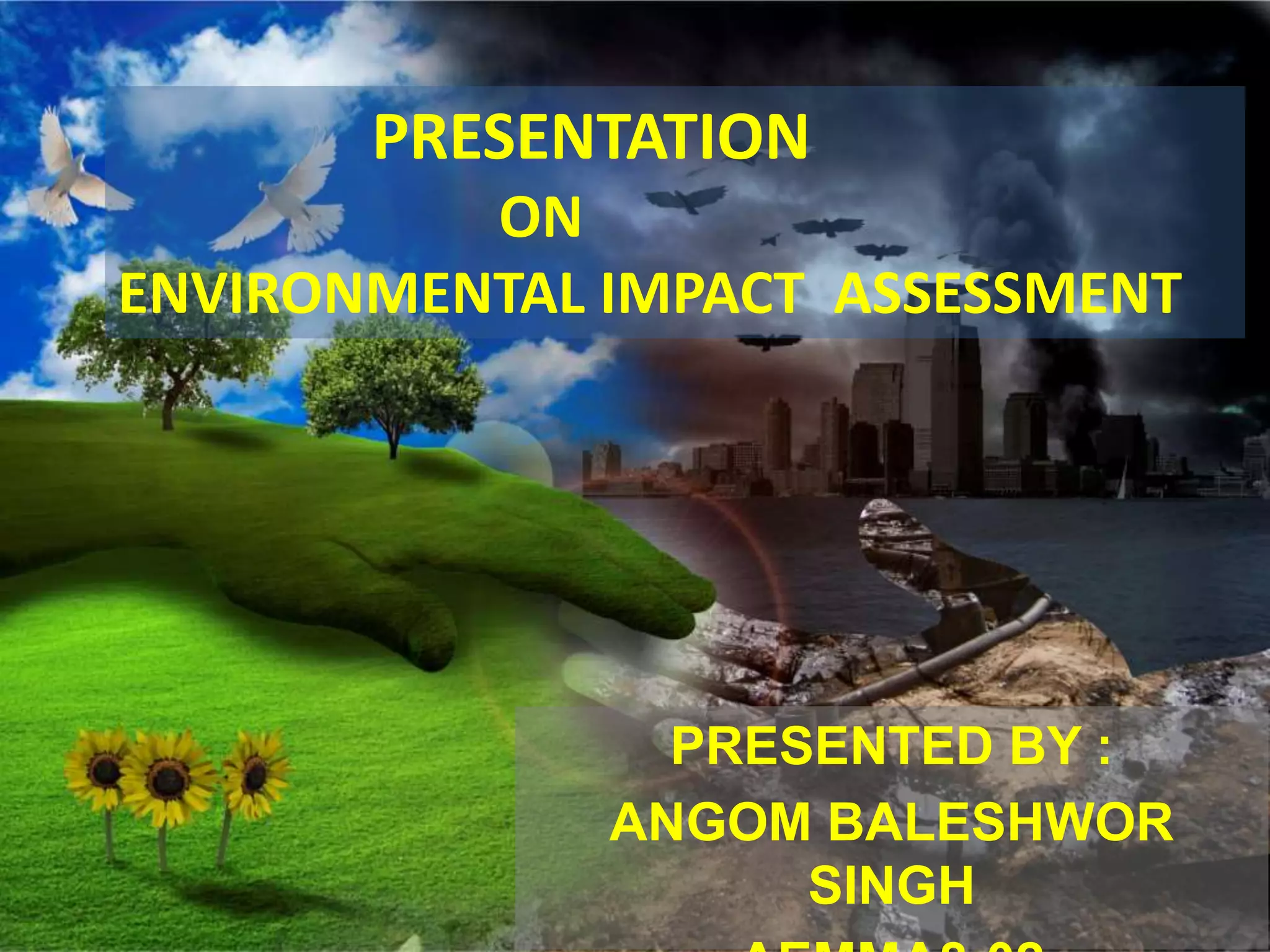
PRESENTATION
ON
ENVIRONMENTAL IMPACT ASSESSMENT
ENVIRONMENTAL IMPACT
ASSESSMENT
• Environmental Impact Assessment (EIA) is a
process of evaluating the likely environmental
impacts of a proposed project or development,
taking into account inter-related socio-economic,
cultural and human-health impacts, both beneficial
and adverse.
• UNEP defines Environmental Impact Assessment
(EIA) as a tool used to identify the environmental,
social and economic impacts of a project prior to
decision-making.
TIMELINE OF EIA
• It was started in USA during early 1970’s in the
form of NEPA(National Environmental Policy
Act).
• Canada, Australia & New Zealand are pionere of
EIA(1973-74).
• In India it was started in 1978-79 by the River
Valley Project.
• In 1986, under EPA, EIA has made mandatory for
29 categories of development activities that
involved investment of 50 crore or more.
Cont…
• In 1994, amendment made again by adding
12 categories.
• In Sept.2006, MoEF notified new EIA
legislation. The notification made mandatory
for the project such as –
• Mining
• Thermal power plant
• River valley
• Infrastructure(road, highway, port, airport)
ENVIRONMENTAL APPRAISAL
COMMITTEES IN INDIA
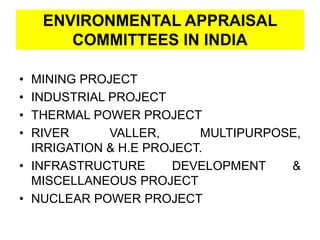
• MINING PROJECT
• INDUSTRIAL PROJECT
• THERMAL POWER PROJECT
• RIVER VALLER, MULTIPURPOSE,
IRRIGATION & H.E PROJECT.
• INFRASTRUCTURE DEVELOPMENT &
MISCELLANEOUS PROJECT
• NUCLEAR POWER PROJECT
SILIENT FEATURES OF 2006
AMMENMENT TO EIA NOTIFICATION
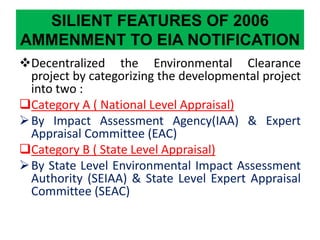
Decentralized the Environmental Clearance
project by categorizing the developmental project
into two :
Category A ( National Level Appraisal)
By Impact Assessment Agency(IAA) & Expert
Appraisal Committee (EAC)
Category B ( State Level Appraisal)
By State Level Environmental Impact Assessment
Authority (SEIAA) & State Level Expert Appraisal
Committee (SEAC)
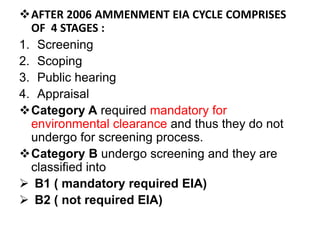
AFTER 2006 AMMENMENT EIA CYCLE COMPRISES
OF 4 STAGES :
1. Screening
2. Scoping
3. Public hearing
4. Appraisal
Category A required mandatory for
environmental clearance and thus they do not
undergo for screening process.
Category B undergo screening and they are
classified into
 B1 ( mandatory required EIA)
 B2 ( not required EIA)
BENEFITS OF EIA
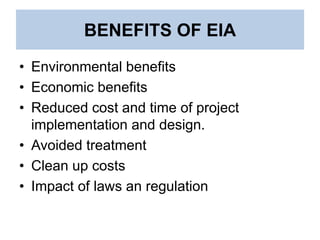
• Environmental benefits
• Economic benefits
• Reduced cost and time of project
implementation and design.
• Avoided treatment
• Clean up costs
• Impact of laws an regulation
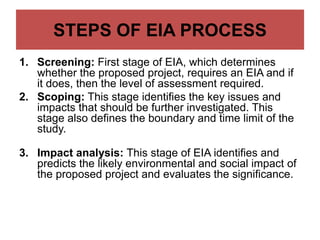
STEPS OF EIA PROCESS
1. Screening: First stage of EIA, which determines
whether the proposed project, requires an EIA and if
it does, then the level of assessment required.
2. Scoping: This stage identifies the key issues and
impacts that should be further investigated. This
stage also defines the boundary and time limit of the
study.
3. Impact analysis: This stage of EIA identifies and
predicts the likely environmental and social impact of
the proposed project and evaluates the significance.
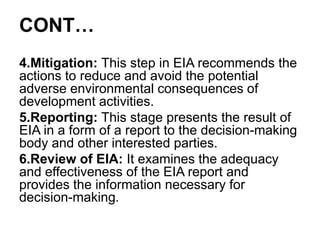
CONT…
4.Mitigation: This step in EIA recommends the
actions to reduce and avoid the potential
adverse environmental consequences of
development activities.
5.Reporting: This stage presents the result of
EIA in a form of a report to the decision-making
body and other interested parties.
6.Review of EIA: It examines the adequacy
and effectiveness of the EIA report and
provides the information necessary for
decision-making.
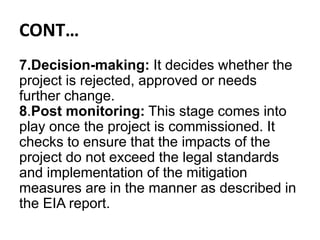
CONT…
7.Decision-making: It decides whether the
project is rejected, approved or needs
further change.
8.Post monitoring: This stage comes into
play once the project is commissioned. It
checks to ensure that the impacts of the
project do not exceed the legal standards
and implementation of the mitigation
measures are in the manner as described in
the EIA report.
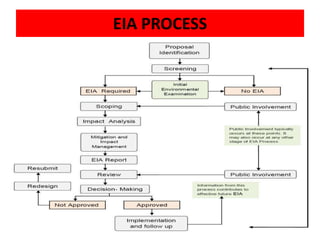
EIA PROCESS
FOLLOW UP
• Precautionary Principle: If an action or policy
has a suspected risk of causing harm to the public,
or environment, in the absence of scientific
consensus, the burden of proof falls on those
taking the action. Part of Rio Declaration & Kyoto
protocol.
• Polluter’s Pay Principle: To make the party
responsible for producing pollution responsible for
paying for the damage done to the natural
environment. Support from OECD and European
community.
CONCLUSION
EIA is a very beneficial step to check,
whether the project is environmental friendly
or not.
Since economic development is result of
interaction between natural resources and
technology supported by designed for
people, so all human activity should be
economic, social and environment friendly
THANK YOU

ENVIRONMENTAL IMPACT ASSESSMENT (EIA)

  • 1.
    PRESENTED BY : ANGOMBALESHWOR SINGH PRESENTATION ON ENVIRONMENTAL IMPACT ASSESSMENT
  • 2.
    ENVIRONMENTAL IMPACT ASSESSMENT • EnvironmentalImpact Assessment (EIA) is a process of evaluating the likely environmental impacts of a proposed project or development, taking into account inter-related socio-economic, cultural and human-health impacts, both beneficial and adverse. • UNEP defines Environmental Impact Assessment (EIA) as a tool used to identify the environmental, social and economic impacts of a project prior to decision-making.
  • 3.
    TIMELINE OF EIA •It was started in USA during early 1970’s in the form of NEPA(National Environmental Policy Act). • Canada, Australia & New Zealand are pionere of EIA(1973-74). • In India it was started in 1978-79 by the River Valley Project. • In 1986, under EPA, EIA has made mandatory for 29 categories of development activities that involved investment of 50 crore or more.
  • 4.
    Cont… • In 1994,amendment made again by adding 12 categories. • In Sept.2006, MoEF notified new EIA legislation. The notification made mandatory for the project such as – • Mining • Thermal power plant • River valley • Infrastructure(road, highway, port, airport)
  • 5.
    ENVIRONMENTAL APPRAISAL COMMITTEES ININDIA • MINING PROJECT • INDUSTRIAL PROJECT • THERMAL POWER PROJECT • RIVER VALLER, MULTIPURPOSE, IRRIGATION & H.E PROJECT. • INFRASTRUCTURE DEVELOPMENT & MISCELLANEOUS PROJECT • NUCLEAR POWER PROJECT
  • 6.
    SILIENT FEATURES OF2006 AMMENMENT TO EIA NOTIFICATION Decentralized the Environmental Clearance project by categorizing the developmental project into two : Category A ( National Level Appraisal) By Impact Assessment Agency(IAA) & Expert Appraisal Committee (EAC) Category B ( State Level Appraisal) By State Level Environmental Impact Assessment Authority (SEIAA) & State Level Expert Appraisal Committee (SEAC)
  • 7.
    AFTER 2006 AMMENMENTEIA CYCLE COMPRISES OF 4 STAGES : 1. Screening 2. Scoping 3. Public hearing 4. Appraisal Category A required mandatory for environmental clearance and thus they do not undergo for screening process. Category B undergo screening and they are classified into  B1 ( mandatory required EIA)  B2 ( not required EIA)
  • 8.
    BENEFITS OF EIA •Environmental benefits • Economic benefits • Reduced cost and time of project implementation and design. • Avoided treatment • Clean up costs • Impact of laws an regulation
  • 9.
    STEPS OF EIAPROCESS 1. Screening: First stage of EIA, which determines whether the proposed project, requires an EIA and if it does, then the level of assessment required. 2. Scoping: This stage identifies the key issues and impacts that should be further investigated. This stage also defines the boundary and time limit of the study. 3. Impact analysis: This stage of EIA identifies and predicts the likely environmental and social impact of the proposed project and evaluates the significance.
  • 10.
    CONT… 4.Mitigation: This stepin EIA recommends the actions to reduce and avoid the potential adverse environmental consequences of development activities. 5.Reporting: This stage presents the result of EIA in a form of a report to the decision-making body and other interested parties. 6.Review of EIA: It examines the adequacy and effectiveness of the EIA report and provides the information necessary for decision-making.
  • 11.
    CONT… 7.Decision-making: It decideswhether the project is rejected, approved or needs further change. 8.Post monitoring: This stage comes into play once the project is commissioned. It checks to ensure that the impacts of the project do not exceed the legal standards and implementation of the mitigation measures are in the manner as described in the EIA report.
  • 12.
  • 13.
    FOLLOW UP • PrecautionaryPrinciple: If an action or policy has a suspected risk of causing harm to the public, or environment, in the absence of scientific consensus, the burden of proof falls on those taking the action. Part of Rio Declaration & Kyoto protocol. • Polluter’s Pay Principle: To make the party responsible for producing pollution responsible for paying for the damage done to the natural environment. Support from OECD and European community.
  • 14.
    CONCLUSION EIA is avery beneficial step to check, whether the project is environmental friendly or not. Since economic development is result of interaction between natural resources and technology supported by designed for people, so all human activity should be economic, social and environment friendly
  • 15.