
Use of Forensics to Identify 
Sources of Methane 
Presented by: Court Sandau, PhD, PChem 
November 15, 2007 
1 
Air and Waste Management Association’s 
Vapour Intrusion – A Rapidly Developing Environmental Challenge
Environmental Forensic Investigation 
“The application of scientific methods used to 
identify the origin and timing of a contaminant 
release” 
www.chemistry-matters.com 
2
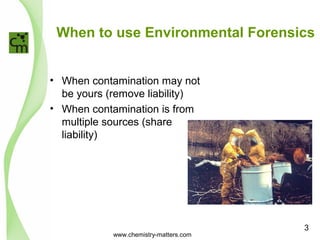
When to use Environmental Forensics 
• When contamination may not 
be yours (remove liability) 
• When contamination is from 
multiple sources (share 
liability) 
www.chemistry-matters.com 
3
Implicate or Vindicate? 
• It may demonstrate your own 
responsibility 
• It may show dual responsibility 
(share the liability) 
• It may vindicate a party 
completely 
www.chemistry-matters.com 
4
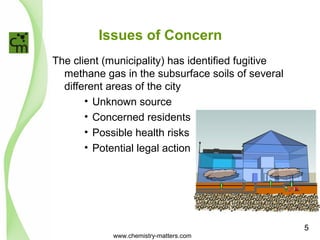
Issues of Concern 
The client (municipality) has identified fugitive 
methane gas in the subsurface soils of several 
different areas of the city 
• Unknown source 
• Concerned residents 
• Possible health risks 
• Potential legal action 
www.chemistry-matters.com 
5
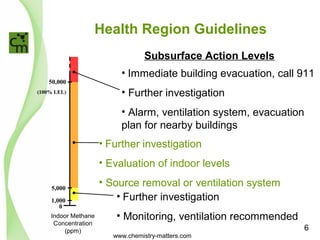
Health Region Guidelines 
Subsurface Action Levels 
• Immediate building evacuation, call 911 
• Further investigation 
• Alarm, ventilation system, evacuation 
plan for nearby buildings 
• Further investigation 
• Evaluation of indoor levels 
• Source removal or ventilation system 
• Further investigation 
• Monitoring, ventilation recommended 
50,000 
(100% LEL) 
5,000 
1,000 
0 
Indoor Methane 
Concentration 
(ppm) 
www.chemistry-matters.com 
6
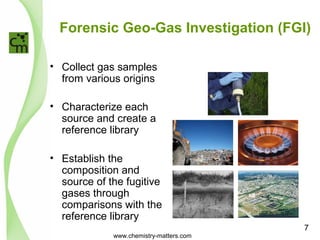
Forensic Geo-Gas Investigation (FGI) 
• Collect gas samples 
from various origins 
• Characterize each 
source and create a 
reference library 
• Establish the 
composition and 
source of the fugitive 
gases through 
comparisons with the 
reference library 
www.chemistry-matters.com 
7
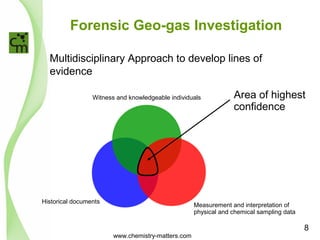
Forensic Geo-gas Investigation 
Multidisciplinary Approach to develop lines of 
evidence 
Witness and knowledgeable individuals Area of highest 
Measurement and interpretation of 
physical and chemical sampling data 
Historical documents 
confidence 
www.chemistry-matters.com 
8
Witness and Knowledgeable 
Individuals 
• Interview 
knowledgeable people 
regarding 
circumstances 
surrounding events 
and non-events 
www.chemistry-matters.com 
9
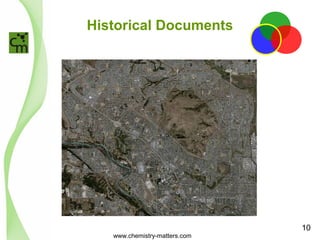
Historical Documents 
www.chemistry-matters.com 
10
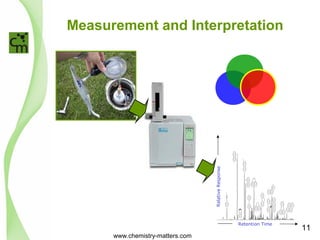
Measurement and Interpretation 
Retention Time 
Relative Response 
S 
S 
www.chemistry-matters.com 
11
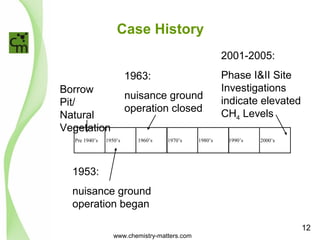
Case History 
1963: 
nuisance ground 
operation closed 
Pre 1940’s 1950’s 1960’s 1970’s 1980’s 1990’s 2000’s 
1953: 
nuisance ground 
operation began 
2001-2005: 
Phase I&II Site 
Investigations 
indicate elevated 
CH4 Levels 
Borrow 
Pit/ 
Natural 
Vegetation 
www.chemistry-matters.com 
12
Investigation 
• Sampling location chosen based on historical data 
• 1L gas samples taken from 4 sample locations 
• Tiered Forensic Approach adopted to identify 
potential sources 
www.chemistry-matters.com 
13
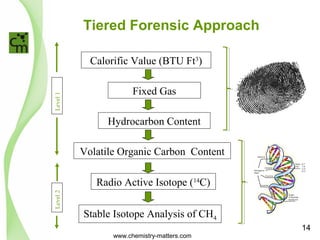
Tiered Forensic Approach 
Calorific Value (BTU Ft3) 
Hydrocarbon Content 
Volatile Organic Carbon Content 
Level 1 
Fixed Gas 
Radio Active Isotope (14C) 
Stable Isotope Analysis of CH4 
Level 2 
www.chemistry-matters.com 
14
QA-QC 
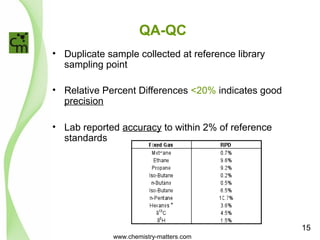
• Duplicate sample collected at reference library 
sampling point 
• Relative Percent Differences <20% indicates good 
precision 
• Lab reported accuracy to within 2% of reference 
standards 
www.chemistry-matters.com 
15
Results 
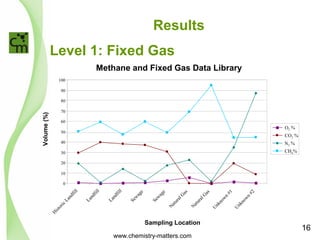
Level 1: Fixed Gas 
Methane and Fixed Gas Data Library 
100 
90 
80 
70 
60 
50 
40 
30 
20 
10 
0 
Historic Landfill 
Landfill 
Landfill 
Sewage 
Sewage 
Natural Gas 
Natural Gas 
Unknown #1 
Unknown #2 
Sampling Location 
Volume (%) 
O2 % 
CO2 % 
N2 % 
CH4% 
www.chemistry-matters.com 
16
Results 
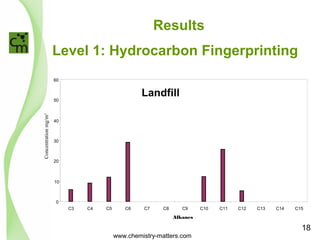
Level 1: Hydrocarbon Fingerprinting 
60 
50 
40 
30 
20 
10 
0 
C3 C4 C5 C6 C7 C8 C9 C10 C11 C12 C13 C14 C15 
Alkane 
s 
Concentration mg/m3 
Natural Gas 
www.chemistry-matters.com 
17
Results 
Level 1: Hydrocarbon Fingerprinting 
60 
50 
40 
30 
20 
10 
0 
C3 C4 C5 C6 C7 C8 C9 C10 C11 C12 C13 C14 C15 
Alkanes 
Concentration mg/m3 
Landfill 
www.chemistry-matters.com 
18
Results 
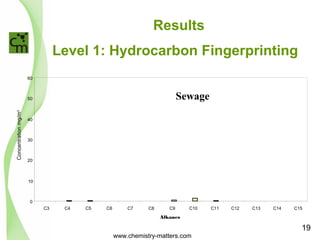
Level 1: Hydrocarbon Fingerprinting 
60 
50 
40 
30 
20 
10 
0 
C3 C4 C5 C6 C7 C8 C9 C10 C11 C12 C13 C14 C15 
Alkanes 
Concentration mg/m3 
Sewage 
www.chemistry-matters.com 
19
Results 
Level 1: Hydrocarbon Fingerprinting 
60 
50 
40 
30 
20 
10 
0 
C3 C4 C5 C6 C7 C8 C9 C10 C11 C12 C13 C14 C15 
Alkanes 
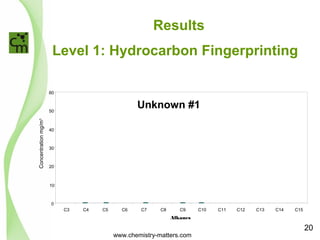
Concentration mg/m3 
Unknown #1 
www.chemistry-matters.com 
20
Results 
Level 1: Hydrocarbon Fingerprinting 
60 
50 
40 
30 
20 
10 
0 
C3 C4 C5 C6 C7 C8 C9 C10 C11 C12 C13 C14 C15 
Alkanes 
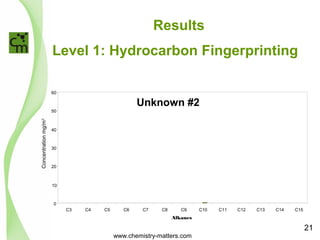
Concentration mg/m3 
Unknown #2 
www.chemistry-matters.com 
21
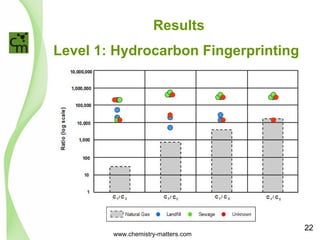
Results 
Level 1: Hydrocarbon Fingerprinting 
www.chemistry-matters.com 
22
Results 
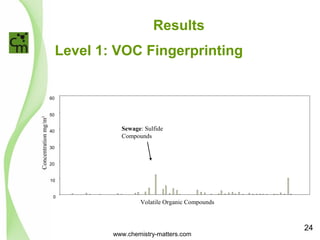
Level 1: VOC Fingerprinting 
60 
50 
40 
30 
20 
10 
0 
Volatile Organic Compounds 
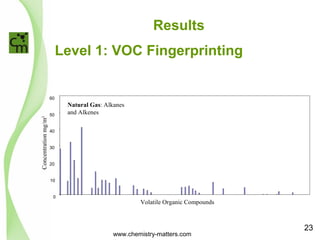
Concentration mg/m3 
Natural Gas: Alkanes 
and Alkenes 
www.chemistry-matters.com 
23
Results 
Level 1: VOC Fingerprinting 
60 
50 
40 
30 
20 
10 
0 
Volatile Organic Compounds 
Concentration mg/m3 
Sewage: Sulfide 
Compounds 
www.chemistry-matters.com 
24
Results 
Level 1: VOC Fingerprinting 
60 
50 
40 
30 
20 
10 
0 
Volatile Organic Compounds 
Concentration mg/m3 
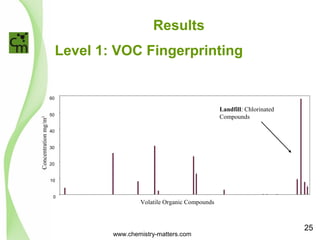
Landfill: Chlorinated 
Compounds 
www.chemistry-matters.com 
25
Results 
Level 1: VOC Fingerprinting 
60 
50 
40 
30 
20 
10 
0 
Volatile Organic Compounds 
Concentration mg/m3 
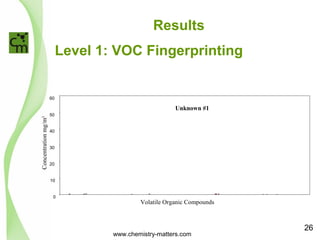
Unknown #1 
www.chemistry-matters.com 
26
Results 
Level 1: VOC Fingerprinting 
60 
50 
40 
30 
20 
10 
0 
Volatile Organic Compounds 
Concentration mg/m3 
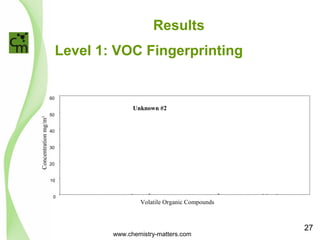
Unknown #2 
www.chemistry-matters.com 
27
Summary of Level 1 Findings 
• 2 locations had elevated levels of CH4 
• Based on calorific and fixed gas data 
Thermogenic sources were ruled out 
• Unable to differentiate landfill, sewage sources 
using level 1 investigation 
• Need to progress to Level 2 
www.chemistry-matters.com 
28
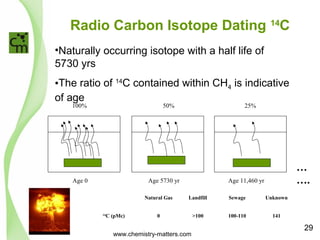
Radio Carbon Isotope Dating 14C 
•Naturally occurring isotope with a half life of 
5730 yrs 
•The ratio of 14C contained within CH4 is indicative 
of age 
50% 
Age 5730 yr 
100% 
Age 0 
…… 
. 
25% 
Age 11,460 yr 
Natural Gas Landfill Sewage Unknown 
14C (pMc) 0 >100 100-110 141 
www.chemistry-matters.com 
29
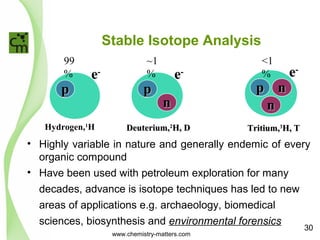
Stable Isotope Analysis 
99 
% 
pp 
ee-- 
Hydrogen,1H 
nn 
~1 
% 
pp 
ee-- 
DDeeuutteerriiuumm,,22HH,, DD 
<1 
% 
pp nn 
nn 
ee-- 
TTrriittiiuumm,,33HH,, TT 
• Highly variable in nature and generally endemic of every 
organic compound 
• Have been used with petroleum exploration for many 
decades, advance is isotope techniques has led to new 
areas of applications e.g. archaeology, biomedical 
sciences, biosynthesis and environmental forensics 
www.chemistry-matters.com 
30
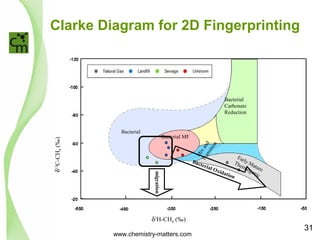
Clarke Diagram for 2D Fingerprinting 
d13C-CH4 (‰) 
Bacterial MF 
d2H-CH4 (‰) 
Bacterial 
Carbonate 
Reduction 
Bacterial 
Mix and 
Transition 
Early Mature 
Thermogenic 
migration 
Bacterial Oxidation 
www.chemistry-matters.com 
31
Combination of Techniques 
Unknown 
Landfill 
Migration will cause a change in methane 
concentration but not a large isotopic shift 
d13C-CH4 (‰) 
C1/[C2+C3] 
Sewage 
Plant 
Sewage 
Plant 
Unknown 
Landfill 
Historic 
Landfill 
Natural Gas 
Natural Gas 
Bacterial consumption of Methane will cause a 
reduction in Methane concentration and 
isotopic shift 
Migration 
Oxidation 
Migration 
www.chemistry-matters.com 
32
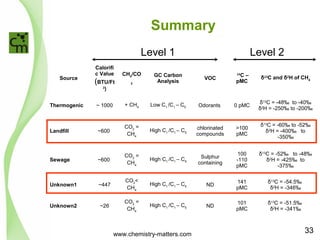
Summary 
Source 
Calorifi 
c Value 
(BTU/Ft 
3) 
Level 1 Level 2 
CH4/CO 
2 
GC Carbon 
Analysis VOC 14C – 
pMC δ13C and δ2H of CH4 
Thermogenic ~ 1000 + CH4 Low C1 /C1 – C5 Odorants 0 pMC δ13C = -48‰ to -40‰ 
δ2H = -250‰ to -200‰ 
Landfill ~600 
CO2 = 
CH4 
High C1 /C1 – C5 
chlorinated 
compounds 
>100 
pMC 
δ13C = -60‰ to -52‰ 
δ2H = -400‰ to 
-350‰ 
Sewage ~600 
CO2 = 
CH4 
High C1 /C1 – C5 
Sulphur 
containing 
100 
-110 
pMC 
δ13C = -52‰ to -48‰ 
δ2H = -425‰ to 
-375‰ 
Unknown1 ~447 
CO2< 
CH4 
High C1 /C1 – C5 ND 141 
pMC 
δ13C = -54.5‰ 
δ2H = -346‰ 
Unknown2 ~26 
CO2 = 
CH4 
High C1 /C1 – C5 ND 101 
pMC 
δ13C = -51.5‰ 
δ2H = -341‰ 
www.chemistry-matters.com 33
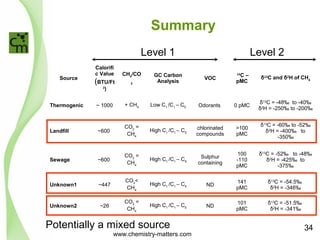
Summary 
Source 
Calorifi 
c Value 
(BTU/Ft 
3) 
Level 1 Level 2 
CH4/CO 
2 
GC Carbon 
Analysis VOC 14C – 
pMC δ13C and δ2H of CH4 
Thermogenic ~ 1000 + CH4 Low C1 /C1 – C5 Odorants 0 pMC δ13C = -48‰ to -40‰ 
δ2H = -250‰ to -200‰ 
Landfill ~600 
CO2 = 
CH4 
High C1 /C1 – C5 
chlorinated 
compounds 
>100 
pMC 
δ13C = -60‰ to -52‰ 
δ2H = -400‰ to 
-350‰ 
Sewage ~600 
CO2 = 
CH4 
High C1 /C1 – C5 
Sulphur 
containing 
100 
-110 
pMC 
δ13C = -52‰ to -48‰ 
δ2H = -425‰ to 
-375‰ 
Unknown1 ~447 
CO2< 
CH4 
High C1 /C1 – C5 ND 141 
pMC 
δ13C = -54.5‰ 
δ2H = -346‰ 
Unknown2 ~26 
CO2 = 
CH4 
High C1 /C1 – C5 ND 101 
pMC 
δ13C = -51.5‰ 
δ2H = -341‰ 
Potentially a mixed source 
www.chemistry-matters.com 
34
Conclusion 
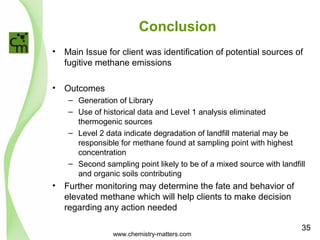
• Main Issue for client was identification of potential sources of 
fugitive methane emissions 
• Outcomes 
– Generation of Library 
– Use of historical data and Level 1 analysis eliminated 
thermogenic sources 
– Level 2 data indicate degradation of landfill material may be 
responsible for methane found at sampling point with highest 
concentration 
– Second sampling point likely to be of a mixed source with landfill 
and organic soils contributing 
• Further monitoring may determine the fate and behavior of 
elevated methane which will help clients to make decision 
regarding any action needed 
www.chemistry-matters.com 
35

Environmental forensics for methane source identification

  • 1.
    Use of Forensicsto Identify Sources of Methane Presented by: Court Sandau, PhD, PChem November 15, 2007 1 Air and Waste Management Association’s Vapour Intrusion – A Rapidly Developing Environmental Challenge
  • 2.
    Environmental Forensic Investigation “The application of scientific methods used to identify the origin and timing of a contaminant release” www.chemistry-matters.com 2
  • 3.
    When to useEnvironmental Forensics • When contamination may not be yours (remove liability) • When contamination is from multiple sources (share liability) www.chemistry-matters.com 3
  • 4.
    Implicate or Vindicate? • It may demonstrate your own responsibility • It may show dual responsibility (share the liability) • It may vindicate a party completely www.chemistry-matters.com 4
  • 5.
    Issues of Concern The client (municipality) has identified fugitive methane gas in the subsurface soils of several different areas of the city • Unknown source • Concerned residents • Possible health risks • Potential legal action www.chemistry-matters.com 5
  • 6.
    Health Region Guidelines Subsurface Action Levels • Immediate building evacuation, call 911 • Further investigation • Alarm, ventilation system, evacuation plan for nearby buildings • Further investigation • Evaluation of indoor levels • Source removal or ventilation system • Further investigation • Monitoring, ventilation recommended 50,000 (100% LEL) 5,000 1,000 0 Indoor Methane Concentration (ppm) www.chemistry-matters.com 6
  • 7.
    Forensic Geo-Gas Investigation(FGI) • Collect gas samples from various origins • Characterize each source and create a reference library • Establish the composition and source of the fugitive gases through comparisons with the reference library www.chemistry-matters.com 7
  • 8.
    Forensic Geo-gas Investigation Multidisciplinary Approach to develop lines of evidence Witness and knowledgeable individuals Area of highest Measurement and interpretation of physical and chemical sampling data Historical documents confidence www.chemistry-matters.com 8
  • 9.
    Witness and Knowledgeable Individuals • Interview knowledgeable people regarding circumstances surrounding events and non-events www.chemistry-matters.com 9
  • 10.
  • 11.
    Measurement and Interpretation Retention Time Relative Response S S www.chemistry-matters.com 11
  • 12.
    Case History 1963: nuisance ground operation closed Pre 1940’s 1950’s 1960’s 1970’s 1980’s 1990’s 2000’s 1953: nuisance ground operation began 2001-2005: Phase I&II Site Investigations indicate elevated CH4 Levels Borrow Pit/ Natural Vegetation www.chemistry-matters.com 12
  • 13.
    Investigation • Samplinglocation chosen based on historical data • 1L gas samples taken from 4 sample locations • Tiered Forensic Approach adopted to identify potential sources www.chemistry-matters.com 13
  • 14.
    Tiered Forensic Approach Calorific Value (BTU Ft3) Hydrocarbon Content Volatile Organic Carbon Content Level 1 Fixed Gas Radio Active Isotope (14C) Stable Isotope Analysis of CH4 Level 2 www.chemistry-matters.com 14
  • 15.
    QA-QC • Duplicatesample collected at reference library sampling point • Relative Percent Differences <20% indicates good precision • Lab reported accuracy to within 2% of reference standards www.chemistry-matters.com 15
  • 16.
    Results Level 1:Fixed Gas Methane and Fixed Gas Data Library 100 90 80 70 60 50 40 30 20 10 0 Historic Landfill Landfill Landfill Sewage Sewage Natural Gas Natural Gas Unknown #1 Unknown #2 Sampling Location Volume (%) O2 % CO2 % N2 % CH4% www.chemistry-matters.com 16
  • 17.
    Results Level 1:Hydrocarbon Fingerprinting 60 50 40 30 20 10 0 C3 C4 C5 C6 C7 C8 C9 C10 C11 C12 C13 C14 C15 Alkane s Concentration mg/m3 Natural Gas www.chemistry-matters.com 17
  • 18.
    Results Level 1:Hydrocarbon Fingerprinting 60 50 40 30 20 10 0 C3 C4 C5 C6 C7 C8 C9 C10 C11 C12 C13 C14 C15 Alkanes Concentration mg/m3 Landfill www.chemistry-matters.com 18
  • 19.
    Results Level 1:Hydrocarbon Fingerprinting 60 50 40 30 20 10 0 C3 C4 C5 C6 C7 C8 C9 C10 C11 C12 C13 C14 C15 Alkanes Concentration mg/m3 Sewage www.chemistry-matters.com 19
  • 20.
    Results Level 1:Hydrocarbon Fingerprinting 60 50 40 30 20 10 0 C3 C4 C5 C6 C7 C8 C9 C10 C11 C12 C13 C14 C15 Alkanes Concentration mg/m3 Unknown #1 www.chemistry-matters.com 20
  • 21.
    Results Level 1:Hydrocarbon Fingerprinting 60 50 40 30 20 10 0 C3 C4 C5 C6 C7 C8 C9 C10 C11 C12 C13 C14 C15 Alkanes Concentration mg/m3 Unknown #2 www.chemistry-matters.com 21
  • 22.
    Results Level 1:Hydrocarbon Fingerprinting www.chemistry-matters.com 22
  • 23.
    Results Level 1:VOC Fingerprinting 60 50 40 30 20 10 0 Volatile Organic Compounds Concentration mg/m3 Natural Gas: Alkanes and Alkenes www.chemistry-matters.com 23
  • 24.
    Results Level 1:VOC Fingerprinting 60 50 40 30 20 10 0 Volatile Organic Compounds Concentration mg/m3 Sewage: Sulfide Compounds www.chemistry-matters.com 24
  • 25.
    Results Level 1:VOC Fingerprinting 60 50 40 30 20 10 0 Volatile Organic Compounds Concentration mg/m3 Landfill: Chlorinated Compounds www.chemistry-matters.com 25
  • 26.
    Results Level 1:VOC Fingerprinting 60 50 40 30 20 10 0 Volatile Organic Compounds Concentration mg/m3 Unknown #1 www.chemistry-matters.com 26
  • 27.
    Results Level 1:VOC Fingerprinting 60 50 40 30 20 10 0 Volatile Organic Compounds Concentration mg/m3 Unknown #2 www.chemistry-matters.com 27
  • 28.
    Summary of Level1 Findings • 2 locations had elevated levels of CH4 • Based on calorific and fixed gas data Thermogenic sources were ruled out • Unable to differentiate landfill, sewage sources using level 1 investigation • Need to progress to Level 2 www.chemistry-matters.com 28
  • 29.
    Radio Carbon IsotopeDating 14C •Naturally occurring isotope with a half life of 5730 yrs •The ratio of 14C contained within CH4 is indicative of age 50% Age 5730 yr 100% Age 0 …… . 25% Age 11,460 yr Natural Gas Landfill Sewage Unknown 14C (pMc) 0 >100 100-110 141 www.chemistry-matters.com 29
  • 30.
    Stable Isotope Analysis 99 % pp ee-- Hydrogen,1H nn ~1 % pp ee-- DDeeuutteerriiuumm,,22HH,, DD <1 % pp nn nn ee-- TTrriittiiuumm,,33HH,, TT • Highly variable in nature and generally endemic of every organic compound • Have been used with petroleum exploration for many decades, advance is isotope techniques has led to new areas of applications e.g. archaeology, biomedical sciences, biosynthesis and environmental forensics www.chemistry-matters.com 30
  • 31.
    Clarke Diagram for2D Fingerprinting d13C-CH4 (‰) Bacterial MF d2H-CH4 (‰) Bacterial Carbonate Reduction Bacterial Mix and Transition Early Mature Thermogenic migration Bacterial Oxidation www.chemistry-matters.com 31
  • 32.
    Combination of Techniques Unknown Landfill Migration will cause a change in methane concentration but not a large isotopic shift d13C-CH4 (‰) C1/[C2+C3] Sewage Plant Sewage Plant Unknown Landfill Historic Landfill Natural Gas Natural Gas Bacterial consumption of Methane will cause a reduction in Methane concentration and isotopic shift Migration Oxidation Migration www.chemistry-matters.com 32
  • 33.
    Summary Source Calorifi c Value (BTU/Ft 3) Level 1 Level 2 CH4/CO 2 GC Carbon Analysis VOC 14C – pMC δ13C and δ2H of CH4 Thermogenic ~ 1000 + CH4 Low C1 /C1 – C5 Odorants 0 pMC δ13C = -48‰ to -40‰ δ2H = -250‰ to -200‰ Landfill ~600 CO2 = CH4 High C1 /C1 – C5 chlorinated compounds >100 pMC δ13C = -60‰ to -52‰ δ2H = -400‰ to -350‰ Sewage ~600 CO2 = CH4 High C1 /C1 – C5 Sulphur containing 100 -110 pMC δ13C = -52‰ to -48‰ δ2H = -425‰ to -375‰ Unknown1 ~447 CO2< CH4 High C1 /C1 – C5 ND 141 pMC δ13C = -54.5‰ δ2H = -346‰ Unknown2 ~26 CO2 = CH4 High C1 /C1 – C5 ND 101 pMC δ13C = -51.5‰ δ2H = -341‰ www.chemistry-matters.com 33
  • 34.
    Summary Source Calorifi c Value (BTU/Ft 3) Level 1 Level 2 CH4/CO 2 GC Carbon Analysis VOC 14C – pMC δ13C and δ2H of CH4 Thermogenic ~ 1000 + CH4 Low C1 /C1 – C5 Odorants 0 pMC δ13C = -48‰ to -40‰ δ2H = -250‰ to -200‰ Landfill ~600 CO2 = CH4 High C1 /C1 – C5 chlorinated compounds >100 pMC δ13C = -60‰ to -52‰ δ2H = -400‰ to -350‰ Sewage ~600 CO2 = CH4 High C1 /C1 – C5 Sulphur containing 100 -110 pMC δ13C = -52‰ to -48‰ δ2H = -425‰ to -375‰ Unknown1 ~447 CO2< CH4 High C1 /C1 – C5 ND 141 pMC δ13C = -54.5‰ δ2H = -346‰ Unknown2 ~26 CO2 = CH4 High C1 /C1 – C5 ND 101 pMC δ13C = -51.5‰ δ2H = -341‰ Potentially a mixed source www.chemistry-matters.com 34
  • 35.
    Conclusion • MainIssue for client was identification of potential sources of fugitive methane emissions • Outcomes – Generation of Library – Use of historical data and Level 1 analysis eliminated thermogenic sources – Level 2 data indicate degradation of landfill material may be responsible for methane found at sampling point with highest concentration – Second sampling point likely to be of a mixed source with landfill and organic soils contributing • Further monitoring may determine the fate and behavior of elevated methane which will help clients to make decision regarding any action needed www.chemistry-matters.com 35