Application on Semi-aerobic Landfill Technology in in Tropical Climate: Lysimeter experiment of Thailand 
Chart Chiemchaisri, Noppharit Sutthasil, Komsilp Wangyao, Kazuto Endo, Masato Yamada 
Department of Environmental Engineering, Faculty of Engineering, Kasetsart University, 
Joint Graduate School of Energy and Environment, King Mongkut’s University of Technology Thonburi, 
Research Center for Material Cycles and Waste Management, National Institute for Environmental Studies, Japan
2 
Anaerobic vs Aerobic landfills 
 
Anaerobic (Conventional) Landfill 
 
The stabilization of most organic waste in landfill took place under absence of oxygen. 
 
High organic strength leachate was generated during acid phase followed by long term stabilization in methane phase. 
 
High CH4 and CO2 in gas produced during methane phase 
 
Semi-aerobic (Fukuoka Method) and Aerobic (forced aeration) Landfill 
 
Introduction of air yielding aerobic degradation in some or whole part of waste body. 
 
Acceleration of waste stabilization and improvement of leachate qualities 
 
Reducing CH4 emission
3 
Objective of this research 
 
To investigate the applicability of semi-aerobic landfill technology in tropical climate 
How effective can the air diffuse into the waste body under high moisture condition? 
 
To study the effect of initial waste placement (degree of compaction) and leachate retention on waste stabilization, leachate qualities and gas production in semi-aerobic and anaerobic lysimeters. 
 
To determine methane emission ratio between semi- aerobic and anaerobic conditions 
Methane Correction Factor (MCF) for semi- aerobic landfill.
4 
Methane Correction Factor (MCF) in IPCC Guidelines 
 
MCF indicates degree of anaerobic condition which creates and emits methane gas from solid waste disposal site. 
 
MCF depends on design and operating condition of the landfills. It can also change with time. 
 
IPCC proposed the following default MCF for different types of landfills 
Type of Site 
Methane Correction Factor (MCF) Default Values 
Managed – Anaerobic 
1.0 
Managed - Semi-Aerobic 
0.5 
Unmanaged – Deep (>5 m deep) 
and/or high water Table 
0.4 
Unmanaged – Shallow (<5 m deep) 
0.8 
Uncategorised SWDS 
0.6
5 
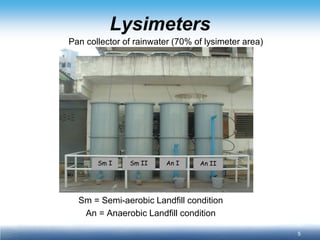
Lysimeters 
Sm = Semi-aerobic Landfill condition 
An = Anaerobic Landfill condition 
Sm I 
Sm II 
An I 
An II 
Pan collector of rainwater (70% of lysimeter area)
6 
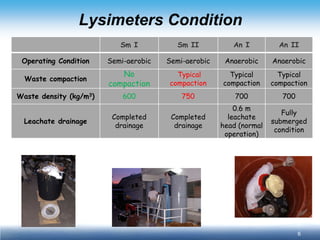
Lysimeters Condition 
Sm I 
Sm II 
An I 
An II 
Operating Condition 
Semi-aerobic 
Semi-aerobic 
Anaerobic 
Anaerobic 
Waste compaction 
No compaction 
Typical compaction 
Typical compaction 
Typical compaction 
Waste density (kg/m3) 
600 
750 
700 
700 
Leachate drainage 
Completed 
drainage 
Completed 
drainage 
0.6 m leachate head (normal operation) 
Fully submerged condition
7 
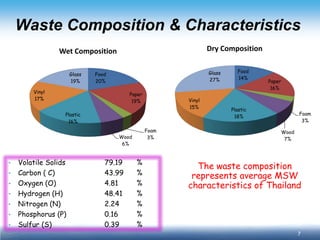
Waste Composition & Characteristics 
Food 20% 
Paper 19% 
Foam 3% 
Wood 6% 
Plastic 16% 
Vinyl 17% 
Glass 19% 
Wet Composition 
Food 14% 
Paper 16% 
Foam 3% 
Wood 7% 
Plastic 18% 
Vinyl 15% 
Glass 27% 
Dry Composition 
The waste composition represents average MSW characteristics of Thailand 
• 
Volatile Solids 79.19 % 
• 
Carbon ( C) 43.99 % 
• 
Oxygen (O) 4.81 % 
• 
Hydrogen (H) 48.41 % 
• 
Nitrogen (N) 2.24 % 
• 
Phosphorus (P) 0.16 % 
• 
Sulfur (S) 0.39 %
8 
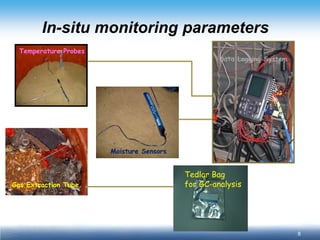
In-situ monitoring parameters 
Temperature Probes 
Gas Extraction Tube 
Moisture Sensors 
Data Logging System 
Tedlar Bag 
for GC-analysis
9 
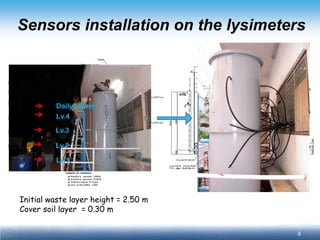
Sensors installation on the lysimeters 
Daily Cover 
Lv.4 
Lv.3 
Lv.2 
Lv.1 
Initial waste layer height = 2.50 m 
Cover soil layer = 0.30 m
10 
Sampling, Measurement & Analysis 
Sample 
frequency 
Gas composition (CH4, CO2, O2, N2) 
Once a week 
Leachate (pH, EC, BOD, COD, TOC NH4+, TKN, NO3, TP) 
Once a week 
Gas emission (CH4, CO2) 
Once a month 
Close Flux Chamber Method 
Estimation of MCF based on methane ratio in landfill gas MCF = 1 where %CH4/(%CH4 + %CO2) ≥ 0.6 MCF = [%CH4/(%CH4 + %CO2)]/0.6 where CH4/(%CH4 + %CO2) < 0.6 
Gas Emission based on close flux 
measurement 
F = ρ VΔC/ AΔt 
where F = gas flux, g/m2/h 
ρ = gas density, g/m3 
V = volume of chamber, m3 
A = area of chamber, m2 
ΔC = gas concentration difference 
(volume fraction) 
Δt = time, h
11 
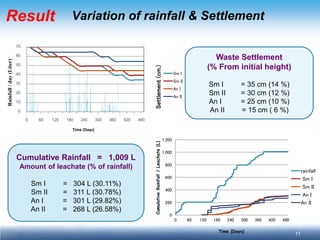
Variation of rainfall & Settlement 
Result 
Sm I 
Sm II 
An I 
An II 
Settlement (cm.) 
Waste Settlement 
(% From initial height) 
Sm I = 35 cm (14 %) 
Sm II = 30 cm (12 %) 
An I = 25 cm (10 %) 
An II = 15 cm ( 6 %) 
Cumulative Rainfall = 1,009 L Amount of leachate (% of rainfall) Sm I = 304 L (30.11%) Sm II = 311 L (30.78%) An I = 301 L (29.82%) An II = 268 L (26.58%) 
0 
200 
400 
600 
800 
1,000 
1,200 
0 
60 
120 
180 
240 
300 
360 
420 
480 
Cumulative Rainfall / Leachate (L) 
rainfall 
Sm I 
Sm II 
An I 
An II 
Time (Days) 
0 
10 
20 
30 
40 
50 
60 
70 
0 
60 
120 
180 
240 
300 
360 
420 
480 
Time (Days) 
Rainfall / day (Liter)
12 
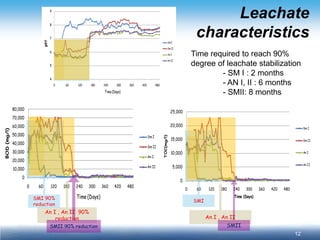
Leachate characteristics 
05,00010,00015,00020,00025,000060120180240300360420480 TOC(mg/l) Sm ISm IIAn IAn IITime (Days) 010,00020,00030,00040,00050,00060,00070,00080,000060120180240300360420480 BOD (mg/l) Sm ISm IIAn IAn IITime (Days) 456789060120180240300360420480 pH Sm ISm IIAn IAn IITime (Days) 
SMI 90% reduction 
SMI 
An I , An II 90% reduction 
An I , An II 
SMII 90% reduction 
SMII 
Time required to reach 90% 
degree of leachate stabilization 
- SM I : 2 months 
- AN I, II : 6 months 
- SMII: 8 months
13 
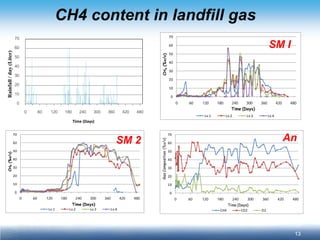
CH4 content in landfill gas 
010203040506070060120180240300360420480Lv.1Lv.2Lv.3Lv.4 CH4(%v/v) Time (Days) 
SM I 
0 
10 
20 
30 
40 
50 
60 
70 
0 
60 
120 
180 
240 
300 
360 
420 
480 
Time (Days) 
Rainfall / day (Liter) 
010203040506070060120180240300360420480Lv.1Lv.2Lv.3Lv.4 CH4(%v/v) Time (Days) 010203040506070060120180240300360420480CH4CO2O2 Gas Composition(%v/v) Time (Days) 
SM 2 
An
14 
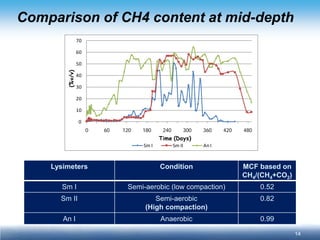
Comparison of CH4 content at mid-depth 
010203040506070060120180240300360420480Sm ISm IIAn I (%v/v) Time (Days) 
Lysimeters 
Condition 
MCF based on 
CH4/(CH4+CO2) 
Sm I 
Semi-aerobic (low compaction) 
0.52 
Sm II 
Semi-aerobic 
(High compaction) 
0.82 
An I 
Anaerobic 
0.99
15 
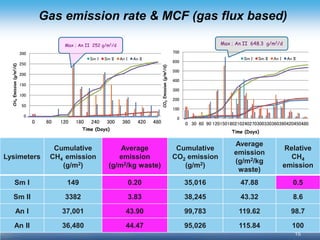
Gas emission rate & MCF (gas flux based) 
Lysimeters 
Cumulative CH4 emission (g/m2) 
Average emission 
(g/m2/kg waste) 
Cumulative CO2 emission (g/m2) 
Average emission 
(g/m2/kg waste) 
Relative CH4 emission 
Sm I 
149 
0.20 
35,016 
47.88 
0.5 
Sm II 
3382 
3.83 
38,245 
43.32 
8.6 
An I 
37,001 
43.90 
99,783 
119.62 
98.7 
An II 
36,480 
44.47 
95,026 
115.84 
100 
Max ; An II 252 g/m2/d 
Max ; An II 648.3 g/m2/d 
0 
50 
100 
150 
200 
250 
300 
0 
60 
120 
180 
240 
300 
360 
420 
480 
Sm I 
Sm II 
An I 
An II 
Time (Days) 
CH4 Emission (g/m2/d) 
0 
100 
200 
300 
400 
500 
600 
700 
0 
30 
60 
90 
120 
150 
180 
210 
240 
270 
300 
330 
360 
390 
420 
450 
480 
Sm I 
Sm II 
An I 
An II 
Time (Days) 
CO2 Emission (g/m2/d)
16 
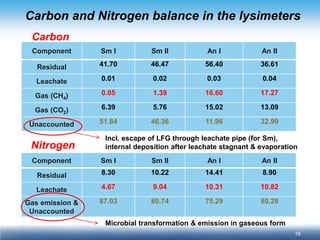
Carbon and Nitrogen balance in the lysimeters 
Component 
Sm I 
Sm II 
An I 
An II 
Residual 
41.70 
46.47 
56.40 
36.61 
Leachate 
0.01 
0.02 
0.03 
0.04 
Gas (CH4) 
0.05 
1.39 
16.60 
17.27 
Gas (CO2) 
6.39 
5.76 
15.02 
13.09 
Unaccounted 
51.84 
46.36 
11.96 
32.99 
Carbon 
Nitrogen 
Component 
Sm I 
Sm II 
An I 
An II 
Residual 
8.30 
10.22 
14.41 
8.90 
Leachate 
4.67 
9.04 
10.31 
10.82 
Gas emission & Unaccounted 
87.03 
80.74 
75.29 
80.28 
Incl. escape of LFG through leachate pipe (for Sm), 
internal deposition after leachate stagnant & evaporation 
Microbial transformation & emission in gaseous form
17 
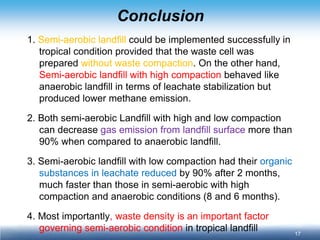
Conclusion 
1. Semi-aerobic landfill could be implemented successfully in tropical condition provided that the waste cell was prepared without waste compaction. On the other hand, Semi-aerobic landfill with high compaction behaved like anaerobic landfill in terms of leachate stabilization but produced lower methane emission. 
2. Both semi-aerobic Landfill with high and low compaction can decrease gas emission from landfill surface more than 90% when compared to anaerobic landfill. 
3. Semi-aerobic landfill with low compaction had their organic substances in leachate reduced by 90% after 2 months, much faster than those in semi-aerobic with high compaction and anaerobic conditions (8 and 6 months). 
4. Most importantly, waste density is an important factor governing semi-aerobic condition in tropical landfill
18 
Future research needs 
1. Investigation of optimum aeration rate and operating condition for inducing natural ventilation into semi-aerobic landfill in tropical climate (wet and dry season). 
2. Investigation of possibility to introduce bulking materials or using existing specific waste components in semi-aerobic landfill for promotion of natural ventilation. 
3. Investigation of nitrous oxide emission rate and its seasonal variation from semi-aerobic landfill operated in tropical climate.
This research work is carried out under NIES-KMUTT-KU collaboration research laboratory with financial support from Kasetsart University Research and Development Institute (KURDI) 
Acknowledgement
Thank you for your attention

Application on Semi-aerobic Landfill. Technology in in Tropical Climate: Lysimeter experiment of Thailand (SWGA Chart Chiemchaisri)

  • 1.
    Application on Semi-aerobicLandfill Technology in in Tropical Climate: Lysimeter experiment of Thailand Chart Chiemchaisri, Noppharit Sutthasil, Komsilp Wangyao, Kazuto Endo, Masato Yamada Department of Environmental Engineering, Faculty of Engineering, Kasetsart University, Joint Graduate School of Energy and Environment, King Mongkut’s University of Technology Thonburi, Research Center for Material Cycles and Waste Management, National Institute for Environmental Studies, Japan
  • 2.
    2 Anaerobic vsAerobic landfills  Anaerobic (Conventional) Landfill  The stabilization of most organic waste in landfill took place under absence of oxygen.  High organic strength leachate was generated during acid phase followed by long term stabilization in methane phase.  High CH4 and CO2 in gas produced during methane phase  Semi-aerobic (Fukuoka Method) and Aerobic (forced aeration) Landfill  Introduction of air yielding aerobic degradation in some or whole part of waste body.  Acceleration of waste stabilization and improvement of leachate qualities  Reducing CH4 emission
  • 3.
    3 Objective ofthis research  To investigate the applicability of semi-aerobic landfill technology in tropical climate How effective can the air diffuse into the waste body under high moisture condition?  To study the effect of initial waste placement (degree of compaction) and leachate retention on waste stabilization, leachate qualities and gas production in semi-aerobic and anaerobic lysimeters.  To determine methane emission ratio between semi- aerobic and anaerobic conditions Methane Correction Factor (MCF) for semi- aerobic landfill.
  • 4.
    4 Methane CorrectionFactor (MCF) in IPCC Guidelines  MCF indicates degree of anaerobic condition which creates and emits methane gas from solid waste disposal site.  MCF depends on design and operating condition of the landfills. It can also change with time.  IPCC proposed the following default MCF for different types of landfills Type of Site Methane Correction Factor (MCF) Default Values Managed – Anaerobic 1.0 Managed - Semi-Aerobic 0.5 Unmanaged – Deep (>5 m deep) and/or high water Table 0.4 Unmanaged – Shallow (<5 m deep) 0.8 Uncategorised SWDS 0.6
  • 5.
    5 Lysimeters Sm= Semi-aerobic Landfill condition An = Anaerobic Landfill condition Sm I Sm II An I An II Pan collector of rainwater (70% of lysimeter area)
  • 6.
    6 Lysimeters Condition Sm I Sm II An I An II Operating Condition Semi-aerobic Semi-aerobic Anaerobic Anaerobic Waste compaction No compaction Typical compaction Typical compaction Typical compaction Waste density (kg/m3) 600 750 700 700 Leachate drainage Completed drainage Completed drainage 0.6 m leachate head (normal operation) Fully submerged condition
  • 7.
    7 Waste Composition& Characteristics Food 20% Paper 19% Foam 3% Wood 6% Plastic 16% Vinyl 17% Glass 19% Wet Composition Food 14% Paper 16% Foam 3% Wood 7% Plastic 18% Vinyl 15% Glass 27% Dry Composition The waste composition represents average MSW characteristics of Thailand • Volatile Solids 79.19 % • Carbon ( C) 43.99 % • Oxygen (O) 4.81 % • Hydrogen (H) 48.41 % • Nitrogen (N) 2.24 % • Phosphorus (P) 0.16 % • Sulfur (S) 0.39 %
  • 8.
    8 In-situ monitoringparameters Temperature Probes Gas Extraction Tube Moisture Sensors Data Logging System Tedlar Bag for GC-analysis
  • 9.
    9 Sensors installationon the lysimeters Daily Cover Lv.4 Lv.3 Lv.2 Lv.1 Initial waste layer height = 2.50 m Cover soil layer = 0.30 m
  • 10.
    10 Sampling, Measurement& Analysis Sample frequency Gas composition (CH4, CO2, O2, N2) Once a week Leachate (pH, EC, BOD, COD, TOC NH4+, TKN, NO3, TP) Once a week Gas emission (CH4, CO2) Once a month Close Flux Chamber Method Estimation of MCF based on methane ratio in landfill gas MCF = 1 where %CH4/(%CH4 + %CO2) ≥ 0.6 MCF = [%CH4/(%CH4 + %CO2)]/0.6 where CH4/(%CH4 + %CO2) < 0.6 Gas Emission based on close flux measurement F = ρ VΔC/ AΔt where F = gas flux, g/m2/h ρ = gas density, g/m3 V = volume of chamber, m3 A = area of chamber, m2 ΔC = gas concentration difference (volume fraction) Δt = time, h
  • 11.
    11 Variation ofrainfall & Settlement Result Sm I Sm II An I An II Settlement (cm.) Waste Settlement (% From initial height) Sm I = 35 cm (14 %) Sm II = 30 cm (12 %) An I = 25 cm (10 %) An II = 15 cm ( 6 %) Cumulative Rainfall = 1,009 L Amount of leachate (% of rainfall) Sm I = 304 L (30.11%) Sm II = 311 L (30.78%) An I = 301 L (29.82%) An II = 268 L (26.58%) 0 200 400 600 800 1,000 1,200 0 60 120 180 240 300 360 420 480 Cumulative Rainfall / Leachate (L) rainfall Sm I Sm II An I An II Time (Days) 0 10 20 30 40 50 60 70 0 60 120 180 240 300 360 420 480 Time (Days) Rainfall / day (Liter)
  • 12.
    12 Leachate characteristics 05,00010,00015,00020,00025,000060120180240300360420480 TOC(mg/l) Sm ISm IIAn IAn IITime (Days) 010,00020,00030,00040,00050,00060,00070,00080,000060120180240300360420480 BOD (mg/l) Sm ISm IIAn IAn IITime (Days) 456789060120180240300360420480 pH Sm ISm IIAn IAn IITime (Days) SMI 90% reduction SMI An I , An II 90% reduction An I , An II SMII 90% reduction SMII Time required to reach 90% degree of leachate stabilization - SM I : 2 months - AN I, II : 6 months - SMII: 8 months
  • 13.
    13 CH4 contentin landfill gas 010203040506070060120180240300360420480Lv.1Lv.2Lv.3Lv.4 CH4(%v/v) Time (Days) SM I 0 10 20 30 40 50 60 70 0 60 120 180 240 300 360 420 480 Time (Days) Rainfall / day (Liter) 010203040506070060120180240300360420480Lv.1Lv.2Lv.3Lv.4 CH4(%v/v) Time (Days) 010203040506070060120180240300360420480CH4CO2O2 Gas Composition(%v/v) Time (Days) SM 2 An
  • 14.
    14 Comparison ofCH4 content at mid-depth 010203040506070060120180240300360420480Sm ISm IIAn I (%v/v) Time (Days) Lysimeters Condition MCF based on CH4/(CH4+CO2) Sm I Semi-aerobic (low compaction) 0.52 Sm II Semi-aerobic (High compaction) 0.82 An I Anaerobic 0.99
  • 15.
    15 Gas emissionrate & MCF (gas flux based) Lysimeters Cumulative CH4 emission (g/m2) Average emission (g/m2/kg waste) Cumulative CO2 emission (g/m2) Average emission (g/m2/kg waste) Relative CH4 emission Sm I 149 0.20 35,016 47.88 0.5 Sm II 3382 3.83 38,245 43.32 8.6 An I 37,001 43.90 99,783 119.62 98.7 An II 36,480 44.47 95,026 115.84 100 Max ; An II 252 g/m2/d Max ; An II 648.3 g/m2/d 0 50 100 150 200 250 300 0 60 120 180 240 300 360 420 480 Sm I Sm II An I An II Time (Days) CH4 Emission (g/m2/d) 0 100 200 300 400 500 600 700 0 30 60 90 120 150 180 210 240 270 300 330 360 390 420 450 480 Sm I Sm II An I An II Time (Days) CO2 Emission (g/m2/d)
  • 16.
    16 Carbon andNitrogen balance in the lysimeters Component Sm I Sm II An I An II Residual 41.70 46.47 56.40 36.61 Leachate 0.01 0.02 0.03 0.04 Gas (CH4) 0.05 1.39 16.60 17.27 Gas (CO2) 6.39 5.76 15.02 13.09 Unaccounted 51.84 46.36 11.96 32.99 Carbon Nitrogen Component Sm I Sm II An I An II Residual 8.30 10.22 14.41 8.90 Leachate 4.67 9.04 10.31 10.82 Gas emission & Unaccounted 87.03 80.74 75.29 80.28 Incl. escape of LFG through leachate pipe (for Sm), internal deposition after leachate stagnant & evaporation Microbial transformation & emission in gaseous form
  • 17.
    17 Conclusion 1.Semi-aerobic landfill could be implemented successfully in tropical condition provided that the waste cell was prepared without waste compaction. On the other hand, Semi-aerobic landfill with high compaction behaved like anaerobic landfill in terms of leachate stabilization but produced lower methane emission. 2. Both semi-aerobic Landfill with high and low compaction can decrease gas emission from landfill surface more than 90% when compared to anaerobic landfill. 3. Semi-aerobic landfill with low compaction had their organic substances in leachate reduced by 90% after 2 months, much faster than those in semi-aerobic with high compaction and anaerobic conditions (8 and 6 months). 4. Most importantly, waste density is an important factor governing semi-aerobic condition in tropical landfill
  • 18.
    18 Future researchneeds 1. Investigation of optimum aeration rate and operating condition for inducing natural ventilation into semi-aerobic landfill in tropical climate (wet and dry season). 2. Investigation of possibility to introduce bulking materials or using existing specific waste components in semi-aerobic landfill for promotion of natural ventilation. 3. Investigation of nitrous oxide emission rate and its seasonal variation from semi-aerobic landfill operated in tropical climate.
  • 19.
    This research workis carried out under NIES-KMUTT-KU collaboration research laboratory with financial support from Kasetsart University Research and Development Institute (KURDI) Acknowledgement
  • 20.
    Thank you foryour attention