1
UNIVERSITI TEKNOLOGI MALAYSIA
INSTITUTE OF ENVIRONMENTAL & WATER RESOURCE MANAGEMENT (IPASA)
Lecture notes on Environmental Chemistry by Prof. Zaini Ujang. zaini@utm.my
Environmental Chemistry
Menu 1: Introduction
(3 hr)
Dato’ Prof. Zaini Ujang
Ph.D., PE (M), C.Eng.(UK), C.W.E.M. (UK), C.Sci. (UK)
Institute of Environmental & Water Resource Management
Universiti Teknologi Malaysia
Email: zaini@utm.my
http://www.fkkksa.utm.my/staff/zaini
2
UNIVERSITI TEKNOLOGI MALAYSIA
INSTITUTE OF ENVIRONMENTAL & WATER RESOURCE MANAGEMENT (IPASA)
Lecture notes on Environmental Chemistry by Prof. Zaini Ujang. zaini@utm.my
Environmental Chemistry
Lecture outline
Pollution perspective
Major pollutants
Effects of pollutants on
ecosystems
Fate and behavior of chemicals in
environment
Environmental toxicity testing
Environmental monitoring
Instrumentations
3
UNIVERSITI TEKNOLOGI MALAYSIA
INSTITUTE OF ENVIRONMENTAL & WATER RESOURCE MANAGEMENT (IPASA)
Lecture notes on Environmental Chemistry by Prof. Zaini Ujang. zaini@utm.my
Introduction
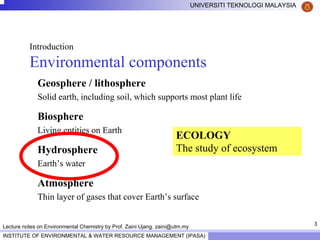
Environmental components
Geosphere / lithosphere
Solid earth, including soil, which supports most plant life
Biosphere
Living entities on Earth
Hydrosphere
Earth’s water
Atmosphere
Thin layer of gases that cover Earth’s surface
ECOLOGY
The study of ecosystem
4
UNIVERSITI TEKNOLOGI MALAYSIA
INSTITUTE OF ENVIRONMENTAL & WATER RESOURCE MANAGEMENT (IPASA)
Lecture notes on Environmental Chemistry by Prof. Zaini Ujang. zaini@utm.my
Ecosystem
• Encompasses both living (biotic) and non-living
(abiotic) components of an area – a combination of the
community and physical and chemical components of
the local environment.
• The major feature of this ecological level is the strong
interaction between the biotic and abiotic components
• Major processes:
• Nutrient recycling
• Energy flow
5
UNIVERSITI TEKNOLOGI MALAYSIA
INSTITUTE OF ENVIRONMENTAL & WATER RESOURCE MANAGEMENT (IPASA)
Lecture notes on Environmental Chemistry by Prof. Zaini Ujang. zaini@utm.my
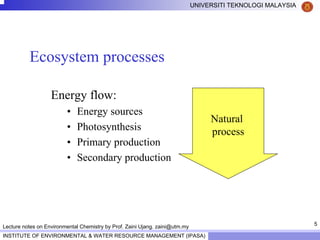
Ecosystem processes
Energy flow:
• Energy sources
• Photosynthesis
• Primary production
• Secondary production
Natural
process
6
UNIVERSITI TEKNOLOGI MALAYSIA
INSTITUTE OF ENVIRONMENTAL & WATER RESOURCE MANAGEMENT (IPASA)
Lecture notes on Environmental Chemistry by Prof. Zaini Ujang. zaini@utm.my
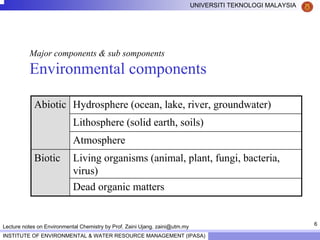
Major components & sub somponents
Environmental components
Hydrosphere (ocean, lake, river, groundwater)
Lithosphere (solid earth, soils)
Atmosphere
Living organisms (animal, plant, fungi, bacteria,
virus)
Biotic
Dead organic matters
Abiotic
7
UNIVERSITI TEKNOLOGI MALAYSIA
INSTITUTE OF ENVIRONMENTAL & WATER RESOURCE MANAGEMENT (IPASA)
Lecture notes on Environmental Chemistry by Prof. Zaini Ujang. zaini@utm.my
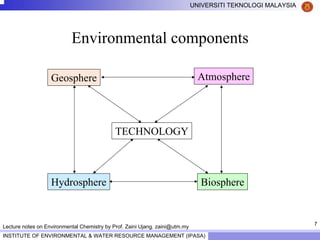
Environmental components
Geosphere
Hydrosphere
Atmosphere
Biosphere
TECHNOLOGY
8
UNIVERSITI TEKNOLOGI MALAYSIA
INSTITUTE OF ENVIRONMENTAL & WATER RESOURCE MANAGEMENT (IPASA)
Lecture notes on Environmental Chemistry by Prof. Zaini Ujang. zaini@utm.my
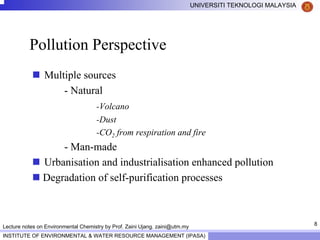
Pollution Perspective
Multiple sources
- Natural
-Volcano
-Dust
-CO2 from respiration and fire
- Man-made
Urbanisation and industrialisation enhanced pollution
Degradation of self-purification processes
9
UNIVERSITI TEKNOLOGI MALAYSIA
INSTITUTE OF ENVIRONMENTAL & WATER RESOURCE MANAGEMENT (IPASA)
Lecture notes on Environmental Chemistry by Prof. Zaini Ujang. zaini@utm.my
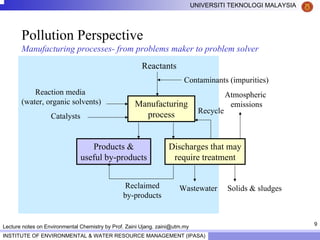
Pollution Perspective
Manufacturing processes- from problems maker to problem solver
Manufacturing
process
Reactants
Contaminants (impurities)
Reaction media
(water, organic solvents)
Catalysts
Products &
useful by-products
Discharges that may
require treatment
Reclaimed
by-products
Wastewater Solids & sludges
Recycle
Atmospheric
emissions
10
UNIVERSITI TEKNOLOGI MALAYSIA
INSTITUTE OF ENVIRONMENTAL & WATER RESOURCE MANAGEMENT (IPASA)
Lecture notes on Environmental Chemistry by Prof. Zaini Ujang. zaini@utm.my
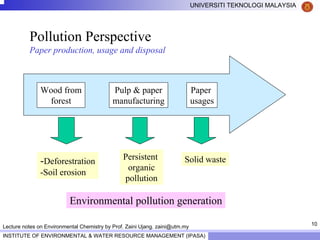
Pollution Perspective
Paper production, usage and disposal
Wood from
forest
Pulp & paper
manufacturing
Paper
usages
Persistent
organic
pollution
-Deforestration
-Soil erosion
Solid waste
Environmental pollution generation
11
UNIVERSITI TEKNOLOGI MALAYSIA
INSTITUTE OF ENVIRONMENTAL & WATER RESOURCE MANAGEMENT (IPASA)
Lecture notes on Environmental Chemistry by Prof. Zaini Ujang. zaini@utm.my
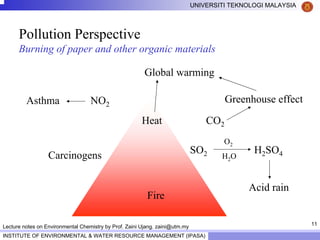
Pollution Perspective
Burning of paper and other organic materials
Global warming
Fire
Carcinogens
Asthma NO2
Heat CO2
Greenhouse effect
SO2 H2SO4
Acid rain
O2
H2O
12
UNIVERSITI TEKNOLOGI MALAYSIA
INSTITUTE OF ENVIRONMENTAL & WATER RESOURCE MANAGEMENT (IPASA)
Lecture notes on Environmental Chemistry by Prof. Zaini Ujang. zaini@utm.my
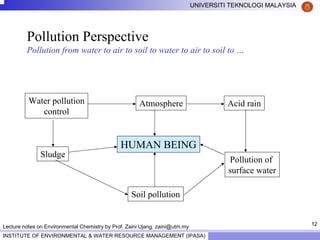
Pollution Perspective
Pollution from water to air to soil to water to air to soil to …
Water pollution
control
Sludge
Atmosphere Acid rain
Pollution of
surface water
Soil pollution
HUMAN BEING
13
UNIVERSITI TEKNOLOGI MALAYSIA
INSTITUTE OF ENVIRONMENTAL & WATER RESOURCE MANAGEMENT (IPASA)
Lecture notes on Environmental Chemistry by Prof. Zaini Ujang. zaini@utm.my
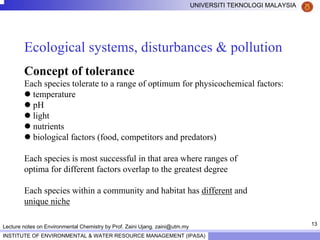
Ecological systems, disturbances & pollution
Concept of tolerance
Each species tolerate to a range of optimum for physicochemical factors:
temperature
pH
light
nutrients
biological factors (food, competitors and predators)
Each species is most successful in that area where ranges of
optima for different factors overlap to the greatest degree
Each species within a community and habitat has different and
unique niche
14
UNIVERSITI TEKNOLOGI MALAYSIA
INSTITUTE OF ENVIRONMENTAL & WATER RESOURCE MANAGEMENT (IPASA)
Lecture notes on Environmental Chemistry by Prof. Zaini Ujang. zaini@utm.my
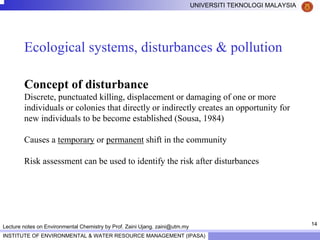
Ecological systems, disturbances & pollution
Concept of disturbance
Discrete, punctuated killing, displacement or damaging of one or more
individuals or colonies that directly or indirectly creates an opportunity for
new individuals to be become established (Sousa, 1984)
Causes a temporary or permanent shift in the community
Risk assessment can be used to identify the risk after disturbances
15
UNIVERSITI TEKNOLOGI MALAYSIA
INSTITUTE OF ENVIRONMENTAL & WATER RESOURCE MANAGEMENT (IPASA)
Lecture notes on Environmental Chemistry by Prof. Zaini Ujang. zaini@utm.my
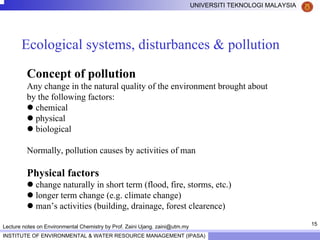
Ecological systems, disturbances & pollution
Concept of pollution
Any change in the natural quality of the environment brought about
by the following factors:
chemical
physical
biological
Normally, pollution causes by activities of man
Physical factors
change naturally in short term (flood, fire, storms, etc.)
longer term change (e.g. climate change)
man’s activities (building, drainage, forest clearence)
16
UNIVERSITI TEKNOLOGI MALAYSIA
INSTITUTE OF ENVIRONMENTAL & WATER RESOURCE MANAGEMENT (IPASA)
Lecture notes on Environmental Chemistry by Prof. Zaini Ujang. zaini@utm.my
Ecological systems, disturbances & pollution
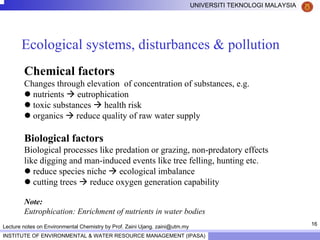
Chemical factors
Changes through elevation of concentration of substances, e.g.
nutrients eutrophication
toxic substances health risk
organics reduce quality of raw water supply
Biological factors
Biological processes like predation or grazing, non-predatory effects
like digging and man-induced events like tree felling, hunting etc.
reduce species niche ecological imbalance
cutting trees reduce oxygen generation capability
Note:
Eutrophication: Enrichment of nutrients in water bodies
17
UNIVERSITI TEKNOLOGI MALAYSIA
INSTITUTE OF ENVIRONMENTAL & WATER RESOURCE MANAGEMENT (IPASA)
Lecture notes on Environmental Chemistry by Prof. Zaini Ujang. zaini@utm.my
Ecological systems, disturbances & pollution
Most pollution, disturbances can be recovered
The ability to recover and rate of recovery are dependent on
the regime of disturbance:
Nature of disturbances
Size of the disturbed area
Magnitude and duration of the event (intensity of disturbing force)
Timing and frequency of the disturbance
Predictability of the disturbance
Turnover rate (average time required to disturb the entire area)
18
UNIVERSITI TEKNOLOGI MALAYSIA
INSTITUTE OF ENVIRONMENTAL & WATER RESOURCE MANAGEMENT (IPASA)
Lecture notes on Environmental Chemistry by Prof. Zaini Ujang. zaini@utm.my
Major pollutants
Water, Atmosphere, Soil
Sulphur dioxide
Nitrogen oxides and nitrate
Sewage
Agricultural waste
Warfare
Pesticides
19
UNIVERSITI TEKNOLOGI MALAYSIA
INSTITUTE OF ENVIRONMENTAL & WATER RESOURCE MANAGEMENT (IPASA)
Lecture notes on Environmental Chemistry by Prof. Zaini Ujang. zaini@utm.my
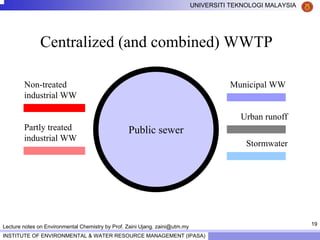
Centralized (and combined) WWTP
Partly treated
industrial WW
Non-treated
industrial WW
Municipal WW
Stormwater
Public sewer
Urban runoff
20
UNIVERSITI TEKNOLOGI MALAYSIA
INSTITUTE OF ENVIRONMENTAL & WATER RESOURCE MANAGEMENT (IPASA)
Lecture notes on Environmental Chemistry by Prof. Zaini Ujang. zaini@utm.my
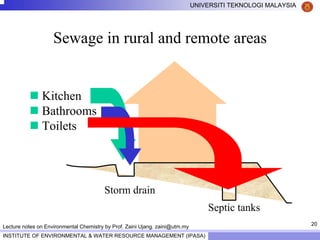
Sewage in rural and remote areas
Kitchen
Bathrooms
Toilets
Storm drain
Septic tanks
21
UNIVERSITI TEKNOLOGI MALAYSIA
INSTITUTE OF ENVIRONMENTAL & WATER RESOURCE MANAGEMENT (IPASA)
Lecture notes on Environmental Chemistry by Prof. Zaini Ujang. zaini@utm.my
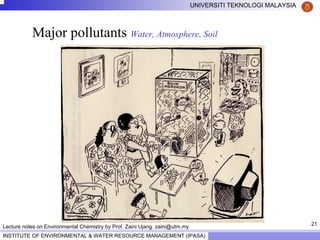
Major pollutants Water, Atmosphere, Soil
22
UNIVERSITI TEKNOLOGI MALAYSIA
INSTITUTE OF ENVIRONMENTAL & WATER RESOURCE MANAGEMENT (IPASA)
Lecture notes on Environmental Chemistry by Prof. Zaini Ujang. zaini@utm.my
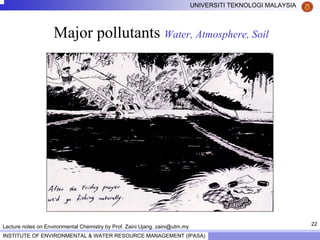
Major pollutants Water, Atmosphere, Soil
23
UNIVERSITI TEKNOLOGI MALAYSIA
INSTITUTE OF ENVIRONMENTAL & WATER RESOURCE MANAGEMENT (IPASA)
Lecture notes on Environmental Chemistry by Prof. Zaini Ujang. zaini@utm.my
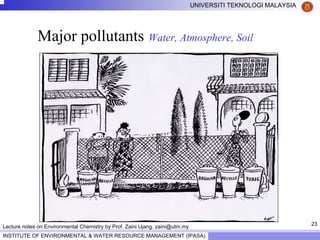
Major pollutants Water, Atmosphere, Soil
24
UNIVERSITI TEKNOLOGI MALAYSIA
INSTITUTE OF ENVIRONMENTAL & WATER RESOURCE MANAGEMENT (IPASA)
Lecture notes on Environmental Chemistry by Prof. Zaini Ujang. zaini@utm.my
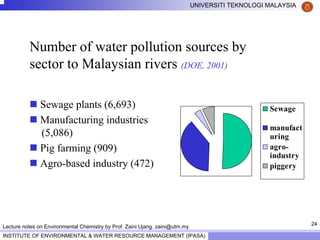
Number of water pollution sources by
sector to Malaysian rivers (DOE, 2001)
Sewage plants (6,693)
Manufacturing industries
(5,086)
Pig farming (909)
Agro-based industry (472)
Sewage
manufact
uring
agro-
industry
piggery
25
UNIVERSITI TEKNOLOGI MALAYSIA
INSTITUTE OF ENVIRONMENTAL & WATER RESOURCE MANAGEMENT (IPASA)
Lecture notes on Environmental Chemistry by Prof. Zaini Ujang. zaini@utm.my
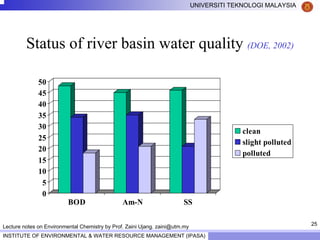
Status of river basin water quality (DOE, 2002)
0
5
10
15
20
25
30
35
40
45
50
BOD Am-N SS
clean
slight polluted
polluted
26
UNIVERSITI TEKNOLOGI MALAYSIA
INSTITUTE OF ENVIRONMENTAL & WATER RESOURCE MANAGEMENT (IPASA)
Lecture notes on Environmental Chemistry by Prof. Zaini Ujang. zaini@utm.my
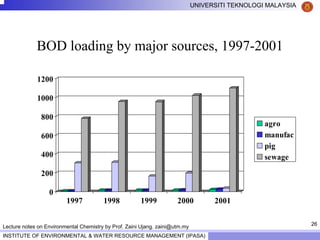
BOD loading by major sources, 1997-2001
0
200
400
600
800
1000
1200
1997 1998 1999 2000 2001
agro
manufac
pig
sewage
27
UNIVERSITI TEKNOLOGI MALAYSIA
INSTITUTE OF ENVIRONMENTAL & WATER RESOURCE MANAGEMENT (IPASA)
Lecture notes on Environmental Chemistry by Prof. Zaini Ujang. zaini@utm.my
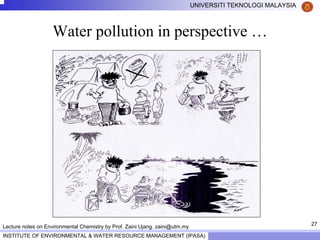
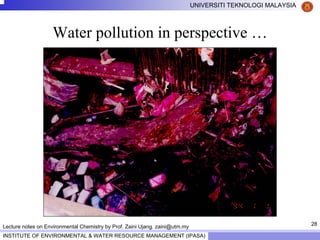
Water pollution in perspective …
28
UNIVERSITI TEKNOLOGI MALAYSIA
INSTITUTE OF ENVIRONMENTAL & WATER RESOURCE MANAGEMENT (IPASA)
Lecture notes on Environmental Chemistry by Prof. Zaini Ujang. zaini@utm.my
Water pollution in perspective …
29
UNIVERSITI TEKNOLOGI MALAYSIA
INSTITUTE OF ENVIRONMENTAL & WATER RESOURCE MANAGEMENT (IPASA)
Lecture notes on Environmental Chemistry by Prof. Zaini Ujang. zaini@utm.my
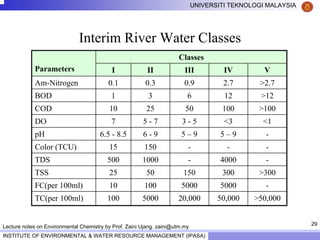
Interim River Water Classes
Classes
Parameters I II III IV V
Am-Nitrogen 0.1 0.3 0.9 2.7 >2.7
BOD 1 3 6 12 >12
COD 10 25 50 100 >100
DO 7 5 - 7 3 - 5 <3 <1
pH 6.5 - 8.5 6 - 9 5 – 9 5 – 9 -
Color (TCU) 15 150 - - -
TDS 500 1000 - 4000 -
TSS 25 50 150 300 >300
FC(per 100ml) 10 100 5000 5000 -
TC(per 100ml) 100 5000 20,000 50,000 >50,000
30
UNIVERSITI TEKNOLOGI MALAYSIA
INSTITUTE OF ENVIRONMENTAL & WATER RESOURCE MANAGEMENT (IPASA)
Lecture notes on Environmental Chemistry by Prof. Zaini Ujang. zaini@utm.my
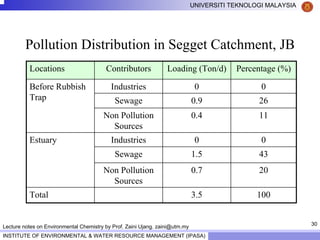
Pollution Distribution in Segget Catchment, JB
Locations Contributors Loading (Ton/d) Percentage (%)
Industries 0 0
Sewage 0.9 26
Non Pollution
Sources
0.4 11
Industries 0 0
Sewage 1.5 43
Non Pollution
Sources
0.7 20
Total 3.5 100
Estuary
Before Rubbish
Trap
31
UNIVERSITI TEKNOLOGI MALAYSIA
INSTITUTE OF ENVIRONMENTAL & WATER RESOURCE MANAGEMENT (IPASA)
Lecture notes on Environmental Chemistry by Prof. Zaini Ujang. zaini@utm.my
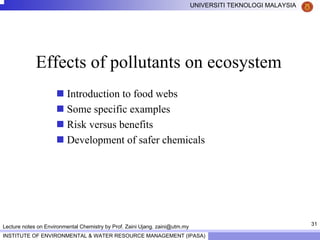
Effects of pollutants on ecosystem
Introduction to food webs
Some specific examples
Risk versus benefits
Development of safer chemicals
32
UNIVERSITI TEKNOLOGI MALAYSIA
INSTITUTE OF ENVIRONMENTAL & WATER RESOURCE MANAGEMENT (IPASA)
Lecture notes on Environmental Chemistry by Prof. Zaini Ujang. zaini@utm.my
Effects of pollutants on ecosystem
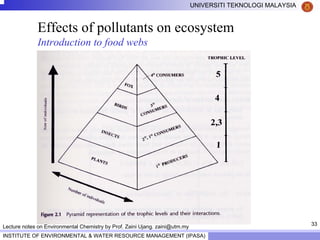
Introduction to food webs
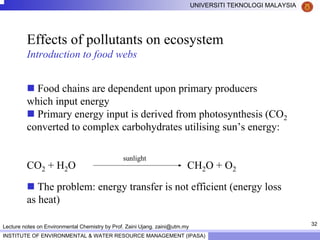
Food chains are dependent upon primary producers
which input energy
Primary energy input is derived from photosynthesis (CO2
converted to complex carbohydrates utilising sun’s energy:
CO2 + H2O CH2O + O2
The problem: energy transfer is not efficient (energy loss
as heat)
sunlight
33
UNIVERSITI TEKNOLOGI MALAYSIA
INSTITUTE OF ENVIRONMENTAL & WATER RESOURCE MANAGEMENT (IPASA)
Lecture notes on Environmental Chemistry by Prof. Zaini Ujang. zaini@utm.my
Effects of pollutants on ecosystem
Introduction to food webs
34
UNIVERSITI TEKNOLOGI MALAYSIA
INSTITUTE OF ENVIRONMENTAL & WATER RESOURCE MANAGEMENT (IPASA)
Lecture notes on Environmental Chemistry by Prof. Zaini Ujang. zaini@utm.my
Effects of pollutants on ecosystem
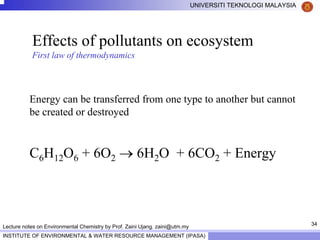
First law of thermodynamics
Energy can be transferred from one type to another but cannot
be created or destroyed
C6H12O6 + 6O2 → 6H2O + 6CO2 + Energy
35
UNIVERSITI TEKNOLOGI MALAYSIA
INSTITUTE OF ENVIRONMENTAL & WATER RESOURCE MANAGEMENT (IPASA)
Lecture notes on Environmental Chemistry by Prof. Zaini Ujang. zaini@utm.my
Effects of pollutants on ecosystem
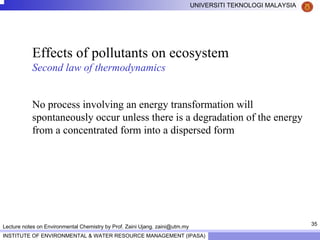
Second law of thermodynamics
No process involving an energy transformation will
spontaneously occur unless there is a degradation of the energy
from a concentrated form into a dispersed form
36
UNIVERSITI TEKNOLOGI MALAYSIA
INSTITUTE OF ENVIRONMENTAL & WATER RESOURCE MANAGEMENT (IPASA)
Lecture notes on Environmental Chemistry by Prof. Zaini Ujang. zaini@utm.my
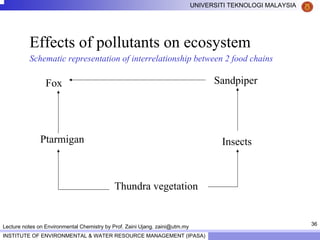
Effects of pollutants on ecosystem
Schematic representation of interrelationship between 2 food chains
SandpiperFox
Ptarmigan Insects
Thundra vegetation
37
UNIVERSITI TEKNOLOGI MALAYSIA
INSTITUTE OF ENVIRONMENTAL & WATER RESOURCE MANAGEMENT (IPASA)
Lecture notes on Environmental Chemistry by Prof. Zaini Ujang. zaini@utm.my
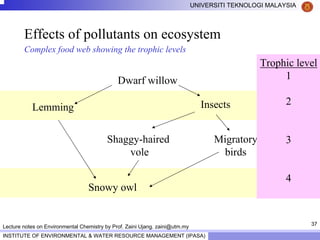
Effects of pollutants on ecosystem
Complex food web showing the trophic levels
Snowy owl
Shaggy-haired
vole
Insects
Dwarf willow
Lemming
Migratory
birds
Trophic level
1
2
3
4
38
UNIVERSITI TEKNOLOGI MALAYSIA
INSTITUTE OF ENVIRONMENTAL & WATER RESOURCE MANAGEMENT (IPASA)
Lecture notes on Environmental Chemistry by Prof. Zaini Ujang. zaini@utm.my
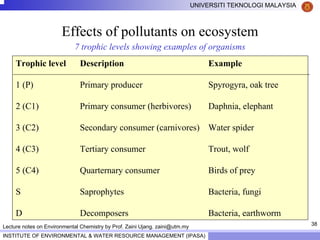
Effects of pollutants on ecosystem
7 trophic levels showing examples of organisms
Trophic level Description Example
1 (P) Primary producer Spyrogyra, oak tree
2 (C1) Primary consumer (herbivores) Daphnia, elephant
3 (C2) Secondary consumer (carnivores) Water spider
4 (C3) Tertiary consumer Trout, wolf
5 (C4) Quarternary consumer Birds of prey
S Saprophytes Bacteria, fungi
D Decomposers Bacteria, earthworm
39
UNIVERSITI TEKNOLOGI MALAYSIA
INSTITUTE OF ENVIRONMENTAL & WATER RESOURCE MANAGEMENT (IPASA)
Lecture notes on Environmental Chemistry by Prof. Zaini Ujang. zaini@utm.my
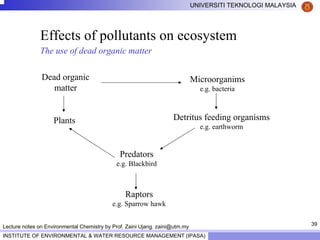
Effects of pollutants on ecosystem
The use of dead organic matter
Dead organic
matter
Microorganims
e.g. bacteria
Detritus feeding organisms
e.g. earthworm
Plants
Predators
e.g. Blackbird
Raptors
e.g. Sparrow hawk
40
UNIVERSITI TEKNOLOGI MALAYSIA
INSTITUTE OF ENVIRONMENTAL & WATER RESOURCE MANAGEMENT (IPASA)
Lecture notes on Environmental Chemistry by Prof. Zaini Ujang. zaini@utm.my
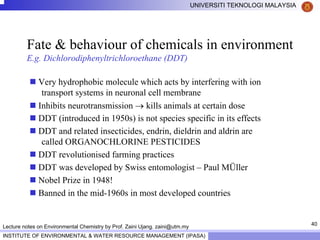
Fate & behaviour of chemicals in environment
E.g. Dichlorodiphenyltrichloroethane (DDT)
Very hydrophobic molecule which acts by interfering with ion
transport systems in neuronal cell membrane
Inhibits neurotransmission → kills animals at certain dose
DDT (introduced in 1950s) is not species specific in its effects
DDT and related insecticides, endrin, dieldrin and aldrin are
called ORGANOCHLORINE PESTICIDES
DDT revolutionised farming practices
DDT was developed by Swiss entomologist – Paul MÜller
Nobel Prize in 1948!
Banned in the mid-1960s in most developed countries
41
UNIVERSITI TEKNOLOGI MALAYSIA
INSTITUTE OF ENVIRONMENTAL & WATER RESOURCE MANAGEMENT (IPASA)
Lecture notes on Environmental Chemistry by Prof. Zaini Ujang. zaini@utm.my
Fate & behavior of chemicals in environment
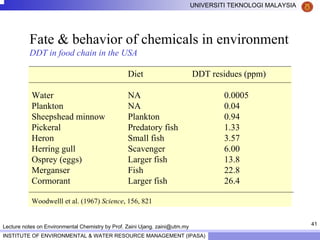
DDT in food chain in the USA
Diet DDT residues (ppm)
Water NA 0.0005
Plankton NA 0.04
Sheepshead minnow Plankton 0.94
Pickeral Predatory fish 1.33
Heron Small fish 3.57
Herring gull Scavenger 6.00
Osprey (eggs) Larger fish 13.8
Merganser Fish 22.8
Cormorant Larger fish 26.4
Woodwelll et al. (1967) Science, 156, 821
42
UNIVERSITI TEKNOLOGI MALAYSIA
INSTITUTE OF ENVIRONMENTAL & WATER RESOURCE MANAGEMENT (IPASA)
Lecture notes on Environmental Chemistry by Prof. Zaini Ujang. zaini@utm.my
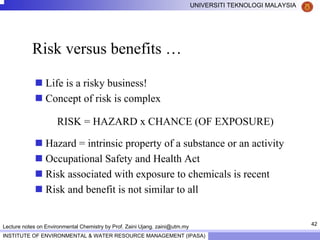
Risk versus benefits …
Life is a risky business!
Concept of risk is complex
RISK = HAZARD x CHANCE (OF EXPOSURE)
Hazard = intrinsic property of a substance or an activity
Occupational Safety and Health Act
Risk associated with exposure to chemicals is recent
Risk and benefit is not similar to all
43
UNIVERSITI TEKNOLOGI MALAYSIA
INSTITUTE OF ENVIRONMENTAL & WATER RESOURCE MANAGEMENT (IPASA)
Lecture notes on Environmental Chemistry by Prof. Zaini Ujang. zaini@utm.my
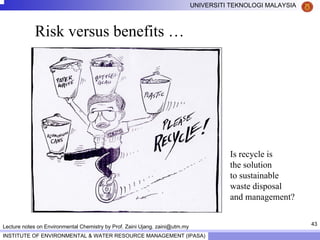
Risk versus benefits …
Is recycle is
the solution
to sustainable
waste disposal
and management?
44
UNIVERSITI TEKNOLOGI MALAYSIA
INSTITUTE OF ENVIRONMENTAL & WATER RESOURCE MANAGEMENT (IPASA)
Lecture notes on Environmental Chemistry by Prof. Zaini Ujang. zaini@utm.my
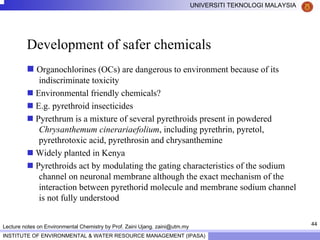
Development of safer chemicals
Organochlorines (OCs) are dangerous to environment because of its
indiscriminate toxicity
Environmental friendly chemicals?
E.g. pyrethroid insecticides
Pyrethrum is a mixture of several pyrethroids present in powdered
Chrysanthemum cinerariaefolium, including pyrethrin, pyretol,
pyrethrotoxic acid, pyrethrosin and chrysanthemine
Widely planted in Kenya
Pyrethroids act by modulating the gating characteristics of the sodium
channel on neuronal membrane although the exact mechanism of the
interaction between pyrethorid molecule and membrane sodium channel
is not fully understood
45
UNIVERSITI TEKNOLOGI MALAYSIA
INSTITUTE OF ENVIRONMENTAL & WATER RESOURCE MANAGEMENT (IPASA)
Lecture notes on Environmental Chemistry by Prof. Zaini Ujang. zaini@utm.my
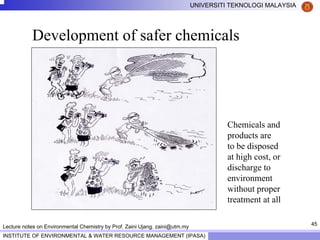
Development of safer chemicals
Chemicals and
products are
to be disposed
at high cost, or
discharge to
environment
without proper
treatment at all
46
UNIVERSITI TEKNOLOGI MALAYSIA
INSTITUTE OF ENVIRONMENTAL & WATER RESOURCE MANAGEMENT (IPASA)
Lecture notes on Environmental Chemistry by Prof. Zaini Ujang. zaini@utm.my
Environmental toxicity testing
Toxicity testing in perspective
Extrapolating the results of toxicity test in rats (& other
animals to humans)
The best is to use human body
Ethical problems, especially in pharmaceutical industry
Scope and limitations
Oestogenicity assay
Toxicity tests on animals and plants
Environmental impacts assessment
47
UNIVERSITI TEKNOLOGI MALAYSIA
INSTITUTE OF ENVIRONMENTAL & WATER RESOURCE MANAGEMENT (IPASA)
Lecture notes on Environmental Chemistry by Prof. Zaini Ujang. zaini@utm.my
Environmental monitoring
Why monitor environmental contaminants
Methods
Meaning of analytical results
Analytical techniques
Identification of environmental contaminants
Inorganic contaminants
Immunoassays

Environmental chemistry lecture

  • 1.
    1 UNIVERSITI TEKNOLOGI MALAYSIA INSTITUTEOF ENVIRONMENTAL & WATER RESOURCE MANAGEMENT (IPASA) Lecture notes on Environmental Chemistry by Prof. Zaini Ujang. zaini@utm.my Environmental Chemistry Menu 1: Introduction (3 hr) Dato’ Prof. Zaini Ujang Ph.D., PE (M), C.Eng.(UK), C.W.E.M. (UK), C.Sci. (UK) Institute of Environmental & Water Resource Management Universiti Teknologi Malaysia Email: zaini@utm.my http://www.fkkksa.utm.my/staff/zaini
  • 2.
    2 UNIVERSITI TEKNOLOGI MALAYSIA INSTITUTEOF ENVIRONMENTAL & WATER RESOURCE MANAGEMENT (IPASA) Lecture notes on Environmental Chemistry by Prof. Zaini Ujang. zaini@utm.my Environmental Chemistry Lecture outline Pollution perspective Major pollutants Effects of pollutants on ecosystems Fate and behavior of chemicals in environment Environmental toxicity testing Environmental monitoring Instrumentations
  • 3.
    3 UNIVERSITI TEKNOLOGI MALAYSIA INSTITUTEOF ENVIRONMENTAL & WATER RESOURCE MANAGEMENT (IPASA) Lecture notes on Environmental Chemistry by Prof. Zaini Ujang. zaini@utm.my Introduction Environmental components Geosphere / lithosphere Solid earth, including soil, which supports most plant life Biosphere Living entities on Earth Hydrosphere Earth’s water Atmosphere Thin layer of gases that cover Earth’s surface ECOLOGY The study of ecosystem
  • 4.
    4 UNIVERSITI TEKNOLOGI MALAYSIA INSTITUTEOF ENVIRONMENTAL & WATER RESOURCE MANAGEMENT (IPASA) Lecture notes on Environmental Chemistry by Prof. Zaini Ujang. zaini@utm.my Ecosystem • Encompasses both living (biotic) and non-living (abiotic) components of an area – a combination of the community and physical and chemical components of the local environment. • The major feature of this ecological level is the strong interaction between the biotic and abiotic components • Major processes: • Nutrient recycling • Energy flow
  • 5.
    5 UNIVERSITI TEKNOLOGI MALAYSIA INSTITUTEOF ENVIRONMENTAL & WATER RESOURCE MANAGEMENT (IPASA) Lecture notes on Environmental Chemistry by Prof. Zaini Ujang. zaini@utm.my Ecosystem processes Energy flow: • Energy sources • Photosynthesis • Primary production • Secondary production Natural process
  • 6.
    6 UNIVERSITI TEKNOLOGI MALAYSIA INSTITUTEOF ENVIRONMENTAL & WATER RESOURCE MANAGEMENT (IPASA) Lecture notes on Environmental Chemistry by Prof. Zaini Ujang. zaini@utm.my Major components & sub somponents Environmental components Hydrosphere (ocean, lake, river, groundwater) Lithosphere (solid earth, soils) Atmosphere Living organisms (animal, plant, fungi, bacteria, virus) Biotic Dead organic matters Abiotic
  • 7.
    7 UNIVERSITI TEKNOLOGI MALAYSIA INSTITUTEOF ENVIRONMENTAL & WATER RESOURCE MANAGEMENT (IPASA) Lecture notes on Environmental Chemistry by Prof. Zaini Ujang. zaini@utm.my Environmental components Geosphere Hydrosphere Atmosphere Biosphere TECHNOLOGY
  • 8.
    8 UNIVERSITI TEKNOLOGI MALAYSIA INSTITUTEOF ENVIRONMENTAL & WATER RESOURCE MANAGEMENT (IPASA) Lecture notes on Environmental Chemistry by Prof. Zaini Ujang. zaini@utm.my Pollution Perspective Multiple sources - Natural -Volcano -Dust -CO2 from respiration and fire - Man-made Urbanisation and industrialisation enhanced pollution Degradation of self-purification processes
  • 9.
    9 UNIVERSITI TEKNOLOGI MALAYSIA INSTITUTEOF ENVIRONMENTAL & WATER RESOURCE MANAGEMENT (IPASA) Lecture notes on Environmental Chemistry by Prof. Zaini Ujang. zaini@utm.my Pollution Perspective Manufacturing processes- from problems maker to problem solver Manufacturing process Reactants Contaminants (impurities) Reaction media (water, organic solvents) Catalysts Products & useful by-products Discharges that may require treatment Reclaimed by-products Wastewater Solids & sludges Recycle Atmospheric emissions
  • 10.
    10 UNIVERSITI TEKNOLOGI MALAYSIA INSTITUTEOF ENVIRONMENTAL & WATER RESOURCE MANAGEMENT (IPASA) Lecture notes on Environmental Chemistry by Prof. Zaini Ujang. zaini@utm.my Pollution Perspective Paper production, usage and disposal Wood from forest Pulp & paper manufacturing Paper usages Persistent organic pollution -Deforestration -Soil erosion Solid waste Environmental pollution generation
  • 11.
    11 UNIVERSITI TEKNOLOGI MALAYSIA INSTITUTEOF ENVIRONMENTAL & WATER RESOURCE MANAGEMENT (IPASA) Lecture notes on Environmental Chemistry by Prof. Zaini Ujang. zaini@utm.my Pollution Perspective Burning of paper and other organic materials Global warming Fire Carcinogens Asthma NO2 Heat CO2 Greenhouse effect SO2 H2SO4 Acid rain O2 H2O
  • 12.
    12 UNIVERSITI TEKNOLOGI MALAYSIA INSTITUTEOF ENVIRONMENTAL & WATER RESOURCE MANAGEMENT (IPASA) Lecture notes on Environmental Chemistry by Prof. Zaini Ujang. zaini@utm.my Pollution Perspective Pollution from water to air to soil to water to air to soil to … Water pollution control Sludge Atmosphere Acid rain Pollution of surface water Soil pollution HUMAN BEING
  • 13.
    13 UNIVERSITI TEKNOLOGI MALAYSIA INSTITUTEOF ENVIRONMENTAL & WATER RESOURCE MANAGEMENT (IPASA) Lecture notes on Environmental Chemistry by Prof. Zaini Ujang. zaini@utm.my Ecological systems, disturbances & pollution Concept of tolerance Each species tolerate to a range of optimum for physicochemical factors: temperature pH light nutrients biological factors (food, competitors and predators) Each species is most successful in that area where ranges of optima for different factors overlap to the greatest degree Each species within a community and habitat has different and unique niche
  • 14.
    14 UNIVERSITI TEKNOLOGI MALAYSIA INSTITUTEOF ENVIRONMENTAL & WATER RESOURCE MANAGEMENT (IPASA) Lecture notes on Environmental Chemistry by Prof. Zaini Ujang. zaini@utm.my Ecological systems, disturbances & pollution Concept of disturbance Discrete, punctuated killing, displacement or damaging of one or more individuals or colonies that directly or indirectly creates an opportunity for new individuals to be become established (Sousa, 1984) Causes a temporary or permanent shift in the community Risk assessment can be used to identify the risk after disturbances
  • 15.
    15 UNIVERSITI TEKNOLOGI MALAYSIA INSTITUTEOF ENVIRONMENTAL & WATER RESOURCE MANAGEMENT (IPASA) Lecture notes on Environmental Chemistry by Prof. Zaini Ujang. zaini@utm.my Ecological systems, disturbances & pollution Concept of pollution Any change in the natural quality of the environment brought about by the following factors: chemical physical biological Normally, pollution causes by activities of man Physical factors change naturally in short term (flood, fire, storms, etc.) longer term change (e.g. climate change) man’s activities (building, drainage, forest clearence)
  • 16.
    16 UNIVERSITI TEKNOLOGI MALAYSIA INSTITUTEOF ENVIRONMENTAL & WATER RESOURCE MANAGEMENT (IPASA) Lecture notes on Environmental Chemistry by Prof. Zaini Ujang. zaini@utm.my Ecological systems, disturbances & pollution Chemical factors Changes through elevation of concentration of substances, e.g. nutrients eutrophication toxic substances health risk organics reduce quality of raw water supply Biological factors Biological processes like predation or grazing, non-predatory effects like digging and man-induced events like tree felling, hunting etc. reduce species niche ecological imbalance cutting trees reduce oxygen generation capability Note: Eutrophication: Enrichment of nutrients in water bodies
  • 17.
    17 UNIVERSITI TEKNOLOGI MALAYSIA INSTITUTEOF ENVIRONMENTAL & WATER RESOURCE MANAGEMENT (IPASA) Lecture notes on Environmental Chemistry by Prof. Zaini Ujang. zaini@utm.my Ecological systems, disturbances & pollution Most pollution, disturbances can be recovered The ability to recover and rate of recovery are dependent on the regime of disturbance: Nature of disturbances Size of the disturbed area Magnitude and duration of the event (intensity of disturbing force) Timing and frequency of the disturbance Predictability of the disturbance Turnover rate (average time required to disturb the entire area)
  • 18.
    18 UNIVERSITI TEKNOLOGI MALAYSIA INSTITUTEOF ENVIRONMENTAL & WATER RESOURCE MANAGEMENT (IPASA) Lecture notes on Environmental Chemistry by Prof. Zaini Ujang. zaini@utm.my Major pollutants Water, Atmosphere, Soil Sulphur dioxide Nitrogen oxides and nitrate Sewage Agricultural waste Warfare Pesticides
  • 19.
    19 UNIVERSITI TEKNOLOGI MALAYSIA INSTITUTEOF ENVIRONMENTAL & WATER RESOURCE MANAGEMENT (IPASA) Lecture notes on Environmental Chemistry by Prof. Zaini Ujang. zaini@utm.my Centralized (and combined) WWTP Partly treated industrial WW Non-treated industrial WW Municipal WW Stormwater Public sewer Urban runoff
  • 20.
    20 UNIVERSITI TEKNOLOGI MALAYSIA INSTITUTEOF ENVIRONMENTAL & WATER RESOURCE MANAGEMENT (IPASA) Lecture notes on Environmental Chemistry by Prof. Zaini Ujang. zaini@utm.my Sewage in rural and remote areas Kitchen Bathrooms Toilets Storm drain Septic tanks
  • 21.
    21 UNIVERSITI TEKNOLOGI MALAYSIA INSTITUTEOF ENVIRONMENTAL & WATER RESOURCE MANAGEMENT (IPASA) Lecture notes on Environmental Chemistry by Prof. Zaini Ujang. zaini@utm.my Major pollutants Water, Atmosphere, Soil
  • 22.
    22 UNIVERSITI TEKNOLOGI MALAYSIA INSTITUTEOF ENVIRONMENTAL & WATER RESOURCE MANAGEMENT (IPASA) Lecture notes on Environmental Chemistry by Prof. Zaini Ujang. zaini@utm.my Major pollutants Water, Atmosphere, Soil
  • 23.
    23 UNIVERSITI TEKNOLOGI MALAYSIA INSTITUTEOF ENVIRONMENTAL & WATER RESOURCE MANAGEMENT (IPASA) Lecture notes on Environmental Chemistry by Prof. Zaini Ujang. zaini@utm.my Major pollutants Water, Atmosphere, Soil
  • 24.
    24 UNIVERSITI TEKNOLOGI MALAYSIA INSTITUTEOF ENVIRONMENTAL & WATER RESOURCE MANAGEMENT (IPASA) Lecture notes on Environmental Chemistry by Prof. Zaini Ujang. zaini@utm.my Number of water pollution sources by sector to Malaysian rivers (DOE, 2001) Sewage plants (6,693) Manufacturing industries (5,086) Pig farming (909) Agro-based industry (472) Sewage manufact uring agro- industry piggery
  • 25.
    25 UNIVERSITI TEKNOLOGI MALAYSIA INSTITUTEOF ENVIRONMENTAL & WATER RESOURCE MANAGEMENT (IPASA) Lecture notes on Environmental Chemistry by Prof. Zaini Ujang. zaini@utm.my Status of river basin water quality (DOE, 2002) 0 5 10 15 20 25 30 35 40 45 50 BOD Am-N SS clean slight polluted polluted
  • 26.
    26 UNIVERSITI TEKNOLOGI MALAYSIA INSTITUTEOF ENVIRONMENTAL & WATER RESOURCE MANAGEMENT (IPASA) Lecture notes on Environmental Chemistry by Prof. Zaini Ujang. zaini@utm.my BOD loading by major sources, 1997-2001 0 200 400 600 800 1000 1200 1997 1998 1999 2000 2001 agro manufac pig sewage
  • 27.
    27 UNIVERSITI TEKNOLOGI MALAYSIA INSTITUTEOF ENVIRONMENTAL & WATER RESOURCE MANAGEMENT (IPASA) Lecture notes on Environmental Chemistry by Prof. Zaini Ujang. zaini@utm.my Water pollution in perspective …
  • 28.
    28 UNIVERSITI TEKNOLOGI MALAYSIA INSTITUTEOF ENVIRONMENTAL & WATER RESOURCE MANAGEMENT (IPASA) Lecture notes on Environmental Chemistry by Prof. Zaini Ujang. zaini@utm.my Water pollution in perspective …
  • 29.
    29 UNIVERSITI TEKNOLOGI MALAYSIA INSTITUTEOF ENVIRONMENTAL & WATER RESOURCE MANAGEMENT (IPASA) Lecture notes on Environmental Chemistry by Prof. Zaini Ujang. zaini@utm.my Interim River Water Classes Classes Parameters I II III IV V Am-Nitrogen 0.1 0.3 0.9 2.7 >2.7 BOD 1 3 6 12 >12 COD 10 25 50 100 >100 DO 7 5 - 7 3 - 5 <3 <1 pH 6.5 - 8.5 6 - 9 5 – 9 5 – 9 - Color (TCU) 15 150 - - - TDS 500 1000 - 4000 - TSS 25 50 150 300 >300 FC(per 100ml) 10 100 5000 5000 - TC(per 100ml) 100 5000 20,000 50,000 >50,000
  • 30.
    30 UNIVERSITI TEKNOLOGI MALAYSIA INSTITUTEOF ENVIRONMENTAL & WATER RESOURCE MANAGEMENT (IPASA) Lecture notes on Environmental Chemistry by Prof. Zaini Ujang. zaini@utm.my Pollution Distribution in Segget Catchment, JB Locations Contributors Loading (Ton/d) Percentage (%) Industries 0 0 Sewage 0.9 26 Non Pollution Sources 0.4 11 Industries 0 0 Sewage 1.5 43 Non Pollution Sources 0.7 20 Total 3.5 100 Estuary Before Rubbish Trap
  • 31.
    31 UNIVERSITI TEKNOLOGI MALAYSIA INSTITUTEOF ENVIRONMENTAL & WATER RESOURCE MANAGEMENT (IPASA) Lecture notes on Environmental Chemistry by Prof. Zaini Ujang. zaini@utm.my Effects of pollutants on ecosystem Introduction to food webs Some specific examples Risk versus benefits Development of safer chemicals
  • 32.
    32 UNIVERSITI TEKNOLOGI MALAYSIA INSTITUTEOF ENVIRONMENTAL & WATER RESOURCE MANAGEMENT (IPASA) Lecture notes on Environmental Chemistry by Prof. Zaini Ujang. zaini@utm.my Effects of pollutants on ecosystem Introduction to food webs Food chains are dependent upon primary producers which input energy Primary energy input is derived from photosynthesis (CO2 converted to complex carbohydrates utilising sun’s energy: CO2 + H2O CH2O + O2 The problem: energy transfer is not efficient (energy loss as heat) sunlight
  • 33.
    33 UNIVERSITI TEKNOLOGI MALAYSIA INSTITUTEOF ENVIRONMENTAL & WATER RESOURCE MANAGEMENT (IPASA) Lecture notes on Environmental Chemistry by Prof. Zaini Ujang. zaini@utm.my Effects of pollutants on ecosystem Introduction to food webs
  • 34.
    34 UNIVERSITI TEKNOLOGI MALAYSIA INSTITUTEOF ENVIRONMENTAL & WATER RESOURCE MANAGEMENT (IPASA) Lecture notes on Environmental Chemistry by Prof. Zaini Ujang. zaini@utm.my Effects of pollutants on ecosystem First law of thermodynamics Energy can be transferred from one type to another but cannot be created or destroyed C6H12O6 + 6O2 → 6H2O + 6CO2 + Energy
  • 35.
    35 UNIVERSITI TEKNOLOGI MALAYSIA INSTITUTEOF ENVIRONMENTAL & WATER RESOURCE MANAGEMENT (IPASA) Lecture notes on Environmental Chemistry by Prof. Zaini Ujang. zaini@utm.my Effects of pollutants on ecosystem Second law of thermodynamics No process involving an energy transformation will spontaneously occur unless there is a degradation of the energy from a concentrated form into a dispersed form
  • 36.
    36 UNIVERSITI TEKNOLOGI MALAYSIA INSTITUTEOF ENVIRONMENTAL & WATER RESOURCE MANAGEMENT (IPASA) Lecture notes on Environmental Chemistry by Prof. Zaini Ujang. zaini@utm.my Effects of pollutants on ecosystem Schematic representation of interrelationship between 2 food chains SandpiperFox Ptarmigan Insects Thundra vegetation
  • 37.
    37 UNIVERSITI TEKNOLOGI MALAYSIA INSTITUTEOF ENVIRONMENTAL & WATER RESOURCE MANAGEMENT (IPASA) Lecture notes on Environmental Chemistry by Prof. Zaini Ujang. zaini@utm.my Effects of pollutants on ecosystem Complex food web showing the trophic levels Snowy owl Shaggy-haired vole Insects Dwarf willow Lemming Migratory birds Trophic level 1 2 3 4
  • 38.
    38 UNIVERSITI TEKNOLOGI MALAYSIA INSTITUTEOF ENVIRONMENTAL & WATER RESOURCE MANAGEMENT (IPASA) Lecture notes on Environmental Chemistry by Prof. Zaini Ujang. zaini@utm.my Effects of pollutants on ecosystem 7 trophic levels showing examples of organisms Trophic level Description Example 1 (P) Primary producer Spyrogyra, oak tree 2 (C1) Primary consumer (herbivores) Daphnia, elephant 3 (C2) Secondary consumer (carnivores) Water spider 4 (C3) Tertiary consumer Trout, wolf 5 (C4) Quarternary consumer Birds of prey S Saprophytes Bacteria, fungi D Decomposers Bacteria, earthworm
  • 39.
    39 UNIVERSITI TEKNOLOGI MALAYSIA INSTITUTEOF ENVIRONMENTAL & WATER RESOURCE MANAGEMENT (IPASA) Lecture notes on Environmental Chemistry by Prof. Zaini Ujang. zaini@utm.my Effects of pollutants on ecosystem The use of dead organic matter Dead organic matter Microorganims e.g. bacteria Detritus feeding organisms e.g. earthworm Plants Predators e.g. Blackbird Raptors e.g. Sparrow hawk
  • 40.
    40 UNIVERSITI TEKNOLOGI MALAYSIA INSTITUTEOF ENVIRONMENTAL & WATER RESOURCE MANAGEMENT (IPASA) Lecture notes on Environmental Chemistry by Prof. Zaini Ujang. zaini@utm.my Fate & behaviour of chemicals in environment E.g. Dichlorodiphenyltrichloroethane (DDT) Very hydrophobic molecule which acts by interfering with ion transport systems in neuronal cell membrane Inhibits neurotransmission → kills animals at certain dose DDT (introduced in 1950s) is not species specific in its effects DDT and related insecticides, endrin, dieldrin and aldrin are called ORGANOCHLORINE PESTICIDES DDT revolutionised farming practices DDT was developed by Swiss entomologist – Paul MÜller Nobel Prize in 1948! Banned in the mid-1960s in most developed countries
  • 41.
    41 UNIVERSITI TEKNOLOGI MALAYSIA INSTITUTEOF ENVIRONMENTAL & WATER RESOURCE MANAGEMENT (IPASA) Lecture notes on Environmental Chemistry by Prof. Zaini Ujang. zaini@utm.my Fate & behavior of chemicals in environment DDT in food chain in the USA Diet DDT residues (ppm) Water NA 0.0005 Plankton NA 0.04 Sheepshead minnow Plankton 0.94 Pickeral Predatory fish 1.33 Heron Small fish 3.57 Herring gull Scavenger 6.00 Osprey (eggs) Larger fish 13.8 Merganser Fish 22.8 Cormorant Larger fish 26.4 Woodwelll et al. (1967) Science, 156, 821
  • 42.
    42 UNIVERSITI TEKNOLOGI MALAYSIA INSTITUTEOF ENVIRONMENTAL & WATER RESOURCE MANAGEMENT (IPASA) Lecture notes on Environmental Chemistry by Prof. Zaini Ujang. zaini@utm.my Risk versus benefits … Life is a risky business! Concept of risk is complex RISK = HAZARD x CHANCE (OF EXPOSURE) Hazard = intrinsic property of a substance or an activity Occupational Safety and Health Act Risk associated with exposure to chemicals is recent Risk and benefit is not similar to all
  • 43.
    43 UNIVERSITI TEKNOLOGI MALAYSIA INSTITUTEOF ENVIRONMENTAL & WATER RESOURCE MANAGEMENT (IPASA) Lecture notes on Environmental Chemistry by Prof. Zaini Ujang. zaini@utm.my Risk versus benefits … Is recycle is the solution to sustainable waste disposal and management?
  • 44.
    44 UNIVERSITI TEKNOLOGI MALAYSIA INSTITUTEOF ENVIRONMENTAL & WATER RESOURCE MANAGEMENT (IPASA) Lecture notes on Environmental Chemistry by Prof. Zaini Ujang. zaini@utm.my Development of safer chemicals Organochlorines (OCs) are dangerous to environment because of its indiscriminate toxicity Environmental friendly chemicals? E.g. pyrethroid insecticides Pyrethrum is a mixture of several pyrethroids present in powdered Chrysanthemum cinerariaefolium, including pyrethrin, pyretol, pyrethrotoxic acid, pyrethrosin and chrysanthemine Widely planted in Kenya Pyrethroids act by modulating the gating characteristics of the sodium channel on neuronal membrane although the exact mechanism of the interaction between pyrethorid molecule and membrane sodium channel is not fully understood
  • 45.
    45 UNIVERSITI TEKNOLOGI MALAYSIA INSTITUTEOF ENVIRONMENTAL & WATER RESOURCE MANAGEMENT (IPASA) Lecture notes on Environmental Chemistry by Prof. Zaini Ujang. zaini@utm.my Development of safer chemicals Chemicals and products are to be disposed at high cost, or discharge to environment without proper treatment at all
  • 46.
    46 UNIVERSITI TEKNOLOGI MALAYSIA INSTITUTEOF ENVIRONMENTAL & WATER RESOURCE MANAGEMENT (IPASA) Lecture notes on Environmental Chemistry by Prof. Zaini Ujang. zaini@utm.my Environmental toxicity testing Toxicity testing in perspective Extrapolating the results of toxicity test in rats (& other animals to humans) The best is to use human body Ethical problems, especially in pharmaceutical industry Scope and limitations Oestogenicity assay Toxicity tests on animals and plants Environmental impacts assessment
  • 47.
    47 UNIVERSITI TEKNOLOGI MALAYSIA INSTITUTEOF ENVIRONMENTAL & WATER RESOURCE MANAGEMENT (IPASA) Lecture notes on Environmental Chemistry by Prof. Zaini Ujang. zaini@utm.my Environmental monitoring Why monitor environmental contaminants Methods Meaning of analytical results Analytical techniques Identification of environmental contaminants Inorganic contaminants Immunoassays