


Source and Fate of
Methane Within an Urban
Setting
Court D. Sandau, PhD, PChem
(csandau@chemistry-matters.com)
Presented at AWMA Conference 2010
© 2015
Chemistry Matters Inc.
• Thank you to the City of Calgary for
support on this project
• Work presented was published in the
following citation:
• O’Sullivan et al. 2010, Forensics Geo-Gas Investigation of
Methane: Characterization of Sources within an Urban
Setting, Environmental Forensics, 11, 108-116.
Acknowledgements
www.chemistry-matters.com
2© 2015
Chemistry Matters Inc.
Outline
• Introduction
• Methane Reference Library
– Project Background
– Sites & Sampling Locations
– Forensic Analytical Program
• Case Study
– Project Background
– Site & Sampling Locations
– Forensic Analytical Program
www.chemistry-matters.com
3© 2015
Chemistry Matters Inc.
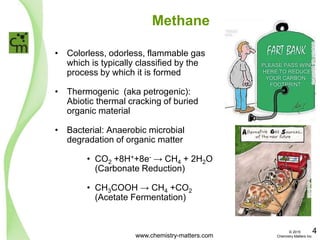
Methane
• Colorless, odorless, flammable gas
which is typically classified by the
process by which it is formed
• Thermogenic (aka petrogenic):
Abiotic thermal cracking of buried
organic material
• Bacterial: Anaerobic microbial
degradation of organic matter
• CO2 +8H++8e- → CH4 + 2H2O
(Carbonate Reduction)
• CH3COOH → CH4 +CO2
(Acetate Fermentation)
www.cartoonstock.com
www.chemistry-matters.com
4© 2015
Chemistry Matters Inc.
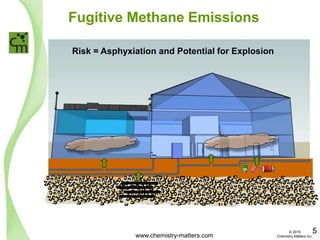
Fugitive Methane Emissions
Risk = Asphyxiation and Potential for Explosion
www.chemistry-matters.com
5© 2015
Chemistry Matters Inc.
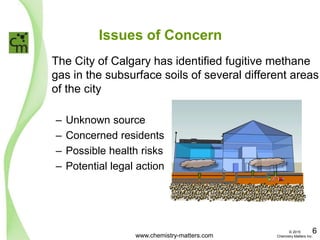
Issues of Concern
The City of Calgary has identified fugitive methane
gas in the subsurface soils of several different areas
of the city
– Unknown source
– Concerned residents
– Possible health risks
– Potential legal action
www.chemistry-matters.com
6© 2015
Chemistry Matters Inc.
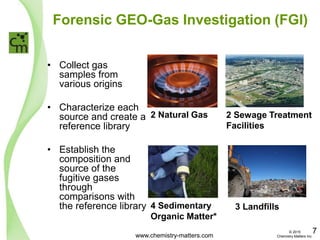
Forensic GEO-Gas Investigation (FGI)
• Collect gas
samples from
various origins
• Characterize each
source and create a
reference library
• Establish the
composition and
source of the
fugitive gases
through
comparisons with
the reference library 3 Landfills
2 Sewage Treatment
Facilities
2 Natural Gas
4 Sedimentary
Organic Matter*
www.chemistry-matters.com
7© 2015
Chemistry Matters Inc.
Investigation
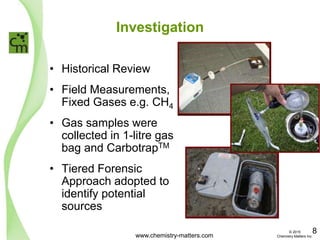
• Historical Review
• Field Measurements,
Fixed Gases e.g. CH4
• Gas samples were
collected in 1-litre gas
bag and CarbotrapTM
• Tiered Forensic
Approach adopted to
identify potential
sources
www.chemistry-matters.com
8© 2015
Chemistry Matters Inc.
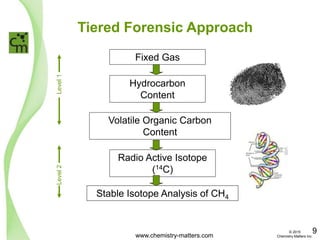
Tiered Forensic Approach
Hydrocarbon
Content
Volatile Organic Carbon
Content
Level1 Fixed Gas
Radio Active Isotope
(14C)
Stable Isotope Analysis of CH4
Level2
www.chemistry-matters.com
9© 2015
Chemistry Matters Inc.
Results of Level 1
www.chemistry-matters.com
10© 2015
Chemistry Matters Inc.
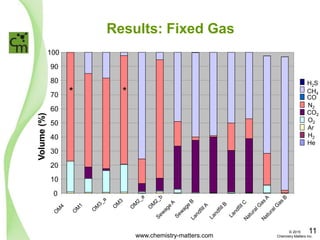
Results: Fixed Gas
0
10
20
30
40
50
60
70
80
90
100
Volume(%)
H2S
CH4
CO
N2
CO2
O2
Ar
H2
He
* *
www.chemistry-matters.com
11© 2015
Chemistry Matters Inc.
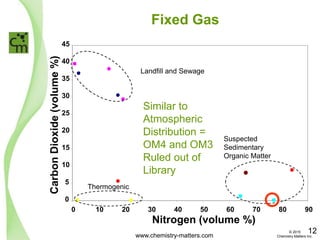
Fixed Gas
0
5
10
15
20
25
30
35
40
45
0 10 20 30 40 50 60 70 80 90
Nitrogen (volume %)
CarbonDioxide(volume%)
Landfill and Sewage
Suspected
Sedimentary
Organic Matter
Thermogenic
Similar to
Atmospheric
Distribution =
OM4 and OM3
Ruled out of
Library
www.chemistry-matters.com
12© 2015
Chemistry Matters Inc.
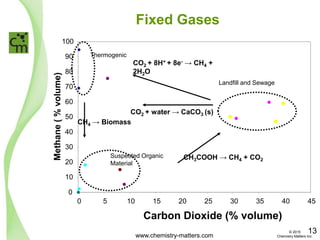
Fixed Gases
0
10
20
30
40
50
60
70
80
90
100
0 5 10 15 20 25 30 35 40 45
Carbon Dioxide (% volume)
Methane(%volume) Thermogenic
Landfill and Sewage
Suspected Organic
Material
CH4 → Biomass
CH3COOH → CH4 + CO2
CO2 + 8H+ + 8e- → CH4 +
2H2O
CO2 + water → CaCO3 (s)
www.chemistry-matters.com
13© 2015
Chemistry Matters Inc.
Results: VOC Fingerprinting
0
10
20
30
40
50
60
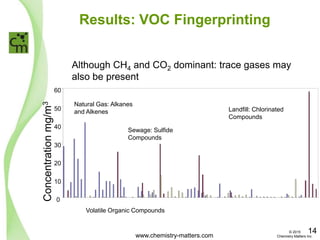
Landfill: Chlorinated
Compounds
Sewage: Sulfide
Compounds
Natural Gas: Alkanes
and Alkenes
Volatile Organic Compounds
Concentrationmg/m3
Although CH4 and CO2 dominant: trace gases may
also be present
www.chemistry-matters.com
14© 2015
Chemistry Matters Inc.
Results: VOC Fingerprinting
1
0
2
Concentration(mg/m3)
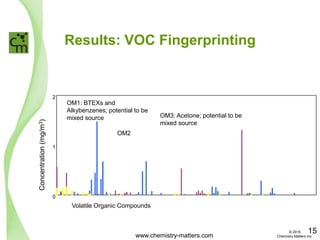
OM3: Acetone; potential to be
mixed source
OM1: BTEXs and
Alkybenzenes; potential to be
mixed source
OM2
Volatile Organic Compounds
www.chemistry-matters.com
15© 2015
Chemistry Matters Inc.
0
10
20
30
40
50
60
C3 C4 C5 C6 C7 C8 C9 C10 C11 C12 C13 C14 C15
Alkanes
Concentrationmg/m3
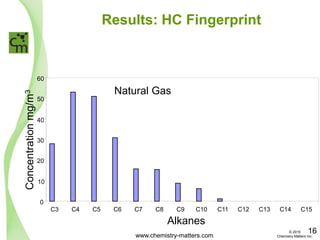
Natural Gas
Results: HC Fingerprint
www.chemistry-matters.com
16© 2015
Chemistry Matters Inc.
0
10
20
30
40
50
60
C3 C4 C5 C6 C7 C8 C9 C10 C11 C12 C13 C14 C15
Alkanes
Concentrationmg/m3
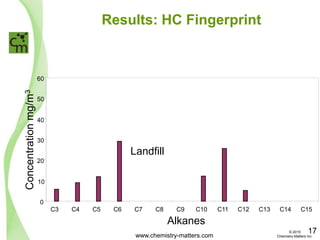
Landfill
Results: HC Fingerprint
www.chemistry-matters.com
17© 2015
Chemistry Matters Inc.
0
10
20
30
40
50
60
C3 C4 C5 C6 C7 C8 C9 C10 C11 C12 C13 C14 C15
Alkanes
Concentrationmg/m3
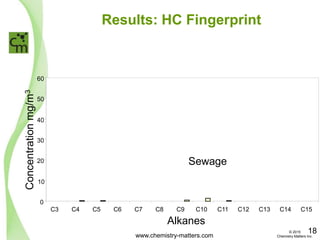
Sewage
Results: HC Fingerprint
www.chemistry-matters.com
18© 2015
Chemistry Matters Inc.
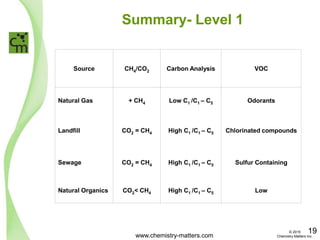
Summary- Level 1
Source CH4/CO2 Carbon Analysis VOC
Natural Gas + CH4 Low C1 /C1 – C5 Odorants
Landfill CO2 = CH4 High C1 /C1 – C5 Chlorinated compounds
Sewage CO2 = CH4 High C1 /C1 – C5 Sulfur Containing
Natural Organics CO2< CH4 High C1 /C1 – C5 Low
www.chemistry-matters.com
19© 2015
Chemistry Matters Inc.
Results of Level 2
www.chemistry-matters.com
20© 2015
Chemistry Matters Inc.
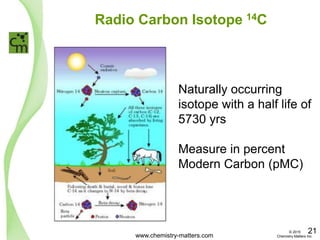
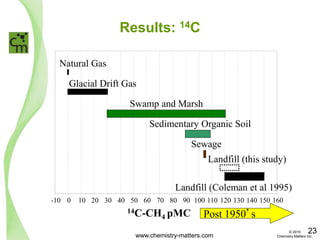
Radio Carbon Isotope 14C
Naturally occurring
isotope with a half life of
5730 yrs
Measure in percent
Modern Carbon (pMC)
www.chemistry-matters.com
21© 2015
Chemistry Matters Inc.
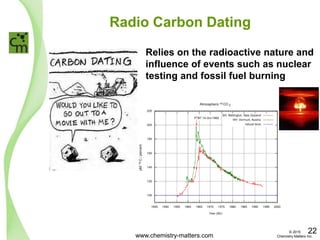
Radio Carbon Dating
Relies on the radioactive nature and
influence of events such as nuclear
testing and fossil fuel burning
www.chemistry-matters.com
22© 2015
Chemistry Matters Inc.
Results: 14C
Post 1950’s
-10 0 10 20 30 40 50 60 70 80 90 100 110 120 130 140 150 160
14C-CH4 pMC
Landfill (this study)
Sewage
Sedimentary Organic Soil
Natural Gas
Glacial Drift Gas
Landfill (Coleman et al 1995)
Swamp and Marsh
www.chemistry-matters.com
23© 2015
Chemistry Matters Inc.
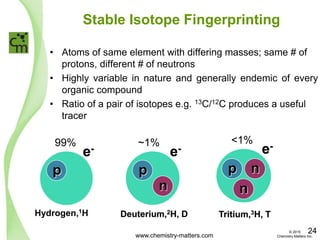
Stable Isotope Fingerprinting
• Atoms of same element with differing masses; same # of
protons, different # of neutrons
• Highly variable in nature and generally endemic of every
organic compound
• Ratio of a pair of isotopes e.g. 13C/12C produces a useful
tracer
p
e-
Hydrogen,1H
n
p
e-
Deuterium,2H, D
n
p n
e-
Tritium,3H, T
99% ~1% <1%
www.chemistry-matters.com
24© 2015
Chemistry Matters Inc.
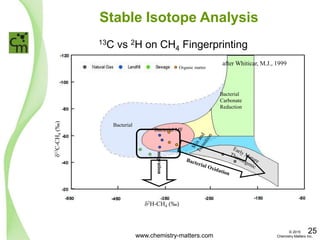
Stable Isotope Analysis
Bacterial MF
13C vs 2H on CH4 Fingerprinting
2H-CH4 (‰)
13C-CH4(‰)
Bacterial
Carbonate
Reduction
Bacterial
migration
after Whiticar, M.J., 1999
Organic matter
www.chemistry-matters.com
25© 2015
Chemistry Matters Inc.
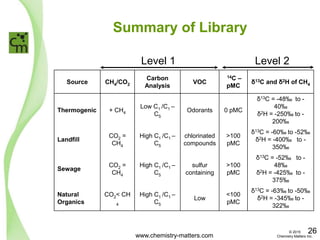
Summary of Library
Source CH4/CO2
Carbon
Analysis
VOC
14C –
pMC
δ13C and δ2H of CH4
Thermogenic + CH4
Low C1 /C1 –
C5
Odorants 0 pMC
δ13C = -48‰ to -
40‰
δ2H = -250‰ to -
200‰
Landfill
CO2 =
CH4
High C1 /C1 –
C5
chlorinated
compounds
>100
pMC
δ13C = -60‰ to -52‰
δ2H = -400‰ to -
350‰
Sewage
CO2 =
CH4
High C1 /C1 –
C5
sulfur
containing
>100
pMC
δ13C = -52‰ to -
48‰
δ2H = -425‰ to -
375‰
Natural
Organics
CO2< CH
4
High C1 /C1 –
C5
Low
<100
pMC
δ13C = -63‰ to -50‰
δ2H = -345‰ to -
322‰
Level 1 Level 2
www.chemistry-matters.com
26© 2015
Chemistry Matters Inc.
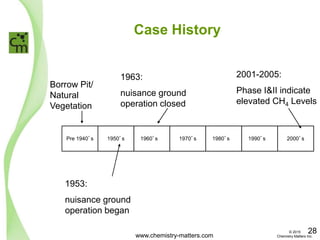
FGI Investigation:
Former Nuisance Grounds
www.chemistry-matters.com
27© 2015
Chemistry Matters Inc.
Case History
Pre 1940’s 1950’s 1960’s 1970’s 1980’s 1990’s 2000’s
1953:
nuisance ground
operation began
1963:
nuisance ground
operation closed
2001-2005:
Phase I&II indicate
elevated CH4 Levels
Borrow Pit/
Natural
Vegetation
www.chemistry-matters.com
28© 2015
Chemistry Matters Inc.
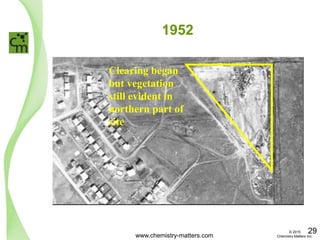
1952
Clearing began
but vegetation
still evident in
northern part of
site
www.chemistry-matters.com
29© 2015
Chemistry Matters Inc.
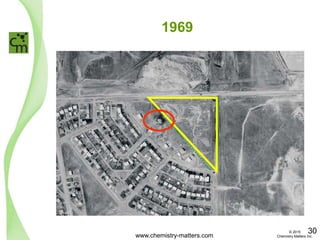
1969
www.chemistry-matters.com
30© 2015
Chemistry Matters Inc.
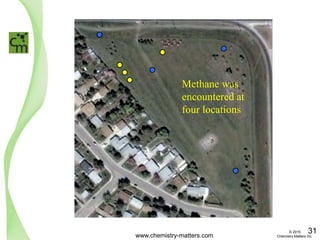
Methane was
encountered at
four locations
www.chemistry-matters.com
31© 2015
Chemistry Matters Inc.
0.01
0.10
1.00
Concentration(mg/m
3
)
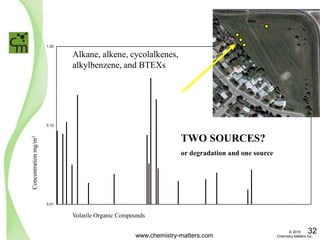
Volatile Organic Compounds
Concentrationmg/m3
Alkane, alkene, cycolalkenes,
alkylbenzene, and BTEXs
TWO SOURCES?
or degradation and one source
www.chemistry-matters.com
32© 2015
Chemistry Matters Inc.
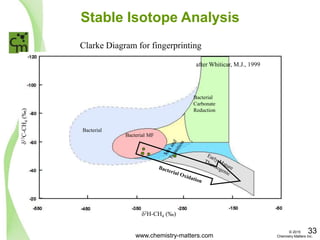
Bacterial MF
Clarke Diagram for fingerprinting
2H-CH4 (‰)
13C-CH4(‰)
Bacterial
Carbonate
Reduction
Bacterial
Stable Isotope Analysis
after Whiticar, M.J., 1999
www.chemistry-matters.com
33© 2015
Chemistry Matters Inc.
Bacterial MF
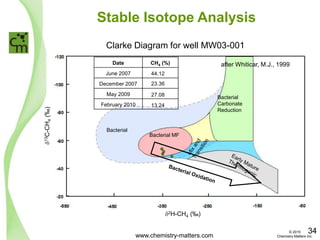
Clarke Diagram for well MW03-001
2H-CH4 (‰)
13C-CH4(‰)
Bacterial
Carbonate
Reduction
Bacterial
Stable Isotope Analysis
after Whiticar, M.J., 1999Date CH4 (%)
June 2007
December 2007
May 2009
February 2010
44.12
23.36
27.08
13.24
www.chemistry-matters.com
34© 2015
Chemistry Matters Inc.
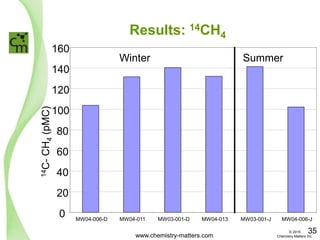
Results: 14CH4
0
20
40
60
80
100
120
140
160
MW04-006-D MW04-011 MW03-001-D MW04-013 MW03-001-J MW04-006-J
14C-CH4(pMC)
Winter Summer
www.chemistry-matters.com
35© 2015
Chemistry Matters Inc.
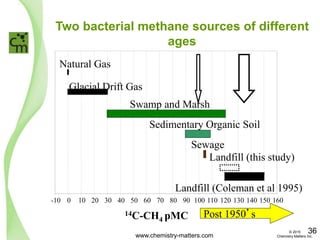
Two bacterial methane sources of different
ages
Post 1950’s
-10 0 10 20 30 40 50 60 70 80 90 100 110 120 130 140 150 160
14C-CH4 pMC
Landfill (this study)
Sewage
Sedimentary Organic Soil
Natural Gas
Glacial Drift Gas
Landfill (Coleman et al 1995)
Swamp and Marsh
www.chemistry-matters.com
36© 2015
Chemistry Matters Inc.
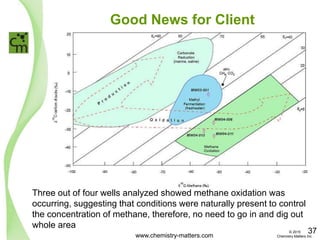
Three out of four wells analyzed showed methane oxidation was
occurring, suggesting that conditions were naturally present to control
the concentration of methane, therefore, no need to go in and dig out
whole area
Good News for Client
www.chemistry-matters.com
37© 2015
Chemistry Matters Inc.
Results of Study:
– Two potential sources identified, landfill and
organic material
– Use of stable and radio isotope not only
indicated source but also gave information
pertaining to the risk associated with the fate
and behavior of elevated methane which
helps client to make decision regarding action
needed
– Tiered Forensic approach required to
confidently identify sources
www.chemistry-matters.com
38© 2015
Chemistry Matters Inc.
Q u e s t i o n s ?
www.chemistry-matters.com
39© 2015
Chemistry Matters Inc.
Contact Info:
Chemistry Matters Inc.
Court Sandau
Cell: 1.403.669.8566
Email: csandau@chemistry-matters.com
URL: chemistry-matters.com
Twitter: @Chem_Matters
Slideshare: www.slideshare.net/csandau
© 2015
Chemistry Matters Inc.

AWMA 2010 methane forensics in urban setting

  • 1.
    Source and Fateof Methane Within an Urban Setting Court D. Sandau, PhD, PChem (csandau@chemistry-matters.com) Presented at AWMA Conference 2010 © 2015 Chemistry Matters Inc.
  • 2.
    • Thank youto the City of Calgary for support on this project • Work presented was published in the following citation: • O’Sullivan et al. 2010, Forensics Geo-Gas Investigation of Methane: Characterization of Sources within an Urban Setting, Environmental Forensics, 11, 108-116. Acknowledgements www.chemistry-matters.com 2© 2015 Chemistry Matters Inc.
  • 3.
    Outline • Introduction • MethaneReference Library – Project Background – Sites & Sampling Locations – Forensic Analytical Program • Case Study – Project Background – Site & Sampling Locations – Forensic Analytical Program www.chemistry-matters.com 3© 2015 Chemistry Matters Inc.
  • 4.
    Methane • Colorless, odorless,flammable gas which is typically classified by the process by which it is formed • Thermogenic (aka petrogenic): Abiotic thermal cracking of buried organic material • Bacterial: Anaerobic microbial degradation of organic matter • CO2 +8H++8e- → CH4 + 2H2O (Carbonate Reduction) • CH3COOH → CH4 +CO2 (Acetate Fermentation) www.cartoonstock.com www.chemistry-matters.com 4© 2015 Chemistry Matters Inc.
  • 5.
    Fugitive Methane Emissions Risk= Asphyxiation and Potential for Explosion www.chemistry-matters.com 5© 2015 Chemistry Matters Inc.
  • 6.
    Issues of Concern TheCity of Calgary has identified fugitive methane gas in the subsurface soils of several different areas of the city – Unknown source – Concerned residents – Possible health risks – Potential legal action www.chemistry-matters.com 6© 2015 Chemistry Matters Inc.
  • 7.
    Forensic GEO-Gas Investigation(FGI) • Collect gas samples from various origins • Characterize each source and create a reference library • Establish the composition and source of the fugitive gases through comparisons with the reference library 3 Landfills 2 Sewage Treatment Facilities 2 Natural Gas 4 Sedimentary Organic Matter* www.chemistry-matters.com 7© 2015 Chemistry Matters Inc.
  • 8.
    Investigation • Historical Review •Field Measurements, Fixed Gases e.g. CH4 • Gas samples were collected in 1-litre gas bag and CarbotrapTM • Tiered Forensic Approach adopted to identify potential sources www.chemistry-matters.com 8© 2015 Chemistry Matters Inc.
  • 9.
    Tiered Forensic Approach Hydrocarbon Content VolatileOrganic Carbon Content Level1 Fixed Gas Radio Active Isotope (14C) Stable Isotope Analysis of CH4 Level2 www.chemistry-matters.com 9© 2015 Chemistry Matters Inc.
  • 10.
    Results of Level1 www.chemistry-matters.com 10© 2015 Chemistry Matters Inc.
  • 11.
  • 12.
    Fixed Gas 0 5 10 15 20 25 30 35 40 45 0 1020 30 40 50 60 70 80 90 Nitrogen (volume %) CarbonDioxide(volume%) Landfill and Sewage Suspected Sedimentary Organic Matter Thermogenic Similar to Atmospheric Distribution = OM4 and OM3 Ruled out of Library www.chemistry-matters.com 12© 2015 Chemistry Matters Inc.
  • 13.
    Fixed Gases 0 10 20 30 40 50 60 70 80 90 100 0 510 15 20 25 30 35 40 45 Carbon Dioxide (% volume) Methane(%volume) Thermogenic Landfill and Sewage Suspected Organic Material CH4 → Biomass CH3COOH → CH4 + CO2 CO2 + 8H+ + 8e- → CH4 + 2H2O CO2 + water → CaCO3 (s) www.chemistry-matters.com 13© 2015 Chemistry Matters Inc.
  • 14.
    Results: VOC Fingerprinting 0 10 20 30 40 50 60 Landfill:Chlorinated Compounds Sewage: Sulfide Compounds Natural Gas: Alkanes and Alkenes Volatile Organic Compounds Concentrationmg/m3 Although CH4 and CO2 dominant: trace gases may also be present www.chemistry-matters.com 14© 2015 Chemistry Matters Inc.
  • 15.
    Results: VOC Fingerprinting 1 0 2 Concentration(mg/m3) OM3:Acetone; potential to be mixed source OM1: BTEXs and Alkybenzenes; potential to be mixed source OM2 Volatile Organic Compounds www.chemistry-matters.com 15© 2015 Chemistry Matters Inc.
  • 16.
    0 10 20 30 40 50 60 C3 C4 C5C6 C7 C8 C9 C10 C11 C12 C13 C14 C15 Alkanes Concentrationmg/m3 Natural Gas Results: HC Fingerprint www.chemistry-matters.com 16© 2015 Chemistry Matters Inc.
  • 17.
    0 10 20 30 40 50 60 C3 C4 C5C6 C7 C8 C9 C10 C11 C12 C13 C14 C15 Alkanes Concentrationmg/m3 Landfill Results: HC Fingerprint www.chemistry-matters.com 17© 2015 Chemistry Matters Inc.
  • 18.
    0 10 20 30 40 50 60 C3 C4 C5C6 C7 C8 C9 C10 C11 C12 C13 C14 C15 Alkanes Concentrationmg/m3 Sewage Results: HC Fingerprint www.chemistry-matters.com 18© 2015 Chemistry Matters Inc.
  • 19.
    Summary- Level 1 SourceCH4/CO2 Carbon Analysis VOC Natural Gas + CH4 Low C1 /C1 – C5 Odorants Landfill CO2 = CH4 High C1 /C1 – C5 Chlorinated compounds Sewage CO2 = CH4 High C1 /C1 – C5 Sulfur Containing Natural Organics CO2< CH4 High C1 /C1 – C5 Low www.chemistry-matters.com 19© 2015 Chemistry Matters Inc.
  • 20.
    Results of Level2 www.chemistry-matters.com 20© 2015 Chemistry Matters Inc.
  • 21.
    Radio Carbon Isotope14C Naturally occurring isotope with a half life of 5730 yrs Measure in percent Modern Carbon (pMC) www.chemistry-matters.com 21© 2015 Chemistry Matters Inc.
  • 22.
    Radio Carbon Dating Relieson the radioactive nature and influence of events such as nuclear testing and fossil fuel burning www.chemistry-matters.com 22© 2015 Chemistry Matters Inc.
  • 23.
    Results: 14C Post 1950’s -100 10 20 30 40 50 60 70 80 90 100 110 120 130 140 150 160 14C-CH4 pMC Landfill (this study) Sewage Sedimentary Organic Soil Natural Gas Glacial Drift Gas Landfill (Coleman et al 1995) Swamp and Marsh www.chemistry-matters.com 23© 2015 Chemistry Matters Inc.
  • 24.
    Stable Isotope Fingerprinting •Atoms of same element with differing masses; same # of protons, different # of neutrons • Highly variable in nature and generally endemic of every organic compound • Ratio of a pair of isotopes e.g. 13C/12C produces a useful tracer p e- Hydrogen,1H n p e- Deuterium,2H, D n p n e- Tritium,3H, T 99% ~1% <1% www.chemistry-matters.com 24© 2015 Chemistry Matters Inc.
  • 25.
    Stable Isotope Analysis BacterialMF 13C vs 2H on CH4 Fingerprinting 2H-CH4 (‰) 13C-CH4(‰) Bacterial Carbonate Reduction Bacterial migration after Whiticar, M.J., 1999 Organic matter www.chemistry-matters.com 25© 2015 Chemistry Matters Inc.
  • 26.
    Summary of Library SourceCH4/CO2 Carbon Analysis VOC 14C – pMC δ13C and δ2H of CH4 Thermogenic + CH4 Low C1 /C1 – C5 Odorants 0 pMC δ13C = -48‰ to - 40‰ δ2H = -250‰ to - 200‰ Landfill CO2 = CH4 High C1 /C1 – C5 chlorinated compounds >100 pMC δ13C = -60‰ to -52‰ δ2H = -400‰ to - 350‰ Sewage CO2 = CH4 High C1 /C1 – C5 sulfur containing >100 pMC δ13C = -52‰ to - 48‰ δ2H = -425‰ to - 375‰ Natural Organics CO2< CH 4 High C1 /C1 – C5 Low <100 pMC δ13C = -63‰ to -50‰ δ2H = -345‰ to - 322‰ Level 1 Level 2 www.chemistry-matters.com 26© 2015 Chemistry Matters Inc.
  • 27.
    FGI Investigation: Former NuisanceGrounds www.chemistry-matters.com 27© 2015 Chemistry Matters Inc.
  • 28.
    Case History Pre 1940’s1950’s 1960’s 1970’s 1980’s 1990’s 2000’s 1953: nuisance ground operation began 1963: nuisance ground operation closed 2001-2005: Phase I&II indicate elevated CH4 Levels Borrow Pit/ Natural Vegetation www.chemistry-matters.com 28© 2015 Chemistry Matters Inc.
  • 29.
    1952 Clearing began but vegetation stillevident in northern part of site www.chemistry-matters.com 29© 2015 Chemistry Matters Inc.
  • 30.
  • 31.
    Methane was encountered at fourlocations www.chemistry-matters.com 31© 2015 Chemistry Matters Inc.
  • 32.
    0.01 0.10 1.00 Concentration(mg/m 3 ) Volatile Organic Compounds Concentrationmg/m3 Alkane,alkene, cycolalkenes, alkylbenzene, and BTEXs TWO SOURCES? or degradation and one source www.chemistry-matters.com 32© 2015 Chemistry Matters Inc.
  • 33.
    Bacterial MF Clarke Diagramfor fingerprinting 2H-CH4 (‰) 13C-CH4(‰) Bacterial Carbonate Reduction Bacterial Stable Isotope Analysis after Whiticar, M.J., 1999 www.chemistry-matters.com 33© 2015 Chemistry Matters Inc.
  • 34.
    Bacterial MF Clarke Diagramfor well MW03-001 2H-CH4 (‰) 13C-CH4(‰) Bacterial Carbonate Reduction Bacterial Stable Isotope Analysis after Whiticar, M.J., 1999Date CH4 (%) June 2007 December 2007 May 2009 February 2010 44.12 23.36 27.08 13.24 www.chemistry-matters.com 34© 2015 Chemistry Matters Inc.
  • 35.
    Results: 14CH4 0 20 40 60 80 100 120 140 160 MW04-006-D MW04-011MW03-001-D MW04-013 MW03-001-J MW04-006-J 14C-CH4(pMC) Winter Summer www.chemistry-matters.com 35© 2015 Chemistry Matters Inc.
  • 36.
    Two bacterial methanesources of different ages Post 1950’s -10 0 10 20 30 40 50 60 70 80 90 100 110 120 130 140 150 160 14C-CH4 pMC Landfill (this study) Sewage Sedimentary Organic Soil Natural Gas Glacial Drift Gas Landfill (Coleman et al 1995) Swamp and Marsh www.chemistry-matters.com 36© 2015 Chemistry Matters Inc.
  • 37.
    Three out offour wells analyzed showed methane oxidation was occurring, suggesting that conditions were naturally present to control the concentration of methane, therefore, no need to go in and dig out whole area Good News for Client www.chemistry-matters.com 37© 2015 Chemistry Matters Inc.
  • 38.
    Results of Study: –Two potential sources identified, landfill and organic material – Use of stable and radio isotope not only indicated source but also gave information pertaining to the risk associated with the fate and behavior of elevated methane which helps client to make decision regarding action needed – Tiered Forensic approach required to confidently identify sources www.chemistry-matters.com 38© 2015 Chemistry Matters Inc.
  • 39.
    Q u es t i o n s ? www.chemistry-matters.com 39© 2015 Chemistry Matters Inc.
  • 40.
    Contact Info: Chemistry MattersInc. Court Sandau Cell: 1.403.669.8566 Email: csandau@chemistry-matters.com URL: chemistry-matters.com Twitter: @Chem_Matters Slideshare: www.slideshare.net/csandau © 2015 Chemistry Matters Inc.

Editor's Notes

  • #7 Both slides are in… one with the picture of the City and this one. This one has no animation.
  • #8 Would it be better to focus this slide on FGI e.g. next slide
  • #12 Remove names in charts; start with empty chart then fly in bars and title for multiple samples
  • #14 Bacterial oxidation of methane converting to biomass, causes a decrease in methane (make a thermo source resemble a SOM) Acetate from carbs/proteins/lipids fermenting causing increased CH4 and CO2 In the absence of more favourable electron donors (oxygen, ferric iron, manganese, nitrate), bacteria may reduce CO2 to CH4
  • #19 Remove names in charts; start with empty chart then fly in bars and title for multiple samples
  • #22 Need to improve drawings
  • #26 1: Isotopic signature of source material, 2: Isotopic effect associated with migration and degradation
  • #27 A different way to present the findings, might be better at the end for a visual summary. Replacing Garrison Woods info with MGN
  • #29 Evolution of lines of evidence
  • #34 1: Isotopic signature of source material, 2: Isotopic effect associated with migration and degradation