Economic Growth, Resource Scarcity & Environmental Degradation
Introduction
• Evolution of Human race
• Homo Sapiens Humans
• Human were, even then, set somewhat apart of the rest of the
ecosystem by their superior intellect.
• Slowly, people began to bend ecosystem to their needs through
development of social culture, communication and
organization system, it permits them to direct their
collective energies.
• Socialization creates great civilizations & the slow & painful process
of progress begins.
400 Year Boom
• Just before & in the early age of Industrial Revolution few
developments boost the humans towards todays industrialization.
• The first manifestation is the development of transoceanic navigation,
which facilitated trade. (very important generator of economic
growth)
• Later with more wealth & ease of travel permits people to do cross
fertilization (which we can say 2nd manifestation)
400 Year Boom
• To expand to wealth and resources people start extraction minerals
and with the development of science and medicine, those natural
resources are useless.
• Most important in the 400 year history is “Social Organization
Mechanism” “Legal System” “Institutional Structure” it
developed during the
400 year boom.
This progress is useless with out the cooperation of human beings.
Benefits & costs of Economic Growth
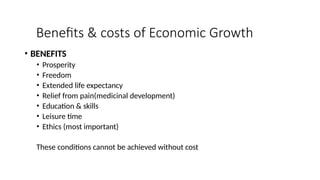
• BENEFITS
• Prosperity
• Freedom
• Extended life expectancy
• Relief from pain(medicinal development)
• Education & skills
• Leisure time
• Ethics (most important)
These conditions cannot be achieved without cost
Benefits & costs of Economic Growth
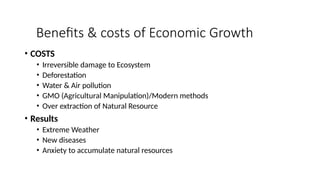
• COSTS
• Irreversible damage to Ecosystem
• Deforestation
• Water & Air pollution
• GMO (Agricultural Manipulation)/Modern methods
• Over extraction of Natural Resource
• Results
• Extreme Weather
• New diseases
• Anxiety to accumulate natural resources
An uncertain future
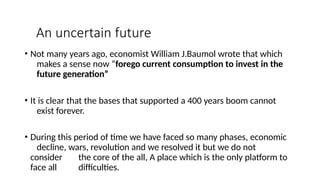
• Not many years ago, economist William J.Baumol wrote that which
makes a sense now “forego current consumption to invest in the
future generation”
• It is clear that the bases that supported a 400 years boom cannot
exist forever.
• During this period of time we have faced so many phases, economic
decline, wars, revolution and we resolved it but we do not
consider the core of the all, A place which is the only platform to
face all difficulties.
An uncertain future
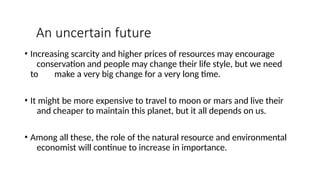
• Increasing scarcity and higher prices of resources may encourage
conservation and people may change their life style, but we need
to make a very big change for a very long time.
• It might be more expensive to travel to moon or mars and live their
and cheaper to maintain this planet, but it all depends on us.
• Among all these, the role of the natural resource and environmental
economist will continue to increase in importance.
Changing Perspectives on the Environment
Events in Modern Environmental History
Economic approaches to the Environment
Environmental Economics
Ecological Economics
Economic System in Environmental Context
Sustainability
Pluralistic Approach
Differences Between Environmental & Ecological
Economics
Economic approaches to the Environment
field
of
• The existence of environmental economics as a
specific economics dates back only to the 1960s.
• Environmental economists apply mainstream economic principles to environmental and
natural resource issues.
• Dating back to the 1980s, ecological economics has emerged as a field.
• It brings together viewpoints from different academic disciplines to study the
interactions between economic and ecological systems.
• Some economists consider the two fields to have essentially merged into
“environmental and ecological economics. Others call for a new term, such as
“sustainability economics” which “lies at the intersection of the two and uses
concepts and methods of both.
Principles of Environmental Economics
We can identify the core of environmental economics as being comprised of four
concepts:
• The theory of environmental externalities -
• The optimal management of common property and public goods
• The optimal management of natural resources over time
• The economic valuation of environmental goods and services
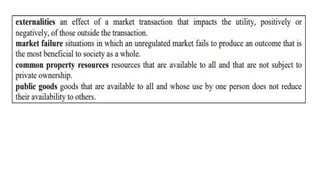
• Externalities are an example of market failure – situations in which an
unregulated market fails to produce an outcome that is the most beneficial to
society as a whole. Another important instance of market failure is the
allocation of common property resources such as the atmosphere and the
oceans, and public goods such as natural parks and wildlife preserves.
• Because these resources are not privately owned, we normally can’t rely upon
markets to maintain them in adequate supply, and in general the principles
governing their use are different from those affecting privately owned and
marketed goods. Environmental economists have developed a set of economic
theories relevant to common property resources and public goods
Principles of Ecological Economics
The core concepts in ecological economics are somewhat harder to define, as it is a
broader field than environmental economics. The theory of environmental
externalities
• The economic system is a subset of the broader ecological system
• Sustainability should be defined according to ecological, rather than economic,
criteria
• It is essential to rely upon a range of academic disciplines and perspectives, in
addition to economics, to provide insight into environmental issues
Economic System in Environmental Context
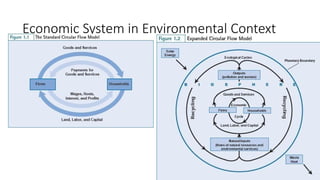
The Standard Circular Flow Model
This simple model depicts the relationships between households and business
firms in two markets: the market for goods and services and the market for factors
of production. Factors of production are generally defined as land, labour, and
capital. The services that these factors provide are inputs into the production of
goods and services, which in turn provide for households’ consumption needs.
Goods, services, and factors flow clockwise; their economic values are reflected in
the flows of money used to pay for them, moving counterclockwise. In both
markets, the interaction of supply and demand determines a market-clearing price
and establishes an equilibrium level of output.
Expanded Circular Flow Model
It provides a broader framework for placing the economic system in its ecological context.
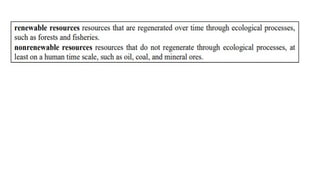
Natural resources include both renewable and nonrenewable resources. Renewable
resources are those that are regenerated over time through ecological processes, such as
forests and fisheries. Renewable resources can be managed sustainably if extraction rates
don’t exceed natural regeneration rates.
However, if renewable resources are overexploited they can be depleted, such as species that
go extinct through over-harvesting. Nonrenewable resources are those that do not
regenerate through ecological processes, at least on a human time scale. Nonrenewable
resources such as oil, coal, and mineral ores are ultimately available in a fixed supply, although
new resources can be discovered to expand the known available supply. The other input into
the economic system is solar energy, which as we will see later in the text provides a limited
but incredibly abundant source of continual energy
What does this expanded circular flow model imply for economic theory? There are at least three
major implications:
1. The recognition that natural resources and solar energy provide essential input into economic
processes implies that human well-being is ultimately dependent on these resources. Measuring
well-being using standard economic metrics, such as gross domestic product, understates the
importance of natural resources. This suggests a need for alternative indicators of well-being.
2. the ecological system has its own circular flow, which is determined by physical and biological
rather than economic laws. This broader flow has only one net ―input—solar energy—and only
one net ―output—waste heat. Everything else must somehow be recycled or contained within
the planetary ecosystem.
3. In the standard circular flow model, the economic system is unbounded and can theoretically
grow indefinitely. But in the expanded model, economic activity is limited by both the availability
of natural resources and the ability of the environment to assimilate wastes and pollution. Thus
the overall scale of the economy relative to the available natural resources must be considered.
Sustainability
• Sustainable development defined by the Brundtland Commission as
“development that meets the needs of the present without compromising
the ability of future generations to meet their own needs.”
• Anthropocentric worldview a perspective that places humans at the center
of analysis.
• Ecocentric worldview a perspective that places the natural world at the
center of analysis.
Pluralistic Approach
• Pluralism the perspective that a full understanding of an issue can
only come from a variety of viewpoints, disciplines, and approaches.
• Core concept in ecological economics is the promotion of a
pluralistic approach to studying the relationship between the
economy and the environment.
•To make ethical conduct central and to place the social, ecological and economic discourses on an
equal footing. . . . Deep ecological economics requires challenging both personal and social pre-
conceptions, while taking a campaigning sprit to change public policy and the institutions blocking
the necessary transition to [alternative economic systems].
• Economists have thought about various natural resource issues for
hundreds of years, the existence of environmental economics as a specific
field of economics dates back only to the 1960s, concurrent with the
growing awareness of environmental issues discussed above.
Environmental economists apply mainstream economic principles to
environmental and natural resource issues.
• Even more recently (dating back to the 1980s), ecological economics has
emerged as a field which brings together viewpoints from different
academic disciplines to study the interactions between economic and
ecological systems. Unlike environmental economics, ecological economics
is defined not so much by applying a particular set of economic principles,
but by analyzing economic activity in the context of the biological and
physical systems that support life, including all human activities.
Differences between Environmental & Ecological Economics
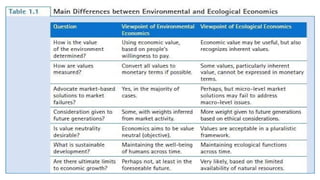
•Environmental Economist - Economic value: the value of something
derived from people’s willingness to pay for it.
•Ecologists – Inherent Value: the value of something separate from
economic value, based on ethics, rights, and justice.
Conclusion:
• National and global environmental issues are major challenges in the twenty-first
century. Responding to these challenges requires understanding the economics of the
environment. Policies aimed at environmental protection have economic costs and
benefits, and this economic dimension is often crucial in determining which policies
we adopt. Some cases may require tradeoffs between economic and environmental
goals; in other cases, these goals may prove compatible and mutually reinforcing.
• Two different approaches address the economic analysis of environmental issues. The
standard approach applies economic theory to the environment using the concepts of
money valuation and economic equilibrium. This approach aims to achieve efficient
management of natural resources and the proper valuation of waste and pollution.
The ecological economic approach views the economic system as a whole as a subset
of a broader biophysical system. This approach emphasizes the need for economic
activity that conforms to physical and biological limits.
• Much of the analysis drawn from the standard approach is microeconomic,
based on the workings of markets. Variations of standard market analysis can
be applied to cases in which economic activity has damaging environmental
effects or uses up scarce resources. Other economic analyses provide insight
into the use of common property resources and public goods.
• Ecological economics takes a macro perspective, emphasizing the relationship
between economic production and the major natural cycles of the planet. In
many cases, significant conflicts arise between the operations of the economic
system and these natural systems, creating regional and global problems such
as global climate change from excess carbon dioxide accumulation. This
broader approach requires new ways to measure economic activity, as well as
an analysis of how the scale of economic activity affects environmental
systems.

Resource and Environmental Economics lect

  • 1.
    Economic Growth, ResourceScarcity & Environmental Degradation
  • 2.
    Introduction • Evolution ofHuman race • Homo Sapiens Humans • Human were, even then, set somewhat apart of the rest of the ecosystem by their superior intellect. • Slowly, people began to bend ecosystem to their needs through development of social culture, communication and organization system, it permits them to direct their collective energies. • Socialization creates great civilizations & the slow & painful process of progress begins.
  • 3.
    400 Year Boom •Just before & in the early age of Industrial Revolution few developments boost the humans towards todays industrialization. • The first manifestation is the development of transoceanic navigation, which facilitated trade. (very important generator of economic growth) • Later with more wealth & ease of travel permits people to do cross fertilization (which we can say 2nd manifestation)
  • 4.
    400 Year Boom •To expand to wealth and resources people start extraction minerals and with the development of science and medicine, those natural resources are useless. • Most important in the 400 year history is “Social Organization Mechanism” “Legal System” “Institutional Structure” it developed during the 400 year boom. This progress is useless with out the cooperation of human beings.
  • 5.
    Benefits & costsof Economic Growth • BENEFITS • Prosperity • Freedom • Extended life expectancy • Relief from pain(medicinal development) • Education & skills • Leisure time • Ethics (most important) These conditions cannot be achieved without cost
  • 6.
    Benefits & costsof Economic Growth • COSTS • Irreversible damage to Ecosystem • Deforestation • Water & Air pollution • GMO (Agricultural Manipulation)/Modern methods • Over extraction of Natural Resource • Results • Extreme Weather • New diseases • Anxiety to accumulate natural resources
  • 7.
    An uncertain future •Not many years ago, economist William J.Baumol wrote that which makes a sense now “forego current consumption to invest in the future generation” • It is clear that the bases that supported a 400 years boom cannot exist forever. • During this period of time we have faced so many phases, economic decline, wars, revolution and we resolved it but we do not consider the core of the all, A place which is the only platform to face all difficulties.
  • 8.
    An uncertain future •Increasing scarcity and higher prices of resources may encourage conservation and people may change their life style, but we need to make a very big change for a very long time. • It might be more expensive to travel to moon or mars and live their and cheaper to maintain this planet, but it all depends on us. • Among all these, the role of the natural resource and environmental economist will continue to increase in importance.
  • 9.
    Changing Perspectives onthe Environment Events in Modern Environmental History Economic approaches to the Environment Environmental Economics Ecological Economics Economic System in Environmental Context Sustainability Pluralistic Approach Differences Between Environmental & Ecological Economics
  • 10.
    Economic approaches tothe Environment field of • The existence of environmental economics as a specific economics dates back only to the 1960s. • Environmental economists apply mainstream economic principles to environmental and natural resource issues. • Dating back to the 1980s, ecological economics has emerged as a field. • It brings together viewpoints from different academic disciplines to study the interactions between economic and ecological systems. • Some economists consider the two fields to have essentially merged into “environmental and ecological economics. Others call for a new term, such as “sustainability economics” which “lies at the intersection of the two and uses concepts and methods of both.
  • 11.
    Principles of EnvironmentalEconomics We can identify the core of environmental economics as being comprised of four concepts: • The theory of environmental externalities - • The optimal management of common property and public goods • The optimal management of natural resources over time • The economic valuation of environmental goods and services
  • 12.
    • Externalities arean example of market failure – situations in which an unregulated market fails to produce an outcome that is the most beneficial to society as a whole. Another important instance of market failure is the allocation of common property resources such as the atmosphere and the oceans, and public goods such as natural parks and wildlife preserves. • Because these resources are not privately owned, we normally can’t rely upon markets to maintain them in adequate supply, and in general the principles governing their use are different from those affecting privately owned and marketed goods. Environmental economists have developed a set of economic theories relevant to common property resources and public goods
  • 14.
    Principles of EcologicalEconomics The core concepts in ecological economics are somewhat harder to define, as it is a broader field than environmental economics. The theory of environmental externalities • The economic system is a subset of the broader ecological system • Sustainability should be defined according to ecological, rather than economic, criteria • It is essential to rely upon a range of academic disciplines and perspectives, in addition to economics, to provide insight into environmental issues
  • 15.
    Economic System inEnvironmental Context
  • 16.
    The Standard CircularFlow Model This simple model depicts the relationships between households and business firms in two markets: the market for goods and services and the market for factors of production. Factors of production are generally defined as land, labour, and capital. The services that these factors provide are inputs into the production of goods and services, which in turn provide for households’ consumption needs. Goods, services, and factors flow clockwise; their economic values are reflected in the flows of money used to pay for them, moving counterclockwise. In both markets, the interaction of supply and demand determines a market-clearing price and establishes an equilibrium level of output.
  • 17.
    Expanded Circular FlowModel It provides a broader framework for placing the economic system in its ecological context. Natural resources include both renewable and nonrenewable resources. Renewable resources are those that are regenerated over time through ecological processes, such as forests and fisheries. Renewable resources can be managed sustainably if extraction rates don’t exceed natural regeneration rates. However, if renewable resources are overexploited they can be depleted, such as species that go extinct through over-harvesting. Nonrenewable resources are those that do not regenerate through ecological processes, at least on a human time scale. Nonrenewable resources such as oil, coal, and mineral ores are ultimately available in a fixed supply, although new resources can be discovered to expand the known available supply. The other input into the economic system is solar energy, which as we will see later in the text provides a limited but incredibly abundant source of continual energy
  • 19.
    What does thisexpanded circular flow model imply for economic theory? There are at least three major implications: 1. The recognition that natural resources and solar energy provide essential input into economic processes implies that human well-being is ultimately dependent on these resources. Measuring well-being using standard economic metrics, such as gross domestic product, understates the importance of natural resources. This suggests a need for alternative indicators of well-being. 2. the ecological system has its own circular flow, which is determined by physical and biological rather than economic laws. This broader flow has only one net ―input—solar energy—and only one net ―output—waste heat. Everything else must somehow be recycled or contained within the planetary ecosystem. 3. In the standard circular flow model, the economic system is unbounded and can theoretically grow indefinitely. But in the expanded model, economic activity is limited by both the availability of natural resources and the ability of the environment to assimilate wastes and pollution. Thus the overall scale of the economy relative to the available natural resources must be considered.
  • 20.
    Sustainability • Sustainable developmentdefined by the Brundtland Commission as “development that meets the needs of the present without compromising the ability of future generations to meet their own needs.” • Anthropocentric worldview a perspective that places humans at the center of analysis. • Ecocentric worldview a perspective that places the natural world at the center of analysis.
  • 21.
    Pluralistic Approach • Pluralismthe perspective that a full understanding of an issue can only come from a variety of viewpoints, disciplines, and approaches. • Core concept in ecological economics is the promotion of a pluralistic approach to studying the relationship between the economy and the environment. •To make ethical conduct central and to place the social, ecological and economic discourses on an equal footing. . . . Deep ecological economics requires challenging both personal and social pre- conceptions, while taking a campaigning sprit to change public policy and the institutions blocking the necessary transition to [alternative economic systems].
  • 22.
    • Economists havethought about various natural resource issues for hundreds of years, the existence of environmental economics as a specific field of economics dates back only to the 1960s, concurrent with the growing awareness of environmental issues discussed above. Environmental economists apply mainstream economic principles to environmental and natural resource issues. • Even more recently (dating back to the 1980s), ecological economics has emerged as a field which brings together viewpoints from different academic disciplines to study the interactions between economic and ecological systems. Unlike environmental economics, ecological economics is defined not so much by applying a particular set of economic principles, but by analyzing economic activity in the context of the biological and physical systems that support life, including all human activities.
  • 23.
    Differences between Environmental& Ecological Economics •Environmental Economist - Economic value: the value of something derived from people’s willingness to pay for it. •Ecologists – Inherent Value: the value of something separate from economic value, based on ethics, rights, and justice.
  • 25.
    Conclusion: • National andglobal environmental issues are major challenges in the twenty-first century. Responding to these challenges requires understanding the economics of the environment. Policies aimed at environmental protection have economic costs and benefits, and this economic dimension is often crucial in determining which policies we adopt. Some cases may require tradeoffs between economic and environmental goals; in other cases, these goals may prove compatible and mutually reinforcing. • Two different approaches address the economic analysis of environmental issues. The standard approach applies economic theory to the environment using the concepts of money valuation and economic equilibrium. This approach aims to achieve efficient management of natural resources and the proper valuation of waste and pollution. The ecological economic approach views the economic system as a whole as a subset of a broader biophysical system. This approach emphasizes the need for economic activity that conforms to physical and biological limits.
  • 26.
    • Much ofthe analysis drawn from the standard approach is microeconomic, based on the workings of markets. Variations of standard market analysis can be applied to cases in which economic activity has damaging environmental effects or uses up scarce resources. Other economic analyses provide insight into the use of common property resources and public goods. • Ecological economics takes a macro perspective, emphasizing the relationship between economic production and the major natural cycles of the planet. In many cases, significant conflicts arise between the operations of the economic system and these natural systems, creating regional and global problems such as global climate change from excess carbon dioxide accumulation. This broader approach requires new ways to measure economic activity, as well as an analysis of how the scale of economic activity affects environmental systems.