Environmental Valuation Techniques: 
A Review 
Submitted To 
Dr. Sandeep Srivastava 
Civil Dept. 
Submitted By 
Abhigyan Anand 
2013PCD5317
Environmental Valuation 
 It refers to the assignment of money values to non-marketed 
assets, goods and services, where the money values have a 
particular and precise meaning. 
 Non-marketed goods and services refer to those which may 
not be directly bought and sold in the market place. 
 Examples are scenic views, coral reefs, mountain vistas, 
biodiversity. 
 Accident prevention would be an example of a service which 
is sometimes marketed (purchase of safety equipment) and 
sometimes not (good driving behavior). 
 If a good or service contributes positively to human 
wellbeing, it has economic value.
 An individual’s wellbeing is determined by whether or not it 
satisfies that individual’s preferences. 
 Preferences are revealed in many ways, but the context of 
interest is the market. 
 Environmental values are measured in money terms through 
the concept of individuals willingness to pay (WTP) or 
willingness to accept (WTA) compensation for alterations in 
environmental conditions. 
 WTP measured by the maximum amount of money that that 
person would be willing to pay in return for receiving the 
benefit. 
 WTA is measured by the minimum amount of money that 
that person would be willing to accept as compensation for 
incurring the cost.
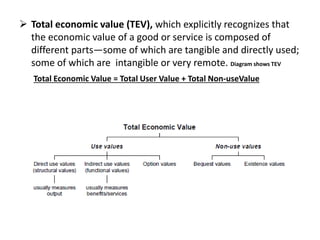
 Total economic value (TEV), which explicitly recognizes that 
the economic value of a good or service is composed of 
different parts—some of which are tangible and directly used; 
some of which are intangible or very remote. Diagram shows TEV 
Total Economic Value = Total User Value + Total Non-useValue
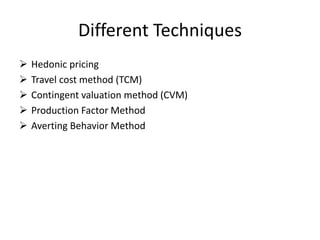
Different Techniques 
 Hedonic pricing 
 Travel cost method (TCM) 
 Contingent valuation method (CVM) 
 Production Factor Method 
 Averting Behavior Method
Hedonic pricing Method 
• The hedonic pricing method infers the value of 
environmental features from the prices of traded goods. 
• It is applicable in those cases where the prices of a good is 
directly influenced by environmental factors. 
• Example is the housing market, where the value of two 
comparable properties or apartments will differ depending on 
the environmental amenities in the vicinity of each site. 
• Hazardous waste site leads to a measurable drop in the 
property price (compared to equivalent houses in other 
locations), 
• This difference in prices gives an indication of the external 
cost of the waste site.
 Hedonic pricing can also be applied to the valuation of 
external benefits. 
 HPM has a very large data requirement because both primary 
data (characteristics of the surroundings) and secondary data 
(market transactions) need to be collected. 
 The value of a house or wage depends on many factors: there 
are social factors, such as employment opportunities, taxes 
and accessibility. 
 Data need to be gathered for all these factors. 
 This makes HPM less suited for application in a decision 
support tool.
Travel Cost Method 
 The travel cost method is well suited for placing a value on 
natural resources, amenities, natural parks, hunting, fishing, 
and wildlife watching sites, and cultural heritage sites. 
 It is based on the concept that if people travel to a site, then 
their willingness to pay for visiting this site must be at least 
as large as the travel cost incurred. 
 The travel cost is comprised of the out−of−pocket 
expenditures incurred to travel to and at the site, plus the 
opportunity cost of time. 
 It is also useful for estimating time costs and their impact on 
the choice of transport mode. 
 The problem with this method is that it does not take into 
account multi-purpose travel (i.e. that individuals will visit 
multiple sites on a single trip).
Contingent Valuation Method 
 The contingent valuation method is a direct approach using a 
hypothetical market. 
 CVM is a survey method in which respondents are asked how 
much they are willing to pay for the use or conservation of 
natural goods. 
 It is the only environmental valuation technique that takes 
into account non-use values . 
 However, using this method can lead to potential biases 
(values can be under or over estimated). 
 There are also high costs involved as it is expensive to 
interview people individually.
Essential elements of the survey are: 
 description of the natural good that is to be valued : includes 
identifying all valuable attributes of the good 
 description of the payment vehicle: how the money will be 
paid 
 description of the hypothetical market : include an 
identification of who will provide and who will pay for the 
nature improvement 
It is said to be an appropriate economic valuation method for 
environmental goods that have no indirect effects on other 
goods. 
It is therefore suited for the valuation of amenities or but not for 
the valuation of natural processes, such as climate regulation .
Production Factor Method(PFM) 
 PFM is based on the fact that many natural resources, 
processes and qualities are used as production factors. 
 Improvement of natural quality may lead to a reduction of 
production costs for the sector making use of the relevant 
quality. 
 The PFM tries to value natural qualities by valuing their 
impacts on production costs. 
 The PFM has been applied to value the effects of water 
quality on agriculture, fishery and industry and the effects of 
air quality on buildings, crops and livestock. 
 The method is meant to determine the value of changes in 
natural qualities on the economic production system.
The method consists of two steps: 
 First, the relation between a dose of pollution and an effect 
on production (the response) is determined. 
 Secondly, the response must be translated into economic 
terms. This is can be done by means of the previously 
described valuation methods (de Boer et al., 1997) and 
consequently the PFM is not really a separate valuation 
method. 
The valuation part of PFM is mostly done by simply multiplying 
the quantity change by the market price. 
It would, however, be better to investigate all economic effects, 
such as changes in demand and supply and in prices. 
PFM can only produce cost-based estimates of the value of the 
production capacity of nature
Averting Behavior Method(ABM) 
 ABM is especially suited for valuing natural qualities. 
 This is done by looking at expenditures made to avert or 
mitigate negative effects from the reduction of a natural 
quality. 
 ABM relies on the assumption that people perceive the 
negative effects of environmental deterioration on their 
welfare and that they are able to adapt their behavior to avert 
or reduce these effects. 
 This means, that people experience the negative effects of 
ozone depletion and that they will buy products such as hats 
and sun-cream to prevent damage to their health. 
 The willingness to pay for a clean environment is deducted 
from people’s purchases of products and services to avert the 
negative effects of pollution.
 ABM is a cost-based method, since the costs of purchasing 
these items are used to value environmental qualities, even 
though the social preferences for a healthy environment may 
be much greater than the expenditures on these products. 
 Buying such products actually means that they have less 
money to spend on the environment . 
 people may not react to small changes in environmental 
quality. They may only react when a certain threshold has 
been passed.
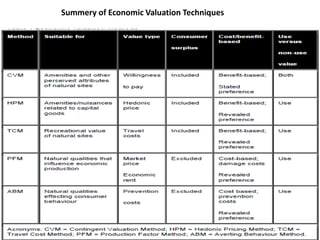
Summery of Economic Valuation Techniques
Case Study Cheimaditida wetland 
 Several lakes in Greece were drained to generate 
hydroelectric power or to expand agricultural land, resulting 
in biodiversity loss. 
 Greece lost 63% of its wetlands between 1920 and 1991 
(Barbier et al.,1997). 
 The aim of this case study is to estimate the non-use values of 
the Cheimaditida wetland in Greece using the CVM which is 
one of only two valuation techniques able to estimate non-use 
values of environmental resources. 
 These non-use values can be combined with use values of the 
Cheimaditida wetland (Psychoudakis et al., 2005 for 
estimates) to obtain its TEV which can then be used for CBA of 
management strategies for this wetland.
 The main economic activities in the area are irrigation and 
fertilizer-intensive agriculture and fishing. 
 Both are adversely affecting water quantity and quality of 
the wetland, thereby reducing its ability to maintain 
biodiversity and other life support functions (Seferlis, 2004). 
 Methodology: 
 The purpose of this study is to elicit the non-use values 
associated with the wetland . 
 In this study, respondents were asked to state their valuation 
(WTP) for an improvement in the quantity and quality of the 
environment. 
• These are the four characteristics, expected to generate non-use 
values, were selected in this study: These were (a) 
biodiversity, (b) open water surface area, (c) inherent 
research and educational values that can be extracted from 
the wetland and (d) values associated with environmentally 
friendly employment opportunities.
 The majority of the non-use values associated with wetlands that 
were estimated were attributed to biodiversity. 
 Using these characteristics, and after extensive consultations with 
scientific experts, the Greek Biotope and Wetland Centre, a 
current scenario and two management scenarios were designed: 
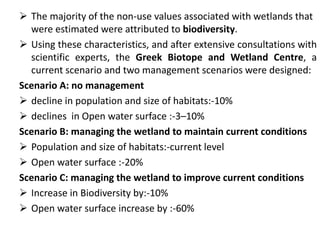
Scenario A: no management 
 decline in population and size of habitats:-10% 
 declines in Open water surface :-3–10% 
Scenario B: managing the wetland to maintain current conditions 
 Population and size of habitats:-current level 
 Open water surface :-20% 
Scenario C: managing the wetland to improve current conditions 
 Increase in Biodiversity by:-10% 
 Open water surface increase by :-60%
 Due to limited time and resources, an open-ended approach was 
used to elicit WTP values for the two different wetland 
management scenarios. 
 An open-ended (OE) elicitation format asks the respondent 
“How much are you willing to pay to…”, rather than a close-ended 
format which asks “Are you willing to pay €X to…”. 
 The respondents were asked whether they are WTP to move 
from scenario A to B and if yes, to state their maximum WTP. 
 Similarly the respondents were asked whether or not they are 
WTP to move from scenario A to C and if yes, to state their 
maximum WTP. 
 While stating their WTP values the respondents were reminded 
of their budget constraints, household expenses, as well as 
other substitute sites in Greece. 
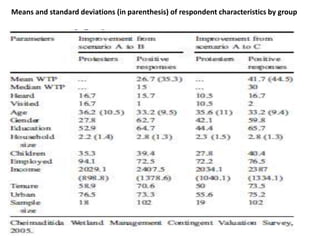
 Result is shown in next slides
Means and standard deviations (in parenthesis) of respondent characteristics by group
Conclusion 
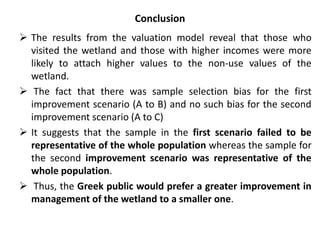
 The results from the valuation model reveal that those who 
visited the wetland and those with higher incomes were more 
likely to attach higher values to the non-use values of the 
wetland. 
 The fact that there was sample selection bias for the first 
improvement scenario (A to B) and no such bias for the second 
improvement scenario (A to C) 
 It suggests that the sample in the first scenario failed to be 
representative of the whole population whereas the sample for 
the second improvement scenario was representative of the 
whole population. 
 Thus, the Greek public would prefer a greater improvement in 
management of the wetland to a smaller one.
 Overall, the results of this contingent valuation case study 
indicate that the Greek public attaches positive and significant 
non-use values to the Cheimaditida wetland. 
 These results assert that CVM can produce valid nonmarket 
estimates of non-use value. 
 These non-use values can be combined with direct and indirect 
use values of the Cheimaditida wetland to estimate its TEV, 
which can provide policy makers with the necessary economic 
information to carry out a CBA, and thus to ensure the 
sustainable and efficient management of the Cheimaditida 
wetland.
References 
 Birol et al. ..“Using economic valuation techniques to inform water resources 
management: A survey and critical appraisal of available techniques and an 
application” 2006. 
 Bishop et al..” Assessing the Economic Value of Ecosystem Conservation” 2004. 
 Dixon et al.” Environmental Valuation: Challenges and Practices” 2008. 
 Dosi et al.” Environmental Values, Valuation Methods, And Natural Disaster 
Damage Assessment” 2000. 
 Eastwood et al..” Generalisability in economic evaluation studies in healthcare: a 
review and case studies” 2004. 
 The Economic, Social and Ecological Value of Ecosystem Services: A Literature 
Review 2005. 
 Venkatachalam et al.“The contingent valuation method: a review” 2003. 
 Zdemiroglu et al..”Economic Valuation with Stated Preference Techniques” 2002.
Thanks

Environmental valuation techniques a review

  • 1.
    Environmental Valuation Techniques: A Review Submitted To Dr. Sandeep Srivastava Civil Dept. Submitted By Abhigyan Anand 2013PCD5317
  • 2.
    Environmental Valuation It refers to the assignment of money values to non-marketed assets, goods and services, where the money values have a particular and precise meaning.  Non-marketed goods and services refer to those which may not be directly bought and sold in the market place.  Examples are scenic views, coral reefs, mountain vistas, biodiversity.  Accident prevention would be an example of a service which is sometimes marketed (purchase of safety equipment) and sometimes not (good driving behavior).  If a good or service contributes positively to human wellbeing, it has economic value.
  • 3.
     An individual’swellbeing is determined by whether or not it satisfies that individual’s preferences.  Preferences are revealed in many ways, but the context of interest is the market.  Environmental values are measured in money terms through the concept of individuals willingness to pay (WTP) or willingness to accept (WTA) compensation for alterations in environmental conditions.  WTP measured by the maximum amount of money that that person would be willing to pay in return for receiving the benefit.  WTA is measured by the minimum amount of money that that person would be willing to accept as compensation for incurring the cost.
  • 4.
     Total economicvalue (TEV), which explicitly recognizes that the economic value of a good or service is composed of different parts—some of which are tangible and directly used; some of which are intangible or very remote. Diagram shows TEV Total Economic Value = Total User Value + Total Non-useValue
  • 5.
    Different Techniques Hedonic pricing  Travel cost method (TCM)  Contingent valuation method (CVM)  Production Factor Method  Averting Behavior Method
  • 6.
    Hedonic pricing Method • The hedonic pricing method infers the value of environmental features from the prices of traded goods. • It is applicable in those cases where the prices of a good is directly influenced by environmental factors. • Example is the housing market, where the value of two comparable properties or apartments will differ depending on the environmental amenities in the vicinity of each site. • Hazardous waste site leads to a measurable drop in the property price (compared to equivalent houses in other locations), • This difference in prices gives an indication of the external cost of the waste site.
  • 7.
     Hedonic pricingcan also be applied to the valuation of external benefits.  HPM has a very large data requirement because both primary data (characteristics of the surroundings) and secondary data (market transactions) need to be collected.  The value of a house or wage depends on many factors: there are social factors, such as employment opportunities, taxes and accessibility.  Data need to be gathered for all these factors.  This makes HPM less suited for application in a decision support tool.
  • 8.
    Travel Cost Method  The travel cost method is well suited for placing a value on natural resources, amenities, natural parks, hunting, fishing, and wildlife watching sites, and cultural heritage sites.  It is based on the concept that if people travel to a site, then their willingness to pay for visiting this site must be at least as large as the travel cost incurred.  The travel cost is comprised of the out−of−pocket expenditures incurred to travel to and at the site, plus the opportunity cost of time.  It is also useful for estimating time costs and their impact on the choice of transport mode.  The problem with this method is that it does not take into account multi-purpose travel (i.e. that individuals will visit multiple sites on a single trip).
  • 9.
    Contingent Valuation Method  The contingent valuation method is a direct approach using a hypothetical market.  CVM is a survey method in which respondents are asked how much they are willing to pay for the use or conservation of natural goods.  It is the only environmental valuation technique that takes into account non-use values .  However, using this method can lead to potential biases (values can be under or over estimated).  There are also high costs involved as it is expensive to interview people individually.
  • 10.
    Essential elements ofthe survey are:  description of the natural good that is to be valued : includes identifying all valuable attributes of the good  description of the payment vehicle: how the money will be paid  description of the hypothetical market : include an identification of who will provide and who will pay for the nature improvement It is said to be an appropriate economic valuation method for environmental goods that have no indirect effects on other goods. It is therefore suited for the valuation of amenities or but not for the valuation of natural processes, such as climate regulation .
  • 11.
    Production Factor Method(PFM)  PFM is based on the fact that many natural resources, processes and qualities are used as production factors.  Improvement of natural quality may lead to a reduction of production costs for the sector making use of the relevant quality.  The PFM tries to value natural qualities by valuing their impacts on production costs.  The PFM has been applied to value the effects of water quality on agriculture, fishery and industry and the effects of air quality on buildings, crops and livestock.  The method is meant to determine the value of changes in natural qualities on the economic production system.
  • 12.
    The method consistsof two steps:  First, the relation between a dose of pollution and an effect on production (the response) is determined.  Secondly, the response must be translated into economic terms. This is can be done by means of the previously described valuation methods (de Boer et al., 1997) and consequently the PFM is not really a separate valuation method. The valuation part of PFM is mostly done by simply multiplying the quantity change by the market price. It would, however, be better to investigate all economic effects, such as changes in demand and supply and in prices. PFM can only produce cost-based estimates of the value of the production capacity of nature
  • 13.
    Averting Behavior Method(ABM)  ABM is especially suited for valuing natural qualities.  This is done by looking at expenditures made to avert or mitigate negative effects from the reduction of a natural quality.  ABM relies on the assumption that people perceive the negative effects of environmental deterioration on their welfare and that they are able to adapt their behavior to avert or reduce these effects.  This means, that people experience the negative effects of ozone depletion and that they will buy products such as hats and sun-cream to prevent damage to their health.  The willingness to pay for a clean environment is deducted from people’s purchases of products and services to avert the negative effects of pollution.
  • 14.
     ABM isa cost-based method, since the costs of purchasing these items are used to value environmental qualities, even though the social preferences for a healthy environment may be much greater than the expenditures on these products.  Buying such products actually means that they have less money to spend on the environment .  people may not react to small changes in environmental quality. They may only react when a certain threshold has been passed.
  • 15.
    Summery of EconomicValuation Techniques
  • 16.
    Case Study Cheimaditidawetland  Several lakes in Greece were drained to generate hydroelectric power or to expand agricultural land, resulting in biodiversity loss.  Greece lost 63% of its wetlands between 1920 and 1991 (Barbier et al.,1997).  The aim of this case study is to estimate the non-use values of the Cheimaditida wetland in Greece using the CVM which is one of only two valuation techniques able to estimate non-use values of environmental resources.  These non-use values can be combined with use values of the Cheimaditida wetland (Psychoudakis et al., 2005 for estimates) to obtain its TEV which can then be used for CBA of management strategies for this wetland.
  • 17.
     The maineconomic activities in the area are irrigation and fertilizer-intensive agriculture and fishing.  Both are adversely affecting water quantity and quality of the wetland, thereby reducing its ability to maintain biodiversity and other life support functions (Seferlis, 2004).  Methodology:  The purpose of this study is to elicit the non-use values associated with the wetland .  In this study, respondents were asked to state their valuation (WTP) for an improvement in the quantity and quality of the environment. • These are the four characteristics, expected to generate non-use values, were selected in this study: These were (a) biodiversity, (b) open water surface area, (c) inherent research and educational values that can be extracted from the wetland and (d) values associated with environmentally friendly employment opportunities.
  • 18.
     The majorityof the non-use values associated with wetlands that were estimated were attributed to biodiversity.  Using these characteristics, and after extensive consultations with scientific experts, the Greek Biotope and Wetland Centre, a current scenario and two management scenarios were designed: Scenario A: no management  decline in population and size of habitats:-10%  declines in Open water surface :-3–10% Scenario B: managing the wetland to maintain current conditions  Population and size of habitats:-current level  Open water surface :-20% Scenario C: managing the wetland to improve current conditions  Increase in Biodiversity by:-10%  Open water surface increase by :-60%
  • 19.
     Due tolimited time and resources, an open-ended approach was used to elicit WTP values for the two different wetland management scenarios.  An open-ended (OE) elicitation format asks the respondent “How much are you willing to pay to…”, rather than a close-ended format which asks “Are you willing to pay €X to…”.  The respondents were asked whether they are WTP to move from scenario A to B and if yes, to state their maximum WTP.  Similarly the respondents were asked whether or not they are WTP to move from scenario A to C and if yes, to state their maximum WTP.  While stating their WTP values the respondents were reminded of their budget constraints, household expenses, as well as other substitute sites in Greece.  Result is shown in next slides
  • 20.
    Means and standarddeviations (in parenthesis) of respondent characteristics by group
  • 21.
    Conclusion  Theresults from the valuation model reveal that those who visited the wetland and those with higher incomes were more likely to attach higher values to the non-use values of the wetland.  The fact that there was sample selection bias for the first improvement scenario (A to B) and no such bias for the second improvement scenario (A to C)  It suggests that the sample in the first scenario failed to be representative of the whole population whereas the sample for the second improvement scenario was representative of the whole population.  Thus, the Greek public would prefer a greater improvement in management of the wetland to a smaller one.
  • 22.
     Overall, theresults of this contingent valuation case study indicate that the Greek public attaches positive and significant non-use values to the Cheimaditida wetland.  These results assert that CVM can produce valid nonmarket estimates of non-use value.  These non-use values can be combined with direct and indirect use values of the Cheimaditida wetland to estimate its TEV, which can provide policy makers with the necessary economic information to carry out a CBA, and thus to ensure the sustainable and efficient management of the Cheimaditida wetland.
  • 23.
    References  Birolet al. ..“Using economic valuation techniques to inform water resources management: A survey and critical appraisal of available techniques and an application” 2006.  Bishop et al..” Assessing the Economic Value of Ecosystem Conservation” 2004.  Dixon et al.” Environmental Valuation: Challenges and Practices” 2008.  Dosi et al.” Environmental Values, Valuation Methods, And Natural Disaster Damage Assessment” 2000.  Eastwood et al..” Generalisability in economic evaluation studies in healthcare: a review and case studies” 2004.  The Economic, Social and Ecological Value of Ecosystem Services: A Literature Review 2005.  Venkatachalam et al.“The contingent valuation method: a review” 2003.  Zdemiroglu et al..”Economic Valuation with Stated Preference Techniques” 2002.
  • 24.