ENVIRONMENTAL 
LEGISLATIONS/ACTS
Legislative Background 
 Specific provisions on Environmental 
Protection in Indian Constitution 
 Directive Principles of State Policy, 
Fundamental Duties explicitly enunciate the 
National Commitment to protect and 
improve the Environment 
 Ruling of Court - Environment is 
Fundamental right of life
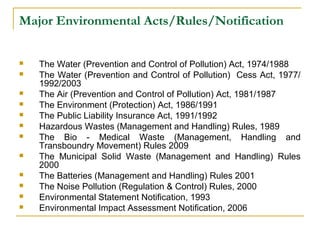
Major Environmental Acts/Rules/Notification 
 The Water (Prevention and Control of Pollution) Act, 1974/1988 
 The Water (Prevention and Control of Pollution) Cess Act, 1977/ 
1992/2003 
 The Air (Prevention and Control of Pollution) Act, 1981/1987 
 The Environment (Protection) Act, 1986/1991 
 The Public Liability Insurance Act, 1991/1992 
 Hazardous Wastes (Management and Handling) Rules, 1989 
 The Bio - Medical Waste (Management, Handling and 
Transboundry Movement) Rules 2009 
 The Municipal Solid Waste (Management and Handling) Rules 
2000 
 The Batteries (Management and Handling) Rules 2001 
 The Noise Pollution (Regulation & Control) Rules, 2000 
 Environmental Statement Notification, 1993 
 Environmental Impact Assessment Notification, 2006
The Water Act 
 An Act to provide for the prevention and control of 
water pollution and the maintaining or restoring of 
wholesomeness of water, for the establishment, with 
a view of carrying out the purpose aforesaid, of 
Boards for the prevention and control of water 
pollution, for conferring on and assigning to such 
Boards powers and functions related thereto and for 
matters connected therewith. 
 Prevention and Control of Water Pollution 
 Maintaining or restoring of wholesomeness of water 
 Formulation of Pollution Control Boards
Salient Features of Water Act 
 Vests regulatory authority to Pollution Control Boards 
(PCB) to establish and enforce effluent standards 
 PCB control sewage/effluent discharge by consent to 
discharge 
 PCB advise and assist for selection of appropriate 
sites for industrial activities 
 Acts give guidelines for formulation, operation and 
other duties/powers of the PCB 
 The 1988 Amendment strengthened the Act’s 
implementation provisions and added the Provisions on 
Citizen’s Suit
The Water Cess Act 
 An Act to provide for the levy and collection of a 
cess on water consumed by persons carrying on 
certain industries and by local authorities, with a 
view to augment the resources of the Central 
Board and the State Boards for the prevention and 
control of water pollution constituted under the 
Water Act, 1974. 
 To collect Cess on Water Consumption 
 To meet the expense of Central and State Boards 
 These revenues are used to implement the Water Act
The Air Act 
 An Act to provide for the prevention, control and abatement of 
air pollution, for the establishment, with a view to carry out 
the aforesaid purposes, of Boards, for conferring on and 
assigning to such Boards powers and functions relating 
thereto and for matters connected therewith. 
 Similar Framework as of Water Act 
 Act expand the authority of Boards to include Air Pollution 
 All industries causing Air Pollution must take consent 
 Formulate Standards for Emission from Industries, 
Automobiles and Ambient Air Quality 
 Air Amendment Act, 1987 introduced stiffer penalties and 
introduced citizen’s Suit provision and added Noise Pollution
Environment Act 
 An Act to provide for the protection and improvement of 
environment and for matters connected therewith. 
 In wake of Bhopal tragedy, the Government of India 
enacted the Environment (Protection) Act of 1986 
under Article 253 of the Constitution. 
 To implement various International conventions on 
Environment 
 Act to cover Protection and improvement of the human 
environment 
 Prevention of hazards to human beings, other living 
creatures, plant and property.
Environment Act 
 Umbrella legislation designated to provide a 
framework for Central Government co-ordination 
of the activities of various Central and State 
authorities established under Water, Air Act. 
 Covering broad scope to include water, air and land 
and the inter-relationships with other living 
creatures, plants, micro-organisms and property. 
 Defines broadly the scope of Environmental 
Pollution and Hazardous substances.
Environment Act 
 Act empowers the Centre to take all such measures 
deem necessary or expedient for the purpose of 
protecting and improving the quality of the environment. 
 Authorises Central Government to set new National 
standards for Ambient Air Quality, Emissions, Effluent 
Discharge 
 Regulate industrial locations 
 Prescribe procedures for managing hazardous 
substances 
 Establishing safeguards for preventing accidents 
 To collect and disseminate information on 
environmental pollution
The Public Liability Insurance Act, 1991 
 An Act to provide for public liability insurance for the purpose of 
providing immediate relief to the persons affected by accidental 
occurring while handling any hazardous substances and for matters 
connected therewith or incidental thereto. 
 Liability to give relief in certain cases on principle of no fault. 
 Liability of owner to takeout insurance policies. 
 Verification and publication of accident by District Administration. 
 Establishment of Environment relief fund. 
 Provisions as to other right to claim compensation for death etc. 
 Power of entry, search and inspection. 
 Power to make application to courts for restraining owners from 
handling hazardous substances.
Hazardous Wastes Rules 
 Applicable to industries generating, handling, storing 
hazardous waste as per schedule 
 Practical steps needed for hazardous wastes treatment, 
storage and disposal 
 Hazardous wastes to be collected, treated, stored and 
disposed off only on authorised places 
 Authorisation for above to be issued by SPCB 
 Hazardous waste to be packed and transported in 
sufficiently safe conditions 
 State government or a person authorised shall undertake a 
continuing programme to identify the sites and publish 
periodically an inventory of disposal sites within the state for 
disposal of Hazardous wastes.
Environmental Statement Notification 
 As per Environmental Statement Notification, Every 
industry is required to submit Environmental Statement 
for the Financial Year ending 31st March before 30th 
September. 
 Environmental Statement enables industry to take 
comprehensive look on : 
 Industrial Process and facilities 
 Material Balance 
 Areas for Waste reduction 
 Savings 
 Environmental Status
Contents of Environmental Statement 
 Site plan & process flow diagram 
 Material balance, Process inputs and outputs 
 Wastes considered to be hazardous or for which regulations 
exist 
 Wastes for which disposal costs are high 
 Listing of unit operations 
 Recording of water usage 
 Current levels of waste re-use/recycling 
 Accounting for waste water (effluent discharge point, waste 
water generated from each unit operation) 
 Characteristics of waste water 
 Accounting for gaseous emissions
Contents of Environmental Statement 
 Accounting for off-site wastes 
 Waste reduction measures, including areas of priority-activities 
which looked promising from the view point of prevention i.e. good 
house keeping, technological change, use of alternative raw 
materials 
 Targeting and Characterising problem wastes 
 Development of long term waste reduction options including 
energy impact, water conservation and substitution of chemicals 
 Environmental and economic evaluation of waste reduction 
options, including cost benefit analysis of preventive options 
 Recommendations for developing and implementing and action 
plan for reduction of waste and increase of production efficiency 
and sequence of steps toward waste prevention options
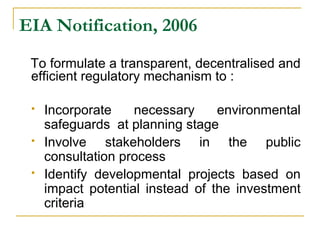
EIA Notification, 2006 
To formulate a transparent, decentralised and 
efficient regulatory mechanism to : 
 Incorporate necessary environmental 
safeguards at planning stage 
 Involve stakeholders in the public 
consultation process 
 Identify developmental projects based on 
impact potential instead of the investment 
criteria
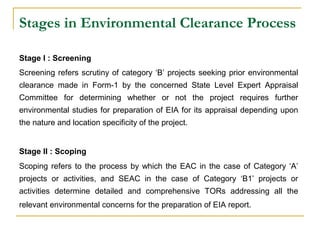
Stages in Environmental Clearance Process 
Stage I : Screening 
Screening refers scrutiny of category ‘B’ projects seeking prior environmental 
clearance made in Form-1 by the concerned State Level Expert Appraisal 
Committee for determining whether or not the project requires further 
environmental studies for preparation of EIA for its appraisal depending upon 
the nature and location specificity of the project. 
Stage II : Scoping 
Scoping refers to the process by which the EAC in the case of Category ‘A’ 
projects or activities, and SEAC in the case of Category ‘B1’ projects or 
activities determine detailed and comprehensive TORs addressing all the 
relevant environmental concerns for the preparation of EIA report.
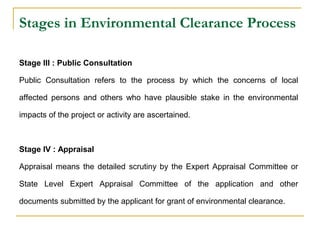
Stages in Environmental Clearance Process 
Stage III : Public Consultation 
Public Consultation refers to the process by which the concerns of local 
affected persons and others who have plausible stake in the environmental 
impacts of the project or activity are ascertained. 
Stage IV : Appraisal 
Appraisal means the detailed scrutiny by the Expert Appraisal Committee or 
State Level Expert Appraisal Committee of the application and other 
documents submitted by the applicant for grant of environmental clearance.
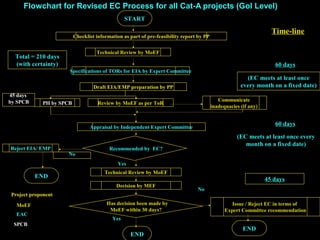
Flowchart for Revised EC Process for all Cat-A projects (GoI Level) 
START 
Time-line 
45 days 
by SPCB 
60 days 
45 days 
Recommended by EC? 
Decision by MEF 
END 
No 
END 
No 
Yes 
Has decision been made by 
MoEF within 30 days? 
END 
60 days 
Checklist information as part of pre-feasibility report by PP 
Technical Review by MoEF 
Specifications of TORs for EIA by Expert Committee 
Draft EIA/EMP preparation by PP 
Review by MoEF as per ToR Communicate 
inadequacies (if any) 
Appraisal by Independent Expert Committee 
PH by SPCB 
Reject EIA/ EMP 
Technical Review by MoEF 
Issue / Reject EC in terms of 
Expert Committee recommendation 
Yes 
Total = 210 days 
(with certainty) 
Project proponent 
MoEF 
EAC 
SPCB 
(EC meets at least once 
every month on a fixed date) 
(EC meets at least once every 
month on a fixed date)
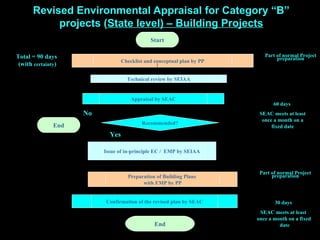
Revised Environmental Appraisal for Category “B” 
projects (State level) – Building Projects 
Start 
Checklist and conceptual plan by PP 
Technical review by SEIAA 
Appraisal by SEAC 
End Recommended? 
Issue of in-principle EC / EMP by SEIAA 
Preparation of Building Plans 
with EMP by PP 
Confirmation of the revised plan by SEAC 
End 
Yes 
No 
Part opfr nepoarmraatli oPnroject 
30 days 
SEAC meets at least 
once a month on a fixed 
date 
Total = 90 days 
(with certainty) 
60 days 
SEAC meets at least 
once a month on a 
fixed date
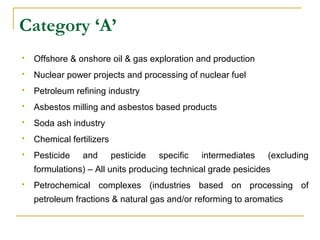
Category ‘A’ 
 Offshore & onshore oil & gas exploration and production 
 Nuclear power projects and processing of nuclear fuel 
 Petroleum refining industry 
 Asbestos milling and asbestos based products 
 Soda ash industry 
 Chemical fertilizers 
 Pesticide and pesticide specific intermediates (excluding 
formulations) – All units producing technical grade pesicides 
 Petrochemical complexes (industries based on processing of 
petroleum fractions & natural gas and/or reforming to aromatics
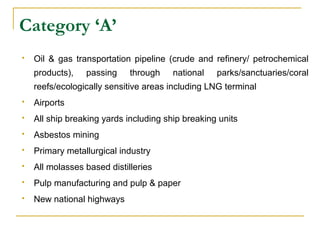
Category ‘A’ 
 Oil & gas transportation pipeline (crude and refinery/ petrochemical 
products), passing through national parks/sanctuaries/coral 
reefs/ecologically sensitive areas including LNG terminal 
 Airports 
 All ship breaking yards including ship breaking units 
 Asbestos mining 
 Primary metallurgical industry 
 All molasses based distilleries 
 Pulp manufacturing and pulp & paper 
 New national highways
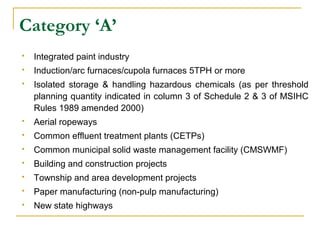
Category ‘A’ 
 Integrated paint industry 
 Induction/arc furnaces/cupola furnaces 5TPH or more 
 Isolated storage & handling hazardous chemicals (as per threshold 
planning quantity indicated in column 3 of Schedule 2 & 3 of MSIHC 
Rules 1989 amended 2000) 
 Aerial ropeways 
 Common effluent treatment plants (CETPs) 
 Common municipal solid waste management facility (CMSWMF) 
 Building and construction projects 
 Township and area development projects 
 Paper manufacturing (non-pulp manufacturing) 
 New state highways
EP ACT 1986 – Emission Standards 
 Central Pollution Control Board (CPCB) has developed 
National Standards for Emission under the statutory 
powers of the Air ( Prevention and Control of Pollution) 
Act, 1981. 
 These standards have been approved and notified by 
the Government of India, Ministry of Environment & 
Forests, under Section 25 of the Environmental 
(Protection) Act, 1986. 
 Emission Standards for different categories of 
industries have been evolved.
Important Standards 
 National Ambient Air Quality Standards 
 The Environmental (Protection) Rules, 1986 
 SCHEDULE III : Ambient Air Quality Standards 
in respect of Noise 
 SCEDULE VI : Part - A - Effluent General 
Standards for discharge of environmental 
pollutants 
 SCHEDULE VI : Part - D - General Emission 
Standards for Air Emissions
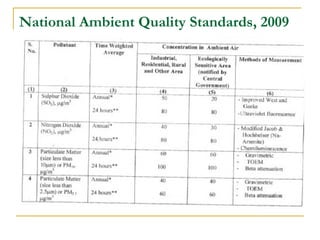
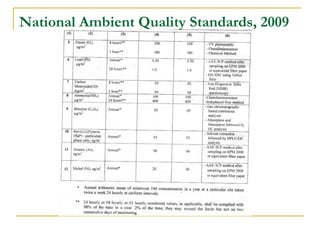
National Ambient Quality Standards, 2009
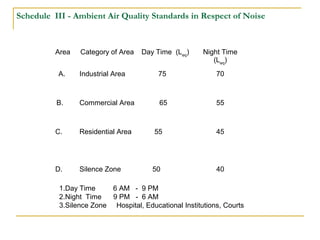
Schedule III - Ambient Air Quality Standards in Respect of Noise 
Area 
Category of Area Day Time (Leq) Night Time 
(Leq) 
A. Industrial Area 75 70 
B. Commercial Area 65 55 
C. Residential Area 
55 45 
D. Silence Zone 
50 40 
1.Day Time 6 AM - 9 PM 
2.Night Time 9 PM - 6 AM 
3.Silence Zone Hospital, Educational Institutions, Courts
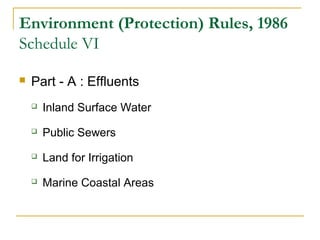
Environment (Protection) Rules, 1986 
Schedule VI 
 Part - A : Effluents 
 Inland Surface Water 
 Public Sewers 
 Land for Irrigation 
 Marine Coastal Areas
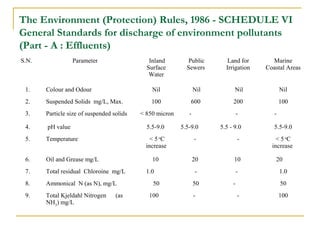
The Environment (Protection) Rules, 1986 - SCHEDULE VI 
General Standards for discharge of environment pollutants 
(Part - A : Effluents) 
S.N. Parameter Inland 
Surface 
Water 
Public 
Sewers 
Land for 
Irrigation 
Marine 
Coastal Areas 
1. Colour and Odour Nil Nil Nil Nil 
2. Suspended Solids mg/L, Max. 100 600 200 100 
3. Particle size of suspended solids < 850 micron - - - 
4. pH value 5.5-9.0 5.5-9.0 5.5 - 9.0 5.5-9.0 
5. Temperature < 5 oC 
increase 
- - < 5 oC 
increase 
6. Oil and Grease mg/L 10 20 10 20 
7. Total residual Chloroine mg/L 1.0 - - 1.0 
8. Ammonical N (as N), mg/L 50 50 - 50 
9. Total Kjeldahl Nitrogen (as 
NH3) mg/L 
100 - - 100
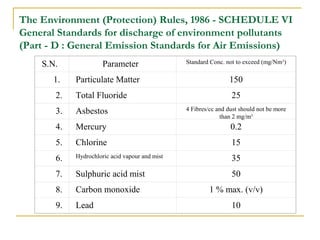
The Environment (Protection) Rules, 1986 - SCHEDULE VI 
General Standards for discharge of environment pollutants 
(Part - D : General Emission Standards for Air Emissions) 
S.N. 
Parameter Standard Conc. not to exceed (mg/Nm3) 
1. 
Particulate Matter 150 
2. 
Total Fluoride 25 
3. 
Asbestos 4 Fibres/cc and dust should not be more 
than 2 mg/m3 
4. 
Mercury 0.2 
5. 
Chlorine 15 
6. 
Hydrochloric acid vapour and mist 35 
7. 
Sulphuric acid mist 
50 
8. 
Carbon monoxide 
1 % max. (v/v) 
9. 
Lead 
10
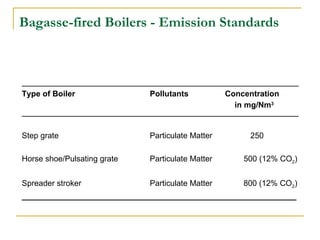
Bagasse-fired Boilers - Emission Standards 
________________________________________________________________________________ 
Type of Boiler Pollutants Concentration 
in mg/Nm3 
________________________________________________________________________________ 
Step grate Particulate Matter 250 
Horse shoe/Pulsating grate Particulate Matter 500 (12% CO2) 
Spreader stroker Particulate Matter 800 (12% CO2) 
______________________________________________________________
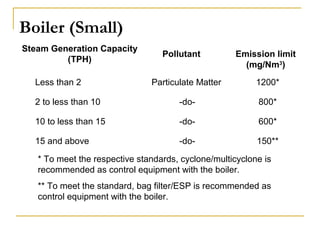
Boiler (Small) 
Steam Generation Capacity 
(TPH) Pollutant Emission limit 
(mg/Nm3) 
Less than 2 Particulate Matter 1200* 
2 to less than 10 -do- 800* 
10 to less than 15 -do- 600* 
15 and above -do- 150** 
* To meet the respective standards, cyclone/multicyclone is 
recommended as control equipment with the boiler. 
** To meet the standard, bag filter/ESP is recommended as 
control equipment with the boiler.
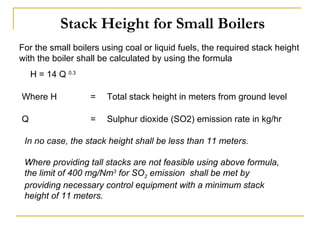
Stack Height for Small Boilers 
For the small boilers using coal or liquid fuels, the required stack height 
with the boiler shall be calculated by using the formula 
H = 14 Q 0.3 
Where H = Total stack height in meters from ground level 
Q = Sulphur dioxide (SO2) emission rate in kg/hr 
In no case, the stack height shall be less than 11 meters. 
Where providing tall stacks are not feasible using above formula, 
the limit of 400 mg/Nm3 for SO2 emission shall be met by 
providing necessary control equipment with a minimum stack 
height of 11 meters.
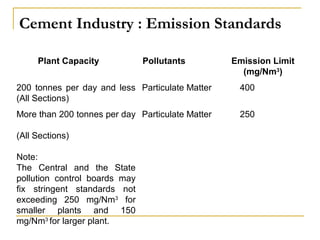
Cement Industry : Emission Standards 
Plant Capacity Pollutants Emission Limit 
(mg/Nm3) 
200 tonnes per day and less 
(All Sections) 
Particulate Matter 400 
More than 200 tonnes per day 
(All Sections) 
Note: 
The Central and the State 
pollution control boards may 
fix stringent standards not 
exceeding 250 mg/Nm3 for 
smaller plants and 150 
mg/Nm3 for larger plant. 
Particulate Matter 250
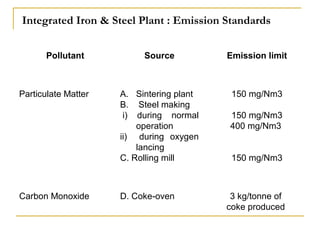
Integrated Iron & Steel Plant : Emission Standards 
Pollutant Source Emission limit 
Particulate Matter A. Sintering plant 
B. Steel making 
i) during normal 
operation 
ii) during oxygen 
lancing 
150 mg/Nm3 
150 mg/Nm3 
400 mg/Nm3 
C. Rolling mill 150 mg/Nm3 
Carbon Monoxide D. Coke-oven 3 kg/tonne of 
coke produced
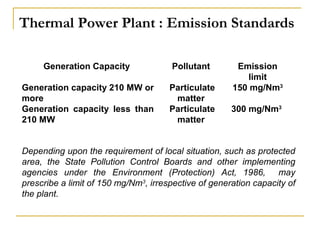
Thermal Power Plant : Emission Standards 
Generation Capacity Pollutant Emission 
limit 
Generation capacity 210 MW or 
more 
Generation capacity less than 
210 MW 
Particulate 
matter 
Particulate 
matter 
150 mg/Nm3 
300 mg/Nm3 
Depending upon the requirement of local situation, such as protected 
area, the State Pollution Control Boards and other implementing 
agencies under the Environment (Protection) Act, 1986, may 
prescribe a limit of 150 mg/Nm3, irrespective of generation capacity of 
the plant.
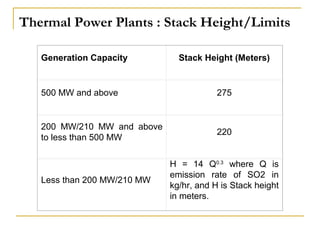
Thermal Power Plants : Stack Height/Limits 
Generation Capacity Stack Height (Meters) 
500 MW and above 275 
200 MW/210 MW and above 
to less than 500 MW 220 
Less than 200 MW/210 MW 
H = 14 Q0.3 where Q is 
emission rate of SO2 in 
kg/hr, and H is Stack height 
in meters.
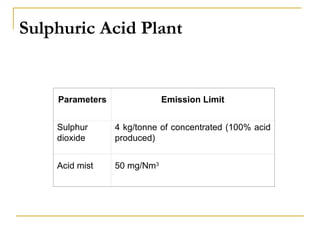
Sulphuric Acid Plant 
Parameters Emission Limit 
Sulphur 
dioxide 
4 kg/tonne of concentrated (100% acid 
produced) 
Acid mist 50 mg/Nm3
Thank You

Environmental acts

  • 1.
  • 2.
    Legislative Background Specific provisions on Environmental Protection in Indian Constitution  Directive Principles of State Policy, Fundamental Duties explicitly enunciate the National Commitment to protect and improve the Environment  Ruling of Court - Environment is Fundamental right of life
  • 3.
    Major Environmental Acts/Rules/Notification  The Water (Prevention and Control of Pollution) Act, 1974/1988  The Water (Prevention and Control of Pollution) Cess Act, 1977/ 1992/2003  The Air (Prevention and Control of Pollution) Act, 1981/1987  The Environment (Protection) Act, 1986/1991  The Public Liability Insurance Act, 1991/1992  Hazardous Wastes (Management and Handling) Rules, 1989  The Bio - Medical Waste (Management, Handling and Transboundry Movement) Rules 2009  The Municipal Solid Waste (Management and Handling) Rules 2000  The Batteries (Management and Handling) Rules 2001  The Noise Pollution (Regulation & Control) Rules, 2000  Environmental Statement Notification, 1993  Environmental Impact Assessment Notification, 2006
  • 4.
    The Water Act  An Act to provide for the prevention and control of water pollution and the maintaining or restoring of wholesomeness of water, for the establishment, with a view of carrying out the purpose aforesaid, of Boards for the prevention and control of water pollution, for conferring on and assigning to such Boards powers and functions related thereto and for matters connected therewith.  Prevention and Control of Water Pollution  Maintaining or restoring of wholesomeness of water  Formulation of Pollution Control Boards
  • 5.
    Salient Features ofWater Act  Vests regulatory authority to Pollution Control Boards (PCB) to establish and enforce effluent standards  PCB control sewage/effluent discharge by consent to discharge  PCB advise and assist for selection of appropriate sites for industrial activities  Acts give guidelines for formulation, operation and other duties/powers of the PCB  The 1988 Amendment strengthened the Act’s implementation provisions and added the Provisions on Citizen’s Suit
  • 6.
    The Water CessAct  An Act to provide for the levy and collection of a cess on water consumed by persons carrying on certain industries and by local authorities, with a view to augment the resources of the Central Board and the State Boards for the prevention and control of water pollution constituted under the Water Act, 1974.  To collect Cess on Water Consumption  To meet the expense of Central and State Boards  These revenues are used to implement the Water Act
  • 7.
    The Air Act  An Act to provide for the prevention, control and abatement of air pollution, for the establishment, with a view to carry out the aforesaid purposes, of Boards, for conferring on and assigning to such Boards powers and functions relating thereto and for matters connected therewith.  Similar Framework as of Water Act  Act expand the authority of Boards to include Air Pollution  All industries causing Air Pollution must take consent  Formulate Standards for Emission from Industries, Automobiles and Ambient Air Quality  Air Amendment Act, 1987 introduced stiffer penalties and introduced citizen’s Suit provision and added Noise Pollution
  • 8.
    Environment Act An Act to provide for the protection and improvement of environment and for matters connected therewith.  In wake of Bhopal tragedy, the Government of India enacted the Environment (Protection) Act of 1986 under Article 253 of the Constitution.  To implement various International conventions on Environment  Act to cover Protection and improvement of the human environment  Prevention of hazards to human beings, other living creatures, plant and property.
  • 9.
    Environment Act Umbrella legislation designated to provide a framework for Central Government co-ordination of the activities of various Central and State authorities established under Water, Air Act.  Covering broad scope to include water, air and land and the inter-relationships with other living creatures, plants, micro-organisms and property.  Defines broadly the scope of Environmental Pollution and Hazardous substances.
  • 10.
    Environment Act Act empowers the Centre to take all such measures deem necessary or expedient for the purpose of protecting and improving the quality of the environment.  Authorises Central Government to set new National standards for Ambient Air Quality, Emissions, Effluent Discharge  Regulate industrial locations  Prescribe procedures for managing hazardous substances  Establishing safeguards for preventing accidents  To collect and disseminate information on environmental pollution
  • 11.
    The Public LiabilityInsurance Act, 1991  An Act to provide for public liability insurance for the purpose of providing immediate relief to the persons affected by accidental occurring while handling any hazardous substances and for matters connected therewith or incidental thereto.  Liability to give relief in certain cases on principle of no fault.  Liability of owner to takeout insurance policies.  Verification and publication of accident by District Administration.  Establishment of Environment relief fund.  Provisions as to other right to claim compensation for death etc.  Power of entry, search and inspection.  Power to make application to courts for restraining owners from handling hazardous substances.
  • 12.
    Hazardous Wastes Rules  Applicable to industries generating, handling, storing hazardous waste as per schedule  Practical steps needed for hazardous wastes treatment, storage and disposal  Hazardous wastes to be collected, treated, stored and disposed off only on authorised places  Authorisation for above to be issued by SPCB  Hazardous waste to be packed and transported in sufficiently safe conditions  State government or a person authorised shall undertake a continuing programme to identify the sites and publish periodically an inventory of disposal sites within the state for disposal of Hazardous wastes.
  • 13.
    Environmental Statement Notification  As per Environmental Statement Notification, Every industry is required to submit Environmental Statement for the Financial Year ending 31st March before 30th September.  Environmental Statement enables industry to take comprehensive look on :  Industrial Process and facilities  Material Balance  Areas for Waste reduction  Savings  Environmental Status
  • 14.
    Contents of EnvironmentalStatement  Site plan & process flow diagram  Material balance, Process inputs and outputs  Wastes considered to be hazardous or for which regulations exist  Wastes for which disposal costs are high  Listing of unit operations  Recording of water usage  Current levels of waste re-use/recycling  Accounting for waste water (effluent discharge point, waste water generated from each unit operation)  Characteristics of waste water  Accounting for gaseous emissions
  • 15.
    Contents of EnvironmentalStatement  Accounting for off-site wastes  Waste reduction measures, including areas of priority-activities which looked promising from the view point of prevention i.e. good house keeping, technological change, use of alternative raw materials  Targeting and Characterising problem wastes  Development of long term waste reduction options including energy impact, water conservation and substitution of chemicals  Environmental and economic evaluation of waste reduction options, including cost benefit analysis of preventive options  Recommendations for developing and implementing and action plan for reduction of waste and increase of production efficiency and sequence of steps toward waste prevention options
  • 16.
    EIA Notification, 2006 To formulate a transparent, decentralised and efficient regulatory mechanism to :  Incorporate necessary environmental safeguards at planning stage  Involve stakeholders in the public consultation process  Identify developmental projects based on impact potential instead of the investment criteria
  • 17.
    Stages in EnvironmentalClearance Process Stage I : Screening Screening refers scrutiny of category ‘B’ projects seeking prior environmental clearance made in Form-1 by the concerned State Level Expert Appraisal Committee for determining whether or not the project requires further environmental studies for preparation of EIA for its appraisal depending upon the nature and location specificity of the project. Stage II : Scoping Scoping refers to the process by which the EAC in the case of Category ‘A’ projects or activities, and SEAC in the case of Category ‘B1’ projects or activities determine detailed and comprehensive TORs addressing all the relevant environmental concerns for the preparation of EIA report.
  • 18.
    Stages in EnvironmentalClearance Process Stage III : Public Consultation Public Consultation refers to the process by which the concerns of local affected persons and others who have plausible stake in the environmental impacts of the project or activity are ascertained. Stage IV : Appraisal Appraisal means the detailed scrutiny by the Expert Appraisal Committee or State Level Expert Appraisal Committee of the application and other documents submitted by the applicant for grant of environmental clearance.
  • 19.
    Flowchart for RevisedEC Process for all Cat-A projects (GoI Level) START Time-line 45 days by SPCB 60 days 45 days Recommended by EC? Decision by MEF END No END No Yes Has decision been made by MoEF within 30 days? END 60 days Checklist information as part of pre-feasibility report by PP Technical Review by MoEF Specifications of TORs for EIA by Expert Committee Draft EIA/EMP preparation by PP Review by MoEF as per ToR Communicate inadequacies (if any) Appraisal by Independent Expert Committee PH by SPCB Reject EIA/ EMP Technical Review by MoEF Issue / Reject EC in terms of Expert Committee recommendation Yes Total = 210 days (with certainty) Project proponent MoEF EAC SPCB (EC meets at least once every month on a fixed date) (EC meets at least once every month on a fixed date)
  • 20.
    Revised Environmental Appraisalfor Category “B” projects (State level) – Building Projects Start Checklist and conceptual plan by PP Technical review by SEIAA Appraisal by SEAC End Recommended? Issue of in-principle EC / EMP by SEIAA Preparation of Building Plans with EMP by PP Confirmation of the revised plan by SEAC End Yes No Part opfr nepoarmraatli oPnroject Part opfr nepoarmraatli oPnroject 30 days SEAC meets at least once a month on a fixed date Total = 90 days (with certainty) 60 days SEAC meets at least once a month on a fixed date
  • 21.
    Category ‘A’ Offshore & onshore oil & gas exploration and production  Nuclear power projects and processing of nuclear fuel  Petroleum refining industry  Asbestos milling and asbestos based products  Soda ash industry  Chemical fertilizers  Pesticide and pesticide specific intermediates (excluding formulations) – All units producing technical grade pesicides  Petrochemical complexes (industries based on processing of petroleum fractions & natural gas and/or reforming to aromatics
  • 22.
    Category ‘A’ Oil & gas transportation pipeline (crude and refinery/ petrochemical products), passing through national parks/sanctuaries/coral reefs/ecologically sensitive areas including LNG terminal  Airports  All ship breaking yards including ship breaking units  Asbestos mining  Primary metallurgical industry  All molasses based distilleries  Pulp manufacturing and pulp & paper  New national highways
  • 23.
    Category ‘A’ Integrated paint industry  Induction/arc furnaces/cupola furnaces 5TPH or more  Isolated storage & handling hazardous chemicals (as per threshold planning quantity indicated in column 3 of Schedule 2 & 3 of MSIHC Rules 1989 amended 2000)  Aerial ropeways  Common effluent treatment plants (CETPs)  Common municipal solid waste management facility (CMSWMF)  Building and construction projects  Township and area development projects  Paper manufacturing (non-pulp manufacturing)  New state highways
  • 24.
    EP ACT 1986– Emission Standards  Central Pollution Control Board (CPCB) has developed National Standards for Emission under the statutory powers of the Air ( Prevention and Control of Pollution) Act, 1981.  These standards have been approved and notified by the Government of India, Ministry of Environment & Forests, under Section 25 of the Environmental (Protection) Act, 1986.  Emission Standards for different categories of industries have been evolved.
  • 25.
    Important Standards National Ambient Air Quality Standards  The Environmental (Protection) Rules, 1986  SCHEDULE III : Ambient Air Quality Standards in respect of Noise  SCEDULE VI : Part - A - Effluent General Standards for discharge of environmental pollutants  SCHEDULE VI : Part - D - General Emission Standards for Air Emissions
  • 26.
    National Ambient QualityStandards, 2009
  • 27.
    National Ambient QualityStandards, 2009
  • 28.
    Schedule III -Ambient Air Quality Standards in Respect of Noise Area Category of Area Day Time (Leq) Night Time (Leq) A. Industrial Area 75 70 B. Commercial Area 65 55 C. Residential Area 55 45 D. Silence Zone 50 40 1.Day Time 6 AM - 9 PM 2.Night Time 9 PM - 6 AM 3.Silence Zone Hospital, Educational Institutions, Courts
  • 29.
    Environment (Protection) Rules,1986 Schedule VI  Part - A : Effluents  Inland Surface Water  Public Sewers  Land for Irrigation  Marine Coastal Areas
  • 30.
    The Environment (Protection)Rules, 1986 - SCHEDULE VI General Standards for discharge of environment pollutants (Part - A : Effluents) S.N. Parameter Inland Surface Water Public Sewers Land for Irrigation Marine Coastal Areas 1. Colour and Odour Nil Nil Nil Nil 2. Suspended Solids mg/L, Max. 100 600 200 100 3. Particle size of suspended solids < 850 micron - - - 4. pH value 5.5-9.0 5.5-9.0 5.5 - 9.0 5.5-9.0 5. Temperature < 5 oC increase - - < 5 oC increase 6. Oil and Grease mg/L 10 20 10 20 7. Total residual Chloroine mg/L 1.0 - - 1.0 8. Ammonical N (as N), mg/L 50 50 - 50 9. Total Kjeldahl Nitrogen (as NH3) mg/L 100 - - 100
  • 31.
    The Environment (Protection)Rules, 1986 - SCHEDULE VI General Standards for discharge of environment pollutants (Part - D : General Emission Standards for Air Emissions) S.N. Parameter Standard Conc. not to exceed (mg/Nm3) 1. Particulate Matter 150 2. Total Fluoride 25 3. Asbestos 4 Fibres/cc and dust should not be more than 2 mg/m3 4. Mercury 0.2 5. Chlorine 15 6. Hydrochloric acid vapour and mist 35 7. Sulphuric acid mist 50 8. Carbon monoxide 1 % max. (v/v) 9. Lead 10
  • 32.
    Bagasse-fired Boilers -Emission Standards ________________________________________________________________________________ Type of Boiler Pollutants Concentration in mg/Nm3 ________________________________________________________________________________ Step grate Particulate Matter 250 Horse shoe/Pulsating grate Particulate Matter 500 (12% CO2) Spreader stroker Particulate Matter 800 (12% CO2) ______________________________________________________________
  • 33.
    Boiler (Small) SteamGeneration Capacity (TPH) Pollutant Emission limit (mg/Nm3) Less than 2 Particulate Matter 1200* 2 to less than 10 -do- 800* 10 to less than 15 -do- 600* 15 and above -do- 150** * To meet the respective standards, cyclone/multicyclone is recommended as control equipment with the boiler. ** To meet the standard, bag filter/ESP is recommended as control equipment with the boiler.
  • 34.
    Stack Height forSmall Boilers For the small boilers using coal or liquid fuels, the required stack height with the boiler shall be calculated by using the formula H = 14 Q 0.3 Where H = Total stack height in meters from ground level Q = Sulphur dioxide (SO2) emission rate in kg/hr In no case, the stack height shall be less than 11 meters. Where providing tall stacks are not feasible using above formula, the limit of 400 mg/Nm3 for SO2 emission shall be met by providing necessary control equipment with a minimum stack height of 11 meters.
  • 35.
    Cement Industry :Emission Standards Plant Capacity Pollutants Emission Limit (mg/Nm3) 200 tonnes per day and less (All Sections) Particulate Matter 400 More than 200 tonnes per day (All Sections) Note: The Central and the State pollution control boards may fix stringent standards not exceeding 250 mg/Nm3 for smaller plants and 150 mg/Nm3 for larger plant. Particulate Matter 250
  • 36.
    Integrated Iron &Steel Plant : Emission Standards Pollutant Source Emission limit Particulate Matter A. Sintering plant B. Steel making i) during normal operation ii) during oxygen lancing 150 mg/Nm3 150 mg/Nm3 400 mg/Nm3 C. Rolling mill 150 mg/Nm3 Carbon Monoxide D. Coke-oven 3 kg/tonne of coke produced
  • 37.
    Thermal Power Plant: Emission Standards Generation Capacity Pollutant Emission limit Generation capacity 210 MW or more Generation capacity less than 210 MW Particulate matter Particulate matter 150 mg/Nm3 300 mg/Nm3 Depending upon the requirement of local situation, such as protected area, the State Pollution Control Boards and other implementing agencies under the Environment (Protection) Act, 1986, may prescribe a limit of 150 mg/Nm3, irrespective of generation capacity of the plant.
  • 38.
    Thermal Power Plants: Stack Height/Limits Generation Capacity Stack Height (Meters) 500 MW and above 275 200 MW/210 MW and above to less than 500 MW 220 Less than 200 MW/210 MW H = 14 Q0.3 where Q is emission rate of SO2 in kg/hr, and H is Stack height in meters.
  • 39.
    Sulphuric Acid Plant Parameters Emission Limit Sulphur dioxide 4 kg/tonne of concentrated (100% acid produced) Acid mist 50 mg/Nm3
  • 40.