NATIONAL GREEN
TRIBUNAL ACT
National Green Tribunal Act ,2010 is an
act of the Parliament Of India which
enables creation of a special tribunal or
body to handle the efficient disposal of
the cases related to environmental
issues.
It is inspired from India’s constitutional
provision of Article 21, which assures the
citizens of India the right to a healthy
The act aims at efficient
solving of cases related to
environmental pollution
and giving relief
and compensation
for damages to persons
and property and for matters
connected therewith
Initially, the NGT is proposed to be set
up at five places of sittings and will
follow circuit procedure for making
itself more accessible; New Delhi is the
Principal Place of Sitting of the Tribunal
and Bhopal, Pune, Kolkata, Allahabad
and Chennai shall be the other place of
sitting of the Tribunal.
There lie many reasons behind the setting
up of this tribunal. After India's move with
Carbon credits, such tribunal may play a
vital role in ensuring the control of
emissions and maintaining the desired
levels. This is the first body of its kind that
is required by its parent statute to apply the
"polluter pays" principle and the principle
of sustainable development.
 The tribunal is mandated to make and endeavor for
disposal of applications or appeals finally within 6
months of filing .
 New Delhi is the principal place of sitting of the
tribunal .
 This court is special because India is the third
country following Australia and New Zealand to
have such a system .
During the Rio de Janeiro summit of United
Nations Conference on Environment and
Development in June 1992, India vowed the
participating states to provide judicial and
administrative remedies for the victims of the
pollutants and other environmental damage.
On 18 October 2010, Justice Lokeshwar Singh
Panta became its first chairman.Currently it is
chaired by Hon'ble Mr. Justice Swatanter Kumar.
• It is a specialized body equipped with
necessary expertise to handle
environment disputes involving multi-
disciplinary issues.
• The tribunal provides –
a) Relief and compensation to the
victims of pollution and other
environment damage for restitution of
property damaged
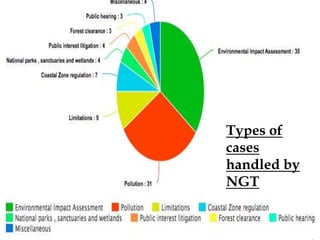
Types of
cases
handled by
NGT
JURISDICTION
The NGT has the power to hear all civil cases relating to
environmental issues and questions that are linked to the
implementation of laws listed in Schedule I of the NGT Act.
These include the following
The Water (Prevention and Control of Pollution) Act, 1974;
• The Water (Prevention and Control of Pollution) Cess Act,
1977;
• The Forest (Conservation) Act, 1980;
• The Air (Prevention and Control of Pollution) Act, 1981;
• The Environment (Protection) Act, 1986;
• This means that any violations pertaining only to these laws,
or any order / decision taken by the Government under these
laws can be challenged before the NGT.
YAMUNA
CONSERVATION ZONE
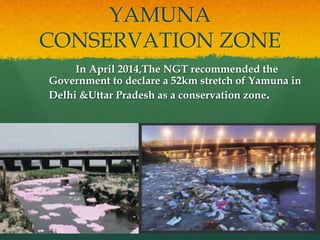
In April 2014,The NGT recommended the
Government to declare a 52km stretch of Yamuna in
Delhi &Uttar Pradesh as a conservation zone.
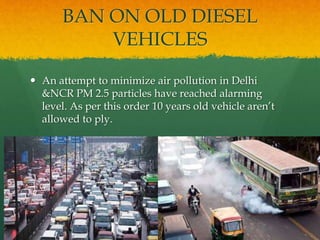
BAN ON OLD DIESEL
VEHICLES
 An attempt to minimize air pollution in Delhi
&NCR PM 2.5 particles have reached alarming
level. As per this order 10 years old vehicle aren’t
allowed to ply.
national green tribunal

national green tribunal

  • 2.
    NATIONAL GREEN TRIBUNAL ACT NationalGreen Tribunal Act ,2010 is an act of the Parliament Of India which enables creation of a special tribunal or body to handle the efficient disposal of the cases related to environmental issues. It is inspired from India’s constitutional provision of Article 21, which assures the citizens of India the right to a healthy
  • 3.
    The act aimsat efficient solving of cases related to environmental pollution and giving relief and compensation for damages to persons and property and for matters connected therewith
  • 4.
    Initially, the NGTis proposed to be set up at five places of sittings and will follow circuit procedure for making itself more accessible; New Delhi is the Principal Place of Sitting of the Tribunal and Bhopal, Pune, Kolkata, Allahabad and Chennai shall be the other place of sitting of the Tribunal.
  • 5.
    There lie manyreasons behind the setting up of this tribunal. After India's move with Carbon credits, such tribunal may play a vital role in ensuring the control of emissions and maintaining the desired levels. This is the first body of its kind that is required by its parent statute to apply the "polluter pays" principle and the principle of sustainable development.
  • 6.
     The tribunalis mandated to make and endeavor for disposal of applications or appeals finally within 6 months of filing .  New Delhi is the principal place of sitting of the tribunal .  This court is special because India is the third country following Australia and New Zealand to have such a system .
  • 7.
    During the Riode Janeiro summit of United Nations Conference on Environment and Development in June 1992, India vowed the participating states to provide judicial and administrative remedies for the victims of the pollutants and other environmental damage. On 18 October 2010, Justice Lokeshwar Singh Panta became its first chairman.Currently it is chaired by Hon'ble Mr. Justice Swatanter Kumar.
  • 8.
    • It isa specialized body equipped with necessary expertise to handle environment disputes involving multi- disciplinary issues. • The tribunal provides – a) Relief and compensation to the victims of pollution and other environment damage for restitution of property damaged
  • 9.
  • 11.
    JURISDICTION The NGT hasthe power to hear all civil cases relating to environmental issues and questions that are linked to the implementation of laws listed in Schedule I of the NGT Act. These include the following The Water (Prevention and Control of Pollution) Act, 1974; • The Water (Prevention and Control of Pollution) Cess Act, 1977; • The Forest (Conservation) Act, 1980; • The Air (Prevention and Control of Pollution) Act, 1981; • The Environment (Protection) Act, 1986; • This means that any violations pertaining only to these laws, or any order / decision taken by the Government under these laws can be challenged before the NGT.
  • 13.
    YAMUNA CONSERVATION ZONE In April2014,The NGT recommended the Government to declare a 52km stretch of Yamuna in Delhi &Uttar Pradesh as a conservation zone.
  • 14.
    BAN ON OLDDIESEL VEHICLES  An attempt to minimize air pollution in Delhi &NCR PM 2.5 particles have reached alarming level. As per this order 10 years old vehicle aren’t allowed to ply.