Instructor :- Dr. Soumik mukhoupadhyay
Name:-Vishnu Kumar Tiwari
Roll. No.:- 181171
Email- tvishnu@iitk.ac.in
1.Definition of Paramagnetism
2. Different Origion of Paramagnetism
3.Local Moment Paramagnetism
4. Effective Magnetic moment
5.Van Velck Paramagnetism
6.Curie & Curie-Weiss law
7. Pauli Paramagnetism
8.Crossover between local moment
Paramagnetism and Pauli Paramagetism
Definition of Paramagnetism
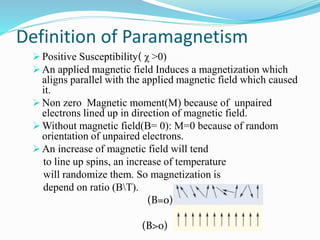
 Positive Susceptibility( χ >0)
 An applied magnetic field Induces a magnetization which
aligns parallel with the applied magnetic field which caused
it.
 Non zero Magnetic moment(M) because of unpaired
electrons lined up in direction of magnetic field.
 Without magnetic field(B= 0): M=0 because of random
orientation of unpaired electrons.
 An increase of magnetic field will tend
to line up spins, an increase of temperature
will randomize them. So magnetization is
depend on ratio (BT).
(B=0)
(B>0)
The peramagnet magnetic moment results from the
following cotributions:
The spin and intrinsic moments of the electrons.
 The Orbital motion of electron .
The spin magnetic moment of nucleolus.
Paramagnetism observed in metals because of odd no. of
electrons.
Paramagnetism can be explained by classical theory which
is known is Lengevin`s theory of Paramagnetism.
Lengevin`s theory of Paramagnetism:
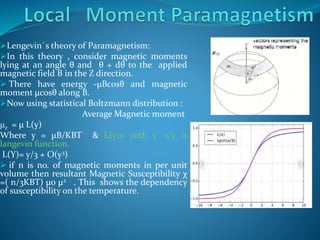
In this theory , consider magnetic moments
lying at an angle θ and θ + dθ to the applied
magnetic field B in the Z direction.
 There have energy -μBcosθ and magnetic
moment μcosθ along B.
Now using statistical Boltzmann distribution :
Average Magnetic moment
μz = μ L(y)
Where y = μB/KBT & L(y)= coth y -1/y is
langevin function.
L(Y)= y/3 + O(y3)
 if n is no. of magnetic moments in per unit
volume then resultant Magnetic Susceptibility χ
=( n/3KBT) μ0 μ2 . This shows the dependency
of susceptibility on the temperature.
In general, magnetization M =Ms Bj(y)
Where saturation magnetization Ms = ngj μBJ
Where Bj(y) = Brillouin function
By solving this ,susceptibility χ=(n/3kB T)μ◦ μeff
2
 μeff is effective magnetic moment = gj μB
[J(J+1)]1/2
 where Lande gj value = (3/2) + S(S+1) –L(L+1)
2J(J+1)
 Using hund`s rules application, For 4f
elements, effective magnetic moment value closed
to experimental value .
 3d elements experimental effective magnetic
moment are not agree with this theoretical value
because of Orbital quenching it means orbital
angular momentum is quenched (L=0).
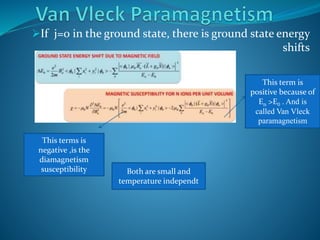
If j=0 in the ground state, there is ground state energy
shifts
This term is
positive because of
En >E0 . And is
called Van Vleck
paramagnetism
This terms is
negative ,is the
diamagnetism
susceptibility Both are small and
temperature independt
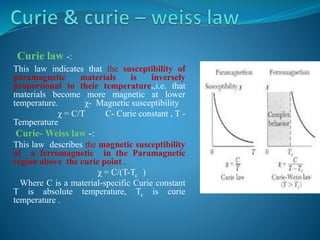
Curie law -:
This law indicates that the susceptibility of
paramagnetic materials is inversely
proportional to their temperature.,i.e. that
materials become more magnetic at lower
temperature. χ- Magnetic susceptibility
χ = C/T C- Curie constant , T -
Temperature
Curie- Weiss law -:
This law describes the magnetic susceptibility
of a ferromagnetic in the Paramagnetic
region above the curie point .
χ = C/(T-Tc )
Where C is a material-specific Curie constant
T is absolute temperature, Tc is curie
temperature .
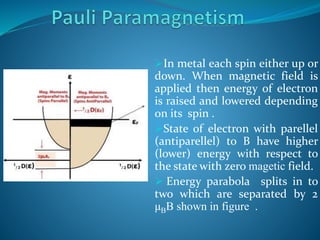
In metal each spin either up or
down. When magnetic field is
applied then energy of electron
is raised and lowered depending
on its spin .
State of electron with parellel
(antiparellel) to B have higher
(lower) energy with respect to
the state with zero magetic field.
 Energy parabola splits in to
two which are separated by 2
μBB shown in figure .
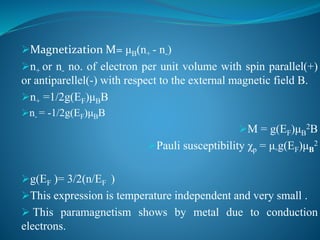
Magnetization M= μB(n+ - n-)
n+ or n- no. of electron per unit volume with spin parallel(+)
or antiparellel(-) with respect to the external magnetic field B.
n+ =1/2g(EF)μBB
n- = -1/2g(EF)μBB
M = g(EF)μB
2B
Pauli susceptibility χp = μ◦g(EF)μB
2
g(EF )= 3/2(n/EF )
This expression is temperature independent and very small .
 This paramagnetism shows by metal due to conduction
electrons.
 The effect of the Fermi Dirac statistics and the croos over Pauli
paramagnetism between localized moment behavior can be illustrated by
rederiving .
n+ =1/2ʃg(E+μBB)f(E)dE
 n- = 1/2ʃg(E-μBB)f(E)dE
Now Magnetization M = μB (n+ - n- )
Now solving this using Taylor expansion,
 M= μB
2 Bʃ(-df/dE)g(E)dE
In the degenerate limit at T=0, M = μB
2 Bg(EF ) & χp = μ◦g(EF)μB
2
In the nondegenrate limit f(E) =exp[-(E- μ)/k B T] so by solving this :
 M = n μB
2 B/K B T & χp = nμ◦μB
2 /K B T
 This susceptibility equalnt to n localized moments (of magnitude μB )
per unit volume .
 Thank you

Paramagnetism & Properties.pptx

  • 1.
    Instructor :- Dr.Soumik mukhoupadhyay Name:-Vishnu Kumar Tiwari Roll. No.:- 181171 Email- tvishnu@iitk.ac.in
  • 2.
    1.Definition of Paramagnetism 2.Different Origion of Paramagnetism 3.Local Moment Paramagnetism 4. Effective Magnetic moment 5.Van Velck Paramagnetism 6.Curie & Curie-Weiss law 7. Pauli Paramagnetism 8.Crossover between local moment Paramagnetism and Pauli Paramagetism
  • 3.
    Definition of Paramagnetism Positive Susceptibility( χ >0)  An applied magnetic field Induces a magnetization which aligns parallel with the applied magnetic field which caused it.  Non zero Magnetic moment(M) because of unpaired electrons lined up in direction of magnetic field.  Without magnetic field(B= 0): M=0 because of random orientation of unpaired electrons.  An increase of magnetic field will tend to line up spins, an increase of temperature will randomize them. So magnetization is depend on ratio (BT). (B=0) (B>0)
  • 4.
    The peramagnet magneticmoment results from the following cotributions: The spin and intrinsic moments of the electrons.  The Orbital motion of electron . The spin magnetic moment of nucleolus. Paramagnetism observed in metals because of odd no. of electrons. Paramagnetism can be explained by classical theory which is known is Lengevin`s theory of Paramagnetism.
  • 5.
    Lengevin`s theory ofParamagnetism: In this theory , consider magnetic moments lying at an angle θ and θ + dθ to the applied magnetic field B in the Z direction.  There have energy -μBcosθ and magnetic moment μcosθ along B. Now using statistical Boltzmann distribution : Average Magnetic moment μz = μ L(y) Where y = μB/KBT & L(y)= coth y -1/y is langevin function. L(Y)= y/3 + O(y3)  if n is no. of magnetic moments in per unit volume then resultant Magnetic Susceptibility χ =( n/3KBT) μ0 μ2 . This shows the dependency of susceptibility on the temperature.
  • 6.
    In general, magnetizationM =Ms Bj(y) Where saturation magnetization Ms = ngj μBJ Where Bj(y) = Brillouin function By solving this ,susceptibility χ=(n/3kB T)μ◦ μeff 2  μeff is effective magnetic moment = gj μB [J(J+1)]1/2  where Lande gj value = (3/2) + S(S+1) –L(L+1) 2J(J+1)  Using hund`s rules application, For 4f elements, effective magnetic moment value closed to experimental value .  3d elements experimental effective magnetic moment are not agree with this theoretical value because of Orbital quenching it means orbital angular momentum is quenched (L=0).
  • 7.
    If j=0 inthe ground state, there is ground state energy shifts This term is positive because of En >E0 . And is called Van Vleck paramagnetism This terms is negative ,is the diamagnetism susceptibility Both are small and temperature independt
  • 8.
    Curie law -: Thislaw indicates that the susceptibility of paramagnetic materials is inversely proportional to their temperature.,i.e. that materials become more magnetic at lower temperature. χ- Magnetic susceptibility χ = C/T C- Curie constant , T - Temperature Curie- Weiss law -: This law describes the magnetic susceptibility of a ferromagnetic in the Paramagnetic region above the curie point . χ = C/(T-Tc ) Where C is a material-specific Curie constant T is absolute temperature, Tc is curie temperature .
  • 9.
    In metal eachspin either up or down. When magnetic field is applied then energy of electron is raised and lowered depending on its spin . State of electron with parellel (antiparellel) to B have higher (lower) energy with respect to the state with zero magetic field.  Energy parabola splits in to two which are separated by 2 μBB shown in figure .
  • 10.
    Magnetization M= μB(n+- n-) n+ or n- no. of electron per unit volume with spin parallel(+) or antiparellel(-) with respect to the external magnetic field B. n+ =1/2g(EF)μBB n- = -1/2g(EF)μBB M = g(EF)μB 2B Pauli susceptibility χp = μ◦g(EF)μB 2 g(EF )= 3/2(n/EF ) This expression is temperature independent and very small .  This paramagnetism shows by metal due to conduction electrons.
  • 11.
     The effectof the Fermi Dirac statistics and the croos over Pauli paramagnetism between localized moment behavior can be illustrated by rederiving . n+ =1/2ʃg(E+μBB)f(E)dE  n- = 1/2ʃg(E-μBB)f(E)dE Now Magnetization M = μB (n+ - n- ) Now solving this using Taylor expansion,  M= μB 2 Bʃ(-df/dE)g(E)dE In the degenerate limit at T=0, M = μB 2 Bg(EF ) & χp = μ◦g(EF)μB 2 In the nondegenrate limit f(E) =exp[-(E- μ)/k B T] so by solving this :  M = n μB 2 B/K B T & χp = nμ◦μB 2 /K B T  This susceptibility equalnt to n localized moments (of magnitude μB ) per unit volume .
  • 12.