
Enriching the Academic Experience
                The Library and Experiential Learning

                                       William Black
                                       Christy Groves
                                         Amy York

                          Middle Tennessee State University


INSPIRATION, INNOVATION, CELEBRATION
     an entrepreneurial conference for librarians
                                   June 3 & 4, 2009
Introduction and Overview


 Define EXL

 EXL @ MTSU

 EXL experiences @ MTSU Walker Library

 EXL formal class

 EXL as a new role for libraries
Several EXL Definitions


 Internships

 Cooperative Education

 Undergraduate Research

 Study Abroad

 Service Learning

 Leadership Development

 Student Teaching
EXL @ MTSU

  “that learning process that takes place beyond the traditional classroom
and that enhances the personal and intellectual growth of the student. This
 education can occur in a wide variety of settings, but it usually takes on a
       ‘learn-by-doing’ aspect that engages the student directly in the
                     subject, work or service involved.”


      -- Experiential Education in the College of Arts and Sciences, Northeastern
                                     University, 1997.
EXL @ MTSU
 Develop an experience-based knowledge & apply theories to practical problems

 Create connections between experience and discipline

 Cultivate good citizenship through contributions to community

 Develop as individuals -- understand needs of others, cultural awareness, and
  appreciation of differences

 Develop & demonstrate managerial & leadership & research skills

 American Democracy Project, McNair Scholars
MTSU EXL Requirements
   18 hours of EXL classes

   At least one external activity – a research project requiring interaction external
    to the department or university

   Internal service component – leadership role in campus sponsored charitable
    activity, volunteer with campus office, or campus leader

   Completion of an E-Portfolio (a Web site created by the student showing
    learning outcomes during the EXL Scholars Program experience)

   Participation in assessment activities
EXL Benefits to Faculty

 Participating in the EXL Program at MTSU can provide valuable opportunities to:

     Keep abreast of changing needs in industry

     Interact with professionals in the field

     Become familiar with employers

     Evaluate classroom instruction in relation to students’ preparation for employment

     Explore new possibilities for working relationships

     Explore new possibilities for public service
EXL Experiences @ Walker Library
 Library as Partner: Revisioning the Library
    Marketing students and survey
    Anthropology students and focus groups
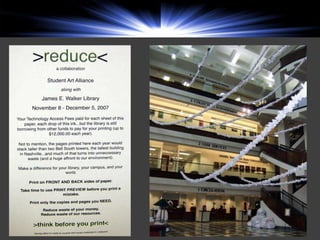
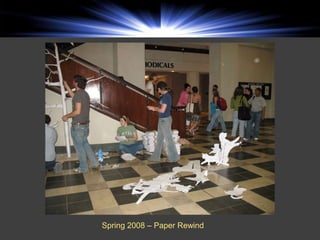
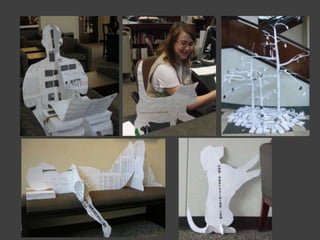
    Art students and paper projects

 Library as Leader
     Spring 2009 EXL 2010: Revisioning Walker Library

 Library as Lab
    Anthropology and Garbology
    Printing Press Project
Library as Partner
Revisioning the Walker Library

 Assessing the Library’s Role

 Evaluating Performance

 Structuring the Partnership

 Goals

 Outcomes
Revisioning the Walker Library

Focus Questions

      What Activities can be stopped?

      How could continuing activities use less resources?

      What changes could be made to improve efficiency?

      What new services/activities could be provided to faculty and students to
       improve the library’s relevance to the campus?

      What relationships with other campus units should be established or
       expanded in order to improve library’s relevance to the campus?
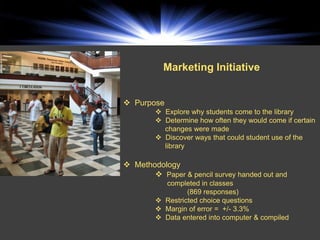
Marketing Initiative


 Purpose
         Explore why students come to the library
         Determine how often they would come if certain
          changes were made
         Discover ways that could student use of the
          library

 Methodology
        Paper & pencil survey handed out and
          completed in classes
                 (869 responses)
         Restricted choice questions
         Margin of error = +/- 3.3%
         Data entered into computer & compiled
Marketing Initiative

 Results

         Students primarily come to the library to
               a) use computers
               b) meet with study groups
               c) do research for a class

         Students would come more often or stay longer if the library had
               a) more computers
               b) increased open seating, more comfortable seating
               c) the ability to reserve meeting rooms
               d) longer hours, particularly 24 hour access during exams
               e) the ability to bring food & drink into the building
Marketing Initiative


 What we learned:

    Collaboration has value

    Population counts
Anthropology Project
 Three overriding questions:
        How do students conduct research for class assignments?

          Do students use the library during the research process and

          What are student perceptions of the library?

 Focus Group Discussion Issues:
         How students conduct research

                   Who students consult about research

                   If and how students use the MTSU library

                   Student awareness of library resources and services

                   Student satisfaction with library resources and services
Anthropology Project


 Methodology

    Student researchers solicited participants

    The Library provided food for Summer focus groups

    Researchers took notes and transcribed audio sessions

    Discussion questions developed as a group with anthropology instructor
Anthropology Project

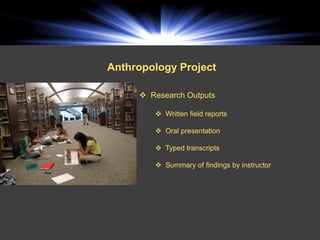
      Research Outputs

         Written field reports

         Oral presentation

         Typed transcripts

         Summary of findings by instructor
a
                   Anthropology Project


 Assessment

    Review of focus group transcripts

    Assignment of identifiers

    Identification of common themes
Anthropology Project

 We learned about why students use the library:
        Use computers, study alone or with a group, do research
               for a class, find books and articles

 How they do research:
        Internet (Google, Wikipedia, Amazon), book and article
                research, database preferences

 Who they contact
        Classmates, friends in major, students who have taken
               same class, instructor, reference desk, Jesus
Anthropology Project


 Application of Research Results

     Question Tent – Fall 2008

     More laptops and increased laptop checkout period

     Circulation limits increased

     Food and drink policy changed
Anthropology Project


 Drawbacks of Partnership – Library

    Diminished control

    Reliance on inexperienced researchers

    Increased visibility = increased accountability
Anthropology Project
 LESSONS

       Clear research questions

       Preliminary education

       Deeper discussion about project goals

       Realistic timeline

       Increased involvement


Anthropology Project information from K. West & S. Mangrum
Walker Library, MTSU
Art Studen


Amy


      Spring 2008 – Paper Rewind
Library as Leader
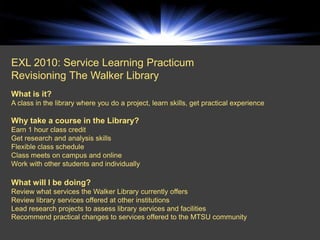
EXL 2010: Service Learning Practicum
Revisioning The Walker Library
What is it?
A class in the library where you do a project, learn skills, get practical experience

Why take a course in the Library?
Earn 1 hour class credit
Get research and analysis skills
Flexible class schedule
Class meets on campus and online
Work with other students and individually

What will I be doing?
Review what services the Walker Library currently offers
Review library services offered at other institutions
Lead research projects to assess library services and facilities
Recommend practical changes to services offered to the MTSU community
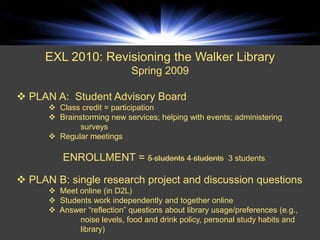
EXL 2010: Revisioning the Walker Library
                             Spring 2009

 PLAN A: Student Advisory Board
       Class credit = participation
       Brainstorming new services; helping with events; administering
             surveys
       Regular meetings

          ENROLLMENT = 5 students 4 students            3 students

 PLAN B: single research project and discussion questions
       Meet online (in D2L)
       Students work independently and together online
       Answer “reflection” questions about library usage/preferences (e.g.,
             noise levels, food and drink policy, personal study habits and
             library)
EXL 2010 Research Project
Space Utilization Study*

Methods:
    10 days of observation: M-F and M-F
    4 times per day (except Friday): 10 am, 2pm, 6pm, 10pm
    Record occupation of open seating, computers, and group study rooms
    Library is divided into zones for observations

Goals:
    Determine most popular seating choices: carrels, tables, or soft chairs
    Identify most popular “zones” in the library
    Determine peak computer and group study usage times

Student participation:
     Help design study parameters and observation sheets
     Record observations
     Analyze data


* Modeled after Xia, Jingfeng (2005). Visualizing occupancy of library study space with GIS maps.
New Library World 106: 5/6. pp. 219-233.
Library as Lab
Anthropology and Garbology
A Material Culture Investigation of the James E.
Walker Library, Middle Tennessee State
University, Murfreesboro, Tennessee by
Owenby and Cavlovic
  In this paper we will explore the material culture left behind by
  people using the James E. Walker Library on the Middle
  Tennessee State University campus. We will do this by
  examining the trash left behind by students and faculty in the
  library study rooms, student break rooms, faculty break
  room, and the Starbucks in the library. We will reveal our
  expectations, methodologies, what we found, and
  interpretations of these findings. We will also include a critique
  of our methodologies and recommendations for future projects
  of this genre.
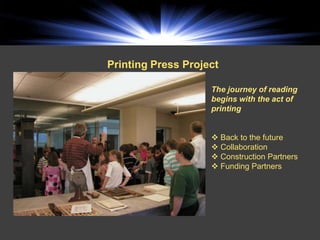
Printing Press Project

                    The journey of reading
                    begins with the act of
                    printing


                     Back to the future
                     Collaboration
                     Construction Partners
                     Funding Partners
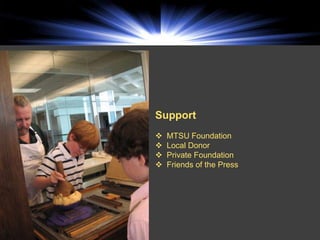
Support
   MTSU Foundation
   Local Donor
   Private Foundation
   Friends of the Press
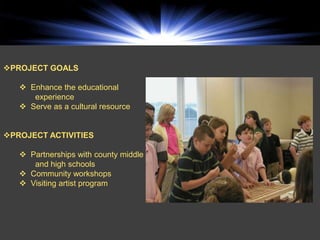
PROJECT GOALS

    Enhance the educational
      experience
    Serve as a cultural resource


PROJECT ACTIVITIES

    Partnerships with county middle
      and high schools
    Community workshops
    Visiting artist program
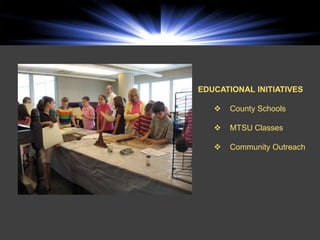
EDUCATIONAL INITIATIVES

      County Schools

      MTSU Classes

      Community Outreach
EXL and Libraries
Pros:
Free work
Part of larger academic community
Library takes active role in learning
Students have active role in library services
Sets up new role for libraries


Cons:
Results may be less than perfect
Can be a lot of work for librarians
Are you ready to accept student ideas? And follow up?
Grades



Cultivating Partnerships
Create list of library needs
Tap your friends in academic departments
Contact EXL or Service Learning Office
Get to know the curriculum (senior capstone project?)
Go to student exhibits, scholars day, senior showcases
Use web 2.0 to invite feedback/projects (blogs, twitter, facebook, wikis)
Exhibit some radical (or moderate) trust
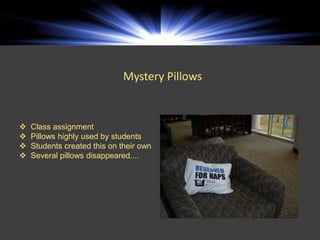
Mystery Pillows


   Class assignment
   Pillows highly used by students
   Students created this on their own
   Several pillows disappeared....
Keys to the Entrepreneurial Spirit

 Expect success

 Be willing to try

 Find a nucleus of support

 Dedicate to the task

 Learn from others

 Snatch success from failure

 Culture of experimentation
Other Examples

 Marketing/advertising
     CSU San Marcos: library marketing plan1
     Texas A&M: advertise e-books2
     Illinois Wesleyan: promote reference services3


 Database instruction (English students)
     Hampton University: created database guides4
     Eastern Washington University: Refworks workshops5

 Ergonomics
    Cornell University: library signage and workstation design6
ENDNOTES


                                   References
1. Meulemans, Yvonne Nalani and Ann Manning Fiegen. (2006). Using business student
   consultants to benchmark and develop a library marketing plan. Journal of Business
   and Finance Librarianship. 11(3), 19-31.
2. McGeachin, Robert B. and Diana Ramirez. (2005). Collaborating with students to
   develop an advertising campaign. College & Undergraduate Libraries. 12(1), 139-152.
3. Duke, Lynda M., Jean B. MacDonald, and Carrie S. Trimble. (2009). Collaboration
   between marketing students and the library: an experiential learning project to
   promote reference services. College and Research Libraries. 70(2), 110-121.
4. Rhodes, Naomi J. and Judith M. Davis. (2001). Using service learning to get positive
   reactions in the library. Computers in Libraries. 21(1), 32-35.
5. Meyer, Nadean J. and Ielleen R. Miller. (2008). The library as a service-learning
   partner: a win-win collaboration with students and faculty. College & Undergraduate
   Libraries. 15(4), 399-413.
6. Library ergonomics. Cornell University Ergonomics Web. Retrieved May
   28, 2009, from http://ergo.human.cornell.edu/AHProjects/Library/libraryprojects.html.
7. Katula, Richard and Elizabeth Threnhauser.. (1999). Experiential education in the
   undergraduate curriculum. Communication Education. 48, 238-255.

Enriching the Academic Experience: the Library and Experiential Learning at Middle Tennessee State University

  • 1.
    Enriching the AcademicExperience The Library and Experiential Learning William Black Christy Groves Amy York Middle Tennessee State University INSPIRATION, INNOVATION, CELEBRATION an entrepreneurial conference for librarians June 3 & 4, 2009
  • 2.
    Introduction and Overview Define EXL  EXL @ MTSU  EXL experiences @ MTSU Walker Library  EXL formal class  EXL as a new role for libraries
  • 3.
    Several EXL Definitions Internships  Cooperative Education  Undergraduate Research  Study Abroad  Service Learning  Leadership Development  Student Teaching
  • 4.
    EXL @ MTSU “that learning process that takes place beyond the traditional classroom and that enhances the personal and intellectual growth of the student. This education can occur in a wide variety of settings, but it usually takes on a ‘learn-by-doing’ aspect that engages the student directly in the subject, work or service involved.” -- Experiential Education in the College of Arts and Sciences, Northeastern University, 1997.
  • 5.
    EXL @ MTSU Develop an experience-based knowledge & apply theories to practical problems  Create connections between experience and discipline  Cultivate good citizenship through contributions to community  Develop as individuals -- understand needs of others, cultural awareness, and appreciation of differences  Develop & demonstrate managerial & leadership & research skills  American Democracy Project, McNair Scholars
  • 6.
    MTSU EXL Requirements  18 hours of EXL classes  At least one external activity – a research project requiring interaction external to the department or university  Internal service component – leadership role in campus sponsored charitable activity, volunteer with campus office, or campus leader  Completion of an E-Portfolio (a Web site created by the student showing learning outcomes during the EXL Scholars Program experience)  Participation in assessment activities
  • 7.
    EXL Benefits toFaculty  Participating in the EXL Program at MTSU can provide valuable opportunities to:  Keep abreast of changing needs in industry  Interact with professionals in the field  Become familiar with employers  Evaluate classroom instruction in relation to students’ preparation for employment  Explore new possibilities for working relationships  Explore new possibilities for public service
  • 8.
    EXL Experiences @Walker Library  Library as Partner: Revisioning the Library  Marketing students and survey  Anthropology students and focus groups  Art students and paper projects  Library as Leader  Spring 2009 EXL 2010: Revisioning Walker Library  Library as Lab  Anthropology and Garbology  Printing Press Project
  • 9.
  • 10.
    Revisioning the WalkerLibrary  Assessing the Library’s Role  Evaluating Performance  Structuring the Partnership  Goals  Outcomes
  • 11.
    Revisioning the WalkerLibrary Focus Questions  What Activities can be stopped?  How could continuing activities use less resources?  What changes could be made to improve efficiency?  What new services/activities could be provided to faculty and students to improve the library’s relevance to the campus?  What relationships with other campus units should be established or expanded in order to improve library’s relevance to the campus?
  • 12.
    Marketing Initiative  Purpose  Explore why students come to the library  Determine how often they would come if certain changes were made  Discover ways that could student use of the library  Methodology  Paper & pencil survey handed out and completed in classes (869 responses)  Restricted choice questions  Margin of error = +/- 3.3%  Data entered into computer & compiled
  • 13.
    Marketing Initiative  Results  Students primarily come to the library to a) use computers b) meet with study groups c) do research for a class  Students would come more often or stay longer if the library had a) more computers b) increased open seating, more comfortable seating c) the ability to reserve meeting rooms d) longer hours, particularly 24 hour access during exams e) the ability to bring food & drink into the building
  • 14.
    Marketing Initiative  Whatwe learned:  Collaboration has value  Population counts
  • 15.
    Anthropology Project  Threeoverriding questions:  How do students conduct research for class assignments?  Do students use the library during the research process and  What are student perceptions of the library?  Focus Group Discussion Issues: How students conduct research  Who students consult about research  If and how students use the MTSU library  Student awareness of library resources and services  Student satisfaction with library resources and services
  • 16.
    Anthropology Project  Methodology  Student researchers solicited participants  The Library provided food for Summer focus groups  Researchers took notes and transcribed audio sessions  Discussion questions developed as a group with anthropology instructor
  • 17.
    Anthropology Project  Research Outputs  Written field reports  Oral presentation  Typed transcripts  Summary of findings by instructor
  • 18.
    a Anthropology Project  Assessment  Review of focus group transcripts  Assignment of identifiers  Identification of common themes
  • 19.
    Anthropology Project  Welearned about why students use the library:  Use computers, study alone or with a group, do research for a class, find books and articles  How they do research:  Internet (Google, Wikipedia, Amazon), book and article research, database preferences  Who they contact  Classmates, friends in major, students who have taken same class, instructor, reference desk, Jesus
  • 20.
    Anthropology Project  Applicationof Research Results  Question Tent – Fall 2008  More laptops and increased laptop checkout period  Circulation limits increased  Food and drink policy changed
  • 21.
    Anthropology Project  Drawbacksof Partnership – Library Diminished control Reliance on inexperienced researchers Increased visibility = increased accountability
  • 22.
    Anthropology Project  LESSONS  Clear research questions  Preliminary education  Deeper discussion about project goals  Realistic timeline  Increased involvement Anthropology Project information from K. West & S. Mangrum Walker Library, MTSU
  • 24.
    Art Studen Amy Spring 2008 – Paper Rewind
  • 26.
  • 27.
    EXL 2010: ServiceLearning Practicum Revisioning The Walker Library What is it? A class in the library where you do a project, learn skills, get practical experience Why take a course in the Library? Earn 1 hour class credit Get research and analysis skills Flexible class schedule Class meets on campus and online Work with other students and individually What will I be doing? Review what services the Walker Library currently offers Review library services offered at other institutions Lead research projects to assess library services and facilities Recommend practical changes to services offered to the MTSU community
  • 28.
    EXL 2010: Revisioningthe Walker Library Spring 2009  PLAN A: Student Advisory Board  Class credit = participation  Brainstorming new services; helping with events; administering surveys  Regular meetings ENROLLMENT = 5 students 4 students 3 students  PLAN B: single research project and discussion questions  Meet online (in D2L)  Students work independently and together online  Answer “reflection” questions about library usage/preferences (e.g., noise levels, food and drink policy, personal study habits and library)
  • 29.
    EXL 2010 ResearchProject Space Utilization Study* Methods:  10 days of observation: M-F and M-F  4 times per day (except Friday): 10 am, 2pm, 6pm, 10pm  Record occupation of open seating, computers, and group study rooms  Library is divided into zones for observations Goals:  Determine most popular seating choices: carrels, tables, or soft chairs  Identify most popular “zones” in the library  Determine peak computer and group study usage times Student participation:  Help design study parameters and observation sheets  Record observations  Analyze data * Modeled after Xia, Jingfeng (2005). Visualizing occupancy of library study space with GIS maps. New Library World 106: 5/6. pp. 219-233.
  • 30.
  • 31.
    Anthropology and Garbology AMaterial Culture Investigation of the James E. Walker Library, Middle Tennessee State University, Murfreesboro, Tennessee by Owenby and Cavlovic In this paper we will explore the material culture left behind by people using the James E. Walker Library on the Middle Tennessee State University campus. We will do this by examining the trash left behind by students and faculty in the library study rooms, student break rooms, faculty break room, and the Starbucks in the library. We will reveal our expectations, methodologies, what we found, and interpretations of these findings. We will also include a critique of our methodologies and recommendations for future projects of this genre.
  • 32.
    Printing Press Project The journey of reading begins with the act of printing  Back to the future  Collaboration  Construction Partners  Funding Partners
  • 33.
    Support  MTSU Foundation  Local Donor  Private Foundation  Friends of the Press
  • 34.
    PROJECT GOALS  Enhance the educational experience  Serve as a cultural resource PROJECT ACTIVITIES  Partnerships with county middle and high schools  Community workshops  Visiting artist program
  • 35.
    EDUCATIONAL INITIATIVES  County Schools  MTSU Classes  Community Outreach
  • 36.
  • 37.
    Pros: Free work Part oflarger academic community Library takes active role in learning Students have active role in library services Sets up new role for libraries Cons: Results may be less than perfect Can be a lot of work for librarians Are you ready to accept student ideas? And follow up? Grades
  • 38.
     Cultivating Partnerships Create listof library needs Tap your friends in academic departments Contact EXL or Service Learning Office Get to know the curriculum (senior capstone project?) Go to student exhibits, scholars day, senior showcases Use web 2.0 to invite feedback/projects (blogs, twitter, facebook, wikis) Exhibit some radical (or moderate) trust
  • 39.
    Mystery Pillows  Class assignment  Pillows highly used by students  Students created this on their own  Several pillows disappeared....
  • 40.
    Keys to theEntrepreneurial Spirit  Expect success  Be willing to try  Find a nucleus of support  Dedicate to the task  Learn from others  Snatch success from failure  Culture of experimentation
  • 41.
    Other Examples  Marketing/advertising  CSU San Marcos: library marketing plan1  Texas A&M: advertise e-books2  Illinois Wesleyan: promote reference services3  Database instruction (English students)  Hampton University: created database guides4  Eastern Washington University: Refworks workshops5  Ergonomics  Cornell University: library signage and workstation design6
  • 42.
    ENDNOTES References 1. Meulemans, Yvonne Nalani and Ann Manning Fiegen. (2006). Using business student consultants to benchmark and develop a library marketing plan. Journal of Business and Finance Librarianship. 11(3), 19-31. 2. McGeachin, Robert B. and Diana Ramirez. (2005). Collaborating with students to develop an advertising campaign. College & Undergraduate Libraries. 12(1), 139-152. 3. Duke, Lynda M., Jean B. MacDonald, and Carrie S. Trimble. (2009). Collaboration between marketing students and the library: an experiential learning project to promote reference services. College and Research Libraries. 70(2), 110-121. 4. Rhodes, Naomi J. and Judith M. Davis. (2001). Using service learning to get positive reactions in the library. Computers in Libraries. 21(1), 32-35. 5. Meyer, Nadean J. and Ielleen R. Miller. (2008). The library as a service-learning partner: a win-win collaboration with students and faculty. College & Undergraduate Libraries. 15(4), 399-413. 6. Library ergonomics. Cornell University Ergonomics Web. Retrieved May 28, 2009, from http://ergo.human.cornell.edu/AHProjects/Library/libraryprojects.html. 7. Katula, Richard and Elizabeth Threnhauser.. (1999). Experiential education in the undergraduate curriculum. Communication Education. 48, 238-255.