A New Model for Public Service in
Academic Libraries
Changing Library Roles, Taking Risks to Make a
Difference for Students, Faculty, Staff and the
Community
Susan Smith, Head of Library Research Support Services
Julie Leuzinger, Head of Library Learning Services
University of North Texas Libraries
October 17, 2016
By the end of this presentation, we will have
addressed the following:
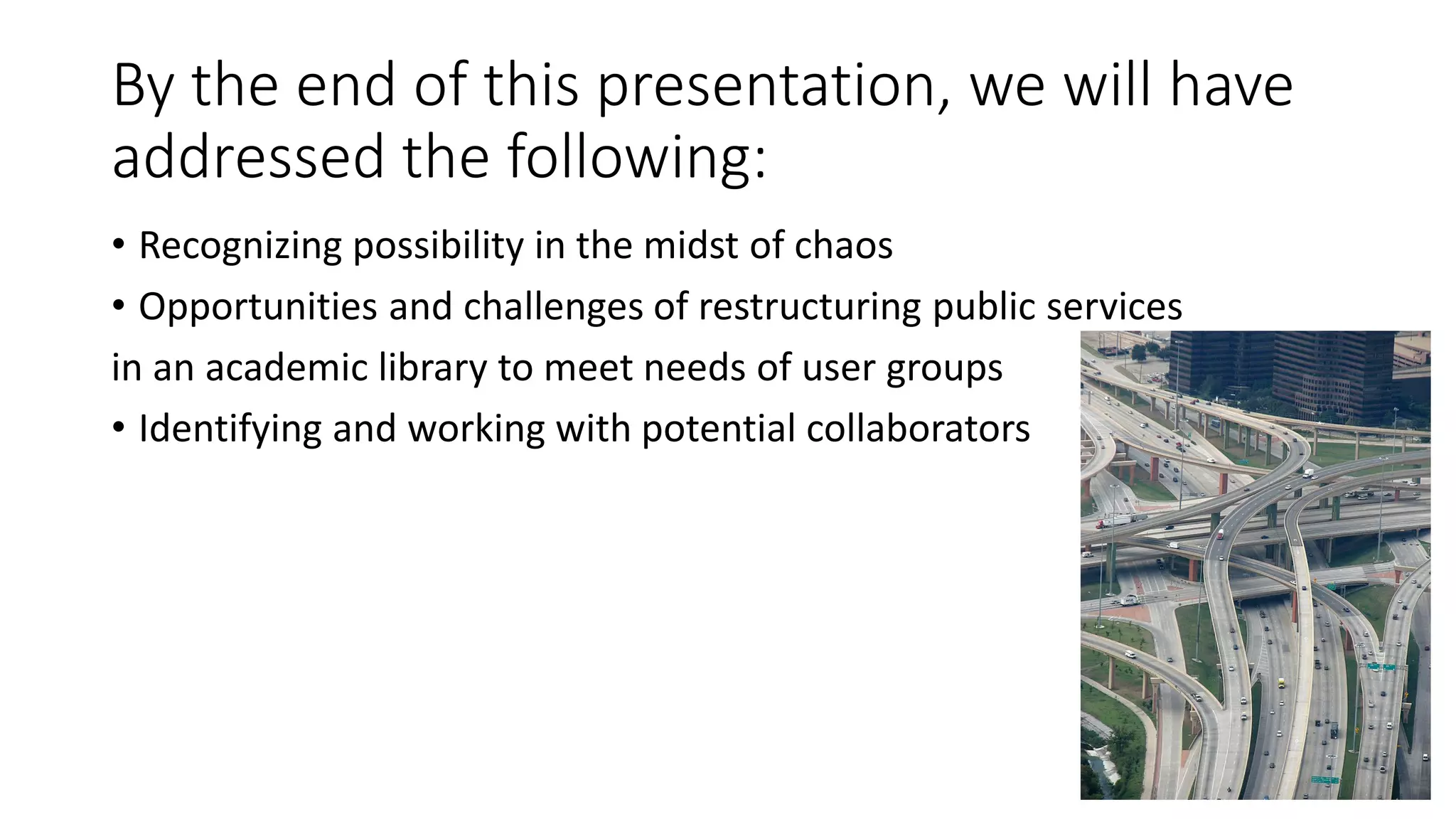
• Recognizing possibility in the midst of chaos
• Opportunities and challenges of restructuring public services
in an academic library to meet needs of user groups
• Identifying and working with potential collaborators
University of North Texas
Denton, Texas
• 1,056 full time faculty
• 2,432 full time staff
• 37,973 students
Degrees offered
• Bachelor's – 99
• Master's – 83
• Doctoral – 35
• Special Professional -1
University of North Texas
• Diverse in race, gender and
culture
• 90.2% Texas residents
• 6,215 live on campus
• 4,661 first time in college
• 4,037 transfer students
• Freshmen Persistence: 79.1%
• Student/Faculty Ratio: 24.5 to 1
• Carnegie R1
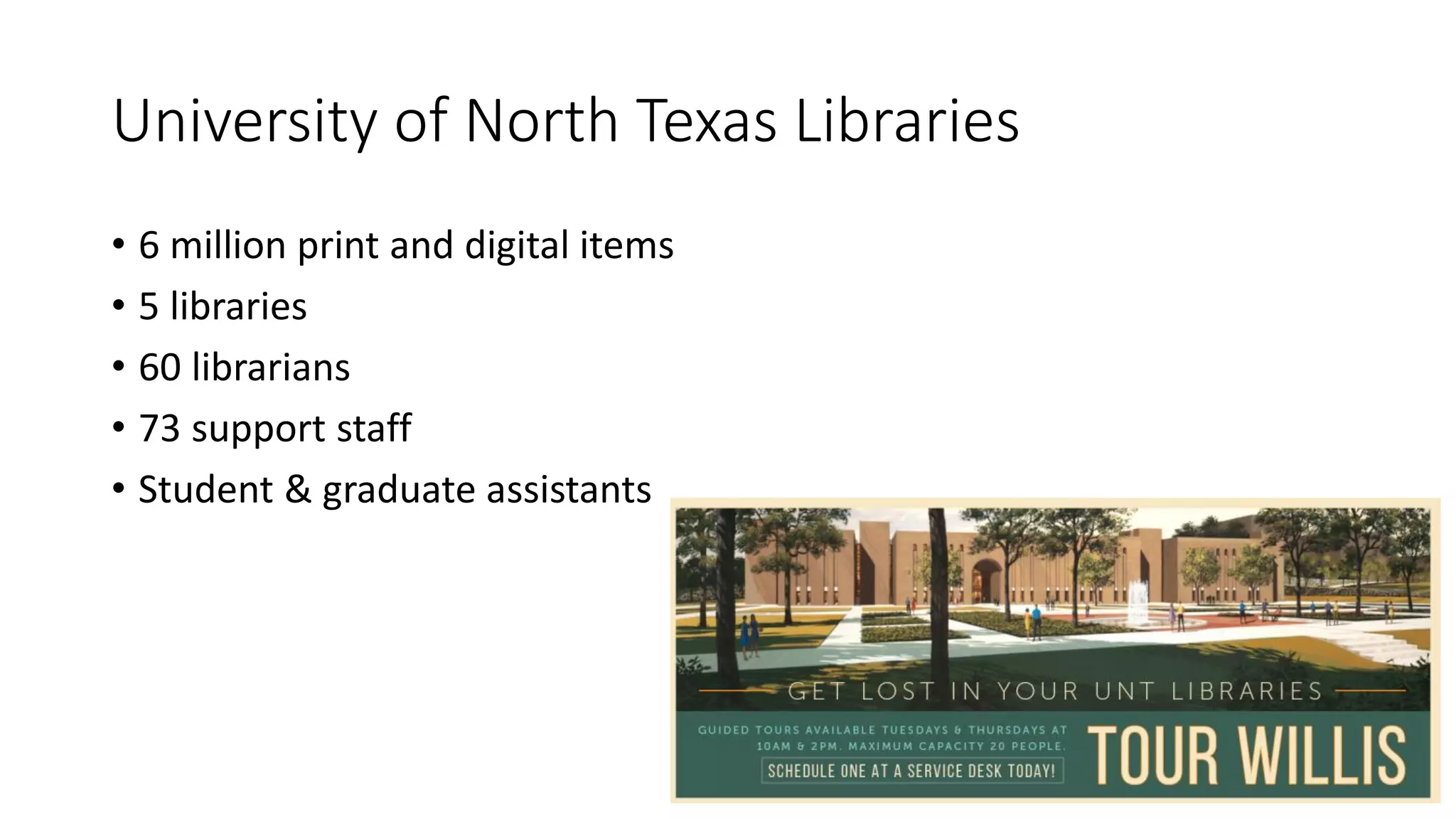
University of North Texas Libraries
• 6 million print and digital items
• 5 libraries
• 60 librarians
• 73 support staff
• Student & graduate assistants
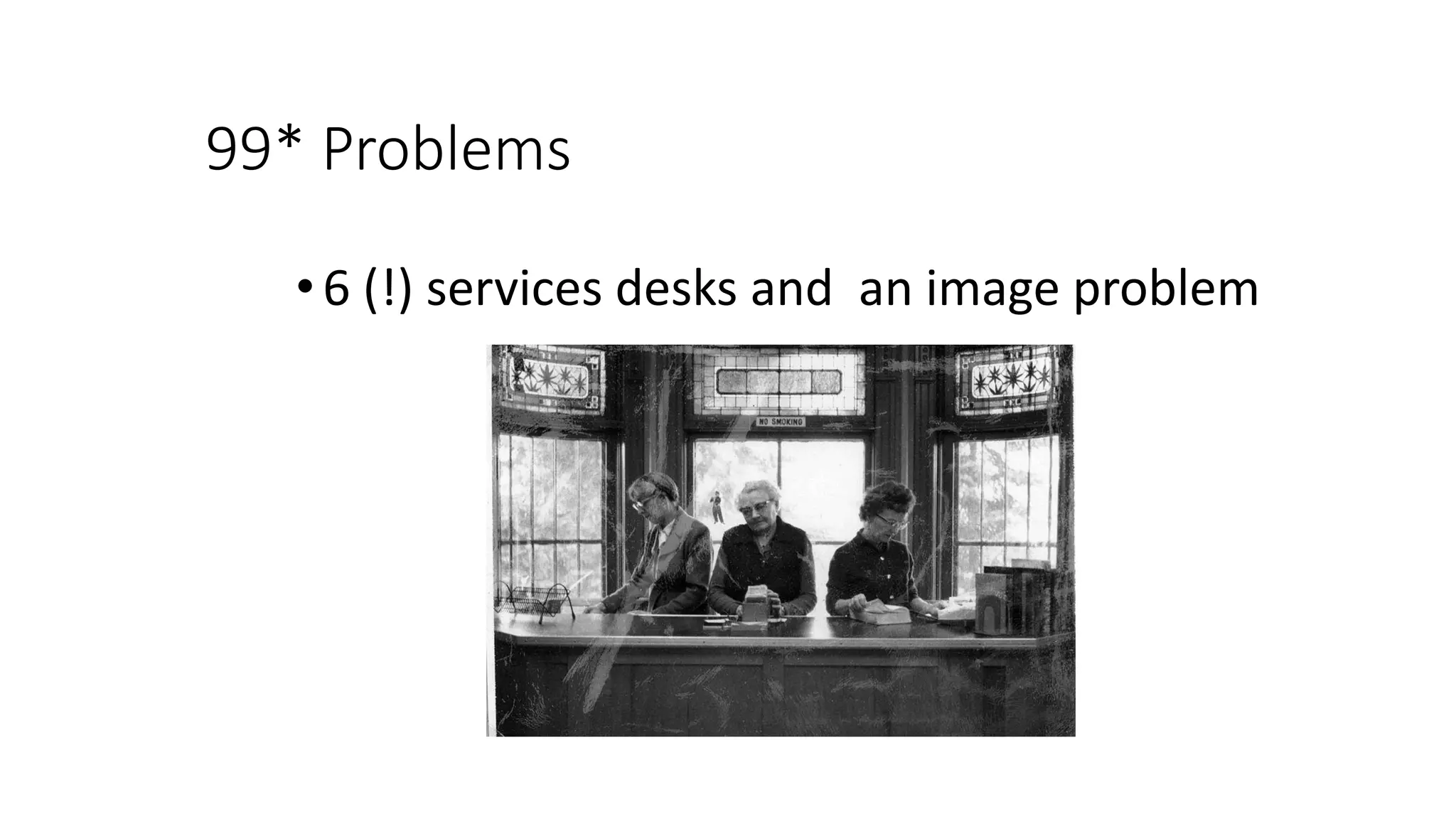
99* Problems
•6 (!) services desks and an image problem
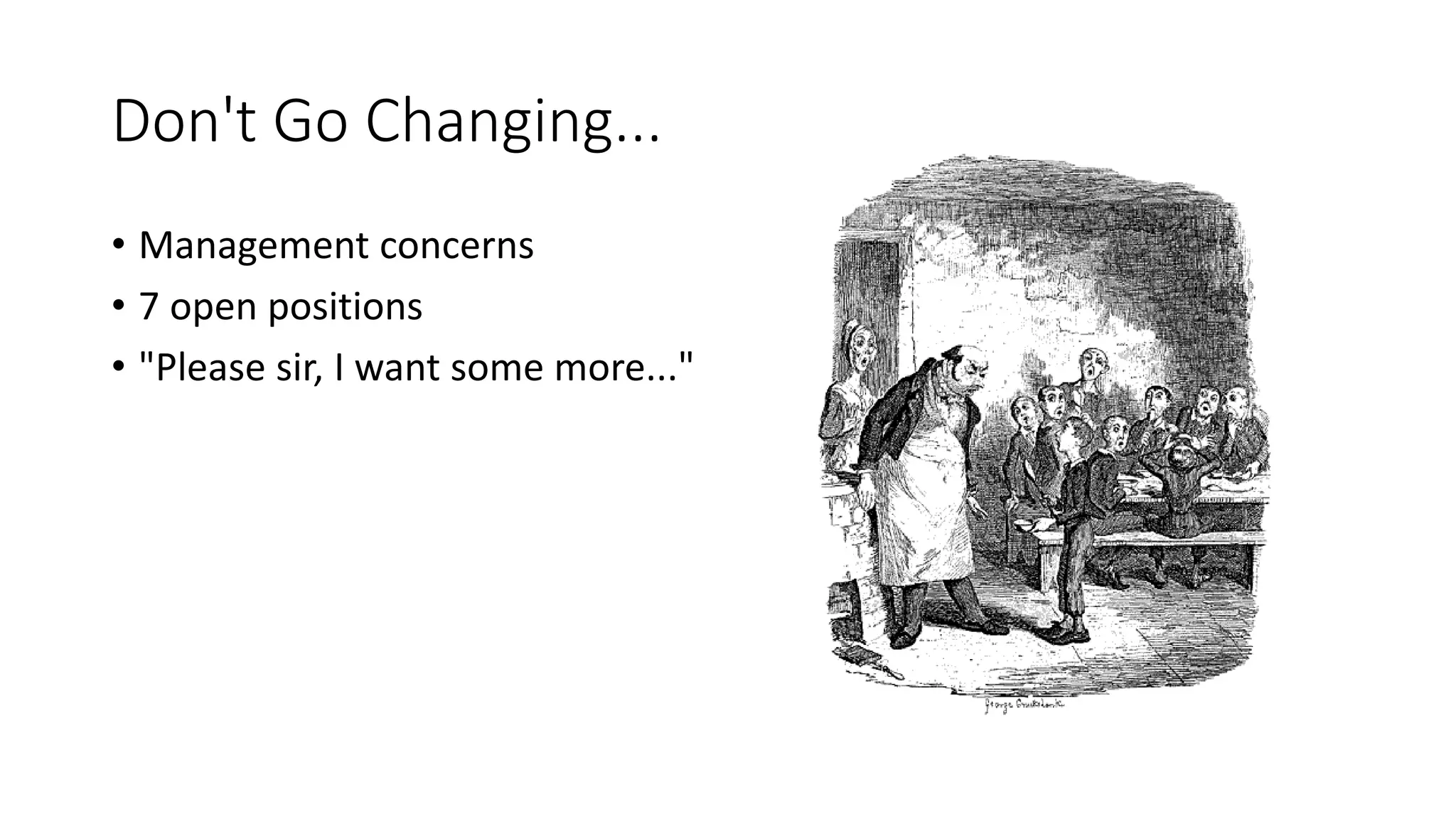
Don't Go Changing...
• Management concerns
• 7 open positions
• "Please sir, I want some more..."
Ch-ch-changes
2013-2014
Fall 2013
• Plans for Eagle Commons Library as outward facing community research hub
Spring 2014
• Major collection shift
Early Summer 2014
• Major staff shift
Mid Summer 2014
• New Government Documents Librarian/Assistant Manager
Late Summer 2014
• Restructure
Fall 2014
• Planning for the future of the Public Services Division
Challenges
• Staff
• Will people get it?
• Blurred lines
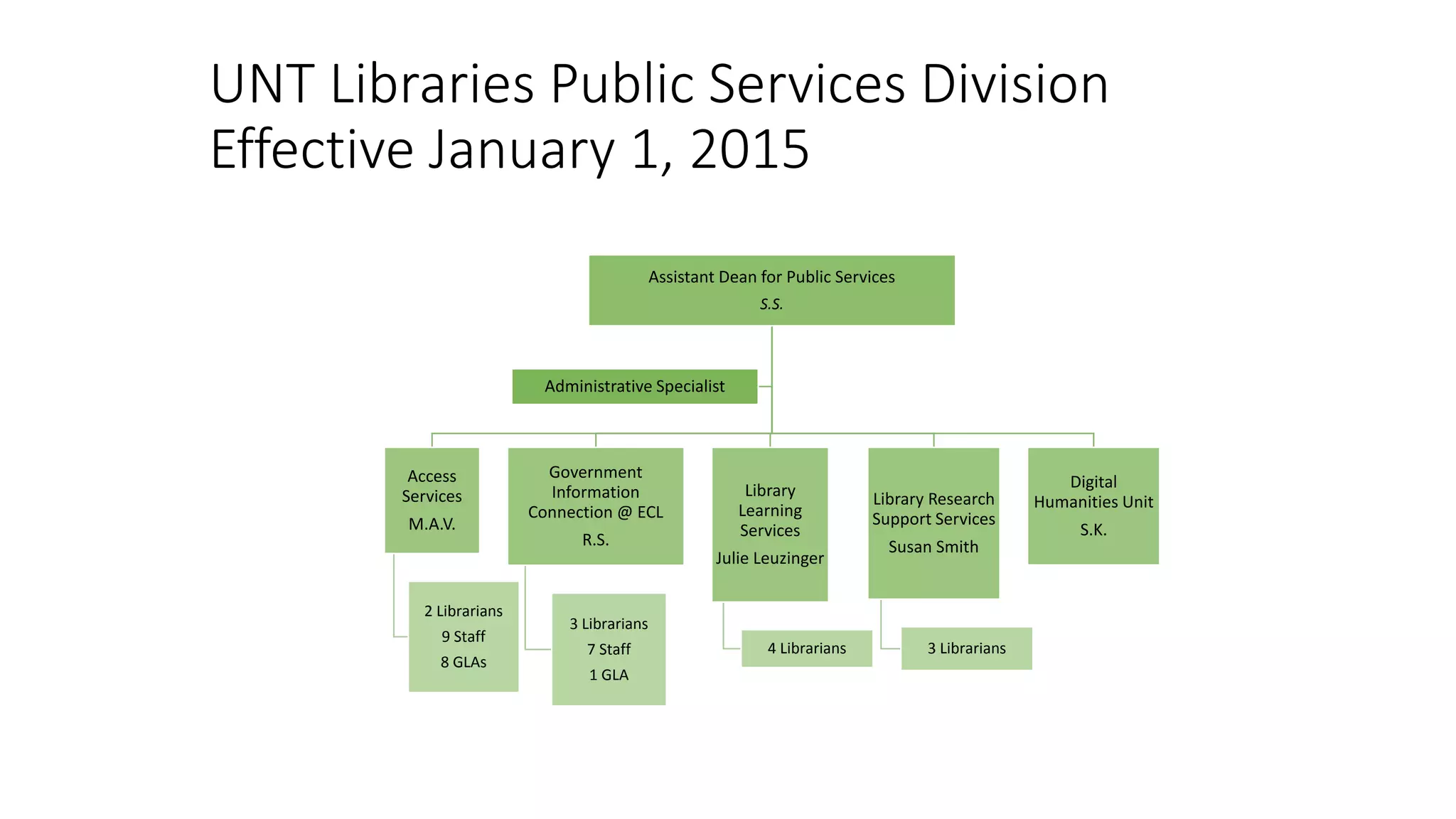
UNT Libraries Public Services Division
Effective January 1, 2015
Assistant Dean for Public Services
S.S.
Access
Services
M.A.V.
2 Librarians
9 Staff
8 GLAs
Government
Information
Connection @ ECL
R.S.
3 Librarians
7 Staff
1 GLA
Library
Learning
Services
Julie Leuzinger
4 Librarians
Library Research
Support Services
Susan Smith
3 Librarians
Digital
Humanities Unit
S.K.
Administrative Specialist
The Department Formerly Known As RIS:
Library Learning Services
• Provides individualized library service through instruction and student
engagement.
• Committed to supporting undergraduate student success by
advancing the information fluency initiative, by facilitating the first
year college experience, and by contributing to the timely graduation
of our undergraduate student population through creative
partnerships with other university student -centered groups and
faculty.
The Department Formerly Known As RIS:
Library Research Support Services
• Provides research support to enrich the scholarly experience and
success of the University of North Texas graduate students and
faculty.
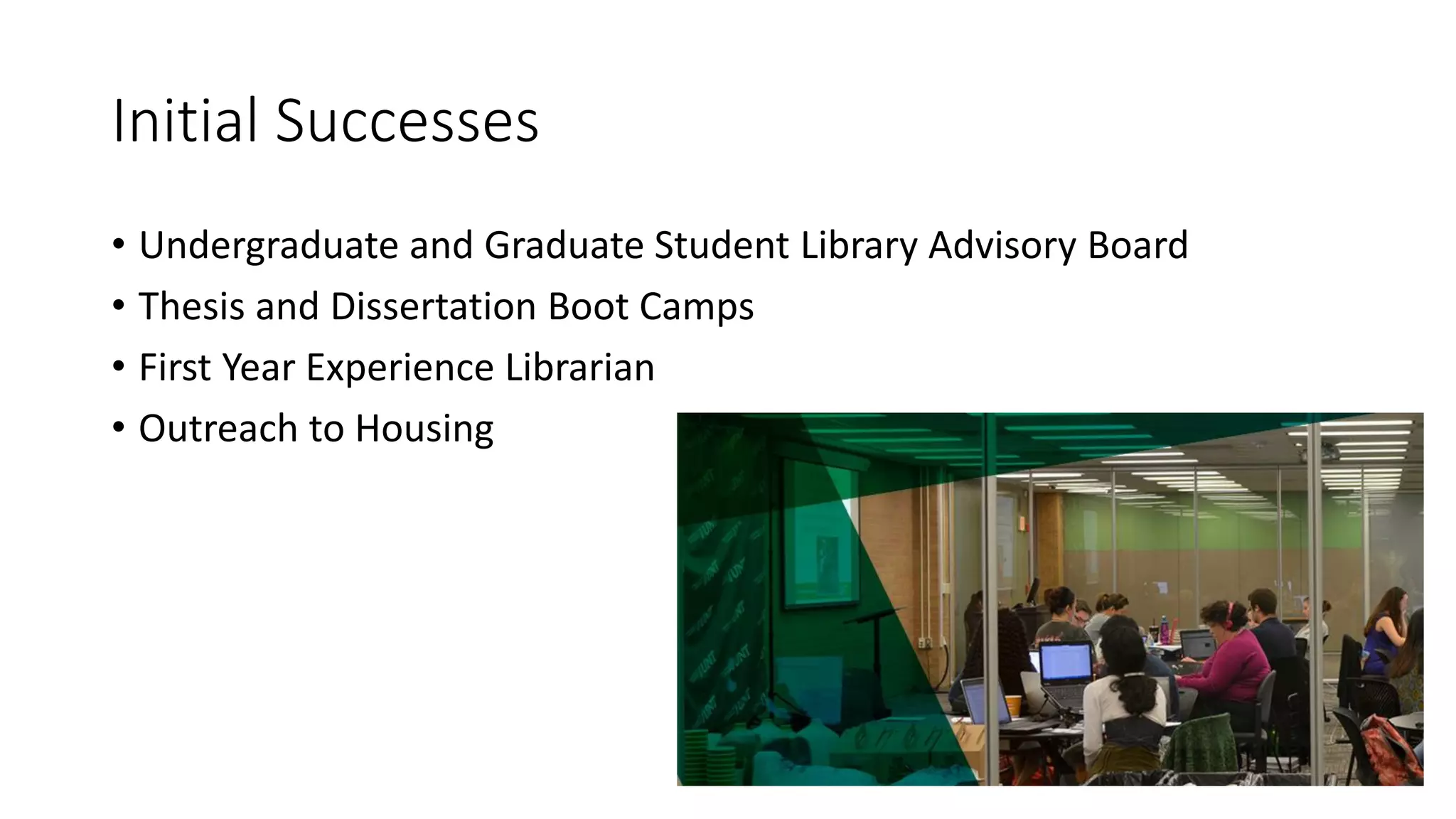
Initial Successes
• Undergraduate and Graduate Student Library Advisory Board
• Thesis and Dissertation Boot Camps
• First Year Experience Librarian
• Outreach to Housing
More interaction with librarians=?
• Student faculty interaction is a key sign of student
involvement, and is highly related to student satisfaction
with college (Astin, 1999).
• For most students more interaction with faculty improved
outcomes and led to students engaging in other
educationally purposeful activities during college (Kuh & Hu,
2001).
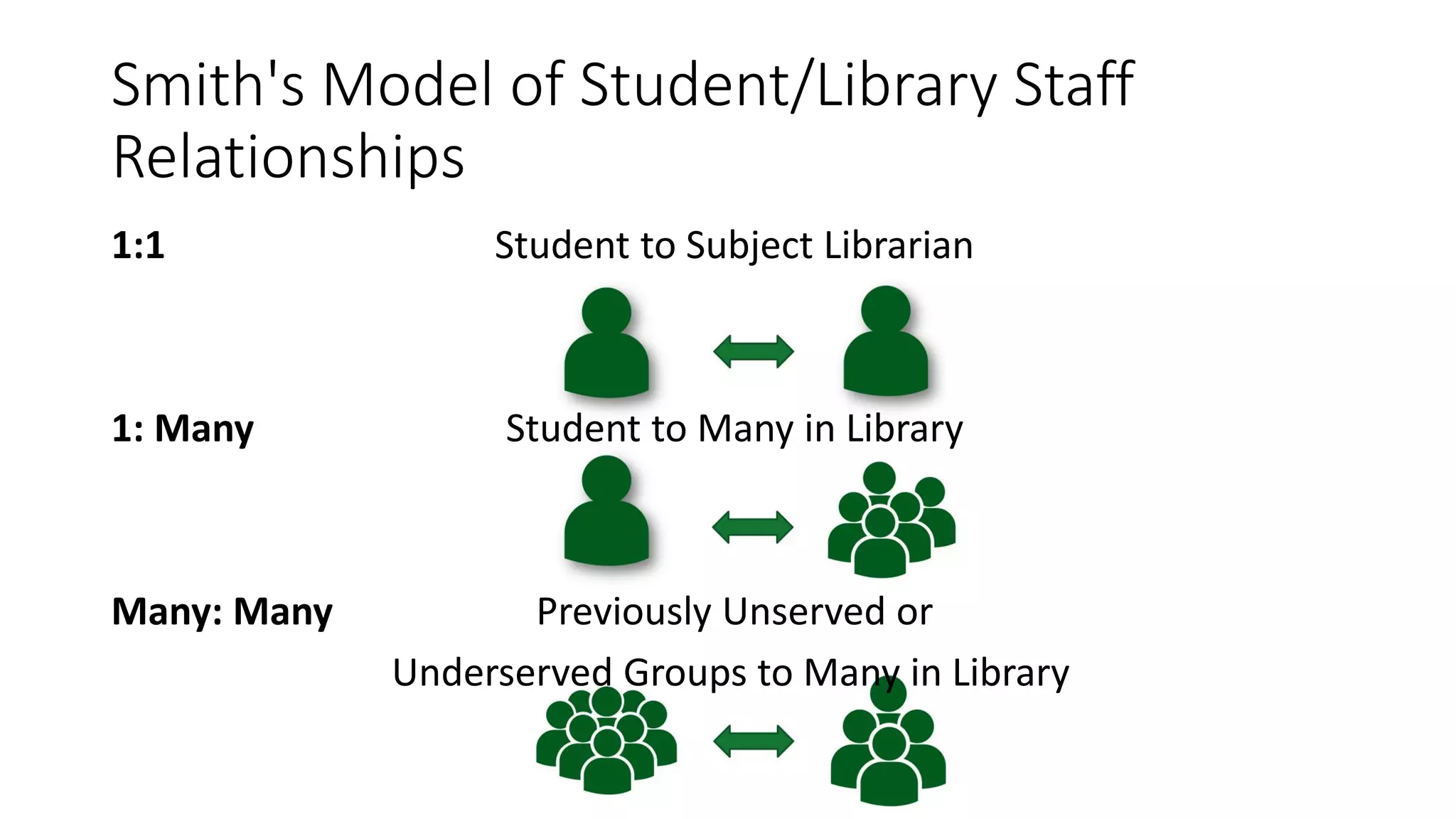
Smith's Model of Student/Library Staff
Relationships
1:1 Student to Subject Librarian
1: Many Student to Many in Library
Many: Many Previously Unserved or
Underserved Groups to Many in Library
Opportunities
• Reinvigorate long term library staff
• Group like with like
• Strategic new hires/positions
• Capitalize on things already doing/first steps
• We’re all in this together
• Students, faculty, staff, community more than just subject
areas/disciplines
Change Partners and Dance
• If you do not like what is being said, change the conversation
(Meulemans & Carr, 2013).
• Develop professional value system that places primary focus and
importance on meaningful collaboration and partnership
(Meulemans & Carr, 2013).
• What value proposition are we presenting to our community and
leaders? (Huber & Potter, 2015).
Susan’s Rules for Finding
Partners/Collaborators
• It’s not about you
• Show up where they are
• LISTEN
• What can you offer to fit what they need?
• Be faithful in small ways
This isn't
about
you
either
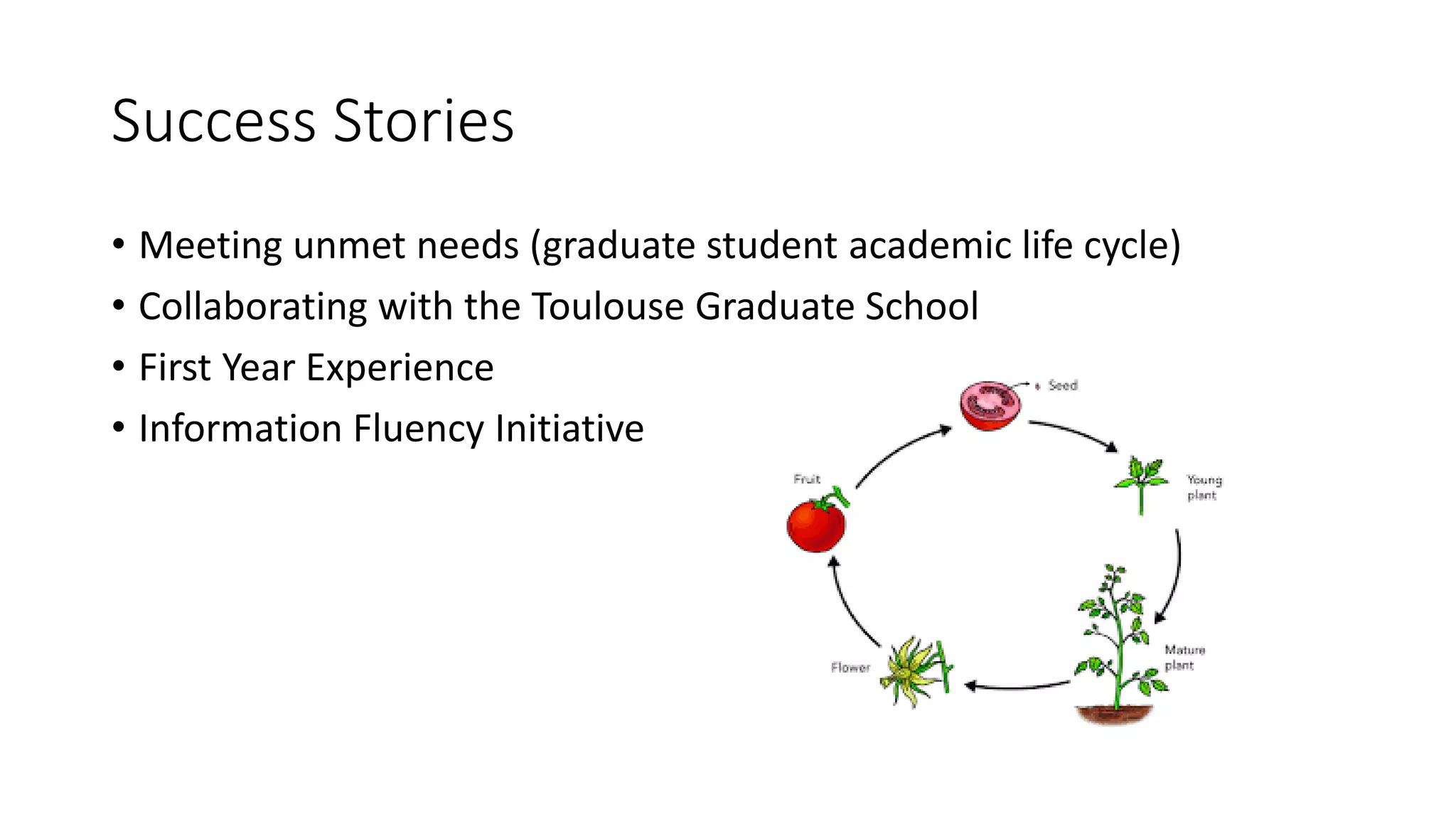
Success Stories
• Meeting unmet needs (graduate student academic life cycle)
• Collaborating with the Toulouse Graduate School
• First Year Experience
• Information Fluency Initiative
Looking Ahead
• Graduate Library Space
• The Office of Innovation and Commercialization
• The Collab Lab
• Information Fluency Initiative
• Undergraduate Advising
• Transfer Center
• Student Government Association
Transformation of Services
From...
• Solo to collaboration
• Student/faculty input to input from many stakeholders
• Serving the individual student to serving groups of students
• Primary provider of programs/services to facilitator of programs/services
• Less library led, more stakeholder driven
• Less passive more active
Benefits of Transformation
• Combined resources
• Effective service
• Awareness of barriers
• Coherent programs and services
We'd Like to Thank: Transformation Team
• All subject librarians
• Other library departments/divisions
• Library administration
• Many others outside of the library
References
Astin, A. W. (1999). Student involvement: A developmental theory for higher
education. Journal of College Student Development, 40(5): 518-529
(Reprinted from Journal of College Student Personnel, 25(4), 297-308, 1984).
Huber, J. & Potter, S. (2015). The Purpose-Based library: Finding your path to
survival, success and growth. Chicago, IL: ALA Neal-Schuman.
Kuh, G. D. & Hu, S. (2001). The effects of student-faculty interaction in the
1990s. The Review of Higher Education, 24(3): 309-332. doi:
10.13531/rhe.2001.0005
Meulemans, Y. N., & Carr, A. (2013). Not at your service: building genuine
faculty-librarian partnerships. Reference Services Review, 41(1), 80-90.
http://dx.doi.org/10.1108/00907321311300893
Further Information
• Leuzinger, Julie. Transforming an Academic Library from a Traditional
Service Model to a Community Partner. UNT Digital
Library. http://digital.library.unt.edu/ark:/67531/metadc407864/.
Accessed October 10, 2016.
• Leuzinger, Julie. (2013.) “Reducing Service Points in the Academic
Library: How to provide quality customer service in the face of budget
cuts.” College & Research Libraries News 11: 530-533.
Questions?
Contact us:
• Susan Smith, Susan.Smith@unt.edu
• Julie Leuzinger, Julie.Leuzinger@unt.edu

New model for public service in academic libraries

  • 1.
    A New Modelfor Public Service in Academic Libraries Changing Library Roles, Taking Risks to Make a Difference for Students, Faculty, Staff and the Community Susan Smith, Head of Library Research Support Services Julie Leuzinger, Head of Library Learning Services University of North Texas Libraries October 17, 2016
  • 2.
    By the endof this presentation, we will have addressed the following: • Recognizing possibility in the midst of chaos • Opportunities and challenges of restructuring public services in an academic library to meet needs of user groups • Identifying and working with potential collaborators
  • 3.
    University of NorthTexas Denton, Texas • 1,056 full time faculty • 2,432 full time staff • 37,973 students Degrees offered • Bachelor's – 99 • Master's – 83 • Doctoral – 35 • Special Professional -1
  • 4.
    University of NorthTexas • Diverse in race, gender and culture • 90.2% Texas residents • 6,215 live on campus • 4,661 first time in college • 4,037 transfer students • Freshmen Persistence: 79.1% • Student/Faculty Ratio: 24.5 to 1 • Carnegie R1
  • 5.
    University of NorthTexas Libraries • 6 million print and digital items • 5 libraries • 60 librarians • 73 support staff • Student & graduate assistants
  • 6.
    99* Problems •6 (!)services desks and an image problem
  • 7.
    Don't Go Changing... •Management concerns • 7 open positions • "Please sir, I want some more..."
  • 8.
    Ch-ch-changes 2013-2014 Fall 2013 • Plansfor Eagle Commons Library as outward facing community research hub Spring 2014 • Major collection shift Early Summer 2014 • Major staff shift Mid Summer 2014 • New Government Documents Librarian/Assistant Manager Late Summer 2014 • Restructure Fall 2014 • Planning for the future of the Public Services Division
  • 9.
    Challenges • Staff • Willpeople get it? • Blurred lines
  • 10.
    UNT Libraries PublicServices Division Effective January 1, 2015 Assistant Dean for Public Services S.S. Access Services M.A.V. 2 Librarians 9 Staff 8 GLAs Government Information Connection @ ECL R.S. 3 Librarians 7 Staff 1 GLA Library Learning Services Julie Leuzinger 4 Librarians Library Research Support Services Susan Smith 3 Librarians Digital Humanities Unit S.K. Administrative Specialist
  • 11.
    The Department FormerlyKnown As RIS: Library Learning Services • Provides individualized library service through instruction and student engagement. • Committed to supporting undergraduate student success by advancing the information fluency initiative, by facilitating the first year college experience, and by contributing to the timely graduation of our undergraduate student population through creative partnerships with other university student -centered groups and faculty.
  • 12.
    The Department FormerlyKnown As RIS: Library Research Support Services • Provides research support to enrich the scholarly experience and success of the University of North Texas graduate students and faculty.
  • 13.
    Initial Successes • Undergraduateand Graduate Student Library Advisory Board • Thesis and Dissertation Boot Camps • First Year Experience Librarian • Outreach to Housing
  • 14.
    More interaction withlibrarians=? • Student faculty interaction is a key sign of student involvement, and is highly related to student satisfaction with college (Astin, 1999). • For most students more interaction with faculty improved outcomes and led to students engaging in other educationally purposeful activities during college (Kuh & Hu, 2001).
  • 15.
    Smith's Model ofStudent/Library Staff Relationships 1:1 Student to Subject Librarian 1: Many Student to Many in Library Many: Many Previously Unserved or Underserved Groups to Many in Library
  • 16.
    Opportunities • Reinvigorate longterm library staff • Group like with like • Strategic new hires/positions • Capitalize on things already doing/first steps • We’re all in this together • Students, faculty, staff, community more than just subject areas/disciplines
  • 17.
    Change Partners andDance • If you do not like what is being said, change the conversation (Meulemans & Carr, 2013). • Develop professional value system that places primary focus and importance on meaningful collaboration and partnership (Meulemans & Carr, 2013). • What value proposition are we presenting to our community and leaders? (Huber & Potter, 2015).
  • 18.
    Susan’s Rules forFinding Partners/Collaborators • It’s not about you • Show up where they are • LISTEN • What can you offer to fit what they need? • Be faithful in small ways This isn't about you either
  • 19.
    Success Stories • Meetingunmet needs (graduate student academic life cycle) • Collaborating with the Toulouse Graduate School • First Year Experience • Information Fluency Initiative
  • 20.
    Looking Ahead • GraduateLibrary Space • The Office of Innovation and Commercialization • The Collab Lab • Information Fluency Initiative • Undergraduate Advising • Transfer Center • Student Government Association
  • 21.
    Transformation of Services From... •Solo to collaboration • Student/faculty input to input from many stakeholders • Serving the individual student to serving groups of students • Primary provider of programs/services to facilitator of programs/services • Less library led, more stakeholder driven • Less passive more active
  • 22.
    Benefits of Transformation •Combined resources • Effective service • Awareness of barriers • Coherent programs and services
  • 23.
    We'd Like toThank: Transformation Team • All subject librarians • Other library departments/divisions • Library administration • Many others outside of the library
  • 24.
    References Astin, A. W.(1999). Student involvement: A developmental theory for higher education. Journal of College Student Development, 40(5): 518-529 (Reprinted from Journal of College Student Personnel, 25(4), 297-308, 1984). Huber, J. & Potter, S. (2015). The Purpose-Based library: Finding your path to survival, success and growth. Chicago, IL: ALA Neal-Schuman. Kuh, G. D. & Hu, S. (2001). The effects of student-faculty interaction in the 1990s. The Review of Higher Education, 24(3): 309-332. doi: 10.13531/rhe.2001.0005 Meulemans, Y. N., & Carr, A. (2013). Not at your service: building genuine faculty-librarian partnerships. Reference Services Review, 41(1), 80-90. http://dx.doi.org/10.1108/00907321311300893
  • 25.
    Further Information • Leuzinger,Julie. Transforming an Academic Library from a Traditional Service Model to a Community Partner. UNT Digital Library. http://digital.library.unt.edu/ark:/67531/metadc407864/. Accessed October 10, 2016. • Leuzinger, Julie. (2013.) “Reducing Service Points in the Academic Library: How to provide quality customer service in the face of budget cuts.” College & Research Libraries News 11: 530-533.
  • 26.
    Questions? Contact us: • SusanSmith, Susan.Smith@unt.edu • Julie Leuzinger, Julie.Leuzinger@unt.edu