


Team of Researchers and Staff College of Education Jan Daugherty ,Doctoral Student Angela Griner, Doctoral Student Kendra Minor, Doctoral Student College of Arts and Humanities Alex Katsaros, Doctoral Student
Team of Researchers and Staff CREATE Stella Sung, DMA, Director, CREATE Carolyn Walker Hopp, Ph.D. Affiliate Faculty Victor Randle, Program Assistant, CREATE Brian Tortorelli, Program Assistant, CREATE
Presentation Goals •  Discuss the roles and responsibilities of each collaborative partner.  •  Provide a narrative about the process used to analyze, design, develop, implement and evaluate the professional development workshop.  •  Demonstrate the tools and community generated by the collaborative.
Presentation Goals  Report formative and summative evaluation data illustrating the impact of the program on educators’ attitudes and abilities. Discuss the insights and lessons learned by each collaborative partner
COLLABORATION  College of Education And CREATE What is the focus of our work? Faculty, students, and partners interact to: • impact community, creative thought, and research; • foster inter-disciplinarity; • create a symbiotic relationship.
Guiding Research Question  How does the structure of the research and educational components of CREATE impact the sustainability of community outreach and partnerships?
CREATE Community Projects Nap Ford Community School: “extended classroom”** ParramoreKidz Zone (PKZ): City of Orlando Orlando Science Center** K-12 Professional Development ** Creative Arts Projects** Young Composer’s Challenge Interactive Expeditions Puerto Ricans in Central Florida PeruVine
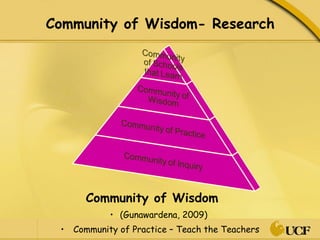
Community of Wisdom- Research Community of Wisdom (Gunawardena, 2009)  Community of Practice – Teach the Teachers
Traditional aims at professional development commonly suffer from : lack of variety in the delivery of modes of professional development, inaccessibility of professional development opportunities, little or no support in transferring professional development to the classroom, lack of systematic evaluation of professional development (Díaz-Maggioli, 2004, p. 4).
Leverage technologies in support of establishing learning communities for:  •  Continuous professional development •  Peer collaboration •  Community building •  Follow-up support
Leverage technologies in support of establishing learning communities. Use a three-phase evaluation design. Leverage technology within the school community to aid in enhancing professional learning communities among the school, teacher, students, and parents.
Need for continuous professional development  Need to develop professional learning communities (PLCs) through technology
In June 2010, 20 faculty members from Cypress Creek High School participated in a two-day professional development program at CREATE, which: established  the foundation to enhance community using technology, emphasized how to  integrate technology  that teachers and staff could  easily access,  focused on the use of specific technologies to enhance collaboration between teachers, staff, students, and their families.
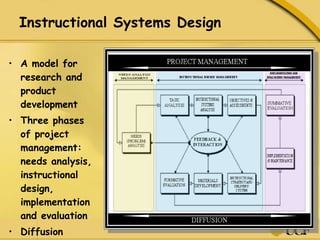
Instructional Systems Design  A model for research and product development  Three phases of project management: needs analysis, instructional design, implementation and evaluation Diffusion
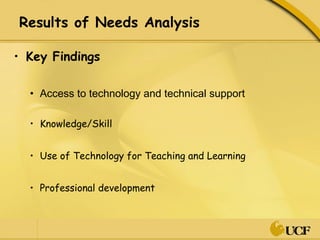
Results of Needs Analysis Key Findings  Access to technology and technical support Knowledge/Skill Use of Technology for Teaching and Learning  Professional development
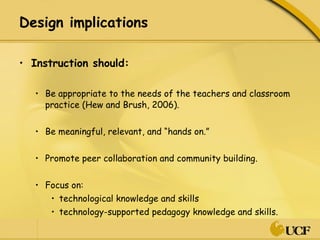
Design implications  Instruction should: Be appropriate to the needs of the teachers and classroom practice (Hew and Brush, 2006).  Be meaningful, relevant, and “hands on.” Promote peer collaboration and community building. Focus on: technological knowledge and skills technology-supported pedagogy knowledge and skills.
Student-centered Approaches Teaching for Understanding (TfU) 5E Model of Inquiry
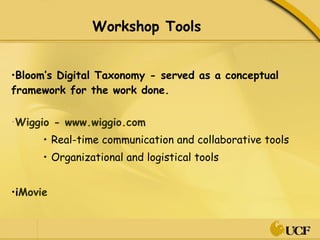
Workshop Tools Bloom’s Digital Taxonomy - served as a conceptual framework for the work done. Wiggio - www.wiggio.com Real-time communication and collaborative tools Organizational and logistical tools i Movie
Phase I: Program Evaluation How are teachers’ knowledge and perceptions related to technology use in their classrooms affected by participation in CREATE’s professional development program?  To what degree does participation in CREATE’s professional development program change teachers intentions to use the technologies they have been trained to use during this program?
Phase I: Program Evaluation To what degree does participation in CREATE’s professional development program change teachers’ intentions to use the technologies they have been trained to use during this program in order to enhance collaboration with other teachers, staff, students, and their families?
Methodology Mixed Methods Study Quantitative  Pre and post surveys •  An adapted version of TAM2 measure Qualitative  Pre and post interviews and focus groups
Findings  UCF/CREATE’s technology professional development program was found to have a positive impact in all areas.  The role of reflective practice and participant attitudes allowed for engaged and reciprocal learning.
The purpose of Phase II, was to further explore: the impact of the professional development workshop in terms of how the teachers applied the knowledge gained from workshop, and perceptions of how the technology impacted their school community.
Phase II: Summative evaluation  Research Question  How do members of the learning organization perceive and describe their lived experiences using a web-based collaborative networking environment, Wiggio™, within the school community (i.e. with teachers, staff, students, and their families)? What type of interactions are taking place through the collaborative technology?  What has been the impact on the culture of the learning organization and individual learning communities?
Phase II: Summative evaluation  Qualitative  Phenomenological Study Population and Sample School staff and faculty were recruited to serve as participants in the study.  Three staff members volunteered Data Collection Interviews  Semi-structured interview questions  Data Analysis List of non-repetitive significant statements Statements were then grouped into larger themes
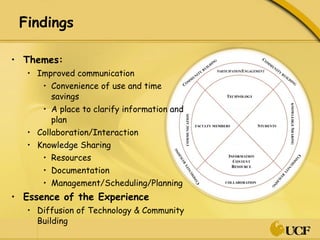
Findings Themes:  Improved communication  Convenience of use and time savings A place to clarify information and plan Collaboration/Interaction  Knowledge Sharing Resources  Documentation Management/Scheduling/Planning  Essence of the Experience Diffusion of Technology & Community Building
Impact of student learning Sustainability of professional development   model “ Practicality is the reality”
Insights and Lessons Learned Importance of collaboration Clear expectations with community partners Identify partners’ learning needs Understand our partners’ context Demonstrate technology that we are familiar with through practice
Questions?

Enhancing School Community through Technology Professional Development for Teachers

  • 1.
  • 2.
    Team of Researchersand Staff College of Education Jan Daugherty ,Doctoral Student Angela Griner, Doctoral Student Kendra Minor, Doctoral Student College of Arts and Humanities Alex Katsaros, Doctoral Student
  • 3.
    Team of Researchersand Staff CREATE Stella Sung, DMA, Director, CREATE Carolyn Walker Hopp, Ph.D. Affiliate Faculty Victor Randle, Program Assistant, CREATE Brian Tortorelli, Program Assistant, CREATE
  • 4.
    Presentation Goals • Discuss the roles and responsibilities of each collaborative partner. • Provide a narrative about the process used to analyze, design, develop, implement and evaluate the professional development workshop. • Demonstrate the tools and community generated by the collaborative.
  • 5.
    Presentation Goals Report formative and summative evaluation data illustrating the impact of the program on educators’ attitudes and abilities. Discuss the insights and lessons learned by each collaborative partner
  • 6.
    COLLABORATION Collegeof Education And CREATE What is the focus of our work? Faculty, students, and partners interact to: • impact community, creative thought, and research; • foster inter-disciplinarity; • create a symbiotic relationship.
  • 7.
    Guiding Research Question How does the structure of the research and educational components of CREATE impact the sustainability of community outreach and partnerships?
  • 8.
    CREATE Community ProjectsNap Ford Community School: “extended classroom”** ParramoreKidz Zone (PKZ): City of Orlando Orlando Science Center** K-12 Professional Development ** Creative Arts Projects** Young Composer’s Challenge Interactive Expeditions Puerto Ricans in Central Florida PeruVine
  • 9.
    Community of Wisdom-Research Community of Wisdom (Gunawardena, 2009) Community of Practice – Teach the Teachers
  • 10.
    Traditional aims atprofessional development commonly suffer from : lack of variety in the delivery of modes of professional development, inaccessibility of professional development opportunities, little or no support in transferring professional development to the classroom, lack of systematic evaluation of professional development (Díaz-Maggioli, 2004, p. 4).
  • 11.
    Leverage technologies insupport of establishing learning communities for: • Continuous professional development • Peer collaboration • Community building • Follow-up support
  • 12.
    Leverage technologies insupport of establishing learning communities. Use a three-phase evaluation design. Leverage technology within the school community to aid in enhancing professional learning communities among the school, teacher, students, and parents.
  • 13.
    Need for continuousprofessional development Need to develop professional learning communities (PLCs) through technology
  • 14.
    In June 2010,20 faculty members from Cypress Creek High School participated in a two-day professional development program at CREATE, which: established the foundation to enhance community using technology, emphasized how to integrate technology that teachers and staff could easily access, focused on the use of specific technologies to enhance collaboration between teachers, staff, students, and their families.
  • 15.
    Instructional Systems Design A model for research and product development Three phases of project management: needs analysis, instructional design, implementation and evaluation Diffusion
  • 16.
    Results of NeedsAnalysis Key Findings Access to technology and technical support Knowledge/Skill Use of Technology for Teaching and Learning Professional development
  • 17.
    Design implications Instruction should: Be appropriate to the needs of the teachers and classroom practice (Hew and Brush, 2006). Be meaningful, relevant, and “hands on.” Promote peer collaboration and community building. Focus on: technological knowledge and skills technology-supported pedagogy knowledge and skills.
  • 18.
    Student-centered Approaches Teachingfor Understanding (TfU) 5E Model of Inquiry
  • 19.
    Workshop Tools Bloom’sDigital Taxonomy - served as a conceptual framework for the work done. Wiggio - www.wiggio.com Real-time communication and collaborative tools Organizational and logistical tools i Movie
  • 20.
    Phase I: ProgramEvaluation How are teachers’ knowledge and perceptions related to technology use in their classrooms affected by participation in CREATE’s professional development program? To what degree does participation in CREATE’s professional development program change teachers intentions to use the technologies they have been trained to use during this program?
  • 21.
    Phase I: ProgramEvaluation To what degree does participation in CREATE’s professional development program change teachers’ intentions to use the technologies they have been trained to use during this program in order to enhance collaboration with other teachers, staff, students, and their families?
  • 22.
    Methodology Mixed MethodsStudy Quantitative Pre and post surveys • An adapted version of TAM2 measure Qualitative Pre and post interviews and focus groups
  • 23.
    Findings UCF/CREATE’stechnology professional development program was found to have a positive impact in all areas. The role of reflective practice and participant attitudes allowed for engaged and reciprocal learning.
  • 24.
    The purpose ofPhase II, was to further explore: the impact of the professional development workshop in terms of how the teachers applied the knowledge gained from workshop, and perceptions of how the technology impacted their school community.
  • 25.
    Phase II: Summativeevaluation Research Question How do members of the learning organization perceive and describe their lived experiences using a web-based collaborative networking environment, Wiggio™, within the school community (i.e. with teachers, staff, students, and their families)? What type of interactions are taking place through the collaborative technology? What has been the impact on the culture of the learning organization and individual learning communities?
  • 26.
    Phase II: Summativeevaluation Qualitative Phenomenological Study Population and Sample School staff and faculty were recruited to serve as participants in the study. Three staff members volunteered Data Collection Interviews Semi-structured interview questions Data Analysis List of non-repetitive significant statements Statements were then grouped into larger themes
  • 27.
    Findings Themes: Improved communication Convenience of use and time savings A place to clarify information and plan Collaboration/Interaction Knowledge Sharing Resources Documentation Management/Scheduling/Planning Essence of the Experience Diffusion of Technology & Community Building
  • 28.
    Impact of studentlearning Sustainability of professional development model “ Practicality is the reality”
  • 29.
    Insights and LessonsLearned Importance of collaboration Clear expectations with community partners Identify partners’ learning needs Understand our partners’ context Demonstrate technology that we are familiar with through practice
  • 30.

Editor's Notes