About the LTC
Follow @UWMLTC, twitter.com/uwmltc
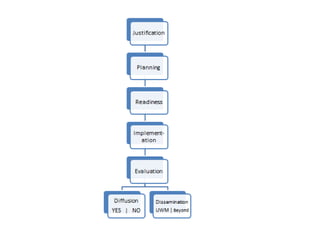
Preso at: http://www.slideshare.net/tjoosten/
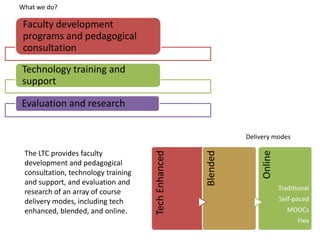
TechEnhanced
Blended
Online
Traditional
Self-paced
MOOCs
Flex
Faculty development
programs and pedagogical
consultation
Technology training and
support
Evaluation and research
The LTC provides faculty
development and pedagogical
consultation, technology training
and support, and evaluation and
research of an array of course
delivery modes, including tech
enhanced, blended, and online.
Delivery modes
What we do?
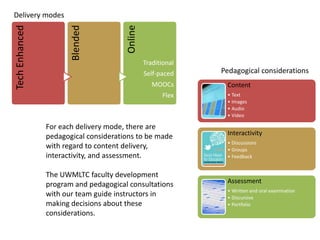
Delivery modes
TechEnhanced
Blended
Online
Traditional
Self-paced
MOOCs
Flex
Content
• Text
• Images
• Audio
• Video
Interactivity
• Discussions
• Groups
• Feedback
Assessment
• Written and oral examination
• Discursive
• Portfolio
Pedagogical considerations
For each delivery mode, there are
pedagogical considerations to be made
with regard to content delivery,
interactivity, and assessment.
The UWMLTC faculty development
program and pedagogical consultations
with our team guide instructors in
making decisions about these
considerations.
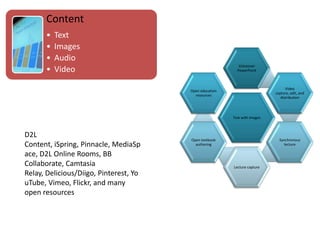
Content
• Text
• Images
• Audio
• Video
Text with images
Voiceover
PowerPoint
Video
capture, edit, and
distribution
Synchronous
lecture
Lecture capture
Open textbook
authoring
Open education
resources
D2L
Content, iSpring, Pinnacle, MediaSp
ace, D2L Online Rooms, BB
Collaborate, Camtasia
Relay, Delicious/Diigo, Pinterest, Yo
uTube, Vimeo, Flickr, and many
open resources
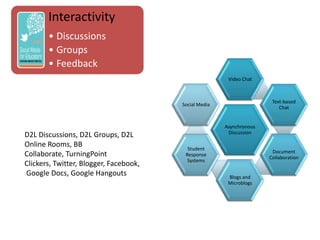
Interactivity
• Discussions
• Groups
• Feedback
Asynchronous
Discussion
Video Chat
Text-based
Chat
Document
Collaboration
Blogs and
Microblogs
Student
Response
Systems
Social Media
D2L Discussions, D2L Groups, D2L
Online Rooms, BB
Collaborate, TurningPoint
Clickers, Twitter, Blogger, Facebook,
Google Docs, Google Hangouts
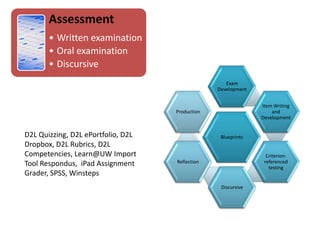
Assessment
• Written examination
• Oral examination
• Discursive
Blueprints
Exam
Development
Item Writing
and
Development
Criterion-
referenced
testing
Discursive
Reflection
Production
D2L Quizzing, D2L ePortfolio, D2L
Dropbox, D2L Rubrics, D2L
Competencies, Learn@UW Import
Tool Respondus, iPad Assignment
Grader, SPSS, Winsteps
UW-Milwaukee
Faculty Development Program:
Purpose | Format | Outcomes
Overall purpose or goals
• Design, develop, teach, and advocate for
blended courses
• A practical approach
– Get started
– Redesign course
– Develop course material
– Acquire teaching skills
Program format
• Taught in a blended format and in multiple
formats during the academic year
• Face-to-face meetings and online assignments
– Model good blended practices
– Experience blended course as a student
– Effective teaching model
• Experienced blended teachers are program
facilitators
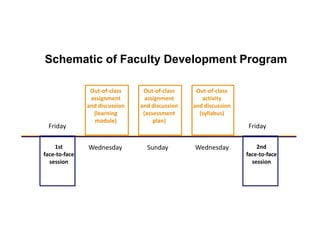
Schematic of Faculty Development Program
1st
face-to-face
session
Out-of-class
assignment
and discussion
(learning
module)
2nd
face-to-face
session
Out-of-class
assignment
and discussion
(assessment
plan)
Out-of-class
activity
and discussion
(syllabus)
Friday Friday
Wednesday WednesdaySunday
Program activities
• Presentation, demonstration, small-group
activities, facilitator feedback, peer
feedback, online discussion, consultation
• Emphasis on faculty “active learning”
– Discussing
– Questioning
– Developing
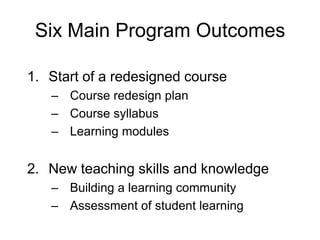
Six Main Program Outcomes
1. Start of a redesigned course
– Course redesign plan
– Course syllabus
– Learning modules
2. New teaching skills and knowledge
– Building a learning community
– Assessment of student learning
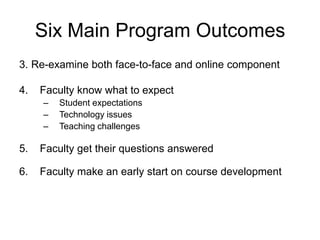
Six Main Program Outcomes
3. Re-examine both face-to-face and online component
4. Faculty know what to expect
– Student expectations
– Technology issues
– Teaching challenges
5. Faculty get their questions answered
6. Faculty make an early start on course development
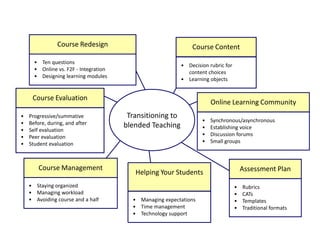
• Ten questions
• Online vs. F2F - Integration
• Designing learning modules
• Decision rubric for
content choices
• Learning objects
Course Content
• Progressive/summative
• Before, during, and after
• Self evaluation
• Peer evaluation
• Student evaluation
Course Evaluation
• Rubrics
• CATs
• Templates
• Traditional formats
Assessment Plan
• Synchronous/asynchronous
• Establishing voice
• Discussion forums
• Small groups
Online Learning Community
• Managing expectations
• Time management
• Technology support
Helping Your Students
• Staying organized
• Managing workload
• Avoiding course and a half
Course Management
Course Redesign
Transitioning to
blended Teaching
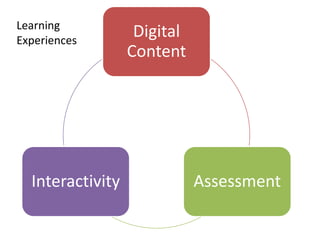
Digital
Content
AssessmentInteractivity
Learning
Experiences
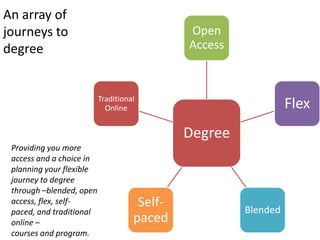
An array of
journeys to
degree
Degree
Open
Access
Flex
Blended
Self-
paced
Traditional
Online
Providing you more
access and a choice in
planning your flexible
journey to degree
through –blended, open
access, flex, self-
paced, and traditional
online –
courses and program.
LTC initiatives
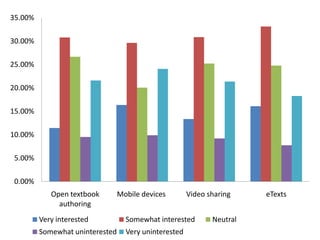
Open textbook
authoring
Mobile devices Video sharing eTexts
0.00%
5.00%
10.00%
15.00%
20.00%
25.00%
30.00%
35.00%
Very interested Somewhat interested Neutral
Somewhat uninterested Very uninterested
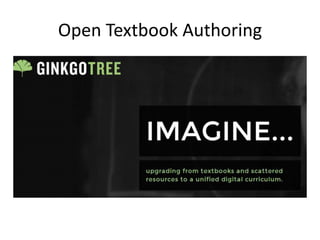
Open Textbook Authoring
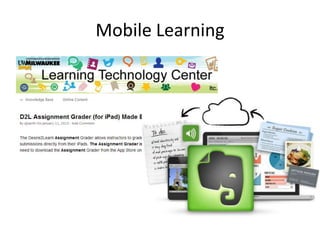
Mobile Learning
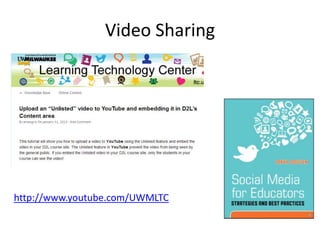
Video Sharing
http://www.youtube.com/UWMLTC
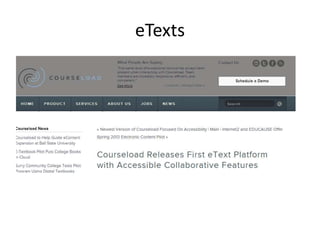
eTexts
• Courseload Pilot
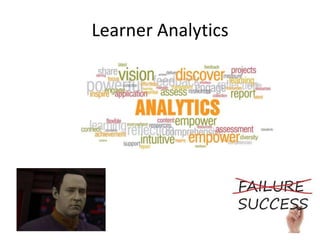
Learner Analytics
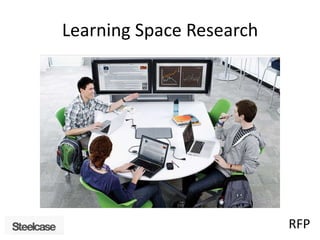
Learning Space Research
RFP
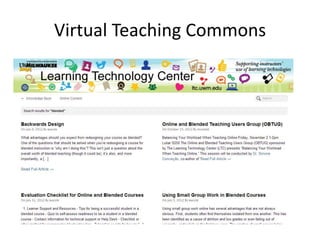
Virtual Teaching Commons
www.Desire2Learn.com
eCommerce
Open registration, course
enrollment, and revenue
gathering
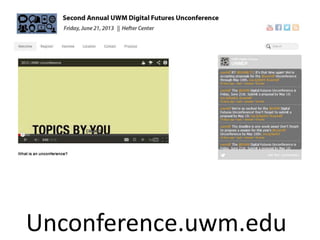
Unconference.uwm.edu
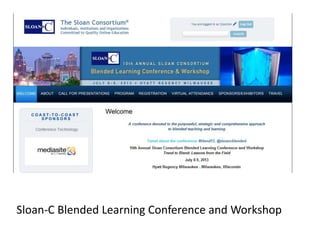
Sloan-C Blended Learning Conference and Workshop
Recent Publications
Joosten, T., Barth, D., Harness, L., & Weber, N.
(2013, anticipated) Impact of blended faculty
development. In Research perspectives in blended
learning (Eds . Anthony G. Picciano, Charles D.
Dziuban, and Charles R. Graham). Taylor and Francis.
Joosten, T., Pasquini, L, & Harness, L. (2013). Guiding
institutions use of social media. Planning for Higher
Education, 41, 2.
Joosten, T. (2012). Social media for
educators. Wiley/Jossey-Bass, San Francisco.
Upcoming Presentations
2013, July 8th. Strategies to ensure quality in online and blended courses.
Workshop. Sloan Consortium Blended Workshop and Conference.
Milwaukee, WI.
2013, July 9th. Using MOOCs for Blended Learning. Featured Session. Sloan
Consortium Blended Workshop and Conference. Milwaukee, WI.
2013, August 7th. Strategies to ensure quality in online and blended courses.
Workshop. Annual Distance Teaching and Learning Conference. Madison, WI.
2013, August 8th. Survey says! Uncovering faculty support needs and
instructional technology preferences .Annual Distance Teaching and Learning
Conference. Madison, WI.
2013, October 15th. Ensuring quality in online and blended programs.
Workshop. EDUCAUSE Annual Conference, Boston, MA.
2013, October 15th. Social media for teaching and learning. Workshop.
EDUCAUSE Annual Online Conference, Boston, MA.
2013, November 22nd. The flipped classroom: Taking advantage of renewed
opportunities. Workshop. Sloan Consortium International Conference for
Online Learning. Orlando, FL.
twitter.com/tjoosten
linkedin.com/in/tjoosten
Google juice.gyoza@gmail.com
tjoosten@uwm.edu

UWM's Learning Technology Center

  • 1.
    About the LTC Follow@UWMLTC, twitter.com/uwmltc Preso at: http://www.slideshare.net/tjoosten/
  • 2.
    TechEnhanced Blended Online Traditional Self-paced MOOCs Flex Faculty development programs andpedagogical consultation Technology training and support Evaluation and research The LTC provides faculty development and pedagogical consultation, technology training and support, and evaluation and research of an array of course delivery modes, including tech enhanced, blended, and online. Delivery modes What we do?
  • 3.
    Delivery modes TechEnhanced Blended Online Traditional Self-paced MOOCs Flex Content • Text •Images • Audio • Video Interactivity • Discussions • Groups • Feedback Assessment • Written and oral examination • Discursive • Portfolio Pedagogical considerations For each delivery mode, there are pedagogical considerations to be made with regard to content delivery, interactivity, and assessment. The UWMLTC faculty development program and pedagogical consultations with our team guide instructors in making decisions about these considerations.
  • 4.
    Content • Text • Images •Audio • Video Text with images Voiceover PowerPoint Video capture, edit, and distribution Synchronous lecture Lecture capture Open textbook authoring Open education resources D2L Content, iSpring, Pinnacle, MediaSp ace, D2L Online Rooms, BB Collaborate, Camtasia Relay, Delicious/Diigo, Pinterest, Yo uTube, Vimeo, Flickr, and many open resources
  • 5.
    Interactivity • Discussions • Groups •Feedback Asynchronous Discussion Video Chat Text-based Chat Document Collaboration Blogs and Microblogs Student Response Systems Social Media D2L Discussions, D2L Groups, D2L Online Rooms, BB Collaborate, TurningPoint Clickers, Twitter, Blogger, Facebook, Google Docs, Google Hangouts
  • 6.
    Assessment • Written examination •Oral examination • Discursive Blueprints Exam Development Item Writing and Development Criterion- referenced testing Discursive Reflection Production D2L Quizzing, D2L ePortfolio, D2L Dropbox, D2L Rubrics, D2L Competencies, Learn@UW Import Tool Respondus, iPad Assignment Grader, SPSS, Winsteps
  • 7.
  • 8.
    Overall purpose orgoals • Design, develop, teach, and advocate for blended courses • A practical approach – Get started – Redesign course – Develop course material – Acquire teaching skills
  • 9.
    Program format • Taughtin a blended format and in multiple formats during the academic year • Face-to-face meetings and online assignments – Model good blended practices – Experience blended course as a student – Effective teaching model • Experienced blended teachers are program facilitators
  • 10.
    Schematic of FacultyDevelopment Program 1st face-to-face session Out-of-class assignment and discussion (learning module) 2nd face-to-face session Out-of-class assignment and discussion (assessment plan) Out-of-class activity and discussion (syllabus) Friday Friday Wednesday WednesdaySunday
  • 11.
    Program activities • Presentation,demonstration, small-group activities, facilitator feedback, peer feedback, online discussion, consultation • Emphasis on faculty “active learning” – Discussing – Questioning – Developing
  • 12.
    Six Main ProgramOutcomes 1. Start of a redesigned course – Course redesign plan – Course syllabus – Learning modules 2. New teaching skills and knowledge – Building a learning community – Assessment of student learning
  • 13.
    Six Main ProgramOutcomes 3. Re-examine both face-to-face and online component 4. Faculty know what to expect – Student expectations – Technology issues – Teaching challenges 5. Faculty get their questions answered 6. Faculty make an early start on course development
  • 14.
    • Ten questions •Online vs. F2F - Integration • Designing learning modules • Decision rubric for content choices • Learning objects Course Content • Progressive/summative • Before, during, and after • Self evaluation • Peer evaluation • Student evaluation Course Evaluation • Rubrics • CATs • Templates • Traditional formats Assessment Plan • Synchronous/asynchronous • Establishing voice • Discussion forums • Small groups Online Learning Community • Managing expectations • Time management • Technology support Helping Your Students • Staying organized • Managing workload • Avoiding course and a half Course Management Course Redesign Transitioning to blended Teaching
  • 16.
  • 18.
    An array of journeysto degree Degree Open Access Flex Blended Self- paced Traditional Online Providing you more access and a choice in planning your flexible journey to degree through –blended, open access, flex, self- paced, and traditional online – courses and program.
  • 19.
  • 21.
    Open textbook authoring Mobile devicesVideo sharing eTexts 0.00% 5.00% 10.00% 15.00% 20.00% 25.00% 30.00% 35.00% Very interested Somewhat interested Neutral Somewhat uninterested Very uninterested
  • 22.
  • 23.
  • 24.
  • 25.
  • 26.
  • 27.
  • 28.
  • 29.
  • 30.
  • 31.
    Sloan-C Blended LearningConference and Workshop
  • 32.
    Recent Publications Joosten, T.,Barth, D., Harness, L., & Weber, N. (2013, anticipated) Impact of blended faculty development. In Research perspectives in blended learning (Eds . Anthony G. Picciano, Charles D. Dziuban, and Charles R. Graham). Taylor and Francis. Joosten, T., Pasquini, L, & Harness, L. (2013). Guiding institutions use of social media. Planning for Higher Education, 41, 2. Joosten, T. (2012). Social media for educators. Wiley/Jossey-Bass, San Francisco.
  • 33.
    Upcoming Presentations 2013, July8th. Strategies to ensure quality in online and blended courses. Workshop. Sloan Consortium Blended Workshop and Conference. Milwaukee, WI. 2013, July 9th. Using MOOCs for Blended Learning. Featured Session. Sloan Consortium Blended Workshop and Conference. Milwaukee, WI. 2013, August 7th. Strategies to ensure quality in online and blended courses. Workshop. Annual Distance Teaching and Learning Conference. Madison, WI. 2013, August 8th. Survey says! Uncovering faculty support needs and instructional technology preferences .Annual Distance Teaching and Learning Conference. Madison, WI. 2013, October 15th. Ensuring quality in online and blended programs. Workshop. EDUCAUSE Annual Conference, Boston, MA. 2013, October 15th. Social media for teaching and learning. Workshop. EDUCAUSE Annual Online Conference, Boston, MA. 2013, November 22nd. The flipped classroom: Taking advantage of renewed opportunities. Workshop. Sloan Consortium International Conference for Online Learning. Orlando, FL.
  • 34.

Editor's Notes

  • #2 Ends :36
  • #13 Six main outcomes are highlighted as central to the faculty development program.  First, faculty start with concrete development of both broad-perspective elements of their new course, such as a course redesign plan and a syllabus, and the development of more specific features of the course such as learning modules. This is especially appropriate in disciplines or areas where “learning modules” are not typically the unit of course redesign, thus requiring faculty to re-examine their conceptual basis for instruction from the bottom up.  Second, faculty must acquire new teaching skills and knowledge appropriate to a blended learning frame, such as how to facilitate a peer learning community both face-to-face and online, and how to assess student learning in a manner that is quite distinct from the usual “three exams and a term paper” of a traditional face-to-face course. In the latter context, it is important to note that faculty are often committed to the use of summative assessments such as exams and term papers without ever having questioned previously their efficacy. The prospect of a blended course redesign thus holds out the possibility of a paradigm shift from modes of instruction that once seemed satisfactory to a model of teaching and learning that problematizes everything that has once been taken for granted. This is a source of considerable skepticism and anxiety for faculty who have been teaching for many years in a more traditional manner, often unreflectively.
  • #16 GOAL: UWM will lead the state in MOOC delivery.The means to do this will be built off of the knowledge of blended and online faculty development and course design, upace model, and flex programming.
  • #23 QuestionVery interestedSomewhat interestedNeutralSomewhat uninterestedVery uninterestedResponsesMeanOpen textbook authoring (e.g., iBooks, Wordpress)11.43%30.79%26.67%9.52%21.59%3152.99
  • #24 Mobile devices (e.g. iPad, iPhone, Android)16.36%29.63%20.06%9.88%24.07%3242.96QuestionVery interestedSomewhat interestedNeutralSomewhat uninterestedVery uninterestedResponsesMeanAssignment GraderMobile Learning PilotEvernote Whitepaper
  • #25 Video sharing (YouTube, Vimeo)13.35%30.86%25.22%9.20%21.36%3372.94
  • #26 eTexts16.10%33.13%24.77%7.74%18.27%3232.79
  • #27 Software:D2L Data WarehouseD2L Learner AnalyticsD2L Student Success ToolIBM Predictive AnalyticsKnewton AnalyticsSPSSHardware:STAFF!!
  • #30 We need a way for students to self register (username, password), self-enroll, and potentially pay for courses or assessmentsWe need to encourage Lorna Wong, UW Systems, Learn@UW Exec Committee, Common Systems, etc., to make sure our new D2L contract and technologies facilities MOOCs, users that are not UWM students – future UWM students. Further, what is the load on d2L? Efforts need to be harnessed to explore.Oracle has a solution as well (CUNY, Long State CC) price tag starting at $100,000We also could develop a D2L LTI integration for facebook possibly…mobile developers initiative…UWM needs more programming development initiatives that re entreprenuerial and innovative AND interdipsclinary