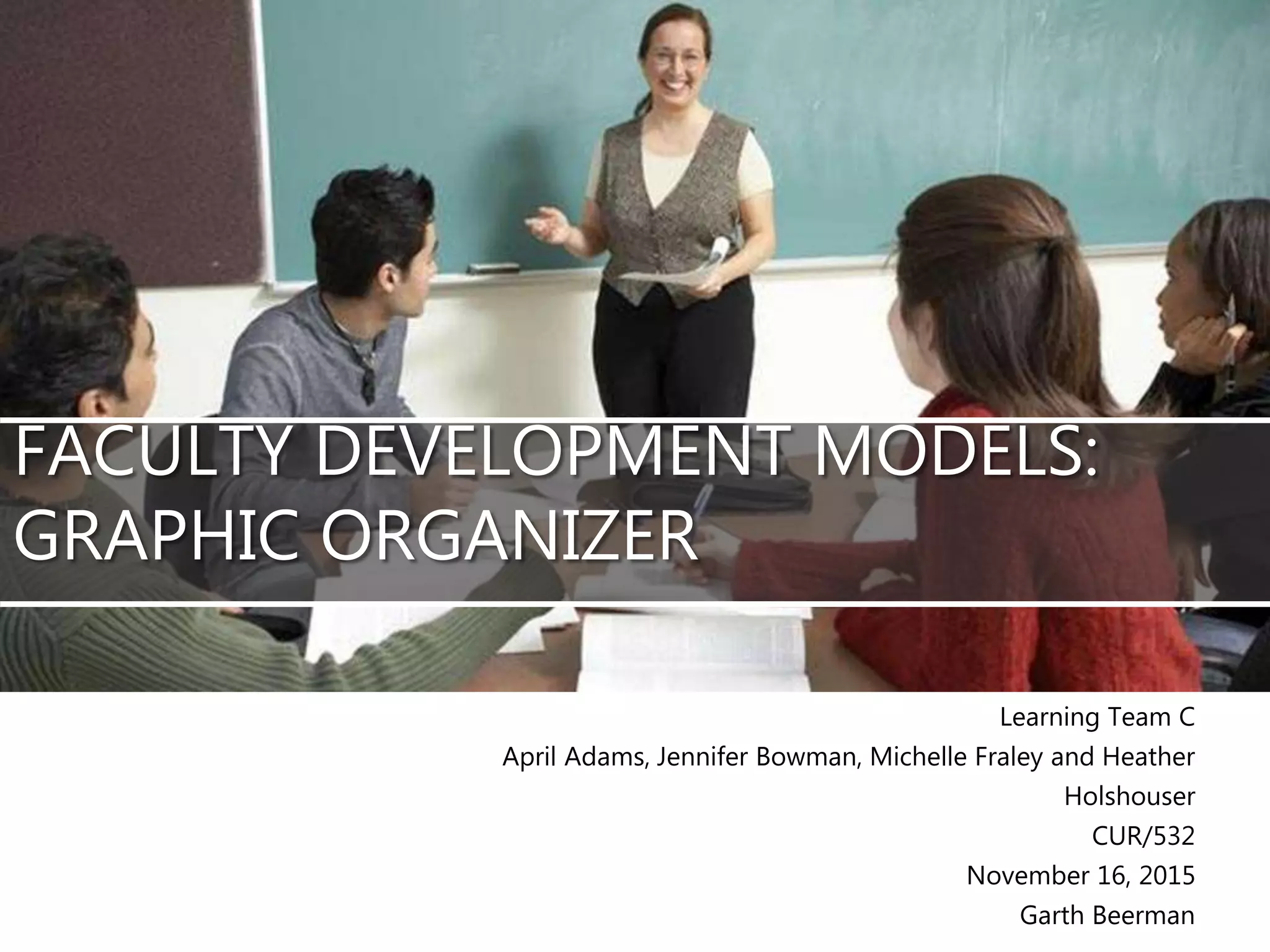
FACULTY DEVELOPMENT MODELS:
GRAPHIC ORGANIZER
Learning Team C
April Adams, Jennifer Bowman, Michelle Fraley and Heather
Holshouser
CUR/532
November 16, 2015
Garth Beerman
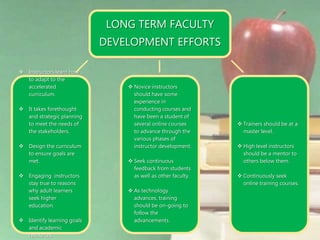
LONG TERM FACULTY
DEVELOPMENT EFFORTS
 Identify learning goals
and academic
resources.
 Novice instructors
should have some
experience in
conducting courses and
have been a student of
several online courses
to advance through the
various phases of
instructor development.
 Seek continuous
feedback from students
as well as other faculty.
 Instructors learn how
to adapt to the
accelerated
curriculum.
 It takes forethought
and strategic planning
to meet the needs of
the stakeholders.
 Design the curriculum
to ensure goals are
met.
 Engaging instructors
stay true to reasons
why adult learners
seek higher
education.
 As technology
advances, training
should be on-going to
follow the
advancements.
 Trainers should be at a
master level.
 High level instructors
should be a mentor to
others below them.
 Continuously seek
online training courses.
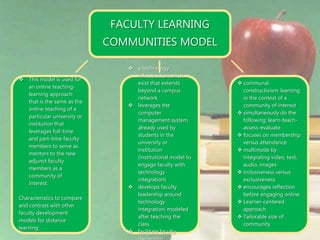
FACULTY LEARNING
COMMUNITIES MODEL
 a technology
infrastructure must exist
that extends beyond a
campus network
 leverages the computer
management system
already used by students
in the university or
institution (institutional
model to engage faculty
with technology
integration)
 develops faculty
leadership around
technology integration;
modeled after teaching
the class.
 facilitates faculty
ownership
 This model is used for an
online teaching-learning
approach that is the same
as the online teaching of
a particular university or
institution that leverages
full-time and part-time
faculty members to serve
as mentors to the new
adjunct faculty members
as a community of
interest.
 maximizes communal
constructivism: learning in
the context of a community
of interest
 simultaneously do the
following: learn-teach-
assess-evaluate
 focuses on membership
versus attendance
 multimode by integrating
video, text, audio, images
 inclusiveness versus
exclusiveness
 encourages reflection
before engaging online
 Learner-centered approach
 Tailorable size of
community
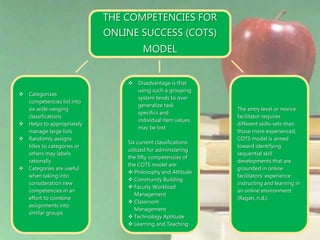
THE COMPETENCIES FOR
ONLINE SUCCESS (COTS)
MODEL
 Disadvantage is that
using such a grouping
system tends to over
generalize task specifics
and individual item values
may be lost
Six current classifications
utilized for administering the
fifty competencies of the
COTS model are:
 Philosophy and Attitude
 Community Building
 Faculty Workload
Management
 Classroom Management
 Technology Aptitude
 Learning and Teaching
 Categorizes
competencies list into
six wide-ranging
classifications
 Helps to appropriately
manage large lists
 Randomly assigns
titles to categories or
others may labels
rationally
 Categories are useful
when taking into
consideration new
competencies in an
effort to combine
assignments into
similar groups
The entry level or novice
facilitator requires
different skills-sets than
those more experienced.
COTS model is aimed
toward identifying
sequential skill
developments that are
grounded in online
facilitators’ experience
instructing and learning in
an online environment
(Ragan, n.d.).
REFERENCES
Braddlee, D., Pawlyshyn N., Lewis, M., Olson, L. (Feb 16, 2011). Faculty learning
Communities: A Model for Faculty Development. Retrieved from
http://www.slideshore.net/mattlewisesh/faculty-learning-communities-a-model-
for-faculty-development
Haythornthwaite, C., & Andrews, R. (2011). E-learning theory and practice. Los
Angeles, CA: Sage.
Palloff, Rena M., and Keith Pratt. The Excellent Online Instructor: Strategies for
Professional Development. San Francisco, CA: Jossey-Bass, 2011. Print
Ragan, L. (n.d.) Defining competencies for online teaching success. Faculty
Development in Distance Education: Issues, Trends, ad Tips. Madison, WI: Magna
Publications Retrieved from http://www.ponce.inter.edu/him/retencion-faculty-
development-in-distance-education.pdf

Learning Team C - Faculty Development Models: Graphic Organizer

  • 1.
    FACULTY DEVELOPMENT MODELS: GRAPHICORGANIZER Learning Team C April Adams, Jennifer Bowman, Michelle Fraley and Heather Holshouser CUR/532 November 16, 2015 Garth Beerman
  • 2.
    LONG TERM FACULTY DEVELOPMENTEFFORTS  Identify learning goals and academic resources.  Novice instructors should have some experience in conducting courses and have been a student of several online courses to advance through the various phases of instructor development.  Seek continuous feedback from students as well as other faculty.  Instructors learn how to adapt to the accelerated curriculum.  It takes forethought and strategic planning to meet the needs of the stakeholders.  Design the curriculum to ensure goals are met.  Engaging instructors stay true to reasons why adult learners seek higher education.  As technology advances, training should be on-going to follow the advancements.  Trainers should be at a master level.  High level instructors should be a mentor to others below them.  Continuously seek online training courses.
  • 3.
    FACULTY LEARNING COMMUNITIES MODEL a technology infrastructure must exist that extends beyond a campus network  leverages the computer management system already used by students in the university or institution (institutional model to engage faculty with technology integration)  develops faculty leadership around technology integration; modeled after teaching the class.  facilitates faculty ownership  This model is used for an online teaching-learning approach that is the same as the online teaching of a particular university or institution that leverages full-time and part-time faculty members to serve as mentors to the new adjunct faculty members as a community of interest.  maximizes communal constructivism: learning in the context of a community of interest  simultaneously do the following: learn-teach- assess-evaluate  focuses on membership versus attendance  multimode by integrating video, text, audio, images  inclusiveness versus exclusiveness  encourages reflection before engaging online  Learner-centered approach  Tailorable size of community
  • 4.
    THE COMPETENCIES FOR ONLINESUCCESS (COTS) MODEL  Disadvantage is that using such a grouping system tends to over generalize task specifics and individual item values may be lost Six current classifications utilized for administering the fifty competencies of the COTS model are:  Philosophy and Attitude  Community Building  Faculty Workload Management  Classroom Management  Technology Aptitude  Learning and Teaching  Categorizes competencies list into six wide-ranging classifications  Helps to appropriately manage large lists  Randomly assigns titles to categories or others may labels rationally  Categories are useful when taking into consideration new competencies in an effort to combine assignments into similar groups The entry level or novice facilitator requires different skills-sets than those more experienced. COTS model is aimed toward identifying sequential skill developments that are grounded in online facilitators’ experience instructing and learning in an online environment (Ragan, n.d.).
  • 5.
    REFERENCES Braddlee, D., PawlyshynN., Lewis, M., Olson, L. (Feb 16, 2011). Faculty learning Communities: A Model for Faculty Development. Retrieved from http://www.slideshore.net/mattlewisesh/faculty-learning-communities-a-model- for-faculty-development Haythornthwaite, C., & Andrews, R. (2011). E-learning theory and practice. Los Angeles, CA: Sage. Palloff, Rena M., and Keith Pratt. The Excellent Online Instructor: Strategies for Professional Development. San Francisco, CA: Jossey-Bass, 2011. Print Ragan, L. (n.d.) Defining competencies for online teaching success. Faculty Development in Distance Education: Issues, Trends, ad Tips. Madison, WI: Magna Publications Retrieved from http://www.ponce.inter.edu/him/retencion-faculty- development-in-distance-education.pdf