Using Web 2.0 Technologies to Coach Teacher Action Research Nancy Fichtman Dana Christopher D. Sessums Kara Dawson University of Florida
Our Mission:  To support and  promote practitioner inquiry as a primary mechanism for school improvement in schools throughout the state.
Overview of Presentation What is action research? What does it mean to effectively coach this process? What are some strategies coaches can employ to deepen the action research process? How might coaches be supported through Web 2.0 technologies? How might technology aid in the design, distribution, and mentoring of action research within and across a district?
What is action research?  Action Research/ Teacher Research/ Teacher Inquiry/ Practitioner Inquiry/ Classroom Research Systematic, intentional study by teachers of their own classroom practice (Cochran-Smith & Lytle, 1993)
Components of the Action Research Cycle Wondering (Question) Development Data Collection Data Analysis Synthesis/Sharing Action
An Example of Teacher Research Focus on Fractured Fairy Tales and Fluency Flourishes -  Debbi Hubbell, 4 th  Grade Teacher
Debbi’s Wondering What is the relationship between my fourth graders’ fluency development and the reading of fractured fairy tales?
Debbi’s Instructional Plan Day One : Students chose parts, Debbi read the play to the group, then students practiced silently Day Two : Students practiced silently, then aloud with the group to Debbi;  Debbi followed with short individual conferences Day Three : Students practiced silently, then aloud with the group to Debbi Day Four : Students practiced silently, then presented aloud with the group to the class
Debbi’s Data Collection Plan DIBELS Observation of Students - Anecdotal Notes  Student Artifacts – “Dear Mrs. Hubbell” letters
Debbi’s Data Analysis Plan Chart DIBELS data - Compare DIBELS scores over time Read Through Observations and Student Artifacts multiple times asking questions such as:  What was happening? What have I learned about myself as a teacher? What have I learned about children?  What are the implications of my findings for my   teaching?  Discuss analysis with teaching colleagues
DIBELS Test Results   10/18   12/1   2/10   2/21   4/6 J 48 53 55 60 73 B 81 98 114 105 164 C 90 98 95 100 130  Ja 64 70 92 85 119 T 93 96 88 97 121 S 94 91 86 78 113 M 84 101 99 107 127
Debbi’s Themes: Enjoyment/Enthusiasm Students perceive academic benefits Positive social interactions
Enjoyment/Enthusiasm …
Academic Benefits …
Positive social interactions …
In Summary …
Debbi’s Action Develop school/district wide fluency objectives Homework for 60 wpm kids vs. 180 wpm kids Make listening centers more effective Connect to struggling readers in secondary school
Overview of Presentation What is action research? What does it mean to effectively coach this process? What are some strategies coaches can employ to deepen the action research process? How might coaches be supported through Web 2.0 technologies? How might technology aid in the design, distribution, and mentoring of action research within and across a district?
Four Critical Junctures Defining and refining a wondering Developing a research plan Analyzing data Sharing work with others
Overview of Presentation What is action research? What does it mean to effectively coach this process? What are some strategies coaches can employ to deepen the action research process? How might coaches be supported through Web 2.0 technologies? How might technology aid in the design, distribution, and mentoring of action research within and across a district?
Four Critical Junctures Defining and refining a wondering Developing a research plan Analyzing data Sharing work with others
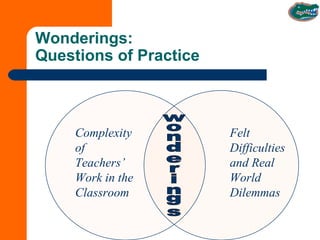
Wonderings:  Questions of Practice Complexity of Teachers’ Work in the Classroom Felt Difficulties and Real World Dilemmas wonderings
Four Critical Junctures Defining and refining a wondering Developing a research plan Analyzing data Sharing work with others
The Inquiry Brief One to two page proposal for action research indicating purpose, wonderings/questions, data collection and analysis strategies, and time-line for study
Four Critical Junctures Defining and refining a wondering Developing a research plan Analyzing data Sharing work with others
Overview of Presentation What is action research? What does it mean to effectively coach this process? What are some strategies coaches can employ to deepen the action research process? How might coaches be supported through Web 2.0 technologies? How might technology aid in the design, distribution, and mentoring of action research within and across a district?
How might coaches be supported through Web 2.0 technologies? Define Web 2.0 technologies An example of an online learning community Discuss other applications that can support networks
Web 2.0 definition Digital technologies that allow for • sharing •  conversation • collaboration • collective action (Shirky, 2008)
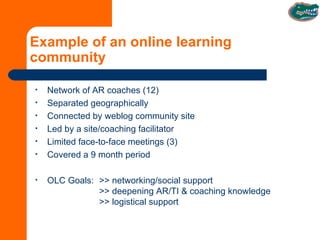
Example of an online learning community Network of AR coaches (12) Separated geographically Connected by weblog community site Led by a site/coaching facilitator Limited face-to-face meetings (3) Covered a 9 month period OLC Goals: >> networking/social support >> deepening AR/TI & coaching knowledge >> logistical support
 
 
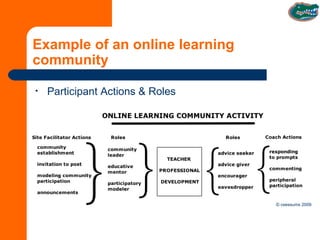
Example of an online learning community Participant Actions & Roles © csessums 2009
Example of an online learning community With the aid of the online learning community, participants were able to: • share and problematize experiences • share resources • engage in conversations about practice • collaborate on the enterprise of (1) supporting teacher researchers and (2) supporting each other •  collectively support the production of a Showcase of projects Build expertise in and deepen their knowledge of AR/TI & coaching, and  Deepen their own philosophy of coaching
What other applications can support and sustain learning communities online? Thoughts?
What other applications can support and sustain learning communities online? Wikis (PBWiki, WetPaint) Social networking apps (ex: Ning, Google Groups, Eduspaces) Blogs and Microblogs (Blogger, Wordpress, Twitter) Voice & Video Sharing apps (YouTube, Seesmic, Voicethread, Skype) Office Suite apps (GoogleDocs, Zotero, Zoho) Start Page apps (PageFlakes, NetVibes)
Overview of Presentation What is action research? What does it mean to effectively coach this process? What are some strategies coaches can employ to deepen the action research process? How might coaches be supported through Web 2.0 technologies? How might technology aid in the design, distribution, and mentoring of action research within and across a district?
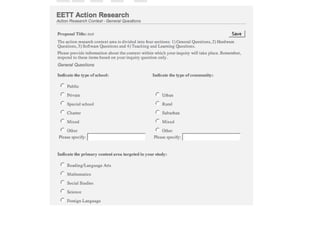
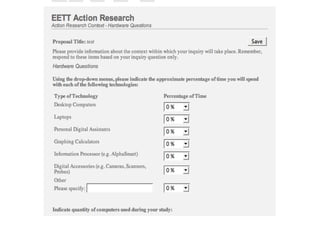
What other applications can support and sustain learning communities online? AR may help schools and districts  aggregate data from multiple classrooms  while enabling teachers to reap the  benefits of systematically and intentionally studying their own practice  through inquiry ARTI is part of a statewide initiative looking at the impact of statewide technology funding and systemic professional development efforts on teaching practices and student achievement.  ARTI is used to study the impact of Enhancing Education Through Technology (EETT) funding in Florida districts. Teachers from EETT districts use ARTI with the support of AR mentors trained in the AR process.


What other applications can support and sustain learning communities online? Available to districts and teacher education programs Streamlines AR process to make it accessible to more educators Upcoming: Embedded multimedia coaching Upcoming: Embedded online communities
Resources for Coaching Action Research
Contact Us . . . Nancy Fichtman Dana  	 [email_address] Christopher Sessums  	 [email_address] Kara Dawson [email_address] Visit the CSI website at  www.coe.ufl.edu/csi

ASCD Presentation 16MAR09

  • 1.
    Using Web 2.0Technologies to Coach Teacher Action Research Nancy Fichtman Dana Christopher D. Sessums Kara Dawson University of Florida
  • 2.
    Our Mission: To support and promote practitioner inquiry as a primary mechanism for school improvement in schools throughout the state.
  • 3.
    Overview of PresentationWhat is action research? What does it mean to effectively coach this process? What are some strategies coaches can employ to deepen the action research process? How might coaches be supported through Web 2.0 technologies? How might technology aid in the design, distribution, and mentoring of action research within and across a district?
  • 4.
    Overview of PresentationWhat is action research? What does it mean to effectively coach this process? What are some strategies coaches can employ to deepen the action research process? How might coaches be supported through Web 2.0 technologies? How might technology aid in the design, distribution, and mentoring of action research within and across a district?
  • 5.
    What is actionresearch? Action Research/ Teacher Research/ Teacher Inquiry/ Practitioner Inquiry/ Classroom Research Systematic, intentional study by teachers of their own classroom practice (Cochran-Smith & Lytle, 1993)
  • 6.
    Components of theAction Research Cycle Wondering (Question) Development Data Collection Data Analysis Synthesis/Sharing Action
  • 7.
    An Example ofTeacher Research Focus on Fractured Fairy Tales and Fluency Flourishes - Debbi Hubbell, 4 th Grade Teacher
  • 8.
    Debbi’s Wondering Whatis the relationship between my fourth graders’ fluency development and the reading of fractured fairy tales?
  • 9.
    Debbi’s Instructional PlanDay One : Students chose parts, Debbi read the play to the group, then students practiced silently Day Two : Students practiced silently, then aloud with the group to Debbi; Debbi followed with short individual conferences Day Three : Students practiced silently, then aloud with the group to Debbi Day Four : Students practiced silently, then presented aloud with the group to the class
  • 10.
    Debbi’s Data CollectionPlan DIBELS Observation of Students - Anecdotal Notes Student Artifacts – “Dear Mrs. Hubbell” letters
  • 11.
    Debbi’s Data AnalysisPlan Chart DIBELS data - Compare DIBELS scores over time Read Through Observations and Student Artifacts multiple times asking questions such as: What was happening? What have I learned about myself as a teacher? What have I learned about children? What are the implications of my findings for my teaching? Discuss analysis with teaching colleagues
  • 12.
    DIBELS Test Results 10/18 12/1 2/10 2/21 4/6 J 48 53 55 60 73 B 81 98 114 105 164 C 90 98 95 100 130 Ja 64 70 92 85 119 T 93 96 88 97 121 S 94 91 86 78 113 M 84 101 99 107 127
  • 13.
    Debbi’s Themes: Enjoyment/EnthusiasmStudents perceive academic benefits Positive social interactions
  • 14.
  • 15.
  • 16.
  • 17.
  • 18.
    Debbi’s Action Developschool/district wide fluency objectives Homework for 60 wpm kids vs. 180 wpm kids Make listening centers more effective Connect to struggling readers in secondary school
  • 19.
    Overview of PresentationWhat is action research? What does it mean to effectively coach this process? What are some strategies coaches can employ to deepen the action research process? How might coaches be supported through Web 2.0 technologies? How might technology aid in the design, distribution, and mentoring of action research within and across a district?
  • 20.
    Four Critical JuncturesDefining and refining a wondering Developing a research plan Analyzing data Sharing work with others
  • 21.
    Overview of PresentationWhat is action research? What does it mean to effectively coach this process? What are some strategies coaches can employ to deepen the action research process? How might coaches be supported through Web 2.0 technologies? How might technology aid in the design, distribution, and mentoring of action research within and across a district?
  • 22.
    Four Critical JuncturesDefining and refining a wondering Developing a research plan Analyzing data Sharing work with others
  • 23.
    Wonderings: Questionsof Practice Complexity of Teachers’ Work in the Classroom Felt Difficulties and Real World Dilemmas wonderings
  • 24.
    Four Critical JuncturesDefining and refining a wondering Developing a research plan Analyzing data Sharing work with others
  • 25.
    The Inquiry BriefOne to two page proposal for action research indicating purpose, wonderings/questions, data collection and analysis strategies, and time-line for study
  • 26.
    Four Critical JuncturesDefining and refining a wondering Developing a research plan Analyzing data Sharing work with others
  • 27.
    Four Critical JuncturesDefining and refining a wondering Developing a research plan Analyzing data Sharing work with others
  • 28.
    Overview of PresentationWhat is action research? What does it mean to effectively coach this process? What are some strategies coaches can employ to deepen the action research process? How might coaches be supported through Web 2.0 technologies? How might technology aid in the design, distribution, and mentoring of action research within and across a district?
  • 29.
    How might coachesbe supported through Web 2.0 technologies? Define Web 2.0 technologies An example of an online learning community Discuss other applications that can support networks
  • 30.
    Web 2.0 definitionDigital technologies that allow for • sharing • conversation • collaboration • collective action (Shirky, 2008)
  • 31.
    Example of anonline learning community Network of AR coaches (12) Separated geographically Connected by weblog community site Led by a site/coaching facilitator Limited face-to-face meetings (3) Covered a 9 month period OLC Goals: >> networking/social support >> deepening AR/TI & coaching knowledge >> logistical support
  • 32.
  • 33.
  • 34.
    Example of anonline learning community Participant Actions & Roles © csessums 2009
  • 35.
    Example of anonline learning community With the aid of the online learning community, participants were able to: • share and problematize experiences • share resources • engage in conversations about practice • collaborate on the enterprise of (1) supporting teacher researchers and (2) supporting each other • collectively support the production of a Showcase of projects Build expertise in and deepen their knowledge of AR/TI & coaching, and Deepen their own philosophy of coaching
  • 36.
    What other applicationscan support and sustain learning communities online? Thoughts?
  • 37.
    What other applicationscan support and sustain learning communities online? Wikis (PBWiki, WetPaint) Social networking apps (ex: Ning, Google Groups, Eduspaces) Blogs and Microblogs (Blogger, Wordpress, Twitter) Voice & Video Sharing apps (YouTube, Seesmic, Voicethread, Skype) Office Suite apps (GoogleDocs, Zotero, Zoho) Start Page apps (PageFlakes, NetVibes)
  • 38.
    Overview of PresentationWhat is action research? What does it mean to effectively coach this process? What are some strategies coaches can employ to deepen the action research process? How might coaches be supported through Web 2.0 technologies? How might technology aid in the design, distribution, and mentoring of action research within and across a district?
  • 39.
    What other applicationscan support and sustain learning communities online? AR may help schools and districts aggregate data from multiple classrooms while enabling teachers to reap the benefits of systematically and intentionally studying their own practice through inquiry ARTI is part of a statewide initiative looking at the impact of statewide technology funding and systemic professional development efforts on teaching practices and student achievement. ARTI is used to study the impact of Enhancing Education Through Technology (EETT) funding in Florida districts. Teachers from EETT districts use ARTI with the support of AR mentors trained in the AR process.
  • 40.
  • 41.
  • 42.
  • 43.
  • 44.
    What other applicationscan support and sustain learning communities online? Available to districts and teacher education programs Streamlines AR process to make it accessible to more educators Upcoming: Embedded multimedia coaching Upcoming: Embedded online communities
  • 45.
    Resources for CoachingAction Research
  • 46.
    Contact Us .. . Nancy Fichtman Dana [email_address] Christopher Sessums [email_address] Kara Dawson [email_address] Visit the CSI website at www.coe.ufl.edu/csi