Finding the Good Fit:  Faculty Members, Instruction, Evidence, and Technology Patricia A. McGee, PhD [email_address] Associate Professor/2003 NLII Fellow Instructional Technology Department of Educational Psychology University of Texas at San Antonio Veronica M. Diaz, PhD [email_address]   Instructional Technology Manager Maricopa Center for Learning and Instruction  Maricopa Community Colleges Adjunct Professor, Northern Arizona University
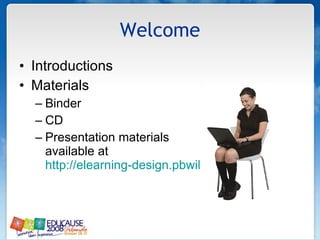
Welcome Introductions  Materials  Binder CD Presentation materials available at  http://elearning-design.pbwiki.com/
Seminar Overview Web 2.0: Diffusion, Instructional Development and Support Understanding Faculty Members and Learners and Web 2.0 Content, Pedagogy, Assessment, and Tools
Part I Web 2.0: Diffusion, Instructional Development and Support
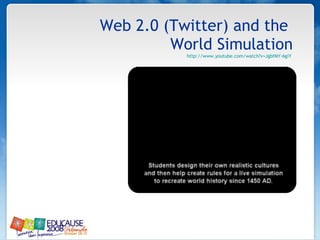
Web 2.0 (Twitter) and the  World Simulation http://www.youtube.com/watch?v=JgbfMY-6giY
WEB 2.0 Model of Diffusion and Other Considerations
 
 
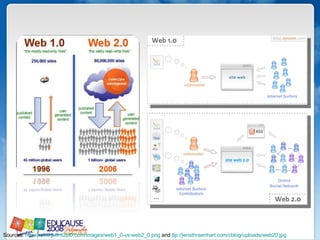
Sources:  http://www.jeffro2pt0.com/images/web1_0-vs-web2_0.png  and  ttp://jensthraenhart.com/cblog/uploads/web20.jpg
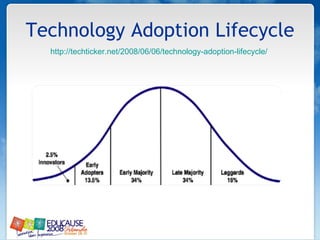
Technology Adoption Lifecycle http://techticker.net/2008/06/06/technology-adoption-lifecycle/
Web 2.0 Tools and Distributed Learning Models
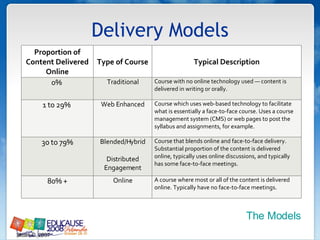
Delivery Models Sloan-C, 2007 The Models Proportion of Content Delivered Online Type of Course Typical Description 0%  Traditional Course with no online technology used — content is delivered in writing or orally. 1 to 29%  Web Enhanced Course which uses web-based technology to facilitate what is essentially a face-to-face course. Uses a course management system (CMS) or web pages to post the syllabus and assignments, for example. 30 to 79% Blended/Hybrid Distributed Engagement Course that blends online and face-to-face delivery. Substantial proportion of the content is delivered online, typically uses online discussions, and typically has some face-to-face meetings. 80% + Online A course where most or all of the content is delivered online. Typically have no face-to-face meetings.
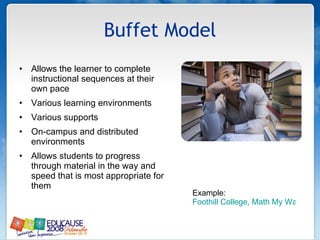
Buffet Model Allows the learner to complete instructional sequences at their own pace Various learning environments  Various supports On-campus and distributed environments Allows students to progress through material in the way and speed that is most appropriate for them Example:  Foothill College, Math My Way
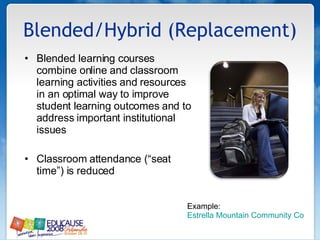
Blended/Hybrid (Replacement) Blended learning courses combine online and classroom learning activities and resources in an optimal way to improve student learning outcomes and to address important institutional issues Classroom attendance (“seat time”) is reduced Example:  Estrella Mountain Community College, Learning College
100% Online All course activities, resources, interactions, and communications occur online, typically through an institutional learning/course management system Example:  Rio Salado College Online
Models and Web 2.0 The containers Redesign approach Pedagogy Discipline
What models are you  most active in? Web enhanced (F2F) Buffet Blended/Hybrid Online
INSTRUCTIONAL DEVELOPMENT  MODELS AND SUPPORT
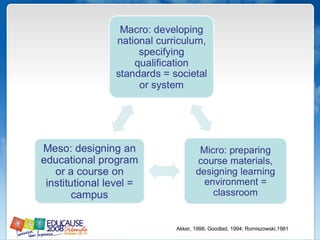
Akker, 1998; Goodlad, 1994; Romiszowski,1981
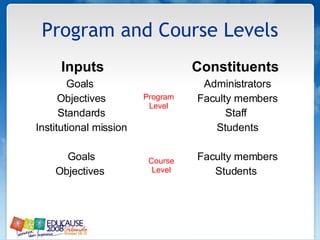
Program and Course Levels Inputs Goals  Objectives Standards Institutional mission Goals Objectives  Constituents  Administrators Faculty members Staff  Students Faculty members Students  Program Level Course Level
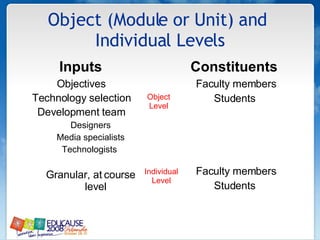
Object (Module or Unit) and  Individual Levels Inputs  Objectives  Technology selection  Development team  Designers Media specialists Technologists  Granular, at course level Constituents  Faculty members Students  Faculty members Students  Object Level Individual Level
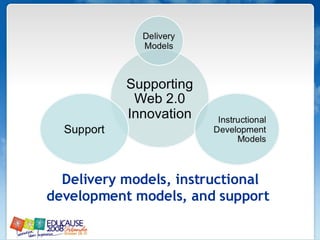
Delivery models, instructional development models, and support
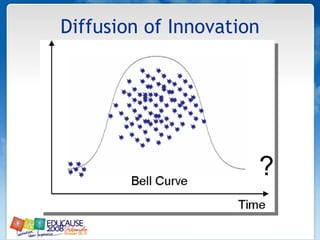
Diffusion of Innovation ?
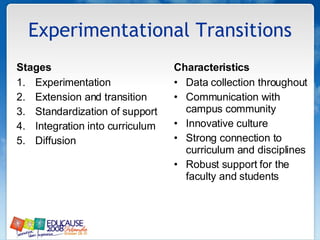
Experimentational Transitions Stages Experimentation Extension and transition Standardization of support  Integration into curriculum Diffusion  Characteristics  Data collection throughout Communication with campus community  Innovative culture  Strong connection to curriculum and disciplines  Robust support for the faculty and students
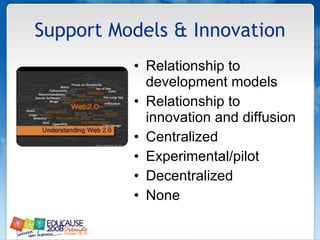
Support Models & Innovation Relationship to development models  Relationship to innovation and diffusion Centralized  Experimental/pilot Decentralized None
WEB 2.0 AND INSTITUTIONAL ISSUES/CONSIDERATIONS
Quality Assurance and Web 2.0
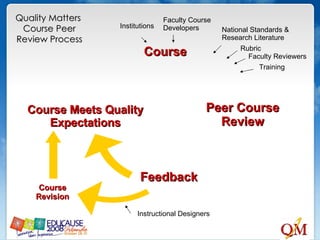
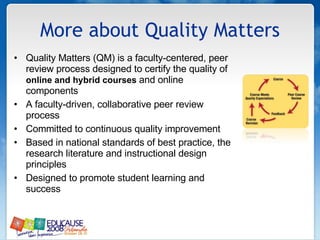
Peer Course Review Feedback Course Instructional Designers Institutions Faculty Course Developers National Standards & Research Literature Rubric Faculty Reviewers Training Quality Matters  Course Peer Review Process Course Meets Quality Expectations Course Revision
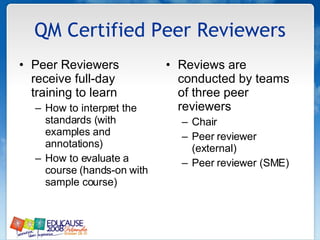
QM Certified Peer Reviewers Peer Reviewers receive full-day training to learn How to interpret the standards (with examples and annotations) How to evaluate a course (hands-on with sample course) Reviews are conducted by teams of three peer reviewers Chair  Peer reviewer (external) Peer reviewer (SME)
More about Quality Matters Quality Matters (QM) is a faculty-centered, peer review process designed to certify the quality of  online and hybrid courses  and online components A faculty-driven, collaborative peer review process Committed to continuous quality improvement Based in national standards of best practice, the research literature and instructional design principles Designed to promote student learning and success
The Rubric is the  Core of Quality Matters 40 specific elements across 8 broad areas (general standards) of course quality  Detailed annotations and examples of good practice for all 40 standards
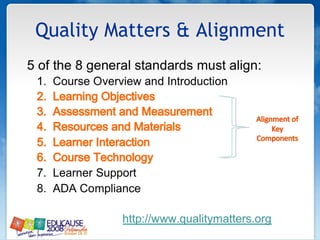
Quality Matters & Alignment
Essential Standards that  Relate to Alignment A statement introduces the student to the course and learning  Navigational instructions Learning activities foster interaction: Instructor-student Content-student Student-student Clear standards are set for instructor response and availability  Assessment strategies provide feedback Grading policy is transparent and easy to understand Implemented tools and media support learning objectives and integrate with texts and lesson assignments The course acknowledges the importance of ADA compliance
Other QM Uses College quality assurance review processes Guidelines for online/hybrid  course development Faculty development/training programs Checklist for improvement of existing online courses An element in regional and professional accreditation
Intellectual Property & Web 2.0 How broad or inclusive? What tools or learning environments should be addressed?  How is maintenance of instructional products and systems addressed?  Employees or units involved in the production process, work time/course of employment issues, resources expended, or units involved?  Innovation within or outside established, controlled university-owned systems?
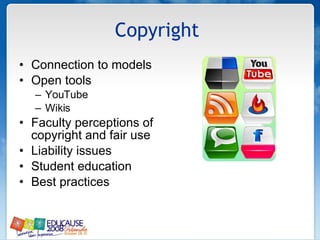
Copyright  Connection to models Open tools YouTube Wikis  Faculty perceptions of copyright and fair use  Liability issues  Student education Best practices
Three Questions Describe existing instructional delivery and development models for integrating technology into instruction. What are your teaching and learning goals for Web 2.0 tools? What are the support issues that will need to be addressed to achieve your Web 2.0 goals?

Educause 08 Part 1

  • 1.
    Finding the GoodFit: Faculty Members, Instruction, Evidence, and Technology Patricia A. McGee, PhD [email_address] Associate Professor/2003 NLII Fellow Instructional Technology Department of Educational Psychology University of Texas at San Antonio Veronica M. Diaz, PhD [email_address] Instructional Technology Manager Maricopa Center for Learning and Instruction Maricopa Community Colleges Adjunct Professor, Northern Arizona University
  • 2.
    Welcome Introductions Materials Binder CD Presentation materials available at http://elearning-design.pbwiki.com/
  • 3.
    Seminar Overview Web2.0: Diffusion, Instructional Development and Support Understanding Faculty Members and Learners and Web 2.0 Content, Pedagogy, Assessment, and Tools
  • 4.
    Part I Web2.0: Diffusion, Instructional Development and Support
  • 5.
    Web 2.0 (Twitter)and the World Simulation http://www.youtube.com/watch?v=JgbfMY-6giY
  • 6.
    WEB 2.0 Modelof Diffusion and Other Considerations
  • 7.
  • 8.
  • 9.
    Sources: http://www.jeffro2pt0.com/images/web1_0-vs-web2_0.png and ttp://jensthraenhart.com/cblog/uploads/web20.jpg
  • 10.
    Technology Adoption Lifecyclehttp://techticker.net/2008/06/06/technology-adoption-lifecycle/
  • 11.
    Web 2.0 Toolsand Distributed Learning Models
  • 12.
    Delivery Models Sloan-C,2007 The Models Proportion of Content Delivered Online Type of Course Typical Description 0% Traditional Course with no online technology used — content is delivered in writing or orally. 1 to 29% Web Enhanced Course which uses web-based technology to facilitate what is essentially a face-to-face course. Uses a course management system (CMS) or web pages to post the syllabus and assignments, for example. 30 to 79% Blended/Hybrid Distributed Engagement Course that blends online and face-to-face delivery. Substantial proportion of the content is delivered online, typically uses online discussions, and typically has some face-to-face meetings. 80% + Online A course where most or all of the content is delivered online. Typically have no face-to-face meetings.
  • 13.
    Buffet Model Allowsthe learner to complete instructional sequences at their own pace Various learning environments Various supports On-campus and distributed environments Allows students to progress through material in the way and speed that is most appropriate for them Example: Foothill College, Math My Way
  • 14.
    Blended/Hybrid (Replacement) Blendedlearning courses combine online and classroom learning activities and resources in an optimal way to improve student learning outcomes and to address important institutional issues Classroom attendance (“seat time”) is reduced Example: Estrella Mountain Community College, Learning College
  • 15.
    100% Online Allcourse activities, resources, interactions, and communications occur online, typically through an institutional learning/course management system Example: Rio Salado College Online
  • 16.
    Models and Web2.0 The containers Redesign approach Pedagogy Discipline
  • 17.
    What models areyou most active in? Web enhanced (F2F) Buffet Blended/Hybrid Online
  • 18.
    INSTRUCTIONAL DEVELOPMENT MODELS AND SUPPORT
  • 19.
    Akker, 1998; Goodlad,1994; Romiszowski,1981
  • 20.
    Program and CourseLevels Inputs Goals Objectives Standards Institutional mission Goals Objectives Constituents Administrators Faculty members Staff Students Faculty members Students Program Level Course Level
  • 21.
    Object (Module orUnit) and Individual Levels Inputs Objectives Technology selection Development team Designers Media specialists Technologists Granular, at course level Constituents Faculty members Students Faculty members Students Object Level Individual Level
  • 22.
    Delivery models, instructionaldevelopment models, and support
  • 23.
  • 24.
    Experimentational Transitions StagesExperimentation Extension and transition Standardization of support Integration into curriculum Diffusion Characteristics Data collection throughout Communication with campus community Innovative culture Strong connection to curriculum and disciplines Robust support for the faculty and students
  • 25.
    Support Models &Innovation Relationship to development models Relationship to innovation and diffusion Centralized Experimental/pilot Decentralized None
  • 26.
    WEB 2.0 ANDINSTITUTIONAL ISSUES/CONSIDERATIONS
  • 27.
  • 28.
    Peer Course ReviewFeedback Course Instructional Designers Institutions Faculty Course Developers National Standards & Research Literature Rubric Faculty Reviewers Training Quality Matters Course Peer Review Process Course Meets Quality Expectations Course Revision
  • 29.
    QM Certified PeerReviewers Peer Reviewers receive full-day training to learn How to interpret the standards (with examples and annotations) How to evaluate a course (hands-on with sample course) Reviews are conducted by teams of three peer reviewers Chair Peer reviewer (external) Peer reviewer (SME)
  • 30.
    More about QualityMatters Quality Matters (QM) is a faculty-centered, peer review process designed to certify the quality of online and hybrid courses and online components A faculty-driven, collaborative peer review process Committed to continuous quality improvement Based in national standards of best practice, the research literature and instructional design principles Designed to promote student learning and success
  • 31.
    The Rubric isthe Core of Quality Matters 40 specific elements across 8 broad areas (general standards) of course quality Detailed annotations and examples of good practice for all 40 standards
  • 32.
  • 33.
    Essential Standards that Relate to Alignment A statement introduces the student to the course and learning Navigational instructions Learning activities foster interaction: Instructor-student Content-student Student-student Clear standards are set for instructor response and availability Assessment strategies provide feedback Grading policy is transparent and easy to understand Implemented tools and media support learning objectives and integrate with texts and lesson assignments The course acknowledges the importance of ADA compliance
  • 34.
    Other QM UsesCollege quality assurance review processes Guidelines for online/hybrid course development Faculty development/training programs Checklist for improvement of existing online courses An element in regional and professional accreditation
  • 35.
    Intellectual Property &Web 2.0 How broad or inclusive? What tools or learning environments should be addressed? How is maintenance of instructional products and systems addressed? Employees or units involved in the production process, work time/course of employment issues, resources expended, or units involved? Innovation within or outside established, controlled university-owned systems?
  • 36.
    Copyright Connectionto models Open tools YouTube Wikis Faculty perceptions of copyright and fair use Liability issues Student education Best practices
  • 37.
    Three Questions Describeexisting instructional delivery and development models for integrating technology into instruction. What are your teaching and learning goals for Web 2.0 tools? What are the support issues that will need to be addressed to achieve your Web 2.0 goals?