An antonym is a word that is the opposite meaning of another. It comes
from the Greek words “anti” for opposite and “onym” for name. Since
language is complex, people may at times, disagree on what words are
truly opposite in meaning to other words.
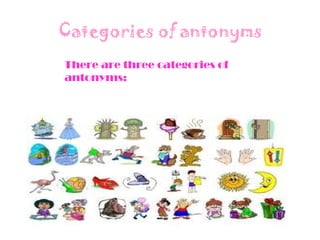
Categories of antonyms
There are three categories of
antonyms:
Graded antonyms
•

Graded antonyms deal with levels of the meaning of the words, like
if something is not “good”, is may still not be “bad.” There is a scale
involved with some words, and besides good and bad there can be
average, fair, excellent, terrible, poor, or satisfactory.
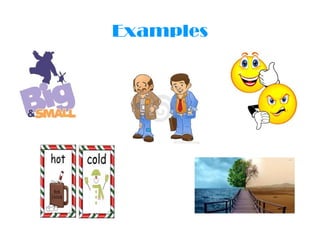
Examples
Complementary antonyms
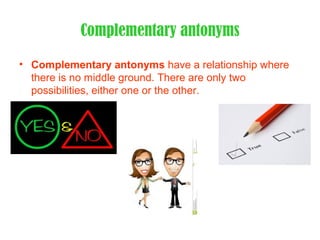
• Complementary antonyms have a relationship where
there is no middle ground. There are only two
possibilities, either one or the other.
Relational antonyms
•

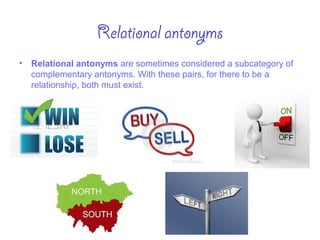
Relational antonyms are sometimes considered a subcategory of
complementary antonyms. With these pairs, for there to be a
relationship, both must exist.
Adding a prefix
•

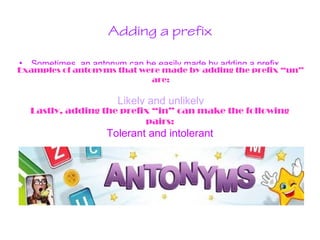
Sometimes, an antonym can be easily made by adding a prefix.

Examples of antonyms that were made by adding the prefix “un”
are:

Likely and unlikely

Lastly, adding the prefix “in” can make the following
pairs:

Tolerant and intolerant
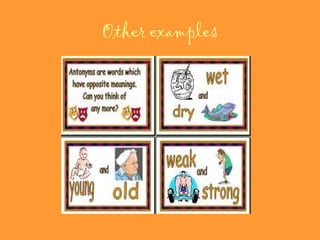
Other examples
Antonym dictionaries
• If you want to find the perfect antonym, a thesaurus or
antonym dictionary can be very helpful. These reference
sources will give definitions and parts of speech, has lists
of anonyms, synonyms, and sometimes will even show
similar sounding words, homophones, rhymes, and will
show examples from literature.
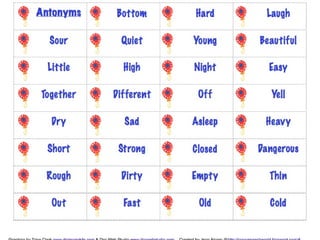
ANTONYM GAMES
Antonyms

Antonyms

  • 2.
    An antonym isa word that is the opposite meaning of another. It comes from the Greek words “anti” for opposite and “onym” for name. Since language is complex, people may at times, disagree on what words are truly opposite in meaning to other words.
  • 3.
    Categories of antonyms Thereare three categories of antonyms:
  • 4.
    Graded antonyms • Graded antonymsdeal with levels of the meaning of the words, like if something is not “good”, is may still not be “bad.” There is a scale involved with some words, and besides good and bad there can be average, fair, excellent, terrible, poor, or satisfactory.
  • 5.
  • 6.
    Complementary antonyms • Complementaryantonyms have a relationship where there is no middle ground. There are only two possibilities, either one or the other.
  • 7.
    Relational antonyms • Relational antonymsare sometimes considered a subcategory of complementary antonyms. With these pairs, for there to be a relationship, both must exist.
  • 8.
    Adding a prefix • Sometimes,an antonym can be easily made by adding a prefix. Examples of antonyms that were made by adding the prefix “un” are: Likely and unlikely Lastly, adding the prefix “in” can make the following pairs: Tolerant and intolerant
  • 9.
  • 10.
    Antonym dictionaries • Ifyou want to find the perfect antonym, a thesaurus or antonym dictionary can be very helpful. These reference sources will give definitions and parts of speech, has lists of anonyms, synonyms, and sometimes will even show similar sounding words, homophones, rhymes, and will show examples from literature.
  • 11.