Creative Writing
Objectives
Punctuations
. Writing
Discuss in your own words what
is writing to you.
To write clearly it is essential to understand the
basic system of a language. In English this includes
knowledge of grammar, punctuation and sentence
structure. Vocabulary is also necessary, as is
correct spelling and formatting.
"Writing" is the process of using symbols (letters of the alphabet,
punctuation and spaces) to communicate thoughts and ideas in a readable
form.
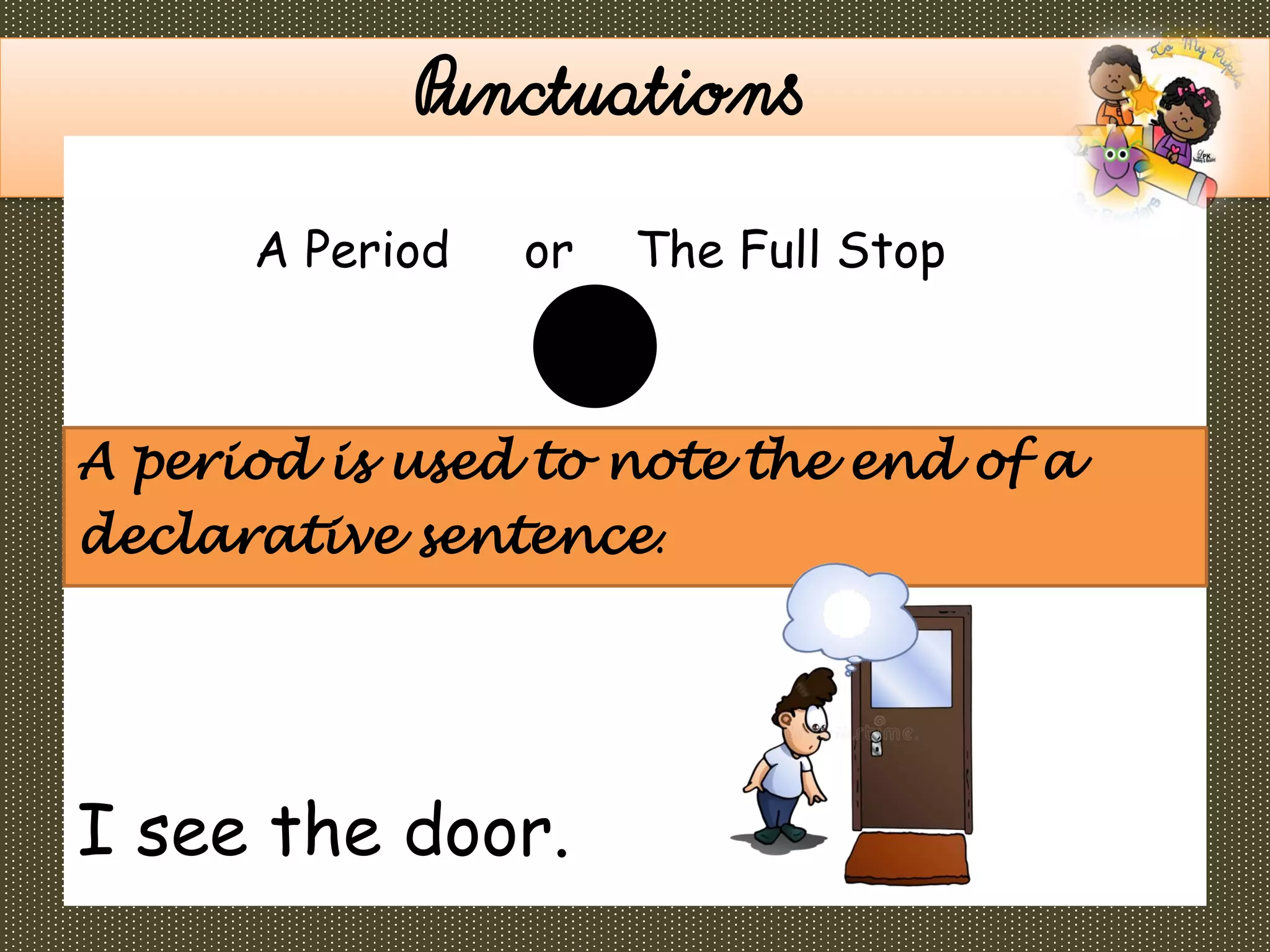
I see the door.
Punctuations
A period is used to note the end of a
declarative sentence.
A Period or The Full Stop
It is cold!
Punctuations
An exclamation point is used to show
excitement or emphasis.
The Exclamation Mark
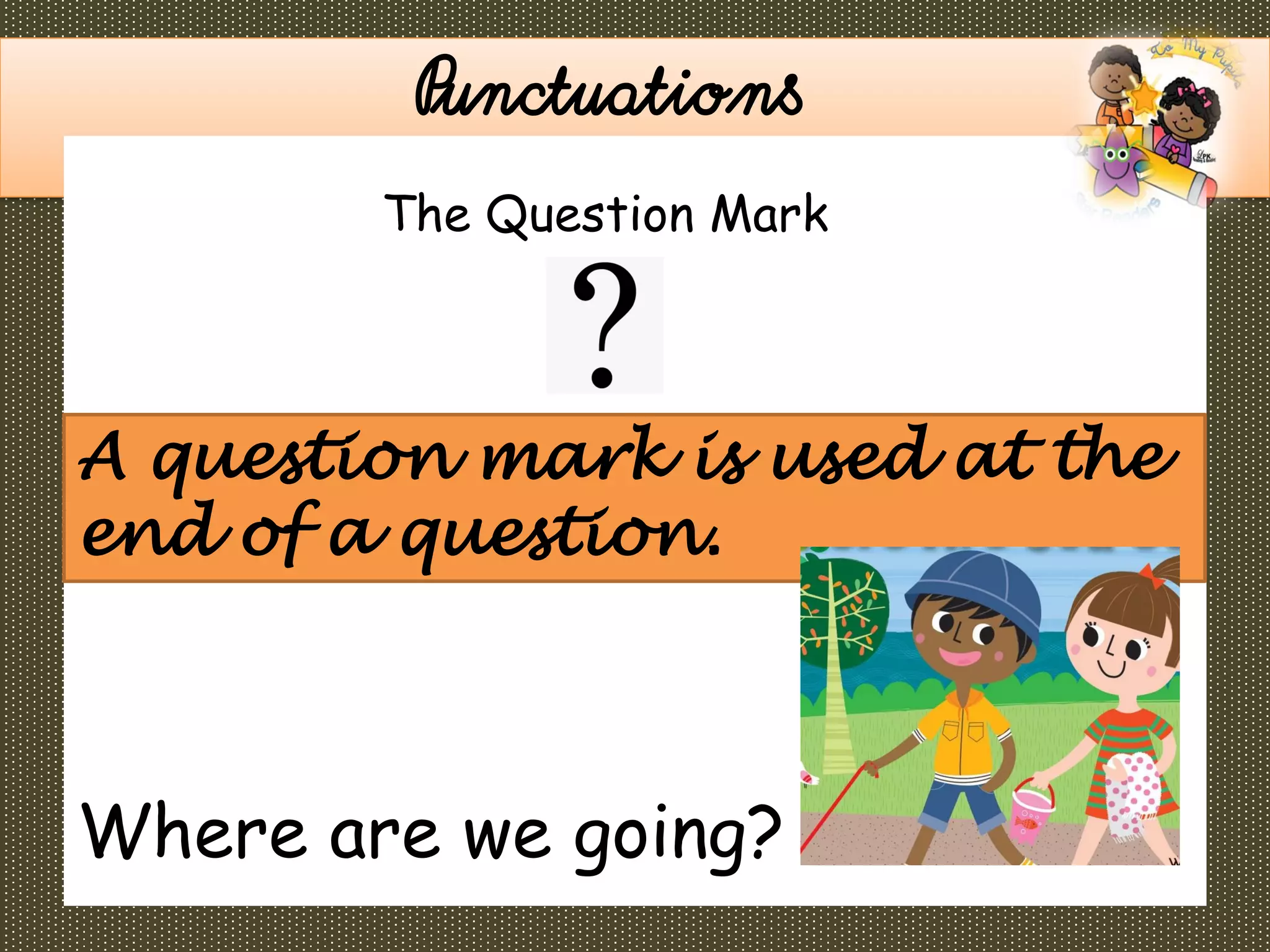
Where are we going?
Punctuations
A question mark is used at the
end of a question.
The Question Mark
/
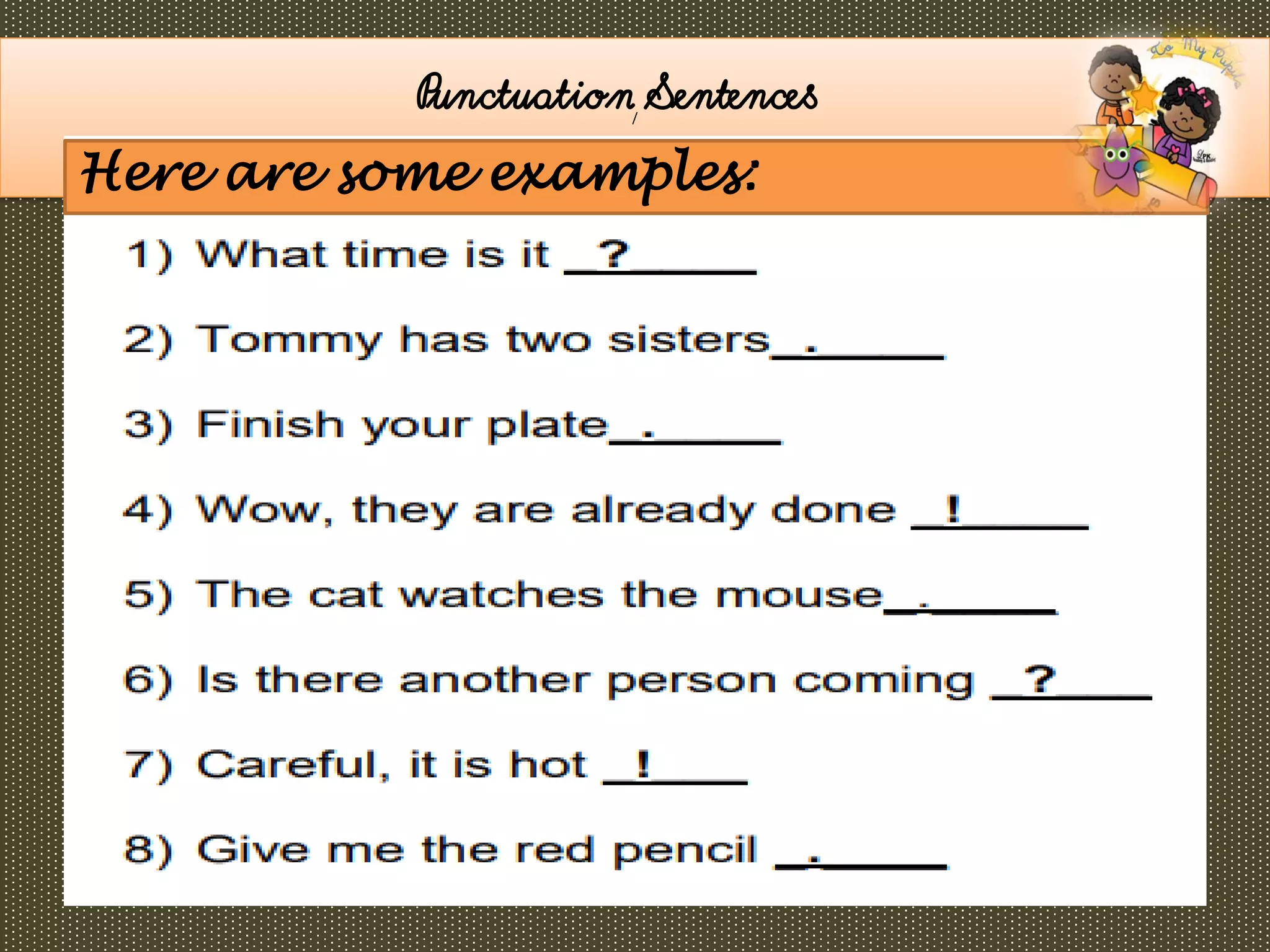
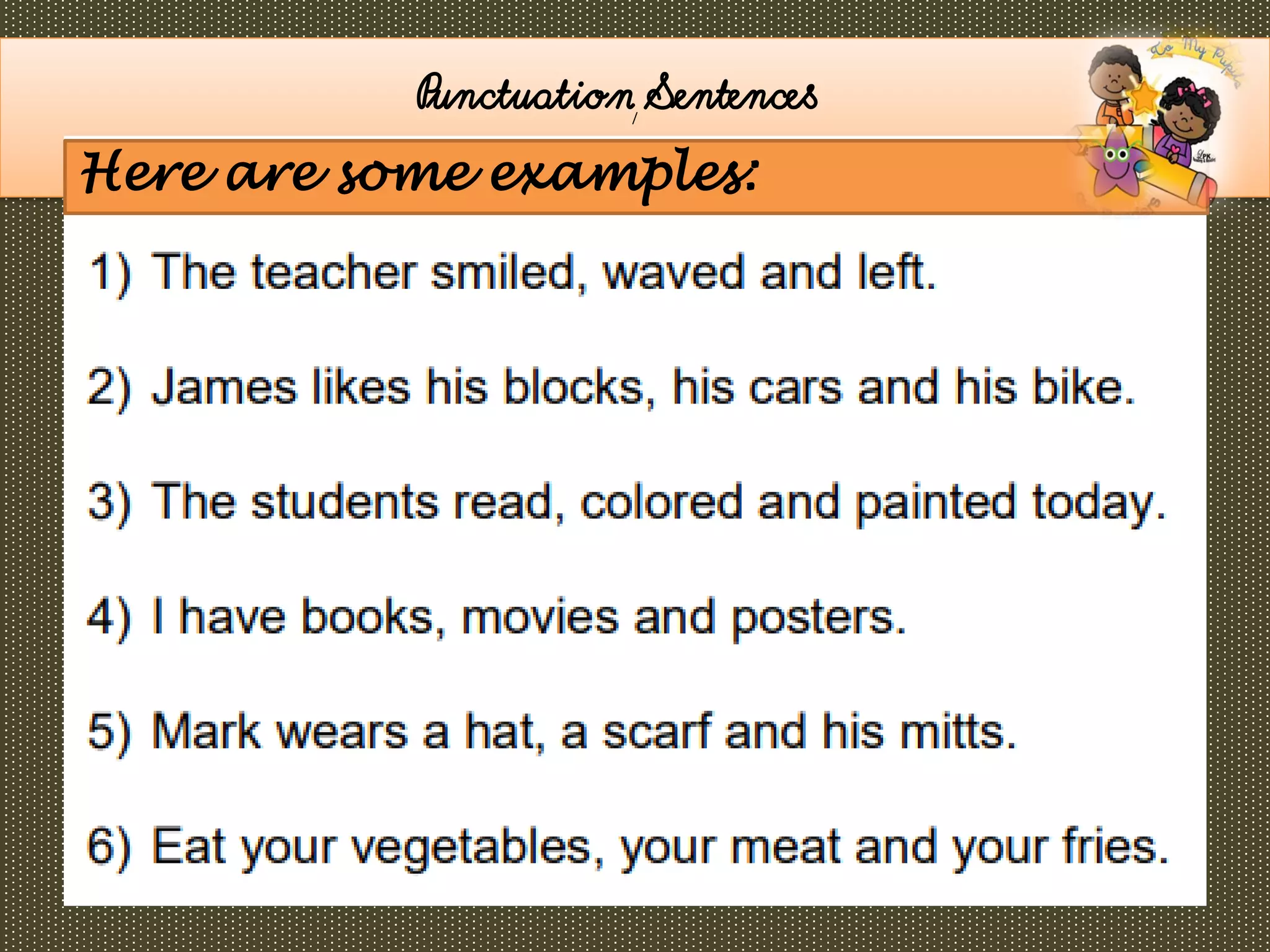
Punctuation Sentences
Here are some examples:
/
Punctuation Sentences
Here are some examples:
She bought milk, eggs, and bread.
Punctuations
A comma is used to separate phrases or
items in a list.
The Comma
/
Punctuation Sentences
Here are some examples:
/
Punctuation Sentences
Here are some examples:
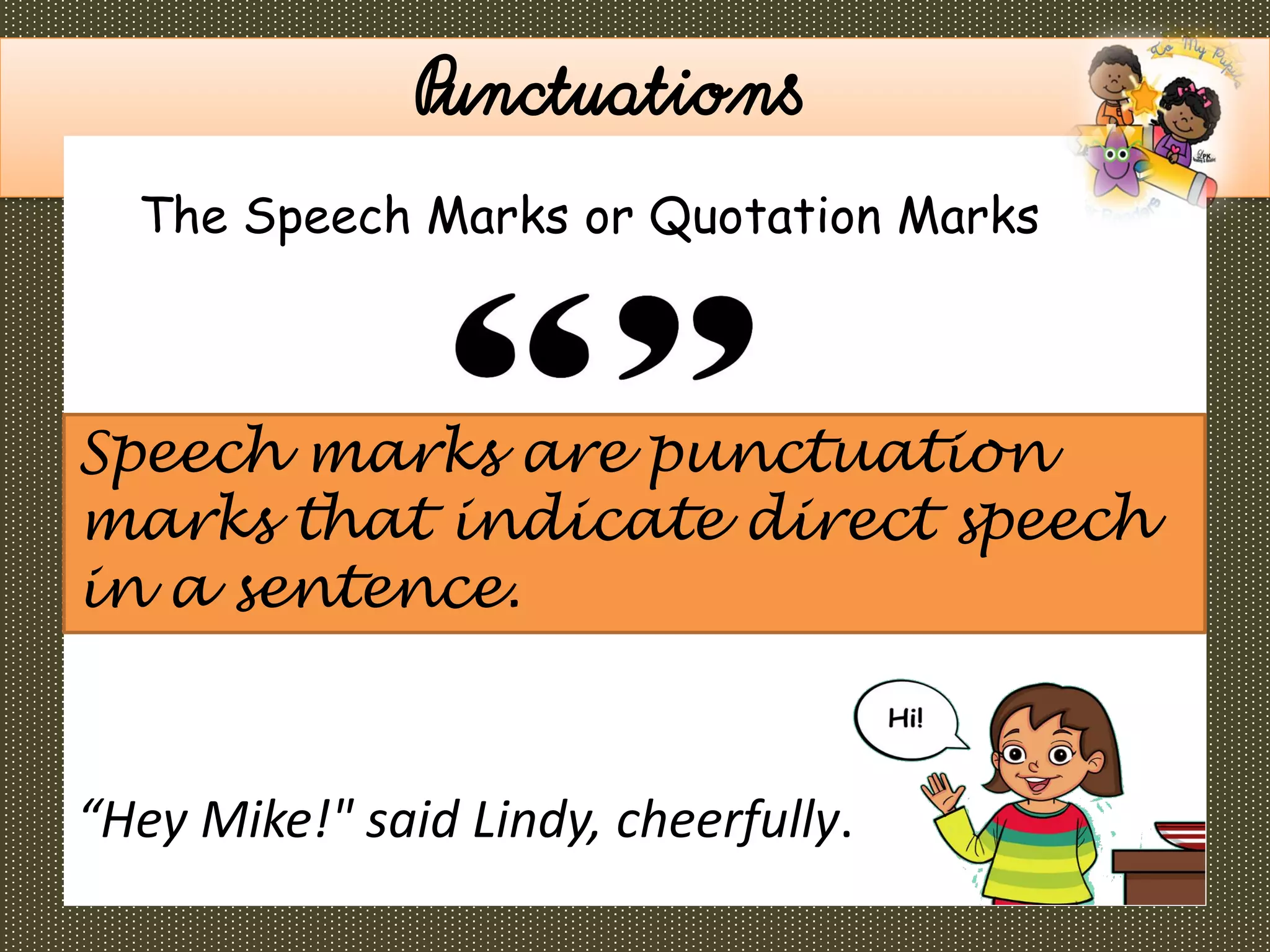
“Hey Mike!" said Lindy, cheerfully.
Punctuations
Speech marks are punctuation
marks that indicate direct speech
in a sentence.
The Speech Marks or Quotation Marks
/
Punctuation Sentences
Here are some examples:
/
Punctuation Sentences
Here are some examples:
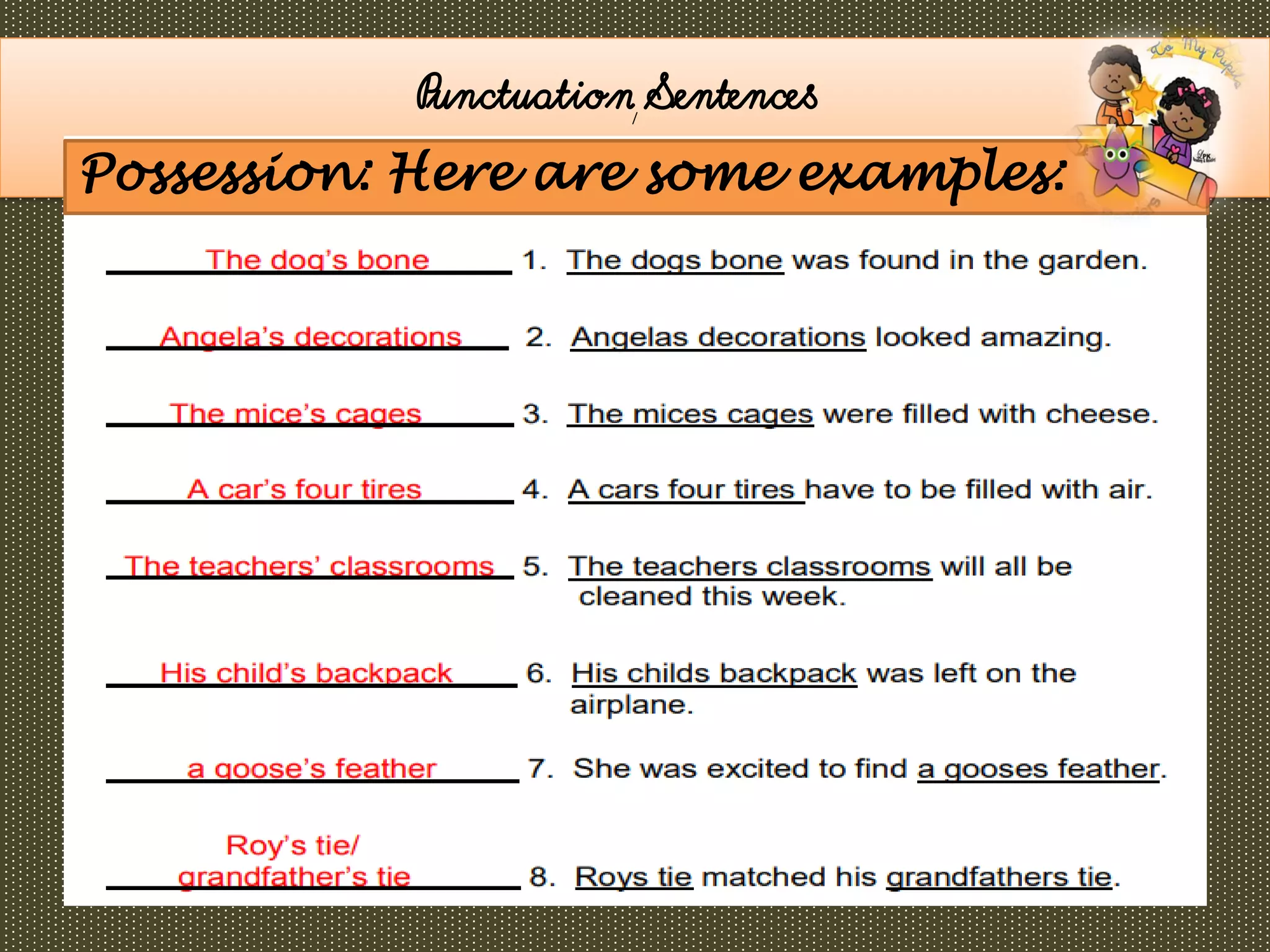
1. Use an apostrophe + S ('s) to show that one person/thing owns
or is a member of something.
2. Use an apostrophe after the "s" at the end of a plural noun to
show possession.
3. If a plural noun doesn't end in "s," add an apostrophe + "s" to
create the possessive form.
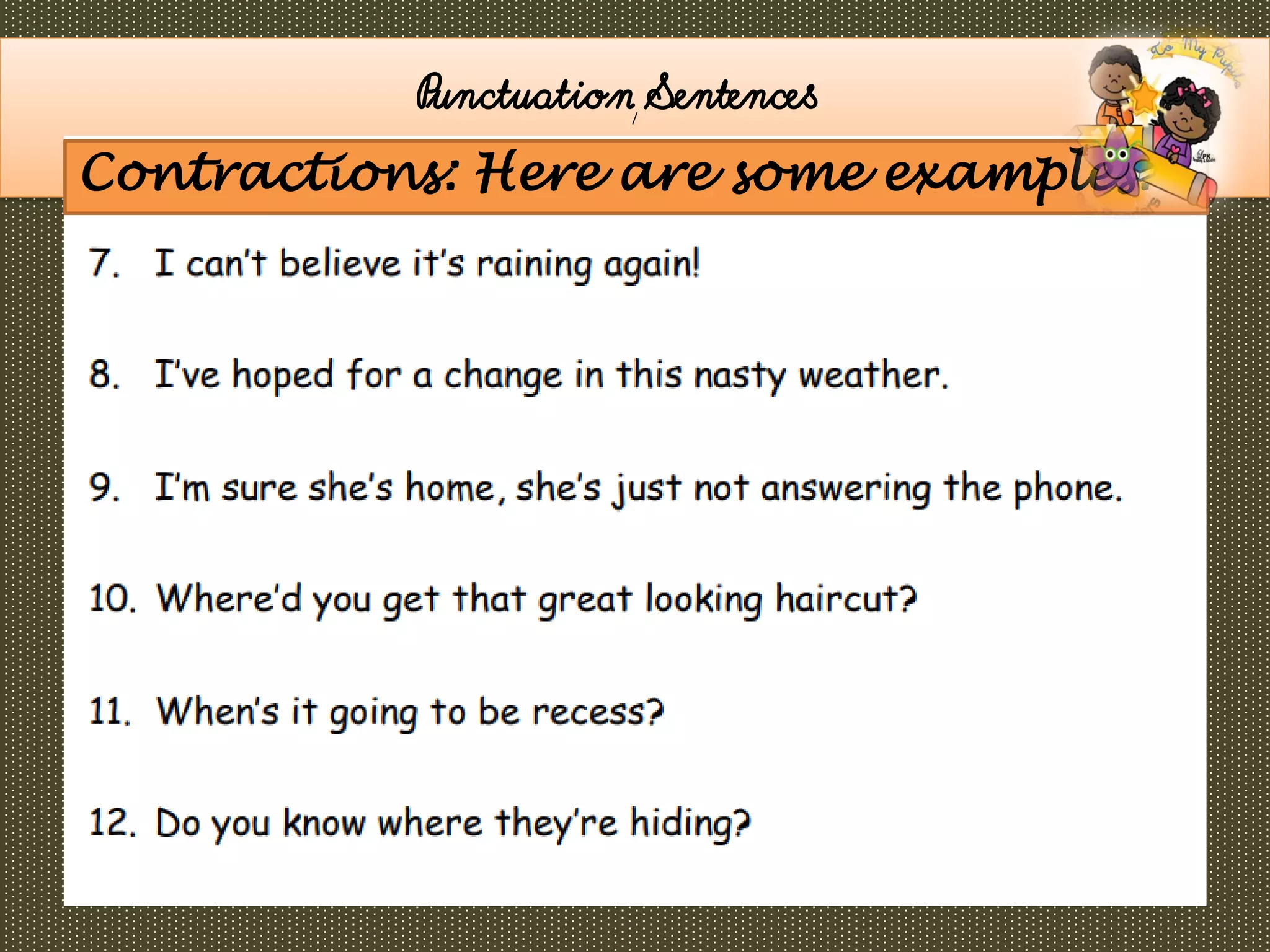
4. When you combine two words to make a contraction, you will
always take out some letters. In their place, use an apostrophe.
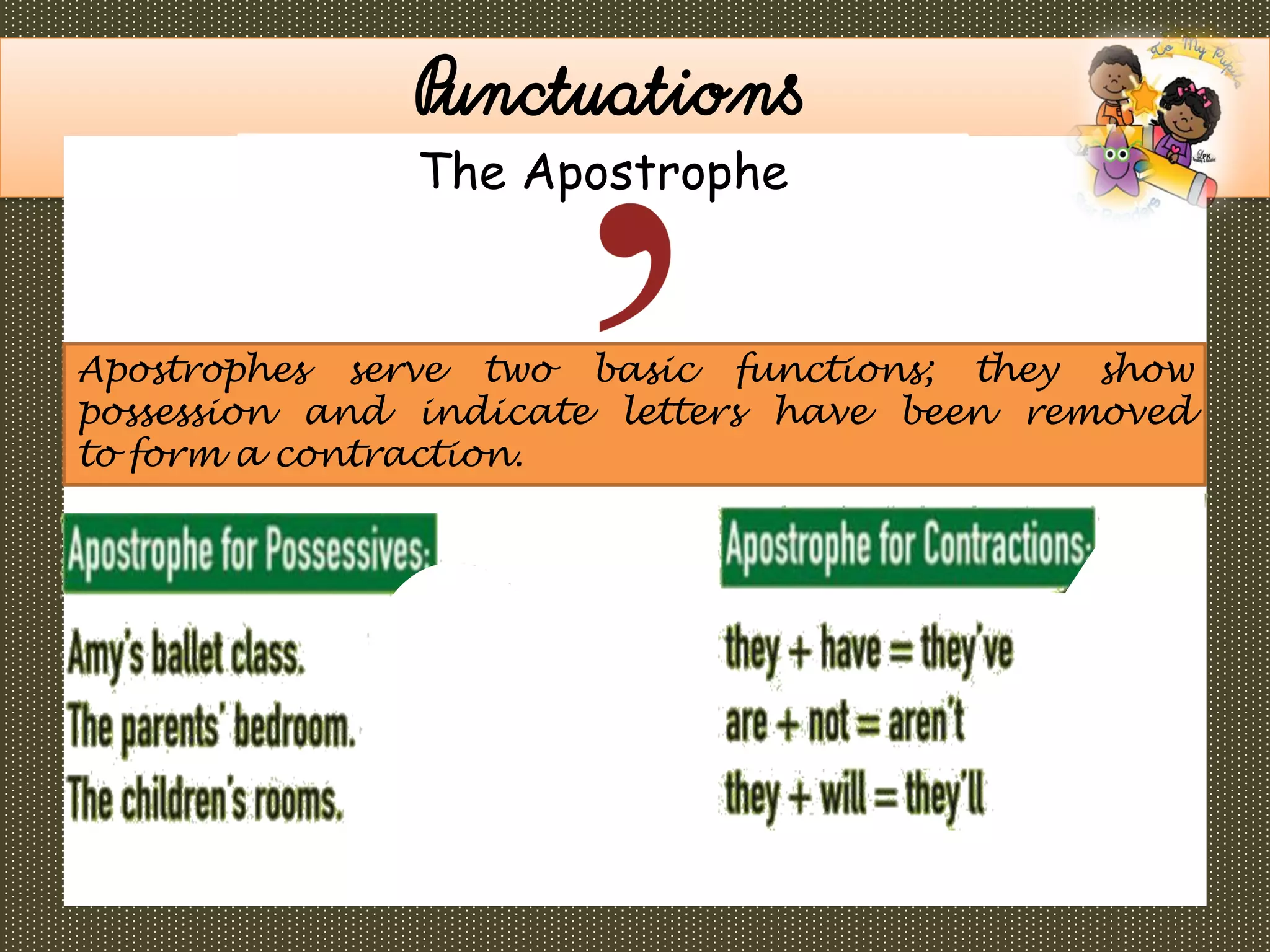
Punctuations
The Apostrophe
Apostrophes serve two basic functions; they show
possession and indicate letters have been removed
to form a contraction.
/
Punctuation Sentences
Possision: Here are some examples:
/
Punctuation Sentences
Possession: Here are some examples:
/
Punctuation Sentences
Contractions: Here are some examples:
/
Punctuation Sentences
Contractions: Here are some examples:
.
Punctuations
The Apostrophe
Apostrophes serve two basic functions; they show
possession and indicate letters have been removed
to form a contraction.
https://www.thepunctuationguide.com/colon.
html
1. The colon is used to introduce a list of items.
2. Do not, however, use a colon when the listed items are incorporated into
the flow of the sentence.
3. The colon is used to separate two independent clauses when the second
explains or illustrates the first. In such usage, the colon functions in
much the same way as the semicolon. As with the semicolon, do not
capitalize the first word after the colon unless the word is ordinarily
capitalized.
4. When two or more sentences follow a colon, capitalize the first word
following the colon.
5. The colon can be used to emphasize a phrase or single word at the end
of a sentence.
Punctuations
The colon and its grammatical uses.
The Colon
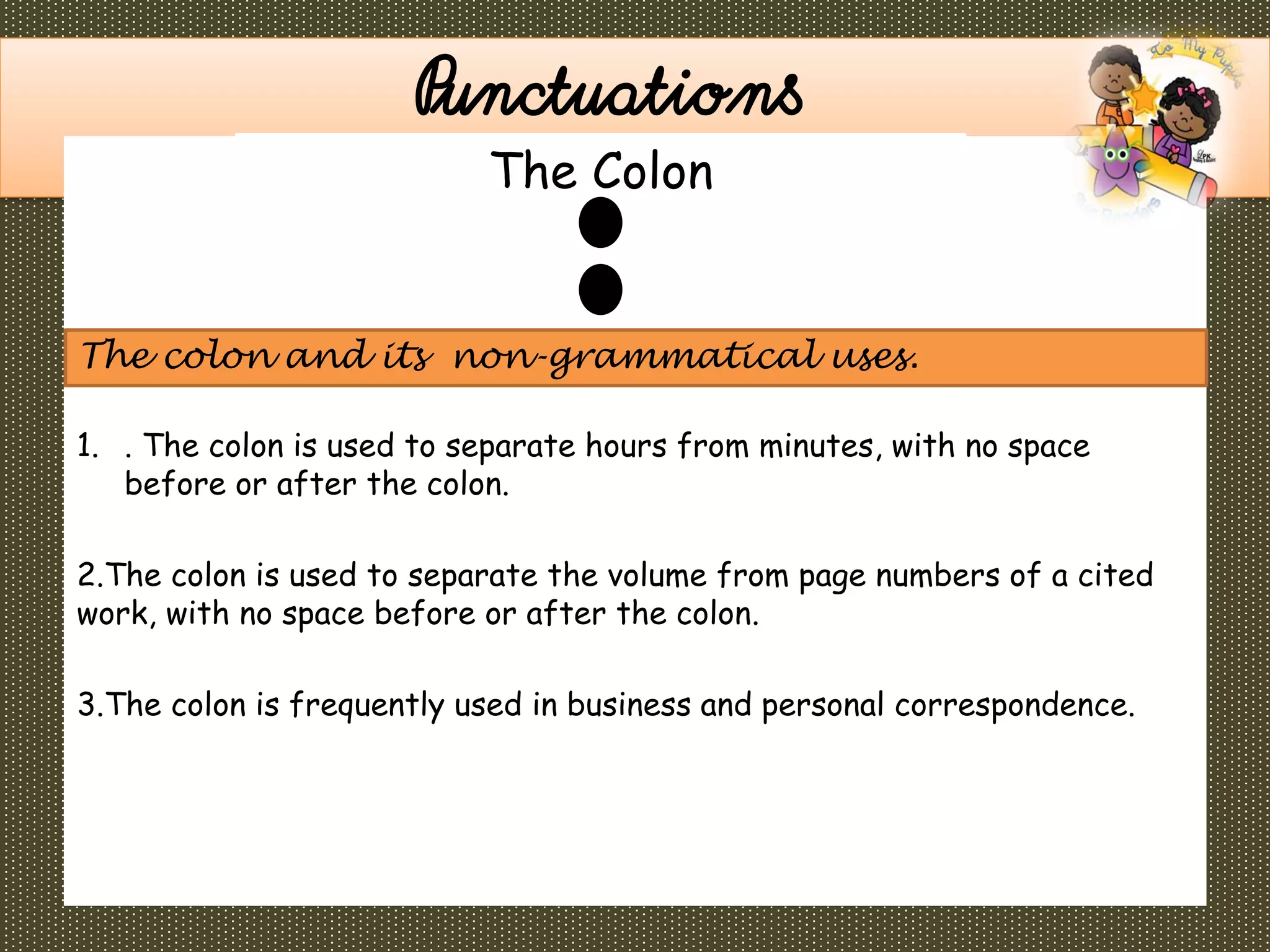
1. . The colon is used to separate hours from minutes, with no space
before or after the colon.
2.The colon is used to separate the volume from page numbers of a cited
work, with no space before or after the colon.
3.The colon is frequently used in business and personal correspondence.
Punctuations
The colon and its non-grammatical uses.
The Colon
Punctuations
This punctuation is used to join two independent clauses, or
two complete thoughts that could stand alone as complete
sentences.
The Semi-Colon
/
Punctuation Sentences
Here are some examples of sentences with colons and semi-colons.
/
Punctuation Sentences
Here are some examples of sentences with colons and semi-colons.
/
Punctuation Sentences
Here are some examples of sentences with colons and semi-colons.
/
Punctuation Sentences
Here are some examples of sentences with colons and semi-colons.
. Discussion
Study the examples and observe carefully
how the punctuations are used in the
sentences.
Punctuations

Punctuations

  • 1.
  • 2.
    . Writing Discuss inyour own words what is writing to you. To write clearly it is essential to understand the basic system of a language. In English this includes knowledge of grammar, punctuation and sentence structure. Vocabulary is also necessary, as is correct spelling and formatting. "Writing" is the process of using symbols (letters of the alphabet, punctuation and spaces) to communicate thoughts and ideas in a readable form.
  • 3.
    I see thedoor. Punctuations A period is used to note the end of a declarative sentence. A Period or The Full Stop
  • 4.
    It is cold! Punctuations Anexclamation point is used to show excitement or emphasis. The Exclamation Mark
  • 5.
    Where are wegoing? Punctuations A question mark is used at the end of a question. The Question Mark
  • 6.
  • 7.
  • 8.
    She bought milk,eggs, and bread. Punctuations A comma is used to separate phrases or items in a list. The Comma
  • 9.
  • 10.
  • 11.
    “Hey Mike!" saidLindy, cheerfully. Punctuations Speech marks are punctuation marks that indicate direct speech in a sentence. The Speech Marks or Quotation Marks
  • 12.
  • 13.
  • 14.
    1. Use anapostrophe + S ('s) to show that one person/thing owns or is a member of something. 2. Use an apostrophe after the "s" at the end of a plural noun to show possession. 3. If a plural noun doesn't end in "s," add an apostrophe + "s" to create the possessive form. 4. When you combine two words to make a contraction, you will always take out some letters. In their place, use an apostrophe. Punctuations The Apostrophe Apostrophes serve two basic functions; they show possession and indicate letters have been removed to form a contraction.
  • 15.
  • 16.
  • 17.
  • 18.
  • 19.
    . Punctuations The Apostrophe Apostrophes servetwo basic functions; they show possession and indicate letters have been removed to form a contraction.
  • 20.
    https://www.thepunctuationguide.com/colon. html 1. The colonis used to introduce a list of items. 2. Do not, however, use a colon when the listed items are incorporated into the flow of the sentence. 3. The colon is used to separate two independent clauses when the second explains or illustrates the first. In such usage, the colon functions in much the same way as the semicolon. As with the semicolon, do not capitalize the first word after the colon unless the word is ordinarily capitalized. 4. When two or more sentences follow a colon, capitalize the first word following the colon. 5. The colon can be used to emphasize a phrase or single word at the end of a sentence. Punctuations The colon and its grammatical uses. The Colon
  • 21.
    1. . Thecolon is used to separate hours from minutes, with no space before or after the colon. 2.The colon is used to separate the volume from page numbers of a cited work, with no space before or after the colon. 3.The colon is frequently used in business and personal correspondence. Punctuations The colon and its non-grammatical uses. The Colon
  • 22.
    Punctuations This punctuation isused to join two independent clauses, or two complete thoughts that could stand alone as complete sentences. The Semi-Colon
  • 23.
    / Punctuation Sentences Here aresome examples of sentences with colons and semi-colons.
  • 24.
    / Punctuation Sentences Here aresome examples of sentences with colons and semi-colons.
  • 25.
    / Punctuation Sentences Here aresome examples of sentences with colons and semi-colons.
  • 26.
    / Punctuation Sentences Here aresome examples of sentences with colons and semi-colons.
  • 27.
    . Discussion Study theexamples and observe carefully how the punctuations are used in the sentences.