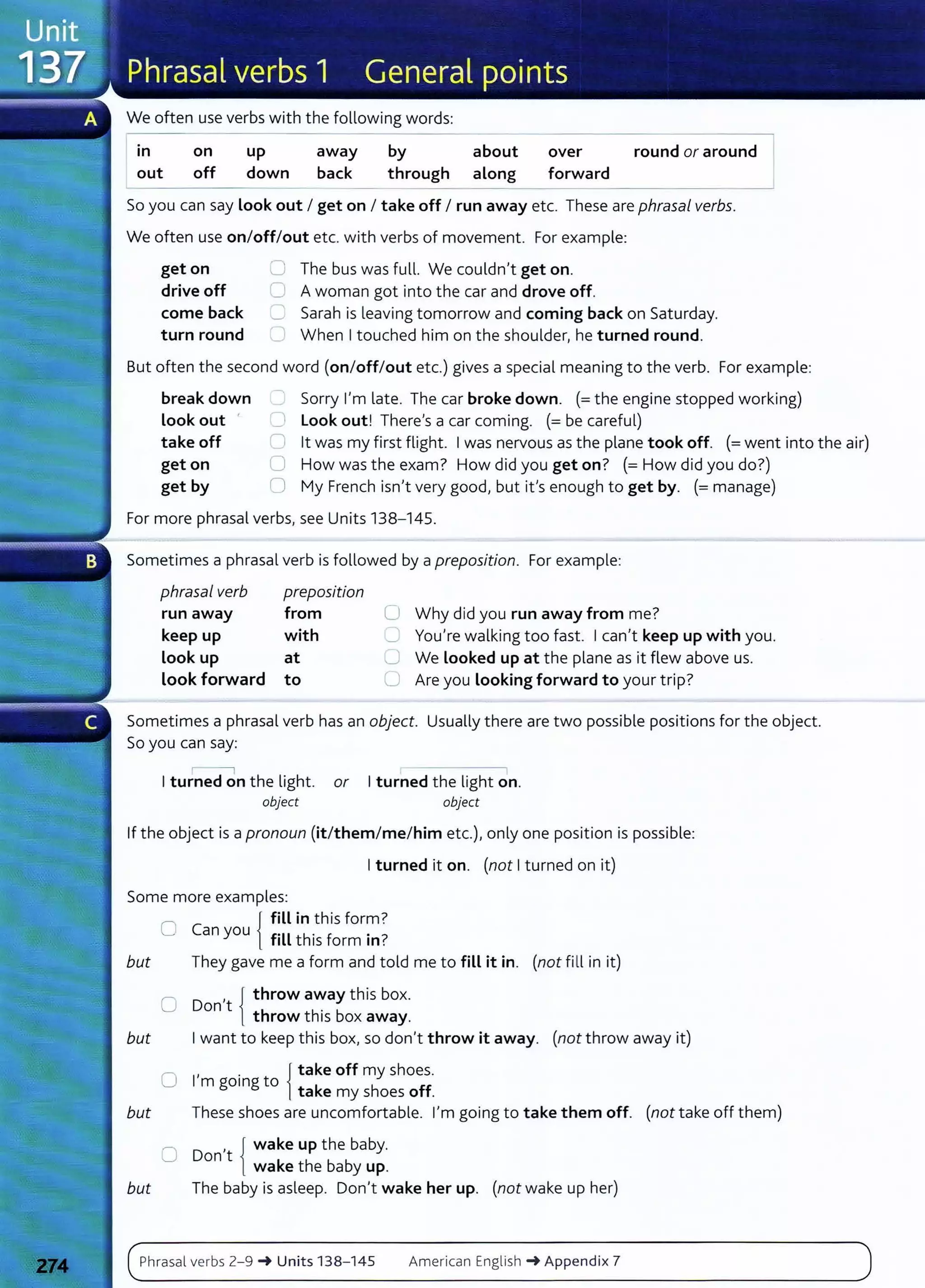
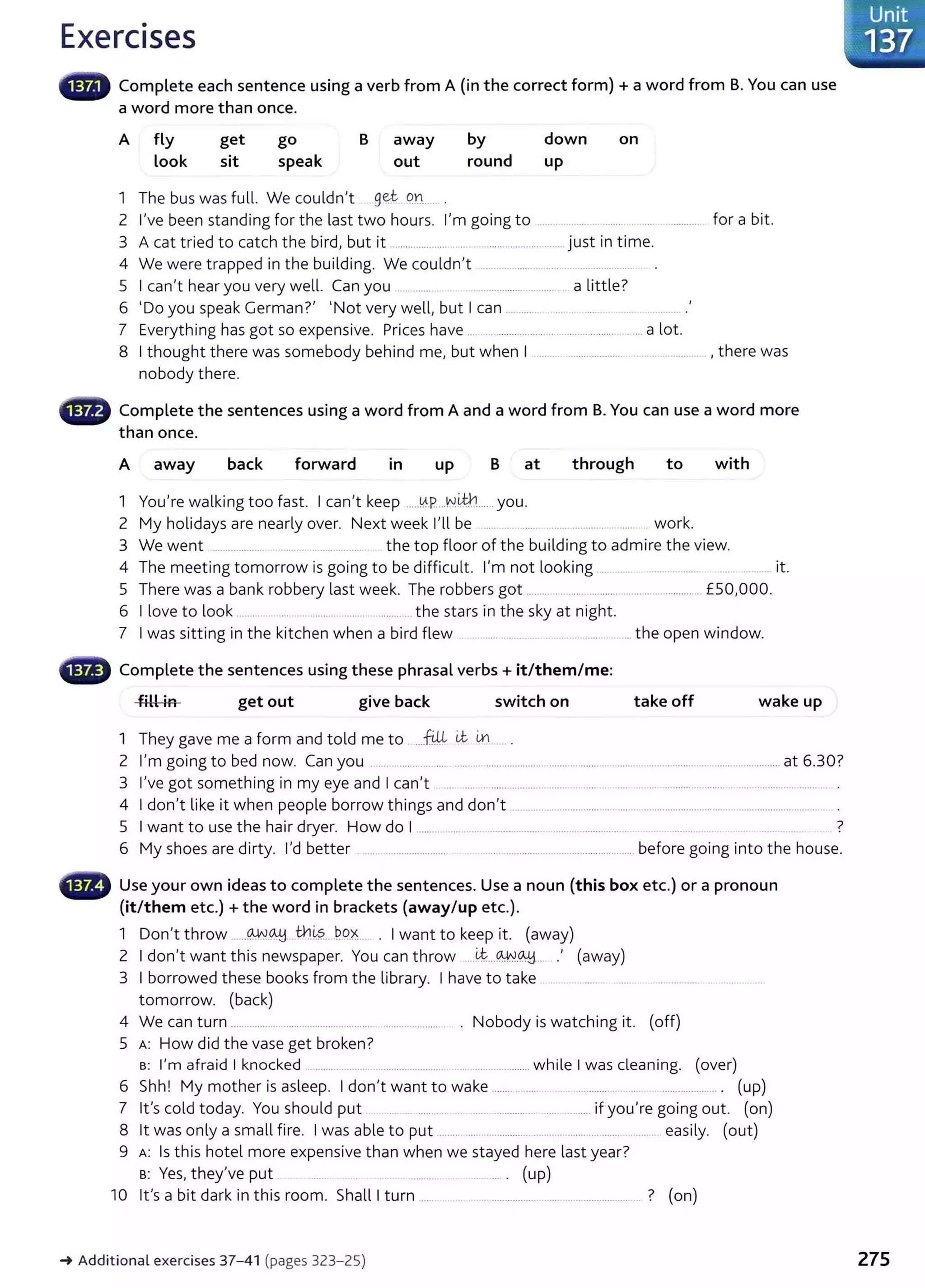
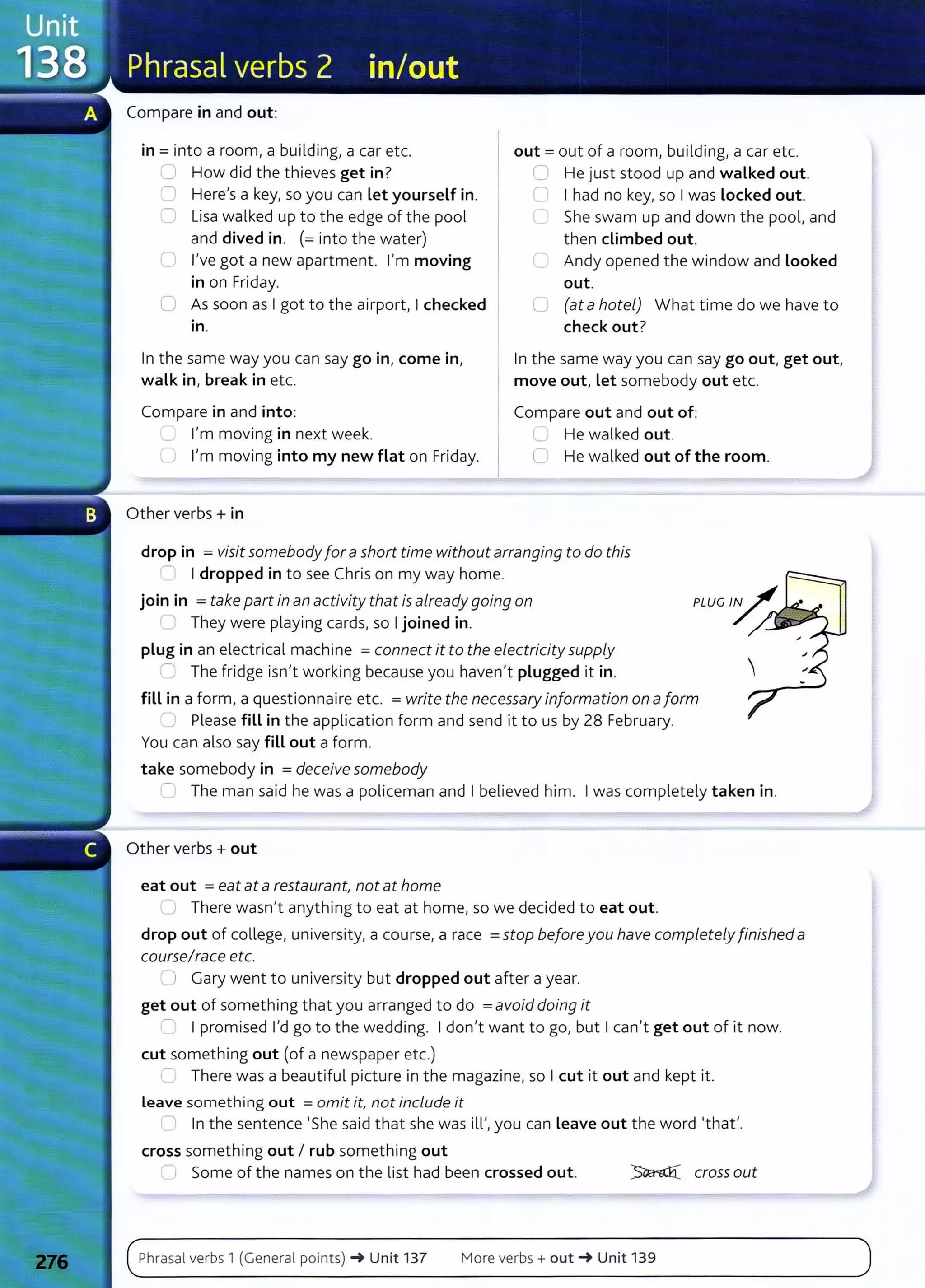
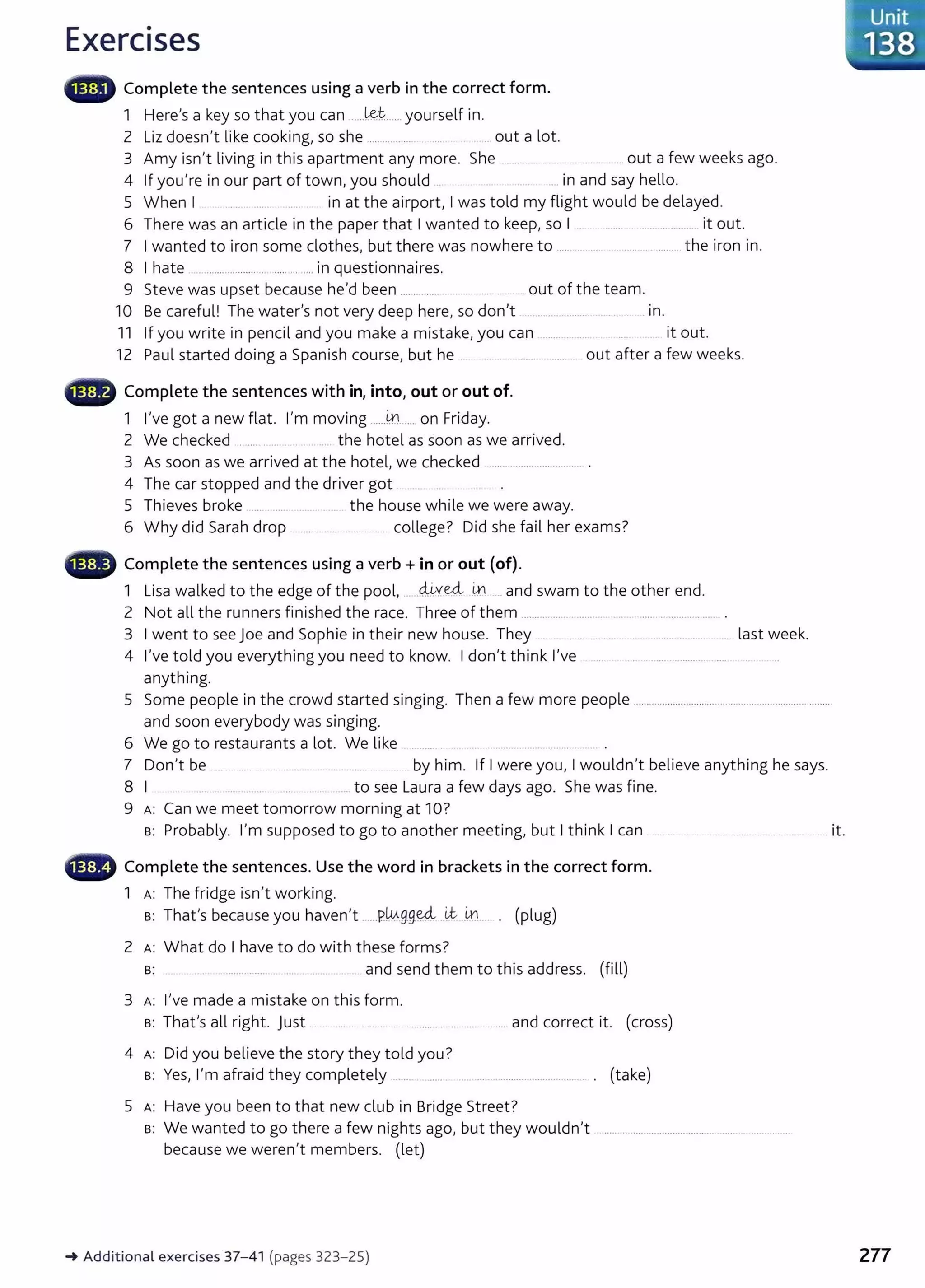
11
11
A self-study reference and practice book
for intermediate learners of English
Fourth Edition
,. ~.....__ "11.: .....,_ - - - - • · - • :---. --.••• ,
~...-- with ,
answ.e·
rs:·:'
. - ~ -~··- ~·· ..
Raymond Murphy
CAMBRIDGE UNIVERSITY PRESS
Cambridge, New York. Melbourne, Madrid, Cape Town,
Singapore, Sao Paulo, Delhi,Tokyo, Mexico City
Cambridge University Press
The Edinburgh Building, Cambridge CB2 8RU, UK
www.cambridge.org
Information on this title: www.cambridge.org/englishgrammarinuse
Fourth Edition © Cambridge University Press 20 12
This publication is in copyright. Subject to statutory exception
and to the provisions of relevant collective licensing agreements,
no reproduction of any part may take place without the written
permission of Cambridge University Press.
English Grammar in Use first published 1985
Fourth edition 20 12
Reprinted 2012
Printed in China by Golden Cup Printing Co. Ltd
A catalogue record for this publication is available from the British Ubrary
ISBN 978-0-521-18906-4 Edition with answers
ISBN 978-0-521-18908-8 Edition without answers
ISBN 978-0-521-18939-2 Edition with answers and CD-ROM
ISBN 978-0-51 1-96173-1 Online access code pack
ISBN 978-1-1 07-64138-9 Online access code pack and book with answers
Cambridge University Press has no responsibility for the persistence or
accuracy of URLs for external or third-party internet websites referred to in
this publication, and does not guarantee that any content on such websites is,
or will remain, accurate or appropriate. Information regarding prices, travel
timetables and other factual information given in this work is correct at
the time of first printing but Cambridge University Press does not guarantee
the accuracy of such information thereafter.
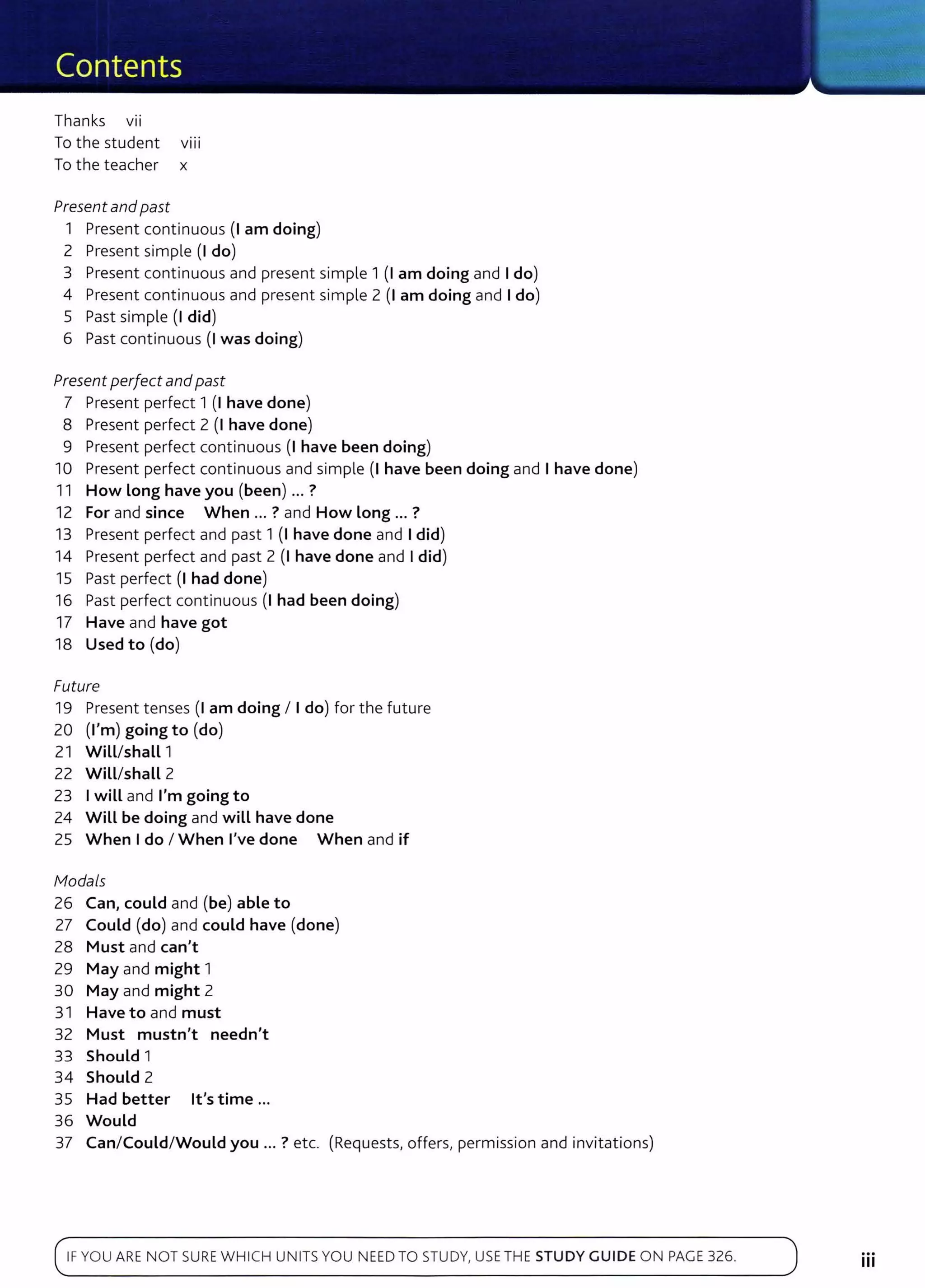
Thanks VII
To the student v111
To the teacher x
Present and past
1 Present continuous (I am doing)
2 Present simple (I do)
3 Present continuous and present simple 1 (1 am doing and I do)
4 Present continuous and present simple 2 (I am doing and I do)
5 Past simple (I did)
6 Past continuous (I was doing)
Present perfect andpast
7 Present perfect 1 (I have done)
8 Present perfect 2 (I have done)
9 Present perfect continuous (I have been doing)
10 Present perfect continuous and simple (I have been doing and I have done)
11 How Long have you (been) ... ?
12 For and since When ... ? and How Long ... ?
13 Present perfect and past 1 (I have done and I did)
14 Present perfect and past 2 (I have done and I did)
15 Past perfect (I had done)
16 Past perfect continuous (I had been doing)
17 Have and have got
18 Used to (do)
Future
19 Present tenses (I am doing I I do) for the future
20 (I'm) going to (do)
21 WiLL/shaLL 1
22 WiLL/shaLL 2
23 I wiLL and I'm going to
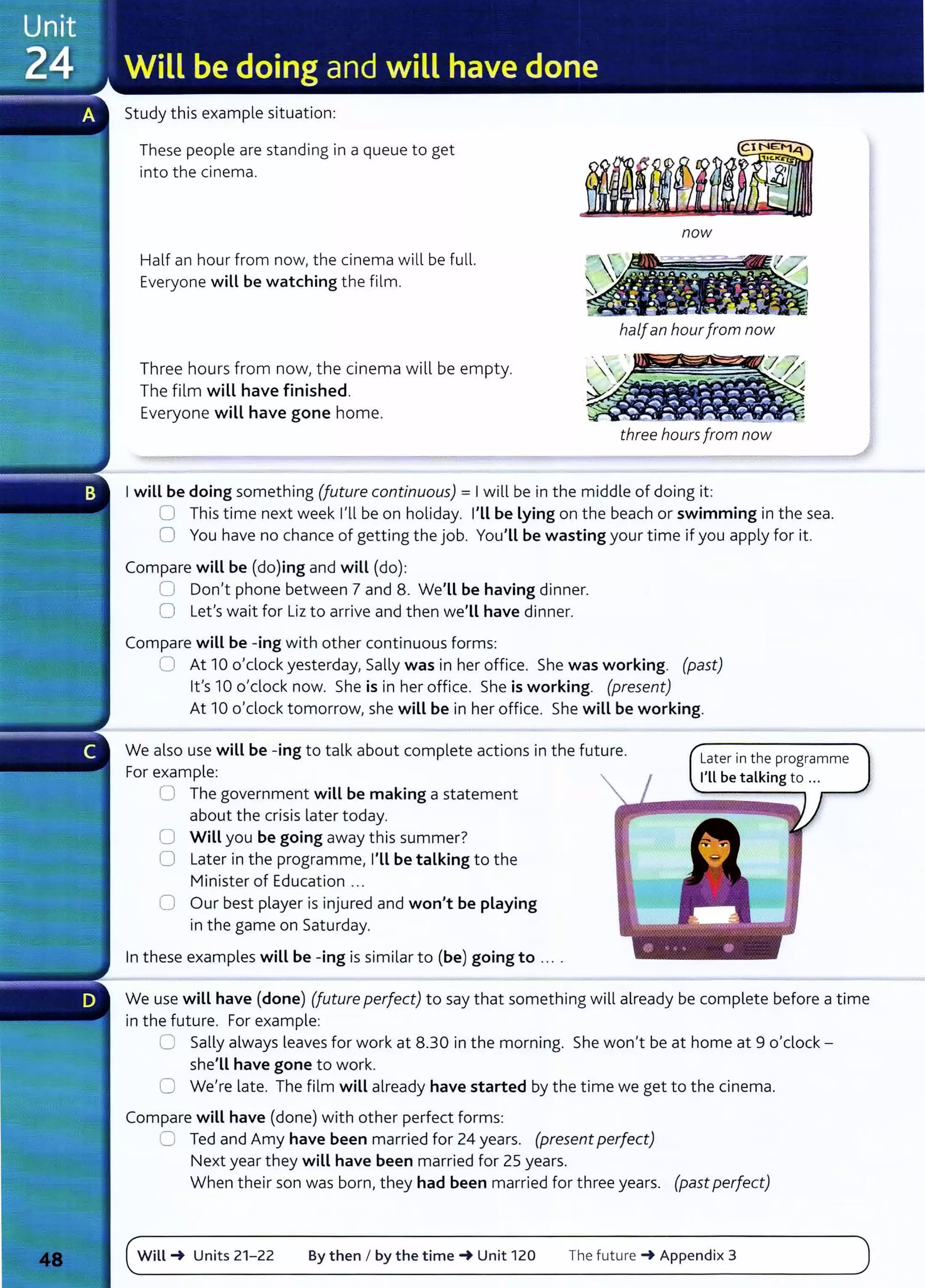
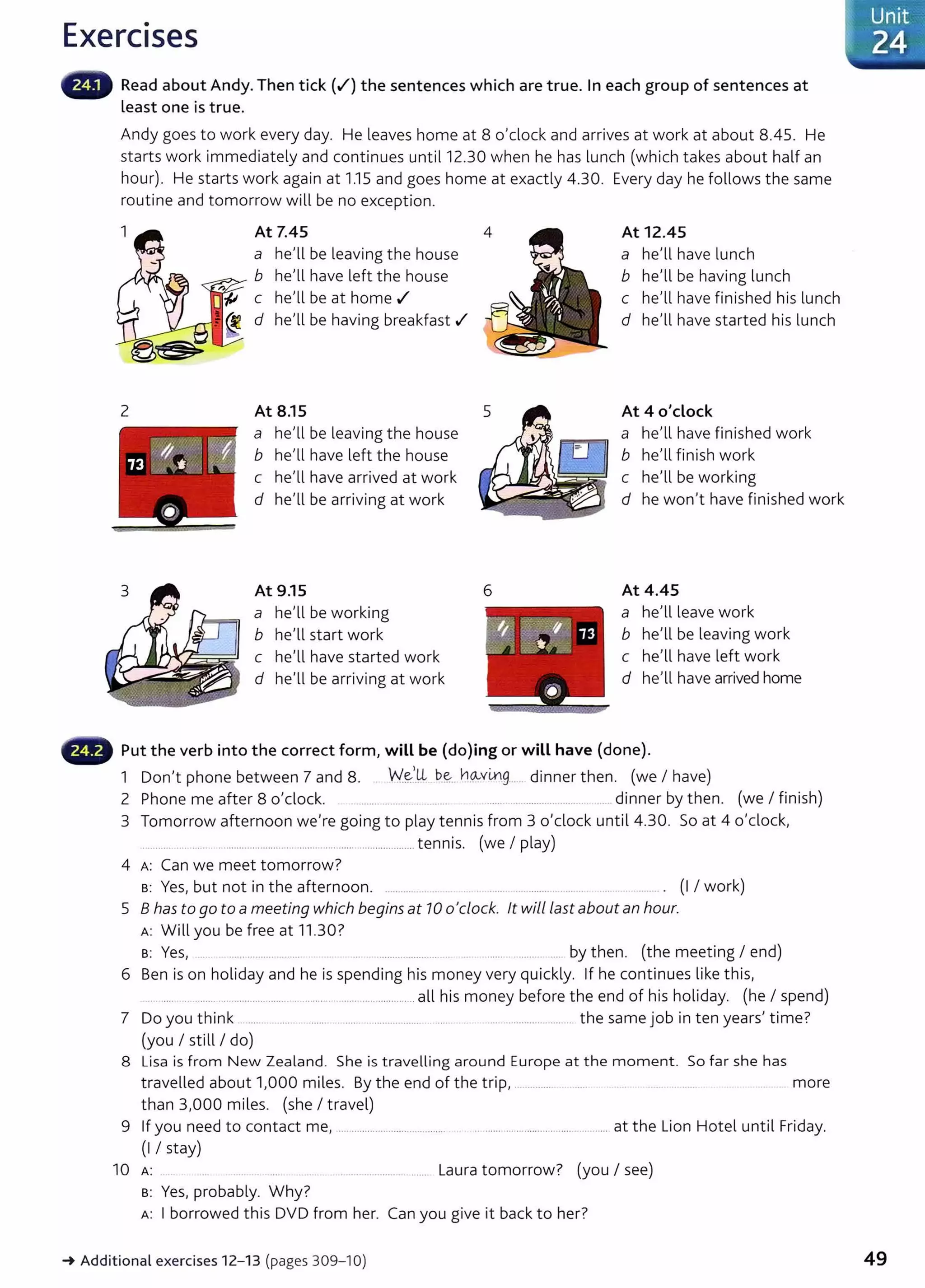
24 Will be doing and wiLL have done
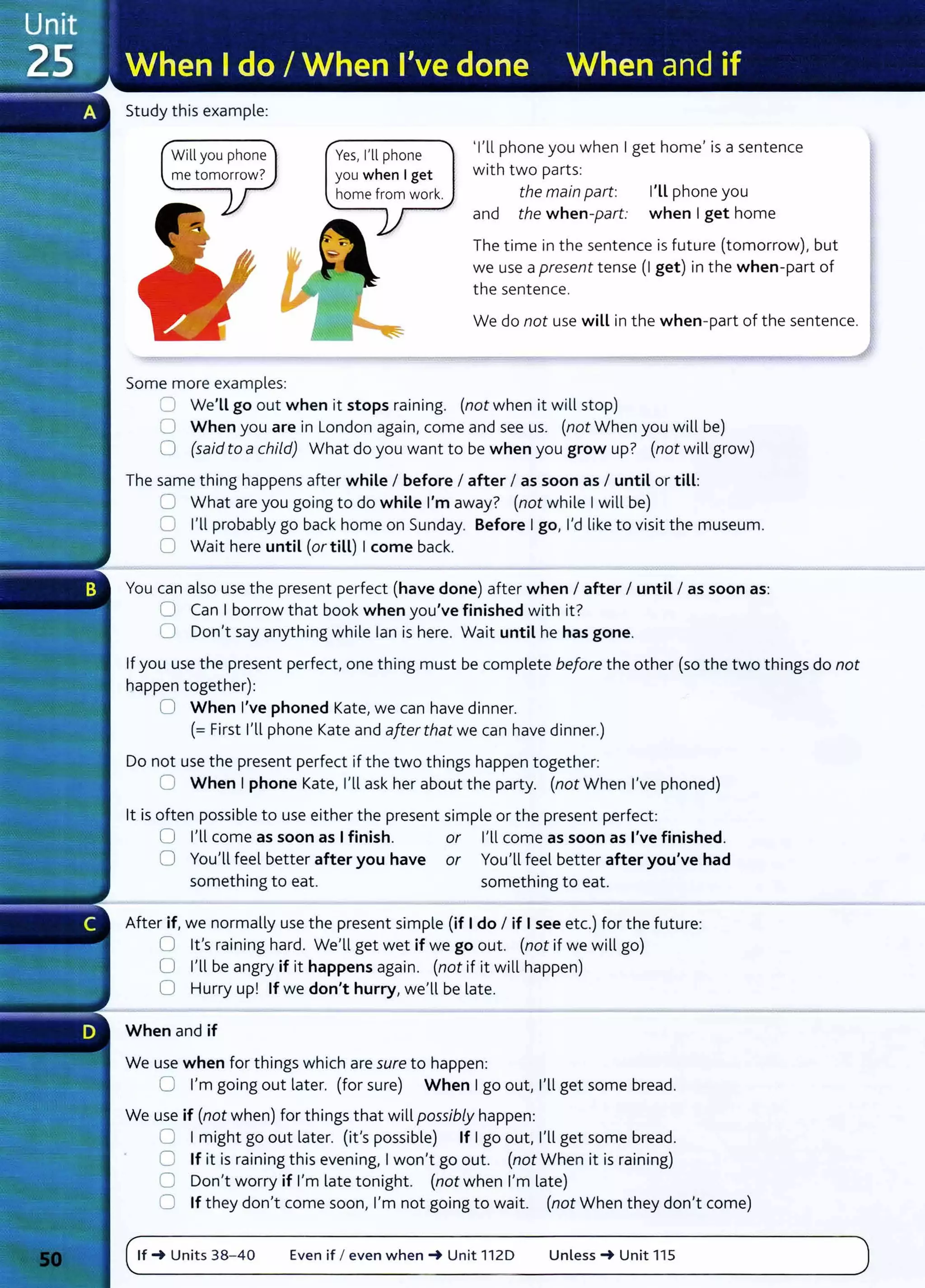
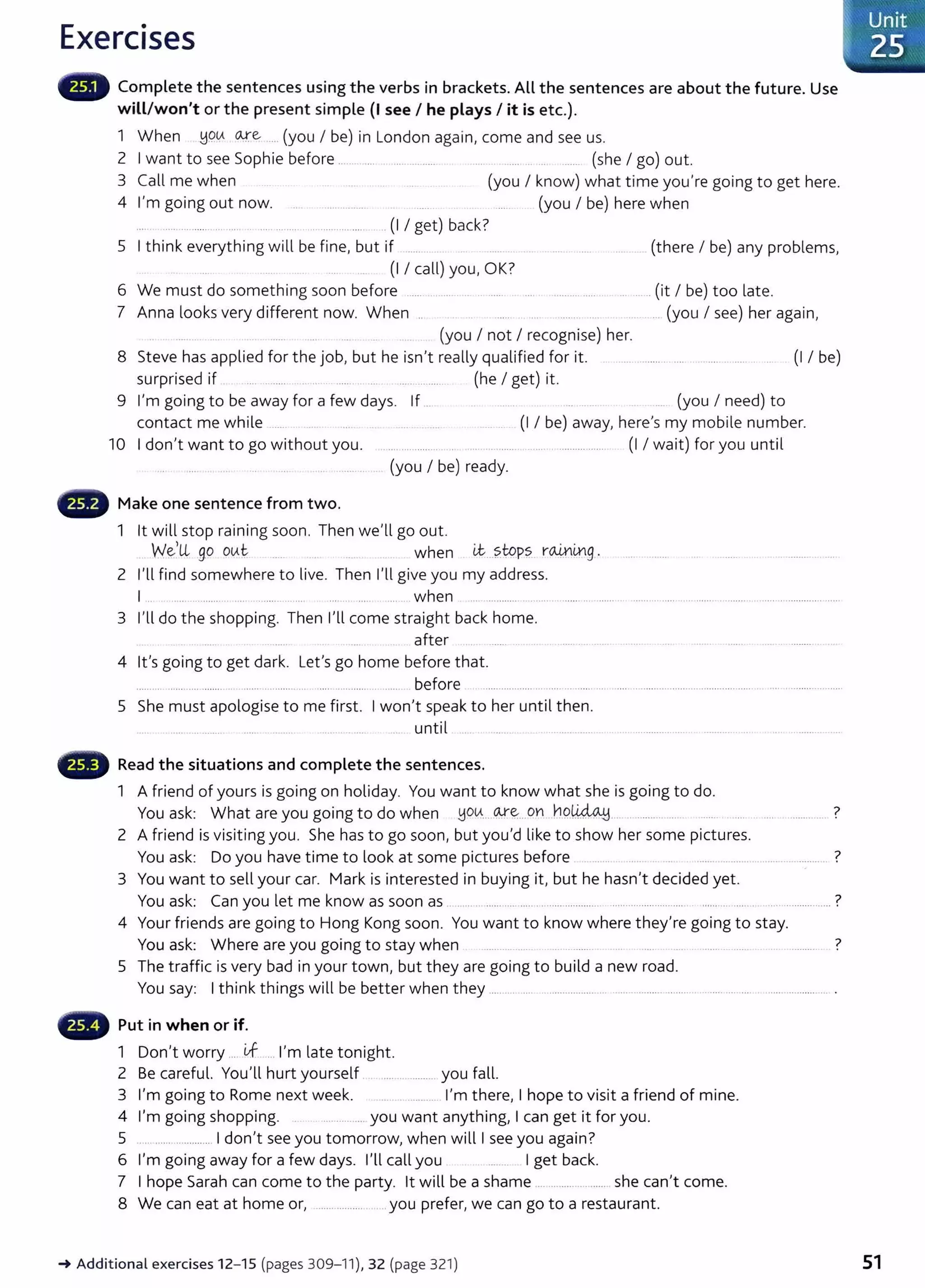
25 When I do I When I've done When and if
fv1odals
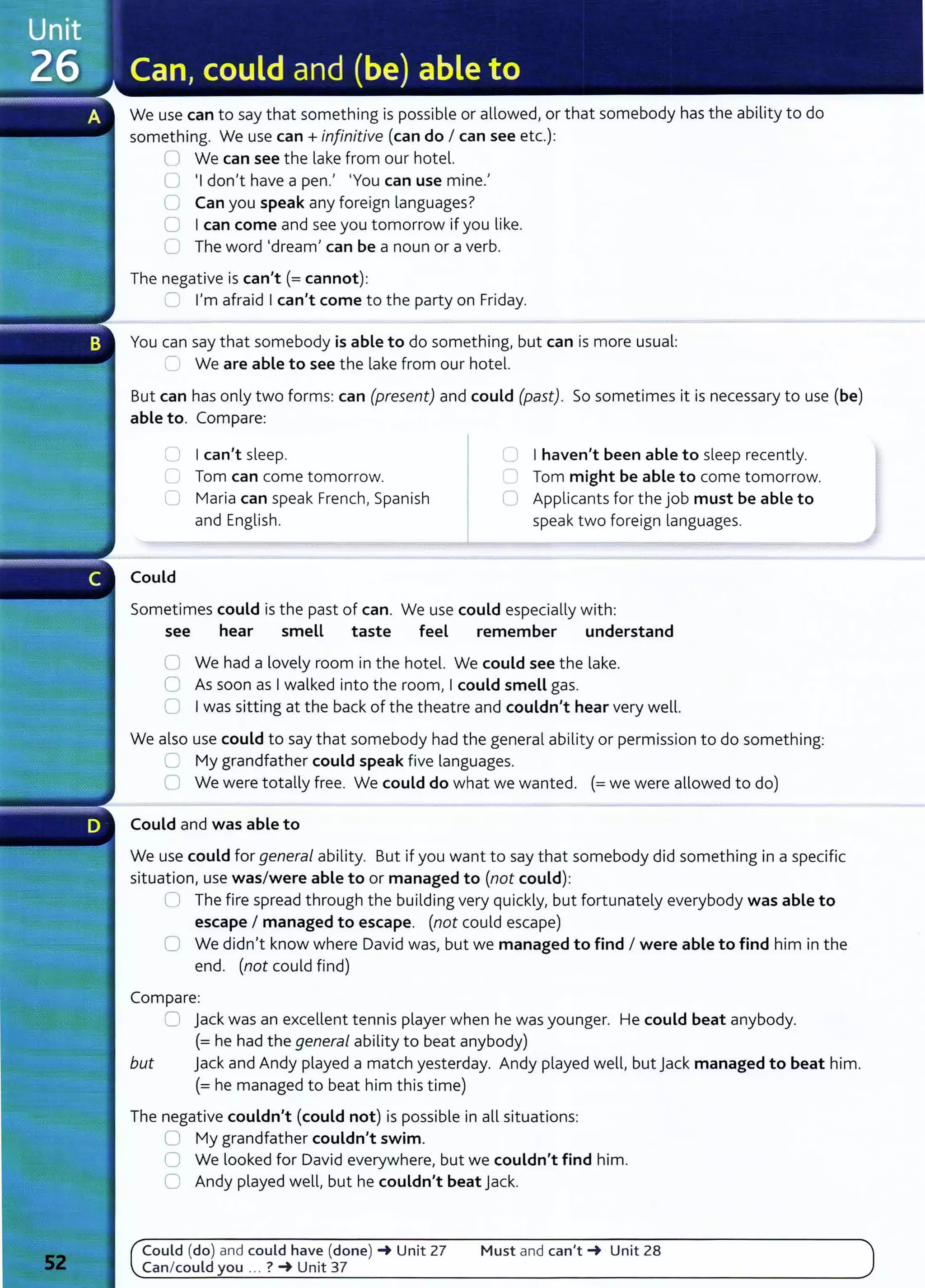
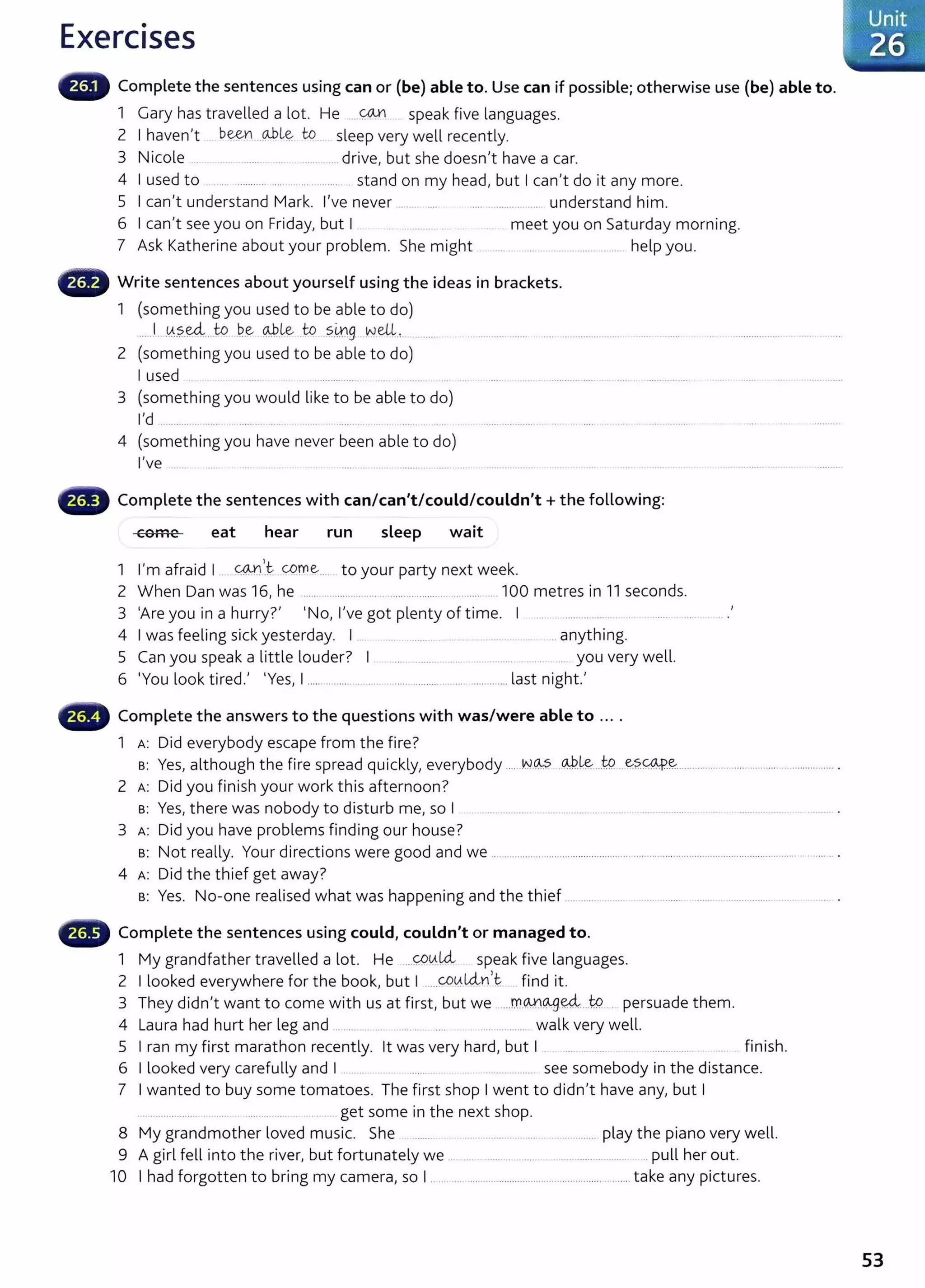
26 Can, could and (be) able to
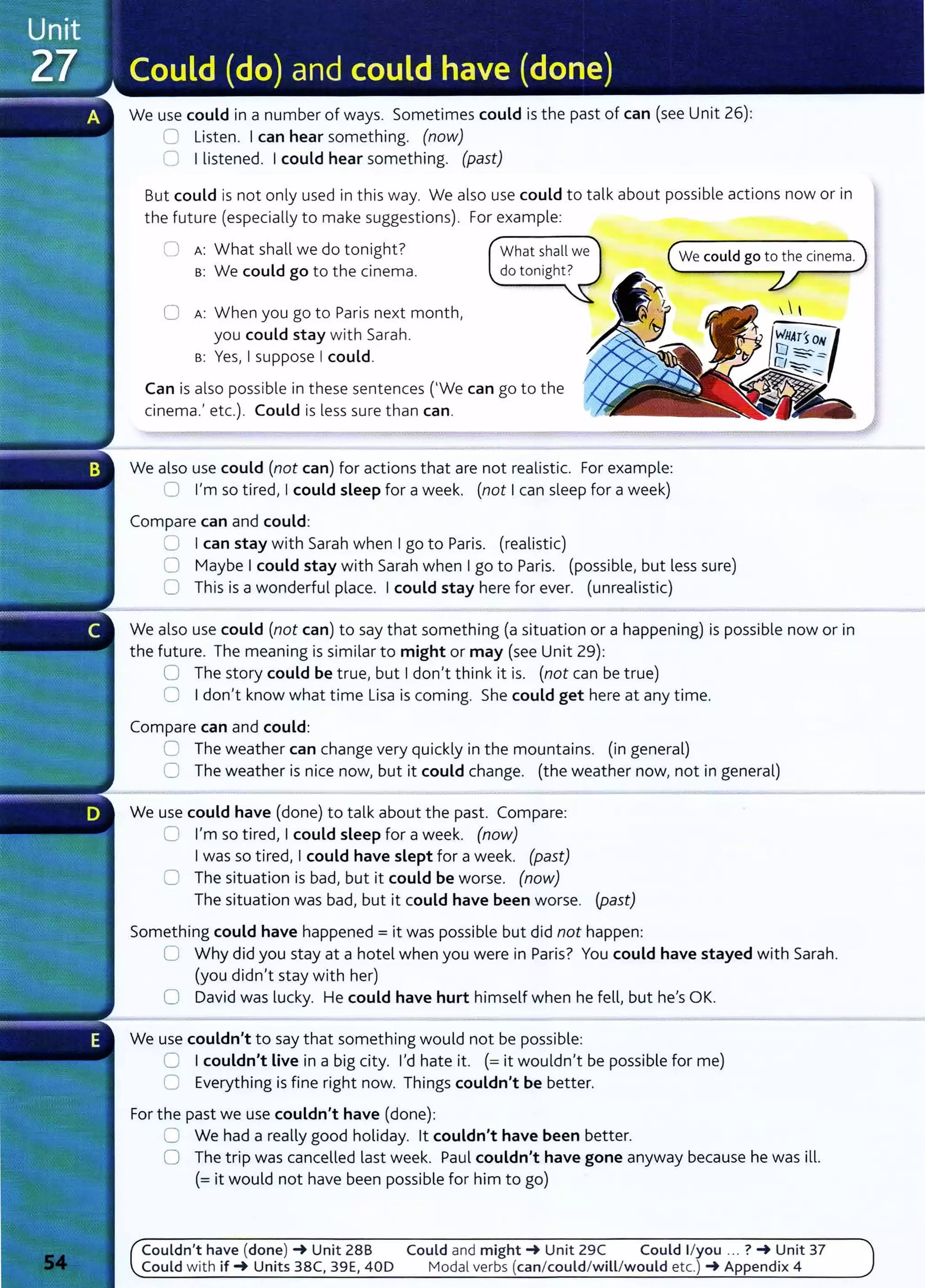
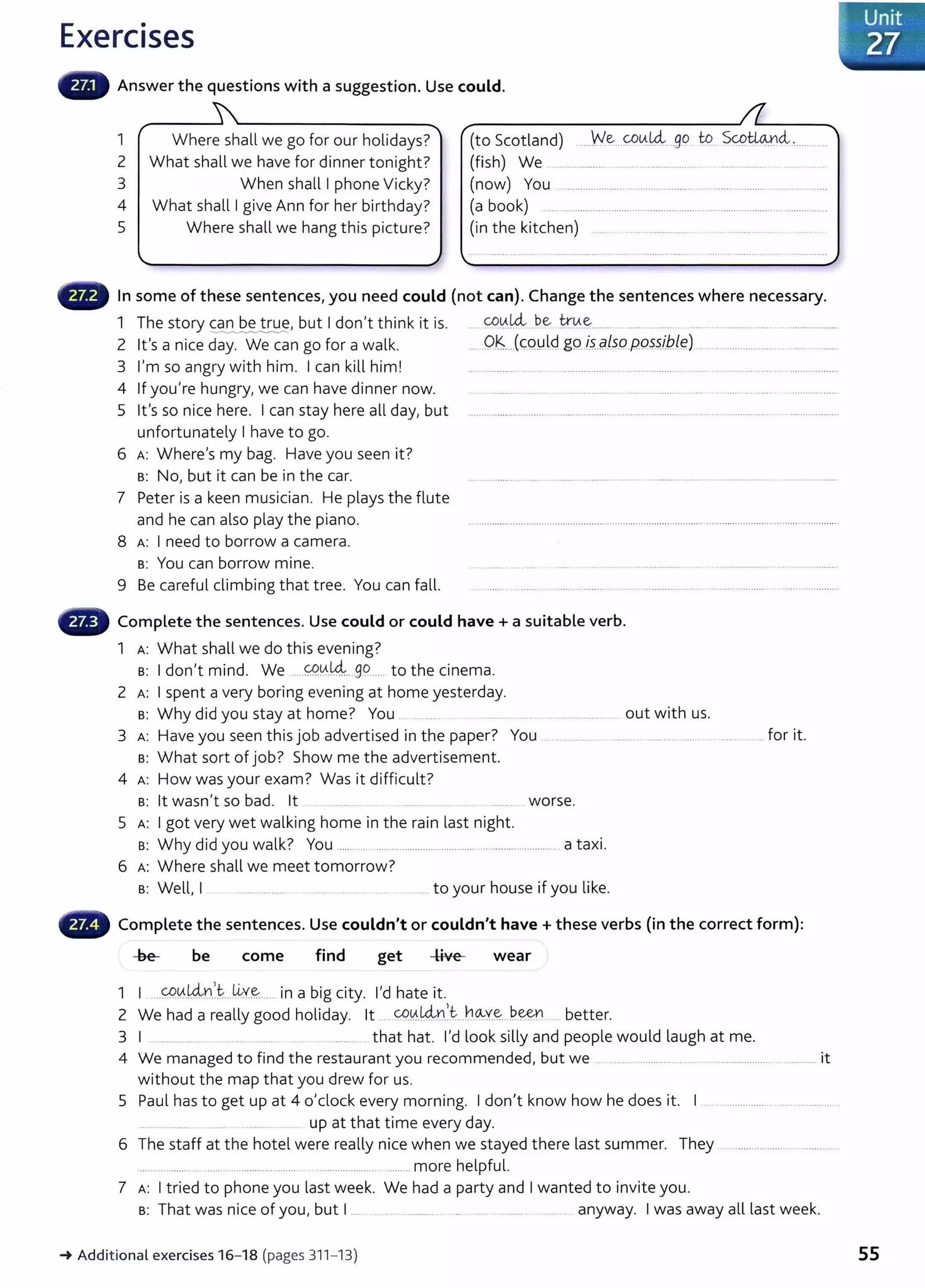
27 Could (do) and could have (done)
28 Must and can't
29 May and might 1
30 May and might 2
31 Have to and must
32 Must mustn't needn't
33 Should 1
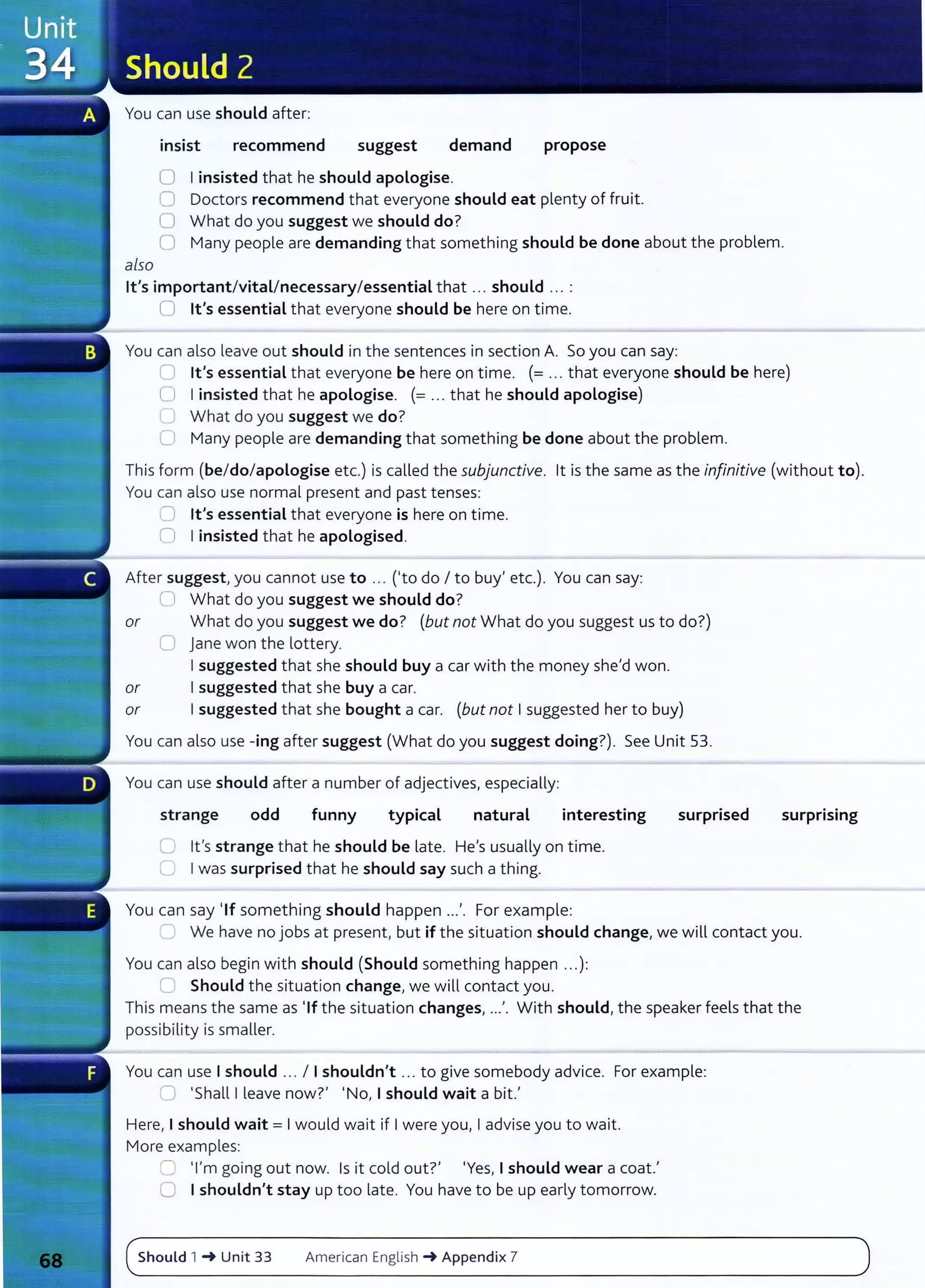
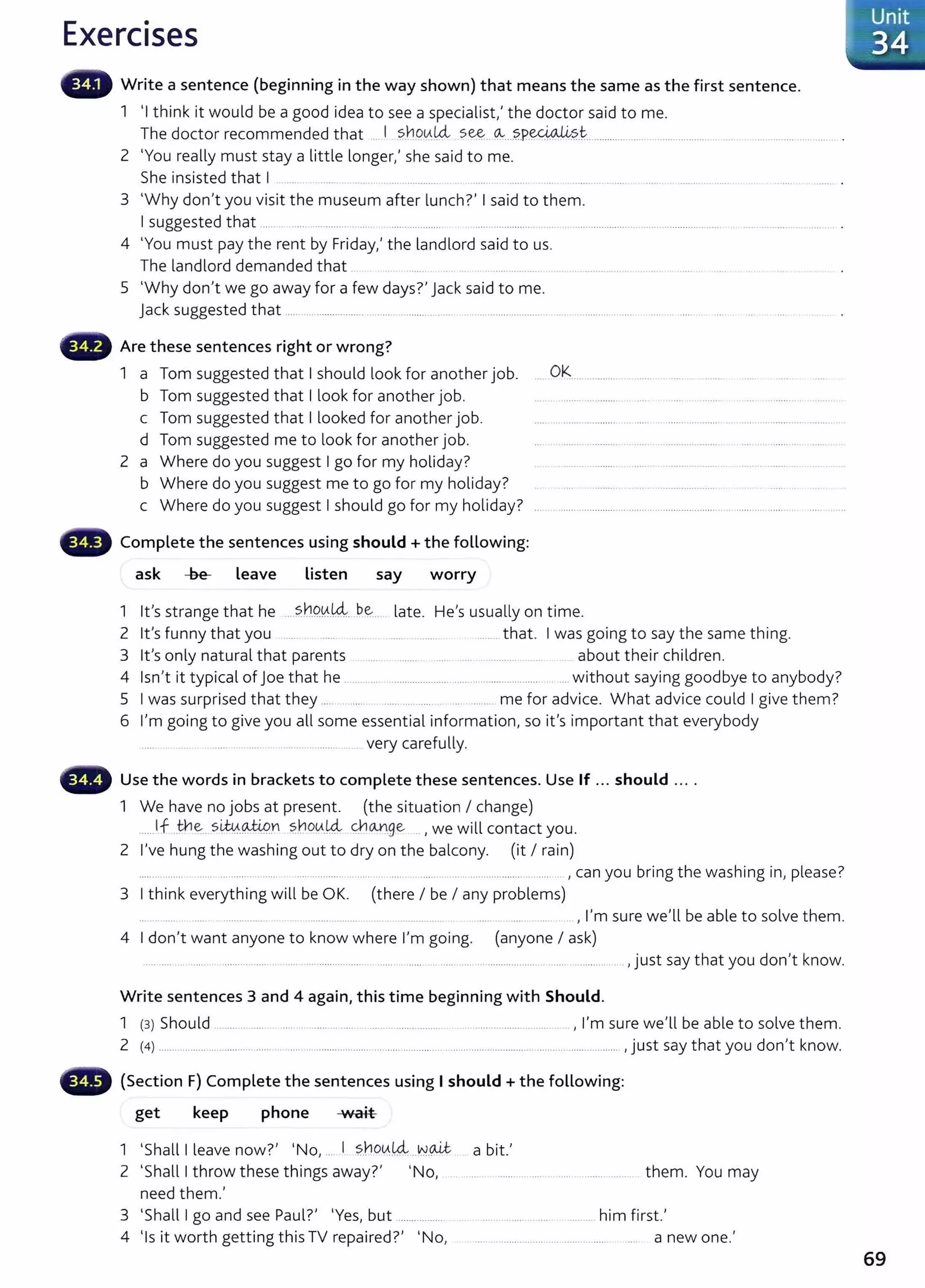
34 Should 2
35 Had better lt's time ...
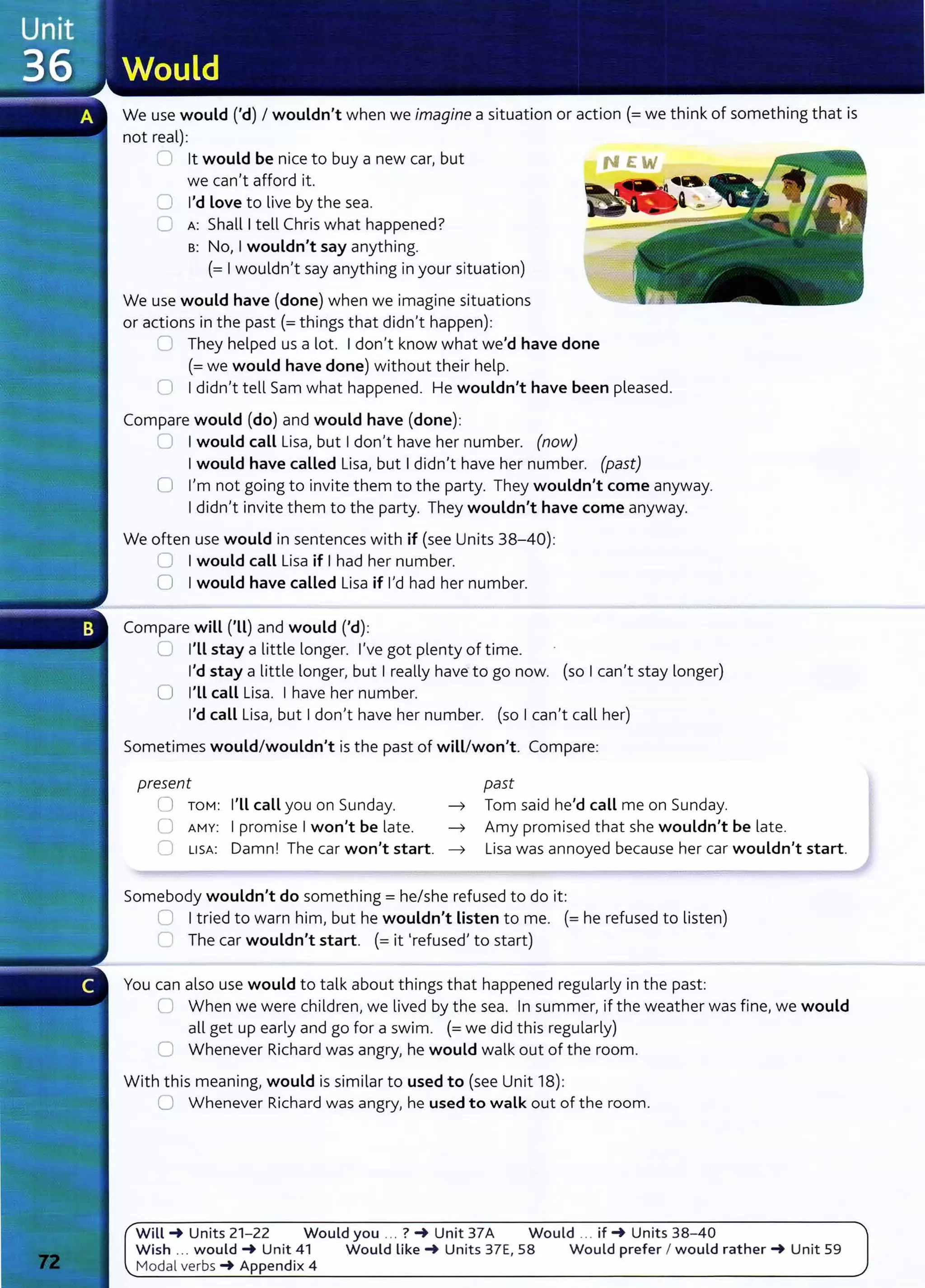
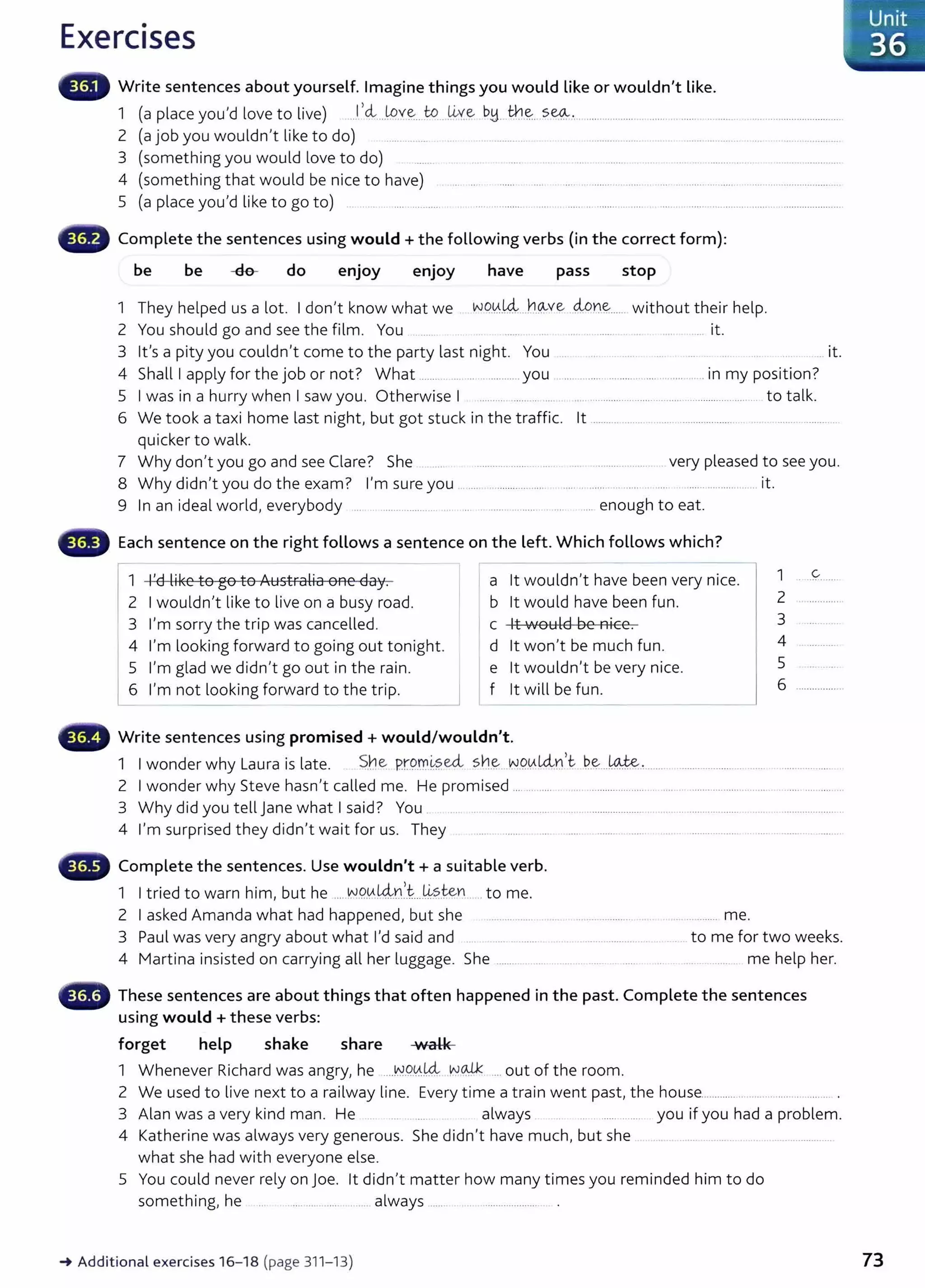
36 Would
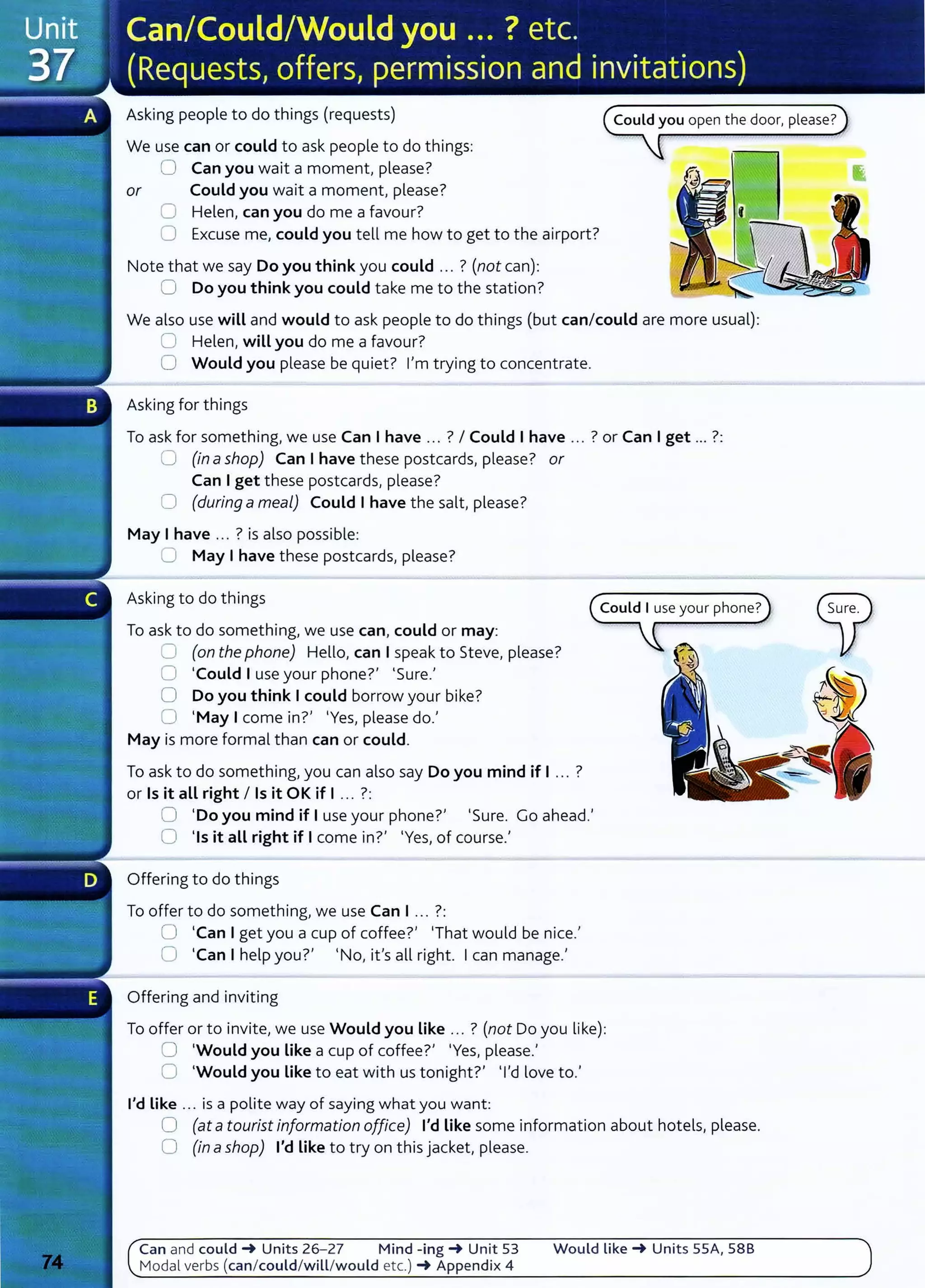
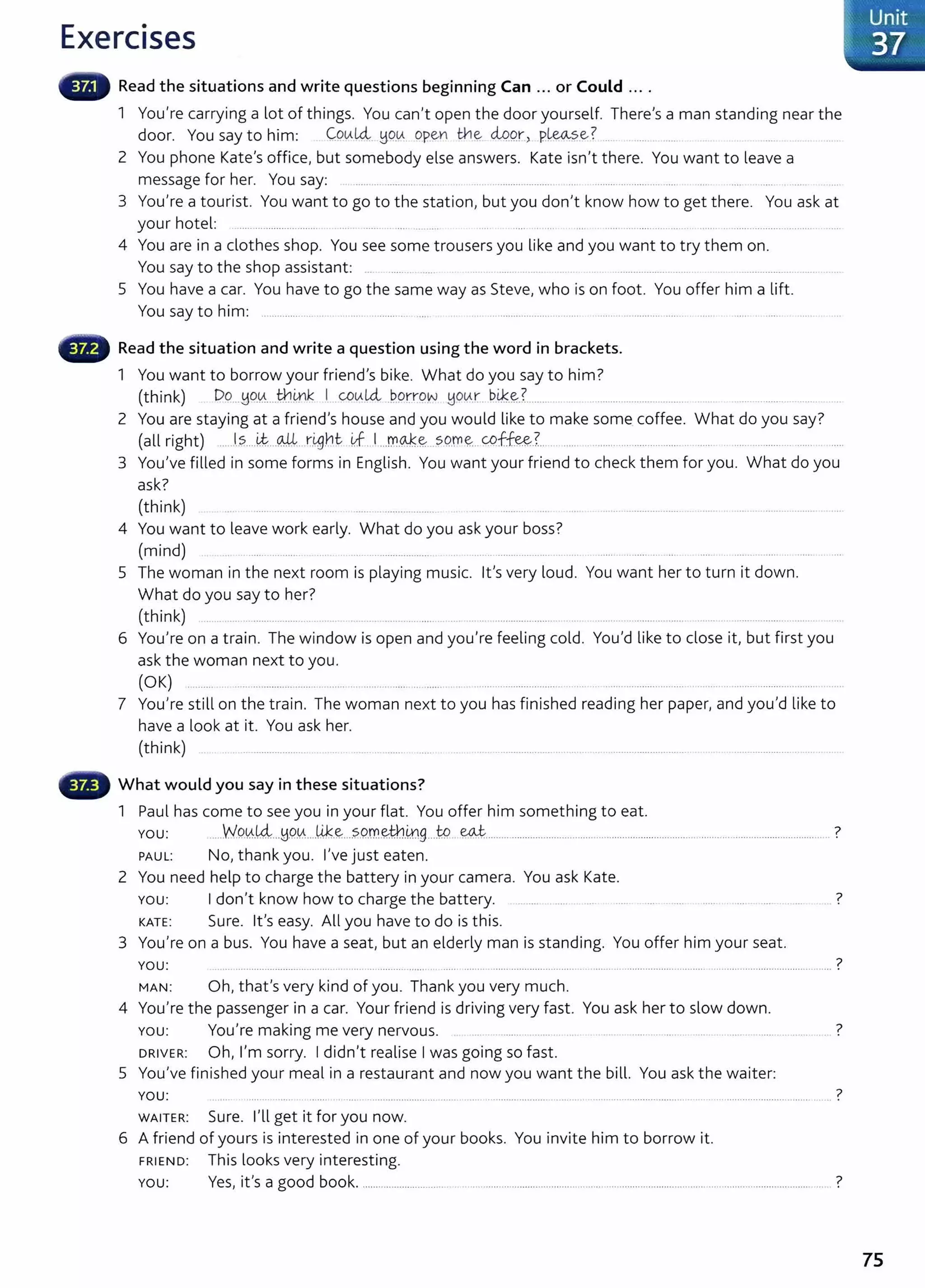
37 Can/Could/Would you ... ? etc. (Requests, offers, permission and invitations)
IFYOU AR E N OT SUREWHI CH UNITSYOU NEED TO STUDY, USE TH E STUDY GUIDE O N PAGE 326.
...
Ill
.
IV
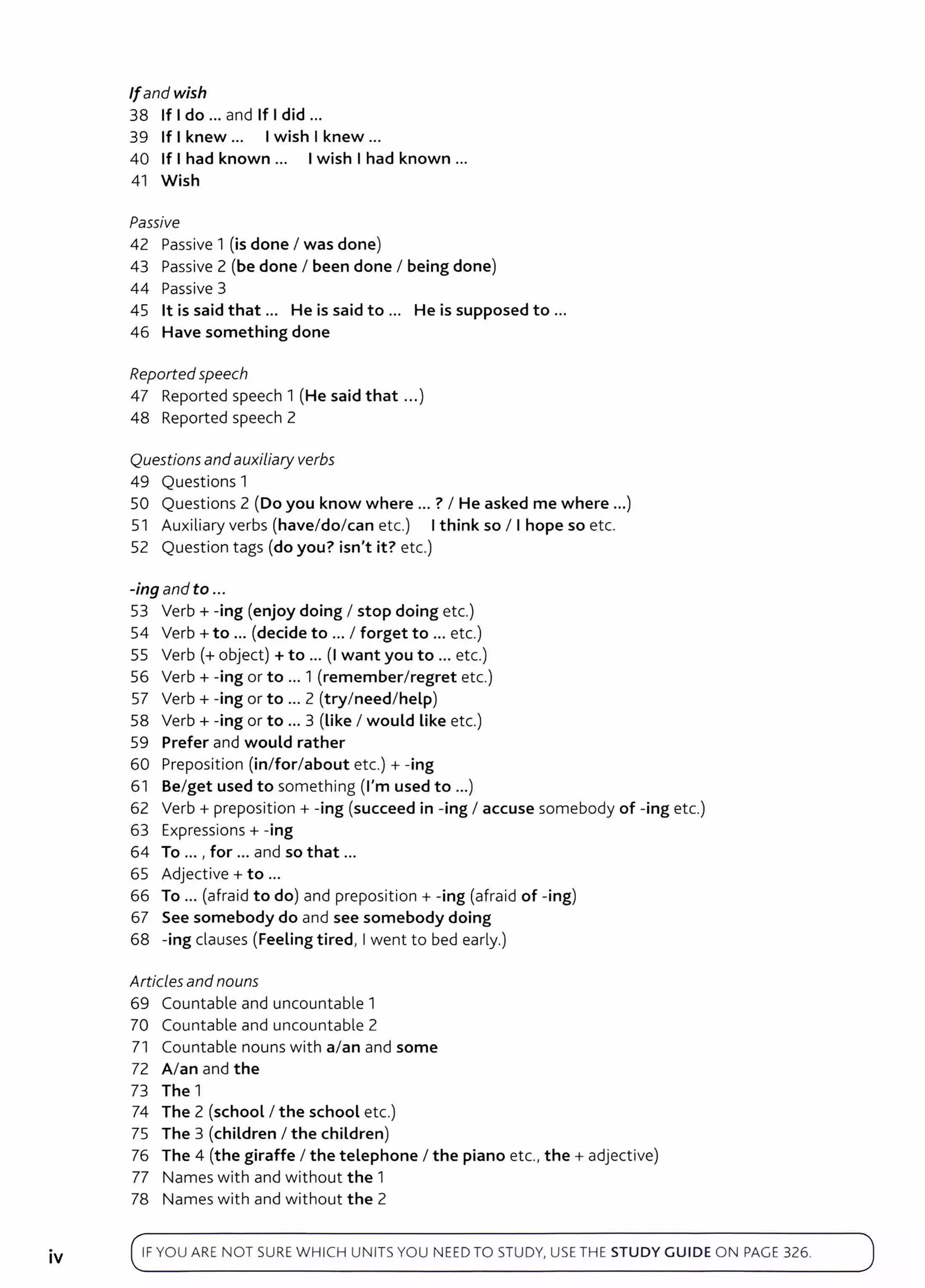
Ifand wish
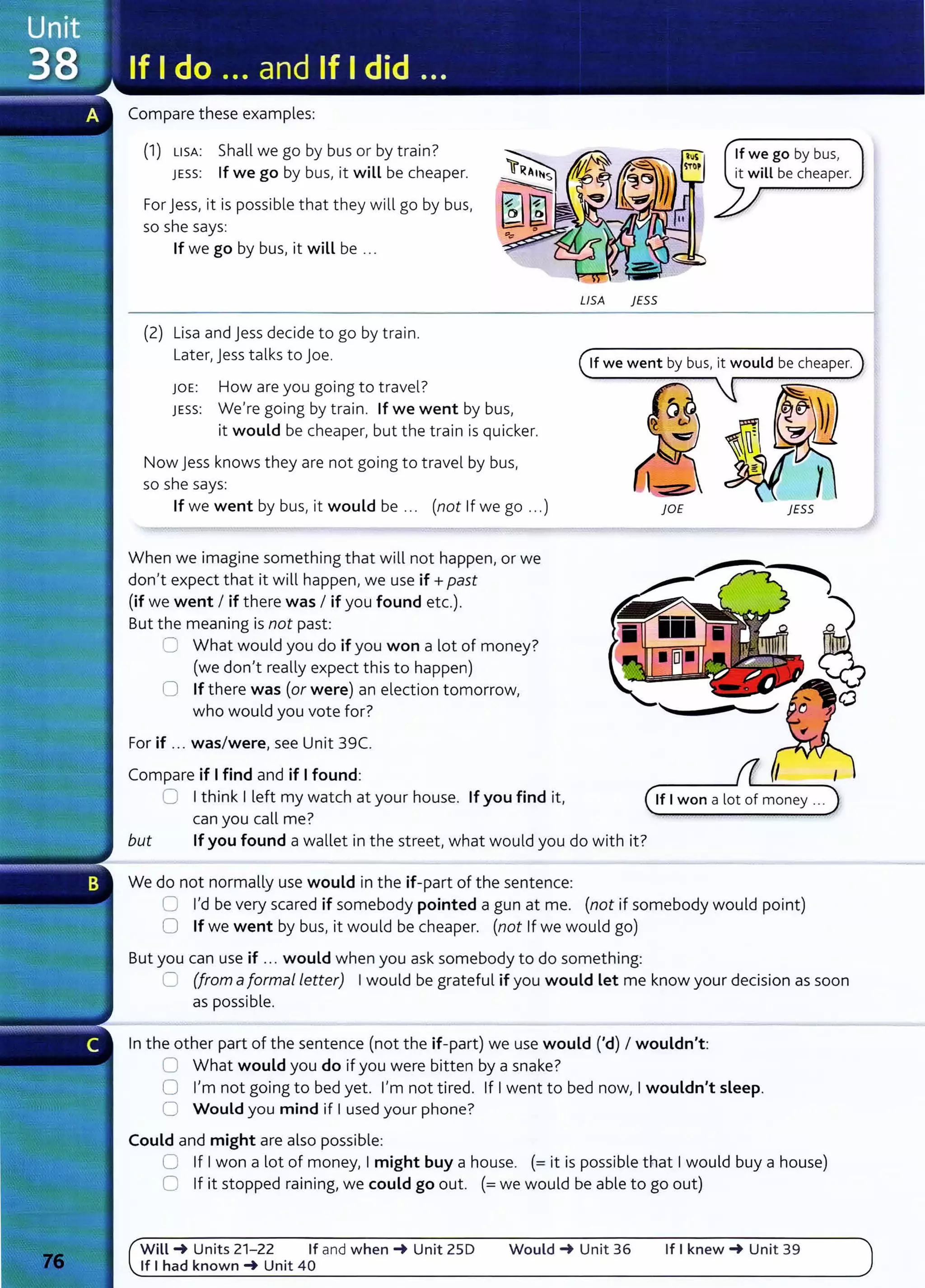
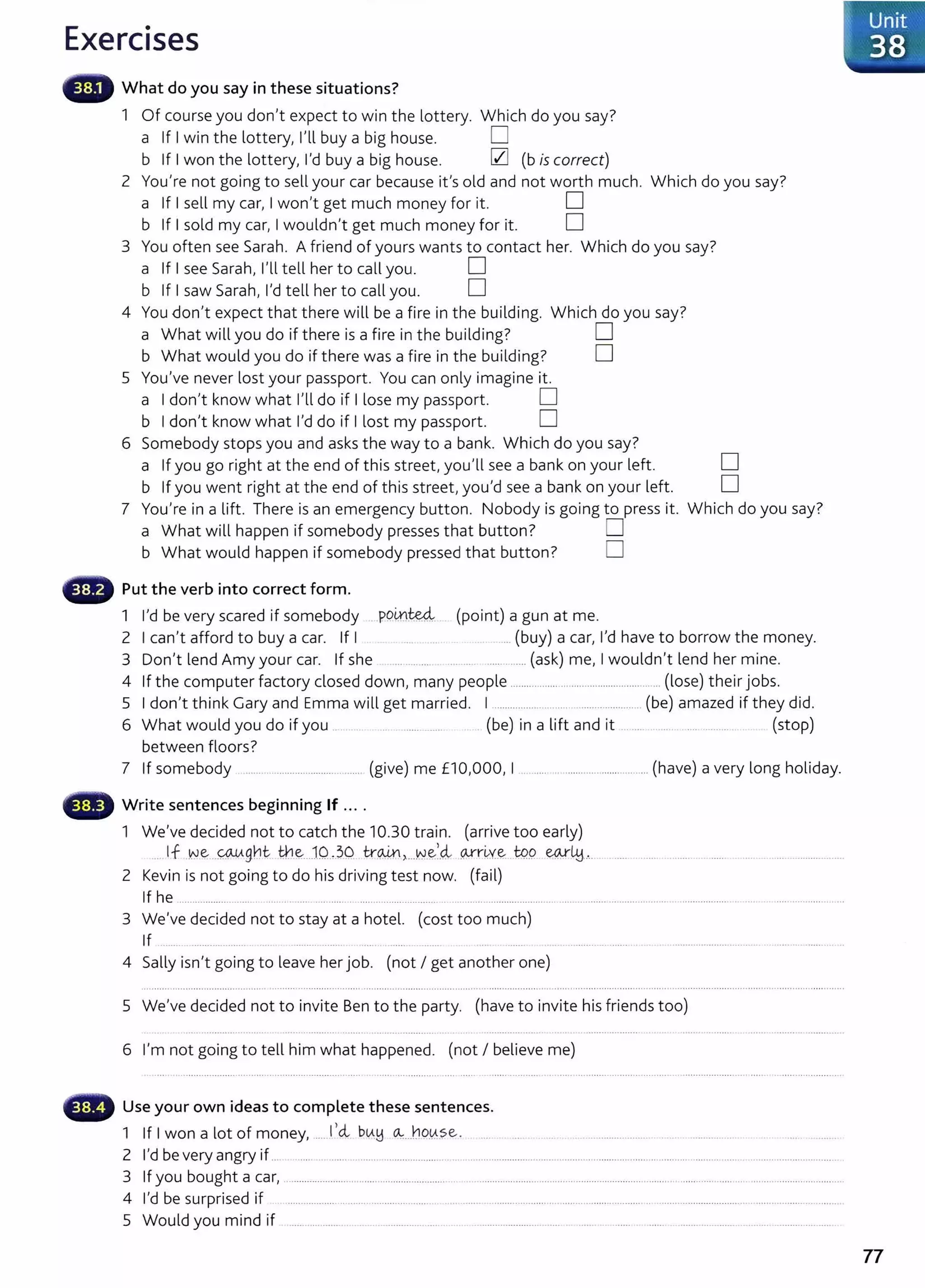
38 If Ido ... and If I did ...
39 If I knew... Iwish I knew ...
40 If I had known ... Iwish I had known ...
41 Wish
Passive
42 Passive 1 (is done I was done)
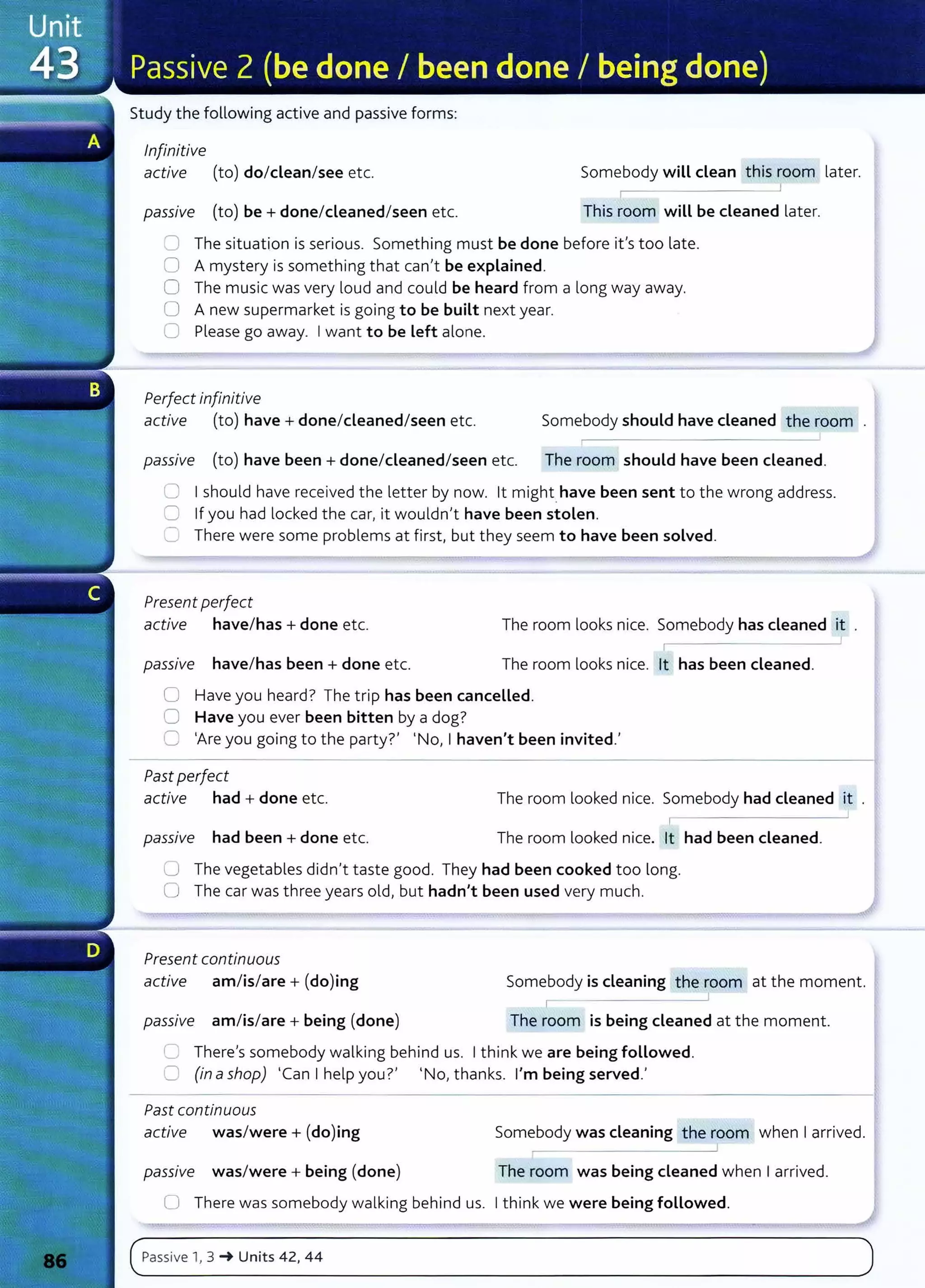
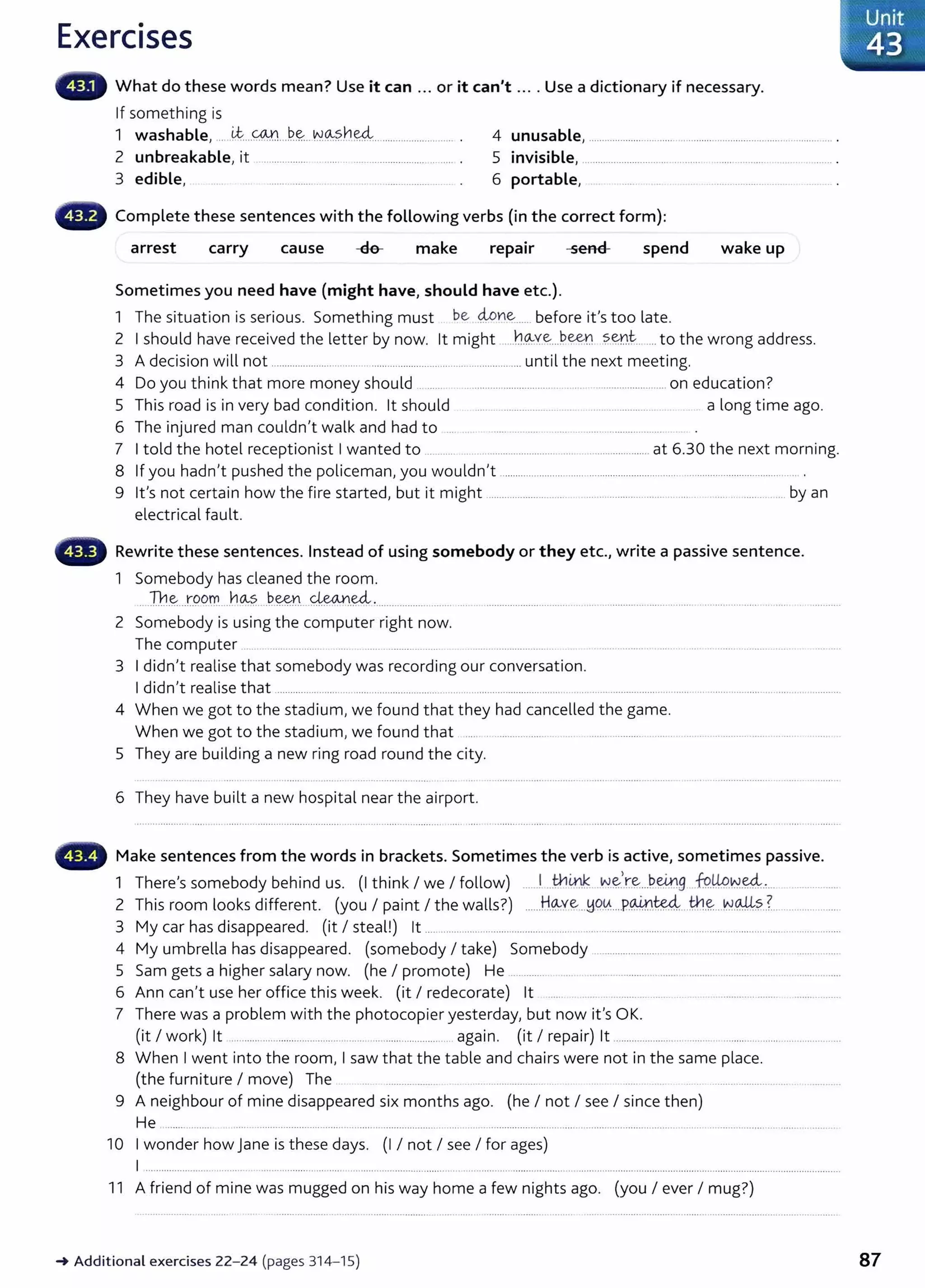
43 Passive 2 (be done I been done I being done)
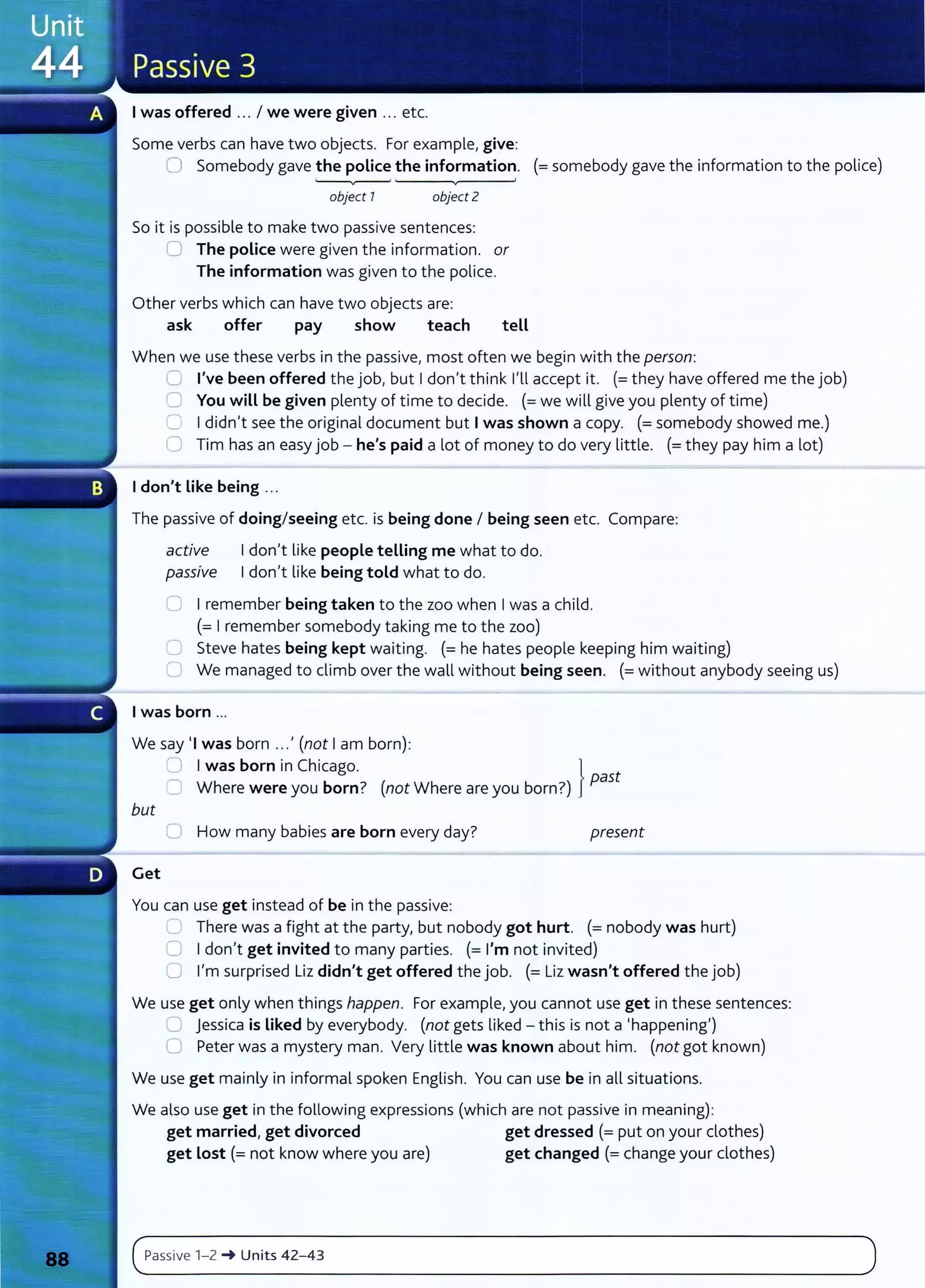
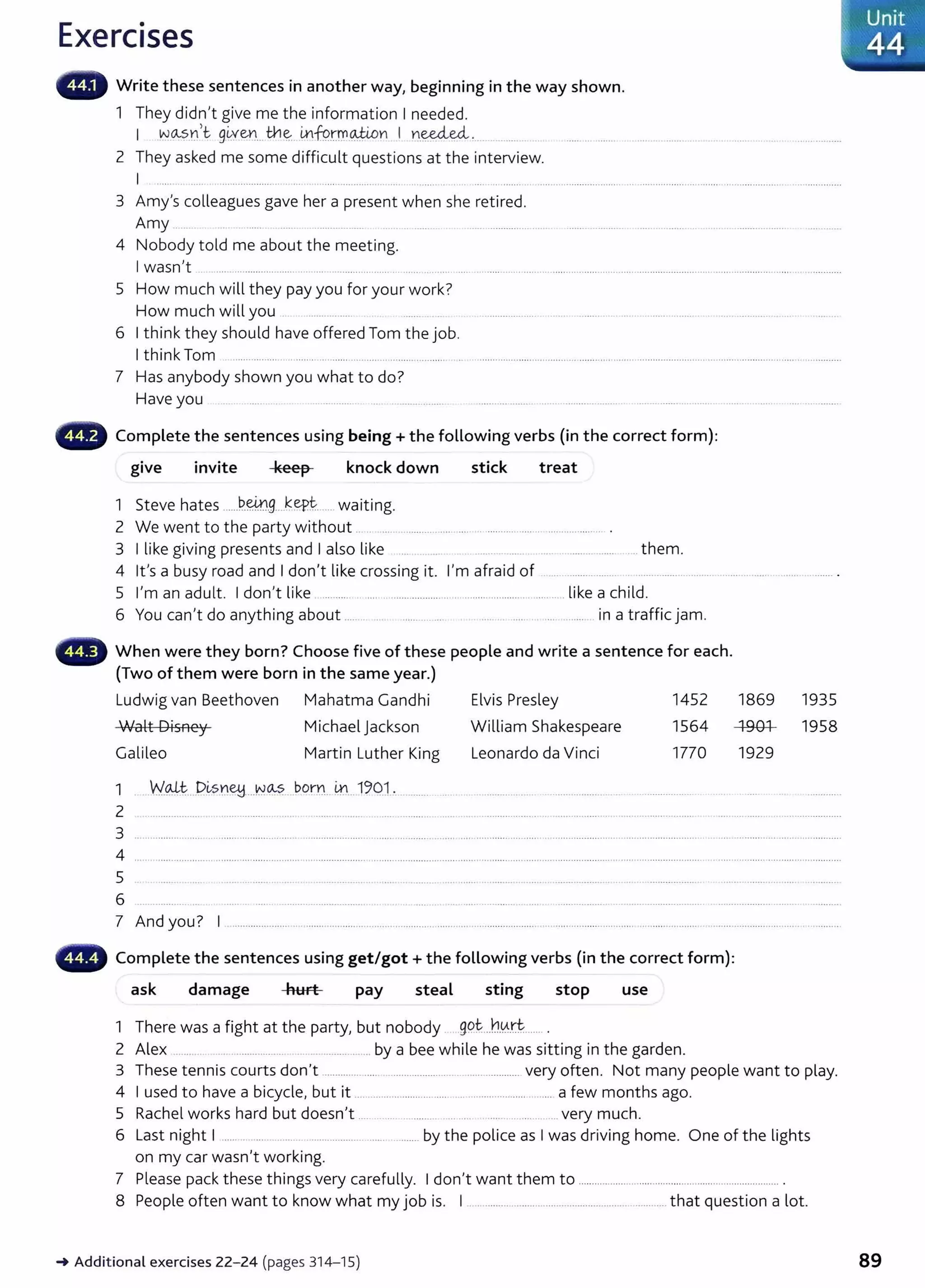
44 Passive 3
45 lt is said that ... He is said to ... He is supposed to ...
46 Have something done
Reportedspeech
47 Reported speech 1 (He said that ...)
48 Reported speech 2
Questions and auxiliary verbs
49 Questions 1
50 Questions 2 (Do you know where ... ? I He asked me where ...)
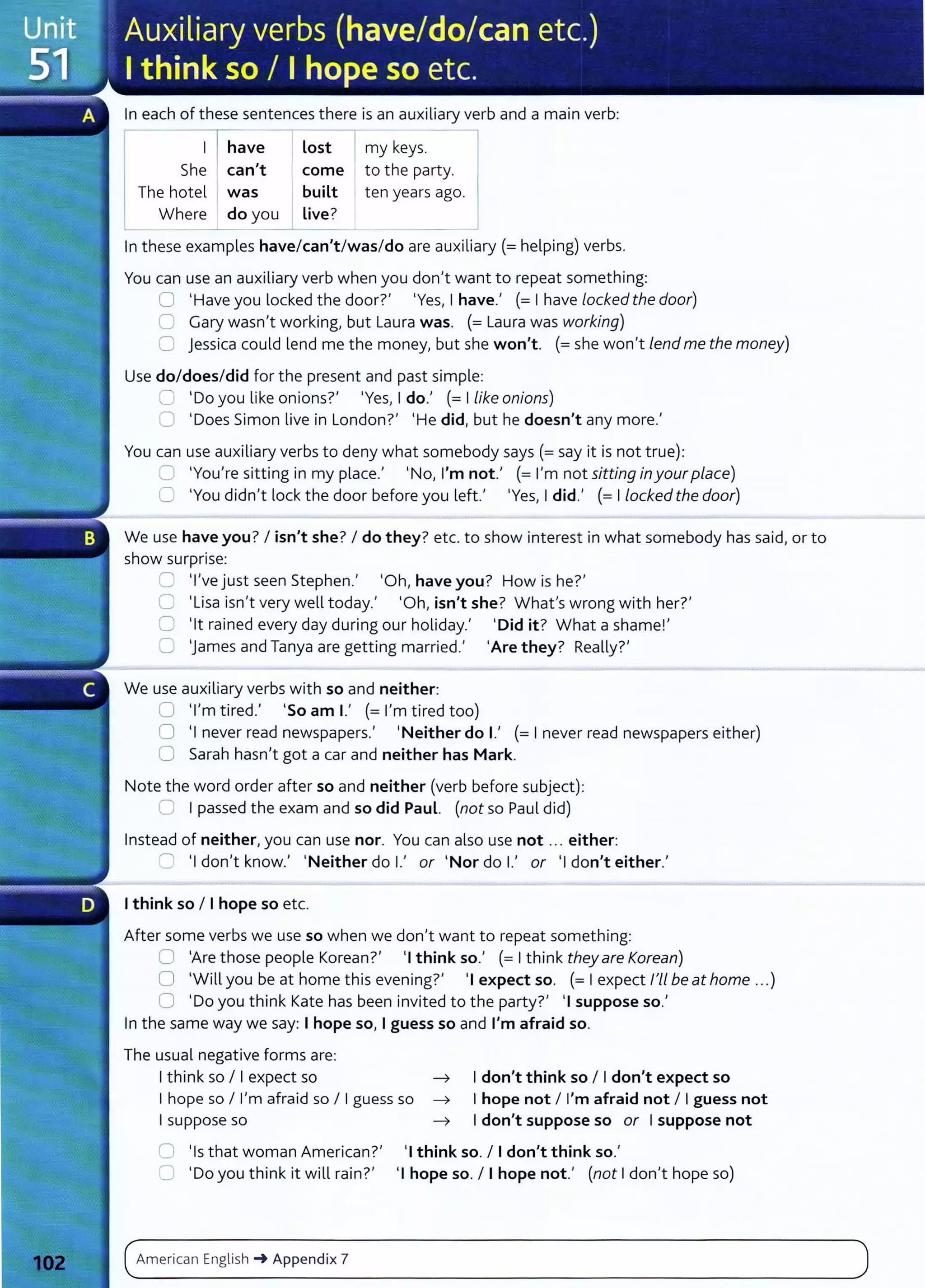
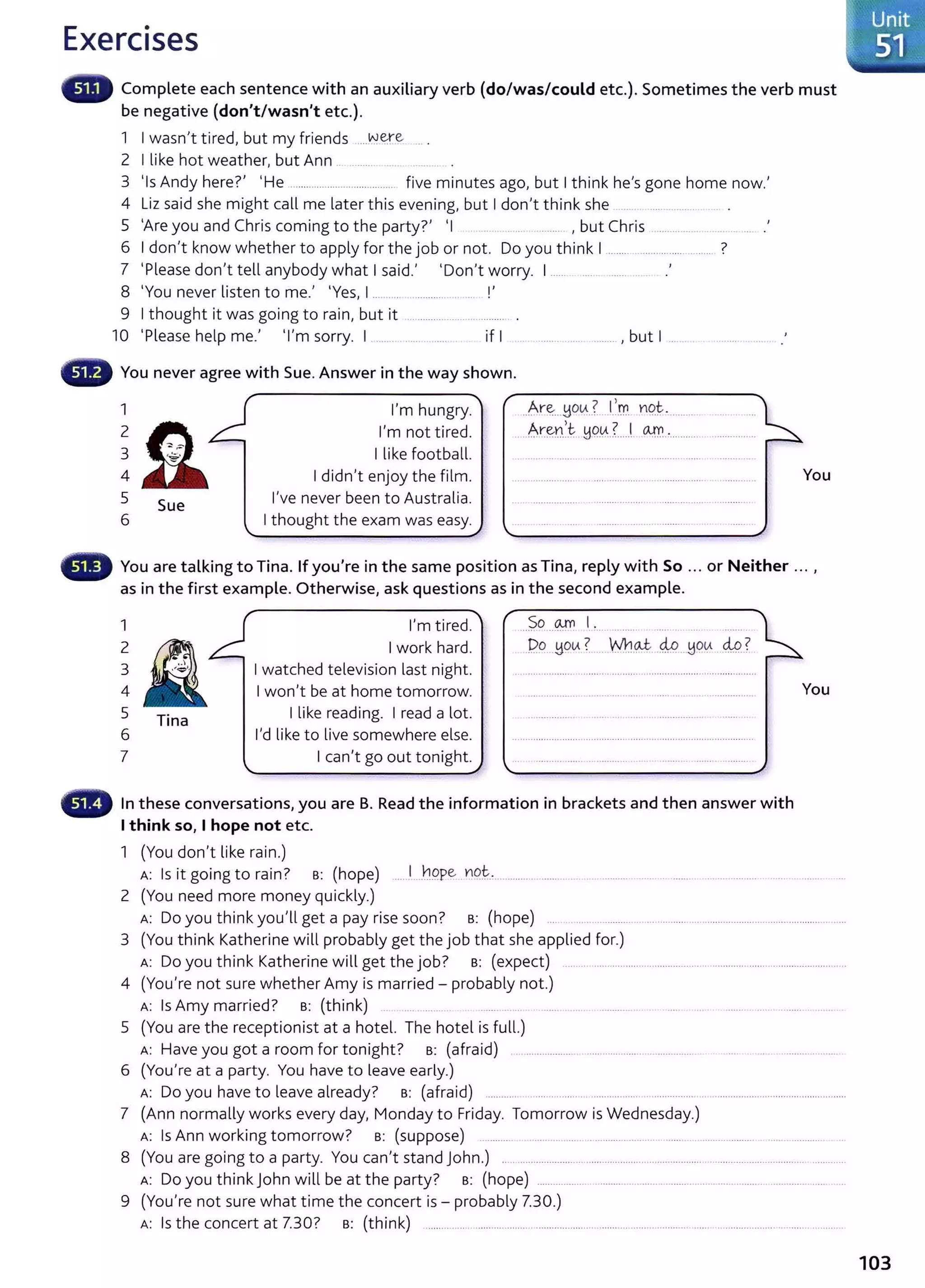
51 Auxiliary verbs (have/do/can etc.) Ithink so I I hope so etc.
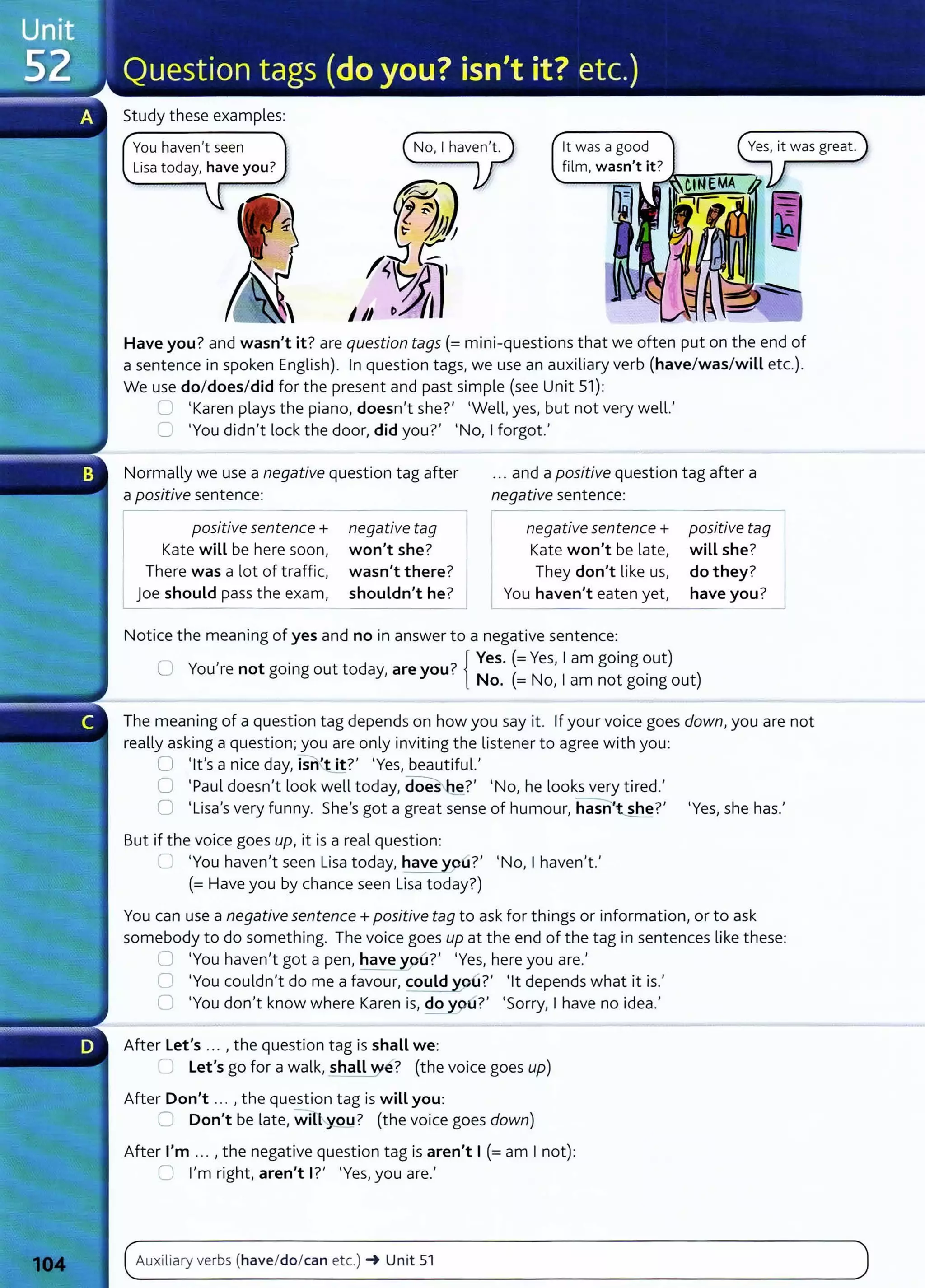
52 Question tags (do you? isn't it? etc.)
-ing and to ...
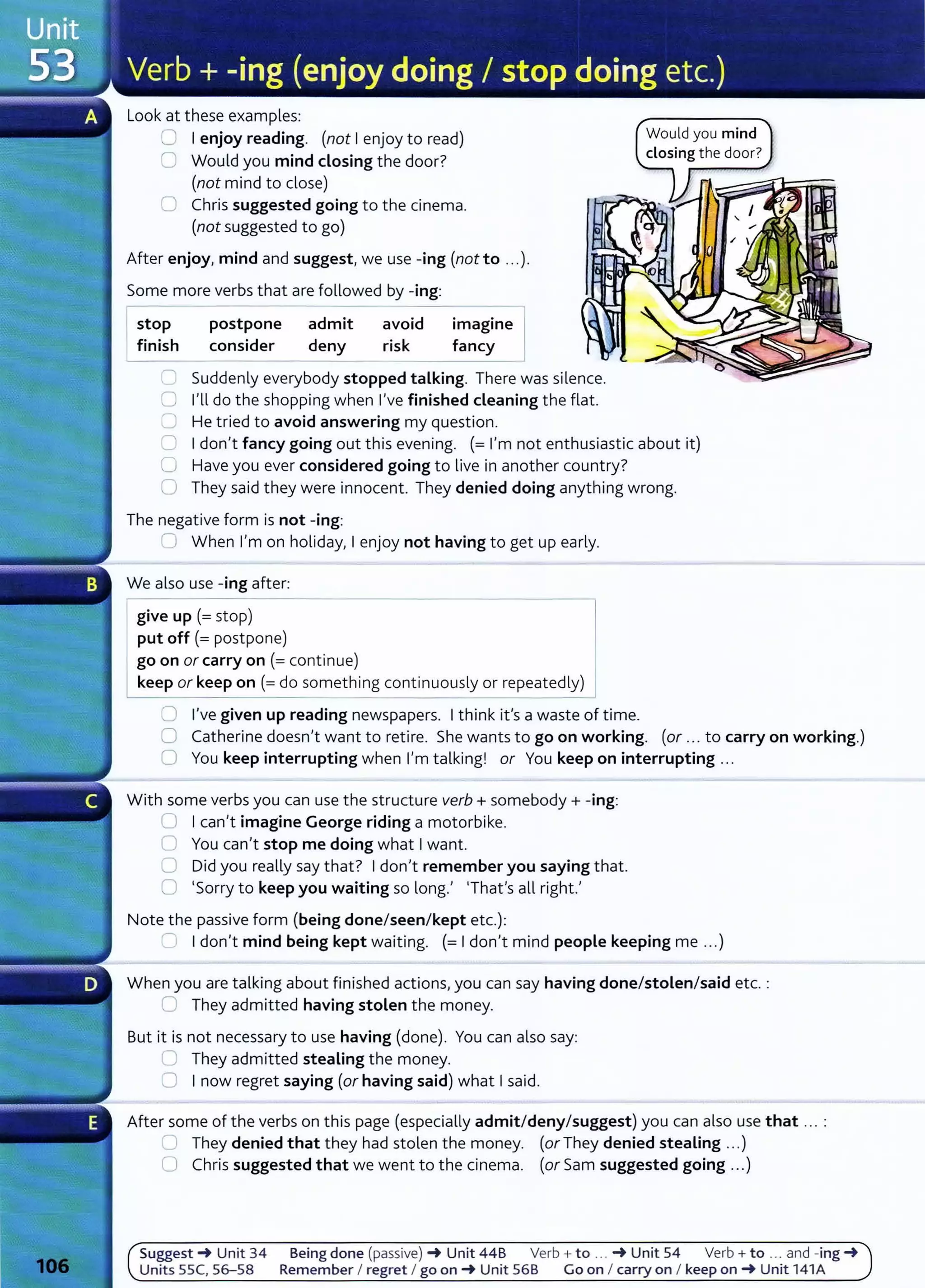
53 Verb+ -ing (enjoy doing I stop doing etc.)
54 Verb+ to ... (decide to ... I forget to ... etc.)
55 Verb(+ object)+ to ... (I want you to ... etc.)
56 Verb+ -ing or to ... 1 (remember/regret etc.)
57 Verb+ -ing or to ... 2 (try/need/help)
58 Verb+ -ing or to ... 3 (Like I would Like etc.)
59 Prefer and would rather
60 Preposition (in/for/about etc.)+ -ing
61 Be/get used to something (I'm used to ...)
62 Verb + preposition + -ing (succeed in -ing I accuse somebody of -ing etc.)
63 Expressions+ -ing
64 To ... , for ... and so that ...
65 Adjective+ to ...
66 To ... (afraid to do) and preposition+ -ing (afraid of -ing)
67 See somebody do and see somebody doing
68 -ing clauses (Feeling tired, Iwent to bed early.)
Articlesandnouns
69 Countable and uncountable 1
70 Countable and uncountable 2
71 Countable nouns with a/an and some
72 A/an and the
73 The 1
74 The 2 (school I the school etc.)
75 The 3 (children I the children)
76 The 4 (the giraffe I the telephone I the piano etc., the + adjective)
77 Names with and without the 1
78 Names with and without the 2
IF YOU ARE NOT SURE WH ICH UNITS YOU NEED TO STUDY, USE TH E STUDY GUIDE ON PAGE 326.
79 Singular and plural
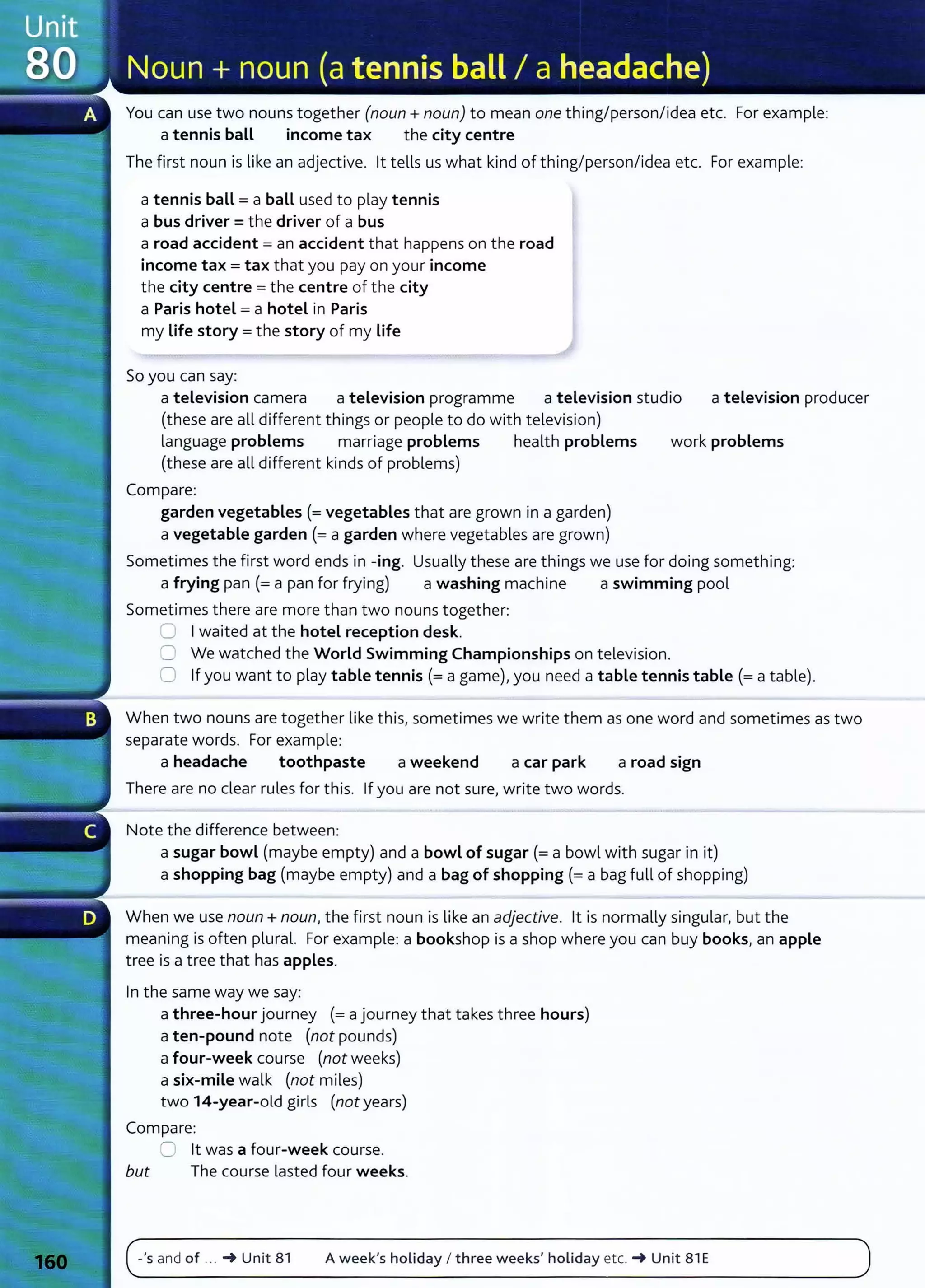
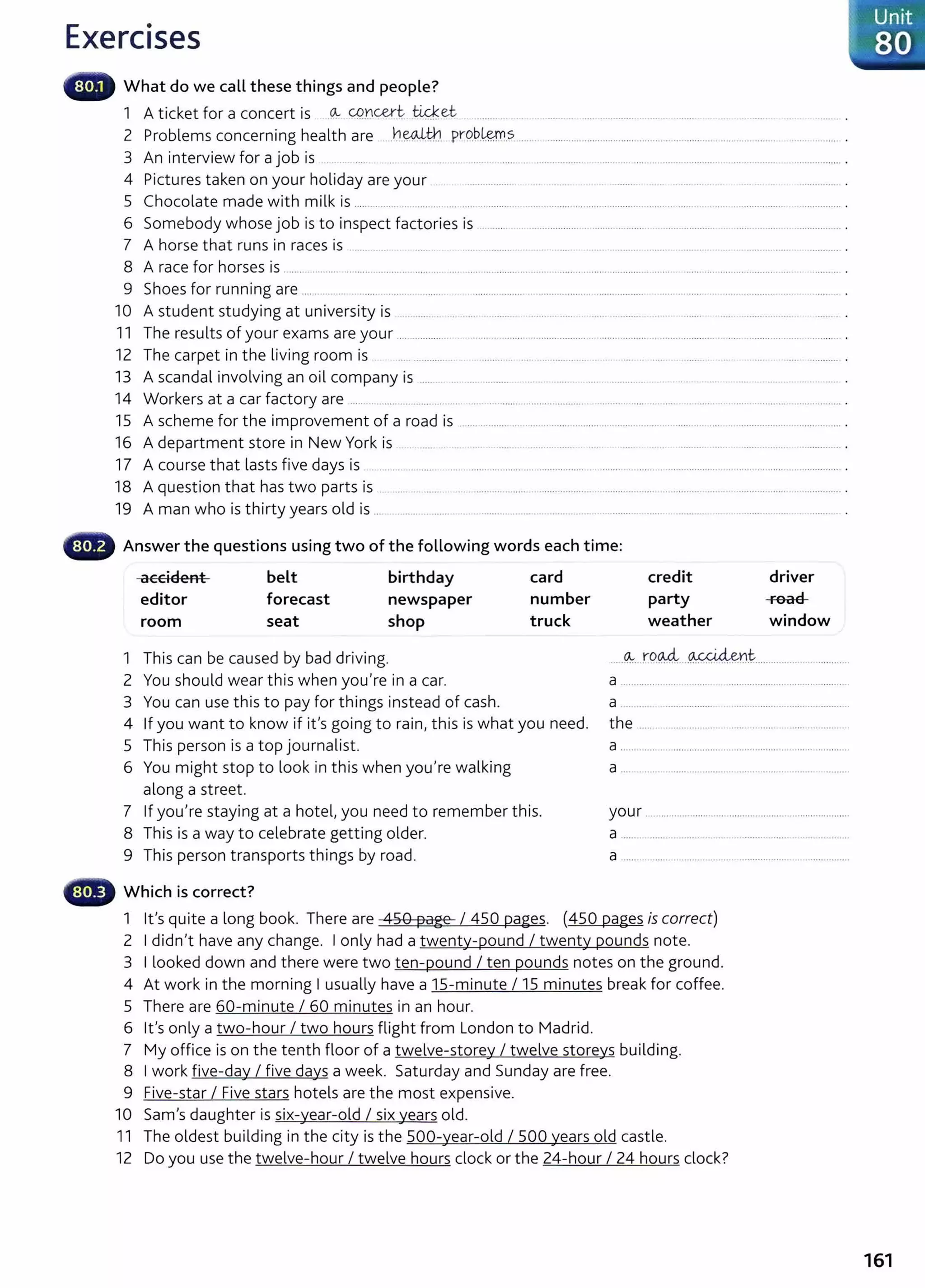
80 Noun+ noun (a tennis ball I a headache)
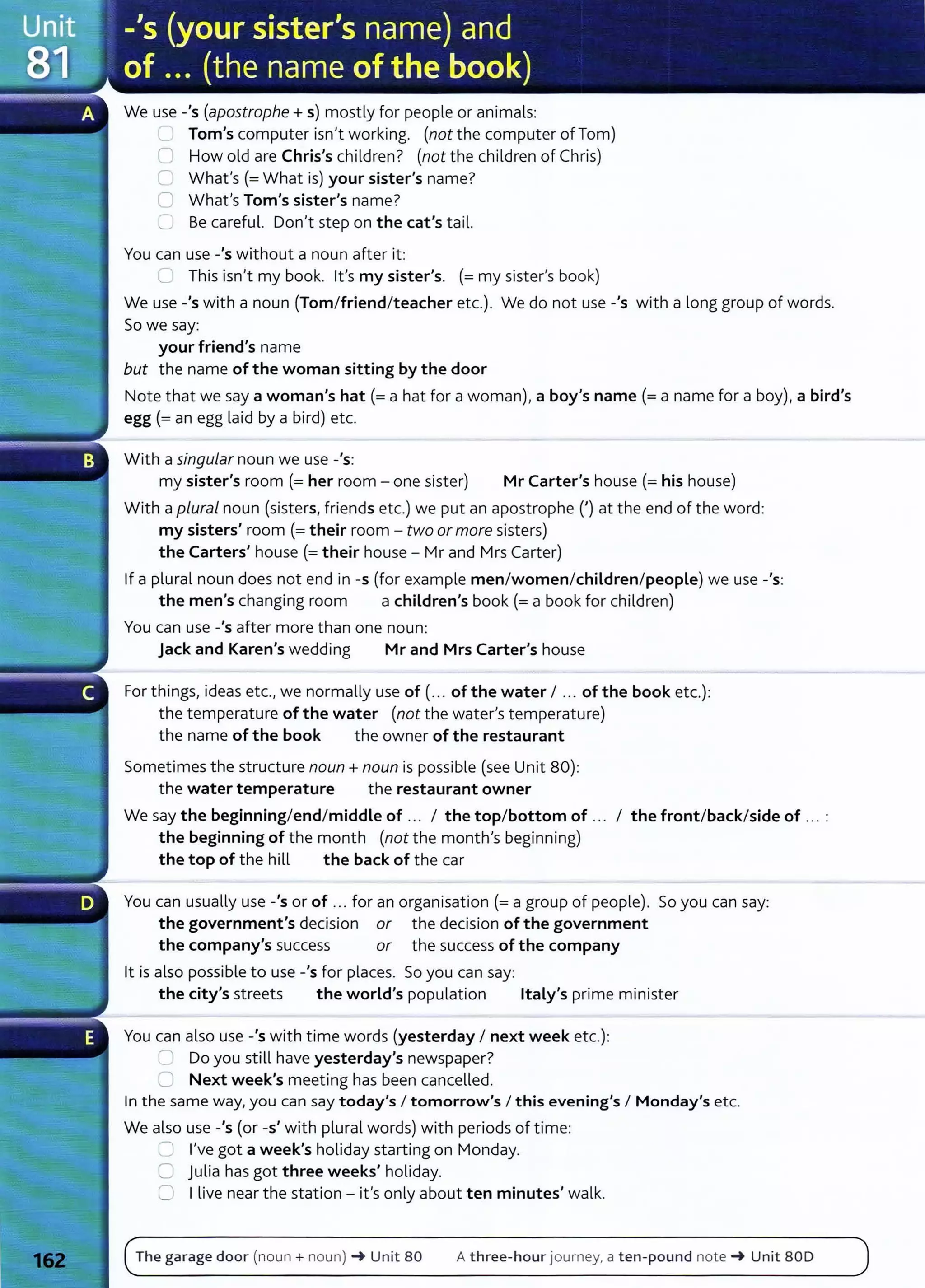
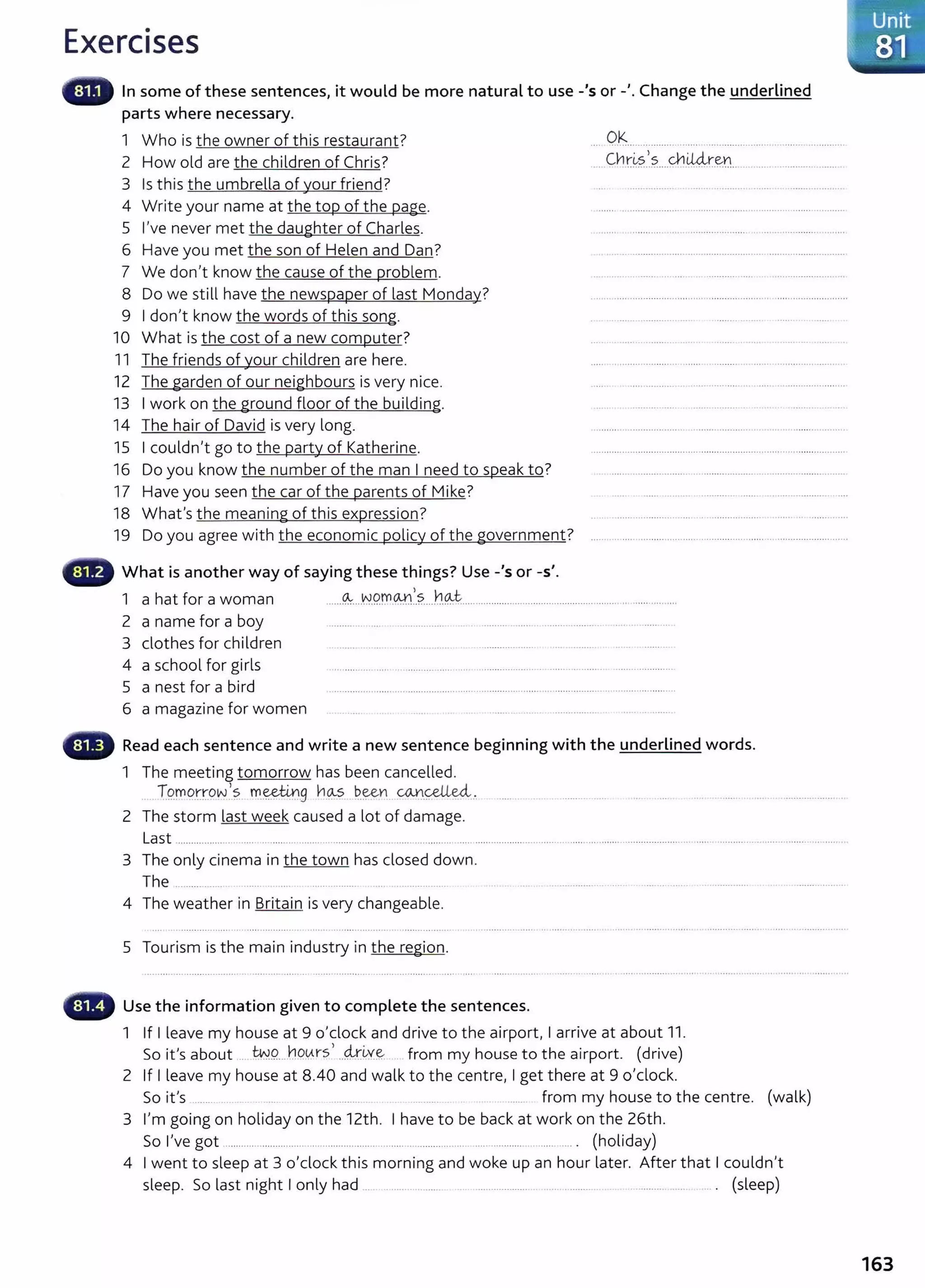
81 -'s (your sister's name) and of ... (the name of the book)
Pronouns and determiners
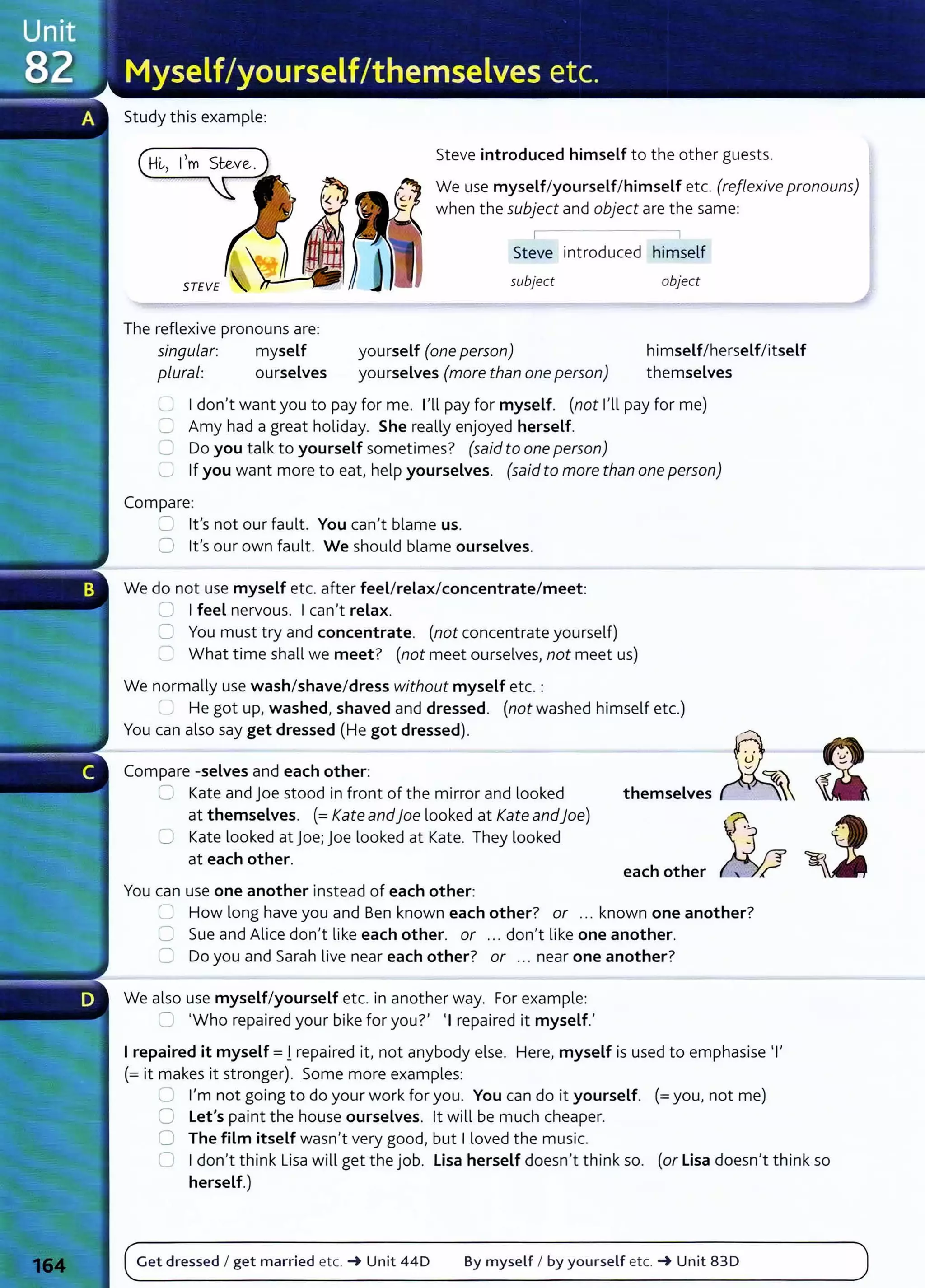
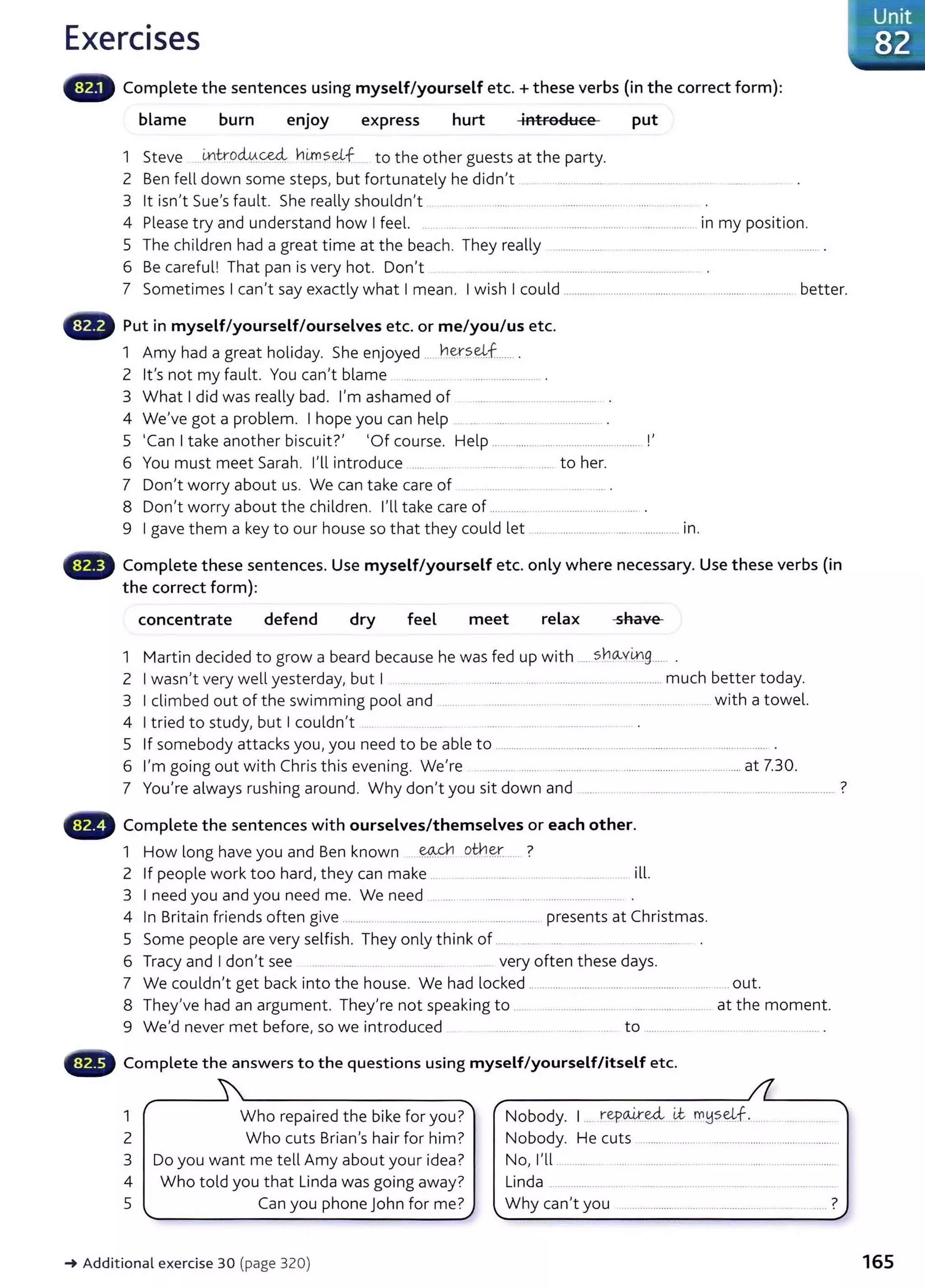
82 Myself/yourself/themselves etc.
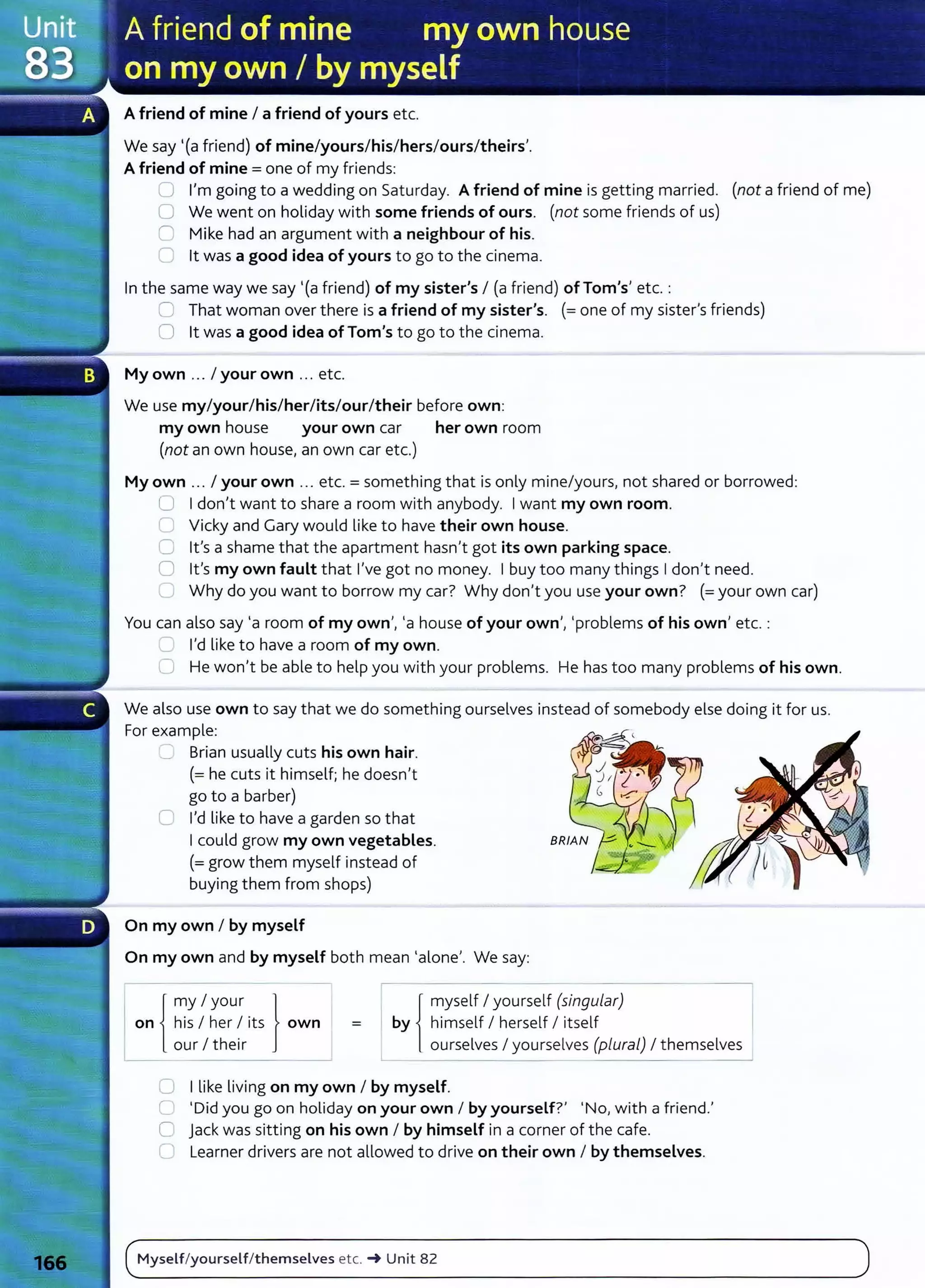
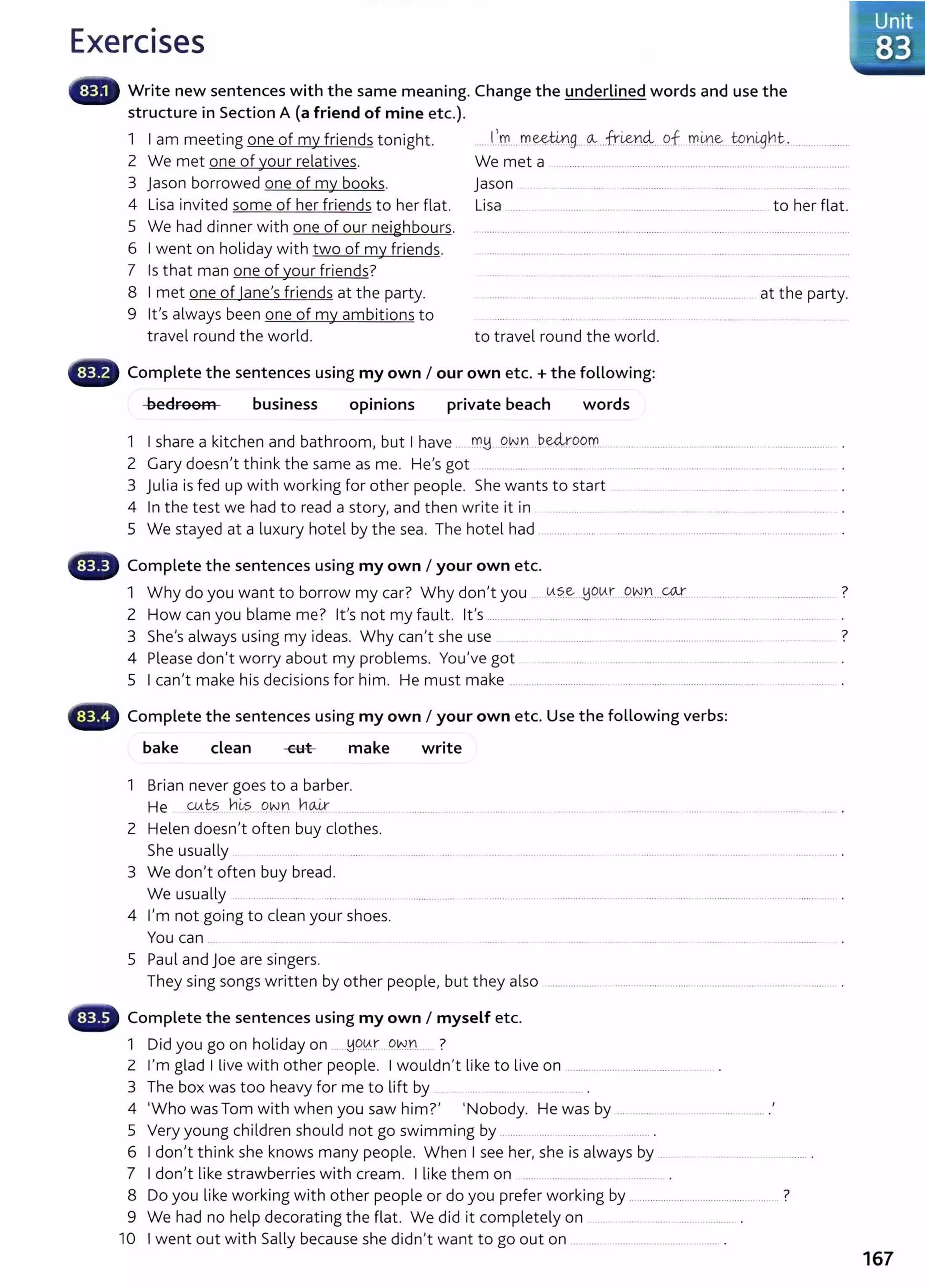
83 A friend of mine My own house On my own I by myself
84 There ... and it ...
85 Some and any
86 No/none/any Nothing/nobody etc.
87 Much, many, Little, few, a Lot, plenty
88 All I all of most I most of no I none of etc.
89 Both I both of neither I neither of either I either of
90 All, every and whole
91 Each and every
Relative clauses
92 Relative clauses 1: clauses with who/that/which
93 Relative clauses 2: clauses with and without who/that/which
94 Relative clauses 3: whose/whom/where
95 Relative clauses 4: extra information clauses (1)
96 Relative clauses 5: extra information clauses (2)
97 -ing and -ed clauses (the woman talking to Tom, the boy injured in the accident)
Adjectives andadverbs
98 Adjectives ending in -ing and -ed (boring/bored etc.)
99 Adjectives: a nice new house, you look tired
100 Adjectives and adverbs 1 (quick/quickly)
101 Adjectives and adverbs 2 (well/fast/Late, hard/ hardly)
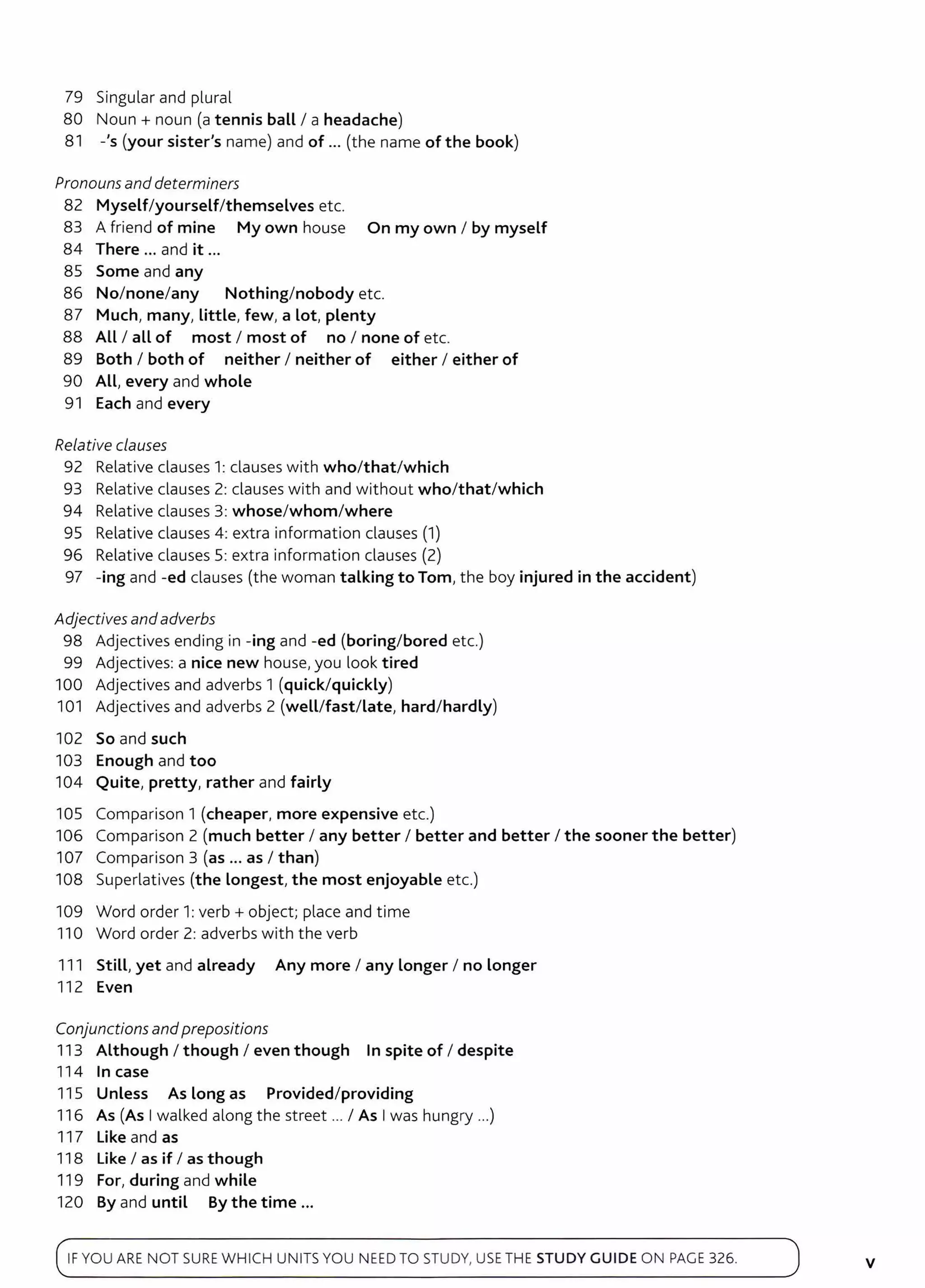
102 So and such
103 Enough and too
104 Quite, pretty, rather and fairly
105 Comparison 1 (cheaper, more expensive etc.)
106 Comparison 2 (much better I any better I better and better I the sooner the better)
107 Comparison 3 (as ... as I than)
108 Superlatives (the Longest, the most enjoyable etc.)
109 Word order 1: verb+ object; place and time
110 Word order 2: adverbs with the verb
111 Still/ yet and already Any more I any Longer I no Longer
112 Even
Conjunctions andprepositions
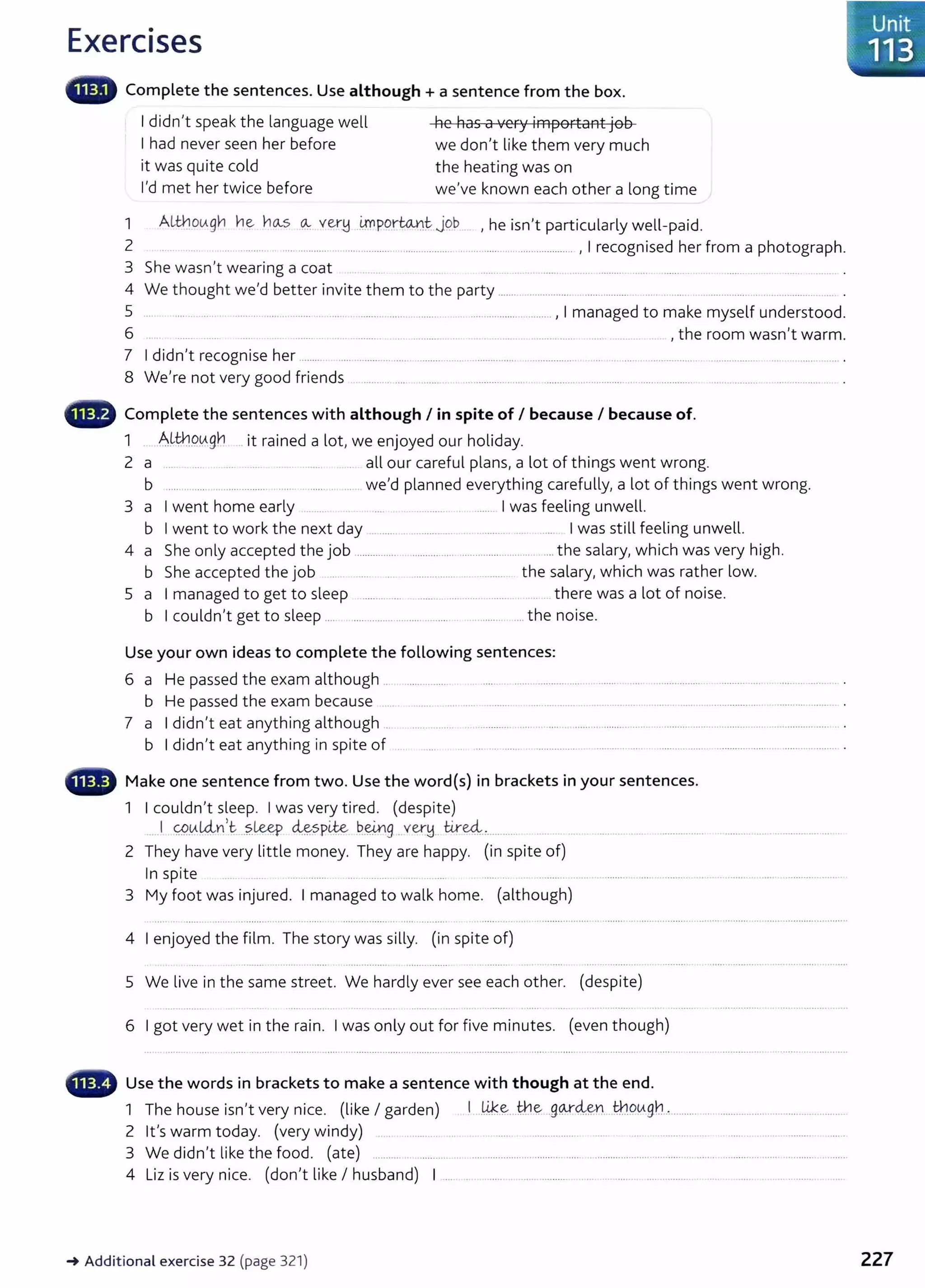
113 Although I though I even though In spite of I despite
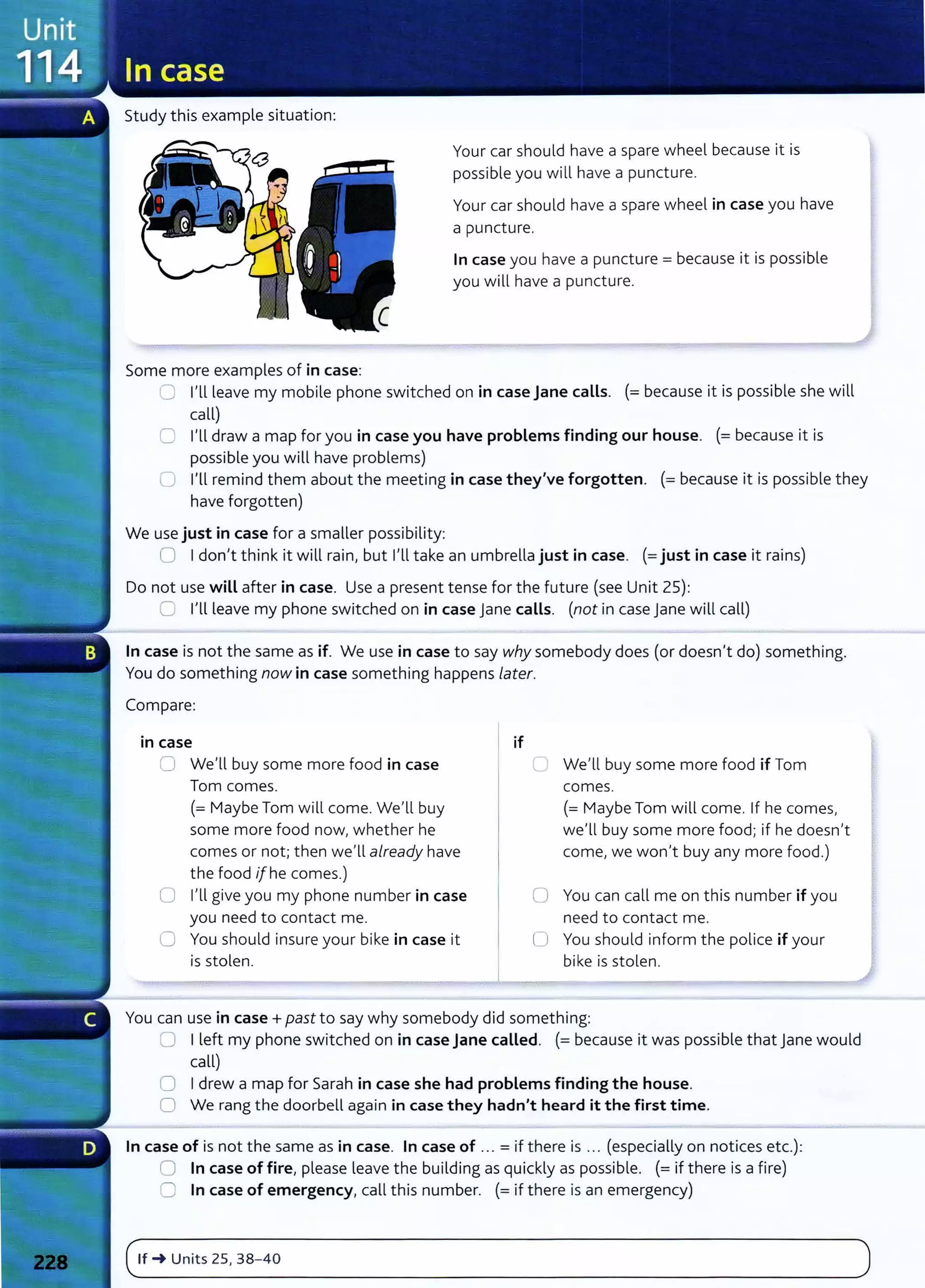
114 In case
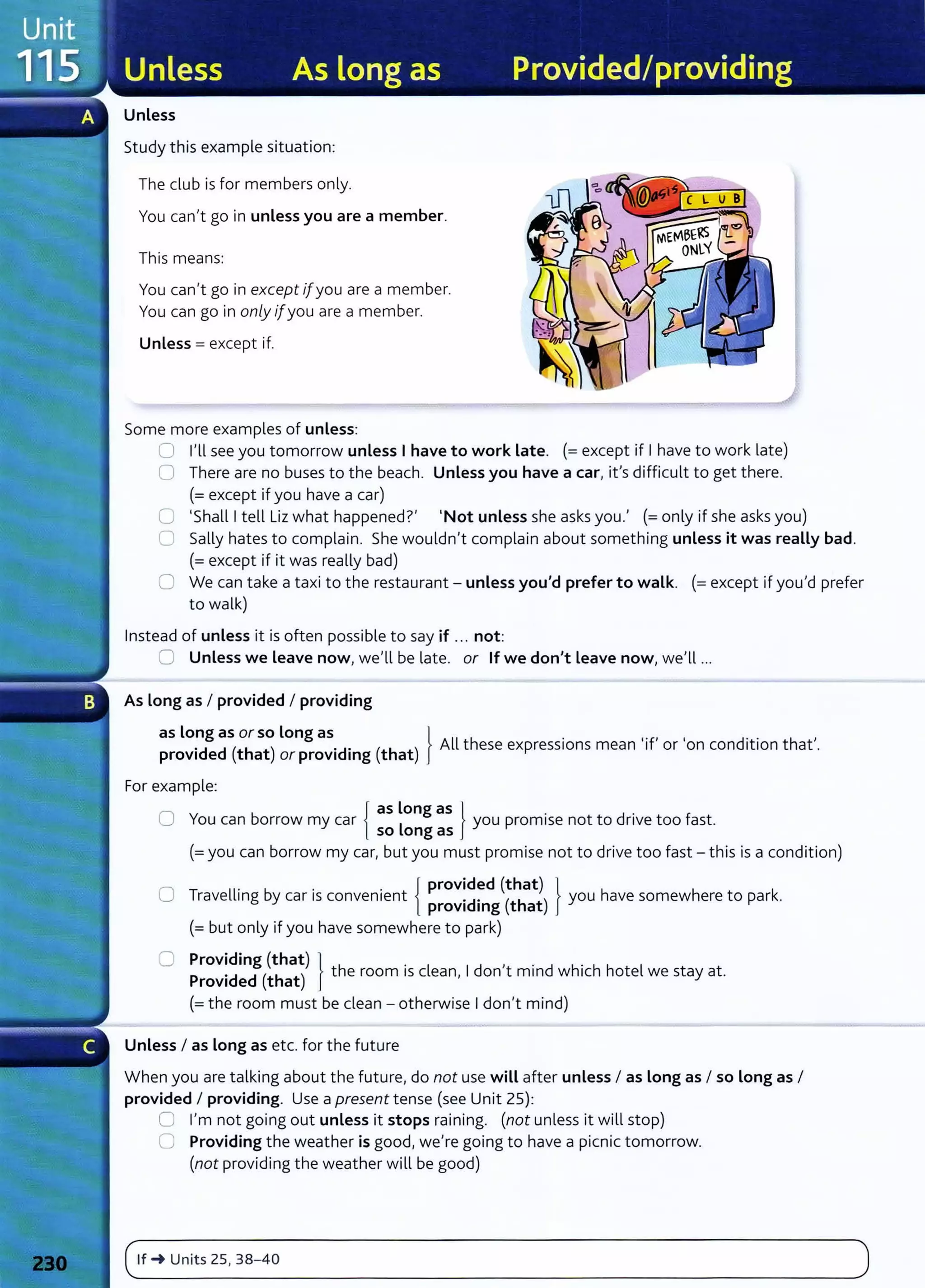
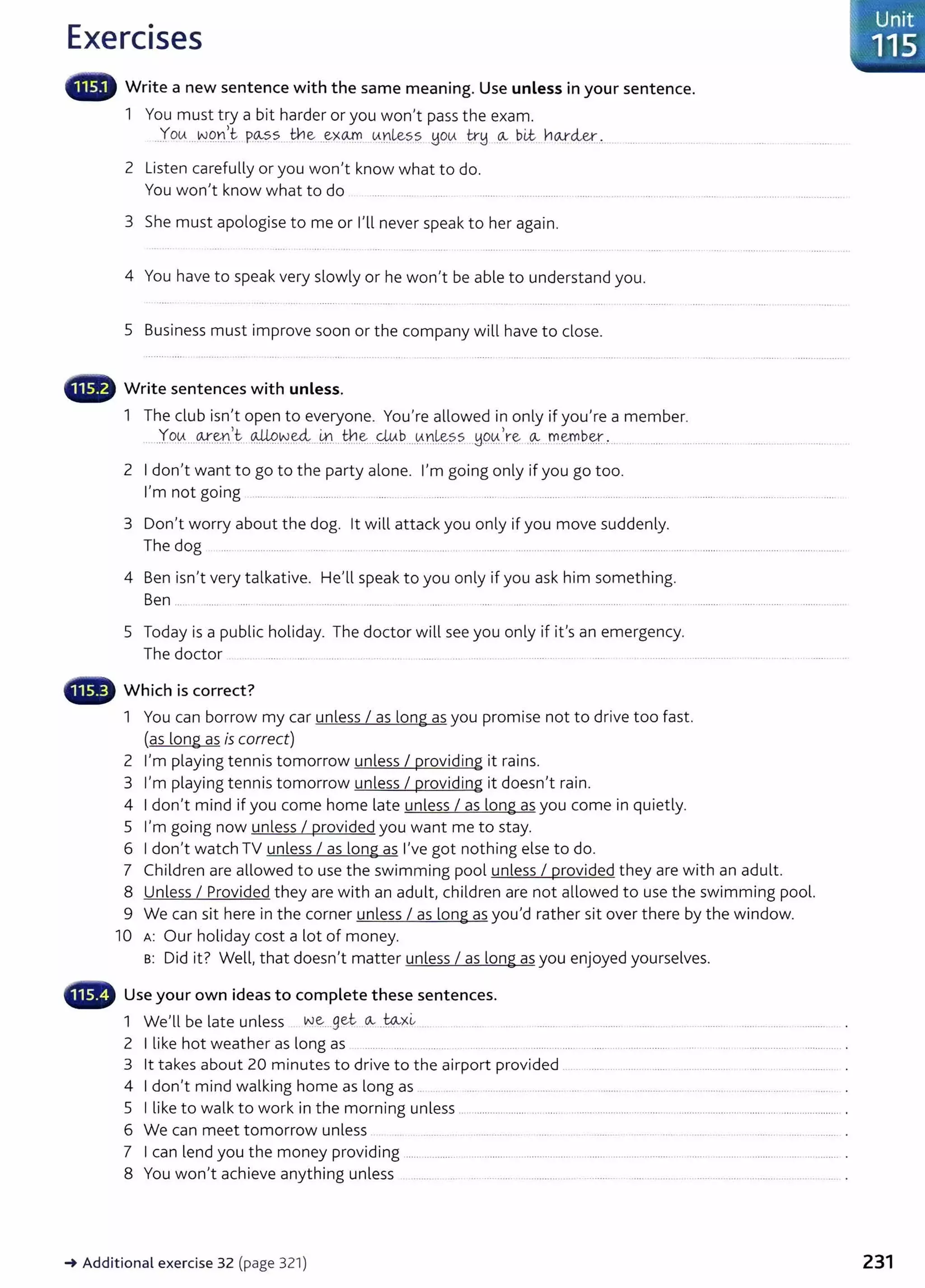
115 Unless As Long as Provided/ providing
11 6 As (As Iwalked along the street ... I As Iwas hungry ...)
117 like and as
118 Like I as if I as though
11 9 For, during and while
120 By and until By the time ...
IF YOU ARE N OT SURE WHI CH UNITS YOU NEED TO STUDY, USE THE STUDY GUIDE O N PAGE 326. V
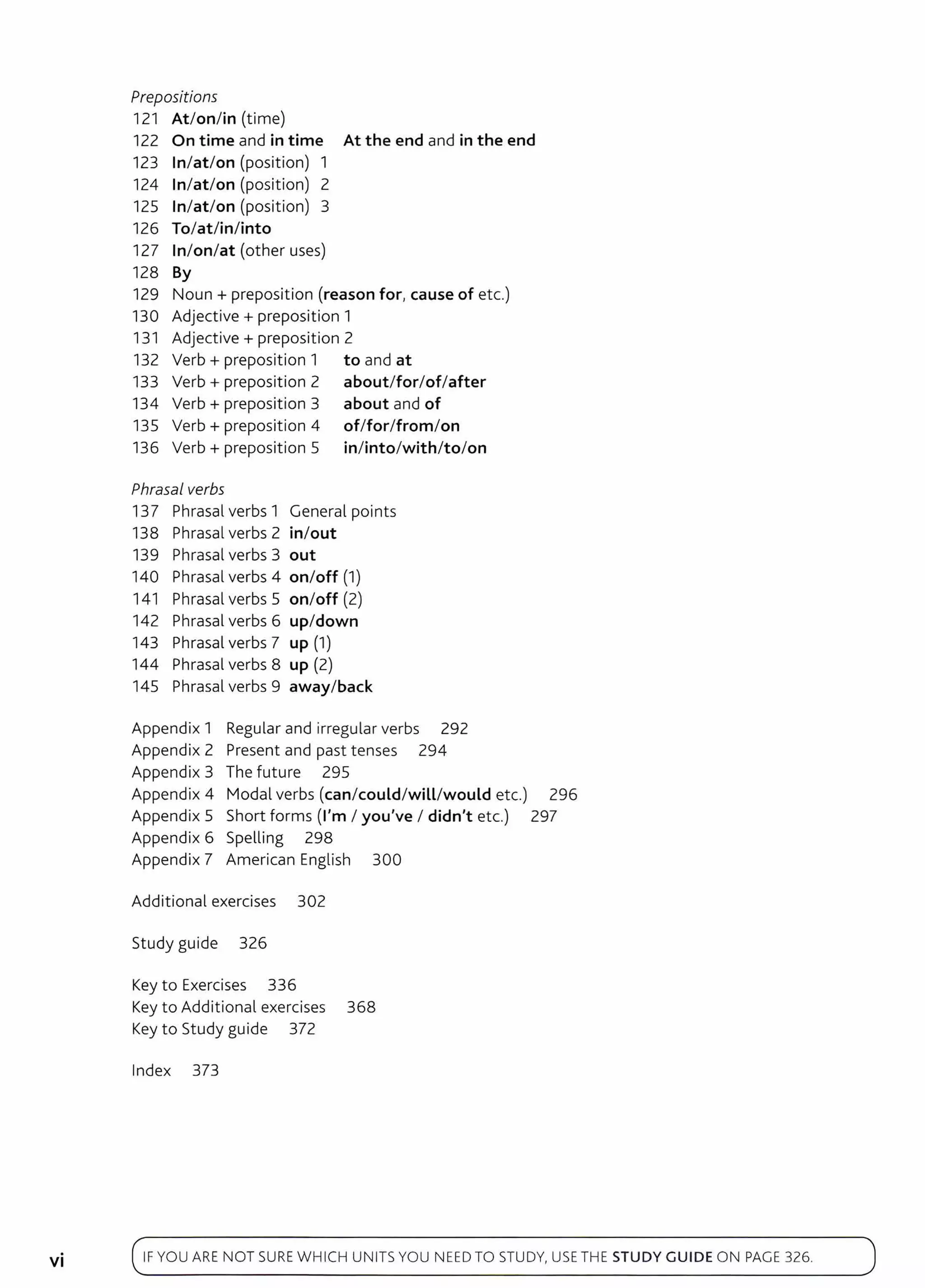
Prepositions
121 At/on/in (time)
122 On time and in time At the end and in the end
123 In/at/on (position) 1
124 In/at/on (position) 2
125 In/at/on (position) 3
126 To/at/in/into
127 In/on/at (other uses)
128 By
129 Noun+ preposition (reason for, cause of etc.)
130 Adjective+ preposition 1
131 Adjective+ preposition 2
132 Verb+ preposition 1 to and at
133 Verb+ preposition 2 about/for/of/after
134 Verb+ preposition 3 about and of
135 Verb+ preposition 4 of/for/from/on
136 Verb+ preposition 5 in/ into/with/to/on
Phrasal verbs
137 Phrasal verbs 1 General points
138 Phrasal verbs 2 in/out
139 Phrasal verbs 3 out
140 Phrasal verbs 4 on/off (1)
141 Phrasal verbs 5 on/off (2)
142 Phrasal verbs 6 up/down
143 Phrasal verbs 7 up (1)
144 Phrasal verbs 8 up (2)
145 Phrasal verbs 9 away/back
Appendix 1 Regular and irregular verbs 292
Appendix 2 Present and past tenses 294
Appendix 3 The future 295
Appendix 4 Modal verbs (can/could/will/would etc.) 296
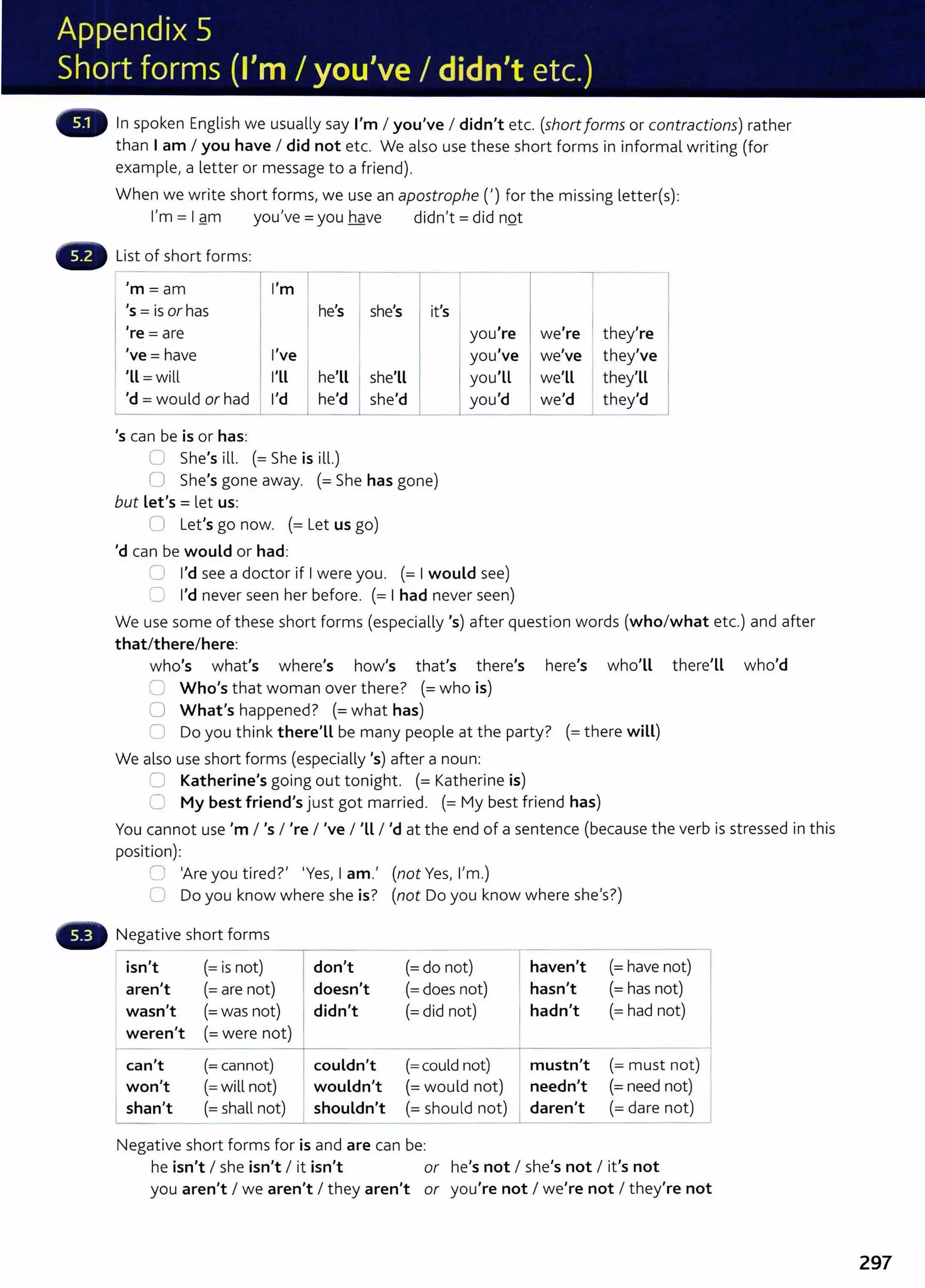
Appendix 5 Short forms (I'm I you've I didn't etc.) 297
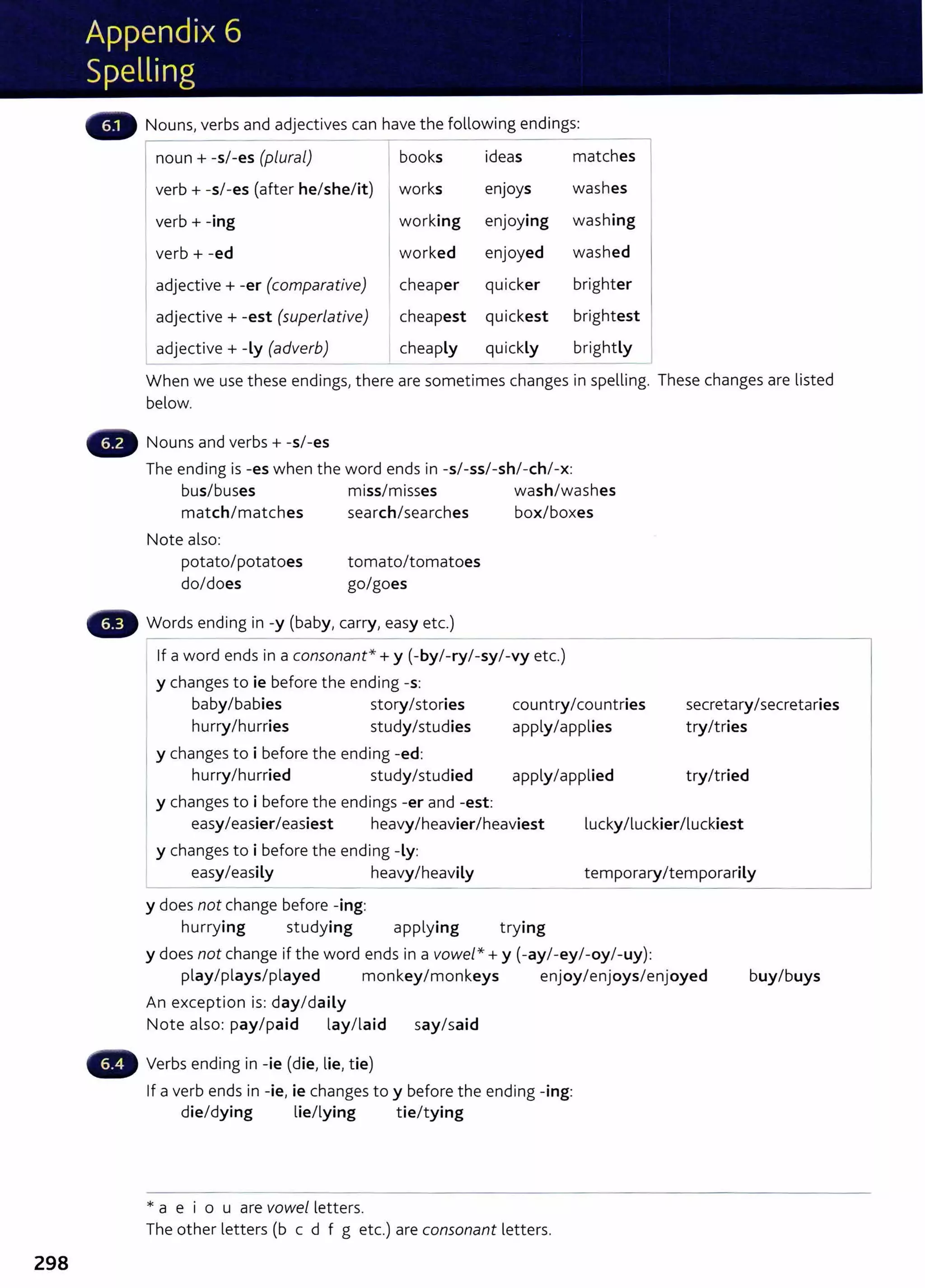
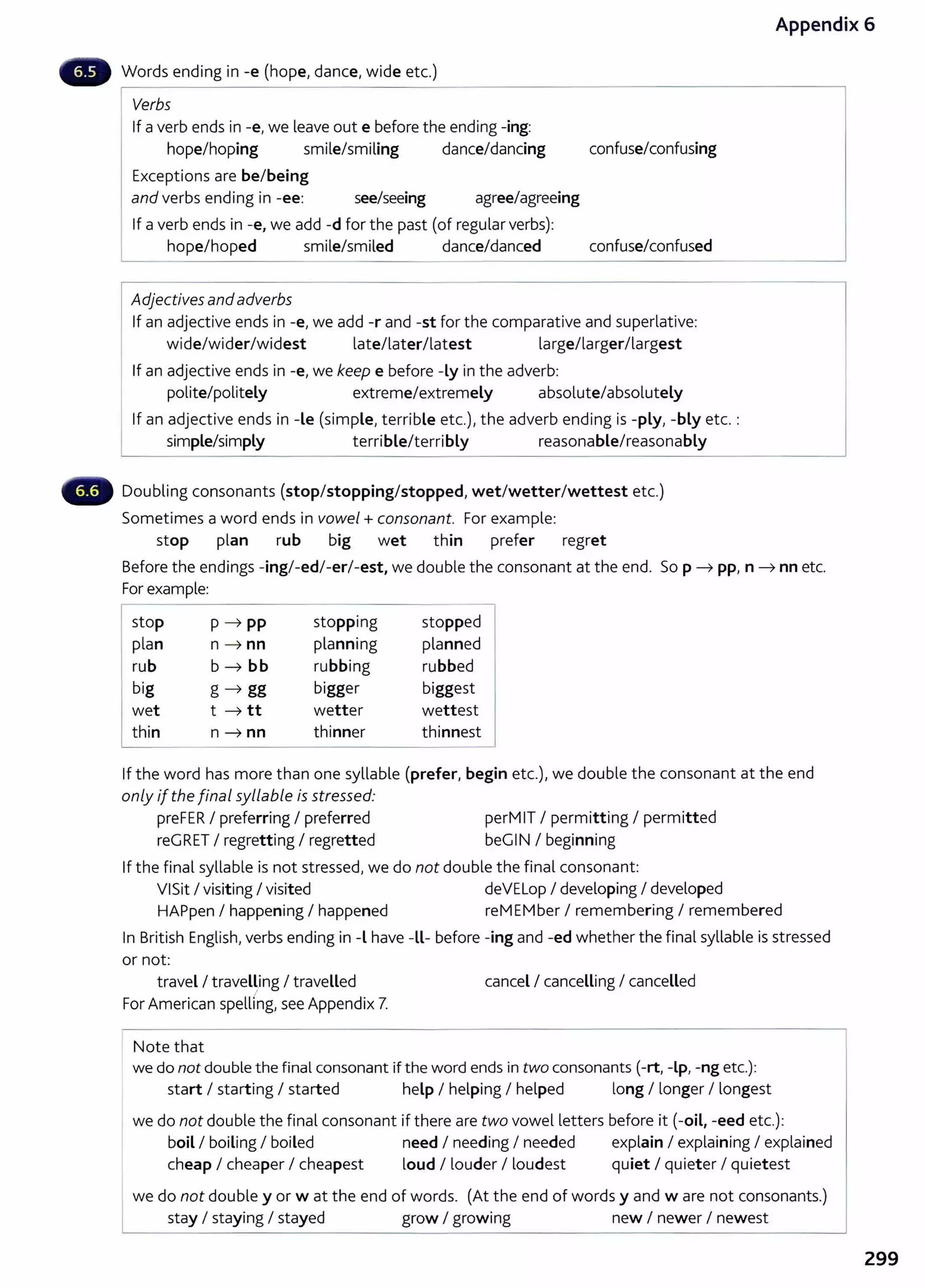
Appendix 6 Spelling 298
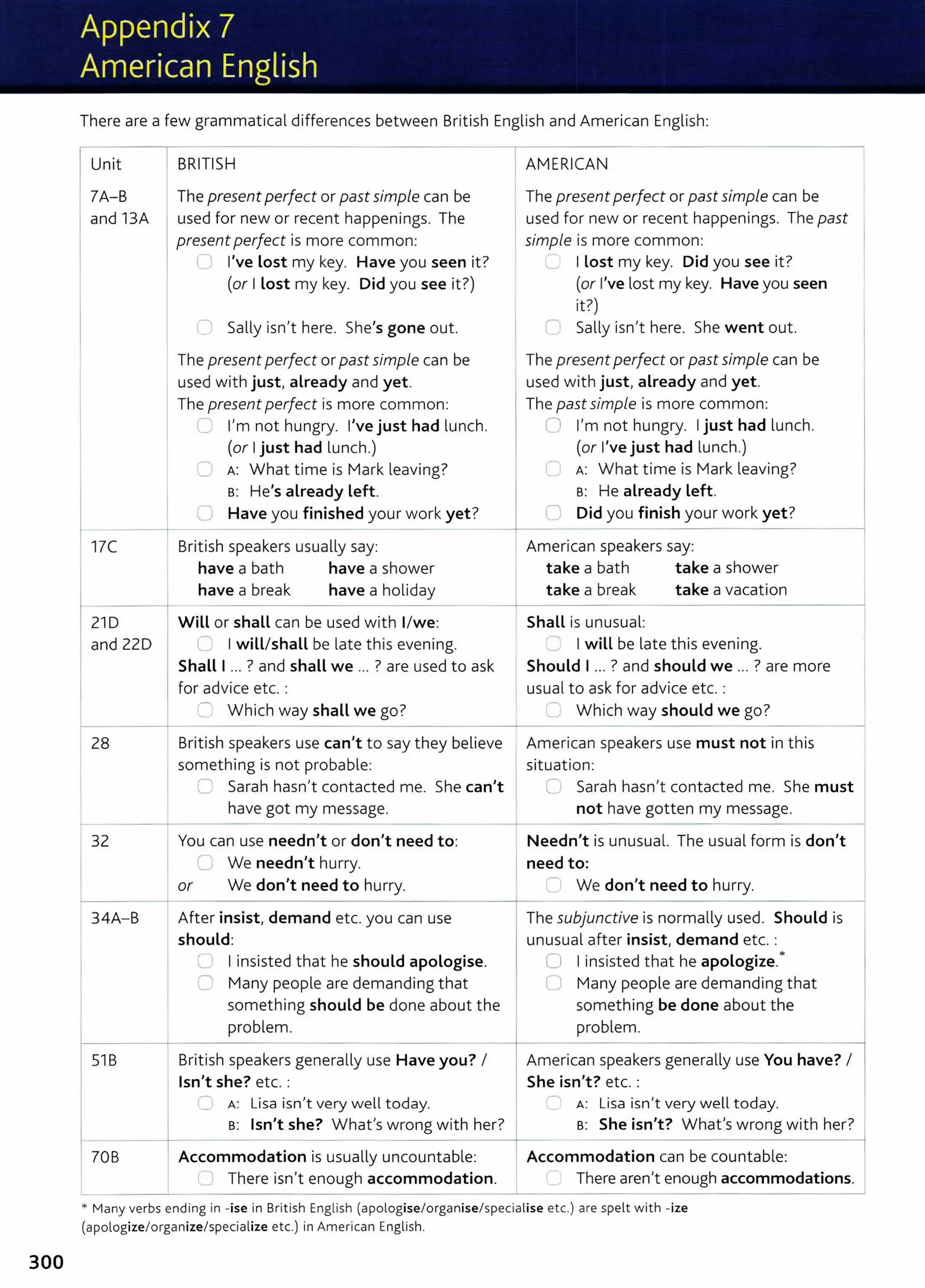
Appendix 7 American English 300
Additional exercises 302
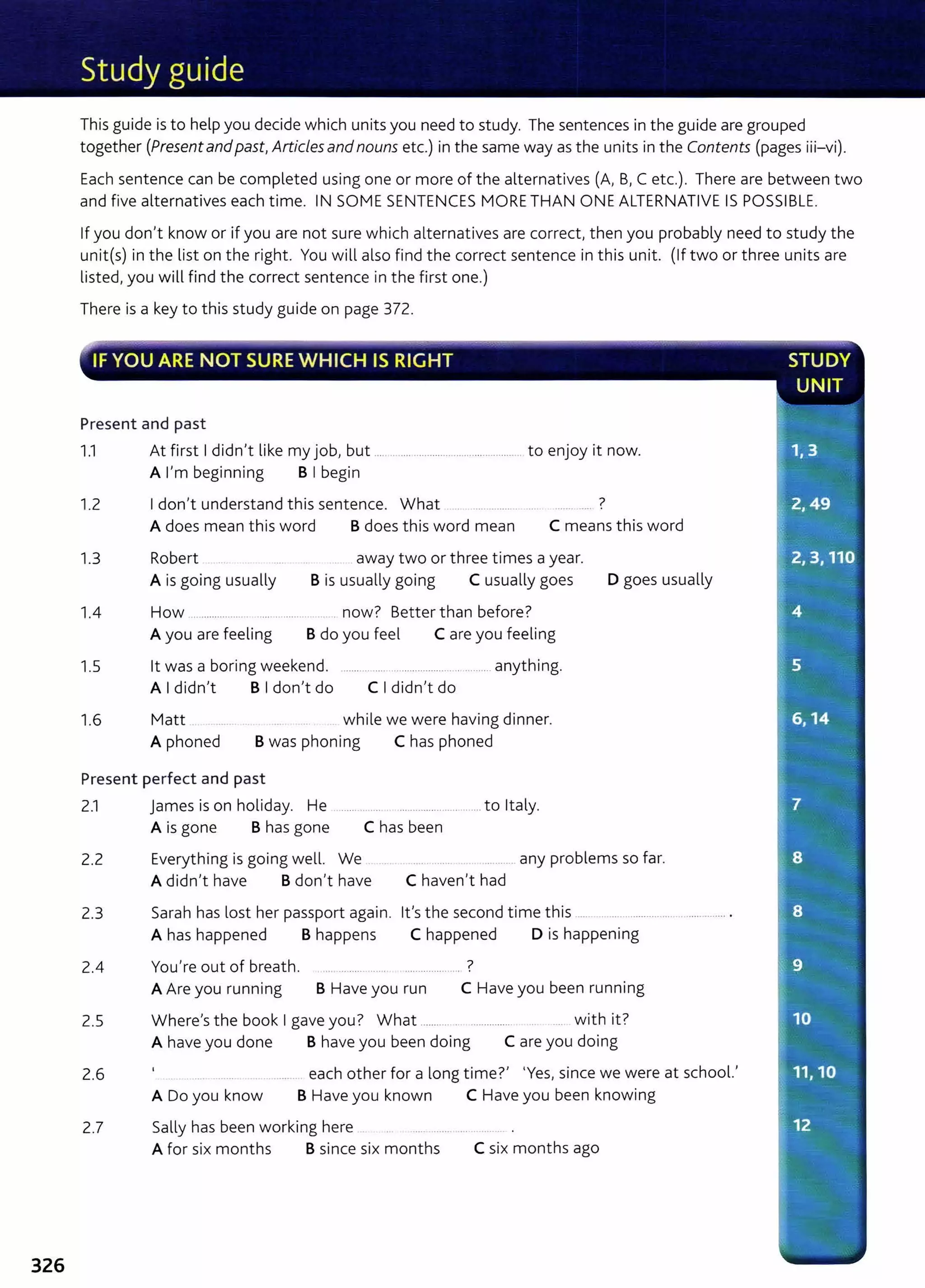
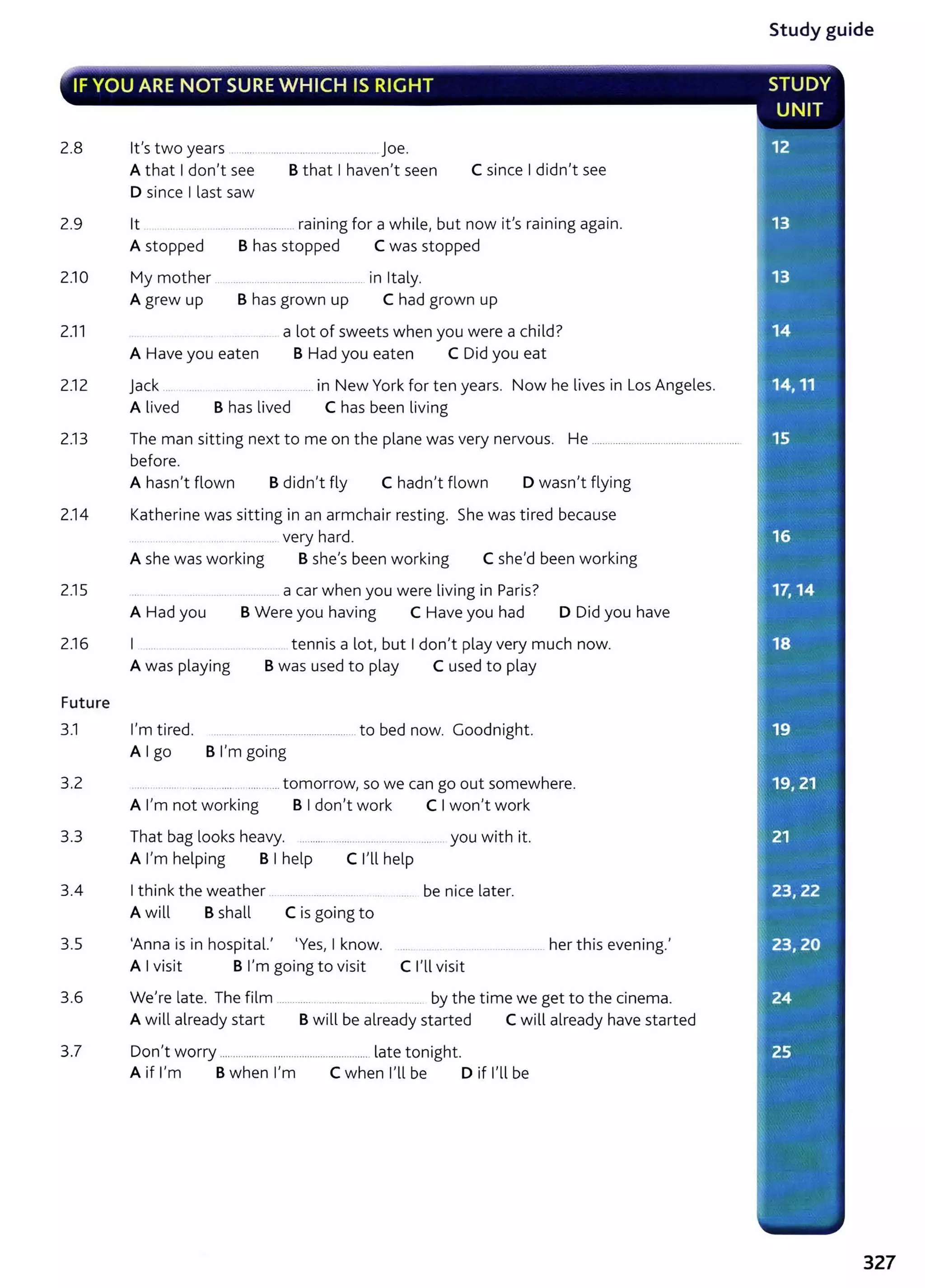
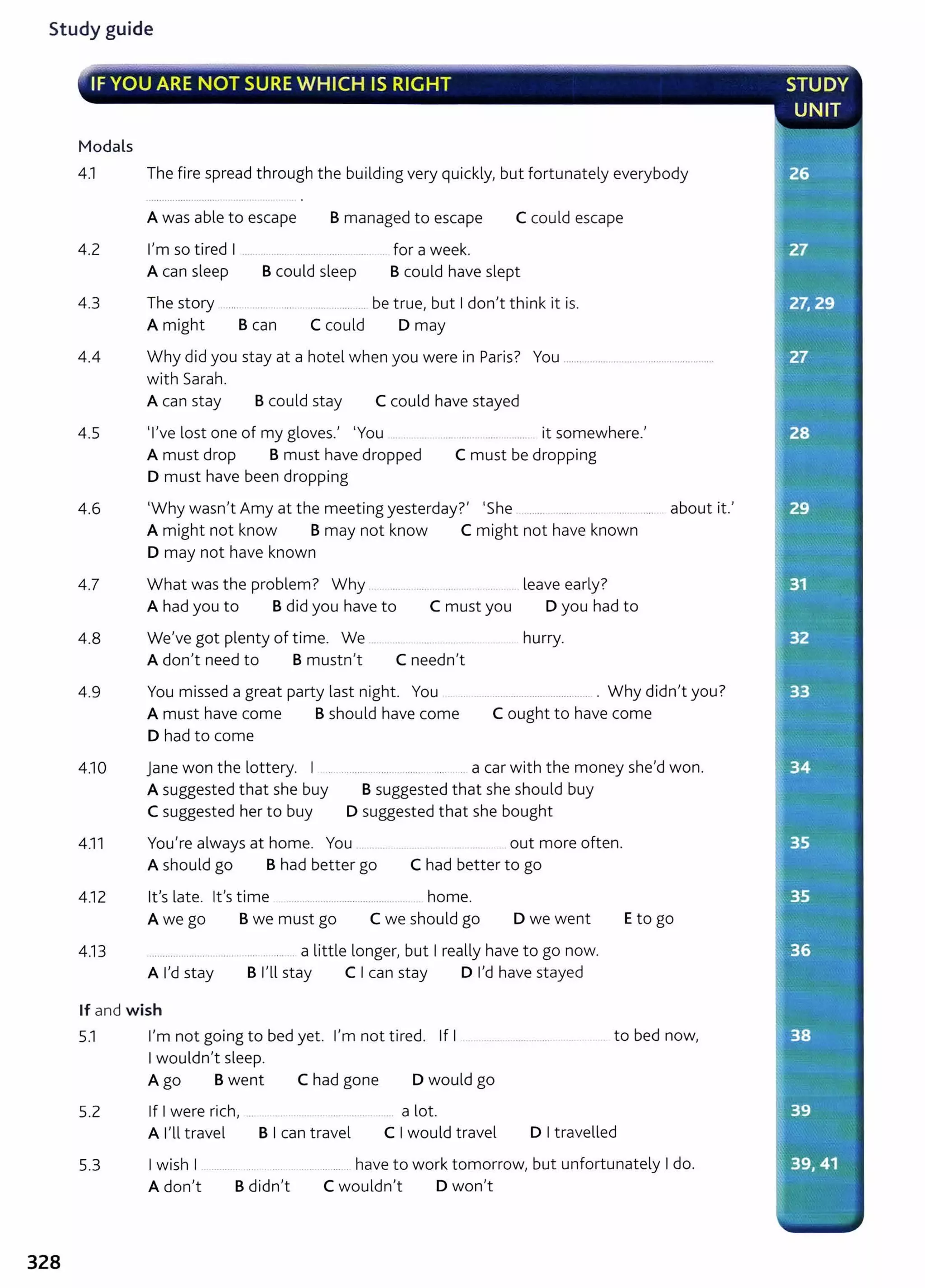
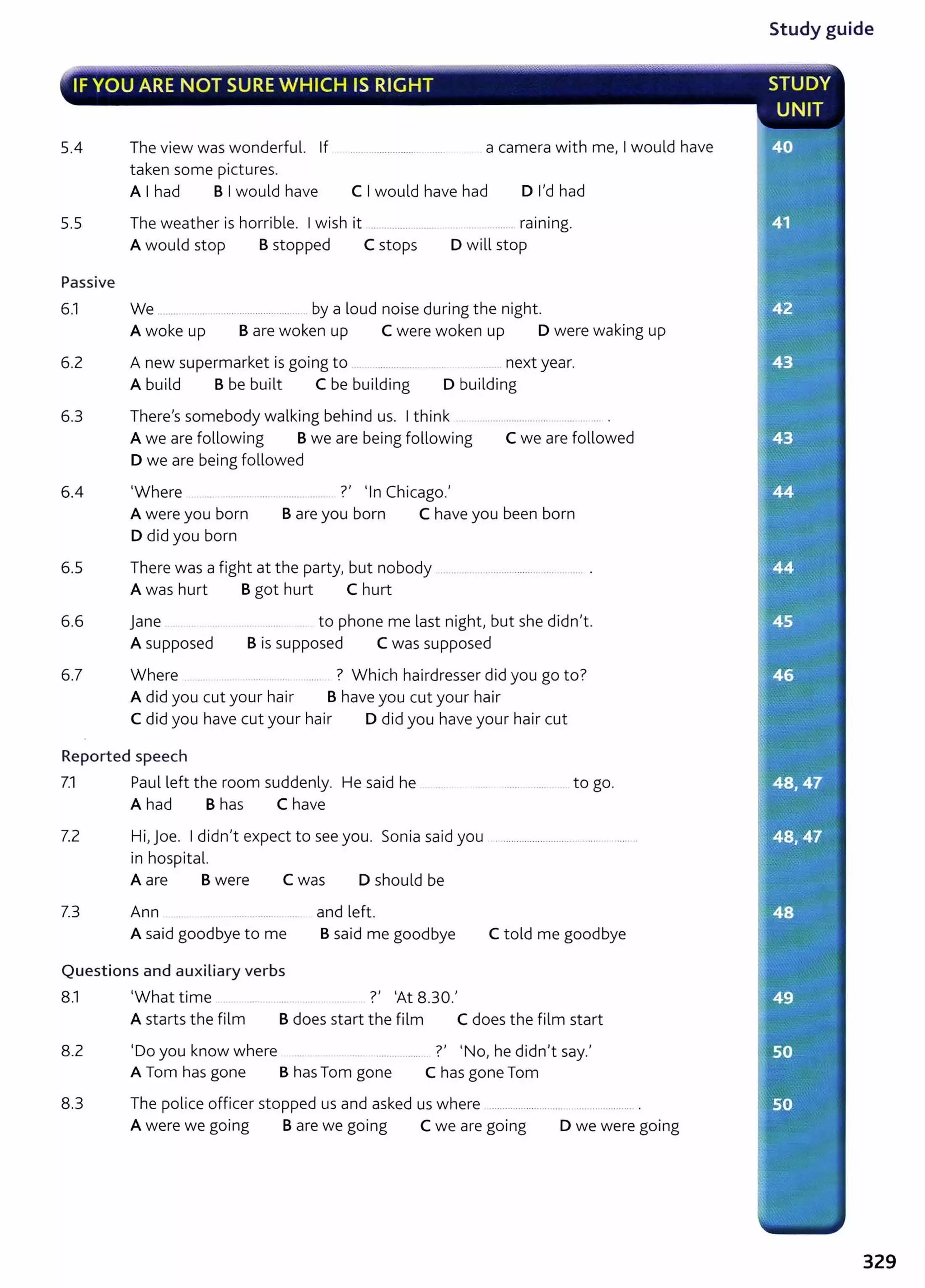
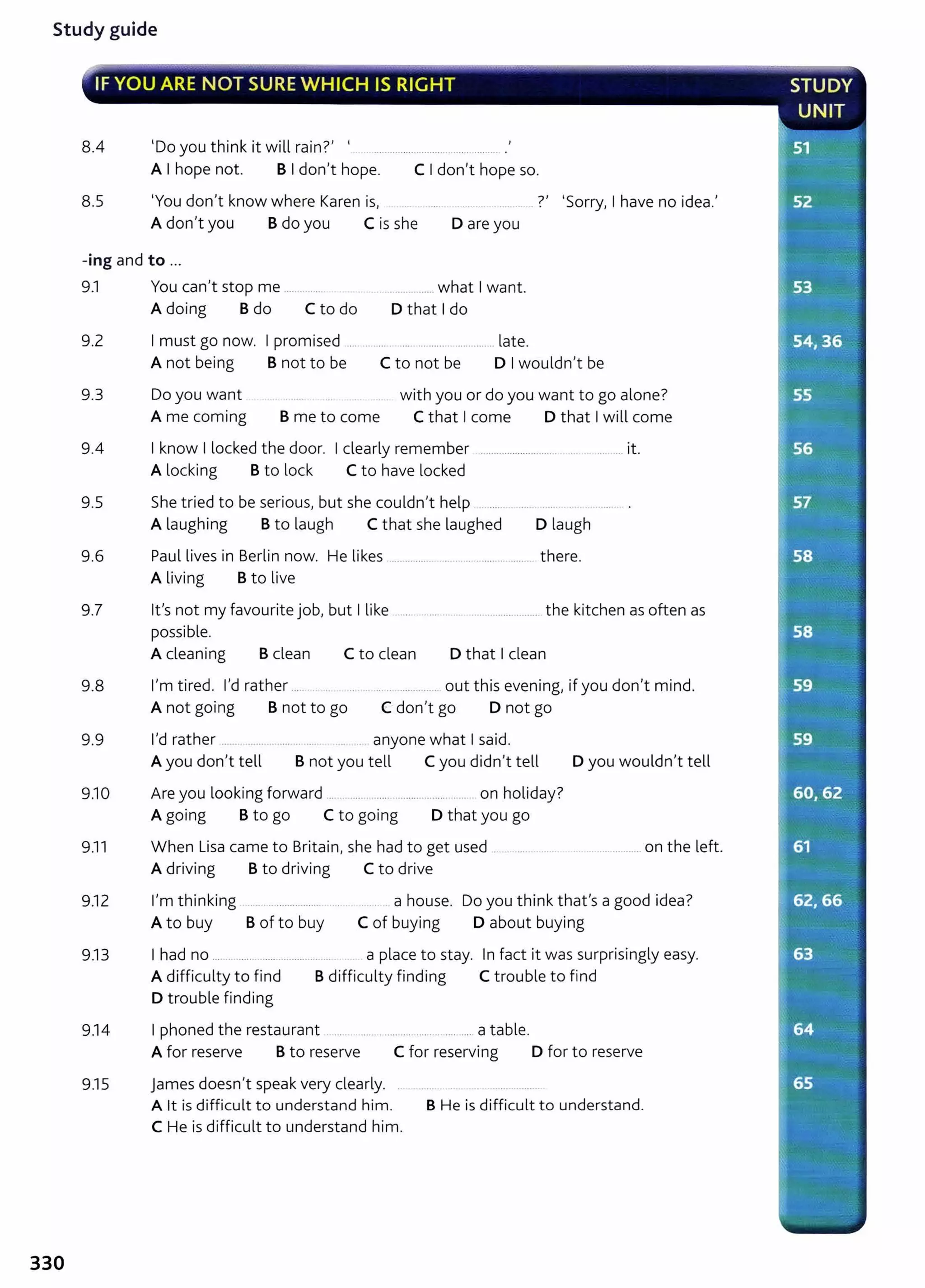
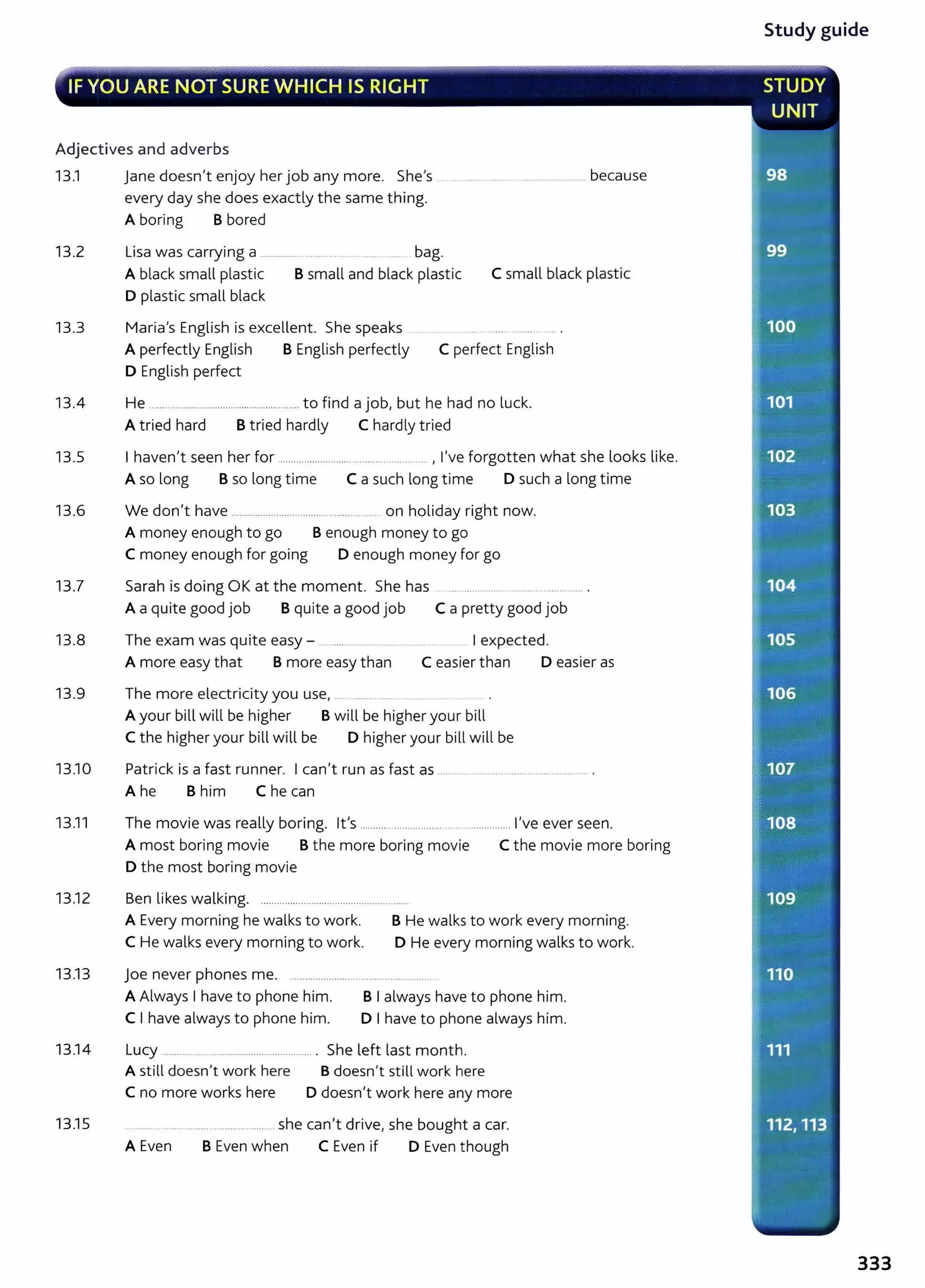
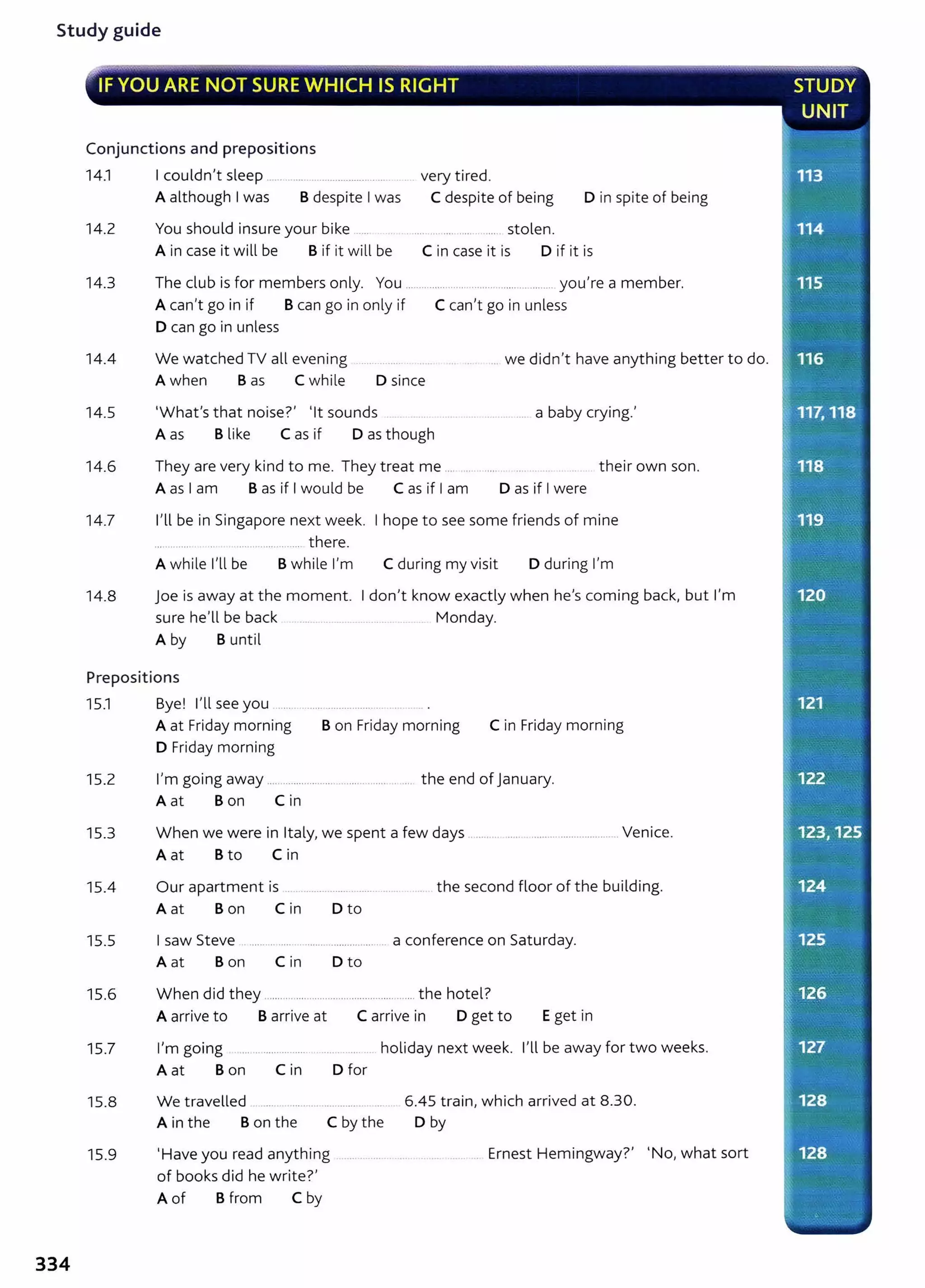
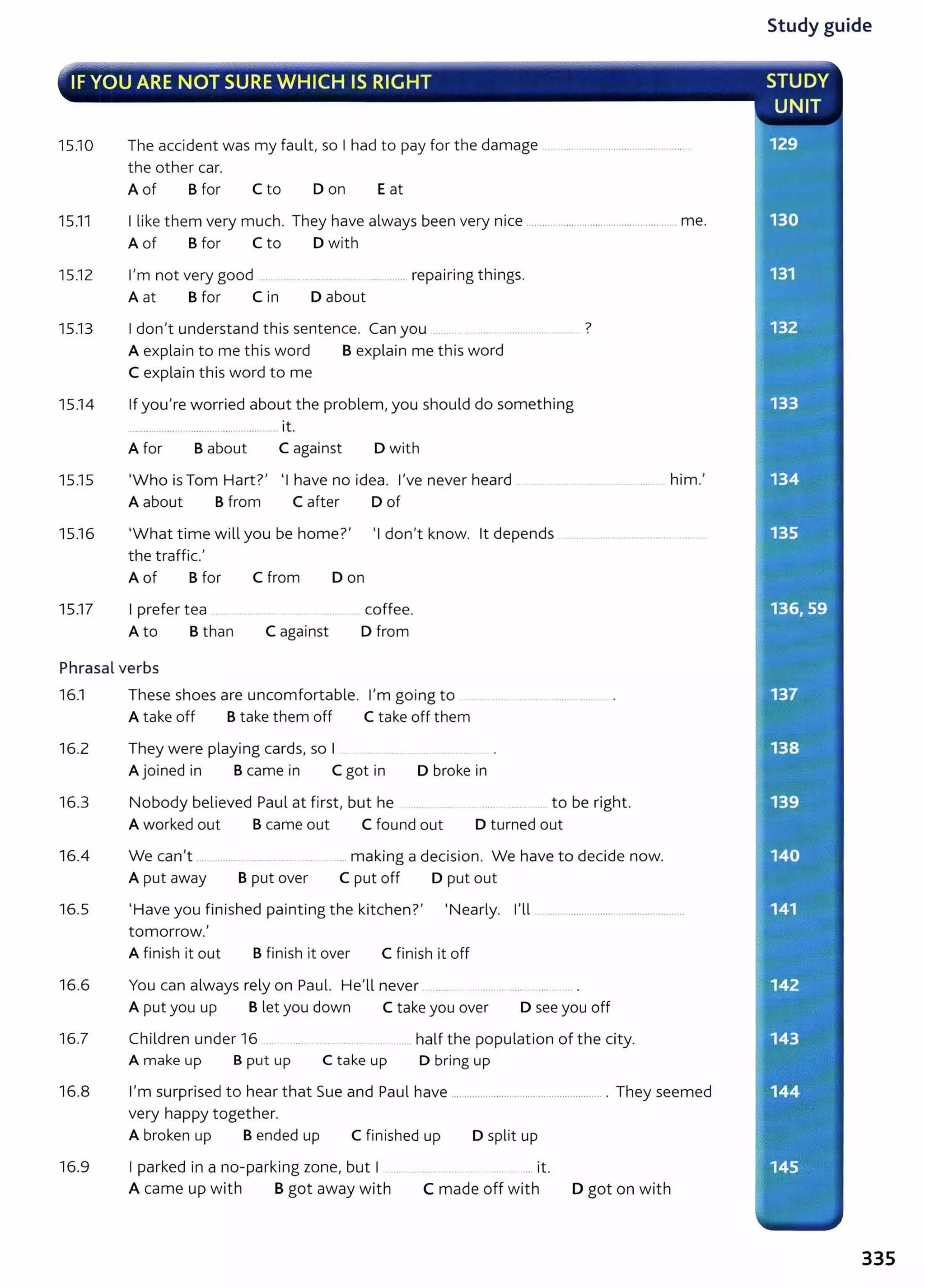
Study guide 326
Key to Exercises 336
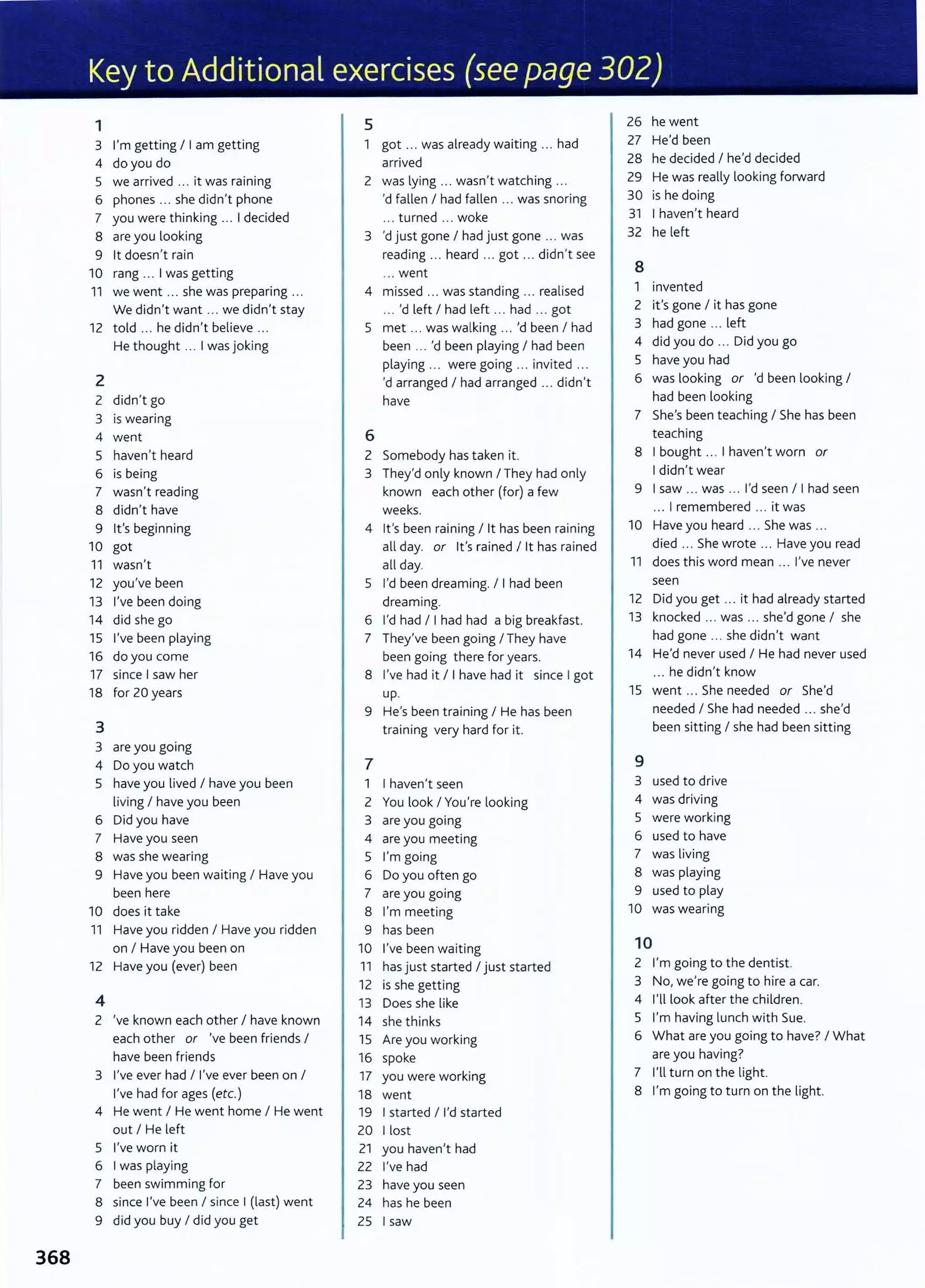
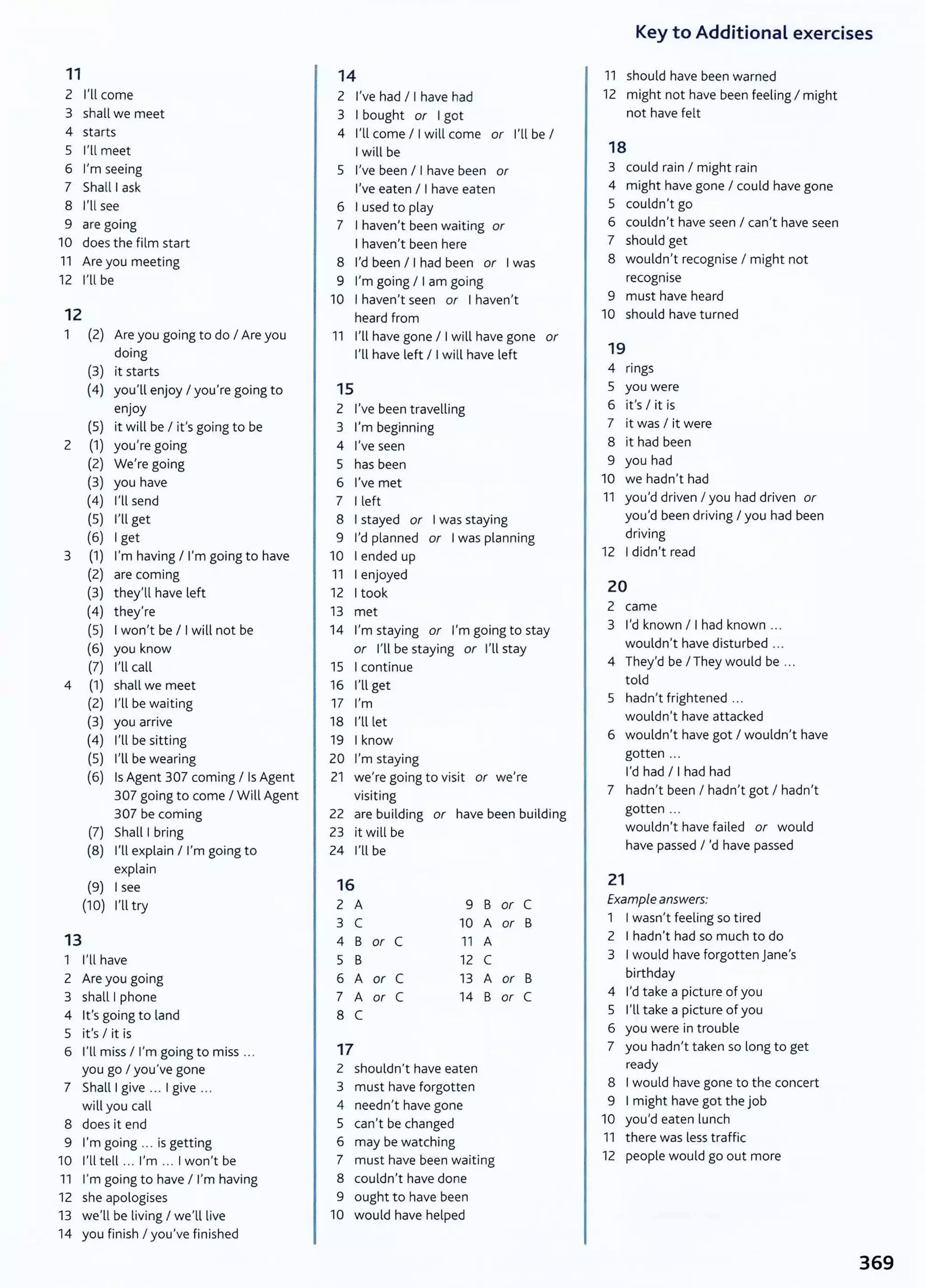
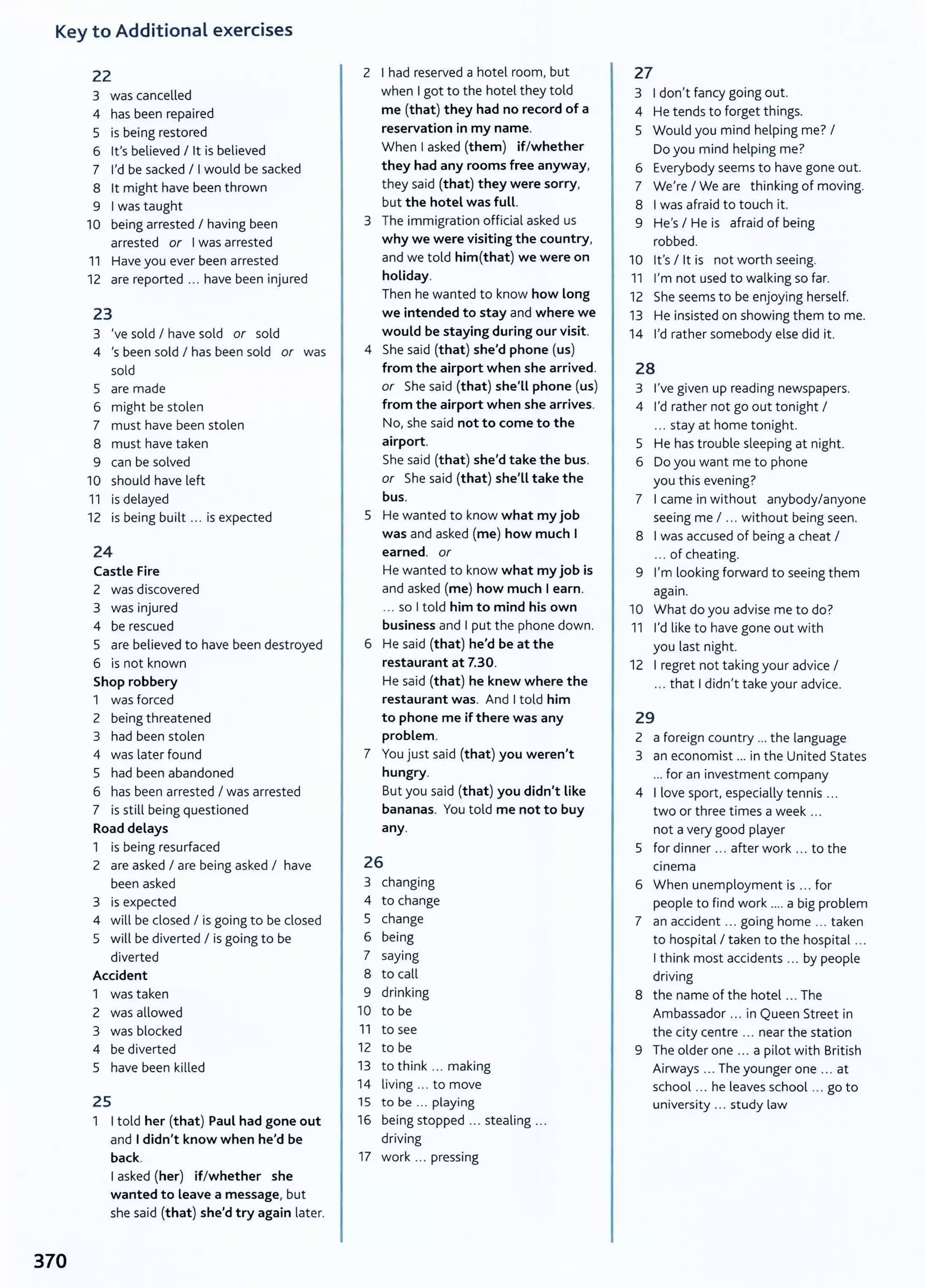
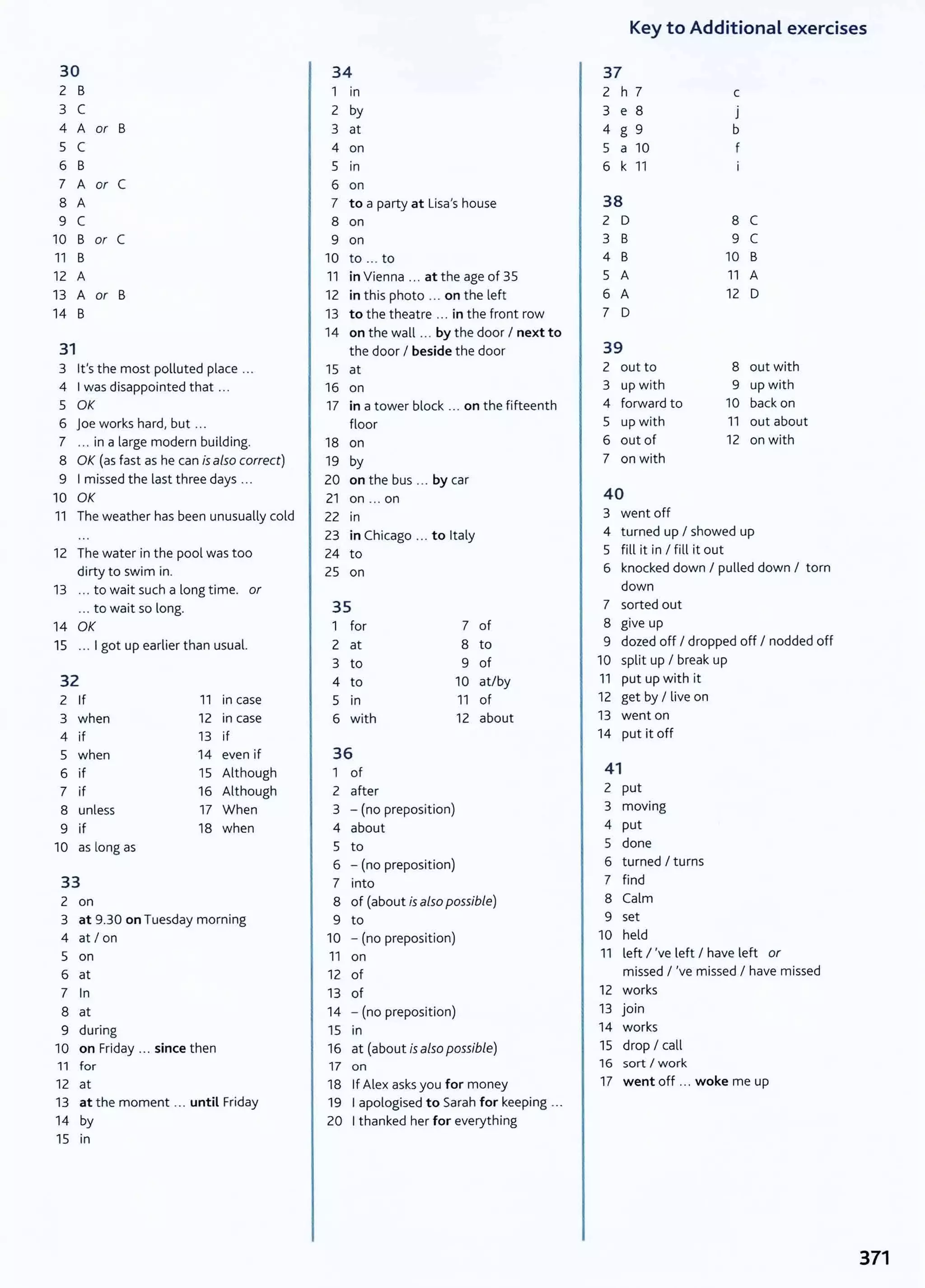
Key to Additional exercises 368
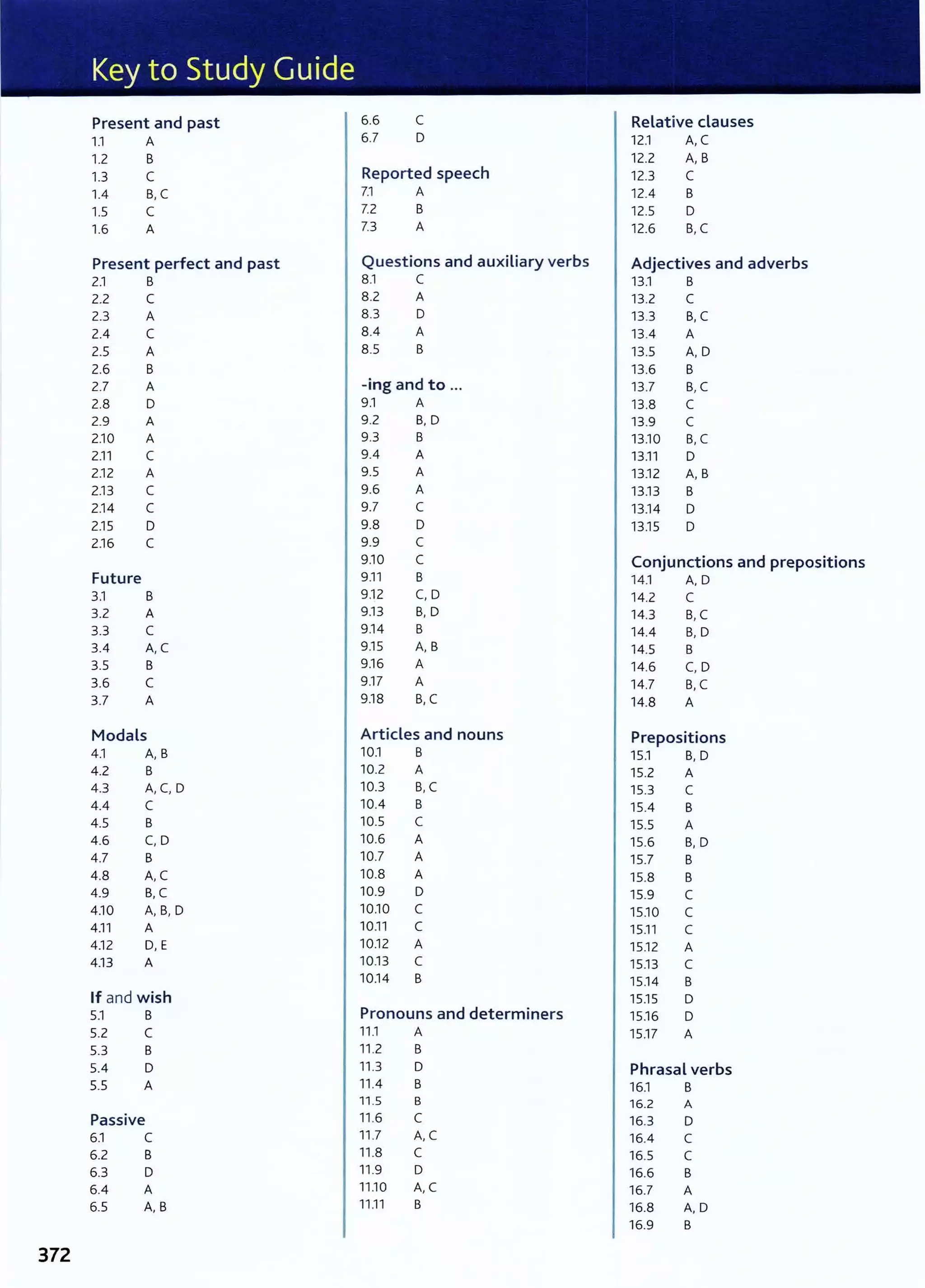
Key to Study guide 372
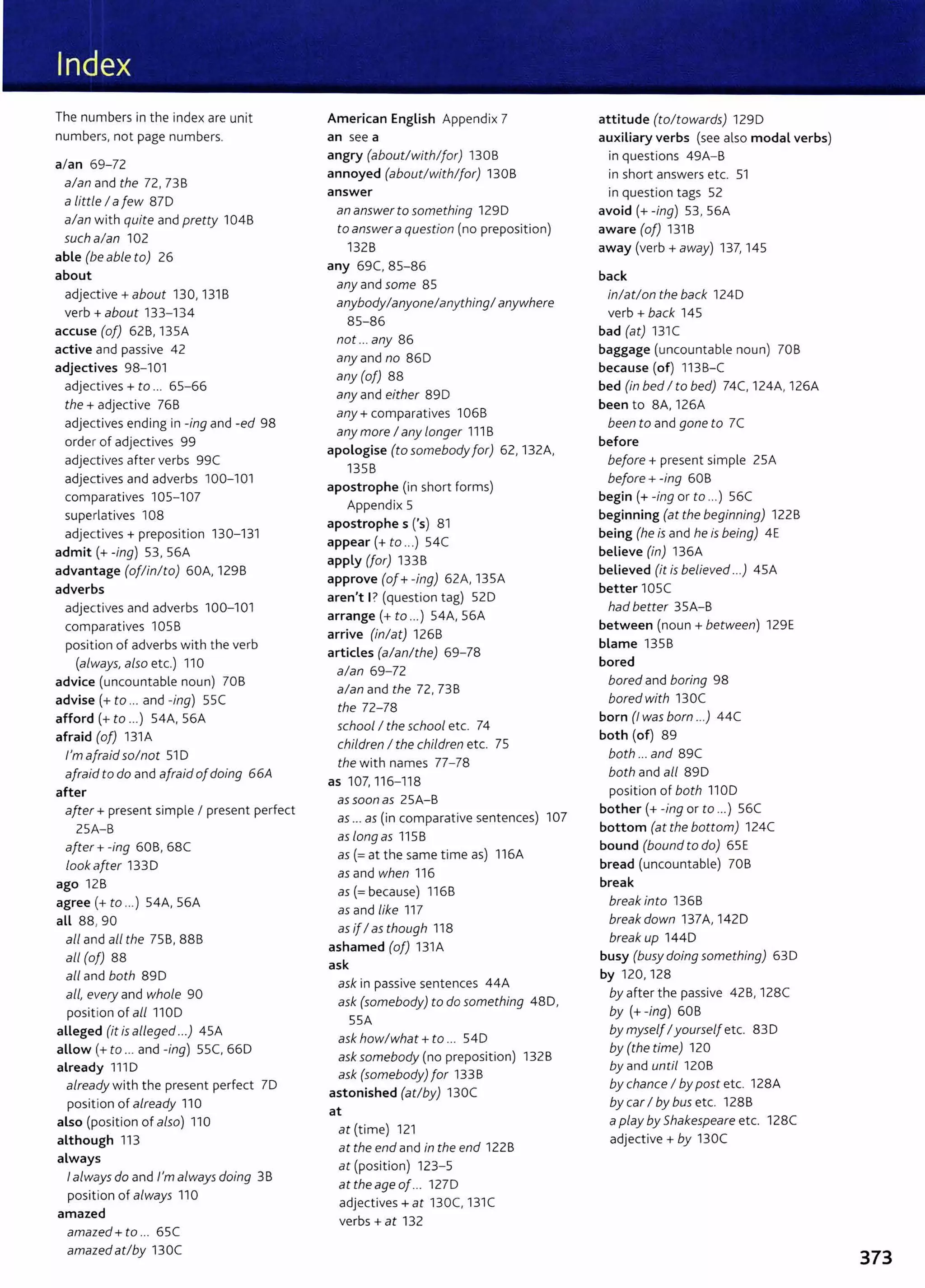
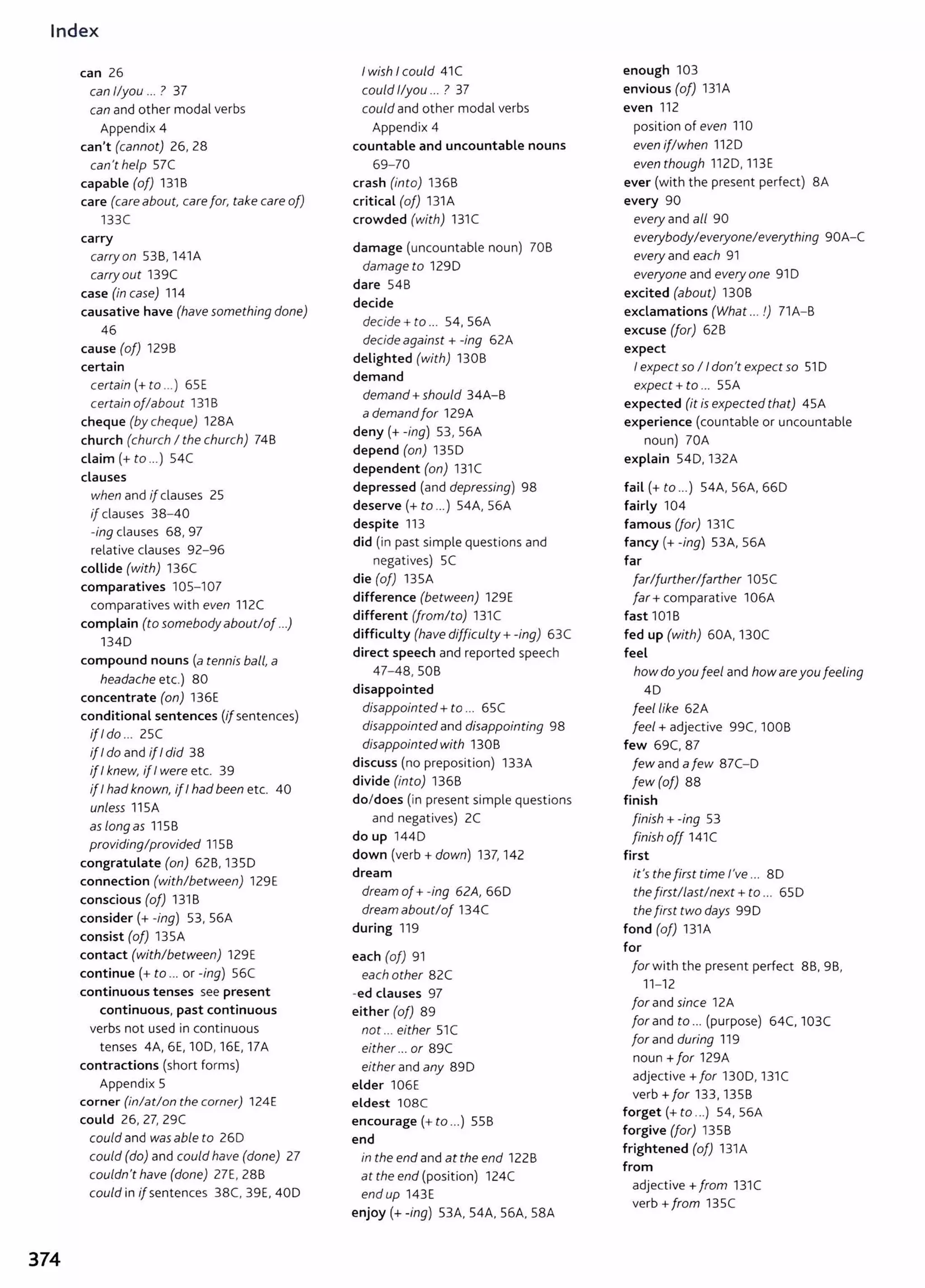
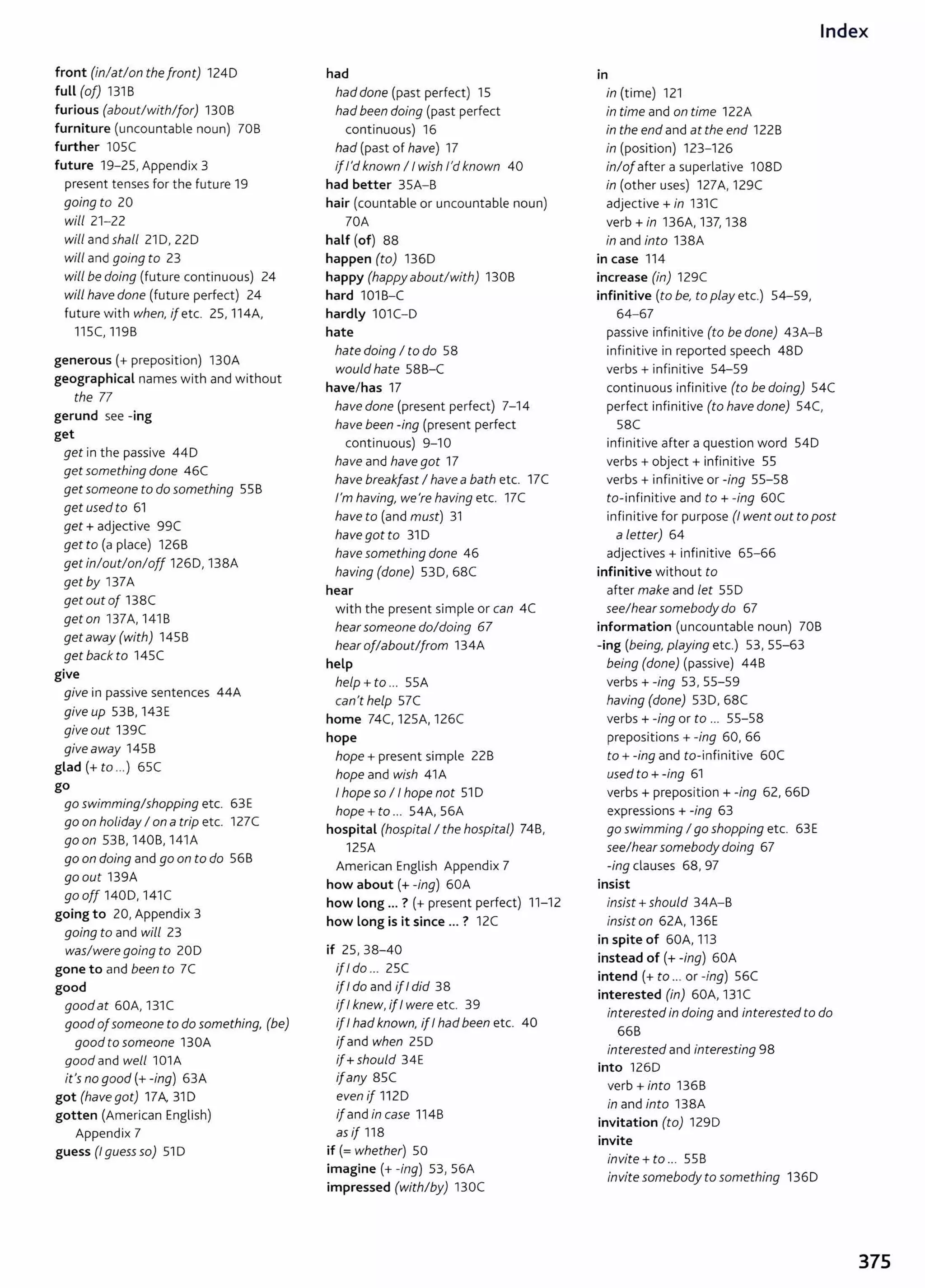
Index 373
vi IFYOU ARE NOT SUREWHICH UNITS YOU NEED TO STUDY, USE THE STUDY GUIDE ON PAGE 326.
This is the fourth edition of English Grammar in Use. I wrote the original edition when I was a teacher at
the Swan School of English, Oxford. I would like to repeat my thanks to my colleagues and students at the
school for their help, encouragement and interest at that time.
Regarding the production of this fourth edition, I am grateful to N6irfn Burke, Annabel Marriott, Matthew
Duffy, Liz Driscoll, jane Walsh, jeanette Alfoldi and Kamae Design. I would like to thank Cambridge
University Press for permission to access the Cambridge International Corpus.
Thank you also to the following illustrators: Humberto Blanco, Paul Fellows, Sophie Joyce, Katie Mac,
lan Mitchell, Gillian Martin, Sandy Nicholls, Roger Penwill, Lisa Smith, Dave Whamond and Simon Williams.
..
VII
...
VIII
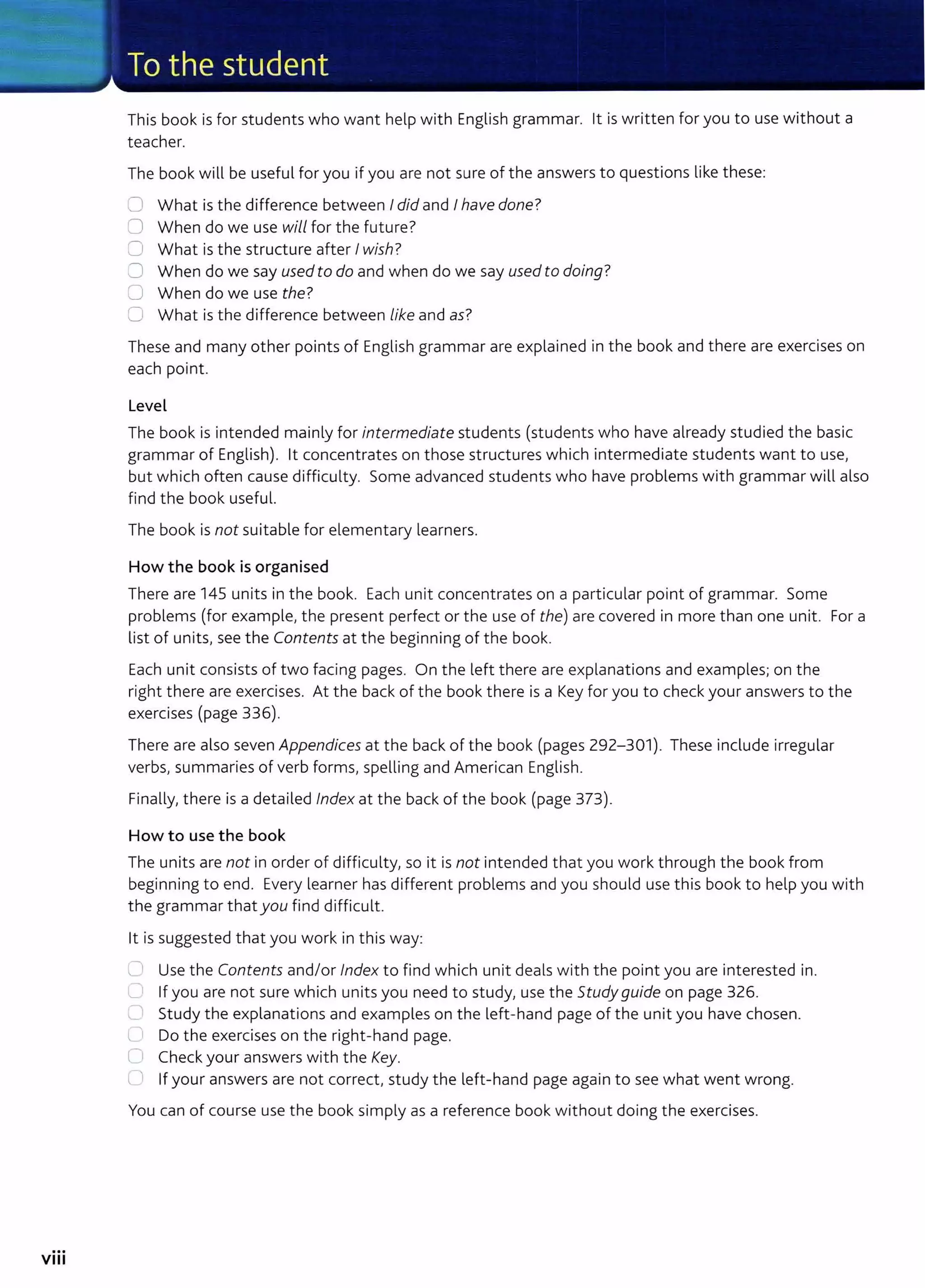
This book is for students who want help with English grammar. lt is written for you to use without a
teacher.
The book will be useful for you if you are not sure of the answers to questions like these:
0 What is the difference between Idid and Ihave done?
0 When do we use will for the future?
0 What is the structure after Iwish?
0 When do we say usedto do and when do we say used to doing?
U When do we use the?
0 What is the difference between like and as?
These and many other points of English grammar are explained in the book and there are exercises on
each point.
Level
The book is intended mainly for intermediate students (students who have already studied the basic
grammar of English). lt concentrates on those structures which intermediate students want to use,
but which often cause difficulty. Some advanced students who have problems with grammar will also
find the book useful.
The book is not suitable for elementary learners.
How the book is organised
There are 145 units in the book. Each unit concentrates on a particular point of grammar. Some
problems (for example, the present perfect or the use of the) are covered in more than one unit. For a
list of units, see the Contents at the beginning of the book.
Each unit consists of two facing pages. On the left there are explanations and examples; on the
right there are exercises. At the back of the book there is a Key for you to check your answers to the
exercises (page 336).
There are also seven Appendices at the back of the book (pages 292-301). These include irregular
verbs, summaries of verb forms, spelling and American English.
Finally, there is a detailed Index at the back of the book (page 373).
How to use the book
The units are not in order of difficulty, so it is not intended that you work through the book from
beginning to end. Every learner has different problems and you should use this book to help you with
the grammar that you find difficult.
lt is suggested that you work in this way:
0 Use the Contents and/or Index to find which unit deals with t he point you are interested in.
C If you are not sure which units you need to study, use the Study guide on page 326.
........
Study the explanations and examples on the left-hand page of the unit you have chosen.
L Do the exercises on the right-hand page.
Cl Check your answers with the Key.
C) If your answers are not correct, study the left-hand page again to see what went wrong.
You can of course use the book simply as a reference book without doing the exercises.
Additional exercises
At the back of the book there are Additional exercises (pages 302-325). These exercises bring together
some of the grammar points from a number of different units. For example, Exercise 16 brings together
grammar points from Units 26- 36. You can use these exercises for extra practice after you have studied
and practised the grammar in the units concerned.
.
IX
X
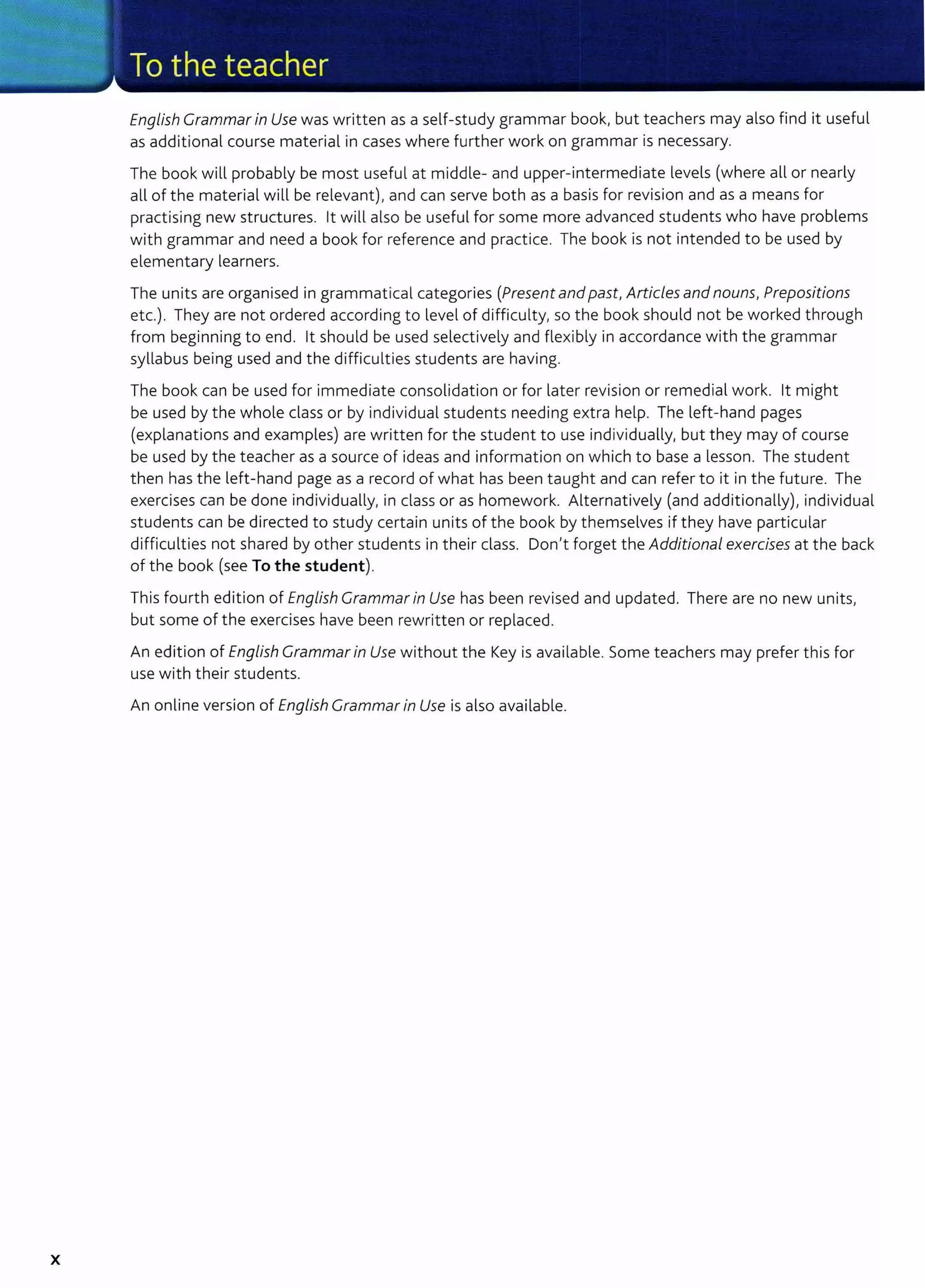
English Grammar in Use was written as a self-study grammar book, but teachers may also find it useful
as additional course material in cases where further work on grammar is necessary.
The book will probably be most useful at middle- and upper-intermediate levels (where all or nearly
all of the material will be relevant), and can serve both as a basis for revision and as a means for
practising new structures. lt will also be useful for some more advanced students who have problems
with grammar and need a book for reference and practice. The book is not intended to be used by
elementary learners.
The units are organised in grammatical categories (Present and past, Articles and nouns, Prepositions
etc.). They are not ordered according to level of difficulty, so the book should not be worked through
from beginning to end. lt should be used selectively and flexibly in accordance with the grammar
syllabus being used and the difficulties students are having.
The book can be used for immediate consolidation or for later revision or remedial work. lt might
be used by the whole class or by individual students needing extra help. The left-hand pages
(explanations and examples) are written for the student to use individually, but they may of course
be used by the teacher as a source of ideas and information on which to base a lesson. The student
then has the left-hand page as a record of what has been taught and can refer to it in the future. The
exercises can be done individually, in class or as homework. Alternatively (and additionally), individual
students can be directed to study certain units of the book by themselves if they have particular
difficulties not shared by other students in their class. Don't forget the Additional exercises at the back
of the book (see To the student).
This fourth edition of English Grammar in Use has been revised and updated. There are no new units,
but some of the exercises have been rewritten or replaced.
An edition of English Grammar in Use without the Key is available. Some teachers may prefer this for
use with their students.
An online version of English Grammar in Use is also available.
-
-
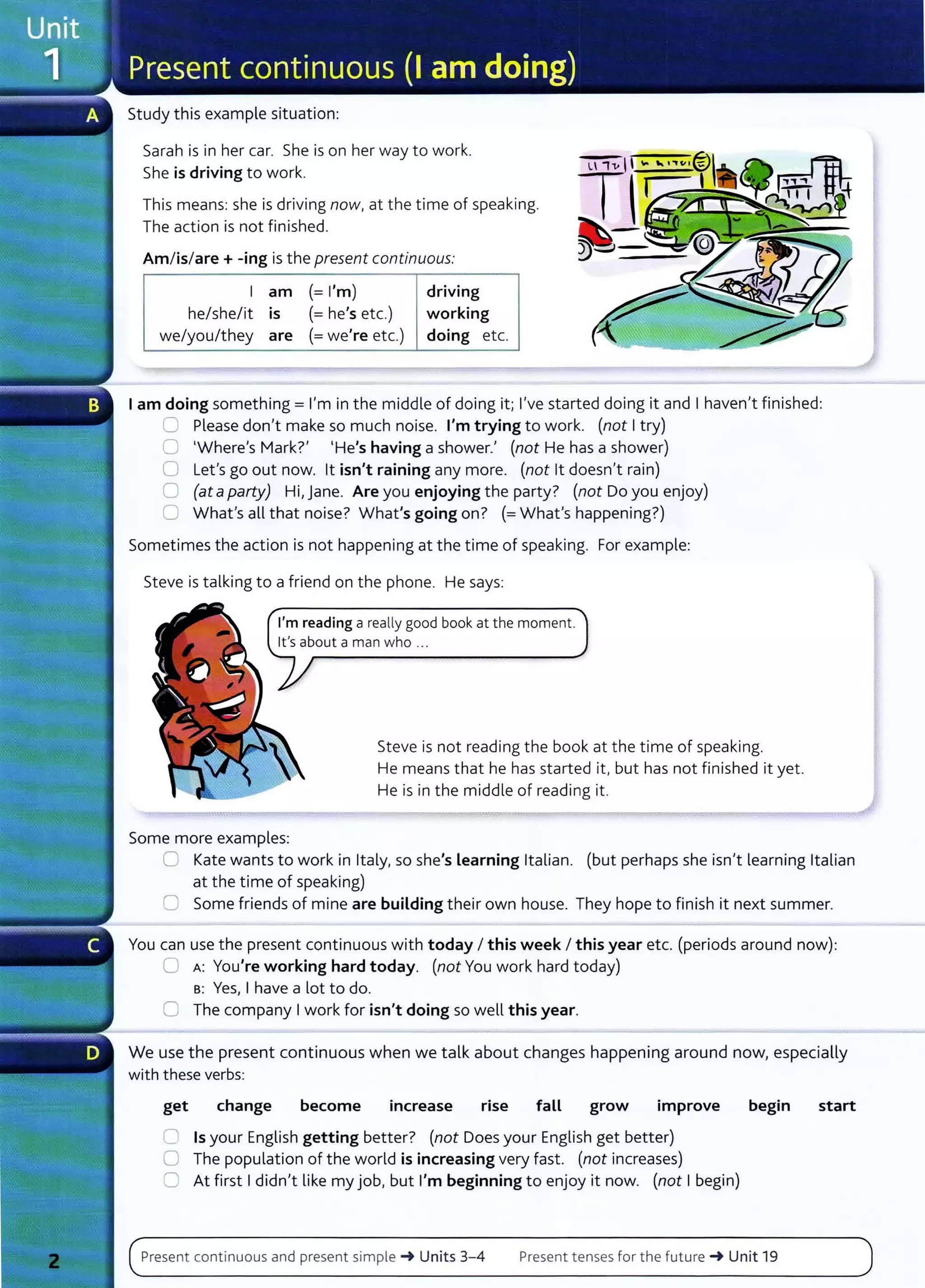
Study this example situation:
Sarah is in her car. She is on her way to work.
She is driving to work.
This means: she is driving now, at the time of speaking.
The action is not finished.
Am/is/are+ -ing is the present continuous:
am (=I'm)
he/she/it is (=he's etc.)
we/you/they are (=we're etc.)
driving
working
doing etc.
I am doing something= I'm in the middle of doing it; I've started doing it and I haven't finished:
=Please don't make so much noise. I'm trying to work. (not I try)
0 'Where's Mark?' 'He's having a shower.' (not He has a shower)
0 Let's go out now. lt isn't raining any more. (not lt doesn't rain)
0 (at aparty) Hi, jane. Are you enjoying the party? (not Do you enjoy)
C What's all that noise? What's going on? (=What's happening?}
Sometimes the action is not happening at the time of speaking. For example:
Steve is talking to a friend on the phone. He says:
I'm reading a really good book at the moment.
it's about a man who ...
Steve is not reading the book at the t ime of speaking.
He means that he has started it, but has not finished it yet.
He is in the middle of reading it.
Some more examples:
0 Kate wants to work in Italy, so she's Learning Italian. (but perhaps she isn't learning Italian
at the time of speaking)
0 Some friends of mine are building their own house. They hope to finish it next summer.
You can use the present continuous with today I this week I this year etc. (periods around now}:
0 A: You're working hard today. (not You work hard today)
s: Yes, I have a lot to do.
C The company I work for isn't doing so well this year.
We use the present continuous when we talk about changes happening around now, especially
with these verbs:
get change become increase rise fall grow improve
0 Is your English getting better? (not Does your English get better)
0 The population of the world is increasing very fast. (not increases)
C At first I didn't like my job, but I'm beginning to enj oy it now. (not I begin}
begin start
Present continuous and present simple -+ Units 3-4 Present tenses for the future -+ Unit 19
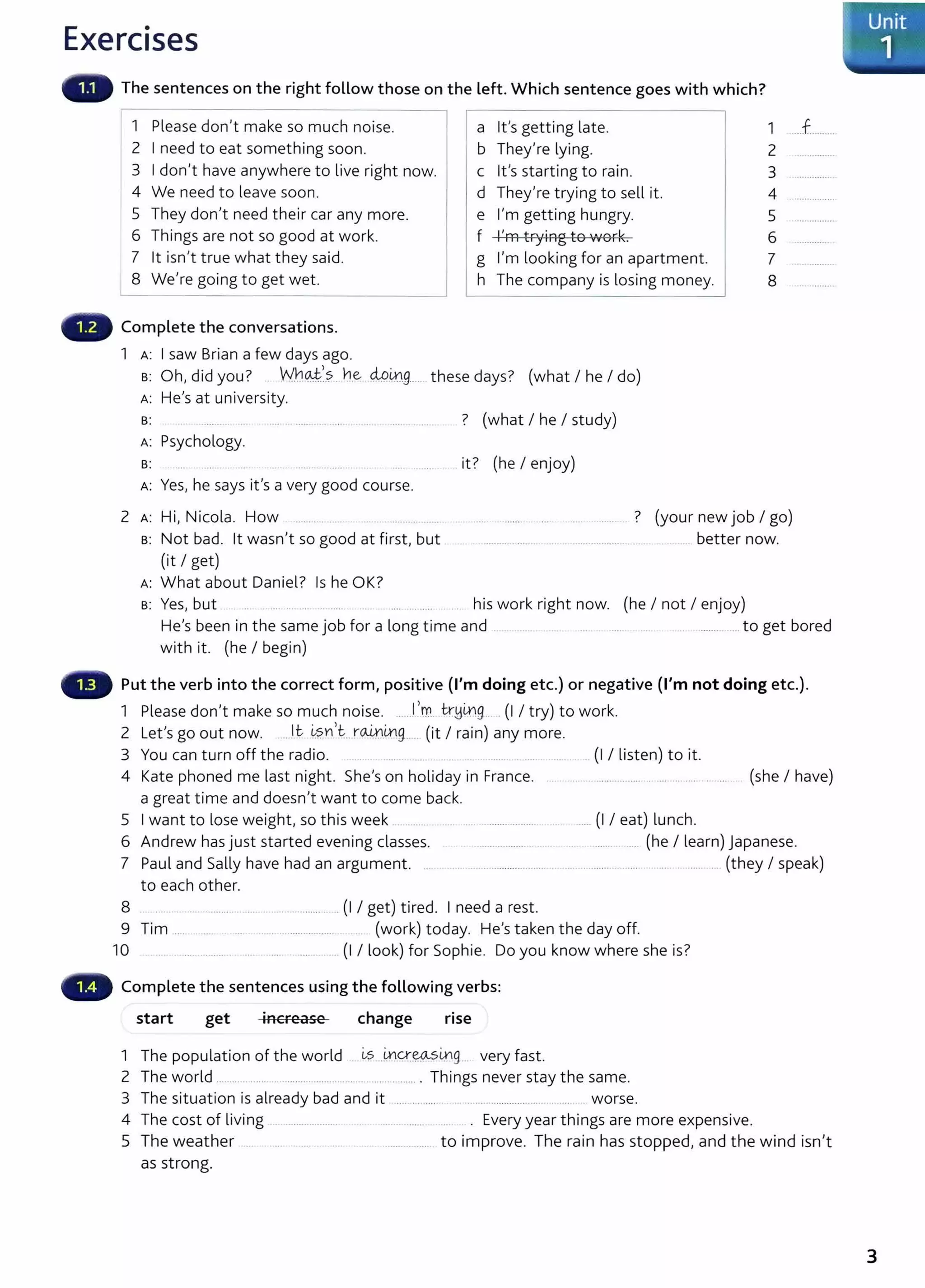
Exercises
The sentences on the right follow those on the left. Which sentence goes with which?
1 Please don't make so much noise. a lt's getting late.
2 I need to eat something soon. b They're lying.
3 I don't have anywhere to live right now. c lt's starting to rain.
4 We need to leave soon. d They're trying to sell it.
5 They don't need their car any more. e I'm getting hungry.
6 Things are not so good at work. f l'ffi +ryiAg {9 1""',..k
Cl Vf 01 .
7 lt isn't true what they said. g I'm looking for an apartment.
8 We're going to get wet . h The company is losing money.
Complete the conversations.
1 A: I saw Brian a few days ago.
B: Oh, did you? . W~_QJ./.?.. n
.
eM~9.- .. these days? (what I he I do)
A: He's at university.
B: ? (what I he I study)
A: Psychology.
B: ..... ....... it? (he I enjoy)
A: Yes, he says it's a very good course.
1
2
3
4
5
6
7
8
2 A: Hi, Nicola. How ......... ............. . ........ ? (your new job I go)
s: Not bad. lt wasn't so good at first, but
(it I get)
A: What about Daniel? Is he OK?
..... ........... ..... .. better now.
s: Yes, but .. .. .... .. ... .... . ...... . his work right now. (he I not I enjoy)
...f..........
He's been in the same job for a long time and .. ............ to get bored
with it. (he I begin)
Put the verb into the correct form, positive (I'm doing etc.) or negative (I'm not doing etc.).
1 Please don't make so much noise. ......!'m tr~~9.--- .. (I I try) to work.
2 Let's go out now. ......lt -~?.YI
1
t:..r~Lttg___
__ (it I rain) any more.
3 You can turn off t he radio. (I I listen) to it.
4 Kate phoned me last night. She's on holiday in France. (she I have)
a great t ime and doesn't want to come back.
5 I want to lose weight, so this week .............. ........ .......... .. ..... (I I eat) lunch.
6 Andrew has just started evening classes.
7 Paul and Sally have had an argument. ...
.................. ........ ... (he I learn) Japanese.
....... ..................... .. ..... .............. ..... .... ......... (they I speak)
to each other.
8 ............. .... (I I get) tired. I need a rest.
9 Tim ....... . .. .................. (work) today. He's taken the day off.
10 .... . . (I I look) for Sophie. Do you know where she is?
Complete the sentences using the following verbs:
start get increase change rise
1 The population of the world ~s _i,ncr.~mg very fast.
2 The world ......... .................................................. . Things never stay the same.
3 The situation is already bad and it .... .... ..... . ......................... .... worse.
4 The cost of living ..... ........... ............... . Every year things are more expensive.
5 The weather .. . ..... to improve. The rain has stopped, and the wind isn't
as strong.
I
Unit
. 1
3
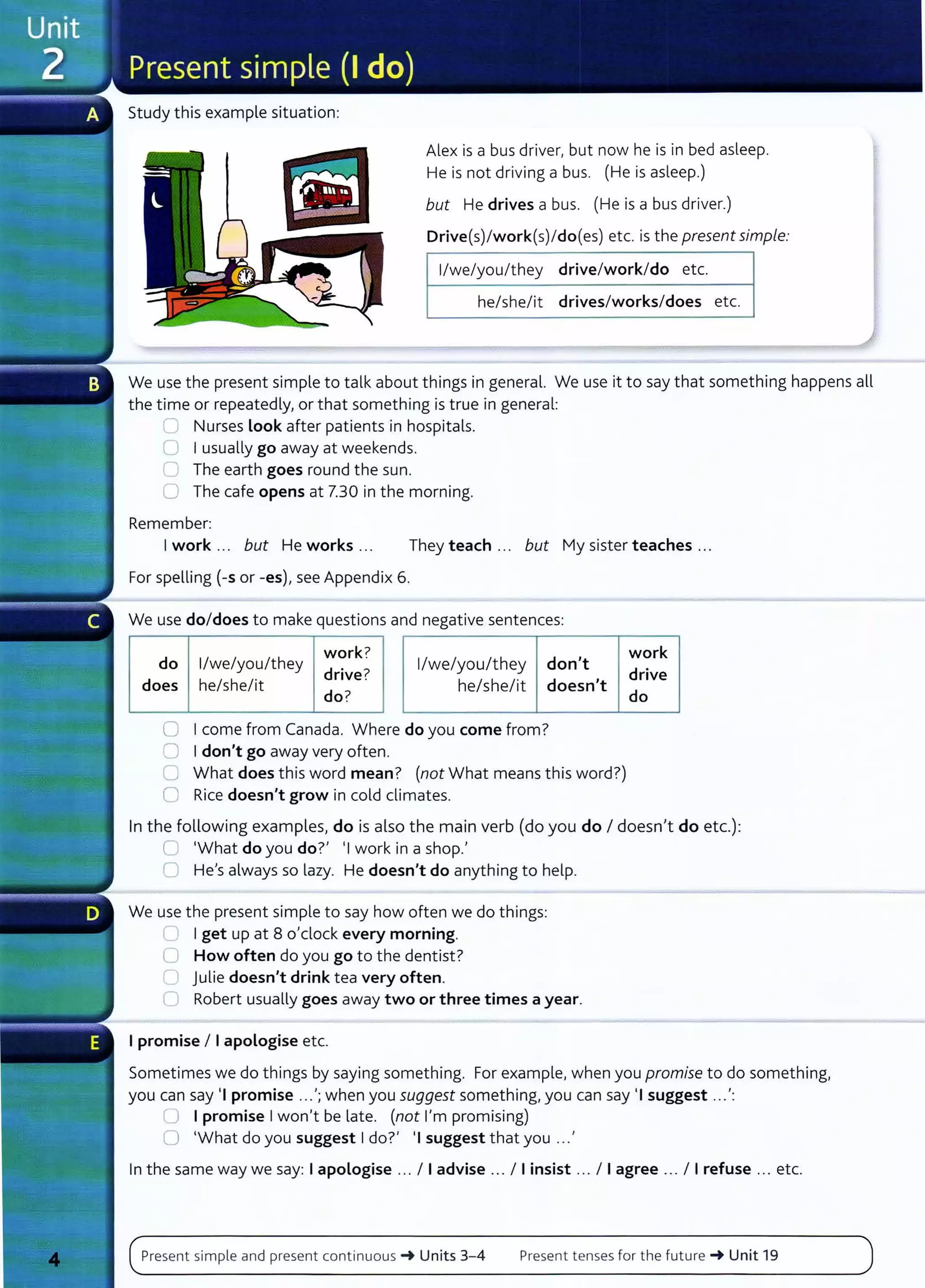
Study this example situation:
Alex is a bus driver, but now he is in bed asleep.
He is not driving a bus. (He is asleep.)
but He drives a bus. (He is a bus driver.)
Drive(s)/work(s)/do(es) etc. is the present simple:
1
/we/you/they drive/work/ do etc.
he/she/it drives/works/ does etc.
We use the present simple to talk about things in general. We use it to say that something happens all
the time or repeatedly/ or that something is true in general:
0 Nurses Look after patients in hospitals.
0 I usually go away at weekends.
0 The earth goes round the sun.
0 The cafe opens at 7.30 in the morning.
Remember:
I work ... but He works ... They teach ... but My sister teaches .. .
For spelling (-sor -es), see Appendix 6.
We use do/does to make questions and negative sentences:
do 1/we/you/they
work?
drive?
does he/she/ it
do?
1
/we/you/they don't
he/she/it doesn't
0 I come from Canada. Where do you come from ?
0 I don't go away very often.
0 What does this word mean? (not What means this word?)
0 Rice doesn't grow in cold climates.
work
drive
do
In the following examples, do is also the main verb (do you do I doesn,t do etc.):
U 'What do you do?' 'I work in a shop.'
0 He's always so lazy. He doesn't do anything to help.
We use the present simple to say how often we do things:
'--' I get up at 8 o'clock every morning.
0 How often do you go to the dentist?
C1 julie doesn't drink tea very often.
0 Robert usually goes away two or three times a year.
I promise I I apologise etc.
Sometimes we do things by saying something. For example, when you promise to do something,
you can say 'I promise ... '; when you suggest something, you can say 'I suggest ...':
0 I promise I won't be late. (not I'm promising)
0 'What do you suggest I do?' 'I suggest that you ... '
In the same way we say: I apologise .. . I I advise ... I I insist ... I I agree ... I I refuse ... etc.
Present simple and present continuous -+ Units 3-4 Present tenses for the future -+ Unit 19
Exercises
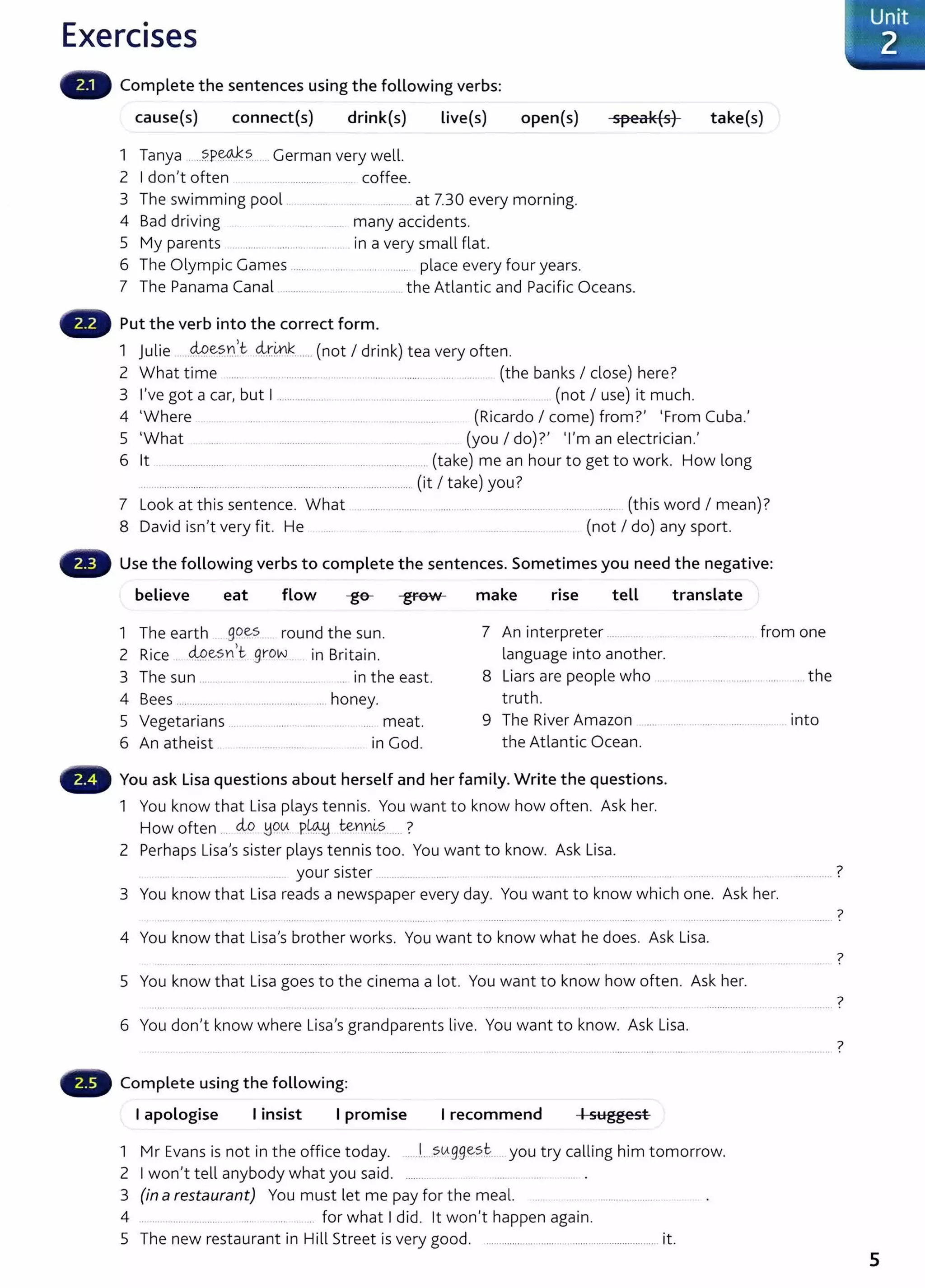
Complete the sentences using the following verbs:
cause(s) connect(s) drink(s) Live(s) open(s) speak(s) take(s)
1 Tanya ......?.P~?.. ....German very well.
2 I don't often ...... ............ ... coffee.
3 The swimming pool . . ...... .......... at 7.30 every morning.
4 Bad driving ... ... .. ......... ...... many accidents.
5 My parents ..... ................. in a very small flat.
6 The Olympic Games .. .................. . ....... .. ...... place every four years.
7 The Panama Canal ............... ..... .. ............. the Atlantic and Pacific Oceans.
Put the verb into the correct form.
1 Julie .....M.e?.n 4r.~k...... (not I drink) tea very often.
2 What time ........ .................... ..................................................... (the banks I dose) here?
3 I've got a car, but I .................. ....................... ..... ... ........ .. (not I use) it much.
4 'Where ... .. .. ..... .. ..... ...... ..... ...... (Ricardo I come) from?' 'From Cuba.'
5 'What .............. .... (you I do)?' Tm an electrician.'
6 lt .................................................................... .................... (take) me an hour to get to work. How long
.................................. .......................... ....... ................... (it I take) you?
7 Look at this sentence. What ...................... . ...... ... ....................................... (this word I mean)?
8 David isn't very fit. He .... .... . . ..... .... .. .......... ... (not I do) any sport.
Use the following verbs to complete the sentences. Sometimes you need the negative:
believe eat flow
1 The earth goes round the sun.
2 Rice .. 49.
es)'J,t grow.. in Britain.
3 The sun ... ............ ......................... .... in the east.
4 Bees ................. .... .... ..... ....... ... honey.
5 Vegetarians ... .
6 An atheist
... meat.
in God.
make nse tell translate
7 An interpreter .... ....... ............... from one
language into another.
8 Liars are people who ............................. ........ ...... the
t ruth.
9 The River Amazon ....................................... into
the Atlantic Ocean.
You ask Lisa questions about herself and her family. Write the questions.
1 You know that Lisa plays tennis. You want to know how often. Ask her.
How often .. clo yq~ ..P~ ten.D~s...... ?
2 Perhaps Lisa's sister plays tennis too. You want to know. Ask Lisa.
7
.. your sister . . ....... ..... ... ........ ...... ........... .. ......... ............... .
3 You know that Lisa reads a newspaper every day. You want to know which one. Ask her.
7
..................................
4 You know that Lisa's brother works. You want to know what he does. Ask Lisa.
7
5 You know that Lisa goes to the cinema a lot. You want to know how often. Ask her.
7
. . . . . . . . . . . . . . . . . . . • . . • . . . . . . ••••• •••••••• ••• 0 ••••••••••••••••••••• •• · - · · · · · •• ••• •••• .. •• •• • •• • • •••• •• • ••• ••••• • • • • • • • • • • • • • • • •
6 You don't know where Lisa's grandparents live. You want to know. Ask Lisa.
7
Complete using the following:
I apologise I insist I promise I recommend I suggest
1 Mr Evans is not in the office today. ....J....sLA.g.g.e~t....you t ry calling him tomorrow.
2 I won't tell anybody what you said. ........ .. ..... ... ....
3 (in a restaurant) You must let me pay for the meal.
4 ... ........................ .... ...... for what I did. lt won't happen again.
5 The new restaurant in Hill Street is very good. ........................................................... it.
Unit
': 2
5
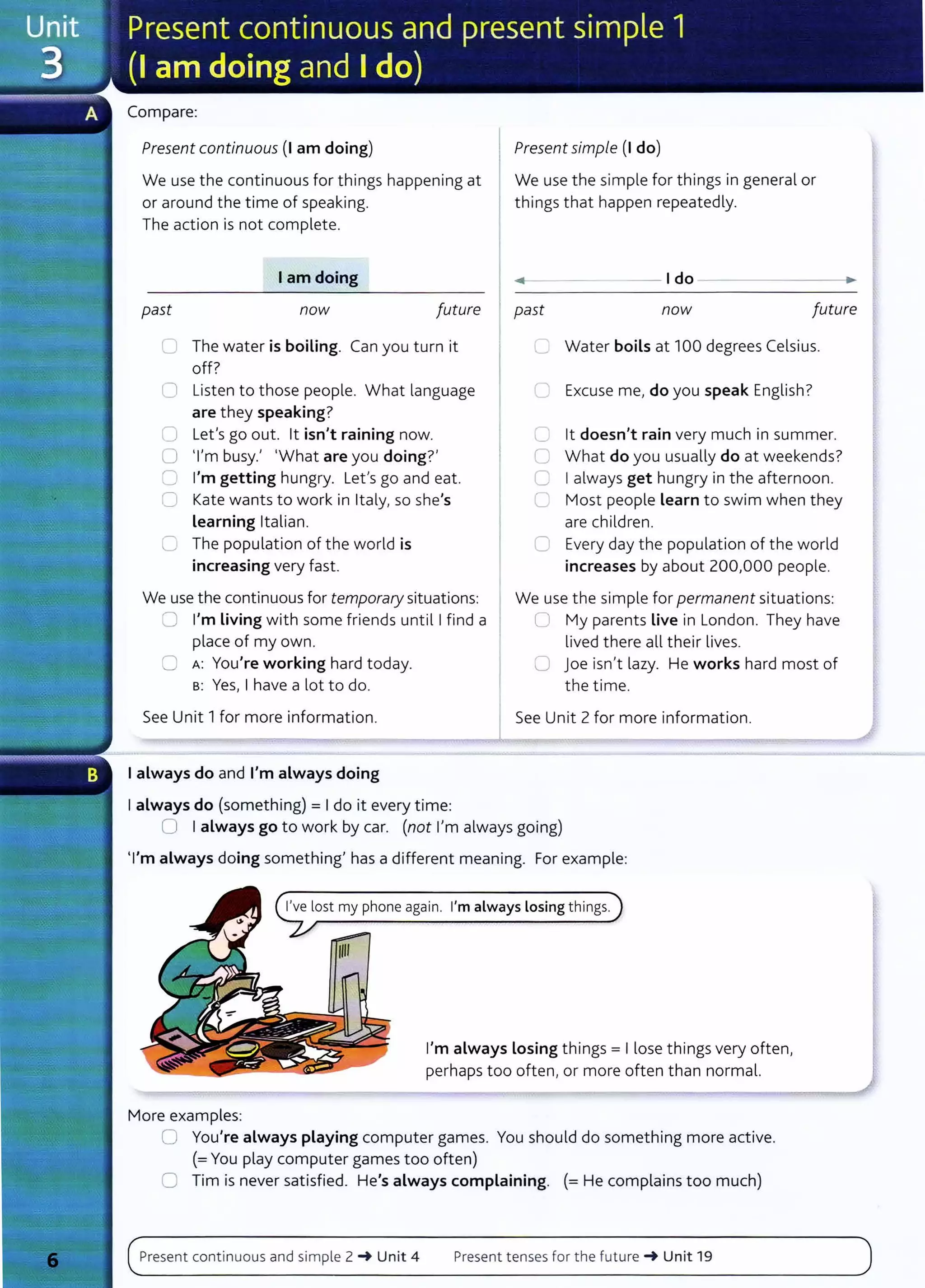
Compare:
Present continuous (I am doing)
We use the continuous for things happening at
or around the time of speaking.
The action is not complete.
I am doing
past now future
0 The water is boiling. Can you turn it
off?
0 Listen to those people. What language
are they speaking?
0 Let's go out. lt isn't raining now.
0 'I'm busy.' 'What are you doing?'
0 I'm getting hungry. Let's go and eat.
c Kate wants to work in Italy, so she's
Learning Italian.
c The population of the world is
increasing very fast.
We use the continuous for temporary situations:
C) I'm Living with some friends until I find a
place of my own.
0 A: You're working hard today.
B: Yes, I have a lot to do.
See Unit 1 for more information.
I always do and I'm always doing
I always do (something) = I do it every time:
Present simple (I do)
We use the simple for things in general or
things that happen repeatedly.
.__ I do
past now future
'--- Water boils at 100 degrees Celsius.
0 Excuse me, do you speak English?
c lt doesn't rain very much in summer.
c What do you usually do at weekends?
0 I always get hungry in the afternoon.
0 Most people Learn to swim when they
are children.
,...--
Every day the population of the world
I._..
increases by about 200,000 people.
We use the simple for permanent situations:
0 My parents Live in London. They have
lived there all their lives.
C joe isn,t lazy. He works hard most of
the t ime.
See Unit 2 for more information.
0 I always go to work by car. (not I'm always going)
'I'm always doing something' has a different meaning. For example:
More examples:
I'm always losing things.
I'm always Losing things = I lose t hings very often,
perhaps too often, or more often than normal.
0 You're always playing computer games. You should do something more active.
(=You play computer games too often)
0 Tim is never satisfied. He's always complaining. (=He complains too much)
Present continuous and simple 2 -+ Unit 4 Present t enses for the future -+ Unit 19
Exercises
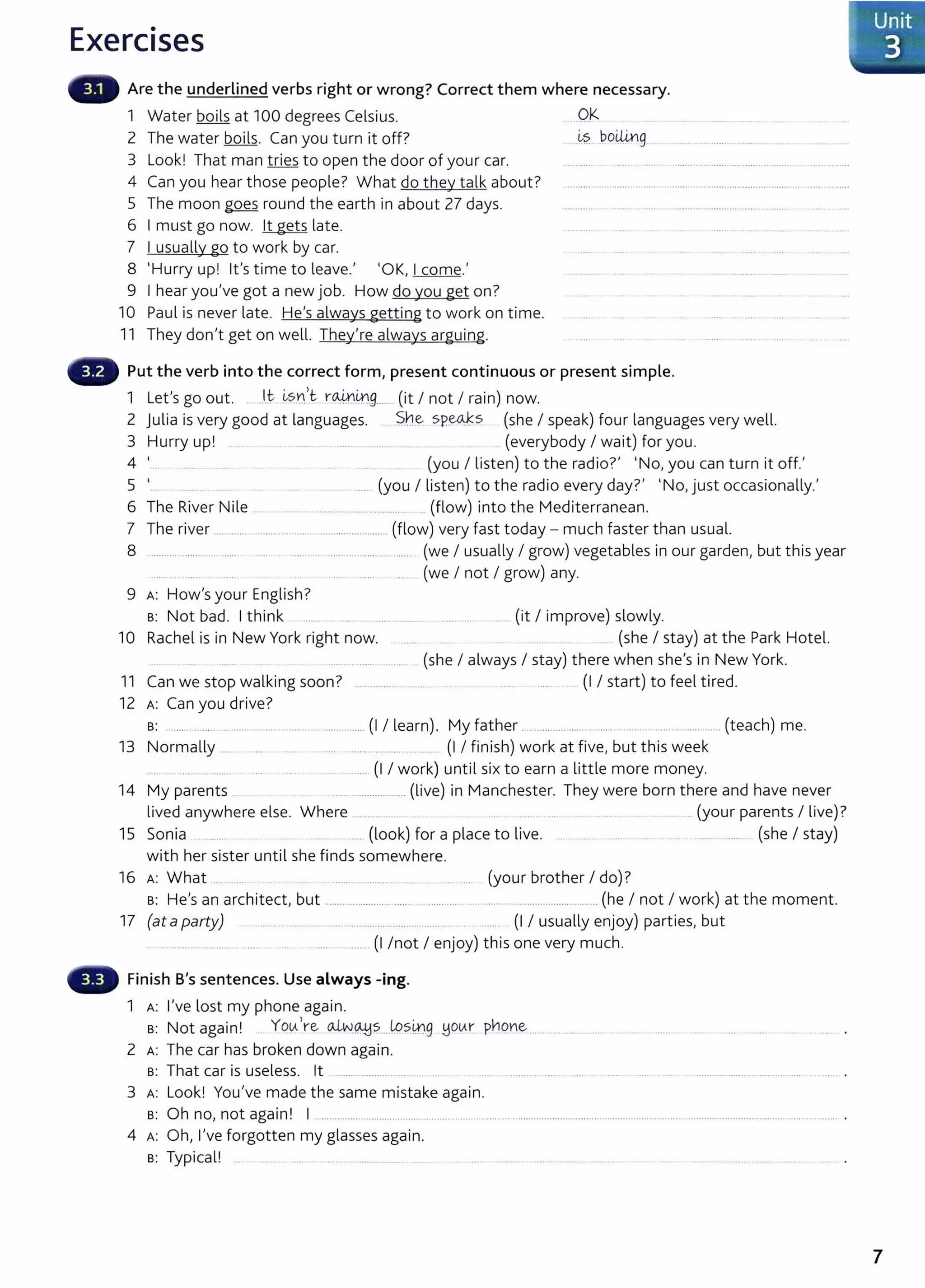
Are the underlined verbs right or wrong? Correct them where necessary.
1 Water boils at 100 degrees Celsius.
2 The water boils. Can you turn it off?
3 Look! That man tries to open the door of your car.
4 Can you hear those people? What do they talk about?
5 The moon goes round the earth in about 27 days.
6 I must go now. lt gets late.
7 I usually go to work by car.
8 'Hurry up! lt's time to leave.' 'OK, I come.'
9 I hear you've got a new job. How do you get on?
10 Paul is never late. He's always getting to work on time.
11 They don't get on well. They're always arguing.
.. Q)(
~s boi.Un
.............. g
Put the verb into the correct form1 present continuous or present simple.
1 Let's go out. ..l.t i.,sn 't . r~mg...... (it I not I rain) now.
2 Julia is very good at languages. S.n~ sp~s (she I speak) four languages very well.
3 Hurry up! .... .. .............. .... (everybody I wait) for you.
4 '... (you I listen) to the radio?' 'No, you can turn it off.'
5 '... ............... (you I listen) to the radio every day?' 'No,just occasionally.'
6 The River Nile ............................................. (flow) into the Mediterranean.
7 The river ............................................... .............. (flow) very fast today- much faster than usual.
8 ....................... ...... ..... . ..... .... ..... .... ............ ....... (we I usually I grow) vegetables in our garden, but this year
..... ... .... .. .. ...... ..... ...... ... ...... (we I not I grow) any.
9 A: How'syour English?
s: Not bad. I think ..... ..... .. ......... . ..... .... ... (it I improve) slowly.
10 Rachel is in New York right now. . ..... ........ ..... .. (she I stay) at the Park Hotel.
..... ........ ... ....... (she I always I stay) there when she's in New York.
11 Can we stop walking soon? ........................... ..... ... .............. ..... (I I start) to feel tired.
12 A: Can you drive?
s: ............. ........................................................ (I I learn). My father ........................ ......... ........................... (teach) me.
13 Normally ...... . .... ..... . .......................... ............. (I I finish) work at five, but this week
..... ... ....... ..................... (I I work) until six to earn a little more money.
14 My parents ... ............................ (live) in Manchester. They were born there and have never
lived anywhere else. Where ................. .... ..... . ....... ... .(your parents I live)?
15 Sonia . ...... . ..... (look) for a place to live. ....... ...... .. .. ...... (she I stay)
with her sister until she finds somewhere.
16 A: What .... ........ . .... ... . ...................................... .... .... (your brother I do)?
s: He's an architect, but .............................................................................................. (he I not I work) at the moment.
17 (at aparty) .. ....... . ....... ................................... . ... ... ...... (I I usually enjoy) parties, but
................................. ..... ... . .............. (I /not I enjoy) this one very much.
Finish B's sentences. Use always -ing.
1 A: I've lost my phone again.
s: Not again! . YotA're o..LN~?....L.o?ill.g .!jOtAr pY!pn~...................... ..
2 A: The car has broken down again.
s: That car is useless. lt ........ .................. . ....
3 A: Look! You've made the same mistake again.
s: Oh no, not again! I ....................................................................................................................................................................................
4 A: Oh, I've forgotten my glasses again.
s: Typical! ......................
IUnit
. 3
7
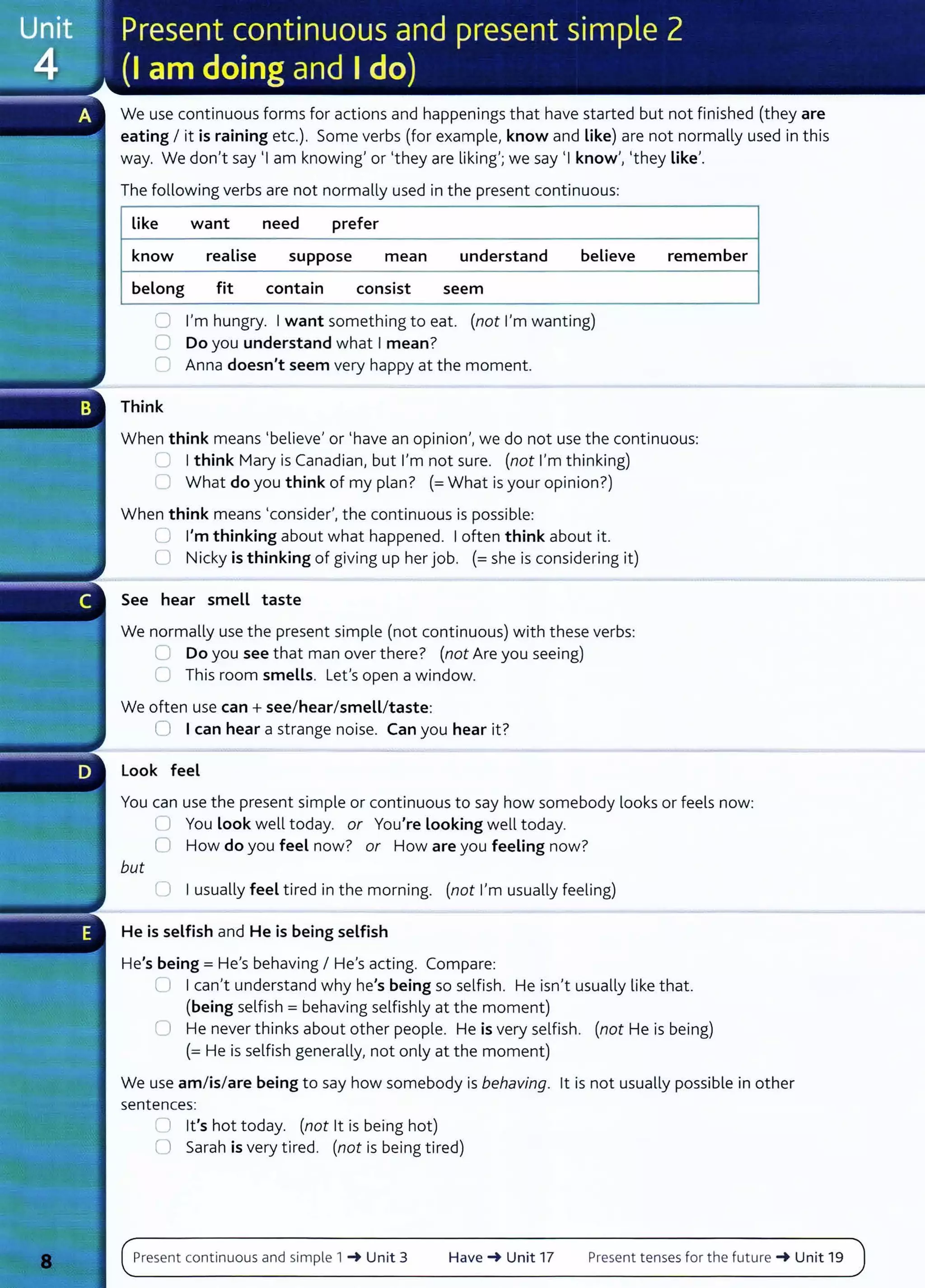
We use continuous forms for actions and happenings that have started but not finished (they are
eating I it is raining etc.). Some verbs (for example, know and Like) are not normally used in this
way. We don't say 'I am knowing' or 'they are liking'; we say 'I know', 'they Like'.
The following verbs are not normally used in the present continuous:
Like want need prefer
know realise suppose mean understand believe
belong fit contain consist seem
0 I'm hungry. I want something to eat. (not I'm wanting)
0 Do you understand what I mean?
r-- Anna doesn't seem very happy at the moment.
Think
remember
When think means 'believe' or 'have an opinion', we do not use the continuous:
lJ I think Mary is Canadian, but I'm not sure. (not I'm thinking)
C What do you think of my plan? (=What is your opinion?)
When think means 'consider', the continuous is possible:
U I'm thinking about what happened. I often think about it.
0 Nicky is thinking of giving up her job. (=she is considering it)
See hear smell taste
We normally use the present simple (not continuous) with these verbs:
U Do you see that man over there? (not Are you seeing)
0 This room smells. Lefs open a window.
We often use can + see/hear/smell/taste:
0 I can hear a strange noise. Can you hear it?
Look feel
You can use the present simple or continuous to say how somebody looks or feels now:
but
U You Look well today. or You're Looking well today.
0 How do you feel now? or How are you feeling now?
LJ I usually feel tired in the morning. (not I'm usually feeling)
He is selfish and He is being selfish
He's being= He's behaving I He's acting. Compare:
(J I can't understand why he's being so selfish. He isn't usually like that.
(being selfish = behaving selfishly at the moment)
0 He never thinks about other people. He is very selfish. (not He is being)
(= He is selfish generally, not only at the moment)
We use am/is/are being to say how somebody is behaving. lt is not usually possible in other
sentences:
0 it's hot today. (not lt is being hot)
U Sarah is very tired. (not is being tired)
Present continuous and simple 1 ~ Unit 3 Have~ Unit 17 Present tenses for the future ~ Unit 19
Exercises
Put the verb into the correct form, present continuous or present simple.
1 Are you hungry? ......D~!...,HOtA ..v->~t...... (you I want) something to eat?
2 Don't put the dictionary away. ........ ....... (I I use) it.
3 Don't put the dictionary away. ......... ..... (1 I need) it.
4 Who is that man? What ... .. . ............................. ........... (he I want)?
5 Who is that man? Why .... ... .... ...................... ........ . .............. (he I look) at us?
6 Alan says he's 80 years old, but nobody ... . ... ....................... ..... .. .. . ..... (believe) him.
7 She told me her name, but .. ....... ............. ............ (I I not I remember) it now.
8 ................ . . .................. ....... (I I think) of selling my car. Would you be interested in buying it?
9 ..... . ............... (I I think) you should sell your car. .... ....
(you I not I use) it very often.
10 Air ............. .. ..... ..................... ........... (consist) mainly of nitrogen and oxygen.
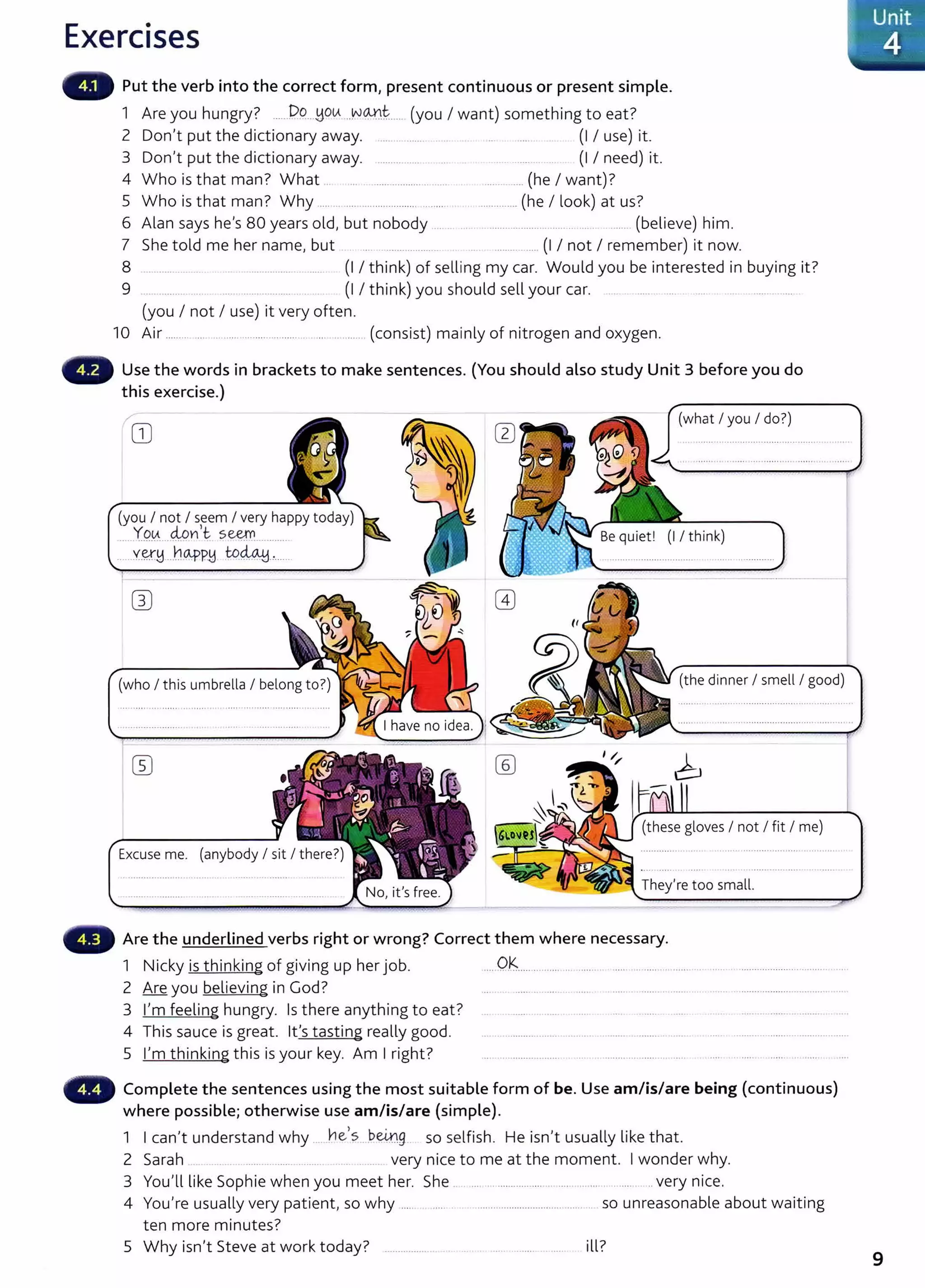
Use the words in brackets to make sentences. (You should also study Unit 3 before you do
this exercise.)
(what I you I do?)
(you I not I seem I very happy today)
....Y9~....4Pnlt. s~............
......X.~M ...nCA.f>P~ -~~-'-----·
(the dinnerI smell I good)
(these gloves I not I fit I me)
Are the underlined verbs right or wrong? Correct them where necessary.
1 N. k . h. k' f . . h . b Ok
1
c y IS t m mg o g1vmg up er JO . .... .. . ....... .......... .. ..... . ........................
2 Are you believing in God? ...... .. ...... . ..... ..........................
3 I'm feeling hungry. Is t here anything to eat? ..... . ..... .... .. ......
4 This sauce is great. lt's tasting really good. ... ....................... .. .. . .............
5 I'm thinking this is your key. Am I right? ................................................................
Complete the sentences using the most suitable form of be. Use am/is/are being (continuous)
where possible; otherwise use am/is/are (simple).
1 I can't understand why . he
1
s___b@g__ so selfish. He isn't usually like that.
2 Sarah ...... .... . .. . .. very nice to me at the moment. I wonder why.
3 You'll like Sophie when you meet her. She .. ....................... ............................. very n1ce.
4 You're usually very patient, so why ..... ..... . ................................. ........ so unreasonable about waiting
ten more minutes?
5 Why isn't Steve at work today? .................. . ill?
Unit
4
9
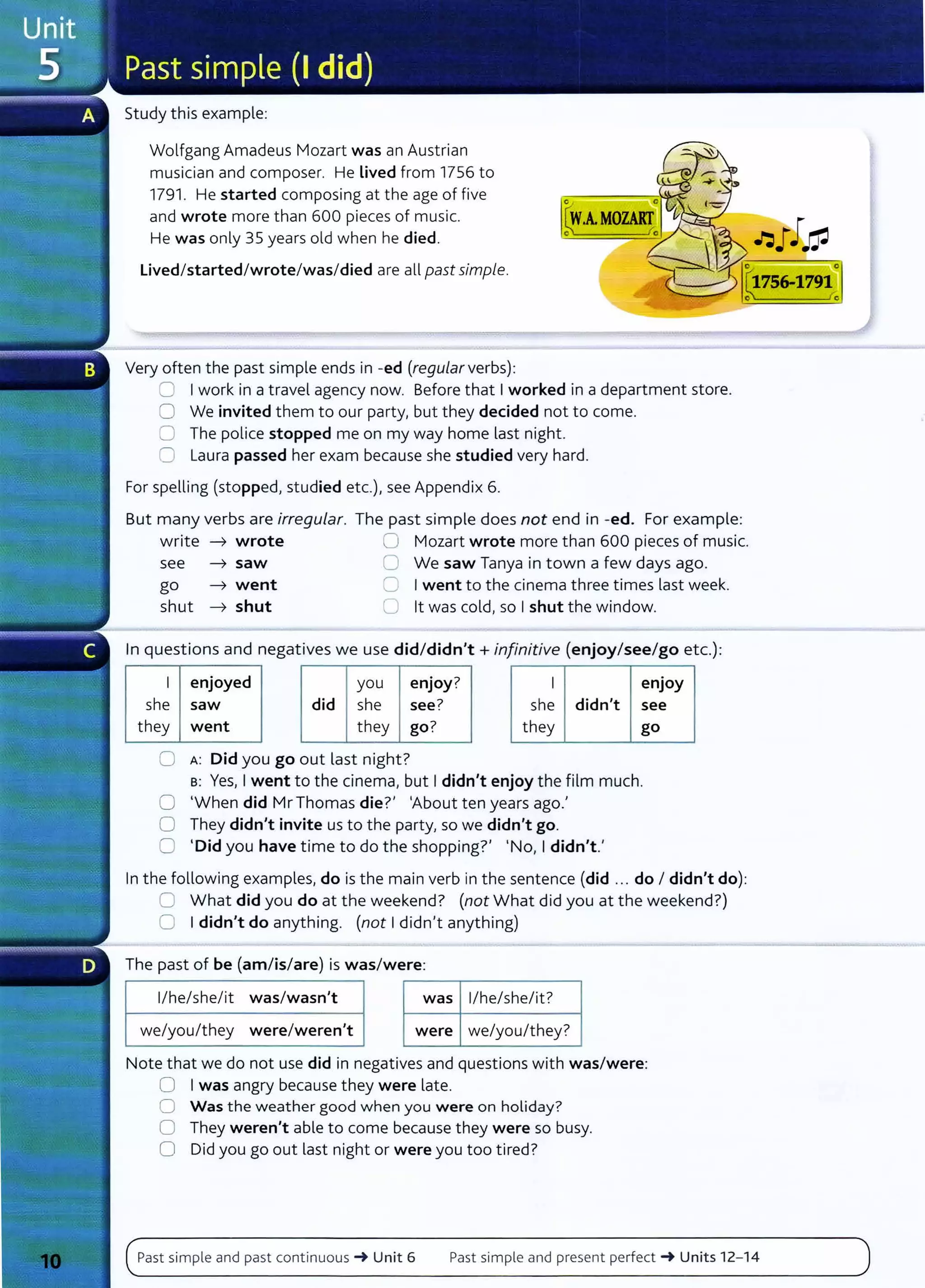
Study this example:
Wolfgang Amadeus Mozart was an Austrian
musician and composer. He Lived from 1756 to
1791. He started composing at the age of five
and wrote more than 600 pieces of music.
He was only 35 years old when he died.
lived/started/wrote/was/died are all past simple.
Very often the past simple ends in -ed (regular verbs):
0 I work in a travel agency now. Before that I worked in a department store.
0 We invited them to our party, but they decided not to come.
0 The police stopped me on my way home last night.
0 Laura passed her exam because she studied very hard.
For spelling (stopped, studied etc.), see Appendix 6.
But many verbs are irregular. The past simple does not end in -ed. For example:
0 0
~756-179~0
write --1 wrote 0 Mozart wrote more than 600 pieces of music.
see ~ saw 0 We saw Tanya in town a few days ago.
go ~ went C) I went to the cinema three times last week.
shut ~ shut 0 lt was cold, so I shut the window.
In questions and negatives we use did/didn't+ infinitive (enjoy/see/go etc.):
enjoyed
she saw
they went
did
you
she
they
0 A: Did you go out last night?
enjoy?
see?
go?
I enjoy
she didn't see
they go
a: Yes, I went to the cinema, but I didn't enjoy the film much.
0 'When did MrThomas die?' 'About ten years ago.'
0 They didn't invite us to the party, so we didn't go.
0 'Did you have time to do the shopping?' 'No, I didn't.'
In the following examples, do is the main verb in the sentence (did ... do I didn't do):
0 What did you do at the weekend? (not What did you at the weekend?)
0 I didn't do anything. (not I didn't anything)
The past of be (am/is/are) is was/were:
1
/he/she/it was/wasn't was 1/he/she/it?
we/you/they were/weren't were we/you/they?
Note that we do not use did in negatives and questions with was/were:
0 I was angry because they were late.
0 Was the weather good when you were on holiday?
0 They weren't able to come because they were so busy.
0 Did you go out last night or were you too tired?
Past simple and past continuous _. Unit 6 Past simple and present perfect _. Units 12- 14
Exercises
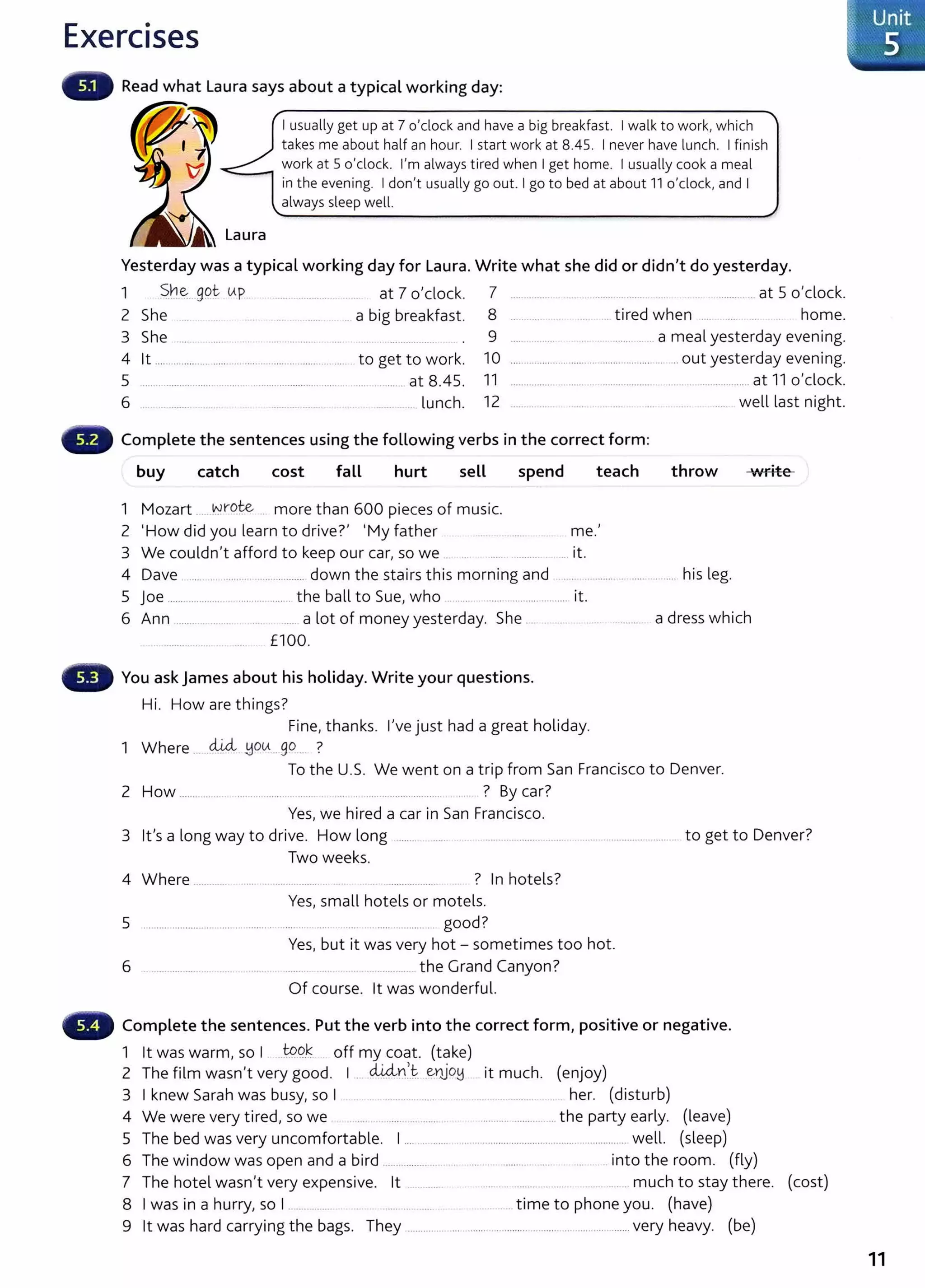
Read what Laura says about a typical working day:
.__"""
I usually get up at 7 o'clock and have a big breakfast. I walk to work, which
takes me about half an hour. I start work at 8.45. I never have lunch. I finish
work at 5 o'clock. I'm always tired when I get home. I usually cook a meal
in the evening. I don't usually go out. I go to bed at about 11 o'clock, and I
always sleep well.
Laura
Yesterday was a typical working day for Laura. Write what she did or didn't do yesterday.
1 ~h~. _
gpt- (Ap at 7 o'clock. 7 ........ ....... .. .......... ....... ........... at 5 o'clock.
2 She .. .. a big breakfast. 8 ... ...tired when ... home.
3 She .... . ..... ....... ........ . .... ... ........... 9 .... ........ .......... a mealyesterday evening.
4 lt .... ......... .... .... ....... ..... ..... ........ ... to get to work. 10 ............... ............... ......................... ... out yesterday evening.
5 ..................................... ............................... .. .... ....... at 8.45. 11 ................ ........ ...................... .............................at 11 o'clock.
6 .. ... .. ... lunch. 12 ............. .... well last night.
Complete the sentences using the following verbs in the correct form:
buy catch cost fall hurt sell spend teach throw ·write
1 Mozart ~li"O~ more than 600 pieces of music.
2 'How did you learn to drive?' 'My father . .......... me.'
3 We couldn't afford to keep our car, so we ... . ..... .. it.
4 Dave ...... ............. ................... down the stairs this morning and ... ............. ................ his leg.
5 joe ..................... .................... the ball to Sue, who .. ..... .... .... ............... it.
6 Ann .......... ......... ...... a lot of money yesterday. She . ... ........... a dress which
........... ..... .. ..... £100.
You ask James about his holiday. Write your questions.
Hi. How are things?
Fine, thanks. I've just had a great holiday.
1 Where ......cLUL ~ou... go... ?
To the U.S. We went on a trip from San Francisco to Denver.
2 How ............... . ....... ............ ..... ... .. ............................. . ? By car?
Yes, we hired a car in San Francisco.
3 lt's a long way to drive. How long ....... .......... .. .................... ......... . ..... ......................... to get to Denver?
4 Where ...........
5 .. ........................ ....... .. ........ .
6
Two weeks.
? In hotels?
Yes, small hotels or motels.
.... ... ... ................ ... good?
Yes, but it was very hot - sometimes too hot.
............ the Grand Canyon?
Of course. lt was wonderful.
Complete the sentences. Put the verb into the correct form, positive or negative.
1 lt was warm, so I J-99.~ off my coat. (take)
2 The film wasn't very good. I . d.i.4-D.~.t. _e~o~ it much. (enjoy)
3 Iknew Sarah was busy, so I .... .. . .. ..................... .. . ....................... her. (disturb)
4 We were very tired, so we ...... .. ........ ........... ............... the party early. (leave)
5 The bed was very uncomfortable. I.... ........... ....... .................................................... well. (sleep)
6 The window was open and a bird ................. . . .... .. ........... ...... .... . .into the room. (fly)
7 The hotel wasn't very expensive. lt .. ..... . ..... . ......... . ............. much to stay there. (cost)
8 Iwas in a hurry, so I....... .. .. ..... .... ... ........... time to phone you. (have)
9 lt was hard carrying the bags. They .............. ... ...... ......................... .. ................ very heavy. (be)
11
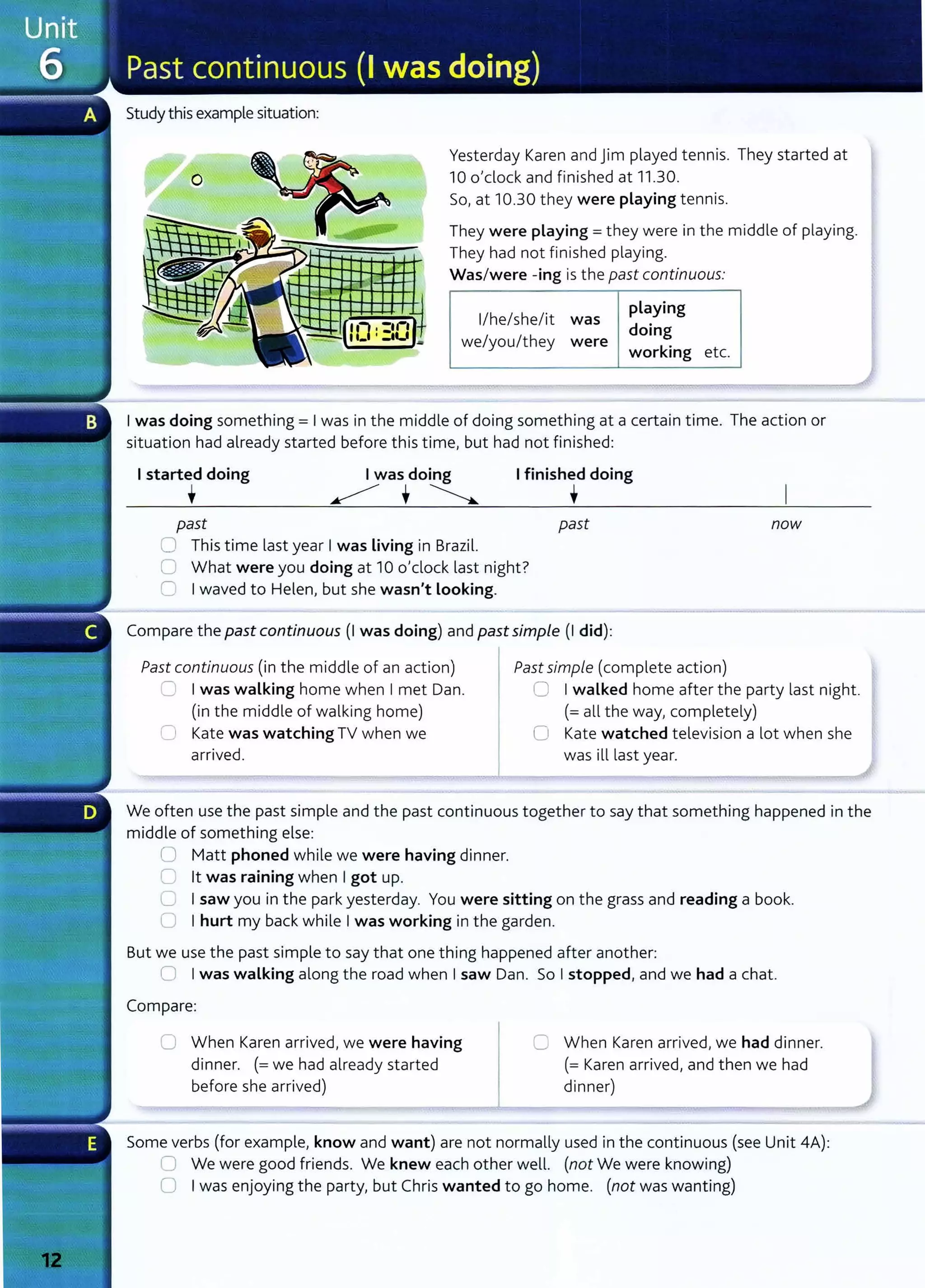
Study this example situation:
Yesterday Karen and jim played tennis. They started at
10 o'clock and finished at 11.30.
So, at 10.30 they were playing tennis.
They were playing = they were in the middle of playing.
They had not finished playing.
Was/were -ing is the past continuous:
1/he/she/it was
we/you/they were
playing
doing
working etc.
Iwas doing something= I was in the middle of doing something at a certain time. The action or
situation had already started before this time, but had not finished:
Istarted doing
•
Iwas doing
~ · ~
Ifinished doing
•
past past now
0 This time last year Iwas living in Brazil.
C What were you doing at 10 o'clock last night?
0 Iwaved to Helen, but she wasn't looking.
Compare the past continuous (I was doing) and pastsimple (I did):
Past continuous (in the middle of an action)
C Iwas walking home when Imet Dan.
(in the middle of walking home)
0 Kate was watching TV when we
arrived.
Pastsimple (complete action)
0 Iwalked home after the party last night.
(=all the way, completely)
0 Kate watched television a lot when she
was ill last year.
We often use the past simple and the past continuous together to say that something happened in the
middle of something else:
0 Matt phoned while we were having dinner.
0 lt was raining when Igot up.
0 Isaw you in the park yesterday. You were sitting on the grass and reading a book.
0 Ihurt my back while Iwas working in the garden.
But we use the past simple to say that one thing happened after another:
0 Iwas walking along the road when Isaw Dan. So Istopped, and we had a chat.
Compare:
0 When Karen arrived, we were having
dinner. (= we had already started
before she arrived)
C When Karen arrived, we had dinner.
(= Karen arrived, and then we had
dinner)
Some verbs (for example, know and want) are not normally used in the continuous (see Unit 4A):
~ We were good friends. We knew each other well. (not We were knowing)
0 Iwas enjoying the party, but Chris wanted to go home. (not was wanting)
Exercises
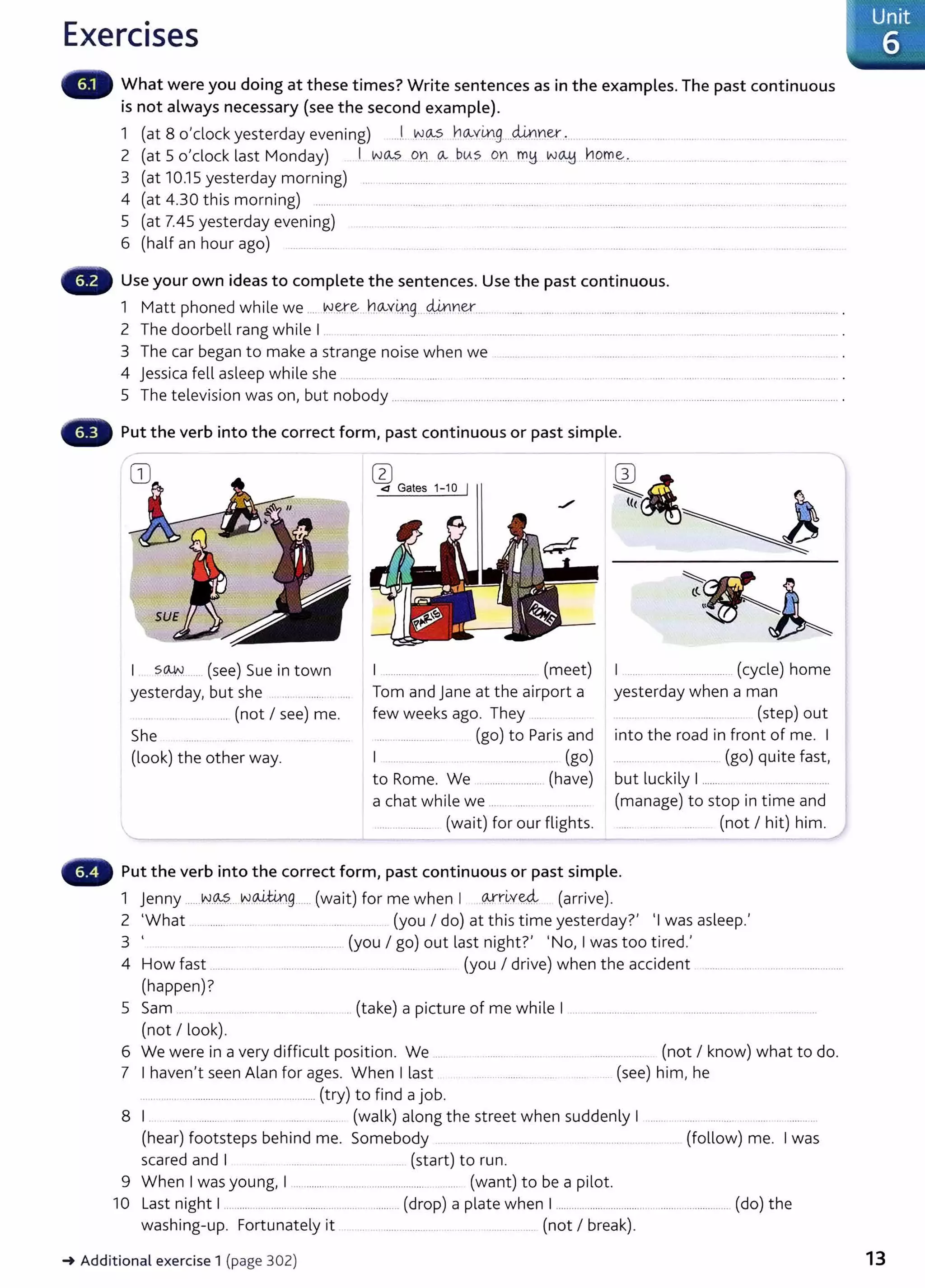
What were you doing at these times? Write sentences as in the examples. The past continuous
is not always necessary (see the second example).
1 (at 8 o'clock yesterday evening) ....1....vv.~ ho...vmg....~rter.. ........... ...... .... .... .... .. ..........................
2 (at 5 o'clock last Monday) I w~ .O.n Q.- ..b<As qn___ m!:J w~ n.9rr..~...... .... .................... ..... .... ..... ..
3 (at 10.15 yesterday morning) ... ................... .. .. ...... ...................... ........ ..... ....... .. ................ .......... ...................... ..
4 (at 4.30 this morning) .......... ...... .. ....... . .......... .... ..... . ..... .......... . ..... . ................... . .... . .................. ..
5 (at 7.45 yesterday evening) .. . ......... ...... .. .. . ....... ....................... ...................................................... ...........
6 (half an hour ago) .................... ........ ......... ...... ........... .. .. .. .... .............. ...... .. .. ... . ...... .
Use your own ideas to complete the sentences. Use the past continuous.
1 Matt phoned while we .... W.~e... ho...v.~g.. ~ner... ......... .............................. ............ ................. .......... .................. .
2 The doorbell rang while I .. ...... ....... .................... . .. .................... ...... . ...... . ..... ................. .
3 The car began to make a strange noise when we ....... ... .. ........... ..... ...... ..... ........ ...... .
4 jessica fell asleep while she .. ...... ............ ...... . ... .... .. .. ..... ..... .. . ..... ... ....... . ..... .. ..... . . ........ .... .. .................... .
5 The television was on, but nobody ........................................ ................................................................................................................... .
Put the verb into the correct form, past continuous or past simple.
s~....... (see) Sue in town
yesterday, but she ...............
... ... ............ (not I see) me.
She
(look) the other way.
w
<1 Gates 1-10 I
I ........................ .................... (meet)
Tom and jane at the airport a
few weeks ago. They ......
.... ................. (go) to Paris and
I .... ..... ..... . .................. ... (go)
to Rome. We ...... ............... (have)
a chat while we ........................
............ ......... (wait) for our flights.
I ..... .......................... (cycle) home
yesterday when a man
... ........... .... (step) out
into the road in front of me. I
......... . ............ (go) quite fast,
but luckily I...........................................
(manage) to stop in time and
..... .... (not I hit) him.
Put the verb into the correct form, past continuous or past simple.
1 jenny ......IN.~?....NP,W.g...... (wait) for me when I Q-rrir.v~ (arrive).
2 'What .......... ...... .. .. ....... ..... (you I do) at this time yesterdayt 'Iwas asleep.'
3 ' .... ............................................. (you I go) out last night?' 'No, Iwas too tired.'
4 How fast ........... ... ...................... ..... . .. . ......... .... ..... (you I drive) when the accident ...............................................
(happen)?
5 Sam .. ... ....... ..... ................. (take) a picture of me while I ... ....................... . .... .. ...................... .... ..........
(not I look).
6 We were in a very difficult position. We .....
7 I haven't seen Alan for ages. When I last
........... ............................................... (try) to find a job.
........ .......... ....... . ..................... (not I know) what to do.
....... .......... ... .. . (see) him, he
8 I. . ...... ............ ........ ..... ...................... (walk) along the street when suddenly I ....... . ..... . ........ . ............. ..
(hear) footsteps behind me. Somebody ..... ............... . . ........ ............. ... . (follow) me. Iwas
scared and I .................................. (start) to run.
9 When Iwas young, I ............................. .................. .. ... .... (want) to be a pilot.
10 L
ast night I............................................................. (drop) a plate when I................................................................... (do) the
washing-up. Fortunately it .. .. ...... .............. . .. ............ (not I break).
-t Additional exercise 1 (page 302)
·· Unit
6
13
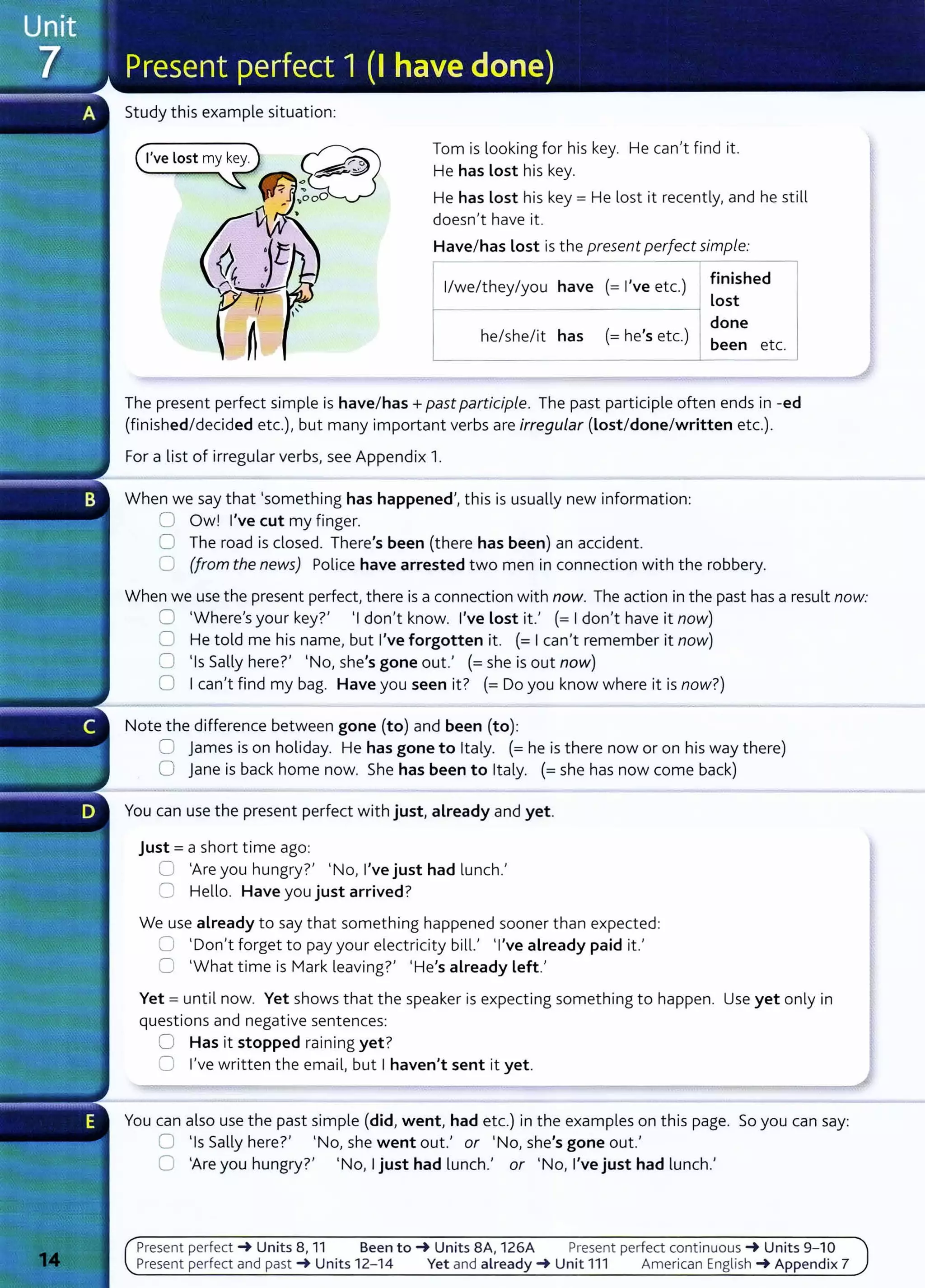
Study this example situation:
Tom is looking for his key. He can't find it.
He has Lost his key.
He has Lost his key= He lost it recently, and he still
doesn't have it.
Have/has Lost is the present perfect simple:
1
/we/they/you have (=I've etc.)
he/she/it has (= he's etc.)
finished
Lost
done
been etc.
The present perfect simple is have/has+ past participle. The past participle often ends in -ed
(finished/decided etc.), but many important verbs are irregular (Lost/done/written etc.).
For a list of irregular verbs, see Appendix 1.
When we say that 'something has happened', this is usually new information:
0 Owl I've cut my finger.
0 The road is closed. There's been (there has been) an accident.
0 (from the news) Police have arrested two men in connection with the robbery.
When we use the present perfect, there is a connection with now. The action in the past has a result now:
0 'Where's your key?' 'I don't know. I've Lost it.' (=I don't have it now)
0 He told me his name, but I've forgotten it. (= I can't remember it now)
0 'Is Sally here?' 'No, she's gone out.' (=she is out now)
0 I can't find my bag. Have you seen it? (= Do you know where it is now?)
Note the difference between gone (to) and been (to):
0 james is on holiday. He has gone to Italy. (= he is there now or on his way there)
0 Jane is back home now. She has been to Italy. (=she has now come back)
You can use the present perfect with just, already and yet.
just = a short time ago:
0 'Areyou hungry?' 'No, I've just had lunch.'
0 Hello. Have you just arrived?
We use already to say that something happened sooner than expected:
0 'Don't forget to pay your electricity bill.' 'I've already paid it.'
0 'What time is Mark leaving?' 'He's already Left.'
Yet = until now. Yet shows that the speaker is expecting something to happen. Use yet only in
questions and negative sentences:
0 Has it stopped raining yet?
0 I've written the email, but I haven't sent it yet.
You can also use the past simple (did, went, had etc.) in the examples on this page. So you can say:
0 'Is Sally here?' 'No, she went out.' or 'No, she's gone out.'
0 'Are you hungry?' 'No, I just had lunch.' or 'No, I've just had lunch.'
Present pe rfect ~ Units 8, 11 Been to~ Units 8A, 126A Present perfect co ntinuous ~ Units 9- 10
Present perfect and past ~ Units 12- 14 Yet and already~ Unit 111 American English ~ Appendix 7
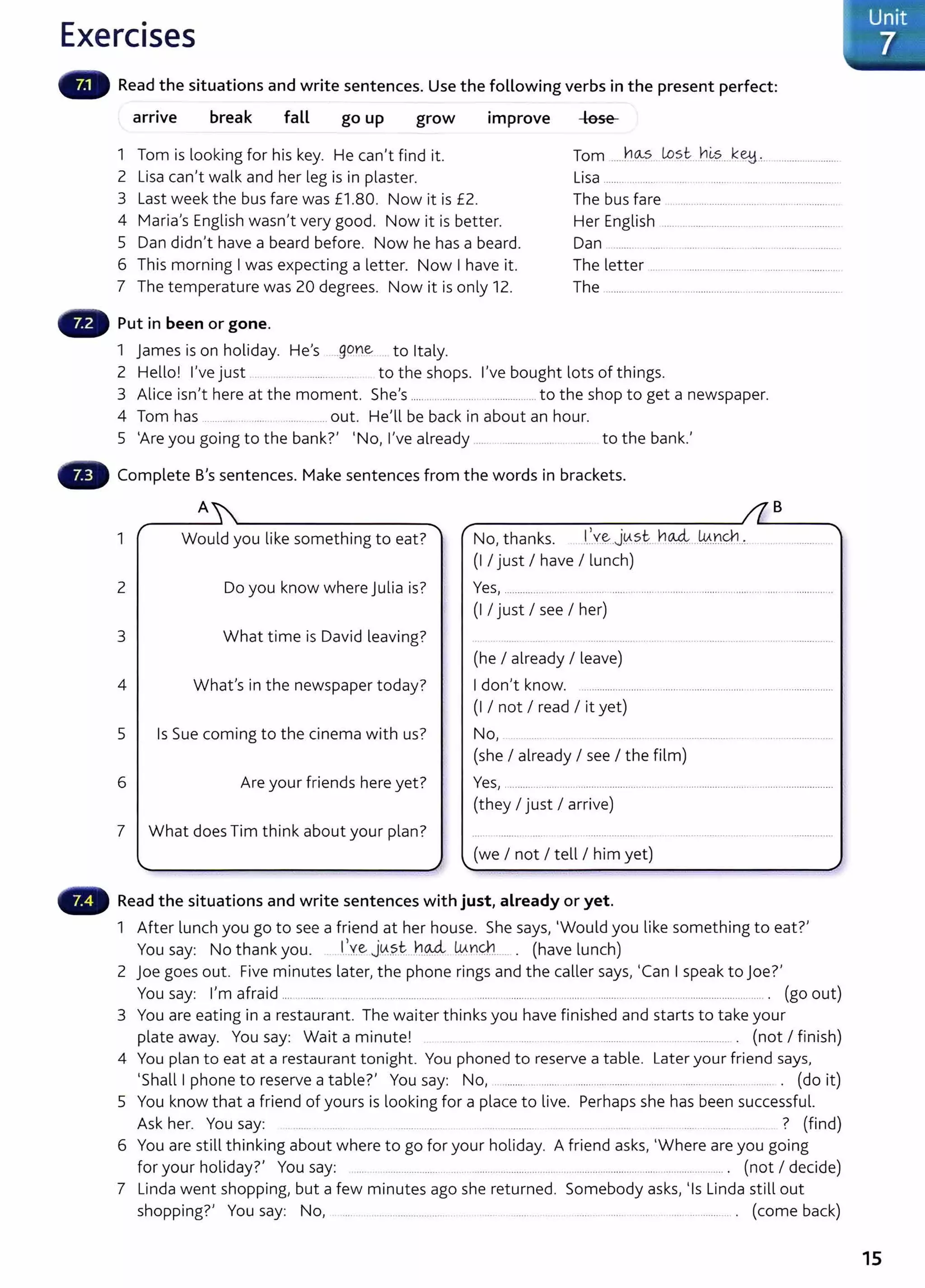
Exercises
Read the situations and write sentences. Use the following verbs in the present perfect:
.
arnve break go up grow 1mprove lose
fall
Tom .....h.~? . Lo~t. .b~s.....k~.:.
1 Tom is looking for his key. He can't find it.
2 Lisa can't walk and her leg is in plaster. Lisa .................... ..... .............................................
3 Last week the bus fare was £1 .80. Now it is £2. The bus fa re ........................................ ................
4 Maria's English wasn't very good. Now it is better. Her English ...............................................................
5 Dan didn't have a beard before. Now he has a beard.
6 This morning I was expecting a letter. Now I have it.
7 The temperature was 20 degrees. Now it is only 12.
Dan ........ ..... .......................................
The letter ..... . ....................... . ....... ...............
The .................................................................................
Put in been or gone.
1 James is on holiday. He's ..gone . to Italy.
2 Hello! I've just ........... ... to the shops. I've bought lots of things.
3 Alice isn't here at the moment. She's ..... .......... ............................to the shop to get a newspaper.
4 Tom has ..................................... out. He'll be back in about an hour.
5 'Are you going to the bank?' 'No, I've already ..... . ....................... ..... to the bank.'
- Complete B's sentences. Make sentences from the words in brackets.
A B
1 Would you like something to eat? No, thanks. .
1
..~j~st. h~ ..W..nQ1..~.
(I I just I have I lunch)
2 Do you know where Julia is? Yes, .................................. ........................................................ .........................
(I I just I see I her)
3 What time is David leaving?
(he I already I leave)
4 What's in the newspaper today? I don't know. ............................................................... ................................
(I I not I read I it yet)
5 Is Sue coming to the cinema with us? No, ....... ............ ......
(she I already I see I the film)
6 Are your friends here yet? Yes, ........................................................................................................................ ~
(they I just I arrive)
7 What does Tim think about your plan?
(we I not I tell I him yet)
Read the situations and write sentences with just, already or yet.
1 After lunch you go to see a friend at her house. She says, 'Would you like something to eat?'
You say: No thank you. . 1
:.v.e J~.s.t.. .n~ wn<J:J...... . (have lunch)
2 joe goes out. Five minutes later, the phone rings and the caller says, 'Can I speak to joe?'
You say: I'm afraid .... ........... .... .... ................................. .. .. ...................... .......... ......... .................. ......................................... . (go out)
3 You are eating in a restaurant. The waiter thinksyou have finished and starts to take your
plate away. You say: Wait a minute! ................ ..... . .. ................. . (not I finish)
4 You plan to eat at a restaurant tonight. You phoned to reserve a table. Later your friend says,
'Shall I phone to reserve a table?' You say: No, ............ ............ ......................... ........... .... ....... ................. ...... . (do it)
5 You know that a friend of yours is looking for a place t o live. Perhaps she has been successful.
Ask her. You say: .. ....... ............ . ................... .. ..................... ...... ................ ... .... ... .......... ? (find)
6 You are still thinking about where to go for your holiday. A friend asks, 'Where are you going
for your holiday?' You say: ...................... ... . ........ ..................... . ........................ ..... .... ........... .... . (not I decide)
7 Linda went shopping, but a few minutes ago she returned. Somebody asks, 'Is Linda still out
shopping?' You say: No, .... ....................... ..... .. ....... ... .. ..... ................ . (come back)
Unit
7
15
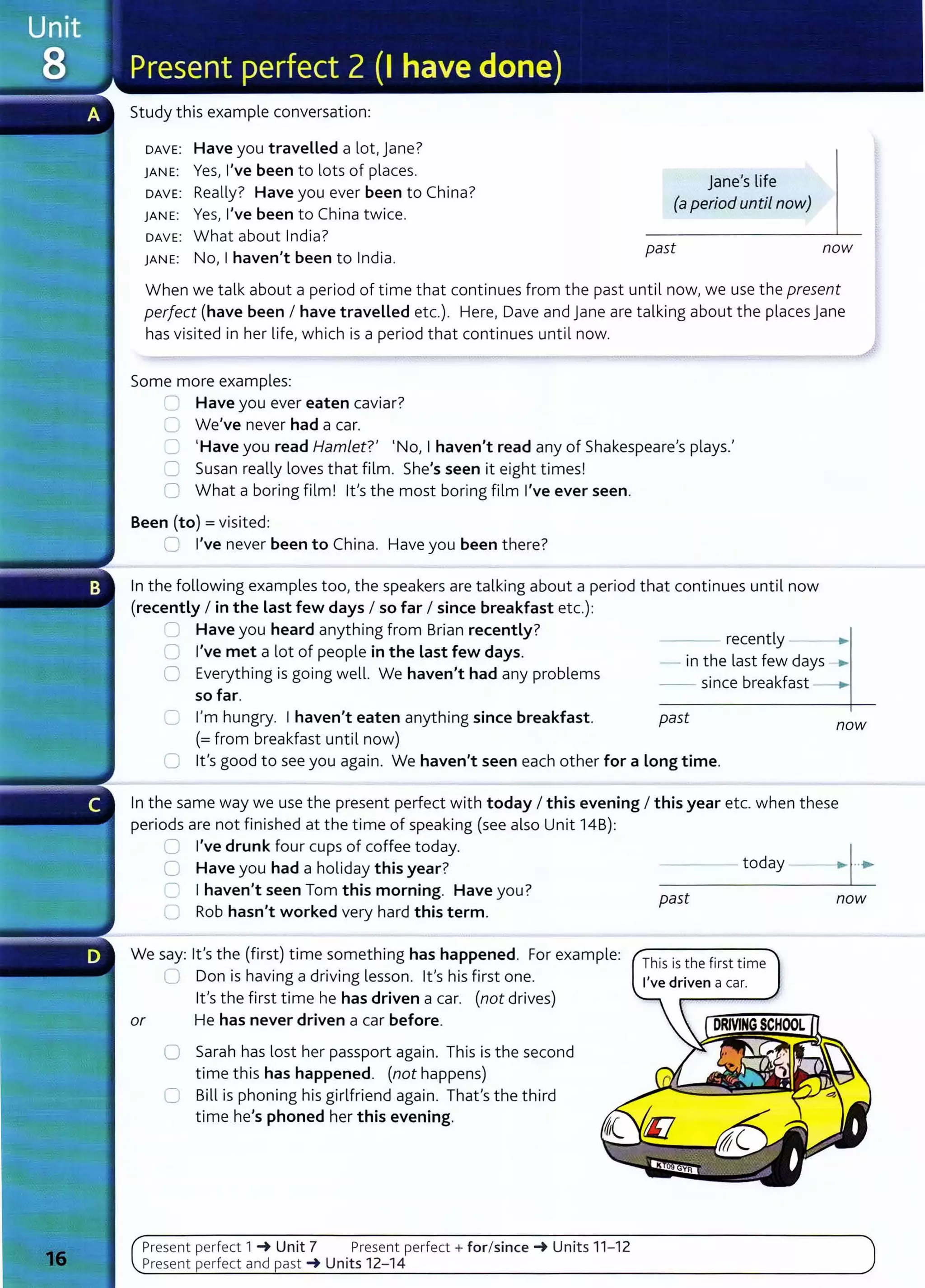
Study this example conversation:
DAVE: Have you travelled a lot, jane?
JANE: Yes, I've been to lots of places.
DAVE: Really? Have you ever been to China?
JANE: Yes, I've been to China twice.
DAVE: What about India?
JANE: No, I haven't been to India.
jane's life
(a period until now)
past now
When we talk about a period of time that continues from the past until now, we use the present
perfect (have been I have traveLLed etc.). Here, Dave and jane are talking about the places jane
has visited in her life, which is a period that continues until now.
Some more examples:
~ Have you ever eaten caviar?
C We've never had a car.
C 1
Have you read Hamlet?' I No, I haven't read any of Shakespeare's plays.'
'= Susan really loves that film. She's seen it eight times!
0 What a boring film! lt's the most boring film I've ever seen.
Been (to)= visited:
Cl I've never been to China. Have you been there?
In the following examples too, the speakers are talking about a period that continues until now
(recently I in the Last few days I so far I since breakfast etc.):
~ Have you heard anything from Brian recently?
C I've met a lot of people in the Last few days.
0 Everything is going well. We haven't had any problems
so far.
recently ___.,
- in the last few days .....
0 I'm hungry. I haven't eaten anything since breakfast.
(=from breakfast until now)
- - since breakfast
past now
0 lt's good to see you again. We haven't seen each other for a Long time.
In the same way we use the present perfect with today I this evening I this year etc. when these
periods are not finished at the time of speaking (see also Unit 14B):
0 I've drunk four cups of coffee today.
0 Have you had a holiday this year?
C I haven't seen Tom this morning. Have you?
U Rob hasn't worked very hard this term.
We say: lt's the (first) time something has happened. For example:
0 Don is having a driving lesson. lt's his first one.
lt's the first time he has driven a car. (not drives)
or He has never driven a car before.
0 Sarah has lost her passport again. This is the second
time this has happened. (not happens)
C Bill is phoning his girlfriend again. That's the third
time he's phoned her this evening.
Present perfect 1 _. Unit 7 Present perfect+ for/since_. Units 11- 12
Present perfect and past _. Units 12-14
- - - - today --·~ •
past now
This is the first time
Exercises
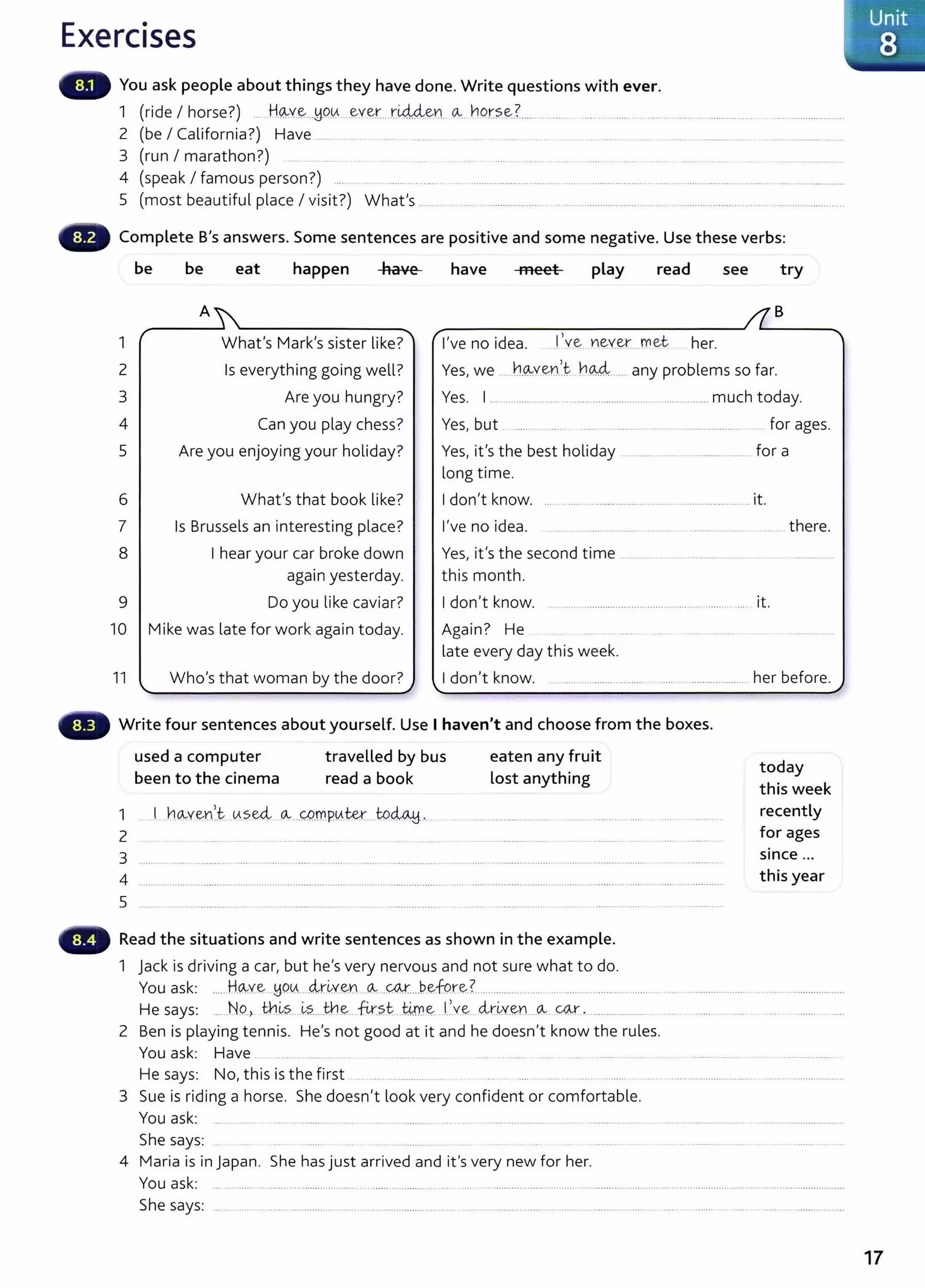
You ask people about things they have done. Write questions with ever.
1 (ride I horse?) .. .H~Y.~...H9.
0 .. ever..r.~Y1. ~. rw.r.~.~.?.... .... ..... .. .... ........ . ... .. ...... ...................... ...........................
2 (be I California?) Have ....... ... ..... ............. .. .. ......... ..... ...................... ...... .............. ..... ............................
3 (run I marathon?) .... ........... ....... ......................
4 (speak I famous person?) ............................................ ............................................................................................... ...... .................
5 (most beautiful place I visit?) Whafs ............................................................................................... ......... ..............................
Complete B's answers. Some sentences are positive and some negative. Use these verbs:
1
2
3
4
5
6
7
8
9
be be eat happen have
A
What's Mark's sister like?
Is everything going well?
Are you hungry?
Can you play chess?
Are you enjoying your holiday?
What's that book like?
Is Brussels an interesting place?
I hear your car broke down
again yesterday.
Do you like caviar?
have meet play read see try
B
I've no idea. Ie n~v.~.. met her.
Yes, we .. h.~v~n~t- bAA...... any problems so far.
Yes. I .................................. ......................................... much today.
Yes, but ....... .... for ages.
Yes, it's the best holiday ...... . ... .. .. ................... for a
long time.
I don't know. ............................................ .......................... it.
I've no idea.
Yes, it's the second time ....
this month.
I don't know. ...................................................................... it.
there.
10 Mike was late for work again today. Again? He
late every day this week.
11 Who's that woman by the door? I don't know. .. ............................................................ her before.
Write four sentences about yourself. Use I haven't and choose from the boxes.
used a computer
been to the cinema
travelled by bus
read a book
2 ..... .... .......................................... .
3 ............................. .......................................
eaten any fruit
lost anything
4 ............................................................................................................................................................................. .... ................... .............
5 ...................................................................................................................................................... ..
Read the situations and write sentences as shown in the example.
1 jack is driving a car, but he's very nervous and not sure what to do.
today
this week
recently
for ages
SinCe ...
this year
You ask: .. ...H.~Y.e HO.(A....~r.~Y.~Y.I... c&...QA.r....P.~fo.r~.?.............................................................................................................................
He says: .....No.). tn.~~....~?......t.h~.. fir.~t.. @.~ !.~v~. clt:~v.~n...~..CQ-.f.... ......... .......... .. ...... . . ..... .... ..... ... .. .................
2 Ben is playing tennis. He's not good at it and he doesn't know the rules.
You ask: Have ....................... .. . ..................... .... ...... .... ......... .
He says: No, this isthe first ..... ................. .... .... ... . .... . .... .. ......... .. . ........ ...................... .............................
3 Sue is riding a horse. She doesn't look very confident or comfortable.
You ask: .... .. ....... .... ............... ..... ......... ............ .... ... ........................ .... ........................ . .... ... ..................... . .........................
She says: .
4 Maria is in Japan. She has just arrived and it's very new for her.
You ask: ............................................................................... .... ............................................................................................................................................
She says: ...... .... ........................... .......... ................................. .............................. ............ ................. .... .. .... ......... .... . ...........................
17
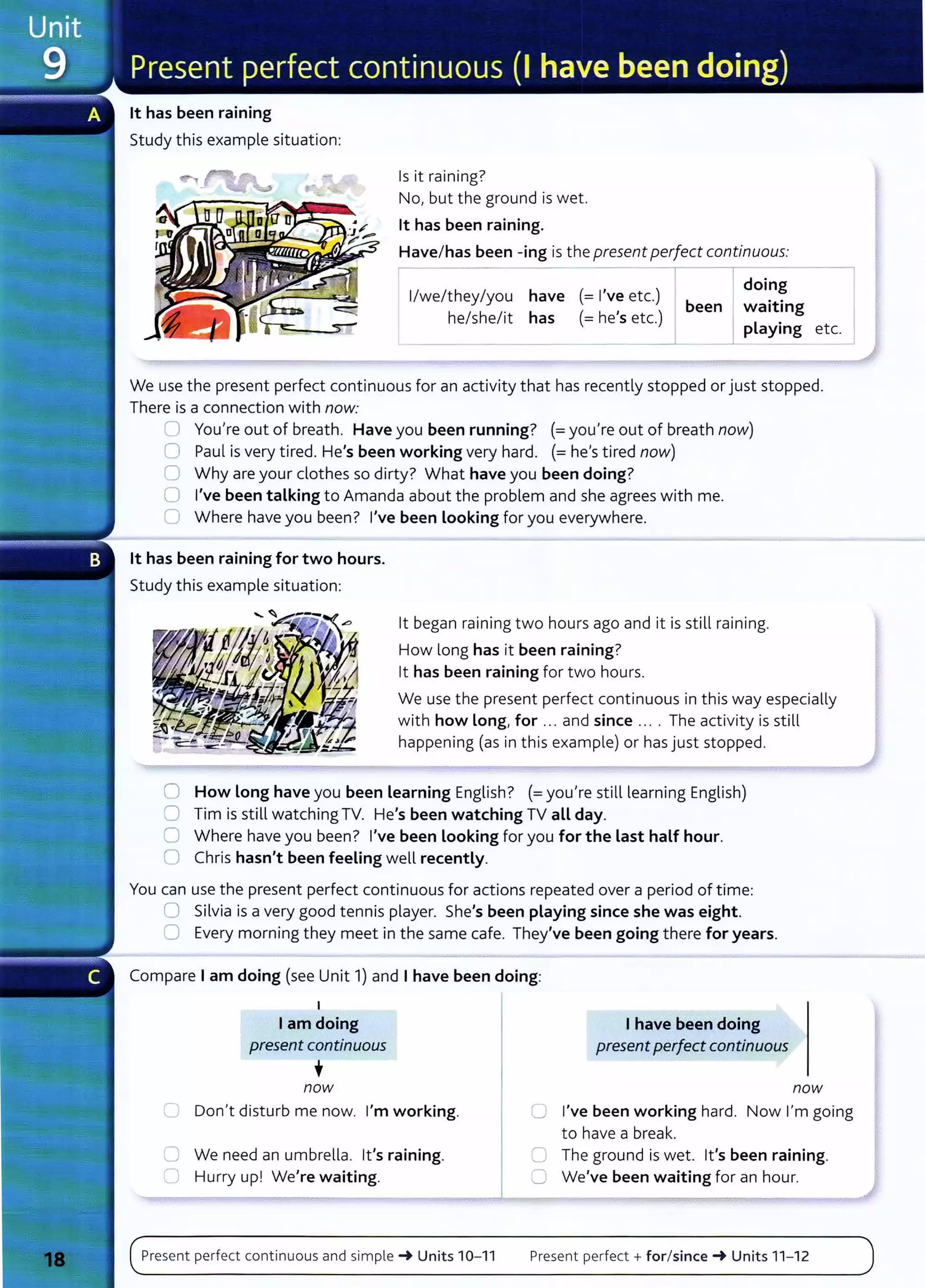
lt has been raining
Study this example situation:
Is it raining?
No, but the ground is wet.
lt has been raining.
Have/ has been -ing is the present perfect continuous:
r-- , I Idoing
1
/we/they/you have (= I ve etc.) b ..
h (- h , ) een I waatang
e/she/it has - e s etc. L .
_ _ ____._I------'--
p ayang etc.
We use the present perfect continuous for an activity t hat has recently stopped or just stopped.
There is a connection with now:
0 You're out of breath. Have you been running? (= you're out of breath now)
0 Paul is very tired. He's been working very hard. (= he'stired now)
C Why are your clot hes so dirty? What have you been doing?
0 I've been talking to Amanda about the problem and she agrees with me.
0 Where have you been? I've been Looking for you everywhere.
lt has been raining for two hours.
Study this example situation:
lt began raining two hours ago and it is still raining.
How long has it been raining?
lt has been raining for two hours.
We use the present perfect cont inuous in t his way especially
with how Long, for ... and since .... The activity is still
happening (as in this example) or has just stopped.
0 How Long have you been Learning English? (=you're still learning English)
0 Tim is still watching TV. He's been watching TV aLL day.
0 Where have you been? I've been Looking for you for the Last half hour.
0 Chris hasn't been feeling well recently.
You can use the present perfect cont inuous for actions repeated over a period of time:
0 Silvia is a very good tennis player. She's been playing since she was eight.
0 Every morning they meet in t he same cafe. They've been going t here for years.
Compare I am doing (see Unit 1) and I have been doing:
I
I am doing
present continuous
•
now
I have been doing
presentperfectcontinuous
now
C Don't disturb me now. I'm working. C I've been working hard. Now I'm going
to have a break.
C We need an umbrella. lt's raining.
C Hurry up! We're waiting.
Present perfect continuous and simple -+ Units 10- 11
C The ground is wet. lt's been raining.
C We've been waiting for an hour.
Present perfect+ for/since -+ Units 11- 12
Exercises
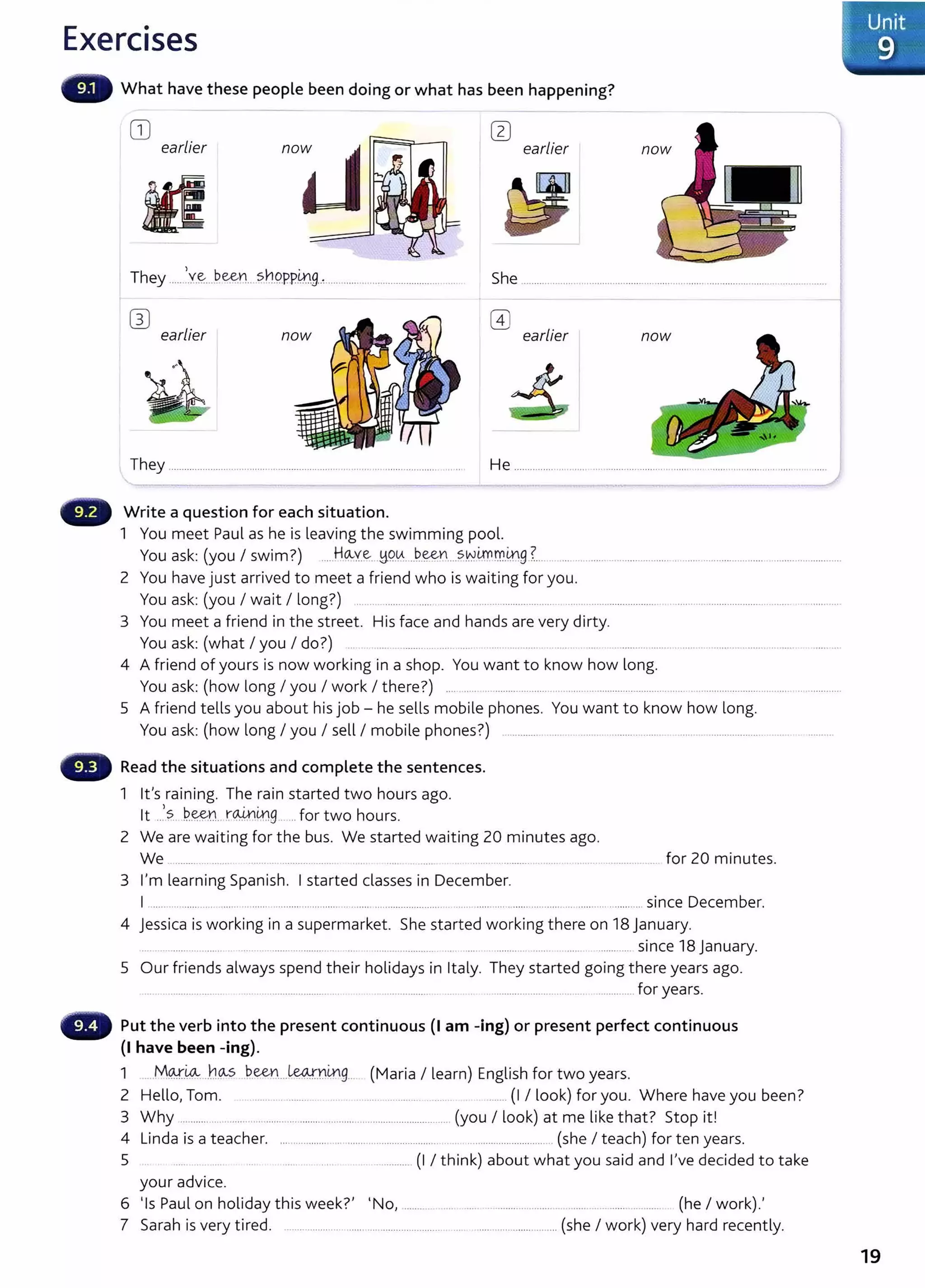
What have these people been doing or what has been happening?
CD earlier
earlier
n
oij
~I
They ....~Y.~....~e:e:~·:t ?.h.O..P..P.Lr9..~................................................... She .................................................................................................................
wearlier
(1)
earlier now
They .......................................................................................................... He ............... ......................................... ................ ................ ......... .....
Write a question for each situation.
1 You meet Paul as he is leaving the swim ming pool.
You ask: (you I swim?) .....H.q._y~_ .~9-~....~-~....?.kY~m.mg?... .................................................................... ...........................
2 You have just arrived to meet a friend w ho is wait ing for you.
You ask: (you I wait I long?) .......................... .................................... ....................................................................................
3 You meet a friend in the st reet . His face and hands are very dirty.
You ask: (w hat I you I do?) .. .... ........... .... ... .. . .. .... ...........................................................
4 A friend of yours is now working in a shop. You want t o know how long.
You ask: (how long I you I work I there?) .................................................................................. ............................ .........................
5 A friend t ells you about hisj ob- he sells mobile phones. You want t o know how long.
You ask: (how long I you I sell I mobile phones?) .............. ................................................................................... .
Read the situations and complete the sentences.
1 lt's raining. The rain st arted two hours ago.
lt ..).?.. l?.~n rW.Lng..... for two hours.
2 We are waiting for the bus. We started waiting 20 minutes ago.
We ..................... ........ ................... .... . ... ................. ......
3 I'm learning Spanish. I started classes in December.
for 20 minutes.
I ................... .............. ......................................... .......................................... ...... ....................................... since December.
4 Jessica is working in a supermarket. She started w orking t here on 18 January.
.... ................ ..... ................... ...................... ... ... ......... .... ............. since 18 January.
5 Our friends always spend t heir holidays in It aly. They started going t here years ago.
.... .......................... ................................... ... . . ....................... ... . ................................................... for years.
Put the verb into the present continuous (I am -ing) or present perfect continuous
(I have been -ing).
1 .....M~-~ ..h<AS J?.~..--~.Y.4-lg... (Maria I learn) English for two years.
2 Hello, Tom. . ....... .. .........._ .. . . .... ........... ....... (I I look) for you. Where have you been?
3 Why ......................... ............................................................................ (you I look) at me like t hat? St op it !
4 Linda is a t eacher. .............................................................................................. (she I t each) for ten years.
5 ...... . .. . ...... . ... . .............. (I I think) about w hat you said and I've decided t o take
your advice.
6 'Is Paul on holiday t his week?' 'No, .................... ...... ........................ ............ ........... ............ (he I work).'
7 Sarah is very tired. ....................... ....... .............................. ... ................................ (she I work) very hard recently.
19
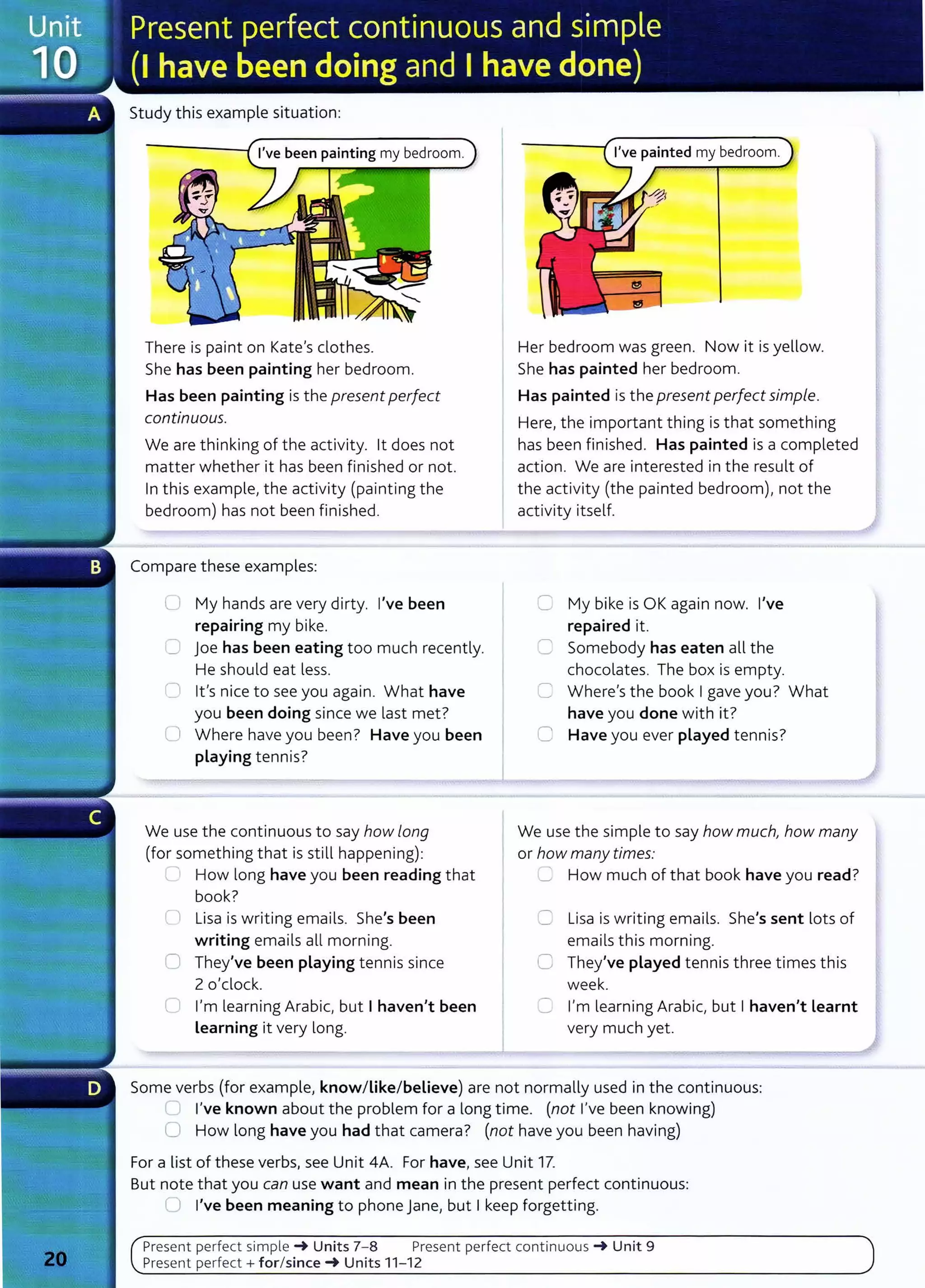
Study this example situation:
I've been painting my bedroom.
There is paint on Kate's clothes.
She has been painting her bedroom.
Has been painting is the present perfect
continuous.
We are thinking of the activity. lt does not
matter whether it has been finished or not.
In this example, the activity (painting the
bedroom) has not been finished.
Compare these examples:
Q My hands are very dirty. I've been
repairing my bike.
,-. joe has been eating too much recently.
He should eat less.
I lt's nice to see you again. What have
you been doing since we last met?
0 Where have you been? Have you been
playing tennis?
We use the continuous to say how long
(for something that is still happening):
'--- How long have you been reading that
book?
Cl Lisa is writing emails. She's been
writing emails all morning.
0 They've been playing tennis since
2 o'clock.
0 I'm learning Arabic, but I haven't been
Learning it very long.
I've painted my bedroom.
Her bedroom was green. Now it is yellow.
She has painted her bedroom.
Has painted is the present perfect simple.
Here, the important thing is that something
has been finished. Has painted is a completed
action. We are interested in the result of
the activity (the painted bedroom), not the
activity itself.
C My bike is OK again now. I've
repaired it.
C Somebody has eaten all the
chocolates. The box is empty.
C Where's the book I gave you? What
have you done with it?
C Have you ever played tennis?
We use the simple to say how much, how many
or how many times:
..= How much of that book have you read?
C Lisa is writing emails. She's sent lots of
emails this morning.
C They've played tennis three times this
week.
C I'm learning Arabic, but I haven't learnt
very much yet.
Some verbs (for example, know/Like/believe) are not normally used in the continuous:
..__, I've known about the problem for a long time. (not I've been knowing)
0 How long have you had that camera? (not have you been having)
For a list of these verbs, see Unit 4A. For have, see Unit 17.
But note that you can use want and mean in the present perfect continuous:
U I've been meaning to phone Jane1 but I keep forgetting.
Present perfect simple -+ Units 7- 8 Present perfect continuous -+ Unit 9
Present perfect+ for/since-+ Units 11- 12
Exercises
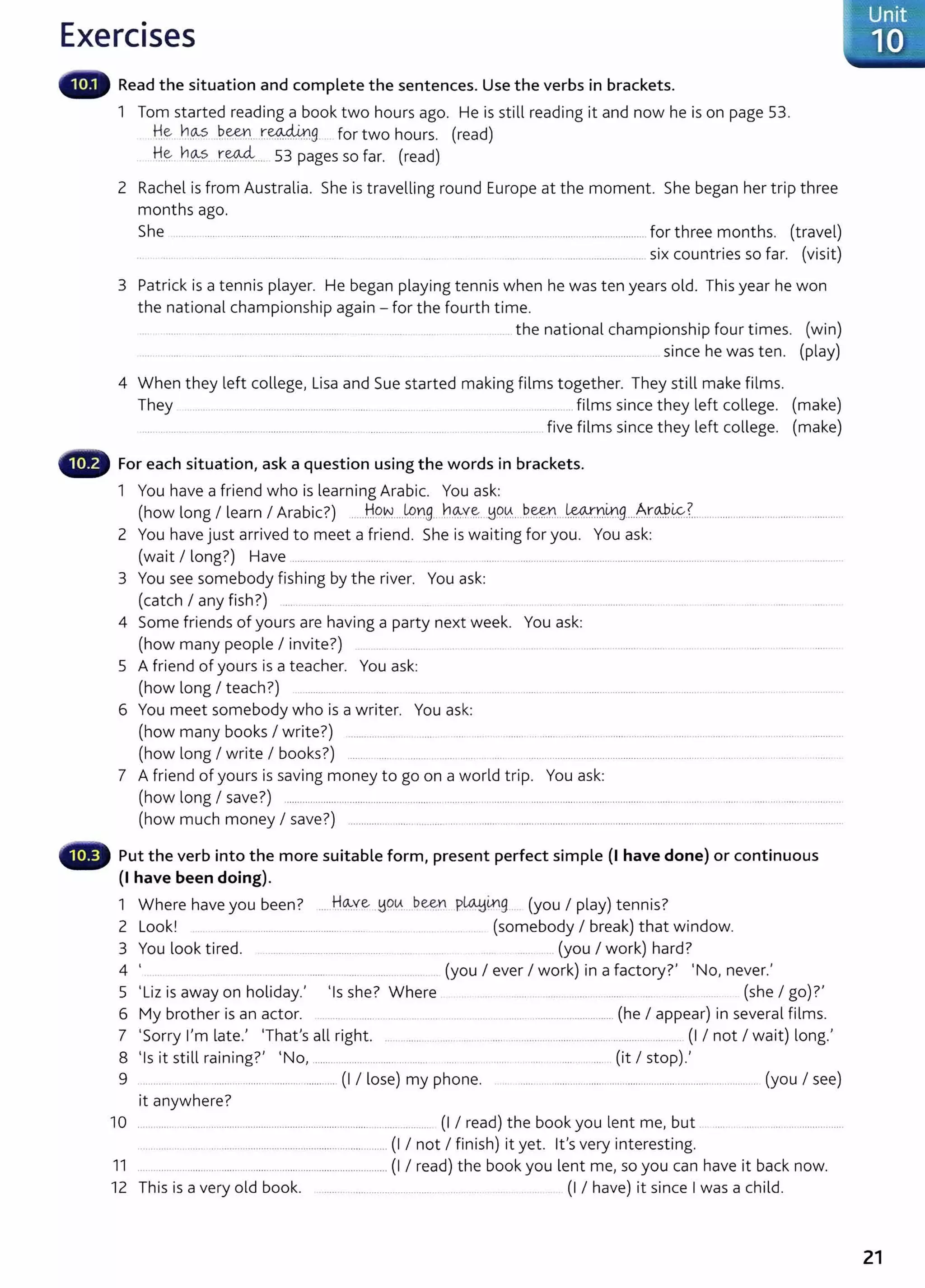
Read the situation and complete the sentences. Use the verbs in brackets.
1 Tom started reading a book two hours ago. He is still reading it and now he is on page 53.
.H~ . n~ ..P..~Y.1.. x-.~9- ... for two hours. (read)
H~ h_
0::?. r.~---· 53 pages so far. (read)
2 Rachel is from Australia. She is travelling round Europe at the moment. She began her trip three
months ago.
She ........ .... ................................................................. .... ............. ................................................................. for three months. (travel)
.. . ... ... . ..................... ........ . ...... . .......... ........... ....... ....... ... . . ........ ........................................ six countries so far. (visit)
3 Patrick is a tennis player. He began playing tennis when he was ten years old. This year he won
the national championship again- for the fourth time.
.. . ...... ....... . ........................................ .. . ..... .... the national championship four times. (win)
.... ..... . ....... ......... ....................... ........ ..... . .... .. ................................................ since he was ten. (play)
4 When they left college, Lisa and Sue started making films together. They still make films.
They ..... ....... ...................... ....... ......... .... ........ . ..... ............films since they left college. (make)
... ...... . .. ........... ........................................ ..... .. .... .... ..... ..... . . .. .. .. .. ....... five films since they left college. (make)
For each situation, ask a question using the words in brackets.
1 You have a friend who is learning Arabic. You ask:
(how long I learn I Arabic?) .....H9~..JP.rg...b.0:-v.~. !:1q~.. P..~r,l....~Y.1.0.9....A.r.0.:b.~?.......................................................
2 You have just arrived to meet a friend. She is waiting for you. You ask:
(wait I long?) Have ................................... ...... . ................................................................................................... ..
3 You see somebody fishing by the river. You ask:
(catch I any fish ?) ...
4 Some friends of yours are having a party next week. You ask:
(how many people I invite?)
5 A friend of yours is a teacher. You ask:
(how long I teach?) ............. ... ... .. .
6 You meet somebody who is a writer. You ask:
(how many books I write?) ....................... ...... .. ... .... . ...... . ...... ......... ........... ............... ...... ... ........ ......................... ..
(how long I write I books?) ...... .. ..... . .... . .......... ... ..... ............................................................................................. . ...... ...... .
7 A friend of yours is saving money to go on a world trip. You ask:
(how long I save?) .............................................................................................................................................. ............................. ..... .... ......................
(how much money I save?) ...................... ........... ......................................................................................................... ............. .......................
Put the verb into the more suitable form, present perfect simple (I have done) or continuous
(I have been doing).
1 Where have you been? ... H~ye__yq~--- ~~Y.1 ..P~~g . (you I play) tennis?
2 Look! .................................. ........ (somebody I break) that window.
3 You look tired. ........................................... . ..... (you I work) hard?
4 ' ...... .... .......... ....... . .... ....... (you I ever I work) in a factory?' 'No, never.'
5 'Liz is away on holiday.' 'Is she? Where ... .... . . ..... . .... (she I go) ?'
6 My brother is an actor. .... .... ........................................................................... (he I appear) in several films.
7 'Sorry I'm late.' 'That's all right. ............................................................................................... (I I not I wait) long.'
8 'I . 'll . . ?' 'N (' I ) I
s 1t st1 ra1n1ng . o, ........ .......... .. ........ ......... ... . .... .. . .... 1t stop .
9 ........... ... .... ......... ................................... (I I lose) my phone. . ........ ..................................................................................... (you I see)
it anywhere?
10 ..................................................... .................................. (I I read) the book you lent me, but
........................................................................................... (I I not I finish) it yet. it's very interesting.
11 ....................................................................................... (I I read) the book you lent me, so you can have it back now.
12 This is a very old book. ..... ......................................... ... (I I have) it since I was a child.
21
Study this example situation:
Dan and jenny are married. They got married exactly
20 years ago, so today is their 20th wedding anniversary.
They have been married for 20 years.
We say: They are married. (present)
but How long have they been married? (present perfect)
(not How long are they married?)
They have been married for 20 years.
(not They are married for 20 years)
We use the present perfect to talk about something that began in the past and still continues now.
Compare the present and the present perfect:
but
but
C Paul is in hospital.
He's been in hospital since Monday. (=He has been ...)
(not Paul is in hospital since Monday)
0 Do you know each other well?
Have you known each other for a Long time?
(not Do you know)
0 She's waiting for somebody.
present perfect
he has been
have you known
present
he is
do you know
she is waiting
but She's been waiting aLL morning. she has been waiting
0 Do they have a car?
but How Long have they had their car? past
I have known/had/ Lived etc. is the present perfectsimple.
I have been Learning I been waiting I been doing etc. is the present perfect continuous.
When we ask or say 'how long', the continuous is more usual (see Unit 10):
CJ I've been learning English for six months.
0 lt's been raining since Lunchtime.
0 Richard has been doing the same job for 20 years.
0 'How long have you been driving?' 'Since I was 17.'
Some verbs (for example, know/Like/believe) are not normally used in the continuous:
0 How long have you known jane? (not have you been knowing)
0 I've had a pain in my stomach all day. (not I've been having)
See also Units 4A and 10C. For have, see Unit 17.
You can use either the present perfect continuous or simple with live and work:
C julia has been Living I has Lived here for a long time.
0 How long have you been working I have you worked here?
But use the simple (I've Lived I I've done etc.) with always:
0 I've always Lived in the country. (not always been living)
We say 'I haven't done something since/for ...' (present perfectsimple):
G I haven't seen Tom since Monday. (= Monday was the last t ime I saw him)
C Sarah hasn't phoned for ages. (=the last time she phoned was ages ago)
now
I haven't ... since/for~ Unit 8B Present perfect continu ou s ~ Units 9- 10 For and since ~Unit 12A
Exercises
Are the underlined verbs right or wrong? Correct them where necessary.
1 Ben is a friend of mine. I know him very well. ... Q~ .................. ...................................... ..... ..... ..................
2 Ben is a friend of mine. I know him for a long time. llve, kYo~n him ...................
3 Sarah and Adam are married since July. .............. ...... . .......... . .
4 The weather is awful. lt's raining again. . .................... ..... .... ..................... . ....... ...............
5 The weather is awful. lt's raining all day. .............. ...............................................................................................
6 I like your house. How long are you living there? ......... ..... .... ............. ..
7 Gary is working in a shop for the last few months. .. ... ....... ..... . .............. .
8 I don't know Tom well. We've only met a few times. .......... ... ...... ............................
9 I gave up drinking coffee. I don't drink it for a year. .... ...... ... ...................... ...... ..............................................................
10 Thafs a very old bike. How long do you have it? .. .... . ................ ..... .... ...................................................
Read the situations and write questions from the words in brackets.
1 A friend tells you that Paul is in hospital. You ask him:
(how long I be I in hospital?) ... HO.N ..lp.ng hCA-?....P.@.~.. b~n .~...h9.?.PW? ........................ ...................................
2 You meet a woman who tells you that she teaches English. You ask her:
(how long I teach I English?) .......... ... . ...... . ........ . ...... . ..... .......... ..
3 You know that j ane is a good friend of Katherine's. You ask jane:
(how long I know I Katherine?) ...................... .. ... ...... . .... ....................... ... .......................................................
4 Your friend's brother went to Australia some time ago and he's still there. You ask your friend:
(how long I be I in Australia?) ......... ... ....... . ... ... . ................... .... ...............
5 Tom always wears the same jacket. lt's a very old jacket. You ask him:
(how long I have I that jacket?) ..................... . .... . ..... ............. .. ...... ................... .............................
6 You are talking to a friend about joe. joe now works at the airport. You ask your friend:
(how long I work I at the airport?) ...... ..... .... .... . . .. ........... ..... ... ......... ... ...... ...................... .....
7 A friend of yours is having guitar lessons. You ask him:
(how long I have I guitar lessons?) .................
8 You meet somebody on a plane. She says that she lives in Chicago. You ask her:
(always I live I in Chicago?) .... .. .. ................... .. ................................................................. ...................................................................
Complete B's answers to A's questions.
A
1 Paul is in hospital, isn't he?
2 Do you see Ann very often?
3 Is Amy married?
4 Are you waiting for me?
5 You know Mel, don't you?
6 Do you still play tennis?
7 Isjoe watching TV?
8 Do you watch TV a lot?
9 Do you have a headache?
10 Adrian is never ill, is he?
11 Are you feeling ill?
12 Sue lives in Berlin, doesn't she?
13 Do you go to the cinema a lot?
14 Would you like to go to New
York one day?.I
B
Y h ho..s be,e,n · h ·t l · M d
es, e .. . .... .. ..... .. .... m osp1 a smce on ay.
No, I h ~y_~.. s~ . her for three months.
Yes, she ...... ......................... married for ten years.
Yes, I ............................ ........................................... for the last half hour.
Yes, we ...................................................... each other a long time.
No, I . ........... ...... .. ................ . . .... . .. tennis for years.
Yes, he ......................... ................................ ...................... TV all evening.
No, I ............................................................................................. ............... TV for ages.
Yes, I .. .
No, he
a headache all morning.
.. ill since I've known him.
Yes, I ...................................................................................................... ill all day.
Yes, she ........................ ....... ................................ .................. in Berlin for the
last few years.
No, I .. ........................ ... . ................................ .. to the cinema for ages.
Yes, I ... ... ...... .. ..... ...... ................. ....... .. .. to go to New York.
(use always I want)
23
We use for and since to say how long something has been happening.
We use for + a period of time (two hours, six
weeks etc.):
We use since+ the start of a period
(8 o'clock, Monday, 1999 etc.):
0 I've been waiting for two hours. 0 I've been waiting since 8 o'clock.
for two hours since 8 o'clock
twohou~ago---------~~now 8 o'clock ----------~~ now
for
two hours 20 minutes
a long time six months
a week ages
five days
50 years
years
8 o'clock
April
lunchtime
since
Monday
2001
we arrived
12 May
Christmas
I got up
0 Sally has been working here for six
months. (not since six months)
0 I haven't seen Tom for three days.
0 Sally has been working here since April.
(=from April until now)
C Ihaven't seen Tom since Monday.
lt is possible to leave out for (but not usually in negative sentences):
0 They've been married (for) ten years. (with or without for)
0 They haven't had a holiday for ten years. (you must use for)
We do not use for+ all ... (all day I all my life etc.):
0 I've lived here all my life. (not for all my life)
You can use in instead of for in negative sentences (I haven't ... etc.):
G They haven't had a holiday in ten years. (=for ten years)
Compare when ... ? (+past simple) and how long ... ? (+present perfect):
A: When did it start raining?
s: lt started raining an hour ago I at 1 o'clock.
A: How Long has it been raining?
s: lt's been raining for an hour I since 1 o'clock.
A: When did j oe and Carol first meet?
Th f
. { a Long time ago.
s: ey lrst met when they were at school.
A: How long have they known each other?
{
for a Long time.
s: They've known each other . h h L
smce t ey were at se oo .
since something happened
We say: lt's (= lt is)
or lt's been (= lt has been)
a long time
six months (etc.)
0 lt's two years since I last saw joe. or lt's been two years since ...
(= I haven't seen j oe for two years)
0 lt's ages since we went to the cinema. or lt's been ages since ...
(= We haven't been to the cinema for ages)
0 How Long is it since Mrs Hill died? or How Long has it been since ... ?
(= When did Mrs Hill die?)
C
How long have you (been) ... ? -t Unit 11 )
. . _ _ _ _
- - -
- - -
- -
- -
Exercises
Write for or since.
1 lt' b . . smce l ht"
s een ra1n1ng ....................... unc 1me.
2 Sarah has lived in Paris .................. ...... 1995.
3 Paul has lived in Brazil ...... ....... __ ten years.
4 I' . d f . . w I b . . h h
m t1re o wa1t1ng. eve een s1tt1ng ere __ .... ..... ... ... an our.
5 Kevin has been looking for a job .................................. he left school.
6 I haven't been to a party ............ ... ..........ages.
7 I wonder where joe is. I haven't seen him last week.
8 jane is away. She's been away .................. Friday.
9 The weather is dry. lt hasn't rained .. ........ .... ... .. .. a few weeks.
Write questions with how Long and when.
1 it's raining.
(how long?) .. How lQ_
Ylg....h<A-s .i-t ~-~_..r<Airl.
lKg..? .... .... . ....... . .... . ..... ..............................................
(when?) .____wn~Y.'...4U....i&...?..W.X.t....r.W.4J.g.~....................................................................................................................................................
2 Kate is learning Japanese.
(how long I learn?) ................ ... .... ....... _______ ......... ..... ....... ........ .. .. ..... ....................... ........... ..................... ...................................
(when I start?) ... . .... ___ .. ..... . ........ ....................... ........ . ........ ..... ............ .......
3 I know Simon.
(how long I you I know?) ......................................................................................................................................................................................
(when I you I first I meet?) ...... .................... . . ............................. ..............................................................................................
4 Rebecca and David are married.
(how long?) ..... ....... . .................. . . .. .. ...................... . .. ........................ ..... ................................. ........................ ...................................
(when?) . .... ..... . ...... . ..... . ... ...... ... .............................. .... . ...... ..... ... .................... ............ ........................................... ........
Read the situations and complete the sentences.
1 I ' · · 1 ' b · · · l h · I sw..rted.. r<Airtrnn t l ht.
t s ra~nmg. t s een ra1n1ng s~nce unc t1me. t ...........................................3- .. a unc 1
me.
2 Ann and jess are friends. They first met years ago. They've ...J .r.JQ.NY...~....9~.~--- fu~........years.
3 Mark is ill. He became ill on Sunday. He has ...................................................................................................................... Sunday.
4 Mark is ill. He became ill a few days ago. He has ______ ...................................................................... a few days.
5 Sarah is married. She's been married for a year. She got ................................................................................... .
6 You have a headache. lt started when you woke up.
I've ................................................................................................................ I woke up.
7 Sue has been in Italy for the last three weeks.
She went .......... __ ..................
8 You're working in a hotel. You started six months ago.
I've .................................................................. ...................................................................................................................................................................................·
Write B's sentences using the words in brackets.
1 A: Do you often go on holiday?
B: No, ......1 J!.~Y.e.?:,t .h~----~..JlQ.~ ...fur.. five years.
2 A: Do you often see Laura?
B: No, I .............. ....... __ ................... ................................................ ................ about a month.
3 A: Do you often go to the cinema?
B: No, .......... ... . .................................................................................................. a long time.
4 A: Do you often eat in restaurants?
B: No, ......................................................................................................................................... ages.
Now write B's answers again. This time use lt's ... since ... .
5 (1) ....N Q.)....i&~?... _fi_,y~..~~.?...s.~<:& ..!...h%....Cb....Y1Q.~.·.............................. ........................................................................................
6 (2} No, its .............. .................................................................................................................................................................................................................. ....
7 (3) N0 I . ...................... . .................................... ....... .......... . .. . . ......... .. ................. ...................................................................................................................
8 (4) ... . ......... ... .. ................. . . ' . ....... ... ..... . ..... ........... .... ..... ......... ....... ............... '
25
Study this example situation:
Ten minutes later:
Tom is looking for his key. He can't find it.
He has Lost his key. (present perfect)
This means that he doesn't have his key now.
Now Tom has found his key. He has it now.
Has he lost his key? No, he has found it.
Did he Lose his key? Yes, he did.
He lost his key (past simple)
but now he has found it. (present perfect)
The present perfect (something has happened) is a present tense. lt always tells us about the
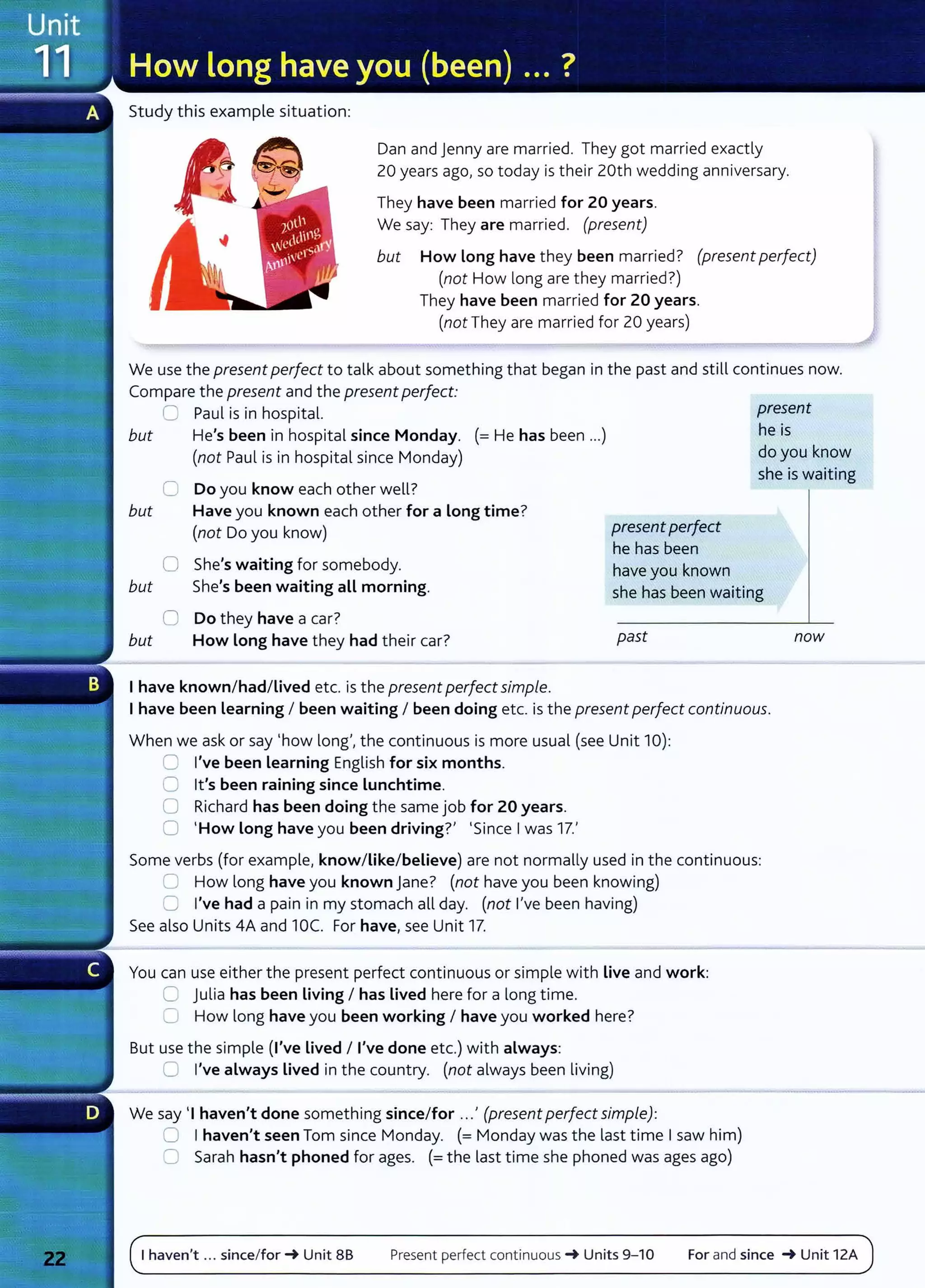
situation now. 'Tom has lost his key'= he doesn't have his key now (see Unit 7).
The past simple (something happened) tells us only about the past. If somebody says 'Tom lost his
key', this doesn't tell us whether he has the key now or not. lt tells us only that he lost his key at some
time in the past.
Do not use the present perfect if the situation now is different. Compare:
0 They've gone away. They'll be back on Friday. (they are away now)
They went away, but I think they're back at home now. (not They've gone)
0 lt has stopped raining now, so we don't need the umbrella. (it isn't raining now)
lt stopped raining for a while, but now it's raining again. (not lt has stopped)
You can use the present perfect for new or recent happenings:
0 'I've repaired the washing machine. lt's working OK now.' 'Oh, that's good.'
0 'Sally has had a baby! lt's a boy.' 'That's great news.'
Usually, you can also use the past simple:
0 I repaired the washing machine. lt's working OK now.
Use the past simple (not the present perfect) for things that are not recent or new:
0 Mozart was a composer. He wrote more t han 600 pieces of music.
(not has been ... has written)
0 My mother grew up in Italy. (not has grown)
Compare:
0 Did you know that somebody has invented a new type of washing machine?
0 Who invented the telephone? (not has invented)
We use the present perfect to give new information (see Unit 7). But if we continue to talk about it,
we normally use the past simple:
0 A : Ow! I've burnt myself.
s: How did you do that? (not have you done)
A: I picked up a hot dish. (not have picked)
0 A: Look! Somebody has spilt something on the sofa.
s: Well, it wasn't me. I didn't do it. (not hasn't been ... haven't done)
Past s i m pl e ~ Unit 5 Present perfect ~ Units 7- 8 Present perfect and past 2 ~ Unit 14
American English ~Appendix 7
Exercises
Complete the sentences using the verbs in brackets. Use the present perfect where possible.
Otherwise use the past simple.
GJ
I can't get in.
1....e lq?t . (lose) my
key.
I meant to call you last night,
but I
(forget).
Yes, I ........
(have) a headache, but I'm
fine now.
The office is empty now.
Everybody
(go) home.
Helen
(go) to Egypt for a holiday, but
she's back home in England now.
Can you help us? Our car
Are the underlined parts of these sentences right or wrong? Correct them where necessary.
1 Did you hear about Sue? She's given up her job. Ok ... ......... ...... _ .....................................
2 My mother has grown up in Italy. .....gr~ . .. ...... . ... .. ........................................
3 How many poems has William Shakespeare written? ............................................................ ................................
4 Ow! I've cut my finger. lt's bleeding. ........ ..................... ...............................................
5 Drugs have become a big problem everywhere. .... .... ...... ............................. .
6 Who has invented paper? ....... .. .. ..... . . ..... ...................................
7 Where have you been born? ........................ .. ..... . .. ...... _
...........................
8 Ellie isn't at home. She's gone shopping. ................... . .... ......................................
9 Albert Einstein has been the scientist who .................... ............ ....... .. ... ..... ..
has developed the theory of relativity. ....... ... ....... .. ........ .. . ........................ .
Put the verb into the correct form, present perfect or past simple.
1 lt sto eeL · · f h'l b · ' · · · ('t I t )
.......... PP...... ra1n1ng or a w 1 e, ut now 1t s rammg agam. 1 s op
2 The town where I live is very different now. . .l.t h.~~ ...~.@.9~ ..... a lot. (it I change)
3 I studied German at school, but ......... ..... .... .... . .. ..... ............. most of it now. (I I forget)
4 The police . three people, but later they let them go. (arrest)
5 What do you think of my English? Do you think ? (it I improve)
6 A: Are you still reading the paper?
s: No, ... ............... with it. You can have it. (I I finish)
7 _
....... for a job as a tourist guide, but I wasn't successful. (I I apply)
8 Where's my bike? ..... ... . ..... outside the house, but it's not there now. (it I be)
9 Quick! We need to call an ambulance. . .. .. . ...... ..... .. ... an accident. (there I be)
10 A: Have you heard about Ben? .................... .... ................ his arm. (he I break)
B: Really? How .. .. .... . .... ... ..... ? (that I happen)
A: . . . .. ... . ..... . ... off a ladder. (he I fall)
Unit
-_ 13
27
Do not use the present perfect (I have done) when you talk about a finished time (for example,
yesterday I ten minutes ago I in 2005 I when I was a child). Use a past tense:
0 lt was very cold yesterday. (not has been)
0 Paul and Lucy arrived ten minutes ago. (not have arrived)
0 Did you eat a lot of sweets when you were a child? (not have you eaten)
0 Igot home late last night. Iwas very tired and went straight to bed.
Use the past to ask When ... ? or What time ... ?:
0 When did your friends arrive? (not have ... arrived)
0 What time did you finish work?
Compare:
Present perfect
.__] Tom has Lost his key. He can't get
into the house.
0 Is Carla here or has she Left?
Compare:
Present perfect (have done)
0 I've done a lot of work today.
We use the present perfect for a period of time
that continues until now. For example:
today I this week I since 2007.
I
1 unfinished 1
I to1ay I
past now
0 lt hasn't rained this week.
0 Have you seen Anna this morning?
(it is still morning)
0 Have you seen Tim recently?
0 Idon't know where Lisa is. I haven't
seen her. (= I haven't seen her
recently)
0 We've been waiting for an hour.
(we are still waiting now)
0 Jack lives in Los Angeles. He has Lived
there for seven years.
0 I have never played golf. (in my life)
C) lt's the last day ofyour holiday. You say:
lt's been a really good holiday.
I've really enjoyed it.
Past simple _. Unit 5 Present perfect _. Units 7- 8
Past simple
=Tom Lost his key yesterday.
He couldn't get into the house.
0 When did Carta Leave?
Past simple (did)
~ Idid a lot of work yesterday.
We use the past simple for a finished t ime in
the past. For example:
yesterday I last week I from 2007 to 2010.
past
1 unfinished 1
I yesterday I
now
8 lt didn't rain last week.
8 Did you see Anna this morning?
(it is now afternoon or evening)
8 Did you see Tim on Sunday?
0 A: Was Lisa at the party on Sunday?
B: Idon't think so. Ididn't see her.
:= We waited (or were waiting) for an
hour. (we are no longer waiting)
0 Jack Lived in New York for ten years.
Now he lives in Los Angeles.
8 Ididn't play golf Last summer.
C Afteryou come back from holidayyou
say: lt was a really good holiday.
I really enjoyed it.
Present perfect and past 1 _. Unit 13
Exercises
Are the underlined parts of these sentences right or wrong? Correct them where necessary.
1 I've lost my key. I can,t find it anywhere. ...0-'S................................................................. .........................
2 Have you eaten a lot of sweets when you were a child?
3 I've bought a new car. You must come and see it.
4 I've bought a new car last week.
5 Where have you been yesterday evening?
6 Lucy has left school in 1999.
7 I'm looking for Mike. Have you seen him?
8 'Have you been to Paris?, 'Yes, many times.'
9 l,m very hungry. I haven,t eaten much today.
10 When has this book been published?
..Di4...W?.~... ~--·· ·············... ....
Make sentences from the words in brackets. Use the present perfect or past simple.
1 (it I not I rain I this week) .lt .h~?..n....r~.~ ~-~?....W.~ , ....................... .... . ...... ............... ... .... ... ..... .
2 (the weather I be I cold I recently) The weather ................................................................ ..... ... ......................................................
3 (it I cold I last week) lt ........ ..... . .......... .......... ....... .... .. ....................... ............................. .......... .........................................................
4 (I I not I read I a newspaper yesterday) I . . .......... ........ .. .. ................ .. . ...................
5 (I I not I read I a newspaper today) ......... ... . . .. .................... . . . .... .. ......... . . ...... .. ... . ...
6 (Emily I earn I a lot of money I this year) ................................ .................... ......... ................................... .............. . .
7 (she I not I earn I so much I last year) ................. ..................................................... ........................................... ........................
8 (you I have I a holiday recently?) .......... ....... ............................. . .. ........ ... ..... .. ..................................... ...
Put the verb into the correct form, present perfect or past simple.
1 'Whafs Madrid like?, 'I don,t know. .....J...h.Q--Y.~nl..P.e&n.....(I I not I be) there.'
2 When .... .............. ...... .. ....................... ... (I I get) home last night, ............................... ....................... (I I be)
very tired and ..... .............. (I I go) straight to bed.
3 A: ........................................................ (you I see) Lisa recently?
B: Yes, .................... ..... .. ........... ...... .... .. (I I saw) her a few days ago.
4 l,m tired. ....... . . ... ......... .. . .................. .... (1 I not I sleep) well last night.
5 The bus drivers were on strike last week. .. (there I be) no buses.
6 Mr Lee . ........ (work) in a bank for 15 years. Then ........................................ (he I give)
it up. Now he works as a gardener.
7 Mary lives in Dublin. .... ...... .... .. ....... .................. ............. .(she I live) there all her life.
8 A: ... . .. ................ ..... ................... (you I go) to the cinema last night?
B: Yes, but ........ ....... .................. . ..... (it I be) a mistake. The film .......... (be) awful.
9 My grandfather .. ....... ........... .. ... ............... (die) before I was born. . .... ...............................................
(1 I never I meet) him.
10 I don't know Karen's husband. ............................................................................ (I I never I meet) him.
11 Ifs nearly lunchtime, and .. .. .. ..... ........... ... .. ...... ...... . (I I not I see) Martin all morning.
I wonder where he is.
12 'Where do you live?, 'In Boston.'
'How long ................................................................................. .(you I live) there?' 'Five years.'
'Where .. ....... ... .. ....... . .. . .. ..... ...... .. (you I live) before that?' 'In Chicago.,
'And how long ...... .............. .. . . .... . ........... .. .... . (you I live) in Chicago?' 'Two years.'
Write sentences about yourself using the ideas in brackets.
1 (something you haven't done today) ......1. ~.QvV:~Y1.
1
.i:.....~n CM1H...fr.tA.~...t9~................... .. ........... ........ .
2 (something you haven,t done today) .... .... ... . ....... ... .... .... ..... .... ............. ..
3 (something you didn,t do yesterday) .... . ..... ............. .. . . .... ......... .. .. ...............
4 (something you did yesterday evening) ............ ... ................. .. ........................... ..... .................. ....... ..... ...................
5 (something you haven't done recently) ......................................................................................................................................................
6 (something you've done a lot recently) .... ..... .. . ...... ... . ...... .. ...... .. . ....... ............ .. ...................... .
_.Additional exercises 2- 4 (pages 303- 04), 14- 15 (pages 310- 11) 29
Study this example situation:
at 10.30 at 11.00
PAUL SA RA H
Sarah went to a party last week. Paul went to the
party too, but they didn't see each other. Paul left the
party at 10.30 and Sarah arrived at 11 o'clock. So:
When Sarah arrived at the party, Paul wasn't there.
He had gone home.
Had gone is the past perfect (simple):
1
/we/they/you
he/she/it
had
(=I'd etc.)
(= he'd etc.)
gone
seen
finished etc.
The past perfect simple is had+ past participle (gone/ seen/ finished etc).
Sometimes we talk about something that happened in t he past:
0 Sarah arrived at the party.
This is the starting point of the story. Then, if we want to talk about things that happened before this
time, we use the past perfect (had ...):
0 When Sarah arrived at the party, Paul had already gone home.
Some more examples:
0 When we got home last night, we found that somebody had broken into the flat.
0 Karen didn't want to go to the cinema with us because she'd already seen the movie.
0 At first Ithought I'd done the right thing, but Isoon realised that I'd made a big mistake.
0 The man sitting next to me on the plane was very nervous. He hadn't flown before.
or ... He had never flown before.
Compare the present perfect (have seen etc.) and the past perfect (had seen etc.):
Present perfect I Past perfect
have seen
past now
0 Who is that woman? I've seen her
before, but Ican't remember where.
C We aren't hungry. We've just had
lunch.
0 The house is dirty. They haven't
cleaned it for weeks.
hadseen
past now
CJ Iwasn't sure who she was. I'd seen her
before, but Icouldn't remember where.
C We weren't hungry. We'd just had
lunch.
8 The house was dirty. They hadn't
cleaned it for weeks.
Compare the past simple (Left, was etc.) and the past perfect (had left, had been etc.):
0 A: Was Tom there when you arrived? 0 A: Was Tom there when you arrived?
B: Yes, but he Left soon afterwards. B: No, he had already Left.
0 Kate wasn't at home when Iphoned. 0 Kate had just got home when I phoned.
She was at her mother/s house. She had been at her mother's house.
Past perfect continuous -+ Unit 16 Irregular verbs (gone/seen etc.) -+ Appendix 1
Exercises
Read the situations and write sentences from the words in brackets.
1 You went to Sue's house, but she wasn't there.
(she I go I out) _S_h.~...h.o.-4...99.Y1.~....9~t. . ......0 . . ·······o···· o····· .. ·o······o ... .... . ...........0 . . . . . . . . . . . . . . . . . . . . . . . . . . . . . . . . . . . . . . . . . . . . . . . . . .
2 You went back to your home town after many years. lt wasn't the same as before.
(it I change I a lot) ........0 . . . . . . . . . . . . . . . . . . . . . . • • . . . . . . • . . . . . . . • . . . . . . . . . . . . . . . . . . . . . . . . . . . . . . . . . . . . . . . . . . . . . . . . . . . . . . . . . . . . . . . . . . . . . . . . . . . . . . . . . . . . . 0 . . . . . . . . . . . . . . . . . . . . . . . . . . . . . . . . . .
3 Iinvited Rachel to the party, but she couldn't come.
(she I arrange I to do something else) o
..... o
..............ooo ...............................0 . . . . . . . . 0 . . . . . . . . . . . . . . . . . . . . . . . . .
4 You went to the cinema last night. You got to the cinema late.
(the film I already I start) ....... 0 0 000000.. ........ ••• . • ••••••• .. .....
5 lt was nice to see Daniel again after such a long time.
(I I not I see I him for five years)
6 Ioffered Sue something to eat, but she wasn't hungry.
(she I just I have I breakfast) ...................... .................................. ............................ ............ .........................................................................
G For each situation, write a sentence ending with never ... before. Use the verb in brackets.
1 The man sitting next to you on the plane was very nervous. lt was his first flight.
(fly) ...o
He,4 ne:-ver flown .be.fore:-.... ..o..o
.........................o.... ...... . ....
2 Somebody sang a song. Ididn't know it.
(hear) I ......oooooo....o
....o
......o
..ooo 0 .... ........................o
.... 0 0 .... •........................o
.....o
..... before.
3 Sam played tennis yesterday. He wasn't very good at it because it was his first game.
(play) He .... ..........0..... .. .......o.. . . . . . • . . . . . . o • . . . • • 0.....0.................0................. .... . ...... .. ...... ............0....................
4 Last year we went to Mexico. lt was our first time there.
(be there) We .... .. ........ ...................... ...... .. .... . ... ...........................0...................................................... ........0...........0.....0.............................
Use the sentences on the left to complete the paragraphs on the right. These sentences are
in the order in which they happened - so (a) happened before (b), (b) before (c) etc. But your
paragraph begins with the underlined sentence, so sometimes you need the past perfect.
1 (a) Somebody broke into the office during We arrived at work in the morning and
the night. found that o
....?..o.rr..~o~ . ~.% OP.r.9.~e.no....
(b) We arrived at work in the morning. into the office during the night. So
(c) We called the police. ...0 . . . . . . . . . . . . . . . . . . . . . . . . . . . . . . . . . . . . . . . . . . . . . . . . . . . . . . . . . . . . . . . . . . . . . . . . . . . . . . . . . . . . . the police.
2 (a) L
aura went out this morning.
(b) Irang her doorbell.
(c) There was no answer.
no
out.
3 (a) Jim came back from holiday a few
days ago.
(b) Imet him the same day.
(c) He looked very well.
}
~u~tetJt=~f~~ ~~~s ago. : . . h~liday.
.. .....0........0...............................................................................0 very well.
4 (a) Kevin sent Sally lots of emails.
(b) She never replied to them.
(c) Yesterday he got a phone call from her.
(d) He was very surprised.
Yesterday Kevin ....................................0 . . . . . . . . . . . . . . . . . . . . . . . . . 0 . . . from
Sally. .. 0 . . . . . . . . . . . . . . . . o.. .......... • • • .. ....... very surprised.
............o................o.... ........ .. lots of emails,
but ............0 . . . . . . . . . . . . . . .
Put the verb into the correct form, past perfect (I had done) or past simple (I did).
1 'Was Paul at the party when you arrived?' 'No, he ooooooh~..ogQn~..... (go) home.'
2 Ifelt very tired when Igot home, so I .. . .... . ........0 . . . . . . . . . . . . . . . . . . . . . (go) straight to bed.
3 The house was very quiet when Igot home. Everybody ................................................... (go) to bed.
4 Sorry I'm late. The car.................0 . . . . . . . . . . . . . . . . . . . . . . . . . . . . . . . . . . . . (break) down on my way here.
5 We were driving along the road when we ............................o
....o
........o
....o(see) a car which
......0......................... (break) down, so we ..................0.........0......... (stop) to help.
_. Additional exercises 5- 8 (pages 304-07) 31
Study this example situation:
yesterday morning Yesterday morning I got up and looked out of the window.
The sun was shining, but the ground was very wet.
lt had been raining.
lt was not raining when I looked out of the window;
the sun was shining. But it had been raining before.
Some more examples:
Had been -ing is the past perfect continuous:
1/we/you/they
he/she/it
had
(= I'd etc.)
(=he'd etc.)
I
been
doing
working
playing etc.
8 When the boys came into the house, their clothes were dirty, their hair was untidy and one of
them had a black eye. They'd been fighting.
C I was very tired when I got home. I'd been working hard all day.
l__ When I went to Madrid a few years ago, I stayed with a friend of mine. She hadn't been
Living there very long, but she knew the city very well.
You can say that something had been happening for a period of time before something else happened:
0 We'd been playing tennis for about half an hour when it started to rain heavily.
0 Paul went to the doctor last Friday. He hadn't been feeling well for some time.
Compare have been -ing (present perfect continuous) and had been -ing (past perfect continuous):
Present perfect continuous
I have been -ing
past now
0 I hope the bus comes soon. I've been
waiting for 20 minutes. (before now)
0 James is out of breath. He has been
running.
Past perfect continuous
I had been -ing
past now
0 At last the bus came. I'd been waiting
for 20 minutes. (before the bus came)
C James was out of breath. He had been
running.
Compare was -ing (past continuous) and had been -ing:
._. lt wasn't raining when we went out. The sun was shining. But it had been raining,
so the ground was wet.
0 Katherine was sitting in an armchair resting. She was tired because she'd been working
very hard.
Some verbs {for example, know and Like) are not normally used in the continuous:
~] We were good friends. We had known each other for years. (not had been knowing)
0 I was surprised when Lisa cut her hair. She'd had long hair since I first met her.
(not she'd been having)
For a list of these verbs, see Unit 4A. For have, see Unit 17.
Present perfect continuous -+ Unit 9- 10 Past perfect simple -+ Unit 15
Exercises
Read the situations and make sentences from the words in brackets.
1 I was very tired when I arrived home.
(I I work I hard all day) .. 1
1
~.. b~r wgrk~g .Y:lo...r.
4. o-.4.. ~ :.............................................
2 The two boys came into the house. They had a football and they were both very t ired.
(they I play I football) .. .. ..... .... ....... .. . .... ....................................................
3 I was disappointed when I had to cancel my holiday.
(I I look I forward to it) ... .. .. ........................... . .............
4 Ann woke up in the middle of the night. She was frightened and didn't know where she was.
(she I dream) ... .. ...... ....... .... ...................... ..... ..... ..... ....................... ........... ...
5 When I got home, Mark was sitting in front of the TV. He had just turned it off.
(he I watch I a film) .. .......... ....... .. ..... ....... ...... ........................................................................................................... ................. .
Read the situations and complete the sentences.
1 We played tennis yesterday. Half an hour after we began playing, it started to rain.
We .....h%...P~Y.LP.~ill.9....f9.r....h..~f...(.Y'1... ~.9.tA.t.... when ......~...?..~~....t9....r.W....... .
2 I had arranged to meet Tom in a restaurant. I arrived and waited for him. After 20 minutes
I realised that I was in the wrong restaurant.
I .................................. ............................................... ..... for 20 minutes when I .......................................................... ..............
................................................................................. .. the wrong restaurant.
3 Sarah got a job in factory. Five years later the factory closed down.
At the time the factory .......... , Sarah ......................... .
... ........................ .. . there for five years.
4 I went to a concert last week. The orchestra began playing. After about ten minutes a man in
the audience suddenly started shouting.
The orchestra ............................ . .... .... . .. .. ........ ............... ...... . ......................................................................... when
This time make your own sentence:
5 I began walking along the road. I
when ............................... .. ...... ....... ............................
Put the verb into the most suitable form, past continuous {I was doing)~ past perfect
(I had done) or past perfect continuous (I had been doing).
1 lt was very noisy next door. Our neighbours ....N.~~....h(A..Y.
i.r.l.g...... (have) a party.
2 We were good friends. ....W.~'~..kY).Q.w~. (we I know) each other for years.
3 John and I went for a walk. I had difficulty keeping up with him because
.................................................. ........................ (he I walk) so fast.
4 Sue was sitting on the ground. She was out of breath. ........................................................................... (she I run).
5 When I arrived} everybody was sitting round the table with their mouths fu lL
...................... ......................................... (they I eat).
6 When I arrived} everybody was sitting round the table and talking. Their mouthswere empty,
but their stomachs were full. ................. ..... .. .............. (they I eat).
7 j ames was on his hands and knees on the floor. ....... ....... ... ....................................... (he I look) for his
contact lens.
8 When I arrived, Kate ................................. ..... .. .... (wait) for me. She was annoyed because I was
late and .. .. ..... .. ...... . ..... ........ .(she I wait) for a long time.
9 I was sad when I sold my car. . (I I have) it for a very long time.
10 We were extremely tired at the end of the journey. .... ............. ........................... ........ ....... .. (we I travel) for
more than 24 hours.
_.Additional exercises 5- 8 (pages 304-07) 33
Have and have got(= for possession, relationships, illnesses etc.)
You can use have or have got. There is no difference in meaning:
C They have a new car. or They've got a new car.
0 Lisa has two brothers. or Lisa's got two brothers.
C I have a headache. or I've got a headache.
C Our house has a small garden. or Our house has got a small garden.
0 He has a few problems. or He's got a few problems.
With these meanings (possession etc.), you cannot use continuous forms (am having etc.):
C We're enjoying our holiday. We have I We've got a nice room in the hotel. (not We're
having a nice room)
For the past we use had (without got):
... J Lisa had long hair when she was a child. (not Lisa had got)
In questions and negative sentences there are three possible forms:
- - -- - - ---,
Do you have any questions? ~don't have any questions.
Have you got any questions? J ~ haven't got any questions.
Have you any questions? (less usual) I haven't any questions. (less usual)
Does she have a car? I She doesn't have a car.
Has she got a car? She hasn't got a car.
Has she a car? (less usual) She hasn't a car. (less usual)
In past questions and negative sentences we use did/didn't:
'-.J Did you have a car when you were living in Paris?
0 Ididn't have my phone, so Icouldn,t call you.
C Lisa had long hair, didn't she?
Have breakfast I have a shower I have a good time etc.
----------------~
We also use have (but not have got) for many actions and experiences. For example:
breakfast I dinner I a cup of coffee I something to eat etc.
a bath I a shower I a swim I a break I a rest I a party I a holiday
an accident I an experience I a dream
have a Look (at something)
a chat I a conversation I a discussion (with somebody)
trouble I difficulty I fun I a good time etc.
a baby (= give birth to a baby)
Have got is not possible in the expressions in the box. Compare:
0 Sometimes I have(= eat) a sandwich for my lunch. (not I've got)
but I've got I I have some sandwiches. Would you like one?
You can use continuous forms (am having etc.) with the expressions in the box:
~ We're enjoying our holiday. We're having a great time. (not We have)
C Mark is having a shower at the moment. He has a shower every day.
In questions and negative sentences we use do/does/did:
21 I don't usually have a big breakfast. (not I usually haven,t)
0 What time does Chris have lunch? (not has Chris lunch)
0 Did you have trouble finding a place to live?
Have (got) to ... _. Unit 31 American English _. Appendix 7
Exercises
Write negative sentences with have. Some are present and some are past.
1 I can't get into the house. (a key) ......l....hp._ve~...g.9.t.. o.,_k~.~.............. ........ ...............................................................
2 I couldn't read the letter. (my glasses) I d.i..cln~~ l-1o.,ve .JYl~..._gLo...sses .. ..............
3 I can't get onto the roof. (a ladder) I .... ....... ...... . . .... .. ... .... . ...... ...................................
4 We couldn't visit the museum. (enough time) We .............................................................................................................
5 He couldn't find his way to our house. (a map) . ..... ...... . ..... .... . .. ....... ...................................
6 She can't pay her bills. (any money) ........ .......... .. .......... .. ................ ............
7 I can't go swimming today. (enough energy) ..... .. .. ......... ..... . ... ................... ..................
8 They couldn't take any pictures. (a camera) .........................................................................................................................
Which alternatives are correct? Sometimes two alternatives are possible, sometimes only one.
1 Excuse me, ................... ....................... a pen I could borrow?
®have you got B are you having ©do you have (both A and Care correct)
2 ............... ... time to go to the bank yesterday?
A Had you got B Did you have C Had you
3 I need a stamp for this letter. ............................................... one?
A Do you have BAre you having C Have you got
4 What does jack do? ... .... ... a job?
A Does he have B Is he having C Has he got
5 ..................... a lot of friends when you were a child?
A Did you have B Were you having C Had you
6 When you worked in your last job, .. ...... ................. your own office?
A had you B have you got C did you have
Are the underlined verbs OK? Change them where necessary.
1 Is there anything you want to ask? Do you have any questions? ... OIS. .. ........
2 Lisa had got long hair when she was a child. .. L~~f'.-...Yl.AA ..Lc>.ng....n~ .......................
3 Tom couldn't contact us because he hadn't our number. ..... . .....
4 'Are you feeling OK?' 'No, I'm having a toothache.' ....................
5 Are you enjoying yourself? Are you having a good time? .......... .......
6 lt started to rain. I got wet because I hadn't an umbrella. . .............................. .. .................
7 Will can't drive. He doesn't have a driving licence. . ..............
8 Did your trip go OK? Had you any problems? .. ............. ..................
9 My friend called me when I was having breakfast. . ........................... ..........................................
Complete the sentences. Use an expression from the List with have in the correct form.
have a baby
have a Look
have a break
have lunch
have a chat
have a party
have trouble
have a nice time
1 I don't eat much during the day. I never .... l-1o.,ve....w.n~
2 David starts work at 8 o'clock and ............ .
have a good flight
have a shower
.. at 10.30.
3 We .... . ... .. .................. .. ..... . ....... ... .... .... ................... . last week. lt was great - we invited lots of people.
4 Excuse me, can I ..... .. .......... . .. . ... ....... ........ .................. ..... at your newspaper, please?
5 Jim is away on holiday at the moment. I hope he ......
6 I met Ann in the supermarket yesterday. We stopped and .............
7 A: ................................................. ................................................. ...... finding the book you wanted?
B: No, I found it OK.
8 Suzanne ............. . a few weeks ago. it's her second child.
9 A: Why didn't you answer the phone?
B: 1............... . ...................... .... .........................................
10 You meetyourfriend Sally at the airport. She hasjust arrived. You say:
Hi, Sally. How are you? .................. ................. ?
35
Study this example situation:
afewyears ago Nicola doesn't travel much these days.
She prefers to stay at home.
But she used to travel a lot.
She used to go away two or three times a year.
She used to travel a lot= she travelled a lot often in the
past, but she doesn't do this any more.
she used to travel she doesn't
travel
these days past
Something used to happen = it happened often in the past, but no longer happens:
0 I used to play tennis a lot, but I don't play very much now.
0 David used to spend a lot of money on clothes. These days he can't afford it.
C 'Do you go to the cinema much?' 'Not now, but I used to.' (=I used to go)
We also use used to ... for things that were true, but are not true any more:
0 This building is now a furniture shop. lt used to be a cinema.
0 I used to think Mark was unfriendly, but now I realise he's a very nice person.
0 I've started drinking tea recently. I never used to Like it before.
0 Lisa used to have very long hair when she was a child.
'I used to do something' is past. There is no present. You cannot say 'I use to do'.
To talk about the present, use the present simple (1 do).
Compare:
1 pas~e used to play
r-,;-esent he plays
we used to Live Ithere used to be
we Live there is
C We used to Live in a small village, but now we Live in London.
0 There used to be four cinemas in the town. Now there is only one.
The normal question form is did (you) use to ... ?:
0 Did you use to eat a lot of sweets when you were a child?
The negative form is didn't use to .. . (used not to ... is also possible):
:_ I didn't use to like him. (or I used not to like him.)
Compare I used to do and I was doing:
now
~ I used to watch TV a lot. (=I watched TV often in the past, but I no longer do this)
0 I was watching TV when Rob called. (= I was in the middle of watching TV)
Do not confuse I used to do and I am used to doing (see Unit 61). The structures and meanings are
different:
U I used to Live alone. (= I lived alone in the past, but I no longer live alone)
0 I am used to Living alone. (= I live alone, and I don't find it strange or difficult because I've
been living alone for some time)
Past continuous (1was doing) ~ Unit 6 Would (= used to) ~ Unit 36
Be/get used to (doing) something~ Unit 61
Exercises
Complete the sentences with use(d) to+ a suitable verb.
1 Nicola doesn't travel much now. She .. tA?.e4 U:?....tr.~Y.~...... a lot, but she prefers to stay at home
these days.
2 Sophie ..... ..... ........ .. .... . ................. a motorbike, but last year she sold it and bought a car.
3 We moved to Spain a few years ago. We .. ... ...... ...................... ..... ............... in Paris.
4 I rarely eat ice-cream now, but I .. ................. it when I was a child.
5 Jackie ......... .... .. .. .. my best friend, but we aren't good friends any more.
6 lt only takes me about 40 minutes to get to work now that the new road is open. lt
.... ............. .... .... .. ..... ....... more than an hou r.
7 There .... ....... .... .... ... ... .. a hotel nea r the airport, but it closed a long time ago.
8 When you lived in New York, .... .... .... .. ................. .. .. .. .. to the theatre very often?
Compare what Karen said five years ago and what she says today:
FIVE YEARS AGO
I travel a lot. ~ .-.L~.-. .........
I've got lots
of friends.- --
I'm very lazy. -----
1don't like/
cheese.
I'm a hotel
receptionist.
/ Iplay the piano.
TODAY
Ieat lots of
cheese now~
Iwork very hard
these days. - - -
Idon't know many/;
people these days. /
Iwork in a /
bookshop now.
M
y dog died two
/ years ago.
( _;read a newspaper
/ every day now.
Ihaven't been to a
~ party for ages.
Ihaven't played the
~ piano foryears.
~ I don't go away
.......a ~h the....... d~.....
I I I Cl 1 1 i J C UJ J·
Igo to a lot of parties. Tea's great! Ilike it now.
Now write sentences about how Karen has changed. Use used to I didn't use to I never used
to in the first part of your sentence.
1 .$Y1e:..V.5~ to tt~Y.~----~ LQt.> ...................... but ...?.h.e......Me5n>t, .go G4'YO-.y. mtAc}1 tt.J.~?-~ ~5 . ............
2 She used .. ...... ...... ........ .. but ... ................... . .... .. ... . .............. ....... ................................. ........ ..........
3 ....................................... ..........................................................but . ... .............................. ............................................. ............................. ....................
4 ............................... ................................. ....... ..... .......... .......... .. but .
5 .. .................... ..... ........... . but
6 .. .. ................... .. . . ...... . . ...... ....... but
7 ..... . ............. .... ........................ ...... ........................... but
8 ......................................... ......................................................................but ...........................................................................................................................................
9 .......... ...................... ...... .................................... .............................. but
10 ... ............................. .......................... but
Write sentences about yourself Like the examples. Begin I used to ... (I used to be/work/like/
play/read etc.).
1 1
....~5.~ ~--..~Y.~.. 4.'1...~...5rr..o..U.:...Y.~~->-.Jwt n9N...J...4.Y~...itl.Jo.
r49Yl........... .... .. .....................................................
2 1
.....1!..~-~ tq___pla.y ~~ni-s .. o.... LQt> P.v...t J cion,t p~_
_any mqre .....
3 I used .... ....... .. .... ....... ....... ... , but .................... . _
4 I ................................... .... . ....... .... .. ......................... . . ................... ... ............ ..... . .... ................ ........ ....................
5
Now begin with I didn't use to ....
6 .....1 44in,~. tA~.~ W.....r~ o..... lot-,..Jn~~..l cio ~olN..·........ . ...
7 Ididn't .... .................. . .. .....................
~ Unit
~- .18
8 .................................................................................................................. .............................................. ............................................................ 0 . . . . . . . . . . . . . . . . .
-+ Additional exercise 9 (page 307) 37
Present continuous {I am doing) with a future meaning
This is Ben's diary for next week.
He is playing tennis on Monday afternoon.
He is going to the dentist on Tuesday morning.
He is having dinner with Kate on Friday.
In all these examples, Ben has already decided and
arranged to do these things.
I'm doing something (tomorrow) = I have already decided and arranged to do it:
L A: What are you doing on Saturday evening? (not What do you do)
B: I'm going to the theatre. (not I go)
0 A: What time is Katherine arriving tomorrow?
s: Half past ten. I'm meeting her at the station.
C I'm not working tomorrow, so we can go out somewhere.
C Steve isn't playing football next Saturday. He's hurt his leg.
'I'm going to (do)' is also possible in these sentences:
__ What are you going to do on Saturday evening?
But the present continuous is more natural when we talk about arrangements. See Unit 20B.
Do not use will to talk about what you have arranged to do:
2 What are you doing this evening? (not What will you do)
0 Alex is getting married next month. (not will get)
You can also use the present continuous for an action just beforeyou begin to do it. This
happens especially with verbs of movement (go/come/Leave etc.):
~ I'm tired. I'm going to bed now. Goodnight. (not I go to bed now)
0 'Jess, are you ready yet?' 'Yes, I'm coming.' (not I come)
Present simple (I do) with a future meaning
We use the present simple when we talk about timetables, programmes etc. (for public
transport, cinemas etc.):
U My train leaves at 11.30, so I need to be at the station by 11.15.
U What time does the film start this evening?
U lt's Wednesday tomorrow. I Tomorrow is Wednesday.
You can use the present simple to talk about people if their plans are fixed like a timetable:
0 I start my new job on Monday.
0 What time do you finish work tomorrow?
But the continuous is more usual for personal arrangements:
C What time are you meeting Ann tomorrow? (not do you meet)
Compare:
Present continuous Present simple
0 What time are you arriving? C What time does the train arrive?
0 I'm going to the cinema this evening. CJ The film starts at 8.1 5 (this evening).
I'm going to~ Units 20, 23 Will~ Units 21- 22 Present simple after when/if etc. ~Unit 25
Exercises
A friend of yours is planning to go on holiday soon. You ask her about her plans.
Use the words in brackets to make your questions.
1 (where I go?) Aih~~ .0-:r.~ ~q0. 99.~.9 ?_ .......................
2 (how long I go for?) ........... ...... ....................... ...........................................................
3 (when I leave?) .. . .................. . ...... ........ ..... .... ... ...... .. . . .. .........
Scotland.
Ten days.
Next Friday.
4 (go I alone?) ................... .............. ................. ..........
5 (travel I by car?) .......................... . .............. .... ... .. .. .
No, with a friend.
No, by train.
6 (where I stay?) ........................................ ....................................................................... . In a hotel.
Tom wants you to visit him, but you are very busy. Look at your diary for the next few days and
explain to him why you can't come.
TOM: Can you come on Monday evening?
5-Monday·
Volleyball ; 30
YOU: Sorry, but .....J,.~ ..P.~.0g....Y9..~~-~---··········· ............................................... ............ . (1)
6-Tu · Prn ToM: What about Tuesday evening then?
You: No, not Tuesday. I ..... ... ........... ....... .................. . (2)
esday·
Work late(· .
7 - t111 9Prn )
Wednesda .
TheMre y.
B-Thursday·
Meet J(t/i •
asPrn
TOM: And Wednesday evening?
YOU: ......... ............................. ............ ..... ........................................ ........... ........... ..
TOM: Well, are you free on Thursday?
You: IJ
m afraid not.
Have you arranged to do anything at these times? Write sentences about yourself.
...................... . (3)
... . ......... . (4)
1 (this evening) l..,.m .9.9~9...0!--!-.t:. tb.~?.....~Y-~r.~9.:.... or ......1
..,rY)..J'iQ~...4o.0.g...<MJ_Idth.~g....~-~s .~V~Y1.1A.'19..·......
2 (tomorrow morning) I .... ......................... ................... . ... . ......... .. ...................
3 (tomorrow evening) ................. .. .. . ...... ... ........ ..... .. ........ ...............
4 (next Sunday) .. ....... ..................... ... ...... ........................ .................... ..... .......... ........... . ...... ...................... .. . .........................
5 (chooseanotherdayortime) ......... ................................................................................... ................................ ............. ......................
Put the verb into the more suitable form, present continuous or present simple.
1 l.~.m 99.
iA::l9.. (I I go) to the cinema this evening.
2 P.9~?... .tb.~ .illm. ..?w..r.L..... (the film I start) at 3.30 or 4.30?
3 ............................................ ........ .... .... (we I have) a party next Saturday. Would you like to come?
4 The art exhibition ............................... (finish) on 3 May.
5 ...... ......... (I I not I go) out this evening. .......... ... .............. . ..
(1 I stay) at home.
6 ' .. .......................................................... ........... (you I do) anything tomorrow morning?' 'No, I'm free. Why?'
7 ... ...... ........................ .. ..... ................... ..... .(we I go) to a concert tonight. ..........
(it I start) at 7.30.
8 ................... (I I leave) now. I've come to say goodbye.
9 A: Have you seen Liz recently?
s: No, but ....................................... ............. ............... (we I meet) for lunch next week.
10 You are on the train to London andyou ask anotherpassenger:
Excuse me. What time .... .. . ......... ..... ....... .. .......... ..... (this train I get) to London?
11 You are talking to He!en:
Helen, ............................................................... (I I go) to the supermarket. ........................... ............. ...... ... .... (you I come)
with me?
12 You andafriend are watching television. You say:
I'm bored with this programme. What time .. .. ...... ... .......... (it I end)?
13 .......... ........................................................................... . (I I not I use) t he car this evening, so you can have it.
14 Sue ...... .. ....... .. ..... . .................... ....... (come) to see us tomorrow. ........................... .....................................
(she I travel) by train and her train .................. ................................ (arrive) at 10.15.
-+Additional exercises 10- 13 (pages 308-l 0) 39
Iam going to do something= I have already decided to do it, I intend to do it:
(_) I Are you going to eat anything?' I No, I'm not hungry.'
0 A: I hear Sarah has won some money. What is she going to do with it?
a: She's going to buy a new car.
0 I'm just going to make a quick phone call. Can you wait for me?
0 This cheese smells horrible. I'm not going to eat it.
I am doing and Iam going to do
We use I am doing (present continuous) when we say what we have arranged to do- for example,
arranged to meet somebody, arranged to go somewhere:
_ What time are you meeting Ann this evening?
0 I'm Leaving tomorrow. I've got my plane ticket.
Iam going to do something= I've decided to do it (but perhaps not arranged to do it):
1
Your shoes are dirty.' I Yes, Iknow. I'm going to dean them., (=I've decided to clean
them, but I haven't arranged to clean them)
8 I've decided not to stay here any longer. Tomorrow I'm going to Look for somewhere
else to stay.
Often the difference is very small and either form is possible.
You can also say that ~something is going to happen' in the future. For example:
The man isn't looking where he is going.
~ He is going to walk into the wall.
Some more examples:
When we say that 'something is going to happen',
the situation now makes this dear. The man is walking
towards the wall now, so we can see that he is going to
walk into it.
going to
situation now future happening
~~ Look at those black clouds! lt's going to rain. (the clouds are there now)
0 Ifeel terrible. Ithink I'm going to be sick. (I feel terrible now)
0 The economic situation is bad now and things are going to get worse.
Iwas going to do something= I intended to do it, but didn't do it:
CJ We were going to travel by train, but then we decided to go by car instead.
0 Peter was going to do the exam, but he changed his mind.
0 I was just going to cross the road when somebody shouted 'Stop!'
You can say that 'something was going to happen' (but didn't happen):
~ Ithought it was going to rain, but it didn't.
I am doing for the future _. Unit 19A I will and I'm going to_. Unit 23
Exercises
Write a question with going to for each situation.
1 Your friend has won some money. You ask:
(what I do with it?) .....Who.J .0-:re:...hi.O.~. ..go~g .W...M..v.v!M'l....~L................... ..... ........ ....... .. ...............................
2 Your friend is going to a party tonight. You ask:
(what I wear?) .
3 Your friend has just bought a new table. You ask:
(where I put it?) ... ... .. ...... . ... ................... ... .... ......... ........................ ... .. ....... .... ... ....... ............. ........... .......... ........ ....
4 Your friend has decided to have a party. You ask:
(who I invite?) ............. .
Read the situations and complete the dialogues. Use going to.
1 You have decided to clean your room this morning.
FRIEND: Are you going out this morning?
YOU: No, 1
1
m ge>L.r!g....t.9 ~ m~ rOOf'r!... . . .......
2 You bought a sweater, but it doesn't fit you very well. You have decided to take it back
to the shop.
FRIEND: That sweater is too big for you.
You: I know.
3 You have been offered a job, but you have decided not to accept it.
FRIEND: I hear you've been offered a job.
You: That's right, but . .. ... ................... ......... .... .... .......... .. ..................... .
4 You have to phone Sarah. Ifs morning now, and you have decided to phone her tonight.
FRIEND: Have you phoned Sarah yet?
You: No, ...................................................... ...................... . .................... ..... ........................ .... ........... ............ . .... ......................
5 You are in a restaurant. The food is awful and you've decided to complain.
FRIEND: This food is awful, isn't it?
You: Yes, it's disgusting. . . ..............
fB What is going to happen in these situations? Use the words in brackets.
1 There are a lot of black clouds in the sky.
(rain) ...Jes...golx).g tq r~ 0 • . . . . . . . . . . . . .. . . . . . . . . " ' . . . . . . . . . . . . . . . . . . . . . . . .
2 lt is 8.30. Tom is leaving his house. He has to be at work at 8.45, but the journey takes 30
minutes.
(late) He ......... . ...... ....... .... ........ . .....
3 There is a hole in the bottom of the boat. A lot of water is coming in through the hole.
(sink) The boat ...... . ..... ........... .. ....................... .. . ....................... ..... . ............ ..... . . .... ... ......... ....................................
4 Lucy and Chris are driving. There is very little petrol left in the tank. The nearest petrol station is
a long way away.
(run out) They
Complete the sentences with was/were going to +the following verbs:
buy give up phone play say travel
1 We .... w~e gQi!.l.
g tg . tr.~Y.~...... by train, but then we decided to go by car instead.
2 I . ...... .. .... .... ....... ... ..... . ..... ................ ..... .............. ..... some new clothes yesterday, but I was very busy and
didn't have time to go to the shops.
3 Oliver and I . ................. tennis last week, but he had to cancel
because he'd hurt his knee.
4 I ................................................................................................ jane, but I decided to email her instead.
5 A: When I last saw Tim, he ....... .. . ............ ..... ...................... ..... ......... his job.
s: That's right, but in the end he decided to stay where he was.
6 I'm sorry I interrupted you. What you ..... .. 7
.Unit
.:::·zo ..
..............
41
We use I'Ll(= I will) when we've just decided to do something. When we say 'I'Ll do something',
we announce our decision:
~ Oh, I've left the door open. I'Ll go and shut it.
0 'What would you like to drink?' TU have an orange juice, please.'
0 'Did you phone Lucy?' 'Oh no, I forgot. I'Ll phone her now.'
You cannot use the presentsimple (I do I I go etc.) in these sentences:
CJ I'Ll go and shut the door. (not I go and shut)
We often use I think I'Ll ... and I don't think I'll ... :
0 I feel a bit hungry. I think I'll have something to eat.
0 I don't think I'Ll go out tonight. I'm too tired.
In spoken English the negative of wiLL is usually won't(= will not):
0 I can see you're busy, so I won't stay long.
Do not use will to talk about what you decided before (see Units 19-20):
0 I'm going on holiday next Saturday. (not I'll go)
0 Are you working tomorrow? (not Will you work)
We often use will in these situations:
Offering to do something
0 That bag looks heavy. I'Ll help you with it. (not I help)
Agreeing to do something
0 A: Can you give Tim this book?
0 B: Sure, I'Ll give it to him when I see him this afternoon.
Promising to do something
0 Thanks for lending me the money. I'Ll pay you back on Friday.
0 I won't tell anyone what happened. I promise.
Asking somebody to do something (WiLL you ... ?)
0 Will you please turn the music down? I'm trying to concentrate.
You can use won't to say that somebody refuses to do something:
0 I've tried to give her advice, but she won't Listen.
0 The car won't start. (=the car 'refuses' to start)
Shall I ... ? Shall we ... ?
Shall is used mostly in the questions shall I ... ? I shall we ... ?
We use shall I ... ? I shall we .. . ?to ask somebody's opinion (especially in offers or suggestions):
0 Shall I open the window? (=Do you want me to open the window?)
0 I've got no money. What shall I do? (= What do you suggest?)
0 'Shall we go?' 'Just a minute. I'm not ready yet.'
CJ 'Where shall we have lunch?' 'Let's go to Marino's.'
Compare shall I ... ? and will you ... ?:
0 ShaLL I shut the door? (= Do you want me to shut it?)
0 Will you shut the door? (= I want you to shut it)
Will/shall 2-+ Unit 22 I will and I'm going to-+ Unit 23 American English -+Appendix 7
Exercises
Complete the sentences with I'Ll+ a suitable verb.
1 I'm too tired to walk home. I think .....JJt W~---··· a taxi.
2 'lt's cold in this room.' 'Is it? .......... ... ... . ..................... ..... on the heating then.'
3 'Bye! Have a nice holiday!' 'Thanks. ....... ....................................... you a postcard.'
4 'Shall I do the washing-up?' 'No, it's all right. .... . ....... ....... _..... it later.'
5 'I don't know how to shut down this computer.' 'OK, . .. ......... .... . . . ............ .... .... .. you.'
6 'Would you like tea or coffee?' '....... ....... .... .... .. ................... ... .............. . .... coffee, please.'
7 'Are you coming with us?' 'No, I think ......... ... .. ...... ... ...... ..................... ..... ..... ... here.'
8 Thanks for lending me the money. ....... . . . .... .. ..... . ...... . .... it back as soon as
possible, OK?
9 A: I know you're busy, but can you finish this report this afternoon?
B: Well, ................. . ... .......................... _.. , but I can't promise.
Read the situations and write sentences with I think I'll ... or I don't think I'll ... .
1 lt's a bit cold. The window is open and you decide to close it. You say:
.1.. itl.~k. f .
LL. ®.?.~...th~....Nm~~-' ................. ... .. ...................................
2 You are feeling tired and it's getting late. You decide to go to bed. You say:
I think ..... .... . ... ... ........ ..................... .. ...........
3 A friend of yours offers you a lift in his car, but you decide to walk. You say:
Thank you, but ... ........... ...... ............................
4 You were going to have lunch. Now you decide that you don't want to eat anything.
I don't think .................. ..... .................................... .. . ..... ........................ .. ... ......... .
5 You planned to go swimming. Now you decide that you don't want to go. You say:
Which is correct? (If necessary, study Units 19-20 first.)
You say:
1 'Did you phone Lucy?' 'Oh no, I forgot. I phone I I'll phone her now.' (I'll phone is correct)
2 I can't meet you tomorrow. I'm playing I I'll play tennis. (I'm playing is correct)
3 'I meet I I'll meet you outside the hotel in half an hour, OK?' 'Yes, that's fine.'
4 'I need some money.' 'OK, I'm lending I l'll lend you some. How much do you need?'
5 I'm having I I'll have a party next Saturday. I hope you can come.
6 'Remember to get a newspaper when you go out.' 'OK, I don't forget I I won't forget.'
7 What time does your train leave I will your train leave tomorrow?
8 I asked Sue what happened, but she doesn't tell I won't tell me.
9 'Are you doing I Will you do anything tomorrow evening?' 'No, I'm free. Why?'
10 I don't want to go out alone. Do you come I Will you come with me?
What do you say in these situations? Write sentences with shall I ... ? or shall we ... ?
1 You and a friend want to do something this evening, but you don't know what.
You ask your friend: ... Wh~...?.h~. -~~ do.. th.~s ~Y.e-Y.liJ:J_g _
? .... ................................. .. ... .......
2 You try on a jacket in a shop. You are not sure whether to buy it or not.
You ask a friend for advice: ..........................
3 lt's Helen's birthday next week. You want to give her a present, but you don't know what.
You ask a friend for advice:
it?
What ................................................................................................................................................................................................. ........... ...............................
4 You and a friend are going on holiday together, but you have to decide where.
You ask him/her: .. ....... .... ....... ... . ...... ... ...................... . .....
5 You and a friend are going out. You have to decide whether to go by car or to walk.
You ask him/her: ...... ..... ... ........ _
.................. or ..... .... ...... ... .. . ........... .
6 Your friend wants you to come and see her. You don't know what t ime to come.
You ask her: .................. ...... ........................................................................................................................................................................... ..
-+ Addit ional exercises 10- 13 (pages 308- 10) 43
We do not use will to say what somebody has already arranged or decided to do:
0 Diane is working next week. (not Diane will work)
0 Are you going to watch anything on TV this evening? (not Will you watch)
For 'is working' and 'Are you going to ... ?',see Units 19-20.
But often, when we talk about the future, we are not talking about what somebody has decided to do.
For example:
Kate is doing an exam next week. Chris and
joe are talking about it. --------....
Do you think
Kate will pass
the exam?
Some more examples:
She'LL pass does not mean 'she has
decided to pass'. Joe is saying what
he knows or believes will happen.
He is predicting the future.
When we predict a future happening
or situation, we use will/won't.
S They've been away a long time. When they return, they'LL find a lot of changes here.
0 'Where will you be this time next year?' 'I'Ll be in Japan.'
0 That plate is hot. If you touch it, you'LL burn yourself.
0 Tom won't pass the exam. He hasn't studied hard enough.
C Anna looks completely different now. You won't recognise her.
0 When will you get your exam results?
We often use will ('ll) with:
probably
(I'm) sure
(I) think
(I) don't think
Iwonder
C I'Ll probably be home late tonight.
C Don't worry about the exam. I'm sure you'LL pass.
C Do you think Sarah will like the present we bought her?
C Idon't think the exam will be very difficult.
C Iwonder what will happen.
After I hope, we generally use the present (will is also possible):
0 Ihope Kate passes the exam. (or Ihope Kate will pass ...)
0 Ihope it doesn't rain tomorrow.
Generally we use will to talk about the future, but sometimes we use will to talk about now.
For example:
C Don't phone Ann now. She'LL be busy. (=she'll be busy now)
Ishall ... I we shall ...
Normally we use shall only with Iand we. You can say:
Ishall or Iwill (I'll) we shall or we will (we'll)
8 Ishall be late this evening. (or Iwill be)
0 We shall probably go to France in June. (or We will probably go)
In spoken English we normally use I'LL and we'LL:
0 We'LL probably go to France.
The negative of shall is shall not or shan't:
0 Ishan't be here tomorrow. (or Iwon't be)
Do not use shall with he/she/it/you/they:
CJ She will be very angry. (not She shall be)
Will/shall 1 _. Unit 21 I will and I'm going to_. Unit 23 Will be doing and will have done_. Unit 24
Will have to_. Unit 31A The future _. Appendix 3 American English _. Appendix 7
Exercises
Which form of the verb is better in these sentences? The verbs are underlined.
1 Diane isn't free on Saturday. She'll work I She's working. (She's working is correct)
2 I'll go I I'm going to a party tomorrow night. Would you like to come too?
3 I think Amy will get I is getting the job. She has a lot of experience.
4 I can't meet you this evening. A friend of mine will come I is coming to see me.
5 A: Have you decided where to go for your holidays?
B: Yes, we'll go I we're going to Italy.
6 Don't be afraid of the dog. lt won't hurt I lt isn't hurting you.
G Put in will ('Ll) or won't.
1 Can you wait for me? 1 ... WOYI,t .. be long.
2 Don't ask Amanda for advice. She .......... . ........... know what to do.
3 I'm glad you're coming to see us next week. lt ..................... .................... be good to see you again.
4 I'm sorry about what happened yesterday. lt ...... ......................... .. ..... happen again.
5 You don't need to take an umbrella with you. I don't think it ...... . .... ram.
6 I've got some incredible news! You ... believe it.
f8 Complete the sentences using will ('LL). Choose from the following:
it I be she I come you I get you I like
people I Live it I Look we I meet you I pass
1 D 't b t I' uoLA,LL po...ss
on worry a ou your exam. m sure . ::~ .. ............... .
2 Why don't you try on this jacket ? .................... .·······--··-·------- ---···---· nice on you.
3 You must meet Daniel sometime. I think .... ................................... ..... ...................... him.
4 lt's raining. Don't go out. .. . ..... ....... ..... ... .............. wet.
5 Do you think ... .................... ..... .. ....... ........ longer in the future?
6 Bye! I'm sure .. ... .......... . . ............. _. again before long.
7 I've invited Anna to the party, but I don't think ...... .... ............. .... ........................ .. .
8 lt takes me an hour to get to work at the moment, but when the new road is finished,
............... ...................................... .. much quicker.
Write questions using do you think ... will ... ? +the following:
be back cost end get married happen ram
1 I've bought this picture for Karen. ...J?.9. ..~oLA th~k....?.h.e-L ~~ _
L,t................. .... .......... 7
2 The weather doesn't look very good. Do you .... . .... .... ... _....................... ... .. ................... 7
3 The meeting is still going on. When do you . .. ........ ................. .............................................................................. ........ ?
4 My car needs to be repaired. How much .. .. .... ...................... .... ..... .. ...................... .... .. ...... ... ........... .... .. ..... ?
5 Sally and David are in love. Do ................................ ..... ............................................ .......................................... ......................... ........... ?
6 'I'm going out now.' 'OK. What time ..... ... .. ... .................. . ... ......... ............................... ...................... ...... ...... ?'
7 The future situation is uncertain. What ... ...... . .... ....................... ...... ............ ...... .. ....... ..... . ........ ....... . . . 7
f8 Where do you think you will be at these times? Write true sentences about yourself. Use:
I'll be ... or I'll probably be ... or Idon't know where I'Ll be
1 (next Monday evening at 7.45) I,U, _
b_
E;.; -~-- hPrr~.·...
2 (at 5 o'clock tomorrow morning)
3 (at 10.30 tomorrow morning)
4 (next Saturday afternoon at 4.15)
5 (this time next year)
or _
I>Ll pr-.9.~9.-J?-~ ---~-~ a..t. 11orr..~ - ..... ...
or ....1 MYI~t. KY.l.Q~ wnere: 1
..L.P..~-
45
Future actions
Study the difference between will and (be) going to:
Sarah is talking to Helen:
------------------
That's a great idea.
will ('LL): We use will to announce a new
decision. The party is a new idea.
We'll invite lots of people.
past
SARAH HELEN
decision
now
IWe'll ...
now future
Later that day, Helen meets Dan:
Sarah and I have decided to have a party.
We're going to invite lots of people.
(be) going to:We use (be) going to when
we have aLready decided to do something.
Helen had already decided to invite lots
of people before she spoke to Dan.
decision
before
IWe're ~oingto ...
past now
HELEN DAN
Compare:
0 'Gary phoned while you were out.' 'OK. I'Ll call him back.'
'Gary phoned while you were out.' 'Yes, I know. I'm going to call him back.'
0 'Anna is in hospital.' 'Oh really? I didn't know. I'Ll go and visit her.'
'Anna is in hospital.' 'Yes, I know. I'm going to visit her this evening.'
Future happenings and situations (predicting the future)
We use both will and going to to predict future happenings and situations. So you can say:
0 I think the weather will be nice later. or
I think the weather is going to be nice later.
0 Those shoes are well-made. They'LL last a long time. or
Those shoes are well-made. They're going to Last a long time.
future
When we say something is going to happen, we know this from the situation now. What is happening
now shows that something is going to happen in the future. For example:
~ Look at those black clouds. it's going to rain. (not lt will rain)
(We can see that it is going to rain from the clouds that are in the sky now.)
0 I feel terrible. I think I'm going to be sick. (not I think I'll be sick)
(I think I'm going to be sick because I feel terrible now.)
Do not use will in this type of situation.
I'm going to~ Unit 20 Will~ Units 21- 22 The future ~ Appendix 3
Exercises
Complete the sentences using will ('Ll) or going to.
1 A: Why are you turning on the TV?
s: I,m ,gomg ...W. VY.~ .. the news. (I I watch)
2 A: Oh, I've just realised. I haven't got any money.
B: Haven't you? Welt, don't worry. .... .... ......................
3 A: I've got a headache.
B: Have you? Wait a second and
4 A: Why are you filling that bucket with water?
s: ...... .. ..... .... ... ...... the car. (I I wash)
5 A: I've decided to repaint this room.
s: Oh, have you? What colour
6 A: Where are you going? Are you going shopping?
.. you some. (I I lend)
an aspirin for you. (I I get)
it? (you I paint)
B: Yes, .... .......... some t hings for dinner. (I I buy)
7 A: I don't know how to use the washing machine.
s: lt's easy. ..... ...... .... you. (I I show)
8 A: What would you like to eat?
B: .. a pizza, please. (I I have)
9 A: Did you call Lisa?
s: Oh, no. I completely forgot. her now. (I I call)
10 A: Has Dan decided what to do when he leaves school?
s: Yes. Everything is planned. a holiday for a few weeks.
(he I have) Then ........ . ... . ...... ... ....... . .. ... ...a management training course. (he I do)
- Read the situations and complete the sentences using will ('LL) or going to.
1 The phone rings and you answer. Somebody wants to speak to John.
CALLE R: Hello. Can I speak to John, please?
You: just a moment. I ,~ .9~~...... him. (I I get)
2 lt's a nice day, so you have decided to take a walk. just before you go, you tell your friend.
You: The weather's too nice to stay in. ..... . ........ .... ..... ........... .. .. .... . .... ... ..... a walk. (I I take)
FRIEND: Good idea! I think ..................................................................................... ....... ................. you. (I I join)
3 Your friend is worried because she has lost her driving licence.
You: Don't worry. I'm sure .. .. ..... ...... it. (you I find)
FRIEND: I hope SO.
4 There was a job advertised in the paper recently. At first you were interested, but then you
decided not to apply.
FRIEND: Have you decided what to do about that job you were interested in?
You: Yes, .... .. ...... .. .. .................. ....................... for it. (I I not I apply)
5 You and a friend are stuck in traffic. You have to be in a meeting in five minutes and you need at
least another 20 minutes to get there.
You: The meeting begins in five minutes. .... .. ..................... .. . ...... ...... ... . (we I be late)
6 Ann and Sam are staying at a hotel. Their room is in very bad condition, especially the ceiling.
A NN: The ceiling doesn't look very safe, does it?
SAM: No, it looks as if ...... ........................ ... ......... . ... ............................... ... ... ... .................. . (it I fall down)
7 Paul has to go to the airport to catch a plane tomorrow morning.
PAUL: Kate, I need somebody to take me to the airport tomorrow morning.
KATE: That's no problem. .................... .you. (I I take) What time is your flight?
PAUL: 10.30.
KATE : OK, ........ .. .... .... .................. ........ you up at your house at about 8 o'clock then. (I I pick)
Lat er that day, j oe offers to take Paul to the airport.
JOE: Paul, do you want me to take you to the airport?
PAUL: No thanks, j oe. ... . ....................... ..... . ... . ........ ............. ...... . ................ me. (Kate I take)
~Additional exercises 10- 13 (pages 308-10) 47
Study this example situation:
These people are standing in a queue to get
into the cinema.
now
Half an hour from now, the cinema will be full.
Everyone will be watching the film.
~
halfan hourfrom now
Three hours from now, the cinema will be empty.
The film will have finished.
Everyone will have gone home.
three hours from now
Iwill be doing something (future continuous)= Iwill be in the middle of doing it:
0 This time next week I'll be on holiday. I'Ll be lying on the beach or swimming in the sea.
0 You have no chance of getting the job. You'Ll be wasting your time if you apply for it.
Compare will be (do)ing and will (do):
0 Don't phone between 7 and 8. We'Ll be having dinner.
0 Lefs wait for Liz to arrive and then we'll have dinner.
Compare will be-ing with other continuous forms:
0 At 10 o'clock yesterday, Sally was in her office. She was working. (past)
it's 10 o'clock now. She is in her office. She is working. (present)
At 10 o'clock tomorrow, she will be in her office. She will be working.
We also use will be-ing to talk about complete actions in the future.
For example:
0 The government will be making a statement
about the crisis later today.
0 Will you be going away this summer?
0 Later in the programme, I'LL be talking to the
Minister of Education ...
0 Our best player is injured and won't be playing
in the game on Saturday.
In these examples wiLL be -ing is similar to (be) going to ....
Later in the programme
I'll be talking to ...
We use wiLL have (done) (future perfect) to say that something will already be complete before a time
in the future. For example:
0 Sally always leaves for work at 8.30 in the morning. She won't be at home at 9 o'clock -
she'LL have gone to work.
0 We're late. The film wiLL already have started by the time we get to the cinema.
Compare will have (done) with other perfect forms:
8 Ted and Amy have been married for 24 years. (present perfect)
Next year they wiLL have been married for 25 years.
When their son was born, they had been married for three years. (past perfect)
Will_. Units 21-22 By then I by the time_. Unit 120 The future _. Appendix 3
Exercises
Read about Andy. Then tick (.f) the sentences which are true. In each group of sentences at
Least one is true.
Andy goes to work every day. He leaves home at 8 0
1
clock and arrives at work at about 8.45. He
starts work immediately and continues until12.30 when he has lunch (which takes about half an
hour). He starts work again at 1.15 and goes home at exactly 4.30. Every day he follows the same
routine and tomorrow will be no exception.
2
At 7.45
a he'll be leaving the house
~"-':.>"'" b he'll have left the house
c he
1
ll be at home .I
d helll be having breakfast .I
At 8.15
a helll be leaving the house
b helll have left the house
c he'll have arrived at work
d he'll be arriving at work
At 9.15
a he'll be working
b he'll start work
c he'll have started work
d he'll be arriving at work
6
At 12.45
a helll have lunch
b helll be having lunch
c he'll have finished his lunch
d helll have started his lunch
At 4 o'clock
a he
1
ll have finished work
b helll finish work
c helll be working
d he wonlt have finished work
At 4.45
a helllleave work
b he
1
ll be leaving work
c he
1
ll have left work
d he
1
ll have arrived home
,._..., Put the verb into the correct form} will be (do)ing or will have (done).
1 Donlt phone between 7 and 8. W~)Jl be... h~.xmg.......dinner then. (we I have)
2 Phone me after 8 0
1
clock. ....... ............ .. ...... ...... .............................. ... dinner by then. (we I finish)
3 Tomorrow afternoon welre going to play tennis from 3 o'clock until 4.30. So at 4 o'clock,
.......... ........................................................ ..................... tennis. (we I play)
4 A: Can we meet tomorrow?
s: Yes~ but not in the afternoon. .................... .. . .... ........... ..... .... ......... . (I I work)
5 8 has to go to a meeting which begins at 10 0
1
clock. lt will Last about an hour.
A: Will you be free at 11.30?
s: Yes1 .. ........................... . .... ... ... ..................... .......................... by then. (the meeting I end)
6 Ben is on holiday and he is spending his money very quickly. If he continues like this,
... .................................................... ................................ all his money before the end of his holiday. (he I spend)
7 Do you think ....... ........ ....... ............................ . ..... . ......................... . the same job in ten years} time?
(you I still I do)
8 Lisa is from New Zealand. She is travelling around Europe at the moment. So far she has
travelled about 11000 miles. By the end of the trip, ....................... .. . .. ..... more
than 3,000 miles. (she I travel)
9 If you need to contact me, ........................... ............. . ................................................ at the Lion Hotel until Friday.
(I I stay)
10 A: . ..................... ... ..... Laura tomorrow? (you I see)
s: Yes, probably. Why?
A: I borrowed this DVD from her. Can you give it back to her?
-t Additional exercises 12- 13 (pages 309-10)
Unit
'24
49
Study this example:
Will you phone
me tomorrow?
Some more examples:
Yes, I'll phone
you when I get
home from work.
'I'll phone you when I get home' is a sentence
with two parts:
the main part: I'LL phone you
and the when-part: when I get home
The time in the sentence is future (tomorrow), but
we use a present tense (I get) in the when-part of
the sentence.
We do not use wiLL in the when-part of the sentence.
0 We'LL go out when it stops raining. (not when it will stop)
0 When you are in London again, come and see us. (not When you will be)
0 (said to a child) What do you want to be when you grow up? (not will grow)
The same thing happens after while I before I after I as soon as I until or tiLL:
0 What are you going to do while I'm away? (not while I will be)
0 I'll probably go back home on Sunday. Before I go, I'd like to visit the museum.
0 Wait here until (or till) I come back.
You can also use the present perfect (have done) after when I after I until I as soon as:
0 Can I borrow that book when you've finished with it?
0 Don't say anything while lan is here. Wait until he has gone.
If you use the present perfect, one thing must be complete before the other (so the two things do not
happen together):
0 When I've phoned Kate, we can have dinner.
(= First I'll phone Kate and after that we can have dinner.)
Do not use the present perfect if the two things happen together:
0 When I phone Kate, I'll ask her about the party. (not When I've phoned}
lt is often possible to use either the present simple or the present perfect:
0 I'll come as soon as I finish. or I'll come as soon as I've finished.
0 You'll feel better after you have or You'll feel better after you've had
something to eat. something to eat.
After if, we normally use the present simple (if I do I if I see etc.) for the future:
0 lt's raining hard. We'll get wet if we go out. (not if we will go)
0 I'll be angry if it happens again. (not if it will happen)
0 Hurry up! If we don't hurry, we'll be late.
When and if
We use when for things which are sure to happen:
0 I'm going out later. (for sure) When I go out, I'll get some bread.
We use if (not when) for things that will possibly happen:
0 I might go out later. (it's possible) If I go out, I'll get some bread.
0 If it is raining this evening, I won't go out. (not When it is raining)
0 Don't worry if I'm late tonight. (not when I'm late)
0 If they don't come soon, I'm not going to wait. (not When they don't come)
If_. Units 38- 4 0 Even if I even when_. Unit 1120 Unless_. Unit 115
Exercises
Complete the sentences using the verbs in brackets. All the sentences are about the future. Use
will/won't or the present simple {I see I he plays I it is etc.).
1 When !jQLA o.,.re .... (you I be) in London again, come and see us.
2 I want to see Sophie before ...... ... . ... .......... ..... . .. ...... (she I go) out.
3 Call me when (you I know) what time you're going to get here.
4 I'm going out now. ............... (you I be) here when
.... ... ...... .. ..... . ... ....... .. ..... .. ..... . (I I get) back?
5 I think everything will be fine, but if ...... (there I be) any problems,
(I I call) you, OK?
6 We must do something soon before ...... ... ..... . ...... ......(it I be) too late.
7 Anna looks very different now. When .. .. (you I see) her again,
..... . .. (you I not I recognise) her.
8 Steve has applied for the job, but he isn't really qualified for it. .............. ..... (I I be)
surprised if ... . ..... . .. .... . .. ...... (he I get) it.
9 I'm going to be away for a few days. If .. .. (you I need) to
contact me while ..... ... . (I I be) away, here's my mobile number.
10 I don't want to go without you. ................. . ... ..... ....... . .......... ....... (I I wait) for you until
(you I be) ready.
Make one sentence from two.
1 lt will stop raining soon. Then we'll go out.
We,ll go OVti:. when i.t..?.WP~ r~mg.
2 I'll find somewhere to live. Then I'll give you my address.
1... ....... .. .... ...... .. .... .... .. ......... when ... ............ . ... ...... ..........
3 I'll do the shopping. Then I'll come straight back home.
after
4 lt's going to get dark. Let's go home before that.
..... .. ..... .... ........ . ..... ......... .. .... ............ . ...... before .........................
5 She must apologise to me first. I won't speak to her until then.
.... ... ........ ........ .... .. until .. ............... .
Read the situations and complete the sentences.
1 A friend of yours is going on holiday. You want to know what she is going to do.
You ask: What are you going to do when yo~....~~..on .hP~.... .. .......... .... ...... .... .... ........... ?
2 A friend is visiting you. She has to go soon, but you'd like to show her some pictures.
You ask: Do you have time to look at some pictures before . ....... ............................................ ?
3 You want to sell your car. Mark is interested in buying it, but he hasn't decided yet.
You ask: Can you let me know as soon as .. . . ...... ... ..... ... .................. ........................... ...... . .... .. .. ........ ?
4 Your friends are going to Hong Kong soon. You want to know where they're going to stay.
You ask: Where are you going to stay when . .. ........ ?
5 The traffic is very bad in your town, but they are going to build a new road.
You say: I think things will be better when t hey ......... .... ....................... ..... .. ......... ......... . .... .... .... ....................... .
Put in when or if.
1 Don't worry .... if ... I'm late tonight.
2 Be careful. You'll hurt yourself . ..................... you fall.
3 I'm going to Rome next week. ............ I'm there, I hope to visit a friend of mine.
4 I'm going shopping. .............. you want anything, I can get it for you.
5 ........................ 1 don't see you tomorrow, when will I see you again?
6 I'm going away for a few days. I'll call you ........ I get back.
7 I hope Sarah can come to the party. lt will be a shame .................. she can't come.
8 We can eat at home or, ..................... .. you prefer, we can go to a restaurant.
~Additional exercises 12- 15 (pages 309-11), 32 (page 321) 51
We use can to say that something is possible or allowed, or that somebody has the ability to do
something. We use can+ infinitive (can do I can see etc.):
ll We can see the lake from our hotel.
0 'I don't have a pen.' 'You can use mine.'
0 Can you speak any foreign languages?
0 Ican come and see you tomorrow if you like.
0 The word 'dream' can be a noun or a verb.
The negative is can't(= cannot):
r- I'm afraid Ican't come to the party on Friday.
You can say that somebody is able to do something, but can is more usual:
~ We are able to see the lake from our hotel.
But can has only two forms: can (present) and could (past). So sometimes it is necessary to use (be)
able to. Compare:
0 Ican't sleep.
c; Tom can come tomorrow.
C Maria can speak French, Spanish
and English.
Could
0 I haven't been able to sleep recently.
0 Tom might be able to come tomorrow.
0 Applicants for the job must be able to
speak two foreign languages.
Sometimes could is the past of can. We use could especially with:
see hear smell taste feel remember understand
0 We had a lovely room in the hotel. We could see the lake.
0 As soon as Iwalked into the room, Icould smell gas.
G Iwas sitting at the back of the theatre and couldn't hear very well.
We also use could to say that somebody had the general ability or permission to do something:
'---' My grandfather could speak five languages.
0 We were totally free. We could do what we wanted. (=we were allowed to do)
Could and was able to
We use could for general ability. But if you want to say that somebody did something in a specific
situation, use was/were able to or managed to (not could):
U The fire spread through the building very quickly, but fortunately everybody was able to
escape I managed to escape. (not could escape)
0 We didn't know where David was, but we managed to find I were able to find him in the
end. (not could find)
Compare:
0 jack was an excellent tennis player when he was younger. He could beat anybody.
(=he had the general ability to beat anybody)
but jack and Andy played a match yesterday. Andy played well, but jack managed to beat him.
(= he managed to beat him this time)
The negative couldn't (could not) is possible in all situations:
U My grandfather couldn't swim.
0 We looked for David everywhere, but we couldn't find him.
0 Andy played well, but he couldn't beat jack.
Could (do) and could have (done)_. Unit 27
Can/ could you ... ? -+ Unit 37
Must and can't-+ Unit 28
Exercises
Complete the sentences using can or (be) able to. Use can if possible; otherwise use (be) able to.
1 Gary has travelled a lot. He .....~ speak five languages.
2 I haven't b~ _ciliL~ to sleep very well recently.
3 Nicole ... ..... .......................... ....drive, but she doesn't have a car.
4 I used to .......................................... .. stand on my head, but I can't do it any more.
5 I can't understand Mark. I've never ....... .... ..... ......... ........ understand him.
6 I can't see you on Friday, but I meet you on Saturday morning.
7 Ask Katherine about your problem. She might ...... .... ..... .................. help you.
G Write sentences about yourself using the ideas in brackets.
1 (something you used to be able to do)
....J...~.?.-~....t:Q .
b..e ~l:e .W .~-~9 .
NeU.,..........
2 (something you used to be able to do)
I used . ....... ..
3 (something you would like to be able to do)
I'd .............. .... ........ .... ......... ... . ............... . ..... ............ ..
4 (something you have never been able to do)
I've ....... . . .. . ....... .
Complete the sentences with can/can't/could/couldn't+ the following:
,.."~ .......
<I:VIIIC eat hear run sleep wait
1 I'm afraid I <4.JJ
1
.t come... to your party next week.
2 When Dan was 16, he ..... . ......... ............. ...................... .. 100 metres in 11 seconds.
3 'Are you in a hurry?' 'No, I've got plenty of time. I .... . ................... ....... ....
4 I was feeling sick yesterday. I . ... ...... ..... ... ... .. .. anything.
5 Can you speak a little louder? I. ...... ......... .... ............... ... . ... you very well.
6 'You look tired.' 'Yes, I ..... ..................... ......... ........... ....... ......... .... last night.'
Complete the answers to the questions with was/were able to ....
1 A: Did everybody escape from the fire?
B: Yes, although the fire spread quickly, everybody .... ~-~ ..c:W.k:-...W...e:?.<;:4.p.~............... ....... ........... ................... .
2 A: Did you finish your work this afternoon?
B: Yes, there was nobody to disturb me, so I
3 A: Did you have problems finding our house?
B: Not really. Your directions were good and we .................................................................................. ................................ ..... .. .
4 A: Did the thief get away?
B: Yes. No-one realised what was happening and the thief ............ ...... .. ... ....... ...... ................ ..... ........ .
Complete the sentences using could, couldn't or managed to.
1 My grandfather travelled a lot. He ...<:::P!A..Ui speak five languages.
2 I looked everywhere for the book, but I .....~0.Uin,t: find it.
3 They didn't want to come with us at first, but we ......m.@(&fJ~....W.... persuade them.
4 Laura had hurt her leg and ........ .. .. ......... .... . .... ..... walk very well.
5 I ran my first marathon recently. lt was very hard, but I .... . ...... . .................... . finish.
6 I looked very carefully and I ........ ......... see somebody in the distance.
7 I wanted to buy some tomatoes. The first shop I went to didn't have any, but I
... ............... ...... ........ ..... . .. .... get some in the next shop.
8 My grandmother loved music. She ................................................ play the piano very well.
9 A girl fell into the river, but fortunately we .. .... ........... .... .. ................... .... .pull her out.
10 I had forgotten to bring my camera, so I ............................................................................take any pictures.
53
We use could in a number of ways. Sometimes could is the past of can (see Unit 26):
0 Listen. I can hear something. (now)
0 I listened. Icould hear something. (past)
But could is not only used in this way. We also use could to talk about possible actions now or in
the future (especially to make suggestions). For example:
0 A: What shall we do tonight?
s: We could go to the cinema.
0 A: When you go to Paris next month,
you could stay with Sarah.
s: Yes, Isuppose I could.
What shall we
do tonight?
Can is also possible in these sentences ('We can go to the
cinema.' etc.). Could is less sure than can.
We also use could (not can) for actions that are not realistic. For example:
0 I'm so tired, Icould sleep for a week. (not Ican sleep for a week)
Compare can and could:
0 I can stay with Sarah when Igo to Paris. (realistic)
We could go to the cinema.
0 Maybe Icould stay with Sarah when Igo to Paris. (possible, but less sure)
0 This is a wonderful place. I could stay here for ever. (unrealistic)
We also use could (not can) to say that something (a situation or a happening) is possible now or in
the future. The meaning is similar to might or may (see Unit 29):
0 The story could be true, but I don't think it is. (not can be true)
0 Idon't know what time Lisa is coming. She could get here at any time.
Compare can and could:
0 The weather can change very quickly in the mountains. (in general)
0 The weather is nice now, but it could change. (the weather now, not in general)
We use could have (done) to talk about the past. Compare:
0 I'm so tired, I could sleep for a week. (now)
Iwas so tired, Icould have slept for a week. (past)
0 The situation is bad, but it could be worse. (now)
The situation was bad, but it could have been worse. (past)
Something could have happened = it was possible but did not happen:
0 Why did you stay at a hotel when you were in Paris? You could have stayed with Sarah.
(you didn't stay with her)
0 David was lucky. He could have hurt himself when he fell, but he's OK.
We use couldn't to say that something would not be possible:
0 I couldn't live in a big city. I'd hate it. (= it wouldn't be possible for me)
0 Everything is fine right now. Things couldn't be better.
For the past we use couldn't have (done):
0 We had a really good holiday. lt couldn't have been better.
0 The trip was cancelled last week. Paul couldn't have gone anyway because he was ill.
(= it would not have been possible for him to go)
Couldn't have (done) -+Unit 28B
Could with if-+ Units 38C, 39E, 400
Could and might-+ Unit 29C Could 1/you ... ? -+ Unit 37
Modal verbs (can/could/will/would etc.) -+ Appendix 4
Exercises
Answer the questions with a suggestion. Use could.
1 Where shall we go for our holidays? (to Scotland) ......W.~.--~lA.k4.__go_4?.. Scp_~cl ~...........
2 What shall we have for dinner tonight? (fish) We ................... __ ..... .................... ..................
3 When shall I phone Vicky? (now) You ..................................................... ..........................................
4 What shall I give Ann for her birthday? (a book) .................................................................................. ....................
5 Where shall we hang this picture? (in the kitchen) ... ...................... ... _
______ ...
In some of these sentences, you need could (not can). Change the sentences where necessary.
1 The story~~ but I don't think it is.
2 lt's a nice day. We can go for a walk.
3 I'm so angry with him. I can kill him!
4 If you're hungry, we can have dinner now.
5 lt's so nice here. I can stay here all day, but
unfortunately I have to go.
6 A: Where's my bag. Have you seen it?
B: No, but it can be in the car.
7 Peter is a keen musician. He plays the flute
and he can also play the piano.
8 A: I need to borrow a camera.
B: You can borrow mine.
9 Be careful climbing that tree. You can fall.
0.~-~ ~e t.r~-~-------- ..... ............................ ...................
.....OK...(<;:o_
ql_
q gq..i?.CJ.lsp_p_o$s.i.b.(~)..__ ...........................................
- Complete the sentences. Use could or could have+ a suitable verb.
1 A : What shall we do this evening?
B: I don't mind. We ....0.~.k4....9.9...... to the cinema.
2 A: I spent a very boring evening at home yesterday.
B: Why did you stay at home? You ........... _____ ..................... out with us.
3 A : Have you seen this job advertised in the paper? You ......... ........ .... . ..... .... .... . . ........... for it.
B: What sort of job? Show me the advertisement.
4 A: How was your exam? Was it difficult?
B: lt wasn't so bad. lt . __________ . worse.
5 A: I got very wet walking home in the rain last night.
B: Why did you walk? You .............................................................................. a taxi.
6 A: Where shall we meet tomorrow?
B: Well, I .................... _................. _ . ....... to your house if you like.
- Complete the sentences. Use couldn't or couldn't have+ these verbs (in the correct form):
-&e- be come find get -live- wear
1 I ...9::>0..L.4.n1...liNE?....... in a big city. I'd hate it.
2 We had a really good holiday. lt .... ~~-L.4.n:~...h~YE?....b..~ .. better.
3 I ................. ...... ....... . ............ that hat. I'd look silly and people would laugh at me.
4 We managed to find the restaurant you recommended, but we ......................... _
_ ...................... ....... .... it
without the map that you drew for us.
I .Unit
~- .27.
5 Paul has to get up at 4 o'clock every morning. I don1
t know how he does it. I ............................................ .
...... ... ......... .... up at that time every day.
6 The staff at the hotel were really nice when we stayed there last summer. They ............ ....... . ..............
..... .... ....... .... ....... ....................... ................................. more helpful.
7 A: I tried to phone you last week. We had a party and I wanted to invite you.
B: That was nice of you, but I ... _..................... _ ... ...... ........... ........ anyway. I was away all last week.
_.Additional exercises 16-18 (pages 311-13) 55
Studythis example:
My house is very near the motorway.
You can use must to say that you believe something is certain:
0 You've been travelling all day. You must be tired. (Travelling is tiring and you've been
travelling all day, so you must be tired.)
0 'Joe is a hard worker.' 'joe? You must be joking. He doesn't do anything.'
0 Louise must get very bored in her job. She does the same thing every day.
U I'm sure Sally gave me her address. Imust have it somewhere.
You can use can't to say that you believe something is not possible:
0 You've just had lunch. You can't be hungry already. (People are not normally hungry just
after eating a meal. You've just eaten, so you can't be hungry.)
0 They haven't lived here for very long. They can't know many people.
Study the structure:
llyoulhe (etc.)
must
can't
be (tired I hungry I at work etc.)
be (doing I going I joking etc.)
do I get I know I have etc.
~------''---"----
For the past we use must have (done) and can't have (done).
Study this example:
There's nobody at
home. They must
have gone out.
Martin and Lucy are standing at the door
of their friends' house.
They have rung the doorbell twice, but
nobody has answered. Lucy says:
They must have gone out.
0 'We used to live very near the motorway.' 'Did you? lt must have been noisy.'
0 'I've lost one of my gloves.' 'You must have dropped it somewhere.'
0 Sarah hasn't contacted me. She can't have got my message.
0 Tom walked into a wall. He can't have been Looking where he was going.
Study the structure:
llyoulhe (etc.)
must
can't
been (asleep I at work etc.)
have been (doing I Looking etc.)
gone I got I known etc.
You can use couldn't have instead of can't have:
0 Sarah couldn't have got my message.
0 Tom couldn't have been Looking where he was going.
Can't ('I can't swim' etc.) -+ Unit 26 Must ('I must go' etc.) -+ Units 31- 32
Modal verbs (can/could/will/would etc.) -+ Appendix 4 American English -+ Appendix 7
Exercises
Put in must or can't.
l You've been travelling all day. You .. t:r!.l!..st. ... be tired.
2 That restaurant .... ...... .. . ................. be very good. lt's always full of people.
3 That restaurant .. ...... . ...... be very good. lt's always empty.
4 I'm sure I gave you the key. You ..... ................ ... ... have it. Have you looked in your bag?
5 I often see that woman walking along this street. She .. .................... ............ live near here.
6 lt rained every day during their holiday, so they ...... ..... . ...... .... have had a very nice time.
7 Congratulations on passing your exam. You .. ........ be very pleased.
8 You got here very quickly. You ... . ....... .... ........ have walked very fast.
9 Bill and Sue always stay at luxury hotels, so they ......................................... be short of money.
~lillir Complete each sentence with a verb (one or two words).
l I've lost one of my gloves. I must ..h~Y.~...clropp~---··· it somewhere.
2 Their house is very near the motorway. lt must .....P.~---··· very noisy.
3 Sarah knows a lot about films. She must .... .... .................. .. ...... to the cinema a lot.
4 I left my bike outside the house last night and now it's gone. Somebody must
......................... . ..................... .... ......... it.
5 'How old is Ted?' 'He's older than me. He must ..... .... .... ........ ...... . at least 40.'
6 I didn't hear the phone ring. I must ............... ... ..... ................... asleep.
7 A: You're going on holiday soon. You must ........................................................ ...... forward to it.
B: Yes, it will be really good to get away.
8 The police have dosed the road, so we have to go a different way. There must
an accident.
9 I'm sure you know this song. You must ........... .... ............................................. it before.
lO There is a man walking behind us. He has been walking behind us for the last 20 minutes. He
must ...... ......... ...... us.
Read the situations and use the words in brackets to write sentences with must have and
can't have.
l We went to their house and rang the doorbell, but nobody answered. (they I go out)
Jn.~..J)1U ~t..h.~Y~ goY1~...9~t_,_ ............. ... ... ....... ...... .. ..................... ...... ......... ... . ........................................
2 Sarah hasn't contacted me. (she I get I my message)
S.h~ . 0-n,t::...~-~Y.~ gqt. rr.~. n:.~sse&ge_,________ ..... . ..... .......................................................................................
3 The jacket you bought is very good quality. (it I very expensive)
4 I haven't seen our neighbours for ages. (they I go away)
5 I can't find my umbrella. (I I leave I it in the restaurant last night)
6 Amy was in a very difficult situation when she lost her job. (it I easy for her)
7 There was a man standing outside the cafe. (he I wait I for somebody)
8 Rachel did the opposite of what I asked her to do. (she I understand I what I said)
9 When I got back to my car, the door was unlocked. (I I forget I to lock it)
lO I was woken up in the night by the noise next door. (my neighbours I have I a party)
ll The tight was red, but the car didn't stop. (the driver I see I the red tight)
-+Additional exercises 16- 18 (pages 311- 13) 57
Study this example situation:
You are looking for Ben. Nobody is sure where he is/ but you get some suggestions.
4"He may be in his office.) (=perhaps he is in his office)
4"He might be having lunch.) (=perhaps he is having lunch)
4"AskAnn. She might know) (=perhaps she knows)
We use may or might to say that something is possible. Usually you can use may or might so you
can say:
0 lt may be true. or lt might be true. (= perhaps it is true)
0 She might know. or She may know.
The negative forms are may not and might not (or mightn't):
0 lt may not be true. (=perhaps it isn1
t true)
0 She might not work here any more. (=perhaps she doesn
1
t work here)
Study the structure:
llyoul he (etc.) m~yh (not)
m1g t
I
be (true I in his office etc.)
be (doing I working I having etc.)
know I work I want etc.
For the past we use may have (done) or might have (done):
0 A: Iwonder why Kate didn1
t answer her phone.
s: She may have been asleep. (=perhaps she was asleep)
0 A: Icanlt find my phone anywhere.
s: You might have Left it at work. (=perhaps you left it at work)
0 A: Why wasnlt Amy at the meeting yesterday?
s: She might not have known about it. (=perhaps she didn
1
t know)
0 A: Iwonder why David was in such a bad mood yesterday.
s: He may not have been feeling well. (= perhaps he wasn1
t feeling well)
Study the structure:
llyoul he (etc.) m~yh~have
mlg t I (not)
Could is similar to may and might:
been (asleep I at home etc.)
been (doing I working I feeling etc.)
known I had I wanted I Left etc.
0 Ifs a strange story/ but it could be true. (= it is possible t hat ifs t rue)
C You could have Left your phone at work. (= ifs possible t hat you left it there)
But couldn't (negative) is different from may not and might not. Compare:
0 Sarah couldn't have got my message. Otherwise she would have replied.
(= it is not possible t hat she got my message)
C Iwonder why Sarah hasnlt replied to my message. Isuppose she might not have got it.
(= ifs possible that she didnlt get it - so perhaps she did, perhaps she didnlt)
Could -+Unit 27 May/might 2 -+ Unit 30 May I ... ? -+ Unit 37C
Might with if-+ Units 30B1 38C1 40D Modal verbs (can/could/will/would etc.) -+ Appendix 4
Exercises
Write these sentences in a different way using might.
1 Perhaps Helen is in her office. Sh~...m.~~t...b~....~...her 9f~.. ................ ......
2 Perhaps Helen is busy. .................... .. ..... . .. ..... ...... .... ... ...................... ... ...............
3 Perhaps she is working. ........................................................................... .................... ... ................
4 Perhaps she wants to be alone. ........ ...... .... ................. .... ...... ... ....... .........................
5 Perhaps she was ill yesterday. . .................... ...... ... ..... . ..... ..................... .... ....
6 Perhaps she went home early. ..... .... ..... .......... ........... ..... ..... ......... ............................
7 Perhaps she had to go home early. ...... ............................................................. ........................ ..............................................
8 Perhaps she was working yesterday. .... . .............. ..... .................... ... . .......................................................
In sentences 9-11 use might not.
9 Perhaps she doesn't want to see me.
10 Perhaps she isn't working today.
11 Perhaps she wasn't feeling well yesterday.
- Complete each sentence with a verb in the correct form.
1 ·where's Ben?' Tm not sure. He might .. be....h~y_iJ).g.... lunch.'
2 ·who is that man with Anna?' •I'm not sure. lt might ..... .............. her brother.'
3 A: Who was the man we saw with Anna yesterday?
B: I'm not sure. lt may ................ ... ... .......................... her brother.
4 A: What are those people doing by the side of the road?
B: I don't know. I suppose they might ....... .. ................................ for a bus.
5 •1s Sarah here?' •1 can't see her. She may not ................... .. . .................... .. ....... yet.'
- Read the situation and make sentences from the words in brackets. Use might.
1 I can't find Jeff anywhere. I wonder where he is.
a (he I go I shopping) .....He J)1igh.t.. h~Y-~...99Y.'e..?..b.9ppmg ....................... .....................................................................
b (he I play I tennis) ......H..~....rrigbt..-~-~-..P~419....~~n~?...·.......................................................................................
2 I'm looking for Sophie. Do you know where she is?
a (she I watch I TV) ........ .. .... .. ................... ................... .... ........ . .. . ... . ..................
b (she I go I out) . ................. ............................... ...................... ............................... .........................
3 I can't find my umbrella. Have you seen it?
a (it I be I in the car) ...... ..... .. ....... ....................... ................................................. ................................................................
b (you I leave I in the restaurant) ............. .. ...................... .. ... .
4 Why didn't Dan answer the doorbell? I'm sure he was at home at the time.
a (he I go I to bed early) ......... .............................................................. ......................................... ......... ....................... ...................
b (he I not I hear I the doorbell) ..................... .......................................................... .............................. .. .......... .........................
c (he I be I in the shower) .. .. . ....... ........... .. ........ .................. .. ................... ................... .............................
G Complete the sentences using might not have ... or couldn't have ....
1 A: Do you think Sarah got the message I sent her?
B: No, she would have replied. .. Sh.~...<;P.A..~.n)t b~:ve....got -~ ......... .. .................. ....... ... ............ ........ .
2 A: I was surprised Amy wasn't at the meeting. Perhaps she didn't know about it.
s: That's possible. ... ~-h~...m.~~t...n9.t....bCA-Y..~ ~Y)o.~.n...@..90~...~............ .... .... ................. ...... ..... .... .... ............ .
3 A: I wonder why they haven't replied to the emaill sent. Do you think they received it?
s: Maybe not. They .................. ...... ... .. .. . ...... ............ ......... ..... . ..... .. .........................................
4 A: I wonder how the fire started. Was it an accident?
B: No, the police say it .................... ... ..... ... ............ ..... ... ..................... ................................... ........... ......... . ........................................
5 A: Mike says he needs to see you. He tried to find you yesterday.
s: Well, he . ....... ...... ..... ................. ....... ....... . very hard. I was in my office all day.
6 A: The man you spoke to - are you sure he was American?
B: No, I'm not sure. He .................. ............................................................. .......... .
_.Additional exercises 16- 18 (pages 311- 13) 59
We use may and might to talk about possible actions or happenings in the future:
0 Ihaven't decided yet where to go on holiday. Imay go to Ireland. (=perhaps Iwill go there)
0 Take an umbrella with you. lt might rain later. (= perhaps it will rain)
0 The bus isn't always on time. We might have to wait a few minutes. (=perhaps we will
have to wait)
The negative forms are may not and might not (mightn't):
0 Amy may not go out tonight. She isn't feeling well. (=perhaps she will not go out)
0 There might not be enough time to discuss everything at the meeting. (=perhaps there will
not be enough time)
Compare will and may/might:
0 I'LL be late this evening. (for sure)
0 Imay/might be late this evening. (possible)
Usually you can use may or might. So you can say:
CJ Imay go to Ireland. or Imight go to Ireland.
0 jane might be able to help you. or jane may be able to help you.
But we use only might (not may) when the situation is not real:
0 If they paid me better, Imight work harder. (not Imay work)
The situation here is not real because they do not pay me well, so I'm not going to work harder.
There is a continuous form: may/might be -ing. Compare this with will be-ing:
0 Don't phone at 8.30. I'Ll be watching the football on television.
0 Don't phone at 8.30. Imight be watching (or Imay be watching) the football on TV.
(=perhaps I'll be watching it)
We also use may/might be -ing for possible plans. Compare:
8 I'm going to Ireland in July. (for sure)
0 Imight be going (or Imay be going) to Ireland soon. (possible)
But you can also say 1
1might go I Imay go ...' with little difference in meaning.
Might as weLL
Helen and Clare have just missed the bus. The buses run every hour.
We might as well. it's a nice day and
I don't want to wait here for an hour.
We might as well do something= We should do
it because there is no better alternative. There
is no reason not to do it.
May as weLL is also possible.
0 A: What time are you going out?
s: Well, I'm ready, so Imight as weLL go now.
0 Buses are so expensive these days, you might as weLL get a taxi. (=taxis are as good,
no more expensive)
Will be - ing~ Unit 24 May/might 1 ~ Unit 29 May I .. . ? ~ Unit 37C
Might with if~ Units 38C, 40D
Exercises
Write sentences with might.
1 Where are you going for your holidays? (to Ireland???)
I haven't decided yet. . J..rr_
i,gnt go....to _
_
l,re.UA.¥14...
2 What sort of car are you going to buy? (a Honda???)
I'm not sure yet. I ................... .. .. ..... .... ... ....................................... ........................................
3 When is Tom coming to see us? (on Saturday???)
He hasn't said yet. .............
4 Where are you going to hang that picture? (in the dining room???)
I haven't made up my mind yet. ...... ........... ..... ......
5 What is Tanya going to do when she leaves school? (go to university???)
She's still thinking about it. . . ................... ............... .
Complete the sentences using might+ the following:
bite break need rain slip wake
1 Take an umbrella with you when you go out. lt ....!':Yl(.g.
nt. r~....... later.
2 Don't make too much noise. You .... the baby.
3 Be careful of that dog. lt ... .... .. .. ...... ....... ... ......... you.
4 Don't throw that letter away. We ....... ...... ...... ... . .................... . ................. it later.
5 Be careful. The footpath is very icy. You .... .. .... ........................................................ .
6 Don't let the children play in this room. They something.
Complete the sentences. Use might be able to or might have to+ one of the following:
fix help Leave meet seLL work
1 Tell me about your problem. I .. mi,g.~t- ~e ol>Le.....to.. h~p .... .... . ..... ... you.
2 I'm not free this evening, but I .... ... ... . . . .. ......... ..... .... .. .. .............. you tomorrow.
3 I don't know if I'll be free on Sunday. I .................. .................................................................................................................. .
4 I can come to the meeting, but I .. ................... .. .. .... . ..... .. .... ..................................... before the end.
5 I'm short of money. I want to keep my car, but I .................. ........ ........................... .... ................................. ............ it.
6 A: There's something wrong with my bike.
s: Let me have a look. I ....... ... ...... . ... .... ....................... . .... ................... . ...... . ........ ....... .. .... .......... it.
~-., Write sentences with might not.
1 I'm not sure that Liz will come to the party.
L~z -~-Lg.bt...n.ot C{?tr.~...tP.....~-~ P.~ty.............
2 I'm not sure that I'll go out this evening.
I . ... ..... .... ....... .... ..... .... .... ............................
3 I'm not sure that we'll be able to get tickets for the game.
We ..... . .... ...... ....... ................
4 I'm not sure that Sam will be able to go out with us tonight.
ililliiii• Read the situations and make sentences with might as well.
1 You and a friend have just missed the bus. The buses run every hour.
You say: We'll have to wait an hour for the next bus. We .m.4Jb~...~? w~ . N~..-
2 You've been invited to a party. You're not very excited about it, but you decide to go.
You say: I'm not doing anything else, so I . .......... ....... ..... .. ............ .... . to the party.
3 You've just painted your kitchen. You still have a lot of paint, so why not paint the bathroom too?
You say: We ............................. .... ........ ................ . There's plenty of paint left.
4 You and a friend are at home. You're bored. There's a film on TV starting in a few minutes.
You say: ......... .. . . ................................ ...... .... ..... . ..... ... ...... .. ....... ...... .............. . There's nothing else to do.
~Additional exercises16- 18 (pages 311- 13) 61
I have to do something= it is necessary to do it, I am obliged to do it:
0 You can't turn right here. You have to turn left.
0 I have to wear glasses for reading.
0 Robert can't come out with us this evening.
He has to work late.
0 Last week Tina broke her arm and had to go to hospital.
C I haven't had to go to the doctor for ages.
You have to turn left here.
We use do/does/did in questions and negative sentences (for the present and past simple):
0 What do I have to do to get a new driving licence? (not What have I to do?)
0 Karen doesn't have to work Saturdays. (not Karen hasn't to)
C Why did you have to Leave early?
You can say I'LL have to ... , I'm going to have to ... and I might I I may have to ... :
~ They can't fix my computer, so I'LL have to buy a new one. or
I'm going to have to buy a new one.
C) Tom might have to work late tomorrow. or Tom may have to work ...
(=it's possible that he will have to)
Must is similar to have to:
0 lt's later than I thought. I must go. or I have to go.
You can use must or have to to give your own opinion (for example, to say what you think is
necessary, or to recommend someone to do something):
0 I haven't spoken to Sue for ages. I must phone her. I I have to phone her.
(= I say this is necessary)
8 Mark is a really nice person. You must meet him. I You have to meet him.
(I recommend this)
We use have to (not usually must) to say what someone is obligedto do. The speaker is not giving
his/her own opinion:
0 I have to work from 8.30 to 5.30 every day. (a fact, not an opinion)
0 jane has to travel a lot for her work.
But must is used in written rules and instructions:
0 Applications for the job must be received by 18 May.
0 (exam instruction) Answer all the questions. You must write your answers in ink.
You cannot use must to talk about the past :
0 We didn't have much time. We had to hurry. (not we must hurry)
Mustn't and don't have to are completely different:
You mustn't do something = it is necessary
that you do not do it (so don't do it):
C You must keep this a secret . You mustn't
tell anyone. (= don't tell anyone)
0 I promised I would be on time. I mustn't
be late. (= I must be on time)
You don't have to do something = you don't
need to do it (but you can if you want):
C You don't have to teLL Tom what
happened. I can tell him myself.
0 I don't have to be at the meeting, but
I t hink I'll go anyway.
You can use have got to inst ead of have to. So you can say:
0 I've got to work tomorrow. or I have to work tomorrow.
0 When has Helen got to go? or When does Helen have to go?
Must ('You must be tired') ~ Unit 28 Must/mustn't / needn't ~ Unit 32
Exercises
Complete the sentences using have to I has to I had to.
1 Bill starts work at 5 a.m. .. He 11.9---?....t:P ..get UP...... at four. (he I get up)
2 'I b k l t k' ' DUi uou ho...ve to go t h 't l?' ( 1 )
ro e my arm as wee . . ·'=J ··· .... ..... ..... o osp1 a . you go
3 There was a lot of noise from the street. . . . ................. .. .. . .. ....... .... the window. (we I dose)
4 Karen can't stay for the whole meeting. .. .... ........................ ..... ... . ......................... ...... ... early. (she I leave)
5 How old ........... ..... .... . . ... . .......... ........ ... .... .. ............. ..... .... to drive in your country? (you I be)
6 I don't have much time. ................... . . .. ....... .. . soon. (1 I go)
7 How is Paul enjoying his new job? .... .......................... . .. -· _..... .... a lot? (he I travel)
8 'I'm afraid I can't stay long.' 'What time .. ..... .............. ....... .................. .... ...... .. .... ?' (you I go)
9 'The bus was late again.' 'How long ......................................................................................................._
.......... ?' (you I wait)
10 There was nobody to help me. I ..... ......... .. ......... . .. . ... everything by myself. (1 I do)
Complete the sentences using have to+ the verbs in the list. Some sentences are positive
(I have to ... etc.) and some are negative (I don't have to ... etc.}:
ask do drive get up go make make pay she...
..
1 I'm not working tomorrow, so I <iQ_
n,t ..~o...ve tp g~ up early.
2 Steve didn't know how to turn off the computer, so I ... ho.-:4. t9....?..b9..~. him.
3 Excuse me a moment- I .. .... . ... ................... ................................................... a phone call. I won't be long.
4 I'm not too busy. I have a few things to do, but I ................... ...................................... ..................... ... them now.
5 I couldn't find the street I wanted. I .......... ... . .................. somebody for directions.
6 The car park is free. You ... ........ ..... to park your car there.
7 A man was injured in the accident, but he .. .... .................. ..... .. .. ........ ... .. . . to hospital because it
wasn't serious.
8 Jane has a senior position in the company. She ........
9 When Patrick starts his new job next month, he ............. .
work every day.
important decisions.
............ . 50 miles to
In some of these sentences, must is wrong or unnatural. Correct the sentences where necessary.
1 lt's later than I thought. I must go.
2 I must work every day from 8.30 to 5.30.
---------------
3 You must come and see us again soon.
4 Tom can't meet us tomorrow. He must work.
5 I must work late yesterday evening.
6 I must get up early tomorrow. I have a lot to do.
7 Julia wears glasses. She must wear glasses
since she was very young.
...0.~ (have.t.9.l:?..qlsq cqrrg(;JL....
.... l....ho...v..~ U?....w
.otJ .... ..............
Complete the sentences with mustn't or don't/doesn't have to.
1 I don't want anyone to know about our plan. You ......!:'(l.tfSm)t tell anyone.
2 Richard .....M.~sn,t. h.~Y.~...W...... wear a suit to work, but he usually does.
3 I can sleep late tomorrow morning because I ................................. .... ................. ........... go to work.
4 Whatever you do, you ......... . .... ..................... ..... ..... ... ....... .......... touch that switch. lt's very dangerous.
5 There's a lift in the building, so we .... . .... ....... .._. .................. climb the stairs.
6 You . .................... .. .. .. .. ........... ... ...... ......forget what I told you. lt's very important.
7 Silvia ...... ..... ...... ... ..... .... ...................................... get up early, but she usually does.
8 Don't make so much noise. We ...... .......... . ...... .............................. .................. wake the children.
9 I .. ... .. ...... ... . eat too much. I'm supposed to be on a diet.
10 You .. ......... .... ..... ......be a good player to enjoy a game of tennis.
~Additional exercise 16 (page 311)
, Unit
- 31
63
Must and mustn't
You must do something= it is necessary that you do it:
C Don't tell anybody what Isaid. You must keep it a secret.
0 We haven't got much time. We must hurry.
You mustn't do something= it is necessary that you do not do it (so don't do it):
0 You must keep it a secret. You mustn't tell anyone. (=don't tell anyone)
0 We must be very quiet. We mustn't make any noise.
Needn't and don't need to
You needn't do something= it's not necessary to do it (but you can if you like):
C We've got plenty of time. We needn't hurry. (=it is not necessary to hurry)
0 joe can stay here. He needn't come with us. (=it is not necessary for him to come)
You can also use don't/doesn't need to:
:= We don't need to hurry.
Remember that we say don't need to do I doesn't need to do, but needn't do (without to).
Needn't have (done)
Study this example situation:
Hello, can I reserve a
table for two, please?
Paul and Sue decided to go to a restaurant.
They reserved a table.
later
We needn't have reserved a table.
But the restaurant was almost empty.
So they needn't have reserved a table.
They needn't have reserved a table. =They reserved a table, but this was not necessary.
Compare needn't (do) and needn't have (done):
C Everything will be OK. You needn't worry. (it is not necessary)
0 Everything was OK. You needn't have worried. (you worried, but it was not necessary)
Needn't have (done) and didn't need to (do)
He needn't have done something= he did it, but now we know that it was not necessary:
0 Why did he get up at 5 o'clock? He needn't have got up so early. He could have stayed in
bed longer.
He didn't need to do something = it was not necessary to do it. lt doesn't matter whether he did it
or not:
0 He didn't need to get up early, so he didn't.
0 He didn't need to get up early, but it was a beautiful morning, so he did.
He didn't have to ... is also possible in these examples.
Must ('You must be tired') _. Unit 28 Have to and must_. Unit 31
Modal verbs (can/could/will/would etc.) _. Appendix 4 American English _. Appendix 7
Exercises
Which is correct?
1 We haven't got much time. We must I mustn't hurry. (must iscorrect)
2 We've got plenty of time. We mustn't I don't need to hurry.
3 I have to talk to Gary. I must I mustn't remember to call him.
4 I have to talk to Gary. I mustn't I needn't forget to call him.
5 There's plenty of time for you to make up your mind. You mustn't I don't need to decide now.
6 We needn't I mustn't wash these tomatoes. They've already been washed.
7 This is a valuable book. You must I needn't take good care of it and you mustn't I don't need to
lose it.
8 A: What sort of house do you want to buy? Something big?
B: Well, it mustn't I needn't be big- that's not so important. But it must I mustn't have a nice
garden- that's essential.
G Complete the sentences. Use needn't+ one of these verbs:
ask come explain Lea·1e walk
1 We've got plenty of time. We ..Y'~.Y.I~.t- ..~Ye.......yet.
2 Ican manage the shopping alone. You .. . .............. ................ ....... with me.
3 We .......... . ....... all the way home. We can get a taxi.
4 just help yourself if you'd like more to eat. You .................... ... ................. ...... ......... fi rst.
5 I understand the situation perfectly. You . . ........ ......... ..... ............. ....... .. . .... fu rther.
Write two sentences for each situation. Use needn't have in the first sentence and could have
in the second (as in the example). For could have, see Unit 27.
1 Why did you rush? Why didn't you take your time?
Yo(,.{ nee4n't ..rw
..ye r.~?l1~ . Yo0....~-~Ld.- h~ye W.k:en_!j_O.~r ~ e .
2 Why did you walk home? Why didn't you take a taxi?
3 Why did you stay at a hotel? Why didn't you stay wit h us?
4 Why did she phone me in the middle of the night? Why didn't she wait until the morning?
5 Why did you shout at me? Why weren't you more pat ient?
6 Why did you leave without saying anything? Why didn't you say goodbye to me?
Correct the sentences where necessary.
1 We have plenty of time. We don't need hurry. .....W
.'?.MY.1~.t....n~ W.... h0.-.r:r,H..
2 You must keep it a secret . You mustn't tell anybody else. ....OIS
3 I'll be all right. You needn't to worry about me. ... .....
4 You mustn't wait for me. You go on and I'll join you later.
5 You don't need to keep t hese emails. You can delete t hem. ...............
6 I needn't have gone out, so I stayed at home. .................... . .....................
7 I needn't have bought eggs. We had some already. .... . ... .....
.-.Additional exercises 16- 17 (pages 311-12) 65
You should do something= it is a good thing to do or the right thing to do. You can use should to
give advice or to give an opinion:
0 You look tired. You should go to bed.
0 The government should do more to improve education.
0 'Should we invite Stephanie to the party?' 'Yes, Ithink we should.'
We often use should with Ithink I Idon't think I Do you think ... ?:
0 Ithink the government should do more to improve education.
8 Idon't think you should work so hard.
0 'Do you think Ishould apply for this job?' 'Yes, Ithink you should.'
You shouldn't do something= it isn't a good thing to do:
0 You shouldn't believe everything you read in the newspapers.
Should is not as strong as must or have to:
0 You should apologise. (=it would be a good thing to do)
C You must apologise. I You have to apologise. (=you have no alternative)
You can use should when something is not right or what you expect:
C Where's Tina? She should be here by now.
(=she isn't here yet, and this is not normal)
0 The price on this packet is wrong. lt should be £2.50,
not £3.50.
0 That man on the motorbike should be wearing a helmet.
We also use should to say that we expect something to happen:
CJ Helen has been studying hard for the exam, so she should pass.
(= I expect her to pass)
0 There are plenty of hotels in the town. lt shouldn't be hard to
find a place to stay.
(= I don't expect it to be hard)
He should be wearing
a helmet.
You should have done something= you didn't do it, but it would have been the right thing to do:
0 You missed a great party last night. You should have come. Why didn't you?
(=you didn't come, but it would have been good to come)
C I wonder why they're so late. They should have got here long ago.
You shouldn't have done something= you did it, but it was the wrong thing to do:
0 I'm feeling sick. I shouldn't have eaten so much. (= Iate too much)
0 She shouldn't have been Listening to our conversation. lt was private.
(= she was listening)
Compare should (do) and should have (done):
8 You look tired. You should go to bed now.
0 You went to bed very late last night. You should have gone to bed earlier.
Ought to ...
You can use ought to instead of should in the sentences on this page. We say 'ought to do' (with to):
0 Do you think Iought to apply for this job? (= Do you think Ishould apply ... ?)
0 Jack ought not to go to bed so late. (= Jack shouldn't go ...)
0 lt was a great party last night. You ought to have come.
0 Helen has been studying hard for the exam, so she ought to pass.
Should 2 -+ Unit 34 Should and had better-+ Unit 358
Modal verbs (can/could/will/would etc.) -+ Appendix 4
Exercises
For each situation, write a sentence with should or shouldn't+ one of the following:
go B'·lv·ay for a fe'v' days
put some pictures on the waLLs
go to bed so Late
take a photo
Look for another job
use her car so much
1 Anna needs a change.
2 Your salary is very low.
~.he.-..?.hqtAUi 99....~~- for-....~...-fu..J -~-?...:.... ..
You ......... .. . . . .......... .... ... ........
3 Jack always finds it hard to get up.
4 What a beautiful view!
He ................... ..... ........................ .......................................................
You ........................ ........................................................................................ ....... ...
5 Sue drives everywhere. She never walks.
6 Dan's room isn't very interesting.
She ..................................................... ........ ................. ..............................
Read the situations and write sentences with Ithink I Idon't think ... should ....
1 joe and Catherine are planning to get married. You think it's a bad idea.
......!...__clon)c.th.0.k...H-1ey ?..~.9.0L4 9et n:.
0!rLe<i. ..... ......... ...... .........
2 jane has a bad cold, but plans to go out tonight. You don't think this is a good idea. You say to
her: ............................................................................................................................................................................................................ .........................................
3 Peter needs a job. He's just seen an advert for a job which you think would be ideal for him, but
he's not sure whether to apply or not. You say to him:
4 The government wants to increase taxes, but you don't think this is a good idea.
Complete the sentences with should (have)+ the verb in brackets.
1 Helen . ~h.9.0..~...P0:-?.
?. .... the exam. She's been studying very hard. (pass)
2 You missed a great party last night. ....Y.o~ S~P0.k4.. h~ve...C9.r.!:.~..... . (come)
3 We don't see you enough. You . ........................ ... .............. and see us more often. (come)
4 I'm in a difficult position. What do you think I . ......... ........... .................... ................................. .. now? (do)
5 I'm sorry that I didn't take your advice. I .... .......................... ............................. ........................ .. what you said. (do)
6 We lost the game yesterday, but we .................... ........ .................... .. ..... .. .... . ... .... . . We were the better
team. (win)
7 Tanya has a tennis match against Jane tomorrow. Jane ...... .......... . ..... . ....... ......... . ..... ................. -she's
much better than Tanya. (win)
8 'Is j oe here yet?' 'Not yet, but he ..... . ...... ....................................................... here soon.' (be)
9 We went the wrong way and got lost. We ... ....................... ....................... . .... .... ...right, not left. (turn)
past and some are present.
1 I'm feeling sick. I ate too much. 1....?.J:1DtA.!4:n>c ~-~ve ..~n 5.9....mtAc¥1 . .............
2 That man on the motorbike isn't wearing a helmet. That's dangerous.
He .. Sh90..~----~~ ~W!:Lrl9 ...~...h.~.~t.:. .... . .. . ....... .. .. ..... ........ .
3 When we got to the restaurant, there were no free tables. We hadn't reserved one.
We ....... ........ ..... ............... ........ . ... ... ...... . ............................ ...... ....
4 The notice says that the shop is open every day from 8.30. lt is 9 o'clock now, but the shop isn't
open yet. .............. ... .................... .... .. .......... .... .... ..................... ......................................... ............................................................
5 The speed limit is 30 miles an hour, but Kate is doing 50.
She ................ . . . ................ .... ........... .. .... ...............
6 Laura told me her address, but I didn't write it down. Now I can't remember the house number.
I ........ ....... ... ........... ..... .................. ..... ., ................... ..... ............................. .................... ....... ...................... ......... ............... ...... .... ...
7 I was driving behind another car. Suddenly, the driver in front stopped without warning and I
drove into the back of his car. lt wasn't my fault.
The driver in front ... ........... .. .... ..... .......... .................... ........... ...... . .......... ... . .. .................. . .. .. ...
8 I walked into a wall. I was looking behind me. I wasn't looking where I was going.
_.Additional exercises 16-18 (pages 311- 13) 67
You can use should after:
insist recommend suggest demand propose
0 Iinsisted that he should apologise.
0 Doctors recommend that everyone should eat plenty of fruit.
0 What do you suggest we should do?
0 Many people are demanding that something should be done about the problem.
also
lt's important/vitaL/necessary/essentiaL that ... should ... :
0 lt's essential that everyone should be here on time.
You can also leave out should in the sentences in section A. So you can say:
0 lt's essential that everyone be here on time. (= ... that everyone should be here)
0 Iinsisted that he apologise. (= ... that he should apologise)
0 What do you suggest we do?
0 Many people are demanding that something be done about the problem.
This form (be/do/apologise etc.) is called the subjunctive. lt is the same as the infinitive (without to).
You can also use normal present and past tenses:
8 lt's essential that everyone is here on time.
0 Iinsisted that he apologised.
After suggest, you cannot use to ... ('to do I to buy' etc.). You can say:
0 What do you suggest we should do?
or What do you suggest we do? (but not What do you suggest us to do?)
0 jane won the lottery.
Isuggested that she should buy a car with the money she'd won.
or Isuggested that she buy a car.
or Isuggested that she bought a car. (but not Isuggested her to buy)
You can also use -ing after suggest (What do you suggest doing?). See Unit 53.
You can use should after a number of adjectives, especially:
strange odd funny typical natural interesting
0 it's strange that he should be late. He's usually on time.
C Iwas surprised that he should say such a thing.
You can say 'If something should happen ...'. For example:
surprised surprising
~..__. We have no jobs at present, but if the situation should change, we will contact you.
You can also begin with should (Should something happen ...):
0 Should the situation change, we will contact you.
This means the same as 'If the situation changes, ...'. With should, the speaker feels that the
possibility is smaller.
You can use I should ... I Ishouldn't ... to give somebody advice. For example:
~ 'Shalllleave now?' 'No, Ishould wait a bit.'
Here, I should wait = Iwould wait if Iwere you, Iadvise you to wait.
More examples:
L.J 'I'm going out now. Is it cold out?' 'Yes, I should wear a coat.'
0 I shouldn't stay up too late. You have to be up early tomorrow.
Should 1 _. Unit 33 American English _.Appendix 7
Exercises
Write a sentence (beginning in the way shown) that means the same as the first sentence.
1 'I think it would be a good idea to see a specialist,' t he doctor said to me.
The doctor recommended that .. I ?..no~t4 s~. ~...?.P.e4oJ,i?..t........... .............................. .... .... ......................... .
2 'You really must stay a little longer,' she said to me.
She insisted that I ... .............
3 'Why don't you visit the museum after lunch?' I said to them.
I suggested that ... . .... ............... ... .................... ... ................ . .. ...........................................................
4 'You must pay the rent by Friday,' the landlord said to us.
The landlord demanded that ..... ..... .... . . ........... ... . ....
5 'Why don't we go away for a few days?' jack said to me.
j ack suggested that .... .... .................. .................... ......................................
•liill' Are these sentences right or wrong?
1 a Tom suggested that I should look for another job.
b Tom suggest ed that I look for another job.
c Tom suggested that I looked for another job.
d Tom suggested me to look for another job.
2 a Where do you suggest I go for my holiday?
b Where do you suggest me to go for my holiday?
c Where do you suggest I should go for my holiday?
Complete the sentences using should +the following:
ask -&e- Leave Listen say worry
OK..............
1 lt's strange that he .sh.9.0..l4.. b~. late. He's usually on time.
2 lt's funny that you .... ..... ........ ...... that. I was going to say the same thing.
3 lt's only natural that parents ... ........ .... .. . .. ........ ........ about their children.
4 Isn't it typical of joe that he ................................................. ............. ..... without saying goodbye to anybody?
5 I was surprised that they ... ..... ........... .. ....... me for advice. What advice could I give them?
6 I'm going to give you all some essential information, so it's important that everybody
............... ......... very carefully.
Use the words in brackets to complete these sentences. Use If ... should ....
1 We have no jobs at present. (the situation I change)
....If .tn~ . s~-~Y' ?~ou.k4.- q-,o.Yt,ge .,we will contact you.
2 I've hung the washing out to dry on the balcony. (it I rain)
......... ...... ... .... ...... ... ..... ................. .. .. . .... . ...... . ................... ......... , can you bring the washing in, please?
3 I t hink everything will be OK. (there I be I any problems)
4 I don't want anyone to know where I'm going.
, I'm sure we'll be able to solve them.
(anyone I ask)
, just say that you don't know.
Write sentences 3 and 4 again, this time beginning with Should.
1 (3) Should .......... ... . ..... .. ........... ..... .. .... .. ........ ......... .. .............................. , I'm sure we'll be able to solve them.
2 (4) ............................. ............ ....... ....................... ................................................................................... ,just say that you don't know.
(Section F) Complete the sentences using I should +the following:
get keep phone v.-ait
1 'Shalllleave now?' 'No, .... I ?..nou.
L4.. ~.~ a bit.'
2 'Shall I throw these things away?' 'No, them. You may
need them.'
3 'Shall I go and see Paul?' 'Yes, but ................... h. f' I
..... ... 1m 1rst.
4 'Is it worth getting this TV repaired?' 'No, .. . a new one.'
Unit
34
69
Had better (I'd better I you'd better etc.)
I'd better do something= it is advisable to do it. If I don't do it, there will be a problem or a danger:
0 I have to meet Amy in ten minutes. I'd better go now or I'll be late.
0 'Shall I take an umbrella?' 'Yes, you'd better. lt might rain.'
0 We'd better stop for petrol soon. The tank is almost empty.
The negative is I'd better not(= I had better not):
0 'The jacket looks good on you. Are you going to buy it?' 'I'd better not. lt's too expensive.'
0 You don't look very well. You'd better not go out tonight.
Remember that:
The form is 'had better' (usually 'I'd better I you'd better' etc. in spoken English).
0 I'd better phone Chris, hadn't I?
Had is normally past, but the meaning of had better is present or future, not past.
0 I'd better go to the bank now I tomorrow.
We say 'I'd better do' (not to do):
0 lt might rain. We'd better take an umbrella. (not We'd better to take)
Had better and should
Had better is similar to should, but not exactly the same. We use had better only for a specific
situation, not for things in general. You can use should in all types of situations to give an opinion or
give advice:
0 lt's late. You'd better go. I You should go. (a specific situation)
C You're always at home. You should go out more often. (in general- not 'had better go')
Also, with had better, there is always a danger or a problem if you don't follow the advice.
Should means only 'it is a good thing to do'. Compare:
0 lt's a great film. You should go and see it. (but no problem if you don't)
0 The film starts at 8.30. You'd better go now or you'll be late.
lt's time ...
You can say lt's time (for somebody) to ... :
0 lt's time to go home. I lt's time for us to go home.
But you can also say:
0 lt's late. lt's time we went home.
When we use it's time+ past (we went I I did I they were etc.), the meaning is present, not past:
0 lt's time they were here. Why are they so late? (not lt's time they are here)
lt's time somebody did something= they should have already done it or started it. We often use this
structure to criticise or to complain:
0 This situation can't continue. lt's time you did something about it.
0 He's very selfish. lt's time he realised that he isn't the most important person in the world.
You can also say lt's about time ... . This makes the criticism stronger:
0 jack is a great talker. But it's about time he did something instead of just talking.
(~s_h_
o_u_
ld_,__
~__
u_
n_it_3_3____________________________________________________________
)
Exercises
Read the situations and write sentences with had better or had better not. Use the words in
brackets.
1 You're going out for a walk with Tom. lt looks as if it might rain. You say to Tom:
(an umbrella) .We,~..~~~ ~.e...~....v.t.m.P.r.~:........... ...............................................................................................
2 Oliver has just cut himself. Ifs a bad cut. You say to him:
(a plaster)
3 You and Kate plan to go to a restaurant this evening. Ifs a popular restaurant. You say to Kate:
(reserve) We ........... ..... ...... ........... .. ..... .................... . .. .............................. .......................... ..... .......... ... ...... .... . .... . ... ............
4 Rebecca doesn't look very well this morning- not well enough to go to work. You say to her:
(work) ...............
5 You received your phone bill four weeks ago, but you haven't paid it yet. If you don't pay soon,
you could be in trouble. You say to yourself:
(pay) ... ............ ...... .. .... ...... ... ..
6 You want to ask your boss something, but he's very busy and you know he doesn't like to be
disturbed. You say to a colleague:
(disturb) I ............................................................................ ............................................................ ................................................................................
Put in had better where suitable. If had better is not suitable, use should.
1 I h · . · I ,d, better I'll b l
ave an appomtment 1n ten mmutes. . .. .............. go now or e ate.
2 it's a great film. You .....?.h9.0.k4... go and see it. You'll really like it.
3 You . set your alarm. You'll never wake up on time if you don't.
4 When people are driving, they ........... . ... .. ... ...... .. keep their eyes on the road.
5 I'm glad you came to see us. You ............ ... .. .................. .............. come more often.
6 She'll be upset if we don't invite her to the party, so we .... .. ............... ................................ invite her.
7 These biscuits are delicious. You ............... .....try one.
8 I think everybody ... ........ learn a foreign language.
Complete the sentences. Sometimes you need only one word, sometimes two.
1 a I have a toothache. I'd better . 9.9..... to the dentist.
b John is expecting you to phone him. You .. .......... ...... .. ..... ......... better phone him now.
c 'Shall I leave the window open?' 'No, you'd better . ... .. .. ............ it.'
d We'd better leave as soon as possible, .... ........................... .. ........ we?
2 a it's time the government
b it's time something ...............
c I think it's about time you
about yourself.
.. .. ......... ........ .. something about the problem.
...... . ... about the problem.
.... ............ ................. .... .. ... about other people instead of only thinking
Read the situations and write sentences with lt's time (somebody did something).
1 You think the oil in the car needs to be changed. lt hasn't been changed for a long time.
...Jfs.... 4.rr..~..N~...Y.b..0-Ylg.ffi...~.e...9.~.. 4:l....th.~. ~ :..... ............ ..... ............... ..... ...................................................................
2 You haven't had a holiday for a very long t ime. You need one now.
it's time I ........... ... ............. ... ...........
3 You're sitting on a train waiting for it to leave the station. lt's already five minutes late.
4 You enjoy having parties. You haven't had one for a long time.
5 The company you work for has been badly managed for a long time. You think some changes
should be made.
6 Andrew has been doing the same job for the last ten years. He should try something else.
-. Additional exercise 16 (page 311) 71
We use would ('d) I wouldn't when we imagine a situation or action (=we think of something that is
not real):
lJ lt would be nice to buy a new car, but
we can't afford it.
0 I'd Love to live by the sea.
C A: Shall Itell Chris what happened?
s: No, Iwouldn't say anything.
(= Iwouldn't say anything in your situation)
We use would have (done) when we imagine situations
or actions in the past (=things that didn't happen):
0 They helped us a lot. Idon't know what we'd have done
(=we would have done) without their help.
0 Ididn't tell Sam what happened. He wouldn't have been pleased.
Compare would (do) and would have (done):
U Iwould call Lisa, but Idon't have her number. (now)
Iwould have called Lisa, but Ididn't have her number. (past)
0 I'm not going to invite them to the party. They wouldn't come anyway.
Ididn't invite them to the party. They wouldn't have come anyway.
We often use would in sentences with if (see Units 38-40):
0 Iwould call Lisa if Ihad her number.
0 Iwould have called Lisa if l,d had her number.
Compare will ('LL) and would ('d):
U I'Ll stay a little longer. I've got plenty of time.
I'd stay a little longer, but Ireally have to go now. (so Ican,t stay longer)
0 I'LL caLL Lisa. I have her number.
I'd call Lisa, but Idon,t have her number. (so Ican,t call her)
Sometimes would/wouldn't is the past of will/won't. Compare:
present past
0 TOM: I'Ll call you on Sunday. ---7 Tom said he'd call me on Sunday.
0 AMY: I promise Iwon't be late. ---7 Amy promised that she wouldn't be late.
0 usA: Damn! The car won't start. ---7 Lisa was annoyed because her car wouldn't start.
Somebody wouldn't do something = he/she refused to do it:
0 Itried to warn him, but he wouldn't Listen to me. (= he refused to listen)
0 The car wouldn't start. (= it ~refused, to start)
You can also use would to talk about things that happened regularly in the past:
0 When we were children, we lived by the sea. In summer, if the weather was fine, we would
all get up early and go for a swim. (=we did this regularly)
0 Whenever Richard was angry, he would walk out of the room.
With this meaning, would is similar to used to (see Unit 18):
U Whenever Richard was angry, he used to walk out of the room.
Will -+ Units 21-22 Would you ... ? -+ Unit 37A Would ... if-+ Units 38-40
Wish ... would-+ Unit 41 Would Like-+ Units 37E, 58 Would prefer I would rather-+ Unit 59
Modal verbs -+ Appendix 4
Exercises
Write sentences about yourself. Imagine things you would like or wouldn't Like.
1 (a place you'd love to live) .J,cL..Jo.v~.. to .~Y.e, b~. itl.~. s~.................... ..............................................................
2 (a job you wouldn't like to do) ................ .... . ... ............. .................. .. .. ....... ............ .... .....................
3 (something you would love to do) ...................
4 (something that would be nice to have) .. . ... .... ... ... ...... . ... .. ....... .......... ............ .................. .
5 (a place you'd like to go t o) .. . .. . .... .......... .... ........ . ....................... . .... . .... ............. ........ .. ......................
'llilliff Complete the sentences using would+ the following verbs (in the correct form):
be be -de- do enjoy enJOY have pass stop
1 They helped us a lot . I don't know what we WQ.0..l4...h~.xe, MY~...... without t heir help.
2 You should go and see the film. You . ... . ..... ... it.
3 lt's a pity you couldn't come to the party last night. You ... it.
4 Shall I apply for the job or not? W hat ....... ....... ............ .you
. . . ?
.............. ......... ................... 1n my pos1t1on .
5 I was in a hurry when I saw you. Otherwise I .................. .... ...... ................ .......... .................. ..... .. to talk.
6 We took a taxi home last night, but got stuck in the traffic. lt ......................................................... .......................
quicker to walk.
7 Why don't you go and see Clare? She ............ ......... ... . .... ............. ..... very pleased to see you.
8 Why didn't you do the exam? I'm sure you ..... ..................... ..... .. ..... ... ..... . .... ........................ it.
9 In an ideal world, everybody ... . .................. . .... ...... .... ..... . .... ... enough to eat.
Each sentence on the right follows a sentence on the left. Which follows which?
~~3
I'd like to go to Australia one day.
I wouldn't like to live on a busy road.
I'm sorry the trip was cancelled.
4 I'm looking forward to going out tonight.
I'm glad we didn't go out in the rain.
I'm not looking forward t o the trip.
L~
a lt wouldn't have been very nice.
b lt would have been fun.
c lt would be nice.
d lt won't be much fun.
e lt wouldn't be very nice.
f lt will be fun.
'~•~' Write sentences using promised +would/wouldn't.
1 ...~.......
2
3
4
5
6 .................
1 I wonder why Laura is late. S.ne- Pt9..1J:l~?ecl SYJ.~. N.9..tAL4:n,t ~.~..-~:......... ........................ ..... ................. .
2 I wonder why Steve hasn't called me. He promised .... ... ..... ................................................................ .... ..... .... ..
3 Why did you tell Jane what I said? You ................................................... ........ .. .................... ............................. .
4 I'm surprised they didn't wait for us. They ........ ....... ......................................... ..
Complete the sentences. Use wouldn't+ a suitable verb.
1 I tried to warn him, but he .... V.V.9.0..L4n,.t....~~.ren ... to me.
2 I asked Amanda what had happened, but she .................. ...... ....... ............. .
3 Paul was very angry about what I'd said and .... .. ....... .. .......................... .
4 Martina insisted on carrying all her luggage. She ........ . .....................
........... me.
to me for two weeks.
... ........ me help her.
'IIMir These sentences are about things that often happened in the past. Complete the sentences
using would +these verbs:
forget help shake share walk
1 Whenever Richard was angry, he ....N.9.0.~ VJQJ.k .... out of the room.
2 We used to live next to a railway line. Every time a t rain went past , the house............. . ... . .... .. ..... . .
3 Alan was a very kind man. He always .. . ...... ........ you if you had a problem.
4 Katherine was always very generous. She didn't have much, but she ..............................
what she had with everyone else.
5 You could never rely on joe. lt didn't matter how many times you reminded him to do
something, he .. .... ...... .... . .. . always ...... . .................... . .
-+Additional exercises 16- 18 (page 311-13) 73
Asking people to do things (requests)
We use can or could to ask people to do things:
0 Can you wait a moment, please?
or Could you wait a moment, please?
0 Helen, can you do me a favour?
0 Excuse me, could you tell me how to get to the airport?
Note that we say Do you think you could ... ? (not can):
0 Do you think you could take me to the station?
We also use will and would to ask people to do things (but can/could are more usual):
0 Helen, will you do me a favour?
0 Would you please be quiet? I'm trying to concentrate.
Asking for things
To ask for something, we use Can I have .. . ? I Could I have ... ? or Can Iget ... ?:
0 (in ashop) Can I have these postcards, please? or
Can I get these postcards, please?
0 (during a meal) Could I have the salt, please?
May I have ... ? is also possible:
0 May I have these postcards, please?
Asking to do things
To ask to do something, we use can, could or may:
0 (on the phone) Hello, can I speak to Steve, please?
0 'Could I use your phone?' 'Sure.'
0 Do you think I could borrow your bike?
0 'May I come in?' 'Yes, please do.'
May is more formal than can or could.
To ask to do something, you can also say Do you mind if I ... ?
or Is it all right I Is it OK if I ... ?:
0 'Do you mind if I use your phone?' 'Sure. Go ahead.'
0 'Is it aLL right if I come in?' 'Yes, of course.'
Offering to do things
To offer to do something, we use Can I ... ?:
0 'Can I get you a cup of coffee?' 'That would be nice.'
0 'Can Ihelp you?' 'No, it's all right. Ican manage.'
Offering and inviting
To offer or to invite, we use Would you Like ... ? (not Do you like):
0 'Would you Like a cup of coffee?' 'Yes, please.'
0 'Would you Like to eat with us tonight?' 'I'd love to.'
I'd Like ... is a polite way of saying what you want:
0 (at atourist information office) I'd Like some information about hotels, please.
0 (in ashop) I'd Like to try on this jacket, please.
Can and could -+ Units 26-27 Mind -ing-+ Unit 53 Would like -+ Units SSA, 58B
Modal verbs (can/could/will/would etc.) -+ Appendix 4
Exercises
Read the situations and write questions beginning Can ... or Could ....
1 You're carrying a lot of things. You can't open the door yourself. There's a man standing near the
door. You say to him: C.ovd4 ~:WYI-. open th~ ciQQr> p~~_e? ..
2 You phone Kate's office, but somebody else answers. Kate isn't there. You want to leave a
message for her. You say: ........... .................. . .... ...................... . ... ......... ................ ..... ..... . ..
3 You're a tourist. You want to go to the station, but you don't know how to get there. You ask at
your hotel: ............................. ... ...... . .... ....... .... . .... ...... .... .......... .... ....... . .................. .......... . ....
4 You are in a clothes shop. You see some trousers you like and you want to try them on.
You say to the shop assistant: ... ..... ... ...... ...... .. .. ................. ........ ...............................
5 You have a car. You have to go the same way as Steve, who is on foot. You offer him a lift.
You say to him: ................. .. ... . .... .............. .... .. .......................... ..... .......... ............... ......... ...... ............
Read the situation and write a question using the word in brackets.
1 You want to borrow your friend's bike. What do you say to him?
(think) Do...yo.~....th!J1k I cov.L<i .P.ot:"rOYJ ~ov.x. bik.~.?........ ................................ ....... ....
2 You are staying at a friend's house and you would like to make some coffee. What do you say?
(all right) .....l..
s...-~---~--r!.B.h~ w
..1...m.QJ;.~ __sQ."fl~-- cpffe&.?.. ..... . ..... .... ................... ..... ..... ... ...... . ......
3 You've filled in some forms in English. You want your friend to check them for you. What do you
ask?
(think)
4 You want to leave work early. What do you ask your boss?
(mind) .. ....... ... ..... ..................... ... .. ...................... .. . ...... ........ ..
5 The woman in the next room is playing music. lt's very loud. You want her to turn it down.
What do you say to her?
(think) .. . ..... .................. ... . ... ............ ..... . ... .. ............................ ....... ..................... ......................
6 You're on a train. The window is open and you're feeling cold. You'd like to close it, but first you
ask the woman next to you.
(OK) ......... .. ... ....................... ................... ........
7 You're still on the train. The woman next to you has finished reading her paper, and you'd like to
have a look at it. You ask her.
(think) . . . .. . ......... ................. .. ......................
What would you say in these situations?
1 Paul has come to see you in your flat. You offer him something to eat.
YOU: ....W9.~.t4....~.9..!A....U,.k;g....S..Q.rr.~tr.J.m.g...W.~........................................ ... ................................. ............................................ ?
PAUL: No, thank you. I've just eaten.
2 You need help to charge the battery in your camera. You ask Kate.
YOU: I don't know how to charge the battery. ...... ... ?
KATE: Sure. lt's easy. All you have to do is this.
3 You're on a bus. You have a seat, but an elderly man is standing. You offer him your seat.
YOU: .......................................................................... ............................................ ·· ......... ............................................................................ ?
MAN: Oh, that's very kind of you. Thank you very much.
4 You're the passenger in a car. Your friend is driving very fast. You ask her to slow down.
You: You're making me very nervous. ...... .... . ... ..... .. ...... .... .... .. ...... ?
DRIVER: Oh, I'm sorry. I didn't realise I was going so fast.
5 You've finished your meal in a restaurant and now you want the bill. You ask the waiter:
YOU: ?
.... .. ...... . ....... ............................. ······· ...... ······················· .............................................................................................. .
WAITER: Sure. I'll get it for you now.
6 A friend of yours is interested in one of your books. You invite him to borrow it.
FRIEND: This looks very interesting.
You: Yes, it's a good book. ................................ ?
75
Compare these examples:
(1) usA: Shall we go by bus or by train?
JESS: If we go by bus, it will be cheaper.
For jess, it is possible that they will go by bus,
so she says:
If we go by bus, it will be ...
(2) Lisa and jess decide to go by train.
USA }ESS
If we go by bus,
it will be cheaper.
Later, jess talks to joe. If we went by bus, it would be cheaper.
JOE: How are you going to travel?
JESS: We're going by train. If we went by bus,
it would be cheaper, but the train is quicker.
Now jess knows they are not going to travel by bus,
so she says:
If we went by bus, it would be .. . (not If we go ...)
When we imagine something that will not happen, or we
don't expect that it will happen, we use if+ past
(if we went I if there was I if you found etc.).
But the meaning is not past:
0 What would you do if you won a lot of money?
(we don't really expect this to happen)
0 If there was (or were) an election tomorrow,
who would you vote for?
For if ... was/were, see Unit 39C.
Compare if Ifind and if Ifound:
}OE }ESS
0 Ithink I left my watch at your house. If you find it, If 1won a lot of money ...
can you call me?
but If you found a wallet in the street, what would you do with it?
We do not normally use would in the if-part of the sentence:
0 I'd be very scared if somebody pointed a gun at me. (not if somebody would point)
0 If we went by bus, it would be cheaper. (not If we would go)
But you can use if ... would when you ask somebody to do something:
C (from aforma/letter) Iwould be grateful if you would Let me know your decision as soon
as possible.
In the other part of the sentence (not the if-part) we use would ('d) I wouldn't:
0 What would you do if you were bitten by a snake?
0 I'm not going to bed yet. I'm not tired. If Iwent to bed now, Iwouldn't sleep.
0 Would you mind if I used your phone?
Could and might are also possible:
0 If Iwon a lot of money, Imight buy a house. (= it is possible that Iwould buy a house)
0 If it stopped raining, we could go out. (=we would be able to go out)
Will~ Units 21-22 If and when~ Unit ZSD Would ~ Unit 36 If I knew~ Unit 39
If I had known~ Unit 40
Exercises
What do you say in these situations?
1 Of course you don't expect to win the lottery. Which do you say?
a If I win the lottery, I'll buy a big house. D
b If I won the lottery, I'd buy a big house. 0 (b is correct)
2 You're not going to sell your car because it's old and not worth much. Which do you say?
a If I sell my car, I won't get much money for it. D
b If I sold my car, I wouldn't get much money for it. D
3 You often see Sarah. A friend of yours wants to contact her. Which do you say?
a If I see Sarah, I'll tell her to call you. D
b If I saw Sarah, I'd tell her to call you. D
4 You don't expect that there will be a fire in the building. Which do you say?
a What will you do if there is a fire in the building? D
b What would you do if there was a fire in the building? D
5 You've never lost your passport. You can only imagine it.
a I don't know what I'll do if I lose my passport. D
b I don't know what I'd do if I lost my passport. D
6 Somebody stops you and asks the way to a bank. Which do you say?
a If you go right at the end of this street, you'll see a bank on your left. D
b If you went right at the end of this street, you'd see a bank on your left. D
7 You're in a lift. There is an emergency button. Nobody is going to press it. Which do you say?
a What will happen if somebody presses that button? D
b What would happen if somebody pressed that button? D
Put the verb into correct form.
1 I'd be very scared if somebody P9inM. (point) a gun at me.
2 I can't afford to buy a car. If I .... (buy) a car, I'd have to borrow the money.
3 Don't lend Amy your car. If she ... .... ............. (ask) me, I wouldn't lend her mine.
4 If the computer factory closed down, many people ................................................. ...... (lose) their jobs.
5 I don't think Gary and Emma will get married. I ....................................................(be) amazed if they did.
6 What would you do if you .. .............. (be) in a lift and it . ..... .. .... .......... (stop)
between floors?
7 If somebody ............................................. (give) me £10,000, I ............ ........................... ... (have) a very long holiday.
Write sentences beginning If ....
1 We've decided not to catch the 10.30 train. (arrive too early)
.. If w~ ..qA.tAg~t- tn~..J0.,.30. tr~ ,....w
.e,_
<i wr~v..~ . W9. ew..
LH..... ...... ....... .. ...... . ..... .... ............................
2 Kevin is not going to do his driving test now. (fail)
If he ............................ ..... .. ..... ............. ............................. . ........................................ ........................................ .................... ... ..................... .
3 We've decided not to stay at a hotel. (cost too much)
If .. ........ ........... ......... ..... ..... ......
4 Sally isn't going to leave her job. (not I get another one)
5 We've decided not to invite Ben to t he party. (have to invite his friends too)
6 I'm not going to tell him what happened. (not I believe me)
~· Use your own ideas to complete these sentences.
1 If I won a lot of money,.......1,cl btA.!j ~...ho.~.se. .... ... . .. . . .......................... .. .. . ................. . . .... ........
2 l'dbeveryangryif.............................................. ..... ........................................ .................... ... ....... .. ..............................................
3 If you bought a car, ................................................................. ................................................................................................................................................
4 I'd be surprised if .................. .......... .............. ..... . .. .................................. ................................ ............................................................... .
5 Would you mind if ........................ . ................ ...... . .. .......................... ...... ....... . ........ ...... ...................................................
77
Study this example situation:
Sarah wants to phone Paul, but she can't do this because
she doesn't know his number. She says:
If Iknew his number, Iwould phone him.
Sarah says: If I knew his number .... This tells us that she
doesn't know his number. She is imagining the situation.
The real situation is that she doesn't know his number.
When we imagine a situation like this, we use if+ past (if Iknew I if you were I if we didn't etc.).
But the meaning is present, not past:
0 There are many things I'd like to do if Ihad more time. (but Idon't have time)
0 If Ididn't want to go to the party, Iwouldn't go. (but Iwant to go)
G We wouldn't have any money if we didn't work. (but we work)
0 If you were in my position, what would you do?
0 it's a pity he can't drive. lt would be useful if he could.
We use the past in the same way after wish (I wish Iknew I Iwish you were etc.). We use wish to
say that we regret something, that something is not as we would like it to be: ---------.
0 Iwish Iknew Paul's phone number.
(= Idon't know it and Iregret this)
0 Do you ever wish you could fly?
(you can't fly)
0 lt rains a lot here. Iwish it didn't rain so much.
0 it's very crowded here. Iwish there weren't so
many people. (there are a lot of people)
0 Iwish Ididn't have to work tomorrow, but
unfortunately Ido.
If Iwere I if Iwas
After if and wish,you can use were instead of was (if Iwere I Iwish it were etc.).
If Iwas I Iwish it was are also possible. So you can say:
0 If Iwere you, Iwouldn't buy that coat. or If Iwas you, ...
0 I'd go for a walk if it weren't so cold. or ... if it wasn't so cold.
0 I wish she were here. or Iwish she was here.
We do not normally use would in the if-part of the sentence or after wish:
=:, If I were rich, Iwould travel a lot. (not If Iwould be rich)
0 Who would you ask if you needed help? (not if you would need)
0 Iwish Ihad something to read. (not Iwish Iwould have)
Sometimes wish .. . would is possible: Iwish you would Listen. See Unit 41 .
Could sometimes means 'would be able to' and sometimes 'was/were able to':
0 She could get a better job (she could get= she would be able to get)
if she could speak English. (if she could speak= if she was/were able to speak)
0 Iwish Icould help you. (I wish Icould = Iwish Iwas able)
Could _. Units 26- 27 If I do I if I did _. Unit 38
If I had known I I wish I had known_. Unit 40 Wish _. Unit 41
Exercises
Put the verb into the correct form.
1 If ...1 .~Yiew... (I I know) his number, I would phone him.
2 ....J.. -~_oLALclYI,t bLA~__ (I I not I buy) that coat if I were you.
3 .... .. ................. (I I help) you if I could, but I'm afraid I can't.
4 We don't need a car at present, but we would need a car if .. ... .................................... ........ (we I live)
in the country.
5 If we had the choice, .................. ........................................... ................... (we I live) in the country.
6 This soup isn't very good. ...... ....... .. ....................... (it I taste) better if it wasn't so salty.
7 I wouldn't mind living in England if the weather .. .. .. ..... ... ..... ...... ............ ..... (be) better.
8 If I were you, .... ................ .......... .. ........... ........... (I I not I wait). ............................. .. ..... (I I go) now.
9 You're always tired. If ................ ..................................... (you I not I go) to bed so late every night,
you wouldn't be tired all the time.
10 I think there are too many cars. If ................. .. ....... ................... ...... ..... (there I not I be) so many cars,
............... .... .... . ........................... ..... .......... (there I not I be) so much pollution.
Write a sentence with if ... for each situation.
1 We don't see you very often because you live so far away.
......J.f..~C?.~....44.n.
,_
t...~Y-~....?.9.. f9.-r....~.<A.+j.,...N.~~~ ?.~.. H0.0.....r.n.P.r~....o..
ften: ......... .............................................................
2 it's a nice book but it's too expensive, so I'm not going to buy it.
I ..... .... it if ............... ... ..... ... so ........................... ... .. ..........................................
3 We don't go out very often - we can't afford it.
We ........... .. ......... .............. ..... ...... ............................. more often .......................................................................................... .....
4 I can't meet you tomorrow - I have to work late.
If .............. .... ....... .. .................................. .......................... ........................................................................... ...................... ............ ....................
5 lt would be nice to have lunch outside but it's raining, so we can't.
We ... ................ .... .. ..... .......... .. .........................
6 I don't want his advice, and that's why I'm not going to ask for it.
If ............. ................................................................................ ............. ..............................................................................................................................
Write sentences beginning I wish ....
1 I don't know many people (and I'm lonely). . I ..W~?.h....l ~.rew....mor~ P.~P.!&-- ...............................
2 I don't have a computer (and I need one). I wish .......................................................................................................
3 Helen isn't here (and I need to see her). ...... .... ...... ... ....... .....................................................................................
4 it's cold (and I hate cold weather). ................................... .............................................................................................................................
5 I live in a big city (and I don't like it). ............... .................................................................... ..........................................................................
6 I can't go to the party (and I'd like to). . ......................................................................................................................................
7 I have to get up early tomorrow {but I'd like to sleep late).
8 I don't know anything about cars (and my car has just broken down).
9 I'm not feeling well (and it's not nice).
Write your own sentences beginning I wish ... .
1 (somewhere you'd like to be now - on the beach, in New York, in bed etc.)
I wish I
2 (something you'd like to have- a motorbike, more friends, lots of money etc.)
3 (something you'd like to be able to do- sing, travel more, cook etc.)
4 (something you'd like to be - beautiful, strong, younger etc.)
-+ Additional exercises 19- 21 (pages 313- 14)
Unit
. 39
79
Study this example situation:
Last month Gary was in hospital for a few days. Rachel didnlt know this~ so she didnlt go to visit
him. They met a few days ago.
Rachel said:
If I'd known you were in hospital, Iwould have gone to see you.
Rachel said: If I'd known (=If Ihad known) you were in hospital. This tells us that she didn't know.
We use if+ had ('d) ... to talk about the past (if Ihad known/been/done etc.):
0 Ididn't see you when you passed me in the street. If I'd seen you, of course Iwould have said
hello. (but Ididn't see you)
0 Ididn't go out last night. Iwould have gone out if Ihadn't been so tired. (but Iwas tired)
0 If he had been Looking where he was going, he wouldn't have walked into the wall. (but he
wasn't looking)
0 The view was wonderful. If I'd had a camera with me, Iwould have taken some pictures.
(but Ididn't have a camera)
Compare:
0 I'm not hungry. If Iwas hungry, Iwould eat something. (now)
0 Iwasn't hungry. If Ihad been hungry, Iwould have eaten something. (past)
Do not use would in the if-part of the sentence. We use would in the other part of the sentence:
0 If Ihad seen you, Iwould have said hello. (not If Iwould have seen you)
Note that 'd can be would or had:
U If I'd seen you, (I'd seen= Ihad seen)
0 I'd have said hello. (I'd have said = Iwould have said)
We use had (done) in the same way after wish. Iwish something had happened= Iam sorry that it
didn't happen:
0 Iwish I'd known that Gary was ill. Iwould have gone to see him. (but Ididn't know)
0 Ifeel sick. Iwish Ihadn't eaten so much cake. (I ate too much cake)
0 Do you wish you'd studied science instead of languages? (you didn't study science)
Do not use would have ... after wish:
0 The weather was cold when we were on holiday. Iwish it had been warmer. (not Iwish it
would have been)
Compare would (do) and would have (done):
0 If I'd gone to the party last night, Iwould be tired now. (I am not tired now - present)
0 If I'd gone to the party last night, Iwould have met lots of people. (I didn't meet lots
of people- past)
Compare would have, could have and might have:
we would have gone out.
we could have gone out.
0 If the weather hadn't been so bad, (= we would have been able to go out)
we might have gone out.
Had done_. Unit 15
Wish_. Unit 41
. (=perhaps we would have gone out)
If I do I if I did_. Unit 38 If I knew I I wish I knew_. Unit 39
Exercises
Put the verb into the correct form.
1 I didn,t see you when you passed me in the street. If .......!..,~ ..?..~Y.l....... (I I see) you,
I .wotA.~ h~ye ?..QJ.cl.... (I I say) hello.
2 Sam got to the station just in time to catch the train to the airport. If
(he I miss) the train, ..................... .... .. . .. ...... .. .................. . ....... (he I miss) his flight too.
3 l,m glad that you reminded me about Rachel,s birthday. . ........ ... ........ .. .... ... ...... ......... ... ..... ......................
(I I forget) if . . ................... .... (you I not I remind) me.
4 I wanted to send you an email, but I didn,t have your email address. If
(I I have) your address, ...... ..... ............ ...... .. ..... ..... .. ........... .... (I I send) you an email.
5 A: How was your trip? Was it good?
B: lt was OK, but .. .. ...... .... ...... . ..... ..... .... ...... . .. ..... ............ ....... (we I enjoy) it more if the weather
........ ... . (be) better.
6 I took a taxi to the hotel, but the traffic was bad. .......... (it I be)
quicker if ..... . ...... ... ...... ............ . ...... ... .... ........... .. . ........................... (I I walk).
7 l,m not tired. If . ................................ ............................. ...... ...................... .............. (I I be) tired, l,d go home now.
8 I wasn,t tired last night. If ..................................... ... .................... ... ...... . ....... (I I be) tired, I would
have gone home earlier.
For each situation, write a sentence beginning with If.
1 I wasn,t hungry, so I didn,t eat anything.
If I,4:.. P.~n h~ngr~J I _J-JO~!Ai h9--Y.~....~Y:I so.t:'f.l.~-~9 . .......................... .
2 The accident happened because the road was icy.
If the road ...... ... . .... ........ .. .... .... ................... , the accident .. ... . ............... .
3 I didn,t know that Joe had to get up early, so I didn,t wake him up.
If I ................. that he had to get up early,
4 Unfortunately I lost my phone, so I couldn,t call you.
If . .. ........... .... ..... . ...... .......... ..... .. .............. .... .................... .
5 Karen wasn,t injured in the crash because she was wearing a seat belt.
6 You didn,t have breakfast- thafs why you,re hungry now.
7 I didn,t get a taxi because I didn,t have enough money.
Imagine that you are in these situations. For each situation, write a sentence with I wish.
1 You've eaten too much and now you feel sick.
You say: .J -~~?.~ ..L..h~n,_t....~tl....?.9... m0..~..·................. ... .... ............................. . .. ..................... .... ..... ........ ...............
2 There was a job advertised in the paper. You decided not to apply for it. Now you think that
your decision was wrong.
You say: I wish I ...... ..... . .. ....... ............... .
3 When you were younger, you never learned to play a musical instrument. Now you regret this.
You say: ....... ...... ............. .................................. ............ ..... ................. .............................................................................................. ..
4 You've painted the gat e red. Now you think that red was the wrong colour.
You say: ...... ..... ............ ... ................. .....................
5 You are walking in the country. You,d like to take some pictures, but you didn,t bring your
camera.
You say: ....... . ..... ..... .. ...... .. ..... . ....................... ..... .... ... ....... . ..... . ........... ........ ..... ..... . ... . ........ .................................
6 You have some unexpected guests. They didn,t phone you fi rst to say they were coming. You are
very busy and you are not prepared for them.
You say (to yourself): ...............
-t Additional exercises 19-21 (pages 313- 14)
Unit
40
81
You can say 'I wish you Luck I all the best I a happy birthday' etc.:
0 I wish you all the best in the future.
0 Isaw Mark before the exam and he wished me Luck.
We say 'wish somebody something' (Luck I a happy birthday etc.). But you cannot say 'I wish that
something happens'. We use hope in this situation. For example:
0 I'm sorry you're not well. Ihope you feel better soon. (not Iwish you feel)
Compare I wish and I hope:
0 I wish you a pleasant stay here.
0 I hope you have a pleasant stay here. (not Iwish you have)
We also use wish to say that we regret something, that something is not as we would like it.
When we use wish in this way, we use the past (knew/Lived etc.), but the meaning is present:
0 Iwish Iknew what to do about the problem. (I don't know and I regret this)
0 Iwish you didn't have to go so soon. (you have to go)
0 Do you wish you Lived near the sea? (you don't live near the sea)
C jack's going on a trip to Mexico soon. Iwish Iwas going too. (I'm not going)
To say that we regret something in the past, we use wish+ had ... (had known I had said) etc.:
0 Iwish I'd known about the party. Iwould have gone if I'd known. (I didn't know)
0 lt was a stupid thing to say. Iwish Ihadn't said it. (I said it)
For more examples, see Units 39 and 40.
I wish I could (do something)= I regret that Icannot do it:
0 I'm sorry Ihave to go. Iwish Icould stay longer. (but Ican't)
0 I've met that man before. Iwish Icould remember his name. (but Ican't)
I wish I could have (done something)= Iregret that Icould not do it:
0 Ihear the party was great. Iwish Icould have gone. (but Icouldn't go)
You can say 'I wish (somebody) would (do something)'. For example:
I wish it would
stop raining.
lt's been raining all day. Tanya doesn't like it. She says:
I wish it would stop raining.
Tanya would like the rain to stop, but this will probably not happen.
We use Iwish ... would when we would like something to happen
or change. Usually, the speaker doesn't expect this to happen.
We often use Iwish ... would to complain about a situation:
0 The phone has been ringing for five minutes. Iwish somebody would answer it.
0 Iwish you'd do(= you would do) something instead of just sitting and doing nothing.
You can use Iwish ... wouldn't ... to complain about things that people do repeatedly:
0 Iwish you wouldn't keep interrupting me. (= please don't interrupt me)
We use Iwish ... would ... to say that we want something to happen. But we do not use Iwish ...
would ... to say how we would like things to be. Compare:
0 Iwish Sarah would come. (= Iwant her to come)
but Iwish Sarah was (or were) here now. (not Iwish Sarah would be)
0 Iwish somebody would buy me a car.
but Iwish Ihad a car. (not I wish I would have)
Would~ Unit 36 I wish I knew~ Unit 39 I wish I was I I wish I were~ Unit 39C
I wish I had known~ Unit 40
Exercises
Put in wish(ed) or hope(d).
1 I ~.i.-sY1 ...... you a pleasant stay here.
2 Enjoy your holiday. I ................ ......... you have a great time.
3 Goodbye. I .. .............. you all the best.
4 We said goodbye to each other and .............. . ................. each other luck.
5 We're going to have a picnic tomorrow, so I ... ..................................... the weather is nice.
6 I ...... . .. you luck in your new job. I .................... ...... .. it works out well for you.
What do you say in these situations? Write sentences with I wish ... would ....
1 it's raining. You want t o go out, but not in the rain.
You say: ..... .1...w.i.-sn.. Lt..~o.~!4-. s.W.P....t~LJ:!,g. .................... .............................................................................................. ..
2 You're waiting for Jane. She's late and you're getting impatient.
You say to yourself: I wish . ..... ..... ........... .. ........ ...
3 You're looking for a job- so far without success. Nobody will give you a job.
You say: I wish somebody ....... .... .. ............ .... ............................... ............................... ..................................... ..............................
4 You can hear a baby crying. lt's been crying for a long time and you're trying to study.
You say: ............ . . ...... . .. ...............
5 Brian has been wearing the same clothes for years. You think he needs some new clothes.
You say to Brian: ............ ..... .......... ..................................................................... ..............................................................................................
For the following situations, write sentences with I wish ... wouldn't ....
6 Your friend drives very fast . You don't like this.
You say to your friend: I w ish you . . ..... ... . .. .............. .. ... ..................... ........................................... .............. .............
7 joe leaves the door open all the time. This annoys you.
You say to joe: .......... ..
8 A lot of people drop litter in the street. You don't like this.
You say: I wish people ................. ...... ........................... . ....... ............. . . .....................
Are these sentences right or wrong? Correct them where necessary.
1 I wish Sarah would be here now. .... .I . ~.~?.!.!.. $.Q-.r<Ah. ..~ey:~..Y1~e .n9.N..................... .
2 I wish you would listen to me.
3 I wish I would have more free time.
4 I wish our flat would be a bit bigger.
5 I wish the weather would change.
6 I wish you wouldn't complain all the time.
7 I wish everything wouldn't be so expensive.
Put the verb into the correct form.
1 I .d h. I . h I Y1o..dvr1,t s0-Ui . (I I I )
t was a stup1 t mg to say. w1
s ..... ... . .... . ....... 1t. not say
2 I'm fed up with this rain. I wish il.:.. ~9Y..LcL...stQp ... . (it I stop)
3 lt's a difficult question. I wish ... ................... ..................................... ..... the answer. (I I know)
4 I should have listened to you. I wish ...... ................... ..... ................ ...... ................................ your advice. (I I take)
5 You're lucky to be going away. I wish .................. ..... .................... ..... ..... ....... . with you. (I I can I come)
6 I have no energy at the moment. I wish ... . . ... .............. so tired. (I I not I be)
7 Aren't they ready yet? I wish .. ......... ..................... ...... ....................... ........... ................. . (they I hurry up)
8 lt would be nice to stay here longer. I wish . ...................... ....... .............................. .. .. to go now.
(we I not I have)
9 When we were in London last year, we didn't have time to see all the things we wanted to see.
I wish .................. ....... .. .... . .. ................. longer. (we I can I stay)
10 lt's freezing today. I wish .... . . .. ...... ............ . .. .. .. .......... . .. . so cold. I hate cold weather.
(it I not I be)
11 Joe still doesn't know what he wants to do. I wish ...... ....... ....... .. ...................... ... ..... ................... . (he I decide)
12 I really didn't enjoy the party. I wish ................ ...... .............. .................... .................. . (we I not I go)
83
Study this example:
This house was built in 1961.
Was built is passive.
Compare active and passive:
Somebody built this house in 1961. (active)
subject object
This house was built in 1961. (passive)
subject
When we use an active verb, we say what the subject does:
C:. My grandfather was a builder. He built this house in 1961.
0 lt's a big company. lt employs two hundred people.
When we use a passive verb, we say what happens to the subject:
0 'How old is this house?' 'lt was built in 1961.'
8 Two hundred people are employed by the company.
When we use the passive, who or what causes the action is often unknown or unimportant:
~ A lot of money was stolen in the robbery. (somebody stole it, but we don't know who)
C Is this room cleaned every day? (does somebody clean it?- it 's not important who)
If we want to say who does or what causes the action, we use by:
~ This house was built by my grandfather.
0 Two hundred people are employed by the company.
The passive is be (is/was etc.)+ past participle (done/cleaned/seen etc.):
(be) done (be) cleaned (be) damaged (be) built (be) seen etc.
For irregular past participles (done/seen/known etc.), see Appendix 1.
Study the active and passive forms of the presentsimple and past simple:
Present simple
active clean(s) I see(s) etc.
pass1ve am/is/are + cleaned/seen etc.
0 Many accidents are caused by careless driving.
0 I'm not invited to parties very often.
0 How is this word pronounced?
Past simple
active cleaned/saw etc.
passiVe was/were+ cleaned/seen etc.
Somebody cleans this room every day.
r--
This room is cleaned every day.
Somebody cleaned this room yesterday.
This room was cleaned yesterday.
0 We were woken up by a loud noise du ring the night.
0 'Did you go to the party?' 'No, Iwasn't invited.'
0 How much money was stolen in the robbery?
c~
P-
as_s_
iv_e_z_
-_
3_~
__
u_n
_
it
_
s_4
_
3
_
-_
4_
4____
B_Y_~
__u_n
_i_
t_1z
_a
__________________________________________)
Exercises
Complete the sentences using one of these verbs in the correct form, present or past:
cause
overtake
damage
show
hold
surround
invite
translate
1 Many accidents _
____ <M:".~ C().,¥._?._~---- by dangerous driving.
2 Cheese .. __ . .... .... .... ....... ........ from milk.
make
write
3 The roof of the building .... __________ ...... ................. in a storm a few days ago.
4 You to the wedding. Why didn't you go?
5 A cinema is a place where films .................. ..... .......... .................................... .
6 In the United States, elections for president ............................. .. .... ..................................... every four years.
7 Originally the book . .... . . ... .. ..... ...................... ....... ............ in Spanish, and a few years ago it
... ...... ......... .. into English.
8 Although we were driving fast, we ... _ _ .... ......... ..................... .... by a lot of other cars.
9 You can't see the house from the road. lt .... .............................. .. . ...................... by trees.
Write questions using the passive. Some are present and some are past.
1 Ask about glass. (how I make?) ......H9.W....~~ 9~?.-~....m.~.?. ...... ................................... ..... ..................................
2 Ask about television. (when I invent?) ... . . .................................................................................. _
..... .... ......................
3 Ask about mountains. (how I form?) .. ..... .................... ..... .. ................ .......... ........ ..........................
4 Ask about antibiotics. (when I discover?) .. .. . . . ... .. ..... . .. ...................
5 Ask about silver. (what I use for?) .. .... .. . . . ...................... ........................... ..... .....................
Put the verb into the correct form, present simple or past simple, active or passive.
1 lt's a big factory. Five hundred people . ~e ..~PlP.!d.~...... (employ) there.
2 ______DU:;l sq.m.~.o~---~ (somebody I clean) this room yesterday?
3 Water .... ......... .... (cover) most of the earth's surface.
4 How much of the earth's surface ..................... (cover) by water?
5 The park gates ................. ....... ........ ........... .... (lock) at 6.30 p.m. every evening.
6 The letter ............................ . .. ... . (send) a week ago and it (arrive) ........ ........ ......... ... ... yesterday.
7 The boat hit a rock and .......................................................... (sink) quickly. Fortunately everybody
_
....... .. .......... .................... .... .... ....... (rescue).
8 Robert's parents . . .. . .. . .... (die) when he was very young. He and his sister
______ .................. ............ (bring up) by their grandparents.
9 I was born in London, but I ........ ... (grow up) in Canada.
10 While I was on holiday, my camera ......... ................ _
...................... (steal) from my hotel room.
11 While I was on holiday, my camera ....................................................... (disappear) from my hotel room.
12 Why .. ...... ..................... .. ........................ (Sue I resign) from her job? Didn't she enjoy it?
13 Why ... ........ ........... ...... ... ..... ... ...... (Ben I fire) from his job? Did he do something wrong?
14 The company is not independent. lt .. ...... ...................... ...... (own) by a much larger company.
15 I saw an accident last night. Somebody ....................... .... (call) an ambulance but nobody
..... .. ........ ..... ...................... ......... (injure), so the ambulance ............... .................................... ....... (not I need).
16 Where .................................................. ..... ... .......... ..... ............ . ....................... (these pictures I take)? In London?
.... .. ...... .......................................... (you I take) them, or somebody else?
17 Sometimes it's quite noisy living here, but it's not a problem for me -
I ... ..... . ..... .. ... ......... (not I bother) by it.
• • • Rewrite these sentences. Instead of using somebody, they, people etc., write a passive
sentence.
1 Somebody cleans the room every day.
2 They cancelled all flights because of fog.
3 People don
1
t use this road much.
4 Somebody accused me of stealing money.
5 How do people learn languages?
6 People warned us not to go out alone.
...Th~...tQ.P.m....~?.....~~---~Y~!1...~... ......................................
All ....................................................................................................................
How ....................................... ..................................... ................................
85
Study the following active and passive forms:
Infinitive
active (to) do/dean/see etc. Somebody will dean this room later.
passive (to) be+ done/cleaned/seen etc. This room will be cleaned later.
0 The situation is serious. Something must be done before ifs too late.
0 A mystery is something that can't be explained.
0 The music was very loud and could be heard from a long way away.
0 A new supermarket is going to be built next year.
0 Please go away. Iwant to be Left alone.
Perfect infinitive
active (to) have + done/cleaned/seen etc. Somebody should have cleaned the room
passiVe (to) have been + done/cleaned/seen etc. The room should have been cleaned.
0 Ishould have received t he letter by now. lt might have been sent to the wrong address.
C) If you had locked the car, it wouldn't have been stolen.
U There were some problems at first, but they seem to have been solved.
Present perfect
active have/has + done etc. The room looks nice. Somebody has cleaned it .
passiVe have/has been + done etc. The room looks nice. lt has been cleaned.
0 Have you heard? The t rip has been cancelled.
0 Have you ever been bitten by a dog?
C 'Are you going to the party?' 'No, I haven't been invited.'
Past perfect
active had + done etc.
passiVe had been + done etc.
The room looked nice. Somebody had cleaned it .
r
The room looked nice. lt had been cleaned.
0 The vegetables didn't taste good. They had been cooked too long.
0 The car was t hree years old, but hadn't been used very much.
Present continuous
active am/is/are + (do)ing Somebody is cleaning the room at the moment.
I
passiVe am/is/are + being (done) The room is being cleaned at the moment.
0 There's somebody walking behind us. Ithink we are being followed .
0 (in ashop) 'Can I help you?' 'No, thanks. I'm being served.'
Past continuous
active was/were+ (do)ing Somebody was cleaning the room when Iarrived.
~--------------~
passiVe was/were + being (done) The room was being cleaned when Iarrived.
0 There was somebody walking behind us. Ithink we were being followed.
Exercises
What do these words mean? Use it can ... or it can't .... Use a dictionary if necessary.
If something is
1 washable, ....~..-~...PE2... W~?.h~.. ........................... . 4 unusable, ......................................................................................... .
2 unbreakable, it ................................................................ . 5 invisible, ............................................ ................... .. ............ .
3 edible, .................. . ........................ . 6 portable, .... .... ........ ... .. . ..
Complete these sentences with the following verbs (in the correct form):
arrest make wake up
.
repa1r spend
carry cause
Sometimes you need have (might have, should have etc.).
1 Th ·t t. · · S h. be ctoYe b f 't' t l
e s1 ua 1on 1s senous. omet 1ng must ... . ....... e ore 1 s oo ate.
2 I should have received the letter by now. it might .....h~'(-~...P.~~ .?.~nt........ to the wrong address.
3 A decision will not ........................................................................................... until the next meeting.
4 Do you think that more money should .. ...... .......................................................................... on education?
5 This road is in very bad condition. lt should .............................. .... ..... ...................... a long time ago.
6 The injured man couldn't walk and had to .... .. ...... ...... .... ........................................
7 I told the hotel receptionist I wanted to ......................................................................... at 6.30 the next morning.
8 If you hadn't pushed the policeman, you wouldn't ......................... ...................................................................................... .
9 it's not certain how the fire started, but it might ............................ .............................. ... .... . ............... ..... by an
electrical fault.
Rewrite these sentences. Instead of using somebody or they etc., write a passive sentence.
1 Somebody has cleaned the room.
.. .Th..e.-:...rPC?rr......h~- ..b..~r.....~.~·............................. .... ....................................... .... ....................... ......... ............... ..... ......
2 Somebody is using the computer right now.
The computer ................. .... ............ ..... .. .......................
3 I didn't realise that somebody was recording our conversation.
I didn't realise that ........................ ............................................. ................................................................................................................................
4 When we got to the stadium, we found that t hey had cancelled the game.
When we got to the stadium, we found that .... . ................... ................................................................
5 They are building a new ring road round the city.
6 They have built a new hospital near the airport.
Make sentences from the words in brackets. Sometimes the verb is active, sometimes passive.
1 There's somebody behind us. (I think I we I follow) ......!. -~~....W~.~.r.e.-:...P.~g fuUP.~~.:... ..................
2 This room looks different. (you I paint I the walls?) ....J:t~ye..~O..~....P..o..:4.1.~...t.h..e.-:...N.~~..?...........................
3 My car has disappeared. (it I steal!) lt ..... .......................... ..................... .............................................................................................
4 My umbrella has disappeared. (somebody I take) Somebody ................................................................................
5 Sam gets a higher salary now. (he I promote) He .............. . .. .........................................................................................
6 Ann can't use her office this week. (it I redecorate) lt ...... ..... .. .. ....... . ........ .. . . . ....... .... ....... ....... ..........
7 There was a problem with the photocopier yesterday, but now it's OK.
(it I work) lt ................................................ .............................. again. (it I repair) lt ................................................................................
8 When I went into the room, I saw that the table and chairs were not in the same place.
(the furniture I move) The ... .................. ... .. ..................... ... .................... ....... . ............
9 A neighbour of mine disappeared six months ago. (he I not I see I since then)
He ................... ........................................................................ ..................................................................................................... ...............................................
10 I wonder how Jane is these days. (I I not I see I for ages)
I ........................................................ ........ .....................................................................................................................................................................................
11 A friend of mine was mugged on his way home a few nights ago. (you I ever I mug?)
-+ Additional exercises 22- 24 (pages 314-15) 87
I was offered ... I we were given ... etc.
Some verbs can have two objects. For example, give:
0 Somebody gave the police the information. (=somebody gave the information to the police)
object 7 object 2
So it is possible to make two passive sentences:
0 The police were given the information. or
The information was given to the police.
Other verbs which can have two objects are:
ask offer pay show teach tell
When we use these verbs in the passive, most often we begin with the person:
0 I've been offered the job, but I don't think I'll accept it. (=they have offered me the job)
0 You will be given plenty of time to decide. (=we will give you plenty of time)
0 I didn't see the original document but I was shown a copy. (=somebody showed me.)
0 Tim has an easy job - he's paid a lot of money to do very little. (=they pay him a lot)
I don't Like being ...
The passive of doing/seeing etc. is being done I being seen etc. Compare:
active I don't like people telling me what to do.
passive I don't like being told what to do.
U I remember being taken to the zoo when I was a child.
(=I remember somebody taking me to the zoo)
C Steve hates being kept waiting. (=he hates people keeping him waiting)
C1 We managed to climb over the wall without being seen. (=without anybody seeing us)
I was born ...
We say 'I was born ...' (not I am born):
0 I was born in Chicago. }
C Where were you born? (not Where are you born?) past
but
0 How many babies are born every day? present
Get
You can use get instead of be in the passive:
L.l There was a fight at the party, but nobody got hurt. (= nobody was hurt)
0 I don,t get invited to many parties. (= I'm not invited)
0 I'm surprised Liz didn't get offered the job. (= Liz wasn't offered the job)
We use get only when things happen. For example, you cannot use get in these sentences:
0 jessica is Liked by everybody. (not gets liked - this is not a 'happening')
0 Peter was a mystery man. Very little was known about him. (not got known)
We use get mainly in informal spoken English. You can use be in all situations.
We also use get in the following expressions (which are not passive in meaning):
get married, get divorced get dressed (= put on your clothes)
get Lost(= not know where you are) get changed (=change your clothes)
c~P_
a_
ss_iv_e_1_
-_
z_
~
__
u_n_
it
_
s_4_
z_
- _
4_3_______________________________________________________
)
Exercises
Write these sentences in another way, beginning in the way shown.
1 They didn't give me the information I needed.
1 -~-~?.':1't g~yetJ...tnC?.. Ln-furrn.~n I D.~e:d- '···· .......... .
2 They asked me some difficult questions at the interview.
I ..... ... ·················· ... .. .....············.... ..... ... .... . ... .... .. ........ ................................................................... ..................... ...................
3 Amy's colleagues gave her a present when she retired.
Amy ... ................ .. ......................................................................................................
4 Nobody told me about the meeting.
I wasn't ................................................................................................... .... ................................................................................................ ...........
5 How much will they pay you for your work?
How much will you . ................
6 I think they should have offered Tom the job.
I think Tom ............................. ..... ...... .................................................................... ............... ....................................................................................
7 Has anybody shown you what to do?
Have you ................ .. .................. ................... ....... .................... ...........................
- Complete the sentences using being+ the following verbs (in the correct form):
give invite keep knock down stick treat
1 Steve hates ......b..~.g..__kept....... waiting.
2 We went to the party without .. . ..... ....................................... .... ........... ......... .
3 I like giving presents and I also like ... . ......... ....... them.
4 lt's a busy road and I don't like crossing it. I'm afraid of ... ..................................................................
5 I'm an adult. I don't like ........... ................................................................... like a child.
6 You can't do anything about ...... .. ..... .. .... .. ... ....... in a traffic jam.
When were they born? Choose five of these people and write a sentence for each.
(Two of them were born in the same year.)
Ludwig van Beethoven Mahatma Gandhi Elvis Presley 1452 1869 1935
Walt Disney
Galileo
Michael jackson
Martin Luther King
1 . W.~~- ..D~sney....N~ born... i,r. 19Q.1.
2
William Shakespeare
Leonardo da Vinci
1564
1770
1901 1958
1929
3 ..................................................................................................................................................................................................................................................................
4 .......................................... .................................................................................................................................................................................................................
5
6
7 And you? I ....................... ... ........................................................................................................ ............... ........................................... ....... .........
- Complete the sentences using get/got+ the following verbs (in the correct form):
ask damage hurt pay steal sting stop use
1 There was a fight at the party, but nobody ..99.~...h~.rt........ .
2 Alex .... . . .................. . .............. by a bee while he was sitting in the garden.
3 These tennis courts don't .................... ................................................ very often. Not many people want to play.
4 I used to have a bicycle, but it ................................ .... ...................... .... a few months ago.
5 Rachel works hard but doesn't .... .. ..... . ........ .... ... . .... ................ very much.
6 Last night I ...... ... ........................................ by the police as I was driving home. One of the lights
on my car wasn 't working.
7 Please pack these things very carefully. I don't want them to ...................... .................................................... .
8 People often want to know what my job is. I ............................................................. that question a lot.
_. Additional exercises 22-24 (pages 314- 15) 89
Study this example situation:
George is very old. Nobody knows exactly how old he is, but:
lt is said that he is 108 years old.
or He is said to be 108 years old.
Both these sentences mean: 'People say that he is 108 years old.'
You can use these structures with a number of other verbs, especially:
alleged believed considered expected known reported thought understood
Compare the two structures:
C Cathy loves running.
lt is said that she runs ten miles a day.
0 The police are looking for a missing boy.
lt is believed that the boy is wearing
a white sweater and blue jeans.
C The strike started three weeks ago.
lt is expected that the strike will end
soon.
0 A friend of mine has been arrested.
lt is alleged that he hit a policeman.
or She is said to run ten miles a day.
or The boy is believed to be wearing
a white sweater and blue jeans.
or The strike is expected to end soon.
or He is aLLeged to have hit a policeman.
0 The two houses belong to the same family.
lt is said that t here is a secret tunnel
between them.
or There is said to be a secret tunnel
between them.
These structures are often used in news reports.
~ lt is reported that two people were
injured in the explosion.
(Be) supposed to
Sometimes (it is) supposed to ... = (it is) said to ... :
For example, in a report about an accident:
or Two people are reported to have
been injured in the explosion.
0 Iwant to see that film. lt's supposed to be good. (=it is said to be good)
0 Fireworks are supposed to have been invented in China. Is it true?
But sometimes supposed to has a different meaning. We use supposed to to say what is intended,
arranged or expected. Often this is different from the real situation:
0 The plan is supposed to be a secret, but everybody seems to know about it.
(= the plan is intended to be a secret)
0 What are you doing at work? You're supposed to be on holiday.
(= you arranged to be on holiday)
0 Our guests were supposed to come at 7.30, but they were late.
0 jane was supposed to phone me last night, but she didn't.
0 I'd better hurry. I'm supposed to be meeting Chris in ten minutes.
You're not supposed to do something= it is not allowed or advisable:
0 You're not supposed to park your car here. lt's private parking only.
0 jeff is much better after his illness, but he's still not supposed to do any heavy work.
Exercises
Write these sentences in another way, beginning as shown. Use the underlined word each time.
1 lt is expected that the strike will end soon. The strike .....ih ~XP.~...to .~¥)9-- ...?oon ..
2 lt is expected that the weather will be good tomorrow.
The weather is ......... .... . ....... ... ..... ... ..... .... ....... ... .. ... ................................................ .. ..............................................................
3 lt is believed that the thieves got in through a window in the roof.
The thieves ......... .. .. .................. .......... ..... .. ... .................. ... ............... .... .... ....
4 lt is reported that many people are homeless after the floods.
Many people .................................................................................................................................................... .................. ..................................
5 lt is thought that the prisoner escaped by climbing over a wall.
The prisoner .. .... .......... ...... .... ...... ...... ..... ... .... ................... ... .. .....
6 lt is alleged that the man was driving at 110 miles an hour.
The man ..... .. ....... ......... ......................... ..................................................................................... ................................................................................
7 lt is reported that the building has been badly damaged by the fire.
The building ..... . ..... ................
8 a lt is said that the company is losing a lot of money.
The company ... . .......................... ............................... ..............................................................................................................................................
b lt is believed that the company lost a lot of money last year.
The company .. ..... ..... .... ..... .... .... . .... ....... ............... ... .. .......... .. .. . ...
c lt is expected that the company will make a loss this year.
The company ............................................................................................................................................................................................................ ...........
Alan
Nobody is sure whether these things are true. Write sentences about Alan using supposed to.
1 .....A.L<ui.. ~s ?.J
A
ppqse,4 tQ.. .?..P~ t&Yl ..!tAn.g.0..cy~s.,....... ........ .. ........ ............ ........ ..... . ....... ... ...... . ................. ... .............
2 He .......... . ... .......... .... . ..... ..... .................... ........... . .................................................... ..
3 ...................................... ................... ...................................................................... .............. .................................... ...............
4 ............. ........................................... ..............................................................................................................................................................................................................
5
G Complete the sentences using supposed to be+ the foLLowing:
on a diet a flower my friend a joke a secret working
1 How is it t hat everybody seems to know about the plan? lt .. ~2....?.tAppo~-~....W
. ~-~ 0v .?..eq_~. ..... .
2 You shouldn't criticise me all the time. You ..... ........... ....... .. . .................... ........ ....................... ..................... ..... ........
3 I shouldn't be eating this cake really. I ......... ............................................... .......................................................................................
4 I'm sorry for what I said. I was trying to be funny. lt ... .. ..... ............ .. .. . .... .............. .... . ......... .... .
5 What's this drawing? Is it a tree? Or maybe it ...................... ..... ...... .. ..... ...................................................
6 You shouldn't be reading the paper now. You ......... . .... ..... ............. ................................. . .... ... ............... . . ... .
G Write sentences with supposed to +the following verbs:
block depart park phone start
Use the negative (not supposed to) where necessary.
1 You ..'re DO.:t.. ?..lA.PPOSe4. :lP.. P<Ar..
k ... here. lt's private parking only.
2 We .... ....... ... . .... ... .. ..... .......... work at 8.15, but we rarely do anything before 8.30.
3 Oh, I ................. ... ... ...... . ... ..................... . .. Helen last night, but I completely forgot.
4 This door is a fire exit. You ..................................... ............................................ ......... ..... . ..... it.
5 My flight ... ....... . .. ......................................................... at 11.30, but it was an hour late.
-+Addit ional exercises 22-24 (pages 314--15) 91
Study this example sit uation:
USA
The roof of Lisa's house was damaged in a storm.
So she called a builder, and yest erday a man
came and repaired it.
Lisa had the roof repaired yesterday.
This means: Lisa arranged for somebody else to
repair the roof. She didn't repair it herself.
We use have something done to say that we arrange for somebody else to do something for us.
Compare:
..___. Lisa repaired the roof. (=she repaired it herself)
Lisa had the roof repaired. (=she arranged for somebody else to repair it)
tl 'Did you make those curtains yourself?' 'Yes, I enjoy making things.'
'Did you have those curtains made?' 'No, I made them myself.'
Be careful with word order. The past participle (repaired/cut etc.) is after the object:
have object past participle
Lisa had the roof repaired yesterday.
Where did you have your hair cut?
Your hair looks nice. Have you had it cut?
Our neighbour has just had a garage built.
We are having the house painted t his week.
How often do you have your car serviced?
I think you should have t hat coat cleaned.
I don't like having my picture taken.
Get something done
You can also say 'get somet hing done' instead of 'have something done':
lJ When are you going to get the roof repaired? (=have the roof repaired)
C) I t hink you should get your hair cut really short.
Sometimes have something done has a different meaning. For example:
~ Paul and Karen had their bags stolen while they were travelling.
This does not mean that they arranged for somebody to steal their bags. 'They had their bags stolen'
means only: 'Their bags were stolen'.
With t his meaning, we use have something done to say t hat something happens to somebody or
t heir belongings. Often what happens is not nice:
L Gary had his nose broken in a fight. (= his nose was broken)
0 Have you ever had your bike stolen?
Exercises
Tick(~) the correct sentence, (a) or (b), for each picture.
OJ
SARAH BILL JOHN SUE
(a) Sarah is cutting (a) Bill is cutting his (a) John is cleaning (a) Sue is taking a
her hair. hair. his shoes. picture.
(b) Sarah is having (b) Bill is having his (b) John is having his (b) Sue is having her
her hair cut . hair cut. shoes cleaned. picture taken.
G Put the words in the correct order.
1 had I a few weeks ago I the house I we I painted
....w~...n.~ .tn.~...h9.0..?~ .P.w.~ ~..fuw....v.v.~? . C&9.9.
·........
2 serviced I her car I Sarah I once a year I has
Sarah ... ... ... ..........
3 twelve pounds I have I cleaned I it I my suit I cost I to
4 my eyes I I I two years ago I had I tested I the last time I was
5 had I in the kitchen I fitted I some new cupboards I we've
6 as soon as possible I need I translated I we I to get I this document
G Write sentences in the way shown.
1 Lisa didn't repair the roof herself. She ....11Gt.d.. ~.. rq?.~e4., . .............. ..... ........ ........... . ................... ......................
2 I didn't cut my hair myself. I . ..... .......... .. .... ................... .. ......... ..... ... ........
3 We didn't dean the carpets ourselves. We . ................ ...... ......................................................... .. . ................ .. .. ...................
4 John didn't build that wall himself. ... ........... ... .. . ................. .. ..... .................. ....... ........ ... ..... . ...... ... . ....... ..........
5 I didn't deliver t he flowers myself.
••r Use the words in brackets to complete the sentences. Use the structure have something done.
1 .....W.~~r~....~~Y~.g.. .Ph.~.. hQ~?..~...Po..4.:1M....... (we I the house I paint) this week.
. 2 I lost my key. I'll have to ... .. . . . .... ............ . ..... ....... ..... ................... ... (another key I make).
3 When was the last time . ................... .... ...... . . ........... .... ....... . .... ..... (you I your hair I cut)?
4 ...................... ................. ... ......... .............. ....... ......................................... ........ ............... (you I a newspaper I deliver) to
your house every day, or do you go out and buy one?
5 A: What's happening in your garden?
a: Oh, . ......... ......... ..... .. ........................ .... ........... ... ... ............. ....... .... ... .... . .... . ......... (we I a garage I build).
6 A: ........... .. ....... ...................... ........... .................. .... .......... ........... .. . ................................. (you I the washing machine I fix)?
a: Not yet. There's someone coming to look at it next week.
7 If you want to wear earrings, why don't you .............
(you I your ears I pierce)?
Now use 'have something done' with its second meaning (see Section D).
8 Gary was in a fight last night. He ..hM- b~s nQ?..~ br,oke-Y)_.. (he I his nose I break).
9 Did I tell you about Jane? . .... . .. ...... ............. ....... .... ............. .... ........................................................................ .
(she I her credit cards I steal).
10 Security was very strict at the airport.
(we all I our bags I search).
93
Study this example situation:
Compare:
r-
'
direct Paul said '
'
You want to tell somebody what Paul said.
There are two ways of doing this:
You can repeat Paul's words (direct speech):
Paul said 'I'm feeling ill.'
Or you can use reported speech:
Paul said that he was feeling ill.
• l
am feeling ill.' In writing we use these quotation
• marks to show direct speech.
reported Paul said that he was feeling ill.
When we use reported speech, the main verb of the sentence is usually past (Paul said that ... I
I told her that ... etc.). The rest of the sentence is usually past too:
-=: Paul said that he was feeling ill.
C I told Lisa that I didn't have any money.
You can leave out that. So you can say:
0 Paul said that he was feeling ill. or Paul said he was feeling ill.
In general, the present form in direct speech changes to the past form in reported speech:
am/is ---7 was do/does ---7 did will ---7 would
are ---7 were have/has ---7 had can ---7 could
want/like/know/go etc. ---7 wanted/Liked/knew/went etc.
Compare direct speech and reported speech:
You met Anna. Here are some of
the things she said in direct speech:
My parents are fine.
I'm going to learn to drive.
I want to buy a car.
John has a new job.
I can't come to the party on
Friday.
I don't have much free time.
I'm going away for a few days.
I'Ll phone you when I get back.
' ~
ANNA
Later you tell somebody what Anna said.
You use reported speech:
C Anna said that her parents were fine.
0 She said that she was going to learn to
drive.
0 She said that she wanted to buy a car.
0 She said that John had a new job.
8 She said that she couldn't come to the
party on Friday.
C She said she didn't have much free time.
0 She said that she was going away for a
few days and would phone me when
she got back.
The past simple {did/saw/knew etc.) can usually stay the same in reported speech, or you can change
it to the past perfect (had done I had seen I had known etc.):
0 direct Paul said 'I woke up feeling ill, so I didn't go to work.'
reported Paul said (that) he woke up feeling ill, so he didn't go to work. or
Paul said (that) he had woken up feeling ill, so he hadn't gone to work.
Reported speech 2 -+ Unit 48 Report ed questions -+ Unit SOB
Exercises
Yesterday you met a friend of yours, Steve. You hadn't seen him for a long time. Here are some
of the things Steve said to you:
1 I'm living in London. 7 I haven't seen Amy recently.
2 My father isn't very well.
3 Rachel and Mark are getting~
married next month.
4 My sister has had a baby. - - - - -
5 I don't know what ~
joe is doing. ~
6 I saw Helen at a party in
June and she seemed fine.
~
8
9
-------- 11
Steve
__,2
I'm not enjoying my job very much.
You can come and stay at my place
if you're ever in London.
My car was stolen a few days ago.
I want to go on holiday, but I
can't afford it.
I'll tell Chris I saw you.
Later that day you tell another friend what Steve said. Use reported speech.
1 ..St&v.e s~---~Q.&...h~ ---~-~... IJ--v:~g --~ Londpn.................... ...... . ...... .... ........... .......... .. .
2 He said that .................. ..... ...... ..... ................... . ..... ............... ...... ......................... .... .... ...... .......... .....
3 He ............ ...... .. ........................... . ............................................................ ......................................................................... ....... .................
4 .................. ..... .... .. ......... ................................ ... .
5
6
7 ............................ .............................. ...................... .................................................................... ...... .......... .. ..................................................................
8
9
10 ....................... ...
11
12 ................................................ .. ..
Somebody says something to you which is not what you expected. Use your own ideas to
complete your answers.
1 A: lt's quite a long way from the hotel to the station.
a: Is it? The man on the reception desk said .U::...N~ 0..~41 ...~Y.~.. m0..~:t&.?>_ ~~ . ................. ..... . ........ .
2 A: Sue is coming to the party tonight.
B: Is she? I saw her a few days ago and she said she ....
3 A: Sarah gets on fine with Paul.
a: Does she? Last week you said ........... .... .. .... ................... ......... .................... .................................................each other.
4 A: j oe knows lots of people.
B: That's not what he told me. He said ......... .. .. . ........ .... ..... .. ............ ..... . ......... ............................................ anyone.
5 A: jane will be here next week.
a: Oh, really? When I spoke to her, she said .................................................................... .................. .................................... away.
6 A: I'm going out tonight.
B: Are you? I thought you said ...................... . .. .................... .. ...................... home.
7 A: John speaks French quite well.
s: Does he? He told me ............. .. ........................ .... ............. ........ ......................... ................... any other languages.
8 A: I haven't seen Ben recently.
s: That's strange. He told me ... ..... ... ........ .. ...................................................... ................................... last weekend.
_. Addit ional exercise 25 (page 316) 95
lt is not always necessary to change the verb in reported speech. If the situation is still the same, you
do not need to change the verb to the past. For example:
0 direct Paul said 'My new job is boring.'
reported Paul said that his new job is boring.
{The situation is still the same. His job is still boring now.)
0 direct
reported
Helen said 'I want to go to Canada next year.'
Helen told me that she wants to go to Canada next year.
(Helen still wants to go to Canada next year.)
You can also change the verb to the past:
0 Paul said that his new job was boring.
0 Helen told me that she wanted to go to Canada next year.
But if the situation has changed or finished, you must use a past verb:
C Paul left the room suddenly. He said he had to go. (not has to go)
You need to use a past form when there is a difference
between what was said and what is really true.
For example:
You met Sonia a few days ago.
She said: Joe is in hospital.
Later that day you meet Joe in the street. You say:
Hi, joe. I didn't expect to see you. Sonia said you were in hospital.
(not 'Sonia said you are in hospital', because dearly he is not)
Say and tell
If you say who somebody is talking to, use tell:
0 Sonia told me that you were in hospital. (not Sonia said me)
0 What did you tell the police? (not say the police)
Otherwise use say:
0 Sonia said that you were in hospital. (not Sonia told that ...)
0 What did you say?
But you can 'say something to somebody':
~ Ann said goodbye to me and left. (not Ann said me goodbye)
0 What did you say to the police?
Tell/ask somebody to do something
Have you heard?
joe is in hospital.
Hi,joe.
Sonia said
you were
in hospital.
We also use the infinitive (to do I to be etc.) in reported speech, especially with tell and ask (for
orders and requests):
0 direct 'Drink plenty of water,' the doctor said to me.
reported The doctor told me to drink plenty of water.
C direct 'Don't be late,' I said to Joe.
reported I told joe not to be late.
Cl direct 'Can you help me, please,' jackie said to me.
reported Jackie asked me to help her.
You can also say 'Somebody said (not) to do something':
() Paul said not to worry about him. (but not Paul said me)
Reported speech 1 -+ Unit 47 Reported questions -+ Unit SOB
Exercises
Here are some things that Sarah said to you:
I've never been to the United States. I don't have any brothers or sisters.
jane has a very well-paid job.
I'm working tomorrow evening.
But later Sarah says something different to you. What do you say?
Sarah You
1
2
3
4
5
6
7
8
r ~
Dave works very hard. ......~.0.t ..!19.0.....?<M.4:...h~....N.~--- ~H-·................................ ...... .....................
Let's have fish for dinner.
I'm going to buy a car.
Jane is always short of money.
My sister lives in Paris.
I think New York is a great place.
Let's go out tomorrow evening.
I've never spoken to jane.
./
But
Complete the sentences with say or tell (in the correct form). Use only one word each time.
oid.,
1 Ann ......?. .... ..... . goodbye to me and left.
2 .... .... ..................... us about your holiday. Did you have a nice time?
3 D I • d h I h' I
on t JUSt stan t ere. .... .. . .... ............ somet mg.
4 I wonder where Sue is. She ....... ... ....... .... she would be here at 8 o'clock.
5 Dan .... .............................. me that he was bored with his job.
6 The doctor .. ................... ..... that I should rest for at least a week.
7 Don't . ....... .... anybody what I ... ............ . it's a secret just between us.
8 'Did she ............... you what happened?' 'No, she didn't ...... ... ................. anything to me.'
9 Gary couldn't help me. He ...................................... me to ask Chris.
10 Gary couldn't help me. He ...... ......................... to ask Chris.
The following sentences are direct speech:
Can you open your bag, please? Could you get me a paper?
....___________,......,?
Do you think you could give me a hand, Tom?
Now choose one of these to complete each of the sentences below. Use reported speech.
1 Will was taking a long time to get ready, so I . t9.~.. h.~ W....h.0.rr~ kP ......... ......... ..................... ..................... .
2 Sarah was driving too fast, so I asked ....... ... . ..... . . .................. ... ................... .. . ..... ............... .
3 Sue was nervous about the situation. I told ...................... ............................................................................................................ .
4 I couldn't move the piano alone, so I ......... ... .. ........... ....... .. .................. .. .................. ...... .. ....................................... .
5 The security guard looked at me suspiciously and ........... .... . ........ .... . ................ ... . ....................... ...... ........ .
6 Tom was going to the shop, so I ................. .. .......................... ................. ... ......... ................... . ............. ................................. .
7 The man started asking me personal questions, so I ....................................................................... ................................................ .
8 John was in love with Marianne, so he ....... . ...... . .......... ...... ...... ..................... ........ ....... .............. .
9 I didn't want to delay Helen, so I ...... ........... ..... ............... ...... . ....... ....... ....... .......... .. ................. ............. .
-+ Additional exercise 25 (page 316)
l~-~
4
un
8it·.
~'S;
:;. "
97
In questions we usually put the subject after the first verb:
subject + verb verb + subject
I Tom
you
the house
will
have
was
will Tom?
have you?
was the house?
Remember that the subject comes after the first verb:
0 Will Tom be here tomorrow?
C Have you been working hard?
C When was the house built?
.....) Is Katherine working today? (not Is working Katherine)
In present simple questions, we use do/does:
I you live ~ do you Live?
Lthe film starts ~ does the film start?
In past simple questions, we use did:
L
you
the train
sold ~ did
stopped ~ did
you sell?
the train stop?
C Do you Live near here?
~ What time does the film start?
C Did you sell your car?
0 Why did the train stop?
But do not use do/does/did if who/what etc. is the subject of the sentence. Compare:
who object who subject
somebody phoned Emma.
Emma phoned somebody
- object subject --1
Who did Emma phone? Who phoned Emma?
In these examples, who/what etc. is the subject:
u Who wants something to eat? (not Who does want)
What happened to you last night? (not What did happen)
How many people came to the meeting? (not did come)
(1 Which bus goes to the centre? (not does go)
Note the position of prepositions in questions beginning Who/What/Which/Where ... ?:
u Who do you want to speak to? :J What was the weather Like yesterday?
0 Which job hasTina applied for? 0 Where are you from?
You can use preposition+ whom in formal style:
0 To whom do you wish to speak?
Isn't it ... ? I Didn't you ... ? etc. (negative questions)
We use negative questions especially to show surprise:
l) Didn't you hear the doorbell? I rang it three times.
or when we expect the listener to agree with us:
u I Haven't we met before?' 1
Yes, I think we have.'
Note the meaning of yes and no in answers to negative questions:
,
7
{ Yes. (= Yes, I want to go)
0 Don t you want to go. N ( N 1d , )
o. = o, on t want to go
Note the word order in negative questions beginning Why .. . ?:
Why don't we eat out tonight? (not Why we don't eat)
U Why wasn't Emma at work yesterday? (not Why Emma wasn't)
Questions 2 -+ Unit 50 Question tags (do you ? isn't it? etc.) -+ Unit 52
Exercises
Ask Joe questions. (Look at his answers before you write the questions.)
1 (where I live?) W.h~~ clo ~o-~ ~y~?
2 (born there?) ............................................. ..........
3 (married?) ........................................................................ .....
4 (how long I married?) ............................... .......................
5 (children?) ...... ................................. ....................... ....... ... ...
6 (how old I they?) .......................... .. ..................... ..... ..
7 (what I do?) .................................................................
8 (what I wife I do?) ........... ..... .. ..... ..... .
Make questions with who or what.
1 Somebody hit me.
2 I hit somebody.
In Manchester.
No, I was born in London.
Yes.
17 years.
Yes, two boys.
12 and 15.
I'm a journalist.
She's a doctor.
joe
M:19.....b~. ~903.......... . ...... ... ....... ....... . .. . ..........
"'.M:19.....c44.~O..lA.....h~.?. ..... .....................................................
3 Somebody paid the bill. Who ............................................... ..... .................... ....... ......................
4 Something happened. What ...
5 Diane said something.
6 This book belongs to somebody.
7 Somebody lives in that house.
8 I fell over something.
9 Something fell off the shelf.
10 This word means something.
11 I borrowed the money from somebody.
12 I'm worried about something.
Put the words in brackets in the correct order. All the sentences are questions.
1 (when I was I built I this house) .....Yn.~ ...~<&?. Jh~s.....b.9!A.?.~ b..~-~t:.?................................................ ...............................
2 (how I cheese I is I made) ................. ..... ...... ....................... .... .......... ........ ..................................................................
3 (when I invented I the computer I was) .... . ................... . .. .... .. ......... ......... . ... ... . . ....... ........................... ..
4 (why I Sue I working I isn't I today) ....... ... ................... ......... .................................. .. ...................... ....... . . ......... .........
5 (what time I coming I your friends I are) .. ... ................. ..... .............. ........................ ......................................
6 (why I was I cancelled I the trip) .................. .....................................................................................................................................................
7 (where I your mother I was I born) . ............................... ... .... ... ...... .................... .................... .............................
8 (why I you I to the party I didn't I come) .. . ...................... ... .. ................ .... . . . .................. ........ .................... ..
9 (how I the accident I did I happen) ......... ... .. ... ......... .. .. ... .... ............. .. . ................ ..................................
10 (why I this machine I doesn't I work) ....................................... ................................................................................................................
• •., Write negative questions from the words in brackets. In each situation you are surprised.
1 A: We won't see Lisa this evening.
s: Why not? (she I not I come I out with us?) .......I.?.Y.I)c.sne: ..0.r:r..~g...ov.~. w~ ~.?.? ................................
2 A: I hope we don't meet Luke tonight.
8 : Why? (you I not I like I him?) ............... .. . ................................. ...................... ... .. . .... . ......................................
3 A: Don't go and see that film.
8: Why not? (it I not I good?) ..... ............. .... ..... .. ........... .... .... . ..... ......................... ................................ .. . ................... .
4 A: I'll have to borrow some money.
8: Why? (you I not I have I any?) ....
99
Do you know where ... ? I Idon't know why ... I Could you tell me what ... ? etc.
We say: Where has Tom gone?
X
but Do you know where Tom has gone? (not Do you know where has Tom gone?)
When the question (Where has Tom gone?) is part of a longer sentence (Do you know ... ? I
I don't know ... I Can you tell me .. . ? etc.), the word order changes. We say:
n What time is it? but Do you know what time it is?
( Who are those people? Idon't know who those people are.
" Where can I find Louise? Can you tell me where Ican find Louise?
How much will it cost? Do you have any idea how much it will cost?
Be careful with do/does/did questions. We say:
C1 What time does the film start? but Do you know what time the film starts?
(not does the film start)
'- What do you mean?
"--" Why did she Leave early?
Please explain what you mean.
Iwonder why she Left early.
Use if or whether where there is no other question word (what, why etc.):
C Did anybody see you? but Do you know if anybody saw you?
or ... whether anybody saw you?
He asked me where .. . (reported questions)
The same changes in word order happen in reported questions. Compare:
0 direct The police officer said to us 'Where are you going ?'
I
reported The police officer asked us where we were going
C direct Clare said 'What time do the banks close ?'
reported Clare wanted to know what time the banks closed .
In reported speech the verb usually changes to the past (were, closed etc.). See Unit 47.
Study these examples. You had an interview for a job and these were some of the questions the
interviewer asked you:
What do you do in your spare time?
How long have you been
working in your present job?
Why did you apply for the job?
Do you have a driving licence?
L
ater you tell a friend what the interviewer asked you. You use reported speech:
' She asked if (or whether) I was willing to travel.
C She wanted to know what Idid in my spare time.
C She asked how long I had been working in my present job.
0 She asked why I had applied for the job. (or ... why Iapplied)
0 She wanted to know if (or whether) Icould speak any other languages.
C She asked if (or whether) I had a driving licence.
(~R_
e_
p_
ort
__
ed
__
sp
_e
_
e_
ch
__
~__
u_n_it_
s _
4_
7-
_4_s
____________________________________________________
)
Exercises
Which is right? Tick (~)the correct alternative.
1 a Do you know what time the film starts? ../
b Do you know what time does the film start?
c Do you know what time starts the film?
2 a Why Amy does get up so early every day?
b Why Amy gets up so early every day?
c Why does Amy get up so early every day?
3 a I want to know what this word means.
b I want to know what does this word mean.
c I want to know what means this word.
4 a I can't remember where did I park the car.
b I can't remember where I parked the car.
c I can't remember where I did park the car.
Put the words in the correct order.
5 a Why you didn't phone me yesterday?
b Why didn't you phone me yesterday?
c Why you not phoned me yesterday?
6 a Do you know where does Helen work?
b Do you know where Helen does work?
c Do you know where Helen works?
7 a How much it costs to park here?
b How much does it cost to park here?
c How much it does cost to park here?
8 a Tell me what you want.
b Tell me what you do want.
c Tell me what do you want.
1 (don't I Tom I where I know I gone I has) I ......M.Y.~.t k.n9¥.V....N~.~~-- T.l!.tr....h~?.....9.9.n~ ..................... ..............
2 (is I to the airport I far I it) How ....4Pn... k~Q~...~her.~....To.~ 11~?. 99.n~......... ...... ?
3 (wonder I is I how I old I Tom) I .... 49r'.c k.D9.N....N.~.~~ T9..D:....hQ-..?.....9.9.~e............................. .
4 (Lisa I on holiday I going I is) When ..4o~. k.r!9~....~h~~...Tom...~~- gqn~....... ?
5 (tell I the post office I you I me I is I where)
Could ........... ...... ....... .......... .. ............................................................................................................................... ..................................................... ?
6 (in the accident I injured I anyone I don't I whether I know I was)
I ... ....... .............. ... ............... ....... .......... ................. ................. ................................. ..... ....................................................................
7 (what I tomorrow I know I time I will I arrive I you I you)
Do ..... ................................................................................. . ?
··············· .
You have been away for a while and have just come back to your home town. You meet Tony,
a friend of yours. He asks you a lot of questions:
1 5 6
2 7
3 How long have you been back?
8 Do you have any plans to go away again?
Tony
4
What are you doing now?
9
Can you help me find a job?
Now you tell another friend what Tony asked you. Use reported speech.
1 .....tt.~....as~.~- me _
hqw ...!....v.v.~s .. ............... ...... ..................... ...... ........... . .................. .......
2 He asked me ..................
3 He ............. ...
4 ...................................................... ... ........................................................................................................................................ ... .......................... ..
5
6 ............................................................. ....... ...... .................................
7 ......................................................................................................................................................................................................................... ..
8
9 ........................................ .................................................................................................................................. .................. .......................................
~Additional exercise 25 (page 316) 101
In each of these sentences there is an auxiliary verb and a main verb:
I
have lost I my keys.
She can't come to the party.
The hotel was built ten years ago.
Where do you 1 Live?
In these examples have/can't/was/do are auxiliary (=helping) verbs.
You can use an auxiliary verb when you don't want to repeat something:
0 'Have you locked the door?' 'Yes, I have.' (=I have locked the door)
=Gary wasn't working, but Laura was. (= Laura was working)
0 jessica could lend me the money, but she won't. (=she won't lend me the money)
Use do/does/did for the present and past simple:
0 'Do you like onions?' 'Yes, I do.' (=I like onions)
0 'Does Simon live in London?' 'He did, but he doesn't any more.'
You can use auxiliary verbs to deny what somebody says(= say it is not true):
0 'You're sitting in my place.' 'No, I'm not.' (=I'm not sitting inyourplace)
0 'You didn't lock the door before you left.' 'Yes, I did.' (=I locked the door)
We use have you? I isn't she? I do they? etc. to show interest in what somebody has said, or to
show surprise:
~ 'I've just seen Stephen.' 'Oh, have you? How is he?'
0 'Lisa isn't very well today.' 'Oh, isn't she? What's wrong with her?'
0 'lt rained every day during our holiday.' 'Did it? What a shame!'
0 'James and Tanya are getting married.' 'Are they? Really?'
We use auxiliary verbs with so and neither:
0 'I'm tired.' 'So am 1.' (=I'm tired too)
0 'I never read newspapers.' 'Neither do 1.' (= I never read newspapers either)
0 Sarah hasn't got a car and neither has Mark.
Note the word order after so and neither (verb before subject):
C I passed the exam and so did Paul. (not so Paul did)
Instead of neither, you can use nor. You can also use not ... either:
2 'I don't know.' 'Neither do 1.' or 'Nor do 1
.' or 'I don't either.'
I think so I I hope so etc.
After some verbs we use so when we don't want to repeat something:
0 'Are those people Korean?' 'I think so.' (= I think theyare Korean)
0 'Will you be at home this evening?' 'I expect so. (= I expect I'll beat home ...)
0 'Do you think Kate has been invited to the party?' 'I suppose so.'
In the same way we say: I hope so, I guess so and I'm afraid so.
The usual negative forms are:
I think so I I expect so ___,
I hope so I I'm afraid so I I guess so ___,
I suppose so ___,
I don't think so I I don't expect so
I hope not I I'm afraid not I I guess not
I don't suppose so or I suppose not
0 'Isthat woman American?'
(; 'Do you think it will rain ?'
'I think so. I I don't think so.'
'I hope so. I I hope not.' (not I don't hope so)
c~
A_m_e_r_
ic_
a_
n_
E_
ng
_l_
is_h_~
__
A_P_P_
e_nd_i_
x_7____________________________________________________
)
Exercises
Complete each sentence with an auxiliary verb (do/was/could etc.). Sometimes the verb must
be negative (don't/wasn't etc.).
1 I wasn't tired, but my friends ....YY~re .. .
2 I like hot weather, but Ann ............ ..
3 'Is Andy here?' 'He ........................ ............... five minutes ago, but I think he's gone home now.'
4 Liz said she might call me later this evening, but I don't think she .... . .................... .
5 'Are you and Chris coming to the party?' 'I ........ , but Chris ............. .
6 I don't know whether to apply for the job or not. Do you think I ............................ ........ ?
7 'Please don't tell anybody what I said.' 'Don't worry. I ...... . .... . ....... ..... .'
8 'You never listen to me.' 'Yes, I ........ .............. ... !'
9 I thought it was going to rain, but it .................................... .
10 'Please help me.' 'I'm sorry. I ...... . ....... ....... if I ................... , but I ......
- You never agree with Sue. Answer in the way shown.
4
5
6
Sue
' """'
I m hungry.
I'm not tired.
I like football.
I didn't enjoy the film.
I've never been to Australia.
I thought the exam was easy.
' ~
-------------------------
..Ar~___yo~..?...f.~. YQt ............
. .Ar~n.)~.. HQ.
V.3.....! CA!.0. ·...........
You
- You are talking to Tina. If you're in the same position as Tina, reply with So ... or Neither ... ,
as in the first example. Otherwise, ask questions as in the second example.
1
2
3
4
5 Tina
6
7
I'm tired.
I work hard.
I watched television last night.
I won't be at home tomorrow.
I like reading. I read a lot.
I'd like to live somewhere else.
I can't go out tonight.
So OJ'n I .
····· .. ·-······· . . ...........
.PP..Y9tA ~- ... wn.~ 4.9..Ho~ .M..?
In these conversations, you are B. Read the information in brackets and then answer with
I think so, I hope not etc.
1 (You don't like rain.)
You
A: Is it going to rain? B: (hope) .....l.._
hppe _
YQ
t .... .......... ............ ... ..................... ....... ... ............... ..................
2 (You need more money quickly.)
A: Do you think you'll get a pay rise soon? B: (hope) ........................... ... .......................................................................
3 (You think Katherine will probably get the job that she applied for.)
A: Do you think Katherine will get the job? B: (expect) .........................................................................................................
4 (You're not sure whether Amy is married - probably not.)
A: Is Amy married? B: (think) .... .......... ....... ..... ...... . ....... ............... . ..... ... ................................. .
5 {You are the receptionist at a hotel. The hotel is full.)
A: Have you got a room for tonight? B: {afraid) .. ................... ..................... ................... ...... . . . ......................
6 (You're at a party. You have to leave early.)
A: Do you have to leave already? B: {afraid) ............ .... ............................. .....................................................................
7 (Ann normally works every day, Monday to Friday. Tomorrow is Wednesday.)
A: Is Ann working tomorrow? B: (suppose) ............ .. ............ ........ .................................. ..................... . ....... ............ ..
8 (You are going to a party. You can't stand John.) .. ............. ..................................................................................... .............
A: Do you think John will be at the party? B: (hope) .............................................. .................................................... .....
9 (You're not sure what time the concert is - probably 7.30.)
A: Is the concert at 7.30? B: (think) .................................... .................................. .................................................... .....................
103
Study these examples:
You haven't seen it was a good
film, wasn't it? Jr-.-"!"~""";"--,
Have you? and wasn't it? are question tags(= mini-questions that we often put on the end of
a sentence in spoken English). In question tags, we use an auxiliary verb (have/was/will etc.).
We use do/does/did for the present and past simple (see Unit 51):
~ 'Karen plays the piano, doesn't she?' 'Well, yes, but not very well.'
':J 'You didn't lock the door, did you?' 'No, I forgot.'
Normally we use a negative question tag after
a positive sentence:
... and a positive question tag after a
negative sentence:
positive sentence+
Kate will be here soon,
There was a lot of traffic,
joe should pass the exam,
negative tag
won't she?
wasn't there?
shouldn't he?
negative sentence+
Kate won't be late,
They don't like us,
You haven't eaten yet, have you?
positive tag
will she? J
do they?
--------------------
Notice the meaning of yes and no in answer to a negative sentence:
, .
7
{ Yes. (=Yes, I am going out)
U You re not gomg out today, are you. N ( N
1
• )
o. = o, am not gomg out
The meaning of a question tag depends on how you say it. If your voice goes down, you are not
really asking a question; you are only inviting the listener to agree with you:
0 'lt's a nice day, isnt it?' 'Yes, beautiful.'
0 'Paul doesn't look well today, dOes-~?' 'No, he looks very tired.'
0 'Lisa's very funny. She's got a great sense of humour, hasn she?' 'Yes, she has.'
But if the voice goes up, it is a real question:
--___.~ 'You haven't seen Lisa today, have you?' 'No, I haven't.'
(= Have you by chance seen Lisa today?)
You can use a negative sentence+ positive tag to ask for things or information, or to ask
somebody to do something. The voice goes up at the end of the tag in sentences like these:
0 'You haven't got a pen, have ypu?' 'Yes, here you are.'
CJ 'You couldn't do me a favour, could oo?' 'lt depends what it is.'
0 'You don't know where Karen is, do 9u?' 'Sorry, I have no idea.'
After Let's ... , the question tag is shall we:
~ Let's go for a walk, shall e? (the voice goes up)
After Don't ... , the question tag is will you:
0 Don't be late, wi 'You? (the voice goes down)
After I'm ... , the negative question tag is aren't I (=am I not):
0 I'm right, aren't I?' 'Yes, you are.'
Auxiliary verbs (have/do/can etc.) ~ Unit 51
Exercises
Put a question tag on the end of these sentences.
1 Kate won't be late,
2 You're tired,
3 You travel a lot,
4 You weren't listening,
5 Sarah doesn't know Ann,
6 jack's on holiday,
7 Kate's been to China before,
8 You can speak German,
9 They won't mind if I take a photo,
10 There are a lot of people here,
11 Let's go out tonight,
12 This isn't very interesting,
13 I'm too impatient,
14 You wouldn't tell anyone,
15 Ann has lived here a long time,
16 I shouldn't have lost my temper,
17 He'd never met her before,
18 Don't drop that vase,
.. ...N.il+.. sh~........... ........ ........... ?
....~e~>~--~~~---········ . .. .. 7
?
. ~-- .. ........ . .... - . .. ..
?
....... ··-·····-···- ....
?
0 I " ' ' ' ' ' " ' ' ' ' ' ' ' " ' ' ' ' oO ' ' ' ' ' ' ' ' ' " ' ' ' 0
?
............ . . ······ .... ······ ...............
?
·········· .......
?
..... .................... .
?
················· ........................................... '
7
........................... .....
?
..............
?
OOHO OOOOO 00 0 . . 000
?
·············· ............. ..................... .... .
?
.............. ...... .......... ············· ................ .
?
•······· ..........
?
...................
?
. . . . . . . . . . . . . . . . 0 . . . . . . . . . . . . . . . . . . .. . . . . . . . . . . . . . . . . .
No, she's never late.
Yes, a little.
Yes, I love travelling.
Yes, I was!
No, they've never met.
Yes, he's in Australia.
Yes, two or three times.
Yes, but not fluently.
No, of course they won't.
Yes, more than I expected.
Yes, that would be great.
No, not really.
Yes, you are sometimes.
No, of course not.
Yes, 20 years.
No, but that's all right.
No, that was the first time.
Don't worry. I won't.
Read the situation and write a sentence with a question tag. In each situation you are asking
your friend to agree with you.
1 You look out of the window. The sky is blue and the sun is shining. What do you say to your
friend? (beautiful day) .....l.fs .Q..- b.~.~l ~J....~sn)t i.t? ........... ..... .....
2 You're with a friend outside a restaurant. You're looking at the prices, which are very high.
What do you say? (expensive) lt ........ .. ..... .......... ..................................... ....................... ............................... ........ .
3 You and a colleague have just finished a training course. You really enjoyed it. What do you
say to your colleague? (great) The course .... ....... ...................
4 Your friend's hair is much shorter than when you last met. What do you say to her/ him?
(have I your hair I cut) You ....... ......... ........... ...... ..... ............. ....... . .......... ....... .... ... .. .................... ......................................
5 You and a friend are listening to a woman singing. You like her voice very much. What do you
say to your friend? (a good voice) She . .......... ... .. .................
6 You are trying on a jacket in a shop. You look in the mirror and you don't like what you see.
What do you say to your friend? (not I look I very good)
lt ........... ....... . ...... ..... .... ...... . .. . . ..... .............. .... ................ ... .... ... ............................. ..................... ........................ .
7 You and a friend are walking over a small wooden bridge. The bridge is very old and some
parts are broken. What do you say? (not I very safe)
This bridge ................ ........ .................... ... . .. .. .................. ..................................................................................................................... ..........
In these situations you are asking for information, asking people to do things etc.
1 You need a pen. PerhapsJane has got one. Ask her.
.....J.~~> ~Q~...J~l.Q..-Ye:-n,t ..gQt:...~. pen> _}']q_..v~..J:iOU ? ................. ... .... ............... ... .. .... .... ... .. .. ......................... .
2 You have to move a heavy table. You want joe to give you a hand with it. Ask him.
j oe, you . .. .......... .... ..... ............. ........................
3 You're looking for Sarah. Perhaps Kate knows where she is. Ask her.
Kate, you ....... .. ... ......... .... ... ... .. ................. ......................................................................................
4 You need a bicycle pump. Perhaps Helen has got one. Ask her.
Helen, ..... ...................... ... .... .................... ..... ........ .. .... ................ ... ............ .
5 Ann has a car and you need a lift to the station. Perhaps she'll take you. Ask her.
Ann, .. .................. ................. ........... ..................................................................................................
6 You're looking for your keys. Perhaps Robert has seen them. Ask him.
Robert, ...................... ..... ........................................................................................................ ............. ...................................... .........
105
Look at these examples:
CJ I enjoy reading. (not I enjoy to read)
C Would you mind closing the door?
(not mind to dose)
0 Chris suggested going to the cinema.
(not suggested to go)
After enjoy, mind and suggest, we use -ing (not to ...).
Some more verbs that are followed by -ing:
stop
finish
postpone admit
consider deny
avoid
risk
imagine
fancy
C' Suddenly everybody stopped talking. There was silence.
0 I'll do the shopping when I've finished cleaning the flat.
0 He tried to avoid answering my question.
Would you mind
closing the door?
0 Idon't fancy going out this evening. (= I'm not enthusiastic about it)
0 Have you ever considered going to live in another country?
0 They said they were innocent. They denied doing anything wrong.
The negative form is not -ing:
0 When I'm on holiday, I enjoy not having to get up early.
We also use -ing after:
--------------------------------~
give up(= stop)
put off(= postpone)
1 ?o on or carry on (=continue)
~ep or keep on (=do something continuously or repeatedly)
0 I've given up reading newspapers. Ithink it's a waste of time.
0 Catherine doesn't want to retire. She wants to go on working. (or ... to carry on working.)
0 You keep interrupting when I'm talking! or You keep on interrupting .. .
With some verbs you can use the structure verb+ somebody+ -ing:
0 Ican't imagine George riding a motorbike.
0 You can't stop me doing what Iwant.
0 Did you really say that? Idon't remember you saying that.
0 'Sorry to keep you waiting so long.' 'That's all right.'
Note the passive form (being done/seen/kept etc.):
.= Idon't mind being kept waiting. (= Idon't mind people keeping me ...)
When you are talking about finished actions, you can say having done/stolen/said etc. :
0 They admitted having stolen the money.
But it is not necessary to use having (done). You can also say:
~ They admitted stealing the money.
0 I now regret saying (or having said) what Isaid.
After some of the verbs on this page (especially admit/deny/suggest) you can also use that ... :
..__. They denied that they had stolen the money. (or They denied stealing ...)
0 Chris suggested that we went to the cinema. (or Sam suggested going ...)
Suggest~ Unit 34 Being done (passive) ~ Unit 44B Verb+ to ... ~ Unit 54 Verb+ to ... and -ing ~
Units 55C, 56-58 Remember I regret I go on~ Unit 568 Go on I carry on I keep on~ Unit 141A
Exercises
Complete the sentences for each situation using -ing.
1
( What shall we do?)>_~ l -<(We could go to the zoo)
2 (ooyouwanttoplaytennis?)>_~ ,~
3
4
5
( vou were driving too fast.)>.~ -<(vou're right. Sorry!)
( Let's go swimming)>.~~~
( vou broke the ovo player)>f ~~
6
(Can you wait a few minutes?)>_~~-<(sure, no problem)
She suggested ......g9.0.g tQ...
th ~ zpo .................
He didn't fancy ... .... .
She admitted ...............................
She suggested ............ ..
He denied .......... ............. .......... ..
They didn't mind
Complete each sentence with one of the following verbs (in the correct form):
answer
Lose
apply
make
be
pay
forget
read
1 H . d t 'd OJ-"SWe.YtntJ t'
e tne o avo1 ..................... CJ my ques 1on.
2 Could you please stop ............................................ so much noise?
3 I enjoy ........ ............................to music.
Listen
try
Live
use
4 I considered ........ .... ...... for the job, but in the end I decided against it.
5 Have you finished ....... . ....... the newspaper yet?
6 We need to change our routine. We can't go on ......... ......... . . . like this.
7 I don't mind you .. ....................... ..... ..... my phone, but please ask me first.
8 My memory is getting worse. I keep ........... . ........................ things.
9 I've put off ... ...................... ... this bill so many times. I really must do it today.
10 What a stupid thing to do! Can you imagine anybody ...... .................... so stupid?
11 I've given up . ................. .... to lose weight- it's impossible.
12 If you gamble, you risk ................... ........................... your money.
Complete the sentences so that they mean the same as the first sentence.
1 I can do what I want and you can't stop me.
You .....~,t- stQp_r:Yl.~....M.~g what I want.
2 lt's not a good idea to travel during the rush hour.
lt's better to avoid ...................... ................................ ... ..................................... during the rush hour.
3 Shall we paint the kitchen next weekend instead of this weekend?
Shall we postpone .......... .. .... ..... ... ......... ............................................................. until next weekend?
4 Could you turn the music down, please?
Would you mind ........... . ........... . ... , please?
5 Please don't interrupt all the time.
Would you mind ..................................... ...................... ..... ..... ........................ all the time?
Use your own ideas to complete these sentences. Use -ing.
1 She's a very interesting person. I always enjoy .. ~-~g....to ner............................................................................ .
2 I'm not feeling very well. I don't fancy .... .................. . .... ......... ...................... ...... ....................................... .
3 I'm afraid there aren't any chairs. I hope you don't mind ........................................... .... ................................................... .
4 it was a beautiful day, so I suggested ... ..................................... .......................................... ........ ................ .....
5 lt was very funny. I couldn't stop .................... ... ... .... .. ................................................................................................................... .
6 My car isn't very reliable. lt keeps ........... .... ...... ......................... .................................................................... ................ .
107
offer
agree
refuse
decide
plan
arrange
manage
fail
deserve
afford
forget
promise
threaten
Learn
After these verbs you can use to ... (infinitive):
0 lt was late, so we decided to take a taxi home.
C Simon was in a difficult situation, so I agreed to help him.
0 How old were you when you Learnt to drive? (or learnt how to drive)
0 I waved to Karen, but failed to attract her attention.
The negative is not to ... :
0 We decided not to go out because of the weather.
~ I promised not to be late.
After some verbs to .. . is not possible. For example, enjoy/think/suggest:
0 I enjoy reading. (not enjoy to read)
0 Andy suggested meeting for coffee. (not suggested to meet)
C Are you thinking of buying a car? (not thinking to buy)
For verb+ -ing, see Unit 53. For verb+ preposition+ -ing, see Unit 62.
After dare you can use the infinitive with or without to:
0 I wouldn't dare to teLL him. or I wouldn't dare teLL him.
But after dare not (or daren't), you must use the infinitive without to:
0 I daren't teLL him what happened. (not I daren't to tell him)
We also use to ... after:
seem appear tend pretend claim
For example:
0 They seem to have plenty of money.
0 I like Dan, but I think he tends to talk too much.
0 Ann pretended not to see me when she passed me in the street.
There is also a continuous infinitive (to be doing) and a perfect infinitive (to have done):
0 I pretended to be reading the paper. (=I pretended that I was reading)
0 You seem to have lost weight. (=it seems that you have Lost weight)
C joe seems to be enjoying his new job. (= it seems that he is enjoying it)
After some verbsyou can use a question word (what/whether/how etc.) +to ....
We use this structure especially after:
ask decide know remember forget explain Learn understand wonder
We asked how to get to the station.
Have you decided where to go for your holidays?
I don't know whether to apply for the job or not.
Do you understand what to do?
Also
show/teLL/ask/advise/teach somebody what/how/where to do something:
2 Can somebody show me how to use this camera?
C Ask jack. He'll teLL you what to do.
Verb+ -ing ~ Unit 53 Verb+ object+ to ... (want etc.) ~ Unit 55
Verb+ to .. . and -ing ~ Units 55C, 56- 58
Exercises
Complete the sentences for these situations.
1
2
(shall we get married?):,._~
(Please help me~A
They decided to....g~t.....
)11 Clrr~
She agreed
3 (Can Icarry your bag for you?~/l.Ji..£.No, thanks. 1can manage.) He offer~·d··· .:.·:
4 (Let'smeetat8o'clock~J ~~ They arranged .................
5
(What's your name>~J2 I'm not going to tell you.
She refused
6
(:tease don't tell anyone.~~ i ~I won't. Ipromise.)
She promised ....
Complete each sentence with a suitable verb.
1 Don't forget .. W.....W~.... the door when you go out.
2 There was a lot of traffic, but we managed ..... to the airport in time.
3 We couldn't afford . .... ........ .... ............... in London. lt's too expensive.
4 We've got new computer software in our office. I haven't learnt ................................ ............................. it yet.
5 Mark doesn't know what happened. I decided not ..... ... . .................... . ..... ... ... him.
6 We were all afraid to speak. Nobody dared ... . ...... ... . ................. . .. .. anything.
~~~~~~ Put the verb into the correct form, to ... or -ing. (See Unit 53 for verbs+ -ing.)
1 When I'm tired, I enjoy N.~ix.g ... television. lt's relaxing. (watch)
2 I've decided ....... .......... ........... .... for another job. I need a change. (look)
3 Let's get a taxi. I don't fancy ....... . ....... ........... . ............... home. (walk)
4 I'm not in a hurry. I don't mind .... ....................... . ........... ....... . (wait)
5 Tina ran in a marathon last week, but she fai led ................. ..... ........... .. . (finish)
6 I wish that dog would stop ..... . ...... . ..... .. ...... . lt's driving me crazy. (bark)
7 Our neighbour threatened ......... .................... ......................... the police if we didn't stop the noise. (call)
8 We were hungry, so I suggested ..................... ..... ...... .. ....... . dinner early. (have)
9 Hurry up! I don't want to risk ...... ................... the train. (miss)
10 They didn't know I was listening to them. I pretended ............................................................ asleep. (be)
.... Make a new sentence using the verb in brackets.
1 You've lost weight. (seem) Y.o~....?..~....w..J~1~y~ L9.
?.t...Nci9h.t.. ..................
2 Tom is worried about something. (appear) Tom appears ..............................................................................................
3 You know a lot of people. (seem) You .................................................. ...................... .........................................................
4 My English is getting better. (seem) ... ................ ..... . ..... .. .... .. . ..................... .................... ...... . ..............
5 That car has broken down. (appear) . ......... . ... .................... ..............................................
6 David forgets things. (tend) .............................................. ............................................................................
7 They have solved the problem. (claim) ...... .................................................... ...................... ..... .......... ................. ............
~~~~~" Complete each sentence using what/how/where/whether+ these verbs:
do go put ride use
1 Do you know ....YlO.W to g~t-.. ... to John's house?
2 Would you know ....... ..... ..................... ..... .......... ..... . ...... . ... . if there was a fire in the building?
3 You'll never forget ...... ........ ............. ....... ............... .... ............................ a bicycle once you've learnt.
4 I've been invited to the party, but I haven't decided .................................... .......................................................... or not.
5 My room is very untidy. I've got so many things and I don't know ..... them.
6 I have some clothes to wash. Can you show me .................................................. the washing machine?
~ Additional exercises 26- 28 (pages 317- 19)
Unit
54
109
want ask help would Like I
Lexpect beg mean (= intend) would pref~
These verbs are followed by to .. . (infinitive). The structure can be:
verb+ to ...
0 We expected to be late.
0 Would you like to go now?
0 He doesn't want to know.
Do not say 'want thaf:
or verb + object + to ...
C We expected Dan to be late.
~ Would you like me to go now?
8 He doesn't want anybody to know.
~ Do you want me to come with you? (not Do you want that I come)
After help you can use the infinitive with or without to. So you can say:
=Can you help me to move this table? or Can you help me move this table?
tell
order
remind
warn
force
invite
encourage teach e
-n
-a-blel
persuade _ get(= persuade) J
These verbs have the structure verb+ object+ to ... :
0 Can you remind me to call Sam tomorrow?
C Who taught you to drive?
0 Ididn't move the piano by myself. Igot somebody to help me.
C joe said the switch was dangerous and warned me not to touch it.
In the next example, the verb is passive (I was warned I we were told etc.):
8 I was warned not to touch the switch.
You cannot use suggest with the structure verb+ object+ to ... :
2 Jane suggested that I ask your advice. (not Jane suggested me to ask)
After advise and allow, two structures are possible. Compare:
verb+ -ing (without an object)
0 Iwouldn't advise staying in that
hotel.
0 They don't allow parking in front of
the building.
Study these examples with (be) allowed (passive):
,.-.. Parking isn't allowed in front of
the building.
Make and Let
verb + object+ to ...
0 Iwouldn't advise anybody to stay in that
hotel.
0 They don't allow people to park in front
of the building.
C You aren't allowed to park in front of
the building.
These verbs have the structure verb+ object+ infinitive (without to):
0 I made him promise that he wouldn't tell anybody what happened. (not to promise)
0 Hot weather makes me feel tired. (= causes me to feel tired)
0 Her parents wouldn't Let her go out alone. (= wouldn't allow her to go out)
0 Let me carry your bag for you.
We say 'make somebody do' (not to do), but in the passive we say 'made to do' (with to):
0 We were made to wait for two hours. (= They made us wait ...)
Suggest,.. Units 34, 53
Verb+ t o ... ,.. Unit 54
Tell/ask somebody to ... ,.. Unit 480
Verb+ to ... and -ing ,.. Units 56- 58
Verb + -ing ,.. Unit 53
Help ... Unit 57C
Exercises
Complete the questions. Use do you want me to ... ? or would you like me to ... ? with these
verbs(+ any other necessary words}:
come lend repeat show shut wait
1 Do you want to go alone, or ....4-P.....W
?V...No...¥:t ..f!l~ .t9....0.m.e ...~~----Y9.0...
2 Do you have enough money, or do you want ........ .. ....... .............. ....................
3 Shall I leave the window open, or would you ... ............... .......... .....
4 Do you know how to use the machine, or would ................................ .................... ....... .................... .. .... ..........
5 Did you hear what I said, or do ......... ...... .... ...... .. .. .... ................... ..... ................. ................... ..... ············· ....
6 Can I go now, or do .......... ....... . .... . . ..................... . .. ....... ................. ..... .................................. .. . ............ . .
Complete the sentences for these situations.
7
7
7
7
1 Meet me at
the stat ion.
She told ....n.~....
W.....rr.~t................
2
3
4
.her.--~ Jh~ ..?..WJ.0..n..................... .
Why don't you come
and stay with us?
~&
<(That would be nice) ~~e~ invited .hi= ....••
( oo.n't forget to calljoe):. g. " <(No, Iwon't forget.)
He reminded her ....................................
~ ~ j <(oon't worry. IwilL)
She warned
5 (canyougive mea hand?):.~!JI~ He asked
Complete each second sentence so that the meaning is similar to the first sentence.
1 My father said I could use his car. My father allowed ......rr..~...:t.9...0?..~...h~?. ...<::<A.:t.~................... ...... .....
2 I was surprised that it rained. I didn't expect ....................................................................................................
3 Don't stop him doing what he wants. Let ................ ........ .... . .... ..... ...... . ............
4 Tim looks older when he wears glasses. Tim's glasses make .. ........ . . . . ........ . ....... . . . ................
5 I think you should know the truth. I want ....................... ..................................................... .......................................
6 At first I didn't want to apply for the Sarah persuaded ................................ ....................................................................
job, but Sarah persuaded me. ........ .. . .... ............. .... . ...... ...... ....... ....
7 My lawyer said I shouldn't say My lawyer advised ........ ............ ..............................
anything to t he police. ........... ......... .... .. .......... .........
8 I was told t hat I shouldn't believe I was warned ......................................... ............................................ ................... ..
everything he says. .. .. .................... ... .... ............................... ..... ..... ................. ....... ............. .............
9 If you've got a car, you are able to get Having a car enables ... ........... . .... . ..... ..................
around more easily. . .. . .... . .............. ...... . ........ ... ............. ..... .. ..... ............... ..
G Put the verb into the correct form: infinitive (do/make/eat etc.), to+ infinitive, or -ing.
1 They don't allow people .....W
...P~k...... in front of t he building. (park}
2 I've never been to Hong Kong, but I'd like ............................................................... there. (go)
3 I'm in a difficult position. What do you advise me ...................... ................ ...... ? (do)
4 The film was very sad. lt made me ......... . . . . ....................... . . (cry)
5 Lisa's parents always encouraged her .......................................................... hard at school. (study)
6 If you want to get a cheap flight , I'd advise ................................................................ early. (book)
7 Sarah wouldn't let me ...... .. .... ........ ..................... her car. She doesn't t rust me. (borrow)
8 If you enter a country wit h a tourist visa, you are normally not allowed ......................
t here. (work)
9 'I don't think Alex likes me.' 'What makes you ........................................ .......................that?' (think)
-.Additional exercises 26-28 (pages 317- 19)
: Unit
~· 55
111
Some verbs are followed by -ing and some are followed by to .. . .
Verbs usually followed by -ing: Verbs usually followed by to ... :
admit fancy postpone afford fail offer
avoid finish risk agree forget plan
consider imagine stop hope
.
arrange promase
deny keep (on) suggest decide Learn refuse
enjoy mind deserve manage threaten
For exam ples, see Unit 53. For examples, see Unit 54.
Some verbs can be followed by -ing or to ... with a difference of meaning:
remember
I remember doing something= I did it and
now I remember this.
You remember doing something afteryou
have done it.
'-' I know I locked t he door. I clearly
remember Locking it.
(= I locked it, and now I remember this)
r He could remember driving along the
road just before t he accident, but he
couldn't remember t he accident itself.
regret
I regret doing something= I did it and now
I'm sorry about it:
(_) I now regret saying what I said. I
shouldn't have said it.
t_: Do you regret not going to college?
goon
Go on doing something = continue with the
same thing:
Ll The president paused for a moment and
then went on talking.
C We need to change. We can't go on
Living like t his.
I remembered to do something= I
remembered that I had t o do it , so I did it.
You remember to do something before you
do it.
I remembered to Lock the door, but I
forgot to shut the windows.
(= I remembered that I had to lock it,
and so I locked it)
0 I must remember to pay t he electricity
bill. (= I must not forget to pay it)
I regret to say I to tell you I to inform
you = I'm sorry that I have to say (etc.):
J (from aforma/letter) We regret to
inform you that your application has
been unsuccessful.
Go on to do something = do or say
something new:
'-' After discussing the economy, the
president then went on to talk about
foreign policy.
The following verbs can be followed by -ing or to ... with no difference of meaning:
begin start continue intend bother
So you can say:
_) it started raining. or it started to rain.
0 Andy intends buying a house. or Andy intends to buy ...
C Don't bother Locking the door. or Don't bother to Lock ...
But normally we do not use -ing after -ing:
0 lt's starting to rain. (not it's starting raining)
Verb+ -ing -+ Unit 53 Verb+ to ... _. Units 54- 55 Other verbs+ -ing or t o ... _. Units 57- 58
Exercises
Put the verb into the correct form, -ing or to ....
1 They denied .?..~g the money. (steal)
2 I don't enjoy .. .............. very much. (drive)
3 I can't afford ..... ... ....... ............... out tonight. I don't have enough money. (go)
4 Has it stopped ...................................... yet? (rain)
5 We were unlucky to lose the game. We deserved .. ...................................... ........ . . (win)
6 Why do you keep ... ............... ....... .. . me questions? Can't you leave me alone? (ask)
7 Please stop .. ........ ..... . me questions! (ask)
8 I refuse any more questions. (answer)
9 The driver of one of the cars admitted ..................... the accident. (cause)
10 Mark needed our help, and we promised .... ..... .... what we could. (do)
11 I don't mind .. .... .. alone, but it's better to be with other people. (be)
12 The wall was quite high, but I managed .... .........................................over it. (climb)
13 'Does Sarah know about the meeting?' 'No, I forgot ................... .......................... her.' (tell)
14 I've enjoyed .. .... ............................ to you. I hope ..... ......................................... ....you again soon. (talk, see)
Tom can remember some things about his childhood, but he can't remember others. Complete
the sentences.
1 He was in hospital when he was a small child. He can still remember this.
.H..~...<:®...r:~~b~ b@g 4-1 n..Q.?pit.<U ... when he was a small child.
2 He went to Paris with his parents when he was eight. He remembers this.
He remembers ......................................................................................... ........................................................................... with his parents
when he was eight.
3 He cried on his first day at school. He doesn't remember this.
He doesn't .. ............................ ... .... ... on his first day at school.
4 Once he fell into the river. He can remember this.
He
5 He said he wanted to be a doctor. He can't remember this.
. ............................ to be a doctor.
6 Once he was bitten by a dog. He doesn't remember this.
........................................................ a dog.
Complete each sentence with a verb in the correct form, -ing or to ... . Sometimes either form
is possible.
1 a Please remember to LoC:k ... the door when you go out.
b A: You lent me some money a few months ago.
s: Did I? Are you sure? I don't remember .. ...... ................ .... ....... you any money.
c A: Did you remember ......................................................... your sister?
s: Oh no, I completely forgot. I'll phone her tomorrow.
d When you see Steve, remember .... ............... hello to him from me.
e Someone must have taken my bag. I clearly remember ....................... ... it by the window
and now it has gone.
2 a I believe that what I said was right. I don't regret . .............. ... . it.
b I knew they were in trouble, but I regret .. ... ........................... I did nothing to help them.
c lt st arted to get cold, and he regretted not .. ....... ................. ..... his coat.
3 a Ben joined the company nine years ago. He became assistant manager after two years, and a
few years later he went on ................................... .... . ... manager of the company.
b I can't go on . .. .. ... .............. .. here any more. I want a different job.
c When I came into the room, Lisa was reading a newspaper. She looked up and said hello, and
then went on . . ............. her newspaper.
4 a If the company continues .. ... ... .... ... .. money, the factory may be closed.
b julia has been ill, but now she's beginning .................. ...... .... better.
c The baby started . ....... ............................... .. in the middle of the night.
_. Addit ional exercises 26-28 (pages 317-19)
Unit
_· 56
113
Try to ... and try-ing
Try to do= attempt to do, make an effort to do:
0 I was very tired. I tried to keep my eyes open, but I couldn't.
0 Please try to be quiet when you come home. Everyone will be asleep.
Try also means 'do something as an experiment or test'. For example:
C) These cakes are delicious. You should try one.
(=you should have one to see if you like it)
CJ We couldn't find anywhere to stay. We tried every hotel in the town, but they were all full.
(=we went to every hotel to see if they had a room)
If try (with this meaning) is followed by a verb, we say try -ing:
0 A: The photocopier doesn't seem to be working.
B: Try pressing the green button.
(=press the green button- perhaps this will help to solve the problem)
Compare:
8 I tried to move the table, but it was too heavy. (so I couldn't move it)
=I didn't like the way the furniture was arran·
ged, so I tried moving the table to the other side
of the room. But it didn't look right, so I moved it back again.
Need to ... and need -ing
I need to do something= it is necessary for me to do it:
0 I need to get more exercise.
0 He needs to work harder if he wants to make progress.
0 I don't need to come to the meeting, do I?
Something needs doing= it needs to be done:
C My phone needs charging.
(=it needs to be charged)
0 Do you think this jacket needs cleaning?
(= .. . needs to be cleaned)
0 lt's a difficult problem. lt needs thinking about very
carefully. (= it needs to be thought about)
Help and can't help
You can say help to do or help do (with or without to):
0 Everybody helped to clean up after the party. or
Everybody helped clean up ...
0 Can you help me to move this table? or
Can you help me move ...
I can't help doing something = I can't stop myself doing it:
0 I don't like him, but he has a lot of problems. I can't help
feeling sorry for him.
0 She tried to be serious, but she couldn't help laughing.
(=she couldn't stop herself laughing)
0 I'm sorry I'm so nervous. I can't help it.
My phone needs charging.
(= I can't help being nervous) She couldn't help Laughing.
Verb+ -ing-+ Unit 53 Verb + to ... -+ Units 54- 55 Other verbs+ -ing or to .. . -+ Units 56, 58
Exercises
Make suggestions. Use try+ one of the following:
phone his office restart it change the batteries
turn it the other way take an aspirin
1 r
2
3
4
The radio isn't working.
I can't open the door. The key
won't turn.
The computer isn't working
properly.
Fred isn't answering his phone.
-.....
Have you 1:?:~ <;}l(U}g~g...the...b<A#.::erl.es? ..
Try ................................. . ..........................
Have you tried .... ... . ........ ..... ... . ........ . .....
What shall I do?
5 I've got a terrible headache. I
wish it would go.
You could ......................................................... .........................
For each picture, write a sentence with need{s) +one of the following verbs:
dean cut empty paint tighten
CD
I
1 This jacket is dirty. .....lt....n~.s ~.~g :. .... ...... .... . ......... ... ... ... ........ .. .
2 The room isn't very nice. lt ..... .... .. ...... . .... ... . ...... . . .. .. .... ........ ..... . ..................... ... .. ............................ ..
3 The grass is very long. ....... .............. ...... ..................... ..... .. .. .................................................... . ...................... ......................................
4 The screws are loose. ............... ...................... .. ..... .. ..... ....... ............ ... ..... .. ......... ... ... .. .... ..... .. . . ......... ............ ..
5 The bin is full. ... .. ..... ............ .. . .................. . ... ....... ... ... .. ....... ...... ................... . ..... ................... ....... .
- Put the verb into the correct form.
1 a I was very tired. I tried .....t9.. k~... (keep) my eyes open, but I couldn't.
b I rang the doorbell, but there was no answer. Then I tried ......... ... .. ..... ........ ........ ................. (knock)
on the door, but there was still no answer.
c We tried ............ ......... ......... .......... .... ..... ........... .(put) the fire out but without success. We had to call the
fire brigade.
d Sue needed to borrow some money. She tried .............. .. .. .... .. ..... .. ................. (ask) Gary, but he
was short of money too.
e I tried . .................. . .. . ............................ (reach) t he shelf, but I wasn't tall enough.
f Please leave me alone. I'm trying .......... . .................... ................. (concentrate).
2 a I need a change. I need .. .. ........... (go) away for a while.
b My grandmother isn't able to look aft er herself any more. She needs
.. ....... .... .... .. ........ ..... ............... (look) after.
c The windows are dirty. They need . ....... ... ................................................ (clean).
d Your hair is getting very long. lt needs ... (cut).
e You don't need .... ............................................... . (iron) that shirt. lt doesn't need
.. ..... ...................... .... ... ..... .............. (iron).
3 a They were talking very loudly. I couldn't help ............................................................. (overhear) what
they said.
b Can you help me ..... . ....... . . (get) the dinner ready?
c He looks so funny. Whenever I see him, I can't help ......................................................................... (smile).
d The fine weather helped ................................................................. (make) it a really nice holiday.
= Unit
< 57
115
Like I Love I hate
When you talk about repeated actions, you can use -ing or to ... after these verbs.
So you can say:
but
CJ Do you Like getting up early? or Do you Like to get up early?
0 Stephanie hates flying. or Stephanie hates to fly.
0 I Love meeting people. or I Love to meet people.
0 I don't Like being kept waiting. or ... Like to be kept waiting.
0 I don't Like friends calling me at work. or ... friends to call me at work.
(1) We use -ing (not to ...) when we talk about a situation that already exists (or existed).
For example:
=Paul lives in Berlin now. He Likes Living there. (He Likes Living in Berlin= He lives there and
he likes it)
0 Do you Like being a student? (You are a student- do you like it?)
C The office I worked in was horrible. I hated working there. (I worked there and I hated it)
(2) There is sometimes a difference between I Like to do and I Like doing:
I Like doing something = I do it and I enjoy it:
0 I Like cleaning the kitchen. (= I enjoy it.)
I Like to do something= I think it is a good thing to do, but I don't necessarily enjoy it:
CJ lt's not my favourite job, but I Like to clean the kitchen as often as possible.
Note that enjoy and mind are always followed by -ing (not to ...):
C I enjoy cleaning the kitchen. (not I enjoy to clean)
0 I don't mind cleaning the kitchen. (not I don't mind to clean)
Would Like I would love I would hate I would prefer
Would Like I would love etc. are usually followed by to .. . :
C I'd like (= I would like) to go away for a few days.
C Would you like to come to dinner on Friday?
0 I wouldn't Like to go on holiday alone.
0 I'd Love to meet your family.
0 Would you prefer to have dinner now or later?
Compare I Like and I would Like (I'd like):
C I Like playing tennis. I I Like to play tennis. (= I like it in general)
LJ I'd Like to play tennis today. (= I want to play today)
Would mind is always followed by -ing (not to ...):
2 Would you mind closing the door, please?
I would like to have done something= I regret now that I didn't or couldn't do it:
CJ lt's a shame we didn't see Anna when we were in London. I would Like to have seen her
agam.
0 We'd Like to have gone away, but we were too busy at home.
You can use the same structure aft er would Love I would hate I would prefer:
G Poor David! I would hate to have been in his position.
0 I'd Love to have gone to the party, but it was impossible.
Enjoy/mind-+ Unit 53 Would Like-+ Units 37E, 55A Prefer-+ Unit 59
Exercises
Write sentences about yourself. Say whether you Like or don't like these activities. Choose one
of these verbs for each sentence:
Like I don't Like Love hate enjoy don't mind
1 (fly) ... I d..on,t....kik.~...~~9..·....... or ...J...d..on,t:...kik.~....to. ~ ~....... ......... ....... .....
2 (play cards) .. ......... .. ... .... ....... ........... .... .... .............. .. ........ ............ ................................................
3 (be alone) .............. . ...................... ................ .... .... .................... ... ........... ... ... ... ... ....
4 (go to museums) ......... ..... .... ........... . ..........................................................
5 (cook) .................. ..................... .. ..................... ..... .......................... ..... . ................. ........ ..
G Make sentences from the words in brackets. Use -ing or to .... Sometimes either form is
possible.
1 Paul lives in Berlin now. lt's nice. He likes it.
(he I like I live I there) .....H.~.-~-~? ..~Y.~g -~~-~-~...... ....... ....................... .. ...... ........................ . ......................... ..............
2 jane is a biology teacher. She likes her job.
(she I like I teach I biology) She ...... .... ....... ...... ... .. .... .. ...
3 joe always has his camera with him and takes a lot of pictures.
(he I like I take I pictures) ................. ................. . . .... .. .... ................... ...... ................... . .... ................ .... ................
4 I used to work in a supermarket. I didn't like it much.
(I I not I like I work I there) .... ........ . .... ... ........... ................................................................................................................................
5 Rachel is studying medicine. She likes it.
(she I like I study I medicine) .......
6 Dan is famous, but he doesn't like it.
(he I not I like I be I famous) ......... .. ............ ..... ....................... ................................................................................. .................
7 jennifer is a very careful person. She doesn't take many risks.
(she I not I like I take I risks) .. . . ..... . .. .................... ..... ........................ .. .................. .........................................
8 I don't like surprises.
(I I like I know I things I in advance) ........................................... ............................................................................................................ ....
Complete each sentence with a verb in the correct form, -ing or to .... In one sentence either
form is possible.
1 I ' d · · th l I · tr<A..veUmg
t s goo to v1
s1t o er p aces - enJOY .................... .......... .. .
2 'Would you like .... .... . .. ........... down?' 'No, thanks. I'll stand.'
3 I'm not quite ready yet. Would you mind . .. .. . .......... ....... ...... ..... a little longer?
4 When I was a child, I hated ............ .......................................................... to bed early.
5 When I have to catch a train, I'm always worried that I'll miss it. So I like .............................................................
to the station in plenty of time.
6 I enjoy . . . .................. ... ........ .... .... busy. I don't like it when there's nothing to do.
7 I would love ........................................................................to your wedding, but I'm afraid it isn't possible.
8 I don't like .... .. ....... .......... in this part of town. I want to move somewhere else.
9 Do you have a minute? I'd like . ... . ........ ... ..... ...... .......... ....... ... t o you about something.
10 If there's bad news and good news, I like ....................................... .................. the bad news fi rst .
Write sentences using would ... to have (done). Use the verbs in brackets.
1 lt's a shame I couldn't go to the party. (like) ...J.....N9.~.l4....~-~-..W h~Y.~....g.C?.~~....t<?.....tb.~...P.~~..·.............
2 lt's a shame I didn't see the programme. (like) ........................................... ............................................................................... .......
3 I'm glad I didn't lose my watch. (hate) ............................................................................................ .............. ........ .................
4 lt's too bad I didn't meet your parents. (love) ..... ............ .. ....... .............. ........ ...................... .........................................
5 I'm glad I wasn't alone. (not I like) ......... ...........................................................................................................................................
6 lt's a shame I couldn't travel by train. (prefer) ............................................................................................................. .................
~ Additional exercises 26-28 (pages 317-19)
. Unit
. 58 .
117
Prefer to do and prefer doing
You can use 'prefer to (do)' or 'prefer -ing' to say what you prefer in general:
0 Idon't like cities. I prefer to Live in the country. or I prefer Living in the country.
Study the differences in structure after prefer. We say:
but
I prefer
I prefer
I prefer
something
doing something
to do something
to something else.
. to doing something else.
rather than (do) something else.
0 I prefer this coat to the coat you were wearing yesterday.
0 I prefer driving to travelling by train.
but 0 I prefer to drive rather than travel by train.
0 Sarah prefers to Live in the country rather than (Live) in a city.
Would prefer (I'd prefer ... )
We use would prefer to say what somebody wants in a specific situation (not in general):
0 'Would you prefer tea or coffee?' 'Coffee, please.'
We say 'would prefer to do something' (not usually would prefer doing):
C 'Shall we go by train?' 'I'd prefer to drive.' (not I'd prefer driving)
0 I'd prefer to stay at home tonight rather than go to the cinema.
Would rather (I'd rather ...)
Would rather {do)= would prefer (to do). We use would rather+ infinitive {without to).
Compare:
0 , h ll b . 7 , { 'I'd prefer to drive.'
S a we go y tram. 'I'd h d . , ( d . )
rat er nve. not to nve
0 'Would you rather have tea or coffee?' 'Coffee, please.'
The negative is 'I'd rather not (do somethingf:
0 I'm tired. I'd rather not go out this evening, if you don't mind.
0 'Do you want to go out this eveningt 'I'd rather not.'
We say 'would rather do something than do something else':
0 I'd rather stay at home tonight than go to the cinema.
I'd rather somebody did something
We say 'I'd rather you did something' (not I'd rather you do). For example:
0 'Who's going to drive, you or me?' 'I'd rather you drove.' (= Iwould prefer this)
0 'Jack says he'll repair your bike tomorrow, OK?' 'I'd rather he did it today.'
0 Are you going to tell Anna what happened, or would you rather Itold her?
In this structure we use the past {drove, did etc.), but the meaning is present not past.
Compare:
0 I'd rather make dinner now.
I'd rather you made dinner now. (not I'd rather you make)
I'd rather you didn't (do something) = I'd prefer you not to do it:
0 I'd rather you didn't tell anyone what Isaid.
0 'Are you going to tell Anna what happened?' 'No. I'd rather she didn't know.'
0 'Shall Itell Anna what happened?' 'I'd rather you didn't.'
Would prefer_. Unit 58B Prefer (one thing) to (another) ... Unit 1360
Exercises
Which do you prefer? Write sentences using 'I prefer (something) to (something else)'. Put the
verb into the correct form where necessary.
1 (drive I travel by train)
........ 1
.....P.r.~fey,....~r.~v.mg...W....k~v.e4.i.ng PH ..t;r.~·'··-· ................................... ..................................................................................................
2 (basketball I football)
I prefer .. . .. ........ ... .. ............. __ ... ............ .. .........
3 (go to the cinema I watch DVDs at home)
I .. ........... .... .......... ............... ..... ________ _
______ to .............................................................................................. __ at home.
4 (be very busy I have nothing to do)
I ....................... ···----··········- ················ .......................................................................................... ...........................................................................
Now rewrite sentences 3 and 4 using the structure 'I prefer to (do something)'.
s (1) ... ·'· _pre.f~.. ~ dx.~x-~...r.<Mt.l_ey_...tn.o.,n.tr.~veL P.y..Jr.w.~................ ... ......................................... .... .. ... ................. _
...............
6 (3) I prefer to ...... ........... ......... .. .................... ............ ...... .. .........................................................................................................................................
7 (4) ......... ..... . ........ ... ....... . . . ....... ....... ................. . . ....... ...... ...................................... ..................... ......................................
Complete the sentences. Sometimes you need one word, sometimes more.
1
2
3
4
5
6
7
A
""'
Shall we walk home?
Do you want to eat now?
Would you like to watch TV?
Do you want to go to a restaurant?
Let's leave now.
What about a game of tennis?
I think we should decide now.
8 Would you like to sit down?
9 Do you want me to come with you?
'
Now use the same ideas to complete these sentences using than and rather than.
B
10 I'd rather g.~t ...... a taxi ..... fu~n.. N.~....h9m.~-............ .................................................................................................................................
11 I'd prefer .. ........................... for a swim ................................................................................................................................................
12 I'd rather ............................... at home .... ..... .. .... ......................................................................................... ....................
13 I'd prefer ............................................... about it for a while .....................................................................................................................
14 I'd rather .................................................... some music .........................................................................................................................................
Complete the sentences using would you rather I ... .
1 Are you going to make dinner or ..... W9.
0.
l4:..J:19lA....t::~-~....l....m.AA.~ U::....... ........................................................................ ?
2 Are you going to tell Anna what happened or would you rather ....... ............................................................ ?
3 Are you going to do the shopping or ............................................................................................................................................................... ?
4 Are you going to phone Tanya or ................................ ......................................................................................................................... ?
Use your own ideas to complete these sentences.
d..Uin't '
1 'Shall I tell Anna what happened?' 'No, I'd rather she ..................... know.
2 Do you want me to go now or would you rather 1...... .... ........................ here?
3 Do you want to go out this evening or would you rather ............... .... ........... at home?
4 This is a private matter. I'd rather you .......... . ............. ...... tell anybody else.
5 I don't want to make a decision without jack and Sue. I'd rather they ............ here.
6 A: Do you mind if I put some music on?
B: I'd rather you .................. .................... . I'm trying to study.
-+Addit ional exercises 27-28 (pages 318-19)
. Unit
~ ..59
119
If a preposition (in/for/about etc.) is followed by a verb, the verb ends in -ing:
I preposition I verb (-ing) I _____,
Are you interested m working for us?
I'm not good at Learning languages.
Sue must be fed up with studying.
What are the advantages I of having a car?
Thanks very much for inviting me to your party.
How I about meeting for lunch tomorrow?
Why don't you go out instead of sitting at home all the time?
Amy went to work in spite of feeling ill.
You can also say 'instead of somebody doing something', 'fed up with people doing something' etc. :
~ I'm fed up with people telling me what to do.
Note the use of the following prepositions + -ing:
before -ing and after -ing:
=Before going out, I phoned Sarah. (not Before to go out)
0 What did you do after finishing school?
You can also say 'Before I went out ...' and '.. . after you finished school'.
by -ing (to say how something happens):
C The burglars got into the house by breaking a window and climbing in.
0 You can improve your English by reading more.
C She made herself ill by not eating properly.
0 Many accidents are caused by people driving too fast.
without -ing:
c; We ran ten kilometres without stopping.
0 lt was a stupid thing to say. I said it without thinking.
C1 She needs to work without people disturbing her. (or ... without being disturbed.)
C I have enough problems of my own without having to worry about yours.
To -ing (look forward to doing something etc.)
To is often part of the infinitive (to do I to see etc.):
0 We decided to travel by train.
0 Would you like to meet for lunch tomorrow?
But to is also a preposition (like in/for/about/with etc.). For example:
C We went from Paris to Geneva.
0 I prefer tea to coffee.
0 Are you looking forward to the weekend?
If a preposition is followed by a verb, the verb ends in -ing:
0 I'm fed up with traveLLing by train.
0 How about going away this weekend?
So, when to is a preposition and it is followed by a verb, you must say to -ing:
C I prefer driving to travelling by train. (not to travel)
0 Are you looking forward to going on holiday? (not looking forward to go)
Be/get used to -ing _. Unit 61
While/when -ing _. Unit 68B
Verb+ preposition + -ing _. Unit 62
In spite of_. Unit 113 Preposit ions _. Units 121- 136
Exercises
Complete the second sentence so that it means the same as the first.
1 Why is it useful to have a car?
What are the advantages of ....h~y~g ...~....co..r... ................................................................................................................................... ?
2 Idon't intend to apply for the job.
Ihave no intention of
3 Helen has a good memory for names.
Helen is good at ... ......... ......... ........ ....... ... ............ ..... . .. . ..................................................................................................................................... .
4 You probably won't win the lottery. You have little chance.
You have little chance of ....... ... ........................................................................................................................................ .
5 Did you get into trouble because you were late?
Did you get into trouble for ....... ...... .. ................. ...... .................................................................................... ................... ?
6 We didn't eat at home. We went to a restaurant instead.
Instead of .. .... ........... . .... ......... ..... ............. .......................................................................................................... .
7 We got into the exhibition. We didn't have to queue.
We got into the exhibition without .......... ........ .................. .. ................... .......................................................................... .
8 We played very well, but we lost the game.
We lost the game despite ........ ...... ..... ..................... ...... .................................................................................................................................. .
~liMill' Complete the sentences using by -ing. Use the following (with the verb in the correct form):
borrow too much money
put some pictures on the walls
break a ""indo·...
tf? ~
stand on a chair
drive too fast
turn a key
1 The burglars got into the house b~ P.r~mg ~---~mM.~.................................................................................................... .
2 Iwas able to reach the top shelf .. . ...................................................... ..................................................................................................... .
3 You start the engine of a car ............. .. .................... .................................................................................. ..................................................... .
4 Kevin got himself into financial trouble .... ... ........................... .... ................. .................................................................... .
5 You can put people's lives in danger ............................................ ................. .. ...... .................................................................................. .
6 We made the room look nicer ........................................... ................................ .............. ............ ...................................................................... .
Complete the sentences with a suitable word. Use only one word each time.
1 We ran ten kilometres without ....stQp_p_
i,r1_
g... .
2 He left the hotel without . ......... .......... .............. his bill.
3 lt's a nice morning. How about .. .... ................. . .... for a walk?
4 We were able to translate the letter into English without ............................................ a dictionary.
5 Before ............... ........................... to bed, Ilike to have a hot drink.
6 lt was a long trip. Iwas very tired after ........ .............. .... on a train for 36 hours.
7 Iwas annoyed because the decision was made without anybody .... .. ..... _............. me.
8 After .................... ...... ............ the same job for ten years, Ifelt Ineeded a change.
9 We got lost because we went straight on instead of ............ ................................ left.
10 Ilike these pictures you took. You're good at . .......... ... . ...... pictures.
For each situation, write a sentence with I'm (not) looking forward to.
1 You are going on holiday next week. How do you feel?
1~-~- _L.Qg_~~g -fu.r.w.¥4 tP....99.~9 ...9.n.....~9.~... ........ ..
2 Kate is a good friend of yours and she is coming to visit you soon. So you will see her again
soon. How do you feel? I'm ... ............................ .................... .......................................................................................................................
3 You are going to the dentist tomorrow. You don't enjoy going to the dentist. How do you feel?
I'm not .......... . . ............ .......................................................................... ... .....................................................................................................
4 Rachel hates schooC but she's leaving next summer. How does she feel?
5 You've arranged to play tennis tomorrow. You haven't played for a while and you like tennis a
lot. How do you feel?
~ Additional exercises 26- 28 (pages 317-19)
· Unit
60
121
Study this example situation:
Lisa is American, but she lives in Britain. When she first
drove a car in Britain, she found it very difficult because
she had to drive on the left, not on the right. Driving on
the left was strange and difficult for her because:
She wasn't used to it.
She wasn't used to driving on the left.
But after a lot of practice, driving on t he left became less
strange. So:
She got used to driving on the left.
Now ifs no problem for Lisa:
She is used to driving on the left .
I'm used to something= it is not new or strange for me:
0 Paul lives alone. He doesn't mind this because he has lived alone for 15 years. lt is not
strange for him. He is used to it. He is used to Living alone.
0 I bought some new shoes. They felt a bit strange at first because I wasn't used to them.
0 Our new apartment is on a very busy street. I expect we'll get used to the noise, but at the
moment it's very disturbing.
0 Helen has a new job. She has to get up much earlier now than before - at 6.30. She finds
this difficult because she isn't used to getting up so early.
C Katherine's husband is often away from home. She doesn't mind this. She is used to him
being away.
After be/get used you cannot use the infinitive (to do I to drive etc.). We say:
0 She is used to driving on the left. (not She is used to drive)
When we say •1 am used to something', to is a preposition, not a part of the infinitive.
So we say:
=· We're not used to the noise. I We're not used to it.
0 Paul is used to Living alone. (not Paul is used to live)
0 Lisa had to get used to driving on the left. (not get used to drive)
Do not confuse I am used to doing and I used to do:
I am used to (doing) something= it isn't strange or new for me:
0 I am used to the weather in this country.
0 I am used to driving on the left because I've lived in Britain a long time.
I used to do something= I did it regularly in the past but no longer do it. You can use this only
for the past, not for the present. (See Unit 18.)
The structure is •1 used to do' (not I am used to do):
0 I used to drive to work every day, but these days I usually go by bike.
0 We used to Live just outside the town, but now we live near the centre.
(~
u_s_e_d_t_o_(d_o
_)_~
__
u
_n
_it
__
1s
_____
To
__
+_-_
in_g_~
__
u
_n
_it
__
6_oc
________________________________________
)
Exercises
Look again at the situation in Section Aon the opposite page ('Lisa is American ...').
The following situations are similar. Complete the sentences using used to.
1 jack has to drive two hours to his work every morning. Many years ago, when he first had to do
this, it was difficult for him. But now it 's OK.
When jack started working in thisjob, he wasn't ..........................................................................................................driving
two hours to work every morning, but after some time he ... ...... ........ . .. ....... . it.
Now it's no problem for him. He .. ......... .. .................................................................... two hours every morning.
2 julia is a nurse. A year ago she started working nights. At first she found it hard and didn't like it.
She ..................... ..... .. ....... ..... .. ............ ....... . ........ ... nights and it took her a few months
to . ......... ... ......... . ..... .......... ... .... ...... .. ...... it. Now, after ayear, it's OK for her.
She ....................................................................................................... nights.
What do you say in these situations? Use I'm (not) used to ....
1 You live alone. You don't mind this. You have always lived alone.
FRIEND: Do you get lonely sometimes?
YOU: No, ...J..
1
m...~.?e.4:. to...~Y~g oJ.p_
n?.: ..... . ... .... ... ....... .... . ....... . .................................
2 You sleep on the floor. You don't mind this. You have always slept on the floor.
FRIEND: Wouldn't you prefer to sleep in a bed?
You: No, I ....... .... ......... ...... ............ ...... ................
3 You have to work long hours in your job. This is not a problem for you. You have always worked
long hours.
FRIEND: You have to work very long hours in your job, don't you?
You: Yes, but I don't mind that. I ........ ... .... .. ....... ................. ...... ........... .. .. .. . ....... ... ...... .......
4 You usually go to bed early. Last night you went to bed very late (for you) and as a result you are
very tired this morning.
FRIEND: You look tired this morning.
You: Yes, ................................................................................................................................................................................................................................ ....
Read the situations and complete the sentences using get/got used to.
1 Some friends of yours have just moved into an apartment on a busy street. lt is very noisy.
They'll have to .geJ-
...0se4. ~....tb~...Y9.~?..~- . ................. .................... ...... ..................... ........................ .... .............................
2 The children at school got a new teacher. She was different from the teacher before her, but this
wasn't a problem for the children. They soon .................. . ....... ........... ..................... ............................................... .......
3 Sue moved from a big house to a much smaller one. She found it strange at first . She had to
........ ....... ............ ... ..... . ...... .... .. . ... .... in a much smaller house.
4 Some people you know from Britain are going to live in your country. What will they have to get
used to?
They'll have to . ...........
Complete the sentences using only one word each time (see Section C).
1 Lisa had to get used to .~x~viJJ.g. on the left.
2 Dan used to a lot of coffee. Now he prefers tea.
3 I feel very full after that meal. I'm not used to ...................................... so much.
4 I wouldn't like to share an office. I'm used to ................. ..... ........... my own office.
5 I used to ........ a car, but I sold it a few months ago.
6 When we were children, we used to ................ ................. swimming very often.
7 There used to .................................... a school here, but it was knocked down a few years ago.
8 I'm the boss here! I'm not used to .. .......... ........... told what to do.
9 We used to ............................. ...... in a village. We moved to London a few years ago and had to get
used to ............................................. in a big city.
-+ Additional exercises 26- 28 (pages 317- 19)
Unit
-=----61 '"
---
123
Many verbs have the structure verb+ preposition (in/for/about etc.) +object.
For example:
verb + preposition
, - - - - - - - -
We talked about
You must apologise for
If the object is another verb, it ends in -ing:
verb + preposition
We talked about
You must apologise for
Some more verbs with this structure:
approve (of) He doesn't approve of
decide (against) We have decided against
dream (of) Iwouldn't dream of
feel (Like) Do you feel like
insist (on) They insisted on
Look forward (to) I'm Looking forward to
succeed (in) Have you succeeded In
think (of/about) I'm thinking of/about
+object
---------.
the problem.
what you said.
+object
going to South America.
not telling the truth.
swearing.
moving to London.
asking them fo r money.
going out tonight?
paying for the meal.
meeting her.
finding a job yet?
buying a house.
You can also say 'approve of somebody doing something', 'look forward to somebody doing
something' etc :
0 Idon't approve of people killing animals for fun.
0 We are all looking forward to Andy coming home.
The following verbs can have the structure verb+ object+ preposition+ -ing:
verb + +object preposition + -ing (object)
accuse (of) They accused us of telling lies.
congratulate (on) We all congratulated Lisa on winning the first prize.
excuse (for) Excuse me for phoning you so late.
prevent (from) What prevented you from coming to see us?
stop (from) The rain didn't stop us from enjoying our holiday.
suspect (of) Nobody suspected I the general of I being a spy.
thank (for) Iforgot to thank them for helping me.
You can say 'stop somebody doing' or 'stop somebody from doing':
0 You can't stop me doing what Iwant. or You can't stop me from doing what Iwant.
The following examples are with not -ing:
0 They accused us of not telling the truth.
0 Excuse me for not replying to your email until now.
Some of these verbs are often used in the passive. For example:
0 We were accused of telling lies.
0 The general was suspected of being a spy.
Note that we say 'apologise to somebody for ...':
0 Iapologised to them for keeping them waiting. (not Iapologised them)
Decide to ... -+ Unit 54A Preposition+ -ing-+ Unit 60 Verb + preposition -+ Units 132- 136
Exercises
Complete each sentence using only one word.
1 Our neighbours apologised for mo..kitlg so much noise.
2 I feel lazy. I don't feel like .. ........ .... ........... any work.
3 I wanted to go out alone, but joe insisted on . ... ........ .. ..... .. .......... with me.
4 Where are you thinking of ....... .. your holiday this year?
5 We have decided against . ...... a car because we can't really afford it.
6 it's good Dan and Amy are coming to stay with us. I'm looking forward to ... ....... .............................
them again.
7 Some parents don't approve of their children .... ......... .. ........ .......... a lot of TV.
8 lt took us a long time, but we finally succeeded in ............ ......................... .. the problem.
9 I've always dreamed of . ... ..... .... .... .......... a small house by the sea.
Complete each sentence using a preposition+ one of the following verbs (in the correct form):
be
interrupt
cause
invite
do
tell
eat
use
1 Do you feel .Wce:....go~g out this evening?
escape
walk
-ge-
wear
2 The driver of the other car accused me ..... ... ........................................ t he accident.
3 There's a fence around the lawn to stop people .............. . .. ..... .... ......... on the grass.
4 Excuse me ... . ...... . you, but may I ask you something?
5 The man who has been arrested is suspected ................................ ............ .............. a false passport.
6 I'm fed up with my job. I'm thinking ........ ..... .. .......... .. . ...... something else.
7 The guards weren't able to prevent the prisoner .......... . ..................................... .
8 I didn't want to hear the story, but Dan insisted ........... ....................................................... me.
9 I'm getting hungry. I'm really looking forward ....................................... ..... ..... ....something.
10 I think you should apologise to Sue .. so rude to her.
11 I'm sorry I can't come to your party, but thank you very much .... .............. ..... .... me.
12 The police stopped the car because they suspected the driver ................... not ................................................................
a seat belt.
Complete the sentences on the right.
1 f6
YOU KEVIN
2
~ ~
ANN TOM
3
JJ~
YOU DAN
4
~ JZ

SUE jENN Y
5
IJ
YOU KATE
6
I
YOU }ANE
lt was nice of you to help
me. Thanks very much.
I'll take you to the
station. I insist.
I hear you got married.
Congratulations!
lt was nice of you to come
to see me. Thank you.
I'm sorry I didn't
phone earlier.
~Additiona l exercises 27-28 (pages 318-1 9)
Kevin thanked .....m.~...for....h~p~g ..hlrn._
.......... .
Tom insisted ....................................................... Ann
Dan congratulated me ...........................................
Jenny thanked .....................................................................
Kate apologised
j ane accused .........................................
Unit
62
125
When these expressions are followed by a verbI the verb ends in -ing:
lt's no use I lt's no good ...
~ ThereIs nothing you can do about the situation} so it's no use worrying about it.
CJ lt's no good trying to persuade me. You won}t succeed.
There's no point in ...
0 There's no point in having a car if you never use it .
0 There was no point in waiting any longer} so we left.
But we usually say 'the point of doing something}:
C What's the point of having a car if you never use it?
lt's (not) worth ...
.:J I live only a short walk from hereI so it's not worth taking a taxi.
0 Our flight was very early in the morn ing~ so it wasn't worth going to bed.
You can say that a film is worth seeing} a book is worth reading etc. :
~ What was the film like? Was it worth seeing?
0 Thieves broke into the house, but didn't take anything. There was nothing worth stealing.
Have trouble -ing} have difficulty -ing etc.
Have trouble I difficulty I a problem doing something:
~ I had no trouble finding a place to stay. (not trouble to find)
0 Did you have any difficulty getting a visa?
0 People sometimes have problems reading my writing.
----~
Spend time I waste time I be busy
spend/waste (time) doing something:
0 He spent hours trying to repair the clock.
=:J I waste a lot of time doing nothing.
(be) busy doing something:
:J She said she couldn't see me. She was too busy doing other things.
Go swimming I go fishing etc.
We use go -ing for a number of activities (especially sports).
For example, you can say:
go sailing
go camping
go riding
go swimming
go surfing
go hiking
0 How often do you go swimming?
0 I'd like to go skiing.
go fishing
go scuba diving
go sightseeing
C When was the last time you went shopping?
8 I've never been sailing. (For gone and been}see Unit 70.)
go skiing
go jogging
go shopping
Exercises
Make sentences beginning There's no point ....
1 Why have a car if you never use it?
.....Jh.~e:?. YIO.....P.9.~t: ~ ~~Y.~.g....~ 0.!.....Y.f ~OtA....Y.~Y.~. tA.?.~..i&.!......................................................................... ...................
2 Why work if you don't need money?
3 Don't try to study if you feel tired.
4 Why hurry if you've got plenty of time?
G Complete the sentences on the right.
1
r
Shall we get a taxi home?""'' r ~ ~-
No, it isn't far. lt's not worth ......9~..........9
....~..........X.~...... .
2 If you need help, why don't you lt's no use ............... ..................... ............................................................. . He
ask David? won't be able to do anything.
3 I don't really want to go out Well, stay at home! There's no point ....................................................
tonight. .......... ............................................................................... if you don't want to.
4 Shall I phone Lisa now? No, it's no good ..................... .. .. ...... .. .. ...................................... ,
. .............................................................. now. She won't be at home.
5 Are you going to complain about No, it's not worth ................................................ .......................................................
what happened? Nobody will do anything about it.
6 Do you want to keep these old No, let's throw them away. They're not worth
clothes?
'" ..,)
G Complete the sentences.
1 I managed to get a visa, but it was difficult.
I had difficulty ..... 9~~.9...<!-:-....Y.~~-~---..................................................................................................................................................................... ·
2 I find it hard to remember people's names.
I have a problem ................................................................. .. ......................................................... ........................ ............................................. .
3 Lucy managed to get a job. lt wasn't a problem.
She had no trouble ..... ........................................................................................... ................................................................................................................. .
4 lt won't be difficult to get a ticket for the game.
You won't have any problem .............................................................................................................................. .
5 Do you find it difficult to understand him?
Do you have difficulty ..........................................................................................................................................................................................................?
Complete the sentences. Use only one word each time.
1 I waste a lot of time .....49.~9...... nothing.
2 Every morning I spend about an hour ....................................................... the newspaper.
3 'What's Karen doing?' 'She's going away tomorrow, so she's busy ................................................... .'
4 I think you waste too much time ...................................................... TV.
5 There's a beautiful view from that hill. it's worth ......................................................... to the top.
6 Just stay calm. There's no point in ........................................................ angry.
Complete these sentences with the following (with the verb in the correct form):
go riding go sailing go shopping go skiing go swimming
1 Ben lives by the sea and he's got a boat, so he often ......gq~~....?.P~~9........ .
2 lt was a very hot day, so we ....... .... .................. ................... . in the lake.
3 There's plenty of snow in the mountains, so we'll be able to . .... .. .. ................................................... .
4 Helen has got two horses. She ............................................................................ regularly.
5 'Where's Dan?' 'He's ................ ................................................... . There were a few things he needed to buy.'
-+ Additional exercises 27- 28 (pages 318-19)
. Unit
63
127
Study these examples:
0 I phoned the restaurant to reserve a table.
0 What do you need to make bread?
0 We shouted to warn everybody of the danger.
0 This letter is to confirm the decisions we made at our meeting last week.
0 The president has a team of bodyguards to protect him.
In these examples to ... (to reserve ... I to make ... etc.) tells us the purpose of something: why
somebody does something~ has something~ needs something etc.lor why something exists.
We say 'a place to park~~ 'something to eat'~ 'work to do' etc.:
:J Ifs difficult to find a place to park in the centre. (= a place where you can park)
0 Would you like something to eat? (= something t hat you can eat)
0 Do you have much work to do? (=work that you must do)
0 I get lonely if thereIs nobody to talk to.
0 I need something to open this bottle with.
Also money/time/chance/opportunity/energy/courage (etc.) to do something:
0 They gave us money to buy food.
0 Do you have much opportunity to practise your English?
0 I need a few days to think about your proposal.
Compare for ... and to ... :
for+ noun
U We stopped for petrol.
C I had to run for the bus.
You can say 'for somebody to do something':
to+ verb
C We stopped to get petrol.
0 I had to run to catch the bus.
0 There werenlt any chairs for us to sit on, so we sat on the floor.
You can use for -ing or to ... to talk about the general purpose of something) or what it is generally
used for:
C I use this brush for washing the dishes. or ... to wash the dishes.
But we do not use for -ing to say why somebody does something:
0 I went into the kitchen to wash the dishes. (not for washing)
You can use What ... for?to ask about purpose:
U What is this switch for?
0 What did you do that for?
So that
We use so that (not to ...) especially
when the purpose is negative (so that .. . won't/wouldn't):
=I hurried so that I wouldn't be late. (= because I didn
1
t want to be late)
0 Eat something now so that you won't (or don't) get hungry later.
with can and could (so that .. . can/could):
~ Shels learning English so that she can st udy in Canada.
0 We moved to London so that we could see our friends more often.
You can leave out that. So you can say:
0 I hurried so that I wouldn't be late. or I hurried so I wouldnit be late.
Exercises
Choose from Box A and Box B to make a new sentence with to ....
A 1 ! shouted B I want to keep warm
2 I opened the box I want to go to Canada
3 I'm saving money I wanted to report the accident
4 I need a knife ! wanted to 'vVarn people of the danger
5 I'm wearing two sweaters I want to chop these onions _j
6 I phoned the police I wanted to see what was in it
1 .l.... sbqv.~.JP.....N.o.,.rn ...P.W.P.l&...Qf...th~....4An.g~., .....................................................................................................................................
2 I opened the box .. .... . .. .. .... .... .. ... .................... . ..... .. ............ ....... .......... .......... ....... ...................... ...................
3 1................ ....... .. ........ . .. ........... .. ... ...... .. ........ .................... ........................
4 .. ... ........ ...........................
5
6 .........................................................................
._
111
r Complete these sentences using to+ a suitable verb.
1 The president has a team of bodyguards ... W. pr.Q.~.... him.
2 I didn't have enough time ......... the newspaper today.
3 I came home by taxi. I didn't have the energy ................. ..... .. ............... .................... .
4 'Would you like something ......................................... ........................ .?' 'Yes, please. A cup of coffee.'
5 We need a bag ............ .... .. ......... ...... .. ....... ... these things in.
6 There will be a meeting next week .. . ......... .. ... ....... .. ........... the problem.
7 Do you need a visa ... ....... .. .. ..... ....... ... ... to the United States?
8 I saw Helen at the party, but we didn't have a chance .................................................................... ... to each other.
9 I need some new clothes. I don't have anything nice ......................................................................... .
10 They've just passed their exams. They're having a party ..... . ............... ... .
11 I can't do all this work alone. I need somebody ............................ .................................... me.
- Put in to or for.
1 We stopped . -k?r petrol.
2 You need a lot of experience .............. ...........this job.
3 You need a lot of experience ........................... do this job.
4 We'll need more time make a decision.
5 I went to the dentist ....... a check-up.
6 I had to put on my glasses .......................... read the paper.
7 Do you have to wear glasses ......... ................. reading?
8 I wish we had a garden ...... . ..... the children ................... play in.
••r Make one sentence from two, using so that.
1 I hurried. I didn't want to be late. I hurried ... SC?....tb~.. I....W.Q~.~n't:...~~....~., ................................... .................
2 I wore warm clothes. I didn't want to be cold.
I wore warm clothes ... ... ........ .. .... .... ......... . ...................... .. .. . ..... .... ....... ................................ .................... ..... . ............
3 I gave Dan my phone number. I wanted him to be able to contact me.
I gave Dan my phone number .... .................. ..................... ...................... ................................ .......................................................
4 We whispered. We didn't want anybody else to hear our conversation.
We whispered ...... .... ................. .............. ..... .................. .... .........nobody ................ ....... ...........................................................................
5 Please arrive early. We want to be able to start the meeting on time.
Please arrive early . .. .............. . .............. ..... .......... . ...... ................. ............................. ................................. ................
6 We made a list of things to do. We didn't want to forget anything.
We made a list of things to do ..........................................................................................................................................................................
7 I slowed down. I wanted the car behind me to be able to overtake.
I slowed down ...... .. ....... . ...................... ........ .............. . .. ..................... ..................................................................................................................
129
Difficult to understand etc.
Compare sentences (a) and (b):
{
(a) lt is difficult to understand him
0 James doesn't speak very clearly. r- --
(b) He is difficult to understand.
Sentences (a) and (b) have the same meaning. Note that we say:
0 He is difficult to understand. (not He is difficult to understand him.)
You can use the same structures with:
easy nice safe cheap exciting
interesting
impossible
hard good dangerous expensive
C Do you think it is safe (for us) to drink this water?
Do you think this water is safe (for us) to drink? (not to drink it)
0 The questions in the exam were very difficult. lt was impossible to answer them.
The questions in the exam were very difficult. They were impossible to answer.
(not to answer them)
0 Nicola has lots of interesting ideas. lt's interesting to talk to her.
Nicola is interesting to talk to. (not to talk to her.)
You can also use this structure with adjective+ noun:
0 This is a difficult question (for me) to answer. (not to answer it)
Nice of (you) to ...
You can say 'lt's nice of somebody to do something':
0 lt was nice of you to take me to the airport. Thank you very much.
You can use many other adjectives in this way. For example:
kind (in)considerate generous mean careless silly
0 lt's silly of Ruth to give up her job when she needs the money.
0 Ithink it was unfair of him to criticise me.
Sorry to ... I surprised to ... etc.
You can use adjective+ to ... to say how somebody reacts to something:
0 I'm sorry to hear that your mother isn't well.
You can use many other adjectives in this way. For example:
stupid
glad pleased relieved surprised amazed sad disappointed
C Was Julia surprised to see you?
0 lt was a long and tiring journey. We were glad to get home.
The first I the next (etc.)+ to ...
unfair
You can use to ... after the first/second/third etc., and also after the last I the next I the only ... :
0 If I have any more news, you will be the first (person) to know.
0 The next train to arrive at platform 4 will be the 10.50 to Liverpool.
0 Everybody was late except me. Iwas the only one to arrive on time.
You can say that something is sure/certain/likely/bound to happen:
0 Carla is a very good student. She's bound to pass the exam. (= she is sure to pass)
0 I'm likely to get home late tonight. (= Iwill probably get home late)
Afraid/interested/sorry_,. Unit 66 lt ... _,.Unit 84C Enough and too + adject ive _,. Unit 103
Exercises
(Section A) Write these sentences in another way, beginning as shown.
1 lt's difficult to understand him. He ......~?.....M.~.~t:...t9 !Ar!~?.~<i..................................................
2 it's easy to use this machine. This machine is ...... . . .... ... ............
3 lt was very difficult to open the window.
4 it's impossible to translate some words.
5 it's expensive tv maintain a car.
The window ....................................................................................
Some words .............................. ........................................................... ..................
A .............................................. .. .................. ............................
6 it's not safe to stand on that chair. That ............
G (Section A) Complete the second sentence. Use the adjective in brackets and to ... as in
the example.
1 I couldn't answer the question.
2 Everybody makes that mistake.
3 I like living in this place.
4 We enjoyed watching the game.
(difficult)
(easy)
(nice)
(good)
it's an .. ............................... ... ..... .............. ......................................
it's a .... .................................. .................... ..... .................................
lt was a
CB (Section B) Make a new sentence beginning lt .... Use one of these adjectives each time:
careless inconsiderate kind mce
1 Sue has offered to help me. ..J.fs ..k0.4...of S.~.~ ..t9....9ffu....t9. .he4?... ~-~.:..................................................................
2 You make the same mistake again and again.
lt .............. ... ................... "'" ... .... .. .... .. .... ... .......... ... "
3 Dan and jenny invited me to stay with them.
4 The neighbours make so much noise.
(Section C) Use the foLLowing words to complete these sentences:
I I sorry I hear I I glad I hear pleased I meet we I surprised I see
1 ..If~.. ?ornd t9.... heox that your mother isn't well. I hope she gets better soon.
2 I got your message. ... ................ .... .................. ................... .................... that you're keeping well.
3 ................................. ................ ........................................... . Paula at the party last night. We didn't expect her to come.
4 'Tom, this is Chris.
1
'Hi Chris. .............. ................................................................... you.
1
(Section D) Complete the second sentence using the words in brackets+ to ... .
1 Nobody spoke before me. (the first) I was .....th.~...fu~.t....P~?.9.Y.L.t0....?.P.~..·............................................................
2 Everybody else arrived before Paul.
(the last) Paul was the ............... .. ....... . ....... ... . . ..... ...... ......... ....... . ..... ............................................
3 Emily passed the exam. All the other students failed.
(the only) Emily was .... ... ....... ..... .. ................ . ............. .... ..... .. ....... ........... ..............................................................
4 I complained to the restaurant manager about the service. Another customer had already
complained.
(the second) I was .. ....................... ....... ............ ... .... ... .. .................... ............................... ............................................................
5 Neil Armstrong walked on the moon in 1969. Nobody had done this before him.
(the first) Neil Armstrong was ...................... ..... ..... ......... ....... ...... ......... .... ....... .... ........ .... ...............
- (Section E) Complete these sentences using the words in brackets and a suitable verb.
1 Carla is a very good student. She .J?.. bov.Y4.. ip....P.~S ... the exam. (bound)
2 llm not surprised you're tired. After such a long journey you .......... ... ........... ................. tired.
(bound)
3 Andy has a very bad memory. He ............................................................................................ what you tell him. (sure)
4 I don't think you need to take an umbrella. lt ................... ........ ......................... ...................... ..... . . (not likely)
5 The holidays begin this weekend. There ............ ...... ........ ........ ...................... a lot of traffic on the
roads. (likely)
Unit
65
131
Afraid to {do) and afraid of {do)ing
Iam afraid to do something= Idon't want to do it because it is dangerous or the result could
be bad.
We use afraid to do for things we do intentionally; we can choose to do them or not:
0 This part of town is dangerous. People are afraid to walk here at night.
(=they don't want to walk here because it is dangerous- so they don't)
0 james was afraid to tell his parents what had happened.
(=he didn't want to tell them because he knew they would be angry or worried)
Iam afraid of something happening= it is possible that something bad will happen (for
example, an accident).
We do not use afraid of -ing for things we do intentionally:
C The path was icy, so we walked very carefully. We were afraid of falling.
(=it was possible that we would fall- not we were afraid to fall)
C) Idon't like dogs. I'm always afraid of being bitten. (not afraid to be bitten)
So, you are afraid to do something because you are afraid of something happening as a result:
f'l Iwas afraid to go near the dog because Iwas afraid of being bitten.
Interested in (do)ing and interested to (do)
I'm interested in doing something= I'm thinking of doing it, Iwould like to do it:
0 Let me know if you're interested in joining the club. (not to join)
0 Itried to sell my car, but nobody was interested in buying it. (not to buy)
We use interested to ... to say how somebody reacts to what they hear/see/read/learn/ know/find.
For example, 'I was interested to hear it' = I heard it and it was interesting for me:
0 Iwas interested to hear that Tanya left her job.
C Ask Mike for his opinion. Iwould be interested to know what he thinks. (=it would be
interesting for me to know it)
This structure is the same as surprised to ... I glad to ... etc. (see Unit 65C):
0 Iwas surprised to hear that Tanya left her job.
Sorry to (do) and sorry for/about (do)ing
We use sorry to ... to say we regret something that happens (see Unit 65C):
0 Iwas sorry to hear that Nicky lost her job. (= Iwas sorry when I heard that .. .)
0 I've enjoyed my stay here. I'll be sorry to leave.
We also say sorry to ... to apologise at the time we do something:
0 I'm sorry to phone you so late, but I need to ask you something.
You can use sorry for or sorry about (doing something) to apologise for something you did before:
0 I'm sorry for (or about) shouting at you yesterday. (not sorry to shout)
You can also say:
C I'm sorry I shouted at you yesterday.
We say:
Iwant to (do) I I'd like to (do)
Ifailed to (do)
I allowed them to (do)
but
but
but
For examples, see Units 54- 55 and 62.
Verb+ preposition + -ing-+ Unit 62
Sorry about/for-+ Unit 130
I'm thinking of (do)ing I Idream of (do)ing
Isucceeded in (do)ing
I prevented them from (do)ing
Istopped them from (do)ing
Adjective+ preposition -+ Units 130-131
Exercises
Use the words in brackets to write sentences. Use afraid to ... or afraid of -ing.
1 The streets are unsafe at night.
(a lot of people I afraid I go I out) . A.lot of...P.~P.~ ~-~-- ~fro..i4....W
....go <?.~t.. ........................................
2 We walked very carefully along the icy path.
(we I afraid I fall) ......W.~ w.~.~...~tt~...9.f faM0.g :.. .................................................................................... .................................
3 I don't usually carry my passport with me.
(I I afraid I lose I it) ................................. ... .................... .. ............... ...................................................................... ............................................
4 I thought she would be angry if I told her what had happened.
(I I afraid I tell I her) .. .... .. . .. .... ....... . ....... ........... . .. ........ ... ...... .......... ...... .. ............. ....................... .......... ..
5 We rushed to the station.
(we I afraid I miss I our train) ... ... .............. ...... .....................................................................................................................................
6 In the middle of the film there was an especially horrifying scene.
(we I afraid I look) ... ... ........... ..... ................. ... .................................................................................................. ........
7 The vase was very valuable, so I held it carefully.
(I I afraid I drop I it) ..... ............ ..... ................. ....... ............. .. .................. .... . ........................... ..................... .. ...................... ........ .
8 I thought the food on my plate didn't look fresh.
a (I I afraid I eat I it) .... .................................................... ..................................................................................................................................... ...........
b (I I afraid I get I sick) .............. ...... ....................... .. .. ...... . ... ... ............ ....... .. ....... ... ...... ...........................................................
Complete the sentences using in ... or to .... Use these verbs:
get know Look read start
1 I'm trying to sell my car, but nobody is interested ... - ~ ..P~~~g ... it.
2 julia is interested ..................................... .......................... her own business.
3 I was interested ................ ...... ..................... ....... ........... your article in the newspaper last week. lt was very
well written.
4 Ben wants to stay single. He's not interested ........................................................................ married.
5 I heard from Mark recently. You'll be interested ........................................................................ that he's now
working in Paris.
6 I don't enjoy sightseeing. I'm not interested .......... ...... .................. . .. ....... at old buildings.
- Complete each sentence using sorry for/about ... or sorry to ... . Use the verb in brackets.
1 I'm ?..<?..tr~ to pngne . you so late, but I need to ask you something. (phone)
2 I was ........................................... ........ ................................. that you didn't get the job you applied for. (hear)
3 I'm ......................................................................... ........ all those bad things about you. I didn't mean them. (say)
4 I'm .................. ............... ...................................... you, but do you have a pen I could borrow? (disturb)
5 I'm ........... ...... ................... ... ...... ............. .... ...... the book you lent me. I'll buy you another one. (lose)
- Complete each sentence using the verb in brackets.
1 a We wanted .... W
....~~-.ve ... the building. (leave)
b We weren't allowed ...... ................................................................ the building. (leave)
c We were prevented ....... .................... ................ ................. the building. (leave)
2 a Peter failed .. .... .... ................. .............. the problem. (solve)
b Chris succeeded ..... ... ........ ........................ ................. the problem. (solve)
3 a I'm thinking .......................... .............................................. away next week. (go)
b I'm hoping ................. . ................... ..... ............. away next week. (go)
c I'd like .. . ..... ........ away next week. (go)
d I'm looking forward ...................................................................... away next week. (go)
4 a Helen wanted .............. .................. ... ................. me lunch. (buy)
b Helen insisted ............. . ........ .... ............... me lunch. (buy)
c Helen promised ..... . ........................... .. ..................... me lunch. (buy)
d Helen wouldn't dream ........................ ... ........... ... .. .................. me lunch. (buy)
-+Additional exercise 27 (page 318)
Unit
66
133
Study this example situation:
Tom got into his car and drove away. You saw this.
You can say:
0 I saw Tom get into his car and drive away.
In this structure we use get/drive/do etc.
(not to get I to drive I to do).
Somebody did something + I saw this
I saw somebody do something
But after a passive ('he was seen} etc.)~ we use to:
0 He was seen to get in the car.
Study this example situation:
Yesterday you saw Kate. She was waiting for a bus.
You can say:
G I saw Kate waiting for a bus.
In this structure we use -ing (waiting/doing etc.):
n
TOfvf
Somebody was doing something + I saw this
I ~
I
I saw somebody doing something
KATE
Study the difference in meaning between the two structures:
I saw him do something= he did something (past simple) and I saw this. I saw the complete
action from beginning to end:
0 He fell off the wall. I saw this. -t I saw him fall off the wall.
C The accident happened. Did you see it? -t Did you see the accident happen?
I saw him doing something= he was doing something (past continuous) and I saw this. I saw him
when he was in the middle of doing it. This does not mean that I saw the complete action:
C He was walking along the street. } .
I th
. h
1
d . I saw him walkmg along the street.
saw 1
sw en rove past 1n my car.
Sometimes the difference is not important and you can use either form:
0 l}ve never seen her dance. or l}ve never seen her dancing.
We use these structures with see and hear} and a number of other verbs:
C I didn}t hear you come in. (you came in - I didn}t hear this)
0 Lisa suddenly felt somebody touch her on the shoulder.
0 Did you notice anyone go out?
0 I could hear it raining. (it was raining - I could hear it)
0 A man was seen running away a short time after the break-in.
() Listen to the birds singing!
0 Can you smell something burning?
C We looked everywhere for Paul} and finally we found him sitting under a tree in the garden
and eating an apple.
Exercises
Complete the answers to the questions.
1 Did anybody go out?
2 Has Sarah arrived yet?
3 How do you know I took the money?
4 Did the doorbell ring?
5 Can Tom play the piano?
6 Did I lock the door when I went out?
7 How did the woman fall?
I don't think so. I didn't see
Yes, I think I heard her
~~~o~ go o.~.t........ .
I know because I saw you .. .......................... ........................ .
I don't think so. I didn't hear . ..... . . ... ....................... .
I've never heard ..... .... ...... ..... . ...........
Yes, I saw ... . ......... ... ..................... .
I don't know. I didn't see .... ...............
In each of these situations you and a friend saw, heard or smelt something. Look at the pictures
and complete the sentences.
CD Look! There's David
and Helen.
•
1 ... w~..?..~....~9.Je -~~9. :fur ~...~0..S.... ....... ... . .................... ......... ..... .................... ...... ..........................
2 We saw David and Helen ................................ .............................................................................................. ............................... ............ .
3 We saw ..... ......... .. ..... . ......... .... ..... .................................. .................................. ........................................................... in a restaurant.
4 We heard .............. ..... .... .............. ..... . ................... ........ ... ...... .... ....... ....... ............. ...... . ........................ ..... ............................ .
5 We could .... .. . ......... . ...... .. . ................... .... ......... ....... ........ .......... ...... ............................................................. .
6 .................................................................................................................................................................................................................... .
CB Complete these sentences. Use the following verbs (in the correct form):
climb come crawl cry explode ride
run say sing slam sleep tell
1 Listen to the birds ....?..
0g0g.......!
2 I didn't hear you ....~.~-~...... in.
3 We listened to the old man his story from beginning to end.
4 Listen! Can you hear a baby ...... . ..... .. ?
5 I looked out of the window and saw Dan . ... .... .... .................... his bike along the road.
6 I thought I heard somebody .. . ............ ..... 'Hi', so I looked round.
7 We watched two men .... . .......... across the garden and .............. .. through an
open window into the house.
8 Everybody heard the bomb ... ........ ........................ . lt was a tremendous noise.
9 Oh! I can feel something .......... ..................... . up my leg! lt must be an insect.
10 I heard somebody ........... ....... . .. .. ...... the door in the middle of the night. lt woke me up.
11 When we got home, we found a cat ............. ............ on the kitchen table.
135
Study these situations:
joe was playing football. He hurt his knee.
You can say:
:::J Joe hurt his knee playing football.
You were feeling tired. So you went to bed early.
You can say:
0 Feeling tired, I went to bed early.
'Playing football' and 'feeling tired' are -ing clauses.
If the -ing clause is at the beginning of the sentence (as in the second example), we write a
comma (,) after it.
When two things happen at the same time, you can use an -ing clause:
0 Kate is in the kitchen making coffee.
(=she is in the kitchen and she is making coffee)
0 A man ran out of the house shouting.
(= he ran out of the house and he was shouting)
0 Do something! Don't just stand there doing nothing!
We also use -ing when one action happens during another action. We use -ing for the longer action:
0 joe hurt his knee playing football. (=while he was playing)
G Did you cut yourself shaving? (=while you were shaving)
You can also use -ing after while or when:
u joe hurt his knee while playing football.
0 Be careful when crossing the road. (= when you are crossing)
When one action happens before another action, we use having (done) for the first action:
0 Having found a hotel, we looked for somewhere to have dinner.
0 Having finished her work, she went home.
You can also say after -ing:
0 After finishing her work, she went home.
If one short action follows another short action, you can use the simple -ing form (doing instead of
having done) for the first action:
:J Taking a key out of his pocket, he opened the door.
These structures are used more in written English than in spoken English.
You can use an -ing clause to explain something, or to say why somebody does something.
The -ing clause usually comes at the beginning of the sentence:
0 Feeling tired, I went to bed early. (= because I felt tired)
0 Being unemployed, he doesn't have much money. (= because he is unemployed)
0 Not having a car, she finds it difficult to get around.
(= because she doesn't have a car)
Use having (done) for something that happened before something else:
(J Having already seen the film twice, I didn't want to see it again.
(=because I had already seen it twice)
These structures are used more in written English t han in spoken English.
(~ing and -ed clauses-+ Unit 97 )
- -
- - - - - - - - - - -
Exercises
Choose from Box A and Box Bto make sentences. Use an -ing clause.
A I 1 ILate ...as iA ±bo 1~ite19eA
'' YV ..._, ''- ''' I I. B I She was trying not to make a noise.
2 Amy was sitting in an armchair.
3 Sue opened the door carefully.
4 Sarah went out.
5 Lisa was in London for two years.
6 Anna walked around the town.
She looked at the sights and took pictures.
She said she would be back in an hour.
She was reading a book.
cbo '"as ffial~iAg eeHee
..JII'- 11V 1 1 1 .
She worked in a bookshop.
1 ....k.~ . w.~s 0. ..tn.~ .k.~~Y.I m..
<M;0g....YP.ffee.......... ....................................................................................................................
2 Amy was s1ttmg .. ..... ... . ........ ....... . ........ ......... . ....
3 Sue ............. . ............. ........ ......................
4 ......... ............... ...................... ................................ ..................
5
6
•lilliii~ Make one sentence from two using an -ing clause.
1 Joe was playing football. He hurt his knee. . ~.Q~...~.0rt. --~~s .Jnee....P~0.g_ .footb..oJL............ ...............
2 I was watching TV. I fell asleep. I .. . .......... ............... .... ........... ...... .................... . ........ ....... ......................
3 A friend of mine slipped and fell. He was getting off a bus.
A friend of mine ................ . ........ ........ ........... .............................................. ................................................. ........ ............................... ..............
4 I was walking home in the rain. I got very wet.
I .............
5 Laura was driving to work yesterday. She had an accident.
6 Two people were overcome by smoke. They were trying to put out the fire.
Make sentences beginning Having .... Put the words in the correct order.
1 (went I she I work I her I home I finished)
Having @~sh~....t1er ..w.o.r.~.> sh~ ~-~~- ~o~~- ......... .
2 (tickets I the theatre I bought I into I our I went I we)
Having .............. ....................... .............. , . ............................ ...................... ........... ...............................
3 (journey I their I had I they I lunch I continued)
Having ....... ..... ... ....... .......... ... ................... .... .............. ............ , .. ..................... ..... .... .......................................................... .
4 (the I coffee I shopping I I I a cup I went I done I for I of)
Having ..... .. ........ ....... . ....... ...... ..... .............. .... .... , ..
Make one sentence from two. Begin with -ing or Not -ing (like the examples in Section D).
Sometimes you need to begin with Having (done something).
1 I felt tired. So I went to bed early.
Feelin tired..
............ 9...... ..... ) ... I went to bed early.
2 I thought they might be hungry. So I offered them something t o eat.
... .... ....... ........ .......... ... ... ........ . ................... ......... , I offered them something to eat.
3 Robert is a vegetarian. So he doesn't eat any kind of meat.
. ............. ..... . ................... ........ .......... . .................... . .. , Robert doesn't eat any kind of meat.
4 I didn't know his email address. So I wasn't able to contact him .
... ......... ............ ... , I wasn't able to contact him.
5 Sarah has travelled a lot. So she knows a lot about other countries.
....... ................. .......................... ... ........ .... ... .............. ............................ , Sarah knows a lot about other countries.
6 I wasn't able to speak the local language. So I had trouble communicating.
........... ... .. ....... ...... ..... ........ ....... .... , I had trouble communicating.
7 We had spent nearly all our money. So we couldn't afford to stay at a hotel.
......................................................................................... ...................................................................... , we couldn't afford to stay at a hotel.
I Unit
I 68
137
A noun can be countable or uncountable:
Countable
0 I eat a banana every day.
0 I like bananas.
Banana is a countable noun.
A countable noun can be singular (banana) or
plural (bananas).
We can use numbers with countable nouns.
So we can say 'one banana', 'two bananas'
etc.
Examples of nouns usually countable:
.__) Kate was singing a song.
0 There's a nice beach near here.
CJ Do you have a ten-pound note?
0 lt wasn't your fault. lt was an accident.
8 There are no batteries in the radio.
C) We don't have enough cups.
You can use a/an with singular countable
nouns:
a beach a student an umbrella
You cannot use singular countable nouns
alone (without a/the/my etc.):
~ I want a banana. (not I want banana)
0 There's been an accident. (not There's
been accident)
You can use plural countable nouns alone:
0 I like bananas. (=bananas in general)
0 Accidents can be prevented.
You can use some and any with plural
countable nouns:
0 We sang some songs.
0 Did you buy any apples?
We use many and few with plural countable
nouns:
lJ We didn't ta ke many pictures.
0 I have a few things to do.
Uncountable
U I eat rice every day.
0 I like rice.
Rice is an uncountable noun.
An uncountable noun has only one form (rice).
We cannot use numbers with uncountable
nouns. We cannot say 'one rice', 'two rices'
etc.
Examples of nouns usually uncountable:
0 Kate was listening to (some) music.
0 There's sand in my shoes.
8 Do you have any money?
0 lt wasn't your fault. lt was bad luck.
=: There is no electricity in this house.
C We don't have enough water.
You cannot normally use a/an with
uncountable nouns. We do not say 'a sand',
l • J I • I
a mus1c, a nee.
But you can often use a .. . of. For example:
a bowl I a packet I a grain of rice
You can use uncountable nouns alone
(without the/my/some etc.):
=. I eat rice every day.
0 There's blood on your shirt.
C Can you hear music?
You can use some and any with uncountable
nouns:
---
........ We listened to some music.
0 Did you buy any apple juice?
We use much and little with uncountable
nouns:
0 We didn't do much shopping.
CJ I have a little work to do.
Countable and uncountable 2 -+ Unit 70 Some and any-+ Unit 85
Many/much/few/ little-+ Unit 87 Children I the children -+ Unit 75
Exercises
Some of these sentences need a/an. Correct the sentences where necessary.
1 joe goes everywhere by bike. He hasn,t g0__~·
2 Helen was listening to music when I arrived.
......H..~-- .hOv?._
n,t-___.g.Q_
t. --~- .«M:_
, . .................. .....
.... OK ................ ........................................
3 We went to very nice restaurant last weekend.
4 I brush my teeth with toothpaste.
5 I use toothbrush to brush my teeth.
6 Can you tell me if there's bank near here?
7 My brother works for insurance company in Frankfurt.
8 I don't like violence.
9 Can you smell paint?
10 When we were in Rome, we stayed in big hotel.
11 We need petrol. I hope we come to petrol station soon.
12 I wonder if you can help me. I have problem.
13 I like your suggestion. Ifs very interesting idea.
14 John has interview for job tomorrow.
15 I like volleyball. lt's good game.
16 Lisa doesn't usually wear jewellery.
17 Jane was wearing beautiful necklace.
Complete the sentences using the following words. Use a/an where necessary.
accident
interview
biscuit
key
blood
moment
1 lt wasn't your fault. lt was .... @ ..~Y.rr~...
2 Listen! Can you hear ... m.0..?..~. ?
coat
musiC
3 I couldn't get into the house because I didn't have
decision
question
4 lt's very warm today. Why are you wearing ........ ... ... .............................. ?
5 Do you take ......................................................................... in your coffee?
6 Are you hungry? Would you like ............... . .................................... with your coffee?
7 Our lives would be very difficult without ..... . .. .
electricity
sugar
8 'I had .. ...... .................. ... .. ............... for a job yesterday., 'Did you? How did it go?'
9 The heart pumps ........................................................... ......... through the body.
10 Excuse me, but can I ask you .. . .... ........... ... .... ..... ..................... ?
11 I'm not ready yet. Can you wait ....... ........ .. .. ........... ......... ,please?
12 We can't delay much longer. We have to make ............................................................soon.
0 Complete the sentences using the following words. Sometimes the word needs to be plural
(-s), and sometimes you need to use a/an.
a1r
patience
day
people
friend
picture
joke
queue
1 I had my camera, but I didn't take any .....pictu.re?._
..... .
2 There are seven ............... ........ .......... .. ..... .. .... .......... in a week.
Language
space
3 A vegetarian is a person who doesn't eat .... ... .............. ........ . ............
meat
umbrella
4 Outside the cinema there was . ................ ...... ......... . of people waiting to see the film.
5 I'm not very good at telling ...... ............................................. .
6 Last night I went out with some .. ......... ...... ... . ... ...................... .... of mine.
7 There were very few .. ....... .... . ... ................. in town today. The streets were almost empty.
8 I'm going out for a walk. I need some fresh ........ ....... ..............
9 Gary always wants things quickly. He doesn,t have much ..... ... .... . .. . ............. .. .... ........ .
10 I think it's going to rain. Do you have ............... ............................................... 1 could borrow?
11 Do you speak any foreign ............. .... . ......... ... .............. ?
12 Our flat is very small. We don't have much ... ... ....... .... .. . ............
139
Many nouns can be used as countable or uncountable nouns, usually with a difference in meaning.
Compare:
Countable
0 Did you hear a noise just now?
(=a specific noise)
0 I bought a paper to read.
(=a newspaper)
0 There's a hair in my soup!
(=one single hair)
C You can stay with us. There's a spare
room. (=a room in a house)
0 I had some interesting experiences
while I was travelling. (=things that
happened to me)
CJ Enjoy your trip. Have a good time!
Uncountable
C I can't work here. There's too much
notse. (=noise in general)
C I need some paper to write on.
(=material for writing on)
C1 You've got very long hair. (not hairs)
(=all the hair on your head)
C You can't sit here. There isn't room.
(=space)
C They offered me the job because I had a
lot of experience. (not experiences)
C I can't wait. I don't have time.
Coffee/tea/juice/beer etc. (drinks) are normally uncountable:
0 I don't like coffee very much.
But you can say a coffee(= a cup of coffee), two coffees (=two cups) etc. :
C Two coffees and an orange juice, please.
The following nouns are usually uncountable:
accommodation
advice
baggage
behaviour
bread
chaos
damage
furniture
information
You cannot use a/an with these nouns:
Luck
Luggage
news
permission
progress
scenery
0 I'm going to buy some bread. or ... a Loaf of bread. (not a bread)
- - - - ,
traffic
weather
work
0 Enjoy your holiday! I hope you have good weather. (not a good weather)
These nouns are not usually plural (so we do not say
1
breads', 'furnitures' etc.):
0 Where are you going to put all your furniture? (not furnitures)
0 Let me know if you need more information. (not informations)
News is uncountable, not plural:
0 The news was very depressing. (not The news were)
Travel (noun) means ~travelling in general' (uncountable). We do not say 1
a travel' to mean a trip
or a journey:
0 They spend a lot of money on travel.
0 We had a very good trip/journey. (not a good travel)
Compare these countable and uncountable nouns:
Countable
0 I'm looking for a job.
C What a beautiful view!
0 it's a nice day today.
C We had a lot of bags and cases.
0 These chairs are mine.
0 That's a good suggestion.
Countable and uncountable 1 ~ Unit 69
Uncountable
C I'm looking for work. (not a work)
"---' What beautiful scenery!
C it's nice weather today.
C We had a lot of baggage/luggage.
C This furniture is mine.
C That's good advice.
American English -+ Appendix 7
Exercises
Which of the underlined parts of these sentences is correct?
1 'Did you hear noise I a noise just now?' 'No, I didn't hear anything.' (a noise is correct)
2 a If you want to know the news, you can read paper I a paper.
b I want to print some documents, but the printer is out of paper I papers.
3 a Light I A light comes from the sun.
b I thought there was somebody in the house because there was light I a light on inside.
4 a I was in a hurry this morning. I didn't have time I a time for breakfast.
b 'Did you have a good holiday?' 'Yes, we had wonderful time I a wonderful time.'
5 This is nice room I a nice room. Did you decorate it yourself?
6 Sue was very helpful. She gave us some very useful advice I advices.
7 Did you have nice weather I a nice weather when you were away?
8 We were very unfortunate. We had bad luck I a bad luck.
9 Is it difficult to find a work I iob at the moment?
.
10 Our travel I journey from Paris to Moscow by train was very tiring.
11 When the fire alarm rang, there was total chaos I a total chaos.
12 I had to buy a bread I some bread because I wanted to make some sandwiches.
13 Bad news don't I doesn't make people happy.
14 Your hair is I Your hairs are too long. You should have it I them cut.
15 The damage I The damages caused by the storm will cost a lot to repair.
Complete the sentences using the following words. Use the plural (-s) where necessary.
advice
information
chair
job
experience
1ug,...a"'e
L 6 6
expenence
permission
1 I didn't have much .W..gg~~.... -just two small bags.
furniture
progress
hair
work
2 They'll tell you all you want to know. They'll give you plenty of .... .......... . . ............ .
3 There is room for everybody to sit down. There are plenty of ..... ...... .. ............ ................
4 We have no ...................... . ....... ..................... , not even a bed or a table.
5 'What does Alan look like?' 'He's got a long beard and very short ................................ ................ .
6 Carla's English is better than it was. She's made ................ ..................
7 Mike is unemployed. He can't get a ........ . ................... ...........
8 Mike is unemployed. He can't get ................. ......... ............................ .
9 If you want to leave early, you have to ask for ................................................. .
10 I didn't know what to do. So I asked Chris for ........... ........ ................... .. .
11 I don't think Dan should get the job. He doesn't have enough ....................... ............................. .
12 Nicola has done many interesting things. She could write a book about her .......................
What do you say in these situations? Use a word from Section B (luggage, weather etc.) in
each sentence.
1 Your friends have just arrived at the station. You can't see any cases or bags.
You ask them: Do ~Q.~.. h.~ve...CA..YM...wg,go..ge ........ .. ... .. .... ....... . 7
······· ......... .
2 You go into the tourist office. You want to know about places to see in the town.
You say: I'd like ............................................................................................ ............................. ........................... ........ .. ...................... ............. .
3 You are a student. You want your t eacher to advise you about which courses to do.
You say: Can you give me ........... ................ ..... ... ..... ............. ..... .................................. ?
4 You want to watch the news on TV, but you don't know when it is on.
You ask your friend: What time .... .. ....... ... .... .. .......... ..... ..... . .............................. ... ....... ... ..... . ...................... ...................?
5 You are at the top of a mountain. You can see a very long way. it's beautiful.
You say: lt ... . . ........ .. ... . ....... .. . ....... ...............
• I . 7
, 1sn t 1t.
6 You look out of the window. The weather is horrible: cold, wet and windy.
You say: What ................. ..................... ............................... .. . ........... ........... ........ ....... .................. . ...... ................ ..... ................ !
141
Countable nouns can be singular or plural:
a dog
1 dogs
a child
some children
the evening
the evenings
this party
these parties
an umbrella
two umbrellas
Before singular countable nouns you can use a/an:
0 Bye! Have a nice evening.
0 Do you need an umbrella?
You cannot use singular countable nouns alone (without a/the/ my etc.):
G She never wears a hat. (not She never wears hat)
0 Be careful of the dog. (not Be careful of dog)
C What a beautiful day!
0 I've got a headache.
We use a/an ... to say what kind of thing something is, or what kind of person somebody is:
0 Thafs a nice table.
In the plural we use the noun alone (not some .. .):
0 Those are nice chairs. (not some nice chairs)
Compare singular and plural:
C A dog is an animal.
C I'm an optimist.
C Tom's father is a doctor.
C Are you a good driver?
C jane is a really nice person.
C What a lovely dress!
Dogs are animals.
C We're optimists.
L...; Most of my friends are students.
..___ Are t hey good students?
C jane's parents are really nice people.
C What awful shoes!
We say that somebody has a long nose I a nice face I blue eyes I small hands etc. :
C jack has a long nose.
(not the long nose)
n jack has blue eyes.
(not the blue eyes)
Remember to use a/an when you say what somebody's job is:
0 Sandra is a nurse. (not Sandra is nurse)
0 Would you like to be an English teacher?
You can use some with plural countable nouns. We use some in two ways.
(1) Some = a number of I a few of I a pair of:
L.J I've seen some good movies recent ly. (not I've seen good movies)
0 Some friends of mine are coming to stay at the weekend.
0 I need some new sunglasses. (= a new pair of sunglasses)
Do not use some when you are talking about things in general (see Unit 75):
0 I love bananas. (not some bananas)
C My aunt is a writer. She writes books. (not some books)
(2) Some = some but not all:
-......) Some children learn very quickly. (but not all children)
0 Tomorrow there will be rain in some places, but most of the country will be dry.
Countable and uncountable -+ Units 69- 70 A/ an and t he -+ Unit 72 Some and any-+ Unit 85
Exercises
What are these things? Use a dictionary if necessary.
1 an ant? Ifs 0-!.}_ in?ect .. .... 7 Earth, Mars, Venus and Jupiter?
2 ants and bees? ..Th~'r~ m?.ect.?. ' ········· ................ .. .. .... ............... .... .. ..... .
3 a cauliflower? 8 a tulip? .............. ....................................................................... .........
4 chess? ................ 9 the Nile, the Rhine and the Mekong?
5 a pigeon, an eagle and a crow?
10 a violin, a trumpet and a flute?
6 a skyscraper?
Who were these people?
11 Beethoven? ....H~....t-:J.~....~...0f.r'l.P.Q?..~................ . 15 Marilyn Monroe?
12 Shakespeare? ......................... .
13 Albert Einstein? 16 Michael Jackson and John Lennon?
14 Washington, Lincoln and Kennedy? 17 Van Gogh, Renoir and Picasso?
Read about what these people do, and say what their jobs are. Choose from:
chef
plumber
interpreter
surgeon
journalist
tour guide
nurse
waiter
1 Sarah looks after patients in hospital. ......She,?.. -~--..tl~.t?..~, ................. ................... ..............................................
2 Gary works in a restaurant He brings the food to the tables. He .................... ...... . .............. . ..........................
3 Jane writes articles for a newspaper. ................ ... ... ............ ......... ....... ......... ... .................... ........................ ...............................
4 Kevin works in a hospital. He operates on people. .............. .................... .......................................................................
5 jonathan cooks in a restaurant. ... ................ .................. ..... . ...... .. . .................. ..... ..... ... .. ........... .... ...
6 Dave installs and repairs water pipes. .. .. .... ....... ..... .......... ............... ............................................. ..
7 Martina takes visitors round her city and tells them about it. She ...... .................. ........................................................
8 Lisa translates what people are saying from one language into another so that they can
understand each other. . .......... .. ... .... ......... ................... ........ ... ......... ............. ........ ........ ..... .............................
Put in a/an or some where necessary. If no word is necessary, leave the space empty.
1 I've seen .. some .. good films recently.
2 What's wrong with you? Have you got ..... Ov headache?
3 I know a lot of people. Most of them are ......-:-..... students.
4 When I was .... ................ child, I used to be very shy.
5 Would you like to be actor?
6 Q . . . I y I l k' . I
uest1ons, questions, quest1ons. ou re a ways as 1ng .......................... quest1
ons.
7 What ............... .... beautiful garden!
8 ...... birds, for example the penguin, cannot fly.
9 Do you like staying in . ............... hotels?
10 I've been walking for three hours. I've got ....................... sore feet.
11 I don,t feel very well this morning. l,ve got . sore throat.
12 Maria speaks . English, but not very much.
13 Ifs a shame we don't have ..................... ......camera. I'd like to take .... ...................... picture of that house.
14 Those are .. . ............... nice shoes. Where did you get them?
15 I'm going shopping. I want to buy . new shoes.
16 You need ..................... visa to visit ......................... countries, but not all of them.
17 j ane is ....................... teacher. Her parents were .................. ... teachers too.
18 I don't believe him. He's ...... .... liar. He's always telling ........ ........ lies.
143
Study this example:
I had a sandwich and an apple
for lunch.
joe says 'a sandwich', 'an apple' because this is
the first time he talks about them.
The sandwich wasn't very good,
but the apple was nice.
~•-----11 joe now says 'the sandwich', 'the apple'
because Karen knows which sandwich and
which apple he means - the sandwich and the
_ apple that he had for lunch.
)OE KAREN
Compare a and the in these examples:
0 A man and a woman were sitting opposite me. The man was American, but I think the
woman was British.
0 When we were on holiday, we stayed at a hotel. Sometimes we ate at the hotel and
sometimes we went to a restaurant.
We use the when we are thinking of a specific thing. Compare a/an and the:
0 Tim sat down on a chair. (perhaps one of many chairs in the room)
Tim sat down on the chair nearest the door. (a specific chair)
C Paula is looking for a job. (not a specific job)
Did Paula get the job she applied for? (a specific job)
0 Do you have a car? (not a specific car)
I cleaned the car yesterday. (=my car)
We use the when it is clear in the situation which thing or person we mean. For example, in a room
we talk about the Light I the floor I the ceiling I the door I the carpet etc. :
0 Can you turn off the Light, please? (=the light in this room)
0 I took a taxi to the station. (= the station in that town)
C (in ashop) I'd like to speak to the manager, please. (=the manager of this shop)
In the same way, we say (go to) the bank I the post office:
:= I have to go to the bank and then I'm going to the post office.
(The speaker is usually thinking of a specific bank or post office.)
We also say (go to) the doctor I the dentist:
0 Clare isn't very well. She's gone to the doctor. (= her usual doctor)
0 I don't like going to the dentist.
Compare the and a:
0 I have to go to the bank today.
Is there a bank near here?
0 I don't like going to the dentist.
My sister is a dentist.
We say 'once a week I three times a day I £1.50 a kilo' etc. :
0 'How often do you go to the cinema?' 'About once a month.'
0 'How much are those potatoes?' '£1.50 a kilo.'
0 Helen works eight hours a day, six days a week.
c~A_I_
an
__
~
__
u_
n_i
t_7
_1____
T_h_
e_~
__
u_
n_it
_s_7
_
3_
-_
78
_______________________________________________
)
Exercises
Put in a/an or the.
1 This morning I bought ......o.........newspaper and .. .............. . ..... magazine. .. ...... ............... newspaper is in
my bag, but I can't remember where I put ........ ...... magazine.
2 I saw ..... accident this morning. ...... ...... car crashed into ... .... . .. tree. ... ...................
driver of .... .. ............. car wasn't hurt, but ............. ..............car was badly damaged.
3 There are two cars parked outside: blue one and .. . grey one. ...... ..... blue
one belongs to my neighbours; I don't know who ... ......... .. owner of .... ... . grey one is.
4 My friends live in .......................... old house in .. ........... small village. There is ..... ....... ......... beautiful
garden behind ...... .. ....... house. I would like to have . ........... . . garden like that.
f8 Put in a/an or the.
1 a This house is very nice. Has it got .............. garden?
b lt's a beautiful day. Let's sit in ..... .......... garden.
c I like living in this house, but it's a shame that ........ ...............garden is so small.
2 a Can you recommend ...... ...... good restaurant?
b We had dinner in ............... ........ very nice restaurant.
c We had dinner in best restaurant in town.
3 a She has ................ French name, but in fact she's English, not French.
b What's ............... ....... name of that man we met yesterday?
c We stayed at a very nice hotel- I can't remember .......... ..... name now.
4 a There isn't ......... ....... airport near where I live. .... ................ nearest airport is 70 miles away.
b Our flight was delayed. We had to wait at ....................... airport for three hours.
c Excuse me, please. Can you tell me how to get to .... ...... . airport?
5 a 'Are you going away next week?' 'No, ....................... week after next.'
b I'm going away for ........................ week in September.
c Gary has a part-time job. He works three mornings ... ....... . ..... week.
f8 Put in a/an or the where necessary.
1 Would you like ~~
2 How often do you go to dentist?
3 Could you dose door, please?
4 I'm sorry. I didn't mean to do that. lt was mistake.
5 Excuse me, where is bus station, please?
6 I have problem. Can you help me?
7 I'm just going to post office. I won't be long.
8 There were no chairs, so we sat on floor
9 Have you finished with book I lent you?
10 My sister has just got job in bank in Zurich.
11 We live in small apartment in city centre.
12 There's supermarket at end of street I live in.
W
9.Al4...YC?~.. lik~....~ 94'P~?. ... . . .......
- Answer these questions about yourself. Where possible, use the structure in Section D (once a
week I three times a day etc.).
1 How often do you go to the cinema? .....Th.r~...P.r....fo.
L-A.:r....ti!.r.~?.....~...H~ :.............. ........................................................
2 How often do you go to the cinema? ..... .. .... ................. .. ...... ..... .. .............................. .......... .................................... ........
3 How often do you go away on holiday? .... ..... ... . .................. . .......... .. ........ . . ...................
4 What's the usual speed limit in towns in your country? ........................................................... .........................................
5 How much sleep do you need? ......... .. ................ ........ ......... ................. .. ...... ............ .................. . .................................... .
6 How often do you go out in the evening? . ........ . ..... . ..... ................. .................. ................ ............ ........ ..
7 How much television do you watch (on average)? ... .......... ....................................... ....... . ............................ ....
8 How much does it cost to rent a small car in your country? ............... . ...... . ...... ..............
_.Additional exercise 29 (page 319)
l···~.u
. nit
~/ 72
145
We use the when there is only one of something:
0 Have you ever crossed the equator?
(there is only one equator)
0 What's the Longest river in Europe?
0 Our apartment is on the tenth floor.
CJ Buenos Aires is the capital of Argentina.
0 I'm going away at the end of this month.
We use the before same (the same):
0 Your sweater is the same colour as mine. (not is same colour)
0 'Are these keys the same?' 'No, they're different.'
We say:
I the su
- n
--
the moon
the sky the sea
the earth
the ground
the world
the environment
0 I love to look at the stars in the sky. (not in sky)
C The internet has changed the way we live.
the universe
the internet
C We need to do more to protect the environment. (=the natural world around us)
0 The earth goes round the sun, and the moon goes round the earth.
We also use 'Earth' (without the) when we think of it as a planet in space (like Mars, Jupiter etc.).
0 Which planet is nearest Earth?
We say space (without the) when we mean 'space in the universe'. Compare
U There are millions of stars in space. (not in the space)
0 Itried to park my car, but the space was too small.
We use a/an to say what kind of thing something is (see Unit 71 B). Compare the and a:
~ The sun is a star. (=one of many stars)
0 The hotel we stayed at was a very nice hotel.
We say: (go to) the cinema, the theatre.
:J Igo to the cinema a lot, but I haven't been to the theatre for ages.
When we say the cinema I the theatre, we do not necessarily mean a specific cinema or theatre.
We usually say the radio, but television/TV (without the). Compare:
0 I listen to the radio a lot. but Iwatch television a lot.
0 We heard it on the radio. but We watched it on TV.
The television I the TV= the television set:
2 Can you turn off the television, please?
We do not normally use the with breakfast/Lunch/dinner:
C What did you have for breakfast?
C We had Lunch in a very nice restaurant.
But we use a/an if we say 'a big lunch', 'a wonderful dinner', 'an early breakfast' etc. :
'---' We had a very nice Lunch. (not We had very nice lunch)
We do not use the before noun +number. For example, we say:
L..l Our train leaves from Platform 5. (not the Platform 5)
Cl (in ashop) Do you have these shoes in size 43? (not the size 43)
In the same way, we say: Room 126 (in a hotel), page 29 (of a book), question 3 (in an exam),
Gate 10 (at an airport) etc.
A/an and the-+ Unit 72 The 2-4 -+ Units 74- 76 Names with and without the-+ Units 77- 78
Exercises
Put in the or a where necessary. If no word is necessary, leave the space empty.
1 A: Our apartment is on ..th~ tenth floor.
s: Is it? I hope there's (& ... . lift.
2 A: Did you have ................ ..... nice holiday?
s: Yes, it was .... ...... ... ..... best holiday I've ever had.
3 A: Where's ......................... nearest shop?
s: There's one at ...................... end of this street.
4 A: lt's .... ... .. ... lovely day, isn't it?
s: Yes, there isn't .... .......cloud in ... sky.
5 A: I've got a problem with my computer. lt isn't connecting to .. ... ... .... . internet.
s: That's interesting. I've got ..... ...... same problem with mine.
6 A: We spent all our money because we stayed at . . .. .... ... . most expensive hotel in town.
s: Why didn't you stay at ...........................cheaper hotel?
7 A: Would you like to travel in space?
s: Yes, I'd love to go to .. ..................... moon.
8 Wh I J . 7 I . 7
A: at s up1ter. s 1t .........star.
s: No, it's .................. planet. lt's ............. .. ...... largest planet in ................... solar system.
Put in the where necessary. If you don't need the, leave the space empty.
1 I haven't been to .. th~..... cinema for ages.
2 Sarah spends most of her free time watching .. .... ..... ..... TV.
3 Do you ever listen to .................... radio?
4 ..................... television was on, but nobody was watching it.
5 Have you had ... ......... .... dinner yet?
6 Lisa and I arrived at .......................... same time.
7 What's capital city of Canada?
8 What do you want for .................. breakfast?
9 I lay down on ........ ...... .... ground and looked up at .................. sky.
Put in the or a where necessary. (See Unit 72 for a and the if necessary.)
1 Sun is star. .... Th~ ?0.YI ~~....0.... ~Wt.,.. ....... ......... ............. ..
--- .__...._....._
2 I'm fed up with doing same thing every day. .............................................................................................. ....................................
3 Room 25 is on second floor. ....... .... .... . ............... ......... ..... ........... .. . .................................. ......................
4 Moon goes round earth every 27 days. ...... ............... ...... ......... .................. ... ........... .. ........ ... ............... ................. .
5 lt was very hot day. lt was hottest day of year. ... .... .. .. .......... .... ......... ................................. ...........................................
6 We had lunch in nice restaurant by sea. ........... .. . .. .... . .......... .. ... ........ . ....... ...... ....... ............... ...... . ....
7 What's on at cinema this week? ...................... ............... .................................. ......................................................................................
8 I like to eat good breakfast before I go to work. ...... .......... . ............ ... ........... ...... ...... .. .....
9 We missed our train because we were waiting on wrong platform. ............................ .... .............................. .........
10 Next train to London leaves from Platform 3. ... ... . ........... ...... ... ........................ .... . .......... .......... ..... . ........... .....
11 You'll find information you need at top of page 15. .................. ................... .......... ..... .. ....... .................. ..........................
Complete the sentences using the following. Use the where necessary.
breakfast cmema dinner gate Gate 21 question 8 sea
1 Are you going out this evening?' 'Yes, after dJ.rt~er....... .
2 There was no wind, so .. .. ............ . .... . ... ............ . was very calm.
3 The test wasn't too difficult, but I couldn't answer
4 'I' . . h I 'A ? Wh f'l . ?'
m gomg to ............................................................. ton1g t. re you. at 1m are you gomg to see.
5 I didn't have time for ...... .. .. this morning because I was in a hurry.
6 Oh, .... .... .. ........ . .................. .... is open. I must have forgotten to shut it.
7 (airport announcement) Flight AB123 to Rome is now boarding at .................................. ........... .
-+Additional exercise 29 (page 319)
-~ Unit
~:;>73
147
Compare school and the school:
ELLIE
Ellie is ten years old. Every day she goes to
school. She's at school now. School starts
at 9 and finishes at 3.
We say a child goes to school or is at school
(as a student). We are not thinking of a specific
school. We are thinking of school as a general
idea- children learning in a classroom.
Today Ellie's mother wants to speak to her
daughter's teacher. So she has gone to the
school to see her. She's at the school now.
Ellie's mother is not a student. She is not 'at
school', she doesn't 'go to school'. If she
wants to see Ellie's teacher, she goes to the
school (=Ellie's school, a specific building).
We use prison (or jail), hospital, university, coLLege and church in a similar way. We do not use the
when we are thinking of the general idea of these places and what they are used for.
Compare:
CJ Ken's brother is in prison for robbery.
(He is a prisoner. We are not thinking
of a specific prison.)
G joe had an accident last week. He was
taken to hospital. He's still in hospital
now. (as a patient)
0 When I leave school, I plan to go
to university I go to college. (as a
student)
0 Sally's father goes to church every
Sunday. (to take part in a religious
service)
0 Ken went to the prison to visit his
brother.
(He went as a visitor, not as a prisoner.)
C jane has gone to the hospital to visit
joe. She's at the hospital now. (as a
visitor, not as a patient)
0 Iwent to the university to meet
Professor Thomas. (as a visitor, not as
a student)
0 Some workmen went to the church
to repair the roof. (not for a religious
service)
With most other places, you need the. For example, the station, the cinema, (see Units 72C and 73C).
We say go to bed I be in bed etc. (not the bed):
0 I'm going to bed now. Goodnight.
0 Do you ever have breakfast in bed?
but 0 Isat down on the bed. (a specific piece of furniture)
go to work I be at work I start work I finish work etc. (not the work):
0 Chris didn't go to work yesterday.
0 What time do you usually finish work?
go home I come home I arrive home I get home I be at home etc. :
C lt's late. Let's go home.
0 Will you be at home tomorrow afternoon?
We say go to sea I be at sea (without the) when the meaning is 'go/be on a voyage':
0 Keith works on ships. He's at sea most of the time.
but 0 I'd like to live near the sea.
0 lt can be dangerous to swim in the sea.
The-+ Units 72- 73, 75- 78 Prepositions (at school I in hospital etc.) -+ Units 123- 125
Home-+ Unit 126C American English -+ Appendix 7
Exercises
Complete each sentence using a preposition (to/at/in etc.) +one of these words:
bed home hospital hospital pnson school university work
1 Two people were injured in the accident and were taken t:9.....h.9..SP~-- ......................................
2 In Britain, children from the age of five have to go ................................................................................................. ......... .
3 Mark didn't go out last night. He stayed ......... ..... ....... ..... . ....... .. ......... .. ........... .. ... .. ....... . ...... .
4 There is a lot of traffic in the morning when everybody is going ...... ........ .......................................................... .
5 Kate's mother has just had an operation. She is still ................ .. ... .. ... ............ ..... ........... ... . . .. ...... ...... .
6 When Sophie leaves school, she wants to study economics ............................................ ........................................ .
7 Ben never gets up before 9 o'clock. lt's 8.30 now, so he is still .. ............. ......................................... .
8 If people commit crimes, they may be sent ....... .. ........ .......... . . .... ..... .. ............................. .
Complete the sentences with school or the school.
1 Why aren't your children at .....?.q-,9.9k . today? Are they ill?
2 When he was younger, Tim hated . ... ...... . .... ........ .......... ...... ..... .
3 There were some parents waiting outside . ...... ........... ......................... ........ ......... to meet their children.
4 ....... . .. . usually starts at 8.30 in the morning.
5 A: How do your children get to and from ..... . . ....... . ..... ......... . ..... . ..... . ? By bus?
B: No, they walk. isn't very far.
6 What sort of job does Emily want to do when she leaves .. ........... . ...... ... ...... ........ ?
Some of these sentences need the. Correct them where necessary.
1 a I How old ~?' ~About ZOO years.'
b In your country do many people go to university?
c If you want to get a degree, you normally have to study
at university.
d This is a small town, but university is the biggest in the country.
2 a My brother has always been healthy. He's never been in hospital.
b When Ann was ill, I went to hospital to visit her. When I was
there, I met Lisa who is a nurse at hospital.
c A woman was injured in the accident and was taken to hospital.
3 a John's mother is a regular churchgoer. She goes to church every
Sunday.
b John himself doesn't go to church.
c John went to church to take some pictures of the building.
4 a Why is she in prison? What did she do?
b A few days ago firefighters were called to prison to put out a fire.
c Do you think too many people are sent to prison?
Which is correct?
..tn..~...AD~Y~?~ ......................
Ok ............................ .............
1 How did you get home I get to home after the party? (get home is correct)
2 I like to read in bed I in the bed before I go to sleep.
3 Shall we meet after work I after the work tomorrow evening?
4 I love swimming in sea I in the sea.
5 lt's nice to travel around, but there's no place like home I like the home!
6 Sam likes to go to bed I go to the bed early, and get up early.
7 I didn't sleep well in the hotel. Bed I The bed was uncomfortable.
8 How long did it take to cross the ocean? How long were you at sea I at the sea?
9 What t ime do you usually start work I the work in the morning?
~ Additional exercise 29 (page 319) 149
When we are talking about things or people in general, we do not use the:
0 I'm afraid of dogs. (not the dogs)
(dogs= dogs in general, not a specific group of dogs)
0 Doctors are usually paid more than teachers.
0 Do you know anybody who collects stamps?
C Crime is a problem in most big cities. (not The crime)
0 Life has changed a lot in the last thirty years. (not The life)
0 Do you like classical music I Chinese food I fast cars?
0 My favourite sport is football/skiing/athletics.
0 My favourite subject at school was history/physics/English.
We say 'most people I most books I most cars' etc. (not the most .. .):
0 Most shops accept credit cards. (not The most shops)
We use the when we mean specific things or people.
Compare:
In general (without the)
L) Children learn from playing.
(=children in general)
0 I couldn't live without music.
0 All cars have wheels.
C Sugar isn't very good for you.
C English people drink a lot of tea.
(=English people in general)
Specific people or things (with the)
L We took the children to the zoo.
(=a specific group, perhaps the
speaker's children)
0 The film wasn't very good, but I liked
the music. (=the music in the film)
0 All the cars in this car park belong to
people who work here.
C Can you pass the sugar, please?
(=the sugar on the table)
0 The English people I know drink a lot
of tea. (=only the English people I
know, not English people in general)
The difference between 'something in general' and 'something specific' is not always very dear.
Compare:
In general (without the)
0 I like working with people.
(= people in general)
0 I like working with people who say
what they think. (not all people, but
'people who say what they think' is still
a general idea)
8 Do you like coffee?
(= coffee in general)
0 Do you like strong black coffee?
(not all coffee, but 'strong black coffee'
is still a general idea)
Specific people or things (with the)
0 I like the people Iwork with.
(=a specific group of people)
0 Ididn't like the coffee we had after
dinner.
(=specific coffee)
The 1-2 _. Units 73- 74 The + adjective (the young I the English etc.) _. Unit 76
Exercises
Choose four of these things and write whether you like them or not:
bananas
hot weather
boxing
maths
cats
opera
Begin each sentence with one of these:
crowds
snow
I like ... I I don't Like ... Idon't mind ...
fast food
supermarkets
horror movies
zoos
I love ... I I hate ... I'm interested in ... I I'm not interested in ...
2
3 ........................
4
5
Complete the sentences using the following. Use the where necessary.
(the) basketball
(the) questions
(the) history
(the) grass
(the) meat
(the) water
1 My favourite sport is .bo...~.~~~.~ . .
(the) patience
(the) information
(the) spiders
2 ...The..~.
.fu.rm.QJ.Wn we were given wasn't correct.
3 Some people are afraid of .............. .... .. ................................ .
4 A vegetarian is somebody who doesn't eat ....... .. .. ...... ........ . .
(the) people
(the) hotels
(the) Lies
5 The test wasn't very difficult. I answered . .. ............ ... .. .......................... without difficulty.
6 Do you know ................ ........ ................................ who live next door?
7 is the study of the past.
8 lt's better to tell the truth. Telling . .. ....... ................ usually causes problems.
9 We couldn't find anywhere to stay in the town. ............................................ ........................ were full.
10 .. .......... .. ... ..... in the pool didn't look very clean, so we didn't go for a swim.
11 Don't sit on .... ............. ..... . ............... .... ....... . lt's wet after the rain.
12 You need ........ .................. .......................... to teach young children.
Choose the correct form, with or without the.
1 I'm afraid of dogs I the dogs. (dogs is correct)
2 Apples I The apples are good for you.
3 Look at apples I the apples on that tree! They're very big.
4 Women I The women live longer than men I the men.
5 I don't drink tea I the tea. I don't like it.
6 We had a very good meal. Vegetables I The vegetables were especially good.
7 Life I The life is strange sometimes. Some very strange things happen.
8 I enjoy holidays I the holidays by the sea.
9 How much money does the government spend on education I the education?
10 Who are people I the people in this picture?
11 What makes people I the people violent? What causes aggression I the aggression?
12 All books I All the books on the top shelf belong to me.
13 Don't stay in that hotel. lt's very noisy and rooms I the rooms are very small.
14 A pacifist is somebody who is against war I the war.
15 First World War I The First World War lasted from 1914 until 1918.
16 I don't like films I the films that don't have happy endings.
17 Someone gave me a book about history I the history of modern art I the modern art.
18 Rob and Louise got married, but marriage I the marriage didn't last very long.
19 Most people I The most people believe that marriage I the marriage and
family life I the family life are the basis of society I the society.
_.Additional exercise 29 (page 319) 151
Study these sentences:
0 The giraffe is the tallest of all animals.
C The bicycle is an excellent means of transport.
0 When was the telephone invented?
CJ The dollar is the currency of the United States.
In these examples, the ... does not mean one specific thing.
The giraffe= a specific type of animal, not a specific giraffe.
We use the in this way to talk about a type of animal, machine etc.
In the same way we use the for musical instruments:
0 Can you play the guitar?
C The piano is my favourite instrument.
Compare a and the:
Ican't play the piano.
U I'd like to have a piano. but
0 We saw a giraffe at the zoo. but The giraffe is my favourite animal.
Note that we use man (= human beings in general I the human race) without the:
~ What do you know about the origins of man? (not the man)
The+ adjective
We use the+ adjective (without a noun) to talk about groups of people. For example:
the young
the old
the elderly
the rich
the poor
the homeless
the sick
the disabled
the unemployed
The young = young people, the rich = rich people etc. :
,=:J Do you think the rich should pay higher taxes?
0 We need to do more to help the homeless.
the injured
the dead
The young I the rich I the injured etc. are plural in meaning. For example, you cannot say ·a young'
or •the injured' for one person. You must say ·a young person', •the injured woman' etc.
Note that we say •the poor' (not the poors), •the young' (not the youngs) etc.
The+ nationality
You can use the + nationality adjectives that end in -eh or -sh (the French I the English I the
Spanish etc.). The meaning is •the people of that country':
0 The French are famous for their food. (= the people of France)
The French I the English etc. are plural in meaning. We do not say ·a French I an English'.
You have to say a Frenchman I an Englishwoman etc.
We also use the + nationality words ending in -ese (the Chinese I the Sudanese I the Japanese etc.):
0 The Chinese invented printing.
But t hese words can also be singular (a Chinese, a Japanese etc.).
Note also: a Swiss (singular) and the Swiss (= the people of Switzerland)
Wit h other nationalities, the plural noun ends in -s. For example:
an Italian ---7 Italians a Mexican ---7 Mexicans a Turk ---7 Turks
With these words (Italians etc.), we do not normally use the to talk about the people in general (see
Unit 75).
A/an and the_. Unit 72 The 1-3 _. Units 73- 75 Names with and without the-+ Units 77-78
Exercises
Answer the questions. Choose the right answer from the box. Don't forget the. Use a dictionary
if necessary.
1 2 3
animals birds inventions
tiger elephant eagle penguin telephone
rabbit cheetah swan owl telescope
giraffe kangaroo parrot pigeon helicopter
1 a Which of the animals is tallest?
b Which animal can run fastest?
c Which of these animals is found in Australia?
2 a Which of these birds has a long neck?
b Which of these birds cannot fly?
c Which bird flies at night?
3 a Which of these inventions is oldest?
b Which one is most recent?
c Which one was especially important for astronomy?
4 a What is the currency of India?
b What is the currency of Canada?
c And the currency of your country?
Put in the or a.
1 When was tt.l.~....... telephone invented?
2 Can you play .. .............. ..... musical instrument?
3 jessica plays .... ...... violin in an orchestra.
4 There was .. .............. piano in the corner of the room.
5 Can you play .... ........... .... piano?
6 Our society is based on ................ ..... family.
7 Martin comes from ......... large family.
8 ..... .......... .. computer has changed the way we live.
Complete these sentences using the+ the following:
injured poor rich sick unemployed
1 .... l1.1E;- .!:19.~.ng .... have the future in their hands.
4
wheel
currencies ~
dollar peso
laser euro rupee
typewriter rouble yen
.....t¥.1.~ glr.~ff:e ..............
young
2 Ambulances arrived at the scene of the accident and took ...................................... to hospital.
3 Life is all right if you have a job, but things are not so easy for .... ............................................ .
4 Helen has been a nurse all her life. She has spent her life caring for ......................................................
5 In England there is an old story about a man called Robin Hood. lt is said that he robbed
....... ................... and gave the money to .............. .............. .
What do you call the people of these countries?
one person (a/an ...) the people in general
1 Canada ..... ~...Cw.~...................... .....C.@~.?.......................
2 Germany
3 France
4 Russia
5 China
6 Brazil
7 England
8 and your country
Unit
. 76
153
We do not use the with names of people ('Helen', 'Helen Taylor' etc.). In the same way, we do
not use the with most names of places. For example:
continents
countries, states etc.
islands
Africa (not the Africa), Europe, South America
France (not the France), Japan, Brazil, Texas
Sicily, Bermuda, Tasmania
cities, towns etc.
mountains
Cairo, New York, Bangkok
Everest, Etna, Kilimanjaro
But we use the in names with Republic, Kingdom, States etc. :
the Czech Republic the United Kingdom (the UK)
the Dominican Republic the United States of America (the USA)
Compare:
, Have you been to Canada or the United States?
When we use MriMrsiCaptainiDoctor etc. + a name, we do not use the. So we say:
Mr johnson I Doctor Johnson I Captain Johnson I President Johnson etc. (not the ...)
Uncle Robert I Saint Catherine I Princess Maria etc. (not the ...)
Compare:
We called the doctor.
We called Doctor johnson. (not the Doctor Johnson)
We use Mount(= mountain) and lake before a name in the same way (without the):
Mount Everest (not the ...) Mount Etna lake Superior lake Victoria
'] They live near the Lake.
They live near lake Superior. (not the Lake Superior)
We use the with the names of oceans, seas, rivers and canals:
the Atlantic (Ocean) the Red Sea
the Indian Ocean the Channel (between
the Mediterranean (Sea) France and Britain)
We use the with the names of deserts:
the Sahara (Desert) the Gobi Desert
We use the with plural names of people and places:
the Amazon
the Nile
the Suez Canal
people
countries
groups ofislands
mountain ranges
the Taylors (= the Taylor fami ly), the Johnsons 1
the Netherlands, the Philippines, the United States
the Canaries I the Canary Islands, the Bahamas
the Rocky Mountains I the Rockies, the Andes, the Alps I
::J The highest mountain in the Andes is (Mount) Aconcagua.
We say:
the north (of Brazil)
the south-east (of Spain)
Compare:
but
but
northern Brazil (without the)
south-eastern Spain
~ Sweden is in northern Europe; Spain is in the south.
Also the Middle East, the Far East
We also use north/south etc. (without the) in the names of some regions and countries:
North America South Africa
Note that on maps, the is not usually included in the name.
c~N_a_m_e_s_w_i_
th_a_n_d_w
_i_
th
_o_u_t_
t_
he
__
z_~
__
u_n
_
it
_7_
s______________________________________________
)
Exercises
Put in the where necessary. Leave the space empty if the sentence is already complete.
1 Who is ... - . Doctor Johnson? (the sentence is complete without the)
2 I was ill, so I went to see .......... ........ .... doctor.
3 The most powerful person in .........................United States is ............................. president.
4 ...... President Kennedy was assassinated in 1963.
5 Do you know .... ... ..... Wilsons? They're a very nice couple.
6 I'm looking for ............................ Professor Brown. Do you know where she is?
Some of these sentences are correct, but some need the (sometimes more than once). Correct
the sentences where necessary.
1 Everest was first climbed in 1953.
2 Milan is in nqrtb of Italy.
3 Africa is much larger than Europe.
4 Last year I visited Mexico and United States.
5 South of England is warmer than north.
6 Portugal is in western Europe.
7 France and Britain are separated by Channel.
8 James has travelled a lot in Middle East.
9 Chicago is on Lake Michigan.
10 Next year we're going skiing in Swiss Alps.
11 UK consists of Great Britain and Northern Ireland.
12 Seychelles are a group of islands in Indian Ocean.
13 The highest mountain in Africa is Kilimanjaro.
14 River Volga flows into Caspian Sea.
Ok
•• •• ' ' '' '" '' ••• ••• • ••••••••••• •••• • •• • •••• ••• • •• • • '' ' '"' '''''•'H''' '''' ''
.~ tb..~ ¥19.rti:1 ..g.f....1 tqJ,y................... ........ .. ..'.. . .
Here are some geography questions. Choose the right answer from one of the boxes and write
the if necessary. You do not need all the names in the boxes. Use an atlas if necessary.
continents countries oceans and seas rmountains rivers and canals
Africa Canada Atl::>n+ ic Alps Amazon Rhine
LlUfft..l '-.
Asia Denmark Indian Ocean Andes Danube Thames
Australia Indonesia Pacific Himalayas Nile Volga
Europe Sweden Black Sea Rockies Suez Canal
North America Thailand Mediterranean Urals Panama Canal
South America United States Red Sea _j
1 What do you have to cross to travel from Europe to America? the Alio..niic ...............................
2 Where is Argentina? ..... ....... ....... .... .......... ................... ................................... ................................................... ............
3 Which is t he longest river in Africa? ....................................................................................................... ......................................................
4 Of which country is Stockholm the capital? ............................................... ...........................................................................
5 Of which country is Washington the capital? .............. .......... .. .... ...................................
6 What is the name of the mountain range in the west of North America? ..............................................................
7 What is t he name of the sea between Africa and Europe? ......... ..... ..................................... .......................................
8 Which is the smallest continent in the world? ................ ...... .. .... ............. .................................................... .
9 What is the name of the ocean between North America and Asia?
10 What is the name of the ocean between Africa and Australia? ..... ...................... ........................
11 Which river flows through London? .. ........... .......... ..... ..................... . . ...... . . . ................ .
12 Which river flows through Vienna, Budapest and Belgrade? ...........................................................................................
13 Of which country is Bangkok the capital? .............. .. ..... ............................................-..........................................................
14 What joins the Atlantic and Pacific Oceans? ................................................................................................................
15 Which is the longest river in South America? ....................... .................. .... ..................... ... ............
155
Names without the
We do not use the with names of most city streets/roads/squares/parks etc. :
Union Street (not the ...) Fifth Avenue Hyde Park
Queens Road Broadway Times Square
Names of important public buildings and institutions (for example, airports, stations,
universities) are often two words:
Manchester Airport Harvard University
The first word is the name of a place ('Manchester,) or a person ('Harvard} These names are
usually without the. In the same way, we say:
Victoria Station (not the ...) Canterbury Cathedral
Buckingham Palace Cambridge University
Compare:
Buckingham Palace (not the ...) but the Royal Palace
('Royal' is an adjective- it is not a name like 'Buckingham'.)
Most other buildings have names with the. For example:
hotels the Sheraton Hotel, the Holiday Inn
the Palace Theatre, the Odeon (cinema)
Edinburgh Castle
Sydney Harbour
theatres/cinemas
museums/galleries
other buildings
the Guggenheim Museum, the National Gallery
the Empire State (Building), the White House, the Eiffel Tower
We often leave out the noun:
the Sheraton (Hotel) the Palace (Theatre) the Guggenheim (Museum)
Some names are only the+ noun, for example:
the Acropolis the Kremlin the Pentagon
Names with of usually have the. For example:
the Bank of England the Museum of Modern Art
the Great Wall of China the Tower of London
Note that we say:
the University of Cambridge but Cambridge University (without the)
Many shops, restaurants, hotels, banks etc. are named after people. These names end in -'s or -s.
We do not use the with these names:
McDonald's (not the ...) Barclays (bank)
joe's Diner (restaurant) Macy's (department store)
Churches are often named after saints (St =Saint):
Stjohn's Church (not the St johns Church) St Patrick's Cathedral
Most newspapers and many organisations have names with the:
~wspapers the Washington Post, the Financial Times, the Sun
~rganisations the European Union, the BBC, the Red Cross
Names of companies, airlines etc. are usually without the:
Fiat (not the Fiat) Sony Singapore Airlines
Kodak IBM Yale University Press
c~N_a_m_e_s_w
_i_
th__
an
_d
_w
__
it_
ho
_u_t_t_h_e_1_~
__
u_n_it_7_7
______________________________________________
)
Exercises
Use the map to answer the questions. Write the name of the place and the street it is in.
Use the if necessary. (Remember that on maps we do not normally use the.)
1 Is there a cinema near here?
2 Is there a supermarket near here?
3 Is there a hotel near here?
4
5
6
7
8
Is there a church near here?
Is there a museum near here?
Is there a bookshop near here?
Is there a restaurant near here?
Is there a park near here?
Yes, .. ........ .... ................ .. 1n ..... ... . ....................
Yes, ... ............ ................................... In ....... .... ............. ....... ................ .
Yes,
Yes,
Yes,
Yes,
Yes,
1n ....... .
1n .............................
1n ....... .......................... .
................ ........................ .. 1n .............. .
........... .... ..... . .... .... ................ .. ............. at the end of
Where are the following? Use the where necessary.
Acropolis
Kremlin
Broadway
White House
1 Tixn~s.. Sq0-o...r.~ is in New York.
2 ....... ........ ... ................................... is in Paris.
3 .. . ..... ............. ... .. . ..... ........ ..... is in London.
4 .... ........... is in Washington.
Buckingham Palace
Gatwick Airport
Eiffel Tower
Times Square
5 .. ............. ..... .. ....... ..... ............. is in Moscow.
6 ... ................... . ... ......... ........ ...................................... is in New York.
7 ........ ........ . .... ............. ...... . ......... .... ...... ............ is in Athens.
8 ..... ........... ......... ................... ........... is near London.
Choose the correct form, with or without the.
1 Have you ever been to British ~4useum I the British Museum? (the British Museum is correct)
2 The biggest park in New York is Central Park I the Central Park.
3 My favourite park in London is St lames's Park I the St lames's Park.
4 Imperial Hotel I The Imperial Hotel is in Baker Street I the Baker Street.
5 Dublin Airport I The Dublin Airport is situated about 12 kilometres from the city centre.
6 j ack is a student at Liverpool University I the Liverpool University.
7 If you're looking for a department store, I would recommend Harrison's I the Harrison's.
8 If you're looking for a hotel, I would recommend Park Plaza I the Park Plaza.
9 Statue of Liberty I The Statue of Liberty is at the entrance to New York Harbour I the New York
Harbour.
10 You should go to Science Museum I the Science Museum. lt's very interesting.
11 Andy works for IBM I the IBM now. He used to work for British Telecom I the British Telecom.
12 'Which cinema are you going to this evening?' 'Classic I The Classic.'
13 I'd like to go to China and see Great Wall / the Great Wall.
14 'Which newspaper do you want?' 'Times / The Times.'
15 This book is published by Cambridge University Press I the Cambridge University Press.
16 'What's that building?' 'lt's College of Art I the College of Art.'
-+ Additional exercise 29 (page 319)
IUnit
. 78
157
Sometimes we use a plural noun for one thing that has two parts. For example:
trousers (two legs) I ~.yjamas glasses binoculars SCISSOrs
also jeansltightslshorts/pant~op and bottom)
These words are plural, so they take a plural verb:
0 My trousers are too long. (not my trousers is)
You can also use a pair of+ these words:
0 Those are nice jeans. or That's a nice pair of jeans. (not a nice jeans)
C Ineed some new glasses. or Ineed a new pair of glasses.
Some nouns end in -ics, but are not usually plural. For example:
athletics economics electronics gymnastics
maths (=mathematics) physics politics
=. Gymnastics is my favourite sport. (not Gymnastics are)
News is not plural (see Unit 70B):
c_ What time is the news on TV? (not are the news)
Some words ending in -s can be singular or plural. For example:
means a means of transport many means of transport
series a television series two television series
species a species of bird 200 species of bird
Some singular nouns are often used with a plural verb. For example:
audience committee company family firm government staff
These nouns are all groups of people. We often think of them as a number of people (=they),
not as one thing(= it). So we often use a plural verb:
~ The government(= they) have decided to increase taxes.
0 The staff at the company (=they) are not happy with their working conditions.
In the same way, we often use a plural verb after the name of a sports team or a company:
~ Italy are playing Brazil next Sunday (in a football match).
~ Shell have increased the price of petrol.
Asingular verb (The government wants ... I Shell has .. . etc.) is also possible.
We use a plural verb with police:
:= The police are investigating the crime, but haven't arrested anyone yet.
(not The police is ... hasn't)
Note that we say a police officer I a policeman I a policewoman (not a police).
We do not often use the plural of person ('persons'). We normally use people (a plural word):
C He's a nice person. but They are nice people. (not nice persons)
0 Many people don't have enough to eat. (not Many people doesn't)
team
We think of a sum of money, a period of time, a distance etc. as one thing. So we use a singular verb:
C Fifty thousand pounds(= it) was stolen in the robbery. (not were stolen)
0 Three years(= it) is a long time to be without a job. (not Three years are)
0 Two miles isn't very far to walk.
( American English -+ Appendix 7 )
- -
- - - -- - - -- - -
Exercises
Complete each sentence using a word from Sections A or B. Sometimes you need a or some.
1 My eyesight isn't very good. I need .....9~?..?..~?.........
2 A .SP~? is a group of animals or plants that have the same characteristics.
3 Footballers don't wear trousers when they play. They wear .......................................................................... .
4 The bicycle is .................................................................... of transport.
5 The bicycle and the car are . ....... .. .. . ........................ of transport.
6 I want to cut this piece of material. I need . .............. ..... ............... ................. .
7 A friend of mine is writing .......... .... .. .................. ................. of articles for the local newspaper.
8 There are a lot of American TV ...... ........ .......... .. ................................... shown on TV in Britain.
9 While we were out walking, we saw many different ..... ................. .......... ...... ............... of bird.
In each example the words on the left are connected with an activity (for example, a sport or
an academic subject). Write the name of the activity. The beginning of the word is given.
1 calculate algebra equation ......fl:'l~.~.~?............................................. .........................................
2 government election minister p...................................................................................................................................
3 finance trade employment e.....................................................................................................................
4 runnmg jumping throwing a.............................................................. .................................................................
5 light heat gravity ph.................................................................................................................................
6 exerc1ses somersault parallel bars gy................................................................................................................................
7 processor silicon chip gigabyte el ..... ..................................................................................................... ..........
Choose the correct form of the verb, singular or plural. In two sentences either the singular or
plural verb is possible.
1 Gymnastics is I -are- my favourite sport. (is is correct)
2 The trousers you bought for me doesn't I don't fit me.
3 The police want I wants to interview two men about the robbery last week.
4 Physics was I were my best subject at school.
5 Can I borrow your scissors? Mine isn't I aren't sharp enough.
6 it's a nice place to visit. The people is I are very friendly.
7 Fortunately the news wasn't I weren't as bad as we expected.
8 Where does I do your family live?
9 I can't find my binoculars. Do you know where it is I they are?
10 Does I Do the police know how the accident happened?
11 Germany is I are playing Spain tomorrow night, but it's not on TV.
12 Most people enjoy I enjoys music.
Most of these sentences are wrong. Correct them where necessary.
1 ~e y~e a long time to be without a job. ......Tht~--~~.?.....~?.....~....LP.r9....@ ..~................
2 The government have decided to increase taxes. ..... OK (h9..?...Q~(i.9.~.d..i~..~l$..Q..( .Q.[f.E?.c;..t.J............
3 Susan was wearing a black jeans. ...................................................................................................
4 I don't like hot weather. Thirty degrees is too hot for me. ........................................................................................................
5 I like Martin and jane. They're very nice persons. ........ ........................................................................... ..............
6 Ten pounds aren't enough. I need more money than that. .........................................................................................................
7 I'm going to buy a new pyjama. .......................... ......................... ..................................................
8 The committee haven't made a decision yet. ......... ...........................................................................................
9 There was a police directing traffic in the street. ........... ........................................................................................
10 What is the police going to do? ........................................................................................................
11 This scissors isn't very sharp. .........................................................................................................
12 Four days isn't enough for a good holiday. ......................................................................................................
159
You can use two nouns together (noun+ noun) to mean one thing/person/idea etc. For example:
a tennis ball income tax the city centre
The first noun is like an adjective. lt tells us what kind of thing/person/idea etc. For example:
a tennis ball= a baLL used to play tennis
a bus driver= the driver of a bus
a road accident= an accident that happens on the road
income tax= tax that you pay on your income
the city centre= the centre of the city
a Paris hotel= a hotel in Paris
my Life story = the story of my Life
So you can say:
a television camera a television programme a television studio a television producer
(these are all different things or people to do with television)
language problems marriage problems health problems work problems
(these are all different kinds of problems)
Compare:
garden vegetables (=vegetables that are grown in a garden)
a vegetable garden(= a garden where vegetables are grown)
Sometimes the first word ends in -ing. Usually these are things we use for doing something:
a frying pan (=a pan for frying) a washing machine a swimming pool
Sometimes there are more than two nouns together:
0 Iwaited at the hotel reception desk.
0 We watched the World Swimming Championships on television.
0 If you want to play table tennis (=a game), you need a table tennis table (=a table).
When two nouns are together like this, sometimes we write them as one word and sometimes as two
separate words. For example:
a headache toothpaste a weekend a car park a road sign
There are no clear rules for this. If you are not sure, write two words.
Note the difference between:
a sugar bowl (maybe empty) and a bowl of sugar(= a bowl with sugar in it)
a shopping bag (maybe empty) and a bag of shopping(= a bag full of shopping)
When we use noun+ noun, the first noun is like an adjective. lt is normally singular, but the
meaning is often plural. For example: a bookshop is a shop where you can buy books, an apple
tree is a tree that has apples.
In the same way we say:
a three-hour journey (= a journey that takes three hours)
a ten-pound note (not pounds)
a four-week course (not weeks)
a six-mile walk (not miles)
two 14-year-old girls (not years)
Compare:
0 lt was a four-week course.
but The course lasted four weeks.
-'s and of ... -t Unit 81 A week's holiday I three weeks' holiday etc. -t Unit 81 E
Exercises
What do we call these things and people?
1 A ticket for a concert is _
(A.. CQ:Dcert tiq(ec ...... .... . . ........... ...... .......................... ........ . ... ........ .....
2 Problems concerning health are ..~.~tn. pr:Q.b.~.~.................................................................................................................. .
3 An interview for a job is .. .... . . . ......... .... ....................... ......... .... ........................................................... .
4 Pictures taken on your holiday are your ... ................... .... ......... .. . ........ ..... ............ ..... ................ .
5 Chocolate made with milk is ........................ .... ... ..... .............. ........ ........ ............. ..................... .. ..... . . ....... .................. ................ .
6 Somebody whose job is to inspect factories is ................................................................................ ........................................... .
7 A horse that runs in races is ......... ... . ..... ..... .............. .. . .... ...... ........... ... .... . ...... .. . ................................. .
8 A race for horses is .......................................... ..... ............................................. ......................................................................... ........... .
9 Shoes for running are ...... .... .. . ..... .... ... ........ ......... ....... . ..................... ....... .......... . .. . .. ...... . .................... .
10 A student studying at university is ......... ..... ..... ......... . .. ...... ....... .
11 The results of your exams are your .... .................. ............................................ ............................................ ..........................................
12 The carpet in the living room is ... ............. .............. .... .................. ... ........ ..... .. .......... .................
13 A scandal involving an oil company is ......... ... ............... ... .... ......... ...... ............ ... ................ .. .... .
14 Workers at a car factory are ................... ................................................................................... .. ................................................................. .
15 A scheme for the improvement of a road is ........................ .................................................................................................. .
16 A department store in New York is ..... . . .... ......... .................. ..... ..... ... ........... ..... . ................. ................ .
17 A course that lasts five days is .. ..................... ...... ............................................ . ....... ... ......................................................................... .
18 A question that has two parts is . ... . ........ . ...... ... .. ..... ................................. ...... ................. .................. .. ............. .
19 A man who is thirty years old is ... ... ..... ........ . ............................................................................. ....... ................................ .
G Answer the questions using two of the following words each time:
accident belt birthday card
editor
room
forecast
seat
newspaper
shop
number
truck
credit
party
weather
driver
road
window
1 This can be caused by bad driving. .....~...ro.% ....~t.................. ...........
2 You should wear this when you're in a car.
3 You can use this to pay for things instead of cash.
4 If you want to know if it's going to rain, this is what you need.
5 This person is a top journalist.
6 You might stop to look in this when you're walking
along a street.
7 If you're staying at a hotel, you need to remember this.
8 This is a way to celebrate getting older.
9 This person transports things by road.
Which is correct?
a ..............................................................................
a ........ ................... .................................... ..
the .....................................................................
a ............................................................. ...................
a .... .................................................................
your .............................. ...............................................
a ...... . ........................ .... ........................................
a .......................................................... ..................
1 lt's quite a long book. There are 450 page I 450 pages. (450 pages is correct)
2 I didn't have any change. I only had a twenty-pound I twenty pounds note.
3 I looked down and there were two ten-pound I ten pounds notes on the ground.
4 At work in the morning I usually have a 15-minute I 15 minutes break for coffee.
5 There are 60-minute I 60 minutes in an hour.
6 lt's only a two-hour I two hours flight from London to Madrid.
7 My office is on the tenth floor of a twelve-storey I twelve storeys building.
8 I work five-day I five days a week. Saturday and Sunday are free.
9 Five-star I Five stars hotels are the most expensive.
10 Sam's daughter is six-year-old I six years old.
11 The oldest building in the city is the 500-year-old I 500 years old castle.
12 Do you use the twelve-hour I twelve hours clock or the 24-hour I 24 hours clock?
161
We use-'s (apostrophe+ s) mostly for people or animals:
'--' Tom's computer isn't working. (not the computer of Tom)
0 How old are Chris's children? (not the children of Chris)
C Whafs (=What is) your sister's name?
C What's Tom's sister's name?
0 Be careful. Don't step on the eat's tail.
You can use-'s without a noun after it:
L This isn't my book. lt's my sister's. (=my sister's book)
We use-'s with a noun (Tom/friend/teacher etc.). We do not use-'s with a long group of words.
So we say:
your friend's name
but the name of the woman sitting by the door
Note that we say a woman's hat(= a hat for a woman), a boy's name (=a name for a boy), a bird's
egg(= an egg laid by a bird) etc.
With a singular noun we use -'s:
my sister's room (=her room- one sister) Mr Carter's house(= his house)
With a plural noun (sisters, friends etc.) we put an apostrophe (') at the end of the word:
my sisters' room (= their room - two ormore sisters)
the Carters' house(= their house- Mr and Mrs Carter)
If a plural noun does not end in -s (for example men/women/children/people) we use-'s:
the men's changing room a children's book(= a book for children)
You can use-'s after more than one noun:
Jack and Karen's wedding Mr and Mrs Carter's house
For things, ideas etc., we normally use of (... of the water I ... of the book etc.):
the temperature of the water (not the water's temperature)
the name of the book the owner of the restaurant
Sometimes the structure noun+ noun is possible (see Unit 80):
the water temperature the restaurant owner
We say the beginning/end/middle of ... I the top/bottom of .. . I the front/back/side of ... :
the beginning of the month (not the month's beginning)
the top of the hill the back of the car
You can usually use-'s or of .. . for an organisation(= a group of people). So you can say:
the government's decision or the decision of the government
the company's success or the success of the company
lt is also possible to use -'s for places. So you can say:
the city's streets the world's population Italy's prime minister
You can also use -'s with time words (yesterday I next week etc.):
0 Do you still have yesterday's newspaper?
Q Next week's meeting has been cancelled.
In the same way, you can say today's I tomorrow's I this evening's I Monday's etc.
We also use -'s (or -s' with plural words) with periods of time:
~ I've got a week's holiday starting on Monday.
C julia has got three weeks' holiday.
C I live near the station - it's only about ten minutes' walk.
The garage door (noun+ noun) ~ Unit 80 A three-hour journey, a ten-pound note ~ Unit 800
Exercises
In some of these sentences, it would be more natural to use-'s or-'. Change the underlined
parts where necessary.
1 Who is the owner of this restaurant?
2 How old are the children of Chris?
3 Is this the umbrella of your friend?
4 Write your name at the top of the page.
5 I've never met the daughter of Charles.
6 Have you met the son of Helen and Dan?
7 We don't know the cause of the problem.
8 Do we still have the newspaper of last Monday?
9 I don't know the words of this song.
10 What is the cost of a new computer?
11 The friends of your children are here.
12 The garden of our neighbours is very nice.
13 I work on the ground floor of the building.
14 The hair of David is very long.
15 I couldn't go to the party of Katherine.
16 Do you know the number of the man I need to speak to?
17 Have you seen the car of the parents of Mike?
18 What's the meaning of this expression?
19 Do you agree with the economic policy of the government?
What is another way of saying these things? Use-'s or -s'.
.... 0.~.................
c~t~~-
1
.?.....~4:4.!-~~-- ............................... .
1 a hat for a woman ......~....~.9.rn.cY.<.?.....b.~.................................................................... ..........
2 a name for a boy .............. ..... . .................. . . ........ .... .................. . ........ ..
3 clothes for children ...... . .... .......... ..... ..... ...... ...... ... ........ ...... ........
4 a school for girls ............... ..... .. ..... ........ ........ ..................... ....... .......... ......................
5 a nest for a bird ..........................................................................................................................
6 a magazine for women
Read each sentence and write a new sentence beginning with the underlined words.
1 The meeting tomorrow has been cancelled.
TP.rno.rr.ow_
1
? m.~.g ~.9.--:s.. ~-~n ~-~·
2 The storm last week caused a lot of damage.
Last ................. .......... .................................................................................................................................... ................... ......................... ..
3 The only cinema in the town has closed down.
The ................ ...... ....... .......................................
4 The weather in Britain is very changeable.
5 Tourism is the main industry in the region.
Use the information given to complete the sentences.
1 If I leave my house at 9 o'clock and drive to the airport, I arrive at about 11.
S 't' b t two hotArs
1
clrixe. f h t th · t (d · )
o 1 sa ou ... . .. ...... ... .. ........ .... rom my ouse o e a1rpor . nve
2 If I leave my house at 8.40 and walk to the centre, I get there at 9 o'clock.
So it's ....... from my house to the centre. (walk)
3 I'm going on holiday on the 12th. I have to be back at work on the 26th.
So I've got .............................. .... ..................... ....... ... ............ .... ..... ............ ..... ..... . (holiday)
4 I went to sleep at 3 o'clock this morning and woke up an hour later. After that I couldn't
sleep. So last night I only had . ....... . ..... .. ..................... . ...... ............. . ......... ..... ... . (sleep)
163
Study this example:
Steve introduced himself to the other guests.
We use myself/yourself/himself etc. (reflexive pronouns)
when the subject and object are the same:
-,
Steve introduced himself
The reflexive pronouns are:
singular: myself
plural: ourselves
subject
yourself (one person)
yourselves (more than one person)
object
himself/herself/itself
themselves
~ I don't want you to pay for me. I'll pay for myself. (not I'll pay for me)
C Amy had a great holiday. She really enjoyed herself.
C Do you talk to yourself sometimes? (said to one person)
0 If you want more to eat, help yourselves. (said to more than one person)
Compare:
C. lt's not our fault. You can't blame us.
0 lt's our own fault. We should blame ourselves.
We do not use myself etc. after feel/relax/concentrate/meet:
0 I feel nervous. I can't relax.
0 You must try and concentrate. (not concentrate yourself)
C What time shall we meet? (not meet ourselves, not meet us)
We normally use wash/shave/ dress without myself etc. :
He got up, washed, shaved and dressed. (not washed himself etc.)
You can also say get dressed (He got dressed).
Compare -selves and each other:
0 Kate and Joe stood in front of the mirror and looked
at themselves. (= Kateandjoe looked at Kateandjoe)
0 Kate looked at joe; joe looked at Kate. They looked
at each other.
You can use one another instead of each other:
themselves ~
each other ~ ~
2 How long have you and Ben known each other? or ... known one another?
C Sue and Alice don't like each other. or ... don't like one another.
._) Do you and Sarah live near each other? or ... near one another?
We also use myself/yourself etc. in another way. For example:
~ 'Who repaired your bike for you?' 'I repaired it myself.'
I repaired it myself =! repaired it, not anybody else. Here, myself is used to emphasise 'I'
(= it makes it stronger). Some more examples:
'---' I'm not going to do your work for you. You can do it yourself. (=you, not me)
0 let's paint the house ourselves. lt will be much cheaper.
0 The film itself wasn't very good, but I loved the music.
C I don't think Lisa will get the job. lisa herself doesn't think so. (or lisa doesn't think so
herself.)
Get dressed I get married etc. ~ Unit 44D By myself I by yourself etc. ~ Unit 83D
Exercises
Complete the sentences using myself/yourself etc.+ these verbs (in the correct form):
blame burn enjoy express hurt introduce put
1 Steve ... Lntr.oci0..~ hi.ms~JJ . to the other guests at the party.
2 Ben fell down some steps, but fortunately he didn't ... ....................... ......................... ..... . .......
3 lt isn't Sue's fault. She really shouldn't .. .... .... ............ ........ ......... .............. ................. .
4 Please try and understand how I feel. .. . .... ............ . .... .......................... ... ................. in my position.
5 The children had a great time at the beach. They really ................... .. ...... ............ .................................... .
6 Be careful! That pan is very hot. Don't ..................................................... .
7 Sometimes I can't say exactly what I mean. I wish I could .................................................... ............................. better.
Put in myself/yourself/ourselves etc. or me/you/us etc.
1 Amy had a great holiday. She enjoyed ....h~.?-~f....... .
2 it's not my fault. You can't blame . ......... .... . ......................... .
3 What I did was really bad. I'm ashamed of .............................................
4 We've got a problem. I hope you can help ... ... ..................................
5 'Can I take another biscuit?' 'Of course. Help ........ ........ ... ................................ !'
6 You must meet Sarah. I'll introduce ..... ........................ to her.
7 Don't worry about us. We can take care of ........ ... ... ... .
8 Don't worry about the children. I'll take care of ............... ..................................... .
9 I gave them a key to our house so that they could let ....... ........................................... in.
lilliiillill' Complete these sentences. Use myself/yourself etc. only where necessary. Use these verbs (in
the correct form):
concentrate defend dry feel meet relax shave
1 Martin decided to grow a beard because he was fed up with .....s}:1_o..v~g_
____
2 I wasn't very well yesterday, but I .. ........... .. ...................................................................much better today.
3 I climbed out of the swimming pool and ..... . ........... ... ....... . .......... ...... ...... ..... ..... . with a towel.
4 I tried to study, but I couldn't ..... ... . ..........................
5 If somebody attacks you, you need to be able to ...................................................................................................... .
6 I'm going out with Chris this evening. We're .. ...................... ........... ........................................................at 7.30.
7 You're always rushing around. Why don't you sit down and ...... .. ........... ...... .. . ........ .. ....... ................... ?
...., Complete the sentences with ourselves/themselves or each other.
1 How long have you and Ben known ----~ otl-!.~r.... ?
2 If people work too hard, they can make ... .. ..... ............. . ill.
3 I need you and you need me. We need .............................................................
4 In Britain fri ends often give ..................... ................................................ presents at Christmas.
5 Some people are very selfish. They only think of ..... ...... .... ......... . .................. .
6 Tracy and I don't see ..... ............. ...... ................... ... very often these days.
7 We couldn't get back into the house. We had locked .................................................................. out.
8 They've had an argument. They're not speaking to .................................................................. at the moment.
9 We'd never met before, so we introduced .................. . .. ..... .... to .................. ...... .... ....... .............. .
Complete the answers to the questions using myself/yourself/itself etc.
1 Who repaired the bike for you? Nobody. 1.... repa4':~---~ m~seJJ.. ..... ...........
2 Who cuts Brian's hair for him? Nobody. He cuts ...................................................................
3 Do you want me tell Amy about your idea? No, I'll ..............................................................
4 Who told you that Linda was going away? Linda ..........................................................................
5 Can you phone John for me? Why can't you ............................................................. ?
-+ Additional exercise 30 (page 320) 165
A friend of mine I a friend of yours etc.
We say '(a friend) of mine/yours/his/hers/ours/theirs'.
A friend of mine= one of my friends:
0 I'm going to a wedding on Saturday. A friend of mine is getting married. (not a friend of me)
0 We went on holiday with some friends of ours. (not some friends of us)
C Mike had an argument with a neighbour of his.
0 lt was a good idea of yours to go to the cinema.
In the same way we say '(a friend) of my sister's I (a friend) ofTom's' etc.:
C That woman over there is a friend of my sister's. (=one of my sister's friends)
0 lt was a good idea of Tom's to go to the cinema.
My own ... I your own ... etc.
We use my/your/his/her/its/our/their before own:
my own house your own car her own room
(not an own house, an own car etc.)
My own ... I your own .. . etc.= something that is only mine/yours, not shared or borrowed:
U I don't want to share a room with anybody. I want my own room.
C Vicky and Gary would like to have their own house.
0 lt's a shame that the apartment hasn't got its own parking space.
0 lt's my own fault that I've got no money. I buy too many things I don't need.
C Why do you want to borrow my car? Why don't you use your own? (=your own car)
You can also say 'a room of my own', 'a house of your own', 'problems of his own' etc. :
'--' I'd like to have a room of my own.
0 He won't be able to help you with your problems. He has too many problems of his own.
We also use own to say that we do something ourselves instead of somebody else doing it for us.
For example:
...___, Brian usually cuts his own hair.
(=he cuts it himself; he doesn't
go to a barber)
C I'd like to have a garden so that
I could grow my own vegetables.
(=grow them myself instead of
buying them from shops)
On my own I by myself
On my own and by myself both mean 'alone'. We say:
lr{
my I your }
I on i his I her I its own
L our I their _j
r- { myself I yourself (singular) ~
by himself I herself I itself I
ourselves I yourselves (pluraL) I themselves
=
! _ _ _ - - - -
- - - -
0 I like living on my own I by myself.
0 'Did you go on holiday on your own I by yourself?' 'No, with a friend.'
C jack was sitting on his own I by himself in a corner of the cafe.
C Learner drivers are not allowed to drive on their own I by themselves.
Myself/yourself/themselves etc. ... Unit 82
Exercises
Write new sentences with the same meaning. Change the underlined words and use the
structure in Section A (a friend of mine etc.).
1 I am meeting one of my friends tonight. ......1
..'-m...rr..~®.-9.. ~..fri&.
n4....9..f..rr.~~-- _
t9.nl9ht.,......................
2 We met one of your relatives. We met a ......................................................................................................
3 jason borrowed one of my books. Jason ... . .. ....... ... ..... .................. . .. ...... . .
4 Lisa invited some of her friends to her flat.
5 We had dinner with one of our neighbours.
6 I went on holiday with two of my friends.
Lisa .. ... . ... .......... ........ .. ......... .................. ........... .. ..... to her flat.
7 Is that man one of your friends?
8 I met one of lane's friends at the party.
9 it's always been one of my ambitions to
......... ....... . ................ ... .................................................... at the party.
travel round the world. to travel round the world.
Complete the sentences using my own I our own etc. +the following:
-beEtroom business opinions private beach words
1 I share a kitchen and bathroom, but I have ...rr.~ ..9..
NYl ..~~r.9..9rr.. ..... ................... ............. ... .......................
2 Gary doesn't think the same as me. He's got ......... .... .................. .. .... ........................ ...................................
3 Julia is fed up with working for other people. She wants to start .. ....... . .... ...... .......... .. ..........
4 In the test we had to read a story, and then write it in .......... .. .. . ... .......... ...............
5 We stayed at a luxury hotel by the sea. The hotel had ....................................................................................................
'llilil~ Complete the sentences using my own I your own etc.
1 Why do you want to borrow my car? Why don't you ... lA?..e..:...BQLAr .C?.VV.Yl....~................. ....... ................ 7
2 How can you blame me? it's not my fault. it's......... ......... ....... ............. ................................................. ........ ........ ..
3 She's always using my ideas. Why can't she use ................. . ... .. ........ . ....... .. ........... ..... .............. 7
4 Please don't worry about my problems. You've got ..... ......... . .... .... ...... ...... . ........ ....
5 I can't make his decisions for him. He must make ........................................................................................ .........................
~--~ Complete the sentences using my own I your own etc. Use the following verbs:
bake clean make write
1 Brian never goes to a barber.
He .w.ts...hl-?. ..9..~.n. ~~ ....................... ............ .... ..... . ...... .. .... ............ ..... ................ ... . ......... ... ....... _.... .
2 Helen doesn't often buy clothes.
She usually ................. ... .. ....... . ... ......... . ... . ......... ..... .................. . ....... ............. ..... . ....... ........... . ..................... .
3 We don't often buy bread.
We usually .................................................... ................................................................................. ................................................. ........... ... .
4 I'm not going to clean your shoes.
You can ..... ... .......... .. ................................
5 Paul and Joe are singers.
They sing songs written by other people, but they also ..................... ....................................................................... ... .
Complete the sentences using my own I myself etc.
1 Did you go on holiday on .....~.90..r ..Q~.Y.L... ?
Z I'm glad I live with other people. I wouldn't like to live on ............................................ ....... _.
3 The box was too heavy for me to lift by
4
1
Who was Tom with when you saw him?' ~Nobody. He was by .............................................. .'
5 Very young children should not go swimming by ........... ....................... .
6 I don't think she knows many people. When I see her, she is always by .... .. ....... ................ ................ .
7 I don't like strawberries with cream. I like them on ...............
8 Do you like working with other people or do you prefer working by .............................................. ........ ?
9 We had no help decorating the flat. We did it completely on ... ..................................... .
10 I went out with Sally because she didn't want to go out on .....................
167
Study this example:
There's a new restaurant in Hill Street.
Yes, I know. I've
heard it's very good.
We use there ... when we talk about something for the first time, to say that it exists:
0 There's a new restaurant in Hill Street. (not A new restaurant is in Hill Street)
0 I'm sorry I'm late. There was a lot of traffic. (not lt was a lot of traffic)
0 Things are more expensive now. There has been a big rise in the cost of living.
lt =a specific thing, place, fact, situation etc. (but see also section C):
U We went to the new restaurant. lt's very good. (lt =the restaurant)
0 Iwasn't expecting them to come. lt was a complete surprise. (lt =that they came)
Compare there and it:
=Idon't like this town. There's nothing to do here. lt's a boring place.
There also means (to/at/in that place':
'--I When we got to the party, there were already a lot of people there(= at the party).
You can say there will be I there must be I there might be I there used to be etc. :
'--- Will you be busy tomorrow? Will there be much to do?
0 'Is there a flight to Rome tonight?' 'There might be. I'll check the website.'
r If people drove more carefully, there wouldn't be so many accidents.
Also there must have been, there should have been etc.:
0 Icould hear music coming from the house. There must have been somebody at home.
Compare there and it:
U They live on a busy road. There must be a lot of noise from the traffic.
0 They live on a busy road. lt must be very noisy.
0 There used to be a cinema here, but it closed a few years ago.
0 That building is now a supermarket. lt used to be a cinema.
You can also say there is sure I bound (=sure) I likely to be .... Compare there and it:
0 There's sure to be a flight to Rome tonight. (or There's bound to be ...)
0 There's a flight to Rome tonight, but it's sure to be full. (it= the flight)
We also use it in sentences like this:
0 Ifs dangerous to walk in the road.
We do not usually say 'To walk in the road is dangerous,. Normally we begin with lt ... .
Some more examples:
8 lt didn't take us long to get here.
0 lt's a shame (that) you can't come to the party.
C1 Let's go. lt,s not worth waiting any longer.
We also use it to talk about distance, time and weather:
2 How far is it from here to the airport?
0 What day is it today?
0 Ifs a long time since we saw you last.
0 lt was windy yesterday. (but There was a cold wind.)
lt's worth I it's no use I there's no point-+ Unit 63
There is + -ingl -ed-+ Unit 97
Sure to I bound to ... etc. -+ Unit 65E
Exercises
Put in there is/was or it is/was. Some sentences are questions (is there ... ? I is it ... ? etc.) and
some are negative (isn't/wasn't).
1 The journey took a long time. Th~-~ wo..s a lot of traffic.
2 Wh t' h' l'k 7 Is Lt d?
a s t IS restaurant 1 e. .... .. ...... goo .
3 ..................................... .. something wrong with the computer. Can you check it for me?
4 I wanted to visit the museum, but ... ........... .. .............. enough time.
5 'What's that building? ....... ....... a hotel?' 'No, __ _ . _..... .. . a theatre.'
6 How do we get across the river? ...... .. ... a bridge?
7 A few days ago ... .. .... .................................... a big storm, which caused a lot of damage.
8 I can't find my phone. ..... . . .... .......... ... in my bag- I just looked.
9 it's often cold here, but ... .... .. . ...... .... much snow.
10 'How was your trip?' _......... ... .... ...................... a disaster. Everything went wrong.'
11 ................. .. ......... ...................... anything on television, so I turned it off.
12 '... ............ .... . ... ... a bookshop near here?' 'Yes, ................. .. ........ one in Hudson Street.'
13 When we got to the cinema, . ........ _... .. ..... a queue outside. .......................... .................. a very
long queue, so we decided not to wait.
14 I couldn't see anything. ..... .... . ...... ............... . completely dark.
15 ......... ....... .... ..... ..... difficult to get a job right now. .......... ........ . ......a lot of unemployment.
'~~•" Read the first sentence and then write a sentence beginning There ... .
1 The roads were busy yesterday. ... Th.~.e -~-~~...~.. _
lptPf...k~ffi&.,.. ........................ .................. ... . _
....... ..
2 This soup is very salty. There ... ..... .......... ......... ..................... .... .................................... in the soup.
3 The box was empty. .................. ........... ...... . ....... .. ........... ...... .......... .................. in the box.
4 The film is very violent. ................ .......................... ............................................................................... ... ...... .............
5 The shopping mall was crowded. ... ........... . . . ... ... .... .......................... .....................................................................
6 I like this town- it's lively. ................. ..... .. .... .. .... .... ...... ................................... ............................ ...........
'll!lllilr Complete the sentences. Use there will be, there would be etc. Choose from:
wiLL may •uould
·~
wouldn't should used to (be) going to
1 If people drove more carefully, .. they_~..J~9(}.14- ..?..~--- fewer accidents.
2 'Do we have any eggs?' 'I'm not sure. .. ..................................................................................... some in the fridge.'
3 I think everything will be OK. I don't think ..... ... ......... .......................... any problems.
4 Look at the sky. . ..... .... ....... .. a storm.
5 'Is there a school in the village?' 'Not now. ............................... ........................................ .. one, but it closed.'
6 People drive too fast on this road. I think ...... ............... . ......... ....................................................... a speed limit.
7 If people weren't aggressive, . . .......... .... . ............ ... .................... any wars.
'~~•r Are these sentences right or wrong? Change it to there where necessary.
1 They live on a busy road. lt must be a lot of noise. ... Th~-~...rr..~.?..t ..?..?.. ~....LP..
t...P.f.. no..~?..?.,.
--..-.....-....- ...-...
2 lt's a long way from my house to the nearest shop.
3 After the lecture it will be an opportunity to ask questions.
4 I like where I live, but it would be nicer to live by the sea.
5 Why was she so unfriendly? lt must have been a reason.
6 it's three years since I last went to the theatre.
7 A: Where can we park the car?
s: Don't worry. lt's sure to be a car park somewhere.
8 lt was Ken's birthday yesterday. We had a party.
9 The situation is still the same. lt has been no change.
10 lt used to be a church here, but it was knocked down.
11 I was told that it would be somebody to meet me at the
station, but it wasn't anybody.
12 I don't know who'll win, but it's sure to be a good game.
lUnit
84
169
In general we use some (also somebody/someone/something) in positive sentences and any
(also anybody etc.) in negative sentences:
some any
~ We bought some flowers. C We didn't buy any flowers.
CJ He's busy. He's got some work to do.
0 There's somebody at the door.
8 Iwant something to eat.
0 He's lazy. He never does any work.
:J There isn't anybody at the door.
8 Idon't want anything to eat.
We use any in the following sentences because the meaning is negative:
8 She went out without any money. (she didn't take any money with her)
0 He refused to eat anything. (he didn't eat anything)
0 it's a very easy exam. Hardly anybody fails. (=almost nobody fails)
We use both some and any in questions. We use some/somebody/something to talk about a person
or thing that we know exists, or we think exists:
0 Are you waiting for somebody? (I think you are waiting for somebody)
We use some in questions when we offer or ask for things:
0 Would you like something to eat? (there is something to eat)
C Can I have some sugar, please? (there is probably some sugar Ican have)
But in most questions, we use any. We do not know if the thing or person exists:
C 'Do you have any luggage?' 'No, Idon't.'
0 Ican't find my bag. Has anybody seen it?
We often use any after if:
0 If anyone has any questions, I'll be pleased to answer them.
C Let me know if you need anything.
The following sentences have the idea of if:
C I'm sorry for any trouble I've caused. (=if I have caused any trouble)
0 Anyone who wants to do the exam should tell me by Friday. (=if there is anyone)
We also use any with the meaning 'it doesn't matter which':
CJ You can take any bus. They all go to the centre. (=it doesn't matter which bus you take)
0 'Sing a song.' 'Which song shall Ising?' 'Any song. Idon't mind.' (=it doesn't matter
which song)
0 Come and see me any time you want.
We use anybody/anyone/anything/anywhere in the same way:
0 We forgot to lock the door. Anybody could have come in.
0 'Let's go out somewhere.' 'Where shall we go?' 'Anywhere. Ijust want to go out.'
Compare something and anything:
C A: I'm hungry. Iwant something to eat.
s: What would you like?
A: Idon't mind. Anything. (= it doesn't matter what)
Somebody/someone/anybody/anyone are singular words:
_:= Someone is here to see you.
But we use they/them/their after these words:
C1 Someone has forgotten their umbrella. (=his or her umbrella)
C If anybody wants to leave early, they can. (= he or she can)
Not .. . any-+ Unit 86 Some of I any of ... -+ Unit 88 Hardly any-+ Unit 1010
Exercises
Put in some or any.
1 We didn't buy -----~!d .... flowers.
2 Tonight I'm going out with ... .. ....... ........ friends of mine.
3 A: Have you seen . ...... good movies recently?
s: No, I haven't been to the cinema for ages.
4 I didn't have .......................................... money, so I had to borrow ......................................... .
5 Can I have ............................................. milk in my coffee, please?
6 We wanted to buy .............. ...... .................. grapes, but they didn't have . .................... in the shop.
7 He did everything himself- without .. . .................. help.
8 You can use this card to withdraw money at .... ................ ... cash machine.
9 I'd like ... . . .... . ................... information about places of interest in the town.
10 With the special tourist train ticket, you can travel on .................. ........................ train you like.
11 Those apples look nice. Shall we buy .. ....... ....................... ?
Complete the sentences with some- or any-+ -body/-thing/-where.
1 I was too surprised to say ®~t:h..m_g._ ... .
2 There's ............................................... at the door. Can you go and see who it is?
3 Does ............................................ mind if I open the window?
4 I wasn't feeling hungry, so I didn't eat . ...... . .... .. ............ .
5 You must be hungry. Why don't I get you ................................ . to eat?
6 Quick, let's go! There's ................. coming and I don't want ........................ .... to see us.
7 Sarah was upset about ... ... .......... and refused to talk to ..............................
8 This machine is very easy to use. .................................... can learn to use it very quickly.
9 There was hardly ...........................................on the beach. lt was almost deserted.
10 'Do you live ................. near Joe?' 'No, he lives in another part of town.'
11 'Where shall we go on holiday?' 'Let's go ... . ........... ..... warm and sunny.'
12 They stay at home all the time. They never seem to go .....
13 I'm going to a meeting now. If .. .............................. needs me, tell them I'll be back at 11.30.
14 Why are you looking under the bed? Have you lost ................................ ......... ?
15 This is a no-parking area. . . ...... ........... who parks here will have to pay a fine.
16 jonathan stood up and left the room without saying .. ... ........... .
17 'Can I ask you ?' 'Sure. What do you want to ask?'
18 Sue is very secretive. She never tells ........... ....... .... .. ................. ... ......... ........................ . (2 words)
Complete the sentences. Use any(+ noun) or anybody/anything/anywhere.
1 r Which bus do I have to catch?""
2 Which day shall I come?
3 What do you want to eat?
4 Where shall I sit?
5 What sort of job are you looking for?
6 What time shall I call you tomorrow?
7 Who shall I invite to the party?
8 Which newspaper shall I buy?
..
. They all go to the centre.
I don't mind. ............... ...................................... .
I don't mind. Whatever you
have.
lt's up to you. You can sit .......................
you like.
lt doesn't matter.
....................... ... . ....... ... ........ . Leave a message if I
don't answer and I'll get back to you.
I don't mind. ..... ....................................... .. you like.
have in the shop.
..
See what they
171
No and none
We use no+ noun. No= not a or not any:
C We had to walk home because there was no bus. (=there wasn't a bus)
0 Sue will have no trouble finding a job. (=Sue won't have any trouble ...)
0 There were no shops open. (=There weren't any shops open.)
You can use no+ noun at the beginning of a sentence:
0 No reason was given for the change of plan.
We use none without a noun:
;:] 'How much money do you have?' 'None.' (=no money)
0 All the tickets have been sold. There are none left. (=no tickets left)
Or we use none of .. . :
~ This money is all yours. None of it is mine.
Compare none and any:
':' 'How much luggage do you have?' 'None.' I 'I don't have any.'
After none of+ plural (none of the students, none of them etc.) the verb can be singular or plural.
A plural verb is more usual:
=:: None of the shops were (or was) open.
Nothing nobodyIno-one nowhere
You can use these words at the beginning of a sentence or alone (as answers to questions):
,:] 'What's going to happen?' 'Nobody (or No-one) knows.'
0 'What happened?' 'Nothing.'
0 'Where are you going?' 'Nowhere. I'm staying here.'
You can also use these words after a verb, especially after be and have:
0 The house is empty. There's nobody living there.
C We had nothing to eat.
Nothing/ nobody etc. = not+ anything/anybody etc. :
2 I said nothing. = I didn't say anything.
0 jane told nobody about her plans. = Jane didn't tell anybody about her plans.
0 They have nowhere to live. = They don't have anywhere to live.
With nothing/nobody etc., do not use a negative verb (isn't, didn't etc.):
0 I said nothing. (not I didn't say nothing)
After nobody/no-one you can use they/them/their (see also Unit 85E):
:= Nobody is perfect, are they? (=is he or she perfect)
C No-one did what I asked them to do. (=him or her)
0 Nobody in the class did their homework. (=his or her homework)
Sometimes any/anything/anybody etc. means 'it doesn't matter which/what/who' (see Unit 850).
Compare no- and any-:
::::::::: There was no bus, so we walked home.
You can take any bus. They all go to the centre. (=it doesn't matter which)
='What do you want to eat?' 'Nothing. I'm not hungry.'
I'm so hungry. I could eat anything. (=it doesn't matter what)
0 The exam was extremely difficult. Nobody passed. (=everybody failed)
The exam was very easy. Anybody could have passed. (=it doesn't matter who)
Some and any_. Unit 85 None of ... _. Unit 88 Any bigger I no better etc. _. Unit 106B
Exercises
Complete these sentences with no, none or any.
1 lt was a public holiday, so there were .... D.9. shops open.
2 I haven't got ~~ .... money. Can you lend me some?
3 We had to walk home because there were ....... ..... .... . taxis.
4 We had to walk home because there weren't . . ........... ..... taxis.
5 'How many eggs have we got?' ................... ........... . Do you want me to get some?'
6 We took a few pictures, but . .. .................... of them were very good.
7 'Did you take lots of pictures?' 'No, I didn't take ........ .............. .
8 What a stupid thing to do! .... .... ........ intelligent person would do such a thing.
9 There's nowhere to cross the river. There's .................. ... ....... bridge.
10 I haven't read ....................................... of the books you lent me.
11 We cancelled the party because ...... .... ....... ....... of the people we invited were able to come.
12 'Do you know when Chris will be back?' 'I'm sorry. I have ........................................... idea.'
Answer these questions using none/nobody/nothing/nowhere.
1 What did you do? ... Notnmg . ..........
2 Who were you talking to?
3 How much sugar do you want?
4 Where are you going?
5 How many emails did you get?
6 How much did you pay?
Now answer the same questions using complete sentences with any/anybody/anything/
anywhere.
7 (1} 1..d..i4n.lt ..cio o..n!:JthLn.g. ........... _... . ... ... ................ ..... .................... ............ ..... ...................... ...................................
8 (2) I ..... ... .... ....... ... ......... .... .. ................... .... .... ........................................................................................................................
9 (3) ........ ....... ....................................................................................................................................................................... ........................ ...................................
10 (4) .
11 (5) ..
12 (6} ...
Complete these sentences with no- or any-+ -body/-thing/-where.
1 I don't want ... OJ"~tnix.g to drink. I'm not thirsty.
2 The bus was completely empty. There was ....................................... on it.
3 'Where did you go for your holidays?' '.......................................... . I stayed at home.'
4 I went to the shops, but I didn't buy ........... ...... ..... ............. .
5 'What did you buy?' ... . ............ . I couldn't find ................ ..... .......... I wanted.'
6 The town is still the same as it was years ago. . . ....... .. ... ........ has changed.
7 Have you seen my watch? I can't find it ....................................... .
8 There was complete silence in the room. ............ ............................ said ............................................... .
,_.._~ Choose the right word.
1 She didn't tell nobody I anybody about her plans. (anybody is correct)
2 The accident looked bad, but fortunately nobody I anybody was badly injured.
3 I looked out of the window, but I couldn't see no-one I anyone.
4 My job is very easy. Nobody I Anybody could do it.
5 'What's in that box?' 'Nothing I Anything. lt's empty.'
6 The situation is uncertain. Nothing I Anything could happen.
7 I don't know nothing I anything about economics.
8 I'll try and answer no I any questions you ask me.
9 'Who were you talking to just now?' 'No-one I Anyone. I wasn't talking to no-one I anyone.
~ Additional exercise 30 (page 320)
Unit
86
173
We use much and little with uncountable nouns:
much time much luck little energy Little money
We use many and few with plural nouns:
many friends many people few cars few countries
We use a lot of I Lots of I plenty of with both uncountable and plural nouns:
a Lot of Luck Lots of time plenty of money
a lot of friends Lots of people plenty of ideas
Plenty= more than enough:
_ There's no need to hurry. We've got plenty of time.
Much is unusual in positive sentences (especially in spoken English). Compare:
l We didn't spend much money.
but We spent a Lot of money. (not We spent much money)
Do you see David much?
but I see David a Lot. (not I see David much)
We use many and a lot of in all kinds of sentences:
'--' Many people drive too fast. or A Lot of people drive too fast.
C) Do you know many people? or Do you know a Lot of people?
There aren't many tourists here. or There aren't a Lot of tourists here.
Note that we say many years I many weeks I many days (not a lot of .. .):
U We've lived here for many years. (not a lot of years)
Little = not much, few = not many:
'--' Gary is very busy with his job. He has little time for other things. (=not much time, less
time than he would like)
....... Vicky doesn't like living in London. She has few friends there. (=not many, not as many as
she would like)
You can say very Little and very few:
~ Gary has very Little time for other things.
C Vicky has very few friends in London.
A little= some, a small amount:
~ Let's go and have a coffee. We have a Little time before the train leaves.
(a little time= some time, enough time to have a coffee)
'"' 'Do you speak English?' 'A Little.' (so we can talk a bit)
A few = some, a small number:
I enjoy my life here. I have a few friends and we meet quite often.
(a few friends= not many but enough to have a good time)
0 'When was the last time you saw Clare?' 'A few days ago.' (= some days ago)
Compare Little and a Little, few and a few:
.,_, He spoke Little English, so it was difficult to communicate with him.
He spoke a Little English, so we were able to communicate with him.
r: She's lucky. She has few problems. (=not many problems)
Things are not going so well for her. She has a few problems. (= some problems)
You can say only a Little and only a few:
LJ Hurry! We only have a Little time. (not only little time)
The village was very small. There were only a few houses. (not only few houses)
Count able and u ncountable ~ Units 69- 70
Exercises
In some of these sentences much is incorrect or unnatural. Change much to many or a lot (of)
where necessary. Write 'OK' if the sentence is correct.
1 We didn't spend much money.
2 Sue drinks much tea.
......9~.............................................................................................
......~ Jpt qf.~.............................................................
--------------
3 joe always puts much salt on his food.
4 We'll have to hurry. We don't have much time.
5 lt cost much to repair the car.
6 Did it cost much to repair the car?
7 I don't know much people in this town.
8 Mike travels much.
9 There wasn't much traffic this morning. ......... . . ... ..............................
10 You need much money to travel round the world. ............ .. . ... .. ...... . ..
- Complete the sentences using plenty or plenty of+ the following:
hotels money room time to Learn to see
1 There's no need to hurry. There's ....P.{&n~ of t4r~-... .. ................... ........ ....... .................... ....... ..............
2 He doesn't have any financial problems. He has ............... . ......... ...................... ....................................... .............
3 Come and sit with us. There,s ... ......... ............... . . ..................... ................................................................................... ............
4 She knows a lot, but she still has ................ . ..... . ....... ..................... ..... . .... . ........................ .. . ................ ... . . ........
5 lt's an interesting town to visit. There ..... .. .. ... ........ .................. ... ... .. ...................... ....... ......................................................
6 I'm sure we'll find somewhere to stay. . ...... .. ... .. ........... ..... .... . .............. ...... ......... .................................... ....
(D Put in much/many/little/few (one word only).
1 She isn't very popular. She has .few.. friends.
2 Ann is very busy these days. She has ... free time.
3 Did you take .. .... ........... .... .... pictures when you were on holiday?
4 I'm not very busy today. I don't have .............. .. ..................... to do.
5 This is a very modern city. There are ... .................... ............... old buildings.
6 The weather has been very dry recently. We've had .... .. .. . ................ . rain.
7 'Do you know Rome?' 'No, I haven't been there for .......... . ..... . ....... years.'
Put in a (a few, a little) where necessary. Write 'OK' if the sentence is already complete.
1 She's lucky. She has few problems.
2 Things are not going so well for her. She has few problems.
3 Can you lend me few dollars?
4 There was little traffic, so the journey didn't take very long.
5 I can't give you a decision yet. I need little time to think.
6 lt was a surprise that he won the match. Few people
expected him to win.
7 I don't know much Spanish - only few words.
8 I wonder how Sam is. I haven't seen him for few months.
Put in little I a little I few I a few.
......9.~................... ........................................................
....~.. ~ .probL.~D1.?...... ........... .......................
1 Gary is very busy with his job. He has ......~ time for other things.
2 Listen carefully. I'm going to give you ........ ...... .......... advice.
3 Do you mind if I ask you ... .............. questions?
4 lt's not a very interesting place to visit, so . ..... .. ..... .. tourists come here.
5 I don't think Amy would be a good teacher. She has ........................................ patience.
6 'Would you like milk in your coffee?' 'Yes, ................... .
7 This is a very boring place to live. There's ............................. to do.
8 'H b p . ?' 'Y I' b h . I
ave you ever een to ans . es, ve een t ere .... ................................... t rmes.
- Unit
~> :87
175
all some any most much/many Little/few no
You can use the words in the box with a noun (some food I few books etc.):
=All cars have wheels.
0 Some cars can go faster than others.
0 (on anotice) NO CARS. (=no cars allowed)
0 Many people drive too fast.
0 I don't go out very often. I'm at home most days.
You cannot say 'all of cars', 'some of people' etc. (see also Section B):
0 Some people learn languages more easily than others. (not Some of people)
Note that we say most (not the most):
~ Most tourists don't visit this part of the town. (not The most tourists)
Iall some any most much/many Little/few
You can use these words with of (some of I most of etc.).
some of
We use lmost of
none of etc.
So you can say:
I
+
the ...
this ...
1 those ...
my ...
these ...
those... etc.
half
some of the people, some of those people (but not some of people)
most of my time, most of the time (but not most of time)
0 Some of the people I work with are not very friendly.
0 None of this money is mine.
0 Have you read any of these books?
0 I was sick yesterday. I spent most of the day in bed.
You don't need of after all or half. So you can say:
0 All my friends live in Los Angeles. or All of my friends ...
C Half this money is mine. or Half of this money ...
Compare:
'-- All flowers are beautiful. (=all flowers in general)
none
All (of) the flowers in this garden are beautiful. (=a specific group of flowers)
0 Most problems have a solution. (= most problems in general)
NO
CAllS
We were able to solve most of the problems we had. (= a specific group of problems)
You can use all of I some of I none of et c. + it/us/you/them:
CJ 'How many of these people do you know?' 'None of them. I A few of them.'
C Do any of you want to come to a party tonight?
0 'Do you like this music?' 'Some of it. Not all of it.'
We say: all of us I all of you I half of it I half of them etc. You need of before it/us/you/them:
=All of us were late. (not all us)
Cl I haven't finished the book yet . I've only read half of it. (not half it)
You can also use some/most etc. alone, without a noun:
0 Some cars have four doors and some have t wo.
0 A few of the shops were open, but most (of them) were closed.
C Half t his money is mine, and half (of it) is yours. (not the half)
All ~ Units 75B, 90, 1000 Some and any ~ Unit 85 No and none~ Unit 86
M uch/many/little/few ~ Unit 87 All of whom I most of which etc. ~ Unit 96B
Exercises
Put in of where necessary. Leave the space empty if the sentence is already complete.
1 All _ - cars have wheels. (the sentence is already complete)
2 None of._ this money is mine.
3 Some .... ... ........ films are very violent.
4 Some .............the films I've seen recently have been very violent.
5 joe never goes to museums. He says that all . ............. museums are boring.
6 I think some .. people watch too much TV.
7 'Do you want any these magazines?' 'No, I've finished with them.'
8 Kate has lived in London most ............. .... . her life.
9 joe has lived in Chicago all .................... his life.
10 Most .................... days I get up before 7 o'clock.
Choose from the list and complete the sentences. Use of (some of I most of etc.) where
necessary.
accidents
birds
cars
European countries
her friends
her opinions
1 I haven't read many ... of__
th~~-? J>.99.k.?..
2 All coxs have wheels.
my dinner
my spare time
the buildings
3 I spend much ...... ................. ............... gardening.
4 Many .... . ..... .. ............... . ...... .......................... are caused by bad driving.
the players
the population
-these bool<s
5 lt's a historic town. Many .. ..... ..................... .. .... . ........................................ are over 400 years old.
6 When she got married, she kept it a secret. She didn't tell any .... ............................... . ... ................................. .
7 Not many people live in the north of the country. Most . . ...... ... ....... .. ... live in
the south.
8 Not all ...... .... .... can fly. For example, the penguin can't fly.
9 Our team played badly and lost the game. None ......................... ..... ................................. .... played well.
10 Emma and I have very different ideas. I don't agree with many ........................................................ ............ ........... .
11 Sarah travels a lot in Europe. She has been to most ..................... .. ... . ............................
12 I had no appetite. I could only eat half... ..... ... ......... ....... ...... . .......... .
Use your own ideas to complete these sentences.
1 The building was damaged in the explosion. All ..th.~...v.--!.0..~~-s were broken.
2 We argue sometimes, but get on well most of ..... ................................ .......... ..................... .
3 I went to the cinema by myself. None of ................................................ ........... wanted to come.
4 The test was difficult. I could only answer half
5 Some of .. ... ........ . .... ... _
.. you took at the wedding were very good.
6 'Did you spend all ................. ..... .... ...... __ ..... ... I gave you?' 'No, there's still some left.'
Complete the sentences. Use:
all of I some of I none of + it/them/us {all of it I some of them etc.)
1 These books are all jane's. No~e, o_f__the-m belong t o me.
2 How many of these books have you read?' .... ........... . .... .............. . Every one.'
3 We all got wet in the rain because .... . ... ... .......... ...... had an umbrella.
4 Some of this money isyours and ..... ... ............ ... .... ............................. is mine.
5 I asked some people for directions, but ..... .... .. ...... .... ............... . .. ....... was able to help me.
6 She invented the whole story from beginning to end. ............... .......................... .. was true.
7 Not all the tourists in the group were Spanish. ... ...... ....... ... ..... . . .................... were French.
8 I watched most of the film, but not ...... .. ..... ... ........... _
.............. .
177
We use both/neither/either for two things. You can use these words with a noun (both books,
neither book etc.).
For example, you are going out to eat. There are two possible restaurants. You say:
:::-,..., Both restaurants are very good. (not The both restaurants)
C Neither restaurant is expensive.
0 We can go to either restaurant. I don't mind.
(either= one or the other, lt doesn't matter which one)
You can also use both/neither/either alone, without a noun:
CJ I couldn't decide which of the two shirts to buy. I liked both. (or I liked both of them.)
0 'Is your friend British or American?' 'Neither. She's Australian.'
0 'Do you want tea or coffee?' 'Either. I don't mind.'
Both of ... I neither of ... I either of ...
We use both of I neither of I either of+ the/these/my/Tom's ... etc. So we say 'both of the
restaurants', 'both of those restaurants' etc. (but not both of restaurants):
Both of these restaurants are very good.
Neither of the restaurants we went to was (or were) expensive.
I haven't been to either of those restaurants. (= I haven't been to one or the other)
You don't need of after both. So you can say:
Both my parents are from Egypt. or Both of my parents ...
You can use both of I neither of I either of+ us/you/them:
(taLking to two peopLe) Can either of you speak Russian?
I asked two people the way to the station, but neither of them could help me.
You must say 'both of' before us/you/them:
Both of us were very tired. (not Both us were ...)
After neither of .. . a singuLar or a pLuraL verb is possible:
Neither of the children wants (or want) to go to bed.
You can say:
both ... and ... ( Both Chris and Paul were late.
~ I was both tired and hungry when I arrived home.
neither .. . nor ... ~'""""' Neither Chris nor Paul came to the party.
c=- There was an accident in the street where we live, but we neither saw
nor heard anything.
either ... or ... - I'm not sure where Maria's from. She's either Spanish or Italian.
Either you apologise, or I'll never speak to you again.
Compare either/neither/both (two things) and any/none/all (more than two):
There are two good hotels here.
You could stay at either of them.
0 We tried two hotels.
{
Neither of them had any rooms.
Both of them were full.
Neither do 1/ 1don't either-+ Unit 51C
Both-+ Unit 1100
I There are many good hotels here.
You could stay at any of them.
C We tried a Lot of hotels.
{
None of them had any rooms.
All of them were full.
Both of whom I neither of which-+ Unit 96B
Exercises
Complete the sentences with both/neither/either.
1 ~Do you want tea or coffee?' ~ .. f...lth.~ . I really don't mind.'
2 'What day is it today - the 18th or the 19th?' ......................................... . it's the 20th.'
3 A: Where did you go on your trip- Korea or japan?
s: We went to ............................. .............. . A week in Korea and a week in japan.
4 ~ Shall we sit in the corner or by the window?'
1
.......................................... . I don't mind.'
5 ~where's Lisa? Is she at work or at home?' ~ ..... .................................. . She's away on holiday.'
,...illiir Complete the sentences with both/neither/either. Use of where necessary.
1 Bqth my parents are from London.
2 To get to the town centre, you can go along the footpath by the river or you can go along the
road. You can go ... ......... ........ . way.
3 I tried twice to phone Carl, but . .. . times he was out.
4 ... ....... Tom's parents is English. His father is Polish and his mother is Italian.
5 I saw an accident this morning. One car drove into the back of another. Fortunately
... .............driver was injured, but ...................................... cars were badly damaged.
6 I've got two sisters and a brother. My brother is working, but ........................................ ....... my sisters are
still at school.
Complete the sentences with both/neither/either+ of us I of them.
1 I asked two people the way to the station, but ~~-q .Qf .tr.l.~....... could help me.
2 I was invited to two parties last week, but I couldn't go to ............................................... ..
3 There were two windows in the room. it was very warm, so I opened .................
4 Sarah and I play tennis together regularly, but we're not very good. ....... .......
can play very well:
5 I tried two bookshops for the book I wanted, but .. ........... ......... ........ ......... ..... .... had it.
••~ Write sentences with both ... and ... I neither ... nor ... I either ... or ....
1 Chris was late. So was Pat. ....~.9th. Chr~s .0-.Y~ ?.Q.t.N.q~....~.,............. ........... ... ...... ................
2 He didn't say hello, and he didn't smile. .. .H~ ..n~_ey....?..~....Yl~ ...n9.r....~.rr.i:L~-.....................................
3 joe is on holiday and so is Sam.
4 joe doesn't have a car. Sam doesn't have one either.
5 Brian doesn't watch TV and he doesn't read newspapers.
6 it was a boring movie. it was long too.
The movie ....................... ..................... ..... ...... ..................................................... .
7 Is that man's name Richard? Or is it Robert? it's one of the two.
That man's name ...... ........ .......... ..........................................................................................................
8 I haven't got time to go on holiday. And I don't have the money.
I have
9 We can leave today or we can leave tomorrow - whichever you prefer.
We .. ........................................................... .. ................................................................................................................................
Complete the sentences with neither/either/none/any.
1 We tried a lot of hotels, but .....J1.Q.n~..... of them had any rooms.
2 I took two books w ith me on holiday, but I didn't read .............................................. of them.
3 I took five books with me on holiday, but I didn't read ......................................... of them.
4 There are a few shops at the end of the street, but ............................................. of them sells newspapers.
5 You can phone me at ................................... .. ... time during the evening. I'm always at home.
6 I can meet you next Monday or Friday. Would .. ........................... of those days suit you?
7 John and I couldn't get into the house because .... . . ........................... of us had a key.
179
All and everybody/everyone
We do not normally use all to mean everybody/everyone:
0 Everybody had a great t ime at the party. (not All enjoyed)
But we say all of us I all of you I all of them:
C All of us had a great time at the party. (not Everybody of us)
All and everything
Sometimes you can use all or everything:
.....) I'll do all I can to help. or I'll do everything I can to help.
Y
ou can say lalll can' I I all you need' etc., but we do not normally use all a/one:
C He thinks he knows everything. (not he knows all)
C Our holiday was a disaster. Everything went wrong. (not All went wrong)
But you can say all about:
=He knows all about computers.
We also use all (not everything) to mean 1
the only thing(s)':
0 ALL I've eaten today is a sandwich. (= the only t hing I've eaten today)
Every I everybody I everyone I everything are singular words, so we use a singular verb:
'--" Every seat in the theatre was taken.
Cl Everybody has arrived. (not have arrived)
But we use they/them/their after everybody/everyone:
f._) Everybody said they enjoyed themselves. (=everybody enjoyed himself or herself)
Whole and all
Whole = complete, entire. Most often we use whole with singular nouns:
) Did you read the whole book? (= all t he book, not just a part of it)
0 Emily has lived her whole Life in the same town.
0 Iwas so hungry, Iate a whole packet of biscuits. (= a complete packet)
We use the/my/her etc. before whole. Compare whole and all:
her whole Life but all her Life
We do not normally use whole wit h uncountable nouns. We say:
~ I've spent all the money you gave me. (not the whole money)
Every/all/whole with time words
We use every to say how often something happens (every day I every Monday I every ten minutes I
every three weeks etc.):
:] When we were on holiday, we went to the beach every day. (not all days)
0 The bus service is excellent. There's a bus every ten minutes.
0 We don't see each other very often - about every six months.
All day I the whole day = the complete day from beginning to end:
=We spent all day I the whole day on the beach.
C: Dan was very quiet. He didn't say a word all evening I the whole evening.
Note that we say all day (not all the day), aLL week (not all t he week) etc.
Compare all the time and every time:
C They never go out. They are at home all the time. (=always, continuously)
0 Every time Isee you, you look different. (=each time, on every occasion)
Countable and uncountable~ Units 69-70 All I all of~ Unit 88 Each and every~ Unit 91
Every one~ Unit 91D All (word order) ~ Unit 11 OD
Exercises
Complete these sentences with all, everything or everybody/everyone.
1 lt was a good party. .£y~~QQ~ ___ had a great time.
2 ... Al-L . I've eaten today is a sandwich.
3 .... . _
___
_
_.............. has their faults. Nobody is perfect.
4 Nothing has changed. ... . . ... ______________
_
____
. is the same as it was.
5 Kate told me __________ ... ______ about her new job. lt sounds quite interesting.
6 Can write their names on a piece of paper, please?
7 Why are you always thinking about money? Money isn't ..
8 I didn't have much money with me. ...... ....... .. I had was ten pounds.
9 When the fire alarm rang, . .. ...... ....................... .. left the building immediately.
10 Sarah didn't say where she was going. .. ... _
_
___ ............ she said was that she was going away.
11 We have completely different opinions. I disagree with ........................ she says.
12 We all did well in the exam. ........... .... in our class passed.
13 We all did well in the exam. of us passed.
14 Why are you so lazy? Why do you expect me to do .................... ....... . . ... for you?
Write sentences with whole.
1 I read the book from beginning to end.
2 Everyone in the team played well.
.1... r~.. th--~....Nr10Le QOQk . ............
The ..............
3 Paul opened a box of chocolates. When he finished eating, there were no chocolates left in the
box. He ate ................ .... .. ...... .......... .... ... ........... ...... .... ......... .... ... ............... .... ........ .................... ......
4 The police came to the house. They were looking for something. They searched everywhere,
every room. They . .... ............................. ..... . .............. ...... .... ........ .. ..... .. ................................ .......................... ....
5 Everyone in Ed and Jane's family plays tennis. Ed and Jane play, and so do all their
children. The ..... .... ......... ........ ....... ...................................................................
6 Ann worked from early in the morning until late in the evening.
7 Jack and Lisa had a week's holiday by the sea. lt rained from the beginning of the
week to the end. lt ..... . .. ...... .. .................. ... ..... . .... ..... .... ................. .. .. ... .......... .. ..........................................................................
Now write sentences 6 and 7 again using all instead of whole.
8 {6) Ann ........ ..... .. .... . ..... .... ......... ........ ... . ....... ..... ......... .
9 (7) .... . ....... ................................ .. ... . .. ....... ....................... ..... ..... ......................... ...... ...
Complete these sentences using every with the following:
five minutes ten minutes four hours six months four years
1 The bus service is very good. There's a bus ev_
er!j_...t?n...mm~tes ..... ..................... . ..... ............................... .
2 Tom is ill. He has some medicine. He has to take it ....... ..... . ..... .... ...... .......... .... .... .. .. ................ .
3 The Olympic Games take place ................. .... .... .. ............. ....... .. .. .... ............................................ ........................... .
4 We live near a busy airport. A plane flies over our house ...................................................................................................... .
5 Martin goes to the dentist for a check-up . ........... ..................... .... ..... ............................................................................... .
Which is the correct alternative?
1 I've spent the 'Nhole money I all the money you gave me. (all the money is correct)
2 Sue works every day I all days except Sunday.
3 I'm tired. I've been working hard all the day I all day.
4 lt was a terrible fire. Whole building I The whole building was destroyed.
5 I've been trying to contact her, but every time I all the time I phone there's no answer.
6 I don't like the weather here. lt rains every time I all the time.
7 When I was on holiday, all my luggage I my whole luggage was stolen.
-+ Additional exercise 30 (page 320)
·-'Unit
--~~90 :
181
Each and every are similar in meaning. Often it is possible to use each or every:
'=:=; Each time (or Every time) I see you, you look different.
0 There are computers in each classroom (or every classroom) in the school.
But each and every are not exactly the same. Study the difference:
We use each when we think of things
separately, one by one.
0 Study each sentence carefully.
(=study the sentences one by one)
each = )( + )( + )( + )(
Each is more usual for a small number:
C There were four books on the table.
Each book was a different colour.
C (in a cardgame) At the beginning of the
game, each player has three cards.
Each (but not every) can be used for two things:
We use every when we think of t hings as a
group. The meaning is similar to all.
Every sentence must have a verb.
(= all sentences in general)
every=
Every is more usual for a large number:
Kate loves reading. She has read every
book in the library. (=all the books)
I'd like to visit every country in the
world. (=all the countries)
S In football, each team has eleven players. (not every team)
We use every (not each) t o say how often something happens:
0 'How often do you use your car?, 'Every day., (not Each day)
0 There,s a bus every ten minutes. (not each ten minutes)
Compare the structures we use with each and every:
You can use each with a noun:
each book each student
You can use each alone (without a noun):
0 None of the rooms was the same.
Each(= each room) was different.
Or you can use each one:
0 Each one was different.
You can say each of (the ... I these .. . I them
etc.):
'-.J Read each of these sentences carefully.
0 Each of the books is a different colour.
0 Each of them is a different colour.
You can use every with a noun:
every book every student
You can't use every alone, but you can say
every one:
-. A: Have you read all these books?
B: Yes, every one.
You can say every one of ... (but not 'every of):
l,ve read every one of those books.
(not every of those books)
l,ve read every one of them.
You can also use each in the middle or at the end of a sentence. For example:
0 The students were each given a book. (=Each student was given a book.)
0 These oranges cost 40 pence each.
Everyone and every one
Everyone (one word) is only for people(= everybody).
Every one (two words) is for things or people, and is similar to each one (see Section B).
0 Everyone enjoyed the party. (= Everybody ...)
0 Sarah is invited to lots of parties and she goes to every one. (=to every party)
Each other~ Unit 82C All and every ~ Unit 90
Exercises
Look at the pictures and complete the sentences with each or every.
CD wf- 2.5 C.M --4
T T
-
-
"tRAINS TO
LONt>ON ..
..
1 ... f.~.....player has three cards.
IO:IS
11"· 15
12: 15
tJ:It;
,.:15
2 Kate has read ..~Y.~!d...... book in the library.
2.7
C. M
3 ..... ....................... ................ side of a square is the same length.
4 .... ........... ......... ........... ... seat in the theatre was taken.
f- 2.5 C.M --4
  I I
' /
2.5
C.M
5 There are six apartments in the building. ........................................ one has a balcony.
6 ThereIs a train to London . ....................... .......... . .. hour.
7 She was wearing four rings - one on .. . .... finger.
8 Our football team is playing well. We!ve won ....... .. ............................ game this season.
Put in each or every.
1 There were four books on the table. f.:.~ book was a different colour.
2 The Olympic Games are held ......~Y.E(.r!d,...... four years.
3 .....parent worries about their children.
4 In a game of tennis there are two or four players. ........... ..................................player has a racket.
5 Nicola plays volleyball ........................................ Thursday evening.
6 I understood most of what they said but not .... ......................................... word.
7 The book is divided into five parts and ................................................of these has three sections.
8 I get paid .................................. ..... ...... four weeks.
9 I called the office two or three times! but ... . . ........................... time it was dosed.
10 Car seat belts save lives. .... .......... ....... ........... .... driver should wear one.
11 A friend of mine has three children. I always give ................................................of them a present at
Christmas.
12 (from an exam) Answer all five questions. Write your answer to ......................................... question on a
separate sheet of paper.
Complete the sentences using each.
1 The price of one of those oranges is 30 pence. .... Tht?..?..~...9t~9~?.....~.~...~9...P.~~....~.......................... .
2 I had ten pounds and so did Sonia. Sonia and I . ............................................................................................................................. .
3 One of those postcards costs 80 pence. Those ..................................................................................................................................... .
4 The hotel was expensive. I paid £150 and so did you. We .................................................... .................................................. .
- Put in everyone (1 word) or every one (2 words).
1 Sarah is invited to a lot of parties and she goes to ....~Y.~.Y ...9..n~......
2 As soon as .. ....................................... ..... .................. had arrived, we began the meeting.
3 I asked her lots of questions and she answered ........................................................................... correctly.
4 Amy is very popular. ........................... .... likes her.
5 I dropped a tray of glasses. Unfortunately ... .....................................................broke.
Unit
91
183
Look at this example sentence:
The woman who lives next door is a doctor.
'---- relative clause
A clause is a part of a sentence. A relative clause tells us which person or thing (or what kind of
person or thing) the speaker means:
0 The woman who Lives next door ... ('who lives next door' tells us which woman)
0 People who live in the country ... ('who live in the country' tells us what kind of people)
We use who in a relative clause when we are talking about people (not things):
the woman- she lives next door- is a doctor
'
-~ The woman who lives next door is a doctor.
we know a lot of people - they live in the country
'
-~ We know a lot of people who live in the country.
0 An architect is someone who designs buildings.
C What was the name of the person who phoned?
C Anyone who wants to apply for the job must do so by Friday.
You can also use that (instead of who), but you can't use which for people:
l] The woman that Lives next door is a doctor. (not the woman which)
Sometimes you must use who (not that) for people- see Unit 95.
When we are talking about things, we use that or which (not who) in a relative clause:
where is the cheese? - it was in the fridge
'
- .. Where is the cheese { ;~~c~ } was in the fridge?
C I don't like stories that have unhappy endings. (or stories which have ... )
C Grace works for a company that makes furniture. (or a company which makes furniture)
0 The machine that broke down is working again now. (or The machine which broke down)
That is more usual than which, but sometimes you must use which- see Unit 95.
Remember that in relative clauses we use who/that/which, not he/she/they/it.
Compare:
C 'Who's that woman?' 'She lives next door to me.'
I've never spoken to the woman who lives next door. (not the woman she lives)
C Where is the cheese? lt was in the fridge.
Where is the cheese that was in the fridge? (not the cheese it was)
What= 'the thing(s) that'. Compare what and that:
_I What happened was my fault. (=the thing that happened)
but
0 Everything that happened was my fault. (not Everything what happened)
0 The machine that broke down is now working again. (not The machine what broke down)
( Relat ive clauses 2- 5 -+ Units 93- 96 )
..._
_ _ _ _ _ _ _ _ _ ___..
Exercises
In this exercise you have to explain what some words mean. Choose the right meaning from
the box and then write a sentence with who. Use a dictionary if necessary.
steals from a shop buys something from a shop l
he/she designs Buildings he/she pays rent to live in a house or apartment I
doesn't believe in God breaks into a house to steal things
is not brave expects the worst to happen
1 (an architect) . A.n. w-Y.h~---~?.....?..9.rr..~ne N.tH!.....4&?..~n?.....~~Mm.9?.. ,__ ..................................... ................
2 (a burglar) A burglar is someone .........................................................................................................................................................................
3 (a customer) ... ... ................................... ......... .. . .......... ········-··----------····----··· ......................................................
4 (a shoplifter) .......................... --·----··--------------------------- ....... ................................................................... ------------·-------····· ........ ............................
5 (a coward) .. -----··· ......................................·---·------···-·--··-·---····· ..... ·····--·-----------------------
···---·--·······-··--··-················-··-·-----------·-----------·--·······.......................... ___
6 (an atheist) .............................. ········--······-··--·---··-----·------···-···---·--···· ................................................................................................................................................
7 (a pessimist) -·-·--·-·-···--···-·---··..···········---·-··-·---··--···-···--·······--··········..·-·-..······----····------·---·--······--··--··--···-----..·-····--···--··--···----····--------··----·-····-----··-·----------··-···-----·--···--
8 (a tenant) .......... ......................................................................................................................................................................................................................
Make one sentence from two. Use who/that/which.
1 A girl was injured in the accident. She is now in hospital.
Th~ -9~-~...Nho N.!A-5 .i.rlJ~r~---~----tt.J.e....~-t -~?....r.w.w
_
..1-n..JlD.?.P~-'-- -------·----·---------------------··----·-- ......................
2 A waitress served us. She was impolite and impatient.
The ................................... .........................................................................................................................................................................................................
3 A building was destroyed in the fire. lt has now been rebuilt.
The -------------------------------·----..-·--·--···--··········--·------------------------------···--·-····---·--·· -·--------·-----------------------·----------------·--·--·--------------------·---------------..........................................
4 Some people were arrested. They have now been released.
The ___ ________________ ........... --------------·---------------------------· ...... ------ ................................................ --········-····· .........................................................
5 A bus goes to the airport. lt runs every half hour.
The --------------------· .............................................................................................................................................................................................. .............
Complete the sentences. Choose from the box and make a relative clause.
invented the telephone
runs away from home
stole my wallet
were hanging on the wall
makes furniture
gives you the meaning of words
can support Life
cannot be explained
1 Helen works for a company ......th.~---rr..~-~?.. fu.n:#¥r..~---------------------------··· ............................................................ ..................... .
2 The book is about a girl .................................................................................................................................................................................................... .
3 What happened to the pictures ................................................................................................ .................................................................................... ?
4 A mystery is something ........................................................................................................................................................................................................ .
5 The police have arrested the man _________________ ....... ................................................................................................................................................. .
6 A dictionary is a book .................... ·-----------------------------· ..... ................................................ .......................................................................................... .
7 Alexander Bell was the man .................... ____ ............. ···--·--·--·----·--·--·-----------------------· .......... ................................................................................. .
8 lt seems that Earth is the only planet ................................................................................................................................................. .
,.._• ., Are these sentences right or wrong? Correct them where necessary.
1 I don't like stories who have unhappy endings. .....?.tP.r.~?.. JheJ.-....b.~Y~......................................................
_______________........_.._,..
2 What was the name of the person who phoned? ......OK...................................................................................................
3 Where's the nearest shop who sells bread? ............................................................. .................................... _
_________ ..
4 The driver which caused the accident was fined £500. ..............................................................................................................
5 Do you know the person that took these pictures?
6 We live in a world what is changing all the t ime.
7 Dan said some things about me that were not t rue.
8 What was the name of the horse it won the race?
185
Look at these example sentences from Unit 92:
0 The woman who lives next door is a doctor. (or The woman that lives ...)
I
The woman lives next door. who(= the woman) is the subject
0 Where is the cheese that was in the fridge? (or the cheese which was ...)
The cheese was in the fridge. that(= the cheese) is the subject
You must use who/that/which when it is the subject of the relative clause. So you cannot say
'The woman lives next door is a doctor' or 'Where is the cheese was in the fridge?'.
Sometimes who/that/which is the object of the verb. For example:
0 The woman who I wanted to see was away on holiday.
Iwanted to see the woman
who(= the woman) is the object
I is the subject
U Have you found the keys that you Lost?
You lost the keys.
that (= the keys) is the object
you is the subject.
When who/that/which is the object, you can leave it out. So you can say:
G The woman I wanted to see was away. or The woman who Iwanted to see ...
0 Have you found the keys you Lost? or ... the keys that you lost?
0 The dress Lisa bought doesn't fit her very well. or The dress that Lisa bought ...
0 Is there anything I can do? or ... anything that Ican do?
Note that we say:
the keys you Lost (not the keys you lost them)
the dress Lisa bought (not the dress Lisa bought it)
Note the position of prepositions (in/to/for etc.) in relative clauses:
Tom is talking to a woman- do you know her?
-----. Do you know the woman (who/that) Tom is talking to ?
I slept in a bed last night - it wasn't very comfortable
__.. The bed (that/which) I slept in last night wasn't very comfortable.
C Are these the books you were Looking for? or ... the books that/which you were ...
0 The woman he fell in Love with left him after a month. or The woman who/that he ...
0 The man Iwas sitting next to on the plane talked all the time. or
The man who/that Iwas sitting next to ...
Note that we say:
the books you were Looking for (not the books you were looking for them)
You cannot use what in sentences like these (see also Unit 92D):
0 Everything {that) they said was true. (not Everything what they said)
0 Igave her all the money (that) I had. (not all the money what Ihad)
What = the thing(s) that:
0 Did you hear what they said? (= the things that they said)
Relative clauses 1 _. Unit 92 Relative clauses 3- 5 _. Units 94- 96 Whom _. Unit 94B
Exercises
- In some of these sentences you need who or that. Correct the sentences where necessary.
1 The woman lives next door is a doctor.
2 Have you found the keys you lost?
3 The people we met last night were very nice.
4 The people work in the office are very nice.
5 The people I work with are very nice.
6 What have you done with the money I gave you?
7 What happened to the money was on the table?
8 What's the worst film you've ever seen?
9 What's the best thing it has ever happened to you?
....Th~ ..~.9..rr.m...~bC?.....~Y..~?.....n~xt....M.P.r.. ..............
......0.~................................................ .....................................................
G What do you say in these situations? Complete each sentence with a relative clause.
1 Your friend lost some keys. You want to know if he has found them. You say:
Have you found tt.!e k~.?....H9..0.....t.9~t..... ... .... ........................................... ........ .................................................................. ?
2 A friend is wearing a dress. You like it. You tell her:
I like the dress .... .. .................. .. .........................................
3 A friend is going to see a film. You want to know the name of t he film. You say:
What's the name of the film ............. ... ....... .................... ....... ....................................... ?
4 You wanted to visit a museum. lt was shut when you got there. You tell a friend:
The museum ... ... . ..... .. .................. ...... . ...................... ................... .. was shut when we got there.
5 You invited some people to your party. Some of them couldn't come. You tell someone:
Some of the people .. ..................................... .................. .. ..................................................... ........ ............... couldn't come.
6 Your friend had to do some work. You want to know if she has fin ished. You say:
Have you finished the work . ...... ....... .... . ..... . .. ........ ........... ......... ......... 7
7 You rented a car. lt broke down after a few miles. You tell a friend:
The car ......... ....... .......... ....... ... ...... ..... . . ........................... broke down after a few miles.
These sentences all have a relative clause with a preposition. Put the words in the correct order.
1 Did you find (looking I for I you I the books I were)?
Did you find .. tt.!.~ P.9.9.~?....yo~....~-~.~...LQ9.k~.g .fqr ............................................................................................................................ ?
2 We couldn't go to (we I invited I to I were I the wedding).
We couldn't go to .. ..... ....................... . .. ........... ................................................. ....................................................................... .
3 What's the name of (the hotel I about I me I told I you)?
What's the name of ................. ....... ....................... ....... ...... .......................................... ............. 7
4 Unfortunately I didn't get (applied I I I the job I for).
Unfortunately I didn't get .. ....... ..... .......... ..................... ............ .................................................................. .
5 Did you enjoy (you I the concert I to I went)?
Did you enjoy ..................................... ................................................................................................................................................... ?
6 Gary is a good person to know. He's (on I rely I can I somebody I you).
Gary is a good person to know. He's .. .... ................... ................................ ............................................................... .
7 Who was (the man I were I with I you) in the restaurant last night?
Who was ........ ..... .. ......... .......................................... .......... . . ........ in the restaurant last night?
Put in that or what where necessary. If the sentence is already complete, leave the space empty.
1 I gave her all the money ...:- ..... I had. (all the money that I had is also correct)
2 D.d h wltloJ:. h 'd7
1 you ear . ..... t ey sa1 .
3 They give their children everything ........ ...... .. they want.
4 Tell me ........................................ you want and n l try to get it for you.
5 Why do you blame me for everything ........ .. .. ...................... goes wrong?
6 I won't be able to do much, but I'll do .. ....... ................. I can.
7 I won't be able to do much, but I'll do the best .... . ................................ I can.
8 I don't agree with . .... ...................... you've just said.
9 I don't trust him. I don't believe anything ................. he says.
187
Whose
We use whose in relative clauses instead of his/her/their:
we helped some people- their car had broken down
--. We helped some people whose car had broken down.
We use whose mostly for people:
8 A widow is a woman whose husband is dead. (her husband is dead)
0 What's the name of the man whose car you borrowed? (you borrowed his car)
0 Imet someone whose brother Iwent to school with. (I went to school with his/her brother)
Compare who and whose:
0 Imet a man who knows you. (he knows you)
0 Imet a man whose sister knows you. (his sister knows you)
Whom
Whom is possible instead of who when it is the object of the verb in the relative clause (like the
sentences in Unit 938):
::J George is a person whom Iadmire very much. (I admire him)
You can also use whom with a preposition (to whom I from whom I with whom etc.):
0 Ilike the people with whom Iwork. (I work with them)
Whom is a formal word and we do not often use it in this way. We usually prefer who or that, or
nothing (see Unit 93). So we usually say:
0 ... a person who/that Iadmire a lot or ... a person Iadmire a lot
0 ... the people who/that Iwork with or ... the people Iwork with
Where
You can use where in a relative clause to talk about a place:
the restaurant- we had lunch there -it was near the airport
I
- . The restaurant where we had Lunch was near the airport.
0 I recently went back to the town where Igrew up.
(or ... the town Igrew up in or ... the town that Igrew up in)
0 Iwould like to live in a place where there is plenty of sunshine.
We say:
. { something happens or
the day I the year I the tame etc. h h' h
t at somet mg appens
0 I can't meet you on Friday. That's the day (that) I'm going away.
0 The Last time (that) Isaw Anna, she looked great.
0 I haven't seen Jack and Helen since the year (that) they got married.
We say:
h {
something happens or
t e reason .
that/why somethmg happens
0 The reason I'm phoning isto ask your advice.
(or The reason that I'm phoning I The reason why I'm phoning)
Relative clauses 1- 2 ~ Units 92- 93 Relative clauses 4-5 ~ Units 95- 96 Whom ~ Unit 96
Exercises
You met these people at a party:
My mother writes
detective stories.
My wife is an
English teacher. .
,------7
My ambition is
to climb Everest
W We've just got married. My parents used to
work in a circus.
The next day you tell a friend about these people. Complete the sentences using who or whose.
1 I met somebody .....Nb.9.?.~...rr.9.tl1.~...w.r~s....4~te.Y.4.Y~..?..W.r.~?................... ...................................... ..... .......... ............ .
2 I met a man ...................... ............... ................................................................................................................................. ................ ............................ .
3 I met a woman ................................................................................................................................................................................................... ............... .
4 I met somebody ..... .. ................... .. .................... ... .. ......... ..... . ...... .. ......... ........................................ ............ ..... ... ........ ....................... .
5 I met a couple ..................................................... ...... .. .... . ...... ................................................ ........................................ .
6 I met somebody ........................................... .... .. .... .......... ........................................................ ....... .. ...........
Read the situations and complete the sentences using where.
1 You grew up in a small town. You went back there recently. You tell someone this.
I recently went back to ......th.~...~rr.0-.4. to.~YI w~~~....Lg.r.~...YP................... . ..... ...
2 You're thirsty and you want a drink. You ask a friend where you can get some water.
Is there a shop near here ............................... . ... ... .. .. ... ... ........... ....... ...... . ..... ?
3 You work in a factory. The factory is going to close down next month. You tell a friend.
The ............ ................................ ............................ ... ......................................................... is going to close down next month.
4 Sue is staying at a hotel. You want to know the name of the hotel. You ask a friend.
Do you know the name of .................. ... ...... ........... ... ..... . ......... .... ................................... ..... ............................................ ?
5 You play football in a park on Sundays. You show a friend the park. You say:
This is the ... ............................................................... ....... . ..... . . .. .. ........... ...... .... ....... ................................................. on Sundays.
••~ Complete each sentence using who/whom/whose/where.
1 What's the name of the man .... N.h9..s.e. .... car you borrowed?
2 A cemetery is a place ........................................ people are buried.
3 A pacifist is a person ......................................... believes that all wars are wrong.
4 An orphan is a child ...... . .... ..... ...... parents are dead.
5 What was the name of the person to ....... . ...... you spoke on the phone?
6 The place ....... ................................... we spent our holidays was really beautiful.
7 This school is only for children .............. ......... .......... ... . fi rst language is not English.
8 The woman with ... ...................................... he fell in love left him after a month.
Use your own ideas to complete these sentences. They are like the examples in Sections D and E.
1 I can't meet you on Friday. That's the day I,.m....gPirlg....~.~........................... ..... ....... .................................... .
2 The reason ..... .......... ... ....................................................... ........................................................was that t he salary was too low.
3 I'll never forget the time ......... ................................... ......... .......... ..... .... ...... ........................ ........... .. ................. .
4 Do you remember the day ............................ ........ .. . ... . .. ..... ......... ............. .......... ......... ..... .. ..... ?
5 The reason . . . .............................. .... ..... .. ..... ................................................ is that they don't need one.
6 ... ........ ..... . ....... was the year ............................ .... .... ....... ......................................................... ......... .. ............
189
There are two types of relative clause. In these examples, the relative clauses are underlined.
Compare:
Type 1
L The woman who lives next door is a
doctor.
0 Grace works for a company that makes
furniture.
0 We stayed at the hotel {that) you
recommended.
In these examples, the relative clauses tell you
which person or thing (or what kind of person
or thing) the speaker means:
'The woman who lives next door' tells us
which woman.
'A company that makes furniture' tells us
what kind of company.
'The hotel (that) you recommended' tells
us which hotel.
We do not use commas (,) with these clauses:
~.___..~ We know a lot of people who live in
London.
T
ype2
0 My brother Ben, who lives in Hong
Kong, is an architect.
G Anna told me about her new job, which
she's enjoying a lot.
C We stayed at the Park Hotel, which a
friend of ours recommended.
In these examples, the relative clauses do not
tell you which person or thing the speaker
means. We already know which thing or
person is meant: 'My brother Ben', 'Anna's new
job' and 'the Park Hotel'.
The relative clauses in these sentences give us
extra information about the person or thing.
We use commas (,) with these clauses:
'---' My brother Ben, who lives in Hong
Kong, is an architect.
In both types of relative clause we use who for people and which for things. But:
Type 1
You can use that:
0 Do you know anyone who/that speaks
French and Italian?
0 Grace works for a company which/that
makes furniture.
You can leave out who/which/that when it is
the object (see Unit 93):
1._) We stayed at the hotel (that/which) you
recommended.
0 This morning I met somebody (who/
that) I hadn't seen for ages.
We do not often use whom in this type of
clause (see Unit 94B).
Type2
You cannot use that:
C John, who (not that) speaks French and
Italian, works as a tour guide.
C Anna told me about her new job, which
(not that) she's enjoying a lot.
You cannot leave out who or which:
C::: We stayed at the Park Hotel, which a
friend of ours recommended.
0 This morning I met Chris, who I hadn't
seen for ages.
You can use whom for people (when it isthe
object):
U This morning I met Chris, whom I hadn't
seen for ages.
In both types of relative clause you can use whose and where:
0 We met some people whose car had
broken down.
0 What's the name of the place where
you went on holiday?
C Lisa, whose car had broken down, was
in a very bad mood.
C Kate hasjust been to Sweden, where
her daughter lives.
Relative clauses (Type 1) -+ Units 92- 94 Relat ive clauses (Type 2) -+ Unit 96
Exercises
Make one sentence from two. Use the sentence in brackets to make a relative clause (Type 2).
You will need to use who(m)/whose/which/where.
1 Catherine is very friendly. (She lives next door.)
.....C:~er.l1.1~, ..~h9.....1J.,v:~?. n~xt-..4-Pg.r_
,_
..~?.....vet:"y fr~Y1441 ~... . .. ........................................................................................
2 We stayed at the Park Hotel. (A friend of ours recommended it.)
...We....~~~---~...th.~...P..cv.k....HP.~L....~hi&b .~ ..fr~n4....9.f...9..0..t?.....r.w..~m.~n~.....................................................
3 We often go to visit our friends in Cambridge. (lt is not far from London.)
We often go to visit our friends in Cambridge .......... ........................ ..................................................................................................
4 I went to see the doctor. (She told me I needed to change my diet.)
I went to see .................... ........ ... . ................................ ... ... ........ ........... .... ... .. ........... ..................... .... .. ...............................................
5 Steven is one of my closest friends. (I have known him for a very long time.)
Steven .. ....... ................................ .. .......... ............................ .. ...............................................................................................................................................
6 Lisa is away from home a lot. (Her job involves a lot of travelling.)
Lisa ............. ....... ........... ........ ... ...... ...................................................................................................................................................................................
7 The new stadium will be finished next month. (lt can hold 90,000 people.)
8 Alaska is the largest state in the USA. (My brother lives there.)
9 Our teacher was very kind. (I have forgotten her name.)
Read the information and complete each sentence. Use a relative clause of Type 1 or Type 2.
Use commas where necessary.
1 There's a woman living next door to me. She's a doctor.
The woman .....NYJQ. J~y_~s. D~~t....4P9.r....W.....r.ne:.~~-..-~...49f-t9r........... ..................................................................................................
2 I've got a brother called Ben. He lives in Hong Kong. He's an architect.
My brother ....~.~D..,....~hQ . ~ye~....~....H.Png....k.l?DB> .~?.....~....<¥.~-~-'-.........................................................................................
3 There was a strike at the factory. lt began ten days ago. lt is now over.
The strike at the factory ......... ............................................................................................................................................................................................
4 I was looking for a book this morning. I've found it now.
I've found ............................... .......................................... ... .. ..............................................................................................................................................
5 I've had my car for 15 years. lt has never broken down.
My car ....... .... .. ............ .... ................................................................................... .. .................................................................................................
6 A job was advertised. A lot of people applied for it. Few of them had the necessary qualifications.
Few of ............................................................................................. .......................................................................................................................................................
7 Amy has a son. She showed me a picture of him. He's a police officer.
Amy showed me ........... ....... . ................... ......... .................................................................................................................................................
Some of these sentences are wrong. Correct them and put in commas where necessary. If the
sentence is correct, write 'OK'.
1 Anna told me about her ~ she's enjoying very much.
......Ann~...to~..--~-~...@P.
If.t:...h~....n~..J.9..~.,....~h~....?..n~~?.....~JP~~9...Y.~H...m
Y.-.Q1..~...........................................................
2 My office that is on the second floor is very small.
3 The office I'm using at the moment is very small.
4 Mark's father that used to be in the army now works for a TV company.
5 The doctor that examined me couldn't find anything wrong.
6 The sun that is one of millions of stars in the universe provides us with heat and light.
Unit
95
191
Prepositions + whom/which
You can use a preposition before whom (for people) and which (for things). So you can say:
to whom I with whom I about which I without which etc. :
=:::; Mr Lee, to whom I spoke at the meeting, is very interested in our proposal.
C Fortunately we had a good map, without which we would have got lost.
In informal English we often keep the preposition after the verb in the relative clause. When we do
this, we normally use who (not whom) for people:
C) This is my friend from Canada, who I was telling you about.
0 Yesterday we visited the City Museum, which I'd never been to before.
All of I most of etc.+ whom/which
Study these examples:
Helen has three brothers. All of them are married. (2 sentences)
______. Helen has three brothers, all of whom are married. (7 sentence)
They asked me a lot of questions. I couldn't answer most of them . (2 sentences)
r- _]
______. They asked me a lot of questions, most of which I couldn't answer. (1 sentence)
In the same way you can say:
some of I many of I much of I (a) few of + wh~mh ph~op e
none of I neither of I any of I either of } h ( l )
+ w 1c (t 1ngs)
both of I half of I each of I one of I two of etc.
0 Martin tried on three jackets, none of which fitted him.
C Two men, neither of whom I had seen before, came into the office.
2 They have three cars, two of which they rarely use.
0 Sue has a lot of friends, many of whom she was at school with.
You can also say the cause of which I the name of which etc. :
0 The building was destroyed in a fire, the cause of which was never established.
0 We stayed at a beautiful hotel, the name of which I can't remember now.
Which (not what)
Study this example:
l
joe got the job. This surprised everybody. (2 sentences)
joe got the job, which surprised everybody. (7 sentence)
I relative clause _j
In this example, which = 'the fact that he got the job'. You must use which (not what) in sentences
like these:
::J Sarah couldn't meet us, which was a shame. (not what was a shame)
0 The weather was good, which we hadn't expected. (not what we hadn't expected)
For what, see Units 920 and 930.
ALL of I most of etc. _. Unit 88 Both of etc. _. Unit 89 Relative clauses 1- 4 _. Units 92-95
Exercises
- Write the relative clauses in a more formal way using a preposition +whom/which.
1 Yesterday we visited the City Museum/ which 1
1
d never been to before.
Yesterday we visited the City Museum/ ..Jo ~hi&.h.....I..
,4....
Y.l~Y.~....~-~----~-~fc?r..~................................................... .
2 My brother showed us his new earl which hels very proud of.
My brother showed us his new earl ........... . ......................... ....... ............................ ..... ..................................................... .
3 This is a picture of our friends Chris and Sam, who we went on holiday with.
This is a picture of our friends Chris and Saml ..................... ...... ............................... .... ...................... ................... .
4 The wedding/ which only members of the family were invited t01 took place on Friday.
The wedding~ ..... .. ...................... ............................................ ............................................................................. ................................. ............. ,
took place on Friday.
Use the information in the first sentence to complete the second sentence. Use all of I most of
etc. or the ... of+ whom/which.
1 All of Helen1
S brothers are married.
Helen has three brothers~ @ P.f...~h.9~. 0-.r.~...r.-0.9.-::t:':t:'~.... ........................................................................................... .
2 Most of the information we were given was useless.
We were given a lot of information/ ........ . . ........................... .. .. . ............................................................................................
3 None of the ten people who applied for the job was suitable.
Ten people applied for the jobI ... ........ . ... .. ................ ....... . ........... . ..... . ............. ...... ....... .. ........... ................ . ... .. .. ..... .. ... .. ...... . . .... . ... .... .......... .
4 Kate hardly ever uses one of her computers.
Kate has got two computers, ................. ... .. ....... .. ........ ....... ................ .. ........................................... ..................
5 Mike won £1001
000. He gave half of it to his parents.
Mike won £10010001 ............................................................................................................................................................................................... .
6 Both of julia
1
S sisters are lawyers.
julia has two sisters~ ................................................................................... ...................... ................................................................................... .
7 jane replied to neither of the emails I sent her.
I sent jane two emailsl ..... ..... .............................. ............................ ................................. .... . ...................................................... .
8 I went to a party- I knew only a few of the people there.
There were a lot of people at the party~ ........................................................................................................................................................
9 The sides of the road we drove along were lined with trees.
We drove along the road, the ... ............. ....... ....... . ..... .... ............................ ................................. ................ .
10 The aim of the compan/s new business plan is to save money.
The company has a new business plan/ ........................................................................................ ................................................................. .
- Join sentences from the boxes to make new sentences. Use which.
1 Laura couldn
1
t come to the party.
2 jane doesnlt have a phone.
3 Alex has passed his exams.
4 Our flight was delayed.
5 Kate offered to let me stay at her house.
6 The street I live in isvery noisy at night.
7 Our car has broken down.
- - -
This was very kind of her.
This means we canlt go away tomorrow.
This makes it difficult to contact her.
This makes it difficult to sleep sometimes.
This was a shame.
This is good news.
This meant we had to wait three hours at the
airport.
1 Laura couldnit come to the partyI ...... w
.
hi&h ..w~·-· .~...?.h.9.-!0~..... ........................... .............................................. ....................
2 jane ............ ...... ....... ................................ ..........................................................................................................................................................................
3 .............................................................................................................................................................................................................................................
4 ............................................................................................................................................................................................................................................................................
5
6 ................................................................. ................................................. .. ............................................................................................................................................
7 .............................................................................................................. ..
Unit
,,· 96
193
Aclause is a part of a sentence. Some clauses begin with -ing or -ed. For example:
Do you know the woman talking to Tom ?
-ing clause __j
the woman
talking to Tom
The boy injured in the accident was taken to hospital.
-ed clause __,
the boy injured
in the accident
TOM
We use -ing clauses to say what somebody (or something) is (or was) doing at a particular time:
0 Do you know the woman talking to Tom? (the woman is talking to Tom)
C Police investigating the crime are looking for three men. (police are investigating the crime)
U Who were those people waiting outside? (they were waiting)
0 Iwas woken up by a bell ringing. (a bell was ringing)
You can also use an -ing clause to say what happens all the time, not just at a particular time.
For example:
0 The road connecting the two villages is very narrow. (the road connects the two villages)
0 Ihave a large room overlooking the garden. (the room overlooks the garden)
0 Can you think of the name of a flower beginning with T? (the name begins with T)
-ed clauses have a passive meaning:
0 The boy injured in the accident was taken to hospital.
(he was injured in the accident)
0 George showed me some pictures painted by his father.
(they had been painted by his father)
Injured and invited are past participles. Note that many past participles are irregular and do not
end in -ed (stolen/made/written etc.):
G The police never found the money stolen in the robbery.
0 Most of the goods made in this factory are exported.
You can use left in this way, with the meaning 'not used, still there':
C We've eaten nearly all the chocolates. There are only a few left.
We often use -ing and -ed clauses after there is I there was etc. :
0 There were some children swimming in the river.
0 Is there anybody waiting?
0 There was a big red car parked outside the house.
See/ hear somebody doing something -+ Unit 67 -ing clauses -+ Unit 68
Irregular past participles (made/stolen etc.) -+ Appendix 1
There (is) -+ Unit 84
Exercises
Make one sentence from two. Complete the sentences with an -ing clause.
1 A bell was ringing. I was woken up by it.
I was woken up by .....~ b~ ..rmg.~g
2 A man was sitting next to me on the plane. I didn't talk much to him.
I didn't talk much to the ......... ............ ..... . ...
3 A taxi was taking us to the airport. lt broke down.
The broke down.
4 There's a path at the end of this street. The path leads to the river.
At the end of the street there's a .................... ... .... ..... ..... ....... ... ......... .... .. .. .......... .................. ......... .. .... .. .................... .
5 A factory has just opened in the town. lt employs 500 people.
A ... .. .. . ...... ......................... ....... . ...... ........... ... ...... . . ............................ ...... ............. has just opened in the town.
6 The company sent me a brochure. lt contained the information I needed.
The company sent me ..... ....... ............. .. .. . .. .. ......................... .... ...... ........................ ...... ............ ............ ....... .
- Make one sentence from two, beginning as shown. Each time make an -ed clause.
1 A boy was injured in the accident. He was taken to hospital.
The boy L¥.1J.~r..~..--~ it1.? ~-~n~.......was taken to hospital.
2 A gate was damaged in the storm. lt has now been repaired.
The gate ...... .... .... . ... . ......... . . . has now been repaired.
3 A number of suggestions were made at the meeting. Most of them were not very practical.
Most of the ...... .... ....... ........ .... .. ................. .... . ................... ....... . were not very practical.
4 Some paintings were stolen from the museum. They haven't been found yet.
The ......................................................................................................................................haven't been found yet.
5 A man was arrested by the police. What's his name?
7
What's the name of . . ........................................... .... .. ..... . ........... ..... ... . . ............................ ••••• ••••••••••••••• •••••••• • • • • 0
• Complete the sentences using the following verbs in the correct form:
blow caLL invite Live offer read ring sit study work
1 I was woken up by a bell ... rt.n.gi.r.lg............... .. .
2 Some of the people ......~v~ to the party can't come.
3 Life must be very unpleasant for people ........ ...... .... near busy airports.
4 A few days after the interview, I received an email . me the job.
5 Somebody . ...... ......... jack phoned while you were out.
6 There was a tree ..................................................... down in the storm last night.
7 The waiting room was empty except for a young man ..................... ............................. by the window
... ............................. a magazine.
8 Ian has a brother ..... .. .......... ..... in a bank in London and a sister ...................... ...........................
economics at university in Manchester.
Use the words in brackets to make sentences using There is I There was etc.
1 That house is empty. (nobody I live I in it) .....TI:H~!.~
1
?.....Y.l.O..b.9~. ~Y.~.g....m
....~.,.......................................................
2 The accident wasn,t serious. (nobody I injure) .....Th.~.~...N.~~- ..Y.1.9b.P~.. 41j0.:r~.................................................
3 I can hear footsteps. (somebody I come)
There .. ...... ...... .... .........
4 The train was full. (a lot of people I travel)
5 We were the only guests at the hotel. (nobody else I stay there)
6 The piece of paper was blank. (nothing I write I on it)
7 The college offers English courses in the evening. (a course I begin I next Monday)
Unit
97
195
Many adjectives end in -ing and -ed, for example: boring and bored. Study this example situation:
bored
jane has been doing the same job for a very long
time. Every day she does exactly the same thing
again and again. She doesn't enjoy her job any
more and would like to do something different.
jane's job is boring.
jane is bored (with her job).
Somebody is bored if something (or somebody else) is boring. Or, if something is boring, it makes
you bored. So:
0 jane is bored because her job is boring.
0 jane's job is boring, so jane is bored. (not jane is boring)
If a person is boring, this means that they make other people bored:
~ George always talks about the same things. He's really boring.
Compare adjectives ending in -ing and -ed:
boring.
interesting.
Cl My job is tiring.
satisfying.
depressing. (etc.)
In these examples, the -ing adjective tells
you about the job.
Compare these examples:
interesting
(J julia thinks politics is interesting.
C Did you meet anyone interesting at the
party?
surprising
U lt was surprising that he passed the
exam.
disappointing
0 The movie was disappointing.
We expected it to be much better.
shocking
C The news was shocking.
0 I'm bored with my job.
0 I'm not interested in my job any more.
0 I get very tired doing my job.
0 I'm not satisfied with my job.
C My job makes me depressed. (etc.)
In these examples, the -ed adjective tells you
how somebody feels (about the job).
interested
u Julia is interested in politics.
(not interesting in politics)
C Are you interested in buying a car?
I'm trying to sell mine.
surprised
L Everybody was surprised that he passed
the exam.
disappointed
C We were disappointed with the movie.
We expected it to be much better.
shocked
~ I was shocked when I heard the news.
Exercises
Complete the sentences for each situation. Use the word in brackets+ -ing or -ed.
1 The movie wasn't as good as we had expected. (disappoint...)
a The movie was ...M?C4?poi,ntir_g
b We were ... ~?.C4?P9.0~ . with the movie.
2 Donna teaches young children. lt's avery hard job, but she enjoys it. (exhaust...)
a She enjoys her job, but it's often ....... ............................
b At the end of a day's work, she is often ............................................................. .
3 lt's been raining all day. I hate this weather. (depress...)
a This weather is ................................
b This weather makes me . ..... .................
c lt's silly to get ................................................................ because of the weather.
4 Clare is going to Mexico next month. She has never been there before. (excit...)
a lt will be an ....................................................................... experience for her.
b Going to new places is always ................................. ..................................... .
c She is really ...... ............................ ........... ............00 . . . . . . . . . about going to Mexico.
G Choose the correct word.
1 I was disappointing I disappointed with the film. I had expected it to be better.
(disappointed is correct)
2 Are you interesting I interested in football?
3 The new project sounds exciting I excited. I'm looking forward to working on it.
4 lt's embarrassing I embarrassed when you have to ask people for money.
5 Do you easily get embarrassing I embarrassed?
6 I had never expected to get the job. I was really amazing I amazed when I was offered it.
7 She has really learnt very fast. She has made amazing I amazed progress.
8 I didn't find the situation funny. I was not amusing I amused.
9 lt was a really terrifying I terrified experience. Everybody was very shocking I shocked.
10 Why do you always look so boring I bored? Is your life really so boring I bored?
11 He's one of the most boring I bored people I've ever met. He never stops talking and he never
says anything interesting I interested.
Complete each sentence using a word from the box.
amusing/amused
confusing/confused
exhausting/exhausted
annoying/annoyed
disgusting/disgusted
interesting/interested
boring/bored
exciting/excited
surprising /surprised
1 He works very hard. lt's not ... .?.0tP.t~?.it.lg..... that he's always tired.
2 I've got nothing to do. I'm ...... ............ oo ......00 . . . . . . . . . . . . . . . . . . . . . . . . . . . . . . . . . . .
3 The teacher's explanation was ............................................................ oo....... oooo. • Most of the students didn't
understand it.
4 The kitchen hadn't been cleaned for ages. lt was really 00 . . . . . . . . . . . . . . . . . . . . . . . . oo•••..oo ..•.•.•••..oo•.oooo······oo······· •
5 I don't visit art galleries very often. I'm not particularly ...... 00 . . . . oo··· ...................................00 . . . . . . . . . . 000000 in art.
6 There's no need to get .........0 0 0 0 . • . . . . • • • • • • • • • • • • just because I'm a few minutes late.
7 The lecture was .oo...oo.... • .. .•.. • I fell asleep.
8 I've been working very hard all day and now I'm ...oo.. 00 . . . . . . . . 00.00 00 . . . . . . . . . . . . . . . . . . . . . . . . . . . . ·····oo·······.. .
9 I'm starting a new job next week. I'm very . . 0 0 . . . . 00 . . . . . . oo........oo.......... about it.
10 Steve is good at telling funny stories. He can be very 000 . . . . . . . . . . . 00 . . . . . . . . . . . . . . . . . . . . . . . . . . . . . .
11 Helen is a very ...................... .... ............................. person. She knows a lot, she's travelled a lot and
she's done lots of different things.
197
Sometimes we use two or more adjectives together:
0 My brother lives in a nice new house.
0 In the kitchen there was a beautiful large round wooden table.
Adjectives like new/large/round/wooden are fact adjectives. They give us factual information about
age, size, colour etc.
Adjectives like nice/beautiful are opinion adjectives. They tell us what somebody thinks of something
or somebody.
Opinion adjectives usually go before fact adjectives.
opm10n fact
a nice long summer holiday
an interesting young man
delicious hot vegetablesoup I
a beautiful large round wooden table
Sometimes we use two or more fact adjectives together. Usually (but not always) we put fact
adjectives in this order:
1
how big?
2
how old?
3
what
colour?
4
where
from?
5
what is it
made of?
a tall young man (1 ---7 2)
big blue eyes (1 ---7 3)
a Large wooden table (1 ---7 5)
an old Russian song (2 ---7 4)
a small black plastic bag (1 ---7 3 ---7 5) an old white cotton shirt (2 ---7 3 ---7 5)
Adjectives of size and length (big/small/tall/short/Long etc.) usually go
before adjectives of shape and width (round/fat/thin/slim/wide etc.):
a Large round table a tall thin girl a long narrow street
When there are two or more colour adjectives, we use and:
a black and white dress a red, white and green flag
This does not usually happen with other adjectives before a noun:
a Long black dress (not a long and black dress)
We use adjectives after be/get/become/seem:
CJ Be careful!
0 I'm tired and I'm getting hungry.
0 As the film went on, it became more and more boring.
0 Your friend seems very nice.
NOUN
We also use adjectives to say how somebody/something looks, feels, sounds, tastes or smells:
0 You Look tired. I Ifeel tired. I She sounds tired.
0 The dinner smells good.
0 This tea tastes a bit strange.
But to say how somebody does something you must use an adverb (see Units 100-101):
0 Drive carefully! (not Drive careful)
0 Susan plays the piano very well. (not plays ... very good)
We say 'the first two days I the next few weeks I the Last ten minutes' etc. :
0 Ididn't enjoy the first two days of the course. (not the two first days)
0 They'll be away for the next few weeks. (not the few next weeks)
Adverbs -+ Units 100- 101 Comparison {cheaper etc.) -+ Units 105- 107
Superlatives (cheapest etc.) -+ Unit 108
Exercises
Put the adjectives in brackets in the correct position.
1 a beautiful table (wooden I round) av ~~-4-fu.~. r00.¥}~...~.9.9.~~~... to.P..~...................... . . . . ..........
2 an unusual ring (gold) ..........................................................................................................................................
3 an old house (beautiful) .......... ............. .................. ............................ ........... ........... ......... .......................
4 black gloves {leather) . .. ....... .. ........ ... ... ... .. .... ......................... ...... ..... .. ........... ....... ..
5 an American film (old) .. ....... . ...... ..... ..................... ... . ..... .............. .. ..... ..................
6 a long face (thin) ... ... ................................... ...... .. .................. .. .... . ...................... .. .... ... ...........
7 big clouds (black) ... ........ .............................. ............................................................................................................
8 a sunny day {lovely) .... ............. ..... ......................................................................................... ...................
9 an ugly dress (yellow) .. ....................... ..... .. .. .......... ......... .. ..... ........................... .. ...................
10 a wide avenue (long) ... . ...... .......... .............. .... ........... ................. ...... . ........... ....... ..... ..... . ......
11 a lovely restaurant {little) .... ............................................ ......................................................................................
12 a red car (old I little) .... ...... ................................. .............................. ...............................................................
13 a new sweater (green I nice) .................................................... .................. ..................................................................
14 a metal box (black I small) ... .... .. ..................... ..... ... ..... . ..... ......... ...... ...................... ....... ...............
15 a big cat (fat I black) . . .. .. ...................... .. .... .... ........ ........ ....... ..... .... . ... ........... .....
16 long hair (black I beautiful) .... .. .. . .......... ...... ..... . ..... .. ..... ...... . .. .. .................. . .............. ......
17 an old painting (interesting I French) ............. .................................................. .................................................................
18 an enormous umbrella (red I yellow) .... .. . ........................... ..... . ....... ............ ...... . ... .. .......... .............. ..................
0 Complete each sentence with a verb (in the correct form) and an adjective from the boxes.
feel look seem awful fine interesting·
smell sound taste nice upset wet
1 Helen ......?..~.e<:L 0.P?..~t . this morning. Do you know what was wrong?
2 Ican't eat this. I've just tried it and it .. . ..... ....... ...... ... .. ....
3 Iwasn't very well yesterday, but I................... .. ... ....... .......... .. ... . . today.
4 What beautiful flowers! They .............................. .. . ..................... .... too.
5 You .............. ... .... .... ............................... . Have you been out in the rain?
6 james was telling me about his new job. lt .............................. .. ......................... -much better than his
old job.
- Put in the correct word.
1 This tea tastes a bit .....?..t.r.Mg~..... . (strange I strangely)
2 Ialways feel ... .................... ... when the sun is shining. (happy I happily)
3 The children were playing ..... ........ . . in the garden. (happy I happily}
4 The man became ......................................... when the manager of the restaurant asked him to leave.
(violent I violently)
5 You look ......................................... ! Are you all right? (terrible I terribly)
6 There's no point in doing a job if you don't do it ...................... (proper I properly)
7 The soup tastes .......... ....... . ...... . (good I well)
8 Hurry up! You're always so . ........ ........... ..... . . (slow I slowly)
- Write the following in another way using the first ... I the next ... I the last ... .
1 the first day and the second day of the course .....t:¥.1.~ . fir?.~...~.o....~~- of ..:th.~...<;P0.r.?.e .....................
2 next week and the week after .....th.~ ~ext ~o....~~.?. .....................................................
3 yesterday and the day before yesterday ........ . ... ....... .. .. .. ..... .......................... ..... . .......
4 the first week and the second week of May ...............................................................................................................................
5 tomorrow and a few days after that .... ............. ........... .............. ....... ... .............. .................................. .........................
6 questions 1, 2 and 3 in the exam ..... ........ . ..... .. ....... .. ...... ............. .....................................................
7 next year and the year after ............................. ..... .......................... ........ ... ........ .... ...... . ..................
8 the last day of our holiday and the two days ...............................................................................................................................
before that
-+ Additional exercise 31 (page 320) 199
Look at these examples:
0 Our holiday was too short- the time passed very quickly.
0 Two people were seriously injured in the accident.
Quickly and seriously are adverbs. Many adverbs are formed from an adjective+ -Ly:
adjective: quick
adverb: quickly
For spelling, see Appendix 6.
senous
seriously
careful
carefully
quiet
quietly
heavy
heavily
bad
badly
Not all words ending in -Ly are adverbs. Some adjectives end in -Ly too, for example:
friendly Lively elderly Lonely siLLy Lovely
Adjective or adverb?
Adjectives (quick/careful etc.) tell us about
a noun (somebody or something). We use
adjectives before nouns:
0 Sam is a careful driver.
(not a carefully driver)
C We didn't go out because of the heavy
rain.
Compare:
C She speaks perfect English.
adjective + noun
Adverbs (quickly/carefully etc.) tell us about
a verb (how somebody does something or how
something happens):
0 Sam drove carefully along the narrow
road. (not drove careful)
C We didn't go out because it was raining
heavily. (not raining heavy)
0 She speaks English perfectly.
verb + noun + adverb
We also use adjectives after some verbs, especially be, and also Look/feel/sound etc.
Compare:
0 Please be quiet.
0 Iwas disappointed that my exam results
were so bad.
0 Why do you always Look so serious?
0 I feel happy.
0 Please speak quietly.
0 Iwas unhappy that Idid so badly in the
exam. (not did so bad)
C Why do you never take me seriously?
0 The children were playing happily.
We also use adverbs before adjectives and otheradverbs. For example:
reasonably cheap
terribly sorry
incredibly quickly
(adverb +adjective)
(adverb +adjective)
(adverb +adverb)
0 it's a reasonably cheap restaurant and the food is extremely good.
0 I'm terribly sorry. Ididn't mean to push you. (not terrible sorry)
0 Maria learns languages incredibly quickly.
0 The exam was surprisingly easy.
You can also use an adverb before a past participle (injured/organised/written etc.):
0 Two people were seriously injured in the accident. (not serious injured)
0 The meeting was badly organised.
Adjectives after be/Look/feel etc. -+ Unit 99C Adjectives and adverbs 2 -+ Unit 101
Exercises
1111, Complete each sentence with an adverb. The first letters of the adverb are given.
1 We didn't go out because it was raining he ~v~..... .
2 Our team lost the game because we played very ba ..... ..... .....
3 Ididn't have any problems finding a place to live. Ifound a flat quite ea............................................... .
4 We had to wait for a long time, but we didn't complain. We waited pat............................ ........... .
5 Nobody knew Steve was coming to see us. He arrived unex... ... .. ... .. .. . ....... .. .
6 M'k k f b l . .
1 e eeps 1t y p aymg tenn1s reg......................................... .
7 Idon't speak French very well, but Ican understand per ......................................... .if people speak
sl.... . ... ....... ..... and cL...........................
- Put in the correct word.
1 Two people were ......?.~iP-.0.?..41......injured in the accident. (serious I seriously)
2 The driver of the car had ......~er0.0.s ...... injuries. (serious I seriously)
3 Ithink you behaved very ..... .. ........ ...... .. .... . (selfish I selfishly)
4 Tanya is ........... ..................... .. upset about losing her job. (terrible I terribly)
5 There was a change in the weather. (sudden I suddenly)
6 Everybody at the carnival was ........ ... ...... ..... ...... dressed. (colourful I colourfully)
7 Linda usually wears .... ........ ............. clothes. (colourful I colourfully)
8 Liz fell and hurt herself really .......... ........... .......... .... . (bad I badly)
9 joe says he didn't do well at school because he was .................... ..... taught. (bad I badly)
10 Don't go up that ladder. lt doesn't look ....... ........ ......... ...... . (safe I safely)
••~ Complete each sentence using a word from the box. Sometimes you need the adjective (careful
etc.) and sometimes the adverb (carefully etc.).
careful(Ly) complete(Ly) continuous(Ly) financial(Ly)
happy/happily nervous(Ly) perfect(Ly)
1 Our holiday was too short. The time passed very ....q.v.ti.c;k41
2 Steve doesn't take risks when he's driving. He's always ............................................. .
3 Sue works ....... ....... ......... .... . She never seems to stop.
4 Rachel and Patrick are very .... . ..... ........ .... married.
fluent(Ly)
special(Ly)
5 Maria's English is very .............................................. although she makes quite a lot of mistakes.
6 Icooked this meal .. ... ...... .. .......... for you, so I hope you like it.
7 Everything was very quiet. There was .... ........ ............................ silence.
8 Itried on the shoes and they fitted me .. ...... ..... .... ... .. ..... .
9 Do you usually feel .... ... ..... ............. before exams?
10 I'd like to buy a car, but it's ............................................ impossible for me at the moment.
._
111~ Choose two words (one from each box) to complete each sentence.
absolutely
F"""SO...ably
C:U I I
unnecessarily
badly
seriously
unusually
completely
slightly
changed
enormous
planned
cheap
ill
quiet
1 Ithought the restaurant would be expensive, but it was ....r.~~Qn@.t.!d ..~.~..--- ..
2 Will's mother is . ... ......... .. .......... .......... ........ ........... ........... in hospital.
3 What a big house! it's ....... .. .... ........... .. ..... ..... .... ......................... .
damaged
Long
4 lt wasn't a serious accident. The car was only ..................................................................................... .
5 The children are normally very lively, but they're ..... . .............. .. .... ..... .............. today.
6 When I returned home after 20 years, everything had ....... ...... ... ............ ............................... ................ .
7 The movie was .. .............. ... ... ........... . lt could have been much shorter.
8 A lot went wrong during our holiday because it was .......................................................................................... .
~ Additional exercise 31 (page 320)
Unit
100
201
Good is an adjective. The adverb is well:
0 Your English is good. but You speak English well.
0 Susan is a good pianist. but Susan plays the piano well.
We use weLL (not good) with past participles (dressed/known etc.):
well-dressed weLL-known weLL-educated well-paid
0 Gary's father is a well-known writer.
But weLL is also an adjective with the meaning 'in good health':
CJ 'How are you today?' 'I'm very weLL, thanks.'
Fast/hard/Late
These words are both adjectives and adverbs:
adjective adverb
0 Darren is a very fast runner. Darren can run very fast.
CJ Kate is a hard worker. Kate works hard. (not works hardly)
CJ Iwas Late. Igot up Late this morning.
lately = recently:
U Have you seen Tom Lately?
Hardly
Hardly = very little, almost not. Study these examples:
CJ Sarah wasn't very friendly at the party. She hardly spoke to me.
(=she spoke to me very little, almost not at all)
0 We've only met once or twice. We hardly know each other.
Hard and hardly are different. Compare:
0 He tried hard to find a job, but he had no luck. (= he tried a lot, with a lot of effort)
0 I'm not surprised he didn't find a job. He hardly tried. (=he tried very little)
Ican hardly do something= it's very difficult for me, almost impossible:
CJ Your writing is terrible. Ican hardly read it. (= it is almost impossible to read it)
0 My leg was hurting. I could hardly walk.
You can use hardly+ any/anybody/anyone/anything/anywhere:
0 A: How much money have we got?
a: Hardly any. (=very little, almost none)
0 These two cameras are very similar. There's hardly
any difference between them.
0 The exam results were very bad. Hardly anybody in
our class passed. (=very few students passed)
Note that you can say:
n She said hardly anything. or She hardly said anything.
0 We've got hardly any money. or We've hardly got any money.
Hardly ever= almost never:
U I'm nearly always at home in the evenings. I hardly ever go out.
Hardly also means 'certainly not'. For example:
U lt's hardly surprising that you're tired. You haven't slept for three days.
(= it's certainly not surprising)
There'shardly anything
in the fridge.
0 The situation is serious, but it's hardly a crisis. (= it's certainly not a crisis)
Adjectives after verbs ('You Look tired' et c.) -+ Unit 99C Adjectives and adverbs 1 -+Unit 100
Exercises
lllillllll' Put in good or well.
1 I play tennis but I'm not very g9o<i....... .
2 Your exam results were very .. ................ .
3 You did ..................................... in your exams.
4 The weather was .. .. ...... ............ while we were away.
5 I didn't sleep ................................. last night.
6 Lucy speaks German .... ... .. . ..... . She's .......... ........... .. at languages.
7 Our new business isn't doing very ... ......... .... .. . at the moment.
8 I like your hat. lt looks .................................. on you.
9 I've met her a few times, but I don't know her ........................... .
beha'1ed dressed informed kept known paid written
1 The children were very good. They were .YJ~-b~.~Ye4
2 I'm surprised you haven't heard of her. She is quite ................................................. ........................................................
3 Our neighbours' garden is neat and tidy. lt is very ............................................................................................................ .
4 I enjoyed the book you lent me. lt's a great story and it's very .... ...... ...... .................................................. .
5 Tanya knows a lot about many things. She is very .................................................. .............................................................
6 Mark's clothes are always smart. He is always ........ .. .......... ....... ......... ........ ...... . ...... ....................... .
7 jane has a lot of responsibility in her job, but she isn't very ....................................... ...................... ..... . ................
••~ Are the underlined words right or wrong? Correct them where necessary.
1 I'm tired because I've been working hard. .....0.~................................................................................... .........
2 I tried hard to remember her name, but I couldn't. ...................................................................................................
3 This coat is practically unused. I've hardly worn it. .... .............. ........ . ........ ..... . ........ ........................
4 Laura is a good tennis player. She hits the ball hardly. .................................................................................................. ............
5 Don't walk so fast! I can't keep up with you. .............................................................................................................
6 I had plenty of time, so I was walking slow. ................................................................................................................
- Complete the sentences. Use hardly+ the following verbs (in the correct form):
change hear recognise say sleep speak
1 Scott and Tracy have only met once before. They .....hw.d.Md..J.nC?N....... each other.
2 You're speaking very quietly. I can ........ ...................................................................... you.
3 I'm very tired this morning. I ..... .. . ..... ........ .. . ..... ......... last night.
4 We were so shocked when we heard the news, we could ......................... ...................... ....................................... .
5 Kate was very quiet this evening. She .. ...... ................................................................... a word.
6 You look the same now as you looked 15 years ago. You've ....... .... . ..................................................
7 I met David a few days ago. I hadn't seen him for a long time and he looksvery different now.
1 ...................................................................... him.
~iir Complete these sentences with hardly+ any/anybody/anything/anywhere/ever.
1 I'll have to go shopping. There's h9.-:r441 ~~:th~g... to eat.
2 lt was a very warm day and there was .........................................................................................wind.
3 'Do you know much about computers?' 'No, .........................................................
4 The hotel was almost empty. There was ..... .... .............................................. ...................... staying there.
5 I listen to the radio a lot, but I ............................................................................. watch television.
6 Our new boss is not very popular. ..... ...... .......... ...... . ....... ....... .......... likes her.
7 lt wasvery crowded in the room. There was .......................................................................................... to sit.
8 We used to be good friends, but we .... ........... .... . ................ ...... see each other now.
9 lt was nice driving this morning. There was ........... ........... .... ........ .......... ....................... traffic.
10 I hate this town. There's ..................................................................... to do and ............................................................................ to go.
-. Additional exercise 31 (page 320) 203
Compare so and such:
We use so+ adjective/adverb:
so stupid so quick
so nice so quickly
0 I didn't like the book. The story was so
stupid.
C I like Liz and joe. They are so nice.
So and such make the meaning stronger:
0 lt's a beautiful day, isn't it? lt's so warm.
(=really warm)
U lt's difficult to understand him because
he talks so quietly.
You can use so ... that:
_.) The book was so good that I couldn't
put it down.
0 I was so tired that I fell asleep in the
armchair.
We usually leave out that:
0 I was so tired I fell asleep.
We also use so and such with the meaning 'like this':
0 Somebody told me the house was built
100 years ago. I didn't realise it was
so old. (= as old as it is)
0 I'm tired because I got up at six.
I don't usually get up so early.
0 I expected the weather to be cooler.
I'm surprised it is so warm.
Compare:
so long
0 I haven't seen her for so Long I've
forgotten what she looks like.
- - -
so far
=I didn't know it was so far.
- -
so much, so many
CJ I'm sorry I'm late - there was so much
traffic.
We use such + noun:
such a story such people
We also use such +adjective +noun:
such a stupid story such nice people
0 I didn't like the book. lt was such a
stupid story. (not a so stupid story)
0 I like Liz and joe. They are such nice
people. (not so nice people)
We say such a ... (not a such):
such a big dog (not a such big dog)
0 lt was a great holiday. We had such a
good time. (=a really good time)
0 You always think good things are going to
happen. You're such an optimist.
You can use such ... that:
C lt was such a good book that I couldn't
put it down.
0 lt was such nice weather that we spent
the whole day on the beach.
We usually leave out that:
C lt was such nice weather we spent ...
0 I didn't realise it was such an old house.
0 You know it's not true. How can you
say such a thing?
Note the expression no such ... :
8 You won't find the word 'blid' in the
dictionary. There's no such word.
(=this word does not exist)
such a Long time
0 I haven't seen her for such a Long time.
(not so long time)
---------------------4
such a Long way
:= I didn't know it was such a Long way.
- - - - - i
such a Lot (of)
~ I'm sorry I'm late - there was such a Lot
of traffic.
(_N_o_t_s_
o_._
.._a_s_~
__
u_n_it_1_o_
7_A____s_u_c_h_a_s_~
__
u_n_it
_1
_1
_7_A______________________________________
)
Exercises
lilliilll' Put in so, such or such a.
1 lt's difficult to understand him because he speaks ... ?9....... quietly.
2 I like Liz and joe. They're ?.0.9'1 .. nice people.
3 lt was a great holiday. We had ..?..0.~.. o.., good time.
4 I was surprised that he looked ..................... ... ............... well after his recent illness.
5 E h. . . h d . ' . ?
veryt mg IS . .......... ................. expens1ve t ese ays, 1sn t rt.
6 Th h . b 'f l . I • ? I d'd ' . b . d
e weat er IS eaut1 u I 1sn t 1t. 1 n t expect 1t to e .. ................ .... ......... n1ce ay.
7 I think she works too hard. She looks ........ ....... . ........ tired all the time.
8 He always looks good. He wears ................ . ........ .. nice clothes.
9 lt was .. ........ . .... ......... . boring movie that I fell asleep while I was watching it.
10 I couldnit believe the news. lt was ................. ........................... shock.
11 I have to go. I didn't realise it was ....... ............... late.
12 The food at the hotel was .............................. ... awful. I've never eaten ... _ .. ..................... awful
food.
13 They've got ......... ...... ................. much money they don't know what to do with it.
14 I didn't realise you lived ............................................... long way from the city centre.
15 The party was really great. lt was ......... shame you couldnit come.
Make one sentence from two. Use so or such.
1 She worked hard.
2 lt was a beautiful day.
3 I was tired.
4 We had a good time on holiday.
5 She speaks English well.
6 I've got a lot to do.
7 The music was loud.
8 I had a big breakfast.
I
9 lt was horrible weather.
10 I was surprised.
You could hear it from miles away.
You would think it was her native language.
We spent the whole day indoors.
She made herself ill.
I couldn't keep my eyes open.
I didn't eat anything else for the rest of the day.
We decided to go to the beach.
I didn't know what to say.
I don't know where to begin.
We didn't want to come home.
1 $b_~ W
_
Q_rk~....?.C?..J')¥.<i_
..?.rJe ...rr~...Yl.~~-~f ..WJ.................. ..... ........... .. .. .. ........ ........... . ........ . ...................
2 .. lt _y~Jo..,~-----~(,{c):.1_
__ ~---~-~~L ~ .Ne ~~.. to....g.o ..t.o...~-~...P.~..·......................................................... ........
3 I was ................................................................................................................................................................................... .....................
4 ......................
5
6 .............................
7 .......................................................................................................................................................................................................................................................................
8
9 ....................................................................................................................... ............................................................................................................................................
10
G Use your own ideas to complete these pairs of sentences.
1 a We enjoyed our holiday. lt was so .. r.~><~-9..... ................................................................................................................... .
b We enjoyed our holiday. We had such ...._
o.., 99.9ci..ti:me:-.... ...................... ........ .... .......................... ............... .
2 a I like Catherine. She's so ...... .... .... ............. .. ...... ............ ....... ... .... ....... .... ........... ............... ........... ................. . ..... .................. .
b I like Catherine. She's such ............................................................................................................................................................................... .
3 a I like New York. lt's so ... .. ....... ... ......... . ..... ............ ..... .......... ........... ..... ........................ ......................... ............... .
b I like New York. lt's such ............................... ................................................................................................................................ ............. .
4 a I wouldn't like to be a teacher. lt's so ...... .... ..... . .................. .. ...... .............. ...... ... ............... .. ........................................ .
b I wouldn't like t o be a teacher. lt's such
5 a lt's great to see you again! I haven't seen you for so ..... .............................. ............ .......... ............... .
b Ifs great to see you again! I havenlt seen you for such ............................................................................................... ...... .
205
Enough goes after adjectives and adverbs:
0 I can't run very far. I'm not fit enough. (not enough fit)
0 Let's go. We've waited Long enough.
0 Ican let you know tomorrow. Is that soon enough?
Compare too ... and not ... enough:
CJ You never stop working. You work too hard.
(=more than is necessary)
0 You/re lazy. You don't work hard enough.
(=less than is necessary)
Enough normally goes before nouns:
..........
t ' I .
r--- I can/t run very far. Idon/t have enough energy. (not energy enough)
C Do we have enough petrol, or should we stop and get some?
C We've got enough money. We don/t need any more.
C Some of us had to sit on the floor because there weren't enough chairs.
We also use enough alone (without a noun):
~ We don/t need to stop for petrol. We've got enough.
Compare too much/many and enough:
...J There's too much furniture in this room. There1
S not enough space.
0 There were too many people and not enough chairs.
We say enough/too ... for somebody/something:
C Does Joe have enough experience for the job?
C This bag isn't big enough for aLL my clothes.
0 That shirt is too small for you. You need a larger size.
But we say enough/too .. . to do something. For example:
C Does joe have enough experience to do the job? (not for doing)
0 We don't have enough money to go on holiday right now.
0 She's not old enough to have a driving Licence.
She/s too young to have a driving Licence.
0 Lefs get a taxi. Ifs too far to walk home from here.
The following example has both for ... and to ... :
.~ The bridge is just wide enough for two cars to pass each other.
We say:
r--_T
_h
_e
_f
_
o_
o_
d_
w
_
a_
s very hot. We couldn't eat it.
Iand The food was so hot that we couldn't eat it.
but The food was too hot to eat. (without it)
Some more examples like this:
'- These boxes are too heavy to carry.
(not to carry them)
C The wallet was too big to put in my pocket.
(not to put it)
0 This chair isn't strong enough to stand on.
(not to stand on it)
To ... and for ... (purpose) -+ Unit 64 Adjective + to .. . (difficult to understand etc.) -+ Unit 65
Exercises
lilii• Complete the sentences using enough +the following words:
big chairs cups -f.i.t- milk money room time warm well
1 I can't run very far. I'm not ___ ft.t. ~~_ough_ ... .
2 Some of us had to sit on the floor because there weren't . ~.DC?Y9.~....<J:l.~~ ..... .
3 I'd like to buy a car, but I don't have . .... at the moment
4 Do you have .......... .................................. ................................... in your coffee or would you like some more?
5 Are you .... ? Or shall I switch on the heating?
6 lt's only a small car. There isn't ..... ....... .... ...... .. ........ . ....... .. ........... for all of us.
7 Steve didn't feel ... ......... ... to go to work this morning.
8 I enjoyed my trip to Paris, but there wasn't ...... ........... . .... ..... ............. ....... . .. ... ... to do everything I
wanted.
9 Try this jacket on and see if it's .... ......... ...... for you.
10 There weren't .... .................. .... ............. ............... ... .. for everybody to have coffee at the same time.
·-~ Complete the answers to the questions. Use too or enough+ the word(s) in brackets.
1
......
Does she have a driving licence?
/'
(old) .. NQ.,...s~.~.'.?....Y1ot 9.l4. ~n9.u.gb. ...W.........."'
h~ye CA:. ~r.~v~_g lice,Y}.
C&-. .. _.. ... .......
2 I need to talk to you about something. (busy) Well, I'm afraid I'm .............. ............. . ....
. to you now.
3 Let's go to the cinema. (late) No, ifs .................. ..............................................................
to the cinema.
4 Why don't we sit outside? (warm) lt's not ..... .... .................. ........... .......................... 1
·-
outside.
5 Would you like to be a politician? (shy) No, I'm ........................ . .... .
....... ........ a politician.
6 Would you like to be a teacher? (patience) No, I don't have
..... .. ..... . ...... .. ..... .. ...... . .............. a teacher. 1
7 Did you hear what he was saying? (far away) No, we were ........ ..... .....
.................................. .......... what he was saying.
8 Can he read a newspaper in English? (English) No, he doesn't know ....
.
....... a newspaper.
,.,;
- Make one sentence from two. Complete the new sentence using too or enough.
1 We couldn't carry the boxes. They were too heavy.
.....Th.~..P..9.~~s.. ·~-~.~...t.9.9.....h..~Y.H...to.. qy-r!:t.~...................... ........................................................ ................................................................
2 I can't drink this coffee. lt's too hot.
This coffee is ...... ........ ........... .. ................ ............ ................................................................
3 Nobody could move the piano. lt was too heavy.
The piano .......... ...... .. ... ........................... ........
4 Don't eat these apples. They're not ripe enough.
These apples .. ..... ............... .... ... . ....... ................
5 I can't explain the situation. lt is too complicated.
The situation ..
6 We couldn't climb over the wall. lt was too high.
The wall ........ .... ...... ................... ......
7 Three people can't sit on this sofa. lt isn't big enough.
This sofa ....... ........ .... ... ........ ........ ..................
8 You can't see some things without a microscope. They are too small.
Some ........... .......... ... . .................................... .. ........ ........................................... ...............................................................
Unit
·103
207
You can use quite/pretty/rather/fairly+ adjectives or adverbs. So you can say:
u lt's quite cold. lt's pretty cold. lt's rather cold. lt's fairly cold.
Quite/pretty/rather/fairly= less than 'very' but more than 'a little'.
Quite and pretty are similar in meaning:
0 I'm surprised you haven't heard of her. She's quite famous I pretty famous. (=less than
'very famous', but more than 'a little famous')
n Anna lives quite near me, so we see each other pretty often.
Pretty is an informal word and is used mainly in spoken English.
Quite goes before a/an:
(J We live in quite an old house. (not a quite old house)
Compare:
_) Sarah has quite a good job.
Sarah has a pretty good job.
You can also use quite (but not pretty) in the following ways:
quite a/an+ noun (without an adjective):
n I didn't expect t o see them. lt was quite a surprise. (=quite a big surprise)
quite a Lot (of ... ):
~ There were quite a Lot of people at the meeting.
quite+ verb, especially Like and enjoy:
C I quite Like tennis, but it's not my favourite sport.
Rather is similar to quite and pretty. We often use rather for negative ideas (things we think are not
good):
0 The weather isn't so good. lt's rather cloudy.
0 Paul is rather shy. He doesn't talk very much.
Quite and pretty are also possible in these examples.
When we use rather for positive ideas (good/nice etc.), it means 'unusually' or 'surprisingly':
=These oranges are rather good. Where did you get them?
Fairly is weaker than quite/rather/pretty. For example, if something is fairly good, it is not very
good and it could be better:
'- My room is fairly big, but I'd prefer a bigger one.
C We see each other fairly often, but not as often as we used to.
Quite also means 'completely'. For example:
u 'Are you sure?' 'Yes, quite sure.' (= completely sure)
Quite means 'completely' with a number of adjectives, especially:
.--------- -- ----
sure
certain
right
wrong
true
safe
clear
obvious
different
unnecessary
incredible
extraordinary
0 She was quite different from what I expected. (= completely different)
C1 Everything t hey said was quite true. (= completely true)
We also use quite (= completely) with some verbs. For example:
0 I quite agree with you. (= I completely agree)
Not quite = not completely:
=' They haven't quite finished eating yet.
0 I don't quite understand what you mean.
0 'Are you ready yet?' 'Not quite.' (= not completely)
amazing
impossible
Exercises
famous good hungry Late
.
no1sy often old surprised
1 I'm surprised you haven't heard of her. She's .... q0.~__.fGY':'r..9~.?....... .
2 I'm . Is there anything to eat?
3 'How were the pictures you took?' .............. .................. ............................ ........... Better than usual.'
4 I go to the cinema ... .. ... ....... ........ .......... ......... ... .... . -maybe once a month.
5 We live near a very busy road, so it's often .. ... ............. ........... .............. .......... ........... ...
6 I didn't expect Laura to contact me. I was ..... ....... . ........ .... . ... ...... .. .... when she phoned.
7 I went to bed .... .. ......... ... ...... ...... ........ .... last night, so I'm a bit tired this morning.
8 I don't know exactly when these houses were built, but they're ..................................... ..................................... .. .
••~ Put the words in the right order to complete the sentences.
1 The weather was better than we had expected.
lt was .. <1.0.~...~...n~----~···· ........................................... .................................................................
2 Tom likes to sing.
.... (a I nice I quite I day).
He has (voice I quite I good /a).
3 The bus stop wasn't very near the hotel.
We had to walk ..... .. .............. .......... ........... .............................................................. (quite I way I a I long).
4 lt's not so warm today.
There's .. .... ... ...... .... ........... ........ ... ....... (a I wind I cold I pretty).
5 The journey took longer than I expected.
There was ..... ............. .............................................. ........................ ............ ............................ (lot I traffic I a I of I quite).
6 I'm tired.
I've had .......................... .............................. ......... ... .. ................... .................................... (pretty I day I a I busy).
48 Use your own ideas to complete these sentences. Use rather+ adjective.
1 The weather isn't so good. lt's .... r~-~ 4.9<Ac41.. .
2 I enjoyed the film, but it was ..... . .......... ... ....................................... .. ........ .......... .
3 The hotel we stayed at wasn't very good. I was ..... ... .. .... ..... ........ ... ..... ....... .. ....
4 I think it's ...... .. .. . .. . ..... ..... ........ ........ ..... .. ........ that Chris went away without telling anybody.
5 Lucy doesn't like having to wait. Sometimes she's .......... .... .. .... ......... ............. ... .. ............................... .
••~~' What does quite mean in these sentences? Tick {_.I") the right meaning.
more than a little}less
than very (5ection B)
...... • ......_.!"__ ... . ........... .
completely
(Section E)
1 lt's quite cold. You'd better wear your coat.
2 'Are you sure?' 'Yes, quite sure.' ........ .. ..../.... .......... ........
3 Anna's English is quite good.
4 I couldn't believe it. lt was quite incredible.
5 My bedroom is quite big.
6 I'm quite tired. I think I'll go to bed.
7 I quite agree with you.
Cill) Complete these sentences using quite+ the following:
different impossible right safe sure true unnecessary
1 I didn't believe her at first, but in fact what she said was ......q0.~..k~.~---- .
2 You won't fall. The ladder is .... . ..... ............... ............ .............................. .
3 I'm afraid I can't do what you ask. lt's .................. ................................................. ..................................... .
4 I couldn't agree with you more. You are ...... ............................. .......... .. ......... ..... ....................
5 You can't compare the two things. They are ............................................................................... ............ .......... .
6 You needn't have done that. lt was ................................................................................................... .
7 I think I saw them go out, but I'm not ................................................................ ......................... ...... . .
Unit
. 104
209
Study these examples:
How shall we travel? Shall we drive or go by train?
Let's drive. it's cheaper.
Don't go by train. lt's more expensive.
Cheaper and more expensive are comparative forms.
After comparatives you can use than (see Unit 107):
0 lt's cheaper to drive than go by train.
0 Going by train is more expensive than driving.
The comparative form is -er or more .. . .
We use -er for short words (one syllable): We use more .. . for longer words (two
syllables or more):
cheap --t cheaper
Large --t larger
fast --t faster
thin --t thinner
more serious more often
more expensive more comfortable
We also use -er for two-syllable words that We also use more ... for adverbs that end
end in -y (-y --t ier):
lucky --t luckier
easy --t easier
early --t earlier
pretty --t prettier
For spelling, see Appendix 6.
Compare these examples:
in -ly:
more slowly
more easily
more seriously
more quietly
0 You're older than me. 0 You're more patient than me.
0 The exam was quite easy - easier t han
I expected.
C Can you walk a bit faster?
0 I'd like to have a bigger car.
0 Last night Iwent to bed earlier than
usual.
:J The exam was quite difficult- more
difficult than I expected.
0 Can you walk a bit more slowly?
0 I'd like t o have a more reliable car.
0 Idon't play tennis much these days.
I used to play more often.
You can use -er or more ... with some two-syllable adjectives, especially:
clever narrow quiet shallow simple
0 it's too noisy here. Can we go somewhere quieter I more quiet?
A few adjectives and adverbs have irregular comparative forms:
good/well --t better
0 The garden looks better since you t idied it up.
0 I know him well - probably better than anybody else knows him.
bad/badly --t worse
0 'How's your headache? Better?' 'No, it's worse.'
0 He did very badly in the exam - worse than expected.
far --t further (or farther)
0 it's a long walk from here to the park - further than Ithought. (or farther than)
Further (but not farther) can also mean 'more' or 'additional':
0 Let me know if you hear any further news. (= any more news)
Comparison 2-3 -+ Units 106- 107 Superlatives (cheapest I most expensive etc.) -+ Unit 108
Exercises
liliillll' Complete the sentences using a comparative form (older I more important etc.).
1 lt's too noisy here. Can we go somewhere qlA~ ..... ?
2 This coffee is very weak. I like it .. . ...... .. .... ... . ....................................... ......... .
3 The hotel was surprisingly big. I expected it to be .. ........ ..................... ......... ....... ...................... .
4 The hotel was surprisingly cheap. I expected it to be .. ...... ................. .... .... ...................... .
5 The weather is too cold here. I'd like to live somewhere ............. .......................... ...................... ......................
6 My job is a bit boring sometimes. I'd like to do something .. ... .... .... ...... ....... ..
7 lt's a shame you live so far away. I wish you lived ...... ........................................ ....................
8 I was surprised how easy it was to get a job. I thought it would be ..... ......... ... ...... .. .......
9 Your work isn't very good. I'm sure you can do .... ........ ..... . ...... ....... .................. .
10 Don't worry. The situation isn't so bad. lt could be ....... ....................................
11 I was surprised we got here so quickly. I expected the t rip to take ........ .... .. .. .
12 You're talking very loudly. Can you speak ............................................. .. .... ................................ ?
13 You hardly ever call me. Why don't you call me . ......... ... ..... ............ ...... .. ................ ?
14 You're standing too near the camera. Can you move a bit .............................................................. away?
15 You were a little depressed yesterday, but you look .............. ...... ......... ...... ......... ..... ... today.
• •" Complete the sentences. Use the comparative forms of the words in the box. Use than
where necessary.
big
interested
crowded
peaceful
early
reliable
easily
serious
high
simple
1 I was feeling tired last night, so I went to bed .~li&.r t}:l_
(bn . usual.
2 I'd like to have a .r:·r.q.r~ r~.Le..... car. The one I have keeps breaking down.
important
thin
3 Unfortunately her illness was ...................... .... ......... .... .......... ... .... ...... we thought at first.
4 You look ...... ...... . .......... ... ......... ........ .......... .. ...... . Have you lost weight?
5 I want a ... ............... ...... ......... .. ............................... ......................... . apartment. We don't have enough space here.
6 He doesn't study very hard. He's ...... ..... ............ ........ ..... ..... ...... .. . .... .. ...... .... in having a good time.
7 Health and happiness are ............................................. ................................................... money.
8 The instructions were very complicated. They could have been ....... . .... ................... .
9 There were a lot of people on the bus. lt was . ....... .......... .................. ... ........ ........ ....... ...... usual.
10 I like living in the country. lt's ....... .... ................................................................................... living in a town.
11 You'll find your way around the town ..... .... ......... .......... .... . .... . . if you have a good map.
12 In some parts of the country, prices are ...... ............................................... ................................................. in others.
- Read the situations and complete the sentences. Use a comparative form (-er or more ...).
1 Yesterday the temperature was six degrees. Today it's only three degrees.
lt's ....~l4&r....t9.~ -ch..
QJ1...... it wasyesterday.
2 The journey takes four hours by car and five hours by train.
lt takes .................. ........ ........ ......... .................. ........... ....... .. ....... ............. . ......... by car.
3 Dan and I went for a run. I ran ten kilometres. Dan stopped after eight kilometres.
I ran .............................. ......... ..................................... ................................................................................................................................................ Dan.
4 Chris and Joe both did badly in the test. Chris got 30%, but Joe only got 25%.
joe did ... ..... .. .... . ........ ........ ...... . ........... ..... ...... .. . ...... .... Chris in the test.
5 I expected my friends to arrive at about 4 o'clock. In fact they arrived at 2.30.
My friends ...................................................................... ........................................................................................................................ I expected.
6 You can go by bus or by train. The buses run every 30 minutes. The trains run every hour.
The buses........ ....... .. .... . ..... .......... .. ....... ......... ....................................................... ................................................................ the trains.
7 We were very busy in the office today. We're not usually so busy.
We .......... ................................................................................................. .. ...... .............. ....... .............. usual in the office today.
Unit
.. 105
211
Before comparatives you can use:
much a Lot far(= a lot) a bit a Little slightly (=a little)
0 Let's go by car. lt's much cheaper. (or a Lot cheaper)
0 ·How do you feel now?' ·Much better, thanks.'
0 Don't go by train. lt's a Lot more expensive. (or much more expensive)
0 Could you speak a bit more slowly? (or a Little more slowly)
0 This bag is slightly heavier than the other one.
0 Her illness was far more serious than we thought at first. (or much more serious I
a Lot more serious)
You can use any and no+ comparative (any Longer I no bigger etc.):
L I've waited long enough. I'm not waiting any Longer. (=not even a little longer)
_, We expected their apartment to be very big, but it's no bigger than ours. or
... it isn't any bigger than ours. (=not even a little bigger)
0 How do you feel now? Do you feel any better?
0 This hotel is better than the other one, and it's no more expensive.
Better and better I more and more etc.
We repeat comparatives (better and better etc.) to say that something changes continuously:
0 Your English is improving. lt's getting better and better.
0 The city has grown fast in recent years. lt's got bigger and bigger.
C As I listened to his story, I became more and more convinced that he was lying.
0 These days more and more people are learning English.
You can say the (sooner/bigger/more etc.) the better:
8 ·what time shall we leave?' •The sooner the better.' (=as soon as possible)
0 A: What sort of box do you want? A big one?
s: Yes, the bigger the better. (=as big as possible)
0 When you're travelling, the Less Luggage you have the better.
We also use the ... the ... to say that one thing depends on another thing:
8 The warmer the weather, the better I feel. (=if the weather is warmer, I feel better)
CJ The sooner we leave, the earlier we will arrive.
0 The younger you are, the easier it is to learn.
0 The more expensive the hotel, the better the service.
0 The more electricity you use, the higher your bill will be.
0 The more I thought about the plan, the Less I liked it.
Older and elder
The comparative of old is older:
._.; David looks older than he really is.
You can use elder (or older) when you talk about people in a family. You can say
(my/your etc.) elder sister/brother/daughter/son:
:' My elder sister is a TV producer. (or My older sister ...)
We say •my elder sister', but we do not say that ·somebody is elder':
0 My sister is older than me. (not elder than me)
Any/ no_,. Unit 86 Comparison 1, 3 _,.Units 105, 107 Eldest _,. Unit 108C
Even + comparative _,. Unit 112 C
Exercises
lilifl# Use the words in brackets to complete the sentences. Use much I a bit etc. + a comparative
form. Use than where necessary.
1 Her illness was .....J00..
9.':l...m9.r.~ . -~-~-~(.A.?____t¥19--YI we thought at first. (much I serious)
2 This bag is too small. I need something ............. ... ... ................ .. ......... ........... ...... ... .... (much I big)
3 I liked the museum. lt was ........ ........ ........ ................................ I expected. (much I interesting)
4 lt was very hot yesterday. Today it's ...... ........ ............... ............ ............ ........................... . (a bit I cool)
5 I'm afraid the problem is ........ ......... . .. .... ... ...... ...... ...... .......... ...... it seems. (far I complicated)
6 You're driving too fast. Can you drive .......................................... . ........ ............... ? (a bit I slowly)
7 lt's . .. ... to learn a language in a country where it is spoken. (a lot I easy)
8 I thought she was younger than me, but in fact she's ...................... ............. ........... ....... (slightly I old)
...., Complete the sentences using any/no+ comparative. Use than where necessary.
1 I've waited long enough. I'm not waiting .....@H..W.Yl9.~---·· ..
2 I'm sorry I'm a bit late, but I couldn't get here ........ ....... ........ ....... ......... .......... ................
3 This shop isn't expensive. The prices are ......... .... . ....... ....... ... ....... ................ .... .. ....... . ..... anywhere else.
4 I need to stop for a rest. I can't walk ... ....... .. ........ .............. ... . .......... .......... . ..... .. .
5 The traffic isn't particularly bad today. lt's ........ ......... .. ........... .......... ........................................... ......... .. usual.
••~ Complete the sentences using the structure in Section C (... and ...).
1 lt's getting ....r:tJC?.r~ M~....m.9.r.~ ..Jj,f:h&M._
Lt.... to find a job. (difficult)
2 That hole in your sweater is getting . ............ .............. ....... ...... . .... . (big)
3 My bags seemed to get .................. .... ...... ................. ..... ....................................................... as I carried them. (heavy)
4 As I waited for my interview, I became ............... ............. ..... ... ......... ........... ............. .. ........ ...... ..... ..... . (nervous)
5 As the day went on, the weather got ..... .............. ............ .............. ........... ............................ .......... ......... . (bad)
6 Health care is becoming .......... .......... ................. ......... ........... ........... .. ........ ..... ............ .. . (expensive)
7 Since Anna went to Canada, her English has got ... ..... . .......... ..................... . ..............................
8 As the conversation went on, Paul became ....................................................................................... .................... .
._..11' Complete the sentences using the structure in Section D (the ... the ...).
1 I like warm weather.
The warmer the weather, ....th.~...bet@.....l. f~. . (feel)
2 I didn't really like him when we first met.
.... . (good)
(talkative)
But the more I got to know him, ... .......... ......... ......... .... . (like)
3 If you're in business, you want to make a profit.
The more goods you sell, ... ..... ... . ..... ... .......... ............................. ........ ........... ................................ . ..... . (profit)
4 lt's hard to concentrate when you're tired.
The more tired you are, ...... ...... . . ...... . . . (hard)
5 Kate had to wait a very long time.
The longer she had to wait, ..... .................................................................................................................. . (impatient I become)
- - - - - - - - - - - - - - - - - - - - - - - - - - - - - - - - ,
1 I like to travel light. The ...J~?..?....... luggage, the better.
2 The problem is getting ....................................... and more serious.
3 The more time I have, the ...................................... it takes me to do things.
4 I'm walking as fast as I can. I can't walk ... ..... faster.
5 The higher your income, ............................................ more tax you have to pay.
6 I'm surprised Anna is only 25. I thought she was ........ ................................ .
7 jane's ........ ................. sister is a nurse.
8 I was a little late. The journey took ..... ... longer than I expected.
9 We have a lot to discuss. We need to start the meeting .............................. later
than 9.30.
10 Don't tell him anything. The .................... ......... ... he knows, the .............................................
- - - - - - - - - - -- - - ________ ____.
I
any
better
elder
less
Less
Longer
more
no
older
slightly
the _j
213
Study this example situation:
SARAH )OE DAV/0
Some more examples of not as ... (as):
Sarah,joe and David are all very rich.
Sarah has $20 million, Joe has $15 million
and David has $10 million. So:
joe is rich.
He is richer than David.
But he isn't as rich as Sarah.
(= Sarah is richer than he is)
0 jack isn't as old as he looks. (= he looks older than he is)
0 The town centre wasn't as crowded as usual. (=it is usually more crowded)
0 Lisa didn't do as well in the exam as she had hoped. (=she had hoped to do better)
0 The weather is better today. lt's not as cold. (=yesterday was colder than today)
0 Idon't know as many people as you do. (=you know more people than me)
0 'How much did it cost? Fifty pounds?' •No, not as much as that.' (=Less than fifty pounds)
You can also say not so ... (as):
,:= lt's not warm, but it isn't so cold as yesterday. (= it isn't as cold as ...)
less ... than is similar to not as ... as:
0 Ispent Less money than you. (= Ididn't spend as much money as you)
0 The city centre was Less crowded than usual. (=it wasn't as crowded as usual)
8 I play tennis Less than I used to. (=I don't play as much as I used to)
We also use as ... as (but not so ... as) in positive sentences and in questions:
0 I'm sorry I'm late. Igot here as fast as Icould.
0 There's plenty of food. You can have as much as you want.
0 Let's walk. lt's just as quick as taking the bus.
0 Can you send me the information as soon as possible, please?
Also twice as ... as, three times as ... as etc. :
0 Petrol is twice as expensive as it was a few years ago.
0 Their house is about three times as big as ours.
We say the same as (not the same like):
0 Laura's salary is the same as mine. or Laura gets the same salary as me.
0 David is the same age as james.
0 Sarah hasn't changed. She still looks the same as she did ten years ago.
Than me I than Iam etc.
You can say:
0 You're taller than me.
(not usually You're taller than I)
C He's not as clever as her.
0 They have more money than us.
0 Ican't run as fast as him.
or You're taller than I am.
or He's not as clever as she is.
or They have more money than we have.
or Ican't run as fast as he can.
Comparison 1- 2 -+ Units 105-106 As long as-+ Unit 115B As and Like-+ Unit 117
Exercises
Unit
107
lilll• Complete the sentences using as ... as.
1 I'm tall, but you are taller. I'm not ....~s ~ ~.?....~9.~....... .
2 My salary is high, but yours is higher. My salary isn't . ... ............ .. ..... . ....... .. .............. . .. ....... ............................. .
3 You know a bit about cars, but I know more.
You don't ....................................................................................................................................................................... ................ ..... .
4 We are busy today, but we were busier yesterday.
We aren't ... . ......... ................. .............. ..... .......... .... ............................................... ................................... .................................................... .
5 I still feel bad, but I felt a lot worse earlier.
I don't .................................................................................. ......... ................................................................................................................ .
6 Our neighbours have lived here for quite a long time, but we've lived here longer.
Our neighbours haven't ....... ..... ............ . ....... ............ .... ....... ........ ... .................. ....... . ........... ........................................................... .
7 I was a little nervous before the interview, but usually I'm a lot more nervous.
I wasn't ........ ............................................. ......... ........ ........ ... ......... . ............. ...... ........................ ... .... ........... ....... ........ .... . .......... .
G Write a new sentence with the same meaning.
1 jack is younger than he looks. jack isn't ..... ~? ..o.~ ..~?.....b.~....~P.k.?....
2 I didn't spend as much money as you. You .. ?P.~l'}t...~P.r:~...~P-~.~..J?:!®...~ ~...
3 The station was nearer than I thought. The station wasn't .............................................................................................. .
4 The meal didn't cost as much as I expected. The meal cost .............................. ...... ................................................ .
5 I go out less than I used to. I don't ......... ............ .......................................................................................... ......... ....... .
6 Karen's hair isn't as long as it used to be. Karen used to ............................................................................................. .
7 I know them better than you do. You don't .... .......................... ............ .. ....... ............................. .. ...... ............ ................... .
8 There are fewer people at this meeting than at the last one.
There aren't ....... ... ......... .................... ........... ........... ......... . ........ . ..... ......................................................................................... .
- Complete the sentences using as ... as+ the following:
bad comfortable fast hard Long often quietly soon well
1 I'm sorry I'm late. I got here ....~?.....f~?..t.~..... I could.
2 lt was a difficult question. I answered it .... . . ......... ..... .... ...... ... I could.
3 'How long can I stay with you?' 'You can stay .....................................................................................you like.'
4 I need the information quickly, so let me know .. .... ..... ....................... ............. ........ ... ....... possible.
5 I like to keep fit, so I go swimming ..... . ..... .................................................. I can.
6 I didn't want to wake anybody, so I came in ......................... ......................................... . I could.
In the following sentences use just as ... as.
7 I'm going to sleep on the floor. lt's ............ ........ ... ............... .............. ..... the bed.
8 You always say how tiring your job is, but I work ........................ .................................... ..................................... you.
9 At first I thought he was nice, but really he's ............................................................................................ everybody else.
- Write sentences using the same as.
1 David and james are both 22 years old. David ......~?.....th.~....?..~.~-..~-~....~.?........ james.
2 You and I both have dark brown hair. Your hair ........... ....... ............ ........................................................... .............. mine.
3 I arrived at 10.25 and so did you. I arrived ............................................... ....................................... .........................................you.
4 My birthday is 5 April. lt'sTom's birthday too. My birthday ...........................................................................Tom's.
- Complete the sentences with than ... or as ... .
1 I can't reach as high as you. You are taller ..... t.t!.
@..J'fl~..... .
2 He doesn't know much. I know more ................... ........ .......................................
3 I don't work particularly hard. Most people work as hard ....................................................................... .
4 We were very surprised. Nobody was more surprised ..................... .................................................... .
5 She's not a very good player. I'm a better player ................................................................. .
6 They've been very lucky. I wish we were as lucky ............................................................................ .
215
Study these examples:
What is the Longest river in the world?
What was the most enjoyable holiday you've ever had?
Longest and most enjoyable are superlative forms.
The superlative form is -est or most .... In general, we use -est for short words and most ...
for longer words. The rules are the same as those for the comparative- see Unit 105.
Long ----7 longest
but most famous
hot ----7 hottest
most boring
Afew adjectives are irregular:
easy ----7 easiest
most difficult
hard ----7 hardest
most expensive
good ----7 best bad ----7 worst far ----7 furthest/farthest
For spelling, see Appendix 6.
We normally use the before a superlative (the longest I the most famous etc.):
.:=] Yesterday was the hottest day of the year.
0 The movie was really boring. lt's the most boring movie I've ever seen.
0 She is a really nice person- one of the nicest people Iknow.
C Why does he always come to see me at the worst possible time?
Compare superlative and comparative:
0 This hotel is the cheapest in town. (superlative)
lt's cheaper than all the others in town. (comparative)
0 He's the most patient person I've ever met.
He's much more patient than Iam.
Oldest and eldest
The superlative of old is oldest:
C That church is the oldest building in the town. (not the eldest)
We use eldest (oroldest) when we are talking about people in a family:
0 My eldest son is 13 years old. (or My oldest son)
0 Are you the eldest in your family? (orthe oldest)
After superlatives we normally use in with places:
0 What's the longest river in the world? (not of the world)
C We had a nice room. lt was one of the best in the hotel. (not of the hotel)
We also use in for organisations and groups of people (a class I a company etc.):
0 Who is the youngest student in the class? (not of the class)
For a period of timel we normally use of:
:J Y
esterday was the hottest day of the year.
0 What was the happiest day of your life?
We often use the present perfect (I have done) after a superlative (see also Unit BA):
0 What's the most important decision you've ever had to make?
0 That was the best holiday I've had for a long time.
Comparison (cheaper I more expensive etc.) -+ Units 105- 107 Elder-+ Unit 106E
Exercises
1111_, Complete the sentences. Use a superlative (-est or most ... )+ a preposition (of or in).
1 Ifs a very good room. lt's tb..~...b~?~ rqgm ~. _ the hotel.
2 it's a very cheap restaurant. it's .... ........... ........ .... ............ ......... .................... ...... ......................................... the town.
3 lt was a very happy day. lt was ................. __ ........ .................. ..................... _ ........... .... ........ ..................... __ my life.
4 She's a very intelligent student. She's .......... ... ............................... ........................................................ the class.
5 it's a very valuable painting. lt's ......... . ........... ....... ... ......... ......... ..................................... the gallery.
6 Spring is a very busy time for me. Ifs ........... ......................................................... ......................................... the year.
In the following sentences use one of+ a superlative+ a preposition.
7 Ifs a very good room. it's .....9.n~ qf.__th~ b._es_~ . r9.9..
m?....~..... the hotel.
8 He's a very rich man. He's one ............................................ ......................... ............................. ..... ........................... the country.
9 it's a very big castle. it's ........................................ _
............. _
...................... .............. ........................ ..... _
.......... Europe.
10 She's a very good player. She's ............................................................ ....................................................................... the team.
11 lt was a very bad experience. lt was ... .. ............ .. ................................................................................. my life.
12 it's a very famous university. it's ................................................................................................................................... the world.
•lill~ Complete the sentences. Use a superlative (-est or most ...) or a comparative (-er or more ...).
1 We stayed at . Jh~...cYI.~_~stc.... hotel in the town. (cheap)
2 Our hotel was ...QJ.~~--.... than all the others in the town. (cheap)
3 The United States is very large, but Canada is ........................... . . ........ ........ .... ...... ........... . (large)
4 What's ...... .......... . ..................... ..... .............. .... . ...... _country in the world? (small)
5 I wasn't feeling well yesterday, but I feel a bit .............. ........... ..... . ... ..... _.......... _ ...... today. (good)
6 lt was an awful day. lt was ................................................................. ......... ............ day of my life. (bad)
7 What is ................... .. ....... ........ .................. ........... ......... . ......... sport in your country? (popular)
8 Everest is ............................................................................................ mountain in the world. lt is ...............................................................
than any other mountain. (high)
9 This building is over 250 metres high, but it's not .............................................................................................. in the city.
(tall)
10 I prefer this chair to the other one. it's ... ............................ ............... .............................................................. . (comfortable)
11 What's ... ........ ........... .... ... ...................... ............ way to get to the station? (quick)
12 Which is .............................................................................................. - the bus or the train? (quick)
13 What's .... . ..... ....... .................. ..... ......... ......................... thing you've ever bought? (expensive)
14 Sue and Kevin have got three daughters. .................................................... ..................................... is 14 years old. (old)
What do you say in these situations? Use a superlative+ ever. Use the words in brackets (in the
correct form).
1 You've just been to the cinema. The movie was extremely boring. You tell your friend:
(boring I movie I see) That's .. tn~_J)10~{<___~Qr~_g.. _
mo_
Y.i&...fv.~.._ey~__ .?~........ ..... _ .................................... .
2 Your friend has just told you a joke, which you think is very funny. You say:
(funny I joke I hear) That's ......................................................................................................... ........................................................................ .
3 You're drinking coffee with a friend. it's really good coffee. You say:
(good I coffee I taste) This ......................................................................................................................................................... .............................. .
4 You are talking to a friend about Sarah. Sarah is very generous. You tell your friend about her:
(generous I person I meet) She ................................... ....................... ...................... ........... .......................... ................................ ..
5 You have just run ten kilometres. You've never run further than this. You say to your friend:
(far I run) That ................ ........................................................ .................................. ............................................. ........ ................................... .
6 You decided to give up your job. Now you think this was a bad mistake. You say to your friend:
(bad I mistake I make) lt ...................................................................................................................................................................................... .
7 Your friend meets a lot of people, some of them famous. You ask your friend:
(famous I person I meet?) Who .......................................................................................................................................................................... ?
217
Verb +object
The verb and the object normally go together. We do not usually put other words between them:
Did you
Helen never
verb+
like
see
drinks
object
my job
your friends
coffee.
very much. (not Ilike very much my job)
yesterday?
Study these examples. The verb and the object go together each time:
--,
0 Do you eat meat every day? (not Do you eat every day meat?)
r-- - - 1
0 Everybody enjoyed the party very much. (not enjoyed very much the party)
C Our guide spoke English fluently. (not spoke fluently English)
U Ilost all my money and Ialso Lost my passport .
(not Ilost also my passport)
C At the end of the street you'll see a supermarket on your left.
(not see on your left a supermarket)
Place and time
Usually the verb and the place (where?) go together:
go home Live in a city walk to work etc.
If the verb has an object, the place comes after the verb+ object:
take somebody home meet a friend in the street
Time (when? I how often? I how long?) usually goes after place:
place + time
Ben walks to work
Sam has been in Canada
every morning. (not every morning to work)
since April.
We arrived at the airport early.
Study these examples. Time goes after place:
.-------
0 I'm going to Paris on Monday . (not I'm going on Monday to Paris)
0 They have lived in the same house for a Long time .
0 Don't be late. Make sure you're here by 8 o'clock
1
0 Sarah gave me a lift home after the party
0 You really shouldn't go to bed
---,
so Late .
lt is often possible to put time at the beginning of the sentence:
U On Monday I'm going to Paris.
0 Every morning Ben walks to work.
Some time words {for example, always/never/usually) go with the verb in the middle of the
sentence. See Unit 110.
Word order in questions _. Units 49- 50 Adjective order _. Unit 99 Word order 2 _.Unit 110
Exercises
- Is the word order right or wrong? Correct the sentences where necessary.
1 Everybody enjoyed the party very much.
2 Ben walks every mornin to work.
3 joe doesnlt like very much football.
4 I drink three or four cups of coffee every morning.
5 I ate quickly my breakfast and went out.
6 Are you going to invite to the party a lot of people?
7 I phoned Tom immediately after hearing the news.
8 Did you go late to bed last night?
9 Did you learn a lot of things at school today?
10 I met on my way home a friend of mine.
- Put the parts of the sentence in the correct order.
OK....................................
1 (the party I very much I everybody enjoyed) . ..f..Yer~P..94y....~t:tjQY,~..th~..PW.~ ..Y.eJ'~....t:'0<A~...............
2 (we won I easily I the game) .............................. ........................ ............................. ...................................................................
3 (quietly I the door I I closed) ......................................................................................................................................................................... ...........
4 (Tanya I quite well I speaks I German)
5 (Sam I all the time I TV I watches)
6 (again I please donlt ask I that question)
7 (football I every weekend I does Kevin play?)
8 (some money I I borrowed I from a friend of mine)
- Complete the sentences. Put the parts in the correct order.
1 (for a long time I have lived I in the same house)
They h..~ve l.ixecl ~. i:?1.~ SOJ'(le Y1q<A.se :fur ...~. t-ong
....@.~..... ........... ....... 0 . . . . . . . . . . . . . . . . . . . . . . . . . . . . . . . . . . . . . . . . . . . . . . . . . . . . . . . . .
2 (to the supermarket I every Friday I go)
I .... 000 . . . . . . . . . . . . . . . . . . . . . . . . . . . . . . . . . . . . . . . . . . . . . . . . . . . . . . 0 . . . . . 0 . . . . . . . . . . . . . . . . . . . . . . . . . . . . . . . . . . . . . . . . . . . . . . . . . . . . . . . . . . . . . . . . . . . . . . . . . . . . . . . . . . . . . . . . o . . . . . . . . . . . . . . .... ..... .
3 (home I did you come I so late)
Why ..............................o . . . . . . . . . . . . . . . . . . . . . . . . . . . . . . . . . . . . . . . . 0 . . . . . . . . . . . . . . . . . . . . . . . . . . 0 . . . . . . . . . . . . . . . . . . . . . . . . . . . . . . . . . . . . . . . . 0 . . . . . . . . . . . . . . . . . . 0 . . . . . . . . . . . . . . . . . . . . .
7
4 (her children I takes I every day I to school)
Sarah ............... 0 . . . . 0 0 o . . . . . . . . . o . . . . . . . . . . . . . . . 0 . . . . . . . . . . . . . . . . . . . 0 . . . . . . . . . . . . . . . . . . . . . . 0 . . . . . . . . . . . . . . . . . . . . . . . . . . . . . . . . . . . . 0 . . . . . . . . . . . . . . . . . . . . . . . . . . . . . . . . . . . . . . . . . . . . . . . . o . . . o . . . . . . . . . . . o . . . . . . . . .. . . . . . . . . . . . . . . . . . o .
5 (been I recently I to the cinema)
I havenit ......o ,oo . . . . . . . . . o . . . . . . .. . . . . . o . . . . . . . . . . .. . . o . . 0 . . . . . . . . . . . . . . . . . . . o . . . . . . . . . . . . o . . . . . . . . o . . . . . . . . . . . . . . . . . . . . . . . . . . . . . . . . . . . . . . . . o . . . . . . . 0 . . . . . . . . . . . . . . . . . . . o . . . . . . . . . . . . . . . . . . . . . . . . . . . . . . . . . . . . . . . . . . . . . . . . . . . . . . . . . . . . . . . .
6 (at the top of the page I your name I write)
Please .. .......... ............ o . . . . o . . . . . . . . . . . . o .. . . . . . . . . . . . . . . 0 . . . . . . . . . . . . . . o . . . . 0 . . 0 . . . . . . . . . . . . . . . . . . . . . . . . . . . . . . . . . . . . . 0 . . . . . . . . . . . . . . . . . . . . . . . . . . . . . . . 0 . . . . . . . . . . . . . . . . . . . . . . . . . . . . . . . . . . . . . 0 . . . . . . . . . . . . . . . . . . . . . . . .
7 (her name I after a few minutes I remembered)
I ...... 0 . . . . . . . • . . . . . . . . . . . . . . . . . . . . o . . . . . . . . . . . . . . . . . . . . . . . . . . . . . . . . . . . . . . . .. ..
8 (around the town I all morning I walked)
We ....0 . . . . . . . . . . . . . . . . . . . . . . . . . . . . . . . . . . . . . . . . o . . . . . .
9 (on Saturday night I didnlt see you I at the party)
I . ... ........... ...... .. .......
10 (some interesting books I found I in the library)
We ...o . . . . . . . . . . . . o . . . . . . . .. . . o . . . . . . . . o . . . . . . . . . . . . . . . . . . o . . . . . . . . . . . . . . . . . . . . . . . . . . . . . . . .
11 (her umbrella I last night I in a restaurant I left)
Laura 0 . . . .
12 (opposite the park I a new hotel I are building)
They .. ......o . . . . . . . . . . . . . . . . . . . . . . . . . . . . . . . . . . . . . . . . . . . . . . . . . . . . . . . . . . 0 . . . . . . . . . . . . . . . . . . . . .
219
Some adverbs {for example, always, also, probably) go with the verb in the middle of a sentence:
0 Helen always drives to work.
0 We were feeling very tired and we were also hungry.
0 The concert will probably be cancelled.
If the verb is one word {drives/fell/cooked etc.), the adverb goes before the verb:
adverb verb
IHelen always drives to work.
I I almost fell as Iwas going down the stairs.
0 Icleaned the house and also cooked the dinner. (not cooked also)
0 Lucy hardly ever watches television and rarely reads newspapers.
0 'Shall Igive you my address?' 'No, Ialready have it.'
Note that these adverbs (always/often/also etc.) go before have to ... :
0 joe never phones me. Ialways have to phone him. (not I have always to phone)
But adverbs go after am/is/are/was/were:
=: We were feeling very tired and we were also hungry.
C Why are you always late? You're never on time.
0 The traffic isn't usuaLLy as bad as it was this morning.
If the verb is two or more words (for example, can remember I doesn't eat I wiLL be canceLLed), the
adverb usually goes after the first verb (can/doesn't/will etc.):
- - -
verb 1 adverb verb 2
can never remember
Clare doesn't often eat
Are you definitely going
The concert will probably be
0 You've always been very kind to me.
0 jack can't cook. He can't even boil an egg.
0 Do you still work for the same company?
her name.
meat.
away next week?
cancelled.
0 The house was only built a year ago and it's already falling down.
Note that probably goes before a negative (isn't/won't etc.). So we say:
0 Iprobably won't see you. or Iwill probably not see you. (not Iwon't probably)
We also use all and both in these positions:
~ We aLL felt ill after the meal. (not we felt all ill)
C My parents are both teachers. (not my parents both are teachers)
C Sarah and jane have both applied for the job.
0 We are all going out tonight.
Sometimes we use is/will/did etc. instead of repeating part of a sentence (see Unit 51):
0 Tom says he isn't clever, but Ithink he is. (= he is clever)
When we do t his, we put always/ never etc. before the verb:
C He always says he won't be late, but he always is. (=he is always late)
C I've never done it and Inever wiLL. (=I wiLL never do it)
(~w
_o
_r_
d_o_
rd_e_r_l_~
__
u_n
_it
_1_o_9
_________________________________________________________
)
Exercises
llliliil~ Are the underlined words in the right position or not? Correct the sentences where necessary.
1 Helen drives always to work. .....H~....~.~.?.....4r~Y~.?... W.....NQ~k.~... .........................
2 I cleaned the house and also cooked the dinner. ... 0~. ....... ................... .......... ....................................................
3 I have usually a shower in the morning. ................. ....... .................. ........... ............ .... ......... ....................
4 We soon found the solution to the problem. ..... .. ..... ................ ............. ............. ........ ................. ....................
5 Steve gets hardly ever angry. . ...............................................................................................
6 I did some shopping and I went also to the bank. ........ ... ..... .... .... ................ ......... .... . ........... . ...............................
7 jane has always to hurry in the morning. ............. ..... ...... .......... ......... ... ............ ......... ... .. . .....
8 I never have worked in a factory. .. .............................. ........ ....................................................................
9 I never have enough time. I always am busy. ...................................................... ..................................
•lllii~ Rewrite the sentences to include the word in brackets.
1 Clare doesn't eat meat. (often) .....C~~....M.~.?..r<t...P&n..~...f.fl.~.,........................................ ........................
2 Katherine is very generous. (always) .... . .. ...... ...... . .......... .... ............ . ...... .. ................ ....... ..................
3 I don't have to work on Saturdays. (usually) ................ ........... .................. ........ .......... ........ ................................. ................
4 Do you watch TV in the evenings? (always) ...... ............ ..... .......
5 Martin is learning Spanish and he is learning Japanese. (also)
Martin is learning Spanish and he .... .......... ................... ..... . .................... ............. ............ ..... .. ..... . ........ .....
6 a We were on holiday in Spain. (all) .. .......................................................................................... ............................ .........
b We were staying at the same hotel. (all) ................ ............ ........ .... ...... . ............ ................ ......... .... . .... ......... ........
c We enjoyed ourselves. (all) .............................. ................................................................................................................................................
7 a The new hotel is very expensive. (probably) .......... ....... ...... ..... ...... .. ............ .. .. ....... .... . ...................
b lt costs a lot to stay there. (probably) .......... ............................ ... ....... ................. ................... ............ . ................ ........... .......
8 a I can help you. (probably) ... ....... . .. ... ....... ........ .............. .... . .... ..... . ......... ...... ... .... .......... .. .................
b I can't help you. (probably) ........................................................................... ..................... ............................................................. ..
...~ Complete the sentences. Use the words in brackets in the correct order.
1 .... I .9.Ui ..n~v~....r~.~.P..ey- (remember I I I never I can) her name.
2 ................................ ......................................... ....................... (take I I I usually) sugar in coffee.
3 ....... ........... .................. .......... ...... (am I usually I I) hungry when I get home from work.
4 Mark and Amy ....... ...... ............ ............... ............. .. ...... . . ...... .. ............. (both I were I born) in Manchester.
5 Lisa is a good pianist. .. ...... ........... ......... ...... .. .. ..... ....... . . ....... (sing I she I also I can) very well.
6 Our cat ............. ........ ....... ......... .................. ......... .................... (usually I sleeps) under the bed.
7 They live in the same building as me, but... . ....... .... .. .......... ...................................................
(never I I I have I spoken) to them.
8 This shop is always very busy. ........ .. . ........ ............... .......... ......................................................................................
(have I you I always I to wait) a long time to be served.
9 My eyesight isn't very good. .... . .... .. ...... ..... ........... .... ............. ............ .......................... ....................................................
(I I read I can I only) with glasses.
10 ......... ..... . ...... ......... ...... ..................................... (all I were I we) tired, so .... .. ..... ........ ................................ .......
(all I we I fell) asleep.
11 A: Are you tired?
s: Yes, . .......... ...... .......... ................... ........... ......... ..... ... (am I I I always) at this time of day.
12 ............................ ................................................................................. (I I probably I leaving I will I be) early tomorrow.
13 I'm afraid ... ...... .... ............ ........... ...... ....... . ....... . .......... (probably I I I be I won't) able to come to
the party.
14 Helen is away a lot. ..... ............. ... . .... (is I hardly ever I she) at home.
15 .......... ................................................ ........................................ (we I still I are I living) in the same place. We haven't
moved.
16 If we hadn't taken the same train, ......... ........................................................................................................... .....................................
(never I met I we I would I have) each other.
17 Tanya ........................................................ ..... ........... ........... ...... .. (says I always) that she'll phone me, but
.... ......... ..... .......... . ..... .............. . ....... .. (does I she I never).
221
Still
We use still to say that a situation or action is continuing. lt hasn,t changed or stopped:
0 Ifs 10 o,clock and joe is still in bed.
0 When I went to bed, Chris was still working.
0 Do you still want to go away or have you changed your mind?
Still usually goes in the middle of the sentence with the verb (see Unit 110).
Any more I any longer I no Longer
We use not ... any more or not ... any Longer to say that a situation has changed. Any more and
any Longer go at the end of a sentence:
0 Lucy doesn't work here any more (or any Longer). She left last month.
(not Lucy doesn,t still work here.)
C We used to be good friends, but we aren't any more (or any Longer).
You can also use no Longer. No Longer goes in the middle of the sentence:
2 Lucy no Longer works here.
Note that we do not normally use no more in this way:
~ We are no Longer friends. (not We are no more friends.)
Compare still and not ... any more:
2 Sally still works here, but Lucy doesn't work here any more.
Yet
Yet= until now. We use yet mainly in negative sentences (He isn't here yet) and questions
(Is he here yet?). Yet shows that the speaker is expecting something to happen.
Yet usually goes at the end of a sentence:
0 Ifs 10 o,clock and joe isn't here yet.
C Have you met your new neighbours yet?
::] 'Where are you going on holiday?, 'We don't know yet.,
We often use yet with the present perfect (Have you met ... yet?} See Unit 7D.
Compare yet and still:
0 Mike lost his job six months ago and is still unemployed.
Mike lost his job six months ago and hasn't found another job yet.
(] Is it still raining?
Has it stopped raining yet?
Still is also possible in negative sentences (before the negative):
0 She said she would be here an hour ago and she still hasn't come.
This is similar to 'she hasn,t come yet'. But still ... not shows a stronger feeling of surprise or
impatience. Compare:
~ I sent him an invitation last week. He hasn't replied yet. (but I expect he will reply soon)
0 I sent him an invitation weeks ago and he still hasn't replied. (he should have replied
before now)
Already
We use already to say that something happened sooner than expected. Already usually goes in
the middle of a sentence (see Unit 110):
0 'What time is Sue leaving?' 'She has already left., (= sooner than you expected)
0 Shall I tell j oe what happened or does he already know?
0 l,ve just had lunch and l,m already hungry.
Present perfect + already/yet-+ Unit 70 Word order -+ Unit 110
Exercises
Compare what Paul said a few years ago with what he says now. Some things are the same as
before and some things have changed. Write sentences with still and any more.
years ago
1 (travel)
2 (shop)
I travel a lot.
I work in a shop.
I write poems.
I want to be a teacher.
I'm interested in politics.
I'm single.
I go fishing a lot.
He ..?.till...tn~~ygts ..~---tp~.
.. He .4Pe~.r,1 ...NP.rk ..lrl... ~.. s.hpp_
. ~!1-J:flC?r~.. ····· .................... .... ............ .
3 (poems) He .......... .
4 (teacher) .. .. .... ............ ..... ........ .............. ..................... ... .
5 (politics)
6 (single)
7 (fishing)
8 (beard)
Now write three sentences about Paul using no Longer.
I travel a lot.
I work in a hospital.
I gave up writing poems.
I want to be a teacher.
I'm not interested in politics.
I'm single.
I haven't been fishing for years.
9 .....He..Y19.....
1P..'0.gq....N.9.t~?.....~.-- <A-...?b9.P.:... .... ....... . ... 11 .............. ......... ................................................................................................
10 12
.,., For each sentence (with still) write a sentence with a similar meaning using not ... yet+ one of
the following verbs:
decide find finish go
1 it's still raining.
2 Gary is still here.
3 They're still repairing the road.
4 The children are still asleep.
stop take off wake up
He .................
They ............
7
5 Is Ann still looking for a place to live?
6 I'm still wondering what to do.
. ··········-·· .. ...... -- ····· ........ ......... ............. ················. -..................... .
7 The plane is still waiting on the runway.
•w Put in still, yet, already or any more in the underlined sentence (or part of the sentence).
Study the examples carefully.
1 M.k l h. · b d h · l d he ~s still tAnemplouul
1 e ost 1
sJO a year ago an e 1
s unemp oye . .. ................ ..... . .............~ . . .......................
2 Shall I tell j oe what happened or does he know? ......~-~?....h~...9J!.~...k.'0.9.N..?....................................................
3 I'm hungry. Is dinner ready? ..J?. .<4nY1~ ~~ -~~?....... . ........ ...... .......... ...... ... ..... .................. .........
4 I was hungry earlier, but I'm not hungry. .. _
l,f.0. ...D9.~ h0..D9n~- -~~...rn..c?.re......................................................................
5 Can we wait a few minutes? I don't want to go out. ................. ...................... .......................................................................
6 Amy used to work at the airport, but she doesn't work there. . ................ ......... . .........................
7 I used to live in Amsterdam. I have a lot of friends there. ... .....................................................................................................
8 'Shall I introduce you to joe?' 'There's no need. We've met.' ......... .. ..... ... .... .............................. ..................
9 Do you live in the same place or have you moved? .............................................................. .........................................................
10 Would you like to eat with us or have you eaten? .................... ............................................................ ......................... ...............
11 'Where'sJohn?' 'He's not here. He'll be here soon.' .. ..... . ... ... . . ..... .......... .......... ........ ................ . ........
12 Tim said he'd be here at 8.30. it's 9 o'clock now and he isn't here. ..........................................................................
13 Do you want to join the dub or are you a member? ..................... ................ .............. ....................................................
14 lt happened a long time ago, but I can remember it very dearly. ... . ..... .......... ..... ... .. .. .............
15 I've put on weight. These trousers don't fit me. .......................................................................................................................................
16 'Have you finished with the paper?' 'No, I'm reading it.'
223
Study this example situation:
Tina loves watching television.
She has aTV in every room of the house,
even the bathroom.
We use even to say that something is unusual
or surprising. lt is not usual to have aTV
in the bathroom.
Some more examples:
0 These pictures are really awful. Even I take better pictures than these.
(and I'm certainly not a good photographer)
0 He always wears a coat, even in hot weather.
0 The print was very small. I couldn't read it, even with glasses.
0 Nobody would help her, not even her best friend.
or Not even her best friend would help her.
You can use even with the verb in the middle of a sentence (see Unit 110):
=:) Sue has travelled all over the world. She has even been to the Antarct ic.
(lt's especially unusual to go to the Antarctic, so she must have travelled a lot.)
C They are very rich. They even have their own private jet.
Study these examples with even after a negative (not/can't/don't etc.):
0 I canlt cook. I can't even boil an egg. (and boiling an egg is very easy)
0 They weren't very friendly to us. They didn't even say hello.
0 jessica is very fit. She's just run five miles and shels not even out of breath.
You can use even+ comparative (cheaper I more expensive etc.):
~ I got up very early} but jack got up even earlier.
0 I knew I didnlt have much money, but I've got even less than I thought.
0 We were surprised to get an email from her. We were even more surprised when she came
to see us a few days later.
Even though I even when I even if
We use even though I even when I even if +subject+ verb:
0 Even though she can't drivel she bought a car.
subject+ verb
0 He never shouts} even when he's angry.
0 This river is dangerous. lt's dangerous to swim in it/ even if you're a strong swimmer.
You cannot use even in this way(+ subject+ verb). We say:
C Even though she can't drivel she bought a car. (not Even she canlt drive)
0 I can't reach the shelf even if I stand on a chair. (not even I stand)
Compare even if and if:
0 We're going to the beach tomorrow. lt doesn1
t matter what the weather is like.
We're going even if ifs raining.
0 We want to go to the beach tomorrow, but we won't go if it's raining.
If and when~ Unit ZSD Though I even though~ Unit 113E
Exercises
Amy, Kate and Lisa are three friends who went on holiday together. Use the information given
about them to complete the sentences using even or not even.
Amy
is usually happy
is usually on time
likes getting up early
Kate Lisa
is almost always late
is a keen photographer
-
--=~
loves staying in hotels
is very interested in art
isn't very keen on art
is usually miserable
usually hates hotels
hasn't got a camera isn't very good at getting up
1 They stayed at a hotel. Everybody liked it, ..~Y~Y.L k~...... .
2 They arranged to meet. They all arrived on time, ... . ...... .... ........... ......... ....... .............. ........... .. .. .. .......... .
3 They went to an art gallery. Nobody enjoyed it, ...... ......... .............................................................................................. .
4 Yesterday they had to get up early. They all managed to do this, ................................................................................. .
5 They were together yesterday. They were all in a good mood, ......... . ..... .... .. ..... ............. .............. .
6 None of them took any pictures, .................. ............................ ................................. ....................................................................................... .
•lllili~ Make sentences with even. Use the words in brackets.
1 Sue has been all over the world. (the Antarctic) S.h~ .h~....-~Y.~n ..~-~n ...W.....
tn.~ An:W.Y.4c..
...........
2 We painted the whole room. (the floor) We ...... ......... .. .. . ............... ..... ............ ...................... ............. ................
3 Rachel has met lots of famous people. (the prime minister)
She .............. ... ........ ............. ........ ......... ......... .................. ....................................
4 You could hear the noise from a long way away. (from the next street)
You ........................................................ ....................................... ................................. ...................................... ...............................................................
In the following sentences you have to use not ... even.
5 They didn't say anything to us. (hello) .... lY1~...di4nl.t ...~ven....?..~ h.~ : ....................................................
6 I can't remember anything about her. (her name)
I ......... ... ............ . ..... .... ....................... .... .......... ..... .. ... ..... .. ...... ...................... . ........ ................................. ..................................... .
7 There isn't anything to do in this town. (a cinema)
8 He didn't tell anybody where he was going. (his wife)
9 I don't know anyone in our street. (the people next door)
• Complete the sentences using even + comparative.
1 lt was very hot yesterday, but today it's .....~X.~Y.L..h9.~.................................. ..................... ................. ....... .. ..... .................. .
2 The church is 500 years old, but the house next to it is ............................................................................................................... .
3 That's a very good idea, but I've got an ........ . ..... . ... ............... ........... ..... ............ .............................................. one.
4 The first question was very difficult to answer. The second one was ...............................................................................
5 I did very badly in the exam, but most of my friends did ........ ....... ... ........ ............. ..................... .......... .................... .
6 Neither of us was hungry. I ate very little and my friend ate ........................................................................................... .
lli.., Put in if, even, even if or even though.
1 ..... f:y~Y1...t¥.1.o..~g~ .... she can't drive, she has bought a car.
2 The bus leaves in five minutes, but we can still catch it ............................... ......................................... we run.
3 The bus leaves in two minutes. We won't catch it now ......... . ... ............ ...... ............ we run.
4 His Spanish isn't very good, .......................................... .............................. after three years in Spain.
5 His Spanish isn't very good, .. ........ .... ..... .... he lived in Spain for three years.
6 ..... ... ........ ....... ...... ..........................with the heating on, it was cold in the house.
7 I couldn't sleep ............ ... ........... . . ................... I was very tired.
8 I won't forgive them for what they did, ........... ............................ ................. they apologise.
9 ........................................................................ I hadn't eaten anything for 24 hours, I wasn't hungry.
~ Additional exercise 32 (page 321)
. Unit
~ 112
225
Study this example situation:
After although we use a subject+ verb:
Last year Paul and Sarah had a holiday by the sea.
lt rained a lot, but they enjoyed it.
You can say:
Although it rained a lot, they enjoyed it.
(= lt rained a lot, but they ...)
or
In spite of lh . h . d .
D
. t e ram, t ey enJoye 1t.
esp1te
C Although it rained a lot, we enjoyed our holiday.
0 I didn't get the job although I had the necessary qualifications.
Compare the meaning of although and because:
8 We went out although it was raining heavily.
0 We didn't go out because it was raining heavily.
After in spite of or despite, we use a noun, a pronoun (this/that/what etc.) or -ing:
0 In spite of the rain, we enjoyed our holiday.
0 I didn't get the job in spite of having the necessary qualifications.
C She wasn't well, but in spite of this she continued working.
0 In spite of what I said yesterday, I still love you.
Despite is the same as in spite of. We say in spite of, but despite (without of):
=She wasn't well, but despite this she continued working. (not despite of this)
You can say in spite of the fact (that) ... and despite the fact (that) ... :
0 I d.d , h . b { in spite of the fact (that) l h d h l'f' .
' n t get t eJO despite the fact (that) I a t e necessary qua 11
cat1ons.
Compare in spite of and because of:
0 We went out in spite of the rain. (or ... despite the rain.)
C We didn't go out because of the rain.
Compare although and in spite of I despite:
0 Although the traffic was bad, } . d .
I
't f th t ff' we arnve on t1me. (not In spite of the traffic was bad)
n sp1 e o e ra 1c,
0 I ld
, l { although I was very t ired. (not despite I was tired)
cou n t s eep d . b . . d
esp1te emg very t1re .
Though is the same as although:
0 I didn't get the job though I had the necessary qualifications.
In spoken English we often use though at the end of a sentence:
0 The house isn't so nice. I like the garden though. (=but I like the garden)
0 I see them every day. I've never spoken to them though. (= but I've never spoken to them)
Even though (but not 'even' alone) is a stronger form of although:
0 Even though I was really tired, I couldn't sleep. (not Even I was really tired ...)
(~E_v_e_n_
~
__
u_
n_it_1_1_
z ______________________________________________________________
)
Exercises
lllilllll' Complete the sentences. Use although + a sentence from the box.
I didn't speak the language well
I had never seen her before
it was quite cold
I'd met her twice before
he has a very important job
we don't like them very much
the heating was on
we've known each other a long time
1 AW1ov.gn n~ nCA.S 0-.: ver.!j i!npor~~ job , he isn't particularly well-paid.
2 .. ......... ..... ............ .................. ..................................... .................... , I recognised her from a photograph.
3 She wasn't wearing a coat ....... ...... ........ ......... .......... ...... .......... . ....... ... ... ..
4 We thought we'd better invite them to the party .......................... ....... ......... .............. .. ............
5 ....... ... ...... .. ........ .. ...... . ........... ..... . ........... .............................., I managed to make myself understood.
6 ...... . ..... .. ........ .. ............... ... . ... ... . . ............. ... .. , the room wasn't warm.
7 I didn't recognise her ........ ... ............ ...... ...................................... ..... .............. . ... ..... ..... . ................... .................. ...................... .
8 We're not very good friends ........... .... ........ ................ ....... ............ ................... ..... .............. ..............................
- Complete the sentences with although I in spite of I because I because of.
1 AU:;hov.nY, . . d l . d h l'd
...... ........ 3 . .. 1t rame a ot, we enJoye our o 1 ay.
2 a .... .... . .... . .... ..... ....... ... all our careful plans, a lot of things went wrong.
b .... .. ...... .. .............. ...... . ..... .. ... we'd planned everything carefully, a lot of things went wrong.
3 a I went home early ...... .. .................... I was feeling unwell.
b I went to work the next day ....... . ................ ........ ... . .... I was still feeling unwell.
4 a She only accepted the job ................ .. ............................................... the salary, which was very high.
b She accepted the job . ......... ...... ............ the salary, which was rather low.
5 a I managed to get to sleep .......... .... ........ ...... ..... . ....... .. .... there was a lot of noise.
b I couldn't get to sleep .... .. ......................................................the noise.
Use your own ideas to complete the following sentences:
6 a He passed the exam although .. . ................. . . ....... ..... ................. . ....... . .... ................ ................ ....................... .
b He passed the exam because ...... . .... ...... .......... . ..... ........... .... ......... ... ...... ...... .................... ................... .
7 a I didn't eat anything although ... ................ . ............................................. ........................................................................... .
b I didn't eat anything in spite of . ... .......... . ............. .......... .... ........................................................ .
- Make one sentence from two. Use the word{s) in brackets in your sentences.
1 I couldn't sleep. I was very tired. (despite)
.. I 0..
tt.-L4-n,t ...?.leey d&-.
spite ~~g ..ver!d.. tire4.:..... .....
2 They have very little money. They are happy. (in spite of)
In spite ...........
3 My foot was injured. I managed to walk home. (although)
4 I enjoyed the film. The story was silly. (in spite of)
5 We live in the same street. We hardly ever see each other. (despite)
6 I got very wet in the rain. I was only out for five minutes. (even though)
- Use the words in brackets to make a sentence with though at the end.
1 The house isn't very nice. (like I garden) . I ..~.~...~€( .f)QJ"<;i&.n . ~9lAf)tL ...........................................................
2 Ifs warm today. (very windy) ................. ........... ..... ...... . . . .......... ..... .
3 We didn't like the food. (ate) ............. ................................................................................................................................
4 Liz is very nice. (don't like I husband) I ..... . . ........ .................. ...... .... ...... .... ........... . ... . ..... .. ..... .......... ....
~Additional exercise 32 (page 321)
1
.
.Unit
·.. 113 .
. .
227
Study this example situation:
Your car should have a spare wheel because it is
possible you will have a puncture.
Your car should have a spare wheel in case you have
a puncture.
In case you have a puncture= because it is possible
you will have a puncture.
Some more examples of in case:
CJ l'llleave my mobile phone switched on in case Jane calls. (=because it is possible she will
call)
C I'll draw a map for you in case you have problems finding our house. (=because it is
possible you will have problems)
0 I'll remind them about the meeting in case they've forgotten. (=because it is possible they
have forgotten)
We use just in case for a smaller possibility:
0 Idon't think it will rain, but I'll take an umbrella just in case. (=just in case it rains)
Do not use will after in case. Use a present tense for the future (see Unit 25):
C l'llleave my phone switched on in case jane calls. (not in case jane will call)
In case is not the same as if. We use in case to say why somebody does (or doesn't do) something.
You do something now in case something happens later.
Compare:
1n case
0 We'll buy some more food in case
Tom comes.
(= Maybe Tom wilt come. We'll buy
some more food now, whether he
comes or not; then we'll already have
the food 1[he comes.)
0 I'll give you my phone number in case
you need to contact me.
0 You should insure your bike in case it
is stolen.
if
C We'll buy some more food if Tom
comes.
(= Maybe Tom will come. If he comes,
we'll buy some more food; if he doesn't
come, we won't buy any more food.)
0 You can call me on this number if you
need to contact me.
l J You should inform the police if your
bike is stolen.
You can use in case + past to say why somebody did something:
CJ Ileft my phone switched on in case Jane called. (=because it was possible that jane would
call)
0 Idrew a map for Sarah in case she had problems finding the house.
0 We rang the doorbell again in case they hadn't heard it the first time.
In case of is not the same as in case. In case of .. . =if there is ... (especially on notices etc.):
0 In case of fire, please leave the building as quickly as possible. (= if there is a fire)
0 In case of emergency, call this number. (= if there is an emergency)
c~lf_~
___u _
n_it_s_
zs_,_3
_s_
-_4_o___________________________________________________________
)
Exercises
Sophie is going for a long walk in the country. You think she should take:
some chocolate a map an anorak a camera some water
You think she should take these things because:
it's possible she'll get lost
perhaps she'll be thirsty
she might want to take some pictures
she might get hungry
maybe it will rain
What do you say to Sophie? Write sentences with in case.
1 .l~.~ sq_p1e _cho_9.)~ iA-]____@?.~ Y.9tA._
get, ~tADgr~ .... ..................................
2 Take .. ............. .. . ..... ...... ......... ..... . .... .................
3
4
5
What do you say in these situations? Use in case.
1 lt's possible that jane will need to contact you, so you agree to give her your phone number.
You say: I'll give you my phone number ...~ ..<=4.:?..~---~q_0.....¥.1~...W....0.r:t~t...rr..e:- ................................... .
2 A friend of yours is going away for a long time. Maybe you won't see her again before she
goes, so you decide to say goodbye now.
You say: I'll say goodbye now ....... ...... .................................................................. ............................................................. .
3 You are shopping in a supermarket with a friend. You think you have everything you need,
but maybe you forgot something. Your friend has the list. You ask her to check it.
You say: Can you .............. ..... . ..... .............. .......... .... .................. ...................................................... ............ ......... ................... ?
4 You advise a friend about using a computer. You think he should back up (= copy) his fi les
because maybe there will be a problem with his computer (and he could lose all his data).
You say: You should back up .......................................... ................................................................ ................................................................
,.
111
., Complete the sentences using in case.
1 There was a possibility that jane would call. So I left my phone switched on.
I left ....my.._ph.,q_n~ ~~-~e4...9n ..~ @.?..~..)o...ne...~ .... .......... ........................................................
2 I thought that I might forget the name of the book. So I wrote it down.
I wrote down the name of the book ......... .. ..... .... ........... ... ................. ..... ............................................................................... .
3 I thought my parents might be worried about me. So I phoned them.
I phoned my parents ...
4 I sent an email to Lisa, but she didn't reply. So I sent another email because maybe she didn't
get the first one.
I sent her another email .... ....... .. ............. ... ......................
5 I met some people when I was on holiday in France. They said they might come to London
one day. I live in London, so I gave them my phone number.
I gave them my phone number .... . ..... ... ... . .. ......... ... ................. ....... ......... .... .. .............. ...... ........... ....... . .. ....... .
Put in in case or if.
1 I'll draw a map for you . tx.'. ~-~- you have problems finding our house.
2 You should tell the police ... jf.... you have any information about the crime.
3 I hope you'll come to Australia sometime. .................. you come, you must visit us.
4 This book belongs to Susan. Can you give it to her ......... ....... .. .... you see her?
5 Write your name and phone number on your bag ........ ................ ......... you lose it.
6 Go to the lost property office ........... ....... ...... . . you lose your bag.
7 The burglar alarm will ring somebody tries to break into t he house.
8 You should lock your bike to something ....... ........................ ... somebody tries to steal it.
9 I was advised to get insurance ............ ... I needed medical treatment while I was abroad.
-. Additional exercise 32 (page 321) 229
Unless
Study this example situation:
The club is for members only.
Y
ou can,t go in unless you are a member.
This means:
You can,t go in except 1[you are a member.
You can go in only ifyou are a member.
Unless= except if.
Some more examples of unless:
0 l,ll see you tomorrow unless I have to work Late. (=except if Ihave to work late)
0 There are no buses to the beach. Unless you have a car, ifs difficult to get there.
(=except if you have a car)
C 'Shall Itell Liz what happenedt 'Not unless she asks you., (=only if she asks you)
C Sally hates to complain. She wouldn't complain about something unless it was really bad.
(= except if it was really bad)
0 We can take a taxi to the restaurant- unless you'd prefer to walk. (=except if you,d prefer
to walk)
Instead of unless it is often possible to say if ... not:
0 Unless we Leave now, we,ll be late. or If we don't Leave now, we,ll ...
As long as I provided I providing
as long as or so Long as } , , ,
·d d (th t) .d. (th t) All these expressions mean 'if or on condition that .
prov1 e a or prov1 mg a
For example:
0 Y b {
as Long as } . d . f
ou can orrow my car L you prom1se not to nve too ast.
so ong as
(=you can borrow my car, but you must promise not to drive too fast- this is a condition)
0 T ll. b . . { provided (that) } h h k
rave 1ng y car IS convenient .d. ( h ) you ave somew ere to par .
prov1 mg t at
(=but only if you have somewhere to park)
0 Providing (that) } h . l d , · d h' h h l
Provided (that) t e room 1
s c ean, I on t mm w 1c ote we stay at.
(=the room must be clean - otherwise Idon't mind)
Unless I as Long as etc. for the future
When you are talking about the future, do not use will after unless I as Long as I so Long as I
provided I providing. Use a present tense (see Unit 25):
0 I'm not going out unless it stops raining. (not unless it will stop)
0 Providing the weather is good, we're going to have a picnic tomorrow.
(not providing the weather will be good)
(~'f_~
__u
__
ni_
ts
__
zs_,_3_s_
-_4_o___________________________________________________________
)
Exercises
• ., Write a new sentence with the same meaning. Use unless in your sentence.
1 You must try a bit harder or you won't pass the exam.
..You ..w9.n.>
.t- p~ss. _
trle ..~><Clf0 ..u.nles~ you tr~ .
0:-- bLt. no.xcler._
, . ..... .......... ...
2 Listen carefully or you won't know what to do.
You won't know what to do ....... ..... .......
3 She must apologise to me or I'll never speak to her again.
4 You have to speak very slowly or he won't be able to understand you.
5 Business must improve soon or the company will have to close.
Write sentences with unless.
1 The club isn't open to everyone. You're allowed in only if you're a member.
_Yo~...~.E~!.!.~t ..~.~-~...m
..th.~...4ub...0..nr&.~s...!J0..
0..
l.re -~ .m.~b-~..·.. .............. .... _..........
2 I don't want to go to the party alone. I'm going only if you go too.
I'm not going .... .. ......... ........... ... .... . ..... ...... .... ...... .... ....................... ..
3 Don't worry about the dog. lt will attack you only if you move suddenly.
The dog .... .................. .... ....................... .... ............................. ...................................... ................................ ..................
4 Ben isn't very talkative. He'll speak to you only if you ask him something.
Ben ... ... .......... .... ................ . ......... ... ................. ................... ................
5 Today is a public holiday. The doctor will see you only if it's an emergency.
The doctor . .. ...... ... ......... .... .... . ...................................
- Which is correct?
1 You can borrow my car unless I as long as you promise not to drive too fast.
(as long as is correct)
2 I'm playing tennis tomorrow unless I providing it rains.
3 I'm playing tennis tomorrow unless I providing it doesn't rain.
4 I don't mind if you come home late unless I as long as you come in quietly.
5 I'm going now unless I provided you want me to stay.
6 I don't watch TV unless I as long as I've got nothing else to do.
7 Children are allowed to use the swimming pool unless I provided they are with an adult.
8 Unless I Provided they are with an adult, children are not allowed to use the swimming pool.
9 We can sit here in the corner unless I as long as you'd rather sit over there by the window.
10 A: Our holiday cost a lot of money.
B: Did it? Well, that doesn't matter unless I as long as you enjoyed yourselves.
•~'r Use your own ideas to complete these sentences.
1 We'll be late unless ~.~...get-..Ov....~><~ . ... ..... ........ ...... ........... ....... .. ........ ........ ......... . .
2 I like hot weather as long as ......... .... ... ....... ... . .... ............. .... . ...... ... ................ ............................... .
3 lt takes about 20 minutes to drive to the airport provided .. ............ ....... ......... ................... .........................
4 I don't mind walking home as long as .. . .... .......... ........... .. ........ . .......... ... .. .......... ..................
5 I like to walk to work in the morning unless .. ................... ... ...... .......................... ................................................................... .
6 We can meet tomorrow unless .............. .
7 I can lend you the money providing ........................................................................................................................................ .
8 You won't achieve anything unless .. ... ......... . ............ ... .......... ........ ..... .................................... .
-+ Additional exercise 32 (page 321)
Unit
' 115
231
As= at the same time as
You can use as when two things happen at the same time:
0 We all waved goodbye to Liz as she drove away.
(We waved and she drove away at the same time)
0 As Iwalked along the street, I looked in the shop windows.
0 Can you turn off the light as you go out, please?
Or you can say that something happened as you were doing
something else (in the middle of doing something else):
0 Kate slipped as she was getting off the bus.
0 We met Paul as we were Leaving the hotel.
For the past continuous (was getting I were going etc.), see Unit 6.
You can also use just as (=exactly at that moment):
U just as Isat down, the doorbell rang.
C I had to leave just as the conversation was getting interesting.
We also use as when two things happen together in a longer period
of time:
0 As the day went on, the weather got worse.
0 I began to enjoy the job more as Igot used to it.
Compare as and when:
the day went on
the weathergot worse
We use as only if two things happen at the
same time.
Use when (not as) if one thing happens after
another.
LJ As Idrove home, I listened to music.
(= at the same time)
As= because
As also means I because':
C When Igot home, I had something to
eat. (not As Igot home)
CJ As Iwas hungry, Idecided to find somewhere to eat. (=because Iwas hungry)
0 As we have plenty of time before our flight, let's go and have a coffee.
0 We watched TV all evening as we didn't have anything better to do.
0 As Idon't watch television any more, Igave my TV to a friend of mine.
You can also use since in this way:
0 Since we have plenty of time, let's go and have a coffee.
Compare as (= because) and when:
0 Icouldn't contact David as he was on
holiday. (= because he was on holiday)
C As they Lived near us, we used to see
them quite often.
(=because they lived near us)
As ... as -t Unit 107 Like and as -t Unit 117
0 David's passport was stolen when he
was on holiday.
(=during the time he was away)
C When they lived near us, we used to
see them quite often.
(=at the time they lived near us)
As if -t Unit 118
Exercises
(Section A) Use as to join sentences from the boxes.
I~ :t:~:aved goodbye to liz we were driving along the road
I was taking a hot dish out of the oven
she drove away
1
2
3
4
5
3 I burnt myself
4 The crowd cheered
5 A dog ran out in front of the car
I ~he told me her story
~e two teams came onto the field
••"' (Section B) Join sentences from the boxes. Begin each sentence with as.
I, I was hungry I need some advice
1
2
2 today is a public holiday I was very quiet
3 I didn't want to disturb anybody I decided to find somewhere to eat
4 I don't know what to do we didn't know what time it was
5 none of us had a watch many of the shops are shut
3 .... . ...............
4 ............................................... ··················· ...................
5
G What does as mean in these sentences? because at the same
1 As they live near us, we see them quite often.
2 Kate slipped as she was getting off the bus.
3 As I was tired, I went to bed early.
4 Unfortunately, as I was parking the car, I hit the car behind me.
5 As we climbed the hill, we got more and more tired.
6 We decided to go out to eat as we had no food at home.
7 As we don't use the car very often, we've decided to sell it.
time as
.f.. ....
..........'~'...........
• ._., In some of these sentences, you need when (not as). Correct the sentences where necessary.
1 julia got married as she was 22. ...w.h.~n....?h.~...W~?......~.Z- ..............................
------ ---------------
2 As the day went on, the weather got worse. 0~ . ..... . ........ ........... .. . ............. ... .
3 He dropped the glass as he was taking it out of the cupboard. .. .. .... .. . ...... . ..... . . .. ...... .
4 I lost my phone as I was in London. ......... .................... ......................................................
5 As I left school, I didn't know what to do. ..... .. .......... ..... ............................................ ..
6 The train slowed down as it approached the station.
7 I used to live near the sea as I was a child.
G Use your own ideas to complete these sentences.
1 I saw you as .... ..... .. ..... ............ ..... .. ...... ... .... . ....... ...... . ..... ...... .. .... ........ ......... ... . . ......
2 lt started to rain just as ................ .... ............... .... ...... ....................... ... ... ........... ...................... ... . ..........................................
3 As I didn't have enough money for a taxi, . . . ...... .......................... .... ..................................... .......................................................
4 Just as I took the picture, ...... .. ..... ...... ........... . .......... ...... .................. .... . ....... . .... ........ .............. .
~ Additional exercise 32 (page 321) 233
like= 'similar to', 'the same as'. You cannot use as in this way:
0 What a beautiful house! Ifs like a palace. (not as a palace)
0 'What does Sandra do?' 'She's a teacher, Like me.' (not as me)
0 Be careful! The floor has been polished. Ifs Like walking on ice. (not as walking)
0 lt's raining again. I hate weather Like this. (not as this)
In these sentences, like is a preposition. So it is followed by a noun (like a palace), a pronoun
(like me I like this) or -ing (like walking).
You can also say'... Like (somebody/something) doing something':
0 'What's that noise?' 'lt sounds Like a baby crying.'
Sometimes like= for example:
~ I enjoy water sports, like surfing, scuba diving and water-skiing.
You can also use such as (=for example):
8 I enjoy water sports, such as surfing, scuba diving and water-skiing.
As = in the same way as, or in the same condition as. We use as before subject+ verb:
0 I didn't move anything. I left everything as it was.
0 You should have done it as I showed you.
We also use like in this way:
CJ I left everything like it was.
Compare as and like:
:J You should have done it as I showed you. or ...Like I showed you.
0 You should have done it Like this. (not as this)
Note that we say as usual I as always:
0 You're late as usual.
(J As always, Nick was the first to complain.
Sometimes as(+ subject+ verb) has other meanings. For example, after do:
0 You can do as you like. (=do what you like)
0 They did as they promised. (=They did what they promised.)
We also say as you know I as I said I as she expected I as I thought etc. :
0 As you know, it's Emma's birthday next week. (=you know this already)
0 Andy failed his driving test, as he expected. (=he expected this before)
like is not usual in these expressions, except with say (like I said):
0 As I said yesterday, I'm sure we can solve the problem. or like I said yesterday ...
As can also be a preposition, but the meaning is different from Like.
Compare:
0 As a taxi driver, I spend most of my
working life in a car.
0 Everyone wants me to drive them to
places. I'm like a taxi driver.
(1 am a taxi driver, that is my job) (I'm not a taxi driver, but I'm like one)
As (preposition) = in the position of, in the form of etc. :
0 Many years ago I worked as a photographer. (not like a photographer)
0 Many words, for example 'work' and 'rain', can be used as verbs or nouns.
0 London is fine as a place to visit, but I wouldn't like to live there.
0 The news of the tragedy came as a great shock.
As ... as-+ Unit 107 As (= at the same time as I because) -+ Unit 116 As if-+ Unit 118
Exercises
In some of these sentences, you need like (not as). Correct the sentences where necessary.
1 Ifs raining again. I hate weather as this. ..~~-~ Ji.!:e thi-s
--------- --------
2 Andy failed his driving test, as he expected. ......0.~
3 Do you think Lisa looks as her mother? ................. . ................... ... .. . ...... .................................... ..
4 Tim gets on my nerves. I can't stand people as him. ...........
5 Why didn't you do it as I told you to do it? ............ .
6 Brian is a student, as most of his friends. .................
7 You never listen. Talking to you is as talking to the ...... . ........ .............. ... ................... ...................... .
wall.
8 As I said before, I'm thinking of changing my job.
9 Tom's idea seems a good one. Let's do as he suggests.
10 I'll phone you tomorrow as usual, OK?
11 Suddenly there was a terrible noise. lt was as a bomb
exploding.
12 She's a very good swimmer. She swims as a fish.
Complete the sentences using like or as+ the following:
a beginner
a child
blocks of ice
a theatre
a palace
winter
a birthday present
a tour guide
1 This house is beautiful. it's ..14::~..~ ..P~................... ............................................................................................. ........ .. .
2 My feet are really cold. They're .... ........... .. .. ..... . .. . ......... . .. .... ............. ..... .. ...... .... ............
3 I've been playing tennis for years, but I still play ... ........ ....... .. . ..... ................
4 Marion once had a part-time job ..... .............. .. ...... ........ .... ................. . ........ ........ ............. ..... .................
5 I wonder what that building is. lt looks ... ....................... .... ..................... .. .................. . ..... . .. .... .... ............ . .... .
6 My brother gave me this watch ........... ..... . ...... . ..... . .... a long t ime ago.
7 it's very cold for the middle of summer. it's ................. ... ... . ....... . ......................... ... .. ....... ... .. . ..............
8 He's 22 years old, but he sometimes behaves .................. ...................... ................................... ............. ..... ........................ . .
Put in like or as. Sometimes either word is possible.
1 We heard a noise ......14..~ ... a baby crying.
2 Your English is very fluent. I wish I could speak .... .. ... you.
3 Don't take my advice if you don't want to. You can do .... . .... . you like.
4 You waste too much time doing things .... .. ....... sitting in cafes all day.
5 I wish I had a car .............. .......... yours.
6 You don't need to change clothes. You can go out ... ....... you are.
7 My neighbour's house is full of interesting things. it's .... ... ...... .... a museum.
8 We saw Kevin last night. He was very cheerful, ...... ................ always.
9 Sally has been working ................. a waitress for the last two months.
10 In several countries in Asia, ....... .. Japan, Indonesia and Thailand, traffic drives on the left.
11 You're different from the other people I know. I don't know anyone else .................... ...... you.
12 We don't need all the bedrooms in the house, so we use one of them .. ..... ... . a study.
13 The news that Sarah and Gary were getting married came ....... .. . .... a complete surprise to me.
14 ..... her father, Catherine has a very good voice.
15 At the moment I've got a temporary job in a bookshop. it's not great, but it's OK . .... a
temporary job.
16 ..... you can imagine, we were very tired after such a long journey.
17 This tea is awful. lt tastes ................. .........water.
18 I think I prefer this room ........... ... . it was, before we decorated it.
J.: Unit
1.,·117
235
You can use Like to say how somebody or something Looks/sounds/feels:
CJ That house Looks Like it's going to fall down.
0 Helen sounded Like she had a cold, didn't she?
0 I've just got back from holiday, but I feel very
tired. I don't feel like I've had a holiday.
You can also use as if or as though in all these examples:
0 That house looks as if it's going to fall down.
0 Helen sounded as if she had a cold, didn't she?
0 I don't feel as though I've had a holiday.
Compare:
0 You look tired. (look+ adjective)
You Look Like you haven't slept. (look like+ subject+ verb)
As if and as though are more formal than like.
You can say lt looks like ... I lt sounds like ... :
0 Sarah is very late, isn't she? lt looks like she
isn't coming.
C We took an umbrella because it looked like it
was going to rain.
G The noise is very loud next door. lt sounds like
they're having a party.
You can also use as if or as though:
~ lt looks as if she isn't coming. or
lt looks as though she isn't coming.
0 lt Looked as if it was going to rain.
0 lt sounds as though they're having a party.
lt sounds like they're
having a party next door.
That house looks like
You can use Like I as if I as though with other verbs to say how somebody does something:
8 He ran like he was running for his Life.
0 After the interruption, the speaker went on talking as if nothing had happened.
0 When I told them my plan, they looked at me as though I was mad.
After as if (or as though), we sometimes use the past when we are talking about the present.
For example:
U I don't like Tim. He talks as if he knew everything.
The meaning is not past in this sentence. We use the past (as if he knew) because the idea is not
real: Tim does not know everything. We use the past in the same way in other sentences with if and
wish (see Unit 39).
like is not normally used in this way.
Some more examples:
.:::J She's always asking me to do things for her - as if I didn't have enough to do already.
(I do have enough to do)
0 Gary's only 40. Why do you talk about him as if he was an old man? (he isn't an old man)
When you use the past in this way, you can use were instead of was:
0 Why do you talk about him as if he were (or was) an old man?
0 They treat me as if I were (or was) their own son. (I'm not their son)
If I was/were~ Unit 39C Look/sound etc. +adject i ve ~ Unit 99C Like and as~ Unit 117
Exercises
lllilll' What do you say in these situations? Use the words in brackets to make your sentence.
1 You meet Bill. He has a black eye and some plasters on his face. (look I like I be I a fight)
You say to him: .Yov.....W.Pk.. ~.~ .Y9.A..~V~ beet~...~ ~ f1gh.~,.... ..... ........... .. .............
2 Claire comes into the room. She looks absolutely terrified. (look I like I see I a ghost)
You say to her: What's the matter? You ............. .... ............... ..............
3 joe is on holiday. He's talking to you on the phone and sounds happy. (sound I as if I have I a
good time)
You say to him: You ....... . .. ............
4 You have just run one kilometre. You are absolutely exhausted. (feel I like I run I a marathon)
You say to a friend: I ....................... ... ......... ........................ . ...... ... ...... .. .... . ...... . ... ........... .... .......... .... . .. ..................
Make sentences beginning lt looks like ... I lt sounds like ... .
you should see a doctor
it's going to rain
there's been an accident
she isn't coming
1 Sarah said she would be here an hour ago.
they're having an argument
we'll have to walk
You say: ..... lt,..JpQk.?.. ~~...?.n.~ ~~.n,~ ..0.rn.rng.,.......................... ........................ ................................... ......................... ...................
2 The sky is full of black clouds.
You say: lt . . . ..... .... ....... .
3 You hear two people shouting at each other next door.
You say: .... .................. .... .... ................ ...... .... ..... ............... ... ........... ....... ... ....... ............... ............................ ..............................................
4 You see an ambulance, some policemen and two damaged cars at the side of the road.
You say: ............... . ........... ........ ...... ....................................................................................
5 You and a friend have just missed the last bus home.
You say: ...... .. .................. ....... .......... .... ...................... ....... .... ................... ... .. ...... ......... ............................ ........... .............................
6 Dave isn't feeling well. He tellsyou all about it.
You say: .... ..... .. .... ........... ...... ....... . ... . ..... ... .. . ... . ..... .... ... ........... .... ...............................................
·~~ Complete the sentences with as if. Choose from the box, putting the verbs in the correct form.
she I enjoy I it
he I need I a good rest
I I not I exist
I I go I be sick
she I hurt I her leg
she I not I want I come
he I not I eat I for a week
he I mean I what he I say
1 Mark looks very tired. He looks .... ~....ik be .rte.e4?. o... ..goo<;l .r~?.t. ..................................................................
2 I don't think Paul was joking. He looked ..... . ................................................................................................................... .
3 What's the matter with Amanda? She's walking ....... ....................................................................................................... .
4 Peter was extremely hungry and ate his dinner very quickly.
He ate . ... ........ .... ..... .... .. . .......... ........................ .. ................................................................. ·
5 Tanya had a bored expression on her face during the movie.
She didn't look ......... ... ....... .... ...... . ....... ................... ................................. ...................
6 I've just eaten too many chocolates. Now I don't feel well.
I feel ... . .. .. ................. .... . ........ ..... .......... ........... ...... ................. .
7 I phoned Liz and invited her to the party, but she wasn't very enthusiastic about it.
She sounded . ..... ........ .. ...... .. ....... .. .. . . ........
8 I went into the office, but nobody spoke to me or looked at me.
Everybody ignored me ...................... .... ................ ........... ...................... .... ...................... . .................... . .. . ................
• ._·-., These sentences are like the ones in Section D. Complete each sentence using as if.
1 Andy is a terrible driver. He drives ...~ ...u- V1e...V>J.ey-.~ the only driver on the road.
2 I'm 20 years old, so please don't talk to me ................................... I ..................................... a child.
3 Steve has never met Nicola, but he talks about her .......................................................... .... his best friend.
4 lt was a long time ago that we first met, but I remember it ..... ... ... . ............. ..... . ................. yesterday.
Unit
.· 118
237
For and during
We use for+ a period of time to say how long something goes on:
for two hours for a week for ages
0 We watched TV for two hours last night.
0 Jess is going away for a week in September.
0 Where have you been? l,ve been waiting for ages.
0 Are you going away for the weekend?
We use during+ noun to say when something happens (not how long):
during the movie during our holiday during the night
0 I fell asleep during the movie.
0 We met some really nice people during our holiday.
0 The ground is wet. lt must have rained during the night.
I fell asleep during the movie.
With 'time words, (for example: the morning I the afternoon I the summer), you can usually say in
or during:
::::= lt must have rained in the night. or ... during the night.
0 l,ll phone you sometime during the afternoon. or ... in the afternoon.
You cannot use during to say how long something goes on:
0 lt rained for three days without stopping. (not during three days)
Compare during and for:
0 I fell asleep during the movie. I was asleep for half an hour.
During and while
Compare:
We use during+ noun: We use while+ subject+ verb:
0 I fell asleep during the movie. 0 I fell asleep while I was watching TV.
noun - L subject +verb
0 We met a lot of interesting people
during our holiday.
0 We met a lot of interesting people
while we were on holiday.
0 Robert suddenly began to feel ill
during the exam.
0 Robert suddenly began to feel ill
while he was doing the exam.
Some more examples of while:
0 We saw Clare while we were waiting for the bus.
0 While you were out, there was a phone call for you.
c= Alex read a book while I watched TV.
When you are talking about the future, use the present (not will)
after while:
0 l,m going to Singapore next week. I hope to see some
friends of mine while I'm there.(not while I will be there)
C What are you going to do while you're waiting?
(not while you,ll be waiting)
See also Unit 25.
For and since~ Unit 12A While + -ing ~ Unit 68B
Alex read a book while I
watched TV.
Exercises
llliillllll' Put in for or during.
1 lt rained .....fP..r ..... three days without stopping.
2 I fell asleep 40.rt.ng the movie.
3 I went to the theatre last night. I met Sue ....................................the interval.
4 Martin hasnlt lived in Britain all his life. He lived in Brazil ............................................four years.
5 Production at the factory was seriously affected ....... ... .. ................... .the strike.
6 I felt really ill last week. I could hardly eat anything ....................................... three days.
7 I waited for you ............................................... half an hour and decided that you weren1
t coming.
8 Sarah was very angry with me. She didn1
t speak to me .............. . ...................... a week.
9 We usually go out at weekendsI but we donlt go out ...... ............. ..the week very often.
10 jack started a new job a few weeks ago. Before that he was out of work ..... ...................... ..................
six months.
11 I need a break. I think nl go away ... ............ ............ a few days.
12 The president gave a long speech. She spoke .. ..................................... two hours.
13 We were hungry when we arrived. We hadnlt had anything to eat ............................................. the journey.
14 We were hungry when we arrived. We hadnlt had anything to eat ............................................. eight hours.
CD Put in during or while.
1 We met a lot of interesting people . .Nhu.&....... we were on holiday.
2 We met a lot of interesting people . clv...r.U:'g .... our holiday.
3 I met Mike ...............................................I was shopping.
4 .......... ...................... .....I was on holiday~ I didnlt read any newspapers or watch TV.
5 .... .. . ... . our stay in ParisI we went to a lot of museums and galleries.
6 My phone rang ... ................. ................. we were having dinner.
7 There was a lot of noise ...................................... the night. What was it?
8 l
1
d been away for many years. .. ...................... ..... .. that timeI many things had changed.
9 What did they say about me ........ ................. ............ I was out of the room?
10 I went out for dinner last night. Unfortunately I began to feel ill .............................................. the meal and
had to go home.
11 Please donlt interrupt me ....................... ............ rm speaking.
12 There were many interruptions ...............................................the presidenfs speech.
13 Can you hold my bag ..... _.................. _........... I try on this jacket?
14 We were hungry when we arrived. We hadnlt had anything to eat ......................................... we were
travelling.
- Use your own ideas to complete these sentences.
1 I fell asleep while .. J....N.~?...W.~.~g....TY..,..................................................................................................................................................
2 I fell asleep during ......t:h~...~PY.~-'-··· ...................................................................................................... ................................................................
3 Nobody came to see me while ..... ....... .. ............ .... .. ..... ..... .. . . . ... .... ........ ...... ................................................
4 Can you wait for me while .. ....... .......... .............................................................................................................................................................
5 Most of the students looked bored during ........ ........... ........... .................... . ...................... .................................................. ..........
6 I was asked a lot of questions during .............. .. . . ..................... ..... ............. ............. ..... ................... .................... ........
7 Donit open the car door while ..... .. ...... ....................... ...... ........ .. .. ..... .............................. ....................................................
8 The lights suddenly went out while .. ........................................................................................................................................................................
9 lt started to rain during ... . ........ .... ................. ........... .... . ..........................................................................
10 lt started to rain while ............ ....... .................. ....... _. ... ............... . ................... ... ........... ..... ...........................
11 What are you going to do while .......................................................................................................................................................................
-+ Additional exercise 33 (page 321)
Unit
119
239
By ... = not later than:
0 Isent the documents to them today, so
they should receive them by Monday.
(=on or before Monday, not later
than Monday)
C We'd better hurry. We have to be
home by 5 o'dock. (= at or before
5 o'clock, not later than 5 o'clock)
0 Where's Sarah? She should be here by
now. (= now or before now- so she
should have already arrived) This milk has to be used by 14 August.
We use until (or till) to say how Long a situation continues:
0 'Shall we go now?' 'No, let's wait until it stops raining.' or '... till it stops raining.'
, . . { Istayed in bed until half past ten.
0 1 couldn t get up th1s mornmg. 1
d.d 't ·L h lf t t
1 n get up unt1 a pas en.
Compare until and by:
Something continues until a time in the
future:
U joe will be away until Monday.
(so he'll be back on Monday)
U I'Ll be working until 11.30.
(so I'll stop working at 11.30)
Something happens by a time in the future:
0 joe will be back by Monday.
(=he'll be back not later than Monday)
0 I'Ll have finished my work by 11.30.
(= I'll finish my work not later than
11.30.)
You can say 'by the time something happens'. Study these examples:
0 lt's too late to go to the bank now. By the time we get there, it will be closed.
(=the bank will close between now and the time we get there)
0 (from apostcard) Our holiday ends tomorrow. So by the time you receive this postcard,
I'll be back home.
(= Iwill arrive home between tomorrow and the time you receive this postcard)
C) Hurry up! By the time we get to the cinema, the film will already have started.
You can say 'by the time something happened' (for the past):
0 Karen's car broke down on the way to the party last night. By the time she arrived, most of
the other guests had left.
(= it took her a long time to get to the party and most of the guests left during this time)
0 Ihad a lot of work to do yesterday evening. Iwas very tired by the time Ifinished.
(=it took me a long time to do the work, and I became more and more tired during this time)
C We went to the cinema last night. lt took us a long time to find somewhere to park the car.
By the time we got to the cinema, the film had already started.
Also by then or by that time:
U Karen finally got to the party at midnight, but by then, most of the other guests had left.
or ... but by that time, most of the other guests had left.
Will be doing and will have done~ Unit 24 By (other uses) ~ Units 42B, 608, 128
Exercises
lliiili• Complete the sentences with by.
1 We have to be home not later than 5 o'clock.
We have to be home .b~ 5 o,_
@.qc_
.......... _
2 I have to be at the airport not later than 8.30.
I have to be at the airport ... ....... .......... .. . ... .. ................. .......... .. ............. ................................................. .
3 Let me know not later than Saturday whether you can come to the party.
.......... ... ............ . .... ........... .................. .. ............................ ... ... ................. ... ............... whether you can come to the party.
4 Please make sure that you're here not later than 2 o'clock.
Please make sure that ...... .................................................... ...... ........ ................................... ................. ...... .........................................
5 If we leave now, we should arrive not later than lunchtime.
If we leave now, ..... . .. ........... ..... . .... .... ....... ............ . ...........................................................................................................
- Put in by or until.
1 Steve has gone away. He'll be away .....0..ntil-... until Monday.
2 Sorry, but I must go. I have to be home . .. ...................... ............ 5 o'clock.
3 I've been offered a job. I haven't decided yet whether to accept it or not. I have to decide
........................................... Friday.
4 I think I'll wait ..... . .......... _ ..... Thursday before making a decision.
5 it's too late to go shopping. The shops are open only .......................................... 5.30 today. They'll be
closed ....... .. ... .. ...... .... now.
6 I need to pay the phone bill. lt has to be paid . .... .. tomorrow.
7 Don't pay the bill today. Wait .......... ...................... .... .. tomorrow.
8 A: Have you finished redecorating your house?
B: Not yet. We hope to finish ............... ........... .... the end of the week.
9 A: I'm going out now. I'll be back at about 10.30. Will you still be here?
B: I don't think so. I'll probably have gone out .......... ...... then.
10 I'm moving into my new flat next week. I'm staying with a friend .... .................................... then.
11 I've got a lot of work to do. _.. .......... ..... the time I finish, it will be time to go to bed.
12 If you want to take part in the competition, you have to apply .................................. .. 3 April.
- Use your own ideas to complete these sentences. Use by or until.
1 David is away at the moment. He'll be away .. 0..D.t4 M9..D~ ...................................................................................... .
2 David is away at the moment. He'll be back .. b~.. .M9.¥.~ __ ............... . ..... .. .... ..... ............ ..................... ....... .
3 I'm just going out. I won't be very long. Wait here ..... ........... ..... ... ..... .... ......... ............................ .
4 I'm going out to buy a few things. it's 4.30 now. I won't be long. I'll be back .................................................. .
5 If you want to apply for the job, your application must be received ........................................................................ .
6 Last night I watched TV .. ..... _......... ....... ... ...... ... ...... .............. ...... . ..... . ............. ..... . ... . .. . . ........ .............................. .
- Read the situations and complete the sentences using By the time ... .
1 I was invited to a party, but I got there much later than I intended.
B.~ th.~ ®e...L...g9~..W.....th.~...P.~~- .. , most of the other guests had left.
2 I intended to catch a train, but it took me longer than expected to get to the station.
............. . .................. ........... .... .. ............ .................. ... ...... ...... . ...... ..................................... , my train had already left.
3 I wanted to go shopping after finishing my work. But I finished much later than expected.
....... ... . .......... ..... ......... .... ..... ............. ..... ............. ................. ............. ................ _...... , it was too late t o go shopping.
4 I saw two men who looked as if they were trying to steal a car. I called the police, but it was
some time before they arrived.
....... .......... ........... .... ................. ........... ............ .................................... .... ......... ........................................ ,the two men had disappeared.
5 We climbed a mountain and it took us a very long time to get to the top. There wasn't
much time to enjoy the view.
..... . ................. ................. , we had to come down again.
-. Additional exercise 33 (page 321)
Unit
120
241
Compare at, on and in:
8 They arrived at 5 o'clock.
0 They arrived on Friday.
0 They arrived in October. I They arrived in 1998.
We use:
at for t he time of day
at five o'clock at 11.45 at midnight at lunchtime
on for days and dates
at sunset etc.
on Friday I on Fridays on 16 May 2009 on Christmas Day on my birthday
in for longer periods (for example: months/years/seasons)
in October in 1998 in the 18th century in the past
in (the) winter in the 1990s in the Middle Ages in (the) future
We use at in these expressions:
at night 0 I don't like working at night.
0 Will you be here at the weekend?
at the weekend I at weekends
at Christmas (_) Do you give each other presents at Christmas?
at the moment I at present
at the same time
0 The manager isn't here at the moment I at present.
lJ Kate and I arrived at the same time.
We say:
in the morning(s)
in the afternoon(s)
in the evening(s)
but
0 I'll see you in the morning.
0 Do you work in the evenings?
on Friday morning(s)
on Sunday afternoon(s)
on Monday evening(s) etc.
C I'll see you on Friday morning.
0 Do you work on Saturday evenings?
We do not use at/on/in before last/next/this/every:
0 I'll see you next Friday. (not on next Friday)
0 They got married last March.
In spoken English we often leave out on before days (Sunday/Monday etc.). So you can say:
0 I'll see you on Friday. or I'll see you Friday.
0 I don't work on Monday mornings. or I don't work Monday mornings.
In a few minutes I in six months etc.
0 The train will be leaving in a few minutes. (=a few minutes from now)
0 Andy has gone away. He'll be back in a week. (= a week from now)
0 They'll be here in a moment. (=a moment from now)
You can also say: in six months' time, in a week's time etc.
CJ They're getting married in six months' time. or ... in six months.
We also use in ... to say how long it takes to do something:
0 I learnt to drive in four weeks. (= it took me four weeks to learn)
On/ in time, at/in t he end-+ Unit 122 In/at/on (position) -+ Units 123- 125
In/ at/on (other uses) -+ Unit 127 American English -+ Appendix 7
Exercises
Put in at, on or in.
1 Mozart was born in Salzburg .... .4:1.... 1756.
2 I've been invited to a wedding ....oo . . . . . . . . . . . . . . 14 February.
3 El . . . . b
ectne~ty pnces are gomg up ...00 . . . . . . . . . Octo er.
4 ..... 00 weekends, we often go for long walks in the country.
S I haven't seen Kate for a few days. I last saw her .... oo . . . . . . . . Tuesday.
6 jonathan is 63. He'll be retiring from hisjob ..................... two years' time.
7 I'm busy right now, but I'll be with you .. a moment.
8 My brother is an engineer, but he doesn't have a job ....................... the moment.
9 There are usually a lot of parties ...oo.. . . . New Year's Eve.
10 I don't like driving ....00 . . . . . . . . . . . .. . night.
11 My car is being repaired at the garage. lt will be ready ..oo . . oo oo· two hours.
12 My phone and the doorbell rang 00 . . . . . . . . . the same time.
13 Mary and David always go out for dinner ...... 00 . . . their wedding anniversary.
14 lt was a short book and easy to read. I read it .....0000 . . . . . . 000 a day.
15 .. ........ ... Saturday night I went to bed ........... oo . . midnight.
16 We travelled overnight and arrived ... 0000 S o'clock 00 . . . . . . . the morning.
17 The course begins 00 00 000 . . . . . . . . . . . . . 7 January and ends sometime .... ..............April.
18 I might not be at home ..00 . . . . . . . . . . . 00 00 Tuesday morning, but I'll be there ........oo . . . oo • the afternoon.
48 Complete the sentences. Use at, on or in +the following:
the evening about 20 minutes 1492
the moment 21 July 1969 the 1920s
the same time
night
Saturdays the Middle Ages 11 seconds
1 Columbus made his first voyage from Europe to America . 4100. 14:~.~ 0000...... 00 00 00 • • . . . 00 00 • . . . . . . . . . . 00 . . . . . . . . . . . .
2 If the sky is clear, you can see the stars .........oo . . . . . . . . . . . . . . . . oo . oo . . . . . oo . . . OO . . oo . . . . . . . . . . . . 00 . . . . 00 . . . oo . . . . . . . . . . . . . . oo . . . oo oo o oo . . . . . . . . oo . . . . . . . . . . . . . . . . . . . . . . . . . oo . . . . oo .
3 After working hard during the day, I like to relax ..oo . . . . . . . . . . . . . . . . . . . . . . 0000" 00 . . . . . . . . . . . . . . . . . . . . . . . . . . . . . . 0000 • • • . .. . . . 00 . . . . . .
4 Neil Armstrong was the first man to walk on the moon .. oo . . . . . . . . . . . . . . . . . . . . . . . . . . . . . . . . . . . . 00 . . . . . . OOoOOOOO . . . . . . . . . . . . oo oo . . . . . . . 00 . . . . . . . . . . . . .. . . . . . . . . . . . .
5 lt's difficult to listen if everyone is speaking ..00 . . . . . . . . . oo . . . . . oooo . . oo . . . . . . . . . . . . . . . . . 00 . . . . . . . . 00 . . . . . . . . . . . . . . . . . . . . . . . 00 . . . . . . . . . . . . . . . . . . . . . . . . . . . . . . . . . . . . . . . . . .
6 jazz became popular in the United States ... ............... ............................................................00 . . . . . . . . . 00 . . . . . . . . . . . . . . . . . . . . . . . . . 00 . . . . . . . . . . .
7 I'm just going out to the shop. I'll be back 00 . . . . . . . . . . . . . . . . . . . 00 . . . . . . . . 0000 . . . . . . . . . . . . . . . 00 . . . . . 00 . . . . . . . . . . . . . . . . . . . 00 . . . . . . . . . . . . . . . . . . . . . . . . . . . . . . . . . . .
8 'Can I speak to Dan?' 'I'm afraid he's busy .............................................00 . . . . . . . . . . . . . . . . . . . . . . . . . . . . . . . . 00 . . . . . . . . . . . 00 . . . . . . . . . . . . . . . . . . . . . . . . oo oooooooo··oo . '
9 Many of Europe's great cathedrals were built ...................................00 . . . . . . . . . . . . . . . . . . . . . . . . . .. . . . . . . . . . . . . 00 . . . . . . . . . . . . . . . . . . . . . . . . . . . . . . . . . . . 00 . . . . . . . . . . . . . . . . .
10 Ben is a very fast runner. He can run 100 metres ..........................................00 . . . . 00 . . . . . . . . . . . . . . . . . . . . . . . . . . . . . . 00 •
11 Liz works from Monday to Friday. Sometimes she also works . .....00 . . . . . . . . . . . . . . . . . oo . . . . oo.oo . . . . . . . . . . . . . . . . . . . . oo . . . . . . . . . . . . . . . . . . . . . . . . . . . . .
- Which is correct: a, b, or both of them?
1 a I'll see you on Friday.
2 a I'll see you on next Friday.
3 a Paul got married in April.
4 a They never go out on Sunday
evenings.
S a We often have a short holiday on
Christmas.
6 a What are you doing the weekend?
7 a Will you be here on Tuesday?
8 a We were ill at the same time.
9 a Sue got married at 18 May 2008.
10 a He left school last June.
-+ Additional exercise 33 (page 321)
b I'll see you Friday.
b I'll see you next Friday.
b Paul got married April.
b They never go out Sunday
evenings.
b We often have a short holiday at
Christmas.
b What are you doing at the
weekend?
b Will you be here Tuesday?
b We were ill in the same time.
b Sue got married on 18 May 2008.
b He left school in last June.
both
... .... .............
..........P
......oooooOOO O
Unit
. 121
243
On time and in time
On time= punctual, not late. If something happens on time, it happens at the time that was
planned:
0 The 11.45 train left on time. (=it left at 11.45)
0 Tll meet you at 7.30.' 'OK, but please be on time.' (=don't be late, be there at 7.30)
=::1 The conference was well-organised. Everything began and finished on time.
The opposite of on time is Late:
0 Be on time. Don't be Late.
In time (for something I to do something) =soon enough:
Ll Will you be home in time for dinner? (=soon enough for dinner)
C I've sent Tracey a birthday present. I hope it arrives in time (for her birthday).
(=on or before her birthday)
C I'm in a hurry. I want to get home in time to see the game on TV.
(=soon enough to see the game)
The opposite of in time is too Late:
~ I got home too Late to see the game on TV.
You can say just in time(= almost too late):
C We got to the station just in time for our train.
0 A child ran into the road in front of the car- I managed to stop just in time.
At the end and in the end
At the end (of something) =at the time when something ends. For example:
at the end of the month
at the end of the film
at the end of January
at the end of the course
at the end of the game
at the end of the concert
0 I'm going away at the end of January I at the end of the month.
0 At the end of the concert, everyone applauded.
0 The players shook hands at the end of the game.
We do not say 'in the end of ...'. So you cannot say 'in the end of January' or 'in the end of the
concert'.
The opposite of at the end (of ...) is at the beginning (of ...):
0 I'm going away at the beginning ofJanuary. (not in the beginning)
In the end = finally.
We use in the end when we say what the final result of a situation was:
0 We had a lot of problems with our car. We sold it in the end. (= finally we sold it)
0 He got more and more angry. In the end he just walked out of the room.
0 Alan couldn't decide where to go for his holidays. He didn't go anywhere in the end.
(not at the end)
The opposite of in the end is usually at first:
0 At first we didn't get on very well, but in the end we became good friends.
(~A_t_
lo_n_l_in_(_
t_
im_e_)_~
__
u_n_it_1_
2
_1_______________________________________________________
)
Exercises
Complete the sentences with on time or in time.
1 The bus was late this morning, but it's usually .... .on @ ~..... .
2 The film was supposed to start at 8.30, but it didn't begin ... . .......
3 I like to get up ..... ....... .. ....... to have a big breakfast before going to work.
4 We want to start the meeting .. ... .. . ......... , so please don't be late.
5 I've just washed this shirt. I want to wear it this evening, so I hope it will be dry
6 Th t . . . I d Th . l
e ram serv1ce 1sn t very goo . e trams are rare y ............................... ................ .
7 I nearly missed my flight this morning. I got to the airport just .................. .......................
8 I almost forgot that it was joe's birthday. Fortunately I remembered ... ............. .............. .......... .
9 Why are you never ..................... ... .. ........................... ? You always keep everybody wait ing.
8 Read the situations and make sentences using just in time.
1 A child ran into the road in front of your car. You saw the child at the last moment.
(manage I stop) ......J....Jr.M.~.~...W...?..WP..J~.?.t- .
m
...@.~........................................................ .............. ..... .................. .............
2 You were walking home. Just after you got home, it started to rain very heavily.
(get I home) I ......... .................................... ...... ...... . ............ ......... .. ........................ . ........ ........... .............. ....... ........ . ............... .
3 Tim was going to sit on the chair you had just painted. You said, 'Don't sit on that chair! ',
so he didn't. (stop I him) I . .... . ... ...... .... . ...... . ................
4 You and a friend went to the cinema. You were late, and you thought you would miss the
beginning of the film. But the film began just as you sat down in the cinema.
(get I cinema I beginning I film)
We .............................................. ................................................................................................... ..................................................... .......
4D Complete the sentences using at the end+ the following:
the course the game the interview the month the race
1 The players shook hands ~- th.~ enci of... ~~....g<Arr.~ .. ........ .......... ....................................................................... .
2 I usually get paid ...................................................... ............................................................... ........................................................................................... .
3 The students had a party ...... ................. ......... ...........................................................................................................................
4 Two of the runners collapsed . ......... ........................................... ........................................................................................................... ............ .
5 To my surprise, I was offered the job ........................... ... ....... ........ ............................................................... ......................................... .
4D Write sentences with In the end. Use the verb in brackets.
1 We had a lot of problems with our car. (sell) ....Jn th..~ ~n4- ~-~ sQk4. ~-'· ..................................................
2 Anna got more and more fed up with her job.
(resign) .. ......... ............. ........ .......... ........... ........... ...... .... ..... . ........... ........... .......... ......... ........ ....... ........ . ...... .................. ..
3 I tried to learn German, but I found it too difficult.
(give up) ........ ..... .. .......... ............ ...... ........ ...................................................................................................................................... ...........
4 We couldn't decide whether to go to the party or not.
(not I go) .... ................................................. ...... .......................... ...........................................................................................................................................
- Put in at or in.
1 I'm going away -----~- ... at the end of the month.
2 lt took me a long time to find a job. ....................... ....the end I got a job in a hotel.
3 Are you going away ...... ....... ............ the beginning of August or . .... ......... .. the end?
4 I couldn't decide what to buy Laura for her birthday. I didn't buy her anything t he end.
5 We waited ages for a taxi. We gave up .............................the end and walked home.
6 I'll be moving to a new address ...... the end of September.
7 We had a few problems at first, but .............. .............t he end everything was OK.
8 I'm going away ....... ......... .. the end of this week.
9 A: I didn't know what to do.
s: Yes, you were in a difficult position. What did you do ....................... the end?
Unit
·122
245
In
in a room
in a building
in a box
in a garden
in a town/country
in the city centre
0 There's no-one in the room I in the building I in the garden.
0 What have you got in your hand I in your mouth?
0 When we were in Italy, we spent a few days in Venice.
C I have a friend who lives in a small village in the mountains.
0 There were some people swimming in the pool I in the sea I in the river.
in a pool
in the sea
in a river
at the bus stop at the door at the roundabout at recept ion
On
0 Who is that man standing at the bus stop I at the door I at the window?
0 Turn left at the traffic Lights I at the church I at the roundabout I at the junction.
0 We have to get off the bus at the next stop.
C When you leave the hotel, please leave your key at reception. (=at the reception desk)
----::::---=:- on the ceiling
x IR--on the door
I~
c!'J~~onthe floor
on the wall on the table on a page on an island
0 I sat on the floor I on the ground I on the grass I on the beach I on a chair.
0 There's a dirty mark on the waLL I on the ceiling I on your nose I on your shirt.
0 Have you seen the notice on the notice board I on the door?
0 You'll find details of TV programmes on page seven (of the newspaper).
0 The hotel is on a smaLL island in the middle of a lake.
Compare in and at:
0 There were a lot of people in the shop. lt was very crowded.
Go along this road, then turn left at the shop.
0 I'll meet you in the hotel Lobby.
I'll meet you at the entrance to the hotel.
Compare in and on:
C There is some water in the bottle.
There is a Label on the bottle.
Compare at and on:
on the bottle
._. There is somebody at the door. Shall I go and see who it is?
There is a notice on the door. lt says 'Do not disturb'.
( In/at/ on (posit ion) 2-3 ~ Units 124- 125 )
. . _ _ _ _ _ _
- - - - - - - - - -
Exercises
liiiiiW Answer the questions about the pictures. Use in, at or on with the words below the pictures.
OJ
(bottle) (arm) (traffic lights) (door)
w @
(wall) (Paris) (gate) (beach)
1 Where's the label? On the bottLe.
.................................................................... .......... .......................................... ........................................................................................
2 Where's the fly? ..... ... ...... ............. ........... .. .......... .. ......... .......... .......... .............. ........ ........... . ............................ .
3 Where is the car waiting? ...................... ........... ..... . ........... ..... ... ...........................................................................................................
4 a Where's the notice? .................................................. ................................................................................................................................
b Where's the key? ......... ........ ......... .............. ......... .. .....................................................................................................................
5 Where are the shelves? .................................................................................................................. ..................................................................................
6 Where's the Eiffel Tower? ....... .......... ....... .......... ....................................................................................................................................
7 a Where's the man standing? ........ ............................ ......................................................................................................................................
b Where's the bird? .... . ... ..... .......... ............................ .......... .. ........... .......... ..... ...................... ..............................................................
8 Where are the children playing? ...........................................................................................................................................
G Complete the sentences. Use in, at or on+ the following:
the window
my guitar
your coffee
the river
the mountains
the island
1 Look at those people swimming ......k1...th.~....r.~Y~........
that tree
the next petrol station
2 One of the strings ... ..... ... .. ....... .. ........ ........ ....... ............................. is broken.
3 There's something wrong with the car. We'd better stop ........................................................................................................... .
4 Would you like sugar ............ .......................................................... ................... ?
5 The leaves ............................................................................................... are a beautiful colour.
6 Last year we had a wonderful skiing holiday .............................................................................................
7 There's nobody living ......... . ...................... .......... _
....... .................................. . it's uninhabited.
8 He spends most of the day sitting ................................................................................. .................... and looking outside.
• Complete the sentences with in, at or on.
1 There was a long queue of people ...~.... the bus stop.
2 Nicola was wearing a silver ring ......................... her little finger.
3 There was an accident ............................. the crossroads this morning.
4 I wasn't sure whether ! had come to the right office. There was no name ........................... the door.
5 There are some beautiful trees ........................... the park.
6 You'll find the sports results ............................ the back page of the newspaper.
7 I wouldn't like an office job. I couldn't spend the whole day sitting .......................... a computer.
8 My brother lives .......... ................ a small village ............................ the south-west of England.
9 The man the police are looking for has a scar . ...... ...... his right cheek.
10 The headquarters of the company are ......................... Milan.
11 I like that picture hanging ......................... the wall ........................ the kitchen.
12 If you come here by bus, get off ....................... ... the stop after the traffic lights.
_. Additional exercise 34 (page 322) 247
We say that somebody/something is:
in a Line I in a row I in a queue- - - - -
in_b
_
e_
d_______ --------l
in the sky I in the world in the country I in the countryside
in an office I in a department in a picture I in a photo I in a photograph
in a book I in a paper (= newspaper) I in a magazine I in a Letter
------------------~
C When Igo to the cinema, I like to sit in the front row.
C james isn't up yet. He's still in bed.
0 lt was a lovely day. There wasn't a cloud in the sky.
C I've just started working in the sales department.
C Who is the woman in that photo?
0 Have you seen this picture in today's paper?
~ - - - -
on the Left I on the right on the Left-hand side I on the right-hand side
on the ground floor I on the first floor I on the second floor etc.
on a map I on a menu I on a List
on a farm
C In Britain we drive on the Left. or ... on the Left-hand side.
C Our apartment is on the second floor of the building.
C Here's a shopping list. Don't buy anything thaf s not on the List.
C Have you ever worked on a farm?
We say that a place is on a river I on a road I on the coast:
=Budapest is on the (river) Danube.
C The town where you live - is it on the coast or inland?
Also on the way:
=: We stopped to buy some things in a shop on the way home.
in a row
BUDAPEST
at the top (of) I at the bottom (of) I at the end (of)
C Write your name at the top of the page.
C jane's house is at the other end of the street.
at the top (of the page)------t~:;....~)
at the bottom (of the page)-~0~
in the front I in the back of a car
.._.. Iwas sitting in the back (of the car) when we crashed.
at the front I at the back of a building I theatre I group of people etc.
0 The garden is at the back of the house.
C Lef s sit at the front (of the cinema).
C We were at the back, so we couldn't see very well.
on the front I on the back of a letter I piece of paper etc.
0 Iwrote the date on the back of the photo.
in the corner of a room
~ The TV is in the corner of t he room.
at the corner or on the corner of a street
0 There is a small shop at/on the corner of the street.
in the corner
at t he back
at the front
at/on the corner
In the world-+ Unit 1080 In/at /on (posit ion) -+ Units 123, 125 American English -+ Appendix 7
Exercises
.·_Unit
-~~1 24
llilllfW Answer the questions about the pictures. Use in, at or on with the words below the pictures.
(sales department) (corner) (corner) (top I stairs)
(j]
{back I car) (front) left (back row) (farm)
1 Where does Sue work? ....l
.n...tkl.~...?.~.?....4eP.P·!.~.mt:... . ........ . .....
2 Sue lives in this building. Where's her flat exactly? ..... .......... ... .. ................. ...... .. ........ ...............
3 Where is the woman standing? .. . ........ ........ .. ............ ................... ............ ............ .... ........ . .... . ...............
4 Where is the man standing? . ....... ................ ........................................................................................................ .........................
5 Where's the cat? .......... .. ..................... .. ...... ........... . ........... .... ... .. .... ...... ........... . . ...... ..... .................... ..... .. ....
6 Where's the dog? .......... ...... ... ...... .. .. ....... ................... .. ... ................ ....... .....................................
7 Liz is in this group of people. Where is she? ............................................................................... ......... ............ ................. ..........
8 Where's the post office? ..... .. .. .. .......... ...... ................ .................. . .... ........... ...... ............ ....
9 Gary is at the cinema. Where is he sitting? ........ .. ....... ............. ........ ................... ... .................... .... ....................... ..
10 Where does Kate work? ........ ........... ....... ... .......... ...... .................... .. ..... ........ . ............................ .............. ............. .......... ...... .
- Complete the sentences. Use in, at or on +the following:
the west coast the world the back of the class the sky
the front row the right the back of this card the way to work
1 lt was a lovely day. There wasn't a cloud . in th.~..?.k-!:1 . .
2 In most countries people drive .................................. .............................................. ..................... .
3 What is the tallest building ............ ..... .. . .... ... ............... ........ ..... . ...... ?
4 I usually buy a newspaper ....... . .... .. .......... ........ .... ......... ... . .......... .... ..... ......... in the morning.
5 San Francisco is ...... .......... ........... .... . .... ............ ......... .... . .............. of the United States.
6 We went to the theatre last night. We had seats ............... ..... .... ...... ................
7 I couldn't hear the teacher. She spoke quietly and I was sitting
8 I don't have your address. Could you write it ............... ..... . ..................... ....................... .......................... ................... ....... ?
- Complete the sentences with in, at or on.
1 Write your name ... -~ . the top of the page.
2 Is your sister ........................ this photograph? I don't recognise her.
3 I didn't feel very well when I woke up, so I stayed .... .... .. ..... bed.
4 We normally use the front entrance to the building, but there's another one ............ . the back.
5 Is there anything interesting ........... . .... the paper today?
6 There was a list of names, but my name wasn't .. ......... .. the list.
7 ...the end of the street, there is a path leading to the river.
8 I love to look up at the stars ............. ...... the sky at night.
9 When I'm a passenger in a car, I prefer to sit .................... the front.
10 I live in a very small village. You probably won't find it ..... ....... your map.
11 joe works .......... ... . the furniture department of a large store.
12 Paris is .... ............ ...the river Seine.
13 I don't like cities. I'd much prefer to live ....the country.
14 My office is ....... ............. .... the top floor. lt's ...... ....... the left as you come out of the lift.
-+ Addit ional exercise 34 (page 322) 249
In hospital I at work etc.
We say that somebody is in hospital I in prison I in jail:
C: Anna's mother is in hospital.
We say that somebody is at work I at school I at university I at college:
8 I'll be at work until 5.30.
8 julia is studying chemistry at university.
We say that somebody is at home or is home (with or without at), but we say do something at
home (with at):
=I'll be at home all evening. or I'll be home all evening.
0 Shall we go to a restaurant or eat at home?
At a party I at a concert etc.
We say that somebody is at an event (at a party I at a conference etc.):
.____ Were there many people at the party I at the meeting I at the wedding?
0 Isaw Steve at a conference I at a concert on Saturday.
In and at for buildings
You can often use in or at with buildings. For example,you can eat in a restaurant or at a
restaurant; you can buy something in a supermarket or at a supermarket. We usually say at when
we say where an event takes place (for example: a concert, a film, a party, a meeting):
- We went to a concert at the National Concert Hall.
0 The meeting took place at the company's head office in Frankfurt.
Cl There was a robbery at the supermarket.
We say at the station I at the airport:
=There's no need to meet me at the station. Ican get a taxi.
We say at somebody's house:
' J Iwas at Helen's house last night. or Iwas at Helen's last night.
Also at the doctor's I at the hairdresser's etc.
We use in when we are thinking about the building itself. Compare:
0 We had dinner at the hotel.
All the rooms in the hotel have air conditioning. (not at the hotel)
:::=. Iwas at Helen's (house) last night.
lt's always cold in Helen's house. The heating doesn't work well. (not at Helen's house)
In and at for towns etc.
We normally use in with cities, towns and villages:
c=, The Louvre is a famous art museum in Paris. (not at Paris)
0 Sam's parents live in a village in the south of France. (not at a village)
We use at when we think of the place as a point or station on a journey:
L) Does this train stop at Oxford? (=at Oxford station)
On a bus I in a car etc.
We usually say on a bus I on a train I on a plane I on a ship but in a car I in a taxi:
~ The bus was very fulL There were too many people on it.
n Laura arrived in a taxi.
We say on a bike(= bicycle) I on a motorbike I on a horse:
__ jane passed me on her bike.
At school I in hospital etc. -+ Unit 74 In/at/on (position) -+Units 123- 24
To/at/in/into-+ Unit 126 By car I by bike etc. -+ Unit 1288
Exercises
lliililllll' Complete the sentences about the pictures. Use in, at or on with the words below the pictures.
(the airport) (a train)
)UDY
(the hairdresser's)
DAVE KAREN
(a conference) (hospital)
1 You can hire a car .. oJ:. tne:...~orl:............. . 5 Judy is ........ .............. .......................................................................... .
2 Dave is .... ..... ..... ..... . .... . .. ............. .. ... ............ . 6 I saw Gary ............. ...... . ......................................................................... .
3 Karen is .................................................................... . 7 We spent a few days ................................................................... .
4 Martin is ...... . .... ....... ... .. ....... ......... .. .. ....... . 8 We went to a show ......... ..... .. ................ .... ................ .
• Complete the sentences. Use in, at or on +the following:
the plane hospital a taxi the station the cinema
Tokyo school prison the airport the sports centre
1 My train arrives at 11.30. Can you meet me ..~...t:r.l.~....?WJi.9.YI...... ?
2 We walked to the restaurant, but we went home .....................................
3 I'd like to see a film. What's on ....... ............ ..... ..... ... ............... ........... .... this week?
4 Some people are .............................................. ..................... ... for crimes that they did not comm it.
5 'What does your sister do? Does she have a job?' 'No, she's still ................ .......................
6 I play basketball ...... ... ........... .... . ............ ..... .on Friday evenings.
7 A friend of mine was injured in an accident a few days ago. She's still ............ ......... .......................... ........... .
8 Our flight was delayed. We had to wait ...... .. .. ................. . ................................................. for four hours.
9 I enjoyed the flight, but the food .. .......... ................... .... ...................... wasn't very nice.
10 Vicky has gone to Japan. She's living ....................................................................... .
CD Complete these sentences with in, at or on.
1 We went to a concert ~..... the National Concert Hall.
2 lt was a very slow train. lt stopped ..................... every station.
3 My parents live ................ ...... a small village about 50 miles from London.
4 I haven't seen Kate for some time. I last saw her ...... .... . .. David's wedding.
5 We stayed ..... ............. a very comfortable hotel when we were ... ......... Amsterdam.
6 There were about fifty rooms ......................... the hotel.
7 I don't know where my umbrella is. Perhaps I left it ..... .......... the bus.
8 'Where were you on Monday evening?' 'I was a friend's house.'
9 There must be somebody ................. . the house. The lights are on.
10 The exhibition ....................... the Museum of Modern Art finishes on Saturday.
11 Shall we travel ....... .. your car or mine?
12 I didn't expect you to be ................. home. I thought you'd be . ................ work.
13 'D'd l'k h . ? ' 'Y b . h h . I
1 you 1 et e mov1e . es, ut 1t was t oo ot ........................... t e c1nema.
14 Paul lives ....................... Birmingham. He's a student ....................... Birmingham University.
-+ Additional exercise 34 (page 322)
...
~~Unit -
-.:.....-~-·.
<
n
zs.
.
·-~~-·'····-
251
We say go/come/travel (etc.) to a place or event. For example:
go to China go to bed
go back to Italy go to the bank
return to London go to a concert
welcome somebody to a place
come to my house
be taken to hospital
be sent to prison
drive to the airport
C When are your friends going back to Italy? (not going back in Italy)
C Three people were injured in the accident and taken to hospital.
C Welcome to our country! (not Welcome in)
In the same way we say 'a journey to I a trip to I a visit to I on my way to ... 'etc. :
0 Did you enjoy your trip to Paris I your visit to the zoo?
Compare to (for movement) and in/at (for position):
C They are going to France. but They Live in France.
C Can you come to the party? but I'll see you at the party.
We say been to a place or an event:
'1 I've been to Italy four times, but I've never been to Rome.
=Amanda has never been to a football match in her life.
Get and arrive
We say get to a place:
=What time did they get to London I to work I to the hotel?
But we say arrive in ... or arrive at ... (not arrive to).
We say arrive in a town, city or country:
::J They arrived in London I in Spain a week ago.
For other places (buildings etc.) or events, we say arrive at:
.__, When did they arrive at the hotel I at the airport I at the party?
Home
TO D
..
We say go home I come home I get home I arrive home I on the way home etc. (no preposition).
We do not say 'to home':
~ I'm tired. Let's go home now. (not go to home)
0 I met Lisa on my way home. (not my way to home)
Into
Go into, get into ... etc.= enter (a room I a building I a car etc.):
U I opened the door, went into the room and sat down.
t::' A bird flew into the kitchen through the window.
1
Every month, my salary is paid directly into my bank account.
With some verbs (especially go/get/put) we often use in (instead of into):
L) She got in the car and drove away. (or She got into the car ...)
0 I read the letter and put it back in the envelope.
The opposite of into is out of:
~ She got out of the car and went into a shop.
We usually say 'get on/off a bus I a train I a plane' (not usuaLLy into/out of):
:= She got on the bus and I never saw her again.
Been to-+ Units 7- 8 In/at/on (position) -+Units 123- 125 At home-+ Unit 125A
Into and in-+ Unit 138A
INT02
Exercises
lliiilliiW Put in to/at/in/into where necessary. If no preposition is necessary, leave the space empty.
1 Three people were taken to.. hospital after the accident.
2 I met Kate on my way home. (no preposition)
3 We left our luggage the station and went to find something to eat.
4 Shall we take a taxi the station or shall we walk?
5 I have to go ....................... the bank today. What time does it open?
6 The Amazon flows .............. .. the Atlantic Ocean.
7 'Do you have your camera with you?' 'No, I left it .... . ...... .. the car.'
8 Have you ever been China?
9 I had lost my key, but I managed to climb ............. the house through a window.
10 We got stuck in a traffic jam on our way ................... the airport.
11 We had lunch ......................... the airport while we were waiting for our plane.
12 Welcome ... . ........ the hotel. We hope you enjoy your stay here.
13 We drove along the main road for about a kilometre and then turned .... ..... ... a narrow
side street.
14 Did you enjoy your visit ... ... .. ....... the museum?
15 I'm tired. As soon as I get ..... ........... home, I'm going ..................... bed.
16 Marcel is French. He has just returned ............... France after two years ........... .... Brazil.
17 Carl was born ................ . ... Chicago, but his family moved .................... New York when he was three.
He still lives .................. New York.
lliiillillii/1 Have you been to these places? If so, how many times? Choose three of the places and write a
sentence using been to.
Athens
Rome
Australia
Singapore
Hong Kong
Sweden
Mexico
Tokyo
Paris
the United States
1 (example answers) ...1.'~ ~evey.. ~-~n....t9. .Au?.tr~. ..1 llve b.~Y.I ...W
....M~x~ 0'J~................................
2 .....................
3
4
~-~ Put in to/at/in where necessary. If no preposition is necessary, leave the space empty.
1 What time does this train get ..tQ...... London?
2 We arrived ... . .... ... ....... Barcelona a few days ago.
3 What time did you get ................... home last night?
4 What time do you usually arrive ...................... .. work in the morning?
5 When we got .. the cinema, there was a long queue outside.
6 I arrived .... . ....... home feeling very tired.
~~~~~~ Write sentences using got+ into I out of I on I off.
1 You were walking home. A friend passed you in her car. She saw you, stopped and offered you a
lift. She opened the door. What did you do? ...1 .99.t i.n..
t:P H:le ~-' .... ..... .. .... .......
2 You were waiting for the bus. At last your bus came. The doors opened. What did you do then?
I .......... . . ...................... ..... ....... ........ ............. ..... ...... ........ ...................... ..................... the bus.
3 You drove home in your car. You stopped outside your house and parked the car. What did you
do then? .. ....................... .... .. ..... .. ........... ..... ............ ........................ ...... ..... ...................... .... . ......................................... .
4 You were travelling by train to Manchester. When the train got to Manchester, what did you do?
5 You needed a taxi. After a few minutes a taxi stopped for you. You opened the door. What did
you do then? ........... .. ............ .
6 You were travelling by air. At the end of your flight,your plane landed at the airport and
stopped. The doors were opened, you took your bag and stood up. What did you do then?
~ Additional exercise 34 (page 322) 253
In
in the rain I in the sun I in the shade I in the dark I in bad weather etc.
:J We sat in the shade. lt was too hot to sit in the sun.
0 Don't go out in the rain. Wait until it stops.
(write) in ink I in pen I in pencil
~ When you do the exam, you're not allowed to write in pencil.
Also (write) in words I in figures I in capital Letters etc.
0 Please write your name in capital Letters.
'= Write the story in your own words. (=don't copy somebody else)
(be/fall) in Love (with somebody)
C They're very happy together. They're in Love.
in (my) opinion
=In my opinion, the movie wasn't very good.
On
on TV I on television I on the radio
=· Ididn't watch the news on television, but Iheard it on the radio.
on the phone
=I've never met her, but I've spoken to her on the phone a few times.
(be/go) on strike
0 There are no trains today. The drivers are on strike.
(be/go) on a diet
C I've put on a lot of weight. I'll have to go on a diet.
{be) on fire
=: Look! That car is on fire.
on the whole(= in general)
0 Sometimes Ihave problems at work, but on the whole Ienjoy my job.
on purpose(= intentionally)
C I'm sorry. Ididn't mean to annoy you. Ididn't do it on purpose.
On holiday I on a trip etc.
We say: {be/go) on holiday I on business I on a trip I on a tour I on a cruise etc.
0 I'm going on holiday next week.
I= Emma's away on business at the moment.
C One day I'd like to go on a world tour.
You can also say 'go to a place for a holiday I for my holiday(s)':
---:: Steve has gone to France for a holiday.
the shade
At the age of ... etc.
We are now flying at a speed of
800 kilometres an hour and at
We say at the age of 16 I at 120 miles an hour I
at 100 degrees etc. :
Tracy left school at 16. or ... at the age of 16.
0 The train was travelling at 120 miles an hour.
C Water boils at 100 degrees Celsius.
In/at/on (time) -+ Unit 121 In/at/on (posit ion) -+Units 123- 125
Exercises
Complete the sentences using in +the following:
capital Letters
pencil
cold weather
the rain
Love
the shade
1 Don't go out .....m
....th.~...r.~...... . Wait until it stops.
my opinion
2 Matt likes to keep warm, so he doesn't go out much ....0000 0 0000 00 •• oOO 0 00000 .oo • • oo • • •• • •• • • • • oo.ooo •
3 If you write OOOOOOOOOOOOOOo . . oooOo o o · - - · . . 0 . . 0 . . . o . . . . . . . 000000000000000 00 and make a mistake, you can rub it out and correct it.
4 They fell 0 . . 00 .o 0 00000 . . 00 OOOOOOOOOOOOoOOoo almost immediately and were married in a few weeks.
5 Please write your address clearly, preferably .00 . . . . . . . . . . . . . . . 00 . . . . 00 . . . . . . . . . . . . . . . . . . . . . . . . . . . . . . . . . . . . . o . . . . . . . . o . . . . . . o . . . . . . . . . . . . o . . . . . . . . 0 . . . . . . . . . .
6 lt's too hot in the sun. I'm going to sit o·oo oo . . . o 0000 . . . . . . . . . . . . . . . . . . . . . . . . . . . . . . . . . . . . . . . . . . . . . . . . . . . . . . . . . 0 . . . . . . . . . . . . . . .
7 Amanda thought the restaurant was OK, but .. ....0 . . . . . . 00 . . . . . . . 00 . . . . . . . . . . . . . . . 00 . . . . . . . . . . . . . . . . . . . . . . . . . . . . . . . . . . . . . . . it wasn't very good.
• Complete the sentences using on +the foLLowing:
business a diet -f-ire- holiday
purpose strike TV a tour
the phone
the whole
1 Look! That car is oo . . . 9.Y. W~....... ! Somebody call the fire brigade.
2 Workers at the factory have gone oo oo oo • •• o o . . . . . . . . .oo . . . . . . . . . 0 0 . . . . . . . . . . . . . . . . . . . . . . . . . for better pay and conditions.
3 Soon after we arrived, we were taken 0 00 0000 0000 0 000000 00 00000000000000 . . . . . 00 . . . . . . . of the city.
4 I feel lazy this evening. Is there anything worth watching ............o . . . . . . . . ooooo oooo oooo . . . . . . . . . . . . . . . . . . . 0 . . . . . . . . . . . ?
5 I'm sorry. lt was an accident. I didn't do it . ooOOOOOoOOOo . . . . . . 0 . o . . . . . o . . . . . . . . . . . . . . o .
6 Richard has put on a lot of weight recently. I think he should go .................00 . . 0 . . . . . . . . . . . . . . . . . . . . . . Ooooooo oooooooooo oooooo .
7 jane's job involves a lot of travelling. She often has to go away .......................o . . . . . . . . . . . . . . . . . . oo.oooooooooo . . . . . . . . . . . . . . . . . . . . . .
8 A: I'm going oo· . . 000 00 0 0000 ·oo-- oooooo o oooo . . . . . . . . . . . oo • • oo . . . . o . . . . oo . . . . . . . oo next week.
s: Where are you going? Somewhere nice?
9 A: Is Sarah here?
s: Yes, but she's ..... at the moment. She won't be long.
10 A: How was your exam?
s: Well, there were some difficult questions, but ..............oo . oo . . . . . . . . . . . . . . . oo . . . . . . . . . . . . . oo . . . . . . . . . . . . o . . . . . 00 00 0 it was OK.
- Complete the sentences with in, on or at.
1 Water boils 000~0000000 100 degrees Celsius.
2 When I was 14, I went 00 a trip to France organised by my school.
3 There was panic when people realised that the building was ..o . . . . oOooooooo fire.
4 Julia's grandmother died recently .........oo . . . . oo . . . . . . . . . o the age of 79.
5 Can you turn the light on, please? I don't want to sit ..........o . . . . . . . . . . . .. . . . . . the dark.
6 We didn't go ...............o . . . . o • ·o holiday last year. We stayed at home.
7 I hate driving ........0 . . . . . . . . . . . . . . . . . 0 fog. You can't see anything.
8 I won't be here next week. I'll be o o - - - - - - - - 0 0 0 000 holiday.
9 Technology has developed ... 0 . . . . . . . . . . . . . . . . great speed.
10 Alan got married ........o . . . . . . . . . . . . 17, which is rather young to get married.
11 I heard an interesting programme ..oo . . . oo . . . 0 . . . . . . . the radio this morning.
12 .... 0 my opinion, violent films should not be shown ......0 0 . 0 . . . . . . 00 . . . . . . . television.
13 I wouldn't like to go ...............oo . . . . a cruise. I think I'd get bored.
14 I shouldn't eat too much. I'm supposed to be o . . . . . . . o· oo· · - - o o · · a diet.
15 I wouldn't like hisjob. He spends most of his time talking ..00 00 •• the phone.
16 The earth travels round the sun ...........0 0 . . . . . . . . . . . 107,000 kilometres an hour.
17 ·oid you enjoy your holiday?' •Not every minute, but ............................. the whole, yes.'
18 A lot of houses were damaged ..............00 . . . . . . . . . . . . the storm last week.
-+ Additional exercise 34 (page 322)
Unit
·
......-
127.
255
We use by in many expressions to say how we do something. For example, you can:
send something by post contact somebody by phone I by email
do something by hand pay by credit card I by cheque
0 Can I pay by credit card?
n You can contact me by phone or by email.
But we say pay cash or pay in cash (not usually by cash).
We also say that something happens by mistake I by accident I by chance:
C
J We hadn't arranged to meet. We met by chance.
But we say 'do something on purpose' (=you mean to do it):
"-" Ididn't do it on purpose. lt was an accident.
Note that we say by chance, by credit card etc. (not by the chance I by a credit card). In these
expressions we use by+ noun without the or a.
In the same way we use by ... to say how somebody travels:
by car I by train I by plane I by boat I by ship I by bus I by bike etc.
by road I by rail I by air I by sea
Jess usually goes to work by bus.
But we say on foot:
'--" Did you come here by car or on foot?
You cannot use by if you say my car I the train I g taxi etc. We say:
by car but in my car (not by my car)
by train but on the train (not by the train)
We use in for cars and taxis:
They didn't come in their car. They came in a taxi.
We use on for bikes and public transport (buses, trains etc.):
__ We travelled on the 6.45 train.
We say that 'something is done by somebody/something' (passive):
L Have you ever been bitten by a dog?
Ci The programme was watched by millions of people.
Compare by and with:
._,I The door must have been opened with a key. (not by a key)
(=somebody used a key to open it)
C The door must have been opened by somebody with a key.
We say 'a play by Shakespeare' I 'a painting by Rembrandt' I 'a novel by Tolstoy' etc. :
....... Have you read anything by Ernest Hemingway?
By also means 'next to I beside':
0 Come and sit by me. (=next to me)
C 'Where's the light switch?' 'By the door.'
Note the following use of by:
new salary--,-
. - £2,750
.__.. Clare's salary has just gone up from £2,500 a month to
£2,750. So it has increased by £250 I by ten per cent.
C Carl and Mike had a race over 200 metres. Carl won
by about three metres.
increased by £250
old salary _l £2,500
Passive+ by_. Unit 42B By + -ing _. Unit 60B By myself_. Unit 830 By (time) _. Unit 120
Exercises
canal chance credit card hand mistake
1 We hadn't arranged to meet. We met . bB Q-1Q.JJ_~
2 I didn't intend to take your umbrella. I took it .......................... .
3 Don't put the sweater in the washing machine. lt has to be washed ...................................................... ............ .
4 I don't need cash. I can pay the bill . ........ ................................. .......................... .
5 The town is not on the coast, but is connected to the sea ................ ........................... ........................ .. .
~~~~~" Put in by, in or on.
1 jess usually goes to work .....D,H. bus.
2 I saw jane this morning. She was the bus.
3 How did you get here? Did you come .......... ....... .... train?
4 I decided not to go ........................... car. I went ........................ my bike instead.
5 I didn't feel like walking home, so I came home .... . ... a taxi.
6 Sorry we're late. We missed the bus, so we had to come .................. .. . foot.
7 How long does it take to cross the Atlantic ........................... ship?
All these sentences have a mistake. Correct them.
1 Did you come here Q.y~ or yours?
2 I don't like travelling on bus.
3 These photographs were taken by a very good camera.
4 I know this music is from Beethoven, but I can't
remember what it's called.
5 I couldn't pay by cash - I didn't have any money on me.
6 We lost the game because of a mistake of one of our
players.
......41 .K4-t~/.?....~.......................................................
0 Write three sentences like the examples. Write about a song, a painting, a film, a book etc.
1 ....W{}%____9.-X4- P~ &s CA- D..o.Pk bJ:1 ToL
sJP.B- ..................... .................... .........................................................................................
2 .RPm.~___ @dv..J~-~~ ~?. ~---P~...~H...S.n~~sp~-~-·.........................................................................................................................
3 ............................................................................................................ . .. .....................................................................................................................................
4
5
~~~ Put in by, in, on or with.
1 Have you ever been bitten ......D..H .. a dog?
2 The plane was badly damaged ........................ lightning.
3 We managed to put the fire out ..... ................. a fire extinguisher.
4 Who is that man standing ......... the window?
5 These photographs were taken a friend of mine.
6 I don't mind going ........................ car, but I don't want to go .......................... your car.
7 There was a small table ...................... the bed ..................... a lamp and a dock .......................... it.
~--~ Complete the sentences using by.
1 Clare's salary was £2,500 a month. Now it is £2,750.
Her salary .....YJ.~?.....~.Q-~.~....PH...~Z-5..0.,......... ....... ... . ................
2 My daily newspaper used to cost 80 pence. From today it costs 90.
The price has gone up .... .. ........... ... .. ......... ........... . . .................................................................................................................................
3 There was an election. Helen won. She got 25 votes and james got 23.
Helen won ....... ...... ............ ...... .... ..... .................... ................................................
4 I went to Kate's house to see her, but she had gone out five minutes before I arrived.
I missed ..................................................................................................................................................................................................................................................
_. Additional exercise 34 (page 322) 257
Noun+ for ...
a demand I a need FOR ...
0 The company closed down because there wasn't enough demand for its product.
0 There's no excuse for behaviour like that. There's no need for it.
a reason FOR .. .
0 The train was late, but nobody knew the reason for the delay. (not reason of)
Noun+ of ...
an advantage I a disadvantage OF ...
_, The advantage of Living alone is that you can do what you like.
but
there is an advantage in (or to) doing something
'-' There are many advantages in living alone. or ... many advantages to living alone.
a cause OF ...
- The cause of the explosion is unknown.
a picture I a photo I a photograph I a map I a plan I a drawing (etc.) OF .. .
~,) Rachel showed me some pictures of her family.
0 I had a map of the town, so I was able to find my way around.
Noun+ in ...
an increase I a decrease I a rise I a fall IN (prices etc.)
0 There has been an increase in the number of road accidents recently.
C Last year was a bad one for the company. There was a big fall in sales.
Noun+ to ...
damage TO ...
L. The accident was my fault, so I had to pay for the damage to the other car.
an invitation TO .. . (a party I a wedding etc.)
'- Did you get an invitation to the party?
a solution TO (a problem) I a key TO (a door) I an answer TO (a question) I a reply TO
(a letter) I a reaction TO ...
~ I hope we find a solution to the problem. (not a solution of the problem)
0 I was surprised at her reaction to my suggestion.
an attitude TO .. . or an attitude TOWARDS ...
-=: His attitude to hisjob is very negative. or His attitude towards his job ...
Noun+ with ... I between ...
a relationship I a connection I contact WITH ...
.... Do you have a good relationship with your parents?
The police want to question a man in connection with the robbery.
but
a relationship I a connection I contact I a difference BETWEEN two t hings or people
The police believe that there is no connection between the two crimes.
0 There are some differences between British and American English.
Exercises
- Complete the second sentence so that it has the same meaning as the first.
1 What caused the explosion? What was the cause .....Pf ...~?.....e~pk9.?.iP.n ....... ...... .. .... .. ...... .... .........?
2 We're trying to solve the problem.
We're trying to find a solution .................. .....
3 Sue gets on well with her brother.
Sue has a good relationship ........ ......... .......................................................................................................... .
4 The cost of living has gone up a lot.
There has been a big increase ........................ ...... ................................................................................ ..................................................... .
5 I don't know how to answer your question.
I can't think of an answer .... ................... . .... .. ....... ........... ....... ................... ..... ...............................
6 I don't think that a new road is necessary.
I don't think there is any need .. ...... ..... ....... .................................................................._
.................... .................................
7 I think that working at home has many advantages.
I think that there are many advantages .......................................................................... ............................................ ........... ........ .
8 The number of people without jobs fell last month.
Last month there was a fall ... .................. . ........ ... ..... ..... .. ........................ ..... ... . ..................... .
9 Nobody wants to buy shoes like these any more.
There is no demand ............... ........... ........................ ..... . ....... ............................................. ........................................................... ............... .
10 In what way is your job different from mine?
What is the difference .... ..................................... ...... ... . ... ................... ........... ...... ... ......... ........ . .............................. .................. ?
8 Complete the sentences using these nouns + a preposition:
cause connection contact damage
key map photographs reason
1 On the wall there were some pictures and a . m.~....9f. ... the world.
2 Thank you for the .... .......... ... . .............. .. . ... your party next week.
invitation
reply
3 Since she left home two years ago, Sophie has had little ....................................... ... ......... ...... her family.
4 I can't open this door. Do you have a ..... .. .... .... .. .......... ..... .. ...... ........ the other door?
5 The ....... .... ......... ....... ... the fi re at the hotel last week is still unknown.
6 Did you get a .. ...... .. the email you sent to the company?
7 The two companies are completely independent. There is no ................. ... ............................ .. them.
8 Jane showed me some old .. .. ... ....... .. ......................................... the city as it looked 100 years ago.
9 Carol has decided to give up her job. I don't know her .......................................................................... doing this.
10 lt wasn't a bad accident. The .. . ..... .... .... .. .... .. ......................... the car wasn't serious.
CD Complete the sentences with the correct preposition.
1 There are some differences .. ..P..~tv.Y.~n... British and American English.
2 Money isn't the solution ................. ........ every problem.
3 There has been an increase ...... ............... the amount of traffic using this road.
4 The advantage ..................... having a car is that you don't have to rely on public transport.
5 There are many advantages ....... being able to speak a foreign language.
6 Everything can be explained. There's a reason ........................... everything.
7 When Paul left home, his attitude .................. .... his parents seemed to change.
8 Ben and I used to be good friends, but I don't have much contact him now.
9 There has been a sharp rise ................. property prices in the past few years.
10 What was Sarah's reaction . . ...... the news?
11 If I give you the camera, can you take a picture ................... ...... me?
12 The company has rejected the workers' demands .......................... a rise ............................ pay.
13 What was the answer ...... ... question 3 in the test ?
14 The fact that jane was offered a job has no connection ..... ........... the fact that she is a friend of
the managing director.
-+ Additional exercise 35 (page 322)
·~, Unit
.·s129
259
lt was nice of you to ...
nice I kind I good I generous I polite I stupid I silly etc. OF somebody (to do something)
'-._.} Thank you. lt was very kind of you to help me.
::J lt is stupid of me to go out without a coat in such cold weather.
but
(be) nice I kind I good I generous I polite I rude I friendly I cruel etc. TO somebody
"--' They have always been very nice to me. (not with me)
0 Why were you so unfriendly to Lucy?
Adjective+ about I with
. { ABOUT something
angry I annoyed I funous I upset WITH b d FORd . h.
some o y omg somet mg
=There's no point in getting angry about things that don't matter.
2 Are you annoyed with me for being late?
r:: Lisa is upset about not being invited to the party.
excited I worried I nervous I happy etc. ABOUT a situation
=Are you nervous about the exam?
pleased I satisfied I happy I delighted I disappointed WITH something you receive, or the
result of something
=: They were delighted with the present I gave them.
8 Were you happy with your exam results?
Adjective+ at I by I with I of
surprised I shocked I amazed I astonished I upset AT or BY something
=Everybody was surprised at (or by) the news.
0 I hope you weren't shocked by (or at) what I said.
impressed WITH or BY somebody/something
=:J I'm very impressed with (or by) her English. lt's very good.
fed up I bored WITH something
......._ I don't enjoy my job any more. I'm fed up with it. I I'm bored with it.
tired I sick OF something
;:: Come on, let's go! I'm tired of waiting. I I'm sick of waiting.
Sorry about I for
sorry ABOUT a situation or something that happened
0 I'm sorry about the mess. I'll dear it up lat er.
C Sorry about last night. (=Sorry about something that happened last night)
sorry FOR or ABOUT something you did
0 Alex is very sorry for what he said. (or sorry about what he said)
C I'm sorry for shouting at you yesterday. (or sorry about shouting)
You can also say 'I'm sorry I (did something)':
C I'm sorry I shouted at you yesterday.
feel I be sorry FOR somebody who is in a bad situation
0 I feel sorry for Matt. He's had a lot of bad luck. (not I feel sorry about Matt)
Preposit ion + -ing -+ Unit 60 Adjective+ to .. . -+ Unit 65 Sorry to ... I sorry for ... -+ Unit 66C
Adjective+ preposition 2 -+ Unit 131
Exercises
llliiillifl# Complete the sentences using nice of ... , kind of ... etc.
1 I went out in the cold without a coat. (silly) ])1~ w~....?.~ 9.f ~9.~... ..... ....... _ ......
2 Tom offered to drive me to the airport.
3 I needed money and Sue gave me some.
4 They didn't invite us to their party.
5 Can I help you with your luggage?
6 Kevin never says 'thank you'.
7 They've had an argument and now they
refuse to speak to each other.
(nice)
That was
(generous)
That ..
(not very nice)
That wasn't ...................................................
(very kind)
(not very polite)
(a bit childish)
- Complete the sentences using these adjectives+ a preposition:
... him.
amazed angry bored careless excited impressed kind nervous
1 Are you .....Y~Y.0.~.?.....0P..9.tA..t .. the exam?
2 Thank you for all you've done. You've been very ................ ..... .... me.
3 What have I done wrong? Why are you .. ............... ............. me?
4 You must be very ... ........... .................................... your trip next week. lt sounds really great.
5 I wasn't ..... ..... . .... ... ................. ...... the service in the restaurant. We had to wait ages before our
food arrived.
6 Ben isn't very happy at college. He says he's ................................................... the course he's doing.
7 I'd never seen so many people before. I was .. ......... .... .... .... ... the crowds.
8 lt was .... .... .......... ..... . you to leave the door unlocked when you went out.
- Put in the correct preposition.
1 They were delighted ... wilh....... the present I gave them.
2 lt was nice .. ....... you to come and see me when I was ill.
3 Why are you so rude ........................people? Why can't you be more polite?
4 We always have the same food every day. I'm fed up ... ... ......... it.
5 We enjoyed our holiday, but we were a bit disappointed ....... ........ the hotel.
6 I can't understand people who are cruel ...... .. . ......... animals.
7 I was surprised ..... ... ... the way he behaved. lt was completely out of character.
8 I've been trying to learn Spanish, but I'm not very satisfied ............ .... my progress.
9 Tanya doesn't look very well. I'm worried ... ... ........ her.
10 They told me they were sorry .......... .......... the situation, but there was nothing they could do.
11 I wouldn't like to be in her position. I feel sorry her.
12 Are you still upset ...... what I said to you yesterday?
13 Some people say Kate is unfriendly, but she's always been very nice ......................... me.
14 I'm tired ..... .... doing the same thing every day. I need a change.
15 The man we interviewed for the job was intelligent and we were impressed ............................ the way he
answered our questions.
16 I'm sorry ... .................. the smell of paint in this room. I've just finished redecorating it.
17 I was shocked ............... what I saw. I'd never seen anything like it before.
18 Our neighbours were very angry ...................... the noise we made.
19 O ur neighbours were furious . ..... ....... us . ... ........... making so much noise.
20 I'm sorry ...... ... what I did. I hope you're not angry ........... ..... me.
~ Additional exercise 35 (page 322)
Unit
--130
261
Adjective+ of (1)
afraid I frightened I terrified I scared OF ...
() 'Are you afraid of spiders?' 'Yes, I'm terrified of them.'
fond I proud I ashamed I jealous I envious OF .. .
' Why are you always so jealous of other people?
suspicious I critical I tolerant OF ...
~ He didn't trust me. He was suspicious of my motives.
Adjective+ of (2)
aware I conscious OF ...
'Did you know he was married?' 'No, I wasn't aware of that.'
capable I incapable OF ...
"' I'm sure you are capable of passing the examination.
fuLL I short OF ...
L Amy is a very active person. She's always fuLL of energy.
C I'm short of money. Can you lend me some?
typical OF ...
" He's late again. it's typical of him to keep everybody waiting.
certain I sure OF or ABOUT ...
U I think she's arriving this evening, but I'm not sure of that. or ... not sure about that.
Adjective+ at I to I from I in I on I with I for
good I bad I brilliant I better I hopeless etc. AT ...
..--. I'm not very good at repairing things. (not good in repairing things)
married I engaged TO ...
=Louise is married to an American. (not married with)
but Louise is married with three children. (=she is married and has three children)
similarTO ...
_ Your writing is similar to mine.
different FROM or different TO ...
~ The film was different from what I'd expected. or ... different to what I'd expected.
interested IN ...
~ Are you interested in art?
keen ON ...
CJ We stayed at home because Chris wasn't very keen on going out.
dependent ON ... (but independent OF .. .)
U I don't want to be dependent on anybody.
crowded WITH (people etc.)
~ The streets were crowded with tourists. (but ...fuLL of tourists)
famous FOR ...
The Italian city of Florence is famous for its art treasures.
responsible FOR ...
C' Who was responsible for all that noise last night ?
Preposit ion+ -ing-+ Unit 60 Afraid of/to ... -+ Unit 66A Adjective+ preposit ion 1 -+Unit 130
America n English -+Appendix 7
Exercises
Complete the sentences using these adjectives+ the correct preposition:
afraid capable different interested proud responsible similar sure
1 I think she's arriving this evening, but I'm not .. ?.0X.~...9.f....... ...that.
2 Your camera is ... . ........ . .... .......... ... .. mine, but it isn't exactly the same.
3 Don't worry. l'lllook after you. There's nothing to be . ... . . .. ................... ... . ... ..
4 I never watch the news on TV. I'm not ..... ........... ... .. . ... ................ . ... the news.
5 The editor is the person who is .......... ......................................................................... .... what appears in a newspaper.
6 Sarah is a keen gardener. She's very ........... ............................................................. .. her garden and loves
showing it to visitors.
7 I was surprised when I met Lisa for the first time. She was .. ...................... .. .... ...........................
what I expected.
8 He could become world champion one day. He's .................. .......... .......... ............................. .............. it.
G Complete the second sentence so that it means the same as the first.
1 There were lots of tourists in the streets. The streets were crowded ~-Lt.¥1 t:Ol!.J:~?t:? ... ............. .
2 There was a lot of furniture in the room. The room was full ... .. ......................... ................. .. ..... .................... .
3 I don't like sport very much. I'm not very keen ............ .......... . ..... ............... ............... ...... ... ............. .
4 We don't have enough time. We're short .... ... ................................................... .........................................
5 I'm not a very good tennis player. I'm not very good .... ....... ... .... ....................................
6 Catherine's husband is Russian. Catherine is married .................. ..................................
7 I don't trust Robert. I'm suspicious ....... ............ .... ........
8 My problem is not the same as yours. My problem is different .................................. ....................... ...........
- Put in the correct preposition.
1 Amy is always full ....9.f....... energy.
2 My home town is not a very interesting place. it's not famous .................... anything.
3 Kate is very fond ............................. her younger brother.
4 I don't like going up ladders. I'm scared ........................... heights.
5 You look bored. You don't seem interested ......................... what I'm saying.
6 'Our flight departs at 10.35.' 'Are you sure ....... that?'
7 I'm not ashamed ............. ... ... what I did. In fact I'm quite proud ................. it.
8 I wanted to go out for a meal, but nobody else was keen ... ........... ...... the idea.
9 These days everybody is aware .......................... the dangers of smoking.
10 The station platform was crowded .................. .. people waiting for the train.
11 Sue is much more successful than I am. Sometimes I feel a bit jealous ... her.
12 Do you know anyone who might be interested ......................... buying an old car?
13 We've got plenty to eat. The fridge is full .......................... food.
14 She's very honest . I don't think she is capable ............................. telling a lie.
15 Helen works hard and she's extremely good .... ... ............. her job.
16 it's typical .......... ...... him to change his mind at the last minute.
17 Mark has no money of his own. He's totally dependent his parents.
18 We're short ......................... staff in our office at t he moment. We need more people to do the work.
- Write sentences about yourself. Are you good at these things or not? Use the following:
good pretty good not very good hopeless
1 (repairing things) .....I..,_D:l..XY?t . Y..~~----9.9.9.4 o.k rgp~4:19....th.~9~- ·.....................................................................................
2 (telling jokes) .. ............................................................................................................................ .............................................................................................
3 (maths) .................. . ..... . . .... ..................... .. ..... ................................... ................................. ........ .. ... .... ........ ........ .. ..... . ...... ......
4 (remembering names) ......... .......... ....................... ... .... .................... ............................................................................................
5 (sport) ...... . ................... .......... ... ..... ....................... . .. . .......... ................... . .... .. ..................... .......... ..................... ........ .............
-+Additional exercise 35 (page 322) 263
Verb+ to
talk I speak TO somebody (with is also possible but less usual)
U Who was that man you were talking to?
Listen TO ...
'- We spent the evening Listening to music. (not listening music)
apologise TO somebody (for ...)
..:J They apologised to me for what happened. (not They apologised me)
explain something TO somebody
'--" Can you explain this word to me? (not explain me this word)
explain I describe (to somebody) what/how/why ...
0 Iexplained to them why Iwas worried. (not Iexplained them)
0 L
et me describe to you what Isaw. (not Let me describe you)
We do not use to with these verbs:
phone I call I email I text somebody
~ Icalled the airline to cancel my flight. (not called to the airline)
but write (a letter) to somebody
answer somebody/something
J He refused to answer my question. (not answer to my question)
but reply to an email I a letter etc.
ask somebody
- Can Iask you a question? (not ask to you)
thank somebody (for something)
0 He thanked me for helping him. (not He thanked to me)
Verb + at
Look I stare I glance AT .. . , have a Look I take a Look AT ...
~J Why are you Looking at me like t hat?
laugh AT .. .
Ilook stupid with this haircut. Everybody will Laugh at me.
aim I point (something) AT ... , shoot I fire (a gun) AT ...
~ Don't point that knife at me. Ifs dangerous.
0 We saw someone with a gun shooting at birds, but he didn't hit any.
Some verbs can be followed by at or to,with a difference in meaning. For example:
shout AT somebody (when you are angry)
C He got very angry and started shouting at me.
shout TO somebody (so that they can hear you)
0 He shouted to me from the other side of the street.
throw something AT somebody/something (in order to hit them)
'--' Somebody threw an egg at the minister.
throw something TO somebody (for somebody to catch)
'--" Lisa shouted 'Catch!' and threw t he keys to me from the window.
Verb+ preposition 2-5 _. Units 133-136 Ask for_. Unit 133B
Apologise for I thank somebody for_. Unit 135B Other verbs+ to_. Unit 1360
Exercises
lliillli-' Which is correct?
1 a Can you explain this word to me? CZl
b Can you explain me this word? D
2 a I got angry with Mark. Afterwards, I apologised to him. . ... D
b I got angry with Mark. Afterwards I apologised him. ......... D
3 a Amy won't be able to help you. There's no point in asking to her. D
b Amy won't be able to help you. There's no point in asking her. D
4 a I need somebody to explain me what I have to do. . .. D
b I need somebody to explain to me what I have to do. D
5 a They didn't understand the system, so I explained it to them. .................. D
b They didn't understand the system, so I explained it them. ..................D
6 a I like to sit on the beach and listen to the sound of the sea. ............... D
b I like to sit on the beach and listen the sound of the sea. ..... .. ..... D
7 a I asked them to describe me exactly what happened. ... .. . ..... D
b I asked them to describe to me exactly what happened. .. D
8 a We'd better phone the restaurant to reserve a table. ............. D
b We'd better phone to the restaurant to reserve a table. .. D
9 a lt was a difficult question. I couldn't answer to it. .........
b lt was a difficult question. I couldn't answer it.
10 a
b
I explained everybody the reasons for my decision.
I explained to everybody the reasons for my decision.
11 a I thanked everybody for all the help they had given me.
D
D
......... D
... D
.................0
b I thanked to everybody for all the help they had given me. ......D
12 a My friend texted to me to let me know she was going to be late. ..................D
b My friend texted me to let me know she was going to be late. ....................D
explain Listen look point reply speak
1 I look stupid with this haircut. Everybody will ~,g_b. .~- me.
2 I don,t understand this. Can you ......~~P.~.. it ~....... me?
throw throw
3 Sue and Kevin had an argument and now they're refusing to . ............................................................ each other.
4 Be careful with those scissors! Don't ........... . .... .... ...... them ........... .... .. me!
5 I'm not sure where we are. I'll have to ............................................................. the map.
6 Please .. . ............................ ... ..... . ............ me! l,ve got something important to tell you.
7 Don't .......... ..... .. stones ...................... .. the birds! it's cruel.
8 If you don't want that sandwich, ........... ....... ... . ...... it .............. . ..... the birds. They'll eat it.
9 I tried to contact Tina, but she didn,t ... ....... .. .... ..................... ....... ... ..... . my emails.
• Put in to or at.
1 They apologised .....t9 me for what happened.
2 I glanced ................... my watch to see what time it was.
3 Please don,t shout ... ..... . . . me! Try to calm down.
4 I saw Sue as I was cycling along the road. I shouted ........... her, but she didn't hear me.
5 Don't listen ...................... ..... what he says. He doesn't know what he's talking about.
6 What's so funny? What are you laughing . .... ?
7 Could I have a look your magazine, please?
8 l,m lonely. I need somebody to talk ........ .
9 She was so angry she threw a book ....... .. the wall.
10 The woman sitting opposite me on the train kept staring ......................... me.
11 Can I speak .......................... you a moment? There's something I want to ask you.
~ Additional exercise 36 (page 323) 265
Verb+ about
talk I read I know ABOUT ... , tell somebody ABOUT .. .
0 We talked about a lot of things at the meeting.
have a discussion ABOUT somet hing, but discuss something (no preposition)
We had a discussion about what we should do.
0 We discussed a lot of things at the meeting. (not discussed about)
do something ABOUT something =do something to improve a badsituation
0 If you're worried about the problem, you should do something about it.
Verb+ for
ask (somebody) FOR ...
~., I I sent an email to the company asking them for more information about the job.
but 'I asked him the way to ...', 'She asked me my name' (no preposition)
apply (TO a person, a company etc.) FOR a job etc.
( I I think you'd be good at this job. Why don't you apply for it?
wait FOR ...
L Don't wait for me. I'll join you later.
'"' I'm not going out yet. I'm waiting for the rain to stop.
search (a person I a place I a bag etc.) FOR .. .
0 I've searched the house for my keys, but I still can't find them.
Leave (a place) FOR another place
I haven't seen her since she Left (home) for the office this morning.
(not left to the office)
Care about, care for and take care of
care ABOUT somebody/something =think that somebody/something is important
) He's very selfish. He doesn't care about other people.
We say 'care what/where/how ...' etc. (without about):
;---- You can do what you like. I don't care what you do.
care FOR somebody/something
(1) =like something (usually negative sentences)
~ I don't care for very hot weather. (=I don't like ...)
(2) =look aftersomebody
_) Alan is 85 and lives alone. He needs somebody to care for him.
take care OF ... =look after, keep safe, take responsibiLity for
0 Don't worry about me. I can take care of myself.
0 I'll take care of t he travel arrangements. You don't need to do anything.
Look for and Look after
Look FOR ... =search for, try to find
Cl I've lost my keys. Can you help me to look for them?
look AFTER ... = take care of, keep safe or in good condition
,:J Alan is 85 and lives alone. He needs somebody to Look after him. (not look for)
0 You can borrow t his book, but you must promise to look after it.
Verbs+ about/of (think/hear etc.) -+ Unit 134 Other verbs+ for-+ Unit 1358
Exercises
liiliifW Put in the correct preposition. If no preposition is necessary, leave the space empty.
1 I'm not going out yet. I'm waiting .. ...fur... the rain to stop.
2 Don't ask me ....... .... money. I don't have any.
3 I've applied .. ... . .... a job at the factory. I don't know if I'll get it.
4 I've applied ........................ three colleges. I hope one of them accepts me.
5 I've searched everywhere ......................... joe, but I haven't been able to find him.
6 I don't want to talk .. ............. what happened last night. Let's forget it.
7 I don't want to discuss . what happened last night. Let's forget it.
8 We had an interesting discussion .. ..... ........... . the problem, but we didn't reach a decision.
9 We discussed ....... . .... .... the problem, but we didn't reach a decision.
10 I sent her an email. Now I'm waiting ........... .... her to reply.
11 Ken and Sonia are travelling in Italy. They're in Rome right now, and tomorrow they leave
............................ Venice.
12 The roof of the house is in very bad condition. I think we ought to do something . ... .. it.
13 We waited ...... ... .... Steve for half an hour, but he never came.
14 Tomorrow morning I have to catch a plane. I'm leaving my house .................... the airport at 7.30.
••~ Put in the correct preposition after care. If no preposition is necessary, leave the space empty.
1 He's very selfish. He doesn't care <1-P..Q
tAt. other people.
2 Who's going to take care ...................... .you when you are old?
3 She doesn't care ........ .... ......the exam. She doesn't care whether she passes or fails.
4 'Do you like this coat?' 'Not really. I don't care ........ .. .... the colour.'
5 Don't worry about the shopping. I'll take care ... ............ that.
6 He gave up his job to care .......................... his elderly father.
7 I want to have a good holiday. I don't care ............... the cost.
8 I want to have a good holiday. I don't care .... .............. how much it costs.
• Complete the sentences with look for or look after. Use the correct form of look {looks/
looked/looking).
1 I ...JQqk.
ed.....for..... my keys, but I couldn't find them anywhere.
2 Kate is ....................................................... a job. I hope she finds one soon.
3 Who ............... ... .... ............. .. ... ............... you when you were ill?
4 I'm ........ ................ ..................... Liz. I need to ask her something. Have you seen her?
5 The car park was full, so we had to ........ . ... . . .........somewhere else to park.
6 A babysitter is somebody who .......... ................................. ......................... other people's children.
- Complete the sentences with these verbs (in the correct form) +a preposition:
apply ask do Leave look search talk wait
1 Police are .s.~Yh~g . fQ.r...... the man who escaped from prison.
2 Sarah wasn't ready. We had to ... ...... .... ....... .. .................. ..... .... . her.
3 I think Ben likes his job, but he doesn't ............ ................. ................................ it much.
4 When I'd finished my meal, I .......................................... the waiter ............................ the bill.
5 Cathy is unemployed. She has .. . ........ ........ ........................ .. several jobs, but she hasn't had any
luck.
6 If something is wrong, why don't you .......... ... .. .. ...................... something ................... it?
7 Helen's car is very old, but it's in excellent condition. She ......................... ...... .............. . ............. it very well.
8 Diane is from Boston, but now she lives in Paris. She .................................... Boston .. ................... Paris
when she was 19.
-4 Additional exercise 36 (page 323) 267
hear ABOUT ... =be toldabout something
CJ Did you hear about the fire at the hotel yesterday?
hear OF ... =know that somebody/something exists
LJ 'Who is Tom Hartt
1
1have no idea. I've never heard of him.' (not heard from him)
hear FROM .. . =be in contact with somebody
0 1
Have you heard from jane recently?' ~Yes, she called me a few days ago.'
think ABOUT ... and think OF .. .
When you think ABOUT something, you consider it, you concentrate your mind on it:
0 I've thought about what you said and I've decided to take your advice.
0 tWill you lend me the money?' Tll think about it.'
When you think OF something, the idea comes to your mind:
2 lt was my idea. I thought of it first. (not thought about it)
=I felt embarrassed. I couldn't think of anything to say. (not think about anything)
We also use think of when we ask or give an opinion:
~ ~what did you think of the movie?' 1
1didn't think much of it.' (=I didn't like it much)
The difference is sometimes very small and you can use of or about:
--=: W hen I'm alone, I often think of (or about) you.
You can say think of or think about doing something (for possible future actions):
...._) My sister is thinking of (or about) going to Canada. (=she is considering it)
dream ABOUT .. . (when you are asleep)
0 I dreamt about you last night.
dream OF or ABOUT being something I doing something =imagine
0 Do you dream of (or about) being rich and famous?
I wouldn't dream OF doing something =I would never do it
0 ~Don't tell anyone what I said.' ~ No, I wouldn't dream of it.' (=I would never do it)
complain (TO somebody) ABOUT ... =say thatyou are not satisfied
C We complained to the manager of the restaurant about the food.
complain OF a pain, an illness etc. =say thatyou have a pain etc.
0 We called the doctor because George was complaining of a pain in his stomach.
remind somebody ABOUT .. . = tell somebody not to forget
0 I'm glad you reminded me about the meeting. I'd completely forgotten about it.
remind somebody 0 F ... = cause somebody to remember
0 This house reminds me of t he one I lived in when I was a child.
0 Look at this photograph of Richard. Who does he remind you of?
warn somebody ABOUT a person or thing which is bad, dangerous, unusual etc.
0 I knew he was a strange person. I had been warned about him. (not warned of him)
C Vicky warned me about the traffic. She said it would be bad.
warn somebody ABOUT or OF a danger, something bad which might happen later
=Scientists have warned usabout (or of) the effects of climate change.
( Remind/warn somebody to .. . ~ Unit 55B )
- - -_ _ _ _ _ _ _ __ ___..
Exercises
• • Complete the sentences using hear or heard+ a preposition (about/of/from).
1 I've never .h~-~...P.f Tom Hart. Who is he?
2 'Did you ........... the accident last night?' 'Yes, Vicky told me.'
3 jane used to call me quite often, but I haven't ... .. ........................ ... ............ her for a long time now.
4 A: Have you ............... .. .. ... ............ ..a writer called William Hudson?
s: No, I don't think so. What sort of writer is he?
5 Thanks for your email. lt was good to .................... you.
6 'Do you want to .. ..... ............. our holiday?' 'Not now. Tell me later.'
7 I live in a small town in the north of England. You've probably never ............ ..... . ............................. it.
• Complete the sentences using think about or think of. Sometimes both about and of are
possible. Use the correct form of think (think/thinking/thought).
1 l k . Wh trl' k' .
o-.bOVl
.. t ?
You oo senous. at are you ...........ill.. L¥)9
2 I need time to make decisions. I like to .. .. .. ................................. .. . .............. things carefully.
3 That's a good idea. Why didn't I .......... ..... .... . .......................... that?
4 A: I've finished reading the book you lent me.
s: What did you ........................ ............................... ..... it? Did you think it was good?
5 We're .... ......... ...... .. ....................... ............ going out to eat this evening. Would you like to come?
6 I don't really want to go out with Tom tonight. I'll have to ......... ..... .. ... an excuse.
7 When I was offered the job, I didn't accept immediately. I went away and
..... . .......................... ... it for a while. In the end I decided to take the job.
8 I don't .. . ..... ............... ..... much ................... ....... this coffee. lt's like water.
9 Katherine is homesick. She's always ................................................................... her family back home.
10 A: Do you think I should apply to do the course?
s: I can't ..................................................................... any reason why not.
Put in the correct preposition.
1 Did you hear @.9.0..t ... the fire at the hotel yesterday?
2 'I had a strange dream last night.' 'Did you? What did you dream ...................... ?'
3 Our neighbours complained .......................... us ..................... the noise we made last night.
4 Kevin was complaining . .... ..... pains in his chest, so he went to the doctor.
5 I love this music. lt reminds me ... .. .... .. .. . a warm day in spring.
6 He loves his job. He thinks his work all the time, he dreams ..... .. it, he talks
................. ........ it and I'm fed up with hearing ......... it.
7 'We've got no money. What can we do?' 'Don't worry. I'll think ............ .. ...... .. something.'
8 jackie warned me ............ .... the water. She said it wasn't safe to drink.
9 We warned our children .... ...... the dangers of playing in the street.
...., Complete the sentences using these verbs (in the correct form) + a preposition:
complain dream hear remind remind think think warn
1 lt was my idea. I .....tb..O..
'Agh.t:...of...... it first.
2 Ben is never satisfied. He's always ......... something.
3 I can't make a decision yet. I need time to ..... ....... .......... ... .................your proposal.
4 Before you go into the house, I must you the dog. He's bitten
people before, so be careful.
5 She's not a well-known singer. Not many people have ... ........ .. ..... ..................... .... ... her.
6 A: You wouldn't go away without telling me, would you?
s: Of course not. I wouldn't ... . ............... ...... ........... it.
7 I would have forgotten my appointment if jane hadn't .. ...... .......... me it.
8 Do you see that man over there? Does he ............................. you .......................... anybody you know?
-+ Additional exercise 36 (page 323) 269
Verb+ of
accuse I suspect somebody OF ...
0 Sue accused me of being selfish.
C Some students were suspected of cheating in the exam.
approve I disapprove OF ...
0 His parents don't approve of what he does, but they can't stop him.
die OF or FROM an illness etc.
~ 'What did he die of?' 'A heart attack.'
consist OF ...
0 We had an enormous meal. lt consisted of seven courses.
Verb+ for
pay (somebody) FOR ...
=I didn't have enough money to pay for the meal. (not pay the meal)
but pay a bill I a fine I a fee I tax I rent I a sum of money etc. (no preposition)
0 I didn't have enough money to pay the rent.
thank I forgive somebody FOR .. .
~ I'll never forgive them for what they did.
apologise (TO somebody) FOR ...
0 When I realised I was wrong, I apologised (to them) for my mistake.
blame somebody/something FOR ... , somebody is to blame FOR ...
=Everybody blamed me for the accident.
0 Everybody said that I was to blame for the accident.
blame (a problem etc.) ON ...
G The accident wasn't my fault. Don't blame it on me.
Verb+from
suffer FROM an illness etc.
0 There's been an increase in the number of people suffering from heart disease.
protect somebody/something FROM
C Sun block protects the skin from the sun.
Verb+ on
depend I rely ON ...
~ 'What time will you be home?' 'I don't know. lt depends on the traffic.'
0 You can rely on Anna. She always keeps her promises.
You can use depend +when/where/how etc. with or without on:
~ 'Are you going to buy it?' 'lt depends how much it is.' (or lt depends on how much)
live ON money/food
0 Michael's salary is very low. lt isn't enough to live on.
congratulate I compliment somebody ON .. .
2 I congratulated her on doing so well in her exams.
0 The meal was really good. I complimented Mark on his cooking skills.
Verb + preposition + -ing ~ Unit 62 Other verbs + for~ Unit 133 Other verbs+ on~ Unit 136E
Exercises
iilliifll Put in the correct preposition. If no preposition is necessary, leave the space empty.
1 Some students were suspected ......C?.f.... cheating in the exam.
2 Are you going to apologise ........... ... what you did?
3 The apartment consists .... ..............three rooms, a kitchen and bathroom.
4 I was accused .. .................. .. lying, but I was telling the truth.
5 We finished our meal, paid ........................... the bill, and left the restaurant.
6 The accident was my fault, so I had to pay .. ...... ..........the repairs.
7 Some people are dying ........ ............ hunger, while others eat too much.
8 I called Helen to thank her .... ............... the present she sent me.
9 The government is popular. Most people approve . ......... ..... what they're doing.
10 Do you blame the government ..................... the economic situation?
11 When something goes wrong, you always blame it ...................... other people.
- Complete the second sentence so that it means the same as the first.
1 Sue said that I was selfish.
Sue accused me ......9f...~e4.':1g s~~?..b..... .......
2 The misunderstanding was my fault, so I apologised.
I apologised .... ..................... ....... ........................... . ......................................... ................................. ................................................... .
3 Jane won the tournament, so I congratulated her.
I congratulated ............ ...... ..... ........ ....
4 He has enemies, and he has a bodyguard to protect him.
He has a bodyguard to protect .......................... .. ............................................ ................................................................................. .
5 There are eleven players in a football team.
A football team consists . ...... .............................................. ........ ............... ........................................... ..................... ........ .
6 Sandra eats only bread and eggs.
Sandra lives .. .... ...... .. ..... . ...... . ....... ..... .......
7 You can't say that your problems are my fault.
You can't blame ........................ ...... ............................ .. ... ....................... ........ ........................................................................................ .
- Complete the sentences using these verbs (in the correct form) + a preposition:
accuse apologise approve congratulate depend Live pay suffer
1 His parents don't .....0-PProve qf what he does, but they can't stop him.
2 When you went to the theatre with Paul, who ............................... .... .... . ............................ . the tickets?
3 lt's not pleasant when you are .................................. .............. ........................... .. something you didn't do.
4 We hope to go to the beach tomorrow, but it . .......................... ....... . ..... .......................... the weather.
5 Things are cheap there. You can ..... . ...... ...................... .... . ........... very little money.
6 You were rude to Lisa. I think you should ..................... .. .... ............... .. her.
7 Alex ... ... ................................................................ back pain. He spends too much time working at his desk.
8 When I saw David, I ............................................................... ......... him ...................... passing his driving test.
• Put in the correct preposition. If no preposition is necessary, leave the space empty.
1 I'll never forgive them for. what they did.
2 They wore warm clothes to protect themselves ......................... the cold.
3 You know you can always rely ......................... me if you need any help.
4 Sophie doesn't have enough money to pay ...........................her college fees.
5 She's often unwell. She suffers ...... .................. very bad headaches.
6 I don't know whether I'll go out tonight. lt depends ............. how I feel.
7 She hasn't got a job. She depends....... her parents for money.
8 My usual breakfast consists . ................. fruit, cereal and coffee.
9 I complimented her .......................... her English. She spoke really well.
~ Additional exercise 36 (page 323) 271
Verb+ in
believe IN ...
0 Do you believe in God? (=Do you believe that God exists?)
0 I believe in saying what I think. (= I believe it is right to say what I think)
but believe something(= believe it is true), believe somebody(= believe t hey are telling the truth)
0 The story can,t be true. I don,t believe it. (not believe in it)
specialise IN ...
0 Helen is a lawyer. She specialises in company law.
succeed IN ...
8 I hope you succeed in finding the job you want.
Verb+ into
break INTO ...
---- Our house was broken into a few days ago, but nothing was stolen.
crash I drive I bump I run INTO ...
:J He lost control of the car and crashed into a wall.
divide I cut I split something INTO two or more parts
----- The book is divided into three parts.
translate a book etc. FROM one language INTO another
'-' She,s a famous writer. Her books have been translated into many languages.
Verb+ with
collide WITH ...
0 There was an accident this morning. A bus collided with a car.
fill something WITH ... (but full of ... - see Unit 131B)
=l Take this saucepan and fill it with water.
provide I supply somebody WITH ...
0 The school provides all its students with books.
Verb+ to
happen TO ...
=What happened to that gold watch you used to have? (= where is it now?)
invite somebody TO a party I a wedding etc.
~ They only invited a few people to their wedding.
prefer one thing/person TO another
C I prefer tea to coffee.
Verb+ on
concentrate ON .. .
:J I tried to concentrate on my work, but I kept thinking about other things.
insist ON ...
/" I wanted to go alone, but some friends of mine insisted on coming with me.
spend (money) ON ...
:._ How much do you spend on food each week?
Verb + preposition + -ing _. Unit 62 Ot her verbs+ to_. Unit 132 Other verbs+ on_. Unit 1350
Exercises
G Complete the sentences using these verbs (in the correct form) +a preposition:
believe concentrate divide drive fill happen -insist invite
1 I wanted to go alone, but my friends ......~.S..~?.t.e.4....o..n.... coming with me.
2 I haven't seen Mike for ages. I wonder what has .................. ... . .............................. ... him.
3 We've been ......... _the party, but unfortunately we can't go.
4 lt's a very large house. lt's ................ four apartments.
5 I don't ....... . ... .. . .................... .. .... ghosts. I think people imagine that they see them.
6 Steve gave me an empty bucket and told me to .................... ................... it .... ................. water.
7 I was driving along when the car in front stopped suddenly. I couldn't stop in time and
...... ... ..... the back of it.
8 Don't try and do two things together. .. . . one thing at a time.
succeed
9 lt wasn't easy, but in the end we .................... .. finding a solution to the problem.
• Complete the second sentence so that it means the same as the first.
1 There was a collision between a bus and a car.
A bus collided .wt.tn_
--~---~ ............
2 I don't mind big cities, but I prefer small towns.
I prefer ............ ..... ... .... .......... ... ...... .. ............ .... .. ..... ........................ ............................. ...................................................................... .
3 I got all the information I needed from jane.
jane provided me ... . .... ..... . . ..... ..................... ....... ... ..... . .................... .... ..... ........ ...... .... .................. .
4 This morning I bought a pair of shoes which cost £70.
This morning I spent ................. .. ....... ... ..................... ...... .................................. ..... . ....... ... ...... ... ....... .................... ..... ................. .
5 There are ten districts in the city.
The city is divided . ....................... ... ..................... ... . ......................... .... .........................
Put in the correct preposition. If the sentence is already complete, Leave the space empty.
1 The school provides all its students .....~.®.... books.
2 A strange thing happened .............................. me a few days ago.
3 Mark decided to give up sport to concentrate his studies.
4 Money should be used well. I don't believe ...................... wasting it.
5 My present job isn't wonderful, but I prefer it ............................. what I did before.
6 I hope you succeed ..................... ... ..... getting what you want.
7 As I was coming out of the room, I collided ..... ................ somebody who was coming in.
8 There was an awful noise as the car crashed ........ ....... ... a tree.
9 Patrick is a photographer. He specialises .. ... .............. sports photography.
10 Do you spend a lot of money .. . .. ........... clothes?
11 I was amazed when Joe walked into the room. I couldn't believe ............................... it.
12 Somebody broke . .. ..... my car and stole the radio.
13 I was quite cold, but Tom insisted _ ..... ........ .... . having the window open.
14 The teacher decided to split the class .......... . ......... four groups.
15 I filled the tank, but unfortunately I filled it .... ............... the wrong kind of petrol.
16 Some words are difficult to translate ....................... .... one language .................................. another.
•liMtr Use your own ideas to complete these sentences. Use a preposition.
1 I wanted to go out alone, but my friend insisted .9Y1 cpmrng .~.i#.!....D1e..... ...... ................ .... .......................
2 I spend a lot of money ............. .... ........................ ..... ... .......................... .... .. ..... .. ..................... ......................................... .
3 I saw the accident. The car crashed ...... .......................................................................................................................... . .......... .
4 Chris prefers basketball .... ... ...... ..... .. ........ .. ..... . ......................................................... ....................... .
5 The restaurant we went to specialises ..... ...... . ....... ............
6 Shakespeare's plays have been translated . ..... ........ .. .... . .. .... .. . ..... .. ..... .................
-+ Additional exercise 36 (page 323)
Unit
136
273
We often use verbs with the following words:
----------------------------
in on up away by about over round or around I
out off down back through along forward
- - - - - -
So you can say Look out I get on I take off I run away etc. These are phrasal verbs.
We often use on/off/out etc. with verbs of movement. For example:
get on
drive off
come back
turn round
0 The bus was full. We couldn't get on.
0 A woman got into the car and drove off.
C Sarah is leaving tomorrow and coming back on Saturday.
'-- When I touched him on the shoulder, he turned round.
But often the second word (on/off/out etc.) gives a special meaning to the verb. For example:
break down
Look out '
-..,
0
Sorry I'm late. The car broke down. (=the engine stopped working)
Look out! There's a car coming. (= be careful)
take off
get on
0
c
lt was my first flight. I was nervous as the plane took off. (=went into the air)
How was the exam? How did you get on? (=How did you do?)
get by 0 My French isn't very good, but it's enough to get by. (= manage)
For more phrasal verbs, see Units 138-145.
Sometimes a phrasal verb is followed by a preposition. For example:
phrasal verb preposition
run away from
keep up with
Look up at
look forward to
0
c
0
u
Why did you run away from me?
You're walking too fast. I can't keep up with you.
We Looked up at the plane as it flew above us.
Are you Looking forward to your trip?
Sometimes a phrasal verb has an object. Usually there are two possible positions for the object.
So you can say:
,-----,
I turned on the light. or I turned the light on.
object object
If the object is a pronoun (it/them/me/him etc.), only one position is possible:
I turned it on. (not I turned on it)
Some more examples:
0 {
fill in this form?
Can you f•tt th. f · ?
1 IS orm m .
but They gave me a form and told me to fill it in. (not fill in it)
Don t .
0
, { throw away this box.
throw th1s box away.
but I want to keep this box, so don't throw it away. (not throw away it)
O 1
, . Jtake off my shoes.
m going to l take my shoes off.
but These shoes are uncomfortable. I'm going to take them off. (not take off them)
O Don't { wake up the baby.
wake the baby up.
but The baby is asleep. Don't wake her up. (not wake up her)
Phrasal verbs 2-9 -+ Units 138- 145 American English -+Appendix 7
Exercises
Complete each sentence using a verb from A (in the correct form) + a word from B. You can use
a word more than once.
A fly
look
get
sit
go
speak
B away
out
1 The bus was fulL We couldn,t g ~t on....
by
round
down
up
on
2 I've been standing for the last two hours. I'm going to .... ........ ........... .... ............ for a bit.
3 A cat tried to catch the bird, but it ....................................................... just in time.
4 We were trapped in the building. We couldn,t ... ............... ... .. ............... .
5 I can,t hear you very welL Can you .. .. ........ ............................ a little?
6 'Do you speak Germant 'Not very well, but I can ....................... ......... ..
7 Everything has got so expensive. Prices have .... ............................................ ....... a lot.
8 I thought there was somebody behind me, but when I ........ ..................... . ... .. . .......... , there was
nobody there.
llillllilil' Complete the sentences using a word from A and a word from B. You can use a word more
than once.
A away back forward m up B at through to with
1 You're walking too fast. I can,t keep ....V.P...N~....... you.
2 My holidays are nearly over. Next week nl be ..... ... . ..... . ........ .............. ..... . work.
3 We went .................. ................ the top floor of the building to admire the view.
4 The meeting tomorrow is going to be difficult. I'm not looking .............. ........ .......... . ............ it.
5 There was a bank robbery last week. The robbers got ......................................................... £50,000.
6 I love to look ......... .. ..... ................................. the stars in the sky at night.
7 I was sitting in the kitchen when a bird flew ..... ..... .... .... .. . ..... ......... .... the open window.
liillliil Complete the sentences using these phrasal verbs+ it/them/me:
fill in get out give back switch on take off wake up
L:ll tt .
1 They gave me a form and told me to ...1.~ .. (%)....... .
2 I'm going to bed now. Can you ............................ .......... .................................................... ................. .............. .............. at 6.30?
3 l,ve got something in my eye and I can,t .... .... .................................... . ......................................... ...................................... .
4 I don't like it when people borrow things and don't .................................... ........................................ ....................... ........ .
5 I want to use the hair dryer. How do I ..... ...... ............................. .............................. ?
6 My shoes are dirty. I'd better ..... ........................ . ............................ ................. ..... before going into the house.
••~ Use your own ideas to complete the sentences. Use a noun (this box etc.) or a pronoun
(it/them etc.) +the word in brackets (away/up etc.).
1 Don,t throw ......~.~... th.~?.....R
.c?.X... . I want to keep it. (away)
2 I don,t want this newspaper. You can throw ... ~..-~.~-- .' (away)
3 I borrowed these books from the library. I have to take .... .. ........... ...... .... ............. ............
tomorrow. (back)
4 We can turn ................................................................................ . Nobody is watching it. (off)
5 A: How did the vase get broken?
a: I'm afraid I knocked ...................................................................... while I was cleaning. (over)
6 Shh! My mother is asleep. I don't want to wake ....... ..... .................... . (up)
7 lt's cold today. You should put .... .. ..... .......................................... if you're going out. (on)
8 lt was only a small fire. I was able to put .................................................................... easily. (out)
9 A: Is this hotel more expensive than when we stayed here last year?
B: Yes, they've put ......... . (up)
10 lt's a bit dark in this room. Shall I turn ............................... ...... ........................... ? (on)
_. Additional exercises 37-41 (pages 323- 25)
..- Unit
·:..137.-.
.''• ·- .
275
Compare in and out:
in= into a room, a building, a car etc.
u How did the thieves get in?
::J Here's a key, so you can Let yourself in.
0 Lisa walked up to the edge of the pool
and dived in. (=into the water)
.._; I've got a new apartment. I'm moving
in on Friday.
0 As soon as I got to the airport, I checked
tn .
In the same way you can say go in, come in,
walk in, break in etc.
Compare in and into:
.._ I'm moving in next week.
U I'm moving into my new flat on Friday.
Other verbs+ in
out= out of a room, building, a car etc.
G He just stood up and walked out.
C I had no key, so I was Locked out.
She swam up and down the pool, and
then climbed out.
Andy opened the window and Looked
out.
C... (at a hotel) What time do we have to
check out?
In the same way you can say go out, get out,
move out, Let somebody out etc.
Compare out and out of:
I.._) He walked out.
G He walked out of the room.
drop in = visit somebody for a short time without arranging to do this
I dropped in to see Chris on my way home.
join in = take part in an activity that is already going on
( I They were playing cards, so I joined in.
plug in an electrical machine =connect it to the electricity supply
r:_ The fridge isn't working because you haven't plugged it in.
fill in a form, a questionnaire etc. =write the necessary information on a form
~ Please fill in the application form and send it to us by 28 February.
You can also say fill out a form.
take somebody in =deceive somebody
- The man said he was a policeman and I believed him. I was completely taken in.
Other verbs+ out
eat out = eat at a restaurant, not at home
~ There wasn't anything to eat at home, so we decided to eat out.
drop out of college, university, a course, a race =stop beforeyou have completely finished a
course/race etc.
~ Gary went to university but dropped out after a year.
get out of something that you arranged to do =avoid doing it
,...-.. I promised I'd go to the wedding. I don't want to go, but I can't get out of it now.
cut something out (of a newspaper et c.)
- There was a beautiful picture in the magazine, so I cut it out and kept it.
Leave som ething out = omit it, not include it
~ In the sentence 'She said that she was ill', you can Leave out t he word 'that'.
cross something out I rub something out
Some of the names on the list had been crossed out. ~ crossout
Phrasal verbs 1 (General points) -+ Unit 137 More verbs+ out_. Unit 139
Exercises
liili., Complete the sentences using a verb in the correct form.
1 Here's a key so that you can ......l&t:..... yourself in.
2 Liz doesn't like cooking, so she ................... . .. out a lot
3 Amy isn't living in this apartment any more. She ......................... ... ... out a few weeks ago.
4 If you're in our part of town, you should ... in and say hello.
5 When I ...... ... in at the airport, I was told my flight would be delayed.
6 There was an article in the paper that I wanted to keep, so I . ....... . .................. it out.
7 I wanted to iron some clothes, but there was nowhere to ..... . ... ...... ........ the iron in.
8 I hate ..................... ............ in questionnaires.
9 Steve was upset because he'd been ........ ...... .................. out of the team.
10 Be careful! The water's not very deep here, so don't ............. ...... ..... . In.
11 If you write in pencil and you make a mistake, you can
12 Paul started doing a Spanish course, but he
G Complete the sentences with in, into, out or out of.
1 I've got a new flat I'm moving ......~...... on Friday.
2 We checked ........... .... . ... the hotel as soon as we arrived.
.. it out.
out after a few weeks.
3 As soon as we arrived at the hotel, we checked .................................. .
4 The car stopped and the driver got ...
5 Thieves broke .... .. ... .... the house while we were away.
6 Why did Sarah drop ... ....... ............... college? Did she fail her exams?
G Complete the sentences using a verb+ in or out (of).
cli; ed, .
1 Lisa walked to the edge of the pool, ...........Y .......
IJ.':l . and swam to the other end.
2 Not all the runners finished the race. Three of them .................. ............. .... . ............................
3 I went to see joe and Sophie in their new house. They .... .. .. ......... .... ..... last week.
4 I've told you everything you need to know. I don't think I've ............................
anything.
5 Some people in the crowd started singing. Then a few more people .......................................................................
and soon everybody was singing.
6 We go to restaurants a lot. We like . .. . ........................ ............. . .... .
7 Don't be ......................... ... .. . .................. by him. If I were you, I wouldn't believe anything he says.
8 I to see Laura a few days ago. She was fine.
9 A: Can we meet tomorrow morning at 10?
s: Probably. I'm supposed to go to another meeting, but I think I can .. ....... ..... ... .... ............. ....... it.
- Complete the sentences. Use the word in brackets in the correct form.
1 A: The fridge isn't working.
Th I b h I w. ed, i.t l,n ( l )
s: at s ecause you aven t .....P.... g_g..... . . . p ug
2 A : What do I have to do with these forms?
B: . .. . .. ................. .... . . . .. and send them to this address. (fill)
3 A: I've made a mistake on this form.
s: That's all right. Just .. . ......................... ..... . .... and correct it. (cross)
4 A: Did you believe the story they told you?
s: Yes, I'm afraid they completely ....... .. .. ... ..... ................................... . (take)
5 A: Have you been to that new club in Bridge Street?
s: We wanted to go there a few nights ago, but they wouldn't
because we weren't members. (let)
-+Additional exercises 37-41 (pages 323-25)
-
...Unit
·138
277
out= not burning, not shining
go out
put out a fire I a cigarette I a light
turn out a light
blow out a candle
work out
work out =do physical exercises
C Suddenly all the lights in the building went out.
C We managed to put the fire out.
0 I turned the lights out before leaving.
C We don't need the candle. You can blow it out.
0 Rachel works out at the gym three times a week.
work out =develop, progress
0 Good luck for the future. I hope everything works out well for you.
C A: Why did james leave the company?
B: Things didn't work out. (=things didn't work out well)
work out (for mathematical calculations)
.= The total bill for three people is £84.60. That works out at £28.20 each.
work something out =calculate, think about a problem andfind the answer
0 345 x 76? I need to do this on paper. I can't work it out in my head.
Other verbs + out
carry out an order, an experiment, a survey, an investigation, a plan etc.
=Soldiers are expected to carry out orders.
:J An investigation into the accident will be carried out as soon as possible.
fall out (with somebody) =stop being friends
0 They used to be very good friends. I'm surprised to hear that they have fallen out.
CJ David fell out with his father and left home.
find out that/what/when ... etc., find out about something =get information
0 The police never found out who committed the murder.
CJ I just found out t hat it's Helen's birthday today.
r' I checked a few websites to find out about hotels in t he town.
give/ hand things out =give to each person
~ At the end of the lecture, the speaker gave out information sheets to the audience.
point something out (to somebody) =drawattention to something
2 As we drove through the city, our guide pointed out all the sights.
0 I didn't realise I'd made a mistake until somebody pointed it out to me.
run out (of something)
=We ran out of petrol on the motorway. (=we used all our petrol)
sort something out =findasolution to, put in order
0 There are a few problems we need to sort out.
l' All these papers are mixed up. I'll have to sort them out.
turn out to be ... , turn out good/nice etc. , turn out that ...
10 Nobody believed Paul at first, but he turned out to be right. (=it became clear in the end
that he was right)
:J The weather wasn't so good in the morning, but it turned out nice later.
r= I thought they knew each other, but it turned out that they'd never met.
try out a machine, a system, a new idea etc. =test it to see ifit is OK
'--' The company is trying out a new computer system at the moment.
Phrasal verbs l (General points) -+ Unit 137 More verbs+ out-+ Unit 138
Exercises
8 Which words can go together? Choose from the list.
a candle a cigarette a mess a mistake a new product an order
Ii11ht
1 turn out ····-~---~·····················.........................................................
2 point out ........................................................................................... . 5 put out .............................................................................................................
3 blow out ............................................................ ....................... . 6 try out ..............................................................................................................
4 carry out .. ............................................................ .......................... . 7 sort out ................... .......................................................................................
a Complete the sentences using a verb +out.
1 The company is ....t.r.!:14.1.9....9.tA..t..... .a new computer system at the moment.
2 Steve is very fit. He does a lot of sport and .................................................................... regularly.
3 The road will be closed for two days next week while building work is ....... ....... .................................. ........ .
4 We didn't manage to discuss everything at the meeting. We ................. ......... .......... ....... ... ...... ............ of time.
5 You have to .... . .... .. ......... ....... .. ............... ........ the problem yourself. I can't do it for you.
6 I don't know what happened exactly. I need to ................ ........................................................ .
7 The new drug will be . .... .. ..... .... . ... . .. on a small group of patients.
8 I thought the two books were the same until a friend of mine ........................................................................ the
difference.
9 They got married a few years ago, but it didn't .............................................................. and they separated.
10 There was a power cut and all the lights .. ......................................................... .
11 We thought she was American at first, but she ....................... to be Swedish.
12 Sometimes it ... .. .... ....... .. . ... . cheaper to eat in a restaurant than to cook at home.
13 I haven't applied for the job yet. I want to ..................................................... more about the company first.
14 lt took the fire brigade two hours to ................ ....... .. ... .. .. .. .. .. .. .... . the fire.
- For each picture, complete the sentence using a verb+ out.
OJ
earlier now
They've ....r.tf~....O.tA..t. 9.f _. ........... The man with the beard is The weather has .................................
.....P.~t.r.P.L............................... -· ....... leaflets.
SALLY her OJ'!:j more.
Sally and Kim are ............. ................. They've . .................. ............. ........... ......... . Lisa is trying to .....................................
.................................................... at the gym.
- Complete the sentences. Each time use a verb+ out.
1 A: Was the fire serious?
how ..................................................................
B: No, we were able to ......P.0.t...~..90..~.................................................................................................................................................................... .
2 A: This recipe looks interesting.
B: Yes, let's ............................................................................ ...................................................................................................................................................... .
3 A: How much money do I owe you exactly?
s: just a moment. I'll have to ..... .......... ... ........ .... ..... . ........................................................................................................................ .
4 A: What happened about your problem with your bank?
B: lt's OK now. I went to see them and we ........................................................................................................................................ .
_.Additional exercises 37-41 (pages 323-25)
Unit
'139
279
On and off for lights, machines etc.
We say: the light is on I put the light on I Leave the light on etc.
turn the light on/off or switch the light on/off
2 Shall I Leave the lights on or turn them off?
C 'Is the heating on?' 'No, Iswitched it off.'
C We need some boiling water, so I'll put the kettle on.
Also put on some music I a CD etc.
...__) I haven't listened to this CD yet. Shall I put it on? (=shall I play it)
On and off for events etc.
go on = happen
.__ What's all that noise? What's going on? (=what's happening)
call something off =cancel it
'-.J The open air concert had to be called off because of the weather.
put something off, put off doing something =delay it
The wedding has been put off until January.
,....., We can't put off making a decision. We have to decide now.
On and off for clothes etc.
put on clothes, glasses, make-up, a seat belt etc.
....) My hands were cold, so I put my gloves on.
Also put on weight =get heavier
'-' I've put on two kilograms in the last month.
try on clothes (to see if they fit)
~ Itried on a jacket in the shop, but it didn't fit me very well.
take off clothes, glasses etc.
._) lt was warm, so Itook off my jacket.
Off = away from a person or place
be off (to a place)
C Tomorrow I'm off to Paris I I'm off on holiday.
(= I'm going to Paris I I'm going on holiday)
walk off I run off I drive off I ride off I go off (similar to walk away I run away etc.)
~ Diane got on her bike and rode off.
0 Mark left home at the age of 18 and went off to Canada.
set off = start ajourney
L We set off very early to avoid the traffic. (= We left early)
take off =leave the ground (for planes)
L After a long delay t he plane fina lly took off.
see somebody off =go with them to the airport/station to saygoodbye
~ Helen was going away. We went to the station with her to see her off.
Phrasal verbs 1 (General points) -+ Unit 137 More verbs+ on/off-+ Unit 141
Exercises
a CD the heating the kettle the Light the oven
1 lt was getting dark, so I ..... P.~.t....th.~_..IJ.f]b.t ..Qn . ................................................................................................................... ................... .
2 lt was getting cold, so I ................................................ . . .... ... ...................................................... ......................... ...................... .... ..... . ....... .
3 I wanted to bake a cake, so I ............................................................................................................................................................................... .
4 I wanted to make some tea, so I ............................................................................. ................................................................................................ .
5 I wanted to listen to some music, so I ..................................................................................................................................................... .
4D Complete the sentences. Each time use a verb+ on or off.
1 lt was warm, so I t9..9k pff...... my jacket.
2 What are all these people doing? Whafs ..... ..... ..... ...................... ............ ....... ?
3 The weather was too bad for the plane to ........................................................................ , so the flight was delayed.
4 I didn't want to be disturbed, so I ............................................................................my phone.
5 Rachel got into her car and ......................... ....... ............................... at high speed.
6 Tim has ........... .. . . ...................... weight since I last saw him. He used to be quite thin.
7 A: What time are you leaving tomorrow?
B: I'm not sure yet, but I'd like to .. ....................................... as early as possible.
8 Don't ................. ..................... until tomorrow what you can do today.
9 There was going to be a strike by bus drivers, but now they have been offered more money and
the strike has been ............................................................. ....... .
10 Are you cold? Shall I get you a sweater to ............................................................................ ?
11 When I go away, I prefer to be alone at the station or airport. I don't like it when people come to
...... ................................. me ........................ .
Look at the pictures and complete the sentences.
CD
Her hands were cold, so The plane ............................................................................. at 10.55.
she .....P.~.t:...hey:...gLo'(~.,s Qn .... .
Maria ... ...... ................................................... , The match ................................................................................................
but it was too big for her. because of the weather.
Mark's parents went to the airport to He took his sunglasses out of his pocket
and .................................................................................................................... .
~Additional exercises 37- 41 (pages 323- 25)
. Unit
140
281
Verb+ on= continue doing something
drive on I walk on I play on =continue driving/walking/playing etc.
0 Shall we stop at this petrol station or shall we drive on to the next one?
go on =continue
2 The party went on until4 o'clock in the morning.
go on I carry on doing something =continue doing something
0 We can't go on spending money like this. We'll have nothing left soon.
0 I don't want to carry on working here. I'm going to look for another job.
Also go on with I carry on with something
0 Don't let me disturb you. Please carry on with what you're doing.
keep on doing something =do it continuously orrepeatedly
-=:: He keeps on criticising me. I'm fed up with it!
Get on
get on = progress
C How are you getting on in your new job? (=How is it going?)
get on (with somebody) =have agood relationship
C Joanne and Karen don't get on. They're always arguing.
0 Richard gets on well with his neighbours. They're all very friendly.
get on with something =continue doing somethingyou have to do, usuaLly afteran interruption
~ I must get on with my work. I have a lot to do.
Verb+ off
doze off I drop off I nod off =fall asLeep
C The lecture wasn't very interesting. In fact I dozed off in the middle of it.
finish something off =do the Last part ofsomething
0 A: Have you finished painting the kitchen?
s: Nearly. I'll finish it off tomorrow.
go off =explode
0 A bomb went off in the city centre, but fortunately nobody was hurt.
Also an alarm can go off =ring
8 Did you hear the alarm go off?
put somebody off (doing something) =cause somebody not to want something or to do something
0 We wanted to go to the exhibition, but we were put off by the long queue.
0 What put you off applying for the job? Was the salary too low?
rip somebody off = cheatsomebody (informaL)
0 Did you really pay £2,000 for that painting? I think you were ripped off.
(=you paid too much)
show off =try to impress peopLe withyourability, your knowledge etc.
0 Look at that boy on the bike riding with no hands. He's just showing off.
tell somebody off =speakangriLy to somebody because they did something wrong
0 Clare's mother told her off for wearing dirty shoes in the house.
Go on I carry on I keep on_. Unit 538 Phrasal verbs 1 (General points) _. Unit 137
More verbs + on/off_. Unit 140 American English _. Appendix 7
Exercises
Change the underlined words. Keep the same meaning, but use a verb+ on or off.
1 Did you hear the bomb explode?
Did you hear the bomb ......99 .9.ff... ?
2 The meeting continued longer than I expected.
The meeting ........................................................................ longer than I expected.
3 We didn't stop to rest. We continued walking.
We didn't stop to rest. We .................. ................. . ............................ .
4 I fell asleep while I was watching TV.
I ........ ... ....... .... .... while I was watching TV.
5 Gary doesn't want to retire. He wants to continue working.
Gary doesn't want to retire. He wants to .........oooo oo . . . . oo . . . . . . . oo . . oo ooo . . . . oo . . . . oo . . . oo . . . . . . . . . . . . . . . . . . working.
6 The fire alarm rang in the middle of the night.
The fire alarm ....... ....................00..........................00......00......... in the middle of the night.
7 Martin phones me continuously. lt's very annoying.
Martin . oo . . . . oo . . . . oo . . . oo . . . . . . . . . . oo . . oooo . . . oo . . ooooo · oooo . . 000000 ...00..00............oo . . . . . . . . . . . . 00.... . lt's very annoying.
- Complete each sentence using a verb + on or off.
1 We can't 99.0000Q.tL.. spending money like this. We'll have nothing left soon.
2 .I was standing by the car when suddenly the alarm . oo . . . . . . . . . . . . . . . . . oo oo . . . . . . . . . . . . . oo . . . . . . . oo oooooo .. . . . . . . . . . . . . . . . oo . . .
3 l,m not ready to go home yet. I have a few things to ..............00.......00..........00.......00......0000 .00............ .
4 'Shall I stop the car here?' 'No, ..00.... ... ...... ............................00......... .
5 Bill paid too much for the car he bought. I think he was ...oo . . . . . . . . . . . . . . . . . . . . . . . . . . . . . . . . . . . . . . . . . . . . . . . . . . . . . . . . . . . . . . .. .
6 'I E
0 0
h
0 0
?' 'Y h I ll '
s mma enJoying er course at un1vers1ty. es, s e s ..........00.......00............. . ..... ......... . .......... very we .
7 I was very tired at work today. I nearly ............ ..............................................................at my desk a couple of times.
8 Ben was .......................................................................... by his boss for being late for work repeatedly.
9 I really like working with my colleagues. We all ....oo... . . . . . . . . . . . . . . . . . . 00.. .. . ............ ...... ......... really well together.
10 There was a very loud noise. lt sounded like a bomb ......................................................................... .
11 I ..................... ................................................... making the same mistake. lt's very frustrating.
12 I've just had a coffee break, and now I must .. ................ .. ............. .... ...................... with my work.
13 Peter is always trying to impress people. He's always .............................................................. ............. .
14 We decided not to go to the concert. We were ............ ....................................00..00... 0000..... by the cost of tickets.
- Complete the sentences. Use the following verbs {in the correct form) +on or off. Sometimes
you will need other words as well:
carry finish get get
1 A: How oooooo(¥.'~. . .H9.~....g~~.g .. on.... in your new job?
s: Fine, thanks. lt's going very well.
2 A: Have you written the letter you had to write?
go
s: I've started it. I'll ...... .... ... ...... ........ ........ . .................. in the morning.
3 A: We took a taxi to the airport. lt cost £40.
rip
s: £40! Normally it cost s about £20. You ......................................................................................... .
4 A: Why were you late for work this morning?
s: I overslept. My alarm dock didn't ............................................................................................. .
tell
5 A: How ................................................................................ in your interview? Do you think you'll get the job?
s: I hope so. The interview was OK.
6 A: Did you stop playing tennis when it started to rain?
s: No, we ........oo . . . . . . . . . . . . . . . . . . . . . . . . . . oo. • . . . . . . . . . . . . . . . . . . . . . . . . • The rain wasn't very heavy.
7 A: Some children at the next table in the restaurant were behaving very badly.
s: Why didn't their parents ............................................................................................. ?
8 A: Why does Paul want to leave his job?
s: He .... ........... .............................................................. ............ his boss.
~ Additional exercises 37- 41 (pages 323- 25)
-Unit
;~--··:·141 ::
283
Compare up and down:
put something up (on a wall etc.)
0 I put a picture up on the wall.
pick something up
0 There was a letter on the floor.
I picked it up and looked at it.
stand up
0 Alan stood up and walked out.
turn something up
~ I can't hear the TV. Can you
turn it up a bit?
Knock down, cut down etc.
take something down (from a wall etc.)
C I didn't like the picture, so I took
it down.
put something down
C I stopped writing and put down
my pen.
sit down I bend down I Lie down
C I bent down t o tie my shoelace.
turn something down
C The oven is too hot. Turn it down
to 150 degrees.
knock down a building, blow something down, cut something down etc.
0 Some old houses were knocked down to make way for the new shopping centre.
C Why did you cut down the tree in your garden?
be knocked down (by a car etc.)
(J A man was knocked down by a car and taken to hospital.
burn down = be destroyed byfire
0 They were able to put out the fire before the house burnt down.
Down = getting less
slow down = go more slowly
0 You're driving too fast. Slow down.
calm (somebody) down =become calmer, make somebody calmer
0 Calm down. There's no point in getting angry.
cut down (on something) =eat, drink or do something less often
0 I'm trying to cut down on coffee. I drink too much of it.
Other verbs + down
break down =stop working (for machines, cars, relationships etc.)
0 The car broke down and I had to phone for help.
0 Their marriage broke down after only a few months.
dose down I shut down =stop doing business
n There used to be a shop at the end of the street; it dosed down a few years ago.
let somebody down = disappoint them becauseyou didn't do what they hoped
0 You can always rely on Paul. He'll never let you down.
turn somebody/something down =refuse an application, an offer etc.
0 I applied for several jobs, but I was turned down for all of them.
'=-.; Rachel was offered the job, but she decided to turn it down.
write something down = write something on paper becauseyou may needthe information L
ater
0 I can't remember Tim's address. I wrote it down, but I can't find it.
Phrasal verbs 1 (General points) -+ Unit 137 More verbs+ up-+ Units 143- 144
Exercises
• • For each picture, complete the sentences using a verb+ up or down. In most sentences you will
need other words as well.
before now before now
1 There used to be a tree next to the house, but we . Wt. ~...MY.JYI
2 There used to be some shelves on the wall, but I ......................................
3 The ceiling was so low, he couldn't ....................... ............. ............................................. straight.
4 She couldn't hear the radio very well, so she .... ..... .. ..... .. .... ..... .... .....................
5 While they were waiting for the bus, they ................ ......... ... on the ground.
6 A few trees .... ..... ... ..... ................ .... ............. .... in the storm last week.
7 We've got some new curtains, but we haven't ....................................................................................... yet.
8 Lisa dropped her keys, so she .. .... .. .. ....... .... . ..... ........ _and ........................ ... . .................... ................ .
Complete the sentences. Use the following verbs (in the correct form) +down:
calm Let take turn turn write
1 I don't like this picture on the wall. I'm going to .....w..ke...LC M.W.n... ................................................ ................ .
2 The music is too loud. Can you ... ................... ........................................................................... ................ ............................. ?
3 David was very angry. I tried to .. .. ..... ......... . . .... ............ . .... ................. .. . ... .... .... .. ...... ... ................ ......... .
4 Sarah gave me her phone number. I ........... .................... ................ .. .. .. ............... on a piece of paper.
5 I promised I would help Anna. I don't want to .. ............ ............ ....... .......... ...... ......... _........... ..... . .............. .
6 I was offered the job, but I decided I didn't want it. So I ..................................................................................................... .
•liili" Complete each sentence using a verb (in the correct form) +down.
1 I stopped writing and ptAt., M~YI my pen.
2 I was really angry. lt took me a long time to ..................... ...... .............. .. ............................ .
3 The train ... ....... ............ . .... as it approached the station.
4 Sarah applied to study medicine at university, but she . ......... ...... .. ....... .................... ..... .......
5 Our car is very reliable. lt has never ..... .... ... .................... .................
6 I need to spend less money. I'm going to ..... .. . .................... ........ ....... .... .................... on things I don't
really need.
7 I didn't play very well. I felt that I had ...... .... . ... . ... ...... ............ the other players in the team.
8 The shop .. ................ ...... _.. ........... .. ...................... because it was losing money.
9 This is a very ugly building. Many people would like it to ... ............ .......... ..... . ...........
10 I can't understand why you ......... .... _........... _ ............ ....... .............the chance of working abroad for
a year. lt would have been a great experience for you.
11 A: Did you see the accident? What happened exactly?
B: A man .......... .... ......... ....... by a car as he was crossing the road.
12 Peter got married when he was 20, but unfortunately the marriage ...... . .. .. .. .......... .. . .............
a few years later.
_.Additional exercises 37- 41 (pages 323-25) 285
go up I come up I walk up (to ...) =approach
0 A man came up to me in the street and asked me for money.
catch up (with somebody), catch somebody up =move faster than somebody in front ofyou so
thatyou reach them
0 I'm not ready to go yet. You go on and I'll catch up with you I I'll catch you up.
keep up (with somebody) =continue at the same speed or level
0 You're walking too fast. Ican't keep up (with you).
0 You're doing well. Keep it up!
set up an organisation, a company, a business, a system, a website etc. =start it
~ The government has set up a committee to investigate the problem.
take up a hobby, a sport, an activity etc. =start doing it
:1 Laura took up photography a few years ago. She takes really good pictures.
fix up a meeting etc. =arrange it
0 We've fixed up a meeting for next Monday.
grow up =become an adult
_ Ann was born in Hong Kong but grew up in Australia.
bring up a child =raise, look after a child
' Her parents died when she was a child and she was brought up by her grandparents.
dean up I clear up I tidy up something =make it clean, tidy etc.
=L
ook at this mess! Who's going to tidy up? (or tidy it up)
wash up = wash the plates, dishes etc. aftera meal
0 I hate washing up. (or Ihate doing the washing-up.)
end up somewhere, end up doing something etc.
U There was a fight in the street and three men ended up in hospital. (= thafs what
happened to these men in the end)
0 Icouldn't find a hotel and ended up sleeping on a bench at the station. (=that's what
happened to me in the end)
give up = stop trying, give something up = stop doing it
:___ Don't give up. Keep trying!
0 Sue got bored with her job and decided to give it up. (= stop doing it)
make up something, be made up of something
C Children under 16 make up half the population of the city. (= half the population are
children under 16)
0 Air is made up mainly of nitrogen and oxygen. (=Air consists of ...)
take up space or time =use space or time
_,; Most of the space in the room was taken up by a large table.
turn up I show up =arrive, appear
0 We arranged to meet David last night, but he didn't turn up.
use something up =use all ofit so that nothing is left
::=J I'm going to make some soup. We have a lot of vegetables and Iwant to use them up.
Phrasal verbs 1 (General points) ~ Unit 137 More verbs+ up~ Units 142, 144
Exercises
- Look at the pictures and complete the sentences. Use three words each time, including a verb
from Section A.
GJ teU me
A man ···---~~ Y.P....t:o . me in the street and
asked me the way to the station.
Sue ....... ... .................. ... .... . ............ the front door
of the house and rang the doorbell.
Tom was a long way behind the other
runners, but he managed to Tanya was running too fast for Paul. He
:......................................................................... them. TOfv1 couldn't ..........................................................................her.
,_,......,..__
4D Complete the sentences. Use the foLLowing verbs {in the correct form) + up:
end end give give grow make take take turn use wash
1 I couldn't find a hotel and ......~n4~..Y.P....... sleeping on a bench at the station.
2 I'm feeling very tired now. I've . .................. ... .. ............. ...... ... all my energy.
3 After dinner I ..................................................................... and put the dishes away.
4 People often ask children what they want to be when they ........................................................................... .
5 We invited Tom to the party, but he didn't ............................................ ........................... .
6 Two years ago james ....................................................................his studies to be a professional footballer.
7 A: Do you do any sports?
s: Not at the moment, but I'm thinking of ........................................................................... tennis.
8 You don't have enough determination. You ............................................................................ too easily.
9 Karen travelled a lot for a few years and .............................................................. in Canada, where she still lives.
10 I do a lot of gardening. lt ........................................................................... most of my free time.
11 There are two universities in the city, and students ............................................................................ 20 per cent of the
population.
- Complete the sentences. Use the foLLowing verbs+ up (with any other necessary words):
bring catch fix give go keep keep make set tidy
1 Sue got bored with her job and decided to ....g~v~----~-..0.P... .
2 I'm not ready yet. You go on and l'll ......~....A..P....~-~...... you.
3 The room is in a mess. I'd better ............................................................................
4 We expect to go away on holiday sometime in July, but we haven't . ... .................. . . ................. yet.
5 Stephen is having problems at school. He can't ........... .. ........... ... . ............... the rest of the class.
6 Although I . ............. .... ....................................... in the country, I have always preferred cities.
7 Our team started the game well, but we couldn't ............................................................................and in the end we
lost.
8 I saw Mike at the party, so I ..... . ............................ . ................... him and said hello.
9 When I was on holiday, I joined a tour group. The group ...........................................................................................
t wo Americans, three Germans, five Italians and myself.
10 Helen has her own internet website. A friend of hers helped her to .......................................................................... .
_. Additional exercises 37- 41 (pages 323-25)
~- .
{ Unrt
~- 143
287
bring up a topic etc. =introduce it in a conversation
0 I don't want to hear any more about this matter. Please don't bring it up again.
come up =be introduced in a conversation
0 Some interesting points came up in our discussion yesterday.
come up with an idea, a suggestion etc. =produce an idea
C Sarah is very creative. She's always coming up with new ideas.
make something up =invent something that is not true
c-; What Kevin told you about himself wasn't true. He made it all up.
cheer up= be happier, cheer somebody up= make somebodyfeel happier
'-- You look so sad! Cheer up!
0 Helen is depressed at the moment. What can we do to cheer her up?
save up for something I to do something =save money to buy something
Dan is saving up for a trip round the world.
clear up =become bright (for weather)
0 lt was raining when I got up, but it cleared up later.
blow up= explode, blow something up = destroy it with a bomb etc.
.....1 The engine caught fire and blew up.
Cl The bridge was blown up during the war.
tear something up = tear it into pieces
r l I didn't read the letter. I just tore it up and threw it away.
beat somebody up =hit someone repeatedly so that they are badly hurt
0 A friend of mine was attacked and beaten up a few days ago. He was badly hurt and had to
go to hospital.
break up I split up (with somebody) =separate
~ I'm surprised to hear that Sue and Paul have split up. They seemed very happy together.
do up a coat, a shoelace, buttons etc. =fasten, tie etc.
-: lt's quite cold. Do up your coat before you go out.
do up a building, a room etc. =repairand improve it
LJ The kitchen looks great now that it has been done up.
look something up in a dictionary, encyclopaedia etc.
0 If you don't know the meaning of a word, you can look it up in a dictionary.
put up with something =tolerate it
ll We live on a busy road, so we have to put up with a lot of noise from the traffic.
hold up a person, a plan etc. =delay
....) Don't wait for me. I don't want to hold you up.
=' Plans to build a new factory have been held up because of the company's financial
problems.
mix up people/things, get people/things mixed up =you think one is the other
0 The two brothers look very similar. Many people mix them up. (or ... get them mixed up)
Phrasal verbs 1 (General po i nts) ~ Unit 137
American English ~Appendix 7
More verbs+ up~ Units 142- 143
Exercises
• • Which goes with which?
1 I'm going to tear up
2 j ane came up with
3 Paul is always making up
4 I think you should do up
5 I don't think you should bring up
6 I'm saving up for
7 We had to put up with
a
b
c
d
e
f
g
a new camera 1 f
a lot of bad weather 2
your jacket 3
an interesting suggestion 4
excuses 5
the letter 6
that subject 7
••~ Look at the pictures and complete the sent ences. You wiLL need two or three words each t ime.
GJ
this morning now
AfvfY
The weather was horrible this morning, but
it's ... ~-~ .
0.P ... now.
Amy was late because she was
................. ..... .................. ............... .... ... in t he traffic.
Come otAt for o... mw.L wil¥1 tAS!
They bought an old house and .............. .................. joe was really depressed. We took him out
........................................... ..... ...................... . it's really nice now. for a meal to ................................................................... ....... .
••~ Complete t he sentences using a verb (in the correct form)+ up. Sometimes you wiLL need other
words as weLL.
1 S · t · tt COJYl e tAp · d· · t d
ome mteres mg ma ers ......... ... . m our tscusston yes er ay.
2 The ship ....... and sank. The cause of the explosion was never discovered.
3 Two men have been arrested after a man was ........................................................................ outside a restaurant
last night. The injured man was taken to hospital.
4 'Is Robert still going out with Tina?' I No, they've .................................................
5 My hands were so cold, I found it hard to ............ ......... ........................... ..... .. my shoelaces.
6 I wish it would stop raining! I hope it .......... ...... ... ....................... ................... soon.
7 I wanted to phone Chris, but I dialled Laura's number by mistake. I got their phone numbers
- Com plete t he sentences using a verb +up. You w iLL need ot her words as w eLL.
1 Don't wait for me. I don't want to .....h9.!4..~Wlf.: ~P..... .
2 I don't know what this word means. I'll have to ......................................... ........................... .
3 There's nothing we can do about the problem. We'll just have to ............... ....................................................it.
4 'Was that story true?' 'No, I ..... .. ........ ... . ..... ... ..
5 I t hink we should follow Tom's suggestion. Nobody has ...... ........ .................................................... a better plan.
6 I hate this photo. I'm going to .... .......... ........................ .............................. .
~ Unit
~ 144
7 I'm trying to spend less money at the moment. I'm ............................. .. .................................. a trip to Australia.
~Additional exercises 37- 41 (pages 323- 25) 289
Compare away and back:
away = away from home
8 We're going away on holiday today.
away = away from a place, a person etc.
0 The woman got into her car, started the
engine and drove away.
0 I tried to take a picture of the bird, but
it flew away.
0 I dropped the ticket and it blew away in
the wind.
0 The police searched the house and took
away a computer.
In the same way you can say:
walk away, run away, Look away etc.
Other verbs + away
get away =escape, leave with difficulty
back =back home
0 We'll be back in three weeks.
back= back to a place, a person etc.
0 A: I'm going out now.
B: What time will you be back?
C After eating at a restaurant, we walked
back to our hotel.
0 I've still got Jane's keys. I forgot to give
them back to her.
0 When you've finished with that book,
can you put it back on the shelf?
In the same way you can say:
go back, come back, get back,
take something back etc.
C We tried to catch the thief, but she managed to get away.
get away with something =do something wrong without being caught
0 I parked in a no-parking zone, but I got away with it. I didn't have to pay a fine.
keep away (from ...) =don'tgo near
0 Keep away from the edge of the pool. You might fall in.
give something away =give it to somebody else becauseyou don't want it any more
0 'Did you sell your old computer?' 'No, I gave it away.'
put something away =put it in the place where it is kept, usually outofsight
0 When the children had finished playing with their toys, they put them away.
throw something away =put it in the rubbish
0 I kept the letter, but I threw away the envelope.
Other verbs + back
wave back I smile back I shout back I write back I hit somebody back
0 I waved to her and she waved back.
call/phone/ring (somebody) back =return a phone call
0 I can't talk to you now. I'll call you back in ten minutes.
get back to somebody = reply to them by phone etc.
0 I sent him an email, but he never got back to me.
Look back (on something) = think about what happened in the past
0 My first job was in a travel agency. I didn't like it very much at the time but, Looking back
on it, I learnt a lot and it was a very useful experience.
pay back money, pay somebody back
0 If you borrow money, you have to pay it back.
0 Thanksfor lending me the money. I'll pay you back next week.
Phrasal verbs 1 (General points) -+Unit 137
Exercises
- Look at the pictures and complete the sentences.
- - -
CD w
SU£g~~1
lt was windy. I dropped a
twenty-pound note and it
Sue opened the letter, read it
She waved to him and he
--~-9.--ved, bo..4;:_
____ .
and ....................................................... in
){-------.·i
ELL/E-t• i BEN
the envelope.
-
He tried to talk to her, but Ellie threw the ball to Ben His shoes were worn out, so
she just ................................................... . and he ............................................... . he ....................................................... .
4D Complete the sentences. Use a verb + away or back.
1 I was away all day yesterday. I . gQt....b..~ .... very late.
2 I haven't seen our neighbours for a while. I think they must ..........................................................................................
3 'I'm going out now.' 'OK. What time will you ............................................................................................ ?'
4 A man was trying to break into a car. When he saw me, he .......................................................................................... .
5 I smiled at him, but he didn't .... ... ... . ................ ........................ .
6 If you cheat in the exam, you might ........................................................ ......... ................. with it. But you might
get caught.
7 Be careful! That's an electric fence. ......... ... .... ............ ... .......... ..................... ... .. ... from it.
4D Complete the sentences using a verb in the correct form.
1 The woman got into her car, started the engine and ......4.r.QY~...... away.
2 Here's the money you need. .. ... ..................... .. ... .... .... me back when you can.
3 Don't .. ........................ ... .................. that box away. lt could be useful.
4 Jane doesn't do anything at work. I don't know how she ........................................................away with it.
5 I'm going out now. I'll ....................................................... back in about an hour.
6 You should think more about the future; don't ............................................. back all the time.
7 Gary is very generous. He won some money in the lottery and ...... ...... ................... . ......... it all away.
8 I'll ...................................................... back to you as soon as I have the information you need.
- Complete the sentences. Use the verb in brackets+ away or back.
1 A: Do you still have my keys?
B: No. Don't you remember? I .....g~y~____
t}1em b..Q-4... to you yesterday. (give)
2 A: Do you want this magazine?
B: No, I've finished with it. You can ...... .. .... .... ........ .......... ................................ . (throw)
3 A: How are your new jeans? Do they fit you OK?
B: No, I'm going to . ..................... ..... ................ .................... to the shop. (take)
4 A: Here's the money you asked me to lend you.
B: Thanks. I'll ............................................................................... .........as soon as I can. (pay)
5 A: What happened to all the books you used to have?
B: I didn't want them any more, so I ............... . .............................. ................................ . (give)
6 A: Did you phone Sarah?
B: She wasn't there. I left a message asking her to ...................................................................................... ... . (call)
J Unit
1145
_.Additional exercises 37- 41 (pages 323- 25) 291
292
Regular verbs
If a verb is regular, the past simple and past participle end in -ed. For example:
infinitive clean finish use paint
past simple } L d
..
1
c eane
past parttctp e
IFor spelling rules, see Appendix 6.
finished painted
used
For the past simple (I cleaned I t hey finished I she carried etc.), see Unit 5.
We use the past participle t o make the perfect tenses and all the passive forms.
Perfect tenses (have/has/ had cleaned):
0 I have cleaned the windows. (present perfect- see Units 7- 8)
stop
stopped
0 They were still working. They hadn't finished. (past perfect - see Unit 15)
Passive (is cleaned I was cleaned et c.):
0 He was carried out of the room.
:J This gate has just been painted.
Irregular verbs
(past simple passive) l U .
42 44
. see n1
ts -
(present perfect passtve)
carry
carry
When the past simple and past part iciple do not end in -ed (for example, I saw I I have seen), the
verb is irregular.
With some irregular verbs, all t hree forms (infinitive, past simple and past participle) are the same.
For example, hit:
0 Don't hit me. (infinitive)
0 Somebody hit me as I cam e into the room. (past simple)
0 I've never hit anybody in my life. (past participle- present perfect)
0 George was hit on t he head by a stone. (past participle - passive)
With other irregular verbs, the past simple is the same as the past participle (but different from the
infinitive). For example, tell ~ told :
0 Can you tell me what t o do? (infinitive)
8 She told me t o come back t he next day. (past simple)
0 Have you told anybody about your new job? (past participle - present perfect)
C I was told t o come back t he next day. (past participle - passive)
With other irregular verbs, all three forms are different. For example, wake ~ woke/ woken:
0 I'll wake you up. (infinitive)
C I woke up in t he middle of the night. (past simple)
0 The baby has woken up. (past participle - present perfect)
0 I was woken up by a loud noise. (past participle - passive)
The following verbs can be regular or irregular:
I burn ~ burned or burnt smell ~ smelled
dream ~ dreamed or dreamt (dremt]* spell ~ spelled
Lean ~ leaned or leant (lent]* spill ~ spilled
Learn ~ learned or learnt spoil ~ spoiled
So you can say:
~ I Leant out of t he window. or I Leaned out of the window.
0 The dinner has been spoiled. or The dinner has been spoilt.
or smelt
or spelt
or spilt
or spoilt
* pronunciation
In Brit ish English t he irregular form (burnt/ learnt etc.) is more usual. For American English, see
Appendix 7.
Appendix 1
List of irregular verbs
infinitive past simple past participle infinitive past simple past participle
be was/were been Light lit lit
beat beat beaten lose lost lost
become became become make made made
begin began begun mean meant meant
bend bent bent meet met met
bet bet bet pay paid paid
bite bit bitten put put put
blow blew blown read read [red]* read [red]*
break broke broken ride rode ridden
bring brought brought ring rang rung
broadcast broadcast broadcast rise rose risen
build bu ilt built run ran run
burst burst burst say said said
buy bought bought see saw seen
catch caught caught seek sought sought
choose chose chosen sell sold sold
come came come send sent sent
cost cost cost set set set
creep crept crept sew sewed sewn/sewed
cut cut cut shake shook shaken
deal dealt dealt shine shone shone
dig dug dug shoot shot shot
do did done show showed shown/showed
draw drew drawn shrink shrank shrunk
drink drank drunk shut shut shut
drive drove driven sing sang sung
eat ate eaten sink sank sunk
fall fell fallen sit sat sat
feed fed fed sleep slept slept
feel felt felt slide slid slid
fight fought fought speak spoke spoken
find fou nd found spend spent spent
flee fled fled spit spat spat
fly flew flown split split split
forbid forbade forbidden spread spread spread
forget forgot forgotten spring sprang sprung
forgive forgave forgiven stand stood stood
freeze froze frozen steal stole stolen
get got got/gotten stick stuck stuck
give gave given sting stung stung
go went gone stink stank stunk
grow grew grown strike struck struck
hang hung hung swear swore sworn
have had had sweep swept swept
hear heard heard swim swam swum
hide hid hidden swing swung swung
hit hit hit take took taken
hold held held teach taught taught
hurt hurt hurt tear tore torn
keep kept kept tell told told
kneel knelt knelt think thought thought
know knew known throw threw thrown
Lay la id la id understand understood understood
Lead led led wake woke woken
Leave left left wear wore worn
Lend lent lent weep wept wept
Let let let win won won
Lie la la in write wrote written
* pronunciation
293
294
simple
present I do
present
perfect
past
past
perfect
presentsimple(~ Units 2-4)
0 Ann often plays tennis.
0 I work in a bank, but I don't enjoy it
much.
0 Do you Like parties?
0 lt doesn't rain so much in summer.
I have done
present perfectsimpLe
(~Units 7-8, 10-14)
0 Ann has played tennis many times.
0 I've lost my key. Have you seen it
anywhere?
0 How long have you and Sam known
each other?
0 A: Is it still raining?
B: No, it has stopped.
0 The house is dirty. I haven't cleaned it
for weeks.
I did
past simple (~Units S-6, 13- 14)
0 Ann played tennis yesterday
afternoon.
2 I Lost my key a few days ago.
0 There was a film on TV last night, but
we didn't watch it.
0 What did you do when you finished
work yesterday?
I had done
past perfect( ~ Unit 15)
0 lt wasn't her first game of tennis. She
had played many times before.
0 They couldn't get into the house
because they had Lost the key.
0 The house was dirty because I hadn't
cleaned it for weeks.
For the passive, see Units 42- 44.
continuous
I am doing
present continuous(~ Units 1, 3-4)
0 'Where's Ann?' 'She's playing tennis.'
0 Please don't disturb me now. I'm
working.
C Hello. Are you enjoying the party?
C lt isn't raining at the moment.
I have been doing
present perfect continuous
(~Units 9-11)
0 Ann is tired. She has been playing
tennis.
0 You're out of breath. Have you been
running?
0 How long have you been learning
English?
0 it's still raining. lt has been raining
all day.
0 I haven't been feeling well recently.
Perhaps I should go to the doctor.
I was doing
past continuous(~ Unit 6)
0 I saw Ann at the sports centre
yesterday. She was playing tennis.
C I dropped my key when I was trying to
open the door.
0 The television was on, but we weren't
watching it.
C What were you doing at this time
yesterday?
I had been doing
past perfect continuous( ~ Unit 16)
0 Ann was tired yesterday evening
because she had been playing tennis
in the afternoon.
0 james decided to go to the doctor
because he hadn't been feeling well.
Listoffuture forms:
U I'm Leaving tomorrow.
0 My train Leaves at 9.30.
0 I'm going to Leave tomorrow.
0 I'LL Leave tomorrow.
0 I'Ll be Leaving tomorrow.
0 I'Ll have Left by this time tomorrow.
0 I hope to see you before I Leave tomorrow.
Future actions
present continuous
present simple
(be) going to
will
future continuous
future perfect
present simple
We use the present continuous (I'm doing) for arrangements:
(---7 Unit 19 A)
(---7 Unit 198)
(---7 Units 20, 23)
(---7 Units 21-23)
(---7 Unit 24)
(---7 Unit 24)
(---7 Unit 25)
0 I'm Leaving tomorrow. I've got my plane ticket. (already planned and arranged)
0 'When are they getting married?' 'On 24 July.'
We use the present simple (I Leave I it Leaves etc.) for timetables, programmes etc. :
0 My train Leaves at 11.30. (according to the timetable)
0 What time does the film begin?
We use (be) going to ... to say what somebody has already decided to do:
0 I've decided not to stay here any longer. I'm going to Leave tomorrow. (or I'm Leaving
tomorrow.)
0 'Your shoes are dirty.' 'Yes, I know. I'm going to clean them.'
We use will ('LL) when we decide or agree to do something at the time of speaking:
0 A: I don't want you to stay here any longer.
B: OK. I'LL Leave tomorrow. (B decides this at the time of speaking)
0 That bag looks heavy. I'Ll help you with it.
0 I won't tell anybody what happened. I promise. (won't= will not)
Future happenings andsituations
Most often we use will to talk about future happenings ('something will happen') or situations
('something will be'):
0 I don't think John is happy at work. I think he'Ll Leave soon.
0 This time next year I'Ll be in Japan. Where will you be?
We use (be) going to when the situation now shows what is going to happen in the future:
0 Look at those black clouds. lt's going to rain. (you can see the clouds now)
- Future continuous andfuture perfect
Will be (do)ing =will be in the middle of (doing something):
0 This time next week I'll be on holiday. I'Ll be Lying on a beach or swimming in the sea.
We also use will be-ing for future actions (see Unit 24C):
u What time will you be Leaving tomorrow?
We use will have (done) to say that something will already be complete before a time in the
future:
0 I won't be here this time tomorrow. I'LL have already Left.
We use the present (not will) after when/if/while/before etc. (see Unit 25):
0 I hope to see you before I Leave tomorrow. (not before I will leave)
0 When you are in London again, come and see us. (not When you will be)
0 If we don't hurry, we'll be late.
295
296
Appendix 4
Modal verbs (can/could/wiLL/would etc.)
This appendix is a summary of modal verbs. For more information, see Units 21-41.
Compare can/could etc. for actions:
can
could
U I can go out tonight. (=there is nothing to stop me)
0 I can't go out tonight.
0 I could go out tonight, but I'm not very keen.
0 I couldn't go out last night. (= I wasn,t able)
------~---------------~
l
ean or Can l
may CJ May Igo out tonight? (=do you allow me?)
- - - - - -
will/won't 0 I think I'LL go out tonight.
l
would
0 I promise I won't go out.
0 I would go out tonight, but I have too much to do.
0 I promised I wouldn't go out.
- - - - - - - - - - - - - - - -
shall Shall I go out tonight? (do you think it is a good idea?)
-----------
should or
ought to
must
needn't
0 I { ::~~~dto lgo out tonight. (=it would be a good thing to do)
U I must go out tonight. (= it is necessary)
0 I mustn't go out tonight. (= it is necessary that I do not go out)
C I needn't go out tonight. (=it is not necessary)
- - - - - - - - -
Compare could have ... I would have ... etc. :
- - - -
could 0 1 could have gone out last night, but I decided to stay at home.
would 0 I would have gone out last night, but I had too much to do.
I {
should lh l . h , d'd ,
ought to ave gone out ast n1g t . I m sorry 1 1 n t.
should or
0
ought to
- - - - - - - - - !
needn't 0 I needn't have gone out last night. (= I went out, but it was not necessary)
- - -
We use will/would/ may etc. to say whether something is possible, impossible, probable,
certain etc. Compare:
I will L 'What time will she be here?, 'She'LL be here soon.,
I would C She would be
_ h
_ere _
no
_w, but she's been d
_e
_l__:
ay
'--
e
_
d
__
·____
I should or { should l ·
ought to C She ought to be here soon. (=I expect she w1ll be here soon)
may or
might or
could
- - - - - - - - - - i
C She { ~~ht } be here now. l,m not sure. (=ifs possible that she is here)
could
She must be here. I saw her come in.
0 She can't possibly be here. I know for certain that she's away on holiday.
must
Lcan't
- -
Compare would have ... I should have ... etc.:
will
would
should or
ought to
mayor
might or
could
must
can't
0 She will have arrived by now. (= before now)
C She would have arrived earlier, but she was delayed.
0 I wonder where she is. She { ~:~~~dto lhave arrived by now.
,...-- She { ~:i'ht 1have arrived. I'm not sure. (=it's possible that she has arrived)
could r
- -
She must have arrived by now. (= I'm sure- there is no other possibility) 1
0 She can't possibly have arrived yet. lt's much too early. (= it's impossible)___J
Appendix 5
Short forms (I'm I you've I didn't etc.)
In spoken English we usually say I'm I you've I didn't etc. (short forms or contractions) rather
than I am I you have I did not etc. We also use these short forms in informal writing (for
example, a letter or message to a friend).
When we write short forms, we use an apostrophe(') for the missing letter(s):
I'm= I g_m you've= you have didn't= did nQt
List of short forms:
'm=am I'm
's =is or has he's she's it's
're = are
've =have I've
'LL =will I'LL he'LL she'Ll
'd =would or had I'd he'd
I she'd
'scan be is or has:
lJ She's ill. (=She is ill.)
0 She's gone away. (=She has gone)
but Let's = let us:
U Let's go now. (=Let us go)
'd can be would or had:
you're
you've
you'LL
1 you'd
u I'd see a doctor if I were you. (= I would see)
0 I'd never seen her before. (=I had never seen)
we're they're
we've they've
we'LL they'LL
we'd they'd
We use some of these short forms (especially's) after question words (who/what etc.) and after
that/there/here:
who's what's where's how's that's there's here's who'll there'LL who'd
.J Who's that woman over there? (=who is)
0 What's happened? (=what has)
C Do you think there'll be many people at the party? (=there will)
We also use short forms (especially's) after a noun:
8 Katherine's going out tonight. (= Katherine is)
0 My best friend's just got married. (= My best friend has)
You cannot use 'm I 'sI 're I've I'll I'd at the end of a sentence (because the verb is stressed in this
position):
0 'Are you tired?' 'Yes, I am.' (not Yes, I'm.)
0 Do you know where she is? (not Do you know where she's?)
Negative short forms
isn't (=is not) I don't (=do not) I haven't (=have not)
aren't (=are not) doesn't (=does not) hasn't (=has not)
wasn't (=was not) didn't (=did not) hadn't (=had not)
weren't (=were not)
---
I
can't (=cannot) couldn't (=could not) mustn't (=must not)
won't (=will not) wouldn't (=would not) needn't (=need not)
shan't (=shall not) shouldn't (=should not) daren't (=dare not)
- -- - - --
Negative short forms for is and are can be:
he isn't I she isn't I it isn't or he's not I she's not I it's not
you aren't I we aren't I they aren't or you're not I we're not I they're not
297
298
Nouns, verbs and adjectives can have the following endings:
----~·
Inoun+ -s/-es (plural) -- -~books ideas matches
I
verb+ -s/-es (after he/she/it) works enJoys washes
verb+ -ing working enjoying washing
verb+ -ed worked enjoyed washed
adjective+ -er (comparative) cheaper quicker brighter
adjective + -est (superlative) cheapest quickest brightest
adjective+ -ly (adverb) cheaply quickly brightly
- - - -
When we use these endings, there are sometimes changes in spelling. These changes are listed
below.
Nouns and verbs+ -s/-es
The ending is -es when the word ends in -s/-ss/-sh/-ch/-x:
bus/buses miss/misses wash/washes
match/matches search/searches box/boxes
Note also:
potato/potatoes
do/does
tomato/tomatoes
go/goes
- Words ending in -y (baby, carry, easy etc.)
If a word ends in a consonant*+y (-by/-ry/-sy/-vy etc.)
y changes to ie before the ending-s:
baby/babies story/stories
hurry/hurries study/studies
countryIcountries
apply/applies
I y changes to i before the ending -ed:
hurry/hurried study/studied apply/applied
secretaryIsecretaries
try/tries
try/tried
J y changes to i before the endings -er and -est:
easy/easier/easiest heavy/heavier/heaviest lucky/luckier/luckiest
y changes to i before the ending -ly:
easy/easily heavy/heavily temporary/temporarily
y does not change before -ing:
hurrying studying applying trying
y does not change if the word ends in a vowel*+ y (-ay/-ey/-oy/-uy):
play/plays/played monkey/monkeys enjoy/enjoys/enjoyed buy/buys
An exception is: day/daily
Note also: pay/paid lay/laid say/said
Verbs ending in -ie (die, lie, tie)
If a verb ends in -ie, ie changes toy before the ending -ing:
die/dying lie/lying tie/tying
* a e i o u are vowel letters.
The other letters (b c d f g etc.) are consonant letters.
Appendix 6
Words ending in -e (hope, dance, wide etc.)
I Vems -----------------------------------------------.
If a verb ends in -e, we leave out e before the ending -ing:
hope/hoping smile/smiling dance/dancing confuse/confusing
Exceptions are be/being
and verbs ending in -ee: see/seeing agree/agreeing
If a verb ends in -e, we add -d for the past (of regular verbs):
hope/hoped smile/smiled dance/danced confuse/confused
Adjectives andadverbs
If an adjective ends in -e, we add -rand -st for the comparative and superlative:
wide/wider/widest late/later/latest large/larger/largest
If an adjective ends in -e, we keep e before -Ly in the adverb:
polite/politely extreme/extremely absolute/absolutely
1 If an adjective ends in -Le (simple, terrible etc.), the adverb ending is -ply, -bly etc. :
~mple/simply terrible/terribly reasonable/reasonably
Doubling consonants (stop/stopping/stopped,wet/wetter/wettest etc.)
Sometimes a word ends in vowel+ consonant. For example:
stop plan rub big wet thin prefer regret
Before the endings -ing/-ed/-er/-est, we double the consonant at the end. Sop~ pp, n ~ nn etc.
For example:
I stop
plan
rub
big
wet
thin
p ~ pp
n ~ nn
b ~ bb
g~gg
t ~ tt
n~nn
stopping
planning
rubbing
bigger
wetter
thinner
stopped
planned
rubbed
biggest
wettest
thinnest
If the word has more than one syllable (prefer, begin etc.), we double the consonant at the end
only if the final syllable is stressed:
preFER I preferring I preferred
reGRET I regretting I regretted
perM IT I permitting I permitted
beGIN I beginning
If the final syllable is not stressed, we do not double the final consonant:
VISit I visiting I visited deVELop I developing I developed
HAPpen I happening I happened reMEMber I remembering I remembered
In British English, verbs ending in -l have -ll- before -ing and -ed whether the final syllable is stressed
or not:
travel I travel~ing I travelled
I
For American spelling, see Appendix7.
cancel I cancelling I cancelled
Note that
we do not double the final consonant if the word ends in two consonants (-rt, -Lp, -ng etc.):
start I starting I started help I helping I helped long I longer I longest
we do not double the final consonant if there are two vowel letters before it (-oil, -eed etc.):
boil I boiling I boiled need I needing I needed explain I explaining I explained
cheap I cheaper I cheapest loud I louder I loudest quiet I quieter I quietest
we do not double y or w at t he end of words. (At the end of words y and ware not consonants.)
stay I staying I stayed grow I growing new I newer I newest
299
300
There are a few grammatical differences between British English and American English:
Unit BRITISH
7A-B The present perfect or past simple can be
and 13A used for new or recent happenings. The
present perfect is more common:
U I've lost my key. Have you seen it?
(or I Lost my key. Did you see it?)
0 Sally isn't here. She's gone out.
The present perfect or past simple can be
used with just, already and yet.
The present perfect is more common:
L' I'm not hungry. I've just had lunch.
(or Ijust had lunch.)
C A: What time is Mark leaving?
s: He's already left.
C Have you finished your work yet?
AMERICAN
The present perfect or past simple can be
used for new or recent happenings. The past
simple is more common:
I Lost my key. Did you see it?
(or I've lost my key. Have you seen
it?)
C Sally isn't here. She went out.
The present perfect or past simple can be
used with just, already and yet.
The past simple is more common:
0 I'm not hungry. Ijust had lunch.
(or I've just had lunch.)
C A: What time is Mark leaving?
s: He already Left.
0 Did you finish your work yet?
__...._
17C British speakers usually say:
have a bath have a shower
have a break have a holiday
21 D Will or shall can be used with 1
/we:
and 22D (' I will/shall be late this evening.
28
32
Shall I ... ? and shall we ... ? are used to ask
for advice etc. :
~ Which way shall we go?
British speakers use can't to say they believe
something is not probable:
2 Sarah hasn't contacted me. She can't
have got my message.
American speakers say:
take a bath take a shower
take a break take a vacation
Shall is unusual:
I will be late this evening.
Should I ... ? and should we ... ? are more
usual to ask for advice etc. :
"--- Which way should we go?
American speakers use must not in this
situation:
C Sarah hasn't contacted me. She must
not have gotten my message.
Needn't is unusual. The usual form is don't
need to:
C We don't need to hurry.
----------------------------------.---
34A- B
51B British speakers generally use Have you? I
Isn't she? etc. :
~ A: Lisa isn't very well today.
I s: Isn't she? What's wrong w ith her?
- r
Accommodation is usually uncountable:
70B
_) There isn't enough accommodation.
The subjunctive is normally used. Should is
unusual after insist, demand etc. :
0 I insisted that he apologize.*
U Many people are demanding that
something be done about the
problem.
- -- - -
American speakers generally use You have? I
Sh • I ?
e 1sn t. etc. :
A: Lisa isn't very well today.
s: She isn't? What's wrong with her?
Accommodation can be countable:
There aren't enough accommodations.
* Many verbs ending in -ise in Brit ish English (apologise/organise/specialise etc.) are spelt with -ize
(apologize/organize/specialize etc.) in American English.
Appendix 7
Unit
748
BRITISH
to/in hospital (without the):
, J Three people were injured and taken
to hospital.
AMERICAN
to/in the hospital:
r-------~-----------------------
0 Three people were injured and taken
to the hospital.
--------------~
79C Nouns like government/team/family etc. These nouns normally take a singular verb in
can have a singular or plural verb: American English:
(_ The team is/are playing well. 0 The team is playing well.
~--------------------
1218 at the weekend I at weekends: on the weekend I on weekends:
U Will you be here at the weekend?
~------~---------
0 Will you be here on the weekend?
124D
1131(
137A
137C
141B
144D
at the front I at the back (of a group etc.):
2 Let's sit at the front (of the cinema).
different from or different to:
0 lt was different from/to what I'd
expected.
--------------
British speakers use both round and around:
0 He turned round. or
He turned around.
British speakers use both fiLL in and fiLL out:
0 Can you fiLL in this form? or
Can you fiLL out this form?
in the front I in the back (of a group etc.):
C Let's sit in the front (of the movie
theater).
----------
different from or different than:
0 lt was different from/than what I'd
expected.
American speakers use around (not usually
'round'):
C He turned around.
American speakers use fiLL out:
0 Can you fiLL out this form?
----~------
get on= progress: American speakers do not use get on in this
0 How are you getting on in your new way.
job? American speakers use get along (with
get on (with somebody): somebody):
C Richard gets on well with his new 0 Richard gets along well with his new
neighbours. neighbors.
--------------------r--------
do up a house etc. : fix up a house etc. :
0 That old house looks great now that it 0 That old house looks great now that it
has been done up. has been fixed up.
Appendix I BRITISH AMERICAN I
1.3 The verbs in this section (burn, speLL etc.)
can be regular or irregular (burned or burnt,
speLLed or spelt etc.).
6.6
The past participle of get is got:
0 Your English has got much better.
(= has become much better)
Have got is also an alternative to have:
0 I've got two brothers. (= I have two
brothers.)
British spelling:
travel --7 travelling I travelled
cancel --7 canceLLing I canceLLed
The verbs in this section are normally regular
(burned, speLLed etc.).
The past participle of get isgotten:
0 Your English has gotten much better.
Have got = have (as in British English):
0 I've got two brothers.
American spelling:
travel --7 traveling I traveled
cancel --7 canceling I canceled
301
302
These exercises are divided into the following sections:
Present and past (Units 1-6)
Present and past (Units 1-14)
Present and past (Units 1-17)
Past continuous and used to (Units 6, 18)
The future (Units 19-25)
1 Past, present and future (Units 1-25)
I
Modal verbs (can/must/would etc.) (Units 26-36)
if (conditional) (Units 25, 38-40)
1 Passive (Units 42-45)
Reported speech (Units 47-48, 50)
-ing and to ... (Units 53-66)
a/an and the (Units 69-78)
Pronouns and determiners (Units 82- 91)
Adjectives and adverbs (Units 98-108)
Conjunctions (Units 25, 38, 112- 118)
Prepositions (time) (Units 12, 119-122)
Prepositions (position etc.) (Units 123- 128)
Noun/adjective+ preposition (Units 129-131)
Verb+ preposition (Units 132- 136)
~hrasal verbs (Units 137- 145)
~··- -- ~----. . . - ~'
Present and past
Exercise 1
Exercises 2-4
Exercises 5-8
Exercise 9
Exercises 10-13
Exercises 14-15
Exercises 16-18
Exercises 19-21
Exercises 22-24
Exercise 25
Exercises 26-28
Exercise 29
Exercise 30
Exercise 31
Exercise 32
Exercise 33
Exercise 34
Exercise 35
Exercise 36
Exercises 37-41
Units 1-6, Appendix 2
Put the verb into the correct form: present simple (I do), present continuous (I am doing), past
simple (I did) or past continuous (I was doing).
1 We can go out now. ......l.t- ..~?.r...r~-~9.... (it I not I rain) any more.
2 Katherine ......N.~....N.~9. .. (wait) for me when ..... .l.....~rkve4... . (I I arrive).
3 .. ..... ........ ... ...... ........ ...... ............. (I I get) hungry. Let's go and have something to eat.
4 What .. ..... ..... ...... (you I do) in your spare time? Do you have any hobbies?
5 The weather was horrible when .................... ................ ...................................................... (we I arrive). lt was cold and
....... .......... . .......... ...... ........... ...... ........ ....... (it I rain) hard.
6 Louise usually ... ......... ......... ... .... .... ... (phone) me on Fridays, but
................................ ................... ...... ..... (she I not I phone) last Friday.
7 A: When I last saw you, ............................................................................................ (you I think) of moving to a new flat.
B: That's right, but in the end ............. ....... ............ .. . .. . .. . ...... (I I decide) to stay where I was.
8 Why ........ ...... ... ..... ...... .. ..... ...... ........ .... .... ... (you I look) at me like that? What's the matter?
9 lt's usually dry here at this time of the year. ..... ....... .... .... . ..... .................... (it I not I rain) much.
10 Sorry I'm late. My phone ............................. ... ..... ....... ...... ....... (ring) three times while
........ ....... .. ..... .... ..... (I I get) ready to go out.
11 Lisa was busy when ................................................................. . (we I go) to see her yesterday. She had an exam
today and ................. .. . ..... ............................................. (she I prepare) for it. .....................................................................
(we I not I want) to disturb her, so ...... . ... . ..... .... (we I not I stay) very long.
12 When I first .... .... ...................................... (tell) Tom what happened, ..... ....... ... .... .... .... ............
(he I not I believe) me. ..................... ................... .... ........ (he I think) that ....................................................................
(I I joke).
.j:"~
Additional exercises
.............~:_,;;~.......-.h··..-.....~,.... ............_~, ..........-,..;_
Present and past Units 1-14, Appendix 2
Which is correct?
1 Everything is going well. We didn't have I haven't had any problems so far.
(haven't had is correct)
2 Lisa didn't go I hasn't gone to work yesterday. She wasn't feeling well.
3 Look! That man over there wears I is wearing the same sweater as you.
4 I went I have been to New Zealand last year.
5 I didn't hear I haven't heard from jess recently. I hope she's OK.
6 I wonder why james is I is being so nice to me today. He isn't usually like that.
7 jane had a book open in front of her, but she didn't read I wasn't reading it.
8 I wasn't very busy. I didn't have I wasn't having much to do.
9 lt begins I lt's beginning to get dark. Shall I t urn on the light?
10 After finishing school, Tim got I has got a job in a factory.
11 When Sue heard the news, she wasn't I hasn't been very pleased.
12 This is a nice restaurant, isn't it? Is this the first time you are I you've been here?
13 I need a new job. I'm doing I I've been doing the same job for too long.
14 'Anna has gone out.' 'Oh, has she? What time did she go I has she gone?'
15 'You look tired.' 'Yes, I've played I I've been playing basketball.'
16 Where are you coming I do you come from? Are you American?
17 I'd like to see Tina again. lt's a long time since I saw her I that I didn't see her.
18 Robert and Maria have been married since 20 years I for 20 years.
Complete each question using a suitable verb.
1 A: I'm looking for Paul. .....H~v~...M-9.~... s~r.L.. him?
B: Yes, he was here a moment ago.
2 A: Why ..d.M:l..tJO~....go . to bed so early last night?
B: I was feeling very tired.
3 A: Where ................ ......... .................. .. .............. ......... .. ....... .. ?
s: just to the shop at the end of the street. I'll be back in a few minutes.
4 A: .......... ...... ............ ...... ... ..... ........ ..... ............................. TV every evening?
B: No, only if there's something special on.
5 A: Your house is very beautiful. How long ............................................................................................................. here?
B: Nearly ten years.
6 A: How wasyour holiday? . a nice time?
B: Yes, thanks. lt was great.
7 A: ........... ...... ......... ........ Sarah recently?
B: Yes, we had lunch together a few days ago.
7
8 A: Can you describe the woman you saw? What ... ······ ....... . ······ . .... ·········· .. ····--············· ········-··········· .
B: A red sweater and black jeans.
9 A: I'm sorry to keep you waiting. ...... . ...... .. ...... .................. ... ............................... .. .................. long?
B: No, only about ten minutes.
10 H l k . h . 7
A: ow ong .......... ..... ............. ................. you to get to wor tn t e morntng.
B: Usually about 45 minutes. lt depends on t he traffic.
11 A: .. . . . . ........ ..... .. ....... . .... .......... ...... ..... a horse before?
B: No, this is the first time. I'm a little nervous.
12 A: ........ to t he United States?
s: No, never, but I went to Canada a few years ago.
303
Additional exercises
304
Use your own ideas to complete B's sentences.
1 A: What's the new restaurant like? Is it good?
B: I've no idea. l_
,.ve ~ever b~n ....... . ..........
2 A: How well do you know Ben?
B: Very well. We .........
3 A: Did you enjoy your holiday?
B: Yes, it was really good. lt's the best holiday
4 A: Is David still here?
B: No, I'm afraid he isn't.
5 A: I like your suit. I haven't seen it before.
. . ... there.
since we were children.
... ..... .... .......... about ten minutes ago.
B: lt's new. lt's the first time .. ............... ........... .
6 A: How did you cut your knee?
B: I slipped and fell when ................................................... ................................ tennis.
7 A: Do you ever go swimming?
B: Not these days. I haven't ... ........ .. . ..... .. . ...... .......... . .. . .......... ...............................................................a long time.
8 A: How often do you go to the cinema?
B: Very rarely. lt's nearly a year .. ............... ......... .... ......... .................................. .......... ..... ............ to the cinema.
9 A: I've bought some new shoes. Do you like them?
B: Yes, the/re very nice. Where ...... ......... .... ......... .. ...... ..... ........................................................ ..................... ..... them?
~
Present and past Units 1-17, 110, Appendix 2
Put the verb into the correct form: past simple (I did), past continuous (I was doing), past
perfect (I had done) or past perfect continuous (I had been doing).
CD
SARAH
Yesterday afternoon Sarah .wen~ ... (go) to the station to meet Paul. When she
.... . ..... .... ...... .......... (get) there, Paul . .............. . .......... .... .. . . ..... ............................................ (already I wait)
for her. His train ....... ..... .. .......... ................. (arrive) early.
0
When I got home, Ben .. .. .. . . (lie) on the sofa. The TV was on, but
he .... ....... .... .. .... .......... (not I watch) it. He . . . ....... ................ ......... ....... .... (fall) asleep
and (snore) loudly. I . ........... ..... .... . (turn) the TV
off and just then he ...... .......... ... . ..... ............... ......... (wake) up.
Additional exercises
-
"
Last night I ................................................... (just I go) to bed and ..... . .... ......... ............ ... .... (read)
a book when suddenly I . . . ... . (hear) a noise. I .. ........................ ..
I (get) up to see what it was, but 1...................... .......................................... (not I see) anything, so I
, .................................................................... (go) back to bed.
Lisa had to go to New York last week, but she almost .. .................. .. ................................ (miss) the
plane. She ........... .... . ............ ..... . .................. . (stand) in the queue at the check-in desk when she
suddenly ... ....... .. ........ .... ....... ... (realise) that she .......... .. ..................... .................. (leave) her
passport at home. Fortunately she lives near the airport, so she .... . .. ....... . ..... . ..... . ....... ..... (have)
time to take a taxi home to get it. She ........ . .... ........... ............................ (get) back to the airport
just in time for her flight.
DUi !1otA no...ve
o.., good., go.me? CZf'grwt.)
Come <A.Y~ct
no..,ve (}.., clr-mk.
I ... ... ............... ...... ......... ...... .......... (meet) Peter and Lucy yesterday as I ............................................................
(walk) through the park. They ...... ..... . ......................... (be) to the sports centre where they
............................................. (play) tennis. They .......... .................... (go) to a cafe and
............. ...................... .............................. (invite) me to join them, but I .................................................................. (arrange)
to meet another friend and ......... ...... .. ..... .... .......... ............... (not I have) time.
Make sentences from the words in brackets. Put the verb into the correct form: present perfect
(1 have done), present perfect continuous (I have been doing), past perfect (I had done) or past
perfect continuous (1 had been doing).
1 Amanda is sitting on the ground. She's out of breath.
(she I run) .....S.n~ h~?. ~~Yt rtA~nl:ng..,..............
2 Where's my bag? I left it under this chair.
(somebody I take I it) .... .. ......... ... .......... ....... .... . ..... ... .... ...............................................................................
3 We were all surprised when jess and Nick got married last year.
(they I only I know I each other I a few weeks)
4 it's still raining. I wish it would stop.
(it I rain I all day) .......... .... .. . .................. .......... .......... .. ......... ....... .......... . . .......... ...... . .................. .................. ..................
5 Suddenly Iwoke up. Iwas confused and didn't know where Iwas.
(I I dream) . .... . ................................ ............................................................................................ ..
305
Additional exercises
6 I wasn't hungry at lunchtime, so I didn't have anything to eat.
(I I have I a big breakfast) ............ ...... ......... .. ..... ........ . .... .... .. .. .... . .............................. .............................. .
7 Every year Robert and Tina spend a few days at the same hotel by the sea.
(they I go I there for years) ............ ................. ................................................ ..... ...... ............................. .....................................
8 I've got a headache.
(I I have I it I since I got up) .... ............... ...................... ...... ...... ......................................................................................
9 Next month Gary is going to run in a marathon.
(he I train I very hard for it) ........... ..................................................... ..... .. ............................ .....................................................
Put the verb into the correct form.
Sarah and joe are old friends. They meet by chance at a train station.
SARAH: Hello, joe. (1) . . . . ..... . . ......... ....... (I I not I see)
you for ages. How are you?
JOE: I'm fine. How about you?
(2) ......... ........................... ........... .... ..................................... (you I look) good.
SARAH: Thanks. You too.
So, (3) ............................. ............... .............................. .......... (you I go) somewhere or
(4) .... . .......... ...... . ........ . .. . ........ (you I meet) somebody?
JOE: (5) ........................................................................................... (I I go) to London for a business meeting.
SARAH: Oh. (6) .... .............. .................................... (you I often I go) away on business?
JOE: Quite often, yes. And you? Where (7) .......... ......... .............. .................................................. (you I go)?
SARAH: Nowhere. (8) . ..... .......... ............... ....... (I I meet) a friend.
Unfortunately her train (9) .............................................................. ...... ..................... (be) delayed-
(10) ... ... .... ..... .. .............. (I I wait) here for nearly an hour.
JOE: How are your children?
SARAH: They're all fine, thanks. The youngest (11 ) ....... . .... . ..................................................... Uust I start)
school.
JOE: How (12) .... ............ . ..... ................. ......... ............. (she I get) on?
(13) ..... ................................................................................ (she I like) it?
SARAH: Yes, (14) ......... .......... ............. ..... . ............................... (she I think) it's great.
JOE: (15) ...................... .... . . .. ......... ............ ..... ............... (you I work) at the moment?The last time I
(16) ... . .... ......... ... ....... ................... (speak) to you, (17) .........................................................................................
(you I work) in a travel agency.
SARAH: That's right. Unfortunately the company (18) .... .............................................................................. (go) out
of business a couple of months after (19) .... .......... ..................................................................... (I I start) work
there, so (20) ....... .. ... ..... ..... .......... ........... ..................... (I I lose) my job.
JOE: And (21) ...... .... ... .... ....... .... ........................................ (you I not I have) a job since then?
SARAH: Not a permanent job. (22) ....................... ................ ....... . ................ ......... . (I I have) a few temporary
jobs. By the way, (23) . ............ ............................ ..................... (you I see) Matt recently?
JOE: Matt? He's in Canada.
SARAH: Really? How long (24) ................................................................................... (he I be) in Canada?
JOE: About a year now. (25) ........... . .... . .. ....... ..... (I I see) him a few days before
(26) .... .. . ......... . ..... .... ....... ............. (he I go). (27) ........................................................................ (he I be)
unemployed for months, so (28) ...... .............. . ........... .. ........ ............................ (he I decide) to try his
luck somewhere else. (29) ..................... ............... ................ ............................. (he I really I look forward)
to going.
SARAH: So, what (30) .......... . ............... ......................................... ........... (he I do) there?
JOE: I have no idea. {31) ...................................................... ......... ............ (I I not I hear) from him since
(32) .. .... . ..... . ....... .... . .................. (he I leave). Anyway, I have to go and catch my train.
lt was really nice to see you again.
SARAH: You too. Bye. Have a good trip.
JOE: Thanks. Bye.
306
Additional exercises
Put the verb into the most suitable form.
1 Who ................................................... ..................................... (invent) the bicycle?
2 'Do you still have a headache?' 'No, .......... ................ .... .................. (it I go). I'm OK now.'
3 I was the last to leave the office last night. Everybody else ............. .... . ... ........................... (go)
home when I ............... ....................................................... (leave).
4 What .... ........ ... .......................... ............................. (you I do) last weekend? ..............................................................
(you I go) away?
5 I like your car. How long .............................................. . ............. ................. (you I have) it?
6 lt's a shame the trip was cancelled. I .......... ..... ............. ...................... ..... (look) forward to it.
7 jane is an experienced teacher and loves her job. ...... ......... ............ .... ..... ...... .... . ....... (she I teach)
for 15 years.
8 ............................................................. ........... (I I buy) a new jacket last week, but .................................................. ............................ ..
(I I not I wear) it yet.
9 A few days ago . .. ........ ..... ...... ............ .. (I I see) a man at a party whose face ........................................ ...... (be)
very familiar. At first I couldn't think where ........................................................... ............................................................ (I I see)
him before.Then suddenly ......... ...... . .... (I I remember) who ............................................. (it I be).
10 ....... ........................................................ (you I hear) of Agatha Christie? . .............................................. ... (she I be)
a writer who .... .. ................................................................. (die) in 1976. .......... ............. ........... .......... ......................... (she I write)
more than 70 detective novels. ............. .............. ..... ......... ............ .................... ... (you I read) any of them?
11 A: What .. ...... ............ ............................ ......................... ........ (this word I mean)?
B: I've no idea. ........................... .................................................. .. (I I never I see) it before. Look it up in the
dictionary.
12 A: ... ..... . ........ ...... . .... . .. .................. ... (you I get) to the theatre in time for the play last night?
B: No, we were late. By the time we got there, ...................................................................................... .................................
(it I already I start).
13 I went to Sarah's room and .... (knock) on the door, but there
.......................................... .............................. (be) no answer. Either .. .... ........ .... ....................... (she I go) out
or ..... ..................... ................................... .................... (she I not I want) to see anyone.
14 Patrick asked me how to use the photocopier. ..... ....................................................................... . (he I never I
use) it before, so ................. .... ............. . .... ....... .. ....... (he I not I know) what to do.
15 Lisa ....................................................... ................. (go) for a swim after work yesterday.
................................ ................................ ... (she I need) some exercise because ..................................... ..................................................
(she I sit) in an office all day in front of a computer.
~ ......
~....~
...........~ ........ ~~ .............. -~......~"'0111;-·--.'-~.....,"Y'Io'~"
·" Past continuous and used t o Units 6, 18
Complete the sentences using the past continuous (was/were -ing) or used to .... Use the verb
in brackets.
1 I haven't been to the cinema for ages now. We ..Y.?..~...W.....g9... .a lot. (go)
2 Ann didn't see me wave to her. She ......N.O..:..~..Jopk_
41g...... in the other direction. (look)
3 I ....... . .... . a lot, but I don't use my car very much these days. (drive)
4 I asked the taxi driver to slow down. She ........................... ........ ............................ . too fast. (drive)
5 Rosemary and jonathan met for the first time when they ....................................................................... in the same
bank. (work)
6 When I was a child, I ... . . .......................................... _
..... a lot of bad dreams. (have)
7 I wonder what joe is doing these days. He .......................................................................... in Spain when I last
heard from him. (live)
8 'Where were you yesterday afternoon?' 'I ................................................................... volleyball.' (play)
9 'Do you do any sports?' 'Not these days, but I .......................................................................... volleyball.' (play)
10 George looked very nice at the party. He ............................................................................ a very smart suit. (wear)
307
Additional exercises
308
~. -vcp·
,, The future Units 19-25, Appendix 3
What do you say to your friend in these situations? Use the words given in brackets. Use the
present continuous (I am doing), going to or will (I'll).
1 You have made all your holiday arrangements. Your destination is Jamaica.
FRIEND: Have you decided where to go for your holiday yet?
You: ...l.'m.....gging ..to JOJYl~. (I I go)
2 You have made an appointment with the dentist for Friday morning.
FRIEND: Shall we meet on Friday morning?
You: I can't on Friday. ... ........ .... .. .......... ...... .. ... ... ...... ... ........... ........... ........... ........ ......... .... ....... (I I go)
3 You and some friends are planning a holiday in Spain. You have decided to hire a car, but you
haven't arranged this yet.
FRIEND: How do you plan to travel round Spain? By train?
You: No, ..... . ......... ........... ................... ........... ........... ..... ... ......... .... ........... ........ .. ........... ... (we I hire)
4 Your friend has t wo young children. She wants to go out tomorrow evening. You offer to look
after the children.
FRIEND: I want to go out tomorrow evening, but I don't have a babysitter.
You: That's no problem. ....................... ....... (I I look after)
5 You have already arranged to have lunch with Sue tomorrow.
FRIEND: Are you free at lunchtime tomorrow?
YOU: No, ... (have lunch)
6 You are in a restaurant. You and your friend are looking at the menu. Maybe your friend has
decided what to have. You ask her/him.
You: What ...... .......... ........... ......... ......... ................. ...................... .......................................................? (you I have)
FRIEND: I don't know. I can't make up my mind.
7 You and a friend are reading. lt's getting a bit dark and your friend is having trouble reading.
You decide to turn on the light.
FRIEND: lt's getting a bit dark, isn't it? lt's difficult to read.
YOU: Yes. .. ......... ...... . ...... ........ .. . .. . . . .... .......... ..................................... (I I turn on)
8 You and a friend are reading. it's getting a bit dark and you decide to turn on the light.
You stand up and walk towards the light switch.
FRIEND: What are you doing?
YOU: .... ... ...... ..................... ............. .............. (I I turn on)
Put the verb into the most suitable form. Use a present tense (simple or continuous), will (I'll)
or shall.
Conversation 1 (in the morning)
JENNY: (1) A.r~ .YQ!A 4ol.ng... (you I do) anything tomorrow evening, Helen?
HELEN: No, why?
JENNY: Well, would you like to go to the cinema? Strangers on a Plane is on. I want to see it, but I
don't want to go alone.
HELEN: OK, (2) ..... . ...... .............. .. ......... ....... ........ .... . (I I come) with you. What time
(3) .. ....... .. ... ... .. ...................... (we I meet)?
JENNY: Well, the film (4) ...... . ....... ........ ... ..... (start) at 8.45, so
(5) . ............................... ......... ..................................... (I I meet) you at about 8.30 outside the cinema, OK?
HELEN: Fine. {6) . .. ........ ..... . . .... . ......... .... (I I see) Tina later this evening.
(7) ...... ... ...................... .......................................... (I I ask) her if she wants to come too?
JENNY: Yes, do that. {8) ..... . ........ ... ........... ..... ... ..... . . (I I see) you t omorrow then. Bye.
Additional exercises
Conversation 2 (later the same day)
HELEN: jenny and I (9) _____ (go) to the cinema tomorrow night to see
Strangers on a Plane. Why don't you com_
e too?
TINA: I'd love to come. What time (10) _____
_
_
___ . --------------·-·· (the film I start)?
HELEN: 8.45.
TINA: (11) . (you I meet) outside the cinema?
HELEN: Yes, at 8.30. Is that OK for you?
TINA: Yes, (12) ............................ . .............. (I I be) there at 8.30.
Put the verb into the most suitable form. Sometimes there is more than one possibility.
1 A has decided to learn a language.
A: I've decided to try and learn a foreign language.
s: Have you? Which language (1) __ o..t.e..:. ~q0 goiJJ_g_ to - ~-n (you I learn) ?
A: Spanish.
s: (2) .................. .. ..... .......... ............................................ (you I do) a course?
A: Yes, (3) ________ ___ ... ·-------·--· ..... (it I start) next week.
s: That's great. I'm sure (4) ... ..... . .... . _____ .... ___
_____ (you I enjoy) it.
A: I hope so. But I think (5) .................... ................. . ............... ........................... (it I be) difficult.
2 A wants to know about B's holiday plans.
A: I hear (1) ....... . ...................... ..................................................... (you I go) on holiday soon.
s: That's right. (2) ___ .... ... .. ............ ..... ........... .... _________........ (we I go) to Finland.
A: I hope {3) ..... . _____ .. . ............... . ............... (you I have) a nice time.
s: Thanks. (4) . ................ .. ........................... .. ................. ........... (I I send) you a postcard and
(5) ....... . ......................... ..... (I I get) in touch with you when
(6) . .. . . . ....... ........ .......... ....... ....... (I I get) back.
3 A invites 8 to aparty.
A: (1) __ .... _______
____ .... ____
_
_____ . ..... (I I have) a party next Saturday. Can you come?
s: On Saturday? I'm not sure. Some friends of mine (2) ..................................................................................... (come)
to stay with me next week, but I think (3) ........ ............... __________ ....... _________
_
_
. ..... _____
__ (they I leave)
by Saturday. But if (4) ...... ..... .......... ____ .. ........ ____...... (they I be) still here,
(5) ..... ... ...... .... .... . .... ...... . ................ .. ...... (I I not I be) able to come to the party.
A: OK. Well, tell me as soon as {6) .... ....... _......... ....... ....... (you I know).
B: Right. (7) _
______________ ---------· .. ................... ....... ... (I I call) you during the week.
4 Aand 8 are two secretagents arranging a meeting. They are talking on the phone.
A: Well, what time (1) .......... .... . ........ ...... ............... (we I meet)?
s: Come to the cafe by the station at 4 o'clock.
{2) ... ................. ............................ ..... _. ..... .. (I I wait) for you
when (3) ....... ..... .......... ..... ... .......... . ...... _ (you I arrive).
(4) ....... ............................ .......... .................................. ........ (I I sit) by the window
and (s) ... ..... ..... .. ...... ....... .. ....... .... . . ........ ... (I I wear) a bright green sweater.
A: OK. (6) ........ .. .................. .......... . ... (Agent 307 I come) too?
s: No, she can't be there.
A: Oh. (7) ............. .... ......... ....... .............................. .......... (I I bring) the documents?
B: Yes. (8) ... . . ....... ... .......... ...... .... . . (I I explain) everything when
(9) ..... .. ........... .... ............ ........ ................ .......... . (I I see) you. And don't be late.
A: OK. (10) ........... . ................. . .................. .... ... ..... . ... (I I try) to be on time.
309
Additional exercises
310
Put the verb into the correct form. Choose from the following:
present continuous (I am doing) will ('LL) I won't
presentsimple (I do) will be doing
going to (I'm going to do) shall
1 I feel a bit hungry. I think ....... ........... ... .. ............... . .... ............ (I I have) something to eat.
2 Why are you putting on your coat? .......... .......... ...... .............................................. (you I go) somewhere?
3 What time .............................. . .... ...... .. ........................... (I I phone) you tonight? About 7.30?
4 Look! That plane is flying towards the airport. .... ......... ..... . ...................... ...... .......... ...... (it I land).
5 We must do something soon, before ......... .. .................. .. ........ ..... ......................... (it I be) too late.
6 I'm sorry you've decided to leave the company. .. ..................................................................................... (I I miss) you
when ...... ......... ........ .... ............ (you I go).
7 ................ ... ........... .... ........... ... ..... .. (I I give) you my phone number? If ...........
(I I give) you my number, ........................................................................................ (you I call) me?
8 Are you still watching that programme? What time .... .... ... ..................... .............. ........ ... (it I end)?
9 .................................................... .............................. (I I go) to a wedding next weekend. A friend of mine
..... .......... .................·.. ..... ........ ........ (get) married.
10 I'm not ready yet. .. .................................................... (I I tell) you when .......................... ...........................................
(I I be) ready. I promise ...................... ............................. ........... ......... ..... ... (I I not I be) very long.
11 A: Where are you going?
B: To the hairdresser's. ..... . ...... . ..... ... ...... ........... (I I have) my hair cut.
12 She was very rude to me. I refuse to speak to her again until .........................................................................................
(she I apologise).
13 I wonder where ..... ...... .............. ................... (we I live) ten years from now?
14 What do you plan to do when ...................................................................................... (you I finish) your course at
college?
~--.....~~.-~..........-..,.........-.-.---__,....,-..,..~"""--"¥-"'"'-'".- ............'"'"'"" ,,.
· Past, present and future
Use your own ideas to complete B's sentences.
1 A: How did the accident happen?
B: I .. ..N.~S.....99.~.9...... too fast and couldn't stop in time.
2 A: Is that a new camera?
B: No, I .. .......... ......... .... ...... .. ....... ............................. it a long time.
3 A: Is that a new computer?
B: Yes, I ........................................... ......... ........................ ...... it a few weeks ago.
4 A: I can't talk to you right now. You can see I'm very busy.
B: OK. I ...................................... .................... ................ ...............back in about half an hour.
5 A: This is a nice restaurant. Do you come here often?
B: No, it's the first time I .............. . .................... .................. ................. . ........ here.
6 A: Do you do any sport ?
s: No, I ................ .................................................. football, but I gave it up.
7 A: I'm sorry I'm late.
B: That's OK. I ................................................................................................ long.
8 A: When you went to the US last year, was it your first visit?
s: No, I ........ ......... ... ... ......... ... ....... there twice before.
9 A: Do you have any plans for the weekend?
B: Yes, I .. .... ................ .... ............ ..... ............................ to a party on Saturday night.
10 A: Do you know what Steve's doing these days?
s: No, I ................................................................................................ him for ages.
11 A: Will you still be here by the time I get back?
s: No, I ..................................................................................................... by then.
Units 1-25
Additional exercises
Robert is traveLLing in North America. He sends
an email to a friend in Winnipeg (Canada). Put
the verb into the most suitable form.
,,..M. ~
~ete Junk Reply Reply All Forward Print To Oo
Subje.ct:
To:
Hi
Minneapolis
Kansas City
(1) ......l~.Y~ j0_
?.t...(Afr:~ve4..... (I I just I arrive) in Minneapolis. (2) ................... .... ..................... ...... ... ..... ...........
(I I travel) for more than a month now, and (3) .................. . ........... ....................................... (I I begin) to
think about coming home. Everything (4) ... .... ... .. ....... .. . .......... .......... .. (I I see) so far
(5) .... ..... ........ . ................... (be) really interesting, and (6) ...... .................. ......................... ... .. (I I meet)
some really kind people.
(7) ..... ........ . ... . (I I leave) Kansas City a week ago. (8) ... . ........ .... ... .. ........ ..
(I I stay) there with Emily, the aunt of a friend from college. She was really helpful and
hospitable and although (9) ........................................ .... .......................... .......... (I I plan) to stay only a couple of
days, (10) ......................................................... ............... . (I I end up) staying more than a week.
( 11) . ....... ........ ........ . ..... ..... ..... ......... (I I enjoy) the journey from Kansas City to here.
(12) ...... ....... (I I take) the Greyhound bus and (13) ..................................................... (meet)
some really interesting people - everybody was really friendly.
So now I'm here, and (14) . .. . ......... ....... .... .. ........... . .......... (I I stay) here for a few days before
(15) . ..... . .... ........... .......... .. ...... (I I continue) up to Canada. I 'm not sure exactly when
(16) .................................................. ...... ............................. (I I get) to Winnipeg - it depends what happens while
(17) .. . .. .... .......... ..... ......... ... (I I be) here. But (18) .......... .. ........................................ (I /l et) you
know as soon as (19) . . ...... ........ .................. ..... .......... (I I know) myself.
(20) ..... .. . ............ ..... .. ...... .............. ... ..................... (I I stay) with a family here - they're friends of some
people I know at home. Tomorrow (21) ............. ........................................................ (we I visit) some people
they know who (22) .. ............. ..... . ..... ......... ..... ................... (build) a house in the mountains. It isn't
finished yet, but (23) ................ ...... ........................................................ (it I be) interesting to see what it's like.
Anyway, that's all for now. (24) ............... ............................. .... ........................................ (I I be) in touch again soon.
Robert
r'V""Y"'~~--~~~~..........-~.,.,........~·-....~·----....,_.....~....................-__...~.,......
Modal verbs (can/must/would etc.) Units 26-36, Appendix 4
Which alternatives are correct? Sometimes only one alternative is correct, and sometimes two
of the alternatives are possible.
1 'What time will you be home tonight?' 'I'm not sure. I . .................. .... late.'
@ may be ®might be C can be (both A and Bare correct)
2 I can't find the theatre tickets. They .............. .. ... ...... ......... ... .... out of my pocket.
A must have fallen B should have fallen C had to fall
3 Somebody ran in front of the car as I was driving. Fortunately I ........................................... ........ just in time.
A could stop B could have stopped C managed to stop
4 We've got plenty of time. We . .. ........ . ........ yet.
A mustn't leave B needn't leave C don't need to leave
311
Additional exercises
312
5 I ........................................................out but I didn't feel like it, so I stayed at home.
A could go B could have gone C must have gone
6 I'm sorry I ....... . .......... ....... come to your party last week.
A couldn't come B couldn't have come C wasn't able to come
7 'What do you think of my theory?' 'I'm not sure. You ............................................ right.'
A could be B must be C might be
8 I couldn't wait for you any longer. I ....................................................... , and so I went.
A must go B must have gone C had to go
9 'Do you know where Sarah is?' 'No. I suppose she .. .................................................... shopping.'
A should have gone B may have gone C could have gone
10 At first they didn't believe me when I told them what had happened, but in the end
I ....................................................them that I was telling the truth.
A was able to convince B managed to convince C could convince
11 I promised I'd call Gary this evening. 1.................................................. .
A mustn't forget B needn't forget C don't have to forget
12 Why did you leave without me? You ... .... ....... ... ...... for me.
A must have waited B had to wait C should have waited
13 Lisa called me and suggested .......................................... lunch together.
A we have Bwe should have C to have
14 You look nice in that jacket, but you hardly ever wear it. ........................................................ it more often.
A You'd better wear BYou should wear C You ought to wear
15 Shall I buy a car? What's your advice? What ........................ ....................... ?
A will you do Bwould you do C shall you do
Complete the sentences using the words in brackets.
1 Don't phone them now.
They ....m.4J.h~---~~-..h~Y~g. lunch. (might I have)
2 I've eaten too much. Now I feel sick.
I ............................................................................................................................................ so much. (shouldn't I eat)
3 I wonder why Tom didn't phone me.
He .................................................... . ................... .... ...... ............... ................. ... ........... . (must I forget)
4 Why did you go home so early?
You ... .......... . ................................................... ............... home so early. (needn't I go)
5 You've signed the contract.
lt ............................................................................. ............................................................ now. (can't I change)
6 'What's Linda doing?' 'I'm not sure.'
She ................................................................................................................................... TV. (may I watch)
7 Laura was standing outside t he cinema.
She .. .. ........... ..... . ................ ................ . ...... ... ..... . ........ for somebody. (must I wait)
8 He was in prison at the time that the crime was committed.
He ............................. ................. ................................................................................... it. (couldn't I do)
9 Why weren't you here earlier?
You ................................................................................................................................... here earlier. (ought I be)
10 Why didn't you ask me to help you?
I ................................................................................................................................. you. (would I help)
11 I'm surprised you weren't told that the road was dangerous.
You ... .................. ..................... ................... .. ........... ............................. ..............about it. (should I warn)
12 Gary was in a strange mood yesterday.
He .................... ....................................... ............................................................... very well. (might not I feel)
Additional exercises
Complete B's sentences using can/could/might/must/should/would +the verb in brackets. In
some sentences you need to use have: must have ... I should have ... etc. In some sentences
you need the negative (can't/couldn't etc.).
1 A: I'm hungry.
a: But you've just had lunch. You ......@n.1~..b~... ... hungry already. (be)
2 A: I haven't seen our neighbours for ages.
a: No. They m0..
?.t. r.~Y~..g9n~ away. (go)
3 A: What's the weather like? Is it raining?
a: Not at the moment, but it ... .......... ....... .................................................................. later. (rain)
4 A: Where's julia?
a: I'm not sure. She ................................. ....................................................................out. (go)
5 A: I didn't see you at Michael's party last week.
a: No, I had to work that night, so I . .... .................. . ......................... ................. .. . . . (go)
6 A: I think I saw you at Michael's party last week.
a: No, you ... .....................................................................................................me. I didn't go to Michael's party. (see)
7 A: What time will we get to Sue's house?
a: Well, it takes about one and a half hours, so if we leave at 3 o'clock, we
............................ .................................................................................... there by 4.30. (get)
8 A: When was the last time you saw Bill?
a: Years ago. I ................. ...... .......... .............................. ............................... him if I saw him now. (recognise)
9 A: Did you hear the explosion?
a: What explosion?
A: There was a loud explosion about an hour ago. You ....... ....... ... ...................... ................. ..... it. (hear)
10 A: We weren't sure which way to go. In the end we turned right.
a: You went the wrong way. You ................................................................................................................. left. (turn)
-~
--~~"" ......,............._.-....-,..... -.--..-r-e~---,......- ....., ...
if (conditional) Units 25, 38-40
- Put the verb into the correct form.
1 If ....~Q0....f9.
0n4......a wallet in the street, what would you do with it? (you I find)
2 I must hurry. My friend will be annoyed if .... C
m...D.9t.... on time. (I I not I be)
3 I didn't realise that Gary was in hospital. If ..f.
4....k):1.9.N.n......he was in hospital, I would have gone
to visit him. (I I know)
4 If the phone .... . ....... ... ..... ...... ......... . .... , can you answer it? (ring)
5 I can't decide what to do. What would you do if ..................................... .. ................. . in my position?
(you I be)
6 A: What shall we do tomorrow?
a: Well, if .............................. ...... ................................. a nice day, we can go to the beach. (it I be)
7 A: Let's go to the beach.
a: No, it's too cold. If ................ ..........................................................warmer, I wouldn't mind going. (it I be)
8 A: Did you go to the beach yesterday?
a: No, it was too cold. If ............... ....... ................... .. ............... warmer, we might have gone. (it I be)
9 If ..................................... ................................... enough money to go anywhere in the world, where would you go?
(you I have)
10 I'm glad we had a map. I'm sure we would have got lost if .............................................................................................
one. (we I not I have)
11 The accident was your fault. If .................................................................. ..................................more carefully, it wouldn't
have happened. (you I drive)
12 A: Why do you read newspapers?
a: Well, if ..... ....................................................... ...................... ........ newspapers, I wouldn't know what was happening
in the world. (I I not I read)
313
Additional exercises
314
Complete the sentences.
1 Lisa is tired all the time. She shouldn't go to bed so late.
If Lisa ......W-4n __go to bed so late, she ... wg_~L4nJ be ... tired all the time.
2 it's getting late. I don't think Sarah will come to see us now.
I'd be surprised if Sarah ................ ..................................................to see us now.
3 I'm sorry I disturbed you. I didn't know you were busy.
If ............ .. you were busy, I .... .. ...... .... ........ ... ...... .. ... .. . ................... you.
4 I don't want them to be upset, so I've decided not to tell them what happened.
... . ..... .......... ................ upset if I .. ............... them what happened.
5 The dog attacked you, but only because you frightened it.
If you ....... .... ............................ .. ....... ... .... ... ............... the dog, it ................. ..................... ..... .. .................. . ... ... .... . you.
6 Unfortunately I didn't have an umbrella and so I got very wet in the rain.
I .. so wet if ....... ...... .... . an umbrella.
7 Martin failed his driving test. He was very nervous and that's why he failed.
If he .............. .... ...... ......... ................... so nervous, he . . ......... ........... .... .......... ............................ ..... the test.
Use your own ideas to complete the sentences.
1 I'd go out tonight if ...... .. ................. . ...... .. ......... . . ......... ........... . ..... ............ ............. ................. .................... ............................
2 I'd have gone out last night if .... ........... ........... ......... ............... ............................. ... .................. ................................. .
3 If you hadn't reminded me, .. . ... . ..... . ....... . .......... ........ ........ ...... . ......... ...... ..... ............
4 If I had my camera, .... ......... ... . ..... ... ...... .. .. . .......... ....... ...... ............ ..... .. ........... ....... .. ................. . .. .... .. .... ........... .
5 If you give me the camera,...... .... ............ ... ........................... .. .... . ........... .... .... ............. ................... ........................
6 Who would you phone if ... . ........ . ... .... ......... ....... ...... ....... . . ................... ...... . ....... . .. .. ....... .. ..... 7
7 We wouldn't have been late if ................. .. .. ................... .. ............ ...... .. ........... .... ... .......... ... ... ................ ...... .
8 If I'd been able to get a ticket, .. ............................................ ................................. ...................................................................................... .
9 If I'd done better at the interview, .... ........ ................ .. ............. ... .....
10 You wouldn't be hungry now if
11 Cities would be nicer places if ..
12 If there was no TV, ..... ....... . ...
w ·v··.......-.;;r-"1~·~...~
H Passive
Put the verb into the most suitable passive form.
1 There's somebody behind us. I think .....we,r~....~-~g -k?.lJ-9~~ ... (we I follow).
2 A t · th. th t COJ'1,t be expw.Lned, ( 't I l · )
mys ery 1
s some mg a ... .... . .... ... ... .. .. . can exp am .
Units 42-45
3 We didn't play football yesterday. The game ...... ................................................................... (cancel).
4 The TV (repair). it's working again now.
5 In the middle of the village there is a church which ..... .. .. . ................. ....... ........ . . . ........ (restore)
at the moment. The work is almost finished.
6 The tower is the oldest part of the church. ................................................................................. (it I believe) t o be
over 600 years old.
7 If I didn't do my job properly, ........... ..... ... .......... .. .... (I I would I sack).
8 A: I left a newspaper on the desk last night and it isn't there now.
s: ...... ... ... .. ......... (it I might I throw) away.
9 I learnt to swim when I was very young. .. .......... ...... ............... ........... (I I teach) by my
mother.
10 After ..... ..... .. ....... ..... ...... . ... ................................ (arrest), I was taken to the police stat ion.
11 ' .. . ...... ....... (you I ever I arrest)?' 'No, never.'
12 Two people ..... .......... ..... (report) to ..... .... ...................... ...................... .................. (injure)
in an explosion at a factory in Birmingham early t his morning.
Additional exercises
Put the verb into the correct form, active or passive.
1 This house is quite old. lt .... ~-~?.....b.v.~t. (build) over 100 years ago.
2 My grandfather was a builder. He .....b.IA~~ (build) this house many years ago.
3 'Is your car still for sale?' 'No, I .......... ....... ................................................. (sell) it.'
4 A: Is the house at the end of the street still for sale?
s: No, it _
.................... ..... .. ......................................... (sell).
5 Sometimes mistakes ............ ........... ......................... ... ................................. (make). lt's inevitable.
6 Iwouldn't leave your car unlocked. lt .. ..... .. . . ................................ ........... ............ ...... ... .... .. (might I steal).
7 My bag has disappeared. lt ....................... . ................... ........... ................ (must I steal).
8 Ican't find my hat. Somebody ...................... . . ................................. .......... ........ (must I take) it by mistake.
9 Ifs a serious problem. Idon't know how it ........................................................................ ........ (can I solve).
10 We didn't leave early enough. We ..................... ......................................................................... (should I leave) earlier.
11 Nearly every time Itravel by plane, my flight .................................................................................... ..... (delay).
12 A new bridge ............................ ...... ... ................. ........................ (build) across the river. Work started last year
and the bridge .............................. ................................ ........ ....... (expect) to open next year.
Read these newspaper reports and put the verbs into the most suitable form.
~---
1CD Castle Fire J
I •
Winton Castle (1) .....~-~?.....~o-.gffi ..... (damage)
in a fire last night. The fire, which
(2) ..................... ...................... .... ............... (discover) at about
9 o'clock, spread very quickly. Nobody
(3) ............. ... ...... ...................... (injure), but two
people had to (4) ....................... ... ..............................
(rescue) from an upstairs room. A number of
paintings (5) ..........................................................................................
...........................................................................(believe I destroy).
lt (6) ........... ...... .... .... .... .............................. ...................................... .
(not I know) how the fire started.
In Paxham yesterday a shop assistant
(1) ................ .. . ................................ (force) to hand
over £500 after (2) ............... ... ................. ..
(threaten) by a man with a knife. The man
escaped in a car which (3) ........................................... ..............
............................................................ (steal) earlier in the day.
The car (4) ........ ............................... ... .. . .............................. .
(later I find) in a car park where it (5) ........... ..
.. ............ ... ........... ...... ................................. (abandon) by the
thief. A man (6} ................................................................................... ..
(arrest) in connection with the robbery and
(7) ................................. ............................................................... .......... ....
(still I question) by the police.
W ROAD DELAYS l
&2 F .
Repair work started yesterday on the
Paxham-Longworth road. The road
(1) .................................... ..................................................... (resurface)
and there will be long delays. Drivers
(2} .................. ......... ... .. ..................... ........... .. ... (ask) to use
an alternative route if possible. The work
(3} ................... ... .... .. .... ........... ......... ........ (expect) to
last two weeks. Next Sunday the road
(4) ........................................................................................ (close), and '
traffic (5) .............................................................................. (divert).
Accide~t l
A woman (1} ............................................. .................... (take)
to hospital after her car collided with a
lorry near Norstock yesterday. She
(2) ................................................................................................. (allow)
home later after treatment. The road
(3} ............................................................................................ (block)
for an hour after the accident, and traffic
had to (4} ... ................... ...... .................. (divert).
A police inspector said afterwards: The
woman was lucky. She could (5} ..................................
......................................................................... (kill).'
315
Additional exercises
316
' •.
< Reported speech
Complete the sentences using reported speech.
CD Can I speak to Paul, please?
Units 47-48, SO
Paul has gone out. I don't know
when he'll be back. Do you want
to leave a message?
A woman phoned at lunchtime yesterday and asked ......if ?.he ~~14-:...?.P.~ J:p .?~~-- .... . I told
........................................ ... ............ ...... .. .... ........ ................ and .................... ......................................... ................................
......................................................... . I asked ............................................................................
but she said ...................... . ...... ....... ............... ....... .. .. .......................... ... later. But she never did.
We have no record of a Do you have any
rooms free anyway?
I went to London recently, but my visit didn't begin well. I had reserved a hotel room, but
when I got to the hotel they told ............................................................................................................ ......................................... ..... ...........
......................................................... . When I asked ................ .. ......... ............................. .. ..... .... ............................ .............. .................. .. .. ... ,
they said ..... .. ........................ .... .... ... ....... ......... , but ................ . ... .....
There was nothing I could do. I just had to look for somewhere else to stay.
W (Why are you visiting the country?>
I
(How long do you intend to stay?~
Where will you be
staying during your visit?
We're on holiday.
After getting off the plane, we had to queue for an hour to get through immigration. Finally
it was our turn. The immigration official asked us ......... ..... .. .... ................. ................. ................... ....... .......... ...
............ ... , and we told .............. ........ ....... . ...................... ..... ......... ...................................... .
Then he wanted to know . .. ............................. ....... ........................... .................... ...... . ...... ...................... ....... and
He seemed satisfied with our answers, checked our passports and wished us a pleasant stay.
I'll phone you from the
airport when I arrive.
A: What time is Sue arriving this afternoon?
B: About three. She said ... ............... .... . . .....
A: Aren't you going to meet her?
B: No, she said ....................................................................... ...... ........ ..
Don't come to the
airport. I'll take the bus.
us ..........................................................
She said
Additional exercises
<:How much do you earn?)
YOU
A few days ago a man phoned from a marketing company and started asking me questions.
He wanted to know ..... .............. .......... .... . .... ........... .................. and asked ................................................................ .
I don't like people phoning and asking questions like that,
so I told .................... ....................... .............. and I put the phone down.
now I'll be at the earlier
Phone me if there's any problem.
PAUL
Louise and Sarah are in a restaurant waiting for Paul.
LOUISE: I wonder where Paul is. He said ....... ... .. .................................. .
SARAH: Maybe he's got lost.
I LOUISE: I don't think so. He said .......... ...................
And I told . ........ ....... . ...... .
Idon't like bananas, so don't buy any.
}ANE
Five minutes later
JOE: Is there anything to eat?
JANE: You just said ................................................................. . ....................
JOE: Well, I am now. I'd love a banana.
JANE: A banana? But you said ........ ...... ................................................................................................................................ .
You told ....... . ......... ... .. ... ..... .. . . .... . ................................. _
............................................................................ .
,: . . . ~~~
.....
;. -ing and to ... Units 53-66
Put the verb into the correct form.
1 How old were you when you learnt tQ clx~ve. ? (drive)
2 I don't mind .w.~~g .... home, but I'd rather .... g~t- ... a taxi. (walk, get)
3 I can't make a decision. I keep .............. ...................... ....................................my mind. (change)
4 He had made his decision and refused ............. ... ...................................... his mind. (change)
5 Why did you change your decision? What made you .................................................................... your mind?
(change)
6 lt was a really good holiday. I really enjoyed ... ............. ... by the sea again. (be)
7 Did I really tell you I was unhappy? I don't remember ..................................................................... that. (say)
8 'Remember .... ........ ... ............ ................... ....... Tom tomorrow.' 'OK. I won't forget.' (call)
317
Additional exercises
9 The water here is not very good. I'd avoid ............................................................. ....... it if I were you. (drink)
10 I pretended .......................................................................... interested in the conversation, but really it was very
boring. (be)
11 I got up and looked out of the window ..................................................... ..... what the weather was like. (see)
12 I have a friend who claims ......... ... ................................. . ....... .... able to speak five languages. (be)
13 I like .... ... ...... ................ ................... carefully about things before ......... ..... .......... .. ........................ a
decision. (think, make)
14 I had a flat in the centre of town but I didn't like ......................... .. ............................................ there, so I decided
................ . ..................... .................... ... . . (live, move)
15 Steve used ............................. ................................... a footballer. He had to stop ......................................................................... .
because of an injury. (be, play)
16 After .......... .. . . .. .. . ..... .... by the police, the man admitted .... .. ... .... .... .... ........ ...........
the car, but denied ........ ........................................................ at 100 miles an hour. (stop, steal, drive)
17 A: How do you make this machine .............. ......................................... . ..... ? (work)
B: I'm not sure. Try .. ........... .............. .................................. that button and see what happens. (press)
Make sentences from the words in brackets.
1 I can't find the tickets. (I I seem I lose I them)
.....J
.... ?.~....t.9....h~Y~....L9.?
.t....th~..~.................................................................................................................................................... ........................... .....
2 I don't have far to go. (it I not I worth I take I a taxi)
.......H::/.? .YO..i::-....W
.9rth....to.J:.0g ..~. -~~.0................... ............................ ..................... ............... .............................. ............... ... ................. .....
3 I'm feeling a bit tired. (I I not I fancy I go I out)
4 Tim isn't very reliable. (he I tend I forget I things)
5 I've got a lot of luggage. (you I mind I help I me?)
6 There's nobody at home. (everybody I seem I go out)
7 We don't like our apartment. (we I think I move)
8 The vase was very valuable. (I I afraid I touch I it)
9 Ben never carries a lot of money with him. (he I afraid I robbed)
10 I wouldn't go to see the film. (it I not I worth I see)
11 I'm very tired after that long walk. (I I not I used I walk I so far)
12 Sue is on holiday. I received a postcard from her yesterday. (she I seem I enjoy I herself)
13 Dan had lots of photographs he'd taken while on holiday. (he I insist I show I them to me)
14 I don't want to do the shopping. (I'd rather I somebody else I do I it)
318
Additional exercises
- Complete the second sentence so that the meaning is similar to the first.
1 I was surprised I passed the exam.
I didn't expect ....J9... P~?.?...tb.e:- .~X~
2 Did you manage to solve the problem?
Did you succeed L¥1...?Q~yi1Jg ..th.~. prob.~ .................................................................................................................... ?
3 I don't read newspapers any more.
I've given up .. ...... . ........ ....... ....................................................................................................... ......................................................... .
4 I'd prefer not to go out tonight.
I'd rather ......................... ... ..... ..................................................................................................................... ........................ ......................................... .
5 He finds it difficult to sleep at night.
He has trouble .......... ................. ........... .... .... ......................................................................................................................................... .
6 Shall I phone you this evening?
Do you want ?
7 Nobody saw me come in.
I came in without ... ................... ................ .... ... .. ...... .. ............................................................................................................. ...................... ......... .
8 They said I was a cheat.
I was accused ......................................... ........... ..................................................................................................................................................................... .
9 lt will be good to see them again.
I'm looking forward .. ... ......... ............................................................................................. .................... ................................................... .
10 What do you think I should do?
What do you advise me .. ?
............ ···- ···-· ............... ·················· ...... .
11 lt's a pity I couldn't go out with you last night.
I'd like ...... ........ ................................... ........................................................................................................................................... .
12 I wish I'd taken your advice.
I regret .............................................................................. .............................................................................................................................................................
oc'L .. - - • • .......
'?
a/an and the Units 69-76
- Put in a/an or the where necessary. Leave the space empty if the sentence is already complete.
1 I don't usually like staying at ..:-:... hotels, but last summer we spent two weeks at ~.... very
nice hotel by .....th.~ sea.
2 If you go to live in ... .. foreign country,you should t ry and learn ................ language.
3 Helen is .................... economist. She lives in .............. United States and works for ................. invest ment
company.
4 I love ................. sport, especially ............ .... tennis . I play two or three times .................... week if I can, but
I'm not ...... .. .. very good player.
5 I won't be home for ............... dinner this evening. I'm meeting some friends after .................. work and
we're going to .............. c1nema.
6 When .... .... . unemployment is high, it's difficult for ................... people to find .................. work. lt's
............. big problem.
7 There was ....... accident as I was going ...... ....... home last night. Two people were taken to
...... hospital. I t hink .. . . most accidents are caused by .... ... people driving too fast.
8 A: What's .................. name of ... ....... hotel where you're staying?
B: ..... ... ..... Ambassador. lt's in ........ ... . Queen Street in ... ...... . city cent re. lt 's near ..............
station.
9 I have two brothers. ................. older one is training to be ....... pilot wit h ................. British
Airways. .. .. younger one is still at ........ school. When he leaves ............... school, he wants
to go to ................. university to study ............. .... law.
319
Additional exercises
320
. - . ~ - - -
Pronouns and determiners Units 82-91
Which alternatives are correct? Sometimes only one alternative is correct, and sometimes two
alternatives are possible.
1 I don't remember .......... .. about the accident.
@anything B something C nothing (A is correct)
2 Chris and I have known .. for quite a long time.
A us B each other C ourselves
3 'How often do the buses run?' ' .......... .................................... twenty minutes.'
A All B Each C Every
4 I shouted for help, but .. .... ...... came.
A nobody B no-one C anybody
5 Last night we went out with some friends of ............
A us B our C ours
6 lt didn't take us a long time to get here. .... ...... . ... .r traffic.
A lt wasn't much BThere wasn't much C lt wasn't a lot
7 Can I have ...... milk in my coffee, please?
A a little B any C some
8 Sometimes I find it difficult to
A concentrate B concentrate me C concentrate myself
9 There's ....... .. on at the cinema that I want to see, so there's no point in going.
A something B anything C nothing
10 I drink water every day.
A much B a lot of Clots of
11 ....... . ... ........ in the centre are open on Sunday.
A Most of shops B Most of the shops C The most of the shops
12 There were about twenty people in the photo. I didn't recognise .............................. .......... ......... of them.
A any B none C either
13 I've been waiting ....... ... .. ...... for Sarah to phone.
A all morning B the whole morning Call the morning
14 I can't afford to buy anything in this shop. ........... .... ................ ........... so expensive.
A All is B Everything is CAll are
- ~
..
· Adjectives and adverbs Units 98-108
There are mistakes in some of these sentences. Correct the sentences where necessary. Write
'OK' if the sentence is already correct.
1 The building was total destroyed in the fire.
------~
2 I didn't like the book. lt was such a stupid story.
3 The city is very polluted. lt's the more polluted place
I've ever been to.
4 I was disappointing that I didn't get the job. I was well-
qualified and the interview went well.
5 lt's warm today, but there's quite a strong wind.
6 joe works hardly, but he doesn't get paid very much.
7 The company's offices are in a modern large building.
8 Dan is a very fast runner. I wish I could run as fast as him.
.....w~....¥?..~0!6~ .... . ................ .
.....OK.........................................................................
Additional exercises
9 I missed the three last days of the course because I was ill.
10 You don't look happy. What's the matter?
11 The weather has been unusual cold for the time of the year.
12 The water in the pool was too dirty to swim in it.
13 I got impatient because we had to wait so long time.
14 Is this box big enough or do you need a bigger one?
15 This morning I got up more early than usual.
·· Conjunctions
Which is correct?
1 I'll try to be on time, but don't worry if I when I'm late. (if is correct)
2 Don't throw that bag away. If I When you don't want it, I'll have it.
3 Please report to reception if I when you arrive at the hotel.
Units 25, 38, 112-118
4 We've arranged to go to the beach tomorrow, but we won't go if I when it's raining.
5 Tanya is in her final year at school. She still doesn't know what she's going to do if I when
she leaves.
6 What would you do if I when you lost your keys?
7 I hope I'll be able to come to the party, but l'lllet you know if I unless I can't.
8 I don't want to be disturbed, so don't phone me if I unless it's something important.
9 Please sign the contract if I unless you're happy with the conditions.
10 I like travelling by ship as long as I unless the sea is not rough.
11 You might not remember the name of the hotel, so write it down if I in case you forget it.
12 it's not cold now, but take your coat with you if I in case it gets cold later.
13 Take your coat with you and then you can put it on if I in case it gets cold later.
14 They always have the TV on, even if I if nobody is watching it.
15 Even I Although I left home early, I got to work late.
16 Despite I Although we've known each other a long time, we're not particularly close friends.
17 'When did you leave school?' 'As I When I was 17.'
18 I think Ann will be very pleased as I when she hears the news.
...-~~·
Prepositions (time) Units 12, 119-122
Put in one of the following: at on in during for since by until
1 jack has gone away. He'll be back ....m
.......a week.
2 We're having a party ..... . ............... Saturday. Can you come?
3 I've got an interview next week. lt's ......... 9.30 ..... ........... Tuesday morning.
4 Sue isn't usually here ...................... weekends. She goes away.
5 The train service is very good. The trains are nearly always ........................ time.
6 it was a confusing situation. Many things were happening .... the same time.
7 I couldn't decide whether or not to buy the sweater. .......................... the end I decided not to.
8 The road is busy all the time, even ...... .......... . . night.
9 I met a lot of nice people ...................... my stay in New York.
10 I saw Helen .... ........... Friday, but I haven't seen her .. .. ...... then.
11 Robert has been doing the same job ........ ........ five years.
12 Lisa's birthday is ......................... the end of March. I'm not sure exactly which day it is.
13 We have some friends staying with us ..... . . the moment. They're staying .................. ... Friday.
14 If you're interested in applying for the job, your application must be received . ........... Friday.
15 I'm just going out. I won't be long- I'll be back .......................... ten minutes.
321
Additional exercises
322
·""
~--~-~.-...""""-;~.~-4-..~.~~-~----.·
Prepositions (position and other uses) Units 123-128
Put in the missing preposition.
1 I'd love to be able to visit every country ................ the world.
2 Jessica White is my favourite author. Have you read anything .. .. ............ her?
3 'Is there a bank near here?' 'Yes, there's one ..................... the end of this road.'
4 Tim is away at the moment. He's ..................... holiday.
5 We live ........................ . the country, a long way from the nearest town.
6 I've got a stain ..... ........... . my jacket. nl have to have it cleaned.
7 We went .................. a party ......... .. .. Lisa's house on Saturday.
8 Boston is ...................... the east coast of the United States.
9 Look at the leaves ............... . ... that tree. They're a beautiful colour.
10 'Have you ever been ................. Tokyo?' 'No, I've never been .......................... Japan.'
11 Mozart died ...... ..... ..... Vienna in 1791 ........................ the age of 35.
12 'Are you . .. .............. this photo?' 'Yes, that's me, . . ........ .... the left.'
13 We went ........................... the theatre last night. We had seats ....................... the front row.
14 'Where's the light switch?' 'lt's .................. the wall ............. ........ the door.'
15 lt was late when we arrived ............ .... the hotel.
16 I couldn't decide what to eat. There was nothing ...... .............. ...the menu that I liked.
17 We live a tower block. Our apartment is ..... ... .. .... the fifteenth floor.
18 A: What did you think of the film?
B: Some parts were a bit stupid, but ....... ... .... the whole I enjoyed it.
19 'When you paid the restaurant bill, did you pay cash?' 'No, I paid ................... credit card.'
20 'How did you get here? Did you come ........................... the bus?' 'No, ......... .................. car.'
21 A: I wonder what's .TV this evening. Do you have a newspaper?
s: Yes, the TV programmes are .... .............. the back page.
22 Helen works for a telecommunications company. She works ...... .................. the customer services
department.
23 Anna spent two years working ...
24 'Did you enjoy your trip .............
............. Chicago before returning ............ ............ Italy.
the beach?' 'Yes, it was great.'
25 Next summer we're going a trip to Canada.
"'..-;- -~.,.,..._.-,.;~_.........--,.............. __~.-~.-.......-.....~-
. Noun/adjective+ prepositions Units 129-131
Put in the missing preposition.
1 The plan has been changed, but nobody seems to know the reason ..................... this.
2 Don't ask me to decide. I'm not very good ............ ... making decisions.
3 Some people say that Sue is unfriendly, but she's always very nice .................... me.
4 What do you think is the best solution .... t he problem?
5 There has been a big increase ............ the price of oil recently.
6 He lives a rather lonely life. He doesn't have much contact ......................... other people.
7 Paul is a keen photographer. He likes taking pictures ... people.
8 Michael got married .................. a woman he met when he was studying at college.
9 He's very brave. He's not afraid ... ......... .... anything.
10 I'm surprised .. the amount of traffic today. I didn't think it would be so busy.
11 Thank you for lending me t he guidebook. lt was full .... .............. useful information.
12 I'm afraid I've had to change my plans, so I can't meet you tomorrow. I'm sorry .. ........ that.
Additional exercises
~~,... -~.~
Verb + preposition Units 132-136
Complete each sentence with a preposition where necessary. If no preposition is necessary,
leave the space empty.
1 She works quite hard. You can't accuse her . .................. being lazy.
2 Who's going to look ........................... your children while you're at work?
3 The problem is becoming serious. We have to discuss ........ it.
4 The problem is becoming serious. We have to do something . . .. . .. . it.
5 I prefer this chair ..... . ......... .......the other one. lt's more comfortable.
6 I need to phone ..... ..................... the office to tell them I won't be at work today.
7 The river divides the city ........ .. .... two parts.
8 'What do you think ..................... your new boss?' 'She's all right, I suppose.'
9 Can somebody please explain .................... me what I have to do?
10 I said hello to her, but she didn't answer .................. ........ me.
11 'Do you like staying at hotels?' 'lt depends .......................... the hotel.,
12 'Have you ever been to Borla?, 'No, l,ve never heard .... ..... it. Where is it?'
13 You remind me ..... ............... somebody I knew a long time ago. You look just like her.
14 This is wonderful news! I can't believe .... .......................it.
15 George is not an idealist- he believes ................... .... being practical.
16 What's funny? What are you laughing ..... ?
17 What did you do with all the money you had? What did you spend it .... .................. ?
18 If Alex asks ....... ........ .... you ....... ... ...... money, don't give him any.
19 I apologised ........... .............. Sarah ......... .................. keeping her waiting so long.
20 Lisa was very helpful. I thanked ................... .... her ...... ......... . everything she,d done.
r
l"~~
Phrasal verbs Units 137-145
A says something and B replies. Which goes with which?
A B
1 I've made a mistake on this form. a Don,t worry. I'll dear it up. 1 ....4.......
2 I'm too warm with my coat on. b No problem. I can fix it up.
2
3
3 This jacket looks nice. c Kate pointed it out. 4
4 My phone number is 576920. d +hafs GK. ~FOSS it Ol::lt and 5
EOFFeEt it. 6
5 This room is in a mess. 7
6 What's 45 euros in dollars?
e Yes, why don't you try it on? 8
f OK, I won't bring it up. 9
7 How did you find the mistake? 10
8 l,m not sure whether to accept their
g Just a minute. nl write it down. 11
offer or not. h Why don't you take it off then?
9 I need a place to stay when I'm in You can look it up.
London.
I think you should turn it down.
J
10 lt's a subject he doesn,t like to talk
k Give me a moment. I'll work it
about.
out .
11 I don't know what this word means.
323
Additional exercises
Only one alternative is correct. Which is it?
1 Nobody believed Paul at first but he B to be right. (B is correct)
A came out B turned out C worked out D carried out
2 Here's some good news. it will
A turn you up B put you up C blow you up D cheer you up
3 I was annoyed with the way the children were behaving, so I .
A told them up Btold them off C told them out D told them over
4 The club committee is ..... ....... of the president, the secretary and seven other members.
A set up B made up C set out D made out
5 You were going to apply for the job, and then you decided not to. So what .. 7
... ..................
A put you off B put you out C turned you off D turned you away
6 I had no idea that he was lying to me. I was completely
A taken in Btaken down C taken off D taken over
7 Helen started a course at college, but she .. ... ....................... .after six months.
A went out B fell out C turned out D dropped out
8 You can't predict everything. Often things don't .... . ........ as you expect.
A make out B break out C work out D get out
9 Why are all these people here? What's . .... ...... 7
A going off Bgetting off C going on D getting on
10 it's a very busy airport. There are planes ...... ......... ..... or landing every few minutes.
A going up B taking off C getting up D driving off
11 The traffic was moving slowly because a bus had and was blocking the road.
A broken down B fallen down C fallen over D broken up
12 H . . b7 A . . 't7
ow are you ......... ... ........ m your new JO . re you enJoymg 1 •
A keeping on Bgoing on C carrying on D getting on
Complete the sentences. Use two words each time.
1 Keep -~-~--- frq_
r.n the edge of the pool. You might fall in.
2 I didn't notice that the two pictures were different until Tanya pointed it ..... me.
3 I asked Dan if he had any suggestions about what we should do, but he didn't come
............ .. .... .. ......... ....... anything.
4 I'm glad Sarah is coming to the party. I'm really looking . ................................... seeing her again.
5 Things are changing all the time. it's difficult to keep .. ..... all these changes.
6 I don't want to run . . ........... food for the party. Are you sure we have enough?
7 Don't let me interrupt you. Carry .................. . ................... ..... your work.
8 Steve was very happy in hisjob until he fell .................. ... ... .. ....... .. his boss. After that, it was
impossible for them to work together, and Steve decided to leave.
9 I've had enough of being treated like this. I'm not going to put .... ..... ........... ....... ....... .. it any more.
10 I didn't enjoy the trip very much at the time, but when I look ............................................. ... it now, I realise
it was a good experience and I'm glad I went on it.
11 The wedding was supposed to be a secret, so how did you find .. .. . ...... ................. .. . .. it?
Did Jess tell you?
12 Ther
English Grammar in Use 4th Edition with answers - Raymond Murphy.pdf

English Grammar in Use 4th Edition with answers - Raymond Murphy.pdf

  • 2.
    11 11 A self-study referenceand practice book for intermediate learners of English Fourth Edition ,. ~.....__ "11.: .....,_ - - - - • · - • :---. --.••• , ~...-- with , answ.e· rs:·:' . - ~ -~··- ~·· .. Raymond Murphy
  • 3.
    CAMBRIDGE UNIVERSITY PRESS Cambridge,New York. Melbourne, Madrid, Cape Town, Singapore, Sao Paulo, Delhi,Tokyo, Mexico City Cambridge University Press The Edinburgh Building, Cambridge CB2 8RU, UK www.cambridge.org Information on this title: www.cambridge.org/englishgrammarinuse Fourth Edition © Cambridge University Press 20 12 This publication is in copyright. Subject to statutory exception and to the provisions of relevant collective licensing agreements, no reproduction of any part may take place without the written permission of Cambridge University Press. English Grammar in Use first published 1985 Fourth edition 20 12 Reprinted 2012 Printed in China by Golden Cup Printing Co. Ltd A catalogue record for this publication is available from the British Ubrary ISBN 978-0-521-18906-4 Edition with answers ISBN 978-0-521-18908-8 Edition without answers ISBN 978-0-521-18939-2 Edition with answers and CD-ROM ISBN 978-0-51 1-96173-1 Online access code pack ISBN 978-1-1 07-64138-9 Online access code pack and book with answers Cambridge University Press has no responsibility for the persistence or accuracy of URLs for external or third-party internet websites referred to in this publication, and does not guarantee that any content on such websites is, or will remain, accurate or appropriate. Information regarding prices, travel timetables and other factual information given in this work is correct at the time of first printing but Cambridge University Press does not guarantee the accuracy of such information thereafter.
  • 4.
    Thanks VII To thestudent v111 To the teacher x Present and past 1 Present continuous (I am doing) 2 Present simple (I do) 3 Present continuous and present simple 1 (1 am doing and I do) 4 Present continuous and present simple 2 (I am doing and I do) 5 Past simple (I did) 6 Past continuous (I was doing) Present perfect andpast 7 Present perfect 1 (I have done) 8 Present perfect 2 (I have done) 9 Present perfect continuous (I have been doing) 10 Present perfect continuous and simple (I have been doing and I have done) 11 How Long have you (been) ... ? 12 For and since When ... ? and How Long ... ? 13 Present perfect and past 1 (I have done and I did) 14 Present perfect and past 2 (I have done and I did) 15 Past perfect (I had done) 16 Past perfect continuous (I had been doing) 17 Have and have got 18 Used to (do) Future 19 Present tenses (I am doing I I do) for the future 20 (I'm) going to (do) 21 WiLL/shaLL 1 22 WiLL/shaLL 2 23 I wiLL and I'm going to 24 Will be doing and wiLL have done 25 When I do I When I've done When and if fv1odals 26 Can, could and (be) able to 27 Could (do) and could have (done) 28 Must and can't 29 May and might 1 30 May and might 2 31 Have to and must 32 Must mustn't needn't 33 Should 1 34 Should 2 35 Had better lt's time ... 36 Would 37 Can/Could/Would you ... ? etc. (Requests, offers, permission and invitations) IFYOU AR E N OT SUREWHI CH UNITSYOU NEED TO STUDY, USE TH E STUDY GUIDE O N PAGE 326. ... Ill
  • 5.
    . IV Ifand wish 38 IfIdo ... and If I did ... 39 If I knew... Iwish I knew ... 40 If I had known ... Iwish I had known ... 41 Wish Passive 42 Passive 1 (is done I was done) 43 Passive 2 (be done I been done I being done) 44 Passive 3 45 lt is said that ... He is said to ... He is supposed to ... 46 Have something done Reportedspeech 47 Reported speech 1 (He said that ...) 48 Reported speech 2 Questions and auxiliary verbs 49 Questions 1 50 Questions 2 (Do you know where ... ? I He asked me where ...) 51 Auxiliary verbs (have/do/can etc.) Ithink so I I hope so etc. 52 Question tags (do you? isn't it? etc.) -ing and to ... 53 Verb+ -ing (enjoy doing I stop doing etc.) 54 Verb+ to ... (decide to ... I forget to ... etc.) 55 Verb(+ object)+ to ... (I want you to ... etc.) 56 Verb+ -ing or to ... 1 (remember/regret etc.) 57 Verb+ -ing or to ... 2 (try/need/help) 58 Verb+ -ing or to ... 3 (Like I would Like etc.) 59 Prefer and would rather 60 Preposition (in/for/about etc.)+ -ing 61 Be/get used to something (I'm used to ...) 62 Verb + preposition + -ing (succeed in -ing I accuse somebody of -ing etc.) 63 Expressions+ -ing 64 To ... , for ... and so that ... 65 Adjective+ to ... 66 To ... (afraid to do) and preposition+ -ing (afraid of -ing) 67 See somebody do and see somebody doing 68 -ing clauses (Feeling tired, Iwent to bed early.) Articlesandnouns 69 Countable and uncountable 1 70 Countable and uncountable 2 71 Countable nouns with a/an and some 72 A/an and the 73 The 1 74 The 2 (school I the school etc.) 75 The 3 (children I the children) 76 The 4 (the giraffe I the telephone I the piano etc., the + adjective) 77 Names with and without the 1 78 Names with and without the 2 IF YOU ARE NOT SURE WH ICH UNITS YOU NEED TO STUDY, USE TH E STUDY GUIDE ON PAGE 326.
  • 6.
    79 Singular andplural 80 Noun+ noun (a tennis ball I a headache) 81 -'s (your sister's name) and of ... (the name of the book) Pronouns and determiners 82 Myself/yourself/themselves etc. 83 A friend of mine My own house On my own I by myself 84 There ... and it ... 85 Some and any 86 No/none/any Nothing/nobody etc. 87 Much, many, Little, few, a Lot, plenty 88 All I all of most I most of no I none of etc. 89 Both I both of neither I neither of either I either of 90 All, every and whole 91 Each and every Relative clauses 92 Relative clauses 1: clauses with who/that/which 93 Relative clauses 2: clauses with and without who/that/which 94 Relative clauses 3: whose/whom/where 95 Relative clauses 4: extra information clauses (1) 96 Relative clauses 5: extra information clauses (2) 97 -ing and -ed clauses (the woman talking to Tom, the boy injured in the accident) Adjectives andadverbs 98 Adjectives ending in -ing and -ed (boring/bored etc.) 99 Adjectives: a nice new house, you look tired 100 Adjectives and adverbs 1 (quick/quickly) 101 Adjectives and adverbs 2 (well/fast/Late, hard/ hardly) 102 So and such 103 Enough and too 104 Quite, pretty, rather and fairly 105 Comparison 1 (cheaper, more expensive etc.) 106 Comparison 2 (much better I any better I better and better I the sooner the better) 107 Comparison 3 (as ... as I than) 108 Superlatives (the Longest, the most enjoyable etc.) 109 Word order 1: verb+ object; place and time 110 Word order 2: adverbs with the verb 111 Still/ yet and already Any more I any Longer I no Longer 112 Even Conjunctions andprepositions 113 Although I though I even though In spite of I despite 114 In case 115 Unless As Long as Provided/ providing 11 6 As (As Iwalked along the street ... I As Iwas hungry ...) 117 like and as 118 Like I as if I as though 11 9 For, during and while 120 By and until By the time ... IF YOU ARE N OT SURE WHI CH UNITS YOU NEED TO STUDY, USE THE STUDY GUIDE O N PAGE 326. V
  • 7.
    Prepositions 121 At/on/in (time) 122On time and in time At the end and in the end 123 In/at/on (position) 1 124 In/at/on (position) 2 125 In/at/on (position) 3 126 To/at/in/into 127 In/on/at (other uses) 128 By 129 Noun+ preposition (reason for, cause of etc.) 130 Adjective+ preposition 1 131 Adjective+ preposition 2 132 Verb+ preposition 1 to and at 133 Verb+ preposition 2 about/for/of/after 134 Verb+ preposition 3 about and of 135 Verb+ preposition 4 of/for/from/on 136 Verb+ preposition 5 in/ into/with/to/on Phrasal verbs 137 Phrasal verbs 1 General points 138 Phrasal verbs 2 in/out 139 Phrasal verbs 3 out 140 Phrasal verbs 4 on/off (1) 141 Phrasal verbs 5 on/off (2) 142 Phrasal verbs 6 up/down 143 Phrasal verbs 7 up (1) 144 Phrasal verbs 8 up (2) 145 Phrasal verbs 9 away/back Appendix 1 Regular and irregular verbs 292 Appendix 2 Present and past tenses 294 Appendix 3 The future 295 Appendix 4 Modal verbs (can/could/will/would etc.) 296 Appendix 5 Short forms (I'm I you've I didn't etc.) 297 Appendix 6 Spelling 298 Appendix 7 American English 300 Additional exercises 302 Study guide 326 Key to Exercises 336 Key to Additional exercises 368 Key to Study guide 372 Index 373 vi IFYOU ARE NOT SUREWHICH UNITS YOU NEED TO STUDY, USE THE STUDY GUIDE ON PAGE 326.
  • 8.
    This is thefourth edition of English Grammar in Use. I wrote the original edition when I was a teacher at the Swan School of English, Oxford. I would like to repeat my thanks to my colleagues and students at the school for their help, encouragement and interest at that time. Regarding the production of this fourth edition, I am grateful to N6irfn Burke, Annabel Marriott, Matthew Duffy, Liz Driscoll, jane Walsh, jeanette Alfoldi and Kamae Design. I would like to thank Cambridge University Press for permission to access the Cambridge International Corpus. Thank you also to the following illustrators: Humberto Blanco, Paul Fellows, Sophie Joyce, Katie Mac, lan Mitchell, Gillian Martin, Sandy Nicholls, Roger Penwill, Lisa Smith, Dave Whamond and Simon Williams. .. VII
  • 9.
    ... VIII This book isfor students who want help with English grammar. lt is written for you to use without a teacher. The book will be useful for you if you are not sure of the answers to questions like these: 0 What is the difference between Idid and Ihave done? 0 When do we use will for the future? 0 What is the structure after Iwish? 0 When do we say usedto do and when do we say used to doing? U When do we use the? 0 What is the difference between like and as? These and many other points of English grammar are explained in the book and there are exercises on each point. Level The book is intended mainly for intermediate students (students who have already studied the basic grammar of English). lt concentrates on those structures which intermediate students want to use, but which often cause difficulty. Some advanced students who have problems with grammar will also find the book useful. The book is not suitable for elementary learners. How the book is organised There are 145 units in the book. Each unit concentrates on a particular point of grammar. Some problems (for example, the present perfect or the use of the) are covered in more than one unit. For a list of units, see the Contents at the beginning of the book. Each unit consists of two facing pages. On the left there are explanations and examples; on the right there are exercises. At the back of the book there is a Key for you to check your answers to the exercises (page 336). There are also seven Appendices at the back of the book (pages 292-301). These include irregular verbs, summaries of verb forms, spelling and American English. Finally, there is a detailed Index at the back of the book (page 373). How to use the book The units are not in order of difficulty, so it is not intended that you work through the book from beginning to end. Every learner has different problems and you should use this book to help you with the grammar that you find difficult. lt is suggested that you work in this way: 0 Use the Contents and/or Index to find which unit deals with t he point you are interested in. C If you are not sure which units you need to study, use the Study guide on page 326. ........ Study the explanations and examples on the left-hand page of the unit you have chosen. L Do the exercises on the right-hand page. Cl Check your answers with the Key. C) If your answers are not correct, study the left-hand page again to see what went wrong. You can of course use the book simply as a reference book without doing the exercises.
  • 10.
    Additional exercises At theback of the book there are Additional exercises (pages 302-325). These exercises bring together some of the grammar points from a number of different units. For example, Exercise 16 brings together grammar points from Units 26- 36. You can use these exercises for extra practice after you have studied and practised the grammar in the units concerned. . IX
  • 11.
    X English Grammar inUse was written as a self-study grammar book, but teachers may also find it useful as additional course material in cases where further work on grammar is necessary. The book will probably be most useful at middle- and upper-intermediate levels (where all or nearly all of the material will be relevant), and can serve both as a basis for revision and as a means for practising new structures. lt will also be useful for some more advanced students who have problems with grammar and need a book for reference and practice. The book is not intended to be used by elementary learners. The units are organised in grammatical categories (Present and past, Articles and nouns, Prepositions etc.). They are not ordered according to level of difficulty, so the book should not be worked through from beginning to end. lt should be used selectively and flexibly in accordance with the grammar syllabus being used and the difficulties students are having. The book can be used for immediate consolidation or for later revision or remedial work. lt might be used by the whole class or by individual students needing extra help. The left-hand pages (explanations and examples) are written for the student to use individually, but they may of course be used by the teacher as a source of ideas and information on which to base a lesson. The student then has the left-hand page as a record of what has been taught and can refer to it in the future. The exercises can be done individually, in class or as homework. Alternatively (and additionally), individual students can be directed to study certain units of the book by themselves if they have particular difficulties not shared by other students in their class. Don't forget the Additional exercises at the back of the book (see To the student). This fourth edition of English Grammar in Use has been revised and updated. There are no new units, but some of the exercises have been rewritten or replaced. An edition of English Grammar in Use without the Key is available. Some teachers may prefer this for use with their students. An online version of English Grammar in Use is also available.
  • 12.
  • 13.
    Study this examplesituation: Sarah is in her car. She is on her way to work. She is driving to work. This means: she is driving now, at the time of speaking. The action is not finished. Am/is/are+ -ing is the present continuous: am (=I'm) he/she/it is (=he's etc.) we/you/they are (=we're etc.) driving working doing etc. I am doing something= I'm in the middle of doing it; I've started doing it and I haven't finished: =Please don't make so much noise. I'm trying to work. (not I try) 0 'Where's Mark?' 'He's having a shower.' (not He has a shower) 0 Let's go out now. lt isn't raining any more. (not lt doesn't rain) 0 (at aparty) Hi, jane. Are you enjoying the party? (not Do you enjoy) C What's all that noise? What's going on? (=What's happening?} Sometimes the action is not happening at the time of speaking. For example: Steve is talking to a friend on the phone. He says: I'm reading a really good book at the moment. it's about a man who ... Steve is not reading the book at the t ime of speaking. He means that he has started it, but has not finished it yet. He is in the middle of reading it. Some more examples: 0 Kate wants to work in Italy, so she's Learning Italian. (but perhaps she isn't learning Italian at the time of speaking) 0 Some friends of mine are building their own house. They hope to finish it next summer. You can use the present continuous with today I this week I this year etc. (periods around now}: 0 A: You're working hard today. (not You work hard today) s: Yes, I have a lot to do. C The company I work for isn't doing so well this year. We use the present continuous when we talk about changes happening around now, especially with these verbs: get change become increase rise fall grow improve 0 Is your English getting better? (not Does your English get better) 0 The population of the world is increasing very fast. (not increases) C At first I didn't like my job, but I'm beginning to enj oy it now. (not I begin} begin start Present continuous and present simple -+ Units 3-4 Present tenses for the future -+ Unit 19
  • 14.
    Exercises The sentences onthe right follow those on the left. Which sentence goes with which? 1 Please don't make so much noise. a lt's getting late. 2 I need to eat something soon. b They're lying. 3 I don't have anywhere to live right now. c lt's starting to rain. 4 We need to leave soon. d They're trying to sell it. 5 They don't need their car any more. e I'm getting hungry. 6 Things are not so good at work. f l'ffi +ryiAg {9 1""',..k Cl Vf 01 . 7 lt isn't true what they said. g I'm looking for an apartment. 8 We're going to get wet . h The company is losing money. Complete the conversations. 1 A: I saw Brian a few days ago. B: Oh, did you? . W~_QJ./.?.. n . eM~9.- .. these days? (what I he I do) A: He's at university. B: ? (what I he I study) A: Psychology. B: ..... ....... it? (he I enjoy) A: Yes, he says it's a very good course. 1 2 3 4 5 6 7 8 2 A: Hi, Nicola. How ......... ............. . ........ ? (your new job I go) s: Not bad. lt wasn't so good at first, but (it I get) A: What about Daniel? Is he OK? ..... ........... ..... .. better now. s: Yes, but .. .. .... .. ... .... . ...... . his work right now. (he I not I enjoy) ...f.......... He's been in the same job for a long time and .. ............ to get bored with it. (he I begin) Put the verb into the correct form, positive (I'm doing etc.) or negative (I'm not doing etc.). 1 Please don't make so much noise. ......!'m tr~~9.--- .. (I I try) to work. 2 Let's go out now. ......lt -~?.YI 1 t:..r~Lttg___ __ (it I rain) any more. 3 You can turn off t he radio. (I I listen) to it. 4 Kate phoned me last night. She's on holiday in France. (she I have) a great t ime and doesn't want to come back. 5 I want to lose weight, so this week .............. ........ .......... .. ..... (I I eat) lunch. 6 Andrew has just started evening classes. 7 Paul and Sally have had an argument. ... .................. ........ ... (he I learn) Japanese. ....... ..................... .. ..... .............. ..... .... ......... (they I speak) to each other. 8 ............. .... (I I get) tired. I need a rest. 9 Tim ....... . .. .................. (work) today. He's taken the day off. 10 .... . . (I I look) for Sophie. Do you know where she is? Complete the sentences using the following verbs: start get increase change rise 1 The population of the world ~s _i,ncr.~mg very fast. 2 The world ......... .................................................. . Things never stay the same. 3 The situation is already bad and it .... .... ..... . ......................... .... worse. 4 The cost of living ..... ........... ............... . Every year things are more expensive. 5 The weather .. . ..... to improve. The rain has stopped, and the wind isn't as strong. I Unit . 1 3
  • 15.
    Study this examplesituation: Alex is a bus driver, but now he is in bed asleep. He is not driving a bus. (He is asleep.) but He drives a bus. (He is a bus driver.) Drive(s)/work(s)/do(es) etc. is the present simple: 1 /we/you/they drive/work/ do etc. he/she/it drives/works/ does etc. We use the present simple to talk about things in general. We use it to say that something happens all the time or repeatedly/ or that something is true in general: 0 Nurses Look after patients in hospitals. 0 I usually go away at weekends. 0 The earth goes round the sun. 0 The cafe opens at 7.30 in the morning. Remember: I work ... but He works ... They teach ... but My sister teaches .. . For spelling (-sor -es), see Appendix 6. We use do/does to make questions and negative sentences: do 1/we/you/they work? drive? does he/she/ it do? 1 /we/you/they don't he/she/it doesn't 0 I come from Canada. Where do you come from ? 0 I don't go away very often. 0 What does this word mean? (not What means this word?) 0 Rice doesn't grow in cold climates. work drive do In the following examples, do is also the main verb (do you do I doesn,t do etc.): U 'What do you do?' 'I work in a shop.' 0 He's always so lazy. He doesn't do anything to help. We use the present simple to say how often we do things: '--' I get up at 8 o'clock every morning. 0 How often do you go to the dentist? C1 julie doesn't drink tea very often. 0 Robert usually goes away two or three times a year. I promise I I apologise etc. Sometimes we do things by saying something. For example, when you promise to do something, you can say 'I promise ... '; when you suggest something, you can say 'I suggest ...': 0 I promise I won't be late. (not I'm promising) 0 'What do you suggest I do?' 'I suggest that you ... ' In the same way we say: I apologise .. . I I advise ... I I insist ... I I agree ... I I refuse ... etc. Present simple and present continuous -+ Units 3-4 Present tenses for the future -+ Unit 19
  • 16.
    Exercises Complete the sentencesusing the following verbs: cause(s) connect(s) drink(s) Live(s) open(s) speak(s) take(s) 1 Tanya ......?.P~?.. ....German very well. 2 I don't often ...... ............ ... coffee. 3 The swimming pool . . ...... .......... at 7.30 every morning. 4 Bad driving ... ... .. ......... ...... many accidents. 5 My parents ..... ................. in a very small flat. 6 The Olympic Games .. .................. . ....... .. ...... place every four years. 7 The Panama Canal ............... ..... .. ............. the Atlantic and Pacific Oceans. Put the verb into the correct form. 1 Julie .....M.e?.n 4r.~k...... (not I drink) tea very often. 2 What time ........ .................... ..................................................... (the banks I dose) here? 3 I've got a car, but I .................. ....................... ..... ... ........ .. (not I use) it much. 4 'Where ... .. .. ..... .. ..... ...... ..... ...... (Ricardo I come) from?' 'From Cuba.' 5 'What .............. .... (you I do)?' Tm an electrician.' 6 lt .................................................................... .................... (take) me an hour to get to work. How long .................................. .......................... ....... ................... (it I take) you? 7 Look at this sentence. What ...................... . ...... ... ....................................... (this word I mean)? 8 David isn't very fit. He .... .... . . ..... .... .. .......... ... (not I do) any sport. Use the following verbs to complete the sentences. Sometimes you need the negative: believe eat flow 1 The earth goes round the sun. 2 Rice .. 49. es)'J,t grow.. in Britain. 3 The sun ... ............ ......................... .... in the east. 4 Bees ................. .... .... ..... ....... ... honey. 5 Vegetarians ... . 6 An atheist ... meat. in God. make nse tell translate 7 An interpreter .... ....... ............... from one language into another. 8 Liars are people who ............................. ........ ...... the t ruth. 9 The River Amazon ....................................... into the Atlantic Ocean. You ask Lisa questions about herself and her family. Write the questions. 1 You know that Lisa plays tennis. You want to know how often. Ask her. How often .. clo yq~ ..P~ ten.D~s...... ? 2 Perhaps Lisa's sister plays tennis too. You want to know. Ask Lisa. 7 .. your sister . . ....... ..... ... ........ ...... ........... .. ......... ............... . 3 You know that Lisa reads a newspaper every day. You want to know which one. Ask her. 7 .................................. 4 You know that Lisa's brother works. You want to know what he does. Ask Lisa. 7 5 You know that Lisa goes to the cinema a lot. You want to know how often. Ask her. 7 . . . . . . . . . . . . . . . . . . . • . . • . . . . . . ••••• •••••••• ••• 0 ••••••••••••••••••••• •• · - · · · · · •• ••• •••• .. •• •• • •• • • •••• •• • ••• ••••• • • • • • • • • • • • • • • • • 6 You don't know where Lisa's grandparents live. You want to know. Ask Lisa. 7 Complete using the following: I apologise I insist I promise I recommend I suggest 1 Mr Evans is not in the office today. ....J....sLA.g.g.e~t....you t ry calling him tomorrow. 2 I won't tell anybody what you said. ........ .. ..... ... .... 3 (in a restaurant) You must let me pay for the meal. 4 ... ........................ .... ...... for what I did. lt won't happen again. 5 The new restaurant in Hill Street is very good. ........................................................... it. Unit ': 2 5
  • 17.
    Compare: Present continuous (Iam doing) We use the continuous for things happening at or around the time of speaking. The action is not complete. I am doing past now future 0 The water is boiling. Can you turn it off? 0 Listen to those people. What language are they speaking? 0 Let's go out. lt isn't raining now. 0 'I'm busy.' 'What are you doing?' 0 I'm getting hungry. Let's go and eat. c Kate wants to work in Italy, so she's Learning Italian. c The population of the world is increasing very fast. We use the continuous for temporary situations: C) I'm Living with some friends until I find a place of my own. 0 A: You're working hard today. B: Yes, I have a lot to do. See Unit 1 for more information. I always do and I'm always doing I always do (something) = I do it every time: Present simple (I do) We use the simple for things in general or things that happen repeatedly. .__ I do past now future '--- Water boils at 100 degrees Celsius. 0 Excuse me, do you speak English? c lt doesn't rain very much in summer. c What do you usually do at weekends? 0 I always get hungry in the afternoon. 0 Most people Learn to swim when they are children. ,...-- Every day the population of the world I._.. increases by about 200,000 people. We use the simple for permanent situations: 0 My parents Live in London. They have lived there all their lives. C joe isn,t lazy. He works hard most of the t ime. See Unit 2 for more information. 0 I always go to work by car. (not I'm always going) 'I'm always doing something' has a different meaning. For example: More examples: I'm always losing things. I'm always Losing things = I lose t hings very often, perhaps too often, or more often than normal. 0 You're always playing computer games. You should do something more active. (=You play computer games too often) 0 Tim is never satisfied. He's always complaining. (=He complains too much) Present continuous and simple 2 -+ Unit 4 Present t enses for the future -+ Unit 19
  • 18.
    Exercises Are the underlinedverbs right or wrong? Correct them where necessary. 1 Water boils at 100 degrees Celsius. 2 The water boils. Can you turn it off? 3 Look! That man tries to open the door of your car. 4 Can you hear those people? What do they talk about? 5 The moon goes round the earth in about 27 days. 6 I must go now. lt gets late. 7 I usually go to work by car. 8 'Hurry up! lt's time to leave.' 'OK, I come.' 9 I hear you've got a new job. How do you get on? 10 Paul is never late. He's always getting to work on time. 11 They don't get on well. They're always arguing. .. Q)( ~s boi.Un .............. g Put the verb into the correct form1 present continuous or present simple. 1 Let's go out. ..l.t i.,sn 't . r~mg...... (it I not I rain) now. 2 Julia is very good at languages. S.n~ sp~s (she I speak) four languages very well. 3 Hurry up! .... .. .............. .... (everybody I wait) for you. 4 '... (you I listen) to the radio?' 'No, you can turn it off.' 5 '... ............... (you I listen) to the radio every day?' 'No,just occasionally.' 6 The River Nile ............................................. (flow) into the Mediterranean. 7 The river ............................................... .............. (flow) very fast today- much faster than usual. 8 ....................... ...... ..... . ..... .... ..... .... ............ ....... (we I usually I grow) vegetables in our garden, but this year ..... ... .... .. .. ...... ..... ...... ... ...... (we I not I grow) any. 9 A: How'syour English? s: Not bad. I think ..... ..... .. ......... . ..... .... ... (it I improve) slowly. 10 Rachel is in New York right now. . ..... ........ ..... .. (she I stay) at the Park Hotel. ..... ........ ... ....... (she I always I stay) there when she's in New York. 11 Can we stop walking soon? ........................... ..... ... .............. ..... (I I start) to feel tired. 12 A: Can you drive? s: ............. ........................................................ (I I learn). My father ........................ ......... ........................... (teach) me. 13 Normally ...... . .... ..... . .......................... ............. (I I finish) work at five, but this week ..... ... ....... ..................... (I I work) until six to earn a little more money. 14 My parents ... ............................ (live) in Manchester. They were born there and have never lived anywhere else. Where ................. .... ..... . ....... ... .(your parents I live)? 15 Sonia . ...... . ..... (look) for a place to live. ....... ...... .. .. ...... (she I stay) with her sister until she finds somewhere. 16 A: What .... ........ . .... ... . ...................................... .... .... (your brother I do)? s: He's an architect, but .............................................................................................. (he I not I work) at the moment. 17 (at aparty) .. ....... . ....... ................................... . ... ... ...... (I I usually enjoy) parties, but ................................. ..... ... . .............. (I /not I enjoy) this one very much. Finish B's sentences. Use always -ing. 1 A: I've lost my phone again. s: Not again! . YotA're o..LN~?....L.o?ill.g .!jOtAr pY!pn~...................... .. 2 A: The car has broken down again. s: That car is useless. lt ........ .................. . .... 3 A: Look! You've made the same mistake again. s: Oh no, not again! I .................................................................................................................................................................................... 4 A: Oh, I've forgotten my glasses again. s: Typical! ...................... IUnit . 3 7
  • 19.
    We use continuousforms for actions and happenings that have started but not finished (they are eating I it is raining etc.). Some verbs (for example, know and Like) are not normally used in this way. We don't say 'I am knowing' or 'they are liking'; we say 'I know', 'they Like'. The following verbs are not normally used in the present continuous: Like want need prefer know realise suppose mean understand believe belong fit contain consist seem 0 I'm hungry. I want something to eat. (not I'm wanting) 0 Do you understand what I mean? r-- Anna doesn't seem very happy at the moment. Think remember When think means 'believe' or 'have an opinion', we do not use the continuous: lJ I think Mary is Canadian, but I'm not sure. (not I'm thinking) C What do you think of my plan? (=What is your opinion?) When think means 'consider', the continuous is possible: U I'm thinking about what happened. I often think about it. 0 Nicky is thinking of giving up her job. (=she is considering it) See hear smell taste We normally use the present simple (not continuous) with these verbs: U Do you see that man over there? (not Are you seeing) 0 This room smells. Lefs open a window. We often use can + see/hear/smell/taste: 0 I can hear a strange noise. Can you hear it? Look feel You can use the present simple or continuous to say how somebody looks or feels now: but U You Look well today. or You're Looking well today. 0 How do you feel now? or How are you feeling now? LJ I usually feel tired in the morning. (not I'm usually feeling) He is selfish and He is being selfish He's being= He's behaving I He's acting. Compare: (J I can't understand why he's being so selfish. He isn't usually like that. (being selfish = behaving selfishly at the moment) 0 He never thinks about other people. He is very selfish. (not He is being) (= He is selfish generally, not only at the moment) We use am/is/are being to say how somebody is behaving. lt is not usually possible in other sentences: 0 it's hot today. (not lt is being hot) U Sarah is very tired. (not is being tired) Present continuous and simple 1 ~ Unit 3 Have~ Unit 17 Present tenses for the future ~ Unit 19
  • 20.
    Exercises Put the verbinto the correct form, present continuous or present simple. 1 Are you hungry? ......D~!...,HOtA ..v->~t...... (you I want) something to eat? 2 Don't put the dictionary away. ........ ....... (I I use) it. 3 Don't put the dictionary away. ......... ..... (1 I need) it. 4 Who is that man? What ... .. . ............................. ........... (he I want)? 5 Who is that man? Why .... ... .... ...................... ........ . .............. (he I look) at us? 6 Alan says he's 80 years old, but nobody ... . ... ....................... ..... .. .. . ..... (believe) him. 7 She told me her name, but .. ....... ............. ............ (I I not I remember) it now. 8 ................ . . .................. ....... (I I think) of selling my car. Would you be interested in buying it? 9 ..... . ............... (I I think) you should sell your car. .... .... (you I not I use) it very often. 10 Air ............. .. ..... ..................... ........... (consist) mainly of nitrogen and oxygen. Use the words in brackets to make sentences. (You should also study Unit 3 before you do this exercise.) (what I you I do?) (you I not I seem I very happy today) ....Y9~....4Pnlt. s~............ ......X.~M ...nCA.f>P~ -~~-'-----· (the dinnerI smell I good) (these gloves I not I fit I me) Are the underlined verbs right or wrong? Correct them where necessary. 1 N. k . h. k' f . . h . b Ok 1 c y IS t m mg o g1vmg up er JO . .... .. . ....... .......... .. ..... . ........................ 2 Are you believing in God? ...... .. ...... . ..... .......................... 3 I'm feeling hungry. Is t here anything to eat? ..... . ..... .... .. ...... 4 This sauce is great. lt's tasting really good. ... ....................... .. .. . ............. 5 I'm thinking this is your key. Am I right? ................................................................ Complete the sentences using the most suitable form of be. Use am/is/are being (continuous) where possible; otherwise use am/is/are (simple). 1 I can't understand why . he 1 s___b@g__ so selfish. He isn't usually like that. 2 Sarah ...... .... . .. . .. very nice to me at the moment. I wonder why. 3 You'll like Sophie when you meet her. She .. ....................... ............................. very n1ce. 4 You're usually very patient, so why ..... ..... . ................................. ........ so unreasonable about waiting ten more minutes? 5 Why isn't Steve at work today? .................. . ill? Unit 4 9
  • 21.
    Study this example: WolfgangAmadeus Mozart was an Austrian musician and composer. He Lived from 1756 to 1791. He started composing at the age of five and wrote more than 600 pieces of music. He was only 35 years old when he died. lived/started/wrote/was/died are all past simple. Very often the past simple ends in -ed (regular verbs): 0 I work in a travel agency now. Before that I worked in a department store. 0 We invited them to our party, but they decided not to come. 0 The police stopped me on my way home last night. 0 Laura passed her exam because she studied very hard. For spelling (stopped, studied etc.), see Appendix 6. But many verbs are irregular. The past simple does not end in -ed. For example: 0 0 ~756-179~0 write --1 wrote 0 Mozart wrote more than 600 pieces of music. see ~ saw 0 We saw Tanya in town a few days ago. go ~ went C) I went to the cinema three times last week. shut ~ shut 0 lt was cold, so I shut the window. In questions and negatives we use did/didn't+ infinitive (enjoy/see/go etc.): enjoyed she saw they went did you she they 0 A: Did you go out last night? enjoy? see? go? I enjoy she didn't see they go a: Yes, I went to the cinema, but I didn't enjoy the film much. 0 'When did MrThomas die?' 'About ten years ago.' 0 They didn't invite us to the party, so we didn't go. 0 'Did you have time to do the shopping?' 'No, I didn't.' In the following examples, do is the main verb in the sentence (did ... do I didn't do): 0 What did you do at the weekend? (not What did you at the weekend?) 0 I didn't do anything. (not I didn't anything) The past of be (am/is/are) is was/were: 1 /he/she/it was/wasn't was 1/he/she/it? we/you/they were/weren't were we/you/they? Note that we do not use did in negatives and questions with was/were: 0 I was angry because they were late. 0 Was the weather good when you were on holiday? 0 They weren't able to come because they were so busy. 0 Did you go out last night or were you too tired? Past simple and past continuous _. Unit 6 Past simple and present perfect _. Units 12- 14
  • 22.
    Exercises Read what Laurasays about a typical working day: .__""" I usually get up at 7 o'clock and have a big breakfast. I walk to work, which takes me about half an hour. I start work at 8.45. I never have lunch. I finish work at 5 o'clock. I'm always tired when I get home. I usually cook a meal in the evening. I don't usually go out. I go to bed at about 11 o'clock, and I always sleep well. Laura Yesterday was a typical working day for Laura. Write what she did or didn't do yesterday. 1 ~h~. _ gpt- (Ap at 7 o'clock. 7 ........ ....... .. .......... ....... ........... at 5 o'clock. 2 She .. .. a big breakfast. 8 ... ...tired when ... home. 3 She .... . ..... ....... ........ . .... ... ........... 9 .... ........ .......... a mealyesterday evening. 4 lt .... ......... .... .... ....... ..... ..... ........ ... to get to work. 10 ............... ............... ......................... ... out yesterday evening. 5 ..................................... ............................... .. .... ....... at 8.45. 11 ................ ........ ...................... .............................at 11 o'clock. 6 .. ... .. ... lunch. 12 ............. .... well last night. Complete the sentences using the following verbs in the correct form: buy catch cost fall hurt sell spend teach throw ·write 1 Mozart ~li"O~ more than 600 pieces of music. 2 'How did you learn to drive?' 'My father . .......... me.' 3 We couldn't afford to keep our car, so we ... . ..... .. it. 4 Dave ...... ............. ................... down the stairs this morning and ... ............. ................ his leg. 5 joe ..................... .................... the ball to Sue, who .. ..... .... .... ............... it. 6 Ann .......... ......... ...... a lot of money yesterday. She . ... ........... a dress which ........... ..... .. ..... £100. You ask James about his holiday. Write your questions. Hi. How are things? Fine, thanks. I've just had a great holiday. 1 Where ......cLUL ~ou... go... ? To the U.S. We went on a trip from San Francisco to Denver. 2 How ............... . ....... ............ ..... ... .. ............................. . ? By car? Yes, we hired a car in San Francisco. 3 lt's a long way to drive. How long ....... .......... .. .................... ......... . ..... ......................... to get to Denver? 4 Where ........... 5 .. ........................ ....... .. ........ . 6 Two weeks. ? In hotels? Yes, small hotels or motels. .... ... ... ................ ... good? Yes, but it was very hot - sometimes too hot. ............ the Grand Canyon? Of course. lt was wonderful. Complete the sentences. Put the verb into the correct form, positive or negative. 1 lt was warm, so I J-99.~ off my coat. (take) 2 The film wasn't very good. I . d.i.4-D.~.t. _e~o~ it much. (enjoy) 3 Iknew Sarah was busy, so I .... .. . .. ..................... .. . ....................... her. (disturb) 4 We were very tired, so we ...... .. ........ ........... ............... the party early. (leave) 5 The bed was very uncomfortable. I.... ........... ....... .................................................... well. (sleep) 6 The window was open and a bird ................. . . .... .. ........... ...... .... . .into the room. (fly) 7 The hotel wasn't very expensive. lt .. ..... . ..... . ......... . ............. much to stay there. (cost) 8 Iwas in a hurry, so I....... .. .. ..... .... ... ........... time to phone you. (have) 9 lt was hard carrying the bags. They .............. ... ...... ......................... .. ................ very heavy. (be) 11
  • 23.
    Study this examplesituation: Yesterday Karen and jim played tennis. They started at 10 o'clock and finished at 11.30. So, at 10.30 they were playing tennis. They were playing = they were in the middle of playing. They had not finished playing. Was/were -ing is the past continuous: 1/he/she/it was we/you/they were playing doing working etc. Iwas doing something= I was in the middle of doing something at a certain time. The action or situation had already started before this time, but had not finished: Istarted doing • Iwas doing ~ · ~ Ifinished doing • past past now 0 This time last year Iwas living in Brazil. C What were you doing at 10 o'clock last night? 0 Iwaved to Helen, but she wasn't looking. Compare the past continuous (I was doing) and pastsimple (I did): Past continuous (in the middle of an action) C Iwas walking home when Imet Dan. (in the middle of walking home) 0 Kate was watching TV when we arrived. Pastsimple (complete action) 0 Iwalked home after the party last night. (=all the way, completely) 0 Kate watched television a lot when she was ill last year. We often use the past simple and the past continuous together to say that something happened in the middle of something else: 0 Matt phoned while we were having dinner. 0 lt was raining when Igot up. 0 Isaw you in the park yesterday. You were sitting on the grass and reading a book. 0 Ihurt my back while Iwas working in the garden. But we use the past simple to say that one thing happened after another: 0 Iwas walking along the road when Isaw Dan. So Istopped, and we had a chat. Compare: 0 When Karen arrived, we were having dinner. (= we had already started before she arrived) C When Karen arrived, we had dinner. (= Karen arrived, and then we had dinner) Some verbs (for example, know and want) are not normally used in the continuous (see Unit 4A): ~ We were good friends. We knew each other well. (not We were knowing) 0 Iwas enjoying the party, but Chris wanted to go home. (not was wanting)
  • 24.
    Exercises What were youdoing at these times? Write sentences as in the examples. The past continuous is not always necessary (see the second example). 1 (at 8 o'clock yesterday evening) ....1....vv.~ ho...vmg....~rter.. ........... ...... .... .... .... .. .......................... 2 (at 5 o'clock last Monday) I w~ .O.n Q.- ..b<As qn___ m!:J w~ n.9rr..~...... .... .................... ..... .... ..... .. 3 (at 10.15 yesterday morning) ... ................... .. .. ...... ...................... ........ ..... ....... .. ................ .......... ...................... .. 4 (at 4.30 this morning) .......... ...... .. ....... . .......... .... ..... . ..... .......... . ..... . ................... . .... . .................. .. 5 (at 7.45 yesterday evening) .. . ......... ...... .. .. . ....... ....................... ...................................................... ........... 6 (half an hour ago) .................... ........ ......... ...... ........... .. .. .. .... .............. ...... .. .. ... . ...... . Use your own ideas to complete the sentences. Use the past continuous. 1 Matt phoned while we .... W.~e... ho...v.~g.. ~ner... ......... .............................. ............ ................. .......... .................. . 2 The doorbell rang while I .. ...... ....... .................... . .. .................... ...... . ...... . ..... ................. . 3 The car began to make a strange noise when we ....... ... .. ........... ..... ...... ..... ........ ...... . 4 jessica fell asleep while she .. ...... ............ ...... . ... .... .. .. ..... ..... .. . ..... ... ....... . ..... .. ..... . . ........ .... .. .................... . 5 The television was on, but nobody ........................................ ................................................................................................................... . Put the verb into the correct form, past continuous or past simple. s~....... (see) Sue in town yesterday, but she ............... ... ... ............ (not I see) me. She (look) the other way. w <1 Gates 1-10 I I ........................ .................... (meet) Tom and jane at the airport a few weeks ago. They ...... .... ................. (go) to Paris and I .... ..... ..... . .................. ... (go) to Rome. We ...... ............... (have) a chat while we ........................ ............ ......... (wait) for our flights. I ..... .......................... (cycle) home yesterday when a man ... ........... .... (step) out into the road in front of me. I ......... . ............ (go) quite fast, but luckily I........................................... (manage) to stop in time and ..... .... (not I hit) him. Put the verb into the correct form, past continuous or past simple. 1 jenny ......IN.~?....NP,W.g...... (wait) for me when I Q-rrir.v~ (arrive). 2 'What .......... ...... .. .. ....... ..... (you I do) at this time yesterdayt 'Iwas asleep.' 3 ' .... ............................................. (you I go) out last night?' 'No, Iwas too tired.' 4 How fast ........... ... ...................... ..... . .. . ......... .... ..... (you I drive) when the accident ............................................... (happen)? 5 Sam .. ... ....... ..... ................. (take) a picture of me while I ... ....................... . .... .. ...................... .... .......... (not I look). 6 We were in a very difficult position. We ..... 7 I haven't seen Alan for ages. When I last ........... ............................................... (try) to find a job. ........ .......... ....... . ..................... (not I know) what to do. ....... .......... ... .. . (see) him, he 8 I. . ...... ............ ........ ..... ...................... (walk) along the street when suddenly I ....... . ..... . ........ . ............. .. (hear) footsteps behind me. Somebody ..... ............... . . ........ ............. ... . (follow) me. Iwas scared and I .................................. (start) to run. 9 When Iwas young, I ............................. .................. .. ... .... (want) to be a pilot. 10 L ast night I............................................................. (drop) a plate when I................................................................... (do) the washing-up. Fortunately it .. .. ...... .............. . .. ............ (not I break). -t Additional exercise 1 (page 302) ·· Unit 6 13
  • 25.
    Study this examplesituation: Tom is looking for his key. He can't find it. He has Lost his key. He has Lost his key= He lost it recently, and he still doesn't have it. Have/has Lost is the present perfect simple: 1 /we/they/you have (=I've etc.) he/she/it has (= he's etc.) finished Lost done been etc. The present perfect simple is have/has+ past participle. The past participle often ends in -ed (finished/decided etc.), but many important verbs are irregular (Lost/done/written etc.). For a list of irregular verbs, see Appendix 1. When we say that 'something has happened', this is usually new information: 0 Owl I've cut my finger. 0 The road is closed. There's been (there has been) an accident. 0 (from the news) Police have arrested two men in connection with the robbery. When we use the present perfect, there is a connection with now. The action in the past has a result now: 0 'Where's your key?' 'I don't know. I've Lost it.' (=I don't have it now) 0 He told me his name, but I've forgotten it. (= I can't remember it now) 0 'Is Sally here?' 'No, she's gone out.' (=she is out now) 0 I can't find my bag. Have you seen it? (= Do you know where it is now?) Note the difference between gone (to) and been (to): 0 james is on holiday. He has gone to Italy. (= he is there now or on his way there) 0 Jane is back home now. She has been to Italy. (=she has now come back) You can use the present perfect with just, already and yet. just = a short time ago: 0 'Areyou hungry?' 'No, I've just had lunch.' 0 Hello. Have you just arrived? We use already to say that something happened sooner than expected: 0 'Don't forget to pay your electricity bill.' 'I've already paid it.' 0 'What time is Mark leaving?' 'He's already Left.' Yet = until now. Yet shows that the speaker is expecting something to happen. Use yet only in questions and negative sentences: 0 Has it stopped raining yet? 0 I've written the email, but I haven't sent it yet. You can also use the past simple (did, went, had etc.) in the examples on this page. So you can say: 0 'Is Sally here?' 'No, she went out.' or 'No, she's gone out.' 0 'Are you hungry?' 'No, I just had lunch.' or 'No, I've just had lunch.' Present pe rfect ~ Units 8, 11 Been to~ Units 8A, 126A Present perfect co ntinuous ~ Units 9- 10 Present perfect and past ~ Units 12- 14 Yet and already~ Unit 111 American English ~ Appendix 7
  • 26.
    Exercises Read the situationsand write sentences. Use the following verbs in the present perfect: . arnve break go up grow 1mprove lose fall Tom .....h.~? . Lo~t. .b~s.....k~.:. 1 Tom is looking for his key. He can't find it. 2 Lisa can't walk and her leg is in plaster. Lisa .................... ..... ............................................. 3 Last week the bus fare was £1 .80. Now it is £2. The bus fa re ........................................ ................ 4 Maria's English wasn't very good. Now it is better. Her English ............................................................... 5 Dan didn't have a beard before. Now he has a beard. 6 This morning I was expecting a letter. Now I have it. 7 The temperature was 20 degrees. Now it is only 12. Dan ........ ..... ....................................... The letter ..... . ....................... . ....... ............... The ................................................................................. Put in been or gone. 1 James is on holiday. He's ..gone . to Italy. 2 Hello! I've just ........... ... to the shops. I've bought lots of things. 3 Alice isn't here at the moment. She's ..... .......... ............................to the shop to get a newspaper. 4 Tom has ..................................... out. He'll be back in about an hour. 5 'Are you going to the bank?' 'No, I've already ..... . ....................... ..... to the bank.' - Complete B's sentences. Make sentences from the words in brackets. A B 1 Would you like something to eat? No, thanks. . 1 ..~j~st. h~ ..W..nQ1..~. (I I just I have I lunch) 2 Do you know where Julia is? Yes, .................................. ........................................................ ......................... (I I just I see I her) 3 What time is David leaving? (he I already I leave) 4 What's in the newspaper today? I don't know. ............................................................... ................................ (I I not I read I it yet) 5 Is Sue coming to the cinema with us? No, ....... ............ ...... (she I already I see I the film) 6 Are your friends here yet? Yes, ........................................................................................................................ ~ (they I just I arrive) 7 What does Tim think about your plan? (we I not I tell I him yet) Read the situations and write sentences with just, already or yet. 1 After lunch you go to see a friend at her house. She says, 'Would you like something to eat?' You say: No thank you. . 1 :.v.e J~.s.t.. .n~ wn<J:J...... . (have lunch) 2 joe goes out. Five minutes later, the phone rings and the caller says, 'Can I speak to joe?' You say: I'm afraid .... ........... .... .... ................................. .. .. ...................... .......... ......... .................. ......................................... . (go out) 3 You are eating in a restaurant. The waiter thinksyou have finished and starts to take your plate away. You say: Wait a minute! ................ ..... . .. ................. . (not I finish) 4 You plan to eat at a restaurant tonight. You phoned to reserve a table. Later your friend says, 'Shall I phone to reserve a table?' You say: No, ............ ............ ......................... ........... .... ....... ................. ...... . (do it) 5 You know that a friend of yours is looking for a place t o live. Perhaps she has been successful. Ask her. You say: .. ....... ............ . ................... .. ..................... ...... ................ ... .... ... .......... ? (find) 6 You are still thinking about where to go for your holiday. A friend asks, 'Where are you going for your holiday?' You say: ...................... ... . ........ ..................... . ........................ ..... .... ........... .... . (not I decide) 7 Linda went shopping, but a few minutes ago she returned. Somebody asks, 'Is Linda still out shopping?' You say: No, .... ....................... ..... .. ....... ... .. ..... ................ . (come back) Unit 7 15
  • 27.
    Study this exampleconversation: DAVE: Have you travelled a lot, jane? JANE: Yes, I've been to lots of places. DAVE: Really? Have you ever been to China? JANE: Yes, I've been to China twice. DAVE: What about India? JANE: No, I haven't been to India. jane's life (a period until now) past now When we talk about a period of time that continues from the past until now, we use the present perfect (have been I have traveLLed etc.). Here, Dave and jane are talking about the places jane has visited in her life, which is a period that continues until now. Some more examples: ~ Have you ever eaten caviar? C We've never had a car. C 1 Have you read Hamlet?' I No, I haven't read any of Shakespeare's plays.' '= Susan really loves that film. She's seen it eight times! 0 What a boring film! lt's the most boring film I've ever seen. Been (to)= visited: Cl I've never been to China. Have you been there? In the following examples too, the speakers are talking about a period that continues until now (recently I in the Last few days I so far I since breakfast etc.): ~ Have you heard anything from Brian recently? C I've met a lot of people in the Last few days. 0 Everything is going well. We haven't had any problems so far. recently ___., - in the last few days ..... 0 I'm hungry. I haven't eaten anything since breakfast. (=from breakfast until now) - - since breakfast past now 0 lt's good to see you again. We haven't seen each other for a Long time. In the same way we use the present perfect with today I this evening I this year etc. when these periods are not finished at the time of speaking (see also Unit 14B): 0 I've drunk four cups of coffee today. 0 Have you had a holiday this year? C I haven't seen Tom this morning. Have you? U Rob hasn't worked very hard this term. We say: lt's the (first) time something has happened. For example: 0 Don is having a driving lesson. lt's his first one. lt's the first time he has driven a car. (not drives) or He has never driven a car before. 0 Sarah has lost her passport again. This is the second time this has happened. (not happens) C Bill is phoning his girlfriend again. That's the third time he's phoned her this evening. Present perfect 1 _. Unit 7 Present perfect+ for/since_. Units 11- 12 Present perfect and past _. Units 12-14 - - - - today --·~ • past now This is the first time
  • 28.
    Exercises You ask peopleabout things they have done. Write questions with ever. 1 (ride I horse?) .. .H~Y.~...H9. 0 .. ever..r.~Y1. ~. rw.r.~.~.?.... .... ..... .. .... ........ . ... .. ...... ...................... ........................... 2 (be I California?) Have ....... ... ..... ............. .. .. ......... ..... ...................... ...... .............. ..... ............................ 3 (run I marathon?) .... ........... ....... ...................... 4 (speak I famous person?) ............................................ ............................................................................................... ...... ................. 5 (most beautiful place I visit?) Whafs ............................................................................................... ......... .............................. Complete B's answers. Some sentences are positive and some negative. Use these verbs: 1 2 3 4 5 6 7 8 9 be be eat happen have A What's Mark's sister like? Is everything going well? Are you hungry? Can you play chess? Are you enjoying your holiday? What's that book like? Is Brussels an interesting place? I hear your car broke down again yesterday. Do you like caviar? have meet play read see try B I've no idea. Ie n~v.~.. met her. Yes, we .. h.~v~n~t- bAA...... any problems so far. Yes. I .................................. ......................................... much today. Yes, but ....... .... for ages. Yes, it's the best holiday ...... . ... .. .. ................... for a long time. I don't know. ............................................ .......................... it. I've no idea. Yes, it's the second time .... this month. I don't know. ...................................................................... it. there. 10 Mike was late for work again today. Again? He late every day this week. 11 Who's that woman by the door? I don't know. .. ............................................................ her before. Write four sentences about yourself. Use I haven't and choose from the boxes. used a computer been to the cinema travelled by bus read a book 2 ..... .... .......................................... . 3 ............................. ....................................... eaten any fruit lost anything 4 ............................................................................................................................................................................. .... ................... ............. 5 ...................................................................................................................................................... .. Read the situations and write sentences as shown in the example. 1 jack is driving a car, but he's very nervous and not sure what to do. today this week recently for ages SinCe ... this year You ask: .. ...H.~Y.e HO.(A....~r.~Y.~Y.I... c&...QA.r....P.~fo.r~.?............................................................................................................................. He says: .....No.). tn.~~....~?......t.h~.. fir.~t.. @.~ !.~v~. clt:~v.~n...~..CQ-.f.... ......... .......... .. ...... . . ..... .... ..... ... .. ................. 2 Ben is playing tennis. He's not good at it and he doesn't know the rules. You ask: Have ....................... .. . ..................... .... ...... .... ......... . He says: No, this isthe first ..... ................. .... .... ... . .... . .... .. ......... .. . ........ ...................... ............................. 3 Sue is riding a horse. She doesn't look very confident or comfortable. You ask: .... .. ....... .... ............... ..... ......... ............ .... ... ........................ .... ........................ . .... ... ..................... . ......................... She says: . 4 Maria is in Japan. She has just arrived and it's very new for her. You ask: ............................................................................... .... ............................................................................................................................................ She says: ...... .... ........................... .......... ................................. .............................. ............ ................. .... .. .... ......... .... . ........................... 17
  • 29.
    lt has beenraining Study this example situation: Is it raining? No, but the ground is wet. lt has been raining. Have/ has been -ing is the present perfect continuous: r-- , I Idoing 1 /we/they/you have (= I ve etc.) b .. h (- h , ) een I waatang e/she/it has - e s etc. L . _ _ ____._I------'-- p ayang etc. We use the present perfect continuous for an activity t hat has recently stopped or just stopped. There is a connection with now: 0 You're out of breath. Have you been running? (= you're out of breath now) 0 Paul is very tired. He's been working very hard. (= he'stired now) C Why are your clot hes so dirty? What have you been doing? 0 I've been talking to Amanda about the problem and she agrees with me. 0 Where have you been? I've been Looking for you everywhere. lt has been raining for two hours. Study this example situation: lt began raining two hours ago and it is still raining. How long has it been raining? lt has been raining for two hours. We use the present perfect cont inuous in t his way especially with how Long, for ... and since .... The activity is still happening (as in this example) or has just stopped. 0 How Long have you been Learning English? (=you're still learning English) 0 Tim is still watching TV. He's been watching TV aLL day. 0 Where have you been? I've been Looking for you for the Last half hour. 0 Chris hasn't been feeling well recently. You can use the present perfect cont inuous for actions repeated over a period of time: 0 Silvia is a very good tennis player. She's been playing since she was eight. 0 Every morning they meet in t he same cafe. They've been going t here for years. Compare I am doing (see Unit 1) and I have been doing: I I am doing present continuous • now I have been doing presentperfectcontinuous now C Don't disturb me now. I'm working. C I've been working hard. Now I'm going to have a break. C We need an umbrella. lt's raining. C Hurry up! We're waiting. Present perfect continuous and simple -+ Units 10- 11 C The ground is wet. lt's been raining. C We've been waiting for an hour. Present perfect+ for/since -+ Units 11- 12
  • 30.
    Exercises What have thesepeople been doing or what has been happening? CD earlier earlier n oij ~I They ....~Y.~....~e:e:~·:t ?.h.O..P..P.Lr9..~................................................... She ................................................................................................................. wearlier (1) earlier now They .......................................................................................................... He ............... ......................................... ................ ................ ......... ..... Write a question for each situation. 1 You meet Paul as he is leaving the swim ming pool. You ask: (you I swim?) .....H.q._y~_ .~9-~....~-~....?.kY~m.mg?... .................................................................... ........................... 2 You have just arrived to meet a friend w ho is wait ing for you. You ask: (you I wait I long?) .......................... .................................... .................................................................................... 3 You meet a friend in the st reet . His face and hands are very dirty. You ask: (w hat I you I do?) .. .... ........... .... ... .. . .. .... ........................................................... 4 A friend of yours is now working in a shop. You want t o know how long. You ask: (how long I you I work I there?) .................................................................................. ............................ ......................... 5 A friend t ells you about hisj ob- he sells mobile phones. You want t o know how long. You ask: (how long I you I sell I mobile phones?) .............. ................................................................................... . Read the situations and complete the sentences. 1 lt's raining. The rain st arted two hours ago. lt ..).?.. l?.~n rW.Lng..... for two hours. 2 We are waiting for the bus. We started waiting 20 minutes ago. We ..................... ........ ................... .... . ... ................. ...... 3 I'm learning Spanish. I started classes in December. for 20 minutes. I ................... .............. ......................................... .......................................... ...... ....................................... since December. 4 Jessica is working in a supermarket. She started w orking t here on 18 January. .... ................ ..... ................... ...................... ... ... ......... .... ............. since 18 January. 5 Our friends always spend t heir holidays in It aly. They started going t here years ago. .... .......................... ................................... ... . . ....................... ... . ................................................... for years. Put the verb into the present continuous (I am -ing) or present perfect continuous (I have been -ing). 1 .....M~-~ ..h<AS J?.~..--~.Y.4-lg... (Maria I learn) English for two years. 2 Hello, Tom. . ....... .. .........._ .. . . .... ........... ....... (I I look) for you. Where have you been? 3 Why ......................... ............................................................................ (you I look) at me like t hat? St op it ! 4 Linda is a t eacher. .............................................................................................. (she I t each) for ten years. 5 ...... . .. . ...... . ... . .............. (I I think) about w hat you said and I've decided t o take your advice. 6 'Is Paul on holiday t his week?' 'No, .................... ...... ........................ ............ ........... ............ (he I work).' 7 Sarah is very tired. ....................... ....... .............................. ... ................................ (she I work) very hard recently. 19
  • 31.
    Study this examplesituation: I've been painting my bedroom. There is paint on Kate's clothes. She has been painting her bedroom. Has been painting is the present perfect continuous. We are thinking of the activity. lt does not matter whether it has been finished or not. In this example, the activity (painting the bedroom) has not been finished. Compare these examples: Q My hands are very dirty. I've been repairing my bike. ,-. joe has been eating too much recently. He should eat less. I lt's nice to see you again. What have you been doing since we last met? 0 Where have you been? Have you been playing tennis? We use the continuous to say how long (for something that is still happening): '--- How long have you been reading that book? Cl Lisa is writing emails. She's been writing emails all morning. 0 They've been playing tennis since 2 o'clock. 0 I'm learning Arabic, but I haven't been Learning it very long. I've painted my bedroom. Her bedroom was green. Now it is yellow. She has painted her bedroom. Has painted is the present perfect simple. Here, the important thing is that something has been finished. Has painted is a completed action. We are interested in the result of the activity (the painted bedroom), not the activity itself. C My bike is OK again now. I've repaired it. C Somebody has eaten all the chocolates. The box is empty. C Where's the book I gave you? What have you done with it? C Have you ever played tennis? We use the simple to say how much, how many or how many times: ..= How much of that book have you read? C Lisa is writing emails. She's sent lots of emails this morning. C They've played tennis three times this week. C I'm learning Arabic, but I haven't learnt very much yet. Some verbs (for example, know/Like/believe) are not normally used in the continuous: ..__, I've known about the problem for a long time. (not I've been knowing) 0 How long have you had that camera? (not have you been having) For a list of these verbs, see Unit 4A. For have, see Unit 17. But note that you can use want and mean in the present perfect continuous: U I've been meaning to phone Jane1 but I keep forgetting. Present perfect simple -+ Units 7- 8 Present perfect continuous -+ Unit 9 Present perfect+ for/since-+ Units 11- 12
  • 32.
    Exercises Read the situationand complete the sentences. Use the verbs in brackets. 1 Tom started reading a book two hours ago. He is still reading it and now he is on page 53. .H~ . n~ ..P..~Y.1.. x-.~9- ... for two hours. (read) H~ h_ 0::?. r.~---· 53 pages so far. (read) 2 Rachel is from Australia. She is travelling round Europe at the moment. She began her trip three months ago. She ........ .... ................................................................. .... ............. ................................................................. for three months. (travel) .. . ... ... . ..................... ........ . ...... . .......... ........... ....... ....... ... . . ........ ........................................ six countries so far. (visit) 3 Patrick is a tennis player. He began playing tennis when he was ten years old. This year he won the national championship again- for the fourth time. .. . ...... ....... . ........................................ .. . ..... .... the national championship four times. (win) .... ..... . ....... ......... ....................... ........ ..... . .... .. ................................................ since he was ten. (play) 4 When they left college, Lisa and Sue started making films together. They still make films. They ..... ....... ...................... ....... ......... .... ........ . ..... ............films since they left college. (make) ... ...... . .. ........... ........................................ ..... .. .... .... ..... ..... . . .. .. .. .. ....... five films since they left college. (make) For each situation, ask a question using the words in brackets. 1 You have a friend who is learning Arabic. You ask: (how long I learn I Arabic?) .....H9~..JP.rg...b.0:-v.~. !:1q~.. P..~r,l....~Y.1.0.9....A.r.0.:b.~?....................................................... 2 You have just arrived to meet a friend. She is waiting for you. You ask: (wait I long?) Have ................................... ...... . ................................................................................................... .. 3 You see somebody fishing by the river. You ask: (catch I any fish ?) ... 4 Some friends of yours are having a party next week. You ask: (how many people I invite?) 5 A friend of yours is a teacher. You ask: (how long I teach?) ............. ... ... .. . 6 You meet somebody who is a writer. You ask: (how many books I write?) ....................... ...... .. ... .... . ...... . ...... ......... ........... ............... ...... ... ........ ......................... .. (how long I write I books?) ...... .. ..... . .... . .......... ... ..... ............................................................................................. . ...... ...... . 7 A friend of yours is saving money to go on a world trip. You ask: (how long I save?) .............................................................................................................................................. ............................. ..... .... ...................... (how much money I save?) ...................... ........... ......................................................................................................... ............. ....................... Put the verb into the more suitable form, present perfect simple (I have done) or continuous (I have been doing). 1 Where have you been? ... H~ye__yq~--- ~~Y.1 ..P~~g . (you I play) tennis? 2 Look! .................................. ........ (somebody I break) that window. 3 You look tired. ........................................... . ..... (you I work) hard? 4 ' ...... .... .......... ....... . .... ....... (you I ever I work) in a factory?' 'No, never.' 5 'Liz is away on holiday.' 'Is she? Where ... .... . . ..... . .... (she I go) ?' 6 My brother is an actor. .... .... ........................................................................... (he I appear) in several films. 7 'Sorry I'm late.' 'That's all right. ............................................................................................... (I I not I wait) long.' 8 'I . 'll . . ?' 'N (' I ) I s 1t st1 ra1n1ng . o, ........ .......... .. ........ ......... ... . .... .. . .... 1t stop . 9 ........... ... .... ......... ................................... (I I lose) my phone. . ........ ..................................................................................... (you I see) it anywhere? 10 ..................................................... .................................. (I I read) the book you lent me, but ........................................................................................... (I I not I finish) it yet. it's very interesting. 11 ....................................................................................... (I I read) the book you lent me, so you can have it back now. 12 This is a very old book. ..... ......................................... ... (I I have) it since I was a child. 21
  • 33.
    Study this examplesituation: Dan and jenny are married. They got married exactly 20 years ago, so today is their 20th wedding anniversary. They have been married for 20 years. We say: They are married. (present) but How long have they been married? (present perfect) (not How long are they married?) They have been married for 20 years. (not They are married for 20 years) We use the present perfect to talk about something that began in the past and still continues now. Compare the present and the present perfect: but but C Paul is in hospital. He's been in hospital since Monday. (=He has been ...) (not Paul is in hospital since Monday) 0 Do you know each other well? Have you known each other for a Long time? (not Do you know) 0 She's waiting for somebody. present perfect he has been have you known present he is do you know she is waiting but She's been waiting aLL morning. she has been waiting 0 Do they have a car? but How Long have they had their car? past I have known/had/ Lived etc. is the present perfectsimple. I have been Learning I been waiting I been doing etc. is the present perfect continuous. When we ask or say 'how long', the continuous is more usual (see Unit 10): CJ I've been learning English for six months. 0 lt's been raining since Lunchtime. 0 Richard has been doing the same job for 20 years. 0 'How long have you been driving?' 'Since I was 17.' Some verbs (for example, know/Like/believe) are not normally used in the continuous: 0 How long have you known jane? (not have you been knowing) 0 I've had a pain in my stomach all day. (not I've been having) See also Units 4A and 10C. For have, see Unit 17. You can use either the present perfect continuous or simple with live and work: C julia has been Living I has Lived here for a long time. 0 How long have you been working I have you worked here? But use the simple (I've Lived I I've done etc.) with always: 0 I've always Lived in the country. (not always been living) We say 'I haven't done something since/for ...' (present perfectsimple): G I haven't seen Tom since Monday. (= Monday was the last t ime I saw him) C Sarah hasn't phoned for ages. (=the last time she phoned was ages ago) now I haven't ... since/for~ Unit 8B Present perfect continu ou s ~ Units 9- 10 For and since ~Unit 12A
  • 34.
    Exercises Are the underlinedverbs right or wrong? Correct them where necessary. 1 Ben is a friend of mine. I know him very well. ... Q~ .................. ...................................... ..... ..... .................. 2 Ben is a friend of mine. I know him for a long time. llve, kYo~n him ................... 3 Sarah and Adam are married since July. .............. ...... . .......... . . 4 The weather is awful. lt's raining again. . .................... ..... .... ..................... . ....... ............... 5 The weather is awful. lt's raining all day. .............. ............................................................................................... 6 I like your house. How long are you living there? ......... ..... .... ............. .. 7 Gary is working in a shop for the last few months. .. ... ....... ..... . .............. . 8 I don't know Tom well. We've only met a few times. .......... ... ...... ............................ 9 I gave up drinking coffee. I don't drink it for a year. .... ...... ... ...................... ...... .............................................................. 10 Thafs a very old bike. How long do you have it? .. .... . ................ ..... .... ................................................... Read the situations and write questions from the words in brackets. 1 A friend tells you that Paul is in hospital. You ask him: (how long I be I in hospital?) ... HO.N ..lp.ng hCA-?....P.@.~.. b~n .~...h9.?.PW? ........................ ................................... 2 You meet a woman who tells you that she teaches English. You ask her: (how long I teach I English?) .......... ... . ...... . ........ . ...... . ..... .......... .. 3 You know that j ane is a good friend of Katherine's. You ask jane: (how long I know I Katherine?) ...................... .. ... ...... . .... ....................... ... ....................................................... 4 Your friend's brother went to Australia some time ago and he's still there. You ask your friend: (how long I be I in Australia?) ......... ... ....... . ... ... . ................... .... ............... 5 Tom always wears the same jacket. lt's a very old jacket. You ask him: (how long I have I that jacket?) ..................... . .... . ..... ............. .. ...... ................... ............................. 6 You are talking to a friend about joe. joe now works at the airport. You ask your friend: (how long I work I at the airport?) ...... ..... .... .... . . .. ........... ..... ... ......... ... ...... ...................... ..... 7 A friend of yours is having guitar lessons. You ask him: (how long I have I guitar lessons?) ................. 8 You meet somebody on a plane. She says that she lives in Chicago. You ask her: (always I live I in Chicago?) .... .. .. ................... .. ................................................................. ................................................................... Complete B's answers to A's questions. A 1 Paul is in hospital, isn't he? 2 Do you see Ann very often? 3 Is Amy married? 4 Are you waiting for me? 5 You know Mel, don't you? 6 Do you still play tennis? 7 Isjoe watching TV? 8 Do you watch TV a lot? 9 Do you have a headache? 10 Adrian is never ill, is he? 11 Are you feeling ill? 12 Sue lives in Berlin, doesn't she? 13 Do you go to the cinema a lot? 14 Would you like to go to New York one day?.I B Y h ho..s be,e,n · h ·t l · M d es, e .. . .... .. ..... .. .... m osp1 a smce on ay. No, I h ~y_~.. s~ . her for three months. Yes, she ...... ......................... married for ten years. Yes, I ............................ ........................................... for the last half hour. Yes, we ...................................................... each other a long time. No, I . ........... ...... .. ................ . . .... . .. tennis for years. Yes, he ......................... ................................ ...................... TV all evening. No, I ............................................................................................. ............... TV for ages. Yes, I .. . No, he a headache all morning. .. ill since I've known him. Yes, I ...................................................................................................... ill all day. Yes, she ........................ ....... ................................ .................. in Berlin for the last few years. No, I .. ........................ ... . ................................ .. to the cinema for ages. Yes, I ... ... ...... .. ..... ...... ................. ....... .. .. to go to New York. (use always I want) 23
  • 35.
    We use forand since to say how long something has been happening. We use for + a period of time (two hours, six weeks etc.): We use since+ the start of a period (8 o'clock, Monday, 1999 etc.): 0 I've been waiting for two hours. 0 I've been waiting since 8 o'clock. for two hours since 8 o'clock twohou~ago---------~~now 8 o'clock ----------~~ now for two hours 20 minutes a long time six months a week ages five days 50 years years 8 o'clock April lunchtime since Monday 2001 we arrived 12 May Christmas I got up 0 Sally has been working here for six months. (not since six months) 0 I haven't seen Tom for three days. 0 Sally has been working here since April. (=from April until now) C Ihaven't seen Tom since Monday. lt is possible to leave out for (but not usually in negative sentences): 0 They've been married (for) ten years. (with or without for) 0 They haven't had a holiday for ten years. (you must use for) We do not use for+ all ... (all day I all my life etc.): 0 I've lived here all my life. (not for all my life) You can use in instead of for in negative sentences (I haven't ... etc.): G They haven't had a holiday in ten years. (=for ten years) Compare when ... ? (+past simple) and how long ... ? (+present perfect): A: When did it start raining? s: lt started raining an hour ago I at 1 o'clock. A: How Long has it been raining? s: lt's been raining for an hour I since 1 o'clock. A: When did j oe and Carol first meet? Th f . { a Long time ago. s: ey lrst met when they were at school. A: How long have they known each other? { for a Long time. s: They've known each other . h h L smce t ey were at se oo . since something happened We say: lt's (= lt is) or lt's been (= lt has been) a long time six months (etc.) 0 lt's two years since I last saw joe. or lt's been two years since ... (= I haven't seen j oe for two years) 0 lt's ages since we went to the cinema. or lt's been ages since ... (= We haven't been to the cinema for ages) 0 How Long is it since Mrs Hill died? or How Long has it been since ... ? (= When did Mrs Hill die?) C How long have you (been) ... ? -t Unit 11 ) . . _ _ _ _ - - - - - - - - - -
  • 36.
    Exercises Write for orsince. 1 lt' b . . smce l ht" s een ra1n1ng ....................... unc 1me. 2 Sarah has lived in Paris .................. ...... 1995. 3 Paul has lived in Brazil ...... ....... __ ten years. 4 I' . d f . . w I b . . h h m t1re o wa1t1ng. eve een s1tt1ng ere __ .... ..... ... ... an our. 5 Kevin has been looking for a job .................................. he left school. 6 I haven't been to a party ............ ... ..........ages. 7 I wonder where joe is. I haven't seen him last week. 8 jane is away. She's been away .................. Friday. 9 The weather is dry. lt hasn't rained .. ........ .... ... .. .. a few weeks. Write questions with how Long and when. 1 it's raining. (how long?) .. How lQ_ Ylg....h<A-s .i-t ~-~_..r<Airl. lKg..? .... .... . ....... . .... . ..... .............................................. (when?) .____wn~Y.'...4U....i&...?..W.X.t....r.W.4J.g.~.................................................................................................................................................... 2 Kate is learning Japanese. (how long I learn?) ................ ... .... ....... _______ ......... ..... ....... ........ .. .. ..... ....................... ........... ..................... ................................... (when I start?) ... . .... ___ .. ..... . ........ ....................... ........ . ........ ..... ............ ....... 3 I know Simon. (how long I you I know?) ...................................................................................................................................................................................... (when I you I first I meet?) ...... .................... . . ............................. .............................................................................................. 4 Rebecca and David are married. (how long?) ..... ....... . .................. . . .. .. ...................... . .. ........................ ..... ................................. ........................ ................................... (when?) . .... ..... . ...... . ..... . ... ...... ... .............................. .... . ...... ..... ... .................... ............ ........................................... ........ Read the situations and complete the sentences. 1 I ' · · 1 ' b · · · l h · I sw..rted.. r<Airtrnn t l ht. t s ra~nmg. t s een ra1n1ng s~nce unc t1me. t ...........................................3- .. a unc 1 me. 2 Ann and jess are friends. They first met years ago. They've ...J .r.JQ.NY...~....9~.~--- fu~........years. 3 Mark is ill. He became ill on Sunday. He has ...................................................................................................................... Sunday. 4 Mark is ill. He became ill a few days ago. He has ______ ...................................................................... a few days. 5 Sarah is married. She's been married for a year. She got ................................................................................... . 6 You have a headache. lt started when you woke up. I've ................................................................................................................ I woke up. 7 Sue has been in Italy for the last three weeks. She went .......... __ .................. 8 You're working in a hotel. You started six months ago. I've .................................................................. ...................................................................................................................................................................................· Write B's sentences using the words in brackets. 1 A: Do you often go on holiday? B: No, ......1 J!.~Y.e.?:,t .h~----~..JlQ.~ ...fur.. five years. 2 A: Do you often see Laura? B: No, I .............. ....... __ ................... ................................................ ................ about a month. 3 A: Do you often go to the cinema? B: No, .......... ... . .................................................................................................. a long time. 4 A: Do you often eat in restaurants? B: No, ......................................................................................................................................... ages. Now write B's answers again. This time use lt's ... since ... . 5 (1) ....N Q.)....i&~?... _fi_,y~..~~.?...s.~<:& ..!...h%....Cb....Y1Q.~.·.............................. ........................................................................................ 6 (2} No, its .............. .................................................................................................................................................................................................................. .... 7 (3) N0 I . ...................... . .................................... ....... .......... . .. . . ......... .. ................. ................................................................................................................... 8 (4) ... . ......... ... .. ................. . . ' . ....... ... ..... . ..... ........... .... ..... ......... ....... ............... ' 25
  • 37.
    Study this examplesituation: Ten minutes later: Tom is looking for his key. He can't find it. He has Lost his key. (present perfect) This means that he doesn't have his key now. Now Tom has found his key. He has it now. Has he lost his key? No, he has found it. Did he Lose his key? Yes, he did. He lost his key (past simple) but now he has found it. (present perfect) The present perfect (something has happened) is a present tense. lt always tells us about the situation now. 'Tom has lost his key'= he doesn't have his key now (see Unit 7). The past simple (something happened) tells us only about the past. If somebody says 'Tom lost his key', this doesn't tell us whether he has the key now or not. lt tells us only that he lost his key at some time in the past. Do not use the present perfect if the situation now is different. Compare: 0 They've gone away. They'll be back on Friday. (they are away now) They went away, but I think they're back at home now. (not They've gone) 0 lt has stopped raining now, so we don't need the umbrella. (it isn't raining now) lt stopped raining for a while, but now it's raining again. (not lt has stopped) You can use the present perfect for new or recent happenings: 0 'I've repaired the washing machine. lt's working OK now.' 'Oh, that's good.' 0 'Sally has had a baby! lt's a boy.' 'That's great news.' Usually, you can also use the past simple: 0 I repaired the washing machine. lt's working OK now. Use the past simple (not the present perfect) for things that are not recent or new: 0 Mozart was a composer. He wrote more t han 600 pieces of music. (not has been ... has written) 0 My mother grew up in Italy. (not has grown) Compare: 0 Did you know that somebody has invented a new type of washing machine? 0 Who invented the telephone? (not has invented) We use the present perfect to give new information (see Unit 7). But if we continue to talk about it, we normally use the past simple: 0 A : Ow! I've burnt myself. s: How did you do that? (not have you done) A: I picked up a hot dish. (not have picked) 0 A: Look! Somebody has spilt something on the sofa. s: Well, it wasn't me. I didn't do it. (not hasn't been ... haven't done) Past s i m pl e ~ Unit 5 Present perfect ~ Units 7- 8 Present perfect and past 2 ~ Unit 14 American English ~Appendix 7
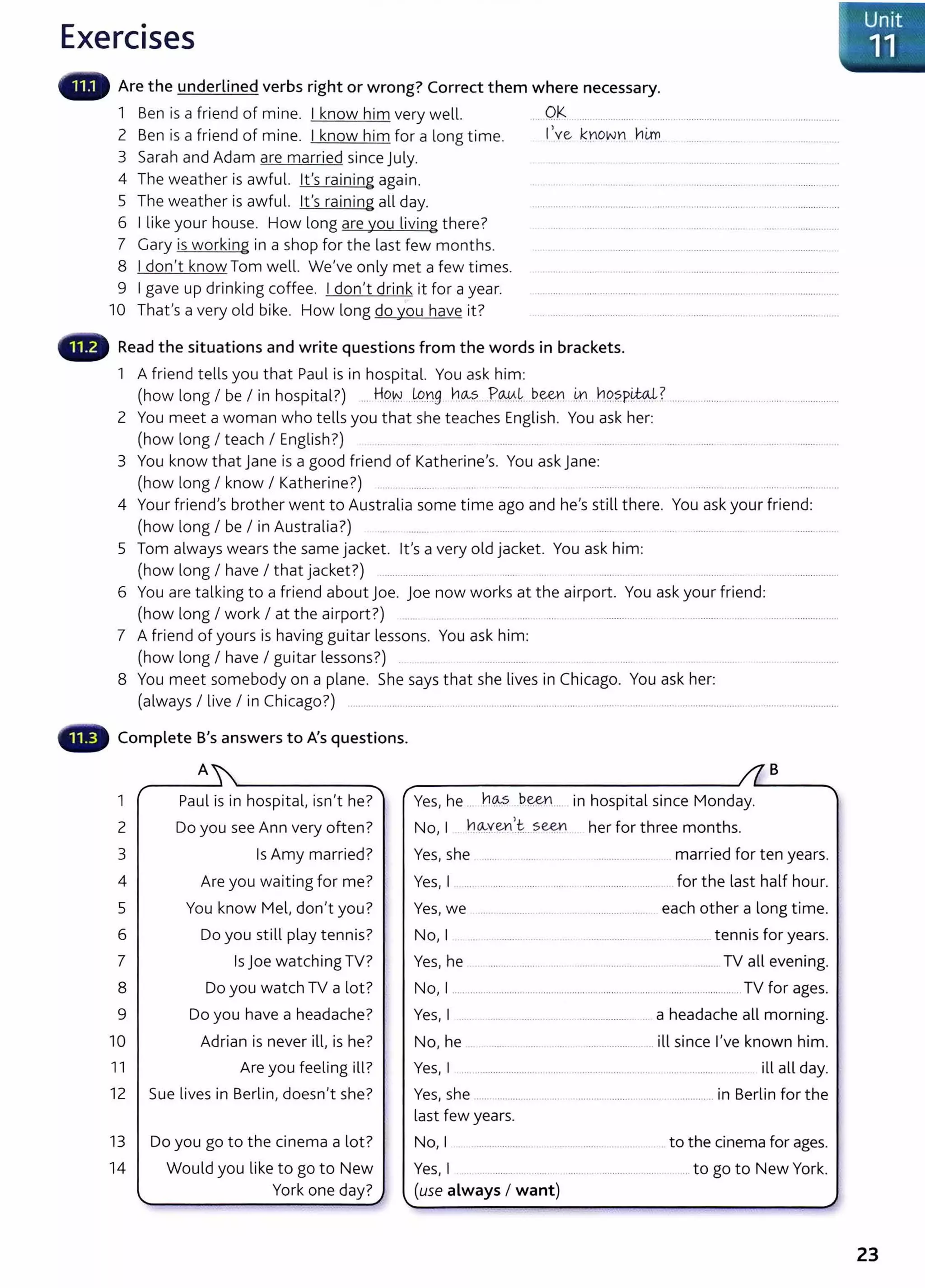
  • 38.
    Exercises Complete the sentencesusing the verbs in brackets. Use the present perfect where possible. Otherwise use the past simple. GJ I can't get in. 1....e lq?t . (lose) my key. I meant to call you last night, but I (forget). Yes, I ........ (have) a headache, but I'm fine now. The office is empty now. Everybody (go) home. Helen (go) to Egypt for a holiday, but she's back home in England now. Can you help us? Our car Are the underlined parts of these sentences right or wrong? Correct them where necessary. 1 Did you hear about Sue? She's given up her job. Ok ... ......... ...... _ ..................................... 2 My mother has grown up in Italy. .....gr~ . .. ...... . ... .. ........................................ 3 How many poems has William Shakespeare written? ............................................................ ................................ 4 Ow! I've cut my finger. lt's bleeding. ........ ..................... ............................................... 5 Drugs have become a big problem everywhere. .... .... ...... ............................. . 6 Who has invented paper? ....... .. .. ..... . . ..... ................................... 7 Where have you been born? ........................ .. ..... . .. ...... _ ........................... 8 Ellie isn't at home. She's gone shopping. ................... . .... ...................................... 9 Albert Einstein has been the scientist who .................... ............ ....... .. ... ..... .. has developed the theory of relativity. ....... ... ....... .. ........ .. . ........................ . Put the verb into the correct form, present perfect or past simple. 1 lt sto eeL · · f h'l b · ' · · · ('t I t ) .......... PP...... ra1n1ng or a w 1 e, ut now 1t s rammg agam. 1 s op 2 The town where I live is very different now. . .l.t h.~~ ...~.@.9~ ..... a lot. (it I change) 3 I studied German at school, but ......... ..... .... .... . .. ..... ............. most of it now. (I I forget) 4 The police . three people, but later they let them go. (arrest) 5 What do you think of my English? Do you think ? (it I improve) 6 A: Are you still reading the paper? s: No, ... ............... with it. You can have it. (I I finish) 7 _ ....... for a job as a tourist guide, but I wasn't successful. (I I apply) 8 Where's my bike? ..... ... . ..... outside the house, but it's not there now. (it I be) 9 Quick! We need to call an ambulance. . .. .. . ...... ..... .. ... an accident. (there I be) 10 A: Have you heard about Ben? .................... .... ................ his arm. (he I break) B: Really? How .. .. .... . .... ... ..... ? (that I happen) A: . . . .. ... . ..... . ... off a ladder. (he I fall) Unit -_ 13 27
  • 39.
    Do not usethe present perfect (I have done) when you talk about a finished time (for example, yesterday I ten minutes ago I in 2005 I when I was a child). Use a past tense: 0 lt was very cold yesterday. (not has been) 0 Paul and Lucy arrived ten minutes ago. (not have arrived) 0 Did you eat a lot of sweets when you were a child? (not have you eaten) 0 Igot home late last night. Iwas very tired and went straight to bed. Use the past to ask When ... ? or What time ... ?: 0 When did your friends arrive? (not have ... arrived) 0 What time did you finish work? Compare: Present perfect .__] Tom has Lost his key. He can't get into the house. 0 Is Carla here or has she Left? Compare: Present perfect (have done) 0 I've done a lot of work today. We use the present perfect for a period of time that continues until now. For example: today I this week I since 2007. I 1 unfinished 1 I to1ay I past now 0 lt hasn't rained this week. 0 Have you seen Anna this morning? (it is still morning) 0 Have you seen Tim recently? 0 Idon't know where Lisa is. I haven't seen her. (= I haven't seen her recently) 0 We've been waiting for an hour. (we are still waiting now) 0 Jack lives in Los Angeles. He has Lived there for seven years. 0 I have never played golf. (in my life) C) lt's the last day ofyour holiday. You say: lt's been a really good holiday. I've really enjoyed it. Past simple _. Unit 5 Present perfect _. Units 7- 8 Past simple =Tom Lost his key yesterday. He couldn't get into the house. 0 When did Carta Leave? Past simple (did) ~ Idid a lot of work yesterday. We use the past simple for a finished t ime in the past. For example: yesterday I last week I from 2007 to 2010. past 1 unfinished 1 I yesterday I now 8 lt didn't rain last week. 8 Did you see Anna this morning? (it is now afternoon or evening) 8 Did you see Tim on Sunday? 0 A: Was Lisa at the party on Sunday? B: Idon't think so. Ididn't see her. := We waited (or were waiting) for an hour. (we are no longer waiting) 0 Jack Lived in New York for ten years. Now he lives in Los Angeles. 8 Ididn't play golf Last summer. C Afteryou come back from holidayyou say: lt was a really good holiday. I really enjoyed it. Present perfect and past 1 _. Unit 13
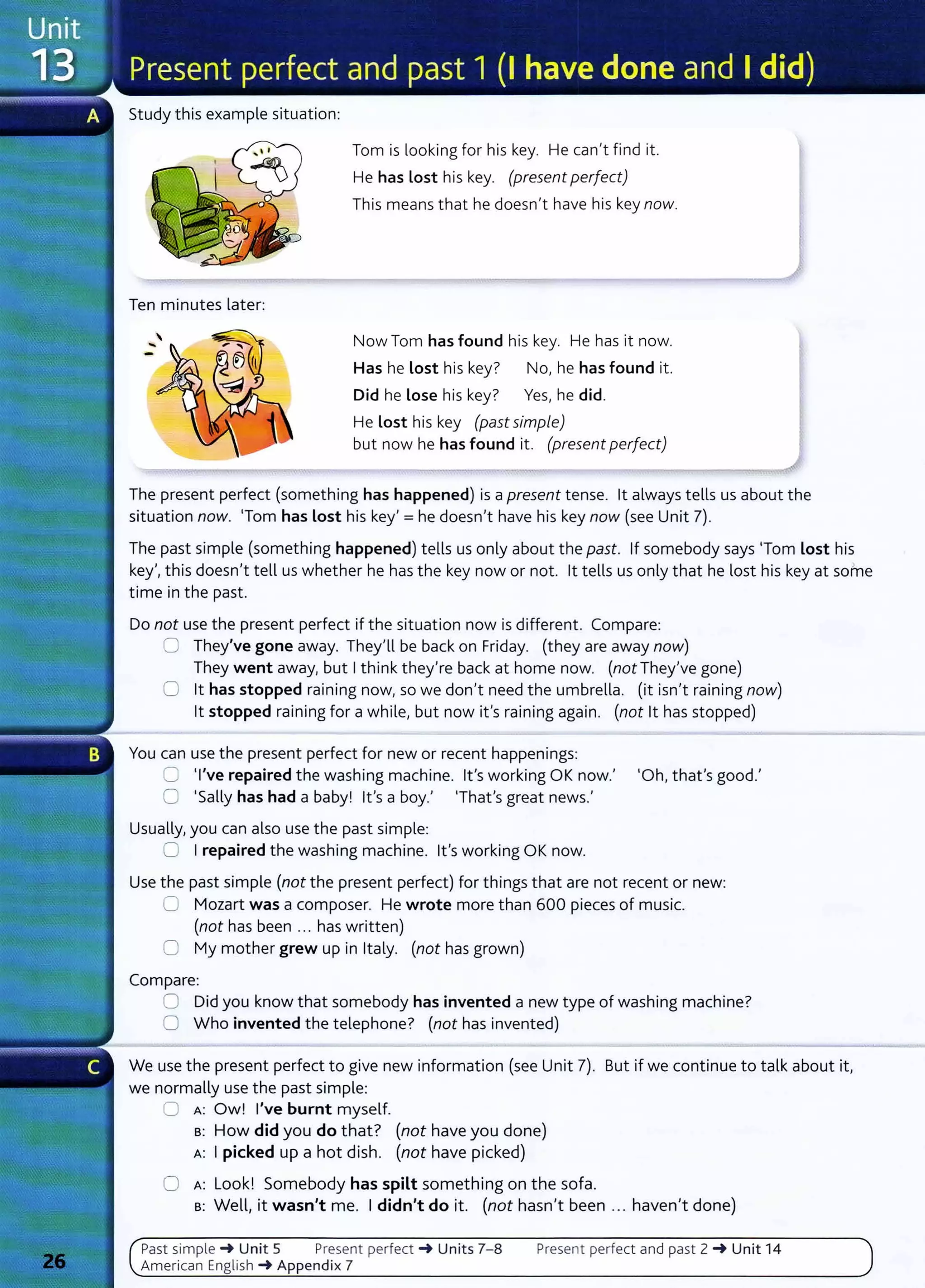
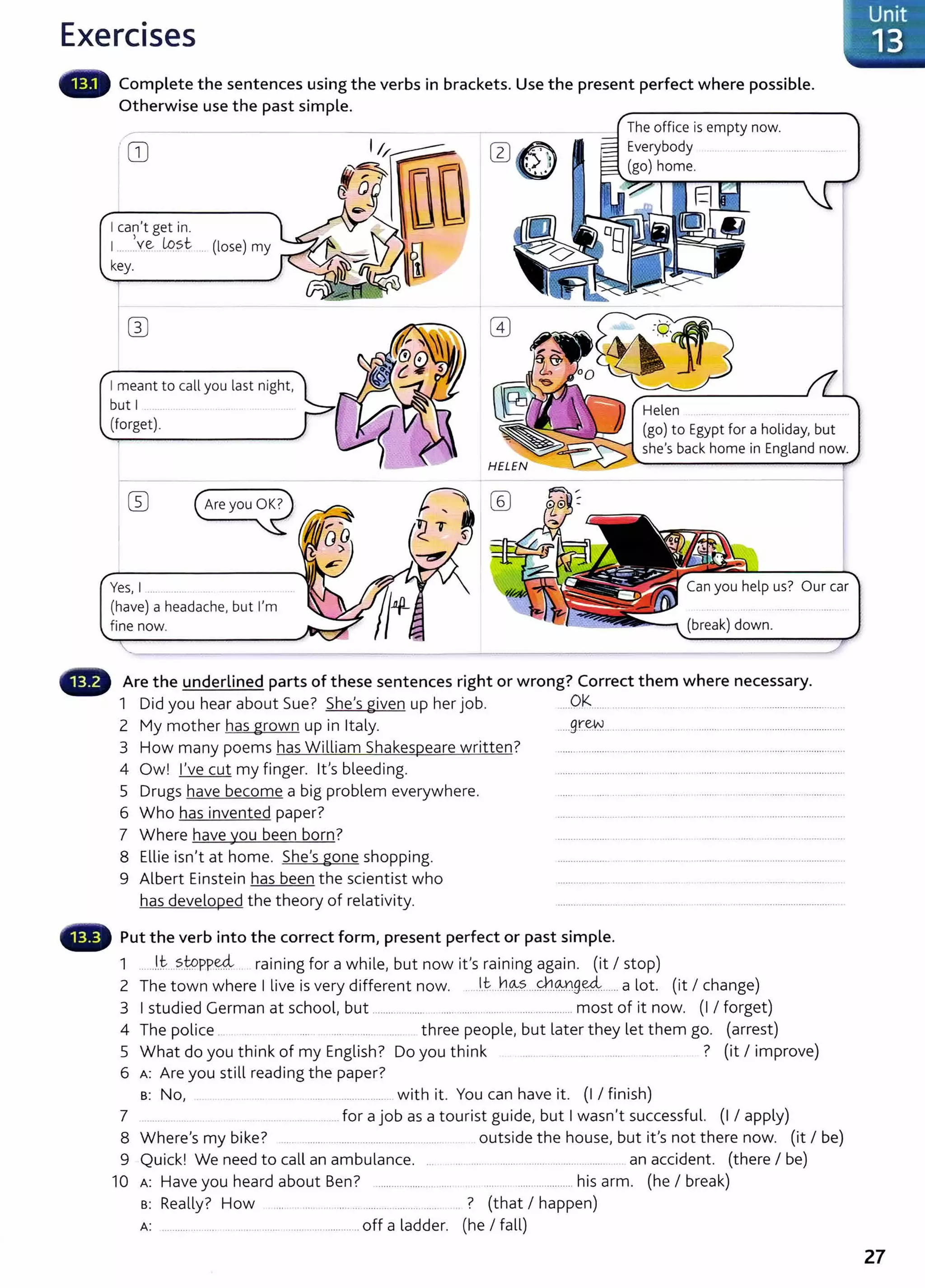
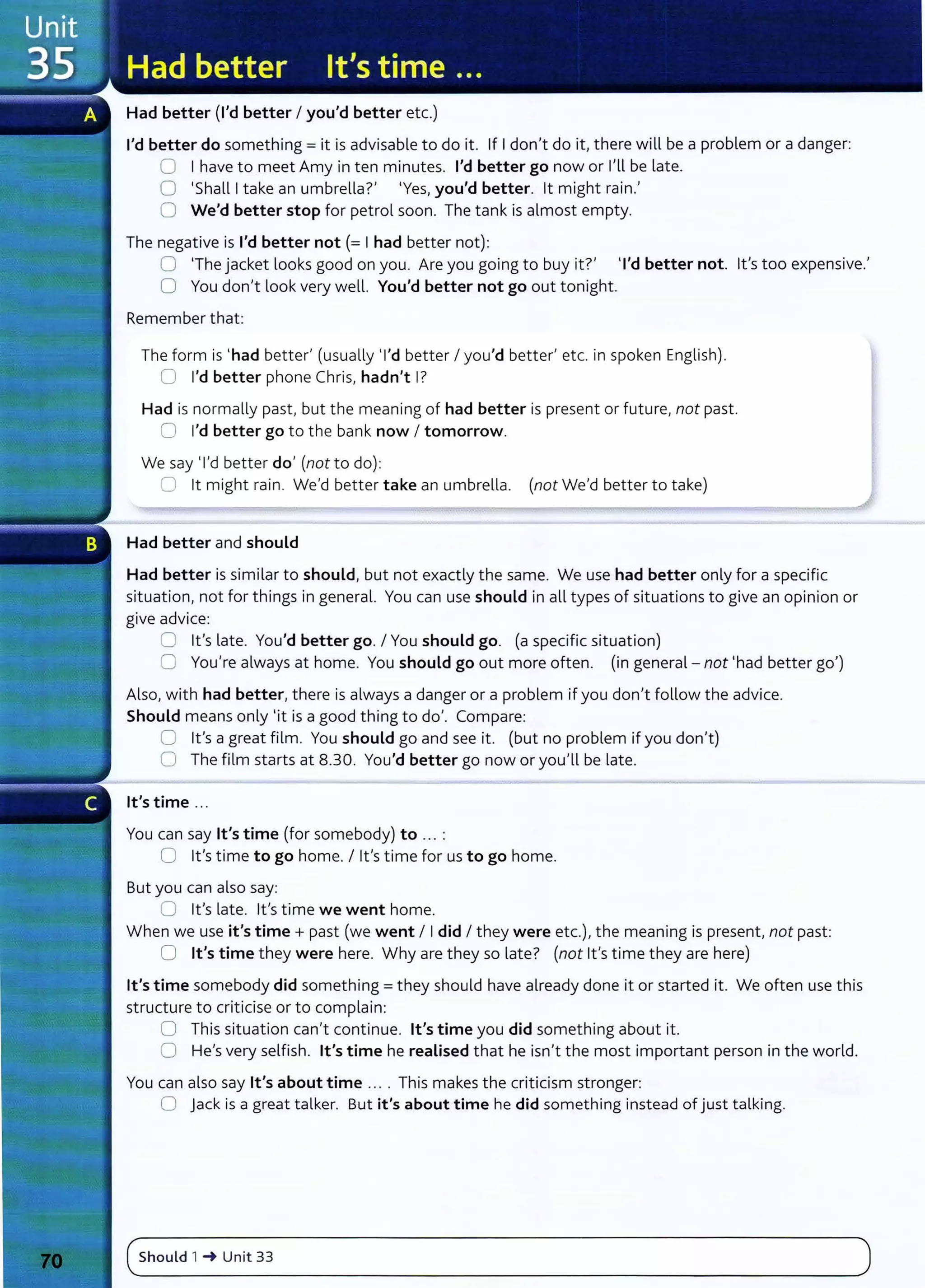
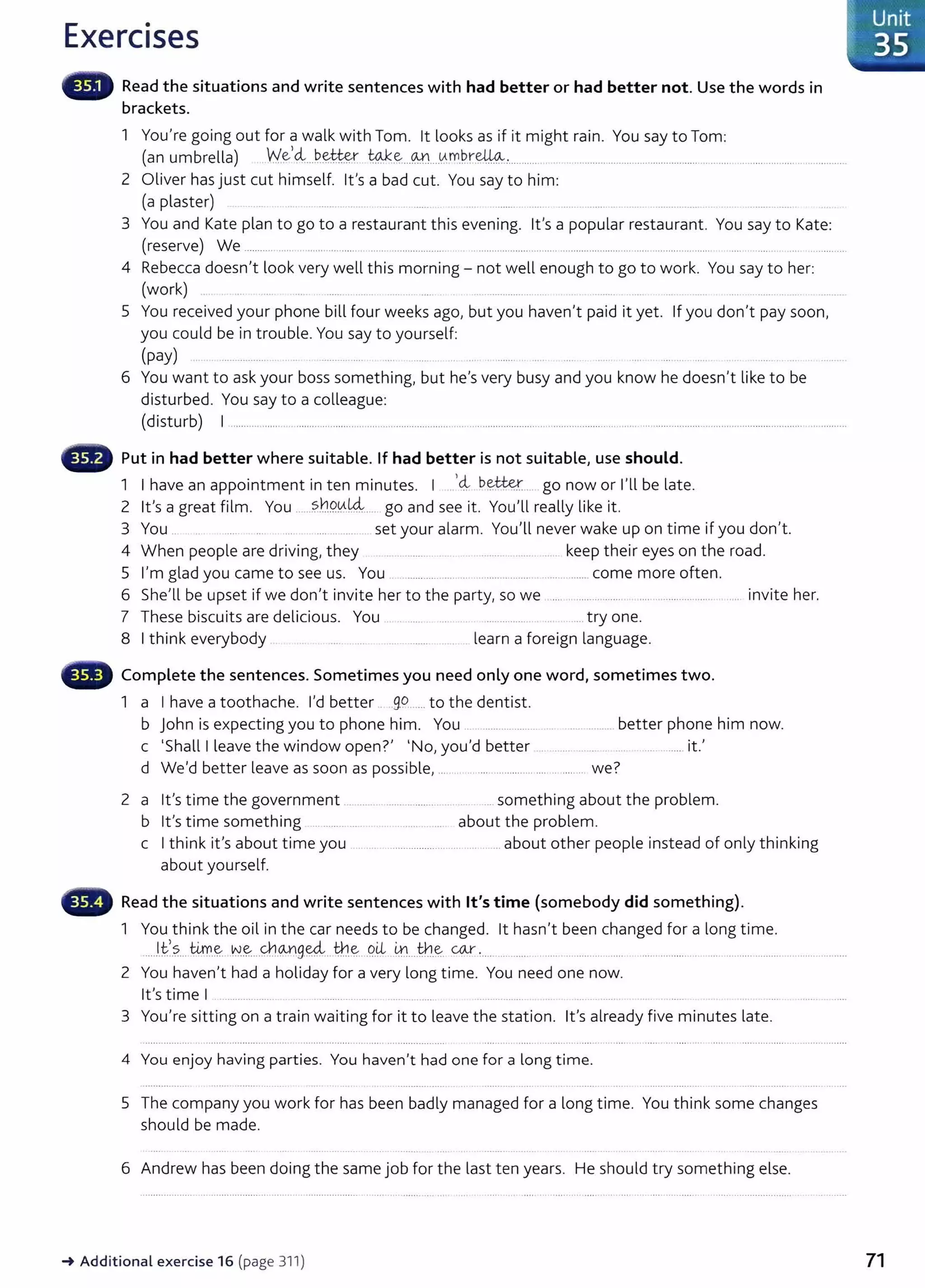
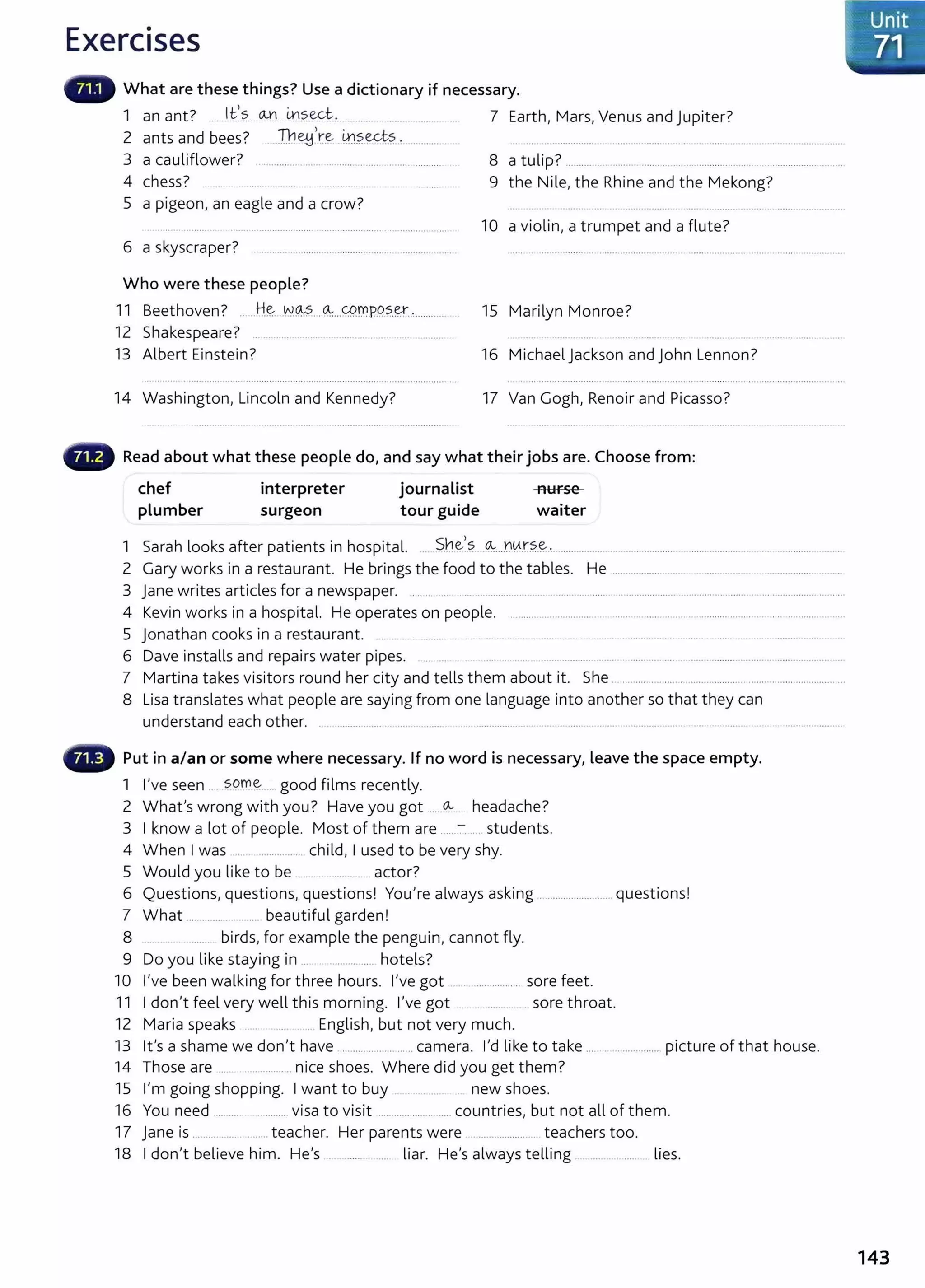
  • 40.
    Exercises Are the underlinedparts of these sentences right or wrong? Correct them where necessary. 1 I've lost my key. I can,t find it anywhere. ...0-'S................................................................. ......................... 2 Have you eaten a lot of sweets when you were a child? 3 I've bought a new car. You must come and see it. 4 I've bought a new car last week. 5 Where have you been yesterday evening? 6 Lucy has left school in 1999. 7 I'm looking for Mike. Have you seen him? 8 'Have you been to Paris?, 'Yes, many times.' 9 l,m very hungry. I haven,t eaten much today. 10 When has this book been published? ..Di4...W?.~... ~--·· ·············... .... Make sentences from the words in brackets. Use the present perfect or past simple. 1 (it I not I rain I this week) .lt .h~?..n....r~.~ ~-~?....W.~ , ....................... .... . ...... ............... ... .... ... ..... . 2 (the weather I be I cold I recently) The weather ................................................................ ..... ... ...................................................... 3 (it I cold I last week) lt ........ ..... . .......... .......... ....... .... .. ....................... ............................. .......... ......................................................... 4 (I I not I read I a newspaper yesterday) I . . .......... ........ .. .. ................ .. . ................... 5 (I I not I read I a newspaper today) ......... ... . . .. .................... . . . .... .. ......... . . ...... .. ... . ... 6 (Emily I earn I a lot of money I this year) ................................ .................... ......... ................................... .............. . . 7 (she I not I earn I so much I last year) ................. ..................................................... ........................................... ........................ 8 (you I have I a holiday recently?) .......... ....... ............................. . .. ........ ... ..... .. ..................................... ... Put the verb into the correct form, present perfect or past simple. 1 'Whafs Madrid like?, 'I don,t know. .....J...h.Q--Y.~nl..P.e&n.....(I I not I be) there.' 2 When .... .............. ...... .. ....................... ... (I I get) home last night, ............................... ....................... (I I be) very tired and ..... .............. (I I go) straight to bed. 3 A: ........................................................ (you I see) Lisa recently? B: Yes, .................... ..... .. ........... ...... .... .. (I I saw) her a few days ago. 4 l,m tired. ....... . . ... ......... .. . .................. .... (1 I not I sleep) well last night. 5 The bus drivers were on strike last week. .. (there I be) no buses. 6 Mr Lee . ........ (work) in a bank for 15 years. Then ........................................ (he I give) it up. Now he works as a gardener. 7 Mary lives in Dublin. .... ...... .... .. ....... .................. ............. .(she I live) there all her life. 8 A: ... . .. ................ ..... ................... (you I go) to the cinema last night? B: Yes, but ........ ....... .................. . ..... (it I be) a mistake. The film .......... (be) awful. 9 My grandfather .. ....... ........... .. ... ............... (die) before I was born. . .... ............................................... (1 I never I meet) him. 10 I don't know Karen's husband. ............................................................................ (I I never I meet) him. 11 Ifs nearly lunchtime, and .. .. .. ..... ........... ... .. ...... ...... . (I I not I see) Martin all morning. I wonder where he is. 12 'Where do you live?, 'In Boston.' 'How long ................................................................................. .(you I live) there?' 'Five years.' 'Where .. ....... ... .. ....... . .. . .. ..... ...... .. (you I live) before that?' 'In Chicago., 'And how long ...... .............. .. . . .... . ........... .. .... . (you I live) in Chicago?' 'Two years.' Write sentences about yourself using the ideas in brackets. 1 (something you haven't done today) ......1. ~.QvV:~Y1. 1 .i:.....~n CM1H...fr.tA.~...t9~................... .. ........... ........ . 2 (something you haven,t done today) .... .... ... . ....... ... .... .... ..... .... ............. .. 3 (something you didn,t do yesterday) .... . ..... ............. .. . . .... ......... .. .. ............... 4 (something you did yesterday evening) ............ ... ................. .. ........................... ..... .................. ....... ..... ................... 5 (something you haven't done recently) ...................................................................................................................................................... 6 (something you've done a lot recently) .... ..... .. . ...... ... . ...... .. ...... .. . ....... ............ .. ...................... . _.Additional exercises 2- 4 (pages 303- 04), 14- 15 (pages 310- 11) 29
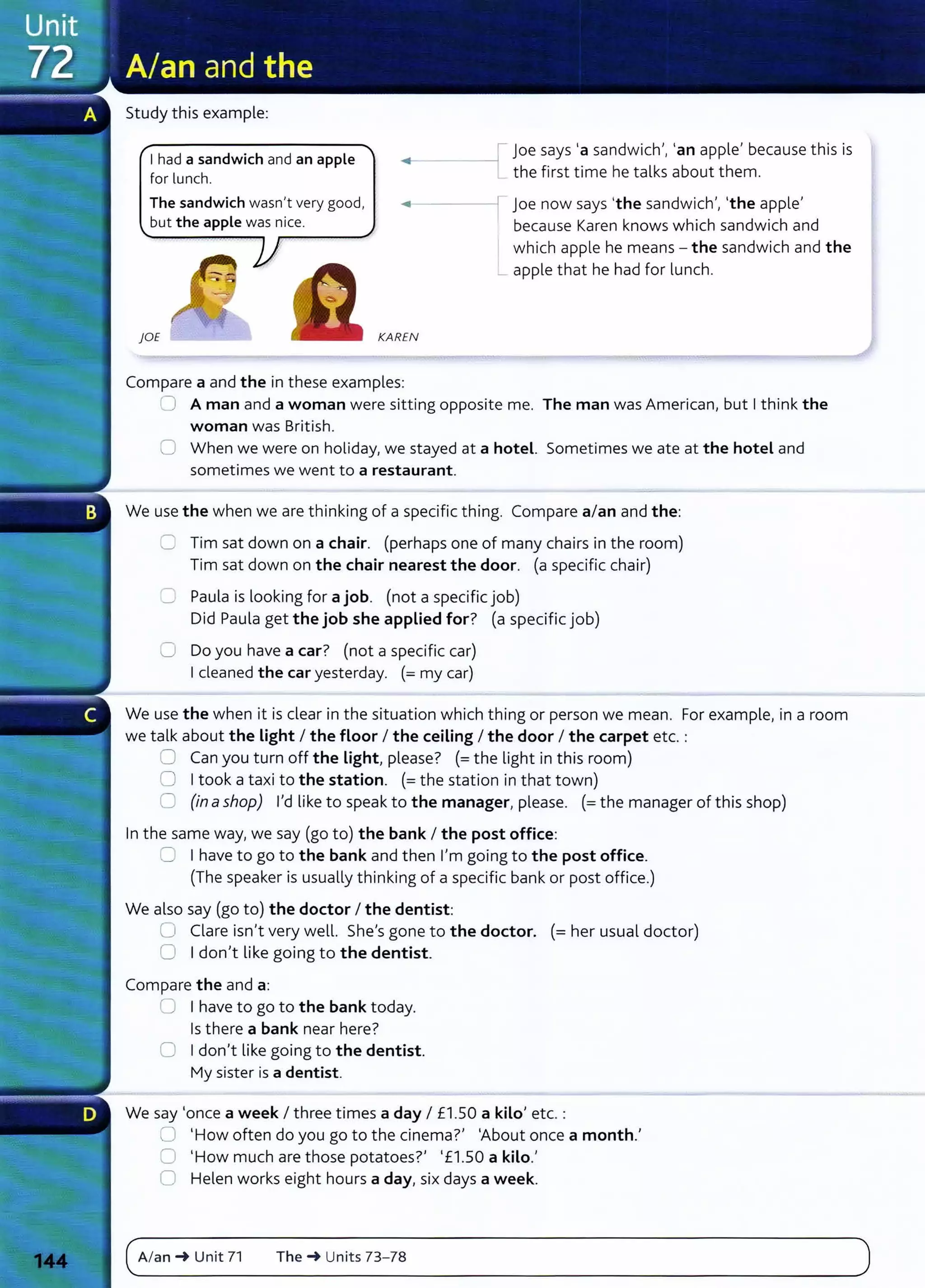
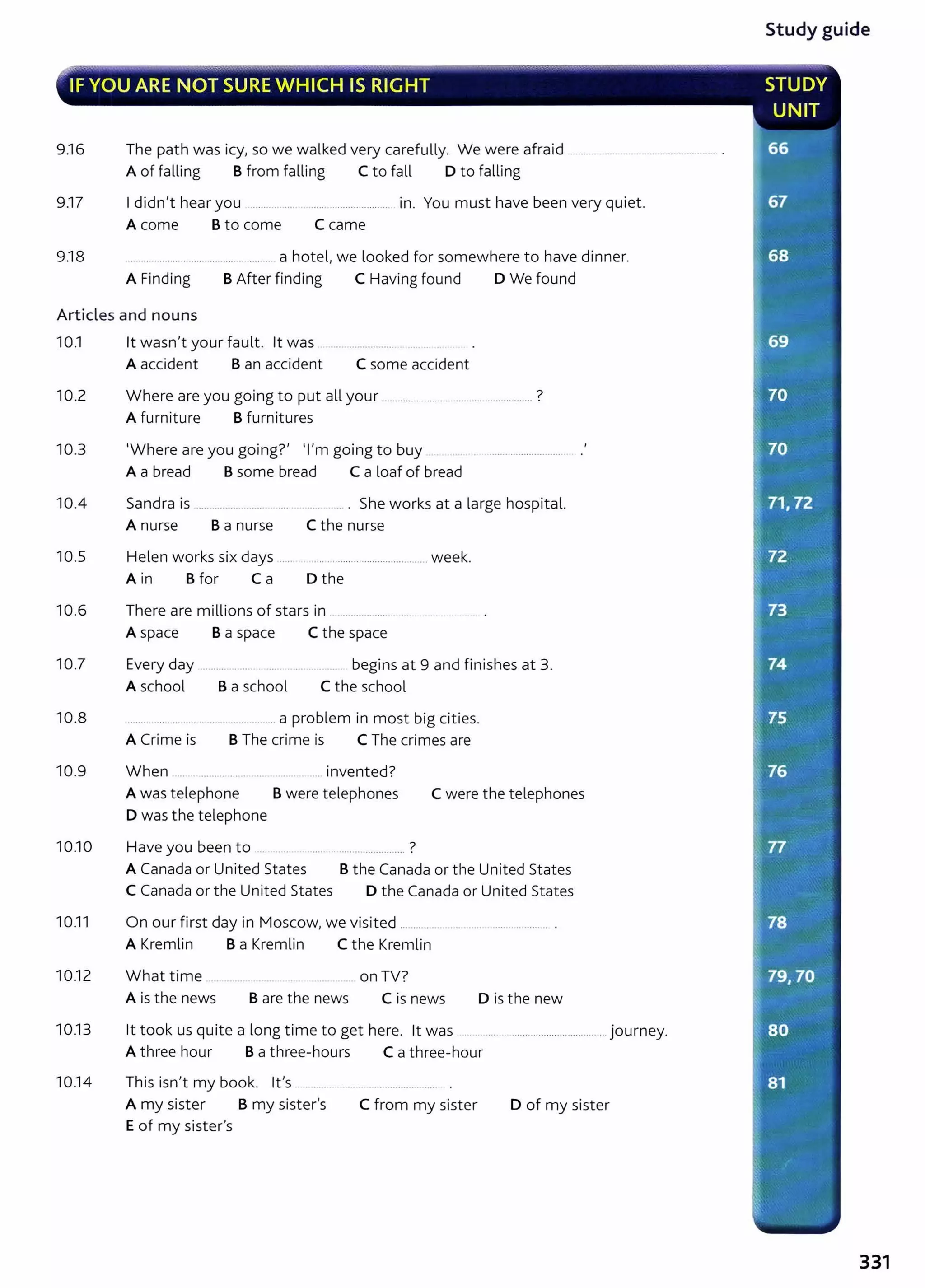
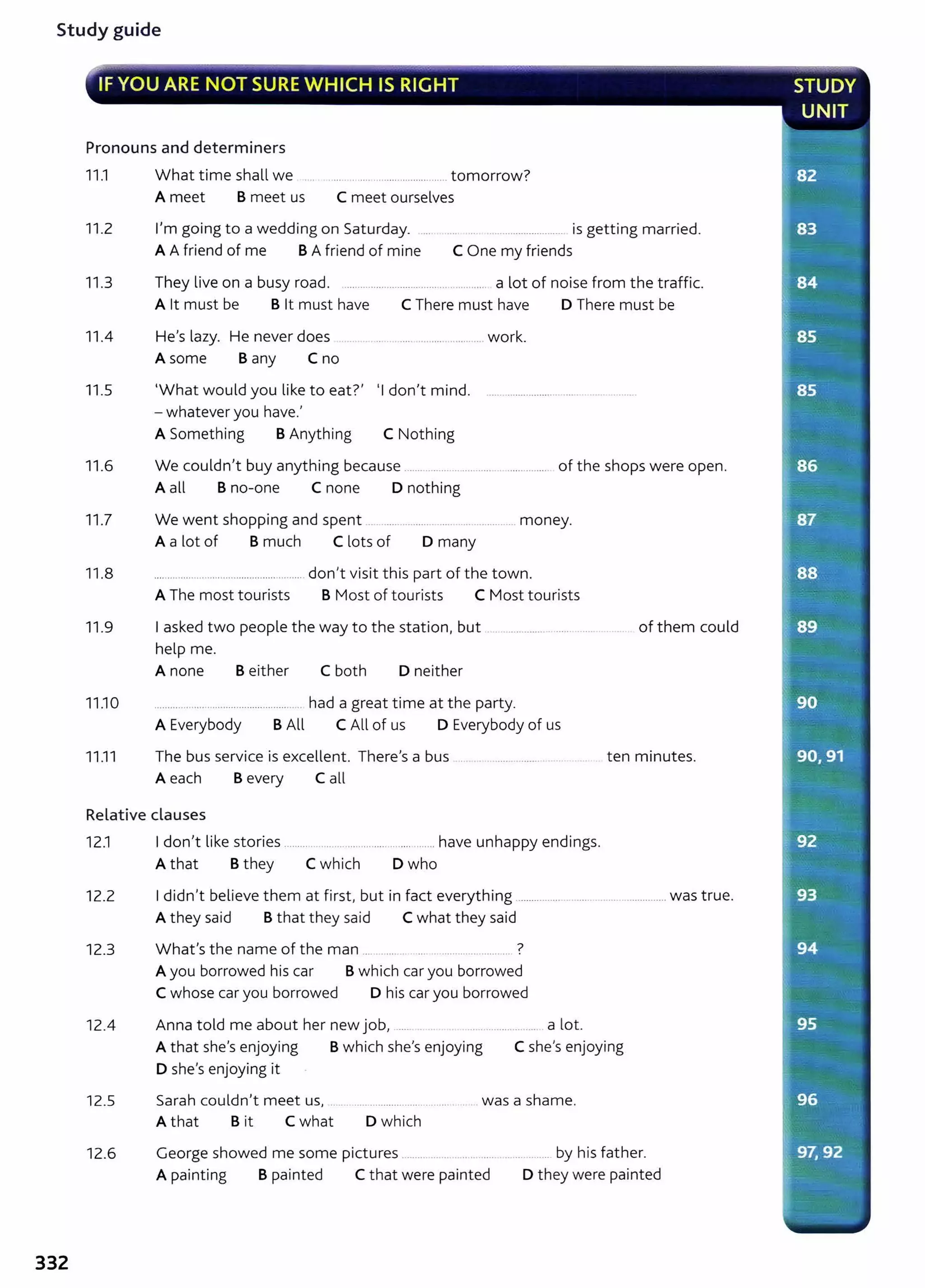
  • 41.
    Study this examplesituation: at 10.30 at 11.00 PAUL SA RA H Sarah went to a party last week. Paul went to the party too, but they didn't see each other. Paul left the party at 10.30 and Sarah arrived at 11 o'clock. So: When Sarah arrived at the party, Paul wasn't there. He had gone home. Had gone is the past perfect (simple): 1 /we/they/you he/she/it had (=I'd etc.) (= he'd etc.) gone seen finished etc. The past perfect simple is had+ past participle (gone/ seen/ finished etc). Sometimes we talk about something that happened in t he past: 0 Sarah arrived at the party. This is the starting point of the story. Then, if we want to talk about things that happened before this time, we use the past perfect (had ...): 0 When Sarah arrived at the party, Paul had already gone home. Some more examples: 0 When we got home last night, we found that somebody had broken into the flat. 0 Karen didn't want to go to the cinema with us because she'd already seen the movie. 0 At first Ithought I'd done the right thing, but Isoon realised that I'd made a big mistake. 0 The man sitting next to me on the plane was very nervous. He hadn't flown before. or ... He had never flown before. Compare the present perfect (have seen etc.) and the past perfect (had seen etc.): Present perfect I Past perfect have seen past now 0 Who is that woman? I've seen her before, but Ican't remember where. C We aren't hungry. We've just had lunch. 0 The house is dirty. They haven't cleaned it for weeks. hadseen past now CJ Iwasn't sure who she was. I'd seen her before, but Icouldn't remember where. C We weren't hungry. We'd just had lunch. 8 The house was dirty. They hadn't cleaned it for weeks. Compare the past simple (Left, was etc.) and the past perfect (had left, had been etc.): 0 A: Was Tom there when you arrived? 0 A: Was Tom there when you arrived? B: Yes, but he Left soon afterwards. B: No, he had already Left. 0 Kate wasn't at home when Iphoned. 0 Kate had just got home when I phoned. She was at her mother/s house. She had been at her mother's house. Past perfect continuous -+ Unit 16 Irregular verbs (gone/seen etc.) -+ Appendix 1
  • 42.
    Exercises Read the situationsand write sentences from the words in brackets. 1 You went to Sue's house, but she wasn't there. (she I go I out) _S_h.~...h.o.-4...99.Y1.~....9~t. . ......0 . . ·······o···· o····· .. ·o······o ... .... . ...........0 . . . . . . . . . . . . . . . . . . . . . . . . . . . . . . . . . . . . . . . . . . . . . . . . . . 2 You went back to your home town after many years. lt wasn't the same as before. (it I change I a lot) ........0 . . . . . . . . . . . . . . . . . . . . . . • • . . . . . . • . . . . . . . • . . . . . . . . . . . . . . . . . . . . . . . . . . . . . . . . . . . . . . . . . . . . . . . . . . . . . . . . . . . . . . . . . . . . . . . . . . . . . . . . . . . . . 0 . . . . . . . . . . . . . . . . . . . . . . . . . . . . . . . . . . 3 Iinvited Rachel to the party, but she couldn't come. (she I arrange I to do something else) o ..... o ..............ooo ...............................0 . . . . . . . . 0 . . . . . . . . . . . . . . . . . . . . . . . . . 4 You went to the cinema last night. You got to the cinema late. (the film I already I start) ....... 0 0 000000.. ........ ••• . • ••••••• .. ..... 5 lt was nice to see Daniel again after such a long time. (I I not I see I him for five years) 6 Ioffered Sue something to eat, but she wasn't hungry. (she I just I have I breakfast) ...................... .................................. ............................ ............ ......................................................................... G For each situation, write a sentence ending with never ... before. Use the verb in brackets. 1 The man sitting next to you on the plane was very nervous. lt was his first flight. (fly) ...o He,4 ne:-ver flown .be.fore:-.... ..o..o .........................o.... ...... . .... 2 Somebody sang a song. Ididn't know it. (hear) I ......oooooo....o ....o ......o ..ooo 0 .... ........................o .... 0 0 .... •........................o .....o ..... before. 3 Sam played tennis yesterday. He wasn't very good at it because it was his first game. (play) He .... ..........0..... .. .......o.. . . . . . • . . . . . . o • . . . • • 0.....0.................0................. .... . ...... .. ...... ............0.................... 4 Last year we went to Mexico. lt was our first time there. (be there) We .... .. ........ ...................... ...... .. .... . ... ...........................0...................................................... ........0...........0.....0............................. Use the sentences on the left to complete the paragraphs on the right. These sentences are in the order in which they happened - so (a) happened before (b), (b) before (c) etc. But your paragraph begins with the underlined sentence, so sometimes you need the past perfect. 1 (a) Somebody broke into the office during We arrived at work in the morning and the night. found that o ....?..o.rr..~o~ . ~.% OP.r.9.~e.no.... (b) We arrived at work in the morning. into the office during the night. So (c) We called the police. ...0 . . . . . . . . . . . . . . . . . . . . . . . . . . . . . . . . . . . . . . . . . . . . . . . . . . . . . . . . . . . . . . . . . . . . . . . . . . . . . . . . . . . . . the police. 2 (a) L aura went out this morning. (b) Irang her doorbell. (c) There was no answer. no out. 3 (a) Jim came back from holiday a few days ago. (b) Imet him the same day. (c) He looked very well. } ~u~tetJt=~f~~ ~~~s ago. : . . h~liday. .. .....0........0...............................................................................0 very well. 4 (a) Kevin sent Sally lots of emails. (b) She never replied to them. (c) Yesterday he got a phone call from her. (d) He was very surprised. Yesterday Kevin ....................................0 . . . . . . . . . . . . . . . . . . . . . . . . . 0 . . . from Sally. .. 0 . . . . . . . . . . . . . . . . o.. .......... • • • .. ....... very surprised. ............o................o.... ........ .. lots of emails, but ............0 . . . . . . . . . . . . . . . Put the verb into the correct form, past perfect (I had done) or past simple (I did). 1 'Was Paul at the party when you arrived?' 'No, he ooooooh~..ogQn~..... (go) home.' 2 Ifelt very tired when Igot home, so I .. . .... . ........0 . . . . . . . . . . . . . . . . . . . . . (go) straight to bed. 3 The house was very quiet when Igot home. Everybody ................................................... (go) to bed. 4 Sorry I'm late. The car.................0 . . . . . . . . . . . . . . . . . . . . . . . . . . . . . . . . . . . . (break) down on my way here. 5 We were driving along the road when we ............................o ....o ........o ....o(see) a car which ......0......................... (break) down, so we ..................0.........0......... (stop) to help. _. Additional exercises 5- 8 (pages 304-07) 31
  • 43.
    Study this examplesituation: yesterday morning Yesterday morning I got up and looked out of the window. The sun was shining, but the ground was very wet. lt had been raining. lt was not raining when I looked out of the window; the sun was shining. But it had been raining before. Some more examples: Had been -ing is the past perfect continuous: 1/we/you/they he/she/it had (= I'd etc.) (=he'd etc.) I been doing working playing etc. 8 When the boys came into the house, their clothes were dirty, their hair was untidy and one of them had a black eye. They'd been fighting. C I was very tired when I got home. I'd been working hard all day. l__ When I went to Madrid a few years ago, I stayed with a friend of mine. She hadn't been Living there very long, but she knew the city very well. You can say that something had been happening for a period of time before something else happened: 0 We'd been playing tennis for about half an hour when it started to rain heavily. 0 Paul went to the doctor last Friday. He hadn't been feeling well for some time. Compare have been -ing (present perfect continuous) and had been -ing (past perfect continuous): Present perfect continuous I have been -ing past now 0 I hope the bus comes soon. I've been waiting for 20 minutes. (before now) 0 James is out of breath. He has been running. Past perfect continuous I had been -ing past now 0 At last the bus came. I'd been waiting for 20 minutes. (before the bus came) C James was out of breath. He had been running. Compare was -ing (past continuous) and had been -ing: ._. lt wasn't raining when we went out. The sun was shining. But it had been raining, so the ground was wet. 0 Katherine was sitting in an armchair resting. She was tired because she'd been working very hard. Some verbs {for example, know and Like) are not normally used in the continuous: ~] We were good friends. We had known each other for years. (not had been knowing) 0 I was surprised when Lisa cut her hair. She'd had long hair since I first met her. (not she'd been having) For a list of these verbs, see Unit 4A. For have, see Unit 17. Present perfect continuous -+ Unit 9- 10 Past perfect simple -+ Unit 15
  • 44.
    Exercises Read the situationsand make sentences from the words in brackets. 1 I was very tired when I arrived home. (I I work I hard all day) .. 1 1 ~.. b~r wgrk~g .Y:lo...r. 4. o-.4.. ~ :............................................. 2 The two boys came into the house. They had a football and they were both very t ired. (they I play I football) .. .. ..... .... ....... .. . .... .................................................... 3 I was disappointed when I had to cancel my holiday. (I I look I forward to it) ... .. .. ........................... . ............. 4 Ann woke up in the middle of the night. She was frightened and didn't know where she was. (she I dream) ... .. ...... ....... .... ...................... ..... ..... ..... ....................... ........... ... 5 When I got home, Mark was sitting in front of the TV. He had just turned it off. (he I watch I a film) .. .......... ....... .. ..... ....... ...... ........................................................................................................... ................. . Read the situations and complete the sentences. 1 We played tennis yesterday. Half an hour after we began playing, it started to rain. We .....h%...P~Y.LP.~ill.9....f9.r....h..~f...(.Y'1... ~.9.tA.t.... when ......~...?..~~....t9....r.W....... . 2 I had arranged to meet Tom in a restaurant. I arrived and waited for him. After 20 minutes I realised that I was in the wrong restaurant. I .................................. ............................................... ..... for 20 minutes when I .......................................................... .............. ................................................................................. .. the wrong restaurant. 3 Sarah got a job in factory. Five years later the factory closed down. At the time the factory .......... , Sarah ......................... . ... ........................ .. . there for five years. 4 I went to a concert last week. The orchestra began playing. After about ten minutes a man in the audience suddenly started shouting. The orchestra ............................ . .... .... . .. .. ........ ............... ...... . ......................................................................... when This time make your own sentence: 5 I began walking along the road. I when ............................... .. ...... ....... ............................ Put the verb into the most suitable form, past continuous {I was doing)~ past perfect (I had done) or past perfect continuous (I had been doing). 1 lt was very noisy next door. Our neighbours ....N.~~....h(A..Y. i.r.l.g...... (have) a party. 2 We were good friends. ....W.~'~..kY).Q.w~. (we I know) each other for years. 3 John and I went for a walk. I had difficulty keeping up with him because .................................................. ........................ (he I walk) so fast. 4 Sue was sitting on the ground. She was out of breath. ........................................................................... (she I run). 5 When I arrived} everybody was sitting round the table with their mouths fu lL ...................... ......................................... (they I eat). 6 When I arrived} everybody was sitting round the table and talking. Their mouthswere empty, but their stomachs were full. ................. ..... .. .............. (they I eat). 7 j ames was on his hands and knees on the floor. ....... ....... ... ....................................... (he I look) for his contact lens. 8 When I arrived, Kate ................................. ..... .. .... (wait) for me. She was annoyed because I was late and .. .. ..... .. ...... . ..... ........ .(she I wait) for a long time. 9 I was sad when I sold my car. . (I I have) it for a very long time. 10 We were extremely tired at the end of the journey. .... ............. ........................... ........ ....... .. (we I travel) for more than 24 hours. _.Additional exercises 5- 8 (pages 304-07) 33
  • 45.
    Have and havegot(= for possession, relationships, illnesses etc.) You can use have or have got. There is no difference in meaning: C They have a new car. or They've got a new car. 0 Lisa has two brothers. or Lisa's got two brothers. C I have a headache. or I've got a headache. C Our house has a small garden. or Our house has got a small garden. 0 He has a few problems. or He's got a few problems. With these meanings (possession etc.), you cannot use continuous forms (am having etc.): C We're enjoying our holiday. We have I We've got a nice room in the hotel. (not We're having a nice room) For the past we use had (without got): ... J Lisa had long hair when she was a child. (not Lisa had got) In questions and negative sentences there are three possible forms: - - -- - - ---, Do you have any questions? ~don't have any questions. Have you got any questions? J ~ haven't got any questions. Have you any questions? (less usual) I haven't any questions. (less usual) Does she have a car? I She doesn't have a car. Has she got a car? She hasn't got a car. Has she a car? (less usual) She hasn't a car. (less usual) In past questions and negative sentences we use did/didn't: '-.J Did you have a car when you were living in Paris? 0 Ididn't have my phone, so Icouldn,t call you. C Lisa had long hair, didn't she? Have breakfast I have a shower I have a good time etc. ----------------~ We also use have (but not have got) for many actions and experiences. For example: breakfast I dinner I a cup of coffee I something to eat etc. a bath I a shower I a swim I a break I a rest I a party I a holiday an accident I an experience I a dream have a Look (at something) a chat I a conversation I a discussion (with somebody) trouble I difficulty I fun I a good time etc. a baby (= give birth to a baby) Have got is not possible in the expressions in the box. Compare: 0 Sometimes I have(= eat) a sandwich for my lunch. (not I've got) but I've got I I have some sandwiches. Would you like one? You can use continuous forms (am having etc.) with the expressions in the box: ~ We're enjoying our holiday. We're having a great time. (not We have) C Mark is having a shower at the moment. He has a shower every day. In questions and negative sentences we use do/does/did: 21 I don't usually have a big breakfast. (not I usually haven,t) 0 What time does Chris have lunch? (not has Chris lunch) 0 Did you have trouble finding a place to live? Have (got) to ... _. Unit 31 American English _. Appendix 7
  • 46.
    Exercises Write negative sentenceswith have. Some are present and some are past. 1 I can't get into the house. (a key) ......l....hp._ve~...g.9.t.. o.,_k~.~.............. ........ ............................................................... 2 I couldn't read the letter. (my glasses) I d.i..cln~~ l-1o.,ve .JYl~..._gLo...sses .. .............. 3 I can't get onto the roof. (a ladder) I .... ....... ...... . . .... .. ... .... . ...... ................................... 4 We couldn't visit the museum. (enough time) We ............................................................................................................. 5 He couldn't find his way to our house. (a map) . ..... ...... . ..... .... . .. ....... ................................... 6 She can't pay her bills. (any money) ........ .......... .. .......... .. ................ ............ 7 I can't go swimming today. (enough energy) ..... .. .. ......... ..... . ... ................... .................. 8 They couldn't take any pictures. (a camera) ......................................................................................................................... Which alternatives are correct? Sometimes two alternatives are possible, sometimes only one. 1 Excuse me, ................... ....................... a pen I could borrow? ®have you got B are you having ©do you have (both A and Care correct) 2 ............... ... time to go to the bank yesterday? A Had you got B Did you have C Had you 3 I need a stamp for this letter. ............................................... one? A Do you have BAre you having C Have you got 4 What does jack do? ... .... ... a job? A Does he have B Is he having C Has he got 5 ..................... a lot of friends when you were a child? A Did you have B Were you having C Had you 6 When you worked in your last job, .. ...... ................. your own office? A had you B have you got C did you have Are the underlined verbs OK? Change them where necessary. 1 Is there anything you want to ask? Do you have any questions? ... OIS. .. ........ 2 Lisa had got long hair when she was a child. .. L~~f'.-...Yl.AA ..Lc>.ng....n~ ....................... 3 Tom couldn't contact us because he hadn't our number. ..... . ..... 4 'Are you feeling OK?' 'No, I'm having a toothache.' .................... 5 Are you enjoying yourself? Are you having a good time? .......... ....... 6 lt started to rain. I got wet because I hadn't an umbrella. . .............................. .. ................. 7 Will can't drive. He doesn't have a driving licence. . .............. 8 Did your trip go OK? Had you any problems? .. ............. .................. 9 My friend called me when I was having breakfast. . ........................... .......................................... Complete the sentences. Use an expression from the List with have in the correct form. have a baby have a Look have a break have lunch have a chat have a party have trouble have a nice time 1 I don't eat much during the day. I never .... l-1o.,ve....w.n~ 2 David starts work at 8 o'clock and ............ . have a good flight have a shower .. at 10.30. 3 We .... . ... .. .................. .. ..... . ....... ... .... .... ................... . last week. lt was great - we invited lots of people. 4 Excuse me, can I ..... .. .......... . .. . ... ....... ........ .................. ..... at your newspaper, please? 5 Jim is away on holiday at the moment. I hope he ...... 6 I met Ann in the supermarket yesterday. We stopped and ............. 7 A: ................................................. ................................................. ...... finding the book you wanted? B: No, I found it OK. 8 Suzanne ............. . a few weeks ago. it's her second child. 9 A: Why didn't you answer the phone? B: 1............... . ...................... .... ......................................... 10 You meetyourfriend Sally at the airport. She hasjust arrived. You say: Hi, Sally. How are you? .................. ................. ? 35
  • 47.
    Study this examplesituation: afewyears ago Nicola doesn't travel much these days. She prefers to stay at home. But she used to travel a lot. She used to go away two or three times a year. She used to travel a lot= she travelled a lot often in the past, but she doesn't do this any more. she used to travel she doesn't travel these days past Something used to happen = it happened often in the past, but no longer happens: 0 I used to play tennis a lot, but I don't play very much now. 0 David used to spend a lot of money on clothes. These days he can't afford it. C 'Do you go to the cinema much?' 'Not now, but I used to.' (=I used to go) We also use used to ... for things that were true, but are not true any more: 0 This building is now a furniture shop. lt used to be a cinema. 0 I used to think Mark was unfriendly, but now I realise he's a very nice person. 0 I've started drinking tea recently. I never used to Like it before. 0 Lisa used to have very long hair when she was a child. 'I used to do something' is past. There is no present. You cannot say 'I use to do'. To talk about the present, use the present simple (1 do). Compare: 1 pas~e used to play r-,;-esent he plays we used to Live Ithere used to be we Live there is C We used to Live in a small village, but now we Live in London. 0 There used to be four cinemas in the town. Now there is only one. The normal question form is did (you) use to ... ?: 0 Did you use to eat a lot of sweets when you were a child? The negative form is didn't use to .. . (used not to ... is also possible): :_ I didn't use to like him. (or I used not to like him.) Compare I used to do and I was doing: now ~ I used to watch TV a lot. (=I watched TV often in the past, but I no longer do this) 0 I was watching TV when Rob called. (= I was in the middle of watching TV) Do not confuse I used to do and I am used to doing (see Unit 61). The structures and meanings are different: U I used to Live alone. (= I lived alone in the past, but I no longer live alone) 0 I am used to Living alone. (= I live alone, and I don't find it strange or difficult because I've been living alone for some time) Past continuous (1was doing) ~ Unit 6 Would (= used to) ~ Unit 36 Be/get used to (doing) something~ Unit 61
  • 48.
    Exercises Complete the sentenceswith use(d) to+ a suitable verb. 1 Nicola doesn't travel much now. She .. tA?.e4 U:?....tr.~Y.~...... a lot, but she prefers to stay at home these days. 2 Sophie ..... ..... ........ .. .... . ................. a motorbike, but last year she sold it and bought a car. 3 We moved to Spain a few years ago. We .. ... ...... ...................... ..... ............... in Paris. 4 I rarely eat ice-cream now, but I .. ................. it when I was a child. 5 Jackie ......... .... .. .. .. my best friend, but we aren't good friends any more. 6 lt only takes me about 40 minutes to get to work now that the new road is open. lt .... ............. .... .... .. ..... ....... more than an hou r. 7 There .... ....... .... .... ... ... .. a hotel nea r the airport, but it closed a long time ago. 8 When you lived in New York, .... .... .... .. ................. .. .. .. .. to the theatre very often? Compare what Karen said five years ago and what she says today: FIVE YEARS AGO I travel a lot. ~ .-.L~.-. ......... I've got lots of friends.- -- I'm very lazy. ----- 1don't like/ cheese. I'm a hotel receptionist. / Iplay the piano. TODAY Ieat lots of cheese now~ Iwork very hard these days. - - - Idon't know many/; people these days. / Iwork in a / bookshop now. M y dog died two / years ago. ( _;read a newspaper / every day now. Ihaven't been to a ~ party for ages. Ihaven't played the ~ piano foryears. ~ I don't go away .......a ~h the....... d~..... I I I Cl 1 1 i J C UJ J· Igo to a lot of parties. Tea's great! Ilike it now. Now write sentences about how Karen has changed. Use used to I didn't use to I never used to in the first part of your sentence. 1 .$Y1e:..V.5~ to tt~Y.~----~ LQt.> ...................... but ...?.h.e......Me5n>t, .go G4'YO-.y. mtAc}1 tt.J.~?-~ ~5 . ............ 2 She used .. ...... ...... ........ .. but ... ................... . .... .. ... . .............. ....... ................................. ........ .......... 3 ....................................... ..........................................................but . ... .............................. ............................................. ............................. .................... 4 ............................... ................................. ....... ..... .......... .......... .. but . 5 .. .................... ..... ........... . but 6 .. .. ................... .. . . ...... . . ...... ....... but 7 ..... . ............. .... ........................ ...... ........................... but 8 ......................................... ......................................................................but ........................................................................................................................................... 9 .......... ...................... ...... .................................... .............................. but 10 ... ............................. .......................... but Write sentences about yourself Like the examples. Begin I used to ... (I used to be/work/like/ play/read etc.). 1 1 ....~5.~ ~--..~Y.~.. 4.'1...~...5rr..o..U.:...Y.~~->-.Jwt n9N...J...4.Y~...itl.Jo. r49Yl........... .... .. ..................................................... 2 1 .....1!..~-~ tq___pla.y ~~ni-s .. o.... LQt> P.v...t J cion,t p~_ _any mqre ..... 3 I used .... ....... .. .... ....... ....... ... , but .................... . _ 4 I ................................... .... . ....... .... .. ......................... . . ................... ... ............ ..... . .... ................ ........ .................... 5 Now begin with I didn't use to .... 6 .....1 44in,~. tA~.~ W.....r~ o..... lot-,..Jn~~..l cio ~olN..·........ . ... 7 Ididn't .... .................. . .. ..................... ~ Unit ~- .18 8 .................................................................................................................. .............................................. ............................................................ 0 . . . . . . . . . . . . . . . . . -+ Additional exercise 9 (page 307) 37
  • 49.
    Present continuous {Iam doing) with a future meaning This is Ben's diary for next week. He is playing tennis on Monday afternoon. He is going to the dentist on Tuesday morning. He is having dinner with Kate on Friday. In all these examples, Ben has already decided and arranged to do these things. I'm doing something (tomorrow) = I have already decided and arranged to do it: L A: What are you doing on Saturday evening? (not What do you do) B: I'm going to the theatre. (not I go) 0 A: What time is Katherine arriving tomorrow? s: Half past ten. I'm meeting her at the station. C I'm not working tomorrow, so we can go out somewhere. C Steve isn't playing football next Saturday. He's hurt his leg. 'I'm going to (do)' is also possible in these sentences: __ What are you going to do on Saturday evening? But the present continuous is more natural when we talk about arrangements. See Unit 20B. Do not use will to talk about what you have arranged to do: 2 What are you doing this evening? (not What will you do) 0 Alex is getting married next month. (not will get) You can also use the present continuous for an action just beforeyou begin to do it. This happens especially with verbs of movement (go/come/Leave etc.): ~ I'm tired. I'm going to bed now. Goodnight. (not I go to bed now) 0 'Jess, are you ready yet?' 'Yes, I'm coming.' (not I come) Present simple (I do) with a future meaning We use the present simple when we talk about timetables, programmes etc. (for public transport, cinemas etc.): U My train leaves at 11.30, so I need to be at the station by 11.15. U What time does the film start this evening? U lt's Wednesday tomorrow. I Tomorrow is Wednesday. You can use the present simple to talk about people if their plans are fixed like a timetable: 0 I start my new job on Monday. 0 What time do you finish work tomorrow? But the continuous is more usual for personal arrangements: C What time are you meeting Ann tomorrow? (not do you meet) Compare: Present continuous Present simple 0 What time are you arriving? C What time does the train arrive? 0 I'm going to the cinema this evening. CJ The film starts at 8.1 5 (this evening). I'm going to~ Units 20, 23 Will~ Units 21- 22 Present simple after when/if etc. ~Unit 25
  • 50.
    Exercises A friend ofyours is planning to go on holiday soon. You ask her about her plans. Use the words in brackets to make your questions. 1 (where I go?) Aih~~ .0-:r.~ ~q0. 99.~.9 ?_ ....................... 2 (how long I go for?) ........... ...... ....................... ........................................................... 3 (when I leave?) .. . .................. . ...... ........ ..... .... ... ...... .. . . .. ......... Scotland. Ten days. Next Friday. 4 (go I alone?) ................... .............. ................. .......... 5 (travel I by car?) .......................... . .............. .... ... .. .. . No, with a friend. No, by train. 6 (where I stay?) ........................................ ....................................................................... . In a hotel. Tom wants you to visit him, but you are very busy. Look at your diary for the next few days and explain to him why you can't come. TOM: Can you come on Monday evening? 5-Monday· Volleyball ; 30 YOU: Sorry, but .....J,.~ ..P.~.0g....Y9..~~-~---··········· ............................................... ............ . (1) 6-Tu · Prn ToM: What about Tuesday evening then? You: No, not Tuesday. I ..... ... ........... ....... .................. . (2) esday· Work late(· . 7 - t111 9Prn ) Wednesda . TheMre y. B-Thursday· Meet J(t/i • asPrn TOM: And Wednesday evening? YOU: ......... ............................. ............ ..... ........................................ ........... ........... .. TOM: Well, are you free on Thursday? You: IJ m afraid not. Have you arranged to do anything at these times? Write sentences about yourself. ...................... . (3) ... . ......... . (4) 1 (this evening) l..,.m .9.9~9...0!--!-.t:. tb.~?.....~Y-~r.~9.:.... or ......1 ..,rY)..J'iQ~...4o.0.g...<MJ_Idth.~g....~-~s .~V~Y1.1A.'19..·...... 2 (tomorrow morning) I .... ......................... ................... . ... . ......... .. ................... 3 (tomorrow evening) ................. .. .. . ...... ... ........ ..... .. ........ ............... 4 (next Sunday) .. ....... ..................... ... ...... ........................ .................... ..... .......... ........... . ...... ...................... .. . ......................... 5 (chooseanotherdayortime) ......... ................................................................................... ................................ ............. ...................... Put the verb into the more suitable form, present continuous or present simple. 1 l.~.m 99. iA::l9.. (I I go) to the cinema this evening. 2 P.9~?... .tb.~ .illm. ..?w..r.L..... (the film I start) at 3.30 or 4.30? 3 ............................................ ........ .... .... (we I have) a party next Saturday. Would you like to come? 4 The art exhibition ............................... (finish) on 3 May. 5 ...... ......... (I I not I go) out this evening. .......... ... .............. . .. (1 I stay) at home. 6 ' .. .......................................................... ........... (you I do) anything tomorrow morning?' 'No, I'm free. Why?' 7 ... ...... ........................ .. ..... ................... ..... .(we I go) to a concert tonight. .......... (it I start) at 7.30. 8 ................... (I I leave) now. I've come to say goodbye. 9 A: Have you seen Liz recently? s: No, but ....................................... ............. ............... (we I meet) for lunch next week. 10 You are on the train to London andyou ask anotherpassenger: Excuse me. What time .... .. . ......... ..... ....... .. .......... ..... (this train I get) to London? 11 You are talking to He!en: Helen, ............................................................... (I I go) to the supermarket. ........................... ............. ...... ... .... (you I come) with me? 12 You andafriend are watching television. You say: I'm bored with this programme. What time .. .. ...... ... .......... (it I end)? 13 .......... ........................................................................... . (I I not I use) t he car this evening, so you can have it. 14 Sue ...... .. ....... .. ..... . .................... ....... (come) to see us tomorrow. ........................... ..................................... (she I travel) by train and her train .................. ................................ (arrive) at 10.15. -+Additional exercises 10- 13 (pages 308-l 0) 39
  • 51.
    Iam going todo something= I have already decided to do it, I intend to do it: (_) I Are you going to eat anything?' I No, I'm not hungry.' 0 A: I hear Sarah has won some money. What is she going to do with it? a: She's going to buy a new car. 0 I'm just going to make a quick phone call. Can you wait for me? 0 This cheese smells horrible. I'm not going to eat it. I am doing and Iam going to do We use I am doing (present continuous) when we say what we have arranged to do- for example, arranged to meet somebody, arranged to go somewhere: _ What time are you meeting Ann this evening? 0 I'm Leaving tomorrow. I've got my plane ticket. Iam going to do something= I've decided to do it (but perhaps not arranged to do it): 1 Your shoes are dirty.' I Yes, Iknow. I'm going to dean them., (=I've decided to clean them, but I haven't arranged to clean them) 8 I've decided not to stay here any longer. Tomorrow I'm going to Look for somewhere else to stay. Often the difference is very small and either form is possible. You can also say that ~something is going to happen' in the future. For example: The man isn't looking where he is going. ~ He is going to walk into the wall. Some more examples: When we say that 'something is going to happen', the situation now makes this dear. The man is walking towards the wall now, so we can see that he is going to walk into it. going to situation now future happening ~~ Look at those black clouds! lt's going to rain. (the clouds are there now) 0 Ifeel terrible. Ithink I'm going to be sick. (I feel terrible now) 0 The economic situation is bad now and things are going to get worse. Iwas going to do something= I intended to do it, but didn't do it: CJ We were going to travel by train, but then we decided to go by car instead. 0 Peter was going to do the exam, but he changed his mind. 0 I was just going to cross the road when somebody shouted 'Stop!' You can say that 'something was going to happen' (but didn't happen): ~ Ithought it was going to rain, but it didn't. I am doing for the future _. Unit 19A I will and I'm going to_. Unit 23
  • 52.
    Exercises Write a questionwith going to for each situation. 1 Your friend has won some money. You ask: (what I do with it?) .....Who.J .0-:re:...hi.O.~. ..go~g .W...M..v.v!M'l....~L................... ..... ........ ....... .. ............................... 2 Your friend is going to a party tonight. You ask: (what I wear?) . 3 Your friend has just bought a new table. You ask: (where I put it?) ... ... .. ...... . ... ................... ... .... ......... ........................ ... .. ....... .... ... ....... ............. ........... .......... ........ .... 4 Your friend has decided to have a party. You ask: (who I invite?) ............. . Read the situations and complete the dialogues. Use going to. 1 You have decided to clean your room this morning. FRIEND: Are you going out this morning? YOU: No, 1 1 m ge>L.r!g....t.9 ~ m~ rOOf'r!... . . ....... 2 You bought a sweater, but it doesn't fit you very well. You have decided to take it back to the shop. FRIEND: That sweater is too big for you. You: I know. 3 You have been offered a job, but you have decided not to accept it. FRIEND: I hear you've been offered a job. You: That's right, but . .. ... ................... ......... .... .... .......... .. ..................... . 4 You have to phone Sarah. Ifs morning now, and you have decided to phone her tonight. FRIEND: Have you phoned Sarah yet? You: No, ...................................................... ...................... . .................... ..... ........................ .... ........... ............ . .... ...................... 5 You are in a restaurant. The food is awful and you've decided to complain. FRIEND: This food is awful, isn't it? You: Yes, it's disgusting. . . .............. fB What is going to happen in these situations? Use the words in brackets. 1 There are a lot of black clouds in the sky. (rain) ...Jes...golx).g tq r~ 0 • . . . . . . . . . . . . .. . . . . . . . . " ' . . . . . . . . . . . . . . . . . . . . . . . . 2 lt is 8.30. Tom is leaving his house. He has to be at work at 8.45, but the journey takes 30 minutes. (late) He ......... . ...... ....... .... ........ . ..... 3 There is a hole in the bottom of the boat. A lot of water is coming in through the hole. (sink) The boat ...... . ..... ........... .. ....................... .. . ....................... ..... . ............ ..... . . .... ... ......... .................................... 4 Lucy and Chris are driving. There is very little petrol left in the tank. The nearest petrol station is a long way away. (run out) They Complete the sentences with was/were going to +the following verbs: buy give up phone play say travel 1 We .... w~e gQi!.l. g tg . tr.~Y.~...... by train, but then we decided to go by car instead. 2 I . ...... .. .... .... ....... ... ..... . ..... ................ ..... .............. ..... some new clothes yesterday, but I was very busy and didn't have time to go to the shops. 3 Oliver and I . ................. tennis last week, but he had to cancel because he'd hurt his knee. 4 I ................................................................................................ jane, but I decided to email her instead. 5 A: When I last saw Tim, he ....... .. . ............ ..... ...................... ..... ......... his job. s: That's right, but in the end he decided to stay where he was. 6 I'm sorry I interrupted you. What you ..... .. 7 .Unit .:::·zo .. .............. 41
  • 53.
    We use I'Ll(=I will) when we've just decided to do something. When we say 'I'Ll do something', we announce our decision: ~ Oh, I've left the door open. I'Ll go and shut it. 0 'What would you like to drink?' TU have an orange juice, please.' 0 'Did you phone Lucy?' 'Oh no, I forgot. I'Ll phone her now.' You cannot use the presentsimple (I do I I go etc.) in these sentences: CJ I'Ll go and shut the door. (not I go and shut) We often use I think I'Ll ... and I don't think I'll ... : 0 I feel a bit hungry. I think I'll have something to eat. 0 I don't think I'Ll go out tonight. I'm too tired. In spoken English the negative of wiLL is usually won't(= will not): 0 I can see you're busy, so I won't stay long. Do not use will to talk about what you decided before (see Units 19-20): 0 I'm going on holiday next Saturday. (not I'll go) 0 Are you working tomorrow? (not Will you work) We often use will in these situations: Offering to do something 0 That bag looks heavy. I'Ll help you with it. (not I help) Agreeing to do something 0 A: Can you give Tim this book? 0 B: Sure, I'Ll give it to him when I see him this afternoon. Promising to do something 0 Thanks for lending me the money. I'Ll pay you back on Friday. 0 I won't tell anyone what happened. I promise. Asking somebody to do something (WiLL you ... ?) 0 Will you please turn the music down? I'm trying to concentrate. You can use won't to say that somebody refuses to do something: 0 I've tried to give her advice, but she won't Listen. 0 The car won't start. (=the car 'refuses' to start) Shall I ... ? Shall we ... ? Shall is used mostly in the questions shall I ... ? I shall we ... ? We use shall I ... ? I shall we .. . ?to ask somebody's opinion (especially in offers or suggestions): 0 Shall I open the window? (=Do you want me to open the window?) 0 I've got no money. What shall I do? (= What do you suggest?) 0 'Shall we go?' 'Just a minute. I'm not ready yet.' CJ 'Where shall we have lunch?' 'Let's go to Marino's.' Compare shall I ... ? and will you ... ?: 0 ShaLL I shut the door? (= Do you want me to shut it?) 0 Will you shut the door? (= I want you to shut it) Will/shall 2-+ Unit 22 I will and I'm going to-+ Unit 23 American English -+Appendix 7
  • 54.
    Exercises Complete the sentenceswith I'Ll+ a suitable verb. 1 I'm too tired to walk home. I think .....JJt W~---··· a taxi. 2 'lt's cold in this room.' 'Is it? .......... ... ... . ..................... ..... on the heating then.' 3 'Bye! Have a nice holiday!' 'Thanks. ....... ....................................... you a postcard.' 4 'Shall I do the washing-up?' 'No, it's all right. .... . ....... ....... _..... it later.' 5 'I don't know how to shut down this computer.' 'OK, . .. ......... .... . . . ............ .... .... .. you.' 6 'Would you like tea or coffee?' '....... ....... .... .... .. ................... ... .............. . .... coffee, please.' 7 'Are you coming with us?' 'No, I think ......... ... .. ...... ... ...... ..................... ..... ..... ... here.' 8 Thanks for lending me the money. ....... . . . .... .. ..... . ...... . .... it back as soon as possible, OK? 9 A: I know you're busy, but can you finish this report this afternoon? B: Well, ................. . ... .......................... _.. , but I can't promise. Read the situations and write sentences with I think I'll ... or I don't think I'll ... . 1 lt's a bit cold. The window is open and you decide to close it. You say: .1.. itl.~k. f . LL. ®.?.~...th~....Nm~~-' ................. ... .. ................................... 2 You are feeling tired and it's getting late. You decide to go to bed. You say: I think ..... .... . ... ... ........ ..................... .. ........... 3 A friend of yours offers you a lift in his car, but you decide to walk. You say: Thank you, but ... ........... ...... ............................ 4 You were going to have lunch. Now you decide that you don't want to eat anything. I don't think .................. ..... .................................... .. . ..... ........................ .. ... ......... . 5 You planned to go swimming. Now you decide that you don't want to go. You say: Which is correct? (If necessary, study Units 19-20 first.) You say: 1 'Did you phone Lucy?' 'Oh no, I forgot. I phone I I'll phone her now.' (I'll phone is correct) 2 I can't meet you tomorrow. I'm playing I I'll play tennis. (I'm playing is correct) 3 'I meet I I'll meet you outside the hotel in half an hour, OK?' 'Yes, that's fine.' 4 'I need some money.' 'OK, I'm lending I l'll lend you some. How much do you need?' 5 I'm having I I'll have a party next Saturday. I hope you can come. 6 'Remember to get a newspaper when you go out.' 'OK, I don't forget I I won't forget.' 7 What time does your train leave I will your train leave tomorrow? 8 I asked Sue what happened, but she doesn't tell I won't tell me. 9 'Are you doing I Will you do anything tomorrow evening?' 'No, I'm free. Why?' 10 I don't want to go out alone. Do you come I Will you come with me? What do you say in these situations? Write sentences with shall I ... ? or shall we ... ? 1 You and a friend want to do something this evening, but you don't know what. You ask your friend: ... Wh~...?.h~. -~~ do.. th.~s ~Y.e-Y.liJ:J_g _ ? .... ................................. .. ... ....... 2 You try on a jacket in a shop. You are not sure whether to buy it or not. You ask a friend for advice: .......................... 3 lt's Helen's birthday next week. You want to give her a present, but you don't know what. You ask a friend for advice: it? What ................................................................................................................................................................................................. ........... ............................... 4 You and a friend are going on holiday together, but you have to decide where. You ask him/her: .. ....... .... ....... ... . ...... ... ...................... . ..... 5 You and a friend are going out. You have to decide whether to go by car or to walk. You ask him/her: ...... ..... ... ........ _ .................. or ..... .... ...... ... .. . ........... . 6 Your friend wants you to come and see her. You don't know what t ime to come. You ask her: .................. ...... ........................................................................................................................................................................... .. -+ Addit ional exercises 10- 13 (pages 308- 10) 43
  • 55.
    We do notuse will to say what somebody has already arranged or decided to do: 0 Diane is working next week. (not Diane will work) 0 Are you going to watch anything on TV this evening? (not Will you watch) For 'is working' and 'Are you going to ... ?',see Units 19-20. But often, when we talk about the future, we are not talking about what somebody has decided to do. For example: Kate is doing an exam next week. Chris and joe are talking about it. --------.... Do you think Kate will pass the exam? Some more examples: She'LL pass does not mean 'she has decided to pass'. Joe is saying what he knows or believes will happen. He is predicting the future. When we predict a future happening or situation, we use will/won't. S They've been away a long time. When they return, they'LL find a lot of changes here. 0 'Where will you be this time next year?' 'I'Ll be in Japan.' 0 That plate is hot. If you touch it, you'LL burn yourself. 0 Tom won't pass the exam. He hasn't studied hard enough. C Anna looks completely different now. You won't recognise her. 0 When will you get your exam results? We often use will ('ll) with: probably (I'm) sure (I) think (I) don't think Iwonder C I'Ll probably be home late tonight. C Don't worry about the exam. I'm sure you'LL pass. C Do you think Sarah will like the present we bought her? C Idon't think the exam will be very difficult. C Iwonder what will happen. After I hope, we generally use the present (will is also possible): 0 Ihope Kate passes the exam. (or Ihope Kate will pass ...) 0 Ihope it doesn't rain tomorrow. Generally we use will to talk about the future, but sometimes we use will to talk about now. For example: C Don't phone Ann now. She'LL be busy. (=she'll be busy now) Ishall ... I we shall ... Normally we use shall only with Iand we. You can say: Ishall or Iwill (I'll) we shall or we will (we'll) 8 Ishall be late this evening. (or Iwill be) 0 We shall probably go to France in June. (or We will probably go) In spoken English we normally use I'LL and we'LL: 0 We'LL probably go to France. The negative of shall is shall not or shan't: 0 Ishan't be here tomorrow. (or Iwon't be) Do not use shall with he/she/it/you/they: CJ She will be very angry. (not She shall be) Will/shall 1 _. Unit 21 I will and I'm going to_. Unit 23 Will be doing and will have done_. Unit 24 Will have to_. Unit 31A The future _. Appendix 3 American English _. Appendix 7
  • 56.
    Exercises Which form ofthe verb is better in these sentences? The verbs are underlined. 1 Diane isn't free on Saturday. She'll work I She's working. (She's working is correct) 2 I'll go I I'm going to a party tomorrow night. Would you like to come too? 3 I think Amy will get I is getting the job. She has a lot of experience. 4 I can't meet you this evening. A friend of mine will come I is coming to see me. 5 A: Have you decided where to go for your holidays? B: Yes, we'll go I we're going to Italy. 6 Don't be afraid of the dog. lt won't hurt I lt isn't hurting you. G Put in will ('Ll) or won't. 1 Can you wait for me? 1 ... WOYI,t .. be long. 2 Don't ask Amanda for advice. She .......... . ........... know what to do. 3 I'm glad you're coming to see us next week. lt ..................... .................... be good to see you again. 4 I'm sorry about what happened yesterday. lt ...... ......................... .. ..... happen again. 5 You don't need to take an umbrella with you. I don't think it ...... . .... ram. 6 I've got some incredible news! You ... believe it. f8 Complete the sentences using will ('LL). Choose from the following: it I be she I come you I get you I like people I Live it I Look we I meet you I pass 1 D 't b t I' uoLA,LL po...ss on worry a ou your exam. m sure . ::~ .. ............... . 2 Why don't you try on this jacket ? .................... .·······--··-·------- ---···---· nice on you. 3 You must meet Daniel sometime. I think .... ................................... ..... ...................... him. 4 lt's raining. Don't go out. .. . ..... ....... ..... ... .............. wet. 5 Do you think ... .................... ..... .. ....... ........ longer in the future? 6 Bye! I'm sure .. ... .......... . . ............. _. again before long. 7 I've invited Anna to the party, but I don't think ...... .... ............. .... ........................ .. . 8 lt takes me an hour to get to work at the moment, but when the new road is finished, ............... ...................................... .. much quicker. Write questions using do you think ... will ... ? +the following: be back cost end get married happen ram 1 I've bought this picture for Karen. ...J?.9. ..~oLA th~k....?.h.e-L ~~ _ L,t................. .... .......... 7 2 The weather doesn't look very good. Do you .... . .... .... ... _....................... ... .. ................... 7 3 The meeting is still going on. When do you . .. ........ ................. .............................................................................. ........ ? 4 My car needs to be repaired. How much .. .. .... ...................... .... ..... .. ...................... .... .. ...... ... ........... .... .. ..... ? 5 Sally and David are in love. Do ................................ ..... ............................................ .......................................... ......................... ........... ? 6 'I'm going out now.' 'OK. What time ..... ... .. ... .................. . ... ......... ............................... ...................... ...... ...... ?' 7 The future situation is uncertain. What ... ...... . .... ....................... ...... ............ ...... .. ....... ..... . ........ ....... . . . 7 f8 Where do you think you will be at these times? Write true sentences about yourself. Use: I'll be ... or I'll probably be ... or Idon't know where I'Ll be 1 (next Monday evening at 7.45) I,U, _ b_ E;.; -~-- hPrr~.·... 2 (at 5 o'clock tomorrow morning) 3 (at 10.30 tomorrow morning) 4 (next Saturday afternoon at 4.15) 5 (this time next year) or _ I>Ll pr-.9.~9.-J?-~ ---~-~ a..t. 11orr..~ - ..... ... or ....1 MYI~t. KY.l.Q~ wnere: 1 ..L.P..~- 45
  • 57.
    Future actions Study thedifference between will and (be) going to: Sarah is talking to Helen: ------------------ That's a great idea. will ('LL): We use will to announce a new decision. The party is a new idea. We'll invite lots of people. past SARAH HELEN decision now IWe'll ... now future Later that day, Helen meets Dan: Sarah and I have decided to have a party. We're going to invite lots of people. (be) going to:We use (be) going to when we have aLready decided to do something. Helen had already decided to invite lots of people before she spoke to Dan. decision before IWe're ~oingto ... past now HELEN DAN Compare: 0 'Gary phoned while you were out.' 'OK. I'Ll call him back.' 'Gary phoned while you were out.' 'Yes, I know. I'm going to call him back.' 0 'Anna is in hospital.' 'Oh really? I didn't know. I'Ll go and visit her.' 'Anna is in hospital.' 'Yes, I know. I'm going to visit her this evening.' Future happenings and situations (predicting the future) We use both will and going to to predict future happenings and situations. So you can say: 0 I think the weather will be nice later. or I think the weather is going to be nice later. 0 Those shoes are well-made. They'LL last a long time. or Those shoes are well-made. They're going to Last a long time. future When we say something is going to happen, we know this from the situation now. What is happening now shows that something is going to happen in the future. For example: ~ Look at those black clouds. it's going to rain. (not lt will rain) (We can see that it is going to rain from the clouds that are in the sky now.) 0 I feel terrible. I think I'm going to be sick. (not I think I'll be sick) (I think I'm going to be sick because I feel terrible now.) Do not use will in this type of situation. I'm going to~ Unit 20 Will~ Units 21- 22 The future ~ Appendix 3
  • 58.
    Exercises Complete the sentencesusing will ('Ll) or going to. 1 A: Why are you turning on the TV? s: I,m ,gomg ...W. VY.~ .. the news. (I I watch) 2 A: Oh, I've just realised. I haven't got any money. B: Haven't you? Welt, don't worry. .... .... ...................... 3 A: I've got a headache. B: Have you? Wait a second and 4 A: Why are you filling that bucket with water? s: ...... .. ..... .... ... ...... the car. (I I wash) 5 A: I've decided to repaint this room. s: Oh, have you? What colour 6 A: Where are you going? Are you going shopping? .. you some. (I I lend) an aspirin for you. (I I get) it? (you I paint) B: Yes, .... .......... some t hings for dinner. (I I buy) 7 A: I don't know how to use the washing machine. s: lt's easy. ..... ...... .... you. (I I show) 8 A: What would you like to eat? B: .. a pizza, please. (I I have) 9 A: Did you call Lisa? s: Oh, no. I completely forgot. her now. (I I call) 10 A: Has Dan decided what to do when he leaves school? s: Yes. Everything is planned. a holiday for a few weeks. (he I have) Then ........ . ... . ...... ... ....... . .. ... ...a management training course. (he I do) - Read the situations and complete the sentences using will ('LL) or going to. 1 The phone rings and you answer. Somebody wants to speak to John. CALLE R: Hello. Can I speak to John, please? You: just a moment. I ,~ .9~~...... him. (I I get) 2 lt's a nice day, so you have decided to take a walk. just before you go, you tell your friend. You: The weather's too nice to stay in. ..... . ........ .... ..... ........... .. .. .... . .... ... ..... a walk. (I I take) FRIEND: Good idea! I think ..................................................................................... ....... ................. you. (I I join) 3 Your friend is worried because she has lost her driving licence. You: Don't worry. I'm sure .. .. ..... ...... it. (you I find) FRIEND: I hope SO. 4 There was a job advertised in the paper recently. At first you were interested, but then you decided not to apply. FRIEND: Have you decided what to do about that job you were interested in? You: Yes, .... .. ...... .. .. .................. ....................... for it. (I I not I apply) 5 You and a friend are stuck in traffic. You have to be in a meeting in five minutes and you need at least another 20 minutes to get there. You: The meeting begins in five minutes. .... .. ..................... .. . ...... ...... ... . (we I be late) 6 Ann and Sam are staying at a hotel. Their room is in very bad condition, especially the ceiling. A NN: The ceiling doesn't look very safe, does it? SAM: No, it looks as if ...... ........................ ... ......... . ... ............................... ... ... ... .................. . (it I fall down) 7 Paul has to go to the airport to catch a plane tomorrow morning. PAUL: Kate, I need somebody to take me to the airport tomorrow morning. KATE: That's no problem. .................... .you. (I I take) What time is your flight? PAUL: 10.30. KATE : OK, ........ .. .... .... .................. ........ you up at your house at about 8 o'clock then. (I I pick) Lat er that day, j oe offers to take Paul to the airport. JOE: Paul, do you want me to take you to the airport? PAUL: No thanks, j oe. ... . ....................... ..... . ... . ........ ............. ...... . ................ me. (Kate I take) ~Additional exercises 10- 13 (pages 308-10) 47
  • 59.
    Study this examplesituation: These people are standing in a queue to get into the cinema. now Half an hour from now, the cinema will be full. Everyone will be watching the film. ~ halfan hourfrom now Three hours from now, the cinema will be empty. The film will have finished. Everyone will have gone home. three hours from now Iwill be doing something (future continuous)= Iwill be in the middle of doing it: 0 This time next week I'll be on holiday. I'Ll be lying on the beach or swimming in the sea. 0 You have no chance of getting the job. You'Ll be wasting your time if you apply for it. Compare will be (do)ing and will (do): 0 Don't phone between 7 and 8. We'Ll be having dinner. 0 Lefs wait for Liz to arrive and then we'll have dinner. Compare will be-ing with other continuous forms: 0 At 10 o'clock yesterday, Sally was in her office. She was working. (past) it's 10 o'clock now. She is in her office. She is working. (present) At 10 o'clock tomorrow, she will be in her office. She will be working. We also use will be-ing to talk about complete actions in the future. For example: 0 The government will be making a statement about the crisis later today. 0 Will you be going away this summer? 0 Later in the programme, I'LL be talking to the Minister of Education ... 0 Our best player is injured and won't be playing in the game on Saturday. In these examples wiLL be -ing is similar to (be) going to .... Later in the programme I'll be talking to ... We use wiLL have (done) (future perfect) to say that something will already be complete before a time in the future. For example: 0 Sally always leaves for work at 8.30 in the morning. She won't be at home at 9 o'clock - she'LL have gone to work. 0 We're late. The film wiLL already have started by the time we get to the cinema. Compare will have (done) with other perfect forms: 8 Ted and Amy have been married for 24 years. (present perfect) Next year they wiLL have been married for 25 years. When their son was born, they had been married for three years. (past perfect) Will_. Units 21-22 By then I by the time_. Unit 120 The future _. Appendix 3
  • 60.
    Exercises Read about Andy.Then tick (.f) the sentences which are true. In each group of sentences at Least one is true. Andy goes to work every day. He leaves home at 8 0 1 clock and arrives at work at about 8.45. He starts work immediately and continues until12.30 when he has lunch (which takes about half an hour). He starts work again at 1.15 and goes home at exactly 4.30. Every day he follows the same routine and tomorrow will be no exception. 2 At 7.45 a he'll be leaving the house ~"-':.>"'" b he'll have left the house c he 1 ll be at home .I d helll be having breakfast .I At 8.15 a helll be leaving the house b helll have left the house c he'll have arrived at work d he'll be arriving at work At 9.15 a he'll be working b he'll start work c he'll have started work d he'll be arriving at work 6 At 12.45 a helll have lunch b helll be having lunch c he'll have finished his lunch d helll have started his lunch At 4 o'clock a he 1 ll have finished work b helll finish work c helll be working d he wonlt have finished work At 4.45 a helllleave work b he 1 ll be leaving work c he 1 ll have left work d he 1 ll have arrived home ,._..., Put the verb into the correct form} will be (do)ing or will have (done). 1 Donlt phone between 7 and 8. W~)Jl be... h~.xmg.......dinner then. (we I have) 2 Phone me after 8 0 1 clock. ....... ............ .. ...... ...... .............................. ... dinner by then. (we I finish) 3 Tomorrow afternoon welre going to play tennis from 3 o'clock until 4.30. So at 4 o'clock, .......... ........................................................ ..................... tennis. (we I play) 4 A: Can we meet tomorrow? s: Yes~ but not in the afternoon. .................... .. . .... ........... ..... .... ......... . (I I work) 5 8 has to go to a meeting which begins at 10 0 1 clock. lt will Last about an hour. A: Will you be free at 11.30? s: Yes1 .. ........................... . .... ... ... ..................... .......................... by then. (the meeting I end) 6 Ben is on holiday and he is spending his money very quickly. If he continues like this, ... .................................................... ................................ all his money before the end of his holiday. (he I spend) 7 Do you think ....... ........ ....... ............................ . ..... . ......................... . the same job in ten years} time? (you I still I do) 8 Lisa is from New Zealand. She is travelling around Europe at the moment. So far she has travelled about 11000 miles. By the end of the trip, ....................... .. . .. ..... more than 3,000 miles. (she I travel) 9 If you need to contact me, ........................... ............. . ................................................ at the Lion Hotel until Friday. (I I stay) 10 A: . ..................... ... ..... Laura tomorrow? (you I see) s: Yes, probably. Why? A: I borrowed this DVD from her. Can you give it back to her? -t Additional exercises 12- 13 (pages 309-10) Unit '24 49
  • 61.
    Study this example: Willyou phone me tomorrow? Some more examples: Yes, I'll phone you when I get home from work. 'I'll phone you when I get home' is a sentence with two parts: the main part: I'LL phone you and the when-part: when I get home The time in the sentence is future (tomorrow), but we use a present tense (I get) in the when-part of the sentence. We do not use wiLL in the when-part of the sentence. 0 We'LL go out when it stops raining. (not when it will stop) 0 When you are in London again, come and see us. (not When you will be) 0 (said to a child) What do you want to be when you grow up? (not will grow) The same thing happens after while I before I after I as soon as I until or tiLL: 0 What are you going to do while I'm away? (not while I will be) 0 I'll probably go back home on Sunday. Before I go, I'd like to visit the museum. 0 Wait here until (or till) I come back. You can also use the present perfect (have done) after when I after I until I as soon as: 0 Can I borrow that book when you've finished with it? 0 Don't say anything while lan is here. Wait until he has gone. If you use the present perfect, one thing must be complete before the other (so the two things do not happen together): 0 When I've phoned Kate, we can have dinner. (= First I'll phone Kate and after that we can have dinner.) Do not use the present perfect if the two things happen together: 0 When I phone Kate, I'll ask her about the party. (not When I've phoned} lt is often possible to use either the present simple or the present perfect: 0 I'll come as soon as I finish. or I'll come as soon as I've finished. 0 You'll feel better after you have or You'll feel better after you've had something to eat. something to eat. After if, we normally use the present simple (if I do I if I see etc.) for the future: 0 lt's raining hard. We'll get wet if we go out. (not if we will go) 0 I'll be angry if it happens again. (not if it will happen) 0 Hurry up! If we don't hurry, we'll be late. When and if We use when for things which are sure to happen: 0 I'm going out later. (for sure) When I go out, I'll get some bread. We use if (not when) for things that will possibly happen: 0 I might go out later. (it's possible) If I go out, I'll get some bread. 0 If it is raining this evening, I won't go out. (not When it is raining) 0 Don't worry if I'm late tonight. (not when I'm late) 0 If they don't come soon, I'm not going to wait. (not When they don't come) If_. Units 38- 4 0 Even if I even when_. Unit 1120 Unless_. Unit 115
  • 62.
    Exercises Complete the sentencesusing the verbs in brackets. All the sentences are about the future. Use will/won't or the present simple {I see I he plays I it is etc.). 1 When !jQLA o.,.re .... (you I be) in London again, come and see us. 2 I want to see Sophie before ...... ... . ... .......... ..... . .. ...... (she I go) out. 3 Call me when (you I know) what time you're going to get here. 4 I'm going out now. ............... (you I be) here when .... ... ...... .. ..... . ... ....... .. ..... .. ..... . (I I get) back? 5 I think everything will be fine, but if ...... (there I be) any problems, (I I call) you, OK? 6 We must do something soon before ...... ... ..... . ...... ......(it I be) too late. 7 Anna looks very different now. When .. .. (you I see) her again, ..... . .. (you I not I recognise) her. 8 Steve has applied for the job, but he isn't really qualified for it. .............. ..... (I I be) surprised if ... . ..... . .. .... . .. ...... (he I get) it. 9 I'm going to be away for a few days. If .. .. (you I need) to contact me while ..... ... . (I I be) away, here's my mobile number. 10 I don't want to go without you. ................. . ... ..... ....... . .......... ....... (I I wait) for you until (you I be) ready. Make one sentence from two. 1 lt will stop raining soon. Then we'll go out. We,ll go OVti:. when i.t..?.WP~ r~mg. 2 I'll find somewhere to live. Then I'll give you my address. 1... ....... .. .... ...... .. .... .... .. ......... when ... ............ . ... ...... .......... 3 I'll do the shopping. Then I'll come straight back home. after 4 lt's going to get dark. Let's go home before that. ..... .. ..... .... ........ . ..... ......... .. .... ............ . ...... before ......................... 5 She must apologise to me first. I won't speak to her until then. .... ... ........ ........ .... .. until .. ............... . Read the situations and complete the sentences. 1 A friend of yours is going on holiday. You want to know what she is going to do. You ask: What are you going to do when yo~....~~..on .hP~.... .. .......... .... ...... .... .... ........... ? 2 A friend is visiting you. She has to go soon, but you'd like to show her some pictures. You ask: Do you have time to look at some pictures before . ....... ............................................ ? 3 You want to sell your car. Mark is interested in buying it, but he hasn't decided yet. You ask: Can you let me know as soon as .. . . ...... ... ..... ... .................. ........................... ...... . .... .. .. ........ ? 4 Your friends are going to Hong Kong soon. You want to know where they're going to stay. You ask: Where are you going to stay when . .. ........ ? 5 The traffic is very bad in your town, but they are going to build a new road. You say: I think things will be better when t hey ......... .... ....................... ..... .. ......... ......... . .... .... .... ....................... . Put in when or if. 1 Don't worry .... if ... I'm late tonight. 2 Be careful. You'll hurt yourself . ..................... you fall. 3 I'm going to Rome next week. ............ I'm there, I hope to visit a friend of mine. 4 I'm going shopping. .............. you want anything, I can get it for you. 5 ........................ 1 don't see you tomorrow, when will I see you again? 6 I'm going away for a few days. I'll call you ........ I get back. 7 I hope Sarah can come to the party. lt will be a shame .................. she can't come. 8 We can eat at home or, ..................... .. you prefer, we can go to a restaurant. ~Additional exercises 12- 15 (pages 309-11), 32 (page 321) 51
  • 63.
    We use canto say that something is possible or allowed, or that somebody has the ability to do something. We use can+ infinitive (can do I can see etc.): ll We can see the lake from our hotel. 0 'I don't have a pen.' 'You can use mine.' 0 Can you speak any foreign languages? 0 Ican come and see you tomorrow if you like. 0 The word 'dream' can be a noun or a verb. The negative is can't(= cannot): r- I'm afraid Ican't come to the party on Friday. You can say that somebody is able to do something, but can is more usual: ~ We are able to see the lake from our hotel. But can has only two forms: can (present) and could (past). So sometimes it is necessary to use (be) able to. Compare: 0 Ican't sleep. c; Tom can come tomorrow. C Maria can speak French, Spanish and English. Could 0 I haven't been able to sleep recently. 0 Tom might be able to come tomorrow. 0 Applicants for the job must be able to speak two foreign languages. Sometimes could is the past of can. We use could especially with: see hear smell taste feel remember understand 0 We had a lovely room in the hotel. We could see the lake. 0 As soon as Iwalked into the room, Icould smell gas. G Iwas sitting at the back of the theatre and couldn't hear very well. We also use could to say that somebody had the general ability or permission to do something: '---' My grandfather could speak five languages. 0 We were totally free. We could do what we wanted. (=we were allowed to do) Could and was able to We use could for general ability. But if you want to say that somebody did something in a specific situation, use was/were able to or managed to (not could): U The fire spread through the building very quickly, but fortunately everybody was able to escape I managed to escape. (not could escape) 0 We didn't know where David was, but we managed to find I were able to find him in the end. (not could find) Compare: 0 jack was an excellent tennis player when he was younger. He could beat anybody. (=he had the general ability to beat anybody) but jack and Andy played a match yesterday. Andy played well, but jack managed to beat him. (= he managed to beat him this time) The negative couldn't (could not) is possible in all situations: U My grandfather couldn't swim. 0 We looked for David everywhere, but we couldn't find him. 0 Andy played well, but he couldn't beat jack. Could (do) and could have (done)_. Unit 27 Can/ could you ... ? -+ Unit 37 Must and can't-+ Unit 28
  • 64.
    Exercises Complete the sentencesusing can or (be) able to. Use can if possible; otherwise use (be) able to. 1 Gary has travelled a lot. He .....~ speak five languages. 2 I haven't b~ _ciliL~ to sleep very well recently. 3 Nicole ... ..... .......................... ....drive, but she doesn't have a car. 4 I used to .......................................... .. stand on my head, but I can't do it any more. 5 I can't understand Mark. I've never ....... .... ..... ......... ........ understand him. 6 I can't see you on Friday, but I meet you on Saturday morning. 7 Ask Katherine about your problem. She might ...... .... ..... .................. help you. G Write sentences about yourself using the ideas in brackets. 1 (something you used to be able to do) ....J...~.?.-~....t:Q . b..e ~l:e .W .~-~9 . NeU.,.......... 2 (something you used to be able to do) I used . ....... .. 3 (something you would like to be able to do) I'd .............. .... ........ .... ......... ... . ............... . ..... ............ .. 4 (something you have never been able to do) I've ....... . . .. . ....... . Complete the sentences with can/can't/could/couldn't+ the following: ,.."~ ....... <I:VIIIC eat hear run sleep wait 1 I'm afraid I <4.JJ 1 .t come... to your party next week. 2 When Dan was 16, he ..... . ......... ............. ...................... .. 100 metres in 11 seconds. 3 'Are you in a hurry?' 'No, I've got plenty of time. I .... . ................... ....... .... 4 I was feeling sick yesterday. I . ... ...... ..... ... ... .. .. anything. 5 Can you speak a little louder? I. ...... ......... .... ............... ... . ... you very well. 6 'You look tired.' 'Yes, I ..... ..................... ......... ........... ....... ......... .... last night.' Complete the answers to the questions with was/were able to .... 1 A: Did everybody escape from the fire? B: Yes, although the fire spread quickly, everybody .... ~-~ ..c:W.k:-...W...e:?.<;:4.p.~............... ....... ........... ................... . 2 A: Did you finish your work this afternoon? B: Yes, there was nobody to disturb me, so I 3 A: Did you have problems finding our house? B: Not really. Your directions were good and we .................................................................................. ................................ ..... .. . 4 A: Did the thief get away? B: Yes. No-one realised what was happening and the thief ............ ...... .. ... ....... ...... ................ ..... ........ . Complete the sentences using could, couldn't or managed to. 1 My grandfather travelled a lot. He ...<:::P!A..Ui speak five languages. 2 I looked everywhere for the book, but I .....~0.Uin,t: find it. 3 They didn't want to come with us at first, but we ......m.@(&fJ~....W.... persuade them. 4 Laura had hurt her leg and ........ .. .. ......... .... . .... ..... walk very well. 5 I ran my first marathon recently. lt was very hard, but I .... . ...... . .................... . finish. 6 I looked very carefully and I ........ ......... see somebody in the distance. 7 I wanted to buy some tomatoes. The first shop I went to didn't have any, but I ... ............... ...... ........ ..... . .. .... get some in the next shop. 8 My grandmother loved music. She ................................................ play the piano very well. 9 A girl fell into the river, but fortunately we .. .... ........... .... .. ................... .... .pull her out. 10 I had forgotten to bring my camera, so I ............................................................................take any pictures. 53
  • 65.
    We use couldin a number of ways. Sometimes could is the past of can (see Unit 26): 0 Listen. I can hear something. (now) 0 I listened. Icould hear something. (past) But could is not only used in this way. We also use could to talk about possible actions now or in the future (especially to make suggestions). For example: 0 A: What shall we do tonight? s: We could go to the cinema. 0 A: When you go to Paris next month, you could stay with Sarah. s: Yes, Isuppose I could. What shall we do tonight? Can is also possible in these sentences ('We can go to the cinema.' etc.). Could is less sure than can. We also use could (not can) for actions that are not realistic. For example: 0 I'm so tired, Icould sleep for a week. (not Ican sleep for a week) Compare can and could: 0 I can stay with Sarah when Igo to Paris. (realistic) We could go to the cinema. 0 Maybe Icould stay with Sarah when Igo to Paris. (possible, but less sure) 0 This is a wonderful place. I could stay here for ever. (unrealistic) We also use could (not can) to say that something (a situation or a happening) is possible now or in the future. The meaning is similar to might or may (see Unit 29): 0 The story could be true, but I don't think it is. (not can be true) 0 Idon't know what time Lisa is coming. She could get here at any time. Compare can and could: 0 The weather can change very quickly in the mountains. (in general) 0 The weather is nice now, but it could change. (the weather now, not in general) We use could have (done) to talk about the past. Compare: 0 I'm so tired, I could sleep for a week. (now) Iwas so tired, Icould have slept for a week. (past) 0 The situation is bad, but it could be worse. (now) The situation was bad, but it could have been worse. (past) Something could have happened = it was possible but did not happen: 0 Why did you stay at a hotel when you were in Paris? You could have stayed with Sarah. (you didn't stay with her) 0 David was lucky. He could have hurt himself when he fell, but he's OK. We use couldn't to say that something would not be possible: 0 I couldn't live in a big city. I'd hate it. (= it wouldn't be possible for me) 0 Everything is fine right now. Things couldn't be better. For the past we use couldn't have (done): 0 We had a really good holiday. lt couldn't have been better. 0 The trip was cancelled last week. Paul couldn't have gone anyway because he was ill. (= it would not have been possible for him to go) Couldn't have (done) -+Unit 28B Could with if-+ Units 38C, 39E, 400 Could and might-+ Unit 29C Could 1/you ... ? -+ Unit 37 Modal verbs (can/could/will/would etc.) -+ Appendix 4
  • 66.
    Exercises Answer the questionswith a suggestion. Use could. 1 Where shall we go for our holidays? (to Scotland) ......W.~.--~lA.k4.__go_4?.. Scp_~cl ~........... 2 What shall we have for dinner tonight? (fish) We ................... __ ..... .................... .................. 3 When shall I phone Vicky? (now) You ..................................................... .......................................... 4 What shall I give Ann for her birthday? (a book) .................................................................................. .................... 5 Where shall we hang this picture? (in the kitchen) ... ...................... ... _ ______ ... In some of these sentences, you need could (not can). Change the sentences where necessary. 1 The story~~ but I don't think it is. 2 lt's a nice day. We can go for a walk. 3 I'm so angry with him. I can kill him! 4 If you're hungry, we can have dinner now. 5 lt's so nice here. I can stay here all day, but unfortunately I have to go. 6 A: Where's my bag. Have you seen it? B: No, but it can be in the car. 7 Peter is a keen musician. He plays the flute and he can also play the piano. 8 A: I need to borrow a camera. B: You can borrow mine. 9 Be careful climbing that tree. You can fall. 0.~-~ ~e t.r~-~-------- ..... ............................ ................... .....OK...(<;:o_ ql_ q gq..i?.CJ.lsp_p_o$s.i.b.(~)..__ ........................................... - Complete the sentences. Use could or could have+ a suitable verb. 1 A : What shall we do this evening? B: I don't mind. We ....0.~.k4....9.9...... to the cinema. 2 A: I spent a very boring evening at home yesterday. B: Why did you stay at home? You ........... _____ ..................... out with us. 3 A : Have you seen this job advertised in the paper? You ......... ........ .... . ..... .... .... . . ........... for it. B: What sort of job? Show me the advertisement. 4 A: How was your exam? Was it difficult? B: lt wasn't so bad. lt . __________ . worse. 5 A: I got very wet walking home in the rain last night. B: Why did you walk? You .............................................................................. a taxi. 6 A: Where shall we meet tomorrow? B: Well, I .................... _................. _ . ....... to your house if you like. - Complete the sentences. Use couldn't or couldn't have+ these verbs (in the correct form): -&e- be come find get -live- wear 1 I ...9::>0..L.4.n1...liNE?....... in a big city. I'd hate it. 2 We had a really good holiday. lt .... ~~-L.4.n:~...h~YE?....b..~ .. better. 3 I ................. ...... ....... . ............ that hat. I'd look silly and people would laugh at me. 4 We managed to find the restaurant you recommended, but we ......................... _ _ ...................... ....... .... it without the map that you drew for us. I .Unit ~- .27. 5 Paul has to get up at 4 o'clock every morning. I don1 t know how he does it. I ............................................ . ...... ... ......... .... up at that time every day. 6 The staff at the hotel were really nice when we stayed there last summer. They ............ ....... . .............. ..... .... ....... .... ....... ....................... ................................. more helpful. 7 A: I tried to phone you last week. We had a party and I wanted to invite you. B: That was nice of you, but I ... _..................... _ ... ...... ........... ........ anyway. I was away all last week. _.Additional exercises 16-18 (pages 311-13) 55
  • 67.
    Studythis example: My houseis very near the motorway. You can use must to say that you believe something is certain: 0 You've been travelling all day. You must be tired. (Travelling is tiring and you've been travelling all day, so you must be tired.) 0 'Joe is a hard worker.' 'joe? You must be joking. He doesn't do anything.' 0 Louise must get very bored in her job. She does the same thing every day. U I'm sure Sally gave me her address. Imust have it somewhere. You can use can't to say that you believe something is not possible: 0 You've just had lunch. You can't be hungry already. (People are not normally hungry just after eating a meal. You've just eaten, so you can't be hungry.) 0 They haven't lived here for very long. They can't know many people. Study the structure: llyoulhe (etc.) must can't be (tired I hungry I at work etc.) be (doing I going I joking etc.) do I get I know I have etc. ~------''---"---- For the past we use must have (done) and can't have (done). Study this example: There's nobody at home. They must have gone out. Martin and Lucy are standing at the door of their friends' house. They have rung the doorbell twice, but nobody has answered. Lucy says: They must have gone out. 0 'We used to live very near the motorway.' 'Did you? lt must have been noisy.' 0 'I've lost one of my gloves.' 'You must have dropped it somewhere.' 0 Sarah hasn't contacted me. She can't have got my message. 0 Tom walked into a wall. He can't have been Looking where he was going. Study the structure: llyoulhe (etc.) must can't been (asleep I at work etc.) have been (doing I Looking etc.) gone I got I known etc. You can use couldn't have instead of can't have: 0 Sarah couldn't have got my message. 0 Tom couldn't have been Looking where he was going. Can't ('I can't swim' etc.) -+ Unit 26 Must ('I must go' etc.) -+ Units 31- 32 Modal verbs (can/could/will/would etc.) -+ Appendix 4 American English -+ Appendix 7
  • 68.
    Exercises Put in mustor can't. l You've been travelling all day. You .. t:r!.l!..st. ... be tired. 2 That restaurant .... ...... .. . ................. be very good. lt's always full of people. 3 That restaurant .. ...... . ...... be very good. lt's always empty. 4 I'm sure I gave you the key. You ..... ................ ... ... have it. Have you looked in your bag? 5 I often see that woman walking along this street. She .. .................... ............ live near here. 6 lt rained every day during their holiday, so they ...... ..... . ...... .... have had a very nice time. 7 Congratulations on passing your exam. You .. ........ be very pleased. 8 You got here very quickly. You ... . ....... .... ........ have walked very fast. 9 Bill and Sue always stay at luxury hotels, so they ......................................... be short of money. ~lillir Complete each sentence with a verb (one or two words). l I've lost one of my gloves. I must ..h~Y.~...clropp~---··· it somewhere. 2 Their house is very near the motorway. lt must .....P.~---··· very noisy. 3 Sarah knows a lot about films. She must .... .... .................. .. ...... to the cinema a lot. 4 I left my bike outside the house last night and now it's gone. Somebody must ......................... . ..................... .... ......... it. 5 'How old is Ted?' 'He's older than me. He must ..... .... .... ........ ...... . at least 40.' 6 I didn't hear the phone ring. I must ............... ... ..... ................... asleep. 7 A: You're going on holiday soon. You must ........................................................ ...... forward to it. B: Yes, it will be really good to get away. 8 The police have dosed the road, so we have to go a different way. There must an accident. 9 I'm sure you know this song. You must ........... .... ............................................. it before. lO There is a man walking behind us. He has been walking behind us for the last 20 minutes. He must ...... ......... ...... us. Read the situations and use the words in brackets to write sentences with must have and can't have. l We went to their house and rang the doorbell, but nobody answered. (they I go out) Jn.~..J)1U ~t..h.~Y~ goY1~...9~t_,_ ............. ... ... ....... ...... .. ..................... ...... ......... ... . ........................................ 2 Sarah hasn't contacted me. (she I get I my message) S.h~ . 0-n,t::...~-~Y.~ gqt. rr.~. n:.~sse&ge_,________ ..... . ..... ....................................................................................... 3 The jacket you bought is very good quality. (it I very expensive) 4 I haven't seen our neighbours for ages. (they I go away) 5 I can't find my umbrella. (I I leave I it in the restaurant last night) 6 Amy was in a very difficult situation when she lost her job. (it I easy for her) 7 There was a man standing outside the cafe. (he I wait I for somebody) 8 Rachel did the opposite of what I asked her to do. (she I understand I what I said) 9 When I got back to my car, the door was unlocked. (I I forget I to lock it) lO I was woken up in the night by the noise next door. (my neighbours I have I a party) ll The tight was red, but the car didn't stop. (the driver I see I the red tight) -+Additional exercises 16- 18 (pages 311- 13) 57
  • 69.
    Study this examplesituation: You are looking for Ben. Nobody is sure where he is/ but you get some suggestions. 4"He may be in his office.) (=perhaps he is in his office) 4"He might be having lunch.) (=perhaps he is having lunch) 4"AskAnn. She might know) (=perhaps she knows) We use may or might to say that something is possible. Usually you can use may or might so you can say: 0 lt may be true. or lt might be true. (= perhaps it is true) 0 She might know. or She may know. The negative forms are may not and might not (or mightn't): 0 lt may not be true. (=perhaps it isn1 t true) 0 She might not work here any more. (=perhaps she doesn 1 t work here) Study the structure: llyoul he (etc.) m~yh (not) m1g t I be (true I in his office etc.) be (doing I working I having etc.) know I work I want etc. For the past we use may have (done) or might have (done): 0 A: Iwonder why Kate didn1 t answer her phone. s: She may have been asleep. (=perhaps she was asleep) 0 A: Icanlt find my phone anywhere. s: You might have Left it at work. (=perhaps you left it at work) 0 A: Why wasnlt Amy at the meeting yesterday? s: She might not have known about it. (=perhaps she didn 1 t know) 0 A: Iwonder why David was in such a bad mood yesterday. s: He may not have been feeling well. (= perhaps he wasn1 t feeling well) Study the structure: llyoul he (etc.) m~yh~have mlg t I (not) Could is similar to may and might: been (asleep I at home etc.) been (doing I working I feeling etc.) known I had I wanted I Left etc. 0 Ifs a strange story/ but it could be true. (= it is possible t hat ifs t rue) C You could have Left your phone at work. (= ifs possible t hat you left it there) But couldn't (negative) is different from may not and might not. Compare: 0 Sarah couldn't have got my message. Otherwise she would have replied. (= it is not possible t hat she got my message) C Iwonder why Sarah hasnlt replied to my message. Isuppose she might not have got it. (= ifs possible that she didnlt get it - so perhaps she did, perhaps she didnlt) Could -+Unit 27 May/might 2 -+ Unit 30 May I ... ? -+ Unit 37C Might with if-+ Units 30B1 38C1 40D Modal verbs (can/could/will/would etc.) -+ Appendix 4
  • 70.
    Exercises Write these sentencesin a different way using might. 1 Perhaps Helen is in her office. Sh~...m.~~t...b~....~...her 9f~.. ................ ...... 2 Perhaps Helen is busy. .................... .. ..... . .. ..... ...... .... ... ...................... ... ............... 3 Perhaps she is working. ........................................................................... .................... ... ................ 4 Perhaps she wants to be alone. ........ ...... .... ................. .... ...... ... ....... ......................... 5 Perhaps she was ill yesterday. . .................... ...... ... ..... . ..... ..................... .... .... 6 Perhaps she went home early. ..... .... ..... .......... ........... ..... ..... ......... ............................ 7 Perhaps she had to go home early. ...... ............................................................. ........................ .............................................. 8 Perhaps she was working yesterday. .... . .............. ..... .................... ... . ....................................................... In sentences 9-11 use might not. 9 Perhaps she doesn't want to see me. 10 Perhaps she isn't working today. 11 Perhaps she wasn't feeling well yesterday. - Complete each sentence with a verb in the correct form. 1 ·where's Ben?' Tm not sure. He might .. be....h~y_iJ).g.... lunch.' 2 ·who is that man with Anna?' •I'm not sure. lt might ..... .............. her brother.' 3 A: Who was the man we saw with Anna yesterday? B: I'm not sure. lt may ................ ... ... .......................... her brother. 4 A: What are those people doing by the side of the road? B: I don't know. I suppose they might ....... .. ................................ for a bus. 5 •1s Sarah here?' •1 can't see her. She may not ................... .. . .................... .. ....... yet.' - Read the situation and make sentences from the words in brackets. Use might. 1 I can't find Jeff anywhere. I wonder where he is. a (he I go I shopping) .....He J)1igh.t.. h~Y-~...99Y.'e..?..b.9ppmg ....................... ..................................................................... b (he I play I tennis) ......H..~....rrigbt..-~-~-..P~419....~~n~?...·....................................................................................... 2 I'm looking for Sophie. Do you know where she is? a (she I watch I TV) ........ .. .... .. ................... ................... .... ........ . .. . ... . .................. b (she I go I out) . ................. ............................... ...................... ............................... ......................... 3 I can't find my umbrella. Have you seen it? a (it I be I in the car) ...... ..... .. ....... ....................... ................................................. ................................................................ b (you I leave I in the restaurant) ............. .. ...................... .. ... . 4 Why didn't Dan answer the doorbell? I'm sure he was at home at the time. a (he I go I to bed early) ......... .............................................................. ......................................... ......... ....................... ................... b (he I not I hear I the doorbell) ..................... .......................................................... .............................. .. .......... ......................... c (he I be I in the shower) .. .. . ....... ........... .. ........ .................. .. ................... ................... ............................. G Complete the sentences using might not have ... or couldn't have .... 1 A: Do you think Sarah got the message I sent her? B: No, she would have replied. .. Sh.~...<;P.A..~.n)t b~:ve....got -~ ......... .. .................. ....... ... ............ ........ . 2 A: I was surprised Amy wasn't at the meeting. Perhaps she didn't know about it. s: That's possible. ... ~-h~...m.~~t...n9.t....bCA-Y..~ ~Y)o.~.n...@..90~...~............ .... .... ................. ...... ..... .... .... ............ . 3 A: I wonder why they haven't replied to the emaill sent. Do you think they received it? s: Maybe not. They .................. ...... ... .. .. . ...... ............ ......... ..... . ..... .. ......................................... 4 A: I wonder how the fire started. Was it an accident? B: No, the police say it .................... ... ..... ... ............ ..... ... ..................... ................................... ........... ......... . ........................................ 5 A: Mike says he needs to see you. He tried to find you yesterday. s: Well, he . ....... ...... ..... ................. ....... ....... . very hard. I was in my office all day. 6 A: The man you spoke to - are you sure he was American? B: No, I'm not sure. He .................. ............................................................. .......... . _.Additional exercises 16- 18 (pages 311- 13) 59
  • 71.
    We use mayand might to talk about possible actions or happenings in the future: 0 Ihaven't decided yet where to go on holiday. Imay go to Ireland. (=perhaps Iwill go there) 0 Take an umbrella with you. lt might rain later. (= perhaps it will rain) 0 The bus isn't always on time. We might have to wait a few minutes. (=perhaps we will have to wait) The negative forms are may not and might not (mightn't): 0 Amy may not go out tonight. She isn't feeling well. (=perhaps she will not go out) 0 There might not be enough time to discuss everything at the meeting. (=perhaps there will not be enough time) Compare will and may/might: 0 I'LL be late this evening. (for sure) 0 Imay/might be late this evening. (possible) Usually you can use may or might. So you can say: CJ Imay go to Ireland. or Imight go to Ireland. 0 jane might be able to help you. or jane may be able to help you. But we use only might (not may) when the situation is not real: 0 If they paid me better, Imight work harder. (not Imay work) The situation here is not real because they do not pay me well, so I'm not going to work harder. There is a continuous form: may/might be -ing. Compare this with will be-ing: 0 Don't phone at 8.30. I'Ll be watching the football on television. 0 Don't phone at 8.30. Imight be watching (or Imay be watching) the football on TV. (=perhaps I'll be watching it) We also use may/might be -ing for possible plans. Compare: 8 I'm going to Ireland in July. (for sure) 0 Imight be going (or Imay be going) to Ireland soon. (possible) But you can also say 1 1might go I Imay go ...' with little difference in meaning. Might as weLL Helen and Clare have just missed the bus. The buses run every hour. We might as well. it's a nice day and I don't want to wait here for an hour. We might as well do something= We should do it because there is no better alternative. There is no reason not to do it. May as weLL is also possible. 0 A: What time are you going out? s: Well, I'm ready, so Imight as weLL go now. 0 Buses are so expensive these days, you might as weLL get a taxi. (=taxis are as good, no more expensive) Will be - ing~ Unit 24 May/might 1 ~ Unit 29 May I .. . ? ~ Unit 37C Might with if~ Units 38C, 40D
  • 72.
    Exercises Write sentences withmight. 1 Where are you going for your holidays? (to Ireland???) I haven't decided yet. . J..rr_ i,gnt go....to _ _ l,re.UA.¥14... 2 What sort of car are you going to buy? (a Honda???) I'm not sure yet. I ................... .. .. ..... .... ... ....................................... ........................................ 3 When is Tom coming to see us? (on Saturday???) He hasn't said yet. ............. 4 Where are you going to hang that picture? (in the dining room???) I haven't made up my mind yet. ...... ........... ..... ...... 5 What is Tanya going to do when she leaves school? (go to university???) She's still thinking about it. . . ................... ............... . Complete the sentences using might+ the following: bite break need rain slip wake 1 Take an umbrella with you when you go out. lt ....!':Yl(.g. nt. r~....... later. 2 Don't make too much noise. You .... the baby. 3 Be careful of that dog. lt ... .... .. .. ...... ....... ... ......... you. 4 Don't throw that letter away. We ....... ...... ...... ... . .................... . ................. it later. 5 Be careful. The footpath is very icy. You .... .. .... ........................................................ . 6 Don't let the children play in this room. They something. Complete the sentences. Use might be able to or might have to+ one of the following: fix help Leave meet seLL work 1 Tell me about your problem. I .. mi,g.~t- ~e ol>Le.....to.. h~p .... .... . ..... ... you. 2 I'm not free this evening, but I .... ... ... . . . .. ......... ..... .... .. .. .............. you tomorrow. 3 I don't know if I'll be free on Sunday. I .................. .................................................................................................................. . 4 I can come to the meeting, but I .. ................... .. .. .... . ..... .. .... ..................................... before the end. 5 I'm short of money. I want to keep my car, but I .................. ........ ........................... .... ................................. ............ it. 6 A: There's something wrong with my bike. s: Let me have a look. I ....... ... ...... . ... .... ....................... . .... ................... . ...... . ........ ....... .. .... .......... it. ~-., Write sentences with might not. 1 I'm not sure that Liz will come to the party. L~z -~-Lg.bt...n.ot C{?tr.~...tP.....~-~ P.~ty............. 2 I'm not sure that I'll go out this evening. I . ... ..... .... ....... .... ..... .... .... ............................ 3 I'm not sure that we'll be able to get tickets for the game. We ..... . .... ...... ....... ................ 4 I'm not sure that Sam will be able to go out with us tonight. ililliiii• Read the situations and make sentences with might as well. 1 You and a friend have just missed the bus. The buses run every hour. You say: We'll have to wait an hour for the next bus. We .m.4Jb~...~? w~ . N~..- 2 You've been invited to a party. You're not very excited about it, but you decide to go. You say: I'm not doing anything else, so I . .......... ....... ..... .. ............ .... . to the party. 3 You've just painted your kitchen. You still have a lot of paint, so why not paint the bathroom too? You say: We ............................. .... ........ ................ . There's plenty of paint left. 4 You and a friend are at home. You're bored. There's a film on TV starting in a few minutes. You say: ......... .. . . ................................ ...... .... ..... . ..... ... ...... .. ....... ...... .............. . There's nothing else to do. ~Additional exercises16- 18 (pages 311- 13) 61
  • 73.
    I have todo something= it is necessary to do it, I am obliged to do it: 0 You can't turn right here. You have to turn left. 0 I have to wear glasses for reading. 0 Robert can't come out with us this evening. He has to work late. 0 Last week Tina broke her arm and had to go to hospital. C I haven't had to go to the doctor for ages. You have to turn left here. We use do/does/did in questions and negative sentences (for the present and past simple): 0 What do I have to do to get a new driving licence? (not What have I to do?) 0 Karen doesn't have to work Saturdays. (not Karen hasn't to) C Why did you have to Leave early? You can say I'LL have to ... , I'm going to have to ... and I might I I may have to ... : ~ They can't fix my computer, so I'LL have to buy a new one. or I'm going to have to buy a new one. C) Tom might have to work late tomorrow. or Tom may have to work ... (=it's possible that he will have to) Must is similar to have to: 0 lt's later than I thought. I must go. or I have to go. You can use must or have to to give your own opinion (for example, to say what you think is necessary, or to recommend someone to do something): 0 I haven't spoken to Sue for ages. I must phone her. I I have to phone her. (= I say this is necessary) 8 Mark is a really nice person. You must meet him. I You have to meet him. (I recommend this) We use have to (not usually must) to say what someone is obligedto do. The speaker is not giving his/her own opinion: 0 I have to work from 8.30 to 5.30 every day. (a fact, not an opinion) 0 jane has to travel a lot for her work. But must is used in written rules and instructions: 0 Applications for the job must be received by 18 May. 0 (exam instruction) Answer all the questions. You must write your answers in ink. You cannot use must to talk about the past : 0 We didn't have much time. We had to hurry. (not we must hurry) Mustn't and don't have to are completely different: You mustn't do something = it is necessary that you do not do it (so don't do it): C You must keep this a secret . You mustn't tell anyone. (= don't tell anyone) 0 I promised I would be on time. I mustn't be late. (= I must be on time) You don't have to do something = you don't need to do it (but you can if you want): C You don't have to teLL Tom what happened. I can tell him myself. 0 I don't have to be at the meeting, but I t hink I'll go anyway. You can use have got to inst ead of have to. So you can say: 0 I've got to work tomorrow. or I have to work tomorrow. 0 When has Helen got to go? or When does Helen have to go? Must ('You must be tired') ~ Unit 28 Must/mustn't / needn't ~ Unit 32
  • 74.
    Exercises Complete the sentencesusing have to I has to I had to. 1 Bill starts work at 5 a.m. .. He 11.9---?....t:P ..get UP...... at four. (he I get up) 2 'I b k l t k' ' DUi uou ho...ve to go t h 't l?' ( 1 ) ro e my arm as wee . . ·'=J ··· .... ..... ..... o osp1 a . you go 3 There was a lot of noise from the street. . . . ................. .. .. . .. ....... .... the window. (we I dose) 4 Karen can't stay for the whole meeting. .. .... ........................ ..... ... . ......................... ...... ... early. (she I leave) 5 How old ........... ..... .... . . ... . .......... ........ ... .... .. ............. ..... .... to drive in your country? (you I be) 6 I don't have much time. ................... . . .. ....... .. . soon. (1 I go) 7 How is Paul enjoying his new job? .... .......................... . .. -· _..... .... a lot? (he I travel) 8 'I'm afraid I can't stay long.' 'What time .. ..... .............. ....... .................. .... ...... .. .... ?' (you I go) 9 'The bus was late again.' 'How long ......................................................................................................._ .......... ?' (you I wait) 10 There was nobody to help me. I ..... ......... .. ......... . .. . ... everything by myself. (1 I do) Complete the sentences using have to+ the verbs in the list. Some sentences are positive (I have to ... etc.) and some are negative (I don't have to ... etc.}: ask do drive get up go make make pay she... .. 1 I'm not working tomorrow, so I <iQ_ n,t ..~o...ve tp g~ up early. 2 Steve didn't know how to turn off the computer, so I ... ho.-:4. t9....?..b9..~. him. 3 Excuse me a moment- I .. .... . ... ................... ................................................... a phone call. I won't be long. 4 I'm not too busy. I have a few things to do, but I ................... ...................................... ..................... ... them now. 5 I couldn't find the street I wanted. I .......... ... . .................. somebody for directions. 6 The car park is free. You ... ........ ..... to park your car there. 7 A man was injured in the accident, but he .. .... .................. ..... .. .. ........ ... .. . . to hospital because it wasn't serious. 8 Jane has a senior position in the company. She ........ 9 When Patrick starts his new job next month, he ............. . work every day. important decisions. ............ . 50 miles to In some of these sentences, must is wrong or unnatural. Correct the sentences where necessary. 1 lt's later than I thought. I must go. 2 I must work every day from 8.30 to 5.30. --------------- 3 You must come and see us again soon. 4 Tom can't meet us tomorrow. He must work. 5 I must work late yesterday evening. 6 I must get up early tomorrow. I have a lot to do. 7 Julia wears glasses. She must wear glasses since she was very young. ...0.~ (have.t.9.l:?..qlsq cqrrg(;JL.... .... l....ho...v..~ U?....w .otJ .... .............. Complete the sentences with mustn't or don't/doesn't have to. 1 I don't want anyone to know about our plan. You ......!:'(l.tfSm)t tell anyone. 2 Richard .....M.~sn,t. h.~Y.~...W...... wear a suit to work, but he usually does. 3 I can sleep late tomorrow morning because I ................................. .... ................. ........... go to work. 4 Whatever you do, you ......... . .... ..................... ..... ..... ... ....... .......... touch that switch. lt's very dangerous. 5 There's a lift in the building, so we .... . .... ....... .._. .................. climb the stairs. 6 You . .................... .. .. .. .. ........... ... ...... ......forget what I told you. lt's very important. 7 Silvia ...... ..... ...... ... ..... .... ...................................... get up early, but she usually does. 8 Don't make so much noise. We ...... .......... . ...... .............................. .................. wake the children. 9 I .. ... .. ...... ... . eat too much. I'm supposed to be on a diet. 10 You .. ......... .... ..... ......be a good player to enjoy a game of tennis. ~Additional exercise 16 (page 311) , Unit - 31 63
  • 75.
    Must and mustn't Youmust do something= it is necessary that you do it: C Don't tell anybody what Isaid. You must keep it a secret. 0 We haven't got much time. We must hurry. You mustn't do something= it is necessary that you do not do it (so don't do it): 0 You must keep it a secret. You mustn't tell anyone. (=don't tell anyone) 0 We must be very quiet. We mustn't make any noise. Needn't and don't need to You needn't do something= it's not necessary to do it (but you can if you like): C We've got plenty of time. We needn't hurry. (=it is not necessary to hurry) 0 joe can stay here. He needn't come with us. (=it is not necessary for him to come) You can also use don't/doesn't need to: := We don't need to hurry. Remember that we say don't need to do I doesn't need to do, but needn't do (without to). Needn't have (done) Study this example situation: Hello, can I reserve a table for two, please? Paul and Sue decided to go to a restaurant. They reserved a table. later We needn't have reserved a table. But the restaurant was almost empty. So they needn't have reserved a table. They needn't have reserved a table. =They reserved a table, but this was not necessary. Compare needn't (do) and needn't have (done): C Everything will be OK. You needn't worry. (it is not necessary) 0 Everything was OK. You needn't have worried. (you worried, but it was not necessary) Needn't have (done) and didn't need to (do) He needn't have done something= he did it, but now we know that it was not necessary: 0 Why did he get up at 5 o'clock? He needn't have got up so early. He could have stayed in bed longer. He didn't need to do something = it was not necessary to do it. lt doesn't matter whether he did it or not: 0 He didn't need to get up early, so he didn't. 0 He didn't need to get up early, but it was a beautiful morning, so he did. He didn't have to ... is also possible in these examples. Must ('You must be tired') _. Unit 28 Have to and must_. Unit 31 Modal verbs (can/could/will/would etc.) _. Appendix 4 American English _. Appendix 7
  • 76.
    Exercises Which is correct? 1We haven't got much time. We must I mustn't hurry. (must iscorrect) 2 We've got plenty of time. We mustn't I don't need to hurry. 3 I have to talk to Gary. I must I mustn't remember to call him. 4 I have to talk to Gary. I mustn't I needn't forget to call him. 5 There's plenty of time for you to make up your mind. You mustn't I don't need to decide now. 6 We needn't I mustn't wash these tomatoes. They've already been washed. 7 This is a valuable book. You must I needn't take good care of it and you mustn't I don't need to lose it. 8 A: What sort of house do you want to buy? Something big? B: Well, it mustn't I needn't be big- that's not so important. But it must I mustn't have a nice garden- that's essential. G Complete the sentences. Use needn't+ one of these verbs: ask come explain Lea·1e walk 1 We've got plenty of time. We ..Y'~.Y.I~.t- ..~Ye.......yet. 2 Ican manage the shopping alone. You .. . .............. ................ ....... with me. 3 We .......... . ....... all the way home. We can get a taxi. 4 just help yourself if you'd like more to eat. You .................... ... ................. ...... ......... fi rst. 5 I understand the situation perfectly. You . . ........ ......... ..... ............. ....... .. . .... fu rther. Write two sentences for each situation. Use needn't have in the first sentence and could have in the second (as in the example). For could have, see Unit 27. 1 Why did you rush? Why didn't you take your time? Yo(,.{ nee4n't ..rw ..ye r.~?l1~ . Yo0....~-~Ld.- h~ye W.k:en_!j_O.~r ~ e . 2 Why did you walk home? Why didn't you take a taxi? 3 Why did you stay at a hotel? Why didn't you stay wit h us? 4 Why did she phone me in the middle of the night? Why didn't she wait until the morning? 5 Why did you shout at me? Why weren't you more pat ient? 6 Why did you leave without saying anything? Why didn't you say goodbye to me? Correct the sentences where necessary. 1 We have plenty of time. We don't need hurry. .....W .'?.MY.1~.t....n~ W.... h0.-.r:r,H.. 2 You must keep it a secret . You mustn't tell anybody else. ....OIS 3 I'll be all right. You needn't to worry about me. ... ..... 4 You mustn't wait for me. You go on and I'll join you later. 5 You don't need to keep t hese emails. You can delete t hem. ............... 6 I needn't have gone out, so I stayed at home. .................... . ..................... 7 I needn't have bought eggs. We had some already. .... . ... ..... .-.Additional exercises 16- 17 (pages 311-12) 65
  • 77.
    You should dosomething= it is a good thing to do or the right thing to do. You can use should to give advice or to give an opinion: 0 You look tired. You should go to bed. 0 The government should do more to improve education. 0 'Should we invite Stephanie to the party?' 'Yes, Ithink we should.' We often use should with Ithink I Idon't think I Do you think ... ?: 0 Ithink the government should do more to improve education. 8 Idon't think you should work so hard. 0 'Do you think Ishould apply for this job?' 'Yes, Ithink you should.' You shouldn't do something= it isn't a good thing to do: 0 You shouldn't believe everything you read in the newspapers. Should is not as strong as must or have to: 0 You should apologise. (=it would be a good thing to do) C You must apologise. I You have to apologise. (=you have no alternative) You can use should when something is not right or what you expect: C Where's Tina? She should be here by now. (=she isn't here yet, and this is not normal) 0 The price on this packet is wrong. lt should be £2.50, not £3.50. 0 That man on the motorbike should be wearing a helmet. We also use should to say that we expect something to happen: CJ Helen has been studying hard for the exam, so she should pass. (= I expect her to pass) 0 There are plenty of hotels in the town. lt shouldn't be hard to find a place to stay. (= I don't expect it to be hard) He should be wearing a helmet. You should have done something= you didn't do it, but it would have been the right thing to do: 0 You missed a great party last night. You should have come. Why didn't you? (=you didn't come, but it would have been good to come) C I wonder why they're so late. They should have got here long ago. You shouldn't have done something= you did it, but it was the wrong thing to do: 0 I'm feeling sick. I shouldn't have eaten so much. (= Iate too much) 0 She shouldn't have been Listening to our conversation. lt was private. (= she was listening) Compare should (do) and should have (done): 8 You look tired. You should go to bed now. 0 You went to bed very late last night. You should have gone to bed earlier. Ought to ... You can use ought to instead of should in the sentences on this page. We say 'ought to do' (with to): 0 Do you think Iought to apply for this job? (= Do you think Ishould apply ... ?) 0 Jack ought not to go to bed so late. (= Jack shouldn't go ...) 0 lt was a great party last night. You ought to have come. 0 Helen has been studying hard for the exam, so she ought to pass. Should 2 -+ Unit 34 Should and had better-+ Unit 358 Modal verbs (can/could/will/would etc.) -+ Appendix 4
  • 78.
    Exercises For each situation,write a sentence with should or shouldn't+ one of the following: go B'·lv·ay for a fe'v' days put some pictures on the waLLs go to bed so Late take a photo Look for another job use her car so much 1 Anna needs a change. 2 Your salary is very low. ~.he.-..?.hqtAUi 99....~~- for-....~...-fu..J -~-?...:.... .. You ......... .. . . . .......... .... ... ........ 3 Jack always finds it hard to get up. 4 What a beautiful view! He ................... ..... ........................ ....................................................... You ........................ ........................................................................................ ....... ... 5 Sue drives everywhere. She never walks. 6 Dan's room isn't very interesting. She ..................................................... ........ ................. .............................. Read the situations and write sentences with Ithink I Idon't think ... should .... 1 joe and Catherine are planning to get married. You think it's a bad idea. ......!...__clon)c.th.0.k...H-1ey ?..~.9.0L4 9et n:. 0!rLe<i. ..... ......... ...... ......... 2 jane has a bad cold, but plans to go out tonight. You don't think this is a good idea. You say to her: ............................................................................................................................................................................................................ ......................................... 3 Peter needs a job. He's just seen an advert for a job which you think would be ideal for him, but he's not sure whether to apply or not. You say to him: 4 The government wants to increase taxes, but you don't think this is a good idea. Complete the sentences with should (have)+ the verb in brackets. 1 Helen . ~h.9.0..~...P0:-?. ?. .... the exam. She's been studying very hard. (pass) 2 You missed a great party last night. ....Y.o~ S~P0.k4.. h~ve...C9.r.!:.~..... . (come) 3 We don't see you enough. You . ........................ ... .............. and see us more often. (come) 4 I'm in a difficult position. What do you think I . ......... ........... .................... ................................. .. now? (do) 5 I'm sorry that I didn't take your advice. I .... .......................... ............................. ........................ .. what you said. (do) 6 We lost the game yesterday, but we .................... ........ .................... .. ..... .. .... . ... .... . . We were the better team. (win) 7 Tanya has a tennis match against Jane tomorrow. Jane ...... .......... . ..... . ....... ......... . ..... ................. -she's much better than Tanya. (win) 8 'Is j oe here yet?' 'Not yet, but he ..... . ...... ....................................................... here soon.' (be) 9 We went the wrong way and got lost. We ... ....................... ....................... . .... .... ...right, not left. (turn) past and some are present. 1 I'm feeling sick. I ate too much. 1....?.J:1DtA.!4:n>c ~-~ve ..~n 5.9....mtAc¥1 . ............. 2 That man on the motorbike isn't wearing a helmet. That's dangerous. He .. Sh90..~----~~ ~W!:Lrl9 ...~...h.~.~t.:. .... . .. . ....... .. .. ..... ........ . 3 When we got to the restaurant, there were no free tables. We hadn't reserved one. We ....... ........ ..... ............... ........ . ... ... ...... . ............................ ...... .... 4 The notice says that the shop is open every day from 8.30. lt is 9 o'clock now, but the shop isn't open yet. .............. ... .................... .... .. .......... .... .... ..................... ......................................... ............................................................ 5 The speed limit is 30 miles an hour, but Kate is doing 50. She ................ . . . ................ .... ........... .. .... ............... 6 Laura told me her address, but I didn't write it down. Now I can't remember the house number. I ........ ....... ... ........... ..... .................. ..... ., ................... ..... ............................. .................... ....... ...................... ......... ............... ...... .... ... 7 I was driving behind another car. Suddenly, the driver in front stopped without warning and I drove into the back of his car. lt wasn't my fault. The driver in front ... ........... .. .... ..... .......... .................... ........... ...... . .......... ... . .. .................. . .. .. ... 8 I walked into a wall. I was looking behind me. I wasn't looking where I was going. _.Additional exercises 16-18 (pages 311- 13) 67
  • 79.
    You can useshould after: insist recommend suggest demand propose 0 Iinsisted that he should apologise. 0 Doctors recommend that everyone should eat plenty of fruit. 0 What do you suggest we should do? 0 Many people are demanding that something should be done about the problem. also lt's important/vitaL/necessary/essentiaL that ... should ... : 0 lt's essential that everyone should be here on time. You can also leave out should in the sentences in section A. So you can say: 0 lt's essential that everyone be here on time. (= ... that everyone should be here) 0 Iinsisted that he apologise. (= ... that he should apologise) 0 What do you suggest we do? 0 Many people are demanding that something be done about the problem. This form (be/do/apologise etc.) is called the subjunctive. lt is the same as the infinitive (without to). You can also use normal present and past tenses: 8 lt's essential that everyone is here on time. 0 Iinsisted that he apologised. After suggest, you cannot use to ... ('to do I to buy' etc.). You can say: 0 What do you suggest we should do? or What do you suggest we do? (but not What do you suggest us to do?) 0 jane won the lottery. Isuggested that she should buy a car with the money she'd won. or Isuggested that she buy a car. or Isuggested that she bought a car. (but not Isuggested her to buy) You can also use -ing after suggest (What do you suggest doing?). See Unit 53. You can use should after a number of adjectives, especially: strange odd funny typical natural interesting 0 it's strange that he should be late. He's usually on time. C Iwas surprised that he should say such a thing. You can say 'If something should happen ...'. For example: surprised surprising ~..__. We have no jobs at present, but if the situation should change, we will contact you. You can also begin with should (Should something happen ...): 0 Should the situation change, we will contact you. This means the same as 'If the situation changes, ...'. With should, the speaker feels that the possibility is smaller. You can use I should ... I Ishouldn't ... to give somebody advice. For example: ~ 'Shalllleave now?' 'No, Ishould wait a bit.' Here, I should wait = Iwould wait if Iwere you, Iadvise you to wait. More examples: L.J 'I'm going out now. Is it cold out?' 'Yes, I should wear a coat.' 0 I shouldn't stay up too late. You have to be up early tomorrow. Should 1 _. Unit 33 American English _.Appendix 7
  • 80.
    Exercises Write a sentence(beginning in the way shown) that means the same as the first sentence. 1 'I think it would be a good idea to see a specialist,' t he doctor said to me. The doctor recommended that .. I ?..no~t4 s~. ~...?.P.e4oJ,i?..t........... .............................. .... .... ......................... . 2 'You really must stay a little longer,' she said to me. She insisted that I ... ............. 3 'Why don't you visit the museum after lunch?' I said to them. I suggested that ... . .... ............... ... .................... ... ................ . .. ........................................................... 4 'You must pay the rent by Friday,' the landlord said to us. The landlord demanded that ..... ..... .... . . ........... ... . .... 5 'Why don't we go away for a few days?' jack said to me. j ack suggested that .... .... .................. .................... ...................................... •liill' Are these sentences right or wrong? 1 a Tom suggested that I should look for another job. b Tom suggest ed that I look for another job. c Tom suggested that I looked for another job. d Tom suggested me to look for another job. 2 a Where do you suggest I go for my holiday? b Where do you suggest me to go for my holiday? c Where do you suggest I should go for my holiday? Complete the sentences using should +the following: ask -&e- Leave Listen say worry OK.............. 1 lt's strange that he .sh.9.0..l4.. b~. late. He's usually on time. 2 lt's funny that you .... ..... ........ ...... that. I was going to say the same thing. 3 lt's only natural that parents ... ........ .... .. . .. ........ ........ about their children. 4 Isn't it typical of joe that he ................................................. ............. ..... without saying goodbye to anybody? 5 I was surprised that they ... ..... ........... .. ....... me for advice. What advice could I give them? 6 I'm going to give you all some essential information, so it's important that everybody ............... ......... very carefully. Use the words in brackets to complete these sentences. Use If ... should .... 1 We have no jobs at present. (the situation I change) ....If .tn~ . s~-~Y' ?~ou.k4.- q-,o.Yt,ge .,we will contact you. 2 I've hung the washing out to dry on the balcony. (it I rain) ......... ...... ... .... ...... ... ..... ................. .. .. . .... . ...... . ................... ......... , can you bring the washing in, please? 3 I t hink everything will be OK. (there I be I any problems) 4 I don't want anyone to know where I'm going. , I'm sure we'll be able to solve them. (anyone I ask) , just say that you don't know. Write sentences 3 and 4 again, this time beginning with Should. 1 (3) Should .......... ... . ..... .. ........... ..... .. .... .. ........ ......... .. .............................. , I'm sure we'll be able to solve them. 2 (4) ............................. ............ ....... ....................... ................................................................................... ,just say that you don't know. (Section F) Complete the sentences using I should +the following: get keep phone v.-ait 1 'Shalllleave now?' 'No, .... I ?..nou. L4.. ~.~ a bit.' 2 'Shall I throw these things away?' 'No, them. You may need them.' 3 'Shall I go and see Paul?' 'Yes, but ................... h. f' I ..... ... 1m 1rst. 4 'Is it worth getting this TV repaired?' 'No, .. . a new one.' Unit 34 69
  • 81.
    Had better (I'dbetter I you'd better etc.) I'd better do something= it is advisable to do it. If I don't do it, there will be a problem or a danger: 0 I have to meet Amy in ten minutes. I'd better go now or I'll be late. 0 'Shall I take an umbrella?' 'Yes, you'd better. lt might rain.' 0 We'd better stop for petrol soon. The tank is almost empty. The negative is I'd better not(= I had better not): 0 'The jacket looks good on you. Are you going to buy it?' 'I'd better not. lt's too expensive.' 0 You don't look very well. You'd better not go out tonight. Remember that: The form is 'had better' (usually 'I'd better I you'd better' etc. in spoken English). 0 I'd better phone Chris, hadn't I? Had is normally past, but the meaning of had better is present or future, not past. 0 I'd better go to the bank now I tomorrow. We say 'I'd better do' (not to do): 0 lt might rain. We'd better take an umbrella. (not We'd better to take) Had better and should Had better is similar to should, but not exactly the same. We use had better only for a specific situation, not for things in general. You can use should in all types of situations to give an opinion or give advice: 0 lt's late. You'd better go. I You should go. (a specific situation) C You're always at home. You should go out more often. (in general- not 'had better go') Also, with had better, there is always a danger or a problem if you don't follow the advice. Should means only 'it is a good thing to do'. Compare: 0 lt's a great film. You should go and see it. (but no problem if you don't) 0 The film starts at 8.30. You'd better go now or you'll be late. lt's time ... You can say lt's time (for somebody) to ... : 0 lt's time to go home. I lt's time for us to go home. But you can also say: 0 lt's late. lt's time we went home. When we use it's time+ past (we went I I did I they were etc.), the meaning is present, not past: 0 lt's time they were here. Why are they so late? (not lt's time they are here) lt's time somebody did something= they should have already done it or started it. We often use this structure to criticise or to complain: 0 This situation can't continue. lt's time you did something about it. 0 He's very selfish. lt's time he realised that he isn't the most important person in the world. You can also say lt's about time ... . This makes the criticism stronger: 0 jack is a great talker. But it's about time he did something instead of just talking. (~s_h_ o_u_ ld_,__ ~__ u_ n_it_3_3____________________________________________________________ )
  • 82.
    Exercises Read the situationsand write sentences with had better or had better not. Use the words in brackets. 1 You're going out for a walk with Tom. lt looks as if it might rain. You say to Tom: (an umbrella) .We,~..~~~ ~.e...~....v.t.m.P.r.~:........... ............................................................................................... 2 Oliver has just cut himself. Ifs a bad cut. You say to him: (a plaster) 3 You and Kate plan to go to a restaurant this evening. Ifs a popular restaurant. You say to Kate: (reserve) We ........... ..... ...... ........... .. ..... .................... . .. .............................. .......................... ..... .......... ... ...... .... . .... . ... ............ 4 Rebecca doesn't look very well this morning- not well enough to go to work. You say to her: (work) ............... 5 You received your phone bill four weeks ago, but you haven't paid it yet. If you don't pay soon, you could be in trouble. You say to yourself: (pay) ... ............ ...... .. .... ...... ... .. 6 You want to ask your boss something, but he's very busy and you know he doesn't like to be disturbed. You say to a colleague: (disturb) I ............................................................................ ............................................................ ................................................................................ Put in had better where suitable. If had better is not suitable, use should. 1 I h · . · I ,d, better I'll b l ave an appomtment 1n ten mmutes. . .. .............. go now or e ate. 2 it's a great film. You .....?.h9.0.k4... go and see it. You'll really like it. 3 You . set your alarm. You'll never wake up on time if you don't. 4 When people are driving, they ........... . ... .. ... ...... .. keep their eyes on the road. 5 I'm glad you came to see us. You ............ ... .. .................. .............. come more often. 6 She'll be upset if we don't invite her to the party, so we .... .. ............... ................................ invite her. 7 These biscuits are delicious. You ............... .....try one. 8 I think everybody ... ........ learn a foreign language. Complete the sentences. Sometimes you need only one word, sometimes two. 1 a I have a toothache. I'd better . 9.9..... to the dentist. b John is expecting you to phone him. You .. .......... ...... .. ..... ......... better phone him now. c 'Shall I leave the window open?' 'No, you'd better . ... .. .. ............ it.' d We'd better leave as soon as possible, .... ........................... .. ........ we? 2 a it's time the government b it's time something ............... c I think it's about time you about yourself. .. .. ......... ........ .. something about the problem. ...... . ... about the problem. .... ............ ................. .... .. ... about other people instead of only thinking Read the situations and write sentences with lt's time (somebody did something). 1 You think the oil in the car needs to be changed. lt hasn't been changed for a long time. ...Jfs.... 4.rr..~..N~...Y.b..0-Ylg.ffi...~.e...9.~.. 4:l....th.~. ~ :..... ............ ..... ............... ..... ................................................................... 2 You haven't had a holiday for a very long t ime. You need one now. it's time I ........... ... ............. ... ........... 3 You're sitting on a train waiting for it to leave the station. lt's already five minutes late. 4 You enjoy having parties. You haven't had one for a long time. 5 The company you work for has been badly managed for a long time. You think some changes should be made. 6 Andrew has been doing the same job for the last ten years. He should try something else. -. Additional exercise 16 (page 311) 71
  • 83.
    We use would('d) I wouldn't when we imagine a situation or action (=we think of something that is not real): lJ lt would be nice to buy a new car, but we can't afford it. 0 I'd Love to live by the sea. C A: Shall Itell Chris what happened? s: No, Iwouldn't say anything. (= Iwouldn't say anything in your situation) We use would have (done) when we imagine situations or actions in the past (=things that didn't happen): 0 They helped us a lot. Idon't know what we'd have done (=we would have done) without their help. 0 Ididn't tell Sam what happened. He wouldn't have been pleased. Compare would (do) and would have (done): U Iwould call Lisa, but Idon't have her number. (now) Iwould have called Lisa, but Ididn't have her number. (past) 0 I'm not going to invite them to the party. They wouldn't come anyway. Ididn't invite them to the party. They wouldn't have come anyway. We often use would in sentences with if (see Units 38-40): 0 Iwould call Lisa if Ihad her number. 0 Iwould have called Lisa if l,d had her number. Compare will ('LL) and would ('d): U I'Ll stay a little longer. I've got plenty of time. I'd stay a little longer, but Ireally have to go now. (so Ican,t stay longer) 0 I'LL caLL Lisa. I have her number. I'd call Lisa, but Idon,t have her number. (so Ican,t call her) Sometimes would/wouldn't is the past of will/won't. Compare: present past 0 TOM: I'Ll call you on Sunday. ---7 Tom said he'd call me on Sunday. 0 AMY: I promise Iwon't be late. ---7 Amy promised that she wouldn't be late. 0 usA: Damn! The car won't start. ---7 Lisa was annoyed because her car wouldn't start. Somebody wouldn't do something = he/she refused to do it: 0 Itried to warn him, but he wouldn't Listen to me. (= he refused to listen) 0 The car wouldn't start. (= it ~refused, to start) You can also use would to talk about things that happened regularly in the past: 0 When we were children, we lived by the sea. In summer, if the weather was fine, we would all get up early and go for a swim. (=we did this regularly) 0 Whenever Richard was angry, he would walk out of the room. With this meaning, would is similar to used to (see Unit 18): U Whenever Richard was angry, he used to walk out of the room. Will -+ Units 21-22 Would you ... ? -+ Unit 37A Would ... if-+ Units 38-40 Wish ... would-+ Unit 41 Would Like-+ Units 37E, 58 Would prefer I would rather-+ Unit 59 Modal verbs -+ Appendix 4
  • 84.
    Exercises Write sentences aboutyourself. Imagine things you would like or wouldn't Like. 1 (a place you'd love to live) .J,cL..Jo.v~.. to .~Y.e, b~. itl.~. s~.................... .............................................................. 2 (a job you wouldn't like to do) ................ .... . ... ............. .................. .. .. ....... ............ .... ..................... 3 (something you would love to do) ................... 4 (something that would be nice to have) .. . ... .... ... ... ...... . ... .. ....... .......... ............ .................. . 5 (a place you'd like to go t o) .. . .. . .... .......... .... ........ . ....................... . .... . .... ............. ........ .. ...................... 'llilliff Complete the sentences using would+ the following verbs (in the correct form): be be -de- do enjoy enJOY have pass stop 1 They helped us a lot . I don't know what we WQ.0..l4...h~.xe, MY~...... without t heir help. 2 You should go and see the film. You . ... . ..... ... it. 3 lt's a pity you couldn't come to the party last night. You ... it. 4 Shall I apply for the job or not? W hat ....... ....... ............ .you . . . ? .............. ......... ................... 1n my pos1t1on . 5 I was in a hurry when I saw you. Otherwise I .................. .... ...... ................ .......... .................. ..... .. to talk. 6 We took a taxi home last night, but got stuck in the traffic. lt ......................................................... ....................... quicker to walk. 7 Why don't you go and see Clare? She ............ ......... ... . .... ............. ..... very pleased to see you. 8 Why didn't you do the exam? I'm sure you ..... ..................... ..... .. ..... ... ..... . .... ........................ it. 9 In an ideal world, everybody ... . .................. . .... ...... .... ..... . .... ... enough to eat. Each sentence on the right follows a sentence on the left. Which follows which? ~~3 I'd like to go to Australia one day. I wouldn't like to live on a busy road. I'm sorry the trip was cancelled. 4 I'm looking forward to going out tonight. I'm glad we didn't go out in the rain. I'm not looking forward t o the trip. L~ a lt wouldn't have been very nice. b lt would have been fun. c lt would be nice. d lt won't be much fun. e lt wouldn't be very nice. f lt will be fun. '~•~' Write sentences using promised +would/wouldn't. 1 ...~....... 2 3 4 5 6 ................. 1 I wonder why Laura is late. S.ne- Pt9..1J:l~?ecl SYJ.~. N.9..tAL4:n,t ~.~..-~:......... ........................ ..... ................. . 2 I wonder why Steve hasn't called me. He promised .... ... ..... ................................................................ .... ..... .... .. 3 Why did you tell Jane what I said? You ................................................... ........ .. .................... ............................. . 4 I'm surprised they didn't wait for us. They ........ ....... ......................................... .. Complete the sentences. Use wouldn't+ a suitable verb. 1 I tried to warn him, but he .... V.V.9.0..L4n,.t....~~.ren ... to me. 2 I asked Amanda what had happened, but she .................. ...... ....... ............. . 3 Paul was very angry about what I'd said and .... .. ....... .. .......................... . 4 Martina insisted on carrying all her luggage. She ........ . ..................... ........... me. to me for two weeks. ... ........ me help her. 'IIMir These sentences are about things that often happened in the past. Complete the sentences using would +these verbs: forget help shake share walk 1 Whenever Richard was angry, he ....N.9.0.~ VJQJ.k .... out of the room. 2 We used to live next to a railway line. Every time a t rain went past , the house............. . ... . .... .. ..... . . 3 Alan was a very kind man. He always .. . ...... ........ you if you had a problem. 4 Katherine was always very generous. She didn't have much, but she .............................. what she had with everyone else. 5 You could never rely on joe. lt didn't matter how many times you reminded him to do something, he .. .... ...... .... . .. . always ...... . .................... . . -+Additional exercises 16- 18 (page 311-13) 73
  • 85.
    Asking people todo things (requests) We use can or could to ask people to do things: 0 Can you wait a moment, please? or Could you wait a moment, please? 0 Helen, can you do me a favour? 0 Excuse me, could you tell me how to get to the airport? Note that we say Do you think you could ... ? (not can): 0 Do you think you could take me to the station? We also use will and would to ask people to do things (but can/could are more usual): 0 Helen, will you do me a favour? 0 Would you please be quiet? I'm trying to concentrate. Asking for things To ask for something, we use Can I have .. . ? I Could I have ... ? or Can Iget ... ?: 0 (in ashop) Can I have these postcards, please? or Can I get these postcards, please? 0 (during a meal) Could I have the salt, please? May I have ... ? is also possible: 0 May I have these postcards, please? Asking to do things To ask to do something, we use can, could or may: 0 (on the phone) Hello, can I speak to Steve, please? 0 'Could I use your phone?' 'Sure.' 0 Do you think I could borrow your bike? 0 'May I come in?' 'Yes, please do.' May is more formal than can or could. To ask to do something, you can also say Do you mind if I ... ? or Is it all right I Is it OK if I ... ?: 0 'Do you mind if I use your phone?' 'Sure. Go ahead.' 0 'Is it aLL right if I come in?' 'Yes, of course.' Offering to do things To offer to do something, we use Can I ... ?: 0 'Can I get you a cup of coffee?' 'That would be nice.' 0 'Can Ihelp you?' 'No, it's all right. Ican manage.' Offering and inviting To offer or to invite, we use Would you Like ... ? (not Do you like): 0 'Would you Like a cup of coffee?' 'Yes, please.' 0 'Would you Like to eat with us tonight?' 'I'd love to.' I'd Like ... is a polite way of saying what you want: 0 (at atourist information office) I'd Like some information about hotels, please. 0 (in ashop) I'd Like to try on this jacket, please. Can and could -+ Units 26-27 Mind -ing-+ Unit 53 Would like -+ Units SSA, 58B Modal verbs (can/could/will/would etc.) -+ Appendix 4
  • 86.
    Exercises Read the situationsand write questions beginning Can ... or Could .... 1 You're carrying a lot of things. You can't open the door yourself. There's a man standing near the door. You say to him: C.ovd4 ~:WYI-. open th~ ciQQr> p~~_e? .. 2 You phone Kate's office, but somebody else answers. Kate isn't there. You want to leave a message for her. You say: ........... .................. . .... ...................... . ... ......... ................ ..... ..... . .. 3 You're a tourist. You want to go to the station, but you don't know how to get there. You ask at your hotel: ............................. ... ...... . .... ....... .... . .... ...... .... .......... .... ....... . .................. .......... . .... 4 You are in a clothes shop. You see some trousers you like and you want to try them on. You say to the shop assistant: ... ..... ... ...... ...... .. .. ................. ........ ............................... 5 You have a car. You have to go the same way as Steve, who is on foot. You offer him a lift. You say to him: ................. .. ... . .... .............. .... .. .......................... ..... .......... ............... ......... ...... ............ Read the situation and write a question using the word in brackets. 1 You want to borrow your friend's bike. What do you say to him? (think) Do...yo.~....th!J1k I cov.L<i .P.ot:"rOYJ ~ov.x. bik.~.?........ ................................ ....... .... 2 You are staying at a friend's house and you would like to make some coffee. What do you say? (all right) .....l.. s...-~---~--r!.B.h~ w ..1...m.QJ;.~ __sQ."fl~-- cpffe&.?.. ..... . ..... .... ................... ..... ..... ... ...... . ...... 3 You've filled in some forms in English. You want your friend to check them for you. What do you ask? (think) 4 You want to leave work early. What do you ask your boss? (mind) .. ....... ... ..... ..................... ... .. ...................... .. . ...... ........ .. 5 The woman in the next room is playing music. lt's very loud. You want her to turn it down. What do you say to her? (think) .. . ..... .................. ... . ... ............ ..... . ... .. ............................ ....... ..................... ...................... 6 You're on a train. The window is open and you're feeling cold. You'd like to close it, but first you ask the woman next to you. (OK) ......... .. ... ....................... ................... ........ 7 You're still on the train. The woman next to you has finished reading her paper, and you'd like to have a look at it. You ask her. (think) . . . .. . ......... ................. .. ...................... What would you say in these situations? 1 Paul has come to see you in your flat. You offer him something to eat. YOU: ....W9.~.t4....~.9..!A....U,.k;g....S..Q.rr.~tr.J.m.g...W.~........................................ ... ................................. ............................................ ? PAUL: No, thank you. I've just eaten. 2 You need help to charge the battery in your camera. You ask Kate. YOU: I don't know how to charge the battery. ...... ... ? KATE: Sure. lt's easy. All you have to do is this. 3 You're on a bus. You have a seat, but an elderly man is standing. You offer him your seat. YOU: .......................................................................... ............................................ ·· ......... ............................................................................ ? MAN: Oh, that's very kind of you. Thank you very much. 4 You're the passenger in a car. Your friend is driving very fast. You ask her to slow down. You: You're making me very nervous. ...... .... . ... ..... .. ...... .... .... .. ...... ? DRIVER: Oh, I'm sorry. I didn't realise I was going so fast. 5 You've finished your meal in a restaurant and now you want the bill. You ask the waiter: YOU: ? .... .. ...... . ....... ............................. ······· ...... ······················· .............................................................................................. . WAITER: Sure. I'll get it for you now. 6 A friend of yours is interested in one of your books. You invite him to borrow it. FRIEND: This looks very interesting. You: Yes, it's a good book. ................................ ? 75
  • 87.
    Compare these examples: (1)usA: Shall we go by bus or by train? JESS: If we go by bus, it will be cheaper. For jess, it is possible that they will go by bus, so she says: If we go by bus, it will be ... (2) Lisa and jess decide to go by train. USA }ESS If we go by bus, it will be cheaper. Later, jess talks to joe. If we went by bus, it would be cheaper. JOE: How are you going to travel? JESS: We're going by train. If we went by bus, it would be cheaper, but the train is quicker. Now jess knows they are not going to travel by bus, so she says: If we went by bus, it would be .. . (not If we go ...) When we imagine something that will not happen, or we don't expect that it will happen, we use if+ past (if we went I if there was I if you found etc.). But the meaning is not past: 0 What would you do if you won a lot of money? (we don't really expect this to happen) 0 If there was (or were) an election tomorrow, who would you vote for? For if ... was/were, see Unit 39C. Compare if Ifind and if Ifound: }OE }ESS 0 Ithink I left my watch at your house. If you find it, If 1won a lot of money ... can you call me? but If you found a wallet in the street, what would you do with it? We do not normally use would in the if-part of the sentence: 0 I'd be very scared if somebody pointed a gun at me. (not if somebody would point) 0 If we went by bus, it would be cheaper. (not If we would go) But you can use if ... would when you ask somebody to do something: C (from aforma/letter) Iwould be grateful if you would Let me know your decision as soon as possible. In the other part of the sentence (not the if-part) we use would ('d) I wouldn't: 0 What would you do if you were bitten by a snake? 0 I'm not going to bed yet. I'm not tired. If Iwent to bed now, Iwouldn't sleep. 0 Would you mind if I used your phone? Could and might are also possible: 0 If Iwon a lot of money, Imight buy a house. (= it is possible that Iwould buy a house) 0 If it stopped raining, we could go out. (=we would be able to go out) Will~ Units 21-22 If and when~ Unit ZSD Would ~ Unit 36 If I knew~ Unit 39 If I had known~ Unit 40
  • 88.
    Exercises What do yousay in these situations? 1 Of course you don't expect to win the lottery. Which do you say? a If I win the lottery, I'll buy a big house. D b If I won the lottery, I'd buy a big house. 0 (b is correct) 2 You're not going to sell your car because it's old and not worth much. Which do you say? a If I sell my car, I won't get much money for it. D b If I sold my car, I wouldn't get much money for it. D 3 You often see Sarah. A friend of yours wants to contact her. Which do you say? a If I see Sarah, I'll tell her to call you. D b If I saw Sarah, I'd tell her to call you. D 4 You don't expect that there will be a fire in the building. Which do you say? a What will you do if there is a fire in the building? D b What would you do if there was a fire in the building? D 5 You've never lost your passport. You can only imagine it. a I don't know what I'll do if I lose my passport. D b I don't know what I'd do if I lost my passport. D 6 Somebody stops you and asks the way to a bank. Which do you say? a If you go right at the end of this street, you'll see a bank on your left. D b If you went right at the end of this street, you'd see a bank on your left. D 7 You're in a lift. There is an emergency button. Nobody is going to press it. Which do you say? a What will happen if somebody presses that button? D b What would happen if somebody pressed that button? D Put the verb into correct form. 1 I'd be very scared if somebody P9inM. (point) a gun at me. 2 I can't afford to buy a car. If I .... (buy) a car, I'd have to borrow the money. 3 Don't lend Amy your car. If she ... .... ............. (ask) me, I wouldn't lend her mine. 4 If the computer factory closed down, many people ................................................. ...... (lose) their jobs. 5 I don't think Gary and Emma will get married. I ....................................................(be) amazed if they did. 6 What would you do if you .. .............. (be) in a lift and it . ..... .. .... .......... (stop) between floors? 7 If somebody ............................................. (give) me £10,000, I ............ ........................... ... (have) a very long holiday. Write sentences beginning If .... 1 We've decided not to catch the 10.30 train. (arrive too early) .. If w~ ..qA.tAg~t- tn~..J0.,.30. tr~ ,....w .e,_ <i wr~v..~ . W9. ew.. LH..... ...... ....... .. ...... . ..... .... ............................ 2 Kevin is not going to do his driving test now. (fail) If he ............................ ..... .. ..... ............. ............................. . ........................................ ........................................ .................... ... ..................... . 3 We've decided not to stay at a hotel. (cost too much) If .. ........ ........... ......... ..... ..... ...... 4 Sally isn't going to leave her job. (not I get another one) 5 We've decided not to invite Ben to t he party. (have to invite his friends too) 6 I'm not going to tell him what happened. (not I believe me) ~· Use your own ideas to complete these sentences. 1 If I won a lot of money,.......1,cl btA.!j ~...ho.~.se. .... ... . .. . . .......................... .. .. . ................. . . .... ........ 2 l'dbeveryangryif.............................................. ..... ........................................ .................... ... ....... .. .............................................. 3 If you bought a car, ................................................................. ................................................................................................................................................ 4 I'd be surprised if .................. .......... .............. ..... . .. .................................. ................................ ............................................................... . 5 Would you mind if ........................ . ................ ...... . .. .......................... ...... ....... . ........ ...... ................................................... 77
  • 89.
    Study this examplesituation: Sarah wants to phone Paul, but she can't do this because she doesn't know his number. She says: If Iknew his number, Iwould phone him. Sarah says: If I knew his number .... This tells us that she doesn't know his number. She is imagining the situation. The real situation is that she doesn't know his number. When we imagine a situation like this, we use if+ past (if Iknew I if you were I if we didn't etc.). But the meaning is present, not past: 0 There are many things I'd like to do if Ihad more time. (but Idon't have time) 0 If Ididn't want to go to the party, Iwouldn't go. (but Iwant to go) G We wouldn't have any money if we didn't work. (but we work) 0 If you were in my position, what would you do? 0 it's a pity he can't drive. lt would be useful if he could. We use the past in the same way after wish (I wish Iknew I Iwish you were etc.). We use wish to say that we regret something, that something is not as we would like it to be: ---------. 0 Iwish Iknew Paul's phone number. (= Idon't know it and Iregret this) 0 Do you ever wish you could fly? (you can't fly) 0 lt rains a lot here. Iwish it didn't rain so much. 0 it's very crowded here. Iwish there weren't so many people. (there are a lot of people) 0 Iwish Ididn't have to work tomorrow, but unfortunately Ido. If Iwere I if Iwas After if and wish,you can use were instead of was (if Iwere I Iwish it were etc.). If Iwas I Iwish it was are also possible. So you can say: 0 If Iwere you, Iwouldn't buy that coat. or If Iwas you, ... 0 I'd go for a walk if it weren't so cold. or ... if it wasn't so cold. 0 I wish she were here. or Iwish she was here. We do not normally use would in the if-part of the sentence or after wish: =:, If I were rich, Iwould travel a lot. (not If Iwould be rich) 0 Who would you ask if you needed help? (not if you would need) 0 Iwish Ihad something to read. (not Iwish Iwould have) Sometimes wish .. . would is possible: Iwish you would Listen. See Unit 41 . Could sometimes means 'would be able to' and sometimes 'was/were able to': 0 She could get a better job (she could get= she would be able to get) if she could speak English. (if she could speak= if she was/were able to speak) 0 Iwish Icould help you. (I wish Icould = Iwish Iwas able) Could _. Units 26- 27 If I do I if I did _. Unit 38 If I had known I I wish I had known_. Unit 40 Wish _. Unit 41
  • 90.
    Exercises Put the verbinto the correct form. 1 If ...1 .~Yiew... (I I know) his number, I would phone him. 2 ....J.. -~_oLALclYI,t bLA~__ (I I not I buy) that coat if I were you. 3 .... .. ................. (I I help) you if I could, but I'm afraid I can't. 4 We don't need a car at present, but we would need a car if .. ... .................................... ........ (we I live) in the country. 5 If we had the choice, .................. ........................................... ................... (we I live) in the country. 6 This soup isn't very good. ...... ....... .. ....................... (it I taste) better if it wasn't so salty. 7 I wouldn't mind living in England if the weather .. .. .. ..... ... ..... ...... ............ ..... (be) better. 8 If I were you, .... ................ .......... .. ........... ........... (I I not I wait). ............................. .. ..... (I I go) now. 9 You're always tired. If ................ ..................................... (you I not I go) to bed so late every night, you wouldn't be tired all the time. 10 I think there are too many cars. If ................. .. ....... ................... ...... ..... (there I not I be) so many cars, ............... .... .... . ........................... ..... .......... (there I not I be) so much pollution. Write a sentence with if ... for each situation. 1 We don't see you very often because you live so far away. ......J.f..~C?.~....44.n. ,_ t...~Y-~....?.9.. f9.-r....~.<A.+j.,...N.~~~ ?.~.. H0.0.....r.n.P.r~....o.. ften: ......... ............................................................. 2 it's a nice book but it's too expensive, so I'm not going to buy it. I ..... .... it if ............... ... ..... ... so ........................... ... .. .......................................... 3 We don't go out very often - we can't afford it. We ........... .. ......... .............. ..... ...... ............................. more often .......................................................................................... ..... 4 I can't meet you tomorrow - I have to work late. If .............. .... ....... .. .................................. .......................... ........................................................................... ...................... ............ .................... 5 lt would be nice to have lunch outside but it's raining, so we can't. We ... ................ .... .. ..... .......... .. ......................... 6 I don't want his advice, and that's why I'm not going to ask for it. If ............. ................................................................................ ............. .............................................................................................................................. Write sentences beginning I wish .... 1 I don't know many people (and I'm lonely). . I ..W~?.h....l ~.rew....mor~ P.~P.!&-- ............................... 2 I don't have a computer (and I need one). I wish ....................................................................................................... 3 Helen isn't here (and I need to see her). ...... .... ...... ... ....... ..................................................................................... 4 it's cold (and I hate cold weather). ................................... ............................................................................................................................. 5 I live in a big city (and I don't like it). ............... .................................................................... .......................................................................... 6 I can't go to the party (and I'd like to). . ...................................................................................................................................... 7 I have to get up early tomorrow {but I'd like to sleep late). 8 I don't know anything about cars (and my car has just broken down). 9 I'm not feeling well (and it's not nice). Write your own sentences beginning I wish ... . 1 (somewhere you'd like to be now - on the beach, in New York, in bed etc.) I wish I 2 (something you'd like to have- a motorbike, more friends, lots of money etc.) 3 (something you'd like to be able to do- sing, travel more, cook etc.) 4 (something you'd like to be - beautiful, strong, younger etc.) -+ Additional exercises 19- 21 (pages 313- 14) Unit . 39 79
  • 91.
    Study this examplesituation: Last month Gary was in hospital for a few days. Rachel didnlt know this~ so she didnlt go to visit him. They met a few days ago. Rachel said: If I'd known you were in hospital, Iwould have gone to see you. Rachel said: If I'd known (=If Ihad known) you were in hospital. This tells us that she didn't know. We use if+ had ('d) ... to talk about the past (if Ihad known/been/done etc.): 0 Ididn't see you when you passed me in the street. If I'd seen you, of course Iwould have said hello. (but Ididn't see you) 0 Ididn't go out last night. Iwould have gone out if Ihadn't been so tired. (but Iwas tired) 0 If he had been Looking where he was going, he wouldn't have walked into the wall. (but he wasn't looking) 0 The view was wonderful. If I'd had a camera with me, Iwould have taken some pictures. (but Ididn't have a camera) Compare: 0 I'm not hungry. If Iwas hungry, Iwould eat something. (now) 0 Iwasn't hungry. If Ihad been hungry, Iwould have eaten something. (past) Do not use would in the if-part of the sentence. We use would in the other part of the sentence: 0 If Ihad seen you, Iwould have said hello. (not If Iwould have seen you) Note that 'd can be would or had: U If I'd seen you, (I'd seen= Ihad seen) 0 I'd have said hello. (I'd have said = Iwould have said) We use had (done) in the same way after wish. Iwish something had happened= Iam sorry that it didn't happen: 0 Iwish I'd known that Gary was ill. Iwould have gone to see him. (but Ididn't know) 0 Ifeel sick. Iwish Ihadn't eaten so much cake. (I ate too much cake) 0 Do you wish you'd studied science instead of languages? (you didn't study science) Do not use would have ... after wish: 0 The weather was cold when we were on holiday. Iwish it had been warmer. (not Iwish it would have been) Compare would (do) and would have (done): 0 If I'd gone to the party last night, Iwould be tired now. (I am not tired now - present) 0 If I'd gone to the party last night, Iwould have met lots of people. (I didn't meet lots of people- past) Compare would have, could have and might have: we would have gone out. we could have gone out. 0 If the weather hadn't been so bad, (= we would have been able to go out) we might have gone out. Had done_. Unit 15 Wish_. Unit 41 . (=perhaps we would have gone out) If I do I if I did_. Unit 38 If I knew I I wish I knew_. Unit 39
  • 92.
    Exercises Put the verbinto the correct form. 1 I didn,t see you when you passed me in the street. If .......!..,~ ..?..~Y.l....... (I I see) you, I .wotA.~ h~ye ?..QJ.cl.... (I I say) hello. 2 Sam got to the station just in time to catch the train to the airport. If (he I miss) the train, ..................... .... .. . .. ...... .. .................. . ....... (he I miss) his flight too. 3 l,m glad that you reminded me about Rachel,s birthday. . ........ ... ........ .. .... ... ...... ......... ... ..... ...................... (I I forget) if . . ................... .... (you I not I remind) me. 4 I wanted to send you an email, but I didn,t have your email address. If (I I have) your address, ...... ..... ............ ...... .. ..... ..... .. ........... .... (I I send) you an email. 5 A: How was your trip? Was it good? B: lt was OK, but .. .. ...... .... ...... . ..... ..... .... ...... . .. ..... ............ ....... (we I enjoy) it more if the weather ........ ... . (be) better. 6 I took a taxi to the hotel, but the traffic was bad. .......... (it I be) quicker if ..... . ...... ... ...... ............ . ...... ... .... ........... .. . ........................... (I I walk). 7 l,m not tired. If . ................................ ............................. ...... ...................... .............. (I I be) tired, l,d go home now. 8 I wasn,t tired last night. If ..................................... ... .................... ... ...... . ....... (I I be) tired, I would have gone home earlier. For each situation, write a sentence beginning with If. 1 I wasn,t hungry, so I didn,t eat anything. If I,4:.. P.~n h~ngr~J I _J-JO~!Ai h9--Y.~....~Y:I so.t:'f.l.~-~9 . .......................... . 2 The accident happened because the road was icy. If the road ...... ... . .... ........ .. .... .... ................... , the accident .. ... . ............... . 3 I didn,t know that Joe had to get up early, so I didn,t wake him up. If I ................. that he had to get up early, 4 Unfortunately I lost my phone, so I couldn,t call you. If . .. ........... .... ..... . ...... .......... ..... .. .............. .... .................... . 5 Karen wasn,t injured in the crash because she was wearing a seat belt. 6 You didn,t have breakfast- thafs why you,re hungry now. 7 I didn,t get a taxi because I didn,t have enough money. Imagine that you are in these situations. For each situation, write a sentence with I wish. 1 You've eaten too much and now you feel sick. You say: .J -~~?.~ ..L..h~n,_t....~tl....?.9... m0..~..·................. ... .... ............................. . .. ..................... .... ..... ........ ............... 2 There was a job advertised in the paper. You decided not to apply for it. Now you think that your decision was wrong. You say: I wish I ...... ..... . .. ....... ............... . 3 When you were younger, you never learned to play a musical instrument. Now you regret this. You say: ....... ...... ............. .................................. ............ ..... ................. .............................................................................................. .. 4 You've painted the gat e red. Now you think that red was the wrong colour. You say: ...... ..... ............ ... ................. ..................... 5 You are walking in the country. You,d like to take some pictures, but you didn,t bring your camera. You say: ....... . ..... ..... .. ...... .. ..... . ....................... ..... .... ... ....... . ..... . ........... ........ ..... ..... . ... . ........ ................................. 6 You have some unexpected guests. They didn,t phone you fi rst to say they were coming. You are very busy and you are not prepared for them. You say (to yourself): ............... -t Additional exercises 19-21 (pages 313- 14) Unit 40 81
  • 93.
    You can say'I wish you Luck I all the best I a happy birthday' etc.: 0 I wish you all the best in the future. 0 Isaw Mark before the exam and he wished me Luck. We say 'wish somebody something' (Luck I a happy birthday etc.). But you cannot say 'I wish that something happens'. We use hope in this situation. For example: 0 I'm sorry you're not well. Ihope you feel better soon. (not Iwish you feel) Compare I wish and I hope: 0 I wish you a pleasant stay here. 0 I hope you have a pleasant stay here. (not Iwish you have) We also use wish to say that we regret something, that something is not as we would like it. When we use wish in this way, we use the past (knew/Lived etc.), but the meaning is present: 0 Iwish Iknew what to do about the problem. (I don't know and I regret this) 0 Iwish you didn't have to go so soon. (you have to go) 0 Do you wish you Lived near the sea? (you don't live near the sea) C jack's going on a trip to Mexico soon. Iwish Iwas going too. (I'm not going) To say that we regret something in the past, we use wish+ had ... (had known I had said) etc.: 0 Iwish I'd known about the party. Iwould have gone if I'd known. (I didn't know) 0 lt was a stupid thing to say. Iwish Ihadn't said it. (I said it) For more examples, see Units 39 and 40. I wish I could (do something)= I regret that Icannot do it: 0 I'm sorry Ihave to go. Iwish Icould stay longer. (but Ican't) 0 I've met that man before. Iwish Icould remember his name. (but Ican't) I wish I could have (done something)= Iregret that Icould not do it: 0 Ihear the party was great. Iwish Icould have gone. (but Icouldn't go) You can say 'I wish (somebody) would (do something)'. For example: I wish it would stop raining. lt's been raining all day. Tanya doesn't like it. She says: I wish it would stop raining. Tanya would like the rain to stop, but this will probably not happen. We use Iwish ... would when we would like something to happen or change. Usually, the speaker doesn't expect this to happen. We often use Iwish ... would to complain about a situation: 0 The phone has been ringing for five minutes. Iwish somebody would answer it. 0 Iwish you'd do(= you would do) something instead of just sitting and doing nothing. You can use Iwish ... wouldn't ... to complain about things that people do repeatedly: 0 Iwish you wouldn't keep interrupting me. (= please don't interrupt me) We use Iwish ... would ... to say that we want something to happen. But we do not use Iwish ... would ... to say how we would like things to be. Compare: 0 Iwish Sarah would come. (= Iwant her to come) but Iwish Sarah was (or were) here now. (not Iwish Sarah would be) 0 Iwish somebody would buy me a car. but Iwish Ihad a car. (not I wish I would have) Would~ Unit 36 I wish I knew~ Unit 39 I wish I was I I wish I were~ Unit 39C I wish I had known~ Unit 40
  • 94.
    Exercises Put in wish(ed)or hope(d). 1 I ~.i.-sY1 ...... you a pleasant stay here. 2 Enjoy your holiday. I ................ ......... you have a great time. 3 Goodbye. I .. .............. you all the best. 4 We said goodbye to each other and .............. . ................. each other luck. 5 We're going to have a picnic tomorrow, so I ... ..................................... the weather is nice. 6 I ...... . .. you luck in your new job. I .................... ...... .. it works out well for you. What do you say in these situations? Write sentences with I wish ... would .... 1 it's raining. You want t o go out, but not in the rain. You say: ..... .1...w.i.-sn.. Lt..~o.~!4-. s.W.P....t~LJ:!,g. .................... .............................................................................................. .. 2 You're waiting for Jane. She's late and you're getting impatient. You say to yourself: I wish . ..... ..... ........... .. ........ ... 3 You're looking for a job- so far without success. Nobody will give you a job. You say: I wish somebody ....... .... .. ............ .... ............................... ............................... ..................................... .............................. 4 You can hear a baby crying. lt's been crying for a long time and you're trying to study. You say: ............ . . ...... . .. ............... 5 Brian has been wearing the same clothes for years. You think he needs some new clothes. You say to Brian: ............ ..... .......... ..................................................................... .............................................................................................. For the following situations, write sentences with I wish ... wouldn't .... 6 Your friend drives very fast . You don't like this. You say to your friend: I w ish you . . ..... ... . .. .............. .. ... ..................... ........................................... .............. ............. 7 joe leaves the door open all the time. This annoys you. You say to joe: .......... .. 8 A lot of people drop litter in the street. You don't like this. You say: I wish people ................. ...... ........................... . ....... ............. . . ..................... Are these sentences right or wrong? Correct them where necessary. 1 I wish Sarah would be here now. .... .I . ~.~?.!.!.. $.Q-.r<Ah. ..~ey:~..Y1~e .n9.N..................... . 2 I wish you would listen to me. 3 I wish I would have more free time. 4 I wish our flat would be a bit bigger. 5 I wish the weather would change. 6 I wish you wouldn't complain all the time. 7 I wish everything wouldn't be so expensive. Put the verb into the correct form. 1 I .d h. I . h I Y1o..dvr1,t s0-Ui . (I I I ) t was a stup1 t mg to say. w1 s ..... ... . .... . ....... 1t. not say 2 I'm fed up with this rain. I wish il.:.. ~9Y..LcL...stQp ... . (it I stop) 3 lt's a difficult question. I wish ... ................... ..................................... ..... the answer. (I I know) 4 I should have listened to you. I wish ...... ................... ..... ................ ...... ................................ your advice. (I I take) 5 You're lucky to be going away. I wish .................. ..... .................... ..... ..... ....... . with you. (I I can I come) 6 I have no energy at the moment. I wish ... . . ... .............. so tired. (I I not I be) 7 Aren't they ready yet? I wish .. ......... ..................... ...... ....................... ........... ................. . (they I hurry up) 8 lt would be nice to stay here longer. I wish . ...................... ....... .............................. .. .. to go now. (we I not I have) 9 When we were in London last year, we didn't have time to see all the things we wanted to see. I wish .................. ....... .. .... . .. ................. longer. (we I can I stay) 10 lt's freezing today. I wish .... . . .. ...... ............ . .. .. .. .......... . .. . so cold. I hate cold weather. (it I not I be) 11 Joe still doesn't know what he wants to do. I wish ...... ....... ....... .. ...................... ... ..... ................... . (he I decide) 12 I really didn't enjoy the party. I wish ................ ...... .............. .................... .................. . (we I not I go) 83
  • 95.
    Study this example: Thishouse was built in 1961. Was built is passive. Compare active and passive: Somebody built this house in 1961. (active) subject object This house was built in 1961. (passive) subject When we use an active verb, we say what the subject does: C:. My grandfather was a builder. He built this house in 1961. 0 lt's a big company. lt employs two hundred people. When we use a passive verb, we say what happens to the subject: 0 'How old is this house?' 'lt was built in 1961.' 8 Two hundred people are employed by the company. When we use the passive, who or what causes the action is often unknown or unimportant: ~ A lot of money was stolen in the robbery. (somebody stole it, but we don't know who) C Is this room cleaned every day? (does somebody clean it?- it 's not important who) If we want to say who does or what causes the action, we use by: ~ This house was built by my grandfather. 0 Two hundred people are employed by the company. The passive is be (is/was etc.)+ past participle (done/cleaned/seen etc.): (be) done (be) cleaned (be) damaged (be) built (be) seen etc. For irregular past participles (done/seen/known etc.), see Appendix 1. Study the active and passive forms of the presentsimple and past simple: Present simple active clean(s) I see(s) etc. pass1ve am/is/are + cleaned/seen etc. 0 Many accidents are caused by careless driving. 0 I'm not invited to parties very often. 0 How is this word pronounced? Past simple active cleaned/saw etc. passiVe was/were+ cleaned/seen etc. Somebody cleans this room every day. r-- This room is cleaned every day. Somebody cleaned this room yesterday. This room was cleaned yesterday. 0 We were woken up by a loud noise du ring the night. 0 'Did you go to the party?' 'No, Iwasn't invited.' 0 How much money was stolen in the robbery? c~ P- as_s_ iv_e_z_ -_ 3_~ __ u_n _ it _ s_4 _ 3 _ -_ 4_ 4____ B_Y_~ __u_n _i_ t_1z _a __________________________________________)
  • 96.
    Exercises Complete the sentencesusing one of these verbs in the correct form, present or past: cause overtake damage show hold surround invite translate 1 Many accidents _ ____ <M:".~ C().,¥._?._~---- by dangerous driving. 2 Cheese .. __ . .... .... .... ....... ........ from milk. make write 3 The roof of the building .... __________ ...... ................. in a storm a few days ago. 4 You to the wedding. Why didn't you go? 5 A cinema is a place where films .................. ..... .......... .................................... . 6 In the United States, elections for president ............................. .. .... ..................................... every four years. 7 Originally the book . .... . . ... .. ..... ...................... ....... ............ in Spanish, and a few years ago it ... ...... ......... .. into English. 8 Although we were driving fast, we ... _ _ .... ......... ..................... .... by a lot of other cars. 9 You can't see the house from the road. lt .... .............................. .. . ...................... by trees. Write questions using the passive. Some are present and some are past. 1 Ask about glass. (how I make?) ......H9.W....~~ 9~?.-~....m.~.?. ...... ................................... ..... .................................. 2 Ask about television. (when I invent?) ... . . .................................................................................. _ ..... .... ...................... 3 Ask about mountains. (how I form?) .. ..... .................... ..... .. ................ .......... ........ .......................... 4 Ask about antibiotics. (when I discover?) .. .. . . . ... .. ..... . .. ................... 5 Ask about silver. (what I use for?) .. .... .. . . . ...................... ........................... ..... ..................... Put the verb into the correct form, present simple or past simple, active or passive. 1 lt's a big factory. Five hundred people . ~e ..~PlP.!d.~...... (employ) there. 2 ______DU:;l sq.m.~.o~---~ (somebody I clean) this room yesterday? 3 Water .... ......... .... (cover) most of the earth's surface. 4 How much of the earth's surface ..................... (cover) by water? 5 The park gates ................. ....... ........ ........... .... (lock) at 6.30 p.m. every evening. 6 The letter ............................ . .. ... . (send) a week ago and it (arrive) ........ ........ ......... ... ... yesterday. 7 The boat hit a rock and .......................................................... (sink) quickly. Fortunately everybody _ ....... .. .......... .................... .... .... ....... (rescue). 8 Robert's parents . . .. . .. . .... (die) when he was very young. He and his sister ______ .................. ............ (bring up) by their grandparents. 9 I was born in London, but I ........ ... (grow up) in Canada. 10 While I was on holiday, my camera ......... ................ _ ...................... (steal) from my hotel room. 11 While I was on holiday, my camera ....................................................... (disappear) from my hotel room. 12 Why .. ...... ..................... .. ........................ (Sue I resign) from her job? Didn't she enjoy it? 13 Why ... ........ ........... ...... ... ..... ... ...... (Ben I fire) from his job? Did he do something wrong? 14 The company is not independent. lt .. ...... ...................... ...... (own) by a much larger company. 15 I saw an accident last night. Somebody ....................... .... (call) an ambulance but nobody ..... .. ........ ..... ...................... ......... (injure), so the ambulance ............... .................................... ....... (not I need). 16 Where .................................................. ..... ... .......... ..... ............ . ....................... (these pictures I take)? In London? .... .. ...... .......................................... (you I take) them, or somebody else? 17 Sometimes it's quite noisy living here, but it's not a problem for me - I ... ..... . ..... .. ... ......... (not I bother) by it. • • • Rewrite these sentences. Instead of using somebody, they, people etc., write a passive sentence. 1 Somebody cleans the room every day. 2 They cancelled all flights because of fog. 3 People don 1 t use this road much. 4 Somebody accused me of stealing money. 5 How do people learn languages? 6 People warned us not to go out alone. ...Th~...tQ.P.m....~?.....~~---~Y~!1...~... ...................................... All .................................................................................................................... How ....................................... ..................................... ................................ 85
  • 97.
    Study the followingactive and passive forms: Infinitive active (to) do/dean/see etc. Somebody will dean this room later. passive (to) be+ done/cleaned/seen etc. This room will be cleaned later. 0 The situation is serious. Something must be done before ifs too late. 0 A mystery is something that can't be explained. 0 The music was very loud and could be heard from a long way away. 0 A new supermarket is going to be built next year. 0 Please go away. Iwant to be Left alone. Perfect infinitive active (to) have + done/cleaned/seen etc. Somebody should have cleaned the room passiVe (to) have been + done/cleaned/seen etc. The room should have been cleaned. 0 Ishould have received t he letter by now. lt might have been sent to the wrong address. C) If you had locked the car, it wouldn't have been stolen. U There were some problems at first, but they seem to have been solved. Present perfect active have/has + done etc. The room looks nice. Somebody has cleaned it . passiVe have/has been + done etc. The room looks nice. lt has been cleaned. 0 Have you heard? The t rip has been cancelled. 0 Have you ever been bitten by a dog? C 'Are you going to the party?' 'No, I haven't been invited.' Past perfect active had + done etc. passiVe had been + done etc. The room looked nice. Somebody had cleaned it . r The room looked nice. lt had been cleaned. 0 The vegetables didn't taste good. They had been cooked too long. 0 The car was t hree years old, but hadn't been used very much. Present continuous active am/is/are + (do)ing Somebody is cleaning the room at the moment. I passiVe am/is/are + being (done) The room is being cleaned at the moment. 0 There's somebody walking behind us. Ithink we are being followed . 0 (in ashop) 'Can I help you?' 'No, thanks. I'm being served.' Past continuous active was/were+ (do)ing Somebody was cleaning the room when Iarrived. ~--------------~ passiVe was/were + being (done) The room was being cleaned when Iarrived. 0 There was somebody walking behind us. Ithink we were being followed.
  • 98.
    Exercises What do thesewords mean? Use it can ... or it can't .... Use a dictionary if necessary. If something is 1 washable, ....~..-~...PE2... W~?.h~.. ........................... . 4 unusable, ......................................................................................... . 2 unbreakable, it ................................................................ . 5 invisible, ............................................ ................... .. ............ . 3 edible, .................. . ........................ . 6 portable, .... .... ........ ... .. . .. Complete these sentences with the following verbs (in the correct form): arrest make wake up . repa1r spend carry cause Sometimes you need have (might have, should have etc.). 1 Th ·t t. · · S h. be ctoYe b f 't' t l e s1 ua 1on 1s senous. omet 1ng must ... . ....... e ore 1 s oo ate. 2 I should have received the letter by now. it might .....h~'(-~...P.~~ .?.~nt........ to the wrong address. 3 A decision will not ........................................................................................... until the next meeting. 4 Do you think that more money should .. ...... .......................................................................... on education? 5 This road is in very bad condition. lt should .............................. .... ..... ...................... a long time ago. 6 The injured man couldn't walk and had to .... .. ...... ...... .... ........................................ 7 I told the hotel receptionist I wanted to ......................................................................... at 6.30 the next morning. 8 If you hadn't pushed the policeman, you wouldn't ......................... ...................................................................................... . 9 it's not certain how the fire started, but it might ............................ .............................. ... .... . ............... ..... by an electrical fault. Rewrite these sentences. Instead of using somebody or they etc., write a passive sentence. 1 Somebody has cleaned the room. .. .Th..e.-:...rPC?rr......h~- ..b..~r.....~.~·............................. .... ....................................... .... ....................... ......... ............... ..... ...... 2 Somebody is using the computer right now. The computer ................. .... ............ ..... .. ....................... 3 I didn't realise that somebody was recording our conversation. I didn't realise that ........................ ............................................. ................................................................................................................................ 4 When we got to the stadium, we found that t hey had cancelled the game. When we got to the stadium, we found that .... . ................... ................................................................ 5 They are building a new ring road round the city. 6 They have built a new hospital near the airport. Make sentences from the words in brackets. Sometimes the verb is active, sometimes passive. 1 There's somebody behind us. (I think I we I follow) ......!. -~~....W~.~.r.e.-:...P.~g fuUP.~~.:... .................. 2 This room looks different. (you I paint I the walls?) ....J:t~ye..~O..~....P..o..:4.1.~...t.h..e.-:...N.~~..?........................... 3 My car has disappeared. (it I steal!) lt ..... .......................... ..................... ............................................................................................. 4 My umbrella has disappeared. (somebody I take) Somebody ................................................................................ 5 Sam gets a higher salary now. (he I promote) He .............. . .. ......................................................................................... 6 Ann can't use her office this week. (it I redecorate) lt ...... ..... .. .. ....... . ........ .. . . . ....... .... ....... ....... .......... 7 There was a problem with the photocopier yesterday, but now it's OK. (it I work) lt ................................................ .............................. again. (it I repair) lt ................................................................................ 8 When I went into the room, I saw that the table and chairs were not in the same place. (the furniture I move) The ... .................. ... .. ..................... ... .................... ....... . ............ 9 A neighbour of mine disappeared six months ago. (he I not I see I since then) He ................... ........................................................................ ..................................................................................................... ............................................... 10 I wonder how Jane is these days. (I I not I see I for ages) I ........................................................ ........ ..................................................................................................................................................................................... 11 A friend of mine was mugged on his way home a few nights ago. (you I ever I mug?) -+ Additional exercises 22- 24 (pages 314-15) 87
  • 99.
    I was offered... I we were given ... etc. Some verbs can have two objects. For example, give: 0 Somebody gave the police the information. (=somebody gave the information to the police) object 7 object 2 So it is possible to make two passive sentences: 0 The police were given the information. or The information was given to the police. Other verbs which can have two objects are: ask offer pay show teach tell When we use these verbs in the passive, most often we begin with the person: 0 I've been offered the job, but I don't think I'll accept it. (=they have offered me the job) 0 You will be given plenty of time to decide. (=we will give you plenty of time) 0 I didn't see the original document but I was shown a copy. (=somebody showed me.) 0 Tim has an easy job - he's paid a lot of money to do very little. (=they pay him a lot) I don't Like being ... The passive of doing/seeing etc. is being done I being seen etc. Compare: active I don't like people telling me what to do. passive I don't like being told what to do. U I remember being taken to the zoo when I was a child. (=I remember somebody taking me to the zoo) C Steve hates being kept waiting. (=he hates people keeping him waiting) C1 We managed to climb over the wall without being seen. (=without anybody seeing us) I was born ... We say 'I was born ...' (not I am born): 0 I was born in Chicago. } C Where were you born? (not Where are you born?) past but 0 How many babies are born every day? present Get You can use get instead of be in the passive: L.l There was a fight at the party, but nobody got hurt. (= nobody was hurt) 0 I don,t get invited to many parties. (= I'm not invited) 0 I'm surprised Liz didn't get offered the job. (= Liz wasn't offered the job) We use get only when things happen. For example, you cannot use get in these sentences: 0 jessica is Liked by everybody. (not gets liked - this is not a 'happening') 0 Peter was a mystery man. Very little was known about him. (not got known) We use get mainly in informal spoken English. You can use be in all situations. We also use get in the following expressions (which are not passive in meaning): get married, get divorced get dressed (= put on your clothes) get Lost(= not know where you are) get changed (=change your clothes) c~P_ a_ ss_iv_e_1_ -_ z_ ~ __ u_n_ it _ s_4_ z_ - _ 4_3_______________________________________________________ )
  • 100.
    Exercises Write these sentencesin another way, beginning in the way shown. 1 They didn't give me the information I needed. 1 -~-~?.':1't g~yetJ...tnC?.. Ln-furrn.~n I D.~e:d- '···· .......... . 2 They asked me some difficult questions at the interview. I ..... ... ·················· ... .. .....············.... ..... ... .... . ... .... .. ........ ................................................................... ..................... ................... 3 Amy's colleagues gave her a present when she retired. Amy ... ................ .. ...................................................................................................... 4 Nobody told me about the meeting. I wasn't ................................................................................................... .... ................................................................................................ ........... 5 How much will they pay you for your work? How much will you . ................ 6 I think they should have offered Tom the job. I think Tom ............................. ..... ...... .................................................................... ............... .................................................................................... 7 Has anybody shown you what to do? Have you ................ .. .................. ................... ....... .................... ........................... - Complete the sentences using being+ the following verbs (in the correct form): give invite keep knock down stick treat 1 Steve hates ......b..~.g..__kept....... waiting. 2 We went to the party without .. . ..... ....................................... .... ........... ......... . 3 I like giving presents and I also like ... . ......... ....... them. 4 lt's a busy road and I don't like crossing it. I'm afraid of ... .................................................................. 5 I'm an adult. I don't like ........... ................................................................... like a child. 6 You can't do anything about ...... .. ..... .. .... .. ... ....... in a traffic jam. When were they born? Choose five of these people and write a sentence for each. (Two of them were born in the same year.) Ludwig van Beethoven Mahatma Gandhi Elvis Presley 1452 1869 1935 Walt Disney Galileo Michael jackson Martin Luther King 1 . W.~~- ..D~sney....N~ born... i,r. 19Q.1. 2 William Shakespeare Leonardo da Vinci 1564 1770 1901 1958 1929 3 .................................................................................................................................................................................................................................................................. 4 .......................................... ................................................................................................................................................................................................................. 5 6 7 And you? I ....................... ... ........................................................................................................ ............... ........................................... ....... ......... - Complete the sentences using get/got+ the following verbs (in the correct form): ask damage hurt pay steal sting stop use 1 There was a fight at the party, but nobody ..99.~...h~.rt........ . 2 Alex .... . . .................. . .............. by a bee while he was sitting in the garden. 3 These tennis courts don't .................... ................................................ very often. Not many people want to play. 4 I used to have a bicycle, but it ................................ .... ...................... .... a few months ago. 5 Rachel works hard but doesn't .... .. ..... . ........ .... ... . .... ................ very much. 6 Last night I ...... ... ........................................ by the police as I was driving home. One of the lights on my car wasn 't working. 7 Please pack these things very carefully. I don't want them to ...................... .................................................... . 8 People often want to know what my job is. I ............................................................. that question a lot. _. Additional exercises 22-24 (pages 314- 15) 89
  • 101.
    Study this examplesituation: George is very old. Nobody knows exactly how old he is, but: lt is said that he is 108 years old. or He is said to be 108 years old. Both these sentences mean: 'People say that he is 108 years old.' You can use these structures with a number of other verbs, especially: alleged believed considered expected known reported thought understood Compare the two structures: C Cathy loves running. lt is said that she runs ten miles a day. 0 The police are looking for a missing boy. lt is believed that the boy is wearing a white sweater and blue jeans. C The strike started three weeks ago. lt is expected that the strike will end soon. 0 A friend of mine has been arrested. lt is alleged that he hit a policeman. or She is said to run ten miles a day. or The boy is believed to be wearing a white sweater and blue jeans. or The strike is expected to end soon. or He is aLLeged to have hit a policeman. 0 The two houses belong to the same family. lt is said that t here is a secret tunnel between them. or There is said to be a secret tunnel between them. These structures are often used in news reports. ~ lt is reported that two people were injured in the explosion. (Be) supposed to Sometimes (it is) supposed to ... = (it is) said to ... : For example, in a report about an accident: or Two people are reported to have been injured in the explosion. 0 Iwant to see that film. lt's supposed to be good. (=it is said to be good) 0 Fireworks are supposed to have been invented in China. Is it true? But sometimes supposed to has a different meaning. We use supposed to to say what is intended, arranged or expected. Often this is different from the real situation: 0 The plan is supposed to be a secret, but everybody seems to know about it. (= the plan is intended to be a secret) 0 What are you doing at work? You're supposed to be on holiday. (= you arranged to be on holiday) 0 Our guests were supposed to come at 7.30, but they were late. 0 jane was supposed to phone me last night, but she didn't. 0 I'd better hurry. I'm supposed to be meeting Chris in ten minutes. You're not supposed to do something= it is not allowed or advisable: 0 You're not supposed to park your car here. lt's private parking only. 0 jeff is much better after his illness, but he's still not supposed to do any heavy work.
  • 102.
    Exercises Write these sentencesin another way, beginning as shown. Use the underlined word each time. 1 lt is expected that the strike will end soon. The strike .....ih ~XP.~...to .~¥)9-- ...?oon .. 2 lt is expected that the weather will be good tomorrow. The weather is ......... .... . ....... ... ..... ... ..... .... ....... ... .. ... ................................................ .. .............................................................. 3 lt is believed that the thieves got in through a window in the roof. The thieves ......... .. .. .................. .......... ..... .. ... .................. ... ............... .... .... .... 4 lt is reported that many people are homeless after the floods. Many people .................................................................................................................................................... .................. .................................. 5 lt is thought that the prisoner escaped by climbing over a wall. The prisoner .. .... .......... ...... .... ...... ...... ..... ... .... ................... ... .. ..... 6 lt is alleged that the man was driving at 110 miles an hour. The man ..... .. ....... ......... ......................... ..................................................................................... ................................................................................ 7 lt is reported that the building has been badly damaged by the fire. The building ..... . ..... ................ 8 a lt is said that the company is losing a lot of money. The company ... . .......................... ............................... .............................................................................................................................................. b lt is believed that the company lost a lot of money last year. The company .. ..... ..... .... ..... .... .... . .... ....... ............... ... .. .......... .. .. . ... c lt is expected that the company will make a loss this year. The company ............................................................................................................................................................................................................ ........... Alan Nobody is sure whether these things are true. Write sentences about Alan using supposed to. 1 .....A.L<ui.. ~s ?.J A ppqse,4 tQ.. .?..P~ t&Yl ..!tAn.g.0..cy~s.,....... ........ .. ........ ............ ........ ..... . ....... ... ...... . ................. ... ............. 2 He .......... . ... .......... .... . ..... ..... .................... ........... . .................................................... .. 3 ...................................... ................... ...................................................................... .............. .................................... ............... 4 ............. ........................................... .............................................................................................................................................................................................................. 5 G Complete the sentences using supposed to be+ the foLLowing: on a diet a flower my friend a joke a secret working 1 How is it t hat everybody seems to know about the plan? lt .. ~2....?.tAppo~-~....W . ~-~ 0v .?..eq_~. ..... . 2 You shouldn't criticise me all the time. You ..... ........... ....... .. . .................... ........ ....................... ..................... ..... ........ 3 I shouldn't be eating this cake really. I ......... ............................................... ....................................................................................... 4 I'm sorry for what I said. I was trying to be funny. lt ... .. ..... ............ .. .. . .... .............. .... . ......... .... . 5 What's this drawing? Is it a tree? Or maybe it ...................... ..... ...... .. ..... ................................................... 6 You shouldn't be reading the paper now. You ......... . .... ..... ............. ................................. . .... ... ............... . . ... . G Write sentences with supposed to +the following verbs: block depart park phone start Use the negative (not supposed to) where necessary. 1 You ..'re DO.:t.. ?..lA.PPOSe4. :lP.. P<Ar.. k ... here. lt's private parking only. 2 We .... ....... ... . .... ... .. ..... .......... work at 8.15, but we rarely do anything before 8.30. 3 Oh, I ................. ... ... ...... . ... ..................... . .. Helen last night, but I completely forgot. 4 This door is a fire exit. You ..................................... ............................................ ......... ..... . ..... it. 5 My flight ... ....... . .. ......................................................... at 11.30, but it was an hour late. -+Addit ional exercises 22-24 (pages 314--15) 91
  • 103.
    Study this examplesit uation: USA The roof of Lisa's house was damaged in a storm. So she called a builder, and yest erday a man came and repaired it. Lisa had the roof repaired yesterday. This means: Lisa arranged for somebody else to repair the roof. She didn't repair it herself. We use have something done to say that we arrange for somebody else to do something for us. Compare: ..___. Lisa repaired the roof. (=she repaired it herself) Lisa had the roof repaired. (=she arranged for somebody else to repair it) tl 'Did you make those curtains yourself?' 'Yes, I enjoy making things.' 'Did you have those curtains made?' 'No, I made them myself.' Be careful with word order. The past participle (repaired/cut etc.) is after the object: have object past participle Lisa had the roof repaired yesterday. Where did you have your hair cut? Your hair looks nice. Have you had it cut? Our neighbour has just had a garage built. We are having the house painted t his week. How often do you have your car serviced? I think you should have t hat coat cleaned. I don't like having my picture taken. Get something done You can also say 'get somet hing done' instead of 'have something done': lJ When are you going to get the roof repaired? (=have the roof repaired) C) I t hink you should get your hair cut really short. Sometimes have something done has a different meaning. For example: ~ Paul and Karen had their bags stolen while they were travelling. This does not mean that they arranged for somebody to steal their bags. 'They had their bags stolen' means only: 'Their bags were stolen'. With t his meaning, we use have something done to say t hat something happens to somebody or t heir belongings. Often what happens is not nice: L Gary had his nose broken in a fight. (= his nose was broken) 0 Have you ever had your bike stolen?
  • 104.
    Exercises Tick(~) the correctsentence, (a) or (b), for each picture. OJ SARAH BILL JOHN SUE (a) Sarah is cutting (a) Bill is cutting his (a) John is cleaning (a) Sue is taking a her hair. hair. his shoes. picture. (b) Sarah is having (b) Bill is having his (b) John is having his (b) Sue is having her her hair cut . hair cut. shoes cleaned. picture taken. G Put the words in the correct order. 1 had I a few weeks ago I the house I we I painted ....w~...n.~ .tn.~...h9.0..?~ .P.w.~ ~..fuw....v.v.~? . C&9.9. ·........ 2 serviced I her car I Sarah I once a year I has Sarah ... ... ... .......... 3 twelve pounds I have I cleaned I it I my suit I cost I to 4 my eyes I I I two years ago I had I tested I the last time I was 5 had I in the kitchen I fitted I some new cupboards I we've 6 as soon as possible I need I translated I we I to get I this document G Write sentences in the way shown. 1 Lisa didn't repair the roof herself. She ....11Gt.d.. ~.. rq?.~e4., . .............. ..... ........ ........... . ................... ...................... 2 I didn't cut my hair myself. I . ..... .......... .. .... ................... .. ......... ..... ... ........ 3 We didn't dean the carpets ourselves. We . ................ ...... ......................................................... .. . ................ .. .. ................... 4 John didn't build that wall himself. ... ........... ... .. . ................. .. ..... .................. ....... ........ ... ..... . ...... ... . ....... .......... 5 I didn't deliver t he flowers myself. ••r Use the words in brackets to complete the sentences. Use the structure have something done. 1 .....W.~~r~....~~Y~.g.. .Ph.~.. hQ~?..~...Po..4.:1M....... (we I the house I paint) this week. . 2 I lost my key. I'll have to ... .. . . . .... ............ . ..... ....... ..... ................... ... (another key I make). 3 When was the last time . ................... .... ...... . . ........... .... ....... . .... ..... (you I your hair I cut)? 4 ...................... ................. ... ......... .............. ....... ......................................... ........ ............... (you I a newspaper I deliver) to your house every day, or do you go out and buy one? 5 A: What's happening in your garden? a: Oh, . ......... ......... ..... .. ........................ .... ........... ... ... ............. ....... .... ... .... . .... . ......... (we I a garage I build). 6 A: ........... .. ....... ...................... ........... .................. .... .......... ........... .. . ................................. (you I the washing machine I fix)? a: Not yet. There's someone coming to look at it next week. 7 If you want to wear earrings, why don't you ............. (you I your ears I pierce)? Now use 'have something done' with its second meaning (see Section D). 8 Gary was in a fight last night. He ..hM- b~s nQ?..~ br,oke-Y)_.. (he I his nose I break). 9 Did I tell you about Jane? . .... . .. ...... ............. ....... .... ............. .... ........................................................................ . (she I her credit cards I steal). 10 Security was very strict at the airport. (we all I our bags I search). 93
  • 105.
    Study this examplesituation: Compare: r- ' direct Paul said ' ' You want to tell somebody what Paul said. There are two ways of doing this: You can repeat Paul's words (direct speech): Paul said 'I'm feeling ill.' Or you can use reported speech: Paul said that he was feeling ill. • l am feeling ill.' In writing we use these quotation • marks to show direct speech. reported Paul said that he was feeling ill. When we use reported speech, the main verb of the sentence is usually past (Paul said that ... I I told her that ... etc.). The rest of the sentence is usually past too: -=: Paul said that he was feeling ill. C I told Lisa that I didn't have any money. You can leave out that. So you can say: 0 Paul said that he was feeling ill. or Paul said he was feeling ill. In general, the present form in direct speech changes to the past form in reported speech: am/is ---7 was do/does ---7 did will ---7 would are ---7 were have/has ---7 had can ---7 could want/like/know/go etc. ---7 wanted/Liked/knew/went etc. Compare direct speech and reported speech: You met Anna. Here are some of the things she said in direct speech: My parents are fine. I'm going to learn to drive. I want to buy a car. John has a new job. I can't come to the party on Friday. I don't have much free time. I'm going away for a few days. I'Ll phone you when I get back. ' ~ ANNA Later you tell somebody what Anna said. You use reported speech: C Anna said that her parents were fine. 0 She said that she was going to learn to drive. 0 She said that she wanted to buy a car. 0 She said that John had a new job. 8 She said that she couldn't come to the party on Friday. C She said she didn't have much free time. 0 She said that she was going away for a few days and would phone me when she got back. The past simple {did/saw/knew etc.) can usually stay the same in reported speech, or you can change it to the past perfect (had done I had seen I had known etc.): 0 direct Paul said 'I woke up feeling ill, so I didn't go to work.' reported Paul said (that) he woke up feeling ill, so he didn't go to work. or Paul said (that) he had woken up feeling ill, so he hadn't gone to work. Reported speech 2 -+ Unit 48 Report ed questions -+ Unit SOB
  • 106.
    Exercises Yesterday you meta friend of yours, Steve. You hadn't seen him for a long time. Here are some of the things Steve said to you: 1 I'm living in London. 7 I haven't seen Amy recently. 2 My father isn't very well. 3 Rachel and Mark are getting~ married next month. 4 My sister has had a baby. - - - - - 5 I don't know what ~ joe is doing. ~ 6 I saw Helen at a party in June and she seemed fine. ~ 8 9 -------- 11 Steve __,2 I'm not enjoying my job very much. You can come and stay at my place if you're ever in London. My car was stolen a few days ago. I want to go on holiday, but I can't afford it. I'll tell Chris I saw you. Later that day you tell another friend what Steve said. Use reported speech. 1 ..St&v.e s~---~Q.&...h~ ---~-~... IJ--v:~g --~ Londpn.................... ...... . ...... .... ........... .......... .. . 2 He said that .................. ..... ...... ..... ................... . ..... ............... ...... ......................... .... .... ...... .......... ..... 3 He ............ ...... .. ........................... . ............................................................ ......................................................................... ....... ................. 4 .................. ..... .... .. ......... ................................ ... . 5 6 7 ............................ .............................. ...................... .................................................................... ...... .......... .. .................................................................. 8 9 10 ....................... ... 11 12 ................................................ .. .. Somebody says something to you which is not what you expected. Use your own ideas to complete your answers. 1 A: lt's quite a long way from the hotel to the station. a: Is it? The man on the reception desk said .U::...N~ 0..~41 ...~Y.~.. m0..~:t&.?>_ ~~ . ................. ..... . ........ . 2 A: Sue is coming to the party tonight. B: Is she? I saw her a few days ago and she said she .... 3 A: Sarah gets on fine with Paul. a: Does she? Last week you said ........... .... .. .... ................... ......... .................... .................................................each other. 4 A: j oe knows lots of people. B: That's not what he told me. He said ......... .. .. . ........ .... ..... .. ............ ..... . ......... ............................................ anyone. 5 A: jane will be here next week. a: Oh, really? When I spoke to her, she said .................................................................... .................. .................................... away. 6 A: I'm going out tonight. B: Are you? I thought you said ...................... . .. .................... .. ...................... home. 7 A: John speaks French quite well. s: Does he? He told me ............. .. ........................ .... ............. ........ ......................... ................... any other languages. 8 A: I haven't seen Ben recently. s: That's strange. He told me ... ..... ... ........ .. ...................................................... ................................... last weekend. _. Addit ional exercise 25 (page 316) 95
  • 107.
    lt is notalways necessary to change the verb in reported speech. If the situation is still the same, you do not need to change the verb to the past. For example: 0 direct Paul said 'My new job is boring.' reported Paul said that his new job is boring. {The situation is still the same. His job is still boring now.) 0 direct reported Helen said 'I want to go to Canada next year.' Helen told me that she wants to go to Canada next year. (Helen still wants to go to Canada next year.) You can also change the verb to the past: 0 Paul said that his new job was boring. 0 Helen told me that she wanted to go to Canada next year. But if the situation has changed or finished, you must use a past verb: C Paul left the room suddenly. He said he had to go. (not has to go) You need to use a past form when there is a difference between what was said and what is really true. For example: You met Sonia a few days ago. She said: Joe is in hospital. Later that day you meet Joe in the street. You say: Hi, joe. I didn't expect to see you. Sonia said you were in hospital. (not 'Sonia said you are in hospital', because dearly he is not) Say and tell If you say who somebody is talking to, use tell: 0 Sonia told me that you were in hospital. (not Sonia said me) 0 What did you tell the police? (not say the police) Otherwise use say: 0 Sonia said that you were in hospital. (not Sonia told that ...) 0 What did you say? But you can 'say something to somebody': ~ Ann said goodbye to me and left. (not Ann said me goodbye) 0 What did you say to the police? Tell/ask somebody to do something Have you heard? joe is in hospital. Hi,joe. Sonia said you were in hospital. We also use the infinitive (to do I to be etc.) in reported speech, especially with tell and ask (for orders and requests): 0 direct 'Drink plenty of water,' the doctor said to me. reported The doctor told me to drink plenty of water. C direct 'Don't be late,' I said to Joe. reported I told joe not to be late. Cl direct 'Can you help me, please,' jackie said to me. reported Jackie asked me to help her. You can also say 'Somebody said (not) to do something': () Paul said not to worry about him. (but not Paul said me) Reported speech 1 -+ Unit 47 Reported questions -+ Unit SOB
  • 108.
    Exercises Here are somethings that Sarah said to you: I've never been to the United States. I don't have any brothers or sisters. jane has a very well-paid job. I'm working tomorrow evening. But later Sarah says something different to you. What do you say? Sarah You 1 2 3 4 5 6 7 8 r ~ Dave works very hard. ......~.0.t ..!19.0.....?<M.4:...h~....N.~--- ~H-·................................ ...... ..................... Let's have fish for dinner. I'm going to buy a car. Jane is always short of money. My sister lives in Paris. I think New York is a great place. Let's go out tomorrow evening. I've never spoken to jane. ./ But Complete the sentences with say or tell (in the correct form). Use only one word each time. oid., 1 Ann ......?. .... ..... . goodbye to me and left. 2 .... .... ..................... us about your holiday. Did you have a nice time? 3 D I • d h I h' I on t JUSt stan t ere. .... .. . .... ............ somet mg. 4 I wonder where Sue is. She ....... ... ....... .... she would be here at 8 o'clock. 5 Dan .... .............................. me that he was bored with his job. 6 The doctor .. ................... ..... that I should rest for at least a week. 7 Don't . ....... .... anybody what I ... ............ . it's a secret just between us. 8 'Did she ............... you what happened?' 'No, she didn't ...... ... ................. anything to me.' 9 Gary couldn't help me. He ...................................... me to ask Chris. 10 Gary couldn't help me. He ...... ......................... to ask Chris. The following sentences are direct speech: Can you open your bag, please? Could you get me a paper? ....___________,......,? Do you think you could give me a hand, Tom? Now choose one of these to complete each of the sentences below. Use reported speech. 1 Will was taking a long time to get ready, so I . t9.~.. h.~ W....h.0.rr~ kP ......... ......... ..................... ..................... . 2 Sarah was driving too fast, so I asked ....... ... . ..... . . .................. ... ................... .. . ..... ............... . 3 Sue was nervous about the situation. I told ...................... ............................................................................................................ . 4 I couldn't move the piano alone, so I ......... ... .. ........... ....... .. .................. .. .................. ...... .. ....................................... . 5 The security guard looked at me suspiciously and ........... .... . ........ .... . ................ ... . ....................... ...... ........ . 6 Tom was going to the shop, so I ................. .. .......................... ................. ... ......... ................... . ............. ................................. . 7 The man started asking me personal questions, so I ....................................................................... ................................................ . 8 John was in love with Marianne, so he ....... . ...... . .......... ...... ...... ..................... ........ ....... .............. . 9 I didn't want to delay Helen, so I ...... ........... ..... ............... ...... . ....... ....... ....... .......... .. ................. ............. . -+ Additional exercise 25 (page 316) l~-~ 4 un 8it·. ~'S; :;. " 97
  • 109.
    In questions weusually put the subject after the first verb: subject + verb verb + subject I Tom you the house will have was will Tom? have you? was the house? Remember that the subject comes after the first verb: 0 Will Tom be here tomorrow? C Have you been working hard? C When was the house built? .....) Is Katherine working today? (not Is working Katherine) In present simple questions, we use do/does: I you live ~ do you Live? Lthe film starts ~ does the film start? In past simple questions, we use did: L you the train sold ~ did stopped ~ did you sell? the train stop? C Do you Live near here? ~ What time does the film start? C Did you sell your car? 0 Why did the train stop? But do not use do/does/did if who/what etc. is the subject of the sentence. Compare: who object who subject somebody phoned Emma. Emma phoned somebody - object subject --1 Who did Emma phone? Who phoned Emma? In these examples, who/what etc. is the subject: u Who wants something to eat? (not Who does want) What happened to you last night? (not What did happen) How many people came to the meeting? (not did come) (1 Which bus goes to the centre? (not does go) Note the position of prepositions in questions beginning Who/What/Which/Where ... ?: u Who do you want to speak to? :J What was the weather Like yesterday? 0 Which job hasTina applied for? 0 Where are you from? You can use preposition+ whom in formal style: 0 To whom do you wish to speak? Isn't it ... ? I Didn't you ... ? etc. (negative questions) We use negative questions especially to show surprise: l) Didn't you hear the doorbell? I rang it three times. or when we expect the listener to agree with us: u I Haven't we met before?' 1 Yes, I think we have.' Note the meaning of yes and no in answers to negative questions: , 7 { Yes. (= Yes, I want to go) 0 Don t you want to go. N ( N 1d , ) o. = o, on t want to go Note the word order in negative questions beginning Why .. . ?: Why don't we eat out tonight? (not Why we don't eat) U Why wasn't Emma at work yesterday? (not Why Emma wasn't) Questions 2 -+ Unit 50 Question tags (do you ? isn't it? etc.) -+ Unit 52
  • 110.
    Exercises Ask Joe questions.(Look at his answers before you write the questions.) 1 (where I live?) W.h~~ clo ~o-~ ~y~? 2 (born there?) ............................................. .......... 3 (married?) ........................................................................ ..... 4 (how long I married?) ............................... ....................... 5 (children?) ...... ................................. ....................... ....... ... ... 6 (how old I they?) .......................... .. ..................... ..... .. 7 (what I do?) ................................................................. 8 (what I wife I do?) ........... ..... .. ..... ..... . Make questions with who or what. 1 Somebody hit me. 2 I hit somebody. In Manchester. No, I was born in London. Yes. 17 years. Yes, two boys. 12 and 15. I'm a journalist. She's a doctor. joe M:19.....b~. ~903.......... . ...... ... ....... ....... . .. . .......... "'.M:19.....c44.~O..lA.....h~.?. ..... ..................................................... 3 Somebody paid the bill. Who ............................................... ..... .................... ....... ...................... 4 Something happened. What ... 5 Diane said something. 6 This book belongs to somebody. 7 Somebody lives in that house. 8 I fell over something. 9 Something fell off the shelf. 10 This word means something. 11 I borrowed the money from somebody. 12 I'm worried about something. Put the words in brackets in the correct order. All the sentences are questions. 1 (when I was I built I this house) .....Yn.~ ...~<&?. Jh~s.....b.9!A.?.~ b..~-~t:.?................................................ ............................... 2 (how I cheese I is I made) ................. ..... ...... ....................... .... .......... ........ .................................................................. 3 (when I invented I the computer I was) .... . ................... . .. .... .. ......... ......... . ... ... . . ....... ........................... .. 4 (why I Sue I working I isn't I today) ....... ... ................... ......... .................................. .. ...................... ....... . . ......... ......... 5 (what time I coming I your friends I are) .. ... ................. ..... .............. ........................ ...................................... 6 (why I was I cancelled I the trip) .................. ..................................................................................................................................................... 7 (where I your mother I was I born) . ............................... ... .... ... ...... .................... .................... ............................. 8 (why I you I to the party I didn't I come) .. . ...................... ... .. ................ .... . . . .................. ........ .................... .. 9 (how I the accident I did I happen) ......... ... .. ... ......... .. .. ... .... ............. .. . ................ .................................. 10 (why I this machine I doesn't I work) ....................................... ................................................................................................................ • •., Write negative questions from the words in brackets. In each situation you are surprised. 1 A: We won't see Lisa this evening. s: Why not? (she I not I come I out with us?) .......I.?.Y.I)c.sne: ..0.r:r..~g...ov.~. w~ ~.?.? ................................ 2 A: I hope we don't meet Luke tonight. 8 : Why? (you I not I like I him?) ............... .. . ................................. ...................... ... .. . .... . ...................................... 3 A: Don't go and see that film. 8: Why not? (it I not I good?) ..... ............. .... ..... .. ........... .... .... . ..... ......................... ................................ .. . ................... . 4 A: I'll have to borrow some money. 8: Why? (you I not I have I any?) .... 99
  • 111.
    Do you knowwhere ... ? I Idon't know why ... I Could you tell me what ... ? etc. We say: Where has Tom gone? X but Do you know where Tom has gone? (not Do you know where has Tom gone?) When the question (Where has Tom gone?) is part of a longer sentence (Do you know ... ? I I don't know ... I Can you tell me .. . ? etc.), the word order changes. We say: n What time is it? but Do you know what time it is? ( Who are those people? Idon't know who those people are. " Where can I find Louise? Can you tell me where Ican find Louise? How much will it cost? Do you have any idea how much it will cost? Be careful with do/does/did questions. We say: C1 What time does the film start? but Do you know what time the film starts? (not does the film start) '- What do you mean? "--" Why did she Leave early? Please explain what you mean. Iwonder why she Left early. Use if or whether where there is no other question word (what, why etc.): C Did anybody see you? but Do you know if anybody saw you? or ... whether anybody saw you? He asked me where .. . (reported questions) The same changes in word order happen in reported questions. Compare: 0 direct The police officer said to us 'Where are you going ?' I reported The police officer asked us where we were going C direct Clare said 'What time do the banks close ?' reported Clare wanted to know what time the banks closed . In reported speech the verb usually changes to the past (were, closed etc.). See Unit 47. Study these examples. You had an interview for a job and these were some of the questions the interviewer asked you: What do you do in your spare time? How long have you been working in your present job? Why did you apply for the job? Do you have a driving licence? L ater you tell a friend what the interviewer asked you. You use reported speech: ' She asked if (or whether) I was willing to travel. C She wanted to know what Idid in my spare time. C She asked how long I had been working in my present job. 0 She asked why I had applied for the job. (or ... why Iapplied) 0 She wanted to know if (or whether) Icould speak any other languages. C She asked if (or whether) I had a driving licence. (~R_ e_ p_ ort __ ed __ sp _e _ e_ ch __ ~__ u_n_it_ s _ 4_ 7- _4_s ____________________________________________________ )
  • 112.
    Exercises Which is right?Tick (~)the correct alternative. 1 a Do you know what time the film starts? ../ b Do you know what time does the film start? c Do you know what time starts the film? 2 a Why Amy does get up so early every day? b Why Amy gets up so early every day? c Why does Amy get up so early every day? 3 a I want to know what this word means. b I want to know what does this word mean. c I want to know what means this word. 4 a I can't remember where did I park the car. b I can't remember where I parked the car. c I can't remember where I did park the car. Put the words in the correct order. 5 a Why you didn't phone me yesterday? b Why didn't you phone me yesterday? c Why you not phoned me yesterday? 6 a Do you know where does Helen work? b Do you know where Helen does work? c Do you know where Helen works? 7 a How much it costs to park here? b How much does it cost to park here? c How much it does cost to park here? 8 a Tell me what you want. b Tell me what you do want. c Tell me what do you want. 1 (don't I Tom I where I know I gone I has) I ......M.Y.~.t k.n9¥.V....N~.~~-- T.l!.tr....h~?.....9.9.n~ ..................... .............. 2 (is I to the airport I far I it) How ....4Pn... k~Q~...~her.~....To.~ 11~?. 99.n~......... ...... ? 3 (wonder I is I how I old I Tom) I .... 49r'.c k.D9.N....N.~.~~ T9..D:....hQ-..?.....9.9.~e............................. . 4 (Lisa I on holiday I going I is) When ..4o~. k.r!9~....~h~~...Tom...~~- gqn~....... ? 5 (tell I the post office I you I me I is I where) Could ........... ...... ....... .......... .. ............................................................................................................................... ..................................................... ? 6 (in the accident I injured I anyone I don't I whether I know I was) I ... ....... .............. ... ............... ....... .......... ................. ................. ................................. ..... .................................................................... 7 (what I tomorrow I know I time I will I arrive I you I you) Do ..... ................................................................................. . ? ··············· . You have been away for a while and have just come back to your home town. You meet Tony, a friend of yours. He asks you a lot of questions: 1 5 6 2 7 3 How long have you been back? 8 Do you have any plans to go away again? Tony 4 What are you doing now? 9 Can you help me find a job? Now you tell another friend what Tony asked you. Use reported speech. 1 .....tt.~....as~.~- me _ hqw ...!....v.v.~s .. ............... ...... ..................... ...... ........... . .................. ....... 2 He asked me .................. 3 He ............. ... 4 ...................................................... ... ........................................................................................................................................ ... .......................... .. 5 6 ............................................................. ....... ...... ................................. 7 ......................................................................................................................................................................................................................... .. 8 9 ........................................ .................................................................................................................................. .................. ....................................... ~Additional exercise 25 (page 316) 101
  • 113.
    In each ofthese sentences there is an auxiliary verb and a main verb: I have lost I my keys. She can't come to the party. The hotel was built ten years ago. Where do you 1 Live? In these examples have/can't/was/do are auxiliary (=helping) verbs. You can use an auxiliary verb when you don't want to repeat something: 0 'Have you locked the door?' 'Yes, I have.' (=I have locked the door) =Gary wasn't working, but Laura was. (= Laura was working) 0 jessica could lend me the money, but she won't. (=she won't lend me the money) Use do/does/did for the present and past simple: 0 'Do you like onions?' 'Yes, I do.' (=I like onions) 0 'Does Simon live in London?' 'He did, but he doesn't any more.' You can use auxiliary verbs to deny what somebody says(= say it is not true): 0 'You're sitting in my place.' 'No, I'm not.' (=I'm not sitting inyourplace) 0 'You didn't lock the door before you left.' 'Yes, I did.' (=I locked the door) We use have you? I isn't she? I do they? etc. to show interest in what somebody has said, or to show surprise: ~ 'I've just seen Stephen.' 'Oh, have you? How is he?' 0 'Lisa isn't very well today.' 'Oh, isn't she? What's wrong with her?' 0 'lt rained every day during our holiday.' 'Did it? What a shame!' 0 'James and Tanya are getting married.' 'Are they? Really?' We use auxiliary verbs with so and neither: 0 'I'm tired.' 'So am 1.' (=I'm tired too) 0 'I never read newspapers.' 'Neither do 1.' (= I never read newspapers either) 0 Sarah hasn't got a car and neither has Mark. Note the word order after so and neither (verb before subject): C I passed the exam and so did Paul. (not so Paul did) Instead of neither, you can use nor. You can also use not ... either: 2 'I don't know.' 'Neither do 1.' or 'Nor do 1 .' or 'I don't either.' I think so I I hope so etc. After some verbs we use so when we don't want to repeat something: 0 'Are those people Korean?' 'I think so.' (= I think theyare Korean) 0 'Will you be at home this evening?' 'I expect so. (= I expect I'll beat home ...) 0 'Do you think Kate has been invited to the party?' 'I suppose so.' In the same way we say: I hope so, I guess so and I'm afraid so. The usual negative forms are: I think so I I expect so ___, I hope so I I'm afraid so I I guess so ___, I suppose so ___, I don't think so I I don't expect so I hope not I I'm afraid not I I guess not I don't suppose so or I suppose not 0 'Isthat woman American?' (; 'Do you think it will rain ?' 'I think so. I I don't think so.' 'I hope so. I I hope not.' (not I don't hope so) c~ A_m_e_r_ ic_ a_ n_ E_ ng _l_ is_h_~ __ A_P_P_ e_nd_i_ x_7____________________________________________________ )
  • 114.
    Exercises Complete each sentencewith an auxiliary verb (do/was/could etc.). Sometimes the verb must be negative (don't/wasn't etc.). 1 I wasn't tired, but my friends ....YY~re .. . 2 I like hot weather, but Ann ............ .. 3 'Is Andy here?' 'He ........................ ............... five minutes ago, but I think he's gone home now.' 4 Liz said she might call me later this evening, but I don't think she .... . .................... . 5 'Are you and Chris coming to the party?' 'I ........ , but Chris ............. . 6 I don't know whether to apply for the job or not. Do you think I ............................ ........ ? 7 'Please don't tell anybody what I said.' 'Don't worry. I ...... . .... . ....... ..... .' 8 'You never listen to me.' 'Yes, I ........ .............. ... !' 9 I thought it was going to rain, but it .................................... . 10 'Please help me.' 'I'm sorry. I ...... . ....... ....... if I ................... , but I ...... - You never agree with Sue. Answer in the way shown. 4 5 6 Sue ' """' I m hungry. I'm not tired. I like football. I didn't enjoy the film. I've never been to Australia. I thought the exam was easy. ' ~ ------------------------- ..Ar~___yo~..?...f.~. YQt ............ . .Ar~n.)~.. HQ. V.3.....! CA!.0. ·........... You - You are talking to Tina. If you're in the same position as Tina, reply with So ... or Neither ... , as in the first example. Otherwise, ask questions as in the second example. 1 2 3 4 5 Tina 6 7 I'm tired. I work hard. I watched television last night. I won't be at home tomorrow. I like reading. I read a lot. I'd like to live somewhere else. I can't go out tonight. So OJ'n I . ····· .. ·-······· . . ........... .PP..Y9tA ~- ... wn.~ 4.9..Ho~ .M..? In these conversations, you are B. Read the information in brackets and then answer with I think so, I hope not etc. 1 (You don't like rain.) You A: Is it going to rain? B: (hope) .....l.._ hppe _ YQ t .... .......... ............ ... ..................... ....... ... ............... .................. 2 (You need more money quickly.) A: Do you think you'll get a pay rise soon? B: (hope) ........................... ... ....................................................................... 3 (You think Katherine will probably get the job that she applied for.) A: Do you think Katherine will get the job? B: (expect) ......................................................................................................... 4 (You're not sure whether Amy is married - probably not.) A: Is Amy married? B: (think) .... .......... ....... ..... ...... . ....... ............... . ..... ... ................................. . 5 {You are the receptionist at a hotel. The hotel is full.) A: Have you got a room for tonight? B: {afraid) .. ................... ..................... ................... ...... . . . ...................... 6 (You're at a party. You have to leave early.) A: Do you have to leave already? B: {afraid) ............ .... ............................. ..................................................................... 7 (Ann normally works every day, Monday to Friday. Tomorrow is Wednesday.) A: Is Ann working tomorrow? B: (suppose) ............ .. ............ ........ .................................. ..................... . ....... ............ .. 8 (You are going to a party. You can't stand John.) .. ............. ..................................................................................... ............. A: Do you think John will be at the party? B: (hope) .............................................. .................................................... ..... 9 (You're not sure what time the concert is - probably 7.30.) A: Is the concert at 7.30? B: (think) .................................... .................................. .................................................... ..................... 103
  • 115.
    Study these examples: Youhaven't seen it was a good film, wasn't it? Jr-.-"!"~""";"--, Have you? and wasn't it? are question tags(= mini-questions that we often put on the end of a sentence in spoken English). In question tags, we use an auxiliary verb (have/was/will etc.). We use do/does/did for the present and past simple (see Unit 51): ~ 'Karen plays the piano, doesn't she?' 'Well, yes, but not very well.' ':J 'You didn't lock the door, did you?' 'No, I forgot.' Normally we use a negative question tag after a positive sentence: ... and a positive question tag after a negative sentence: positive sentence+ Kate will be here soon, There was a lot of traffic, joe should pass the exam, negative tag won't she? wasn't there? shouldn't he? negative sentence+ Kate won't be late, They don't like us, You haven't eaten yet, have you? positive tag will she? J do they? -------------------- Notice the meaning of yes and no in answer to a negative sentence: , . 7 { Yes. (=Yes, I am going out) U You re not gomg out today, are you. N ( N 1 • ) o. = o, am not gomg out The meaning of a question tag depends on how you say it. If your voice goes down, you are not really asking a question; you are only inviting the listener to agree with you: 0 'lt's a nice day, isnt it?' 'Yes, beautiful.' 0 'Paul doesn't look well today, dOes-~?' 'No, he looks very tired.' 0 'Lisa's very funny. She's got a great sense of humour, hasn she?' 'Yes, she has.' But if the voice goes up, it is a real question: --___.~ 'You haven't seen Lisa today, have you?' 'No, I haven't.' (= Have you by chance seen Lisa today?) You can use a negative sentence+ positive tag to ask for things or information, or to ask somebody to do something. The voice goes up at the end of the tag in sentences like these: 0 'You haven't got a pen, have ypu?' 'Yes, here you are.' CJ 'You couldn't do me a favour, could oo?' 'lt depends what it is.' 0 'You don't know where Karen is, do 9u?' 'Sorry, I have no idea.' After Let's ... , the question tag is shall we: ~ Let's go for a walk, shall e? (the voice goes up) After Don't ... , the question tag is will you: 0 Don't be late, wi 'You? (the voice goes down) After I'm ... , the negative question tag is aren't I (=am I not): 0 I'm right, aren't I?' 'Yes, you are.' Auxiliary verbs (have/do/can etc.) ~ Unit 51
  • 116.
    Exercises Put a questiontag on the end of these sentences. 1 Kate won't be late, 2 You're tired, 3 You travel a lot, 4 You weren't listening, 5 Sarah doesn't know Ann, 6 jack's on holiday, 7 Kate's been to China before, 8 You can speak German, 9 They won't mind if I take a photo, 10 There are a lot of people here, 11 Let's go out tonight, 12 This isn't very interesting, 13 I'm too impatient, 14 You wouldn't tell anyone, 15 Ann has lived here a long time, 16 I shouldn't have lost my temper, 17 He'd never met her before, 18 Don't drop that vase, .. ...N.il+.. sh~........... ........ ........... ? ....~e~>~--~~~---········ . .. .. 7 ? . ~-- .. ........ . .... - . .. .. ? ....... ··-·····-···- .... ? 0 I " ' ' ' ' ' " ' ' ' ' ' ' ' " ' ' ' ' oO ' ' ' ' ' ' ' ' ' " ' ' ' 0 ? ............ . . ······ .... ······ ............... ? ·········· ....... ? ..... .................... . ? ················· ........................................... ' 7 ........................... ..... ? .............. ? OOHO OOOOO 00 0 . . 000 ? ·············· ............. ..................... .... . ? .............. ...... .......... ············· ................ . ? •······· .......... ? ................... ? . . . . . . . . . . . . . . . . 0 . . . . . . . . . . . . . . . . . . .. . . . . . . . . . . . . . . . . . No, she's never late. Yes, a little. Yes, I love travelling. Yes, I was! No, they've never met. Yes, he's in Australia. Yes, two or three times. Yes, but not fluently. No, of course they won't. Yes, more than I expected. Yes, that would be great. No, not really. Yes, you are sometimes. No, of course not. Yes, 20 years. No, but that's all right. No, that was the first time. Don't worry. I won't. Read the situation and write a sentence with a question tag. In each situation you are asking your friend to agree with you. 1 You look out of the window. The sky is blue and the sun is shining. What do you say to your friend? (beautiful day) .....l.fs .Q..- b.~.~l ~J....~sn)t i.t? ........... ..... ..... 2 You're with a friend outside a restaurant. You're looking at the prices, which are very high. What do you say? (expensive) lt ........ .. ..... .......... ..................................... ....................... ............................... ........ . 3 You and a colleague have just finished a training course. You really enjoyed it. What do you say to your colleague? (great) The course .... ....... ................... 4 Your friend's hair is much shorter than when you last met. What do you say to her/ him? (have I your hair I cut) You ....... ......... ........... ...... ..... ............. ....... . .......... ....... .... ... .. .................... ...................................... 5 You and a friend are listening to a woman singing. You like her voice very much. What do you say to your friend? (a good voice) She . .......... ... .. ................. 6 You are trying on a jacket in a shop. You look in the mirror and you don't like what you see. What do you say to your friend? (not I look I very good) lt ........... ....... . ...... ..... .... ...... . .. . . ..... .............. .... ................ ... .... ... ............................. ..................... ........................ . 7 You and a friend are walking over a small wooden bridge. The bridge is very old and some parts are broken. What do you say? (not I very safe) This bridge ................ ........ .................... ... . .. .. .................. ..................................................................................................................... .......... In these situations you are asking for information, asking people to do things etc. 1 You need a pen. PerhapsJane has got one. Ask her. .....J.~~> ~Q~...J~l.Q..-Ye:-n,t ..gQt:...~. pen> _}']q_..v~..J:iOU ? ................. ... .... ............... ... .. .... .... ... .. .. ......................... . 2 You have to move a heavy table. You want joe to give you a hand with it. Ask him. j oe, you . .. .......... .... ..... ............. ........................ 3 You're looking for Sarah. Perhaps Kate knows where she is. Ask her. Kate, you ....... .. ... ......... .... ... ... .. ................. ...................................................................................... 4 You need a bicycle pump. Perhaps Helen has got one. Ask her. Helen, ..... ...................... ... .... .................... ..... ........ .. .... ................ ... ............ . 5 Ann has a car and you need a lift to the station. Perhaps she'll take you. Ask her. Ann, .. .................. ................. ........... .................................................................................................. 6 You're looking for your keys. Perhaps Robert has seen them. Ask him. Robert, ...................... ..... ........................................................................................................ ............. ...................................... ......... 105
  • 117.
    Look at theseexamples: CJ I enjoy reading. (not I enjoy to read) C Would you mind closing the door? (not mind to dose) 0 Chris suggested going to the cinema. (not suggested to go) After enjoy, mind and suggest, we use -ing (not to ...). Some more verbs that are followed by -ing: stop finish postpone admit consider deny avoid risk imagine fancy C' Suddenly everybody stopped talking. There was silence. 0 I'll do the shopping when I've finished cleaning the flat. 0 He tried to avoid answering my question. Would you mind closing the door? 0 Idon't fancy going out this evening. (= I'm not enthusiastic about it) 0 Have you ever considered going to live in another country? 0 They said they were innocent. They denied doing anything wrong. The negative form is not -ing: 0 When I'm on holiday, I enjoy not having to get up early. We also use -ing after: --------------------------------~ give up(= stop) put off(= postpone) 1 ?o on or carry on (=continue) ~ep or keep on (=do something continuously or repeatedly) 0 I've given up reading newspapers. Ithink it's a waste of time. 0 Catherine doesn't want to retire. She wants to go on working. (or ... to carry on working.) 0 You keep interrupting when I'm talking! or You keep on interrupting .. . With some verbs you can use the structure verb+ somebody+ -ing: 0 Ican't imagine George riding a motorbike. 0 You can't stop me doing what Iwant. 0 Did you really say that? Idon't remember you saying that. 0 'Sorry to keep you waiting so long.' 'That's all right.' Note the passive form (being done/seen/kept etc.): .= Idon't mind being kept waiting. (= Idon't mind people keeping me ...) When you are talking about finished actions, you can say having done/stolen/said etc. : 0 They admitted having stolen the money. But it is not necessary to use having (done). You can also say: ~ They admitted stealing the money. 0 I now regret saying (or having said) what Isaid. After some of the verbs on this page (especially admit/deny/suggest) you can also use that ... : ..__. They denied that they had stolen the money. (or They denied stealing ...) 0 Chris suggested that we went to the cinema. (or Sam suggested going ...) Suggest~ Unit 34 Being done (passive) ~ Unit 44B Verb+ to ... ~ Unit 54 Verb+ to ... and -ing ~ Units 55C, 56-58 Remember I regret I go on~ Unit 568 Go on I carry on I keep on~ Unit 141A
  • 118.
    Exercises Complete the sentencesfor each situation using -ing. 1 ( What shall we do?)>_~ l -<(We could go to the zoo) 2 (ooyouwanttoplaytennis?)>_~ ,~ 3 4 5 ( vou were driving too fast.)>.~ -<(vou're right. Sorry!) ( Let's go swimming)>.~~~ ( vou broke the ovo player)>f ~~ 6 (Can you wait a few minutes?)>_~~-<(sure, no problem) She suggested ......g9.0.g tQ... th ~ zpo ................. He didn't fancy ... .... . She admitted ............................... She suggested ............ .. He denied .......... ............. .......... .. They didn't mind Complete each sentence with one of the following verbs (in the correct form): answer Lose apply make be pay forget read 1 H . d t 'd OJ-"SWe.YtntJ t' e tne o avo1 ..................... CJ my ques 1on. 2 Could you please stop ............................................ so much noise? 3 I enjoy ........ ............................to music. Listen try Live use 4 I considered ........ .... ...... for the job, but in the end I decided against it. 5 Have you finished ....... . ....... the newspaper yet? 6 We need to change our routine. We can't go on ......... ......... . . . like this. 7 I don't mind you .. ....................... ..... ..... my phone, but please ask me first. 8 My memory is getting worse. I keep ........... . ........................ things. 9 I've put off ... ...................... ... this bill so many times. I really must do it today. 10 What a stupid thing to do! Can you imagine anybody ...... .................... so stupid? 11 I've given up . ................. .... to lose weight- it's impossible. 12 If you gamble, you risk ................... ........................... your money. Complete the sentences so that they mean the same as the first sentence. 1 I can do what I want and you can't stop me. You .....~,t- stQp_r:Yl.~....M.~g what I want. 2 lt's not a good idea to travel during the rush hour. lt's better to avoid ...................... ................................ ... ..................................... during the rush hour. 3 Shall we paint the kitchen next weekend instead of this weekend? Shall we postpone .......... .. .... ..... ... ......... ............................................................. until next weekend? 4 Could you turn the music down, please? Would you mind ........... . ........... . ... , please? 5 Please don't interrupt all the time. Would you mind ..................................... ...................... ..... ..... ........................ all the time? Use your own ideas to complete these sentences. Use -ing. 1 She's a very interesting person. I always enjoy .. ~-~g....to ner............................................................................ . 2 I'm not feeling very well. I don't fancy .... .................. . .... ......... ...................... ...... ....................................... . 3 I'm afraid there aren't any chairs. I hope you don't mind ........................................... .... ................................................... . 4 it was a beautiful day, so I suggested ... ..................................... .......................................... ........ ................ ..... 5 lt was very funny. I couldn't stop .................... ... ... .... .. ................................................................................................................... . 6 My car isn't very reliable. lt keeps ........... .... ...... ......................... .................................................................... ................ . 107
  • 119.
    offer agree refuse decide plan arrange manage fail deserve afford forget promise threaten Learn After these verbsyou can use to ... (infinitive): 0 lt was late, so we decided to take a taxi home. C Simon was in a difficult situation, so I agreed to help him. 0 How old were you when you Learnt to drive? (or learnt how to drive) 0 I waved to Karen, but failed to attract her attention. The negative is not to ... : 0 We decided not to go out because of the weather. ~ I promised not to be late. After some verbs to .. . is not possible. For example, enjoy/think/suggest: 0 I enjoy reading. (not enjoy to read) 0 Andy suggested meeting for coffee. (not suggested to meet) C Are you thinking of buying a car? (not thinking to buy) For verb+ -ing, see Unit 53. For verb+ preposition+ -ing, see Unit 62. After dare you can use the infinitive with or without to: 0 I wouldn't dare to teLL him. or I wouldn't dare teLL him. But after dare not (or daren't), you must use the infinitive without to: 0 I daren't teLL him what happened. (not I daren't to tell him) We also use to ... after: seem appear tend pretend claim For example: 0 They seem to have plenty of money. 0 I like Dan, but I think he tends to talk too much. 0 Ann pretended not to see me when she passed me in the street. There is also a continuous infinitive (to be doing) and a perfect infinitive (to have done): 0 I pretended to be reading the paper. (=I pretended that I was reading) 0 You seem to have lost weight. (=it seems that you have Lost weight) C joe seems to be enjoying his new job. (= it seems that he is enjoying it) After some verbsyou can use a question word (what/whether/how etc.) +to .... We use this structure especially after: ask decide know remember forget explain Learn understand wonder We asked how to get to the station. Have you decided where to go for your holidays? I don't know whether to apply for the job or not. Do you understand what to do? Also show/teLL/ask/advise/teach somebody what/how/where to do something: 2 Can somebody show me how to use this camera? C Ask jack. He'll teLL you what to do. Verb+ -ing ~ Unit 53 Verb+ object+ to ... (want etc.) ~ Unit 55 Verb+ to .. . and -ing ~ Units 55C, 56- 58
  • 120.
    Exercises Complete the sentencesfor these situations. 1 2 (shall we get married?):,._~ (Please help me~A They decided to....g~t..... )11 Clrr~ She agreed 3 (Can Icarry your bag for you?~/l.Ji..£.No, thanks. 1can manage.) He offer~·d··· .:.·: 4 (Let'smeetat8o'clock~J ~~ They arranged ................. 5 (What's your name>~J2 I'm not going to tell you. She refused 6 (:tease don't tell anyone.~~ i ~I won't. Ipromise.) She promised .... Complete each sentence with a suitable verb. 1 Don't forget .. W.....W~.... the door when you go out. 2 There was a lot of traffic, but we managed ..... to the airport in time. 3 We couldn't afford . .... ........ .... ............... in London. lt's too expensive. 4 We've got new computer software in our office. I haven't learnt ................................ ............................. it yet. 5 Mark doesn't know what happened. I decided not ..... ... . .................... . ..... ... ... him. 6 We were all afraid to speak. Nobody dared ... . ...... ... . ................. . .. .. anything. ~~~~~~ Put the verb into the correct form, to ... or -ing. (See Unit 53 for verbs+ -ing.) 1 When I'm tired, I enjoy N.~ix.g ... television. lt's relaxing. (watch) 2 I've decided ....... .......... ........... .... for another job. I need a change. (look) 3 Let's get a taxi. I don't fancy ....... . ....... ........... . ............... home. (walk) 4 I'm not in a hurry. I don't mind .... ....................... . ........... ....... . (wait) 5 Tina ran in a marathon last week, but she fai led ................. ..... ........... .. . (finish) 6 I wish that dog would stop ..... . ...... . ..... .. ...... . lt's driving me crazy. (bark) 7 Our neighbour threatened ......... .................... ......................... the police if we didn't stop the noise. (call) 8 We were hungry, so I suggested ..................... ..... ...... .. ....... . dinner early. (have) 9 Hurry up! I don't want to risk ...... ................... the train. (miss) 10 They didn't know I was listening to them. I pretended ............................................................ asleep. (be) .... Make a new sentence using the verb in brackets. 1 You've lost weight. (seem) Y.o~....?..~....w..J~1~y~ L9. ?.t...Nci9h.t.. .................. 2 Tom is worried about something. (appear) Tom appears .............................................................................................. 3 You know a lot of people. (seem) You .................................................. ...................... ......................................................... 4 My English is getting better. (seem) ... ................ ..... . ..... .. .... .. . ..................... .................... ...... . .............. 5 That car has broken down. (appear) . ......... . ... .................... .............................................. 6 David forgets things. (tend) .............................................. ............................................................................ 7 They have solved the problem. (claim) ...... .................................................... ...................... ..... .......... ................. ............ ~~~~~" Complete each sentence using what/how/where/whether+ these verbs: do go put ride use 1 Do you know ....YlO.W to g~t-.. ... to John's house? 2 Would you know ....... ..... ..................... ..... .......... ..... . ...... . ... . if there was a fire in the building? 3 You'll never forget ...... ........ ............. ....... ............... .... ............................ a bicycle once you've learnt. 4 I've been invited to the party, but I haven't decided .................................... .......................................................... or not. 5 My room is very untidy. I've got so many things and I don't know ..... them. 6 I have some clothes to wash. Can you show me .................................................. the washing machine? ~ Additional exercises 26- 28 (pages 317- 19) Unit 54 109
  • 121.
    want ask helpwould Like I Lexpect beg mean (= intend) would pref~ These verbs are followed by to .. . (infinitive). The structure can be: verb+ to ... 0 We expected to be late. 0 Would you like to go now? 0 He doesn't want to know. Do not say 'want thaf: or verb + object + to ... C We expected Dan to be late. ~ Would you like me to go now? 8 He doesn't want anybody to know. ~ Do you want me to come with you? (not Do you want that I come) After help you can use the infinitive with or without to. So you can say: =Can you help me to move this table? or Can you help me move this table? tell order remind warn force invite encourage teach e -n -a-blel persuade _ get(= persuade) J These verbs have the structure verb+ object+ to ... : 0 Can you remind me to call Sam tomorrow? C Who taught you to drive? 0 Ididn't move the piano by myself. Igot somebody to help me. C joe said the switch was dangerous and warned me not to touch it. In the next example, the verb is passive (I was warned I we were told etc.): 8 I was warned not to touch the switch. You cannot use suggest with the structure verb+ object+ to ... : 2 Jane suggested that I ask your advice. (not Jane suggested me to ask) After advise and allow, two structures are possible. Compare: verb+ -ing (without an object) 0 Iwouldn't advise staying in that hotel. 0 They don't allow parking in front of the building. Study these examples with (be) allowed (passive): ,.-.. Parking isn't allowed in front of the building. Make and Let verb + object+ to ... 0 Iwouldn't advise anybody to stay in that hotel. 0 They don't allow people to park in front of the building. C You aren't allowed to park in front of the building. These verbs have the structure verb+ object+ infinitive (without to): 0 I made him promise that he wouldn't tell anybody what happened. (not to promise) 0 Hot weather makes me feel tired. (= causes me to feel tired) 0 Her parents wouldn't Let her go out alone. (= wouldn't allow her to go out) 0 Let me carry your bag for you. We say 'make somebody do' (not to do), but in the passive we say 'made to do' (with to): 0 We were made to wait for two hours. (= They made us wait ...) Suggest,.. Units 34, 53 Verb+ t o ... ,.. Unit 54 Tell/ask somebody to ... ,.. Unit 480 Verb+ to ... and -ing ,.. Units 56- 58 Verb + -ing ,.. Unit 53 Help ... Unit 57C
  • 122.
    Exercises Complete the questions.Use do you want me to ... ? or would you like me to ... ? with these verbs(+ any other necessary words}: come lend repeat show shut wait 1 Do you want to go alone, or ....4-P.....W ?V...No...¥:t ..f!l~ .t9....0.m.e ...~~----Y9.0... 2 Do you have enough money, or do you want ........ .. ....... .............. .................... 3 Shall I leave the window open, or would you ... ............... .......... ..... 4 Do you know how to use the machine, or would ................................ .................... ....... .................... .. .... .......... 5 Did you hear what I said, or do ......... ...... .... ...... .. .. .... ................... ..... ................. ................... ..... ············· .... 6 Can I go now, or do .......... ....... . .... . . ..................... . .. ....... ................. ..... .................................. .. . ............ . . Complete the sentences for these situations. 7 7 7 7 1 Meet me at the stat ion. She told ....n.~.... W.....rr.~t................ 2 3 4 .her.--~ Jh~ ..?..WJ.0..n..................... . Why don't you come and stay with us? ~& <(That would be nice) ~~e~ invited .hi= ....•• ( oo.n't forget to calljoe):. g. " <(No, Iwon't forget.) He reminded her .................................... ~ ~ j <(oon't worry. IwilL) She warned 5 (canyougive mea hand?):.~!JI~ He asked Complete each second sentence so that the meaning is similar to the first sentence. 1 My father said I could use his car. My father allowed ......rr..~...:t.9...0?..~...h~?. ...<::<A.:t.~................... ...... ..... 2 I was surprised that it rained. I didn't expect .................................................................................................... 3 Don't stop him doing what he wants. Let ................ ........ .... . .... ..... ...... . ............ 4 Tim looks older when he wears glasses. Tim's glasses make .. ........ . . . . ........ . ....... . . . ................ 5 I think you should know the truth. I want ....................... ..................................................... ....................................... 6 At first I didn't want to apply for the Sarah persuaded ................................ .................................................................... job, but Sarah persuaded me. ........ .. . .... ............. .... . ...... ...... ....... .... 7 My lawyer said I shouldn't say My lawyer advised ........ ............ .............................. anything to t he police. ........... ......... .... .. .......... ......... 8 I was told t hat I shouldn't believe I was warned ......................................... ............................................ ................... .. everything he says. .. .. .................... ... .... ............................... ..... ..... ................. ....... ............. ............. 9 If you've got a car, you are able to get Having a car enables ... ........... . .... . ..... .................. around more easily. . .. . .... . .............. ...... . ........ ... ............. ..... .. ..... ............... .. G Put the verb into the correct form: infinitive (do/make/eat etc.), to+ infinitive, or -ing. 1 They don't allow people .....W ...P~k...... in front of t he building. (park} 2 I've never been to Hong Kong, but I'd like ............................................................... there. (go) 3 I'm in a difficult position. What do you advise me ...................... ................ ...... ? (do) 4 The film was very sad. lt made me ......... . . . . ....................... . . (cry) 5 Lisa's parents always encouraged her .......................................................... hard at school. (study) 6 If you want to get a cheap flight , I'd advise ................................................................ early. (book) 7 Sarah wouldn't let me ...... .. .... ........ ..................... her car. She doesn't t rust me. (borrow) 8 If you enter a country wit h a tourist visa, you are normally not allowed ...................... t here. (work) 9 'I don't think Alex likes me.' 'What makes you ........................................ .......................that?' (think) -.Additional exercises 26-28 (pages 317- 19) : Unit ~· 55 111
  • 123.
    Some verbs arefollowed by -ing and some are followed by to .. . . Verbs usually followed by -ing: Verbs usually followed by to ... : admit fancy postpone afford fail offer avoid finish risk agree forget plan consider imagine stop hope . arrange promase deny keep (on) suggest decide Learn refuse enjoy mind deserve manage threaten For exam ples, see Unit 53. For examples, see Unit 54. Some verbs can be followed by -ing or to ... with a difference of meaning: remember I remember doing something= I did it and now I remember this. You remember doing something afteryou have done it. '-' I know I locked t he door. I clearly remember Locking it. (= I locked it, and now I remember this) r He could remember driving along the road just before t he accident, but he couldn't remember t he accident itself. regret I regret doing something= I did it and now I'm sorry about it: (_) I now regret saying what I said. I shouldn't have said it. t_: Do you regret not going to college? goon Go on doing something = continue with the same thing: Ll The president paused for a moment and then went on talking. C We need to change. We can't go on Living like t his. I remembered to do something= I remembered that I had t o do it , so I did it. You remember to do something before you do it. I remembered to Lock the door, but I forgot to shut the windows. (= I remembered that I had to lock it, and so I locked it) 0 I must remember to pay t he electricity bill. (= I must not forget to pay it) I regret to say I to tell you I to inform you = I'm sorry that I have to say (etc.): J (from aforma/letter) We regret to inform you that your application has been unsuccessful. Go on to do something = do or say something new: '-' After discussing the economy, the president then went on to talk about foreign policy. The following verbs can be followed by -ing or to ... with no difference of meaning: begin start continue intend bother So you can say: _) it started raining. or it started to rain. 0 Andy intends buying a house. or Andy intends to buy ... C Don't bother Locking the door. or Don't bother to Lock ... But normally we do not use -ing after -ing: 0 lt's starting to rain. (not it's starting raining) Verb+ -ing -+ Unit 53 Verb+ to ... _. Units 54- 55 Other verbs+ -ing or t o ... _. Units 57- 58
  • 124.
    Exercises Put the verbinto the correct form, -ing or to .... 1 They denied .?..~g the money. (steal) 2 I don't enjoy .. .............. very much. (drive) 3 I can't afford ..... ... ....... ............... out tonight. I don't have enough money. (go) 4 Has it stopped ...................................... yet? (rain) 5 We were unlucky to lose the game. We deserved .. ...................................... ........ . . (win) 6 Why do you keep ... ............... ....... .. . me questions? Can't you leave me alone? (ask) 7 Please stop .. ........ ..... . me questions! (ask) 8 I refuse any more questions. (answer) 9 The driver of one of the cars admitted ..................... the accident. (cause) 10 Mark needed our help, and we promised .... ..... .... what we could. (do) 11 I don't mind .. .... .. alone, but it's better to be with other people. (be) 12 The wall was quite high, but I managed .... .........................................over it. (climb) 13 'Does Sarah know about the meeting?' 'No, I forgot ................... .......................... her.' (tell) 14 I've enjoyed .. .... ............................ to you. I hope ..... ......................................... ....you again soon. (talk, see) Tom can remember some things about his childhood, but he can't remember others. Complete the sentences. 1 He was in hospital when he was a small child. He can still remember this. .H..~...<:®...r:~~b~ b@g 4-1 n..Q.?pit.<U ... when he was a small child. 2 He went to Paris with his parents when he was eight. He remembers this. He remembers ......................................................................................... ........................................................................... with his parents when he was eight. 3 He cried on his first day at school. He doesn't remember this. He doesn't .. ............................ ... .... ... on his first day at school. 4 Once he fell into the river. He can remember this. He 5 He said he wanted to be a doctor. He can't remember this. . ............................ to be a doctor. 6 Once he was bitten by a dog. He doesn't remember this. ........................................................ a dog. Complete each sentence with a verb in the correct form, -ing or to ... . Sometimes either form is possible. 1 a Please remember to LoC:k ... the door when you go out. b A: You lent me some money a few months ago. s: Did I? Are you sure? I don't remember .. ...... ................ .... ....... you any money. c A: Did you remember ......................................................... your sister? s: Oh no, I completely forgot. I'll phone her tomorrow. d When you see Steve, remember .... ............... hello to him from me. e Someone must have taken my bag. I clearly remember ....................... ... it by the window and now it has gone. 2 a I believe that what I said was right. I don't regret . .............. ... . it. b I knew they were in trouble, but I regret .. ... ........................... I did nothing to help them. c lt st arted to get cold, and he regretted not .. ....... ................. ..... his coat. 3 a Ben joined the company nine years ago. He became assistant manager after two years, and a few years later he went on ................................... .... . ... manager of the company. b I can't go on . .. .. ... .............. .. here any more. I want a different job. c When I came into the room, Lisa was reading a newspaper. She looked up and said hello, and then went on . . ............. her newspaper. 4 a If the company continues .. ... ... .... ... .. money, the factory may be closed. b julia has been ill, but now she's beginning .................. ...... .... better. c The baby started . ....... ............................... .. in the middle of the night. _. Addit ional exercises 26-28 (pages 317-19) Unit _· 56 113
  • 125.
    Try to ...and try-ing Try to do= attempt to do, make an effort to do: 0 I was very tired. I tried to keep my eyes open, but I couldn't. 0 Please try to be quiet when you come home. Everyone will be asleep. Try also means 'do something as an experiment or test'. For example: C) These cakes are delicious. You should try one. (=you should have one to see if you like it) CJ We couldn't find anywhere to stay. We tried every hotel in the town, but they were all full. (=we went to every hotel to see if they had a room) If try (with this meaning) is followed by a verb, we say try -ing: 0 A: The photocopier doesn't seem to be working. B: Try pressing the green button. (=press the green button- perhaps this will help to solve the problem) Compare: 8 I tried to move the table, but it was too heavy. (so I couldn't move it) =I didn't like the way the furniture was arran· ged, so I tried moving the table to the other side of the room. But it didn't look right, so I moved it back again. Need to ... and need -ing I need to do something= it is necessary for me to do it: 0 I need to get more exercise. 0 He needs to work harder if he wants to make progress. 0 I don't need to come to the meeting, do I? Something needs doing= it needs to be done: C My phone needs charging. (=it needs to be charged) 0 Do you think this jacket needs cleaning? (= .. . needs to be cleaned) 0 lt's a difficult problem. lt needs thinking about very carefully. (= it needs to be thought about) Help and can't help You can say help to do or help do (with or without to): 0 Everybody helped to clean up after the party. or Everybody helped clean up ... 0 Can you help me to move this table? or Can you help me move ... I can't help doing something = I can't stop myself doing it: 0 I don't like him, but he has a lot of problems. I can't help feeling sorry for him. 0 She tried to be serious, but she couldn't help laughing. (=she couldn't stop herself laughing) 0 I'm sorry I'm so nervous. I can't help it. My phone needs charging. (= I can't help being nervous) She couldn't help Laughing. Verb+ -ing-+ Unit 53 Verb + to ... -+ Units 54- 55 Other verbs+ -ing or to .. . -+ Units 56, 58
  • 126.
    Exercises Make suggestions. Usetry+ one of the following: phone his office restart it change the batteries turn it the other way take an aspirin 1 r 2 3 4 The radio isn't working. I can't open the door. The key won't turn. The computer isn't working properly. Fred isn't answering his phone. -..... Have you 1:?:~ <;}l(U}g~g...the...b<A#.::erl.es? .. Try ................................. . .......................... Have you tried .... ... . ........ ..... ... . ........ . ..... What shall I do? 5 I've got a terrible headache. I wish it would go. You could ......................................................... ......................... For each picture, write a sentence with need{s) +one of the following verbs: dean cut empty paint tighten CD I 1 This jacket is dirty. .....lt....n~.s ~.~g :. .... ...... .... . ......... ... ... ... ........ .. . 2 The room isn't very nice. lt ..... .... .. ...... . .... ... . ...... . . .. .. .... ........ ..... . ..................... ... .. ............................ .. 3 The grass is very long. ....... .............. ...... ..................... ..... .. .. .................................................... . ...................... ...................................... 4 The screws are loose. ............... ...................... .. ..... .. ..... ....... ............ ... ..... .. ......... ... ... .. .... ..... .. . . ......... ............ .. 5 The bin is full. ... .. ..... ............ .. . .................. . ... ....... ... ... .. ....... ...... ................... . ..... ................... ....... . - Put the verb into the correct form. 1 a I was very tired. I tried .....t9.. k~... (keep) my eyes open, but I couldn't. b I rang the doorbell, but there was no answer. Then I tried ......... ... .. ..... ........ ........ ................. (knock) on the door, but there was still no answer. c We tried ............ ......... ......... .......... .... ..... ........... .(put) the fire out but without success. We had to call the fire brigade. d Sue needed to borrow some money. She tried .............. .. .. .... .. ..... .. ................. (ask) Gary, but he was short of money too. e I tried . .................. . .. . ............................ (reach) t he shelf, but I wasn't tall enough. f Please leave me alone. I'm trying .......... . .................... ................. (concentrate). 2 a I need a change. I need .. .. ........... (go) away for a while. b My grandmother isn't able to look aft er herself any more. She needs .. ....... .... .... .. ........ ..... ............... (look) after. c The windows are dirty. They need . ....... ... ................................................ (clean). d Your hair is getting very long. lt needs ... (cut). e You don't need .... ............................................... . (iron) that shirt. lt doesn't need .. ..... ...................... .... ... ..... .............. (iron). 3 a They were talking very loudly. I couldn't help ............................................................. (overhear) what they said. b Can you help me ..... . ....... . . (get) the dinner ready? c He looks so funny. Whenever I see him, I can't help ......................................................................... (smile). d The fine weather helped ................................................................. (make) it a really nice holiday. = Unit < 57 115
  • 127.
    Like I LoveI hate When you talk about repeated actions, you can use -ing or to ... after these verbs. So you can say: but CJ Do you Like getting up early? or Do you Like to get up early? 0 Stephanie hates flying. or Stephanie hates to fly. 0 I Love meeting people. or I Love to meet people. 0 I don't Like being kept waiting. or ... Like to be kept waiting. 0 I don't Like friends calling me at work. or ... friends to call me at work. (1) We use -ing (not to ...) when we talk about a situation that already exists (or existed). For example: =Paul lives in Berlin now. He Likes Living there. (He Likes Living in Berlin= He lives there and he likes it) 0 Do you Like being a student? (You are a student- do you like it?) C The office I worked in was horrible. I hated working there. (I worked there and I hated it) (2) There is sometimes a difference between I Like to do and I Like doing: I Like doing something = I do it and I enjoy it: 0 I Like cleaning the kitchen. (= I enjoy it.) I Like to do something= I think it is a good thing to do, but I don't necessarily enjoy it: CJ lt's not my favourite job, but I Like to clean the kitchen as often as possible. Note that enjoy and mind are always followed by -ing (not to ...): C I enjoy cleaning the kitchen. (not I enjoy to clean) 0 I don't mind cleaning the kitchen. (not I don't mind to clean) Would Like I would love I would hate I would prefer Would Like I would love etc. are usually followed by to .. . : C I'd like (= I would like) to go away for a few days. C Would you like to come to dinner on Friday? 0 I wouldn't Like to go on holiday alone. 0 I'd Love to meet your family. 0 Would you prefer to have dinner now or later? Compare I Like and I would Like (I'd like): C I Like playing tennis. I I Like to play tennis. (= I like it in general) LJ I'd Like to play tennis today. (= I want to play today) Would mind is always followed by -ing (not to ...): 2 Would you mind closing the door, please? I would like to have done something= I regret now that I didn't or couldn't do it: CJ lt's a shame we didn't see Anna when we were in London. I would Like to have seen her agam. 0 We'd Like to have gone away, but we were too busy at home. You can use the same structure aft er would Love I would hate I would prefer: G Poor David! I would hate to have been in his position. 0 I'd Love to have gone to the party, but it was impossible. Enjoy/mind-+ Unit 53 Would Like-+ Units 37E, 55A Prefer-+ Unit 59
  • 128.
    Exercises Write sentences aboutyourself. Say whether you Like or don't like these activities. Choose one of these verbs for each sentence: Like I don't Like Love hate enjoy don't mind 1 (fly) ... I d..on,t....kik.~...~~9..·....... or ...J...d..on,t:...kik.~....to. ~ ~....... ......... ....... ..... 2 (play cards) .. ......... .. ... .... ....... ........... .... .... .............. .. ........ ............ ................................................ 3 (be alone) .............. . ...................... ................ .... .... .................... ... ........... ... ... ... ... .... 4 (go to museums) ......... ..... .... ........... . .......................................................... 5 (cook) .................. ..................... .. ..................... ..... .......................... ..... . ................. ........ .. G Make sentences from the words in brackets. Use -ing or to .... Sometimes either form is possible. 1 Paul lives in Berlin now. lt's nice. He likes it. (he I like I live I there) .....H.~.-~-~? ..~Y.~g -~~-~-~...... ....... ....................... .. ...... ........................ . ......................... .............. 2 jane is a biology teacher. She likes her job. (she I like I teach I biology) She ...... .... ....... ...... ... .. .... .. ... 3 joe always has his camera with him and takes a lot of pictures. (he I like I take I pictures) ................. ................. . . .... .. .... ................... ...... ................... . .... ................ .... ................ 4 I used to work in a supermarket. I didn't like it much. (I I not I like I work I there) .... ........ . .... ... ........... ................................................................................................................................ 5 Rachel is studying medicine. She likes it. (she I like I study I medicine) ....... 6 Dan is famous, but he doesn't like it. (he I not I like I be I famous) ......... .. ............ ..... ....................... ................................................................................. ................. 7 jennifer is a very careful person. She doesn't take many risks. (she I not I like I take I risks) .. . . ..... . .. .................... ..... ........................ .. .................. ......................................... 8 I don't like surprises. (I I like I know I things I in advance) ........................................... ............................................................................................................ .... Complete each sentence with a verb in the correct form, -ing or to .... In one sentence either form is possible. 1 I ' d · · th l I · tr<A..veUmg t s goo to v1 s1t o er p aces - enJOY .................... .......... .. . 2 'Would you like .... .... . .. ........... down?' 'No, thanks. I'll stand.' 3 I'm not quite ready yet. Would you mind . .. .. . .......... ....... ...... ..... a little longer? 4 When I was a child, I hated ............ .......................................................... to bed early. 5 When I have to catch a train, I'm always worried that I'll miss it. So I like ............................................................. to the station in plenty of time. 6 I enjoy . . . .................. ... ........ .... .... busy. I don't like it when there's nothing to do. 7 I would love ........................................................................to your wedding, but I'm afraid it isn't possible. 8 I don't like .... .. ....... .......... in this part of town. I want to move somewhere else. 9 Do you have a minute? I'd like . ... . ........ ... ..... ...... .......... ....... ... t o you about something. 10 If there's bad news and good news, I like ....................................... .................. the bad news fi rst . Write sentences using would ... to have (done). Use the verbs in brackets. 1 lt's a shame I couldn't go to the party. (like) ...J.....N9.~.l4....~-~-..W h~Y.~....g.C?.~~....t<?.....tb.~...P.~~..·............. 2 lt's a shame I didn't see the programme. (like) ........................................... ............................................................................... ....... 3 I'm glad I didn't lose my watch. (hate) ............................................................................................ .............. ........ ................. 4 lt's too bad I didn't meet your parents. (love) ..... ............ .. ....... .............. ........ ...................... ......................................... 5 I'm glad I wasn't alone. (not I like) ......... ........................................................................................................................................... 6 lt's a shame I couldn't travel by train. (prefer) ............................................................................................................. ................. ~ Additional exercises 26-28 (pages 317-19) . Unit . 58 . 117
  • 129.
    Prefer to doand prefer doing You can use 'prefer to (do)' or 'prefer -ing' to say what you prefer in general: 0 Idon't like cities. I prefer to Live in the country. or I prefer Living in the country. Study the differences in structure after prefer. We say: but I prefer I prefer I prefer something doing something to do something to something else. . to doing something else. rather than (do) something else. 0 I prefer this coat to the coat you were wearing yesterday. 0 I prefer driving to travelling by train. but 0 I prefer to drive rather than travel by train. 0 Sarah prefers to Live in the country rather than (Live) in a city. Would prefer (I'd prefer ... ) We use would prefer to say what somebody wants in a specific situation (not in general): 0 'Would you prefer tea or coffee?' 'Coffee, please.' We say 'would prefer to do something' (not usually would prefer doing): C 'Shall we go by train?' 'I'd prefer to drive.' (not I'd prefer driving) 0 I'd prefer to stay at home tonight rather than go to the cinema. Would rather (I'd rather ...) Would rather {do)= would prefer (to do). We use would rather+ infinitive {without to). Compare: 0 , h ll b . 7 , { 'I'd prefer to drive.' S a we go y tram. 'I'd h d . , ( d . ) rat er nve. not to nve 0 'Would you rather have tea or coffee?' 'Coffee, please.' The negative is 'I'd rather not (do somethingf: 0 I'm tired. I'd rather not go out this evening, if you don't mind. 0 'Do you want to go out this eveningt 'I'd rather not.' We say 'would rather do something than do something else': 0 I'd rather stay at home tonight than go to the cinema. I'd rather somebody did something We say 'I'd rather you did something' (not I'd rather you do). For example: 0 'Who's going to drive, you or me?' 'I'd rather you drove.' (= Iwould prefer this) 0 'Jack says he'll repair your bike tomorrow, OK?' 'I'd rather he did it today.' 0 Are you going to tell Anna what happened, or would you rather Itold her? In this structure we use the past {drove, did etc.), but the meaning is present not past. Compare: 0 I'd rather make dinner now. I'd rather you made dinner now. (not I'd rather you make) I'd rather you didn't (do something) = I'd prefer you not to do it: 0 I'd rather you didn't tell anyone what Isaid. 0 'Are you going to tell Anna what happened?' 'No. I'd rather she didn't know.' 0 'Shall Itell Anna what happened?' 'I'd rather you didn't.' Would prefer_. Unit 58B Prefer (one thing) to (another) ... Unit 1360
  • 130.
    Exercises Which do youprefer? Write sentences using 'I prefer (something) to (something else)'. Put the verb into the correct form where necessary. 1 (drive I travel by train) ........ 1 .....P.r.~fey,....~r.~v.mg...W....k~v.e4.i.ng PH ..t;r.~·'··-· ................................... .................................................................................................. 2 (basketball I football) I prefer .. . .. ........ ... .. ............. __ ... ............ .. ......... 3 (go to the cinema I watch DVDs at home) I .. ........... .... .......... ............... ..... ________ _ ______ to .............................................................................................. __ at home. 4 (be very busy I have nothing to do) I ....................... ···----··········- ················ .......................................................................................... ........................................................................... Now rewrite sentences 3 and 4 using the structure 'I prefer to (do something)'. s (1) ... ·'· _pre.f~.. ~ dx.~x-~...r.<Mt.l_ey_...tn.o.,n.tr.~veL P.y..Jr.w.~................ ... ......................................... .... .. ... ................. _ ............... 6 (3) I prefer to ...... ........... ......... .. .................... ............ ...... .. ......................................................................................................................................... 7 (4) ......... ..... . ........ ... ....... . . . ....... ....... ................. . . ....... ...... ...................................... ..................... ...................................... Complete the sentences. Sometimes you need one word, sometimes more. 1 2 3 4 5 6 7 A ""' Shall we walk home? Do you want to eat now? Would you like to watch TV? Do you want to go to a restaurant? Let's leave now. What about a game of tennis? I think we should decide now. 8 Would you like to sit down? 9 Do you want me to come with you? ' Now use the same ideas to complete these sentences using than and rather than. B 10 I'd rather g.~t ...... a taxi ..... fu~n.. N.~....h9m.~-............ ................................................................................................................................. 11 I'd prefer .. ........................... for a swim ................................................................................................................................................ 12 I'd rather ............................... at home .... ..... .. .... ......................................................................................... .................... 13 I'd prefer ............................................... about it for a while ..................................................................................................................... 14 I'd rather .................................................... some music ......................................................................................................................................... Complete the sentences using would you rather I ... . 1 Are you going to make dinner or ..... W9. 0. l4:..J:19lA....t::~-~....l....m.AA.~ U::....... ........................................................................ ? 2 Are you going to tell Anna what happened or would you rather ....... ............................................................ ? 3 Are you going to do the shopping or ............................................................................................................................................................... ? 4 Are you going to phone Tanya or ................................ ......................................................................................................................... ? Use your own ideas to complete these sentences. d..Uin't ' 1 'Shall I tell Anna what happened?' 'No, I'd rather she ..................... know. 2 Do you want me to go now or would you rather 1...... .... ........................ here? 3 Do you want to go out this evening or would you rather ............... .... ........... at home? 4 This is a private matter. I'd rather you .......... . ............. ...... tell anybody else. 5 I don't want to make a decision without jack and Sue. I'd rather they ............ here. 6 A: Do you mind if I put some music on? B: I'd rather you .................. .................... . I'm trying to study. -+Addit ional exercises 27-28 (pages 318-19) . Unit ~ ..59 119
  • 131.
    If a preposition(in/for/about etc.) is followed by a verb, the verb ends in -ing: I preposition I verb (-ing) I _____, Are you interested m working for us? I'm not good at Learning languages. Sue must be fed up with studying. What are the advantages I of having a car? Thanks very much for inviting me to your party. How I about meeting for lunch tomorrow? Why don't you go out instead of sitting at home all the time? Amy went to work in spite of feeling ill. You can also say 'instead of somebody doing something', 'fed up with people doing something' etc. : ~ I'm fed up with people telling me what to do. Note the use of the following prepositions + -ing: before -ing and after -ing: =Before going out, I phoned Sarah. (not Before to go out) 0 What did you do after finishing school? You can also say 'Before I went out ...' and '.. . after you finished school'. by -ing (to say how something happens): C The burglars got into the house by breaking a window and climbing in. 0 You can improve your English by reading more. C She made herself ill by not eating properly. 0 Many accidents are caused by people driving too fast. without -ing: c; We ran ten kilometres without stopping. 0 lt was a stupid thing to say. I said it without thinking. C1 She needs to work without people disturbing her. (or ... without being disturbed.) C I have enough problems of my own without having to worry about yours. To -ing (look forward to doing something etc.) To is often part of the infinitive (to do I to see etc.): 0 We decided to travel by train. 0 Would you like to meet for lunch tomorrow? But to is also a preposition (like in/for/about/with etc.). For example: C We went from Paris to Geneva. 0 I prefer tea to coffee. 0 Are you looking forward to the weekend? If a preposition is followed by a verb, the verb ends in -ing: 0 I'm fed up with traveLLing by train. 0 How about going away this weekend? So, when to is a preposition and it is followed by a verb, you must say to -ing: C I prefer driving to travelling by train. (not to travel) 0 Are you looking forward to going on holiday? (not looking forward to go) Be/get used to -ing _. Unit 61 While/when -ing _. Unit 68B Verb+ preposition + -ing _. Unit 62 In spite of_. Unit 113 Preposit ions _. Units 121- 136
  • 132.
    Exercises Complete the secondsentence so that it means the same as the first. 1 Why is it useful to have a car? What are the advantages of ....h~y~g ...~....co..r... ................................................................................................................................... ? 2 Idon't intend to apply for the job. Ihave no intention of 3 Helen has a good memory for names. Helen is good at ... ......... ......... ........ ....... ... ............ ..... . .. . ..................................................................................................................................... . 4 You probably won't win the lottery. You have little chance. You have little chance of ....... ... ........................................................................................................................................ . 5 Did you get into trouble because you were late? Did you get into trouble for ....... ...... .. ................. ...... .................................................................................... ................... ? 6 We didn't eat at home. We went to a restaurant instead. Instead of .. .... ........... . .... ......... ..... ............. .......................................................................................................... . 7 We got into the exhibition. We didn't have to queue. We got into the exhibition without .......... ........ .................. .. ................... .......................................................................... . 8 We played very well, but we lost the game. We lost the game despite ........ ...... ..... ..................... ...... .................................................................................................................................. . ~liMill' Complete the sentences using by -ing. Use the following (with the verb in the correct form): borrow too much money put some pictures on the walls break a ""indo·... tf? ~ stand on a chair drive too fast turn a key 1 The burglars got into the house b~ P.r~mg ~---~mM.~.................................................................................................... . 2 Iwas able to reach the top shelf .. . ...................................................... ..................................................................................................... . 3 You start the engine of a car ............. .. .................... .................................................................................. ..................................................... . 4 Kevin got himself into financial trouble .... ... ........................... .... ................. .................................................................... . 5 You can put people's lives in danger ............................................ ................. .. ...... .................................................................................. . 6 We made the room look nicer ........................................... ................................ .............. ............ ...................................................................... . Complete the sentences with a suitable word. Use only one word each time. 1 We ran ten kilometres without ....stQp_p_ i,r1_ g... . 2 He left the hotel without . ......... .......... .............. his bill. 3 lt's a nice morning. How about .. .... ................. . .... for a walk? 4 We were able to translate the letter into English without ............................................ a dictionary. 5 Before ............... ........................... to bed, Ilike to have a hot drink. 6 lt was a long trip. Iwas very tired after ........ .............. .... on a train for 36 hours. 7 Iwas annoyed because the decision was made without anybody .... .. ..... _............. me. 8 After .................... ...... ............ the same job for ten years, Ifelt Ineeded a change. 9 We got lost because we went straight on instead of ............ ................................ left. 10 Ilike these pictures you took. You're good at . .......... ... . ...... pictures. For each situation, write a sentence with I'm (not) looking forward to. 1 You are going on holiday next week. How do you feel? 1~-~- _L.Qg_~~g -fu.r.w.¥4 tP....99.~9 ...9.n.....~9.~... ........ .. 2 Kate is a good friend of yours and she is coming to visit you soon. So you will see her again soon. How do you feel? I'm ... ............................ .................... ....................................................................................................................... 3 You are going to the dentist tomorrow. You don't enjoy going to the dentist. How do you feel? I'm not .......... . . ............ .......................................................................... ... ..................................................................................................... 4 Rachel hates schooC but she's leaving next summer. How does she feel? 5 You've arranged to play tennis tomorrow. You haven't played for a while and you like tennis a lot. How do you feel? ~ Additional exercises 26- 28 (pages 317-19) · Unit 60 121
  • 133.
    Study this examplesituation: Lisa is American, but she lives in Britain. When she first drove a car in Britain, she found it very difficult because she had to drive on the left, not on the right. Driving on the left was strange and difficult for her because: She wasn't used to it. She wasn't used to driving on the left. But after a lot of practice, driving on t he left became less strange. So: She got used to driving on the left. Now ifs no problem for Lisa: She is used to driving on the left . I'm used to something= it is not new or strange for me: 0 Paul lives alone. He doesn't mind this because he has lived alone for 15 years. lt is not strange for him. He is used to it. He is used to Living alone. 0 I bought some new shoes. They felt a bit strange at first because I wasn't used to them. 0 Our new apartment is on a very busy street. I expect we'll get used to the noise, but at the moment it's very disturbing. 0 Helen has a new job. She has to get up much earlier now than before - at 6.30. She finds this difficult because she isn't used to getting up so early. C Katherine's husband is often away from home. She doesn't mind this. She is used to him being away. After be/get used you cannot use the infinitive (to do I to drive etc.). We say: 0 She is used to driving on the left. (not She is used to drive) When we say •1 am used to something', to is a preposition, not a part of the infinitive. So we say: =· We're not used to the noise. I We're not used to it. 0 Paul is used to Living alone. (not Paul is used to live) 0 Lisa had to get used to driving on the left. (not get used to drive) Do not confuse I am used to doing and I used to do: I am used to (doing) something= it isn't strange or new for me: 0 I am used to the weather in this country. 0 I am used to driving on the left because I've lived in Britain a long time. I used to do something= I did it regularly in the past but no longer do it. You can use this only for the past, not for the present. (See Unit 18.) The structure is •1 used to do' (not I am used to do): 0 I used to drive to work every day, but these days I usually go by bike. 0 We used to Live just outside the town, but now we live near the centre. (~ u_s_e_d_t_o_(d_o _)_~ __ u _n _it __ 1s _____ To __ +_-_ in_g_~ __ u _n _it __ 6_oc ________________________________________ )
  • 134.
    Exercises Look again atthe situation in Section Aon the opposite page ('Lisa is American ...'). The following situations are similar. Complete the sentences using used to. 1 jack has to drive two hours to his work every morning. Many years ago, when he first had to do this, it was difficult for him. But now it 's OK. When jack started working in thisjob, he wasn't ..........................................................................................................driving two hours to work every morning, but after some time he ... ...... ........ . .. ....... . it. Now it's no problem for him. He .. ......... .. .................................................................... two hours every morning. 2 julia is a nurse. A year ago she started working nights. At first she found it hard and didn't like it. She ..................... ..... .. ....... ..... .. ............ ....... . ........ ... nights and it took her a few months to . ......... ... ......... . ..... .......... ... .... ...... .. ...... it. Now, after ayear, it's OK for her. She ....................................................................................................... nights. What do you say in these situations? Use I'm (not) used to .... 1 You live alone. You don't mind this. You have always lived alone. FRIEND: Do you get lonely sometimes? YOU: No, ...J.. 1 m...~.?e.4:. to...~Y~g oJ.p_ n?.: ..... . ... .... ... ....... .... . ....... . ................................. 2 You sleep on the floor. You don't mind this. You have always slept on the floor. FRIEND: Wouldn't you prefer to sleep in a bed? You: No, I ....... .... ......... ...... ............ ...... ................ 3 You have to work long hours in your job. This is not a problem for you. You have always worked long hours. FRIEND: You have to work very long hours in your job, don't you? You: Yes, but I don't mind that. I ........ ... .... .. ....... ................. ...... ........... .. .. .. . ....... ... ...... ....... 4 You usually go to bed early. Last night you went to bed very late (for you) and as a result you are very tired this morning. FRIEND: You look tired this morning. You: Yes, ................................................................................................................................................................................................................................ .... Read the situations and complete the sentences using get/got used to. 1 Some friends of yours have just moved into an apartment on a busy street. lt is very noisy. They'll have to .geJ- ...0se4. ~....tb~...Y9.~?..~- . ................. .................... ...... ..................... ........................ .... ............................. 2 The children at school got a new teacher. She was different from the teacher before her, but this wasn't a problem for the children. They soon .................. . ....... ........... ..................... ............................................... ....... 3 Sue moved from a big house to a much smaller one. She found it strange at first . She had to ........ ....... ............ ... ..... . ...... .... .. . ... .... in a much smaller house. 4 Some people you know from Britain are going to live in your country. What will they have to get used to? They'll have to . ........... Complete the sentences using only one word each time (see Section C). 1 Lisa had to get used to .~x~viJJ.g. on the left. 2 Dan used to a lot of coffee. Now he prefers tea. 3 I feel very full after that meal. I'm not used to ...................................... so much. 4 I wouldn't like to share an office. I'm used to ................. ..... ........... my own office. 5 I used to ........ a car, but I sold it a few months ago. 6 When we were children, we used to ................ ................. swimming very often. 7 There used to .................................... a school here, but it was knocked down a few years ago. 8 I'm the boss here! I'm not used to .. .......... ........... told what to do. 9 We used to ............................. ...... in a village. We moved to London a few years ago and had to get used to ............................................. in a big city. -+ Additional exercises 26- 28 (pages 317- 19) Unit -=----61 '" --- 123
  • 135.
    Many verbs havethe structure verb+ preposition (in/for/about etc.) +object. For example: verb + preposition , - - - - - - - - We talked about You must apologise for If the object is another verb, it ends in -ing: verb + preposition We talked about You must apologise for Some more verbs with this structure: approve (of) He doesn't approve of decide (against) We have decided against dream (of) Iwouldn't dream of feel (Like) Do you feel like insist (on) They insisted on Look forward (to) I'm Looking forward to succeed (in) Have you succeeded In think (of/about) I'm thinking of/about +object ---------. the problem. what you said. +object going to South America. not telling the truth. swearing. moving to London. asking them fo r money. going out tonight? paying for the meal. meeting her. finding a job yet? buying a house. You can also say 'approve of somebody doing something', 'look forward to somebody doing something' etc : 0 Idon't approve of people killing animals for fun. 0 We are all looking forward to Andy coming home. The following verbs can have the structure verb+ object+ preposition+ -ing: verb + +object preposition + -ing (object) accuse (of) They accused us of telling lies. congratulate (on) We all congratulated Lisa on winning the first prize. excuse (for) Excuse me for phoning you so late. prevent (from) What prevented you from coming to see us? stop (from) The rain didn't stop us from enjoying our holiday. suspect (of) Nobody suspected I the general of I being a spy. thank (for) Iforgot to thank them for helping me. You can say 'stop somebody doing' or 'stop somebody from doing': 0 You can't stop me doing what Iwant. or You can't stop me from doing what Iwant. The following examples are with not -ing: 0 They accused us of not telling the truth. 0 Excuse me for not replying to your email until now. Some of these verbs are often used in the passive. For example: 0 We were accused of telling lies. 0 The general was suspected of being a spy. Note that we say 'apologise to somebody for ...': 0 Iapologised to them for keeping them waiting. (not Iapologised them) Decide to ... -+ Unit 54A Preposition+ -ing-+ Unit 60 Verb + preposition -+ Units 132- 136
  • 136.
    Exercises Complete each sentenceusing only one word. 1 Our neighbours apologised for mo..kitlg so much noise. 2 I feel lazy. I don't feel like .. ........ .... ........... any work. 3 I wanted to go out alone, but joe insisted on . ... ........ .. ..... .. .......... with me. 4 Where are you thinking of ....... .. your holiday this year? 5 We have decided against . ...... a car because we can't really afford it. 6 it's good Dan and Amy are coming to stay with us. I'm looking forward to ... ....... ............................. them again. 7 Some parents don't approve of their children .... ......... .. ........ .......... a lot of TV. 8 lt took us a long time, but we finally succeeded in ............ ......................... .. the problem. 9 I've always dreamed of . ... ..... .... .... .......... a small house by the sea. Complete each sentence using a preposition+ one of the following verbs (in the correct form): be interrupt cause invite do tell eat use 1 Do you feel .Wce:....go~g out this evening? escape walk -ge- wear 2 The driver of the other car accused me ..... ... ........................................ t he accident. 3 There's a fence around the lawn to stop people .............. . .. ..... .... ......... on the grass. 4 Excuse me ... . ...... . you, but may I ask you something? 5 The man who has been arrested is suspected ................................ ............ .............. a false passport. 6 I'm fed up with my job. I'm thinking ........ ..... .. .......... .. . ...... something else. 7 The guards weren't able to prevent the prisoner .......... . ..................................... . 8 I didn't want to hear the story, but Dan insisted ........... ....................................................... me. 9 I'm getting hungry. I'm really looking forward ....................................... ..... ..... ....something. 10 I think you should apologise to Sue .. so rude to her. 11 I'm sorry I can't come to your party, but thank you very much .... .............. ..... .... me. 12 The police stopped the car because they suspected the driver ................... not ................................................................ a seat belt. Complete the sentences on the right. 1 f6 YOU KEVIN 2 ~ ~ ANN TOM 3 JJ~ YOU DAN 4 ~ JZ SUE jENN Y 5 IJ YOU KATE 6 I YOU }ANE lt was nice of you to help me. Thanks very much. I'll take you to the station. I insist. I hear you got married. Congratulations! lt was nice of you to come to see me. Thank you. I'm sorry I didn't phone earlier. ~Additiona l exercises 27-28 (pages 318-1 9) Kevin thanked .....m.~...for....h~p~g ..hlrn._ .......... . Tom insisted ....................................................... Ann Dan congratulated me ........................................... Jenny thanked ..................................................................... Kate apologised j ane accused ......................................... Unit 62 125
  • 137.
    When these expressionsare followed by a verbI the verb ends in -ing: lt's no use I lt's no good ... ~ ThereIs nothing you can do about the situation} so it's no use worrying about it. CJ lt's no good trying to persuade me. You won}t succeed. There's no point in ... 0 There's no point in having a car if you never use it . 0 There was no point in waiting any longer} so we left. But we usually say 'the point of doing something}: C What's the point of having a car if you never use it? lt's (not) worth ... .:J I live only a short walk from hereI so it's not worth taking a taxi. 0 Our flight was very early in the morn ing~ so it wasn't worth going to bed. You can say that a film is worth seeing} a book is worth reading etc. : ~ What was the film like? Was it worth seeing? 0 Thieves broke into the house, but didn't take anything. There was nothing worth stealing. Have trouble -ing} have difficulty -ing etc. Have trouble I difficulty I a problem doing something: ~ I had no trouble finding a place to stay. (not trouble to find) 0 Did you have any difficulty getting a visa? 0 People sometimes have problems reading my writing. ----~ Spend time I waste time I be busy spend/waste (time) doing something: 0 He spent hours trying to repair the clock. =:J I waste a lot of time doing nothing. (be) busy doing something: :J She said she couldn't see me. She was too busy doing other things. Go swimming I go fishing etc. We use go -ing for a number of activities (especially sports). For example, you can say: go sailing go camping go riding go swimming go surfing go hiking 0 How often do you go swimming? 0 I'd like to go skiing. go fishing go scuba diving go sightseeing C When was the last time you went shopping? 8 I've never been sailing. (For gone and been}see Unit 70.) go skiing go jogging go shopping
  • 138.
    Exercises Make sentences beginningThere's no point .... 1 Why have a car if you never use it? .....Jh.~e:?. YIO.....P.9.~t: ~ ~~Y.~.g....~ 0.!.....Y.f ~OtA....Y.~Y.~. tA.?.~..i&.!......................................................................... ................... 2 Why work if you don't need money? 3 Don't try to study if you feel tired. 4 Why hurry if you've got plenty of time? G Complete the sentences on the right. 1 r Shall we get a taxi home?""'' r ~ ~- No, it isn't far. lt's not worth ......9~..........9 ....~..........X.~...... . 2 If you need help, why don't you lt's no use ............... ..................... ............................................................. . He ask David? won't be able to do anything. 3 I don't really want to go out Well, stay at home! There's no point .................................................... tonight. .......... ............................................................................... if you don't want to. 4 Shall I phone Lisa now? No, it's no good ..................... .. .. ...... .. .. ...................................... , . .............................................................. now. She won't be at home. 5 Are you going to complain about No, it's not worth ................................................ ....................................................... what happened? Nobody will do anything about it. 6 Do you want to keep these old No, let's throw them away. They're not worth clothes? '" ..,) G Complete the sentences. 1 I managed to get a visa, but it was difficult. I had difficulty ..... 9~~.9...<!-:-....Y.~~-~---..................................................................................................................................................................... · 2 I find it hard to remember people's names. I have a problem ................................................................. .. ......................................................... ........................ ............................................. . 3 Lucy managed to get a job. lt wasn't a problem. She had no trouble ..... ........................................................................................... ................................................................................................................. . 4 lt won't be difficult to get a ticket for the game. You won't have any problem .............................................................................................................................. . 5 Do you find it difficult to understand him? Do you have difficulty ..........................................................................................................................................................................................................? Complete the sentences. Use only one word each time. 1 I waste a lot of time .....49.~9...... nothing. 2 Every morning I spend about an hour ....................................................... the newspaper. 3 'What's Karen doing?' 'She's going away tomorrow, so she's busy ................................................... .' 4 I think you waste too much time ...................................................... TV. 5 There's a beautiful view from that hill. it's worth ......................................................... to the top. 6 Just stay calm. There's no point in ........................................................ angry. Complete these sentences with the following (with the verb in the correct form): go riding go sailing go shopping go skiing go swimming 1 Ben lives by the sea and he's got a boat, so he often ......gq~~....?.P~~9........ . 2 lt was a very hot day, so we ....... .... .................. ................... . in the lake. 3 There's plenty of snow in the mountains, so we'll be able to . .... .. .. ................................................... . 4 Helen has got two horses. She ............................................................................ regularly. 5 'Where's Dan?' 'He's ................ ................................................... . There were a few things he needed to buy.' -+ Additional exercises 27- 28 (pages 318-19) . Unit 63 127
  • 139.
    Study these examples: 0I phoned the restaurant to reserve a table. 0 What do you need to make bread? 0 We shouted to warn everybody of the danger. 0 This letter is to confirm the decisions we made at our meeting last week. 0 The president has a team of bodyguards to protect him. In these examples to ... (to reserve ... I to make ... etc.) tells us the purpose of something: why somebody does something~ has something~ needs something etc.lor why something exists. We say 'a place to park~~ 'something to eat'~ 'work to do' etc.: :J Ifs difficult to find a place to park in the centre. (= a place where you can park) 0 Would you like something to eat? (= something t hat you can eat) 0 Do you have much work to do? (=work that you must do) 0 I get lonely if thereIs nobody to talk to. 0 I need something to open this bottle with. Also money/time/chance/opportunity/energy/courage (etc.) to do something: 0 They gave us money to buy food. 0 Do you have much opportunity to practise your English? 0 I need a few days to think about your proposal. Compare for ... and to ... : for+ noun U We stopped for petrol. C I had to run for the bus. You can say 'for somebody to do something': to+ verb C We stopped to get petrol. 0 I had to run to catch the bus. 0 There werenlt any chairs for us to sit on, so we sat on the floor. You can use for -ing or to ... to talk about the general purpose of something) or what it is generally used for: C I use this brush for washing the dishes. or ... to wash the dishes. But we do not use for -ing to say why somebody does something: 0 I went into the kitchen to wash the dishes. (not for washing) You can use What ... for?to ask about purpose: U What is this switch for? 0 What did you do that for? So that We use so that (not to ...) especially when the purpose is negative (so that .. . won't/wouldn't): =I hurried so that I wouldn't be late. (= because I didn 1 t want to be late) 0 Eat something now so that you won't (or don't) get hungry later. with can and could (so that .. . can/could): ~ Shels learning English so that she can st udy in Canada. 0 We moved to London so that we could see our friends more often. You can leave out that. So you can say: 0 I hurried so that I wouldn't be late. or I hurried so I wouldnit be late.
  • 140.
    Exercises Choose from BoxA and Box B to make a new sentence with to .... A 1 ! shouted B I want to keep warm 2 I opened the box I want to go to Canada 3 I'm saving money I wanted to report the accident 4 I need a knife ! wanted to 'vVarn people of the danger 5 I'm wearing two sweaters I want to chop these onions _j 6 I phoned the police I wanted to see what was in it 1 .l.... sbqv.~.JP.....N.o.,.rn ...P.W.P.l&...Qf...th~....4An.g~., ..................................................................................................................................... 2 I opened the box .. .... . .. .. .... .... .. ... .................... . ..... .. ............ ....... .......... .......... ....... ...................... ................... 3 1................ ....... .. ........ . .. ........... .. ... ...... .. ........ .................... ........................ 4 .. ... ........ ........................... 5 6 ......................................................................... ._ 111 r Complete these sentences using to+ a suitable verb. 1 The president has a team of bodyguards ... W. pr.Q.~.... him. 2 I didn't have enough time ......... the newspaper today. 3 I came home by taxi. I didn't have the energy ................. ..... .. ............... .................... . 4 'Would you like something ......................................... ........................ .?' 'Yes, please. A cup of coffee.' 5 We need a bag ............ .... .. ......... ...... .. ....... ... these things in. 6 There will be a meeting next week .. . ......... .. ... ....... .. ........... the problem. 7 Do you need a visa ... ....... .. .. ..... ....... ... ... to the United States? 8 I saw Helen at the party, but we didn't have a chance .................................................................... ... to each other. 9 I need some new clothes. I don't have anything nice ......................................................................... . 10 They've just passed their exams. They're having a party ..... . ............... ... . 11 I can't do all this work alone. I need somebody ............................ .................................... me. - Put in to or for. 1 We stopped . -k?r petrol. 2 You need a lot of experience .............. ...........this job. 3 You need a lot of experience ........................... do this job. 4 We'll need more time make a decision. 5 I went to the dentist ....... a check-up. 6 I had to put on my glasses .......................... read the paper. 7 Do you have to wear glasses ......... ................. reading? 8 I wish we had a garden ...... . ..... the children ................... play in. ••r Make one sentence from two, using so that. 1 I hurried. I didn't want to be late. I hurried ... SC?....tb~.. I....W.Q~.~n't:...~~....~., ................................... ................. 2 I wore warm clothes. I didn't want to be cold. I wore warm clothes ... ... ........ .. .... .... ......... . ...................... .. .. . ..... .... ....... ................................ .................... ..... . ............ 3 I gave Dan my phone number. I wanted him to be able to contact me. I gave Dan my phone number .... .................. ..................... ...................... ................................ ....................................................... 4 We whispered. We didn't want anybody else to hear our conversation. We whispered ...... .... ................. .............. ..... .................. .... .........nobody ................ ....... ........................................................................... 5 Please arrive early. We want to be able to start the meeting on time. Please arrive early . .. .............. . .............. ..... .......... . ...... ................. ............................. ................................. ................ 6 We made a list of things to do. We didn't want to forget anything. We made a list of things to do .......................................................................................................................................................................... 7 I slowed down. I wanted the car behind me to be able to overtake. I slowed down ...... .. ....... . ...................... ........ .............. . .. ..................... .................................................................................................................. 129
  • 141.
    Difficult to understandetc. Compare sentences (a) and (b): { (a) lt is difficult to understand him 0 James doesn't speak very clearly. r- -- (b) He is difficult to understand. Sentences (a) and (b) have the same meaning. Note that we say: 0 He is difficult to understand. (not He is difficult to understand him.) You can use the same structures with: easy nice safe cheap exciting interesting impossible hard good dangerous expensive C Do you think it is safe (for us) to drink this water? Do you think this water is safe (for us) to drink? (not to drink it) 0 The questions in the exam were very difficult. lt was impossible to answer them. The questions in the exam were very difficult. They were impossible to answer. (not to answer them) 0 Nicola has lots of interesting ideas. lt's interesting to talk to her. Nicola is interesting to talk to. (not to talk to her.) You can also use this structure with adjective+ noun: 0 This is a difficult question (for me) to answer. (not to answer it) Nice of (you) to ... You can say 'lt's nice of somebody to do something': 0 lt was nice of you to take me to the airport. Thank you very much. You can use many other adjectives in this way. For example: kind (in)considerate generous mean careless silly 0 lt's silly of Ruth to give up her job when she needs the money. 0 Ithink it was unfair of him to criticise me. Sorry to ... I surprised to ... etc. You can use adjective+ to ... to say how somebody reacts to something: 0 I'm sorry to hear that your mother isn't well. You can use many other adjectives in this way. For example: stupid glad pleased relieved surprised amazed sad disappointed C Was Julia surprised to see you? 0 lt was a long and tiring journey. We were glad to get home. The first I the next (etc.)+ to ... unfair You can use to ... after the first/second/third etc., and also after the last I the next I the only ... : 0 If I have any more news, you will be the first (person) to know. 0 The next train to arrive at platform 4 will be the 10.50 to Liverpool. 0 Everybody was late except me. Iwas the only one to arrive on time. You can say that something is sure/certain/likely/bound to happen: 0 Carla is a very good student. She's bound to pass the exam. (= she is sure to pass) 0 I'm likely to get home late tonight. (= Iwill probably get home late) Afraid/interested/sorry_,. Unit 66 lt ... _,.Unit 84C Enough and too + adject ive _,. Unit 103
  • 142.
    Exercises (Section A) Writethese sentences in another way, beginning as shown. 1 lt's difficult to understand him. He ......~?.....M.~.~t:...t9 !Ar!~?.~<i.................................................. 2 it's easy to use this machine. This machine is ...... . . .... ... ............ 3 lt was very difficult to open the window. 4 it's impossible to translate some words. 5 it's expensive tv maintain a car. The window .................................................................................... Some words .............................. ........................................................... .................. A .............................................. .. .................. ............................ 6 it's not safe to stand on that chair. That ............ G (Section A) Complete the second sentence. Use the adjective in brackets and to ... as in the example. 1 I couldn't answer the question. 2 Everybody makes that mistake. 3 I like living in this place. 4 We enjoyed watching the game. (difficult) (easy) (nice) (good) it's an .. ............................... ... ..... .............. ...................................... it's a .... .................................. .................... ..... ................................. lt was a CB (Section B) Make a new sentence beginning lt .... Use one of these adjectives each time: careless inconsiderate kind mce 1 Sue has offered to help me. ..J.fs ..k0.4...of S.~.~ ..t9....9ffu....t9. .he4?... ~-~.:.................................................................. 2 You make the same mistake again and again. lt .............. ... ................... "'" ... .... .. .... .. .... ... .......... ... " 3 Dan and jenny invited me to stay with them. 4 The neighbours make so much noise. (Section C) Use the foLLowing words to complete these sentences: I I sorry I hear I I glad I hear pleased I meet we I surprised I see 1 ..If~.. ?ornd t9.... heox that your mother isn't well. I hope she gets better soon. 2 I got your message. ... ................ .... .................. ................... .................... that you're keeping well. 3 ................................. ................ ........................................... . Paula at the party last night. We didn't expect her to come. 4 'Tom, this is Chris. 1 'Hi Chris. .............. ................................................................... you. 1 (Section D) Complete the second sentence using the words in brackets+ to ... . 1 Nobody spoke before me. (the first) I was .....th.~...fu~.t....P~?.9.Y.L.t0....?.P.~..·............................................................ 2 Everybody else arrived before Paul. (the last) Paul was the ............... .. ....... . ....... ... . . ..... ...... ......... ....... . ..... ............................................ 3 Emily passed the exam. All the other students failed. (the only) Emily was .... ... ....... ..... .. ................ . ............. .... ..... .. ....... ........... .............................................................. 4 I complained to the restaurant manager about the service. Another customer had already complained. (the second) I was .. ....................... ....... ............ ... .... ... .. .................... ............................... ............................................................ 5 Neil Armstrong walked on the moon in 1969. Nobody had done this before him. (the first) Neil Armstrong was ...................... ..... ..... ......... ....... ...... ......... .... ....... .... ........ .... ............... - (Section E) Complete these sentences using the words in brackets and a suitable verb. 1 Carla is a very good student. She .J?.. bov.Y4.. ip....P.~S ... the exam. (bound) 2 llm not surprised you're tired. After such a long journey you .......... ... ........... ................. tired. (bound) 3 Andy has a very bad memory. He ............................................................................................ what you tell him. (sure) 4 I don't think you need to take an umbrella. lt ................... ........ ......................... ...................... ..... . . (not likely) 5 The holidays begin this weekend. There ............ ...... ........ ........ ...................... a lot of traffic on the roads. (likely) Unit 65 131
  • 143.
    Afraid to {do)and afraid of {do)ing Iam afraid to do something= Idon't want to do it because it is dangerous or the result could be bad. We use afraid to do for things we do intentionally; we can choose to do them or not: 0 This part of town is dangerous. People are afraid to walk here at night. (=they don't want to walk here because it is dangerous- so they don't) 0 james was afraid to tell his parents what had happened. (=he didn't want to tell them because he knew they would be angry or worried) Iam afraid of something happening= it is possible that something bad will happen (for example, an accident). We do not use afraid of -ing for things we do intentionally: C The path was icy, so we walked very carefully. We were afraid of falling. (=it was possible that we would fall- not we were afraid to fall) C) Idon't like dogs. I'm always afraid of being bitten. (not afraid to be bitten) So, you are afraid to do something because you are afraid of something happening as a result: f'l Iwas afraid to go near the dog because Iwas afraid of being bitten. Interested in (do)ing and interested to (do) I'm interested in doing something= I'm thinking of doing it, Iwould like to do it: 0 Let me know if you're interested in joining the club. (not to join) 0 Itried to sell my car, but nobody was interested in buying it. (not to buy) We use interested to ... to say how somebody reacts to what they hear/see/read/learn/ know/find. For example, 'I was interested to hear it' = I heard it and it was interesting for me: 0 Iwas interested to hear that Tanya left her job. C Ask Mike for his opinion. Iwould be interested to know what he thinks. (=it would be interesting for me to know it) This structure is the same as surprised to ... I glad to ... etc. (see Unit 65C): 0 Iwas surprised to hear that Tanya left her job. Sorry to (do) and sorry for/about (do)ing We use sorry to ... to say we regret something that happens (see Unit 65C): 0 Iwas sorry to hear that Nicky lost her job. (= Iwas sorry when I heard that .. .) 0 I've enjoyed my stay here. I'll be sorry to leave. We also say sorry to ... to apologise at the time we do something: 0 I'm sorry to phone you so late, but I need to ask you something. You can use sorry for or sorry about (doing something) to apologise for something you did before: 0 I'm sorry for (or about) shouting at you yesterday. (not sorry to shout) You can also say: C I'm sorry I shouted at you yesterday. We say: Iwant to (do) I I'd like to (do) Ifailed to (do) I allowed them to (do) but but but For examples, see Units 54- 55 and 62. Verb+ preposition + -ing-+ Unit 62 Sorry about/for-+ Unit 130 I'm thinking of (do)ing I Idream of (do)ing Isucceeded in (do)ing I prevented them from (do)ing Istopped them from (do)ing Adjective+ preposition -+ Units 130-131
  • 144.
    Exercises Use the wordsin brackets to write sentences. Use afraid to ... or afraid of -ing. 1 The streets are unsafe at night. (a lot of people I afraid I go I out) . A.lot of...P.~P.~ ~-~-- ~fro..i4....W ....go <?.~t.. ........................................ 2 We walked very carefully along the icy path. (we I afraid I fall) ......W.~ w.~.~...~tt~...9.f faM0.g :.. .................................................................................... ................................. 3 I don't usually carry my passport with me. (I I afraid I lose I it) ................................. ... .................... .. ............... ...................................................................... ............................................ 4 I thought she would be angry if I told her what had happened. (I I afraid I tell I her) .. .... .. . .. .... ....... . ....... ........... . .. ........ ... ...... .......... ...... .. ............. ....................... .......... .. 5 We rushed to the station. (we I afraid I miss I our train) ... ... .............. ...... ..................................................................................................................................... 6 In the middle of the film there was an especially horrifying scene. (we I afraid I look) ... ... ........... ..... ................. ... .................................................................................................. ........ 7 The vase was very valuable, so I held it carefully. (I I afraid I drop I it) ..... ............ ..... ................. ....... ............. .. .................. .... . ........................... ..................... .. ...................... ........ . 8 I thought the food on my plate didn't look fresh. a (I I afraid I eat I it) .... .................................................... ..................................................................................................................................... ........... b (I I afraid I get I sick) .............. ...... ....................... .. .. ...... . ... ... ............ ....... .. ....... ... ...... ........................................................... Complete the sentences using in ... or to .... Use these verbs: get know Look read start 1 I'm trying to sell my car, but nobody is interested ... - ~ ..P~~~g ... it. 2 julia is interested ..................................... .......................... her own business. 3 I was interested ................ ...... ..................... ....... ........... your article in the newspaper last week. lt was very well written. 4 Ben wants to stay single. He's not interested ........................................................................ married. 5 I heard from Mark recently. You'll be interested ........................................................................ that he's now working in Paris. 6 I don't enjoy sightseeing. I'm not interested .......... ...... .................. . .. ....... at old buildings. - Complete each sentence using sorry for/about ... or sorry to ... . Use the verb in brackets. 1 I'm ?..<?..tr~ to pngne . you so late, but I need to ask you something. (phone) 2 I was ........................................... ........ ................................. that you didn't get the job you applied for. (hear) 3 I'm ......................................................................... ........ all those bad things about you. I didn't mean them. (say) 4 I'm .................. ............... ...................................... you, but do you have a pen I could borrow? (disturb) 5 I'm ........... ...... ................... ... ...... ............. .... ...... the book you lent me. I'll buy you another one. (lose) - Complete each sentence using the verb in brackets. 1 a We wanted .... W ....~~-.ve ... the building. (leave) b We weren't allowed ...... ................................................................ the building. (leave) c We were prevented ....... .................... ................ ................. the building. (leave) 2 a Peter failed .. .... .... ................. .............. the problem. (solve) b Chris succeeded ..... ... ........ ........................ ................. the problem. (solve) 3 a I'm thinking .......................... .............................................. away next week. (go) b I'm hoping ................. . ................... ..... ............. away next week. (go) c I'd like .. . ..... ........ away next week. (go) d I'm looking forward ...................................................................... away next week. (go) 4 a Helen wanted .............. .................. ... ................. me lunch. (buy) b Helen insisted ............. . ........ .... ............... me lunch. (buy) c Helen promised ..... . ........................... .. ..................... me lunch. (buy) d Helen wouldn't dream ........................ ... ........... ... .. .................. me lunch. (buy) -+Additional exercise 27 (page 318) Unit 66 133
  • 145.
    Study this examplesituation: Tom got into his car and drove away. You saw this. You can say: 0 I saw Tom get into his car and drive away. In this structure we use get/drive/do etc. (not to get I to drive I to do). Somebody did something + I saw this I saw somebody do something But after a passive ('he was seen} etc.)~ we use to: 0 He was seen to get in the car. Study this example situation: Yesterday you saw Kate. She was waiting for a bus. You can say: G I saw Kate waiting for a bus. In this structure we use -ing (waiting/doing etc.): n TOfvf Somebody was doing something + I saw this I ~ I I saw somebody doing something KATE Study the difference in meaning between the two structures: I saw him do something= he did something (past simple) and I saw this. I saw the complete action from beginning to end: 0 He fell off the wall. I saw this. -t I saw him fall off the wall. C The accident happened. Did you see it? -t Did you see the accident happen? I saw him doing something= he was doing something (past continuous) and I saw this. I saw him when he was in the middle of doing it. This does not mean that I saw the complete action: C He was walking along the street. } . I th . h 1 d . I saw him walkmg along the street. saw 1 sw en rove past 1n my car. Sometimes the difference is not important and you can use either form: 0 l}ve never seen her dance. or l}ve never seen her dancing. We use these structures with see and hear} and a number of other verbs: C I didn}t hear you come in. (you came in - I didn}t hear this) 0 Lisa suddenly felt somebody touch her on the shoulder. 0 Did you notice anyone go out? 0 I could hear it raining. (it was raining - I could hear it) 0 A man was seen running away a short time after the break-in. () Listen to the birds singing! 0 Can you smell something burning? C We looked everywhere for Paul} and finally we found him sitting under a tree in the garden and eating an apple.
  • 146.
    Exercises Complete the answersto the questions. 1 Did anybody go out? 2 Has Sarah arrived yet? 3 How do you know I took the money? 4 Did the doorbell ring? 5 Can Tom play the piano? 6 Did I lock the door when I went out? 7 How did the woman fall? I don't think so. I didn't see Yes, I think I heard her ~~~o~ go o.~.t........ . I know because I saw you .. .......................... ........................ . I don't think so. I didn't hear . ..... . . ... ....................... . I've never heard ..... .... ...... ..... . ........... Yes, I saw ... . ......... ... ..................... . I don't know. I didn't see .... ............... In each of these situations you and a friend saw, heard or smelt something. Look at the pictures and complete the sentences. CD Look! There's David and Helen. • 1 ... w~..?..~....~9.Je -~~9. :fur ~...~0..S.... ....... ... . .................... ......... ..... .................... ...... .......................... 2 We saw David and Helen ................................ .............................................................................................. ............................... ............ . 3 We saw ..... ......... .. ..... . ......... .... ..... .................................. .................................. ........................................................... in a restaurant. 4 We heard .............. ..... .... .............. ..... . ................... ........ ... ...... .... ....... ....... ............. ...... . ........................ ..... ............................ . 5 We could .... .. . ......... . ...... .. . ................... .... ......... ....... ........ .......... ...... ............................................................. . 6 .................................................................................................................................................................................................................... . CB Complete these sentences. Use the following verbs (in the correct form): climb come crawl cry explode ride run say sing slam sleep tell 1 Listen to the birds ....?.. 0g0g.......! 2 I didn't hear you ....~.~-~...... in. 3 We listened to the old man his story from beginning to end. 4 Listen! Can you hear a baby ...... . ..... .. ? 5 I looked out of the window and saw Dan . ... .... .... .................... his bike along the road. 6 I thought I heard somebody .. . ............ ..... 'Hi', so I looked round. 7 We watched two men .... . .......... across the garden and .............. .. through an open window into the house. 8 Everybody heard the bomb ... ........ ........................ . lt was a tremendous noise. 9 Oh! I can feel something .......... ..................... . up my leg! lt must be an insect. 10 I heard somebody ........... ....... . .. .. ...... the door in the middle of the night. lt woke me up. 11 When we got home, we found a cat ............. ............ on the kitchen table. 135
  • 147.
    Study these situations: joewas playing football. He hurt his knee. You can say: :::J Joe hurt his knee playing football. You were feeling tired. So you went to bed early. You can say: 0 Feeling tired, I went to bed early. 'Playing football' and 'feeling tired' are -ing clauses. If the -ing clause is at the beginning of the sentence (as in the second example), we write a comma (,) after it. When two things happen at the same time, you can use an -ing clause: 0 Kate is in the kitchen making coffee. (=she is in the kitchen and she is making coffee) 0 A man ran out of the house shouting. (= he ran out of the house and he was shouting) 0 Do something! Don't just stand there doing nothing! We also use -ing when one action happens during another action. We use -ing for the longer action: 0 joe hurt his knee playing football. (=while he was playing) G Did you cut yourself shaving? (=while you were shaving) You can also use -ing after while or when: u joe hurt his knee while playing football. 0 Be careful when crossing the road. (= when you are crossing) When one action happens before another action, we use having (done) for the first action: 0 Having found a hotel, we looked for somewhere to have dinner. 0 Having finished her work, she went home. You can also say after -ing: 0 After finishing her work, she went home. If one short action follows another short action, you can use the simple -ing form (doing instead of having done) for the first action: :J Taking a key out of his pocket, he opened the door. These structures are used more in written English than in spoken English. You can use an -ing clause to explain something, or to say why somebody does something. The -ing clause usually comes at the beginning of the sentence: 0 Feeling tired, I went to bed early. (= because I felt tired) 0 Being unemployed, he doesn't have much money. (= because he is unemployed) 0 Not having a car, she finds it difficult to get around. (= because she doesn't have a car) Use having (done) for something that happened before something else: (J Having already seen the film twice, I didn't want to see it again. (=because I had already seen it twice) These structures are used more in written English t han in spoken English. (~ing and -ed clauses-+ Unit 97 ) - - - - - - - - - - - - -
  • 148.
    Exercises Choose from BoxA and Box Bto make sentences. Use an -ing clause. A I 1 ILate ...as iA ±bo 1~ite19eA '' YV ..._, ''- ''' I I. B I She was trying not to make a noise. 2 Amy was sitting in an armchair. 3 Sue opened the door carefully. 4 Sarah went out. 5 Lisa was in London for two years. 6 Anna walked around the town. She looked at the sights and took pictures. She said she would be back in an hour. She was reading a book. cbo '"as ffial~iAg eeHee ..JII'- 11V 1 1 1 . She worked in a bookshop. 1 ....k.~ . w.~s 0. ..tn.~ .k.~~Y.I m.. <M;0g....YP.ffee.......... .................................................................................................................... 2 Amy was s1ttmg .. ..... ... . ........ ....... . ........ ......... . .... 3 Sue ............. . ............. ........ ...................... 4 ......... ............... ...................... ................................ .................. 5 6 •lilliii~ Make one sentence from two using an -ing clause. 1 Joe was playing football. He hurt his knee. . ~.Q~...~.0rt. --~~s .Jnee....P~0.g_ .footb..oJL............ ............... 2 I was watching TV. I fell asleep. I .. . .......... ............... .... ........... ...... .................... . ........ ....... ...................... 3 A friend of mine slipped and fell. He was getting off a bus. A friend of mine ................ . ........ ........ ........... .............................................. ................................................. ........ ............................... .............. 4 I was walking home in the rain. I got very wet. I ............. 5 Laura was driving to work yesterday. She had an accident. 6 Two people were overcome by smoke. They were trying to put out the fire. Make sentences beginning Having .... Put the words in the correct order. 1 (went I she I work I her I home I finished) Having @~sh~....t1er ..w.o.r.~.> sh~ ~-~~- ~o~~- ......... . 2 (tickets I the theatre I bought I into I our I went I we) Having .............. ....................... .............. , . ............................ ...................... ........... ............................... 3 (journey I their I had I they I lunch I continued) Having ....... ..... ... ....... .......... ... ................... .... .............. ............ , .. ..................... ..... .... .......................................................... . 4 (the I coffee I shopping I I I a cup I went I done I for I of) Having ..... .. ........ ....... . ....... ...... ..... .............. .... .... , .. Make one sentence from two. Begin with -ing or Not -ing (like the examples in Section D). Sometimes you need to begin with Having (done something). 1 I felt tired. So I went to bed early. Feelin tired.. ............ 9...... ..... ) ... I went to bed early. 2 I thought they might be hungry. So I offered them something t o eat. ... .... ....... ........ .......... ... ... ........ . ................... ......... , I offered them something to eat. 3 Robert is a vegetarian. So he doesn't eat any kind of meat. . ............. ..... . ................... ........ .......... . .................... . .. , Robert doesn't eat any kind of meat. 4 I didn't know his email address. So I wasn't able to contact him . ... ......... ............ ... , I wasn't able to contact him. 5 Sarah has travelled a lot. So she knows a lot about other countries. ....... ................. .......................... ... ........ .... ... .............. ............................ , Sarah knows a lot about other countries. 6 I wasn't able to speak the local language. So I had trouble communicating. ........... ... .. ....... ...... ..... ........ ....... .... , I had trouble communicating. 7 We had spent nearly all our money. So we couldn't afford to stay at a hotel. ......................................................................................... ...................................................................... , we couldn't afford to stay at a hotel. I Unit I 68 137
  • 149.
    A noun canbe countable or uncountable: Countable 0 I eat a banana every day. 0 I like bananas. Banana is a countable noun. A countable noun can be singular (banana) or plural (bananas). We can use numbers with countable nouns. So we can say 'one banana', 'two bananas' etc. Examples of nouns usually countable: .__) Kate was singing a song. 0 There's a nice beach near here. CJ Do you have a ten-pound note? 0 lt wasn't your fault. lt was an accident. 8 There are no batteries in the radio. C) We don't have enough cups. You can use a/an with singular countable nouns: a beach a student an umbrella You cannot use singular countable nouns alone (without a/the/my etc.): ~ I want a banana. (not I want banana) 0 There's been an accident. (not There's been accident) You can use plural countable nouns alone: 0 I like bananas. (=bananas in general) 0 Accidents can be prevented. You can use some and any with plural countable nouns: 0 We sang some songs. 0 Did you buy any apples? We use many and few with plural countable nouns: lJ We didn't ta ke many pictures. 0 I have a few things to do. Uncountable U I eat rice every day. 0 I like rice. Rice is an uncountable noun. An uncountable noun has only one form (rice). We cannot use numbers with uncountable nouns. We cannot say 'one rice', 'two rices' etc. Examples of nouns usually uncountable: 0 Kate was listening to (some) music. 0 There's sand in my shoes. 8 Do you have any money? 0 lt wasn't your fault. lt was bad luck. =: There is no electricity in this house. C We don't have enough water. You cannot normally use a/an with uncountable nouns. We do not say 'a sand', l • J I • I a mus1c, a nee. But you can often use a .. . of. For example: a bowl I a packet I a grain of rice You can use uncountable nouns alone (without the/my/some etc.): =. I eat rice every day. 0 There's blood on your shirt. C Can you hear music? You can use some and any with uncountable nouns: --- ........ We listened to some music. 0 Did you buy any apple juice? We use much and little with uncountable nouns: 0 We didn't do much shopping. CJ I have a little work to do. Countable and uncountable 2 -+ Unit 70 Some and any-+ Unit 85 Many/much/few/ little-+ Unit 87 Children I the children -+ Unit 75
  • 150.
    Exercises Some of thesesentences need a/an. Correct the sentences where necessary. 1 joe goes everywhere by bike. He hasn,t g0__~· 2 Helen was listening to music when I arrived. ......H..~-- .hOv?._ n,t-___.g.Q_ t. --~- .«M:_ , . .................. ..... .... OK ................ ........................................ 3 We went to very nice restaurant last weekend. 4 I brush my teeth with toothpaste. 5 I use toothbrush to brush my teeth. 6 Can you tell me if there's bank near here? 7 My brother works for insurance company in Frankfurt. 8 I don't like violence. 9 Can you smell paint? 10 When we were in Rome, we stayed in big hotel. 11 We need petrol. I hope we come to petrol station soon. 12 I wonder if you can help me. I have problem. 13 I like your suggestion. Ifs very interesting idea. 14 John has interview for job tomorrow. 15 I like volleyball. lt's good game. 16 Lisa doesn't usually wear jewellery. 17 Jane was wearing beautiful necklace. Complete the sentences using the following words. Use a/an where necessary. accident interview biscuit key blood moment 1 lt wasn't your fault. lt was .... @ ..~Y.rr~... 2 Listen! Can you hear ... m.0..?..~. ? coat musiC 3 I couldn't get into the house because I didn't have decision question 4 lt's very warm today. Why are you wearing ........ ... ... .............................. ? 5 Do you take ......................................................................... in your coffee? 6 Are you hungry? Would you like ............... . .................................... with your coffee? 7 Our lives would be very difficult without ..... . .. . electricity sugar 8 'I had .. ...... .................. ... .. ............... for a job yesterday., 'Did you? How did it go?' 9 The heart pumps ........................................................... ......... through the body. 10 Excuse me, but can I ask you .. . .... ........... ... .... ..... ..................... ? 11 I'm not ready yet. Can you wait ....... ........ .. .. ........... ......... ,please? 12 We can't delay much longer. We have to make ............................................................soon. 0 Complete the sentences using the following words. Sometimes the word needs to be plural (-s), and sometimes you need to use a/an. a1r patience day people friend picture joke queue 1 I had my camera, but I didn't take any .....pictu.re?._ ..... . 2 There are seven ............... ........ .......... .. ..... .. .... .......... in a week. Language space 3 A vegetarian is a person who doesn't eat .... ... .............. ........ . ............ meat umbrella 4 Outside the cinema there was . ................ ...... ......... . of people waiting to see the film. 5 I'm not very good at telling ...... ............................................. . 6 Last night I went out with some .. ......... ...... ... . ... ...................... .... of mine. 7 There were very few .. ....... .... . ... ................. in town today. The streets were almost empty. 8 I'm going out for a walk. I need some fresh ........ ....... .............. 9 Gary always wants things quickly. He doesn,t have much ..... ... .... . .. . ............. .. .... ........ . 10 I think it's going to rain. Do you have ............... ............................................... 1 could borrow? 11 Do you speak any foreign ............. .... . ......... ... .............. ? 12 Our flat is very small. We don't have much ... ... ....... .... .. . ............ 139
  • 151.
    Many nouns canbe used as countable or uncountable nouns, usually with a difference in meaning. Compare: Countable 0 Did you hear a noise just now? (=a specific noise) 0 I bought a paper to read. (=a newspaper) 0 There's a hair in my soup! (=one single hair) C You can stay with us. There's a spare room. (=a room in a house) 0 I had some interesting experiences while I was travelling. (=things that happened to me) CJ Enjoy your trip. Have a good time! Uncountable C I can't work here. There's too much notse. (=noise in general) C I need some paper to write on. (=material for writing on) C1 You've got very long hair. (not hairs) (=all the hair on your head) C You can't sit here. There isn't room. (=space) C They offered me the job because I had a lot of experience. (not experiences) C I can't wait. I don't have time. Coffee/tea/juice/beer etc. (drinks) are normally uncountable: 0 I don't like coffee very much. But you can say a coffee(= a cup of coffee), two coffees (=two cups) etc. : C Two coffees and an orange juice, please. The following nouns are usually uncountable: accommodation advice baggage behaviour bread chaos damage furniture information You cannot use a/an with these nouns: Luck Luggage news permission progress scenery 0 I'm going to buy some bread. or ... a Loaf of bread. (not a bread) - - - - , traffic weather work 0 Enjoy your holiday! I hope you have good weather. (not a good weather) These nouns are not usually plural (so we do not say 1 breads', 'furnitures' etc.): 0 Where are you going to put all your furniture? (not furnitures) 0 Let me know if you need more information. (not informations) News is uncountable, not plural: 0 The news was very depressing. (not The news were) Travel (noun) means ~travelling in general' (uncountable). We do not say 1 a travel' to mean a trip or a journey: 0 They spend a lot of money on travel. 0 We had a very good trip/journey. (not a good travel) Compare these countable and uncountable nouns: Countable 0 I'm looking for a job. C What a beautiful view! 0 it's a nice day today. C We had a lot of bags and cases. 0 These chairs are mine. 0 That's a good suggestion. Countable and uncountable 1 ~ Unit 69 Uncountable C I'm looking for work. (not a work) "---' What beautiful scenery! C it's nice weather today. C We had a lot of baggage/luggage. C This furniture is mine. C That's good advice. American English -+ Appendix 7
  • 152.
    Exercises Which of theunderlined parts of these sentences is correct? 1 'Did you hear noise I a noise just now?' 'No, I didn't hear anything.' (a noise is correct) 2 a If you want to know the news, you can read paper I a paper. b I want to print some documents, but the printer is out of paper I papers. 3 a Light I A light comes from the sun. b I thought there was somebody in the house because there was light I a light on inside. 4 a I was in a hurry this morning. I didn't have time I a time for breakfast. b 'Did you have a good holiday?' 'Yes, we had wonderful time I a wonderful time.' 5 This is nice room I a nice room. Did you decorate it yourself? 6 Sue was very helpful. She gave us some very useful advice I advices. 7 Did you have nice weather I a nice weather when you were away? 8 We were very unfortunate. We had bad luck I a bad luck. 9 Is it difficult to find a work I iob at the moment? . 10 Our travel I journey from Paris to Moscow by train was very tiring. 11 When the fire alarm rang, there was total chaos I a total chaos. 12 I had to buy a bread I some bread because I wanted to make some sandwiches. 13 Bad news don't I doesn't make people happy. 14 Your hair is I Your hairs are too long. You should have it I them cut. 15 The damage I The damages caused by the storm will cost a lot to repair. Complete the sentences using the following words. Use the plural (-s) where necessary. advice information chair job experience 1ug,...a"'e L 6 6 expenence permission 1 I didn't have much .W..gg~~.... -just two small bags. furniture progress hair work 2 They'll tell you all you want to know. They'll give you plenty of .... .......... . . ............ . 3 There is room for everybody to sit down. There are plenty of ..... ...... .. ............ ................ 4 We have no ...................... . ....... ..................... , not even a bed or a table. 5 'What does Alan look like?' 'He's got a long beard and very short ................................ ................ . 6 Carla's English is better than it was. She's made ................ .................. 7 Mike is unemployed. He can't get a ........ . ................... ........... 8 Mike is unemployed. He can't get ................. ......... ............................ . 9 If you want to leave early, you have to ask for ................................................. . 10 I didn't know what to do. So I asked Chris for ........... ........ ................... .. . 11 I don't think Dan should get the job. He doesn't have enough ....................... ............................. . 12 Nicola has done many interesting things. She could write a book about her ....................... What do you say in these situations? Use a word from Section B (luggage, weather etc.) in each sentence. 1 Your friends have just arrived at the station. You can't see any cases or bags. You ask them: Do ~Q.~.. h.~ve...CA..YM...wg,go..ge ........ .. ... .. .... ....... . 7 ······· ......... . 2 You go into the tourist office. You want to know about places to see in the town. You say: I'd like ............................................................................................ ............................. ........................... ........ .. ...................... ............. . 3 You are a student. You want your t eacher to advise you about which courses to do. You say: Can you give me ........... ................ ..... ... ..... ............. ..... .................................. ? 4 You want to watch the news on TV, but you don't know when it is on. You ask your friend: What time .... .. ....... ... .... .. .......... ..... ..... . .............................. ... ....... ... ..... . ...................... ...................? 5 You are at the top of a mountain. You can see a very long way. it's beautiful. You say: lt ... . . ........ .. ... . ....... .. . ....... ............... • I . 7 , 1sn t 1t. 6 You look out of the window. The weather is horrible: cold, wet and windy. You say: What ................. ..................... ............................... .. . ........... ........... ........ ....... .................. . ...... ................ ..... ................ ! 141
  • 153.
    Countable nouns canbe singular or plural: a dog 1 dogs a child some children the evening the evenings this party these parties an umbrella two umbrellas Before singular countable nouns you can use a/an: 0 Bye! Have a nice evening. 0 Do you need an umbrella? You cannot use singular countable nouns alone (without a/the/ my etc.): G She never wears a hat. (not She never wears hat) 0 Be careful of the dog. (not Be careful of dog) C What a beautiful day! 0 I've got a headache. We use a/an ... to say what kind of thing something is, or what kind of person somebody is: 0 Thafs a nice table. In the plural we use the noun alone (not some .. .): 0 Those are nice chairs. (not some nice chairs) Compare singular and plural: C A dog is an animal. C I'm an optimist. C Tom's father is a doctor. C Are you a good driver? C jane is a really nice person. C What a lovely dress! Dogs are animals. C We're optimists. L...; Most of my friends are students. ..___ Are t hey good students? C jane's parents are really nice people. C What awful shoes! We say that somebody has a long nose I a nice face I blue eyes I small hands etc. : C jack has a long nose. (not the long nose) n jack has blue eyes. (not the blue eyes) Remember to use a/an when you say what somebody's job is: 0 Sandra is a nurse. (not Sandra is nurse) 0 Would you like to be an English teacher? You can use some with plural countable nouns. We use some in two ways. (1) Some = a number of I a few of I a pair of: L.J I've seen some good movies recent ly. (not I've seen good movies) 0 Some friends of mine are coming to stay at the weekend. 0 I need some new sunglasses. (= a new pair of sunglasses) Do not use some when you are talking about things in general (see Unit 75): 0 I love bananas. (not some bananas) C My aunt is a writer. She writes books. (not some books) (2) Some = some but not all: -......) Some children learn very quickly. (but not all children) 0 Tomorrow there will be rain in some places, but most of the country will be dry. Countable and uncountable -+ Units 69- 70 A/ an and t he -+ Unit 72 Some and any-+ Unit 85
  • 154.
    Exercises What are thesethings? Use a dictionary if necessary. 1 an ant? Ifs 0-!.}_ in?ect .. .... 7 Earth, Mars, Venus and Jupiter? 2 ants and bees? ..Th~'r~ m?.ect.?. ' ········· ................ .. .. .... ............... .... .. ..... . 3 a cauliflower? 8 a tulip? .............. ....................................................................... ......... 4 chess? ................ 9 the Nile, the Rhine and the Mekong? 5 a pigeon, an eagle and a crow? 10 a violin, a trumpet and a flute? 6 a skyscraper? Who were these people? 11 Beethoven? ....H~....t-:J.~....~...0f.r'l.P.Q?..~................ . 15 Marilyn Monroe? 12 Shakespeare? ......................... . 13 Albert Einstein? 16 Michael Jackson and John Lennon? 14 Washington, Lincoln and Kennedy? 17 Van Gogh, Renoir and Picasso? Read about what these people do, and say what their jobs are. Choose from: chef plumber interpreter surgeon journalist tour guide nurse waiter 1 Sarah looks after patients in hospital. ......She,?.. -~--..tl~.t?..~, ................. ................... .............................................. 2 Gary works in a restaurant He brings the food to the tables. He .................... ...... . .............. . .......................... 3 Jane writes articles for a newspaper. ................ ... ... ............ ......... ....... ......... ... .................... ........................ ............................... 4 Kevin works in a hospital. He operates on people. .............. .................... ....................................................................... 5 jonathan cooks in a restaurant. ... ................ .................. ..... . ...... .. . .................. ..... ..... ... .. ........... .... ... 6 Dave installs and repairs water pipes. .. .. .... ....... ..... .......... ............... ............................................. .. 7 Martina takes visitors round her city and tells them about it. She ...... .................. ........................................................ 8 Lisa translates what people are saying from one language into another so that they can understand each other. . .......... .. ... .... ......... ................... ........ ... ......... ............. ........ ........ ..... ............................. Put in a/an or some where necessary. If no word is necessary, leave the space empty. 1 I've seen .. some .. good films recently. 2 What's wrong with you? Have you got ..... Ov headache? 3 I know a lot of people. Most of them are ......-:-..... students. 4 When I was .... ................ child, I used to be very shy. 5 Would you like to be actor? 6 Q . . . I y I l k' . I uest1ons, questions, quest1ons. ou re a ways as 1ng .......................... quest1 ons. 7 What ............... .... beautiful garden! 8 ...... birds, for example the penguin, cannot fly. 9 Do you like staying in . ............... hotels? 10 I've been walking for three hours. I've got ....................... sore feet. 11 I don,t feel very well this morning. l,ve got . sore throat. 12 Maria speaks . English, but not very much. 13 Ifs a shame we don't have ..................... ......camera. I'd like to take .... ...................... picture of that house. 14 Those are .. . ............... nice shoes. Where did you get them? 15 I'm going shopping. I want to buy . new shoes. 16 You need ..................... visa to visit ......................... countries, but not all of them. 17 j ane is ....................... teacher. Her parents were .................. ... teachers too. 18 I don't believe him. He's ...... .... liar. He's always telling ........ ........ lies. 143
  • 155.
    Study this example: Ihad a sandwich and an apple for lunch. joe says 'a sandwich', 'an apple' because this is the first time he talks about them. The sandwich wasn't very good, but the apple was nice. ~•-----11 joe now says 'the sandwich', 'the apple' because Karen knows which sandwich and which apple he means - the sandwich and the _ apple that he had for lunch. )OE KAREN Compare a and the in these examples: 0 A man and a woman were sitting opposite me. The man was American, but I think the woman was British. 0 When we were on holiday, we stayed at a hotel. Sometimes we ate at the hotel and sometimes we went to a restaurant. We use the when we are thinking of a specific thing. Compare a/an and the: 0 Tim sat down on a chair. (perhaps one of many chairs in the room) Tim sat down on the chair nearest the door. (a specific chair) C Paula is looking for a job. (not a specific job) Did Paula get the job she applied for? (a specific job) 0 Do you have a car? (not a specific car) I cleaned the car yesterday. (=my car) We use the when it is clear in the situation which thing or person we mean. For example, in a room we talk about the Light I the floor I the ceiling I the door I the carpet etc. : 0 Can you turn off the Light, please? (=the light in this room) 0 I took a taxi to the station. (= the station in that town) C (in ashop) I'd like to speak to the manager, please. (=the manager of this shop) In the same way, we say (go to) the bank I the post office: := I have to go to the bank and then I'm going to the post office. (The speaker is usually thinking of a specific bank or post office.) We also say (go to) the doctor I the dentist: 0 Clare isn't very well. She's gone to the doctor. (= her usual doctor) 0 I don't like going to the dentist. Compare the and a: 0 I have to go to the bank today. Is there a bank near here? 0 I don't like going to the dentist. My sister is a dentist. We say 'once a week I three times a day I £1.50 a kilo' etc. : 0 'How often do you go to the cinema?' 'About once a month.' 0 'How much are those potatoes?' '£1.50 a kilo.' 0 Helen works eight hours a day, six days a week. c~A_I_ an __ ~ __ u_ n_i t_7 _1____ T_h_ e_~ __ u_ n_it _s_7 _ 3_ -_ 78 _______________________________________________ )
  • 156.
    Exercises Put in a/anor the. 1 This morning I bought ......o.........newspaper and .. .............. . ..... magazine. .. ...... ............... newspaper is in my bag, but I can't remember where I put ........ ...... magazine. 2 I saw ..... accident this morning. ...... ...... car crashed into ... .... . .. tree. ... ................... driver of .... .. ............. car wasn't hurt, but ............. ..............car was badly damaged. 3 There are two cars parked outside: blue one and .. . grey one. ...... ..... blue one belongs to my neighbours; I don't know who ... ......... .. owner of .... ... . grey one is. 4 My friends live in .......................... old house in .. ........... small village. There is ..... ....... ......... beautiful garden behind ...... .. ....... house. I would like to have . ........... . . garden like that. f8 Put in a/an or the. 1 a This house is very nice. Has it got .............. garden? b lt's a beautiful day. Let's sit in ..... .......... garden. c I like living in this house, but it's a shame that ........ ...............garden is so small. 2 a Can you recommend ...... ...... good restaurant? b We had dinner in ............... ........ very nice restaurant. c We had dinner in best restaurant in town. 3 a She has ................ French name, but in fact she's English, not French. b What's ............... ....... name of that man we met yesterday? c We stayed at a very nice hotel- I can't remember .......... ..... name now. 4 a There isn't ......... ....... airport near where I live. .... ................ nearest airport is 70 miles away. b Our flight was delayed. We had to wait at ....................... airport for three hours. c Excuse me, please. Can you tell me how to get to .... ...... . airport? 5 a 'Are you going away next week?' 'No, ....................... week after next.' b I'm going away for ........................ week in September. c Gary has a part-time job. He works three mornings ... ....... . ..... week. f8 Put in a/an or the where necessary. 1 Would you like ~~ 2 How often do you go to dentist? 3 Could you dose door, please? 4 I'm sorry. I didn't mean to do that. lt was mistake. 5 Excuse me, where is bus station, please? 6 I have problem. Can you help me? 7 I'm just going to post office. I won't be long. 8 There were no chairs, so we sat on floor 9 Have you finished with book I lent you? 10 My sister has just got job in bank in Zurich. 11 We live in small apartment in city centre. 12 There's supermarket at end of street I live in. W 9.Al4...YC?~.. lik~....~ 94'P~?. ... . . ....... - Answer these questions about yourself. Where possible, use the structure in Section D (once a week I three times a day etc.). 1 How often do you go to the cinema? .....Th.r~...P.r....fo. L-A.:r....ti!.r.~?.....~...H~ :.............. ........................................................ 2 How often do you go to the cinema? ..... .. .... ................. .. ...... ..... .. .............................. .......... .................................... ........ 3 How often do you go away on holiday? .... ..... ... . .................. . .......... .. ........ . . ................... 4 What's the usual speed limit in towns in your country? ........................................................... ......................................... 5 How much sleep do you need? ......... .. ................ ........ ......... ................. .. ...... ............ .................. . .................................... . 6 How often do you go out in the evening? . ........ . ..... . ..... ................. .................. ................ ............ ........ .. 7 How much television do you watch (on average)? ... .......... ....................................... ....... . ............................ .... 8 How much does it cost to rent a small car in your country? ............... . ...... . ...... .............. _.Additional exercise 29 (page 319) l···~.u . nit ~/ 72 145
  • 157.
    We use thewhen there is only one of something: 0 Have you ever crossed the equator? (there is only one equator) 0 What's the Longest river in Europe? 0 Our apartment is on the tenth floor. CJ Buenos Aires is the capital of Argentina. 0 I'm going away at the end of this month. We use the before same (the same): 0 Your sweater is the same colour as mine. (not is same colour) 0 'Are these keys the same?' 'No, they're different.' We say: I the su - n -- the moon the sky the sea the earth the ground the world the environment 0 I love to look at the stars in the sky. (not in sky) C The internet has changed the way we live. the universe the internet C We need to do more to protect the environment. (=the natural world around us) 0 The earth goes round the sun, and the moon goes round the earth. We also use 'Earth' (without the) when we think of it as a planet in space (like Mars, Jupiter etc.). 0 Which planet is nearest Earth? We say space (without the) when we mean 'space in the universe'. Compare U There are millions of stars in space. (not in the space) 0 Itried to park my car, but the space was too small. We use a/an to say what kind of thing something is (see Unit 71 B). Compare the and a: ~ The sun is a star. (=one of many stars) 0 The hotel we stayed at was a very nice hotel. We say: (go to) the cinema, the theatre. :J Igo to the cinema a lot, but I haven't been to the theatre for ages. When we say the cinema I the theatre, we do not necessarily mean a specific cinema or theatre. We usually say the radio, but television/TV (without the). Compare: 0 I listen to the radio a lot. but Iwatch television a lot. 0 We heard it on the radio. but We watched it on TV. The television I the TV= the television set: 2 Can you turn off the television, please? We do not normally use the with breakfast/Lunch/dinner: C What did you have for breakfast? C We had Lunch in a very nice restaurant. But we use a/an if we say 'a big lunch', 'a wonderful dinner', 'an early breakfast' etc. : '---' We had a very nice Lunch. (not We had very nice lunch) We do not use the before noun +number. For example, we say: L..l Our train leaves from Platform 5. (not the Platform 5) Cl (in ashop) Do you have these shoes in size 43? (not the size 43) In the same way, we say: Room 126 (in a hotel), page 29 (of a book), question 3 (in an exam), Gate 10 (at an airport) etc. A/an and the-+ Unit 72 The 2-4 -+ Units 74- 76 Names with and without the-+ Units 77- 78
  • 158.
    Exercises Put in theor a where necessary. If no word is necessary, leave the space empty. 1 A: Our apartment is on ..th~ tenth floor. s: Is it? I hope there's (& ... . lift. 2 A: Did you have ................ ..... nice holiday? s: Yes, it was .... ...... ... ..... best holiday I've ever had. 3 A: Where's ......................... nearest shop? s: There's one at ...................... end of this street. 4 A: lt's .... ... .. ... lovely day, isn't it? s: Yes, there isn't .... .......cloud in ... sky. 5 A: I've got a problem with my computer. lt isn't connecting to .. ... ... .... . internet. s: That's interesting. I've got ..... ...... same problem with mine. 6 A: We spent all our money because we stayed at . . .. .... ... . most expensive hotel in town. s: Why didn't you stay at ...........................cheaper hotel? 7 A: Would you like to travel in space? s: Yes, I'd love to go to .. ..................... moon. 8 Wh I J . 7 I . 7 A: at s up1ter. s 1t .........star. s: No, it's .................. planet. lt's ............. .. ...... largest planet in ................... solar system. Put in the where necessary. If you don't need the, leave the space empty. 1 I haven't been to .. th~..... cinema for ages. 2 Sarah spends most of her free time watching .. .... ..... ..... TV. 3 Do you ever listen to .................... radio? 4 ..................... television was on, but nobody was watching it. 5 Have you had ... ......... .... dinner yet? 6 Lisa and I arrived at .......................... same time. 7 What's capital city of Canada? 8 What do you want for .................. breakfast? 9 I lay down on ........ ...... .... ground and looked up at .................. sky. Put in the or a where necessary. (See Unit 72 for a and the if necessary.) 1 Sun is star. .... Th~ ?0.YI ~~....0.... ~Wt.,.. ....... ......... ............. .. --- .__...._....._ 2 I'm fed up with doing same thing every day. .............................................................................................. .................................... 3 Room 25 is on second floor. ....... .... .... . ............... ......... ..... ........... .. . .................................. ...................... 4 Moon goes round earth every 27 days. ...... ............... ...... ......... .................. ... ........... .. ........ ... ............... ................. . 5 lt was very hot day. lt was hottest day of year. ... .... .. .. .......... .... ......... ................................. ........................................... 6 We had lunch in nice restaurant by sea. ........... .. . .. .... . .......... .. ... ........ . ....... ...... ....... ............... ...... . .... 7 What's on at cinema this week? ...................... ............... .................................. ...................................................................................... 8 I like to eat good breakfast before I go to work. ...... .......... . ............ ... ........... ...... ...... .. ..... 9 We missed our train because we were waiting on wrong platform. ............................ .... .............................. ......... 10 Next train to London leaves from Platform 3. ... ... . ........... ...... ... ........................ .... . .......... .......... ..... . ........... ..... 11 You'll find information you need at top of page 15. .................. ................... .......... ..... .. ....... .................. .......................... Complete the sentences using the following. Use the where necessary. breakfast cmema dinner gate Gate 21 question 8 sea 1 Are you going out this evening?' 'Yes, after dJ.rt~er....... . 2 There was no wind, so .. .. ............ . .... . ... ............ . was very calm. 3 The test wasn't too difficult, but I couldn't answer 4 'I' . . h I 'A ? Wh f'l . ?' m gomg to ............................................................. ton1g t. re you. at 1m are you gomg to see. 5 I didn't have time for ...... .. .. this morning because I was in a hurry. 6 Oh, .... .... .. ........ . .................. .... is open. I must have forgotten to shut it. 7 (airport announcement) Flight AB123 to Rome is now boarding at .................................. ........... . -+Additional exercise 29 (page 319) -~ Unit ~:;>73 147
  • 159.
    Compare school andthe school: ELLIE Ellie is ten years old. Every day she goes to school. She's at school now. School starts at 9 and finishes at 3. We say a child goes to school or is at school (as a student). We are not thinking of a specific school. We are thinking of school as a general idea- children learning in a classroom. Today Ellie's mother wants to speak to her daughter's teacher. So she has gone to the school to see her. She's at the school now. Ellie's mother is not a student. She is not 'at school', she doesn't 'go to school'. If she wants to see Ellie's teacher, she goes to the school (=Ellie's school, a specific building). We use prison (or jail), hospital, university, coLLege and church in a similar way. We do not use the when we are thinking of the general idea of these places and what they are used for. Compare: CJ Ken's brother is in prison for robbery. (He is a prisoner. We are not thinking of a specific prison.) G joe had an accident last week. He was taken to hospital. He's still in hospital now. (as a patient) 0 When I leave school, I plan to go to university I go to college. (as a student) 0 Sally's father goes to church every Sunday. (to take part in a religious service) 0 Ken went to the prison to visit his brother. (He went as a visitor, not as a prisoner.) C jane has gone to the hospital to visit joe. She's at the hospital now. (as a visitor, not as a patient) 0 Iwent to the university to meet Professor Thomas. (as a visitor, not as a student) 0 Some workmen went to the church to repair the roof. (not for a religious service) With most other places, you need the. For example, the station, the cinema, (see Units 72C and 73C). We say go to bed I be in bed etc. (not the bed): 0 I'm going to bed now. Goodnight. 0 Do you ever have breakfast in bed? but 0 Isat down on the bed. (a specific piece of furniture) go to work I be at work I start work I finish work etc. (not the work): 0 Chris didn't go to work yesterday. 0 What time do you usually finish work? go home I come home I arrive home I get home I be at home etc. : C lt's late. Let's go home. 0 Will you be at home tomorrow afternoon? We say go to sea I be at sea (without the) when the meaning is 'go/be on a voyage': 0 Keith works on ships. He's at sea most of the time. but 0 I'd like to live near the sea. 0 lt can be dangerous to swim in the sea. The-+ Units 72- 73, 75- 78 Prepositions (at school I in hospital etc.) -+ Units 123- 125 Home-+ Unit 126C American English -+ Appendix 7
  • 160.
    Exercises Complete each sentenceusing a preposition (to/at/in etc.) +one of these words: bed home hospital hospital pnson school university work 1 Two people were injured in the accident and were taken t:9.....h.9..SP~-- ...................................... 2 In Britain, children from the age of five have to go ................................................................................................. ......... . 3 Mark didn't go out last night. He stayed ......... ..... ....... ..... . ....... .. ......... .. ........... .. ... .. ....... . ...... . 4 There is a lot of traffic in the morning when everybody is going ...... ........ .......................................................... . 5 Kate's mother has just had an operation. She is still ................ .. ... .. ... ............ ..... ........... ... . . .. ...... ...... . 6 When Sophie leaves school, she wants to study economics ............................................ ........................................ . 7 Ben never gets up before 9 o'clock. lt's 8.30 now, so he is still .. ............. ......................................... . 8 If people commit crimes, they may be sent ....... .. ........ .......... . . .... ..... .. ............................. . Complete the sentences with school or the school. 1 Why aren't your children at .....?.q-,9.9k . today? Are they ill? 2 When he was younger, Tim hated . ... ...... . .... ........ .......... ...... ..... . 3 There were some parents waiting outside . ...... ........... ......................... ........ ......... to meet their children. 4 ....... . .. . usually starts at 8.30 in the morning. 5 A: How do your children get to and from ..... . . ....... . ..... ......... . ..... . ..... . ? By bus? B: No, they walk. isn't very far. 6 What sort of job does Emily want to do when she leaves .. ........... . ...... ... ...... ........ ? Some of these sentences need the. Correct them where necessary. 1 a I How old ~?' ~About ZOO years.' b In your country do many people go to university? c If you want to get a degree, you normally have to study at university. d This is a small town, but university is the biggest in the country. 2 a My brother has always been healthy. He's never been in hospital. b When Ann was ill, I went to hospital to visit her. When I was there, I met Lisa who is a nurse at hospital. c A woman was injured in the accident and was taken to hospital. 3 a John's mother is a regular churchgoer. She goes to church every Sunday. b John himself doesn't go to church. c John went to church to take some pictures of the building. 4 a Why is she in prison? What did she do? b A few days ago firefighters were called to prison to put out a fire. c Do you think too many people are sent to prison? Which is correct? ..tn..~...AD~Y~?~ ...................... Ok ............................ ............. 1 How did you get home I get to home after the party? (get home is correct) 2 I like to read in bed I in the bed before I go to sleep. 3 Shall we meet after work I after the work tomorrow evening? 4 I love swimming in sea I in the sea. 5 lt's nice to travel around, but there's no place like home I like the home! 6 Sam likes to go to bed I go to the bed early, and get up early. 7 I didn't sleep well in the hotel. Bed I The bed was uncomfortable. 8 How long did it take to cross the ocean? How long were you at sea I at the sea? 9 What t ime do you usually start work I the work in the morning? ~ Additional exercise 29 (page 319) 149
  • 161.
    When we aretalking about things or people in general, we do not use the: 0 I'm afraid of dogs. (not the dogs) (dogs= dogs in general, not a specific group of dogs) 0 Doctors are usually paid more than teachers. 0 Do you know anybody who collects stamps? C Crime is a problem in most big cities. (not The crime) 0 Life has changed a lot in the last thirty years. (not The life) 0 Do you like classical music I Chinese food I fast cars? 0 My favourite sport is football/skiing/athletics. 0 My favourite subject at school was history/physics/English. We say 'most people I most books I most cars' etc. (not the most .. .): 0 Most shops accept credit cards. (not The most shops) We use the when we mean specific things or people. Compare: In general (without the) L) Children learn from playing. (=children in general) 0 I couldn't live without music. 0 All cars have wheels. C Sugar isn't very good for you. C English people drink a lot of tea. (=English people in general) Specific people or things (with the) L We took the children to the zoo. (=a specific group, perhaps the speaker's children) 0 The film wasn't very good, but I liked the music. (=the music in the film) 0 All the cars in this car park belong to people who work here. C Can you pass the sugar, please? (=the sugar on the table) 0 The English people I know drink a lot of tea. (=only the English people I know, not English people in general) The difference between 'something in general' and 'something specific' is not always very dear. Compare: In general (without the) 0 I like working with people. (= people in general) 0 I like working with people who say what they think. (not all people, but 'people who say what they think' is still a general idea) 8 Do you like coffee? (= coffee in general) 0 Do you like strong black coffee? (not all coffee, but 'strong black coffee' is still a general idea) Specific people or things (with the) 0 I like the people Iwork with. (=a specific group of people) 0 Ididn't like the coffee we had after dinner. (=specific coffee) The 1-2 _. Units 73- 74 The + adjective (the young I the English etc.) _. Unit 76
  • 162.
    Exercises Choose four ofthese things and write whether you like them or not: bananas hot weather boxing maths cats opera Begin each sentence with one of these: crowds snow I like ... I I don't Like ... Idon't mind ... fast food supermarkets horror movies zoos I love ... I I hate ... I'm interested in ... I I'm not interested in ... 2 3 ........................ 4 5 Complete the sentences using the following. Use the where necessary. (the) basketball (the) questions (the) history (the) grass (the) meat (the) water 1 My favourite sport is .bo...~.~~~.~ . . (the) patience (the) information (the) spiders 2 ...The..~. .fu.rm.QJ.Wn we were given wasn't correct. 3 Some people are afraid of .............. .... .. ................................ . 4 A vegetarian is somebody who doesn't eat ....... .. .. ...... ........ . . (the) people (the) hotels (the) Lies 5 The test wasn't very difficult. I answered . .. ............ ... .. .......................... without difficulty. 6 Do you know ................ ........ ................................ who live next door? 7 is the study of the past. 8 lt's better to tell the truth. Telling . .. ....... ................ usually causes problems. 9 We couldn't find anywhere to stay in the town. ............................................ ........................ were full. 10 .. .......... .. ... ..... in the pool didn't look very clean, so we didn't go for a swim. 11 Don't sit on .... ............. ..... . ............... .... ....... . lt's wet after the rain. 12 You need ........ .................. .......................... to teach young children. Choose the correct form, with or without the. 1 I'm afraid of dogs I the dogs. (dogs is correct) 2 Apples I The apples are good for you. 3 Look at apples I the apples on that tree! They're very big. 4 Women I The women live longer than men I the men. 5 I don't drink tea I the tea. I don't like it. 6 We had a very good meal. Vegetables I The vegetables were especially good. 7 Life I The life is strange sometimes. Some very strange things happen. 8 I enjoy holidays I the holidays by the sea. 9 How much money does the government spend on education I the education? 10 Who are people I the people in this picture? 11 What makes people I the people violent? What causes aggression I the aggression? 12 All books I All the books on the top shelf belong to me. 13 Don't stay in that hotel. lt's very noisy and rooms I the rooms are very small. 14 A pacifist is somebody who is against war I the war. 15 First World War I The First World War lasted from 1914 until 1918. 16 I don't like films I the films that don't have happy endings. 17 Someone gave me a book about history I the history of modern art I the modern art. 18 Rob and Louise got married, but marriage I the marriage didn't last very long. 19 Most people I The most people believe that marriage I the marriage and family life I the family life are the basis of society I the society. _.Additional exercise 29 (page 319) 151
  • 163.
    Study these sentences: 0The giraffe is the tallest of all animals. C The bicycle is an excellent means of transport. 0 When was the telephone invented? CJ The dollar is the currency of the United States. In these examples, the ... does not mean one specific thing. The giraffe= a specific type of animal, not a specific giraffe. We use the in this way to talk about a type of animal, machine etc. In the same way we use the for musical instruments: 0 Can you play the guitar? C The piano is my favourite instrument. Compare a and the: Ican't play the piano. U I'd like to have a piano. but 0 We saw a giraffe at the zoo. but The giraffe is my favourite animal. Note that we use man (= human beings in general I the human race) without the: ~ What do you know about the origins of man? (not the man) The+ adjective We use the+ adjective (without a noun) to talk about groups of people. For example: the young the old the elderly the rich the poor the homeless the sick the disabled the unemployed The young = young people, the rich = rich people etc. : ,=:J Do you think the rich should pay higher taxes? 0 We need to do more to help the homeless. the injured the dead The young I the rich I the injured etc. are plural in meaning. For example, you cannot say ·a young' or •the injured' for one person. You must say ·a young person', •the injured woman' etc. Note that we say •the poor' (not the poors), •the young' (not the youngs) etc. The+ nationality You can use the + nationality adjectives that end in -eh or -sh (the French I the English I the Spanish etc.). The meaning is •the people of that country': 0 The French are famous for their food. (= the people of France) The French I the English etc. are plural in meaning. We do not say ·a French I an English'. You have to say a Frenchman I an Englishwoman etc. We also use the + nationality words ending in -ese (the Chinese I the Sudanese I the Japanese etc.): 0 The Chinese invented printing. But t hese words can also be singular (a Chinese, a Japanese etc.). Note also: a Swiss (singular) and the Swiss (= the people of Switzerland) Wit h other nationalities, the plural noun ends in -s. For example: an Italian ---7 Italians a Mexican ---7 Mexicans a Turk ---7 Turks With these words (Italians etc.), we do not normally use the to talk about the people in general (see Unit 75). A/an and the_. Unit 72 The 1-3 _. Units 73- 75 Names with and without the-+ Units 77-78
  • 164.
    Exercises Answer the questions.Choose the right answer from the box. Don't forget the. Use a dictionary if necessary. 1 2 3 animals birds inventions tiger elephant eagle penguin telephone rabbit cheetah swan owl telescope giraffe kangaroo parrot pigeon helicopter 1 a Which of the animals is tallest? b Which animal can run fastest? c Which of these animals is found in Australia? 2 a Which of these birds has a long neck? b Which of these birds cannot fly? c Which bird flies at night? 3 a Which of these inventions is oldest? b Which one is most recent? c Which one was especially important for astronomy? 4 a What is the currency of India? b What is the currency of Canada? c And the currency of your country? Put in the or a. 1 When was tt.l.~....... telephone invented? 2 Can you play .. .............. ..... musical instrument? 3 jessica plays .... ...... violin in an orchestra. 4 There was .. .............. piano in the corner of the room. 5 Can you play .... ........... .... piano? 6 Our society is based on ................ ..... family. 7 Martin comes from ......... large family. 8 ..... .......... .. computer has changed the way we live. Complete these sentences using the+ the following: injured poor rich sick unemployed 1 .... l1.1E;- .!:19.~.ng .... have the future in their hands. 4 wheel currencies ~ dollar peso laser euro rupee typewriter rouble yen .....t¥.1.~ glr.~ff:e .............. young 2 Ambulances arrived at the scene of the accident and took ...................................... to hospital. 3 Life is all right if you have a job, but things are not so easy for .... ............................................ . 4 Helen has been a nurse all her life. She has spent her life caring for ...................................................... 5 In England there is an old story about a man called Robin Hood. lt is said that he robbed ....... ................... and gave the money to .............. .............. . What do you call the people of these countries? one person (a/an ...) the people in general 1 Canada ..... ~...Cw.~...................... .....C.@~.?....................... 2 Germany 3 France 4 Russia 5 China 6 Brazil 7 England 8 and your country Unit . 76 153
  • 165.
    We do notuse the with names of people ('Helen', 'Helen Taylor' etc.). In the same way, we do not use the with most names of places. For example: continents countries, states etc. islands Africa (not the Africa), Europe, South America France (not the France), Japan, Brazil, Texas Sicily, Bermuda, Tasmania cities, towns etc. mountains Cairo, New York, Bangkok Everest, Etna, Kilimanjaro But we use the in names with Republic, Kingdom, States etc. : the Czech Republic the United Kingdom (the UK) the Dominican Republic the United States of America (the USA) Compare: , Have you been to Canada or the United States? When we use MriMrsiCaptainiDoctor etc. + a name, we do not use the. So we say: Mr johnson I Doctor Johnson I Captain Johnson I President Johnson etc. (not the ...) Uncle Robert I Saint Catherine I Princess Maria etc. (not the ...) Compare: We called the doctor. We called Doctor johnson. (not the Doctor Johnson) We use Mount(= mountain) and lake before a name in the same way (without the): Mount Everest (not the ...) Mount Etna lake Superior lake Victoria '] They live near the Lake. They live near lake Superior. (not the Lake Superior) We use the with the names of oceans, seas, rivers and canals: the Atlantic (Ocean) the Red Sea the Indian Ocean the Channel (between the Mediterranean (Sea) France and Britain) We use the with the names of deserts: the Sahara (Desert) the Gobi Desert We use the with plural names of people and places: the Amazon the Nile the Suez Canal people countries groups ofislands mountain ranges the Taylors (= the Taylor fami ly), the Johnsons 1 the Netherlands, the Philippines, the United States the Canaries I the Canary Islands, the Bahamas the Rocky Mountains I the Rockies, the Andes, the Alps I ::J The highest mountain in the Andes is (Mount) Aconcagua. We say: the north (of Brazil) the south-east (of Spain) Compare: but but northern Brazil (without the) south-eastern Spain ~ Sweden is in northern Europe; Spain is in the south. Also the Middle East, the Far East We also use north/south etc. (without the) in the names of some regions and countries: North America South Africa Note that on maps, the is not usually included in the name. c~N_a_m_e_s_w_i_ th_a_n_d_w _i_ th _o_u_t_ t_ he __ z_~ __ u_n _ it _7_ s______________________________________________ )
  • 166.
    Exercises Put in thewhere necessary. Leave the space empty if the sentence is already complete. 1 Who is ... - . Doctor Johnson? (the sentence is complete without the) 2 I was ill, so I went to see .......... ........ .... doctor. 3 The most powerful person in .........................United States is ............................. president. 4 ...... President Kennedy was assassinated in 1963. 5 Do you know .... ... ..... Wilsons? They're a very nice couple. 6 I'm looking for ............................ Professor Brown. Do you know where she is? Some of these sentences are correct, but some need the (sometimes more than once). Correct the sentences where necessary. 1 Everest was first climbed in 1953. 2 Milan is in nqrtb of Italy. 3 Africa is much larger than Europe. 4 Last year I visited Mexico and United States. 5 South of England is warmer than north. 6 Portugal is in western Europe. 7 France and Britain are separated by Channel. 8 James has travelled a lot in Middle East. 9 Chicago is on Lake Michigan. 10 Next year we're going skiing in Swiss Alps. 11 UK consists of Great Britain and Northern Ireland. 12 Seychelles are a group of islands in Indian Ocean. 13 The highest mountain in Africa is Kilimanjaro. 14 River Volga flows into Caspian Sea. Ok •• •• ' ' '' '" '' ••• ••• • ••••••••••• •••• • •• • •••• ••• • •• • • '' ' '"' '''''•'H''' '''' '' .~ tb..~ ¥19.rti:1 ..g.f....1 tqJ,y................... ........ .. ..'.. . . Here are some geography questions. Choose the right answer from one of the boxes and write the if necessary. You do not need all the names in the boxes. Use an atlas if necessary. continents countries oceans and seas rmountains rivers and canals Africa Canada Atl::>n+ ic Alps Amazon Rhine LlUfft..l '-. Asia Denmark Indian Ocean Andes Danube Thames Australia Indonesia Pacific Himalayas Nile Volga Europe Sweden Black Sea Rockies Suez Canal North America Thailand Mediterranean Urals Panama Canal South America United States Red Sea _j 1 What do you have to cross to travel from Europe to America? the Alio..niic ............................... 2 Where is Argentina? ..... ....... ....... .... .......... ................... ................................... ................................................... ............ 3 Which is t he longest river in Africa? ....................................................................................................... ...................................................... 4 Of which country is Stockholm the capital? ............................................... ........................................................................... 5 Of which country is Washington the capital? .............. .......... .. .... ................................... 6 What is the name of the mountain range in the west of North America? .............................................................. 7 What is t he name of the sea between Africa and Europe? ......... ..... ..................................... ....................................... 8 Which is the smallest continent in the world? ................ ...... .. .... ............. .................................................... . 9 What is the name of the ocean between North America and Asia? 10 What is the name of the ocean between Africa and Australia? ..... ...................... ........................ 11 Which river flows through London? .. ........... .......... ..... ..................... . . ...... . . . ................ . 12 Which river flows through Vienna, Budapest and Belgrade? ........................................................................................... 13 Of which country is Bangkok the capital? .............. .. ..... ............................................-.......................................................... 14 What joins the Atlantic and Pacific Oceans? ................................................................................................................ 15 Which is the longest river in South America? ....................... .................. .... ..................... ... ............ 155
  • 167.
    Names without the Wedo not use the with names of most city streets/roads/squares/parks etc. : Union Street (not the ...) Fifth Avenue Hyde Park Queens Road Broadway Times Square Names of important public buildings and institutions (for example, airports, stations, universities) are often two words: Manchester Airport Harvard University The first word is the name of a place ('Manchester,) or a person ('Harvard} These names are usually without the. In the same way, we say: Victoria Station (not the ...) Canterbury Cathedral Buckingham Palace Cambridge University Compare: Buckingham Palace (not the ...) but the Royal Palace ('Royal' is an adjective- it is not a name like 'Buckingham'.) Most other buildings have names with the. For example: hotels the Sheraton Hotel, the Holiday Inn the Palace Theatre, the Odeon (cinema) Edinburgh Castle Sydney Harbour theatres/cinemas museums/galleries other buildings the Guggenheim Museum, the National Gallery the Empire State (Building), the White House, the Eiffel Tower We often leave out the noun: the Sheraton (Hotel) the Palace (Theatre) the Guggenheim (Museum) Some names are only the+ noun, for example: the Acropolis the Kremlin the Pentagon Names with of usually have the. For example: the Bank of England the Museum of Modern Art the Great Wall of China the Tower of London Note that we say: the University of Cambridge but Cambridge University (without the) Many shops, restaurants, hotels, banks etc. are named after people. These names end in -'s or -s. We do not use the with these names: McDonald's (not the ...) Barclays (bank) joe's Diner (restaurant) Macy's (department store) Churches are often named after saints (St =Saint): Stjohn's Church (not the St johns Church) St Patrick's Cathedral Most newspapers and many organisations have names with the: ~wspapers the Washington Post, the Financial Times, the Sun ~rganisations the European Union, the BBC, the Red Cross Names of companies, airlines etc. are usually without the: Fiat (not the Fiat) Sony Singapore Airlines Kodak IBM Yale University Press c~N_a_m_e_s_w _i_ th__ an _d _w __ it_ ho _u_t_t_h_e_1_~ __ u_n_it_7_7 ______________________________________________ )
  • 168.
    Exercises Use the mapto answer the questions. Write the name of the place and the street it is in. Use the if necessary. (Remember that on maps we do not normally use the.) 1 Is there a cinema near here? 2 Is there a supermarket near here? 3 Is there a hotel near here? 4 5 6 7 8 Is there a church near here? Is there a museum near here? Is there a bookshop near here? Is there a restaurant near here? Is there a park near here? Yes, .. ........ .... ................ .. 1n ..... ... . .................... Yes, ... ............ ................................... In ....... .... ............. ....... ................ . Yes, Yes, Yes, Yes, Yes, 1n ....... . 1n ............................. 1n ....... .......................... . ................ ........................ .. 1n .............. . ........... .... ..... . .... .... ................ .. ............. at the end of Where are the following? Use the where necessary. Acropolis Kremlin Broadway White House 1 Tixn~s.. Sq0-o...r.~ is in New York. 2 ....... ........ ... ................................... is in Paris. 3 .. . ..... ............. ... .. . ..... ........ ..... is in London. 4 .... ........... is in Washington. Buckingham Palace Gatwick Airport Eiffel Tower Times Square 5 .. ............. ..... .. ....... ..... ............. is in Moscow. 6 ... ................... . ... ......... ........ ...................................... is in New York. 7 ........ ........ . .... ............. ...... . ......... .... ...... ............ is in Athens. 8 ..... ........... ......... ................... ........... is near London. Choose the correct form, with or without the. 1 Have you ever been to British ~4useum I the British Museum? (the British Museum is correct) 2 The biggest park in New York is Central Park I the Central Park. 3 My favourite park in London is St lames's Park I the St lames's Park. 4 Imperial Hotel I The Imperial Hotel is in Baker Street I the Baker Street. 5 Dublin Airport I The Dublin Airport is situated about 12 kilometres from the city centre. 6 j ack is a student at Liverpool University I the Liverpool University. 7 If you're looking for a department store, I would recommend Harrison's I the Harrison's. 8 If you're looking for a hotel, I would recommend Park Plaza I the Park Plaza. 9 Statue of Liberty I The Statue of Liberty is at the entrance to New York Harbour I the New York Harbour. 10 You should go to Science Museum I the Science Museum. lt's very interesting. 11 Andy works for IBM I the IBM now. He used to work for British Telecom I the British Telecom. 12 'Which cinema are you going to this evening?' 'Classic I The Classic.' 13 I'd like to go to China and see Great Wall / the Great Wall. 14 'Which newspaper do you want?' 'Times / The Times.' 15 This book is published by Cambridge University Press I the Cambridge University Press. 16 'What's that building?' 'lt's College of Art I the College of Art.' -+ Additional exercise 29 (page 319) IUnit . 78 157
  • 169.
    Sometimes we usea plural noun for one thing that has two parts. For example: trousers (two legs) I ~.yjamas glasses binoculars SCISSOrs also jeansltightslshorts/pant~op and bottom) These words are plural, so they take a plural verb: 0 My trousers are too long. (not my trousers is) You can also use a pair of+ these words: 0 Those are nice jeans. or That's a nice pair of jeans. (not a nice jeans) C Ineed some new glasses. or Ineed a new pair of glasses. Some nouns end in -ics, but are not usually plural. For example: athletics economics electronics gymnastics maths (=mathematics) physics politics =. Gymnastics is my favourite sport. (not Gymnastics are) News is not plural (see Unit 70B): c_ What time is the news on TV? (not are the news) Some words ending in -s can be singular or plural. For example: means a means of transport many means of transport series a television series two television series species a species of bird 200 species of bird Some singular nouns are often used with a plural verb. For example: audience committee company family firm government staff These nouns are all groups of people. We often think of them as a number of people (=they), not as one thing(= it). So we often use a plural verb: ~ The government(= they) have decided to increase taxes. 0 The staff at the company (=they) are not happy with their working conditions. In the same way, we often use a plural verb after the name of a sports team or a company: ~ Italy are playing Brazil next Sunday (in a football match). ~ Shell have increased the price of petrol. Asingular verb (The government wants ... I Shell has .. . etc.) is also possible. We use a plural verb with police: := The police are investigating the crime, but haven't arrested anyone yet. (not The police is ... hasn't) Note that we say a police officer I a policeman I a policewoman (not a police). We do not often use the plural of person ('persons'). We normally use people (a plural word): C He's a nice person. but They are nice people. (not nice persons) 0 Many people don't have enough to eat. (not Many people doesn't) team We think of a sum of money, a period of time, a distance etc. as one thing. So we use a singular verb: C Fifty thousand pounds(= it) was stolen in the robbery. (not were stolen) 0 Three years(= it) is a long time to be without a job. (not Three years are) 0 Two miles isn't very far to walk. ( American English -+ Appendix 7 ) - - - - - -- - - -- - -
  • 170.
    Exercises Complete each sentenceusing a word from Sections A or B. Sometimes you need a or some. 1 My eyesight isn't very good. I need .....9~?..?..~?......... 2 A .SP~? is a group of animals or plants that have the same characteristics. 3 Footballers don't wear trousers when they play. They wear .......................................................................... . 4 The bicycle is .................................................................... of transport. 5 The bicycle and the car are . ....... .. .. . ........................ of transport. 6 I want to cut this piece of material. I need . .............. ..... ............... ................. . 7 A friend of mine is writing .......... .... .. .................. ................. of articles for the local newspaper. 8 There are a lot of American TV ...... ........ .......... .. ................................... shown on TV in Britain. 9 While we were out walking, we saw many different ..... ................. .......... ...... ............... of bird. In each example the words on the left are connected with an activity (for example, a sport or an academic subject). Write the name of the activity. The beginning of the word is given. 1 calculate algebra equation ......fl:'l~.~.~?............................................. ......................................... 2 government election minister p................................................................................................................................... 3 finance trade employment e..................................................................................................................... 4 runnmg jumping throwing a.............................................................. ................................................................. 5 light heat gravity ph................................................................................................................................. 6 exerc1ses somersault parallel bars gy................................................................................................................................ 7 processor silicon chip gigabyte el ..... ..................................................................................................... .......... Choose the correct form of the verb, singular or plural. In two sentences either the singular or plural verb is possible. 1 Gymnastics is I -are- my favourite sport. (is is correct) 2 The trousers you bought for me doesn't I don't fit me. 3 The police want I wants to interview two men about the robbery last week. 4 Physics was I were my best subject at school. 5 Can I borrow your scissors? Mine isn't I aren't sharp enough. 6 it's a nice place to visit. The people is I are very friendly. 7 Fortunately the news wasn't I weren't as bad as we expected. 8 Where does I do your family live? 9 I can't find my binoculars. Do you know where it is I they are? 10 Does I Do the police know how the accident happened? 11 Germany is I are playing Spain tomorrow night, but it's not on TV. 12 Most people enjoy I enjoys music. Most of these sentences are wrong. Correct them where necessary. 1 ~e y~e a long time to be without a job. ......Tht~--~~.?.....~?.....~....LP.r9....@ ..~................ 2 The government have decided to increase taxes. ..... OK (h9..?...Q~(i.9.~.d..i~..~l$..Q..( .Q.[f.E?.c;..t.J............ 3 Susan was wearing a black jeans. ................................................................................................... 4 I don't like hot weather. Thirty degrees is too hot for me. ........................................................................................................ 5 I like Martin and jane. They're very nice persons. ........ ........................................................................... .............. 6 Ten pounds aren't enough. I need more money than that. ......................................................................................................... 7 I'm going to buy a new pyjama. .......................... ......................... .................................................. 8 The committee haven't made a decision yet. ......... ........................................................................................... 9 There was a police directing traffic in the street. ........... ........................................................................................ 10 What is the police going to do? ........................................................................................................ 11 This scissors isn't very sharp. ......................................................................................................... 12 Four days isn't enough for a good holiday. ...................................................................................................... 159
  • 171.
    You can usetwo nouns together (noun+ noun) to mean one thing/person/idea etc. For example: a tennis ball income tax the city centre The first noun is like an adjective. lt tells us what kind of thing/person/idea etc. For example: a tennis ball= a baLL used to play tennis a bus driver= the driver of a bus a road accident= an accident that happens on the road income tax= tax that you pay on your income the city centre= the centre of the city a Paris hotel= a hotel in Paris my Life story = the story of my Life So you can say: a television camera a television programme a television studio a television producer (these are all different things or people to do with television) language problems marriage problems health problems work problems (these are all different kinds of problems) Compare: garden vegetables (=vegetables that are grown in a garden) a vegetable garden(= a garden where vegetables are grown) Sometimes the first word ends in -ing. Usually these are things we use for doing something: a frying pan (=a pan for frying) a washing machine a swimming pool Sometimes there are more than two nouns together: 0 Iwaited at the hotel reception desk. 0 We watched the World Swimming Championships on television. 0 If you want to play table tennis (=a game), you need a table tennis table (=a table). When two nouns are together like this, sometimes we write them as one word and sometimes as two separate words. For example: a headache toothpaste a weekend a car park a road sign There are no clear rules for this. If you are not sure, write two words. Note the difference between: a sugar bowl (maybe empty) and a bowl of sugar(= a bowl with sugar in it) a shopping bag (maybe empty) and a bag of shopping(= a bag full of shopping) When we use noun+ noun, the first noun is like an adjective. lt is normally singular, but the meaning is often plural. For example: a bookshop is a shop where you can buy books, an apple tree is a tree that has apples. In the same way we say: a three-hour journey (= a journey that takes three hours) a ten-pound note (not pounds) a four-week course (not weeks) a six-mile walk (not miles) two 14-year-old girls (not years) Compare: 0 lt was a four-week course. but The course lasted four weeks. -'s and of ... -t Unit 81 A week's holiday I three weeks' holiday etc. -t Unit 81 E
  • 172.
    Exercises What do wecall these things and people? 1 A ticket for a concert is _ (A.. CQ:Dcert tiq(ec ...... .... . . ........... ...... .......................... ........ . ... ........ ..... 2 Problems concerning health are ..~.~tn. pr:Q.b.~.~.................................................................................................................. . 3 An interview for a job is .. .... . . . ......... .... ....................... ......... .... ........................................................... . 4 Pictures taken on your holiday are your ... ................... .... ......... .. . ........ ..... ............ ..... ................ . 5 Chocolate made with milk is ........................ .... ... ..... .............. ........ ........ ............. ..................... .. ..... . . ....... .................. ................ . 6 Somebody whose job is to inspect factories is ................................................................................ ........................................... . 7 A horse that runs in races is ......... ... . ..... ..... .............. .. . .... ...... ........... ... .... . ...... .. . ................................. . 8 A race for horses is .......................................... ..... ............................................. ......................................................................... ........... . 9 Shoes for running are ...... .... .. . ..... .... ... ........ ......... ....... . ..................... ....... .......... . .. . .. ...... . .................... . 10 A student studying at university is ......... ..... ..... ......... . .. ...... ....... . 11 The results of your exams are your .... .................. ............................................ ............................................ .......................................... 12 The carpet in the living room is ... ............. .............. .... .................. ... ........ ..... .. .......... ................. 13 A scandal involving an oil company is ......... ... ............... ... .... ......... ...... ............ ... ................ .. .... . 14 Workers at a car factory are ................... ................................................................................... .. ................................................................. . 15 A scheme for the improvement of a road is ........................ .................................................................................................. . 16 A department store in New York is ..... . . .... ......... .................. ..... ..... ... ........... ..... . ................. ................ . 17 A course that lasts five days is .. ..................... ...... ............................................ . ....... ... ......................................................................... . 18 A question that has two parts is . ... . ........ . ...... ... .. ..... ................................. ...... ................. .................. .. ............. . 19 A man who is thirty years old is ... ... ..... ........ . ............................................................................. ....... ................................ . G Answer the questions using two of the following words each time: accident belt birthday card editor room forecast seat newspaper shop number truck credit party weather driver road window 1 This can be caused by bad driving. .....~...ro.% ....~t.................. ........... 2 You should wear this when you're in a car. 3 You can use this to pay for things instead of cash. 4 If you want to know if it's going to rain, this is what you need. 5 This person is a top journalist. 6 You might stop to look in this when you're walking along a street. 7 If you're staying at a hotel, you need to remember this. 8 This is a way to celebrate getting older. 9 This person transports things by road. Which is correct? a .............................................................................. a ........ ................... .................................... .. the ..................................................................... a ............................................................. ................... a .... ................................................................. your .............................. ............................................... a ...... . ........................ .... ........................................ a .......................................................... .................. 1 lt's quite a long book. There are 450 page I 450 pages. (450 pages is correct) 2 I didn't have any change. I only had a twenty-pound I twenty pounds note. 3 I looked down and there were two ten-pound I ten pounds notes on the ground. 4 At work in the morning I usually have a 15-minute I 15 minutes break for coffee. 5 There are 60-minute I 60 minutes in an hour. 6 lt's only a two-hour I two hours flight from London to Madrid. 7 My office is on the tenth floor of a twelve-storey I twelve storeys building. 8 I work five-day I five days a week. Saturday and Sunday are free. 9 Five-star I Five stars hotels are the most expensive. 10 Sam's daughter is six-year-old I six years old. 11 The oldest building in the city is the 500-year-old I 500 years old castle. 12 Do you use the twelve-hour I twelve hours clock or the 24-hour I 24 hours clock? 161
  • 173.
    We use-'s (apostrophe+s) mostly for people or animals: '--' Tom's computer isn't working. (not the computer of Tom) 0 How old are Chris's children? (not the children of Chris) C Whafs (=What is) your sister's name? C What's Tom's sister's name? 0 Be careful. Don't step on the eat's tail. You can use-'s without a noun after it: L This isn't my book. lt's my sister's. (=my sister's book) We use-'s with a noun (Tom/friend/teacher etc.). We do not use-'s with a long group of words. So we say: your friend's name but the name of the woman sitting by the door Note that we say a woman's hat(= a hat for a woman), a boy's name (=a name for a boy), a bird's egg(= an egg laid by a bird) etc. With a singular noun we use -'s: my sister's room (=her room- one sister) Mr Carter's house(= his house) With a plural noun (sisters, friends etc.) we put an apostrophe (') at the end of the word: my sisters' room (= their room - two ormore sisters) the Carters' house(= their house- Mr and Mrs Carter) If a plural noun does not end in -s (for example men/women/children/people) we use-'s: the men's changing room a children's book(= a book for children) You can use-'s after more than one noun: Jack and Karen's wedding Mr and Mrs Carter's house For things, ideas etc., we normally use of (... of the water I ... of the book etc.): the temperature of the water (not the water's temperature) the name of the book the owner of the restaurant Sometimes the structure noun+ noun is possible (see Unit 80): the water temperature the restaurant owner We say the beginning/end/middle of ... I the top/bottom of .. . I the front/back/side of ... : the beginning of the month (not the month's beginning) the top of the hill the back of the car You can usually use-'s or of .. . for an organisation(= a group of people). So you can say: the government's decision or the decision of the government the company's success or the success of the company lt is also possible to use -'s for places. So you can say: the city's streets the world's population Italy's prime minister You can also use -'s with time words (yesterday I next week etc.): 0 Do you still have yesterday's newspaper? Q Next week's meeting has been cancelled. In the same way, you can say today's I tomorrow's I this evening's I Monday's etc. We also use -'s (or -s' with plural words) with periods of time: ~ I've got a week's holiday starting on Monday. C julia has got three weeks' holiday. C I live near the station - it's only about ten minutes' walk. The garage door (noun+ noun) ~ Unit 80 A three-hour journey, a ten-pound note ~ Unit 800
  • 174.
    Exercises In some ofthese sentences, it would be more natural to use-'s or-'. Change the underlined parts where necessary. 1 Who is the owner of this restaurant? 2 How old are the children of Chris? 3 Is this the umbrella of your friend? 4 Write your name at the top of the page. 5 I've never met the daughter of Charles. 6 Have you met the son of Helen and Dan? 7 We don't know the cause of the problem. 8 Do we still have the newspaper of last Monday? 9 I don't know the words of this song. 10 What is the cost of a new computer? 11 The friends of your children are here. 12 The garden of our neighbours is very nice. 13 I work on the ground floor of the building. 14 The hair of David is very long. 15 I couldn't go to the party of Katherine. 16 Do you know the number of the man I need to speak to? 17 Have you seen the car of the parents of Mike? 18 What's the meaning of this expression? 19 Do you agree with the economic policy of the government? What is another way of saying these things? Use-'s or -s'. .... 0.~................. c~t~~- 1 .?.....~4:4.!-~~-- ............................... . 1 a hat for a woman ......~....~.9.rn.cY.<.?.....b.~.................................................................... .......... 2 a name for a boy .............. ..... . .................. . . ........ .... .................. . ........ .. 3 clothes for children ...... . .... .......... ..... ..... ...... ...... ... ........ ...... ........ 4 a school for girls ............... ..... .. ..... ........ ........ ..................... ....... .......... ...................... 5 a nest for a bird .......................................................................................................................... 6 a magazine for women Read each sentence and write a new sentence beginning with the underlined words. 1 The meeting tomorrow has been cancelled. TP.rno.rr.ow_ 1 ? m.~.g ~.9.--:s.. ~-~n ~-~· 2 The storm last week caused a lot of damage. Last ................. .......... .................................................................................................................................... ................... ......................... .. 3 The only cinema in the town has closed down. The ................ ...... ....... ....................................... 4 The weather in Britain is very changeable. 5 Tourism is the main industry in the region. Use the information given to complete the sentences. 1 If I leave my house at 9 o'clock and drive to the airport, I arrive at about 11. S 't' b t two hotArs 1 clrixe. f h t th · t (d · ) o 1 sa ou ... . .. ...... ... .. ........ .... rom my ouse o e a1rpor . nve 2 If I leave my house at 8.40 and walk to the centre, I get there at 9 o'clock. So it's ....... from my house to the centre. (walk) 3 I'm going on holiday on the 12th. I have to be back at work on the 26th. So I've got .............................. .... ..................... ....... ... ............ .... ..... ............ ..... ..... . (holiday) 4 I went to sleep at 3 o'clock this morning and woke up an hour later. After that I couldn't sleep. So last night I only had . ....... . ..... .. ..................... . ...... ............. . ......... ..... ... . (sleep) 163
  • 175.
    Study this example: Steveintroduced himself to the other guests. We use myself/yourself/himself etc. (reflexive pronouns) when the subject and object are the same: -, Steve introduced himself The reflexive pronouns are: singular: myself plural: ourselves subject yourself (one person) yourselves (more than one person) object himself/herself/itself themselves ~ I don't want you to pay for me. I'll pay for myself. (not I'll pay for me) C Amy had a great holiday. She really enjoyed herself. C Do you talk to yourself sometimes? (said to one person) 0 If you want more to eat, help yourselves. (said to more than one person) Compare: C. lt's not our fault. You can't blame us. 0 lt's our own fault. We should blame ourselves. We do not use myself etc. after feel/relax/concentrate/meet: 0 I feel nervous. I can't relax. 0 You must try and concentrate. (not concentrate yourself) C What time shall we meet? (not meet ourselves, not meet us) We normally use wash/shave/ dress without myself etc. : He got up, washed, shaved and dressed. (not washed himself etc.) You can also say get dressed (He got dressed). Compare -selves and each other: 0 Kate and Joe stood in front of the mirror and looked at themselves. (= Kateandjoe looked at Kateandjoe) 0 Kate looked at joe; joe looked at Kate. They looked at each other. You can use one another instead of each other: themselves ~ each other ~ ~ 2 How long have you and Ben known each other? or ... known one another? C Sue and Alice don't like each other. or ... don't like one another. ._) Do you and Sarah live near each other? or ... near one another? We also use myself/yourself etc. in another way. For example: ~ 'Who repaired your bike for you?' 'I repaired it myself.' I repaired it myself =! repaired it, not anybody else. Here, myself is used to emphasise 'I' (= it makes it stronger). Some more examples: '---' I'm not going to do your work for you. You can do it yourself. (=you, not me) 0 let's paint the house ourselves. lt will be much cheaper. 0 The film itself wasn't very good, but I loved the music. C I don't think Lisa will get the job. lisa herself doesn't think so. (or lisa doesn't think so herself.) Get dressed I get married etc. ~ Unit 44D By myself I by yourself etc. ~ Unit 83D
  • 176.
    Exercises Complete the sentencesusing myself/yourself etc.+ these verbs (in the correct form): blame burn enjoy express hurt introduce put 1 Steve ... Lntr.oci0..~ hi.ms~JJ . to the other guests at the party. 2 Ben fell down some steps, but fortunately he didn't ... ....................... ......................... ..... . ....... 3 lt isn't Sue's fault. She really shouldn't .. .... .... ............ ........ ......... .............. ................. . 4 Please try and understand how I feel. .. . .... ............ . .... .......................... ... ................. in my position. 5 The children had a great time at the beach. They really ................... .. ...... ............ .................................... . 6 Be careful! That pan is very hot. Don't ..................................................... . 7 Sometimes I can't say exactly what I mean. I wish I could .................................................... ............................. better. Put in myself/yourself/ourselves etc. or me/you/us etc. 1 Amy had a great holiday. She enjoyed ....h~.?-~f....... . 2 it's not my fault. You can't blame . ......... .... . ......................... . 3 What I did was really bad. I'm ashamed of ............................................. 4 We've got a problem. I hope you can help ... ... .................................. 5 'Can I take another biscuit?' 'Of course. Help ........ ........ ... ................................ !' 6 You must meet Sarah. I'll introduce ..... ........................ to her. 7 Don't worry about us. We can take care of ........ ... ... ... . 8 Don't worry about the children. I'll take care of ............... ..................................... . 9 I gave them a key to our house so that they could let ....... ........................................... in. lilliiillill' Complete these sentences. Use myself/yourself etc. only where necessary. Use these verbs (in the correct form): concentrate defend dry feel meet relax shave 1 Martin decided to grow a beard because he was fed up with .....s}:1_o..v~g_ ____ 2 I wasn't very well yesterday, but I .. ........... .. ...................................................................much better today. 3 I climbed out of the swimming pool and ..... . ........... ... ....... . .......... ...... ...... ..... ..... . with a towel. 4 I tried to study, but I couldn't ..... ... . .......................... 5 If somebody attacks you, you need to be able to ...................................................................................................... . 6 I'm going out with Chris this evening. We're .. ...................... ........... ........................................................at 7.30. 7 You're always rushing around. Why don't you sit down and ...... .. ........... ...... .. . ........ .. ....... ................... ? ...., Complete the sentences with ourselves/themselves or each other. 1 How long have you and Ben known ----~ otl-!.~r.... ? 2 If people work too hard, they can make ... .. ..... ............. . ill. 3 I need you and you need me. We need ............................................................. 4 In Britain fri ends often give ..................... ................................................ presents at Christmas. 5 Some people are very selfish. They only think of ..... ...... .... ......... . .................. . 6 Tracy and I don't see ..... ............. ...... ................... ... very often these days. 7 We couldn't get back into the house. We had locked .................................................................. out. 8 They've had an argument. They're not speaking to .................................................................. at the moment. 9 We'd never met before, so we introduced .................. . .. ..... .... to .................. ...... .... ....... .............. . Complete the answers to the questions using myself/yourself/itself etc. 1 Who repaired the bike for you? Nobody. 1.... repa4':~---~ m~seJJ.. ..... ........... 2 Who cuts Brian's hair for him? Nobody. He cuts ................................................................... 3 Do you want me tell Amy about your idea? No, I'll .............................................................. 4 Who told you that Linda was going away? Linda .......................................................................... 5 Can you phone John for me? Why can't you ............................................................. ? -+ Additional exercise 30 (page 320) 165
  • 177.
    A friend ofmine I a friend of yours etc. We say '(a friend) of mine/yours/his/hers/ours/theirs'. A friend of mine= one of my friends: 0 I'm going to a wedding on Saturday. A friend of mine is getting married. (not a friend of me) 0 We went on holiday with some friends of ours. (not some friends of us) C Mike had an argument with a neighbour of his. 0 lt was a good idea of yours to go to the cinema. In the same way we say '(a friend) of my sister's I (a friend) ofTom's' etc.: C That woman over there is a friend of my sister's. (=one of my sister's friends) 0 lt was a good idea of Tom's to go to the cinema. My own ... I your own ... etc. We use my/your/his/her/its/our/their before own: my own house your own car her own room (not an own house, an own car etc.) My own ... I your own .. . etc.= something that is only mine/yours, not shared or borrowed: U I don't want to share a room with anybody. I want my own room. C Vicky and Gary would like to have their own house. 0 lt's a shame that the apartment hasn't got its own parking space. 0 lt's my own fault that I've got no money. I buy too many things I don't need. C Why do you want to borrow my car? Why don't you use your own? (=your own car) You can also say 'a room of my own', 'a house of your own', 'problems of his own' etc. : '--' I'd like to have a room of my own. 0 He won't be able to help you with your problems. He has too many problems of his own. We also use own to say that we do something ourselves instead of somebody else doing it for us. For example: ...___, Brian usually cuts his own hair. (=he cuts it himself; he doesn't go to a barber) C I'd like to have a garden so that I could grow my own vegetables. (=grow them myself instead of buying them from shops) On my own I by myself On my own and by myself both mean 'alone'. We say: lr{ my I your } I on i his I her I its own L our I their _j r- { myself I yourself (singular) ~ by himself I herself I itself I ourselves I yourselves (pluraL) I themselves = ! _ _ _ - - - - - - - - 0 I like living on my own I by myself. 0 'Did you go on holiday on your own I by yourself?' 'No, with a friend.' C jack was sitting on his own I by himself in a corner of the cafe. C Learner drivers are not allowed to drive on their own I by themselves. Myself/yourself/themselves etc. ... Unit 82
  • 178.
    Exercises Write new sentenceswith the same meaning. Change the underlined words and use the structure in Section A (a friend of mine etc.). 1 I am meeting one of my friends tonight. ......1 ..'-m...rr..~®.-9.. ~..fri&. n4....9..f..rr.~~-- _ t9.nl9ht.,...................... 2 We met one of your relatives. We met a ...................................................................................................... 3 jason borrowed one of my books. Jason ... . .. ....... ... ..... .................. . .. ...... . . 4 Lisa invited some of her friends to her flat. 5 We had dinner with one of our neighbours. 6 I went on holiday with two of my friends. Lisa .. ... . ... .......... ........ .. ......... .................. ........... .. ..... to her flat. 7 Is that man one of your friends? 8 I met one of lane's friends at the party. 9 it's always been one of my ambitions to ......... ....... . ................ ... .................................................... at the party. travel round the world. to travel round the world. Complete the sentences using my own I our own etc. +the following: -beEtroom business opinions private beach words 1 I share a kitchen and bathroom, but I have ...rr.~ ..9.. NYl ..~~r.9..9rr.. ..... ................... ............. ... ....................... 2 Gary doesn't think the same as me. He's got ......... .... .................. .. .... ........................ ................................... 3 Julia is fed up with working for other people. She wants to start .. ....... . .... ...... .......... .. .......... 4 In the test we had to read a story, and then write it in .......... .. .. . ... .......... ............... 5 We stayed at a luxury hotel by the sea. The hotel had .................................................................................................... 'llilil~ Complete the sentences using my own I your own etc. 1 Why do you want to borrow my car? Why don't you ... lA?..e..:...BQLAr .C?.VV.Yl....~................. ....... ................ 7 2 How can you blame me? it's not my fault. it's......... ......... ....... ............. ................................................. ........ ........ .. 3 She's always using my ideas. Why can't she use ................. . ... .. ........ . ....... .. ........... ..... .............. 7 4 Please don't worry about my problems. You've got ..... ......... . .... .... ...... ...... . ........ .... 5 I can't make his decisions for him. He must make ........................................................................................ ......................... ~--~ Complete the sentences using my own I your own etc. Use the following verbs: bake clean make write 1 Brian never goes to a barber. He .w.ts...hl-?. ..9..~.n. ~~ ....................... ............ .... ..... . ...... .. .... ............ ..... ................ ... . ......... ... ....... _.... . 2 Helen doesn't often buy clothes. She usually ................. ... .. ....... . ... ......... . ... . ......... ..... .................. . ....... ............. ..... . ....... ........... . ..................... . 3 We don't often buy bread. We usually .................................................... ................................................................................. ................................................. ........... ... . 4 I'm not going to clean your shoes. You can ..... ... .......... .. ................................ 5 Paul and Joe are singers. They sing songs written by other people, but they also ..................... ....................................................................... ... . Complete the sentences using my own I myself etc. 1 Did you go on holiday on .....~.90..r ..Q~.Y.L... ? Z I'm glad I live with other people. I wouldn't like to live on ............................................ ....... _. 3 The box was too heavy for me to lift by 4 1 Who was Tom with when you saw him?' ~Nobody. He was by .............................................. .' 5 Very young children should not go swimming by ........... ....................... . 6 I don't think she knows many people. When I see her, she is always by .... .. ....... ................ ................ . 7 I don't like strawberries with cream. I like them on ............... 8 Do you like working with other people or do you prefer working by .............................................. ........ ? 9 We had no help decorating the flat. We did it completely on ... ..................................... . 10 I went out with Sally because she didn't want to go out on ..................... 167
  • 179.
    Study this example: There'sa new restaurant in Hill Street. Yes, I know. I've heard it's very good. We use there ... when we talk about something for the first time, to say that it exists: 0 There's a new restaurant in Hill Street. (not A new restaurant is in Hill Street) 0 I'm sorry I'm late. There was a lot of traffic. (not lt was a lot of traffic) 0 Things are more expensive now. There has been a big rise in the cost of living. lt =a specific thing, place, fact, situation etc. (but see also section C): U We went to the new restaurant. lt's very good. (lt =the restaurant) 0 Iwasn't expecting them to come. lt was a complete surprise. (lt =that they came) Compare there and it: =Idon't like this town. There's nothing to do here. lt's a boring place. There also means (to/at/in that place': '--I When we got to the party, there were already a lot of people there(= at the party). You can say there will be I there must be I there might be I there used to be etc. : '--- Will you be busy tomorrow? Will there be much to do? 0 'Is there a flight to Rome tonight?' 'There might be. I'll check the website.' r If people drove more carefully, there wouldn't be so many accidents. Also there must have been, there should have been etc.: 0 Icould hear music coming from the house. There must have been somebody at home. Compare there and it: U They live on a busy road. There must be a lot of noise from the traffic. 0 They live on a busy road. lt must be very noisy. 0 There used to be a cinema here, but it closed a few years ago. 0 That building is now a supermarket. lt used to be a cinema. You can also say there is sure I bound (=sure) I likely to be .... Compare there and it: 0 There's sure to be a flight to Rome tonight. (or There's bound to be ...) 0 There's a flight to Rome tonight, but it's sure to be full. (it= the flight) We also use it in sentences like this: 0 Ifs dangerous to walk in the road. We do not usually say 'To walk in the road is dangerous,. Normally we begin with lt ... . Some more examples: 8 lt didn't take us long to get here. 0 lt's a shame (that) you can't come to the party. C1 Let's go. lt,s not worth waiting any longer. We also use it to talk about distance, time and weather: 2 How far is it from here to the airport? 0 What day is it today? 0 Ifs a long time since we saw you last. 0 lt was windy yesterday. (but There was a cold wind.) lt's worth I it's no use I there's no point-+ Unit 63 There is + -ingl -ed-+ Unit 97 Sure to I bound to ... etc. -+ Unit 65E
  • 180.
    Exercises Put in thereis/was or it is/was. Some sentences are questions (is there ... ? I is it ... ? etc.) and some are negative (isn't/wasn't). 1 The journey took a long time. Th~-~ wo..s a lot of traffic. 2 Wh t' h' l'k 7 Is Lt d? a s t IS restaurant 1 e. .... .. ...... goo . 3 ..................................... .. something wrong with the computer. Can you check it for me? 4 I wanted to visit the museum, but ... ........... .. .............. enough time. 5 'What's that building? ....... ....... a hotel?' 'No, __ _ . _..... .. . a theatre.' 6 How do we get across the river? ...... .. ... a bridge? 7 A few days ago ... .. .... .................................... a big storm, which caused a lot of damage. 8 I can't find my phone. ..... . . .... .......... ... in my bag- I just looked. 9 it's often cold here, but ... .... .. . ...... .... much snow. 10 'How was your trip?' _......... ... .... ...................... a disaster. Everything went wrong.' 11 ................. .. ......... ...................... anything on television, so I turned it off. 12 '... ............ .... . ... ... a bookshop near here?' 'Yes, ................. .. ........ one in Hudson Street.' 13 When we got to the cinema, . ........ _... .. ..... a queue outside. .......................... .................. a very long queue, so we decided not to wait. 14 I couldn't see anything. ..... .... . ...... ............... . completely dark. 15 ......... ....... .... ..... ..... difficult to get a job right now. .......... ........ . ......a lot of unemployment. '~~•" Read the first sentence and then write a sentence beginning There ... . 1 The roads were busy yesterday. ... Th.~.e -~-~~...~.. _ lptPf...k~ffi&.,.. ........................ .................. ... . _ ....... .. 2 This soup is very salty. There ... ..... .......... ......... ..................... .... .................................... in the soup. 3 The box was empty. .................. ........... ...... . ....... .. ........... ...... .......... .................. in the box. 4 The film is very violent. ................ .......................... ............................................................................... ... ...... ............. 5 The shopping mall was crowded. ... ........... . . . ... ... .... .......................... ..................................................................... 6 I like this town- it's lively. ................. ..... .. .... .. .... .... ...... ................................... ............................ ........... 'll!lllilr Complete the sentences. Use there will be, there would be etc. Choose from: wiLL may •uould ·~ wouldn't should used to (be) going to 1 If people drove more carefully, .. they_~..J~9(}.14- ..?..~--- fewer accidents. 2 'Do we have any eggs?' 'I'm not sure. .. ..................................................................................... some in the fridge.' 3 I think everything will be OK. I don't think ..... ... ......... .......................... any problems. 4 Look at the sky. . ..... .... ....... .. a storm. 5 'Is there a school in the village?' 'Not now. ............................... ........................................ .. one, but it closed.' 6 People drive too fast on this road. I think ...... ............... . ......... ....................................................... a speed limit. 7 If people weren't aggressive, . . .......... .... . ............ ... .................... any wars. '~~•r Are these sentences right or wrong? Change it to there where necessary. 1 They live on a busy road. lt must be a lot of noise. ... Th~-~...rr..~.?..t ..?..?.. ~....LP.. t...P.f.. no..~?..?.,. --..-.....-....- ...-... 2 lt's a long way from my house to the nearest shop. 3 After the lecture it will be an opportunity to ask questions. 4 I like where I live, but it would be nicer to live by the sea. 5 Why was she so unfriendly? lt must have been a reason. 6 it's three years since I last went to the theatre. 7 A: Where can we park the car? s: Don't worry. lt's sure to be a car park somewhere. 8 lt was Ken's birthday yesterday. We had a party. 9 The situation is still the same. lt has been no change. 10 lt used to be a church here, but it was knocked down. 11 I was told that it would be somebody to meet me at the station, but it wasn't anybody. 12 I don't know who'll win, but it's sure to be a good game. lUnit 84 169
  • 181.
    In general weuse some (also somebody/someone/something) in positive sentences and any (also anybody etc.) in negative sentences: some any ~ We bought some flowers. C We didn't buy any flowers. CJ He's busy. He's got some work to do. 0 There's somebody at the door. 8 Iwant something to eat. 0 He's lazy. He never does any work. :J There isn't anybody at the door. 8 Idon't want anything to eat. We use any in the following sentences because the meaning is negative: 8 She went out without any money. (she didn't take any money with her) 0 He refused to eat anything. (he didn't eat anything) 0 it's a very easy exam. Hardly anybody fails. (=almost nobody fails) We use both some and any in questions. We use some/somebody/something to talk about a person or thing that we know exists, or we think exists: 0 Are you waiting for somebody? (I think you are waiting for somebody) We use some in questions when we offer or ask for things: 0 Would you like something to eat? (there is something to eat) C Can I have some sugar, please? (there is probably some sugar Ican have) But in most questions, we use any. We do not know if the thing or person exists: C 'Do you have any luggage?' 'No, Idon't.' 0 Ican't find my bag. Has anybody seen it? We often use any after if: 0 If anyone has any questions, I'll be pleased to answer them. C Let me know if you need anything. The following sentences have the idea of if: C I'm sorry for any trouble I've caused. (=if I have caused any trouble) 0 Anyone who wants to do the exam should tell me by Friday. (=if there is anyone) We also use any with the meaning 'it doesn't matter which': CJ You can take any bus. They all go to the centre. (=it doesn't matter which bus you take) 0 'Sing a song.' 'Which song shall Ising?' 'Any song. Idon't mind.' (=it doesn't matter which song) 0 Come and see me any time you want. We use anybody/anyone/anything/anywhere in the same way: 0 We forgot to lock the door. Anybody could have come in. 0 'Let's go out somewhere.' 'Where shall we go?' 'Anywhere. Ijust want to go out.' Compare something and anything: C A: I'm hungry. Iwant something to eat. s: What would you like? A: Idon't mind. Anything. (= it doesn't matter what) Somebody/someone/anybody/anyone are singular words: _:= Someone is here to see you. But we use they/them/their after these words: C1 Someone has forgotten their umbrella. (=his or her umbrella) C If anybody wants to leave early, they can. (= he or she can) Not .. . any-+ Unit 86 Some of I any of ... -+ Unit 88 Hardly any-+ Unit 1010
  • 182.
    Exercises Put in someor any. 1 We didn't buy -----~!d .... flowers. 2 Tonight I'm going out with ... .. ....... ........ friends of mine. 3 A: Have you seen . ...... good movies recently? s: No, I haven't been to the cinema for ages. 4 I didn't have .......................................... money, so I had to borrow ......................................... . 5 Can I have ............................................. milk in my coffee, please? 6 We wanted to buy .............. ...... .................. grapes, but they didn't have . .................... in the shop. 7 He did everything himself- without .. . .................. help. 8 You can use this card to withdraw money at .... ................ ... cash machine. 9 I'd like ... . . .... . ................... information about places of interest in the town. 10 With the special tourist train ticket, you can travel on .................. ........................ train you like. 11 Those apples look nice. Shall we buy .. ....... ....................... ? Complete the sentences with some- or any-+ -body/-thing/-where. 1 I was too surprised to say ®~t:h..m_g._ ... . 2 There's ............................................... at the door. Can you go and see who it is? 3 Does ............................................ mind if I open the window? 4 I wasn't feeling hungry, so I didn't eat . ...... . .... .. ............ . 5 You must be hungry. Why don't I get you ................................ . to eat? 6 Quick, let's go! There's ................. coming and I don't want ........................ .... to see us. 7 Sarah was upset about ... ... .......... and refused to talk to .............................. 8 This machine is very easy to use. .................................... can learn to use it very quickly. 9 There was hardly ...........................................on the beach. lt was almost deserted. 10 'Do you live ................. near Joe?' 'No, he lives in another part of town.' 11 'Where shall we go on holiday?' 'Let's go ... . ........... ..... warm and sunny.' 12 They stay at home all the time. They never seem to go ..... 13 I'm going to a meeting now. If .. .............................. needs me, tell them I'll be back at 11.30. 14 Why are you looking under the bed? Have you lost ................................ ......... ? 15 This is a no-parking area. . . ...... ........... who parks here will have to pay a fine. 16 jonathan stood up and left the room without saying .. ... ........... . 17 'Can I ask you ?' 'Sure. What do you want to ask?' 18 Sue is very secretive. She never tells ........... ....... .... .. ................. ... ......... ........................ . (2 words) Complete the sentences. Use any(+ noun) or anybody/anything/anywhere. 1 r Which bus do I have to catch?"" 2 Which day shall I come? 3 What do you want to eat? 4 Where shall I sit? 5 What sort of job are you looking for? 6 What time shall I call you tomorrow? 7 Who shall I invite to the party? 8 Which newspaper shall I buy? .. . They all go to the centre. I don't mind. ............... ...................................... . I don't mind. Whatever you have. lt's up to you. You can sit ....................... you like. lt doesn't matter. ....................... ... . ....... ... ........ . Leave a message if I don't answer and I'll get back to you. I don't mind. ..... ....................................... .. you like. have in the shop. .. See what they 171
  • 183.
    No and none Weuse no+ noun. No= not a or not any: C We had to walk home because there was no bus. (=there wasn't a bus) 0 Sue will have no trouble finding a job. (=Sue won't have any trouble ...) 0 There were no shops open. (=There weren't any shops open.) You can use no+ noun at the beginning of a sentence: 0 No reason was given for the change of plan. We use none without a noun: ;:] 'How much money do you have?' 'None.' (=no money) 0 All the tickets have been sold. There are none left. (=no tickets left) Or we use none of .. . : ~ This money is all yours. None of it is mine. Compare none and any: ':' 'How much luggage do you have?' 'None.' I 'I don't have any.' After none of+ plural (none of the students, none of them etc.) the verb can be singular or plural. A plural verb is more usual: =:: None of the shops were (or was) open. Nothing nobodyIno-one nowhere You can use these words at the beginning of a sentence or alone (as answers to questions): ,:] 'What's going to happen?' 'Nobody (or No-one) knows.' 0 'What happened?' 'Nothing.' 0 'Where are you going?' 'Nowhere. I'm staying here.' You can also use these words after a verb, especially after be and have: 0 The house is empty. There's nobody living there. C We had nothing to eat. Nothing/ nobody etc. = not+ anything/anybody etc. : 2 I said nothing. = I didn't say anything. 0 jane told nobody about her plans. = Jane didn't tell anybody about her plans. 0 They have nowhere to live. = They don't have anywhere to live. With nothing/nobody etc., do not use a negative verb (isn't, didn't etc.): 0 I said nothing. (not I didn't say nothing) After nobody/no-one you can use they/them/their (see also Unit 85E): := Nobody is perfect, are they? (=is he or she perfect) C No-one did what I asked them to do. (=him or her) 0 Nobody in the class did their homework. (=his or her homework) Sometimes any/anything/anybody etc. means 'it doesn't matter which/what/who' (see Unit 850). Compare no- and any-: ::::::::: There was no bus, so we walked home. You can take any bus. They all go to the centre. (=it doesn't matter which) ='What do you want to eat?' 'Nothing. I'm not hungry.' I'm so hungry. I could eat anything. (=it doesn't matter what) 0 The exam was extremely difficult. Nobody passed. (=everybody failed) The exam was very easy. Anybody could have passed. (=it doesn't matter who) Some and any_. Unit 85 None of ... _. Unit 88 Any bigger I no better etc. _. Unit 106B
  • 184.
    Exercises Complete these sentenceswith no, none or any. 1 lt was a public holiday, so there were .... D.9. shops open. 2 I haven't got ~~ .... money. Can you lend me some? 3 We had to walk home because there were ....... ..... .... . taxis. 4 We had to walk home because there weren't . . ........... ..... taxis. 5 'How many eggs have we got?' ................... ........... . Do you want me to get some?' 6 We took a few pictures, but . .. .................... of them were very good. 7 'Did you take lots of pictures?' 'No, I didn't take ........ .............. . 8 What a stupid thing to do! .... .... ........ intelligent person would do such a thing. 9 There's nowhere to cross the river. There's .................. ... ....... bridge. 10 I haven't read ....................................... of the books you lent me. 11 We cancelled the party because ...... .... ....... ....... of the people we invited were able to come. 12 'Do you know when Chris will be back?' 'I'm sorry. I have ........................................... idea.' Answer these questions using none/nobody/nothing/nowhere. 1 What did you do? ... Notnmg . .......... 2 Who were you talking to? 3 How much sugar do you want? 4 Where are you going? 5 How many emails did you get? 6 How much did you pay? Now answer the same questions using complete sentences with any/anybody/anything/ anywhere. 7 (1} 1..d..i4n.lt ..cio o..n!:JthLn.g. ........... _... . ... ... ................ ..... .................... ............ ..... ...................... ................................... 8 (2) I ..... ... .... ....... ... ......... .... .. ................... .... .... ........................................................................................................................ 9 (3) ........ ....... ....................................................................................................................................................................... ........................ ................................... 10 (4) . 11 (5) .. 12 (6} ... Complete these sentences with no- or any-+ -body/-thing/-where. 1 I don't want ... OJ"~tnix.g to drink. I'm not thirsty. 2 The bus was completely empty. There was ....................................... on it. 3 'Where did you go for your holidays?' '.......................................... . I stayed at home.' 4 I went to the shops, but I didn't buy ........... ...... ..... ............. . 5 'What did you buy?' ... . ............ . I couldn't find ................ ..... .......... I wanted.' 6 The town is still the same as it was years ago. . . ....... .. ... ........ has changed. 7 Have you seen my watch? I can't find it ....................................... . 8 There was complete silence in the room. ............ ............................ said ............................................... . ,_.._~ Choose the right word. 1 She didn't tell nobody I anybody about her plans. (anybody is correct) 2 The accident looked bad, but fortunately nobody I anybody was badly injured. 3 I looked out of the window, but I couldn't see no-one I anyone. 4 My job is very easy. Nobody I Anybody could do it. 5 'What's in that box?' 'Nothing I Anything. lt's empty.' 6 The situation is uncertain. Nothing I Anything could happen. 7 I don't know nothing I anything about economics. 8 I'll try and answer no I any questions you ask me. 9 'Who were you talking to just now?' 'No-one I Anyone. I wasn't talking to no-one I anyone. ~ Additional exercise 30 (page 320) Unit 86 173
  • 185.
    We use muchand little with uncountable nouns: much time much luck little energy Little money We use many and few with plural nouns: many friends many people few cars few countries We use a lot of I Lots of I plenty of with both uncountable and plural nouns: a Lot of Luck Lots of time plenty of money a lot of friends Lots of people plenty of ideas Plenty= more than enough: _ There's no need to hurry. We've got plenty of time. Much is unusual in positive sentences (especially in spoken English). Compare: l We didn't spend much money. but We spent a Lot of money. (not We spent much money) Do you see David much? but I see David a Lot. (not I see David much) We use many and a lot of in all kinds of sentences: '--' Many people drive too fast. or A Lot of people drive too fast. C) Do you know many people? or Do you know a Lot of people? There aren't many tourists here. or There aren't a Lot of tourists here. Note that we say many years I many weeks I many days (not a lot of .. .): U We've lived here for many years. (not a lot of years) Little = not much, few = not many: '--' Gary is very busy with his job. He has little time for other things. (=not much time, less time than he would like) ....... Vicky doesn't like living in London. She has few friends there. (=not many, not as many as she would like) You can say very Little and very few: ~ Gary has very Little time for other things. C Vicky has very few friends in London. A little= some, a small amount: ~ Let's go and have a coffee. We have a Little time before the train leaves. (a little time= some time, enough time to have a coffee) '"' 'Do you speak English?' 'A Little.' (so we can talk a bit) A few = some, a small number: I enjoy my life here. I have a few friends and we meet quite often. (a few friends= not many but enough to have a good time) 0 'When was the last time you saw Clare?' 'A few days ago.' (= some days ago) Compare Little and a Little, few and a few: .,_, He spoke Little English, so it was difficult to communicate with him. He spoke a Little English, so we were able to communicate with him. r: She's lucky. She has few problems. (=not many problems) Things are not going so well for her. She has a few problems. (= some problems) You can say only a Little and only a few: LJ Hurry! We only have a Little time. (not only little time) The village was very small. There were only a few houses. (not only few houses) Count able and u ncountable ~ Units 69- 70
  • 186.
    Exercises In some ofthese sentences much is incorrect or unnatural. Change much to many or a lot (of) where necessary. Write 'OK' if the sentence is correct. 1 We didn't spend much money. 2 Sue drinks much tea. ......9~............................................................................................. ......~ Jpt qf.~............................................................. -------------- 3 joe always puts much salt on his food. 4 We'll have to hurry. We don't have much time. 5 lt cost much to repair the car. 6 Did it cost much to repair the car? 7 I don't know much people in this town. 8 Mike travels much. 9 There wasn't much traffic this morning. ......... . . ... .............................. 10 You need much money to travel round the world. ............ .. . ... .. ...... . .. - Complete the sentences using plenty or plenty of+ the following: hotels money room time to Learn to see 1 There's no need to hurry. There's ....P.{&n~ of t4r~-... .. ................... ........ ....... .................... ....... .............. 2 He doesn't have any financial problems. He has ............... . ......... ...................... ....................................... ............. 3 Come and sit with us. There,s ... ......... ............... . . ..................... ................................................................................... ............ 4 She knows a lot, but she still has ................ . ..... . ....... ..................... ..... . .... . ........................ .. . ................ ... . . ........ 5 lt's an interesting town to visit. There ..... .. .. ... ........ .................. ... ... .. ...................... ....... ...................................................... 6 I'm sure we'll find somewhere to stay. . ...... .. ... .. ........... ..... .... . .............. ...... ......... .................................... .... (D Put in much/many/little/few (one word only). 1 She isn't very popular. She has .few.. friends. 2 Ann is very busy these days. She has ... free time. 3 Did you take .. .... ........... .... .... pictures when you were on holiday? 4 I'm not very busy today. I don't have .............. .. ..................... to do. 5 This is a very modern city. There are ... .................... ............... old buildings. 6 The weather has been very dry recently. We've had .... .. .. . ................ . rain. 7 'Do you know Rome?' 'No, I haven't been there for .......... . ..... . ....... years.' Put in a (a few, a little) where necessary. Write 'OK' if the sentence is already complete. 1 She's lucky. She has few problems. 2 Things are not going so well for her. She has few problems. 3 Can you lend me few dollars? 4 There was little traffic, so the journey didn't take very long. 5 I can't give you a decision yet. I need little time to think. 6 lt was a surprise that he won the match. Few people expected him to win. 7 I don't know much Spanish - only few words. 8 I wonder how Sam is. I haven't seen him for few months. Put in little I a little I few I a few. ......9.~................... ........................................................ ....~.. ~ .probL.~D1.?...... ........... ....................... 1 Gary is very busy with his job. He has ......~ time for other things. 2 Listen carefully. I'm going to give you ........ ...... .......... advice. 3 Do you mind if I ask you ... .............. questions? 4 lt's not a very interesting place to visit, so . ..... .. ..... .. tourists come here. 5 I don't think Amy would be a good teacher. She has ........................................ patience. 6 'Would you like milk in your coffee?' 'Yes, ................... . 7 This is a very boring place to live. There's ............................. to do. 8 'H b p . ?' 'Y I' b h . I ave you ever een to ans . es, ve een t ere .... ................................... t rmes. - Unit ~> :87 175
  • 187.
    all some anymost much/many Little/few no You can use the words in the box with a noun (some food I few books etc.): =All cars have wheels. 0 Some cars can go faster than others. 0 (on anotice) NO CARS. (=no cars allowed) 0 Many people drive too fast. 0 I don't go out very often. I'm at home most days. You cannot say 'all of cars', 'some of people' etc. (see also Section B): 0 Some people learn languages more easily than others. (not Some of people) Note that we say most (not the most): ~ Most tourists don't visit this part of the town. (not The most tourists) Iall some any most much/many Little/few You can use these words with of (some of I most of etc.). some of We use lmost of none of etc. So you can say: I + the ... this ... 1 those ... my ... these ... those... etc. half some of the people, some of those people (but not some of people) most of my time, most of the time (but not most of time) 0 Some of the people I work with are not very friendly. 0 None of this money is mine. 0 Have you read any of these books? 0 I was sick yesterday. I spent most of the day in bed. You don't need of after all or half. So you can say: 0 All my friends live in Los Angeles. or All of my friends ... C Half this money is mine. or Half of this money ... Compare: '-- All flowers are beautiful. (=all flowers in general) none All (of) the flowers in this garden are beautiful. (=a specific group of flowers) 0 Most problems have a solution. (= most problems in general) NO CAllS We were able to solve most of the problems we had. (= a specific group of problems) You can use all of I some of I none of et c. + it/us/you/them: CJ 'How many of these people do you know?' 'None of them. I A few of them.' C Do any of you want to come to a party tonight? 0 'Do you like this music?' 'Some of it. Not all of it.' We say: all of us I all of you I half of it I half of them etc. You need of before it/us/you/them: =All of us were late. (not all us) Cl I haven't finished the book yet . I've only read half of it. (not half it) You can also use some/most etc. alone, without a noun: 0 Some cars have four doors and some have t wo. 0 A few of the shops were open, but most (of them) were closed. C Half t his money is mine, and half (of it) is yours. (not the half) All ~ Units 75B, 90, 1000 Some and any ~ Unit 85 No and none~ Unit 86 M uch/many/little/few ~ Unit 87 All of whom I most of which etc. ~ Unit 96B
  • 188.
    Exercises Put in ofwhere necessary. Leave the space empty if the sentence is already complete. 1 All _ - cars have wheels. (the sentence is already complete) 2 None of._ this money is mine. 3 Some .... ... ........ films are very violent. 4 Some .............the films I've seen recently have been very violent. 5 joe never goes to museums. He says that all . ............. museums are boring. 6 I think some .. people watch too much TV. 7 'Do you want any these magazines?' 'No, I've finished with them.' 8 Kate has lived in London most ............. .... . her life. 9 joe has lived in Chicago all .................... his life. 10 Most .................... days I get up before 7 o'clock. Choose from the list and complete the sentences. Use of (some of I most of etc.) where necessary. accidents birds cars European countries her friends her opinions 1 I haven't read many ... of__ th~~-? J>.99.k.?.. 2 All coxs have wheels. my dinner my spare time the buildings 3 I spend much ...... ................. ............... gardening. 4 Many .... . ..... .. ............... . ...... .......................... are caused by bad driving. the players the population -these bool<s 5 lt's a historic town. Many .. ..... ..................... .. .... . ........................................ are over 400 years old. 6 When she got married, she kept it a secret. She didn't tell any .... ............................... . ... ................................. . 7 Not many people live in the north of the country. Most . . ...... ... ....... .. ... live in the south. 8 Not all ...... .... .... can fly. For example, the penguin can't fly. 9 Our team played badly and lost the game. None ......................... ..... ................................. .... played well. 10 Emma and I have very different ideas. I don't agree with many ........................................................ ............ ........... . 11 Sarah travels a lot in Europe. She has been to most ..................... .. ... . ............................ 12 I had no appetite. I could only eat half... ..... ... ......... ....... ...... . .......... . Use your own ideas to complete these sentences. 1 The building was damaged in the explosion. All ..th.~...v.--!.0..~~-s were broken. 2 We argue sometimes, but get on well most of ..... ................................ .......... ..................... . 3 I went to the cinema by myself. None of ................................................ ........... wanted to come. 4 The test was difficult. I could only answer half 5 Some of .. ... ........ . .... ... _ .. you took at the wedding were very good. 6 'Did you spend all ................. ..... .... ...... __ ..... ... I gave you?' 'No, there's still some left.' Complete the sentences. Use: all of I some of I none of + it/them/us {all of it I some of them etc.) 1 These books are all jane's. No~e, o_f__the-m belong t o me. 2 How many of these books have you read?' .... ........... . .... .............. . Every one.' 3 We all got wet in the rain because .... . ... ... .......... ...... had an umbrella. 4 Some of this money isyours and ..... ... ............ ... .... ............................. is mine. 5 I asked some people for directions, but ..... .... .. ...... .... ............... . .. ....... was able to help me. 6 She invented the whole story from beginning to end. ............... .......................... .. was true. 7 Not all the tourists in the group were Spanish. ... ...... ....... ... ..... . . .................... were French. 8 I watched most of the film, but not ...... .. ..... ... ........... _ .............. . 177
  • 189.
    We use both/neither/eitherfor two things. You can use these words with a noun (both books, neither book etc.). For example, you are going out to eat. There are two possible restaurants. You say: :::-,..., Both restaurants are very good. (not The both restaurants) C Neither restaurant is expensive. 0 We can go to either restaurant. I don't mind. (either= one or the other, lt doesn't matter which one) You can also use both/neither/either alone, without a noun: CJ I couldn't decide which of the two shirts to buy. I liked both. (or I liked both of them.) 0 'Is your friend British or American?' 'Neither. She's Australian.' 0 'Do you want tea or coffee?' 'Either. I don't mind.' Both of ... I neither of ... I either of ... We use both of I neither of I either of+ the/these/my/Tom's ... etc. So we say 'both of the restaurants', 'both of those restaurants' etc. (but not both of restaurants): Both of these restaurants are very good. Neither of the restaurants we went to was (or were) expensive. I haven't been to either of those restaurants. (= I haven't been to one or the other) You don't need of after both. So you can say: Both my parents are from Egypt. or Both of my parents ... You can use both of I neither of I either of+ us/you/them: (taLking to two peopLe) Can either of you speak Russian? I asked two people the way to the station, but neither of them could help me. You must say 'both of' before us/you/them: Both of us were very tired. (not Both us were ...) After neither of .. . a singuLar or a pLuraL verb is possible: Neither of the children wants (or want) to go to bed. You can say: both ... and ... ( Both Chris and Paul were late. ~ I was both tired and hungry when I arrived home. neither .. . nor ... ~'""""' Neither Chris nor Paul came to the party. c=- There was an accident in the street where we live, but we neither saw nor heard anything. either ... or ... - I'm not sure where Maria's from. She's either Spanish or Italian. Either you apologise, or I'll never speak to you again. Compare either/neither/both (two things) and any/none/all (more than two): There are two good hotels here. You could stay at either of them. 0 We tried two hotels. { Neither of them had any rooms. Both of them were full. Neither do 1/ 1don't either-+ Unit 51C Both-+ Unit 1100 I There are many good hotels here. You could stay at any of them. C We tried a Lot of hotels. { None of them had any rooms. All of them were full. Both of whom I neither of which-+ Unit 96B
  • 190.
    Exercises Complete the sentenceswith both/neither/either. 1 ~Do you want tea or coffee?' ~ .. f...lth.~ . I really don't mind.' 2 'What day is it today - the 18th or the 19th?' ......................................... . it's the 20th.' 3 A: Where did you go on your trip- Korea or japan? s: We went to ............................. .............. . A week in Korea and a week in japan. 4 ~ Shall we sit in the corner or by the window?' 1 .......................................... . I don't mind.' 5 ~where's Lisa? Is she at work or at home?' ~ ..... .................................. . She's away on holiday.' ,...illiir Complete the sentences with both/neither/either. Use of where necessary. 1 Bqth my parents are from London. 2 To get to the town centre, you can go along the footpath by the river or you can go along the road. You can go ... ......... ........ . way. 3 I tried twice to phone Carl, but . .. . times he was out. 4 ... ....... Tom's parents is English. His father is Polish and his mother is Italian. 5 I saw an accident this morning. One car drove into the back of another. Fortunately ... .............driver was injured, but ...................................... cars were badly damaged. 6 I've got two sisters and a brother. My brother is working, but ........................................ ....... my sisters are still at school. Complete the sentences with both/neither/either+ of us I of them. 1 I asked two people the way to the station, but ~~-q .Qf .tr.l.~....... could help me. 2 I was invited to two parties last week, but I couldn't go to ............................................... .. 3 There were two windows in the room. it was very warm, so I opened ................. 4 Sarah and I play tennis together regularly, but we're not very good. ....... ....... can play very well: 5 I tried two bookshops for the book I wanted, but .. ........... ......... ........ ......... ..... .... had it. ••~ Write sentences with both ... and ... I neither ... nor ... I either ... or .... 1 Chris was late. So was Pat. ....~.9th. Chr~s .0-.Y~ ?.Q.t.N.q~....~.,............. ........... ... ...... ................ 2 He didn't say hello, and he didn't smile. .. .H~ ..n~_ey....?..~....Yl~ ...n9.r....~.rr.i:L~-..................................... 3 joe is on holiday and so is Sam. 4 joe doesn't have a car. Sam doesn't have one either. 5 Brian doesn't watch TV and he doesn't read newspapers. 6 it was a boring movie. it was long too. The movie ....................... ..................... ..... ...... ..................................................... . 7 Is that man's name Richard? Or is it Robert? it's one of the two. That man's name ...... ........ .......... .......................................................................................................... 8 I haven't got time to go on holiday. And I don't have the money. I have 9 We can leave today or we can leave tomorrow - whichever you prefer. We .. ........................................................... .. ................................................................................................................................ Complete the sentences with neither/either/none/any. 1 We tried a lot of hotels, but .....J1.Q.n~..... of them had any rooms. 2 I took two books w ith me on holiday, but I didn't read .............................................. of them. 3 I took five books with me on holiday, but I didn't read ......................................... of them. 4 There are a few shops at the end of the street, but ............................................. of them sells newspapers. 5 You can phone me at ................................... .. ... time during the evening. I'm always at home. 6 I can meet you next Monday or Friday. Would .. ........................... of those days suit you? 7 John and I couldn't get into the house because .... . . ........................... of us had a key. 179
  • 191.
    All and everybody/everyone Wedo not normally use all to mean everybody/everyone: 0 Everybody had a great t ime at the party. (not All enjoyed) But we say all of us I all of you I all of them: C All of us had a great time at the party. (not Everybody of us) All and everything Sometimes you can use all or everything: .....) I'll do all I can to help. or I'll do everything I can to help. Y ou can say lalll can' I I all you need' etc., but we do not normally use all a/one: C He thinks he knows everything. (not he knows all) C Our holiday was a disaster. Everything went wrong. (not All went wrong) But you can say all about: =He knows all about computers. We also use all (not everything) to mean 1 the only thing(s)': 0 ALL I've eaten today is a sandwich. (= the only t hing I've eaten today) Every I everybody I everyone I everything are singular words, so we use a singular verb: '--" Every seat in the theatre was taken. Cl Everybody has arrived. (not have arrived) But we use they/them/their after everybody/everyone: f._) Everybody said they enjoyed themselves. (=everybody enjoyed himself or herself) Whole and all Whole = complete, entire. Most often we use whole with singular nouns: ) Did you read the whole book? (= all t he book, not just a part of it) 0 Emily has lived her whole Life in the same town. 0 Iwas so hungry, Iate a whole packet of biscuits. (= a complete packet) We use the/my/her etc. before whole. Compare whole and all: her whole Life but all her Life We do not normally use whole wit h uncountable nouns. We say: ~ I've spent all the money you gave me. (not the whole money) Every/all/whole with time words We use every to say how often something happens (every day I every Monday I every ten minutes I every three weeks etc.): :] When we were on holiday, we went to the beach every day. (not all days) 0 The bus service is excellent. There's a bus every ten minutes. 0 We don't see each other very often - about every six months. All day I the whole day = the complete day from beginning to end: =We spent all day I the whole day on the beach. C: Dan was very quiet. He didn't say a word all evening I the whole evening. Note that we say all day (not all the day), aLL week (not all t he week) etc. Compare all the time and every time: C They never go out. They are at home all the time. (=always, continuously) 0 Every time Isee you, you look different. (=each time, on every occasion) Countable and uncountable~ Units 69-70 All I all of~ Unit 88 Each and every~ Unit 91 Every one~ Unit 91D All (word order) ~ Unit 11 OD
  • 192.
    Exercises Complete these sentenceswith all, everything or everybody/everyone. 1 lt was a good party. .£y~~QQ~ ___ had a great time. 2 ... Al-L . I've eaten today is a sandwich. 3 .... . _ ___ _ _.............. has their faults. Nobody is perfect. 4 Nothing has changed. ... . . ... ______________ _ ____ . is the same as it was. 5 Kate told me __________ ... ______ about her new job. lt sounds quite interesting. 6 Can write their names on a piece of paper, please? 7 Why are you always thinking about money? Money isn't .. 8 I didn't have much money with me. ...... ....... .. I had was ten pounds. 9 When the fire alarm rang, . .. ...... ....................... .. left the building immediately. 10 Sarah didn't say where she was going. .. ... _ _ ___ ............ she said was that she was going away. 11 We have completely different opinions. I disagree with ........................ she says. 12 We all did well in the exam. ........... .... in our class passed. 13 We all did well in the exam. of us passed. 14 Why are you so lazy? Why do you expect me to do .................... ....... . . ... for you? Write sentences with whole. 1 I read the book from beginning to end. 2 Everyone in the team played well. .1... r~.. th--~....Nr10Le QOQk . ............ The .............. 3 Paul opened a box of chocolates. When he finished eating, there were no chocolates left in the box. He ate ................ .... .. ...... .......... .... ... ........... ...... .... ......... .... ... ............... .... ........ .................... ...... 4 The police came to the house. They were looking for something. They searched everywhere, every room. They . .... ............................. ..... . .............. ...... .... ........ .. ..... .. ................................ .......................... .... 5 Everyone in Ed and Jane's family plays tennis. Ed and Jane play, and so do all their children. The ..... .... ......... ........ ....... ................................................................... 6 Ann worked from early in the morning until late in the evening. 7 Jack and Lisa had a week's holiday by the sea. lt rained from the beginning of the week to the end. lt ..... . .. ...... .. .................. ... ..... . .... ..... .... ................. .. .. ... .......... .. .......................................................................... Now write sentences 6 and 7 again using all instead of whole. 8 {6) Ann ........ ..... .. .... . ..... .... ......... ........ ... . ....... ..... ......... . 9 (7) .... . ....... ................................ .. ... . .. ....... ....................... ..... ..... ......................... ...... ... Complete these sentences using every with the following: five minutes ten minutes four hours six months four years 1 The bus service is very good. There's a bus ev_ er!j_...t?n...mm~tes ..... ..................... . ..... ............................... . 2 Tom is ill. He has some medicine. He has to take it ....... ..... . ..... .... ...... .......... .... .... .. .. ................ . 3 The Olympic Games take place ................. .... .... .. ............. ....... .. .. .... ............................................ ........................... . 4 We live near a busy airport. A plane flies over our house ...................................................................................................... . 5 Martin goes to the dentist for a check-up . ........... ..................... .... ..... ............................................................................... . Which is the correct alternative? 1 I've spent the 'Nhole money I all the money you gave me. (all the money is correct) 2 Sue works every day I all days except Sunday. 3 I'm tired. I've been working hard all the day I all day. 4 lt was a terrible fire. Whole building I The whole building was destroyed. 5 I've been trying to contact her, but every time I all the time I phone there's no answer. 6 I don't like the weather here. lt rains every time I all the time. 7 When I was on holiday, all my luggage I my whole luggage was stolen. -+ Additional exercise 30 (page 320) ·-'Unit --~~90 : 181
  • 193.
    Each and everyare similar in meaning. Often it is possible to use each or every: '=:=; Each time (or Every time) I see you, you look different. 0 There are computers in each classroom (or every classroom) in the school. But each and every are not exactly the same. Study the difference: We use each when we think of things separately, one by one. 0 Study each sentence carefully. (=study the sentences one by one) each = )( + )( + )( + )( Each is more usual for a small number: C There were four books on the table. Each book was a different colour. C (in a cardgame) At the beginning of the game, each player has three cards. Each (but not every) can be used for two things: We use every when we think of t hings as a group. The meaning is similar to all. Every sentence must have a verb. (= all sentences in general) every= Every is more usual for a large number: Kate loves reading. She has read every book in the library. (=all the books) I'd like to visit every country in the world. (=all the countries) S In football, each team has eleven players. (not every team) We use every (not each) t o say how often something happens: 0 'How often do you use your car?, 'Every day., (not Each day) 0 There,s a bus every ten minutes. (not each ten minutes) Compare the structures we use with each and every: You can use each with a noun: each book each student You can use each alone (without a noun): 0 None of the rooms was the same. Each(= each room) was different. Or you can use each one: 0 Each one was different. You can say each of (the ... I these .. . I them etc.): '-.J Read each of these sentences carefully. 0 Each of the books is a different colour. 0 Each of them is a different colour. You can use every with a noun: every book every student You can't use every alone, but you can say every one: -. A: Have you read all these books? B: Yes, every one. You can say every one of ... (but not 'every of): l,ve read every one of those books. (not every of those books) l,ve read every one of them. You can also use each in the middle or at the end of a sentence. For example: 0 The students were each given a book. (=Each student was given a book.) 0 These oranges cost 40 pence each. Everyone and every one Everyone (one word) is only for people(= everybody). Every one (two words) is for things or people, and is similar to each one (see Section B). 0 Everyone enjoyed the party. (= Everybody ...) 0 Sarah is invited to lots of parties and she goes to every one. (=to every party) Each other~ Unit 82C All and every ~ Unit 90
  • 194.
    Exercises Look at thepictures and complete the sentences with each or every. CD wf- 2.5 C.M --4 T T - - "tRAINS TO LONt>ON .. .. 1 ... f.~.....player has three cards. IO:IS 11"· 15 12: 15 tJ:It; ,.:15 2 Kate has read ..~Y.~!d...... book in the library. 2.7 C. M 3 ..... ....................... ................ side of a square is the same length. 4 .... ........... ......... ........... ... seat in the theatre was taken. f- 2.5 C.M --4 I I ' / 2.5 C.M 5 There are six apartments in the building. ........................................ one has a balcony. 6 ThereIs a train to London . ....................... .......... . .. hour. 7 She was wearing four rings - one on .. . .... finger. 8 Our football team is playing well. We!ve won ....... .. ............................ game this season. Put in each or every. 1 There were four books on the table. f.:.~ book was a different colour. 2 The Olympic Games are held ......~Y.E(.r!d,...... four years. 3 .....parent worries about their children. 4 In a game of tennis there are two or four players. ........... ..................................player has a racket. 5 Nicola plays volleyball ........................................ Thursday evening. 6 I understood most of what they said but not .... ......................................... word. 7 The book is divided into five parts and ................................................of these has three sections. 8 I get paid .................................. ..... ...... four weeks. 9 I called the office two or three times! but ... . . ........................... time it was dosed. 10 Car seat belts save lives. .... .......... ....... ........... .... driver should wear one. 11 A friend of mine has three children. I always give ................................................of them a present at Christmas. 12 (from an exam) Answer all five questions. Write your answer to ......................................... question on a separate sheet of paper. Complete the sentences using each. 1 The price of one of those oranges is 30 pence. .... Tht?..?..~...9t~9~?.....~.~...~9...P.~~....~.......................... . 2 I had ten pounds and so did Sonia. Sonia and I . ............................................................................................................................. . 3 One of those postcards costs 80 pence. Those ..................................................................................................................................... . 4 The hotel was expensive. I paid £150 and so did you. We .................................................... .................................................. . - Put in everyone (1 word) or every one (2 words). 1 Sarah is invited to a lot of parties and she goes to ....~Y.~.Y ...9..n~...... 2 As soon as .. ....................................... ..... .................. had arrived, we began the meeting. 3 I asked her lots of questions and she answered ........................................................................... correctly. 4 Amy is very popular. ........................... .... likes her. 5 I dropped a tray of glasses. Unfortunately ... .....................................................broke. Unit 91 183
  • 195.
    Look at thisexample sentence: The woman who lives next door is a doctor. '---- relative clause A clause is a part of a sentence. A relative clause tells us which person or thing (or what kind of person or thing) the speaker means: 0 The woman who Lives next door ... ('who lives next door' tells us which woman) 0 People who live in the country ... ('who live in the country' tells us what kind of people) We use who in a relative clause when we are talking about people (not things): the woman- she lives next door- is a doctor ' -~ The woman who lives next door is a doctor. we know a lot of people - they live in the country ' -~ We know a lot of people who live in the country. 0 An architect is someone who designs buildings. C What was the name of the person who phoned? C Anyone who wants to apply for the job must do so by Friday. You can also use that (instead of who), but you can't use which for people: l] The woman that Lives next door is a doctor. (not the woman which) Sometimes you must use who (not that) for people- see Unit 95. When we are talking about things, we use that or which (not who) in a relative clause: where is the cheese? - it was in the fridge ' - .. Where is the cheese { ;~~c~ } was in the fridge? C I don't like stories that have unhappy endings. (or stories which have ... ) C Grace works for a company that makes furniture. (or a company which makes furniture) 0 The machine that broke down is working again now. (or The machine which broke down) That is more usual than which, but sometimes you must use which- see Unit 95. Remember that in relative clauses we use who/that/which, not he/she/they/it. Compare: C 'Who's that woman?' 'She lives next door to me.' I've never spoken to the woman who lives next door. (not the woman she lives) C Where is the cheese? lt was in the fridge. Where is the cheese that was in the fridge? (not the cheese it was) What= 'the thing(s) that'. Compare what and that: _I What happened was my fault. (=the thing that happened) but 0 Everything that happened was my fault. (not Everything what happened) 0 The machine that broke down is now working again. (not The machine what broke down) ( Relat ive clauses 2- 5 -+ Units 93- 96 ) ..._ _ _ _ _ _ _ _ _ _ ___..
  • 196.
    Exercises In this exerciseyou have to explain what some words mean. Choose the right meaning from the box and then write a sentence with who. Use a dictionary if necessary. steals from a shop buys something from a shop l he/she designs Buildings he/she pays rent to live in a house or apartment I doesn't believe in God breaks into a house to steal things is not brave expects the worst to happen 1 (an architect) . A.n. w-Y.h~---~?.....?..9.rr..~ne N.tH!.....4&?..~n?.....~~Mm.9?.. ,__ ..................................... ................ 2 (a burglar) A burglar is someone ......................................................................................................................................................................... 3 (a customer) ... ... ................................... ......... .. . .......... ········-··----------····----··· ...................................................... 4 (a shoplifter) .......................... --·----··--------------------------- ....... ................................................................... ------------·-------····· ........ ............................ 5 (a coward) .. -----··· ......................................·---·------···-·--··-·---····· ..... ·····--·----------------------- ···---·--·······-··--··-················-··-·-----------·-----------·--·······.......................... ___ 6 (an atheist) .............................. ········--······-··--·---··-----·------···-···---·--···· ................................................................................................................................................ 7 (a pessimist) -·-·--·-·-···--···-·---··..···········---·-··-·---··--···-···--·······--··········..·-·-..······----····------·---·--······--··--··--···-----..·-····--···--··--···----····--------··----·-····-----··-·----------··-···-----·--···-- 8 (a tenant) .......... ...................................................................................................................................................................................................................... Make one sentence from two. Use who/that/which. 1 A girl was injured in the accident. She is now in hospital. Th~ -9~-~...Nho N.!A-5 .i.rlJ~r~---~----tt.J.e....~-t -~?....r.w.w _ ..1-n..JlD.?.P~-'-- -------·----·---------------------··----·-- ...................... 2 A waitress served us. She was impolite and impatient. The ................................... ......................................................................................................................................................................................................... 3 A building was destroyed in the fire. lt has now been rebuilt. The -------------------------------·----..-·--·--···--··········--·------------------------------···--·-····---·--·· -·--------·-----------------------·----------------·--·--·--------------------·---------------.......................................... 4 Some people were arrested. They have now been released. The ___ ________________ ........... --------------·---------------------------· ...... ------ ................................................ --········-····· ......................................................... 5 A bus goes to the airport. lt runs every half hour. The --------------------· .............................................................................................................................................................................................. ............. Complete the sentences. Choose from the box and make a relative clause. invented the telephone runs away from home stole my wallet were hanging on the wall makes furniture gives you the meaning of words can support Life cannot be explained 1 Helen works for a company ......th.~---rr..~-~?.. fu.n:#¥r..~---------------------------··· ............................................................ ..................... . 2 The book is about a girl .................................................................................................................................................................................................... . 3 What happened to the pictures ................................................................................................ .................................................................................... ? 4 A mystery is something ........................................................................................................................................................................................................ . 5 The police have arrested the man _________________ ....... ................................................................................................................................................. . 6 A dictionary is a book .................... ·-----------------------------· ..... ................................................ .......................................................................................... . 7 Alexander Bell was the man .................... ____ ............. ···--·--·--·----·--·--·-----------------------· .......... ................................................................................. . 8 lt seems that Earth is the only planet ................................................................................................................................................. . ,.._• ., Are these sentences right or wrong? Correct them where necessary. 1 I don't like stories who have unhappy endings. .....?.tP.r.~?.. JheJ.-....b.~Y~...................................................... _______________........_.._,.. 2 What was the name of the person who phoned? ......OK................................................................................................... 3 Where's the nearest shop who sells bread? ............................................................. .................................... _ _________ .. 4 The driver which caused the accident was fined £500. .............................................................................................................. 5 Do you know the person that took these pictures? 6 We live in a world what is changing all the t ime. 7 Dan said some things about me that were not t rue. 8 What was the name of the horse it won the race? 185
  • 197.
    Look at theseexample sentences from Unit 92: 0 The woman who lives next door is a doctor. (or The woman that lives ...) I The woman lives next door. who(= the woman) is the subject 0 Where is the cheese that was in the fridge? (or the cheese which was ...) The cheese was in the fridge. that(= the cheese) is the subject You must use who/that/which when it is the subject of the relative clause. So you cannot say 'The woman lives next door is a doctor' or 'Where is the cheese was in the fridge?'. Sometimes who/that/which is the object of the verb. For example: 0 The woman who I wanted to see was away on holiday. Iwanted to see the woman who(= the woman) is the object I is the subject U Have you found the keys that you Lost? You lost the keys. that (= the keys) is the object you is the subject. When who/that/which is the object, you can leave it out. So you can say: G The woman I wanted to see was away. or The woman who Iwanted to see ... 0 Have you found the keys you Lost? or ... the keys that you lost? 0 The dress Lisa bought doesn't fit her very well. or The dress that Lisa bought ... 0 Is there anything I can do? or ... anything that Ican do? Note that we say: the keys you Lost (not the keys you lost them) the dress Lisa bought (not the dress Lisa bought it) Note the position of prepositions (in/to/for etc.) in relative clauses: Tom is talking to a woman- do you know her? -----. Do you know the woman (who/that) Tom is talking to ? I slept in a bed last night - it wasn't very comfortable __.. The bed (that/which) I slept in last night wasn't very comfortable. C Are these the books you were Looking for? or ... the books that/which you were ... 0 The woman he fell in Love with left him after a month. or The woman who/that he ... 0 The man Iwas sitting next to on the plane talked all the time. or The man who/that Iwas sitting next to ... Note that we say: the books you were Looking for (not the books you were looking for them) You cannot use what in sentences like these (see also Unit 92D): 0 Everything {that) they said was true. (not Everything what they said) 0 Igave her all the money (that) I had. (not all the money what Ihad) What = the thing(s) that: 0 Did you hear what they said? (= the things that they said) Relative clauses 1 _. Unit 92 Relative clauses 3- 5 _. Units 94- 96 Whom _. Unit 94B
  • 198.
    Exercises - In someof these sentences you need who or that. Correct the sentences where necessary. 1 The woman lives next door is a doctor. 2 Have you found the keys you lost? 3 The people we met last night were very nice. 4 The people work in the office are very nice. 5 The people I work with are very nice. 6 What have you done with the money I gave you? 7 What happened to the money was on the table? 8 What's the worst film you've ever seen? 9 What's the best thing it has ever happened to you? ....Th~ ..~.9..rr.m...~bC?.....~Y..~?.....n~xt....M.P.r.. .............. ......0.~................................................ ..................................................... G What do you say in these situations? Complete each sentence with a relative clause. 1 Your friend lost some keys. You want to know if he has found them. You say: Have you found tt.!e k~.?....H9..0.....t.9~t..... ... .... ........................................... ........ .................................................................. ? 2 A friend is wearing a dress. You like it. You tell her: I like the dress .... .. .................. .. ......................................... 3 A friend is going to see a film. You want to know the name of t he film. You say: What's the name of the film ............. ... ....... .................... ....... ....................................... ? 4 You wanted to visit a museum. lt was shut when you got there. You tell a friend: The museum ... ... . ..... .. .................. ...... . ...................... ................... .. was shut when we got there. 5 You invited some people to your party. Some of them couldn't come. You tell someone: Some of the people .. ..................................... .................. .. ..................................................... ........ ............... couldn't come. 6 Your friend had to do some work. You want to know if she has fin ished. You say: Have you finished the work . ...... ....... .... . ..... . .. ........ ........... ......... ......... 7 7 You rented a car. lt broke down after a few miles. You tell a friend: The car ......... ....... .......... ....... ... ...... ..... . . ........................... broke down after a few miles. These sentences all have a relative clause with a preposition. Put the words in the correct order. 1 Did you find (looking I for I you I the books I were)? Did you find .. tt.!.~ P.9.9.~?....yo~....~-~.~...LQ9.k~.g .fqr ............................................................................................................................ ? 2 We couldn't go to (we I invited I to I were I the wedding). We couldn't go to .. ..... ....................... . .. ........... ................................................. ....................................................................... . 3 What's the name of (the hotel I about I me I told I you)? What's the name of ................. ....... ....................... ....... ...... .......................................... ............. 7 4 Unfortunately I didn't get (applied I I I the job I for). Unfortunately I didn't get .. ....... ..... .......... ..................... ............ .................................................................. . 5 Did you enjoy (you I the concert I to I went)? Did you enjoy ..................................... ................................................................................................................................................... ? 6 Gary is a good person to know. He's (on I rely I can I somebody I you). Gary is a good person to know. He's .. .... ................... ................................ ............................................................... . 7 Who was (the man I were I with I you) in the restaurant last night? Who was ........ ..... .. ......... .......................................... .......... . . ........ in the restaurant last night? Put in that or what where necessary. If the sentence is already complete, leave the space empty. 1 I gave her all the money ...:- ..... I had. (all the money that I had is also correct) 2 D.d h wltloJ:. h 'd7 1 you ear . ..... t ey sa1 . 3 They give their children everything ........ ...... .. they want. 4 Tell me ........................................ you want and n l try to get it for you. 5 Why do you blame me for everything ........ .. .. ...................... goes wrong? 6 I won't be able to do much, but I'll do .. ....... ................. I can. 7 I won't be able to do much, but I'll do the best .... . ................................ I can. 8 I don't agree with . .... ...................... you've just said. 9 I don't trust him. I don't believe anything ................. he says. 187
  • 199.
    Whose We use whosein relative clauses instead of his/her/their: we helped some people- their car had broken down --. We helped some people whose car had broken down. We use whose mostly for people: 8 A widow is a woman whose husband is dead. (her husband is dead) 0 What's the name of the man whose car you borrowed? (you borrowed his car) 0 Imet someone whose brother Iwent to school with. (I went to school with his/her brother) Compare who and whose: 0 Imet a man who knows you. (he knows you) 0 Imet a man whose sister knows you. (his sister knows you) Whom Whom is possible instead of who when it is the object of the verb in the relative clause (like the sentences in Unit 938): ::J George is a person whom Iadmire very much. (I admire him) You can also use whom with a preposition (to whom I from whom I with whom etc.): 0 Ilike the people with whom Iwork. (I work with them) Whom is a formal word and we do not often use it in this way. We usually prefer who or that, or nothing (see Unit 93). So we usually say: 0 ... a person who/that Iadmire a lot or ... a person Iadmire a lot 0 ... the people who/that Iwork with or ... the people Iwork with Where You can use where in a relative clause to talk about a place: the restaurant- we had lunch there -it was near the airport I - . The restaurant where we had Lunch was near the airport. 0 I recently went back to the town where Igrew up. (or ... the town Igrew up in or ... the town that Igrew up in) 0 Iwould like to live in a place where there is plenty of sunshine. We say: . { something happens or the day I the year I the tame etc. h h' h t at somet mg appens 0 I can't meet you on Friday. That's the day (that) I'm going away. 0 The Last time (that) Isaw Anna, she looked great. 0 I haven't seen Jack and Helen since the year (that) they got married. We say: h { something happens or t e reason . that/why somethmg happens 0 The reason I'm phoning isto ask your advice. (or The reason that I'm phoning I The reason why I'm phoning) Relative clauses 1- 2 ~ Units 92- 93 Relative clauses 4-5 ~ Units 95- 96 Whom ~ Unit 96
  • 200.
    Exercises You met thesepeople at a party: My mother writes detective stories. My wife is an English teacher. . ,------7 My ambition is to climb Everest W We've just got married. My parents used to work in a circus. The next day you tell a friend about these people. Complete the sentences using who or whose. 1 I met somebody .....Nb.9.?.~...rr.9.tl1.~...w.r~s....4~te.Y.4.Y~..?..W.r.~?................... ...................................... ..... .......... ............ . 2 I met a man ...................... ............... ................................................................................................................................. ................ ............................ . 3 I met a woman ................................................................................................................................................................................................... ............... . 4 I met somebody ..... .. ................... .. .................... ... .. ......... ..... . ...... .. ......... ........................................ ............ ..... ... ........ ....................... . 5 I met a couple ..................................................... ...... .. .... . ...... ................................................ ........................................ . 6 I met somebody ........................................... .... .. .... .......... ........................................................ ....... .. ........... Read the situations and complete the sentences using where. 1 You grew up in a small town. You went back there recently. You tell someone this. I recently went back to ......th.~...~rr.0-.4. to.~YI w~~~....Lg.r.~...YP................... . ..... ... 2 You're thirsty and you want a drink. You ask a friend where you can get some water. Is there a shop near here ............................... . ... ... .. .. ... ... ........... ....... ...... . ..... ? 3 You work in a factory. The factory is going to close down next month. You tell a friend. The ............ ................................ ............................ ... ......................................................... is going to close down next month. 4 Sue is staying at a hotel. You want to know the name of the hotel. You ask a friend. Do you know the name of .................. ... ...... ........... ... ..... . ......... .... ................................... ..... ............................................ ? 5 You play football in a park on Sundays. You show a friend the park. You say: This is the ... ............................................................... ....... . ..... . . .. .. ........... ...... .... ....... ................................................. on Sundays. ••~ Complete each sentence using who/whom/whose/where. 1 What's the name of the man .... N.h9..s.e. .... car you borrowed? 2 A cemetery is a place ........................................ people are buried. 3 A pacifist is a person ......................................... believes that all wars are wrong. 4 An orphan is a child ...... . .... ..... ...... parents are dead. 5 What was the name of the person to ....... . ...... you spoke on the phone? 6 The place ....... ................................... we spent our holidays was really beautiful. 7 This school is only for children .............. ......... .......... ... . fi rst language is not English. 8 The woman with ... ...................................... he fell in love left him after a month. Use your own ideas to complete these sentences. They are like the examples in Sections D and E. 1 I can't meet you on Friday. That's the day I,.m....gPirlg....~.~........................... ..... ....... .................................... . 2 The reason ..... .......... ... ....................................................... ........................................................was that t he salary was too low. 3 I'll never forget the time ......... ................................... ......... .......... ..... .... ...... ........................ ........... .. ................. . 4 Do you remember the day ............................ ........ .. . ... . .. ..... ......... ............. .......... ......... ..... .. ..... ? 5 The reason . . . .............................. .... ..... .. ..... ................................................ is that they don't need one. 6 ... ........ ..... . ....... was the year ............................ .... .... ....... ......................................................... ......... .. ............ 189
  • 201.
    There are twotypes of relative clause. In these examples, the relative clauses are underlined. Compare: Type 1 L The woman who lives next door is a doctor. 0 Grace works for a company that makes furniture. 0 We stayed at the hotel {that) you recommended. In these examples, the relative clauses tell you which person or thing (or what kind of person or thing) the speaker means: 'The woman who lives next door' tells us which woman. 'A company that makes furniture' tells us what kind of company. 'The hotel (that) you recommended' tells us which hotel. We do not use commas (,) with these clauses: ~.___..~ We know a lot of people who live in London. T ype2 0 My brother Ben, who lives in Hong Kong, is an architect. G Anna told me about her new job, which she's enjoying a lot. C We stayed at the Park Hotel, which a friend of ours recommended. In these examples, the relative clauses do not tell you which person or thing the speaker means. We already know which thing or person is meant: 'My brother Ben', 'Anna's new job' and 'the Park Hotel'. The relative clauses in these sentences give us extra information about the person or thing. We use commas (,) with these clauses: '---' My brother Ben, who lives in Hong Kong, is an architect. In both types of relative clause we use who for people and which for things. But: Type 1 You can use that: 0 Do you know anyone who/that speaks French and Italian? 0 Grace works for a company which/that makes furniture. You can leave out who/which/that when it is the object (see Unit 93): 1._) We stayed at the hotel (that/which) you recommended. 0 This morning I met somebody (who/ that) I hadn't seen for ages. We do not often use whom in this type of clause (see Unit 94B). Type2 You cannot use that: C John, who (not that) speaks French and Italian, works as a tour guide. C Anna told me about her new job, which (not that) she's enjoying a lot. You cannot leave out who or which: C::: We stayed at the Park Hotel, which a friend of ours recommended. 0 This morning I met Chris, who I hadn't seen for ages. You can use whom for people (when it isthe object): U This morning I met Chris, whom I hadn't seen for ages. In both types of relative clause you can use whose and where: 0 We met some people whose car had broken down. 0 What's the name of the place where you went on holiday? C Lisa, whose car had broken down, was in a very bad mood. C Kate hasjust been to Sweden, where her daughter lives. Relative clauses (Type 1) -+ Units 92- 94 Relat ive clauses (Type 2) -+ Unit 96
  • 202.
    Exercises Make one sentencefrom two. Use the sentence in brackets to make a relative clause (Type 2). You will need to use who(m)/whose/which/where. 1 Catherine is very friendly. (She lives next door.) .....C:~er.l1.1~, ..~h9.....1J.,v:~?. n~xt-..4-Pg.r_ ,_ ..~?.....vet:"y fr~Y1441 ~... . .. ........................................................................................ 2 We stayed at the Park Hotel. (A friend of ours recommended it.) ...We....~~~---~...th.~...P..cv.k....HP.~L....~hi&b .~ ..fr~n4....9.f...9..0..t?.....r.w..~m.~n~..................................................... 3 We often go to visit our friends in Cambridge. (lt is not far from London.) We often go to visit our friends in Cambridge .......... ........................ .................................................................................................. 4 I went to see the doctor. (She told me I needed to change my diet.) I went to see .................... ........ ... . ................................ ... ... ........ ........... .... ... .. ........... ..................... .... .. ............................................... 5 Steven is one of my closest friends. (I have known him for a very long time.) Steven .. ....... ................................ .. .......... ............................ .. ............................................................................................................................................... 6 Lisa is away from home a lot. (Her job involves a lot of travelling.) Lisa ............. ....... ........... ........ ... ...... ................................................................................................................................................................................... 7 The new stadium will be finished next month. (lt can hold 90,000 people.) 8 Alaska is the largest state in the USA. (My brother lives there.) 9 Our teacher was very kind. (I have forgotten her name.) Read the information and complete each sentence. Use a relative clause of Type 1 or Type 2. Use commas where necessary. 1 There's a woman living next door to me. She's a doctor. The woman .....NYJQ. J~y_~s. D~~t....4P9.r....W.....r.ne:.~~-..-~...49f-t9r........... .................................................................................................. 2 I've got a brother called Ben. He lives in Hong Kong. He's an architect. My brother ....~.~D..,....~hQ . ~ye~....~....H.Png....k.l?DB> .~?.....~....<¥.~-~-'-......................................................................................... 3 There was a strike at the factory. lt began ten days ago. lt is now over. The strike at the factory ......... ............................................................................................................................................................................................ 4 I was looking for a book this morning. I've found it now. I've found ............................... .......................................... ... .. .............................................................................................................................................. 5 I've had my car for 15 years. lt has never broken down. My car ....... .... .. ............ .... ................................................................................... .. ................................................................................................. 6 A job was advertised. A lot of people applied for it. Few of them had the necessary qualifications. Few of ............................................................................................. ....................................................................................................................................................... 7 Amy has a son. She showed me a picture of him. He's a police officer. Amy showed me ........... ....... . ................... ......... ................................................................................................................................................. Some of these sentences are wrong. Correct them and put in commas where necessary. If the sentence is correct, write 'OK'. 1 Anna told me about her ~ she's enjoying very much. ......Ann~...to~..--~-~...@P. If.t:...h~....n~..J.9..~.,....~h~....?..n~~?.....~JP~~9...Y.~H...m Y.-.Q1..~........................................................... 2 My office that is on the second floor is very small. 3 The office I'm using at the moment is very small. 4 Mark's father that used to be in the army now works for a TV company. 5 The doctor that examined me couldn't find anything wrong. 6 The sun that is one of millions of stars in the universe provides us with heat and light. Unit 95 191
  • 203.
    Prepositions + whom/which Youcan use a preposition before whom (for people) and which (for things). So you can say: to whom I with whom I about which I without which etc. : =:::; Mr Lee, to whom I spoke at the meeting, is very interested in our proposal. C Fortunately we had a good map, without which we would have got lost. In informal English we often keep the preposition after the verb in the relative clause. When we do this, we normally use who (not whom) for people: C) This is my friend from Canada, who I was telling you about. 0 Yesterday we visited the City Museum, which I'd never been to before. All of I most of etc.+ whom/which Study these examples: Helen has three brothers. All of them are married. (2 sentences) ______. Helen has three brothers, all of whom are married. (7 sentence) They asked me a lot of questions. I couldn't answer most of them . (2 sentences) r- _] ______. They asked me a lot of questions, most of which I couldn't answer. (1 sentence) In the same way you can say: some of I many of I much of I (a) few of + wh~mh ph~op e none of I neither of I any of I either of } h ( l ) + w 1c (t 1ngs) both of I half of I each of I one of I two of etc. 0 Martin tried on three jackets, none of which fitted him. C Two men, neither of whom I had seen before, came into the office. 2 They have three cars, two of which they rarely use. 0 Sue has a lot of friends, many of whom she was at school with. You can also say the cause of which I the name of which etc. : 0 The building was destroyed in a fire, the cause of which was never established. 0 We stayed at a beautiful hotel, the name of which I can't remember now. Which (not what) Study this example: l joe got the job. This surprised everybody. (2 sentences) joe got the job, which surprised everybody. (7 sentence) I relative clause _j In this example, which = 'the fact that he got the job'. You must use which (not what) in sentences like these: ::J Sarah couldn't meet us, which was a shame. (not what was a shame) 0 The weather was good, which we hadn't expected. (not what we hadn't expected) For what, see Units 920 and 930. ALL of I most of etc. _. Unit 88 Both of etc. _. Unit 89 Relative clauses 1- 4 _. Units 92-95
  • 204.
    Exercises - Write therelative clauses in a more formal way using a preposition +whom/which. 1 Yesterday we visited the City Museum/ which 1 1 d never been to before. Yesterday we visited the City Museum/ ..Jo ~hi&.h.....I.. ,4.... Y.l~Y.~....~-~----~-~fc?r..~................................................... . 2 My brother showed us his new earl which hels very proud of. My brother showed us his new earl ........... . ......................... ....... ............................ ..... ..................................................... . 3 This is a picture of our friends Chris and Sam, who we went on holiday with. This is a picture of our friends Chris and Saml ..................... ...... ............................... .... ...................... ................... . 4 The wedding/ which only members of the family were invited t01 took place on Friday. The wedding~ ..... .. ...................... ............................................ ............................................................................. ................................. ............. , took place on Friday. Use the information in the first sentence to complete the second sentence. Use all of I most of etc. or the ... of+ whom/which. 1 All of Helen1 S brothers are married. Helen has three brothers~ @ P.f...~h.9~. 0-.r.~...r.-0.9.-::t:':t:'~.... ........................................................................................... . 2 Most of the information we were given was useless. We were given a lot of information/ ........ . . ........................... .. .. . ............................................................................................ 3 None of the ten people who applied for the job was suitable. Ten people applied for the jobI ... ........ . ... .. ................ ....... . ........... . ..... . ............. ...... ....... .. ........... ................ . ... .. .. ..... .. ... .. ...... . . .... . ... .... .......... . 4 Kate hardly ever uses one of her computers. Kate has got two computers, ................. ... .. ....... .. ........ ....... ................ .. ........................................... .................. 5 Mike won £1001 000. He gave half of it to his parents. Mike won £10010001 ............................................................................................................................................................................................... . 6 Both of julia 1 S sisters are lawyers. julia has two sisters~ ................................................................................... ...................... ................................................................................... . 7 jane replied to neither of the emails I sent her. I sent jane two emailsl ..... ..... .............................. ............................ ................................. .... . ...................................................... . 8 I went to a party- I knew only a few of the people there. There were a lot of people at the party~ ........................................................................................................................................................ 9 The sides of the road we drove along were lined with trees. We drove along the road, the ... ............. ....... ....... . ..... .... ............................ ................................. ................ . 10 The aim of the compan/s new business plan is to save money. The company has a new business plan/ ........................................................................................ ................................................................. . - Join sentences from the boxes to make new sentences. Use which. 1 Laura couldn 1 t come to the party. 2 jane doesnlt have a phone. 3 Alex has passed his exams. 4 Our flight was delayed. 5 Kate offered to let me stay at her house. 6 The street I live in isvery noisy at night. 7 Our car has broken down. - - - This was very kind of her. This means we canlt go away tomorrow. This makes it difficult to contact her. This makes it difficult to sleep sometimes. This was a shame. This is good news. This meant we had to wait three hours at the airport. 1 Laura couldnit come to the partyI ...... w . hi&h ..w~·-· .~...?.h.9.-!0~..... ........................... .............................................. .................... 2 jane ............ ...... ....... ................................ .......................................................................................................................................................................... 3 ............................................................................................................................................................................................................................................. 4 ............................................................................................................................................................................................................................................................................ 5 6 ................................................................. ................................................. .. ............................................................................................................................................ 7 .............................................................................................................. .. Unit ,,· 96 193
  • 205.
    Aclause is apart of a sentence. Some clauses begin with -ing or -ed. For example: Do you know the woman talking to Tom ? -ing clause __j the woman talking to Tom The boy injured in the accident was taken to hospital. -ed clause __, the boy injured in the accident TOM We use -ing clauses to say what somebody (or something) is (or was) doing at a particular time: 0 Do you know the woman talking to Tom? (the woman is talking to Tom) C Police investigating the crime are looking for three men. (police are investigating the crime) U Who were those people waiting outside? (they were waiting) 0 Iwas woken up by a bell ringing. (a bell was ringing) You can also use an -ing clause to say what happens all the time, not just at a particular time. For example: 0 The road connecting the two villages is very narrow. (the road connects the two villages) 0 Ihave a large room overlooking the garden. (the room overlooks the garden) 0 Can you think of the name of a flower beginning with T? (the name begins with T) -ed clauses have a passive meaning: 0 The boy injured in the accident was taken to hospital. (he was injured in the accident) 0 George showed me some pictures painted by his father. (they had been painted by his father) Injured and invited are past participles. Note that many past participles are irregular and do not end in -ed (stolen/made/written etc.): G The police never found the money stolen in the robbery. 0 Most of the goods made in this factory are exported. You can use left in this way, with the meaning 'not used, still there': C We've eaten nearly all the chocolates. There are only a few left. We often use -ing and -ed clauses after there is I there was etc. : 0 There were some children swimming in the river. 0 Is there anybody waiting? 0 There was a big red car parked outside the house. See/ hear somebody doing something -+ Unit 67 -ing clauses -+ Unit 68 Irregular past participles (made/stolen etc.) -+ Appendix 1 There (is) -+ Unit 84
  • 206.
    Exercises Make one sentencefrom two. Complete the sentences with an -ing clause. 1 A bell was ringing. I was woken up by it. I was woken up by .....~ b~ ..rmg.~g 2 A man was sitting next to me on the plane. I didn't talk much to him. I didn't talk much to the ......... ............ ..... . ... 3 A taxi was taking us to the airport. lt broke down. The broke down. 4 There's a path at the end of this street. The path leads to the river. At the end of the street there's a .................... ... .... ..... ..... ....... ... ......... .... .. .. .......... .................. ......... .. .... .. .................... . 5 A factory has just opened in the town. lt employs 500 people. A ... .. .. . ...... ......................... ....... . ...... ........... ... ...... . . ............................ ...... ............. has just opened in the town. 6 The company sent me a brochure. lt contained the information I needed. The company sent me ..... ....... ............. .. .. . .. .. ......................... .... ...... ........................ ...... ............ ............ ....... . - Make one sentence from two, beginning as shown. Each time make an -ed clause. 1 A boy was injured in the accident. He was taken to hospital. The boy L¥.1J.~r..~..--~ it1.? ~-~n~.......was taken to hospital. 2 A gate was damaged in the storm. lt has now been repaired. The gate ...... .... .... . ... . ......... . . . has now been repaired. 3 A number of suggestions were made at the meeting. Most of them were not very practical. Most of the ...... .... ....... ........ .... .. ................. .... . ................... ....... . were not very practical. 4 Some paintings were stolen from the museum. They haven't been found yet. The ......................................................................................................................................haven't been found yet. 5 A man was arrested by the police. What's his name? 7 What's the name of . . ........................................... .... .. ..... . ........... ..... ... . . ............................ ••••• ••••••••••••••• •••••••• • • • • 0 • Complete the sentences using the following verbs in the correct form: blow caLL invite Live offer read ring sit study work 1 I was woken up by a bell ... rt.n.gi.r.lg............... .. . 2 Some of the people ......~v~ to the party can't come. 3 Life must be very unpleasant for people ........ ...... .... near busy airports. 4 A few days after the interview, I received an email . me the job. 5 Somebody . ...... ......... jack phoned while you were out. 6 There was a tree ..................................................... down in the storm last night. 7 The waiting room was empty except for a young man ..................... ............................. by the window ... ............................. a magazine. 8 Ian has a brother ..... .. .......... ..... in a bank in London and a sister ...................... ........................... economics at university in Manchester. Use the words in brackets to make sentences using There is I There was etc. 1 That house is empty. (nobody I live I in it) .....TI:H~!.~ 1 ?.....Y.l.O..b.9~. ~Y.~.g....m ....~.,....................................................... 2 The accident wasn,t serious. (nobody I injure) .....Th.~.~...N.~~- ..Y.1.9b.P~.. 41j0.:r~................................................. 3 I can hear footsteps. (somebody I come) There .. ...... ...... .... ......... 4 The train was full. (a lot of people I travel) 5 We were the only guests at the hotel. (nobody else I stay there) 6 The piece of paper was blank. (nothing I write I on it) 7 The college offers English courses in the evening. (a course I begin I next Monday) Unit 97 195
  • 207.
    Many adjectives endin -ing and -ed, for example: boring and bored. Study this example situation: bored jane has been doing the same job for a very long time. Every day she does exactly the same thing again and again. She doesn't enjoy her job any more and would like to do something different. jane's job is boring. jane is bored (with her job). Somebody is bored if something (or somebody else) is boring. Or, if something is boring, it makes you bored. So: 0 jane is bored because her job is boring. 0 jane's job is boring, so jane is bored. (not jane is boring) If a person is boring, this means that they make other people bored: ~ George always talks about the same things. He's really boring. Compare adjectives ending in -ing and -ed: boring. interesting. Cl My job is tiring. satisfying. depressing. (etc.) In these examples, the -ing adjective tells you about the job. Compare these examples: interesting (J julia thinks politics is interesting. C Did you meet anyone interesting at the party? surprising U lt was surprising that he passed the exam. disappointing 0 The movie was disappointing. We expected it to be much better. shocking C The news was shocking. 0 I'm bored with my job. 0 I'm not interested in my job any more. 0 I get very tired doing my job. 0 I'm not satisfied with my job. C My job makes me depressed. (etc.) In these examples, the -ed adjective tells you how somebody feels (about the job). interested u Julia is interested in politics. (not interesting in politics) C Are you interested in buying a car? I'm trying to sell mine. surprised L Everybody was surprised that he passed the exam. disappointed C We were disappointed with the movie. We expected it to be much better. shocked ~ I was shocked when I heard the news.
  • 208.
    Exercises Complete the sentencesfor each situation. Use the word in brackets+ -ing or -ed. 1 The movie wasn't as good as we had expected. (disappoint...) a The movie was ...M?C4?poi,ntir_g b We were ... ~?.C4?P9.0~ . with the movie. 2 Donna teaches young children. lt's avery hard job, but she enjoys it. (exhaust...) a She enjoys her job, but it's often ....... ............................ b At the end of a day's work, she is often ............................................................. . 3 lt's been raining all day. I hate this weather. (depress...) a This weather is ................................ b This weather makes me . ..... ................. c lt's silly to get ................................................................ because of the weather. 4 Clare is going to Mexico next month. She has never been there before. (excit...) a lt will be an ....................................................................... experience for her. b Going to new places is always ................................. ..................................... . c She is really ...... ............................ ........... ............00 . . . . . . . . . about going to Mexico. G Choose the correct word. 1 I was disappointing I disappointed with the film. I had expected it to be better. (disappointed is correct) 2 Are you interesting I interested in football? 3 The new project sounds exciting I excited. I'm looking forward to working on it. 4 lt's embarrassing I embarrassed when you have to ask people for money. 5 Do you easily get embarrassing I embarrassed? 6 I had never expected to get the job. I was really amazing I amazed when I was offered it. 7 She has really learnt very fast. She has made amazing I amazed progress. 8 I didn't find the situation funny. I was not amusing I amused. 9 lt was a really terrifying I terrified experience. Everybody was very shocking I shocked. 10 Why do you always look so boring I bored? Is your life really so boring I bored? 11 He's one of the most boring I bored people I've ever met. He never stops talking and he never says anything interesting I interested. Complete each sentence using a word from the box. amusing/amused confusing/confused exhausting/exhausted annoying/annoyed disgusting/disgusted interesting/interested boring/bored exciting/excited surprising /surprised 1 He works very hard. lt's not ... .?.0tP.t~?.it.lg..... that he's always tired. 2 I've got nothing to do. I'm ...... ............ oo ......00 . . . . . . . . . . . . . . . . . . . . . . . . . . . . . . . . . . . 3 The teacher's explanation was ............................................................ oo....... oooo. • Most of the students didn't understand it. 4 The kitchen hadn't been cleaned for ages. lt was really 00 . . . . . . . . . . . . . . . . . . . . . . . . oo•••..oo ..•.•.•••..oo•.oooo······oo······· • 5 I don't visit art galleries very often. I'm not particularly ...... 00 . . . . oo··· ...................................00 . . . . . . . . . . 000000 in art. 6 There's no need to get .........0 0 0 0 . • . . . . • • • • • • • • • • • • just because I'm a few minutes late. 7 The lecture was .oo...oo.... • .. .•.. • I fell asleep. 8 I've been working very hard all day and now I'm ...oo.. 00 . . . . . . . . 00.00 00 . . . . . . . . . . . . . . . . . . . . . . . . . . . . ·····oo·······.. . 9 I'm starting a new job next week. I'm very . . 0 0 . . . . 00 . . . . . . oo........oo.......... about it. 10 Steve is good at telling funny stories. He can be very 000 . . . . . . . . . . . 00 . . . . . . . . . . . . . . . . . . . . . . . . . . . . . . 11 Helen is a very ...................... .... ............................. person. She knows a lot, she's travelled a lot and she's done lots of different things. 197
  • 209.
    Sometimes we usetwo or more adjectives together: 0 My brother lives in a nice new house. 0 In the kitchen there was a beautiful large round wooden table. Adjectives like new/large/round/wooden are fact adjectives. They give us factual information about age, size, colour etc. Adjectives like nice/beautiful are opinion adjectives. They tell us what somebody thinks of something or somebody. Opinion adjectives usually go before fact adjectives. opm10n fact a nice long summer holiday an interesting young man delicious hot vegetablesoup I a beautiful large round wooden table Sometimes we use two or more fact adjectives together. Usually (but not always) we put fact adjectives in this order: 1 how big? 2 how old? 3 what colour? 4 where from? 5 what is it made of? a tall young man (1 ---7 2) big blue eyes (1 ---7 3) a Large wooden table (1 ---7 5) an old Russian song (2 ---7 4) a small black plastic bag (1 ---7 3 ---7 5) an old white cotton shirt (2 ---7 3 ---7 5) Adjectives of size and length (big/small/tall/short/Long etc.) usually go before adjectives of shape and width (round/fat/thin/slim/wide etc.): a Large round table a tall thin girl a long narrow street When there are two or more colour adjectives, we use and: a black and white dress a red, white and green flag This does not usually happen with other adjectives before a noun: a Long black dress (not a long and black dress) We use adjectives after be/get/become/seem: CJ Be careful! 0 I'm tired and I'm getting hungry. 0 As the film went on, it became more and more boring. 0 Your friend seems very nice. NOUN We also use adjectives to say how somebody/something looks, feels, sounds, tastes or smells: 0 You Look tired. I Ifeel tired. I She sounds tired. 0 The dinner smells good. 0 This tea tastes a bit strange. But to say how somebody does something you must use an adverb (see Units 100-101): 0 Drive carefully! (not Drive careful) 0 Susan plays the piano very well. (not plays ... very good) We say 'the first two days I the next few weeks I the Last ten minutes' etc. : 0 Ididn't enjoy the first two days of the course. (not the two first days) 0 They'll be away for the next few weeks. (not the few next weeks) Adverbs -+ Units 100- 101 Comparison {cheaper etc.) -+ Units 105- 107 Superlatives (cheapest etc.) -+ Unit 108
  • 210.
    Exercises Put the adjectivesin brackets in the correct position. 1 a beautiful table (wooden I round) av ~~-4-fu.~. r00.¥}~...~.9.9.~~~... to.P..~...................... . . . . .......... 2 an unusual ring (gold) .......................................................................................................................................... 3 an old house (beautiful) .......... ............. .................. ............................ ........... ........... ......... ....................... 4 black gloves {leather) . .. ....... .. ........ ... ... ... .. .... ......................... ...... ..... .. ........... ....... .. 5 an American film (old) .. ....... . ...... ..... ..................... ... . ..... .............. .. ..... .................. 6 a long face (thin) ... ... ................................... ...... .. .................. .. .... . ...................... .. .... ... ........... 7 big clouds (black) ... ........ .............................. ............................................................................................................ 8 a sunny day {lovely) .... ............. ..... ......................................................................................... ................... 9 an ugly dress (yellow) .. ....................... ..... .. .. .......... ......... .. ..... ........................... .. ................... 10 a wide avenue (long) ... . ...... .......... .............. .... ........... ................. ...... . ........... ....... ..... ..... . ...... 11 a lovely restaurant {little) .... ............................................ ...................................................................................... 12 a red car (old I little) .... ...... ................................. .............................. ............................................................... 13 a new sweater (green I nice) .................................................... .................. .................................................................. 14 a metal box (black I small) ... .... .. ..................... ..... ... ..... . ..... ......... ...... ...................... ....... ............... 15 a big cat (fat I black) . . .. .. ...................... .. .... .... ........ ........ ....... ..... .... . ... ........... ..... 16 long hair (black I beautiful) .... .. .. . .......... ...... ..... . ..... .. ..... ...... . .. .. .................. . .............. ...... 17 an old painting (interesting I French) ............. .................................................. ................................................................. 18 an enormous umbrella (red I yellow) .... .. . ........................... ..... . ....... ............ ...... . ... .. .......... .............. .................. 0 Complete each sentence with a verb (in the correct form) and an adjective from the boxes. feel look seem awful fine interesting· smell sound taste nice upset wet 1 Helen ......?..~.e<:L 0.P?..~t . this morning. Do you know what was wrong? 2 Ican't eat this. I've just tried it and it .. . ..... ....... ...... ... .. .... 3 Iwasn't very well yesterday, but I................... .. ... ....... .......... .. ... . . today. 4 What beautiful flowers! They .............................. .. . ..................... .... too. 5 You .............. ... .... .... ............................... . Have you been out in the rain? 6 james was telling me about his new job. lt .............................. .. ......................... -much better than his old job. - Put in the correct word. 1 This tea tastes a bit .....?..t.r.Mg~..... . (strange I strangely) 2 Ialways feel ... .................... ... when the sun is shining. (happy I happily) 3 The children were playing ..... ........ . . in the garden. (happy I happily} 4 The man became ......................................... when the manager of the restaurant asked him to leave. (violent I violently) 5 You look ......................................... ! Are you all right? (terrible I terribly) 6 There's no point in doing a job if you don't do it ...................... (proper I properly) 7 The soup tastes .......... ....... . ...... . (good I well) 8 Hurry up! You're always so . ........ ........... ..... . . (slow I slowly) - Write the following in another way using the first ... I the next ... I the last ... . 1 the first day and the second day of the course .....t:¥.1.~ . fir?.~...~.o....~~- of ..:th.~...<;P0.r.?.e ..................... 2 next week and the week after .....th.~ ~ext ~o....~~.?. ..................................................... 3 yesterday and the day before yesterday ........ . ... ....... .. .. .. ..... .......................... ..... . ....... 4 the first week and the second week of May ............................................................................................................................... 5 tomorrow and a few days after that .... ............. ........... .............. ....... ... .............. .................................. ......................... 6 questions 1, 2 and 3 in the exam ..... ........ . ..... .. ....... .. ...... ............. ..................................................... 7 next year and the year after ............................. ..... .......................... ........ ... ........ .... ...... . .................. 8 the last day of our holiday and the two days ............................................................................................................................... before that -+ Additional exercise 31 (page 320) 199
  • 211.
    Look at theseexamples: 0 Our holiday was too short- the time passed very quickly. 0 Two people were seriously injured in the accident. Quickly and seriously are adverbs. Many adverbs are formed from an adjective+ -Ly: adjective: quick adverb: quickly For spelling, see Appendix 6. senous seriously careful carefully quiet quietly heavy heavily bad badly Not all words ending in -Ly are adverbs. Some adjectives end in -Ly too, for example: friendly Lively elderly Lonely siLLy Lovely Adjective or adverb? Adjectives (quick/careful etc.) tell us about a noun (somebody or something). We use adjectives before nouns: 0 Sam is a careful driver. (not a carefully driver) C We didn't go out because of the heavy rain. Compare: C She speaks perfect English. adjective + noun Adverbs (quickly/carefully etc.) tell us about a verb (how somebody does something or how something happens): 0 Sam drove carefully along the narrow road. (not drove careful) C We didn't go out because it was raining heavily. (not raining heavy) 0 She speaks English perfectly. verb + noun + adverb We also use adjectives after some verbs, especially be, and also Look/feel/sound etc. Compare: 0 Please be quiet. 0 Iwas disappointed that my exam results were so bad. 0 Why do you always Look so serious? 0 I feel happy. 0 Please speak quietly. 0 Iwas unhappy that Idid so badly in the exam. (not did so bad) C Why do you never take me seriously? 0 The children were playing happily. We also use adverbs before adjectives and otheradverbs. For example: reasonably cheap terribly sorry incredibly quickly (adverb +adjective) (adverb +adjective) (adverb +adverb) 0 it's a reasonably cheap restaurant and the food is extremely good. 0 I'm terribly sorry. Ididn't mean to push you. (not terrible sorry) 0 Maria learns languages incredibly quickly. 0 The exam was surprisingly easy. You can also use an adverb before a past participle (injured/organised/written etc.): 0 Two people were seriously injured in the accident. (not serious injured) 0 The meeting was badly organised. Adjectives after be/Look/feel etc. -+ Unit 99C Adjectives and adverbs 2 -+ Unit 101
  • 212.
    Exercises 1111, Complete eachsentence with an adverb. The first letters of the adverb are given. 1 We didn't go out because it was raining he ~v~..... . 2 Our team lost the game because we played very ba ..... ..... ..... 3 Ididn't have any problems finding a place to live. Ifound a flat quite ea............................................... . 4 We had to wait for a long time, but we didn't complain. We waited pat............................ ........... . 5 Nobody knew Steve was coming to see us. He arrived unex... ... .. ... .. .. . ....... .. . 6 M'k k f b l . . 1 e eeps 1t y p aymg tenn1s reg......................................... . 7 Idon't speak French very well, but Ican understand per ......................................... .if people speak sl.... . ... ....... ..... and cL........................... - Put in the correct word. 1 Two people were ......?.~iP-.0.?..41......injured in the accident. (serious I seriously) 2 The driver of the car had ......~er0.0.s ...... injuries. (serious I seriously) 3 Ithink you behaved very ..... .. ........ ...... .. .... . (selfish I selfishly) 4 Tanya is ........... ..................... .. upset about losing her job. (terrible I terribly) 5 There was a change in the weather. (sudden I suddenly) 6 Everybody at the carnival was ........ ... ...... ..... ...... dressed. (colourful I colourfully) 7 Linda usually wears .... ........ ............. clothes. (colourful I colourfully) 8 Liz fell and hurt herself really .......... ........... .......... .... . (bad I badly) 9 joe says he didn't do well at school because he was .................... ..... taught. (bad I badly) 10 Don't go up that ladder. lt doesn't look ....... ........ ......... ...... . (safe I safely) ••~ Complete each sentence using a word from the box. Sometimes you need the adjective (careful etc.) and sometimes the adverb (carefully etc.). careful(Ly) complete(Ly) continuous(Ly) financial(Ly) happy/happily nervous(Ly) perfect(Ly) 1 Our holiday was too short. The time passed very ....q.v.ti.c;k41 2 Steve doesn't take risks when he's driving. He's always ............................................. . 3 Sue works ....... ....... ......... .... . She never seems to stop. 4 Rachel and Patrick are very .... . ..... ........ .... married. fluent(Ly) special(Ly) 5 Maria's English is very .............................................. although she makes quite a lot of mistakes. 6 Icooked this meal .. ... ...... .. .......... for you, so I hope you like it. 7 Everything was very quiet. There was .... ........ ............................ silence. 8 Itried on the shoes and they fitted me .. ...... ..... .... ... .. ..... . 9 Do you usually feel .... ... ..... ............. before exams? 10 I'd like to buy a car, but it's ............................................ impossible for me at the moment. ._ 111~ Choose two words (one from each box) to complete each sentence. absolutely F"""SO...ably C:U I I unnecessarily badly seriously unusually completely slightly changed enormous planned cheap ill quiet 1 Ithought the restaurant would be expensive, but it was ....r.~~Qn@.t.!d ..~.~..--- .. 2 Will's mother is . ... ......... .. .......... .......... ........ ........... ........... in hospital. 3 What a big house! it's ....... .. .... ........... .. ..... ..... .... ......................... . damaged Long 4 lt wasn't a serious accident. The car was only ..................................................................................... . 5 The children are normally very lively, but they're ..... . .............. .. .... ..... .............. today. 6 When I returned home after 20 years, everything had ....... ...... ... ............ ............................... ................ . 7 The movie was .. .............. ... ... ........... . lt could have been much shorter. 8 A lot went wrong during our holiday because it was .......................................................................................... . ~ Additional exercise 31 (page 320) Unit 100 201
  • 213.
    Good is anadjective. The adverb is well: 0 Your English is good. but You speak English well. 0 Susan is a good pianist. but Susan plays the piano well. We use weLL (not good) with past participles (dressed/known etc.): well-dressed weLL-known weLL-educated well-paid 0 Gary's father is a well-known writer. But weLL is also an adjective with the meaning 'in good health': CJ 'How are you today?' 'I'm very weLL, thanks.' Fast/hard/Late These words are both adjectives and adverbs: adjective adverb 0 Darren is a very fast runner. Darren can run very fast. CJ Kate is a hard worker. Kate works hard. (not works hardly) CJ Iwas Late. Igot up Late this morning. lately = recently: U Have you seen Tom Lately? Hardly Hardly = very little, almost not. Study these examples: CJ Sarah wasn't very friendly at the party. She hardly spoke to me. (=she spoke to me very little, almost not at all) 0 We've only met once or twice. We hardly know each other. Hard and hardly are different. Compare: 0 He tried hard to find a job, but he had no luck. (= he tried a lot, with a lot of effort) 0 I'm not surprised he didn't find a job. He hardly tried. (=he tried very little) Ican hardly do something= it's very difficult for me, almost impossible: CJ Your writing is terrible. Ican hardly read it. (= it is almost impossible to read it) 0 My leg was hurting. I could hardly walk. You can use hardly+ any/anybody/anyone/anything/anywhere: 0 A: How much money have we got? a: Hardly any. (=very little, almost none) 0 These two cameras are very similar. There's hardly any difference between them. 0 The exam results were very bad. Hardly anybody in our class passed. (=very few students passed) Note that you can say: n She said hardly anything. or She hardly said anything. 0 We've got hardly any money. or We've hardly got any money. Hardly ever= almost never: U I'm nearly always at home in the evenings. I hardly ever go out. Hardly also means 'certainly not'. For example: U lt's hardly surprising that you're tired. You haven't slept for three days. (= it's certainly not surprising) There'shardly anything in the fridge. 0 The situation is serious, but it's hardly a crisis. (= it's certainly not a crisis) Adjectives after verbs ('You Look tired' et c.) -+ Unit 99C Adjectives and adverbs 1 -+Unit 100
  • 214.
    Exercises lllillllll' Put ingood or well. 1 I play tennis but I'm not very g9o<i....... . 2 Your exam results were very .. ................ . 3 You did ..................................... in your exams. 4 The weather was .. .. ...... ............ while we were away. 5 I didn't sleep ................................. last night. 6 Lucy speaks German .... ... .. . ..... . She's .......... ........... .. at languages. 7 Our new business isn't doing very ... ......... .... .. . at the moment. 8 I like your hat. lt looks .................................. on you. 9 I've met her a few times, but I don't know her ........................... . beha'1ed dressed informed kept known paid written 1 The children were very good. They were .YJ~-b~.~Ye4 2 I'm surprised you haven't heard of her. She is quite ................................................. ........................................................ 3 Our neighbours' garden is neat and tidy. lt is very ............................................................................................................ . 4 I enjoyed the book you lent me. lt's a great story and it's very .... ...... ...... .................................................. . 5 Tanya knows a lot about many things. She is very .................................................. ............................................................. 6 Mark's clothes are always smart. He is always ........ .. .......... ....... ......... ........ ...... . ...... ....................... . 7 jane has a lot of responsibility in her job, but she isn't very ....................................... ...................... ..... . ................ ••~ Are the underlined words right or wrong? Correct them where necessary. 1 I'm tired because I've been working hard. .....0.~................................................................................... ......... 2 I tried hard to remember her name, but I couldn't. ................................................................................................... 3 This coat is practically unused. I've hardly worn it. .... .............. ........ . ........ ..... . ........ ........................ 4 Laura is a good tennis player. She hits the ball hardly. .................................................................................................. ............ 5 Don't walk so fast! I can't keep up with you. ............................................................................................................. 6 I had plenty of time, so I was walking slow. ................................................................................................................ - Complete the sentences. Use hardly+ the following verbs (in the correct form): change hear recognise say sleep speak 1 Scott and Tracy have only met once before. They .....hw.d.Md..J.nC?N....... each other. 2 You're speaking very quietly. I can ........ ...................................................................... you. 3 I'm very tired this morning. I ..... .. . ..... ........ .. . ..... ......... last night. 4 We were so shocked when we heard the news, we could ......................... ...................... ....................................... . 5 Kate was very quiet this evening. She .. ...... ................................................................... a word. 6 You look the same now as you looked 15 years ago. You've ....... .... . .................................................. 7 I met David a few days ago. I hadn't seen him for a long time and he looksvery different now. 1 ...................................................................... him. ~iir Complete these sentences with hardly+ any/anybody/anything/anywhere/ever. 1 I'll have to go shopping. There's h9.-:r441 ~~:th~g... to eat. 2 lt was a very warm day and there was .........................................................................................wind. 3 'Do you know much about computers?' 'No, ......................................................... 4 The hotel was almost empty. There was ..... .... .............................................. ...................... staying there. 5 I listen to the radio a lot, but I ............................................................................. watch television. 6 Our new boss is not very popular. ..... ...... .......... ...... . ....... ....... .......... likes her. 7 lt wasvery crowded in the room. There was .......................................................................................... to sit. 8 We used to be good friends, but we .... ........... .... . ................ ...... see each other now. 9 lt was nice driving this morning. There was ........... ........... .... ........ .......... ....................... traffic. 10 I hate this town. There's ..................................................................... to do and ............................................................................ to go. -. Additional exercise 31 (page 320) 203
  • 215.
    Compare so andsuch: We use so+ adjective/adverb: so stupid so quick so nice so quickly 0 I didn't like the book. The story was so stupid. C I like Liz and joe. They are so nice. So and such make the meaning stronger: 0 lt's a beautiful day, isn't it? lt's so warm. (=really warm) U lt's difficult to understand him because he talks so quietly. You can use so ... that: _.) The book was so good that I couldn't put it down. 0 I was so tired that I fell asleep in the armchair. We usually leave out that: 0 I was so tired I fell asleep. We also use so and such with the meaning 'like this': 0 Somebody told me the house was built 100 years ago. I didn't realise it was so old. (= as old as it is) 0 I'm tired because I got up at six. I don't usually get up so early. 0 I expected the weather to be cooler. I'm surprised it is so warm. Compare: so long 0 I haven't seen her for so Long I've forgotten what she looks like. - - - so far =I didn't know it was so far. - - so much, so many CJ I'm sorry I'm late - there was so much traffic. We use such + noun: such a story such people We also use such +adjective +noun: such a stupid story such nice people 0 I didn't like the book. lt was such a stupid story. (not a so stupid story) 0 I like Liz and joe. They are such nice people. (not so nice people) We say such a ... (not a such): such a big dog (not a such big dog) 0 lt was a great holiday. We had such a good time. (=a really good time) 0 You always think good things are going to happen. You're such an optimist. You can use such ... that: C lt was such a good book that I couldn't put it down. 0 lt was such nice weather that we spent the whole day on the beach. We usually leave out that: C lt was such nice weather we spent ... 0 I didn't realise it was such an old house. 0 You know it's not true. How can you say such a thing? Note the expression no such ... : 8 You won't find the word 'blid' in the dictionary. There's no such word. (=this word does not exist) such a Long time 0 I haven't seen her for such a Long time. (not so long time) ---------------------4 such a Long way := I didn't know it was such a Long way. - - - - - i such a Lot (of) ~ I'm sorry I'm late - there was such a Lot of traffic. (_N_o_t_s_ o_._ .._a_s_~ __ u_n_it_1_o_ 7_A____s_u_c_h_a_s_~ __ u_n_it _1 _1 _7_A______________________________________ )
  • 216.
    Exercises lilliilll' Put inso, such or such a. 1 lt's difficult to understand him because he speaks ... ?9....... quietly. 2 I like Liz and joe. They're ?.0.9'1 .. nice people. 3 lt was a great holiday. We had ..?..0.~.. o.., good time. 4 I was surprised that he looked ..................... ... ............... well after his recent illness. 5 E h. . . h d . ' . ? veryt mg IS . .......... ................. expens1ve t ese ays, 1sn t rt. 6 Th h . b 'f l . I • ? I d'd ' . b . d e weat er IS eaut1 u I 1sn t 1t. 1 n t expect 1t to e .. ................ .... ......... n1ce ay. 7 I think she works too hard. She looks ........ ....... . ........ tired all the time. 8 He always looks good. He wears ................ . ........ .. nice clothes. 9 lt was .. ........ . .... ......... . boring movie that I fell asleep while I was watching it. 10 I couldnit believe the news. lt was ................. ........................... shock. 11 I have to go. I didn't realise it was ....... ............... late. 12 The food at the hotel was .............................. ... awful. I've never eaten ... _ .. ..................... awful food. 13 They've got ......... ...... ................. much money they don't know what to do with it. 14 I didn't realise you lived ............................................... long way from the city centre. 15 The party was really great. lt was ......... shame you couldnit come. Make one sentence from two. Use so or such. 1 She worked hard. 2 lt was a beautiful day. 3 I was tired. 4 We had a good time on holiday. 5 She speaks English well. 6 I've got a lot to do. 7 The music was loud. 8 I had a big breakfast. I 9 lt was horrible weather. 10 I was surprised. You could hear it from miles away. You would think it was her native language. We spent the whole day indoors. She made herself ill. I couldn't keep my eyes open. I didn't eat anything else for the rest of the day. We decided to go to the beach. I didn't know what to say. I don't know where to begin. We didn't want to come home. 1 $b_~ W _ Q_rk~....?.C?..J')¥.<i_ ..?.rJe ...rr~...Yl.~~-~f ..WJ.................. ..... ........... .. .. .. ........ ........... . ........ . ................... 2 .. lt _y~Jo..,~-----~(,{c):.1_ __ ~---~-~~L ~ .Ne ~~.. to....g.o ..t.o...~-~...P.~..·......................................................... ........ 3 I was ................................................................................................................................................................................... ..................... 4 ...................... 5 6 ............................. 7 ....................................................................................................................................................................................................................................................................... 8 9 ....................................................................................................................... ............................................................................................................................................ 10 G Use your own ideas to complete these pairs of sentences. 1 a We enjoyed our holiday. lt was so .. r.~><~-9..... ................................................................................................................... . b We enjoyed our holiday. We had such ...._ o.., 99.9ci..ti:me:-.... ...................... ........ .... .......................... ............... . 2 a I like Catherine. She's so ...... .... .... ............. .. ...... ............ ....... ... .... ....... .... ........... ............... ........... ................. . ..... .................. . b I like Catherine. She's such ............................................................................................................................................................................... . 3 a I like New York. lt's so ... .. ....... ... ......... . ..... ............ ..... .......... ........... ..... ........................ ......................... ............... . b I like New York. lt's such ............................... ................................................................................................................................ ............. . 4 a I wouldn't like to be a teacher. lt's so ...... .... ..... . .................. .. ...... .............. ...... ... ............... .. ........................................ . b I wouldn't like t o be a teacher. lt's such 5 a lt's great to see you again! I haven't seen you for so ..... .............................. ............ .......... ............... . b Ifs great to see you again! I havenlt seen you for such ............................................................................................... ...... . 205
  • 217.
    Enough goes afteradjectives and adverbs: 0 I can't run very far. I'm not fit enough. (not enough fit) 0 Let's go. We've waited Long enough. 0 Ican let you know tomorrow. Is that soon enough? Compare too ... and not ... enough: CJ You never stop working. You work too hard. (=more than is necessary) 0 You/re lazy. You don't work hard enough. (=less than is necessary) Enough normally goes before nouns: .......... t ' I . r--- I can/t run very far. Idon/t have enough energy. (not energy enough) C Do we have enough petrol, or should we stop and get some? C We've got enough money. We don/t need any more. C Some of us had to sit on the floor because there weren't enough chairs. We also use enough alone (without a noun): ~ We don/t need to stop for petrol. We've got enough. Compare too much/many and enough: ...J There's too much furniture in this room. There1 S not enough space. 0 There were too many people and not enough chairs. We say enough/too ... for somebody/something: C Does Joe have enough experience for the job? C This bag isn't big enough for aLL my clothes. 0 That shirt is too small for you. You need a larger size. But we say enough/too .. . to do something. For example: C Does joe have enough experience to do the job? (not for doing) 0 We don't have enough money to go on holiday right now. 0 She's not old enough to have a driving Licence. She/s too young to have a driving Licence. 0 Lefs get a taxi. Ifs too far to walk home from here. The following example has both for ... and to ... : .~ The bridge is just wide enough for two cars to pass each other. We say: r--_T _h _e _f _ o_ o_ d_ w _ a_ s very hot. We couldn't eat it. Iand The food was so hot that we couldn't eat it. but The food was too hot to eat. (without it) Some more examples like this: '- These boxes are too heavy to carry. (not to carry them) C The wallet was too big to put in my pocket. (not to put it) 0 This chair isn't strong enough to stand on. (not to stand on it) To ... and for ... (purpose) -+ Unit 64 Adjective + to .. . (difficult to understand etc.) -+ Unit 65
  • 218.
    Exercises lilii• Complete thesentences using enough +the following words: big chairs cups -f.i.t- milk money room time warm well 1 I can't run very far. I'm not ___ ft.t. ~~_ough_ ... . 2 Some of us had to sit on the floor because there weren't . ~.DC?Y9.~....<J:l.~~ ..... . 3 I'd like to buy a car, but I don't have . .... at the moment 4 Do you have .......... .................................. ................................... in your coffee or would you like some more? 5 Are you .... ? Or shall I switch on the heating? 6 lt's only a small car. There isn't ..... ....... .... ...... .. ........ . ....... .. ........... for all of us. 7 Steve didn't feel ... ......... ... to go to work this morning. 8 I enjoyed my trip to Paris, but there wasn't ...... ........... . .... ..... ............. ....... . .. ... ... to do everything I wanted. 9 Try this jacket on and see if it's .... ......... ...... for you. 10 There weren't .... .................. .... ............. ............... ... .. for everybody to have coffee at the same time. ·-~ Complete the answers to the questions. Use too or enough+ the word(s) in brackets. 1 ...... Does she have a driving licence? /' (old) .. NQ.,...s~.~.'.?....Y1ot 9.l4. ~n9.u.gb. ...W.........."' h~ye CA:. ~r.~v~_g lice,Y}. C&-. .. _.. ... ....... 2 I need to talk to you about something. (busy) Well, I'm afraid I'm .............. ............. . .... . to you now. 3 Let's go to the cinema. (late) No, ifs .................. .............................................................. to the cinema. 4 Why don't we sit outside? (warm) lt's not ..... .... .................. ........... .......................... 1 ·- outside. 5 Would you like to be a politician? (shy) No, I'm ........................ . .... . ....... ........ a politician. 6 Would you like to be a teacher? (patience) No, I don't have ..... .. ..... . ...... .. ..... .. ...... . .............. a teacher. 1 7 Did you hear what he was saying? (far away) No, we were ........ ..... ..... .................................. .......... what he was saying. 8 Can he read a newspaper in English? (English) No, he doesn't know .... . ....... a newspaper. ,.,; - Make one sentence from two. Complete the new sentence using too or enough. 1 We couldn't carry the boxes. They were too heavy. .....Th.~..P..9.~~s.. ·~-~.~...t.9.9.....h..~Y.H...to.. qy-r!:t.~...................... ........................................................ ................................................................ 2 I can't drink this coffee. lt's too hot. This coffee is ...... ........ ........... .. ................ ............ ................................................................ 3 Nobody could move the piano. lt was too heavy. The piano .......... ...... .. ... ........................... ........ 4 Don't eat these apples. They're not ripe enough. These apples .. ..... ............... .... ... . ....... ................ 5 I can't explain the situation. lt is too complicated. The situation .. 6 We couldn't climb over the wall. lt was too high. The wall ........ .... ...... ................... ...... 7 Three people can't sit on this sofa. lt isn't big enough. This sofa ....... ........ .... ... ........ ........ .................. 8 You can't see some things without a microscope. They are too small. Some ........... .......... ... . .................................... .. ........ ........................................... ............................................................... Unit ·103 207
  • 219.
    You can usequite/pretty/rather/fairly+ adjectives or adverbs. So you can say: u lt's quite cold. lt's pretty cold. lt's rather cold. lt's fairly cold. Quite/pretty/rather/fairly= less than 'very' but more than 'a little'. Quite and pretty are similar in meaning: 0 I'm surprised you haven't heard of her. She's quite famous I pretty famous. (=less than 'very famous', but more than 'a little famous') n Anna lives quite near me, so we see each other pretty often. Pretty is an informal word and is used mainly in spoken English. Quite goes before a/an: (J We live in quite an old house. (not a quite old house) Compare: _) Sarah has quite a good job. Sarah has a pretty good job. You can also use quite (but not pretty) in the following ways: quite a/an+ noun (without an adjective): n I didn't expect t o see them. lt was quite a surprise. (=quite a big surprise) quite a Lot (of ... ): ~ There were quite a Lot of people at the meeting. quite+ verb, especially Like and enjoy: C I quite Like tennis, but it's not my favourite sport. Rather is similar to quite and pretty. We often use rather for negative ideas (things we think are not good): 0 The weather isn't so good. lt's rather cloudy. 0 Paul is rather shy. He doesn't talk very much. Quite and pretty are also possible in these examples. When we use rather for positive ideas (good/nice etc.), it means 'unusually' or 'surprisingly': =These oranges are rather good. Where did you get them? Fairly is weaker than quite/rather/pretty. For example, if something is fairly good, it is not very good and it could be better: '- My room is fairly big, but I'd prefer a bigger one. C We see each other fairly often, but not as often as we used to. Quite also means 'completely'. For example: u 'Are you sure?' 'Yes, quite sure.' (= completely sure) Quite means 'completely' with a number of adjectives, especially: .--------- -- ---- sure certain right wrong true safe clear obvious different unnecessary incredible extraordinary 0 She was quite different from what I expected. (= completely different) C1 Everything t hey said was quite true. (= completely true) We also use quite (= completely) with some verbs. For example: 0 I quite agree with you. (= I completely agree) Not quite = not completely: =' They haven't quite finished eating yet. 0 I don't quite understand what you mean. 0 'Are you ready yet?' 'Not quite.' (= not completely) amazing impossible
  • 220.
    Exercises famous good hungryLate . no1sy often old surprised 1 I'm surprised you haven't heard of her. She's .... q0.~__.fGY':'r..9~.?....... . 2 I'm . Is there anything to eat? 3 'How were the pictures you took?' .............. .................. ............................ ........... Better than usual.' 4 I go to the cinema ... .. ... ....... ........ .......... ......... ... .... . -maybe once a month. 5 We live near a very busy road, so it's often .. ... ............. ........... .............. .......... ........... ... 6 I didn't expect Laura to contact me. I was ..... ....... . ........ .... . ... ...... .. .... when she phoned. 7 I went to bed .... .. ......... ... ...... ...... ........ .... last night, so I'm a bit tired this morning. 8 I don't know exactly when these houses were built, but they're ..................................... ..................................... .. . ••~ Put the words in the right order to complete the sentences. 1 The weather was better than we had expected. lt was .. <1.0.~...~...n~----~···· ........................................... ................................................................. 2 Tom likes to sing. .... (a I nice I quite I day). He has (voice I quite I good /a). 3 The bus stop wasn't very near the hotel. We had to walk ..... .. .............. .......... ........... .............................................................. (quite I way I a I long). 4 lt's not so warm today. There's .. .... ... ...... .... ........... ........ ... ....... (a I wind I cold I pretty). 5 The journey took longer than I expected. There was ..... ............. .............................................. ........................ ............ ............................ (lot I traffic I a I of I quite). 6 I'm tired. I've had .......................... .............................. ......... ... .. ................... .................................... (pretty I day I a I busy). 48 Use your own ideas to complete these sentences. Use rather+ adjective. 1 The weather isn't so good. lt's .... r~-~ 4.9<Ac41.. . 2 I enjoyed the film, but it was ..... . .......... ... ....................................... .. ........ .......... . 3 The hotel we stayed at wasn't very good. I was ..... ... .. .... ..... ........ ... ..... ....... .. .... 4 I think it's ...... .. .. . .. . ..... ..... ........ ........ ..... .. ........ that Chris went away without telling anybody. 5 Lucy doesn't like having to wait. Sometimes she's .......... .... .. .... ......... ............. ... .. ............................... . ••~~' What does quite mean in these sentences? Tick {_.I") the right meaning. more than a little}less than very (5ection B) ...... • ......_.!"__ ... . ........... . completely (Section E) 1 lt's quite cold. You'd better wear your coat. 2 'Are you sure?' 'Yes, quite sure.' ........ .. ..../.... .......... ........ 3 Anna's English is quite good. 4 I couldn't believe it. lt was quite incredible. 5 My bedroom is quite big. 6 I'm quite tired. I think I'll go to bed. 7 I quite agree with you. Cill) Complete these sentences using quite+ the following: different impossible right safe sure true unnecessary 1 I didn't believe her at first, but in fact what she said was ......q0.~..k~.~---- . 2 You won't fall. The ladder is .... . ..... ............... ............ .............................. . 3 I'm afraid I can't do what you ask. lt's .................. ................................................. ..................................... . 4 I couldn't agree with you more. You are ...... ............................. .......... .. ......... ..... .................... 5 You can't compare the two things. They are ............................................................................... ............ .......... . 6 You needn't have done that. lt was ................................................................................................... . 7 I think I saw them go out, but I'm not ................................................................ ......................... ...... . . Unit . 104 209
  • 221.
    Study these examples: Howshall we travel? Shall we drive or go by train? Let's drive. it's cheaper. Don't go by train. lt's more expensive. Cheaper and more expensive are comparative forms. After comparatives you can use than (see Unit 107): 0 lt's cheaper to drive than go by train. 0 Going by train is more expensive than driving. The comparative form is -er or more .. . . We use -er for short words (one syllable): We use more .. . for longer words (two syllables or more): cheap --t cheaper Large --t larger fast --t faster thin --t thinner more serious more often more expensive more comfortable We also use -er for two-syllable words that We also use more ... for adverbs that end end in -y (-y --t ier): lucky --t luckier easy --t easier early --t earlier pretty --t prettier For spelling, see Appendix 6. Compare these examples: in -ly: more slowly more easily more seriously more quietly 0 You're older than me. 0 You're more patient than me. 0 The exam was quite easy - easier t han I expected. C Can you walk a bit faster? 0 I'd like to have a bigger car. 0 Last night Iwent to bed earlier than usual. :J The exam was quite difficult- more difficult than I expected. 0 Can you walk a bit more slowly? 0 I'd like t o have a more reliable car. 0 Idon't play tennis much these days. I used to play more often. You can use -er or more ... with some two-syllable adjectives, especially: clever narrow quiet shallow simple 0 it's too noisy here. Can we go somewhere quieter I more quiet? A few adjectives and adverbs have irregular comparative forms: good/well --t better 0 The garden looks better since you t idied it up. 0 I know him well - probably better than anybody else knows him. bad/badly --t worse 0 'How's your headache? Better?' 'No, it's worse.' 0 He did very badly in the exam - worse than expected. far --t further (or farther) 0 it's a long walk from here to the park - further than Ithought. (or farther than) Further (but not farther) can also mean 'more' or 'additional': 0 Let me know if you hear any further news. (= any more news) Comparison 2-3 -+ Units 106- 107 Superlatives (cheapest I most expensive etc.) -+ Unit 108
  • 222.
    Exercises liliillll' Complete thesentences using a comparative form (older I more important etc.). 1 lt's too noisy here. Can we go somewhere qlA~ ..... ? 2 This coffee is very weak. I like it .. . ...... .. .... ... . ....................................... ......... . 3 The hotel was surprisingly big. I expected it to be .. ........ ..................... ......... ....... ...................... . 4 The hotel was surprisingly cheap. I expected it to be .. ...... ................. .... .... ...................... . 5 The weather is too cold here. I'd like to live somewhere ............. .......................... ...................... ...................... 6 My job is a bit boring sometimes. I'd like to do something .. ... .... .... ...... ....... .. 7 lt's a shame you live so far away. I wish you lived ...... ........................................ .................... 8 I was surprised how easy it was to get a job. I thought it would be ..... ......... ... ...... .. ....... 9 Your work isn't very good. I'm sure you can do .... ........ ..... . ...... ....... .................. . 10 Don't worry. The situation isn't so bad. lt could be ....... .................................... 11 I was surprised we got here so quickly. I expected the t rip to take ........ .... .. .. . 12 You're talking very loudly. Can you speak ............................................. .. .... ................................ ? 13 You hardly ever call me. Why don't you call me . ......... ... ..... ............ ...... .. ................ ? 14 You're standing too near the camera. Can you move a bit .............................................................. away? 15 You were a little depressed yesterday, but you look .............. ...... ......... ...... ......... ..... ... today. • •" Complete the sentences. Use the comparative forms of the words in the box. Use than where necessary. big interested crowded peaceful early reliable easily serious high simple 1 I was feeling tired last night, so I went to bed .~li&.r t}:l_ (bn . usual. 2 I'd like to have a .r:·r.q.r~ r~.Le..... car. The one I have keeps breaking down. important thin 3 Unfortunately her illness was ...................... .... ......... .... .......... ... .... ...... we thought at first. 4 You look ...... ...... . .......... ... ......... ........ .......... .. ...... . Have you lost weight? 5 I want a ... ............... ...... ......... .. ............................... ......................... . apartment. We don't have enough space here. 6 He doesn't study very hard. He's ...... ..... ............ ........ ..... ..... ...... .. . .... .. ...... .... in having a good time. 7 Health and happiness are ............................................. ................................................... money. 8 The instructions were very complicated. They could have been ....... . .... ................... . 9 There were a lot of people on the bus. lt was . ....... .......... .................. ... ........ ........ ....... ...... usual. 10 I like living in the country. lt's ....... .... ................................................................................... living in a town. 11 You'll find your way around the town ..... .... ......... .......... .... . .... . . if you have a good map. 12 In some parts of the country, prices are ...... ............................................... ................................................. in others. - Read the situations and complete the sentences. Use a comparative form (-er or more ...). 1 Yesterday the temperature was six degrees. Today it's only three degrees. lt's ....~l4&r....t9.~ -ch.. QJ1...... it wasyesterday. 2 The journey takes four hours by car and five hours by train. lt takes .................. ........ ........ ......... .................. ........... ....... .. ....... ............. . ......... by car. 3 Dan and I went for a run. I ran ten kilometres. Dan stopped after eight kilometres. I ran .............................. ......... ..................................... ................................................................................................................................................ Dan. 4 Chris and Joe both did badly in the test. Chris got 30%, but Joe only got 25%. joe did ... ..... .. .... . ........ ........ ...... . ........... ..... ...... .. . ...... .... Chris in the test. 5 I expected my friends to arrive at about 4 o'clock. In fact they arrived at 2.30. My friends ...................................................................... ........................................................................................................................ I expected. 6 You can go by bus or by train. The buses run every 30 minutes. The trains run every hour. The buses........ ....... .. .... . ..... .......... .. ....... ......... ....................................................... ................................................................ the trains. 7 We were very busy in the office today. We're not usually so busy. We .......... ................................................................................................. .. ...... .............. ....... .............. usual in the office today. Unit .. 105 211
  • 223.
    Before comparatives youcan use: much a Lot far(= a lot) a bit a Little slightly (=a little) 0 Let's go by car. lt's much cheaper. (or a Lot cheaper) 0 ·How do you feel now?' ·Much better, thanks.' 0 Don't go by train. lt's a Lot more expensive. (or much more expensive) 0 Could you speak a bit more slowly? (or a Little more slowly) 0 This bag is slightly heavier than the other one. 0 Her illness was far more serious than we thought at first. (or much more serious I a Lot more serious) You can use any and no+ comparative (any Longer I no bigger etc.): L I've waited long enough. I'm not waiting any Longer. (=not even a little longer) _, We expected their apartment to be very big, but it's no bigger than ours. or ... it isn't any bigger than ours. (=not even a little bigger) 0 How do you feel now? Do you feel any better? 0 This hotel is better than the other one, and it's no more expensive. Better and better I more and more etc. We repeat comparatives (better and better etc.) to say that something changes continuously: 0 Your English is improving. lt's getting better and better. 0 The city has grown fast in recent years. lt's got bigger and bigger. C As I listened to his story, I became more and more convinced that he was lying. 0 These days more and more people are learning English. You can say the (sooner/bigger/more etc.) the better: 8 ·what time shall we leave?' •The sooner the better.' (=as soon as possible) 0 A: What sort of box do you want? A big one? s: Yes, the bigger the better. (=as big as possible) 0 When you're travelling, the Less Luggage you have the better. We also use the ... the ... to say that one thing depends on another thing: 8 The warmer the weather, the better I feel. (=if the weather is warmer, I feel better) CJ The sooner we leave, the earlier we will arrive. 0 The younger you are, the easier it is to learn. 0 The more expensive the hotel, the better the service. 0 The more electricity you use, the higher your bill will be. 0 The more I thought about the plan, the Less I liked it. Older and elder The comparative of old is older: ._.; David looks older than he really is. You can use elder (or older) when you talk about people in a family. You can say (my/your etc.) elder sister/brother/daughter/son: :' My elder sister is a TV producer. (or My older sister ...) We say •my elder sister', but we do not say that ·somebody is elder': 0 My sister is older than me. (not elder than me) Any/ no_,. Unit 86 Comparison 1, 3 _,.Units 105, 107 Eldest _,. Unit 108C Even + comparative _,. Unit 112 C
  • 224.
    Exercises lilifl# Use thewords in brackets to complete the sentences. Use much I a bit etc. + a comparative form. Use than where necessary. 1 Her illness was .....J00.. 9.':l...m9.r.~ . -~-~-~(.A.?____t¥19--YI we thought at first. (much I serious) 2 This bag is too small. I need something ............. ... ... ................ .. ......... ........... ...... ... .... (much I big) 3 I liked the museum. lt was ........ ........ ........ ................................ I expected. (much I interesting) 4 lt was very hot yesterday. Today it's ...... ........ ............... ............ ............ ........................... . (a bit I cool) 5 I'm afraid the problem is ........ ......... . .. .... ... ...... ...... ...... .......... ...... it seems. (far I complicated) 6 You're driving too fast. Can you drive .......................................... . ........ ............... ? (a bit I slowly) 7 lt's . .. ... to learn a language in a country where it is spoken. (a lot I easy) 8 I thought she was younger than me, but in fact she's ...................... ............. ........... ....... (slightly I old) ...., Complete the sentences using any/no+ comparative. Use than where necessary. 1 I've waited long enough. I'm not waiting .....@H..W.Yl9.~---·· .. 2 I'm sorry I'm a bit late, but I couldn't get here ........ ....... ........ ....... ......... .......... ................ 3 This shop isn't expensive. The prices are ......... .... . ....... ....... ... ....... ................ .... .. ....... . ..... anywhere else. 4 I need to stop for a rest. I can't walk ... ....... .. ........ .............. ... . .......... .......... . ..... .. . 5 The traffic isn't particularly bad today. lt's ........ ......... .. ........... .......... ........................................... ......... .. usual. ••~ Complete the sentences using the structure in Section C (... and ...). 1 lt's getting ....r:tJC?.r~ M~....m.9.r.~ ..Jj,f:h&M._ Lt.... to find a job. (difficult) 2 That hole in your sweater is getting . ............ .............. ....... ...... . .... . (big) 3 My bags seemed to get .................. .... ...... ................. ..... ....................................................... as I carried them. (heavy) 4 As I waited for my interview, I became ............... ............. ..... ... ......... ........... ............. .. ........ ...... ..... ..... . (nervous) 5 As the day went on, the weather got ..... .............. ............ .............. ........... ............................ .......... ......... . (bad) 6 Health care is becoming .......... .......... ................. ......... ........... ........... .. ........ ..... ............ .. . (expensive) 7 Since Anna went to Canada, her English has got ... ..... . .......... ..................... . .............................. 8 As the conversation went on, Paul became ....................................................................................... .................... . ._..11' Complete the sentences using the structure in Section D (the ... the ...). 1 I like warm weather. The warmer the weather, ....th.~...bet@.....l. f~. . (feel) 2 I didn't really like him when we first met. .... . (good) (talkative) But the more I got to know him, ... .......... ......... ......... .... . (like) 3 If you're in business, you want to make a profit. The more goods you sell, ... ..... ... . ..... ... .......... ............................. ........ ........... ................................ . ..... . (profit) 4 lt's hard to concentrate when you're tired. The more tired you are, ...... ...... . . ...... . . . (hard) 5 Kate had to wait a very long time. The longer she had to wait, ..... .................................................................................................................. . (impatient I become) - - - - - - - - - - - - - - - - - - - - - - - - - - - - - - - - , 1 I like to travel light. The ...J~?..?....... luggage, the better. 2 The problem is getting ....................................... and more serious. 3 The more time I have, the ...................................... it takes me to do things. 4 I'm walking as fast as I can. I can't walk ... ..... faster. 5 The higher your income, ............................................ more tax you have to pay. 6 I'm surprised Anna is only 25. I thought she was ........ ................................ . 7 jane's ........ ................. sister is a nurse. 8 I was a little late. The journey took ..... ... longer than I expected. 9 We have a lot to discuss. We need to start the meeting .............................. later than 9.30. 10 Don't tell him anything. The .................... ......... ... he knows, the ............................................. - - - - - - - - - - -- - - ________ ____. I any better elder less Less Longer more no older slightly the _j 213
  • 225.
    Study this examplesituation: SARAH )OE DAV/0 Some more examples of not as ... (as): Sarah,joe and David are all very rich. Sarah has $20 million, Joe has $15 million and David has $10 million. So: joe is rich. He is richer than David. But he isn't as rich as Sarah. (= Sarah is richer than he is) 0 jack isn't as old as he looks. (= he looks older than he is) 0 The town centre wasn't as crowded as usual. (=it is usually more crowded) 0 Lisa didn't do as well in the exam as she had hoped. (=she had hoped to do better) 0 The weather is better today. lt's not as cold. (=yesterday was colder than today) 0 Idon't know as many people as you do. (=you know more people than me) 0 'How much did it cost? Fifty pounds?' •No, not as much as that.' (=Less than fifty pounds) You can also say not so ... (as): ,:= lt's not warm, but it isn't so cold as yesterday. (= it isn't as cold as ...) less ... than is similar to not as ... as: 0 Ispent Less money than you. (= Ididn't spend as much money as you) 0 The city centre was Less crowded than usual. (=it wasn't as crowded as usual) 8 I play tennis Less than I used to. (=I don't play as much as I used to) We also use as ... as (but not so ... as) in positive sentences and in questions: 0 I'm sorry I'm late. Igot here as fast as Icould. 0 There's plenty of food. You can have as much as you want. 0 Let's walk. lt's just as quick as taking the bus. 0 Can you send me the information as soon as possible, please? Also twice as ... as, three times as ... as etc. : 0 Petrol is twice as expensive as it was a few years ago. 0 Their house is about three times as big as ours. We say the same as (not the same like): 0 Laura's salary is the same as mine. or Laura gets the same salary as me. 0 David is the same age as james. 0 Sarah hasn't changed. She still looks the same as she did ten years ago. Than me I than Iam etc. You can say: 0 You're taller than me. (not usually You're taller than I) C He's not as clever as her. 0 They have more money than us. 0 Ican't run as fast as him. or You're taller than I am. or He's not as clever as she is. or They have more money than we have. or Ican't run as fast as he can. Comparison 1- 2 -+ Units 105-106 As long as-+ Unit 115B As and Like-+ Unit 117
  • 226.
    Exercises Unit 107 lilll• Complete thesentences using as ... as. 1 I'm tall, but you are taller. I'm not ....~s ~ ~.?....~9.~....... . 2 My salary is high, but yours is higher. My salary isn't . ... ............ .. ..... . ....... .. .............. . .. ....... ............................. . 3 You know a bit about cars, but I know more. You don't ....................................................................................................................................................................... ................ ..... . 4 We are busy today, but we were busier yesterday. We aren't ... . ......... ................. .............. ..... .......... .... ............................................... ................................... .................................................... . 5 I still feel bad, but I felt a lot worse earlier. I don't .................................................................................. ......... ................................................................................................................ . 6 Our neighbours have lived here for quite a long time, but we've lived here longer. Our neighbours haven't ....... ..... ............ . ....... ............ .... ....... ........ ... .................. ....... . ........... ........................................................... . 7 I was a little nervous before the interview, but usually I'm a lot more nervous. I wasn't ........ ............................................. ......... ........ ........ ... ......... . ............. ...... ........................ ... .... ........... ....... ........ .... . .......... . G Write a new sentence with the same meaning. 1 jack is younger than he looks. jack isn't ..... ~? ..o.~ ..~?.....b.~....~P.k.?.... 2 I didn't spend as much money as you. You .. ?P.~l'}t...~P.r:~...~P-~.~..J?:!®...~ ~... 3 The station was nearer than I thought. The station wasn't .............................................................................................. . 4 The meal didn't cost as much as I expected. The meal cost .............................. ...... ................................................ . 5 I go out less than I used to. I don't ......... ............ .......................................................................................... ......... ....... . 6 Karen's hair isn't as long as it used to be. Karen used to ............................................................................................. . 7 I know them better than you do. You don't .... .......................... ............ .. ....... ............................. .. ...... ............ ................... . 8 There are fewer people at this meeting than at the last one. There aren't ....... ... ......... .................... ........... ........... ......... . ........ . ..... ......................................................................................... . - Complete the sentences using as ... as+ the following: bad comfortable fast hard Long often quietly soon well 1 I'm sorry I'm late. I got here ....~?.....f~?..t.~..... I could. 2 lt was a difficult question. I answered it .... . . ......... ..... .... ...... ... I could. 3 'How long can I stay with you?' 'You can stay .....................................................................................you like.' 4 I need the information quickly, so let me know .. .... ..... ....................... ............. ........ ... ....... possible. 5 I like to keep fit, so I go swimming ..... . ..... .................................................. I can. 6 I didn't want to wake anybody, so I came in ......................... ......................................... . I could. In the following sentences use just as ... as. 7 I'm going to sleep on the floor. lt's ............ ........ ... ............... .............. ..... the bed. 8 You always say how tiring your job is, but I work ........................ .................................... ..................................... you. 9 At first I thought he was nice, but really he's ............................................................................................ everybody else. - Write sentences using the same as. 1 David and james are both 22 years old. David ......~?.....th.~....?..~.~-..~-~....~.?........ james. 2 You and I both have dark brown hair. Your hair ........... ....... ............ ........................................................... .............. mine. 3 I arrived at 10.25 and so did you. I arrived ............................................... ....................................... .........................................you. 4 My birthday is 5 April. lt'sTom's birthday too. My birthday ...........................................................................Tom's. - Complete the sentences with than ... or as ... . 1 I can't reach as high as you. You are taller ..... t.t!. @..J'fl~..... . 2 He doesn't know much. I know more ................... ........ ....................................... 3 I don't work particularly hard. Most people work as hard ....................................................................... . 4 We were very surprised. Nobody was more surprised ..................... .................................................... . 5 She's not a very good player. I'm a better player ................................................................. . 6 They've been very lucky. I wish we were as lucky ............................................................................ . 215
  • 227.
    Study these examples: Whatis the Longest river in the world? What was the most enjoyable holiday you've ever had? Longest and most enjoyable are superlative forms. The superlative form is -est or most .... In general, we use -est for short words and most ... for longer words. The rules are the same as those for the comparative- see Unit 105. Long ----7 longest but most famous hot ----7 hottest most boring Afew adjectives are irregular: easy ----7 easiest most difficult hard ----7 hardest most expensive good ----7 best bad ----7 worst far ----7 furthest/farthest For spelling, see Appendix 6. We normally use the before a superlative (the longest I the most famous etc.): .:=] Yesterday was the hottest day of the year. 0 The movie was really boring. lt's the most boring movie I've ever seen. 0 She is a really nice person- one of the nicest people Iknow. C Why does he always come to see me at the worst possible time? Compare superlative and comparative: 0 This hotel is the cheapest in town. (superlative) lt's cheaper than all the others in town. (comparative) 0 He's the most patient person I've ever met. He's much more patient than Iam. Oldest and eldest The superlative of old is oldest: C That church is the oldest building in the town. (not the eldest) We use eldest (oroldest) when we are talking about people in a family: 0 My eldest son is 13 years old. (or My oldest son) 0 Are you the eldest in your family? (orthe oldest) After superlatives we normally use in with places: 0 What's the longest river in the world? (not of the world) C We had a nice room. lt was one of the best in the hotel. (not of the hotel) We also use in for organisations and groups of people (a class I a company etc.): 0 Who is the youngest student in the class? (not of the class) For a period of timel we normally use of: :J Y esterday was the hottest day of the year. 0 What was the happiest day of your life? We often use the present perfect (I have done) after a superlative (see also Unit BA): 0 What's the most important decision you've ever had to make? 0 That was the best holiday I've had for a long time. Comparison (cheaper I more expensive etc.) -+ Units 105- 107 Elder-+ Unit 106E
  • 228.
    Exercises 1111_, Complete thesentences. Use a superlative (-est or most ... )+ a preposition (of or in). 1 Ifs a very good room. lt's tb..~...b~?~ rqgm ~. _ the hotel. 2 it's a very cheap restaurant. it's .... ........... ........ .... ............ ......... .................... ...... ......................................... the town. 3 lt was a very happy day. lt was ................. __ ........ .................. ..................... _ ........... .... ........ ..................... __ my life. 4 She's a very intelligent student. She's .......... ... ............................... ........................................................ the class. 5 it's a very valuable painting. lt's ......... . ........... ....... ... ......... ......... ..................................... the gallery. 6 Spring is a very busy time for me. Ifs ........... ......................................................... ......................................... the year. In the following sentences use one of+ a superlative+ a preposition. 7 Ifs a very good room. it's .....9.n~ qf.__th~ b._es_~ . r9.9.. m?....~..... the hotel. 8 He's a very rich man. He's one ............................................ ......................... ............................. ..... ........................... the country. 9 it's a very big castle. it's ........................................ _ ............. _ ...................... .............. ........................ ..... _ .......... Europe. 10 She's a very good player. She's ............................................................ ....................................................................... the team. 11 lt was a very bad experience. lt was ... .. ............ .. ................................................................................. my life. 12 it's a very famous university. it's ................................................................................................................................... the world. •lill~ Complete the sentences. Use a superlative (-est or most ...) or a comparative (-er or more ...). 1 We stayed at . Jh~...cYI.~_~stc.... hotel in the town. (cheap) 2 Our hotel was ...QJ.~~--.... than all the others in the town. (cheap) 3 The United States is very large, but Canada is ........................... . . ........ ........ .... ...... ........... . (large) 4 What's ...... .......... . ..................... ..... .............. .... . ...... _country in the world? (small) 5 I wasn't feeling well yesterday, but I feel a bit .............. ........... ..... . ... ..... _.......... _ ...... today. (good) 6 lt was an awful day. lt was ................................................................. ......... ............ day of my life. (bad) 7 What is ................... .. ....... ........ .................. ........... ......... . ......... sport in your country? (popular) 8 Everest is ............................................................................................ mountain in the world. lt is ............................................................... than any other mountain. (high) 9 This building is over 250 metres high, but it's not .............................................................................................. in the city. (tall) 10 I prefer this chair to the other one. it's ... ............................ ............... .............................................................. . (comfortable) 11 What's ... ........ ........... .... ... ...................... ............ way to get to the station? (quick) 12 Which is .............................................................................................. - the bus or the train? (quick) 13 What's .... . ..... ....... .................. ..... ......... ......................... thing you've ever bought? (expensive) 14 Sue and Kevin have got three daughters. .................................................... ..................................... is 14 years old. (old) What do you say in these situations? Use a superlative+ ever. Use the words in brackets (in the correct form). 1 You've just been to the cinema. The movie was extremely boring. You tell your friend: (boring I movie I see) That's .. tn~_J)10~{<___~Qr~_g.. _ mo_ Y.i&...fv.~.._ey~__ .?~........ ..... _ .................................... . 2 Your friend has just told you a joke, which you think is very funny. You say: (funny I joke I hear) That's ......................................................................................................... ........................................................................ . 3 You're drinking coffee with a friend. it's really good coffee. You say: (good I coffee I taste) This ......................................................................................................................................................... .............................. . 4 You are talking to a friend about Sarah. Sarah is very generous. You tell your friend about her: (generous I person I meet) She ................................... ....................... ...................... ........... .......................... ................................ .. 5 You have just run ten kilometres. You've never run further than this. You say to your friend: (far I run) That ................ ........................................................ .................................. ............................................. ........ ................................... . 6 You decided to give up your job. Now you think this was a bad mistake. You say to your friend: (bad I mistake I make) lt ...................................................................................................................................................................................... . 7 Your friend meets a lot of people, some of them famous. You ask your friend: (famous I person I meet?) Who .......................................................................................................................................................................... ? 217
  • 229.
    Verb +object The verband the object normally go together. We do not usually put other words between them: Did you Helen never verb+ like see drinks object my job your friends coffee. very much. (not Ilike very much my job) yesterday? Study these examples. The verb and the object go together each time: --, 0 Do you eat meat every day? (not Do you eat every day meat?) r-- - - 1 0 Everybody enjoyed the party very much. (not enjoyed very much the party) C Our guide spoke English fluently. (not spoke fluently English) U Ilost all my money and Ialso Lost my passport . (not Ilost also my passport) C At the end of the street you'll see a supermarket on your left. (not see on your left a supermarket) Place and time Usually the verb and the place (where?) go together: go home Live in a city walk to work etc. If the verb has an object, the place comes after the verb+ object: take somebody home meet a friend in the street Time (when? I how often? I how long?) usually goes after place: place + time Ben walks to work Sam has been in Canada every morning. (not every morning to work) since April. We arrived at the airport early. Study these examples. Time goes after place: .------- 0 I'm going to Paris on Monday . (not I'm going on Monday to Paris) 0 They have lived in the same house for a Long time . 0 Don't be late. Make sure you're here by 8 o'clock 1 0 Sarah gave me a lift home after the party 0 You really shouldn't go to bed ---, so Late . lt is often possible to put time at the beginning of the sentence: U On Monday I'm going to Paris. 0 Every morning Ben walks to work. Some time words {for example, always/never/usually) go with the verb in the middle of the sentence. See Unit 110. Word order in questions _. Units 49- 50 Adjective order _. Unit 99 Word order 2 _.Unit 110
  • 230.
    Exercises - Is theword order right or wrong? Correct the sentences where necessary. 1 Everybody enjoyed the party very much. 2 Ben walks every mornin to work. 3 joe doesnlt like very much football. 4 I drink three or four cups of coffee every morning. 5 I ate quickly my breakfast and went out. 6 Are you going to invite to the party a lot of people? 7 I phoned Tom immediately after hearing the news. 8 Did you go late to bed last night? 9 Did you learn a lot of things at school today? 10 I met on my way home a friend of mine. - Put the parts of the sentence in the correct order. OK.................................... 1 (the party I very much I everybody enjoyed) . ..f..Yer~P..94y....~t:tjQY,~..th~..PW.~ ..Y.eJ'~....t:'0<A~............... 2 (we won I easily I the game) .............................. ........................ ............................. ................................................................... 3 (quietly I the door I I closed) ......................................................................................................................................................................... ........... 4 (Tanya I quite well I speaks I German) 5 (Sam I all the time I TV I watches) 6 (again I please donlt ask I that question) 7 (football I every weekend I does Kevin play?) 8 (some money I I borrowed I from a friend of mine) - Complete the sentences. Put the parts in the correct order. 1 (for a long time I have lived I in the same house) They h..~ve l.ixecl ~. i:?1.~ SOJ'(le Y1q<A.se :fur ...~. t-ong ....@.~..... ........... ....... 0 . . . . . . . . . . . . . . . . . . . . . . . . . . . . . . . . . . . . . . . . . . . . . . . . . . . . . . . . . 2 (to the supermarket I every Friday I go) I .... 000 . . . . . . . . . . . . . . . . . . . . . . . . . . . . . . . . . . . . . . . . . . . . . . . . . . . . . . 0 . . . . . 0 . . . . . . . . . . . . . . . . . . . . . . . . . . . . . . . . . . . . . . . . . . . . . . . . . . . . . . . . . . . . . . . . . . . . . . . . . . . . . . . . . . . . . . . . o . . . . . . . . . . . . . . .... ..... . 3 (home I did you come I so late) Why ..............................o . . . . . . . . . . . . . . . . . . . . . . . . . . . . . . . . . . . . . . . . 0 . . . . . . . . . . . . . . . . . . . . . . . . . . 0 . . . . . . . . . . . . . . . . . . . . . . . . . . . . . . . . . . . . . . . . 0 . . . . . . . . . . . . . . . . . . 0 . . . . . . . . . . . . . . . . . . . . . 7 4 (her children I takes I every day I to school) Sarah ............... 0 . . . . 0 0 o . . . . . . . . . o . . . . . . . . . . . . . . . 0 . . . . . . . . . . . . . . . . . . . 0 . . . . . . . . . . . . . . . . . . . . . . 0 . . . . . . . . . . . . . . . . . . . . . . . . . . . . . . . . . . . . 0 . . . . . . . . . . . . . . . . . . . . . . . . . . . . . . . . . . . . . . . . . . . . . . . . o . . . o . . . . . . . . . . . o . . . . . . . . .. . . . . . . . . . . . . . . . . . o . 5 (been I recently I to the cinema) I havenit ......o ,oo . . . . . . . . . o . . . . . . .. . . . . . o . . . . . . . . . . .. . . o . . 0 . . . . . . . . . . . . . . . . . . . o . . . . . . . . . . . . o . . . . . . . . o . . . . . . . . . . . . . . . . . . . . . . . . . . . . . . . . . . . . . . . . o . . . . . . . 0 . . . . . . . . . . . . . . . . . . . o . . . . . . . . . . . . . . . . . . . . . . . . . . . . . . . . . . . . . . . . . . . . . . . . . . . . . . . . . . . . . . . . 6 (at the top of the page I your name I write) Please .. .......... ............ o . . . . o . . . . . . . . . . . . o .. . . . . . . . . . . . . . . 0 . . . . . . . . . . . . . . o . . . . 0 . . 0 . . . . . . . . . . . . . . . . . . . . . . . . . . . . . . . . . . . . . 0 . . . . . . . . . . . . . . . . . . . . . . . . . . . . . . . 0 . . . . . . . . . . . . . . . . . . . . . . . . . . . . . . . . . . . . . 0 . . . . . . . . . . . . . . . . . . . . . . . . 7 (her name I after a few minutes I remembered) I ...... 0 . . . . . . . • . . . . . . . . . . . . . . . . . . . . o . . . . . . . . . . . . . . . . . . . . . . . . . . . . . . . . . . . . . . . .. .. 8 (around the town I all morning I walked) We ....0 . . . . . . . . . . . . . . . . . . . . . . . . . . . . . . . . . . . . . . . . o . . . . . . 9 (on Saturday night I didnlt see you I at the party) I . ... ........... ...... .. ....... 10 (some interesting books I found I in the library) We ...o . . . . . . . . . . . . o . . . . . . . .. . . o . . . . . . . . o . . . . . . . . . . . . . . . . . . o . . . . . . . . . . . . . . . . . . . . . . . . . . . . . . . . 11 (her umbrella I last night I in a restaurant I left) Laura 0 . . . . 12 (opposite the park I a new hotel I are building) They .. ......o . . . . . . . . . . . . . . . . . . . . . . . . . . . . . . . . . . . . . . . . . . . . . . . . . . . . . . . . . . 0 . . . . . . . . . . . . . . . . . . . . . 219
  • 231.
    Some adverbs {forexample, always, also, probably) go with the verb in the middle of a sentence: 0 Helen always drives to work. 0 We were feeling very tired and we were also hungry. 0 The concert will probably be cancelled. If the verb is one word {drives/fell/cooked etc.), the adverb goes before the verb: adverb verb IHelen always drives to work. I I almost fell as Iwas going down the stairs. 0 Icleaned the house and also cooked the dinner. (not cooked also) 0 Lucy hardly ever watches television and rarely reads newspapers. 0 'Shall Igive you my address?' 'No, Ialready have it.' Note that these adverbs (always/often/also etc.) go before have to ... : 0 joe never phones me. Ialways have to phone him. (not I have always to phone) But adverbs go after am/is/are/was/were: =: We were feeling very tired and we were also hungry. C Why are you always late? You're never on time. 0 The traffic isn't usuaLLy as bad as it was this morning. If the verb is two or more words (for example, can remember I doesn't eat I wiLL be canceLLed), the adverb usually goes after the first verb (can/doesn't/will etc.): - - - verb 1 adverb verb 2 can never remember Clare doesn't often eat Are you definitely going The concert will probably be 0 You've always been very kind to me. 0 jack can't cook. He can't even boil an egg. 0 Do you still work for the same company? her name. meat. away next week? cancelled. 0 The house was only built a year ago and it's already falling down. Note that probably goes before a negative (isn't/won't etc.). So we say: 0 Iprobably won't see you. or Iwill probably not see you. (not Iwon't probably) We also use all and both in these positions: ~ We aLL felt ill after the meal. (not we felt all ill) C My parents are both teachers. (not my parents both are teachers) C Sarah and jane have both applied for the job. 0 We are all going out tonight. Sometimes we use is/will/did etc. instead of repeating part of a sentence (see Unit 51): 0 Tom says he isn't clever, but Ithink he is. (= he is clever) When we do t his, we put always/ never etc. before the verb: C He always says he won't be late, but he always is. (=he is always late) C I've never done it and Inever wiLL. (=I wiLL never do it) (~w _o _r_ d_o_ rd_e_r_l_~ __ u_n _it _1_o_9 _________________________________________________________ )
  • 232.
    Exercises llliliil~ Are theunderlined words in the right position or not? Correct the sentences where necessary. 1 Helen drives always to work. .....H~....~.~.?.....4r~Y~.?... W.....NQ~k.~... ......................... 2 I cleaned the house and also cooked the dinner. ... 0~. ....... ................... .......... .................................................... 3 I have usually a shower in the morning. ................. ....... .................. ........... ............ .... ......... .................... 4 We soon found the solution to the problem. ..... .. ..... ................ ............. ............. ........ ................. .................... 5 Steve gets hardly ever angry. . ............................................................................................... 6 I did some shopping and I went also to the bank. ........ ... ..... .... .... ................ ......... .... . ........... . ............................... 7 jane has always to hurry in the morning. ............. ..... ...... .......... ......... ... ............ ......... ... .. . ..... 8 I never have worked in a factory. .. .............................. ........ .................................................................... 9 I never have enough time. I always am busy. ...................................................... .................................. •lllii~ Rewrite the sentences to include the word in brackets. 1 Clare doesn't eat meat. (often) .....C~~....M.~.?..r<t...P&n..~...f.fl.~.,........................................ ........................ 2 Katherine is very generous. (always) .... . .. ...... ...... . .......... .... ............ . ...... .. ................ ....... .................. 3 I don't have to work on Saturdays. (usually) ................ ........... .................. ........ .......... ........ ................................. ................ 4 Do you watch TV in the evenings? (always) ...... ............ ..... ....... 5 Martin is learning Spanish and he is learning Japanese. (also) Martin is learning Spanish and he .... .......... ................... ..... . .................... ............. ............ ..... .. ..... . ........ ..... 6 a We were on holiday in Spain. (all) .. .......................................................................................... ............................ ......... b We were staying at the same hotel. (all) ................ ............ ........ .... ...... . ............ ................ ......... .... . .... ......... ........ c We enjoyed ourselves. (all) .............................. ................................................................................................................................................ 7 a The new hotel is very expensive. (probably) .......... ....... ...... ..... ...... .. ............ .. .. ....... .... . ................... b lt costs a lot to stay there. (probably) .......... ............................ ... ....... ................. ................... ............ . ................ ........... ....... 8 a I can help you. (probably) ... ....... . .. ... ....... ........ .............. .... . .... ..... . ......... ...... ... .... .......... .. ................. b I can't help you. (probably) ........................................................................... ..................... ............................................................. .. ...~ Complete the sentences. Use the words in brackets in the correct order. 1 .... I .9.Ui ..n~v~....r~.~.P..ey- (remember I I I never I can) her name. 2 ................................ ......................................... ....................... (take I I I usually) sugar in coffee. 3 ....... ........... .................. .......... ...... (am I usually I I) hungry when I get home from work. 4 Mark and Amy ....... ...... ............ ............... ............. .. ...... . . ...... .. ............. (both I were I born) in Manchester. 5 Lisa is a good pianist. .. ...... ........... ......... ...... .. .. ..... ....... . . ....... (sing I she I also I can) very well. 6 Our cat ............. ........ ....... ......... .................. ......... .................... (usually I sleeps) under the bed. 7 They live in the same building as me, but... . ....... .... .. .......... ................................................... (never I I I have I spoken) to them. 8 This shop is always very busy. ........ .. . ........ ............... .......... ...................................................................................... (have I you I always I to wait) a long time to be served. 9 My eyesight isn't very good. .... . .... .. ...... ..... ........... .... ............. ............ .......................... .................................................... (I I read I can I only) with glasses. 10 ......... ..... . ...... ......... ...... ..................................... (all I were I we) tired, so .... .. ..... ........ ................................ ....... (all I we I fell) asleep. 11 A: Are you tired? s: Yes, . .......... ...... .......... ................... ........... ......... ..... ... (am I I I always) at this time of day. 12 ............................ ................................................................................. (I I probably I leaving I will I be) early tomorrow. 13 I'm afraid ... ...... .... ............ ........... ...... ....... . ....... . .......... (probably I I I be I won't) able to come to the party. 14 Helen is away a lot. ..... ............. ... . .... (is I hardly ever I she) at home. 15 .......... ................................................ ........................................ (we I still I are I living) in the same place. We haven't moved. 16 If we hadn't taken the same train, ......... ........................................................................................................... ..................................... (never I met I we I would I have) each other. 17 Tanya ........................................................ ..... ........... ........... ...... .. (says I always) that she'll phone me, but .... ......... ..... .......... . ..... .............. . ....... .. (does I she I never). 221
  • 233.
    Still We use stillto say that a situation or action is continuing. lt hasn,t changed or stopped: 0 Ifs 10 o,clock and joe is still in bed. 0 When I went to bed, Chris was still working. 0 Do you still want to go away or have you changed your mind? Still usually goes in the middle of the sentence with the verb (see Unit 110). Any more I any longer I no Longer We use not ... any more or not ... any Longer to say that a situation has changed. Any more and any Longer go at the end of a sentence: 0 Lucy doesn't work here any more (or any Longer). She left last month. (not Lucy doesn,t still work here.) C We used to be good friends, but we aren't any more (or any Longer). You can also use no Longer. No Longer goes in the middle of the sentence: 2 Lucy no Longer works here. Note that we do not normally use no more in this way: ~ We are no Longer friends. (not We are no more friends.) Compare still and not ... any more: 2 Sally still works here, but Lucy doesn't work here any more. Yet Yet= until now. We use yet mainly in negative sentences (He isn't here yet) and questions (Is he here yet?). Yet shows that the speaker is expecting something to happen. Yet usually goes at the end of a sentence: 0 Ifs 10 o,clock and joe isn't here yet. C Have you met your new neighbours yet? ::] 'Where are you going on holiday?, 'We don't know yet., We often use yet with the present perfect (Have you met ... yet?} See Unit 7D. Compare yet and still: 0 Mike lost his job six months ago and is still unemployed. Mike lost his job six months ago and hasn't found another job yet. (] Is it still raining? Has it stopped raining yet? Still is also possible in negative sentences (before the negative): 0 She said she would be here an hour ago and she still hasn't come. This is similar to 'she hasn,t come yet'. But still ... not shows a stronger feeling of surprise or impatience. Compare: ~ I sent him an invitation last week. He hasn't replied yet. (but I expect he will reply soon) 0 I sent him an invitation weeks ago and he still hasn't replied. (he should have replied before now) Already We use already to say that something happened sooner than expected. Already usually goes in the middle of a sentence (see Unit 110): 0 'What time is Sue leaving?' 'She has already left., (= sooner than you expected) 0 Shall I tell j oe what happened or does he already know? 0 l,ve just had lunch and l,m already hungry. Present perfect + already/yet-+ Unit 70 Word order -+ Unit 110
  • 234.
    Exercises Compare what Paulsaid a few years ago with what he says now. Some things are the same as before and some things have changed. Write sentences with still and any more. years ago 1 (travel) 2 (shop) I travel a lot. I work in a shop. I write poems. I want to be a teacher. I'm interested in politics. I'm single. I go fishing a lot. He ..?.till...tn~~ygts ..~---tp~. .. He .4Pe~.r,1 ...NP.rk ..lrl... ~.. s.hpp_ . ~!1-J:flC?r~.. ····· .................... .... ............ . 3 (poems) He .......... . 4 (teacher) .. .. .... ............ ..... ........ .............. ..................... ... . 5 (politics) 6 (single) 7 (fishing) 8 (beard) Now write three sentences about Paul using no Longer. I travel a lot. I work in a hospital. I gave up writing poems. I want to be a teacher. I'm not interested in politics. I'm single. I haven't been fishing for years. 9 .....He..Y19..... 1P..'0.gq....N.9.t~?.....~.-- <A-...?b9.P.:... .... ....... . ... 11 .............. ......... ................................................................................................ 10 12 .,., For each sentence (with still) write a sentence with a similar meaning using not ... yet+ one of the following verbs: decide find finish go 1 it's still raining. 2 Gary is still here. 3 They're still repairing the road. 4 The children are still asleep. stop take off wake up He ................. They ............ 7 5 Is Ann still looking for a place to live? 6 I'm still wondering what to do. . ··········-·· .. ...... -- ····· ........ ......... ............. ················. -..................... . 7 The plane is still waiting on the runway. •w Put in still, yet, already or any more in the underlined sentence (or part of the sentence). Study the examples carefully. 1 M.k l h. · b d h · l d he ~s still tAnemplouul 1 e ost 1 sJO a year ago an e 1 s unemp oye . .. ................ ..... . .............~ . . ....................... 2 Shall I tell j oe what happened or does he know? ......~-~?....h~...9J!.~...k.'0.9.N..?.................................................... 3 I'm hungry. Is dinner ready? ..J?. .<4nY1~ ~~ -~~?....... . ........ ...... .......... ...... ... ..... .................. ......... 4 I was hungry earlier, but I'm not hungry. .. _ l,f.0. ...D9.~ h0..D9n~- -~~...rn..c?.re...................................................................... 5 Can we wait a few minutes? I don't want to go out. ................. ...................... ....................................................................... 6 Amy used to work at the airport, but she doesn't work there. . ................ ......... . ......................... 7 I used to live in Amsterdam. I have a lot of friends there. ... ..................................................................................................... 8 'Shall I introduce you to joe?' 'There's no need. We've met.' ......... .. ..... ... .... .............................. .................. 9 Do you live in the same place or have you moved? .............................................................. ......................................................... 10 Would you like to eat with us or have you eaten? .................... ............................................................ ......................... ............... 11 'Where'sJohn?' 'He's not here. He'll be here soon.' .. ..... . ... ... . . ..... .......... .......... ........ ................ . ........ 12 Tim said he'd be here at 8.30. it's 9 o'clock now and he isn't here. .......................................................................... 13 Do you want to join the dub or are you a member? ..................... ................ .............. .................................................... 14 lt happened a long time ago, but I can remember it very dearly. ... . ..... .......... ..... ... .. .. ............. 15 I've put on weight. These trousers don't fit me. ....................................................................................................................................... 16 'Have you finished with the paper?' 'No, I'm reading it.' 223
  • 235.
    Study this examplesituation: Tina loves watching television. She has aTV in every room of the house, even the bathroom. We use even to say that something is unusual or surprising. lt is not usual to have aTV in the bathroom. Some more examples: 0 These pictures are really awful. Even I take better pictures than these. (and I'm certainly not a good photographer) 0 He always wears a coat, even in hot weather. 0 The print was very small. I couldn't read it, even with glasses. 0 Nobody would help her, not even her best friend. or Not even her best friend would help her. You can use even with the verb in the middle of a sentence (see Unit 110): =:) Sue has travelled all over the world. She has even been to the Antarct ic. (lt's especially unusual to go to the Antarctic, so she must have travelled a lot.) C They are very rich. They even have their own private jet. Study these examples with even after a negative (not/can't/don't etc.): 0 I canlt cook. I can't even boil an egg. (and boiling an egg is very easy) 0 They weren't very friendly to us. They didn't even say hello. 0 jessica is very fit. She's just run five miles and shels not even out of breath. You can use even+ comparative (cheaper I more expensive etc.): ~ I got up very early} but jack got up even earlier. 0 I knew I didnlt have much money, but I've got even less than I thought. 0 We were surprised to get an email from her. We were even more surprised when she came to see us a few days later. Even though I even when I even if We use even though I even when I even if +subject+ verb: 0 Even though she can't drivel she bought a car. subject+ verb 0 He never shouts} even when he's angry. 0 This river is dangerous. lt's dangerous to swim in it/ even if you're a strong swimmer. You cannot use even in this way(+ subject+ verb). We say: C Even though she can't drivel she bought a car. (not Even she canlt drive) 0 I can't reach the shelf even if I stand on a chair. (not even I stand) Compare even if and if: 0 We're going to the beach tomorrow. lt doesn1 t matter what the weather is like. We're going even if ifs raining. 0 We want to go to the beach tomorrow, but we won't go if it's raining. If and when~ Unit ZSD Though I even though~ Unit 113E
  • 236.
    Exercises Amy, Kate andLisa are three friends who went on holiday together. Use the information given about them to complete the sentences using even or not even. Amy is usually happy is usually on time likes getting up early Kate Lisa is almost always late is a keen photographer - --=~ loves staying in hotels is very interested in art isn't very keen on art is usually miserable usually hates hotels hasn't got a camera isn't very good at getting up 1 They stayed at a hotel. Everybody liked it, ..~Y~Y.L k~...... . 2 They arranged to meet. They all arrived on time, ... . ...... .... ........... ......... ....... .............. ........... .. .. .. .......... . 3 They went to an art gallery. Nobody enjoyed it, ...... ......... .............................................................................................. . 4 Yesterday they had to get up early. They all managed to do this, ................................................................................. . 5 They were together yesterday. They were all in a good mood, ......... . ..... .... .. ..... ............. .............. . 6 None of them took any pictures, .................. ............................ ................................. ....................................................................................... . •lllili~ Make sentences with even. Use the words in brackets. 1 Sue has been all over the world. (the Antarctic) S.h~ .h~....-~Y.~n ..~-~n ...W..... tn.~ An:W.Y.4c.. ........... 2 We painted the whole room. (the floor) We ...... ......... .. .. . ............... ..... ............ ...................... ............. ................ 3 Rachel has met lots of famous people. (the prime minister) She .............. ... ........ ............. ........ ......... ......... .................. .................................... 4 You could hear the noise from a long way away. (from the next street) You ........................................................ ....................................... ................................. ...................................... ............................................................... In the following sentences you have to use not ... even. 5 They didn't say anything to us. (hello) .... lY1~...di4nl.t ...~ven....?..~ h.~ : .................................................... 6 I can't remember anything about her. (her name) I ......... ... ............ . ..... .... ....................... .... .......... ..... .. ... ..... .. ...... ...................... . ........ ................................. ..................................... . 7 There isn't anything to do in this town. (a cinema) 8 He didn't tell anybody where he was going. (his wife) 9 I don't know anyone in our street. (the people next door) • Complete the sentences using even + comparative. 1 lt was very hot yesterday, but today it's .....~X.~Y.L..h9.~.................................. ..................... ................. ....... .. ..... .................. . 2 The church is 500 years old, but the house next to it is ............................................................................................................... . 3 That's a very good idea, but I've got an ........ . ..... . ... ............... ........... ..... ............ .............................................. one. 4 The first question was very difficult to answer. The second one was ............................................................................... 5 I did very badly in the exam, but most of my friends did ........ ....... ... ........ ............. ..................... .......... .................... . 6 Neither of us was hungry. I ate very little and my friend ate ........................................................................................... . lli.., Put in if, even, even if or even though. 1 ..... f:y~Y1...t¥.1.o..~g~ .... she can't drive, she has bought a car. 2 The bus leaves in five minutes, but we can still catch it ............................... ......................................... we run. 3 The bus leaves in two minutes. We won't catch it now ......... . ... ............ ...... ............ we run. 4 His Spanish isn't very good, .......................................... .............................. after three years in Spain. 5 His Spanish isn't very good, .. ........ .... ..... .... he lived in Spain for three years. 6 ..... ... ........ ....... ...... ..........................with the heating on, it was cold in the house. 7 I couldn't sleep ............ ... ........... . . ................... I was very tired. 8 I won't forgive them for what they did, ........... ............................ ................. they apologise. 9 ........................................................................ I hadn't eaten anything for 24 hours, I wasn't hungry. ~ Additional exercise 32 (page 321) . Unit ~ 112 225
  • 237.
    Study this examplesituation: After although we use a subject+ verb: Last year Paul and Sarah had a holiday by the sea. lt rained a lot, but they enjoyed it. You can say: Although it rained a lot, they enjoyed it. (= lt rained a lot, but they ...) or In spite of lh . h . d . D . t e ram, t ey enJoye 1t. esp1te C Although it rained a lot, we enjoyed our holiday. 0 I didn't get the job although I had the necessary qualifications. Compare the meaning of although and because: 8 We went out although it was raining heavily. 0 We didn't go out because it was raining heavily. After in spite of or despite, we use a noun, a pronoun (this/that/what etc.) or -ing: 0 In spite of the rain, we enjoyed our holiday. 0 I didn't get the job in spite of having the necessary qualifications. C She wasn't well, but in spite of this she continued working. 0 In spite of what I said yesterday, I still love you. Despite is the same as in spite of. We say in spite of, but despite (without of): =She wasn't well, but despite this she continued working. (not despite of this) You can say in spite of the fact (that) ... and despite the fact (that) ... : 0 I d.d , h . b { in spite of the fact (that) l h d h l'f' . ' n t get t eJO despite the fact (that) I a t e necessary qua 11 cat1ons. Compare in spite of and because of: 0 We went out in spite of the rain. (or ... despite the rain.) C We didn't go out because of the rain. Compare although and in spite of I despite: 0 Although the traffic was bad, } . d . I 't f th t ff' we arnve on t1me. (not In spite of the traffic was bad) n sp1 e o e ra 1c, 0 I ld , l { although I was very t ired. (not despite I was tired) cou n t s eep d . b . . d esp1te emg very t1re . Though is the same as although: 0 I didn't get the job though I had the necessary qualifications. In spoken English we often use though at the end of a sentence: 0 The house isn't so nice. I like the garden though. (=but I like the garden) 0 I see them every day. I've never spoken to them though. (= but I've never spoken to them) Even though (but not 'even' alone) is a stronger form of although: 0 Even though I was really tired, I couldn't sleep. (not Even I was really tired ...) (~E_v_e_n_ ~ __ u_ n_it_1_1_ z ______________________________________________________________ )
  • 238.
    Exercises lllilllll' Complete thesentences. Use although + a sentence from the box. I didn't speak the language well I had never seen her before it was quite cold I'd met her twice before he has a very important job we don't like them very much the heating was on we've known each other a long time 1 AW1ov.gn n~ nCA.S 0-.: ver.!j i!npor~~ job , he isn't particularly well-paid. 2 .. ......... ..... ............ .................. ..................................... .................... , I recognised her from a photograph. 3 She wasn't wearing a coat ....... ...... ........ ......... .......... ...... .......... . ....... ... ... .. 4 We thought we'd better invite them to the party .......................... ....... ......... .............. .. ............ 5 ....... ... ...... .. ........ .. ...... . ........... ..... . ........... .............................., I managed to make myself understood. 6 ...... . ..... .. ........ .. ............... ... . ... ... . . ............. ... .. , the room wasn't warm. 7 I didn't recognise her ........ ... ............ ...... ...................................... ..... .............. . ... ..... ..... . ................... .................. ...................... . 8 We're not very good friends ........... .... ........ ................ ....... ............ ................... ..... .............. .............................. - Complete the sentences with although I in spite of I because I because of. 1 AU:;hov.nY, . . d l . d h l'd ...... ........ 3 . .. 1t rame a ot, we enJoye our o 1 ay. 2 a .... .... . .... . .... ..... ....... ... all our careful plans, a lot of things went wrong. b .... .. ...... .. .............. ...... . ..... .. ... we'd planned everything carefully, a lot of things went wrong. 3 a I went home early ...... .. .................... I was feeling unwell. b I went to work the next day ....... . ................ ........ ... . .... I was still feeling unwell. 4 a She only accepted the job ................ .. ............................................... the salary, which was very high. b She accepted the job . ......... ...... ............ the salary, which was rather low. 5 a I managed to get to sleep .......... .... ........ ...... ..... . ....... .. .... there was a lot of noise. b I couldn't get to sleep .... .. ......................................................the noise. Use your own ideas to complete the following sentences: 6 a He passed the exam although .. . ................. . . ....... ..... ................. . ....... . .... ................ ................ ....................... . b He passed the exam because ...... . .... ...... .......... . ..... ........... .... ......... ... ...... ...... .................... ................... . 7 a I didn't eat anything although ... ................ . ............................................. ........................................................................... . b I didn't eat anything in spite of . ... .......... . ............. .......... .... ........................................................ . - Make one sentence from two. Use the word{s) in brackets in your sentences. 1 I couldn't sleep. I was very tired. (despite) .. I 0.. tt.-L4-n,t ...?.leey d&-. spite ~~g ..ver!d.. tire4.:..... ..... 2 They have very little money. They are happy. (in spite of) In spite ........... 3 My foot was injured. I managed to walk home. (although) 4 I enjoyed the film. The story was silly. (in spite of) 5 We live in the same street. We hardly ever see each other. (despite) 6 I got very wet in the rain. I was only out for five minutes. (even though) - Use the words in brackets to make a sentence with though at the end. 1 The house isn't very nice. (like I garden) . I ..~.~...~€( .f)QJ"<;i&.n . ~9lAf)tL ........................................................... 2 Ifs warm today. (very windy) ................. ........... ..... ...... . . . .......... ..... . 3 We didn't like the food. (ate) ............. ................................................................................................................................ 4 Liz is very nice. (don't like I husband) I ..... . . ........ .................. ...... .... ...... .... ........... . ... . ..... .. ..... .......... .... ~Additional exercise 32 (page 321) 1 . .Unit ·.. 113 . . . 227
  • 239.
    Study this examplesituation: Your car should have a spare wheel because it is possible you will have a puncture. Your car should have a spare wheel in case you have a puncture. In case you have a puncture= because it is possible you will have a puncture. Some more examples of in case: CJ l'llleave my mobile phone switched on in case Jane calls. (=because it is possible she will call) C I'll draw a map for you in case you have problems finding our house. (=because it is possible you will have problems) 0 I'll remind them about the meeting in case they've forgotten. (=because it is possible they have forgotten) We use just in case for a smaller possibility: 0 Idon't think it will rain, but I'll take an umbrella just in case. (=just in case it rains) Do not use will after in case. Use a present tense for the future (see Unit 25): C l'llleave my phone switched on in case jane calls. (not in case jane will call) In case is not the same as if. We use in case to say why somebody does (or doesn't do) something. You do something now in case something happens later. Compare: 1n case 0 We'll buy some more food in case Tom comes. (= Maybe Tom wilt come. We'll buy some more food now, whether he comes or not; then we'll already have the food 1[he comes.) 0 I'll give you my phone number in case you need to contact me. 0 You should insure your bike in case it is stolen. if C We'll buy some more food if Tom comes. (= Maybe Tom will come. If he comes, we'll buy some more food; if he doesn't come, we won't buy any more food.) 0 You can call me on this number if you need to contact me. l J You should inform the police if your bike is stolen. You can use in case + past to say why somebody did something: CJ Ileft my phone switched on in case Jane called. (=because it was possible that jane would call) 0 Idrew a map for Sarah in case she had problems finding the house. 0 We rang the doorbell again in case they hadn't heard it the first time. In case of is not the same as in case. In case of .. . =if there is ... (especially on notices etc.): 0 In case of fire, please leave the building as quickly as possible. (= if there is a fire) 0 In case of emergency, call this number. (= if there is an emergency) c~lf_~ ___u _ n_it_s_ zs_,_3 _s_ -_4_o___________________________________________________________ )
  • 240.
    Exercises Sophie is goingfor a long walk in the country. You think she should take: some chocolate a map an anorak a camera some water You think she should take these things because: it's possible she'll get lost perhaps she'll be thirsty she might want to take some pictures she might get hungry maybe it will rain What do you say to Sophie? Write sentences with in case. 1 .l~.~ sq_p1e _cho_9.)~ iA-]____@?.~ Y.9tA._ get, ~tADgr~ .... .................................. 2 Take .. ............. .. . ..... ...... ......... ..... . .... ................. 3 4 5 What do you say in these situations? Use in case. 1 lt's possible that jane will need to contact you, so you agree to give her your phone number. You say: I'll give you my phone number ...~ ..<=4.:?..~---~q_0.....¥.1~...W....0.r:t~t...rr..e:- ................................... . 2 A friend of yours is going away for a long time. Maybe you won't see her again before she goes, so you decide to say goodbye now. You say: I'll say goodbye now ....... ...... .................................................................. ............................................................. . 3 You are shopping in a supermarket with a friend. You think you have everything you need, but maybe you forgot something. Your friend has the list. You ask her to check it. You say: Can you .............. ..... . ..... .............. .......... .... .................. ...................................................... ............ ......... ................... ? 4 You advise a friend about using a computer. You think he should back up (= copy) his fi les because maybe there will be a problem with his computer (and he could lose all his data). You say: You should back up .......................................... ................................................................ ................................................................ ,. 111 ., Complete the sentences using in case. 1 There was a possibility that jane would call. So I left my phone switched on. I left ....my.._ph.,q_n~ ~~-~e4...9n ..~ @.?..~..)o...ne...~ .... .......... ........................................................ 2 I thought that I might forget the name of the book. So I wrote it down. I wrote down the name of the book ......... .. ..... .... ........... ... ................. ..... ............................................................................... . 3 I thought my parents might be worried about me. So I phoned them. I phoned my parents ... 4 I sent an email to Lisa, but she didn't reply. So I sent another email because maybe she didn't get the first one. I sent her another email .... ....... .. ............. ... ...................... 5 I met some people when I was on holiday in France. They said they might come to London one day. I live in London, so I gave them my phone number. I gave them my phone number .... . ..... ... ... . .. ......... ... ................. ....... ......... .... .. .............. ...... ........... ....... . .. ....... . Put in in case or if. 1 I'll draw a map for you . tx.'. ~-~- you have problems finding our house. 2 You should tell the police ... jf.... you have any information about the crime. 3 I hope you'll come to Australia sometime. .................. you come, you must visit us. 4 This book belongs to Susan. Can you give it to her ......... ....... .. .... you see her? 5 Write your name and phone number on your bag ........ ................ ......... you lose it. 6 Go to the lost property office ........... ....... ...... . . you lose your bag. 7 The burglar alarm will ring somebody tries to break into t he house. 8 You should lock your bike to something ....... ........................ ... somebody tries to steal it. 9 I was advised to get insurance ............ ... I needed medical treatment while I was abroad. -. Additional exercise 32 (page 321) 229
  • 241.
    Unless Study this examplesituation: The club is for members only. Y ou can,t go in unless you are a member. This means: You can,t go in except 1[you are a member. You can go in only ifyou are a member. Unless= except if. Some more examples of unless: 0 l,ll see you tomorrow unless I have to work Late. (=except if Ihave to work late) 0 There are no buses to the beach. Unless you have a car, ifs difficult to get there. (=except if you have a car) C 'Shall Itell Liz what happenedt 'Not unless she asks you., (=only if she asks you) C Sally hates to complain. She wouldn't complain about something unless it was really bad. (= except if it was really bad) 0 We can take a taxi to the restaurant- unless you'd prefer to walk. (=except if you,d prefer to walk) Instead of unless it is often possible to say if ... not: 0 Unless we Leave now, we,ll be late. or If we don't Leave now, we,ll ... As long as I provided I providing as long as or so Long as } , , , ·d d (th t) .d. (th t) All these expressions mean 'if or on condition that . prov1 e a or prov1 mg a For example: 0 Y b { as Long as } . d . f ou can orrow my car L you prom1se not to nve too ast. so ong as (=you can borrow my car, but you must promise not to drive too fast- this is a condition) 0 T ll. b . . { provided (that) } h h k rave 1ng y car IS convenient .d. ( h ) you ave somew ere to par . prov1 mg t at (=but only if you have somewhere to park) 0 Providing (that) } h . l d , · d h' h h l Provided (that) t e room 1 s c ean, I on t mm w 1c ote we stay at. (=the room must be clean - otherwise Idon't mind) Unless I as Long as etc. for the future When you are talking about the future, do not use will after unless I as Long as I so Long as I provided I providing. Use a present tense (see Unit 25): 0 I'm not going out unless it stops raining. (not unless it will stop) 0 Providing the weather is good, we're going to have a picnic tomorrow. (not providing the weather will be good) (~'f_~ __u __ ni_ ts __ zs_,_3_s_ -_4_o___________________________________________________________ )
  • 242.
    Exercises • ., Writea new sentence with the same meaning. Use unless in your sentence. 1 You must try a bit harder or you won't pass the exam. ..You ..w9.n.> .t- p~ss. _ trle ..~><Clf0 ..u.nles~ you tr~ . 0:-- bLt. no.xcler._ , . ..... .......... ... 2 Listen carefully or you won't know what to do. You won't know what to do ....... ..... ....... 3 She must apologise to me or I'll never speak to her again. 4 You have to speak very slowly or he won't be able to understand you. 5 Business must improve soon or the company will have to close. Write sentences with unless. 1 The club isn't open to everyone. You're allowed in only if you're a member. _Yo~...~.E~!.!.~t ..~.~-~...m ..th.~...4ub...0..nr&.~s...!J0.. 0.. l.re -~ .m.~b-~..·.. .............. .... _.......... 2 I don't want to go to the party alone. I'm going only if you go too. I'm not going .... .. ......... ........... ... .... . ..... ...... .... ...... .... ....................... .. 3 Don't worry about the dog. lt will attack you only if you move suddenly. The dog .... .................. .... ....................... .... ............................. ...................................... ................................ .................. 4 Ben isn't very talkative. He'll speak to you only if you ask him something. Ben ... ... .......... .... ................ . ......... ... ................. ................... ................ 5 Today is a public holiday. The doctor will see you only if it's an emergency. The doctor . .. ...... ... ......... .... .... . ................................... - Which is correct? 1 You can borrow my car unless I as long as you promise not to drive too fast. (as long as is correct) 2 I'm playing tennis tomorrow unless I providing it rains. 3 I'm playing tennis tomorrow unless I providing it doesn't rain. 4 I don't mind if you come home late unless I as long as you come in quietly. 5 I'm going now unless I provided you want me to stay. 6 I don't watch TV unless I as long as I've got nothing else to do. 7 Children are allowed to use the swimming pool unless I provided they are with an adult. 8 Unless I Provided they are with an adult, children are not allowed to use the swimming pool. 9 We can sit here in the corner unless I as long as you'd rather sit over there by the window. 10 A: Our holiday cost a lot of money. B: Did it? Well, that doesn't matter unless I as long as you enjoyed yourselves. •~'r Use your own ideas to complete these sentences. 1 We'll be late unless ~.~...get-..Ov....~><~ . ... ..... ........ ...... ........... ....... .. ........ ........ ......... . . 2 I like hot weather as long as ......... .... ... ....... ... . .... ............. .... . ...... ... ................ ............................... . 3 lt takes about 20 minutes to drive to the airport provided .. ............ ....... ......... ................... ......................... 4 I don't mind walking home as long as .. . .... .......... ........... .. ........ . .......... ... .. .......... .................. 5 I like to walk to work in the morning unless .. ................... ... ...... .......................... ................................................................... . 6 We can meet tomorrow unless .............. . 7 I can lend you the money providing ........................................................................................................................................ . 8 You won't achieve anything unless .. ... ......... . ............ ... .......... ........ ..... .................................... . -+ Additional exercise 32 (page 321) Unit ' 115 231
  • 243.
    As= at thesame time as You can use as when two things happen at the same time: 0 We all waved goodbye to Liz as she drove away. (We waved and she drove away at the same time) 0 As Iwalked along the street, I looked in the shop windows. 0 Can you turn off the light as you go out, please? Or you can say that something happened as you were doing something else (in the middle of doing something else): 0 Kate slipped as she was getting off the bus. 0 We met Paul as we were Leaving the hotel. For the past continuous (was getting I were going etc.), see Unit 6. You can also use just as (=exactly at that moment): U just as Isat down, the doorbell rang. C I had to leave just as the conversation was getting interesting. We also use as when two things happen together in a longer period of time: 0 As the day went on, the weather got worse. 0 I began to enjoy the job more as Igot used to it. Compare as and when: the day went on the weathergot worse We use as only if two things happen at the same time. Use when (not as) if one thing happens after another. LJ As Idrove home, I listened to music. (= at the same time) As= because As also means I because': C When Igot home, I had something to eat. (not As Igot home) CJ As Iwas hungry, Idecided to find somewhere to eat. (=because Iwas hungry) 0 As we have plenty of time before our flight, let's go and have a coffee. 0 We watched TV all evening as we didn't have anything better to do. 0 As Idon't watch television any more, Igave my TV to a friend of mine. You can also use since in this way: 0 Since we have plenty of time, let's go and have a coffee. Compare as (= because) and when: 0 Icouldn't contact David as he was on holiday. (= because he was on holiday) C As they Lived near us, we used to see them quite often. (=because they lived near us) As ... as -t Unit 107 Like and as -t Unit 117 0 David's passport was stolen when he was on holiday. (=during the time he was away) C When they lived near us, we used to see them quite often. (=at the time they lived near us) As if -t Unit 118
  • 244.
    Exercises (Section A) Useas to join sentences from the boxes. I~ :t:~:aved goodbye to liz we were driving along the road I was taking a hot dish out of the oven she drove away 1 2 3 4 5 3 I burnt myself 4 The crowd cheered 5 A dog ran out in front of the car I ~he told me her story ~e two teams came onto the field ••"' (Section B) Join sentences from the boxes. Begin each sentence with as. I, I was hungry I need some advice 1 2 2 today is a public holiday I was very quiet 3 I didn't want to disturb anybody I decided to find somewhere to eat 4 I don't know what to do we didn't know what time it was 5 none of us had a watch many of the shops are shut 3 .... . ............... 4 ............................................... ··················· ................... 5 G What does as mean in these sentences? because at the same 1 As they live near us, we see them quite often. 2 Kate slipped as she was getting off the bus. 3 As I was tired, I went to bed early. 4 Unfortunately, as I was parking the car, I hit the car behind me. 5 As we climbed the hill, we got more and more tired. 6 We decided to go out to eat as we had no food at home. 7 As we don't use the car very often, we've decided to sell it. time as .f.. .... ..........'~'........... • ._., In some of these sentences, you need when (not as). Correct the sentences where necessary. 1 julia got married as she was 22. ...w.h.~n....?h.~...W~?......~.Z- .............................. ------ --------------- 2 As the day went on, the weather got worse. 0~ . ..... . ........ ........... .. . ............. ... . 3 He dropped the glass as he was taking it out of the cupboard. .. .. .... .. . ...... . ..... . . .. ...... . 4 I lost my phone as I was in London. ......... .................... ...................................................... 5 As I left school, I didn't know what to do. ..... .. .......... ..... ............................................ .. 6 The train slowed down as it approached the station. 7 I used to live near the sea as I was a child. G Use your own ideas to complete these sentences. 1 I saw you as .... ..... .. ..... ............ ..... .. ...... ... .... . ....... ...... . ..... ...... .. .... ........ ......... ... . . ...... 2 lt started to rain just as ................ .... ............... .... ...... ....................... ... ... ........... ...................... ... . .......................................... 3 As I didn't have enough money for a taxi, . . . ...... .......................... .... ..................................... ....................................................... 4 Just as I took the picture, ...... .. ..... ...... ........... . .......... ...... .................. .... . ....... . .... ........ .............. . ~ Additional exercise 32 (page 321) 233
  • 245.
    like= 'similar to','the same as'. You cannot use as in this way: 0 What a beautiful house! Ifs like a palace. (not as a palace) 0 'What does Sandra do?' 'She's a teacher, Like me.' (not as me) 0 Be careful! The floor has been polished. Ifs Like walking on ice. (not as walking) 0 lt's raining again. I hate weather Like this. (not as this) In these sentences, like is a preposition. So it is followed by a noun (like a palace), a pronoun (like me I like this) or -ing (like walking). You can also say'... Like (somebody/something) doing something': 0 'What's that noise?' 'lt sounds Like a baby crying.' Sometimes like= for example: ~ I enjoy water sports, like surfing, scuba diving and water-skiing. You can also use such as (=for example): 8 I enjoy water sports, such as surfing, scuba diving and water-skiing. As = in the same way as, or in the same condition as. We use as before subject+ verb: 0 I didn't move anything. I left everything as it was. 0 You should have done it as I showed you. We also use like in this way: CJ I left everything like it was. Compare as and like: :J You should have done it as I showed you. or ...Like I showed you. 0 You should have done it Like this. (not as this) Note that we say as usual I as always: 0 You're late as usual. (J As always, Nick was the first to complain. Sometimes as(+ subject+ verb) has other meanings. For example, after do: 0 You can do as you like. (=do what you like) 0 They did as they promised. (=They did what they promised.) We also say as you know I as I said I as she expected I as I thought etc. : 0 As you know, it's Emma's birthday next week. (=you know this already) 0 Andy failed his driving test, as he expected. (=he expected this before) like is not usual in these expressions, except with say (like I said): 0 As I said yesterday, I'm sure we can solve the problem. or like I said yesterday ... As can also be a preposition, but the meaning is different from Like. Compare: 0 As a taxi driver, I spend most of my working life in a car. 0 Everyone wants me to drive them to places. I'm like a taxi driver. (1 am a taxi driver, that is my job) (I'm not a taxi driver, but I'm like one) As (preposition) = in the position of, in the form of etc. : 0 Many years ago I worked as a photographer. (not like a photographer) 0 Many words, for example 'work' and 'rain', can be used as verbs or nouns. 0 London is fine as a place to visit, but I wouldn't like to live there. 0 The news of the tragedy came as a great shock. As ... as-+ Unit 107 As (= at the same time as I because) -+ Unit 116 As if-+ Unit 118
  • 246.
    Exercises In some ofthese sentences, you need like (not as). Correct the sentences where necessary. 1 Ifs raining again. I hate weather as this. ..~~-~ Ji.!:e thi-s --------- -------- 2 Andy failed his driving test, as he expected. ......0.~ 3 Do you think Lisa looks as her mother? ................. . ................... ... .. . ...... .................................... .. 4 Tim gets on my nerves. I can't stand people as him. ........... 5 Why didn't you do it as I told you to do it? ............ . 6 Brian is a student, as most of his friends. ................. 7 You never listen. Talking to you is as talking to the ...... . ........ .............. ... ................... ...................... . wall. 8 As I said before, I'm thinking of changing my job. 9 Tom's idea seems a good one. Let's do as he suggests. 10 I'll phone you tomorrow as usual, OK? 11 Suddenly there was a terrible noise. lt was as a bomb exploding. 12 She's a very good swimmer. She swims as a fish. Complete the sentences using like or as+ the following: a beginner a child blocks of ice a theatre a palace winter a birthday present a tour guide 1 This house is beautiful. it's ..14::~..~ ..P~................... ............................................................................................. ........ .. . 2 My feet are really cold. They're .... ........... .. .. ..... . .. . ......... . .. .... ............. ..... .. ...... .... ............ 3 I've been playing tennis for years, but I still play ... ........ ....... .. . ..... ................ 4 Marion once had a part-time job ..... .............. .. ...... ........ .... ................. . ........ ........ ............. ..... ................. 5 I wonder what that building is. lt looks ... ....................... .... ..................... .. .................. . ..... . .. .... .... ............ . .... . 6 My brother gave me this watch ........... ..... . ...... . ..... . .... a long t ime ago. 7 it's very cold for the middle of summer. it's ................. ... ... . ....... . ......................... ... .. ....... ... .. . .............. 8 He's 22 years old, but he sometimes behaves .................. ...................... ................................... ............. ..... ........................ . . Put in like or as. Sometimes either word is possible. 1 We heard a noise ......14..~ ... a baby crying. 2 Your English is very fluent. I wish I could speak .... .. ... you. 3 Don't take my advice if you don't want to. You can do .... . .... . you like. 4 You waste too much time doing things .... .. ....... sitting in cafes all day. 5 I wish I had a car .............. .......... yours. 6 You don't need to change clothes. You can go out ... ....... you are. 7 My neighbour's house is full of interesting things. it's .... ... ...... .... a museum. 8 We saw Kevin last night. He was very cheerful, ...... ................ always. 9 Sally has been working ................. a waitress for the last two months. 10 In several countries in Asia, ....... .. Japan, Indonesia and Thailand, traffic drives on the left. 11 You're different from the other people I know. I don't know anyone else .................... ...... you. 12 We don't need all the bedrooms in the house, so we use one of them .. ..... ... . a study. 13 The news that Sarah and Gary were getting married came ....... .. . .... a complete surprise to me. 14 ..... her father, Catherine has a very good voice. 15 At the moment I've got a temporary job in a bookshop. it's not great, but it's OK . .... a temporary job. 16 ..... you can imagine, we were very tired after such a long journey. 17 This tea is awful. lt tastes ................. .........water. 18 I think I prefer this room ........... ... . it was, before we decorated it. J.: Unit 1.,·117 235
  • 247.
    You can useLike to say how somebody or something Looks/sounds/feels: CJ That house Looks Like it's going to fall down. 0 Helen sounded Like she had a cold, didn't she? 0 I've just got back from holiday, but I feel very tired. I don't feel like I've had a holiday. You can also use as if or as though in all these examples: 0 That house looks as if it's going to fall down. 0 Helen sounded as if she had a cold, didn't she? 0 I don't feel as though I've had a holiday. Compare: 0 You look tired. (look+ adjective) You Look Like you haven't slept. (look like+ subject+ verb) As if and as though are more formal than like. You can say lt looks like ... I lt sounds like ... : 0 Sarah is very late, isn't she? lt looks like she isn't coming. C We took an umbrella because it looked like it was going to rain. G The noise is very loud next door. lt sounds like they're having a party. You can also use as if or as though: ~ lt looks as if she isn't coming. or lt looks as though she isn't coming. 0 lt Looked as if it was going to rain. 0 lt sounds as though they're having a party. lt sounds like they're having a party next door. That house looks like You can use Like I as if I as though with other verbs to say how somebody does something: 8 He ran like he was running for his Life. 0 After the interruption, the speaker went on talking as if nothing had happened. 0 When I told them my plan, they looked at me as though I was mad. After as if (or as though), we sometimes use the past when we are talking about the present. For example: U I don't like Tim. He talks as if he knew everything. The meaning is not past in this sentence. We use the past (as if he knew) because the idea is not real: Tim does not know everything. We use the past in the same way in other sentences with if and wish (see Unit 39). like is not normally used in this way. Some more examples: .:::J She's always asking me to do things for her - as if I didn't have enough to do already. (I do have enough to do) 0 Gary's only 40. Why do you talk about him as if he was an old man? (he isn't an old man) When you use the past in this way, you can use were instead of was: 0 Why do you talk about him as if he were (or was) an old man? 0 They treat me as if I were (or was) their own son. (I'm not their son) If I was/were~ Unit 39C Look/sound etc. +adject i ve ~ Unit 99C Like and as~ Unit 117
  • 248.
    Exercises lllilll' What doyou say in these situations? Use the words in brackets to make your sentence. 1 You meet Bill. He has a black eye and some plasters on his face. (look I like I be I a fight) You say to him: .Yov.....W.Pk.. ~.~ .Y9.A..~V~ beet~...~ ~ f1gh.~,.... ..... ........... .. ............. 2 Claire comes into the room. She looks absolutely terrified. (look I like I see I a ghost) You say to her: What's the matter? You ............. .... ............... .............. 3 joe is on holiday. He's talking to you on the phone and sounds happy. (sound I as if I have I a good time) You say to him: You ....... . .. ............ 4 You have just run one kilometre. You are absolutely exhausted. (feel I like I run I a marathon) You say to a friend: I ....................... ... ......... ........................ . ...... ... ...... .. .... . ...... . ... ........... .... .......... .... . .. .................. Make sentences beginning lt looks like ... I lt sounds like ... . you should see a doctor it's going to rain there's been an accident she isn't coming 1 Sarah said she would be here an hour ago. they're having an argument we'll have to walk You say: ..... lt,..JpQk.?.. ~~...?.n.~ ~~.n,~ ..0.rn.rng.,.......................... ........................ ................................... ......................... ................... 2 The sky is full of black clouds. You say: lt . . . ..... .... ....... . 3 You hear two people shouting at each other next door. You say: .... .................. .... .... ................ ...... .... ..... ............... ... ........... ....... ... ....... ............... ............................ .............................................. 4 You see an ambulance, some policemen and two damaged cars at the side of the road. You say: ............... . ........... ........ ...... .................................................................................... 5 You and a friend have just missed the last bus home. You say: ...... .. .................. ....... .......... .... ...................... ....... .... ................... ... .. ...... ......... ............................ ........... ............................. 6 Dave isn't feeling well. He tellsyou all about it. You say: .... ..... .. .... ........... ...... ....... . ... . ..... ... .. . ... . ..... .... ... ........... .... ............................................... ·~~ Complete the sentences with as if. Choose from the box, putting the verbs in the correct form. she I enjoy I it he I need I a good rest I I not I exist I I go I be sick she I hurt I her leg she I not I want I come he I not I eat I for a week he I mean I what he I say 1 Mark looks very tired. He looks .... ~....ik be .rte.e4?. o... ..goo<;l .r~?.t. .................................................................. 2 I don't think Paul was joking. He looked ..... . ................................................................................................................... . 3 What's the matter with Amanda? She's walking ....... ....................................................................................................... . 4 Peter was extremely hungry and ate his dinner very quickly. He ate . ... ........ .... ..... .... .. . .......... ........................ .. ................................................................. · 5 Tanya had a bored expression on her face during the movie. She didn't look ......... ... ....... .... ...... . ....... ................... ................................. ................... 6 I've just eaten too many chocolates. Now I don't feel well. I feel ... . .. .. ................. .... . ........ ..... .......... ........... ...... ................. . 7 I phoned Liz and invited her to the party, but she wasn't very enthusiastic about it. She sounded . ..... ........ .. ...... .. ....... .. .. . . ........ 8 I went into the office, but nobody spoke to me or looked at me. Everybody ignored me ...................... .... ................ ........... ...................... .... ...................... . .................... . .. . ................ • ._·-., These sentences are like the ones in Section D. Complete each sentence using as if. 1 Andy is a terrible driver. He drives ...~ ...u- V1e...V>J.ey-.~ the only driver on the road. 2 I'm 20 years old, so please don't talk to me ................................... I ..................................... a child. 3 Steve has never met Nicola, but he talks about her .......................................................... .... his best friend. 4 lt was a long time ago that we first met, but I remember it ..... ... ... . ............. ..... . ................. yesterday. Unit .· 118 237
  • 249.
    For and during Weuse for+ a period of time to say how long something goes on: for two hours for a week for ages 0 We watched TV for two hours last night. 0 Jess is going away for a week in September. 0 Where have you been? l,ve been waiting for ages. 0 Are you going away for the weekend? We use during+ noun to say when something happens (not how long): during the movie during our holiday during the night 0 I fell asleep during the movie. 0 We met some really nice people during our holiday. 0 The ground is wet. lt must have rained during the night. I fell asleep during the movie. With 'time words, (for example: the morning I the afternoon I the summer), you can usually say in or during: ::::= lt must have rained in the night. or ... during the night. 0 l,ll phone you sometime during the afternoon. or ... in the afternoon. You cannot use during to say how long something goes on: 0 lt rained for three days without stopping. (not during three days) Compare during and for: 0 I fell asleep during the movie. I was asleep for half an hour. During and while Compare: We use during+ noun: We use while+ subject+ verb: 0 I fell asleep during the movie. 0 I fell asleep while I was watching TV. noun - L subject +verb 0 We met a lot of interesting people during our holiday. 0 We met a lot of interesting people while we were on holiday. 0 Robert suddenly began to feel ill during the exam. 0 Robert suddenly began to feel ill while he was doing the exam. Some more examples of while: 0 We saw Clare while we were waiting for the bus. 0 While you were out, there was a phone call for you. c= Alex read a book while I watched TV. When you are talking about the future, use the present (not will) after while: 0 l,m going to Singapore next week. I hope to see some friends of mine while I'm there.(not while I will be there) C What are you going to do while you're waiting? (not while you,ll be waiting) See also Unit 25. For and since~ Unit 12A While + -ing ~ Unit 68B Alex read a book while I watched TV.
  • 250.
    Exercises llliillllll' Put infor or during. 1 lt rained .....fP..r ..... three days without stopping. 2 I fell asleep 40.rt.ng the movie. 3 I went to the theatre last night. I met Sue ....................................the interval. 4 Martin hasnlt lived in Britain all his life. He lived in Brazil ............................................four years. 5 Production at the factory was seriously affected ....... ... .. ................... .the strike. 6 I felt really ill last week. I could hardly eat anything ....................................... three days. 7 I waited for you ............................................... half an hour and decided that you weren1 t coming. 8 Sarah was very angry with me. She didn1 t speak to me .............. . ...................... a week. 9 We usually go out at weekendsI but we donlt go out ...... ............. ..the week very often. 10 jack started a new job a few weeks ago. Before that he was out of work ..... ...................... .................. six months. 11 I need a break. I think nl go away ... ............ ............ a few days. 12 The president gave a long speech. She spoke .. ..................................... two hours. 13 We were hungry when we arrived. We hadnlt had anything to eat ............................................. the journey. 14 We were hungry when we arrived. We hadnlt had anything to eat ............................................. eight hours. CD Put in during or while. 1 We met a lot of interesting people . .Nhu.&....... we were on holiday. 2 We met a lot of interesting people . clv...r.U:'g .... our holiday. 3 I met Mike ...............................................I was shopping. 4 .......... ...................... .....I was on holiday~ I didnlt read any newspapers or watch TV. 5 .... .. . ... . our stay in ParisI we went to a lot of museums and galleries. 6 My phone rang ... ................. ................. we were having dinner. 7 There was a lot of noise ...................................... the night. What was it? 8 l 1 d been away for many years. .. ...................... ..... .. that timeI many things had changed. 9 What did they say about me ........ ................. ............ I was out of the room? 10 I went out for dinner last night. Unfortunately I began to feel ill .............................................. the meal and had to go home. 11 Please donlt interrupt me ....................... ............ rm speaking. 12 There were many interruptions ...............................................the presidenfs speech. 13 Can you hold my bag ..... _.................. _........... I try on this jacket? 14 We were hungry when we arrived. We hadnlt had anything to eat ......................................... we were travelling. - Use your own ideas to complete these sentences. 1 I fell asleep while .. J....N.~?...W.~.~g....TY..,.................................................................................................................................................. 2 I fell asleep during ......t:h~...~PY.~-'-··· ...................................................................................................... ................................................................ 3 Nobody came to see me while ..... ....... .. ............ .... .. ..... ..... .. . . . ... .... ........ ...... ................................................ 4 Can you wait for me while .. ....... .......... ............................................................................................................................................................. 5 Most of the students looked bored during ........ ........... ........... .................... . ...................... .................................................. .......... 6 I was asked a lot of questions during .............. .. . . ..................... ..... ............. ............. ..... ................... .................... ........ 7 Donit open the car door while ..... .. ...... ....................... ...... ........ .. .. ..... .............................. .................................................... 8 The lights suddenly went out while .. ........................................................................................................................................................................ 9 lt started to rain during ... . ........ .... ................. ........... .... . .......................................................................... 10 lt started to rain while ............ ....... .................. ....... _. ... ............... . ................... ... ........... ..... ........................... 11 What are you going to do while ....................................................................................................................................................................... -+ Additional exercise 33 (page 321) Unit 119 239
  • 251.
    By ... =not later than: 0 Isent the documents to them today, so they should receive them by Monday. (=on or before Monday, not later than Monday) C We'd better hurry. We have to be home by 5 o'dock. (= at or before 5 o'clock, not later than 5 o'clock) 0 Where's Sarah? She should be here by now. (= now or before now- so she should have already arrived) This milk has to be used by 14 August. We use until (or till) to say how Long a situation continues: 0 'Shall we go now?' 'No, let's wait until it stops raining.' or '... till it stops raining.' , . . { Istayed in bed until half past ten. 0 1 couldn t get up th1s mornmg. 1 d.d 't ·L h lf t t 1 n get up unt1 a pas en. Compare until and by: Something continues until a time in the future: U joe will be away until Monday. (so he'll be back on Monday) U I'Ll be working until 11.30. (so I'll stop working at 11.30) Something happens by a time in the future: 0 joe will be back by Monday. (=he'll be back not later than Monday) 0 I'Ll have finished my work by 11.30. (= I'll finish my work not later than 11.30.) You can say 'by the time something happens'. Study these examples: 0 lt's too late to go to the bank now. By the time we get there, it will be closed. (=the bank will close between now and the time we get there) 0 (from apostcard) Our holiday ends tomorrow. So by the time you receive this postcard, I'll be back home. (= Iwill arrive home between tomorrow and the time you receive this postcard) C) Hurry up! By the time we get to the cinema, the film will already have started. You can say 'by the time something happened' (for the past): 0 Karen's car broke down on the way to the party last night. By the time she arrived, most of the other guests had left. (= it took her a long time to get to the party and most of the guests left during this time) 0 Ihad a lot of work to do yesterday evening. Iwas very tired by the time Ifinished. (=it took me a long time to do the work, and I became more and more tired during this time) C We went to the cinema last night. lt took us a long time to find somewhere to park the car. By the time we got to the cinema, the film had already started. Also by then or by that time: U Karen finally got to the party at midnight, but by then, most of the other guests had left. or ... but by that time, most of the other guests had left. Will be doing and will have done~ Unit 24 By (other uses) ~ Units 42B, 608, 128
  • 252.
    Exercises lliiili• Complete thesentences with by. 1 We have to be home not later than 5 o'clock. We have to be home .b~ 5 o,_ @.qc_ .......... _ 2 I have to be at the airport not later than 8.30. I have to be at the airport ... ....... .......... .. . ... .. ................. .......... .. ............. ................................................. . 3 Let me know not later than Saturday whether you can come to the party. .......... ... ............ . .... ........... .................. .. ............................ ... ... ................. ... ............... whether you can come to the party. 4 Please make sure that you're here not later than 2 o'clock. Please make sure that ...... .................................................... ...... ........ ................................... ................. ...... ......................................... 5 If we leave now, we should arrive not later than lunchtime. If we leave now, ..... . .. ........... ..... . .... .... ....... ............ . ........................................................................................................... - Put in by or until. 1 Steve has gone away. He'll be away .....0..ntil-... until Monday. 2 Sorry, but I must go. I have to be home . .. ...................... ............ 5 o'clock. 3 I've been offered a job. I haven't decided yet whether to accept it or not. I have to decide ........................................... Friday. 4 I think I'll wait ..... . .......... _ ..... Thursday before making a decision. 5 it's too late to go shopping. The shops are open only .......................................... 5.30 today. They'll be closed ....... .. ... .. ...... .... now. 6 I need to pay the phone bill. lt has to be paid . .... .. tomorrow. 7 Don't pay the bill today. Wait .......... ...................... .... .. tomorrow. 8 A: Have you finished redecorating your house? B: Not yet. We hope to finish ............... ........... .... the end of the week. 9 A: I'm going out now. I'll be back at about 10.30. Will you still be here? B: I don't think so. I'll probably have gone out .......... ...... then. 10 I'm moving into my new flat next week. I'm staying with a friend .... .................................... then. 11 I've got a lot of work to do. _.. .......... ..... the time I finish, it will be time to go to bed. 12 If you want to take part in the competition, you have to apply .................................. .. 3 April. - Use your own ideas to complete these sentences. Use by or until. 1 David is away at the moment. He'll be away .. 0..D.t4 M9..D~ ...................................................................................... . 2 David is away at the moment. He'll be back .. b~.. .M9.¥.~ __ ............... . ..... .. .... ..... ............ ..................... ....... . 3 I'm just going out. I won't be very long. Wait here ..... ........... ..... ... ..... .... ......... ............................ . 4 I'm going out to buy a few things. it's 4.30 now. I won't be long. I'll be back .................................................. . 5 If you want to apply for the job, your application must be received ........................................................................ . 6 Last night I watched TV .. ..... _......... ....... ... ...... ... ...... .............. ...... . ..... . ............. ..... . ... . .. . . ........ .............................. . - Read the situations and complete the sentences using By the time ... . 1 I was invited to a party, but I got there much later than I intended. B.~ th.~ ®e...L...g9~..W.....th.~...P.~~- .. , most of the other guests had left. 2 I intended to catch a train, but it took me longer than expected to get to the station. ............. . .................. ........... .... .. ............ .................. ... ...... ...... . ...... ..................................... , my train had already left. 3 I wanted to go shopping after finishing my work. But I finished much later than expected. ....... ... . .......... ..... ......... .... ..... ............. ..... ............. ................. ............. ................ _...... , it was too late t o go shopping. 4 I saw two men who looked as if they were trying to steal a car. I called the police, but it was some time before they arrived. ....... .......... ........... .... ................. ........... ............ .................................... .... ......... ........................................ ,the two men had disappeared. 5 We climbed a mountain and it took us a very long time to get to the top. There wasn't much time to enjoy the view. ..... . ................. ................. , we had to come down again. -. Additional exercise 33 (page 321) Unit 120 241
  • 253.
    Compare at, onand in: 8 They arrived at 5 o'clock. 0 They arrived on Friday. 0 They arrived in October. I They arrived in 1998. We use: at for t he time of day at five o'clock at 11.45 at midnight at lunchtime on for days and dates at sunset etc. on Friday I on Fridays on 16 May 2009 on Christmas Day on my birthday in for longer periods (for example: months/years/seasons) in October in 1998 in the 18th century in the past in (the) winter in the 1990s in the Middle Ages in (the) future We use at in these expressions: at night 0 I don't like working at night. 0 Will you be here at the weekend? at the weekend I at weekends at Christmas (_) Do you give each other presents at Christmas? at the moment I at present at the same time 0 The manager isn't here at the moment I at present. lJ Kate and I arrived at the same time. We say: in the morning(s) in the afternoon(s) in the evening(s) but 0 I'll see you in the morning. 0 Do you work in the evenings? on Friday morning(s) on Sunday afternoon(s) on Monday evening(s) etc. C I'll see you on Friday morning. 0 Do you work on Saturday evenings? We do not use at/on/in before last/next/this/every: 0 I'll see you next Friday. (not on next Friday) 0 They got married last March. In spoken English we often leave out on before days (Sunday/Monday etc.). So you can say: 0 I'll see you on Friday. or I'll see you Friday. 0 I don't work on Monday mornings. or I don't work Monday mornings. In a few minutes I in six months etc. 0 The train will be leaving in a few minutes. (=a few minutes from now) 0 Andy has gone away. He'll be back in a week. (= a week from now) 0 They'll be here in a moment. (=a moment from now) You can also say: in six months' time, in a week's time etc. CJ They're getting married in six months' time. or ... in six months. We also use in ... to say how long it takes to do something: 0 I learnt to drive in four weeks. (= it took me four weeks to learn) On/ in time, at/in t he end-+ Unit 122 In/at/on (position) -+ Units 123- 125 In/ at/on (other uses) -+ Unit 127 American English -+ Appendix 7
  • 254.
    Exercises Put in at,on or in. 1 Mozart was born in Salzburg .... .4:1.... 1756. 2 I've been invited to a wedding ....oo . . . . . . . . . . . . . . 14 February. 3 El . . . . b ectne~ty pnces are gomg up ...00 . . . . . . . . . Octo er. 4 ..... 00 weekends, we often go for long walks in the country. S I haven't seen Kate for a few days. I last saw her .... oo . . . . . . . . Tuesday. 6 jonathan is 63. He'll be retiring from hisjob ..................... two years' time. 7 I'm busy right now, but I'll be with you .. a moment. 8 My brother is an engineer, but he doesn't have a job ....................... the moment. 9 There are usually a lot of parties ...oo.. . . . New Year's Eve. 10 I don't like driving ....00 . . . . . . . . . . . .. . night. 11 My car is being repaired at the garage. lt will be ready ..oo . . oo oo· two hours. 12 My phone and the doorbell rang 00 . . . . . . . . . the same time. 13 Mary and David always go out for dinner ...... 00 . . . their wedding anniversary. 14 lt was a short book and easy to read. I read it .....0000 . . . . . . 000 a day. 15 .. ........ ... Saturday night I went to bed ........... oo . . midnight. 16 We travelled overnight and arrived ... 0000 S o'clock 00 . . . . . . . the morning. 17 The course begins 00 00 000 . . . . . . . . . . . . . 7 January and ends sometime .... ..............April. 18 I might not be at home ..00 . . . . . . . . . . . 00 00 Tuesday morning, but I'll be there ........oo . . . oo • the afternoon. 48 Complete the sentences. Use at, on or in +the following: the evening about 20 minutes 1492 the moment 21 July 1969 the 1920s the same time night Saturdays the Middle Ages 11 seconds 1 Columbus made his first voyage from Europe to America . 4100. 14:~.~ 0000...... 00 00 00 • • . . . 00 00 • . . . . . . . . . . 00 . . . . . . . . . . . . 2 If the sky is clear, you can see the stars .........oo . . . . . . . . . . . . . . . . oo . oo . . . . . oo . . . OO . . oo . . . . . . . . . . . . 00 . . . . 00 . . . oo . . . . . . . . . . . . . . oo . . . oo oo o oo . . . . . . . . oo . . . . . . . . . . . . . . . . . . . . . . . . . oo . . . . oo . 3 After working hard during the day, I like to relax ..oo . . . . . . . . . . . . . . . . . . . . . . 0000" 00 . . . . . . . . . . . . . . . . . . . . . . . . . . . . . . 0000 • • • . .. . . . 00 . . . . . . 4 Neil Armstrong was the first man to walk on the moon .. oo . . . . . . . . . . . . . . . . . . . . . . . . . . . . . . . . . . . . 00 . . . . . . OOoOOOOO . . . . . . . . . . . . oo oo . . . . . . . 00 . . . . . . . . . . . . .. . . . . . . . . . . . . 5 lt's difficult to listen if everyone is speaking ..00 . . . . . . . . . oo . . . . . oooo . . oo . . . . . . . . . . . . . . . . . 00 . . . . . . . . 00 . . . . . . . . . . . . . . . . . . . . . . . 00 . . . . . . . . . . . . . . . . . . . . . . . . . . . . . . . . . . . . . . . . . . 6 jazz became popular in the United States ... ............... ............................................................00 . . . . . . . . . 00 . . . . . . . . . . . . . . . . . . . . . . . . . 00 . . . . . . . . . . . 7 I'm just going out to the shop. I'll be back 00 . . . . . . . . . . . . . . . . . . . 00 . . . . . . . . 0000 . . . . . . . . . . . . . . . 00 . . . . . 00 . . . . . . . . . . . . . . . . . . . 00 . . . . . . . . . . . . . . . . . . . . . . . . . . . . . . . . . . . 8 'Can I speak to Dan?' 'I'm afraid he's busy .............................................00 . . . . . . . . . . . . . . . . . . . . . . . . . . . . . . . . 00 . . . . . . . . . . . 00 . . . . . . . . . . . . . . . . . . . . . . . . oo oooooooo··oo . ' 9 Many of Europe's great cathedrals were built ...................................00 . . . . . . . . . . . . . . . . . . . . . . . . . .. . . . . . . . . . . . . 00 . . . . . . . . . . . . . . . . . . . . . . . . . . . . . . . . . . . 00 . . . . . . . . . . . . . . . . . 10 Ben is a very fast runner. He can run 100 metres ..........................................00 . . . . 00 . . . . . . . . . . . . . . . . . . . . . . . . . . . . . . 00 • 11 Liz works from Monday to Friday. Sometimes she also works . .....00 . . . . . . . . . . . . . . . . . oo . . . . oo.oo . . . . . . . . . . . . . . . . . . . . oo . . . . . . . . . . . . . . . . . . . . . . . . . . . . . - Which is correct: a, b, or both of them? 1 a I'll see you on Friday. 2 a I'll see you on next Friday. 3 a Paul got married in April. 4 a They never go out on Sunday evenings. S a We often have a short holiday on Christmas. 6 a What are you doing the weekend? 7 a Will you be here on Tuesday? 8 a We were ill at the same time. 9 a Sue got married at 18 May 2008. 10 a He left school last June. -+ Additional exercise 33 (page 321) b I'll see you Friday. b I'll see you next Friday. b Paul got married April. b They never go out Sunday evenings. b We often have a short holiday at Christmas. b What are you doing at the weekend? b Will you be here Tuesday? b We were ill in the same time. b Sue got married on 18 May 2008. b He left school in last June. both ... .... ............. ..........P ......oooooOOO O Unit . 121 243
  • 255.
    On time andin time On time= punctual, not late. If something happens on time, it happens at the time that was planned: 0 The 11.45 train left on time. (=it left at 11.45) 0 Tll meet you at 7.30.' 'OK, but please be on time.' (=don't be late, be there at 7.30) =::1 The conference was well-organised. Everything began and finished on time. The opposite of on time is Late: 0 Be on time. Don't be Late. In time (for something I to do something) =soon enough: Ll Will you be home in time for dinner? (=soon enough for dinner) C I've sent Tracey a birthday present. I hope it arrives in time (for her birthday). (=on or before her birthday) C I'm in a hurry. I want to get home in time to see the game on TV. (=soon enough to see the game) The opposite of in time is too Late: ~ I got home too Late to see the game on TV. You can say just in time(= almost too late): C We got to the station just in time for our train. 0 A child ran into the road in front of the car- I managed to stop just in time. At the end and in the end At the end (of something) =at the time when something ends. For example: at the end of the month at the end of the film at the end of January at the end of the course at the end of the game at the end of the concert 0 I'm going away at the end of January I at the end of the month. 0 At the end of the concert, everyone applauded. 0 The players shook hands at the end of the game. We do not say 'in the end of ...'. So you cannot say 'in the end of January' or 'in the end of the concert'. The opposite of at the end (of ...) is at the beginning (of ...): 0 I'm going away at the beginning ofJanuary. (not in the beginning) In the end = finally. We use in the end when we say what the final result of a situation was: 0 We had a lot of problems with our car. We sold it in the end. (= finally we sold it) 0 He got more and more angry. In the end he just walked out of the room. 0 Alan couldn't decide where to go for his holidays. He didn't go anywhere in the end. (not at the end) The opposite of in the end is usually at first: 0 At first we didn't get on very well, but in the end we became good friends. (~A_t_ lo_n_l_in_(_ t_ im_e_)_~ __ u_n_it_1_ 2 _1_______________________________________________________ )
  • 256.
    Exercises Complete the sentenceswith on time or in time. 1 The bus was late this morning, but it's usually .... .on @ ~..... . 2 The film was supposed to start at 8.30, but it didn't begin ... . ....... 3 I like to get up ..... ....... .. ....... to have a big breakfast before going to work. 4 We want to start the meeting .. ... .. . ......... , so please don't be late. 5 I've just washed this shirt. I want to wear it this evening, so I hope it will be dry 6 Th t . . . I d Th . l e ram serv1ce 1sn t very goo . e trams are rare y ............................... ................ . 7 I nearly missed my flight this morning. I got to the airport just .................. ....................... 8 I almost forgot that it was joe's birthday. Fortunately I remembered ... ............. .............. .......... . 9 Why are you never ..................... ... .. ........................... ? You always keep everybody wait ing. 8 Read the situations and make sentences using just in time. 1 A child ran into the road in front of your car. You saw the child at the last moment. (manage I stop) ......J....Jr.M.~.~...W...?..WP..J~.?.t- . m ...@.~........................................................ .............. ..... .................. ............. 2 You were walking home. Just after you got home, it started to rain very heavily. (get I home) I ......... .................................... ...... ...... . ............ ......... .. ........................ . ........ ........... .............. ....... ........ . ............... . 3 Tim was going to sit on the chair you had just painted. You said, 'Don't sit on that chair! ', so he didn't. (stop I him) I . .... . ... ...... .... . ...... . ................ 4 You and a friend went to the cinema. You were late, and you thought you would miss the beginning of the film. But the film began just as you sat down in the cinema. (get I cinema I beginning I film) We .............................................. ................................................................................................... ..................................................... ....... 4D Complete the sentences using at the end+ the following: the course the game the interview the month the race 1 The players shook hands ~- th.~ enci of... ~~....g<Arr.~ .. ........ .......... ....................................................................... . 2 I usually get paid ...................................................... ............................................................... ........................................................................................... . 3 The students had a party ...... ................. ......... ........................................................................................................................... 4 Two of the runners collapsed . ......... ........................................... ........................................................................................................... ............ . 5 To my surprise, I was offered the job ........................... ... ....... ........ ............................................................... ......................................... . 4D Write sentences with In the end. Use the verb in brackets. 1 We had a lot of problems with our car. (sell) ....Jn th..~ ~n4- ~-~ sQk4. ~-'· .................................................. 2 Anna got more and more fed up with her job. (resign) .. ......... ............. ........ .......... ........... ........... ...... .... ..... . ........... ........... .......... ......... ........ ....... ........ . ...... .................. .. 3 I tried to learn German, but I found it too difficult. (give up) ........ ..... .. .......... ............ ...... ........ ...................................................................................................................................... ........... 4 We couldn't decide whether to go to the party or not. (not I go) .... ................................................. ...... .......................... ........................................................................................................................................... - Put in at or in. 1 I'm going away -----~- ... at the end of the month. 2 lt took me a long time to find a job. ....................... ....the end I got a job in a hotel. 3 Are you going away ...... ....... ............ the beginning of August or . .... ......... .. the end? 4 I couldn't decide what to buy Laura for her birthday. I didn't buy her anything t he end. 5 We waited ages for a taxi. We gave up .............................the end and walked home. 6 I'll be moving to a new address ...... the end of September. 7 We had a few problems at first, but .............. .............t he end everything was OK. 8 I'm going away ....... ......... .. the end of this week. 9 A: I didn't know what to do. s: Yes, you were in a difficult position. What did you do ....................... the end? Unit ·122 245
  • 257.
    In in a room ina building in a box in a garden in a town/country in the city centre 0 There's no-one in the room I in the building I in the garden. 0 What have you got in your hand I in your mouth? 0 When we were in Italy, we spent a few days in Venice. C I have a friend who lives in a small village in the mountains. 0 There were some people swimming in the pool I in the sea I in the river. in a pool in the sea in a river at the bus stop at the door at the roundabout at recept ion On 0 Who is that man standing at the bus stop I at the door I at the window? 0 Turn left at the traffic Lights I at the church I at the roundabout I at the junction. 0 We have to get off the bus at the next stop. C When you leave the hotel, please leave your key at reception. (=at the reception desk) ----::::---=:- on the ceiling x IR--on the door I~ c!'J~~onthe floor on the wall on the table on a page on an island 0 I sat on the floor I on the ground I on the grass I on the beach I on a chair. 0 There's a dirty mark on the waLL I on the ceiling I on your nose I on your shirt. 0 Have you seen the notice on the notice board I on the door? 0 You'll find details of TV programmes on page seven (of the newspaper). 0 The hotel is on a smaLL island in the middle of a lake. Compare in and at: 0 There were a lot of people in the shop. lt was very crowded. Go along this road, then turn left at the shop. 0 I'll meet you in the hotel Lobby. I'll meet you at the entrance to the hotel. Compare in and on: C There is some water in the bottle. There is a Label on the bottle. Compare at and on: on the bottle ._. There is somebody at the door. Shall I go and see who it is? There is a notice on the door. lt says 'Do not disturb'. ( In/at/ on (posit ion) 2-3 ~ Units 124- 125 ) . . _ _ _ _ _ _ - - - - - - - - - -
  • 258.
    Exercises liiiiiW Answer thequestions about the pictures. Use in, at or on with the words below the pictures. OJ (bottle) (arm) (traffic lights) (door) w @ (wall) (Paris) (gate) (beach) 1 Where's the label? On the bottLe. .................................................................... .......... .......................................... ........................................................................................ 2 Where's the fly? ..... ... ...... ............. ........... .. .......... .. ......... .......... .......... .............. ........ ........... . ............................ . 3 Where is the car waiting? ...................... ........... ..... . ........... ..... ... ........................................................................................................... 4 a Where's the notice? .................................................. ................................................................................................................................ b Where's the key? ......... ........ ......... .............. ......... .. ..................................................................................................................... 5 Where are the shelves? .................................................................................................................. .................................................................................. 6 Where's the Eiffel Tower? ....... .......... ....... .......... .................................................................................................................................... 7 a Where's the man standing? ........ ............................ ...................................................................................................................................... b Where's the bird? .... . ... ..... .......... ............................ .......... .. ........... .......... ..... ...................... .............................................................. 8 Where are the children playing? ........................................................................................................................................... G Complete the sentences. Use in, at or on+ the following: the window my guitar your coffee the river the mountains the island 1 Look at those people swimming ......k1...th.~....r.~Y~........ that tree the next petrol station 2 One of the strings ... ..... ... .. ....... .. ........ ........ ....... ............................. is broken. 3 There's something wrong with the car. We'd better stop ........................................................................................................... . 4 Would you like sugar ............ .......................................................... ................... ? 5 The leaves ............................................................................................... are a beautiful colour. 6 Last year we had a wonderful skiing holiday ............................................................................................. 7 There's nobody living ......... . ...................... .......... _ ....... .................................. . it's uninhabited. 8 He spends most of the day sitting ................................................................................. .................... and looking outside. • Complete the sentences with in, at or on. 1 There was a long queue of people ...~.... the bus stop. 2 Nicola was wearing a silver ring ......................... her little finger. 3 There was an accident ............................. the crossroads this morning. 4 I wasn't sure whether ! had come to the right office. There was no name ........................... the door. 5 There are some beautiful trees ........................... the park. 6 You'll find the sports results ............................ the back page of the newspaper. 7 I wouldn't like an office job. I couldn't spend the whole day sitting .......................... a computer. 8 My brother lives .......... ................ a small village ............................ the south-west of England. 9 The man the police are looking for has a scar . ...... ...... his right cheek. 10 The headquarters of the company are ......................... Milan. 11 I like that picture hanging ......................... the wall ........................ the kitchen. 12 If you come here by bus, get off ....................... ... the stop after the traffic lights. _. Additional exercise 34 (page 322) 247
  • 259.
    We say thatsomebody/something is: in a Line I in a row I in a queue- - - - - in_b _ e_ d_______ --------l in the sky I in the world in the country I in the countryside in an office I in a department in a picture I in a photo I in a photograph in a book I in a paper (= newspaper) I in a magazine I in a Letter ------------------~ C When Igo to the cinema, I like to sit in the front row. C james isn't up yet. He's still in bed. 0 lt was a lovely day. There wasn't a cloud in the sky. C I've just started working in the sales department. C Who is the woman in that photo? 0 Have you seen this picture in today's paper? ~ - - - - on the Left I on the right on the Left-hand side I on the right-hand side on the ground floor I on the first floor I on the second floor etc. on a map I on a menu I on a List on a farm C In Britain we drive on the Left. or ... on the Left-hand side. C Our apartment is on the second floor of the building. C Here's a shopping list. Don't buy anything thaf s not on the List. C Have you ever worked on a farm? We say that a place is on a river I on a road I on the coast: =Budapest is on the (river) Danube. C The town where you live - is it on the coast or inland? Also on the way: =: We stopped to buy some things in a shop on the way home. in a row BUDAPEST at the top (of) I at the bottom (of) I at the end (of) C Write your name at the top of the page. C jane's house is at the other end of the street. at the top (of the page)------t~:;....~) at the bottom (of the page)-~0~ in the front I in the back of a car .._.. Iwas sitting in the back (of the car) when we crashed. at the front I at the back of a building I theatre I group of people etc. 0 The garden is at the back of the house. C Lef s sit at the front (of the cinema). C We were at the back, so we couldn't see very well. on the front I on the back of a letter I piece of paper etc. 0 Iwrote the date on the back of the photo. in the corner of a room ~ The TV is in the corner of t he room. at the corner or on the corner of a street 0 There is a small shop at/on the corner of the street. in the corner at t he back at the front at/on the corner In the world-+ Unit 1080 In/at /on (posit ion) -+ Units 123, 125 American English -+ Appendix 7
  • 260.
    Exercises .·_Unit -~~1 24 llilllfW Answerthe questions about the pictures. Use in, at or on with the words below the pictures. (sales department) (corner) (corner) (top I stairs) (j] {back I car) (front) left (back row) (farm) 1 Where does Sue work? ....l .n...tkl.~...?.~.?....4eP.P·!.~.mt:... . ........ . ..... 2 Sue lives in this building. Where's her flat exactly? ..... .......... ... .. ................. ...... .. ........ ............... 3 Where is the woman standing? .. . ........ ........ .. ............ ................... ............ ............ .... ........ . .... . ............... 4 Where is the man standing? . ....... ................ ........................................................................................................ ......................... 5 Where's the cat? .......... .. ..................... .. ...... ........... . ........... .... ... .. .... ...... ........... . . ...... ..... .................... ..... .. .... 6 Where's the dog? .......... ...... ... ...... .. .. ....... ................... .. ... ................ ....... ..................................... 7 Liz is in this group of people. Where is she? ............................................................................... ......... ............ ................. .......... 8 Where's the post office? ..... .. .. .. .......... ...... ................ .................. . .... ........... ...... ............ .... 9 Gary is at the cinema. Where is he sitting? ........ .. ....... ............. ........ ................... ... .................... .... ....................... .. 10 Where does Kate work? ........ ........... ....... ... .......... ...... .................... .. ..... ........ . ............................ .............. ............. .......... ...... . - Complete the sentences. Use in, at or on +the following: the west coast the world the back of the class the sky the front row the right the back of this card the way to work 1 lt was a lovely day. There wasn't a cloud . in th.~..?.k-!:1 . . 2 In most countries people drive .................................. .............................................. ..................... . 3 What is the tallest building ............ ..... .. . .... ... ............... ........ ..... . ...... ? 4 I usually buy a newspaper ....... . .... .. .......... ........ .... ......... ... . .......... .... ..... ......... in the morning. 5 San Francisco is ...... .......... ........... .... . .... ............ ......... .... . .............. of the United States. 6 We went to the theatre last night. We had seats ............... ..... .... ...... ................ 7 I couldn't hear the teacher. She spoke quietly and I was sitting 8 I don't have your address. Could you write it ............... ..... . ..................... ....................... .......................... ................... ....... ? - Complete the sentences with in, at or on. 1 Write your name ... -~ . the top of the page. 2 Is your sister ........................ this photograph? I don't recognise her. 3 I didn't feel very well when I woke up, so I stayed .... .... .. ..... bed. 4 We normally use the front entrance to the building, but there's another one ............ . the back. 5 Is there anything interesting ........... . .... the paper today? 6 There was a list of names, but my name wasn't .. ......... .. the list. 7 ...the end of the street, there is a path leading to the river. 8 I love to look up at the stars ............. ...... the sky at night. 9 When I'm a passenger in a car, I prefer to sit .................... the front. 10 I live in a very small village. You probably won't find it ..... ....... your map. 11 joe works .......... ... . the furniture department of a large store. 12 Paris is .... ............ ...the river Seine. 13 I don't like cities. I'd much prefer to live ....the country. 14 My office is ....... ............. .... the top floor. lt's ...... ....... the left as you come out of the lift. -+ Addit ional exercise 34 (page 322) 249
  • 261.
    In hospital Iat work etc. We say that somebody is in hospital I in prison I in jail: C: Anna's mother is in hospital. We say that somebody is at work I at school I at university I at college: 8 I'll be at work until 5.30. 8 julia is studying chemistry at university. We say that somebody is at home or is home (with or without at), but we say do something at home (with at): =I'll be at home all evening. or I'll be home all evening. 0 Shall we go to a restaurant or eat at home? At a party I at a concert etc. We say that somebody is at an event (at a party I at a conference etc.): .____ Were there many people at the party I at the meeting I at the wedding? 0 Isaw Steve at a conference I at a concert on Saturday. In and at for buildings You can often use in or at with buildings. For example,you can eat in a restaurant or at a restaurant; you can buy something in a supermarket or at a supermarket. We usually say at when we say where an event takes place (for example: a concert, a film, a party, a meeting): - We went to a concert at the National Concert Hall. 0 The meeting took place at the company's head office in Frankfurt. Cl There was a robbery at the supermarket. We say at the station I at the airport: =There's no need to meet me at the station. Ican get a taxi. We say at somebody's house: ' J Iwas at Helen's house last night. or Iwas at Helen's last night. Also at the doctor's I at the hairdresser's etc. We use in when we are thinking about the building itself. Compare: 0 We had dinner at the hotel. All the rooms in the hotel have air conditioning. (not at the hotel) :::=. Iwas at Helen's (house) last night. lt's always cold in Helen's house. The heating doesn't work well. (not at Helen's house) In and at for towns etc. We normally use in with cities, towns and villages: c=, The Louvre is a famous art museum in Paris. (not at Paris) 0 Sam's parents live in a village in the south of France. (not at a village) We use at when we think of the place as a point or station on a journey: L) Does this train stop at Oxford? (=at Oxford station) On a bus I in a car etc. We usually say on a bus I on a train I on a plane I on a ship but in a car I in a taxi: ~ The bus was very fulL There were too many people on it. n Laura arrived in a taxi. We say on a bike(= bicycle) I on a motorbike I on a horse: __ jane passed me on her bike. At school I in hospital etc. -+ Unit 74 In/at/on (position) -+Units 123- 24 To/at/in/into-+ Unit 126 By car I by bike etc. -+ Unit 1288
  • 262.
    Exercises lliililllll' Complete thesentences about the pictures. Use in, at or on with the words below the pictures. (the airport) (a train) )UDY (the hairdresser's) DAVE KAREN (a conference) (hospital) 1 You can hire a car .. oJ:. tne:...~orl:............. . 5 Judy is ........ .............. .......................................................................... . 2 Dave is .... ..... ..... ..... . .... . .. ............. .. ... ............ . 6 I saw Gary ............. ...... . ......................................................................... . 3 Karen is .................................................................... . 7 We spent a few days ................................................................... . 4 Martin is ...... . .... ....... ... .. ....... ......... .. .. ....... . 8 We went to a show ......... ..... .. ................ .... ................ . • Complete the sentences. Use in, at or on +the following: the plane hospital a taxi the station the cinema Tokyo school prison the airport the sports centre 1 My train arrives at 11.30. Can you meet me ..~...t:r.l.~....?WJi.9.YI...... ? 2 We walked to the restaurant, but we went home ..................................... 3 I'd like to see a film. What's on ....... ............ ..... ..... ... ............... ........... .... this week? 4 Some people are .............................................. ..................... ... for crimes that they did not comm it. 5 'What does your sister do? Does she have a job?' 'No, she's still ................ ....................... 6 I play basketball ...... ... ........... .... . ............ ..... .on Friday evenings. 7 A friend of mine was injured in an accident a few days ago. She's still ............ ......... .......................... ........... . 8 Our flight was delayed. We had to wait ...... .. .. ................. . ................................................. for four hours. 9 I enjoyed the flight, but the food .. .......... ................... .... ...................... wasn't very nice. 10 Vicky has gone to Japan. She's living ....................................................................... . CD Complete these sentences with in, at or on. 1 We went to a concert ~..... the National Concert Hall. 2 lt was a very slow train. lt stopped ..................... every station. 3 My parents live ................ ...... a small village about 50 miles from London. 4 I haven't seen Kate for some time. I last saw her ...... .... . .. David's wedding. 5 We stayed ..... ............. a very comfortable hotel when we were ... ......... Amsterdam. 6 There were about fifty rooms ......................... the hotel. 7 I don't know where my umbrella is. Perhaps I left it ..... .......... the bus. 8 'Where were you on Monday evening?' 'I was a friend's house.' 9 There must be somebody ................. . the house. The lights are on. 10 The exhibition ....................... the Museum of Modern Art finishes on Saturday. 11 Shall we travel ....... .. your car or mine? 12 I didn't expect you to be ................. home. I thought you'd be . ................ work. 13 'D'd l'k h . ? ' 'Y b . h h . I 1 you 1 et e mov1e . es, ut 1t was t oo ot ........................... t e c1nema. 14 Paul lives ....................... Birmingham. He's a student ....................... Birmingham University. -+ Additional exercise 34 (page 322) ... ~~Unit - -.:.....-~-·. < n zs. . ·-~~-·'····- 251
  • 263.
    We say go/come/travel(etc.) to a place or event. For example: go to China go to bed go back to Italy go to the bank return to London go to a concert welcome somebody to a place come to my house be taken to hospital be sent to prison drive to the airport C When are your friends going back to Italy? (not going back in Italy) C Three people were injured in the accident and taken to hospital. C Welcome to our country! (not Welcome in) In the same way we say 'a journey to I a trip to I a visit to I on my way to ... 'etc. : 0 Did you enjoy your trip to Paris I your visit to the zoo? Compare to (for movement) and in/at (for position): C They are going to France. but They Live in France. C Can you come to the party? but I'll see you at the party. We say been to a place or an event: '1 I've been to Italy four times, but I've never been to Rome. =Amanda has never been to a football match in her life. Get and arrive We say get to a place: =What time did they get to London I to work I to the hotel? But we say arrive in ... or arrive at ... (not arrive to). We say arrive in a town, city or country: ::J They arrived in London I in Spain a week ago. For other places (buildings etc.) or events, we say arrive at: .__, When did they arrive at the hotel I at the airport I at the party? Home TO D .. We say go home I come home I get home I arrive home I on the way home etc. (no preposition). We do not say 'to home': ~ I'm tired. Let's go home now. (not go to home) 0 I met Lisa on my way home. (not my way to home) Into Go into, get into ... etc.= enter (a room I a building I a car etc.): U I opened the door, went into the room and sat down. t::' A bird flew into the kitchen through the window. 1 Every month, my salary is paid directly into my bank account. With some verbs (especially go/get/put) we often use in (instead of into): L) She got in the car and drove away. (or She got into the car ...) 0 I read the letter and put it back in the envelope. The opposite of into is out of: ~ She got out of the car and went into a shop. We usually say 'get on/off a bus I a train I a plane' (not usuaLLy into/out of): := She got on the bus and I never saw her again. Been to-+ Units 7- 8 In/at/on (position) -+Units 123- 125 At home-+ Unit 125A Into and in-+ Unit 138A INT02
  • 264.
    Exercises lliiilliiW Put into/at/in/into where necessary. If no preposition is necessary, leave the space empty. 1 Three people were taken to.. hospital after the accident. 2 I met Kate on my way home. (no preposition) 3 We left our luggage the station and went to find something to eat. 4 Shall we take a taxi the station or shall we walk? 5 I have to go ....................... the bank today. What time does it open? 6 The Amazon flows .............. .. the Atlantic Ocean. 7 'Do you have your camera with you?' 'No, I left it .... . ...... .. the car.' 8 Have you ever been China? 9 I had lost my key, but I managed to climb ............. the house through a window. 10 We got stuck in a traffic jam on our way ................... the airport. 11 We had lunch ......................... the airport while we were waiting for our plane. 12 Welcome ... . ........ the hotel. We hope you enjoy your stay here. 13 We drove along the main road for about a kilometre and then turned .... ..... ... a narrow side street. 14 Did you enjoy your visit ... ... .. ....... the museum? 15 I'm tired. As soon as I get ..... ........... home, I'm going ..................... bed. 16 Marcel is French. He has just returned ............... France after two years ........... .... Brazil. 17 Carl was born ................ . ... Chicago, but his family moved .................... New York when he was three. He still lives .................. New York. lliiillillii/1 Have you been to these places? If so, how many times? Choose three of the places and write a sentence using been to. Athens Rome Australia Singapore Hong Kong Sweden Mexico Tokyo Paris the United States 1 (example answers) ...1.'~ ~evey.. ~-~n....t9. .Au?.tr~. ..1 llve b.~Y.I ...W ....M~x~ 0'J~................................ 2 ..................... 3 4 ~-~ Put in to/at/in where necessary. If no preposition is necessary, leave the space empty. 1 What time does this train get ..tQ...... London? 2 We arrived ... . .... ... ....... Barcelona a few days ago. 3 What time did you get ................... home last night? 4 What time do you usually arrive ...................... .. work in the morning? 5 When we got .. the cinema, there was a long queue outside. 6 I arrived .... . ....... home feeling very tired. ~~~~~~ Write sentences using got+ into I out of I on I off. 1 You were walking home. A friend passed you in her car. She saw you, stopped and offered you a lift. She opened the door. What did you do? ...1 .99.t i.n.. t:P H:le ~-' .... ..... .. .... ....... 2 You were waiting for the bus. At last your bus came. The doors opened. What did you do then? I .......... . . ...................... ..... ....... ........ ............. ..... ...... ........ ...................... ..................... the bus. 3 You drove home in your car. You stopped outside your house and parked the car. What did you do then? .. ....................... .... .. ..... .. ........... ..... ............ ........................ ...... ..... ...................... .... . ......................................... . 4 You were travelling by train to Manchester. When the train got to Manchester, what did you do? 5 You needed a taxi. After a few minutes a taxi stopped for you. You opened the door. What did you do then? ........... .. ............ . 6 You were travelling by air. At the end of your flight,your plane landed at the airport and stopped. The doors were opened, you took your bag and stood up. What did you do then? ~ Additional exercise 34 (page 322) 253
  • 265.
    In in the rainI in the sun I in the shade I in the dark I in bad weather etc. :J We sat in the shade. lt was too hot to sit in the sun. 0 Don't go out in the rain. Wait until it stops. (write) in ink I in pen I in pencil ~ When you do the exam, you're not allowed to write in pencil. Also (write) in words I in figures I in capital Letters etc. 0 Please write your name in capital Letters. '= Write the story in your own words. (=don't copy somebody else) (be/fall) in Love (with somebody) C They're very happy together. They're in Love. in (my) opinion =In my opinion, the movie wasn't very good. On on TV I on television I on the radio =· Ididn't watch the news on television, but Iheard it on the radio. on the phone =I've never met her, but I've spoken to her on the phone a few times. (be/go) on strike 0 There are no trains today. The drivers are on strike. (be/go) on a diet C I've put on a lot of weight. I'll have to go on a diet. {be) on fire =: Look! That car is on fire. on the whole(= in general) 0 Sometimes Ihave problems at work, but on the whole Ienjoy my job. on purpose(= intentionally) C I'm sorry. Ididn't mean to annoy you. Ididn't do it on purpose. On holiday I on a trip etc. We say: {be/go) on holiday I on business I on a trip I on a tour I on a cruise etc. 0 I'm going on holiday next week. I= Emma's away on business at the moment. C One day I'd like to go on a world tour. You can also say 'go to a place for a holiday I for my holiday(s)': ---:: Steve has gone to France for a holiday. the shade At the age of ... etc. We are now flying at a speed of 800 kilometres an hour and at We say at the age of 16 I at 120 miles an hour I at 100 degrees etc. : Tracy left school at 16. or ... at the age of 16. 0 The train was travelling at 120 miles an hour. C Water boils at 100 degrees Celsius. In/at/on (time) -+ Unit 121 In/at/on (posit ion) -+Units 123- 125
  • 266.
    Exercises Complete the sentencesusing in +the following: capital Letters pencil cold weather the rain Love the shade 1 Don't go out .....m ....th.~...r.~...... . Wait until it stops. my opinion 2 Matt likes to keep warm, so he doesn't go out much ....0000 0 0000 00 •• oOO 0 00000 .oo • • oo • • •• • •• • • • • oo.ooo • 3 If you write OOOOOOOOOOOOOOo . . oooOo o o · - - · . . 0 . . 0 . . . o . . . . . . . 000000000000000 00 and make a mistake, you can rub it out and correct it. 4 They fell 0 . . 00 .o 0 00000 . . 00 OOOOOOOOOOOOoOOoo almost immediately and were married in a few weeks. 5 Please write your address clearly, preferably .00 . . . . . . . . . . . . . . . 00 . . . . 00 . . . . . . . . . . . . . . . . . . . . . . . . . . . . . . . . . . . . . o . . . . . . . . o . . . . . . o . . . . . . . . . . . . o . . . . . . . . 0 . . . . . . . . . . 6 lt's too hot in the sun. I'm going to sit o·oo oo . . . o 0000 . . . . . . . . . . . . . . . . . . . . . . . . . . . . . . . . . . . . . . . . . . . . . . . . . . . . . . . . . 0 . . . . . . . . . . . . . . . 7 Amanda thought the restaurant was OK, but .. ....0 . . . . . . 00 . . . . . . . 00 . . . . . . . . . . . . . . . 00 . . . . . . . . . . . . . . . . . . . . . . . . . . . . . . . . . . . . . . . it wasn't very good. • Complete the sentences using on +the foLLowing: business a diet -f-ire- holiday purpose strike TV a tour the phone the whole 1 Look! That car is oo . . . 9.Y. W~....... ! Somebody call the fire brigade. 2 Workers at the factory have gone oo oo oo • •• o o . . . . . . . . .oo . . . . . . . . . 0 0 . . . . . . . . . . . . . . . . . . . . . . . . . for better pay and conditions. 3 Soon after we arrived, we were taken 0 00 0000 0000 0 000000 00 00000000000000 . . . . . 00 . . . . . . . of the city. 4 I feel lazy this evening. Is there anything worth watching ............o . . . . . . . . ooooo oooo oooo . . . . . . . . . . . . . . . . . . . 0 . . . . . . . . . . . ? 5 I'm sorry. lt was an accident. I didn't do it . ooOOOOOoOOOo . . . . . . 0 . o . . . . . o . . . . . . . . . . . . . . o . 6 Richard has put on a lot of weight recently. I think he should go .................00 . . 0 . . . . . . . . . . . . . . . . . . . . . . Ooooooo oooooooooo oooooo . 7 jane's job involves a lot of travelling. She often has to go away .......................o . . . . . . . . . . . . . . . . . . oo.oooooooooo . . . . . . . . . . . . . . . . . . . . . . 8 A: I'm going oo· . . 000 00 0 0000 ·oo-- oooooo o oooo . . . . . . . . . . . oo • • oo . . . . o . . . . oo . . . . . . . oo next week. s: Where are you going? Somewhere nice? 9 A: Is Sarah here? s: Yes, but she's ..... at the moment. She won't be long. 10 A: How was your exam? s: Well, there were some difficult questions, but ..............oo . oo . . . . . . . . . . . . . . . oo . . . . . . . . . . . . . oo . . . . . . . . . . . . o . . . . . 00 00 0 it was OK. - Complete the sentences with in, on or at. 1 Water boils 000~0000000 100 degrees Celsius. 2 When I was 14, I went 00 a trip to France organised by my school. 3 There was panic when people realised that the building was ..o . . . . oOooooooo fire. 4 Julia's grandmother died recently .........oo . . . . oo . . . . . . . . . o the age of 79. 5 Can you turn the light on, please? I don't want to sit ..........o . . . . . . . . . . . .. . . . . . the dark. 6 We didn't go ...............o . . . . o • ·o holiday last year. We stayed at home. 7 I hate driving ........0 . . . . . . . . . . . . . . . . . 0 fog. You can't see anything. 8 I won't be here next week. I'll be o o - - - - - - - - 0 0 0 000 holiday. 9 Technology has developed ... 0 . . . . . . . . . . . . . . . . great speed. 10 Alan got married ........o . . . . . . . . . . . . 17, which is rather young to get married. 11 I heard an interesting programme ..oo . . . oo . . . 0 . . . . . . . the radio this morning. 12 .... 0 my opinion, violent films should not be shown ......0 0 . 0 . . . . . . 00 . . . . . . . television. 13 I wouldn't like to go ...............oo . . . . a cruise. I think I'd get bored. 14 I shouldn't eat too much. I'm supposed to be o . . . . . . . o· oo· · - - o o · · a diet. 15 I wouldn't like hisjob. He spends most of his time talking ..00 00 •• the phone. 16 The earth travels round the sun ...........0 0 . . . . . . . . . . . 107,000 kilometres an hour. 17 ·oid you enjoy your holiday?' •Not every minute, but ............................. the whole, yes.' 18 A lot of houses were damaged ..............00 . . . . . . . . . . . . the storm last week. -+ Additional exercise 34 (page 322) Unit · ......- 127. 255
  • 267.
    We use byin many expressions to say how we do something. For example, you can: send something by post contact somebody by phone I by email do something by hand pay by credit card I by cheque 0 Can I pay by credit card? n You can contact me by phone or by email. But we say pay cash or pay in cash (not usually by cash). We also say that something happens by mistake I by accident I by chance: C J We hadn't arranged to meet. We met by chance. But we say 'do something on purpose' (=you mean to do it): "-" Ididn't do it on purpose. lt was an accident. Note that we say by chance, by credit card etc. (not by the chance I by a credit card). In these expressions we use by+ noun without the or a. In the same way we use by ... to say how somebody travels: by car I by train I by plane I by boat I by ship I by bus I by bike etc. by road I by rail I by air I by sea Jess usually goes to work by bus. But we say on foot: '--" Did you come here by car or on foot? You cannot use by if you say my car I the train I g taxi etc. We say: by car but in my car (not by my car) by train but on the train (not by the train) We use in for cars and taxis: They didn't come in their car. They came in a taxi. We use on for bikes and public transport (buses, trains etc.): __ We travelled on the 6.45 train. We say that 'something is done by somebody/something' (passive): L Have you ever been bitten by a dog? Ci The programme was watched by millions of people. Compare by and with: ._,I The door must have been opened with a key. (not by a key) (=somebody used a key to open it) C The door must have been opened by somebody with a key. We say 'a play by Shakespeare' I 'a painting by Rembrandt' I 'a novel by Tolstoy' etc. : ....... Have you read anything by Ernest Hemingway? By also means 'next to I beside': 0 Come and sit by me. (=next to me) C 'Where's the light switch?' 'By the door.' Note the following use of by: new salary--,- . - £2,750 .__.. Clare's salary has just gone up from £2,500 a month to £2,750. So it has increased by £250 I by ten per cent. C Carl and Mike had a race over 200 metres. Carl won by about three metres. increased by £250 old salary _l £2,500 Passive+ by_. Unit 42B By + -ing _. Unit 60B By myself_. Unit 830 By (time) _. Unit 120
  • 268.
    Exercises canal chance creditcard hand mistake 1 We hadn't arranged to meet. We met . bB Q-1Q.JJ_~ 2 I didn't intend to take your umbrella. I took it .......................... . 3 Don't put the sweater in the washing machine. lt has to be washed ...................................................... ............ . 4 I don't need cash. I can pay the bill . ........ ................................. .......................... . 5 The town is not on the coast, but is connected to the sea ................ ........................... ........................ .. . ~~~~~" Put in by, in or on. 1 jess usually goes to work .....D,H. bus. 2 I saw jane this morning. She was the bus. 3 How did you get here? Did you come .......... ....... .... train? 4 I decided not to go ........................... car. I went ........................ my bike instead. 5 I didn't feel like walking home, so I came home .... . ... a taxi. 6 Sorry we're late. We missed the bus, so we had to come .................. .. . foot. 7 How long does it take to cross the Atlantic ........................... ship? All these sentences have a mistake. Correct them. 1 Did you come here Q.y~ or yours? 2 I don't like travelling on bus. 3 These photographs were taken by a very good camera. 4 I know this music is from Beethoven, but I can't remember what it's called. 5 I couldn't pay by cash - I didn't have any money on me. 6 We lost the game because of a mistake of one of our players. ......41 .K4-t~/.?....~....................................................... 0 Write three sentences like the examples. Write about a song, a painting, a film, a book etc. 1 ....W{}%____9.-X4- P~ &s CA- D..o.Pk bJ:1 ToL sJP.B- ..................... .................... ......................................................................................... 2 .RPm.~___ @dv..J~-~~ ~?. ~---P~...~H...S.n~~sp~-~-·......................................................................................................................... 3 ............................................................................................................ . .. ..................................................................................................................................... 4 5 ~~~ Put in by, in, on or with. 1 Have you ever been bitten ......D..H .. a dog? 2 The plane was badly damaged ........................ lightning. 3 We managed to put the fire out ..... ................. a fire extinguisher. 4 Who is that man standing ......... the window? 5 These photographs were taken a friend of mine. 6 I don't mind going ........................ car, but I don't want to go .......................... your car. 7 There was a small table ...................... the bed ..................... a lamp and a dock .......................... it. ~--~ Complete the sentences using by. 1 Clare's salary was £2,500 a month. Now it is £2,750. Her salary .....YJ.~?.....~.Q-~.~....PH...~Z-5..0.,......... ....... ... . ................ 2 My daily newspaper used to cost 80 pence. From today it costs 90. The price has gone up .... .. ........... ... .. ......... ........... . . ................................................................................................................................. 3 There was an election. Helen won. She got 25 votes and james got 23. Helen won ....... ...... ............ ...... .... ..... .................... ................................................ 4 I went to Kate's house to see her, but she had gone out five minutes before I arrived. I missed .................................................................................................................................................................................................................................................. _. Additional exercise 34 (page 322) 257
  • 269.
    Noun+ for ... ademand I a need FOR ... 0 The company closed down because there wasn't enough demand for its product. 0 There's no excuse for behaviour like that. There's no need for it. a reason FOR .. . 0 The train was late, but nobody knew the reason for the delay. (not reason of) Noun+ of ... an advantage I a disadvantage OF ... _, The advantage of Living alone is that you can do what you like. but there is an advantage in (or to) doing something '-' There are many advantages in living alone. or ... many advantages to living alone. a cause OF ... - The cause of the explosion is unknown. a picture I a photo I a photograph I a map I a plan I a drawing (etc.) OF .. . ~,) Rachel showed me some pictures of her family. 0 I had a map of the town, so I was able to find my way around. Noun+ in ... an increase I a decrease I a rise I a fall IN (prices etc.) 0 There has been an increase in the number of road accidents recently. C Last year was a bad one for the company. There was a big fall in sales. Noun+ to ... damage TO ... L. The accident was my fault, so I had to pay for the damage to the other car. an invitation TO .. . (a party I a wedding etc.) '- Did you get an invitation to the party? a solution TO (a problem) I a key TO (a door) I an answer TO (a question) I a reply TO (a letter) I a reaction TO ... ~ I hope we find a solution to the problem. (not a solution of the problem) 0 I was surprised at her reaction to my suggestion. an attitude TO .. . or an attitude TOWARDS ... -=: His attitude to hisjob is very negative. or His attitude towards his job ... Noun+ with ... I between ... a relationship I a connection I contact WITH ... .... Do you have a good relationship with your parents? The police want to question a man in connection with the robbery. but a relationship I a connection I contact I a difference BETWEEN two t hings or people The police believe that there is no connection between the two crimes. 0 There are some differences between British and American English.
  • 270.
    Exercises - Complete thesecond sentence so that it has the same meaning as the first. 1 What caused the explosion? What was the cause .....Pf ...~?.....e~pk9.?.iP.n ....... ...... .. .... .. ...... .... .........? 2 We're trying to solve the problem. We're trying to find a solution .................. ..... 3 Sue gets on well with her brother. Sue has a good relationship ........ ......... .......................................................................................................... . 4 The cost of living has gone up a lot. There has been a big increase ........................ ...... ................................................................................ ..................................................... . 5 I don't know how to answer your question. I can't think of an answer .... ................... . .... .. ....... ........... ....... ................... ..... ............................... 6 I don't think that a new road is necessary. I don't think there is any need .. ...... ..... ....... .................................................................._ .................... ................................. 7 I think that working at home has many advantages. I think that there are many advantages .......................................................................... ............................................ ........... ........ . 8 The number of people without jobs fell last month. Last month there was a fall ... .................. . ........ ... ..... ..... .. ........................ ..... ... . ..................... . 9 Nobody wants to buy shoes like these any more. There is no demand ............... ........... ........................ ..... . ....... ............................................. ........................................................... ............... . 10 In what way is your job different from mine? What is the difference .... ..................................... ...... ... . ... ................... ........... ...... ... ......... ........ . .............................. .................. ? 8 Complete the sentences using these nouns + a preposition: cause connection contact damage key map photographs reason 1 On the wall there were some pictures and a . m.~....9f. ... the world. 2 Thank you for the .... .......... ... . .............. .. . ... your party next week. invitation reply 3 Since she left home two years ago, Sophie has had little ....................................... ... ......... ...... her family. 4 I can't open this door. Do you have a ..... .. .... .... .. .......... ..... .. ...... ........ the other door? 5 The ....... .... ......... ....... ... the fi re at the hotel last week is still unknown. 6 Did you get a .. ...... .. the email you sent to the company? 7 The two companies are completely independent. There is no ................. ... ............................ .. them. 8 Jane showed me some old .. .. ... ....... .. ......................................... the city as it looked 100 years ago. 9 Carol has decided to give up her job. I don't know her .......................................................................... doing this. 10 lt wasn't a bad accident. The .. . ..... .... .... .. .... .. ......................... the car wasn't serious. CD Complete the sentences with the correct preposition. 1 There are some differences .. ..P..~tv.Y.~n... British and American English. 2 Money isn't the solution ................. ........ every problem. 3 There has been an increase ...... ............... the amount of traffic using this road. 4 The advantage ..................... having a car is that you don't have to rely on public transport. 5 There are many advantages ....... being able to speak a foreign language. 6 Everything can be explained. There's a reason ........................... everything. 7 When Paul left home, his attitude .................. .... his parents seemed to change. 8 Ben and I used to be good friends, but I don't have much contact him now. 9 There has been a sharp rise ................. property prices in the past few years. 10 What was Sarah's reaction . . ...... the news? 11 If I give you the camera, can you take a picture ................... ...... me? 12 The company has rejected the workers' demands .......................... a rise ............................ pay. 13 What was the answer ...... ... question 3 in the test ? 14 The fact that jane was offered a job has no connection ..... ........... the fact that she is a friend of the managing director. -+ Additional exercise 35 (page 322) ·~, Unit .·s129 259
  • 271.
    lt was niceof you to ... nice I kind I good I generous I polite I stupid I silly etc. OF somebody (to do something) '-._.} Thank you. lt was very kind of you to help me. ::J lt is stupid of me to go out without a coat in such cold weather. but (be) nice I kind I good I generous I polite I rude I friendly I cruel etc. TO somebody "--' They have always been very nice to me. (not with me) 0 Why were you so unfriendly to Lucy? Adjective+ about I with . { ABOUT something angry I annoyed I funous I upset WITH b d FORd . h. some o y omg somet mg =There's no point in getting angry about things that don't matter. 2 Are you annoyed with me for being late? r:: Lisa is upset about not being invited to the party. excited I worried I nervous I happy etc. ABOUT a situation =Are you nervous about the exam? pleased I satisfied I happy I delighted I disappointed WITH something you receive, or the result of something =: They were delighted with the present I gave them. 8 Were you happy with your exam results? Adjective+ at I by I with I of surprised I shocked I amazed I astonished I upset AT or BY something =Everybody was surprised at (or by) the news. 0 I hope you weren't shocked by (or at) what I said. impressed WITH or BY somebody/something =:J I'm very impressed with (or by) her English. lt's very good. fed up I bored WITH something ......._ I don't enjoy my job any more. I'm fed up with it. I I'm bored with it. tired I sick OF something ;:: Come on, let's go! I'm tired of waiting. I I'm sick of waiting. Sorry about I for sorry ABOUT a situation or something that happened 0 I'm sorry about the mess. I'll dear it up lat er. C Sorry about last night. (=Sorry about something that happened last night) sorry FOR or ABOUT something you did 0 Alex is very sorry for what he said. (or sorry about what he said) C I'm sorry for shouting at you yesterday. (or sorry about shouting) You can also say 'I'm sorry I (did something)': C I'm sorry I shouted at you yesterday. feel I be sorry FOR somebody who is in a bad situation 0 I feel sorry for Matt. He's had a lot of bad luck. (not I feel sorry about Matt) Preposit ion + -ing -+ Unit 60 Adjective+ to .. . -+ Unit 65 Sorry to ... I sorry for ... -+ Unit 66C Adjective+ preposition 2 -+ Unit 131
  • 272.
    Exercises llliiillifl# Complete thesentences using nice of ... , kind of ... etc. 1 I went out in the cold without a coat. (silly) ])1~ w~....?.~ 9.f ~9.~... ..... ....... _ ...... 2 Tom offered to drive me to the airport. 3 I needed money and Sue gave me some. 4 They didn't invite us to their party. 5 Can I help you with your luggage? 6 Kevin never says 'thank you'. 7 They've had an argument and now they refuse to speak to each other. (nice) That was (generous) That .. (not very nice) That wasn't ................................................... (very kind) (not very polite) (a bit childish) - Complete the sentences using these adjectives+ a preposition: ... him. amazed angry bored careless excited impressed kind nervous 1 Are you .....Y~Y.0.~.?.....0P..9.tA..t .. the exam? 2 Thank you for all you've done. You've been very ................ ..... .... me. 3 What have I done wrong? Why are you .. ............... ............. me? 4 You must be very ... ........... .................................... your trip next week. lt sounds really great. 5 I wasn't ..... ..... . .... ... ................. ...... the service in the restaurant. We had to wait ages before our food arrived. 6 Ben isn't very happy at college. He says he's ................................................... the course he's doing. 7 I'd never seen so many people before. I was .. ......... .... .... .... ... the crowds. 8 lt was .... .... .......... ..... . you to leave the door unlocked when you went out. - Put in the correct preposition. 1 They were delighted ... wilh....... the present I gave them. 2 lt was nice .. ....... you to come and see me when I was ill. 3 Why are you so rude ........................people? Why can't you be more polite? 4 We always have the same food every day. I'm fed up ... ... ......... it. 5 We enjoyed our holiday, but we were a bit disappointed ....... ........ the hotel. 6 I can't understand people who are cruel ...... .. . ......... animals. 7 I was surprised ..... ... ... the way he behaved. lt was completely out of character. 8 I've been trying to learn Spanish, but I'm not very satisfied ............ .... my progress. 9 Tanya doesn't look very well. I'm worried ... ... ........ her. 10 They told me they were sorry .......... .......... the situation, but there was nothing they could do. 11 I wouldn't like to be in her position. I feel sorry her. 12 Are you still upset ...... what I said to you yesterday? 13 Some people say Kate is unfriendly, but she's always been very nice ......................... me. 14 I'm tired ..... .... doing the same thing every day. I need a change. 15 The man we interviewed for the job was intelligent and we were impressed ............................ the way he answered our questions. 16 I'm sorry ... .................. the smell of paint in this room. I've just finished redecorating it. 17 I was shocked ............... what I saw. I'd never seen anything like it before. 18 Our neighbours were very angry ...................... the noise we made. 19 O ur neighbours were furious . ..... ....... us . ... ........... making so much noise. 20 I'm sorry ...... ... what I did. I hope you're not angry ........... ..... me. ~ Additional exercise 35 (page 322) Unit --130 261
  • 273.
    Adjective+ of (1) afraidI frightened I terrified I scared OF ... () 'Are you afraid of spiders?' 'Yes, I'm terrified of them.' fond I proud I ashamed I jealous I envious OF .. . ' Why are you always so jealous of other people? suspicious I critical I tolerant OF ... ~ He didn't trust me. He was suspicious of my motives. Adjective+ of (2) aware I conscious OF ... 'Did you know he was married?' 'No, I wasn't aware of that.' capable I incapable OF ... "' I'm sure you are capable of passing the examination. fuLL I short OF ... L Amy is a very active person. She's always fuLL of energy. C I'm short of money. Can you lend me some? typical OF ... " He's late again. it's typical of him to keep everybody waiting. certain I sure OF or ABOUT ... U I think she's arriving this evening, but I'm not sure of that. or ... not sure about that. Adjective+ at I to I from I in I on I with I for good I bad I brilliant I better I hopeless etc. AT ... ..--. I'm not very good at repairing things. (not good in repairing things) married I engaged TO ... =Louise is married to an American. (not married with) but Louise is married with three children. (=she is married and has three children) similarTO ... _ Your writing is similar to mine. different FROM or different TO ... ~ The film was different from what I'd expected. or ... different to what I'd expected. interested IN ... ~ Are you interested in art? keen ON ... CJ We stayed at home because Chris wasn't very keen on going out. dependent ON ... (but independent OF .. .) U I don't want to be dependent on anybody. crowded WITH (people etc.) ~ The streets were crowded with tourists. (but ...fuLL of tourists) famous FOR ... The Italian city of Florence is famous for its art treasures. responsible FOR ... C' Who was responsible for all that noise last night ? Preposit ion+ -ing-+ Unit 60 Afraid of/to ... -+ Unit 66A Adjective+ preposit ion 1 -+Unit 130 America n English -+Appendix 7
  • 274.
    Exercises Complete the sentencesusing these adjectives+ the correct preposition: afraid capable different interested proud responsible similar sure 1 I think she's arriving this evening, but I'm not .. ?.0X.~...9.f....... ...that. 2 Your camera is ... . ........ . .... .......... ... .. mine, but it isn't exactly the same. 3 Don't worry. l'lllook after you. There's nothing to be . ... . . .. ................... ... . ... .. 4 I never watch the news on TV. I'm not ..... ........... ... .. . ... ................ . ... the news. 5 The editor is the person who is .......... ......................................................................... .... what appears in a newspaper. 6 Sarah is a keen gardener. She's very ........... ............................................................. .. her garden and loves showing it to visitors. 7 I was surprised when I met Lisa for the first time. She was .. ...................... .. .... ........................... what I expected. 8 He could become world champion one day. He's .................. .......... .......... ............................. .............. it. G Complete the second sentence so that it means the same as the first. 1 There were lots of tourists in the streets. The streets were crowded ~-Lt.¥1 t:Ol!.J:~?t:? ... ............. . 2 There was a lot of furniture in the room. The room was full ... .. ......................... ................. .. ..... .................... . 3 I don't like sport very much. I'm not very keen ............ .......... . ..... ............... ............... ...... ... ............. . 4 We don't have enough time. We're short .... ... ................................................... ......................................... 5 I'm not a very good tennis player. I'm not very good .... ....... ... .... .................................... 6 Catherine's husband is Russian. Catherine is married .................. .................................. 7 I don't trust Robert. I'm suspicious ....... ............ .... ........ 8 My problem is not the same as yours. My problem is different .................................. ....................... ........... - Put in the correct preposition. 1 Amy is always full ....9.f....... energy. 2 My home town is not a very interesting place. it's not famous .................... anything. 3 Kate is very fond ............................. her younger brother. 4 I don't like going up ladders. I'm scared ........................... heights. 5 You look bored. You don't seem interested ......................... what I'm saying. 6 'Our flight departs at 10.35.' 'Are you sure ....... that?' 7 I'm not ashamed ............. ... ... what I did. In fact I'm quite proud ................. it. 8 I wanted to go out for a meal, but nobody else was keen ... ........... ...... the idea. 9 These days everybody is aware .......................... the dangers of smoking. 10 The station platform was crowded .................. .. people waiting for the train. 11 Sue is much more successful than I am. Sometimes I feel a bit jealous ... her. 12 Do you know anyone who might be interested ......................... buying an old car? 13 We've got plenty to eat. The fridge is full .......................... food. 14 She's very honest . I don't think she is capable ............................. telling a lie. 15 Helen works hard and she's extremely good .... ... ............. her job. 16 it's typical .......... ...... him to change his mind at the last minute. 17 Mark has no money of his own. He's totally dependent his parents. 18 We're short ......................... staff in our office at t he moment. We need more people to do the work. - Write sentences about yourself. Are you good at these things or not? Use the following: good pretty good not very good hopeless 1 (repairing things) .....I..,_D:l..XY?t . Y..~~----9.9.9.4 o.k rgp~4:19....th.~9~- ·..................................................................................... 2 (telling jokes) .. ............................................................................................................................ ............................................................................................. 3 (maths) .................. . ..... . . .... ..................... .. ..... ................................... ................................. ........ .. ... .... ........ ........ .. ..... . ...... ...... 4 (remembering names) ......... .......... ....................... ... .... .................... ............................................................................................ 5 (sport) ...... . ................... .......... ... ..... ....................... . .. . .......... ................... . .... .. ..................... .......... ..................... ........ ............. -+Additional exercise 35 (page 322) 263
  • 275.
    Verb+ to talk Ispeak TO somebody (with is also possible but less usual) U Who was that man you were talking to? Listen TO ... '- We spent the evening Listening to music. (not listening music) apologise TO somebody (for ...) ..:J They apologised to me for what happened. (not They apologised me) explain something TO somebody '--" Can you explain this word to me? (not explain me this word) explain I describe (to somebody) what/how/why ... 0 Iexplained to them why Iwas worried. (not Iexplained them) 0 L et me describe to you what Isaw. (not Let me describe you) We do not use to with these verbs: phone I call I email I text somebody ~ Icalled the airline to cancel my flight. (not called to the airline) but write (a letter) to somebody answer somebody/something J He refused to answer my question. (not answer to my question) but reply to an email I a letter etc. ask somebody - Can Iask you a question? (not ask to you) thank somebody (for something) 0 He thanked me for helping him. (not He thanked to me) Verb + at Look I stare I glance AT .. . , have a Look I take a Look AT ... ~J Why are you Looking at me like t hat? laugh AT .. . Ilook stupid with this haircut. Everybody will Laugh at me. aim I point (something) AT ... , shoot I fire (a gun) AT ... ~ Don't point that knife at me. Ifs dangerous. 0 We saw someone with a gun shooting at birds, but he didn't hit any. Some verbs can be followed by at or to,with a difference in meaning. For example: shout AT somebody (when you are angry) C He got very angry and started shouting at me. shout TO somebody (so that they can hear you) 0 He shouted to me from the other side of the street. throw something AT somebody/something (in order to hit them) '--' Somebody threw an egg at the minister. throw something TO somebody (for somebody to catch) '--" Lisa shouted 'Catch!' and threw t he keys to me from the window. Verb+ preposition 2-5 _. Units 133-136 Ask for_. Unit 133B Apologise for I thank somebody for_. Unit 135B Other verbs+ to_. Unit 1360
  • 276.
    Exercises lliillli-' Which iscorrect? 1 a Can you explain this word to me? CZl b Can you explain me this word? D 2 a I got angry with Mark. Afterwards, I apologised to him. . ... D b I got angry with Mark. Afterwards I apologised him. ......... D 3 a Amy won't be able to help you. There's no point in asking to her. D b Amy won't be able to help you. There's no point in asking her. D 4 a I need somebody to explain me what I have to do. . .. D b I need somebody to explain to me what I have to do. D 5 a They didn't understand the system, so I explained it to them. .................. D b They didn't understand the system, so I explained it them. ..................D 6 a I like to sit on the beach and listen to the sound of the sea. ............... D b I like to sit on the beach and listen the sound of the sea. ..... .. ..... D 7 a I asked them to describe me exactly what happened. ... .. . ..... D b I asked them to describe to me exactly what happened. .. D 8 a We'd better phone the restaurant to reserve a table. ............. D b We'd better phone to the restaurant to reserve a table. .. D 9 a lt was a difficult question. I couldn't answer to it. ......... b lt was a difficult question. I couldn't answer it. 10 a b I explained everybody the reasons for my decision. I explained to everybody the reasons for my decision. 11 a I thanked everybody for all the help they had given me. D D ......... D ... D .................0 b I thanked to everybody for all the help they had given me. ......D 12 a My friend texted to me to let me know she was going to be late. ..................D b My friend texted me to let me know she was going to be late. ....................D explain Listen look point reply speak 1 I look stupid with this haircut. Everybody will ~,g_b. .~- me. 2 I don,t understand this. Can you ......~~P.~.. it ~....... me? throw throw 3 Sue and Kevin had an argument and now they're refusing to . ............................................................ each other. 4 Be careful with those scissors! Don't ........... . .... .... ...... them ........... .... .. me! 5 I'm not sure where we are. I'll have to ............................................................. the map. 6 Please .. . ............................ ... ..... . ............ me! l,ve got something important to tell you. 7 Don't .......... ..... .. stones ...................... .. the birds! it's cruel. 8 If you don't want that sandwich, ........... ....... ... . ...... it .............. . ..... the birds. They'll eat it. 9 I tried to contact Tina, but she didn,t ... ....... .. .... ..................... ....... ... ..... . my emails. • Put in to or at. 1 They apologised .....t9 me for what happened. 2 I glanced ................... my watch to see what time it was. 3 Please don,t shout ... ..... . . . me! Try to calm down. 4 I saw Sue as I was cycling along the road. I shouted ........... her, but she didn't hear me. 5 Don't listen ...................... ..... what he says. He doesn't know what he's talking about. 6 What's so funny? What are you laughing . .... ? 7 Could I have a look your magazine, please? 8 l,m lonely. I need somebody to talk ........ . 9 She was so angry she threw a book ....... .. the wall. 10 The woman sitting opposite me on the train kept staring ......................... me. 11 Can I speak .......................... you a moment? There's something I want to ask you. ~ Additional exercise 36 (page 323) 265
  • 277.
    Verb+ about talk Iread I know ABOUT ... , tell somebody ABOUT .. . 0 We talked about a lot of things at the meeting. have a discussion ABOUT somet hing, but discuss something (no preposition) We had a discussion about what we should do. 0 We discussed a lot of things at the meeting. (not discussed about) do something ABOUT something =do something to improve a badsituation 0 If you're worried about the problem, you should do something about it. Verb+ for ask (somebody) FOR ... ~., I I sent an email to the company asking them for more information about the job. but 'I asked him the way to ...', 'She asked me my name' (no preposition) apply (TO a person, a company etc.) FOR a job etc. ( I I think you'd be good at this job. Why don't you apply for it? wait FOR ... L Don't wait for me. I'll join you later. '"' I'm not going out yet. I'm waiting for the rain to stop. search (a person I a place I a bag etc.) FOR .. . 0 I've searched the house for my keys, but I still can't find them. Leave (a place) FOR another place I haven't seen her since she Left (home) for the office this morning. (not left to the office) Care about, care for and take care of care ABOUT somebody/something =think that somebody/something is important ) He's very selfish. He doesn't care about other people. We say 'care what/where/how ...' etc. (without about): ;---- You can do what you like. I don't care what you do. care FOR somebody/something (1) =like something (usually negative sentences) ~ I don't care for very hot weather. (=I don't like ...) (2) =look aftersomebody _) Alan is 85 and lives alone. He needs somebody to care for him. take care OF ... =look after, keep safe, take responsibiLity for 0 Don't worry about me. I can take care of myself. 0 I'll take care of t he travel arrangements. You don't need to do anything. Look for and Look after Look FOR ... =search for, try to find Cl I've lost my keys. Can you help me to look for them? look AFTER ... = take care of, keep safe or in good condition ,:J Alan is 85 and lives alone. He needs somebody to Look after him. (not look for) 0 You can borrow t his book, but you must promise to look after it. Verbs+ about/of (think/hear etc.) -+ Unit 134 Other verbs+ for-+ Unit 1358
  • 278.
    Exercises liiliifW Put inthe correct preposition. If no preposition is necessary, leave the space empty. 1 I'm not going out yet. I'm waiting .. ...fur... the rain to stop. 2 Don't ask me ....... .... money. I don't have any. 3 I've applied .. ... . .... a job at the factory. I don't know if I'll get it. 4 I've applied ........................ three colleges. I hope one of them accepts me. 5 I've searched everywhere ......................... joe, but I haven't been able to find him. 6 I don't want to talk .. ............. what happened last night. Let's forget it. 7 I don't want to discuss . what happened last night. Let's forget it. 8 We had an interesting discussion .. ..... ........... . the problem, but we didn't reach a decision. 9 We discussed ....... . .... .... the problem, but we didn't reach a decision. 10 I sent her an email. Now I'm waiting ........... .... her to reply. 11 Ken and Sonia are travelling in Italy. They're in Rome right now, and tomorrow they leave ............................ Venice. 12 The roof of the house is in very bad condition. I think we ought to do something . ... .. it. 13 We waited ...... ... .... Steve for half an hour, but he never came. 14 Tomorrow morning I have to catch a plane. I'm leaving my house .................... the airport at 7.30. ••~ Put in the correct preposition after care. If no preposition is necessary, leave the space empty. 1 He's very selfish. He doesn't care <1-P..Q tAt. other people. 2 Who's going to take care ...................... .you when you are old? 3 She doesn't care ........ .... ......the exam. She doesn't care whether she passes or fails. 4 'Do you like this coat?' 'Not really. I don't care ........ .. .... the colour.' 5 Don't worry about the shopping. I'll take care ... ............ that. 6 He gave up his job to care .......................... his elderly father. 7 I want to have a good holiday. I don't care ............... the cost. 8 I want to have a good holiday. I don't care .... .............. how much it costs. • Complete the sentences with look for or look after. Use the correct form of look {looks/ looked/looking). 1 I ...JQqk. ed.....for..... my keys, but I couldn't find them anywhere. 2 Kate is ....................................................... a job. I hope she finds one soon. 3 Who ............... ... .... ............. .. ... ............... you when you were ill? 4 I'm ........ ................ ..................... Liz. I need to ask her something. Have you seen her? 5 The car park was full, so we had to ........ . ... . . .........somewhere else to park. 6 A babysitter is somebody who .......... ................................. ......................... other people's children. - Complete the sentences with these verbs (in the correct form) +a preposition: apply ask do Leave look search talk wait 1 Police are .s.~Yh~g . fQ.r...... the man who escaped from prison. 2 Sarah wasn't ready. We had to ... ...... .... ....... .. .................. ..... .... . her. 3 I think Ben likes his job, but he doesn't ............ ................. ................................ it much. 4 When I'd finished my meal, I .......................................... the waiter ............................ the bill. 5 Cathy is unemployed. She has .. . ........ ........ ........................ .. several jobs, but she hasn't had any luck. 6 If something is wrong, why don't you .......... ... .. .. ...................... something ................... it? 7 Helen's car is very old, but it's in excellent condition. She ......................... ...... .............. . ............. it very well. 8 Diane is from Boston, but now she lives in Paris. She .................................... Boston .. ................... Paris when she was 19. -4 Additional exercise 36 (page 323) 267
  • 279.
    hear ABOUT ...=be toldabout something CJ Did you hear about the fire at the hotel yesterday? hear OF ... =know that somebody/something exists LJ 'Who is Tom Hartt 1 1have no idea. I've never heard of him.' (not heard from him) hear FROM .. . =be in contact with somebody 0 1 Have you heard from jane recently?' ~Yes, she called me a few days ago.' think ABOUT ... and think OF .. . When you think ABOUT something, you consider it, you concentrate your mind on it: 0 I've thought about what you said and I've decided to take your advice. 0 tWill you lend me the money?' Tll think about it.' When you think OF something, the idea comes to your mind: 2 lt was my idea. I thought of it first. (not thought about it) =I felt embarrassed. I couldn't think of anything to say. (not think about anything) We also use think of when we ask or give an opinion: ~ ~what did you think of the movie?' 1 1didn't think much of it.' (=I didn't like it much) The difference is sometimes very small and you can use of or about: --=: W hen I'm alone, I often think of (or about) you. You can say think of or think about doing something (for possible future actions): ...._) My sister is thinking of (or about) going to Canada. (=she is considering it) dream ABOUT .. . (when you are asleep) 0 I dreamt about you last night. dream OF or ABOUT being something I doing something =imagine 0 Do you dream of (or about) being rich and famous? I wouldn't dream OF doing something =I would never do it 0 ~Don't tell anyone what I said.' ~ No, I wouldn't dream of it.' (=I would never do it) complain (TO somebody) ABOUT ... =say thatyou are not satisfied C We complained to the manager of the restaurant about the food. complain OF a pain, an illness etc. =say thatyou have a pain etc. 0 We called the doctor because George was complaining of a pain in his stomach. remind somebody ABOUT .. . = tell somebody not to forget 0 I'm glad you reminded me about the meeting. I'd completely forgotten about it. remind somebody 0 F ... = cause somebody to remember 0 This house reminds me of t he one I lived in when I was a child. 0 Look at this photograph of Richard. Who does he remind you of? warn somebody ABOUT a person or thing which is bad, dangerous, unusual etc. 0 I knew he was a strange person. I had been warned about him. (not warned of him) C Vicky warned me about the traffic. She said it would be bad. warn somebody ABOUT or OF a danger, something bad which might happen later =Scientists have warned usabout (or of) the effects of climate change. ( Remind/warn somebody to .. . ~ Unit 55B ) - - -_ _ _ _ _ _ _ __ ___..
  • 280.
    Exercises • • Completethe sentences using hear or heard+ a preposition (about/of/from). 1 I've never .h~-~...P.f Tom Hart. Who is he? 2 'Did you ........... the accident last night?' 'Yes, Vicky told me.' 3 jane used to call me quite often, but I haven't ... .. ........................ ... ............ her for a long time now. 4 A: Have you ............... .. .. ... ............ ..a writer called William Hudson? s: No, I don't think so. What sort of writer is he? 5 Thanks for your email. lt was good to .................... you. 6 'Do you want to .. ..... ............. our holiday?' 'Not now. Tell me later.' 7 I live in a small town in the north of England. You've probably never ............ ..... . ............................. it. • Complete the sentences using think about or think of. Sometimes both about and of are possible. Use the correct form of think (think/thinking/thought). 1 l k . Wh trl' k' . o-.bOVl .. t ? You oo senous. at are you ...........ill.. L¥)9 2 I need time to make decisions. I like to .. .. .. ................................. .. . .............. things carefully. 3 That's a good idea. Why didn't I .......... ..... .... . .......................... that? 4 A: I've finished reading the book you lent me. s: What did you ........................ ............................... ..... it? Did you think it was good? 5 We're .... ......... ...... .. ....................... ............ going out to eat this evening. Would you like to come? 6 I don't really want to go out with Tom tonight. I'll have to ......... ..... .. ... an excuse. 7 When I was offered the job, I didn't accept immediately. I went away and ..... . .......................... ... it for a while. In the end I decided to take the job. 8 I don't .. . ..... ............... ..... much ................... ....... this coffee. lt's like water. 9 Katherine is homesick. She's always ................................................................... her family back home. 10 A: Do you think I should apply to do the course? s: I can't ..................................................................... any reason why not. Put in the correct preposition. 1 Did you hear @.9.0..t ... the fire at the hotel yesterday? 2 'I had a strange dream last night.' 'Did you? What did you dream ...................... ?' 3 Our neighbours complained .......................... us ..................... the noise we made last night. 4 Kevin was complaining . .... ..... pains in his chest, so he went to the doctor. 5 I love this music. lt reminds me ... .. .... .. .. . a warm day in spring. 6 He loves his job. He thinks his work all the time, he dreams ..... .. it, he talks ................. ........ it and I'm fed up with hearing ......... it. 7 'We've got no money. What can we do?' 'Don't worry. I'll think ............ .. ...... .. something.' 8 jackie warned me ............ .... the water. She said it wasn't safe to drink. 9 We warned our children .... ...... the dangers of playing in the street. ...., Complete the sentences using these verbs (in the correct form) + a preposition: complain dream hear remind remind think think warn 1 lt was my idea. I .....tb..O.. 'Agh.t:...of...... it first. 2 Ben is never satisfied. He's always ......... something. 3 I can't make a decision yet. I need time to ..... ....... .......... ... .................your proposal. 4 Before you go into the house, I must you the dog. He's bitten people before, so be careful. 5 She's not a well-known singer. Not many people have ... ........ .. ..... ..................... .... ... her. 6 A: You wouldn't go away without telling me, would you? s: Of course not. I wouldn't ... . ............... ...... ........... it. 7 I would have forgotten my appointment if jane hadn't .. ...... .......... me it. 8 Do you see that man over there? Does he ............................. you .......................... anybody you know? -+ Additional exercise 36 (page 323) 269
  • 281.
    Verb+ of accuse Isuspect somebody OF ... 0 Sue accused me of being selfish. C Some students were suspected of cheating in the exam. approve I disapprove OF ... 0 His parents don't approve of what he does, but they can't stop him. die OF or FROM an illness etc. ~ 'What did he die of?' 'A heart attack.' consist OF ... 0 We had an enormous meal. lt consisted of seven courses. Verb+ for pay (somebody) FOR ... =I didn't have enough money to pay for the meal. (not pay the meal) but pay a bill I a fine I a fee I tax I rent I a sum of money etc. (no preposition) 0 I didn't have enough money to pay the rent. thank I forgive somebody FOR .. . ~ I'll never forgive them for what they did. apologise (TO somebody) FOR ... 0 When I realised I was wrong, I apologised (to them) for my mistake. blame somebody/something FOR ... , somebody is to blame FOR ... =Everybody blamed me for the accident. 0 Everybody said that I was to blame for the accident. blame (a problem etc.) ON ... G The accident wasn't my fault. Don't blame it on me. Verb+from suffer FROM an illness etc. 0 There's been an increase in the number of people suffering from heart disease. protect somebody/something FROM C Sun block protects the skin from the sun. Verb+ on depend I rely ON ... ~ 'What time will you be home?' 'I don't know. lt depends on the traffic.' 0 You can rely on Anna. She always keeps her promises. You can use depend +when/where/how etc. with or without on: ~ 'Are you going to buy it?' 'lt depends how much it is.' (or lt depends on how much) live ON money/food 0 Michael's salary is very low. lt isn't enough to live on. congratulate I compliment somebody ON .. . 2 I congratulated her on doing so well in her exams. 0 The meal was really good. I complimented Mark on his cooking skills. Verb + preposition + -ing ~ Unit 62 Other verbs + for~ Unit 133 Other verbs+ on~ Unit 136E
  • 282.
    Exercises iilliifll Put inthe correct preposition. If no preposition is necessary, leave the space empty. 1 Some students were suspected ......C?.f.... cheating in the exam. 2 Are you going to apologise ........... ... what you did? 3 The apartment consists .... ..............three rooms, a kitchen and bathroom. 4 I was accused .. .................. .. lying, but I was telling the truth. 5 We finished our meal, paid ........................... the bill, and left the restaurant. 6 The accident was my fault, so I had to pay .. ...... ..........the repairs. 7 Some people are dying ........ ............ hunger, while others eat too much. 8 I called Helen to thank her .... ............... the present she sent me. 9 The government is popular. Most people approve . ......... ..... what they're doing. 10 Do you blame the government ..................... the economic situation? 11 When something goes wrong, you always blame it ...................... other people. - Complete the second sentence so that it means the same as the first. 1 Sue said that I was selfish. Sue accused me ......9f...~e4.':1g s~~?..b..... ....... 2 The misunderstanding was my fault, so I apologised. I apologised .... ..................... ....... ........................... . ......................................... ................................. ................................................... . 3 Jane won the tournament, so I congratulated her. I congratulated ............ ...... ..... ........ .... 4 He has enemies, and he has a bodyguard to protect him. He has a bodyguard to protect .......................... .. ............................................ ................................................................................. . 5 There are eleven players in a football team. A football team consists . ...... .............................................. ........ ............... ........................................... ..................... ........ . 6 Sandra eats only bread and eggs. Sandra lives .. .... ...... .. ..... . ...... . ....... ..... ....... 7 You can't say that your problems are my fault. You can't blame ........................ ...... ............................ .. ... ....................... ........ ........................................................................................ . - Complete the sentences using these verbs (in the correct form) + a preposition: accuse apologise approve congratulate depend Live pay suffer 1 His parents don't .....0-PProve qf what he does, but they can't stop him. 2 When you went to the theatre with Paul, who ............................... .... .... . ............................ . the tickets? 3 lt's not pleasant when you are .................................. .............. ........................... .. something you didn't do. 4 We hope to go to the beach tomorrow, but it . .......................... ....... . ..... .......................... the weather. 5 Things are cheap there. You can ..... . ...... ...................... .... . ........... very little money. 6 You were rude to Lisa. I think you should ..................... .. .... ............... .. her. 7 Alex ... ... ................................................................ back pain. He spends too much time working at his desk. 8 When I saw David, I ............................................................... ......... him ...................... passing his driving test. • Put in the correct preposition. If no preposition is necessary, leave the space empty. 1 I'll never forgive them for. what they did. 2 They wore warm clothes to protect themselves ......................... the cold. 3 You know you can always rely ......................... me if you need any help. 4 Sophie doesn't have enough money to pay ...........................her college fees. 5 She's often unwell. She suffers ...... .................. very bad headaches. 6 I don't know whether I'll go out tonight. lt depends ............. how I feel. 7 She hasn't got a job. She depends....... her parents for money. 8 My usual breakfast consists . ................. fruit, cereal and coffee. 9 I complimented her .......................... her English. She spoke really well. ~ Additional exercise 36 (page 323) 271
  • 283.
    Verb+ in believe IN... 0 Do you believe in God? (=Do you believe that God exists?) 0 I believe in saying what I think. (= I believe it is right to say what I think) but believe something(= believe it is true), believe somebody(= believe t hey are telling the truth) 0 The story can,t be true. I don,t believe it. (not believe in it) specialise IN ... 0 Helen is a lawyer. She specialises in company law. succeed IN ... 8 I hope you succeed in finding the job you want. Verb+ into break INTO ... ---- Our house was broken into a few days ago, but nothing was stolen. crash I drive I bump I run INTO ... :J He lost control of the car and crashed into a wall. divide I cut I split something INTO two or more parts ----- The book is divided into three parts. translate a book etc. FROM one language INTO another '-' She,s a famous writer. Her books have been translated into many languages. Verb+ with collide WITH ... 0 There was an accident this morning. A bus collided with a car. fill something WITH ... (but full of ... - see Unit 131B) =l Take this saucepan and fill it with water. provide I supply somebody WITH ... 0 The school provides all its students with books. Verb+ to happen TO ... =What happened to that gold watch you used to have? (= where is it now?) invite somebody TO a party I a wedding etc. ~ They only invited a few people to their wedding. prefer one thing/person TO another C I prefer tea to coffee. Verb+ on concentrate ON .. . :J I tried to concentrate on my work, but I kept thinking about other things. insist ON ... /" I wanted to go alone, but some friends of mine insisted on coming with me. spend (money) ON ... :._ How much do you spend on food each week? Verb + preposition + -ing _. Unit 62 Ot her verbs+ to_. Unit 132 Other verbs+ on_. Unit 1350
  • 284.
    Exercises G Complete thesentences using these verbs (in the correct form) +a preposition: believe concentrate divide drive fill happen -insist invite 1 I wanted to go alone, but my friends ......~.S..~?.t.e.4....o..n.... coming with me. 2 I haven't seen Mike for ages. I wonder what has .................. ... . .............................. ... him. 3 We've been ......... _the party, but unfortunately we can't go. 4 lt's a very large house. lt's ................ four apartments. 5 I don't ....... . ... .. . .................... .. .... ghosts. I think people imagine that they see them. 6 Steve gave me an empty bucket and told me to .................... ................... it .... ................. water. 7 I was driving along when the car in front stopped suddenly. I couldn't stop in time and ...... ... ..... the back of it. 8 Don't try and do two things together. .. . . one thing at a time. succeed 9 lt wasn't easy, but in the end we .................... .. finding a solution to the problem. • Complete the second sentence so that it means the same as the first. 1 There was a collision between a bus and a car. A bus collided .wt.tn_ --~---~ ............ 2 I don't mind big cities, but I prefer small towns. I prefer ............ ..... ... .... .......... ... ...... .. ............ .... .. ..... ........................ ............................. ...................................................................... . 3 I got all the information I needed from jane. jane provided me ... . .... ..... . . ..... ..................... ....... ... ..... . .................... .... ..... ........ ...... .... .................. . 4 This morning I bought a pair of shoes which cost £70. This morning I spent ................. .. ....... ... ..................... ...... .................................. ..... . ....... ... ...... ... ....... .................... ..... ................. . 5 There are ten districts in the city. The city is divided . ....................... ... ..................... ... . ......................... .... ......................... Put in the correct preposition. If the sentence is already complete, Leave the space empty. 1 The school provides all its students .....~.®.... books. 2 A strange thing happened .............................. me a few days ago. 3 Mark decided to give up sport to concentrate his studies. 4 Money should be used well. I don't believe ...................... wasting it. 5 My present job isn't wonderful, but I prefer it ............................. what I did before. 6 I hope you succeed ..................... ... ..... getting what you want. 7 As I was coming out of the room, I collided ..... ................ somebody who was coming in. 8 There was an awful noise as the car crashed ........ ....... ... a tree. 9 Patrick is a photographer. He specialises .. ... .............. sports photography. 10 Do you spend a lot of money .. . .. ........... clothes? 11 I was amazed when Joe walked into the room. I couldn't believe ............................... it. 12 Somebody broke . .. ..... my car and stole the radio. 13 I was quite cold, but Tom insisted _ ..... ........ .... . having the window open. 14 The teacher decided to split the class .......... . ......... four groups. 15 I filled the tank, but unfortunately I filled it .... ............... the wrong kind of petrol. 16 Some words are difficult to translate ....................... .... one language .................................. another. •liMtr Use your own ideas to complete these sentences. Use a preposition. 1 I wanted to go out alone, but my friend insisted .9Y1 cpmrng .~.i#.!....D1e..... ...... ................ .... ....................... 2 I spend a lot of money ............. .... ........................ ..... ... .......................... .... .. ..... .. ..................... ......................................... . 3 I saw the accident. The car crashed ...... .......................................................................................................................... . .......... . 4 Chris prefers basketball .... ... ...... ..... .. ........ .. ..... . ......................................................... ....................... . 5 The restaurant we went to specialises ..... ...... . ....... ............ 6 Shakespeare's plays have been translated . ..... ........ .. .... . .. .... .. . ..... .. ..... ................. -+ Additional exercise 36 (page 323) Unit 136 273
  • 285.
    We often useverbs with the following words: ---------------------------- in on up away by about over round or around I out off down back through along forward - - - - - - So you can say Look out I get on I take off I run away etc. These are phrasal verbs. We often use on/off/out etc. with verbs of movement. For example: get on drive off come back turn round 0 The bus was full. We couldn't get on. 0 A woman got into the car and drove off. C Sarah is leaving tomorrow and coming back on Saturday. '-- When I touched him on the shoulder, he turned round. But often the second word (on/off/out etc.) gives a special meaning to the verb. For example: break down Look out ' -.., 0 Sorry I'm late. The car broke down. (=the engine stopped working) Look out! There's a car coming. (= be careful) take off get on 0 c lt was my first flight. I was nervous as the plane took off. (=went into the air) How was the exam? How did you get on? (=How did you do?) get by 0 My French isn't very good, but it's enough to get by. (= manage) For more phrasal verbs, see Units 138-145. Sometimes a phrasal verb is followed by a preposition. For example: phrasal verb preposition run away from keep up with Look up at look forward to 0 c 0 u Why did you run away from me? You're walking too fast. I can't keep up with you. We Looked up at the plane as it flew above us. Are you Looking forward to your trip? Sometimes a phrasal verb has an object. Usually there are two possible positions for the object. So you can say: ,-----, I turned on the light. or I turned the light on. object object If the object is a pronoun (it/them/me/him etc.), only one position is possible: I turned it on. (not I turned on it) Some more examples: 0 { fill in this form? Can you f•tt th. f · ? 1 IS orm m . but They gave me a form and told me to fill it in. (not fill in it) Don t . 0 , { throw away this box. throw th1s box away. but I want to keep this box, so don't throw it away. (not throw away it) O 1 , . Jtake off my shoes. m going to l take my shoes off. but These shoes are uncomfortable. I'm going to take them off. (not take off them) O Don't { wake up the baby. wake the baby up. but The baby is asleep. Don't wake her up. (not wake up her) Phrasal verbs 2-9 -+ Units 138- 145 American English -+Appendix 7
  • 286.
    Exercises Complete each sentenceusing a verb from A (in the correct form) + a word from B. You can use a word more than once. A fly look get sit go speak B away out 1 The bus was fulL We couldn,t g ~t on.... by round down up on 2 I've been standing for the last two hours. I'm going to .... ........ ........... .... ............ for a bit. 3 A cat tried to catch the bird, but it ....................................................... just in time. 4 We were trapped in the building. We couldn,t ... ............... ... .. ............... . 5 I can,t hear you very welL Can you .. .. ........ ............................ a little? 6 'Do you speak Germant 'Not very well, but I can ....................... ......... .. 7 Everything has got so expensive. Prices have .... ............................................ ....... a lot. 8 I thought there was somebody behind me, but when I ........ ..................... . ... .. . .......... , there was nobody there. llillllilil' Complete the sentences using a word from A and a word from B. You can use a word more than once. A away back forward m up B at through to with 1 You're walking too fast. I can,t keep ....V.P...N~....... you. 2 My holidays are nearly over. Next week nl be ..... ... . ..... . ........ .............. ..... . work. 3 We went .................. ................ the top floor of the building to admire the view. 4 The meeting tomorrow is going to be difficult. I'm not looking .............. ........ .......... . ............ it. 5 There was a bank robbery last week. The robbers got ......................................................... £50,000. 6 I love to look ......... .. ..... ................................. the stars in the sky at night. 7 I was sitting in the kitchen when a bird flew ..... ..... .... .... .. . ..... ......... .... the open window. liillliil Complete the sentences using these phrasal verbs+ it/them/me: fill in get out give back switch on take off wake up L:ll tt . 1 They gave me a form and told me to ...1.~ .. (%)....... . 2 I'm going to bed now. Can you ............................ .......... .................................................... ................. .............. .............. at 6.30? 3 l,ve got something in my eye and I can,t .... .... .................................... . ......................................... ...................................... . 4 I don't like it when people borrow things and don't .................................... ........................................ ....................... ........ . 5 I want to use the hair dryer. How do I ..... ...... ............................. .............................. ? 6 My shoes are dirty. I'd better ..... ........................ . ............................ ................. ..... before going into the house. ••~ Use your own ideas to complete the sentences. Use a noun (this box etc.) or a pronoun (it/them etc.) +the word in brackets (away/up etc.). 1 Don,t throw ......~.~... th.~?.....R .c?.X... . I want to keep it. (away) 2 I don,t want this newspaper. You can throw ... ~..-~.~-- .' (away) 3 I borrowed these books from the library. I have to take .... .. ........... ...... .... ............. ............ tomorrow. (back) 4 We can turn ................................................................................ . Nobody is watching it. (off) 5 A: How did the vase get broken? a: I'm afraid I knocked ...................................................................... while I was cleaning. (over) 6 Shh! My mother is asleep. I don't want to wake ....... ..... .................... . (up) 7 lt's cold today. You should put .... .. ..... .......................................... if you're going out. (on) 8 lt was only a small fire. I was able to put .................................................................... easily. (out) 9 A: Is this hotel more expensive than when we stayed here last year? B: Yes, they've put ......... . (up) 10 lt's a bit dark in this room. Shall I turn ............................... ...... ........................... ? (on) _. Additional exercises 37-41 (pages 323- 25) ..- Unit ·:..137.-. .''• ·- . 275
  • 287.
    Compare in andout: in= into a room, a building, a car etc. u How did the thieves get in? ::J Here's a key, so you can Let yourself in. 0 Lisa walked up to the edge of the pool and dived in. (=into the water) .._; I've got a new apartment. I'm moving in on Friday. 0 As soon as I got to the airport, I checked tn . In the same way you can say go in, come in, walk in, break in etc. Compare in and into: .._ I'm moving in next week. U I'm moving into my new flat on Friday. Other verbs+ in out= out of a room, building, a car etc. G He just stood up and walked out. C I had no key, so I was Locked out. She swam up and down the pool, and then climbed out. Andy opened the window and Looked out. C... (at a hotel) What time do we have to check out? In the same way you can say go out, get out, move out, Let somebody out etc. Compare out and out of: I.._) He walked out. G He walked out of the room. drop in = visit somebody for a short time without arranging to do this I dropped in to see Chris on my way home. join in = take part in an activity that is already going on ( I They were playing cards, so I joined in. plug in an electrical machine =connect it to the electricity supply r:_ The fridge isn't working because you haven't plugged it in. fill in a form, a questionnaire etc. =write the necessary information on a form ~ Please fill in the application form and send it to us by 28 February. You can also say fill out a form. take somebody in =deceive somebody - The man said he was a policeman and I believed him. I was completely taken in. Other verbs+ out eat out = eat at a restaurant, not at home ~ There wasn't anything to eat at home, so we decided to eat out. drop out of college, university, a course, a race =stop beforeyou have completely finished a course/race etc. ~ Gary went to university but dropped out after a year. get out of something that you arranged to do =avoid doing it ,...-.. I promised I'd go to the wedding. I don't want to go, but I can't get out of it now. cut something out (of a newspaper et c.) - There was a beautiful picture in the magazine, so I cut it out and kept it. Leave som ething out = omit it, not include it ~ In the sentence 'She said that she was ill', you can Leave out t he word 'that'. cross something out I rub something out Some of the names on the list had been crossed out. ~ crossout Phrasal verbs 1 (General points) -+ Unit 137 More verbs+ out_. Unit 139
  • 288.
    Exercises liili., Complete thesentences using a verb in the correct form. 1 Here's a key so that you can ......l&t:..... yourself in. 2 Liz doesn't like cooking, so she ................... . .. out a lot 3 Amy isn't living in this apartment any more. She ......................... ... ... out a few weeks ago. 4 If you're in our part of town, you should ... in and say hello. 5 When I ...... ... in at the airport, I was told my flight would be delayed. 6 There was an article in the paper that I wanted to keep, so I . ....... . .................. it out. 7 I wanted to iron some clothes, but there was nowhere to ..... . ... ...... ........ the iron in. 8 I hate ..................... ............ in questionnaires. 9 Steve was upset because he'd been ........ ...... .................. out of the team. 10 Be careful! The water's not very deep here, so don't ............. ...... ..... . In. 11 If you write in pencil and you make a mistake, you can 12 Paul started doing a Spanish course, but he G Complete the sentences with in, into, out or out of. 1 I've got a new flat I'm moving ......~...... on Friday. 2 We checked ........... .... . ... the hotel as soon as we arrived. .. it out. out after a few weeks. 3 As soon as we arrived at the hotel, we checked .................................. . 4 The car stopped and the driver got ... 5 Thieves broke .... .. ... .... the house while we were away. 6 Why did Sarah drop ... ....... ............... college? Did she fail her exams? G Complete the sentences using a verb+ in or out (of). cli; ed, . 1 Lisa walked to the edge of the pool, ...........Y ....... IJ.':l . and swam to the other end. 2 Not all the runners finished the race. Three of them .................. ............. .... . ............................ 3 I went to see joe and Sophie in their new house. They .... .. .. ......... .... ..... last week. 4 I've told you everything you need to know. I don't think I've ............................ anything. 5 Some people in the crowd started singing. Then a few more people ....................................................................... and soon everybody was singing. 6 We go to restaurants a lot. We like . .. . ........................ ............. . .... . 7 Don't be ......................... ... .. . .................. by him. If I were you, I wouldn't believe anything he says. 8 I to see Laura a few days ago. She was fine. 9 A: Can we meet tomorrow morning at 10? s: Probably. I'm supposed to go to another meeting, but I think I can .. ....... ..... ... .... ............. ....... it. - Complete the sentences. Use the word in brackets in the correct form. 1 A: The fridge isn't working. Th I b h I w. ed, i.t l,n ( l ) s: at s ecause you aven t .....P.... g_g..... . . . p ug 2 A : What do I have to do with these forms? B: . .. . .. ................. .... . . . .. and send them to this address. (fill) 3 A: I've made a mistake on this form. s: That's all right. Just .. . ......................... ..... . .... and correct it. (cross) 4 A: Did you believe the story they told you? s: Yes, I'm afraid they completely ....... .. .. ... ..... ................................... . (take) 5 A: Have you been to that new club in Bridge Street? s: We wanted to go there a few nights ago, but they wouldn't because we weren't members. (let) -+Additional exercises 37-41 (pages 323-25) - ...Unit ·138 277
  • 289.
    out= not burning,not shining go out put out a fire I a cigarette I a light turn out a light blow out a candle work out work out =do physical exercises C Suddenly all the lights in the building went out. C We managed to put the fire out. 0 I turned the lights out before leaving. C We don't need the candle. You can blow it out. 0 Rachel works out at the gym three times a week. work out =develop, progress 0 Good luck for the future. I hope everything works out well for you. C A: Why did james leave the company? B: Things didn't work out. (=things didn't work out well) work out (for mathematical calculations) .= The total bill for three people is £84.60. That works out at £28.20 each. work something out =calculate, think about a problem andfind the answer 0 345 x 76? I need to do this on paper. I can't work it out in my head. Other verbs + out carry out an order, an experiment, a survey, an investigation, a plan etc. =Soldiers are expected to carry out orders. :J An investigation into the accident will be carried out as soon as possible. fall out (with somebody) =stop being friends 0 They used to be very good friends. I'm surprised to hear that they have fallen out. CJ David fell out with his father and left home. find out that/what/when ... etc., find out about something =get information 0 The police never found out who committed the murder. CJ I just found out t hat it's Helen's birthday today. r' I checked a few websites to find out about hotels in t he town. give/ hand things out =give to each person ~ At the end of the lecture, the speaker gave out information sheets to the audience. point something out (to somebody) =drawattention to something 2 As we drove through the city, our guide pointed out all the sights. 0 I didn't realise I'd made a mistake until somebody pointed it out to me. run out (of something) =We ran out of petrol on the motorway. (=we used all our petrol) sort something out =findasolution to, put in order 0 There are a few problems we need to sort out. l' All these papers are mixed up. I'll have to sort them out. turn out to be ... , turn out good/nice etc. , turn out that ... 10 Nobody believed Paul at first, but he turned out to be right. (=it became clear in the end that he was right) :J The weather wasn't so good in the morning, but it turned out nice later. r= I thought they knew each other, but it turned out that they'd never met. try out a machine, a system, a new idea etc. =test it to see ifit is OK '--' The company is trying out a new computer system at the moment. Phrasal verbs l (General points) -+ Unit 137 More verbs+ out-+ Unit 138
  • 290.
    Exercises 8 Which wordscan go together? Choose from the list. a candle a cigarette a mess a mistake a new product an order Ii11ht 1 turn out ····-~---~·····················......................................................... 2 point out ........................................................................................... . 5 put out ............................................................................................................. 3 blow out ............................................................ ....................... . 6 try out .............................................................................................................. 4 carry out .. ............................................................ .......................... . 7 sort out ................... ....................................................................................... a Complete the sentences using a verb +out. 1 The company is ....t.r.!:14.1.9....9.tA..t..... .a new computer system at the moment. 2 Steve is very fit. He does a lot of sport and .................................................................... regularly. 3 The road will be closed for two days next week while building work is ....... ....... .................................. ........ . 4 We didn't manage to discuss everything at the meeting. We ................. ......... .......... ....... ... ...... ............ of time. 5 You have to .... . .... .. ......... ....... .. ............... ........ the problem yourself. I can't do it for you. 6 I don't know what happened exactly. I need to ................ ........................................................ . 7 The new drug will be . .... .. ..... .... . ... . .. on a small group of patients. 8 I thought the two books were the same until a friend of mine ........................................................................ the difference. 9 They got married a few years ago, but it didn't .............................................................. and they separated. 10 There was a power cut and all the lights .. ......................................................... . 11 We thought she was American at first, but she ....................... to be Swedish. 12 Sometimes it ... .. .... ....... .. . ... . cheaper to eat in a restaurant than to cook at home. 13 I haven't applied for the job yet. I want to ..................................................... more about the company first. 14 lt took the fire brigade two hours to ................ ....... .. ... .. .. .. .. .. .. .... . the fire. - For each picture, complete the sentence using a verb+ out. OJ earlier now They've ....r.tf~....O.tA..t. 9.f _. ........... The man with the beard is The weather has ................................. .....P.~t.r.P.L............................... -· ....... leaflets. SALLY her OJ'!:j more. Sally and Kim are ............. ................. They've . .................. ............. ........... ......... . Lisa is trying to ..................................... .................................................... at the gym. - Complete the sentences. Each time use a verb+ out. 1 A: Was the fire serious? how .................................................................. B: No, we were able to ......P.0.t...~..90..~.................................................................................................................................................................... . 2 A: This recipe looks interesting. B: Yes, let's ............................................................................ ...................................................................................................................................................... . 3 A: How much money do I owe you exactly? s: just a moment. I'll have to ..... .......... ... ........ .... ..... . ........................................................................................................................ . 4 A: What happened about your problem with your bank? B: lt's OK now. I went to see them and we ........................................................................................................................................ . _.Additional exercises 37-41 (pages 323-25) Unit '139 279
  • 291.
    On and offfor lights, machines etc. We say: the light is on I put the light on I Leave the light on etc. turn the light on/off or switch the light on/off 2 Shall I Leave the lights on or turn them off? C 'Is the heating on?' 'No, Iswitched it off.' C We need some boiling water, so I'll put the kettle on. Also put on some music I a CD etc. ...__) I haven't listened to this CD yet. Shall I put it on? (=shall I play it) On and off for events etc. go on = happen .__ What's all that noise? What's going on? (=what's happening) call something off =cancel it '-.J The open air concert had to be called off because of the weather. put something off, put off doing something =delay it The wedding has been put off until January. ,....., We can't put off making a decision. We have to decide now. On and off for clothes etc. put on clothes, glasses, make-up, a seat belt etc. ....) My hands were cold, so I put my gloves on. Also put on weight =get heavier '-' I've put on two kilograms in the last month. try on clothes (to see if they fit) ~ Itried on a jacket in the shop, but it didn't fit me very well. take off clothes, glasses etc. ._) lt was warm, so Itook off my jacket. Off = away from a person or place be off (to a place) C Tomorrow I'm off to Paris I I'm off on holiday. (= I'm going to Paris I I'm going on holiday) walk off I run off I drive off I ride off I go off (similar to walk away I run away etc.) ~ Diane got on her bike and rode off. 0 Mark left home at the age of 18 and went off to Canada. set off = start ajourney L We set off very early to avoid the traffic. (= We left early) take off =leave the ground (for planes) L After a long delay t he plane fina lly took off. see somebody off =go with them to the airport/station to saygoodbye ~ Helen was going away. We went to the station with her to see her off. Phrasal verbs 1 (General points) -+ Unit 137 More verbs+ on/off-+ Unit 141
  • 292.
    Exercises a CD theheating the kettle the Light the oven 1 lt was getting dark, so I ..... P.~.t....th.~_..IJ.f]b.t ..Qn . ................................................................................................................... ................... . 2 lt was getting cold, so I ................................................ . . .... ... ...................................................... ......................... ...................... .... ..... . ....... . 3 I wanted to bake a cake, so I ............................................................................................................................................................................... . 4 I wanted to make some tea, so I ............................................................................. ................................................................................................ . 5 I wanted to listen to some music, so I ..................................................................................................................................................... . 4D Complete the sentences. Each time use a verb+ on or off. 1 lt was warm, so I t9..9k pff...... my jacket. 2 What are all these people doing? Whafs ..... ..... ..... ...................... ............ ....... ? 3 The weather was too bad for the plane to ........................................................................ , so the flight was delayed. 4 I didn't want to be disturbed, so I ............................................................................my phone. 5 Rachel got into her car and ......................... ....... ............................... at high speed. 6 Tim has ........... .. . . ...................... weight since I last saw him. He used to be quite thin. 7 A: What time are you leaving tomorrow? B: I'm not sure yet, but I'd like to .. ....................................... as early as possible. 8 Don't ................. ..................... until tomorrow what you can do today. 9 There was going to be a strike by bus drivers, but now they have been offered more money and the strike has been ............................................................. ....... . 10 Are you cold? Shall I get you a sweater to ............................................................................ ? 11 When I go away, I prefer to be alone at the station or airport. I don't like it when people come to ...... ................................. me ........................ . Look at the pictures and complete the sentences. CD Her hands were cold, so The plane ............................................................................. at 10.55. she .....P.~.t:...hey:...gLo'(~.,s Qn .... . Maria ... ...... ................................................... , The match ................................................................................................ but it was too big for her. because of the weather. Mark's parents went to the airport to He took his sunglasses out of his pocket and .................................................................................................................... . ~Additional exercises 37- 41 (pages 323- 25) . Unit 140 281
  • 293.
    Verb+ on= continuedoing something drive on I walk on I play on =continue driving/walking/playing etc. 0 Shall we stop at this petrol station or shall we drive on to the next one? go on =continue 2 The party went on until4 o'clock in the morning. go on I carry on doing something =continue doing something 0 We can't go on spending money like this. We'll have nothing left soon. 0 I don't want to carry on working here. I'm going to look for another job. Also go on with I carry on with something 0 Don't let me disturb you. Please carry on with what you're doing. keep on doing something =do it continuously orrepeatedly -=:: He keeps on criticising me. I'm fed up with it! Get on get on = progress C How are you getting on in your new job? (=How is it going?) get on (with somebody) =have agood relationship C Joanne and Karen don't get on. They're always arguing. 0 Richard gets on well with his neighbours. They're all very friendly. get on with something =continue doing somethingyou have to do, usuaLly afteran interruption ~ I must get on with my work. I have a lot to do. Verb+ off doze off I drop off I nod off =fall asLeep C The lecture wasn't very interesting. In fact I dozed off in the middle of it. finish something off =do the Last part ofsomething 0 A: Have you finished painting the kitchen? s: Nearly. I'll finish it off tomorrow. go off =explode 0 A bomb went off in the city centre, but fortunately nobody was hurt. Also an alarm can go off =ring 8 Did you hear the alarm go off? put somebody off (doing something) =cause somebody not to want something or to do something 0 We wanted to go to the exhibition, but we were put off by the long queue. 0 What put you off applying for the job? Was the salary too low? rip somebody off = cheatsomebody (informaL) 0 Did you really pay £2,000 for that painting? I think you were ripped off. (=you paid too much) show off =try to impress peopLe withyourability, your knowledge etc. 0 Look at that boy on the bike riding with no hands. He's just showing off. tell somebody off =speakangriLy to somebody because they did something wrong 0 Clare's mother told her off for wearing dirty shoes in the house. Go on I carry on I keep on_. Unit 538 Phrasal verbs 1 (General points) _. Unit 137 More verbs + on/off_. Unit 140 American English _. Appendix 7
  • 294.
    Exercises Change the underlinedwords. Keep the same meaning, but use a verb+ on or off. 1 Did you hear the bomb explode? Did you hear the bomb ......99 .9.ff... ? 2 The meeting continued longer than I expected. The meeting ........................................................................ longer than I expected. 3 We didn't stop to rest. We continued walking. We didn't stop to rest. We .................. ................. . ............................ . 4 I fell asleep while I was watching TV. I ........ ... ....... .... .... while I was watching TV. 5 Gary doesn't want to retire. He wants to continue working. Gary doesn't want to retire. He wants to .........oooo oo . . . . oo . . . . . . . oo . . oo ooo . . . . oo . . . . oo . . . oo . . . . . . . . . . . . . . . . . . working. 6 The fire alarm rang in the middle of the night. The fire alarm ....... ....................00..........................00......00......... in the middle of the night. 7 Martin phones me continuously. lt's very annoying. Martin . oo . . . . oo . . . . oo . . . oo . . . . . . . . . . oo . . oooo . . . oo . . ooooo · oooo . . 000000 ...00..00............oo . . . . . . . . . . . . 00.... . lt's very annoying. - Complete each sentence using a verb + on or off. 1 We can't 99.0000Q.tL.. spending money like this. We'll have nothing left soon. 2 .I was standing by the car when suddenly the alarm . oo . . . . . . . . . . . . . . . . . oo oo . . . . . . . . . . . . . oo . . . . . . . oo oooooo .. . . . . . . . . . . . . . . . oo . . . 3 l,m not ready to go home yet. I have a few things to ..............00.......00..........00.......00......0000 .00............ . 4 'Shall I stop the car here?' 'No, ..00.... ... ...... ............................00......... . 5 Bill paid too much for the car he bought. I think he was ...oo . . . . . . . . . . . . . . . . . . . . . . . . . . . . . . . . . . . . . . . . . . . . . . . . . . . . . . . . . . . . . . .. . 6 'I E 0 0 h 0 0 ?' 'Y h I ll ' s mma enJoying er course at un1vers1ty. es, s e s ..........00.......00............. . ..... ......... . .......... very we . 7 I was very tired at work today. I nearly ............ ..............................................................at my desk a couple of times. 8 Ben was .......................................................................... by his boss for being late for work repeatedly. 9 I really like working with my colleagues. We all ....oo... . . . . . . . . . . . . . . . . . . 00.. .. . ............ ...... ......... really well together. 10 There was a very loud noise. lt sounded like a bomb ......................................................................... . 11 I ..................... ................................................... making the same mistake. lt's very frustrating. 12 I've just had a coffee break, and now I must .. ................ .. ............. .... ...................... with my work. 13 Peter is always trying to impress people. He's always .............................................................. ............. . 14 We decided not to go to the concert. We were ............ ....................................00..00... 0000..... by the cost of tickets. - Complete the sentences. Use the following verbs {in the correct form) +on or off. Sometimes you will need other words as well: carry finish get get 1 A: How oooooo(¥.'~. . .H9.~....g~~.g .. on.... in your new job? s: Fine, thanks. lt's going very well. 2 A: Have you written the letter you had to write? go s: I've started it. I'll ...... .... ... ...... ........ ........ . .................. in the morning. 3 A: We took a taxi to the airport. lt cost £40. rip s: £40! Normally it cost s about £20. You ......................................................................................... . 4 A: Why were you late for work this morning? s: I overslept. My alarm dock didn't ............................................................................................. . tell 5 A: How ................................................................................ in your interview? Do you think you'll get the job? s: I hope so. The interview was OK. 6 A: Did you stop playing tennis when it started to rain? s: No, we ........oo . . . . . . . . . . . . . . . . . . . . . . . . . . oo. • . . . . . . . . . . . . . . . . . . . . . . . . • The rain wasn't very heavy. 7 A: Some children at the next table in the restaurant were behaving very badly. s: Why didn't their parents ............................................................................................. ? 8 A: Why does Paul want to leave his job? s: He .... ........... .............................................................. ............ his boss. ~ Additional exercises 37- 41 (pages 323- 25) -Unit ;~--··:·141 :: 283
  • 295.
    Compare up anddown: put something up (on a wall etc.) 0 I put a picture up on the wall. pick something up 0 There was a letter on the floor. I picked it up and looked at it. stand up 0 Alan stood up and walked out. turn something up ~ I can't hear the TV. Can you turn it up a bit? Knock down, cut down etc. take something down (from a wall etc.) C I didn't like the picture, so I took it down. put something down C I stopped writing and put down my pen. sit down I bend down I Lie down C I bent down t o tie my shoelace. turn something down C The oven is too hot. Turn it down to 150 degrees. knock down a building, blow something down, cut something down etc. 0 Some old houses were knocked down to make way for the new shopping centre. C Why did you cut down the tree in your garden? be knocked down (by a car etc.) (J A man was knocked down by a car and taken to hospital. burn down = be destroyed byfire 0 They were able to put out the fire before the house burnt down. Down = getting less slow down = go more slowly 0 You're driving too fast. Slow down. calm (somebody) down =become calmer, make somebody calmer 0 Calm down. There's no point in getting angry. cut down (on something) =eat, drink or do something less often 0 I'm trying to cut down on coffee. I drink too much of it. Other verbs + down break down =stop working (for machines, cars, relationships etc.) 0 The car broke down and I had to phone for help. 0 Their marriage broke down after only a few months. dose down I shut down =stop doing business n There used to be a shop at the end of the street; it dosed down a few years ago. let somebody down = disappoint them becauseyou didn't do what they hoped 0 You can always rely on Paul. He'll never let you down. turn somebody/something down =refuse an application, an offer etc. 0 I applied for several jobs, but I was turned down for all of them. '=-.; Rachel was offered the job, but she decided to turn it down. write something down = write something on paper becauseyou may needthe information L ater 0 I can't remember Tim's address. I wrote it down, but I can't find it. Phrasal verbs 1 (General points) -+ Unit 137 More verbs+ up-+ Units 143- 144
  • 296.
    Exercises • • Foreach picture, complete the sentences using a verb+ up or down. In most sentences you will need other words as well. before now before now 1 There used to be a tree next to the house, but we . Wt. ~...MY.JYI 2 There used to be some shelves on the wall, but I ...................................... 3 The ceiling was so low, he couldn't ....................... ............. ............................................. straight. 4 She couldn't hear the radio very well, so she .... ..... .. ..... .. .... ..... .... ..................... 5 While they were waiting for the bus, they ................ ......... ... on the ground. 6 A few trees .... ..... ... ..... ................ .... ............. .... in the storm last week. 7 We've got some new curtains, but we haven't ....................................................................................... yet. 8 Lisa dropped her keys, so she .. .... .. .. ....... .... . ..... ........ _and ........................ ... . .................... ................ . Complete the sentences. Use the following verbs (in the correct form) +down: calm Let take turn turn write 1 I don't like this picture on the wall. I'm going to .....w..ke...LC M.W.n... ................................................ ................ . 2 The music is too loud. Can you ... ................... ........................................................................... ................ ............................. ? 3 David was very angry. I tried to .. .. ..... ......... . . .... ............ . .... ................. .. . ... .... .... .. ...... ... ................ ......... . 4 Sarah gave me her phone number. I ........... .................... ................ .. .. .. ............... on a piece of paper. 5 I promised I would help Anna. I don't want to .. ............ ............ ....... .......... ...... ......... _........... ..... . .............. . 6 I was offered the job, but I decided I didn't want it. So I ..................................................................................................... . •liili" Complete each sentence using a verb (in the correct form) +down. 1 I stopped writing and ptAt., M~YI my pen. 2 I was really angry. lt took me a long time to ..................... ...... .............. .. ............................ . 3 The train ... ....... ............ . .... as it approached the station. 4 Sarah applied to study medicine at university, but she . ......... ...... .. ....... .................... ..... ....... 5 Our car is very reliable. lt has never ..... .... ... .................... ................. 6 I need to spend less money. I'm going to ..... .. . .................... ........ ....... .... .................... on things I don't really need. 7 I didn't play very well. I felt that I had ...... .... . ... . ... ...... ............ the other players in the team. 8 The shop .. ................ ...... _.. ........... .. ...................... because it was losing money. 9 This is a very ugly building. Many people would like it to ... ............ .......... ..... . ........... 10 I can't understand why you ......... .... _........... _ ............ ....... .............the chance of working abroad for a year. lt would have been a great experience for you. 11 A: Did you see the accident? What happened exactly? B: A man .......... .... ......... ....... by a car as he was crossing the road. 12 Peter got married when he was 20, but unfortunately the marriage ...... . .. .. .. .......... .. . ............. a few years later. _.Additional exercises 37- 41 (pages 323-25) 285
  • 297.
    go up Icome up I walk up (to ...) =approach 0 A man came up to me in the street and asked me for money. catch up (with somebody), catch somebody up =move faster than somebody in front ofyou so thatyou reach them 0 I'm not ready to go yet. You go on and I'll catch up with you I I'll catch you up. keep up (with somebody) =continue at the same speed or level 0 You're walking too fast. Ican't keep up (with you). 0 You're doing well. Keep it up! set up an organisation, a company, a business, a system, a website etc. =start it ~ The government has set up a committee to investigate the problem. take up a hobby, a sport, an activity etc. =start doing it :1 Laura took up photography a few years ago. She takes really good pictures. fix up a meeting etc. =arrange it 0 We've fixed up a meeting for next Monday. grow up =become an adult _ Ann was born in Hong Kong but grew up in Australia. bring up a child =raise, look after a child ' Her parents died when she was a child and she was brought up by her grandparents. dean up I clear up I tidy up something =make it clean, tidy etc. =L ook at this mess! Who's going to tidy up? (or tidy it up) wash up = wash the plates, dishes etc. aftera meal 0 I hate washing up. (or Ihate doing the washing-up.) end up somewhere, end up doing something etc. U There was a fight in the street and three men ended up in hospital. (= thafs what happened to these men in the end) 0 Icouldn't find a hotel and ended up sleeping on a bench at the station. (=that's what happened to me in the end) give up = stop trying, give something up = stop doing it :___ Don't give up. Keep trying! 0 Sue got bored with her job and decided to give it up. (= stop doing it) make up something, be made up of something C Children under 16 make up half the population of the city. (= half the population are children under 16) 0 Air is made up mainly of nitrogen and oxygen. (=Air consists of ...) take up space or time =use space or time _,; Most of the space in the room was taken up by a large table. turn up I show up =arrive, appear 0 We arranged to meet David last night, but he didn't turn up. use something up =use all ofit so that nothing is left ::=J I'm going to make some soup. We have a lot of vegetables and Iwant to use them up. Phrasal verbs 1 (General points) ~ Unit 137 More verbs+ up~ Units 142, 144
  • 298.
    Exercises - Look atthe pictures and complete the sentences. Use three words each time, including a verb from Section A. GJ teU me A man ···---~~ Y.P....t:o . me in the street and asked me the way to the station. Sue ....... ... .................. ... .... . ............ the front door of the house and rang the doorbell. Tom was a long way behind the other runners, but he managed to Tanya was running too fast for Paul. He :......................................................................... them. TOfv1 couldn't ..........................................................................her. ,_,......,..__ 4D Complete the sentences. Use the foLLowing verbs {in the correct form) + up: end end give give grow make take take turn use wash 1 I couldn't find a hotel and ......~n4~..Y.P....... sleeping on a bench at the station. 2 I'm feeling very tired now. I've . .................. ... .. ............. ...... ... all my energy. 3 After dinner I ..................................................................... and put the dishes away. 4 People often ask children what they want to be when they ........................................................................... . 5 We invited Tom to the party, but he didn't ............................................ ........................... . 6 Two years ago james ....................................................................his studies to be a professional footballer. 7 A: Do you do any sports? s: Not at the moment, but I'm thinking of ........................................................................... tennis. 8 You don't have enough determination. You ............................................................................ too easily. 9 Karen travelled a lot for a few years and .............................................................. in Canada, where she still lives. 10 I do a lot of gardening. lt ........................................................................... most of my free time. 11 There are two universities in the city, and students ............................................................................ 20 per cent of the population. - Complete the sentences. Use the foLLowing verbs+ up (with any other necessary words): bring catch fix give go keep keep make set tidy 1 Sue got bored with her job and decided to ....g~v~----~-..0.P... . 2 I'm not ready yet. You go on and l'll ......~....A..P....~-~...... you. 3 The room is in a mess. I'd better ............................................................................ 4 We expect to go away on holiday sometime in July, but we haven't . ... .................. . . ................. yet. 5 Stephen is having problems at school. He can't ........... .. ........... ... . ............... the rest of the class. 6 Although I . ............. .... ....................................... in the country, I have always preferred cities. 7 Our team started the game well, but we couldn't ............................................................................and in the end we lost. 8 I saw Mike at the party, so I ..... . ............................ . ................... him and said hello. 9 When I was on holiday, I joined a tour group. The group ........................................................................................... t wo Americans, three Germans, five Italians and myself. 10 Helen has her own internet website. A friend of hers helped her to .......................................................................... . _. Additional exercises 37- 41 (pages 323-25) ~- . { Unrt ~- 143 287
  • 299.
    bring up atopic etc. =introduce it in a conversation 0 I don't want to hear any more about this matter. Please don't bring it up again. come up =be introduced in a conversation 0 Some interesting points came up in our discussion yesterday. come up with an idea, a suggestion etc. =produce an idea C Sarah is very creative. She's always coming up with new ideas. make something up =invent something that is not true c-; What Kevin told you about himself wasn't true. He made it all up. cheer up= be happier, cheer somebody up= make somebodyfeel happier '-- You look so sad! Cheer up! 0 Helen is depressed at the moment. What can we do to cheer her up? save up for something I to do something =save money to buy something Dan is saving up for a trip round the world. clear up =become bright (for weather) 0 lt was raining when I got up, but it cleared up later. blow up= explode, blow something up = destroy it with a bomb etc. .....1 The engine caught fire and blew up. Cl The bridge was blown up during the war. tear something up = tear it into pieces r l I didn't read the letter. I just tore it up and threw it away. beat somebody up =hit someone repeatedly so that they are badly hurt 0 A friend of mine was attacked and beaten up a few days ago. He was badly hurt and had to go to hospital. break up I split up (with somebody) =separate ~ I'm surprised to hear that Sue and Paul have split up. They seemed very happy together. do up a coat, a shoelace, buttons etc. =fasten, tie etc. -: lt's quite cold. Do up your coat before you go out. do up a building, a room etc. =repairand improve it LJ The kitchen looks great now that it has been done up. look something up in a dictionary, encyclopaedia etc. 0 If you don't know the meaning of a word, you can look it up in a dictionary. put up with something =tolerate it ll We live on a busy road, so we have to put up with a lot of noise from the traffic. hold up a person, a plan etc. =delay ....) Don't wait for me. I don't want to hold you up. =' Plans to build a new factory have been held up because of the company's financial problems. mix up people/things, get people/things mixed up =you think one is the other 0 The two brothers look very similar. Many people mix them up. (or ... get them mixed up) Phrasal verbs 1 (General po i nts) ~ Unit 137 American English ~Appendix 7 More verbs+ up~ Units 142- 143
  • 300.
    Exercises • • Whichgoes with which? 1 I'm going to tear up 2 j ane came up with 3 Paul is always making up 4 I think you should do up 5 I don't think you should bring up 6 I'm saving up for 7 We had to put up with a b c d e f g a new camera 1 f a lot of bad weather 2 your jacket 3 an interesting suggestion 4 excuses 5 the letter 6 that subject 7 ••~ Look at the pictures and complete the sent ences. You wiLL need two or three words each t ime. GJ this morning now AfvfY The weather was horrible this morning, but it's ... ~-~ . 0.P ... now. Amy was late because she was ................. ..... .................. ............... .... ... in t he traffic. Come otAt for o... mw.L wil¥1 tAS! They bought an old house and .............. .................. joe was really depressed. We took him out ........................................... ..... ...................... . it's really nice now. for a meal to ................................................................... ....... . ••~ Complete t he sentences using a verb (in the correct form)+ up. Sometimes you wiLL need other words as weLL. 1 S · t · tt COJYl e tAp · d· · t d ome mteres mg ma ers ......... ... . m our tscusston yes er ay. 2 The ship ....... and sank. The cause of the explosion was never discovered. 3 Two men have been arrested after a man was ........................................................................ outside a restaurant last night. The injured man was taken to hospital. 4 'Is Robert still going out with Tina?' I No, they've ................................................. 5 My hands were so cold, I found it hard to ............ ......... ........................... ..... .. my shoelaces. 6 I wish it would stop raining! I hope it .......... ...... ... ....................... ................... soon. 7 I wanted to phone Chris, but I dialled Laura's number by mistake. I got their phone numbers - Com plete t he sentences using a verb +up. You w iLL need ot her words as w eLL. 1 Don't wait for me. I don't want to .....h9.!4..~Wlf.: ~P..... . 2 I don't know what this word means. I'll have to ......................................... ........................... . 3 There's nothing we can do about the problem. We'll just have to ............... ....................................................it. 4 'Was that story true?' 'No, I ..... .. ........ ... . ..... ... .. 5 I t hink we should follow Tom's suggestion. Nobody has ...... ........ .................................................... a better plan. 6 I hate this photo. I'm going to .... .......... ........................ .............................. . ~ Unit ~ 144 7 I'm trying to spend less money at the moment. I'm ............................. .. .................................. a trip to Australia. ~Additional exercises 37- 41 (pages 323- 25) 289
  • 301.
    Compare away andback: away = away from home 8 We're going away on holiday today. away = away from a place, a person etc. 0 The woman got into her car, started the engine and drove away. 0 I tried to take a picture of the bird, but it flew away. 0 I dropped the ticket and it blew away in the wind. 0 The police searched the house and took away a computer. In the same way you can say: walk away, run away, Look away etc. Other verbs + away get away =escape, leave with difficulty back =back home 0 We'll be back in three weeks. back= back to a place, a person etc. 0 A: I'm going out now. B: What time will you be back? C After eating at a restaurant, we walked back to our hotel. 0 I've still got Jane's keys. I forgot to give them back to her. 0 When you've finished with that book, can you put it back on the shelf? In the same way you can say: go back, come back, get back, take something back etc. C We tried to catch the thief, but she managed to get away. get away with something =do something wrong without being caught 0 I parked in a no-parking zone, but I got away with it. I didn't have to pay a fine. keep away (from ...) =don'tgo near 0 Keep away from the edge of the pool. You might fall in. give something away =give it to somebody else becauseyou don't want it any more 0 'Did you sell your old computer?' 'No, I gave it away.' put something away =put it in the place where it is kept, usually outofsight 0 When the children had finished playing with their toys, they put them away. throw something away =put it in the rubbish 0 I kept the letter, but I threw away the envelope. Other verbs + back wave back I smile back I shout back I write back I hit somebody back 0 I waved to her and she waved back. call/phone/ring (somebody) back =return a phone call 0 I can't talk to you now. I'll call you back in ten minutes. get back to somebody = reply to them by phone etc. 0 I sent him an email, but he never got back to me. Look back (on something) = think about what happened in the past 0 My first job was in a travel agency. I didn't like it very much at the time but, Looking back on it, I learnt a lot and it was a very useful experience. pay back money, pay somebody back 0 If you borrow money, you have to pay it back. 0 Thanksfor lending me the money. I'll pay you back next week. Phrasal verbs 1 (General points) -+Unit 137
  • 302.
    Exercises - Look atthe pictures and complete the sentences. - - - CD w SU£g~~1 lt was windy. I dropped a twenty-pound note and it Sue opened the letter, read it She waved to him and he --~-9.--ved, bo..4;:_ ____ . and ....................................................... in ){-------.·i ELL/E-t• i BEN the envelope. - He tried to talk to her, but Ellie threw the ball to Ben His shoes were worn out, so she just ................................................... . and he ............................................... . he ....................................................... . 4D Complete the sentences. Use a verb + away or back. 1 I was away all day yesterday. I . gQt....b..~ .... very late. 2 I haven't seen our neighbours for a while. I think they must .......................................................................................... 3 'I'm going out now.' 'OK. What time will you ............................................................................................ ?' 4 A man was trying to break into a car. When he saw me, he .......................................................................................... . 5 I smiled at him, but he didn't .... ... ... . ................ ........................ . 6 If you cheat in the exam, you might ........................................................ ......... ................. with it. But you might get caught. 7 Be careful! That's an electric fence. ......... ... .... ............ ... .......... ..................... ... .. ... from it. 4D Complete the sentences using a verb in the correct form. 1 The woman got into her car, started the engine and ......4.r.QY~...... away. 2 Here's the money you need. .. ... ..................... .. ... .... .... me back when you can. 3 Don't .. ........................ ... .................. that box away. lt could be useful. 4 Jane doesn't do anything at work. I don't know how she ........................................................away with it. 5 I'm going out now. I'll ....................................................... back in about an hour. 6 You should think more about the future; don't ............................................. back all the time. 7 Gary is very generous. He won some money in the lottery and ...... ...... ................... . ......... it all away. 8 I'll ...................................................... back to you as soon as I have the information you need. - Complete the sentences. Use the verb in brackets+ away or back. 1 A: Do you still have my keys? B: No. Don't you remember? I .....g~y~____ t}1em b..Q-4... to you yesterday. (give) 2 A: Do you want this magazine? B: No, I've finished with it. You can ...... .. .... .... ........ .......... ................................ . (throw) 3 A: How are your new jeans? Do they fit you OK? B: No, I'm going to . ..................... ..... ................ .................... to the shop. (take) 4 A: Here's the money you asked me to lend you. B: Thanks. I'll ............................................................................... .........as soon as I can. (pay) 5 A: What happened to all the books you used to have? B: I didn't want them any more, so I ............... . .............................. ................................ . (give) 6 A: Did you phone Sarah? B: She wasn't there. I left a message asking her to ...................................................................................... ... . (call) J Unit 1145 _.Additional exercises 37- 41 (pages 323- 25) 291
  • 303.
    292 Regular verbs If averb is regular, the past simple and past participle end in -ed. For example: infinitive clean finish use paint past simple } L d .. 1 c eane past parttctp e IFor spelling rules, see Appendix 6. finished painted used For the past simple (I cleaned I t hey finished I she carried etc.), see Unit 5. We use the past participle t o make the perfect tenses and all the passive forms. Perfect tenses (have/has/ had cleaned): 0 I have cleaned the windows. (present perfect- see Units 7- 8) stop stopped 0 They were still working. They hadn't finished. (past perfect - see Unit 15) Passive (is cleaned I was cleaned et c.): 0 He was carried out of the room. :J This gate has just been painted. Irregular verbs (past simple passive) l U . 42 44 . see n1 ts - (present perfect passtve) carry carry When the past simple and past part iciple do not end in -ed (for example, I saw I I have seen), the verb is irregular. With some irregular verbs, all t hree forms (infinitive, past simple and past participle) are the same. For example, hit: 0 Don't hit me. (infinitive) 0 Somebody hit me as I cam e into the room. (past simple) 0 I've never hit anybody in my life. (past participle- present perfect) 0 George was hit on t he head by a stone. (past participle - passive) With other irregular verbs, the past simple is the same as the past participle (but different from the infinitive). For example, tell ~ told : 0 Can you tell me what t o do? (infinitive) 8 She told me t o come back t he next day. (past simple) 0 Have you told anybody about your new job? (past participle - present perfect) C I was told t o come back t he next day. (past participle - passive) With other irregular verbs, all three forms are different. For example, wake ~ woke/ woken: 0 I'll wake you up. (infinitive) C I woke up in t he middle of the night. (past simple) 0 The baby has woken up. (past participle - present perfect) 0 I was woken up by a loud noise. (past participle - passive) The following verbs can be regular or irregular: I burn ~ burned or burnt smell ~ smelled dream ~ dreamed or dreamt (dremt]* spell ~ spelled Lean ~ leaned or leant (lent]* spill ~ spilled Learn ~ learned or learnt spoil ~ spoiled So you can say: ~ I Leant out of t he window. or I Leaned out of the window. 0 The dinner has been spoiled. or The dinner has been spoilt. or smelt or spelt or spilt or spoilt * pronunciation In Brit ish English t he irregular form (burnt/ learnt etc.) is more usual. For American English, see Appendix 7.
  • 304.
    Appendix 1 List ofirregular verbs infinitive past simple past participle infinitive past simple past participle be was/were been Light lit lit beat beat beaten lose lost lost become became become make made made begin began begun mean meant meant bend bent bent meet met met bet bet bet pay paid paid bite bit bitten put put put blow blew blown read read [red]* read [red]* break broke broken ride rode ridden bring brought brought ring rang rung broadcast broadcast broadcast rise rose risen build bu ilt built run ran run burst burst burst say said said buy bought bought see saw seen catch caught caught seek sought sought choose chose chosen sell sold sold come came come send sent sent cost cost cost set set set creep crept crept sew sewed sewn/sewed cut cut cut shake shook shaken deal dealt dealt shine shone shone dig dug dug shoot shot shot do did done show showed shown/showed draw drew drawn shrink shrank shrunk drink drank drunk shut shut shut drive drove driven sing sang sung eat ate eaten sink sank sunk fall fell fallen sit sat sat feed fed fed sleep slept slept feel felt felt slide slid slid fight fought fought speak spoke spoken find fou nd found spend spent spent flee fled fled spit spat spat fly flew flown split split split forbid forbade forbidden spread spread spread forget forgot forgotten spring sprang sprung forgive forgave forgiven stand stood stood freeze froze frozen steal stole stolen get got got/gotten stick stuck stuck give gave given sting stung stung go went gone stink stank stunk grow grew grown strike struck struck hang hung hung swear swore sworn have had had sweep swept swept hear heard heard swim swam swum hide hid hidden swing swung swung hit hit hit take took taken hold held held teach taught taught hurt hurt hurt tear tore torn keep kept kept tell told told kneel knelt knelt think thought thought know knew known throw threw thrown Lay la id la id understand understood understood Lead led led wake woke woken Leave left left wear wore worn Lend lent lent weep wept wept Let let let win won won Lie la la in write wrote written * pronunciation 293
  • 305.
    294 simple present I do present perfect past past perfect presentsimple(~Units 2-4) 0 Ann often plays tennis. 0 I work in a bank, but I don't enjoy it much. 0 Do you Like parties? 0 lt doesn't rain so much in summer. I have done present perfectsimpLe (~Units 7-8, 10-14) 0 Ann has played tennis many times. 0 I've lost my key. Have you seen it anywhere? 0 How long have you and Sam known each other? 0 A: Is it still raining? B: No, it has stopped. 0 The house is dirty. I haven't cleaned it for weeks. I did past simple (~Units S-6, 13- 14) 0 Ann played tennis yesterday afternoon. 2 I Lost my key a few days ago. 0 There was a film on TV last night, but we didn't watch it. 0 What did you do when you finished work yesterday? I had done past perfect( ~ Unit 15) 0 lt wasn't her first game of tennis. She had played many times before. 0 They couldn't get into the house because they had Lost the key. 0 The house was dirty because I hadn't cleaned it for weeks. For the passive, see Units 42- 44. continuous I am doing present continuous(~ Units 1, 3-4) 0 'Where's Ann?' 'She's playing tennis.' 0 Please don't disturb me now. I'm working. C Hello. Are you enjoying the party? C lt isn't raining at the moment. I have been doing present perfect continuous (~Units 9-11) 0 Ann is tired. She has been playing tennis. 0 You're out of breath. Have you been running? 0 How long have you been learning English? 0 it's still raining. lt has been raining all day. 0 I haven't been feeling well recently. Perhaps I should go to the doctor. I was doing past continuous(~ Unit 6) 0 I saw Ann at the sports centre yesterday. She was playing tennis. C I dropped my key when I was trying to open the door. 0 The television was on, but we weren't watching it. C What were you doing at this time yesterday? I had been doing past perfect continuous( ~ Unit 16) 0 Ann was tired yesterday evening because she had been playing tennis in the afternoon. 0 james decided to go to the doctor because he hadn't been feeling well.
  • 306.
    Listoffuture forms: U I'mLeaving tomorrow. 0 My train Leaves at 9.30. 0 I'm going to Leave tomorrow. 0 I'LL Leave tomorrow. 0 I'Ll be Leaving tomorrow. 0 I'Ll have Left by this time tomorrow. 0 I hope to see you before I Leave tomorrow. Future actions present continuous present simple (be) going to will future continuous future perfect present simple We use the present continuous (I'm doing) for arrangements: (---7 Unit 19 A) (---7 Unit 198) (---7 Units 20, 23) (---7 Units 21-23) (---7 Unit 24) (---7 Unit 24) (---7 Unit 25) 0 I'm Leaving tomorrow. I've got my plane ticket. (already planned and arranged) 0 'When are they getting married?' 'On 24 July.' We use the present simple (I Leave I it Leaves etc.) for timetables, programmes etc. : 0 My train Leaves at 11.30. (according to the timetable) 0 What time does the film begin? We use (be) going to ... to say what somebody has already decided to do: 0 I've decided not to stay here any longer. I'm going to Leave tomorrow. (or I'm Leaving tomorrow.) 0 'Your shoes are dirty.' 'Yes, I know. I'm going to clean them.' We use will ('LL) when we decide or agree to do something at the time of speaking: 0 A: I don't want you to stay here any longer. B: OK. I'LL Leave tomorrow. (B decides this at the time of speaking) 0 That bag looks heavy. I'Ll help you with it. 0 I won't tell anybody what happened. I promise. (won't= will not) Future happenings andsituations Most often we use will to talk about future happenings ('something will happen') or situations ('something will be'): 0 I don't think John is happy at work. I think he'Ll Leave soon. 0 This time next year I'Ll be in Japan. Where will you be? We use (be) going to when the situation now shows what is going to happen in the future: 0 Look at those black clouds. lt's going to rain. (you can see the clouds now) - Future continuous andfuture perfect Will be (do)ing =will be in the middle of (doing something): 0 This time next week I'll be on holiday. I'Ll be Lying on a beach or swimming in the sea. We also use will be-ing for future actions (see Unit 24C): u What time will you be Leaving tomorrow? We use will have (done) to say that something will already be complete before a time in the future: 0 I won't be here this time tomorrow. I'LL have already Left. We use the present (not will) after when/if/while/before etc. (see Unit 25): 0 I hope to see you before I Leave tomorrow. (not before I will leave) 0 When you are in London again, come and see us. (not When you will be) 0 If we don't hurry, we'll be late. 295
  • 307.
    296 Appendix 4 Modal verbs(can/could/wiLL/would etc.) This appendix is a summary of modal verbs. For more information, see Units 21-41. Compare can/could etc. for actions: can could U I can go out tonight. (=there is nothing to stop me) 0 I can't go out tonight. 0 I could go out tonight, but I'm not very keen. 0 I couldn't go out last night. (= I wasn,t able) ------~---------------~ l ean or Can l may CJ May Igo out tonight? (=do you allow me?) - - - - - - will/won't 0 I think I'LL go out tonight. l would 0 I promise I won't go out. 0 I would go out tonight, but I have too much to do. 0 I promised I wouldn't go out. - - - - - - - - - - - - - - - - shall Shall I go out tonight? (do you think it is a good idea?) ----------- should or ought to must needn't 0 I { ::~~~dto lgo out tonight. (=it would be a good thing to do) U I must go out tonight. (= it is necessary) 0 I mustn't go out tonight. (= it is necessary that I do not go out) C I needn't go out tonight. (=it is not necessary) - - - - - - - - - Compare could have ... I would have ... etc. : - - - - could 0 1 could have gone out last night, but I decided to stay at home. would 0 I would have gone out last night, but I had too much to do. I { should lh l . h , d'd , ought to ave gone out ast n1g t . I m sorry 1 1 n t. should or 0 ought to - - - - - - - - - ! needn't 0 I needn't have gone out last night. (= I went out, but it was not necessary) - - - We use will/would/ may etc. to say whether something is possible, impossible, probable, certain etc. Compare: I will L 'What time will she be here?, 'She'LL be here soon., I would C She would be _ h _ere _ no _w, but she's been d _e _l__: ay '-- e _ d __ ·____ I should or { should l · ought to C She ought to be here soon. (=I expect she w1ll be here soon) may or might or could - - - - - - - - - - i C She { ~~ht } be here now. l,m not sure. (=ifs possible that she is here) could She must be here. I saw her come in. 0 She can't possibly be here. I know for certain that she's away on holiday. must Lcan't - - Compare would have ... I should have ... etc.: will would should or ought to mayor might or could must can't 0 She will have arrived by now. (= before now) C She would have arrived earlier, but she was delayed. 0 I wonder where she is. She { ~:~~~dto lhave arrived by now. ,...-- She { ~:i'ht 1have arrived. I'm not sure. (=it's possible that she has arrived) could r - - She must have arrived by now. (= I'm sure- there is no other possibility) 1 0 She can't possibly have arrived yet. lt's much too early. (= it's impossible)___J
  • 308.
    Appendix 5 Short forms(I'm I you've I didn't etc.) In spoken English we usually say I'm I you've I didn't etc. (short forms or contractions) rather than I am I you have I did not etc. We also use these short forms in informal writing (for example, a letter or message to a friend). When we write short forms, we use an apostrophe(') for the missing letter(s): I'm= I g_m you've= you have didn't= did nQt List of short forms: 'm=am I'm 's =is or has he's she's it's 're = are 've =have I've 'LL =will I'LL he'LL she'Ll 'd =would or had I'd he'd I she'd 'scan be is or has: lJ She's ill. (=She is ill.) 0 She's gone away. (=She has gone) but Let's = let us: U Let's go now. (=Let us go) 'd can be would or had: you're you've you'LL 1 you'd u I'd see a doctor if I were you. (= I would see) 0 I'd never seen her before. (=I had never seen) we're they're we've they've we'LL they'LL we'd they'd We use some of these short forms (especially's) after question words (who/what etc.) and after that/there/here: who's what's where's how's that's there's here's who'll there'LL who'd .J Who's that woman over there? (=who is) 0 What's happened? (=what has) C Do you think there'll be many people at the party? (=there will) We also use short forms (especially's) after a noun: 8 Katherine's going out tonight. (= Katherine is) 0 My best friend's just got married. (= My best friend has) You cannot use 'm I 'sI 're I've I'll I'd at the end of a sentence (because the verb is stressed in this position): 0 'Are you tired?' 'Yes, I am.' (not Yes, I'm.) 0 Do you know where she is? (not Do you know where she's?) Negative short forms isn't (=is not) I don't (=do not) I haven't (=have not) aren't (=are not) doesn't (=does not) hasn't (=has not) wasn't (=was not) didn't (=did not) hadn't (=had not) weren't (=were not) --- I can't (=cannot) couldn't (=could not) mustn't (=must not) won't (=will not) wouldn't (=would not) needn't (=need not) shan't (=shall not) shouldn't (=should not) daren't (=dare not) - -- - - -- Negative short forms for is and are can be: he isn't I she isn't I it isn't or he's not I she's not I it's not you aren't I we aren't I they aren't or you're not I we're not I they're not 297
  • 309.
    298 Nouns, verbs andadjectives can have the following endings: ----~· Inoun+ -s/-es (plural) -- -~books ideas matches I verb+ -s/-es (after he/she/it) works enJoys washes verb+ -ing working enjoying washing verb+ -ed worked enjoyed washed adjective+ -er (comparative) cheaper quicker brighter adjective + -est (superlative) cheapest quickest brightest adjective+ -ly (adverb) cheaply quickly brightly - - - - When we use these endings, there are sometimes changes in spelling. These changes are listed below. Nouns and verbs+ -s/-es The ending is -es when the word ends in -s/-ss/-sh/-ch/-x: bus/buses miss/misses wash/washes match/matches search/searches box/boxes Note also: potato/potatoes do/does tomato/tomatoes go/goes - Words ending in -y (baby, carry, easy etc.) If a word ends in a consonant*+y (-by/-ry/-sy/-vy etc.) y changes to ie before the ending-s: baby/babies story/stories hurry/hurries study/studies countryIcountries apply/applies I y changes to i before the ending -ed: hurry/hurried study/studied apply/applied secretaryIsecretaries try/tries try/tried J y changes to i before the endings -er and -est: easy/easier/easiest heavy/heavier/heaviest lucky/luckier/luckiest y changes to i before the ending -ly: easy/easily heavy/heavily temporary/temporarily y does not change before -ing: hurrying studying applying trying y does not change if the word ends in a vowel*+ y (-ay/-ey/-oy/-uy): play/plays/played monkey/monkeys enjoy/enjoys/enjoyed buy/buys An exception is: day/daily Note also: pay/paid lay/laid say/said Verbs ending in -ie (die, lie, tie) If a verb ends in -ie, ie changes toy before the ending -ing: die/dying lie/lying tie/tying * a e i o u are vowel letters. The other letters (b c d f g etc.) are consonant letters.
  • 310.
    Appendix 6 Words endingin -e (hope, dance, wide etc.) I Vems -----------------------------------------------. If a verb ends in -e, we leave out e before the ending -ing: hope/hoping smile/smiling dance/dancing confuse/confusing Exceptions are be/being and verbs ending in -ee: see/seeing agree/agreeing If a verb ends in -e, we add -d for the past (of regular verbs): hope/hoped smile/smiled dance/danced confuse/confused Adjectives andadverbs If an adjective ends in -e, we add -rand -st for the comparative and superlative: wide/wider/widest late/later/latest large/larger/largest If an adjective ends in -e, we keep e before -Ly in the adverb: polite/politely extreme/extremely absolute/absolutely 1 If an adjective ends in -Le (simple, terrible etc.), the adverb ending is -ply, -bly etc. : ~mple/simply terrible/terribly reasonable/reasonably Doubling consonants (stop/stopping/stopped,wet/wetter/wettest etc.) Sometimes a word ends in vowel+ consonant. For example: stop plan rub big wet thin prefer regret Before the endings -ing/-ed/-er/-est, we double the consonant at the end. Sop~ pp, n ~ nn etc. For example: I stop plan rub big wet thin p ~ pp n ~ nn b ~ bb g~gg t ~ tt n~nn stopping planning rubbing bigger wetter thinner stopped planned rubbed biggest wettest thinnest If the word has more than one syllable (prefer, begin etc.), we double the consonant at the end only if the final syllable is stressed: preFER I preferring I preferred reGRET I regretting I regretted perM IT I permitting I permitted beGIN I beginning If the final syllable is not stressed, we do not double the final consonant: VISit I visiting I visited deVELop I developing I developed HAPpen I happening I happened reMEMber I remembering I remembered In British English, verbs ending in -l have -ll- before -ing and -ed whether the final syllable is stressed or not: travel I travel~ing I travelled I For American spelling, see Appendix7. cancel I cancelling I cancelled Note that we do not double the final consonant if the word ends in two consonants (-rt, -Lp, -ng etc.): start I starting I started help I helping I helped long I longer I longest we do not double the final consonant if there are two vowel letters before it (-oil, -eed etc.): boil I boiling I boiled need I needing I needed explain I explaining I explained cheap I cheaper I cheapest loud I louder I loudest quiet I quieter I quietest we do not double y or w at t he end of words. (At the end of words y and ware not consonants.) stay I staying I stayed grow I growing new I newer I newest 299
  • 311.
    300 There are afew grammatical differences between British English and American English: Unit BRITISH 7A-B The present perfect or past simple can be and 13A used for new or recent happenings. The present perfect is more common: U I've lost my key. Have you seen it? (or I Lost my key. Did you see it?) 0 Sally isn't here. She's gone out. The present perfect or past simple can be used with just, already and yet. The present perfect is more common: L' I'm not hungry. I've just had lunch. (or Ijust had lunch.) C A: What time is Mark leaving? s: He's already left. C Have you finished your work yet? AMERICAN The present perfect or past simple can be used for new or recent happenings. The past simple is more common: I Lost my key. Did you see it? (or I've lost my key. Have you seen it?) C Sally isn't here. She went out. The present perfect or past simple can be used with just, already and yet. The past simple is more common: 0 I'm not hungry. Ijust had lunch. (or I've just had lunch.) C A: What time is Mark leaving? s: He already Left. 0 Did you finish your work yet? __...._ 17C British speakers usually say: have a bath have a shower have a break have a holiday 21 D Will or shall can be used with 1 /we: and 22D (' I will/shall be late this evening. 28 32 Shall I ... ? and shall we ... ? are used to ask for advice etc. : ~ Which way shall we go? British speakers use can't to say they believe something is not probable: 2 Sarah hasn't contacted me. She can't have got my message. American speakers say: take a bath take a shower take a break take a vacation Shall is unusual: I will be late this evening. Should I ... ? and should we ... ? are more usual to ask for advice etc. : "--- Which way should we go? American speakers use must not in this situation: C Sarah hasn't contacted me. She must not have gotten my message. Needn't is unusual. The usual form is don't need to: C We don't need to hurry. ----------------------------------.--- 34A- B 51B British speakers generally use Have you? I Isn't she? etc. : ~ A: Lisa isn't very well today. I s: Isn't she? What's wrong w ith her? - r Accommodation is usually uncountable: 70B _) There isn't enough accommodation. The subjunctive is normally used. Should is unusual after insist, demand etc. : 0 I insisted that he apologize.* U Many people are demanding that something be done about the problem. - -- - - American speakers generally use You have? I Sh • I ? e 1sn t. etc. : A: Lisa isn't very well today. s: She isn't? What's wrong with her? Accommodation can be countable: There aren't enough accommodations. * Many verbs ending in -ise in Brit ish English (apologise/organise/specialise etc.) are spelt with -ize (apologize/organize/specialize etc.) in American English.
  • 312.
    Appendix 7 Unit 748 BRITISH to/in hospital(without the): , J Three people were injured and taken to hospital. AMERICAN to/in the hospital: r-------~----------------------- 0 Three people were injured and taken to the hospital. --------------~ 79C Nouns like government/team/family etc. These nouns normally take a singular verb in can have a singular or plural verb: American English: (_ The team is/are playing well. 0 The team is playing well. ~-------------------- 1218 at the weekend I at weekends: on the weekend I on weekends: U Will you be here at the weekend? ~------~--------- 0 Will you be here on the weekend? 124D 1131( 137A 137C 141B 144D at the front I at the back (of a group etc.): 2 Let's sit at the front (of the cinema). different from or different to: 0 lt was different from/to what I'd expected. -------------- British speakers use both round and around: 0 He turned round. or He turned around. British speakers use both fiLL in and fiLL out: 0 Can you fiLL in this form? or Can you fiLL out this form? in the front I in the back (of a group etc.): C Let's sit in the front (of the movie theater). ---------- different from or different than: 0 lt was different from/than what I'd expected. American speakers use around (not usually 'round'): C He turned around. American speakers use fiLL out: 0 Can you fiLL out this form? ----~------ get on= progress: American speakers do not use get on in this 0 How are you getting on in your new way. job? American speakers use get along (with get on (with somebody): somebody): C Richard gets on well with his new 0 Richard gets along well with his new neighbours. neighbors. --------------------r-------- do up a house etc. : fix up a house etc. : 0 That old house looks great now that it 0 That old house looks great now that it has been done up. has been fixed up. Appendix I BRITISH AMERICAN I 1.3 The verbs in this section (burn, speLL etc.) can be regular or irregular (burned or burnt, speLLed or spelt etc.). 6.6 The past participle of get is got: 0 Your English has got much better. (= has become much better) Have got is also an alternative to have: 0 I've got two brothers. (= I have two brothers.) British spelling: travel --7 travelling I travelled cancel --7 canceLLing I canceLLed The verbs in this section are normally regular (burned, speLLed etc.). The past participle of get isgotten: 0 Your English has gotten much better. Have got = have (as in British English): 0 I've got two brothers. American spelling: travel --7 traveling I traveled cancel --7 canceling I canceled 301
  • 313.
    302 These exercises aredivided into the following sections: Present and past (Units 1-6) Present and past (Units 1-14) Present and past (Units 1-17) Past continuous and used to (Units 6, 18) The future (Units 19-25) 1 Past, present and future (Units 1-25) I Modal verbs (can/must/would etc.) (Units 26-36) if (conditional) (Units 25, 38-40) 1 Passive (Units 42-45) Reported speech (Units 47-48, 50) -ing and to ... (Units 53-66) a/an and the (Units 69-78) Pronouns and determiners (Units 82- 91) Adjectives and adverbs (Units 98-108) Conjunctions (Units 25, 38, 112- 118) Prepositions (time) (Units 12, 119-122) Prepositions (position etc.) (Units 123- 128) Noun/adjective+ preposition (Units 129-131) Verb+ preposition (Units 132- 136) ~hrasal verbs (Units 137- 145) ~··- -- ~----. . . - ~' Present and past Exercise 1 Exercises 2-4 Exercises 5-8 Exercise 9 Exercises 10-13 Exercises 14-15 Exercises 16-18 Exercises 19-21 Exercises 22-24 Exercise 25 Exercises 26-28 Exercise 29 Exercise 30 Exercise 31 Exercise 32 Exercise 33 Exercise 34 Exercise 35 Exercise 36 Exercises 37-41 Units 1-6, Appendix 2 Put the verb into the correct form: present simple (I do), present continuous (I am doing), past simple (I did) or past continuous (I was doing). 1 We can go out now. ......l.t- ..~?.r...r~-~9.... (it I not I rain) any more. 2 Katherine ......N.~....N.~9. .. (wait) for me when ..... .l.....~rkve4... . (I I arrive). 3 .. ..... ........ ... ...... ........ ...... ............. (I I get) hungry. Let's go and have something to eat. 4 What .. ..... ..... ...... (you I do) in your spare time? Do you have any hobbies? 5 The weather was horrible when .................... ................ ...................................................... (we I arrive). lt was cold and ....... .......... . .......... ...... ........... ...... ........ ....... (it I rain) hard. 6 Louise usually ... ......... ......... ... .... .... ... (phone) me on Fridays, but ................................ ................... ...... ..... (she I not I phone) last Friday. 7 A: When I last saw you, ............................................................................................ (you I think) of moving to a new flat. B: That's right, but in the end ............. ....... ............ .. . .. . .. . ...... (I I decide) to stay where I was. 8 Why ........ ...... ... ..... ...... .. ..... ...... ........ .... .... ... (you I look) at me like that? What's the matter? 9 lt's usually dry here at this time of the year. ..... ....... .... .... . ..... .................... (it I not I rain) much. 10 Sorry I'm late. My phone ............................. ... ..... ....... ...... ....... (ring) three times while ........ ....... .. ..... .... ..... (I I get) ready to go out. 11 Lisa was busy when ................................................................. . (we I go) to see her yesterday. She had an exam today and ................. .. . ..... ............................................. (she I prepare) for it. ..................................................................... (we I not I want) to disturb her, so ...... . ... . ..... .... (we I not I stay) very long. 12 When I first .... .... ...................................... (tell) Tom what happened, ..... ....... ... .... .... .... ............ (he I not I believe) me. ..................... ................... .... ........ (he I think) that .................................................................... (I I joke).
  • 314.
    .j:"~ Additional exercises .............~:_,;;~.......-.h··..-.....~,.... ............_~,..........-,..;_ Present and past Units 1-14, Appendix 2 Which is correct? 1 Everything is going well. We didn't have I haven't had any problems so far. (haven't had is correct) 2 Lisa didn't go I hasn't gone to work yesterday. She wasn't feeling well. 3 Look! That man over there wears I is wearing the same sweater as you. 4 I went I have been to New Zealand last year. 5 I didn't hear I haven't heard from jess recently. I hope she's OK. 6 I wonder why james is I is being so nice to me today. He isn't usually like that. 7 jane had a book open in front of her, but she didn't read I wasn't reading it. 8 I wasn't very busy. I didn't have I wasn't having much to do. 9 lt begins I lt's beginning to get dark. Shall I t urn on the light? 10 After finishing school, Tim got I has got a job in a factory. 11 When Sue heard the news, she wasn't I hasn't been very pleased. 12 This is a nice restaurant, isn't it? Is this the first time you are I you've been here? 13 I need a new job. I'm doing I I've been doing the same job for too long. 14 'Anna has gone out.' 'Oh, has she? What time did she go I has she gone?' 15 'You look tired.' 'Yes, I've played I I've been playing basketball.' 16 Where are you coming I do you come from? Are you American? 17 I'd like to see Tina again. lt's a long time since I saw her I that I didn't see her. 18 Robert and Maria have been married since 20 years I for 20 years. Complete each question using a suitable verb. 1 A: I'm looking for Paul. .....H~v~...M-9.~... s~r.L.. him? B: Yes, he was here a moment ago. 2 A: Why ..d.M:l..tJO~....go . to bed so early last night? B: I was feeling very tired. 3 A: Where ................ ......... .................. .. .............. ......... .. ....... .. ? s: just to the shop at the end of the street. I'll be back in a few minutes. 4 A: .......... ...... ............ ...... ... ..... ........ ..... ............................. TV every evening? B: No, only if there's something special on. 5 A: Your house is very beautiful. How long ............................................................................................................. here? B: Nearly ten years. 6 A: How wasyour holiday? . a nice time? B: Yes, thanks. lt was great. 7 A: ........... ...... ......... ........ Sarah recently? B: Yes, we had lunch together a few days ago. 7 8 A: Can you describe the woman you saw? What ... ······ ....... . ······ . .... ·········· .. ····--············· ········-··········· . B: A red sweater and black jeans. 9 A: I'm sorry to keep you waiting. ...... . ...... .. ...... .................. ... ............................... .. .................. long? B: No, only about ten minutes. 10 H l k . h . 7 A: ow ong .......... ..... ............. ................. you to get to wor tn t e morntng. B: Usually about 45 minutes. lt depends on t he traffic. 11 A: .. . . . . ........ ..... .. ....... . .... .......... ...... ..... a horse before? B: No, this is the first time. I'm a little nervous. 12 A: ........ to t he United States? s: No, never, but I went to Canada a few years ago. 303
  • 315.
    Additional exercises 304 Use yourown ideas to complete B's sentences. 1 A: What's the new restaurant like? Is it good? B: I've no idea. l_ ,.ve ~ever b~n ....... . .......... 2 A: How well do you know Ben? B: Very well. We ......... 3 A: Did you enjoy your holiday? B: Yes, it was really good. lt's the best holiday 4 A: Is David still here? B: No, I'm afraid he isn't. 5 A: I like your suit. I haven't seen it before. . . ... there. since we were children. ... ..... .... .......... about ten minutes ago. B: lt's new. lt's the first time .. ............... ........... . 6 A: How did you cut your knee? B: I slipped and fell when ................................................... ................................ tennis. 7 A: Do you ever go swimming? B: Not these days. I haven't ... ........ .. . ..... .. . ...... .......... . .. . .......... ...............................................................a long time. 8 A: How often do you go to the cinema? B: Very rarely. lt's nearly a year .. ............... ......... .... ......... .................................. .......... ..... ............ to the cinema. 9 A: I've bought some new shoes. Do you like them? B: Yes, the/re very nice. Where ...... ......... .... ......... .. ...... ..... ........................................................ ..................... ..... them? ~ Present and past Units 1-17, 110, Appendix 2 Put the verb into the correct form: past simple (I did), past continuous (I was doing), past perfect (I had done) or past perfect continuous (I had been doing). CD SARAH Yesterday afternoon Sarah .wen~ ... (go) to the station to meet Paul. When she .... . ..... .... ...... .......... (get) there, Paul . .............. . .......... .... .. . . ..... ............................................ (already I wait) for her. His train ....... ..... .. .......... ................. (arrive) early. 0 When I got home, Ben .. .. .. . . (lie) on the sofa. The TV was on, but he .... ....... .... .. .... .......... (not I watch) it. He . . . ....... ................ ......... ....... .... (fall) asleep and (snore) loudly. I . ........... ..... .... . (turn) the TV off and just then he ...... .......... ... . ..... ............... ......... (wake) up.
  • 316.
    Additional exercises - " Last nightI ................................................... (just I go) to bed and ..... . .... ......... ............ ... .... (read) a book when suddenly I . . . ... . (hear) a noise. I .. ........................ .. I (get) up to see what it was, but 1...................... .......................................... (not I see) anything, so I , .................................................................... (go) back to bed. Lisa had to go to New York last week, but she almost .. .................. .. ................................ (miss) the plane. She ........... .... . ............ ..... . .................. . (stand) in the queue at the check-in desk when she suddenly ... ....... .. ........ .... ....... ... (realise) that she .......... .. ..................... .................. (leave) her passport at home. Fortunately she lives near the airport, so she .... . .. ....... . ..... . ..... . ....... ..... (have) time to take a taxi home to get it. She ........ . .... ........... ............................ (get) back to the airport just in time for her flight. DUi !1otA no...ve o.., good., go.me? CZf'grwt.) Come <A.Y~ct no..,ve (}.., clr-mk. I ... ... ............... ...... ......... ...... .......... (meet) Peter and Lucy yesterday as I ............................................................ (walk) through the park. They ...... ..... . ......................... (be) to the sports centre where they ............................................. (play) tennis. They .......... .................... (go) to a cafe and ............. ...................... .............................. (invite) me to join them, but I .................................................................. (arrange) to meet another friend and ......... ...... .. ..... .... .......... ............... (not I have) time. Make sentences from the words in brackets. Put the verb into the correct form: present perfect (1 have done), present perfect continuous (I have been doing), past perfect (I had done) or past perfect continuous (1 had been doing). 1 Amanda is sitting on the ground. She's out of breath. (she I run) .....S.n~ h~?. ~~Yt rtA~nl:ng..,.............. 2 Where's my bag? I left it under this chair. (somebody I take I it) .... .. ......... ... .......... ....... .... . ..... ... .... ............................................................................... 3 We were all surprised when jess and Nick got married last year. (they I only I know I each other I a few weeks) 4 it's still raining. I wish it would stop. (it I rain I all day) .......... .... .. . .................. .......... .......... .. ......... ....... .......... . . .......... ...... . .................. .................. .................. 5 Suddenly Iwoke up. Iwas confused and didn't know where Iwas. (I I dream) . .... . ................................ ............................................................................................ .. 305
  • 317.
    Additional exercises 6 Iwasn't hungry at lunchtime, so I didn't have anything to eat. (I I have I a big breakfast) ............ ...... ......... .. ..... ........ . .... .... .. .. .... . .............................. .............................. . 7 Every year Robert and Tina spend a few days at the same hotel by the sea. (they I go I there for years) ............ ................. ................................................ ..... ...... ............................. ..................................... 8 I've got a headache. (I I have I it I since I got up) .... ............... ...................... ...... ...... ...................................................................................... 9 Next month Gary is going to run in a marathon. (he I train I very hard for it) ........... ..................................................... ..... .. ............................ ..................................................... Put the verb into the correct form. Sarah and joe are old friends. They meet by chance at a train station. SARAH: Hello, joe. (1) . . . . ..... . . ......... ....... (I I not I see) you for ages. How are you? JOE: I'm fine. How about you? (2) ......... ........................... ........... .... ..................................... (you I look) good. SARAH: Thanks. You too. So, (3) ............................. ............... .............................. .......... (you I go) somewhere or (4) .... . .......... ...... . ........ . .. . ........ (you I meet) somebody? JOE: (5) ........................................................................................... (I I go) to London for a business meeting. SARAH: Oh. (6) .... .............. .................................... (you I often I go) away on business? JOE: Quite often, yes. And you? Where (7) .......... ......... .............. .................................................. (you I go)? SARAH: Nowhere. (8) . ..... .......... ............... ....... (I I meet) a friend. Unfortunately her train (9) .............................................................. ...... ..................... (be) delayed- (10) ... ... .... ..... .. .............. (I I wait) here for nearly an hour. JOE: How are your children? SARAH: They're all fine, thanks. The youngest (11 ) ....... . .... . ..................................................... Uust I start) school. JOE: How (12) .... ............ . ..... ................. ......... ............. (she I get) on? (13) ..... ................................................................................ (she I like) it? SARAH: Yes, (14) ......... .......... ............. ..... . ............................... (she I think) it's great. JOE: (15) ...................... .... . . .. ......... ............ ..... ............... (you I work) at the moment?The last time I (16) ... . .... ......... ... ....... ................... (speak) to you, (17) ......................................................................................... (you I work) in a travel agency. SARAH: That's right. Unfortunately the company (18) .... .............................................................................. (go) out of business a couple of months after (19) .... .......... ..................................................................... (I I start) work there, so (20) ....... .. ... ..... ..... .......... ........... ..................... (I I lose) my job. JOE: And (21) ...... .... ... .... ....... .... ........................................ (you I not I have) a job since then? SARAH: Not a permanent job. (22) ....................... ................ ....... . ................ ......... . (I I have) a few temporary jobs. By the way, (23) . ............ ............................ ..................... (you I see) Matt recently? JOE: Matt? He's in Canada. SARAH: Really? How long (24) ................................................................................... (he I be) in Canada? JOE: About a year now. (25) ........... . .... . .. ....... ..... (I I see) him a few days before (26) .... .. . ......... . ..... .... ....... ............. (he I go). (27) ........................................................................ (he I be) unemployed for months, so (28) ...... .............. . ........... .. ........ ............................ (he I decide) to try his luck somewhere else. (29) ..................... ............... ................ ............................. (he I really I look forward) to going. SARAH: So, what (30) .......... . ............... ......................................... ........... (he I do) there? JOE: I have no idea. {31) ...................................................... ......... ............ (I I not I hear) from him since (32) .. .... . ..... . ....... .... . .................. (he I leave). Anyway, I have to go and catch my train. lt was really nice to see you again. SARAH: You too. Bye. Have a good trip. JOE: Thanks. Bye. 306
  • 318.
    Additional exercises Put theverb into the most suitable form. 1 Who ................................................... ..................................... (invent) the bicycle? 2 'Do you still have a headache?' 'No, .......... ................ .... .................. (it I go). I'm OK now.' 3 I was the last to leave the office last night. Everybody else ............. .... . ... ........................... (go) home when I ............... ....................................................... (leave). 4 What .... ........ ... .......................... ............................. (you I do) last weekend? .............................................................. (you I go) away? 5 I like your car. How long .............................................. . ............. ................. (you I have) it? 6 lt's a shame the trip was cancelled. I .......... ..... ............. ...................... ..... (look) forward to it. 7 jane is an experienced teacher and loves her job. ...... ......... ............ .... ..... ...... .... . ....... (she I teach) for 15 years. 8 ............................................................. ........... (I I buy) a new jacket last week, but .................................................. ............................ .. (I I not I wear) it yet. 9 A few days ago . .. ........ ..... ...... ............ .. (I I see) a man at a party whose face ........................................ ...... (be) very familiar. At first I couldn't think where ........................................................... ............................................................ (I I see) him before.Then suddenly ......... ...... . .... (I I remember) who ............................................. (it I be). 10 ....... ........................................................ (you I hear) of Agatha Christie? . .............................................. ... (she I be) a writer who .... .. ................................................................. (die) in 1976. .......... ............. ........... .......... ......................... (she I write) more than 70 detective novels. ............. .............. ..... ......... ............ .................... ... (you I read) any of them? 11 A: What .. ...... ............ ............................ ......................... ........ (this word I mean)? B: I've no idea. ........................... .................................................. .. (I I never I see) it before. Look it up in the dictionary. 12 A: ... ..... . ........ ...... . .... . .. .................. ... (you I get) to the theatre in time for the play last night? B: No, we were late. By the time we got there, ...................................................................................... ................................. (it I already I start). 13 I went to Sarah's room and .... (knock) on the door, but there .......................................... .............................. (be) no answer. Either .. .... ........ .... ....................... (she I go) out or ..... ..................... ................................... .................... (she I not I want) to see anyone. 14 Patrick asked me how to use the photocopier. ..... ....................................................................... . (he I never I use) it before, so ................. .... ............. . .... ....... .. ....... (he I not I know) what to do. 15 Lisa ....................................................... ................. (go) for a swim after work yesterday. ................................ ................................ ... (she I need) some exercise because ..................................... .................................................. (she I sit) in an office all day in front of a computer. ~ ...... ~....~ ...........~ ........ ~~ .............. -~......~"'0111;-·--.'-~.....,"Y'Io'~" ·" Past continuous and used t o Units 6, 18 Complete the sentences using the past continuous (was/were -ing) or used to .... Use the verb in brackets. 1 I haven't been to the cinema for ages now. We ..Y.?..~...W.....g9... .a lot. (go) 2 Ann didn't see me wave to her. She ......N.O..:..~..Jopk_ 41g...... in the other direction. (look) 3 I ....... . .... . a lot, but I don't use my car very much these days. (drive) 4 I asked the taxi driver to slow down. She ........................... ........ ............................ . too fast. (drive) 5 Rosemary and jonathan met for the first time when they ....................................................................... in the same bank. (work) 6 When I was a child, I ... . . .......................................... _ ..... a lot of bad dreams. (have) 7 I wonder what joe is doing these days. He .......................................................................... in Spain when I last heard from him. (live) 8 'Where were you yesterday afternoon?' 'I ................................................................... volleyball.' (play) 9 'Do you do any sports?' 'Not these days, but I .......................................................................... volleyball.' (play) 10 George looked very nice at the party. He ............................................................................ a very smart suit. (wear) 307
  • 319.
    Additional exercises 308 ~. -vcp· ,,The future Units 19-25, Appendix 3 What do you say to your friend in these situations? Use the words given in brackets. Use the present continuous (I am doing), going to or will (I'll). 1 You have made all your holiday arrangements. Your destination is Jamaica. FRIEND: Have you decided where to go for your holiday yet? You: ...l.'m.....gging ..to JOJYl~. (I I go) 2 You have made an appointment with the dentist for Friday morning. FRIEND: Shall we meet on Friday morning? You: I can't on Friday. ... ........ .... .. .......... ...... .. ... ... ...... ... ........... ........... ........... ........ ......... .... ....... (I I go) 3 You and some friends are planning a holiday in Spain. You have decided to hire a car, but you haven't arranged this yet. FRIEND: How do you plan to travel round Spain? By train? You: No, ..... . ......... ........... ................... ........... ........... ..... ... ......... .... ........... ........ .. ........... ... (we I hire) 4 Your friend has t wo young children. She wants to go out tomorrow evening. You offer to look after the children. FRIEND: I want to go out tomorrow evening, but I don't have a babysitter. You: That's no problem. ....................... ....... (I I look after) 5 You have already arranged to have lunch with Sue tomorrow. FRIEND: Are you free at lunchtime tomorrow? YOU: No, ... (have lunch) 6 You are in a restaurant. You and your friend are looking at the menu. Maybe your friend has decided what to have. You ask her/him. You: What ...... .......... ........... ......... ......... ................. ...................... .......................................................? (you I have) FRIEND: I don't know. I can't make up my mind. 7 You and a friend are reading. lt's getting a bit dark and your friend is having trouble reading. You decide to turn on the light. FRIEND: lt's getting a bit dark, isn't it? lt's difficult to read. YOU: Yes. .. ......... ...... . ...... ........ .. . .. . . . .... .......... ..................................... (I I turn on) 8 You and a friend are reading. it's getting a bit dark and you decide to turn on the light. You stand up and walk towards the light switch. FRIEND: What are you doing? YOU: .... ... ...... ..................... ............. .............. (I I turn on) Put the verb into the most suitable form. Use a present tense (simple or continuous), will (I'll) or shall. Conversation 1 (in the morning) JENNY: (1) A.r~ .YQ!A 4ol.ng... (you I do) anything tomorrow evening, Helen? HELEN: No, why? JENNY: Well, would you like to go to the cinema? Strangers on a Plane is on. I want to see it, but I don't want to go alone. HELEN: OK, (2) ..... . ...... .............. .. ......... ....... ........ .... . (I I come) with you. What time (3) .. ....... .. ... ... .. ...................... (we I meet)? JENNY: Well, the film (4) ...... . ....... ........ ... ..... (start) at 8.45, so (5) . ............................... ......... ..................................... (I I meet) you at about 8.30 outside the cinema, OK? HELEN: Fine. {6) . .. ........ ..... . . .... . ......... .... (I I see) Tina later this evening. (7) ...... ... ...................... .......................................... (I I ask) her if she wants to come too? JENNY: Yes, do that. {8) ..... . ........ ... ........... ..... ... ..... . . (I I see) you t omorrow then. Bye.
  • 320.
    Additional exercises Conversation 2(later the same day) HELEN: jenny and I (9) _____ (go) to the cinema tomorrow night to see Strangers on a Plane. Why don't you com_ e too? TINA: I'd love to come. What time (10) _____ _ _ ___ . --------------·-·· (the film I start)? HELEN: 8.45. TINA: (11) . (you I meet) outside the cinema? HELEN: Yes, at 8.30. Is that OK for you? TINA: Yes, (12) ............................ . .............. (I I be) there at 8.30. Put the verb into the most suitable form. Sometimes there is more than one possibility. 1 A has decided to learn a language. A: I've decided to try and learn a foreign language. s: Have you? Which language (1) __ o..t.e..:. ~q0 goiJJ_g_ to - ~-n (you I learn) ? A: Spanish. s: (2) .................. .. ..... .......... ............................................ (you I do) a course? A: Yes, (3) ________ ___ ... ·-------·--· ..... (it I start) next week. s: That's great. I'm sure (4) ... ..... . .... . _____ .... ___ _____ (you I enjoy) it. A: I hope so. But I think (5) .................... ................. . ............... ........................... (it I be) difficult. 2 A wants to know about B's holiday plans. A: I hear (1) ....... . ...................... ..................................................... (you I go) on holiday soon. s: That's right. (2) ___ .... ... .. ............ ..... ........... .... _________........ (we I go) to Finland. A: I hope {3) ..... . _____ .. . ............... . ............... (you I have) a nice time. s: Thanks. (4) . ................ .. ........................... .. ................. ........... (I I send) you a postcard and (5) ....... . ......................... ..... (I I get) in touch with you when (6) . .. . . . ....... ........ .......... ....... ....... (I I get) back. 3 A invites 8 to aparty. A: (1) __ .... _______ ____ .... ____ _ _____ . ..... (I I have) a party next Saturday. Can you come? s: On Saturday? I'm not sure. Some friends of mine (2) ..................................................................................... (come) to stay with me next week, but I think (3) ........ ............... __________ ....... _________ _ _ . ..... _____ __ (they I leave) by Saturday. But if (4) ...... ..... .......... ____ .. ........ ____...... (they I be) still here, (5) ..... ... ...... .... .... . .... ...... . ................ .. ...... (I I not I be) able to come to the party. A: OK. Well, tell me as soon as {6) .... ....... _......... ....... ....... (you I know). B: Right. (7) _ ______________ ---------· .. ................... ....... ... (I I call) you during the week. 4 Aand 8 are two secretagents arranging a meeting. They are talking on the phone. A: Well, what time (1) .......... .... . ........ ...... ............... (we I meet)? s: Come to the cafe by the station at 4 o'clock. {2) ... ................. ............................ ..... _. ..... .. (I I wait) for you when (3) ....... ..... .......... ..... ... .......... . ...... _ (you I arrive). (4) ....... ............................ .......... .................................. ........ (I I sit) by the window and (s) ... ..... ..... .. ...... ....... .. ....... .... . . ........ ... (I I wear) a bright green sweater. A: OK. (6) ........ .. .................. .......... . ... (Agent 307 I come) too? s: No, she can't be there. A: Oh. (7) ............. .... ......... ....... .............................. .......... (I I bring) the documents? B: Yes. (8) ... . . ....... ... .......... ...... .... . . (I I explain) everything when (9) ..... .. ........... .... ............ ........ ................ .......... . (I I see) you. And don't be late. A: OK. (10) ........... . ................. . .................. .... ... ..... . ... (I I try) to be on time. 309
  • 321.
    Additional exercises 310 Put theverb into the correct form. Choose from the following: present continuous (I am doing) will ('LL) I won't presentsimple (I do) will be doing going to (I'm going to do) shall 1 I feel a bit hungry. I think ....... ........... ... .. ............... . .... ............ (I I have) something to eat. 2 Why are you putting on your coat? .......... .......... ...... .............................................. (you I go) somewhere? 3 What time .............................. . .... ...... .. ........................... (I I phone) you tonight? About 7.30? 4 Look! That plane is flying towards the airport. .... ......... ..... . ...................... ...... .......... ...... (it I land). 5 We must do something soon, before ......... .. .................. .. ........ ..... ......................... (it I be) too late. 6 I'm sorry you've decided to leave the company. .. ..................................................................................... (I I miss) you when ...... ......... ........ .... ............ (you I go). 7 ................ ... ........... .... ........... ... ..... .. (I I give) you my phone number? If ........... (I I give) you my number, ........................................................................................ (you I call) me? 8 Are you still watching that programme? What time .... .... ... ..................... .............. ........ ... (it I end)? 9 .................................................... .............................. (I I go) to a wedding next weekend. A friend of mine ..... .......... .................·.. ..... ........ ........ (get) married. 10 I'm not ready yet. .. .................................................... (I I tell) you when .......................... ........................................... (I I be) ready. I promise ...................... ............................. ........... ......... ..... ... (I I not I be) very long. 11 A: Where are you going? B: To the hairdresser's. ..... . ...... . ..... ... ...... ........... (I I have) my hair cut. 12 She was very rude to me. I refuse to speak to her again until ......................................................................................... (she I apologise). 13 I wonder where ..... ...... .............. ................... (we I live) ten years from now? 14 What do you plan to do when ...................................................................................... (you I finish) your course at college? ~--.....~~.-~..........-..,.........-.-.---__,....,-..,..~"""--"¥-"'"'-'".- ............'"'"'"" ,,. · Past, present and future Use your own ideas to complete B's sentences. 1 A: How did the accident happen? B: I .. ..N.~S.....99.~.9...... too fast and couldn't stop in time. 2 A: Is that a new camera? B: No, I .. .......... ......... .... ...... .. ....... ............................. it a long time. 3 A: Is that a new computer? B: Yes, I ........................................... ......... ........................ ...... it a few weeks ago. 4 A: I can't talk to you right now. You can see I'm very busy. B: OK. I ...................................... .................... ................ ...............back in about half an hour. 5 A: This is a nice restaurant. Do you come here often? B: No, it's the first time I .............. . .................... .................. ................. . ........ here. 6 A: Do you do any sport ? s: No, I ................ .................................................. football, but I gave it up. 7 A: I'm sorry I'm late. B: That's OK. I ................................................................................................ long. 8 A: When you went to the US last year, was it your first visit? s: No, I ........ ......... ... ... ......... ... ....... there twice before. 9 A: Do you have any plans for the weekend? B: Yes, I .. .... ................ .... ............ ..... ............................ to a party on Saturday night. 10 A: Do you know what Steve's doing these days? s: No, I ................................................................................................ him for ages. 11 A: Will you still be here by the time I get back? s: No, I ..................................................................................................... by then. Units 1-25
  • 322.
    Additional exercises Robert istraveLLing in North America. He sends an email to a friend in Winnipeg (Canada). Put the verb into the most suitable form. ,,..M. ~ ~ete Junk Reply Reply All Forward Print To Oo Subje.ct: To: Hi Minneapolis Kansas City (1) ......l~.Y~ j0_ ?.t...(Afr:~ve4..... (I I just I arrive) in Minneapolis. (2) ................... .... ..................... ...... ... ..... ........... (I I travel) for more than a month now, and (3) .................. . ........... ....................................... (I I begin) to think about coming home. Everything (4) ... .... ... .. ....... .. . .......... .......... .. (I I see) so far (5) .... ..... ........ . ................... (be) really interesting, and (6) ...... .................. ......................... ... .. (I I meet) some really kind people. (7) ..... ........ . ... . (I I leave) Kansas City a week ago. (8) ... . ........ .... ... .. ........ .. (I I stay) there with Emily, the aunt of a friend from college. She was really helpful and hospitable and although (9) ........................................ .... .......................... .......... (I I plan) to stay only a couple of days, (10) ......................................................... ............... . (I I end up) staying more than a week. ( 11) . ....... ........ ........ . ..... ..... ..... ......... (I I enjoy) the journey from Kansas City to here. (12) ...... ....... (I I take) the Greyhound bus and (13) ..................................................... (meet) some really interesting people - everybody was really friendly. So now I'm here, and (14) . .. . ......... ....... .... .. ........... . .......... (I I stay) here for a few days before (15) . ..... . .... ........... .......... .. ...... (I I continue) up to Canada. I 'm not sure exactly when (16) .................................................. ...... ............................. (I I get) to Winnipeg - it depends what happens while (17) .. . .. .... .......... ..... ......... ... (I I be) here. But (18) .......... .. ........................................ (I /l et) you know as soon as (19) . . ...... ........ .................. ..... .......... (I I know) myself. (20) ..... .. . ............ ..... .. ...... .............. ... ..................... (I I stay) with a family here - they're friends of some people I know at home. Tomorrow (21) ............. ........................................................ (we I visit) some people they know who (22) .. ............. ..... . ..... ......... ..... ................... (build) a house in the mountains. It isn't finished yet, but (23) ................ ...... ........................................................ (it I be) interesting to see what it's like. Anyway, that's all for now. (24) ............... ............................. .... ........................................ (I I be) in touch again soon. Robert r'V""Y"'~~--~~~~..........-~.,.,........~·-....~·----....,_.....~....................-__...~.,...... Modal verbs (can/must/would etc.) Units 26-36, Appendix 4 Which alternatives are correct? Sometimes only one alternative is correct, and sometimes two of the alternatives are possible. 1 'What time will you be home tonight?' 'I'm not sure. I . .................. .... late.' @ may be ®might be C can be (both A and Bare correct) 2 I can't find the theatre tickets. They .............. .. ... ...... ......... ... .... out of my pocket. A must have fallen B should have fallen C had to fall 3 Somebody ran in front of the car as I was driving. Fortunately I ........................................... ........ just in time. A could stop B could have stopped C managed to stop 4 We've got plenty of time. We . .. ........ . ........ yet. A mustn't leave B needn't leave C don't need to leave 311
  • 323.
    Additional exercises 312 5 I........................................................out but I didn't feel like it, so I stayed at home. A could go B could have gone C must have gone 6 I'm sorry I ....... . .......... ....... come to your party last week. A couldn't come B couldn't have come C wasn't able to come 7 'What do you think of my theory?' 'I'm not sure. You ............................................ right.' A could be B must be C might be 8 I couldn't wait for you any longer. I ....................................................... , and so I went. A must go B must have gone C had to go 9 'Do you know where Sarah is?' 'No. I suppose she .. .................................................... shopping.' A should have gone B may have gone C could have gone 10 At first they didn't believe me when I told them what had happened, but in the end I ....................................................them that I was telling the truth. A was able to convince B managed to convince C could convince 11 I promised I'd call Gary this evening. 1.................................................. . A mustn't forget B needn't forget C don't have to forget 12 Why did you leave without me? You ... .... ....... ... ...... for me. A must have waited B had to wait C should have waited 13 Lisa called me and suggested .......................................... lunch together. A we have Bwe should have C to have 14 You look nice in that jacket, but you hardly ever wear it. ........................................................ it more often. A You'd better wear BYou should wear C You ought to wear 15 Shall I buy a car? What's your advice? What ........................ ....................... ? A will you do Bwould you do C shall you do Complete the sentences using the words in brackets. 1 Don't phone them now. They ....m.4J.h~---~~-..h~Y~g. lunch. (might I have) 2 I've eaten too much. Now I feel sick. I ............................................................................................................................................ so much. (shouldn't I eat) 3 I wonder why Tom didn't phone me. He .................................................... . ................... .... ...... ............... ................. ... ........... . (must I forget) 4 Why did you go home so early? You ... .......... . ................................................... ............... home so early. (needn't I go) 5 You've signed the contract. lt ............................................................................. ............................................................ now. (can't I change) 6 'What's Linda doing?' 'I'm not sure.' She ................................................................................................................................... TV. (may I watch) 7 Laura was standing outside t he cinema. She .. .. ........... ..... . ................ ................ . ...... ... ..... . ........ for somebody. (must I wait) 8 He was in prison at the time that the crime was committed. He ............................. ................. ................................................................................... it. (couldn't I do) 9 Why weren't you here earlier? You ................................................................................................................................... here earlier. (ought I be) 10 Why didn't you ask me to help you? I ................................................................................................................................. you. (would I help) 11 I'm surprised you weren't told that the road was dangerous. You ... .................. ..................... ................... .. ........... ............................. ..............about it. (should I warn) 12 Gary was in a strange mood yesterday. He .................... ....................................... ............................................................... very well. (might not I feel)
  • 324.
    Additional exercises Complete B'ssentences using can/could/might/must/should/would +the verb in brackets. In some sentences you need to use have: must have ... I should have ... etc. In some sentences you need the negative (can't/couldn't etc.). 1 A: I'm hungry. a: But you've just had lunch. You ......@n.1~..b~... ... hungry already. (be) 2 A: I haven't seen our neighbours for ages. a: No. They m0.. ?.t. r.~Y~..g9n~ away. (go) 3 A: What's the weather like? Is it raining? a: Not at the moment, but it ... .......... ....... .................................................................. later. (rain) 4 A: Where's julia? a: I'm not sure. She ................................. ....................................................................out. (go) 5 A: I didn't see you at Michael's party last week. a: No, I had to work that night, so I . .... .................. . ......................... ................. .. . . . (go) 6 A: I think I saw you at Michael's party last week. a: No, you ... .....................................................................................................me. I didn't go to Michael's party. (see) 7 A: What time will we get to Sue's house? a: Well, it takes about one and a half hours, so if we leave at 3 o'clock, we ............................ .................................................................................... there by 4.30. (get) 8 A: When was the last time you saw Bill? a: Years ago. I ................. ...... .......... .............................. ............................... him if I saw him now. (recognise) 9 A: Did you hear the explosion? a: What explosion? A: There was a loud explosion about an hour ago. You ....... ....... ... ...................... ................. ..... it. (hear) 10 A: We weren't sure which way to go. In the end we turned right. a: You went the wrong way. You ................................................................................................................. left. (turn) -~ --~~"" ......,............._.-....-,..... -.--..-r-e~---,......- ....., ... if (conditional) Units 25, 38-40 - Put the verb into the correct form. 1 If ....~Q0....f9. 0n4......a wallet in the street, what would you do with it? (you I find) 2 I must hurry. My friend will be annoyed if .... C m...D.9t.... on time. (I I not I be) 3 I didn't realise that Gary was in hospital. If ..f. 4....k):1.9.N.n......he was in hospital, I would have gone to visit him. (I I know) 4 If the phone .... . ....... ... ..... ...... ......... . .... , can you answer it? (ring) 5 I can't decide what to do. What would you do if ..................................... .. ................. . in my position? (you I be) 6 A: What shall we do tomorrow? a: Well, if .............................. ...... ................................. a nice day, we can go to the beach. (it I be) 7 A: Let's go to the beach. a: No, it's too cold. If ................ ..........................................................warmer, I wouldn't mind going. (it I be) 8 A: Did you go to the beach yesterday? a: No, it was too cold. If ............... ....... ................... .. ............... warmer, we might have gone. (it I be) 9 If ..................................... ................................... enough money to go anywhere in the world, where would you go? (you I have) 10 I'm glad we had a map. I'm sure we would have got lost if ............................................................................................. one. (we I not I have) 11 The accident was your fault. If .................................................................. ..................................more carefully, it wouldn't have happened. (you I drive) 12 A: Why do you read newspapers? a: Well, if ..... ....................................................... ...................... ........ newspapers, I wouldn't know what was happening in the world. (I I not I read) 313
  • 325.
    Additional exercises 314 Complete thesentences. 1 Lisa is tired all the time. She shouldn't go to bed so late. If Lisa ......W-4n __go to bed so late, she ... wg_~L4nJ be ... tired all the time. 2 it's getting late. I don't think Sarah will come to see us now. I'd be surprised if Sarah ................ ..................................................to see us now. 3 I'm sorry I disturbed you. I didn't know you were busy. If ............ .. you were busy, I .... .. ...... .... ........ ... ...... .. ... .. . ................... you. 4 I don't want them to be upset, so I've decided not to tell them what happened. ... . ..... .......... ................ upset if I .. ............... them what happened. 5 The dog attacked you, but only because you frightened it. If you ....... .... ............................ .. ....... ... .... ... ............... the dog, it ................. ..................... ..... .. .................. . ... ... .... . you. 6 Unfortunately I didn't have an umbrella and so I got very wet in the rain. I .. so wet if ....... ...... .... . an umbrella. 7 Martin failed his driving test. He was very nervous and that's why he failed. If he .............. .... ...... ......... ................... so nervous, he . . ......... ........... .... .......... ............................ ..... the test. Use your own ideas to complete the sentences. 1 I'd go out tonight if ...... .. ................. . ...... .. ......... . . ......... ........... . ..... ............ ............. ................. .................... ............................ 2 I'd have gone out last night if .... ........... ........... ......... ............... ............................. ... .................. ................................. . 3 If you hadn't reminded me, .. . ... . ..... . ....... . .......... ........ ........ ...... . ......... ...... ..... ............ 4 If I had my camera, .... ......... ... . ..... ... ...... .. .. . .......... ....... ...... ............ ..... .. ........... ....... .. ................. . .. .... .. .... ........... . 5 If you give me the camera,...... .... ............ ... ........................... .. .... . ........... .... .... ............. ................... ........................ 6 Who would you phone if ... . ........ . ... .... ......... ....... ...... ....... . . ................... ...... . ....... . .. .. ....... .. ..... 7 7 We wouldn't have been late if ................. .. .. ................... .. ............ ...... .. ........... .... ... .......... ... ... ................ ...... . 8 If I'd been able to get a ticket, .. ............................................ ................................. ...................................................................................... . 9 If I'd done better at the interview, .... ........ ................ .. ............. ... ..... 10 You wouldn't be hungry now if 11 Cities would be nicer places if .. 12 If there was no TV, ..... ....... . ... w ·v··.......-.;;r-"1~·~...~ H Passive Put the verb into the most suitable passive form. 1 There's somebody behind us. I think .....we,r~....~-~g -k?.lJ-9~~ ... (we I follow). 2 A t · th. th t COJ'1,t be expw.Lned, ( 't I l · ) mys ery 1 s some mg a ... .... . .... ... ... .. .. . can exp am . Units 42-45 3 We didn't play football yesterday. The game ...... ................................................................... (cancel). 4 The TV (repair). it's working again now. 5 In the middle of the village there is a church which ..... .. .. . ................. ....... ........ . . . ........ (restore) at the moment. The work is almost finished. 6 The tower is the oldest part of the church. ................................................................................. (it I believe) t o be over 600 years old. 7 If I didn't do my job properly, ........... ..... ... .......... .. .... (I I would I sack). 8 A: I left a newspaper on the desk last night and it isn't there now. s: ...... ... ... .. ......... (it I might I throw) away. 9 I learnt to swim when I was very young. .. .......... ...... ............... ........... (I I teach) by my mother. 10 After ..... ..... .. ....... ..... ...... . ... ................................ (arrest), I was taken to the police stat ion. 11 ' .. . ...... ....... (you I ever I arrest)?' 'No, never.' 12 Two people ..... .......... ..... (report) to ..... .... ...................... ...................... .................. (injure) in an explosion at a factory in Birmingham early t his morning.
  • 326.
    Additional exercises Put theverb into the correct form, active or passive. 1 This house is quite old. lt .... ~-~?.....b.v.~t. (build) over 100 years ago. 2 My grandfather was a builder. He .....b.IA~~ (build) this house many years ago. 3 'Is your car still for sale?' 'No, I .......... ....... ................................................. (sell) it.' 4 A: Is the house at the end of the street still for sale? s: No, it _ .................... ..... .. ......................................... (sell). 5 Sometimes mistakes ............ ........... ......................... ... ................................. (make). lt's inevitable. 6 Iwouldn't leave your car unlocked. lt .. ..... .. . . ................................ ........... ............ ...... ... .... .. (might I steal). 7 My bag has disappeared. lt ....................... . ................... ........... ................ (must I steal). 8 Ican't find my hat. Somebody ...................... . . ................................. .......... ........ (must I take) it by mistake. 9 Ifs a serious problem. Idon't know how it ........................................................................ ........ (can I solve). 10 We didn't leave early enough. We ..................... ......................................................................... (should I leave) earlier. 11 Nearly every time Itravel by plane, my flight .................................................................................... ..... (delay). 12 A new bridge ............................ ...... ... ................. ........................ (build) across the river. Work started last year and the bridge .............................. ................................ ........ ....... (expect) to open next year. Read these newspaper reports and put the verbs into the most suitable form. ~--- 1CD Castle Fire J I • Winton Castle (1) .....~-~?.....~o-.gffi ..... (damage) in a fire last night. The fire, which (2) ..................... ...................... .... ............... (discover) at about 9 o'clock, spread very quickly. Nobody (3) ............. ... ...... ...................... (injure), but two people had to (4) ....................... ... .............................. (rescue) from an upstairs room. A number of paintings (5) .......................................................................................... ...........................................................................(believe I destroy). lt (6) ........... ...... .... .... .... .............................. ...................................... . (not I know) how the fire started. In Paxham yesterday a shop assistant (1) ................ .. . ................................ (force) to hand over £500 after (2) ............... ... ................. .. (threaten) by a man with a knife. The man escaped in a car which (3) ........................................... .............. ............................................................ (steal) earlier in the day. The car (4) ........ ............................... ... .. . .............................. . (later I find) in a car park where it (5) ........... .. .. ............ ... ........... ...... ................................. (abandon) by the thief. A man (6} ................................................................................... .. (arrest) in connection with the robbery and (7) ................................. ............................................................... .......... .... (still I question) by the police. W ROAD DELAYS l &2 F . Repair work started yesterday on the Paxham-Longworth road. The road (1) .................................... ..................................................... (resurface) and there will be long delays. Drivers (2} .................. ......... ... .. ..................... ........... .. ... (ask) to use an alternative route if possible. The work (3} ................... ... .... .. .... ........... ......... ........ (expect) to last two weeks. Next Sunday the road (4) ........................................................................................ (close), and ' traffic (5) .............................................................................. (divert). Accide~t l A woman (1} ............................................. .................... (take) to hospital after her car collided with a lorry near Norstock yesterday. She (2) ................................................................................................. (allow) home later after treatment. The road (3} ............................................................................................ (block) for an hour after the accident, and traffic had to (4} ... ................... ...... .................. (divert). A police inspector said afterwards: The woman was lucky. She could (5} .................................. ......................................................................... (kill).' 315
  • 327.
    Additional exercises 316 ' •. <Reported speech Complete the sentences using reported speech. CD Can I speak to Paul, please? Units 47-48, SO Paul has gone out. I don't know when he'll be back. Do you want to leave a message? A woman phoned at lunchtime yesterday and asked ......if ?.he ~~14-:...?.P.~ J:p .?~~-- .... . I told ........................................ ... ............ ...... .. .... ........ ................ and .................... ......................................... ................................ ......................................................... . I asked ............................................................................ but she said ...................... . ...... ....... ............... ....... .. .. .......................... ... later. But she never did. We have no record of a Do you have any rooms free anyway? I went to London recently, but my visit didn't begin well. I had reserved a hotel room, but when I got to the hotel they told ............................................................................................................ ......................................... ..... ........... ......................................................... . When I asked ................ .. ......... ............................. .. ..... .... ............................ .............. .................. .. .. ... , they said ..... .. ........................ .... .... ... ....... ......... , but ................ . ... ..... There was nothing I could do. I just had to look for somewhere else to stay. W (Why are you visiting the country?> I (How long do you intend to stay?~ Where will you be staying during your visit? We're on holiday. After getting off the plane, we had to queue for an hour to get through immigration. Finally it was our turn. The immigration official asked us ......... ..... .. .... ................. ................. ................... ....... .......... ... ............ ... , and we told .............. ........ ....... . ...................... ..... ......... ...................................... . Then he wanted to know . .. ............................. ....... ........................... .................... ...... . ...... ...................... ....... and He seemed satisfied with our answers, checked our passports and wished us a pleasant stay. I'll phone you from the airport when I arrive. A: What time is Sue arriving this afternoon? B: About three. She said ... ............... .... . . ..... A: Aren't you going to meet her? B: No, she said ....................................................................... ...... ........ .. Don't come to the airport. I'll take the bus. us .......................................................... She said
  • 328.
    Additional exercises <:How muchdo you earn?) YOU A few days ago a man phoned from a marketing company and started asking me questions. He wanted to know ..... .............. .......... .... . .... ........... .................. and asked ................................................................ . I don't like people phoning and asking questions like that, so I told .................... ....................... .............. and I put the phone down. now I'll be at the earlier Phone me if there's any problem. PAUL Louise and Sarah are in a restaurant waiting for Paul. LOUISE: I wonder where Paul is. He said ....... ... .. .................................. . SARAH: Maybe he's got lost. I LOUISE: I don't think so. He said .......... ................... And I told . ........ ....... . ...... . Idon't like bananas, so don't buy any. }ANE Five minutes later JOE: Is there anything to eat? JANE: You just said ................................................................. . .................... JOE: Well, I am now. I'd love a banana. JANE: A banana? But you said ........ ...... ................................................................................................................................ . You told ....... . ......... ... .. ... ..... .. . . .... . ................................. _ ............................................................................ . ,: . . . ~~~ ..... ;. -ing and to ... Units 53-66 Put the verb into the correct form. 1 How old were you when you learnt tQ clx~ve. ? (drive) 2 I don't mind .w.~~g .... home, but I'd rather .... g~t- ... a taxi. (walk, get) 3 I can't make a decision. I keep .............. ...................... ....................................my mind. (change) 4 He had made his decision and refused ............. ... ...................................... his mind. (change) 5 Why did you change your decision? What made you .................................................................... your mind? (change) 6 lt was a really good holiday. I really enjoyed ... ............. ... by the sea again. (be) 7 Did I really tell you I was unhappy? I don't remember ..................................................................... that. (say) 8 'Remember .... ........ ... ............ ................... ....... Tom tomorrow.' 'OK. I won't forget.' (call) 317
  • 329.
    Additional exercises 9 Thewater here is not very good. I'd avoid ............................................................. ....... it if I were you. (drink) 10 I pretended .......................................................................... interested in the conversation, but really it was very boring. (be) 11 I got up and looked out of the window ..................................................... ..... what the weather was like. (see) 12 I have a friend who claims ......... ... ................................. . ....... .... able to speak five languages. (be) 13 I like .... ... ...... ................ ................... carefully about things before ......... ..... .......... .. ........................ a decision. (think, make) 14 I had a flat in the centre of town but I didn't like ......................... .. ............................................ there, so I decided ................ . ..................... .................... ... . . (live, move) 15 Steve used ............................. ................................... a footballer. He had to stop ......................................................................... . because of an injury. (be, play) 16 After .......... .. . . .. .. . ..... .... by the police, the man admitted .... .. ... .... .... .... ........ ........... the car, but denied ........ ........................................................ at 100 miles an hour. (stop, steal, drive) 17 A: How do you make this machine .............. ......................................... . ..... ? (work) B: I'm not sure. Try .. ........... .............. .................................. that button and see what happens. (press) Make sentences from the words in brackets. 1 I can't find the tickets. (I I seem I lose I them) .....J .... ?.~....t.9....h~Y~....L9.? .t....th~..~.................................................................................................................................................... ........................... ..... 2 I don't have far to go. (it I not I worth I take I a taxi) .......H::/.? .YO..i::-....W .9rth....to.J:.0g ..~. -~~.0................... ............................ ..................... ............... .............................. ............... ... ................. ..... 3 I'm feeling a bit tired. (I I not I fancy I go I out) 4 Tim isn't very reliable. (he I tend I forget I things) 5 I've got a lot of luggage. (you I mind I help I me?) 6 There's nobody at home. (everybody I seem I go out) 7 We don't like our apartment. (we I think I move) 8 The vase was very valuable. (I I afraid I touch I it) 9 Ben never carries a lot of money with him. (he I afraid I robbed) 10 I wouldn't go to see the film. (it I not I worth I see) 11 I'm very tired after that long walk. (I I not I used I walk I so far) 12 Sue is on holiday. I received a postcard from her yesterday. (she I seem I enjoy I herself) 13 Dan had lots of photographs he'd taken while on holiday. (he I insist I show I them to me) 14 I don't want to do the shopping. (I'd rather I somebody else I do I it) 318
  • 330.
    Additional exercises - Completethe second sentence so that the meaning is similar to the first. 1 I was surprised I passed the exam. I didn't expect ....J9... P~?.?...tb.e:- .~X~ 2 Did you manage to solve the problem? Did you succeed L¥1...?Q~yi1Jg ..th.~. prob.~ .................................................................................................................... ? 3 I don't read newspapers any more. I've given up .. ...... . ........ ....... ....................................................................................................... ......................................................... . 4 I'd prefer not to go out tonight. I'd rather ......................... ... ..... ..................................................................................................................... ........................ ......................................... . 5 He finds it difficult to sleep at night. He has trouble .......... ................. ........... .... .... ......................................................................................................................................... . 6 Shall I phone you this evening? Do you want ? 7 Nobody saw me come in. I came in without ... ................... ................ .... ... .. ...... .. ............................................................................................................. ...................... ......... . 8 They said I was a cheat. I was accused ......................................... ........... ..................................................................................................................................................................... . 9 lt will be good to see them again. I'm looking forward .. ... ......... ............................................................................................. .................... ................................................... . 10 What do you think I should do? What do you advise me .. ? ............ ···- ···-· ............... ·················· ...... . 11 lt's a pity I couldn't go out with you last night. I'd like ...... ........ ................................... ........................................................................................................................................... . 12 I wish I'd taken your advice. I regret .............................................................................. ............................................................................................................................................................. oc'L .. - - • • ....... '? a/an and the Units 69-76 - Put in a/an or the where necessary. Leave the space empty if the sentence is already complete. 1 I don't usually like staying at ..:-:... hotels, but last summer we spent two weeks at ~.... very nice hotel by .....th.~ sea. 2 If you go to live in ... .. foreign country,you should t ry and learn ................ language. 3 Helen is .................... economist. She lives in .............. United States and works for ................. invest ment company. 4 I love ................. sport, especially ............ .... tennis . I play two or three times .................... week if I can, but I'm not ...... .. .. very good player. 5 I won't be home for ............... dinner this evening. I'm meeting some friends after .................. work and we're going to .............. c1nema. 6 When .... .... . unemployment is high, it's difficult for ................... people to find .................. work. lt's ............. big problem. 7 There was ....... accident as I was going ...... ....... home last night. Two people were taken to ...... hospital. I t hink .. . . most accidents are caused by .... ... people driving too fast. 8 A: What's .................. name of ... ....... hotel where you're staying? B: ..... ... ..... Ambassador. lt's in ........ ... . Queen Street in ... ...... . city cent re. lt 's near .............. station. 9 I have two brothers. ................. older one is training to be ....... pilot wit h ................. British Airways. .. .. younger one is still at ........ school. When he leaves ............... school, he wants to go to ................. university to study ............. .... law. 319
  • 331.
    Additional exercises 320 . -. ~ - - - Pronouns and determiners Units 82-91 Which alternatives are correct? Sometimes only one alternative is correct, and sometimes two alternatives are possible. 1 I don't remember .......... .. about the accident. @anything B something C nothing (A is correct) 2 Chris and I have known .. for quite a long time. A us B each other C ourselves 3 'How often do the buses run?' ' .......... .................................... twenty minutes.' A All B Each C Every 4 I shouted for help, but .. .... ...... came. A nobody B no-one C anybody 5 Last night we went out with some friends of ............ A us B our C ours 6 lt didn't take us a long time to get here. .... ...... . ... .r traffic. A lt wasn't much BThere wasn't much C lt wasn't a lot 7 Can I have ...... milk in my coffee, please? A a little B any C some 8 Sometimes I find it difficult to A concentrate B concentrate me C concentrate myself 9 There's ....... .. on at the cinema that I want to see, so there's no point in going. A something B anything C nothing 10 I drink water every day. A much B a lot of Clots of 11 ....... . ... ........ in the centre are open on Sunday. A Most of shops B Most of the shops C The most of the shops 12 There were about twenty people in the photo. I didn't recognise .............................. .......... ......... of them. A any B none C either 13 I've been waiting ....... ... .. ...... for Sarah to phone. A all morning B the whole morning Call the morning 14 I can't afford to buy anything in this shop. ........... .... ................ ........... so expensive. A All is B Everything is CAll are - ~ .. · Adjectives and adverbs Units 98-108 There are mistakes in some of these sentences. Correct the sentences where necessary. Write 'OK' if the sentence is already correct. 1 The building was total destroyed in the fire. ------~ 2 I didn't like the book. lt was such a stupid story. 3 The city is very polluted. lt's the more polluted place I've ever been to. 4 I was disappointing that I didn't get the job. I was well- qualified and the interview went well. 5 lt's warm today, but there's quite a strong wind. 6 joe works hardly, but he doesn't get paid very much. 7 The company's offices are in a modern large building. 8 Dan is a very fast runner. I wish I could run as fast as him. .....w~....¥?..~0!6~ .... . ................ . .....OK.........................................................................
  • 332.
    Additional exercises 9 Imissed the three last days of the course because I was ill. 10 You don't look happy. What's the matter? 11 The weather has been unusual cold for the time of the year. 12 The water in the pool was too dirty to swim in it. 13 I got impatient because we had to wait so long time. 14 Is this box big enough or do you need a bigger one? 15 This morning I got up more early than usual. ·· Conjunctions Which is correct? 1 I'll try to be on time, but don't worry if I when I'm late. (if is correct) 2 Don't throw that bag away. If I When you don't want it, I'll have it. 3 Please report to reception if I when you arrive at the hotel. Units 25, 38, 112-118 4 We've arranged to go to the beach tomorrow, but we won't go if I when it's raining. 5 Tanya is in her final year at school. She still doesn't know what she's going to do if I when she leaves. 6 What would you do if I when you lost your keys? 7 I hope I'll be able to come to the party, but l'lllet you know if I unless I can't. 8 I don't want to be disturbed, so don't phone me if I unless it's something important. 9 Please sign the contract if I unless you're happy with the conditions. 10 I like travelling by ship as long as I unless the sea is not rough. 11 You might not remember the name of the hotel, so write it down if I in case you forget it. 12 it's not cold now, but take your coat with you if I in case it gets cold later. 13 Take your coat with you and then you can put it on if I in case it gets cold later. 14 They always have the TV on, even if I if nobody is watching it. 15 Even I Although I left home early, I got to work late. 16 Despite I Although we've known each other a long time, we're not particularly close friends. 17 'When did you leave school?' 'As I When I was 17.' 18 I think Ann will be very pleased as I when she hears the news. ...-~~· Prepositions (time) Units 12, 119-122 Put in one of the following: at on in during for since by until 1 jack has gone away. He'll be back ....m .......a week. 2 We're having a party ..... . ............... Saturday. Can you come? 3 I've got an interview next week. lt's ......... 9.30 ..... ........... Tuesday morning. 4 Sue isn't usually here ...................... weekends. She goes away. 5 The train service is very good. The trains are nearly always ........................ time. 6 it was a confusing situation. Many things were happening .... the same time. 7 I couldn't decide whether or not to buy the sweater. .......................... the end I decided not to. 8 The road is busy all the time, even ...... .......... . . night. 9 I met a lot of nice people ...................... my stay in New York. 10 I saw Helen .... ........... Friday, but I haven't seen her .. .. ...... then. 11 Robert has been doing the same job ........ ........ five years. 12 Lisa's birthday is ......................... the end of March. I'm not sure exactly which day it is. 13 We have some friends staying with us ..... . . the moment. They're staying .................. ... Friday. 14 If you're interested in applying for the job, your application must be received . ........... Friday. 15 I'm just going out. I won't be long- I'll be back .......................... ten minutes. 321
  • 333.
    Additional exercises 322 ·"" ~--~-~.-...""""-;~.~-4-..~.~~-~----.· Prepositions (positionand other uses) Units 123-128 Put in the missing preposition. 1 I'd love to be able to visit every country ................ the world. 2 Jessica White is my favourite author. Have you read anything .. .. ............ her? 3 'Is there a bank near here?' 'Yes, there's one ..................... the end of this road.' 4 Tim is away at the moment. He's ..................... holiday. 5 We live ........................ . the country, a long way from the nearest town. 6 I've got a stain ..... ........... . my jacket. nl have to have it cleaned. 7 We went .................. a party ......... .. .. Lisa's house on Saturday. 8 Boston is ...................... the east coast of the United States. 9 Look at the leaves ............... . ... that tree. They're a beautiful colour. 10 'Have you ever been ................. Tokyo?' 'No, I've never been .......................... Japan.' 11 Mozart died ...... ..... ..... Vienna in 1791 ........................ the age of 35. 12 'Are you . .. .............. this photo?' 'Yes, that's me, . . ........ .... the left.' 13 We went ........................... the theatre last night. We had seats ....................... the front row. 14 'Where's the light switch?' 'lt's .................. the wall ............. ........ the door.' 15 lt was late when we arrived ............ .... the hotel. 16 I couldn't decide what to eat. There was nothing ...... .............. ...the menu that I liked. 17 We live a tower block. Our apartment is ..... ... .. .... the fifteenth floor. 18 A: What did you think of the film? B: Some parts were a bit stupid, but ....... ... .... the whole I enjoyed it. 19 'When you paid the restaurant bill, did you pay cash?' 'No, I paid ................... credit card.' 20 'How did you get here? Did you come ........................... the bus?' 'No, ......... .................. car.' 21 A: I wonder what's .TV this evening. Do you have a newspaper? s: Yes, the TV programmes are .... .............. the back page. 22 Helen works for a telecommunications company. She works ...... .................. the customer services department. 23 Anna spent two years working ... 24 'Did you enjoy your trip ............. ............. Chicago before returning ............ ............ Italy. the beach?' 'Yes, it was great.' 25 Next summer we're going a trip to Canada. "'..-;- -~.,.,..._.-,.;~_.........--,.............. __~.-~.-.......-.....~- . Noun/adjective+ prepositions Units 129-131 Put in the missing preposition. 1 The plan has been changed, but nobody seems to know the reason ..................... this. 2 Don't ask me to decide. I'm not very good ............ ... making decisions. 3 Some people say that Sue is unfriendly, but she's always very nice .................... me. 4 What do you think is the best solution .... t he problem? 5 There has been a big increase ............ the price of oil recently. 6 He lives a rather lonely life. He doesn't have much contact ......................... other people. 7 Paul is a keen photographer. He likes taking pictures ... people. 8 Michael got married .................. a woman he met when he was studying at college. 9 He's very brave. He's not afraid ... ......... .... anything. 10 I'm surprised .. the amount of traffic today. I didn't think it would be so busy. 11 Thank you for lending me t he guidebook. lt was full .... .............. useful information. 12 I'm afraid I've had to change my plans, so I can't meet you tomorrow. I'm sorry .. ........ that.
  • 334.
    Additional exercises ~~,... -~.~ Verb+ preposition Units 132-136 Complete each sentence with a preposition where necessary. If no preposition is necessary, leave the space empty. 1 She works quite hard. You can't accuse her . .................. being lazy. 2 Who's going to look ........................... your children while you're at work? 3 The problem is becoming serious. We have to discuss ........ it. 4 The problem is becoming serious. We have to do something . . .. . .. . it. 5 I prefer this chair ..... . ......... .......the other one. lt's more comfortable. 6 I need to phone ..... ..................... the office to tell them I won't be at work today. 7 The river divides the city ........ .. .... two parts. 8 'What do you think ..................... your new boss?' 'She's all right, I suppose.' 9 Can somebody please explain .................... me what I have to do? 10 I said hello to her, but she didn't answer .................. ........ me. 11 'Do you like staying at hotels?' 'lt depends .......................... the hotel., 12 'Have you ever been to Borla?, 'No, l,ve never heard .... ..... it. Where is it?' 13 You remind me ..... ............... somebody I knew a long time ago. You look just like her. 14 This is wonderful news! I can't believe .... .......................it. 15 George is not an idealist- he believes ................... .... being practical. 16 What's funny? What are you laughing ..... ? 17 What did you do with all the money you had? What did you spend it .... .................. ? 18 If Alex asks ....... ........ .... you ....... ... ...... money, don't give him any. 19 I apologised ........... .............. Sarah ......... .................. keeping her waiting so long. 20 Lisa was very helpful. I thanked ................... .... her ...... ......... . everything she,d done. r l"~~ Phrasal verbs Units 137-145 A says something and B replies. Which goes with which? A B 1 I've made a mistake on this form. a Don,t worry. I'll dear it up. 1 ....4....... 2 I'm too warm with my coat on. b No problem. I can fix it up. 2 3 3 This jacket looks nice. c Kate pointed it out. 4 4 My phone number is 576920. d +hafs GK. ~FOSS it Ol::lt and 5 EOFFeEt it. 6 5 This room is in a mess. 7 6 What's 45 euros in dollars? e Yes, why don't you try it on? 8 f OK, I won't bring it up. 9 7 How did you find the mistake? 10 8 l,m not sure whether to accept their g Just a minute. nl write it down. 11 offer or not. h Why don't you take it off then? 9 I need a place to stay when I'm in You can look it up. London. I think you should turn it down. J 10 lt's a subject he doesn,t like to talk k Give me a moment. I'll work it about. out . 11 I don't know what this word means. 323
  • 335.
    Additional exercises Only onealternative is correct. Which is it? 1 Nobody believed Paul at first but he B to be right. (B is correct) A came out B turned out C worked out D carried out 2 Here's some good news. it will A turn you up B put you up C blow you up D cheer you up 3 I was annoyed with the way the children were behaving, so I . A told them up Btold them off C told them out D told them over 4 The club committee is ..... ....... of the president, the secretary and seven other members. A set up B made up C set out D made out 5 You were going to apply for the job, and then you decided not to. So what .. 7 ... .................. A put you off B put you out C turned you off D turned you away 6 I had no idea that he was lying to me. I was completely A taken in Btaken down C taken off D taken over 7 Helen started a course at college, but she .. ... ....................... .after six months. A went out B fell out C turned out D dropped out 8 You can't predict everything. Often things don't .... . ........ as you expect. A make out B break out C work out D get out 9 Why are all these people here? What's . .... ...... 7 A going off Bgetting off C going on D getting on 10 it's a very busy airport. There are planes ...... ......... ..... or landing every few minutes. A going up B taking off C getting up D driving off 11 The traffic was moving slowly because a bus had and was blocking the road. A broken down B fallen down C fallen over D broken up 12 H . . b7 A . . 't7 ow are you ......... ... ........ m your new JO . re you enJoymg 1 • A keeping on Bgoing on C carrying on D getting on Complete the sentences. Use two words each time. 1 Keep -~-~--- frq_ r.n the edge of the pool. You might fall in. 2 I didn't notice that the two pictures were different until Tanya pointed it ..... me. 3 I asked Dan if he had any suggestions about what we should do, but he didn't come ............ .. .... .. ......... ....... anything. 4 I'm glad Sarah is coming to the party. I'm really looking . ................................... seeing her again. 5 Things are changing all the time. it's difficult to keep .. ..... all these changes. 6 I don't want to run . . ........... food for the party. Are you sure we have enough? 7 Don't let me interrupt you. Carry .................. . ................... ..... your work. 8 Steve was very happy in hisjob until he fell .................. ... ... .. ....... .. his boss. After that, it was impossible for them to work together, and Steve decided to leave. 9 I've had enough of being treated like this. I'm not going to put .... ..... ........... ....... ....... .. it any more. 10 I didn't enjoy the trip very much at the time, but when I look ............................................. ... it now, I realise it was a good experience and I'm glad I went on it. 11 The wedding was supposed to be a secret, so how did you find .. .. . ...... ................. .. . .. it? Did Jess tell you? 12 Ther