NOUNS
 adapted from Sandra Boyd
Common and Proper
         Nouns
•   A noun is a word that names a person,
              place, thing, or idea.
• A common noun names any person, place,
  thing or idea. Common nouns are not
  capitalized, unless they come at the
  beginning of a sentence.
• Examples:
•
•        teacher baseball            city
Common Nouns


          car
                 dog
        door
boat            mother
 love
Common Nouns

house      car
                  dog
         door
 boat            mother
  love
Common Nouns

house      car
                         dog
         door
 boat                   mother
  love           desk
ASSIGNMENT #1

1. Write six (6) common nouns.
2. Write a declarative sentence
  with two of your nouns.
3. Write an interrogative
  sentence with two of your
  nouns.
• A proper noun names a particular person,
  place, thing, or idea. Proper nouns are
  always capitalized.
• Examples:


    Atlanta Braves         New York
Proper Nouns
• A proper noun names a particular person,
  place, thing, or idea. Proper nouns are
  always capitalized.
• Examples:


    Atlanta Braves         New York
Proper Nouns
Proper Nouns
Mr. Delbridge
Proper Nouns
Mr. Delbridge

    George Washington
Proper Nouns
Mr. Delbridge


    George Washington


      Jeffrson Memorial
Proper Nouns
Mr. Delbridge


    George Washington


                          Baptist Hospital


      Jeffrson Memorial
Proper Nouns
Mr. Delbridge        Mercury Boulevard

    George Washington


                          Baptist Hospital


      Jeffrson Memorial
ASSIGNMENT #2

1. Write six (6) proper nouns.
2. Write an exclamatory sentence
  with two of your nouns.
3. Write an interrogative
  sentence with two of your
  nouns.
Concrete Nouns
Concrete Nouns
• One class of nouns is concrete. You can experience
  this group of nouns with your five senses: you see
  them, hear them, smell them, taste them, and feel
  them. If you cannot see, hear, taste, touch, or smell
  something, it is not a concrete noun.
Concrete Nouns
• One class of nouns is concrete. You can experience
  this group of nouns with your five senses: you see
  them, hear them, smell them, taste them, and feel
  them. If you cannot see, hear, taste, touch, or smell
  something, it is not a concrete noun.
• Concrete nouns can be common, proper, countable,
  uncountable, collective, and appear in singular or
  plural forms.
Concrete Nouns
• One class of nouns is concrete. You can experience
  this group of nouns with your five senses: you see
  them, hear them, smell them, taste them, and feel
  them. If you cannot see, hear, taste, touch, or smell
  something, it is not a concrete noun.
• Concrete nouns can be common, proper, countable,
  uncountable, collective, and appear in singular or
  plural forms.
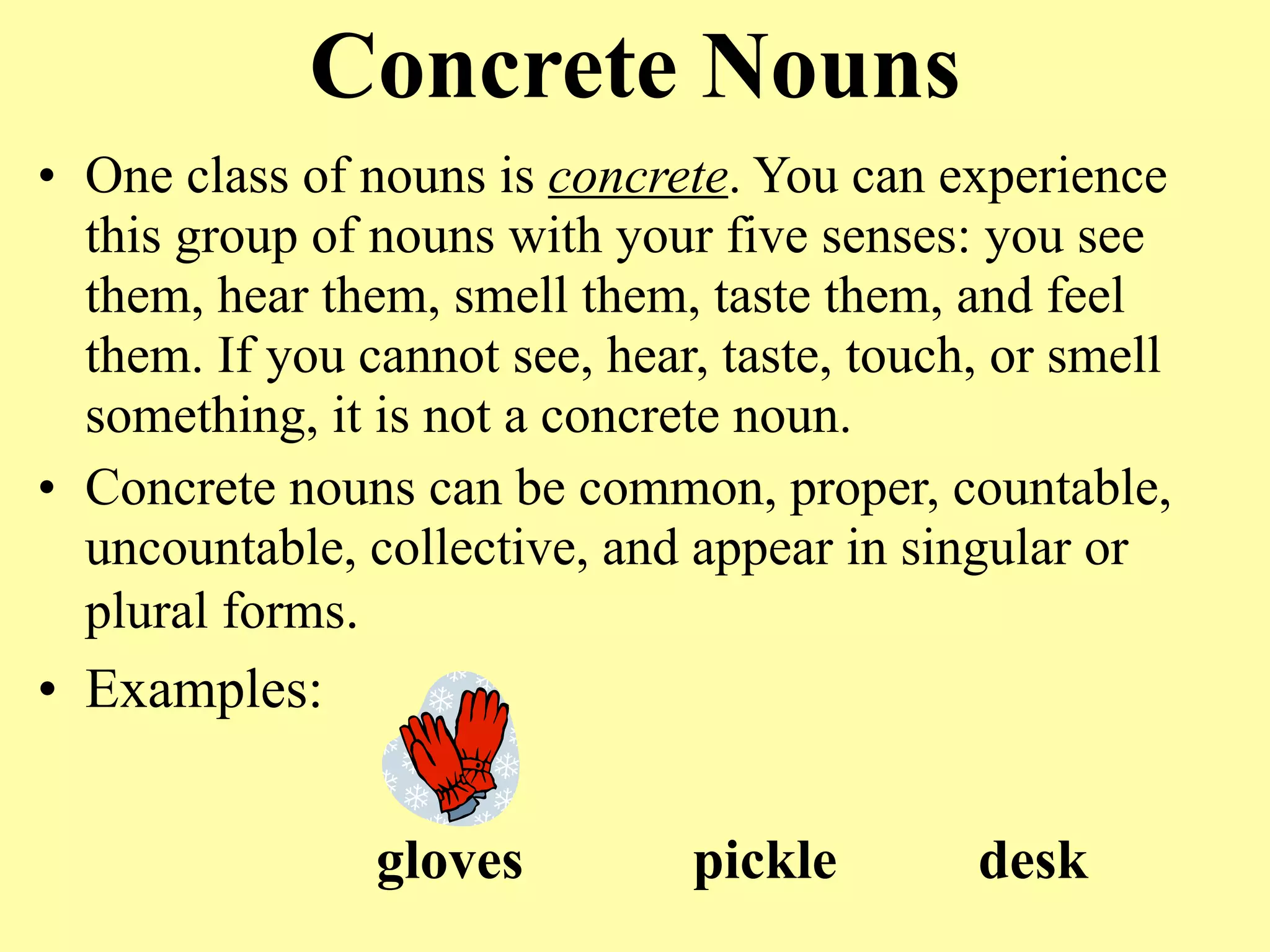
• Examples:


                gloves         pickle        desk
Concrete Nouns
• One class of nouns is concrete. You can experience
  this group of nouns with your five senses: you see
  them, hear them, smell them, taste them, and feel
  them. If you cannot see, hear, taste, touch, or smell
  something, it is not a concrete noun.
• Concrete nouns can be common, proper, countable,
  uncountable, collective, and appear in singular or
  plural forms.
• Examples:


                gloves         pickle        desk
Concrete Nouns
• One class of nouns is concrete. You can experience
  this group of nouns with your five senses: you see
  them, hear them, smell them, taste them, and feel
  them. If you cannot see, hear, taste, touch, or smell
  something, it is not a concrete noun.
• Concrete nouns can be common, proper, countable,
  uncountable, collective, and appear in singular or
  plural forms.
• Examples:


                gloves         pickle        desk
Concrete Nouns
• One class of nouns is concrete. You can experience
  this group of nouns with your five senses: you see
  them, hear them, smell them, taste them, and feel
  them. If you cannot see, hear, taste, touch, or smell
  something, it is not a concrete noun.
• Concrete nouns can be common, proper, countable,
  uncountable, collective, and appear in singular or
  plural forms.
• Examples:


                gloves         pickle        desk
• Reliable, Diane's beagle,
  licked strawberry ice cream
  off her chin.                  Concrete       Nouns
• Ice cream, for example, is a
  concrete noun. You can see
  the pink. You can taste the
  berry flavor. You can feel
  your tongue growing numb
  from the cold. Any noun that
  you can experience with at
  least one of your five senses is
  a concrete noun.
                                            9
ASSIGNMENT #3
1. Write four (4) concrete nouns.
2. Write a declarative sentence with
   two of your nouns.
3. Write an imperative sentence with
   two of your nouns.
Abstract Nouns
Abstract Nouns
• An abstract noun names a quality or an
  idea that cannot be recognized by the
  senses.
Abstract Nouns
• An abstract noun names a quality or an
  idea that cannot be recognized by the
  senses.
Abstract Nouns
• An abstract noun names a quality or an
  idea that cannot be recognized by the
  senses.

• Examples:
Abstract Nouns
• An abstract noun names a quality or an
  idea that cannot be recognized by the
  senses.

• Examples:
Abstract Nouns
• An abstract noun names a quality or an
  idea that cannot be recognized by the
  senses.

• Examples:


          love     laziness      fear
Abstract Nouns
• An abstract noun names a quality or an
  idea that cannot be recognized by the
  senses.

• Examples:


          love     laziness      fear
Abstract Nouns
• An abstract noun names a quality or an
  idea that cannot be recognized by the
  senses.

• Examples:


          love     laziness      fear
Abstract Nouns
• An abstract noun names a quality or an
  idea that cannot be recognized by the
  senses.

• Examples:


          love     laziness      fear
• Abstract nouns are like the opposite of concrete
  nouns. These are nouns that name things you
  cannot see, smell, taste, hear, or touch. They refer
  to emotions, ideas, concepts, tenets, beliefs, or your
  state of being.

• Examples include: love, hate, bigotry, acceptance,
  tyranny, democracy, freedom, power, happiness,
  curiosity, peace, maturity, deceit, trust, integrity,
  culture, patience, rage, calm, anticipation,
  education, stupidity, safety, evil, progress,
  shopping, and virtue.
                                               12
Abstract
                                           Noun
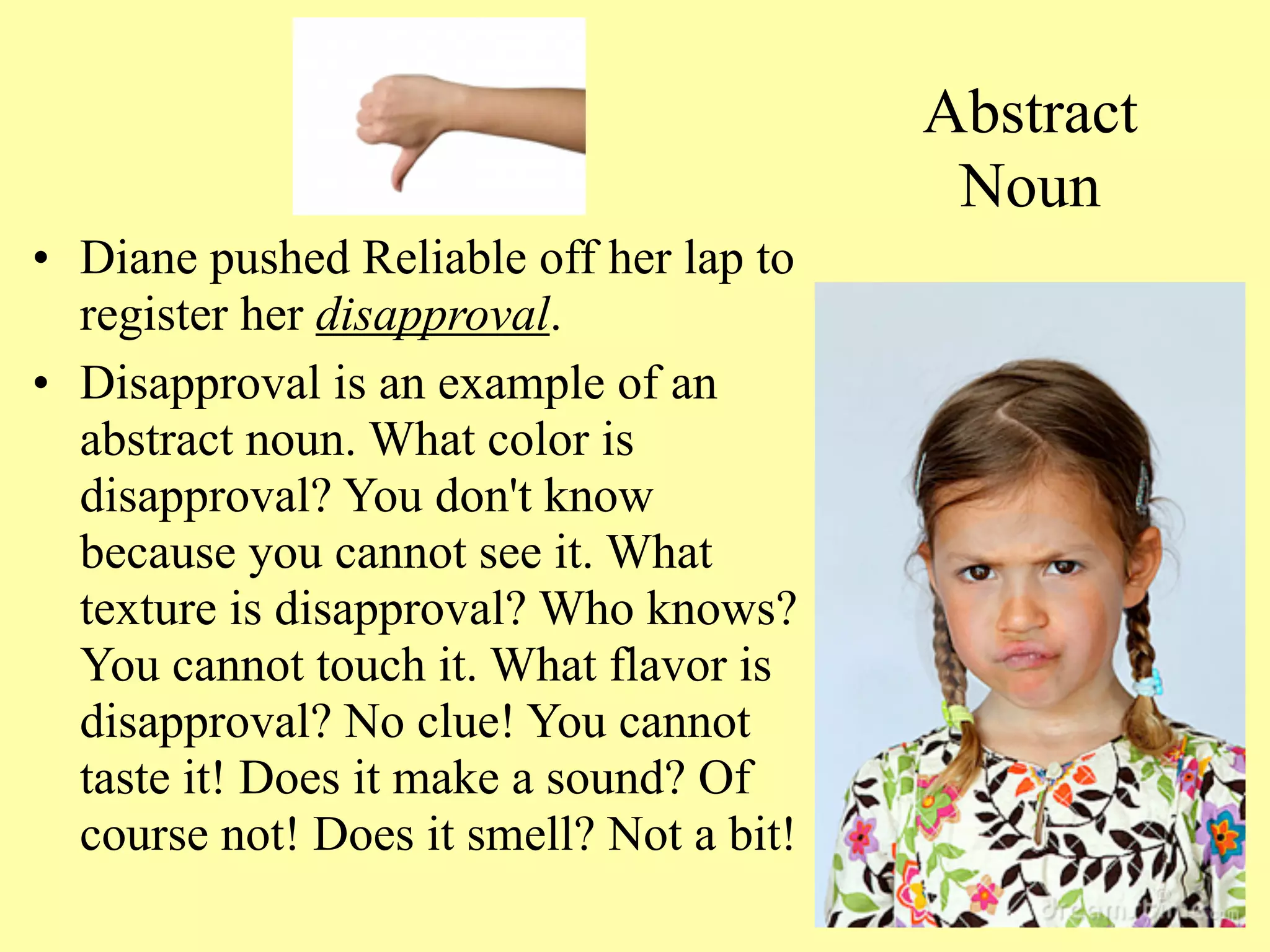
• Diane pushed Reliable off her lap to
  register her disapproval.
• Disapproval is an example of an
  abstract noun. What color is
  disapproval? You don't know
  because you cannot see it. What
  texture is disapproval? Who knows?
  You cannot touch it. What flavor is
  disapproval? No clue! You cannot
  taste it! Does it make a sound? Of
  course not! Does it smell? Not a bit!
                                             13
ASSIGNMENT #4
1. Write four (4) abstract nouns.
2. Write an exclamatory sentence
   with two of your nouns.
3. Write an imperative sentence with
   two of your nouns.
Compound nouns are nouns that are
made up of two or more words.
Compound nouns can be written as
one word- hometown -or as more than
one word- ice cream . Other
compound words are written as two or
more words joined by
hyphens- mother-in-law .
Compound Nouns
Compound nouns are nouns that are
made up of two or more words.
Compound nouns can be written as
one word- hometown -or as more than
one word- ice cream . Other
compound words are written as two or
more words joined by
hyphens- mother-in-law .
bookmark
     doorknob
      strongbox
             necklace
highchair
One Word Compound Nouns
              bookmark
        doorknob
          strongbox
                necklace
highchair
ASSIGNMENT #5
1. Write two (2) one word compound
   nouns.
2. Write a declarative sentence with one
   of your nouns.
age-group

     great-grandmother
runner-up
             go-cart
Hyphenated Nouns
            age-group

     great-grandmother
runner-up
             go-cart
ASSIGNMENT #6

1. Write two (2) hyphenated nouns.
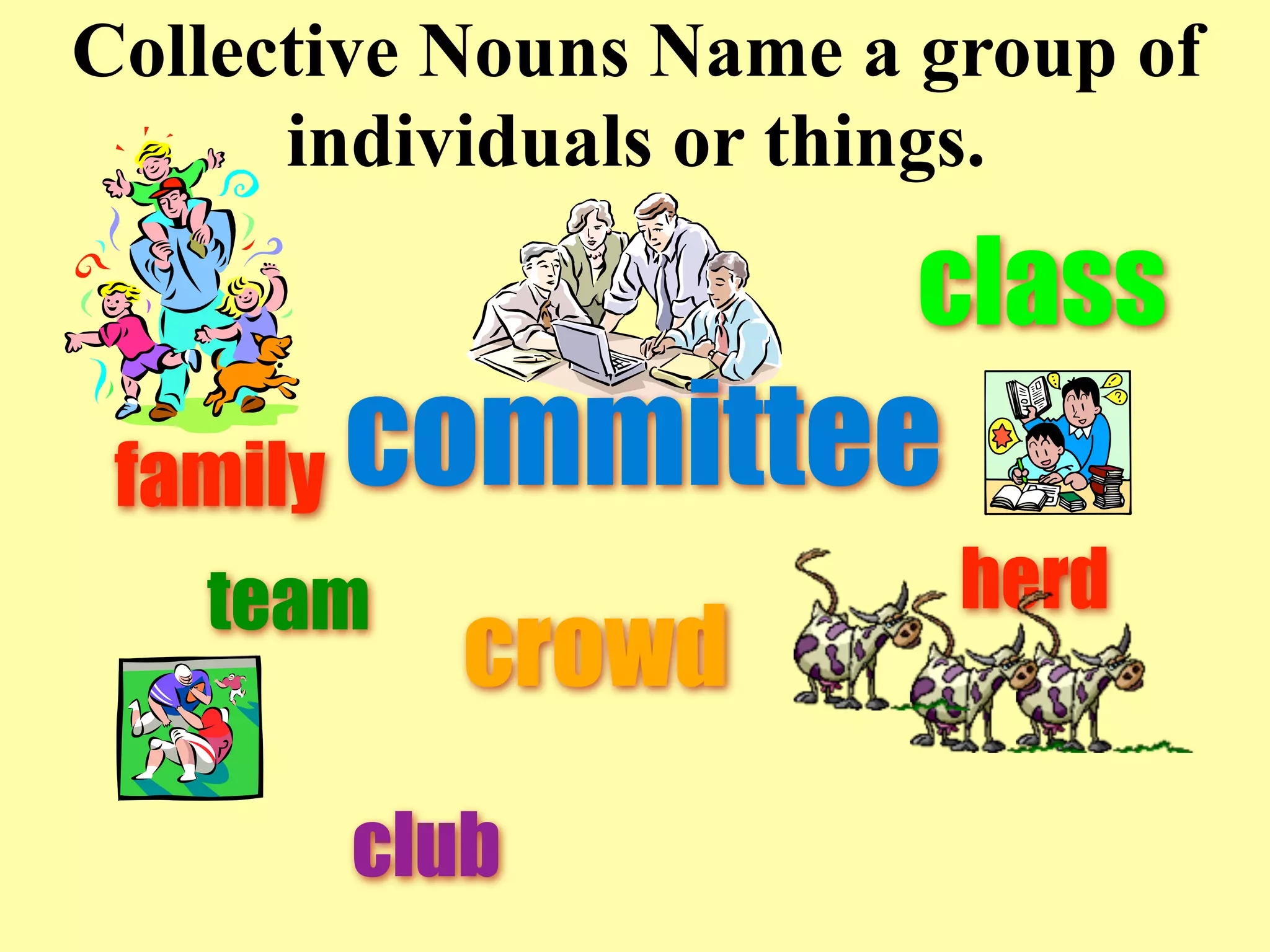
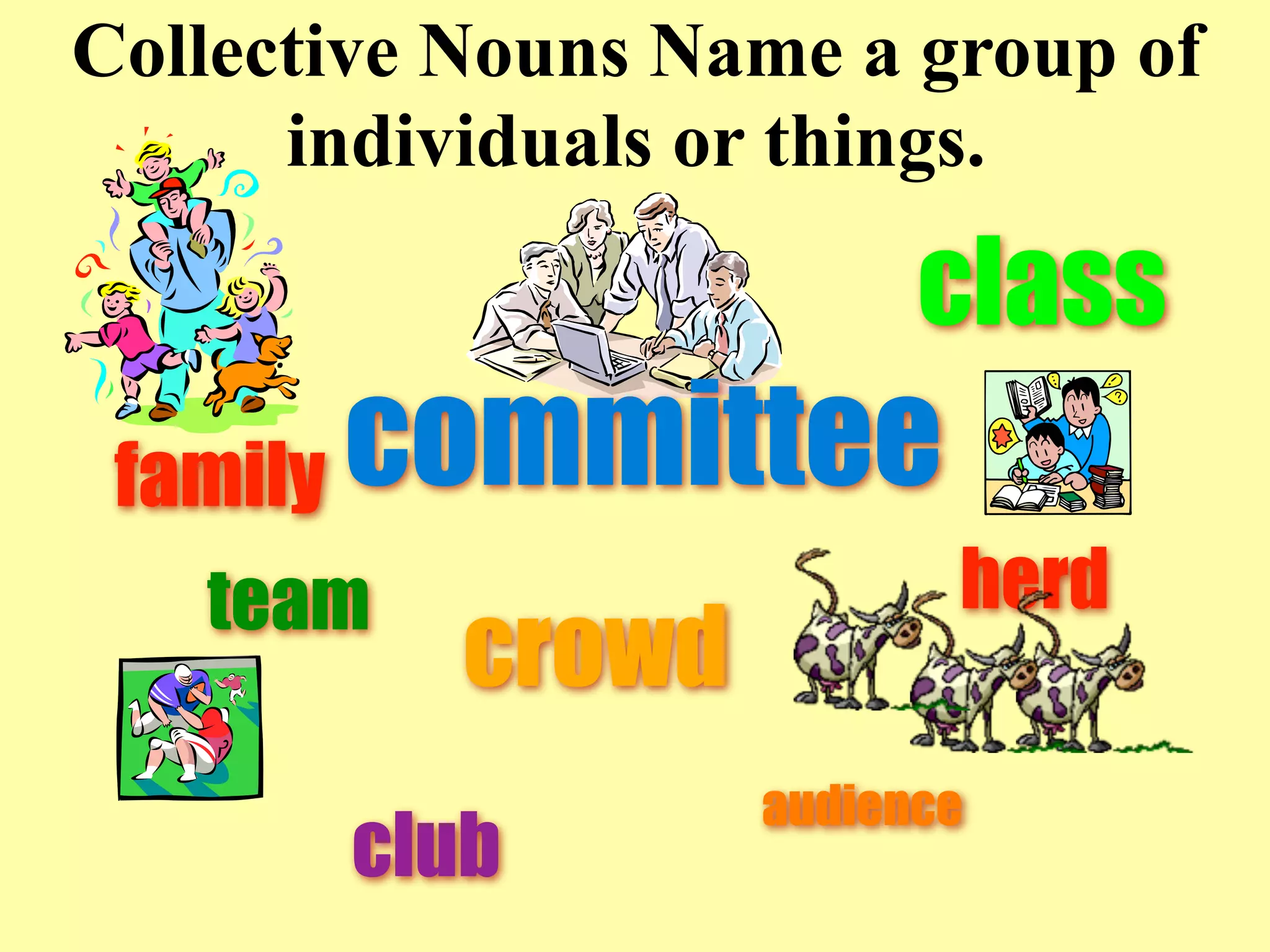
Collective Nouns Name a group of
      individuals or things.

                       class
 family
   team                  herd
            crowd
          club
Collective Nouns Name a group of
      individuals or things.

                       class
 family   committee
   team                  herd
            crowd
          club
Collective Nouns Name a group of
      individuals or things.

                          class
 family   committee
   team                    herd
            crowd
                    audience
          club
ASSIGNMENT #7

1. Write five (5) collective nouns.
A possessive noun names who
  or what owns or has something.
Possessive nouns can be common
or proper nouns. They can also be
 singular or plural. The following
pairs of sentences show possessive
         nouns are formed.
Possessive Nouns
 A possessive noun names who
  or what owns or has something.
Possessive nouns can be common
or proper nouns. They can also be
 singular or plural. The following
pairs of sentences show possessive
         nouns are formed.
Possessive Nouns
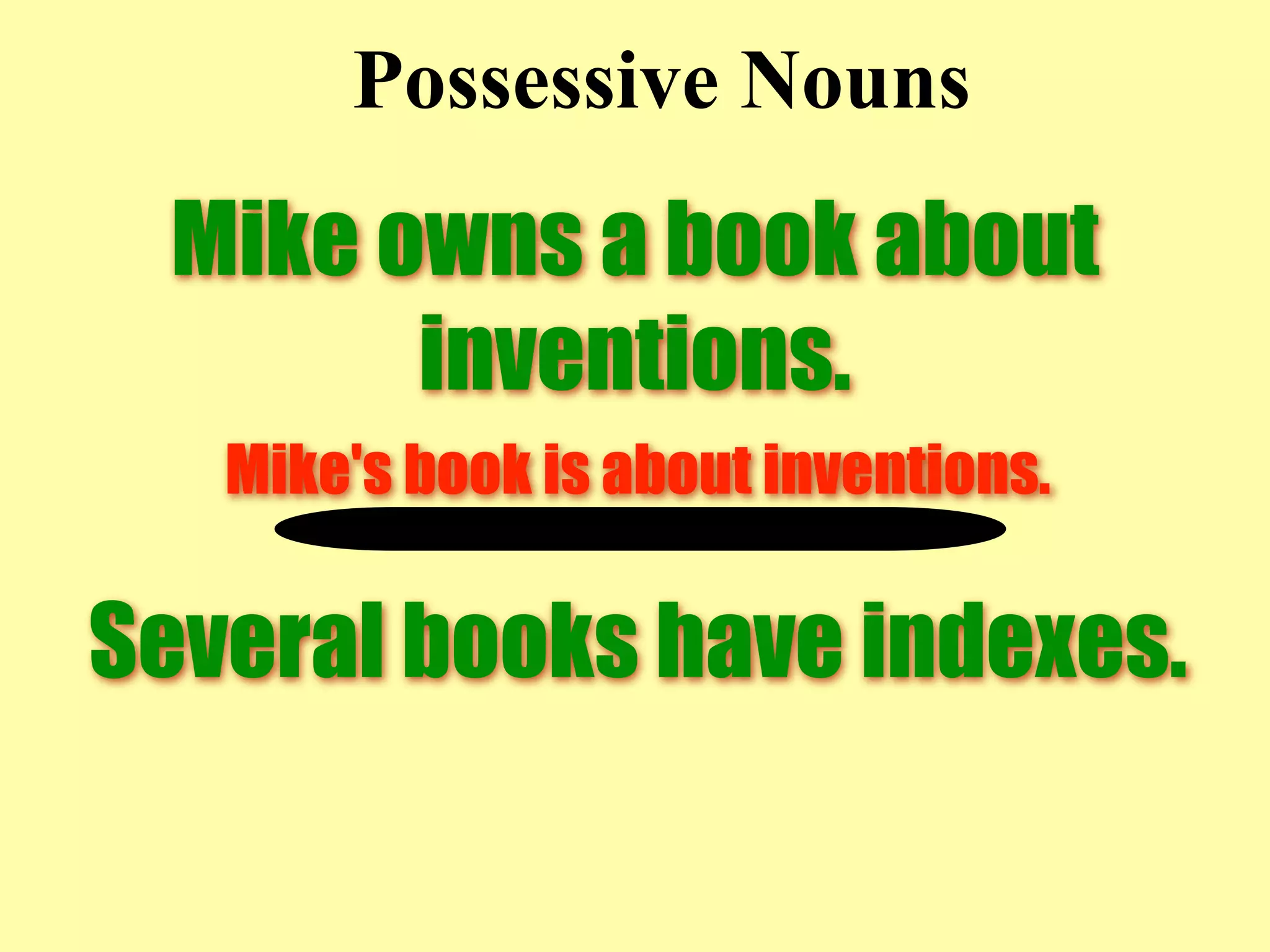
  Mike owns a book about
        inventions.


Several books have indexes.
Possessive Nouns
  Mike owns a book about
        inventions.
   Mike's book is about inventions.

Several books have indexes.
Possessive Nouns
  Mike owns a book about
        inventions.
   Mike's book is about inventions.

Several books have indexes.
       Check several books' indexes.
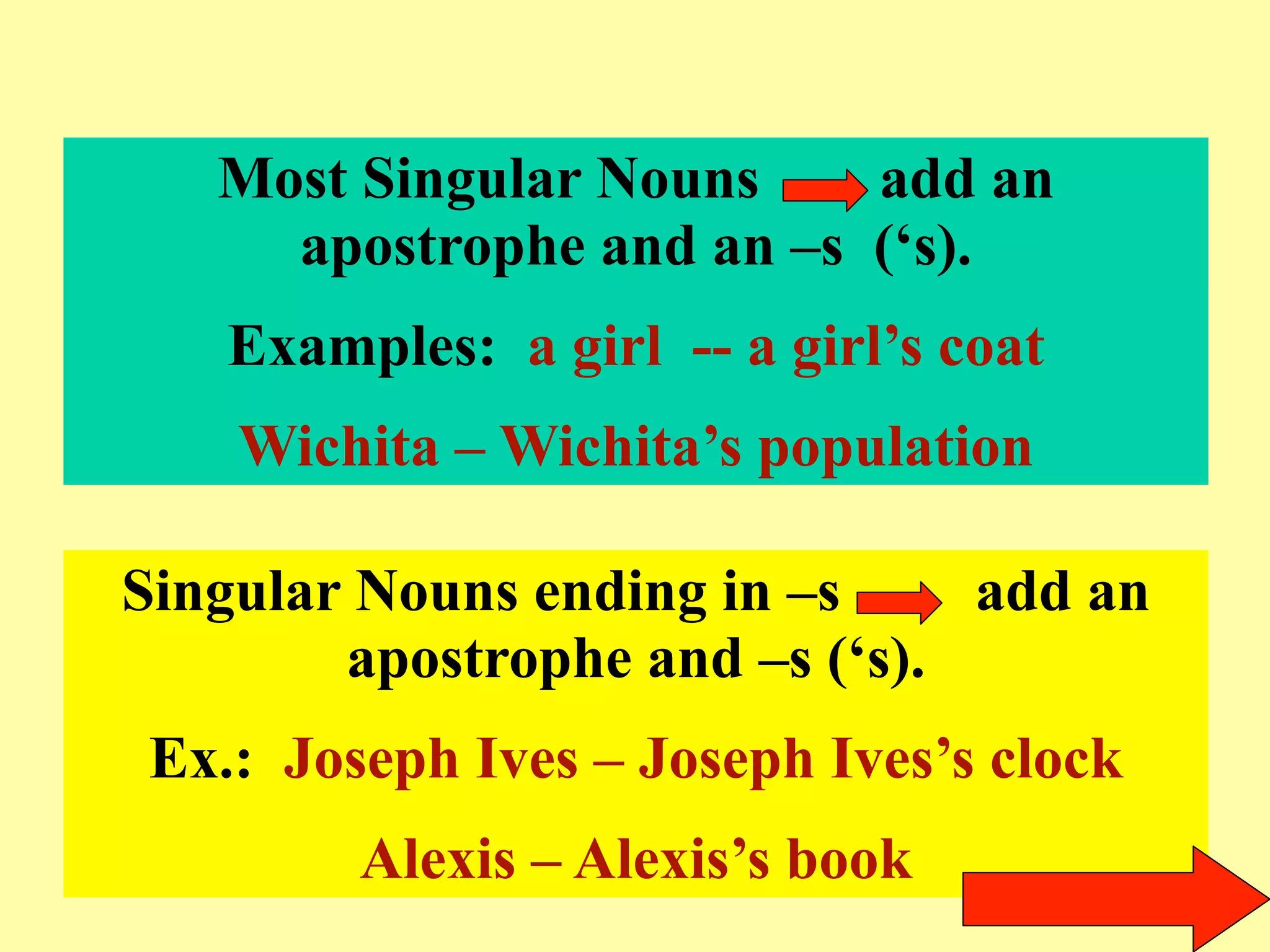
Most Singular Nouns    add an
     apostrophe and an –s (‘s).
    Examples: a girl -- a girl’s coat
    Wichita – Wichita’s population

Singular Nouns ending in –s     add an
        apostrophe and –s (‘s).
 Ex.: Joseph Ives – Joseph Ives’s clock
         Alexis – Alexis’s book
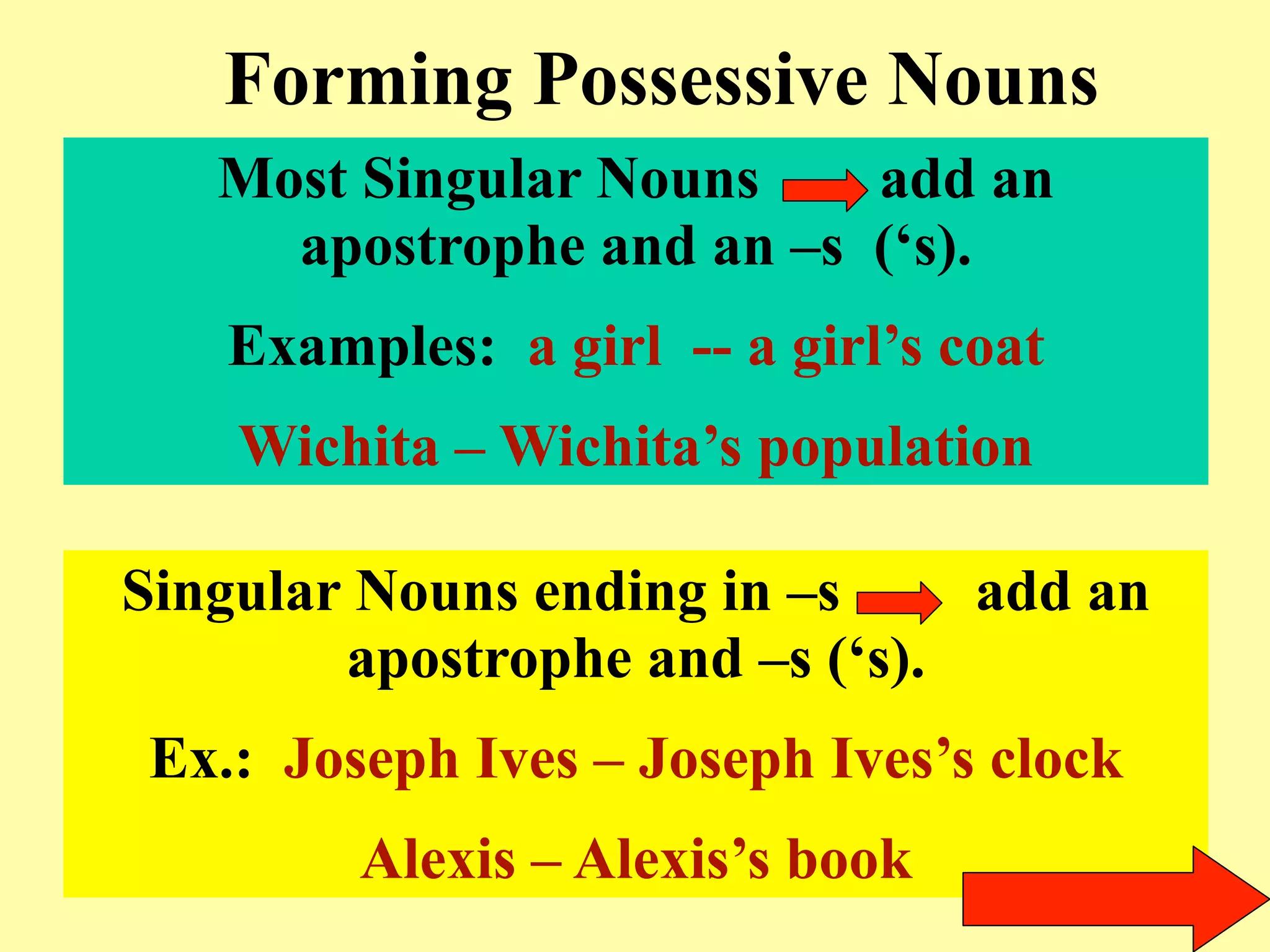
Forming Possessive Nouns
   Most Singular Nouns    add an
     apostrophe and an –s (‘s).
    Examples: a girl -- a girl’s coat
    Wichita – Wichita’s population

Singular Nouns ending in –s     add an
        apostrophe and –s (‘s).
 Ex.: Joseph Ives – Joseph Ives’s clock
         Alexis – Alexis’s book
Plural Nouns ending in -s        add an
            apostrophe (‘).
         Examples: boys –boys’
    The Wrights – the Wrights’ plane

Plural Nouns not ending in –s        add an
         apostrophe and –s (‘s).
     Ex.: children – children’s toys
     women – women’s organization
Forming Possessive Nouns
  Plural Nouns ending in -s        add an
            apostrophe (‘).
         Examples: boys –boys’
    The Wrights – the Wrights’ plane

Plural Nouns not ending in –s        add an
         apostrophe and –s (‘s).
     Ex.: children – children’s toys
     women – women’s organization
Forming Possessive Nouns
  Plural Nouns ending in -s        add an
            apostrophe (‘).
         Examples: boys –boys’
    The Wrights – the Wrights’ plane

Plural Nouns not ending in –s        add an
         apostrophe and –s (‘s).
     Ex.: children – children’s toys
     women – women’s organization
Forming Possessive Nouns
  Plural Nouns ending in -s        add an
            apostrophe (‘).
         Examples: boys –boys’
    The Wrights – the Wrights’ plane

Plural Nouns not ending in –s        add an
         apostrophe and –s (‘s).
     Ex.: children – children’s toys
     women – women’s organization
ASSIGNMENT #8

1. Write four (4) possessive
noun phrases.
Example:
-Maria’s toy
-All the dads’ cars

Nouns

  • 1.
    NOUNS adapted fromSandra Boyd
  • 2.
    Common and Proper Nouns • A noun is a word that names a person, place, thing, or idea. • A common noun names any person, place, thing or idea. Common nouns are not capitalized, unless they come at the beginning of a sentence. • Examples: • • teacher baseball city
  • 4.
    Common Nouns car dog door boat mother love
  • 5.
    Common Nouns house car dog door boat mother love
  • 6.
    Common Nouns house car dog door boat mother love desk
  • 7.
    ASSIGNMENT #1 1. Writesix (6) common nouns. 2. Write a declarative sentence with two of your nouns. 3. Write an interrogative sentence with two of your nouns.
  • 8.
    • A propernoun names a particular person, place, thing, or idea. Proper nouns are always capitalized. • Examples: Atlanta Braves New York
  • 9.
    Proper Nouns • Aproper noun names a particular person, place, thing, or idea. Proper nouns are always capitalized. • Examples: Atlanta Braves New York
  • 11.
  • 12.
  • 13.
    Proper Nouns Mr. Delbridge George Washington
  • 14.
    Proper Nouns Mr. Delbridge George Washington Jeffrson Memorial
  • 15.
    Proper Nouns Mr. Delbridge George Washington Baptist Hospital Jeffrson Memorial
  • 16.
    Proper Nouns Mr. Delbridge Mercury Boulevard George Washington Baptist Hospital Jeffrson Memorial
  • 17.
    ASSIGNMENT #2 1. Writesix (6) proper nouns. 2. Write an exclamatory sentence with two of your nouns. 3. Write an interrogative sentence with two of your nouns.
  • 19.
  • 20.
    Concrete Nouns • Oneclass of nouns is concrete. You can experience this group of nouns with your five senses: you see them, hear them, smell them, taste them, and feel them. If you cannot see, hear, taste, touch, or smell something, it is not a concrete noun.
  • 21.
    Concrete Nouns • Oneclass of nouns is concrete. You can experience this group of nouns with your five senses: you see them, hear them, smell them, taste them, and feel them. If you cannot see, hear, taste, touch, or smell something, it is not a concrete noun. • Concrete nouns can be common, proper, countable, uncountable, collective, and appear in singular or plural forms.
  • 22.
    Concrete Nouns • Oneclass of nouns is concrete. You can experience this group of nouns with your five senses: you see them, hear them, smell them, taste them, and feel them. If you cannot see, hear, taste, touch, or smell something, it is not a concrete noun. • Concrete nouns can be common, proper, countable, uncountable, collective, and appear in singular or plural forms. • Examples: gloves pickle desk
  • 23.
    Concrete Nouns • Oneclass of nouns is concrete. You can experience this group of nouns with your five senses: you see them, hear them, smell them, taste them, and feel them. If you cannot see, hear, taste, touch, or smell something, it is not a concrete noun. • Concrete nouns can be common, proper, countable, uncountable, collective, and appear in singular or plural forms. • Examples: gloves pickle desk
  • 24.
    Concrete Nouns • Oneclass of nouns is concrete. You can experience this group of nouns with your five senses: you see them, hear them, smell them, taste them, and feel them. If you cannot see, hear, taste, touch, or smell something, it is not a concrete noun. • Concrete nouns can be common, proper, countable, uncountable, collective, and appear in singular or plural forms. • Examples: gloves pickle desk
  • 25.
    Concrete Nouns • Oneclass of nouns is concrete. You can experience this group of nouns with your five senses: you see them, hear them, smell them, taste them, and feel them. If you cannot see, hear, taste, touch, or smell something, it is not a concrete noun. • Concrete nouns can be common, proper, countable, uncountable, collective, and appear in singular or plural forms. • Examples: gloves pickle desk
  • 26.
    • Reliable, Diane'sbeagle, licked strawberry ice cream off her chin. Concrete Nouns • Ice cream, for example, is a concrete noun. You can see the pink. You can taste the berry flavor. You can feel your tongue growing numb from the cold. Any noun that you can experience with at least one of your five senses is a concrete noun. 9
  • 27.
    ASSIGNMENT #3 1. Writefour (4) concrete nouns. 2. Write a declarative sentence with two of your nouns. 3. Write an imperative sentence with two of your nouns.
  • 29.
  • 30.
    Abstract Nouns • Anabstract noun names a quality or an idea that cannot be recognized by the senses.
  • 31.
    Abstract Nouns • Anabstract noun names a quality or an idea that cannot be recognized by the senses.
  • 32.
    Abstract Nouns • Anabstract noun names a quality or an idea that cannot be recognized by the senses. • Examples:
  • 33.
    Abstract Nouns • Anabstract noun names a quality or an idea that cannot be recognized by the senses. • Examples:
  • 34.
    Abstract Nouns • Anabstract noun names a quality or an idea that cannot be recognized by the senses. • Examples: love laziness fear
  • 35.
    Abstract Nouns • Anabstract noun names a quality or an idea that cannot be recognized by the senses. • Examples: love laziness fear
  • 36.
    Abstract Nouns • Anabstract noun names a quality or an idea that cannot be recognized by the senses. • Examples: love laziness fear
  • 37.
    Abstract Nouns • Anabstract noun names a quality or an idea that cannot be recognized by the senses. • Examples: love laziness fear
  • 38.
    • Abstract nounsare like the opposite of concrete nouns. These are nouns that name things you cannot see, smell, taste, hear, or touch. They refer to emotions, ideas, concepts, tenets, beliefs, or your state of being. • Examples include: love, hate, bigotry, acceptance, tyranny, democracy, freedom, power, happiness, curiosity, peace, maturity, deceit, trust, integrity, culture, patience, rage, calm, anticipation, education, stupidity, safety, evil, progress, shopping, and virtue. 12
  • 39.
    Abstract Noun • Diane pushed Reliable off her lap to register her disapproval. • Disapproval is an example of an abstract noun. What color is disapproval? You don't know because you cannot see it. What texture is disapproval? Who knows? You cannot touch it. What flavor is disapproval? No clue! You cannot taste it! Does it make a sound? Of course not! Does it smell? Not a bit! 13
  • 40.
    ASSIGNMENT #4 1. Writefour (4) abstract nouns. 2. Write an exclamatory sentence with two of your nouns. 3. Write an imperative sentence with two of your nouns.
  • 41.
    Compound nouns arenouns that are made up of two or more words. Compound nouns can be written as one word- hometown -or as more than one word- ice cream . Other compound words are written as two or more words joined by hyphens- mother-in-law .
  • 42.
    Compound Nouns Compound nounsare nouns that are made up of two or more words. Compound nouns can be written as one word- hometown -or as more than one word- ice cream . Other compound words are written as two or more words joined by hyphens- mother-in-law .
  • 43.
    bookmark doorknob strongbox necklace highchair
  • 44.
    One Word CompoundNouns bookmark doorknob strongbox necklace highchair
  • 45.
    ASSIGNMENT #5 1. Writetwo (2) one word compound nouns. 2. Write a declarative sentence with one of your nouns.
  • 46.
    age-group great-grandmother runner-up go-cart
  • 47.
    Hyphenated Nouns age-group great-grandmother runner-up go-cart
  • 48.
    ASSIGNMENT #6 1. Writetwo (2) hyphenated nouns.
  • 50.
    Collective Nouns Namea group of individuals or things. class family team herd crowd club
  • 51.
    Collective Nouns Namea group of individuals or things. class family committee team herd crowd club
  • 52.
    Collective Nouns Namea group of individuals or things. class family committee team herd crowd audience club
  • 53.
    ASSIGNMENT #7 1. Writefive (5) collective nouns.
  • 54.
    A possessive nounnames who or what owns or has something. Possessive nouns can be common or proper nouns. They can also be singular or plural. The following pairs of sentences show possessive nouns are formed.
  • 55.
    Possessive Nouns Apossessive noun names who or what owns or has something. Possessive nouns can be common or proper nouns. They can also be singular or plural. The following pairs of sentences show possessive nouns are formed.
  • 56.
    Possessive Nouns Mike owns a book about inventions. Several books have indexes.
  • 57.
    Possessive Nouns Mike owns a book about inventions. Mike's book is about inventions. Several books have indexes.
  • 58.
    Possessive Nouns Mike owns a book about inventions. Mike's book is about inventions. Several books have indexes. Check several books' indexes.
  • 59.
    Most Singular Nouns add an apostrophe and an –s (‘s). Examples: a girl -- a girl’s coat Wichita – Wichita’s population Singular Nouns ending in –s add an apostrophe and –s (‘s). Ex.: Joseph Ives – Joseph Ives’s clock Alexis – Alexis’s book
  • 60.
    Forming Possessive Nouns Most Singular Nouns add an apostrophe and an –s (‘s). Examples: a girl -- a girl’s coat Wichita – Wichita’s population Singular Nouns ending in –s add an apostrophe and –s (‘s). Ex.: Joseph Ives – Joseph Ives’s clock Alexis – Alexis’s book
  • 61.
    Plural Nouns endingin -s add an apostrophe (‘). Examples: boys –boys’ The Wrights – the Wrights’ plane Plural Nouns not ending in –s add an apostrophe and –s (‘s). Ex.: children – children’s toys women – women’s organization
  • 62.
    Forming Possessive Nouns Plural Nouns ending in -s add an apostrophe (‘). Examples: boys –boys’ The Wrights – the Wrights’ plane Plural Nouns not ending in –s add an apostrophe and –s (‘s). Ex.: children – children’s toys women – women’s organization
  • 63.
    Forming Possessive Nouns Plural Nouns ending in -s add an apostrophe (‘). Examples: boys –boys’ The Wrights – the Wrights’ plane Plural Nouns not ending in –s add an apostrophe and –s (‘s). Ex.: children – children’s toys women – women’s organization
  • 64.
    Forming Possessive Nouns Plural Nouns ending in -s add an apostrophe (‘). Examples: boys –boys’ The Wrights – the Wrights’ plane Plural Nouns not ending in –s add an apostrophe and –s (‘s). Ex.: children – children’s toys women – women’s organization
  • 65.
    ASSIGNMENT #8 1. Writefour (4) possessive noun phrases. Example: -Maria’s toy -All the dads’ cars