Unit 1
         Greetings and Introductions


Introduction
      When meeting, people say or/and do
something. In Thailand we say “(Swasdee
ka)” or “(Swasdee krab.)” This greeting
phrase is usually accompanied with a “wai”
or a smile. Customarily, the junior will initiate
the “wai” to the senior as the gesture of
showing respect. In English spoken
countries, some greeting phrases are used
for one specific time of the day while some
can be used at any time.
Content
1. Formal greetings
2. Informal greetings
3. Asking and Responding about work and healt
4. Asking and replying for more information.
5. Introducing yourself and other people
6. Responding to an introduction
7. Ending the conversation
8. Conversation Practice
9. Exercise
Formal greetings             Formal
                            Responses
- Good morning. +       - Good morning. +
(Name)                  (Name)
- Good afternoon. +    - Good afternoon. +
(Name)                 (Name)
- Good evening. +      - Good evening. +
(Name)                 (Name)
- Good day. + (Name)   - Good day. + (Name)

- How do you           - How do you do?
do?
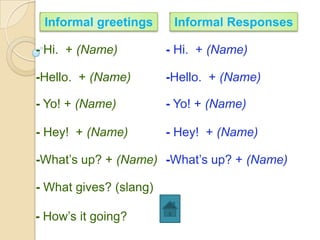
Informal greetings      Informal Responses

- Hi. + (Name)          - Hi. + (Name)

-Hello. + (Name)        -Hello. + (Name)

- Yo! + (Name)          - Yo! + (Name)

- Hey! + (Name)         - Hey! + (Name)

-What’s up? + (Name) -What’s up? + (Name)

- What gives? (slang)

- How’s it going?
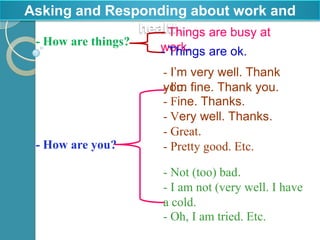
Asking and Responding about work and
               health
                  - Things are busy at
 - How are things?   work. are ok.
                     - Things
                     - I’m very well. Thank
                     - I’m
                     you. fine. Thank you.
                     - Fine. Thanks.
                     - Very well. Thanks.
                     - Great.
 - How are you?      - Pretty good. Etc.

                     - Not (too) bad.
                     - I am not (very well. I have
                     a cold.
                     - Oh, I am tried. Etc.
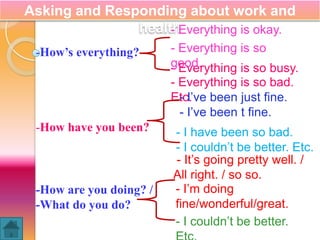
Asking and Responding about work and
               healthEverything is okay.
                    -
 -How’s everything?      - Everything is so
                         good.
                         - Everything is so busy.
                         - Everything is so bad.
                         Etc. been just fine.
                           - I’ve
                           - I’ve been t fine.
 -How have you been?     - I have been so bad.
                         - I couldn’t be better. Etc.
                         - It’s going pretty well. /
                         All right. / so so.
 -How are you doing? /   - I’m doing
 -What do you do?        fine/wonderful/great.
                         - I couldn’t be better.
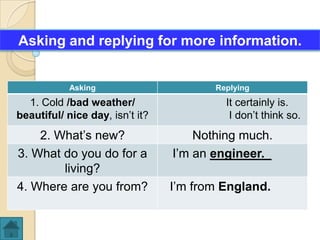
Asking and replying for more information.


           Asking                       Replying
  1. Cold /bad weather/                   It certainly is.
beautiful/ nice day, isn’t it?             I don’t think so.
    2. What’s new?                   Nothing much.
3. What do you do for a          I’m an engineer.
        living?
4. Where are you from?           I’m from England.
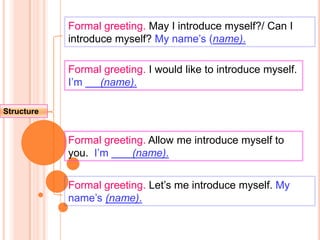
Formal greeting. May I introduce myself?/ Can I
            introduce myself? My name’s (name).

            Formal greeting. I would like to introduce myself.
            I’m   (name).

Structure


            Formal greeting. Allow me introduce myself to
            you. I’m     (name).


            Formal greeting. Let’s me introduce myself. My
            name’s (name).
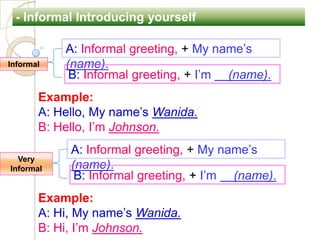
- Informal Introducing yourself

           A: Informal greeting, + My name’s
Informal   (name).
            B: Informal greeting, + I’m (name).
       Example:
       A: Hello, My name’s Wanida.
       B: Hello, I’m Johnson.
            A: Informal greeting, + My name’s
  Very
Informal    (name).
             B: Informal greeting, + I’m (name).
       Example:
       A: Hi, My name’s Wanida.
       B: Hi, I’m Johnson.
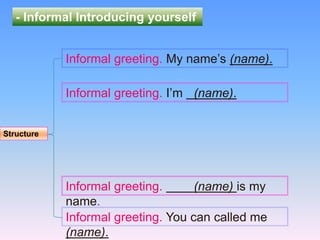
- Informal Introducing yourself


            Informal greeting. My name’s (name).

            Informal greeting. I’m (name).


Structure


            Informal greeting.      (name) is my
            name.
            Informal greeting. You can called me
            (name).
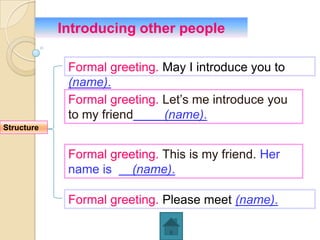
Introducing other people

             Formal greeting. May I introduce you to
             (name).
             Formal greeting. Let’s me introduce you
             to my friend     (name).
Structure


             Formal greeting. This is my friend. Her
             name is    (name).

             Formal greeting. Please meet (name).
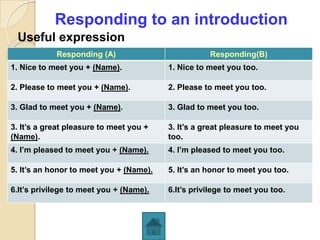
Responding to an introduction
 Useful expression
            Responding (A)                          Responding(B)
1. Nice to meet you + (Name).            1. Nice to meet you too.

2. Please to meet you + (Name).          2. Please to meet you too.

3. Glad to meet you + (Name).            3. Glad to meet you too.

3. It’s a great pleasure to meet you +   3. It’s a great pleasure to meet you
(Name).                                  too.
4. I’m pleased to meet you + (Name).     4. I’m pleased to meet you too.

5. It’s an honor to meet you + (Name).   5. It’s an honor to meet you too.

6.It’s privilege to meet you + (Name).   6.It’s privilege to meet you too.
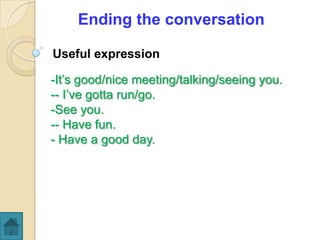
Ending the conversation

Useful expression

-It’s good/nice meeting/talking/seeing you.
-- I’ve gotta run/go.
-See you.
-- Have fun.
- Have a good day.
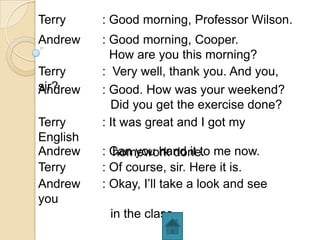
Terry     : Good morning, Professor Wilson.
Andrew    : Good morning, Cooper.
            How are you this morning?
Terry     : Very well, thank you. And you,
sir?
Andrew    : Good. How was your weekend?
            Did you get the exercise done?
Terry     : It was great and I got my
English
Andrew    : Can you hand it to me now.
            homework done.
Terry     : Of course, sir. Here it is.
Andrew    : Okay, I’ll take a look and see
you
           in the class.
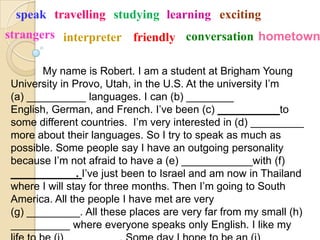
speak travelling studying learning exciting
strangers interpreter friendly conversation hometown

       My name is Robert. I am a student at Brigham Young
University in Provo, Utah, in the U.S. At the university I’m
(a) __________ languages. I can (b) ________
English, German, and French. I’ve been (c) ____         ___to
some different countries. I’m very interested in (d) _________
more about their languages. So I try to speak as much as
possible. Some people say I have an outgoing personality
because I’m not afraid to have a (e) ____________with (f)
_______       _. I’ve just been to Israel and am now in Thailand
where I will stay for three months. Then I’m going to South
America. All the people I have met are very
(g) _________. All these places are very far from my small (h)
__________ where everyone speaks only English. I like my
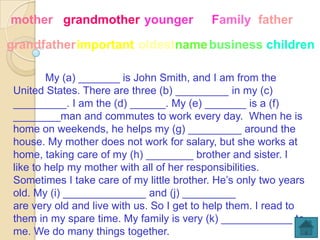
mother grandmother younger                 Family father

grandfatherimportant oldestname business children

         My (a) _______ is John Smith, and I am from the
 United States. There are three (b) _________ in my (c)
 _________. I am the (d) ______. My (e) _______ is a (f)
 ________man and commutes to work every day. When he is
 home on weekends, he helps my (g) _________ around the
 house. My mother does not work for salary, but she works at
 home, taking care of my (h) ________ brother and sister. I
 like to help my mother with all of her responsibilities.
 Sometimes I take care of my little brother. He’s only two years
 old. My (i) ______________ and (j) _________
 are very old and live with us. So I get to help them. I read to
 them in my spare time. My family is very (k) ____________ to
 me. We do many things together.
BYE BYE

Unit 1 greeting

  • 1.
    Unit 1 Greetings and Introductions Introduction When meeting, people say or/and do something. In Thailand we say “(Swasdee ka)” or “(Swasdee krab.)” This greeting phrase is usually accompanied with a “wai” or a smile. Customarily, the junior will initiate the “wai” to the senior as the gesture of showing respect. In English spoken countries, some greeting phrases are used for one specific time of the day while some can be used at any time.
  • 2.
    Content 1. Formal greetings 2.Informal greetings 3. Asking and Responding about work and healt 4. Asking and replying for more information. 5. Introducing yourself and other people 6. Responding to an introduction 7. Ending the conversation 8. Conversation Practice 9. Exercise
  • 3.
    Formal greetings Formal Responses - Good morning. + - Good morning. + (Name) (Name) - Good afternoon. + - Good afternoon. + (Name) (Name) - Good evening. + - Good evening. + (Name) (Name) - Good day. + (Name) - Good day. + (Name) - How do you - How do you do? do?
  • 4.
    Informal greetings Informal Responses - Hi. + (Name) - Hi. + (Name) -Hello. + (Name) -Hello. + (Name) - Yo! + (Name) - Yo! + (Name) - Hey! + (Name) - Hey! + (Name) -What’s up? + (Name) -What’s up? + (Name) - What gives? (slang) - How’s it going?
  • 5.
    Asking and Respondingabout work and health - Things are busy at - How are things? work. are ok. - Things - I’m very well. Thank - I’m you. fine. Thank you. - Fine. Thanks. - Very well. Thanks. - Great. - How are you? - Pretty good. Etc. - Not (too) bad. - I am not (very well. I have a cold. - Oh, I am tried. Etc.
  • 6.
    Asking and Respondingabout work and healthEverything is okay. - -How’s everything? - Everything is so good. - Everything is so busy. - Everything is so bad. Etc. been just fine. - I’ve - I’ve been t fine. -How have you been? - I have been so bad. - I couldn’t be better. Etc. - It’s going pretty well. / All right. / so so. -How are you doing? / - I’m doing -What do you do? fine/wonderful/great. - I couldn’t be better.
  • 7.
    Asking and replyingfor more information. Asking Replying 1. Cold /bad weather/ It certainly is. beautiful/ nice day, isn’t it? I don’t think so. 2. What’s new? Nothing much. 3. What do you do for a I’m an engineer. living? 4. Where are you from? I’m from England.
  • 8.
    Formal greeting. MayI introduce myself?/ Can I introduce myself? My name’s (name). Formal greeting. I would like to introduce myself. I’m (name). Structure Formal greeting. Allow me introduce myself to you. I’m (name). Formal greeting. Let’s me introduce myself. My name’s (name).
  • 9.
    - Informal Introducingyourself A: Informal greeting, + My name’s Informal (name). B: Informal greeting, + I’m (name). Example: A: Hello, My name’s Wanida. B: Hello, I’m Johnson. A: Informal greeting, + My name’s Very Informal (name). B: Informal greeting, + I’m (name). Example: A: Hi, My name’s Wanida. B: Hi, I’m Johnson.
  • 10.
    - Informal Introducingyourself Informal greeting. My name’s (name). Informal greeting. I’m (name). Structure Informal greeting. (name) is my name. Informal greeting. You can called me (name).
  • 11.
    Introducing other people Formal greeting. May I introduce you to (name). Formal greeting. Let’s me introduce you to my friend (name). Structure Formal greeting. This is my friend. Her name is (name). Formal greeting. Please meet (name).
  • 12.
    Responding to anintroduction Useful expression Responding (A) Responding(B) 1. Nice to meet you + (Name). 1. Nice to meet you too. 2. Please to meet you + (Name). 2. Please to meet you too. 3. Glad to meet you + (Name). 3. Glad to meet you too. 3. It’s a great pleasure to meet you + 3. It’s a great pleasure to meet you (Name). too. 4. I’m pleased to meet you + (Name). 4. I’m pleased to meet you too. 5. It’s an honor to meet you + (Name). 5. It’s an honor to meet you too. 6.It’s privilege to meet you + (Name). 6.It’s privilege to meet you too.
  • 13.
    Ending the conversation Usefulexpression -It’s good/nice meeting/talking/seeing you. -- I’ve gotta run/go. -See you. -- Have fun. - Have a good day.
  • 14.
    Terry : Good morning, Professor Wilson. Andrew : Good morning, Cooper. How are you this morning? Terry : Very well, thank you. And you, sir? Andrew : Good. How was your weekend? Did you get the exercise done? Terry : It was great and I got my English Andrew : Can you hand it to me now. homework done. Terry : Of course, sir. Here it is. Andrew : Okay, I’ll take a look and see you in the class.
  • 15.
    speak travelling studyinglearning exciting strangers interpreter friendly conversation hometown My name is Robert. I am a student at Brigham Young University in Provo, Utah, in the U.S. At the university I’m (a) __________ languages. I can (b) ________ English, German, and French. I’ve been (c) ____ ___to some different countries. I’m very interested in (d) _________ more about their languages. So I try to speak as much as possible. Some people say I have an outgoing personality because I’m not afraid to have a (e) ____________with (f) _______ _. I’ve just been to Israel and am now in Thailand where I will stay for three months. Then I’m going to South America. All the people I have met are very (g) _________. All these places are very far from my small (h) __________ where everyone speaks only English. I like my
  • 16.
    mother grandmother younger Family father grandfatherimportant oldestname business children My (a) _______ is John Smith, and I am from the United States. There are three (b) _________ in my (c) _________. I am the (d) ______. My (e) _______ is a (f) ________man and commutes to work every day. When he is home on weekends, he helps my (g) _________ around the house. My mother does not work for salary, but she works at home, taking care of my (h) ________ brother and sister. I like to help my mother with all of her responsibilities. Sometimes I take care of my little brother. He’s only two years old. My (i) ______________ and (j) _________ are very old and live with us. So I get to help them. I read to them in my spare time. My family is very (k) ____________ to me. We do many things together.
  • 17.