KARTHIKEYAN . M
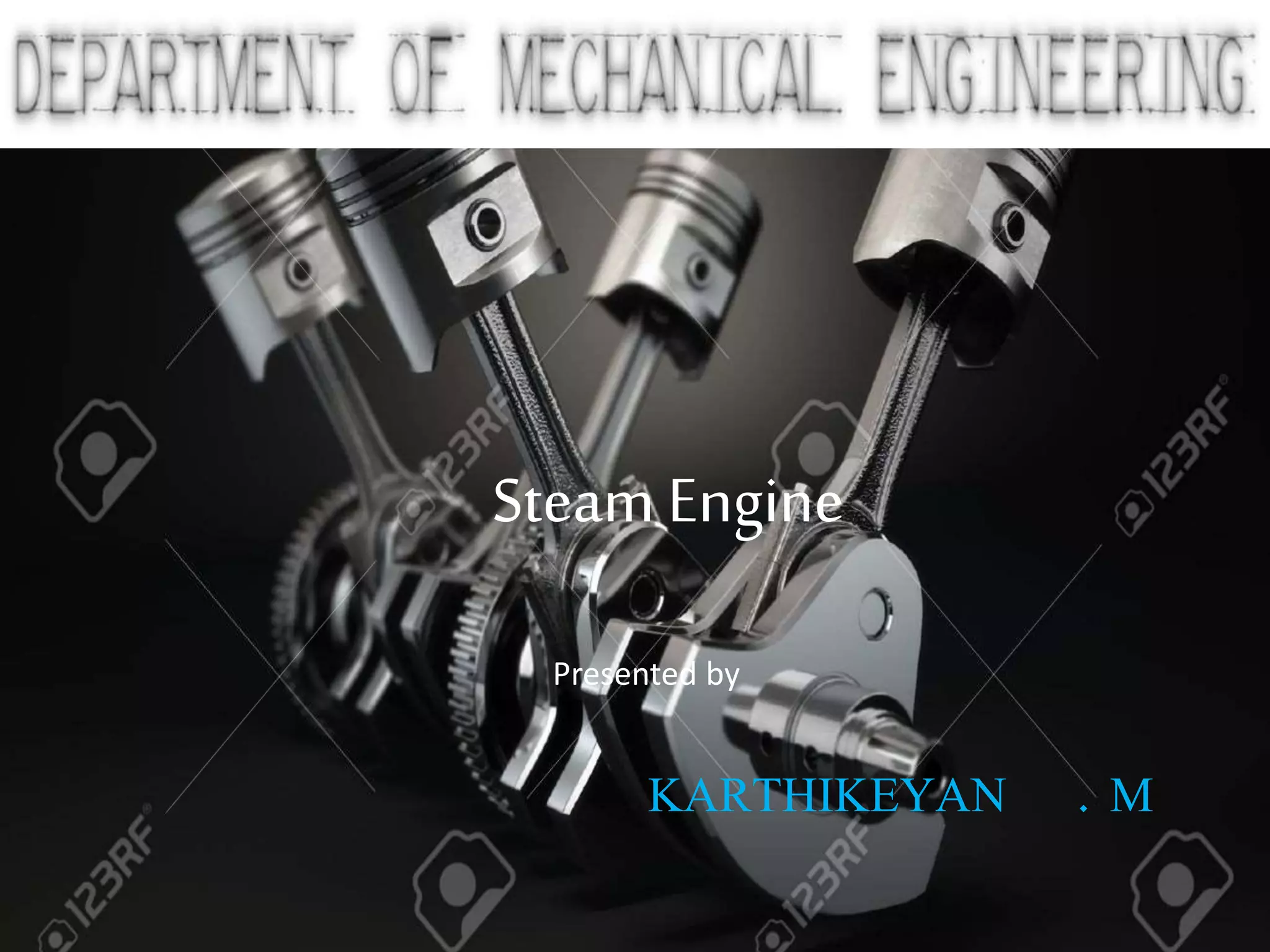
Steam Engine
Presented by
 Introduced to Steam Engine
 History Of Steam Engine
 Working principle of Steam Engine
 Main Part of Steam Engine
 Classification of Steam Engines
 Advantage/Disadvantage Of steam
Engine
Overview of presentation:
Steam Engine
Converting heat to work or steam to
mechanical action.
 A steam engine is a heat
engine that performs mechanical
work using steam as its working fluid.
 In simple terms, the steam engine
uses the expansion principle of chemistry, where
heat applied to water evaporates the water into
steam, and the force generated pushes a piston
back and forth inside a cylinder
 Steam engines are external combustion
engines, where the working fluid is separated from
the combustion products.
 Non-combustion heat sources such as solar
power, nuclear power or geothermal energy may be
used.
The ideal thermodynamic cycle used to analyze
this process is called the Rankine cycle.
History of Steam Engine
 Inventors used experimental devices, such as the
rudimentary steam turbine device described by Taqi
al-Din in 1551 and Giovanni Branca in 1629, to
demonstrate the properties of steam.
 The first practical steam-powered 'engine' was a
water pump, developed in 1698 by Thomas Savery. It
proved only to have a limited lift height and was
prone to boiler explosions, but it still received some
use for mines and pumping stations.
The first commercially successful engine,
the atmospheric engine, invented by
Thomas Newcomen did not appear until
1712. Newcomen's engine was relatively
inefficient, and in most cases was only
used for pumping water.
•Boiler
•Piston
•Slide valve
•Cylinder
•Flywheel
•Connecting Rod
Main parts of steam engines
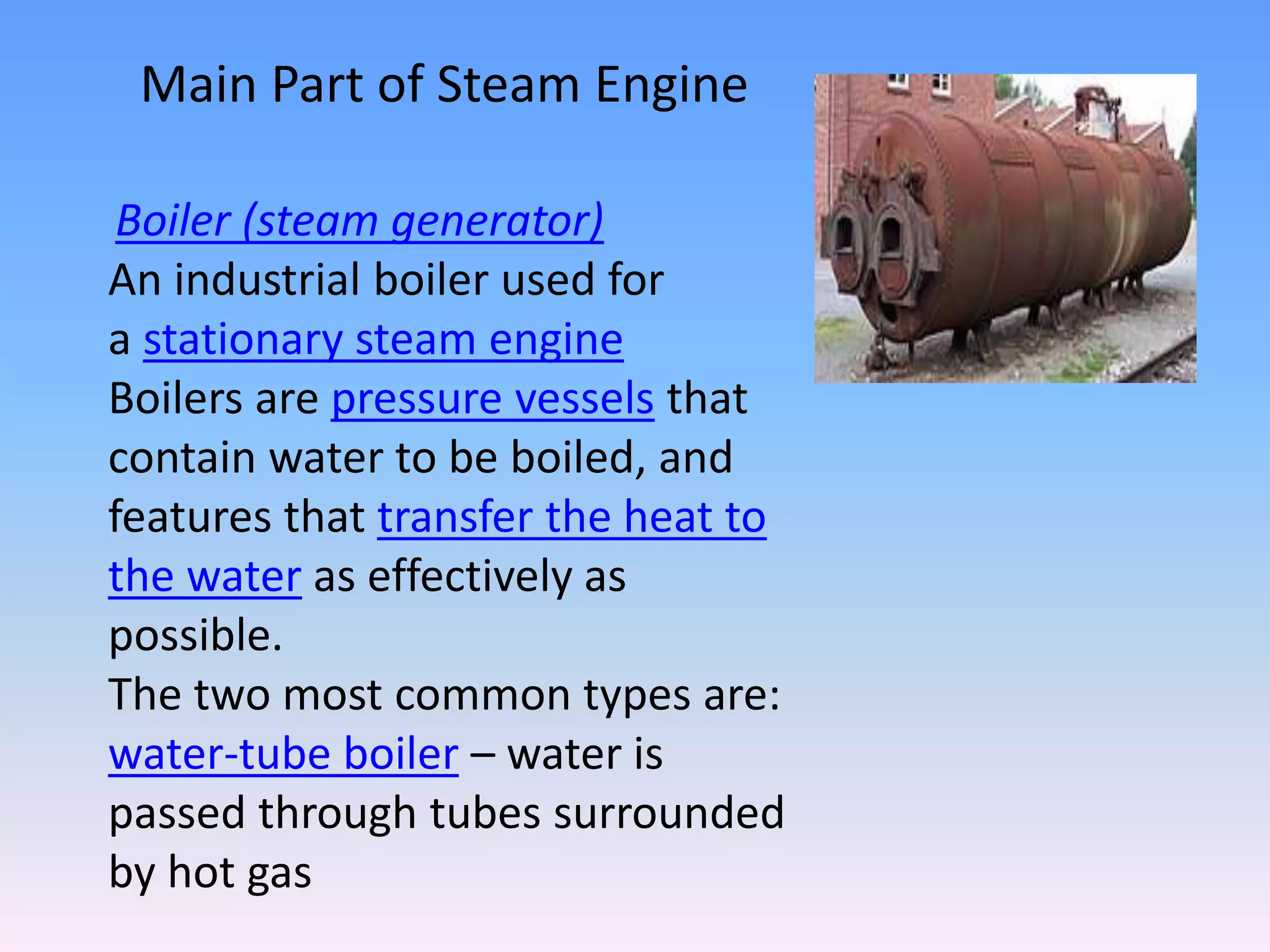
Boiler (steam generator)
An industrial boiler used for
a stationary steam engine
Boilers are pressure vessels that
contain water to be boiled, and
features that transfer the heat to
the water as effectively as
possible.
The two most common types are:
water-tube boiler – water is
passed through tubes surrounded
by hot gas
Main Part of Steam Engine
fire-tube boiler – hot gas is passed through tubes
immersed in water, the same water also circulates
in a water jacket surrounding the firebox and, in
high-output locomotive boilers, also passes
through tubes in the firebox itself (thermic syphons
and security circulators)
Fire tube boilers were the main type used for early
high-pressure steam (typical steam locomotive
practice), but they were to a large extent displaced
by more economical water tube boilers in the late
19th century for marine propulsion and large
stationary applications.
fire-tube boiler
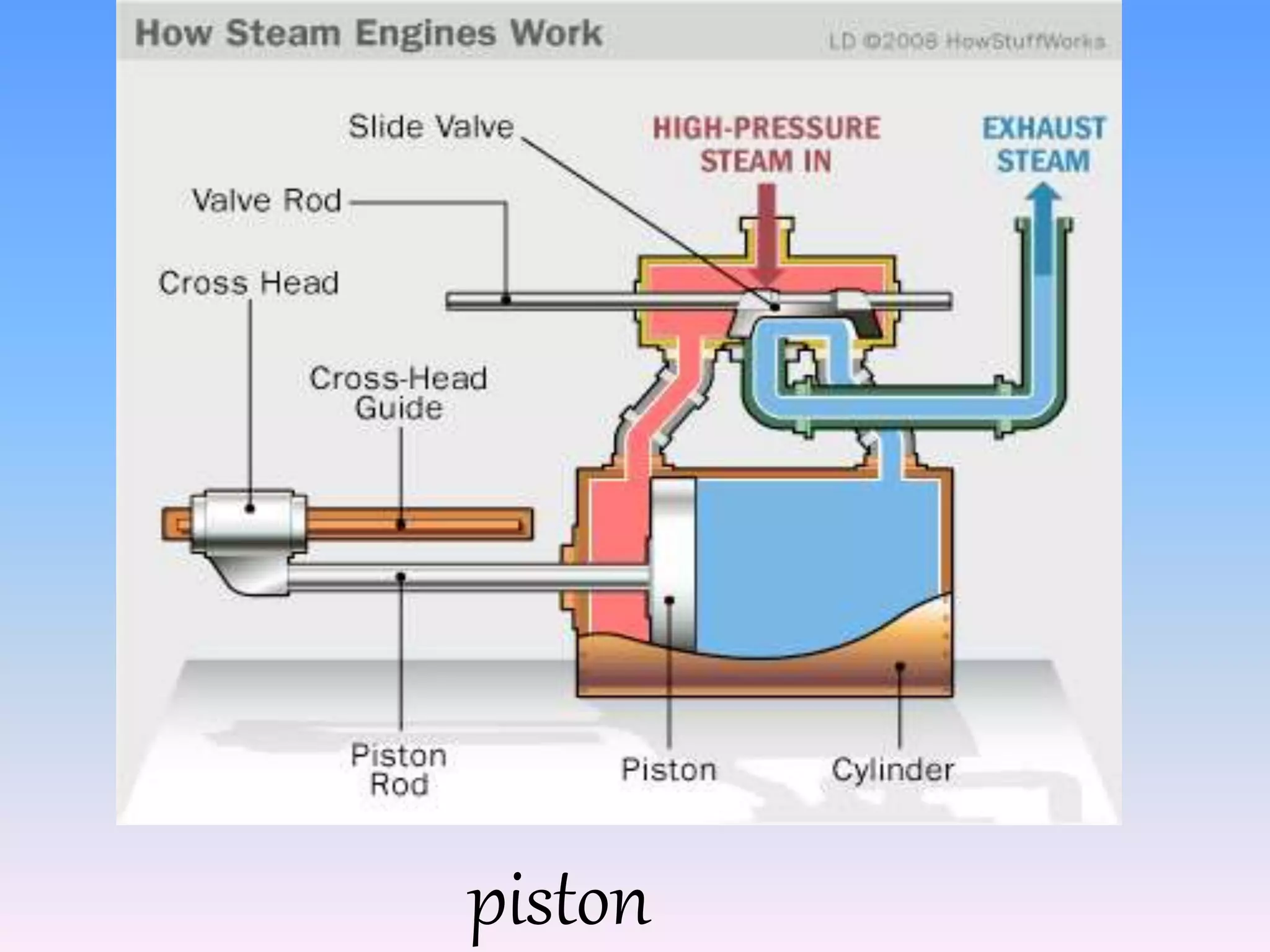
• A piston is made of cast iron and acts as a sliding
round plug inside of the cylinder. It is secured to the
piston rod by a nut.
• The piston rod is round, made of steel, the top
end is secured to the piston, the bottom end to the
crosshead. To prevent steam from blowing out of
the cylinder around the rod, metallic type packing is
installed around the rod in the stuffing box.
::PISTON::
piston
Slide Valve
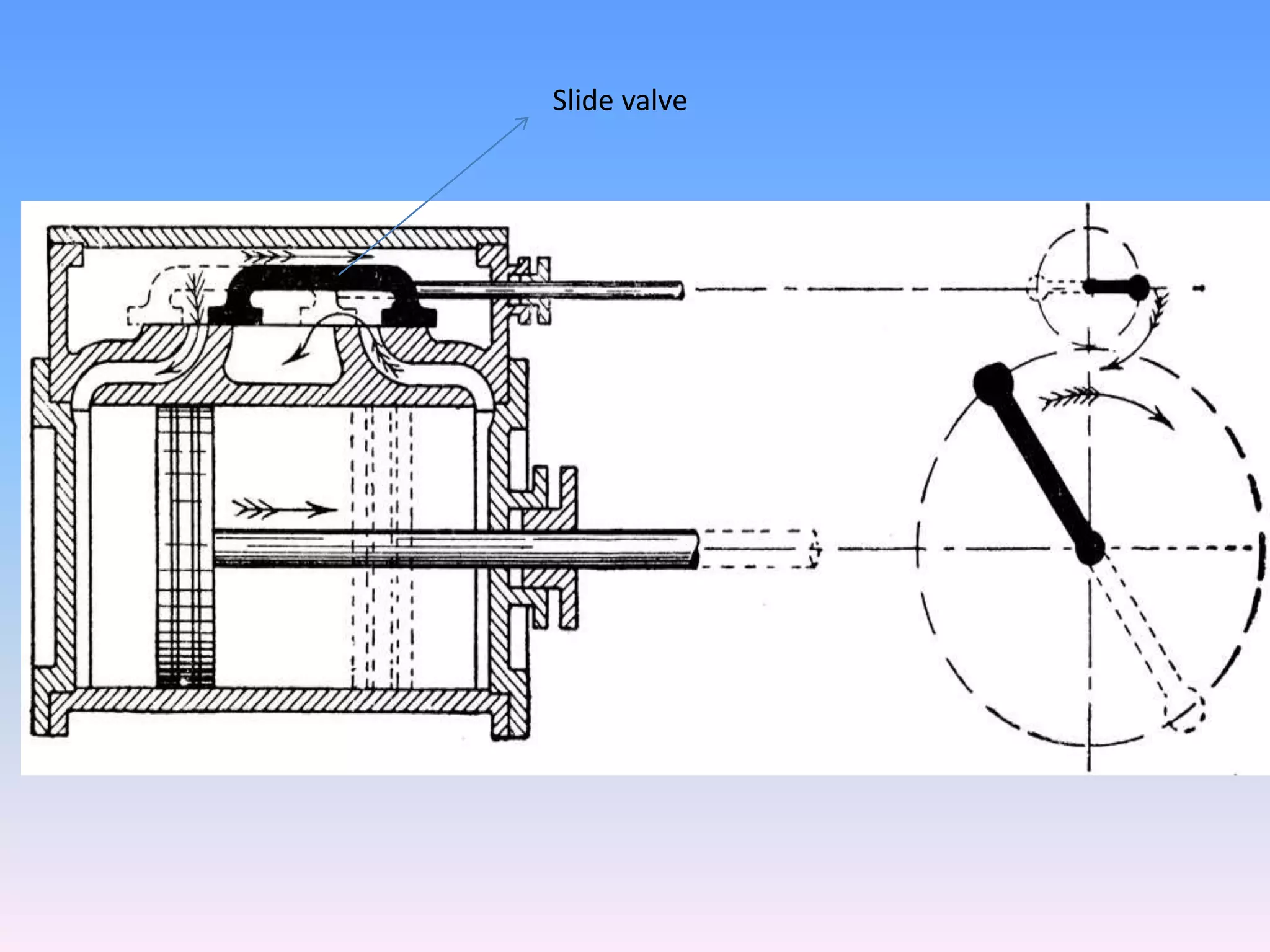
This valve is fixed on the steam chest. Its
function is to admit the steam from steam
chest to the cylinder.
Slide valve also exhausts the steam from
the cylinder at the proper moment.
The valve gets to and fro motion from the
eccentric fitted on the crankshaft.
Slide valve
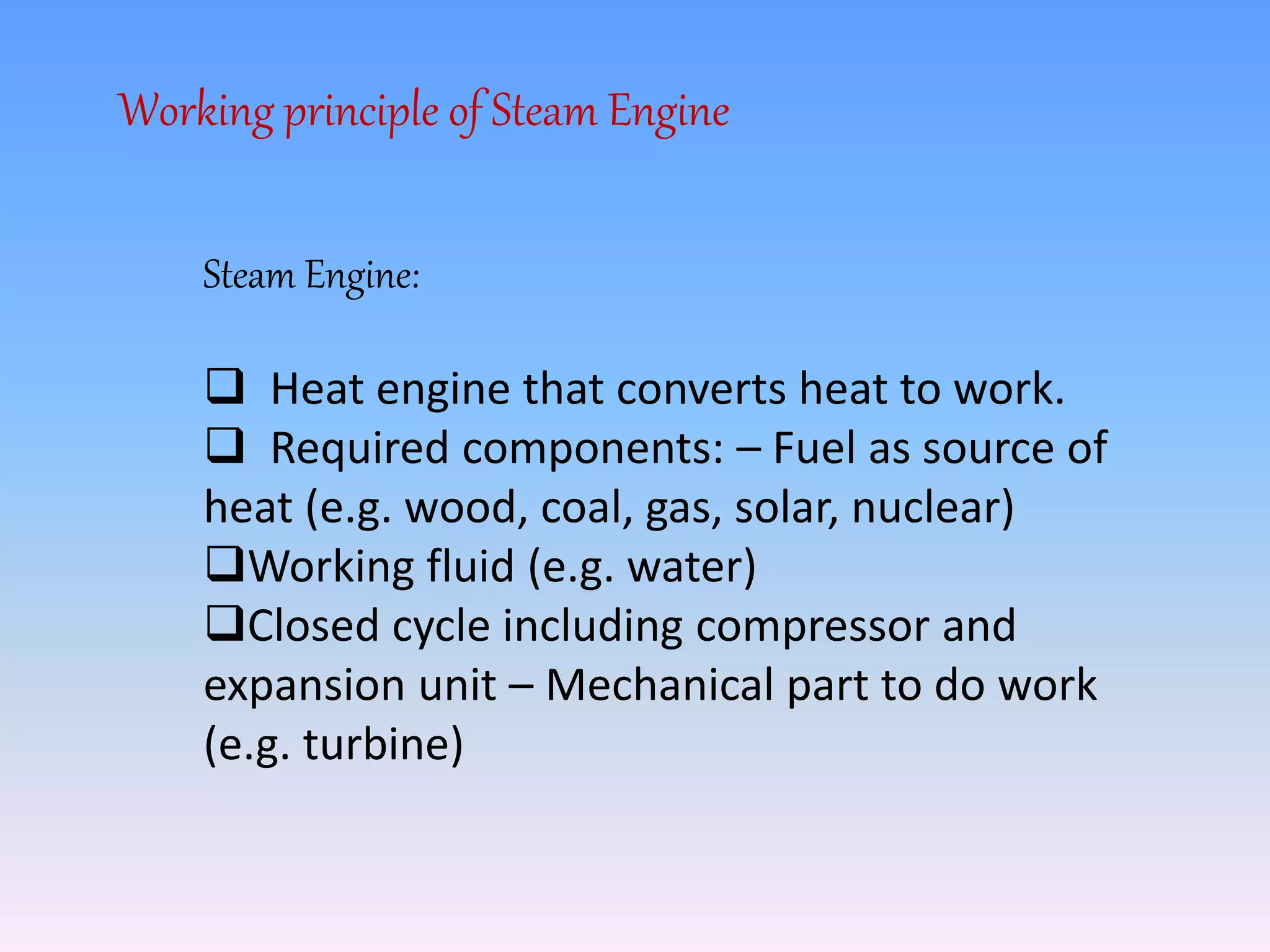
Steam Engine:
 Heat engine that converts heat to work.
 Required components: – Fuel as source of
heat (e.g. wood, coal, gas, solar, nuclear)
Working fluid (e.g. water)
Closed cycle including compressor and
expansion unit – Mechanical part to do work
(e.g. turbine)
Working principle of Steam Engine
Thermodynamic Cycle
• In the study of converting heat (thermo) into
mechanical (dynamic) action or work, many
cycles have been proposed to describe the
relationship between the heat you provide
and the work you get out.
• The goal is to maximize the efficiency of the
cycle, i.e. To increase the ratio [work
out/heat in].
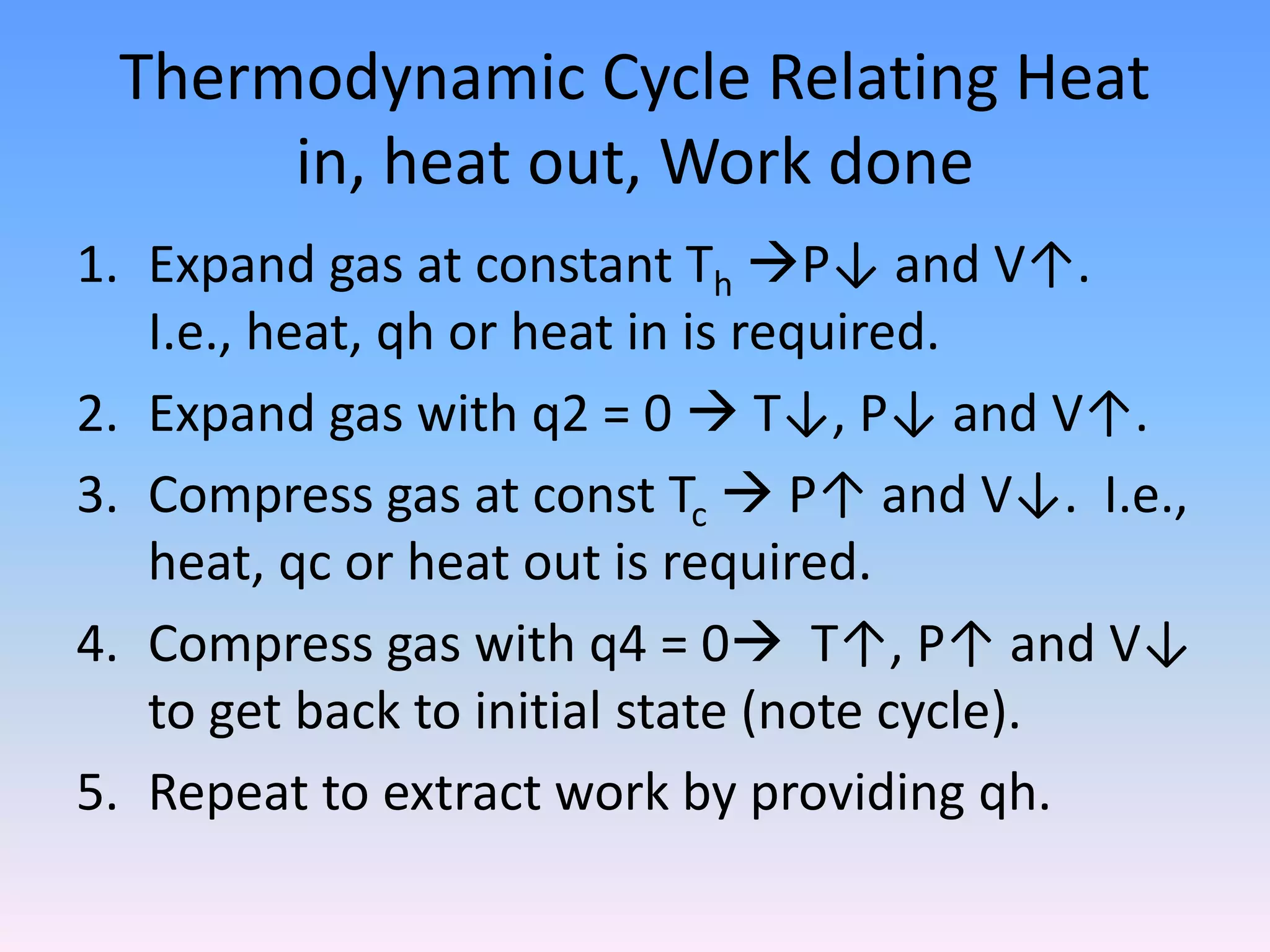
Thermodynamic Cycle Relating Heat
in, heat out, Work done
1. Expand gas at constant Th P↓ and V↑.
I.e., heat, qh or heat in is required.
2. Expand gas with q2 = 0  T↓, P↓ and V↑.
3. Compress gas at const Tc  P↑ and V↓. I.e.,
heat, qc or heat out is required.
4. Compress gas with q4 = 0 T↑, P↑ and V↓
to get back to initial state (note cycle).
5. Repeat to extract work by providing qh.
Classification of Steam Engines
 Based on axis of engine:
Orientation of cylinder axis :
I. Horizontal steam engine
II. Vertical steam engine
 Based on speed of engine:
I. High speed engine- speed of 250rpm and above
II. Medium speed engine- speed 100 to 250 rpm
III. Slow speed engine- speed 100rpm and below
 Based on type of steam action:
I. Double acting steam engine
II. Single acting steam engine
Advantages of the Steam Engine
•A steam engine (or external combustion engine) can
be used at any time because steam can be produced
at any time.
•A steam engine (or external combustion engine) can
be used to run trains for going from one place to
another place.
•A steam engine (or external combustion engine) is
much more powerful than a wind-mill or water-mill.
•A steam engine (or external combustion engine) can
use virtually any combustible material for fuel-wood,
coal, oil, old furniture, …anything that can be put into
the firebox.
Disadvantages of a steam engine
A steam engine is huge and heavy. (That is an external
combustion engine is huge and heavy).
A steam engine is unsafe to use. (That is, An external
combustion engine is unsafe to use).
A steam engine does not start at once. (That is, An
external combustion engine does not start at once).
Before a steam engine can start, we have to build a coal
fire to get steam. This process takes a long time and
hence a steam engine cannot be started at a moment’s
notice.
Application of steam engines
•Refrigeration
•Air Conditioning
•Heat Pumps
•Geothermal Pumps
steam engine working and principle

steam engine working and principle

  • 1.
    KARTHIKEYAN . M SteamEngine Presented by
  • 2.
     Introduced toSteam Engine  History Of Steam Engine  Working principle of Steam Engine  Main Part of Steam Engine  Classification of Steam Engines  Advantage/Disadvantage Of steam Engine Overview of presentation:
  • 3.
    Steam Engine Converting heatto work or steam to mechanical action.
  • 4.
     A steamengine is a heat engine that performs mechanical work using steam as its working fluid.  In simple terms, the steam engine uses the expansion principle of chemistry, where heat applied to water evaporates the water into steam, and the force generated pushes a piston back and forth inside a cylinder
  • 5.
     Steam enginesare external combustion engines, where the working fluid is separated from the combustion products.  Non-combustion heat sources such as solar power, nuclear power or geothermal energy may be used. The ideal thermodynamic cycle used to analyze this process is called the Rankine cycle.
  • 6.
    History of SteamEngine  Inventors used experimental devices, such as the rudimentary steam turbine device described by Taqi al-Din in 1551 and Giovanni Branca in 1629, to demonstrate the properties of steam.  The first practical steam-powered 'engine' was a water pump, developed in 1698 by Thomas Savery. It proved only to have a limited lift height and was prone to boiler explosions, but it still received some use for mines and pumping stations.
  • 7.
    The first commerciallysuccessful engine, the atmospheric engine, invented by Thomas Newcomen did not appear until 1712. Newcomen's engine was relatively inefficient, and in most cases was only used for pumping water.
  • 8.
  • 9.
    Boiler (steam generator) Anindustrial boiler used for a stationary steam engine Boilers are pressure vessels that contain water to be boiled, and features that transfer the heat to the water as effectively as possible. The two most common types are: water-tube boiler – water is passed through tubes surrounded by hot gas Main Part of Steam Engine
  • 10.
    fire-tube boiler –hot gas is passed through tubes immersed in water, the same water also circulates in a water jacket surrounding the firebox and, in high-output locomotive boilers, also passes through tubes in the firebox itself (thermic syphons and security circulators) Fire tube boilers were the main type used for early high-pressure steam (typical steam locomotive practice), but they were to a large extent displaced by more economical water tube boilers in the late 19th century for marine propulsion and large stationary applications.
  • 11.
  • 12.
    • A pistonis made of cast iron and acts as a sliding round plug inside of the cylinder. It is secured to the piston rod by a nut. • The piston rod is round, made of steel, the top end is secured to the piston, the bottom end to the crosshead. To prevent steam from blowing out of the cylinder around the rod, metallic type packing is installed around the rod in the stuffing box. ::PISTON::
  • 13.
  • 14.
    Slide Valve This valveis fixed on the steam chest. Its function is to admit the steam from steam chest to the cylinder. Slide valve also exhausts the steam from the cylinder at the proper moment. The valve gets to and fro motion from the eccentric fitted on the crankshaft.
  • 15.
  • 16.
    Steam Engine:  Heatengine that converts heat to work.  Required components: – Fuel as source of heat (e.g. wood, coal, gas, solar, nuclear) Working fluid (e.g. water) Closed cycle including compressor and expansion unit – Mechanical part to do work (e.g. turbine) Working principle of Steam Engine
  • 17.
    Thermodynamic Cycle • Inthe study of converting heat (thermo) into mechanical (dynamic) action or work, many cycles have been proposed to describe the relationship between the heat you provide and the work you get out. • The goal is to maximize the efficiency of the cycle, i.e. To increase the ratio [work out/heat in].
  • 18.
    Thermodynamic Cycle RelatingHeat in, heat out, Work done 1. Expand gas at constant Th P↓ and V↑. I.e., heat, qh or heat in is required. 2. Expand gas with q2 = 0  T↓, P↓ and V↑. 3. Compress gas at const Tc  P↑ and V↓. I.e., heat, qc or heat out is required. 4. Compress gas with q4 = 0 T↑, P↑ and V↓ to get back to initial state (note cycle). 5. Repeat to extract work by providing qh.
  • 19.
    Classification of SteamEngines  Based on axis of engine: Orientation of cylinder axis : I. Horizontal steam engine II. Vertical steam engine  Based on speed of engine: I. High speed engine- speed of 250rpm and above II. Medium speed engine- speed 100 to 250 rpm III. Slow speed engine- speed 100rpm and below  Based on type of steam action: I. Double acting steam engine II. Single acting steam engine
  • 20.
    Advantages of theSteam Engine •A steam engine (or external combustion engine) can be used at any time because steam can be produced at any time. •A steam engine (or external combustion engine) can be used to run trains for going from one place to another place. •A steam engine (or external combustion engine) is much more powerful than a wind-mill or water-mill. •A steam engine (or external combustion engine) can use virtually any combustible material for fuel-wood, coal, oil, old furniture, …anything that can be put into the firebox.
  • 21.
    Disadvantages of asteam engine A steam engine is huge and heavy. (That is an external combustion engine is huge and heavy). A steam engine is unsafe to use. (That is, An external combustion engine is unsafe to use). A steam engine does not start at once. (That is, An external combustion engine does not start at once). Before a steam engine can start, we have to build a coal fire to get steam. This process takes a long time and hence a steam engine cannot be started at a moment’s notice.
  • 22.
    Application of steamengines •Refrigeration •Air Conditioning •Heat Pumps •Geothermal Pumps