Chapter 1- Static engineering systems
  1.2 Beams and columns
  1.2.1 elastic section modulus for beams
  1.2.2 standard section tables for rolled steel
        beams
  1.2.3 selection of standard sections (eg
        slenderness ratio for compression
        members, standard section and allowable
        stress tables for rolled steel columns,
        selection of standard sections)


                                                   1
Standard sections
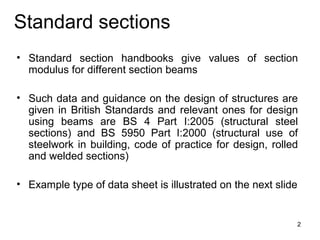
• Standard section handbooks give values of section
  modulus for different section beams

• Such data and guidance on the design of structures are
  given in British Standards and relevant ones for design
  using beams are BS 4 Part I:2005 (structural steel
  sections) and BS 5950 Part I:2000 (structural use of
  steelwork in building, code of practice for design, rolled
  and welded sections)

• Example type of data sheet is illustrated on the next slide


                                                                2
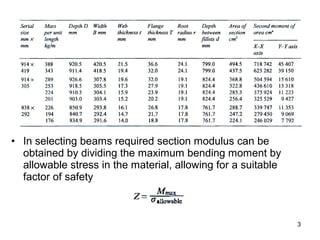
• In selecting beams required section modulus can be
  obtained by dividing the maximum bending moment by
  allowable stress in the material, allowing for a suitable
  factor of safety


                                                              3
• If the allowable stresses are the same for both tension and
  compression, then a cross-sectional shape which has its neutral axis
  at the mid height of the beam selected

• To minimize the weight of a beam, abeam can be selected that has
  not only has the required sectional modulus but also the smallest
  cross-sectional area and the smallest mass per unit length

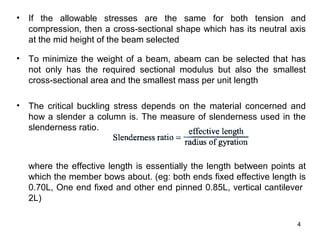
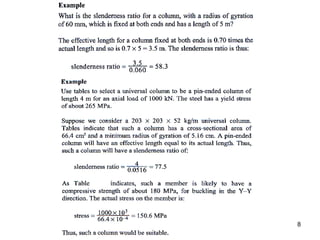
• The critical buckling stress depends on the material concerned and
  how a slender a column is. The measure of slenderness used in the
  slenderness ratio.


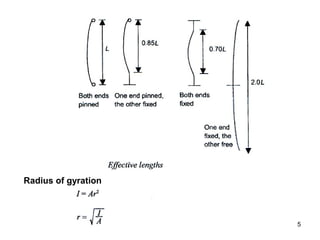
  where the effective length is essentially the length between points at
  which the member bows about. (eg: both ends fixed effective length is
  0.70L, One end fixed and other end pinned 0.85L, vertical cantilever
  2L)

                                                                     4
Radius of gyration


                     5
6
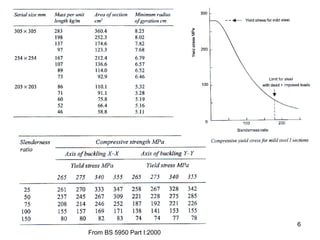
From BS 5950 Part I:2000
•   The maximum slenderness ratio for steel columns carrying dead and
    imposed loads is limited to 180; as table and graph indicates, when the
    slenderness ratio approaches this value the compressive strength drops to
    a quite a low value.

•   If in the design of structure, a larger slenderness ratio is indicated and it
    indicates the need to use a larger section size in order to decrease the
    slenderness ratio

•   The general procedure for designing axially loaded column is
     – Determine the effective length of the required column
     – Select a trial section
     – Using the radius of gyration value for the trial section, calculate the slenderness
       ratio
     – If the slenderness ratio is greater than 180, try a large cross section trial section
     – Using the slenderness ratio, obtain the compression strength from the tables
     – Compare the compression strength with that which is likely to be required in
       practice. If the compression strength is adequate then the trial section is suitable.
       If the compression strength is much greater than is required then it would be
       more economical to choose a section with a smaller radius of gyration.
                                                                                          7
8
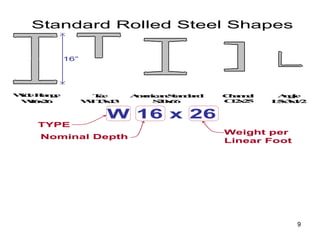
Standard Rolled Steel Shapes

           16”


W eF n e
 id  l g
      a           Te
                   e      A e i a Sa d r
                           m c n t n ad
                             r             Ca nl
                                            hn e    Age
                                                     nl
 W x6
   1 2
    6            W 1 x3
                  T 31         S0 6
                                2x6        C2 2
                                            1x5    Lx x /
                                                    5 3 12


                     W 16 x 26
    TYPE
                                           Weight per
    Nominal Depth
                                           Linear Foot


                                                         9
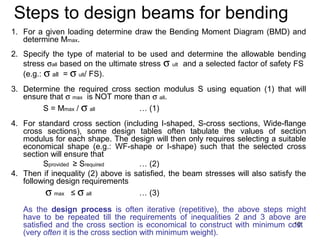
Steps to design beams for bending
1. For a given loading determine draw the Bending Moment Diagram (BMD) and
   determine Mmax.
2. Specify the type of material to be used and determine the allowable bending
   stress σall based on the ultimate stress σ ult and a selected factor of safety FS
   (e.g.: σ all = σ ult/ FS).
3. Determine the required cross section modulus S using equation (1) that will
   ensure that σ max is NOT more than σ all.
        S = Mmax / σ all           … (1)
4. For standard cross section (including I-shaped, S-cross sections, Wide-flange
   cross sections), some design tables often tabulate the values of section
   modulus for each shape. The design will then only requires selecting a suitable
   economical shape (e.g.: WF-shape or I-shape) such that the selected cross
   section will ensure that
         Sprovided ≥ Srequired      … (2)
4. Then if inequality (2) above is satisfied, the beam stresses will also satisfy the
   following design requirements
          σ max ≤ σ all             … (3)

   As the design process is often iterative (repetitive), the above steps might
   have to be repeated till the requirements of inequalities 2 and 3 above are
   satisfied and the cross section is economical to construct with minimum cost
                                                                            10
   (very often it is the cross section with minimum weight).
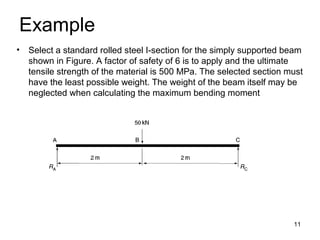
Example
• Select a standard rolled steel I-section for the simply supported beam
  shown in Figure. A factor of safety of 6 is to apply and the ultimate
  tensile strength of the material is 500 MPa. The selected section must
  have the least possible weight. The weight of the beam itself may be
  neglected when calculating the maximum bending moment


                                                                     11
•   Finding support reactions:
    The beam is symmetrically loaded and so the support reactions R A and
    RC will be equal. That is,
    RA = RC = 50/2
    RA=RC=25 kN

•   Finding maximum bending moment, M which will be at the centre of the
    beam:
    M = RA X 2 = 25 X 103 X 2
    M =50X 103Nm

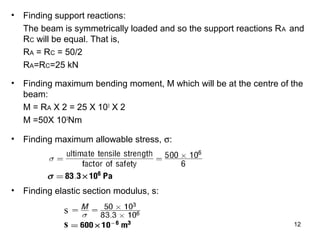
•   Finding maximum allowable stress, σ:


•   Finding elastic section modulus, s:

              s
              s                                                       12
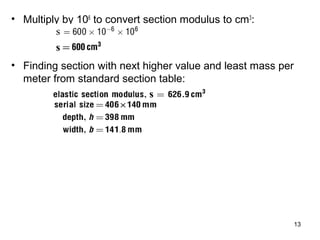
• Multiply by 106 to convert section modulus to cm 3:
         s
         s
• Finding section with next higher value and least mass per
  meter from standard section table:
                             s


                                                              13

Engineering science lesson 6 2

  • 1.
    Chapter 1- Staticengineering systems 1.2 Beams and columns 1.2.1 elastic section modulus for beams 1.2.2 standard section tables for rolled steel beams 1.2.3 selection of standard sections (eg slenderness ratio for compression members, standard section and allowable stress tables for rolled steel columns, selection of standard sections) 1
  • 2.
    Standard sections • Standardsection handbooks give values of section modulus for different section beams • Such data and guidance on the design of structures are given in British Standards and relevant ones for design using beams are BS 4 Part I:2005 (structural steel sections) and BS 5950 Part I:2000 (structural use of steelwork in building, code of practice for design, rolled and welded sections) • Example type of data sheet is illustrated on the next slide 2
  • 3.
    • In selectingbeams required section modulus can be obtained by dividing the maximum bending moment by allowable stress in the material, allowing for a suitable factor of safety 3
  • 4.
    • If theallowable stresses are the same for both tension and compression, then a cross-sectional shape which has its neutral axis at the mid height of the beam selected • To minimize the weight of a beam, abeam can be selected that has not only has the required sectional modulus but also the smallest cross-sectional area and the smallest mass per unit length • The critical buckling stress depends on the material concerned and how a slender a column is. The measure of slenderness used in the slenderness ratio. where the effective length is essentially the length between points at which the member bows about. (eg: both ends fixed effective length is 0.70L, One end fixed and other end pinned 0.85L, vertical cantilever 2L) 4
  • 5.
  • 6.
    6 From BS 5950Part I:2000
  • 7.
    The maximum slenderness ratio for steel columns carrying dead and imposed loads is limited to 180; as table and graph indicates, when the slenderness ratio approaches this value the compressive strength drops to a quite a low value. • If in the design of structure, a larger slenderness ratio is indicated and it indicates the need to use a larger section size in order to decrease the slenderness ratio • The general procedure for designing axially loaded column is – Determine the effective length of the required column – Select a trial section – Using the radius of gyration value for the trial section, calculate the slenderness ratio – If the slenderness ratio is greater than 180, try a large cross section trial section – Using the slenderness ratio, obtain the compression strength from the tables – Compare the compression strength with that which is likely to be required in practice. If the compression strength is adequate then the trial section is suitable. If the compression strength is much greater than is required then it would be more economical to choose a section with a smaller radius of gyration. 7
  • 8.
  • 9.
    Standard Rolled SteelShapes 16” W eF n e id l g a Te e A e i a Sa d r m c n t n ad r Ca nl hn e Age nl W x6 1 2 6 W 1 x3 T 31 S0 6 2x6 C2 2 1x5 Lx x / 5 3 12 W 16 x 26 TYPE Weight per Nominal Depth Linear Foot 9
  • 10.
    Steps to designbeams for bending 1. For a given loading determine draw the Bending Moment Diagram (BMD) and determine Mmax. 2. Specify the type of material to be used and determine the allowable bending stress σall based on the ultimate stress σ ult and a selected factor of safety FS (e.g.: σ all = σ ult/ FS). 3. Determine the required cross section modulus S using equation (1) that will ensure that σ max is NOT more than σ all. S = Mmax / σ all … (1) 4. For standard cross section (including I-shaped, S-cross sections, Wide-flange cross sections), some design tables often tabulate the values of section modulus for each shape. The design will then only requires selecting a suitable economical shape (e.g.: WF-shape or I-shape) such that the selected cross section will ensure that Sprovided ≥ Srequired … (2) 4. Then if inequality (2) above is satisfied, the beam stresses will also satisfy the following design requirements σ max ≤ σ all … (3) As the design process is often iterative (repetitive), the above steps might have to be repeated till the requirements of inequalities 2 and 3 above are satisfied and the cross section is economical to construct with minimum cost 10 (very often it is the cross section with minimum weight).
  • 11.
    Example • Select astandard rolled steel I-section for the simply supported beam shown in Figure. A factor of safety of 6 is to apply and the ultimate tensile strength of the material is 500 MPa. The selected section must have the least possible weight. The weight of the beam itself may be neglected when calculating the maximum bending moment 11
  • 12.
    Finding support reactions: The beam is symmetrically loaded and so the support reactions R A and RC will be equal. That is, RA = RC = 50/2 RA=RC=25 kN • Finding maximum bending moment, M which will be at the centre of the beam: M = RA X 2 = 25 X 103 X 2 M =50X 103Nm • Finding maximum allowable stress, σ: • Finding elastic section modulus, s: s s 12
  • 13.
    • Multiply by106 to convert section modulus to cm 3: s s • Finding section with next higher value and least mass per meter from standard section table: s 13