


ULTIMATE STRENGTH DESIGN
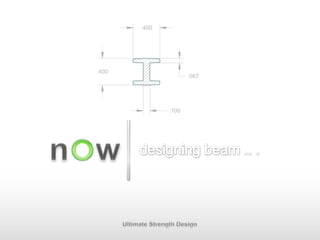
T BEAM DESIGN : Singly and Doubly
Presented By
S. M. Rahat Rahman
10.01.03.044
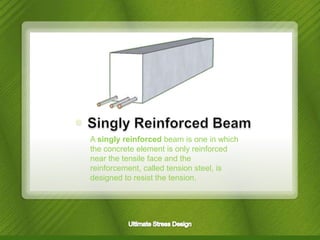
A singly reinforced beam is one in which
the concrete element is only reinforced
near the tensile face and the
reinforcement, called tension steel, is
designed to resist the tension.
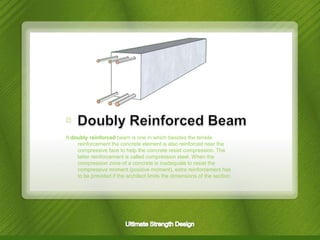
A doubly reinforced beam is one in which besides the tensile
reinforcement the concrete element is also reinforced near the
compressive face to help the concrete resist compression. The
latter reinforcement is called compression steel. When the
compression zone of a concrete is inadequate to resist the
compressive moment (positive moment), extra reinforcement has
to be provided if the architect limits the dimensions of the section.
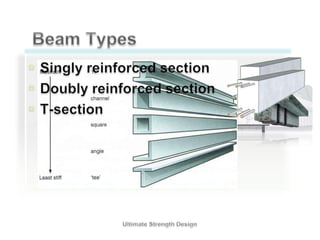
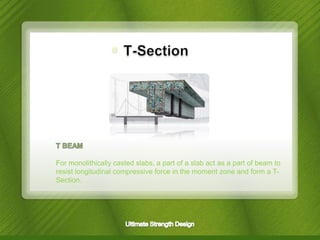
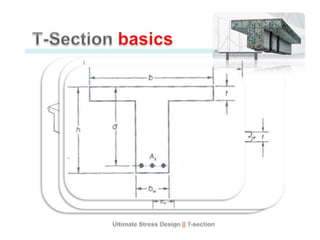
For monolithically casted slabs, a part of a slab act as a part of beam to
resist longitudinal compressive force in the moment zone and form a TSection.
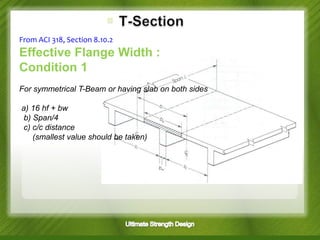
From ACI 318, Section 8.10.2

Effective Flange Width :
Condition 1
For symmetrical T-Beam or having slab on both sides
a) 16 hf + bw
b) Span/4
c) c/c distance
(smallest value should be taken)
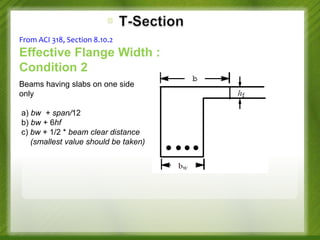
From ACI 318, Section 8.10.2

Effective Flange Width :
Condition 2
Beams having slabs on one side
only
a) bw + span/12
b) bw + 6hf
c) bw + 1/2 * beam clear distance
(smallest value should be taken)
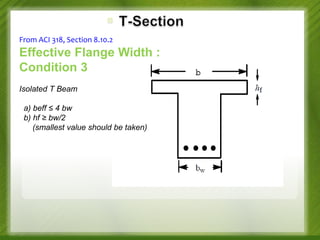
From ACI 318, Section 8.10.2

Effective Flange Width :
Condition 3
Isolated T Beam
a) beff ≤ 4 bw
b) hf ≥ bw/2
(smallest value should be taken)
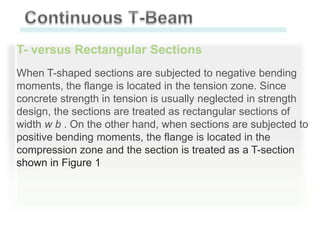
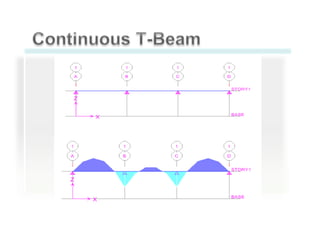
T- versus Rectangular Sections
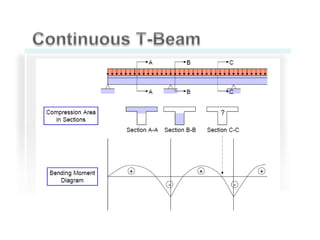
When T-shaped sections are subjected to negative bending
moments, the flange is located in the tension zone. Since
concrete strength in tension is usually neglected in strength
design, the sections are treated as rectangular sections of
width w b . On the other hand, when sections are subjected to
positive bending moments, the flange is located in the
compression zone and the section is treated as a T-section
shown in Figure 1
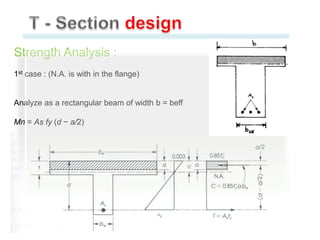
Strength Analysis :
1st case : (N.A. is with in the flange)

Analyze as a rectangular beam of width b = beff
Mn = As fy (d − a/2)
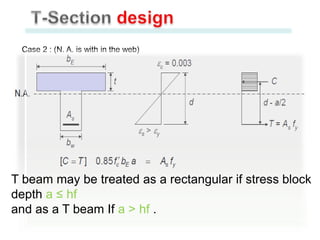
Case 2 : (N. A. is with in the web)

T beam may be treated as a rectangular if stress block
depth a ≤ hf
and as a T beam If a > hf .
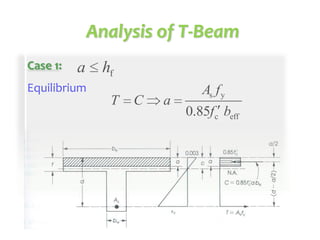
Analysis of T-Beam
Case 1:

a

Equilibrium

hf
T

C

a

As f y
0.85fc beff
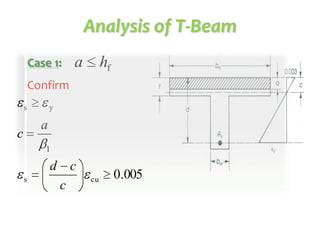
Analysis of T-Beam
Case 1:

a

hf

Confirm
s

y

a

c

1

s

d c
c

cu

0.005
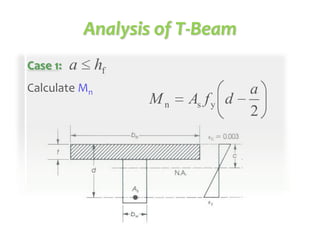
Analysis of T-Beam
Case 1:

a

Calculate Mn

hf
Mn

As f y d

a
2
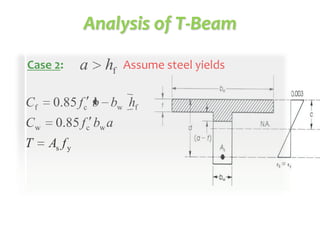
Analysis of T-Beam
Case 2:

a

hf

Assume steel yields

Cf

0.85 f c b bw hf

Cw

0.85 f c bw a

T

As f y
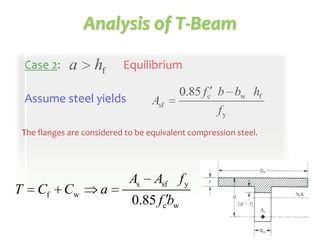
Analysis of T-Beam
Case 2:

a

hf

Equilibrium

Assume steel yields

Asf

0.85 f c b bw hf
fy

The flanges are considered to be equivalent compression steel.

T

Cf

Cw

a

As

Asf f y

0.85 fcbw
Analysis of T-Beam
Case 2:

a

hf

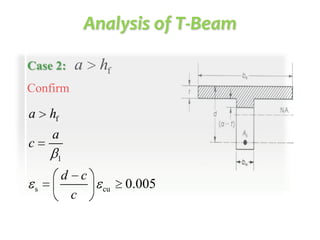
Confirm

a

hf
a

c

1

s

d c
c

cu

0.005
Analysis of T-Beam
Case 2:

a

hf

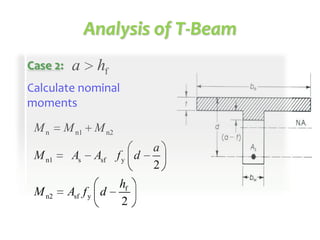
Calculate nominal
moments
Mn
M n1
M n2

M n1 M n2
As

Asf f y d

Asf f y d

hf
2

a
2
Analysis of T-Beams
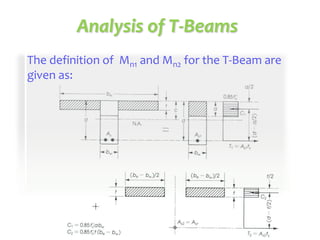
The definition of Mn1 and Mn2 for the T-Beam are
given as:
Limitations on Reinforcement for Flange
Beams
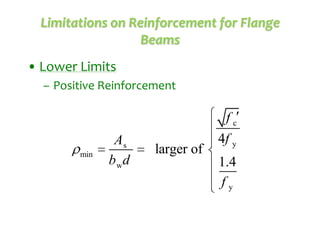
• Lower Limits
– Positive Reinforcement

min

As
b wd

larger of

fc
4f y
1.4
fy
Limitations on Reinforcement for Flange
Beams
• Lower Limits
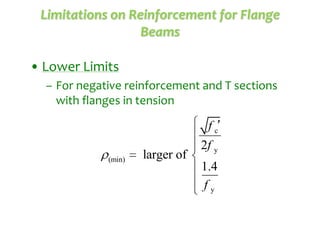
– For negative reinforcement and T sections
with flanges in tension

fc
(min)

larger of

2f y
1.4
fy
Thank you

Test before Final ( T Beam )

  • 2.
    ULTIMATE STRENGTH DESIGN TBEAM DESIGN : Singly and Doubly Presented By S. M. Rahat Rahman 10.01.03.044
  • 13.
    A singly reinforcedbeam is one in which the concrete element is only reinforced near the tensile face and the reinforcement, called tension steel, is designed to resist the tension.
  • 14.
    A doubly reinforcedbeam is one in which besides the tensile reinforcement the concrete element is also reinforced near the compressive face to help the concrete resist compression. The latter reinforcement is called compression steel. When the compression zone of a concrete is inadequate to resist the compressive moment (positive moment), extra reinforcement has to be provided if the architect limits the dimensions of the section.
  • 15.
    For monolithically castedslabs, a part of a slab act as a part of beam to resist longitudinal compressive force in the moment zone and form a TSection.
  • 16.
    From ACI 318,Section 8.10.2 Effective Flange Width : Condition 1 For symmetrical T-Beam or having slab on both sides a) 16 hf + bw b) Span/4 c) c/c distance (smallest value should be taken)
  • 17.
    From ACI 318,Section 8.10.2 Effective Flange Width : Condition 2 Beams having slabs on one side only a) bw + span/12 b) bw + 6hf c) bw + 1/2 * beam clear distance (smallest value should be taken)
  • 18.
    From ACI 318,Section 8.10.2 Effective Flange Width : Condition 3 Isolated T Beam a) beff ≤ 4 bw b) hf ≥ bw/2 (smallest value should be taken)
  • 21.
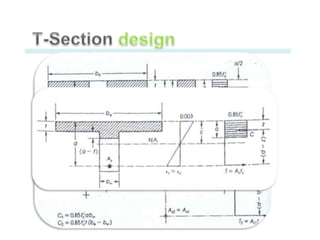
    T- versus RectangularSections When T-shaped sections are subjected to negative bending moments, the flange is located in the tension zone. Since concrete strength in tension is usually neglected in strength design, the sections are treated as rectangular sections of width w b . On the other hand, when sections are subjected to positive bending moments, the flange is located in the compression zone and the section is treated as a T-section shown in Figure 1
  • 24.
    Strength Analysis : 1stcase : (N.A. is with in the flange) Analyze as a rectangular beam of width b = beff Mn = As fy (d − a/2)
  • 25.
    Case 2 :(N. A. is with in the web) T beam may be treated as a rectangular if stress block depth a ≤ hf and as a T beam If a > hf .
  • 26.
    Analysis of T-Beam Case1: a Equilibrium hf T C a As f y 0.85fc beff
  • 27.
    Analysis of T-Beam Case1: a hf Confirm s y a c 1 s d c c cu 0.005
  • 28.
    Analysis of T-Beam Case1: a Calculate Mn hf Mn As f y d a 2
  • 29.
    Analysis of T-Beam Case2: a hf Assume steel yields Cf 0.85 f c b bw hf Cw 0.85 f c bw a T As f y
  • 30.
    Analysis of T-Beam Case2: a hf Equilibrium Assume steel yields Asf 0.85 f c b bw hf fy The flanges are considered to be equivalent compression steel. T Cf Cw a As Asf f y 0.85 fcbw
  • 31.
    Analysis of T-Beam Case2: a hf Confirm a hf a c 1 s d c c cu 0.005
  • 32.
    Analysis of T-Beam Case2: a hf Calculate nominal moments Mn M n1 M n2 M n1 M n2 As Asf f y d Asf f y d hf 2 a 2
  • 33.
    Analysis of T-Beams Thedefinition of Mn1 and Mn2 for the T-Beam are given as:
  • 34.
    Limitations on Reinforcementfor Flange Beams • Lower Limits – Positive Reinforcement min As b wd larger of fc 4f y 1.4 fy
  • 35.
    Limitations on Reinforcementfor Flange Beams • Lower Limits – For negative reinforcement and T sections with flanges in tension fc (min) larger of 2f y 1.4 fy
  • 37.