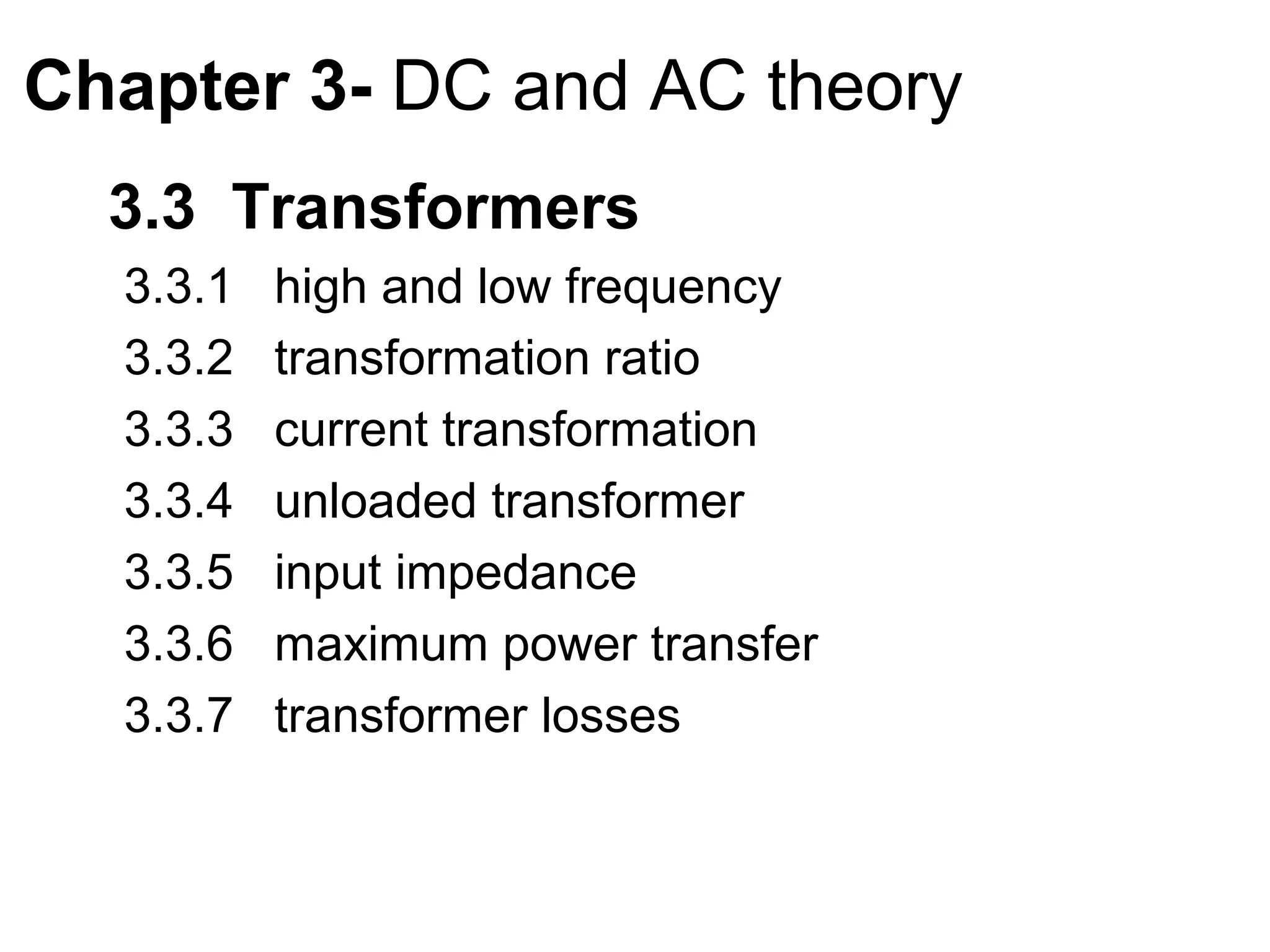
Chapter 3- DC and AC theory
  3.3 Transformers
  3.3.1   high and low frequency
  3.3.2   transformation ratio
  3.3.3   current transformation
  3.3.4   unloaded transformer
  3.3.5   input impedance
  3.3.6   maximum power transfer
  3.3.7   transformer losses
Transformers


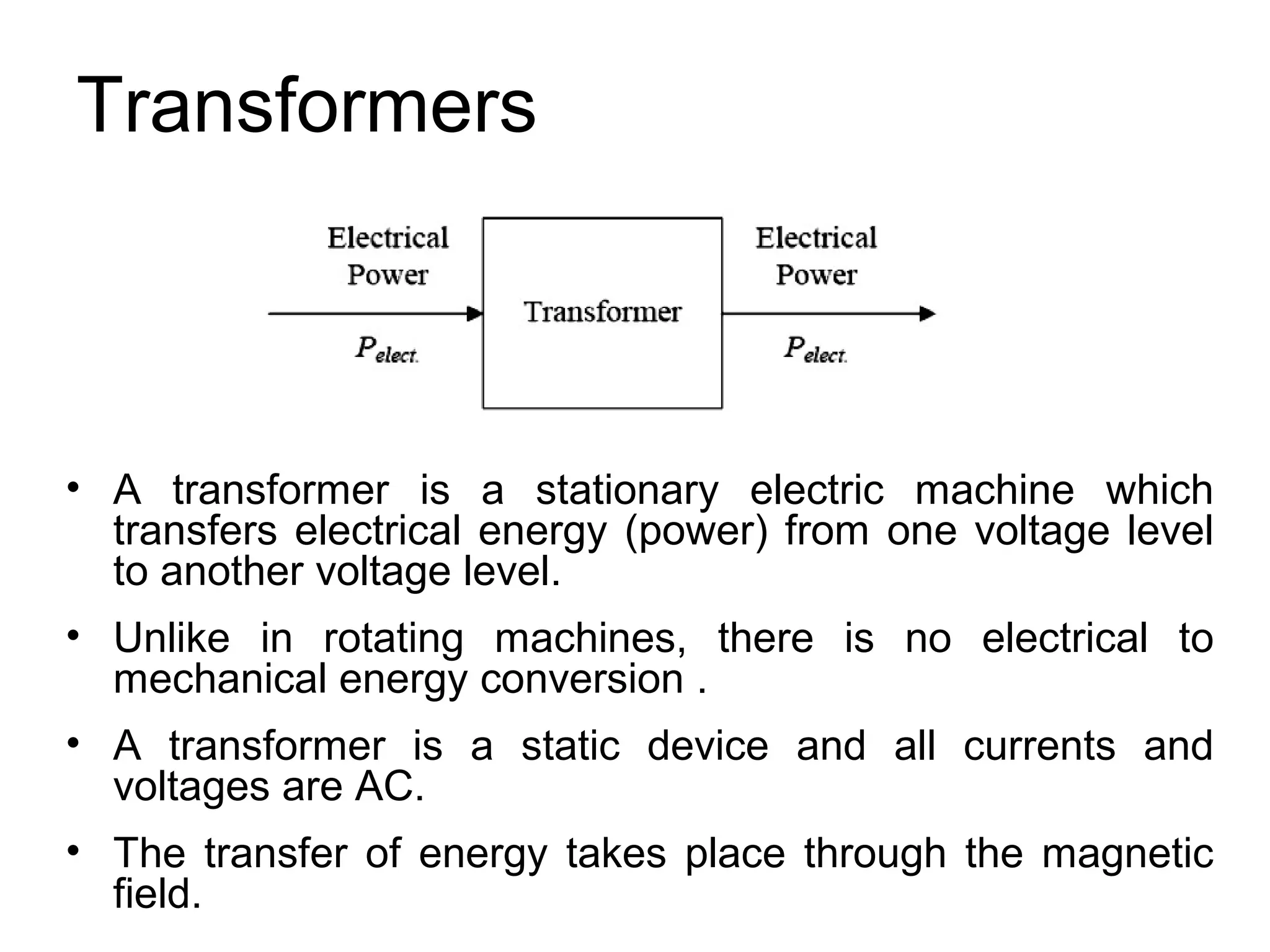
• A transformer is a stationary electric machine which
  transfers electrical energy (power) from one voltage level
  to another voltage level.
• Unlike in rotating machines, there is no electrical to
  mechanical energy conversion .
• A transformer is a static device and all currents and
  voltages are AC.
• The transfer of energy takes place through the magnetic
  field.
Transformer principle
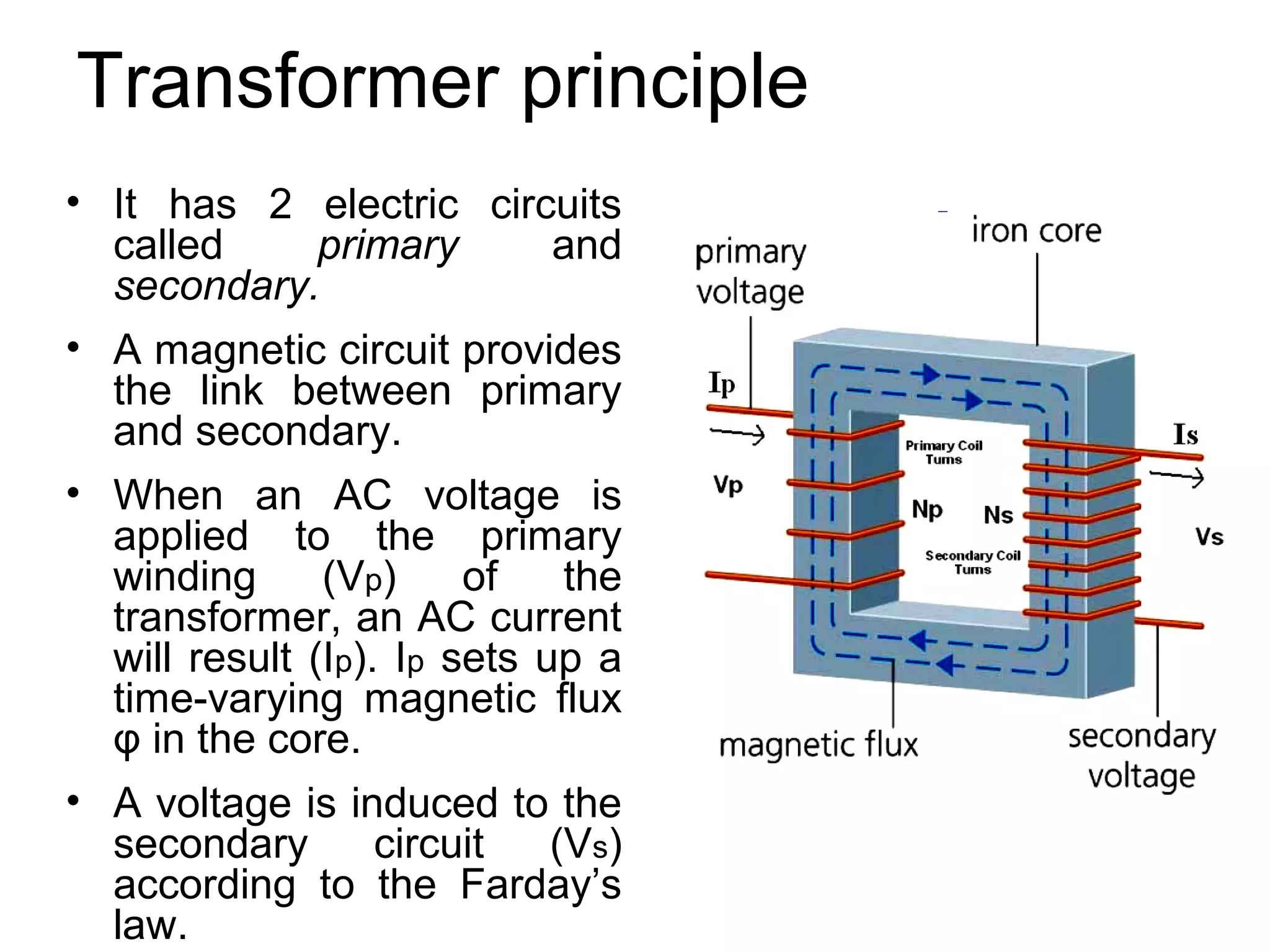
• It has 2 electric circuits
  called       primary       and
  secondary.
• A magnetic circuit provides
  the link between primary
  and secondary.
• When an AC voltage is
  applied to the primary
  winding      (Vp)     of    the
  transformer, an AC current
  will result (Ip). Ip sets up a
  time-varying magnetic flux
  φ in the core.
• A voltage is induced to the
  secondary        circuit   (Vs)
  according to the Farday’s
  law.
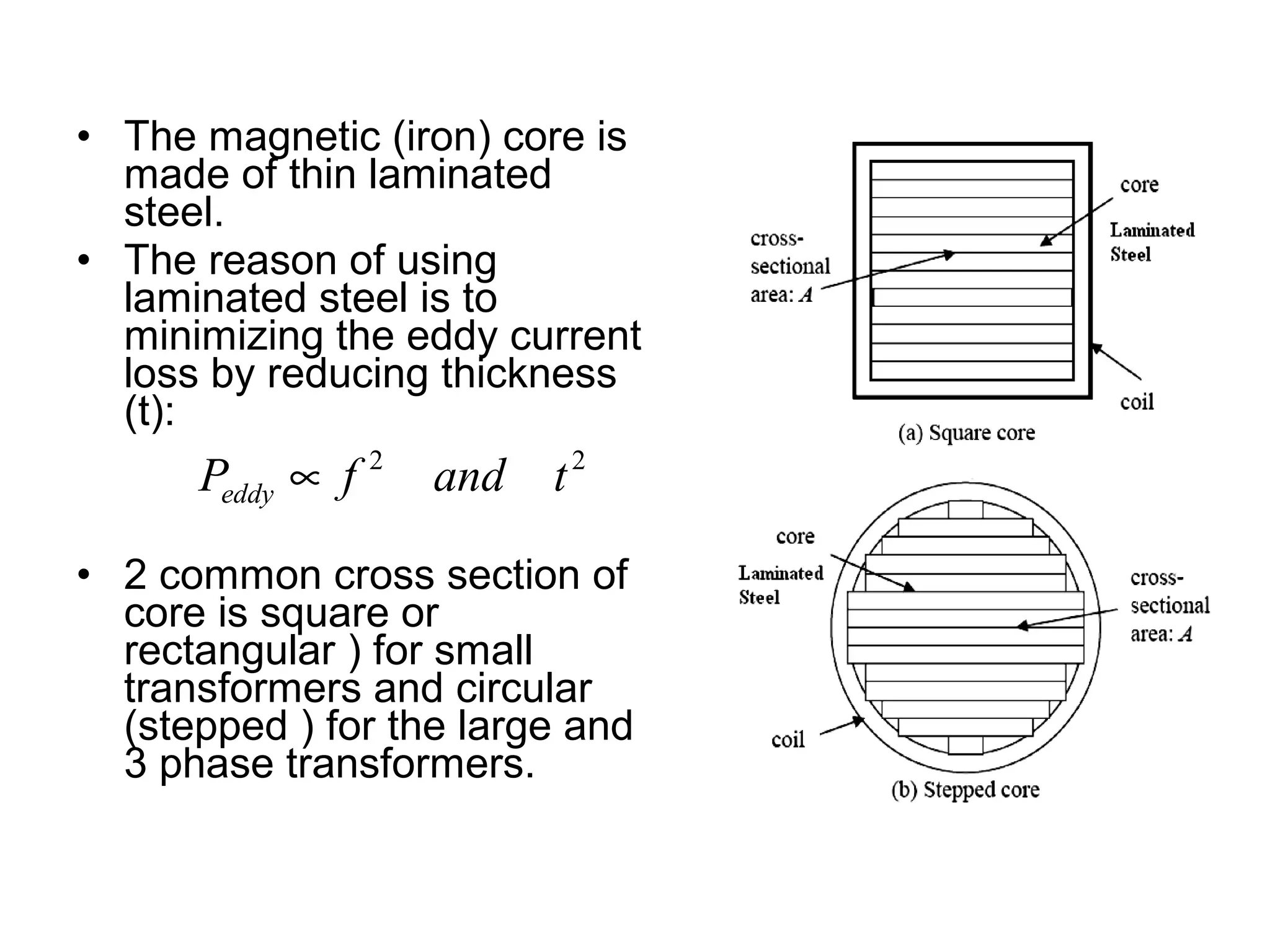
• The magnetic (iron) core is
  made of thin laminated
  steel.
• The reason of using
  laminated steel is to
  minimizing the eddy current
  loss by reducing thickness
  (t):
      Peddy ∝ f 2   and   t2

• 2 common cross section of
  core is square or
  rectangular ) for small
  transformers and circular
  (stepped ) for the large and
  3 phase transformers.
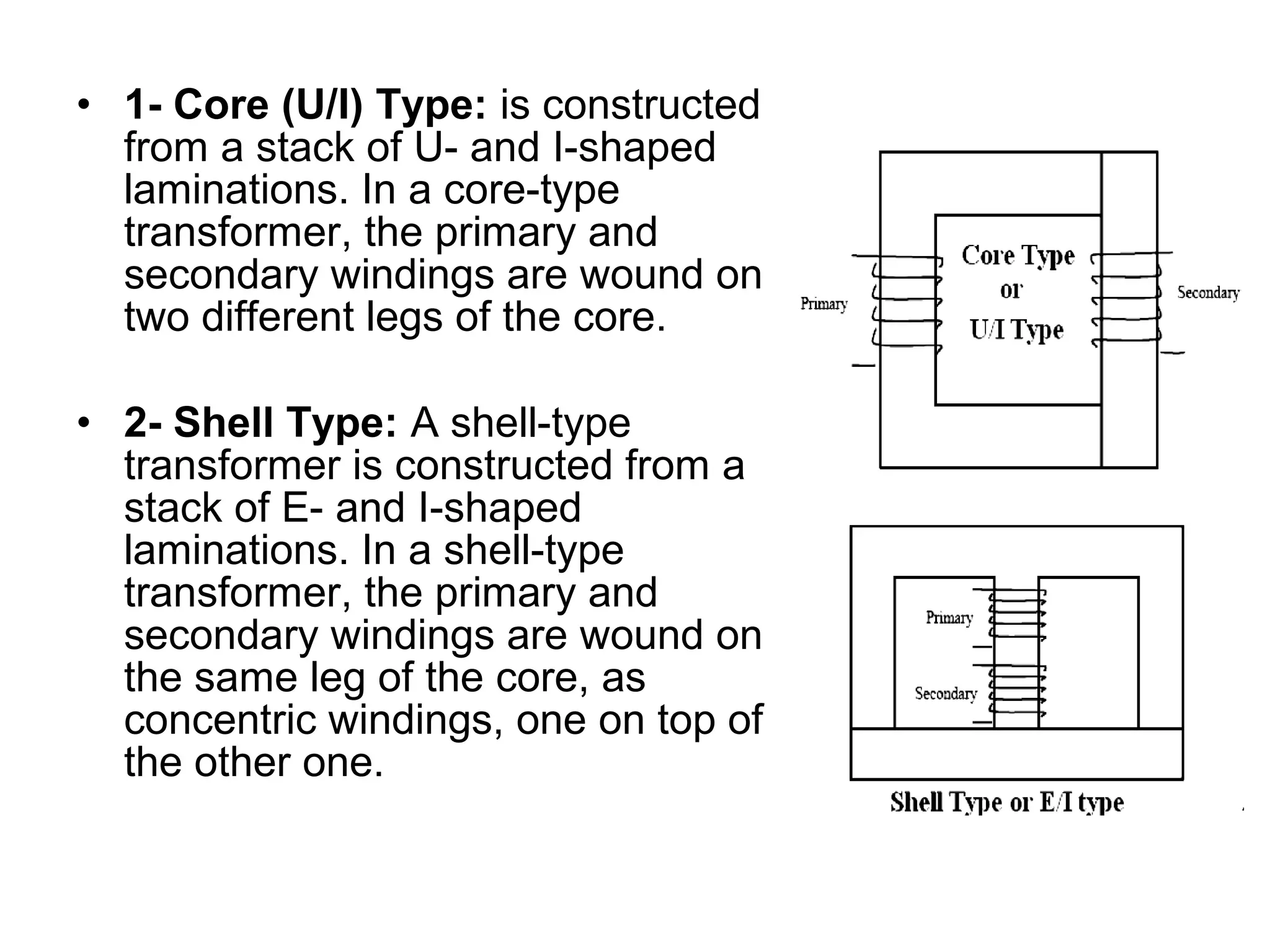
• 1- Core (U/I) Type: is constructed
  from a stack of U- and I-shaped
  laminations. In a core-type
  transformer, the primary and
  secondary windings are wound on
  two different legs of the core.

• 2- Shell Type: A shell-type
  transformer is constructed from a
  stack of E- and I-shaped
  laminations. In a shell-type
  transformer, the primary and
  secondary windings are wound on
  the same leg of the core, as
  concentric windings, one on top of
  the other one.
• At high frequencies, power dissipated in the iron
  core through eddy currents is considerably high
  (proportional to frequency2) and it is not possible
  to use iron cores at high frequencies
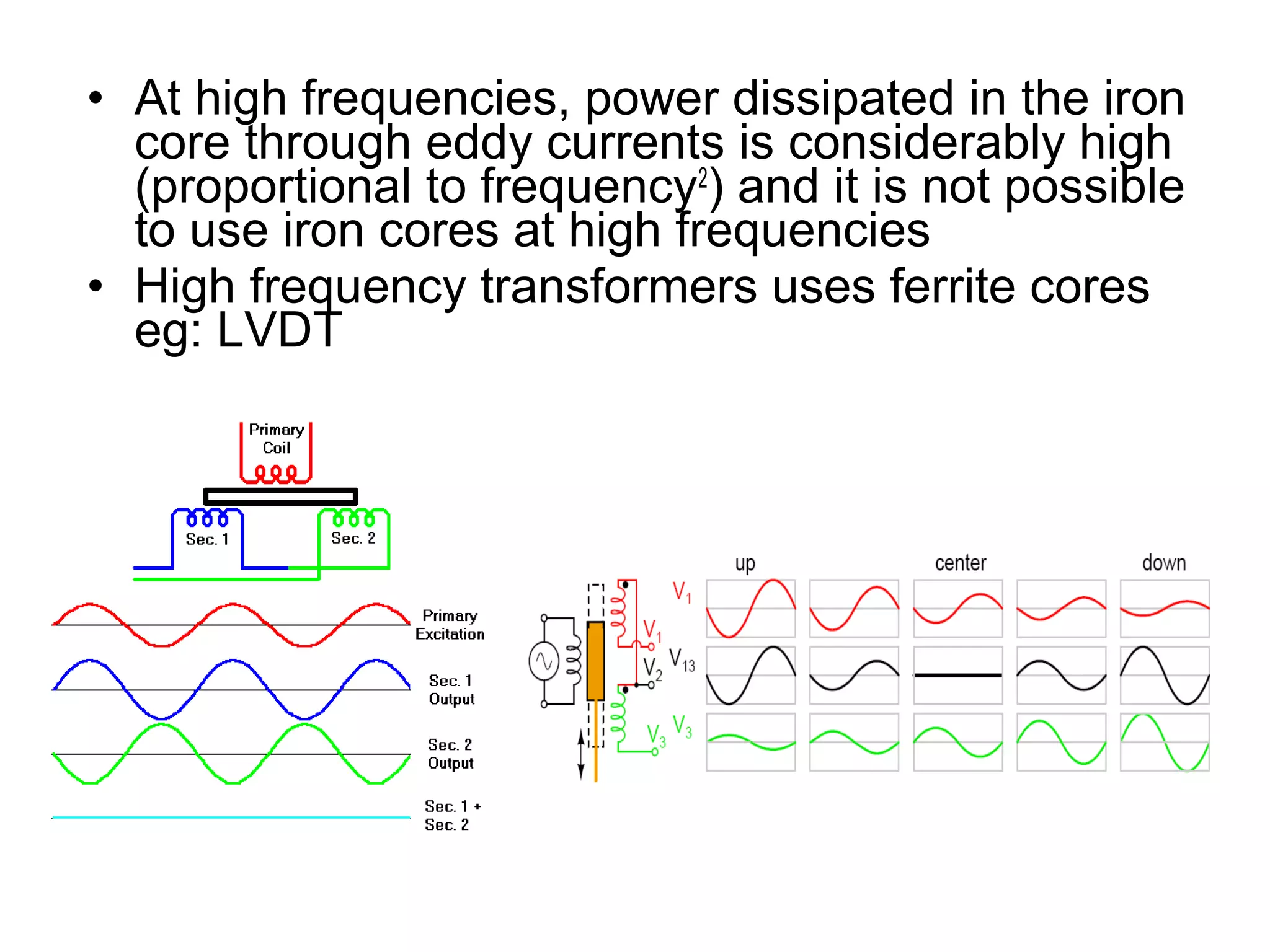
• High frequency transformers uses ferrite cores
  eg: LVDT
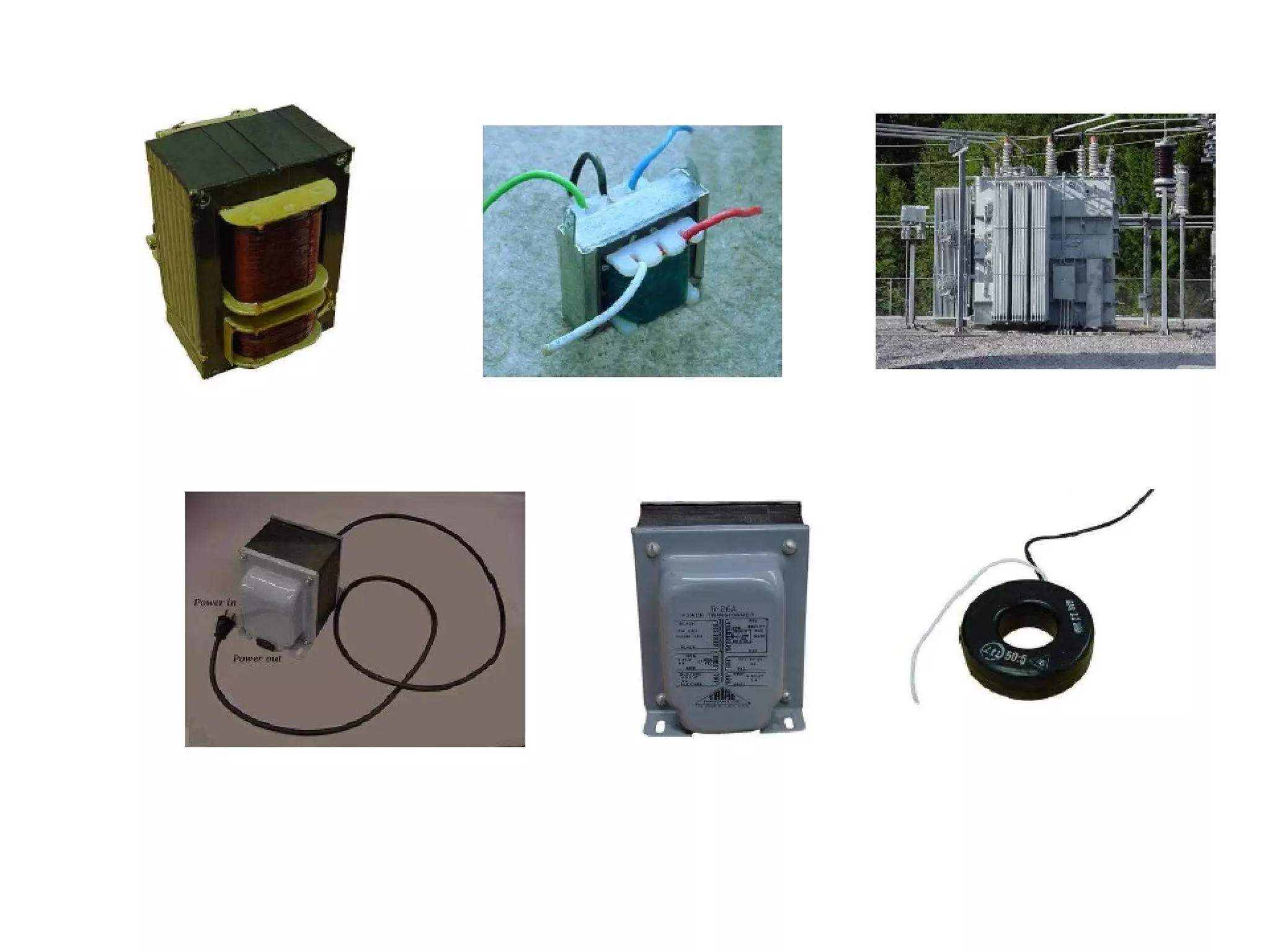
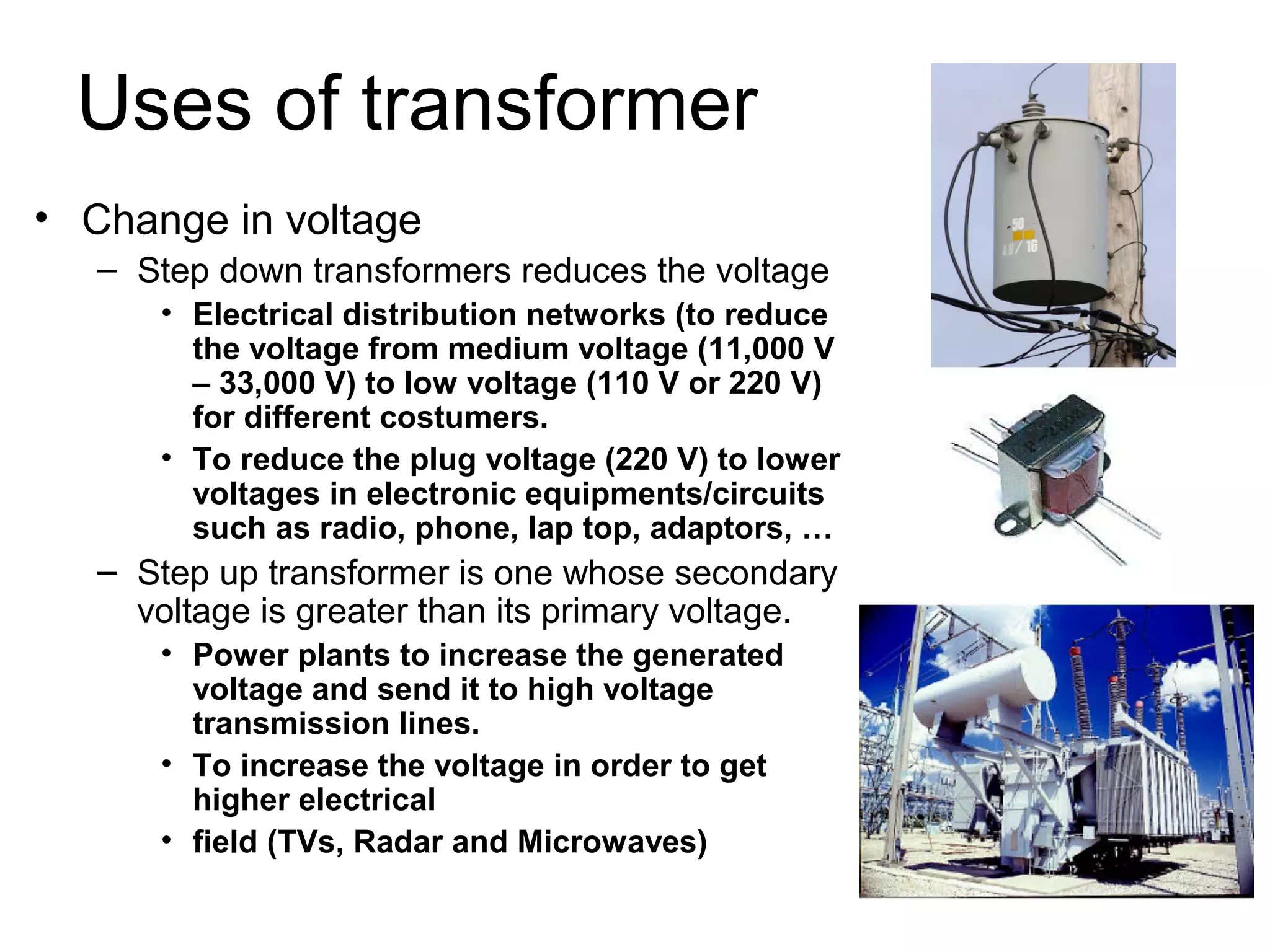
Uses of transformer
• Change in voltage
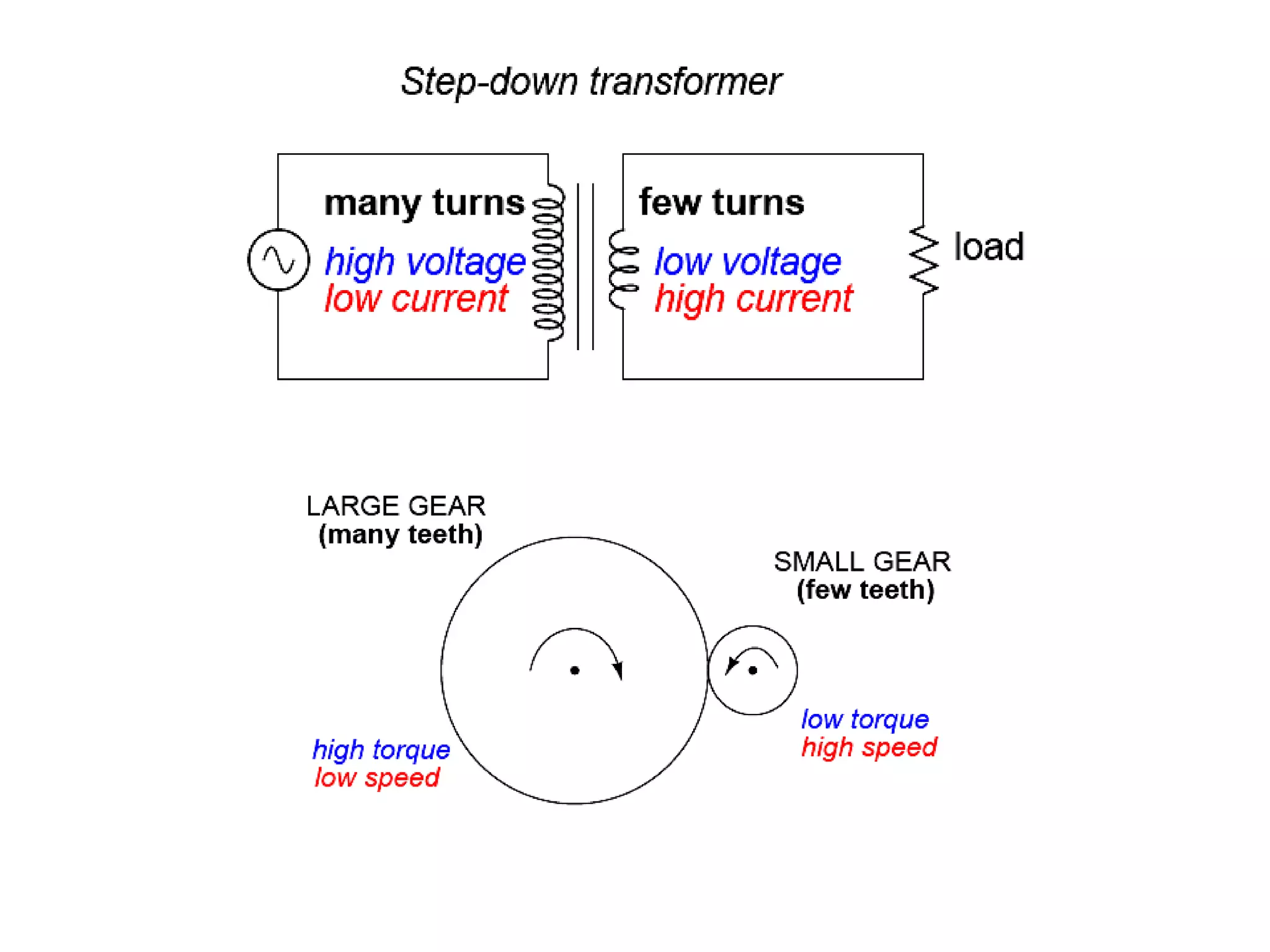
   – Step down transformers reduces the voltage
      • Electrical distribution networks (to reduce
        the voltage from medium voltage (11,000 V
        – 33,000 V) to low voltage (110 V or 220 V)
        for different costumers.
      • To reduce the plug voltage (220 V) to lower
        voltages in electronic equipments/circuits
        such as radio, phone, lap top, adaptors, …
   – Step up transformer is one whose secondary
     voltage is greater than its primary voltage.
      • Power plants to increase the generated
        voltage and send it to high voltage
        transmission lines.
      • To increase the voltage in order to get
        higher electrical
      • field (TVs, Radar and Microwaves)
• Isolation purpose
  – To electrically decouple electronics to protect from
    voltage spikes due to lightening (PABX systems)
• Current transformers for measurements and
  protection
  – Measure the current (clip on multi meters)
  – Protection devices (IGBT over current protections in
    inverters, RCCB)
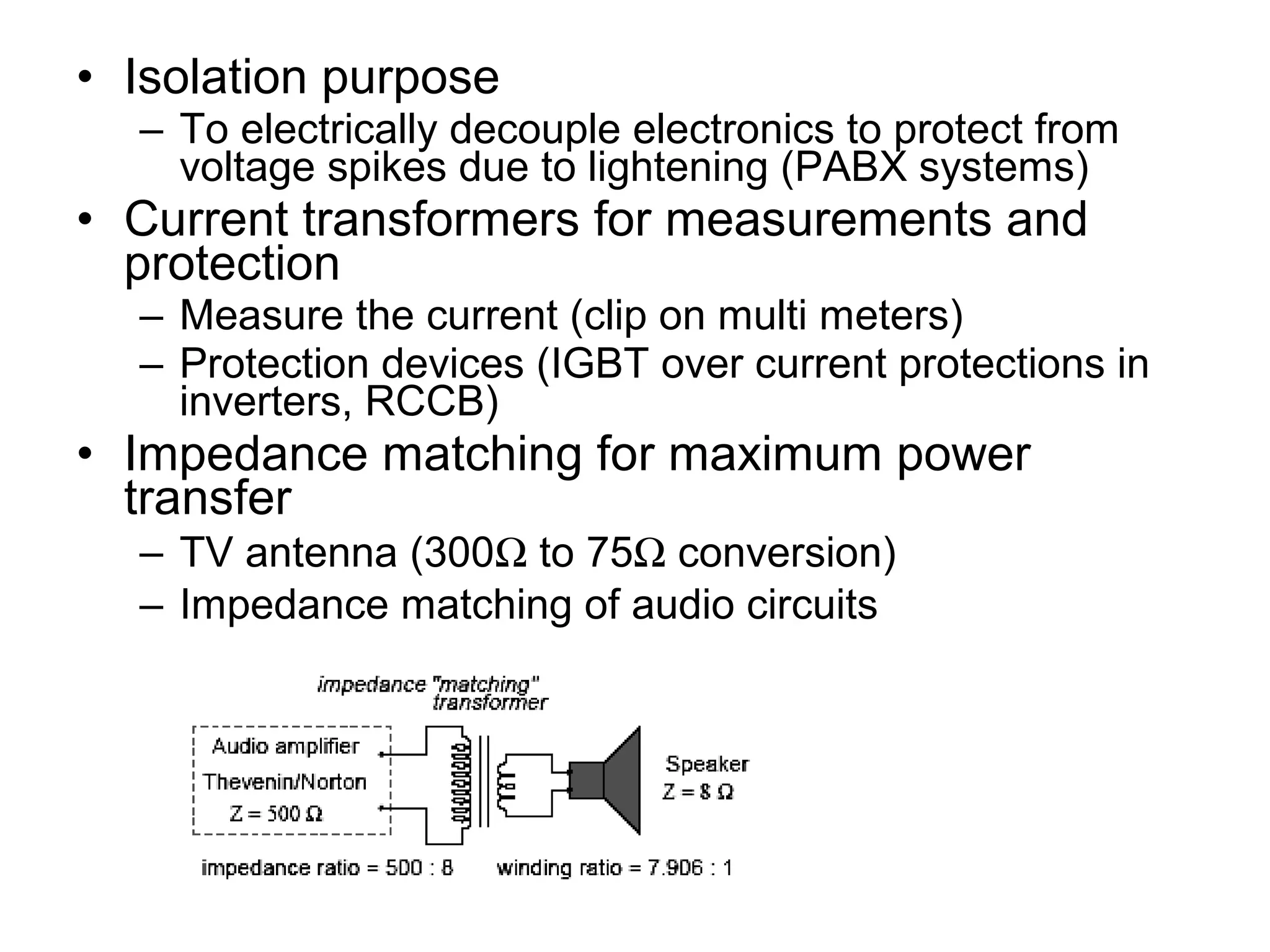
• Impedance matching for maximum power
  transfer
  – TV antenna (300Ω to 75Ω conversion)
  – Impedance matching of audio circuits
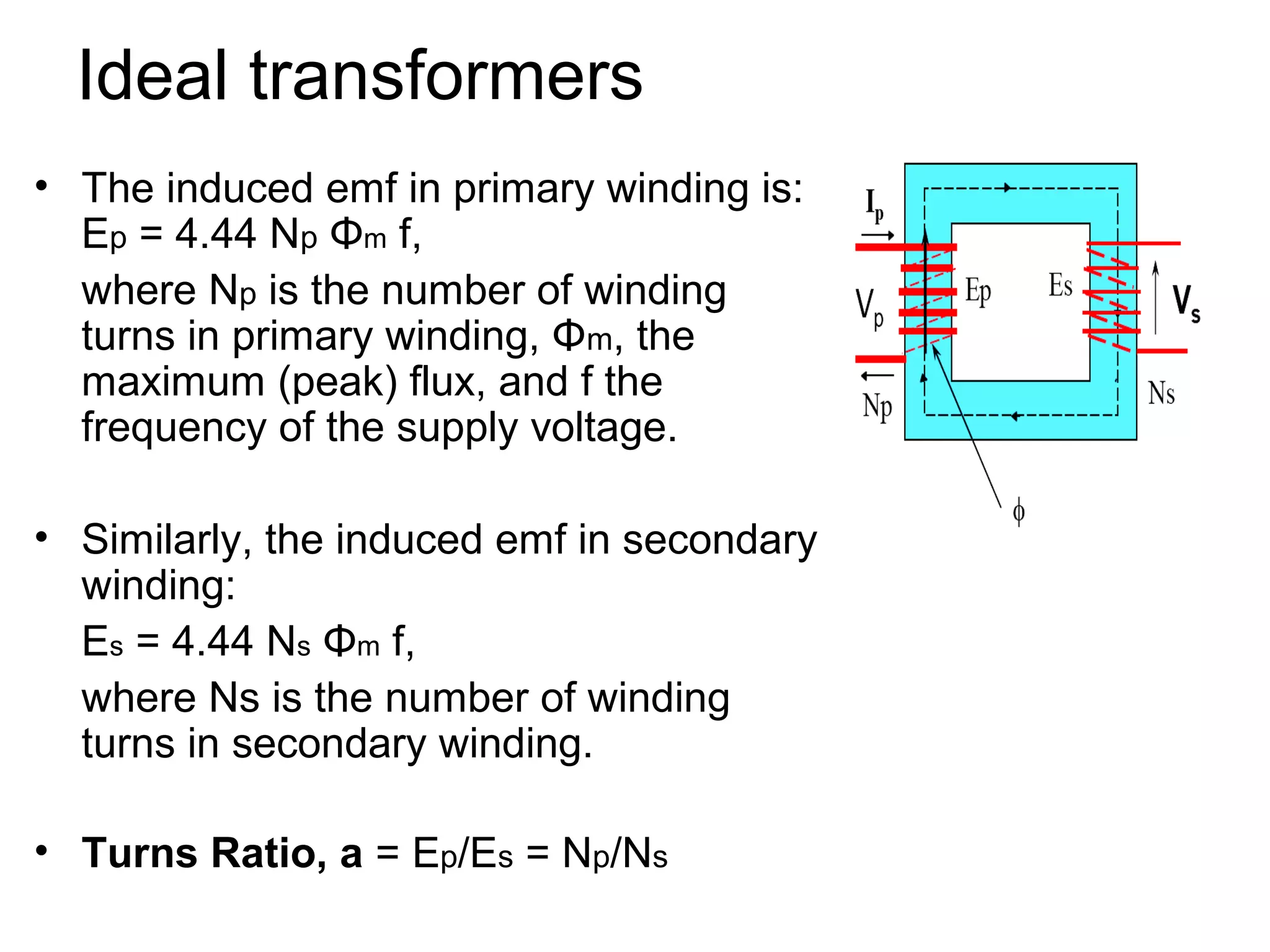
Ideal transformers
• The induced emf in primary winding is:
  Ep = 4.44 Np Φm f,
  where Np is the number of winding
  turns in primary winding, Φm, the
  maximum (peak) flux, and f the
  frequency of the supply voltage.

• Similarly, the induced emf in secondary
  winding:
  Es = 4.44 Ns Φm f,
  where Ns is the number of winding
  turns in secondary winding.

• Turns Ratio, a = Ep/Es = Np/Ns
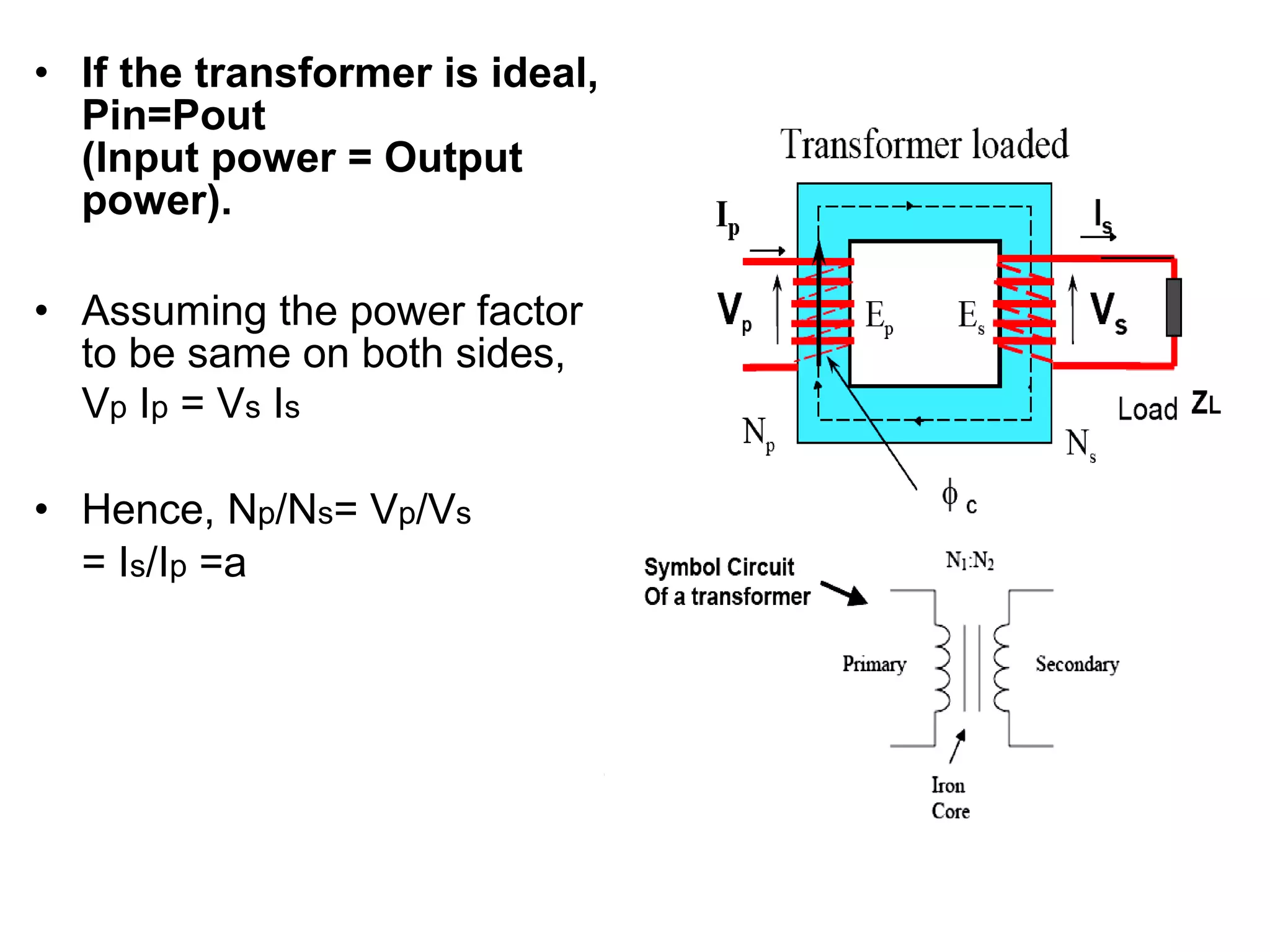
• If the transformer is ideal,
  Pin=Pout
  (Input power = Output
  power).

• Assuming the power factor
  to be same on both sides,
  Vp Ip = Vs Is

• Hence, Np/Ns= Vp/Vs
  = Is/Ip =a
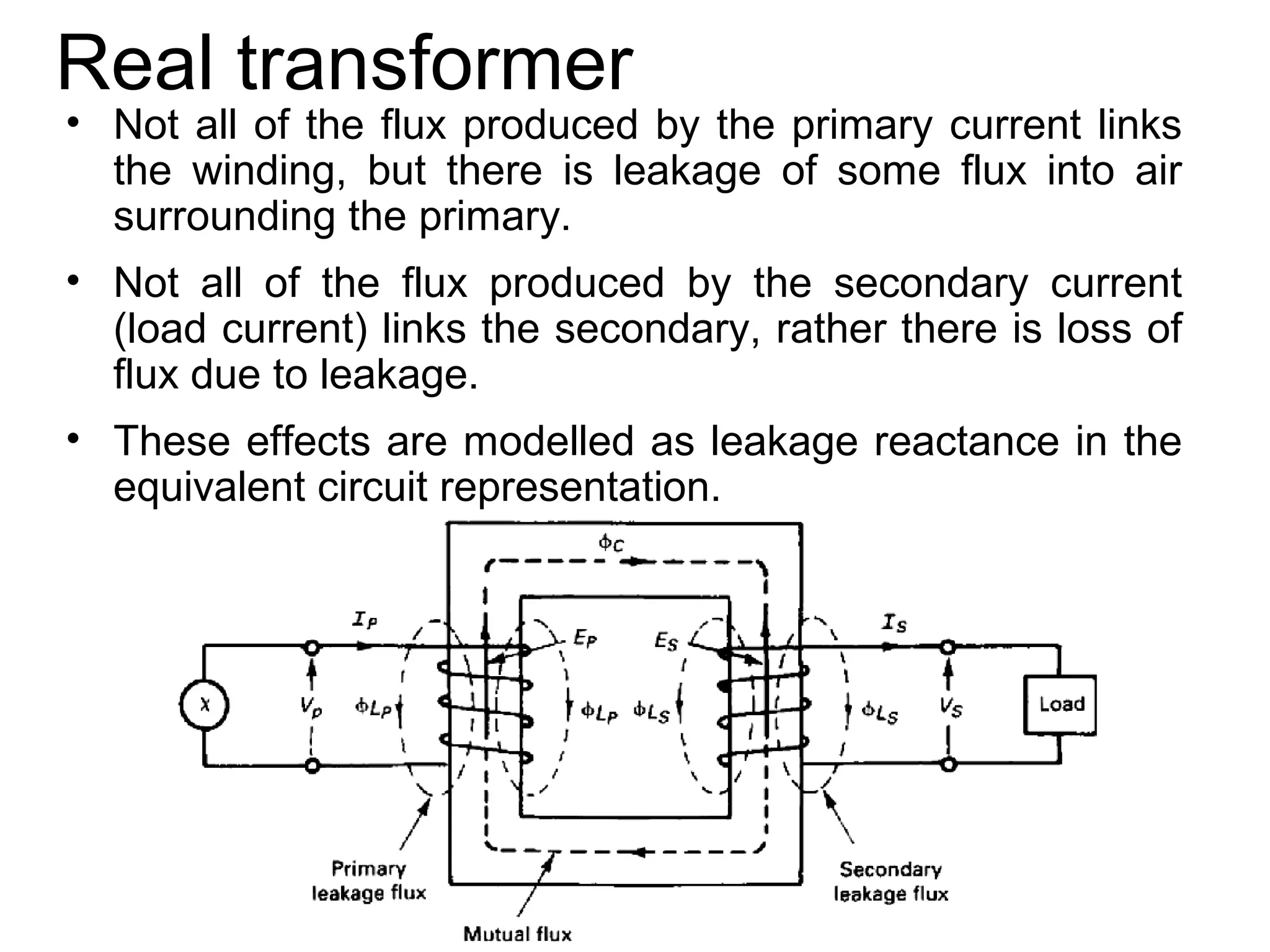
Real transformer
• Not all of the flux produced by the primary current links
  the winding, but there is leakage of some flux into air
  surrounding the primary.
• Not all of the flux produced by the secondary current
  (load current) links the secondary, rather there is loss of
  flux due to leakage.
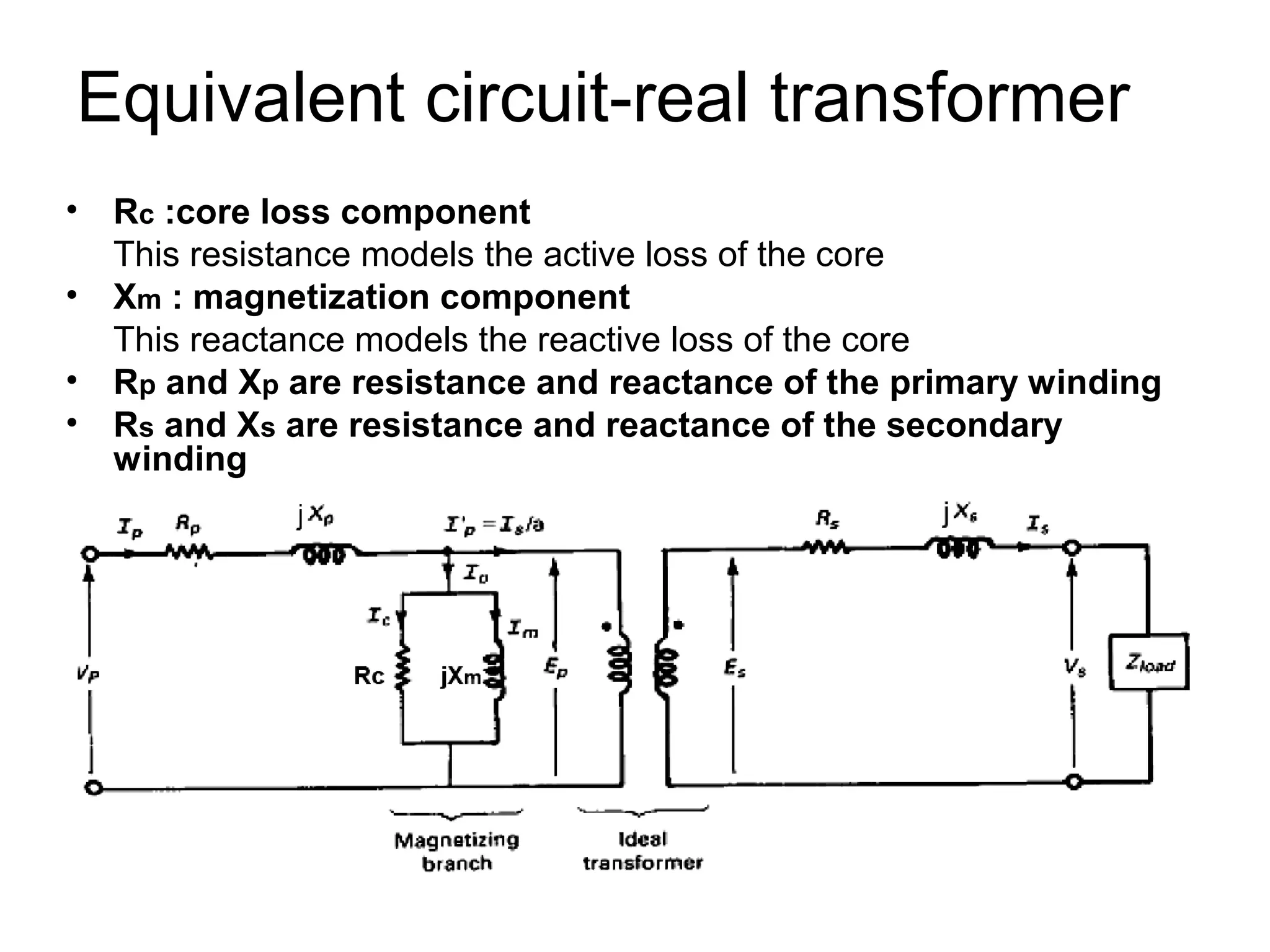
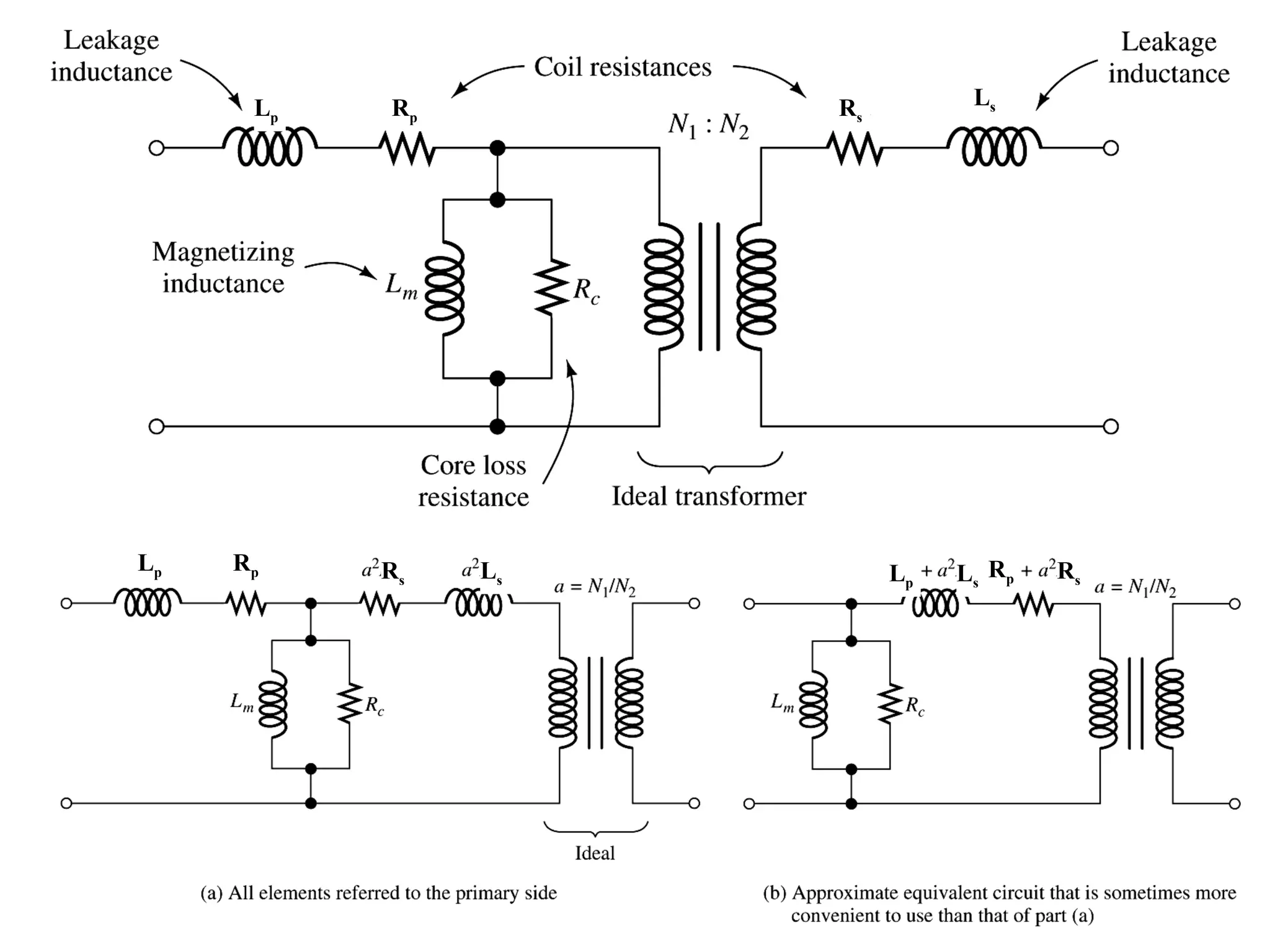
• These effects are modelled as leakage reactance in the
  equivalent circuit representation.
Equivalent circuit-real transformer
•   Rc :core loss component
    This resistance models the active loss of the core
•   Xm : magnetization component
    This reactance models the reactive loss of the core
•   Rp and Xp are resistance and reactance of the primary winding
•   Rs and Xs are resistance and reactance of the secondary
    winding
Lp   Rp        Rs         Ls


Lp   Rp    Rs   Ls        Lp   Ls Rp   Rs
Impedance transfer
• Impedance         transfer      helps to    calculate the
  current/voltage easier and get ride of the ratio for the
  rest of the calculation.
• Looking into the circuit from source side, let us define the
  impedance as         Zin = Vp/Ip
• Looking into the circuit from load side (neglecting the load
  itself), let us define the impedance as ZL = Vs/Is
• Relating Vp/Ip in terms of Vs/Is using the turns ration, a,
  [Vp/Ip]=                         a2                  [Vs/Is]
  Zin = a2 ZL
• Hence, in general, any impedance transferred from
  secondary side to primary side must be multiplied by the
  square of the turns-ratio, a2.
Example
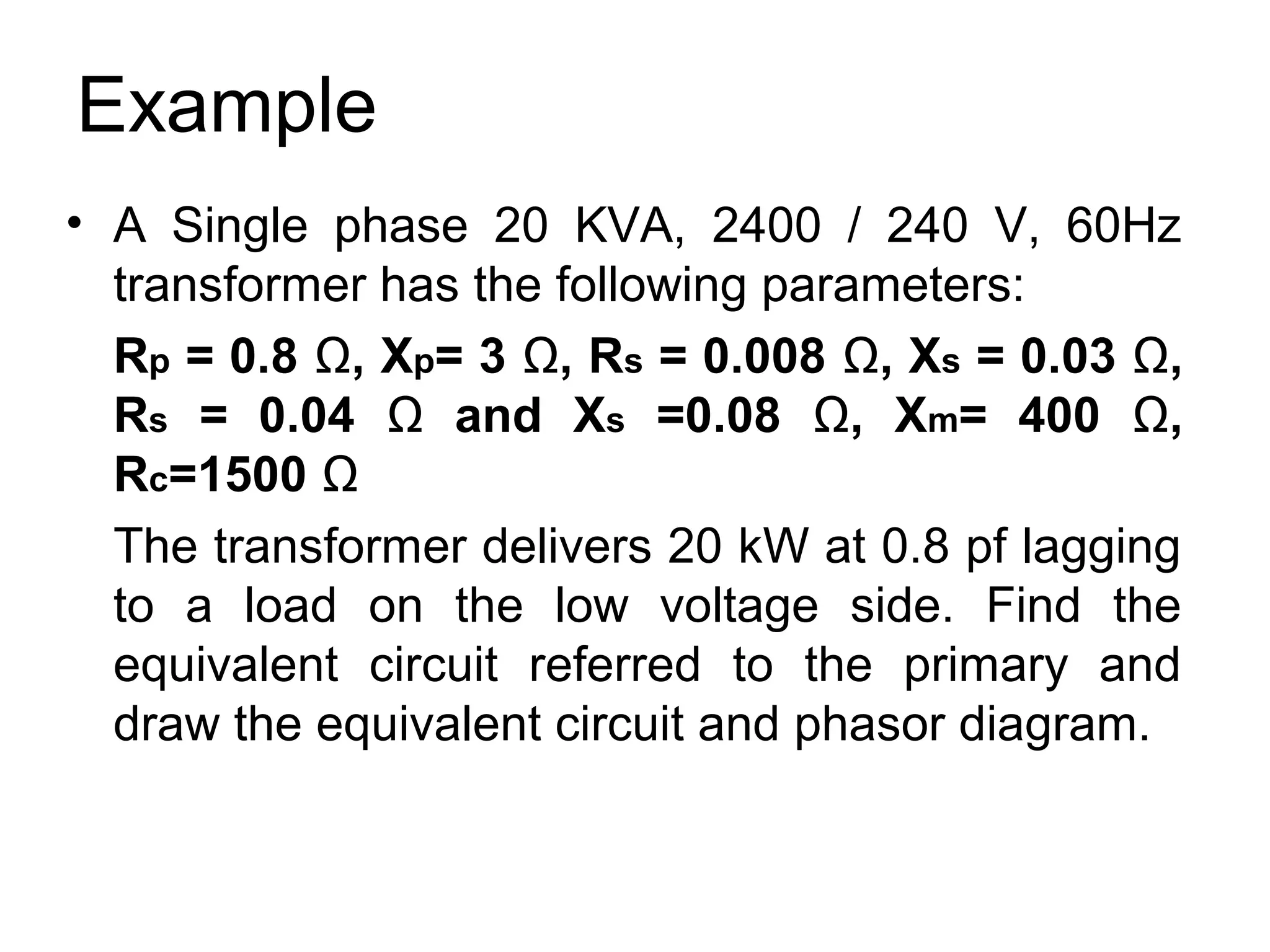
• A Single phase 20 KVA, 2400 / 240 V, 60Hz
  transformer has the following parameters:
  Rp = 0.8 Ω, Xp= 3 Ω, Rs = 0.008 Ω, Xs = 0.03 Ω,
  Rs = 0.04 Ω and Xs =0.08 Ω, Xm= 400 Ω,
  Rc=1500 Ω
  The transformer delivers 20 kW at 0.8 pf lagging
  to a load on the low voltage side. Find the
  equivalent circuit referred to the primary and
  draw the equivalent circuit and phasor diagram.
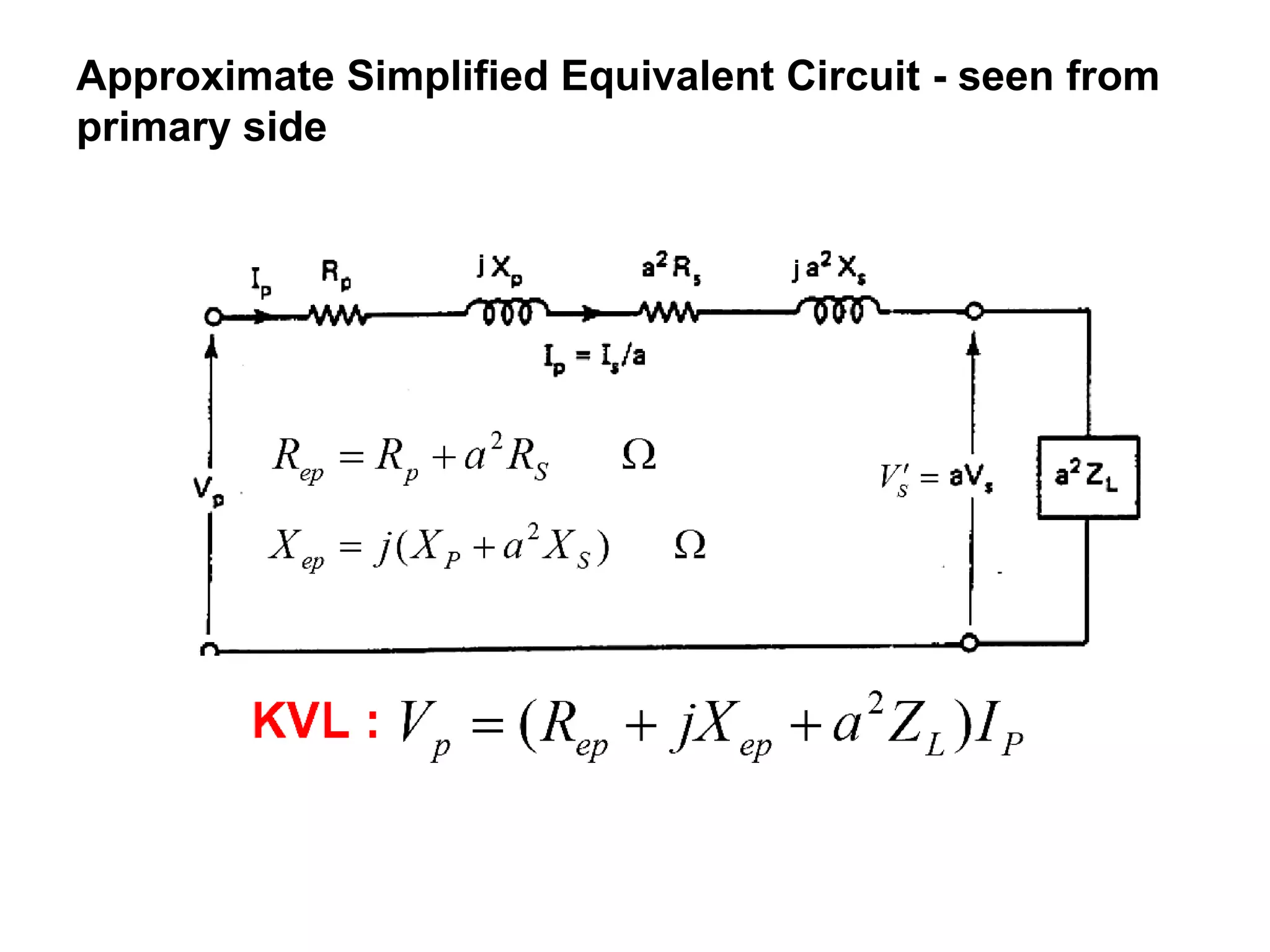
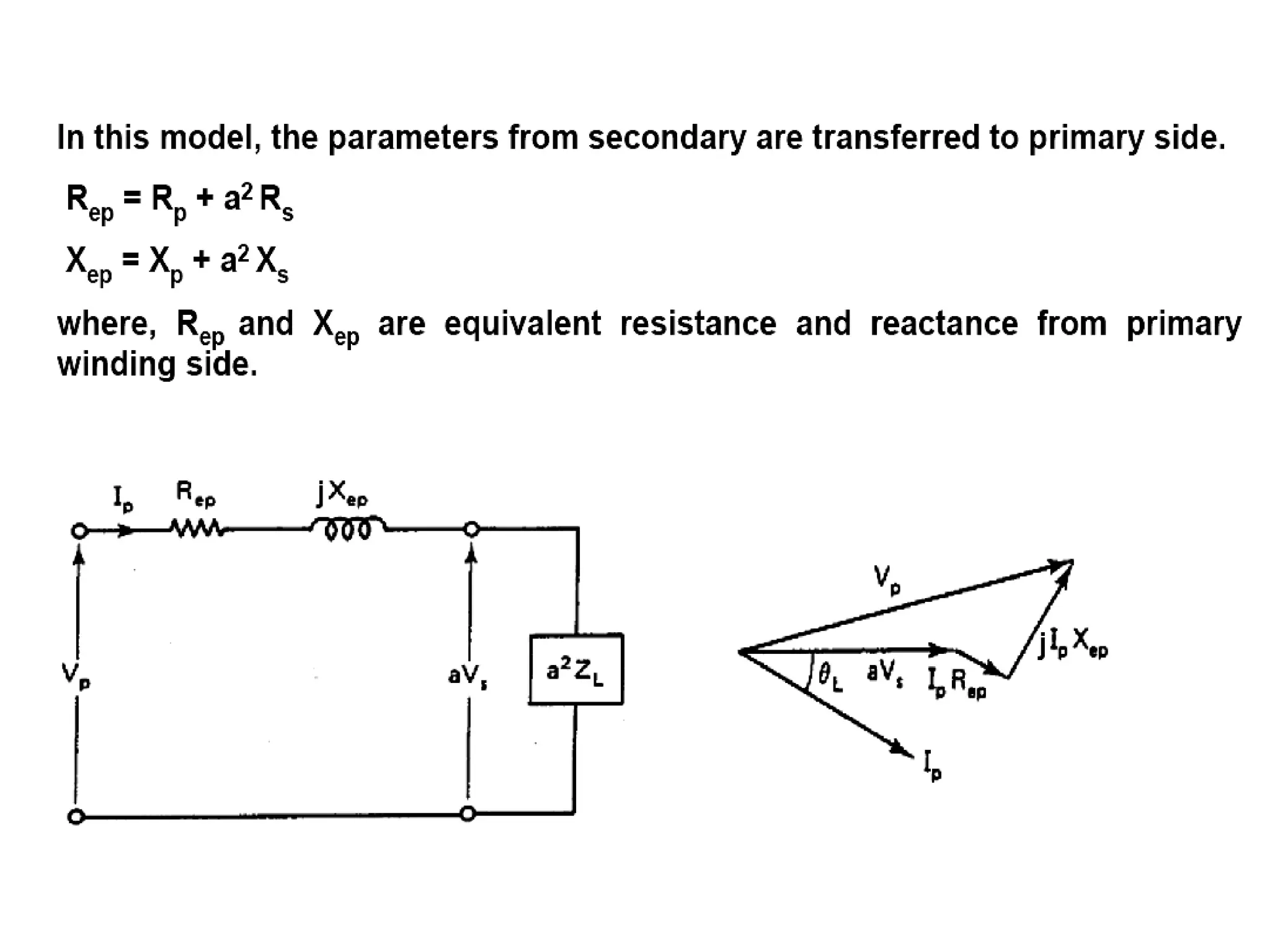
Approximate Simplified Equivalent Circuit - seen from
primary side
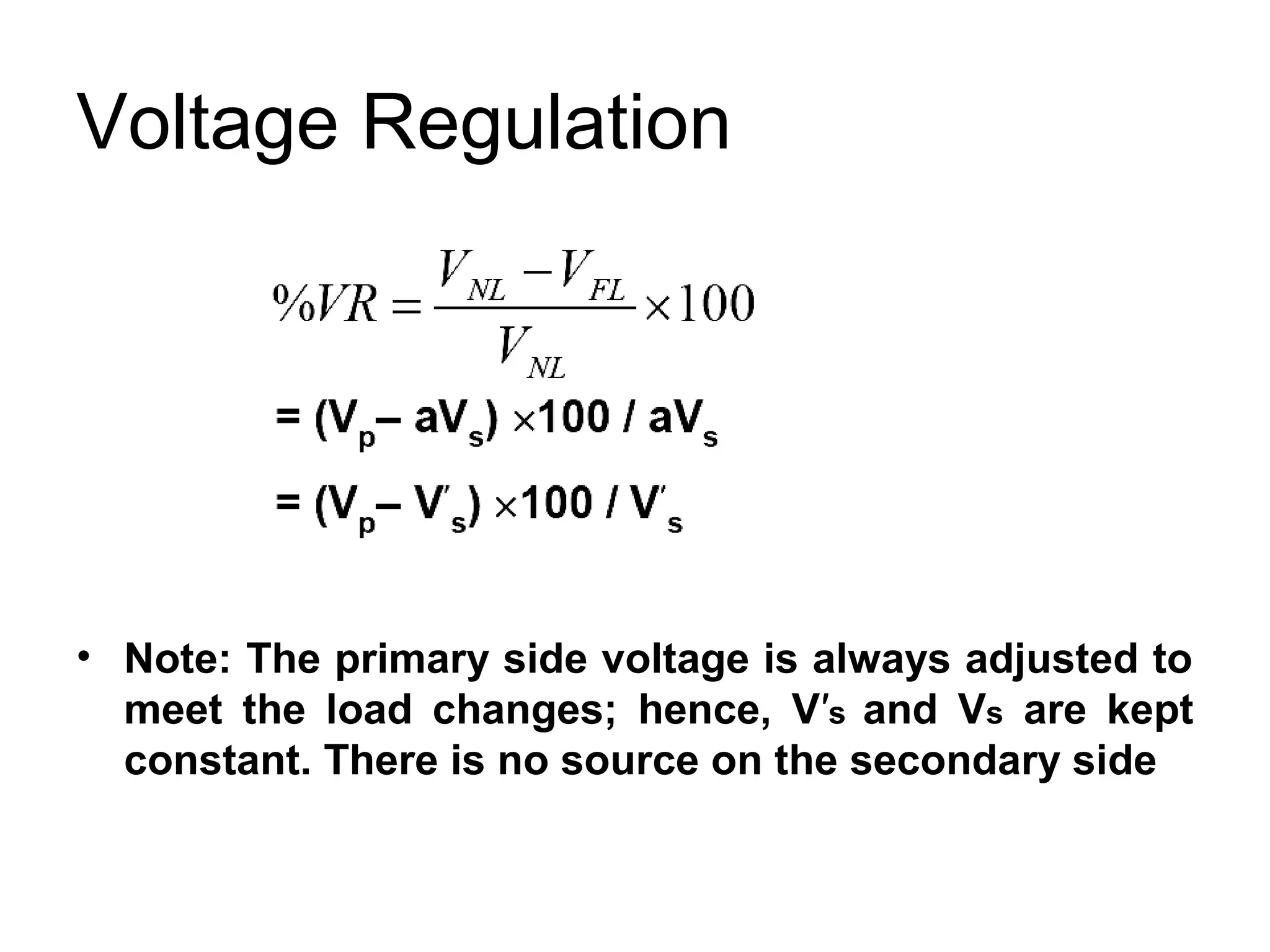
Voltage Regulation


• Note: The primary side voltage is always adjusted to
  meet the load changes; hence, V′s and Vs are kept
  constant. There is no source on the secondary side
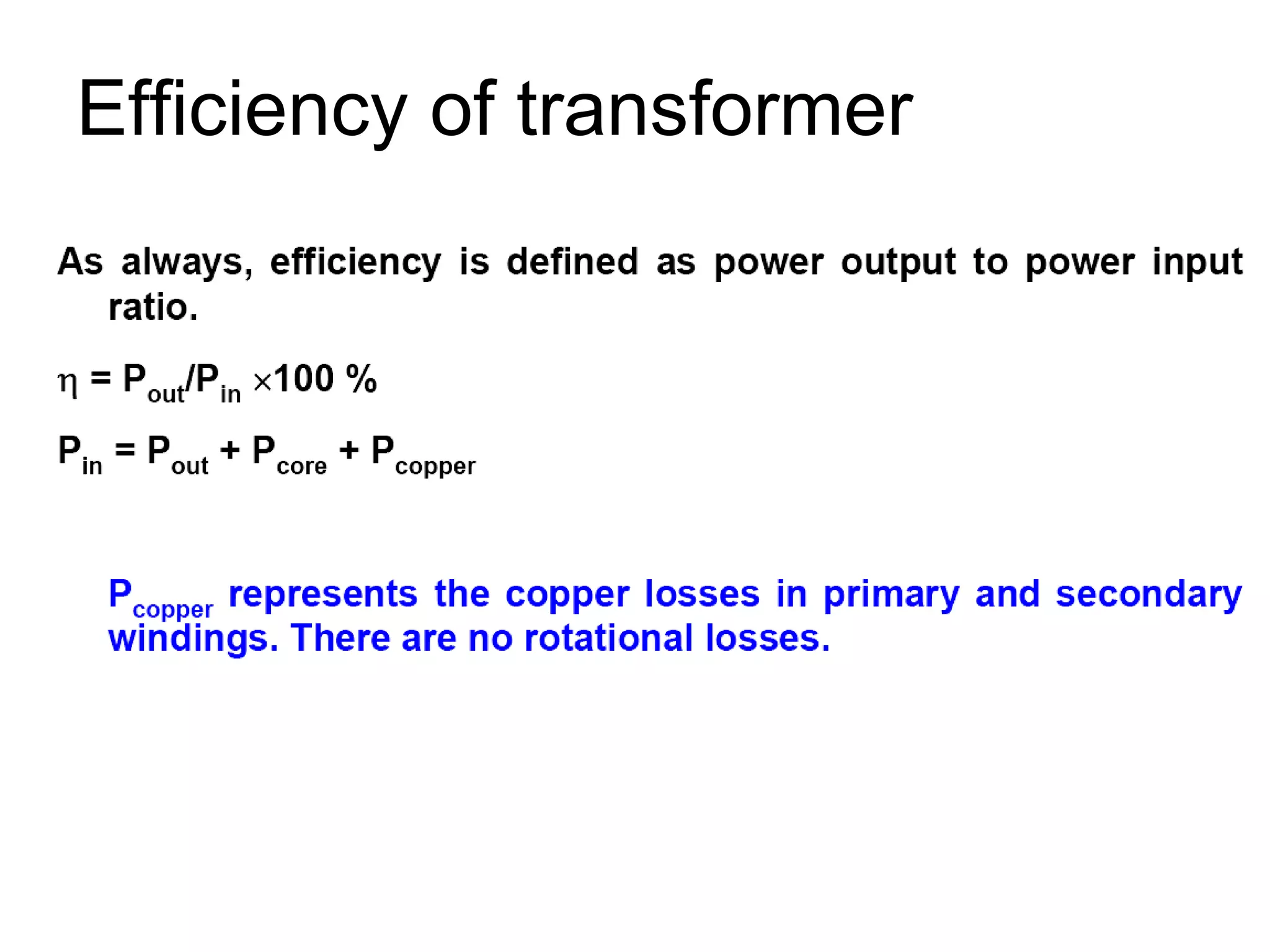
Efficiency of transformer
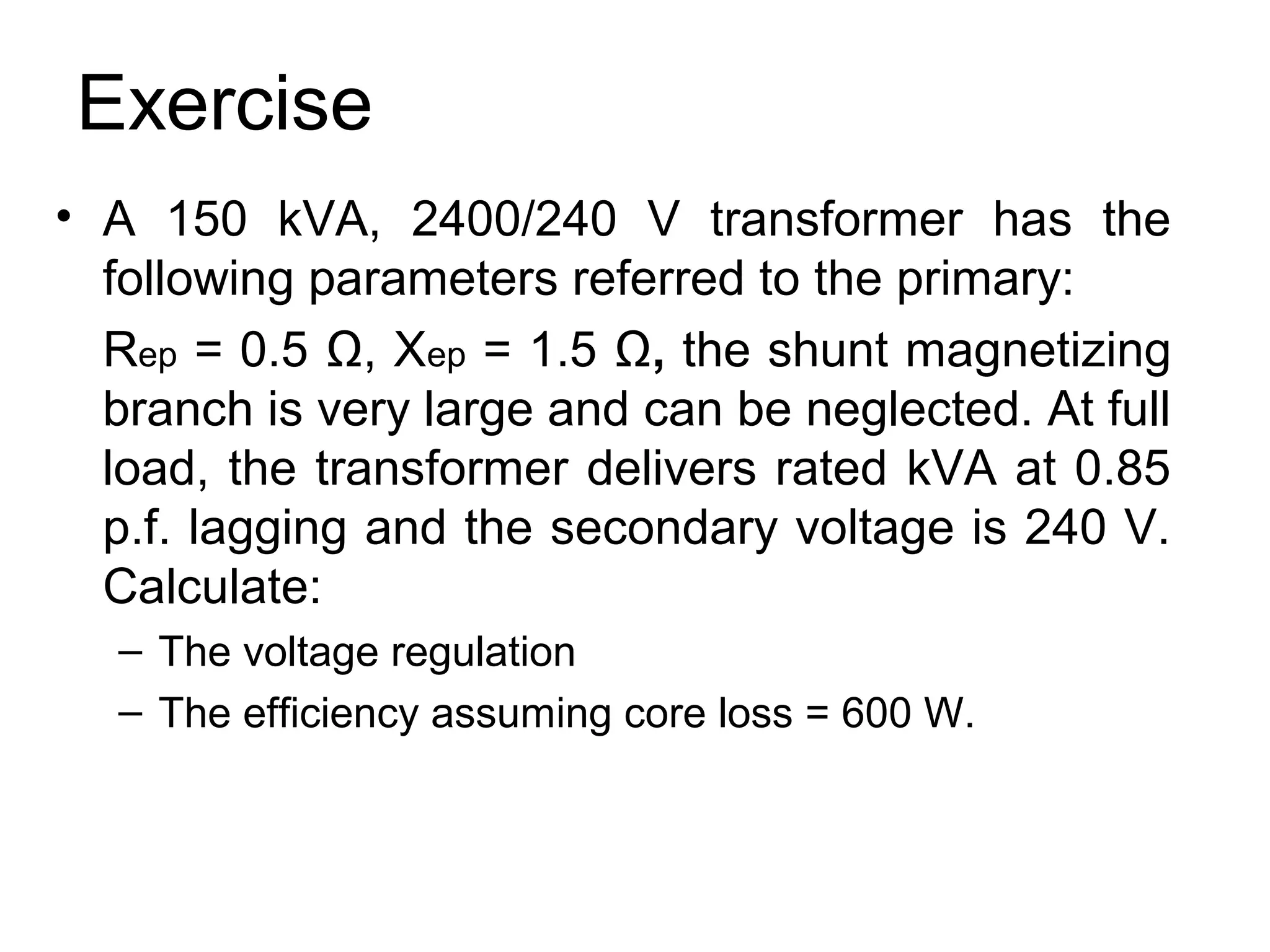
Exercise
• A 150 kVA, 2400/240 V transformer has the
  following parameters referred to the primary:
  Rep = 0.5 Ω, Xep = 1.5 Ω, the shunt magnetizing
  branch is very large and can be neglected. At full
  load, the transformer delivers rated kVA at 0.85
  p.f. lagging and the secondary voltage is 240 V.
  Calculate:
  – The voltage regulation
  – The efficiency assuming core loss = 600 W.
Maximum average power transfer
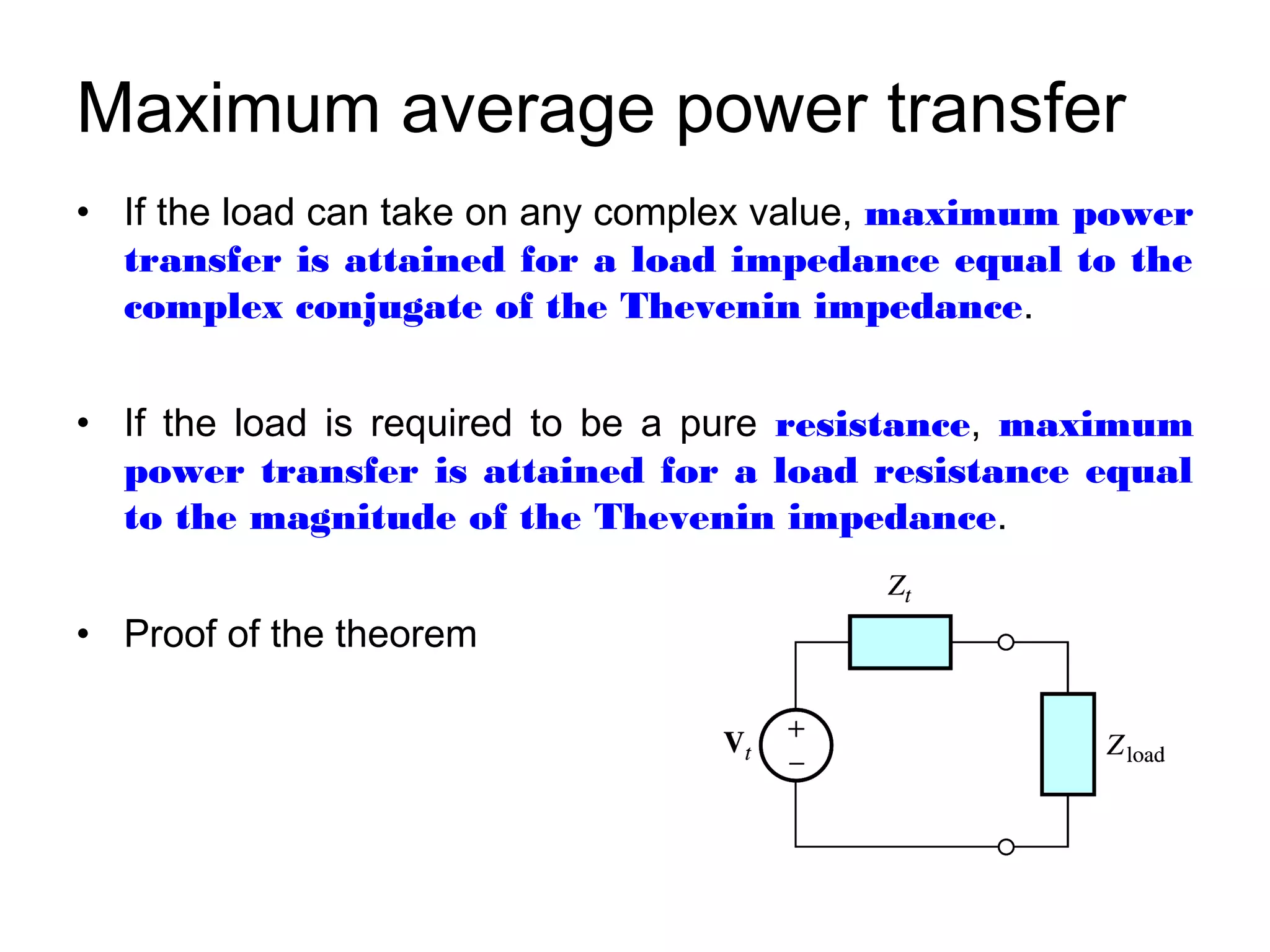
• If the load can take on any complex value, maximum power
  transfer is attained for a load impedance equal to the
  complex conjugate of the Thevenin impedance.


• If the load is required to be a pure resistance, maximum
  power transfer is attained for a load resistance equal
  to the magnitude of the Thevenin impedance.


• Proof of the theorem

Engineering science lesson 10 1

  • 1.
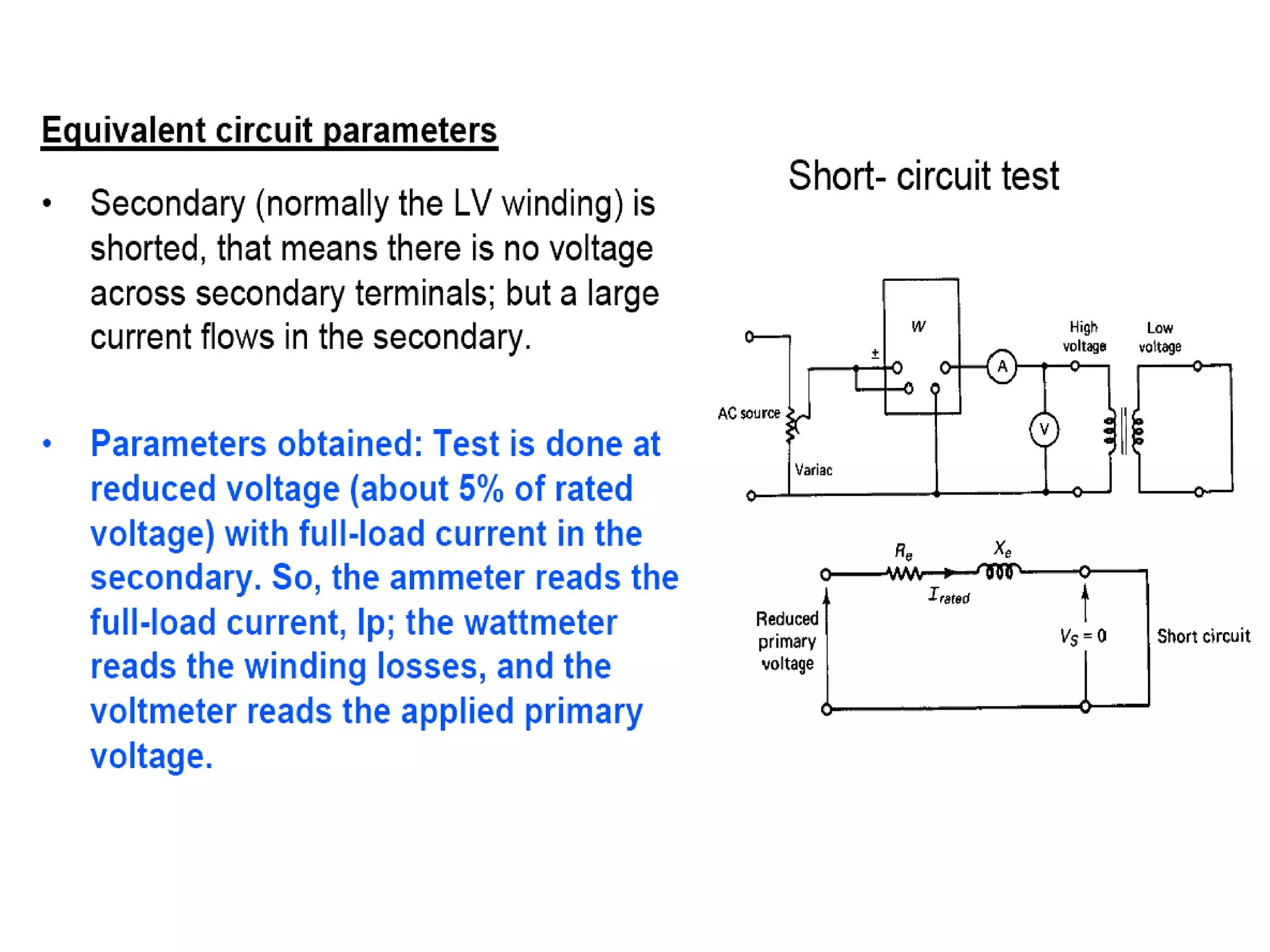
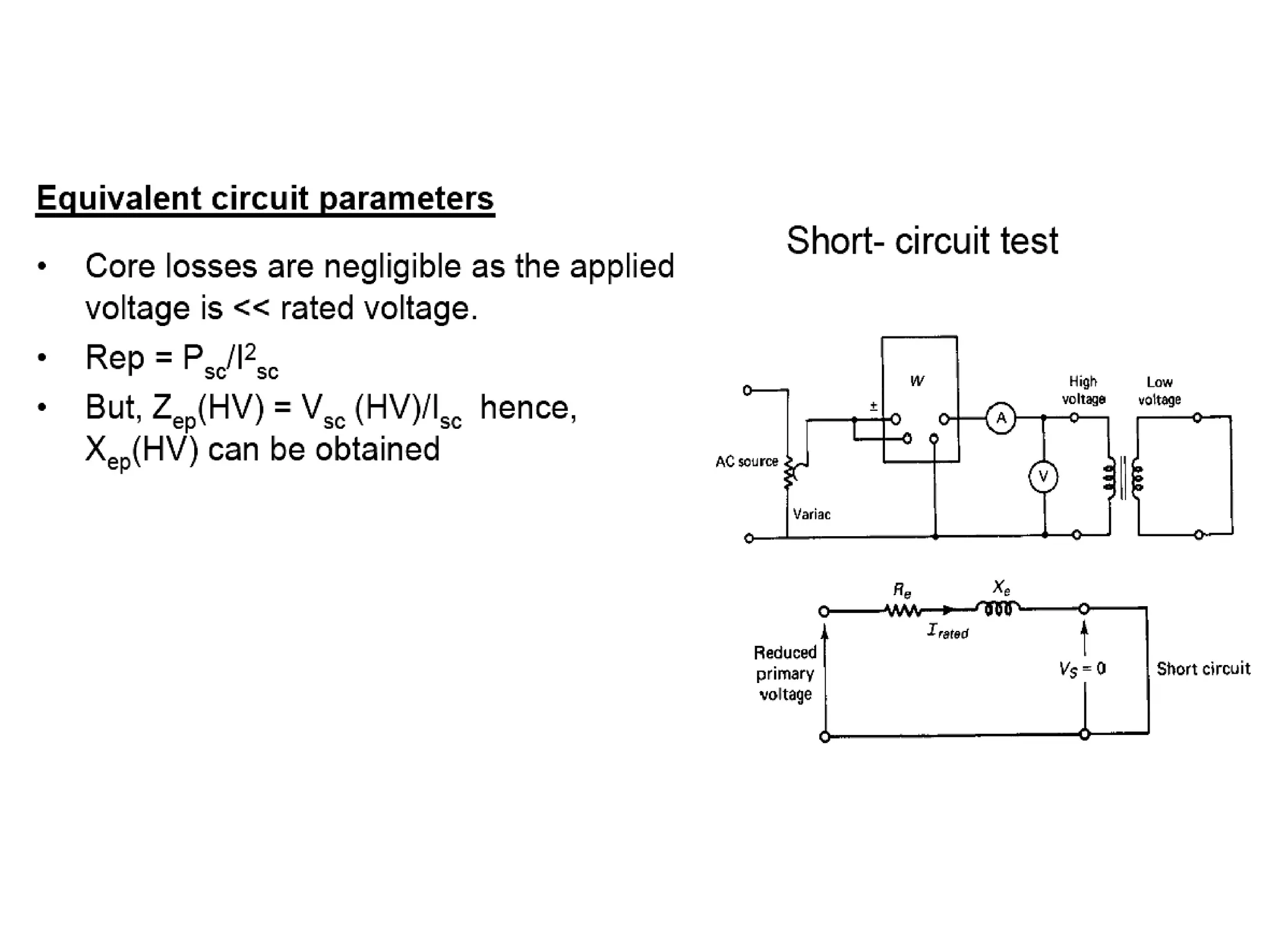
    Chapter 3- DCand AC theory 3.3 Transformers 3.3.1 high and low frequency 3.3.2 transformation ratio 3.3.3 current transformation 3.3.4 unloaded transformer 3.3.5 input impedance 3.3.6 maximum power transfer 3.3.7 transformer losses
  • 3.
    Transformers • A transformeris a stationary electric machine which transfers electrical energy (power) from one voltage level to another voltage level. • Unlike in rotating machines, there is no electrical to mechanical energy conversion . • A transformer is a static device and all currents and voltages are AC. • The transfer of energy takes place through the magnetic field.
  • 4.
    Transformer principle • Ithas 2 electric circuits called primary and secondary. • A magnetic circuit provides the link between primary and secondary. • When an AC voltage is applied to the primary winding (Vp) of the transformer, an AC current will result (Ip). Ip sets up a time-varying magnetic flux φ in the core. • A voltage is induced to the secondary circuit (Vs) according to the Farday’s law.
  • 5.
    • The magnetic(iron) core is made of thin laminated steel. • The reason of using laminated steel is to minimizing the eddy current loss by reducing thickness (t): Peddy ∝ f 2 and t2 • 2 common cross section of core is square or rectangular ) for small transformers and circular (stepped ) for the large and 3 phase transformers.
  • 6.
    • 1- Core(U/I) Type: is constructed from a stack of U- and I-shaped laminations. In a core-type transformer, the primary and secondary windings are wound on two different legs of the core. • 2- Shell Type: A shell-type transformer is constructed from a stack of E- and I-shaped laminations. In a shell-type transformer, the primary and secondary windings are wound on the same leg of the core, as concentric windings, one on top of the other one.
  • 7.
    • At highfrequencies, power dissipated in the iron core through eddy currents is considerably high (proportional to frequency2) and it is not possible to use iron cores at high frequencies • High frequency transformers uses ferrite cores eg: LVDT
  • 8.
    Uses of transformer •Change in voltage – Step down transformers reduces the voltage • Electrical distribution networks (to reduce the voltage from medium voltage (11,000 V – 33,000 V) to low voltage (110 V or 220 V) for different costumers. • To reduce the plug voltage (220 V) to lower voltages in electronic equipments/circuits such as radio, phone, lap top, adaptors, … – Step up transformer is one whose secondary voltage is greater than its primary voltage. • Power plants to increase the generated voltage and send it to high voltage transmission lines. • To increase the voltage in order to get higher electrical • field (TVs, Radar and Microwaves)
  • 10.
    • Isolation purpose – To electrically decouple electronics to protect from voltage spikes due to lightening (PABX systems) • Current transformers for measurements and protection – Measure the current (clip on multi meters) – Protection devices (IGBT over current protections in inverters, RCCB) • Impedance matching for maximum power transfer – TV antenna (300Ω to 75Ω conversion) – Impedance matching of audio circuits
  • 11.
    Ideal transformers • Theinduced emf in primary winding is: Ep = 4.44 Np Φm f, where Np is the number of winding turns in primary winding, Φm, the maximum (peak) flux, and f the frequency of the supply voltage. • Similarly, the induced emf in secondary winding: Es = 4.44 Ns Φm f, where Ns is the number of winding turns in secondary winding. • Turns Ratio, a = Ep/Es = Np/Ns
  • 12.
    • If thetransformer is ideal, Pin=Pout (Input power = Output power). • Assuming the power factor to be same on both sides, Vp Ip = Vs Is • Hence, Np/Ns= Vp/Vs = Is/Ip =a
  • 13.
    Real transformer • Notall of the flux produced by the primary current links the winding, but there is leakage of some flux into air surrounding the primary. • Not all of the flux produced by the secondary current (load current) links the secondary, rather there is loss of flux due to leakage. • These effects are modelled as leakage reactance in the equivalent circuit representation.
  • 14.
    Equivalent circuit-real transformer • Rc :core loss component This resistance models the active loss of the core • Xm : magnetization component This reactance models the reactive loss of the core • Rp and Xp are resistance and reactance of the primary winding • Rs and Xs are resistance and reactance of the secondary winding
  • 15.
    Lp Rp Rs Ls Lp Rp Rs Ls Lp Ls Rp Rs
  • 16.
    Impedance transfer • Impedance transfer helps to calculate the current/voltage easier and get ride of the ratio for the rest of the calculation. • Looking into the circuit from source side, let us define the impedance as Zin = Vp/Ip • Looking into the circuit from load side (neglecting the load itself), let us define the impedance as ZL = Vs/Is • Relating Vp/Ip in terms of Vs/Is using the turns ration, a, [Vp/Ip]= a2 [Vs/Is] Zin = a2 ZL • Hence, in general, any impedance transferred from secondary side to primary side must be multiplied by the square of the turns-ratio, a2.
  • 17.
    Example • A Singlephase 20 KVA, 2400 / 240 V, 60Hz transformer has the following parameters: Rp = 0.8 Ω, Xp= 3 Ω, Rs = 0.008 Ω, Xs = 0.03 Ω, Rs = 0.04 Ω and Xs =0.08 Ω, Xm= 400 Ω, Rc=1500 Ω The transformer delivers 20 kW at 0.8 pf lagging to a load on the low voltage side. Find the equivalent circuit referred to the primary and draw the equivalent circuit and phasor diagram.
  • 18.
    Approximate Simplified EquivalentCircuit - seen from primary side
  • 20.
    Voltage Regulation • Note:The primary side voltage is always adjusted to meet the load changes; hence, V′s and Vs are kept constant. There is no source on the secondary side
  • 21.
  • 22.
    Exercise • A 150kVA, 2400/240 V transformer has the following parameters referred to the primary: Rep = 0.5 Ω, Xep = 1.5 Ω, the shunt magnetizing branch is very large and can be neglected. At full load, the transformer delivers rated kVA at 0.85 p.f. lagging and the secondary voltage is 240 V. Calculate: – The voltage regulation – The efficiency assuming core loss = 600 W.
  • 27.
    Maximum average powertransfer • If the load can take on any complex value, maximum power transfer is attained for a load impedance equal to the complex conjugate of the Thevenin impedance. • If the load is required to be a pure resistance, maximum power transfer is attained for a load resistance equal to the magnitude of the Thevenin impedance. • Proof of the theorem