
Module content
•       Chapter 1: Static engineering systems
    –     Simply supported beams
    –     Beams and columns
    –     Torsion in circular shafts
•       Chapter 2: Dynamic engineering systems
    –     Uniform acceleration
    –     Energy transfer
    –     Oscillating mechanical systems
•       Chapter 3: DC and AC theory
    –     DC electrical principles
    –     AC circuits
    –     Transformers
•       Chapter 4: Information and energy control systems
    –     Information systems
    –     Energy flow control systems
    –     Interface system components
Chapter 2- Dynamic Engineering Systems
  2.1   Uniform acceleration
         •   linear and angular acceleration
         •   Newton’s laws of motion
         •   mass, moment of inertia and radius of gyration of rotating components
         •   combined linear and angular motion
         •   effects of friction
  2.2   Energy transfer
         •   gravitational potential energy
         •   linear and angular kinetic energy
         •   strain energy
         •   principle of conservation of energy
         •   work-energy transfer in systems with combine linear and angular motion
         •   effects of impact loading
  2.3   Oscillating mechanical systems
         • simple harmonic motion
         • linear and transverse systems;
         • qualitative description of the effects of forcing and damping
Outcomes and Assessment criteria
To achieve each outcome in chapter 2 a
learner must demonstrate the ability to:
Analyse dynamic engineering systems
  – determine the behaviour of dynamic mechanical
    systems in which uniform acceleration is present

  – determine the effects    of   energy   transfer   in
    mechanical systems
  – determine the behaviour of oscillating mechanical
    systems
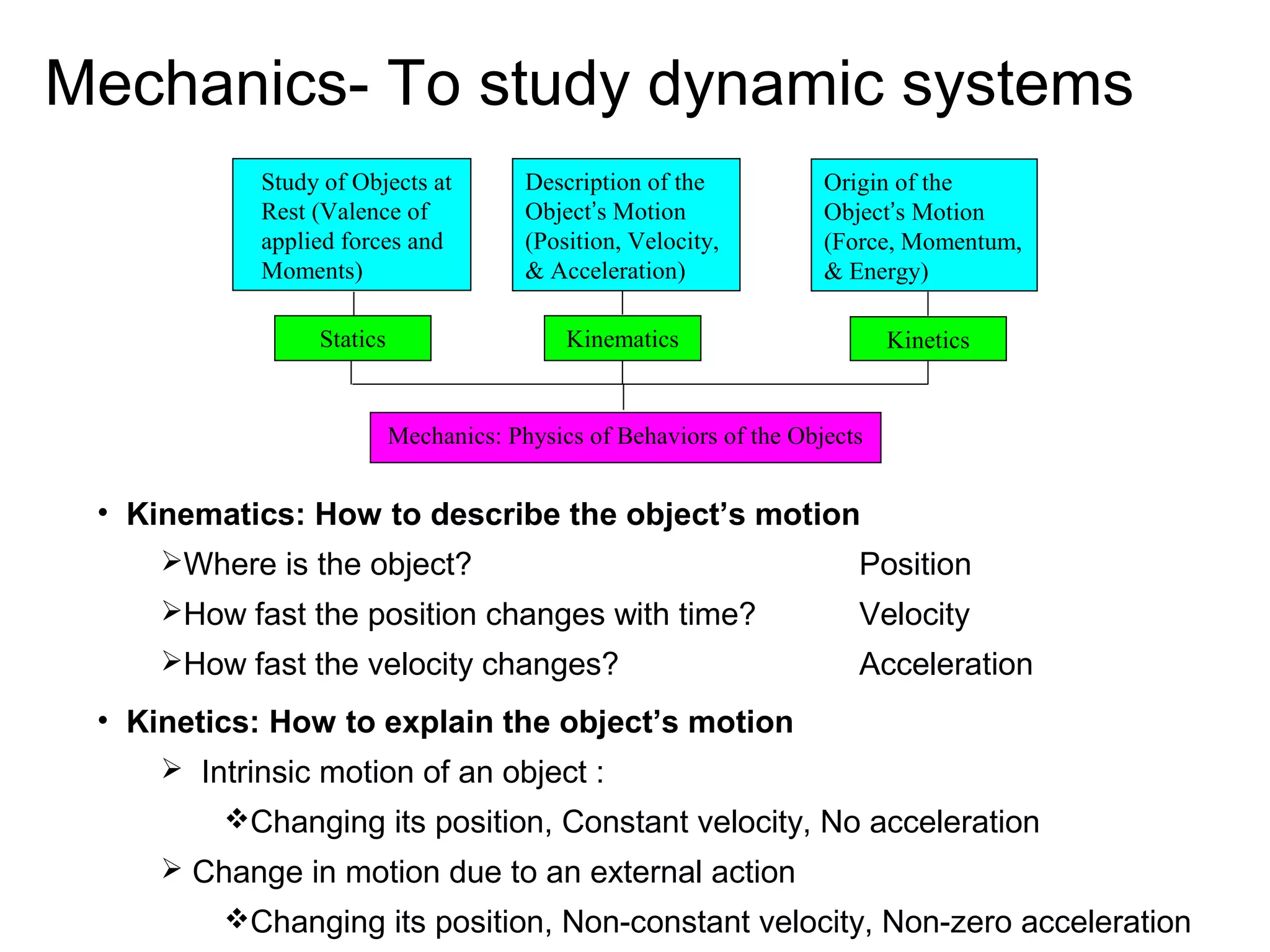
Mechanics- To study dynamic systems
            Study of Objects at         Description of the           Origin of the
            Rest (Valence of            Object’s Motion              Object’s Motion
            applied forces and          (Position, Velocity,         (Force, Momentum,
            Moments)                    & Acceleration)              & Energy)

                 Statics                    Kinematics                      Kinetics


                           Mechanics: Physics of Behaviors of the Objects


 • Kinematics: How to describe the object’s motion
     Where is the object?                                              Position
     How fast the position changes with time?                          Velocity
     How fast the velocity changes?                                    Acceleration
 • Kinetics: How to explain the object’s motion
      Intrinsic motion of an object :
         Changing its position, Constant velocity, No acceleration
      Change in motion due to an external action
         Changing its position, Non-constant velocity, Non-zero acceleration
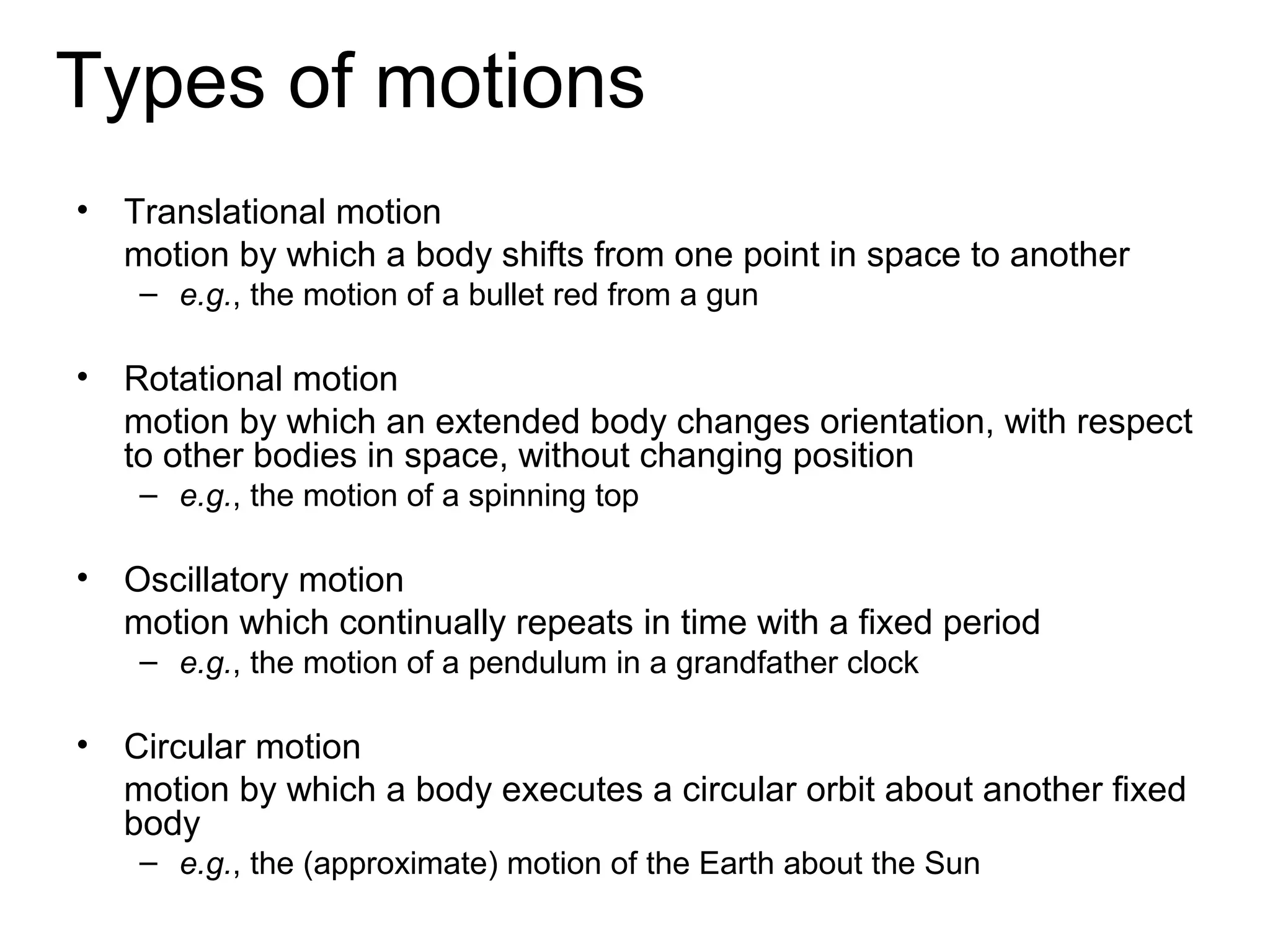
Types of motions
•   Translational motion
    motion by which a body shifts from one point in space to another
     – e.g., the motion of a bullet red from a gun

•   Rotational motion
    motion by which an extended body changes orientation, with respect
    to other bodies in space, without changing position
     – e.g., the motion of a spinning top

•   Oscillatory motion
    motion which continually repeats in time with a fixed period
     – e.g., the motion of a pendulum in a grandfather clock

•   Circular motion
    motion by which a body executes a circular orbit about another fixed
    body
     – e.g., the (approximate) motion of the Earth about the Sun
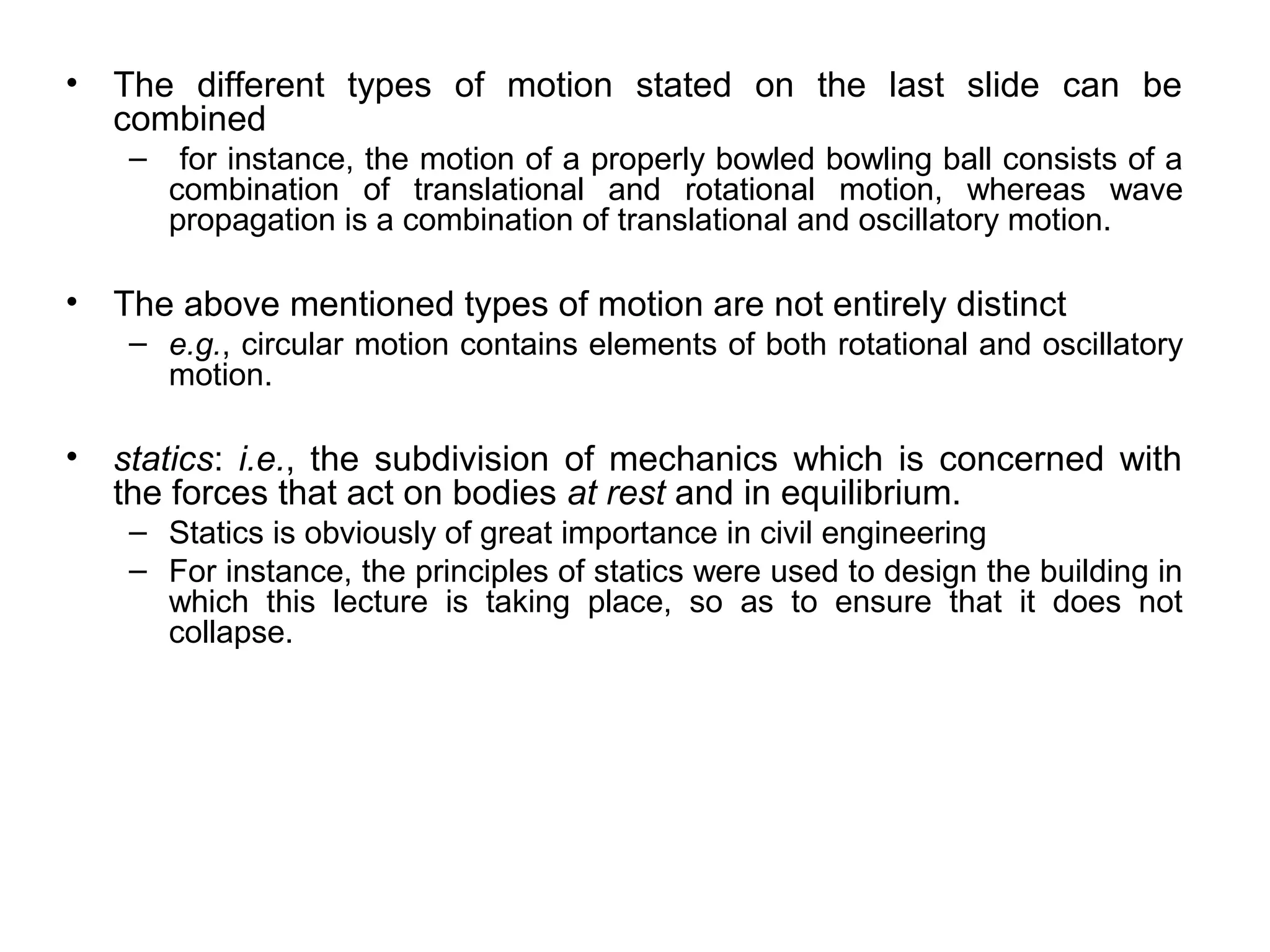
•   The different types of motion stated on the last slide can be
    combined
     –    for instance, the motion of a properly bowled bowling ball consists of a
         combination of translational and rotational motion, whereas wave
         propagation is a combination of translational and oscillatory motion.

•   The above mentioned types of motion are not entirely distinct
     – e.g., circular motion contains elements of both rotational and oscillatory
       motion.

•   statics: i.e., the subdivision of mechanics which is concerned with
    the forces that act on bodies at rest and in equilibrium.
     – Statics is obviously of great importance in civil engineering
     – For instance, the principles of statics were used to design the building in
       which this lecture is taking place, so as to ensure that it does not
       collapse.
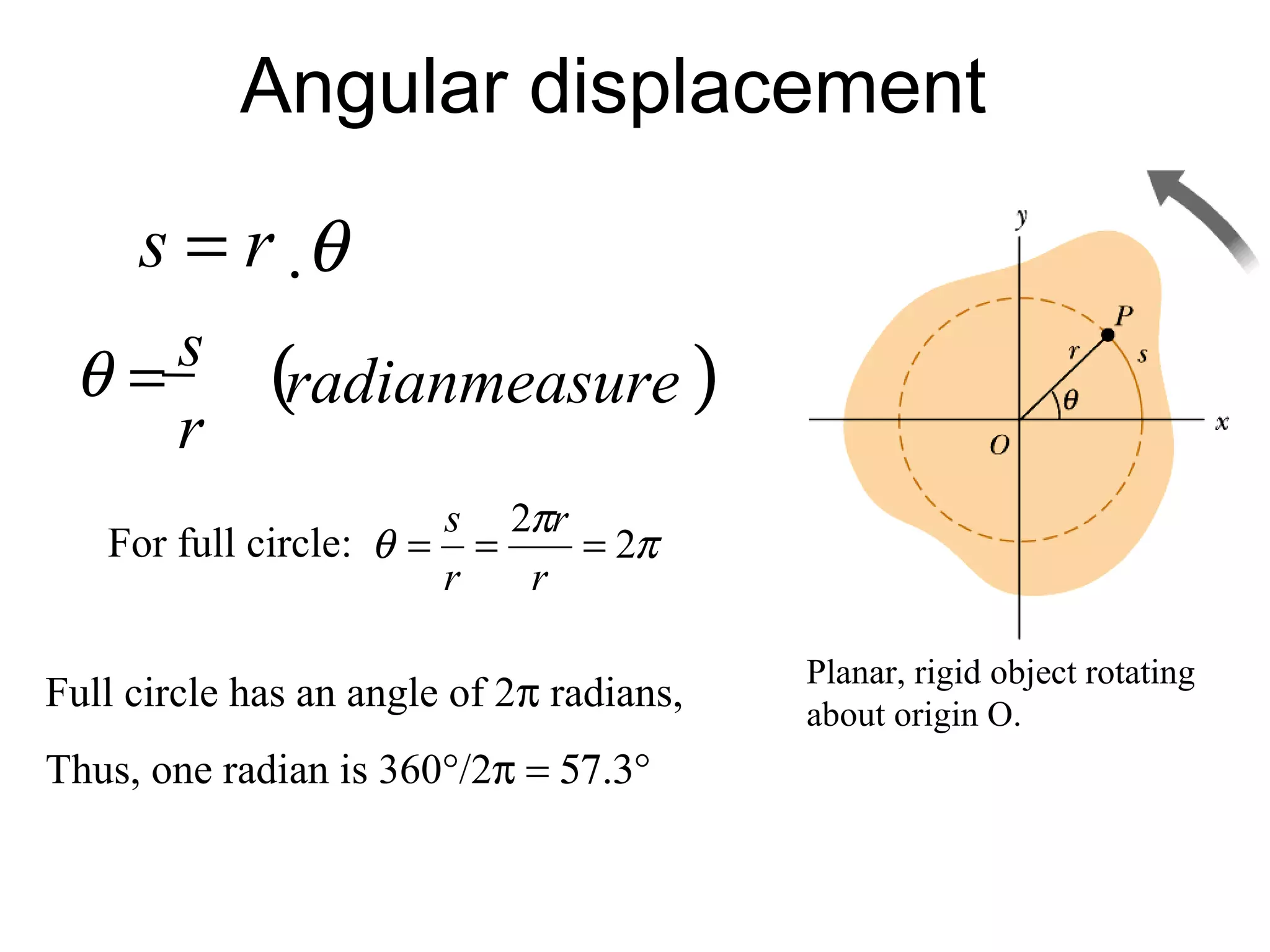
Angular displacement
     s = r ⋅θ
    s
 θ=          (radianmeasure )
    r
                          s 2πr
   For full circle: θ =     =   = 2π
                          r   r

                                          Planar, rigid object rotating
Full circle has an angle of 2π radians,   about origin O.
Thus, one radian is 360°/2π = 57.3°
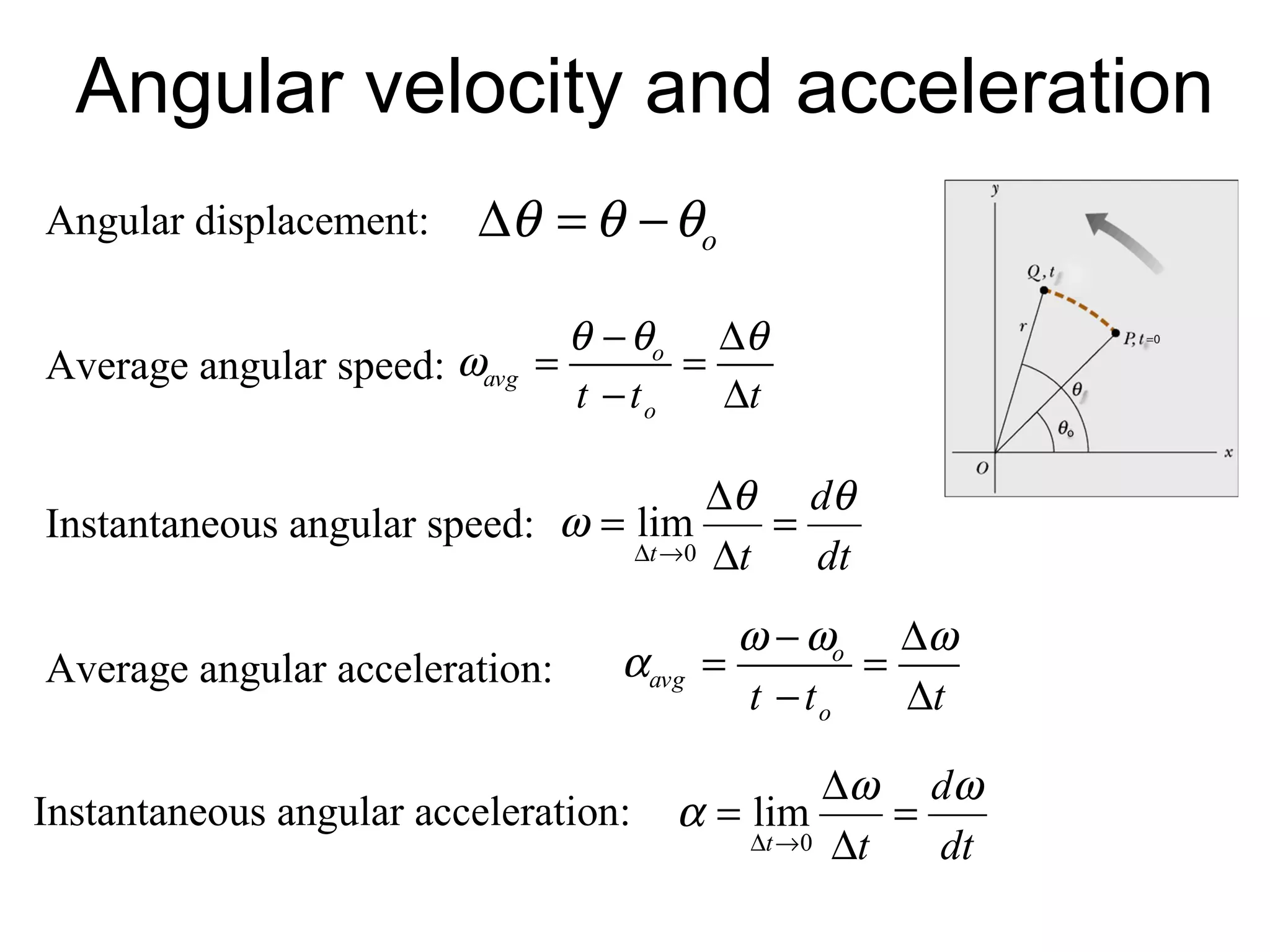
Angular velocity and acceleration
Angular displacement:     ∆θ = θ − θo

                                θ − θ o ∆θ
Average angular speed: ωavg   =        =
                                t − to   ∆t

                                       ∆θ dθ
Instantaneous angular speed: ω = lim      =
                                 ∆t →0 ∆t   dt
                                           ω − ωo ∆ω
Average angular acceleration:     αavg =          =
                                           t − to   ∆t

                                                ∆ω dω
Instantaneous angular acceleration:   α = lim      =
                                          ∆t →0 ∆t   dt
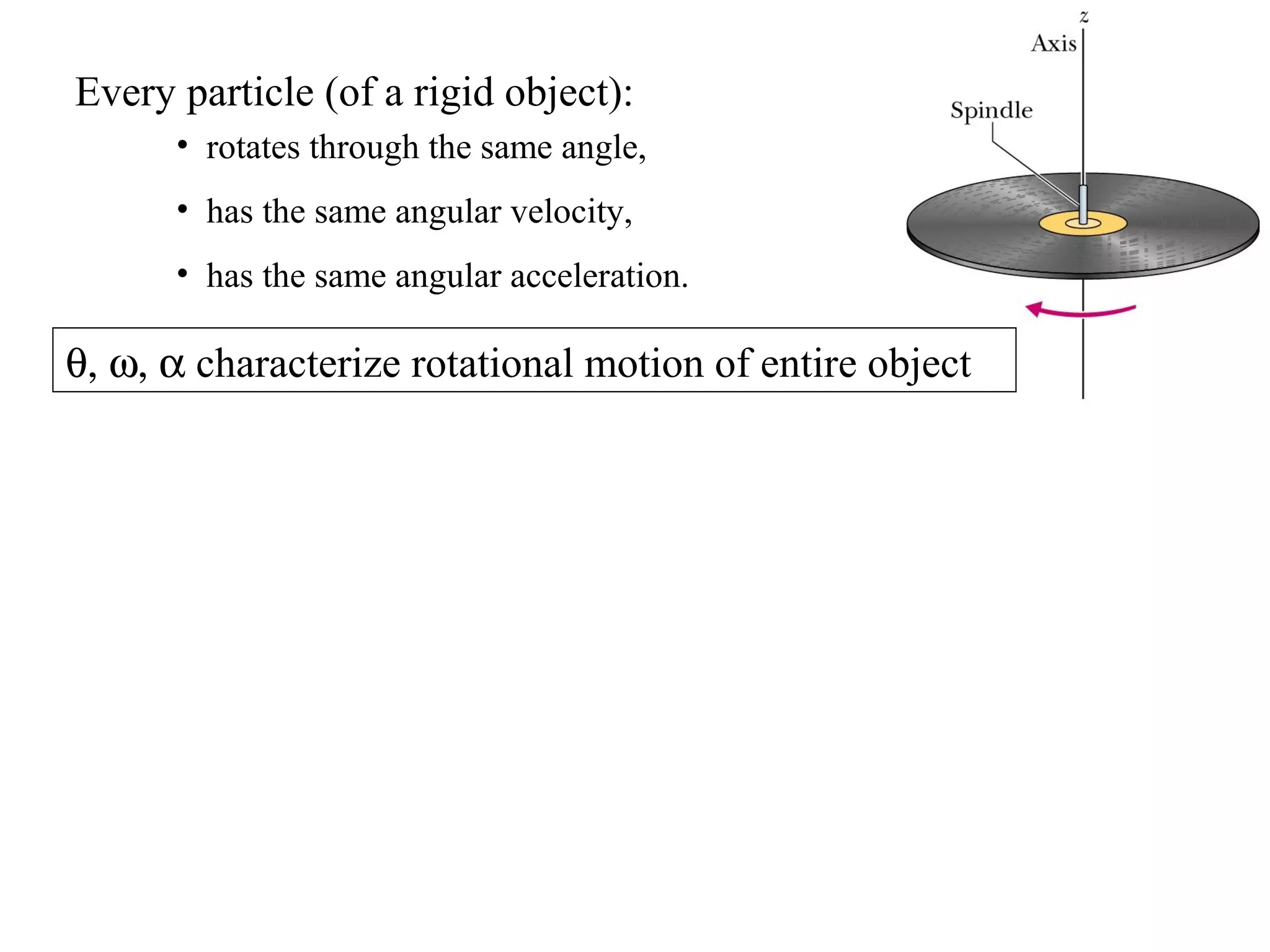
Every particle (of a rigid object):
      • rotates through the same angle,
      • has the same angular velocity,
      • has the same angular acceleration.

θ, ω, α characterize rotational motion of entire object
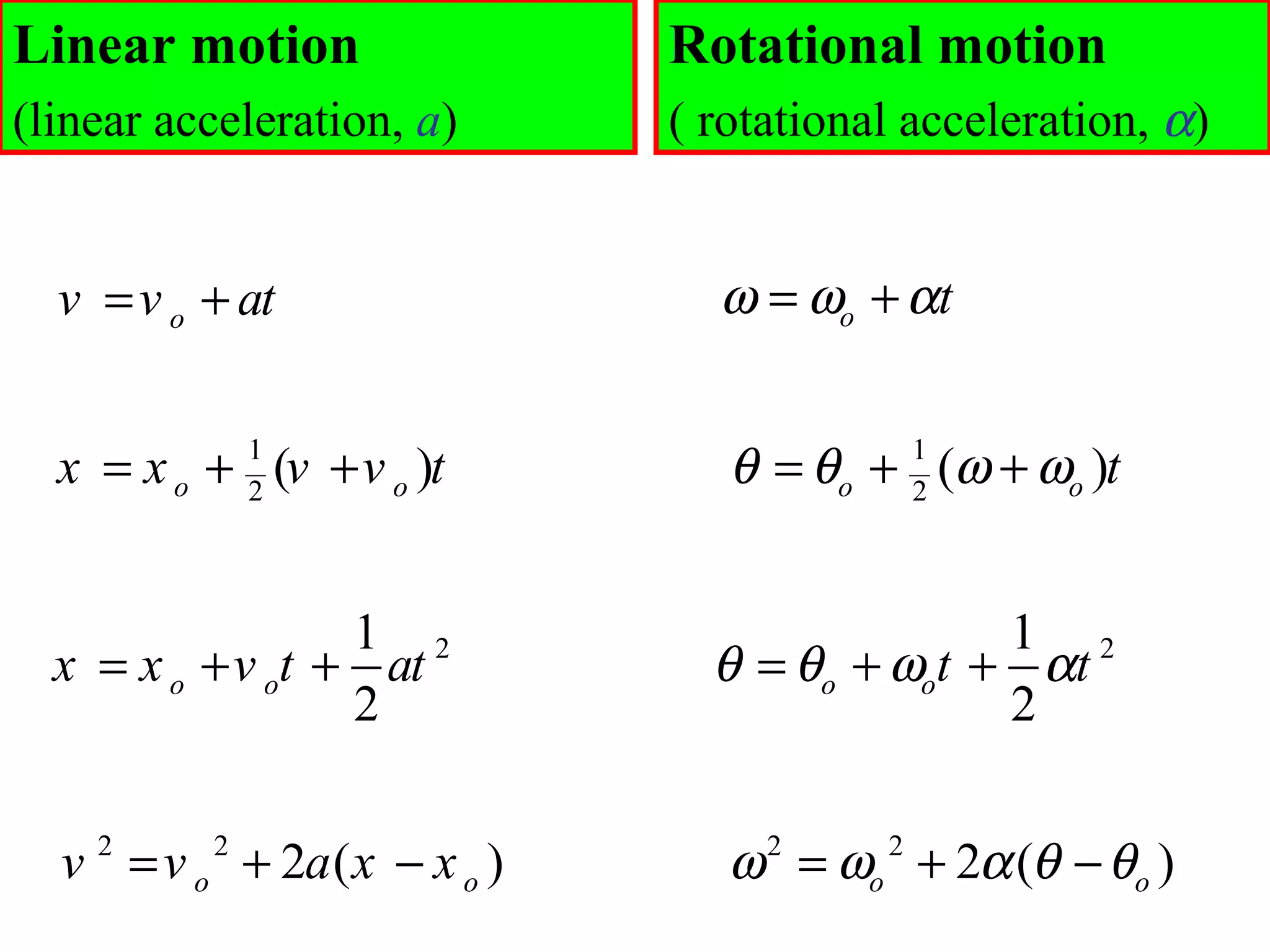
Linear motion                    Rotational motion
(linear acceleration, a)         ( rotational acceleration, α)


  v = v o + at                     ω = ωo + αt


  x = x o + 1 (v + v o )t
            2
                                    θ = θo + 1 (ω + ωo )t
                                             2


                  1 2                            1 2
  x = x o + v ot + at              θ = θo + ωot + αt
                  2                              2


  v 2 = v o 2 + 2a ( x − x o )      ω 2 = ωo 2 + 2α (θ − θo )
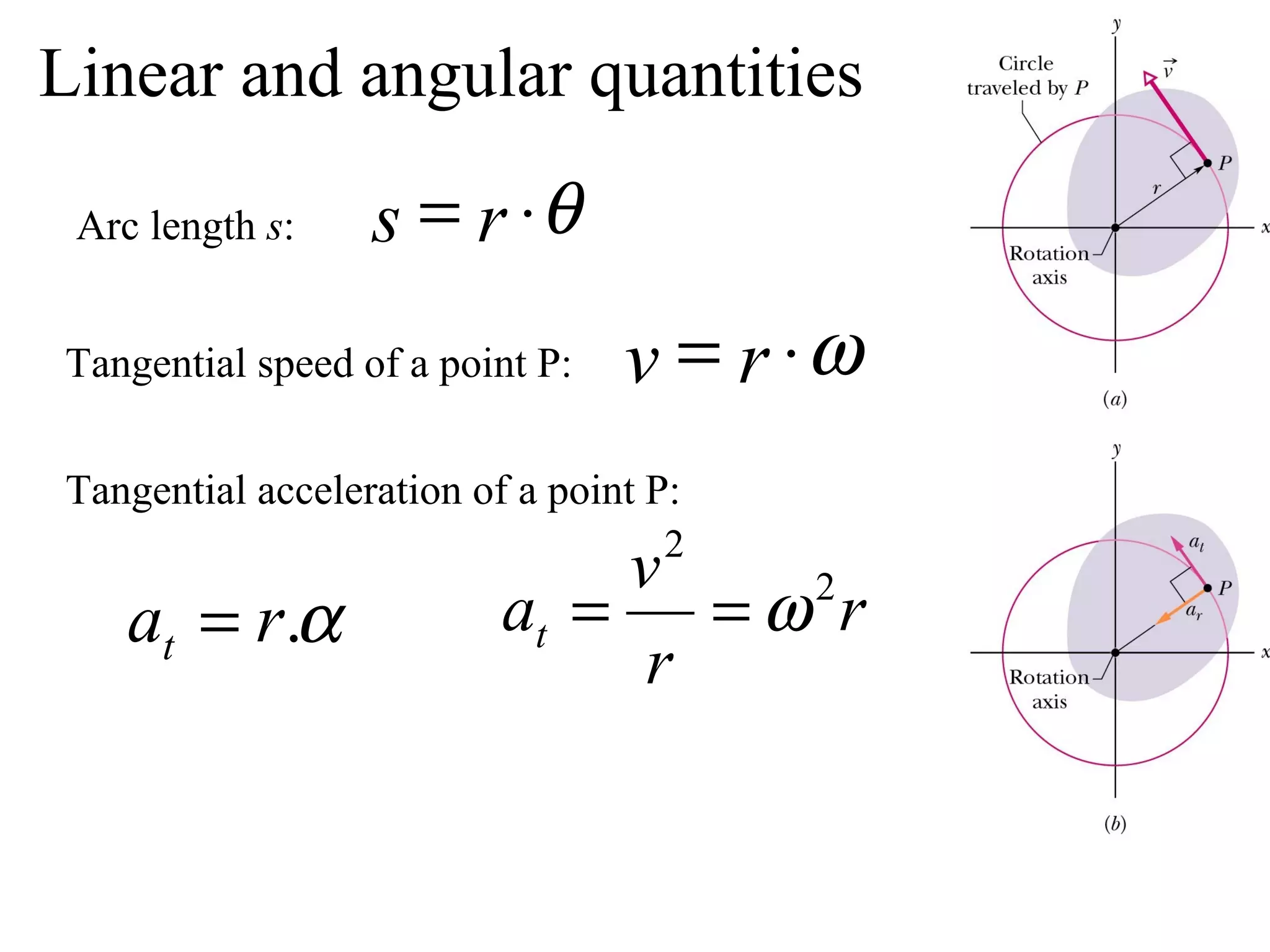
Linear and angular quantities

 Arc length s:    s = r ⋅θ
Tangential speed of a point P:   v = r ⋅ω
Tangential acceleration of a point P:
                                    2
                               v
    at = r.α              at =    =ω r
                                    2

                                r
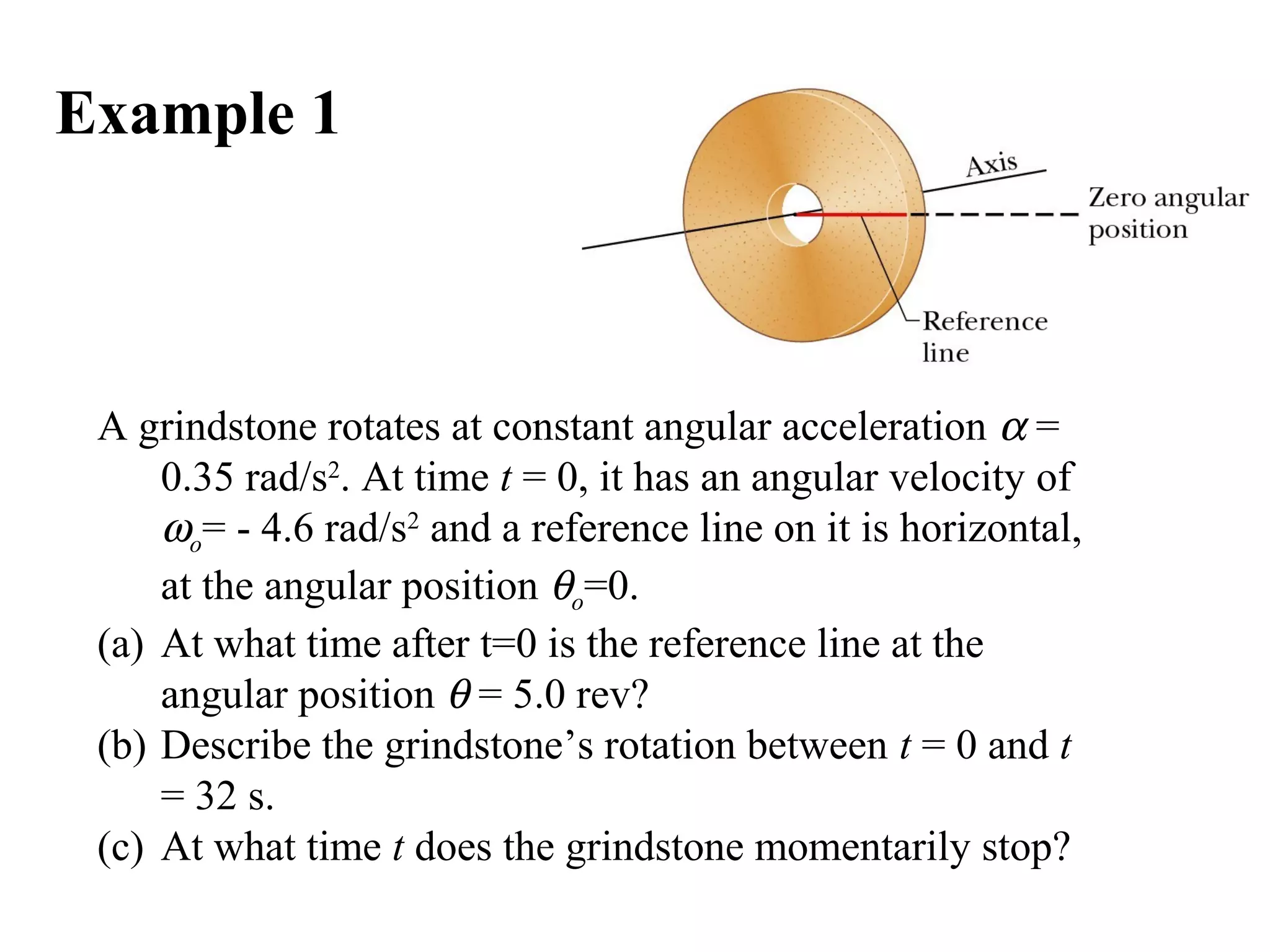
Example 1


 A grindstone rotates at constant angular acceleration α =
     0.35 rad/s2. At time t = 0, it has an angular velocity of
     ωo= - 4.6 rad/s2 and a reference line on it is horizontal,
     at the angular position θo=0.
 (a) At what time after t=0 is the reference line at the
     angular position θ = 5.0 rev?
 (b) Describe the grindstone’s rotation between t = 0 and t
     = 32 s.
 (c) At what time t does the grindstone momentarily stop?
Linear inertia and mass
• Inertia
  – The tendency of an object to keep the current
    state of motion
  – Difficulty in changing the state of motion
• Properties of Inertia
  – Static inertia vs. dynamic inertia
  – Proportional to mass of the object:
     • "The more massive an object, the more it tends to
       maintain its current state of motion."
• Mass: measure of inertia in linear motion
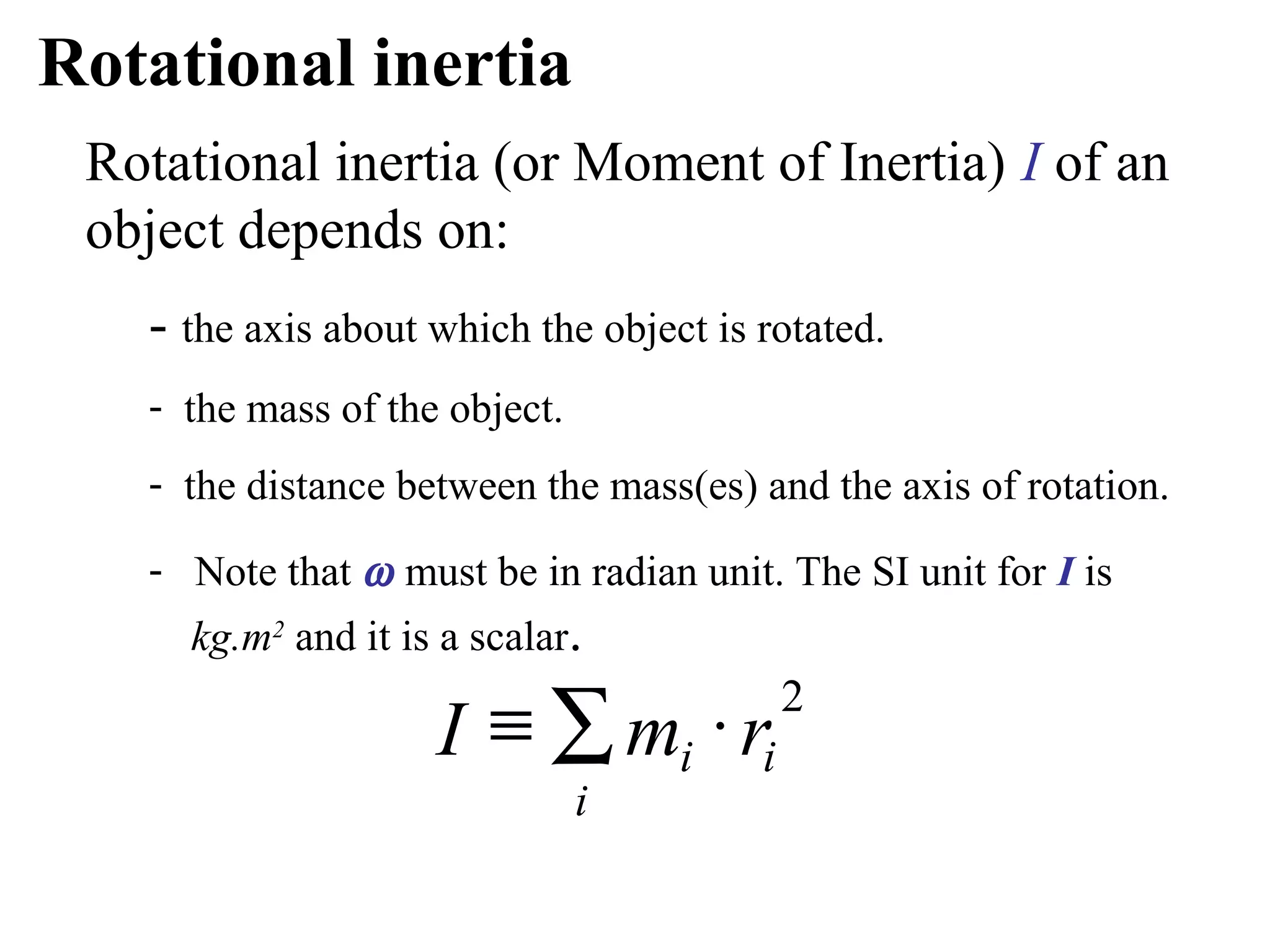
Rotational inertia
 Rotational inertia (or Moment of Inertia) I of an
 object depends on:
   - the axis about which the object is rotated.
   - the mass of the object.
   - the distance between the mass(es) and the axis of rotation.

   - Note that ω must be in radian unit. The SI unit for I is
     kg.m2 and it is a scalar.

                    I ≡ ∑ mi ⋅ ri
                                         2

                               i
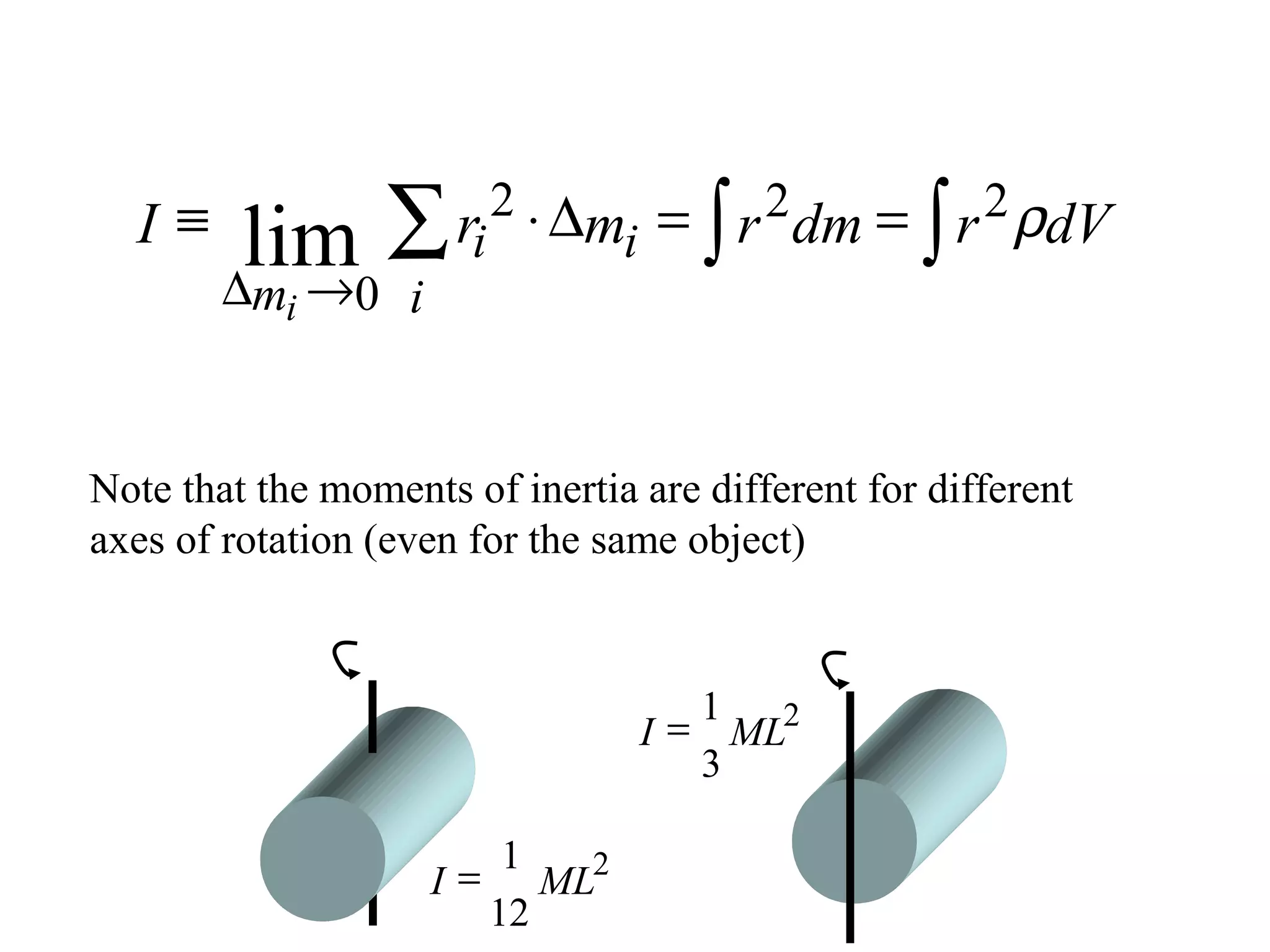
lim ∑ ri                 = ∫ r 2 dm = ∫ r 2 ρdV
                           2 ⋅∆
  I≡                           mi
        ∆ →
         mi     0 i


Note that the moments of inertia are different for different
axes of rotation (even for the same object)


                                       1
                                    I = ML2
                                       3

                            1
                      I=      ML2
                           12
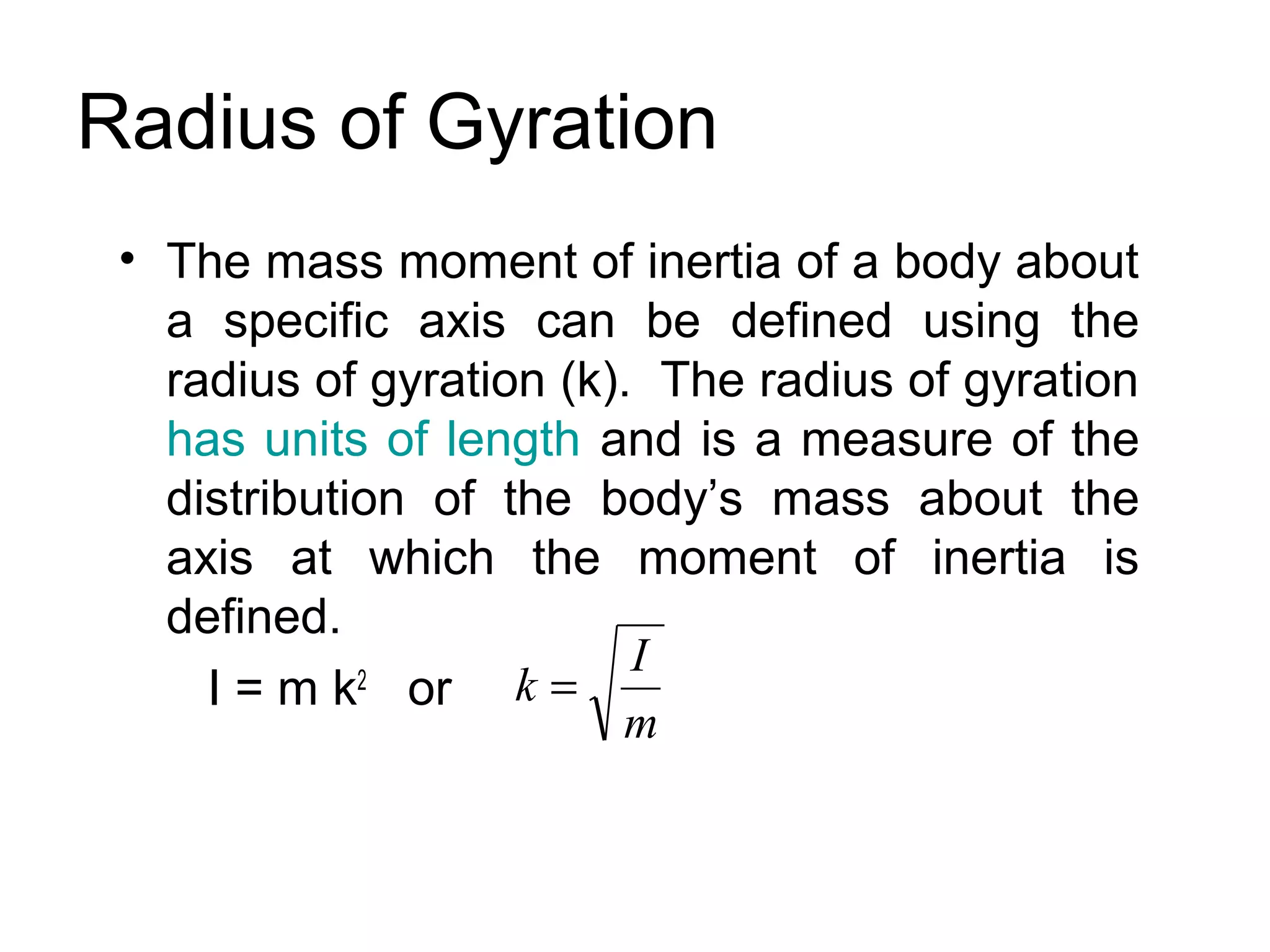
Radius of Gyration
 • The mass moment of inertia of a body about
   a specific axis can be defined using the
   radius of gyration (k). The radius of gyration
   has units of length and is a measure of the
   distribution of the body’s mass about the
   axis at which the moment of inertia is
   defined.
                          I
     I = m k or k =
             2
                         m
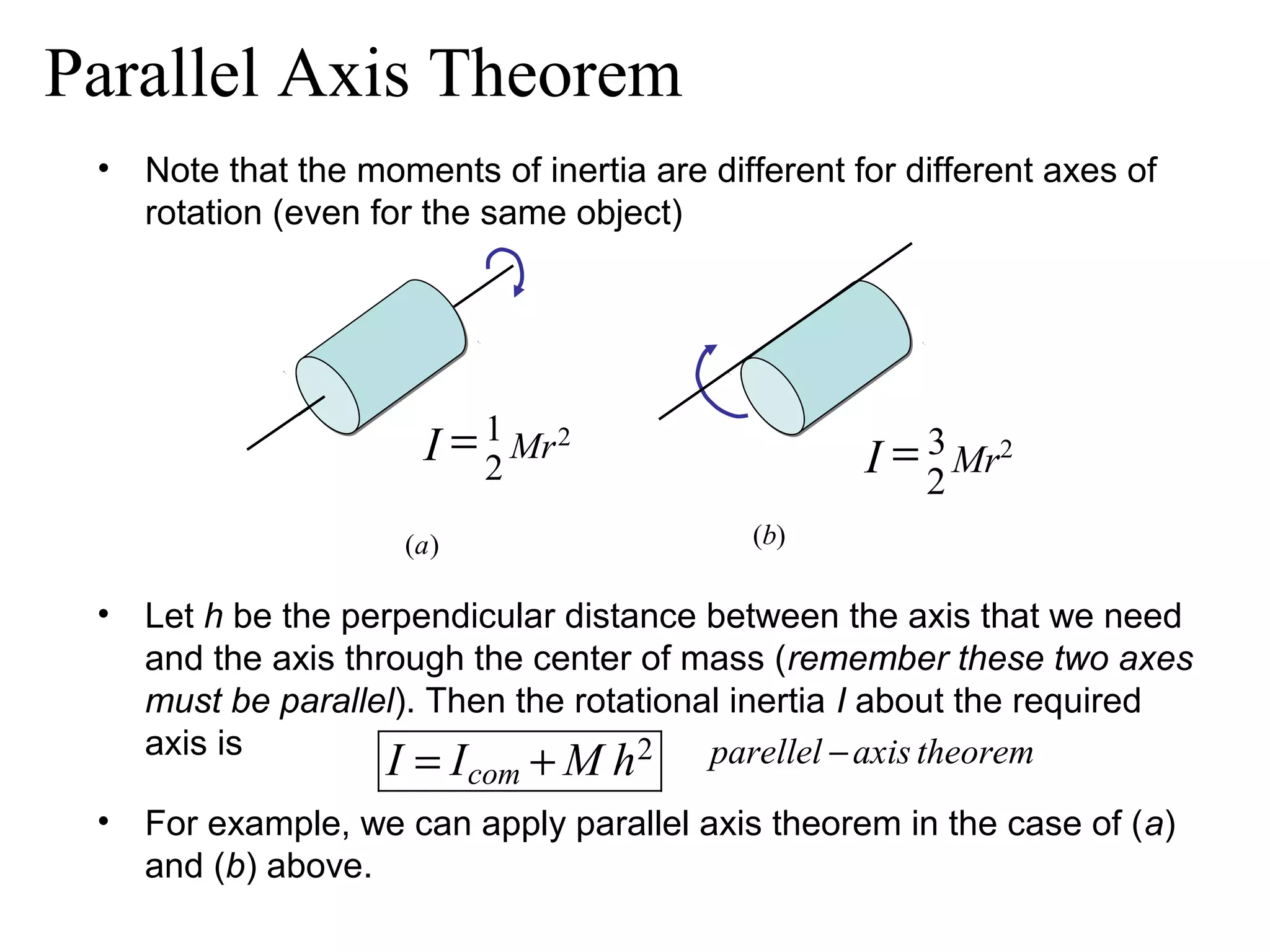
Parallel Axis Theorem
 •   Note that the moments of inertia are different for different axes of
     rotation (even for the same object)


                        I = 1 Mr 2
                            2                        I = 2 Mr2
                                                         3

                      (a )                   (b)

 • Let h be the perpendicular distance between the axis that we need
   and the axis through the center of mass (remember these two axes
   must be parallel). Then the rotational inertia I about the required
   axis is
                   I = I + M h 2 parellel − axis theorem
                             com
 • For example, we can apply parallel axis theorem in the case of (a)
   and (b) above.
First law
• A particle originally at rest, or moving in a
  straight line at constant velocity, will remain
  in this state if the resultant force acting on
  the particle is zero
  – Newton’s First Law looked at objects at rest or
    under constant velocity.
  – No net force was acting on these objects
Second law
•   “A force applied to a body causes an acceleration.”
     – Acceleration describes how quickly motion changes.
     – Or : acceleration = change in velocity
                              time interval
•   Acceleration is proportional to the force, inversely proportional to
    mass.
     – Usually there is more than one force acting on an object. The resulting
       acceleration of an object is due to the total or NET FORCE on the object
     – acceleration ∝ net force
     – acceleration ∝ 1 / mass (As more mass is added, the acceleration of
       the cart is slowed)
     – acceleration = net force        or a = F
                           mass                   m
     – Force = mass x acceleration (work out few examples)

•   Direction of the acceleration = direction of the force

•   First and second law
     – If a force is applied to an object, whether it is at rest or moving, the
       motion will change. IT ACCELERATES.
     – If the force is removed, the object will continue moving at a constant
       velocity
The first and third laws were used in developing the concepts
of statics. Newton’s second law forms the basis of the study of
dynamics.

Mathematically, Newton’s second law of motion can be written
                    F = ma
where F is the resultant unbalanced force acting on the particle,
and a is the acceleration of the particle. The positive scalar m
is called the mass of the particle.


Newton’s second law cannot be used when the particle’s speed
approaches the speed of light, or if the size of the particle is
extremely small (~ size of an atom).
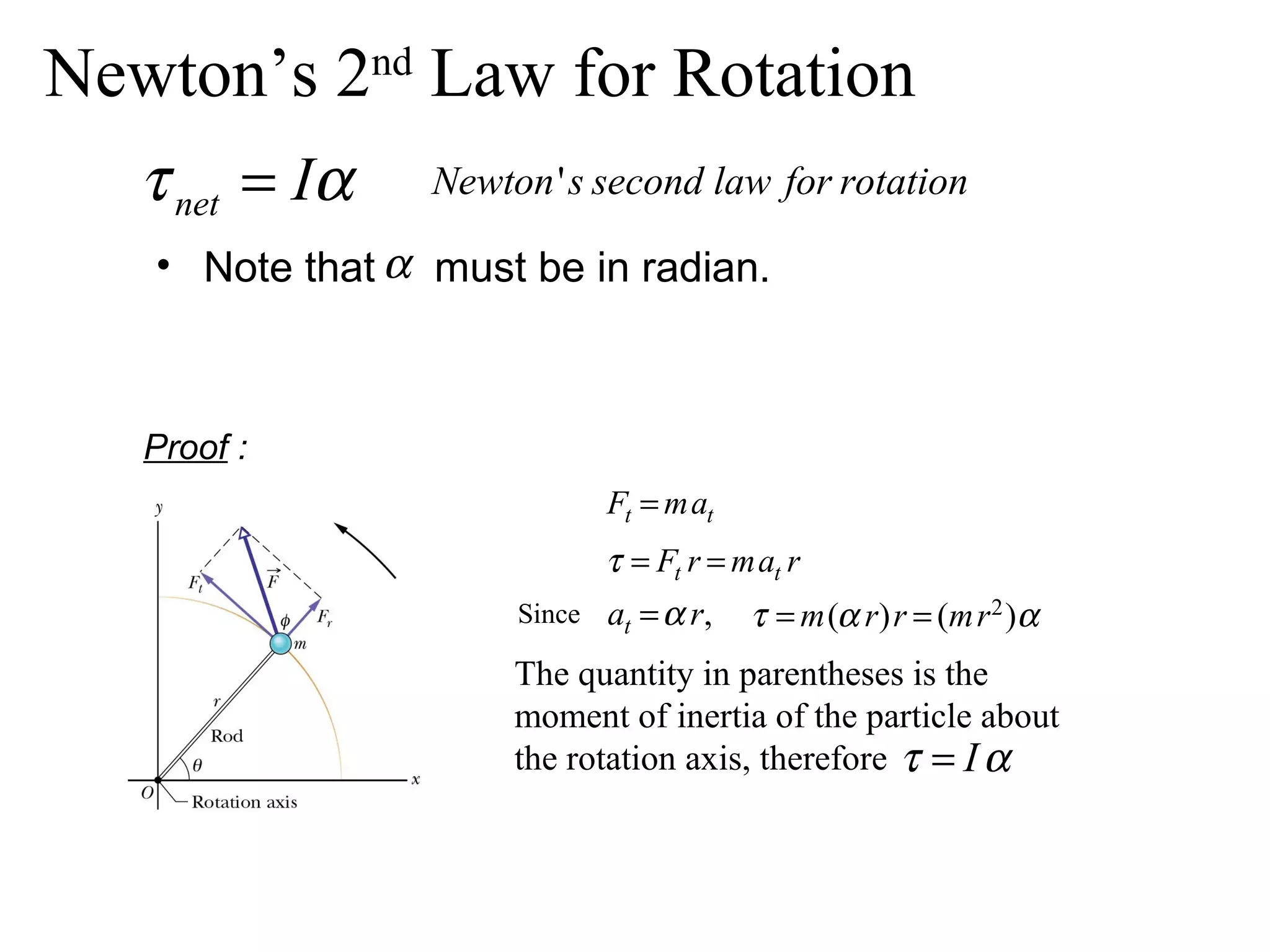
Newton’s 2nd Law for Rotation
   τ net = Iα    Newton ' s second law for rotation

   • Note that α must be in radian.


   Proof :
                              Ft = mat
                              τ = Ft r = mat r
                      Since   at = α r,   τ = m (α r) r = (m r 2 )α
                      The quantity in parentheses is the
                      moment of inertia of the particle about
                      the rotation axis, therefore τ = I α
Third law
• “For every action, there is an equal and opposite
  reaction.”
• “When one body exerts a force on a second, the second
  body exerts a reaction force that is equal in magnitude
  and opposite in direction on the first.”
• Eg: bullet vs. gun, fist fighting, rocket

• For every interaction, the forces always come in pairs
  (twos).
   – The ACTION FORCE (Object A exerts a force on object B )and
   – The REACTION FORCE (Object B exerts a force on object A )
   – They are equal in strength and opposite in direction
Action and reaction on different masses
  • When a cannon is fired, there is an interaction
    between the cannon and the cannon ball.
  • The forces the cannon ball and cannon exert on each
    other are equal and opposite.
  • The cannonball moves fast while the cannon only
    Kicks a bit because of the difference in their masses.
     – FOR THE CANNON : a = F / M
     – FOR THE CANNONBALL : f = F / m
  • The force exerted on a small mass produces a greater
    acceleration than the same force exerted on a large
    mass

  Question :    Does a stick of dynamite contain force?
  Answer :       No, force is not something an object has, like mass and
               volume. An object may posses the capability of exerting force
               on another object but it does not possess force.
Combined linear and angular motions

 • In reality, car tires both rotate and translate
 • They are a good example of something which
   rolls (translates, moves forward, rotates)
   without slipping
 • Is there friction? What kind?
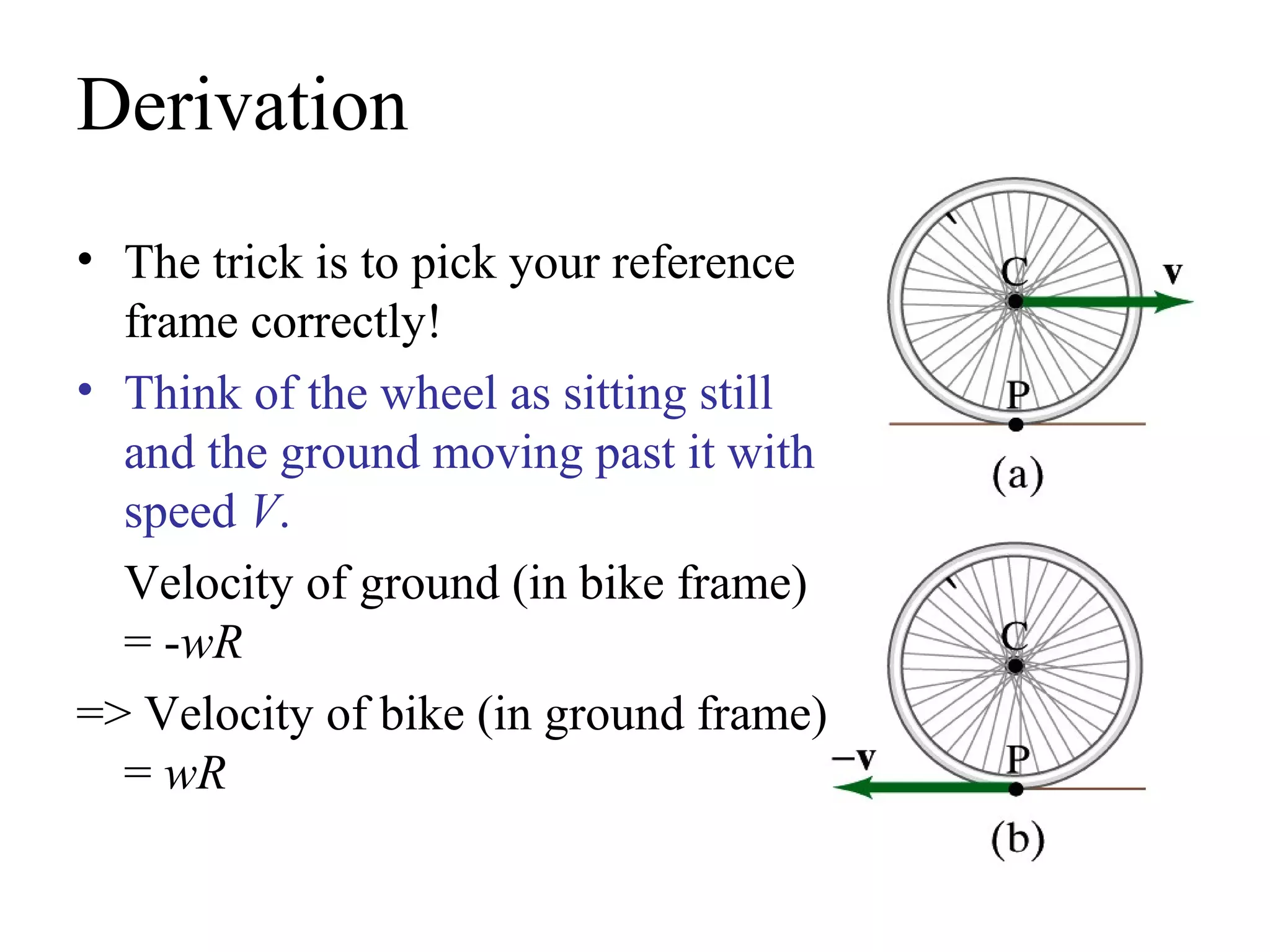
Derivation
• The trick is to pick your reference
  frame correctly!
• Think of the wheel as sitting still
  and the ground moving past it with
  speed V.
  Velocity of ground (in bike frame)
  = -wR
=> Velocity of bike (in ground frame)
  = wR
Friction
• Force acting at the area of contact between two
  surfaces
• Magnitude: proportional to the friction coefficient
  and the normal reaction force
• Direction: opposite that of motion or motion
  tendency
• Types: sliding and rolling
   – Sliding: due to relative motion of the surfaces
   – Rolling: due to deformation of the surfaces
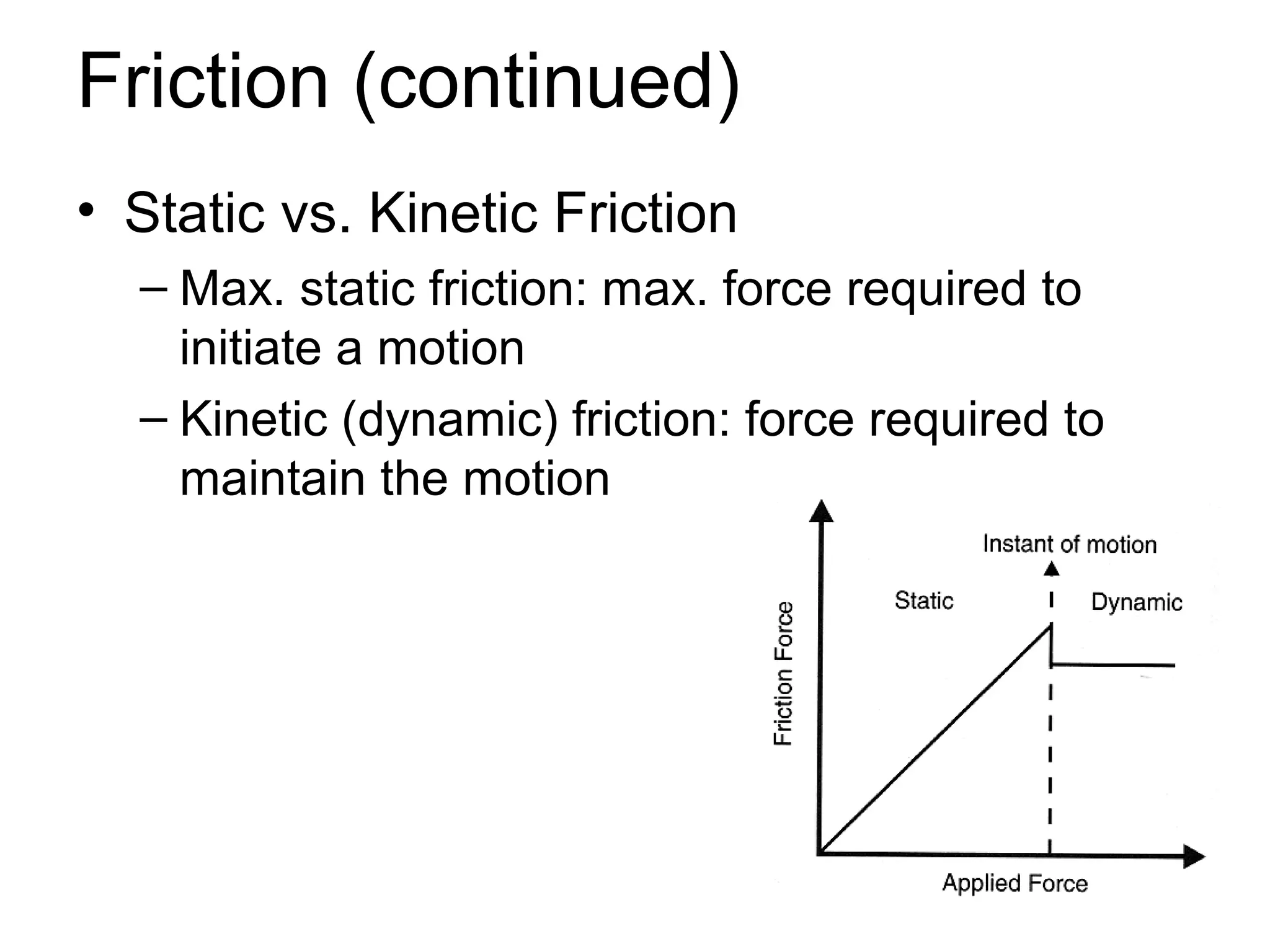
Friction (continued)
• Static vs. Kinetic Friction
  – Max. static friction: max. force required to
    initiate a motion
  – Kinetic (dynamic) friction: force required to
    maintain the motion
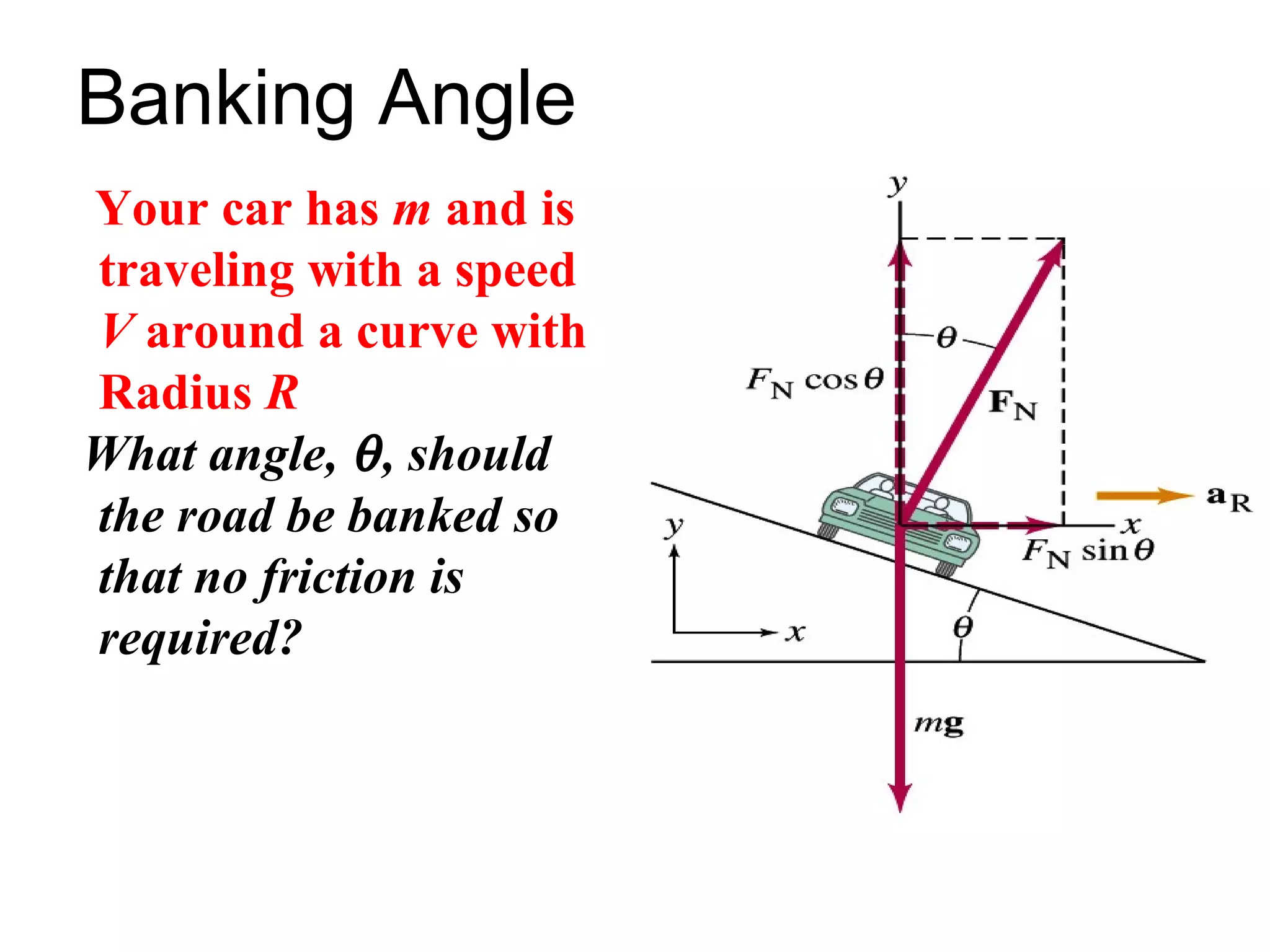
Banking Angle
Your car has m and is
traveling with a speed
V around a curve with
Radius R
What angle, θ , should
the road be banked so
that no friction is
required?
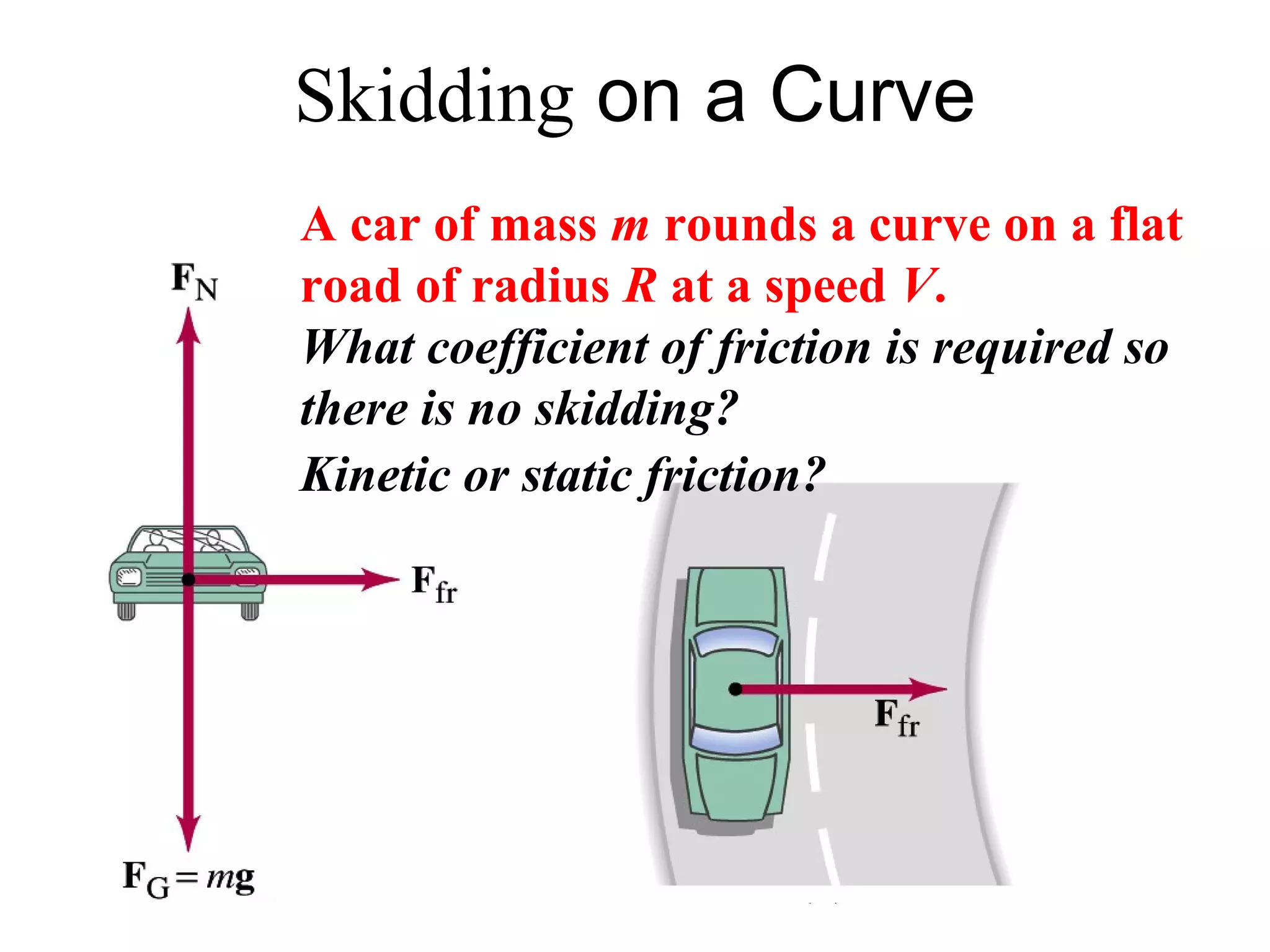
Skidding on a Curve
A car of mass m rounds a curve on a flat
road of radius R at a speed V.
What coefficient of friction is required so
there is no skidding?
Kinetic or static friction?
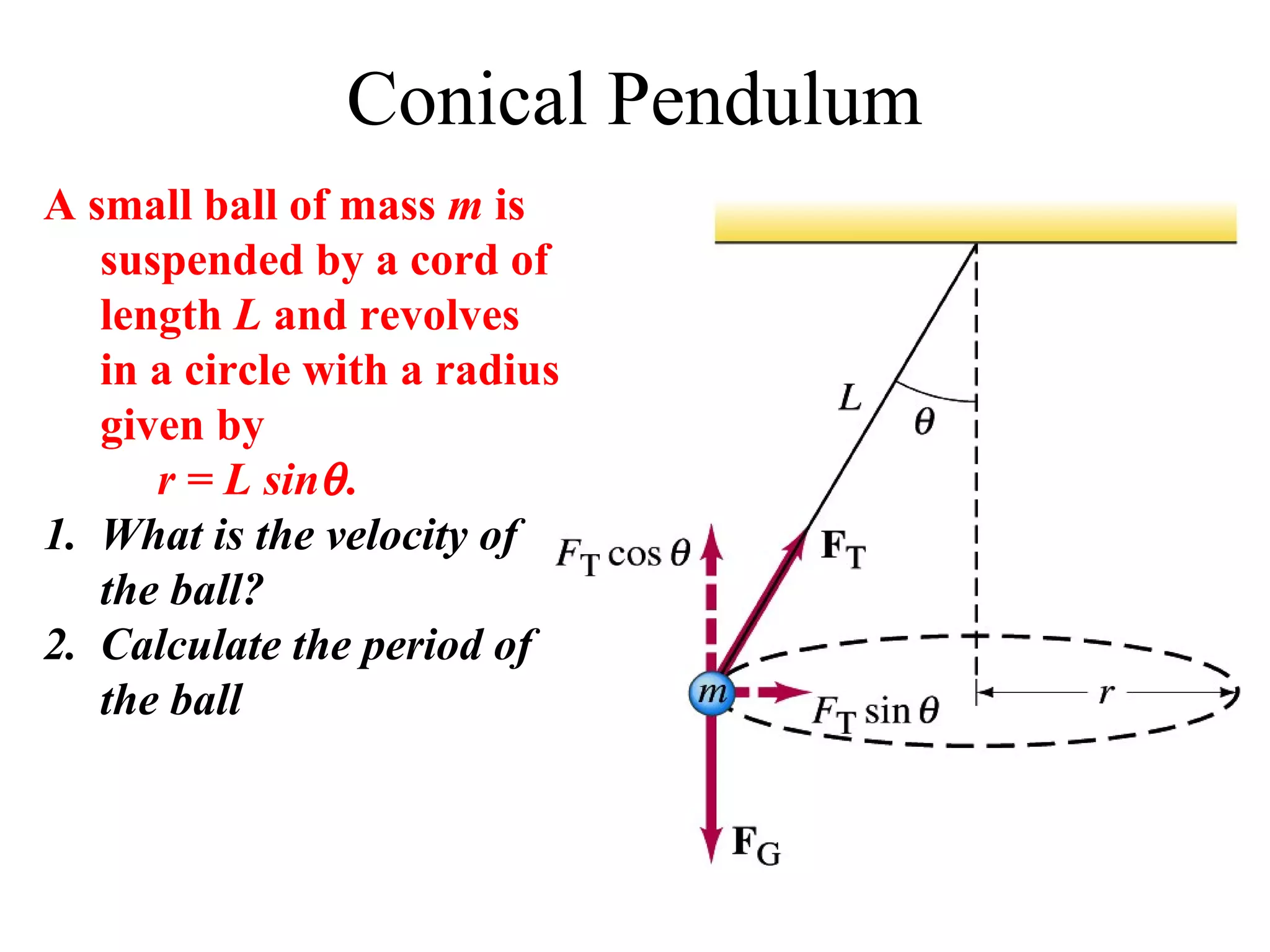
Conical Pendulum
A small ball of mass m is
   suspended by a cord of
   length L and revolves
   in a circle with a radius
   given by
      r = L sinθ .
1. What is the velocity of
   the ball?
2. Calculate the period of
   the ball
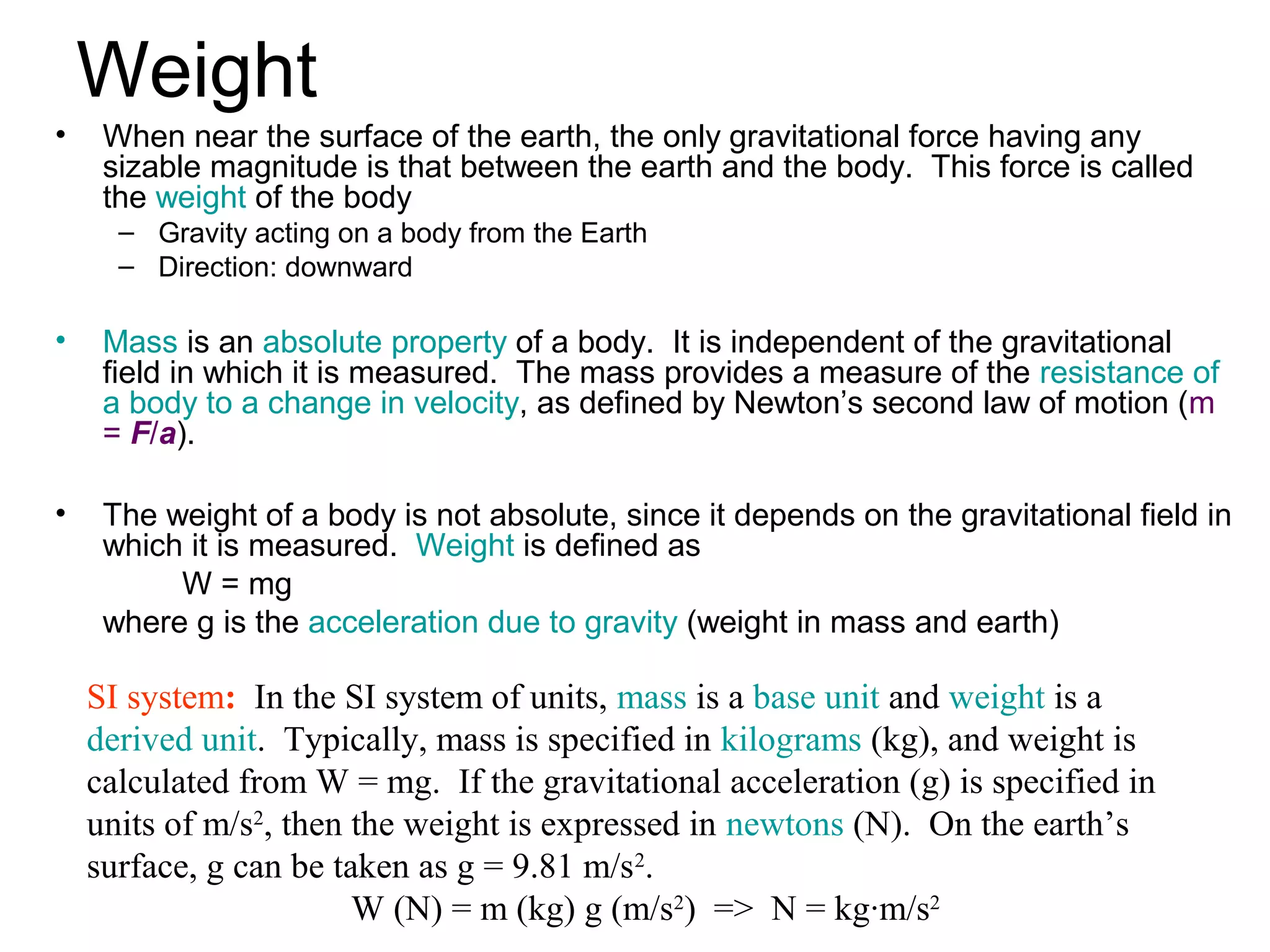
Weight
•    When near the surface of the earth, the only gravitational force having any
     sizable magnitude is that between the earth and the body. This force is called
     the weight of the body
      – Gravity acting on a body from the Earth
      – Direction: downward

•    Mass is an absolute property of a body. It is independent of the gravitational
     field in which it is measured. The mass provides a measure of the resistance of
     a body to a change in velocity, as defined by Newton’s second law of motion (m
     = F/a).

•    The weight of a body is not absolute, since it depends on the gravitational field in
     which it is measured. Weight is defined as
          W = mg
     where g is the acceleration due to gravity (weight in mass and earth)

    SI system: In the SI system of units, mass is a base unit and weight is a
    derived unit. Typically, mass is specified in kilograms (kg), and weight is
    calculated from W = mg. If the gravitational acceleration (g) is specified in
    units of m/s2, then the weight is expressed in newtons (N). On the earth’s
    surface, g can be taken as g = 9.81 m/s2.
                        W (N) = m (kg) g (m/s2) => N = kg·m/s2
Momentum and Impulse
•   Momentum
    –   Amount of motion
    –   Momentum = (mass)(velocity)
    –   Important in giving or receiving impact, collision, etc.
    –   Vector

•   Impulse
    – Collision characterized by the exchange of a large force during a short
      time period
    – Accumulated effect of force exerted on an object for a period of time
    – Impulse = (force)(time)
    – Increase in F or t ⇒ increase in I
    – Vector
    – Equal to the change in momentum of the system
Example 2
        A compact disc player disc from rest and
        accelerates to its final velocity of 3.50 rev/s in
        1.50s. What is the disk's average angular
        acceleration?
Example 3
            The blades of a blender rotate at a rate of
            7500rpm. When the motor is turned off
            during operation, the blades slow to rest
            in 3.0 seconds. What is the angular
            acceleration?
Example 4
            How fast is the outer edge of a CD (at 6.0
            cm) moving when it is rotating at its top
            speed of 22.0 rad/s?
Example 5
            How many rotations does the CD from the
            first problem make while coming up to
            speed from rest to wf = 22.0 rad/sec at a=
            14.7 rad/s2
Example 6
            A wheel with radius 0.5m makes 55 revolutions as it
            changes speed from 80km/h to 30 km/h. The wheel
            has a diameter of 1 meter. (a) What was the angular
            acceleration? (b) How long is required for the wheel
            to come to a stop if it decelerated at that rate?
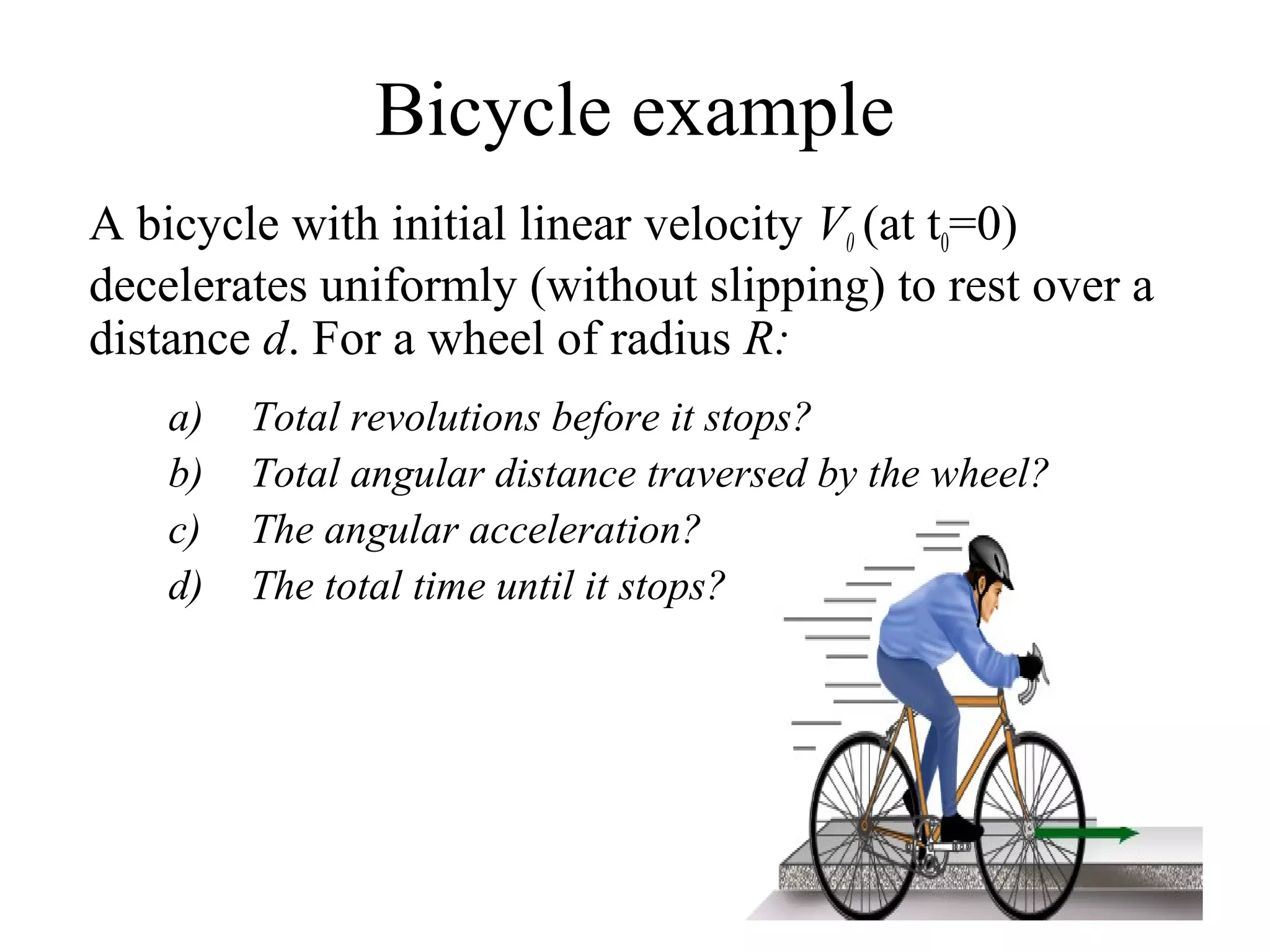
Bicycle example
A bicycle with initial linear velocity V0 (at t0=0)
decelerates uniformly (without slipping) to rest over a
distance d. For a wheel of radius R:
    a)   Total revolutions before it stops?
    b)   Total angular distance traversed by the wheel?
    c)   The angular acceleration?
    d)   The total time until it stops?
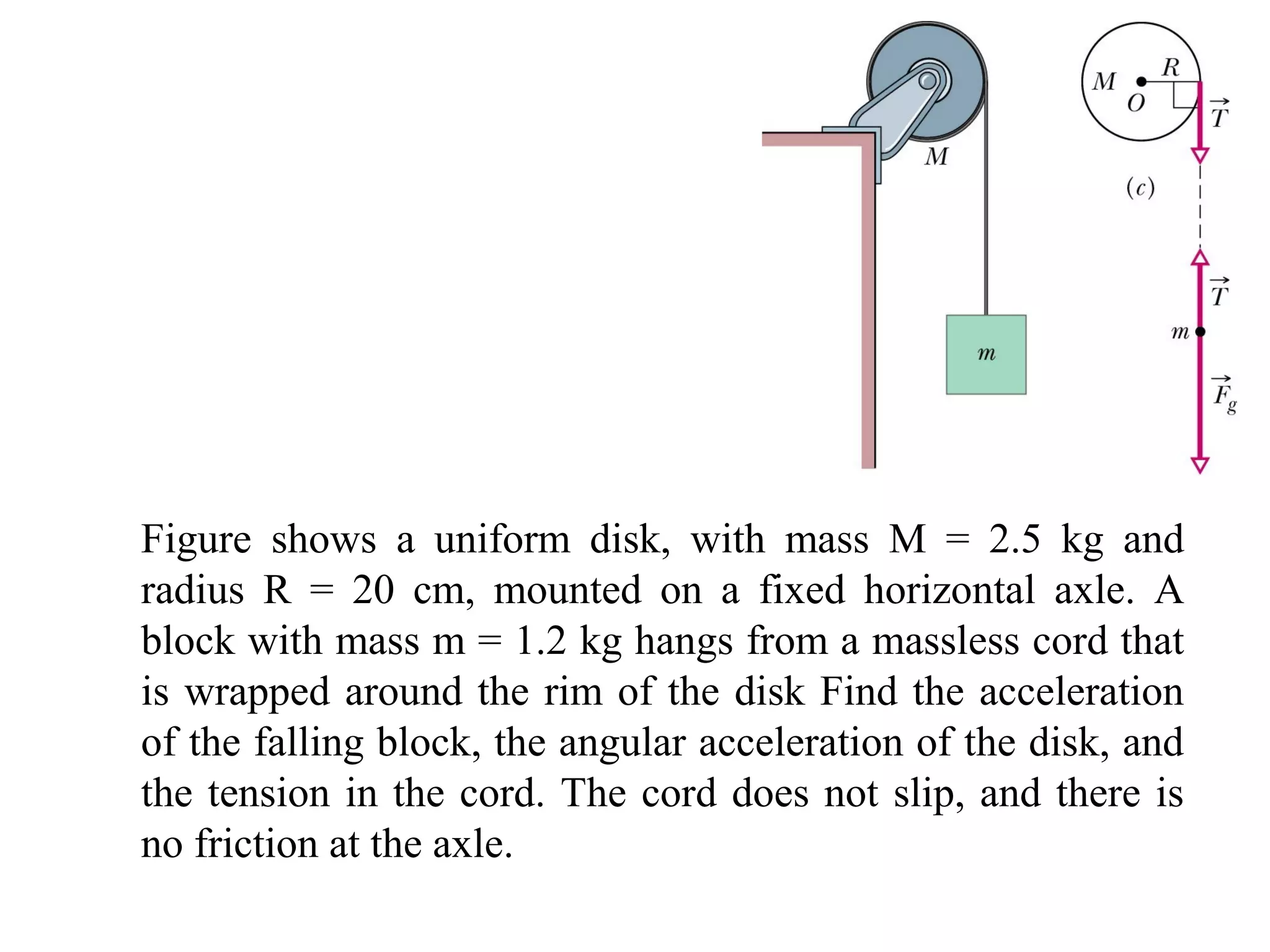
Figure shows a uniform disk, with mass M = 2.5 kg and
radius R = 20 cm, mounted on a fixed horizontal axle. A
block with mass m = 1.2 kg hangs from a massless cord that
is wrapped around the rim of the disk Find the acceleration
of the falling block, the angular acceleration of the disk, and
the tension in the cord. The cord does not slip, and there is
no friction at the axle.
1. Newton’s second law can be written in mathematical form
   as ΣF = ma. Within the summation of forces ΣF,
   ________ are(is) not included.
   A) external forces         B) weight
   C) internal forces         D) All of the above.

2. The equation of motion for a system of n-particles can be
   written as ΣFi = Σ miai = maG, where aG indicates _______.

   A) summation of each particle’s acceleration
   B) acceleration of the center of mass of the system
   C) acceleration of the largest particle
   D) None of the above.
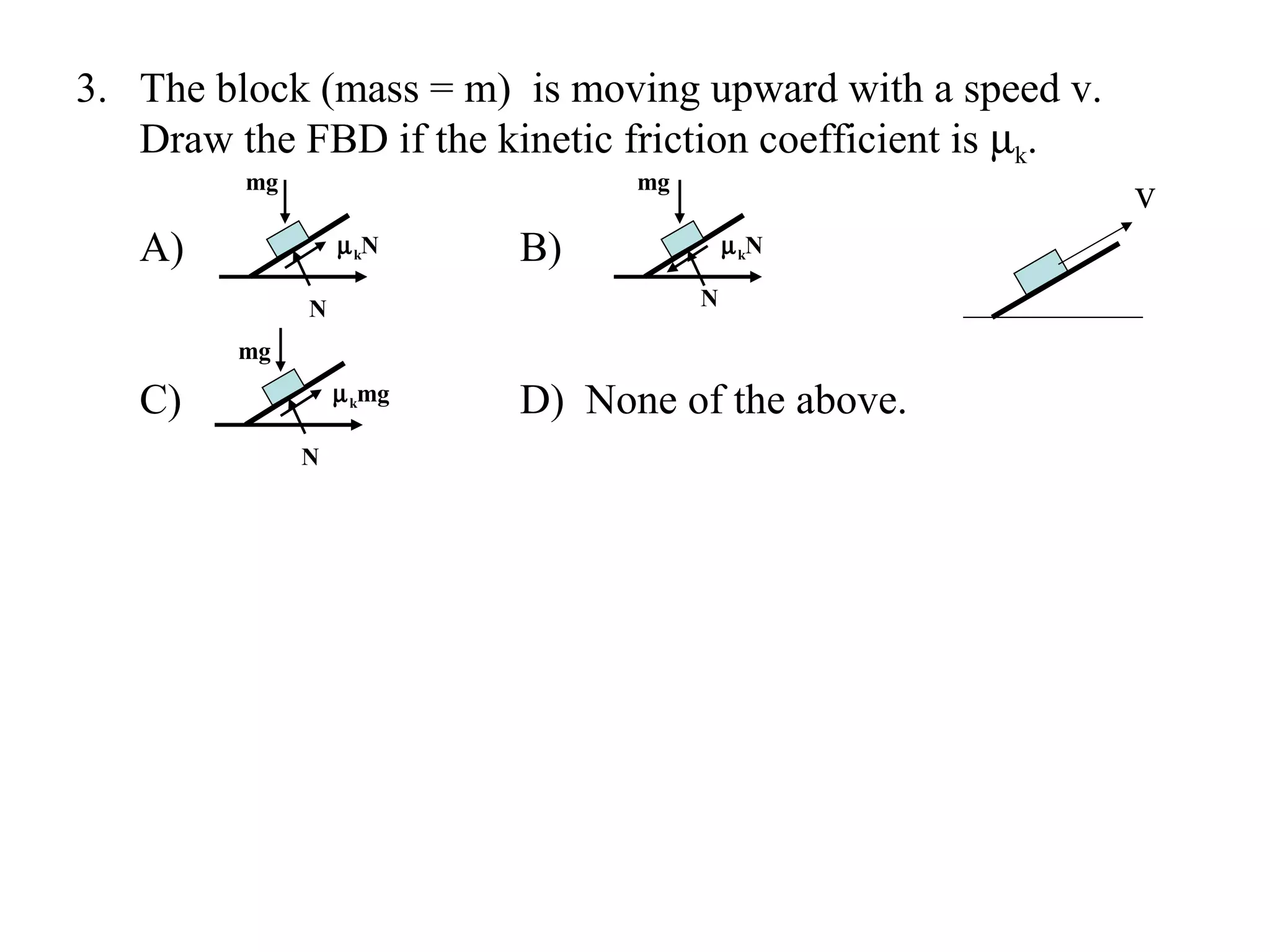
3. The block (mass = m) is moving upward with a speed v.
   Draw the FBD if the kinetic friction coefficient is µk.
         mg                     mg
                                                             v
   A)             µ kN    B)             µ kN

              N                      N

         mg

   C)             µ kmg   D) None of the above.
              N
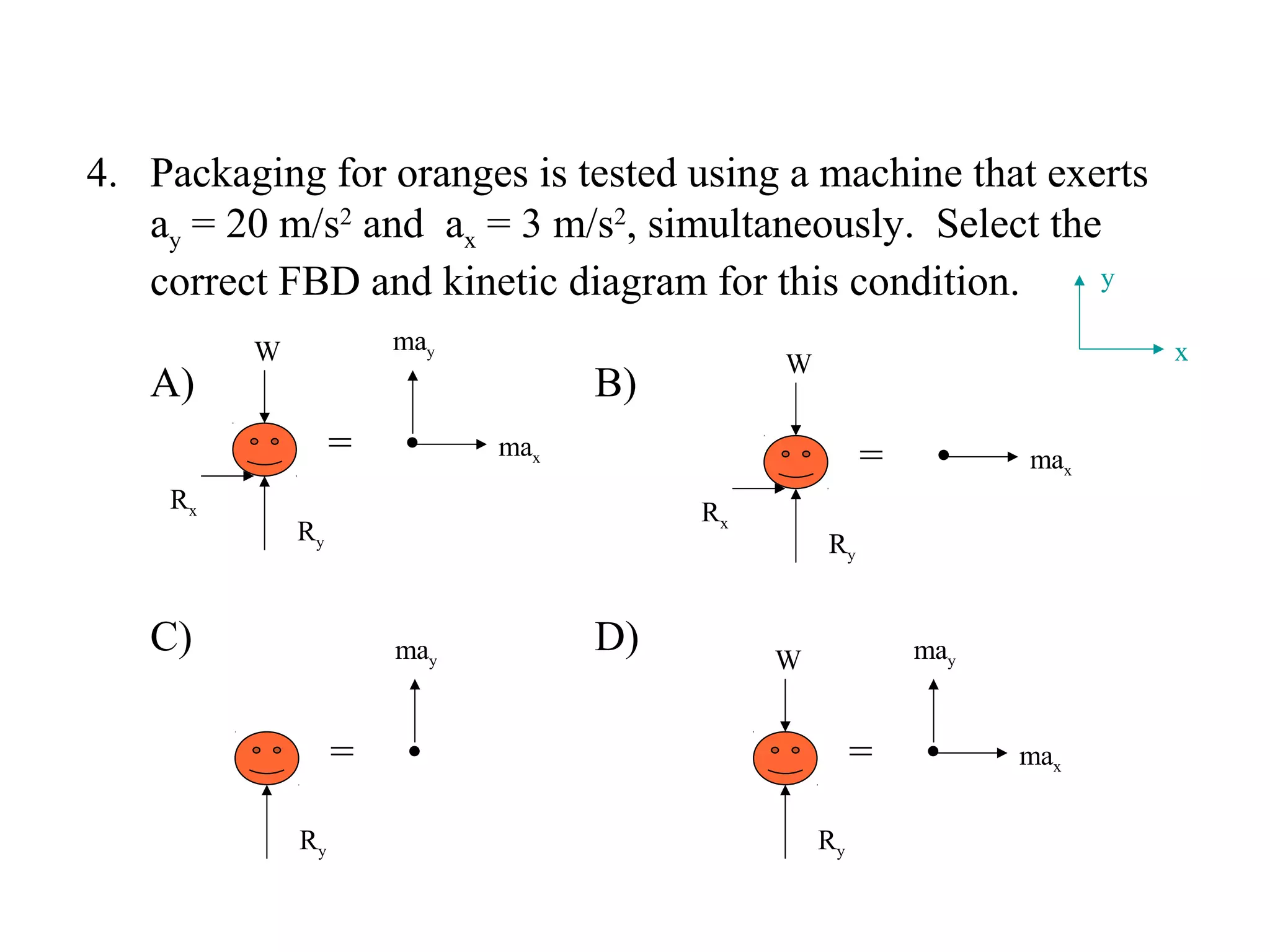
4. Packaging for oranges is tested using a machine that exerts
   ay = 20 m/s2 and ax = 3 m/s2, simultaneously. Select the
   correct FBD and kinetic diagram for this condition.     y

         W            may                                            x
                                            W
   A)                             B)
                  =   •     max                      =    •    max
    Rx                                 Rx
             Ry                                 Ry


   C)                 may         D)        W            may


                  =    •                             =   •     max


             Ry                                 Ry
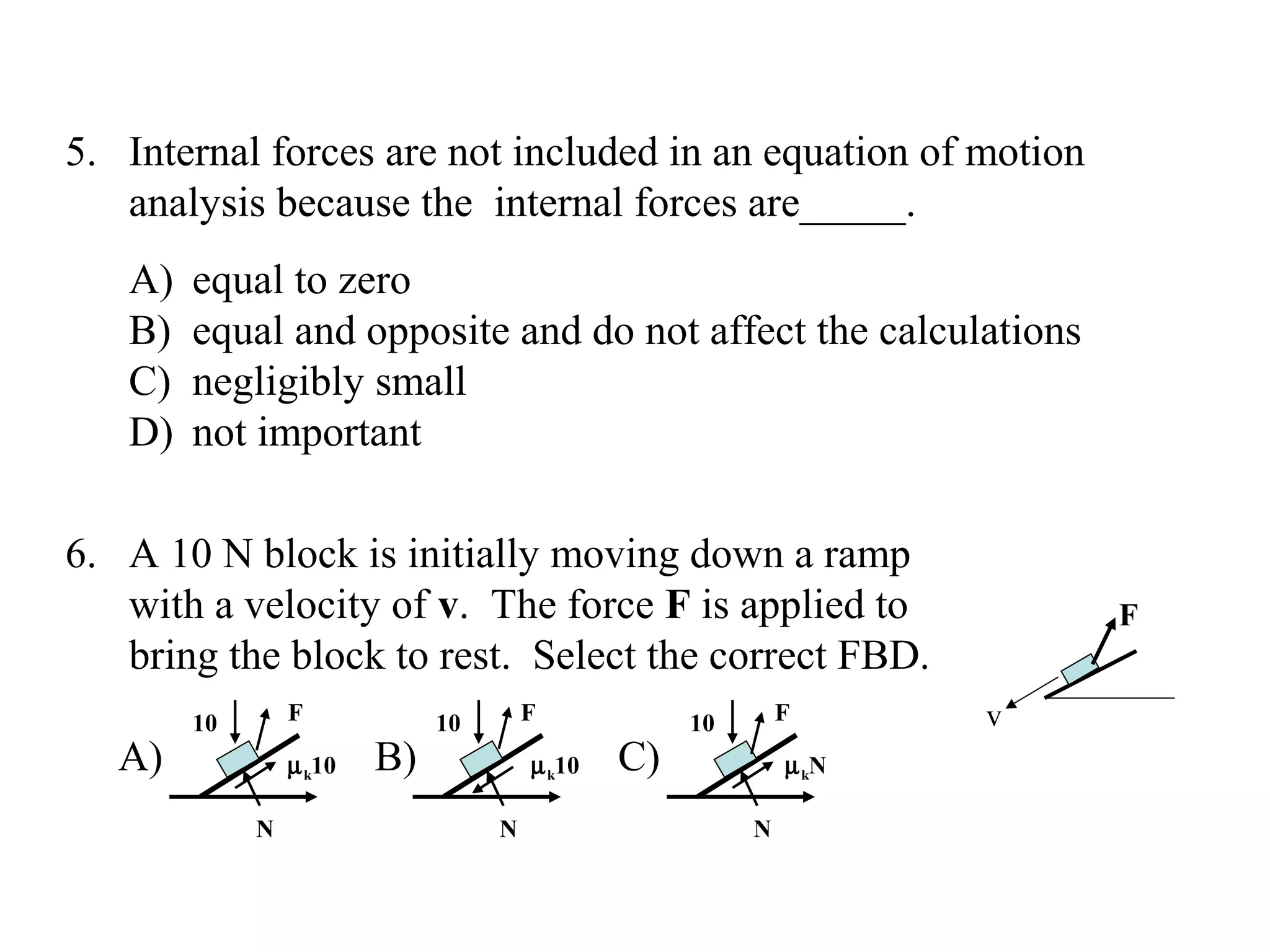
5. Internal forces are not included in an equation of motion
   analysis because the internal forces are_____.
   A)   equal to zero
   B)   equal and opposite and do not affect the calculations
   C)   negligibly small
   D)   not important

6. A 10 N block is initially moving down a ramp
   with a velocity of v. The force F is applied to                      F
   bring the block to rest. Select the correct FBD.
        10       F            10       F            10       F      v
   A)            µ k10   B)            µ k10   C)            µ kN

             N                     N                     N
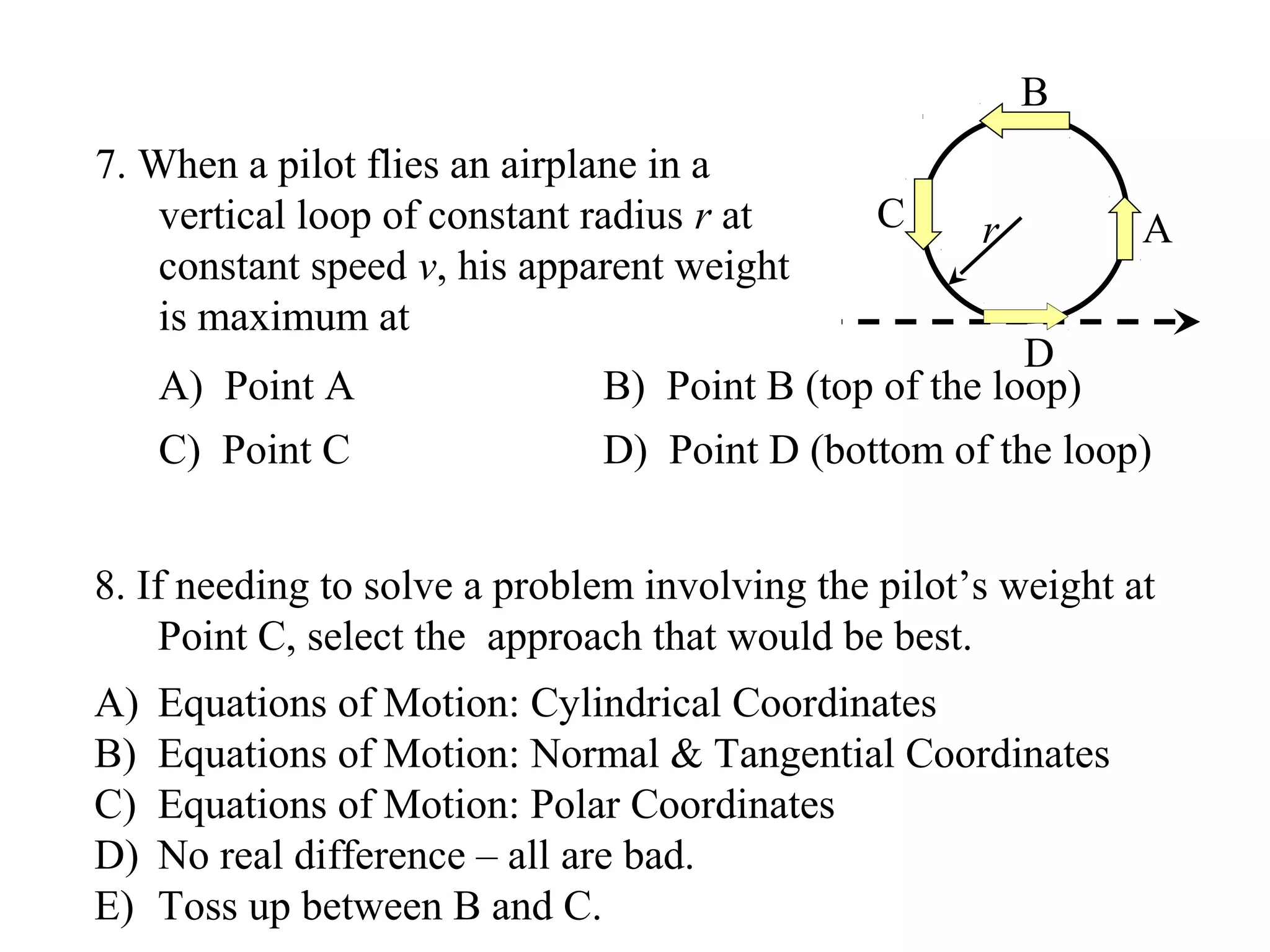
B
7. When a pilot flies an airplane in a
    vertical loop of constant radius r at      C     r         A
    constant speed v, his apparent weight
    is maximum at
                                                       D
     A) Point A               B) Point B (top of the loop)
     C) Point C               D) Point D (bottom of the loop)


8. If needing to solve a problem involving the pilot’s weight at
    Point C, select the approach that would be best.
A)   Equations of Motion: Cylindrical Coordinates
B)   Equations of Motion: Normal & Tangential Coordinates
C)   Equations of Motion: Polar Coordinates
D)   No real difference – all are bad.
E)   Toss up between B and C.
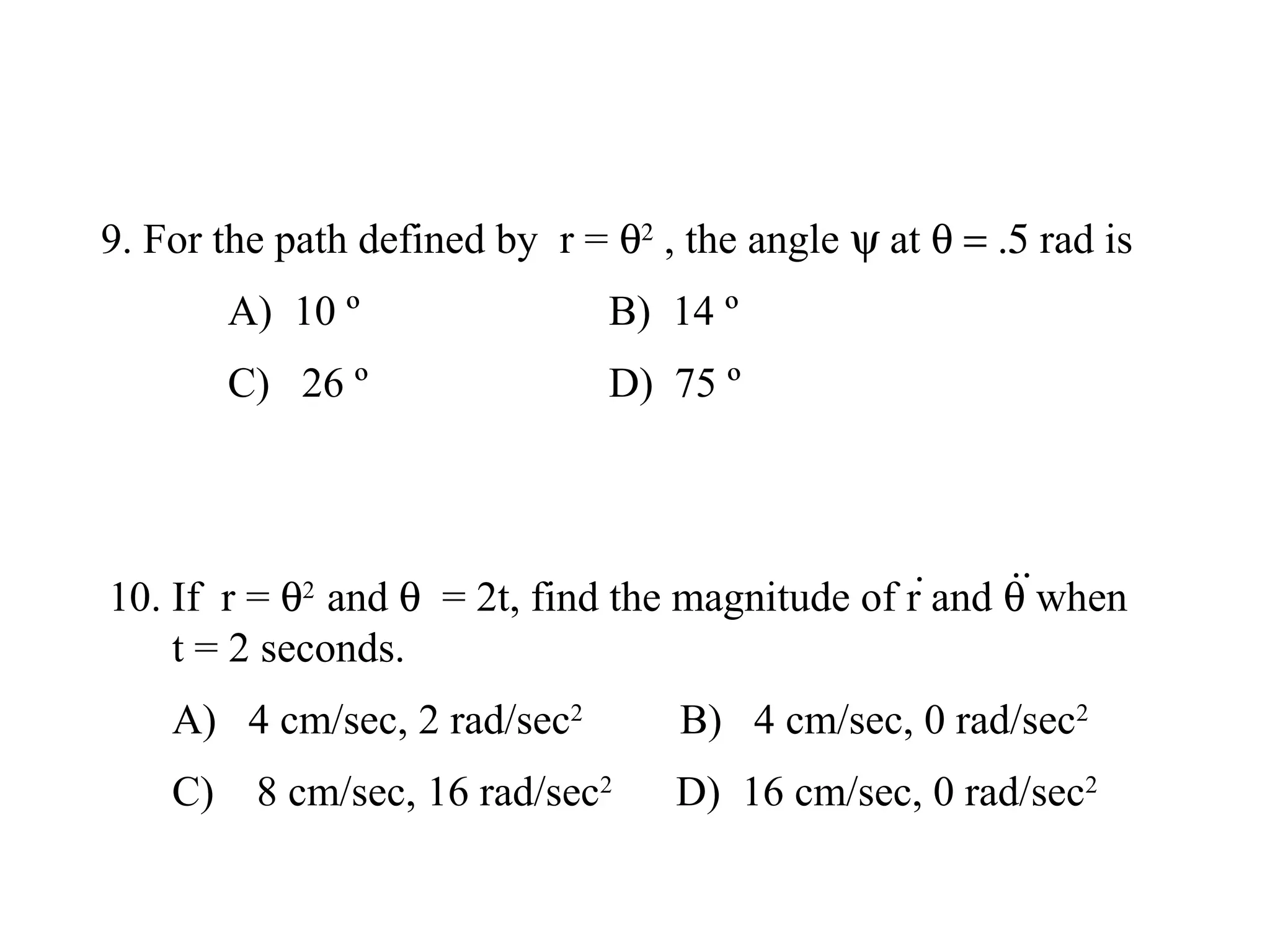
9. For the path defined by r = θ2 , the angle ψ at θ = .5 rad is
       A) 10 º                 B) 14 º
       C) 26 º                 D) 75 º


                                                       ··
10. If r = θ2 and θ = 2t, find the magnitude of r· and θ when
    t = 2 seconds.
    A) 4 cm/sec, 2 rad/sec2        B) 4 cm/sec, 0 rad/sec2
    C) 8 cm/sec, 16 rad/sec2       D) 16 cm/sec, 0 rad/sec2

Engineering science lesson 1

  • 1.
    Module content • Chapter 1: Static engineering systems – Simply supported beams – Beams and columns – Torsion in circular shafts • Chapter 2: Dynamic engineering systems – Uniform acceleration – Energy transfer – Oscillating mechanical systems • Chapter 3: DC and AC theory – DC electrical principles – AC circuits – Transformers • Chapter 4: Information and energy control systems – Information systems – Energy flow control systems – Interface system components
  • 2.
    Chapter 2- DynamicEngineering Systems 2.1 Uniform acceleration • linear and angular acceleration • Newton’s laws of motion • mass, moment of inertia and radius of gyration of rotating components • combined linear and angular motion • effects of friction 2.2 Energy transfer • gravitational potential energy • linear and angular kinetic energy • strain energy • principle of conservation of energy • work-energy transfer in systems with combine linear and angular motion • effects of impact loading 2.3 Oscillating mechanical systems • simple harmonic motion • linear and transverse systems; • qualitative description of the effects of forcing and damping
  • 3.
    Outcomes and Assessmentcriteria To achieve each outcome in chapter 2 a learner must demonstrate the ability to: Analyse dynamic engineering systems – determine the behaviour of dynamic mechanical systems in which uniform acceleration is present – determine the effects of energy transfer in mechanical systems – determine the behaviour of oscillating mechanical systems
  • 4.
    Mechanics- To studydynamic systems Study of Objects at Description of the Origin of the Rest (Valence of Object’s Motion Object’s Motion applied forces and (Position, Velocity, (Force, Momentum, Moments) & Acceleration) & Energy) Statics Kinematics Kinetics Mechanics: Physics of Behaviors of the Objects • Kinematics: How to describe the object’s motion Where is the object? Position How fast the position changes with time? Velocity How fast the velocity changes? Acceleration • Kinetics: How to explain the object’s motion  Intrinsic motion of an object : Changing its position, Constant velocity, No acceleration  Change in motion due to an external action Changing its position, Non-constant velocity, Non-zero acceleration
  • 5.
    Types of motions • Translational motion motion by which a body shifts from one point in space to another – e.g., the motion of a bullet red from a gun • Rotational motion motion by which an extended body changes orientation, with respect to other bodies in space, without changing position – e.g., the motion of a spinning top • Oscillatory motion motion which continually repeats in time with a fixed period – e.g., the motion of a pendulum in a grandfather clock • Circular motion motion by which a body executes a circular orbit about another fixed body – e.g., the (approximate) motion of the Earth about the Sun
  • 6.
    The different types of motion stated on the last slide can be combined – for instance, the motion of a properly bowled bowling ball consists of a combination of translational and rotational motion, whereas wave propagation is a combination of translational and oscillatory motion. • The above mentioned types of motion are not entirely distinct – e.g., circular motion contains elements of both rotational and oscillatory motion. • statics: i.e., the subdivision of mechanics which is concerned with the forces that act on bodies at rest and in equilibrium. – Statics is obviously of great importance in civil engineering – For instance, the principles of statics were used to design the building in which this lecture is taking place, so as to ensure that it does not collapse.
  • 7.
    Angular displacement s = r ⋅θ s θ= (radianmeasure ) r s 2πr For full circle: θ = = = 2π r r Planar, rigid object rotating Full circle has an angle of 2π radians, about origin O. Thus, one radian is 360°/2π = 57.3°
  • 8.
    Angular velocity andacceleration Angular displacement: ∆θ = θ − θo θ − θ o ∆θ Average angular speed: ωavg = = t − to ∆t ∆θ dθ Instantaneous angular speed: ω = lim = ∆t →0 ∆t dt ω − ωo ∆ω Average angular acceleration: αavg = = t − to ∆t ∆ω dω Instantaneous angular acceleration: α = lim = ∆t →0 ∆t dt
  • 9.
    Every particle (ofa rigid object): • rotates through the same angle, • has the same angular velocity, • has the same angular acceleration. θ, ω, α characterize rotational motion of entire object
  • 10.
    Linear motion Rotational motion (linear acceleration, a) ( rotational acceleration, α) v = v o + at ω = ωo + αt x = x o + 1 (v + v o )t 2 θ = θo + 1 (ω + ωo )t 2 1 2 1 2 x = x o + v ot + at θ = θo + ωot + αt 2 2 v 2 = v o 2 + 2a ( x − x o ) ω 2 = ωo 2 + 2α (θ − θo )
  • 11.
    Linear and angularquantities Arc length s: s = r ⋅θ Tangential speed of a point P: v = r ⋅ω Tangential acceleration of a point P: 2 v at = r.α at = =ω r 2 r
  • 12.
    Example 1 Agrindstone rotates at constant angular acceleration α = 0.35 rad/s2. At time t = 0, it has an angular velocity of ωo= - 4.6 rad/s2 and a reference line on it is horizontal, at the angular position θo=0. (a) At what time after t=0 is the reference line at the angular position θ = 5.0 rev? (b) Describe the grindstone’s rotation between t = 0 and t = 32 s. (c) At what time t does the grindstone momentarily stop?
  • 13.
    Linear inertia andmass • Inertia – The tendency of an object to keep the current state of motion – Difficulty in changing the state of motion • Properties of Inertia – Static inertia vs. dynamic inertia – Proportional to mass of the object: • "The more massive an object, the more it tends to maintain its current state of motion." • Mass: measure of inertia in linear motion
  • 14.
    Rotational inertia Rotationalinertia (or Moment of Inertia) I of an object depends on: - the axis about which the object is rotated. - the mass of the object. - the distance between the mass(es) and the axis of rotation. - Note that ω must be in radian unit. The SI unit for I is kg.m2 and it is a scalar. I ≡ ∑ mi ⋅ ri 2 i
  • 15.
    lim ∑ ri = ∫ r 2 dm = ∫ r 2 ρdV 2 ⋅∆ I≡ mi ∆ → mi 0 i Note that the moments of inertia are different for different axes of rotation (even for the same object) 1 I = ML2 3 1 I= ML2 12
  • 17.
    Radius of Gyration • The mass moment of inertia of a body about a specific axis can be defined using the radius of gyration (k). The radius of gyration has units of length and is a measure of the distribution of the body’s mass about the axis at which the moment of inertia is defined. I I = m k or k = 2 m
  • 18.
    Parallel Axis Theorem • Note that the moments of inertia are different for different axes of rotation (even for the same object) I = 1 Mr 2 2 I = 2 Mr2 3 (a ) (b) • Let h be the perpendicular distance between the axis that we need and the axis through the center of mass (remember these two axes must be parallel). Then the rotational inertia I about the required axis is I = I + M h 2 parellel − axis theorem com • For example, we can apply parallel axis theorem in the case of (a) and (b) above.
  • 19.
    First law • Aparticle originally at rest, or moving in a straight line at constant velocity, will remain in this state if the resultant force acting on the particle is zero – Newton’s First Law looked at objects at rest or under constant velocity. – No net force was acting on these objects
  • 20.
    Second law • “A force applied to a body causes an acceleration.” – Acceleration describes how quickly motion changes. – Or : acceleration = change in velocity time interval • Acceleration is proportional to the force, inversely proportional to mass. – Usually there is more than one force acting on an object. The resulting acceleration of an object is due to the total or NET FORCE on the object – acceleration ∝ net force – acceleration ∝ 1 / mass (As more mass is added, the acceleration of the cart is slowed) – acceleration = net force or a = F mass m – Force = mass x acceleration (work out few examples) • Direction of the acceleration = direction of the force • First and second law – If a force is applied to an object, whether it is at rest or moving, the motion will change. IT ACCELERATES. – If the force is removed, the object will continue moving at a constant velocity
  • 21.
    The first andthird laws were used in developing the concepts of statics. Newton’s second law forms the basis of the study of dynamics. Mathematically, Newton’s second law of motion can be written F = ma where F is the resultant unbalanced force acting on the particle, and a is the acceleration of the particle. The positive scalar m is called the mass of the particle. Newton’s second law cannot be used when the particle’s speed approaches the speed of light, or if the size of the particle is extremely small (~ size of an atom).
  • 22.
    Newton’s 2nd Lawfor Rotation τ net = Iα Newton ' s second law for rotation • Note that α must be in radian. Proof : Ft = mat τ = Ft r = mat r Since at = α r, τ = m (α r) r = (m r 2 )α The quantity in parentheses is the moment of inertia of the particle about the rotation axis, therefore τ = I α
  • 23.
    Third law • “Forevery action, there is an equal and opposite reaction.” • “When one body exerts a force on a second, the second body exerts a reaction force that is equal in magnitude and opposite in direction on the first.” • Eg: bullet vs. gun, fist fighting, rocket • For every interaction, the forces always come in pairs (twos). – The ACTION FORCE (Object A exerts a force on object B )and – The REACTION FORCE (Object B exerts a force on object A ) – They are equal in strength and opposite in direction
  • 24.
    Action and reactionon different masses • When a cannon is fired, there is an interaction between the cannon and the cannon ball. • The forces the cannon ball and cannon exert on each other are equal and opposite. • The cannonball moves fast while the cannon only Kicks a bit because of the difference in their masses. – FOR THE CANNON : a = F / M – FOR THE CANNONBALL : f = F / m • The force exerted on a small mass produces a greater acceleration than the same force exerted on a large mass Question : Does a stick of dynamite contain force? Answer : No, force is not something an object has, like mass and volume. An object may posses the capability of exerting force on another object but it does not possess force.
  • 25.
    Combined linear andangular motions • In reality, car tires both rotate and translate • They are a good example of something which rolls (translates, moves forward, rotates) without slipping • Is there friction? What kind?
  • 26.
    Derivation • The trickis to pick your reference frame correctly! • Think of the wheel as sitting still and the ground moving past it with speed V. Velocity of ground (in bike frame) = -wR => Velocity of bike (in ground frame) = wR
  • 27.
    Friction • Force actingat the area of contact between two surfaces • Magnitude: proportional to the friction coefficient and the normal reaction force • Direction: opposite that of motion or motion tendency • Types: sliding and rolling – Sliding: due to relative motion of the surfaces – Rolling: due to deformation of the surfaces
  • 28.
    Friction (continued) • Staticvs. Kinetic Friction – Max. static friction: max. force required to initiate a motion – Kinetic (dynamic) friction: force required to maintain the motion
  • 29.
    Banking Angle Your carhas m and is traveling with a speed V around a curve with Radius R What angle, θ , should the road be banked so that no friction is required?
  • 30.
    Skidding on aCurve A car of mass m rounds a curve on a flat road of radius R at a speed V. What coefficient of friction is required so there is no skidding? Kinetic or static friction?
  • 31.
    Conical Pendulum A smallball of mass m is suspended by a cord of length L and revolves in a circle with a radius given by r = L sinθ . 1. What is the velocity of the ball? 2. Calculate the period of the ball
  • 32.
    Weight • When near the surface of the earth, the only gravitational force having any sizable magnitude is that between the earth and the body. This force is called the weight of the body – Gravity acting on a body from the Earth – Direction: downward • Mass is an absolute property of a body. It is independent of the gravitational field in which it is measured. The mass provides a measure of the resistance of a body to a change in velocity, as defined by Newton’s second law of motion (m = F/a). • The weight of a body is not absolute, since it depends on the gravitational field in which it is measured. Weight is defined as W = mg where g is the acceleration due to gravity (weight in mass and earth) SI system: In the SI system of units, mass is a base unit and weight is a derived unit. Typically, mass is specified in kilograms (kg), and weight is calculated from W = mg. If the gravitational acceleration (g) is specified in units of m/s2, then the weight is expressed in newtons (N). On the earth’s surface, g can be taken as g = 9.81 m/s2. W (N) = m (kg) g (m/s2) => N = kg·m/s2
  • 33.
    Momentum and Impulse • Momentum – Amount of motion – Momentum = (mass)(velocity) – Important in giving or receiving impact, collision, etc. – Vector • Impulse – Collision characterized by the exchange of a large force during a short time period – Accumulated effect of force exerted on an object for a period of time – Impulse = (force)(time) – Increase in F or t ⇒ increase in I – Vector – Equal to the change in momentum of the system
  • 34.
    Example 2 A compact disc player disc from rest and accelerates to its final velocity of 3.50 rev/s in 1.50s. What is the disk's average angular acceleration?
  • 35.
    Example 3 The blades of a blender rotate at a rate of 7500rpm. When the motor is turned off during operation, the blades slow to rest in 3.0 seconds. What is the angular acceleration?
  • 36.
    Example 4 How fast is the outer edge of a CD (at 6.0 cm) moving when it is rotating at its top speed of 22.0 rad/s?
  • 37.
    Example 5 How many rotations does the CD from the first problem make while coming up to speed from rest to wf = 22.0 rad/sec at a= 14.7 rad/s2
  • 38.
    Example 6 A wheel with radius 0.5m makes 55 revolutions as it changes speed from 80km/h to 30 km/h. The wheel has a diameter of 1 meter. (a) What was the angular acceleration? (b) How long is required for the wheel to come to a stop if it decelerated at that rate?
  • 39.
    Bicycle example A bicyclewith initial linear velocity V0 (at t0=0) decelerates uniformly (without slipping) to rest over a distance d. For a wheel of radius R: a) Total revolutions before it stops? b) Total angular distance traversed by the wheel? c) The angular acceleration? d) The total time until it stops?
  • 40.
    Figure shows auniform disk, with mass M = 2.5 kg and radius R = 20 cm, mounted on a fixed horizontal axle. A block with mass m = 1.2 kg hangs from a massless cord that is wrapped around the rim of the disk Find the acceleration of the falling block, the angular acceleration of the disk, and the tension in the cord. The cord does not slip, and there is no friction at the axle.
  • 42.
    1. Newton’s secondlaw can be written in mathematical form as ΣF = ma. Within the summation of forces ΣF, ________ are(is) not included. A) external forces B) weight C) internal forces D) All of the above. 2. The equation of motion for a system of n-particles can be written as ΣFi = Σ miai = maG, where aG indicates _______. A) summation of each particle’s acceleration B) acceleration of the center of mass of the system C) acceleration of the largest particle D) None of the above.
  • 43.
    3. The block(mass = m) is moving upward with a speed v. Draw the FBD if the kinetic friction coefficient is µk. mg mg v A) µ kN B) µ kN N N mg C) µ kmg D) None of the above. N
  • 44.
    4. Packaging fororanges is tested using a machine that exerts ay = 20 m/s2 and ax = 3 m/s2, simultaneously. Select the correct FBD and kinetic diagram for this condition. y W may x W A) B) = • max = • max Rx Rx Ry Ry C) may D) W may = • = • max Ry Ry
  • 45.
    5. Internal forcesare not included in an equation of motion analysis because the internal forces are_____. A) equal to zero B) equal and opposite and do not affect the calculations C) negligibly small D) not important 6. A 10 N block is initially moving down a ramp with a velocity of v. The force F is applied to F bring the block to rest. Select the correct FBD. 10 F 10 F 10 F v A) µ k10 B) µ k10 C) µ kN N N N
  • 46.
    B 7. When apilot flies an airplane in a vertical loop of constant radius r at C r A constant speed v, his apparent weight is maximum at D A) Point A B) Point B (top of the loop) C) Point C D) Point D (bottom of the loop) 8. If needing to solve a problem involving the pilot’s weight at Point C, select the approach that would be best. A) Equations of Motion: Cylindrical Coordinates B) Equations of Motion: Normal & Tangential Coordinates C) Equations of Motion: Polar Coordinates D) No real difference – all are bad. E) Toss up between B and C.
  • 47.
    9. For thepath defined by r = θ2 , the angle ψ at θ = .5 rad is A) 10 º B) 14 º C) 26 º D) 75 º ·· 10. If r = θ2 and θ = 2t, find the magnitude of r· and θ when t = 2 seconds. A) 4 cm/sec, 2 rad/sec2 B) 4 cm/sec, 0 rad/sec2 C) 8 cm/sec, 16 rad/sec2 D) 16 cm/sec, 0 rad/sec2

Editor's Notes