Prof. Dr. Zahid A. Siddiqi
CORRECTION FOR SINGLE ANGLES
FOR PLANAR TRUSSES
Single angle compression members may undergo
torsional buckling at loads lower than the loads at
which buckling may occur about x, y or z axes.
Hence, in order to closely estimate the capacity of
equal leg angles or unequal leg angles connected
through the longer leg, the slenderness ratio is to
be modified as under:
Prof. Dr. Zahid A. Siddiqi
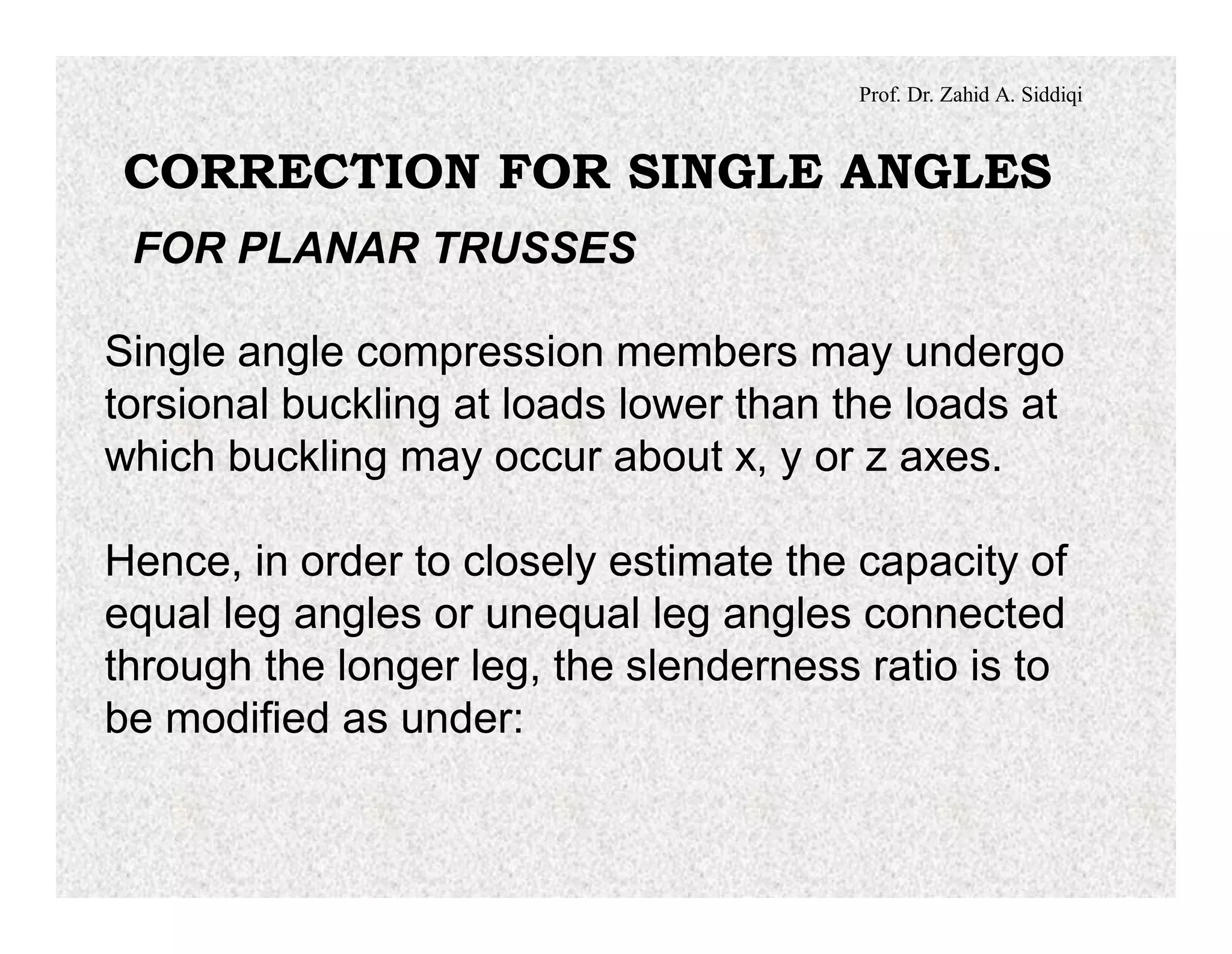
(i) When 0 ≤ L / rx ≤ 80,
KL/r = 72 + 0.75 L / rx
(ii) When L / rx > 80,
KL/r = 32 + 1.25 L / rx ≤ 200
Prof. Dr. Zahid A. Siddiqi
DESIGN FLOW CHART FOR
COMPRESSION MEMBERS
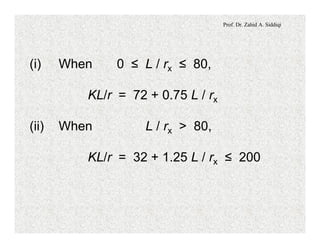
Inputs
PD, PL, L, end conditions, etc.
Calculate Pu for the controlling/critical load
combination. Also find the values of effective
length factor Kx, Ky and Kz.
Assume slenderness ratio (if column selection
tables are not to be used):
Prof. Dr. Zahid A. Siddiqi
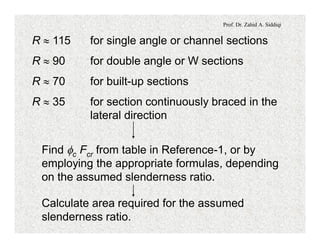
R » 115 for single angle or channel sections
R » 90 for double angle or W sections
R » 70 for built-up sections
R » 35 for section continuously braced in the
lateral direction
Find fc Fcr from table in Reference-1, or by
employing the appropriate formulas, depending
on the assumed slenderness ratio.
Calculate area required for the assumed
slenderness ratio.
Prof. Dr. Zahid A. Siddiqi
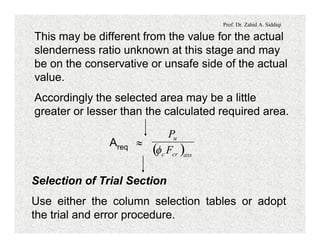
This may be different from the value for the actual
slenderness ratio unknown at this stage and may
be on the conservative or unsafe side of the actual
value.
Accordingly the selected area may be a little
greater or lesser than the calculated required area.
Areq »
( )asscrc
u
F
P
f
Selection of Trial Section
Use either the column selection tables or adopt
the trial and error procedure.
Prof. Dr. Zahid A. Siddiqi
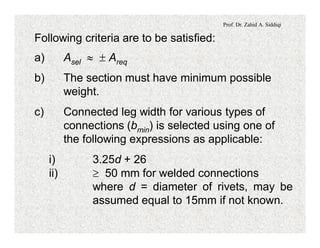
Following criteria are to be satisfied:
a) Asel » ± Areq
b) The section must have minimum possible
weight.
c) Connected leg width for various types of
connections (bmin) is selected using one of
the following expressions as applicable:
i) 3.25d + 26
ii) ³ 50 mm for welded connections
where d = diameter of rivets, may be
assumed equal to 15mm if not known.
Prof. Dr. Zahid A. Siddiqi
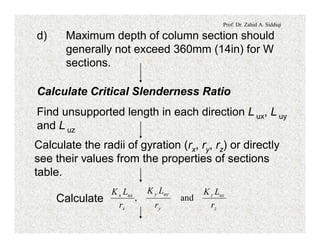
d) Maximum depth of column section should
generally not exceed 360mm (14in) for W
sections.
Calculate Critical Slenderness Ratio
Find unsupported length in each direction L ux, L uy
and L uz
Calculate the radii of gyration (rx, ry, rz) or directly
see their values from the properties of sections
table.
Calculate
z
uzz
y
uyy
x
uxx
r
LK
r
LK
r
LK
and,
Prof. Dr. Zahid A. Siddiqi
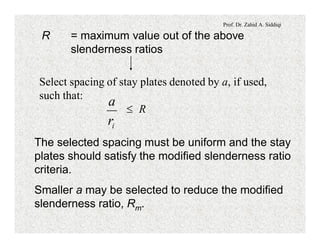
R = maximum value out of the above
slenderness ratios
Select spacing of stay plates denoted by a, if used,
such that:
£ R
ir
a
The selected spacing must be uniform and the stay
plates should satisfy the modified slenderness ratio
criteria.
Smaller a may be selected to reduce the modified
slenderness ratio, Rm.
Prof. Dr. Zahid A. Siddiqi
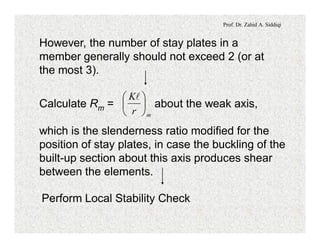
However, the number of stay plates in a
member generally should not exceed 2 (or at
the most 3).
Calculate Rm = about the weak axis,
which is the slenderness ratio modified for the
position of stay plates, in case the buckling of the
built-up section about this axis produces shear
between the elements.
mr
K
÷
ø
ö
ç
è
æ l
Perform Local Stability Check
Prof. Dr. Zahid A. Siddiqi
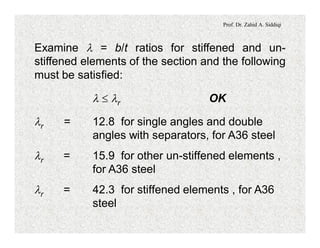
Examine l = b/t ratios for stiffened and un-
stiffened elements of the section and the following
must be satisfied:
l £ lr OK
lr = 12.8 for single angles and double
angles with separators, for A36 steel
lr = 15.9 for other un-stiffened elements ,
for A36 steel
lr = 42.3 for stiffened elements , for A36
steel
Prof. Dr. Zahid A. Siddiqi
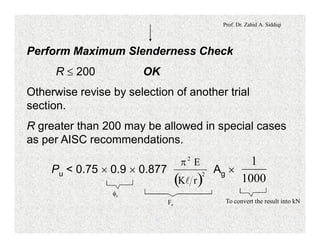
Perform Maximum Slenderness Check
R £ 200 OK
Otherwise revise by selection of another trial
section.
R greater than 200 may be allowed in special cases
as per AISC recommendations.
Fe
fc
To convert the result into kN
Pu < 0.75 ´ 0.9 ´ 0.877 Ag ´
( )
p2
2
E
K rl 1000
1
Prof. Dr. Zahid A. Siddiqi
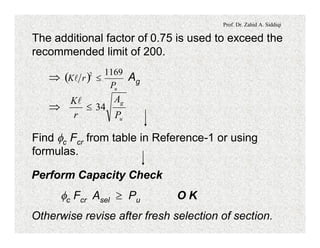
The additional factor of 0.75 is used to exceed the
recommended limit of 200.
Þ Ag( )
uP
rK
11692
£l
Þ
u
g
P
A
r
K
34£
l
Find fc Fcr from table in Reference-1 or using
formulas.
Perform Capacity Check
fc Fcr Asel ³ Pu O K
Otherwise revise after fresh selection of section.
Prof. Dr. Zahid A. Siddiqi
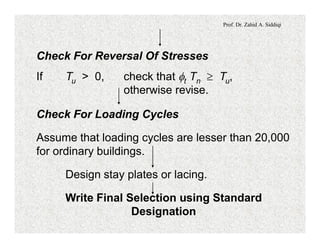
Check For Reversal Of Stresses
If Tu > 0, check that ft Tn ³ Tu,
otherwise revise.
Check For Loading Cycles
Assume that loading cycles are lesser than 20,000
for ordinary buildings.
Design stay plates or lacing.
Write Final Selection using Standard
Designation
Prof. Dr. Zahid A. Siddiqi
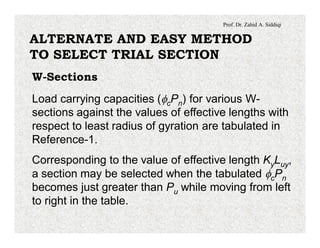
ALTERNATE AND EASY METHOD
TO SELECT TRIAL SECTION
W-Sections
Load carrying capacities (fcPn) for various W-
sections against the values of effective lengths with
respect to least radius of gyration are tabulated in
Reference-1.
Corresponding to the value of effective length KyLuy,
a section may be selected when the tabulated fcPn
becomes just greater than Pu while moving from left
to right in the table.
Prof. Dr. Zahid A. Siddiqi
Few sections with different depths may be
examined to find a minimum weight section.
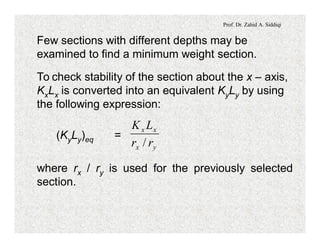
To check stability of the section about the x – axis,
KxLx is converted into an equivalent KyLy by using
the following expression:
(KyLy)eq =
yx
xx
rr
LK
/
where rx / ry is used for the previously selected
section.
Prof. Dr. Zahid A. Siddiqi
The ratio rx / ry included in these tables provides a
convenient method for investigating the strength
of a column with respect to its major axis.
Section is selected / revised for longer of the two
lengths KyLy and (KyLy)eq.
The procedure is explained as under:
Procedure
Find maximum values of KxLx and KyLy.
Select section against KyLy according to the loads
starting from W360 side and moving downward
by weight.
Prof. Dr. Zahid A. Siddiqi
Find rx / ry for the selected section and calculate
equivalent KyLy as KxLx/( rx / ry).
Re-enter the table for greater value out of KyLy
and (KyLy)eq.
Revise the section if necessary.
Double Angle Sections
Column selection tables are also available for
double angle sections with 10mm gusset plate in
Reference 1, using fully tightened stay plates.
Only difference in this case is that the load
carrying capacities (fcPn) are listed both for KxLx
and KyLy.
Prof. Dr. Zahid A. Siddiqi
While selecting section, fcPn for both KxLx and
KyLy should individually be greater than Pu.
After the selection of section, all the checks
should be applied included in the general flow
chart.
Example 3.1: Design a truss compression member
using the following three given cross-sectional
shapes:
1. 2Ls with 10 mm thick gusset plate and bolted stay
plates.
2. Single angle.
3. W-section.
Prof. Dr. Zahid A. Siddiqi
The other data is as under:
PD = 110 kN ; PL = 140 kN
L = 3.4 m ; A36 Steel
Solution:
The truss member consisting of double angles
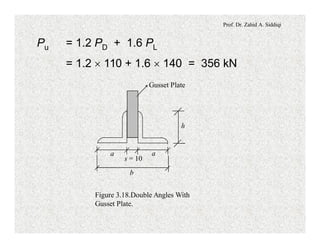
along with the gusset plate is shown in Figure
3.18.
For truss members, K = 1
Lu = L as there is no bracing between the
joints
Prof. Dr. Zahid A. Siddiqi
Pu = 1.2 PD + 1.6 PL
= 1.2 ´ 110 + 1.6 ´ 140 = 356 kN
b
s = 10
aa
h
Gusset Plate
Figure 3.18.Double Angles With
Gusset Plate.
Prof. Dr. Zahid A. Siddiqi
1- Double Angles
1. The section will be economical if it has nearly
same slenderness ratio in both directions.
This means that rx and ry should nearly be
same (as the length for both directions is
equal).
2. The radius of gyration, rx, for the double section
will be same as that for a single section.
3. The radius of gyration, ry, for the double section
will be considerably higher than for a single
section.
Prof. Dr. Zahid A. Siddiqi
4. From the above facts it is clear that, to
make r same in both directions, unequal
leg angles are to be used with the longer
legs connected together.
5. The projecting leg should be relatively
smaller.
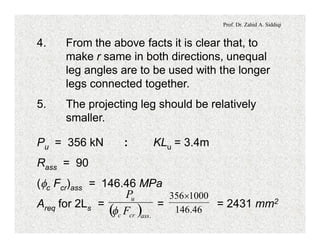
Pu = 356 kN : KLu = 3.4m
Rass = 90
(fc Fcr)ass = 146.46 MPa
Areq for 2Ls = = = 2431 mm2
( ) .asscrc
u
F
P
f 46.146
1000356´
Prof. Dr. Zahid A. Siddiqi
Areq for single angle = 1216 mm2
bmin = 3.25d + 26
= 75 mm (assuming d = 15mm)
Select section based on the following
considerations:
1. Asel » Areq
2. Minimum weight section
3. b ³ bmin
Prof. Dr. Zahid A. Siddiqi
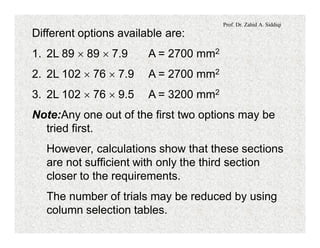
Different options available are:
1. 2L 89 ´ 89 ´ 7.9 A = 2700 mm2
2. 2L 102 ´ 76 ´ 7.9 A = 2700 mm2
3. 2L 102 ´ 76 ´ 9.5 A = 3200 mm2
Note:Any one out of the first two options may be
tried first.
However, calculations show that these sections
are not sufficient with only the third section
closer to the requirements.
The number of trials may be reduced by using
column selection tables.
Prof. Dr. Zahid A. Siddiqi
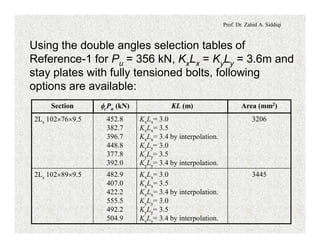
Using the double angles selection tables of
Reference-1 for Pu = 356 kN, KxLx = KyLy = 3.6m and
stay plates with fully tensioned bolts, following
options are available:
Section fcPn (kN) KL (m) Area (mm2)
2Ls 102´76´9.5 452.8
382.7
396.7
448.8
377.8
392.0
KxLx= 3.0
KxLx= 3.5
KxLx= 3.4 by interpolation.
KyLy= 3.0
KyLy= 3.5
KyLy= 3.4 by interpolation.
3206
2Ls 102´89´9.5 482.9
407.0
422.2
555.5
492.2
504.9
KxLx= 3.0
KxLx= 3.5
KxLx= 3.4 by interpolation.
KyLy= 3.0
KyLy= 3.5
KyLy= 3.4 by interpolation.
3445
Prof. Dr. Zahid A. Siddiqi
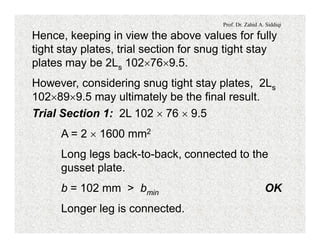
Hence, keeping in view the above values for fully
tight stay plates, trial section for snug tight stay
plates may be 2Ls 102´76´9.5.
However, considering snug tight stay plates, 2Ls
102´89´9.5 may ultimately be the final result.
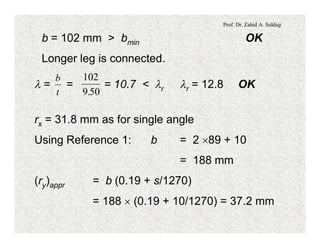
Trial Section 1: 2L 102 ´ 76 ´ 9.5
A = 2 ´ 1600 mm2
Long legs back-to-back, connected to the
gusset plate.
b = 102 mm > bmin OK
Longer leg is connected.
Prof. Dr. Zahid A. Siddiqi
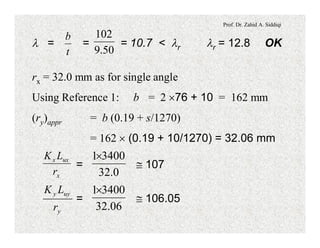
l = = = 10.7 < lr lr = 12.8 OK
t
b
50.9
102
rx = 32.0 mm as for single angle
Using Reference 1: b = 2 ´76 + 10 = 162 mm
(ry)appr = b (0.19 + s/1270)
= 162 ´ (0.19 + 10/1270) = 32.06 mm
= @ 107
x
uxx
r
LK
0.32
34001´
= @ 106.05
y
uyy
r
LK
06.32
34001´
Prof. Dr. Zahid A. Siddiqi
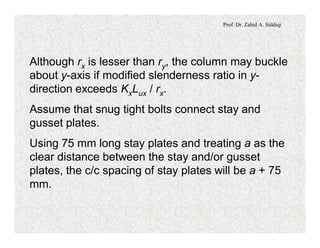
Although rx is lesser than ry, the column may buckle
about y-axis if modified slenderness ratio in y-
direction exceeds KxLux / rx.
Assume that snug tight bolts connect stay and
gusset plates.
Using 75 mm long stay plates and treating a as the
clear distance between the stay and/or gusset
plates, the c/c spacing of stay plates will be a + 75
mm.
Prof. Dr. Zahid A. Siddiqi
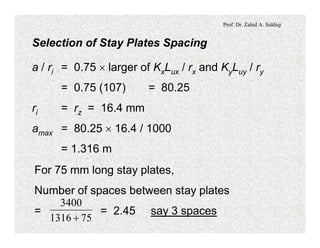
Selection of Stay Plates Spacing
a / ri = 0.75 ´ larger of KxLux / rx and KyLuy / ry
= 0.75 (107) = 80.25
ri = rz = 16.4 mm
amax = 80.25 ´ 16.4 / 1000
= 1.316 m
For 75 mm long stay plates,
Number of spaces between stay plates
= = 2.45 say 3 spaces
751316
3400
+
Prof. Dr. Zahid A. Siddiqi
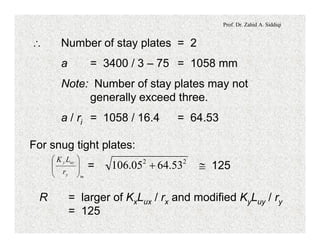
 Number of stay plates = 2
a = 3400 / 3 – 75 = 1058 mm
Note: Number of stay plates may not
generally exceed three.
a / ri = 1058 / 16.4 = 64.53
For snug tight plates:
= @ 125
my
uyy
r
LK
÷
÷
ø
ö
ç
ç
è
æ 22
53.6405.106 +
R = larger of KxLux / rx and modified KyLuy / ry
= 125
Prof. Dr. Zahid A. Siddiqi
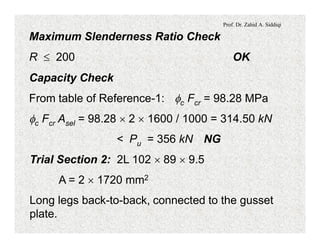
Maximum Slenderness Ratio Check
R £ 200 OK
Capacity Check
From table of Reference-1: fc Fcr = 98.28 MPa
fc Fcr Asel = 98.28 ´ 2 ´ 1600 / 1000 = 314.50 kN
< Pu = 356 kN NG
Trial Section 2: 2L 102 ´ 89 ´ 9.5
A = 2 ´ 1720 mm2
Long legs back-to-back, connected to the gusset
plate.
Prof. Dr. Zahid A. Siddiqi
b = 102 mm > bmin OK
Longer leg is connected.
l = = = 10.7 < lr lr = 12.8 OK
t
b 102
9 50.
rx = 31.8 mm as for single angle
Using Reference 1: b = 2 ´89 + 10
= 188 mm
(ry)appr = b (0.19 + s/1270)
= 188 ´ (0.19 + 10/1270) = 37.2 mm
Prof. Dr. Zahid A. Siddiqi
Exact calculations for ry (to be made only for the
last trial):
Iy = 2 ´ [123 ´ 104 + 1720 ´ (24.3 + 5)2]
= 541.3 ´ 104 mm4
(ry)exact = = 39.7 mm
17202
103.541 4
´
´
= @ 107
x
uxx
r
LK
8.31
34001´
= @ 85.64
y
uyy
r
LK
7.39
34001´
Prof. Dr. Zahid A. Siddiqi
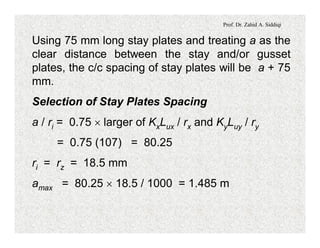
Using 75 mm long stay plates and treating a as the
clear distance between the stay and/or gusset
plates, the c/c spacing of stay plates will be a + 75
mm.
Selection of Stay Plates Spacing
a / ri = 0.75 ´ larger of KxLux / rx and KyLuy / ry
= 0.75 (107) = 80.25
ri = rz = 18.5 mm
amax = 80.25 ´ 18.5 / 1000 = 1.485 m
Prof. Dr. Zahid A. Siddiqi
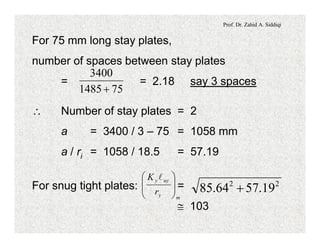
For 75 mm long stay plates,
number of spaces between stay plates
= = 2.18 say 3 spaces
751485
3400
+
 Number of stay plates = 2
a = 3400 / 3 – 75 = 1058 mm
a / ri = 1058 / 18.5 = 57.19
For snug tight plates: =
@ 103
my
uyy
r
K
÷
÷
ø
ö
ç
ç
è
æ l
22
19.5764.85 +
Prof. Dr. Zahid A. Siddiqi
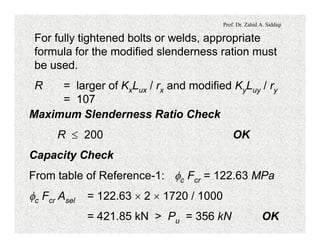
For fully tightened bolts or welds, appropriate
formula for the modified slenderness ration must
be used.
R = larger of KxLux / rx and modified KyLuy / ry
= 107
Maximum Slenderness Ratio Check
R £ 200 OK
Capacity Check
From table of Reference-1: fc Fcr = 122.63 MPa
fc Fcr Asel = 122.63 ´ 2 ´ 1720 / 1000
= 421.85 kN > Pu = 356 kN OK
Prof. Dr. Zahid A. Siddiqi
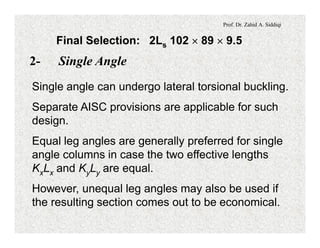
Final Selection: 2Ls 102 ´ 89 ´ 9.5
2- Single Angle
Single angle can undergo lateral torsional buckling.
Separate AISC provisions are applicable for such
design.
Equal leg angles are generally preferred for single
angle columns in case the two effective lengths
KxLx and KyLy are equal.
However, unequal leg angles may also be used if
the resulting section comes out to be economical.
Prof. Dr. Zahid A. Siddiqi
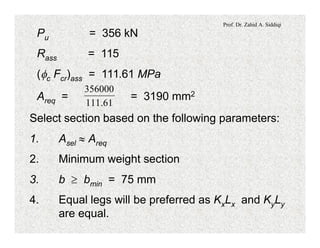
Pu = 356 kN
Rass = 115
(fc Fcr)ass = 111.61 MPa
Areq = = 3190 mm2
61.111
356000
Select section based on the following parameters:
1. Asel » Areq
2. Minimum weight section
3. b ³ bmin = 75 mm
4. Equal legs will be preferred as KxLx and KyLy
are equal.
Prof. Dr. Zahid A. Siddiqi
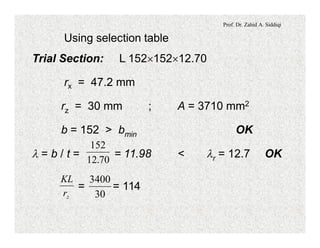
Using selection table
Trial Section: L 152´152´12.70
rx = 47.2 mm
rz = 30 mm ; A = 3710 mm2
b = 152 > bmin OK
l = b / t = = 11.98 < lr = 12.7 OK
152
12 70.
= = 114
zr
KL
30
3400
Prof. Dr. Zahid A. Siddiqi
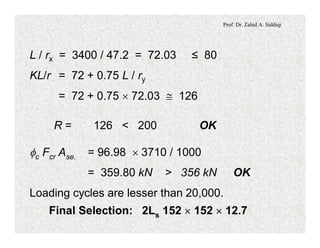
R = 126 < 200 OK
fc Fcr Ase. = 96.98 ´ 3710 / 1000
= 359.80 kN > 356 kN OK
Loading cycles are lesser than 20,000.
Final Selection: 2Ls 152 ´ 152 ´ 12.7
L / rx = 3400 / 47.2 = 72.03 ≤ 80
KL/r = 72 + 0.75 L / ry
= 72 + 0.75 ´ 72.03 @ 126
Prof. Dr. Zahid A. Siddiqi
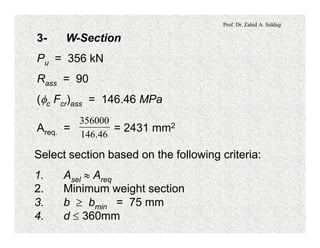
3- W-Section
Pu = 356 kN
Rass = 90
(fc Fcr)ass = 146.46 MPa
Areq. = = 2431 mm2
46.146
356000
Select section based on the following criteria:
1. Asel » Areq
2. Minimum weight section
3. b ³ bmin = 75 mm
4. d £ 360mm
Prof. Dr. Zahid A. Siddiqi
Using the W-shape selection tables of Reference-1
for Pu = 356 kN, KyLy = 3.4m, following option is
obtained [(KyLy)eq is not critical]:
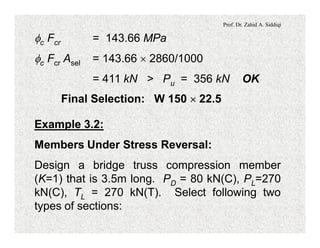
Trial Section: W150 ´ 22.5
rx = 65 ; ry = 37.1 ; A = 2860 mm2
bf / 2 = 152 / 2 = 76 mm > bmin OK
l = = 11.5 < lr = 15.9 OK
f
f
t
b
2
l = = 21.6 < lr = 42.3 OK
wt
h
R = = @ 92 < 200 OK
.minr
Kl
1.37
3400
Prof. Dr. Zahid A. Siddiqi
fc Fcr = 143.66 MPa
fc Fcr Asel = 143.66 ´ 2860/1000
= 411 kN > Pu = 356 kN OK
Final Selection: W 150 ´ 22.5
Example 3.2:
Members Under Stress Reversal:
Design a bridge truss compression member
(K=1) that is 3.5m long. PD = 80 kN(C), PL=270
kN(C), TL = 270 kN(T). Select following two
types of sections:
Prof. Dr. Zahid A. Siddiqi
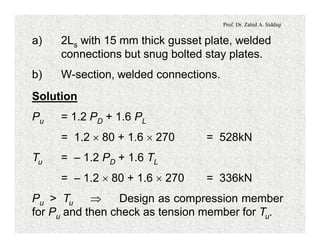
a) 2Ls with 15 mm thick gusset plate, welded
connections but snug bolted stay plates.
b) W-section, welded connections.
Solution
Pu = 1.2 PD + 1.6 PL
= 1.2 ´ 80 + 1.6 ´ 270 = 528kN
Tu = – 1.2 PD + 1.6 TL
= – 1.2 ´ 80 + 1.6 ´ 270 = 336kN
Pu > Tu Þ Design as compression member
for Pu and then check as tension member for Tu.
Prof. Dr. Zahid A. Siddiqi
Complete the example yourself
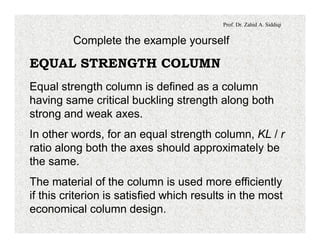
EQUAL STRENGTH COLUMN
Equal strength column is defined as a column
having same critical buckling strength along both
strong and weak axes.
In other words, for an equal strength column, KL / r
ratio along both the axes should approximately be
the same.
The material of the column is used more efficiently
if this criterion is satisfied which results in the most
economical column design.
Prof. Dr. Zahid A. Siddiqi
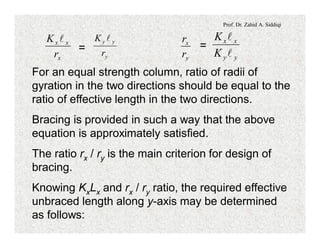
=
x
xx
r
K l
y
yy
r
K l
=
y
x
r
r
yy
xx
K
K
l
l
For an equal strength column, ratio of radii of
gyration in the two directions should be equal to the
ratio of effective length in the two directions.
Bracing is provided in such a way that the above
equation is approximately satisfied.
The ratio rx / ry is the main criterion for design of
bracing.
Knowing KxLx and rx / ry ratio, the required effective
unbraced length along y-axis may be determined
as follows:
Prof. Dr. Zahid A. Siddiqi
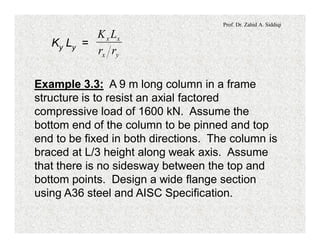
Ky Ly =
yx
xx
rr
LK
Example 3.3: A 9 m long column in a frame
structure is to resist an axial factored
compressive load of 1600 kN. Assume the
bottom end of the column to be pinned and top
end to be fixed in both directions. The column is
braced at L/3 height along weak axis. Assume
that there is no sidesway between the top and
bottom points. Design a wide flange section
using A36 steel and AISC Specification.
Prof. Dr. Zahid A. Siddiqi
Solution:
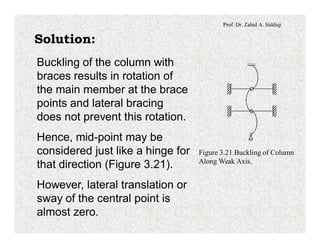
Buckling of the column with
braces results in rotation of
the main member at the brace
points and lateral bracing
does not prevent this rotation.
Hence, mid-point may be
considered just like a hinge for
that direction (Figure 3.21).
However, lateral translation or
sway of the central point is
almost zero.
Figure 3.21.Buckling of Column
Along Weak Axis.
Prof. Dr. Zahid A. Siddiqi
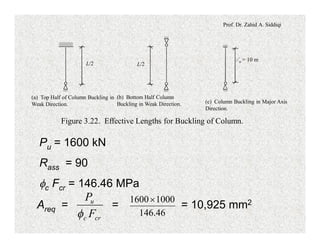
(a) Top Half of Column Buckling in
Weak Direction.
Lu = 10 m
(b) Bottom Half Column
Buckling in Weak Direction. (c) Column Buckling in Major Axis
Direction.
L/2 L/2
Figure 3.22. Effective Lengths for Buckling of Column.
Pu = 1600 kN
Rass = 90
fc Fcr = 146.46 MPa
Areq = = = 10,925 mm2
crc
u
F
P
f 46.146
10001600´
Prof. Dr. Zahid A. Siddiqi
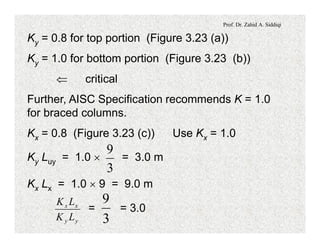
Ky = 0.8 for top portion (Figure 3.23 (a))
Ky = 1.0 for bottom portion (Figure 3.23 (b))
Ü critical
Further, AISC Specification recommends K = 1.0
for braced columns.
Kx = 0.8 (Figure 3.23 (c)) Use Kx = 1.0
Ky Luy = 1.0 ´ = 3.0 m
3
9
Kx Lx = 1.0 ´ 9 = 9.0 m
= = 3.0
yy
xx
LK
LK
3
9
Prof. Dr. Zahid A. Siddiqi
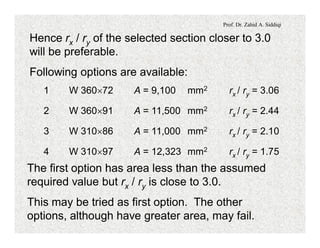
Hence rx / ry of the selected section closer to 3.0
will be preferable.
Following options are available:
1 W 360´72 A = 9,100 mm2 rx / ry = 3.06
2 W 360´91 A = 11,500 mm2 rx / ry = 2.44
3 W 310´86 A = 11,000 mm2 rx / ry = 2.10
4 W 310´97 A = 12,323 mm2 rx / ry = 1.75
The first option has area less than the assumed
required value but rx / ry is close to 3.0.
This may be tried as first option. The other
options, although have greater area, may fail.
Prof. Dr. Zahid A. Siddiqi
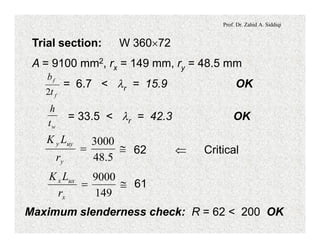
Trial section: W 360´72
A = 9100 mm2, rx = 149 mm, ry = 48.5 mm
= 6.7 < lr = 15.9 OK
f
f
t
b
2
= 33.5 < lr = 42.3 OK
wt
h
62 Ü Critical@=
5.48
3000
y
uyy
r
LK
61@=
149
9000
x
uxx
r
LK
Maximum slenderness check: R = 62 < 200 OK
Prof. Dr. Zahid A. Siddiqi
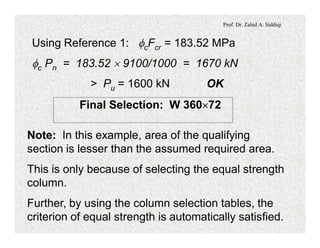
Using Reference 1: fcFcr = 183.52 MPa
fc Pn = 183.52 ´ 9100/1000 = 1670 kN
> Pu = 1600 kN OK
Final Selection: W 360´72
Note: In this example, area of the qualifying
section is lesser than the assumed required area.
This is only because of selecting the equal strength
column.
Further, by using the column selection tables, the
criterion of equal strength is automatically satisfied.
Prof. Dr. Zahid A. Siddiqi
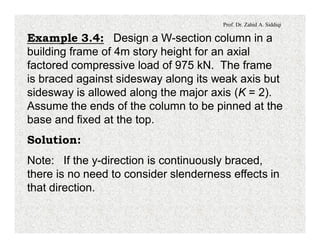
Example 3.4: Design a W-section column in a
building frame of 4m story height for an axial
factored compressive load of 975 kN. The frame
is braced against sidesway along its weak axis but
sidesway is allowed along the major axis (K = 2).
Assume the ends of the column to be pinned at the
base and fixed at the top.
Solution:
Note: If the y-direction is continuously braced,
there is no need to consider slenderness effects in
that direction.
Prof. Dr. Zahid A. Siddiqi
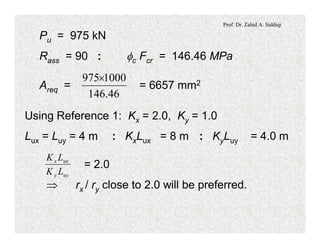
Pu = 975 kN
Rass = 90 : fc Fcr = 146.46 MPa
Areq = = 6657 mm2
46.146
1000975´
Using Reference 1: Kx = 2.0, Ky = 1.0
Lux = Luy = 4 m : KxLux = 8 m : KyLuy = 4.0 m
= 2.0
Þ rx / ry close to 2.0 will be preferred.
uyy
uxx
LK
LK
Prof. Dr. Zahid A. Siddiqi
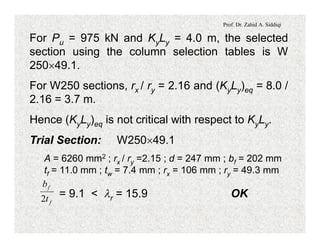
For Pu = 975 kN and KyLy = 4.0 m, the selected
section using the column selection tables is W
250´49.1.
For W250 sections, rx / ry = 2.16 and (KyLy)eq = 8.0 /
2.16 = 3.7 m.
Hence (KyLy)eq is not critical with respect to KyLy.
Trial Section: W250´49.1
A = 6260 mm2 ; rx / ry =2.15 ; d = 247 mm ; bf = 202 mm
tf = 11.0 mm ; tw = 7.4 mm ; rx = 106 mm ; ry = 49.3 mm
= 9.1 < lr = 15.9 OK
f
f
t
b
2
Prof. Dr. Zahid A. Siddiqi
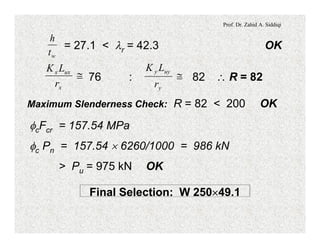
= 27.1 < lr = 42.3 OK
wt
h
76 : 82  R = 82@
x
uxx
r
LK
@
y
uyy
r
LK
Maximum Slenderness Check: R = 82 < 200 OK
fcFcr = 157.54 MPa
fc Pn = 157.54 ´ 6260/1000 = 986 kN
> Pu = 975 kN OK
Final Selection: W 250´49.1
Prof. Dr. Zahid A. Siddiqi
BUILT-UP SECTIONS AND LACING
Built-up section for a compression member becomes
efficient due to the fact that slenderness ratio of
composite section can be made equal in both
directions.
This will give equal strength column with minimum
weight section.
The spacing between the individual elements may
be varied to get desired radius of gyration.
Prof. Dr. Zahid A. Siddiqi
Lacing
1.5d to 1.6d
d
0.6d to
0.7d
0.9d to d
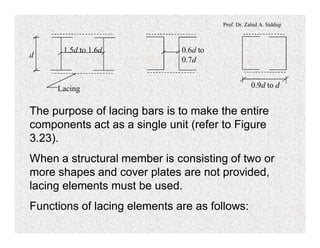
The purpose of lacing bars is to make the entire
components act as a single unit (refer to Figure
3.23).
When a structural member is consisting of two or
more shapes and cover plates are not provided,
lacing elements must be used.
Functions of lacing elements are as follows:
Prof. Dr. Zahid A. Siddiqi
1. To provide resistance against shearing force
(force transverse to the built-up member)
developed by bending produced due to buckling or
due to simultaneous action of bending moment.
Shear is to be transferred among the elements of a
built-up section so that it behaves as a single
member.
2. To decrease the effective length of individual
components.
3. To hold the various parts parallel and the
correct distance apart.
Prof. Dr. Zahid A. Siddiqi
4. To equalize the stress distribution between
the various parts.
5. To allow wind to pass through reducing the
wind pressure.
Note: Area of lacing is not included in composite
area of cross-section of the column as it is not
continuously present throughout the length.
However, area of cover plates present
continuously must be included.
Prof. Dr. Zahid A. Siddiqi
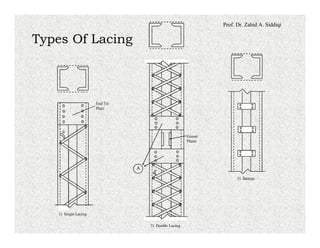
Types Of Lacing
End Tie
Plate
1) Single Lacing
q
Gusset
Plates
2) Double Lacing
q
A
3) Battens
Prof. Dr. Zahid A. Siddiqi
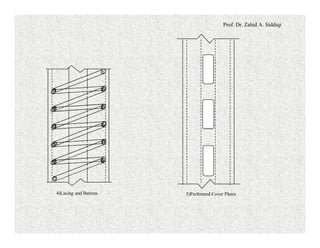
4)Lacing and Battens 5)Perforated Cover Plates
Prof. Dr. Zahid A. Siddiqi
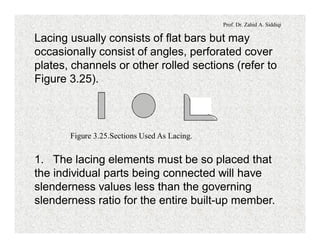
Lacing usually consists of flat bars but may
occasionally consist of angles, perforated cover
plates, channels or other rolled sections (refer to
Figure 3.25).
Figure 3.25.Sections Used As Lacing.
1. The lacing elements must be so placed that
the individual parts being connected will have
slenderness values less than the governing
slenderness ratio for the entire built-up member.
Prof. Dr. Zahid A. Siddiqi
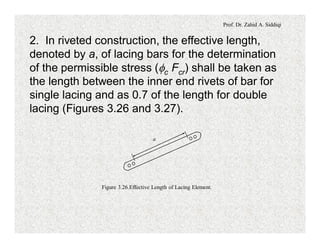
2. In riveted construction, the effective length,
denoted by a, of lacing bars for the determination
of the permissible stress (fc Fcr) shall be taken as
the length between the inner end rivets of bar for
single lacing and as 0.7 of the length for double
lacing (Figures 3.26 and 3.27).
a
Figure 3.26.Effective Length of Lacing Element.
Prof. Dr. Zahid A. Siddiqi
In welded construction, the effective length shall be
taken as the distance between the inner ends of
effective weld lengths connecting the lacing bars to
the main member elements for single lacing and
0.7 of this length for double lacing.
3. The AISC column formulas are used to design
the lacing in the usual manner. The additional
lacing provisions are discussed in AISC-E6.2.
4. Slenderness ratios are limited to 140 for single
lacing and 200 for double lacing.
Prof. Dr. Zahid A. Siddiqi
5. Double lacing should be used if the distance
between connection lines between the lines of
welds or fasteners in the flanges, denoted by s,
is greater than 380 mm.
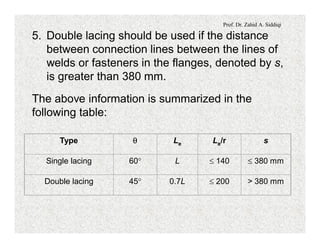
The above information is summarized in the
following table:
Type q Le Le/r s
Single lacing 60° L £ 140 £ 380 mm
Double lacing 45° 0.7L £ 200 > 380 mm
Prof. Dr. Zahid A. Siddiqi
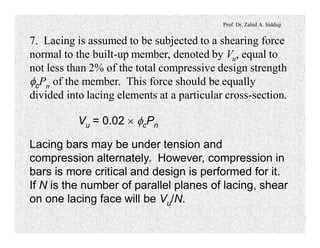
7. Lacing is assumed to be subjected to a shearing force
normal to the built-up member, denoted by Vu, equal to
not less than 2% of the total compressive design strength
fcPn of the member. This force should be equally
divided into lacing elements at a particular cross-section.
Vu = 0.02 ´ fcPn
Lacing bars may be under tension and
compression alternately. However, compression in
bars is more critical and design is performed for it.
If N is the number of parallel planes of lacing, shear
on one lacing face will be Vu/N.
Prof. Dr. Zahid A. Siddiqi
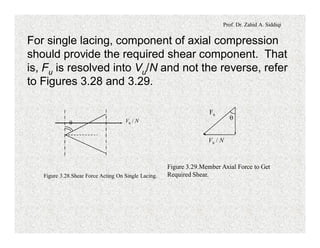
For single lacing, component of axial compression
should provide the required shear component. That
is, Fu is resolved into Vu/N and not the reverse, refer
to Figures 3.28 and 3.29.
q
Figure 3.28.Shear Force Acting On Single Lacing.
Vu / N
Fu
q
Figure 3.29.Member Axial Force to Get
Required Shear.
Vu / N
Prof. Dr. Zahid A. Siddiqi
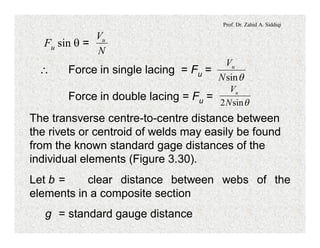
Fu sin q =
N
Vu
 Force in single lacing = Fu =
qsinN
Vu
Force in double lacing = Fu = qsin2N
Vu
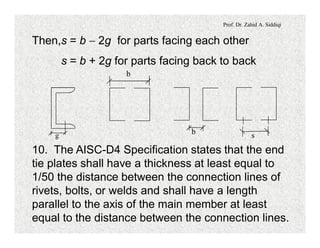
The transverse centre-to-centre distance between
the rivets or centroid of welds may easily be found
from the known standard gage distances of the
individual elements (Figure 3.30).
Let b = clear distance between webs of the
elements in a composite section
g = standard gauge distance
Prof. Dr. Zahid A. Siddiqi
Then,s = b - 2g for parts facing each other
s = b + 2g for parts facing back to back
g
b
b s
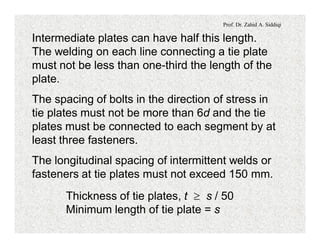
10. The AISC-D4 Specification states that the end
tie plates shall have a thickness at least equal to
1/50 the distance between the connection lines of
rivets, bolts, or welds and shall have a length
parallel to the axis of the main member at least
equal to the distance between the connection lines.
Prof. Dr. Zahid A. Siddiqi
Intermediate plates can have half this length.
The welding on each line connecting a tie plate
must not be less than one-third the length of the
plate.
The spacing of bolts in the direction of stress in
tie plates must not be more than 6d and the tie
plates must be connected to each segment by at
least three fasteners.
The longitudinal spacing of intermittent welds or
fasteners at tie plates must not exceed 150 mm.
Thickness of tie plates, t ³ s / 50
Minimum length of tie plate = s
Prof. Dr. Zahid A. Siddiqi
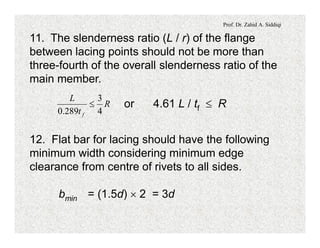
11. The slenderness ratio (L / r) of the flange
between lacing points should not be more than
three-fourth of the overall slenderness ratio of the
main member.
or 4.61 L / tf £ RR
t
L
f 4
3
289.0
£
12. Flat bar for lacing should have the following
minimum width considering minimum edge
clearance from centre of rivets to all sides.
bmin = (1.5d) ´ 2 = 3d
Prof. Dr. Zahid A. Siddiqi
13. Batten plate is defined as a rigidly connected
plate element used to join two parallel components
of a built-up section. This is designed to transmit
shear between the two components of the main
member.
14. Double lacing bars shall be joined together at
their intersections.
DESIGN FLOW CHART FOR
BUILT-UP MEMBERS
Main Member This flow chart is exactly same as
the general compression member flow chart
presented earlier.
Prof. Dr. Zahid A. Siddiqi
Continued in the next file. . . .

Steel strucure lec # (7)

  • 1.
    Prof. Dr. ZahidA. Siddiqi CORRECTION FOR SINGLE ANGLES FOR PLANAR TRUSSES Single angle compression members may undergo torsional buckling at loads lower than the loads at which buckling may occur about x, y or z axes. Hence, in order to closely estimate the capacity of equal leg angles or unequal leg angles connected through the longer leg, the slenderness ratio is to be modified as under:
  • 2.
    Prof. Dr. ZahidA. Siddiqi (i) When 0 ≤ L / rx ≤ 80, KL/r = 72 + 0.75 L / rx (ii) When L / rx > 80, KL/r = 32 + 1.25 L / rx ≤ 200
  • 3.
    Prof. Dr. ZahidA. Siddiqi DESIGN FLOW CHART FOR COMPRESSION MEMBERS Inputs PD, PL, L, end conditions, etc. Calculate Pu for the controlling/critical load combination. Also find the values of effective length factor Kx, Ky and Kz. Assume slenderness ratio (if column selection tables are not to be used):
  • 4.
    Prof. Dr. ZahidA. Siddiqi R » 115 for single angle or channel sections R » 90 for double angle or W sections R » 70 for built-up sections R » 35 for section continuously braced in the lateral direction Find fc Fcr from table in Reference-1, or by employing the appropriate formulas, depending on the assumed slenderness ratio. Calculate area required for the assumed slenderness ratio.
  • 5.
    Prof. Dr. ZahidA. Siddiqi This may be different from the value for the actual slenderness ratio unknown at this stage and may be on the conservative or unsafe side of the actual value. Accordingly the selected area may be a little greater or lesser than the calculated required area. Areq » ( )asscrc u F P f Selection of Trial Section Use either the column selection tables or adopt the trial and error procedure.
  • 6.
    Prof. Dr. ZahidA. Siddiqi Following criteria are to be satisfied: a) Asel » ± Areq b) The section must have minimum possible weight. c) Connected leg width for various types of connections (bmin) is selected using one of the following expressions as applicable: i) 3.25d + 26 ii) ³ 50 mm for welded connections where d = diameter of rivets, may be assumed equal to 15mm if not known.
  • 7.
    Prof. Dr. ZahidA. Siddiqi d) Maximum depth of column section should generally not exceed 360mm (14in) for W sections. Calculate Critical Slenderness Ratio Find unsupported length in each direction L ux, L uy and L uz Calculate the radii of gyration (rx, ry, rz) or directly see their values from the properties of sections table. Calculate z uzz y uyy x uxx r LK r LK r LK and,
  • 8.
    Prof. Dr. ZahidA. Siddiqi R = maximum value out of the above slenderness ratios Select spacing of stay plates denoted by a, if used, such that: £ R ir a The selected spacing must be uniform and the stay plates should satisfy the modified slenderness ratio criteria. Smaller a may be selected to reduce the modified slenderness ratio, Rm.
  • 9.
    Prof. Dr. ZahidA. Siddiqi However, the number of stay plates in a member generally should not exceed 2 (or at the most 3). Calculate Rm = about the weak axis, which is the slenderness ratio modified for the position of stay plates, in case the buckling of the built-up section about this axis produces shear between the elements. mr K ÷ ø ö ç è æ l Perform Local Stability Check
  • 10.
    Prof. Dr. ZahidA. Siddiqi Examine l = b/t ratios for stiffened and un- stiffened elements of the section and the following must be satisfied: l £ lr OK lr = 12.8 for single angles and double angles with separators, for A36 steel lr = 15.9 for other un-stiffened elements , for A36 steel lr = 42.3 for stiffened elements , for A36 steel
  • 11.
    Prof. Dr. ZahidA. Siddiqi Perform Maximum Slenderness Check R £ 200 OK Otherwise revise by selection of another trial section. R greater than 200 may be allowed in special cases as per AISC recommendations. Fe fc To convert the result into kN Pu < 0.75 ´ 0.9 ´ 0.877 Ag ´ ( ) p2 2 E K rl 1000 1
  • 12.
    Prof. Dr. ZahidA. Siddiqi The additional factor of 0.75 is used to exceed the recommended limit of 200. Þ Ag( ) uP rK 11692 £l Þ u g P A r K 34£ l Find fc Fcr from table in Reference-1 or using formulas. Perform Capacity Check fc Fcr Asel ³ Pu O K Otherwise revise after fresh selection of section.
  • 13.
    Prof. Dr. ZahidA. Siddiqi Check For Reversal Of Stresses If Tu > 0, check that ft Tn ³ Tu, otherwise revise. Check For Loading Cycles Assume that loading cycles are lesser than 20,000 for ordinary buildings. Design stay plates or lacing. Write Final Selection using Standard Designation
  • 14.
    Prof. Dr. ZahidA. Siddiqi ALTERNATE AND EASY METHOD TO SELECT TRIAL SECTION W-Sections Load carrying capacities (fcPn) for various W- sections against the values of effective lengths with respect to least radius of gyration are tabulated in Reference-1. Corresponding to the value of effective length KyLuy, a section may be selected when the tabulated fcPn becomes just greater than Pu while moving from left to right in the table.
  • 15.
    Prof. Dr. ZahidA. Siddiqi Few sections with different depths may be examined to find a minimum weight section. To check stability of the section about the x – axis, KxLx is converted into an equivalent KyLy by using the following expression: (KyLy)eq = yx xx rr LK / where rx / ry is used for the previously selected section.
  • 16.
    Prof. Dr. ZahidA. Siddiqi The ratio rx / ry included in these tables provides a convenient method for investigating the strength of a column with respect to its major axis. Section is selected / revised for longer of the two lengths KyLy and (KyLy)eq. The procedure is explained as under: Procedure Find maximum values of KxLx and KyLy. Select section against KyLy according to the loads starting from W360 side and moving downward by weight.
  • 17.
    Prof. Dr. ZahidA. Siddiqi Find rx / ry for the selected section and calculate equivalent KyLy as KxLx/( rx / ry). Re-enter the table for greater value out of KyLy and (KyLy)eq. Revise the section if necessary. Double Angle Sections Column selection tables are also available for double angle sections with 10mm gusset plate in Reference 1, using fully tightened stay plates. Only difference in this case is that the load carrying capacities (fcPn) are listed both for KxLx and KyLy.
  • 18.
    Prof. Dr. ZahidA. Siddiqi While selecting section, fcPn for both KxLx and KyLy should individually be greater than Pu. After the selection of section, all the checks should be applied included in the general flow chart. Example 3.1: Design a truss compression member using the following three given cross-sectional shapes: 1. 2Ls with 10 mm thick gusset plate and bolted stay plates. 2. Single angle. 3. W-section.
  • 19.
    Prof. Dr. ZahidA. Siddiqi The other data is as under: PD = 110 kN ; PL = 140 kN L = 3.4 m ; A36 Steel Solution: The truss member consisting of double angles along with the gusset plate is shown in Figure 3.18. For truss members, K = 1 Lu = L as there is no bracing between the joints
  • 20.
    Prof. Dr. ZahidA. Siddiqi Pu = 1.2 PD + 1.6 PL = 1.2 ´ 110 + 1.6 ´ 140 = 356 kN b s = 10 aa h Gusset Plate Figure 3.18.Double Angles With Gusset Plate.
  • 21.
    Prof. Dr. ZahidA. Siddiqi 1- Double Angles 1. The section will be economical if it has nearly same slenderness ratio in both directions. This means that rx and ry should nearly be same (as the length for both directions is equal). 2. The radius of gyration, rx, for the double section will be same as that for a single section. 3. The radius of gyration, ry, for the double section will be considerably higher than for a single section.
  • 22.
    Prof. Dr. ZahidA. Siddiqi 4. From the above facts it is clear that, to make r same in both directions, unequal leg angles are to be used with the longer legs connected together. 5. The projecting leg should be relatively smaller. Pu = 356 kN : KLu = 3.4m Rass = 90 (fc Fcr)ass = 146.46 MPa Areq for 2Ls = = = 2431 mm2 ( ) .asscrc u F P f 46.146 1000356´
  • 23.
    Prof. Dr. ZahidA. Siddiqi Areq for single angle = 1216 mm2 bmin = 3.25d + 26 = 75 mm (assuming d = 15mm) Select section based on the following considerations: 1. Asel » Areq 2. Minimum weight section 3. b ³ bmin
  • 24.
    Prof. Dr. ZahidA. Siddiqi Different options available are: 1. 2L 89 ´ 89 ´ 7.9 A = 2700 mm2 2. 2L 102 ´ 76 ´ 7.9 A = 2700 mm2 3. 2L 102 ´ 76 ´ 9.5 A = 3200 mm2 Note:Any one out of the first two options may be tried first. However, calculations show that these sections are not sufficient with only the third section closer to the requirements. The number of trials may be reduced by using column selection tables.
  • 25.
    Prof. Dr. ZahidA. Siddiqi Using the double angles selection tables of Reference-1 for Pu = 356 kN, KxLx = KyLy = 3.6m and stay plates with fully tensioned bolts, following options are available: Section fcPn (kN) KL (m) Area (mm2) 2Ls 102´76´9.5 452.8 382.7 396.7 448.8 377.8 392.0 KxLx= 3.0 KxLx= 3.5 KxLx= 3.4 by interpolation. KyLy= 3.0 KyLy= 3.5 KyLy= 3.4 by interpolation. 3206 2Ls 102´89´9.5 482.9 407.0 422.2 555.5 492.2 504.9 KxLx= 3.0 KxLx= 3.5 KxLx= 3.4 by interpolation. KyLy= 3.0 KyLy= 3.5 KyLy= 3.4 by interpolation. 3445
  • 26.
    Prof. Dr. ZahidA. Siddiqi Hence, keeping in view the above values for fully tight stay plates, trial section for snug tight stay plates may be 2Ls 102´76´9.5. However, considering snug tight stay plates, 2Ls 102´89´9.5 may ultimately be the final result. Trial Section 1: 2L 102 ´ 76 ´ 9.5 A = 2 ´ 1600 mm2 Long legs back-to-back, connected to the gusset plate. b = 102 mm > bmin OK Longer leg is connected.
  • 27.
    Prof. Dr. ZahidA. Siddiqi l = = = 10.7 < lr lr = 12.8 OK t b 50.9 102 rx = 32.0 mm as for single angle Using Reference 1: b = 2 ´76 + 10 = 162 mm (ry)appr = b (0.19 + s/1270) = 162 ´ (0.19 + 10/1270) = 32.06 mm = @ 107 x uxx r LK 0.32 34001´ = @ 106.05 y uyy r LK 06.32 34001´
  • 28.
    Prof. Dr. ZahidA. Siddiqi Although rx is lesser than ry, the column may buckle about y-axis if modified slenderness ratio in y- direction exceeds KxLux / rx. Assume that snug tight bolts connect stay and gusset plates. Using 75 mm long stay plates and treating a as the clear distance between the stay and/or gusset plates, the c/c spacing of stay plates will be a + 75 mm.
  • 29.
    Prof. Dr. ZahidA. Siddiqi Selection of Stay Plates Spacing a / ri = 0.75 ´ larger of KxLux / rx and KyLuy / ry = 0.75 (107) = 80.25 ri = rz = 16.4 mm amax = 80.25 ´ 16.4 / 1000 = 1.316 m For 75 mm long stay plates, Number of spaces between stay plates = = 2.45 say 3 spaces 751316 3400 +
  • 30.
    Prof. Dr. ZahidA. Siddiqi Number of stay plates = 2 a = 3400 / 3 – 75 = 1058 mm Note: Number of stay plates may not generally exceed three. a / ri = 1058 / 16.4 = 64.53 For snug tight plates: = @ 125 my uyy r LK ÷ ÷ ø ö ç ç è æ 22 53.6405.106 + R = larger of KxLux / rx and modified KyLuy / ry = 125
  • 31.
    Prof. Dr. ZahidA. Siddiqi Maximum Slenderness Ratio Check R £ 200 OK Capacity Check From table of Reference-1: fc Fcr = 98.28 MPa fc Fcr Asel = 98.28 ´ 2 ´ 1600 / 1000 = 314.50 kN < Pu = 356 kN NG Trial Section 2: 2L 102 ´ 89 ´ 9.5 A = 2 ´ 1720 mm2 Long legs back-to-back, connected to the gusset plate.
  • 32.
    Prof. Dr. ZahidA. Siddiqi b = 102 mm > bmin OK Longer leg is connected. l = = = 10.7 < lr lr = 12.8 OK t b 102 9 50. rx = 31.8 mm as for single angle Using Reference 1: b = 2 ´89 + 10 = 188 mm (ry)appr = b (0.19 + s/1270) = 188 ´ (0.19 + 10/1270) = 37.2 mm
  • 33.
    Prof. Dr. ZahidA. Siddiqi Exact calculations for ry (to be made only for the last trial): Iy = 2 ´ [123 ´ 104 + 1720 ´ (24.3 + 5)2] = 541.3 ´ 104 mm4 (ry)exact = = 39.7 mm 17202 103.541 4 ´ ´ = @ 107 x uxx r LK 8.31 34001´ = @ 85.64 y uyy r LK 7.39 34001´
  • 34.
    Prof. Dr. ZahidA. Siddiqi Using 75 mm long stay plates and treating a as the clear distance between the stay and/or gusset plates, the c/c spacing of stay plates will be a + 75 mm. Selection of Stay Plates Spacing a / ri = 0.75 ´ larger of KxLux / rx and KyLuy / ry = 0.75 (107) = 80.25 ri = rz = 18.5 mm amax = 80.25 ´ 18.5 / 1000 = 1.485 m
  • 35.
    Prof. Dr. ZahidA. Siddiqi For 75 mm long stay plates, number of spaces between stay plates = = 2.18 say 3 spaces 751485 3400 + Number of stay plates = 2 a = 3400 / 3 – 75 = 1058 mm a / ri = 1058 / 18.5 = 57.19 For snug tight plates: = @ 103 my uyy r K ÷ ÷ ø ö ç ç è æ l 22 19.5764.85 +
  • 36.
    Prof. Dr. ZahidA. Siddiqi For fully tightened bolts or welds, appropriate formula for the modified slenderness ration must be used. R = larger of KxLux / rx and modified KyLuy / ry = 107 Maximum Slenderness Ratio Check R £ 200 OK Capacity Check From table of Reference-1: fc Fcr = 122.63 MPa fc Fcr Asel = 122.63 ´ 2 ´ 1720 / 1000 = 421.85 kN > Pu = 356 kN OK
  • 37.
    Prof. Dr. ZahidA. Siddiqi Final Selection: 2Ls 102 ´ 89 ´ 9.5 2- Single Angle Single angle can undergo lateral torsional buckling. Separate AISC provisions are applicable for such design. Equal leg angles are generally preferred for single angle columns in case the two effective lengths KxLx and KyLy are equal. However, unequal leg angles may also be used if the resulting section comes out to be economical.
  • 38.
    Prof. Dr. ZahidA. Siddiqi Pu = 356 kN Rass = 115 (fc Fcr)ass = 111.61 MPa Areq = = 3190 mm2 61.111 356000 Select section based on the following parameters: 1. Asel » Areq 2. Minimum weight section 3. b ³ bmin = 75 mm 4. Equal legs will be preferred as KxLx and KyLy are equal.
  • 39.
    Prof. Dr. ZahidA. Siddiqi Using selection table Trial Section: L 152´152´12.70 rx = 47.2 mm rz = 30 mm ; A = 3710 mm2 b = 152 > bmin OK l = b / t = = 11.98 < lr = 12.7 OK 152 12 70. = = 114 zr KL 30 3400
  • 40.
    Prof. Dr. ZahidA. Siddiqi R = 126 < 200 OK fc Fcr Ase. = 96.98 ´ 3710 / 1000 = 359.80 kN > 356 kN OK Loading cycles are lesser than 20,000. Final Selection: 2Ls 152 ´ 152 ´ 12.7 L / rx = 3400 / 47.2 = 72.03 ≤ 80 KL/r = 72 + 0.75 L / ry = 72 + 0.75 ´ 72.03 @ 126
  • 41.
    Prof. Dr. ZahidA. Siddiqi 3- W-Section Pu = 356 kN Rass = 90 (fc Fcr)ass = 146.46 MPa Areq. = = 2431 mm2 46.146 356000 Select section based on the following criteria: 1. Asel » Areq 2. Minimum weight section 3. b ³ bmin = 75 mm 4. d £ 360mm
  • 42.
    Prof. Dr. ZahidA. Siddiqi Using the W-shape selection tables of Reference-1 for Pu = 356 kN, KyLy = 3.4m, following option is obtained [(KyLy)eq is not critical]: Trial Section: W150 ´ 22.5 rx = 65 ; ry = 37.1 ; A = 2860 mm2 bf / 2 = 152 / 2 = 76 mm > bmin OK l = = 11.5 < lr = 15.9 OK f f t b 2 l = = 21.6 < lr = 42.3 OK wt h R = = @ 92 < 200 OK .minr Kl 1.37 3400
  • 43.
    Prof. Dr. ZahidA. Siddiqi fc Fcr = 143.66 MPa fc Fcr Asel = 143.66 ´ 2860/1000 = 411 kN > Pu = 356 kN OK Final Selection: W 150 ´ 22.5 Example 3.2: Members Under Stress Reversal: Design a bridge truss compression member (K=1) that is 3.5m long. PD = 80 kN(C), PL=270 kN(C), TL = 270 kN(T). Select following two types of sections:
  • 44.
    Prof. Dr. ZahidA. Siddiqi a) 2Ls with 15 mm thick gusset plate, welded connections but snug bolted stay plates. b) W-section, welded connections. Solution Pu = 1.2 PD + 1.6 PL = 1.2 ´ 80 + 1.6 ´ 270 = 528kN Tu = – 1.2 PD + 1.6 TL = – 1.2 ´ 80 + 1.6 ´ 270 = 336kN Pu > Tu Þ Design as compression member for Pu and then check as tension member for Tu.
  • 45.
    Prof. Dr. ZahidA. Siddiqi Complete the example yourself EQUAL STRENGTH COLUMN Equal strength column is defined as a column having same critical buckling strength along both strong and weak axes. In other words, for an equal strength column, KL / r ratio along both the axes should approximately be the same. The material of the column is used more efficiently if this criterion is satisfied which results in the most economical column design.
  • 46.
    Prof. Dr. ZahidA. Siddiqi = x xx r K l y yy r K l = y x r r yy xx K K l l For an equal strength column, ratio of radii of gyration in the two directions should be equal to the ratio of effective length in the two directions. Bracing is provided in such a way that the above equation is approximately satisfied. The ratio rx / ry is the main criterion for design of bracing. Knowing KxLx and rx / ry ratio, the required effective unbraced length along y-axis may be determined as follows:
  • 47.
    Prof. Dr. ZahidA. Siddiqi Ky Ly = yx xx rr LK Example 3.3: A 9 m long column in a frame structure is to resist an axial factored compressive load of 1600 kN. Assume the bottom end of the column to be pinned and top end to be fixed in both directions. The column is braced at L/3 height along weak axis. Assume that there is no sidesway between the top and bottom points. Design a wide flange section using A36 steel and AISC Specification.
  • 48.
    Prof. Dr. ZahidA. Siddiqi Solution: Buckling of the column with braces results in rotation of the main member at the brace points and lateral bracing does not prevent this rotation. Hence, mid-point may be considered just like a hinge for that direction (Figure 3.21). However, lateral translation or sway of the central point is almost zero. Figure 3.21.Buckling of Column Along Weak Axis.
  • 49.
    Prof. Dr. ZahidA. Siddiqi (a) Top Half of Column Buckling in Weak Direction. Lu = 10 m (b) Bottom Half Column Buckling in Weak Direction. (c) Column Buckling in Major Axis Direction. L/2 L/2 Figure 3.22. Effective Lengths for Buckling of Column. Pu = 1600 kN Rass = 90 fc Fcr = 146.46 MPa Areq = = = 10,925 mm2 crc u F P f 46.146 10001600´
  • 50.
    Prof. Dr. ZahidA. Siddiqi Ky = 0.8 for top portion (Figure 3.23 (a)) Ky = 1.0 for bottom portion (Figure 3.23 (b)) Ü critical Further, AISC Specification recommends K = 1.0 for braced columns. Kx = 0.8 (Figure 3.23 (c)) Use Kx = 1.0 Ky Luy = 1.0 ´ = 3.0 m 3 9 Kx Lx = 1.0 ´ 9 = 9.0 m = = 3.0 yy xx LK LK 3 9
  • 51.
    Prof. Dr. ZahidA. Siddiqi Hence rx / ry of the selected section closer to 3.0 will be preferable. Following options are available: 1 W 360´72 A = 9,100 mm2 rx / ry = 3.06 2 W 360´91 A = 11,500 mm2 rx / ry = 2.44 3 W 310´86 A = 11,000 mm2 rx / ry = 2.10 4 W 310´97 A = 12,323 mm2 rx / ry = 1.75 The first option has area less than the assumed required value but rx / ry is close to 3.0. This may be tried as first option. The other options, although have greater area, may fail.
  • 52.
    Prof. Dr. ZahidA. Siddiqi Trial section: W 360´72 A = 9100 mm2, rx = 149 mm, ry = 48.5 mm = 6.7 < lr = 15.9 OK f f t b 2 = 33.5 < lr = 42.3 OK wt h 62 Ü Critical@= 5.48 3000 y uyy r LK 61@= 149 9000 x uxx r LK Maximum slenderness check: R = 62 < 200 OK
  • 53.
    Prof. Dr. ZahidA. Siddiqi Using Reference 1: fcFcr = 183.52 MPa fc Pn = 183.52 ´ 9100/1000 = 1670 kN > Pu = 1600 kN OK Final Selection: W 360´72 Note: In this example, area of the qualifying section is lesser than the assumed required area. This is only because of selecting the equal strength column. Further, by using the column selection tables, the criterion of equal strength is automatically satisfied.
  • 54.
    Prof. Dr. ZahidA. Siddiqi Example 3.4: Design a W-section column in a building frame of 4m story height for an axial factored compressive load of 975 kN. The frame is braced against sidesway along its weak axis but sidesway is allowed along the major axis (K = 2). Assume the ends of the column to be pinned at the base and fixed at the top. Solution: Note: If the y-direction is continuously braced, there is no need to consider slenderness effects in that direction.
  • 55.
    Prof. Dr. ZahidA. Siddiqi Pu = 975 kN Rass = 90 : fc Fcr = 146.46 MPa Areq = = 6657 mm2 46.146 1000975´ Using Reference 1: Kx = 2.0, Ky = 1.0 Lux = Luy = 4 m : KxLux = 8 m : KyLuy = 4.0 m = 2.0 Þ rx / ry close to 2.0 will be preferred. uyy uxx LK LK
  • 56.
    Prof. Dr. ZahidA. Siddiqi For Pu = 975 kN and KyLy = 4.0 m, the selected section using the column selection tables is W 250´49.1. For W250 sections, rx / ry = 2.16 and (KyLy)eq = 8.0 / 2.16 = 3.7 m. Hence (KyLy)eq is not critical with respect to KyLy. Trial Section: W250´49.1 A = 6260 mm2 ; rx / ry =2.15 ; d = 247 mm ; bf = 202 mm tf = 11.0 mm ; tw = 7.4 mm ; rx = 106 mm ; ry = 49.3 mm = 9.1 < lr = 15.9 OK f f t b 2
  • 57.
    Prof. Dr. ZahidA. Siddiqi = 27.1 < lr = 42.3 OK wt h 76 : 82 R = 82@ x uxx r LK @ y uyy r LK Maximum Slenderness Check: R = 82 < 200 OK fcFcr = 157.54 MPa fc Pn = 157.54 ´ 6260/1000 = 986 kN > Pu = 975 kN OK Final Selection: W 250´49.1
  • 58.
    Prof. Dr. ZahidA. Siddiqi BUILT-UP SECTIONS AND LACING Built-up section for a compression member becomes efficient due to the fact that slenderness ratio of composite section can be made equal in both directions. This will give equal strength column with minimum weight section. The spacing between the individual elements may be varied to get desired radius of gyration.
  • 59.
    Prof. Dr. ZahidA. Siddiqi Lacing 1.5d to 1.6d d 0.6d to 0.7d 0.9d to d The purpose of lacing bars is to make the entire components act as a single unit (refer to Figure 3.23). When a structural member is consisting of two or more shapes and cover plates are not provided, lacing elements must be used. Functions of lacing elements are as follows:
  • 60.
    Prof. Dr. ZahidA. Siddiqi 1. To provide resistance against shearing force (force transverse to the built-up member) developed by bending produced due to buckling or due to simultaneous action of bending moment. Shear is to be transferred among the elements of a built-up section so that it behaves as a single member. 2. To decrease the effective length of individual components. 3. To hold the various parts parallel and the correct distance apart.
  • 61.
    Prof. Dr. ZahidA. Siddiqi 4. To equalize the stress distribution between the various parts. 5. To allow wind to pass through reducing the wind pressure. Note: Area of lacing is not included in composite area of cross-section of the column as it is not continuously present throughout the length. However, area of cover plates present continuously must be included.
  • 62.
    Prof. Dr. ZahidA. Siddiqi Types Of Lacing End Tie Plate 1) Single Lacing q Gusset Plates 2) Double Lacing q A 3) Battens
  • 63.
    Prof. Dr. ZahidA. Siddiqi 4)Lacing and Battens 5)Perforated Cover Plates
  • 64.
    Prof. Dr. ZahidA. Siddiqi Lacing usually consists of flat bars but may occasionally consist of angles, perforated cover plates, channels or other rolled sections (refer to Figure 3.25). Figure 3.25.Sections Used As Lacing. 1. The lacing elements must be so placed that the individual parts being connected will have slenderness values less than the governing slenderness ratio for the entire built-up member.
  • 65.
    Prof. Dr. ZahidA. Siddiqi 2. In riveted construction, the effective length, denoted by a, of lacing bars for the determination of the permissible stress (fc Fcr) shall be taken as the length between the inner end rivets of bar for single lacing and as 0.7 of the length for double lacing (Figures 3.26 and 3.27). a Figure 3.26.Effective Length of Lacing Element.
  • 66.
    Prof. Dr. ZahidA. Siddiqi In welded construction, the effective length shall be taken as the distance between the inner ends of effective weld lengths connecting the lacing bars to the main member elements for single lacing and 0.7 of this length for double lacing. 3. The AISC column formulas are used to design the lacing in the usual manner. The additional lacing provisions are discussed in AISC-E6.2. 4. Slenderness ratios are limited to 140 for single lacing and 200 for double lacing.
  • 67.
    Prof. Dr. ZahidA. Siddiqi 5. Double lacing should be used if the distance between connection lines between the lines of welds or fasteners in the flanges, denoted by s, is greater than 380 mm. The above information is summarized in the following table: Type q Le Le/r s Single lacing 60° L £ 140 £ 380 mm Double lacing 45° 0.7L £ 200 > 380 mm
  • 68.
    Prof. Dr. ZahidA. Siddiqi 7. Lacing is assumed to be subjected to a shearing force normal to the built-up member, denoted by Vu, equal to not less than 2% of the total compressive design strength fcPn of the member. This force should be equally divided into lacing elements at a particular cross-section. Vu = 0.02 ´ fcPn Lacing bars may be under tension and compression alternately. However, compression in bars is more critical and design is performed for it. If N is the number of parallel planes of lacing, shear on one lacing face will be Vu/N.
  • 69.
    Prof. Dr. ZahidA. Siddiqi For single lacing, component of axial compression should provide the required shear component. That is, Fu is resolved into Vu/N and not the reverse, refer to Figures 3.28 and 3.29. q Figure 3.28.Shear Force Acting On Single Lacing. Vu / N Fu q Figure 3.29.Member Axial Force to Get Required Shear. Vu / N
  • 70.
    Prof. Dr. ZahidA. Siddiqi Fu sin q = N Vu Force in single lacing = Fu = qsinN Vu Force in double lacing = Fu = qsin2N Vu The transverse centre-to-centre distance between the rivets or centroid of welds may easily be found from the known standard gage distances of the individual elements (Figure 3.30). Let b = clear distance between webs of the elements in a composite section g = standard gauge distance
  • 71.
    Prof. Dr. ZahidA. Siddiqi Then,s = b - 2g for parts facing each other s = b + 2g for parts facing back to back g b b s 10. The AISC-D4 Specification states that the end tie plates shall have a thickness at least equal to 1/50 the distance between the connection lines of rivets, bolts, or welds and shall have a length parallel to the axis of the main member at least equal to the distance between the connection lines.
  • 72.
    Prof. Dr. ZahidA. Siddiqi Intermediate plates can have half this length. The welding on each line connecting a tie plate must not be less than one-third the length of the plate. The spacing of bolts in the direction of stress in tie plates must not be more than 6d and the tie plates must be connected to each segment by at least three fasteners. The longitudinal spacing of intermittent welds or fasteners at tie plates must not exceed 150 mm. Thickness of tie plates, t ³ s / 50 Minimum length of tie plate = s
  • 73.
    Prof. Dr. ZahidA. Siddiqi 11. The slenderness ratio (L / r) of the flange between lacing points should not be more than three-fourth of the overall slenderness ratio of the main member. or 4.61 L / tf £ RR t L f 4 3 289.0 £ 12. Flat bar for lacing should have the following minimum width considering minimum edge clearance from centre of rivets to all sides. bmin = (1.5d) ´ 2 = 3d
  • 74.
    Prof. Dr. ZahidA. Siddiqi 13. Batten plate is defined as a rigidly connected plate element used to join two parallel components of a built-up section. This is designed to transmit shear between the two components of the main member. 14. Double lacing bars shall be joined together at their intersections. DESIGN FLOW CHART FOR BUILT-UP MEMBERS Main Member This flow chart is exactly same as the general compression member flow chart presented earlier.
  • 75.
    Prof. Dr. ZahidA. Siddiqi Continued in the next file. . . .