IJRET: International Journal of Research in Engineering and Technology eISSN: 2319-1163 | pISSN: 2321-7308
_______________________________________________________________________________________
Volume: 05 Issue: 03 | Mar-2016, Available @ http://www.ijret.org 390
ENGINEERING ECONOMICS AND LIFE CYCLE COST ANALYSIS
Dhruv J. Desai1
, Tejas H. Jain2
, Atul A. Dwivedi3
, Anjum D. Attar4
1
M.H.SabooSiddik College of Engineering, Maharashtra, India
2
M.H.SabooSiddik College of Engineering, Maharashtra, India
3
M.H.SabooSiddik College of Engineering, Maharashtra, India
4
M.H.SabooSiddik College of Engineering, Maharashtra, India
Abstract
Life-cycle cost analysis (LCCA) is anevaluating tool to valuate the total financial/resource requirements for total ownership of a
building. LCCA is effective when project options that fulfill the same task demands, having different initial costs and operational
costs, needs to be examined in order to undertake the option that optimizes financial requirements.
Building-related expenses can be furthercategorized into the following:
 Initial Costs
 Operation, Maintenance, and Repair Costs
 Replacement Costs
 Residual Values
 Finance Charges
 Non-Monetary Costs
This article mainly focuses on the Maintenance and Repair cost analysis; giving probable trends for next 25 years for various
elements using DSR, WPI and CPI. These trends are only applicable for the whole of Mumbai.
Keyordsw: Life Cycle Cost, Maintenance and Repair cost.
--------------------------------------------------------------------***----------------------------------------------------------------------
1. LIFE CYCLE COST ANALYSIS
.Life Cycle Cost Analysis is a method of estimating the
economic performance of a building over its life period. It is
also known as “whole cost accounting” or “total cost of
ownership,” LCCA balances the intial stage investment with
life period costs including owning cost and operating cost of
that particular building.
LCCA is calculated on the premises that different building
design alternatives can accomplish the same functions with
the same amount of efficiency. These options having
different initial costs, operational costs, maintenance and
repair costs and may also differ in life cycle periods.
Considering a particular alternative, LCCA forecasts the
total cost of building, including initial construction cost,
operation and maintenance cost, for a particular life of the
building, cited as “study period”.
Life cycle cost analysis helps in maintaining a balance
between the initial cost of any alternative process adopted
and long term cost saving of that alternative process. LCCA
also helps in narrowing the most cost effective alternative
and also calculates the “payback” period of the increased
cost. To estimate life cycle cost for allapplicable alternatives
is not feasible, and therefore the guiding principle for LCCA
considers the one which affects the long-term expenses.
1.1Importance of LCCA
[1].As the CHART-1 below depicts 30 year cost analysis of
a building’s life, including its construction costs, its
maintenance costs, operation costs, and utility costs.
CHART–1:30-YEAR ANALYSIS
Since it is evident that for a 30-year period, maintenance
cost accounts nearly 6% of the total cost, the Maintenance
and Repair cost analysis will be the prime focus of this
article.
2. MAINTENANCE AND REPAIR
Building repairs and maintenance mainly consists
ofconserving proper state of a building, its functions and
utilities in routine use.
The types of building repair and maintenance are:
 Day to day repairs service facilities
 Annual repairs
 Special repairs
 Additions and alterations
 Preventive maintenance
28 %
6 %
4 %
4 %
58 %
30-YEARS LIFE CYCLE COST (%)
UTILITIES MAINTENANCE
SERVICES SYSTEM REPLACEMENT
IJRET: International Journal of Research in Engineering and Technology eISSN: 2319-1163 | pISSN: 2321-7308
_______________________________________________________________________________________
Volume: 05 Issue: 03 | Mar-2016, Available @ http://www.ijret.org 391
3. RESEARCH METHODOLOGY
The maintenance and repair costs are found for various
elements that are subjected to maintenance and repairs. The
cost of these elements are gathered from the DISTRICT
SCHEDULE OF RATES OF MUMBAI AND SUBURBAN
AREA over the last 15 years ie. from year 2001.
SinceDISTRICT SCHEDULE OF RATES OF MUMBAI
AND SUBURBAN AREA is used, these trnds are only
applicable to Mumbai district. These rates are consideredas
the basis for the projected cost over the next 25 years ie. till
year 2040. Basic rates for cistern fittings and labour wages
have been collected from the WHOLESALE PRICE INDEX
and CONSUMER PRICE INDEX respectively
corresponding forecast is developed. Forecasts are
developed with the help of trendlines characterized by
specific curve equations thereby giving projected rates.
4. ELEMENTS CONSIDERED FOR
MAINTENANCE
Next 25 years of cost projections for following maintenance
elements have been determined:-
1. INTERNAL PLASTERING
2. EXTERNAL PLASTERING
3. INTERNAL OIL PAINTING
4. CISTERN FITTINGS
5. DEDO TILING
6. FLOORING
The main reason behind selecting these elements lies in the
fact that these maintenance and repair parameters are the
most common and most widely subjected in reference to
maintenance and repair works.
4.1 Internal Plastering
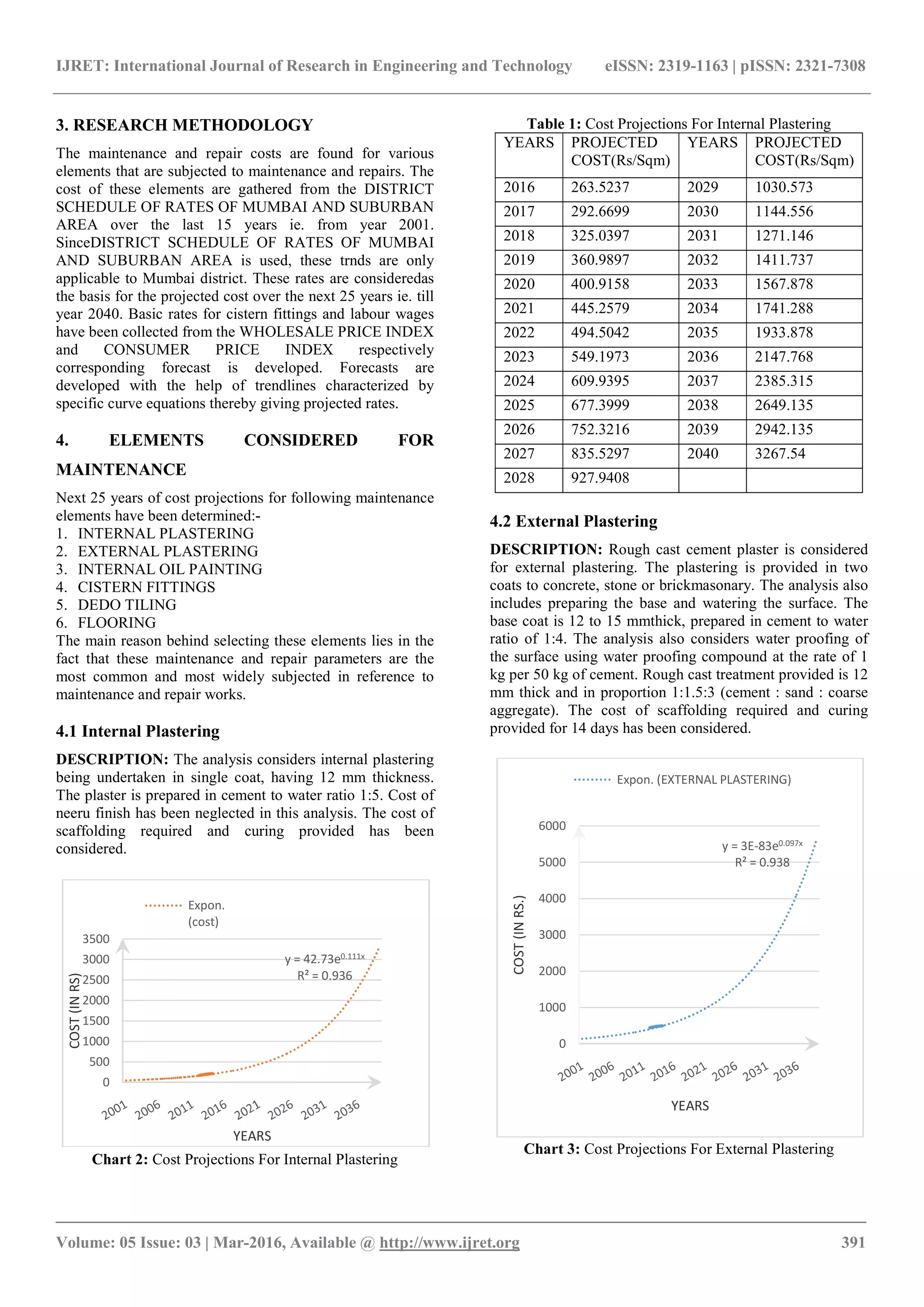
DESCRIPTION: The analysis considers internal plastering
being undertaken in single coat, having 12 mm thickness.
The plaster is prepared in cement to water ratio 1:5. Cost of
neeru finish has been neglected in this analysis. The cost of
scaffolding required and curing provided has been
considered.
Chart 2: Cost Projections For Internal Plastering
Table 1: Cost Projections For Internal Plastering
YEARS PROJECTED
COST(Rs/Sqm)
YEARS PROJECTED
COST(Rs/Sqm)
2016 263.5237 2029 1030.573
2017 292.6699 2030 1144.556
2018 325.0397 2031 1271.146
2019 360.9897 2032 1411.737
2020 400.9158 2033 1567.878
2021 445.2579 2034 1741.288
2022 494.5042 2035 1933.878
2023 549.1973 2036 2147.768
2024 609.9395 2037 2385.315
2025 677.3999 2038 2649.135
2026 752.3216 2039 2942.135
2027 835.5297 2040 3267.54
2028 927.9408
4.2 External Plastering
DESCRIPTION: Rough cast cement plaster is considered
for external plastering. The plastering is provided in two
coats to concrete, stone or brickmasonary. The analysis also
includes preparing the base and watering the surface. The
base coat is 12 to 15 mmthick, prepared in cement to water
ratio of 1:4. The analysis also considers water proofing of
the surface using water proofing compound at the rate of 1
kg per 50 kg of cement. Rough cast treatment provided is 12
mm thick and in proportion 1:1.5:3 (cement : sand : coarse
aggregate). The cost of scaffolding required and curing
provided for 14 days has been considered.
Chart 3: Cost Projections For External Plastering
y = 42.73e0.111x
R² = 0.936
0
500
1000
1500
2000
2500
3000
3500
COST(INRS)
YEARS
Expon.
(cost)
y = 3E-83e0.097x
R² = 0.938
0
1000
2000
3000
4000
5000
6000
COST(INRS.)
YEARS
Expon. (EXTERNAL PLASTERING)
IJRET: International Journal of Research in Engineering and Technology eISSN: 2319-1163 | pISSN: 2321-7308
_______________________________________________________________________________________
Volume: 05 Issue: 03 | Mar-2016, Available @ http://www.ijret.org 392
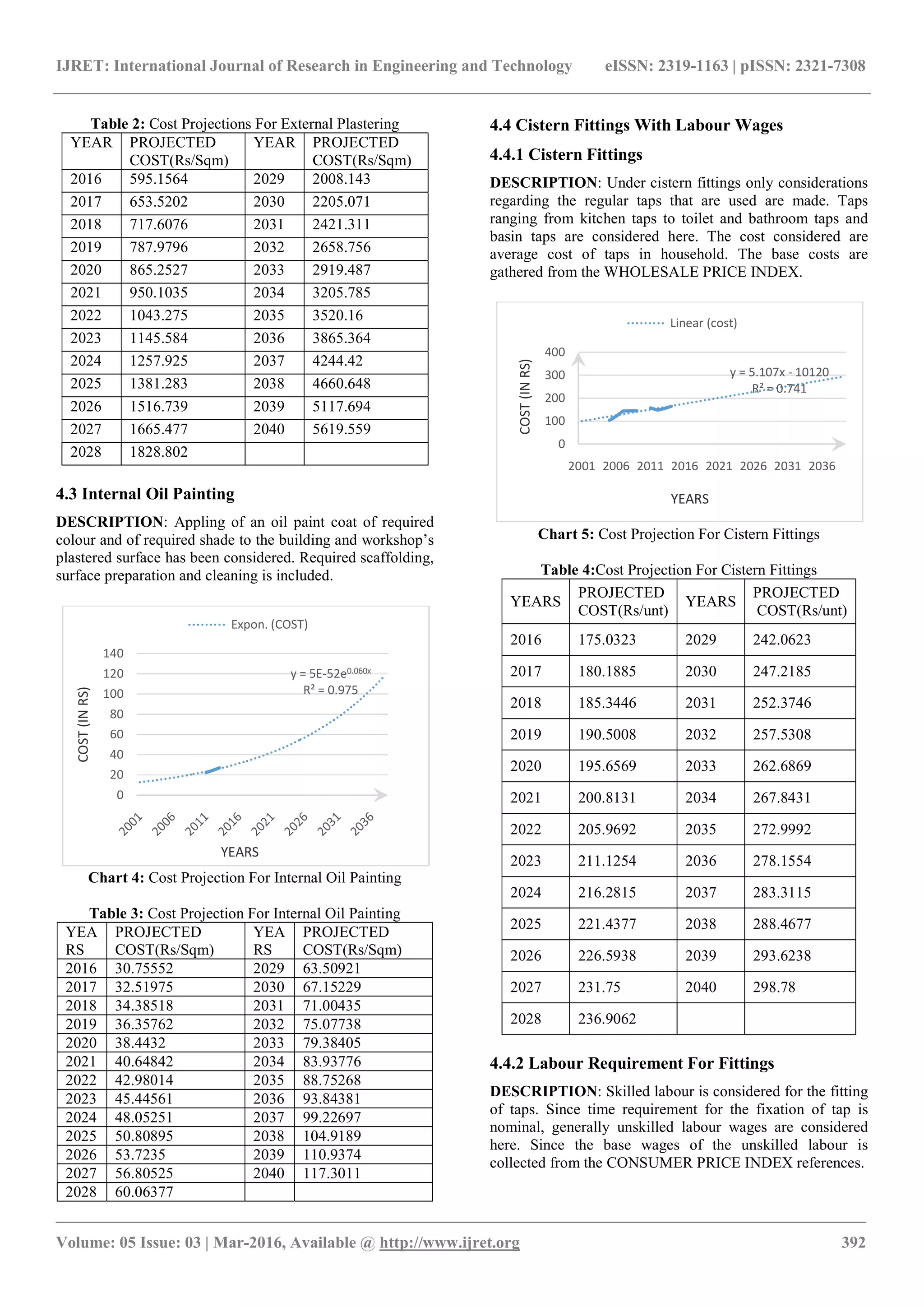
Table 2: Cost Projections For External Plastering
YEAR PROJECTED
COST(Rs/Sqm)
YEAR PROJECTED
COST(Rs/Sqm)
2016 595.1564 2029 2008.143
2017 653.5202 2030 2205.071
2018 717.6076 2031 2421.311
2019 787.9796 2032 2658.756
2020 865.2527 2033 2919.487
2021 950.1035 2034 3205.785
2022 1043.275 2035 3520.16
2023 1145.584 2036 3865.364
2024 1257.925 2037 4244.42
2025 1381.283 2038 4660.648
2026 1516.739 2039 5117.694
2027 1665.477 2040 5619.559
2028 1828.802
4.3 Internal Oil Painting
DESCRIPTION: Appling of an oil paint coat of required
colour and of required shade to the building and workshop’s
plastered surface has been considered. Required scaffolding,
surface preparation and cleaning is included.
Chart 4: Cost Projection For Internal Oil Painting
Table 3: Cost Projection For Internal Oil Painting
YEA
RS
PROJECTED
COST(Rs/Sqm)
YEA
RS
PROJECTED
COST(Rs/Sqm)
2016 30.75552 2029 63.50921
2017 32.51975 2030 67.15229
2018 34.38518 2031 71.00435
2019 36.35762 2032 75.07738
2020 38.4432 2033 79.38405
2021 40.64842 2034 83.93776
2022 42.98014 2035 88.75268
2023 45.44561 2036 93.84381
2024 48.05251 2037 99.22697
2025 50.80895 2038 104.9189
2026 53.7235 2039 110.9374
2027 56.80525 2040 117.3011
2028 60.06377
4.4 Cistern Fittings With Labour Wages
4.4.1 Cistern Fittings
DESCRIPTION: Under cistern fittings only considerations
regarding the regular taps that are used are made. Taps
ranging from kitchen taps to toilet and bathroom taps and
basin taps are considered here. The cost considered are
average cost of taps in household. The base costs are
gathered from the WHOLESALE PRICE INDEX.
Chart 5: Cost Projection For Cistern Fittings
Table 4:Cost Projection For Cistern Fittings
YEARS
PROJECTED
COST(Rs/unt)
YEARS
PROJECTED
COST(Rs/unt)
2016 175.0323 2029 242.0623
2017 180.1885 2030 247.2185
2018 185.3446 2031 252.3746
2019 190.5008 2032 257.5308
2020 195.6569 2033 262.6869
2021 200.8131 2034 267.8431
2022 205.9692 2035 272.9992
2023 211.1254 2036 278.1554
2024 216.2815 2037 283.3115
2025 221.4377 2038 288.4677
2026 226.5938 2039 293.6238
2027 231.75 2040 298.78
2028 236.9062
4.4.2 Labour Requirement For Fittings
DESCRIPTION: Skilled labour is considered for the fitting
of taps. Since time requirement for the fixation of tap is
nominal, generally unskilled labour wages are considered
here. Since the base wages of the unskilled labour is
collected from the CONSUMER PRICE INDEX references.
y = 5E-52e0.060x
R² = 0.975
0
20
40
60
80
100
120
140
COST(INRS)
YEARS
Expon. (COST)
y = 5.107x - 10120
R² = 0.741
0
100
200
300
400
2001 2006 2011 2016 2021 2026 2031 2036
COST(INRS)
YEARS
Linear (cost)
IJRET: International Journal of Research in Engineering and Technology eISSN: 2319-1163 | pISSN: 2321-7308
_______________________________________________________________________________________
Volume: 05 Issue: 03 | Mar-2016, Available @ http://www.ijret.org 393
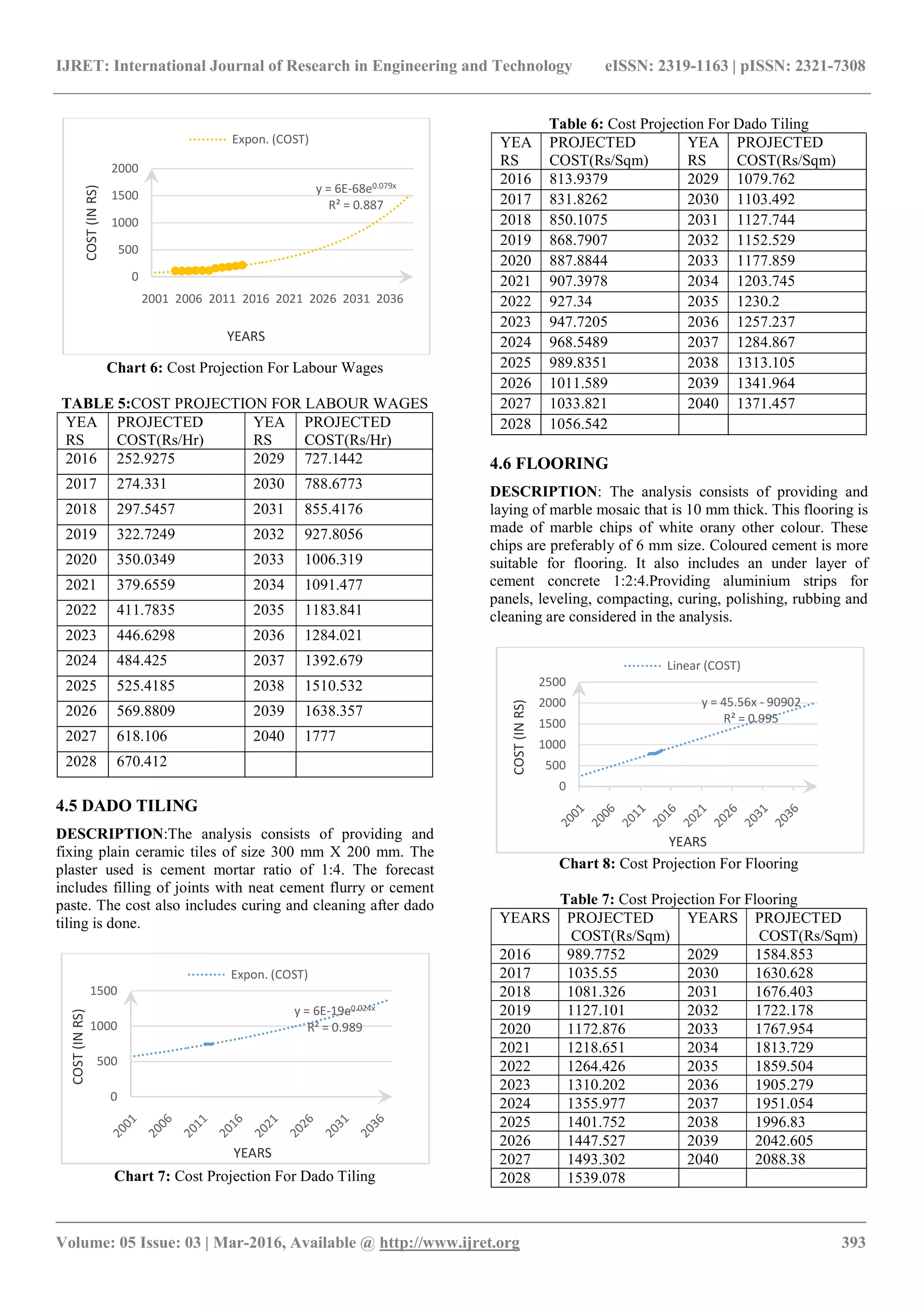
Chart 6: Cost Projection For Labour Wages
TABLE 5:COST PROJECTION FOR LABOUR WAGES
YEA
RS
PROJECTED
COST(Rs/Hr)
YEA
RS
PROJECTED
COST(Rs/Hr)
2016 252.9275 2029 727.1442
2017 274.331 2030 788.6773
2018 297.5457 2031 855.4176
2019 322.7249 2032 927.8056
2020 350.0349 2033 1006.319
2021 379.6559 2034 1091.477
2022 411.7835 2035 1183.841
2023 446.6298 2036 1284.021
2024 484.425 2037 1392.679
2025 525.4185 2038 1510.532
2026 569.8809 2039 1638.357
2027 618.106 2040 1777
2028 670.412
4.5 DADO TILING
DESCRIPTION:The analysis consists of providing and
fixing plain ceramic tiles of size 300 mm X 200 mm. The
plaster used is cement mortar ratio of 1:4. The forecast
includes filling of joints with neat cement flurry or cement
paste. The cost also includes curing and cleaning after dado
tiling is done.
Chart 7: Cost Projection For Dado Tiling
Table 6: Cost Projection For Dado Tiling
YEA
RS
PROJECTED
COST(Rs/Sqm)
YEA
RS
PROJECTED
COST(Rs/Sqm)
2016 813.9379 2029 1079.762
2017 831.8262 2030 1103.492
2018 850.1075 2031 1127.744
2019 868.7907 2032 1152.529
2020 887.8844 2033 1177.859
2021 907.3978 2034 1203.745
2022 927.34 2035 1230.2
2023 947.7205 2036 1257.237
2024 968.5489 2037 1284.867
2025 989.8351 2038 1313.105
2026 1011.589 2039 1341.964
2027 1033.821 2040 1371.457
2028 1056.542
4.6 FLOORING
DESCRIPTION: The analysis consists of providing and
laying of marble mosaic that is 10 mm thick. This flooring is
made of marble chips of white orany other colour. These
chips are preferably of 6 mm size. Coloured cement is more
suitable for flooring. It also includes an under layer of
cement concrete 1:2:4.Providing aluminium strips for
panels, leveling, compacting, curing, polishing, rubbing and
cleaning are considered in the analysis.
Chart 8: Cost Projection For Flooring
Table 7: Cost Projection For Flooring
YEARS PROJECTED
COST(Rs/Sqm)
YEARS PROJECTED
COST(Rs/Sqm)
2016 989.7752 2029 1584.853
2017 1035.55 2030 1630.628
2018 1081.326 2031 1676.403
2019 1127.101 2032 1722.178
2020 1172.876 2033 1767.954
2021 1218.651 2034 1813.729
2022 1264.426 2035 1859.504
2023 1310.202 2036 1905.279
2024 1355.977 2037 1951.054
2025 1401.752 2038 1996.83
2026 1447.527 2039 2042.605
2027 1493.302 2040 2088.38
2028 1539.078
y = 6E-68e0.079x
R² = 0.887
0
500
1000
1500
2000
2001 2006 2011 2016 2021 2026 2031 2036
COST(INRS)
YEARS
Expon. (COST)
y = 6E-19e0.024x
R² = 0.989
0
500
1000
1500
COST(INRS)
YEARS
Expon. (COST)
y = 45.56x - 90902
R² = 0.995
0
500
1000
1500
2000
2500
COST(INRS)
YEARS
Linear (COST)
IJRET: International Journal of Research in Engineering and Technology
__________________________________________________________
Volume: 05 Issue: 03 | Mar-2016, Available @
5. CONCLUSIONS
Thus based on the trendlines of different activies/ process it
can be conferred that the maintenance and
bound to increase as the time passes. Some tend to increase
linearly while some tend to increase exponentially.
graphs will help the financial controllers and economy
managers to predict the cost of specific repair
maintenance work in the future years. These predictions will
assist to plan and manage the finances according
requirement.
ACKNOWLEDGEMENT
We would like to thank and acknowledge the hard work
perseverance of Ms. Shagufta Sayed in guiding u
showing the correct path during the entire research period.
REFERENCES
1. Fuller, Sieglinde. "Whole Building Design Guide
Cycle Cost Analysis (LCCA)." (2004).
https://www.wbdg.org/resources/lcca.php
2. GUIDELINES FOR LIFE CYCLE COST ANALYSIS
https://lbre.stanford.edu/sites/all/lbre-
shared/files/docs_public/LCCA121405.pdf
3. Sayed, ShaguftaSajidMumtaaz, and Priyadarshi H.
Sawant. "Life-cycle cost and financial analysis of energy
components in mass housing projects–A case project in
sub-urban India." International Journal of Sustainable
Built Environment 4.2 (2015): 202-221.
4. Mumtaaz Sayed, ShaguftaSajid, and Priyadarshi H.
Sawant. "Financial Feasibility Analysis of Water
Conservation Components in Mass Housing Projects:
Suburban Indian Case Review." Journal of Architectural
Engineering (2016): 04016001.
BIOGRAPHIES
Dhruv J. Desai, Presently studing in the
final year civil engineering at
M.H.SabooSiddikcollege of engineering
(Mumbai University). He has also presented
preliminary report on “ENGINEERING
ECONOMICS AND LIFE CYCLE COST
ANALYSIS” at the college level. He is a
construction management aspirant at Masters level. He is
presently also working in research areas of costing and
tendering.
Tejas H. Jain, He is purs
Degree in Civil Engineering from
SabooSiddik College of Engineering. He
has keen interest in research and
to make contributions to the society by
becoming a great engineer. He has
presented papers in International journals
and International conferences. He has done internship with
different construction companies.
IJRET: International Journal of Research in Engineering and Technology eISSN: 2319
_______________________________________________________________________________________
, Available @ http://www.ijret.org
Thus based on the trendlines of different activies/ process it
can be conferred that the maintenance and repair costs are
bound to increase as the time passes. Some tend to increase
linearly while some tend to increase exponentially. These
graphs will help the financial controllers and economy
managers to predict the cost of specific repair and
These predictions will
assist to plan and manage the finances according to the
We would like to thank and acknowledge the hard work and
perseverance of Ms. Shagufta Sayed in guiding us and
research period.
Fuller, Sieglinde. "Whole Building Design Guide–Life
Cycle Cost Analysis (LCCA)." (2004).
https://www.wbdg.org/resources/lcca.php
GUIDELINES FOR LIFE CYCLE COST ANALYSIS
shared/files/docs_public/LCCA121405.pdf
Sayed, ShaguftaSajidMumtaaz, and Priyadarshi H.
cycle cost and financial analysis of energy
A case project in
International Journal of Sustainable
Mumtaaz Sayed, ShaguftaSajid, and Priyadarshi H.
Sawant. "Financial Feasibility Analysis of Water
Conservation Components in Mass Housing Projects:
Journal of Architectural
Presently studing in the
final year civil engineering at
M.H.SabooSiddikcollege of engineering
iversity). He has also presented
preliminary report on “ENGINEERING
ECONOMICS AND LIFE CYCLE COST
ANALYSIS” at the college level. He is a
construction management aspirant at Masters level. He is
presently also working in research areas of costing and
pursuing Bachelors
Degree in Civil Engineering from
k College of Engineering. He
keen interest in research and he wishes
to the society by
coming a great engineer. He has
s in International journals
done internship with
Atul Dwivedi
M.H.Saboosiddik C
He is interested in pursuin
project management. Also a
aspirant in the
management, he has given
exams for higher studies.
Anjum D.
diploma in civil engineering from VJTI and
currently pursuing bachelors in civil
engineering from the M.H.SABOO
SIDDIK COLLEGE OF
Being a civil engineer, author want to bring
in the best of advancements in the field of
civil engineering that will benefit the mankind and the
human race because "being a civil engineer is being a
creator"
eISSN: 2319-1163 | pISSN: 2321-7308
_____________________________
394
Atul Dwivedi, Student of be civil in
M.H.Saboosiddik College of Engineering.
nterested in pursuing career in
project management. Also a Masters
aspirant in the field of construction
management, he has given competitive
exams for higher studies.
Attar, She has completed
diploma in civil engineering from VJTI and
currently pursuing bachelors in civil
engineering from the M.H.SABOO
SIDDIK COLLEGE OF ENGINEERING.
Being a civil engineer, author want to bring
in the best of advancements in the field of
civil engineering that will benefit the mankind and the
human race because "being a civil engineer is being a

Engineering economics and life cycle cost analysis

  • 1.
    IJRET: International Journalof Research in Engineering and Technology eISSN: 2319-1163 | pISSN: 2321-7308 _______________________________________________________________________________________ Volume: 05 Issue: 03 | Mar-2016, Available @ http://www.ijret.org 390 ENGINEERING ECONOMICS AND LIFE CYCLE COST ANALYSIS Dhruv J. Desai1 , Tejas H. Jain2 , Atul A. Dwivedi3 , Anjum D. Attar4 1 M.H.SabooSiddik College of Engineering, Maharashtra, India 2 M.H.SabooSiddik College of Engineering, Maharashtra, India 3 M.H.SabooSiddik College of Engineering, Maharashtra, India 4 M.H.SabooSiddik College of Engineering, Maharashtra, India Abstract Life-cycle cost analysis (LCCA) is anevaluating tool to valuate the total financial/resource requirements for total ownership of a building. LCCA is effective when project options that fulfill the same task demands, having different initial costs and operational costs, needs to be examined in order to undertake the option that optimizes financial requirements. Building-related expenses can be furthercategorized into the following:  Initial Costs  Operation, Maintenance, and Repair Costs  Replacement Costs  Residual Values  Finance Charges  Non-Monetary Costs This article mainly focuses on the Maintenance and Repair cost analysis; giving probable trends for next 25 years for various elements using DSR, WPI and CPI. These trends are only applicable for the whole of Mumbai. Keyordsw: Life Cycle Cost, Maintenance and Repair cost. --------------------------------------------------------------------***---------------------------------------------------------------------- 1. LIFE CYCLE COST ANALYSIS .Life Cycle Cost Analysis is a method of estimating the economic performance of a building over its life period. It is also known as “whole cost accounting” or “total cost of ownership,” LCCA balances the intial stage investment with life period costs including owning cost and operating cost of that particular building. LCCA is calculated on the premises that different building design alternatives can accomplish the same functions with the same amount of efficiency. These options having different initial costs, operational costs, maintenance and repair costs and may also differ in life cycle periods. Considering a particular alternative, LCCA forecasts the total cost of building, including initial construction cost, operation and maintenance cost, for a particular life of the building, cited as “study period”. Life cycle cost analysis helps in maintaining a balance between the initial cost of any alternative process adopted and long term cost saving of that alternative process. LCCA also helps in narrowing the most cost effective alternative and also calculates the “payback” period of the increased cost. To estimate life cycle cost for allapplicable alternatives is not feasible, and therefore the guiding principle for LCCA considers the one which affects the long-term expenses. 1.1Importance of LCCA [1].As the CHART-1 below depicts 30 year cost analysis of a building’s life, including its construction costs, its maintenance costs, operation costs, and utility costs. CHART–1:30-YEAR ANALYSIS Since it is evident that for a 30-year period, maintenance cost accounts nearly 6% of the total cost, the Maintenance and Repair cost analysis will be the prime focus of this article. 2. MAINTENANCE AND REPAIR Building repairs and maintenance mainly consists ofconserving proper state of a building, its functions and utilities in routine use. The types of building repair and maintenance are:  Day to day repairs service facilities  Annual repairs  Special repairs  Additions and alterations  Preventive maintenance 28 % 6 % 4 % 4 % 58 % 30-YEARS LIFE CYCLE COST (%) UTILITIES MAINTENANCE SERVICES SYSTEM REPLACEMENT
  • 2.
    IJRET: International Journalof Research in Engineering and Technology eISSN: 2319-1163 | pISSN: 2321-7308 _______________________________________________________________________________________ Volume: 05 Issue: 03 | Mar-2016, Available @ http://www.ijret.org 391 3. RESEARCH METHODOLOGY The maintenance and repair costs are found for various elements that are subjected to maintenance and repairs. The cost of these elements are gathered from the DISTRICT SCHEDULE OF RATES OF MUMBAI AND SUBURBAN AREA over the last 15 years ie. from year 2001. SinceDISTRICT SCHEDULE OF RATES OF MUMBAI AND SUBURBAN AREA is used, these trnds are only applicable to Mumbai district. These rates are consideredas the basis for the projected cost over the next 25 years ie. till year 2040. Basic rates for cistern fittings and labour wages have been collected from the WHOLESALE PRICE INDEX and CONSUMER PRICE INDEX respectively corresponding forecast is developed. Forecasts are developed with the help of trendlines characterized by specific curve equations thereby giving projected rates. 4. ELEMENTS CONSIDERED FOR MAINTENANCE Next 25 years of cost projections for following maintenance elements have been determined:- 1. INTERNAL PLASTERING 2. EXTERNAL PLASTERING 3. INTERNAL OIL PAINTING 4. CISTERN FITTINGS 5. DEDO TILING 6. FLOORING The main reason behind selecting these elements lies in the fact that these maintenance and repair parameters are the most common and most widely subjected in reference to maintenance and repair works. 4.1 Internal Plastering DESCRIPTION: The analysis considers internal plastering being undertaken in single coat, having 12 mm thickness. The plaster is prepared in cement to water ratio 1:5. Cost of neeru finish has been neglected in this analysis. The cost of scaffolding required and curing provided has been considered. Chart 2: Cost Projections For Internal Plastering Table 1: Cost Projections For Internal Plastering YEARS PROJECTED COST(Rs/Sqm) YEARS PROJECTED COST(Rs/Sqm) 2016 263.5237 2029 1030.573 2017 292.6699 2030 1144.556 2018 325.0397 2031 1271.146 2019 360.9897 2032 1411.737 2020 400.9158 2033 1567.878 2021 445.2579 2034 1741.288 2022 494.5042 2035 1933.878 2023 549.1973 2036 2147.768 2024 609.9395 2037 2385.315 2025 677.3999 2038 2649.135 2026 752.3216 2039 2942.135 2027 835.5297 2040 3267.54 2028 927.9408 4.2 External Plastering DESCRIPTION: Rough cast cement plaster is considered for external plastering. The plastering is provided in two coats to concrete, stone or brickmasonary. The analysis also includes preparing the base and watering the surface. The base coat is 12 to 15 mmthick, prepared in cement to water ratio of 1:4. The analysis also considers water proofing of the surface using water proofing compound at the rate of 1 kg per 50 kg of cement. Rough cast treatment provided is 12 mm thick and in proportion 1:1.5:3 (cement : sand : coarse aggregate). The cost of scaffolding required and curing provided for 14 days has been considered. Chart 3: Cost Projections For External Plastering y = 42.73e0.111x R² = 0.936 0 500 1000 1500 2000 2500 3000 3500 COST(INRS) YEARS Expon. (cost) y = 3E-83e0.097x R² = 0.938 0 1000 2000 3000 4000 5000 6000 COST(INRS.) YEARS Expon. (EXTERNAL PLASTERING)
  • 3.
    IJRET: International Journalof Research in Engineering and Technology eISSN: 2319-1163 | pISSN: 2321-7308 _______________________________________________________________________________________ Volume: 05 Issue: 03 | Mar-2016, Available @ http://www.ijret.org 392 Table 2: Cost Projections For External Plastering YEAR PROJECTED COST(Rs/Sqm) YEAR PROJECTED COST(Rs/Sqm) 2016 595.1564 2029 2008.143 2017 653.5202 2030 2205.071 2018 717.6076 2031 2421.311 2019 787.9796 2032 2658.756 2020 865.2527 2033 2919.487 2021 950.1035 2034 3205.785 2022 1043.275 2035 3520.16 2023 1145.584 2036 3865.364 2024 1257.925 2037 4244.42 2025 1381.283 2038 4660.648 2026 1516.739 2039 5117.694 2027 1665.477 2040 5619.559 2028 1828.802 4.3 Internal Oil Painting DESCRIPTION: Appling of an oil paint coat of required colour and of required shade to the building and workshop’s plastered surface has been considered. Required scaffolding, surface preparation and cleaning is included. Chart 4: Cost Projection For Internal Oil Painting Table 3: Cost Projection For Internal Oil Painting YEA RS PROJECTED COST(Rs/Sqm) YEA RS PROJECTED COST(Rs/Sqm) 2016 30.75552 2029 63.50921 2017 32.51975 2030 67.15229 2018 34.38518 2031 71.00435 2019 36.35762 2032 75.07738 2020 38.4432 2033 79.38405 2021 40.64842 2034 83.93776 2022 42.98014 2035 88.75268 2023 45.44561 2036 93.84381 2024 48.05251 2037 99.22697 2025 50.80895 2038 104.9189 2026 53.7235 2039 110.9374 2027 56.80525 2040 117.3011 2028 60.06377 4.4 Cistern Fittings With Labour Wages 4.4.1 Cistern Fittings DESCRIPTION: Under cistern fittings only considerations regarding the regular taps that are used are made. Taps ranging from kitchen taps to toilet and bathroom taps and basin taps are considered here. The cost considered are average cost of taps in household. The base costs are gathered from the WHOLESALE PRICE INDEX. Chart 5: Cost Projection For Cistern Fittings Table 4:Cost Projection For Cistern Fittings YEARS PROJECTED COST(Rs/unt) YEARS PROJECTED COST(Rs/unt) 2016 175.0323 2029 242.0623 2017 180.1885 2030 247.2185 2018 185.3446 2031 252.3746 2019 190.5008 2032 257.5308 2020 195.6569 2033 262.6869 2021 200.8131 2034 267.8431 2022 205.9692 2035 272.9992 2023 211.1254 2036 278.1554 2024 216.2815 2037 283.3115 2025 221.4377 2038 288.4677 2026 226.5938 2039 293.6238 2027 231.75 2040 298.78 2028 236.9062 4.4.2 Labour Requirement For Fittings DESCRIPTION: Skilled labour is considered for the fitting of taps. Since time requirement for the fixation of tap is nominal, generally unskilled labour wages are considered here. Since the base wages of the unskilled labour is collected from the CONSUMER PRICE INDEX references. y = 5E-52e0.060x R² = 0.975 0 20 40 60 80 100 120 140 COST(INRS) YEARS Expon. (COST) y = 5.107x - 10120 R² = 0.741 0 100 200 300 400 2001 2006 2011 2016 2021 2026 2031 2036 COST(INRS) YEARS Linear (cost)
  • 4.
    IJRET: International Journalof Research in Engineering and Technology eISSN: 2319-1163 | pISSN: 2321-7308 _______________________________________________________________________________________ Volume: 05 Issue: 03 | Mar-2016, Available @ http://www.ijret.org 393 Chart 6: Cost Projection For Labour Wages TABLE 5:COST PROJECTION FOR LABOUR WAGES YEA RS PROJECTED COST(Rs/Hr) YEA RS PROJECTED COST(Rs/Hr) 2016 252.9275 2029 727.1442 2017 274.331 2030 788.6773 2018 297.5457 2031 855.4176 2019 322.7249 2032 927.8056 2020 350.0349 2033 1006.319 2021 379.6559 2034 1091.477 2022 411.7835 2035 1183.841 2023 446.6298 2036 1284.021 2024 484.425 2037 1392.679 2025 525.4185 2038 1510.532 2026 569.8809 2039 1638.357 2027 618.106 2040 1777 2028 670.412 4.5 DADO TILING DESCRIPTION:The analysis consists of providing and fixing plain ceramic tiles of size 300 mm X 200 mm. The plaster used is cement mortar ratio of 1:4. The forecast includes filling of joints with neat cement flurry or cement paste. The cost also includes curing and cleaning after dado tiling is done. Chart 7: Cost Projection For Dado Tiling Table 6: Cost Projection For Dado Tiling YEA RS PROJECTED COST(Rs/Sqm) YEA RS PROJECTED COST(Rs/Sqm) 2016 813.9379 2029 1079.762 2017 831.8262 2030 1103.492 2018 850.1075 2031 1127.744 2019 868.7907 2032 1152.529 2020 887.8844 2033 1177.859 2021 907.3978 2034 1203.745 2022 927.34 2035 1230.2 2023 947.7205 2036 1257.237 2024 968.5489 2037 1284.867 2025 989.8351 2038 1313.105 2026 1011.589 2039 1341.964 2027 1033.821 2040 1371.457 2028 1056.542 4.6 FLOORING DESCRIPTION: The analysis consists of providing and laying of marble mosaic that is 10 mm thick. This flooring is made of marble chips of white orany other colour. These chips are preferably of 6 mm size. Coloured cement is more suitable for flooring. It also includes an under layer of cement concrete 1:2:4.Providing aluminium strips for panels, leveling, compacting, curing, polishing, rubbing and cleaning are considered in the analysis. Chart 8: Cost Projection For Flooring Table 7: Cost Projection For Flooring YEARS PROJECTED COST(Rs/Sqm) YEARS PROJECTED COST(Rs/Sqm) 2016 989.7752 2029 1584.853 2017 1035.55 2030 1630.628 2018 1081.326 2031 1676.403 2019 1127.101 2032 1722.178 2020 1172.876 2033 1767.954 2021 1218.651 2034 1813.729 2022 1264.426 2035 1859.504 2023 1310.202 2036 1905.279 2024 1355.977 2037 1951.054 2025 1401.752 2038 1996.83 2026 1447.527 2039 2042.605 2027 1493.302 2040 2088.38 2028 1539.078 y = 6E-68e0.079x R² = 0.887 0 500 1000 1500 2000 2001 2006 2011 2016 2021 2026 2031 2036 COST(INRS) YEARS Expon. (COST) y = 6E-19e0.024x R² = 0.989 0 500 1000 1500 COST(INRS) YEARS Expon. (COST) y = 45.56x - 90902 R² = 0.995 0 500 1000 1500 2000 2500 COST(INRS) YEARS Linear (COST)
  • 5.
    IJRET: International Journalof Research in Engineering and Technology __________________________________________________________ Volume: 05 Issue: 03 | Mar-2016, Available @ 5. CONCLUSIONS Thus based on the trendlines of different activies/ process it can be conferred that the maintenance and bound to increase as the time passes. Some tend to increase linearly while some tend to increase exponentially. graphs will help the financial controllers and economy managers to predict the cost of specific repair maintenance work in the future years. These predictions will assist to plan and manage the finances according requirement. ACKNOWLEDGEMENT We would like to thank and acknowledge the hard work perseverance of Ms. Shagufta Sayed in guiding u showing the correct path during the entire research period. REFERENCES 1. Fuller, Sieglinde. "Whole Building Design Guide Cycle Cost Analysis (LCCA)." (2004). https://www.wbdg.org/resources/lcca.php 2. GUIDELINES FOR LIFE CYCLE COST ANALYSIS https://lbre.stanford.edu/sites/all/lbre- shared/files/docs_public/LCCA121405.pdf 3. Sayed, ShaguftaSajidMumtaaz, and Priyadarshi H. Sawant. "Life-cycle cost and financial analysis of energy components in mass housing projects–A case project in sub-urban India." International Journal of Sustainable Built Environment 4.2 (2015): 202-221. 4. Mumtaaz Sayed, ShaguftaSajid, and Priyadarshi H. Sawant. "Financial Feasibility Analysis of Water Conservation Components in Mass Housing Projects: Suburban Indian Case Review." Journal of Architectural Engineering (2016): 04016001. BIOGRAPHIES Dhruv J. Desai, Presently studing in the final year civil engineering at M.H.SabooSiddikcollege of engineering (Mumbai University). He has also presented preliminary report on “ENGINEERING ECONOMICS AND LIFE CYCLE COST ANALYSIS” at the college level. He is a construction management aspirant at Masters level. He is presently also working in research areas of costing and tendering. Tejas H. Jain, He is purs Degree in Civil Engineering from SabooSiddik College of Engineering. He has keen interest in research and to make contributions to the society by becoming a great engineer. He has presented papers in International journals and International conferences. He has done internship with different construction companies. IJRET: International Journal of Research in Engineering and Technology eISSN: 2319 _______________________________________________________________________________________ , Available @ http://www.ijret.org Thus based on the trendlines of different activies/ process it can be conferred that the maintenance and repair costs are bound to increase as the time passes. Some tend to increase linearly while some tend to increase exponentially. These graphs will help the financial controllers and economy managers to predict the cost of specific repair and These predictions will assist to plan and manage the finances according to the We would like to thank and acknowledge the hard work and perseverance of Ms. Shagufta Sayed in guiding us and research period. Fuller, Sieglinde. "Whole Building Design Guide–Life Cycle Cost Analysis (LCCA)." (2004). https://www.wbdg.org/resources/lcca.php GUIDELINES FOR LIFE CYCLE COST ANALYSIS shared/files/docs_public/LCCA121405.pdf Sayed, ShaguftaSajidMumtaaz, and Priyadarshi H. cycle cost and financial analysis of energy A case project in International Journal of Sustainable Mumtaaz Sayed, ShaguftaSajid, and Priyadarshi H. Sawant. "Financial Feasibility Analysis of Water Conservation Components in Mass Housing Projects: Journal of Architectural Presently studing in the final year civil engineering at M.H.SabooSiddikcollege of engineering iversity). He has also presented preliminary report on “ENGINEERING ECONOMICS AND LIFE CYCLE COST ANALYSIS” at the college level. He is a construction management aspirant at Masters level. He is presently also working in research areas of costing and pursuing Bachelors Degree in Civil Engineering from k College of Engineering. He keen interest in research and he wishes to the society by coming a great engineer. He has s in International journals done internship with Atul Dwivedi M.H.Saboosiddik C He is interested in pursuin project management. Also a aspirant in the management, he has given exams for higher studies. Anjum D. diploma in civil engineering from VJTI and currently pursuing bachelors in civil engineering from the M.H.SABOO SIDDIK COLLEGE OF Being a civil engineer, author want to bring in the best of advancements in the field of civil engineering that will benefit the mankind and the human race because "being a civil engineer is being a creator" eISSN: 2319-1163 | pISSN: 2321-7308 _____________________________ 394 Atul Dwivedi, Student of be civil in M.H.Saboosiddik College of Engineering. nterested in pursuing career in project management. Also a Masters aspirant in the field of construction management, he has given competitive exams for higher studies. Attar, She has completed diploma in civil engineering from VJTI and currently pursuing bachelors in civil engineering from the M.H.SABOO SIDDIK COLLEGE OF ENGINEERING. Being a civil engineer, author want to bring in the best of advancements in the field of civil engineering that will benefit the mankind and the human race because "being a civil engineer is being a