Engaging eLearning
Student expectationsIn 2009, a survey of more than  3,600 VET students revealed that:90% of VET students say that they would like at least ‘a little’e-learning in their course.42% of VET students said that e-learning was a factor in their choice of training provider, with 47% saying that e-learning influenced their choice of course to some degreehttp://e-learningindicators.flexiblelearning.net.au/docs/09results/2009BenchmarkingSurveyReport.pdf
What are your learners expectations?
PurposeMost e learning courses purpose is to share information or  change/improve job role performance.  However, most courses focus on sharing information rather than performance improvements.  This happens because most people focus on delivering content rather than on changing job role performance.
Push or Pull
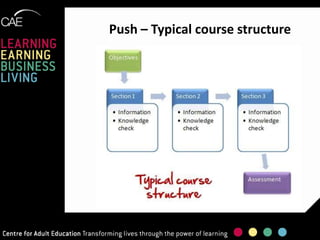
Push – Typical course structure
Pull – Making learners work
Pull – Making learners workhttp://www.articulate.com/rapid-elearning/are-your-e-learning-courses-pushed-or-pulled/
How to?“How do we get the learners to pull this information?”Well designed case studies or scenarios can create a need for the learners to pull the information.
You can present some simple questions, decision making trees or problem-solving activities that require a solution.  All shapes & sizesLearners exhibit a variety of learning style preferencesActiveReflectiveVisualExperientialAuditorySensing
Engaging eLearningOrganise Content into Small ChunksBuild Upon Prior Knowledge.Create processes where the learner can practice using the information in a context that integrates it with prior experience.  Provide Real-World Context. Focus on meaning and not information
Engaging eLearningTap into the learner’s motivation. Have the learners do something with the information that you give them.Make learning about solving problems rather than repeating informationAsk learners how the course content is relevant.Confirm that the scenarios are accurate and realisticUse of Text with Images, Slideshows, PowerPoint presentations, Video and Audio
Engaging eLearningGet the learners to create the learning materials:VideoAudioquiz questionsdecision making treesproduct manuals/resources
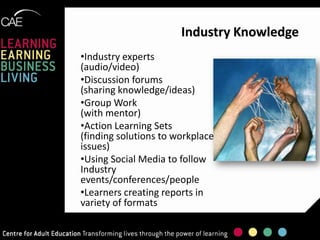
Industry KnowledgeIndustry experts(audio/video)
Discussion forums(sharing knowledge/ideas)
Group Work(with mentor)

Engaging elearning

  • 1.
  • 2.
    Student expectationsIn 2009,a survey of more than 3,600 VET students revealed that:90% of VET students say that they would like at least ‘a little’e-learning in their course.42% of VET students said that e-learning was a factor in their choice of training provider, with 47% saying that e-learning influenced their choice of course to some degreehttp://e-learningindicators.flexiblelearning.net.au/docs/09results/2009BenchmarkingSurveyReport.pdf
  • 3.
    What are yourlearners expectations?
  • 4.
    PurposeMost e learningcourses purpose is to share information or change/improve job role performance. However, most courses focus on sharing information rather than performance improvements. This happens because most people focus on delivering content rather than on changing job role performance.
  • 5.
  • 6.
    Push – Typicalcourse structure
  • 7.
    Pull – Makinglearners work
  • 8.
    Pull – Makinglearners workhttp://www.articulate.com/rapid-elearning/are-your-e-learning-courses-pushed-or-pulled/
  • 9.
    How to?“How dowe get the learners to pull this information?”Well designed case studies or scenarios can create a need for the learners to pull the information.
  • 10.
    You can presentsome simple questions, decision making trees or problem-solving activities that require a solution. All shapes & sizesLearners exhibit a variety of learning style preferencesActiveReflectiveVisualExperientialAuditorySensing
  • 11.
    Engaging eLearningOrganise Contentinto Small ChunksBuild Upon Prior Knowledge.Create processes where the learner can practice using the information in a context that integrates it with prior experience. Provide Real-World Context. Focus on meaning and not information
  • 12.
    Engaging eLearningTap intothe learner’s motivation. Have the learners do something with the information that you give them.Make learning about solving problems rather than repeating informationAsk learners how the course content is relevant.Confirm that the scenarios are accurate and realisticUse of Text with Images, Slideshows, PowerPoint presentations, Video and Audio
  • 13.
    Engaging eLearningGet thelearners to create the learning materials:VideoAudioquiz questionsdecision making treesproduct manuals/resources
  • 14.
  • 15.
  • 16.

Editor's Notes

  • #5  1. Communicate information with no performance expectations. Information-based courses communicate new information but have no built-in expectations of changed performance. A good example is a course that highlights new features of a software application. You learn about the new the features but you aren’t required to do anything with this new information.2. Give step-by-step instructions that have specific outcomes. These courses are focused on procedures and how to do something. They’re made up of repeatable tasks that are very close to what the learner will do at work. A good example is showing someone how to complete a worksheet or use software.3. Share guidelines to help the learner solve problems. The most challenging courses to design are those where you teach principles or guidelines versus repeatable steps. You really have to understand the nuances of the learner’s situation and how the principles can be applied while respecting the fact that each application is somewhat unique.
  • #6  1. Communicate information with no performance expectations. Information-based courses communicate new information but have no built-in expectations of changed performance. A good example is a course that highlights new features of a software application. You learn about the new the features but you aren’t required to do anything with this new information.2. Give step-by-step instructions that have specific outcomes. These courses are focused on procedures and how to do something. They’re made up of repeatable tasks that are very close to what the learner will do at work. A good example is showing someone how to complete a worksheet or use software.3. Share guidelines to help the learner solve problems. The most challenging courses to design are those where you teach principles or guidelines versus repeatable steps. You really have to understand the nuances of the learner’s situation and how the principles can be applied while respecting the fact that each application is somewhat unique.
  • #7  1. Communicate information with no performance expectations. Information-based courses communicate new information but have no built-in expectations of changed performance. A good example is a course that highlights new features of a software application. You learn about the new the features but you aren’t required to do anything with this new information.2. Give step-by-step instructions that have specific outcomes. These courses are focused on procedures and how to do something. They’re made up of repeatable tasks that are very close to what the learner will do at work. A good example is showing someone how to complete a worksheet or use software.3. Share guidelines to help the learner solve problems. The most challenging courses to design are those where you teach principles or guidelines versus repeatable steps. You really have to understand the nuances of the learner’s situation and how the principles can be applied while respecting the fact that each application is somewhat unique.
  • #8  1. Communicate information with no performance expectations. Information-based courses communicate new information but have no built-in expectations of changed performance. A good example is a course that highlights new features of a software application. You learn about the new the features but you aren’t required to do anything with this new information.2. Give step-by-step instructions that have specific outcomes. These courses are focused on procedures and how to do something. They’re made up of repeatable tasks that are very close to what the learner will do at work. A good example is showing someone how to complete a worksheet or use software.3. Share guidelines to help the learner solve problems. The most challenging courses to design are those where you teach principles or guidelines versus repeatable steps. You really have to understand the nuances of the learner’s situation and how the principles can be applied while respecting the fact that each application is somewhat unique.
  • #9  1. Communicate information with no performance expectations. Information-based courses communicate new information but have no built-in expectations of changed performance. A good example is a course that highlights new features of a software application. You learn about the new the features but you aren’t required to do anything with this new information.2. Give step-by-step instructions that have specific outcomes. These courses are focused on procedures and how to do something. They’re made up of repeatable tasks that are very close to what the learner will do at work. A good example is showing someone how to complete a worksheet or use software.3. Share guidelines to help the learner solve problems. The most challenging courses to design are those where you teach principles or guidelines versus repeatable steps. You really have to understand the nuances of the learner’s situation and how the principles can be applied while respecting the fact that each application is somewhat unique.
  • #10  1. Communicate information with no performance expectations. Information-based courses communicate new information but have no built-in expectations of changed performance. A good example is a course that highlights new features of a software application. You learn about the new the features but you aren’t required to do anything with this new information.2. Give step-by-step instructions that have specific outcomes. These courses are focused on procedures and how to do something. They’re made up of repeatable tasks that are very close to what the learner will do at work. A good example is showing someone how to complete a worksheet or use software.3. Share guidelines to help the learner solve problems. The most challenging courses to design are those where you teach principles or guidelines versus repeatable steps. You really have to understand the nuances of the learner’s situation and how the principles can be applied while respecting the fact that each application is somewhat unique.
  • #12 Organise Content into Small Chunks• Build Upon Prior Knowledge. Create processes where the learner can practice using the information in a context that integrates it with prior experience. (Case studies and practices exercises are good because they can be structured to combine the new information with the learner’s current understanding.)• Provide Real-World Context. (Create exercises and real-world scenarios that help the learner apply the new information into a workplace context. Problem-solving scenarios help develop thinking skills that can be transferred to the working environment)• Focus on meaning and not informationYou don’t even need to have big case studies. You can present some simple questions or problem-solving activities that require a solution. Essentially, you want to create a need for the information. Once the learner has a need, then they’re motivated to fulfill it. And that’s how you get the information to them.