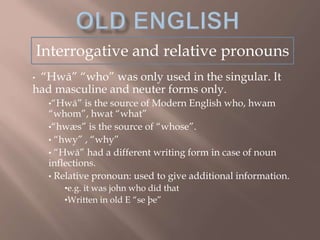
• “Hwā” “who” was only used in the singular. It
had masculine and neuter forms only.
•“Hwā” is the source of Modern English who, hwam
“whom”, hwat “what”
•“hwæs” is the source of “whose”.
• “hwy” , “why”
• “Hwā” had a different writing form in case of noun
inflections.
• Relative pronoun: used to give additional information.
•e.g. it was john who did that
•Written in old E “se þe”
Interrogative and relative pronouns
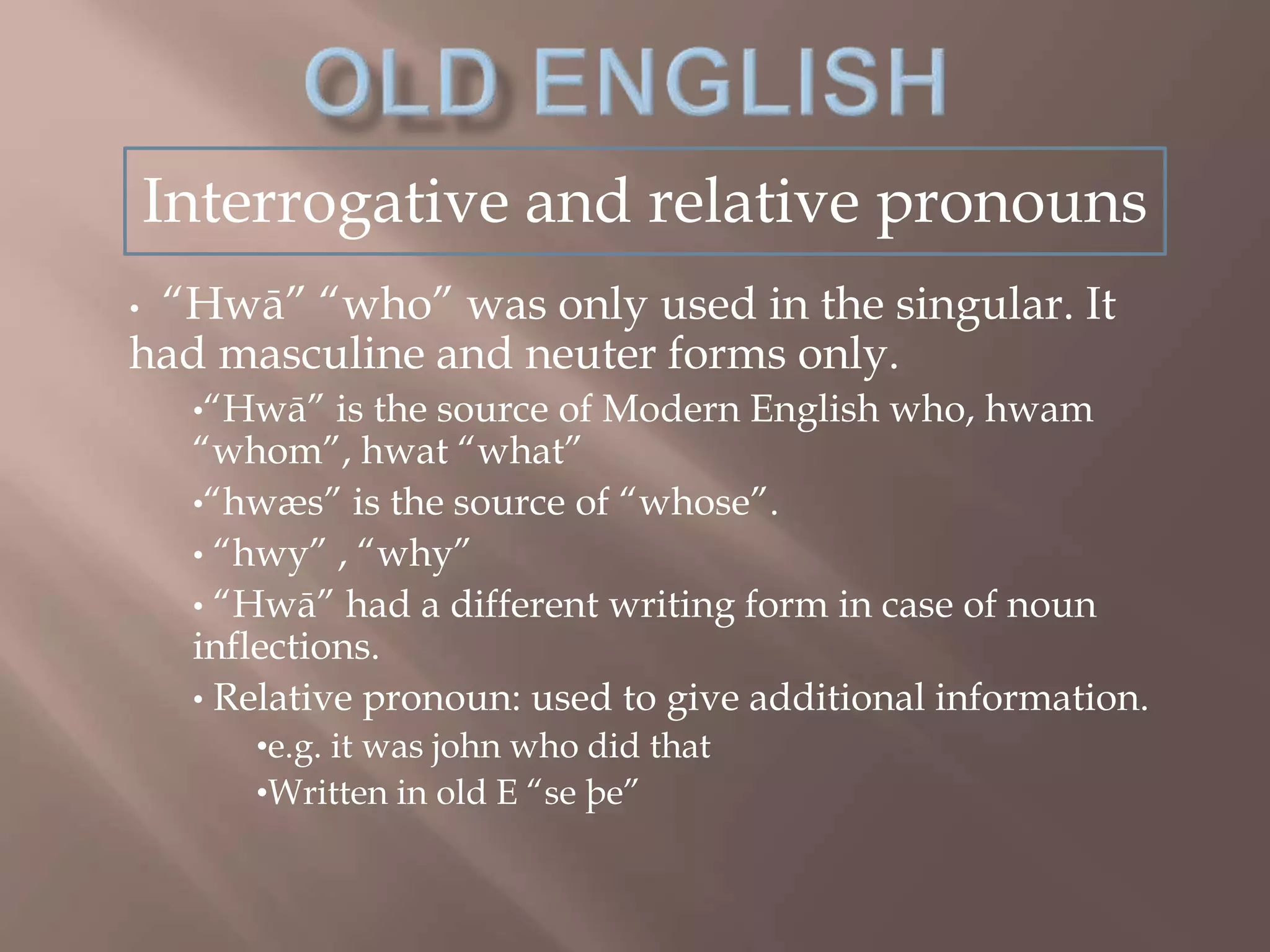
 Like modern E old E verbs were either weak or
strong.
 Weak verbs: the one ending with “d” or “t” to
form preterits and past participles .
 E.g. ” play – played – played”
 Strong verbs: these verbs change their stressed
vowel for the same purpose.
 E.g. “ sing – sang –sung “
 OE had several kinds of weak verbs and 7 groups
of strong verbs distinguished by their pattern of
vowel change.
 OE had more strong verbs than Modern English.
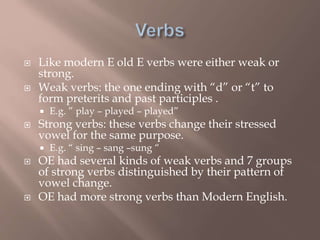
 Present system:
 Indicative
 Subjunctive
 Imperative
 Infinitive
 Preterit system:
 Indicative
 Subjunctive
 Past Participle
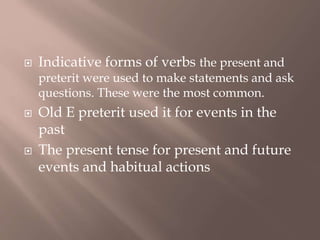
 Indicative forms of verbs the present and
preterit were used to make statements and ask
questions. These were the most common.
 Old E preterit used it for events in the
past
 The present tense for present and future
events and habitual actions
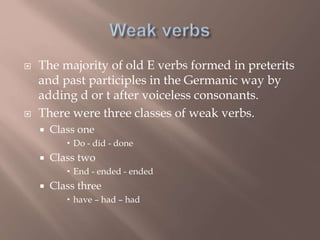
 The majority of old E verbs formed in preterits
and past participles in the Germanic way by
adding d or t after voiceless consonants.
 There were three classes of weak verbs.
 Class one
 Do - did - done
 Class two
 End - ended - ended
 Class three
 have – had – had
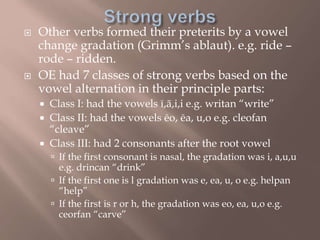
 Other verbs formed their preterits by a vowel
change gradation (Grimm’s ablaut). e.g. ride –
rode – ridden.
 OE had 7 classes of strong verbs based on the
vowel alternation in their principle parts:
 Class I: had the vowels ī,ã,i,i e.g. writan “write”
 Class II: had the vowels ēo, ēa, u,o e.g. cleofan
“cleave”
 Class III: had 2 consonants after the root vowel
 If the first consonant is nasal, the gradation was i, a,u,u
e.g. drincan “drink”
 If the first one is l gradation was e, ea, u, o e.g. helpan
“help”
 If the first is r or h, the gradation was eo, ea, u,o e.g.
ceorfan “carve”
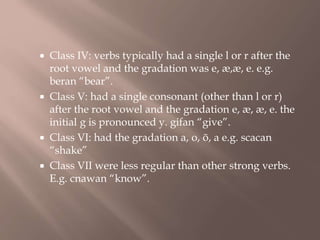
 Class IV: verbs typically had a single l or r after the
root vowel and the gradation was e, æ,æ, e. e.g.
beran “bear”.
 Class V: had a single consonant (other than l or r)
after the root vowel and the gradation e, æ, æ, e. the
initial g is pronounced y. gifan “give”.
 Class VI: had the gradation a, o, õ, a e.g. scacan
“shake”
 Class VII were less regular than other strong verbs.
E.g. cnawan “know”.

Eng424 8

  • 1.
    • “Hwā” “who”was only used in the singular. It had masculine and neuter forms only. •“Hwā” is the source of Modern English who, hwam “whom”, hwat “what” •“hwæs” is the source of “whose”. • “hwy” , “why” • “Hwā” had a different writing form in case of noun inflections. • Relative pronoun: used to give additional information. •e.g. it was john who did that •Written in old E “se þe” Interrogative and relative pronouns
  • 2.
     Like modernE old E verbs were either weak or strong.  Weak verbs: the one ending with “d” or “t” to form preterits and past participles .  E.g. ” play – played – played”  Strong verbs: these verbs change their stressed vowel for the same purpose.  E.g. “ sing – sang –sung “  OE had several kinds of weak verbs and 7 groups of strong verbs distinguished by their pattern of vowel change.  OE had more strong verbs than Modern English.
  • 3.
     Present system: Indicative  Subjunctive  Imperative  Infinitive  Preterit system:  Indicative  Subjunctive  Past Participle
  • 4.
     Indicative formsof verbs the present and preterit were used to make statements and ask questions. These were the most common.  Old E preterit used it for events in the past  The present tense for present and future events and habitual actions
  • 5.
     The majorityof old E verbs formed in preterits and past participles in the Germanic way by adding d or t after voiceless consonants.  There were three classes of weak verbs.  Class one  Do - did - done  Class two  End - ended - ended  Class three  have – had – had
  • 6.
     Other verbsformed their preterits by a vowel change gradation (Grimm’s ablaut). e.g. ride – rode – ridden.  OE had 7 classes of strong verbs based on the vowel alternation in their principle parts:  Class I: had the vowels ī,ã,i,i e.g. writan “write”  Class II: had the vowels ēo, ēa, u,o e.g. cleofan “cleave”  Class III: had 2 consonants after the root vowel  If the first consonant is nasal, the gradation was i, a,u,u e.g. drincan “drink”  If the first one is l gradation was e, ea, u, o e.g. helpan “help”  If the first is r or h, the gradation was eo, ea, u,o e.g. ceorfan “carve”
  • 7.
     Class IV:verbs typically had a single l or r after the root vowel and the gradation was e, æ,æ, e. e.g. beran “bear”.  Class V: had a single consonant (other than l or r) after the root vowel and the gradation e, æ, æ, e. the initial g is pronounced y. gifan “give”.  Class VI: had the gradation a, o, õ, a e.g. scacan “shake”  Class VII were less regular than other strong verbs. E.g. cnawan “know”.