OLD ENGLISH 
THE OLD ENGLISH PERIOD (449-1100)
BRITAIN BEFORE THE ENGLISH: 
• pre-old English existed in Europe to separate English from their 
Germanic cousins. However, recording the history of English 
started on the British Isles. 
Britain before English: 
- English migrated to Britain in 5th century 
- Britain was already inhabited by Celts for centuries before 
Julius Caesar invasion in 55 B.C. 
- Emperor Claudius, a century later, invaded Britain and 
changed it to Britannia as part of the Roman Empire. 
- Celts kept their language but learned to speak the language of 
the Roman rulers. 
- Around 410 Roman legionnaires were withdrawn and Picts 
from the north and Scots from the west attacked the Celts. 
- They were supported by sea raiders called ‘Saxons’ -by the 
Romans- and all attacked the Celts.
THE COMING OF THE ENGLISH: 
- The Roman army included many non-Italians 
(some Angles and Saxons) 
- Britons (Celts) asked for help from Rome 
against Picts and Scots. 
- Around 449, more Angles, Saxons, Frisians 
and Jutes arrived by boats from the Continent. 
- Old English period began around that time. 
- The term Anglo-Saxons used for either the 
language or its speakers
- St. Augustine came at 
the end of 6th century 
to convert them to 
Christianity. 
- Britons (Celts) fled to 
Wales 
- Jutes settled in the 
Southeastern part 
- Saxons in the South 
of the Thames 
- Angles in the rest of 
England roughly.
The English in Britain: 
• Germanic settlement consisted of 
7 Kingdoms: 
Kent, Essex, Sussex, Wessex, East Anglia, 
Mercia, Northumbria.
THE FIRST VIKING CONQUEST 
- The Christian Germanic raiders who took 
Britain by force were attacked by other 
Germanic invaders (Vikings) in the 8th 
century. 
- In 865, Viking army landed in East Anglia 
and gained Eastern part of England. 
- 870, Vikings attacked Wessex, ruled by 
Ethelred, his brother Alfred assisted him 
and in 878, Alfred won signal victory.
- Viking were called Danes by the English 
although there were Norwegians and 
Swedens. 
- Alfred’s son and grandsons (3 kings) were 
able to consolidate England in the 10th 
century. 
THE SECOND VIKING CONQUEST: 
- Later in 10th century troubles started again 
with new Vikings raiders 
- Danes settled and became neighbors with 
English. 
- Beowulf (OE poem concerned with 
Scandinavians) moved English people 
feelings towards those Danes.
SCANDINAVIANS BECOME ENGLISH: 
- Changed feelings towards the 
Danes. 
- They belonged to the same family. 
- Danes and English lived side by 
side and settled. 
- Old English and Old Norse 
(Scandinavians language) had many 
words in common.
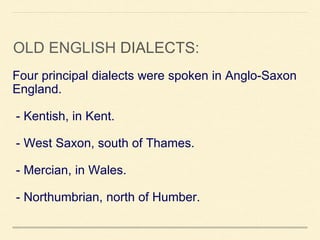
OLD ENGLISH DIALECTS: 
Four principal dialects were spoken in Anglo-Saxon 
England. 
- Kentish, in Kent. 
- West Saxon, south of Thames. 
- Mercian, in Wales. (Standard Modern English is 
Mercian dialect) 
- Northumbrian, north of Humber.
Thank You 
فيصل الشهري ، أحمد المنصور

ENG424 5.ppt

  • 1.
    OLD ENGLISH THEOLD ENGLISH PERIOD (449-1100)
  • 2.
    BRITAIN BEFORE THEENGLISH: • pre-old English existed in Europe to separate English from their Germanic cousins. However, recording the history of English started on the British Isles. Britain before English: - English migrated to Britain in 5th century - Britain was already inhabited by Celts for centuries before Julius Caesar invasion in 55 B.C. - Emperor Claudius, a century later, invaded Britain and changed it to Britannia as part of the Roman Empire. - Celts kept their language but learned to speak the language of the Roman rulers. - Around 410 Roman legionnaires were withdrawn and Picts from the north and Scots from the west attacked the Celts. - They were supported by sea raiders called ‘Saxons’ -by the Romans- and all attacked the Celts.
  • 3.
    THE COMING OFTHE ENGLISH: - The Roman army included many non-Italians (some Angles and Saxons) - Britons (Celts) asked for help from Rome against Picts and Scots. - Around 449, more Angles, Saxons, Frisians and Jutes arrived by boats from the Continent. - Old English period began around that time. - The term Anglo-Saxons used for either the language or its speakers
  • 5.
    - St. Augustinecame at the end of 6th century to convert them to Christianity. - Britons (Celts) fled to Wales - Jutes settled in the Southeastern part - Saxons in the South of the Thames - Angles in the rest of England roughly.
  • 6.
    The English inBritain: • Germanic settlement consisted of 7 Kingdoms: Kent, Essex, Sussex, Wessex, East Anglia, Mercia, Northumbria.
  • 7.
    THE FIRST VIKINGCONQUEST - The Christian Germanic raiders who took Britain by force were attacked by other Germanic invaders (Vikings) in the 8th century. - In 865, Viking army landed in East Anglia and gained Eastern part of England. - 870, Vikings attacked Wessex, ruled by Ethelred, his brother Alfred assisted him and in 878, Alfred won signal victory.
  • 8.
    - Viking werecalled Danes by the English although there were Norwegians and Swedens. - Alfred’s son and grandsons (3 kings) were able to consolidate England in the 10th century. THE SECOND VIKING CONQUEST: - Later in 10th century troubles started again with new Vikings raiders - Danes settled and became neighbors with English. - Beowulf (OE poem concerned with Scandinavians) moved English people feelings towards those Danes.
  • 9.
    SCANDINAVIANS BECOME ENGLISH: - Changed feelings towards the Danes. - They belonged to the same family. - Danes and English lived side by side and settled. - Old English and Old Norse (Scandinavians language) had many words in common.
  • 10.
    OLD ENGLISH DIALECTS: Four principal dialects were spoken in Anglo-Saxon England. - Kentish, in Kent. - West Saxon, south of Thames. - Mercian, in Wales. (Standard Modern English is Mercian dialect) - Northumbrian, north of Humber.
  • 11.
    Thank You فيصلالشهري ، أحمد المنصور