MIDDLE-ENGLISH 
PERIOD 
(1100-1500)
THE BACKGROUND OF THE NORMAN 
CONQUEST 
Af ter the death wi thout issue of Edward the confessor the last king in 
the di rect male l ine of descent from Al fred the great ,Harold, son of 
the power ful Ear l Godwin was elected to the kingship. Almost 
immediately his possession of the crown was chal lenged by Wi l l iam 
the seventh duke of Normandy, who was distantly related to Edward 
the Confessor and who fel t that he had a bet ter claim to the throne 
for a number of tenuous reasons. The Norman conquest for tunately 
for Anglo Amer ican cul ture and civi l ization the last invasion of 
England - was l ike the ear l ier harassments car r ied by Nor thmen who 
under the leadership of Wi l l iam the conqueror defeated the Engl ish 
under the hapless king Harold at the bat t le of Hast ings in 1066. 
Those Scandinavians who set t led in France are commonly designated 
by an Old French from of Nor thmen that is Normans 
, and the sect ion of France that they set t led and governed was cal led 
Normandy.
THE DECLINE OF FRENCH IN ENGLISH 
For a long time af ter Norman Congest French was the language 
of the governing classes in England. 
The loss of Normandy in 1204 by king John, a descendant of the 
conqueror removed an impor tant tie with France, and 
subsequent events were to loosen those that remained. 
The Hundred years War : 
Beginning in 1337, saw England and France bitter enemies in a 
long drawn-out confl ict though it actually fel l somewhat shor t of 
a hundred years which gave the death blow to the already 
moribund use of France in England.
THE LINGUISTIC INFLUENCE OF THE 
CONQUEST 
The impact of the Notman Conquest on the Engl ish language, 
l ike that made by earl ier Norse –speaking invaders, was to a 
large extent confined to the word stock , though Middle Engl ish 
also showed some instances of the influence of French. 
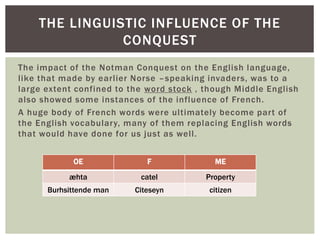
A huge body of French words were ultimately become par t of 
the Engl ish vocabulary, many of them replacing Engl ish words 
that would have done for us just as wel l. 
OE F ME 
æhta catel Property 
Burhsittende man Citeseyn citizen
MIDDLE ENGLISH SPELLING 
Consonants : 
1-The digraph (th) had been used in some of the ear l iest Engl ish texts 
those wr i tten before 900, but was replaced in later Old Engl ish wr i t ten 
by( Þ) . 
2- The( ų ų ) used for (w) in the ear ly manuscr ipts was supplanted by 
the runic wynn, but was brought back to England by Norman scr ibes in 
a l igatured f rom as ( w) 
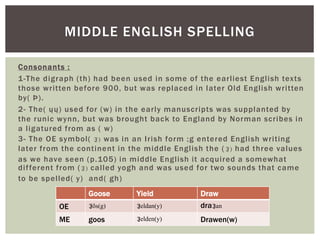
3- The OE symbol ( ३ ) was in an I r ish form ;g entered Engl ish wr i ting 
later f rom the cont inent in the middle Engl ish the ( ३ ) had three values 
as we have seen (p.105) in middle Engl ish i t acqui red a somewhat 
di f ferent from ( ३ ) cal led yogh and was used for two sounds that came 
to be spel led( y) and( gh) 
Goose Yield Draw 
OE ३õs(g) ३eldan(y) dra३an 
ME goos ३elden(y) Drawen(w)
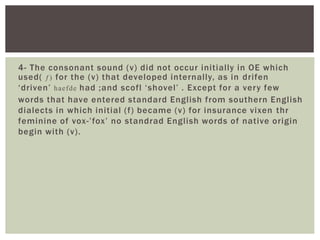
4- The consonant sound (v) did not occur initially in OE which 
used( ƒ) for the (v) that developed internally, as in drifen 
‘ d ri ven’ haefde had ;and scofl ‘ s h ove l’ . E xc e p t fo r a ve r y few 
words that have entered standard Engl ish from southern Engl ish 
dialects in which initial (f) became (v) for insurance vixen thr 
feminine of vox- ’ fox ’ no standrad Engl ish words of native origin 
begin with (v) .
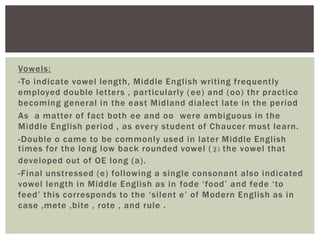
Vowels: 
-To indicate vowel length, Middle Engl ish writing frequently 
employed double letters , par ticularly (ee) and (oo) thr practice 
becoming general in the east Midland dialect late in the period 
As a matter of fact both ee and oo were ambiguous in the 
Middle Engl ish period , as every student of Chaucer must learn. 
-Double o came to be commonly used in later Middle Engl ish 
times for the long low back rounded vowel ( ३) the vowel that 
developed out of OE long (a) . 
-Final unstressed (e) fol lowing a single consonant also indicated 
vowel length in Middle Engl ish as in fode ‘food’ and fede ‘to 
feed’ this corresponds to the ‘si lent e’ of Modern Engl ish as in 
case ,mete ,bite , rote , and rule .
THE END 
By : Abdul Rahman Malek AL-Khalaf

ENG424 10 version 2

  • 1.
  • 2.
    THE BACKGROUND OFTHE NORMAN CONQUEST Af ter the death wi thout issue of Edward the confessor the last king in the di rect male l ine of descent from Al fred the great ,Harold, son of the power ful Ear l Godwin was elected to the kingship. Almost immediately his possession of the crown was chal lenged by Wi l l iam the seventh duke of Normandy, who was distantly related to Edward the Confessor and who fel t that he had a bet ter claim to the throne for a number of tenuous reasons. The Norman conquest for tunately for Anglo Amer ican cul ture and civi l ization the last invasion of England - was l ike the ear l ier harassments car r ied by Nor thmen who under the leadership of Wi l l iam the conqueror defeated the Engl ish under the hapless king Harold at the bat t le of Hast ings in 1066. Those Scandinavians who set t led in France are commonly designated by an Old French from of Nor thmen that is Normans , and the sect ion of France that they set t led and governed was cal led Normandy.
  • 3.
    THE DECLINE OFFRENCH IN ENGLISH For a long time af ter Norman Congest French was the language of the governing classes in England. The loss of Normandy in 1204 by king John, a descendant of the conqueror removed an impor tant tie with France, and subsequent events were to loosen those that remained. The Hundred years War : Beginning in 1337, saw England and France bitter enemies in a long drawn-out confl ict though it actually fel l somewhat shor t of a hundred years which gave the death blow to the already moribund use of France in England.
  • 4.
    THE LINGUISTIC INFLUENCEOF THE CONQUEST The impact of the Notman Conquest on the Engl ish language, l ike that made by earl ier Norse –speaking invaders, was to a large extent confined to the word stock , though Middle Engl ish also showed some instances of the influence of French. A huge body of French words were ultimately become par t of the Engl ish vocabulary, many of them replacing Engl ish words that would have done for us just as wel l. OE F ME æhta catel Property Burhsittende man Citeseyn citizen
  • 5.
    MIDDLE ENGLISH SPELLING Consonants : 1-The digraph (th) had been used in some of the ear l iest Engl ish texts those wr i tten before 900, but was replaced in later Old Engl ish wr i t ten by( Þ) . 2- The( ų ų ) used for (w) in the ear ly manuscr ipts was supplanted by the runic wynn, but was brought back to England by Norman scr ibes in a l igatured f rom as ( w) 3- The OE symbol ( ३ ) was in an I r ish form ;g entered Engl ish wr i ting later f rom the cont inent in the middle Engl ish the ( ३ ) had three values as we have seen (p.105) in middle Engl ish i t acqui red a somewhat di f ferent from ( ३ ) cal led yogh and was used for two sounds that came to be spel led( y) and( gh) Goose Yield Draw OE ३õs(g) ३eldan(y) dra३an ME goos ३elden(y) Drawen(w)
  • 6.
    4- The consonantsound (v) did not occur initially in OE which used( ƒ) for the (v) that developed internally, as in drifen ‘ d ri ven’ haefde had ;and scofl ‘ s h ove l’ . E xc e p t fo r a ve r y few words that have entered standard Engl ish from southern Engl ish dialects in which initial (f) became (v) for insurance vixen thr feminine of vox- ’ fox ’ no standrad Engl ish words of native origin begin with (v) .
  • 7.
    Vowels: -To indicatevowel length, Middle Engl ish writing frequently employed double letters , par ticularly (ee) and (oo) thr practice becoming general in the east Midland dialect late in the period As a matter of fact both ee and oo were ambiguous in the Middle Engl ish period , as every student of Chaucer must learn. -Double o came to be commonly used in later Middle Engl ish times for the long low back rounded vowel ( ३) the vowel that developed out of OE long (a) . -Final unstressed (e) fol lowing a single consonant also indicated vowel length in Middle Engl ish as in fode ‘food’ and fede ‘to feed’ this corresponds to the ‘si lent e’ of Modern Engl ish as in case ,mete ,bite , rote , and rule .
  • 8.
    THE END By: Abdul Rahman Malek AL-Khalaf