Group Work! 
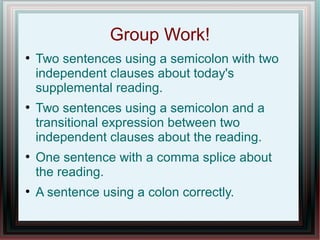
 Two sentences using a semicolon with two 
independent clauses. 
 Two sentences using a semicolon and a 
transitional expression between two independent 
clauses. 
 One sentence with a comma splice. 
 A sentence using a colon correctly.
Quiz Answers... 
 https://docs.google.com/forms/d/1ELk3QT4Dv 
NlQH46zwLMpGuv-x0UI_ 
lOL8mAsx3K9OX8/viewform
Semicolons! 
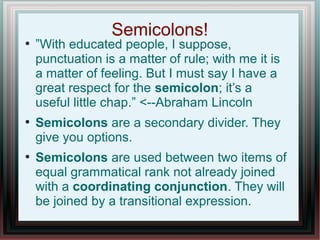
 ”With educated people, I suppose, punctuation is 
a matter of rule; with me it is a matter of feeling. 
But I must say I have a great respect for the 
semicolon; it’s a useful little chap.” <--Abraham 
Lincoln 
 Semicolons are a secondary divider. They give 
you options. 
 Semicolons are used between two items of equal 
grammatical rank not already joined with a 
coordinating conjunction. They will be joined 
by a transitional expression.
Sentences! 
 Two sentences using a semicolon with two 
independent clauses.
Semicolons!! 
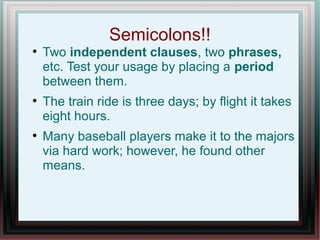
 Two independent clauses, two phrases, etc. 
Test your usage by placing a period between 
them. 
 The train ride is three days; by flight it takes 
eight hours. 
 Many baseball players make it to the majors via 
hard work; however, he found other means.
Independent Clauses! 
 Use a semicolon between related independent 
clauses that offer contrasting or parellel 
information that do not have a coordinating 
conjunction. 
 Paul Revere's The Boston Massacre is traditional 
American protest art; Edward Hick's paintings 
are socially conscious art with a religious strain.
Sentences 
 One sentence with a comma splice.
Run On Sentences (An Intro) 
 We will talk about this later in the month, but 
using only a comma or no punctuation between 
independent clauses will create a run on 
sentence (specifically a comma splice). 
 The sun is high, put on some sunblock. (comma 
splice)
 Two sentences using a semicolon and a 
transitional expression between two independent 
clauses.
Independent Clauses With 
Transitional Words 
 Use a semicolon before a transitional word or 
phrase to join two independent clauses. 
 The transition will normally be followed by a 
comma. 
 Thomas Jefferson brought two hundred vanilla 
beans and a recipe for vanilla ice cream back 
from France; thus, he gave America its all-time 
favorite ice cream flavor. 
 (that's true)
 Pause. 
 Take a breath. 
 Questions?
Items In A Series! 
 As you'll recall from our discussion of commas, 
if there are already commas in the list of 
elements you will add semicolons. 
 Laramie, Wyoming; Wyoming, Deleware; and 
Delaware, Ohio, were three of the places they 
visited.
Don't Misuse Semicolons! 
 Semicolons should be used for our good. Here 
are some common misuses: 
 Between a dependent clause and the rest of the 
sentence (use a comma!) 
 Introducing a list [use a colon! (stay tuned!)] 
 Between two independent clauses joined by 
coordinating conjunctions (use a comma!) 
 Do not use a semicolon to introduce a quote.
 A sentence using a colon correctly.
Colons! 
 Colons are used to introduce a series of 
elements. According to Strunk & White, they 
have ”more effect than the comma, less power to 
separate than the semicolon” (7-8) 
 It will be precedded by a complete sentence 
 Waiting tables requires three skills: Memory, 
speed, and balance. 
 Colons will also be used to introduce 
explanatory material. 
 She had one dream: To play professional 
basketball.
Look For Clues... 
 Is there a coordinating conjunction? 
- If yes, then probably use a comma. 
 Can you put a period in place of semicolon? 
 Remember that the word after a colon is 
supposed to be capitalized (hint hint).
Supplemental Material 
 Grammar Girl on semicolons.

Semicolons

  • 1.
    Group Work! Two sentences using a semicolon with two independent clauses.  Two sentences using a semicolon and a transitional expression between two independent clauses.  One sentence with a comma splice.  A sentence using a colon correctly.
  • 2.
    Quiz Answers... https://docs.google.com/forms/d/1ELk3QT4Dv NlQH46zwLMpGuv-x0UI_ lOL8mAsx3K9OX8/viewform
  • 3.
    Semicolons!  ”Witheducated people, I suppose, punctuation is a matter of rule; with me it is a matter of feeling. But I must say I have a great respect for the semicolon; it’s a useful little chap.” <--Abraham Lincoln  Semicolons are a secondary divider. They give you options.  Semicolons are used between two items of equal grammatical rank not already joined with a coordinating conjunction. They will be joined by a transitional expression.
  • 4.
    Sentences!  Twosentences using a semicolon with two independent clauses.
  • 5.
    Semicolons!!  Twoindependent clauses, two phrases, etc. Test your usage by placing a period between them.  The train ride is three days; by flight it takes eight hours.  Many baseball players make it to the majors via hard work; however, he found other means.
  • 6.
    Independent Clauses! Use a semicolon between related independent clauses that offer contrasting or parellel information that do not have a coordinating conjunction.  Paul Revere's The Boston Massacre is traditional American protest art; Edward Hick's paintings are socially conscious art with a religious strain.
  • 7.
    Sentences  Onesentence with a comma splice.
  • 8.
    Run On Sentences(An Intro)  We will talk about this later in the month, but using only a comma or no punctuation between independent clauses will create a run on sentence (specifically a comma splice).  The sun is high, put on some sunblock. (comma splice)
  • 9.
     Two sentencesusing a semicolon and a transitional expression between two independent clauses.
  • 10.
    Independent Clauses With Transitional Words  Use a semicolon before a transitional word or phrase to join two independent clauses.  The transition will normally be followed by a comma.  Thomas Jefferson brought two hundred vanilla beans and a recipe for vanilla ice cream back from France; thus, he gave America its all-time favorite ice cream flavor.  (that's true)
  • 11.
     Pause. Take a breath.  Questions?
  • 12.
    Items In ASeries!  As you'll recall from our discussion of commas, if there are already commas in the list of elements you will add semicolons.  Laramie, Wyoming; Wyoming, Deleware; and Delaware, Ohio, were three of the places they visited.
  • 13.
    Don't Misuse Semicolons!  Semicolons should be used for our good. Here are some common misuses:  Between a dependent clause and the rest of the sentence (use a comma!)  Introducing a list [use a colon! (stay tuned!)]  Between two independent clauses joined by coordinating conjunctions (use a comma!)  Do not use a semicolon to introduce a quote.
  • 14.
     A sentenceusing a colon correctly.
  • 15.
    Colons!  Colonsare used to introduce a series of elements. According to Strunk & White, they have ”more effect than the comma, less power to separate than the semicolon” (7-8)  It will be precedded by a complete sentence  Waiting tables requires three skills: Memory, speed, and balance.  Colons will also be used to introduce explanatory material.  She had one dream: To play professional basketball.
  • 16.
    Look For Clues...  Is there a coordinating conjunction? - If yes, then probably use a comma.  Can you put a period in place of semicolon?  Remember that the word after a colon is supposed to be capitalized (hint hint).
  • 17.
    Supplemental Material Grammar Girl on semicolons.

Editor's Notes

  • #16 According to the style guide, Punctuate It Right, the colon is a ”mark of expectation or addition.” I like that. Colons are used when the word ”namely” could be used and after complete sentences. There is one space between a colon and the rest of a sentence. A common misusage of colons is before a ”such as.” This is incorrect and should be avoided at all costs. There are other uses for colons that you need to know to write good college level papers. Apposotives When you have a set of apposotives in a sentence, use a colon. Example-My roomate is guilty of two of the seven deadly sins: gluttony and sloth. Quotations Make sure you understand when to use a colon in regards to quotations. Remember, a colon is only used when you have a complete sentence. Example 1-Consider the words of Benjamin Franklin: ”There never was a good war or a bad peace.” (Correct) Example 2-Willow testified that: ”I never went on a date with her.” (Incorrect---first part is not a complete sentence. You will use a comma there) Do I capitalize after a colon?!? I agree with contemporary grammarians like Mignon Fogarty who feel that this is unnecessary. However, if you do it, be consistent.