   Sian Welch & Wendy
    Ingraham - The Crawl -
    1997


                             VCE Physical Education - Unit 3
Muscular Fatigue Mechanisms
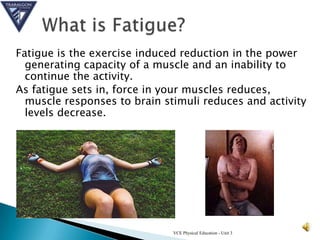
Fatigue is the exercise induced reduction in the power
  generating capacity of a muscle and an inability to
  continue the activity.
As fatigue sets in, force in your muscles reduces,
  muscle responses to brain stimuli reduces and activity
  levels decrease.


                              VCE Physical Education - Unit 3
   When and how fast fatigue kicks in is dependant
    upon the following:
    ◦ Type of activity (intermittent/continuous)
    ◦ Muscle fibre type used (slow/fast twitch. Slow=longer)
    ◦ Type of muscle contraction (isotonic/isometric-
      fastest/isokinetic)
    ◦ Intensity and duration of activity (high
      intensity/anaerobic= quicker fatigue)
    ◦ Level of fitness


                                 VCE Physical Education - Unit 3
Fatigue            Causes, signs & symptoms                                          Example
 Local    Fatigue is experienced in a muscle or group of                        Biceps during bicep
          muscles localised in part of the body. This tends to                         curls
          occur if the same muscle group is called upon
          repeatedly during training (without sufficient
          recovery) or performance. Muscles often experience                          Quads in
          a heaviness, tingling pain or cramp-like feelings.                        snowboarding
General   This tends to occur after completing a full training                  After completing full
          session or competitive game of football, netball or                     weights session
          the like. Performers feel that all their muscles are
          ‘weakened’
          and sometimes also experience psychological                           Playing a full game of
          fatigue as well.                                                           football etc.
Chronic   Performers experience an unhealthy breakdown of                           Chronic fatigue
          their immune system. This is usually caused by                              syndrome
          overtraining as a result of poor training program
          design, inappropriate recovery strategies and/or
                                                                                     Overtraining
          excessive competition demands or schedules.
          Chronic fatigue is dangerous and is often
          accompanied by increased susceptibility to illness                     Reoccurring illness or
          or infections, persistent muscle soreness and                                injuries
          reduced motivation levels.
                                              VCE Physical Education - Unit 3
Muscular Fatigue Mechanisms
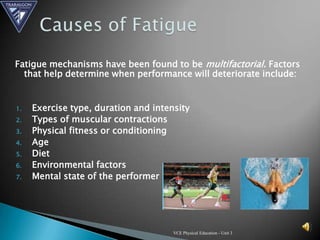
Fatigue mechanisms have been found to be multifactorial. Factors
  that help determine when performance will deteriorate include:


1.   Exercise type, duration and intensity
2.   Types of muscular contractions
3.   Physical fitness or conditioning
4.   Age
5.   Diet
6.   Environmental factors
7.   Mental state of the performer


                                      VCE Physical Education - Unit 3
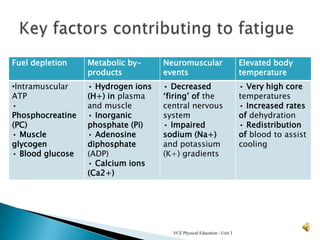
Fuel depletion    Metabolic by-     Neuromuscular                       Elevated body
                  products          events                              temperature
•Intramuscular    • Hydrogen ions   • Decreased                         • Very high core
ATP               (H+) in plasma    ‘firing’ of the                     temperatures
•                 and muscle        central nervous                     • Increased rates
Phosphocreatine   • Inorganic       system                              of dehydration
(PC)              phosphate (Pi)    • Impaired                          • Redistribution
• Muscle          • Adenosine       sodium (Na+)                        of blood to assist
glycogen          diphosphate       and potassium                       cooling
• Blood glucose   (ADP)             (K+) gradients
                  • Calcium ions
                  (Ca2+)


                                      VCE Physical Education - Unit 3
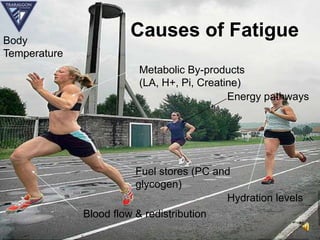
Body
                       Causes of Fatigue
Temperature
                         Metabolic By-products
                         (LA, H+, Pi, Creatine)
                                            Energy pathways


                         Fuel stores (PC and
                         glycogen)
                                           Hydration levels
              Blood flow & redistribution
Lactic acid has a bad                  However, lactic acid does have
  reputation. Many people                a dark side.
  blame it for fatigue, sore            The Hydrogen ion is the acid
  muscles, and cramps.                   in lactic acid.
 Scientists have discovered            It interferes with electrical
  that lactic acid plays a critical      signals in your muscles and
  role in generating energy              nerves, slows energy
  during exercise.                       reactions, and impairs muscle
 When your body makes lactic            contractions.
  acid, it splits into lactate ion      The burn you feel in intense
  (lactate) and hydrogen ion.            exercise is caused by
 The lactate ion provides fuels         hydrogen ion build-up.
  for many tissues, helps use           Inorganic phosphate (Pi) can
  dietary carbohydrates, and             also have a similar fatiguing
  serves as fuel for liver               effect on the body.
  production of glucose and             So, when you fatigue, don't
  glycogen.                              blame it on lactic acid.
                                         Rather, place the blame
                                         where it belongs- on
                                         hydrogen ion.
                         Lactic Acid
                                       VCE Physical Education - Unit 3
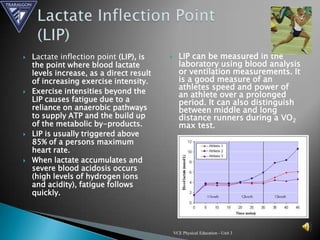
   Lactate inflection point (LIP), is         LIP can be measured in the
    the point where blood lactate               laboratory using blood analysis
    levels increase, as a direct result         or ventilation measurements. It
    of increasing exercise intensity.           is a good measure of an
                                                athletes speed and power of
   Exercise intensities beyond the             an athlete over a prolonged
    LIP causes fatigue due to a                 period. It can also distinguish
    reliance on anaerobic pathways              between middle and long
    to supply ATP and the build up              distance runners during a VO 2
    of the metabolic by-products.               max test.
   LIP is usually triggered above
    85% of a persons maximum
    heart rate.
   When lactate accumulates and
    severe blood acidosis occurs
    (high levels of hydrogen ions
    and acidity), fatigue follows
    quickly.


                                              VCE Physical Education - Unit 3
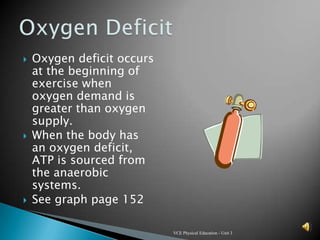
   Oxygen deficit occurs
    at the beginning of
    exercise when
    oxygen demand is
    greater than oxygen
    supply.
   When the body has
    an oxygen deficit,
    ATP is sourced from
    the anaerobic
    systems.
   See graph page 152

                            VCE Physical Education - Unit 3
Oxygen Debt (EPOC) Excess Post-
      exercise Oxygen Consumption

•Oxygen debt is defined as the volume of oxygen used during
recovery from exercise in excess of resting oxygen consumption.
•Occurs after anaerobic exercise.
•Divided into 2 parts. 1(fast)- restores PC in approximately 2-3
minutes. 2-3 litres of oxygen is consumed to provide this
resynthesisation. 2 (slow)-removes lactic acid through buffering.
Recovery depends on usage and metabolic disturbances during
activity.
•High intensity activities = a large oxygen deficit, small (or no)
steady state, large oxygen deficit/EPOC
•Low intensity activities = a small oxygen deficit, long steady state,
small oxygen debt/EPOC
                                       VCE Physical Education - Unit 3
   Most commonly exhausted energy stores are PC and
    glycogen.
   Stores of glycogen in the muscle and liver can fuel
    continuous exercise for over 90 mins.
   Muscle glycogen is generally the first fuel source
    used during aerobic exercise; then liver glycogen
    and eventually blood-borne and stored fat.
   Fat conversion to energy is far less efficient than
    that for glycogen, resulting in a reduced intensity.
   As energy stores are continually depleted, fatigue
    occurs and therefore the quality of performance
    decreases


                                VCE Physical Education - Unit 3
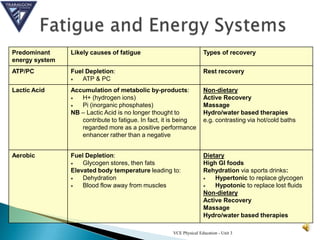
Predominant     Likely causes of fatigue                            Types of recovery
energy system
ATP/PC          Fuel Depletion:                                     Rest recovery
                    ATP & PC
Lactic Acid     Accumulation of metabolic by-products:              Non-dietary
                   H+ (hydrogen ions)                               Active Recovery
                   Pi (inorganic phosphates)                        Massage
                NB – Lactic Acid is no longer thought to            Hydro/water based therapies
                   contribute to fatigue. In fact, it is being      e.g. contrasting via hot/cold baths
                   regarded more as a positive performance
                   enhancer rather than a negative


Aerobic         Fuel Depletion:                                     Dietary
                    Glycogen stores, then fats                      High GI foods
                Elevated body temperature leading to:               Rehydration via sports drinks:
                    Dehydration                                         Hypertonic to replace glycogen
                    Blood flow away from muscles                        Hypotonic to replace lost fluids
                                                                    Non-dietary
                                                                    Active Recovery
                                                                    Massage
                                                                    Hydro/water based therapies

                                                     VCE Physical Education - Unit 3
Muscular Fatigue Mechanisms
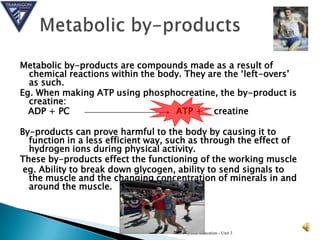
Metabolic by-products are compounds made as a result of
  chemical reactions within the body. They are the ‘left-overs’
  as such.
Eg. When making ATP using phosphocreatine, the by-product is
  creatine:
  ADP + PC                         ATP + creatine

By-products can prove harmful to the body by causing it to
  function in a less efficient way, such as through the effect of
  hydrogen ions during physical activity.
These by-products effect the functioning of the working muscle
 eg. Ability to break down glycogen, ability to send signals to
  the muscle and the changing concentration of minerals in and
  around the muscle.


                                   VCE Physical Education - Unit 3
Muscular Fatigue Mechanisms
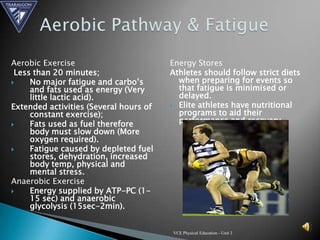
Aerobic Exercise                        Energy Stores
 Less than 20 minutes;                  Athletes should follow strict diets
    No major fatigue and carbo’s         when preparing for events so
     and fats used as energy (Very        that fatigue is minimised or
     little lactic acid).                 delayed.
Extended activities (Several hours of    Elite athletes have nutritional
     constant exercise);                  programs to aid their
    Fats used as fuel therefore          performance and recovery.
     body must slow down (More
     oxygen required).
    Fatigue caused by depleted fuel
     stores, dehydration, increased
     body temp, physical and
     mental stress.
Anaerobic Exercise
    Energy supplied by ATP-PC (1-
     15 sec) and anaerobic
     glycolysis (15sec-2min).


                                        VCE Physical Education - Unit 3
   Recovery is used to return the body to pre-
    exercise conditions and therefore reverse the
    effects of fatigue.
   Efficient recovery enhances adaptations to
    exercise loads and prepares the performer for
    future training/competition
   Inefficient recovery delays the removal of
    fatiguing factors and can lead to injuries and
    over training.
   Exercisers need to ensure they match their
    recovery to the causes of fatigue


                            VCE Physical Education - Unit 3
VCE Physical Education - Unit 3
Complete review
questions on page
    171-172


        VCE Physical Education - Unit 3

Muscular fatigue mechanisms 2011

  • 1.
    Sian Welch & Wendy Ingraham - The Crawl - 1997 VCE Physical Education - Unit 3
  • 2.
  • 3.
    Fatigue is theexercise induced reduction in the power generating capacity of a muscle and an inability to continue the activity. As fatigue sets in, force in your muscles reduces, muscle responses to brain stimuli reduces and activity levels decrease. VCE Physical Education - Unit 3
  • 4.
    When and how fast fatigue kicks in is dependant upon the following: ◦ Type of activity (intermittent/continuous) ◦ Muscle fibre type used (slow/fast twitch. Slow=longer) ◦ Type of muscle contraction (isotonic/isometric- fastest/isokinetic) ◦ Intensity and duration of activity (high intensity/anaerobic= quicker fatigue) ◦ Level of fitness VCE Physical Education - Unit 3
  • 5.
    Fatigue Causes, signs & symptoms Example Local Fatigue is experienced in a muscle or group of Biceps during bicep muscles localised in part of the body. This tends to curls occur if the same muscle group is called upon repeatedly during training (without sufficient recovery) or performance. Muscles often experience Quads in a heaviness, tingling pain or cramp-like feelings. snowboarding General This tends to occur after completing a full training After completing full session or competitive game of football, netball or weights session the like. Performers feel that all their muscles are ‘weakened’ and sometimes also experience psychological Playing a full game of fatigue as well. football etc. Chronic Performers experience an unhealthy breakdown of Chronic fatigue their immune system. This is usually caused by syndrome overtraining as a result of poor training program design, inappropriate recovery strategies and/or Overtraining excessive competition demands or schedules. Chronic fatigue is dangerous and is often accompanied by increased susceptibility to illness Reoccurring illness or or infections, persistent muscle soreness and injuries reduced motivation levels. VCE Physical Education - Unit 3
  • 6.
  • 7.
    Fatigue mechanisms havebeen found to be multifactorial. Factors that help determine when performance will deteriorate include: 1. Exercise type, duration and intensity 2. Types of muscular contractions 3. Physical fitness or conditioning 4. Age 5. Diet 6. Environmental factors 7. Mental state of the performer VCE Physical Education - Unit 3
  • 8.
    Fuel depletion Metabolic by- Neuromuscular Elevated body products events temperature •Intramuscular • Hydrogen ions • Decreased • Very high core ATP (H+) in plasma ‘firing’ of the temperatures • and muscle central nervous • Increased rates Phosphocreatine • Inorganic system of dehydration (PC) phosphate (Pi) • Impaired • Redistribution • Muscle • Adenosine sodium (Na+) of blood to assist glycogen diphosphate and potassium cooling • Blood glucose (ADP) (K+) gradients • Calcium ions (Ca2+) VCE Physical Education - Unit 3
  • 9.
    Body Causes of Fatigue Temperature Metabolic By-products (LA, H+, Pi, Creatine) Energy pathways Fuel stores (PC and glycogen) Hydration levels Blood flow & redistribution
  • 10.
    Lactic acid hasa bad However, lactic acid does have reputation. Many people a dark side. blame it for fatigue, sore  The Hydrogen ion is the acid muscles, and cramps. in lactic acid.  Scientists have discovered  It interferes with electrical that lactic acid plays a critical signals in your muscles and role in generating energy nerves, slows energy during exercise. reactions, and impairs muscle  When your body makes lactic contractions. acid, it splits into lactate ion  The burn you feel in intense (lactate) and hydrogen ion. exercise is caused by  The lactate ion provides fuels hydrogen ion build-up. for many tissues, helps use  Inorganic phosphate (Pi) can dietary carbohydrates, and also have a similar fatiguing serves as fuel for liver effect on the body. production of glucose and  So, when you fatigue, don't glycogen. blame it on lactic acid. Rather, place the blame where it belongs- on hydrogen ion. Lactic Acid VCE Physical Education - Unit 3
  • 11.
    Lactate inflection point (LIP), is  LIP can be measured in the the point where blood lactate laboratory using blood analysis levels increase, as a direct result or ventilation measurements. It of increasing exercise intensity. is a good measure of an athletes speed and power of  Exercise intensities beyond the an athlete over a prolonged LIP causes fatigue due to a period. It can also distinguish reliance on anaerobic pathways between middle and long to supply ATP and the build up distance runners during a VO 2 of the metabolic by-products. max test.  LIP is usually triggered above 85% of a persons maximum heart rate.  When lactate accumulates and severe blood acidosis occurs (high levels of hydrogen ions and acidity), fatigue follows quickly. VCE Physical Education - Unit 3
  • 12.
    Oxygen deficit occurs at the beginning of exercise when oxygen demand is greater than oxygen supply.  When the body has an oxygen deficit, ATP is sourced from the anaerobic systems.  See graph page 152 VCE Physical Education - Unit 3
  • 13.
    Oxygen Debt (EPOC)Excess Post- exercise Oxygen Consumption •Oxygen debt is defined as the volume of oxygen used during recovery from exercise in excess of resting oxygen consumption. •Occurs after anaerobic exercise. •Divided into 2 parts. 1(fast)- restores PC in approximately 2-3 minutes. 2-3 litres of oxygen is consumed to provide this resynthesisation. 2 (slow)-removes lactic acid through buffering. Recovery depends on usage and metabolic disturbances during activity. •High intensity activities = a large oxygen deficit, small (or no) steady state, large oxygen deficit/EPOC •Low intensity activities = a small oxygen deficit, long steady state, small oxygen debt/EPOC VCE Physical Education - Unit 3
  • 14.
    Most commonly exhausted energy stores are PC and glycogen.  Stores of glycogen in the muscle and liver can fuel continuous exercise for over 90 mins.  Muscle glycogen is generally the first fuel source used during aerobic exercise; then liver glycogen and eventually blood-borne and stored fat.  Fat conversion to energy is far less efficient than that for glycogen, resulting in a reduced intensity.  As energy stores are continually depleted, fatigue occurs and therefore the quality of performance decreases VCE Physical Education - Unit 3
  • 15.
    Predominant Likely causes of fatigue Types of recovery energy system ATP/PC Fuel Depletion: Rest recovery ATP & PC Lactic Acid Accumulation of metabolic by-products: Non-dietary H+ (hydrogen ions) Active Recovery Pi (inorganic phosphates) Massage NB – Lactic Acid is no longer thought to Hydro/water based therapies contribute to fatigue. In fact, it is being e.g. contrasting via hot/cold baths regarded more as a positive performance enhancer rather than a negative Aerobic Fuel Depletion: Dietary Glycogen stores, then fats High GI foods Elevated body temperature leading to: Rehydration via sports drinks: Dehydration Hypertonic to replace glycogen Blood flow away from muscles Hypotonic to replace lost fluids Non-dietary Active Recovery Massage Hydro/water based therapies VCE Physical Education - Unit 3
  • 16.
  • 17.
    Metabolic by-products arecompounds made as a result of chemical reactions within the body. They are the ‘left-overs’ as such. Eg. When making ATP using phosphocreatine, the by-product is creatine: ADP + PC ATP + creatine By-products can prove harmful to the body by causing it to function in a less efficient way, such as through the effect of hydrogen ions during physical activity. These by-products effect the functioning of the working muscle eg. Ability to break down glycogen, ability to send signals to the muscle and the changing concentration of minerals in and around the muscle. VCE Physical Education - Unit 3
  • 18.
  • 19.
    Aerobic Exercise Energy Stores Less than 20 minutes; Athletes should follow strict diets  No major fatigue and carbo’s when preparing for events so and fats used as energy (Very that fatigue is minimised or little lactic acid). delayed. Extended activities (Several hours of  Elite athletes have nutritional constant exercise); programs to aid their  Fats used as fuel therefore performance and recovery. body must slow down (More oxygen required).  Fatigue caused by depleted fuel stores, dehydration, increased body temp, physical and mental stress. Anaerobic Exercise  Energy supplied by ATP-PC (1- 15 sec) and anaerobic glycolysis (15sec-2min). VCE Physical Education - Unit 3
  • 20.
    Recovery is used to return the body to pre- exercise conditions and therefore reverse the effects of fatigue.  Efficient recovery enhances adaptations to exercise loads and prepares the performer for future training/competition  Inefficient recovery delays the removal of fatiguing factors and can lead to injuries and over training.  Exercisers need to ensure they match their recovery to the causes of fatigue VCE Physical Education - Unit 3
  • 21.
  • 22.
  • 23.
    Complete review questions onpage 171-172 VCE Physical Education - Unit 3