Energy Harvesting Through Footsteps
Project Guide: Prof.T.Judson Durai Team Members:Saran S.D, Sankar R.S, Sharon.M,Sherin Johnson
Department of Mechanical Engineering
Noorul Islam University
1
Energy Harvesting Through Footsteps
“A rack and pinion based device to
convert the footsteps of the user into useful energy”
2
Project Objectives
 To form an effective energy harvesting concept
 To form a practically applicable system to demonstrate the energy harvesting
concept
 To design and fabricate the system
 To test the system under various models
 To find applications for the system
 To explore further scope
3
The Need
Fast depleting natural resources
 Coal is projected to enter production decline by 2030
 Over dependence on coal based and other
conventional methods for power generation
 87.55% of India’s power production is based on non-renewable
resources
 60% of India’s total power production is coal based
Lack of adequate power supply
 Despite being the third largest power producing nation,300
million Indians lack access to electricity 4
Energy Harvesting
 The process by which energy is derived from external sources, captured, and
stored.
 The input is not deliberately created for the purpose of power generation.
 Taps energy that otherwise would’ve gone wasted.
 Usually produces low outputs, suitable for small applications
5
Energy Harvesting Through Footsteps-Working Principle
• Faraday’s Law: “As long as there is a change in magnetic flux linked
with the coil, an EMF is induced”
6
Components
 Spring based suspensor
 Rack and Pinion
 DC Generator (Magnet & Coil)
 Rechargeable Battery
 Inverter
7
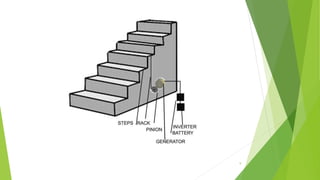
Basic Design
 Step mounted on spring based suspensor.
 Suspensor connected to vertical rack.
 Rack connected to pinion ,whose axis is connected to a generator.
 Generator is linked to a rechargeable battery.
 Battery is connected to a inverter.
8
9
Working
 User walks through the step.
 Footstep activates the rack and pinion .
 Generator connected to the axis of the pinion is activated.
 An EMF is generated according to Faraday’s law.
 Electric power generated is stored in the rechargeable battery.
 Inverter module gives AC output .
10
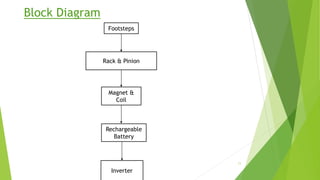
Footsteps
Rack & Pinion
Magnet &
Coil
Rechargeable
Battery
Inverter
Block Diagram
11
Selection of Components
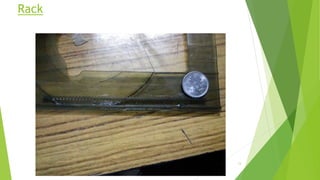
 Rack and Pinion
 Rack and Pinion made of plastic
 Rack has a length of 13 CM and has 65 teeth
 Pinion has a diameter of 1.7 CM and has 15 teeth
 Rack and Pinion sourced from a DVD drive
 Selection helped save cost and weight
12
Rack
13
Pinion
14
Selection of Components
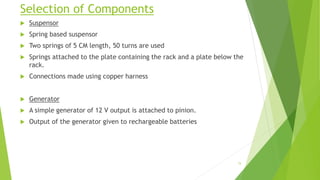
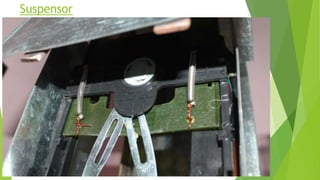
 Suspensor
 Spring based suspensor
 Two springs of 5 CM length, 50 turns are used
 Springs attached to the plate containing the rack and a plate below the
rack.
 Connections made using copper harness
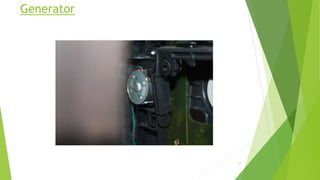
 Generator
 A simple generator of 12 V output is attached to pinion.
 Output of the generator given to rechargeable batteries
15
Suspensor
16
Generator
17
Rechargeable Battery
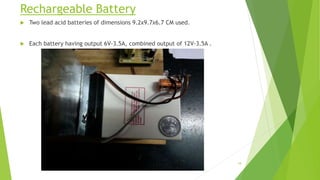
 Two lead acid batteries of dimensions 9.2x9.7x6.7 CM used.
 Each battery having output 6V-3.5A, combined output of 12V-3.5A .
18
Inverter
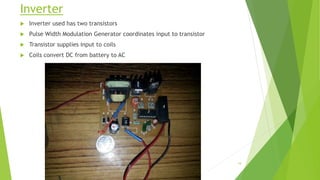
 Inverter used has two transistors
 Pulse Width Modulation Generator coordinates input to transistor
 Transistor supplies input to coils
 Coils convert DC from battery to AC
19
Design
20
Design Requirements
 System must demonstrate power harvesting
 System should withstand weight
 System must be portable
 System must have real time indication of power harvesting
 System should demonstrate practical applications
21
Steps in Designing
 Design of support base
 Design of Footstep
 Design of Supports
 Design of demonstration circuit
22
Design of Support Base
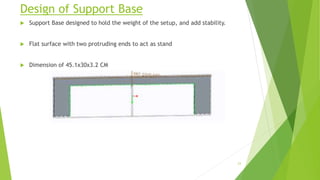
 Support Base designed to hold the weight of the setup, and add stability.
 Flat surface with two protruding ends to act as stand
 Dimension of 45.1x30x3.2 CM
23
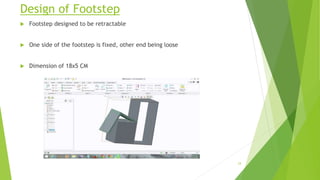
Design of Footstep
 Footstep designed to be retractable
 One side of the footstep is fixed, other end being loose
 Dimension of 18x5 CM
24
Design of Supports
 Supports are designed in the shape of U
 Two supports will be used to hold the steps
 Dimensions 34.5x2 CM
25
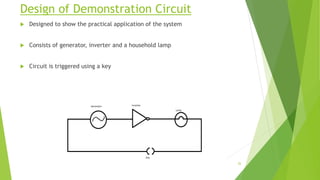
Design of Demonstration Circuit
 Designed to show the practical application of the system
 Consists of generator, inverter and a household lamp
 Circuit is triggered using a key
26
Fabrication
27
Steps in Fabrication
 Fabrication of support base
 Fabrication of footsteps
 Fabrication of supports
28
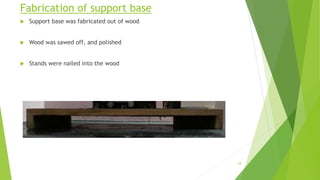
Fabrication of support base
 Support base was fabricated out of wood
 Wood was sawed off, and polished
 Stands were nailed into the wood
29
Fabrication of Footsteps
 Footsteps are fabricated using sheet metal
 Sheet metal is cut and bend into the shape of steps
 This sheet metal was screwed into metal supports
30
Fabrication of Supports
 Supports are made from cast iron
 Cast iron was cut using hack saw and later welded together
 The cast iron was bend to form curves
31
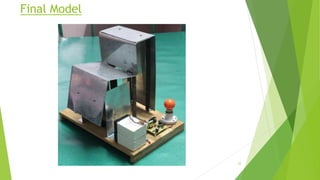
Final Model
32
Testing
33
Objective of Testing
 To assess the performance of the system based on the response.
 Test Models Used:
 Testing with different weights
 Testing with different rate of weight application
34
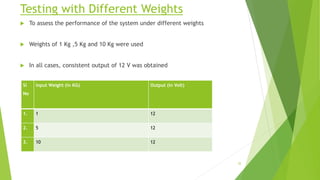
Testing with Different Weights
 To assess the performance of the system under different weights
 Weights of 1 Kg ,5 Kg and 10 Kg were used
 In all cases, consistent output of 12 V was obtained
Sl
No
Input Weight (in KG) Output (in Volt)
1. 1 12
2. 5 12
3. 10 12
35
Testing with Different Rates of Weights
 Intended to test the performance under different rates of weight
 Tests were carried out at the rates 1, 5 and 10 steps per minute
 In all cases, an output of 12 V was obtained
Sl No Rate of Footsteps (No.of times per minute) Output (In Volt)
1. 1 12
2. 5 12
3. 10 12
36
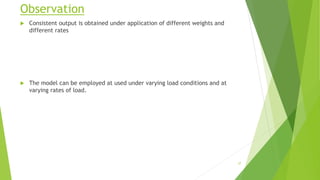
Observation
 Consistent output is obtained under application of different weights and
different rates
 The model can be employed at used under varying load conditions and at
varying rates of load.
37
Applications
 Energy Generating Staircase
 Self Illuminating Pathways
 Burglar Alarms
38
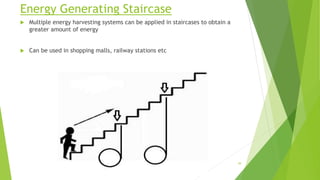
Energy Generating Staircase
 Multiple energy harvesting systems can be applied in staircases to obtain a
greater amount of energy
 Can be used in shopping malls, railway stations etc
39
Self-Illuminating Pathways
 Pathways that light up when user steps on it
 Suitable for application in homes
40
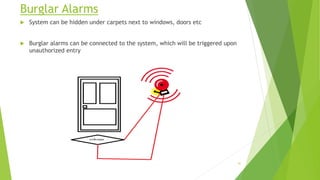
Burglar Alarms
 System can be hidden under carpets next to windows, doors etc
 Burglar alarms can be connected to the system, which will be triggered upon
unauthorized entry
41
Scope of The Project
 Fabrication of more rigid system
 Fabrication of supports with lighter and stronger materials
 Multiple systems can be installed under staircases to harvest more power
 Real time testing can be carried out instead of using weights
42
Conclusion
 The rack and pinion based power harvesting system is found to be effective
 The system is cost effective and light in weight
 The system has a variety of applications
 The system harvest enough power for practical applications, without
significant input
 The system has large future scope
43
Thank You
44

Energy harvesting through footsteps

  • 1.
    Energy Harvesting ThroughFootsteps Project Guide: Prof.T.Judson Durai Team Members:Saran S.D, Sankar R.S, Sharon.M,Sherin Johnson Department of Mechanical Engineering Noorul Islam University 1
  • 2.
    Energy Harvesting ThroughFootsteps “A rack and pinion based device to convert the footsteps of the user into useful energy” 2
  • 3.
    Project Objectives  Toform an effective energy harvesting concept  To form a practically applicable system to demonstrate the energy harvesting concept  To design and fabricate the system  To test the system under various models  To find applications for the system  To explore further scope 3
  • 4.
    The Need Fast depletingnatural resources  Coal is projected to enter production decline by 2030  Over dependence on coal based and other conventional methods for power generation  87.55% of India’s power production is based on non-renewable resources  60% of India’s total power production is coal based Lack of adequate power supply  Despite being the third largest power producing nation,300 million Indians lack access to electricity 4
  • 5.
    Energy Harvesting  Theprocess by which energy is derived from external sources, captured, and stored.  The input is not deliberately created for the purpose of power generation.  Taps energy that otherwise would’ve gone wasted.  Usually produces low outputs, suitable for small applications 5
  • 6.
    Energy Harvesting ThroughFootsteps-Working Principle • Faraday’s Law: “As long as there is a change in magnetic flux linked with the coil, an EMF is induced” 6
  • 7.
    Components  Spring basedsuspensor  Rack and Pinion  DC Generator (Magnet & Coil)  Rechargeable Battery  Inverter 7
  • 8.
    Basic Design  Stepmounted on spring based suspensor.  Suspensor connected to vertical rack.  Rack connected to pinion ,whose axis is connected to a generator.  Generator is linked to a rechargeable battery.  Battery is connected to a inverter. 8
  • 9.
  • 10.
    Working  User walksthrough the step.  Footstep activates the rack and pinion .  Generator connected to the axis of the pinion is activated.  An EMF is generated according to Faraday’s law.  Electric power generated is stored in the rechargeable battery.  Inverter module gives AC output . 10
  • 11.
    Footsteps Rack & Pinion Magnet& Coil Rechargeable Battery Inverter Block Diagram 11
  • 12.
    Selection of Components Rack and Pinion  Rack and Pinion made of plastic  Rack has a length of 13 CM and has 65 teeth  Pinion has a diameter of 1.7 CM and has 15 teeth  Rack and Pinion sourced from a DVD drive  Selection helped save cost and weight 12
  • 13.
  • 14.
  • 15.
    Selection of Components Suspensor  Spring based suspensor  Two springs of 5 CM length, 50 turns are used  Springs attached to the plate containing the rack and a plate below the rack.  Connections made using copper harness  Generator  A simple generator of 12 V output is attached to pinion.  Output of the generator given to rechargeable batteries 15
  • 16.
  • 17.
  • 18.
    Rechargeable Battery  Twolead acid batteries of dimensions 9.2x9.7x6.7 CM used.  Each battery having output 6V-3.5A, combined output of 12V-3.5A . 18
  • 19.
    Inverter  Inverter usedhas two transistors  Pulse Width Modulation Generator coordinates input to transistor  Transistor supplies input to coils  Coils convert DC from battery to AC 19
  • 20.
  • 21.
    Design Requirements  Systemmust demonstrate power harvesting  System should withstand weight  System must be portable  System must have real time indication of power harvesting  System should demonstrate practical applications 21
  • 22.
    Steps in Designing Design of support base  Design of Footstep  Design of Supports  Design of demonstration circuit 22
  • 23.
    Design of SupportBase  Support Base designed to hold the weight of the setup, and add stability.  Flat surface with two protruding ends to act as stand  Dimension of 45.1x30x3.2 CM 23
  • 24.
    Design of Footstep Footstep designed to be retractable  One side of the footstep is fixed, other end being loose  Dimension of 18x5 CM 24
  • 25.
    Design of Supports Supports are designed in the shape of U  Two supports will be used to hold the steps  Dimensions 34.5x2 CM 25
  • 26.
    Design of DemonstrationCircuit  Designed to show the practical application of the system  Consists of generator, inverter and a household lamp  Circuit is triggered using a key 26
  • 27.
  • 28.
    Steps in Fabrication Fabrication of support base  Fabrication of footsteps  Fabrication of supports 28
  • 29.
    Fabrication of supportbase  Support base was fabricated out of wood  Wood was sawed off, and polished  Stands were nailed into the wood 29
  • 30.
    Fabrication of Footsteps Footsteps are fabricated using sheet metal  Sheet metal is cut and bend into the shape of steps  This sheet metal was screwed into metal supports 30
  • 31.
    Fabrication of Supports Supports are made from cast iron  Cast iron was cut using hack saw and later welded together  The cast iron was bend to form curves 31
  • 32.
  • 33.
  • 34.
    Objective of Testing To assess the performance of the system based on the response.  Test Models Used:  Testing with different weights  Testing with different rate of weight application 34
  • 35.
    Testing with DifferentWeights  To assess the performance of the system under different weights  Weights of 1 Kg ,5 Kg and 10 Kg were used  In all cases, consistent output of 12 V was obtained Sl No Input Weight (in KG) Output (in Volt) 1. 1 12 2. 5 12 3. 10 12 35
  • 36.
    Testing with DifferentRates of Weights  Intended to test the performance under different rates of weight  Tests were carried out at the rates 1, 5 and 10 steps per minute  In all cases, an output of 12 V was obtained Sl No Rate of Footsteps (No.of times per minute) Output (In Volt) 1. 1 12 2. 5 12 3. 10 12 36
  • 37.
    Observation  Consistent outputis obtained under application of different weights and different rates  The model can be employed at used under varying load conditions and at varying rates of load. 37
  • 38.
    Applications  Energy GeneratingStaircase  Self Illuminating Pathways  Burglar Alarms 38
  • 39.
    Energy Generating Staircase Multiple energy harvesting systems can be applied in staircases to obtain a greater amount of energy  Can be used in shopping malls, railway stations etc 39
  • 40.
    Self-Illuminating Pathways  Pathwaysthat light up when user steps on it  Suitable for application in homes 40
  • 41.
    Burglar Alarms  Systemcan be hidden under carpets next to windows, doors etc  Burglar alarms can be connected to the system, which will be triggered upon unauthorized entry 41
  • 42.
    Scope of TheProject  Fabrication of more rigid system  Fabrication of supports with lighter and stronger materials  Multiple systems can be installed under staircases to harvest more power  Real time testing can be carried out instead of using weights 42
  • 43.
    Conclusion  The rackand pinion based power harvesting system is found to be effective  The system is cost effective and light in weight  The system has a variety of applications  The system harvest enough power for practical applications, without significant input  The system has large future scope 43
  • 44.

Editor's Notes