OPTOFLUIDIC DEVICES
By,
Prathul Nath P P
15PH62R06
M.Tech in SST
Dept of Physics
IIT Kharagpur
Contents
 Introduction to Optofluidics.
 What makes it special?
 Physics of Optofluidics.
 Device fabrication.
 Applications.
 Conclusion.
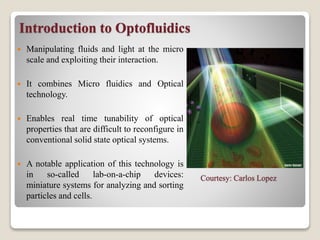
Introduction to Optofluidics
 Manipulating fluids and light at the micro
scale and exploiting their interaction.
 It combines Micro fluidics and Optical
technology.
 Enables real time tunability of optical
properties that are difficult to reconfigure in
conventional solid state optical systems.
 A notable application of this technology is
in so-called lab-on-a-chip devices:
miniature systems for analyzing and sorting
particles and cells.
Courtesy: Carlos Lopez
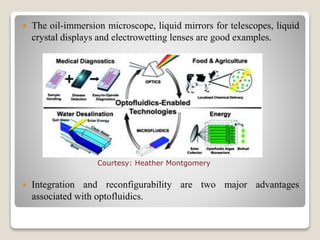
 The oil-immersion microscope, liquid mirrors for telescopes, liquid
crystal displays and electrowetting lenses are good examples.
Courtesy: Heather Montgomery
 Integration and reconfigurability are two major advantages
associated with optofluidics.
What makes it so special ?
 Fluids have unique properties that cannot be found in solid
equivalents, and these properties can be used to design devices.
 Ability to change the optical property of the fluid medium within a
device by simply replacing one fluid with another.
 Optically smooth interface between two immiscible fluids and the
ability of flowing streams of miscible fluids to create gradients in
optical properties by diffusion.
 Chip optical manipulation of Nano /micro-sized objects in micro
fluidic channels, thereby providing a non-intrusive method to
optically manipulate micro particles in a small fluidic sample
volume.
 These devices use active species dissolved in a liquid solution as the
gain medium.
 Integration offers significant advantages to these systems including
minimized consumption of reagents, portability, increased
automation and reduced costs.
 The integration of monolithic or hybrid optical and optoelectronic
devices (light sources, filters or photo detectors) into the lab-on-a-
chip is being investigated at present to improve the performance
and portability of these systems.
Physics of Optofluids
 Laminar flow : For flows confined on the such scale, viscous forces
in the fluid dominate over inertial forces and the flow has damping
nonlinearity thereby never turbulent and always laminar.
 Diffusion driven mixing occurs as a consequence of laminar flow, a
lack of turbulent flow means that all mixing is driven by diffusion
of the species.
 Capillarity phenomena :The surface tension (strongest forces at this
scale) at the phase boundary of a fluid dominates over the viscous
forces inside the fluid. It can be used to introduce a fluid into a void
but similarly renders the same fluid difficult to remove.
Device Fabrication
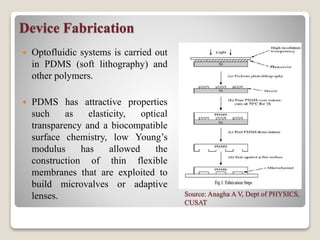
 Optofluidic systems is carried out
in PDMS (soft lithography) and
other polymers.
 PDMS has attractive properties
such as elasticity, optical
transparency and a biocompatible
surface chemistry, low Young’s
modulus has allowed the
construction of thin flexible
membranes that are exploited to
build microvalves or adaptive
lenses. Source: Anagha A V, Dept of PHYSICS,
CUSAT
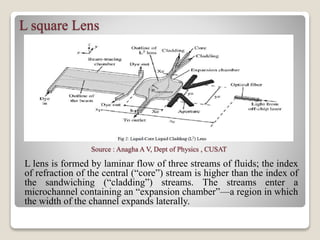
L square Lens
Source : Anagha A V, Dept of Physics , CUSAT
L lens is formed by laminar flow of three streams of fluids; the index
of refraction of the central (“core”) stream is higher than the index of
the sandwiching (“cladding”) streams. The streams enter a
microchannel containing an “expansion chamber”—a region in which
the width of the channel expands laterally.
 Various microfluidic components, such as micromechanical valves,
microchannels, micropumps, microfluidic mixers and other
elements to handle and control fluids at the microscale have been
realized.
 The reported optofluidic lasers emit light in the visible range. By
exploiting other kinds of dissolved active medium, such as quantum
dots or colloidal nanocrystals, near-infrared emission could be
achieved with equally good performance.
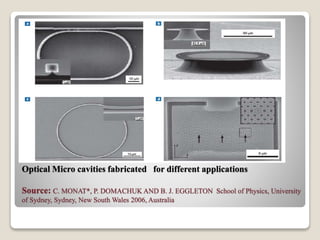
Optical Micro cavities fabricated for different applications
Source: C. MONAT*, P. DOMACHUK AND B. J. EGGLETON School of Physics, University
of Sydney, Sydney, New South Wales 2006, Australia
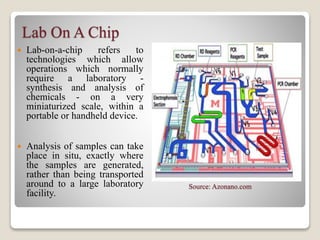
Lab On A Chip
 Lab-on-a-chip refers to
technologies which allow
operations which normally
require a laboratory -
synthesis and analysis of
chemicals - on a very
miniaturized scale, within a
portable or handheld device.
 Analysis of samples can take
place in situ, exactly where
the samples are generated,
rather than being transported
around to a large laboratory
facility.
Source: Azonano.com
Applications
 Displays.
 Biosensors and Imaging.
 Lab On a Chip.
 Energy.
 Dye Laser.
Conclusion
 Optofluidics is a rapidly growing field. The permutations of optics
and micro fluidic combinations are numerous and exciting to
explore It is full of promise, but few devices have been successfully
commercialized as of yet.
 Optofluidic devices are good complements to micro-
electromechanical systems (MEMS) reconfigure themselves
through fluidic controls. Such controls can dramatically simplify
fluid manipulation by completely removing the need for on-chip.
Acknowledgement
I would like to thank the Head of the department and
Professor A.Dhar for giving me this opportunity. I
would also like to thank my seniors and fellow
classmates for all the support they have given.
References
 Integrated Optofluidics: A new river of light, C. MONAT*, P.
DOMACHUK AND B. J. EGGLETON Centre for Ultrahigh
Bandwidth Devices for Optical Systems (CUDOS), School of
Physics, University of Sydney, Sydney, New South Wales 2006,
Australia.
 Optofluidics: An Emerging Technology for Reconfigurable
Architectures, Anagha A1, Anjitha V2, Gnana Sheela K3,
Department of Electronics and Communication Engineering, TIST,
CUSAT, Kerala,India.
 Wikipedia.org
 http://www.azonano.com/
 http://ieeexplore.ieee.org/
THANK YOU

Optofluidic Devices

  • 1.
    OPTOFLUIDIC DEVICES By, Prathul NathP P 15PH62R06 M.Tech in SST Dept of Physics IIT Kharagpur
  • 2.
    Contents  Introduction toOptofluidics.  What makes it special?  Physics of Optofluidics.  Device fabrication.  Applications.  Conclusion.
  • 3.
    Introduction to Optofluidics Manipulating fluids and light at the micro scale and exploiting their interaction.  It combines Micro fluidics and Optical technology.  Enables real time tunability of optical properties that are difficult to reconfigure in conventional solid state optical systems.  A notable application of this technology is in so-called lab-on-a-chip devices: miniature systems for analyzing and sorting particles and cells. Courtesy: Carlos Lopez
  • 4.
     The oil-immersionmicroscope, liquid mirrors for telescopes, liquid crystal displays and electrowetting lenses are good examples. Courtesy: Heather Montgomery  Integration and reconfigurability are two major advantages associated with optofluidics.
  • 5.
    What makes itso special ?  Fluids have unique properties that cannot be found in solid equivalents, and these properties can be used to design devices.  Ability to change the optical property of the fluid medium within a device by simply replacing one fluid with another.  Optically smooth interface between two immiscible fluids and the ability of flowing streams of miscible fluids to create gradients in optical properties by diffusion.  Chip optical manipulation of Nano /micro-sized objects in micro fluidic channels, thereby providing a non-intrusive method to optically manipulate micro particles in a small fluidic sample volume.
  • 6.
     These devicesuse active species dissolved in a liquid solution as the gain medium.  Integration offers significant advantages to these systems including minimized consumption of reagents, portability, increased automation and reduced costs.  The integration of monolithic or hybrid optical and optoelectronic devices (light sources, filters or photo detectors) into the lab-on-a- chip is being investigated at present to improve the performance and portability of these systems.
  • 7.
    Physics of Optofluids Laminar flow : For flows confined on the such scale, viscous forces in the fluid dominate over inertial forces and the flow has damping nonlinearity thereby never turbulent and always laminar.  Diffusion driven mixing occurs as a consequence of laminar flow, a lack of turbulent flow means that all mixing is driven by diffusion of the species.  Capillarity phenomena :The surface tension (strongest forces at this scale) at the phase boundary of a fluid dominates over the viscous forces inside the fluid. It can be used to introduce a fluid into a void but similarly renders the same fluid difficult to remove.
  • 8.
    Device Fabrication  Optofluidicsystems is carried out in PDMS (soft lithography) and other polymers.  PDMS has attractive properties such as elasticity, optical transparency and a biocompatible surface chemistry, low Young’s modulus has allowed the construction of thin flexible membranes that are exploited to build microvalves or adaptive lenses. Source: Anagha A V, Dept of PHYSICS, CUSAT
  • 9.
    L square Lens Source: Anagha A V, Dept of Physics , CUSAT L lens is formed by laminar flow of three streams of fluids; the index of refraction of the central (“core”) stream is higher than the index of the sandwiching (“cladding”) streams. The streams enter a microchannel containing an “expansion chamber”—a region in which the width of the channel expands laterally.
  • 10.
     Various microfluidiccomponents, such as micromechanical valves, microchannels, micropumps, microfluidic mixers and other elements to handle and control fluids at the microscale have been realized.  The reported optofluidic lasers emit light in the visible range. By exploiting other kinds of dissolved active medium, such as quantum dots or colloidal nanocrystals, near-infrared emission could be achieved with equally good performance.
  • 11.
    Optical Micro cavitiesfabricated for different applications Source: C. MONAT*, P. DOMACHUK AND B. J. EGGLETON School of Physics, University of Sydney, Sydney, New South Wales 2006, Australia
  • 12.
    Lab On AChip  Lab-on-a-chip refers to technologies which allow operations which normally require a laboratory - synthesis and analysis of chemicals - on a very miniaturized scale, within a portable or handheld device.  Analysis of samples can take place in situ, exactly where the samples are generated, rather than being transported around to a large laboratory facility. Source: Azonano.com
  • 13.
    Applications  Displays.  Biosensorsand Imaging.  Lab On a Chip.  Energy.  Dye Laser.
  • 14.
    Conclusion  Optofluidics isa rapidly growing field. The permutations of optics and micro fluidic combinations are numerous and exciting to explore It is full of promise, but few devices have been successfully commercialized as of yet.  Optofluidic devices are good complements to micro- electromechanical systems (MEMS) reconfigure themselves through fluidic controls. Such controls can dramatically simplify fluid manipulation by completely removing the need for on-chip.
  • 15.
    Acknowledgement I would liketo thank the Head of the department and Professor A.Dhar for giving me this opportunity. I would also like to thank my seniors and fellow classmates for all the support they have given.
  • 16.
    References  Integrated Optofluidics:A new river of light, C. MONAT*, P. DOMACHUK AND B. J. EGGLETON Centre for Ultrahigh Bandwidth Devices for Optical Systems (CUDOS), School of Physics, University of Sydney, Sydney, New South Wales 2006, Australia.  Optofluidics: An Emerging Technology for Reconfigurable Architectures, Anagha A1, Anjitha V2, Gnana Sheela K3, Department of Electronics and Communication Engineering, TIST, CUSAT, Kerala,India.  Wikipedia.org  http://www.azonano.com/  http://ieeexplore.ieee.org/
  • 17.