In today's fast-pacedworld, harnessing power is like oxygen for getting things done! Our daily
lives are buzzing with gadgets galore, and guess what? Roadway energy harvesting systems
could be a game changer. Energy harvesting is all about snagging tiny bits of energy from the
world around us!Most of us spend a hefty chunk of our lives on our feet. Every time our feet hit
the ground, we’re unleashing forces that can be transformed into a renewable energy source
called kinetic energy. And hold onto your sneakers—a footstep power generator can turn that
energy into electricity! There’s a whole smorgasbord of these gadgets out there, and most rely
on piezoelectric transducers to do the heavy lifting. But here’s the kicker: picking the right
ferroelectric material is crucial for cranking up that energy conversion efficiency!Enter the
mechanical footstep power generator! This clever alternative uses nifty mechanisms to convert
your steps into electricity without the piezoelectric fuss. With perks like easy assembly, lower
costs, and less energy loss, it’s a fresh take on powering up with every step!Get ready to step
into the future with a variety of mechanical footstep power generators out there! In this study,
we’re keeping it simple by crafting a footstep power generator that leans on the trusty rack and
pinion to streamline the mechanical madness. we’re all about that power boost by getting
everyone to stomp with their back foot this brilliant invention. Oh, and we added a splash of
LEDs to showcase just how much power is being generated—because who doesn’t love a
colorful light show?.Turning the kinetic energy from our foot stomps into electric energy is a
super cool renewable energy hack! This research confirms that with a nifty rack and pinion, we
can totally generate electricity. Plus, we’re strategically placing the power generator right in the
hind foot zone to crank up the output and efficiency. Pavegen tiles convert footsteps into
electricity, promoting renewable energy, Key Points:·Testing: Schools and cities like New Delhi
are trialing Pavegen for sustainability.·Challenges: High costs and maintenance hinder broader
implementation.Key Applications:1. some streets in Africa mainly generate electricity from
these tiles2. Lighting in Africa Enhances safety in urban areas3. Dubai Track: A 92-kilometer
pathway harnessing foot traffic energy for streetlights.Benefits:·Develops a new renewable form
of electricity·Active Lifestyles: Encourages walking and biking while generating energy.Overall,
Pavegen tiles are advancing infrastructure and enhancing life quality through renewable energy.
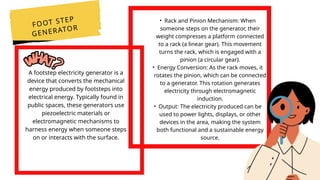
A footstep electricitygenerator is a
device that converts the mechanical
energy produced by footsteps into
electrical energy. Typically found in
public spaces, these generators use
piezoelectric materials or
electromagnetic mechanisms to
harness energy when someone steps
on or interacts with the surface.
FOOT STEP
GENERATOR
• Rack and Pinion Mechanism: When
someone steps on the generator, their
weight compresses a platform connected
to a rack (a linear gear). This movement
turns the rack, which is engaged with a
pinion (a circular gear).
• Energy Conversion: As the rack moves, it
rotates the pinion, which can be connected
to a generator. This rotation generates
electricity through electromagnetic
induction.
• Output: The electricity produced can be
used to power lights, displays, or other
devices in the area, making the system
both functional and a sustainable energy
source.
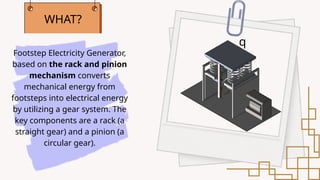
Footstep Electricity Generator,
basedon the rack and pinion
mechanism converts
mechanical energy from
footsteps into electrical energy
by utilizing a gear system. The
key components are a rack (a
straight gear) and a pinion (a
circular gear).
WHAT?
q
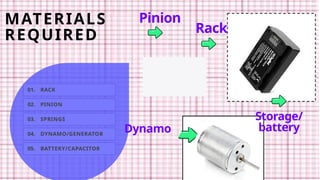
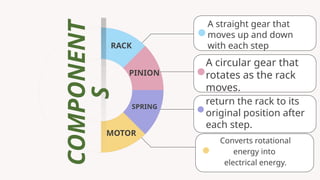
RACK
PINION
SPRING
MOTOR
A straight gearthat
moves up and down
with each step
A circular gear that
rotates as the rack
moves.
return the rack to its
original position after
each step.
MVP development
Converts rotational
energy into
electrical energy.
COMPONENT
S
9.
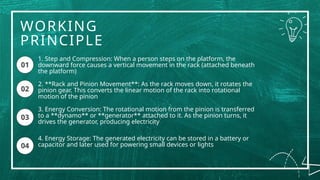
WORKING
PRINCIPLE
01
1. Step andCompression: When a person steps on the platform, the
downward force causes a vertical movement in the rack (attached beneath
the platform)
2. **Rack and Pinion Movement**: As the rack moves down, it rotates the
pinion gear. This converts the linear motion of the rack into rotational
motion of the pinion
3. Energy Conversion: The rotational motion from the pinion is transferred
to a **dynamo** or **generator** attached to it. As the pinion turns, it
drives the generator, producing electricity
4. Energy Storage: The generated electricity can be stored in a battery or
capacitor and later used for powering small devices or lights
01
04
02
03
10.
• **Renewable Energy**:Utilizes
human footsteps to generate
clean, sustainable electricity.
Advantage
s
disadvantag
es
• **Eco-Friendly**: Helps reduce
carbon emissions by decreasing
reliance on fossil fuels.
• **Ideal for High-Traffic Areas**:
Perfect for locations with heavy
foot traffic, such as train
stations, malls, and airports.
• **Durable Mechanism**: The
rack and pinion system is
mechanically simple and reliable,
offering long-term use
• **Limited Power Output**:
Generates only small amounts of
electricity per step, requiring large-
scale implementation.
• **High Installation Costs**: Initial
setup can be expensive and
technically complex.
• **Maintenance**: Regular upkeep
is necessary to ensure the system
operates efficiently over time.








![Footstep_Power_Generation_System[1]-Batch9.pptx](https://cdn.slidesharecdn.com/ss_thumbnails/footsteppowergenerationsystem1-batch9-250417023633-fc5887ee-thumbnail.jpg?width=640&height=640&fit=bounds)


![FOOT STEP BY POWER GENERATION PPT[1].pptxnew.pptx](https://cdn.slidesharecdn.com/ss_thumbnails/footstepbypowergenerationppt1-250919021928-9d77c296-thumbnail.jpg?width=640&height=640&fit=bounds)


