KEY ENERGY EFFICIENCY
INITIATIVES , INCENTIVES AND THE
WAY FORWARD FOR MALAYSIA
Zaini Abdul Wahab
ENERGY EFFICIENCY INFORMATION
SHARING SERIES
Content
 Overview of Energy Resources and Trends
 Current Related Policies
 Energy Efficiency Potentials
 Key Government Lead Initiatives
 Fiscal And Financial Incentives
 Current Development and the way forward
 Proposed Strategic Plan & Implementation
Overview of Energy Resources and
Comparison of Trends
4
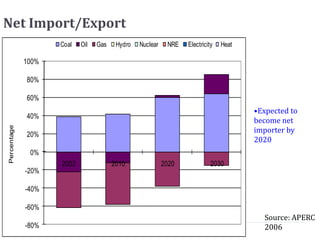
Net Import/Export
-80%
-60%
-40%
-20%
0%
20%
40%
60%
80%
100%
2002 2010 2020 2030
Percentage
Coal Oil Gas Hydro Nuclear NRE Electricity Heat
•Expected to
become net
importer by
2020
Source: APERC
2006
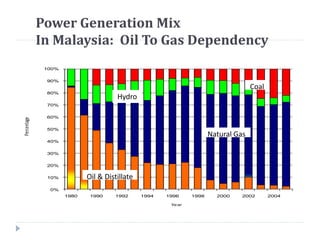
Power Generation Mix
In Malaysia: Oil To Gas Dependency
0%
10%
20%
30%
40%
50%
60%
70%
80%
90%
100%
1980 1990 1992 1994 1996 1998 2000 2002 2004
Percentage
Year
Hydro
Coal
Oil & Distillate
Natural Gas
0
50
100
150
200
250
300
350
400
450
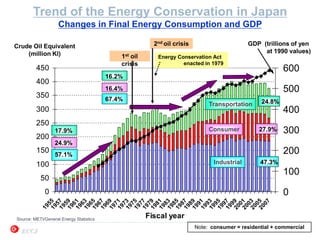
195519571959196119631965196719691971197319751977197919811983198519871989199119931995199719992001200320052007
Fiscal year
0
100
200
300
400
500
600
Energy Conservation Act
enacted in 1979
Industrial
Transportation
Consumer
24.9%
24.8%
27.9%
47.3%
GDP (trillions of yen
at 1990 values)
Crude Oil Equivalent
(million Kl)
Source: METI/General Energy Statistics
16.2%
16.4%
67.4%
17.9%
57.1%
Trend of the Energy Conservation in Japan
Changes in Final Energy Consumption and GDP
ECCJ
Note: consumer = residential + commercial
1st oil
crisis
2nd oil crisis
7
0
50
100
150
200
250
1973
1975
1977
1979
1981
1983
1985
1987
1989
1991
1993
1995
1997
1999
2001
2003
2005
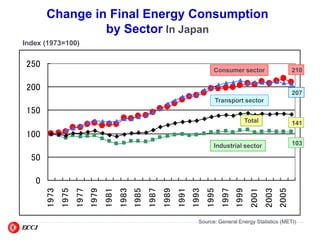
Consumer sector
Transport sector
Total
Industrial sector
207
210
141
103
Change in Final Energy Consumption
by Sector In Japan
Index (1973=100)
Source: General Energy Statistics (METI)
ECCJ
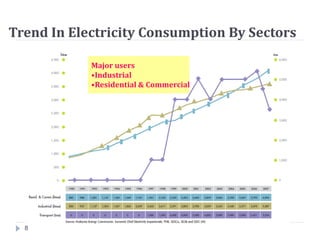
Trend In Electricity Consumption By Sectors
8
Major users
•Industrial
•Residential & Commercial
Current Related Policies
10
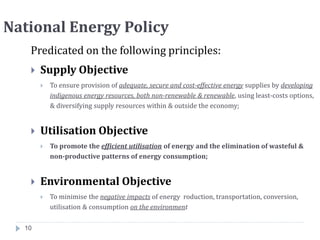
National Energy Policy
Predicated on the following principles:
 Supply Objective
 To ensure provision of adequate, secure and cost-effective energy supplies by developing
indigenous energy resources, both non-renewable & renewable, using least-costs options,
& diversifying supply resources within & outside the economy;
 Utilisation Objective
 To promote the efficient utilisation of energy and the elimination of wasteful &
non-productive patterns of energy consumption;
 Environmental Objective
 To minimise the negative impacts of energy roduction, transportation, conversion,
utilisation & consumption on the environment
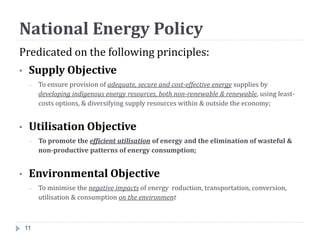
National Energy Policy
11
Predicated on the following principles:
• Supply Objective
– To ensure provision of adequate, secure and cost-effective energy supplies by
developing indigenous energy resources, both non-renewable & renewable, using least-
costs options, & diversifying supply resources within & outside the economy;
• Utilisation Objective
– To promote the efficient utilisation of energy and the elimination of wasteful &
non-productive patterns of energy consumption;
• Environmental Objective
– To minimise the negative impacts of energy roduction, transportation, conversion,
utilisation & consumption on the environment
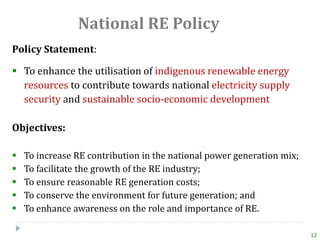
National RE Policy
Policy Statement:
 To enhance the utilisation of indigenous renewable energy
resources to contribute towards national electricity supply
security and sustainable socio-economic development
Objectives:
 To increase RE contribution in the national power generation mix;
 To facilitate the growth of the RE industry;
 To ensure reasonable RE generation costs;
 To conserve the environment for future generation; and
 To enhance awareness on the role and importance of RE.
12
Energy Efficiency Potentials
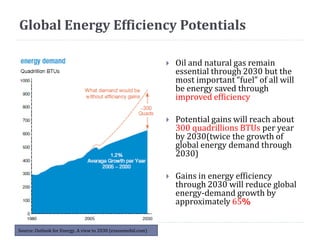
Global Energy Efficiency Potentials
 Oil and natural gas remain
essential through 2030 but the
most important “fuel” of all will
be energy saved through
improved efficiency
 Potential gains will reach about
300 quadrillions BTUs per year
by 2030(twice the growth of
global energy demand through
2030)
 Gains in energy efficiency
through 2030 will reduce global
energy-demand growth by
approximately 65%
Source: Outlook for Energy. A view to 2030 (exxonmobil.com)
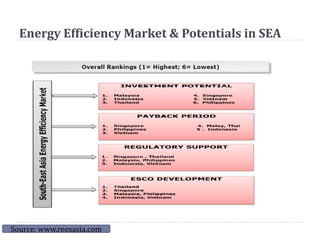
Energy Efficiency Market & Potentials in SEA
Source: www.reexasia.com
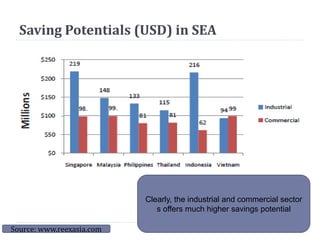
Saving Potentials (USD) in SEA
Clearly, the industrial and commercial sector
s offers much higher savings potential
Source: www.reexasia.com
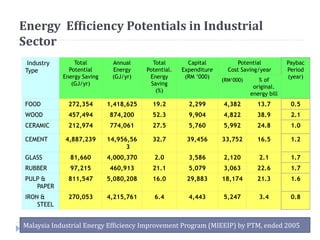
Energy Efficiency Potentials in Industrial
Sector
Industry
Type
Total
Potential
Energy Saving
(GJ/yr)
Annual
Energy
(GJ/yr)
Total
Potential.
Energy
Saving
(%)
Capital
Expenditure
(RM ‘000)
Potential
Cost Saving/year
Paybac
Period
(year)
(RM‘000) % of
original.
energy bill
FOOD 272,354 1,418,625 19.2 2,299 4,382 13.7 0.5
WOOD 457,494 874,200 52.3 9,904 4,822 38.9 2.1
CERAMIC 212,974 774,061 27.5 5,760 5,992 24.8 1.0
CEMENT 4,887,239 14,956,56
3
32.7 39,456 33,752 16.5 1.2
GLASS 81,660 4,000,370 2.0 3,586 2,120 2.1 1.7
RUBBER 97,215 460,913 21.1 5,079 3,063 22.6 1.7
PULP &
PAPER
811,547 5,080,208 16.0 29,883 18,174 21.3 1.6
IRON &
STEEL
270,053 4,215,761 6.4 4,443 5,247 3.4 0.8
17Malaysia Industrial Energy Efficiency Improvement Program (MIEEIP) by PTM, ended 2005
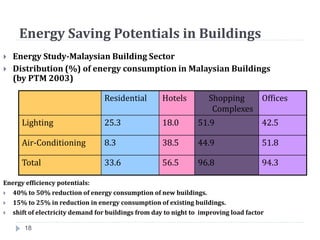
Energy Saving Potentials in Buildings
Residential Hotels Shopping
Complexes
Offices
Lighting 25.3 18.0 51.9 42.5
Air-Conditioning 8.3 38.5 44.9 51.8
Total 33.6 56.5 96.8 94.3
18
 Energy Study-Malaysian Building Sector
 Distribution (%) of energy consumption in Malaysian Buildings
(by PTM 2003)
Energy efficiency potentials:
 40% to 50% reduction of energy consumption of new buildings.
 15% to 25% in reduction in energy consumption of existing buildings.
 shift of electricity demand for buildings from day to night to improving load factor
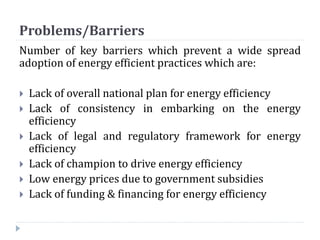
Problems/Barriers
Number of key barriers which prevent a wide spread
adoption of energy efficient practices which are:
 Lack of overall national plan for energy efficiency
 Lack of consistency in embarking on the energy
efficiency
 Lack of legal and regulatory framework for energy
efficiency
 Lack of champion to drive energy efficiency
 Low energy prices due to government subsidies
 Lack of funding & financing for energy efficiency
Key Government Lead Initiatives
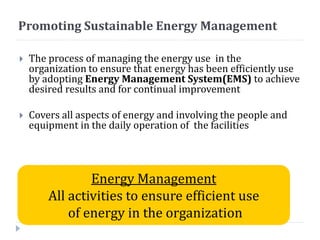
Promoting Sustainable Energy Management
 The process of managing the energy use in the
organization to ensure that energy has been efficiently use
by adopting Energy Management System(EMS) to achieve
desired results and for continual improvement
 Covers all aspects of energy and involving the people and
equipment in the daily operation of the facilities
Energy Management
All activities to ensure efficient use
of energy in the organization
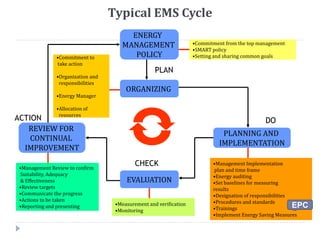
Typical EMS Cycle
ENERGY
MANAGEMENT
POLICY
ORGANIZING
PLANNING AND
IMPLEMENTATION
EVALUATION
REVIEW FOR
CONTINUAL
IMPROVEMENT
PLAN
DO
CHECK
ACTION
•Commitment from the top management
•SMART policy
•Setting and sharing common goals•Commitment to
take action
•Organization and
responsibilities
•Energy Manager
•Allocation of
resources
•Management Implementation
plan and time frame
•Energy auditing
•Set baselines for measuring
results
•Designation of responsibilities
•Procedures and standards
•Trainings
•Implement Energy Saving Measures
•Measurement and verification
•Monitoring
•Management Review to confirm
Suitability, Adequacy
& Effectiveness
•Review targets
•Communicate the progress
•Actions to be taken
•Reporting and presenting EPC
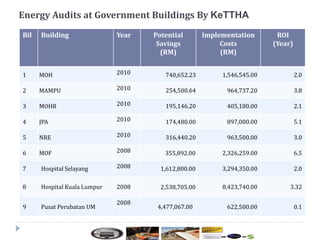
Energy Audits at Government Buildings By KeTTHA
Bil Building Year Potential
Savings
(RM)
Implementation
Costs
(RM)
ROI
(Year)
1 MOH 2010 740,652.23 1,546,545.00 2.0
2 MAMPU 2010 254,500.64 964,737.20 3.8
3 MOHR 2010 195,146.20 405,180.00 2.1
4 JPA 2010 174,480.00 897,000.00 5.1
5 NRE 2010 316,440.20 963,500.00 3.0
6 MOF 2008 355,892.00 2,326,259.00 6.5
7 Hospital Selayang 2008 1,612,800.00 3,294,350.00 2.0
8 Hospital Kuala Lumpur 2008 2,538,705.00 8,423,740.00 3.32
9 Pusat Perubatan UM
2008
4,477,067.00 622,500.00 0.1
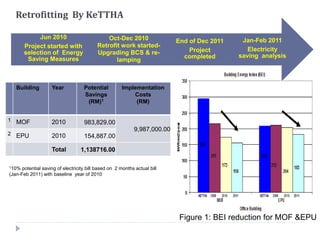
Retrofitting By KeTTHA
Building Year Potential
Savings
(RM)1
Implementation
Costs
(RM)
1 MOF 2010 983,829.00
9,987,000.00
2 EPU 2010 154,887.00
Total 1,138716.00
110% potential saving of electricity bill based on 2 months actual bill
(Jan-Feb 2011) with baseline year of 2010
End of Dec 2011
Project
completed
Jan-Feb 2011
Electricity
saving analysis
Oct-Dec 2010
Retrofit work started-
Upgrading BCS & re-
lamping
Jun 2010
Project started with
selection of Energy
Saving Measures
Figure 1: BEI reduction for MOF &EPU
1 Initiatives under Business & Services lab
2 As per subsidy lab recommendation SOURCE: OGE NKEA Lab
2
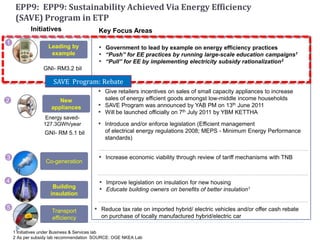
▪ Give retailers incentives on sales of small capacity appliances to increase
sales of energy efficient goods amongst low-middle income households
▪ SAVE Program was announced by YAB PM on 13th June 2011
▪ Will be launched officially on 7th July 2011 by YBM KETTHA
▪ Introduce and/or enforce legislation (Efficient management
of electrical energy regulations 2008; MEPS - Minimum Energy Performance
standards)
▪ Increase economic viability through review of tariff mechanisms with TNB
▪ Improve legislation on insulation for new housing
▪ Educate building owners on benefits of better insulation1
▪ Government to lead by example on energy efficiency practices
▪ “Push” for EE practices by running large-scale education campaigns1
▪ “Pull” for EE by implementing electricity subsidy rationalization2
Key Focus AreasInitiatives
New
appliances
Co-generation
3
Building
insulation
4
Leading by
example
1
Transport
efficiency
5 ▪ Reduce tax rate on imported hybrid/ electric vehicles and/or offer cash rebate
on purchase of locally manufactured hybrid/electric car
EPP9: EPP9: Sustainability Achieved Via Energy Efficiency
(SAVE) Program in ETP
Energy saved-
127.3GWh/year
GNI- RM3.2 bil
GNI- RM 5.1 bil
SAVE Program: Rebate
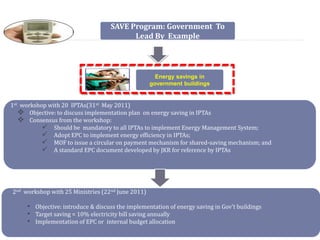
SAVE Program: Government To
Lead By Example
Energy savings in
government buildings
1st workshop with 20 IPTAs(31st May 2011)
 Objective: to discuss implementation plan on energy saving in IPTAs
 Consensus from the workshop:
 Should be mandatory to all IPTAs to implement Energy Management System;
 Adopt EPC to implement energy efficiency in IPTAs;
 MOF to issue a circular on payment mechanism for shared-saving mechanism; and
 A standard EPC document developed by JKR for reference by IPTAs
2nd workshop with 25 Ministries (22nd June 2011)
• Objective: introduce & discuss the implementation of energy saving in Gov’t buildings
• Target saving = 10% electricity bill saving annually
• Implementation of EPC or internal budget allocation
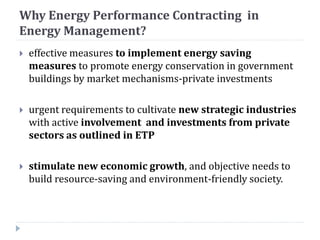
Why Energy Performance Contracting in
Energy Management?
 effective measures to implement energy saving
measures to promote energy conservation in government
buildings by market mechanisms-private investments
 urgent requirements to cultivate new strategic industries
with active involvement and investments from private
sectors as outlined in ETP
 stimulate new economic growth, and objective needs to
build resource-saving and environment-friendly society.
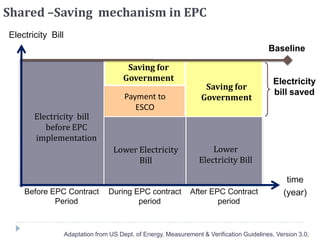
Shared –Saving mechanism in EPC
Adaptation from US Dept. of Energy, Measurement & Verification Guidelines, Version 3.0,
time
(year)
Electricity Bill
During EPC contract
period
Lower Electricity
Bill
After EPC Contract
period
Electricity
bill saved
Before EPC Contract
Period
Electricity bill
before EPC
implementation
Payment to
ESCO
Government’s
Savings
Saving for
Government
Baseline
Lower
Electricity Bill
Saving for
Government
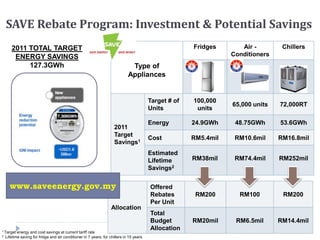
SAVE Rebate Program: Investment & Potential Savings
2011 TOTAL TARGET
ENERGY SAVINGS
127.3GWh Type of
Appliances
Fridges Air -
Conditioners
Chillers
2011
Target
Savings1
Target # of
Units
100,000
units
65,000 units 72,000RT
Energy 24.9GWh 48.75GWh 53.6GWh
Cost RM5.4mil RM10.6mil RM16.8mil
Estimated
Lifetime
Savings2
RM38mil RM74.4mil RM252mil
Allocation
Offered
Rebates
Per Unit
RM200 RM100 RM200
Total
Budget
Allocation
RM20mil RM6.5mil RM14.4mil
1 Target energy and cost savings at current tariff rate
2 Lifetime saving for fridge and air conditioner in 7 years; for chillers in 15 years
Rebate
Program
www.saveenergy.gov.my
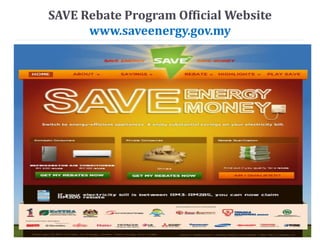
SAVE Rebate Program Official Website
www.saveenergy.gov.my
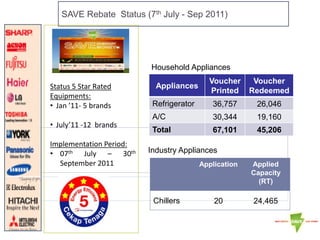
Status 5 Star Rated
Equipments:
• Jan ’11- 5 brands
• July’11 -12 brands
Implementation Period:
• 07th July – 30th
September 2011
Appliances
Voucher
Printed
Voucher
Redeemed
Refrigerator 36,757 26,046
A/C 30,344 19,160
Total 67,101 45,206
Application Applied
Capacity
(RT)
Chillers 20 24,465
SAVE Rebate Status (7th July - Sep 2011)
Household Appliances
Industry Appliances
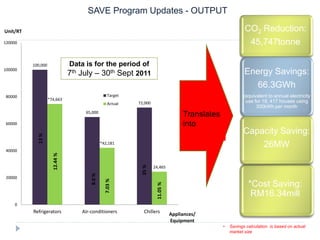
• Savings calculation is based on actual
market size
CO2 Reduction:
45,747tonne
*Cost Saving:
RM16.34mill
Energy Savings:
66.3GWh
(equivalent to annual electricity
use for 18, 417 houses using
300kWh per month
Capacity Saving:
26MW
SAVE Program Updates - OUTPUT
100,000
65,000
72,000
*74,663
*42,181
24,465
0
20000
40000
60000
80000
100000
120000
Refrigerators Air-conditioners Chillers
Unit/RT
Appliances/
Equipment
Target
Actual
13%
12.44%
7.03%
8.0%
35%
11.05%
Data is for the period of
7th July – 30th Sept 2011
Translates
into
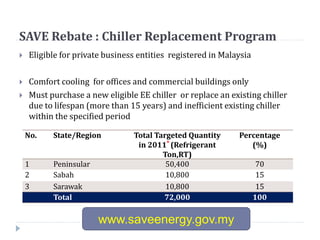
SAVE Rebate : Chiller Replacement Program
 Eligible for private business entities registered in Malaysia
 Comfort cooling for offices and commercial buildings only
 Must purchase a new eligible EE chiller or replace an existing chiller
due to lifespan (more than 15 years) and inefficient existing chiller
within the specified period
No. State/Region Total Targeted Quantity
in 2011* (Refrigerant
Ton,RT)
Percentage
(%)
1 Peninsular 50,400 70
2 Sabah 10,800 15
3 Sarawak 10,800 15
Total 72,000 100
www.saveenergy.gov.my
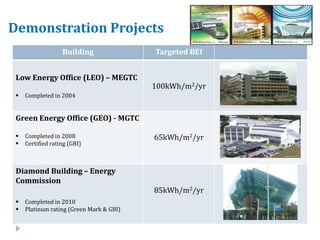
Demonstration Projects
Building Targeted BEI
Low Energy Office (LEO) – MEGTC
 Completed in 2004
100kWh/m2/yr
Green Energy Office (GEO) - MGTC
 Completed in 2008
 Certified rating (GBI)
65kWh/m2/yr
Diamond Building – Energy
Commission
 Completed in 2010
 Platinum rating (Green Mark & GBI)
85kWh/m2/yr
Current Development and
The Way Forward
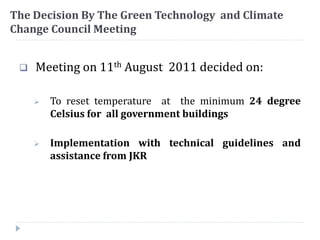
The Decision By The Green Technology and Climate
Change Council Meeting
 Meeting on 11th August 2011 decided on:
 To reset temperature at the minimum 24 degree
Celsius for all government buildings
 Implementation with technical guidelines and
assistance from JKR
The Decision By Economic Council (EC) Meeting
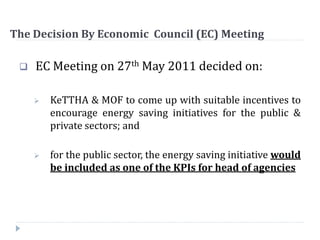
 EC Meeting on 27th May 2011 decided on:
 KeTTHA & MOF to come up with suitable incentives to
encourage energy saving initiatives for the public &
private sectors; and
 for the public sector, the energy saving initiative would
be included as one of the KPIs for head of agencies
EE related Laws
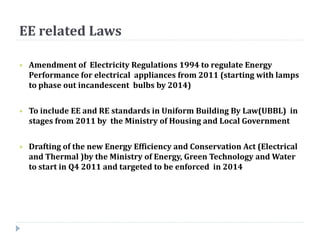
 Amendment of Electricity Regulations 1994 to regulate Energy
Performance for electrical appliances from 2011 (starting with lamps
to phase out incandescent bulbs by 2014)
 To include EE and RE standards in Uniform Building By Law(UBBL) in
stages from 2011 by the Ministry of Housing and Local Government
 Drafting of the new Energy Efficiency and Conservation Act (Electrical
and Thermal )by the Ministry of Energy, Green Technology and Water
to start in Q4 2011 and targeted to be enforced in 2014
The Proposed Strategic
Plan & Implementation
The Strategic Approach
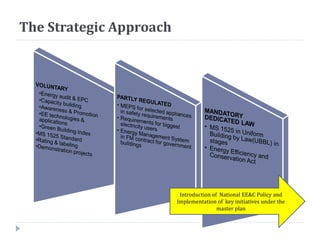
Introduction of National EE&C Policy and
Implementation of key initiatives under the
master plan
Key Elements Required to implement Sustainable Energy
Efficiency & Conservation Program for a long term(10
years) at National Level
• Creation of a Legal & Regulatory Framework to
management all energy using sectors at the demand side
• Creation of a one stop center under one agency for the
planning, implementation and monitoring of energy
consumption for all sectors
• Availability of Sustainable Funding sources & effective
Financial Mechanism
• Capacity Building & Training to build and improve
competencies required in EE&C Industry
• To increase Research & Development for EE technology &
application
• On going Education & Awareness for all types of consumers
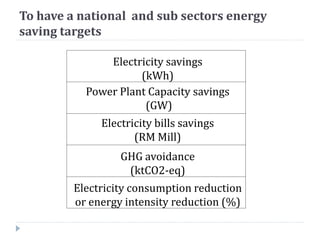
To have a national and sub sectors energy
saving targets
Electricity savings
(kWh)
Power Plant Capacity savings
(GW)
Electricity bills savings
(RM Mill)
GHG avoidance
(ktCO2-eq)
Electricity consumption reduction
or energy intensity reduction (%)
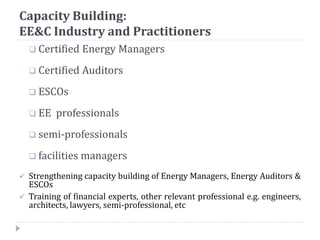
Capacity Building:
EE&C Industry and Practitioners
 Certified Energy Managers
 Certified Auditors
 ESCOs
 EE professionals
 semi-professionals
 facilities managers
 Strengthening capacity building of Energy Managers, Energy Auditors &
ESCOs
 Training of financial experts, other relevant professional e.g. engineers,
architects, lawyers, semi-professional, etc
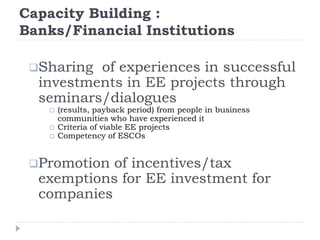
Capacity Building :
Banks/Financial Institutions
Sharing of experiences in successful
investments in EE projects through
seminars/dialogues
 (results, payback period) from people in business
communities who have experienced it
 Criteria of viable EE projects
 Competency of ESCOs
Promotion of incentives/tax
exemptions for EE investment for
companies
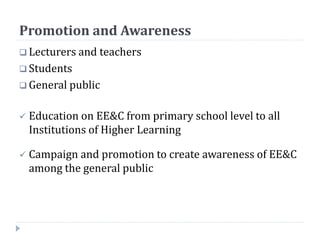
Promotion and Awareness
 Lecturers and teachers
 Students
 General public
 Education on EE&C from primary school level to all
Institutions of Higher Learning
 Campaign and promotion to create awareness of EE&C
among the general public
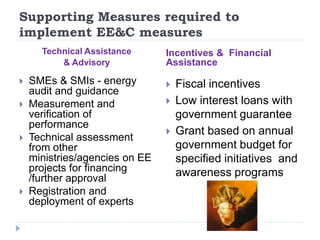
Supporting Measures required to
implement EE&C measures
Technical Assistance
& Advisory
Incentives & Financial
Assistance
 SMEs & SMIs - energy
audit and guidance
 Measurement and
verification of
performance
 Technical assessment
from other
ministries/agencies on EE
projects for financing
/further approval
 Registration and
deployment of experts
 Fiscal incentives
 Low interest loans with
government guarantee
 Grant based on annual
government budget for
specified initiatives and
awareness programs
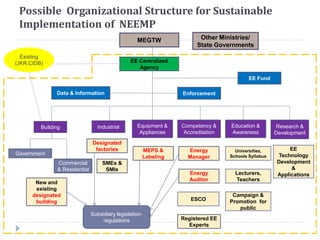
Possible Organizational Structure for Sustainable
Implementation of NEEMP
MEGTW
IndustrialBuilding Equipment &
Appliances
Education &
Awareness
Government
Research &
Development
EE Centralized
Agency
Data & Information Enforcement
Commercial
& Residential
EE Fund
Competency &
Accreditation
New and
existing
designated
building
Designated
factories
SMEs &
SMIs
MEPS &
Labeling
ESCO
Energy
Manager
Energy
Auditor
Registered EE
Experts
Other Ministries/
State Governments
Universities,
Schools Syllabus
Lecturers,
Teachers
Campaign &
Promotion for
public
EE
Technology
Development
&
Applications
Existing
(JKR,CIDB)
Subsidiary legislation-
regulations
Funding Requirements and
Fiscal Incentives
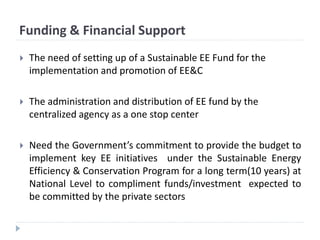
Funding & Financial Support
 The need of setting up of a Sustainable EE Fund for the
implementation and promotion of EE&C
 The administration and distribution of EE fund by the
centralized agency as a one stop center
 Need the Government’s commitment to provide the budget to
implement key EE initiatives under the Sustainable Energy
Efficiency & Conservation Program for a long term(10 years) at
National Level to compliment funds/investment expected to
be committed by the private sectors
• Need the Government’s commitment to provide the
budget to implement key EE initiatives under the
Sustainable Energy Efficiency & Conservation Program for
a long term (10 years) at National Level to compliment
funds/investment expected to be committed by the
private sectors
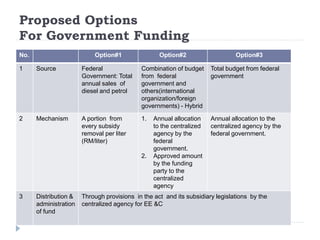
Proposed Options
For Government Funding
No. Option#1 Option#2 Option#3
1 Source Federal
Government: Total
annual sales of
diesel and petrol
Combination of budget
from federal
government and
others(international
organization/foreign
governments) - Hybrid
Total budget from federal
government
2 Mechanism A portion from
every subsidy
removal per liter
(RM/liter)
1. Annual allocation
to the centralized
agency by the
federal
government.
2. Approved amount
by the funding
party to the
centralized
agency
Annual allocation to the
centralized agency by the
federal government.
3 Distribution &
administration
of fund
Through provisions in the act and its subsidiary legislations by the
centralized agency for EE &C
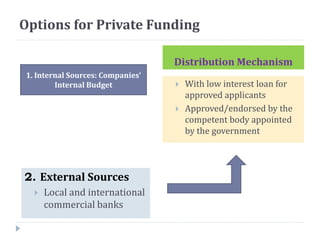
Options for Private Funding
Distribution Mechanism
2. External Sources
 Local and international
commercial banks
 With low interest loan for
approved applicants
 Approved/endorsed by the
competent body appointed
by the government
1. Internal Sources: Companies’
Internal Budget
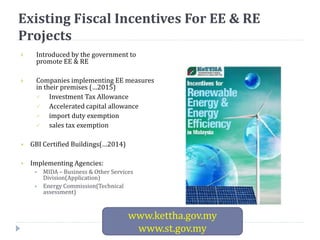
Existing Fiscal Incentives For EE & RE
Projects
 Introduced by the government to
promote EE & RE
 Companies implementing EE measures
in their premises (…2015)
 Investment Tax Allowance
 Accelerated capital allowance
 import duty exemption
 sales tax exemption
 GBI Certified Buildings(…2014)
 Implementing Agencies:
 MIDA – Business & Other Services
Division(Application)
 Energy Commission(Technical
assessment)
www.kettha.gov.my
www.st.gov.my
THE CONCLUSIONS
• EE&C initiatives in Malaysia has been limited & slow
• A Sustainable Energy Efficiency & Conservation Program needs to be
implemented comprehensively and holistically for efficient management of energy
resources to ensure energy security
• A sustainable funding sources and distribution mechanism must be provided for
EE&C initiatives to be carried out smoothly to achieve the targets set at the
national and for each energy using sectors
• Implementation budget allocated by the government will indicate the government
is serious by leading the way to achieve the targets which need to be followed by
the private sector for greater benefits to the country
• Key players of EE industry at the demand side have indicated their supports and
give positive feedbacks through seminars, workshops, dialogues, discussions and
meeting for the proposed implementation of NEEMP
55
 zainiabdulwahab@yahoo.com
 019 2152700
 www.goingee.blogspot.com.my
 www.facebook/zaini.abdulwahab1
 www.slideshare.net/ZAINIABDULWAHAB
 www.linkedin.com/pub/zaini-abdul-wahab/31/239/882
Thank You & Let’s SAVE ENERGY
from today!

Energy Efficiency for Malaysia-the way forward

  • 1.
    KEY ENERGY EFFICIENCY INITIATIVES, INCENTIVES AND THE WAY FORWARD FOR MALAYSIA Zaini Abdul Wahab ENERGY EFFICIENCY INFORMATION SHARING SERIES
  • 2.
    Content  Overview ofEnergy Resources and Trends  Current Related Policies  Energy Efficiency Potentials  Key Government Lead Initiatives  Fiscal And Financial Incentives  Current Development and the way forward  Proposed Strategic Plan & Implementation
  • 3.
    Overview of EnergyResources and Comparison of Trends
  • 4.
    4 Net Import/Export -80% -60% -40% -20% 0% 20% 40% 60% 80% 100% 2002 20102020 2030 Percentage Coal Oil Gas Hydro Nuclear NRE Electricity Heat •Expected to become net importer by 2020 Source: APERC 2006
  • 5.
    Power Generation Mix InMalaysia: Oil To Gas Dependency 0% 10% 20% 30% 40% 50% 60% 70% 80% 90% 100% 1980 1990 1992 1994 1996 1998 2000 2002 2004 Percentage Year Hydro Coal Oil & Distillate Natural Gas
  • 6.
    0 50 100 150 200 250 300 350 400 450 195519571959196119631965196719691971197319751977197919811983198519871989199119931995199719992001200320052007 Fiscal year 0 100 200 300 400 500 600 Energy ConservationAct enacted in 1979 Industrial Transportation Consumer 24.9% 24.8% 27.9% 47.3% GDP (trillions of yen at 1990 values) Crude Oil Equivalent (million Kl) Source: METI/General Energy Statistics 16.2% 16.4% 67.4% 17.9% 57.1% Trend of the Energy Conservation in Japan Changes in Final Energy Consumption and GDP ECCJ Note: consumer = residential + commercial 1st oil crisis 2nd oil crisis
  • 7.
    7 0 50 100 150 200 250 1973 1975 1977 1979 1981 1983 1985 1987 1989 1991 1993 1995 1997 1999 2001 2003 2005 Consumer sector Transport sector Total Industrialsector 207 210 141 103 Change in Final Energy Consumption by Sector In Japan Index (1973=100) Source: General Energy Statistics (METI) ECCJ
  • 8.
    Trend In ElectricityConsumption By Sectors 8 Major users •Industrial •Residential & Commercial
  • 9.
  • 10.
    10 National Energy Policy Predicatedon the following principles:  Supply Objective  To ensure provision of adequate, secure and cost-effective energy supplies by developing indigenous energy resources, both non-renewable & renewable, using least-costs options, & diversifying supply resources within & outside the economy;  Utilisation Objective  To promote the efficient utilisation of energy and the elimination of wasteful & non-productive patterns of energy consumption;  Environmental Objective  To minimise the negative impacts of energy roduction, transportation, conversion, utilisation & consumption on the environment
  • 11.
    National Energy Policy 11 Predicatedon the following principles: • Supply Objective – To ensure provision of adequate, secure and cost-effective energy supplies by developing indigenous energy resources, both non-renewable & renewable, using least- costs options, & diversifying supply resources within & outside the economy; • Utilisation Objective – To promote the efficient utilisation of energy and the elimination of wasteful & non-productive patterns of energy consumption; • Environmental Objective – To minimise the negative impacts of energy roduction, transportation, conversion, utilisation & consumption on the environment
  • 12.
    National RE Policy PolicyStatement:  To enhance the utilisation of indigenous renewable energy resources to contribute towards national electricity supply security and sustainable socio-economic development Objectives:  To increase RE contribution in the national power generation mix;  To facilitate the growth of the RE industry;  To ensure reasonable RE generation costs;  To conserve the environment for future generation; and  To enhance awareness on the role and importance of RE. 12
  • 13.
  • 14.
    Global Energy EfficiencyPotentials  Oil and natural gas remain essential through 2030 but the most important “fuel” of all will be energy saved through improved efficiency  Potential gains will reach about 300 quadrillions BTUs per year by 2030(twice the growth of global energy demand through 2030)  Gains in energy efficiency through 2030 will reduce global energy-demand growth by approximately 65% Source: Outlook for Energy. A view to 2030 (exxonmobil.com)
  • 15.
    Energy Efficiency Market& Potentials in SEA Source: www.reexasia.com
  • 16.
    Saving Potentials (USD)in SEA Clearly, the industrial and commercial sector s offers much higher savings potential Source: www.reexasia.com
  • 17.
    Energy Efficiency Potentialsin Industrial Sector Industry Type Total Potential Energy Saving (GJ/yr) Annual Energy (GJ/yr) Total Potential. Energy Saving (%) Capital Expenditure (RM ‘000) Potential Cost Saving/year Paybac Period (year) (RM‘000) % of original. energy bill FOOD 272,354 1,418,625 19.2 2,299 4,382 13.7 0.5 WOOD 457,494 874,200 52.3 9,904 4,822 38.9 2.1 CERAMIC 212,974 774,061 27.5 5,760 5,992 24.8 1.0 CEMENT 4,887,239 14,956,56 3 32.7 39,456 33,752 16.5 1.2 GLASS 81,660 4,000,370 2.0 3,586 2,120 2.1 1.7 RUBBER 97,215 460,913 21.1 5,079 3,063 22.6 1.7 PULP & PAPER 811,547 5,080,208 16.0 29,883 18,174 21.3 1.6 IRON & STEEL 270,053 4,215,761 6.4 4,443 5,247 3.4 0.8 17Malaysia Industrial Energy Efficiency Improvement Program (MIEEIP) by PTM, ended 2005
  • 18.
    Energy Saving Potentialsin Buildings Residential Hotels Shopping Complexes Offices Lighting 25.3 18.0 51.9 42.5 Air-Conditioning 8.3 38.5 44.9 51.8 Total 33.6 56.5 96.8 94.3 18  Energy Study-Malaysian Building Sector  Distribution (%) of energy consumption in Malaysian Buildings (by PTM 2003) Energy efficiency potentials:  40% to 50% reduction of energy consumption of new buildings.  15% to 25% in reduction in energy consumption of existing buildings.  shift of electricity demand for buildings from day to night to improving load factor
  • 19.
    Problems/Barriers Number of keybarriers which prevent a wide spread adoption of energy efficient practices which are:  Lack of overall national plan for energy efficiency  Lack of consistency in embarking on the energy efficiency  Lack of legal and regulatory framework for energy efficiency  Lack of champion to drive energy efficiency  Low energy prices due to government subsidies  Lack of funding & financing for energy efficiency
  • 20.
  • 21.
    Promoting Sustainable EnergyManagement  The process of managing the energy use in the organization to ensure that energy has been efficiently use by adopting Energy Management System(EMS) to achieve desired results and for continual improvement  Covers all aspects of energy and involving the people and equipment in the daily operation of the facilities Energy Management All activities to ensure efficient use of energy in the organization
  • 22.
    Typical EMS Cycle ENERGY MANAGEMENT POLICY ORGANIZING PLANNINGAND IMPLEMENTATION EVALUATION REVIEW FOR CONTINUAL IMPROVEMENT PLAN DO CHECK ACTION •Commitment from the top management •SMART policy •Setting and sharing common goals•Commitment to take action •Organization and responsibilities •Energy Manager •Allocation of resources •Management Implementation plan and time frame •Energy auditing •Set baselines for measuring results •Designation of responsibilities •Procedures and standards •Trainings •Implement Energy Saving Measures •Measurement and verification •Monitoring •Management Review to confirm Suitability, Adequacy & Effectiveness •Review targets •Communicate the progress •Actions to be taken •Reporting and presenting EPC
  • 23.
    Energy Audits atGovernment Buildings By KeTTHA Bil Building Year Potential Savings (RM) Implementation Costs (RM) ROI (Year) 1 MOH 2010 740,652.23 1,546,545.00 2.0 2 MAMPU 2010 254,500.64 964,737.20 3.8 3 MOHR 2010 195,146.20 405,180.00 2.1 4 JPA 2010 174,480.00 897,000.00 5.1 5 NRE 2010 316,440.20 963,500.00 3.0 6 MOF 2008 355,892.00 2,326,259.00 6.5 7 Hospital Selayang 2008 1,612,800.00 3,294,350.00 2.0 8 Hospital Kuala Lumpur 2008 2,538,705.00 8,423,740.00 3.32 9 Pusat Perubatan UM 2008 4,477,067.00 622,500.00 0.1
  • 24.
    Retrofitting By KeTTHA BuildingYear Potential Savings (RM)1 Implementation Costs (RM) 1 MOF 2010 983,829.00 9,987,000.00 2 EPU 2010 154,887.00 Total 1,138716.00 110% potential saving of electricity bill based on 2 months actual bill (Jan-Feb 2011) with baseline year of 2010 End of Dec 2011 Project completed Jan-Feb 2011 Electricity saving analysis Oct-Dec 2010 Retrofit work started- Upgrading BCS & re- lamping Jun 2010 Project started with selection of Energy Saving Measures Figure 1: BEI reduction for MOF &EPU
  • 25.
    1 Initiatives underBusiness & Services lab 2 As per subsidy lab recommendation SOURCE: OGE NKEA Lab 2 ▪ Give retailers incentives on sales of small capacity appliances to increase sales of energy efficient goods amongst low-middle income households ▪ SAVE Program was announced by YAB PM on 13th June 2011 ▪ Will be launched officially on 7th July 2011 by YBM KETTHA ▪ Introduce and/or enforce legislation (Efficient management of electrical energy regulations 2008; MEPS - Minimum Energy Performance standards) ▪ Increase economic viability through review of tariff mechanisms with TNB ▪ Improve legislation on insulation for new housing ▪ Educate building owners on benefits of better insulation1 ▪ Government to lead by example on energy efficiency practices ▪ “Push” for EE practices by running large-scale education campaigns1 ▪ “Pull” for EE by implementing electricity subsidy rationalization2 Key Focus AreasInitiatives New appliances Co-generation 3 Building insulation 4 Leading by example 1 Transport efficiency 5 ▪ Reduce tax rate on imported hybrid/ electric vehicles and/or offer cash rebate on purchase of locally manufactured hybrid/electric car EPP9: EPP9: Sustainability Achieved Via Energy Efficiency (SAVE) Program in ETP Energy saved- 127.3GWh/year GNI- RM3.2 bil GNI- RM 5.1 bil SAVE Program: Rebate
  • 26.
    SAVE Program: GovernmentTo Lead By Example Energy savings in government buildings 1st workshop with 20 IPTAs(31st May 2011)  Objective: to discuss implementation plan on energy saving in IPTAs  Consensus from the workshop:  Should be mandatory to all IPTAs to implement Energy Management System;  Adopt EPC to implement energy efficiency in IPTAs;  MOF to issue a circular on payment mechanism for shared-saving mechanism; and  A standard EPC document developed by JKR for reference by IPTAs 2nd workshop with 25 Ministries (22nd June 2011) • Objective: introduce & discuss the implementation of energy saving in Gov’t buildings • Target saving = 10% electricity bill saving annually • Implementation of EPC or internal budget allocation
  • 27.
    Why Energy PerformanceContracting in Energy Management?  effective measures to implement energy saving measures to promote energy conservation in government buildings by market mechanisms-private investments  urgent requirements to cultivate new strategic industries with active involvement and investments from private sectors as outlined in ETP  stimulate new economic growth, and objective needs to build resource-saving and environment-friendly society.
  • 28.
    Shared –Saving mechanismin EPC Adaptation from US Dept. of Energy, Measurement & Verification Guidelines, Version 3.0, time (year) Electricity Bill During EPC contract period Lower Electricity Bill After EPC Contract period Electricity bill saved Before EPC Contract Period Electricity bill before EPC implementation Payment to ESCO Government’s Savings Saving for Government Baseline Lower Electricity Bill Saving for Government
  • 29.
    SAVE Rebate Program:Investment & Potential Savings 2011 TOTAL TARGET ENERGY SAVINGS 127.3GWh Type of Appliances Fridges Air - Conditioners Chillers 2011 Target Savings1 Target # of Units 100,000 units 65,000 units 72,000RT Energy 24.9GWh 48.75GWh 53.6GWh Cost RM5.4mil RM10.6mil RM16.8mil Estimated Lifetime Savings2 RM38mil RM74.4mil RM252mil Allocation Offered Rebates Per Unit RM200 RM100 RM200 Total Budget Allocation RM20mil RM6.5mil RM14.4mil 1 Target energy and cost savings at current tariff rate 2 Lifetime saving for fridge and air conditioner in 7 years; for chillers in 15 years Rebate Program www.saveenergy.gov.my
  • 30.
    SAVE Rebate ProgramOfficial Website www.saveenergy.gov.my
  • 31.
    Status 5 StarRated Equipments: • Jan ’11- 5 brands • July’11 -12 brands Implementation Period: • 07th July – 30th September 2011 Appliances Voucher Printed Voucher Redeemed Refrigerator 36,757 26,046 A/C 30,344 19,160 Total 67,101 45,206 Application Applied Capacity (RT) Chillers 20 24,465 SAVE Rebate Status (7th July - Sep 2011) Household Appliances Industry Appliances
  • 32.
    • Savings calculationis based on actual market size CO2 Reduction: 45,747tonne *Cost Saving: RM16.34mill Energy Savings: 66.3GWh (equivalent to annual electricity use for 18, 417 houses using 300kWh per month Capacity Saving: 26MW SAVE Program Updates - OUTPUT 100,000 65,000 72,000 *74,663 *42,181 24,465 0 20000 40000 60000 80000 100000 120000 Refrigerators Air-conditioners Chillers Unit/RT Appliances/ Equipment Target Actual 13% 12.44% 7.03% 8.0% 35% 11.05% Data is for the period of 7th July – 30th Sept 2011 Translates into
  • 33.
    SAVE Rebate :Chiller Replacement Program  Eligible for private business entities registered in Malaysia  Comfort cooling for offices and commercial buildings only  Must purchase a new eligible EE chiller or replace an existing chiller due to lifespan (more than 15 years) and inefficient existing chiller within the specified period No. State/Region Total Targeted Quantity in 2011* (Refrigerant Ton,RT) Percentage (%) 1 Peninsular 50,400 70 2 Sabah 10,800 15 3 Sarawak 10,800 15 Total 72,000 100 www.saveenergy.gov.my
  • 34.
    Demonstration Projects Building TargetedBEI Low Energy Office (LEO) – MEGTC  Completed in 2004 100kWh/m2/yr Green Energy Office (GEO) - MGTC  Completed in 2008  Certified rating (GBI) 65kWh/m2/yr Diamond Building – Energy Commission  Completed in 2010  Platinum rating (Green Mark & GBI) 85kWh/m2/yr
  • 35.
  • 36.
    The Decision ByThe Green Technology and Climate Change Council Meeting  Meeting on 11th August 2011 decided on:  To reset temperature at the minimum 24 degree Celsius for all government buildings  Implementation with technical guidelines and assistance from JKR
  • 37.
    The Decision ByEconomic Council (EC) Meeting  EC Meeting on 27th May 2011 decided on:  KeTTHA & MOF to come up with suitable incentives to encourage energy saving initiatives for the public & private sectors; and  for the public sector, the energy saving initiative would be included as one of the KPIs for head of agencies
  • 38.
    EE related Laws Amendment of Electricity Regulations 1994 to regulate Energy Performance for electrical appliances from 2011 (starting with lamps to phase out incandescent bulbs by 2014)  To include EE and RE standards in Uniform Building By Law(UBBL) in stages from 2011 by the Ministry of Housing and Local Government  Drafting of the new Energy Efficiency and Conservation Act (Electrical and Thermal )by the Ministry of Energy, Green Technology and Water to start in Q4 2011 and targeted to be enforced in 2014
  • 39.
  • 40.
    The Strategic Approach Introductionof National EE&C Policy and Implementation of key initiatives under the master plan
  • 41.
    Key Elements Requiredto implement Sustainable Energy Efficiency & Conservation Program for a long term(10 years) at National Level • Creation of a Legal & Regulatory Framework to management all energy using sectors at the demand side • Creation of a one stop center under one agency for the planning, implementation and monitoring of energy consumption for all sectors • Availability of Sustainable Funding sources & effective Financial Mechanism • Capacity Building & Training to build and improve competencies required in EE&C Industry • To increase Research & Development for EE technology & application • On going Education & Awareness for all types of consumers
  • 42.
    To have anational and sub sectors energy saving targets Electricity savings (kWh) Power Plant Capacity savings (GW) Electricity bills savings (RM Mill) GHG avoidance (ktCO2-eq) Electricity consumption reduction or energy intensity reduction (%)
  • 43.
    Capacity Building: EE&C Industryand Practitioners  Certified Energy Managers  Certified Auditors  ESCOs  EE professionals  semi-professionals  facilities managers  Strengthening capacity building of Energy Managers, Energy Auditors & ESCOs  Training of financial experts, other relevant professional e.g. engineers, architects, lawyers, semi-professional, etc
  • 44.
    Capacity Building : Banks/FinancialInstitutions Sharing of experiences in successful investments in EE projects through seminars/dialogues  (results, payback period) from people in business communities who have experienced it  Criteria of viable EE projects  Competency of ESCOs Promotion of incentives/tax exemptions for EE investment for companies
  • 45.
    Promotion and Awareness Lecturers and teachers  Students  General public  Education on EE&C from primary school level to all Institutions of Higher Learning  Campaign and promotion to create awareness of EE&C among the general public
  • 46.
    Supporting Measures requiredto implement EE&C measures Technical Assistance & Advisory Incentives & Financial Assistance  SMEs & SMIs - energy audit and guidance  Measurement and verification of performance  Technical assessment from other ministries/agencies on EE projects for financing /further approval  Registration and deployment of experts  Fiscal incentives  Low interest loans with government guarantee  Grant based on annual government budget for specified initiatives and awareness programs
  • 47.
    Possible Organizational Structurefor Sustainable Implementation of NEEMP MEGTW IndustrialBuilding Equipment & Appliances Education & Awareness Government Research & Development EE Centralized Agency Data & Information Enforcement Commercial & Residential EE Fund Competency & Accreditation New and existing designated building Designated factories SMEs & SMIs MEPS & Labeling ESCO Energy Manager Energy Auditor Registered EE Experts Other Ministries/ State Governments Universities, Schools Syllabus Lecturers, Teachers Campaign & Promotion for public EE Technology Development & Applications Existing (JKR,CIDB) Subsidiary legislation- regulations
  • 48.
  • 49.
    Funding & FinancialSupport  The need of setting up of a Sustainable EE Fund for the implementation and promotion of EE&C  The administration and distribution of EE fund by the centralized agency as a one stop center  Need the Government’s commitment to provide the budget to implement key EE initiatives under the Sustainable Energy Efficiency & Conservation Program for a long term(10 years) at National Level to compliment funds/investment expected to be committed by the private sectors
  • 50.
    • Need theGovernment’s commitment to provide the budget to implement key EE initiatives under the Sustainable Energy Efficiency & Conservation Program for a long term (10 years) at National Level to compliment funds/investment expected to be committed by the private sectors
  • 51.
    Proposed Options For GovernmentFunding No. Option#1 Option#2 Option#3 1 Source Federal Government: Total annual sales of diesel and petrol Combination of budget from federal government and others(international organization/foreign governments) - Hybrid Total budget from federal government 2 Mechanism A portion from every subsidy removal per liter (RM/liter) 1. Annual allocation to the centralized agency by the federal government. 2. Approved amount by the funding party to the centralized agency Annual allocation to the centralized agency by the federal government. 3 Distribution & administration of fund Through provisions in the act and its subsidiary legislations by the centralized agency for EE &C
  • 52.
    Options for PrivateFunding Distribution Mechanism 2. External Sources  Local and international commercial banks  With low interest loan for approved applicants  Approved/endorsed by the competent body appointed by the government 1. Internal Sources: Companies’ Internal Budget
  • 53.
    Existing Fiscal IncentivesFor EE & RE Projects  Introduced by the government to promote EE & RE  Companies implementing EE measures in their premises (…2015)  Investment Tax Allowance  Accelerated capital allowance  import duty exemption  sales tax exemption  GBI Certified Buildings(…2014)  Implementing Agencies:  MIDA – Business & Other Services Division(Application)  Energy Commission(Technical assessment) www.kettha.gov.my www.st.gov.my
  • 54.
    THE CONCLUSIONS • EE&Cinitiatives in Malaysia has been limited & slow • A Sustainable Energy Efficiency & Conservation Program needs to be implemented comprehensively and holistically for efficient management of energy resources to ensure energy security • A sustainable funding sources and distribution mechanism must be provided for EE&C initiatives to be carried out smoothly to achieve the targets set at the national and for each energy using sectors • Implementation budget allocated by the government will indicate the government is serious by leading the way to achieve the targets which need to be followed by the private sector for greater benefits to the country • Key players of EE industry at the demand side have indicated their supports and give positive feedbacks through seminars, workshops, dialogues, discussions and meeting for the proposed implementation of NEEMP
  • 55.
    55  zainiabdulwahab@yahoo.com  0192152700  www.goingee.blogspot.com.my  www.facebook/zaini.abdulwahab1  www.slideshare.net/ZAINIABDULWAHAB  www.linkedin.com/pub/zaini-abdul-wahab/31/239/882 Thank You & Let’s SAVE ENERGY from today!