REDUCING ENERGY COSTS THROUGH INVESTMENTS WITH ENERGY PERFORMANCE CONTRACTING PROJECTS IMPLEMENTATION AT BUILDING FACILITIES 
By 
ZAINI ABDUL WAHAB 
In Collaboration with: 
& 
Date:19th September 2014 
SMART CITIES
Copyright MIGHT-PTHM-MAESCO-2014 
Introduction To Energy Services & MAESCO 
Overview Of Energy Services Industry & Energy In Building Facilities 
Introduction To EPC Projects Implementation – to reduce energy costs 
What’s Next and The Way Forward… 
Outline 
2
INTRODUCTION TO ENERGY SERVICES & MAESCO 
Copyright MIGHT-PTHM-MAESCO-2014
Copyright MIGHT-PTHM-MAESCO-2014 
An Energy Service Company(ESCO) 
Develop and implement turnkey, comprehensive energy efficiency projects 
ESCOs offer performance-based contracts (i.e., contracts that tie the compensation of the ESCO to the energy savings generated by the project) as a significant part of their business 
To ensure credentials, ESCOs must demonstrate the technical & managerial competencies to design & implement projects involving multiple technologies : 
Lighting 
Motors & Drives 
Heating & steam systems 
HVAC Systems 
Control Systems 
Maximum Demand Controls 
Building Envelope Improvements 
…at building/industrial facilities 
What Is ESCO? 
4
Copyright MIGHT-PTHM-MAESCO-2014 
Registered in September 2000 in conjunction with the launching of the Malaysian Industrial Energy Efficiency Improvement Project (MIEEIP) by the Government-UNDP 
OBJECTIVES 
•To develop recognized ESCO businesses in collaboration with Government & private sectors. 
•To actively promote the activity of cost reduction and efficiency standards of the industrial and commercial sector 
•To oversee the well being of it’s members 
•To facilitate and do all things necessary towards developing successful energy related projects. 
•To introduce related products and services for the industry 
•To foster healthy co-existence amongst members through ethical professional practices 
•Ensure prestige of services by members 
5
Copyright MIGHT-PTHM-MAESCO-2014 
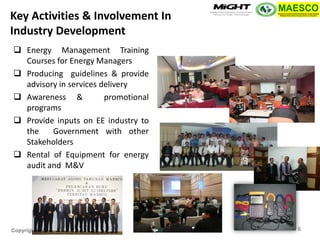
Energy Management Training Courses for Energy Managers 
Producing guidelines & provide advisory in services delivery 
Awareness & promotional programs 
Provide inputs on EE industry to the Government with other Stakeholders 
Rental of Equipment for energy audit and M&V 
Key Activities & Involvement In Industry Development 
6
OVERVIEW OF ENERGY SERVICES INDUSTRY & ENERGY IN BUILDING FACILITIES 
Copyright MIGHT-PTHM-MAESCO-2014
Copyright MIGHT-PTHM-MAESCO-2014 
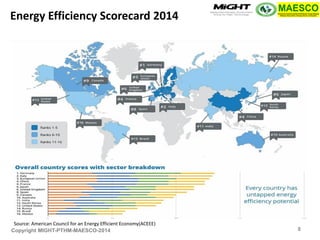
Source: American Council for an Energy Efficient Economy(ACEEE) 
Energy Efficiency Scorecard 2014 
8
Copyright MIGHT-PTHM-MAESCO-2014 
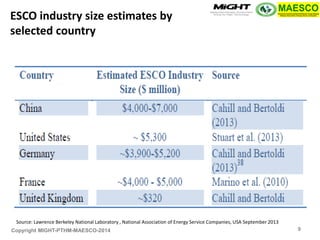
Source: Lawrence Berkeley National Laboratory , National Association of Energy Service Companies, USA September 2013 
ESCO industry size estimates by selected country 
9
Copyright MIGHT-PTHM-MAESCO-2014 
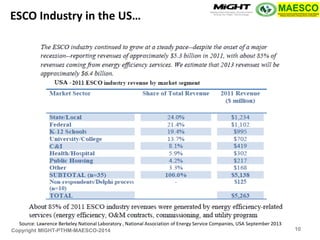
Source: Lawrence Berkeley National Laboratory , National Association of Energy Service Companies, USA September 2013 
ESCO Industry in the US… 
10
Copyright MIGHT-PTHM-MAESCO-2014 
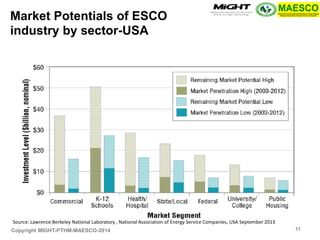
Source: Lawrence Berkeley National Laboratory , National Association of Energy Service Companies, USA September 2013 
Market Potentials of ESCO industry by sector-USA 
11
Copyright MIGHT-PTHM-MAESCO-2014 
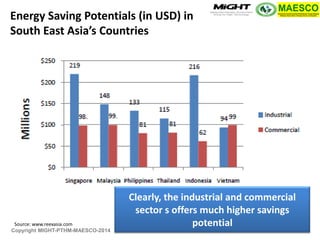
Clearly, the industrial and commercial sector s offers much higher savings potential 
Source: www.reexasia.com 
Energy Saving Potentials (in USD) in South East Asia’s Countries
Copyright MIGHT-PTHM-MAESCO-2014 
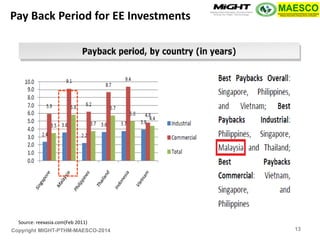
Source: reexasia.com(Feb 2011) 
Pay Back Period for EE Investments 
13
Copyright MIGHT-PTHM-MAESCO-2014 
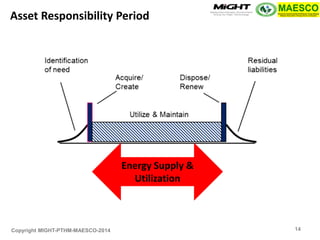
Energy Supply & Utilization 
Asset Responsibility Period 
14
Copyright MIGHT-PTHM-MAESCO-2014 
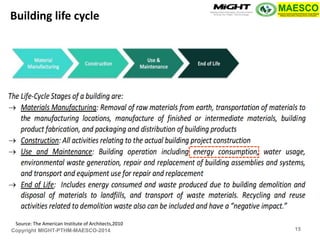
Source: The American Institute of Architects,2010 
Building life cycle 
15
Copyright MIGHT-PTHM-MAESCO-2014 
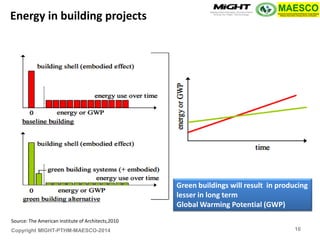
Source: The American Institute of Architects,2010 
Green buildings will result in producing lesser in long term 
Global Warming Potential (GWP) 
Energy in building projects 
16
Copyright MIGHT-PTHM-MAESCO-2014 
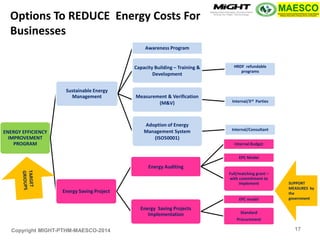
ENERGY EFFICIENCY IMPROVEMENT PROGRAM 
Sustainable Energy Management 
Awareness Program 
Capacity Building – Training & Development 
HRDF refundable programs 
Measurement & Verification (M&V) 
Internal/3rd Parties 
Adoption of Energy Management System (ISO50001) 
Internal/Consultant 
Energy Saving Project 
Energy Auditing 
Internal Budget 
EPC Model 
Full/matching grant – with commitment to implement 
Energy Saving Projects Implementation 
EPC model 
Standard 
Procurement 
SUPPORT MEASURES by the government 
Options To REDUCE Energy Costs For Businesses 
17
Copyright MIGHT-PTHM-MAESCO-2014 
•EEPs viewed as “Infrastructure Investments” – LOW PRIORITY VS. CORE BUSINESS – don’t fix if not broken 
•EEPs funding through loans/debts WILL IMPAIR “CREDIT CAPACITY” from core business – NO WAY for SMEs/SMIs 
•BENEFITS ARE TOO SMALL TO APPEAR ON CEO’S RADAR SCREEN & to justify “perceived’ operating complexities/risks 
•NOT CONVINCED ON ACTUAL COST SAVINGS ACHIEVED nor aware of proven Measurement & Verification(M&V) methods to ensure sustainability of savings. 
KEY BARRIERS to implement Energy Efficiency Projects(EEPs) for companies 
18
Copyright MIGHT-PTHM-MAESCO-2014 
•Reduce government expenditure 
•Create local employment and the capacity to deliver efficiency in the private sector 
•Meet community expectations and existing environmental targets 
•“Lead by example” to mitigate impacts for energy subsidies reduction 
Key drivers on why the Government should improve energy efficiency of its buildings 
19
Copyright MIGHT-PTHM-MAESCO-2014 
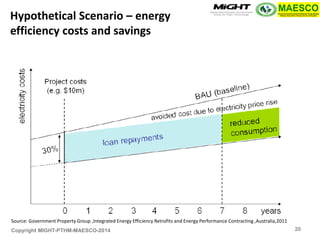
Source: Government Property Group ,Integrated Energy Efficiency Retrofits and Energy Performance Contracting ,Australia,2011 
Hypothetical Scenario – energy efficiency costs and savings 
20
INTRODUCTION TO EPC PROJECTS IMPLEMENTATION To Reduce Energy Cost At Building Facilities 
Copyright MIGHT-PTHM-MAESCO-2014
Copyright MIGHT-PTHM-MAESCO-2014 
“Energy Performance Contracting is when an ESCO is engaged to improve the energy efficiency of a facility, with the guaranteed energy savings paying for the capital investment required to implement improvements” 
What is Energy Performance Contracting(EPC)? 
22
Copyright MIGHT-PTHM-MAESCO-2014 
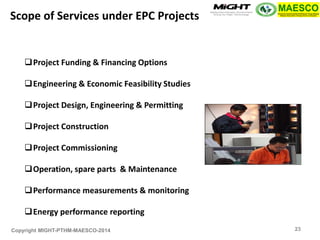
Project Funding & Financing Options 
Engineering & Economic Feasibility Studies 
Project Design, Engineering & Permitting 
Project Construction 
Project Commissioning 
Operation, spare parts & Maintenance 
Performance measurements & monitoring 
Energy performance reporting 
Scope of Services under EPC Projects 
23
Copyright MIGHT-PTHM-MAESCO-2014 
Finance energy saving improvements with no upfront capital 
Invest savings achieved into other projects 
ESCO to identify Energy Saving projects 
ESCO guarantee Energy savings - the remuneration of ESCOs is directly tied to the actual energy savings achieved 
Energy saving is shared between ESCO & the building owner as per agreed terms & payment schedule with a single-source responsibility 
ESCO supplies, installs, maintains & retain an on-going operational role in measuring & verifying the savings over the contractual terms. 
Use future energy ,cut operating cost, be more competitive & improved comfort & productivity from upgraded systems 
Positive environmental impacts & reduced environmental footprint 
Benefits of EPC-Facilities Owner
Copyright MIGHT-PTHM-MAESCO-2014 
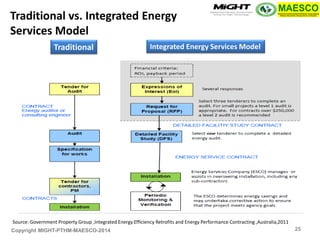
Traditional 
Integrated Energy Services Model 
Source: Government Property Group ,Integrated Energy Efficiency Retrofits and Energy Performance Contracting ,Australia,2011 
Traditional vs. Integrated Energy Services Model 
25
Copyright MIGHT-PTHM-MAESCO-2014 
•Savings based on actual & measured energy performance data with permanent measuring equipment 
•Capable ESCO- Technically & Financially 
•Comprehensive EPC Contract document 
•Understanding of the how EPC works & it long term benefits by facilities owners 
Key Features & Success Factors Of EPC Projects Implementation 
26
Copyright MIGHT-PTHM-MAESCO-2014 
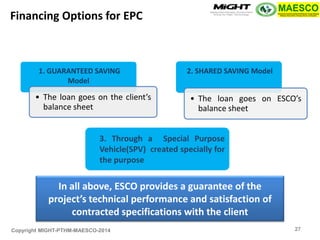
1. GUARANTEED SAVING Model 
•The loan goes on the client’s balance sheet 
2. SHARED SAVING Model 
•The loan goes on ESCO’s balance sheet 
Financing Options for EPC 
3. Through a Special Purpose Vehicle(SPV) created specially for the purpose 
In all above, ESCO provides a guarantee of the project’s technical performance and satisfaction of contracted specifications with the client 
27
Copyright MIGHT-PTHM-MAESCO-2014 
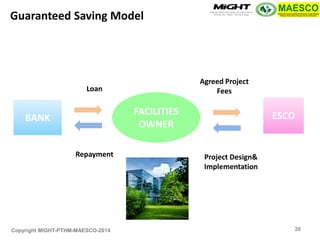
FACILITIES OWNER 
ESCO 
BANK 
Project Design& 
Implementation 
Agreed Project Fees 
Loan 
Repayment 
Guaranteed Saving Model 
28
Copyright MIGHT-PTHM-MAESCO-2014 
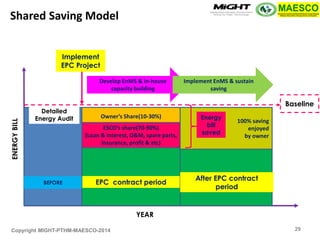
Owner’s Share(10-30%) 
ESCO’s share(70-90%) (Loan & interest, O&M, spare parts, insurance, profit & etc) 
EPC contract period 
BEFORE 
Baseline 
Detailed Energy Audit 
100% saving 
enjoyed 
by owner 
After EPC contract period 
Energy bill saved 
Develop EnMS & in-house capacity building 
Implement EnMS & sustain saving 
YEAR 
ENERGY BILL 
Implement EPC Project 
Shared Saving Model 
29
Copyright MIGHT-PTHM-MAESCO-2014 
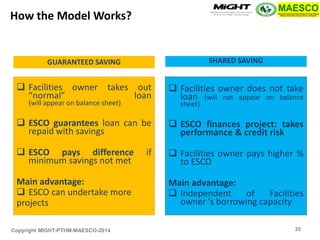
GUARANTEED SAVING 
Facilities owner takes out “normal” loan (will appear on balance sheet) 
ESCO guarantees loan can be repaid with savings 
ESCO pays difference if minimum savings not met 
Main advantage: 
ESCO can undertake more 
projects 
SHARED SAVING 
Facilities owner does not take loan (will not appear on balance sheet) 
ESCO finances project: takes performance & credit risk 
Facilities owner pays higher % to ESCO 
Main advantage: 
Independent of Facilities owner ’s borrowing capacity 
How the Model Works? 
30
Copyright MIGHT-PTHM-MAESCO-2014 
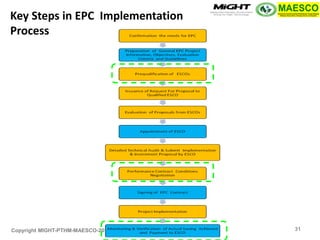
Key Steps in EPC Implementation Process 
31
Copyright MIGHT-PTHM-MAESCO-2014 
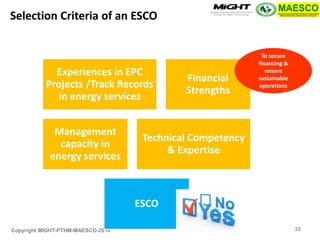
Experiences in EPC Projects /Track Records in energy services 
Financial Strengths 
Management capacity in energy services 
Technical Competency & Expertise 
ESCO 
To secure financing & ensure sustainable operations 
Selection Criteria of an ESCO 
32
Copyright MIGHT-PTHM-MAESCO-2014 
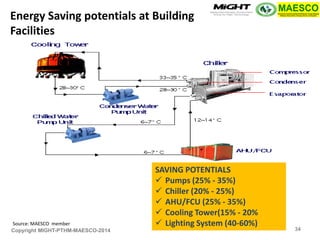
WHERE AND HOW TO SAVE? Potential energy saving opportunities from detailed technical audit
Copyright MIGHT-PTHM-MAESCO-2014 
SAVING POTENTIALS 
Pumps (25% - 35%) 
Chiller (20% - 25%) 
AHU/FCU (25% - 35%) 
Cooling Tower(15% - 20% 
Lighting System (40-60%) 
Source: MAESCO member 
Energy Saving potentials at Building Facilities 
34
Copyright MIGHT-PTHM-MAESCO-2014 
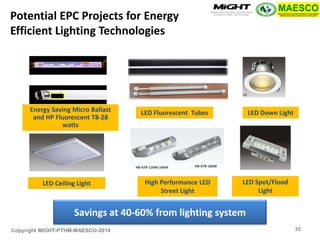
Energy Saving Micro Ballast 
and HP Fluorescent T8-28 watts 
LED Fluorescent Tubes 
LED Down Light 
LED Ceiling Light 
High Performance LED Street Light 
LED Spot/Flood Light 
Potential EPC Projects for Energy Efficient Lighting Technologies 
Savings at 40-60% from lighting system 
35
Copyright MIGHT-PTHM-MAESCO-2014 
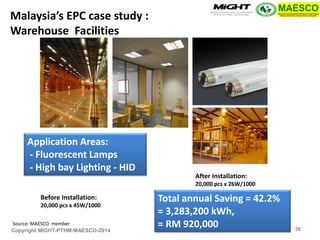
Application Areas: 
- Fluorescent Lamps 
- High bay Lighting - HID 
After Installation: 
20,000 pcs x 26W/1000 
Before Installation: 
20,000 pcs x 45W/1000 
Total annual Saving = 42.2% = 3,283,200 kWh, = RM 920,000 
Source: MAESCO member 
Malaysia’s EPC case study : Warehouse Facilities 
36
Copyright MIGHT-PTHM-MAESCO-2014 
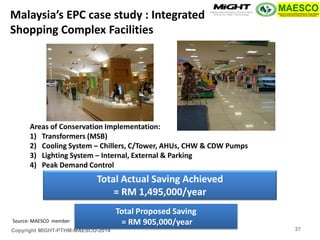
Areas of Conservation Implementation: 
1)Transformers (MSB) 
2)Cooling System – Chillers, C/Tower, AHUs, CHW & CDW Pumps 
3)Lighting System – Internal, External & Parking 
4)Peak Demand Control 
Total Actual Saving Achieved 
= RM 1,495,000/year 
Total Proposed Saving 
= RM 905,000/year 
Source: MAESCO member 
Malaysia’s EPC case study : Integrated Shopping Complex Facilities 
37
Copyright MIGHT-PTHM-MAESCO-2014 
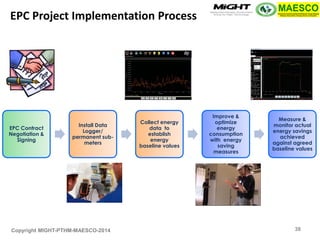
EPC Contract Negotiation & Signing 
Install Data Logger/ permanent sub- meters 
Collect energy data to establish energy baseline values 
Improve & optimize energy consumption with energy saving measures 
Measure & monitor actual energy savings achieved against agreed baseline values 
EPC Project Implementation Process 
38
Copyright MIGHT-PTHM-MAESCO-2014 
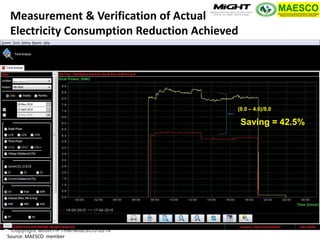
Saving = 40% 
(7.8 – 4.7)/7.8 
Saving = 42.5% 
(8.0 – 4.6)/8.0 
Source: MAESCO member 
Measurement & Verification of Actual Electricity Consumption Reduction Achieved
Copyright MIGHT-PTHM-MAESCO-2014 
Commitment from Client 
Factors Affecting Savings Performance 
Evaluating Savings Uncertainty 
Minimum Operating Conditions 
Energy Prices 
Verification by a Third Party 
Baseline Adjustments (Non-Routine) 
Balancing Uncertainty and Cost 
Factors should be considered for M&V in EPC contract to reduce dispute 
40
Copyright MIGHT-PTHM-MAESCO-2014 
What is guaranteed? 
•The minimum amount of savings expected to be achieved 
•The method, report formatting and formula for calculating shared savings will be paid to the ESCO; 
•Conditions to be applied if savings achieved are less than guaranteed by the ESCO. 
Key Elements in EPC Contract Document(1) 
41
Copyright MIGHT-PTHM-MAESCO-2014 
The cost savings measurement with significant changes of operations at the facilities. 
The responsibilities of building owners and the ESCO throughout the contract period. 
Maintenance, use and modification/ removal of the equipment that was installed by the ESCO by the facilities owner. 
If the equipment installed by the ESCO is lost or damaged 
Guarantee of losses and liabilities by ESCO to the facilities owner. 
Key Elements in EPC Contract Document(2) 
42
Copyright MIGHT-PTHM-MAESCO-2014 
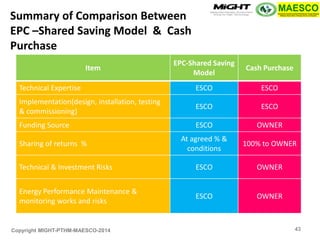
Item 
EPC-Shared Saving Model 
Cash Purchase 
Technical Expertise 
ESCO 
ESCO 
Implementation(design, installation, testing & commissioning) 
ESCO 
ESCO 
Funding Source 
ESCO 
OWNER 
Sharing of returns % 
At agreed % & conditions 
100% to OWNER 
Technical & Investment Risks 
ESCO 
OWNER 
Energy Performance Maintenance & monitoring works and risks 
ESCO 
OWNER 
Summary of Comparison Between EPC –Shared Saving Model & Cash Purchase 
43
Copyright MIGHT-PTHM-MAESCO-2014 
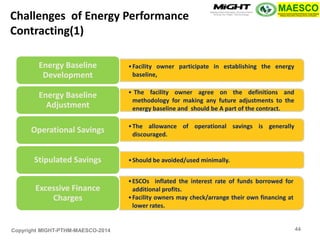
•Facility owner participate in establishing the energy baseline, 
Energy Baseline Development 
• The facility owner agree on the definitions and methodology for making any future adjustments to the energy baseline and should be A part of the contract. 
Energy Baseline Adjustment 
•The allowance of operational savings is generally discouraged. 
Operational Savings 
•Should be avoided/used minimally. 
Stipulated Savings 
•ESCOs inflated the interest rate of funds borrowed for additional profits. 
•Facility owners may check/arrange their own financing at lower rates. 
Excessive Finance Charges 
Challenges of Energy Performance Contracting(1) 
44
Copyright MIGHT-PTHM-MAESCO-2014 
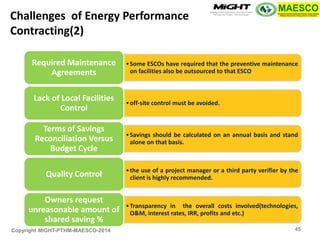
•Some ESCOs have required that the preventive maintenance on facilities also be outsourced to that ESCO 
Required Maintenance Agreements 
•off-site control must be avoided. 
Lack of Local Facilities Control 
•Savings should be calculated on an annual basis and stand alone on that basis. 
Terms of Savings Reconciliation Versus Budget Cycle 
•the use of a project manager or a third party verifier by the client is highly recommended. 
Quality Control 
•Transparency in the overall costs involved(technologies, O&M, interest rates, IRR, profits and etc.) 
Owners request unreasonable amount of shared saving % 
Challenges of Energy Performance Contracting(2) 
45
Copyright MIGHT-PTHM-MAESCO-2014 
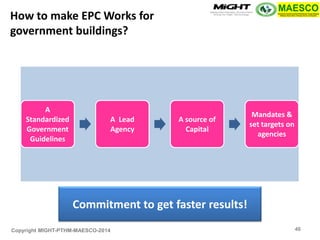
A Standardized Government Guidelines 
A Lead Agency 
A source of Capital 
Mandates & set targets on agencies 
How to make EPC Works for government buildings? 
Commitment to get faster results! 
46
Copyright MIGHT-PTHM-MAESCO-2014 
SUCCESS STORIES OF EPC PROGRAM IMPLEMENTATION
Copyright MIGHT-PTHM-MAESCO-2014 
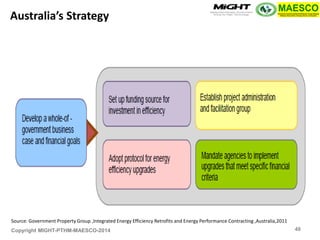
Source: Government Property Group ,Integrated Energy Efficiency Retrofits and Energy Performance Contracting ,Australia,2011 
Australia’s Strategy 
48
Copyright MIGHT-PTHM-MAESCO-2014 
•Greener Government Buildings Program in 2009. 
•Aimed to save $1 billion in energy & maintenance costs in 25 year 
•To reduce emissions from government buildings by 20% by 2020. 
AUSTRALIA -Victorian Government 
•A simple government-wide protocol for the EPC process 
•Loans for agencies to implement energy efficiency upgrades 
•Establishing a facilitation unit in the Department of Treasury and Finance 
•A mandate for all agencies to implement energy efficiency upgrades at sites accounting for 20% of agency energy use by 2012 and 90% by 2018. 
•Commenced with a trial EPC covering 16 office buildings, and is now being rolled out across agencies 
• $160 million in 4 years 
•Decisions on additional funding to complete the program will be made in coming years.
Copyright MIGHT-PTHM-MAESCO-2014 
•The Strategic Energy Efficiency Policy for Queensland Government Buildings - to reduce their energy consumption by 5 % below 2005-06 levels by 2010, and 20 % by 2015. 
•Shares some key features with the Victorian program - the use of EPC and facilitation by a single department, the Department of Public Works. 
•The Department of Public Works has so far invested over $20 million in improving the energy efficiency of 25 of the sites that it owns, and has reduced its energy use in those buildings by 18 megawatt hours per year.6 
AUSTRALIA -Queensland Government 
50
Copyright MIGHT-PTHM-MAESCO-2014 
•Federal, State, and local governments in the US invested over $21 billion in EPC since 1997. 
•The US Federal Government’s 2009 economic stimulus package included an additional $3.1 billion for efficiency in existing federal government buildings 
•Federal and State governments have passed specific laws to facilitate EPC and accept up to 15-20 year payback periods. 
•Research in the US indicated that EPCs have delivered general benefit to cost ratios of 1.6 to 1, with higher 2.1 to 1 ratios for EPCs in health facilities. 
United States 
51
Copyright MIGHT-PTHM-MAESCO-2014 
Development of manuals on additional models and support-EPC + White Certification 
•Quality Standards 
•Comprehensive Refurbishment & link to Facility Management 
•Norms /Certification 
•Financing 
Intensive dialogue with market actors - Building owners - Financial sector - ESCOs 
Capacity building & Increased awareness, know-how & exchange 
•Over 100 events organised and attended, 2,000 participants with about 60 are new EPC experts. 
Pilot projects 
•Over 360 buildings screened 
•30 more concrete projects received further support 
•17 resulted in concrete EPC projects 
•About 1 million square meters 
•Energy cost baseline of almost 10 million Euros/year 
•Estimated energy savings between 10% and over 25% 
European Platform for the Promotion of EPC 
52
Copyright MIGHT-PTHM-MAESCO-2014 
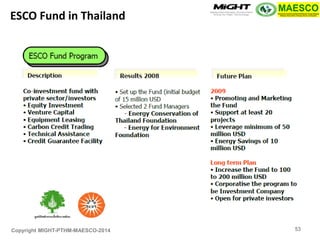
ESCO Fund in Thailand 
53
Copyright MIGHT-PTHM-MAESCO-2014 
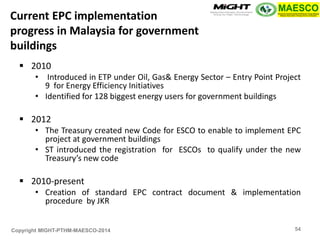
2010 
• Introduced in ETP under Oil, Gas& Energy Sector – Entry Point Project 9 for Energy Efficiency Initiatives 
•Identified for 128 biggest energy users for government buildings 
2012 
•The Treasury created new Code for ESCO to enable to implement EPC project at government buildings 
•ST introduced the registration for ESCOs to qualify under the new Treasury’s new code 
2010-present 
•Creation of standard EPC contract document & implementation procedure by JKR 
Current EPC implementation progress in Malaysia for government buildings 
54
Copyright MIGHT-PTHM-MAESCO-2014 
WHAT’S NEXT?
Copyright MIGHT-PTHM-MAESCO-2014 
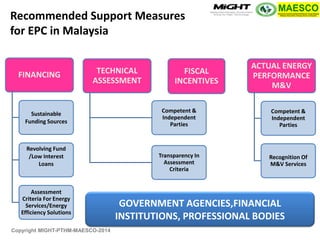
FINANCING 
Sustainable Funding Sources 
Revolving Fund /Low Interest Loans 
Assessment Criteria For Energy Services/Energy Efficiency Solutions 
TECHNICAL ASSESSMENT 
Competent & Independent Parties 
Transparency In Assessment Criteria 
ACTUAL ENERGY PERFORMANCE M&V 
Competent & Independent Parties 
Recognition Of M&V Services 
FISCAL INCENTIVES 
GOVERNMENT AGENCIES,FINANCIAL INSTITUTIONS, PROFESSIONAL BODIES 
Recommended Support Measures for EPC in Malaysia
Copyright MIGHT-PTHM-MAESCO-2014 
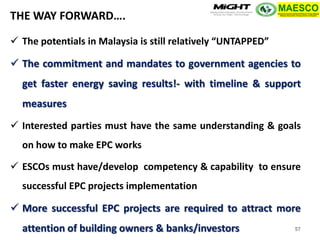
The potentials in Malaysia is still relatively “UNTAPPED” 
The commitment and mandates to government agencies to get faster energy saving results!- with timeline & support measures 
Interested parties must have the same understanding & goals on how to make EPC works 
ESCOs must have/develop competency & capability to ensure successful EPC projects implementation 
More successful EPC projects are required to attract more attention of building owners & banks/investors 
THE WAY FORWARD…. 
57
Copyright MIGHT-PTHM-MAESCO-2014 
REDUCING ENERGY COSTS THROUGH INVESTMENTS WITH ENERGY PERFORMANCE CONTRACTING PROJECTS IMPLEMENTATION AT BUILDING FACILITIES 
By 
ZAINI ABDUL WAHAB 
smartcommunities@might.org.my 
www.maesco.org.my 
zainiabdulwahab@yahoo.com 
In Collaboration with: 
& 
THANK YOU FOR YOUR ATTENTION!

Energy costs reduction through Energy Performance Contracting projects implementation in Malaysia

  • 1.
    REDUCING ENERGY COSTSTHROUGH INVESTMENTS WITH ENERGY PERFORMANCE CONTRACTING PROJECTS IMPLEMENTATION AT BUILDING FACILITIES By ZAINI ABDUL WAHAB In Collaboration with: & Date:19th September 2014 SMART CITIES
  • 2.
    Copyright MIGHT-PTHM-MAESCO-2014 IntroductionTo Energy Services & MAESCO Overview Of Energy Services Industry & Energy In Building Facilities Introduction To EPC Projects Implementation – to reduce energy costs What’s Next and The Way Forward… Outline 2
  • 3.
    INTRODUCTION TO ENERGYSERVICES & MAESCO Copyright MIGHT-PTHM-MAESCO-2014
  • 4.
    Copyright MIGHT-PTHM-MAESCO-2014 AnEnergy Service Company(ESCO) Develop and implement turnkey, comprehensive energy efficiency projects ESCOs offer performance-based contracts (i.e., contracts that tie the compensation of the ESCO to the energy savings generated by the project) as a significant part of their business To ensure credentials, ESCOs must demonstrate the technical & managerial competencies to design & implement projects involving multiple technologies : Lighting Motors & Drives Heating & steam systems HVAC Systems Control Systems Maximum Demand Controls Building Envelope Improvements …at building/industrial facilities What Is ESCO? 4
  • 5.
    Copyright MIGHT-PTHM-MAESCO-2014 Registeredin September 2000 in conjunction with the launching of the Malaysian Industrial Energy Efficiency Improvement Project (MIEEIP) by the Government-UNDP OBJECTIVES •To develop recognized ESCO businesses in collaboration with Government & private sectors. •To actively promote the activity of cost reduction and efficiency standards of the industrial and commercial sector •To oversee the well being of it’s members •To facilitate and do all things necessary towards developing successful energy related projects. •To introduce related products and services for the industry •To foster healthy co-existence amongst members through ethical professional practices •Ensure prestige of services by members 5
  • 6.
    Copyright MIGHT-PTHM-MAESCO-2014 EnergyManagement Training Courses for Energy Managers Producing guidelines & provide advisory in services delivery Awareness & promotional programs Provide inputs on EE industry to the Government with other Stakeholders Rental of Equipment for energy audit and M&V Key Activities & Involvement In Industry Development 6
  • 7.
    OVERVIEW OF ENERGYSERVICES INDUSTRY & ENERGY IN BUILDING FACILITIES Copyright MIGHT-PTHM-MAESCO-2014
  • 8.
    Copyright MIGHT-PTHM-MAESCO-2014 Source:American Council for an Energy Efficient Economy(ACEEE) Energy Efficiency Scorecard 2014 8
  • 9.
    Copyright MIGHT-PTHM-MAESCO-2014 Source:Lawrence Berkeley National Laboratory , National Association of Energy Service Companies, USA September 2013 ESCO industry size estimates by selected country 9
  • 10.
    Copyright MIGHT-PTHM-MAESCO-2014 Source:Lawrence Berkeley National Laboratory , National Association of Energy Service Companies, USA September 2013 ESCO Industry in the US… 10
  • 11.
    Copyright MIGHT-PTHM-MAESCO-2014 Source:Lawrence Berkeley National Laboratory , National Association of Energy Service Companies, USA September 2013 Market Potentials of ESCO industry by sector-USA 11
  • 12.
    Copyright MIGHT-PTHM-MAESCO-2014 Clearly,the industrial and commercial sector s offers much higher savings potential Source: www.reexasia.com Energy Saving Potentials (in USD) in South East Asia’s Countries
  • 13.
    Copyright MIGHT-PTHM-MAESCO-2014 Source:reexasia.com(Feb 2011) Pay Back Period for EE Investments 13
  • 14.
    Copyright MIGHT-PTHM-MAESCO-2014 EnergySupply & Utilization Asset Responsibility Period 14
  • 15.
    Copyright MIGHT-PTHM-MAESCO-2014 Source:The American Institute of Architects,2010 Building life cycle 15
  • 16.
    Copyright MIGHT-PTHM-MAESCO-2014 Source:The American Institute of Architects,2010 Green buildings will result in producing lesser in long term Global Warming Potential (GWP) Energy in building projects 16
  • 17.
    Copyright MIGHT-PTHM-MAESCO-2014 ENERGYEFFICIENCY IMPROVEMENT PROGRAM Sustainable Energy Management Awareness Program Capacity Building – Training & Development HRDF refundable programs Measurement & Verification (M&V) Internal/3rd Parties Adoption of Energy Management System (ISO50001) Internal/Consultant Energy Saving Project Energy Auditing Internal Budget EPC Model Full/matching grant – with commitment to implement Energy Saving Projects Implementation EPC model Standard Procurement SUPPORT MEASURES by the government Options To REDUCE Energy Costs For Businesses 17
  • 18.
    Copyright MIGHT-PTHM-MAESCO-2014 •EEPsviewed as “Infrastructure Investments” – LOW PRIORITY VS. CORE BUSINESS – don’t fix if not broken •EEPs funding through loans/debts WILL IMPAIR “CREDIT CAPACITY” from core business – NO WAY for SMEs/SMIs •BENEFITS ARE TOO SMALL TO APPEAR ON CEO’S RADAR SCREEN & to justify “perceived’ operating complexities/risks •NOT CONVINCED ON ACTUAL COST SAVINGS ACHIEVED nor aware of proven Measurement & Verification(M&V) methods to ensure sustainability of savings. KEY BARRIERS to implement Energy Efficiency Projects(EEPs) for companies 18
  • 19.
    Copyright MIGHT-PTHM-MAESCO-2014 •Reducegovernment expenditure •Create local employment and the capacity to deliver efficiency in the private sector •Meet community expectations and existing environmental targets •“Lead by example” to mitigate impacts for energy subsidies reduction Key drivers on why the Government should improve energy efficiency of its buildings 19
  • 20.
    Copyright MIGHT-PTHM-MAESCO-2014 Source:Government Property Group ,Integrated Energy Efficiency Retrofits and Energy Performance Contracting ,Australia,2011 Hypothetical Scenario – energy efficiency costs and savings 20
  • 21.
    INTRODUCTION TO EPCPROJECTS IMPLEMENTATION To Reduce Energy Cost At Building Facilities Copyright MIGHT-PTHM-MAESCO-2014
  • 22.
    Copyright MIGHT-PTHM-MAESCO-2014 “EnergyPerformance Contracting is when an ESCO is engaged to improve the energy efficiency of a facility, with the guaranteed energy savings paying for the capital investment required to implement improvements” What is Energy Performance Contracting(EPC)? 22
  • 23.
    Copyright MIGHT-PTHM-MAESCO-2014 ProjectFunding & Financing Options Engineering & Economic Feasibility Studies Project Design, Engineering & Permitting Project Construction Project Commissioning Operation, spare parts & Maintenance Performance measurements & monitoring Energy performance reporting Scope of Services under EPC Projects 23
  • 24.
    Copyright MIGHT-PTHM-MAESCO-2014 Financeenergy saving improvements with no upfront capital Invest savings achieved into other projects ESCO to identify Energy Saving projects ESCO guarantee Energy savings - the remuneration of ESCOs is directly tied to the actual energy savings achieved Energy saving is shared between ESCO & the building owner as per agreed terms & payment schedule with a single-source responsibility ESCO supplies, installs, maintains & retain an on-going operational role in measuring & verifying the savings over the contractual terms. Use future energy ,cut operating cost, be more competitive & improved comfort & productivity from upgraded systems Positive environmental impacts & reduced environmental footprint Benefits of EPC-Facilities Owner
  • 25.
    Copyright MIGHT-PTHM-MAESCO-2014 Traditional Integrated Energy Services Model Source: Government Property Group ,Integrated Energy Efficiency Retrofits and Energy Performance Contracting ,Australia,2011 Traditional vs. Integrated Energy Services Model 25
  • 26.
    Copyright MIGHT-PTHM-MAESCO-2014 •Savingsbased on actual & measured energy performance data with permanent measuring equipment •Capable ESCO- Technically & Financially •Comprehensive EPC Contract document •Understanding of the how EPC works & it long term benefits by facilities owners Key Features & Success Factors Of EPC Projects Implementation 26
  • 27.
    Copyright MIGHT-PTHM-MAESCO-2014 1.GUARANTEED SAVING Model •The loan goes on the client’s balance sheet 2. SHARED SAVING Model •The loan goes on ESCO’s balance sheet Financing Options for EPC 3. Through a Special Purpose Vehicle(SPV) created specially for the purpose In all above, ESCO provides a guarantee of the project’s technical performance and satisfaction of contracted specifications with the client 27
  • 28.
    Copyright MIGHT-PTHM-MAESCO-2014 FACILITIESOWNER ESCO BANK Project Design& Implementation Agreed Project Fees Loan Repayment Guaranteed Saving Model 28
  • 29.
    Copyright MIGHT-PTHM-MAESCO-2014 Owner’sShare(10-30%) ESCO’s share(70-90%) (Loan & interest, O&M, spare parts, insurance, profit & etc) EPC contract period BEFORE Baseline Detailed Energy Audit 100% saving enjoyed by owner After EPC contract period Energy bill saved Develop EnMS & in-house capacity building Implement EnMS & sustain saving YEAR ENERGY BILL Implement EPC Project Shared Saving Model 29
  • 30.
    Copyright MIGHT-PTHM-MAESCO-2014 GUARANTEEDSAVING Facilities owner takes out “normal” loan (will appear on balance sheet) ESCO guarantees loan can be repaid with savings ESCO pays difference if minimum savings not met Main advantage: ESCO can undertake more projects SHARED SAVING Facilities owner does not take loan (will not appear on balance sheet) ESCO finances project: takes performance & credit risk Facilities owner pays higher % to ESCO Main advantage: Independent of Facilities owner ’s borrowing capacity How the Model Works? 30
  • 31.
    Copyright MIGHT-PTHM-MAESCO-2014 KeySteps in EPC Implementation Process 31
  • 32.
    Copyright MIGHT-PTHM-MAESCO-2014 Experiencesin EPC Projects /Track Records in energy services Financial Strengths Management capacity in energy services Technical Competency & Expertise ESCO To secure financing & ensure sustainable operations Selection Criteria of an ESCO 32
  • 33.
    Copyright MIGHT-PTHM-MAESCO-2014 WHEREAND HOW TO SAVE? Potential energy saving opportunities from detailed technical audit
  • 34.
    Copyright MIGHT-PTHM-MAESCO-2014 SAVINGPOTENTIALS Pumps (25% - 35%) Chiller (20% - 25%) AHU/FCU (25% - 35%) Cooling Tower(15% - 20% Lighting System (40-60%) Source: MAESCO member Energy Saving potentials at Building Facilities 34
  • 35.
    Copyright MIGHT-PTHM-MAESCO-2014 EnergySaving Micro Ballast and HP Fluorescent T8-28 watts LED Fluorescent Tubes LED Down Light LED Ceiling Light High Performance LED Street Light LED Spot/Flood Light Potential EPC Projects for Energy Efficient Lighting Technologies Savings at 40-60% from lighting system 35
  • 36.
    Copyright MIGHT-PTHM-MAESCO-2014 ApplicationAreas: - Fluorescent Lamps - High bay Lighting - HID After Installation: 20,000 pcs x 26W/1000 Before Installation: 20,000 pcs x 45W/1000 Total annual Saving = 42.2% = 3,283,200 kWh, = RM 920,000 Source: MAESCO member Malaysia’s EPC case study : Warehouse Facilities 36
  • 37.
    Copyright MIGHT-PTHM-MAESCO-2014 Areasof Conservation Implementation: 1)Transformers (MSB) 2)Cooling System – Chillers, C/Tower, AHUs, CHW & CDW Pumps 3)Lighting System – Internal, External & Parking 4)Peak Demand Control Total Actual Saving Achieved = RM 1,495,000/year Total Proposed Saving = RM 905,000/year Source: MAESCO member Malaysia’s EPC case study : Integrated Shopping Complex Facilities 37
  • 38.
    Copyright MIGHT-PTHM-MAESCO-2014 EPCContract Negotiation & Signing Install Data Logger/ permanent sub- meters Collect energy data to establish energy baseline values Improve & optimize energy consumption with energy saving measures Measure & monitor actual energy savings achieved against agreed baseline values EPC Project Implementation Process 38
  • 39.
    Copyright MIGHT-PTHM-MAESCO-2014 Saving= 40% (7.8 – 4.7)/7.8 Saving = 42.5% (8.0 – 4.6)/8.0 Source: MAESCO member Measurement & Verification of Actual Electricity Consumption Reduction Achieved
  • 40.
    Copyright MIGHT-PTHM-MAESCO-2014 Commitmentfrom Client Factors Affecting Savings Performance Evaluating Savings Uncertainty Minimum Operating Conditions Energy Prices Verification by a Third Party Baseline Adjustments (Non-Routine) Balancing Uncertainty and Cost Factors should be considered for M&V in EPC contract to reduce dispute 40
  • 41.
    Copyright MIGHT-PTHM-MAESCO-2014 Whatis guaranteed? •The minimum amount of savings expected to be achieved •The method, report formatting and formula for calculating shared savings will be paid to the ESCO; •Conditions to be applied if savings achieved are less than guaranteed by the ESCO. Key Elements in EPC Contract Document(1) 41
  • 42.
    Copyright MIGHT-PTHM-MAESCO-2014 Thecost savings measurement with significant changes of operations at the facilities. The responsibilities of building owners and the ESCO throughout the contract period. Maintenance, use and modification/ removal of the equipment that was installed by the ESCO by the facilities owner. If the equipment installed by the ESCO is lost or damaged Guarantee of losses and liabilities by ESCO to the facilities owner. Key Elements in EPC Contract Document(2) 42
  • 43.
    Copyright MIGHT-PTHM-MAESCO-2014 Item EPC-Shared Saving Model Cash Purchase Technical Expertise ESCO ESCO Implementation(design, installation, testing & commissioning) ESCO ESCO Funding Source ESCO OWNER Sharing of returns % At agreed % & conditions 100% to OWNER Technical & Investment Risks ESCO OWNER Energy Performance Maintenance & monitoring works and risks ESCO OWNER Summary of Comparison Between EPC –Shared Saving Model & Cash Purchase 43
  • 44.
    Copyright MIGHT-PTHM-MAESCO-2014 •Facilityowner participate in establishing the energy baseline, Energy Baseline Development • The facility owner agree on the definitions and methodology for making any future adjustments to the energy baseline and should be A part of the contract. Energy Baseline Adjustment •The allowance of operational savings is generally discouraged. Operational Savings •Should be avoided/used minimally. Stipulated Savings •ESCOs inflated the interest rate of funds borrowed for additional profits. •Facility owners may check/arrange their own financing at lower rates. Excessive Finance Charges Challenges of Energy Performance Contracting(1) 44
  • 45.
    Copyright MIGHT-PTHM-MAESCO-2014 •SomeESCOs have required that the preventive maintenance on facilities also be outsourced to that ESCO Required Maintenance Agreements •off-site control must be avoided. Lack of Local Facilities Control •Savings should be calculated on an annual basis and stand alone on that basis. Terms of Savings Reconciliation Versus Budget Cycle •the use of a project manager or a third party verifier by the client is highly recommended. Quality Control •Transparency in the overall costs involved(technologies, O&M, interest rates, IRR, profits and etc.) Owners request unreasonable amount of shared saving % Challenges of Energy Performance Contracting(2) 45
  • 46.
    Copyright MIGHT-PTHM-MAESCO-2014 AStandardized Government Guidelines A Lead Agency A source of Capital Mandates & set targets on agencies How to make EPC Works for government buildings? Commitment to get faster results! 46
  • 47.
    Copyright MIGHT-PTHM-MAESCO-2014 SUCCESSSTORIES OF EPC PROGRAM IMPLEMENTATION
  • 48.
    Copyright MIGHT-PTHM-MAESCO-2014 Source:Government Property Group ,Integrated Energy Efficiency Retrofits and Energy Performance Contracting ,Australia,2011 Australia’s Strategy 48
  • 49.
    Copyright MIGHT-PTHM-MAESCO-2014 •GreenerGovernment Buildings Program in 2009. •Aimed to save $1 billion in energy & maintenance costs in 25 year •To reduce emissions from government buildings by 20% by 2020. AUSTRALIA -Victorian Government •A simple government-wide protocol for the EPC process •Loans for agencies to implement energy efficiency upgrades •Establishing a facilitation unit in the Department of Treasury and Finance •A mandate for all agencies to implement energy efficiency upgrades at sites accounting for 20% of agency energy use by 2012 and 90% by 2018. •Commenced with a trial EPC covering 16 office buildings, and is now being rolled out across agencies • $160 million in 4 years •Decisions on additional funding to complete the program will be made in coming years.
  • 50.
    Copyright MIGHT-PTHM-MAESCO-2014 •TheStrategic Energy Efficiency Policy for Queensland Government Buildings - to reduce their energy consumption by 5 % below 2005-06 levels by 2010, and 20 % by 2015. •Shares some key features with the Victorian program - the use of EPC and facilitation by a single department, the Department of Public Works. •The Department of Public Works has so far invested over $20 million in improving the energy efficiency of 25 of the sites that it owns, and has reduced its energy use in those buildings by 18 megawatt hours per year.6 AUSTRALIA -Queensland Government 50
  • 51.
    Copyright MIGHT-PTHM-MAESCO-2014 •Federal,State, and local governments in the US invested over $21 billion in EPC since 1997. •The US Federal Government’s 2009 economic stimulus package included an additional $3.1 billion for efficiency in existing federal government buildings •Federal and State governments have passed specific laws to facilitate EPC and accept up to 15-20 year payback periods. •Research in the US indicated that EPCs have delivered general benefit to cost ratios of 1.6 to 1, with higher 2.1 to 1 ratios for EPCs in health facilities. United States 51
  • 52.
    Copyright MIGHT-PTHM-MAESCO-2014 Developmentof manuals on additional models and support-EPC + White Certification •Quality Standards •Comprehensive Refurbishment & link to Facility Management •Norms /Certification •Financing Intensive dialogue with market actors - Building owners - Financial sector - ESCOs Capacity building & Increased awareness, know-how & exchange •Over 100 events organised and attended, 2,000 participants with about 60 are new EPC experts. Pilot projects •Over 360 buildings screened •30 more concrete projects received further support •17 resulted in concrete EPC projects •About 1 million square meters •Energy cost baseline of almost 10 million Euros/year •Estimated energy savings between 10% and over 25% European Platform for the Promotion of EPC 52
  • 53.
  • 54.
    Copyright MIGHT-PTHM-MAESCO-2014 2010 • Introduced in ETP under Oil, Gas& Energy Sector – Entry Point Project 9 for Energy Efficiency Initiatives •Identified for 128 biggest energy users for government buildings 2012 •The Treasury created new Code for ESCO to enable to implement EPC project at government buildings •ST introduced the registration for ESCOs to qualify under the new Treasury’s new code 2010-present •Creation of standard EPC contract document & implementation procedure by JKR Current EPC implementation progress in Malaysia for government buildings 54
  • 55.
  • 56.
    Copyright MIGHT-PTHM-MAESCO-2014 FINANCING Sustainable Funding Sources Revolving Fund /Low Interest Loans Assessment Criteria For Energy Services/Energy Efficiency Solutions TECHNICAL ASSESSMENT Competent & Independent Parties Transparency In Assessment Criteria ACTUAL ENERGY PERFORMANCE M&V Competent & Independent Parties Recognition Of M&V Services FISCAL INCENTIVES GOVERNMENT AGENCIES,FINANCIAL INSTITUTIONS, PROFESSIONAL BODIES Recommended Support Measures for EPC in Malaysia
  • 57.
    Copyright MIGHT-PTHM-MAESCO-2014 Thepotentials in Malaysia is still relatively “UNTAPPED” The commitment and mandates to government agencies to get faster energy saving results!- with timeline & support measures Interested parties must have the same understanding & goals on how to make EPC works ESCOs must have/develop competency & capability to ensure successful EPC projects implementation More successful EPC projects are required to attract more attention of building owners & banks/investors THE WAY FORWARD…. 57
  • 58.
    Copyright MIGHT-PTHM-MAESCO-2014 REDUCINGENERGY COSTS THROUGH INVESTMENTS WITH ENERGY PERFORMANCE CONTRACTING PROJECTS IMPLEMENTATION AT BUILDING FACILITIES By ZAINI ABDUL WAHAB smartcommunities@might.org.my www.maesco.org.my zainiabdulwahab@yahoo.com In Collaboration with: & THANK YOU FOR YOUR ATTENTION!