Awareness Program For Malaysian Universities
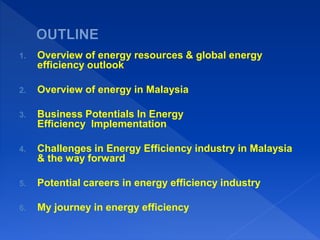
1. OVERVIEW OF ENERGY & ENERGY EFFICIENCY
2. INTRODUCTION TO ENERGY SERVICE INDUSTRY
3. BUSINESS POTENTIALS IN ENERGY EFFICIENCY
4. POTENTIAL CAREERS IN ENERGY EFFICIENCY
INDUSTRY
5. CHALLENGES IN ENERGY EFFICIENCY INDUSTRY
IN MALAYSIA & THE WAY FORWARD
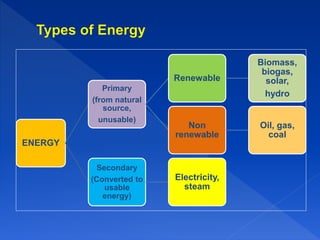
ENERGY
PRIMARY
(FROM
NATURAL
SOURCE,
UNUSABLE)
Renewable
Biomass,
biogas,
solar,
hydro
Non
renewable
Oil, gas,
coal
SECONDARY
(CONVERTED
TO USABLE
ENERGY)
Electricity,
steam
 There is a need to have a dedicated policy on energy efficiency
at the national level &recommended by the study by government
Source: SEDA Malaysia
No clear national policy on
energy efficiency yet
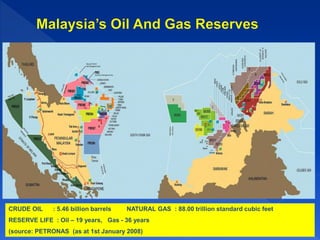
CRUDE OIL : 5.46 billion barrels, NATURAL GAS : 88.00 trillion standard cubic feet
RESERVE LIFE : Oil – 19 years, Gas - 36 years
(source: PETRONAS (as at 1st January 2008)
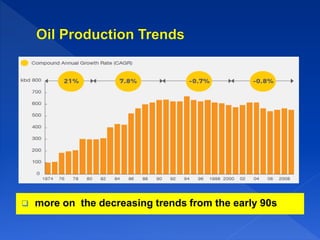
 more on the decreasing trends from the early 90s
Source: PEMANDU
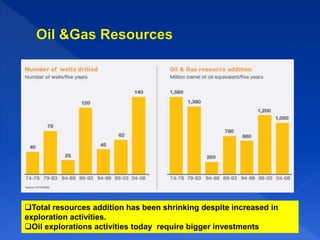
Total resources addition has been shrinking despite
increased in exploration activities.
Oil explorations activities today require bigger investments
Source: PEMANDU
PRIME MINISTER
Ministry of
Internal Trade
& Industry
Licenses for processing
& refining of petroleum
&manufacture of
petrochemical products
Ministry of Domestic
Trade,Cooperative
&Consumerism
Licenses for marketing
& distribution
PETRONAS
Ownership,
management
&control of oil & gas
resources &activities
Through Petroleum Development Act of 1974 & Petroleum Regulations of 1974 (amended in 1975 &1981)
Structure of Authorities in Electricity Sector
 Refer to the right agencies on issues related to electricity based
on their scope of authorities and functions
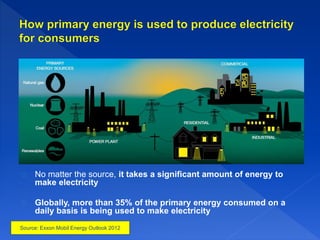
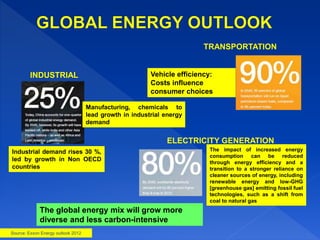
 No matter the source, it takes a significant amount of energy to
make electricity
 Globally, more than 35% of the primary energy consumed on a
daily basis is being used to make electricity
Source: Exxon Mobil Energy Outlook 2012
Source: IEA
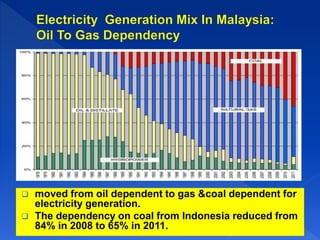
 moved from oil dependent to gas &coal dependent for
electricity generation.
 The dependency on coal from Indonesia reduced from 84%
in 2008 to 65% in 2011.
Source: Energy Commission
The reserve margin for 2013 is 31%
•an installed capacity of 21,749 MW
•a peak demand of 16,562 MW
•a minimum reserve margin of
25% would be required
source: National Energy Security Forum 2012
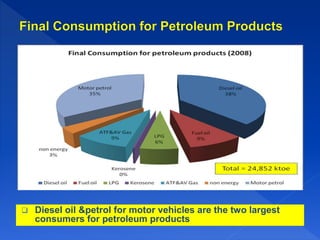
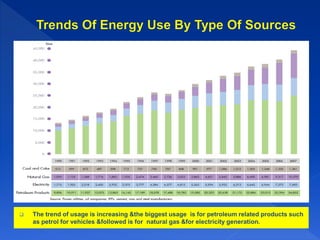
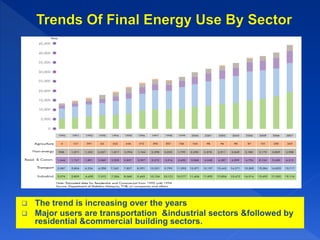
 The trend of usage is increasing &the biggest usage is for
petroleum related products such as petrol for vehicles &followed
is for natural gas &for electricity generation
Source: National Energy Balance 2012
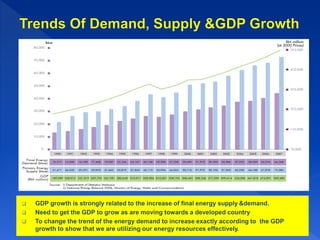
 GDP growth is strongly related to the increase of final energy supply &demand.
 Need to get the GDP to grow as are moving towards a developed country
 To change the trend of the energy demand to increase exactly according to the GDP growth
to show that we are not utilizing our energy resources effectively.
Source: National Energy Balance 2012
Source: Energy Commission
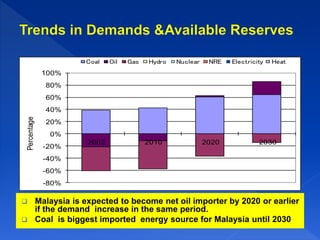
 Malaysia is expected to become net oil importer by 2020 or
earlier if the demand increase in the same period.
 Coal is biggest imported energy source for Malaysia until 2030
-80%
-60%
-40%
-20%
0%
20%
40%
60%
80%
100%
2002 2010 2020 2030
Percentage
Coal Oil Gas Hydro Nuclear NRE Electricity Heat
Source: APERC 2006
The Prime Minister has announced in January 2015
that Malaysia is already a net importer of petroleum
 Energy demand projected to increase from 2,000 PJ(2009) to 4,013
PJ(2030), average rate of 3.6% /year
 Short term &long term measures that can be taken is through EE
initiatives while working on looking for new energy sources (RE&
alternative energy)
To balance and reduce the supply and
demand gap
Source:
EPU,2011
WE NEED
TO CREATE
THE EE
LINE!
TO QUANTIFY!
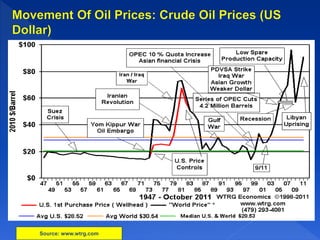
 World oil price is directly affected by major events or crisis in the
world
 Will affect by supply quantity & demand from energy users.
Source: www.wtrg.com
 For the policy makers, regulators, utility suppliers &users is
the need to address impacts on energy costs
&environment with the distortion in energy pricing from
efficient use of energy among intensive energy users
0
10
20
30
40
50
60
70
80
90
100
January
08
February 08
March
08
April 08
May
08
June
08
July 08
August 08
Septem
ber 08
October 08
Novem
ber 08
December 08
January
09
February 09
March
09
April 09
Price(RM/MMBtu)
INDUSTRIAL DIESEL
GMSB WEIGHTED AVERAGE TARIFF
INDUSTRIAL LPG
INDUSTRIAL MFO
63% discount
53% discount
67% discount
72% discount
70% discount
63% discount
RM22.06/MMBtu
RM15.00/MMBtu
RM12.87/MMBtu
GAS PRICE TO POWER SECTOR RM6.40/MMBtu
RM14.31/MMBtu
RM10.50/MMBtu
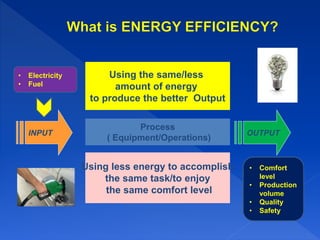
Using the same/less
amount of energy
to produce the better Output
Using less energy
to accomplish
the same task/to enjoy
the same comfort level
Process
( Equipment/Operations)
INPUT OUTPUT
• Comfort
level
• Production
volume
• Quality
• Safety
• Electricity
• Fuel
….but how
Malaysia has
been doing it?
….we MUST
CHANGE THIS!
SUMBER BAHAN API
MAKIN TERHAD &
AKAN HABIS
Keperluan semakin meningkat
(Pertambahan penduduk,peralatan & kenderaan)
Persaingan mendapatkan bekalan & sumber tenaga semakin sengit
(dalam negara & antara negara)
Harga bahan api semakin tinggi/mahal di pasaran tempatan
& global
Kos penjanaan/carigali, penghantaran & pengagihan bekala
elektrik meningkat
KADAR TARIF/BIL
ELEKTRIK MENINGKAT
Kos barang
keperluan
Kos operasi
syarikat
Kos
pengangkutan
KRISIS!!!
Jika tenaga tidak
diuruskan dan
digunakan dengan
cekap
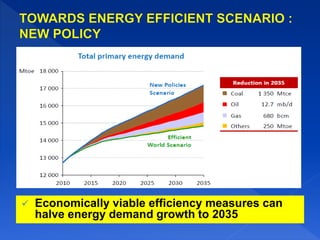
 Economically viable efficiency measures can
halve energy demand growth to 2035
Source: IEA
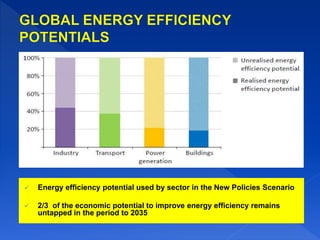
 Energy efficiency potential used by sector in the New Policies Scenario
 2/3 of the economic potential to improve energy efficiency remains
untapped in the period to 2035
Source: IEA
1,327
1,273
1,192
1,101 1,101
1,059 1,059
1,000
978
951
1,036
1,013
1,013
985
1,049
1,091
1,051
1,0701,077
1,037
1,044
1,021
1,059
1,036
1,038
1,050
1,131
1,142
1,345
1,405
1,467
1,566
1,573
1,438
900
1,000
1,100
1,200
1,300
1,400
1,500
1,600
1,700
'73
'75
'77
'79
'81
'83
'85
'87
'89
'91
'93
'95
'97
'99
'01
'03
'05
Fiscal Year
Primaryenergyconsumption/GDP
Ton oil eq.
/ Billion yen
2nd Oil Crisis
1st Oil Crisis
Source: METI/General Energy Statistics
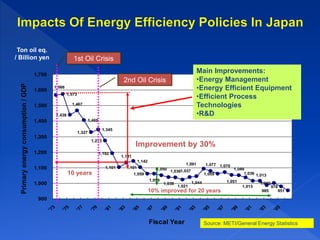
10 years
Improvement by 30%
10% improved for 20 years
Main Improvements:
•Energy Management
•Energy Efficient Equipment
•Efficient Processes
Technologies
•R&D
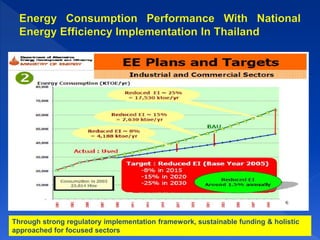
Through strong regulatory implementation framework, sustainable funding & holistic
approach for focused sectors
Source: American Council for an Energy Efficient Economy(ACEEE)
 An Energy Service Company(ESCO)
 Develop and implement turnkey, comprehensive energy
efficiency projects
 ESCOs offer performance-based contracts (i.e., contracts that tie
the compensation of the ESCO to the energy savings generated
by the project) as a significant part of their business
 To ensure credentials, ESCOs must demonstrate the
technical & managerial competencies to design &
implement projects involving multiple technologies :
 Lighting
 Motors & Drives
 Heating & steam systems
 HVAC Systems
 Control Systems
 Maximum Demand Controls
 Building Envelope Improvements
…at building/industrial facilities
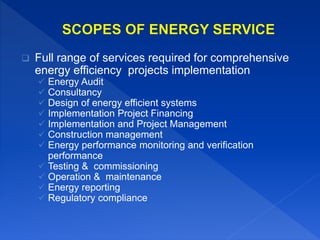
Consultancy & Advisory
Design & Development Of Energy Efficient
Systems/Technologies
Financing & Purchasing
Implementation & Project Management
Construction Management
Energy Performance Targeting, Monitoring &
Verification
Testing & Commissioning
Operation & Maintenance
Energy Analysis &Reporting
Regulatory Compliance
Standards & Ratings
 Registered in
September 2000 n
conjunction with the
launching of the
Malaysian Industrial
Energy Efficiency
Improvement Project
(MIEEIP) by the
Government-UNDP
OBJECTIVES
 To develop recognized ESCO businesses in
collaboration with Government & private
sectors.
 To actively promote the activity of cost
reduction and efficiency standards of the
industrial and commercial sector
 To oversee the well being of it’s members
 To facilitate and do all things necessary
towards developing successful energy
related projects.
 To introduce related products and services
for the industry
 To foster healthy co-existence amongst
members through ethical professional
practices
 Ensure quality of services by members
 Energy Management
Training Courses for Energy
Managers
 Producing guidelines &
provide advisory in services
delivery
 Awareness & promotional
programs
 Provide inputs on EE industry
to the Government with
other Stakeholders
 Rental of Equipment for
energy audit and M&V
Elected Committee Members(2014 /2016)
President
Ar. Zulkifli b. Zahari
Vice President, Policies & Int. Liaison
Ir. Ong Ching Loon
Honorary Secretary &
Historian
VTR Dharamarajah
Honorary Advisor / Internal
Auditor
Ir. Dr. KS Kannan
Business
Development
Ir. Phang Chen
Faut
Training
Mohd Iskandar
b. Majidi
Green Technology
Kevin Yap
Publicity &
Promotions
Ir. Kumarason S
Kandiah
Government
Liaison
Ahmad Zaky
b. Mohd Amin
Internal Auditor
Khairol Nizam
b. Abd Muen
Treasurer &
Finance/Strategic Initiatives
Zaini b. Abdul Wahab
Asst. Honorary Secretary &
Membership and Practice
Koay Keong Tay
Program Coordinator
Anuar b. Mat Saad
Admin / Secretariat
Afiza bt. Mohd Sa’ad
Accountant
Mohd Izzuddin
b. Salahudin
Source: Lawrence Berkeley National Laboratory , National Association
of Energy Service Companies, USA September 2013
Source: Lawrence Berkeley National Laboratory , National Association
of Energy Service Companies, USA September 2013
 Ranked #1 in investment potential &#4 in payback period
due to Malaysia’s lower electricity tariff
 Lagged behind Singapore &Thailand to unavailability of
comprehensive regulatory support
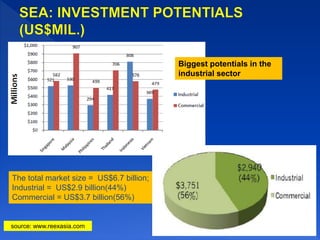
The total market size = US$6.7 billion;
Industrial = US$2.9 billion(44%)
Commercial = US$3.7 billion(56%)
source: www.reexasia.com
Biggest potentials in the industrial
sector
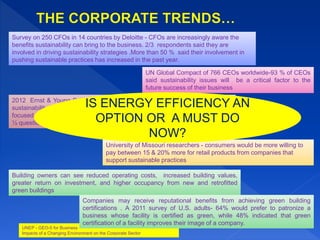
Building owners can see reduced operating costs, increased building
values, greater return on investment, and higher occupancy from new and
retrofitted green buildings
UNEP - GEO-5 for Business
Impacts of a Changing Environment on the Corporate Sector
Companies may receive reputational benefits from achieving green building
certifications . A 2011 survey of U.S. adults- 64% would prefer to patronize a
business whose facility is certified as green, while 48% indicated that green
certification of a facility improves their image of a company.
University of Missouri researchers - consumers would be more
willing to pay between 15 & 20% more for retail products from
companies that support sustainable practices
UN Global Compact of 766 CEOs worldwide-93 % of
CEOs said sustainability issues will be a critical factor
to the future success of their business
2012 Ernst & Young Survey – 66% of executives saw an increased amount
of sustainability-related inquiries from investors in the past year. 70%
inquiries focused on energy management and greenhouse gas emissions
& more than ½ questions about sustainability reporting
Survey on 250 CFOs in 14 countries by Deloitte - CFOs are increasingly aware the
benefits sustainability can bring to the business. 2/3 respondents said they are
involved in driving sustainability strategies .More than 50 % said their
involvement in pushing sustainable practices has increased in the past year.
IS ENERGY EFFICIENCY AN
OPTION OR A MUST DO NOW?
160 companies - 60% of Ireland’s industrial energy use
2% improvement in energy performance per year
Long-term members - have improved energy
performance by 33% (1995 and 2010)
Energy Management Standard helps up to €150m in
avoided energy costs (2005-10)
44
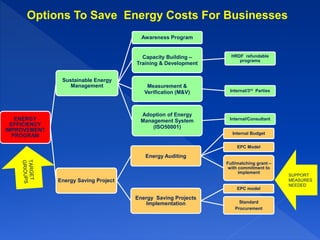
ENERGY
EFFICIENCY
IMPROVEMENT
PROGRAM
Sustainable Energy
Management
Awareness Program
Capacity Building –
Training & Development
HRDF refundable
programs
Measurement &
Verification (M&V) Internal/3rd Parties
Adoption of Energy
Management System
(ISO50001)
Internal/Consultant
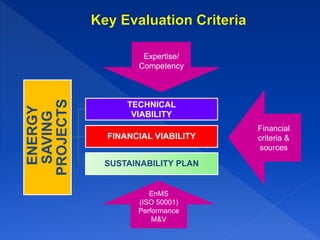
Energy Saving Project
Energy Auditing
Internal Budget
EPC Model
Full/matching grant –
with commitment to
implement
Energy Saving Projects
Implementation
EPC model
Standard
Procurement
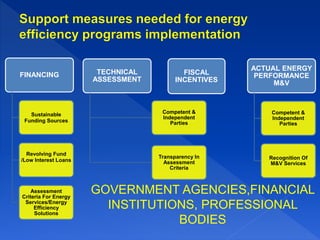
SUPPORT
MEASURES
NEEDED
OPTIONS TO SAVE ENERGY COSTS
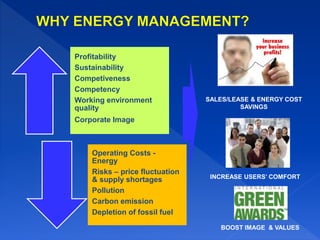
Profitability
Sustainability
Competiveness
Competency
Working environment
quality
Corporate Image
Operating Costs -
Energy
Risks – price fluctuation
& supply shortages
Pollution
Carbon emission
Depletion of fossil fuel
INCREASE USERS’ COMFORT
SALES & ENERGY COST SAVINGS
BOOST IMAGE & VALUES
 One of management resources of an
organization
 Required due to its influence to operation
and activities
All activities to ensure
efficient use of energy
in the organization
 The process of
managing the energy
use in the
organization
 to ensure that energy
has been efficiently
use
 adopting energy
management system
 to achieve desired
results and for
continual
improvement
 Covers all aspects of
energy
 the people
 the equipment
in the daily operation of
the facilities
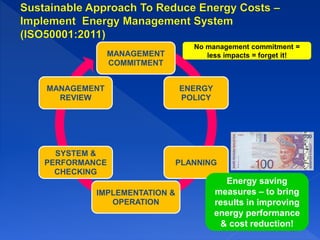
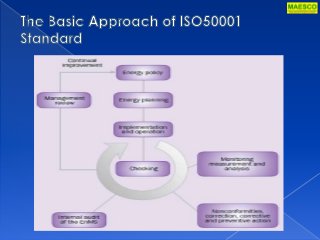
MANAGEMENT
COMMITMENT
ENERGY
POLICY
PLANNING
IMPLEMENTATION &
OPERATION
SYSTEM &
PERFORMANCE
CHECKING
MANAGEMENT
REVIEW
Energy saving
measures – to bring
results in improving
energy performance
& cost reduction!
 To embrace EnMS among all employees at all levels
from the beginning
› Inclusiveness through capacity building & awareness
 Integrating existing good practices & other
Management Systems
 The use of a single updating point & reference for
EnMS implementation in long term
› Defined responsibilities in the system
› Continuous energy review, planning & performance
monitoring
› Updated document controls & reviews
 User friendly & replicable system for all facilities
› Concurrently & future
 Standardization in the field of energy management, including:
• energy supply
• procurement practices for energy using equipment and
systems
• energy use, and any use-related disposal issues
 Also address
 measurement of current energy usage
 implementation of a measurement system to document,
report
 validate continual improvement in the area of energy
management
 Will provide organizations with
 technical and management strategies to increase
energy efficiency, reduce costs, & improve
environmental performance
 a recognized framework for integrating energy
efficiency into their management practices.
 An access to a single, harmonized standard for
implementation across the organization
…..with a logical and consistent methodology for
identifying & implementing improvements
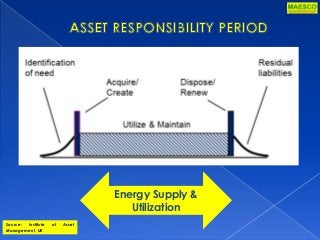
Energy Supply &
Utilization
Source: Institute of Asset
Management, UK
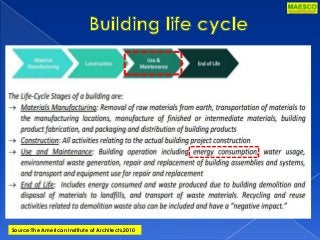
Source:The American Institute of Architects,2010
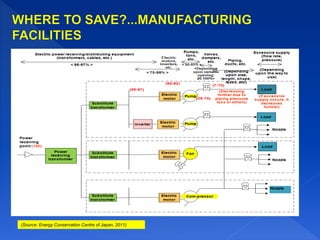
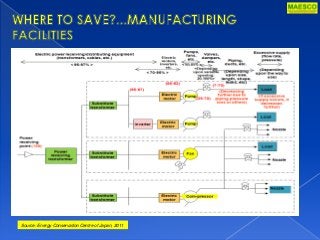
Source: Energy Conservation Centre of Japan, 2011
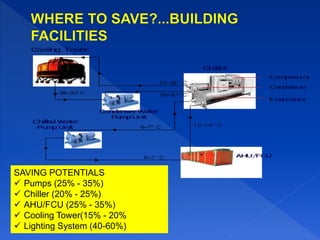
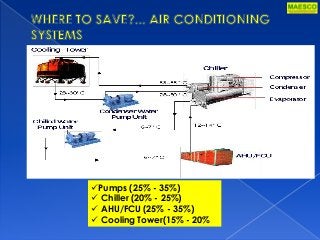
Pumps (25% - 35%)
 Chiller (20% - 25%)
 AHU/FCU (25% - 35%)
 Cooling Tower(15% - 20%
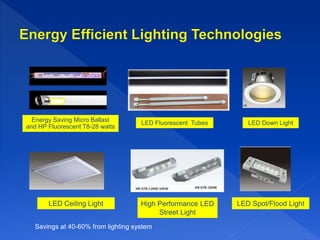
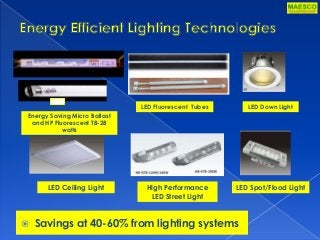
 Savings at 40-60% from lighting systems
Energy Saving Micro Ballast
and HP Fluorescent T8-28
watts
LED Fluorescent Tubes LED Down Light
LED Ceiling Light High Performance
LED Street Light
LED Spot/Flood Light
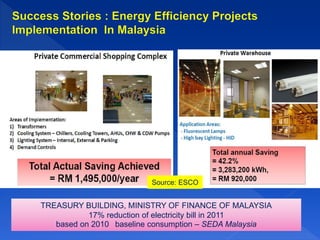
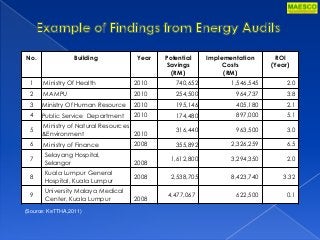
No. Building Year Potential
Savings
(RM)
Implementation
Costs
(RM)
ROI
(Year)
1 Ministry Of Health 2010 740,652 1,546,545 2.0
2 MAMPU 2010 254,500 964,737 3.8
3 Ministry Of Human Resource 2010 195,146 405,180 2.1
4 Public Service Department 2010 174,480 897,000 5.1
5
Ministry of Natural Resources
&Environment 2010
316,440 963,500 3.0
6 Ministry of Finance 2008 355,892 2,326,259 6.5
7
Selayang Hospital,
Selangor 2008
1,612,800 3,294,350 2.0
8
Kuala Lumpur General
Hospital, Kuala Lumpur
2008 2,538,705 8,423,740 3.32
9
University Malaya Medical
Center, Kuala Lumpur 2008
4,477,067 622,500 0.1
(Source: KeTTHA,2011)
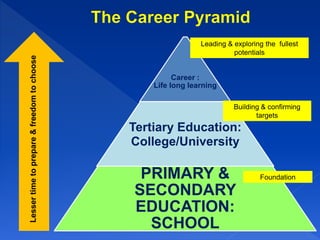
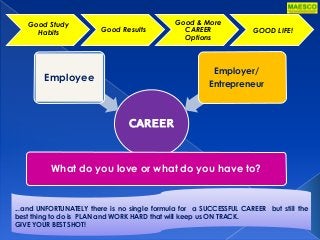
Career :
Life long learning
Tertiary Education:
College/University
PRIMARY &
SECONDARY
EDUCATION: SCHOOL
Lessertimetoprepare&freedomtochoose
Building
Foundation
Building & confirming
targets
Leading & exploring the fullest
potentials
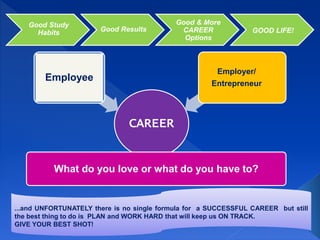
Good Study
Habits Good Results
Good & More
CAREER
Options
GOOD LIFE!
...and UNFORTUNATELY there is no single formula for a SUCCESSFUL CAREER but still the
best thing to do is PLAN and WORK HARD that will keep us ON TRACK.
GIVE YOUR BEST SHOT!
CAREER
Employee
Employer/
Entrepreneur
What do you love or what do you have to?
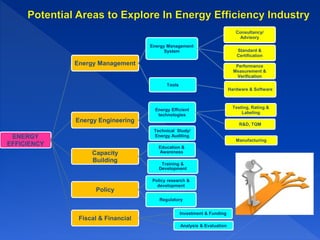
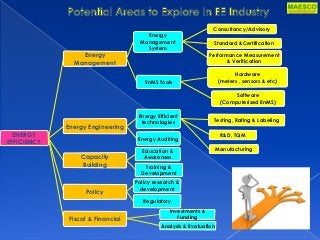
ENERGY
EFFICIENCY
Energy
Management
Energy
Management
System
Consultancy/Advisory
Standard &Certification
Performance Measurement
& Verification
EnMS Tools
Hardware
(meters , sensors & etc)
Software
(Computerized EnMS)
Energy Engineering
Energy Efficient
technologies Testing, Rating & Labeling
R&D, TQM
Manufacturing
Energy Auditing
Capacity
Building
Education &
Awareness
Training &
Development
Policy
Policy research &
development
Regulatory
Fiscal & Financial
Investments &
Funding
Analysis & Evaluation
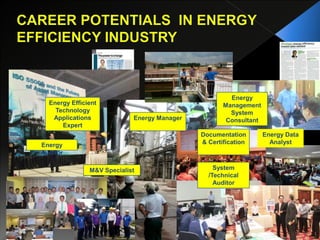
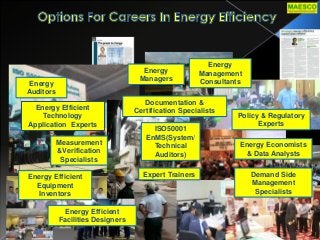
Energy
Auditors
Energy Efficient
Technology
Application Experts
Measurement
&Verification
Specialists
Energy Efficient
Equipment
Inventors
Energy Efficient
Facilities Designers
Energy Economists
& Data Analysts
Policy & Regulatory
Experts
Demand Side
Management
Specialists
Energy
Managers
Energy
Management
Consultants
Documentation &
Certification Specialists
ISO50001
EnMS(System/
Technical
Auditors)
Expert Trainers
Challenges in Energy Efficiency industry
in Malaysia & the way forward
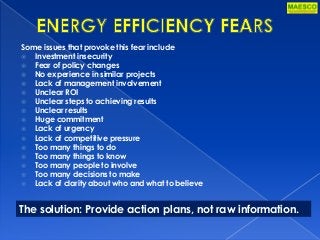
Some issues that provoke this fear include
 Investment insecurity
 Fear of policy changes
 No experience in similar projects
 Lack of management involvement
 Unclear ROI
 Unclear steps to achieving results
 Unclear results
 Huge commitment
 Lack of urgency
 Lack of competitive pressure
 Too many things to do
 Too many things to know
 Too many people to involve
 Too many decisions to make
 Lack of clarity about who and what to believe
The solution: Provide action plans, not raw information.
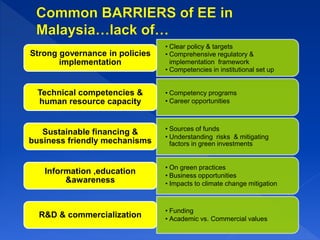
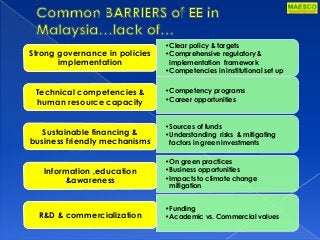
•Clear policy & targets
•Comprehensive regulatory &
implementation framework
•Competencies in institutional set up
Strong governance in policies
implementation
•Competency programs
•Career opportunities
Technical competencies &
human resource capacity
•Sources of funds
•Understanding risks & mitigating
factors in green investments
Sustainable financing &
business friendly mechanisms
•On green practices
•Business opportunities
•Impacts to climate change
mitigation
Information ,education
&awareness
•Funding
•Academic vs. Commercial valuesR&D & commercialization
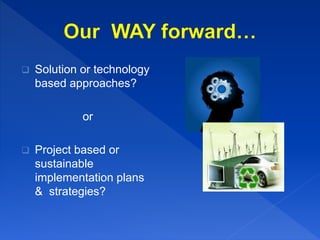
 Solution or technology
based approaches?
or
 Project based or
sustainable
implementation plans
& strategies?
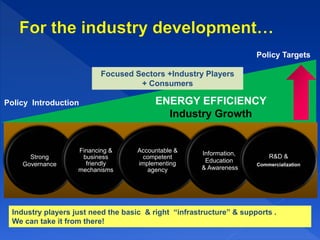
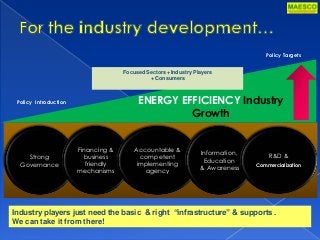
Strong
Governance
Financing &
business
friendly
mechanisms
Accountable &
competent
implementing
agency
Information,
Education
& Awareness
R&D &
Commercialization
ENERGY EFFICIENCY Industry
Growth
Policy Targets
Policy Introduction
Focused Sectors +Industry Players
+ Consumers
Industry players just need the basic & right “infrastructure” & supports .
We can take it from there!
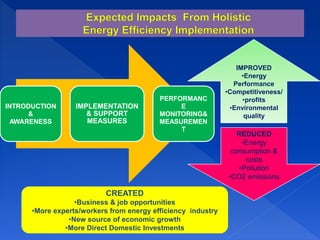
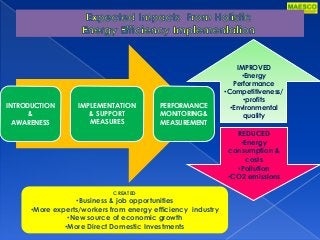
INTRODUCTION
&
AWARENESS
IMPLEMENTATION
& SUPPORT
MEASURES
PERFORMANCE
MONITORING&
MEASUREMENT
IMPROVED
•Energy
Performance
•Competitiveness/
•profits
•Environmental
quality
REDUCED
•Energy
consumption &
costs
•Pollution
•CO2 emissions
CREATED
•Business & job opportunities
•More experts/workers from energy efficiency industry
•New source of economic growth
•More Direct Domestic Investments
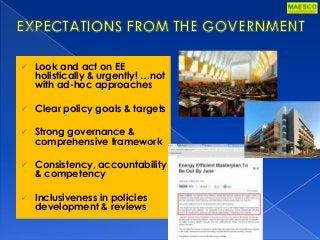
 Look and act on EE
holistically & urgently! …not
with ad-hoc approaches
 Clear policy goals & targets
 Strong governance &
comprehensive framework
 Consistency, accountability
& competency
 Inclusiveness in policies
development & reviews
WHAT ROLES YOU WOULD LIKE TO PLAY FOR
ENERGY EFFICIENCY FOR YOUR OWN
FUTURE?
THANK YOU &
GOOD LUCK!

Introduction to energy efficiency industry to Malaysian universities students

  • 1.
    Awareness Program ForMalaysian Universities
  • 2.
    1. OVERVIEW OFENERGY & ENERGY EFFICIENCY 2. INTRODUCTION TO ENERGY SERVICE INDUSTRY 3. BUSINESS POTENTIALS IN ENERGY EFFICIENCY 4. POTENTIAL CAREERS IN ENERGY EFFICIENCY INDUSTRY 5. CHALLENGES IN ENERGY EFFICIENCY INDUSTRY IN MALAYSIA & THE WAY FORWARD
  • 4.
  • 6.
     There isa need to have a dedicated policy on energy efficiency at the national level &recommended by the study by government Source: SEDA Malaysia No clear national policy on energy efficiency yet
  • 7.
    CRUDE OIL :5.46 billion barrels, NATURAL GAS : 88.00 trillion standard cubic feet RESERVE LIFE : Oil – 19 years, Gas - 36 years (source: PETRONAS (as at 1st January 2008)
  • 8.
     more onthe decreasing trends from the early 90s Source: PEMANDU
  • 9.
    Total resources additionhas been shrinking despite increased in exploration activities. Oil explorations activities today require bigger investments Source: PEMANDU
  • 10.
    PRIME MINISTER Ministry of InternalTrade & Industry Licenses for processing & refining of petroleum &manufacture of petrochemical products Ministry of Domestic Trade,Cooperative &Consumerism Licenses for marketing & distribution PETRONAS Ownership, management &control of oil & gas resources &activities Through Petroleum Development Act of 1974 & Petroleum Regulations of 1974 (amended in 1975 &1981)
  • 11.
    Structure of Authoritiesin Electricity Sector  Refer to the right agencies on issues related to electricity based on their scope of authorities and functions
  • 12.
     No matterthe source, it takes a significant amount of energy to make electricity  Globally, more than 35% of the primary energy consumed on a daily basis is being used to make electricity Source: Exxon Mobil Energy Outlook 2012
  • 13.
  • 14.
     moved fromoil dependent to gas &coal dependent for electricity generation.  The dependency on coal from Indonesia reduced from 84% in 2008 to 65% in 2011. Source: Energy Commission The reserve margin for 2013 is 31% •an installed capacity of 21,749 MW •a peak demand of 16,562 MW •a minimum reserve margin of 25% would be required
  • 15.
    source: National EnergySecurity Forum 2012
  • 16.
     The trendof usage is increasing &the biggest usage is for petroleum related products such as petrol for vehicles &followed is for natural gas &for electricity generation Source: National Energy Balance 2012
  • 17.
     GDP growthis strongly related to the increase of final energy supply &demand.  Need to get the GDP to grow as are moving towards a developed country  To change the trend of the energy demand to increase exactly according to the GDP growth to show that we are not utilizing our energy resources effectively. Source: National Energy Balance 2012
  • 18.
  • 19.
     Malaysia isexpected to become net oil importer by 2020 or earlier if the demand increase in the same period.  Coal is biggest imported energy source for Malaysia until 2030 -80% -60% -40% -20% 0% 20% 40% 60% 80% 100% 2002 2010 2020 2030 Percentage Coal Oil Gas Hydro Nuclear NRE Electricity Heat Source: APERC 2006 The Prime Minister has announced in January 2015 that Malaysia is already a net importer of petroleum
  • 20.
     Energy demandprojected to increase from 2,000 PJ(2009) to 4,013 PJ(2030), average rate of 3.6% /year  Short term &long term measures that can be taken is through EE initiatives while working on looking for new energy sources (RE& alternative energy) To balance and reduce the supply and demand gap Source: EPU,2011 WE NEED TO CREATE THE EE LINE! TO QUANTIFY!
  • 21.
     World oilprice is directly affected by major events or crisis in the world  Will affect by supply quantity & demand from energy users. Source: www.wtrg.com
  • 23.
     For thepolicy makers, regulators, utility suppliers &users is the need to address impacts on energy costs &environment with the distortion in energy pricing from efficient use of energy among intensive energy users 0 10 20 30 40 50 60 70 80 90 100 January 08 February 08 March 08 April 08 May 08 June 08 July 08 August 08 Septem ber 08 October 08 Novem ber 08 December 08 January 09 February 09 March 09 April 09 Price(RM/MMBtu) INDUSTRIAL DIESEL GMSB WEIGHTED AVERAGE TARIFF INDUSTRIAL LPG INDUSTRIAL MFO 63% discount 53% discount 67% discount 72% discount 70% discount 63% discount RM22.06/MMBtu RM15.00/MMBtu RM12.87/MMBtu GAS PRICE TO POWER SECTOR RM6.40/MMBtu RM14.31/MMBtu RM10.50/MMBtu
  • 24.
    Using the same/less amountof energy to produce the better Output Using less energy to accomplish the same task/to enjoy the same comfort level Process ( Equipment/Operations) INPUT OUTPUT • Comfort level • Production volume • Quality • Safety • Electricity • Fuel
  • 25.
    ….but how Malaysia has beendoing it? ….we MUST CHANGE THIS!
  • 26.
    SUMBER BAHAN API MAKINTERHAD & AKAN HABIS Keperluan semakin meningkat (Pertambahan penduduk,peralatan & kenderaan) Persaingan mendapatkan bekalan & sumber tenaga semakin sengit (dalam negara & antara negara) Harga bahan api semakin tinggi/mahal di pasaran tempatan & global Kos penjanaan/carigali, penghantaran & pengagihan bekala elektrik meningkat KADAR TARIF/BIL ELEKTRIK MENINGKAT Kos barang keperluan Kos operasi syarikat Kos pengangkutan KRISIS!!! Jika tenaga tidak diuruskan dan digunakan dengan cekap
  • 27.
     Economically viableefficiency measures can halve energy demand growth to 2035 Source: IEA
  • 28.
     Energy efficiencypotential used by sector in the New Policies Scenario  2/3 of the economic potential to improve energy efficiency remains untapped in the period to 2035 Source: IEA
  • 29.
    1,327 1,273 1,192 1,101 1,101 1,059 1,059 1,000 978 951 1,036 1,013 1,013 985 1,049 1,091 1,051 1,0701,077 1,037 1,044 1,021 1,059 1,036 1,038 1,050 1,131 1,142 1,345 1,405 1,467 1,566 1,573 1,438 900 1,000 1,100 1,200 1,300 1,400 1,500 1,600 1,700 '73 '75 '77 '79 '81 '83 '85 '87 '89 '91 '93 '95 '97 '99 '01 '03 '05 FiscalYear Primaryenergyconsumption/GDP Ton oil eq. / Billion yen 2nd Oil Crisis 1st Oil Crisis Source: METI/General Energy Statistics 10 years Improvement by 30% 10% improved for 20 years Main Improvements: •Energy Management •Energy Efficient Equipment •Efficient Processes Technologies •R&D
  • 30.
    Through strong regulatoryimplementation framework, sustainable funding & holistic approach for focused sectors
  • 31.
    Source: American Councilfor an Energy Efficient Economy(ACEEE)
  • 33.
     An EnergyService Company(ESCO)  Develop and implement turnkey, comprehensive energy efficiency projects  ESCOs offer performance-based contracts (i.e., contracts that tie the compensation of the ESCO to the energy savings generated by the project) as a significant part of their business  To ensure credentials, ESCOs must demonstrate the technical & managerial competencies to design & implement projects involving multiple technologies :  Lighting  Motors & Drives  Heating & steam systems  HVAC Systems  Control Systems  Maximum Demand Controls  Building Envelope Improvements …at building/industrial facilities
  • 34.
    Consultancy & Advisory Design& Development Of Energy Efficient Systems/Technologies Financing & Purchasing Implementation & Project Management Construction Management Energy Performance Targeting, Monitoring & Verification Testing & Commissioning Operation & Maintenance Energy Analysis &Reporting Regulatory Compliance Standards & Ratings
  • 35.
     Registered in September2000 n conjunction with the launching of the Malaysian Industrial Energy Efficiency Improvement Project (MIEEIP) by the Government-UNDP OBJECTIVES  To develop recognized ESCO businesses in collaboration with Government & private sectors.  To actively promote the activity of cost reduction and efficiency standards of the industrial and commercial sector  To oversee the well being of it’s members  To facilitate and do all things necessary towards developing successful energy related projects.  To introduce related products and services for the industry  To foster healthy co-existence amongst members through ethical professional practices  Ensure quality of services by members
  • 36.
     Energy Management TrainingCourses for Energy Managers  Producing guidelines & provide advisory in services delivery  Awareness & promotional programs  Provide inputs on EE industry to the Government with other Stakeholders  Rental of Equipment for energy audit and M&V
  • 37.
    Elected Committee Members(2014/2016) President Ar. Zulkifli b. Zahari Vice President, Policies & Int. Liaison Ir. Ong Ching Loon Honorary Secretary & Historian VTR Dharamarajah Honorary Advisor / Internal Auditor Ir. Dr. KS Kannan Business Development Ir. Phang Chen Faut Training Mohd Iskandar b. Majidi Green Technology Kevin Yap Publicity & Promotions Ir. Kumarason S Kandiah Government Liaison Ahmad Zaky b. Mohd Amin Internal Auditor Khairol Nizam b. Abd Muen Treasurer & Finance/Strategic Initiatives Zaini b. Abdul Wahab Asst. Honorary Secretary & Membership and Practice Koay Keong Tay Program Coordinator Anuar b. Mat Saad Admin / Secretariat Afiza bt. Mohd Sa’ad Accountant Mohd Izzuddin b. Salahudin
  • 38.
    Source: Lawrence BerkeleyNational Laboratory , National Association of Energy Service Companies, USA September 2013
  • 39.
    Source: Lawrence BerkeleyNational Laboratory , National Association of Energy Service Companies, USA September 2013
  • 40.
     Ranked #1in investment potential &#4 in payback period due to Malaysia’s lower electricity tariff  Lagged behind Singapore &Thailand to unavailability of comprehensive regulatory support
  • 41.
    The total marketsize = US$6.7 billion; Industrial = US$2.9 billion(44%) Commercial = US$3.7 billion(56%) source: www.reexasia.com Biggest potentials in the industrial sector
  • 43.
    Building owners cansee reduced operating costs, increased building values, greater return on investment, and higher occupancy from new and retrofitted green buildings UNEP - GEO-5 for Business Impacts of a Changing Environment on the Corporate Sector Companies may receive reputational benefits from achieving green building certifications . A 2011 survey of U.S. adults- 64% would prefer to patronize a business whose facility is certified as green, while 48% indicated that green certification of a facility improves their image of a company. University of Missouri researchers - consumers would be more willing to pay between 15 & 20% more for retail products from companies that support sustainable practices UN Global Compact of 766 CEOs worldwide-93 % of CEOs said sustainability issues will be a critical factor to the future success of their business 2012 Ernst & Young Survey – 66% of executives saw an increased amount of sustainability-related inquiries from investors in the past year. 70% inquiries focused on energy management and greenhouse gas emissions & more than ½ questions about sustainability reporting Survey on 250 CFOs in 14 countries by Deloitte - CFOs are increasingly aware the benefits sustainability can bring to the business. 2/3 respondents said they are involved in driving sustainability strategies .More than 50 % said their involvement in pushing sustainable practices has increased in the past year. IS ENERGY EFFICIENCY AN OPTION OR A MUST DO NOW?
  • 44.
    160 companies -60% of Ireland’s industrial energy use 2% improvement in energy performance per year Long-term members - have improved energy performance by 33% (1995 and 2010) Energy Management Standard helps up to €150m in avoided energy costs (2005-10) 44
  • 45.
    ENERGY EFFICIENCY IMPROVEMENT PROGRAM Sustainable Energy Management Awareness Program CapacityBuilding – Training & Development HRDF refundable programs Measurement & Verification (M&V) Internal/3rd Parties Adoption of Energy Management System (ISO50001) Internal/Consultant Energy Saving Project Energy Auditing Internal Budget EPC Model Full/matching grant – with commitment to implement Energy Saving Projects Implementation EPC model Standard Procurement SUPPORT MEASURES NEEDED OPTIONS TO SAVE ENERGY COSTS
  • 47.
    Profitability Sustainability Competiveness Competency Working environment quality Corporate Image OperatingCosts - Energy Risks – price fluctuation & supply shortages Pollution Carbon emission Depletion of fossil fuel INCREASE USERS’ COMFORT SALES & ENERGY COST SAVINGS BOOST IMAGE & VALUES
  • 48.
     One ofmanagement resources of an organization  Required due to its influence to operation and activities All activities to ensure efficient use of energy in the organization
  • 49.
     The processof managing the energy use in the organization  to ensure that energy has been efficiently use  adopting energy management system  to achieve desired results and for continual improvement  Covers all aspects of energy  the people  the equipment in the daily operation of the facilities
  • 50.
    MANAGEMENT COMMITMENT ENERGY POLICY PLANNING IMPLEMENTATION & OPERATION SYSTEM & PERFORMANCE CHECKING MANAGEMENT REVIEW Energysaving measures – to bring results in improving energy performance & cost reduction!
  • 51.
     To embraceEnMS among all employees at all levels from the beginning › Inclusiveness through capacity building & awareness  Integrating existing good practices & other Management Systems  The use of a single updating point & reference for EnMS implementation in long term › Defined responsibilities in the system › Continuous energy review, planning & performance monitoring › Updated document controls & reviews  User friendly & replicable system for all facilities › Concurrently & future
  • 53.
     Standardization inthe field of energy management, including: • energy supply • procurement practices for energy using equipment and systems • energy use, and any use-related disposal issues  Also address  measurement of current energy usage  implementation of a measurement system to document, report  validate continual improvement in the area of energy management
  • 54.
     Will provideorganizations with  technical and management strategies to increase energy efficiency, reduce costs, & improve environmental performance  a recognized framework for integrating energy efficiency into their management practices.  An access to a single, harmonized standard for implementation across the organization …..with a logical and consistent methodology for identifying & implementing improvements
  • 57.
    Energy Supply & Utilization Source:Institute of Asset Management, UK
  • 58.
  • 59.
    Source: Energy ConservationCentre of Japan, 2011
  • 60.
    Pumps (25% -35%)  Chiller (20% - 25%)  AHU/FCU (25% - 35%)  Cooling Tower(15% - 20%
  • 61.
     Savings at40-60% from lighting systems Energy Saving Micro Ballast and HP Fluorescent T8-28 watts LED Fluorescent Tubes LED Down Light LED Ceiling Light High Performance LED Street Light LED Spot/Flood Light
  • 62.
    No. Building YearPotential Savings (RM) Implementation Costs (RM) ROI (Year) 1 Ministry Of Health 2010 740,652 1,546,545 2.0 2 MAMPU 2010 254,500 964,737 3.8 3 Ministry Of Human Resource 2010 195,146 405,180 2.1 4 Public Service Department 2010 174,480 897,000 5.1 5 Ministry of Natural Resources &Environment 2010 316,440 963,500 3.0 6 Ministry of Finance 2008 355,892 2,326,259 6.5 7 Selayang Hospital, Selangor 2008 1,612,800 3,294,350 2.0 8 Kuala Lumpur General Hospital, Kuala Lumpur 2008 2,538,705 8,423,740 3.32 9 University Malaya Medical Center, Kuala Lumpur 2008 4,477,067 622,500 0.1 (Source: KeTTHA,2011)
  • 64.
    Career : Life longlearning Tertiary Education: College/University PRIMARY & SECONDARY EDUCATION: SCHOOL Lessertimetoprepare&freedomtochoose Building Foundation Building & confirming targets Leading & exploring the fullest potentials
  • 65.
    Good Study Habits GoodResults Good & More CAREER Options GOOD LIFE! ...and UNFORTUNATELY there is no single formula for a SUCCESSFUL CAREER but still the best thing to do is PLAN and WORK HARD that will keep us ON TRACK. GIVE YOUR BEST SHOT! CAREER Employee Employer/ Entrepreneur What do you love or what do you have to?
  • 66.
    ENERGY EFFICIENCY Energy Management Energy Management System Consultancy/Advisory Standard &Certification Performance Measurement &Verification EnMS Tools Hardware (meters , sensors & etc) Software (Computerized EnMS) Energy Engineering Energy Efficient technologies Testing, Rating & Labeling R&D, TQM Manufacturing Energy Auditing Capacity Building Education & Awareness Training & Development Policy Policy research & development Regulatory Fiscal & Financial Investments & Funding Analysis & Evaluation
  • 67.
    Energy Auditors Energy Efficient Technology Application Experts Measurement &Verification Specialists EnergyEfficient Equipment Inventors Energy Efficient Facilities Designers Energy Economists & Data Analysts Policy & Regulatory Experts Demand Side Management Specialists Energy Managers Energy Management Consultants Documentation & Certification Specialists ISO50001 EnMS(System/ Technical Auditors) Expert Trainers
  • 68.
    Challenges in EnergyEfficiency industry in Malaysia & the way forward
  • 69.
    Some issues thatprovoke this fear include  Investment insecurity  Fear of policy changes  No experience in similar projects  Lack of management involvement  Unclear ROI  Unclear steps to achieving results  Unclear results  Huge commitment  Lack of urgency  Lack of competitive pressure  Too many things to do  Too many things to know  Too many people to involve  Too many decisions to make  Lack of clarity about who and what to believe The solution: Provide action plans, not raw information.
  • 70.
    •Clear policy &targets •Comprehensive regulatory & implementation framework •Competencies in institutional set up Strong governance in policies implementation •Competency programs •Career opportunities Technical competencies & human resource capacity •Sources of funds •Understanding risks & mitigating factors in green investments Sustainable financing & business friendly mechanisms •On green practices •Business opportunities •Impacts to climate change mitigation Information ,education &awareness •Funding •Academic vs. Commercial valuesR&D & commercialization
  • 71.
     Solution ortechnology based approaches? or  Project based or sustainable implementation plans & strategies?
  • 72.
    Strong Governance Financing & business friendly mechanisms Accountable & competent implementing agency Information, Education &Awareness R&D & Commercialization ENERGY EFFICIENCY Industry Growth Policy Targets Policy Introduction Focused Sectors +Industry Players + Consumers Industry players just need the basic & right “infrastructure” & supports . We can take it from there!
  • 73.
    INTRODUCTION & AWARENESS IMPLEMENTATION & SUPPORT MEASURES PERFORMANCE MONITORING& MEASUREMENT IMPROVED •Energy Performance •Competitiveness/ •profits •Environmental quality REDUCED •Energy consumption & costs •Pollution •CO2emissions CREATED •Business & job opportunities •More experts/workers from energy efficiency industry •New source of economic growth •More Direct Domestic Investments
  • 74.
     Look andact on EE holistically & urgently! …not with ad-hoc approaches  Clear policy goals & targets  Strong governance & comprehensive framework  Consistency, accountability & competency  Inclusiveness in policies development & reviews
  • 76.
    WHAT ROLES YOUWOULD LIKE TO PLAY FOR ENERGY EFFICIENCY FOR YOUR OWN FUTURE?
  • 77.

Editor's Notes

  • #7 No clear national policy on energy efficiency yet
  • #15 http://www.themalaysianinsider.com/sideviews/article/reserve-margin-is-31-not-50-abdul-razak-majid
  • #16 http://christopherteh.com/blog/2012/10/electricity-msia-04/
  • #20 The Prime Minister has announced in January 2015 that Malaysia is already a net importer of petroleum
  • #28 Energy efficiency/energy saving is the first fuel-a source of energy instead of the an option in O&M activities. Think about it after we consumed the energy or only when we need it
  • #29 Which is better for utility companies? Managing current assets with maximized and efficient utilization by the demand(users) or Having to add new assets just to me the increasing demands and facing uncertainties on the business outcomes in the regulated market. Example: In Malaysia, tariff increase purely subject to the government’s decision and directly linked to political climate
  • #44 We embrace changes or we will be struggling or out of the business
  • #45 Achievable and proven-
  • #48 So much clear benefits-why are we still holding our actions? Easier to measure and verified? Yes!
  • #51 basic components in energy management system
  • #61 To highlight the potentials to improve asset’s operational & energy performance to increase profitability for service providers and/or facilities owners
  • #74 Look energy management as another business opportunities and for future source growth Energy efficiency as an industry – the future and integral element synchronized in asset management