OVERVIEW OF
NET ENERGY METERING
IN MALAYSIA
OUTLINE
06
Recommended additional
necessary measures that should
be implemented by the
government to boost the success
of the energy efficiency policy
using solar power in Malaysia.
05
Strategies or plans that have
been implemented by the
Malaysian government to
encourage the use of NEM.
04
Barriers that impede
successful implementation
of solar PV and NEM in
Malaysia.
03
Benefits of implementing it for
residential, commercial and
industrial buildings.
02
The mechanism of NEM
using solar panels.
01
Overview of Renewable
Energy Sector and Programs
in Malaysia.
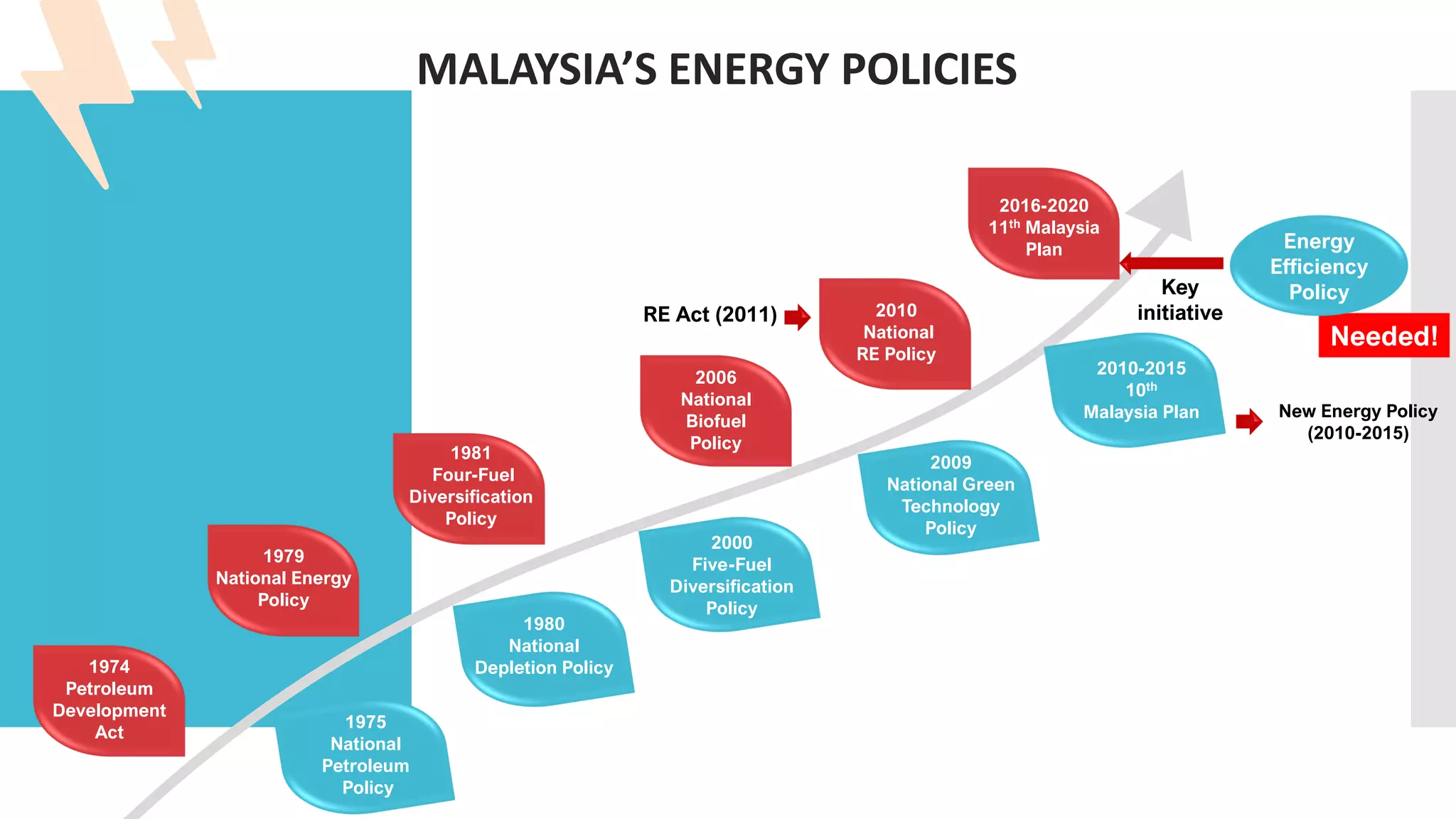
MALAYSIA’S ENERGY POLICIES
03
Content Here
1975
National
Petroleum
Policy
1980
National
Depletion Policy
2000
Five-Fuel
Diversification
Policy
2009
National Green
Technology
Policy
2010-2015
10th
Malaysia Plan
1974
Petroleum
Development
Act
1979
National Energy
Policy
1981
Four-Fuel
Diversification
Policy
2006
National
Biofuel
Policy
2010
National
RE Policy
2016-2020
11th Malaysia
Plan
New Energy Policy
(2010-2015)
RE Act (2011)
Key
initiative
Needed!
Energy
Efficiency
Policy
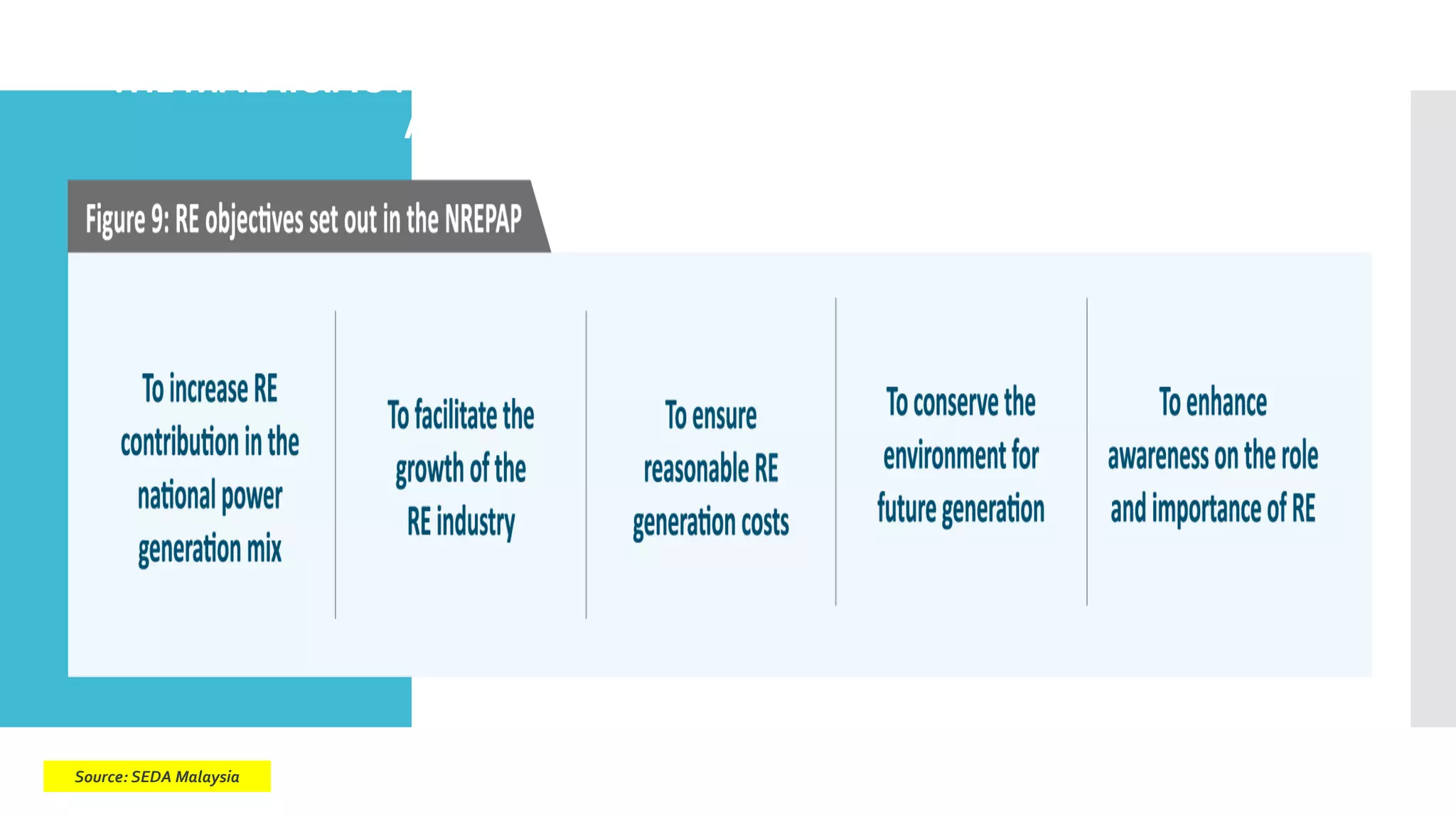
THE MALAYSIA’S NATIONAL RENEWABLE ENERGY POLICY &
ACTION PLAN (NREPAP)
Source: SEDA Malaysia
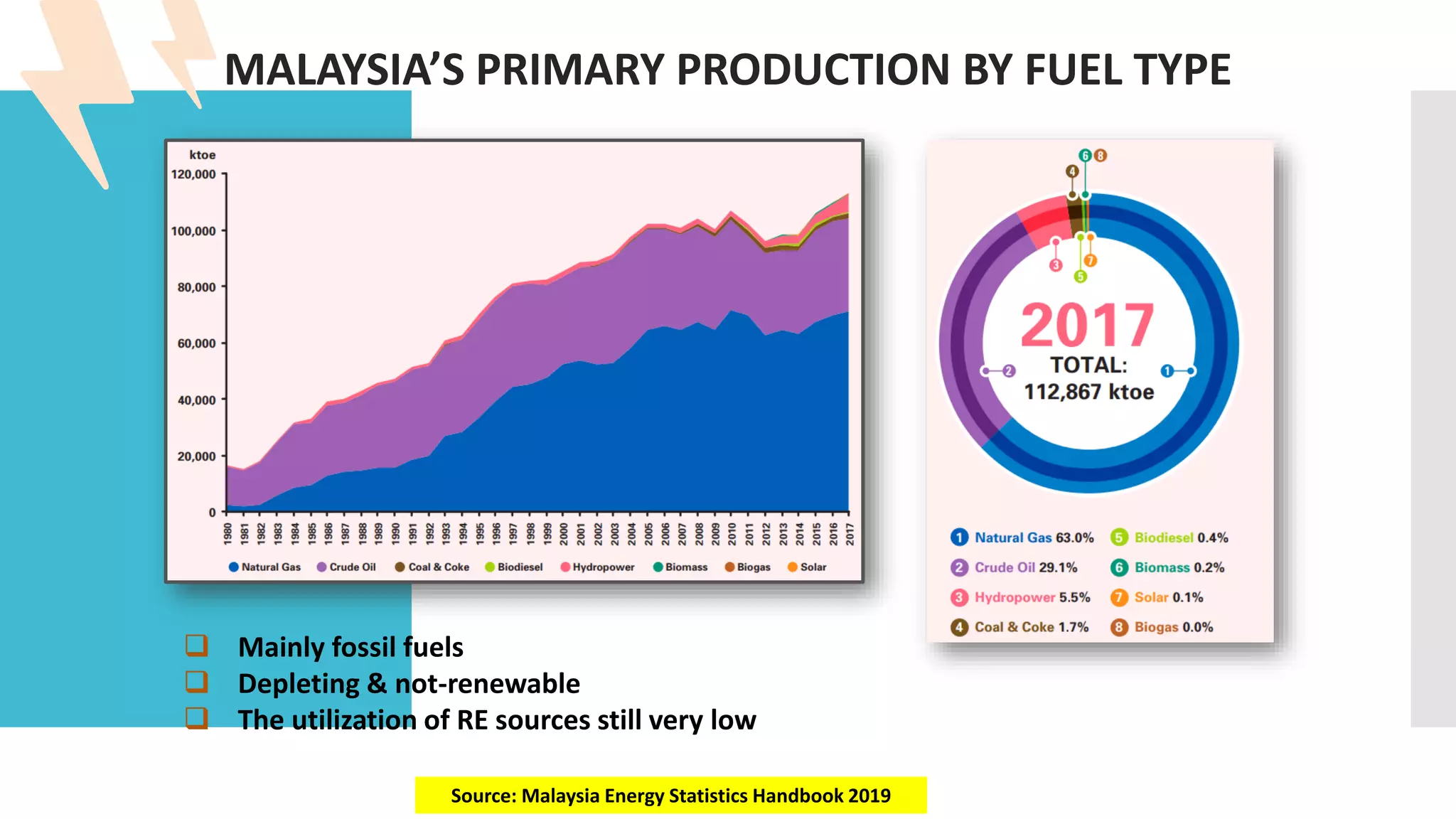
MALAYSIA’S PRIMARY PRODUCTION BY FUEL TYPE
❑ Mainly fossil fuels
❑ Depleting & not-renewable
❑ The utilization of RE sources still very low
Source: Malaysia Energy Statistics Handbook 2019
PERFORMANCE OF RE IN MALAYSIA IN 2016
Source: Energy Commission
The 2016 Performance and Statistical Information on Electricity Supply Industry in Malaysia Report - RE such as
biomass, biogas, solar, and mini hydro had contributed a small share in electricity generation in Malaysia.
EXISTING MALAYSIA’S RE POLICY, TARGETS AND PLANS
FOR ELECTRICITY GENERATION
THE TARGET
Achieving 20% Renewable Energy (RE)
Capacity Mix By 2025
❑Implementing enhanced net energy metering (NEM) and solar leasing
❑Implementing large scale solar programme 3 (lss3)
❑Implementing non-solar RE projects
❑Establishing RE facilitation programmes in sustainable energy development authority Malaysia (SEDA)
❑Enabling greater access to RE sources
HOW?
WRITE YOUR SUBTITLE HERE
RENEWABLE ENERGY PROGRAMS IN MALAYSIA
Graphic Source: SEDA Malaysia
NEM PROGRAM BACKGROUND
The quota allocation for NEM is 500 MW up to year 2020
❑ Quota allocation will be divided into domestic and non-domestic category
Introduced in 2016 under 11th Malaysia Plan (2016 - 2020)
As at 2018 - only 30MW capacity
From 1st January 2019, NEM adopted the true net energy metering concept
❑ Will allow excess solar PV generated energy to be exported back to the grid on a "one-
on-one" offset basis
❑ every 1kWh exported to the grid will be offset against 1kWh consumed from the grid,
instead of at the Displaced Cost previously
The take-up improved after the increase of the displaced cost from
1st January 2019
The progress of quota approved:
❑ 2019 -120MW
❑ 2020-150MW (until September)
NEM STATISTICS
Approved & Commissioned ( As of 31st August 2020 )
RE Sources
Allocated
Quota
(MW)
Applications Approved Plants Commissioned
No. of
Application
Capacity
(MW)
No. of
Project
Capacity
(MW)
Domestic 50 1,866 14.20 1,108 8.27
Commercial
450
765 70.61 370 22.97
Industrial 408 179.49 169 51.11
Agriculture 19 2.96 1 0.13
Total 500 3,058 267.26 1,648 82.49
Source: SEDA Malaysia
MECHANISM OF NET ENERGY METERING (NEM)
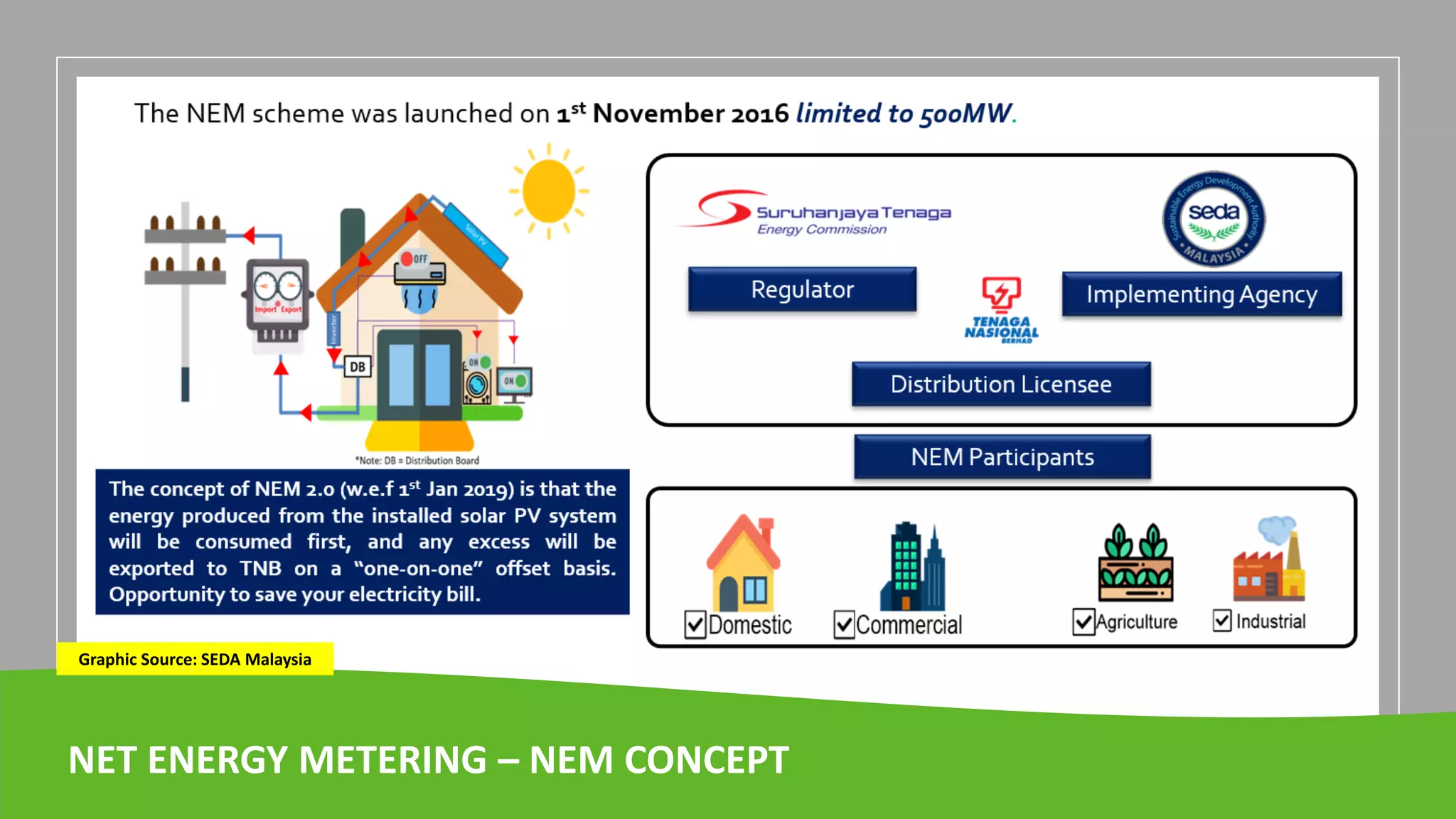
NET ENERGY METERING – NEM CONCEPT
Graphic Source: SEDA Malaysia
❑ 12 kW for single phase system
❑ 72 kW for 3 phase system
NEM 2.0 CAPACITY LIMITS
❑ MV & HV Consumers;
✓ 75% of Maximum Demand
❑ LV Consumers
✓ 60 % of fuse (for direct meter ); or
✓ 60 % of current transformer (CT) rating
➢Registered consumers of TNB in Peninsular Malaysia
▪ No outstanding bill and meter tempering
➢The resources for producing electricity shall be from Solar PV only
➢Other renewable energy resources such as biogas, biomass or micro
hydro may be allowed on case to case basis at the sole discretion of the
Commission
➢Installation types:
i. On the rooftop of buildings
ii. On the garage, car park or similar buildings
NEM ELIGIBILITY & INSTALLATION TYPES
Note:
For ground-mounted system, it may be allowed on case-by-case basis and the installation
shall be within the compound of applicant’s premises and approved by SEDA Malaysia.
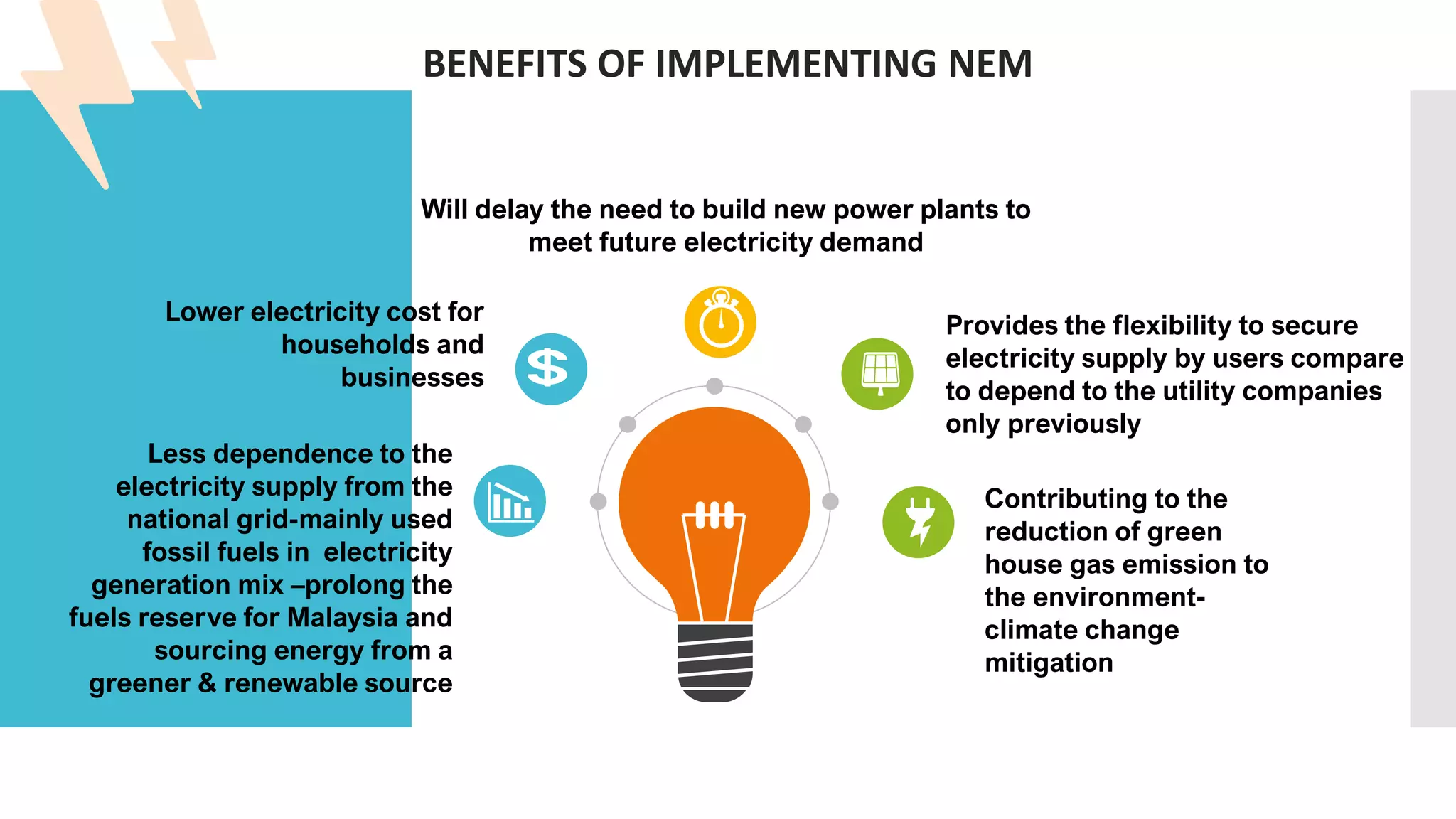
Provides the flexibility to secure
electricity supply by users compare
to depend to the utility companies
only previously
Contributing to the
reduction of green
house gas emission to
the environment-
climate change
mitigation
Will delay the need to build new power plants to
meet future electricity demand
Less dependence to the
electricity supply from the
national grid-mainly used
fossil fuels in electricity
generation mix –prolong the
fuels reserve for Malaysia and
sourcing energy from a
greener & renewable source
Lower electricity cost for
households and
businesses
BENEFITS OF IMPLEMENTING NEM
The technology cost
is still relatively
expensive for mass
installation by
ordinary Malaysians
although the price
has been reduced in
recent years.
Lack of awareness
among Malaysians
especially among
who can afford to
install solar PV at
home at their own
cost.
Hard to convince
decision makers in
the private sector to
embark on NEM.
Too long processing
time for the
application for tax
exemption for
NEM projects.
Local banks mainly
are not funding
NEM projects.
a) b) c) d) e)
BARRIERS THAT IMPEDE FOR SUCCESSFUL IMPLEMENTATION OF
SOLAR PV AND NEM IN MALAYSIA (1/2)
Covid-19 pandemic has
affected businesses and
also the interest of
companies towards NEM
The rental payment
imposed for solar PV
panel installation at
government
buildings
Conditions applied by
UKAS for long term
investments by the
private sector at
government buildings
Technical issues
❑ Fault current value- the value
is too high to inject RE supply
from Solar PV to the
grid(limited to 4-5kW only as
imposed by TNB)
❑ Very costly to install fault
current limiter if needed
f) g) h) i)
BARRIERS THAT IMPEDE FOR SUCCESSFUL IMPLEMENTATION OF
SOLAR PV AND NEM IN MALAYSIA (2/2)
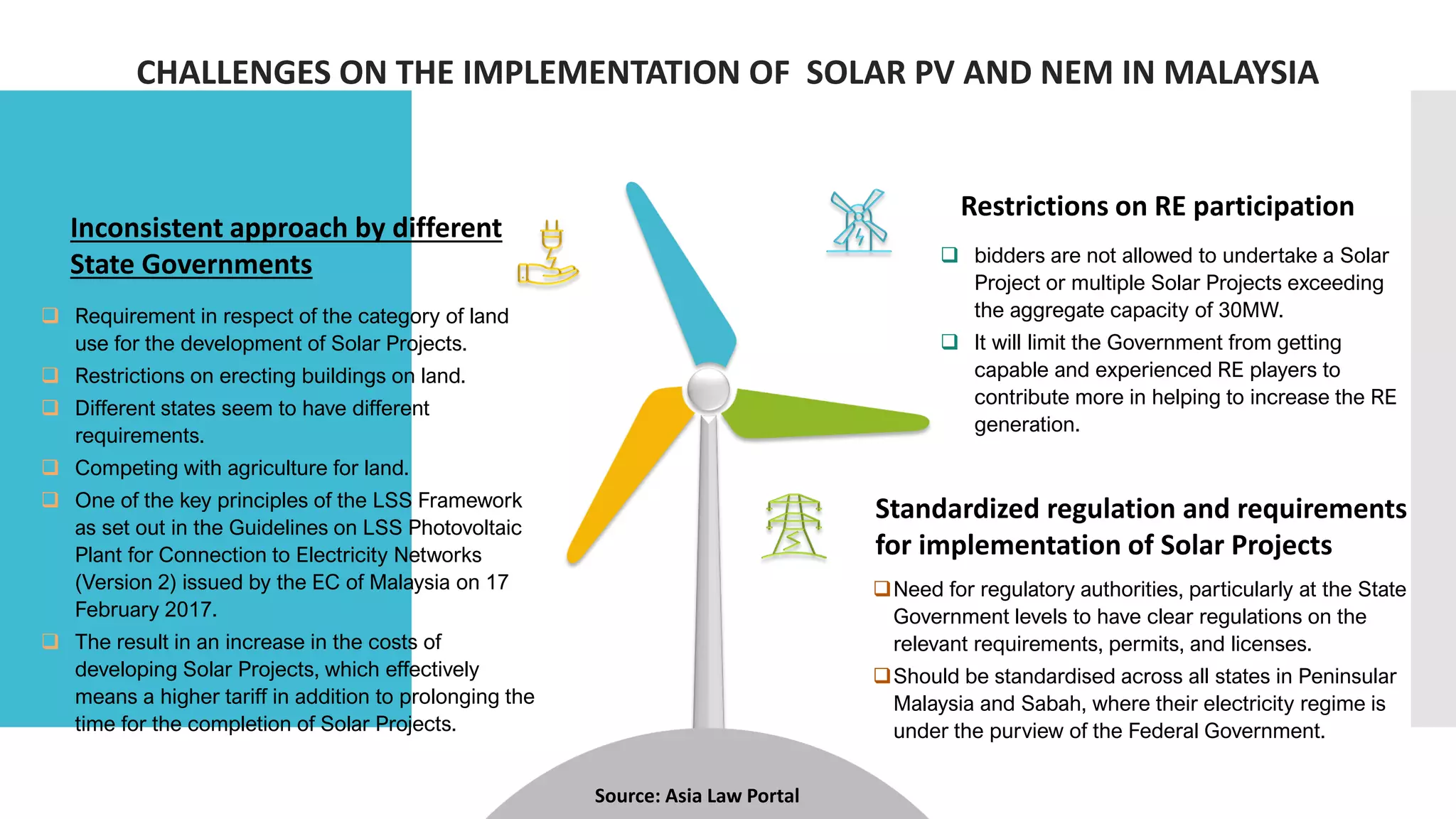
Restrictions on RE participation
❑ bidders are not allowed to undertake a Solar
Project or multiple Solar Projects exceeding
the aggregate capacity of 30MW.
❑ It will limit the Government from getting
capable and experienced RE players to
contribute more in helping to increase the RE
generation.
Standardized regulation and requirements
for implementation of Solar Projects
❑Need for regulatory authorities, particularly at the State
Government levels to have clear regulations on the
relevant requirements, permits, and licenses.
❑Should be standardised across all states in Peninsular
Malaysia and Sabah, where their electricity regime is
under the purview of the Federal Government.
Inconsistent approach by different
State Governments
❑ Requirement in respect of the category of land
use for the development of Solar Projects.
❑ Restrictions on erecting buildings on land.
❑ Different states seem to have different
requirements.
❑ Competing with agriculture for land.
❑ One of the key principles of the LSS Framework
as set out in the Guidelines on LSS Photovoltaic
Plant for Connection to Electricity Networks
(Version 2) issued by the EC of Malaysia on 17
February 2017.
❑ The result in an increase in the costs of
developing Solar Projects, which effectively
means a higher tariff in addition to prolonging the
time for the completion of Solar Projects.
CHALLENGES ON THE IMPLEMENTATION OF SOLAR PV AND NEM IN MALAYSIA
Source: Asia Law Portal
STRATEGIES AND PLANS THAT HAVE BEEN IMPLEMENTED
BY THE MALAYSIAN GOVERNMENT TO
ENCOURAGE THE USE OF NET ENERGY METERING
THE NEM APPLICATION PROCESS
Graphic Source: SEDA Malaysia
CALCULATION OF POTENTIAL ELECTRICITY GENERATION CAPACITY
https://services.seda.gov.my/nemcalculator/#/
SEDA’S NEM CALCULATOR
Example of TNB Bill
Graphic Source: SEDA Malaysia
Registered PV Service Providers (RPVSP)
– since 2014
❖ Companies with qualified persons passed in PV training.
❖ Qualified for Green Income Tax Exemption
(GITE) incentives (MIDA)
❖ Annual renewal, currently 153 Registered PV service
providers
http://www.seda.gov.my/directory/2020-registered-pv-service-
provider-directory/
REFERENCES FOR PV INDUSTRY
Registered PV Investors (RPVI) - since 2019
❖ Provides 0 upfront capex business models to interested
parties.
❖ Requirements for local and foreign companies
❖ Qualified for Green Income Tax Exemption (GITE) for solar
leasing (MIDA)
❖ Annual renewal, currently 116 Registered PV Investors
http://www.seda.gov.my/directory/2020-registered-solar-pv-
investor-rpvi-directory/
NEW SOLAR PV BUSINESS (BEHIND-THE-METER)
❖ In line with global trend, the NEM and the SELCO has spawned new solar PV business for
behind-the-meter (BTM) schemes
❖ Electricity consumers: additional choice of Solar Leasing or & PPA
Graphic Source: SEDA Malaysia
PV INVESTORS BUSINESS MODEL
Solar Power Purchase Agreement (PPA) or Solar Leasing Services
SOLAR PPA
Payment in Energy (RM/kWh)
Customers pay based on per kWh for power generated from PV system
SOLAR LEASING
Fixed Monthly payment (RM)
Customers pay a fixed amount monthly in return for the use of the PV system and the system
will be owned by consumer after lease period ends
Graphic Source: SEDA Malaysia
Benefits
❖ Helps reduce counterparty risk in the event if the customer does not pay.
❖ Incorporates deed of assignment that allows collection of revenue to be transferred
to bank for financing repayment.
❖ Improves bankability of PPAs especially of SMIs & SMEs.
SUPPLY AGREEMENT FOR RENEWABLE ENERGY (SARE)
Graphic Source: SEDA Malaysia
GTFS 2.0
(Green Tech Financing Scheme)
❖ The Govt will bear up to 2% of the total interest rate
of the profit charges by private financial institutions,
limited to the first 7 years only.
❖ Financing size up to RM100 mil (US 24mil) per
company, financing tenure up to 15 years.
❖ Applicable until 2020 or up to RM2 bill upon approval
of funding whichever comes first
Green Investment Tax Allowance &
Green Income Tax Exemption (GITA/GITE)
❖ GITA of 100% of qualifying capex until YA 2020. Can be
utilized to offset up to 70% of statutory income
❖ GITE of 100% of statutory income of Certified company
providing ‘Services’ in green sector until year 2020
❖ New: Budget 2020, both GITA & GITE is now extended until
2023. However, GITE exemption given up to 70% of statutory
income. It is also extended to company providing solar
Leasing/PPA businesses
FISCAL INCENTIVES FOR RE PROJECTS
PHOTOS OF NEM
PROJECTS IN MALAYSIA
507.3 kW,
Perpustakaan
Raja Tun Uda,
Shah Alam, Selangor.
Source: SEDA Malaysia
2.5 MWp, Goodyear Malaysia Bhd, Shah Alam, Selangor.
Source: SEDA Malaysia
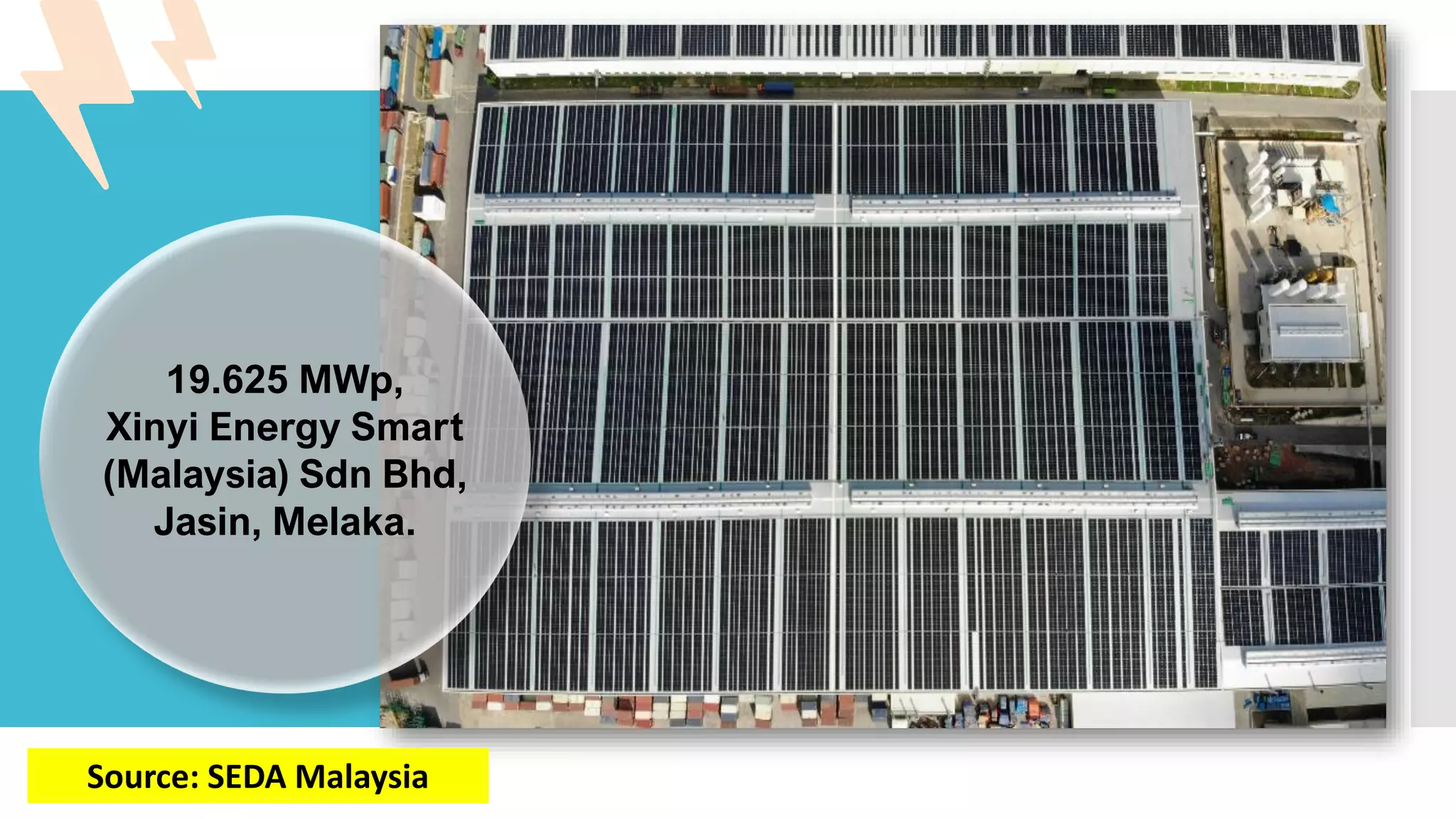
19.625 MWp,
Xinyi Energy Smart
(Malaysia) Sdn Bhd,
Jasin, Melaka.
Source: SEDA Malaysia
3.15 kWp Terrace House, Kota Damansara, Selangor.
To extend NEM program
beyond 11th Malaysia
plan (2016 - 2020)
03
To ensure efficient use of energy
practices among users to ensure the
electricity generated via solar PV or
other RE sources is not wasted
02
Having more government
buildings to have solar PV to
produce electricity –
budgeted or via private
sector investments – Lead by
Government
04
Provide more awareness programs
❖ Educating the banks for NEM projects
funding
❖ Collaboration with Malaysia Photovoltaic
Installers Association (MPIA)
Recommended Additional Measures To Boost The Success Of The
Energy Efficiency Policy Using Solar Power In Malaysia
01
CONCLUSIONS
AND THE WAY
FORWARD
✓The take-up of RE projects to continue increasing in Malaysia.
✓Malaysian Investment Development Authority (MIDA) noted that Malaysia is well
positioned to benefit from the spillover effects of growing solar power usage worldwide.
✓Developed & developing nations are increasingly looking at moving away from nuclear
power and fossil fuels & toward solar, wind, & other renewables that allowed the
opportunity to grow in the market.
✓LSS is proven to has strong potential to contribute effectively to RE capacity in Malaysia
Based on the statistics issued by the EC & SEDA.
✓The NREPAP has recognized the need to design a more convergent & forward-looking RE
policy.
✓Target on enhancing the utilization of indigenous RE resources to contribute towards
national electricity supply security & sustainable socio-economic development.
✓Government’s ambition of increasing the contribution of RE generation to the overall
energy mix up to 20% by 2025.
✓The New Government has set out clear action plans on RE, the country is certainly
moving towards increasing RE generation.
✓The government provides a strong towards increasing the RE generation, particularly
using solar PVs which able to guarantee the brighter future of Malaysia.

OVERVIEW OF NET ENERGY METERING IN MALAYSIA

  • 1.
    OVERVIEW OF NET ENERGYMETERING IN MALAYSIA
  • 2.
    OUTLINE 06 Recommended additional necessary measuresthat should be implemented by the government to boost the success of the energy efficiency policy using solar power in Malaysia. 05 Strategies or plans that have been implemented by the Malaysian government to encourage the use of NEM. 04 Barriers that impede successful implementation of solar PV and NEM in Malaysia. 03 Benefits of implementing it for residential, commercial and industrial buildings. 02 The mechanism of NEM using solar panels. 01 Overview of Renewable Energy Sector and Programs in Malaysia.
  • 3.
    MALAYSIA’S ENERGY POLICIES 03 ContentHere 1975 National Petroleum Policy 1980 National Depletion Policy 2000 Five-Fuel Diversification Policy 2009 National Green Technology Policy 2010-2015 10th Malaysia Plan 1974 Petroleum Development Act 1979 National Energy Policy 1981 Four-Fuel Diversification Policy 2006 National Biofuel Policy 2010 National RE Policy 2016-2020 11th Malaysia Plan New Energy Policy (2010-2015) RE Act (2011) Key initiative Needed! Energy Efficiency Policy
  • 4.
    THE MALAYSIA’S NATIONALRENEWABLE ENERGY POLICY & ACTION PLAN (NREPAP) Source: SEDA Malaysia
  • 5.
    MALAYSIA’S PRIMARY PRODUCTIONBY FUEL TYPE ❑ Mainly fossil fuels ❑ Depleting & not-renewable ❑ The utilization of RE sources still very low Source: Malaysia Energy Statistics Handbook 2019
  • 6.
    PERFORMANCE OF REIN MALAYSIA IN 2016 Source: Energy Commission The 2016 Performance and Statistical Information on Electricity Supply Industry in Malaysia Report - RE such as biomass, biogas, solar, and mini hydro had contributed a small share in electricity generation in Malaysia.
  • 7.
    EXISTING MALAYSIA’S REPOLICY, TARGETS AND PLANS FOR ELECTRICITY GENERATION THE TARGET Achieving 20% Renewable Energy (RE) Capacity Mix By 2025 ❑Implementing enhanced net energy metering (NEM) and solar leasing ❑Implementing large scale solar programme 3 (lss3) ❑Implementing non-solar RE projects ❑Establishing RE facilitation programmes in sustainable energy development authority Malaysia (SEDA) ❑Enabling greater access to RE sources HOW?
  • 8.
    WRITE YOUR SUBTITLEHERE RENEWABLE ENERGY PROGRAMS IN MALAYSIA Graphic Source: SEDA Malaysia
  • 9.
    NEM PROGRAM BACKGROUND Thequota allocation for NEM is 500 MW up to year 2020 ❑ Quota allocation will be divided into domestic and non-domestic category Introduced in 2016 under 11th Malaysia Plan (2016 - 2020) As at 2018 - only 30MW capacity From 1st January 2019, NEM adopted the true net energy metering concept ❑ Will allow excess solar PV generated energy to be exported back to the grid on a "one- on-one" offset basis ❑ every 1kWh exported to the grid will be offset against 1kWh consumed from the grid, instead of at the Displaced Cost previously The take-up improved after the increase of the displaced cost from 1st January 2019 The progress of quota approved: ❑ 2019 -120MW ❑ 2020-150MW (until September)
  • 10.
    NEM STATISTICS Approved &Commissioned ( As of 31st August 2020 ) RE Sources Allocated Quota (MW) Applications Approved Plants Commissioned No. of Application Capacity (MW) No. of Project Capacity (MW) Domestic 50 1,866 14.20 1,108 8.27 Commercial 450 765 70.61 370 22.97 Industrial 408 179.49 169 51.11 Agriculture 19 2.96 1 0.13 Total 500 3,058 267.26 1,648 82.49 Source: SEDA Malaysia
  • 11.
    MECHANISM OF NETENERGY METERING (NEM)
  • 12.
    NET ENERGY METERING– NEM CONCEPT Graphic Source: SEDA Malaysia
  • 13.
    ❑ 12 kWfor single phase system ❑ 72 kW for 3 phase system NEM 2.0 CAPACITY LIMITS ❑ MV & HV Consumers; ✓ 75% of Maximum Demand ❑ LV Consumers ✓ 60 % of fuse (for direct meter ); or ✓ 60 % of current transformer (CT) rating
  • 15.
    ➢Registered consumers ofTNB in Peninsular Malaysia ▪ No outstanding bill and meter tempering ➢The resources for producing electricity shall be from Solar PV only ➢Other renewable energy resources such as biogas, biomass or micro hydro may be allowed on case to case basis at the sole discretion of the Commission ➢Installation types: i. On the rooftop of buildings ii. On the garage, car park or similar buildings NEM ELIGIBILITY & INSTALLATION TYPES Note: For ground-mounted system, it may be allowed on case-by-case basis and the installation shall be within the compound of applicant’s premises and approved by SEDA Malaysia.
  • 16.
    Provides the flexibilityto secure electricity supply by users compare to depend to the utility companies only previously Contributing to the reduction of green house gas emission to the environment- climate change mitigation Will delay the need to build new power plants to meet future electricity demand Less dependence to the electricity supply from the national grid-mainly used fossil fuels in electricity generation mix –prolong the fuels reserve for Malaysia and sourcing energy from a greener & renewable source Lower electricity cost for households and businesses BENEFITS OF IMPLEMENTING NEM
  • 17.
    The technology cost isstill relatively expensive for mass installation by ordinary Malaysians although the price has been reduced in recent years. Lack of awareness among Malaysians especially among who can afford to install solar PV at home at their own cost. Hard to convince decision makers in the private sector to embark on NEM. Too long processing time for the application for tax exemption for NEM projects. Local banks mainly are not funding NEM projects. a) b) c) d) e) BARRIERS THAT IMPEDE FOR SUCCESSFUL IMPLEMENTATION OF SOLAR PV AND NEM IN MALAYSIA (1/2)
  • 18.
    Covid-19 pandemic has affectedbusinesses and also the interest of companies towards NEM The rental payment imposed for solar PV panel installation at government buildings Conditions applied by UKAS for long term investments by the private sector at government buildings Technical issues ❑ Fault current value- the value is too high to inject RE supply from Solar PV to the grid(limited to 4-5kW only as imposed by TNB) ❑ Very costly to install fault current limiter if needed f) g) h) i) BARRIERS THAT IMPEDE FOR SUCCESSFUL IMPLEMENTATION OF SOLAR PV AND NEM IN MALAYSIA (2/2)
  • 19.
    Restrictions on REparticipation ❑ bidders are not allowed to undertake a Solar Project or multiple Solar Projects exceeding the aggregate capacity of 30MW. ❑ It will limit the Government from getting capable and experienced RE players to contribute more in helping to increase the RE generation. Standardized regulation and requirements for implementation of Solar Projects ❑Need for regulatory authorities, particularly at the State Government levels to have clear regulations on the relevant requirements, permits, and licenses. ❑Should be standardised across all states in Peninsular Malaysia and Sabah, where their electricity regime is under the purview of the Federal Government. Inconsistent approach by different State Governments ❑ Requirement in respect of the category of land use for the development of Solar Projects. ❑ Restrictions on erecting buildings on land. ❑ Different states seem to have different requirements. ❑ Competing with agriculture for land. ❑ One of the key principles of the LSS Framework as set out in the Guidelines on LSS Photovoltaic Plant for Connection to Electricity Networks (Version 2) issued by the EC of Malaysia on 17 February 2017. ❑ The result in an increase in the costs of developing Solar Projects, which effectively means a higher tariff in addition to prolonging the time for the completion of Solar Projects. CHALLENGES ON THE IMPLEMENTATION OF SOLAR PV AND NEM IN MALAYSIA Source: Asia Law Portal
  • 20.
    STRATEGIES AND PLANSTHAT HAVE BEEN IMPLEMENTED BY THE MALAYSIAN GOVERNMENT TO ENCOURAGE THE USE OF NET ENERGY METERING
  • 21.
    THE NEM APPLICATIONPROCESS Graphic Source: SEDA Malaysia
  • 22.
    CALCULATION OF POTENTIALELECTRICITY GENERATION CAPACITY https://services.seda.gov.my/nemcalculator/#/
  • 23.
  • 24.
  • 25.
  • 26.
    Registered PV ServiceProviders (RPVSP) – since 2014 ❖ Companies with qualified persons passed in PV training. ❖ Qualified for Green Income Tax Exemption (GITE) incentives (MIDA) ❖ Annual renewal, currently 153 Registered PV service providers http://www.seda.gov.my/directory/2020-registered-pv-service- provider-directory/ REFERENCES FOR PV INDUSTRY Registered PV Investors (RPVI) - since 2019 ❖ Provides 0 upfront capex business models to interested parties. ❖ Requirements for local and foreign companies ❖ Qualified for Green Income Tax Exemption (GITE) for solar leasing (MIDA) ❖ Annual renewal, currently 116 Registered PV Investors http://www.seda.gov.my/directory/2020-registered-solar-pv- investor-rpvi-directory/
  • 27.
    NEW SOLAR PVBUSINESS (BEHIND-THE-METER) ❖ In line with global trend, the NEM and the SELCO has spawned new solar PV business for behind-the-meter (BTM) schemes ❖ Electricity consumers: additional choice of Solar Leasing or & PPA Graphic Source: SEDA Malaysia
  • 28.
    PV INVESTORS BUSINESSMODEL Solar Power Purchase Agreement (PPA) or Solar Leasing Services SOLAR PPA Payment in Energy (RM/kWh) Customers pay based on per kWh for power generated from PV system SOLAR LEASING Fixed Monthly payment (RM) Customers pay a fixed amount monthly in return for the use of the PV system and the system will be owned by consumer after lease period ends Graphic Source: SEDA Malaysia
  • 29.
    Benefits ❖ Helps reducecounterparty risk in the event if the customer does not pay. ❖ Incorporates deed of assignment that allows collection of revenue to be transferred to bank for financing repayment. ❖ Improves bankability of PPAs especially of SMIs & SMEs. SUPPLY AGREEMENT FOR RENEWABLE ENERGY (SARE) Graphic Source: SEDA Malaysia
  • 30.
    GTFS 2.0 (Green TechFinancing Scheme) ❖ The Govt will bear up to 2% of the total interest rate of the profit charges by private financial institutions, limited to the first 7 years only. ❖ Financing size up to RM100 mil (US 24mil) per company, financing tenure up to 15 years. ❖ Applicable until 2020 or up to RM2 bill upon approval of funding whichever comes first Green Investment Tax Allowance & Green Income Tax Exemption (GITA/GITE) ❖ GITA of 100% of qualifying capex until YA 2020. Can be utilized to offset up to 70% of statutory income ❖ GITE of 100% of statutory income of Certified company providing ‘Services’ in green sector until year 2020 ❖ New: Budget 2020, both GITA & GITE is now extended until 2023. However, GITE exemption given up to 70% of statutory income. It is also extended to company providing solar Leasing/PPA businesses FISCAL INCENTIVES FOR RE PROJECTS
  • 31.
  • 32.
    507.3 kW, Perpustakaan Raja TunUda, Shah Alam, Selangor. Source: SEDA Malaysia
  • 33.
    2.5 MWp, GoodyearMalaysia Bhd, Shah Alam, Selangor. Source: SEDA Malaysia
  • 34.
    19.625 MWp, Xinyi EnergySmart (Malaysia) Sdn Bhd, Jasin, Melaka. Source: SEDA Malaysia
  • 35.
    Source: SEDA Malaysia 3.15kWp Terrace House, Kota Damansara, Selangor.
  • 36.
    To extend NEMprogram beyond 11th Malaysia plan (2016 - 2020) 03 To ensure efficient use of energy practices among users to ensure the electricity generated via solar PV or other RE sources is not wasted 02 Having more government buildings to have solar PV to produce electricity – budgeted or via private sector investments – Lead by Government 04 Provide more awareness programs ❖ Educating the banks for NEM projects funding ❖ Collaboration with Malaysia Photovoltaic Installers Association (MPIA) Recommended Additional Measures To Boost The Success Of The Energy Efficiency Policy Using Solar Power In Malaysia 01
  • 37.
    CONCLUSIONS AND THE WAY FORWARD ✓Thetake-up of RE projects to continue increasing in Malaysia. ✓Malaysian Investment Development Authority (MIDA) noted that Malaysia is well positioned to benefit from the spillover effects of growing solar power usage worldwide. ✓Developed & developing nations are increasingly looking at moving away from nuclear power and fossil fuels & toward solar, wind, & other renewables that allowed the opportunity to grow in the market. ✓LSS is proven to has strong potential to contribute effectively to RE capacity in Malaysia Based on the statistics issued by the EC & SEDA. ✓The NREPAP has recognized the need to design a more convergent & forward-looking RE policy. ✓Target on enhancing the utilization of indigenous RE resources to contribute towards national electricity supply security & sustainable socio-economic development. ✓Government’s ambition of increasing the contribution of RE generation to the overall energy mix up to 20% by 2025. ✓The New Government has set out clear action plans on RE, the country is certainly moving towards increasing RE generation. ✓The government provides a strong towards increasing the RE generation, particularly using solar PVs which able to guarantee the brighter future of Malaysia.