Networking Session


  INVESTMENTS POTENTIALS IN
 ENERGY EFFICIENCY INDUSTRY
    & THE WAY FORWARD FOR
SUSTAINABLE IMPLEMENTATION
         IN MALAYSIA
              By
            MAESCO
          21st February 2013
       MIDA Sentral, Kuala Lumpur
Outline
Introduction to ESCO & energy services

EE Potentials in Malaysia

Key barriers for EE implementation &
 proposed counter measures

The way forward
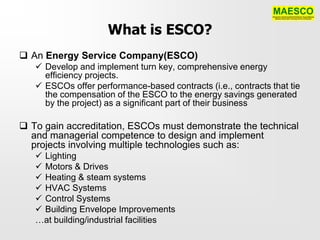
What is ESCO?
 An Energy Service Company(ESCO)
    Develop and implement turn key, comprehensive energy
     efficiency projects.
    ESCOs offer performance-based contracts (i.e., contracts that tie
     the compensation of the ESCO to the energy savings generated
     by the project) as a significant part of their business

 To gain accreditation, ESCOs must demonstrate the technical
  and managerial competence to design and implement
  projects involving multiple technologies such as:
    Lighting
    Motors & Drives
    Heating & steam systems
    HVAC Systems
    Control Systems
    Building Envelope Improvements
   …at building/industrial facilities
Scope of Energy Services
Full range of services required for a
  comprehensive EE project implementation:
  Energy Audit
  Consultancy
  Design of energy efficient systems
  Implementation Project Financing
  Implementation and Project Management
  Construction management
  Energy performance monitoring and verification
   performance
  Testing and commissioning
  Operation and maintenance
Background of MAESCO
        The     Malaysian  Industrial     Energy
         Efficiency Improvement Project (MIEEIP)
         components includes ESCO Development
         Programs and ESCO participation in EE
         Technology Demonstration Projects

        Industrial was chosen as the sector in which
         the greatest commercial and environmental
         impact could be achieved

        MAESCO was registered with the
         Malaysian   Registrar of Society in
         September 2000

        Incorporated in conjunction with the
         launching of the MIEEIP by a Government’s
         implementation agency, PTM (Energy
         Centre of Malaysia) which is now known as
         Malaysia         Green         Technology
         Corporation(Green Tech Malaysia)
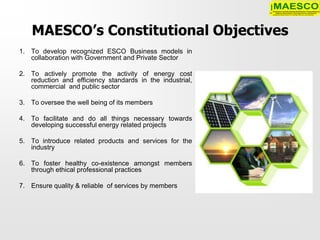
MAESCO’s Constitutional Objectives
1. To develop recognized ESCO Business models in
   collaboration with Government and Private Sector

2. To actively promote the activity of energy cost
   reduction and efficiency standards in the industrial,
   commercial and public sector

3. To oversee the well being of its members

4. To facilitate and do all things necessary towards
   developing successful energy related projects

5. To introduce related products and services for the
   industry

6. To foster healthy co-existence amongst members
   through ethical professional practices

7. Ensure quality & reliable of services by members
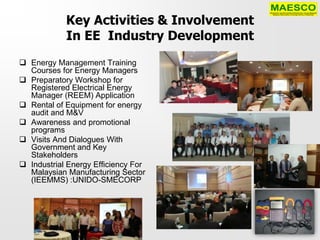
Key Activities & Involvement
            In EE Industry Development
 Energy Management Training
  Courses for Energy Managers
 Preparatory Workshop for
  Registered Electrical Energy
  Manager (REEM) Application
 Rental of Equipment for energy
  audit and M&V
 Awareness and promotional
  programs
 Visits And Dialogues With
  Government and Key
  Stakeholders
 Industrial Energy Efficiency For
  Malaysian Manufacturing Sector
  (IEEMMS) :UNIDO-SMECORP
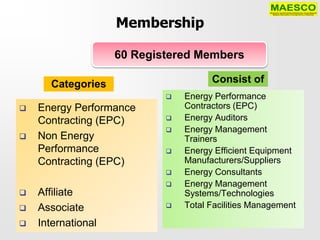
Membership

                    60 Registered Members

      Categories                      Consist of
                               Energy Performance
   Energy Performance          Contractors (EPC)
    Contracting (EPC)          Energy Auditors
                               Energy Management
   Non Energy                  Trainers
    Performance                Energy Efficient Equipment
    Contracting (EPC)           Manufacturers/Suppliers
                               Energy Consultants
                               Energy Management
   Affiliate                   Systems/Technologies
   Associate                  Total Facilities Management

   International
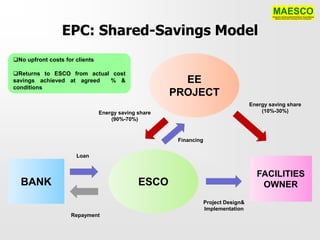
EPC: Shared-Savings Model
No upfront costs for clients

Returns to ESCO from actual cost
savings achieved at agreed  % &                         EE
conditions
                                                      PROJECT
                                                                                     Energy saving share
                                Energy saving share                                      (10%-30%)
                                    (90%-70%)


                                                       Financing

                      Loan


                                                                                       FACILITIES
  BANK                                        ESCO                                      OWNER
                                                                   Project Design&
                                                                   Implementation
                    Repayment
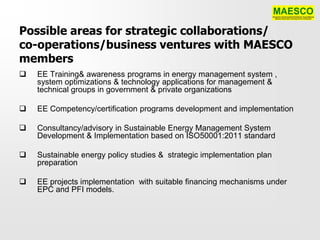
Possible areas for strategic collaborations/
co-operations/business ventures with MAESCO
members
   EE Training& awareness programs in energy management system ,
    system optimizations & technology applications for management &
    technical groups in government & private organizations

   EE Competency/certification programs development and implementation

   Consultancy/advisory in Sustainable Energy Management System
    Development & Implementation based on ISO50001:2011 standard

   Sustainable energy policy studies & strategic implementation plan
    preparation

   EE projects implementation with suitable financing mechanisms under
    EPC and PFI models.
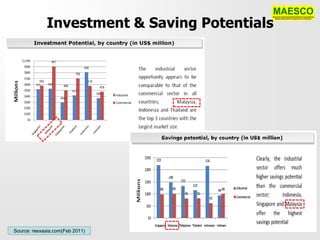
EE Potentials In Malaysia
Investment & Saving Potentials


Source: reexasia.com(Feb 2011)
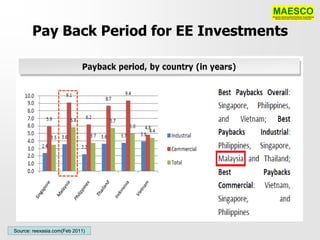
Pay Back Period for EE Investments


Source: reexasia.com(Feb 2011)
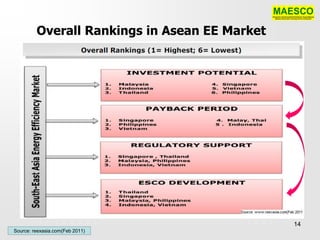
Overall Rankings in Asean EE Market


                                               14
Source: reexasia.com(Feb 2011)
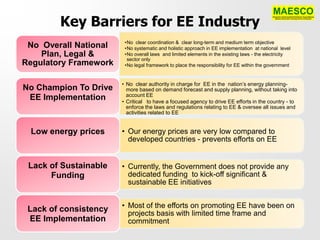
Key Barriers for EE Industry
                        •No clear coordination & clear long-term and medium term objective
 No Overall National    •No systematic and holistic approach in EE implementation at national level
    Plan, Legal &       •No overall laws and limited elements in the existing laws - the electricity
                         sector only
Regulatory Framework    •No legal framework to place the responsibility for EE within the government


                       • No clear authority in charge for EE in the nation’s energy planning-
No Champion To Drive     more based on demand forecast and supply planning, without taking into
                         account EE
 EE Implementation     • Critical to have a focused agency to drive EE efforts in the country - to
                         enforce the laws and regulations relating to EE & oversee all issues and
                         activities related to EE


 Low energy prices     • Our energy prices are very low compared to
                         developed countries - prevents efforts on EE


 Lack of Sustainable   • Currently, the Government does not provide any
      Funding            dedicated funding to kick-off significant &
                         sustainable EE initiatives


 Lack of consistency   • Most of the efforts on promoting EE have been on
                         projects basis with limited time frame and
 EE Implementation       commitment
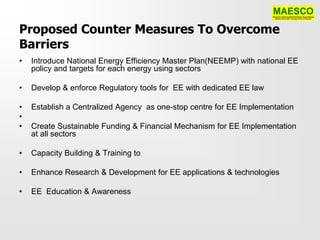
Proposed Counter Measures To Overcome
Barriers
•   Introduce National Energy Efficiency Master Plan(NEEMP) with national EE
    policy and targets for each energy using sectors

•   Develop & enforce Regulatory tools for EE with dedicated EE law

•   Establish a Centralized Agency as one-stop centre for EE Implementation
•
•   Create Sustainable Funding & Financial Mechanism for EE Implementation
    at all sectors

•   Capacity Building & Training to

•   Enhance Research & Development for EE applications & technologies

•   EE Education & Awareness
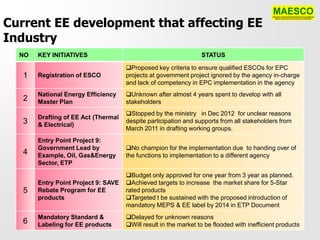
Current EE development that affecting EE
Industry
  NO   KEY INITIATIVES                                           STATUS

                                     Proposed key criteria to ensure qualified ESCOs for EPC
   1   Registration of ESCO          projects at government project ignored by the agency in-charge
                                     and lack of competency in EPC implementation in the agency
       National Energy Efficiency    Unknown after almost 4 years spent to develop with all
   2   Master Plan                   stakeholders
                                     Stopped by the ministry in Dec 2012 for unclear reasons
       Drafting of EE Act (Thermal
   3   & Electrical)
                                     despite participation and supports from all stakeholders from
                                     March 2011 in drafting working groups.
       Entry Point Project 9:
       Government Lead by            No champion for the implementation due to handing over of
   4   Example, Oil, Gas&Energy      the functions to implementation to a different agency
       Sector, ETP
                                     Budget only approved for one year from 3 year as planned.
       Entry Point Project 9: SAVE   Achieved targets to increase the market share for 5-Star
   5   Rebate Program for EE         rated products
       products                      Targeted t be sustained with the proposed introduction of
                                     mandatory MEPS & EE label by 2014 in ETP Document
       Mandatory Standard &          Delayed for unknown reasons
   6   Labeling for EE products      Will result in the market to be flooded with inefficient products
The Way Forward…
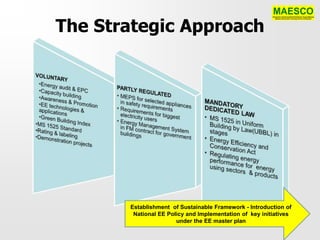
The Strategic Approach


       Establishment of Sustainable Framework - Introduction of
        National EE Policy and Implementation of key initiatives
                       under the EE master plan
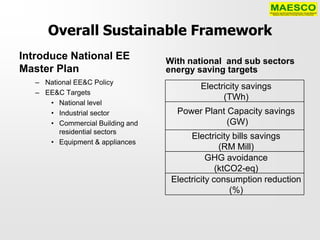
Overall Sustainable Framework
Introduce National EE             With national and sub sectors
Master Plan                       energy saving targets
   – National EE&C Policy
                                          Electricity savings
   – EE&C Targets
                                                (TWh)
      • National level
      • Industrial sector           Power Plant Capacity savings
      • Commercial Building and                 (GW)
         residential sectors
                                        Electricity bills savings
      • Equipment & appliances
                                                 (RM Mill)
                                             GHG avoidance
                                                (ktCO2-eq)
                                   Electricity consumption reduction
                                                    (%)
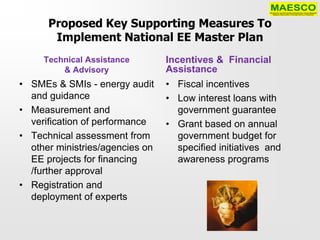
Proposed Key Supporting Measures To
       Implement National EE Master Plan
     Technical Assistance        Incentives & Financial
         & Advisory              Assistance
• SMEs & SMIs - energy audit     • Fiscal incentives
  and guidance                   • Low interest loans with
• Measurement and                  government guarantee
  verification of performance    • Grant based on annual
• Technical assessment from        government budget for
  other ministries/agencies on     specified initiatives and
  EE projects for financing        awareness programs
  /further approval
• Registration and
  deployment of experts
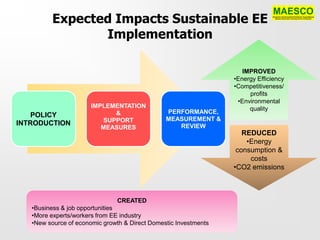
Expected Impacts Sustainable EE
                Implementation

                                                                     IMPROVED
                                                                  •Energy Efficiency
                                                                  •Competitiveness/
                                                                       profits
                                                                   •Environmental
                       IMPLEMENTATION                                  quality
                             &                  PERFORMANCE,
    POLICY
                          SUPPORT               MEASUREMENT &
INTRODUCTION                                       REVIEW
                          MEASURES
                                                                     REDUCED
                                                                      •Energy
                                                                   consumption &
                                                                       costs
                                                                  •CO2 emissions


                               CREATED
   •Business & job opportunities
   •More experts/workers from EE industry
   •New source of economic growth & Direct Domestic Investments
THANK YOU FOR YOUR ATTENTION!

         zaini@cnsgroup.com.my
              019 2152700
           www.maesco.org.my
        www.goingee.blogspot.com

MIDA networking session on clean technologies-21.2.2013

  • 1.
    Networking Session INVESTMENTS POTENTIALS IN ENERGY EFFICIENCY INDUSTRY & THE WAY FORWARD FOR SUSTAINABLE IMPLEMENTATION IN MALAYSIA By MAESCO 21st February 2013 MIDA Sentral, Kuala Lumpur
  • 2.
    Outline Introduction to ESCO& energy services EE Potentials in Malaysia Key barriers for EE implementation & proposed counter measures The way forward
  • 3.
    What is ESCO? An Energy Service Company(ESCO)  Develop and implement turn key, comprehensive energy efficiency projects.  ESCOs offer performance-based contracts (i.e., contracts that tie the compensation of the ESCO to the energy savings generated by the project) as a significant part of their business  To gain accreditation, ESCOs must demonstrate the technical and managerial competence to design and implement projects involving multiple technologies such as:  Lighting  Motors & Drives  Heating & steam systems  HVAC Systems  Control Systems  Building Envelope Improvements …at building/industrial facilities
  • 4.
    Scope of EnergyServices Full range of services required for a comprehensive EE project implementation: Energy Audit Consultancy Design of energy efficient systems Implementation Project Financing Implementation and Project Management Construction management Energy performance monitoring and verification performance Testing and commissioning Operation and maintenance
  • 5.
    Background of MAESCO  The Malaysian Industrial Energy Efficiency Improvement Project (MIEEIP) components includes ESCO Development Programs and ESCO participation in EE Technology Demonstration Projects  Industrial was chosen as the sector in which the greatest commercial and environmental impact could be achieved  MAESCO was registered with the Malaysian Registrar of Society in September 2000  Incorporated in conjunction with the launching of the MIEEIP by a Government’s implementation agency, PTM (Energy Centre of Malaysia) which is now known as Malaysia Green Technology Corporation(Green Tech Malaysia)
  • 6.
    MAESCO’s Constitutional Objectives 1.To develop recognized ESCO Business models in collaboration with Government and Private Sector 2. To actively promote the activity of energy cost reduction and efficiency standards in the industrial, commercial and public sector 3. To oversee the well being of its members 4. To facilitate and do all things necessary towards developing successful energy related projects 5. To introduce related products and services for the industry 6. To foster healthy co-existence amongst members through ethical professional practices 7. Ensure quality & reliable of services by members
  • 7.
    Key Activities &Involvement In EE Industry Development  Energy Management Training Courses for Energy Managers  Preparatory Workshop for Registered Electrical Energy Manager (REEM) Application  Rental of Equipment for energy audit and M&V  Awareness and promotional programs  Visits And Dialogues With Government and Key Stakeholders  Industrial Energy Efficiency For Malaysian Manufacturing Sector (IEEMMS) :UNIDO-SMECORP
  • 8.
    Membership 60 Registered Members Categories Consist of  Energy Performance  Energy Performance Contractors (EPC) Contracting (EPC)  Energy Auditors  Energy Management  Non Energy Trainers Performance  Energy Efficient Equipment Contracting (EPC) Manufacturers/Suppliers  Energy Consultants  Energy Management  Affiliate Systems/Technologies  Associate  Total Facilities Management  International
  • 9.
    EPC: Shared-Savings Model Noupfront costs for clients Returns to ESCO from actual cost savings achieved at agreed % & EE conditions PROJECT Energy saving share Energy saving share (10%-30%) (90%-70%) Financing Loan FACILITIES BANK ESCO OWNER Project Design& Implementation Repayment
  • 10.
    Possible areas forstrategic collaborations/ co-operations/business ventures with MAESCO members  EE Training& awareness programs in energy management system , system optimizations & technology applications for management & technical groups in government & private organizations  EE Competency/certification programs development and implementation  Consultancy/advisory in Sustainable Energy Management System Development & Implementation based on ISO50001:2011 standard  Sustainable energy policy studies & strategic implementation plan preparation  EE projects implementation with suitable financing mechanisms under EPC and PFI models.
  • 11.
  • 12.
    Investment & SavingPotentials Source: reexasia.com(Feb 2011)
  • 13.
    Pay Back Periodfor EE Investments Source: reexasia.com(Feb 2011)
  • 14.
    Overall Rankings inAsean EE Market 14 Source: reexasia.com(Feb 2011)
  • 15.
    Key Barriers forEE Industry •No clear coordination & clear long-term and medium term objective No Overall National •No systematic and holistic approach in EE implementation at national level Plan, Legal & •No overall laws and limited elements in the existing laws - the electricity sector only Regulatory Framework •No legal framework to place the responsibility for EE within the government • No clear authority in charge for EE in the nation’s energy planning- No Champion To Drive more based on demand forecast and supply planning, without taking into account EE EE Implementation • Critical to have a focused agency to drive EE efforts in the country - to enforce the laws and regulations relating to EE & oversee all issues and activities related to EE Low energy prices • Our energy prices are very low compared to developed countries - prevents efforts on EE Lack of Sustainable • Currently, the Government does not provide any Funding dedicated funding to kick-off significant & sustainable EE initiatives Lack of consistency • Most of the efforts on promoting EE have been on projects basis with limited time frame and EE Implementation commitment
  • 16.
    Proposed Counter MeasuresTo Overcome Barriers • Introduce National Energy Efficiency Master Plan(NEEMP) with national EE policy and targets for each energy using sectors • Develop & enforce Regulatory tools for EE with dedicated EE law • Establish a Centralized Agency as one-stop centre for EE Implementation • • Create Sustainable Funding & Financial Mechanism for EE Implementation at all sectors • Capacity Building & Training to • Enhance Research & Development for EE applications & technologies • EE Education & Awareness
  • 17.
    Current EE developmentthat affecting EE Industry NO KEY INITIATIVES STATUS Proposed key criteria to ensure qualified ESCOs for EPC 1 Registration of ESCO projects at government project ignored by the agency in-charge and lack of competency in EPC implementation in the agency National Energy Efficiency Unknown after almost 4 years spent to develop with all 2 Master Plan stakeholders Stopped by the ministry in Dec 2012 for unclear reasons Drafting of EE Act (Thermal 3 & Electrical) despite participation and supports from all stakeholders from March 2011 in drafting working groups. Entry Point Project 9: Government Lead by No champion for the implementation due to handing over of 4 Example, Oil, Gas&Energy the functions to implementation to a different agency Sector, ETP Budget only approved for one year from 3 year as planned. Entry Point Project 9: SAVE Achieved targets to increase the market share for 5-Star 5 Rebate Program for EE rated products products Targeted t be sustained with the proposed introduction of mandatory MEPS & EE label by 2014 in ETP Document Mandatory Standard & Delayed for unknown reasons 6 Labeling for EE products Will result in the market to be flooded with inefficient products
  • 18.
  • 19.
    The Strategic Approach Establishment of Sustainable Framework - Introduction of National EE Policy and Implementation of key initiatives under the EE master plan
  • 20.
    Overall Sustainable Framework IntroduceNational EE With national and sub sectors Master Plan energy saving targets – National EE&C Policy Electricity savings – EE&C Targets (TWh) • National level • Industrial sector Power Plant Capacity savings • Commercial Building and (GW) residential sectors Electricity bills savings • Equipment & appliances (RM Mill) GHG avoidance (ktCO2-eq) Electricity consumption reduction (%)
  • 21.
    Proposed Key SupportingMeasures To Implement National EE Master Plan Technical Assistance Incentives & Financial & Advisory Assistance • SMEs & SMIs - energy audit • Fiscal incentives and guidance • Low interest loans with • Measurement and government guarantee verification of performance • Grant based on annual • Technical assessment from government budget for other ministries/agencies on specified initiatives and EE projects for financing awareness programs /further approval • Registration and deployment of experts
  • 22.
    Expected Impacts SustainableEE Implementation IMPROVED •Energy Efficiency •Competitiveness/ profits •Environmental IMPLEMENTATION quality & PERFORMANCE, POLICY SUPPORT MEASUREMENT & INTRODUCTION REVIEW MEASURES REDUCED •Energy consumption & costs •CO2 emissions CREATED •Business & job opportunities •More experts/workers from EE industry •New source of economic growth & Direct Domestic Investments
  • 23.
    THANK YOU FORYOUR ATTENTION! zaini@cnsgroup.com.my 019 2152700 www.maesco.org.my www.goingee.blogspot.com