IEM & IET ELECTRICAL CONFERENCE 2013

SUSTAINABLE BUSINESS THROUGH
ENERGY EFFICIENCY IMPLEMENTATION:
AN INDUSTRY PLAYER’S PERSPECTIVE
Zaini Abdul Wahab
Group,Malaysia
20th November 2013
Palace of The Golden Horses Hotel
Kuala Lumpur
OUTLINE
1. Business Potentials In Energy
Efficiency Implementation
2. Success Stories
3. Barriers & Counter Measures For Sustainable
Energy Efficiency Programs Implementation
4. Energy Efficiency Industry Development & The
Way Forward
Business Potentials In Energy
Efficiency Implementation
ENERGY OUTLOOK
TRANSPORTATION

Vehicle efficiency:
Costs influence consumer
choices

INDUSTRIAL

Manufacturing, chemicals to lead
growth in industrial energy demand

ELECTRICITY GENERATION
Industrial demand rises 30 %, led
by growth in Non OECD countries

The global energy mix will grow more diverse
and less carbon-intensive
Source: Exxon Energy outlook 2012

The impact of increased energy
consumption can be reduced through
energy efficiency and a transition to a
stronger reliance on cleaner sources of
energy, including renewable energy and
low-GHG [greenhouse gas] emitting fossil
fuel technologies, such as a shift from coal
to natural gas
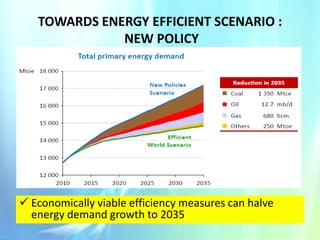
TOWARDS ENERGY EFFICIENT SCENARIO :
NEW POLICY

 Economically viable efficiency measures can halve
energy demand growth to 2035
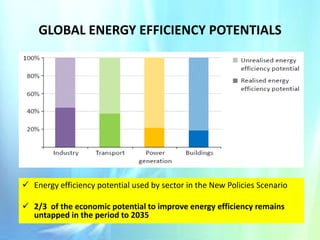
GLOBAL ENERGY EFFICIENCY POTENTIALS

 Energy efficiency potential used by sector in the New Policies Scenario
 2/3 of the economic potential to improve energy efficiency remains
untapped in the period to 2035
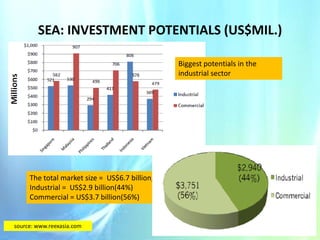
SEA: INVESTMENT POTENTIALS (US$MIL.)
Biggest potentials in the
industrial sector

The total market size = US$6.7 billion;
Industrial = US$2.9 billion(44%)
Commercial = US$3.7 billion(56%)

source: www.reexasia.com
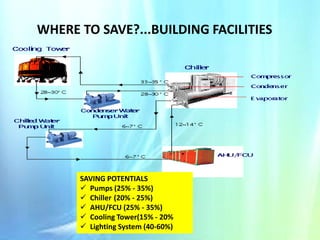
WHERE TO SAVE?...BUILDING FACILITIES

SAVING POTENTIALS
 Pumps (25% - 35%)
 Chiller (20% - 25%)
 AHU/FCU (25% - 35%)
 Cooling Tower(15% - 20%
 Lighting System (40-60%)
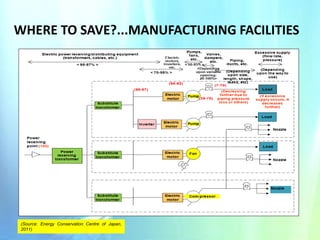
WHERE TO SAVE?...MANUFACTURING FACILITIES

(Source: Energy Conservation Centre of Japan,
2011)
THE TRENDS &
PROVEN SUCCESS STORIES
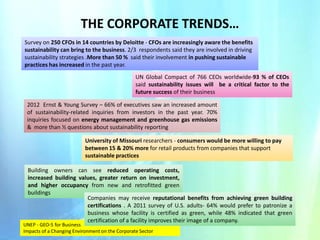
THE CORPORATE TRENDS…
Survey on 250 CFOs in 14 countries by Deloitte - CFOs are increasingly aware the benefits
sustainability can bring to the business. 2/3 respondents said they are involved in driving
sustainability strategies .More than 50 % said their involvement in pushing sustainable
practices has increased in the past year.
UN Global Compact of 766 CEOs worldwide-93 % of CEOs
said sustainability issues will be a critical factor to the
future success of their business
2012 Ernst & Young Survey – 66% of executives saw an increased amount
of sustainability-related inquiries from investors in the past year. 70%
inquiries focused on energy management and greenhouse gas emissions
& more than ½ questions about sustainability reporting
University of Missouri researchers - consumers would be more willing to pay
between 15 & 20% more for retail products from companies that support
sustainable practices
Building owners can see reduced operating costs,
increased building values, greater return on investment,
and higher occupancy from new and retrofitted green
buildings
Companies may receive reputational benefits from achieving green building
certifications . A 2011 survey of U.S. adults- 64% would prefer to patronize a
business whose facility is certified as green, while 48% indicated that green
certification of a facility improves their image of a company.

UNEP - GEO-5 for Business
Impacts of a Changing Environment on the Corporate Sector
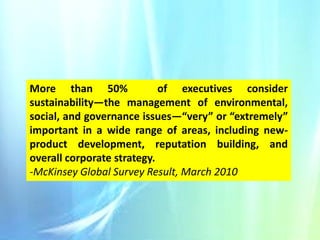
More than 50%
of executives consider
sustainability—the management of environmental,
social, and governance issues—“very” or “extremely”
important in a wide range of areas, including newproduct development, reputation building, and
overall corporate strategy.
-McKinsey Global Survey Result, March 2010
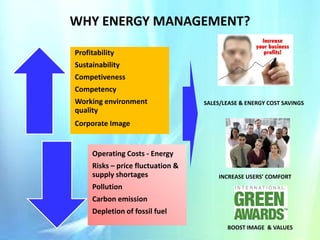
WHY ENERGY MANAGEMENT?
Profitability
Sustainability
Competiveness
Competency
Working environment
quality

SALES/LEASE & ENERGY COST SAVINGS

Corporate Image

Operating Costs - Energy
Risks – price fluctuation &
supply shortages

INCREASE USERS’ COMFORT

Pollution
Carbon emission
Depletion of fossil fuel
BOOST IMAGE & VALUES
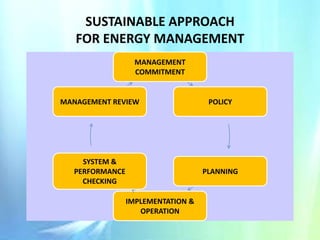
SUSTAINABLE APPROACH
FOR ENERGY MANAGEMENT
MANAGEMENT
COMMITMENT

MANAGEMENT REVIEW

POLICY

SYSTEM &
PERFORMANCE
CHECKING

PLANNING

IMPLEMENTATION &
OPERATION
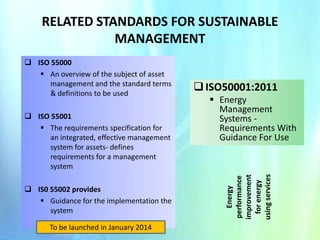
RELATED STANDARDS FOR SUSTAINABLE
MANAGEMENT

 ISO 55001
 The requirements specification for
an integrated, effective management
system for assets- defines
requirements for a management
system
 IS0 55002 provides
 Guidance for the implementation the
system
To be launched in January 2014

 ISO50001:2011
 Energy
Management
Systems Requirements With
Guidance For Use

Energy
performance
improvement
for energy
using services

 ISO 55000
 An overview of the subject of asset
management and the standard terms
& definitions to be used
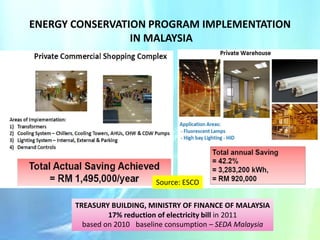
ENERGY CONSERVATION PROGRAM IMPLEMENTATION
IN MALAYSIA

Source: ESCO
TREASURY BUILDING, MINISTRY OF FINANCE OF MALAYSIA
17% reduction of electricity bill in 2011
based on 2010 baseline consumption – SEDA Malaysia
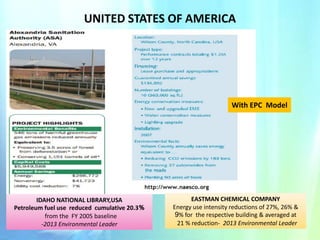
UNITED STATES OF AMERICA

With EPC Model

IDAHO NATIONAL LIBRARY,USA
Petroleum fuel use reduced cumulative 20.3%
from the FY 2005 baseline
-2013 Environmental Leader

EASTMAN CHEMICAL COMPANY
Energy use intensity reductions of 27%, 26% &
9% for the respective building & averaged at
21 % reduction- 2013 Environmental Leader
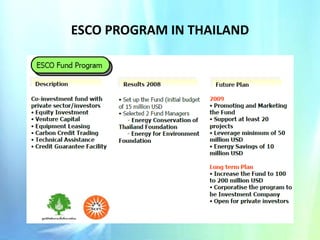
ESCO PROGRAM IN THAILAND
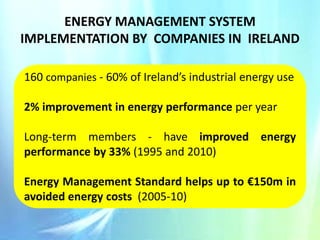
ENERGY MANAGEMENT SYSTEM
IMPLEMENTATION BY COMPANIES IN IRELAND
160 companies - 60% of Ireland’s industrial energy use
2% improvement in energy performance per year

Long-term members - have improved energy
performance by 33% (1995 and 2010)
Energy Management Standard helps up to €150m in
avoided energy costs (2005-10)
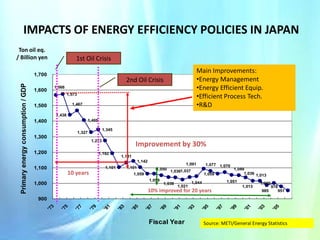
IMPACTS OF ENERGY EFFICIENCY POLICIES IN JAPAN
Ton oil eq.
/ Billion yen

1st Oil Crisis

1,600

Main Improvements:
•Energy Management
•Energy Efficient Equip.
•Efficient Process Tech.
•R&D

2nd Oil Crisis
1,566
1,573
1,467

1,500
1,438

1,405

1,400

1,345

1,327

1,300

1,273

1,200

Improvement by 30%

1,192

1,131
1,142

1,100

1,101

1,091

1,101

10 years

1,050

1,059
1,059

1,000

1,077 1,070

1,0361,037

1,038

1,021

1,059

1,049
1,036 1,013

1,051

1,044

1,013

10% improved for 20 years

1,000
985

978
951

Fiscal Year

'0
5

'0
3

'0
1

'9
9

'9
7

'9
5

'9
3

'9
1

'8
9

'8
7

'8
5

'8
3

'8
1

'7
9

'7
7

'7
5

900
'7
3

Primary energy consumption / GDP

1,700

Source: METI/General Energy Statistics
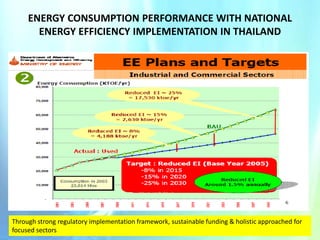
ENERGY CONSUMPTION PERFORMANCE WITH NATIONAL
ENERGY EFFICIENCY IMPLEMENTATION IN THAILAND

Through strong regulatory implementation framework, sustainable funding & holistic approached for
focused sectors
Main Barriers In Mainstreaming Energy
Efficiency Industry In Malaysia

WHAT IS STOPPING US?
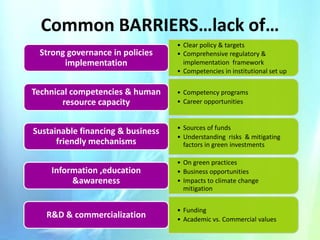
Common BARRIERS…lack of…
Strong governance in policies
implementation

• Clear policy & targets
• Comprehensive regulatory &
implementation framework
• Competencies in institutional set up

Technical competencies & human
resource capacity

• Competency programs
• Career opportunities

Sustainable financing & business
friendly mechanisms

• Sources of funds
• Understanding risks & mitigating
factors in green investments

Information ,education
&awareness

R&D & commercialization

• On green practices
• Business opportunities
• Impacts to climate change
mitigation
• Funding
• Academic vs. Commercial values
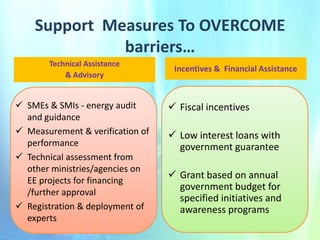
Support Measures To OVERCOME
barriers…
Technical Assistance
& Advisory

 SMEs & SMIs - energy audit
and guidance
 Measurement & verification of
performance
 Technical assessment from
other ministries/agencies on
EE projects for financing
/further approval
 Registration & deployment of
experts

Incentives & Financial Assistance

 Fiscal incentives
 Low interest loans with
government guarantee
 Grant based on annual
government budget for
specified initiatives and
awareness programs
To move forward…
DO WE NEED TO
REINVENT THE WHEEL?
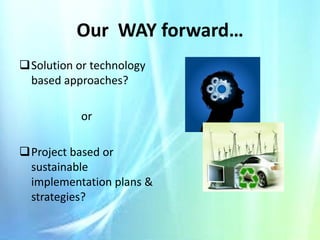
Our WAY forward…
Solution or technology
based approaches?
or
Project based or
sustainable
implementation plans &
strategies?
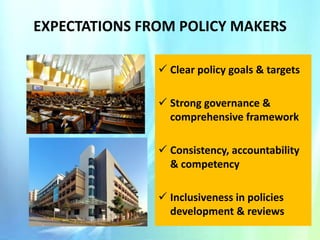
EXPECTATIONS FROM POLICY MAKERS
 Clear policy goals & targets
 Strong governance &
comprehensive framework
 Consistency, accountability
& competency
 Inclusiveness in policies
development & reviews
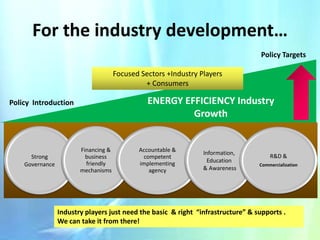
For the industry development…
Policy Targets
Focused Sectors +Industry Players
+ Consumers

ENERGY EFFICIENCY Industry
Growth

Policy Introduction

Strong
Governance

Financing &
business
friendly
mechanisms

Accountable &
competent
implementing
agency

Information,
Education
& Awareness

R&D &
Commercialization

Industry players just need the basic & right “infrastructure” & supports .
We can take it from there!
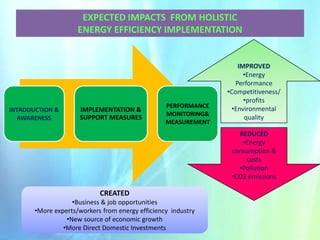
EXPECTED IMPACTS FROM HOLISTIC
ENERGY EFFICIENCY IMPLEMENTATION

INTRODUCTION &
AWARENESS

IMPLEMENTATION &
SUPPORT MEASURES

PERFORMANCE
MONITORING&
MEASUREMENT

IMPROVED
•Energy
Performance
•Competitiveness/
•profits
•Environmental
quality
REDUCED
•Energy
consumption &
costs
•Pollution
•CO2 emissions

CREATED
•Business & job opportunities
•More experts/workers from energy efficiency industry
•New source of economic growth
•More Direct Domestic Investments
THANK YOU!

zaini@cnsgroup.com.my
019 2152700

www.cnsgroup.com.my

IIEC ELECTRICAL CONFERENCE 2013:EE implementation-player's perspective

  • 1.
    IEM & IETELECTRICAL CONFERENCE 2013 SUSTAINABLE BUSINESS THROUGH ENERGY EFFICIENCY IMPLEMENTATION: AN INDUSTRY PLAYER’S PERSPECTIVE Zaini Abdul Wahab Group,Malaysia 20th November 2013 Palace of The Golden Horses Hotel Kuala Lumpur
  • 2.
    OUTLINE 1. Business PotentialsIn Energy Efficiency Implementation 2. Success Stories 3. Barriers & Counter Measures For Sustainable Energy Efficiency Programs Implementation 4. Energy Efficiency Industry Development & The Way Forward
  • 3.
    Business Potentials InEnergy Efficiency Implementation
  • 4.
    ENERGY OUTLOOK TRANSPORTATION Vehicle efficiency: Costsinfluence consumer choices INDUSTRIAL Manufacturing, chemicals to lead growth in industrial energy demand ELECTRICITY GENERATION Industrial demand rises 30 %, led by growth in Non OECD countries The global energy mix will grow more diverse and less carbon-intensive Source: Exxon Energy outlook 2012 The impact of increased energy consumption can be reduced through energy efficiency and a transition to a stronger reliance on cleaner sources of energy, including renewable energy and low-GHG [greenhouse gas] emitting fossil fuel technologies, such as a shift from coal to natural gas
  • 5.
    TOWARDS ENERGY EFFICIENTSCENARIO : NEW POLICY  Economically viable efficiency measures can halve energy demand growth to 2035
  • 6.
    GLOBAL ENERGY EFFICIENCYPOTENTIALS  Energy efficiency potential used by sector in the New Policies Scenario  2/3 of the economic potential to improve energy efficiency remains untapped in the period to 2035
  • 7.
    SEA: INVESTMENT POTENTIALS(US$MIL.) Biggest potentials in the industrial sector The total market size = US$6.7 billion; Industrial = US$2.9 billion(44%) Commercial = US$3.7 billion(56%) source: www.reexasia.com
  • 8.
    WHERE TO SAVE?...BUILDINGFACILITIES SAVING POTENTIALS  Pumps (25% - 35%)  Chiller (20% - 25%)  AHU/FCU (25% - 35%)  Cooling Tower(15% - 20%  Lighting System (40-60%)
  • 9.
    WHERE TO SAVE?...MANUFACTURINGFACILITIES (Source: Energy Conservation Centre of Japan, 2011)
  • 10.
    THE TRENDS & PROVENSUCCESS STORIES
  • 11.
    THE CORPORATE TRENDS… Surveyon 250 CFOs in 14 countries by Deloitte - CFOs are increasingly aware the benefits sustainability can bring to the business. 2/3 respondents said they are involved in driving sustainability strategies .More than 50 % said their involvement in pushing sustainable practices has increased in the past year. UN Global Compact of 766 CEOs worldwide-93 % of CEOs said sustainability issues will be a critical factor to the future success of their business 2012 Ernst & Young Survey – 66% of executives saw an increased amount of sustainability-related inquiries from investors in the past year. 70% inquiries focused on energy management and greenhouse gas emissions & more than ½ questions about sustainability reporting University of Missouri researchers - consumers would be more willing to pay between 15 & 20% more for retail products from companies that support sustainable practices Building owners can see reduced operating costs, increased building values, greater return on investment, and higher occupancy from new and retrofitted green buildings Companies may receive reputational benefits from achieving green building certifications . A 2011 survey of U.S. adults- 64% would prefer to patronize a business whose facility is certified as green, while 48% indicated that green certification of a facility improves their image of a company. UNEP - GEO-5 for Business Impacts of a Changing Environment on the Corporate Sector
  • 12.
    More than 50% ofexecutives consider sustainability—the management of environmental, social, and governance issues—“very” or “extremely” important in a wide range of areas, including newproduct development, reputation building, and overall corporate strategy. -McKinsey Global Survey Result, March 2010
  • 13.
    WHY ENERGY MANAGEMENT? Profitability Sustainability Competiveness Competency Workingenvironment quality SALES/LEASE & ENERGY COST SAVINGS Corporate Image Operating Costs - Energy Risks – price fluctuation & supply shortages INCREASE USERS’ COMFORT Pollution Carbon emission Depletion of fossil fuel BOOST IMAGE & VALUES
  • 14.
    SUSTAINABLE APPROACH FOR ENERGYMANAGEMENT MANAGEMENT COMMITMENT MANAGEMENT REVIEW POLICY SYSTEM & PERFORMANCE CHECKING PLANNING IMPLEMENTATION & OPERATION
  • 15.
    RELATED STANDARDS FORSUSTAINABLE MANAGEMENT  ISO 55001  The requirements specification for an integrated, effective management system for assets- defines requirements for a management system  IS0 55002 provides  Guidance for the implementation the system To be launched in January 2014  ISO50001:2011  Energy Management Systems Requirements With Guidance For Use Energy performance improvement for energy using services  ISO 55000  An overview of the subject of asset management and the standard terms & definitions to be used
  • 16.
    ENERGY CONSERVATION PROGRAMIMPLEMENTATION IN MALAYSIA Source: ESCO TREASURY BUILDING, MINISTRY OF FINANCE OF MALAYSIA 17% reduction of electricity bill in 2011 based on 2010 baseline consumption – SEDA Malaysia
  • 17.
    UNITED STATES OFAMERICA With EPC Model IDAHO NATIONAL LIBRARY,USA Petroleum fuel use reduced cumulative 20.3% from the FY 2005 baseline -2013 Environmental Leader EASTMAN CHEMICAL COMPANY Energy use intensity reductions of 27%, 26% & 9% for the respective building & averaged at 21 % reduction- 2013 Environmental Leader
  • 18.
  • 19.
    ENERGY MANAGEMENT SYSTEM IMPLEMENTATIONBY COMPANIES IN IRELAND 160 companies - 60% of Ireland’s industrial energy use 2% improvement in energy performance per year Long-term members - have improved energy performance by 33% (1995 and 2010) Energy Management Standard helps up to €150m in avoided energy costs (2005-10)
  • 20.
    IMPACTS OF ENERGYEFFICIENCY POLICIES IN JAPAN Ton oil eq. / Billion yen 1st Oil Crisis 1,600 Main Improvements: •Energy Management •Energy Efficient Equip. •Efficient Process Tech. •R&D 2nd Oil Crisis 1,566 1,573 1,467 1,500 1,438 1,405 1,400 1,345 1,327 1,300 1,273 1,200 Improvement by 30% 1,192 1,131 1,142 1,100 1,101 1,091 1,101 10 years 1,050 1,059 1,059 1,000 1,077 1,070 1,0361,037 1,038 1,021 1,059 1,049 1,036 1,013 1,051 1,044 1,013 10% improved for 20 years 1,000 985 978 951 Fiscal Year '0 5 '0 3 '0 1 '9 9 '9 7 '9 5 '9 3 '9 1 '8 9 '8 7 '8 5 '8 3 '8 1 '7 9 '7 7 '7 5 900 '7 3 Primary energy consumption / GDP 1,700 Source: METI/General Energy Statistics
  • 21.
    ENERGY CONSUMPTION PERFORMANCEWITH NATIONAL ENERGY EFFICIENCY IMPLEMENTATION IN THAILAND Through strong regulatory implementation framework, sustainable funding & holistic approached for focused sectors
  • 22.
    Main Barriers InMainstreaming Energy Efficiency Industry In Malaysia WHAT IS STOPPING US?
  • 23.
    Common BARRIERS…lack of… Stronggovernance in policies implementation • Clear policy & targets • Comprehensive regulatory & implementation framework • Competencies in institutional set up Technical competencies & human resource capacity • Competency programs • Career opportunities Sustainable financing & business friendly mechanisms • Sources of funds • Understanding risks & mitigating factors in green investments Information ,education &awareness R&D & commercialization • On green practices • Business opportunities • Impacts to climate change mitigation • Funding • Academic vs. Commercial values
  • 24.
    Support Measures ToOVERCOME barriers… Technical Assistance & Advisory  SMEs & SMIs - energy audit and guidance  Measurement & verification of performance  Technical assessment from other ministries/agencies on EE projects for financing /further approval  Registration & deployment of experts Incentives & Financial Assistance  Fiscal incentives  Low interest loans with government guarantee  Grant based on annual government budget for specified initiatives and awareness programs
  • 25.
    To move forward… DOWE NEED TO REINVENT THE WHEEL?
  • 26.
    Our WAY forward… Solutionor technology based approaches? or Project based or sustainable implementation plans & strategies?
  • 27.
    EXPECTATIONS FROM POLICYMAKERS  Clear policy goals & targets  Strong governance & comprehensive framework  Consistency, accountability & competency  Inclusiveness in policies development & reviews
  • 28.
    For the industrydevelopment… Policy Targets Focused Sectors +Industry Players + Consumers ENERGY EFFICIENCY Industry Growth Policy Introduction Strong Governance Financing & business friendly mechanisms Accountable & competent implementing agency Information, Education & Awareness R&D & Commercialization Industry players just need the basic & right “infrastructure” & supports . We can take it from there!
  • 29.
    EXPECTED IMPACTS FROMHOLISTIC ENERGY EFFICIENCY IMPLEMENTATION INTRODUCTION & AWARENESS IMPLEMENTATION & SUPPORT MEASURES PERFORMANCE MONITORING& MEASUREMENT IMPROVED •Energy Performance •Competitiveness/ •profits •Environmental quality REDUCED •Energy consumption & costs •Pollution •CO2 emissions CREATED •Business & job opportunities •More experts/workers from energy efficiency industry •New source of economic growth •More Direct Domestic Investments
  • 30.