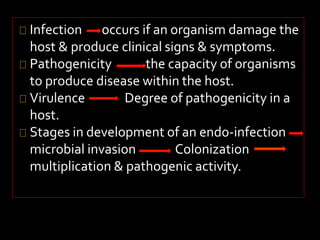
Infection occurs if an organism damage the 
host & produce clinical signs & symptoms. 
Pathogenicity the capacity of organisms 
to produce disease within the host. 
Virulence Degree of pathogenicity in a 
host. 
Stages in development of an endo-infection 
microbial invasion Colonization 
multiplication & pathogenic activity.
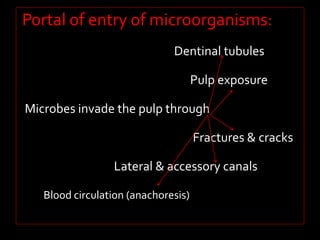
Portal of entry of microorganisms: 
Dentinal tubules 
Pulp exposure 
Microbes invade the pulp through 
Fractures & cracks 
Lateral & accessory canals 
Blood circulation (anachoresis)
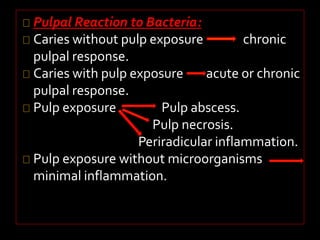
Pulpal Reaction to Bacteria: 
Caries without pulp exposure chronic 
pulpal response. 
Caries with pulp exposure acute or chronic 
pulpal response. 
Pulp exposure Pulp abscess. 
Pulp necrosis. 
Periradicular inflammation. 
Pulp exposure without microorganisms 
minimal inflammation.
Polymicrobal infections: 
Normal oral flora contains more than 350 
bacterial species. 
A relatively small group is isolated from 
infected pulp cavities. 
Infected pulp Mainly anaerobic 
bacteria (strict). 
Some facultative anaerobes. 
Rarely aerobes.
No absolute correlation between species 
of bacteria & endo. signs & symptoms. 
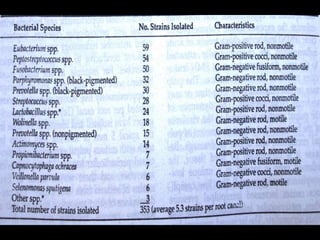
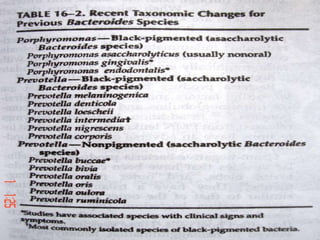
Black Pigmented Bacteria( BPB) 
associated with endo-infections. 
Most canals containing BPB associated 
with acute periapical abscess. 
Purulent lesions are induced by strains of 
BPB.
Porphyromonas gigivalis 
Isolated from acute infections. 
Porphyromonas endodontalis 
Prevotella intermedia found in both 
symptomatic & asymptomatic cases. 
Yeasts & viruses were also found in 
pulp cavity. 
Even the human immunodeficiency virus 
(HIV) was isolated from the pulp.
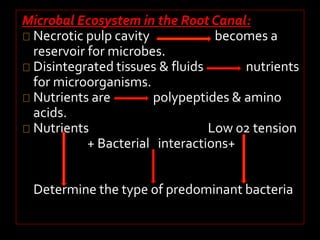
Microbal Ecosystem in the Root Canal: 
Necrotic pulp cavity becomes a 
reservoir for microbes. 
Disintegrated tissues & fluids nutrients 
for microorganisms. 
Nutrients are polypeptides & amino 
acids. 
Nutrients Low 02 tension 
+ Bacterial interactions+ 
Determine the type of predominant bacteria
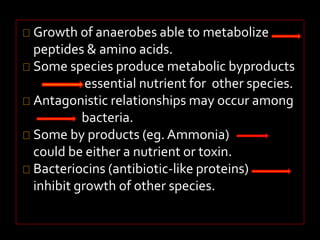
Growth of anaerobes able to metabolize 
peptides & amino acids. 
Some species produce metabolic byproducts 
essential nutrient for other species. 
Antagonistic relationships may occur among 
bacteria. 
Some by products (eg. Ammonia) 
could be either a nutrient or toxin. 
Bacteriocins (antibiotic-like proteins) 
inhibit growth of other species.
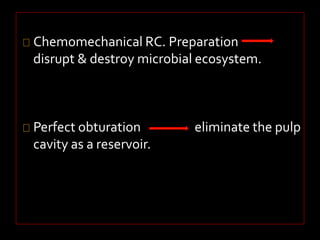
Chemomechanical RC. Preparation 
disrupt & destroy microbial ecosystem. 
Perfect obturation eliminate the pulp 
cavity as a reservoir.
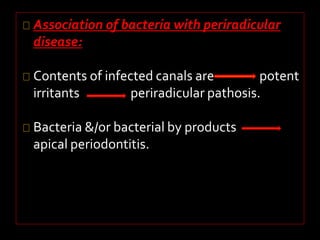
Association of bacteria with periradicular 
disease: 
Contents of infected canals are potent 
irritants periradicular pathosis. 
Bacteria &/or bacterial by products 
apical periodontitis.
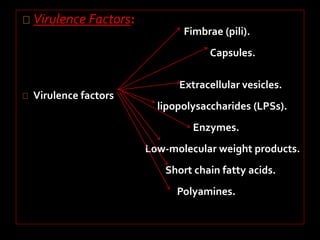
Virulence Factors: 
Fimbrae (pili). 
Capsules. 
Extracellular vesicles. 
Virulence factors 
lipopolysaccharides (LPSs). 
Enzymes. 
Low-molecular weight products. 
Short chain fatty acids. 
Polyamines.
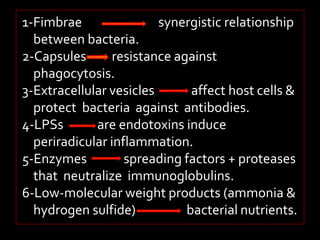
1-Fimbrae synergistic relationship 
between bacteria. 
2-Capsules resistance against 
phagocytosis. 
3-Extracellular vesicles affect host cells & 
protect bacteria against antibodies. 
4-LPSs are endotoxins induce 
periradicular inflammation. 
5-Enzymes spreading factors + proteases 
that neutralize immunoglobulins. 
6-Low-molecular weight products (ammonia & 
hydrogen sulfide) bacterial nutrients.
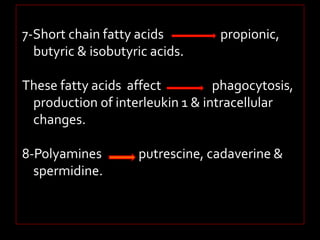
7-Short chain fatty acids propionic, 
butyric & isobutyric acids. 
These fatty acids affect phagocytosis, 
production of interleukin 1 & intracellular 
changes. 
8-Polyamines putrescine, cadaverine & 
spermidine.
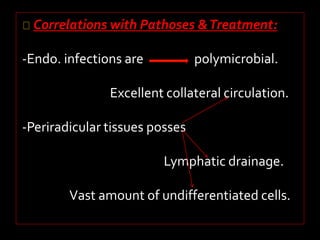
Correlations with Pathoses & Treatment: 
-Endo. infections are polymicrobial. 
Excellent collateral circulation. 
-Periradicular tissues posses 
Lymphatic drainage. 
Vast amount of undifferentiated cells.
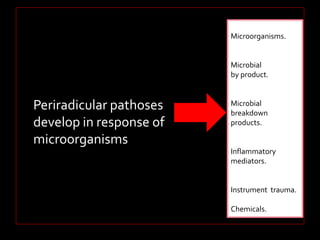
Periradicular pathoses 
develop in response of 
microorganisms 
Microorganisms. 
Microbial 
by product. 
Microbial 
breakdown 
products. 
Inflammatory 
mediators. 
Instrument trauma. 
Chemicals.
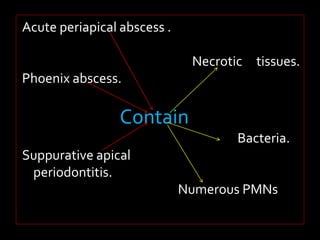
Acute periapical abscess . 
Necrotic tissues. 
Phoenix abscess. 
Contain 
Bacteria. 
Suppurative apical 
periodontitis. 
Numerous PMNs
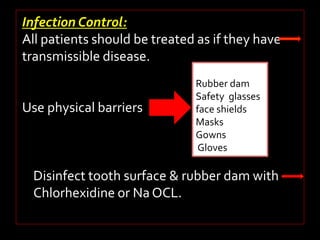
Infection Control: 
All patients should be treated as if they have 
transmissible disease. 
Use physical barriers 
Rubber dam 
Safety glasses 
face shields 
Masks 
Gowns 
Gloves 
Disinfect tooth surface & rubber dam with 
Chlorhexidine or Na OCL.
Treatment of endodontic infections: 
Removal of source of irritation healing 
of periradicular lesion. 
Source of irritation reservoir of 
infection (pulp cavity). 
Achieved by thorough debridement of 
root canals.
Debridement of the root canal system: 
RC debridement instrumentation + 
irrigation. 
Flush out debris 
Irrigants Dissolve organic remnants 
Antimicrobials 
Lubricants
Sodium hypochlorite ( Na OCL 0.5 to 5.25%) 
irrigant of choice 
Na OCL dissolves organic debris & an 
excellent antimicrobial agent. 
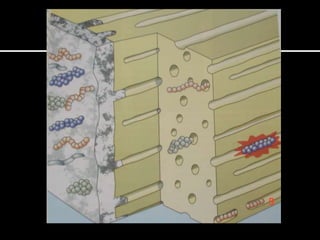
Bacteria stay in fins, irregularities & 
cul-de-sacs of RC. walls. 
Sonic and ultrasonic devices improve 
the irrigant effects. 
Irrigant should be passively delivered 
with a blunt end needle.
Smear layer amorphous layer of 
dentin & other debris + viscous material. 
Smear layer plugs dentinal tubules to 
a depth of 40mm. 
It affects permeability. Protects entraped 
bacteria 
. Inhibits penetration of irrigants 
& medications. 
.Inhibits penetration of sealers. 
. Inhibits bacterial colonization
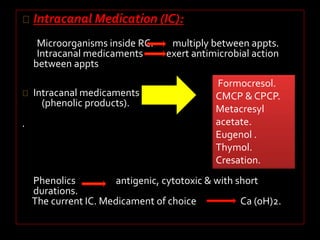
Intracanal Medication (IC): 
Microorganisms inside RC. multiply between appts. 
Intracanal medicaments exert antimicrobial action 
between appts 
Intracanal medicaments 
(phenolic products). 
. 
Formocresol. 
CMCP & CPCP. 
Metacresyl 
acetate. 
Eugenol . 
Thymol. 
Cresation. 
Phenolics antigenic, cytotoxic & with short 
durations. 
The current IC. Medicament of choice Ca (oH)2.
Drainage: 
The key to managing an abscess or cellulitis 
is drainage. 
Drainage through the canal & incision 
decrease discomfort, toxins & pressure. 
Incision of indurated swelling releases 
Blood. 
Serous fluids. 
Bacteria & their byproducts . 
Inflammatory mediators. 
Drainage removes these 
irritants & improves local circulation.
Adjunctive Antibiotic therapy 
Antibiotics are not a substitute for 
local treatment. 
The majority of endo. cases can be 
treated without antibiotics. 
Pain & swelling of endo. origin are managed 
by debridement & drainage.
Symptomatic pulpitis 
Apical periodontitis 
without systemic 
signs & symptoms 
Draining sinus tract 
Localized swelling 
do not 
require 
antibiotics
Prophylactic Antibiotics for Medically 
Compromised Patients: 
Distant infection are high in case of 
transient bacteremia. 
Bacteremia puts medically compromised 
patients at a great risk. 
Transient bacteria can result from apical 
extrusion of bacteria. 
Procedures that may produce bleeding 
induce bacteremia.
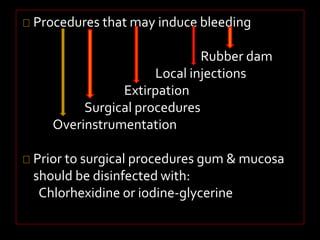
Procedures that may induce bleeding 
Rubber dam 
Local injections 
Extirpation 
Surgical procedures 
Overinstrumentation 
Prior to surgical procedures gum & mucosa 
should be disinfected with: 
Chlorhexidine or iodine-glycerine
Medicaly compromised patients at great risk 
of bacteremia include: 
i-Rheumatic & congentinal disease. 
ii-Prosthetic cardiac valves. 
iii-Valvular prolapse & regurgitation. 
iv-Previous infective endocarditis.
V- Systemic pulmonary shunts. 
Vi- Arterio-venous shunts. 
Vii -Uncontrolled diabetes. 
Viii- Immunosuppressed & immunologically 
deficient cases.
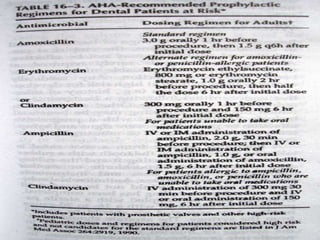
Medically compromised patients at risk of 
bacteremia must receive. 
A regimen of antibiotics that follows the 
recommendations of 
American Heart Association (AHA)
Antibiotics used in treatment: 
Antibiotics are prescribed in conjunction with 
endo. procedures. 
In the reservoir of microorganisms (RC 
System) absence of circulation. 
Therefore antibiotics without endo. 
procedures not effective. 
Antibiotics are prescribed when there is : 
systemic involvement 
Persistent infection 
Spreading infection
Signs & symptoms of systemic 
iInvolvement & spread infection 
Fever 38° c 
Malaise 
Trismus 
Diffuse swelling 
Cellulitis 
alone or in combination 
Antibiotics should be continued for 2 to 3 days after 
disappearance of signs & symptoms.
Selection of an Antibiotic Regimen: 
Penicillin remains the antibiotic of choice. 
Effective against many facultative 
& strict anaerobes. 
Penicillin Has low toxicity 
Inexpensive 
However, penicillin is allergic to approx. 
10% of humans.
Adequate blood level of penicillin must be 
maintained. 
Initial oral dose of 1000mg followed by 
500 mg/6hours. 
Antibiotics + proper endo. procedure 
signif. improvement within 48 hours. 
ALL PRESCRIBED ANTIBIOTICS MAY BE 
GIVEN FOR 7 DAYS.
Erythromycin alternative choice for 
patients allergic to penicillin. 
Erythromycin effective against 
facultative bacteria. 
Erythromycin ineffective against 
most anaerobes & serious infections. 
Adverse effect GI upset ingestion 
of milk or yogurt gives relief. 
Adverse effect transient deafnes. 
Dose 1000mg followed by 500mg/6 
hours.
Clarithromycin (Klacid) 
Clarithromycin a macrolide – a 
semisynthetic derivative of erythromycin. 
Clarithromycin has 
greater antibacterial 
spectrum. 
less GI upset. 
Dose 500 mg/8-12 hours
Cephalosporins broad spectrum but does 
not include anaerobes. 
Cefaclor (2 nd. generation) effective 
against anaerobes. 
Not recommended for penicillin allergic 
patients.
Clindamycin effective gm +ve & -ve 
bacteria. 
Facultative & strict 
anaerobes. 
Clindamycin well distributed throughout 
the body & bones. 
Adverse effects long use 
pseudomembranous colitis. 
Dose 150 to 300 mg/6 hours.
Metronidazole 
effective against anaerobes 
Ineffective against aerobes 
Metronidazole + penicillin or other antibiotic 
endo.infection. 
Dose 250 to 500 mg/ 6 hours.
Culturing 
Required when empirical use of 
antibiotics is not effective. 
Procedure: 
Rubber dam isolation. 
Disinfection with Na OCL or other 
disinfectant. 
Access opening with sterile 
instruments. 
Microbial sampling with sterile paper 
points or aspiration.
Aspiration is done with 16 to 20 gauge 
needle. 
In dry canals place a drop of a sterile 
solution before sampling. 
Submucosal swellings should be sampled 
by aspiration before incision. 
Samples are immediately placed in the 
media. 
Antimicrobial irrigating solutions should 
not be used before sampling.
Endodontics microbiology

Endodontics microbiology

  • 2.
    Infection occurs ifan organism damage the host & produce clinical signs & symptoms. Pathogenicity the capacity of organisms to produce disease within the host. Virulence Degree of pathogenicity in a host. Stages in development of an endo-infection microbial invasion Colonization multiplication & pathogenic activity.
  • 3.
    Portal of entryof microorganisms: Dentinal tubules Pulp exposure Microbes invade the pulp through Fractures & cracks Lateral & accessory canals Blood circulation (anachoresis)
  • 4.
    Pulpal Reaction toBacteria: Caries without pulp exposure chronic pulpal response. Caries with pulp exposure acute or chronic pulpal response. Pulp exposure Pulp abscess. Pulp necrosis. Periradicular inflammation. Pulp exposure without microorganisms minimal inflammation.
  • 5.
    Polymicrobal infections: Normaloral flora contains more than 350 bacterial species. A relatively small group is isolated from infected pulp cavities. Infected pulp Mainly anaerobic bacteria (strict). Some facultative anaerobes. Rarely aerobes.
  • 6.
    No absolute correlationbetween species of bacteria & endo. signs & symptoms. Black Pigmented Bacteria( BPB) associated with endo-infections. Most canals containing BPB associated with acute periapical abscess. Purulent lesions are induced by strains of BPB.
  • 7.
    Porphyromonas gigivalis Isolatedfrom acute infections. Porphyromonas endodontalis Prevotella intermedia found in both symptomatic & asymptomatic cases. Yeasts & viruses were also found in pulp cavity. Even the human immunodeficiency virus (HIV) was isolated from the pulp.
  • 10.
    Microbal Ecosystem inthe Root Canal: Necrotic pulp cavity becomes a reservoir for microbes. Disintegrated tissues & fluids nutrients for microorganisms. Nutrients are polypeptides & amino acids. Nutrients Low 02 tension + Bacterial interactions+ Determine the type of predominant bacteria
  • 11.
    Growth of anaerobesable to metabolize peptides & amino acids. Some species produce metabolic byproducts essential nutrient for other species. Antagonistic relationships may occur among bacteria. Some by products (eg. Ammonia) could be either a nutrient or toxin. Bacteriocins (antibiotic-like proteins) inhibit growth of other species.
  • 12.
    Chemomechanical RC. Preparation disrupt & destroy microbial ecosystem. Perfect obturation eliminate the pulp cavity as a reservoir.
  • 13.
    Association of bacteriawith periradicular disease: Contents of infected canals are potent irritants periradicular pathosis. Bacteria &/or bacterial by products apical periodontitis.
  • 14.
    Virulence Factors: Fimbrae(pili). Capsules. Extracellular vesicles. Virulence factors lipopolysaccharides (LPSs). Enzymes. Low-molecular weight products. Short chain fatty acids. Polyamines.
  • 15.
    1-Fimbrae synergistic relationship between bacteria. 2-Capsules resistance against phagocytosis. 3-Extracellular vesicles affect host cells & protect bacteria against antibodies. 4-LPSs are endotoxins induce periradicular inflammation. 5-Enzymes spreading factors + proteases that neutralize immunoglobulins. 6-Low-molecular weight products (ammonia & hydrogen sulfide) bacterial nutrients.
  • 16.
    7-Short chain fattyacids propionic, butyric & isobutyric acids. These fatty acids affect phagocytosis, production of interleukin 1 & intracellular changes. 8-Polyamines putrescine, cadaverine & spermidine.
  • 17.
    Correlations with Pathoses& Treatment: -Endo. infections are polymicrobial. Excellent collateral circulation. -Periradicular tissues posses Lymphatic drainage. Vast amount of undifferentiated cells.
  • 18.
    Periradicular pathoses developin response of microorganisms Microorganisms. Microbial by product. Microbial breakdown products. Inflammatory mediators. Instrument trauma. Chemicals.
  • 19.
    Acute periapical abscess. Necrotic tissues. Phoenix abscess. Contain Bacteria. Suppurative apical periodontitis. Numerous PMNs
  • 20.
    Infection Control: Allpatients should be treated as if they have transmissible disease. Use physical barriers Rubber dam Safety glasses face shields Masks Gowns Gloves Disinfect tooth surface & rubber dam with Chlorhexidine or Na OCL.
  • 21.
    Treatment of endodonticinfections: Removal of source of irritation healing of periradicular lesion. Source of irritation reservoir of infection (pulp cavity). Achieved by thorough debridement of root canals.
  • 22.
    Debridement of theroot canal system: RC debridement instrumentation + irrigation. Flush out debris Irrigants Dissolve organic remnants Antimicrobials Lubricants
  • 23.
    Sodium hypochlorite (Na OCL 0.5 to 5.25%) irrigant of choice Na OCL dissolves organic debris & an excellent antimicrobial agent. Bacteria stay in fins, irregularities & cul-de-sacs of RC. walls. Sonic and ultrasonic devices improve the irrigant effects. Irrigant should be passively delivered with a blunt end needle.
  • 24.
    Smear layer amorphouslayer of dentin & other debris + viscous material. Smear layer plugs dentinal tubules to a depth of 40mm. It affects permeability. Protects entraped bacteria . Inhibits penetration of irrigants & medications. .Inhibits penetration of sealers. . Inhibits bacterial colonization
  • 26.
    Intracanal Medication (IC): Microorganisms inside RC. multiply between appts. Intracanal medicaments exert antimicrobial action between appts Intracanal medicaments (phenolic products). . Formocresol. CMCP & CPCP. Metacresyl acetate. Eugenol . Thymol. Cresation. Phenolics antigenic, cytotoxic & with short durations. The current IC. Medicament of choice Ca (oH)2.
  • 27.
    Drainage: The keyto managing an abscess or cellulitis is drainage. Drainage through the canal & incision decrease discomfort, toxins & pressure. Incision of indurated swelling releases Blood. Serous fluids. Bacteria & their byproducts . Inflammatory mediators. Drainage removes these irritants & improves local circulation.
  • 28.
    Adjunctive Antibiotic therapy Antibiotics are not a substitute for local treatment. The majority of endo. cases can be treated without antibiotics. Pain & swelling of endo. origin are managed by debridement & drainage.
  • 29.
    Symptomatic pulpitis Apicalperiodontitis without systemic signs & symptoms Draining sinus tract Localized swelling do not require antibiotics
  • 30.
    Prophylactic Antibiotics forMedically Compromised Patients: Distant infection are high in case of transient bacteremia. Bacteremia puts medically compromised patients at a great risk. Transient bacteria can result from apical extrusion of bacteria. Procedures that may produce bleeding induce bacteremia.
  • 31.
    Procedures that mayinduce bleeding Rubber dam Local injections Extirpation Surgical procedures Overinstrumentation Prior to surgical procedures gum & mucosa should be disinfected with: Chlorhexidine or iodine-glycerine
  • 32.
    Medicaly compromised patientsat great risk of bacteremia include: i-Rheumatic & congentinal disease. ii-Prosthetic cardiac valves. iii-Valvular prolapse & regurgitation. iv-Previous infective endocarditis.
  • 33.
    V- Systemic pulmonaryshunts. Vi- Arterio-venous shunts. Vii -Uncontrolled diabetes. Viii- Immunosuppressed & immunologically deficient cases.
  • 34.
    Medically compromised patientsat risk of bacteremia must receive. A regimen of antibiotics that follows the recommendations of American Heart Association (AHA)
  • 35.
    Antibiotics used intreatment: Antibiotics are prescribed in conjunction with endo. procedures. In the reservoir of microorganisms (RC System) absence of circulation. Therefore antibiotics without endo. procedures not effective. Antibiotics are prescribed when there is : systemic involvement Persistent infection Spreading infection
  • 36.
    Signs & symptomsof systemic iInvolvement & spread infection Fever 38° c Malaise Trismus Diffuse swelling Cellulitis alone or in combination Antibiotics should be continued for 2 to 3 days after disappearance of signs & symptoms.
  • 37.
    Selection of anAntibiotic Regimen: Penicillin remains the antibiotic of choice. Effective against many facultative & strict anaerobes. Penicillin Has low toxicity Inexpensive However, penicillin is allergic to approx. 10% of humans.
  • 38.
    Adequate blood levelof penicillin must be maintained. Initial oral dose of 1000mg followed by 500 mg/6hours. Antibiotics + proper endo. procedure signif. improvement within 48 hours. ALL PRESCRIBED ANTIBIOTICS MAY BE GIVEN FOR 7 DAYS.
  • 39.
    Erythromycin alternative choicefor patients allergic to penicillin. Erythromycin effective against facultative bacteria. Erythromycin ineffective against most anaerobes & serious infections. Adverse effect GI upset ingestion of milk or yogurt gives relief. Adverse effect transient deafnes. Dose 1000mg followed by 500mg/6 hours.
  • 40.
    Clarithromycin (Klacid) Clarithromycina macrolide – a semisynthetic derivative of erythromycin. Clarithromycin has greater antibacterial spectrum. less GI upset. Dose 500 mg/8-12 hours
  • 41.
    Cephalosporins broad spectrumbut does not include anaerobes. Cefaclor (2 nd. generation) effective against anaerobes. Not recommended for penicillin allergic patients.
  • 42.
    Clindamycin effective gm+ve & -ve bacteria. Facultative & strict anaerobes. Clindamycin well distributed throughout the body & bones. Adverse effects long use pseudomembranous colitis. Dose 150 to 300 mg/6 hours.
  • 43.
    Metronidazole effective againstanaerobes Ineffective against aerobes Metronidazole + penicillin or other antibiotic endo.infection. Dose 250 to 500 mg/ 6 hours.
  • 45.
    Culturing Required whenempirical use of antibiotics is not effective. Procedure: Rubber dam isolation. Disinfection with Na OCL or other disinfectant. Access opening with sterile instruments. Microbial sampling with sterile paper points or aspiration.
  • 46.
    Aspiration is donewith 16 to 20 gauge needle. In dry canals place a drop of a sterile solution before sampling. Submucosal swellings should be sampled by aspiration before incision. Samples are immediately placed in the media. Antimicrobial irrigating solutions should not be used before sampling.