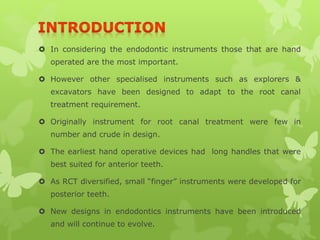
 In considering the endodontic instruments those that are hand
operated are the most important.
 However other specialised instruments such as explorers &
excavators have been designed to adapt to the root canal
treatment requirement.
 Originally instrument for root canal treatment were few in
number and crude in design.
 The earliest hand operative devices had long handles that were
best suited for anterior teeth.
 As RCT diversified, small “finger” instruments were developed for
posterior teeth.
 New designs in endodontics instruments have been introduced
and will continue to evolve.
MICRO
INSTRUMENTS
INTRACANAL
INSTRUMENTS
GENERAL
INSTRUMENTS
Classification
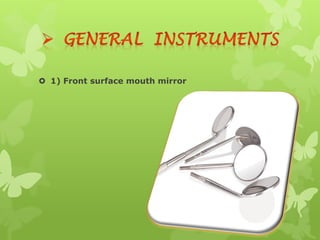
 1) Front surface mouth mirror
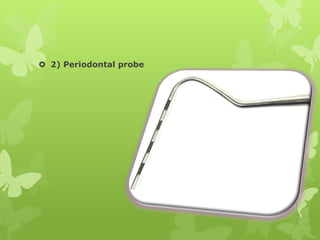
 2) Periodontal probe
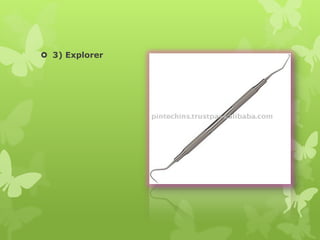
 3) Explorer
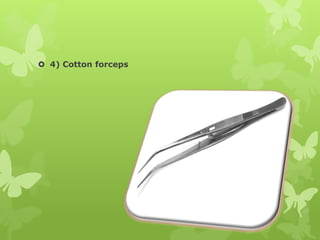
 4) Cotton forceps
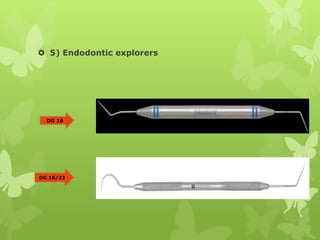
 5) Endodontic explorers
DG 16
DG 16/23
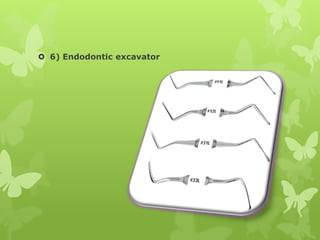
 6) Endodontic excavator
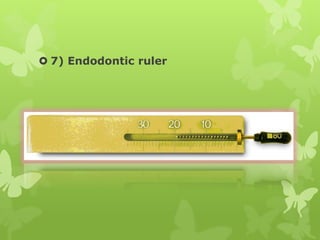
 7) Endodontic ruler
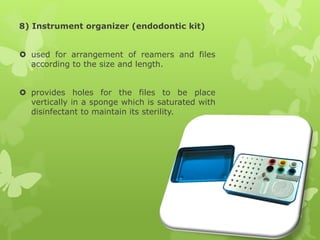
8) Instrument organizer (endodontic kit)
 used for arrangement of reamers and files
according to the size and length.
 provides holes for the files to be place
vertically in a sponge which is saturated with
disinfectant to maintain its sterility.
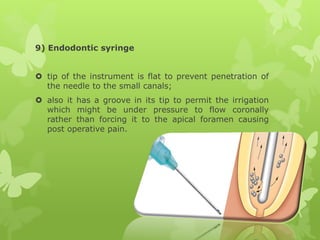
9) Endodontic syringe
 tip of the instrument is flat to prevent penetration of
the needle to the small canals;
 also it has a groove in its tip to permit the irrigation
which might be under pressure to flow coronally
rather than forcing it to the apical foramen causing
post operative pain.
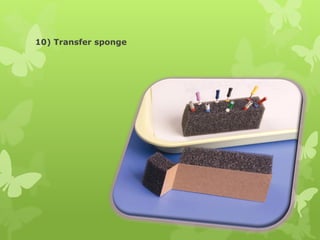
10) Transfer sponge
A-Carbon steel-
contain less than 2.1% of
carbon
 Have high hardness than SS
instruments.
 Prone to corrosion, so cant be
re-sterilised.
 Prone to rust.
 Example: barbed broch
B-Stainless steel instruments-
contain 18% chromium, 8-
10% nickel, 0.12% carbon
 Corrosion resistant
 Stiff nature
 Prone to fracture
 Prone to distortion
C-Nickel titanium - contain 55% Ni and 45% Ti
 Shape memory
 Super elasticity
 Low modulus of elasticity
 Corrosion resisitant
 Softer
 Good resilience
 Biocompatibility
 Poor cutting efficiency
 Don’t show signs of fatigue before they fracture
 Poor resistance to fracture.
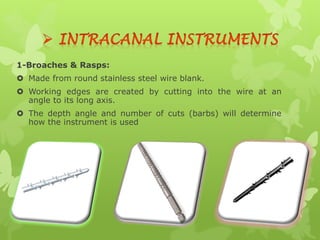
1-Broaches & Rasps:
 Made from round stainless steel wire blank.
 Working edges are created by cutting into the wire at an
angle to its long axis.
 The depth angle and number of cuts (barbs) will determine
how the instrument is used
2- K Files & reamers:
 Designed in 1904 by Kerr Manufacturing Co.
 Are the most widely copied and extensively manufactured endodontic
instruments worldwide .
 Previously made of Carbon Steel Presently made of Stainless Steel.
 K File and Reamer are the oldest instruments used to machine dentin.
 Produced by grinding graduated sizes of round Piano wire into either a
square or triangular configuration
 These instruments are useful for penetrating and enlarging root
canals.
 These instruments works primarily by compression and release
destruction of the dentin surrounding the canal.
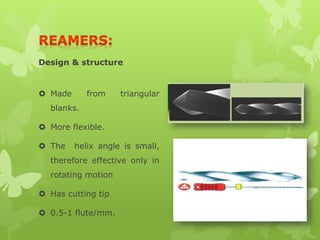
Design & structure
 Made from triangular
blanks.
 More flexible.
 The helix angle is small,
therefore effective only in
rotating motion
 Has cutting tip
 0.5-1 flute/mm.
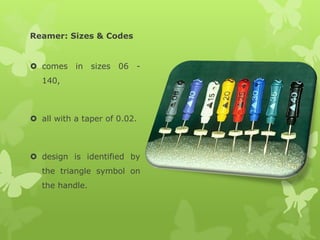
Reamer: Sizes & Codes
 comes in sizes 06 -
140,
 all with a taper of 0.02.
 design is identified by
the triangle symbol on
the handle.
Reamer: Recommended use
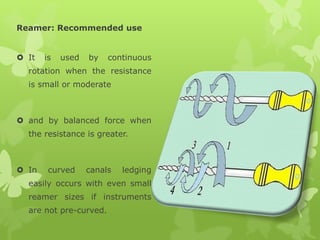
 It is used by continuous
rotation when the resistance
is small or moderate
 and by balanced force when
the resistance is greater.
 In curved canals ledging
easily occurs with even small
reamer sizes if instruments
are not pre-curved.
Reamer: Safety tips
 Reamers can be rotated only using
moderate pressure.
 Use of force, particularly with
smaller sized instruments, may
result in distortion of the helical
structure and ultimately in fracture.
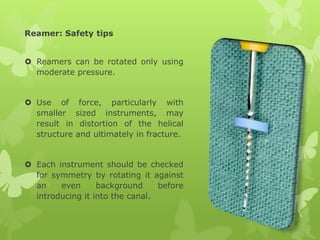
 Each instrument should be checked
for symmetry by rotating it against
an even background before
introducing it into the canal.
K-file: Design & Structure
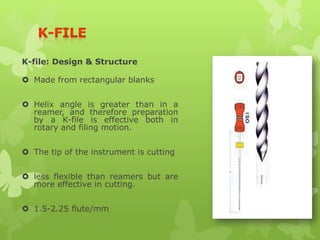
 Made from rectangular blanks
 Helix angle is greater than in a
reamer, and therefore preparation
by a K-file is effective both in
rotary and filing motion.
 The tip of the instrument is cutting
 less flexible than reamers but are
more effective in cutting.
 1.5-2.25 flute/mm.
K-file: Sizes & Codes
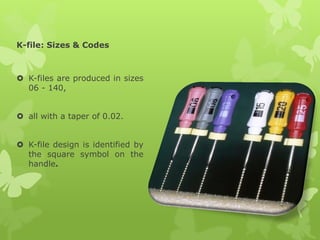
 K-files are produced in sizes
06 - 140,
 all with a taper of 0.02.
 K-file design is identified by
the square symbol on the
handle.
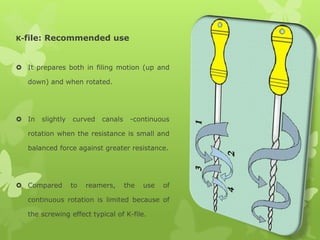
K-file: Recommended use
 It prepares both in filing motion (up and
down) and when rotated.
 In slightly curved canals -continuous
rotation when the resistance is small and
balanced force against greater resistance.
 Compared to reamers, the use of
continuous rotation is limited because of
the screwing effect typical of K-file.
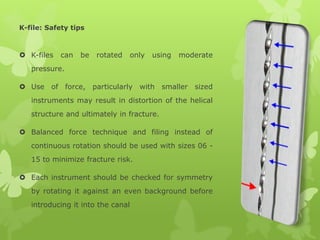
K-file: Safety tips
 K-files can be rotated only using moderate
pressure.
 Use of force, particularly with smaller sized
instruments may result in distortion of the helical
structure and ultimately in fracture.
 Balanced force technique and filing instead of
continuous rotation should be used with sizes 06 -
15 to minimize fracture risk.
 Each instrument should be checked for symmetry
by rotating it against an even background before
introducing it into the canal
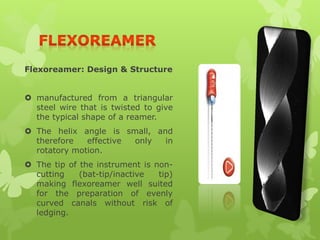
Flexoreamer: Design & Structure
 manufactured from a triangular
steel wire that is twisted to give
the typical shape of a reamer.
 The helix angle is small, and
therefore effective only in
rotatory motion.
 The tip of the instrument is non-
cutting (bat-tip/inactive tip)
making flexoreamer well suited
for the preparation of evenly
curved canals without risk of
ledging.
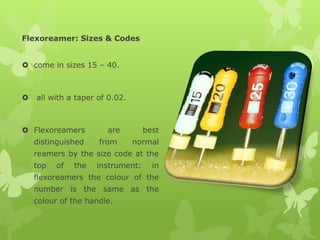
Flexoreamer: Sizes & Codes
 come in sizes 15 – 40.
 all with a taper of 0.02.
 Flexoreamers are best
distinguished from normal
reamers by the size code at the
top of the instrument: in
flexoreamers the colour of the
number is the same as the
colour of the handle.
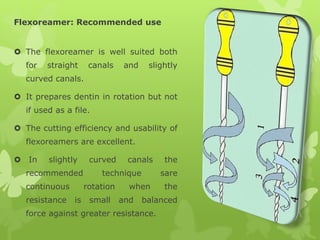
Flexoreamer: Recommended use
 The flexoreamer is well suited both
for straight canals and slightly
curved canals.
 It prepares dentin in rotation but not
if used as a file.
 The cutting efficiency and usability of
flexoreamers are excellent.
 In slightly curved canals the
recommended technique sare
continuous rotation when the
resistance is small and balanced
force against greater resistance.
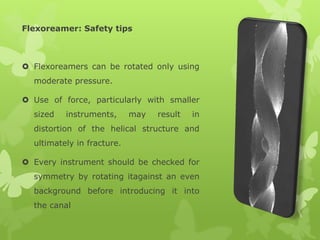
Flexoreamer: Safety tips
 Flexoreamers can be rotated only using
moderate pressure.
 Use of force, particularly with smaller
sized instruments, may result in
distortion of the helical structure and
ultimately in fracture.
 Every instrument should be checked for
symmetry by rotating itagainst an even
background before introducing it into
the canal
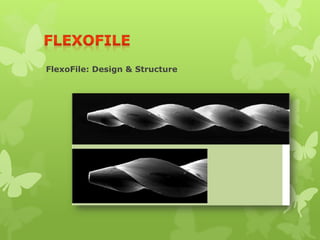
FlexoFile: Design & Structure
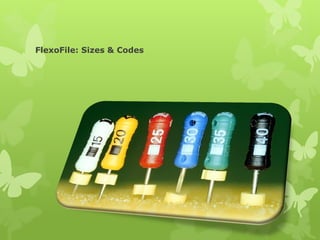
FlexoFile: Sizes & Codes
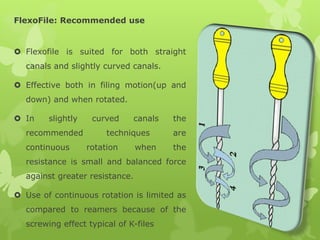
FlexoFile: Recommended use
 Flexofile is suited for both straight
canals and slightly curved canals.
 Effective both in filing motion(up and
down) and when rotated.
 In slightly curved canals the
recommended techniques are
continuous rotation when the
resistance is small and balanced force
against greater resistance.
 Use of continuous rotation is limited as
compared to reamers because of the
screwing effect typical of K-files
FlexoFile: Safety tips
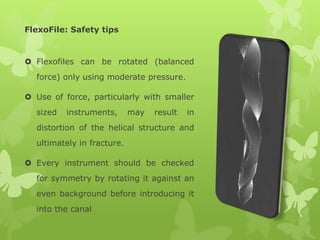
 Flexofiles can be rotated (balanced
force) only using moderate pressure.
 Use of force, particularly with smaller
sized instruments, may result in
distortion of the helical structure and
ultimately in fracture.
 Every instrument should be checked
for symmetry by rotating it against an
even background before introducing it
into the canal
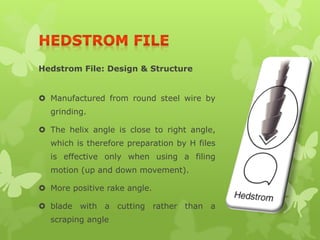
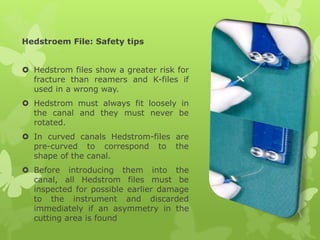
Hedstrom File: Design & Structure
 Manufactured from round steel wire by
grinding.
 The helix angle is close to right angle,
which is therefore preparation by H files
is effective only when using a filing
motion (up and down movement).
 More positive rake angle.
 blade with a cutting rather than a
scraping angle
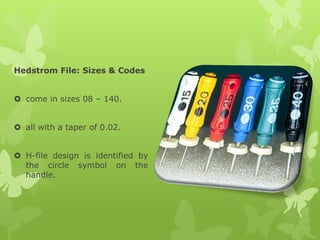
Hedstrom File: Sizes & Codes
 come in sizes 08 – 140.
 all with a taper of 0.02.
 H-file design is identified by
the circle symbol on the
handle.
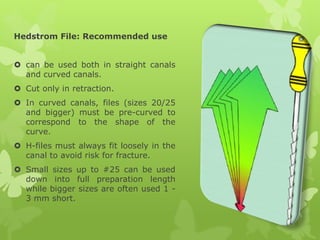
Hedstrom File: Recommended use
 can be used both in straight canals
and curved canals.
 Cut only in retraction.
 In curved canals, files (sizes 20/25
and bigger) must be pre-curved to
correspond to the shape of the
curve.
 H-files must always fit loosely in the
canal to avoid risk for fracture.
 Small sizes up to #25 can be used
down into full preparation length
while bigger sizes are often used 1 -
3 mm short.
Hedstroem File: Safety tips
 Hedstrom files show a greater risk for
fracture than reamers and K-files if
used in a wrong way.
 Hedstrom must always fit loosely in
the canal and they must never be
rotated.
 In curved canals Hedstrom-files are
pre-curved to correspond to the
shape of the canal.
 Before introducing them into the
canal, all Hedstrom files must be
inspected for possible earlier damage
to the instrument and discarded
immediately if an asymmetry in the
cutting area is found
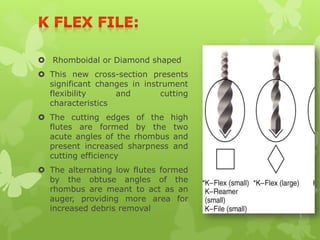
 Rhomboidal or Diamond shaped
 This new cross-section presents
significant changes in instrument
flexibility and cutting
characteristics
 The cutting edges of the high
flutes are formed by the two
acute angles of the rhombus and
present increased sharpness and
cutting efficiency
 The alternating low flutes formed
by the obtuse angles of the
rhombus are meant to act as an
auger, providing more area for
increased debris removal
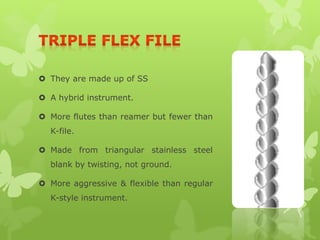
 They are made up of SS
 A hybrid instrument.
 More flutes than reamer but fewer than
K-file.
 Made from triangular stainless steel
blank by twisting, not ground.
 More aggressive & flexible than regular
K-style instrument.
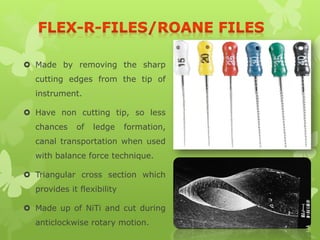
 Made by removing the sharp
cutting edges from the tip of
instrument.
 Have non cutting tip, so less
chances of ledge formation,
canal transportation when used
with balance force technique.
 Triangular cross section which
provides it flexibility
 Made up of NiTi and cut during
anticlockwise rotary motion.
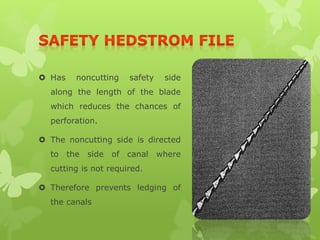
 Has noncutting safety side
along the length of the blade
which reduces the chances of
perforation.
 The noncutting side is directed
to the side of canal where
cutting is not required.
 Therefore prevents ledging of
the canals
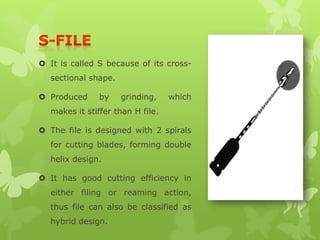
 It is called S because of its cross-
sectional shape.
 Produced by grinding, which
makes it stiffer than H file.
 The file is designed with 2 spirals
for cutting blades, forming double
helix design.
 It has good cutting efficiency in
either filing or reaming action,
thus file can also be classified as
hybrid design.
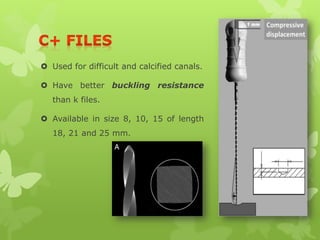
 Used for difficult and calcified canals.
 Have better buckling resistance
than k files.
 Available in size 8, 10, 15 of length
18, 21 and 25 mm.
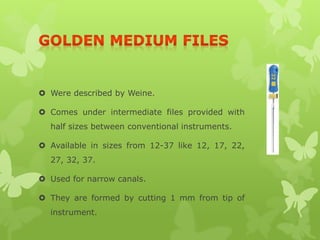
 Were described by Weine.
 Comes under intermediate files provided with
half sizes between conventional instruments.
 Available in sizes from 12-37 like 12, 17, 22,
27, 32, 37.
 Used for narrow canals.
 They are formed by cutting 1 mm from tip of
instrument.
In 1959, a new line of standardized instruments and filling
material was introduced by ingle and levine
 A formula for the diameter and taper in each size of
instrument and filling material was agreed on.
 A formula for a graduated increment in size from one
instrument to the next was developed.
 A new instrument numbering system based on
instrument metric diameter was established.
After the introduction of standardized instruments, about the
only changes made were
 the universal use of stainless rather than carbon steel
 the addition of smaller (Nos. 6 and 8) and larger (Nos. 110-
150) sizes as well as color coding.
It was not until 1976 that the first approved specification for
root canal instruments was published (ADA Specification No.
28)
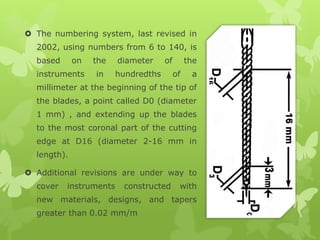
 The numbering system, last revised in
2002, using numbers from 6 to 140, is
based on the diameter of the
instruments in hundredths of a
millimeter at the beginning of the tip of
the blades, a point called D0 (diameter
1 mm) , and extending up the blades
to the most coronal part of the cutting
edge at D16 (diameter 2-16 mm in
length).
 Additional revisions are under way to
cover instruments constructed with
new materials, designs, and tapers
greater than 0.02 mm/m
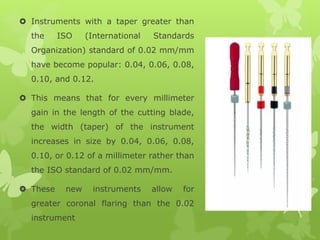
 Instruments with a taper greater than
the ISO (International Standards
Organization) standard of 0.02 mm/mm
have become popular: 0.04, 0.06, 0.08,
0.10, and 0.12.
 This means that for every millimeter
gain in the length of the cutting blade,
the width (taper) of the instrument
increases in size by 0.04, 0.06, 0.08,
0.10, or 0.12 of a millimeter rather than
the ISO standard of 0.02 mm/mm.
 These new instruments allow for
greater coronal flaring than the 0.02
instrument
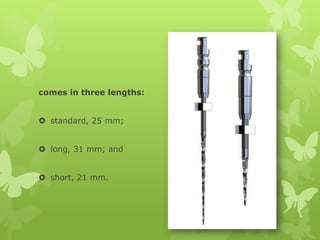
comes in three lengths:
 standard, 25 mm;
 long, 31 mm; and
 short, 21 mm.
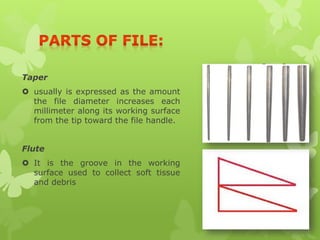
Taper
 usually is expressed as the amount
the file diameter increases each
millimeter along its working surface
from the tip toward the file handle.
Flute
 It is the groove in the working
surface used to collect soft tissue
and debris
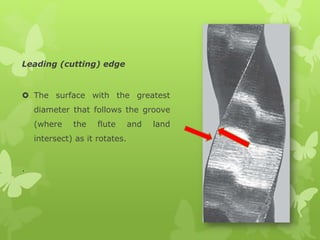
Leading (cutting) edge
 The surface with the greatest
diameter that follows the groove
(where the flute and land
intersect) as it rotates.
.
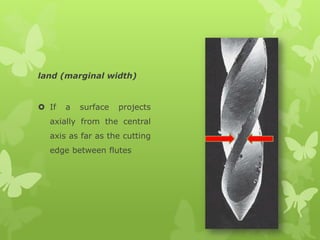
land (marginal width)
 If a surface projects
axially from the central
axis as far as the cutting
edge between flutes
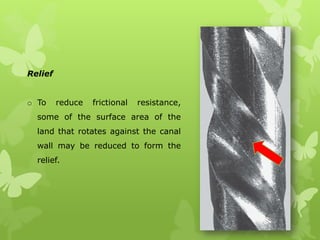
Relief
o To reduce frictional resistance,
some of the surface area of the
land that rotates against the canal
wall may be reduced to form the
relief.
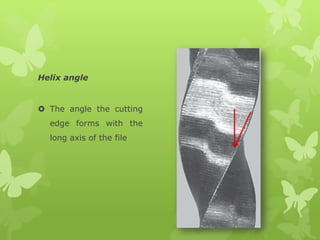
Helix angle
 The angle the cutting
edge forms with the
long axis of the file
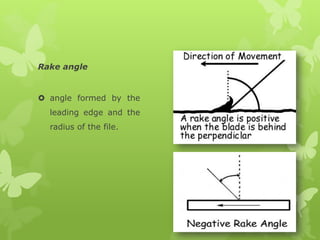
Rake angle
 angle formed by the
leading edge and the
radius of the file.
cutting angle/effective rake angle
 is a better indication of a file’s cutting ability
 determined by measuring the angle formed by the
cutting (leading) edge and the radius when the file is
sectioned perpendicular to the cutting edge
 If the flutes of the file are symmetric, the rake angle
and the cutting angle are essentially the same.
Pitch
 The distance between a point on the leading edge and
the corresponding point on the adjacent leading edge, or
it may be the distance between corresponding points
within which the pattern is not repeated
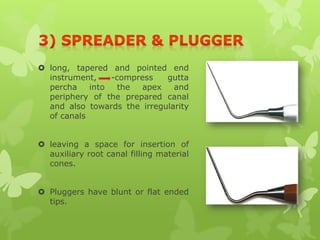
 long, tapered and pointed end
instrument, -compress gutta
percha into the apex and
periphery of the prepared canal
and also towards the irregularity
of canals
 leaving a space for insertion of
auxiliary root canal filling material
cones.
 Pluggers have blunt or flat ended
tips.
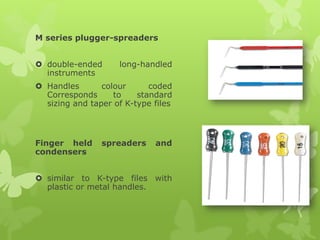
M series plugger-spreaders
 double-ended long-handled
instruments
 Handles colour coded
Corresponds to standard
sizing and taper of K-type files
Finger held spreaders and
condensers
 similar to K-type files with
plastic or metal handles.
 Instruments have been designed to take full advantage
of the increased visibility obtained with dental operating
microscopes, endoscopes, and orascopes.
 Better visualization of the surgical site would have
limited value without microsurgical instruments such as
ultrasonic tips for root-end preparation and micro-
mirrors for inspecting the root end.
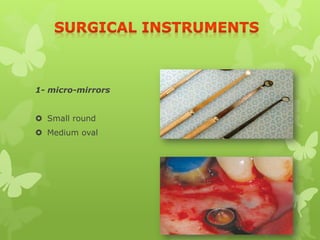
1- micro-mirrors
 Small round
 Medium oval
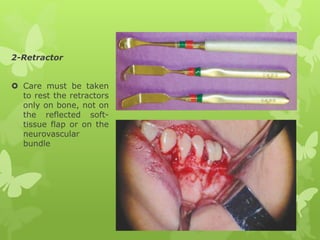
2-Retractor
 Care must be taken
to rest the retractors
only on bone, not on
the reflected soft-
tissue flap or on the
neurovascular
bundle
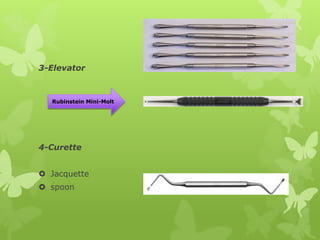
3-Elevator
4-Curette
 Jacquette
 spoon
Rubinstein Mini-Molt
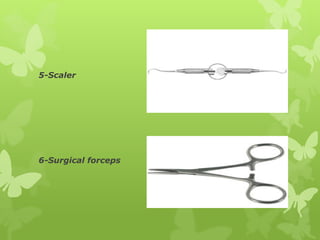
5-Scaler
6-Surgical forceps
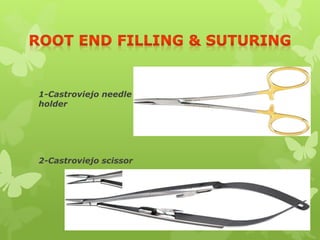
1-Castroviejo needle
holder
2-Castroviejo scissor
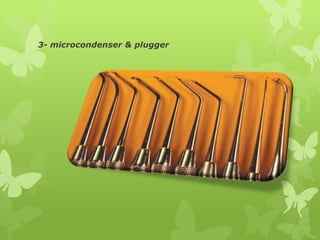
3- microcondenser & plugger
4-Messing gun type syringe
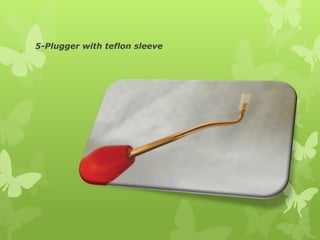
5-Plugger with teflon sleeve
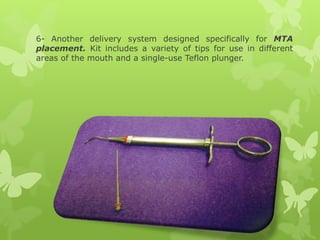
6- Another delivery system designed specifically for MTA
placement. Kit includes a variety of tips for use in different
areas of the mouth and a single-use Teflon plunger.
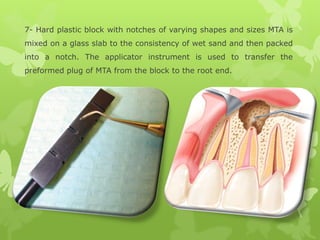
7- Hard plastic block with notches of varying shapes and sizes MTA is
mixed on a glass slab to the consistency of wet sand and then packed
into a notch. The applicator instrument is used to transfer the
preformed plug of MTA from the block to the root end.
 Current NiTi hand preparation procedures that use files with a
greater or variable taper are a substantial improvement over
instrumentation with 0.02 tapered stainless steel files
particularly when used in curved root canals.
 These newer instruments should produce canals with a better
shape, using fewer instruments in a shorter time.
 Microsurgical instruments such as ultrasonic tips for root-end
preparation and micro-mirrors for inspecting the root end
enhances better visualization and contributed to rapid
development of peri-radicular surgery.
Endodontic instruments basic & hand instruments

Endodontic instruments basic & hand instruments

  • 2.
     In consideringthe endodontic instruments those that are hand operated are the most important.  However other specialised instruments such as explorers & excavators have been designed to adapt to the root canal treatment requirement.  Originally instrument for root canal treatment were few in number and crude in design.  The earliest hand operative devices had long handles that were best suited for anterior teeth.  As RCT diversified, small “finger” instruments were developed for posterior teeth.  New designs in endodontics instruments have been introduced and will continue to evolve.
  • 3.
  • 4.
     1) Frontsurface mouth mirror
  • 5.
  • 6.
  • 7.
  • 8.
     5) Endodonticexplorers DG 16 DG 16/23
  • 9.
  • 10.
  • 11.
    8) Instrument organizer(endodontic kit)  used for arrangement of reamers and files according to the size and length.  provides holes for the files to be place vertically in a sponge which is saturated with disinfectant to maintain its sterility.
  • 12.
    9) Endodontic syringe tip of the instrument is flat to prevent penetration of the needle to the small canals;  also it has a groove in its tip to permit the irrigation which might be under pressure to flow coronally rather than forcing it to the apical foramen causing post operative pain.
  • 13.
  • 14.
    A-Carbon steel- contain lessthan 2.1% of carbon  Have high hardness than SS instruments.  Prone to corrosion, so cant be re-sterilised.  Prone to rust.  Example: barbed broch B-Stainless steel instruments- contain 18% chromium, 8- 10% nickel, 0.12% carbon  Corrosion resistant  Stiff nature  Prone to fracture  Prone to distortion
  • 15.
    C-Nickel titanium -contain 55% Ni and 45% Ti  Shape memory  Super elasticity  Low modulus of elasticity  Corrosion resisitant  Softer  Good resilience  Biocompatibility  Poor cutting efficiency  Don’t show signs of fatigue before they fracture  Poor resistance to fracture.
  • 16.
    1-Broaches & Rasps: Made from round stainless steel wire blank.  Working edges are created by cutting into the wire at an angle to its long axis.  The depth angle and number of cuts (barbs) will determine how the instrument is used
  • 17.
    2- K Files& reamers:  Designed in 1904 by Kerr Manufacturing Co.  Are the most widely copied and extensively manufactured endodontic instruments worldwide .  Previously made of Carbon Steel Presently made of Stainless Steel.  K File and Reamer are the oldest instruments used to machine dentin.  Produced by grinding graduated sizes of round Piano wire into either a square or triangular configuration  These instruments are useful for penetrating and enlarging root canals.  These instruments works primarily by compression and release destruction of the dentin surrounding the canal.
  • 18.
    Design & structure Made from triangular blanks.  More flexible.  The helix angle is small, therefore effective only in rotating motion  Has cutting tip  0.5-1 flute/mm.
  • 19.
    Reamer: Sizes &Codes  comes in sizes 06 - 140,  all with a taper of 0.02.  design is identified by the triangle symbol on the handle.
  • 20.
    Reamer: Recommended use It is used by continuous rotation when the resistance is small or moderate  and by balanced force when the resistance is greater.  In curved canals ledging easily occurs with even small reamer sizes if instruments are not pre-curved.
  • 21.
    Reamer: Safety tips Reamers can be rotated only using moderate pressure.  Use of force, particularly with smaller sized instruments, may result in distortion of the helical structure and ultimately in fracture.  Each instrument should be checked for symmetry by rotating it against an even background before introducing it into the canal.
  • 22.
    K-file: Design &Structure  Made from rectangular blanks  Helix angle is greater than in a reamer, and therefore preparation by a K-file is effective both in rotary and filing motion.  The tip of the instrument is cutting  less flexible than reamers but are more effective in cutting.  1.5-2.25 flute/mm.
  • 23.
    K-file: Sizes &Codes  K-files are produced in sizes 06 - 140,  all with a taper of 0.02.  K-file design is identified by the square symbol on the handle.
  • 24.
    K-file: Recommended use It prepares both in filing motion (up and down) and when rotated.  In slightly curved canals -continuous rotation when the resistance is small and balanced force against greater resistance.  Compared to reamers, the use of continuous rotation is limited because of the screwing effect typical of K-file.
  • 25.
    K-file: Safety tips K-files can be rotated only using moderate pressure.  Use of force, particularly with smaller sized instruments may result in distortion of the helical structure and ultimately in fracture.  Balanced force technique and filing instead of continuous rotation should be used with sizes 06 - 15 to minimize fracture risk.  Each instrument should be checked for symmetry by rotating it against an even background before introducing it into the canal
  • 26.
    Flexoreamer: Design &Structure  manufactured from a triangular steel wire that is twisted to give the typical shape of a reamer.  The helix angle is small, and therefore effective only in rotatory motion.  The tip of the instrument is non- cutting (bat-tip/inactive tip) making flexoreamer well suited for the preparation of evenly curved canals without risk of ledging.
  • 27.
    Flexoreamer: Sizes &Codes  come in sizes 15 – 40.  all with a taper of 0.02.  Flexoreamers are best distinguished from normal reamers by the size code at the top of the instrument: in flexoreamers the colour of the number is the same as the colour of the handle.
  • 28.
    Flexoreamer: Recommended use The flexoreamer is well suited both for straight canals and slightly curved canals.  It prepares dentin in rotation but not if used as a file.  The cutting efficiency and usability of flexoreamers are excellent.  In slightly curved canals the recommended technique sare continuous rotation when the resistance is small and balanced force against greater resistance.
  • 29.
    Flexoreamer: Safety tips Flexoreamers can be rotated only using moderate pressure.  Use of force, particularly with smaller sized instruments, may result in distortion of the helical structure and ultimately in fracture.  Every instrument should be checked for symmetry by rotating itagainst an even background before introducing it into the canal
  • 30.
  • 31.
  • 32.
    FlexoFile: Recommended use Flexofile is suited for both straight canals and slightly curved canals.  Effective both in filing motion(up and down) and when rotated.  In slightly curved canals the recommended techniques are continuous rotation when the resistance is small and balanced force against greater resistance.  Use of continuous rotation is limited as compared to reamers because of the screwing effect typical of K-files
  • 33.
    FlexoFile: Safety tips Flexofiles can be rotated (balanced force) only using moderate pressure.  Use of force, particularly with smaller sized instruments, may result in distortion of the helical structure and ultimately in fracture.  Every instrument should be checked for symmetry by rotating it against an even background before introducing it into the canal
  • 34.
    Hedstrom File: Design& Structure  Manufactured from round steel wire by grinding.  The helix angle is close to right angle, which is therefore preparation by H files is effective only when using a filing motion (up and down movement).  More positive rake angle.  blade with a cutting rather than a scraping angle
  • 35.
    Hedstrom File: Sizes& Codes  come in sizes 08 – 140.  all with a taper of 0.02.  H-file design is identified by the circle symbol on the handle.
  • 36.
    Hedstrom File: Recommendeduse  can be used both in straight canals and curved canals.  Cut only in retraction.  In curved canals, files (sizes 20/25 and bigger) must be pre-curved to correspond to the shape of the curve.  H-files must always fit loosely in the canal to avoid risk for fracture.  Small sizes up to #25 can be used down into full preparation length while bigger sizes are often used 1 - 3 mm short.
  • 37.
    Hedstroem File: Safetytips  Hedstrom files show a greater risk for fracture than reamers and K-files if used in a wrong way.  Hedstrom must always fit loosely in the canal and they must never be rotated.  In curved canals Hedstrom-files are pre-curved to correspond to the shape of the canal.  Before introducing them into the canal, all Hedstrom files must be inspected for possible earlier damage to the instrument and discarded immediately if an asymmetry in the cutting area is found
  • 38.
     Rhomboidal orDiamond shaped  This new cross-section presents significant changes in instrument flexibility and cutting characteristics  The cutting edges of the high flutes are formed by the two acute angles of the rhombus and present increased sharpness and cutting efficiency  The alternating low flutes formed by the obtuse angles of the rhombus are meant to act as an auger, providing more area for increased debris removal
  • 39.
     They aremade up of SS  A hybrid instrument.  More flutes than reamer but fewer than K-file.  Made from triangular stainless steel blank by twisting, not ground.  More aggressive & flexible than regular K-style instrument.
  • 40.
     Made byremoving the sharp cutting edges from the tip of instrument.  Have non cutting tip, so less chances of ledge formation, canal transportation when used with balance force technique.  Triangular cross section which provides it flexibility  Made up of NiTi and cut during anticlockwise rotary motion.
  • 41.
     Has noncuttingsafety side along the length of the blade which reduces the chances of perforation.  The noncutting side is directed to the side of canal where cutting is not required.  Therefore prevents ledging of the canals
  • 42.
     It iscalled S because of its cross- sectional shape.  Produced by grinding, which makes it stiffer than H file.  The file is designed with 2 spirals for cutting blades, forming double helix design.  It has good cutting efficiency in either filing or reaming action, thus file can also be classified as hybrid design.
  • 43.
     Used fordifficult and calcified canals.  Have better buckling resistance than k files.  Available in size 8, 10, 15 of length 18, 21 and 25 mm.
  • 44.
     Were describedby Weine.  Comes under intermediate files provided with half sizes between conventional instruments.  Available in sizes from 12-37 like 12, 17, 22, 27, 32, 37.  Used for narrow canals.  They are formed by cutting 1 mm from tip of instrument.
  • 45.
    In 1959, anew line of standardized instruments and filling material was introduced by ingle and levine  A formula for the diameter and taper in each size of instrument and filling material was agreed on.  A formula for a graduated increment in size from one instrument to the next was developed.  A new instrument numbering system based on instrument metric diameter was established.
  • 46.
    After the introductionof standardized instruments, about the only changes made were  the universal use of stainless rather than carbon steel  the addition of smaller (Nos. 6 and 8) and larger (Nos. 110- 150) sizes as well as color coding. It was not until 1976 that the first approved specification for root canal instruments was published (ADA Specification No. 28)
  • 47.
     The numberingsystem, last revised in 2002, using numbers from 6 to 140, is based on the diameter of the instruments in hundredths of a millimeter at the beginning of the tip of the blades, a point called D0 (diameter 1 mm) , and extending up the blades to the most coronal part of the cutting edge at D16 (diameter 2-16 mm in length).  Additional revisions are under way to cover instruments constructed with new materials, designs, and tapers greater than 0.02 mm/m
  • 48.
     Instruments witha taper greater than the ISO (International Standards Organization) standard of 0.02 mm/mm have become popular: 0.04, 0.06, 0.08, 0.10, and 0.12.  This means that for every millimeter gain in the length of the cutting blade, the width (taper) of the instrument increases in size by 0.04, 0.06, 0.08, 0.10, or 0.12 of a millimeter rather than the ISO standard of 0.02 mm/mm.  These new instruments allow for greater coronal flaring than the 0.02 instrument
  • 49.
    comes in threelengths:  standard, 25 mm;  long, 31 mm; and  short, 21 mm.
  • 50.
    Taper  usually isexpressed as the amount the file diameter increases each millimeter along its working surface from the tip toward the file handle. Flute  It is the groove in the working surface used to collect soft tissue and debris
  • 51.
    Leading (cutting) edge The surface with the greatest diameter that follows the groove (where the flute and land intersect) as it rotates. .
  • 52.
    land (marginal width) If a surface projects axially from the central axis as far as the cutting edge between flutes
  • 53.
    Relief o To reducefrictional resistance, some of the surface area of the land that rotates against the canal wall may be reduced to form the relief.
  • 54.
    Helix angle  Theangle the cutting edge forms with the long axis of the file
  • 55.
    Rake angle  angleformed by the leading edge and the radius of the file.
  • 56.
    cutting angle/effective rakeangle  is a better indication of a file’s cutting ability  determined by measuring the angle formed by the cutting (leading) edge and the radius when the file is sectioned perpendicular to the cutting edge  If the flutes of the file are symmetric, the rake angle and the cutting angle are essentially the same.
  • 57.
    Pitch  The distancebetween a point on the leading edge and the corresponding point on the adjacent leading edge, or it may be the distance between corresponding points within which the pattern is not repeated
  • 58.
     long, taperedand pointed end instrument, -compress gutta percha into the apex and periphery of the prepared canal and also towards the irregularity of canals  leaving a space for insertion of auxiliary root canal filling material cones.  Pluggers have blunt or flat ended tips.
  • 59.
    M series plugger-spreaders double-ended long-handled instruments  Handles colour coded Corresponds to standard sizing and taper of K-type files Finger held spreaders and condensers  similar to K-type files with plastic or metal handles.
  • 60.
     Instruments havebeen designed to take full advantage of the increased visibility obtained with dental operating microscopes, endoscopes, and orascopes.  Better visualization of the surgical site would have limited value without microsurgical instruments such as ultrasonic tips for root-end preparation and micro- mirrors for inspecting the root end.
  • 62.
    1- micro-mirrors  Smallround  Medium oval
  • 63.
    2-Retractor  Care mustbe taken to rest the retractors only on bone, not on the reflected soft- tissue flap or on the neurovascular bundle
  • 64.
  • 65.
  • 66.
  • 67.
  • 68.
  • 69.
  • 70.
    6- Another deliverysystem designed specifically for MTA placement. Kit includes a variety of tips for use in different areas of the mouth and a single-use Teflon plunger.
  • 71.
    7- Hard plasticblock with notches of varying shapes and sizes MTA is mixed on a glass slab to the consistency of wet sand and then packed into a notch. The applicator instrument is used to transfer the preformed plug of MTA from the block to the root end.
  • 72.
     Current NiTihand preparation procedures that use files with a greater or variable taper are a substantial improvement over instrumentation with 0.02 tapered stainless steel files particularly when used in curved root canals.  These newer instruments should produce canals with a better shape, using fewer instruments in a shorter time.  Microsurgical instruments such as ultrasonic tips for root-end preparation and micro-mirrors for inspecting the root end enhances better visualization and contributed to rapid development of peri-radicular surgery.