Prepared by :
DR. Anwar N. Altowaity
Endodontic instruments .I
CLASSIFICATION OF ENDODONTIC
INSTRUMENTS ACCORDING TO
SEQUENCE OF USE:
1. Diagnostic instruments .
2. Instruments for access cavity
preparation.
3. Exploring instruments.
4. Extirpating instruments.
5. Root canal enlarging instruments.
6. Obturating instruments.
7. Miscellaneous instruments.
1.Diagnostic Instruments:
A) Standard diagnostic instruments:
mirror , probe , tweezer, periodontal
probe.
B) Diagnostic radiograph:
plain radiography.
Digital radiography.
CBCT (Cone Beam Computed
Tomography).
Ultrasonic imaging.
C) Diagnostic adjuncts:
pulp sensitivity:
Electrical pulp tester.
Thermal pulp tester .
pulp vitality:
Laser Doppler Flowmetry (LDF).
Pulse oxiometry (Infrared).
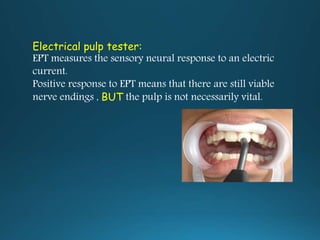
Electrical pulp tester:
EPT measures the sensory neural response to an electric
current.
Positive response to EPT means that there are still viable
nerve endings , BUT the pulp is not necessarily vital.
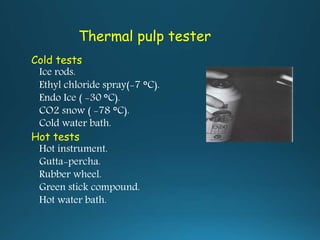
Thermal pulp tester
Cold tests
Ice rods.
Ethyl chloride spray(-7 °C).
Endo Ice ( -30 °C).
CO2 snow ( -78 °C).
Cold water bath.
Hot tests
Hot instrument.
Gutta-percha.
Rubber wheel.
Green stick compound.
Hot water bath.
Clinical Response to Thermal Testing:
Normal pulp : moderate ,transient pain.
Reversible pulpities : sharp pain ( subsides quickly).
Irreversible pulpities : sharp , severe pain ( lingers).
Necrosis: No response.
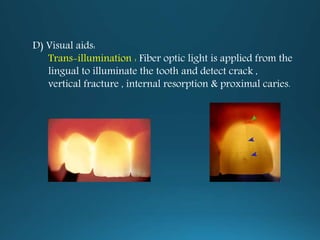
D) Visual aids:
Trans-illumination : Fiber optic light is applied from the
lingual to illuminate the tooth and detect crack ,
vertical fracture , internal resorption & proximal caries.
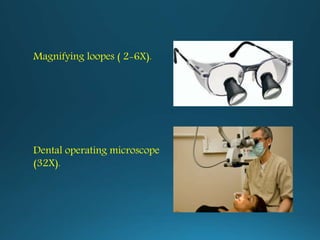
Dental operating microscope
(32X).
Magnifying loopes ( 2-6X).
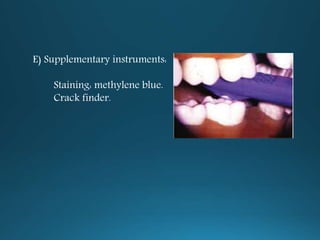
E) Supplementary instruments:
Staining: methylene blue.
Crack finder.
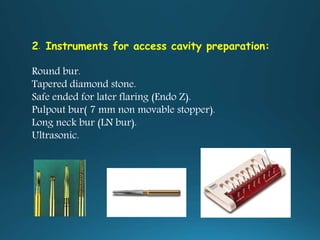
2. Instruments for access cavity preparation:
Round bur.
Tapered diamond stone.
Safe ended for later flaring (Endo Z).
Pulpout bur( 7 mm non movable stopper).
Long neck bur (LN bur).
Ultrasonic.
3. Exploring Instruments :
used for locating the canal orifice and determining
patency of the root canal.
-Endodontic explorer (probe).
-Endodontic spoon.
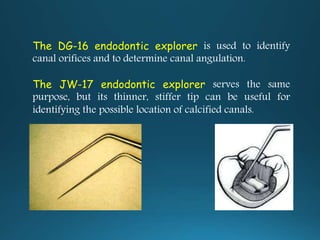
The DG-16 endodontic explorer is used to identify
canal orifices and to determine canal angulation.
The JW-17 endodontic explorer serves the same
purpose, but its thinner, stiffer tip can be useful for
identifying the possible location of calcified canals.
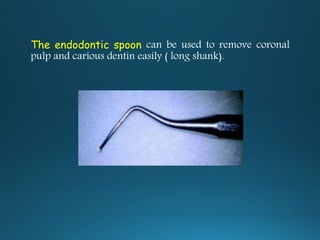
The endodontic spoon can be used to remove coronal
pulp and carious dentin easily ( long shank).
4. Extirpating Instruments :
used for extirpating the pulp and removing any foreign
debris.
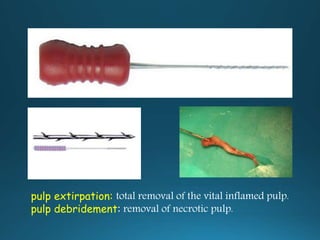
Barbed ( serrated ) broach:
Manufactured of steel.
Has small sharp barbs made by incision & elevation of
shaft along working length.
Uses : pulp extirpation and removal of paper points &
cotton pellets.
Method of use : insertion into canal – quarter rotation –
pull.
pulp extirpation: total removal of the vital inflamed pulp.
pulp debridement: removal of necrotic pulp.
Group I: Manually Operated Instruments.
Group II: Low speed instruments(latch type attachment)
Group III: Engine-driven NiTi rotary instruments.
Group IV: Engine driven instruments that adapt
themselves to the shape of the root canal.
Group V: Engine driven reciprocating instruments.
Group VI: Sonic and ultrasonic instruments.
5. Root canal enlarging instruments
Classification of root canal preparation instruments
Firstly in 1904 Kerr Manufacturing Company designed
the, K-style files and reamers.
Files  instruments that enlarge canals with reciprocal
insertion and withdrawal motions .
Group I – Manually Operated Instruments
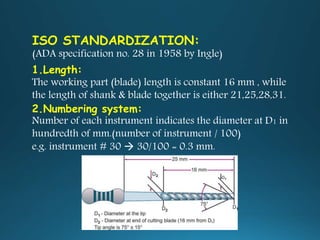
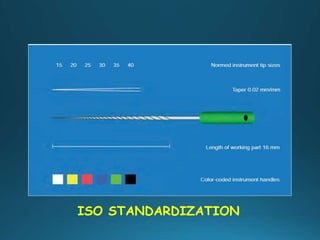
ISO STANDARDIZATION:
(ADA specification no. 28 in 1958 by Ingle)
1.Length:
The working part (blade) length is constant 16 mm , while
the length of shank & blade together is either 21,25,28,31.
2.Numbering system:
Number of each instrument indicates the diameter at D1 in
hundredth of mm.(number of instrument / 100)
e.g. instrument # 30  30/100 = 0.3 mm.
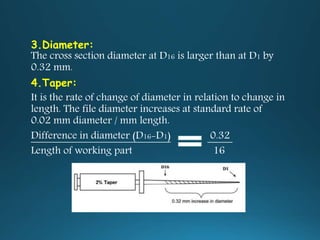
3.Diameter:
The cross section diameter at D16 is larger than at D1 by
0.32 mm.
4.Taper:
It is the rate of change of diameter in relation to change in
length. The file diameter increases at standard rate of
0.02 mm diameter / mm length.
Difference in diameter (D16-D1) 0.32
16Length of working part
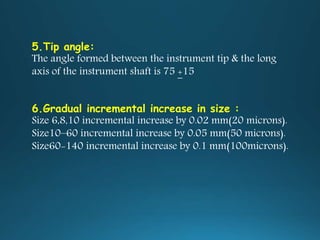
5.Tip angle:
The angle formed between the instrument tip & the long
axis of the instrument shaft is 75 +15
6.Gradual incremental increase in size :
Size 6,8,10 incremental increase by 0.02 mm(20 microns).
Size10–60 incremental increase by 0.05 mm(50 microns).
Size60-140 incremental increase by 0.1 mm(100microns).
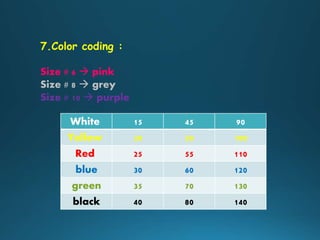
904515White
1005020Yellow
1105525Red
1206030blue
1307035green
1408040black
7.Color coding :
Size # 6  pink
Size # 8  grey
Size # 10  purple
ISO STANDARDIZATION
IMPORTANCE OF ISO STANDARDIZATION:
Allow gradual enlarging of root canal.
Proper root canal preparation & filling.
Ease of instrument selection.
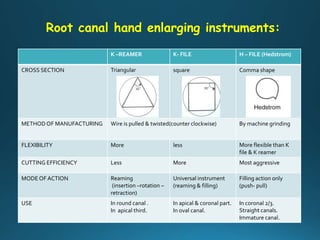
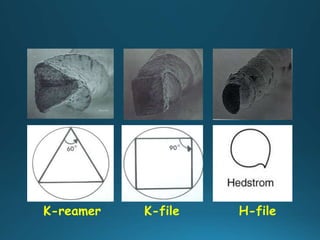
H – FILE (Hedstrom)K- FILEK –REAMER
Comma shapesquareTriangularCROSS SECTION
By machine grindingWire is pulled & twisted(counter clockwise)METHOD OF MANUFACTURING
More flexible than K
file & K reamer
lessMoreFLEXIBILITY
Most aggressiveMoreLessCUTTING EFFICIENCY
Filling action only
(push- pull)
Universal instrument
(reaming & filling)
Reaming
(insertion –rotation –
retraction)
MODEOF ACTION
In coronal 2/3.
Straight canals.
Immature canal.
In apical & coronal part.
In oval canal.
In round canal .
In apical third.
USE
Root canal hand enlarging instruments:
K-reamer K-file H-file
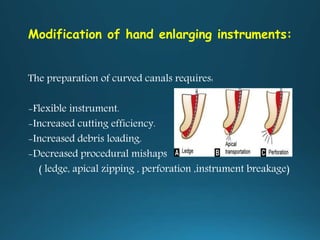
The preparation of curved canals requires:
-Flexible instrument.
-Increased cutting efficiency.
-Increased debris loading.
-Decreased procedural mishaps
( ledge, apical zipping , perforation ,instrument breakage)
Modification of hand enlarging instruments:
K-file Modifications:
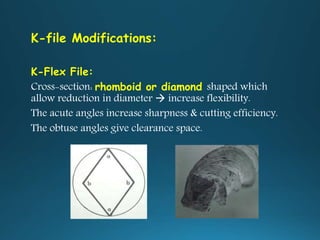
K-Flex File:
Cross-section: rhomboid or diamond shaped which
allow reduction in diameter  increase flexibility.
The acute angles increase sharpness & cutting efficiency.
The obtuse angles give clearance space.
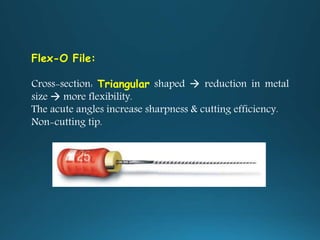
Flex-O File:
Cross-section: Triangular shaped  reduction in metal
size  more flexibility.
The acute angles increase sharpness & cutting efficiency.
Non-cutting tip.
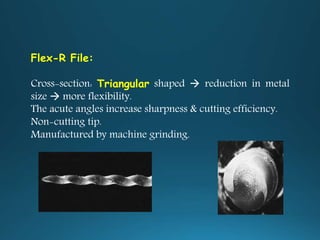
Flex-R File:
Cross-section: Triangular shaped  reduction in metal
size  more flexibility.
The acute angles increase sharpness & cutting efficiency.
Non-cutting tip.
Manufactured by machine grinding.
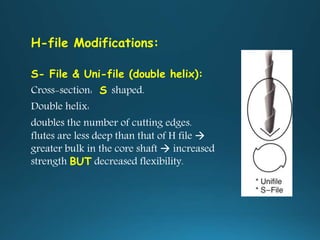
H-file Modifications:
S- File & Uni-file (double helix):
Cross-section: S shaped.
Double helix:
doubles the number of cutting edges.
flutes are less deep than that of H file 
greater bulk in the core shaft  increased
strength BUT decreased flexibility.
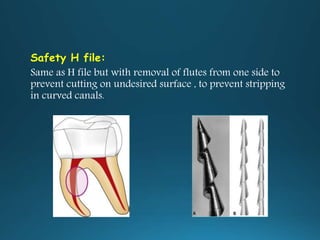
Safety H file:
Same as H file but with removal of flutes from one side to
prevent cutting on undesired surface , to prevent stripping
in curved canals.
Variation in material of construction:
Carbon steel instruments:
Small sized used for initial penetration and gaining access to
the of narrow canal.
Pathfinder & c+ file were developed to negotiate highly
calcified constricted canals as they have greater sharpness
and strength for penetration.( available in size 6, 8,10,15)
N.B: flexible instruments are poor in penetrating the tip of
narrow canal. If flexible instrument is used in such canal it
may bend itself just like a wet noodle.

Endodontic instruments 1

  • 1.
    Prepared by : DR.Anwar N. Altowaity Endodontic instruments .I
  • 2.
    CLASSIFICATION OF ENDODONTIC INSTRUMENTSACCORDING TO SEQUENCE OF USE: 1. Diagnostic instruments . 2. Instruments for access cavity preparation. 3. Exploring instruments. 4. Extirpating instruments. 5. Root canal enlarging instruments. 6. Obturating instruments. 7. Miscellaneous instruments.
  • 3.
    1.Diagnostic Instruments: A) Standarddiagnostic instruments: mirror , probe , tweezer, periodontal probe. B) Diagnostic radiograph: plain radiography. Digital radiography. CBCT (Cone Beam Computed Tomography). Ultrasonic imaging.
  • 4.
    C) Diagnostic adjuncts: pulpsensitivity: Electrical pulp tester. Thermal pulp tester . pulp vitality: Laser Doppler Flowmetry (LDF). Pulse oxiometry (Infrared).
  • 5.
    Electrical pulp tester: EPTmeasures the sensory neural response to an electric current. Positive response to EPT means that there are still viable nerve endings , BUT the pulp is not necessarily vital.
  • 6.
    Thermal pulp tester Coldtests Ice rods. Ethyl chloride spray(-7 °C). Endo Ice ( -30 °C). CO2 snow ( -78 °C). Cold water bath. Hot tests Hot instrument. Gutta-percha. Rubber wheel. Green stick compound. Hot water bath.
  • 7.
    Clinical Response toThermal Testing: Normal pulp : moderate ,transient pain. Reversible pulpities : sharp pain ( subsides quickly). Irreversible pulpities : sharp , severe pain ( lingers). Necrosis: No response.
  • 8.
    D) Visual aids: Trans-illumination: Fiber optic light is applied from the lingual to illuminate the tooth and detect crack , vertical fracture , internal resorption & proximal caries.
  • 9.
  • 10.
    E) Supplementary instruments: Staining:methylene blue. Crack finder.
  • 11.
    2. Instruments foraccess cavity preparation: Round bur. Tapered diamond stone. Safe ended for later flaring (Endo Z). Pulpout bur( 7 mm non movable stopper). Long neck bur (LN bur). Ultrasonic.
  • 12.
    3. Exploring Instruments: used for locating the canal orifice and determining patency of the root canal. -Endodontic explorer (probe). -Endodontic spoon.
  • 13.
    The DG-16 endodonticexplorer is used to identify canal orifices and to determine canal angulation. The JW-17 endodontic explorer serves the same purpose, but its thinner, stiffer tip can be useful for identifying the possible location of calcified canals.
  • 14.
    The endodontic spooncan be used to remove coronal pulp and carious dentin easily ( long shank).
  • 15.
    4. Extirpating Instruments: used for extirpating the pulp and removing any foreign debris. Barbed ( serrated ) broach: Manufactured of steel. Has small sharp barbs made by incision & elevation of shaft along working length. Uses : pulp extirpation and removal of paper points & cotton pellets. Method of use : insertion into canal – quarter rotation – pull.
  • 16.
    pulp extirpation: totalremoval of the vital inflamed pulp. pulp debridement: removal of necrotic pulp.
  • 17.
    Group I: ManuallyOperated Instruments. Group II: Low speed instruments(latch type attachment) Group III: Engine-driven NiTi rotary instruments. Group IV: Engine driven instruments that adapt themselves to the shape of the root canal. Group V: Engine driven reciprocating instruments. Group VI: Sonic and ultrasonic instruments. 5. Root canal enlarging instruments Classification of root canal preparation instruments
  • 18.
    Firstly in 1904Kerr Manufacturing Company designed the, K-style files and reamers. Files  instruments that enlarge canals with reciprocal insertion and withdrawal motions . Group I – Manually Operated Instruments
  • 19.
    ISO STANDARDIZATION: (ADA specificationno. 28 in 1958 by Ingle) 1.Length: The working part (blade) length is constant 16 mm , while the length of shank & blade together is either 21,25,28,31. 2.Numbering system: Number of each instrument indicates the diameter at D1 in hundredth of mm.(number of instrument / 100) e.g. instrument # 30  30/100 = 0.3 mm.
  • 20.
    3.Diameter: The cross sectiondiameter at D16 is larger than at D1 by 0.32 mm. 4.Taper: It is the rate of change of diameter in relation to change in length. The file diameter increases at standard rate of 0.02 mm diameter / mm length. Difference in diameter (D16-D1) 0.32 16Length of working part
  • 21.
    5.Tip angle: The angleformed between the instrument tip & the long axis of the instrument shaft is 75 +15 6.Gradual incremental increase in size : Size 6,8,10 incremental increase by 0.02 mm(20 microns). Size10–60 incremental increase by 0.05 mm(50 microns). Size60-140 incremental increase by 0.1 mm(100microns).
  • 22.
  • 23.
  • 24.
    IMPORTANCE OF ISOSTANDARDIZATION: Allow gradual enlarging of root canal. Proper root canal preparation & filling. Ease of instrument selection.
  • 25.
    H – FILE(Hedstrom)K- FILEK –REAMER Comma shapesquareTriangularCROSS SECTION By machine grindingWire is pulled & twisted(counter clockwise)METHOD OF MANUFACTURING More flexible than K file & K reamer lessMoreFLEXIBILITY Most aggressiveMoreLessCUTTING EFFICIENCY Filling action only (push- pull) Universal instrument (reaming & filling) Reaming (insertion –rotation – retraction) MODEOF ACTION In coronal 2/3. Straight canals. Immature canal. In apical & coronal part. In oval canal. In round canal . In apical third. USE Root canal hand enlarging instruments:
  • 26.
  • 27.
    The preparation ofcurved canals requires: -Flexible instrument. -Increased cutting efficiency. -Increased debris loading. -Decreased procedural mishaps ( ledge, apical zipping , perforation ,instrument breakage) Modification of hand enlarging instruments:
  • 28.
    K-file Modifications: K-Flex File: Cross-section:rhomboid or diamond shaped which allow reduction in diameter  increase flexibility. The acute angles increase sharpness & cutting efficiency. The obtuse angles give clearance space.
  • 29.
    Flex-O File: Cross-section: Triangularshaped  reduction in metal size  more flexibility. The acute angles increase sharpness & cutting efficiency. Non-cutting tip.
  • 30.
    Flex-R File: Cross-section: Triangularshaped  reduction in metal size  more flexibility. The acute angles increase sharpness & cutting efficiency. Non-cutting tip. Manufactured by machine grinding.
  • 31.
    H-file Modifications: S- File& Uni-file (double helix): Cross-section: S shaped. Double helix: doubles the number of cutting edges. flutes are less deep than that of H file  greater bulk in the core shaft  increased strength BUT decreased flexibility.
  • 32.
    Safety H file: Sameas H file but with removal of flutes from one side to prevent cutting on undesired surface , to prevent stripping in curved canals.
  • 33.
    Variation in materialof construction: Carbon steel instruments: Small sized used for initial penetration and gaining access to the of narrow canal. Pathfinder & c+ file were developed to negotiate highly calcified constricted canals as they have greater sharpness and strength for penetration.( available in size 6, 8,10,15) N.B: flexible instruments are poor in penetrating the tip of narrow canal. If flexible instrument is used in such canal it may bend itself just like a wet noodle.