INTRODUCTION
• Instruments playa very important role in the success of a root canal
treatment therefore a basic knowledge of endodontic instruments is
essential.
• General guidelines exist for root canal preparation, but due to the
complex and varied canal anatomy each case presents unique
challenge.
• A variety of instruments are thus available for this purpose.
3.
CLASSIFICATION OF INSTRUMENTS
ISO-FDI(Federation Dentaire
International) grouped root canal
instruments according to their
method of use:
• Group I : Hand use only, for example,
K and H-files, reamers, broaches,
etc.
• Group II : Latch type Engine driven—
same design as group I but can be
attached to hand piece, e.g. Profiles,
Light speed.
• Group III : Drills or reamers Latch
type Engine driven, for example,
Gates-Glidden, Peeso reamers.
• Group IV : Root canal points like
Grossman’s classification
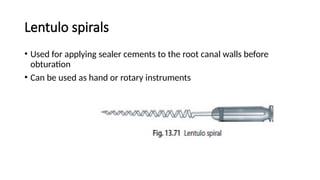
• Function Instruments
• Exploring- Smooth broaches and
endodontic explorers (To locate
canal orifices and determine
patency of root canal)
• Debriding or extirpating-Barbed
broaches (To extirpate the pulp and
other foreign materials from the
root canal)
• Cleaning and shaping- Reamers and
files (Used to shape the canal space)
• Obturating Pluggers, spreaders and
lentulospirals (To pack gutta-percha
4.
PHYSICAL PROPERTIES
• Completedebridement requires instruments to contact and plane all canal walls
• No instrument can fully clean and shape all root canal spaces due to anatomical
complexities.
• Irregular canal spaces often don’t match the round shape of most instruments.
• Stainless steel instruments are relatively flexible and have poor adaptability to
curved canals.
• Nickle-Titanium instruments are more flexible, better suited for fine, curved
canals bur have no significant advantage in irregular canal spaces.
• Effective canal preparation demands skillful and careful use of instruments to
maximize debridement and minimize procedure errors.
CARBON STEEL
• Thesealloys contain less than 2.1% carbon
• Advantage: harder than stainless steel instruments
• Disadvantage: prone to rust and corrosion, and so they can not be
resterilized.
• Example: Barbed broach
8.
STAINLESS STEEL
• Contain18% chromium, 8-10% nickel and 0.12 percent carbon.
• Advantage: corrosion resistant
• Disadvantages: stiff, prone to fracture, prone to distortion.
• Example: K-file, H-file, reamer
9.
NICKEL TITANIUM
• Contain55% nickel and 45% titanium
• Advantages: shape memory, super elasticity, corrosion resistant,
softer, and biocompatibility.
• Disadvantages: poor cutting efficiency, they don’t show fatigue before
they fracture.
• Example: NiTi hand files, profiles, protapers
10.
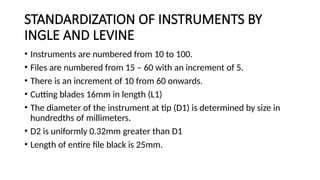
STANDARDIZATION OF INSTRUMENTSBY
INGLE AND LEVINE
• Instruments are numbered from 10 to 100.
• Files are numbered from 15 – 60 with an increment of 5.
• There is an increment of 10 from 60 onwards.
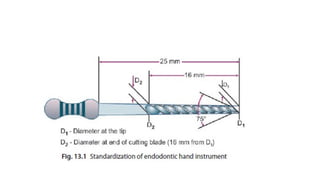
• Cutting blades 16mm in length (L1)
• The diameter of the instrument at tip (D1) is determined by size in
hundredths of millimeters.
• D2 is uniformly 0.32mm greater than D1
• Length of entire file black is 25mm.
12.
MODIFICATIONS IN STANDARDIZATION
•4 modifications were made
1. Additional measurement at D3, 3mm
from tip (D1)
2. Specification for angles of the tip (75°
± 15)
3. Number 6 and 8 have been added for
increased instrumentation
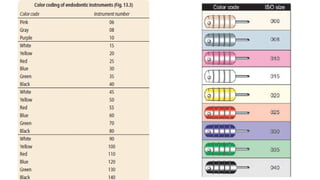
4. Color coding added for quicker
identification of diameters of files
14.
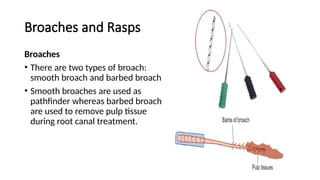
Broaches and Rasps
Broaches
•There are two types of broach:
smooth broach and barbed broach
• Smooth broaches are used as
pathfinder whereas barbed broach
are used to remove pulp tissue
during root canal treatment.
15.
Rasp
• Similar tobarbed broach
• Used to destroy pulp tissue from
canal space (extirpate pulp
tissue)
16.
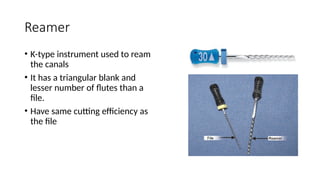
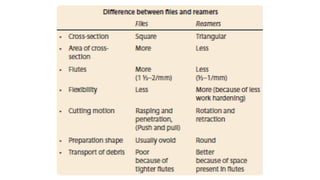
Reamer
• K-type instrumentused to ream
the canals
• It has a triangular blank and
lesser number of flutes than a
file.
• Have same cutting efficiency as
the file
17.
Files
• Instruments usedin cleaning and shaping of root canals.
• Used for removing tissue and superficial dentin from the canal wall
• Commonly used files include: K-file, K-flex file, Flexo file, Flex-R file,
Hedstroem file, Safety H-file, S-file
18.
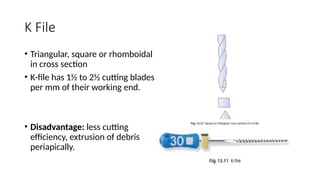
K File
• Triangular,square or rhomboidal
in cross section
• K-file has 1½ to 2½ cutting blades
per mm of their working end.
• Disadvantage: less cutting
efficiency, extrusion of debris
periapically.
19.
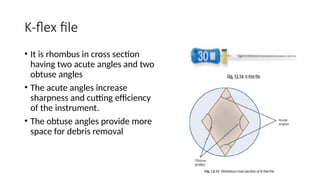
K-flex file
• Itis rhombus in cross section
having two acute angles and two
obtuse angles
• The acute angles increase
sharpness and cutting efficiency
of the instrument.
• The obtuse angles provide more
space for debris removal
20.
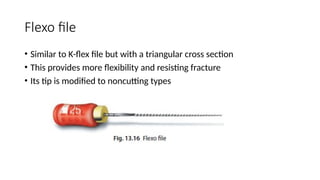
Flexo file
• Similarto K-flex file but with a triangular cross section
• This provides more flexibility and resisting fracture
• Its tip is modified to noncutting types
21.
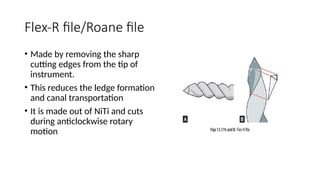
Flex-R file/Roane file
•Made by removing the sharp
cutting edges from the tip of
instrument.
• This reduces the ledge formation
and canal transportation
• It is made out of NiTi and cuts
during anticlockwise rotary
motion
22.
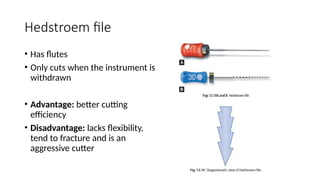
Hedstroem file
• Hasflutes
• Only cuts when the instrument is
withdrawn
• Advantage: better cutting
efficiency
• Disadvantage: lacks flexibility,
tend to fracture and is an
aggressive cutter
23.
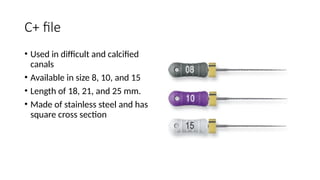
C+ file
• Usedin difficult and calcified
canals
• Available in size 8, 10, and 15
• Length of 18, 21, and 25 mm.
• Made of stainless steel and has
square cross section
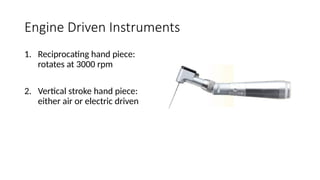
Engine Driven Instruments
1.Reciprocating hand piece:
rotates at 3000 rpm
2. Vertical stroke hand piece:
either air or electric driven
28.
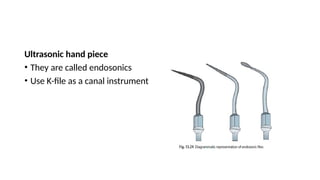
Sonics and Ultrasonic
Sonichand piece
• Uses compressed air
• Sonic hand pieces uses three
types of files which include:
Hello sonic, sharper sonic, and
Rispi sonic
• Have non cutting tip and come in
sizes ranging from 15 to 40.
29.
Continuation
Advantages:
• Better shapingof canal than ultrasonic ones
• Lesser chances of debris extrusion due to constant irrigation
• Produces clean canals
Disadvantages:
• Walls of canal are rough
• Chances of tranpostation are more in curved canals
Uses of Endosonics
•Access enhancement: produces smoother shapes of access cavity
• Orifice location: very useful in removal of chamber calcification
• Irrigation: endosonics produce more cleaner canals
• GP placement: GP gets plasticized by friction generated from the
endosonics
Slow speed rotarystainless steel instruments
• These include
1. Gates-Glidden bur
2. Flexogates
3. Peeso reamers
34.
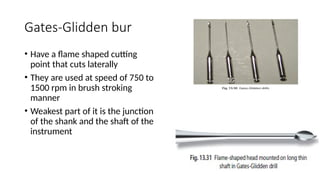
Gates-Glidden bur
• Havea flame shaped cutting
point that cuts laterally
• They are used at speed of 750 to
1500 rpm in brush stroking
manner
• Weakest part of it is the junction
of the shank and the shaft of the
instrument
35.
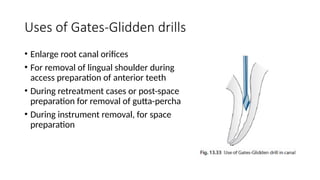
Uses of Gates-Gliddendrills
• Enlarge root canal orifices
• For removal of lingual shoulder during
access preparation of anterior teeth
• During retreatment cases or post-space
preparation for removal of gutta-percha
• During instrument removal, for space
preparation
36.
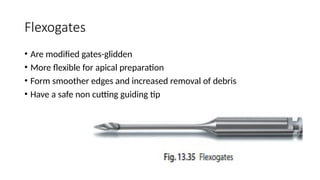
Flexogates
• Are modifiedgates-glidden
• More flexible for apical preparation
• Form smoother edges and increased removal of debris
• Have a safe non cutting guiding tip
37.
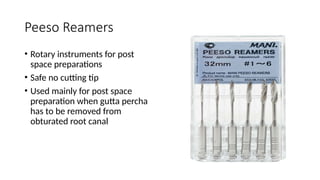
Peeso Reamers
• Rotaryinstruments for post
space preparations
• Safe no cutting tip
• Used mainly for post space
preparation when gutta percha
has to be removed from
obturated root canal
38.
NITI ROTARTY INSTRUMENTS
Advantages:
•Shape memory
• Superelasticity
• Good resiliency
• Corrosion resistant
• And softer than stainless steel
Disadvantages:
• Poor cutting efficiency
• Don’t show signs of fatigue
before fracture
• Poor resistance to fracture
39.
Generations of rotaryinstrument
• First generation: Profiles, Quantec
• Second generation: Profile GT
• Third generation: K3, Race protaper
• Fourth generation: V-taper
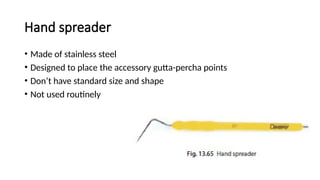
Hand spreader
• Madeof stainless steel
• Designed to place the accessory gutta-percha points
• Don’t have standard size and shape
• Not used routinely
42.
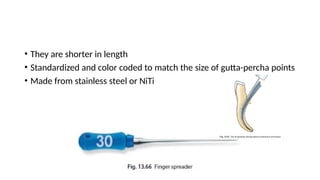
• They areshorter in length
• Standardized and color coded to match the size of gutta-percha points
• Made from stainless steel or NiTi
43.
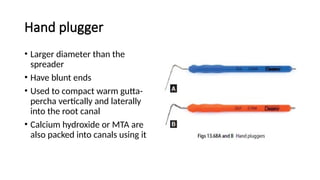
Hand plugger
• Largerdiameter than the
spreader
• Have blunt ends
• Used to compact warm gutta-
percha vertically and laterally
into the root canal
• Calcium hydroxide or MTA are
also packed into canals using it







![PERI-PROSTHETIC FRACTURE NAIL-PLATE CONSTRUCT [NPC].pptx](https://cdn.slidesharecdn.com/ss_thumbnails/drarunkumardrmohamedashrafperiprostheticfrasturenail-plateconstructnpc-260209164459-7e9d15a1-thumbnail.jpg?width=640&height=640&fit=bounds)


