ENDODONTIC
HAND
INSTRUMENTS
Contents
• Introduction
• Materials
• Standardization
• Classification
• File design
• Hand instruments
• Nickel titanium Instruments
• Cleaning, sterilization and storage
• Conclusion
• References
Introduction
• The hand operated instruments
Introduction
• Instruments for RCT
Introduction
• The earliest hand-operated devices
Introduction
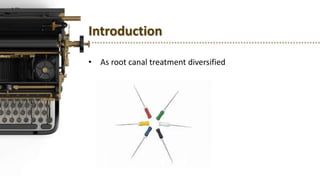
• As root canal treatment diversified
The basic endodontic instruments
• Broaches
• Files
• Reamers.
• The clinician is bombarded with an assortment of new
products and techniques designed to make treatment
faster and effective.
• The technical demands and levels of precision have
traditionally been achieved by careful manipulation of
hand instruments within the root canal space
Short comings of the
older instruments
Before 1958
• Manufactured without established criteria
• Numbering -arbitrary
• Different company - did not coincide
• No correlation of instrument and filling materials
• No quality control of the instrument
• No uniformity existed in progression
Short comings of the
older instruments
BY 1962
Working committee on standardization
 Manufacturers
 The American Association Of Endodontics (AAE)
 The American Dental Association (ADA).
This group evolved into present day INTERNATIONAL STANDARDS ORGANIZATION (ISO)
The endodontic instrument materials
Should be hard enough
Flexible
Resist breakage
MATERIALS USED FOR MANUFACTURING
THE CUTTING INSTRUMENTS:-
 Carbon steel instruments
 Stainless steel instruments
 Nickel-titanium instruments (Nitinol)
Carbon steel instruments
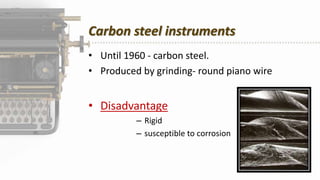
• Until 1960 - carbon steel.
• Produced by grinding- round piano wire
• Disadvantage
– Rigid
– susceptible to corrosion
Stainless steel instruments
• Replaced the carbon steel
» Resilient,
» Ductile and
» Less susceptible to corrosion
• A steel wire is ground along the long AXIS
Disadvantages
– Distortion
– Stiffness of material
– Need to pre-curve the file in curved canals
– Tendency to fracture
Nickel-titanium instruments (Nitinol)
• To overcome the disadvantage of the stainless steel.
• Exotic metal
• It exhibit super elastic behavior and “shape memory”
Nickel-titanium instruments (Nitinol)
• 1960's‘- W.F. Buehler
• In dentistry, Andersen and Hilleman (1971)
• Walia et al in 1988 - Endodontics
• Nitinol files are being manufactured in a U-shaped
configuration as well as K and H-shapes.
Nickel-titanium instruments (Nitinol)
Advantages –
– Less susceptible to distortion
– Low modulus of elasticity
– Elastic flexibility
– Resistance to fracture
– Flexibility is greater
Disadvantages –
– Cutting efficiency is less
– Expensive
– Difficult to manufacture and mill
– Still susceptible to corrosion
Manufacturing of the instruments
Files were first manufactured
The more traditional is produced by grinding graduated sizes of round “piano” wire
The steel wire is ground along its long axis into a 4 sided (square0 or 3 sided
(triangular) tapered shaft i.e. twisted into flutes extending 16 mm from top to tip of
blade.
Three-sided configuration with fewer spirals -reaming,
three or four sided configuration with more spirals -filing.
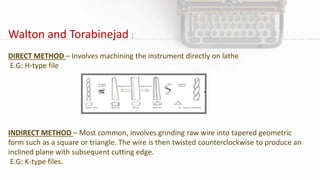
Walton and Torabinejad :
DIRECT METHOD – Involves machining the instrument directly on lathe
E.G: H-type file
INDIRECT METHOD – Most common, involves grinding raw wire into tapered geometric
form such as a square or triangle. The wire is then twisted counterclockwise to produce an
inclined plane with subsequent cutting edge.
E.G: K-type files.
Standardization of the endodontic
instruments
 Before 1958, endodontic instruments were
manufactured without any established criteria.
 There was no uniformity in quality control,
manufacture or progression from one size to another.
 These arbitrarily numbered from 1 to 6
In 1959, Ingle and Levine proposed standardization of
these instruments
1. Instruments shall be numbered from 10 to 100, the numbers to
advance by 5 units to size 60, then by 10 units to size 100.
2. Each number shall be representative of the diameter of the instrument
in hundredths of a mm at the tip. For e.g. No 10 is 10/100 or 0.1mm at
the tip.
3. The working blade (flutes) shall begin at the tip designated site D1 and
shall extend exactly 16mm up the shaft, terminating at designated site
D2
4. The diameter of D2 shall be 32/100 or 0.32mm greater than that of D1.
This sizing ensures a constant increase in taper of 0.02mm per mm for
every instrument regardless of the size
For e.g. No 20 reamer shall have a diameter of 0.20 at D1 and at D2 0.20+0.32
=0.52mm
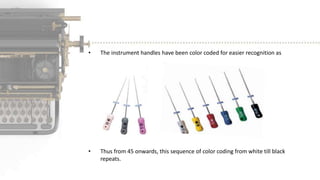
• The instrument handles have been color coded for easier recognition as
• Thus from 45 onwards, this sequence of color coding from white till black
repeats.
Other specifications were added latter. These
includes –
• The full extend of the shaft, up the handle, comes in three
lengths. Standard 25mm, long – 31mm and short – 21mm.
and also 19mm. however other instrument lengths are
available
21mm – used for molars
28 and 30mm for cuspids
25mm – for anteriors
40mm reamers used in preparing canals for
endodontic implants.
Other specifications were added latter. These
includes –
 Universal use of stainless steel and nickel
titanium
1. At present time, instruments with a taper greater than the
ISO 0.02mm/mm have been become popular
 These new instruments allow for greater coronal flaring
Classification
• According to Grossman:
1. Exploring instruments
2. Debriding instruments
3. Cleaning and Shaping instruments
4. Obturating instruments
Classification
Classification
• Classification of Endodontic files and reamers according to new ADA
specification No. 28
Type-I - Reamers
Type-II - Files
Type-III - Hedstroem Files
Type-IV - Rasps
Type-V - Broaches
Type-VI - Probes
Type-VII - Applicators
Type-VIII - Condensers
Type-IX - Spreaders
Classification
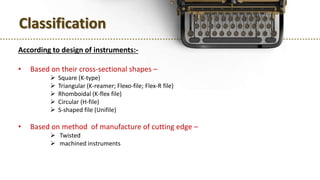
According to design of instruments:-
• Based on their cross-sectional shapes –
 Square (K-type)
 Triangular (K-reamer; Flexo-file; Flex-R file)
 Rhomboidal (K-flex file)
 Circular (H-file)
 S-shaped file (Unifile)
• Based on method of manufacture of cutting edge –
 Twisted
 machined instruments
Instrument design
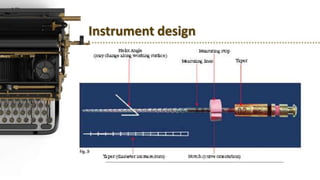
• The amount the file diameter increases each millimeter along its working
surface from the tip toward the handle.
• E.g. size #25 file – 0.02 taper
0.27mm – 1mm
0.29mm – 2mm
0.31mm - 3mm
The taper
The flutes
The GROOVE in the working surface used to collect soft
tissue and dentin chips removed from the wall of the
canal.
Land
• If a surface projects axially from the central axis as far
as the cutting edge between flutes, this surface is
called the “Land”
Relief
• The surface area of the land that rotates against the canal
wall may be reduced to form the “relief”
Helix angle
• The angle the cutting edge forms with the long axis of
the file is called “Helix angle”
The rake angle
• Angle formed by the leading edge and the radius of the
file, when the file is sectioned perpendicular to its long
axis.
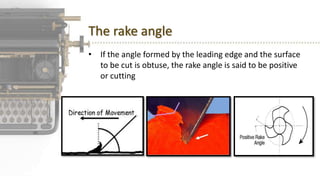
The rake angle
• If the angle formed by the leading edge and the surface
to be cut is obtuse, the rake angle is said to be positive
or cutting
The rake angle
• If the angle formed by the leading edge and the surface
to be cut is acute, the rake angle is said to be negative
or scraping.
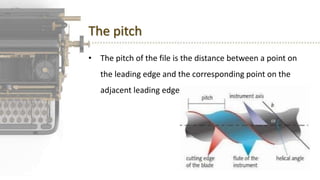
The pitch
• The pitch of the file is the distance between a point on
the leading edge and the corresponding point on the
adjacent leading edge.
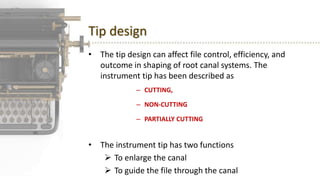
Tip design
• The tip design can affect file control, efficiency, and
outcome in shaping of root canal systems. The
instrument tip has been described as
– CUTTING,
– NON-CUTTING
– PARTIALLY CUTTING
• The instrument tip has two functions
 To enlarge the canal
 To guide the file through the canal
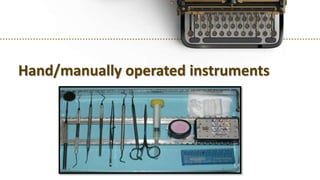
Hand/manually operated instruments
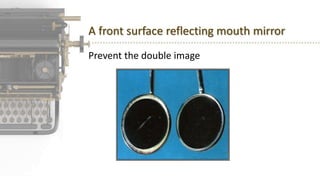
A front surface reflecting mouth mirror
Prevent the double image
Endolocking tweezers
• Gripped safely
• Tip of the beak
• Particularly useful - when handling gutta-percha points,
paper points and cotton wool pledgets
CANAL PROBE
• Long, fine, sharp and strong
• Feel the floor of the pulp chamber
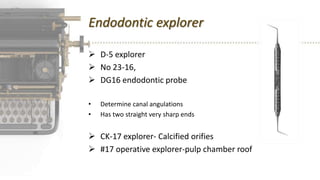
Endodontic explorer
 D-5 explorer
 No 23-16,
 DG16 endodontic probe
• Determine canal angulations
• Has two straight very sharp ends
 CK-17 explorer- Calcified orifies
 #17 operative explorer-pulp chamber roof
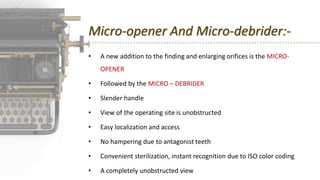
Micro-opener And Micro-debrider:-
• A new addition to the finding and enlarging orifices is the MICRO-
OPENER
• Followed by the MICRO – DEBRIDER
• Slender handle
• View of the operating site is unobstructed
• Easy localization and access
• No hampering due to antagonist teeth
• Convenient sterilization, instant recognition due to ISO color coding
• A completely unobstructed view
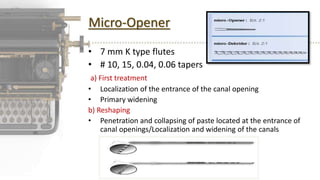
Micro-Opener
• 7 mm K type flutes
• # 10, 15, 0.04, 0.06 tapers
a) First treatment
• Localization of the entrance of the canal opening
• Primary widening
b) Reshaping
• Penetration and collapsing of paste located at the entrance of
canal openings/Localization and widening of the canals
Micro- Debrider
• Hedstrom cutting configuration
• 0.02 taper, sizes #20, 30
• For hard-to-reach, hard-to-visualize canals
• Evacuation of all material or tissue
• Canal widening
Endodontic excavator
• Long shanked
• Small blade
• Excise pulp tissue
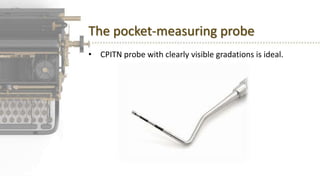
The pocket-measuring probe
• CPITN probe with clearly visible gradations is ideal.
Miscellaneous
• Sterile Cotton Wool Pledgets
• Artery Forceps To Grip A Periapical Radiograph And A Metal
Ruler
• Measuring Device That May Be Sterilized
• Paper Points -Presterilized Packs With Five Points In Each Pack
• Rubber Dam Kit
• Radiographic Equipment
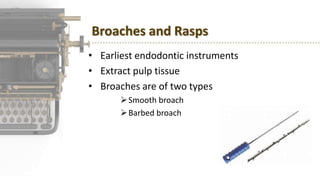
Broaches and Rasps
• Earliest endodontic instruments
• Extract pulp tissue
• Broaches are of two types
Smooth broach
Barbed broach
Smooth broach
• Initial instrument explore the patency and walls of the
canal
• Placing the instrument before removal of pulpal
content may force any inflamed or necrotic tissue
through the apex
Barbed broach
• Used for many years
• Originally in canal preparation
• Ease of breakage
• To removal of soft tissue only.
Manufacturing
• As in weine -soft steel that is notched by shredder
• As per grossman - soft iron wire in which angle cuts are
made
• As per cohen - hacking a round tapered wire with a
blade
Uses
• Originally- canal enlargement and shaping
• Primarily- gross removal of soft tissue removal of
cotton or paper points
• Removal of necrotic debris, absorbent points and other
foreign material
Precaution to be taken
• Never force into a canal beyond the length where it
first begins to bind
• Hard surface of dentin walls is felt
• Should not be inserted into the root canal until the
canal has been enlarged throughout upto a size of
no.20 or 25 reamer/file
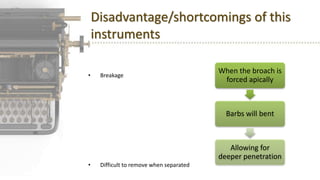
Disadvantage/shortcomings of this
instruments
• Breakage
• Difficult to remove when separated
When the broach is
forced apically
Barbs will bent
Allowing for
deeper penetration
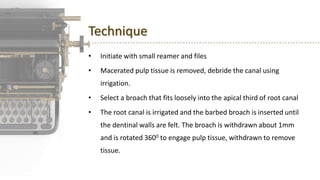
Technique
• Initiate with small reamer and files
• Macerated pulp tissue is removed, debride the canal using
irrigation.
• Select a broach that fits loosely into the apical third of root canal
• The root canal is irrigated and the barbed broach is inserted until
the dentinal walls are felt. The broach is withdrawn about 1mm
and is rotated 3600 to engage pulp tissue, withdrawn to remove
tissue.
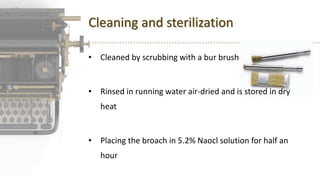
Cleaning and sterilization
• Cleaned by scrubbing with a bur brush
• Rinsed in running water air-dried and is stored in dry
heat
• Placing the broach in 5.2% Naocl solution for half an
hour
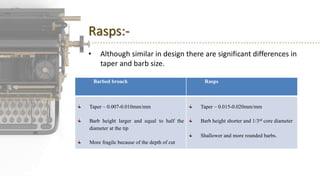
Rasps:-
• Although similar in design there are significant differences in
taper and barb size.
Barbed broach Rasps
Taper – 0.007-0.010mm/mm
Barb height larger and equal to half the
diameter at the tip
More fragile because of the depth of cut
Taper – 0.015-0.020mm/mm
Barb height shorter and 1/3rd core diameter
Shallower and more rounded barbs.
PATHFINDER
Pathfinder CS
• This Carbon Steel Pathfinder provides improved initial
access, negotiating and clearing even highly-calcified
root canals, all the way to the apex.
• The K1 Pathfinder is approximately between file sizes
06 and 08
• The K2 Pathfinder is approximately between file sizes
08 and 10
Profinder (Denstply)
• This file has been specially designed to allow quick and easy
establishment of the glide path of the root canal for shaping with
successive instruments.
• The ProFinder files come in sizes 10, 13 and 17, which are all
available in lengths 18mm, 21mm and 25mm.
Profinder (Denstply)
• Explore
10,13,17
• Shape
Hand/rotary
• WL
10,11,13
• Finish
shaping
Hand/rotary
Reamers:- K-type reamers
• Manufacturing
Reamers:- K-type reamers
Uses:
 Shave dentin
 Widen the canal
 Clockwise reaming action – debris and GP
 Counterclockwise – place sealers and pastes
• Technique : Penetration, Rotation and Retraction
K- Files [Kerr-file]
• Manufacturing
• Uses
K- Files [Kerr-file]
Technique
 Pure filing
 Quarter turn filing
 Pure reaming
Advantages of K-type instruments
• The K-type instrument is useful for the penetration of root canals and
increasing their size
• The K-type file is strong and can easily be precurved to a desired form
for filing
• These files have a similar torsional strength regardless it used in
clockwise or counterclockwise motions
Shortcomings of K-type instruments
• The K-type instrument is poor in removing bulk dentin, unlike H-type
instruments
• The K-type instrument may fracture during clockwise motion after plastic
deformation takes place before a brittle fracture occurs
• This type of instruments needs to be operated more carefully when forced in
counterclockwise direction.
K-style modifications
• K-flex files
• Flex-0-file
• Triple –Flex file
• Flex-R-file
• Zipper flexicut
K-flex files
A
A
B
B
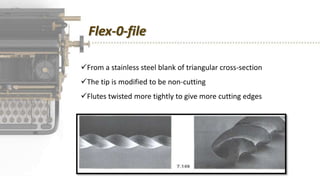
Flex-0-file
From a stainless steel blank of triangular cross-section
The tip is modified to be non-cutting
Flutes twisted more tightly to give more cutting edges
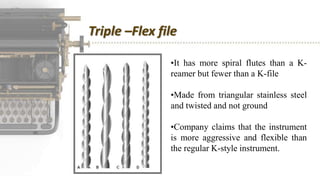
Triple –Flex file
•It has more spiral flutes than a K-
reamer but fewer than a K-file
•Made from triangular stainless steel
and twisted and not ground
•Company claims that the instrument
is more aggressive and flexible than
the regular K-style instrument.
Flex-R-file
Developed by Union Broach company.
This instrument was designed to be used in Roane’s balanced
force technique.
Machined from triangular cross-section (70o) and a guided collar
angles of 35o.
The tip angle is reduced to an angle of 35o so the file stays
centered and cuts all sides more evenly.
Zipper flexicut
Produced by twisting triangular shank made from space craft
steel.
It is a high vacuum fired chrome metal steel which is claimed to
give uniform structure
It’s claimed advantages are its flexibility and non-aggressive tip.
Recent advances in K-files
C+ files
• location of the canal orifices and the initial
exploration of calcified canals.
• diameters 8, 10 and 15
• lengths of 18, 21 and 25 mm.
• Show a characteristic resistance to deformation,
derived from the robust quadrangular cross-
section, which allows the operator to exert 143%
more pressure during insertion into a canal than
would deform a K-File of corresponding size.
C-pilot file
• Used for probing calcified root canals and for creating a
smooth passage for rotary NiTi preparation.
• It has a feature of extra sturdiness due to a unique thermo
process. It is thin but strong enough for obliterated canals.
• C-pilot files are available in ISO sizes – 006, 008, 010, 012.5,
015.
• The files are available in length of 19, 21 and 25.
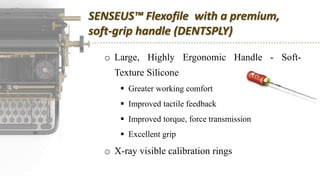
SENSEUS™ Flexofile with a premium,
soft-grip handle (DENTSPLY)
o Large, Highly Ergonomic Handle - Soft-
Texture Silicone
 Greater working comfort
 Improved tactile feedback
 Improved torque, force transmission
 Excellent grip
o X-ray visible calibration rings
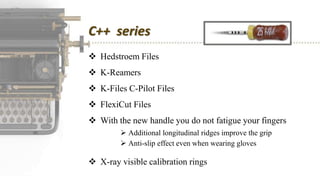
C++ series
 Hedstroem Files
 K-Reamers
 K-Files C-Pilot Files
 FlexiCut Files
 With the new handle you do not fatigue your fingers
 Additional longitudinal ridges improve the grip
 Anti-slip effect even when wearing gloves
 X-ray visible calibration rings
HEDSTROEM FILE [H-FILE]
• Manufacture
• Indication/uses
• Precaution
• Technique
• Advantages
• Disadvantage
Hedstroem file [H-file]
• Instrument has spiral edges arranged to allow cutting
only during a pulling stroke
• It has a more positive rake angle and a blade with a
cutting rather than a scrapping angle
Hedstroem file [H-file]
• Strong, aggressive cutters
• The instrumentation of immature teeth,
• Useful in removing silver points or loose broken
instruments from canals.
• Files up to # 25 are used to relocate canal orifices
• They are best suited for
 Preflaring
 Reverse flaring
 Widening the orifice of any canals for easier
placement of smaller instruments
 To place filling materials.
Hedstroem file [H-file]
ADVANTAGES
 Cut in one direction
 Do not pack debris
 Three times more efficient than k-files
 Ideal for bulk removal of dentin
DISADVANTAGES
 Fracture if the flutes
 Crack the weakened and stressed root
 Separate files
 Difficult to bend to the desired curvature
H-style file modification
Dynatrak file [S-file]:-
• It is a variation of the unifile.
• It differs from the unifile since the angle of the flutes
remains uniform throughout the length of the instrument
and the depth of the flute increases from the tip to handle
Safety H-file [Ingle 5th edition]:-
• A modification of H-file by Buchanan.
• Has a flattened non-cutting side to
prevent ledging in curved canals and to
prevent stripping.
NT sensor files [Ingle 4th edition]:-
• Mc Spadden redesigned the H-file variation as the NT
sensor files. These instruments have three flutes, the
third flute set at half the angle of the other two S-
shaped flutes.
MAC file [Ingle 4th edition]:-
• Newest version of NT sensor files.
• Produced in nickel titanium which gives instruments
super-elasticity.
A-file [Ingle 4th edition]:-
• Levy modified the H-file to function better with the
automated canal finder system. Hand files are also
available.
• Features of A-file
 Steep depth of flutes
 40o helical angle of cutting blades, which cuts more
efficiently than standard 60-70o helical angles.
 Non-cutting tip
Helifile:-
• The method of manufacture is similar to the H-file and
Unifile except that in cross-section there are 3-blades.
• The appearance resembles a reamer rather than a H-
file
Hyflex file:-
• Have the same cross-sectional configuration as Unifile
and Dynatraks. However the latter two are no longer
being marketed.
Instrument for apical
preparations
Apical reamers:-
• Introduced by Otani
• Blades extend only 3mm up the shafts
• Used to prepare only the final retention and resistance
form area of the canal
• Come in ISO size 20 – 70
Canal master:-
Based on k-flex design
Major features –
• A 1.0 mm non-cutting pilot tip
• A small size cutting head (3.0 mm, since reduced to 1-2mm)
• A non-cutting shaft with increased flexibility
• They resembled somewhat a gates-glidden drill
• Advantages –
– Less apical transportation
– A more rounded preparation
Heliapical:-
• Resembles a conventional file in the apical 4-5mm
• Remainder is a narrow blank shank
• Care is needed in its use, small sizes fracture if a
continuous rotational motion is used
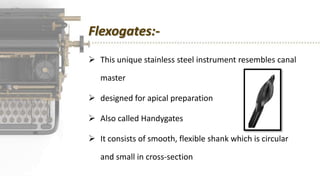
Flexogates:-
 This unique stainless steel instrument resembles canal
master
 designed for apical preparation
 Also called Handygates
 It consists of smooth, flexible shank which is circular
and small in cross-section
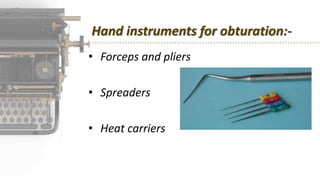
Hand instruments for obturation:-
• Forceps and pliers
• Spreaders
• Heat carriers
Instrument damage:
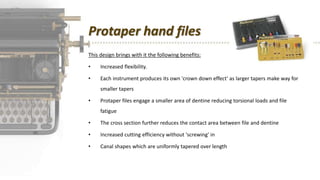
Protaper hand files
This design brings with it the following benefits:
• Increased flexibility.
• Each instrument produces its own 'crown down effect' as larger tapers make way for
smaller tapers
• Protaper files engage a smaller area of dentine reducing torsional loads and file
fatigue
• The cross section further reduces the contact area between file and dentine
• Increased cutting efficiency without 'screwing' in
• Canal shapes which are uniformly tapered over length
Cleaning and sterilization of the
instruments:-
• All instruments contaminated with oral and other body fluids should
be cleaned and sterilized after use. There are three stages to the
sterilization process:
– Presterilization cleaning
– Sterilization
– Storage
Cleaning of the instruments
• Aseptic technique is especially important in
endodontics because microorganisms are the major
cause of endodontic disease.
• In endodontic therapy cleaning actions are required at
three points in time: instruments must be cleansed
prior to or between uses and during their use.
Importance of cleaning files
• Before use - concerning the presence of debris and metallic defects
• During use of the instrument - to avoid possibly transport of this
septic/toxic material to the periapical region setting up an acute reaction
• After the use of the instrument - cleaning of the file blades with
alcohol-soaked gauze
Methods of cleaning:-
• Many methods have been advocated for cleaning
endodontic instruments:
• Cotton rolls,
• Gauze sponges,
• Hand brushes,
• Clean-stand and
• Ultrasonic cleaner
Instrument sterilization
• Chemical methods
• Dry heat
• Bead sterilizers
• Pressure steam (autoclave)
Instrument storage
• The RAF tray
• Metal containers
• Standard 11mm wide Pyrex
test tubes
File holders:-
There are several file holders on the market; they carry
enough instruments for one treatment or part of the
treatment. This simple stand for files closes flat to prevent
the instruments falling out in the autoclave.
Conclusion
• The Evolution of endodontic instrumentation is
an ongoing process in which the benefits are
continuously being refined.
References
• PATHWAYS OF THE PULP-COHEN 8th & 9th
EDITIONS
• Endodontics-Ingle.BAKLAND 5thedition
• Endodontic practice-Louis i.Grossman-11thedition
• DCNA-modern endodontic practice
• Endodontic theraphy; weine
• OOO 2000;13:420-4
• JOE vol 31.No 8 august 2005
• IEJ 1998 VOL 31,166-172
Thank you

endodontic hand instruments

  • 2.
  • 3.
    Contents • Introduction • Materials •Standardization • Classification • File design • Hand instruments • Nickel titanium Instruments • Cleaning, sterilization and storage • Conclusion • References
  • 4.
    Introduction • The handoperated instruments
  • 5.
  • 6.
    Introduction • The earliesthand-operated devices
  • 7.
    Introduction • As rootcanal treatment diversified
  • 8.
    The basic endodonticinstruments • Broaches • Files • Reamers.
  • 9.
    • The clinicianis bombarded with an assortment of new products and techniques designed to make treatment faster and effective. • The technical demands and levels of precision have traditionally been achieved by careful manipulation of hand instruments within the root canal space
  • 10.
    Short comings ofthe older instruments Before 1958 • Manufactured without established criteria • Numbering -arbitrary • Different company - did not coincide • No correlation of instrument and filling materials • No quality control of the instrument • No uniformity existed in progression
  • 11.
    Short comings ofthe older instruments BY 1962 Working committee on standardization  Manufacturers  The American Association Of Endodontics (AAE)  The American Dental Association (ADA). This group evolved into present day INTERNATIONAL STANDARDS ORGANIZATION (ISO)
  • 12.
    The endodontic instrumentmaterials Should be hard enough Flexible Resist breakage
  • 13.
    MATERIALS USED FORMANUFACTURING THE CUTTING INSTRUMENTS:-  Carbon steel instruments  Stainless steel instruments  Nickel-titanium instruments (Nitinol)
  • 14.
    Carbon steel instruments •Until 1960 - carbon steel. • Produced by grinding- round piano wire • Disadvantage – Rigid – susceptible to corrosion
  • 15.
    Stainless steel instruments •Replaced the carbon steel » Resilient, » Ductile and » Less susceptible to corrosion • A steel wire is ground along the long AXIS Disadvantages – Distortion – Stiffness of material – Need to pre-curve the file in curved canals – Tendency to fracture
  • 16.
    Nickel-titanium instruments (Nitinol) •To overcome the disadvantage of the stainless steel. • Exotic metal • It exhibit super elastic behavior and “shape memory”
  • 17.
    Nickel-titanium instruments (Nitinol) •1960's‘- W.F. Buehler • In dentistry, Andersen and Hilleman (1971) • Walia et al in 1988 - Endodontics • Nitinol files are being manufactured in a U-shaped configuration as well as K and H-shapes.
  • 18.
    Nickel-titanium instruments (Nitinol) Advantages– – Less susceptible to distortion – Low modulus of elasticity – Elastic flexibility – Resistance to fracture – Flexibility is greater Disadvantages – – Cutting efficiency is less – Expensive – Difficult to manufacture and mill – Still susceptible to corrosion
  • 19.
  • 20.
    Files were firstmanufactured The more traditional is produced by grinding graduated sizes of round “piano” wire The steel wire is ground along its long axis into a 4 sided (square0 or 3 sided (triangular) tapered shaft i.e. twisted into flutes extending 16 mm from top to tip of blade. Three-sided configuration with fewer spirals -reaming, three or four sided configuration with more spirals -filing.
  • 21.
    Walton and Torabinejad: DIRECT METHOD – Involves machining the instrument directly on lathe E.G: H-type file INDIRECT METHOD – Most common, involves grinding raw wire into tapered geometric form such as a square or triangle. The wire is then twisted counterclockwise to produce an inclined plane with subsequent cutting edge. E.G: K-type files.
  • 22.
    Standardization of theendodontic instruments  Before 1958, endodontic instruments were manufactured without any established criteria.  There was no uniformity in quality control, manufacture or progression from one size to another.  These arbitrarily numbered from 1 to 6
  • 23.
    In 1959, Ingleand Levine proposed standardization of these instruments 1. Instruments shall be numbered from 10 to 100, the numbers to advance by 5 units to size 60, then by 10 units to size 100. 2. Each number shall be representative of the diameter of the instrument in hundredths of a mm at the tip. For e.g. No 10 is 10/100 or 0.1mm at the tip. 3. The working blade (flutes) shall begin at the tip designated site D1 and shall extend exactly 16mm up the shaft, terminating at designated site D2 4. The diameter of D2 shall be 32/100 or 0.32mm greater than that of D1. This sizing ensures a constant increase in taper of 0.02mm per mm for every instrument regardless of the size For e.g. No 20 reamer shall have a diameter of 0.20 at D1 and at D2 0.20+0.32 =0.52mm
  • 24.
    • The instrumenthandles have been color coded for easier recognition as • Thus from 45 onwards, this sequence of color coding from white till black repeats.
  • 25.
    Other specifications wereadded latter. These includes – • The full extend of the shaft, up the handle, comes in three lengths. Standard 25mm, long – 31mm and short – 21mm. and also 19mm. however other instrument lengths are available 21mm – used for molars 28 and 30mm for cuspids 25mm – for anteriors 40mm reamers used in preparing canals for endodontic implants.
  • 26.
    Other specifications wereadded latter. These includes –  Universal use of stainless steel and nickel titanium
  • 27.
    1. At presenttime, instruments with a taper greater than the ISO 0.02mm/mm have been become popular  These new instruments allow for greater coronal flaring
  • 28.
    Classification • According toGrossman: 1. Exploring instruments 2. Debriding instruments 3. Cleaning and Shaping instruments 4. Obturating instruments
  • 29.
  • 30.
    Classification • Classification ofEndodontic files and reamers according to new ADA specification No. 28 Type-I - Reamers Type-II - Files Type-III - Hedstroem Files Type-IV - Rasps Type-V - Broaches Type-VI - Probes Type-VII - Applicators Type-VIII - Condensers Type-IX - Spreaders
  • 31.
    Classification According to designof instruments:- • Based on their cross-sectional shapes –  Square (K-type)  Triangular (K-reamer; Flexo-file; Flex-R file)  Rhomboidal (K-flex file)  Circular (H-file)  S-shaped file (Unifile) • Based on method of manufacture of cutting edge –  Twisted  machined instruments
  • 32.
  • 33.
    • The amountthe file diameter increases each millimeter along its working surface from the tip toward the handle. • E.g. size #25 file – 0.02 taper 0.27mm – 1mm 0.29mm – 2mm 0.31mm - 3mm The taper
  • 34.
    The flutes The GROOVEin the working surface used to collect soft tissue and dentin chips removed from the wall of the canal.
  • 35.
    Land • If asurface projects axially from the central axis as far as the cutting edge between flutes, this surface is called the “Land”
  • 36.
    Relief • The surfacearea of the land that rotates against the canal wall may be reduced to form the “relief”
  • 37.
    Helix angle • Theangle the cutting edge forms with the long axis of the file is called “Helix angle”
  • 38.
    The rake angle •Angle formed by the leading edge and the radius of the file, when the file is sectioned perpendicular to its long axis.
  • 39.
    The rake angle •If the angle formed by the leading edge and the surface to be cut is obtuse, the rake angle is said to be positive or cutting
  • 40.
    The rake angle •If the angle formed by the leading edge and the surface to be cut is acute, the rake angle is said to be negative or scraping.
  • 41.
    The pitch • Thepitch of the file is the distance between a point on the leading edge and the corresponding point on the adjacent leading edge.
  • 42.
    Tip design • Thetip design can affect file control, efficiency, and outcome in shaping of root canal systems. The instrument tip has been described as – CUTTING, – NON-CUTTING – PARTIALLY CUTTING • The instrument tip has two functions  To enlarge the canal  To guide the file through the canal
  • 43.
  • 44.
    A front surfacereflecting mouth mirror Prevent the double image
  • 45.
    Endolocking tweezers • Grippedsafely • Tip of the beak • Particularly useful - when handling gutta-percha points, paper points and cotton wool pledgets
  • 46.
    CANAL PROBE • Long,fine, sharp and strong • Feel the floor of the pulp chamber
  • 47.
    Endodontic explorer  D-5explorer  No 23-16,  DG16 endodontic probe • Determine canal angulations • Has two straight very sharp ends  CK-17 explorer- Calcified orifies  #17 operative explorer-pulp chamber roof
  • 48.
    Micro-opener And Micro-debrider:- •A new addition to the finding and enlarging orifices is the MICRO- OPENER • Followed by the MICRO – DEBRIDER • Slender handle • View of the operating site is unobstructed • Easy localization and access • No hampering due to antagonist teeth • Convenient sterilization, instant recognition due to ISO color coding • A completely unobstructed view
  • 49.
    Micro-Opener • 7 mmK type flutes • # 10, 15, 0.04, 0.06 tapers a) First treatment • Localization of the entrance of the canal opening • Primary widening b) Reshaping • Penetration and collapsing of paste located at the entrance of canal openings/Localization and widening of the canals
  • 50.
    Micro- Debrider • Hedstromcutting configuration • 0.02 taper, sizes #20, 30 • For hard-to-reach, hard-to-visualize canals • Evacuation of all material or tissue • Canal widening
  • 51.
    Endodontic excavator • Longshanked • Small blade • Excise pulp tissue
  • 52.
    The pocket-measuring probe •CPITN probe with clearly visible gradations is ideal.
  • 53.
    Miscellaneous • Sterile CottonWool Pledgets • Artery Forceps To Grip A Periapical Radiograph And A Metal Ruler • Measuring Device That May Be Sterilized • Paper Points -Presterilized Packs With Five Points In Each Pack • Rubber Dam Kit • Radiographic Equipment
  • 54.
    Broaches and Rasps •Earliest endodontic instruments • Extract pulp tissue • Broaches are of two types Smooth broach Barbed broach
  • 55.
    Smooth broach • Initialinstrument explore the patency and walls of the canal • Placing the instrument before removal of pulpal content may force any inflamed or necrotic tissue through the apex
  • 56.
    Barbed broach • Usedfor many years • Originally in canal preparation • Ease of breakage • To removal of soft tissue only. Manufacturing • As in weine -soft steel that is notched by shredder • As per grossman - soft iron wire in which angle cuts are made • As per cohen - hacking a round tapered wire with a blade
  • 57.
    Uses • Originally- canalenlargement and shaping • Primarily- gross removal of soft tissue removal of cotton or paper points • Removal of necrotic debris, absorbent points and other foreign material
  • 58.
    Precaution to betaken • Never force into a canal beyond the length where it first begins to bind • Hard surface of dentin walls is felt • Should not be inserted into the root canal until the canal has been enlarged throughout upto a size of no.20 or 25 reamer/file
  • 59.
    Disadvantage/shortcomings of this instruments •Breakage • Difficult to remove when separated When the broach is forced apically Barbs will bent Allowing for deeper penetration
  • 60.
    Technique • Initiate withsmall reamer and files • Macerated pulp tissue is removed, debride the canal using irrigation. • Select a broach that fits loosely into the apical third of root canal • The root canal is irrigated and the barbed broach is inserted until the dentinal walls are felt. The broach is withdrawn about 1mm and is rotated 3600 to engage pulp tissue, withdrawn to remove tissue.
  • 61.
    Cleaning and sterilization •Cleaned by scrubbing with a bur brush • Rinsed in running water air-dried and is stored in dry heat • Placing the broach in 5.2% Naocl solution for half an hour
  • 62.
    Rasps:- • Although similarin design there are significant differences in taper and barb size. Barbed broach Rasps Taper – 0.007-0.010mm/mm Barb height larger and equal to half the diameter at the tip More fragile because of the depth of cut Taper – 0.015-0.020mm/mm Barb height shorter and 1/3rd core diameter Shallower and more rounded barbs.
  • 63.
  • 64.
    Pathfinder CS • ThisCarbon Steel Pathfinder provides improved initial access, negotiating and clearing even highly-calcified root canals, all the way to the apex. • The K1 Pathfinder is approximately between file sizes 06 and 08 • The K2 Pathfinder is approximately between file sizes 08 and 10
  • 65.
    Profinder (Denstply) • Thisfile has been specially designed to allow quick and easy establishment of the glide path of the root canal for shaping with successive instruments. • The ProFinder files come in sizes 10, 13 and 17, which are all available in lengths 18mm, 21mm and 25mm.
  • 66.
    Profinder (Denstply) • Explore 10,13,17 •Shape Hand/rotary • WL 10,11,13 • Finish shaping Hand/rotary
  • 67.
  • 68.
    Reamers:- K-type reamers Uses: Shave dentin  Widen the canal  Clockwise reaming action – debris and GP  Counterclockwise – place sealers and pastes • Technique : Penetration, Rotation and Retraction
  • 69.
    K- Files [Kerr-file] •Manufacturing • Uses
  • 70.
    K- Files [Kerr-file] Technique Pure filing  Quarter turn filing  Pure reaming
  • 71.
    Advantages of K-typeinstruments • The K-type instrument is useful for the penetration of root canals and increasing their size • The K-type file is strong and can easily be precurved to a desired form for filing • These files have a similar torsional strength regardless it used in clockwise or counterclockwise motions
  • 72.
    Shortcomings of K-typeinstruments • The K-type instrument is poor in removing bulk dentin, unlike H-type instruments • The K-type instrument may fracture during clockwise motion after plastic deformation takes place before a brittle fracture occurs • This type of instruments needs to be operated more carefully when forced in counterclockwise direction.
  • 73.
    K-style modifications • K-flexfiles • Flex-0-file • Triple –Flex file • Flex-R-file • Zipper flexicut
  • 74.
  • 75.
    Flex-0-file From a stainlesssteel blank of triangular cross-section The tip is modified to be non-cutting Flutes twisted more tightly to give more cutting edges
  • 76.
    Triple –Flex file •Ithas more spiral flutes than a K- reamer but fewer than a K-file •Made from triangular stainless steel and twisted and not ground •Company claims that the instrument is more aggressive and flexible than the regular K-style instrument.
  • 77.
    Flex-R-file Developed by UnionBroach company. This instrument was designed to be used in Roane’s balanced force technique. Machined from triangular cross-section (70o) and a guided collar angles of 35o. The tip angle is reduced to an angle of 35o so the file stays centered and cuts all sides more evenly.
  • 78.
    Zipper flexicut Produced bytwisting triangular shank made from space craft steel. It is a high vacuum fired chrome metal steel which is claimed to give uniform structure It’s claimed advantages are its flexibility and non-aggressive tip.
  • 79.
  • 80.
    C+ files • locationof the canal orifices and the initial exploration of calcified canals. • diameters 8, 10 and 15 • lengths of 18, 21 and 25 mm. • Show a characteristic resistance to deformation, derived from the robust quadrangular cross- section, which allows the operator to exert 143% more pressure during insertion into a canal than would deform a K-File of corresponding size.
  • 81.
    C-pilot file • Usedfor probing calcified root canals and for creating a smooth passage for rotary NiTi preparation. • It has a feature of extra sturdiness due to a unique thermo process. It is thin but strong enough for obliterated canals. • C-pilot files are available in ISO sizes – 006, 008, 010, 012.5, 015. • The files are available in length of 19, 21 and 25.
  • 82.
    SENSEUS™ Flexofile witha premium, soft-grip handle (DENTSPLY) o Large, Highly Ergonomic Handle - Soft- Texture Silicone  Greater working comfort  Improved tactile feedback  Improved torque, force transmission  Excellent grip o X-ray visible calibration rings
  • 83.
    C++ series  HedstroemFiles  K-Reamers  K-Files C-Pilot Files  FlexiCut Files  With the new handle you do not fatigue your fingers  Additional longitudinal ridges improve the grip  Anti-slip effect even when wearing gloves  X-ray visible calibration rings
  • 84.
    HEDSTROEM FILE [H-FILE] •Manufacture • Indication/uses • Precaution • Technique • Advantages • Disadvantage
  • 85.
    Hedstroem file [H-file] •Instrument has spiral edges arranged to allow cutting only during a pulling stroke • It has a more positive rake angle and a blade with a cutting rather than a scrapping angle
  • 86.
    Hedstroem file [H-file] •Strong, aggressive cutters • The instrumentation of immature teeth, • Useful in removing silver points or loose broken instruments from canals. • Files up to # 25 are used to relocate canal orifices • They are best suited for  Preflaring  Reverse flaring  Widening the orifice of any canals for easier placement of smaller instruments  To place filling materials.
  • 87.
    Hedstroem file [H-file] ADVANTAGES Cut in one direction  Do not pack debris  Three times more efficient than k-files  Ideal for bulk removal of dentin DISADVANTAGES  Fracture if the flutes  Crack the weakened and stressed root  Separate files  Difficult to bend to the desired curvature
  • 88.
  • 89.
    Dynatrak file [S-file]:- •It is a variation of the unifile. • It differs from the unifile since the angle of the flutes remains uniform throughout the length of the instrument and the depth of the flute increases from the tip to handle
  • 90.
    Safety H-file [Ingle5th edition]:- • A modification of H-file by Buchanan. • Has a flattened non-cutting side to prevent ledging in curved canals and to prevent stripping.
  • 91.
    NT sensor files[Ingle 4th edition]:- • Mc Spadden redesigned the H-file variation as the NT sensor files. These instruments have three flutes, the third flute set at half the angle of the other two S- shaped flutes.
  • 92.
    MAC file [Ingle4th edition]:- • Newest version of NT sensor files. • Produced in nickel titanium which gives instruments super-elasticity.
  • 93.
    A-file [Ingle 4thedition]:- • Levy modified the H-file to function better with the automated canal finder system. Hand files are also available. • Features of A-file  Steep depth of flutes  40o helical angle of cutting blades, which cuts more efficiently than standard 60-70o helical angles.  Non-cutting tip
  • 94.
    Helifile:- • The methodof manufacture is similar to the H-file and Unifile except that in cross-section there are 3-blades. • The appearance resembles a reamer rather than a H- file
  • 95.
    Hyflex file:- • Havethe same cross-sectional configuration as Unifile and Dynatraks. However the latter two are no longer being marketed.
  • 96.
  • 97.
    Apical reamers:- • Introducedby Otani • Blades extend only 3mm up the shafts • Used to prepare only the final retention and resistance form area of the canal • Come in ISO size 20 – 70
  • 98.
    Canal master:- Based onk-flex design Major features – • A 1.0 mm non-cutting pilot tip • A small size cutting head (3.0 mm, since reduced to 1-2mm) • A non-cutting shaft with increased flexibility • They resembled somewhat a gates-glidden drill • Advantages – – Less apical transportation – A more rounded preparation
  • 99.
    Heliapical:- • Resembles aconventional file in the apical 4-5mm • Remainder is a narrow blank shank • Care is needed in its use, small sizes fracture if a continuous rotational motion is used
  • 100.
    Flexogates:-  This uniquestainless steel instrument resembles canal master  designed for apical preparation  Also called Handygates  It consists of smooth, flexible shank which is circular and small in cross-section
  • 101.
    Hand instruments forobturation:- • Forceps and pliers • Spreaders • Heat carriers
  • 102.
  • 103.
    Protaper hand files Thisdesign brings with it the following benefits: • Increased flexibility. • Each instrument produces its own 'crown down effect' as larger tapers make way for smaller tapers • Protaper files engage a smaller area of dentine reducing torsional loads and file fatigue • The cross section further reduces the contact area between file and dentine • Increased cutting efficiency without 'screwing' in • Canal shapes which are uniformly tapered over length
  • 104.
    Cleaning and sterilizationof the instruments:- • All instruments contaminated with oral and other body fluids should be cleaned and sterilized after use. There are three stages to the sterilization process: – Presterilization cleaning – Sterilization – Storage
  • 105.
    Cleaning of theinstruments • Aseptic technique is especially important in endodontics because microorganisms are the major cause of endodontic disease. • In endodontic therapy cleaning actions are required at three points in time: instruments must be cleansed prior to or between uses and during their use.
  • 106.
    Importance of cleaningfiles • Before use - concerning the presence of debris and metallic defects • During use of the instrument - to avoid possibly transport of this septic/toxic material to the periapical region setting up an acute reaction • After the use of the instrument - cleaning of the file blades with alcohol-soaked gauze
  • 107.
    Methods of cleaning:- •Many methods have been advocated for cleaning endodontic instruments: • Cotton rolls, • Gauze sponges, • Hand brushes, • Clean-stand and • Ultrasonic cleaner
  • 108.
    Instrument sterilization • Chemicalmethods • Dry heat • Bead sterilizers • Pressure steam (autoclave)
  • 109.
    Instrument storage • TheRAF tray • Metal containers • Standard 11mm wide Pyrex test tubes
  • 110.
    File holders:- There areseveral file holders on the market; they carry enough instruments for one treatment or part of the treatment. This simple stand for files closes flat to prevent the instruments falling out in the autoclave.
  • 111.
    Conclusion • The Evolutionof endodontic instrumentation is an ongoing process in which the benefits are continuously being refined.
  • 112.
    References • PATHWAYS OFTHE PULP-COHEN 8th & 9th EDITIONS • Endodontics-Ingle.BAKLAND 5thedition • Endodontic practice-Louis i.Grossman-11thedition • DCNA-modern endodontic practice • Endodontic theraphy; weine • OOO 2000;13:420-4 • JOE vol 31.No 8 august 2005 • IEJ 1998 VOL 31,166-172
  • 113.