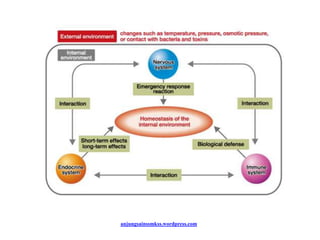
Endocrine system
    Basics
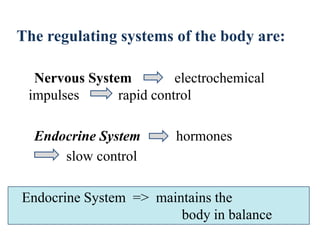
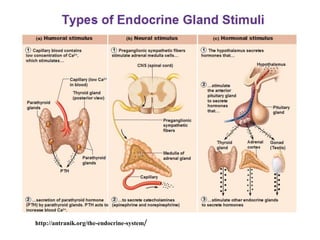
The regulating systems of the body are:

  Nervous System         electrochemical
 impulses      rapid control

  Endocrine System       hormones
      slow control

Endocrine System => maintains the
                        body in balance
Hormones
= substances secreted by endocrine tissue into
  the blood

             act on the target tissue

                                 produce a
                               specific response
http://antranik.org/the-endocrine-system/
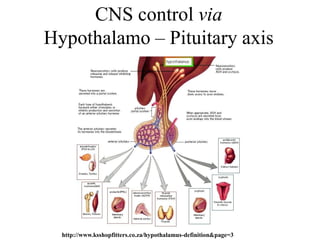
CNS control via
Hypothalamo – Pituitary axis


  http://www.ksshopfitters.co.za/hypothalamus-definition&page=3
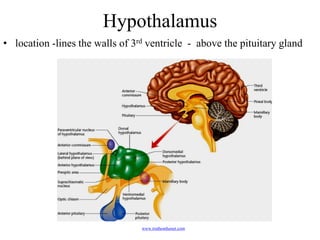
Hypothalamus
• location -lines the walls of 3rd ventricle - above the pituitary gland


                                 www.truthonthenet.com
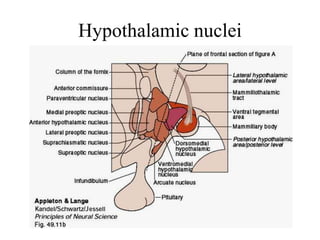
Hypothalamic nuclei
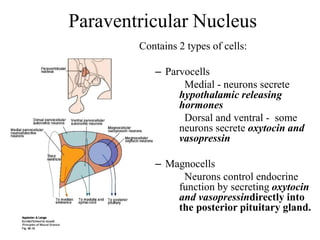
Paraventricular Nucleus
        Contains 2 types of cells:

           – Parvocells
                 Medial - neurons secrete
                hypothalamic releasing
                hormones
                 Dorsal and ventral - some
                neurons secrete oxytocin and
                vasopressin

           – Magnocells
                Neurons control endocrine
               function by secreting oxytocin
               and vasopressindirectly into
               the posterior pituitary gland.
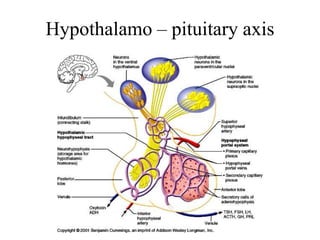
Hypothalamo – pituitary axis
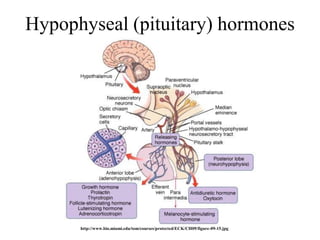
Hypophyseal (pituitary) hormones


      http://www.bio.miami.edu/tom/courses/protected/ECK/CH09/figure-09-15.jpg
Released hormones from the anterior pituitary :
•   Thyroid-stimulating hormone (TSH): stimulates the thyroid gland;
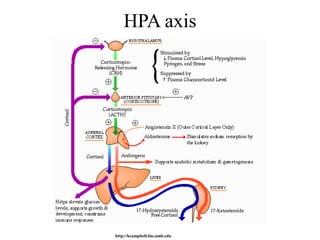
•   Adrenocorticotrophic hormone (ACTH): stimulates the adrenal glands;
•   Follicle-stimulating hormone (FSH): promotes development of eggs within the ovaries
                                          stimulates the secretion of estrogen
                                          stimulates the sperm production in the testes;
•   Luteinizing hormone (LH): causes ovulation in women and prepares the uterus
                                for pregnancy;
•   Prolactin (PRL): causes the development of breast tissue and the production of milk;
•   Growth hormone (GH): causes growth in almost all tissues in the body
                             promotes increase in cell size and cell number.
The posterior pituitary hormones :
•   Anti-diuretic hormone (ADH): causes the kidneys to keep more water in the body;
•   Oxytocin: causes contractions in the uterus of a pregnant woman
               causes the release of milk from the breast.


The paraintermedia hormone:
• Melanocyte – stimulating hormone: stimulates melanogenesis
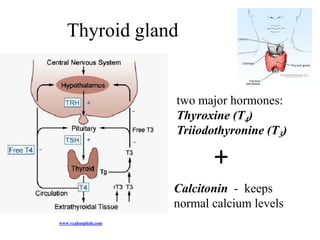
Thyroid gland


                       two major hormones:
                       Thyroxine (T4)
                       Triiodothyronine (T3)

                              +
                       Calcitonin - keeps
                       normal calcium levels
www.vcahospitals.com
Thyroid hormones -
               metabolic actions

• regulate Basal Metabolic Rate
• ↑ oxygen consumption in most target tissues
• ↑ sensitivity of target tissues to catecholamines
  → by elevating lipolysis
glycogenolysis
gluconeogenesis
Thyroid hormones -
             development actions
• critical for normal development of the skeletal system
   and musculature
• essential for normal brain development
• regulates synaptogenesis
 neuronal integration
 myelination
  cell migration

=> neonatal hypothyroidism → Cretinism
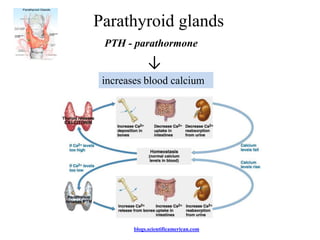
Parathyroid glands
 PTH - parathormone
             ↓
 increases blood calcium


        blogs.scientificamerican.com
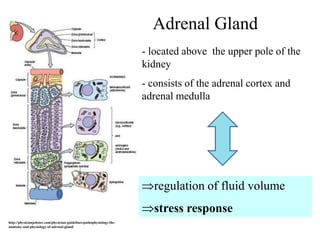
Adrenal Gland
                                                                        - located above the upper pole of the
                                                                        kidney
                                                                        - consists of the adrenal cortex and
                                                                        adrenal medulla


                                                                          regulation of fluid volume
                                                                          stress response
http://physicianjobster.com/physician-guidelines/pathophysiology/the-
anatomy-and-physiology-of-adrenal-gland/
HPA axis


http://kcampbell.bio.umb.edu
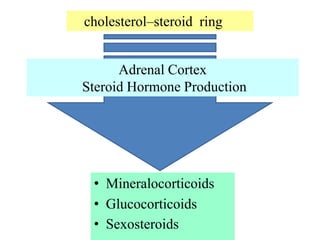
cholesterol–steroid ring


      Adrenal Cortex
Steroid Hormone Production


 • Mineralocorticoids
 • Glucocorticoids
 • Sexosteroids
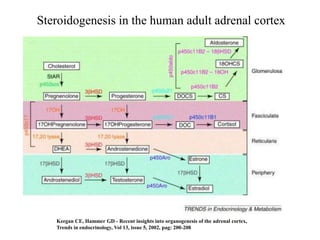
Steroidogenesis in the human adult adrenal cortex


   Keegan CE, Hammer GD - Recent insights into organogenesis of the adrenal cortex,
   Trends in endocrinology, Vol 13, issue 5, 2002, pag: 200-208
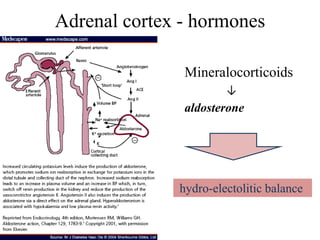
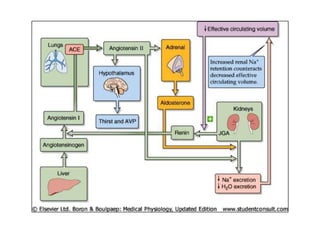
Adrenal cortex - hormones

               Mineralocorticoids
                       ↓
               aldosterone


              hydro-electolitic balance
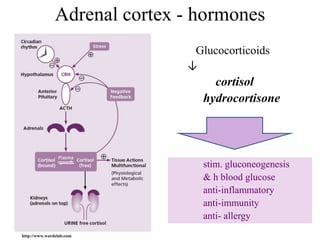
Adrenal cortex - hormones
                               Glucocorticoids
                              ↓
                                   cortisol
                                 hydrocortisone


                                 stim. gluconeogenesis
                                 & h blood glucose
                                 anti-inflammatory
                                 anti-immunity
                                 anti- allergy
http://www.wardelab.com
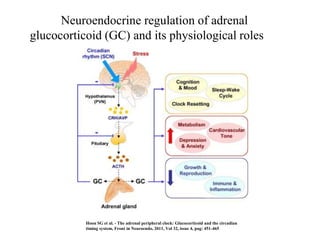
Neuroendocrine regulation of adrenal
glucocorticoid (GC) and its physiological roles


           Hoon SG et al. - The adrenal peripheral clock: Glucocorticoid and the circadian
           timing system, Front in Neuroendo, 2011, Vol 32, issue 4, pag: 451-465
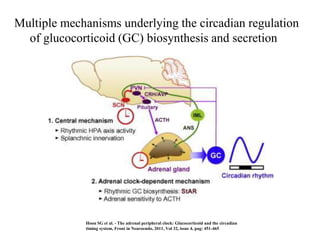
Multiple mechanisms underlying the circadian regulation
  of glucocorticoid (GC) biosynthesis and secretion


             Hoon SG et al. - The adrenal peripheral clock: Glucocorticoid and the circadian
             timing system, Front in Neuroendo, 2011, Vol 32, issue 4, pag: 451-465
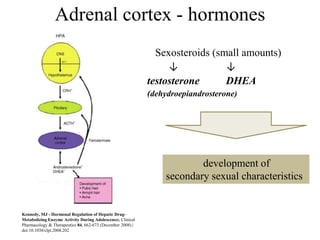
Adrenal cortex - hormones
                                                              Sexosteroids (small amounts)
                                                                 ↓            ↓
                                                            testosterone      DHEA
                                                            (dehydroepiandrosterone)


                                                                        development of
                                                                secondary sexual characteristics


Kennedy, MJ - Hormonal Regulation of Hepatic Drug-
Metabolizing Enzyme Activity During Adolescence; Clinical
Pharmacology & Therapeutics 84, 662-673 (December 2008) |
doi:10.1038/clpt.2008.202
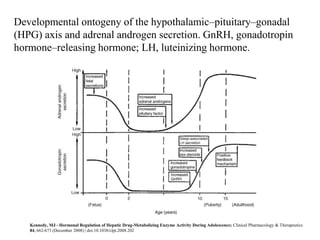
Developmental ontogeny of the hypothalamic–pituitary–gonadal
(HPG) axis and adrenal androgen secretion. GnRH, gonadotropin
hormone–releasing hormone; LH, luteinizing hormone.


   Kennedy, MJ - Hormonal Regulation of Hepatic Drug-Metabolizing Enzyme Activity During Adolescence; Clinical Pharmacology & Therapeutics
   84, 662-673 (December 2008) | doi:10.1038/clpt.2008.202
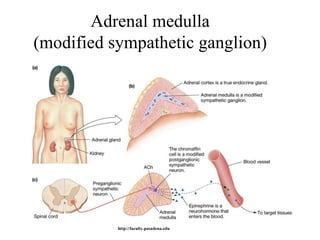
Adrenal medulla
(modified sympathetic ganglion)


           http://faculty.pasadena.edu
Adrenal medulla - hormones
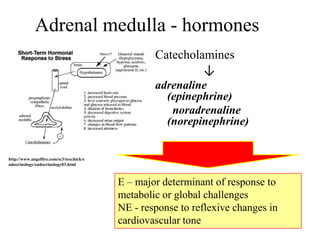
                                                  Catecholamines
                                                             ↓
                                                  adrenaline
                                                    (epinephrine)
                                                     noradrenaline
                                                    (norepinephrine)


http://www.angelfire.com/sc3/toxchick/e
ndocrinology/endocrinology03.html


                                          E – major determinant of response to
                                          metabolic or global challenges
                                          NE - response to reflexive changes in
                                          cardiovascular tone
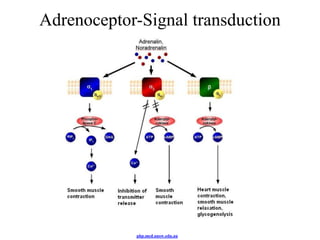
Adrenoceptor-Signal transduction


            php.med.unsw.edu.au
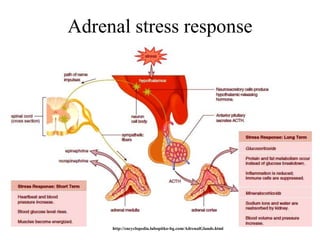
Adrenal stress response


     http://encyclopedia.lubopitko-bg.com/AdrenalGlands.html
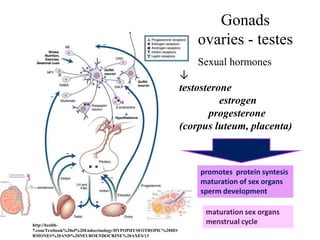
Gonads
                                                                ovaries - testes
                                                                Sexual hormones
                                                            ↓
                                                            testosterone
                                                                      estrogen
                                                                   progesterone
                                                            (corpus luteum, placenta)


                                                                promotes protein syntesis
                                                                maturation of sex organs
                                                                sperm development

                                                                 maturation sex organs
http://health-
                                                                 menstrual cycle
7.com/Textbook%20of%20Endocrinology/HYPOPHYSEOTROPIC%20HO
RMONES%20AND%20NEUROENDOCRINE%20AXES/13
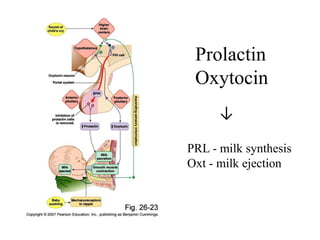
Prolactin
 Oxytocin
      ↓

PRL - milk synthesis
Oxt - milk ejection
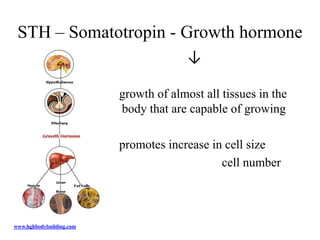
STH – Somatotropin - Growth hormone
                                        ↓

                          growth of almost all tissues in the
                          body that are capable of growing

                          promotes increase in cell size
                                              cell number


www.hghbodybuilding.com
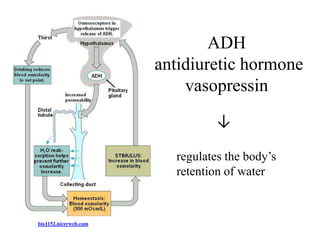
ADH
                       antidiuretic hormone
                           vasopressin
                                 ↓

                         regulates the body’s
                         retention of water


bio1152.nicerweb.com
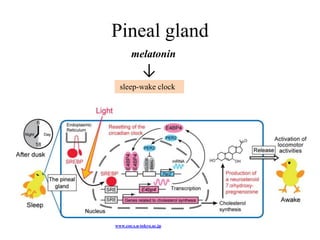
Pineal gland
        melatonin
             ↓
  sleep-wake clock


www.coe.s.u-tokyo.ac.jp
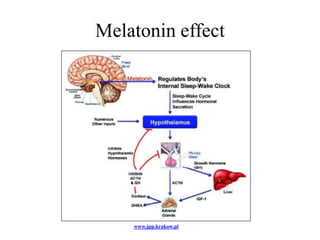
Melatonin effect


    www.jpp.krakow.pl
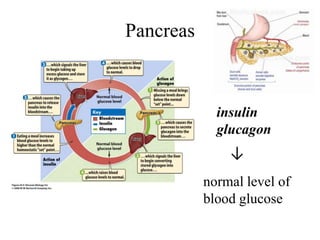
Pancreas


             insulin
             glucagon
               ↓
           normal level of
           blood glucose
www.precisionnutrition.com
anjungsainssmkss.wordpress.com

Endocrine system basics

  • 1.
  • 2.
    The regulating systemsof the body are: Nervous System electrochemical impulses rapid control Endocrine System hormones slow control Endocrine System => maintains the body in balance
  • 3.
    Hormones = substances secretedby endocrine tissue into the blood act on the target tissue produce a specific response
  • 5.
  • 6.
    CNS control via Hypothalamo– Pituitary axis http://www.ksshopfitters.co.za/hypothalamus-definition&page=3
  • 7.
    Hypothalamus • location -linesthe walls of 3rd ventricle - above the pituitary gland www.truthonthenet.com
  • 8.
  • 9.
    Paraventricular Nucleus Contains 2 types of cells: – Parvocells Medial - neurons secrete hypothalamic releasing hormones Dorsal and ventral - some neurons secrete oxytocin and vasopressin – Magnocells Neurons control endocrine function by secreting oxytocin and vasopressindirectly into the posterior pituitary gland.
  • 10.
  • 11.
    Hypophyseal (pituitary) hormones http://www.bio.miami.edu/tom/courses/protected/ECK/CH09/figure-09-15.jpg
  • 12.
    Released hormones fromthe anterior pituitary : • Thyroid-stimulating hormone (TSH): stimulates the thyroid gland; • Adrenocorticotrophic hormone (ACTH): stimulates the adrenal glands; • Follicle-stimulating hormone (FSH): promotes development of eggs within the ovaries stimulates the secretion of estrogen stimulates the sperm production in the testes; • Luteinizing hormone (LH): causes ovulation in women and prepares the uterus for pregnancy; • Prolactin (PRL): causes the development of breast tissue and the production of milk; • Growth hormone (GH): causes growth in almost all tissues in the body promotes increase in cell size and cell number. The posterior pituitary hormones : • Anti-diuretic hormone (ADH): causes the kidneys to keep more water in the body; • Oxytocin: causes contractions in the uterus of a pregnant woman causes the release of milk from the breast. The paraintermedia hormone: • Melanocyte – stimulating hormone: stimulates melanogenesis
  • 13.
    Thyroid gland two major hormones: Thyroxine (T4) Triiodothyronine (T3) + Calcitonin - keeps normal calcium levels www.vcahospitals.com
  • 14.
    Thyroid hormones - metabolic actions • regulate Basal Metabolic Rate • ↑ oxygen consumption in most target tissues • ↑ sensitivity of target tissues to catecholamines → by elevating lipolysis glycogenolysis gluconeogenesis
  • 15.
    Thyroid hormones - development actions • critical for normal development of the skeletal system and musculature • essential for normal brain development • regulates synaptogenesis neuronal integration myelination cell migration => neonatal hypothyroidism → Cretinism
  • 16.
    Parathyroid glands PTH- parathormone ↓ increases blood calcium blogs.scientificamerican.com
  • 17.
    Adrenal Gland - located above the upper pole of the kidney - consists of the adrenal cortex and adrenal medulla regulation of fluid volume stress response http://physicianjobster.com/physician-guidelines/pathophysiology/the- anatomy-and-physiology-of-adrenal-gland/
  • 18.
  • 19.
    cholesterol–steroid ring Adrenal Cortex Steroid Hormone Production • Mineralocorticoids • Glucocorticoids • Sexosteroids
  • 20.
    Steroidogenesis in thehuman adult adrenal cortex Keegan CE, Hammer GD - Recent insights into organogenesis of the adrenal cortex, Trends in endocrinology, Vol 13, issue 5, 2002, pag: 200-208
  • 21.
    Adrenal cortex -hormones Mineralocorticoids ↓ aldosterone hydro-electolitic balance
  • 23.
    Adrenal cortex -hormones Glucocorticoids ↓ cortisol hydrocortisone stim. gluconeogenesis & h blood glucose anti-inflammatory anti-immunity anti- allergy http://www.wardelab.com
  • 24.
    Neuroendocrine regulation ofadrenal glucocorticoid (GC) and its physiological roles Hoon SG et al. - The adrenal peripheral clock: Glucocorticoid and the circadian timing system, Front in Neuroendo, 2011, Vol 32, issue 4, pag: 451-465
  • 25.
    Multiple mechanisms underlyingthe circadian regulation of glucocorticoid (GC) biosynthesis and secretion Hoon SG et al. - The adrenal peripheral clock: Glucocorticoid and the circadian timing system, Front in Neuroendo, 2011, Vol 32, issue 4, pag: 451-465
  • 26.
    Adrenal cortex -hormones Sexosteroids (small amounts) ↓ ↓ testosterone DHEA (dehydroepiandrosterone) development of secondary sexual characteristics Kennedy, MJ - Hormonal Regulation of Hepatic Drug- Metabolizing Enzyme Activity During Adolescence; Clinical Pharmacology & Therapeutics 84, 662-673 (December 2008) | doi:10.1038/clpt.2008.202
  • 27.
    Developmental ontogeny ofthe hypothalamic–pituitary–gonadal (HPG) axis and adrenal androgen secretion. GnRH, gonadotropin hormone–releasing hormone; LH, luteinizing hormone. Kennedy, MJ - Hormonal Regulation of Hepatic Drug-Metabolizing Enzyme Activity During Adolescence; Clinical Pharmacology & Therapeutics 84, 662-673 (December 2008) | doi:10.1038/clpt.2008.202
  • 28.
    Adrenal medulla (modified sympatheticganglion) http://faculty.pasadena.edu
  • 29.
    Adrenal medulla -hormones Catecholamines ↓ adrenaline (epinephrine) noradrenaline (norepinephrine) http://www.angelfire.com/sc3/toxchick/e ndocrinology/endocrinology03.html E – major determinant of response to metabolic or global challenges NE - response to reflexive changes in cardiovascular tone
  • 30.
  • 31.
    Adrenal stress response http://encyclopedia.lubopitko-bg.com/AdrenalGlands.html
  • 32.
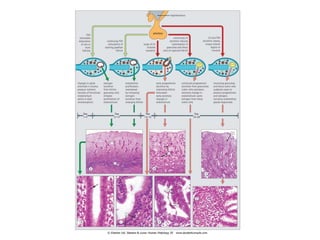
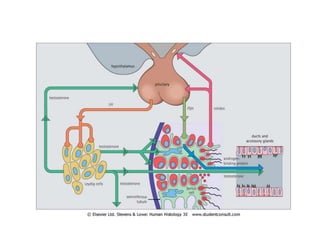
    Gonads ovaries - testes Sexual hormones ↓ testosterone estrogen progesterone (corpus luteum, placenta) promotes protein syntesis maturation of sex organs sperm development maturation sex organs http://health- menstrual cycle 7.com/Textbook%20of%20Endocrinology/HYPOPHYSEOTROPIC%20HO RMONES%20AND%20NEUROENDOCRINE%20AXES/13
  • 35.
    Prolactin Oxytocin ↓ PRL - milk synthesis Oxt - milk ejection
  • 36.
    STH – Somatotropin- Growth hormone ↓ growth of almost all tissues in the body that are capable of growing promotes increase in cell size cell number www.hghbodybuilding.com
  • 37.
    ADH antidiuretic hormone vasopressin ↓ regulates the body’s retention of water bio1152.nicerweb.com
  • 38.
    Pineal gland melatonin ↓ sleep-wake clock www.coe.s.u-tokyo.ac.jp
  • 39.
    Melatonin effect www.jpp.krakow.pl
  • 40.
    Pancreas insulin glucagon ↓ normal level of blood glucose
  • 41.
  • 42.